




Candidates preparing for XAT 2027 should begin their revision by giving priority to DM, VALR and QADI according to their individual strengths and weak areas instead of spending equal time on all sections.
- A well planned revision strategy during the final months can improve section-wise accuracy and the overall XAT 2027 percentile.
- Decision Making revision should focus on previous years' caselets and situation based questions rather than only studying concepts.
- VALR preparation should prioritise Reading Comprehension, Critical Reasoning, Vocabulary in Context, Para Completion, Para Jumbles and Inference based questions.
- XAT 2027 registration started on 15 July 2026 which gives candidates nearly 5.5 months to prepare before the 3 January 2027 examination.
- QADI revision should concentrate on Arithmetic, Algebra, Geometry including Mensuration and Data Interpretation as these topics carry the highest weightage.
- The last three months should be dedicated to full length mock tests, section wise practice and error analysis instead of learning new topics.
Related Links:
- XAT Syllabus 2027 PDF Download: Section-wise Weightage, Exam Pattern, and Best Books
- XAT 2027 Mock Test, Attempt XAT Mock Test Online Free, Test Series and Papers PDF
- XAT Preparation: Mock Test, Section-wise Strategy, Study Plan, Books, Online Coaching
- XAT PYQs: Practice XAT Previous Year Questions (Section-Wise) for QA, VARC, DM & GK

Key Summary
- The last three months before XAT 2027 should be devoted to revision, mock tests, and accuracy improvement, as this phase plays the biggest role in overall performance.
- XAT 2027 deducts 0.25 marks for every incorrect answer in Part 1, while leaving more than eight questions unanswered attracts an additional 0.10 mark penalty for each extra unattempted question.
- Decision Making is unique to XAT, making it one of the highest-priority sections during the final stage of preparation.
- The scored section of XAT 2027 is expected to include 26 VALA questions, 21 Decision Making questions, and 28 QADI questions, while the General Knowledge section is expected to have 20–25 questions and is not included in percentile calculation.
XAT 2027 Exam Pattern Overview
Understanding the XAT 2027 exam pattern helps candidates plan their revision and allocate time more effectively across all sections.
- XAT 2027 is expected to follow the recent exam pattern, with all three scored sections in Part 1 to be completed within a combined 170-minute duration.
- There is no sectional time limit in Part 1, allowing candidates to distribute their time between Decision Making (DM), Verbal and Logical Ability (VALR), and Quantitative Ability and Data Interpretation (QADI).
- Time management is a key factor in XAT 2027, and candidates should practise their pacing strategy during every mock test instead of experimenting on the examination day.
| Section | Questions | Marking Scheme | Counted in Percentile? |
|---|---|---|---|
| Verbal and Logical Ability (VALA) | 26 | +1 / −0.25 | Yes |
| Decision Making (DM) | 21 | +1 / −0.25 | Yes |
| Quantitative Ability and DI (QADI) | 28 | +1 / −0.25 | Yes |
| General Knowledge (GK) | 20 |
+1 (No negative marking) |
No |
Source: XAT Official

Also Read:
Decision Making Revision Strategy
Decision Making (DM) is one of the most important sections in XAT, as it tests ethical reasoning, situational judgement, and business decision-making, unlike other MBA entrance examinations.
- The last three months before XAT 2027 are crucial for Decision Making preparation, as this section requires consistent practice rather than last-minute revision.
- Candidates should prepare Decision Making as a separate subject because it is not tested in CAT, SNAP, or NMAT.
- Candidates should practise 2–3 Decision Making caselets every day, as regular practice improves pattern recognition and decision-making skills.
- Previous years' XAT papers, especially XAT 2023, 2024, and 2025, should be analysed to understand XLRI's decision-making question pattern.
- Ethical Dilemmas, Analytical Reasoning, and Data Arrangement should receive higher priority, as these topics have appeared consistently in recent XAT examinations.
- Candidates should solve every Decision Making case by identifying the stakeholders, evaluating the outcomes, and eliminating unsuitable options before selecting the answer.
- During mock tests, candidates should target around 14–16 accurate attempts in Decision Making, as unnecessary guessing can reduce the overall score because of negative marking.
| DM Sub-type | XAT Frequency | Revision Tip |
|---|---|---|
| Ethical Dilemma | High |
Study business ethics scenarios; always identify all stakeholders before choosing an option |
| Analytical Reasoning | High |
Practise logical puzzles, scheduling, and arrangement problems daily |
| Data Arrangement | Moderate |
Solve complex caselets from past XAT papers under timed conditions |
| Decision-based Caselets | Moderate |
Use structured elimination; never guess when two options seem equally plausible |
Also Read:
Ques. How can I improve my accuracy in the XAT 2027 Decision Making section?
Ans. Candidates can improve their Decision Making accuracy by practising 2–3 caselets daily and analysing why each option is correct or incorrect. Instead of choosing answers based on personal opinion, candidates should evaluate stakeholder interests, ethical responsibilities, and long-term business outcomes. Reviewing previous years' XAT Decision Making questions also helps identify recurring patterns and improves accuracy over time.
Ques. Which Decision Making topics should I prioritise during the last three months before XAT 2027?
Ans. During the final three months, candidates should prioritise Ethical Dilemmas, Analytical Reasoning, Decision-based Caselets, and Data Arrangement as these topics have appeared consistently in recent XAT examinations. Along with regular practice, candidates should analyse XAT 2023–2025 Decision Making papers under timed conditions to strengthen question selection, structured thinking, and decision-making skills before the examination.
Verbal and Logical Ability Revision Strategy
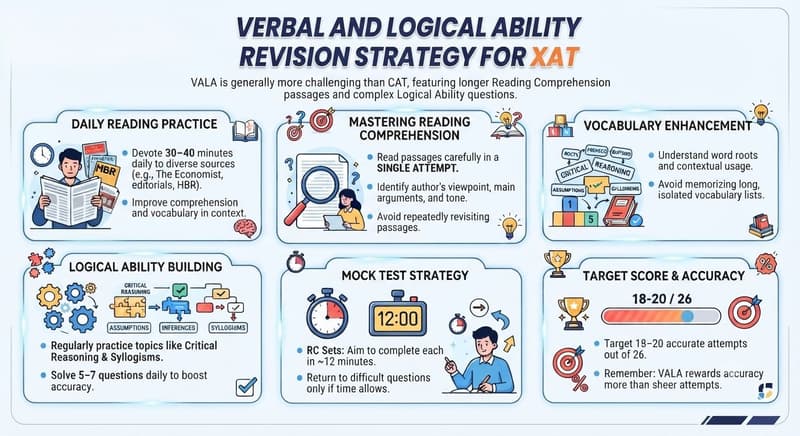
Verbal and Logical Ability (VALA) in XAT is generally more challenging than CAT Verbal Ability, as it includes longer Reading Comprehension passages along with Logical Ability questions.
- Reading Comprehension passages are often based on abstract, philosophical, and analytical topics, making regular reading practice essential for XAT preparation.
- Candidates should spend 30–40 minutes daily reading sources such as The Economist, The Hindu editorials, or Harvard Business Review to improve comprehension and vocabulary.
- While solving Reading Comprehension, candidates should identify the author's viewpoint, main arguments, and tone instead of repeatedly revisiting the passage.
- For vocabulary questions, candidates should focus on word roots and contextual meaning rather than memorising long word lists.
- Logical Ability topics such as Critical Reasoning, Assumptions, Inferences, and Syllogisms require regular practice, and solving 5–7 questions daily can improve accuracy.
- During mock tests, candidates should aim to complete each Reading Comprehension set in about 12 minutes and revisit difficult questions only if time permits.
- Candidates targeting a high VALA score should aim for around 18–20 accurate attempts out of 26, as the section rewards accuracy more than the number of attempts.
Also Read:
Ques. What is a good attempt strategy for the XAT 2027 Verbal and Logical Ability section?
Ans. Candidates aiming for a high percentile should focus on 18–20 accurate attempts out of approximately 26 questions instead of attempting every question. During the examination, candidates should complete each Reading Comprehension set in about 12 minutes, solve familiar Logical Ability questions first, and avoid blind guessing, as maintaining accuracy is more beneficial than increasing the total number of attempts.
Quantitative Ability Revision Strategy
Quantitative Ability and Data Interpretation (QADI) in XAT is comparable to CAT Quantitative Aptitude in difficulty, but the Data Interpretation section demands better speed and time management.
- During the last three months, candidates should focus on improving speed and accuracy and complete the syllabus by the end of October 2026.
- Arithmetic, Algebra, Geometry and Mensuration, and Number System should receive maximum revision time, as these topics consistently carry the highest weightage in QADI.
- Candidates should practise Data Interpretation sets based on tables, graphs, and caselets within 7–8 minutes to match the pace required in XAT.
- Using approximation and option elimination can help candidates solve lengthy calculation-based questions more efficiently during the examination.
- During mock tests, candidates should target around 18–22 attempts in QADI with 70–80% accuracy, as unnecessary guessing can reduce the time available for Decision Making.
| QADI Topic | XAT Weightage | Revision Focus |
|---|---|---|
| Arithmetic | High |
Speed drills on P&L, Percentages, Ratio, Time & Work |
| Algebra | Moderate-High |
Equations, Inequalities, Functions, Progressions |
| Geometry and Mensuration | Moderate |
Formula revision + diagram-based problems |
| Data Interpretation | Moderate |
Mixed DI sets (table + graph + caselets) under timed conditions |
| Number System | Moderate |
Divisibility, Remainders, Factorials, HCF/LCM |
Also Read
XAT 2027 Quantitative Ability and Data Interpretation Chapter-Wise WeightageQues. What is the ideal attempt and accuracy target for the XAT 2027 QADI section?
Ans. Candidates targeting a high percentile in XAT 2027 should aim for 18–22 attempts in the Quantitative Ability and Data Interpretation (QADI) section with 70–80% accuracy. Maintaining good accuracy is more important than attempting every question, as incorrect answers attract negative marking and excessive time spent on QADI can affect performance in Decision Making and Verbal Ability.
Ques. How should I revise Data Interpretation for XAT 2027 in the final three months?
Ans. Candidates should practise mixed Data Interpretation sets containing tables, graphs, and caselets under 7–8 minute time limits to improve calculation speed and question selection. Regular timed practice, along with the use of approximation techniques and option elimination, helps candidates solve lengthy DI questions more efficiently and prepares them for the calculation-intensive nature of the XAT examination.
Month-wise Revision Plan for XAT 2027
The 3-month revision plan is designed to help candidates progress from syllabus revision to full exam readiness, and the preparation intensity should be adjusted according to mock test performance.
- Candidates should analyse every mock test carefully, as spending 90 minutes or more reviewing mistakes is often more beneficial than taking additional mocks.
- During post-mock analysis, candidates should track section-wise accuracy, average time per question, and identify whether mistakes were caused by conceptual gaps, calculation errors, or poor time management.
- Candidates should follow a 20–30 minute daily General Knowledge routine covering business and economy, government policies, international organisations, awards, sports, and static GK.
- Although the General Knowledge section is not included in the XAT percentile, it is considered by XLRI and several other XAT-accepting institutes during shortlisting and interview rounds.
| Month | Primary Focus | Weekly Target |
|---|---|---|
| October 2026 | Concept consolidation and sectional tests |
2 sectional mocks per section each week; review all errors the same day |
| November 2026 | Full mock tests and DM intensive |
2 full XAT mocks per week; 3–4 DM case-sets daily; no new theory |
| December 2026 | Mock analysis and weak-area revision |
3 full mocks per week; daily GK current affairs; tighten pacing |
| Final 2 Weeks (January 2027) | Light revision and confidence building |
1 mock every 3–4 days; revise formulae & short notes only; prioritise sleep and routine |
Also Read
XAT 2027 Expected Cutoff for XIMB, XIME and Other Top CollegesQues. How should I analyse XAT 2027 mock tests to improve my score?
Ans. Candidates should spend at least 90 minutes analysing every XAT mock test after completion. During the analysis, they should identify conceptual mistakes, calculation errors, time-management issues, and poor question selection. Maintaining an error log and tracking section-wise accuracy and average time per question can help candidates avoid repeating the same mistakes and steadily improve their performance.
Ques. What should I do in the last two weeks before XAT 2027?
Ans. During the final two weeks before XAT 2027, candidates should avoid starting new topics and instead focus on formula revision, short notes, previous mistakes, and light mock practice. Attempting one full-length mock every 3–4 days, revising weak areas, maintaining a consistent sleep schedule, and following the exam-day routine can help improve confidence and maximise performance on the examination day.
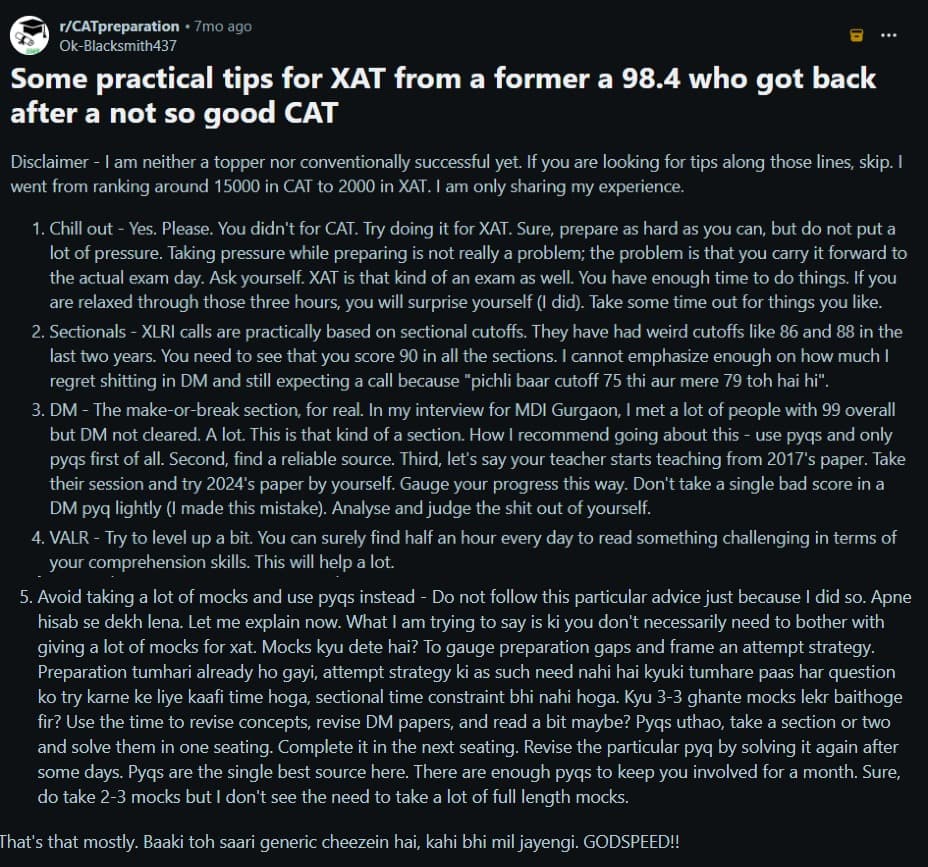
XAT 2027 Revision Strategy: Reddit Discussion
- The discussion shared practical tips for XAT preparation, advising candidates to stay calm during the exam, focus on clearing sectional cutoffs, and give special attention to the Decision Making (DM) section, as it plays a crucial role in the selection process.
- The post also recommended using previous years' XAT papers as the primary preparation resource, improving reading comprehension for VALR, limiting the number of mock tests, and focusing more on revision and mistake analysis to maximise performance in the examination.
XAT 2027 Revision Strategy FAQs
Ques. How many months of preparation are enough for XAT 2027?
Ans. A six-month preparation period is generally considered sufficient for XAT 2027 if candidates follow a disciplined study plan. During the final three months, candidates should focus primarily on revision, full-length mock tests, previous years' papers, error analysis, and improving speed and accuracy instead of starting entirely new topics.
Ques. Which XAT section should get the most revision time in the last 3 months?
Ans. The Decision Making (DM) section should receive the highest priority during the final three months because it is unique to XAT and is not directly covered in other MBA entrance examinations. Candidates should regularly practise previous years' DM caselets, improve ethical and business decision-making skills, and analyse different stakeholder perspectives to maximise their score.
Ques. How many full-length mock tests should I take before XAT 2027?
Ans. Candidates should aim to attempt 20–25 full-length XAT mock tests before the examination. It is equally important to analyse every mock thoroughly by identifying conceptual errors, time-management issues, question selection mistakes, and areas requiring improvement, as mock analysis plays a crucial role in improving the overall XAT score.
Ques. What are the most important QADI topics for XAT 2027?
Ans. Based on previous years' trends, Arithmetic is expected to remain the highest-weightage area in XAT 2027 QADI, followed by Data Interpretation, Algebra, Geometry and Mensuration, Modern Mathematics, and Number System. Candidates should prioritise these topics while also practising calculation-intensive DI sets under timed conditions.
Ques. Is GK important for XAT 2027?
Ans. Yes. Although the General Knowledge (GK) section is not included in the XAT 2027 percentile calculation, it remains important because institutes such as XLRI may consider GK performance during the final selection process. Candidates should spend 20–30 minutes daily covering current affairs, business and economy, national and international events, awards, and important static GK topics.
Ques. When should I stop learning new topics for XAT 2027?
Ans. Candidates should ideally complete all major topics by the end of October 2026. From November onwards, the focus should shift towards revision, sectional practice, previous years' papers, full-length mock tests, and improving weak areas instead of learning new concepts, as consistent revision generally delivers better results during the final preparation phase.



Comments