The NCERT Solutions for Psychology Class 12 Chapter 4 Psychological Disorders answer every textbook Review Question on abnormal behaviour, classification and the main disorders, set to the latest 2026-27 CBSE syllabus. Each answer explains what makes behaviour abnormal, how disorders are grouped, and what the key symptoms are. These solutions help students prepare for the Class 12 Psychology board paper with clear, point-wise answers.
Covers all 11 Review Questions from Chapter 4, with full point-wise answers.
This Class 12 Psychology chapter usually carries 6 to 7 marks in the board paper.
Pairs with the Notes, Handwritten Notes and NCERT Book PDF linked lower on this page.
Every solution for Class 12 Psychology Chapter 4 in this Collegedunia compilation is written by subject experts from the official NCERT Psychology textbook, and checked against the last five years of CBSE board papers.
Student Feedback: In a Collegedunia poll of 8,940 Class 12 Psychology students taken before the 2026 boards, 71% of students rated the classification of disorders as the hardest part of this chapter. Most students said a clear tree of disorder groups made the long-answer questions much easier to recall.
Source: 2026-27 Class 12 Psychology student poll. Sample of 8,940 students from CBSE schools across 13 states.
What Psychological Disorders Class 12 Chapter Is About
Psychological Disorders is the fourth chapter of Class 12 Psychology. It studies what counts as abnormal behaviour, how mental disorders are classified, and the symptoms of the main disorder groups. Before going to the disorders, students must first know how psychologists decide that behaviour is abnormal at all.
The chapter answers three big questions that students should keep in mind:
What is abnormal? Behaviour that is deviant, distressing, dysfunctional or dangerous, the four D criteria.
How are disorders grouped? Through the ICD and DSM classification systems.
What are the main disorders? Anxiety, mood, schizophrenic, dissociative, somatic, eating and substance-use disorders.
So the chapter is really a map of mental health. A student who keeps these three threads in mind can connect almost any question in Psychological Disorders class 12 back to one of them. This is why revision works best when you sort each fact under "what is abnormal", "how it is classified" or "the disorder itself" first.
Abnormality and the Four D Criteria
The chapter opens by asking what makes behaviour abnormal. There is no single test, so psychologists use a set of markers together. For the board exam, students should learn these as a clear list rather than a vague idea of "strange" behaviour.
Deviance: the behaviour differs from what society sees as normal.
Distress: it causes pain or unhappiness to the person.
Dysfunction: it stops normal work, study or relationships.
Danger: it may put the person or others at risk.
A key insight for the exam is that no single criterion is enough on its own. A long-standing pattern of deviant behaviour is only called abnormal when it is also distressing, dysfunctional or dangerous, and is judged in its proper context. Marks come from naming the criteria and then applying them, not just listing them.
How Psychological Disorders Are Classified and Diagnosed
Once abnormality is defined, the next step is to group and name disorders. The chapter explains two systems, and a regular question asks how disorders are diagnosed when there is no physical test. The table below sorts the main points for fast revision.
System or step
What it means
ICD
The World Health Organisation system for naming and coding disorders, used worldwide.
DSM
The American classification manual used to diagnose mental disorders.
Symptoms over time
Diagnosis rests on a pattern of behaviour and feelings, not a single physical sign.
Interview and observation
The psychologist gathers history, observes behaviour and rules out other causes.
The sharp point for the diagnosis question is that psychological disorders are diagnosed from a pattern of symptoms, not from physical signs. Unlike a physician who looks for a fever or a swelling, a psychologist studies behaviour, thoughts and feelings against the ICD or DSM criteria. So the quotation that doctors diagnose only from physical symptoms is a contrast trap, and the answer must explain this difference clearly.
Anxiety, Mood and Schizophrenic Disorders
These three groups carry the most marks in the chapter. Students should keep their definitions and symptoms separate, because the exam often asks them to distinguish or describe a single group. The lists below give the points examiners look for.
Anxiety disorders: generalised anxiety, phobias, panic disorder and obsessive-compulsive disorder, all marked by fear and worry.
Mood disorders: depression (low mood, loss of interest) and mania (high energy, racing thoughts), which combine in bipolar disorder.
Schizophrenia: a break with reality, with positive symptoms like delusions and hallucinations and negative symptoms like flat emotion and social withdrawal.
One frequent trap concerns schizophrenia. When a patient changes topics often while speaking, this is a positive symptom, because it is an excess (disorganised speech), not a loss. Keeping the positive and negative split clear lets students answer the symptom questions without confusion, which is exactly what the long-answer wants.
Dissociative, Somatic, Eating and Substance-Use Disorders
The remaining groups round off the chapter. They appear in short answers and in the case-based items, so students should know the core idea of each. The table keeps the four groups side by side for revision.
Disorder group
Core idea to recall
Dissociative
A split in memory, identity or awareness, as in amnesia, dissociative identity and conversion.
Somatic
Physical complaints with no clear medical cause, linked to mental stress.
Eating
Anorexia and bulimia, often tied to a distorted body image.
Substance-use
Dependence on alcohol or drugs, with serious health, work and family costs.
Two points are worth memorising here. First, a distorted body image can lead to eating disorders such as anorexia (extreme food restriction) and bulimia (binge and purge cycles). Second, alcohol addiction harms the body, the mind, work and family together, so its consequences must be listed across all four areas, not just health.
Psychological Disorders Class 12 Exercise-wise Coverage
The chapter exercise has 11 Review Questions. The table maps each one to its topic so students can plan revision and find the right NCERT answer fast. The full point-wise solution for each sits in the question set lower on this page.
Question
Topic it tests
Q 1
Symptoms of depression and mania
Q 2
Characteristics of children with hyperactivity
Q 3
Consequences of alcohol substance addiction
Q 4
Body image and the forms of eating disorders
Q 5
How psychological disorders are diagnosed
Q 6
Difference between obsessions and compulsions
Q 7
Whether deviant behaviour can be called abnormal
Q 8
Positive and negative symptoms of schizophrenia
Q 9
The term dissociation and its forms
Q 10
Phobias and faulty learning
Q 11
When anxiety becomes a disorder, and its types
Questions 1, 8 and 11 are the most-asked long answers, so students preparing Psychological Disorders class 12 important questions should learn those three first. The "distinguish" and "classify" items (Q4, Q6, Q9) are quick, high-value marks, so revise the disorder groups well to secure them.
Students who want the offline copy can save the class 12 psychology chapter 4 pdf from the download card above and tick off each question as they finish it.
Psychological Disorders Important Questions and Previous Year Trends
CBSE sets a steady mix of short and long answers from this chapter. Knowing the pattern helps students decide how much to write. The chapter is a regular source of one 4-mark or 6-mark question, which is why a focused list of Psychological Disorders important questions saves a lot of revision time.
Long answer (4 to 6 marks): symptoms of schizophrenia, or types of anxiety disorders.
Short answer (2 to 3 marks): obsessions versus compulsions, or forms of dissociation.
Case-based: a short situation that asks students to spot the disorder and its symptoms.
Objective: the four D criteria, ICD and DSM, and positive versus negative symptoms.
For quick recall before the exam, students often practise a short class 12 psychology chapter 4 question answer set and a list of Psychological Disorders class 12 important questions. The most repeated items are the symptoms of schizophrenia and the types of anxiety disorders, so keep those answer points ready in your own words.
Working through the ncert solutions class 12 psychology chapter 4 set twice, once open-book and once from memory, fixes the terms and symptom lists well before the board exam.
Common Mistakes Students Make in This Chapter
A few errors cost marks every year in this chapter. Most come from mixing up disorder groups or confusing positive and negative symptoms. Avoiding them is the fastest way to lift a score.
Calling disorganised speech a negative symptom of schizophrenia. It is a positive symptom.
Confusing obsessions (thoughts) with compulsions (acts). Keep the two clearly separate.
Saying disorders are diagnosed from physical signs. They rest on a pattern of behaviour.
Treating any deviant behaviour as abnormal, without checking distress, dysfunction or danger.
Listing only health effects of addiction, leaving out work, family and mental costs.
Students who fix these five points usually move from average to high marks on the long answers. The exam rewards precise terms, so always name the disorder group and its key symptom before you describe it.
Psychological Disorders PDF Download Formats and Languages
The solutions are free to download in more than one format, so students can pick what suits their device and revision style. The download card at the top of the page carries each option for this chapter.
Normal and HD PDF: the class 12 psychology chapter 4 pdf comes in a normal size for quick downloads and an HD version for clear printing.
English medium: all 11 answers are written in simple English for the CBSE board paper.
Question-only set: a print-and-practise sheet of Psychological Disorders extra questions for self-testing.
Whole-book pack: the solutions sit in one set that runs through every Class 12 Psychology chapter, so you can revise in one place.
Many students search for class 12 psychology chapter 4 answers on their phone the night before a test, so a saved PDF means you can revise even without internet. Keep both the question set and the solved version handy for a full self-check.
How the Psychological Disorders Solutions Pair with Notes and the Book PDF
These NCERT Solutions answer the back-exercise Review Questions. To revise the full chapter, students should use them alongside the other resources for the same chapter, all linked in the table below.
Reading the original NCERT chapter text and case examples
Tip: read the Notes first, then attempt these solutions on your own, and only then check the model answers here. That order builds memory faster than copying answers straight away.
All NCERT Solutions for Class 12 Psychology
The table links the NCERT Solutions for every chapter in Class 12 Psychology, so students can move across the course in one click. Psychological Disorders is highlighted.
All NCERT Solutions for Psychological Disorders with Step-by-Step Solutions
Below are all 11 NCERT exercise questions for this chapter, exactly as they appear in the textbook. Tap Check Solution for the model answer or Expert Solution for the topper-style approach.
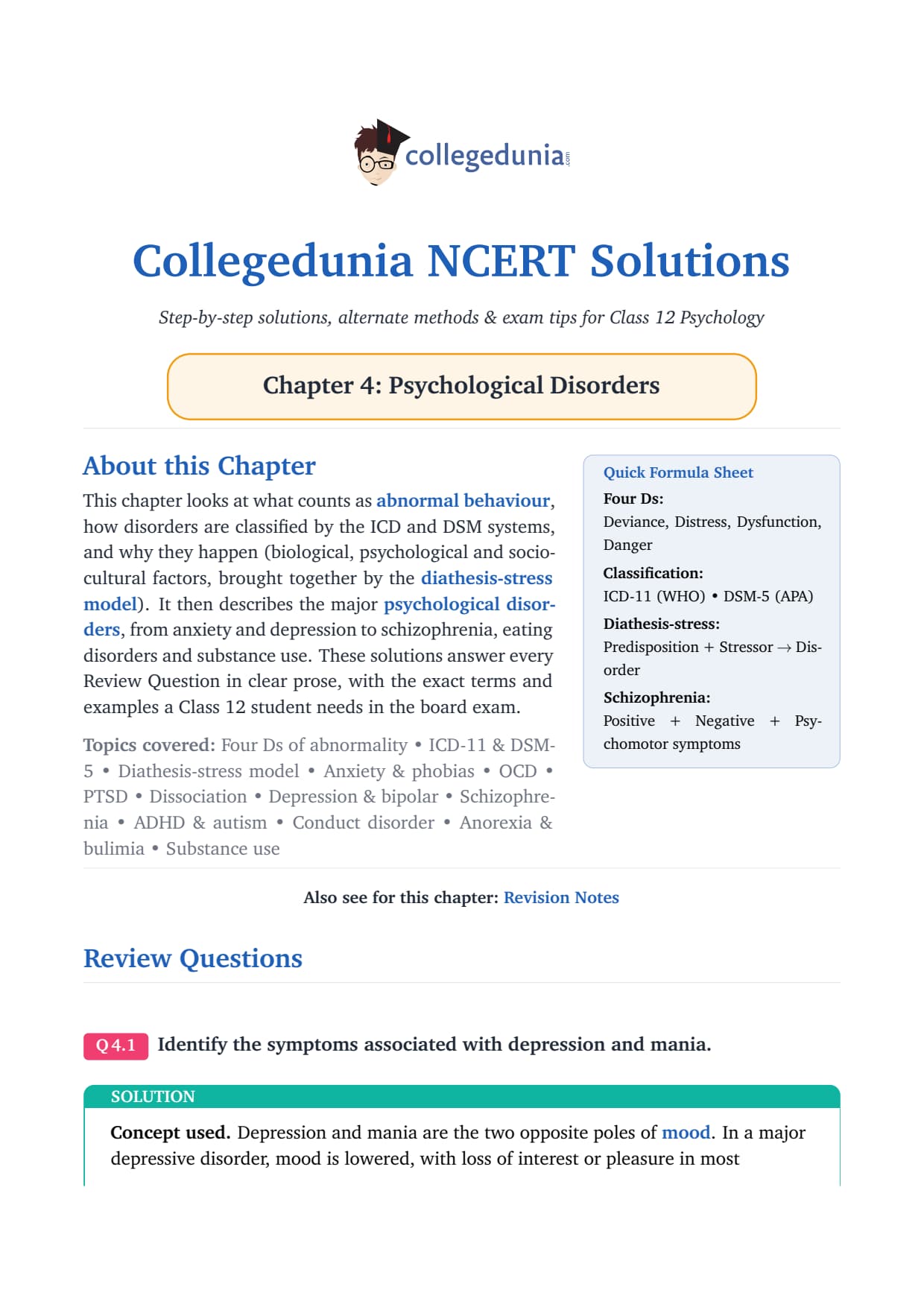
Q 4.1
Identify the symptoms associated with depression and mania.
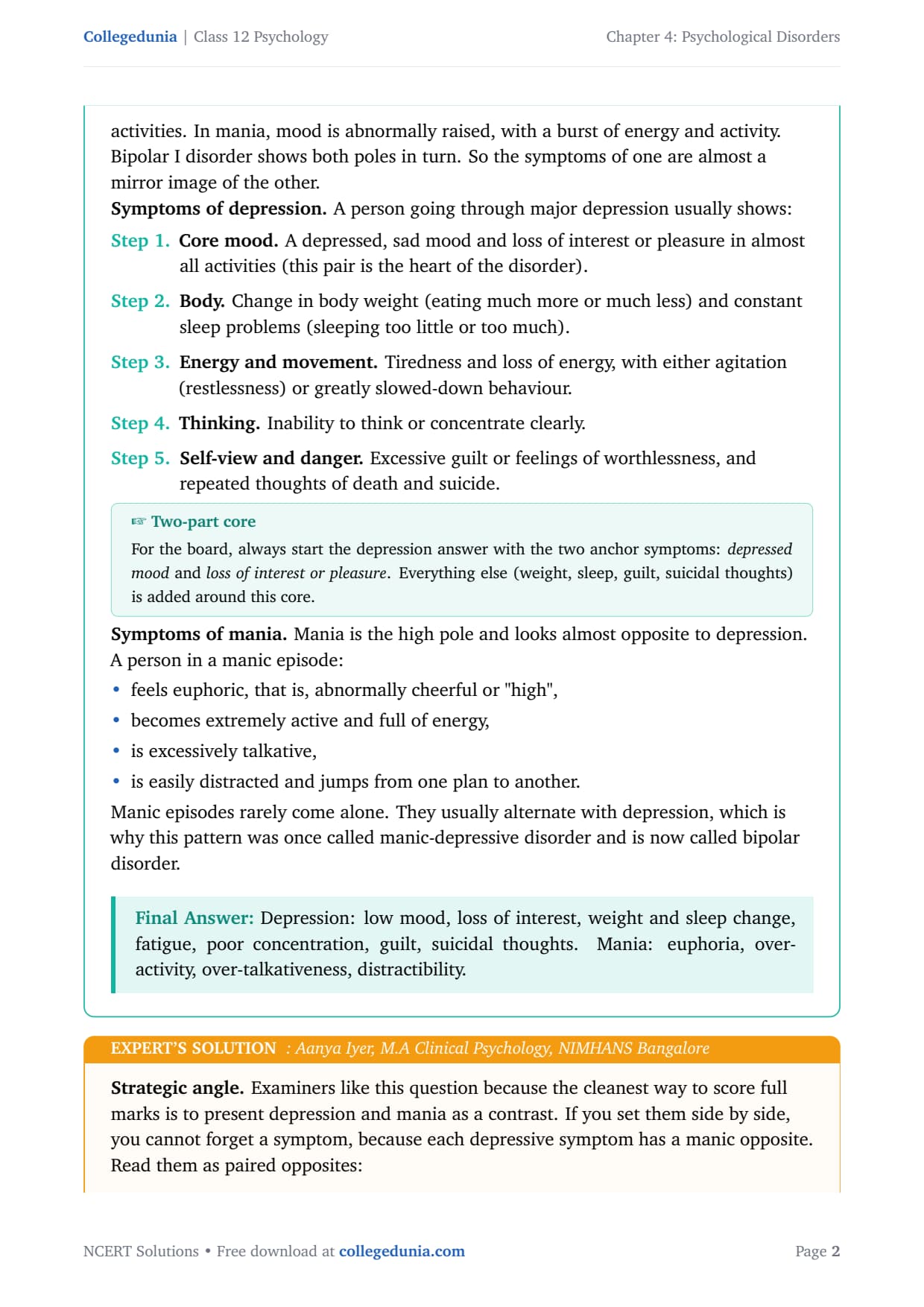
Concept used. Depression and mania are the two opposite poles of
mood. In a major depressive disorder, mood is lowered, with loss
of interest or pleasure in most activities. In mania, mood is abnormally
raised, with a burst of energy and activity. Bipolar I disorder shows both
poles in turn. So the symptoms of one are almost a mirror image of the
other.
Symptoms of depression. A person going through major depression
usually shows:
Core mood. A depressed, sad mood and loss of interest or
pleasure in almost all activities (this pair is the heart of the
disorder).
Body. Change in body weight (eating much more or much
less) and constant sleep problems (sleeping too little or too much).
Energy and movement. Tiredness and loss of energy, with
either agitation (restlessness) or greatly slowed-down behaviour.
Thinking. Inability to think or concentrate clearly.
Self-view and danger. Excessive guilt or feelings of
worthlessness, and repeated thoughts of death and suicide.
Two-part core
For the board, always start the depression answer with the two anchor
symptoms: depressed mood and loss of interest or pleasure.
Everything else (weight, sleep, guilt, suicidal thoughts) is added around
this core.
Symptoms of mania. Mania is the high pole and looks almost
opposite to depression. A person in a manic episode:
feels euphoric, that is, abnormally cheerful or "high",
becomes extremely active and full of energy,
is excessively talkative,
is easily distracted and jumps from one plan to another.
Manic episodes rarely come alone. They usually alternate with depression,
which is why this pattern was once called manic-depressive disorder and is
now called bipolar disorder.
Depression: low mood, loss of interest, weight and sleep change,
fatigue, poor concentration, guilt, suicidal thoughts. Mania: euphoria,
over-activity, over-talkativeness, distractibility.
AI
Aanya Iyer
M.A Clinical Psychology, NIMHANS Bangalore
Verified Expert
Strategic angle. Examiners like this question because the cleanest
way to score full marks is to present depression and mania as a contrast.
If you set them side by side, you cannot forget a symptom, because each
depressive symptom has a manic opposite.
Read them as paired opposites:
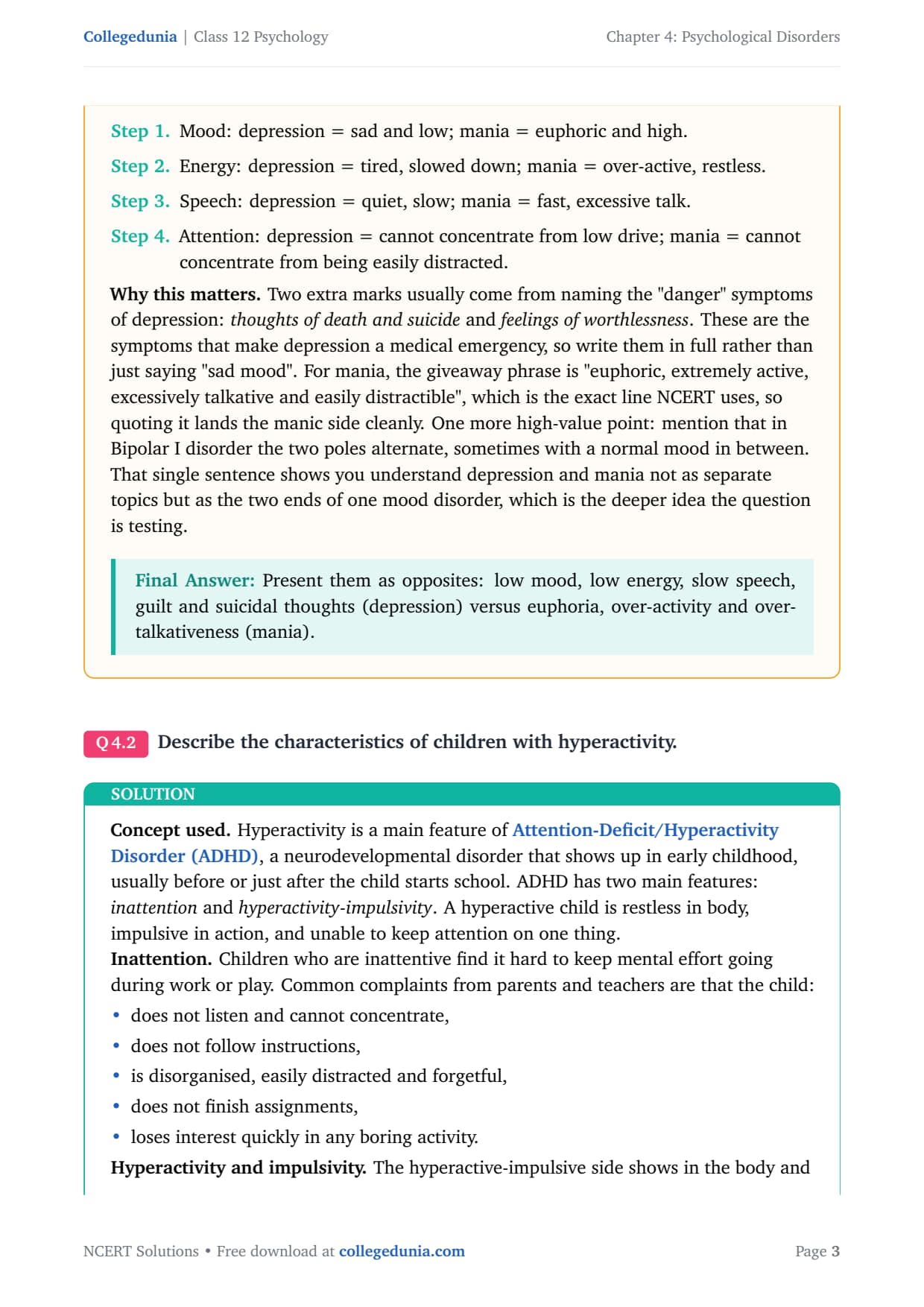
Mood: depression = sad and low; mania = euphoric and high.
Attention: depression = cannot concentrate from low drive; mania =
cannot concentrate from being easily distracted.
Why this matters. Two extra marks usually come from naming the
"danger" symptoms of depression: thoughts of death and suicide and
feelings of worthlessness. These are the symptoms that make
depression a medical emergency, so write them in full rather than just
saying "sad mood". For mania, the giveaway phrase is "euphoric, extremely
active, excessively talkative and easily distractible", which is the exact
line NCERT uses, so quoting it lands the manic side cleanly. One more
high-value point: mention that in Bipolar I disorder the two poles alternate,
sometimes with a normal mood in between. That single sentence shows you
understand depression and mania not as separate topics but as the two ends
of one mood disorder, which is the deeper idea the question is testing.
Present them as opposites: low mood, low energy, slow speech,
guilt and suicidal thoughts (depression) versus euphoria, over-activity and
over-talkativeness (mania).
Q 4.2
Describe the characteristics of children with hyperactivity.
Concept used. Hyperactivity is a main feature of
Attention-Deficit/Hyperactivity Disorder (ADHD), a
neurodevelopmental disorder that shows up in early childhood, usually
before or just after the child starts school. ADHD has two main features:
inattention and hyperactivity-impulsivity. A hyperactive
child is restless in body, impulsive in action, and unable to keep
attention on one thing.
Inattention. Children who are inattentive find it hard to keep
mental effort going during work or play. Common complaints from parents and
teachers are that the child:
does not listen and cannot concentrate,
does not follow instructions,
is disorganised, easily distracted and forgetful,
does not finish assignments,
loses interest quickly in any boring activity.
Hyperactivity and impulsivity. The hyperactive-impulsive side
shows in the body and in self-control:
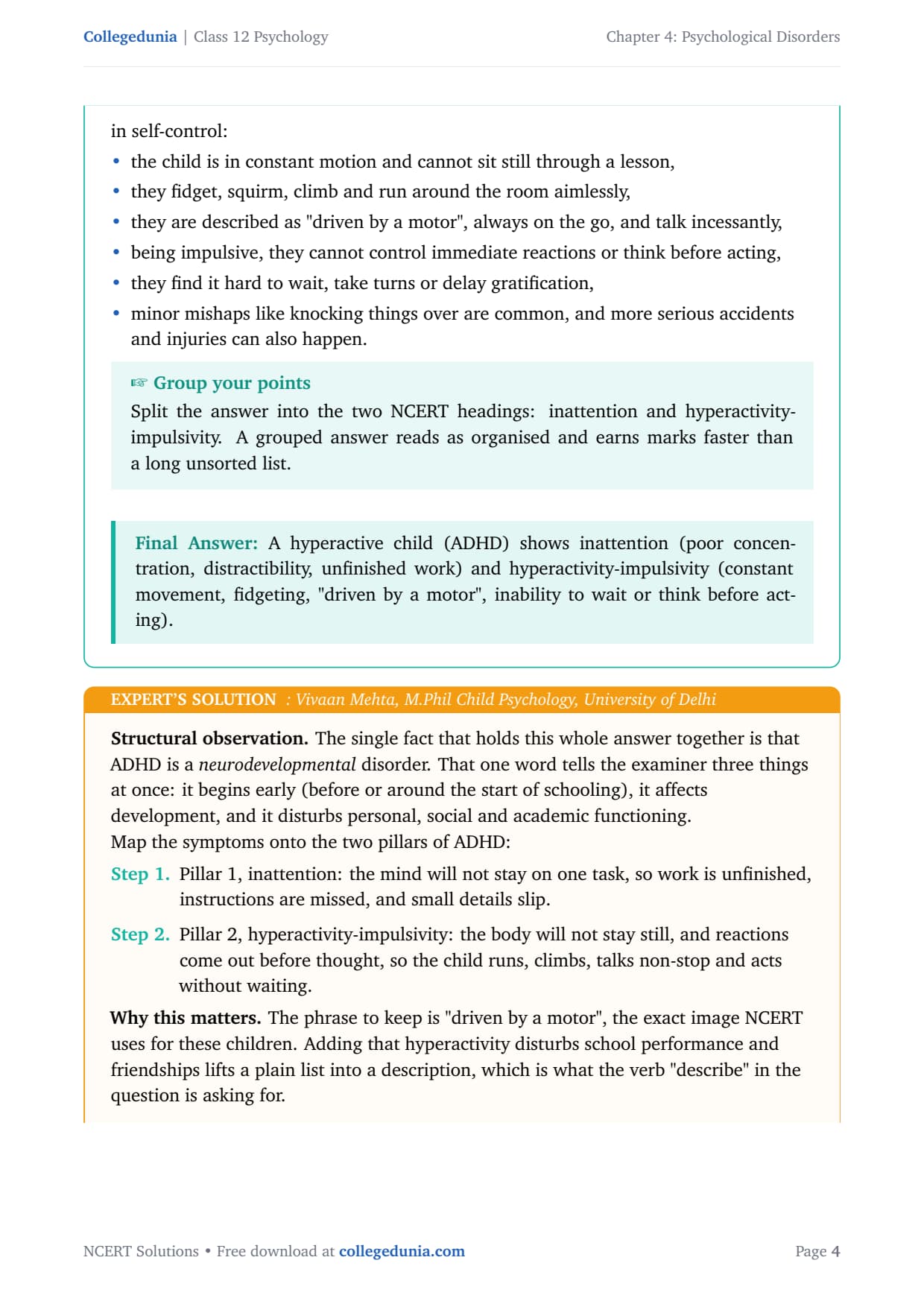
the child is in constant motion and cannot sit still through a
lesson,
they fidget, squirm, climb and run around the room aimlessly,
they are described as "driven by a motor", always on the go, and
talk incessantly,
being impulsive, they cannot control immediate reactions or think
before acting,
they find it hard to wait, take turns or delay gratification,
minor mishaps like knocking things over are common, and more
serious accidents and injuries can also happen.
Group your points
Split the answer into the two NCERT headings: inattention and
hyperactivity-impulsivity. A grouped answer reads as organised and earns
marks faster than a long unsorted list.
A hyperactive child (ADHD) shows inattention (poor concentration,
distractibility, unfinished work) and hyperactivity-impulsivity (constant
movement, fidgeting, "driven by a motor", inability to wait or think before
acting).
VM
Vivaan Mehta
M.Phil Child Psychology, University of Delhi
Verified Expert
Structural observation. The single fact that holds this whole
answer together is that ADHD is a neurodevelopmental disorder. That
one word tells the examiner three things at once: it begins early
(before or around the start of schooling), it affects development, and it
disturbs personal, social and academic functioning.
Map the symptoms onto the two pillars of ADHD:
Pillar 1, inattention: the mind will not stay on one task, so work
is unfinished, instructions are missed, and small details slip.
Pillar 2, hyperactivity-impulsivity: the body will not stay still,
and reactions come out before thought, so the child runs, climbs,
talks non-stop and acts without waiting.
Why this matters. The phrase to keep is "driven by a motor", the
exact image NCERT uses for these children. Adding that hyperactivity
disturbs school performance and friendships lifts a plain list into a
description, which is what the verb "describe" in the question is asking
for.
Frame it around ADHD as a neurodevelopmental disorder with two
pillars: inattention (cannot focus) and hyperactivity-impulsivity (cannot
stay still or wait), present from early childhood.
Q 4.3
What are the consequences of alcohol substance addiction?
Concept used. Alcohol addiction is a substance-related and
addictive disorder. People who abuse alcohol drink large amounts regularly
and lean on it to cope with difficult situations. Over time the body and
mind get used to it, which leads to two key changes:
Tolerance: the body adjusts, so the person needs to drink
greater and greater amounts to feel the same effect.
Withdrawal: when the person stops drinking, the body
reacts with unpleasant withdrawal responses.
Consequences for the individual. Drinking starts to interfere with
the person's social behaviour and with their ability to think and work.
Excessive drinking can seriously damage physical health. Ethyl alcohol acts
on the central nervous system, where it slows down brain functioning,
impairs judgment, blurs vision and disturbs memory and motor control.
Consequences for the family and society. Alcoholism does not stop
at the drinker:
it destroys millions of families, social relationships and careers,
intoxicated drivers cause many road accidents,
it has serious effects on the children of people with this disorder.
These children have higher rates of psychological problems,
especially anxiety, depression, phobias and substance-related
disorders.
Do not stop at the drinker
A common slip is to list only the harm to the drinker. Half the marks here
come from the ripple effects: broken families, road accidents, and the
raised risk of disorders in the children. Always include them.
Alcohol addiction leads to tolerance and withdrawal, damages the
person's health, judgment and work, and harms society through wrecked
families, road accidents and a higher rate of psychological problems in the
drinker's children.
AN
Arjun Nair
M.A Applied Psychology, TISS Mumbai
Verified Expert
Strategic angle. The cleanest way to organise this answer is to
move outward in widening circles: first the body, then the mind, then the
family, then society. The examiner can then tick off each layer, and you
never repeat a point.
The four circles:
Body: tolerance builds, withdrawal appears on stopping, and
physical health is damaged.
Mind and work: judgment, thinking and the ability to work all
suffer.
Family: relationships and careers are destroyed; the children carry
a higher risk of anxiety, depression, phobias and substance use.
Society: drunk driving causes accidents, and the social cost is
large.
Why this matters. The two technical terms, tolerance and
withdrawal, are what separate a top answer from an everyday one. They
show you understand addiction as a disorder, not just a bad habit. Define
each in a single line, then build the social consequences on top. The
closing point worth making is that alcohol is a depressant of the central
nervous system, which is why judgment, speech and movement all decline as
intake rises; naming that mechanism ties the personal and social harms back
to a single biological cause.
Answer in four widening circles: body (tolerance, withdrawal,
health), mind and work, family (broken homes, at-risk children), and
society (accidents).
Q 4.4
Can a distorted body image lead to eating disorders? Classify the various forms of it.
Concept used. A distorted body image means a person sees
their own body very differently from how it really is, usually seeing
themselves as overweight when they are not. Feeding and eating
disorders are conditions in which eating behaviour becomes seriously
disturbed. Yes, a distorted body image can lead to an eating disorder. It is
the central feature of anorexia nervosa, where the wrong self-image drives
the person to starve themselves.
The three forms of eating disorder. NCERT classifies eating
disorders into three types.
Anorexia nervosa: the person has a distorted body image
and sees themselves as overweight. They often refuse to eat,
exercise compulsively, and develop unusual habits such as refusing
to eat in front of others. They may lose large amounts of weight
and can even starve themselves to death.
Bulimia nervosa: the person eats excessive amounts of
food (a binge) and then purges the body of it, by using laxatives,
diuretics, or by vomiting. They often feel disgusted and ashamed
when bingeing, and feel relieved of tension and negative emotions
after purging.
Binge eating: there are frequent episodes of out-of-control
eating. The person eats faster than normal and keeps eating until
uncomfortably full. Large amounts of food may be eaten even when the
person is not hungry. (Note: there is no purging here, unlike in
bulimia.)
Anorexia vs bulimia in one line
Remember the key difference: in anorexia the person refuses food and
loses weight; in bulimia the person binges and then purges. Binge
eating is bingeing without the purging.
Yes. A distorted body image is the core of anorexia nervosa.
Eating disorders are classified as anorexia nervosa (refusal to eat,
starvation), bulimia nervosa (binge then purge), and binge eating
(out-of-control eating without purging).
PR
Priya Reddy
M.Sc Clinical Psychology, NIMHANS Bangalore
Verified Expert
Strategic angle. This question has two parts, so split your answer
in two: first answer "yes" with a one-line reason, then classify. Markers
look for both halves, and students often forget to actually answer the
yes/no part.
The cleanest contrast to draw:
Anorexia: restriction. The person eats too little and loses
dangerous amounts of weight; the distorted body image is what
drives the starving.
Bulimia: binge then purge. Body weight may stay closer to
normal, but the cycle of overeating and getting rid of food is the
marker.
Binge eating: binge only. Loss of control over eating, but
no purging to follow.
Why this matters. The phrase "distorted body image" links the
abstract idea (how I see myself) to the dangerous behaviour (starving). If
you name that link clearly, you have answered the "can it lead to" part of
the question and earned the classification marks at the same time. A useful
closing observation is that the distortion is strongest in anorexia, where
the person sees an overweight body that is not there, while in bulimia and
binge eating the loss of control over eating is the leading feature. Tying
the body-image distortion most tightly to anorexia is what makes the answer
read like real understanding rather than three memorised definitions.
Yes, a distorted body image directly causes anorexia nervosa.
Classify into anorexia (restrict), bulimia (binge then purge), and binge
eating (binge only).
Q 4.5
``Physicians make diagnosis looking at a person's physical symptoms''. How are psychological disorders diagnosed?
Concept used. A physician diagnoses a physical illness by examining
visible bodily symptoms and lab tests. Psychological disorders cannot always
be seen on the body, so they are diagnosed by matching a person's pattern of
thoughts, feelings and behaviour against an agreed classification
system. A classification is a list of disorders grouped into classes on the
basis of shared characteristics. It lets psychologists, psychiatrists and
social workers communicate with one another and understand the causes and
course of a disorder.
The two main classification systems. Diagnosis rests on two
official manuals.
The DSM (Diagnostic and Statistical Manual of Mental
Disorders), published by the American Psychiatric Association
(APA). The current version is DSM-5. It lays out discrete clinical
criteria that indicate the presence or absence of each disorder.
The ICD (International Classification of Diseases),
prepared by the World Health Organisation (WHO) and used officially
in India. The latest revision is ICD-11. For each disorder it gives
a description of the main clinical features (symptoms) and
diagnostic guidelines.
How the diagnosis is actually made. The clinician collects the
person's symptoms, then checks whether they match the listed criteria for a
particular disorder. The behaviour is also judged against the
four Ds: is it deviant, distressing, dysfunctional and dangerous?
The same behaviour can be normal in one situation and abnormal in another,
so context matters. For example, talking to yourself is normal if you are
praying.
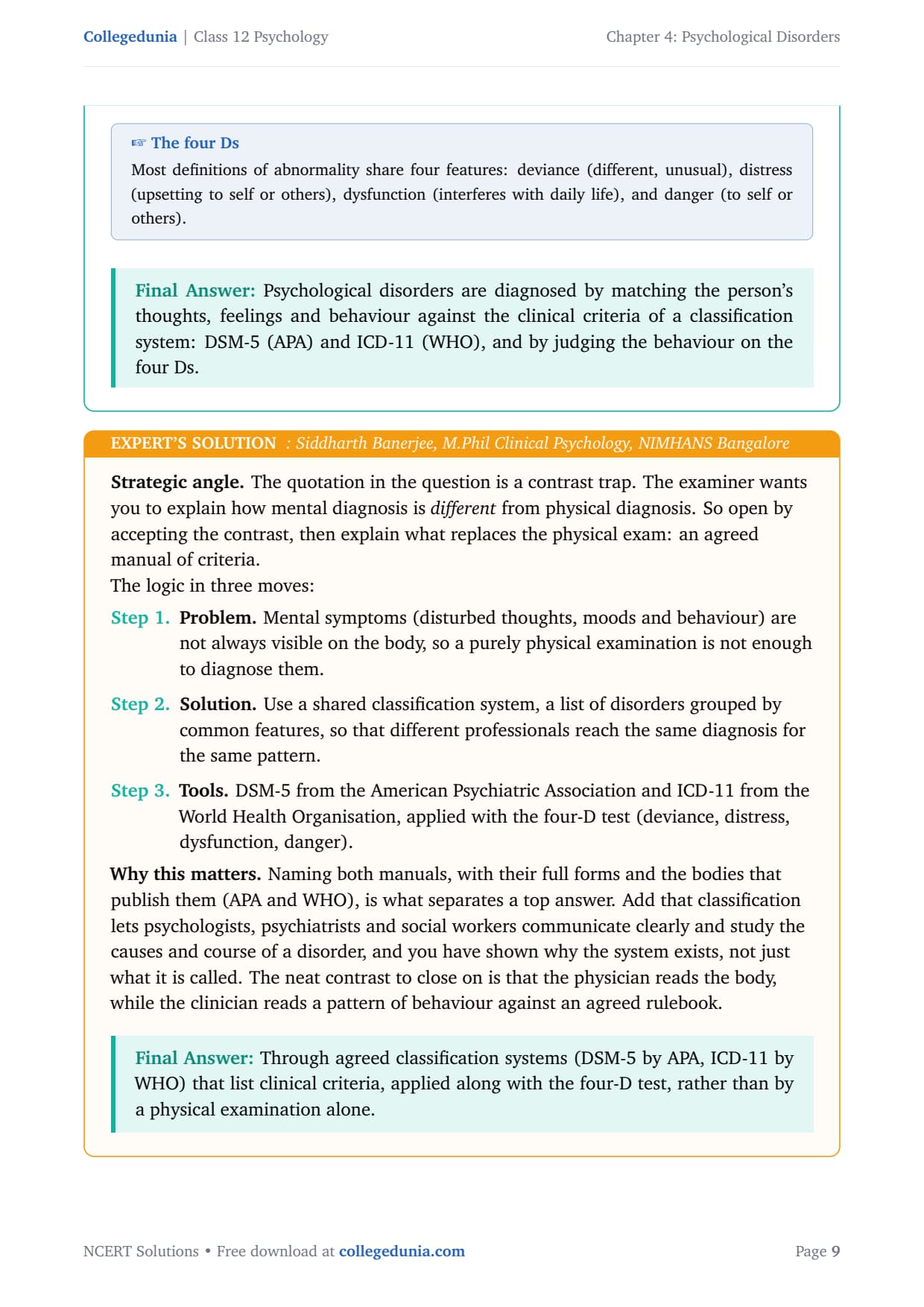
The four Ds
Most definitions of abnormality share four features: deviance (different,
unusual), distress (upsetting to self or others), dysfunction (interferes
with daily life), and danger (to self or others).
Psychological disorders are diagnosed by matching the person's
thoughts, feelings and behaviour against the clinical criteria of a
classification system: DSM-5 (APA) and ICD-11 (WHO), and by judging the
behaviour on the four Ds.
SB
Siddharth Banerjee
M.Phil Clinical Psychology, NIMHANS Bangalore
Verified Expert
Strategic angle. The quotation in the question is a contrast trap.
The examiner wants you to explain how mental diagnosis is different
from physical diagnosis. So open by accepting the contrast, then explain
what replaces the physical exam: an agreed manual of criteria.
The logic in three moves:
Problem. Mental symptoms (disturbed thoughts, moods and
behaviour) are not always visible on the body, so a purely physical
examination is not enough to diagnose them.
Solution. Use a shared classification system, a list of
disorders grouped by common features, so that different
professionals reach the same diagnosis for the same pattern.
Tools. DSM-5 from the American Psychiatric Association and
ICD-11 from the World Health Organisation, applied with the four-D
test (deviance, distress, dysfunction, danger).
Why this matters. Naming both manuals, with their full forms and
the bodies that publish them (APA and WHO), is what separates a top answer.
Add that classification lets psychologists, psychiatrists and social workers
communicate clearly and study the causes and course of a disorder, and you
have shown why the system exists, not just what it is called. The neat
contrast to close on is that the physician reads the body, while the
clinician reads a pattern of behaviour against an agreed rulebook.
Through agreed classification systems (DSM-5 by APA, ICD-11 by
WHO) that list clinical criteria, applied along with the four-D test, rather
than by a physical examination alone.
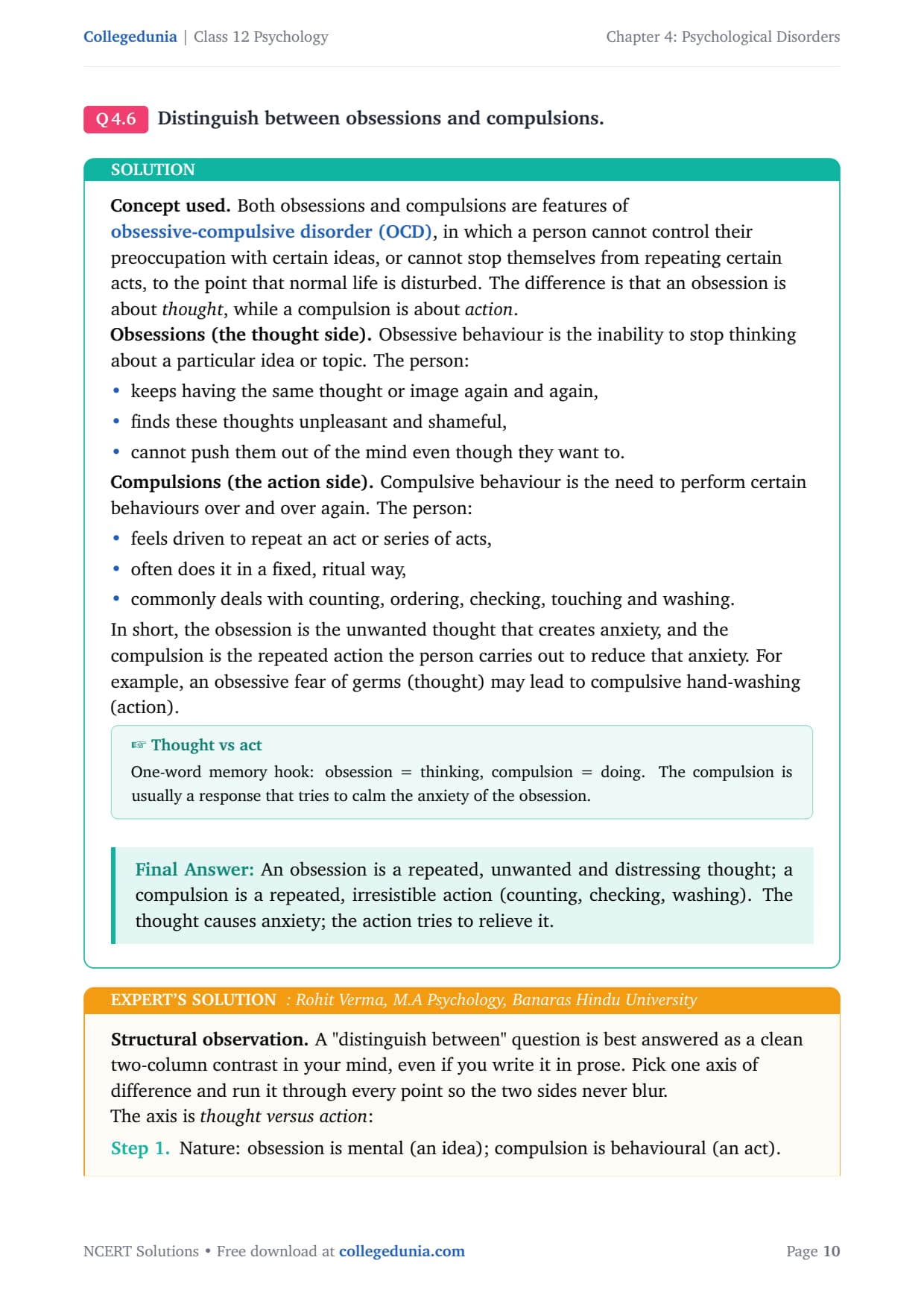
Q 4.6
Distinguish between obsessions and compulsions.
Concept used. Both obsessions and compulsions are features of
obsessive-compulsive disorder (OCD), in which a person cannot
control their preoccupation with certain ideas, or cannot stop themselves
from repeating certain acts, to the point that normal life is disturbed. The
difference is that an obsession is about thought, while a compulsion
is about action.
Obsessions (the thought side). Obsessive behaviour is the inability
to stop thinking about a particular idea or topic. The person:
keeps having the same thought or image again and again,
finds these thoughts unpleasant and shameful,
cannot push them out of the mind even though they want to.
Compulsions (the action side). Compulsive behaviour is the need to
perform certain behaviours over and over again. The person:
feels driven to repeat an act or series of acts,
often does it in a fixed, ritual way,
commonly deals with counting, ordering, checking, touching and
washing.
In short, the obsession is the unwanted thought that creates anxiety, and
the compulsion is the repeated action the person carries out to reduce that
anxiety. For example, an obsessive fear of germs (thought) may lead to
compulsive hand-washing (action).
Thought vs act
One-word memory hook: obsession = thinking, compulsion = doing. The
compulsion is usually a response that tries to calm the anxiety of the
obsession.
An obsession is a repeated, unwanted and distressing thought; a
compulsion is a repeated, irresistible action (counting, checking, washing).
The thought causes anxiety; the action tries to relieve it.
RV
Rohit Verma
M.A Psychology, Banaras Hindu University
Verified Expert
Structural observation. A "distinguish between" question is best
answered as a clean two-column contrast in your mind, even if you write it
in prose. Pick one axis of difference and run it through every point so the
two sides never blur.
The axis is thought versus action:
Nature: obsession is mental (an idea); compulsion is behavioural
(an act).
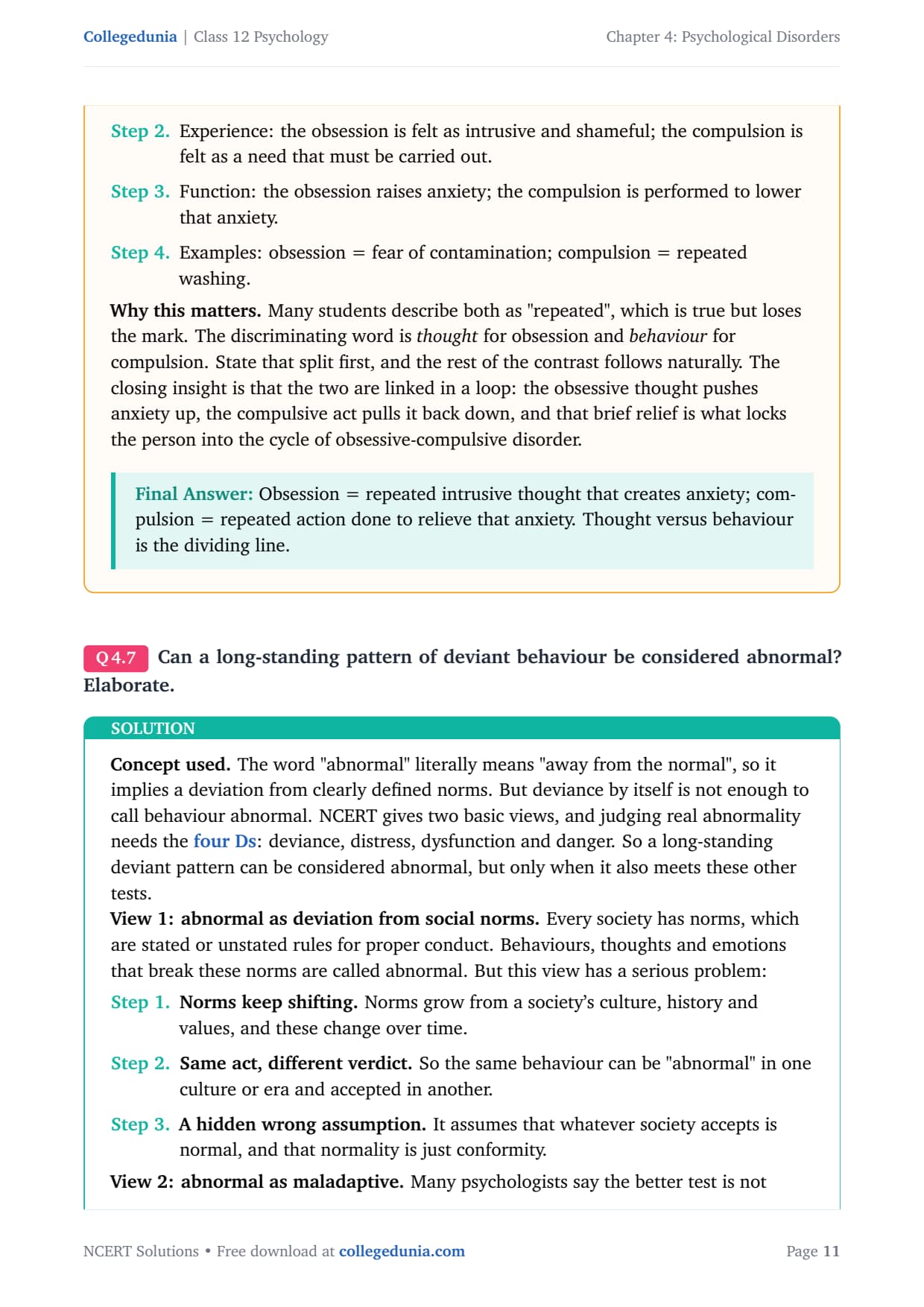
Experience: the obsession is felt as intrusive and shameful; the
compulsion is felt as a need that must be carried out.
Function: the obsession raises anxiety; the compulsion is performed
to lower that anxiety.
Examples: obsession = fear of contamination; compulsion = repeated
washing.
Why this matters. Many students describe both as "repeated", which
is true but loses the mark. The discriminating word is thought for
obsession and behaviour for compulsion. State that split first, and
the rest of the contrast follows naturally. The closing insight is that the
two are linked in a loop: the obsessive thought pushes anxiety up, the
compulsive act pulls it back down, and that brief relief is what locks the
person into the cycle of obsessive-compulsive disorder.
Obsession = repeated intrusive thought that creates anxiety;
compulsion = repeated action done to relieve that anxiety. Thought versus
behaviour is the dividing line.
Q 4.7
Can a long-standing pattern of deviant behaviour be considered abnormal? Elaborate.
Concept used. The word "abnormal" literally means "away from the
normal", so it implies a deviation from clearly defined norms. But deviance
by itself is not enough to call behaviour abnormal. NCERT gives two basic
views, and judging real abnormality needs the four Ds: deviance,
distress, dysfunction and danger. So a long-standing deviant pattern can be
considered abnormal, but only when it also meets these other tests.
View 1: abnormal as deviation from social norms. Every society has
norms, which are stated or unstated rules for proper conduct. Behaviours,
thoughts and emotions that break these norms are called abnormal. But this
view has a serious problem:
Norms keep shifting. Norms grow from a society's culture,
history and values, and these change over time.
Same act, different verdict. So the same behaviour can be
"abnormal" in one culture or era and accepted in another.
A hidden wrong assumption. It assumes that whatever society
accepts is normal, and that normality is just conformity.
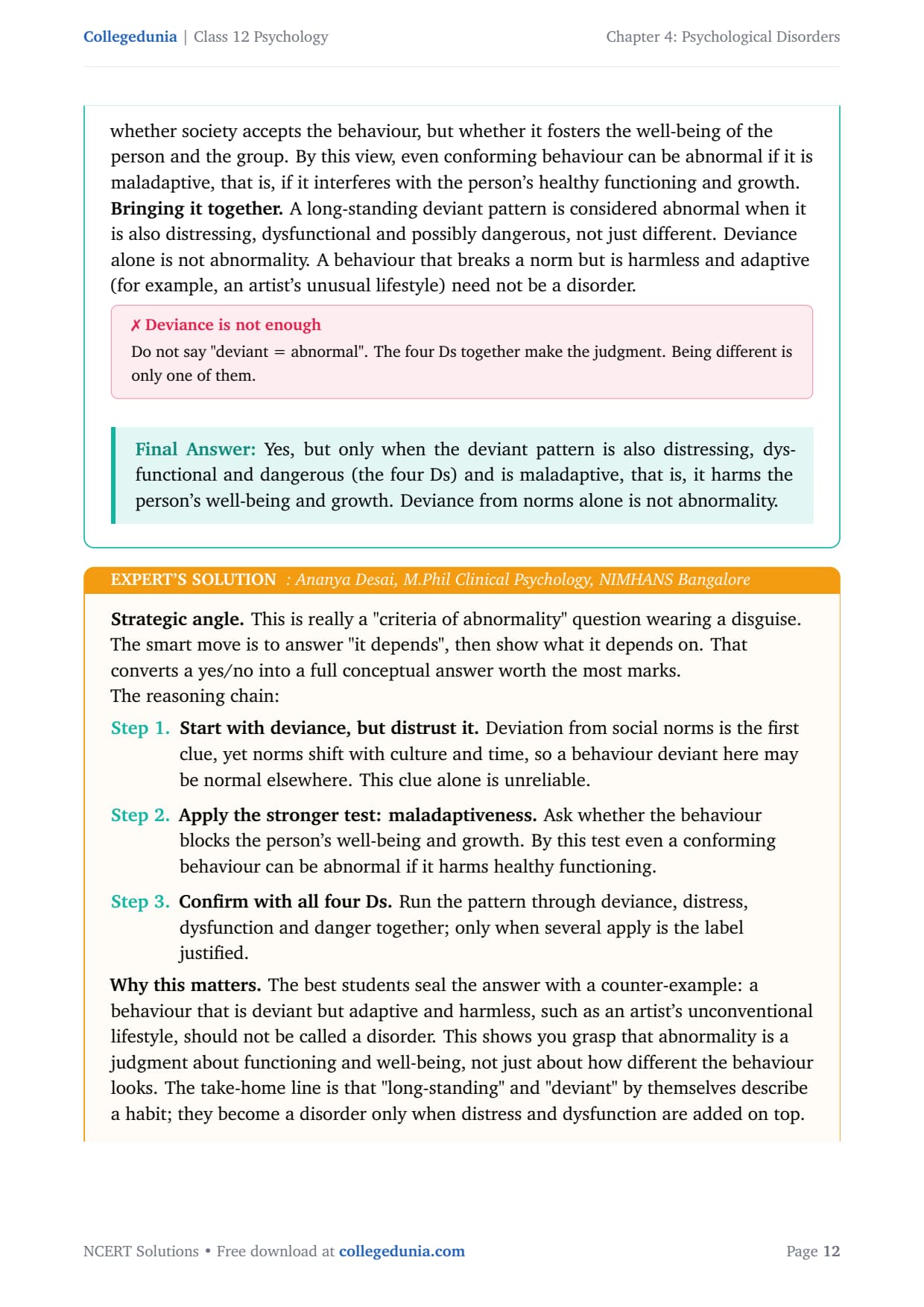
View 2: abnormal as maladaptive. Many psychologists say the better
test is not whether society accepts the behaviour, but whether it fosters
the well-being of the person and the group. By this view, even conforming
behaviour can be abnormal if it is maladaptive, that is, if it interferes
with the person's healthy functioning and growth.
Bringing it together. A long-standing deviant pattern is considered
abnormal when it is also distressing, dysfunctional and possibly dangerous,
not just different. Deviance alone is not abnormality. A behaviour that
breaks a norm but is harmless and adaptive (for example, an artist's unusual
lifestyle) need not be a disorder.
Deviance is not enough
Do not say "deviant = abnormal". The four Ds together make the judgment.
Being different is only one of them.
Yes, but only when the deviant pattern is also distressing,
dysfunctional and dangerous (the four Ds) and is maladaptive, that is, it
harms the person's well-being and growth. Deviance from norms alone is not
abnormality.
AD
Ananya Desai
M.Phil Clinical Psychology, NIMHANS Bangalore
Verified Expert
Strategic angle. This is really a "criteria of abnormality"
question wearing a disguise. The smart move is to answer "it depends", then
show what it depends on. That converts a yes/no into a full conceptual
answer worth the most marks.
The reasoning chain:
Start with deviance, but distrust it. Deviation from
social norms is the first clue, yet norms shift with culture and
time, so a behaviour deviant here may be normal elsewhere. This clue
alone is unreliable.
Apply the stronger test: maladaptiveness. Ask whether the
behaviour blocks the person's well-being and growth. By this test
even a conforming behaviour can be abnormal if it harms healthy
functioning.
Confirm with all four Ds. Run the pattern through deviance,
distress, dysfunction and danger together; only when several apply
is the label justified.
Why this matters. The best students seal the answer with a
counter-example: a behaviour that is deviant but adaptive and harmless, such
as an artist's unconventional lifestyle, should not be called a disorder.
This shows you grasp that abnormality is a judgment about functioning and
well-being, not just about how different the behaviour looks. The take-home
line is that "long-standing" and "deviant" by themselves describe a habit;
they become a disorder only when distress and dysfunction are added on top.
A long-standing deviant pattern counts as abnormal only when it is
also maladaptive and meets the four Ds; mere deviation from changing social
norms is not enough.
Q 4.8
While speaking in public the patient changes topics frequently, is this a positive or a negative symptom of schizophrenia? Describe the other symptoms of schizophrenia.
Concept used.Schizophrenia is a group of psychotic
disorders in which personal, social and occupational functioning break down
because of disturbed thought, strange perceptions, unusual emotions and
motor abnormalities. Its symptoms fall into three groups: positive
symptoms (pathological excesses or "bizarre additions"), negative
symptoms (pathological deficits), and psychomotor symptoms.
Answering the given case. Changing topics frequently while
speaking is a positive symptom. It is a formal thought disorder
called loosening of associations (or derailment), where the person
shifts rapidly from one topic to another so the normal structure of
thinking becomes muddled and illogical. It is an excess or disorder added to
behaviour, so it belongs to the positive group, not the negative one.
Other positive symptoms. These are bizarre additions to behaviour:
Delusions: false beliefs firmly held on inadequate
grounds, not changed by reason. Types include delusions of
persecution (most common), reference, grandeur and control.
Other disorganised thinking and speech: inventing new words
(neologisms) and repeating the same thoughts (perseveration).
Hallucinations: perceptions without any external stimulus.
Auditory hallucinations (hearing voices) are most common; there are
also visual, tactile, somatic, gustatory and olfactory types.
Inappropriate affect: emotions that do not suit the
situation.
Negative symptoms. These are pathological deficits:
alogia or poverty of speech (reduced speech and content),
blunted affect (less emotion than normal) and flat affect (no
emotion at all),
loss of volition or avolition (apathy, inability to start or
finish actions),
social withdrawal.
Psychomotor symptoms. The person moves less, or makes odd grimaces
and gestures. In extreme form this is catatonia: catatonic stupor
(motionless and silent), catatonic rigidity (a rigid upright posture for
hours), and catatonic posturing (awkward, bizarre positions).
Positive vs negative
Positive does not mean "good". Positive = something added (delusions,
hallucinations, jumbled speech). Negative = something taken away
(little speech, no emotion, no drive).
Frequently changing topics is a positive symptom (loosening of
associations). Other symptoms: positive (delusions, hallucinations,
disorganised speech, inappropriate affect), negative (poverty of speech,
flat or blunted affect, avolition, social withdrawal), and psychomotor
(catatonia).
KJ
Karan Joshi
M.A Clinical Psychology, NIMHANS Bangalore
Verified Expert
Strategic angle. The trap in this question is the word "positive".
Lock down its meaning first: positive means a symptom that is added
to normal behaviour, regardless of whether it is pleasant. Topic-shifting is
extra disordered speech, so it is added, and that is why it is a positive
symptom, not a negative one. The same add-versus-subtract test then sorts
every other symptom cleanly, so you never have to memorise the lists blindly.
Apply the test to all three NCERT groups:
Added (positive symptoms). These are bizarre extras laid on
top of normal behaviour: delusions (false fixed beliefs of
persecution, reference, grandeur, control), hallucinations
(auditory most common, plus visual, tactile, somatic, gustatory,
olfactory), disorganised speech (loosening of associations,
neologisms, perseveration), and inappropriate affect.
Subtracted (negative symptoms). These are things taken
away from normal life: poverty of speech (alogia), blunted or flat
affect (less or no emotion), avolition (no drive to start or finish
anything), and social withdrawal.
Movement (psychomotor symptoms). Odd or reduced movement,
in the extreme form catatonia: catatonic stupor (frozen and silent),
rigidity (a stiff upright posture held for hours), and posturing
(awkward positions held for long periods).
The patient in the question fits squarely in the first group. Rapid
topic-switching is the formal thought disorder called loosening of
associations, an excess of disordered speech, so it is positive. Contrast
this with a patient who barely speaks at all (poverty of speech): that
would be a negative symptom, because content is missing rather than added.
Why this matters. Naming the technical term loosening of
associations for the topic-shifting earns the first mark cleanly. Then
sorting the rest into the three NCERT groups, positive, negative and
psychomotor, shows the structure that a "describe the other symptoms"
instruction is built to reward.
It is a positive symptom (loosening of associations); the other
symptoms split into positive (excesses), negative (deficits) and psychomotor
(catatonia) groups.
Q 4.9
What do you understand by the term `dissociation'? Discuss its various forms.
Concept used.Dissociation can be viewed as a severance,
that is, a cutting off, of the connections between ideas and emotions. It
involves feelings of unreality, estrangement, depersonalisation, and
sometimes a loss or shift of identity. The defining feature of
dissociative disorders is sudden, temporary alterations of
consciousness that blot out painful experiences.
Forms of dissociative disorders. NCERT lists the following forms.
Dissociative amnesia: extensive but selective memory loss
with no known organic cause (such as a head injury). Some people
cannot recall anything about their past; others lose only specific
events, people or places, while other memories stay intact.
Dissociative fugue: a part of dissociative amnesia. Its
essential feature is an unexpected travel away from home and
workplace, the assumption of a new identity, and an inability to
recall the previous identity. The fugue usually ends when the person
suddenly "wakes up" with no memory of what happened. It is often
linked to overwhelming stress.
Dissociative identity disorder (multiple personality):
the most dramatic form. The person assumes two or more separate and
contrasting personalities (alternate personalities) that may or may
not be aware of each other. It is often linked to traumatic
experiences, such as abuse, in childhood.
Depersonalisation/Derealisation disorder: a dreamlike
state in which the person feels separated both from the self and
from reality. In depersonalisation the person's self-perception
changes and their sense of reality is temporarily lost or altered.
The common thread
All four forms share one thing: a temporary break in the normal flow of
consciousness, memory or identity, usually triggered by stress or trauma.
Dissociation is a severance of the link between ideas and emotions,
with feelings of unreality and loss of identity. Its forms are dissociative
amnesia (and fugue), dissociative identity disorder, and
depersonalisation/derealisation disorder.
IP
Ishita Pillai
M.Phil Clinical Psychology, NIMHANS Bangalore
Verified Expert
Strategic angle. Start with a one-line definition that contains the
keyword "severance" or "break", then list the forms. The examiner reads the
definition first, so make it sharp, then earn the bulk of the marks on the
four forms.
Sort the forms by what is disrupted:
Memory is disrupted. Dissociative amnesia, where selective
memory is lost with no organic cause, and its sub-type fugue, which
adds an unexpected journey away from home plus a brand-new identity
before the person suddenly "wakes up".
Identity is disrupted. Dissociative identity disorder
(multiple personality), the most dramatic form, where two or more
separate, contrasting personalities take turns, often rooted in
childhood abuse.
Sense of self and reality is disrupted.
Depersonalisation/derealisation disorder, a dreamlike state of
feeling cut off from both the self and the outside world.
Why this matters. The link with childhood trauma and overwhelming
stress is the line that explains why dissociation happens: the mind
blots out unbearable experiences by breaking the normal flow of memory,
identity or awareness. Adding this mechanism turns a list of names into an
understanding, which is exactly what the verb "discuss" asks for. A strong
closing point is that all the forms are protective in origin, the mind's way
of escaping pain, even though they end up disabling the person.
Dissociation is a break between ideas and emotions; its forms are
dissociative amnesia (and fugue), dissociative identity disorder, and
depersonalisation/derealisation disorder.
Q 4.10
What are phobias? If someone had an intense fear of snakes, could this simple phobia be a result of faulty learning? Analyse how this phobia could have developed.
Concept used.Phobias are irrational fears related to
specific objects, people or situations. People with phobias know the fear is
out of proportion, but cannot control it. Phobias often develop gradually or
begin with a generalised anxiety disorder, and they fall into three main
types: specific phobias, social phobias (social anxiety
disorder), and agoraphobia. A fear of snakes is a specific phobia,
the most common type, which includes intense fear of a certain kind of
animal.
Can it come from faulty learning? Yes. The behavioural
model states that both normal and abnormal behaviours are learned, and that
psychological disorders result from learning maladaptive ways of behaving.
What has been learned can also be unlearned. Learning happens through:
classical conditioning: two events that repeatedly occur
close together in time become linked,
operant conditioning: a behaviour is shaped by the reward
that follows it,
social learning: learning by imitating others' behaviour.
How the snake phobia could develop. The fear can grow through these
learning routes.
By classical conditioning: if a person once had a frightening
encounter with a snake (a painful or scary event paired with the
sight of a snake), the snake alone later triggers fear, because the
two were linked in time.
By social learning: a child who repeatedly sees a parent scream and
run away from snakes may imitate that reaction and learn to fear
snakes too, even without a direct bad experience.
By operant conditioning: every time the person avoids a snake, the
anxiety drops, and that relief acts as a reward. The avoidance is
reinforced, so the phobia is maintained.
Learned means unlearnable
Because the behavioural model says phobias are learned, it also says they
can be unlearned. This is the basis of behaviour therapies for phobias, a
useful line to add for extra credit.
Phobias are irrational fears of specific objects, people or
situations (specific, social, agoraphobia). A snake phobia is a specific
phobia and can result from faulty learning: classical conditioning (a scary
pairing), social learning (imitating a fearful model), and operant
conditioning (avoidance rewarded by relief).
AK
Aditya Kapoor
M.A Psychology, Jamia Millia Islamia
Verified Expert
Strategic angle. This question has three demands packed in: define
phobias, say whether learning can cause one, and analyse how. Answer them in
that order, and use the behavioural model as the spine of the "analyse"
part. That model is the examiner's expected route.
The three learning routes, applied to snakes:
Classical conditioning (how the fear starts). A single
frightening snake encounter, a bite or a scare, pairs strong fear
with the sight of a snake. Because the two happened together in
time, the snake alone later sets off the fear, even with no real
danger present.
Social learning (how it spreads without an encounter).
A child who repeatedly watches a parent scream and flee from snakes
copies that reaction. The fear is learned by imitation, so the child
can become phobic without ever being harmed by a snake.
Operant conditioning (how it is kept alive). Each time the
person avoids a snake, the anxiety drops at once. That relief acts
as a reward, so the avoidance is reinforced and the phobia is
maintained instead of fading.
Why this matters. The "analyse" verb expects more than a list. Show
the cause-and-effect chain: a trigger event, a learned association, then
reward-driven maintenance. Naming all three conditioning types and tying
each to the snake example is what earns the analysis marks. The closing
insight worth adding is that the behavioural model is hopeful: if a phobia
is learned, it can be unlearned, which is exactly why exposure-based
behaviour therapies work so well for specific phobias.
Yes, a snake phobia (a specific phobia) can be faulty learning,
explained by classical conditioning, social learning and operant
conditioning under the behavioural model.
Q 4.11
Anxiety has been called the ``butterflies in the stomach feeling''. At what stage does anxiety become a disorder? Discuss its types.
Concept used.Anxiety is usually defined as a diffuse,
vague, very unpleasant feeling of fear and apprehension. A certain amount of
anxiety is normal and even useful, for example, before an exam or a
performance it motivates us to do well. The key is to know when this normal
feeling crosses over into a disorder.
When anxiety becomes a disorder. Anxiety becomes a disorder when
the levels of anxiety are high, distressing, and interfere with
effective functioning. At that stage it is no longer the helpful "butterflies
in the stomach" feeling but an anxiety disorder, the most common
category of psychological disorders. The anxious person also shows physical
signs such as rapid heart rate, shortness of breath, sweating, dizziness,
sleeplessness and tremors.
Types of anxiety disorders. NCERT discusses these main types.
Generalised anxiety disorder (GAD): prolonged, vague,
unexplained and intense fears that are not attached to any
particular object. It is marked by worry, hypervigilance (constantly
scanning the environment for danger) and motor tension (restless,
unable to relax, shaky).
Panic disorder: recurrent anxiety attacks of intense
terror. A panic attack is an abrupt surge of anxiety, with shortness
of breath, dizziness, trembling, palpitations, choking, nausea,
chest pain, and a fear of going crazy, losing control or dying.
Phobias: irrational fears of specific objects, people or
situations. They are of three kinds: specific phobias, social
phobias (social anxiety disorder), and agoraphobia (fear of entering
unfamiliar situations or leaving home).
Separation anxiety disorder (SAD): being fearful and
anxious about separation from attachment figures to a degree that is
not appropriate for the person's age. Children may refuse to be
alone, cling to parents, throw tantrums, or make suicidal gestures
to avoid separation.
Normal vs disorder
The boundary line for the board is one sentence: anxiety becomes a disorder
when it is high, distressing, and interferes with effective functioning.
Quote it before listing the types.
Anxiety becomes a disorder when it grows high, distressing and
interferes with effective functioning. Its types are generalised anxiety
disorder, panic disorder, phobias (specific, social, agoraphobia), and
separation anxiety disorder.
SC
Sneha Chatterjee
M.Phil Clinical Psychology, NIMHANS Bangalore
Verified Expert
Strategic angle. The question gives you a hook ("butterflies in
the stomach"), and the smartest opening uses it: normal anxiety is the
butterflies; a disorder is when those butterflies take over your life.
Answer the "at what stage" part in one crisp sentence before you list types,
because that sentence is a guaranteed mark.
Group the four types by what the fear attaches to:
Free-floating fear, no object. Generalised anxiety
disorder: the worry is constant and attaches to nothing in
particular, backed by hypervigilance and motor tension.
Sudden bursts of terror. Panic disorder: short, abrupt
attacks of intense fear, with palpitations, breathlessness and a
sense of dying or going crazy.
Fear tied to a specific trigger. Phobias: an irrational
fear locked onto an object, person or situation, split into
specific, social and agoraphobia.
Fear of being apart from loved ones. Separation anxiety
disorder: distress at leaving attachment figures, beyond what is
normal for the person's age.
Why this matters. The discriminating idea is that normal anxiety is
adaptive (it motivates us before an exam or a stage performance), while a
disorder is maladaptive (it disrupts effective functioning). Stating that
contrast shows you understand the boundary, which is the real point of the
question, not just the names of the types. A neat closing line for the exam
is that all four types share the same core feeling of fear and apprehension;
they differ only in what that fear latches onto, which is exactly why they
sit together as one family of anxiety disorders.
Anxiety becomes a disorder when it is high, distressing and
disrupts functioning. Types: GAD (no object), panic disorder (sudden
attacks), phobias (specific trigger), and separation anxiety disorder.
FAQs on Psychological Disorders Class 12 NCERT Solutions
Psychological Disorders Class 12 Psychology Common Questions
Ques. Where can I get the class 12 psychology chapter 4 NCERT Solutions PDF?
Ans. You can download the Psychological Disorders Class 12 Psychology NCERT Solutions PDF directly from this page. It is free, follows the 2026-27 NCERT, and answers all 11 Review Questions in clear point-wise prose.
Ques. How many questions are there in Psychological Disorders class 12 questions and answers?
Ans. The chapter has 11 Review Questions. They cover the symptoms of depression and mania, hyperactivity, addiction, eating disorders, diagnosis, obsessions and compulsions, abnormality, schizophrenia, dissociation, phobias and anxiety.
Ques. What is the difference between positive and negative symptoms of schizophrenia?
Ans. Positive symptoms are an excess, such as delusions, hallucinations and disorganised speech. Negative symptoms are a loss, such as flat emotion, poverty of speech and social withdrawal. Changing topics often while speaking is a positive symptom.
Ques. How are psychological disorders diagnosed?
Ans. They are diagnosed from a pattern of behaviour, thoughts and feelings over time, judged against the ICD or DSM criteria. Unlike a physician who looks at physical symptoms, a psychologist studies behaviour and rules out other causes.
Ques. What are the four D criteria of abnormal behaviour?
Ans. The four D criteria are deviance, distress, dysfunction and danger. Behaviour is usually called abnormal only when several of these markers are present together and are judged in context, not from one criterion alone.
Ques. Is class 12 psychology chapter 4 easy to score in the board exam?
Ans. Yes. It is a high-scoring chapter if you keep the disorder groups and their symptoms clear. Practise the schizophrenia symptoms, the types of anxiety and the obsession versus compulsion difference for the most repeated marks.







Comments