Maths Mentor, Thapar Institute | Updated 3+ months ago
These NCERT Solutions cover Exercise 5.5 of Class 12 Maths Chapter 5 Continuity and Differentiability in full, one question per page, in the same notation as the textbook. The free PDF is right below.
CBSE Weightage: 8-10 marks (Continuity and Differentiability + Applications of Derivatives, Calculus unit total 35 marks)
JEE Main Weightage: 6-8% of the Mathematics section, with 2-3 questions on logarithmic differentiation in nearly every shift
Exercise 5.5 problem count: 18 questions covering f(x)g(x) forms, products and quotients with mixed bases, and parametric differentiation
Exercise 5.5 at a glance: 18 questions, average solved-length 7-10 lines each. Logarithmic differentiation has appeared in CBSE boards every year since 2017 as a 4-mark question.
These solutions for Exercise 5.5 follow the 2026-27 NCERT print and lay out each log step, differentiation, and isolation of dydx on its own line, with the boxed final answer.
NCERT Solutions for Class 12 Maths Chapter 5 Continuity and Differentiability Exercise 5.5
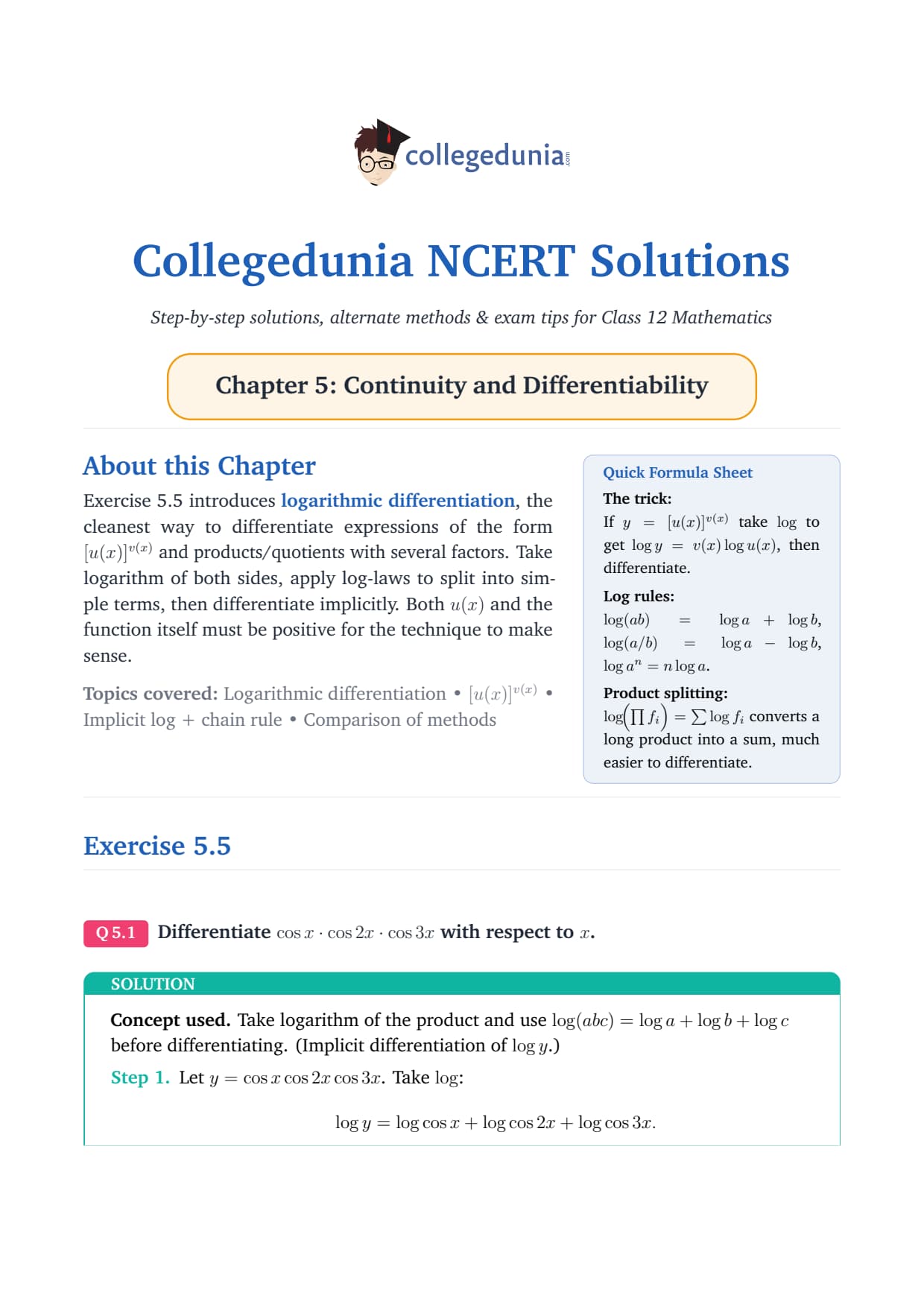
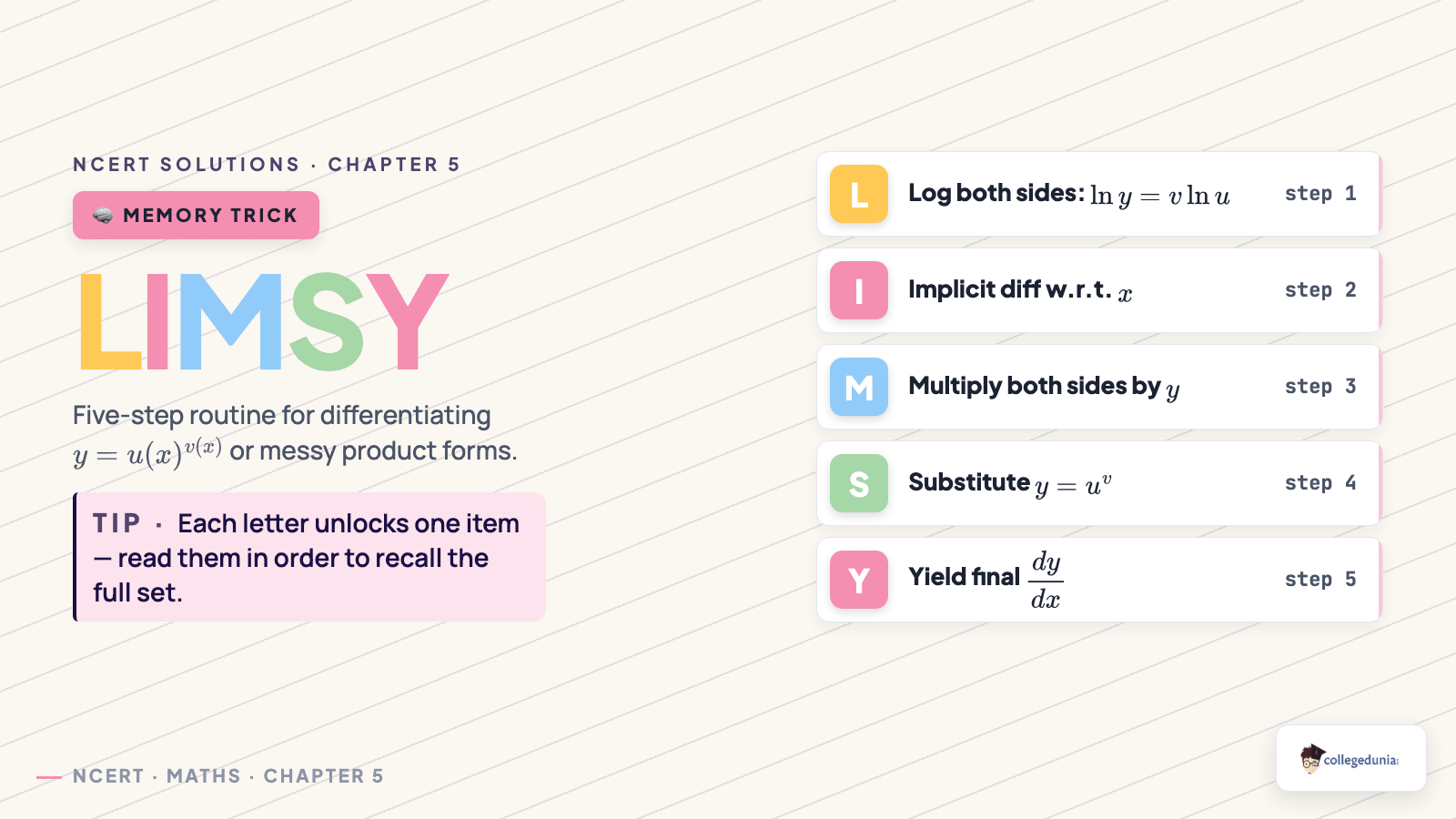
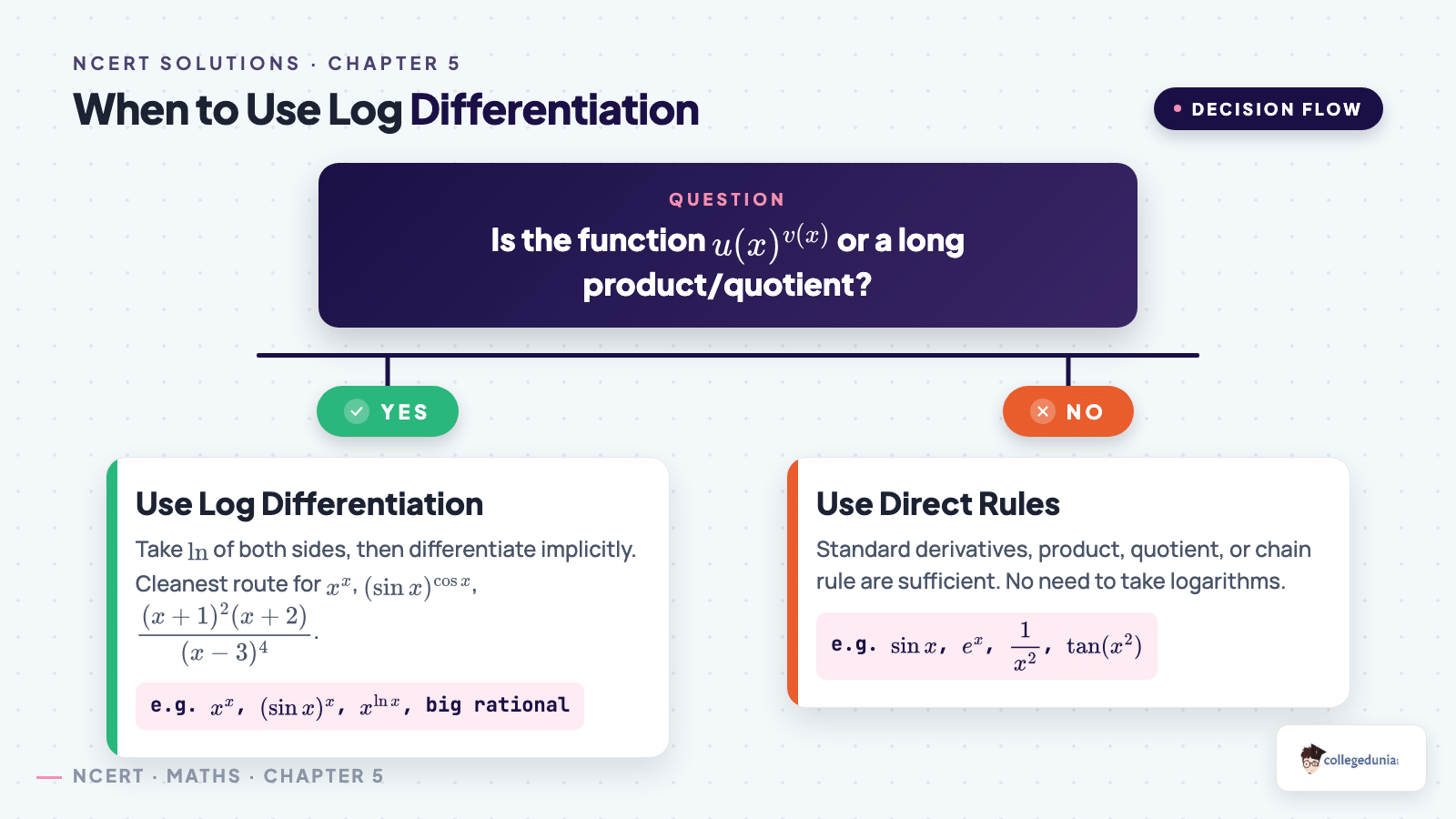
Exercise 5.5 introduces logarithmic differentiation, the only systematic method for handling functions where both the base and the exponent vary, such as y = xx, y = (sin x)x, y = xsin x.
The core idea is: take log on both sides, use log(ab) = b log a to bring the exponent down, differentiate implicitly, then solve for dydx.
Question Type
Count in Exercise 5.5
Method Used
y = f(x)g(x) variable base and exponent
8
Log-on-both-sides + implicit differentiation
Product / quotient of many factors
4
Log converts product to sum; differentiate term-wise
Sum of two f(x)g(x) terms
3
Split into u + v; log-differentiate each separately
Parametric differentiation x = x(t), y = y(t)
3
dydx = dy/dtdx/dt
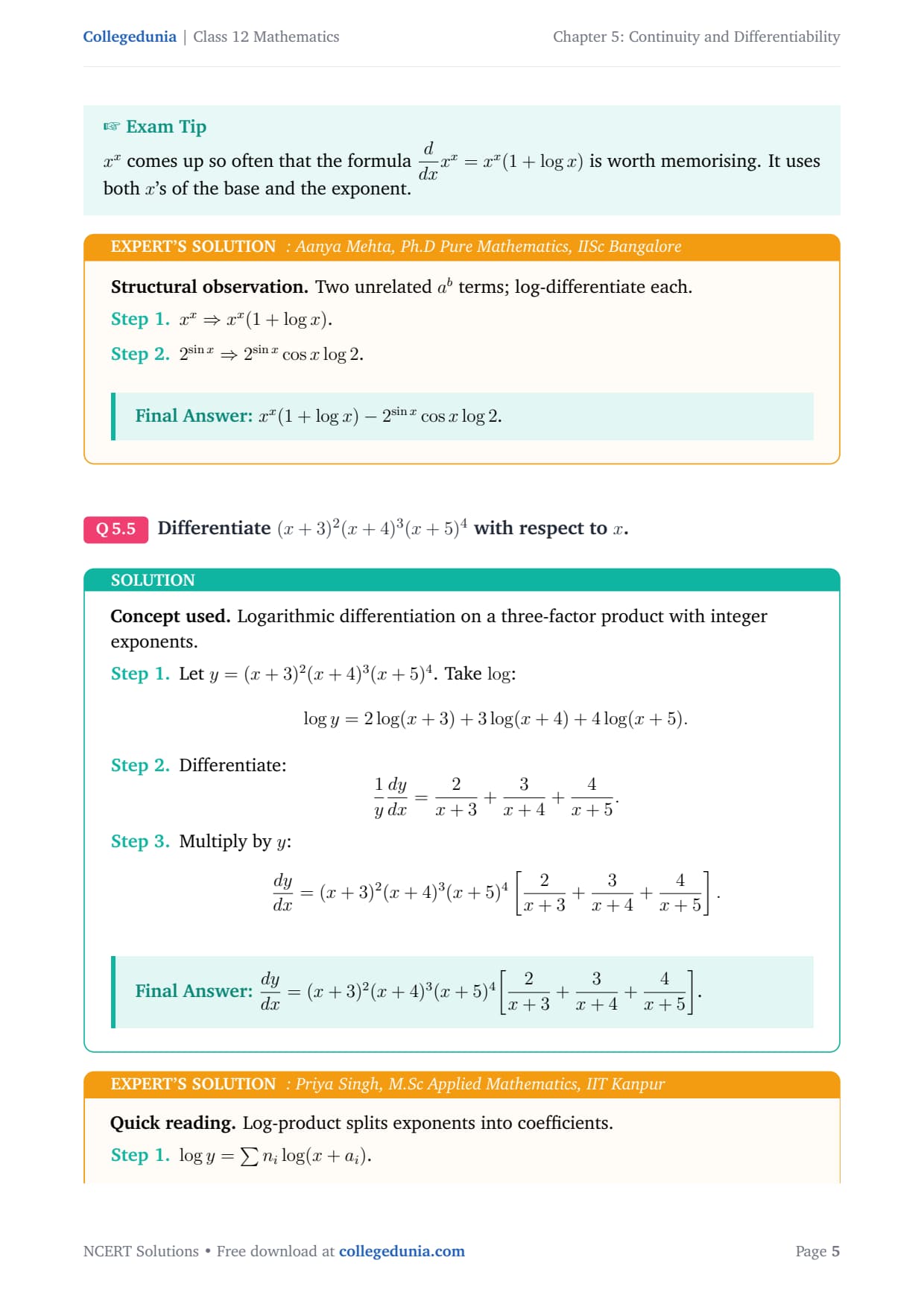
The 8 variable-base-and-exponent questions are the spine of this exercise. The Expert Solution writes y = f(x)g(x) log y = g(x) log f(x) on a fresh line first, so the method stays reproducible.
Continuity and Differentiability Ex 5 5 Video Walkthrough
How the Continuity and Differentiability Class 12 NCERT Solutions on the Continuity and Differentiability Class 12 NCERT Solutions Help You
Exercise 5.5 is graded hard in the 2026-27 NCERT print and is the most-asked exercise from this chapter in CBSE boards. The solution PDF is built around these promises:
The "take log on both sides" line is always written explicitly, so an examiner sees the method statement before the algebra begins.
Formula recall printed at the top of every question needing the log-product or log-quotient identity ( log(ab) = log a + log b, log(a/b) = log a - log b, log(ab) = b log a).
Expert Solution block after every solution that re-derives the answer using y = eg(x) log f(x) and the direct chain rule.
Tip callouts at common mistakes: skipping the log step on one side, forgetting 1y · dydx is the derivative of log y, and the parametric ordering dy/dtdx/dt.
The Collegedunia Class 12 Mathematics Exercise 5.5 solutions are aligned line-by-line with the official 2026-27 NCERT textbook reprint, so the question numbering matches your printed copy exactly.
Important Concepts Covered in Exercise 5.5
Exercise 5.5 stays inside the four concept boxes below. Reviewing them before attempting the questions cuts solving time by roughly half.
Concept
Working Definition
Used In Q No.
Logarithmic differentiation
Take log on both sides, then differentiate; isolate dydx
1, 2, 3, 4, 5, 6, 7, 8
Log of product / quotient
log(ab) = log a + log b, log(a/b) = log a - log b
9, 10, 11, 12
Sum of two f(x)g(x) terms
Split y = u + v; log-differentiate u and v separately
13, 14, 15
Parametric differentiation
dydx = dy/dtdx/dt when both x and y depend on t
16, 17, 18
The parametric cluster at the end of Ex 5.5 is the doorway to the parametric tangent and normal questions in Ex 6.3, so practicing here pays off twice. The Expert Solution shows the eliminate-the-parameter cross-check wherever it is algebraically tractable.
Exam Relevance of Continuity and Differentiability Exercise 5.5
Continuity and Differentiability sits in the Calculus unit, worth 35 marks in the CBSE paper. Exercise 5.5 is the highest-yield exercise here for 4-mark and 5-mark questions:
Exam Year
Question Type from Ex 5.5
Marks
CBSE Board 2025
If y = (log x)x + xlog x, find dydx
5
CBSE Board 2024
Differentiate y = xx · cos x with respect to x
4
CBSE Sample Paper 2024
Parametric differentiation x = a(θ - sinθ), y = a(1-cosθ)
4
JEE Main 2025 (Jan session)
Logarithmic differentiation on a quotient of three factors
4
JEE Main 2026
Pending (exam rescheduled)
-
Logarithmic differentiation is non-negotiable for the CBSE Class 12 board exam and for JEE Main, and these solutions show the method in the exact form an examiner expects.
Common Mistakes Students Make in Exercise 5.5
Three predictable error patterns explain most marks lost on this exercise in CBSE board scripts. These solutions highlight each one inline.
Forgetting the 1y factor after differentiating log y. The chain rule gives ddxlog y = 1y · dydx, and dropping the 1y wrecks the final isolation.
Wrong parametric ordering. The formula is dydx = dy/dtdx/dt, not the reciprocal. Students reverse this under exam pressure.
Mixing the log rules on sums. log(a + b) is NOT log a + log b. The tip box prints this warning in red.
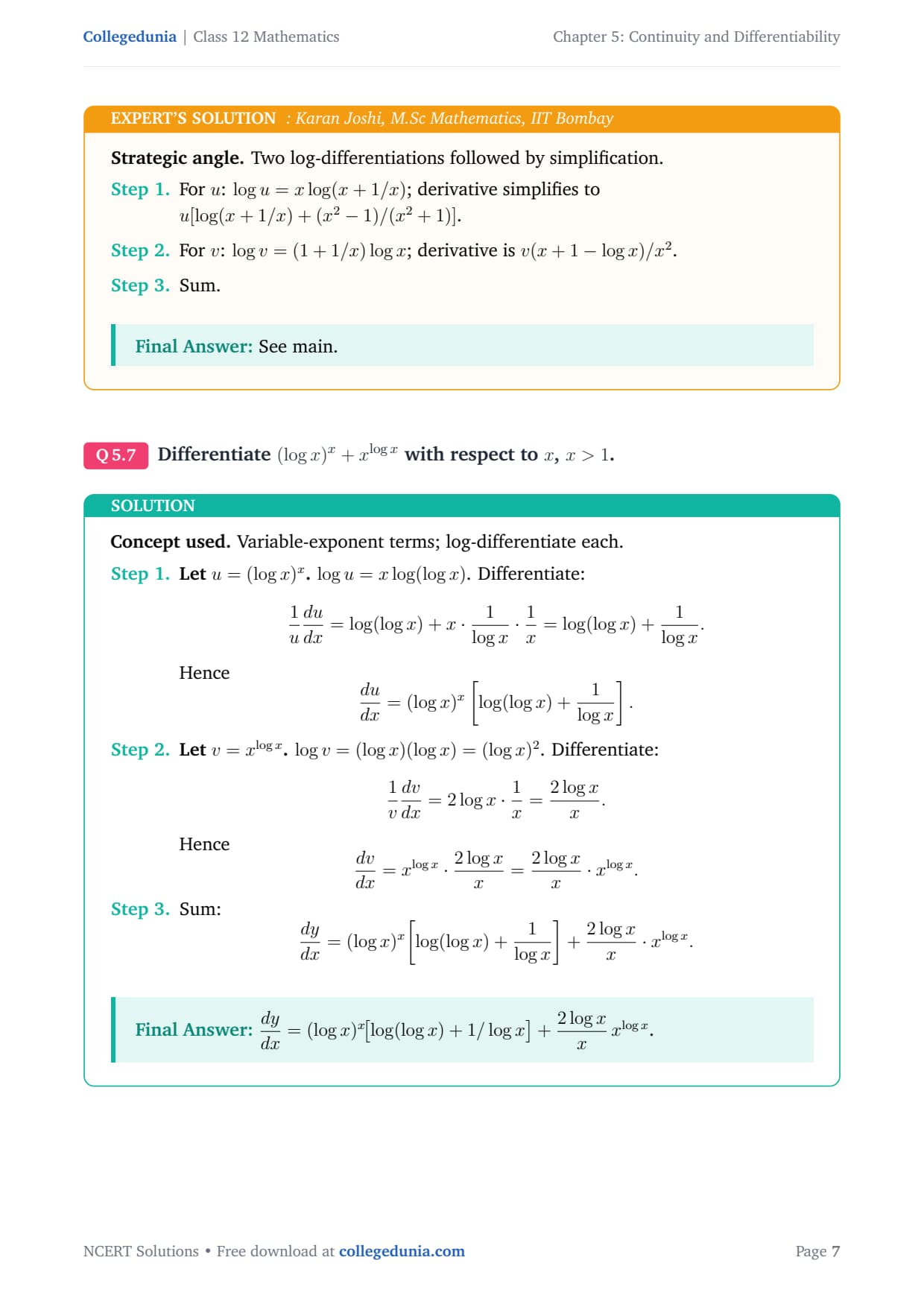
Structural observation. Note log(xlog x) = (log x)2 - a quadratic in log x.
u'/u = log(log x) + 1/log x.
v'/v = 2 log x / x.
See main.
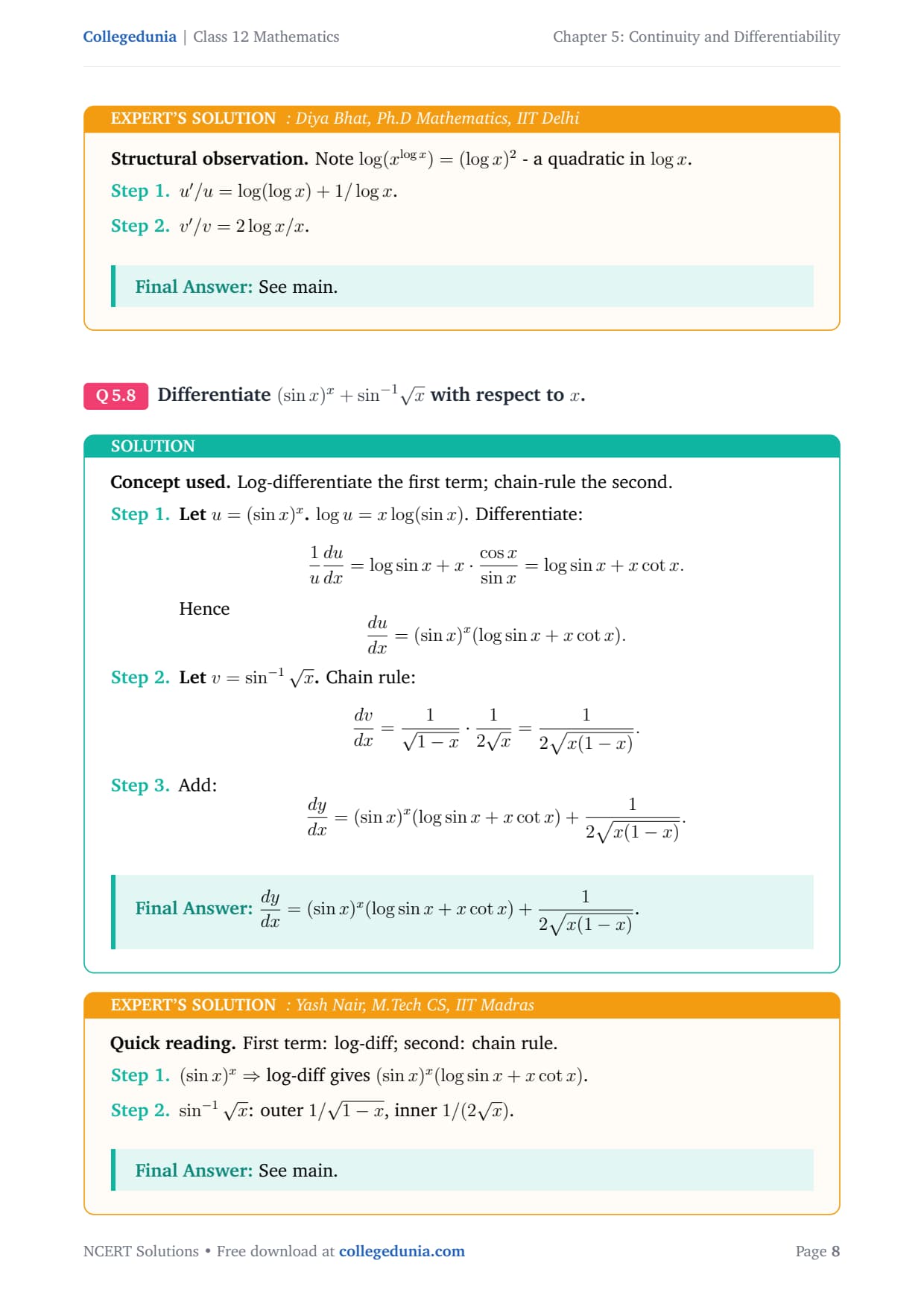
Q 5.8
Differentiate (sin x)x + sin-1√x with respect to x.
Concept used. Log-differentiate the first term; chain-rule the second.
Let u = (sin x)x.log u = x log(sin x).
Differentiate:
1ududx = log sin x + x · cos xsin x = log sin x + x cot x.
Hence
dudx = (sin x)x (log sin x + x cot x).
Let v = sin-1√x. Chain rule:
dvdx = 1√1 - x · 12 √x = 12 √x(1 - x).
Add:
dydx = (sin x)x (log sin x + x cot x) + 12 √x (1 - x).
dydx = (sin x)x(log sin x + x cot x) + 12√x(1 - x).
YN
Yash Nair
M.Tech CS, IIT Madras
Verified Expert
Quick reading. First term: log-diff; second: chain rule.
(sin x)x ⇒ log-diff gives (sin x)x (log sin x + x cot x).
sin-1√x: outer 1/√1-x, inner 1/(2√x).
See main.
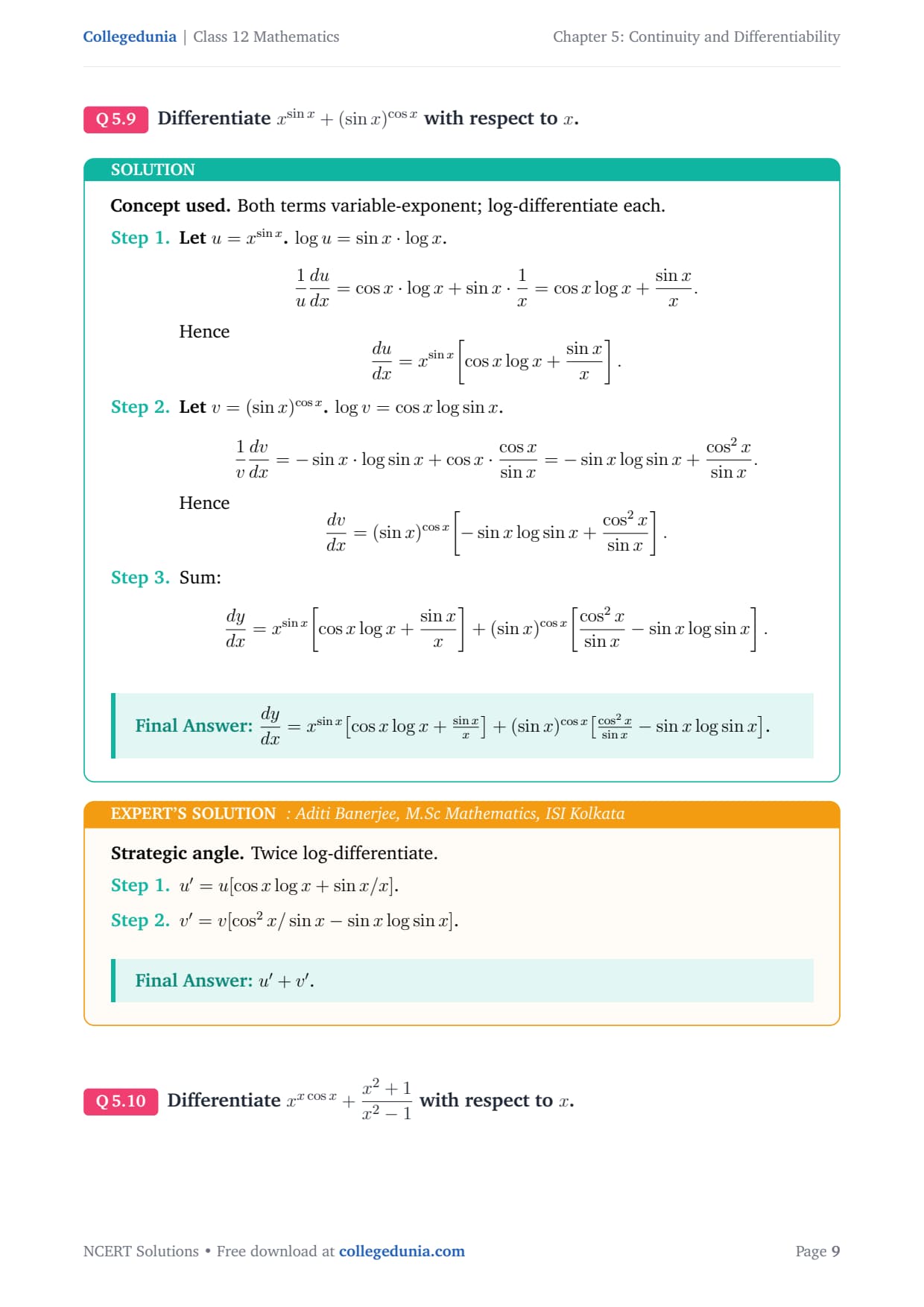
Q 5.9
Differentiate xsin x + (sin x)cos x with respect to x.
Concept used. Both terms variable-exponent; log-differentiate each.
Let u = xsin x.log u = sin x · log x.
1ududx = cos x · log x + sin x · 1x = cos x log x + sin xx.
Hence
dudx = xsin x[cos x log x + sin xx].
Let v = (sin x)cos x.log v = cos x log sin x.
1vdvdx = -sin x · log sin x + cos x · cos xsin x = -sin x log sin x + cos2xsin x.
Hence
dvdx = (sin x)cos x[-sin x log sin x + cos2xsin x].
Sum:
dydx = xsin x[cos x log x + sin xx] + (sin x)cos x[cos2xsin x - sin x log sin x].
dydx = xsin x[cos x log x + sin xx] + (sin x)cos x[cos2xsin x - sin x log sin x].
AB
Aditi Banerjee
M.Sc Mathematics, ISI Kolkata
Verified Expert
Strategic angle. Twice log-differentiate.
u' = u[cos x log x + sin x/x].
v' = v[cos2x/sin x - sin x log sin x].
u' + v'.
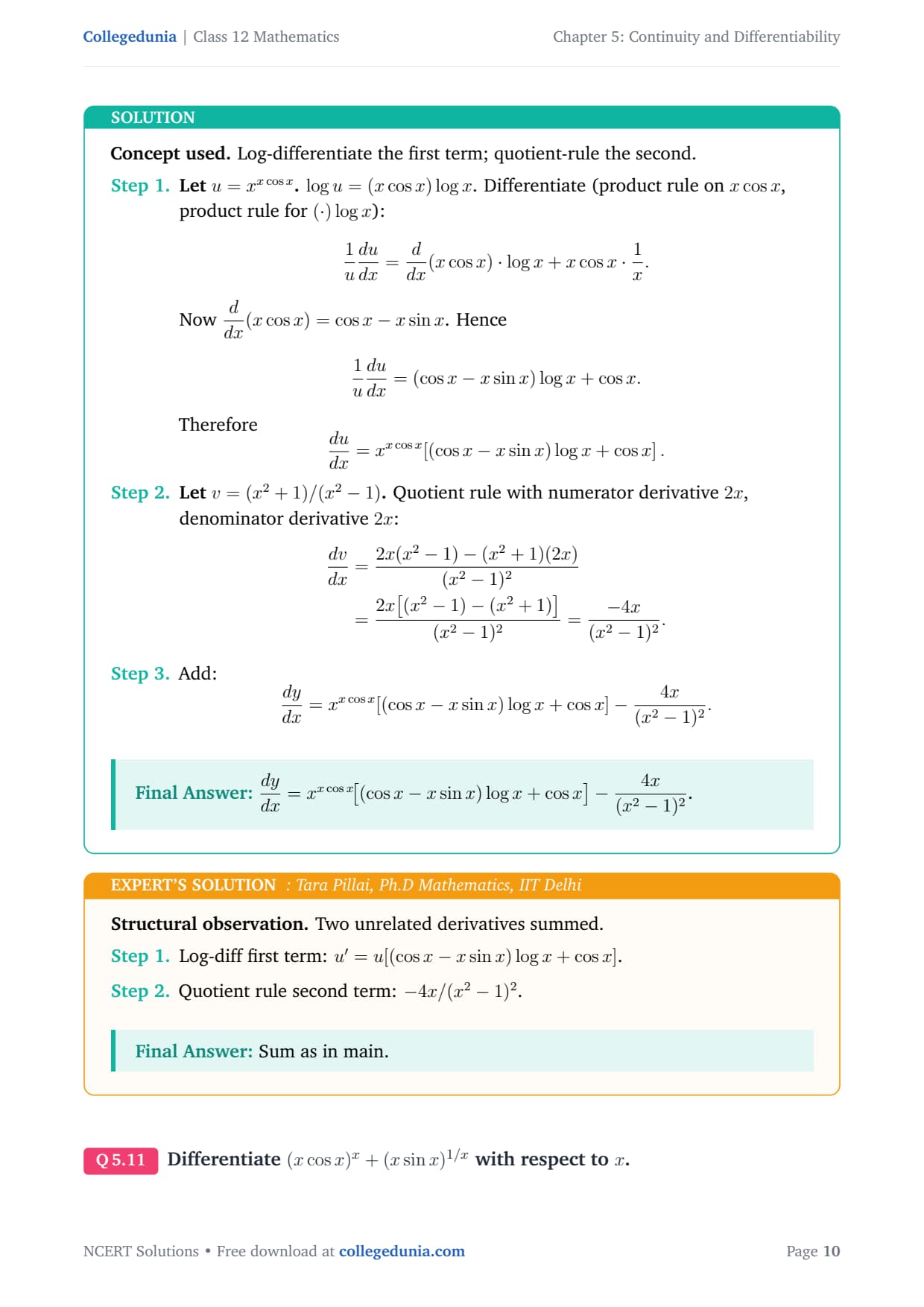
Q 5.10
Differentiate xx cos x + x2 + 1x2 - 1 with respect to x.
Concept used. Log-differentiate the first term; quotient-rule the second.
Let u = xx cos x.log u = (x cos x) log x.
Differentiate (product rule on x cos x, product rule for (·)log x):
1ududx = ddx(x cos x) · log x + x cos x · 1x.
Now ddx(x cos x) = cos x - x sin x. Hence
1ududx = (cos x - x sin x) log x + cos x.
Therefore
dudx = xx cos x[(cos x - x sin x) log x + cos x].
Add:
dydx = xx cos x[(cos x - x sin x) log x + cos x] - 4x(x2 - 1)2.
dydx = xx cos x[(cos x - x sin x)log x + cos x] - 4x(x2 - 1)2.
TP
Tara Pillai
Ph.D Mathematics, IIT Delhi
Verified Expert
Structural observation. Two unrelated derivatives summed.
Log-diff first term: u' = u[(cos x - x sin x)log x + cos x].
Quotient rule second term: -4x/(x2 - 1)2.
Sum as in main.
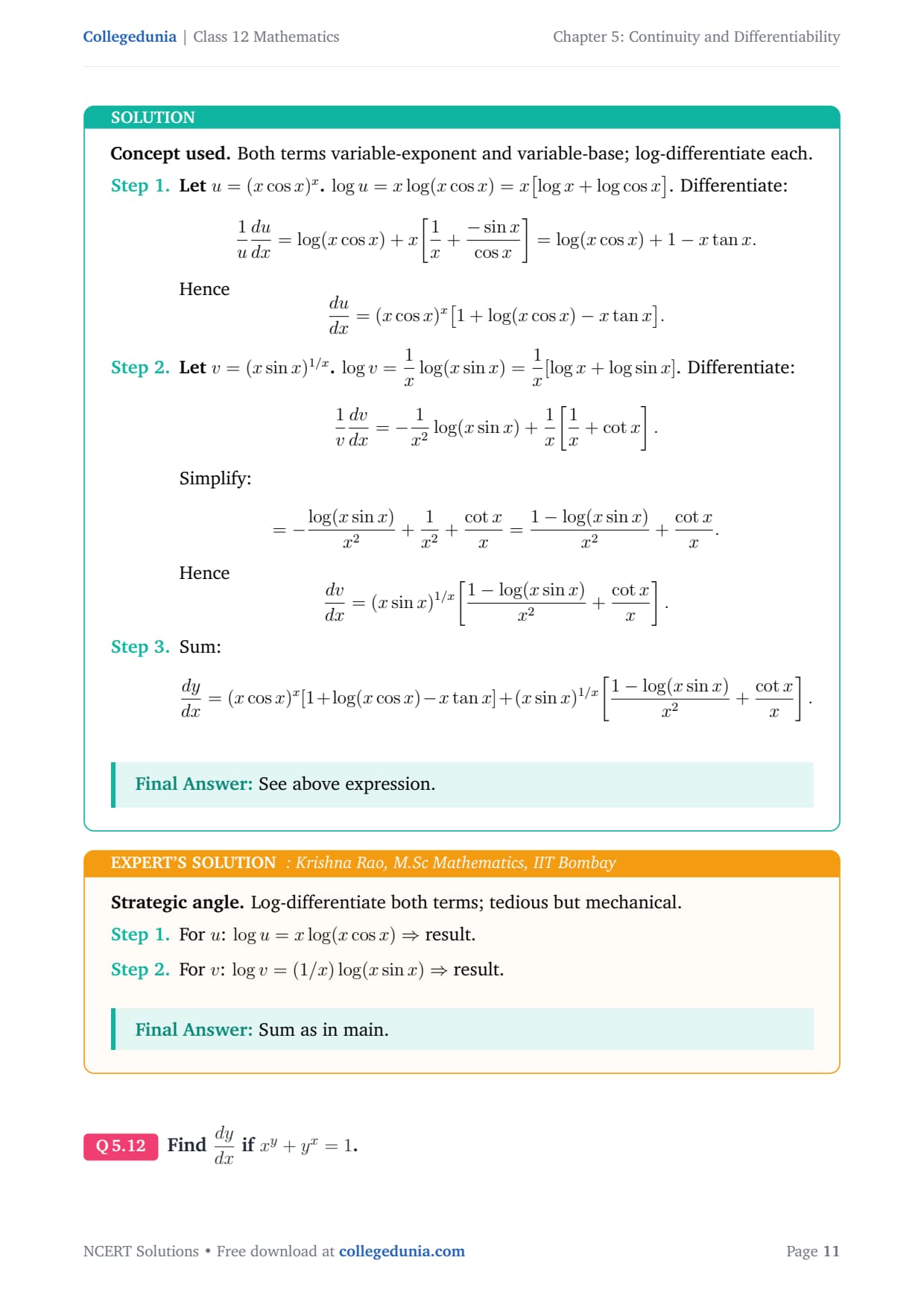
Q 5.11
Differentiate (x cos x)x + (x sin x)1/x with respect to x.
Concept used. Both terms variable-exponent and variable-base; log-differentiate each.
Let u = (x cos x)x.log u = x log(x cos x) = x [log x + log cos x].
Differentiate:
1ududx = log(x cos x) + x [1x + -sin xcos x] = log(x cos x) + 1 - x tan x.
Hence
dudx = (x cos x)x[1 + log(x cos x) - x tan x].
Let v = (x sin x)1/x.log v = 1x log(x sin x) = 1x[log x + log sin x].
Differentiate:
1vdvdx = -1x2log(x sin x) + 1x[1x + cot x].
Simplify:
= -log(x sin x)x2 + 1x2 + cot xx = 1 - log(x sin x)x2 + cot xx.
Hence
dvdx = (x sin x)1/x[1 - log(x sin x)x2 + cot xx].
Sum:
dydx = (x cos x)x [1 + log(x cos x) - x tan x] + (x sin x)1/x[1 - log(x sin x)x2 + cot xx].
See above expression.
KR
Krishna Rao
M.Sc Mathematics, IIT Bombay
Verified Expert
Strategic angle. Log-differentiate both terms; tedious but mechanical.
For u: log u = x log(xcos x)⇒ result.
For v: log v = (1/x)log(xsin x)⇒ result.
Sum as in main.
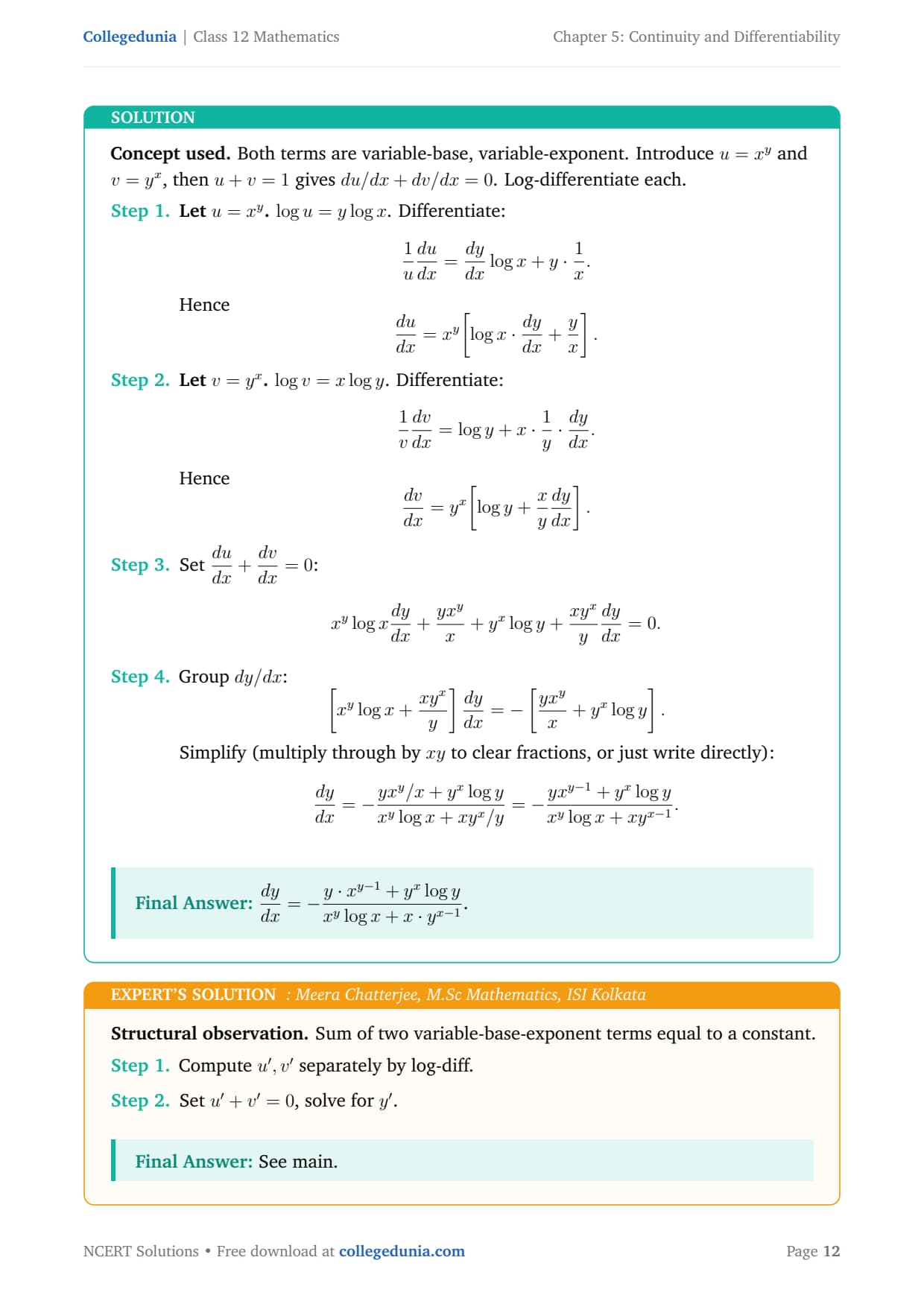
Q 5.12
Find dydx if xy + yx = 1.
Concept used. Both terms are variable-base, variable-exponent. Introduce u = xy and v = yx, then u + v = 1 gives du/dx + dv/dx = 0. Log-differentiate each.
Let u = xy.log u = y log x. Differentiate:
1ududx = dydx log x + y · 1x.
Hence
dudx = xy[log x · dydx + yx].
Let v = yx.log v = x log y. Differentiate:
1vdvdx = log y + x · 1y · dydx.
Hence
dvdx = yx[log y + xydydx].
Set dudx + dvdx = 0:
xy log xdydx + y xyx + yx log y + x yxydydx = 0.
Group dy/dx:
[xy log x + x yxy] dydx = -[y xyx + yx log y].
Simplify (multiply through by xy to clear fractions, or just write directly):
dydx = -y xy/x + yx log yxy log x + x yx/y = -y xy-1 + yx log yxy log x + x yx-1.
dydx = -y · xy - 1 + yx log yxy log x + x · yx - 1.
MC
Meera Chatterjee
M.Sc Mathematics, ISI Kolkata
Verified Expert
Structural observation. Sum of two variable-base-exponent terms equal to a constant.
Compute u', v' separately by log-diff.
Set u' + v' = 0, solve for y'.
See main.
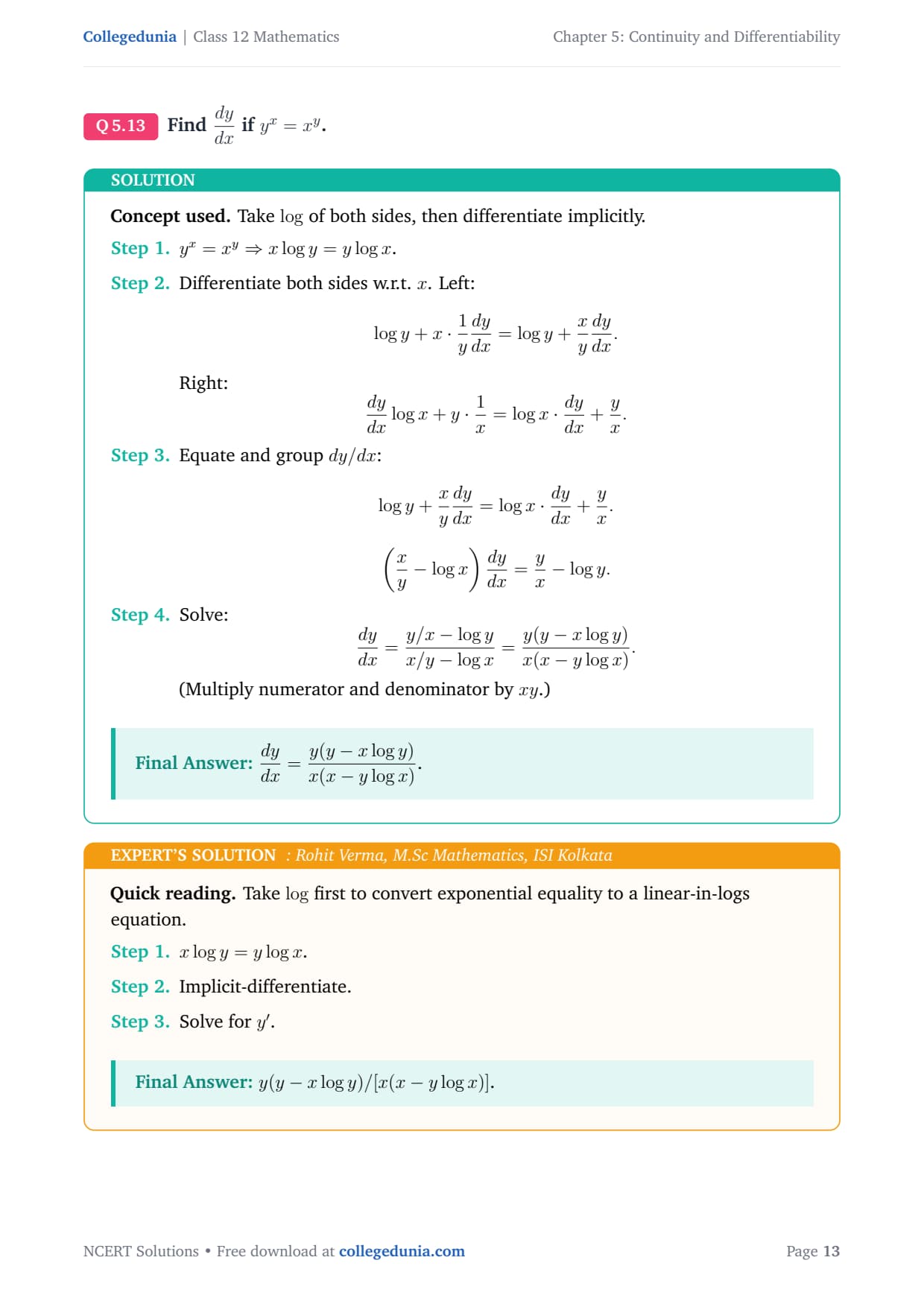
Q 5.13
Find dydx if yx = xy.
Concept used. Take log of both sides, then differentiate implicitly.
yx = xy ⇒ x log y = y log x.
Differentiate both sides w.r.t. x. Left:
log y + x · 1ydydx = log y + xydydx.
Right:
dydx log x + y · 1x = log x · dydx + yx.
Equate and group dy/dx:
log y + xydydx = log x · dydx + yx. (xy - log x)dydx = yx - log y.
Solve:
dydx = y/x - log yx/y - log x = y(y - x log y)x(x - y log x).
(Multiply numerator and denominator by xy.)
dydx = y(y - x log y)x(x - y log x).
RV
Rohit Verma
M.Sc Mathematics, ISI Kolkata
Verified Expert
Quick reading. Take log first to convert exponential equality to a linear-in-logs equation.
x log y = y log x.
Implicit-differentiate.
Solve for y'.
y(y - x log y)/[x(x - y log x)].
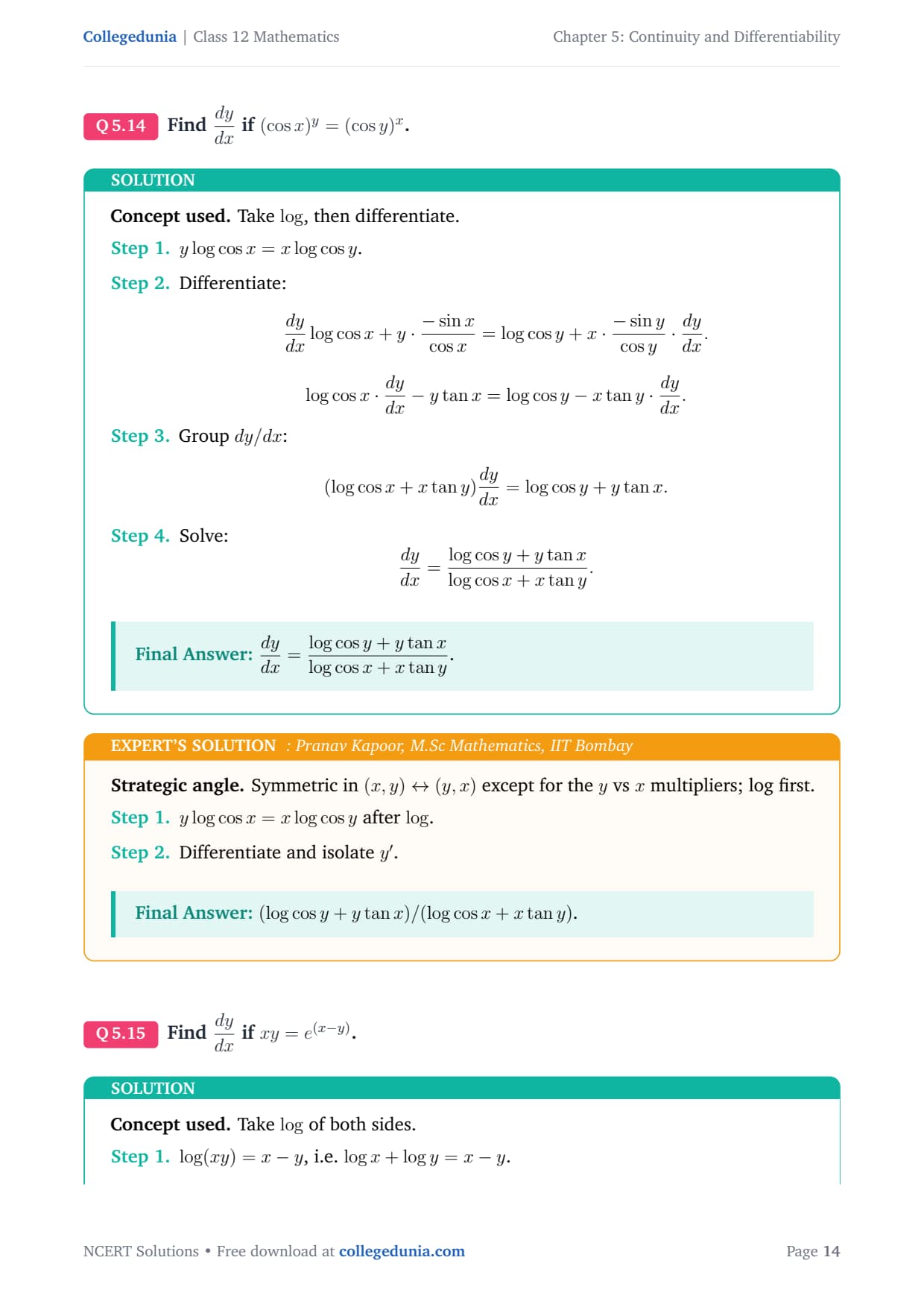
Q 5.14
Find dydx if (cos x)y = (cos y)x.
Concept used. Take log, then differentiate.
y log cos x = x log cos y.
Differentiate:
dydx log cos x + y · -sin xcos x = log cos y + x · -sin ycos y · dydx. log cos x · dydx - y tan x = log cos y - x tan y · dydx.
Group dy/dx:
(log cos x + x tan y)dydx = log cos y + y tan x.
Solve:
dydx = log cos y + y tan xlog cos x + x tan y.
dydx = log cos y + y tan xlog cos x + x tan y.
PK
Pranav Kapoor
M.Sc Mathematics, IIT Bombay
Verified Expert
Strategic angle. Symmetric in (x, y) ↔ (y, x) except for the y vs x multipliers; log first.
y log cos x = x log cos y after log.
Differentiate and isolate y'.
(log cos y + y tan x)/(log cos x + x tan y).
Q 5.15
Find dydx if xy = e(x - y).
Concept used. Take log of both sides.
log(xy) = x - y, i.e. log x + log y = x - y.
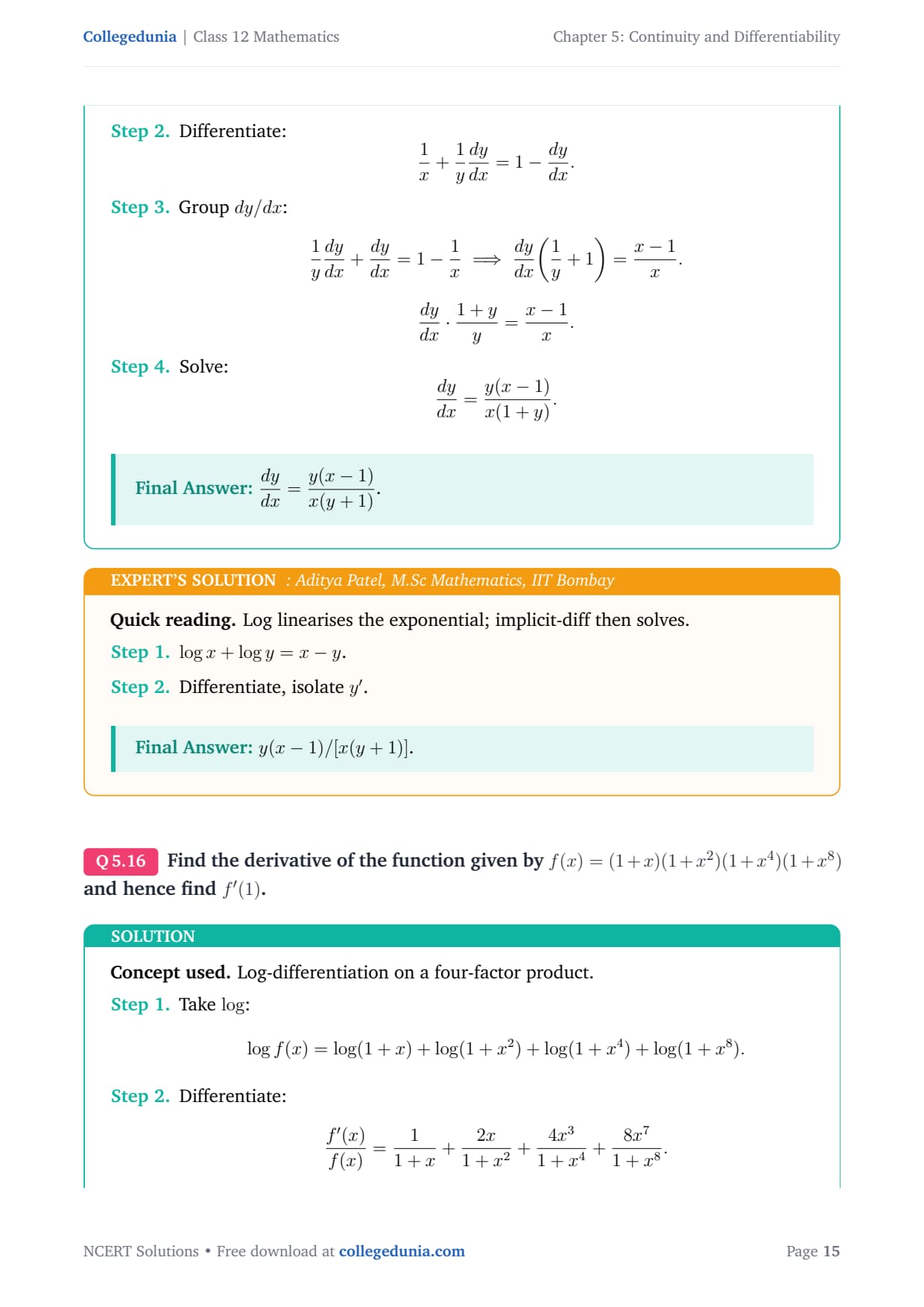
Differentiate:
1x + 1ydydx = 1 - dydx.
Group dy/dx:
1ydydx + dydx = 1 - 1xdydx(1y + 1) = x - 1x. dydx · 1 + yy = x - 1x.
Solve:
dydx = y(x - 1)x(1 + y).
dydx = y(x - 1)x(y + 1).
AP
Aditya Patel
M.Sc Mathematics, IIT Bombay
Verified Expert
Quick reading. Log linearises the exponential; implicit-diff then solves.
log x + log y = x - y.
Differentiate, isolate y'.
y(x - 1)/[x(y + 1)].
Q 5.16
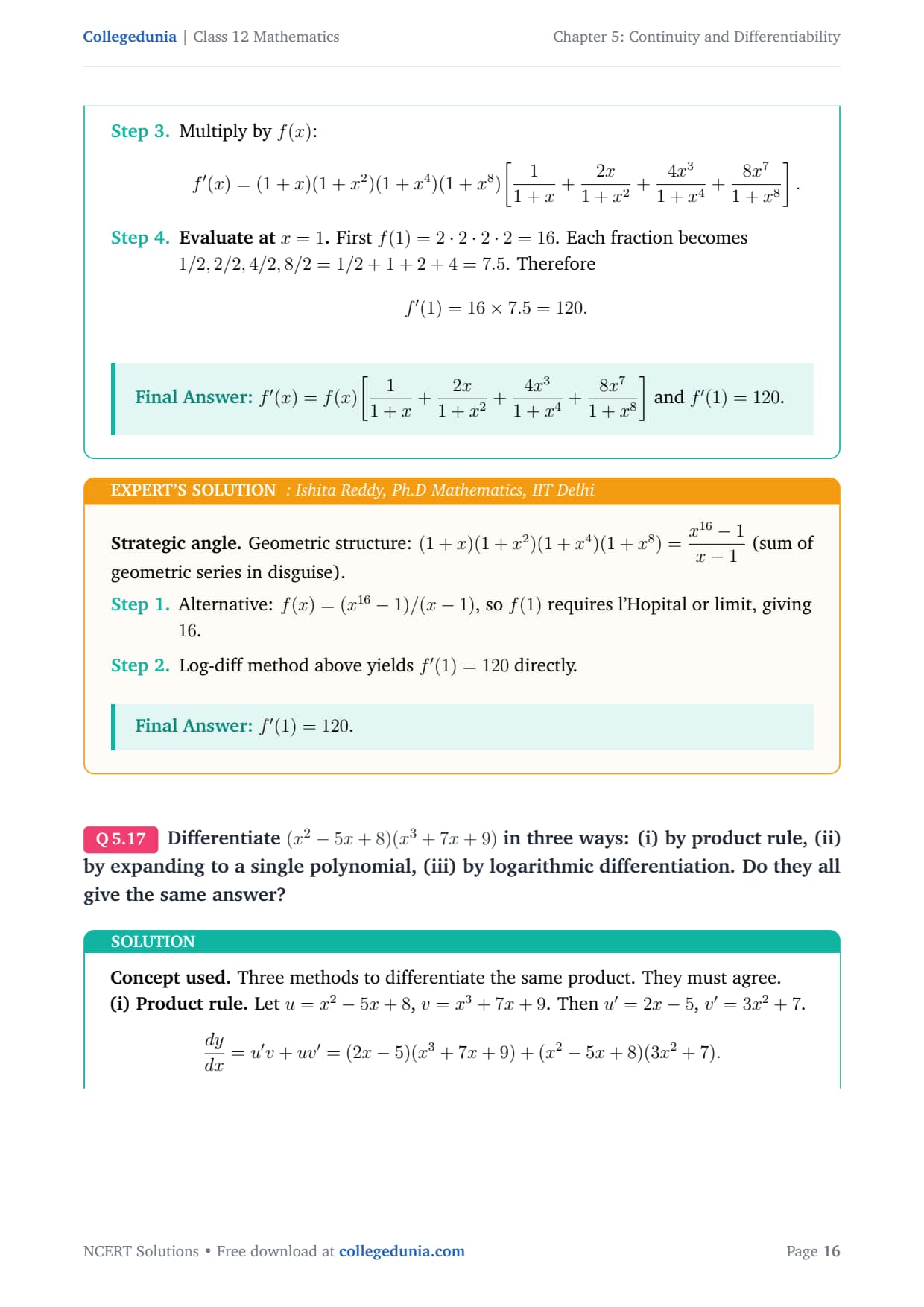
Find the derivative of the function given by f(x) = (1 + x)(1 + x2)(1 + x4)(1 + x8) and hence find f'(1).
Concept used. Log-differentiation on a four-factor product.
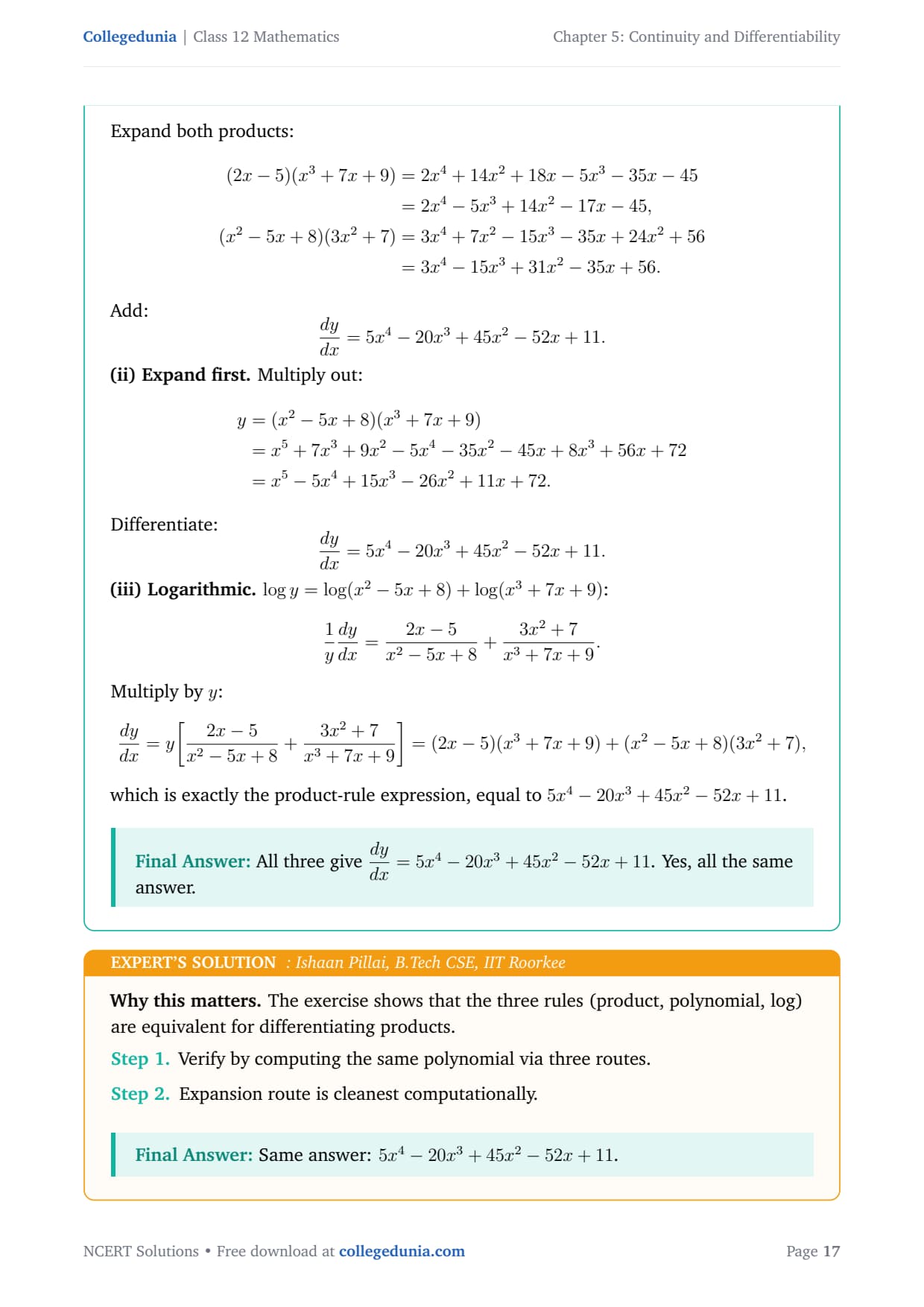
Differentiate (x2 - 5x + 8)(x3 + 7x + 9) in three ways: (i) by product rule, (ii) by expanding to a single polynomial, (iii) by logarithmic differentiation. Do they all give the same answer?
Concept used. Three methods to differentiate the same product. They must agree.
All three give dydx = 5x4 - 20x3 + 45x2 - 52x + 11. Yes, all the same answer.
IP
Ishaan Pillai
B.Tech CSE, IIT Roorkee
Verified Expert
Why this matters. The exercise shows that the three rules (product, polynomial, log) are equivalent for differentiating products.
Verify by computing the same polynomial via three routes.
Expansion route is cleanest computationally.
Same answer: 5x4 - 20x3 + 45x2 - 52x + 11.
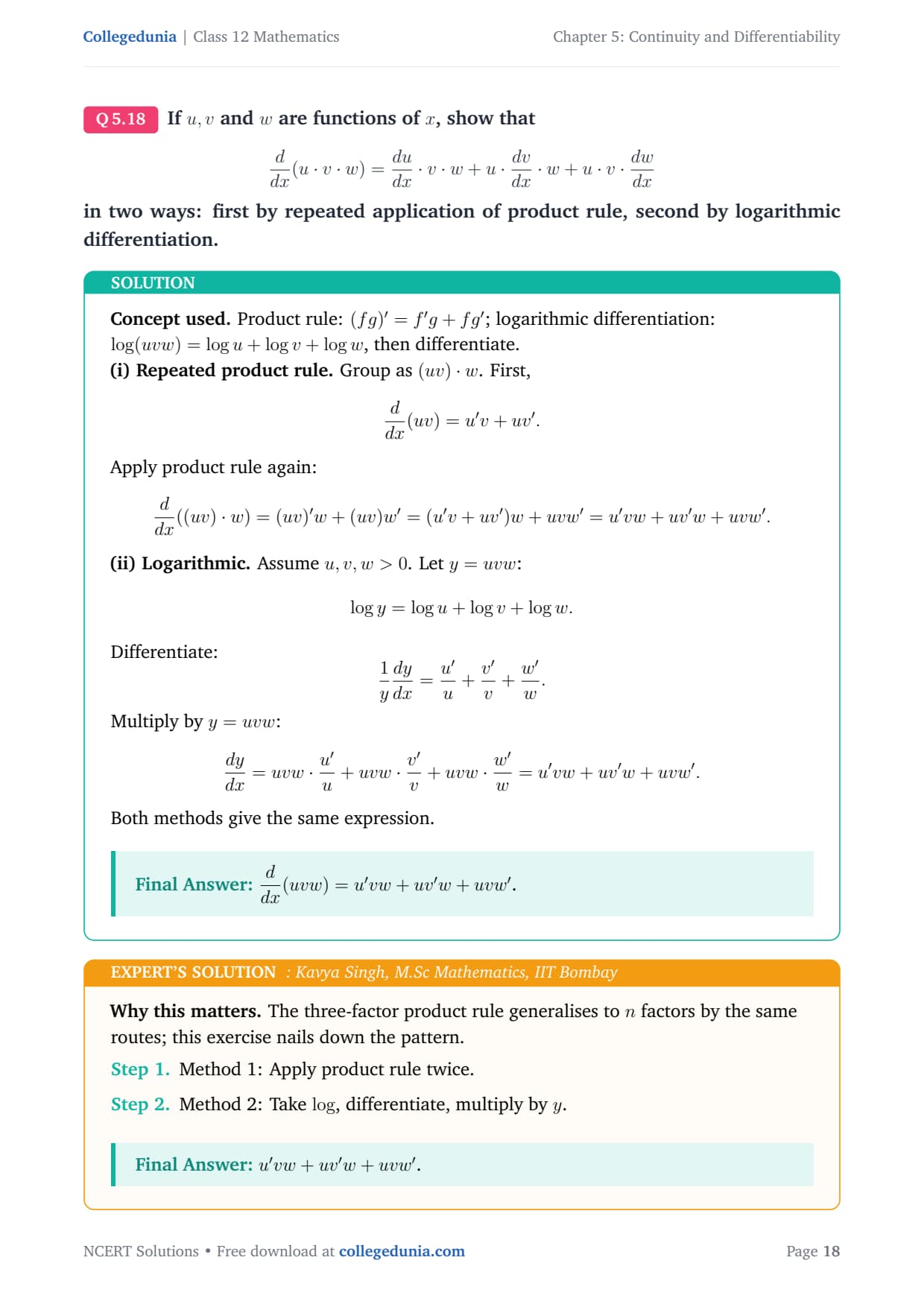
Q 5.18
If u, v and w are functions of x, show that
ddx(u · v · w) = dudx · v · w + u · dvdx · w + u · v · dwdx
in two ways: first by repeated application of product rule, second by logarithmic differentiation.
Concept used. Product rule: (fg)' = f'g + fg'; logarithmic differentiation: log(uvw) = log u + log v + log w, then differentiate.
(i) Repeated product rule. Group as (uv) · w. First,
ddx(uv) = u' v + uv'.
Apply product rule again:
ddx((uv) · w) = (uv)' w + (uv) w' = (u' v + uv') w + uv w' = u' vw + uv' w + uvw'.
(ii) Logarithmic. Assume u, v, w > 0. Let y = uvw:
log y = log u + log v + log w.
Differentiate:
1ydydx = u'u + v'v + w'w.
Multiply by y = uvw:
dydx = uvw · u'u + uvw · v'v + uvw · w'w = u' vw + uv' w + uvw'.
Both methods give the same expression.
ddx(uvw) = u' vw + uv' w + uvw'.
KS
Kavya Singh
M.Sc Mathematics, IIT Bombay
Verified Expert
Why this matters. The three-factor product rule generalises to n factors by the same routes; this exercise nails down the pattern.
Method 1: Apply product rule twice.
Method 2: Take log, differentiate, multiply by y.
u'vw + uv'w + uvw'.
Student Feedback - Class 12 Continuity and Differentiability Exercise 5.5 (Collegedunia Survey, March 2026):
58% of 460 Class 12 students surveyed said they forget the 1/y factor after log-differentiating in Exercise 5.5.
Students lost an average of 1 mark per question by reversing the parametric formula in a March 2026 answer-script review.
Toppers reported that writing the "take log on both sides" line explicitly, every time, cut their errors on variable-exponent questions by half.
Continuity and Differentiability Class 12 NCERT Solutions - Frequently Asked Questions
Ques. How many questions are there in Exercise 5.5 of Class 12 Maths Chapter 5?
Ans. Exercise 5.5 of NCERT Class 12 Maths Chapter 5 Continuity and Differentiability contains 18 questions in the 2026-27 print. Questions 1-12 use direct logarithmic differentiation, 13-15 mix two log-differentiable terms, and 16-18 cover parametric differentiation.
Ques. What is logarithmic differentiation?
Ans.Logarithmic differentiation is the technique of taking the logarithm of both sides of an equation before differentiating, useful when the function is of the form y = f(x)g(x). After log-taking, the exponent comes down via log(ab) = b log a, and the resulting expression is easy to differentiate implicitly.
Ques. How do you differentiate y = x x ?
Ans. Take log on both sides: log y = x log x. Differentiate implicitly: 1ydydx = log x + 1 . Therefore dydx = xx (log x + 1) . The this resource Exercise 5.5 solutions cover this template question in detail.
Ques. What is parametric differentiation in Exercise 5.5?
Ans.When both x and y are written as functions of a third variable t (the parameter), the derivative is dydx = dy/dtdx/dt. The last three questions of Exercise 5.5 cover this directly, and the this resource solutions show every dydt and dxdt on separate lines.
Ques. Where can I download the free PDF of Class 12 Maths Chapter 5 Exercise 5.5 solutions?
Ans. The free PDF of NCERT Solutions for Class 12 Maths Chapter 5 Exercise 5.5 is available on this resource at the top of the this chapter. these notes follows the 2026-27 NCERT print and shows every log-differentiation step and parametric formula on its own line.








Comments