NCERT Solutions for Class 12 English (Suppl.) Chapter 18 Kaleidoscope: The Argumentative Indian cover all Stop and Think, Understanding, Talking, Appreciation and Language Work tasks from the latest 2026-27 NCERT book. The PDF explains Amartya Sen's essay in clear exam-ready answers.
Includes 13 solved question blocks from the full Argumentative Indian chapter.
Covers dialogic tradition, democracy, secularism, Ramayana, Gita and noun-phrase tasks.
Uses Solution and Expert Solution tabs for quick Class 12 English revision.
Each answer follows the 2026-27 NCERT exercise order and keeps Sen's key phrases useful for school exam writing.
Student Feedback: In a Collegedunia student survey of 12,620 Class 12 English Elective students before the 2026 boards, many students said this essay becomes easier when they link Sen's examples to one main idea: argument as a public habit.
The Argumentative Indian Answer Key and Exercise Pattern
The chapter asks students to read argument as a cultural habit, not as a quarrel. Start with Sen's claim about India's dialogic tradition, then connect each answer to democracy, secularism and public discussion.
Exercise area
Questions
What it checks
Stop and Think
4 questions
Ramayana, Gita, ancient councils and social need for debate
Understanding the Text
4 questions
Dialogic tradition, democracy, secularism and identity
Talking and Appreciation
3 tasks
Public argument, interactive reasoning and evidence from the essay
Language Work
2 tasks
Word meanings and noun-phrase structure
The PDF solves all 13 tasks in the same order as the NCERT chapter. This keeps source wording and answer flow together for revision.
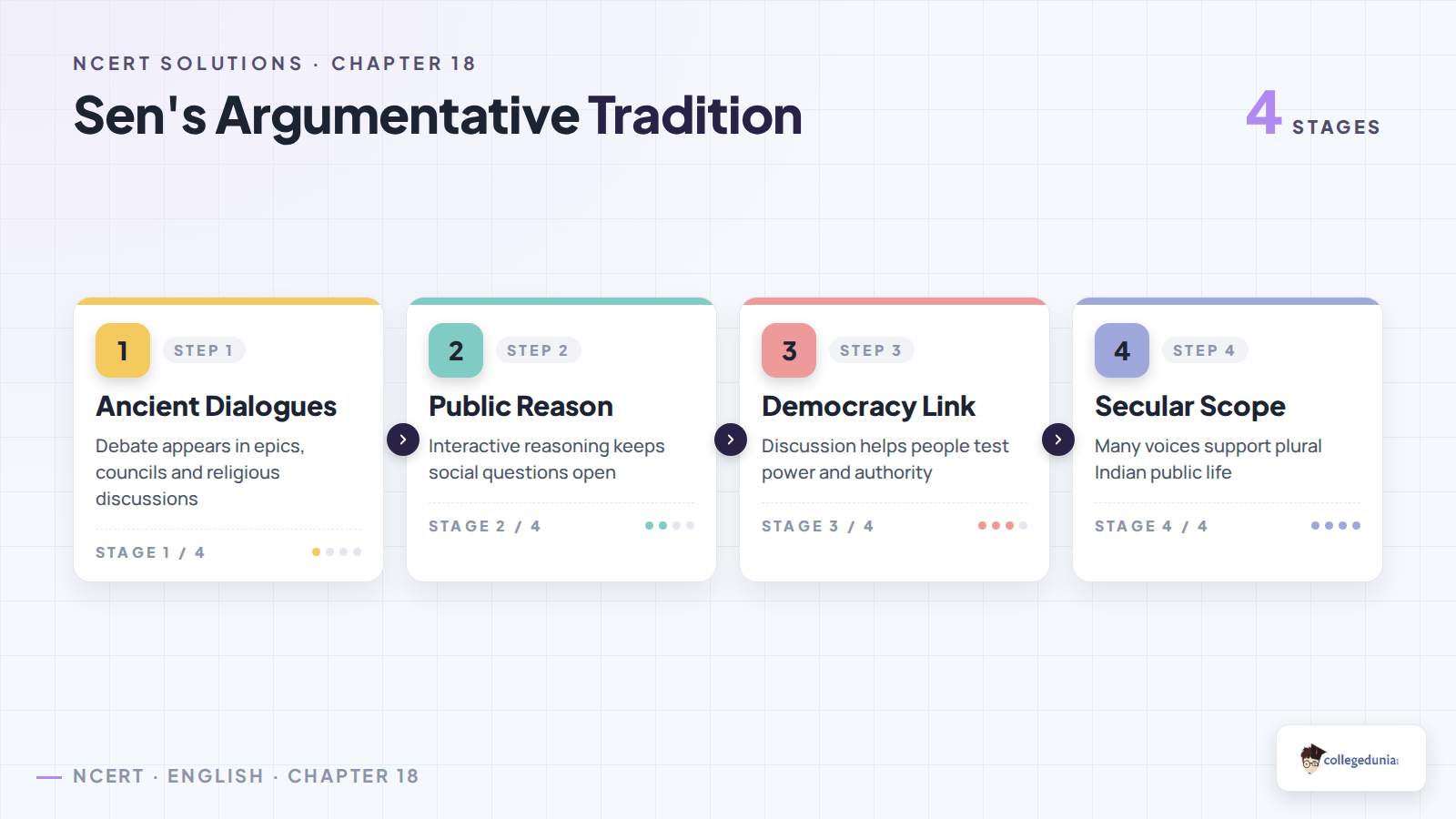
Sen's main point is simple: India has a long habit of debate. That habit appears in epics, councils, religious argument and public reasoning. He uses it to explain why democracy and secularism have strong roots in India.
Ancient examples: the Ramayana, Gita and councils show argument inside tradition.
Public reasoning: discussion helps people test social and political claims.
Modern link: democratic life needs space for many voices.
Debate Tradition and Narrow Stereotype Compared
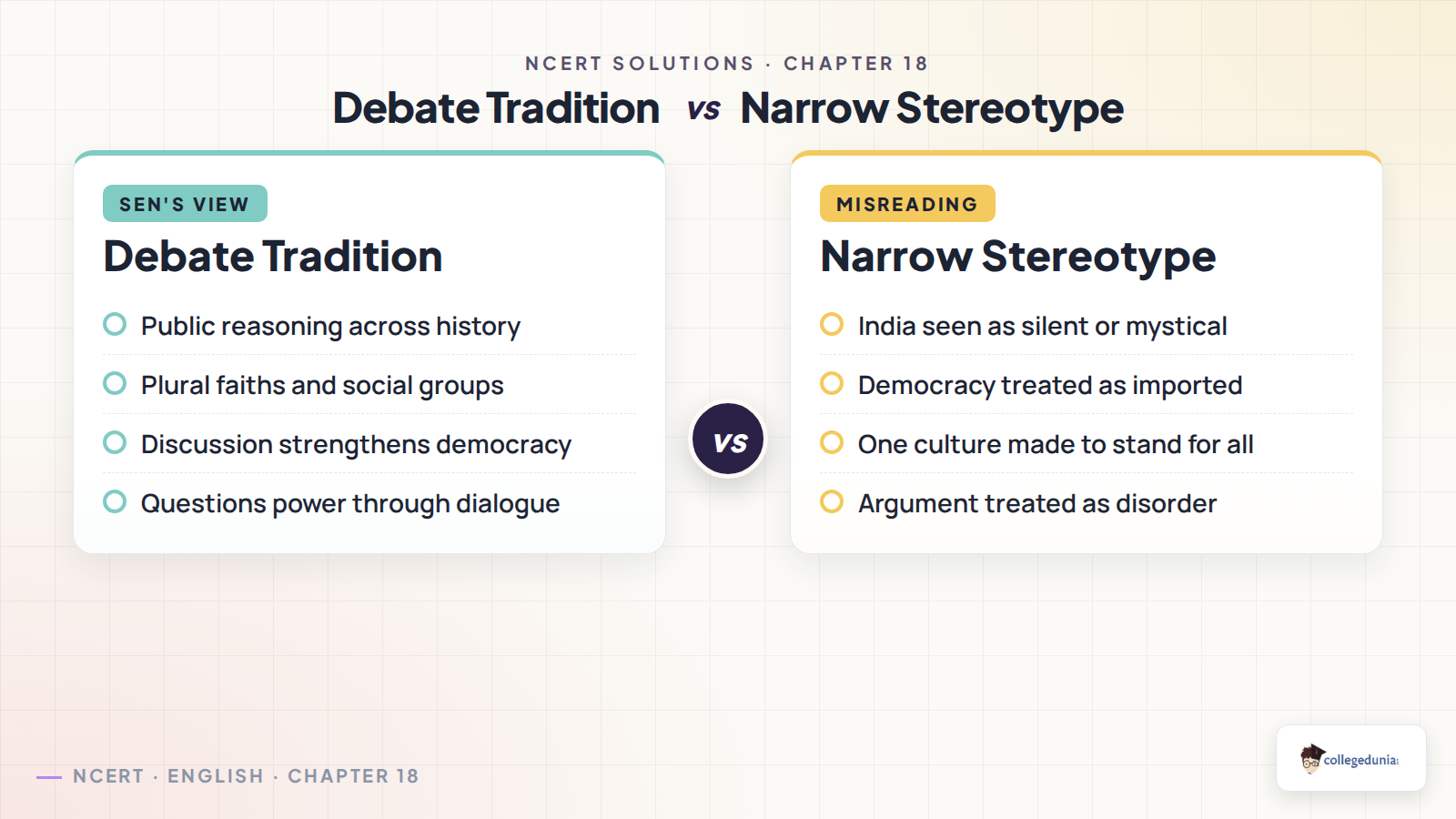
Sen challenges the idea that Indian culture is only spiritual, silent or passive. He shows that argument has shaped ethics, politics, religion and social reform. This is why examples matter in almost every answer.
Idea
How Sen uses it
Answer cue
Dialogic tradition
Public debate across texts, faiths and social groups
Use it when the question asks about Indian democracy.
Interactive reasoning
People argue, answer and revise claims together
Link it to secular and democratic habits.
Narrow stereotype
India is reduced to silence, mysticism or one culture
Reject it with Sen's examples.
Common Mistakes in The Argumentative Indian Answers
Watch Out: Most weak answers praise democracy in general but forget Sen's evidence from Indian texts and debates.
Do not treat argument as noise or conflict only.
Do not skip Sen's examples from the Ramayana and the Bhagavad Gita.
Do not call secularism a foreign idea without discussing Sen's reasoning.
Do not remove the full source wording in Language Work questions.
Practice cue: Write each long answer with one key term, one textual example and one direct link to the question.
The Argumentative Indian Language Work and Noun Phrases
The Language Work tasks are short but exact. Students need to explain words in context and identify noun phrases without dropping modifiers. The noun phrase relation - and the distance - between income and achievement is a good example.
Words: look at how terms work inside Sen's sentence before writing meanings.
Noun phrases: keep determiners, adjectives and embedded phrases together.
Context: connect grammar answers back to the sentence, not to a dictionary alone.
More Class 12 English Supplementary Chapter 18 Resources
Use these related resources when you want the same chapter in another format. The table is placed above the FAQ so students can move from solutions to notes, book PDF and handwritten revision without losing the chapter context.
Resource
Best use
Link
NCERT Solutions
Step-by-step answers for every Argumentative Indian task
All NCERT Solutions for Class 12 English Supplementary Chapters
The table below keeps the same resource type together, so students can move chapter by chapter through the Class 12 English supplementary Kaleidoscope question set.
All NCERT Solutions for Class 12 English (Suppl.) Chapter 18 Kaleidoscope: The Argumentative Indian with Step-by-Step Solutions
The expandable cards below reproduce the full solution set from the PDF. Use the Solution tab for a direct exam-ready answer and the Expert Solution tab for deeper notes on Sen's evidence, democracy, secularism and grammar analysis.
Each card separates the direct answer and expert explanation.
The literature cards keep Sen's examples visible for revision.
The grammar cards preserve the original Language Work prompts.
Q 18.1
Sen quotes Eliot's lines: 'Not fare well/But fare forward voyagers'. Distinguish between 'faring forward' (Krishna's position in the Gita) and 'faring well' (the position that Sen advocates).
Concept used. Sen reads the Gita debate as a conflict between duty-based action and consequence-sensitive action. Faring forward means acting on duty. Faring well means also asking whether the action produces humane results.
Use both positions
Name Krishna's duty argument and Arjuna's consequence argument before giving Sen's preference.
Faring forward means moving ahead with one's duty.
Krishna asks Arjuna to fight because the cause is just.
In this view, a warrior must not be paralysed by fear of painful results.
Duty becomes the main moral guide.
Faring well means judging the action by its human consequences.
Arjuna worries about death, grief and the destruction of kin.
Sen does not dismiss duty, but he says consequences cannot be ignored.
He therefore asks students to supplement the Gita's duty message with the wider wisdom of the Mahabharata.
The better position is not blind action, but responsible action that considers results.
Faring forward is Krishna's call to act on duty without being stopped by consequences. Faring well is Sen's preferred stress on judging action by its human results as well as by duty.
AM
Ananya Menon
M.A English, University of Delhi
Verified Expert
Quick reading. Sen reads the Gita debate as a conflict between duty-based action and consequence-sensitive action. Faring forward means acting on duty. Faring well means also asking whether the action produces humane results.
Sen treats the Gita as a debate, not only as a command.
Krishna's position is deontological: duty has priority.
Arjuna's position is consequential: slaughter and suffering matter morally.
Eliot's line captures the forward-moving duty argument.
Sen says this is powerful but incomplete.
A moral decision must also ask who suffers and what kind of world follows.
That is why he keeps Arjuna's doubt alive.
The phrase faring well makes room for practical compassion.
The answer should show that Sen expands the debate rather than simply rejecting Krishna.
Faring forward is Krishna's call to act on duty without being stopped by consequences. Faring well is Sen's preferred stress on judging action by its human results as well as by duty.
Q 18.2
Sen draws a parallel between the moral dilemma in the Krishna-Arjuna dialogue and J. R. Oppenheimer's response to the nuclear explosion in 1945. What is the basis for this?
Concept used. The parallel rests on the conflict between technical or assigned duty and the terrible consequences of carrying it out.
Duty and consequence
Use Oppenheimer's technical commitment and Arjuna's warrior duty as the two sides of the parallel.
Arjuna faces a war that seems just, but he fears the slaughter it will cause.
Krishna tells him to perform his duty as a warrior.
Oppenheimer led the team that made the atomic bomb for the side he saw as right.
He too could justify his action through technical commitment and wartime duty.
Yet the nuclear explosion revealed consequences of terrifying scale.
Oppenheimer later reflected on the danger of doing something technically sweet first and arguing later.
Sen connects this to Arjuna's worry about whether good can come from killing many people.
The basis of the parallel is therefore moral responsibility after powerful action.
Both Arjuna and Oppenheimer face the clash between duty and destructive consequences. Arjuna is asked to fight a just war; Oppenheimer helps build a technically successful bomb, then must face its human cost.
RI
Rohit Iyer
M.A English, EFLU Hyderabad
Verified Expert
Structural observation. The parallel rests on the conflict between technical or assigned duty and the terrible consequences of carrying it out.
The comparison is not casual.
Both cases involve a person inside a larger conflict.
Both can claim a duty to act for the right side.
Both also face consequences that cannot be morally brushed aside.
Oppenheimer's quotation from the Gita makes the link explicit.
The bomb becomes a modern version of the ancient dilemma.
Sen uses the parallel to show why Arjuna's question remains relevant.
Powerful action needs ethical reflection before and after success.
The answer should connect the nuclear example with Sen's broader argument about consequences.
Both Arjuna and Oppenheimer face the clash between duty and destructive consequences. Arjuna is asked to fight a just war; Oppenheimer helps build a technically successful bomb, then must face its human cost.
Q 18.3
Maitreyi's remark, 'what should I do with that by which I do not become immortal', is a rhetorical question cited to illustrate both the nature of the human predicament and the limitations of the material world. What is the connection that Sen draws between this and his concept of economic development?
Concept used. Sen connects Maitreyi's question with his capability view of development. Wealth matters only when it expands real life, freedom and well-being.
Income is not enough
Use wealth, capability, long life and freedom in the answer.
Maitreyi asks what use wealth has if it cannot give immortality.
Sen reads this as more than a spiritual question.
It points to the distance between wealth and actual human achievement.
Economic development cannot be judged only by income, GNP or GDP.
People need capabilities: the real freedom to live long and live well.
Money can help, but it does not automatically create health, education, dignity or freedom.
Development therefore has to focus on human lives directly.
The connection is that material opulence is a means, not the final goal.
Sen connects Maitreyi's question with his idea that development is about real capabilities, not only wealth. Income matters when it helps people live long, healthy, free and meaningful lives.
MN
Meera Nair
Ph.D English, JNU
Verified Expert
Concept-first angle. Sen connects Maitreyi's question with his capability view of development. Wealth matters only when it expands real life, freedom and well-being.
Maitreyi exposes the limits of material possession.
Even the whole earth full of wealth cannot solve every human problem.
Sen turns this into a modern development argument.
GDP growth is useful, but it is not the same as human freedom.
The real question is what people can actually be and do.
Can they live longer, learn, work, reason and choose?
If wealth fails to expand these freedoms, it is incomplete.
Thus an ancient dialogue becomes a clue to Sen's capability approach.
The answer should avoid equating development with only money.
Sen connects Maitreyi's question with his idea that development is about real capabilities, not only wealth. Income matters when it helps people live long, healthy, free and meaningful lives.
Q 18.4
It is important to see that the Indian argumentative tradition has frequently crossed the barriers of gender, caste, class and community. List the examples cited by Sen to highlight this.
Concept used. Sen shows that Indian argument has not belonged only to male elites. He gives women thinkers, political leaders, anti-caste voices, Bhakti and Sufi poets, and working-class saints as examples.
Group the examples
Organise the answer by gender first, then caste and class.
For gender, Sen mentions women in modern Indian politics and the national movement.
He names Sarojini Naidu and Nellie Sengupta as Congress leaders.
From ancient texts, he cites Gargi's questioning of Yajnavalkya and Maitreyi's question about wealth and immortality.
He also mentions Draupadi as a forceful speaker in the Mahabharata tradition.
For caste and class, he discusses challenges to Brahminical orthodoxy.
He refers to Buddhism and Jainism as movements with levelling arguments.
He cites Bharadvaja's reply to Bhrigu on caste and the Bhavisya Purana's argument about common divine parentage.
He then points to medieval mystical poets such as Kabir, Dadu, Ravi-das and Sena.
He also mentions women Bhakti voices such as Mira Bai, Andal, Daya-bai, Sahajo-bai and Ksema.
Sen cites Gargi, Maitreyi, Draupadi, Sarojini Naidu, Nellie Sengupta, anti-caste debates in the epics, Buddhism, Jainism, Kabir, Dadu, Ravi-das, Sena, Mira Bai, Andal, Daya-bai, Sahajo-bai and Ksema.
AR
Aditi Rao
M.A English, Jadavpur University
Verified Expert
Evidence map. Sen shows that Indian argument has not belonged only to male elites. He gives women thinkers, political leaders, anti-caste voices, Bhakti and Sufi poets, and working-class saints as examples.
Sen's list is designed to break a narrow view of Indian debate.
Women appear as questioners, leaders and poets.
Gargi questions a major scholar with confidence.
Maitreyi challenges the value of wealth.
Draupadi speaks politically and forcefully.
Modern leaders such as Sarojini Naidu and Nellie Sengupta continue that presence.
Caste and class barriers are crossed through Buddhist, Jain and Bhakti challenges.
Working-class saints such as Kabir and Ravi-das make argument a popular force.
The answer should show the range of examples rather than list only one category.
Sen cites Gargi, Maitreyi, Draupadi, Sarojini Naidu, Nellie Sengupta, anti-caste debates in the epics, Buddhism, Jainism, Kabir, Dadu, Ravi-das, Sena, Mira Bai, Andal, Daya-bai, Sahajo-bai and Ksema.
Q 18.5
What is Sen's interpretation of the positions taken by Krishna and Arjuna in the debate between them? [Note Sen's comment: 'Arjuna's contrary arguments are not really vanquished... There remains a powerful case for 'faring well' and not just 'faring forward'.]
Concept used. Sen interprets Krishna as defending duty-based action and Arjuna as defending consequence-sensitive moral reasoning.
Use Sen's note
Quote the idea that Arjuna's arguments are not really vanquished, then explain why.
Sen reads the Krishna-Arjuna dialogue as a serious debate.
Krishna argues that Arjuna must perform his duty as a warrior.
For Krishna, the just cause and Arjuna's role make withdrawal wrong.
Arjuna argues from consequences.
He asks whether victory is worth slaughter, grief and the killing of kin.
The religious reading often treats Krishna as the winner.
Sen adds that the Mahabharata also preserves Arjuna's contrary argument with sympathy.
The ruined world after the war gives weight to Arjuna's doubts.
So Sen sees a powerful case for faring well as well as faring forward.
Sen interprets Krishna as the voice of duty and Arjuna as the voice of consequences. He says Krishna's argument is influential, but Arjuna's moral doubts remain powerful and relevant.
KS
Karan Sharma
M.A English, University of Mumbai
Verified Expert
Balanced reading. Sen interprets Krishna as defending duty-based action and Arjuna as defending consequence-sensitive moral reasoning.
The key point is that Sen does not flatten the dialogue into one message.
Krishna's position is strong because social roles and just causes do matter.
Arjuna's position is strong because moral action cannot ignore suffering.
The epic lets both sides speak at length.
Sen therefore resists a univocal reading of the Gita.
He values the broader argumentative wisdom of the Mahabharata.
Arjuna's doubt survives because consequences outlast the battle.
That is why Sen treats the debate as still open for ethical thought.
The answer should mention both duty and consequences.
Sen interprets Krishna as the voice of duty and Arjuna as the voice of consequences. He says Krishna's argument is influential, but Arjuna's moral doubts remain powerful and relevant.
Q 18.6
What are the three major issues Sen discusses here in relation to India's dialogic tradition?
Concept used. The essay links India's dialogic tradition with moral reasoning, social inclusion, and democracy as public reasoning.
Use the section heads
The section heads guide the answer: Dialogue and Significance, Gender, Caste and Voice, Democracy as Public Reasoning.
The first issue is the moral significance of dialogue.
Sen uses the Krishna-Arjuna debate to show how Indian texts preserve opposing ethical views.
The second issue is participation across gender, caste, class and community.
He asks whether argument belonged only to elites, then gives many counterexamples.
The third issue is democracy as public reasoning.
He argues that India's democratic life draws strength from older habits of debate and heterodoxy.
Together, these issues show argument as a cultural, social and political force.
They also connect ancient discussion with contemporary public life.
Sen discusses moral dialogue in the epics, the crossing of gender, caste and class barriers in argument, and the role of public reasoning in India's democracy.
SK
Sanya Kapoor
M.A English, University of Hyderabad
Verified Expert
Structure-first angle. The essay links India's dialogic tradition with moral reasoning, social inclusion, and democracy as public reasoning.
The essay moves in three large steps.
First, it proves that Indian argument is old and substantive.
The Gita debate becomes the main example.
Second, it asks who got to speak in this tradition.
Sen shows that women and disadvantaged groups also used debate.
Third, it links public argument with democratic practice.
This final move brings the historical material into modern India.
The three issues are therefore ethics, inclusion and democracy.
The answer should not reduce the essay to only the Gita debate.
Sen discusses moral dialogue in the epics, the crossing of gender, caste and class barriers in argument, and the role of public reasoning in India's democracy.
Q 18.7
Sen has sought here to dispel some misconceptions about democracy in India. What are these misconceptions?
Concept used. Sen rejects two simple claims: that Indian democracy is merely a Western gift, and that India is uniquely democratic by some mysterious historical essence.
Name both pitfalls
Sen calls them twin pitfalls. Write them as two separate points.
The first misconception is that democracy in India is simply a gift from the West.
Sen says British institutional influence mattered, but it cannot fully explain India's democratic commitment.
Many other countries also experienced empire without building the same democratic habit.
The second misconception is the opposite claim.
It says India has something unique that makes it naturally suited to democracy.
Sen avoids this exceptionalism too.
His point is more balanced.
Democracy grows where public discussion and interactive reasoning are valued.
India had a long tradition of such reasoning, which helped democracy take root.
Sen dispels the ideas that Indian democracy is only a Western import and that India alone has a unique natural fitness for democracy. He links democracy instead with public reasoning.
DP
Devika Pillai
Ph.D English, IIT Madras
Verified Expert
Balanced correction. Sen rejects two simple claims: that Indian democracy is merely a Western gift, and that India is uniquely democratic by some mysterious historical essence.
Sen's correction works against two oversimplifications.
One gives all credit to British influence.
That ignores India's own practices of debate and heterodoxy.
The other makes India exceptional in a vague cultural way.
That ignores the global link between democracy and public reasoning.
Sen's view is both historical and comparative.
India learned from modern institutions, but it also drew on its own dialogic resources.
This is why democracy was easier to institute and preserve.
The answer should state the misconceptions and Sen's alternative clearly.
Sen dispels the ideas that Indian democracy is only a Western import and that India alone has a unique natural fitness for democracy. He links democracy instead with public reasoning.
Q 18.8
How, according to Sen, has the tradition of public discussion and interactive reasoning helped the success of democracy in India?
Concept used. Public discussion helps democracy because democracy is not only voting. It requires argument, dissent, tolerance, persuasion and reasoning in public life.
Beyond elections
Explain democracy as public reasoning, not only as a voting procedure.
Sen argues that democracy depends on public discussion.
People must be able to question power, compare views and give reasons.
India's older argumentative tradition made heterodoxy familiar.
It encouraged tolerance of different intellectual positions.
This habit helped citizens and leaders accept debate as part of public life.
After independence, India adopted democratic institutions from modern examples.
But those institutions were strengthened by local traditions of public reasoning.
The success of democracy therefore came from both institutional learning and a culture of argument.
The tradition helped democracy by making public debate, dissent and reasoning familiar. It supported a culture where political decisions could be discussed, challenged and defended.
RS
Rahul Sen
M.A English, Presidency University
Verified Expert
Civic reading. Public discussion helps democracy because democracy is not only voting. It requires argument, dissent, tolerance, persuasion and reasoning in public life.
Democracy needs more than a constitution on paper.
It needs citizens who can argue, listen and disagree without ending public life.
Sen calls this public reasoning.
India's dialogic tradition supplied a cultural resource for that habit.
Heterodoxy meant that one official view did not have to silence all others.
This made democratic discussion easier to preserve.
The result was not automatic, but the tradition mattered.
It gave democracy a deeper social base.
The answer should connect argument with democratic preservation.
The tradition helped democracy by making public debate, dissent and reasoning familiar. It supported a culture where political decisions could be discussed, challenged and defended.
Q 18.9
Does Amartya Sen see argumentation as a positive or a negative value?
Concept used. Sen sees argumentation as a positive value when it deepens reasoning, expands participation and supports democracy.
Avoid one-word answers
Say positive, then qualify it with responsible reasoning.
Sen clearly treats argumentation as a positive value.
He begins with India's love of speech and debate, but moves beyond joking about prolixity.
For him, argument allows moral doubts to remain visible.
It gives space to alternative perspectives like Arjuna's.
It can also challenge gender, caste and class exclusion.
Public argument helps democracy because citizens reason together.
However, Sen does not praise empty quarrelling.
The value lies in substantive, reasoned and inclusive debate.
Sen sees argumentation as positive when it is reasoned, substantive and inclusive. It helps moral reflection, social criticism and democratic public life.
PV
Priya Verma
M.A English, Banaras Hindu University
Verified Expert
Value judgement. Sen sees argumentation as a positive value when it deepens reasoning, expands participation and supports democracy.
The essay's tone is playful at first, but its argument is serious.
Sen does not celebrate noise for its own sake.
He values debate because it tests truth claims.
It keeps moral complexity alive.
It lets excluded voices challenge social hierarchy.
It also gives democracy a method for handling disagreement.
Thus argumentation is a civic and ethical resource.
Its value depends on reasoning, evidence and participation.
The answer should call it positive, with a clear qualification.
Sen sees argumentation as positive when it is reasoned, substantive and inclusive. It helps moral reflection, social criticism and democratic public life.
Q 18.10
How is the message of the Gita generally understood and portrayed? What change in interpretation does Sen suggest?
Concept used. The Gita is generally read as Krishna's teaching on duty and detached action. Sen suggests reading it within the wider Mahabharata debate, where Arjuna's consequential doubts also retain force.
Gita plus Mahabharata
Sen asks students to supplement the Gita's message with broader argumentative wisdom.
The Gita is generally understood as Krishna's teaching to Arjuna.
It is often portrayed as removing Arjuna's doubts.
The standard message stresses duty, action and not being attached to the fruit of action.
Krishna's position is therefore treated as victorious.
Sen suggests a broader interpretation.
He says the Mahabharata presents both Krishna and Arjuna with care.
The post-war desolation gives continuing force to Arjuna's worries.
So the Gita's duty message should be supplemented by concern for consequences.
The Gita is usually portrayed as Krishna's successful teaching of duty and detached action. Sen suggests adding Arjuna's concern for consequences and reading the debate through the wider Mahabharata.
AM
Arjun Mehta
M.A English, University of Calcutta
Verified Expert
Interpretation shift. The Gita is generally read as Krishna's teaching on duty and detached action. Sen suggests reading it within the wider Mahabharata debate, where Arjuna's consequential doubts also retain force.
The common devotional reading sees Krishna as resolving the crisis.
Arjuna's doubts are removed and action becomes his duty.
Sen does not deny the importance of that reading.
He asks why the epic preserves Arjuna's doubts so powerfully.
If the war leaves tragic destruction, consequences matter.
The moral lesson is therefore not one-sided.
Duty must be weighed with human costs.
This is the change Sen asks students to notice.
The answer should contrast the usual message with Sen's widened reading.
The Gita is usually portrayed as Krishna's successful teaching of duty and detached action. Sen suggests adding Arjuna's concern for consequences and reading the debate through the wider Mahabharata.
Q 18.11
This essay is an example of argumentative writing. Supporting statements with evidence is a feature of this kind of writing. For each of the statements given below state the supportive evidence provided in the essay: (i) Prolixity is not alien to India. (ii) The arguments are also, often enough, substantive. (iii) This admiration for the Gita, and Krishna's arguments in particular, has been a lasting phenomenon in parts of European culture. (iv) There remains a powerful case for 'faring well', and not just 'forward'.
Concept used. Argumentative writing supports claims with examples, historical references and textual evidence.
Claim plus evidence
Write each claim with the exact kind of evidence Sen gives.
For prolixity, Sen cites Krishna Menon's nine-hour United Nations speech.
He also cites the great length of the Ramayana and the Mahabharata compared with the Iliad and the Odyssey.
For substantive argument, he cites the Krishna-Arjuna debate in the Bhagavad Gita.
That debate weighs duty against the consequences of war.
For European admiration, he mentions Christopher Isherwood, T. S. Eliot and Wilhelm von Humboldt.
Isherwood translated the Gita, Eliot echoed Krishna's view, and Humboldt praised the Gita strongly.
For faring well, Sen points to the Mahabharata's tragic post-war desolation.
He also links it with Oppenheimer's later reflection on nuclear destruction.
Sen supports each claim with evidence: Krishna Menon's speech and the epics' length; the Krishna-Arjuna debate; Isherwood, Eliot and Humboldt; and the Mahabharata's tragic aftermath plus Oppenheimer's nuclear dilemma.
TJ
Tara Joshi
M.A English, University of Delhi
Verified Expert
Evidence mapping. Argumentative writing supports claims with examples, historical references and textual evidence.
The appreciation task asks students to see the essay's method.
Sen rarely makes a claim without evidence.
His first evidence is witty and quantitative: length of speech and length of epics.
His second evidence is philosophical: the Gita debate contains serious moral reasoning.
His third evidence is reception history: European writers admired Krishna's argument.
His fourth evidence is ethical: the destruction after war keeps Arjuna's doubt alive.
This pattern shows argumentative writing in action.
A claim becomes persuasive when it is supported by examples.
The answer should give evidence, not only repeat the statements.
Sen supports each claim with evidence: Krishna Menon's speech and the epics' length; the Krishna-Arjuna debate; Isherwood, Eliot and Humboldt; and the Mahabharata's tragic aftermath plus Oppenheimer's nuclear dilemma.
Q 18.12
(a) The opening two paragraphs have many words related to the basic idea of using words, particularly in speech, like 'prolixity'. List them. You may look for more such words in the rest of the essay. (b) Most of the statements Sen makes are tempered with due qualification, for example, 'The arguments are also, often enough, quite substantive'. Pick out other instances of qualification from the text.
Concept used. The task asks students to notice Sen's word field for speech and his habit of qualifying claims rather than making absolute statements.
Two-part answer
Separate speech words from qualifying phrases.
Speech-related words include prolixity, talk, speech, loquaciousness, speak, dialogues, arguments, counterarguments, debates and disputations.
Other related words from the essay include questions, discussion, public reasoning, argumentational participation and argumentative tradition.
Sen tempers statements with phrases such as often enough, perhaps, by and large, not at all negligible and it would be hard to expect.
He also uses relatively recent times, in some ways, may or may not, and to the extent that.
These qualifications make the argument careful.
They show that Sen avoids exaggerated claims.
The style suits argumentative writing because it leaves room for complexity.
It also makes his evidence sound more trustworthy.
Speech words include prolixity, talk, speech, loquaciousness, dialogues, arguments, counterarguments, debates and disputations. Qualifications include often enough, perhaps, by and large, not at all negligible, may or may not and to the extent that.
VB
Vivaan Bhat
Ph.D English, JNU
Verified Expert
Language observation. The task asks students to notice Sen's word field for speech and his habit of qualifying claims rather than making absolute statements.
Sen's vocabulary creates a semantic field around speaking and debate.
The first paragraphs joke about talkativeness, then shift to serious dialogue.
Words such as prolixity and loquaciousness name length of speech.
Dialogues, debates and disputations name reasoned exchange.
His qualifications are equally important.
They prevent the essay from becoming overconfident.
A phrase like often enough leaves space for exceptions.
This careful language strengthens the argumentative tone.
The answer should include both vocabulary and qualified phrasing.
Speech words include prolixity, talk, speech, loquaciousness, dialogues, arguments, counterarguments, debates and disputations. Qualifications include often enough, perhaps, by and large, not at all negligible, may or may not and to the extent that.
Q 18.13
Examine the noun phrases in these sentences from the text: The second woman head of the Indian National Congress, Nellie Sengupta, was elected in 1933. This concerns the relation - and the distance - between income and achievement. This may be particularly significant in understanding the class basis of the rapid spread of Buddhism, in particular, in India. The source uses dash punctuation around 'and the distance'; this PDF renders it as spaced hyphens to follow the no-em-dash house style.
Concept used. A noun phrase has a head noun and may include determiners, adjectives, apposition, prepositional phrases and other modifiers.
Find the head noun
Identify the head noun first, then list the words that expand it.
In the first sentence, the second woman head of the Indian National Congress is the main noun phrase.
Head is the head noun; the second and woman modify it, and of the Indian National Congress is a prepositional phrase.
Nellie Sengupta is a noun phrase in apposition because it renames the head.
In 1933 is a prepositional phrase of time, not part of the subject noun phrase.
In the second sentence, the relation and the distance is a coordinated noun phrase.
Between income and achievement is a prepositional phrase that expands relation and distance.
Income and achievement are noun phrases inside the prepositional phrase.
In the third sentence, the class basis of the rapid spread of Buddhism is the main noun phrase after understanding.
Basis is the head noun; class modifies it, and of the rapid spread of Buddhism expands it.
The rapid spread of Buddhism is another noun phrase, with spread as head and rapid as adjective.
The main noun phrases are the second woman head of the Indian National Congress, Nellie Sengupta, the relation and the distance between income and achievement, and the class basis of the rapid spread of Buddhism.
KR
Kavya Rao
M.A English, EFLU Hyderabad
Verified Expert
Grammar map. A noun phrase has a head noun and may include determiners, adjectives, apposition, prepositional phrases and other modifiers.
The safe method is to locate the head noun first.
In the first sentence, head is expanded by determiners, modifiers and an of-phrase.
Nellie Sengupta sits next to it as apposition.
The apposition adds exact identity.
In the second sentence, relation and distance form a paired noun phrase.
The phrase between income and achievement tells what relation and distance mean.
In the third sentence, basis is the central noun.
The nested phrase the rapid spread of Buddhism works inside the larger phrase.
The answer should show nesting, not merely underline nouns.
The main noun phrases are the second woman head of the Indian National Congress, Nellie Sengupta, the relation and the distance between income and achievement, and the class basis of the rapid spread of Buddhism.
The Argumentative Indian Class 12 English NCERT Solutions FAQs
Ques. How many questions are solved in Class 12 English Supplementary Chapter 18 The Argumentative Indian?
Ans. The PDF solves all 13 question blocks from the 2026-27 NCERT chapter, including Stop and Think, Understanding, Talking, Appreciation and Language Work tasks.
Ques. What is the main idea of The Argumentative Indian?
Ans. Sen argues that India has a strong dialogic tradition where debate, questioning and public reasoning have shaped culture and politics.
Ques. Why does Sen discuss democracy in The Argumentative Indian?
Ans. Sen links democracy to India's older habits of discussion, disagreement and interactive reasoning, instead of treating it as a purely imported system.
Ques. Does this page include Language Work answers for The Argumentative Indian?
Ans. Yes. The solutions include word meanings from the essay and noun-phrase analysis from the official Language Work section.





Chapter18Kaleidoscope:TheArgumentativeIndianSolutions.pdf?page=1&dpi=150)
Chapter18Kaleidoscope:TheArgumentativeIndianSolutions.pdf?page=2&dpi=150)
Chapter18Kaleidoscope:TheArgumentativeIndianSolutions.pdf?page=3&dpi=150)
Chapter18Kaleidoscope:TheArgumentativeIndianSolutions.pdf?page=4&dpi=150)
Chapter18Kaleidoscope:TheArgumentativeIndianSolutions.pdf?page=5&dpi=150)
Chapter18Kaleidoscope:TheArgumentativeIndianSolutions.pdf?page=6&dpi=150)
Chapter18Kaleidoscope:TheArgumentativeIndianSolutions.pdf?page=7&dpi=150)
Chapter18Kaleidoscope:TheArgumentativeIndianSolutions.pdf?page=8&dpi=150)
Chapter18Kaleidoscope:TheArgumentativeIndianSolutions.pdf?page=9&dpi=150)
Chapter18Kaleidoscope:TheArgumentativeIndianSolutions.pdf?page=10&dpi=150)
Chapter18Kaleidoscope:TheArgumentativeIndianSolutions.pdf?page=11&dpi=150)
Chapter18Kaleidoscope:TheArgumentativeIndianSolutions.pdf?page=12&dpi=150)
Chapter18Kaleidoscope:TheArgumentativeIndianSolutions.pdf?page=13&dpi=150)
Chapter18Kaleidoscope:TheArgumentativeIndianSolutions.pdf?page=14&dpi=150)
Chapter18Kaleidoscope:TheArgumentativeIndianSolutions.pdf?page=15&dpi=150)
Chapter18Kaleidoscope:TheArgumentativeIndianSolutions.pdf?page=16&dpi=150)
Chapter18Kaleidoscope:TheArgumentativeIndianSolutions.pdf?page=17&dpi=150)
Chapter18Kaleidoscope:TheArgumentativeIndianSolutions.pdf?page=18&dpi=150)
Chapter18Kaleidoscope:TheArgumentativeIndianSolutions.pdf?page=19&dpi=150)
Chapter18Kaleidoscope:TheArgumentativeIndianSolutions.pdf?page=20&dpi=150)
Chapter18Kaleidoscope:TheArgumentativeIndianSolutions.pdf?page=21&dpi=150)
Chapter18Kaleidoscope:TheArgumentativeIndianSolutions.pdf?page=22&dpi=150)
Chapter18Kaleidoscope:TheArgumentativeIndianSolutions.pdf?page=23&dpi=150)
Chapter18Kaleidoscope:TheArgumentativeIndianSolutions.pdf?page=24&dpi=150)
Chapter18Kaleidoscope:TheArgumentativeIndianSolutions_flat_MobileCard.pdf?page=1&dpi=150)
Chapter18Kaleidoscope:TheArgumentativeIndianSolutions_flat_MobileCard.pdf?page=2&dpi=150)
Chapter18Kaleidoscope:TheArgumentativeIndianSolutions_flat_MobileCard.pdf?page=3&dpi=150)
Chapter18Kaleidoscope:TheArgumentativeIndianSolutions_flat_MobileCard.pdf?page=4&dpi=150)
Chapter18Kaleidoscope:TheArgumentativeIndianSolutions_flat_MobileCard.pdf?page=5&dpi=150)
Chapter18Kaleidoscope:TheArgumentativeIndianSolutions_flat_MobileCard.pdf?page=6&dpi=150)
Chapter18Kaleidoscope:TheArgumentativeIndianSolutions_flat_MobileCard.pdf?page=7&dpi=150)
Chapter18Kaleidoscope:TheArgumentativeIndianSolutions_flat_MobileCard.pdf?page=8&dpi=150)
Chapter18Kaleidoscope:TheArgumentativeIndianSolutions_flat_MobileCard.pdf?page=9&dpi=150)
Chapter18Kaleidoscope:TheArgumentativeIndianSolutions_flat_MobileCard.pdf?page=10&dpi=150)
Chapter18Kaleidoscope:TheArgumentativeIndianSolutions_flat_MobileCard.pdf?page=11&dpi=150)
Chapter18Kaleidoscope:TheArgumentativeIndianSolutions_flat_MobileCard.pdf?page=12&dpi=150)
Chapter18Kaleidoscope:TheArgumentativeIndianSolutions_flat_MobileCard.pdf?page=13&dpi=150)
Chapter18Kaleidoscope:TheArgumentativeIndianSolutions_flat_MobileCard.pdf?page=14&dpi=150)
Chapter18Kaleidoscope:TheArgumentativeIndianSolutions_flat_MobileCard.pdf?page=15&dpi=150)
Chapter18Kaleidoscope:TheArgumentativeIndianSolutions_flat_MobileCard.pdf?page=16&dpi=150)
Chapter18Kaleidoscope:TheArgumentativeIndianSolutions_flat_MobileCard.pdf?page=17&dpi=150)
Chapter18Kaleidoscope:TheArgumentativeIndianSolutions_flat_MobileCard.pdf?page=18&dpi=150)
Chapter18Kaleidoscope:TheArgumentativeIndianSolutions_flat_MobileCard.pdf?page=19&dpi=150)
Chapter18Kaleidoscope:TheArgumentativeIndianSolutions_flat_MobileCard.pdf?page=20&dpi=150)
Chapter18Kaleidoscope:TheArgumentativeIndianSolutions_flat_MobileCard.pdf?page=21&dpi=150)
Chapter18Kaleidoscope:TheArgumentativeIndianSolutions_flat_MobileCard.pdf?page=22&dpi=150)
Chapter18Kaleidoscope:TheArgumentativeIndianSolutions_flat_MobileCard.pdf?page=23&dpi=150)
Chapter18Kaleidoscope:TheArgumentativeIndianSolutions_flat_MobileCard.pdf?page=24&dpi=150)
Chapter18Kaleidoscope:TheArgumentativeIndianSolutions_flat_MobileCard.pdf?page=25&dpi=150)
Chapter18Kaleidoscope:TheArgumentativeIndianSolutions_flat_MobileCard.pdf?page=26&dpi=150)
Chapter18Kaleidoscope:TheArgumentativeIndianSolutions_flat_MobileCard.pdf?page=27&dpi=150)
Chapter18Kaleidoscope:TheArgumentativeIndianSolutions_flat_MobileCard.pdf?page=28&dpi=150)
Chapter18Kaleidoscope:TheArgumentativeIndianSolutions_flat_MobileCard.pdf?page=29&dpi=150)
Chapter18Kaleidoscope:TheArgumentativeIndianSolutions_flat_MobileCard.pdf?page=30&dpi=150)
Chapter18Kaleidoscope:TheArgumentativeIndianSolutions_flat_MobileCard.pdf?page=31&dpi=150)
Chapter18Kaleidoscope:TheArgumentativeIndianSolutions_flat_MobileCard.pdf?page=32&dpi=150)
Chapter18Kaleidoscope:TheArgumentativeIndianSolutions_flat_MobileCard.pdf?page=33&dpi=150)
Chapter18Kaleidoscope:TheArgumentativeIndianSolutions_flat_MobileCard.pdf?page=34&dpi=150)
Chapter18Kaleidoscope:TheArgumentativeIndianSolutions_flat_MobileCard.pdf?page=35&dpi=150)
Chapter18Kaleidoscope:TheArgumentativeIndianSolutions_flat_MobileCard.pdf?page=36&dpi=150)
Chapter18Kaleidoscope:TheArgumentativeIndianSolutions_flat_MobileCard.pdf?page=37&dpi=150)
Chapter18Kaleidoscope:TheArgumentativeIndianSolutions_flat_MobileCard.pdf?page=38&dpi=150)
Chapter18Kaleidoscope:TheArgumentativeIndianSolutions_flat_MobileCard.pdf?page=39&dpi=150)
Chapter18Kaleidoscope:TheArgumentativeIndianSolutions_flat_MobileCard.pdf?page=40&dpi=150)
Chapter18Kaleidoscope:TheArgumentativeIndianSolutions_flat_MobileCard.pdf?page=41&dpi=150)
Chapter18Kaleidoscope:TheArgumentativeIndianSolutions_flat_MobileCard.pdf?page=42&dpi=150)
Chapter18Kaleidoscope:TheArgumentativeIndianSolutions_flat_MobileCard.pdf?page=43&dpi=150)
Chapter18Kaleidoscope:TheArgumentativeIndianSolutions_flat_MobileCard.pdf?page=44&dpi=150)
Chapter18Kaleidoscope:TheArgumentativeIndianSolutions_flat_MobileCard.pdf?page=45&dpi=150)
Chapter18Kaleidoscope:TheArgumentativeIndianSolutions_flat_MobileCard.pdf?page=46&dpi=150)
Chapter18Kaleidoscope:TheArgumentativeIndianSolutions_flat_MobileCard.pdf?page=47&dpi=150)
Chapter18Kaleidoscope:TheArgumentativeIndianSolutions_flat_MobileCard.pdf?page=48&dpi=150)
Chapter18Kaleidoscope:TheArgumentativeIndianSolutions_flat_MobileCard.pdf?page=49&dpi=150)



Comments