NCERT Solutions for Class 12 English (Suppl.) Chapter 17 Kaleidoscope: Why the Novel Matters cover all Stop and Think, Talking, Appreciation and Language Work tasks from the latest 2026-27 NCERT book. The PDF explains D.H. Lawrence's defence of the novel in clear exam-ready answers.
Includes 16 solved question blocks from the full Why the Novel Matters chapter.
Covers man alive, body knowledge, integrity, Ruskin's good book and grammar tasks.
Uses Solution and Expert Solution tabs for quick Class 12 English revision.
Each answer follows the 2026-27 NCERT exercise order and keeps Lawrence's main phrases useful for school exam writing.
Student Feedback: In a Collegedunia student survey of 12,480 Class 12 English Elective students before the 2026 boards, many students said this essay becomes easier when they revise Lawrence's repeated phrases with the grammar tasks.
Why the Novel Matters Answer Key and Exercise Pattern
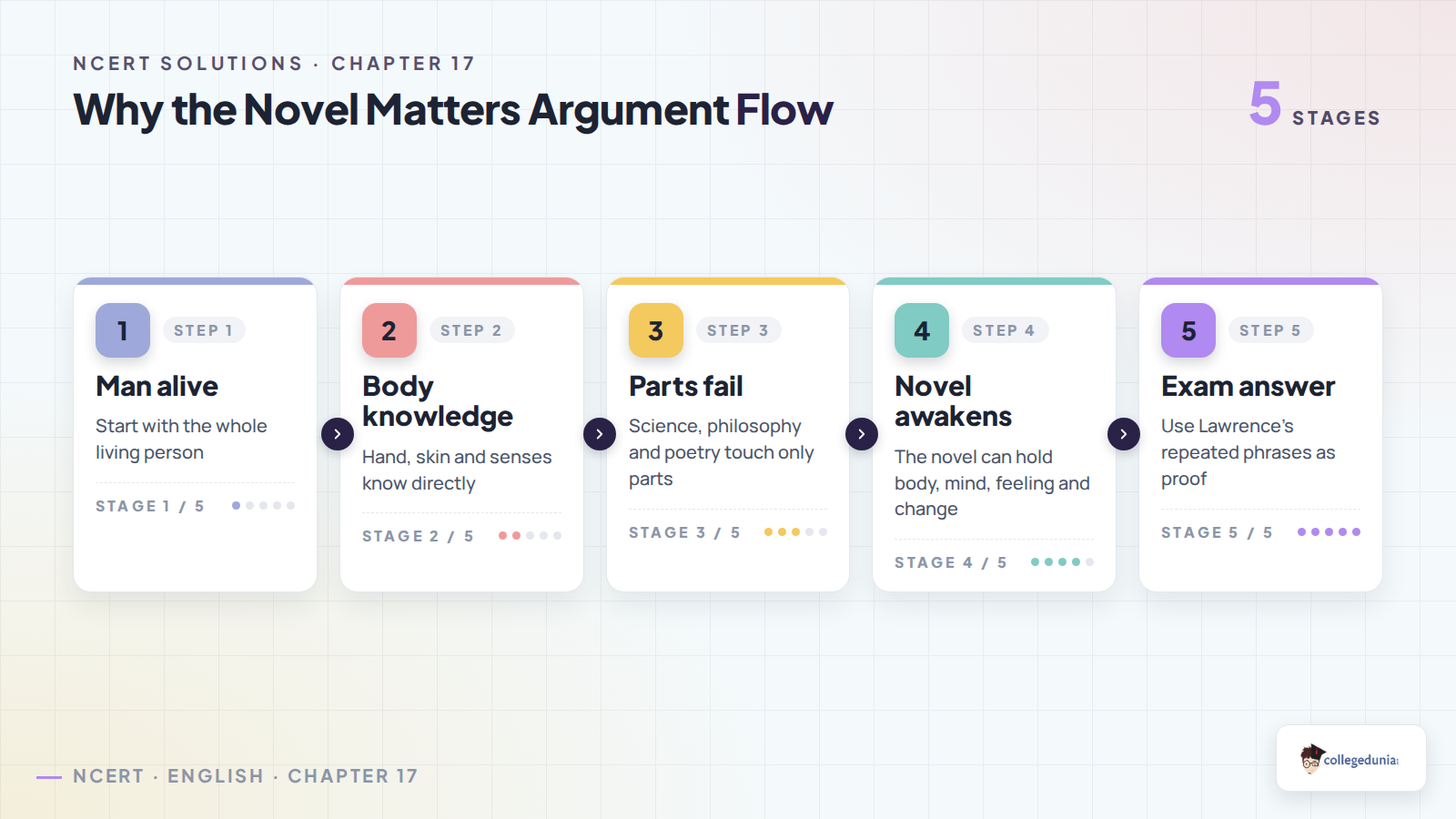
The chapter mixes literary argument with vocabulary and grammar practice. Start with Lawrence's claim about the whole living person, then connect each answer to the phrases man alive, book of life and whole greater than the part.
Exercise area
Questions
What it checks
Stop and Think
3 questions
Lawrence's attack on body-soul separation and his idea of man alive
Understanding the Text
4 questions
Novel as the book of life, body knowledge and repeated catch phrases
Talking and Appreciation
4 questions
Integrity, Ruskin's good book, rhetoric and argumentative force
Language Work
5 tasks
Foreign expressions, Latin roots, copulas, intransitive verbs and ch-gh sounds
The PDF solves all 16 tasks in the same order as the NCERT chapter. This helps students revise the essay and language-work section without switching sources.
Lawrence argues that a person cannot be split into body, soul, mind and message. The living person is whole. A novel matters because it can hold that mixed life better than a single idea or abstract rule.
Body knowledge: the hand, skin and senses know life directly.
Whole person: the essay values feeling, thought, body and change together.
Novel form: the novel keeps character, contradiction and movement alive.
Novel and Other Books in Why the Novel Matters
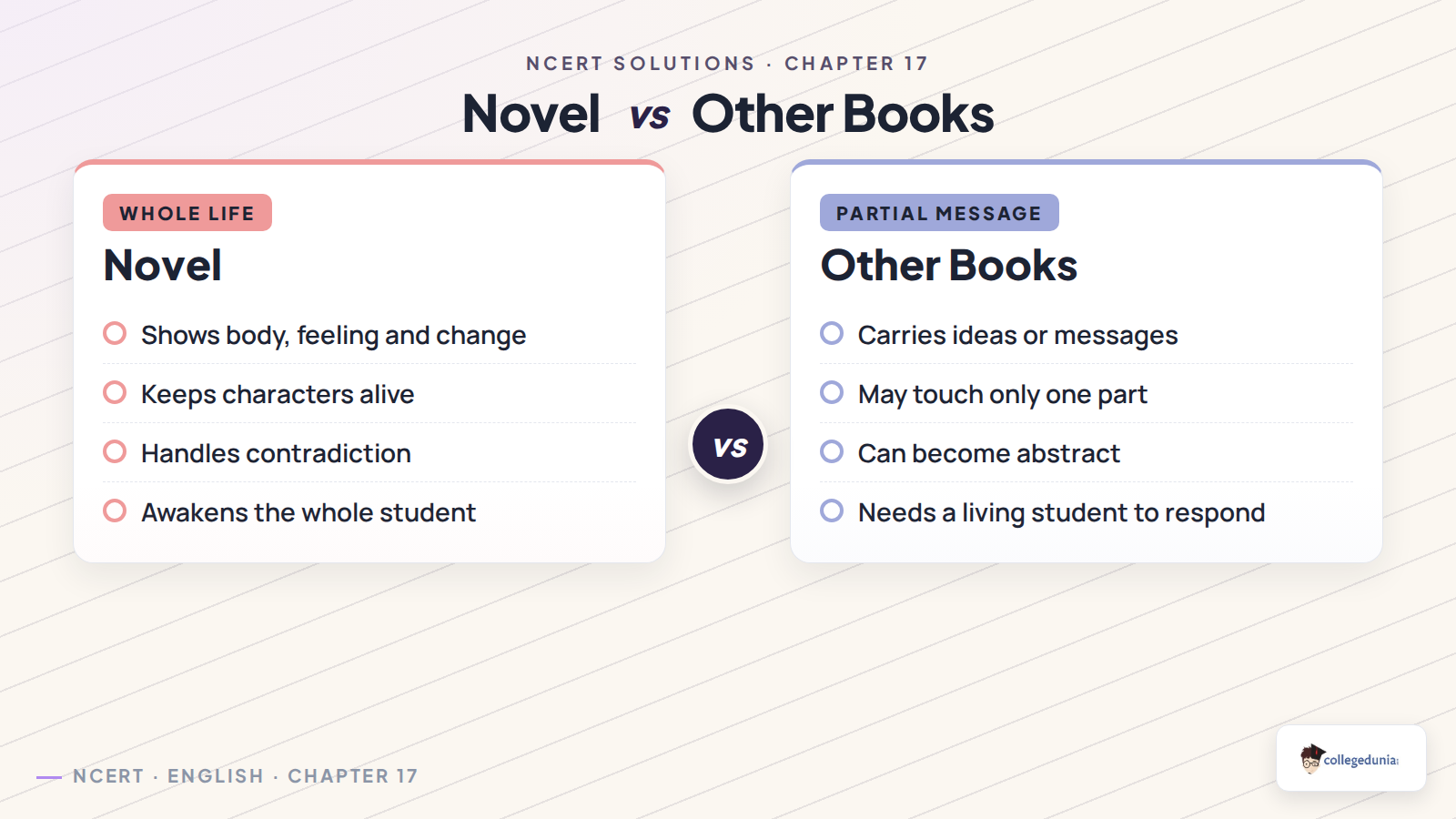
Lawrence does not say every book is useless. He says books are not life itself. Ruskin's good book preserves a wise writer's best thought, but Lawrence gives the novel a special place because it awakens the whole person.
Book form
Main strength
Answer cue
Novel
Characters, body, feeling, change and contradiction
Use book of life and man alive as proof.
Philosophy or science
Ideas, theories and messages
Explain why Lawrence calls these partial forms.
Ruskin's good book
A wise writer's preserved thought
Contrast lasting wisdom with living response.
Common Mistakes in Why the Novel Matters Answers
Watch Out: Most weak answers repeat the word novel without explaining Lawrence's idea of whole living life.
Do not treat body, soul and mind as separate final truths.
Do not skip the contrast between integrity and rigid consistency.
Do not forget Ruskin when the question directly asks for his definition.
Do not label forever as an object in the grammar task.
Practice cue: Write each long answer with one Lawrence phrase, one explanation and one clear link to the question.
Why the Novel Matters Language Work and Grammar Tasks
The Language Work section is scoring if students label words carefully. The foreign expressions connect to body, life and spirit. The grammar questions need a clear difference between copulas and intransitive verbs.
Latin roots: mens links to mind, corpus to body and sanare to healing.
Copula: am, is and are link a subject to a complement.
Intransitive verb: fades, opens and stand do not take objects.
Pronunciation: ch and gh can have different sounds across English words.
More Class 12 English Supplementary Chapter 17 Resources
Use these related resources when you want the same chapter in another format. The table is placed above the FAQ so students can move from solutions to notes, book PDF and handwritten revision without losing the chapter context.
Resource
Best use
Link
NCERT Solutions
Step-by-step answers for every Why the Novel Matters task
All NCERT Solutions for Class 12 English Supplementary Chapters
The table below keeps the same resource type together, so students can move chapter by chapter through the Class 12 English supplementary Kaleidoscope question set.
All NCERT Solutions for Class 12 English (Suppl.) Chapter 17 Kaleidoscope: Why the Novel Matters with Step-by-Step Solutions
The expandable cards below reproduce the full solution set from the PDF. Use the Solution tab for a direct exam-ready answer and the Expert Solution tab for deeper notes on Lawrence's argument, Ruskin's definition and grammar analysis.
Each card separates the direct answer and expert explanation.
The grammar cards identify copulas, intransitive verbs and complement categories.
The literature cards keep Lawrence's repeated phrases visible for revision.
Q 17.1
What are the things that mark animate things from the inanimate?
Concept used. Lawrence separates living things from objects by stressing felt life. Animate things have inner energy, sensation, response, change and wholeness. Inanimate things do not share that living awareness.
Life as response
Use Lawrence's repeated phrase man alive. It is his short name for the whole living person.
Animate things are alive in themselves.
They feel, respond and change from moment to moment.
Lawrence uses his hand as the clearest example.
The hand is not a tool attached to the mind.
It touches the table, moves while writing and has its own living awareness.
Even skin, veins, bones, freckles and folds are part of the living person.
An inanimate object, such as the pen, does not share this inward life.
The pen may be useful, but it is not me alive.
So animation is marked by living sensation, response and inward wholeness.
Animate things are marked by living sensation, response, movement, change and inward wholeness. Inanimate things may be useful, like a pen, but they do not share the living awareness of man alive.
AM
Ananya Menon
M.A English, University of Delhi
Verified Expert
Quick reading. Lawrence separates living things from objects by stressing felt life. Animate things have inner energy, sensation, response, change and wholeness. Inanimate things do not share that living awareness.
Lawrence rejects the idea that life is locked in one higher part of us.
He refuses to treat the hand as a mere servant of the brain.
The hand is alive because it touches, writes, tires and responds.
The living body knows the world directly.
By contrast, a pen has no inner sensation of its own.
The difference is not usefulness, but aliveness.
For Lawrence, every living part belongs to the whole person.
That is why animate life cannot be reduced to a bottle, vessel or machine.
The answer should stress living response, not only physical movement.
Animate things are marked by living sensation, response, movement, change and inward wholeness. Inanimate things may be useful, like a pen, but they do not share the living awareness of man alive.
Q 17.2
What is the simple truth that eludes the philosopher or the scientist?
Concept used. The simple truth is that nothing is important except life. Lawrence means actual living wholeness, not abstract spirit, thought, tissue or theory.
Name the target
Mention both targets: philosophers reduce life to thought, while scientists reduce life to parts.
The simple truth is that life matters most.
Lawrence says life can be seen only in the living.
A philosopher may treat pure thought or spirit as supreme.
A scientist may cut the person into organs, nerves, glands or tissues.
Both approaches miss the whole living person.
A person is not only soul, mind, body, brain or nervous system.
Each of these is only a part of the whole.
The whole living person is greater than any single part.
This truth eludes thinkers who prefer abstractions or dead fragments.
The simple truth is that nothing is important except life. Lawrence says a person is not merely soul, mind, body, brain or tissue. The whole living person is greater than every part.
RI
Rohit Iyer
M.A English, EFLU Hyderabad
Verified Expert
Structural observation. The simple truth is that nothing is important except life. Lawrence means actual living wholeness, not abstract spirit, thought, tissue or theory.
Lawrence's attack is aimed at reduction.
The philosopher reduces the person to mind, spirit or an ideal.
The scientist reduces the person to dead parts under analysis.
Both methods can explain something, but neither captures living wholeness.
Lawrence wants students to see the person as man alive.
That phrase holds body, feeling, thought and spirit together.
The truth is simple because it is felt before it is argued.
Life exists in living beings, not in abstract labels about them.
The best answer uses Lawrence's contrast between parts and the whole.
The simple truth is that nothing is important except life. Lawrence says a person is not merely soul, mind, body, brain or tissue. The whole living person is greater than every part.
Q 17.3
How does Lawrence reconcile inconsistency of behaviour with integrity?
Concept used. Integrity for Lawrence is not fixed sameness. A living person keeps wholeness while changing with experience, love, fear, choice and circumstance.
Change is not falseness
Show that a living person may change without becoming dishonest.
Lawrence says a living person is a curious assembly of different parts.
A person's yes today may differ from yesterday's yes.
Feelings also change across time.
This inconsistency does not destroy integrity.
Integrity lies in being fully alive in each situation.
A fixed pattern can make a person dead or mechanical.
If someone insists on always being the same, life is cut down to a pattern.
The novel shows characters living through changing reactions.
So integrity means faithful living wholeness, not rigid consistency.
Lawrence reconciles inconsistency with integrity by seeing life as change. A person may react differently in different situations and still remain whole, honest and alive.
MN
Meera Nair
Ph.D English, JNU
Verified Expert
Concept-first angle. Integrity for Lawrence is not fixed sameness. A living person keeps wholeness while changing with experience, love, fear, choice and circumstance.
Lawrence opposes a pattern-based idea of character.
If a person always behaves according to one label, the person becomes lifeless.
Life asks for fresh response.
That response may look inconsistent from outside.
Yet it can be truthful if it comes from the whole living person.
The novel helps because it shows characters in changing circumstances.
A good character is alive, not merely consistent.
Thus integrity is dynamic wholeness.
The answer should contrast living integrity with dead pattern.
Lawrence reconciles inconsistency with integrity by seeing life as change. A person may react differently in different situations and still remain whole, honest and alive.
Q 17.4
How does the novel reflect the wholeness of a human being?
Concept used. Wholeness means the whole person: body, mind, feeling, instinct, spirit, contradiction and change. Lawrence says the novel gives all these parts full play.
Whole person
Do not reduce the novel to plot. Show how it catches the total movement of life.
The novel reflects human wholeness because it deals with persons in full life.
It does not isolate only one part of the self.
Philosophy may focus on ideas.
Science may focus on body parts or causes.
Poetry may intensify one feeling or vision.
The novel can bring body, thought, emotion, habit, memory and action together.
A novel shows characters responding to people and circumstances.
It also shows change, contradiction and growth.
That is why Lawrence calls the novel the bright book of life.
The novel reflects wholeness by showing human beings as complete living persons. It gives body, mind, feeling, instinct, contradiction and change full play through characters and situations.
AR
Aditi Rao
M.A English, Jadavpur University
Verified Expert
Structural observation. Wholeness means the whole person: body, mind, feeling, instinct, spirit, contradiction and change. Lawrence says the novel gives all these parts full play.
Lawrence values the novel because it does not worship a single part of life.
A sermon may stir the spirit.
A philosophical idea may stir thought.
A poem may stir one sharp feeling.
A novel can make the whole person respond.
Its characters act, feel, desire, fail, change and contradict themselves.
This full movement is closer to actual life.
The novel therefore mirrors human wholeness better than a narrow theory.
The key phrase is whole man alive or whole woman alive.
The novel reflects wholeness by showing human beings as complete living persons. It gives body, mind, feeling, instinct, contradiction and change full play through characters and situations.
Q 17.5
Why does the author consider the novel superior to philosophy, science or even poetry?
Concept used. Lawrence calls the novel superior because it can awaken the whole living person. Philosophy, science and poetry usually master only parts of human life.
Use comparison
Write one line each on philosophy, science and poetry before giving the novel's advantage.
Lawrence respects other forms, but he finds them partial.
Philosophy often turns life into ideas and abstractions.
Science studies parts of the body and may treat the living person as dead matter.
Poetry may awaken a powerful feeling or vision.
Each form touches only a part of the human being.
The novel can include thought, feeling, body, action and social life together.
It shows people in living situations instead of fixed formulas.
It can make the whole person tremble with new life.
For this reason Lawrence considers the novel supreme among books.
The author considers the novel superior because it affects the whole living person. Philosophy, science and poetry often touch only thought, analysis or feeling, while the novel gives full play to life.
KS
Karan Sharma
M.A English, University of Mumbai
Verified Expert
Quick reading. Lawrence calls the novel superior because it can awaken the whole living person. Philosophy, science and poetry usually master only parts of human life.
Lawrence's claim is not that philosophy, science and poetry are useless.
He says they are limited by their chosen focus.
The philosopher thinks about ideas.
The scientist examines parts, often after separating them from life.
The poet may heighten one part of experience.
The novelist can hold many forces together.
Character, action, desire, error, body and society meet in the novel.
This makes the novel closer to the mixed reality of being alive.
The answer should present superiority as wholeness, not as simple ranking.
The author considers the novel superior because it affects the whole living person. Philosophy, science and poetry often touch only thought, analysis or feeling, while the novel gives full play to life.
Q 17.6
What does the author mean by 'tremulations on ether' and 'the novel as a tremulation'?
Concept used. Tremulations are vibrations or quivers. Lawrence uses the phrase for communicated words, ideas and books that are not alive themselves but can affect living people.
Signal and response
The message is not alive by itself. The living person becomes stirred by it.
Lawrence uses tremulations on ether to describe words, thoughts and messages.
They are like vibrations travelling from one person to another.
A teaching, a poem or a book is not alive by itself.
It becomes important only when it touches a living person.
The novel too is a tremulation because it is a written communication.
Yet it is a special tremulation.
It can make the whole living person respond.
A great novel does not stir only one idea or one moral rule.
It makes the whole tree of life tremble.
Tremulations on ether means communicated vibrations such as words, thoughts or books. The novel is also such a communication, but it can stir the whole living person into a fuller sense of life.
SK
Sanya Kapoor
M.A English, University of Hyderabad
Verified Expert
Image logic. Tremulations are vibrations or quivers. Lawrence uses the phrase for communicated words, ideas and books that are not alive themselves but can affect living people.
The phrase sounds scientific, but Lawrence uses it imaginatively.
A message travels outward like a vibration.
By itself, that vibration is not a living body.
It becomes valuable when a living person receives it.
The novel is one such vibration made of words.
Its greatness lies in the range of response it creates.
It can move body, mind, emotion and moral instinct together.
That is why Lawrence calls it the bright book of life.
The answer should keep both meanings: communication and living response.
Tremulations on ether means communicated vibrations such as words, thoughts or books. The novel is also such a communication, but it can stir the whole living person into a fuller sense of life.
Q 17.7
What are the arguments presented in the essay against the denial of the body by spiritual thinkers?
Concept used. Lawrence argues that the body is not a container for a higher soul. The body is the living person, and its sensations are real knowledge.
Use examples
Bring in hand, fingertip, fire, St. Francis and the whole greater than the part.
Lawrence rejects the idea that the body is a bottle or vessel for the soul.
He says the hand is alive and is part of the self.
The body meets the world through touch, pain, heat, hunger and movement.
If a finger touches fire, the body knows the truth intensely.
This knowledge is not inferior to abstract spiritual talk.
He criticises saints who treat the body as something to sacrifice.
He suggests that even St. Francis might apologise to his body at death.
He also says the whole living person is greater than soul, mind or body alone.
So denying the body means denying the living whole.
Lawrence argues that the body is alive, knowing and inseparable from the self. The hand, skin, blood and senses are part of man alive, so spiritual thinkers are wrong to treat the body as a mere container or obstacle.
DP
Devika Pillai
Ph.D English, IIT Madras
Verified Expert
Structural observation. Lawrence argues that the body is not a container for a higher soul. The body is the living person, and its sensations are real knowledge.
The essay attacks any belief that makes the body secondary.
For Lawrence, the body is not dead matter waiting for spirit to use it.
It is the very place where life is felt.
The hand writes, touches and knows.
Pain and heat give direct knowledge through the body.
Spiritual denial can become cruelty toward life itself.
That is why Lawrence mocks the image of the body as a bottle or vessel.
He wants a view of the person that honours the whole living being.
The answer should show that Lawrence defends body as living intelligence.
Lawrence argues that the body is alive, knowing and inseparable from the self. The hand, skin, blood and senses are part of man alive, so spiritual thinkers are wrong to treat the body as a mere container or obstacle.
Q 17.8
Discuss in pairs: The interest in a novel springs from the reactions of characters to circumstances. It is more important for characters to be true to themselves (integrity) than to what is expected of them (consistency). A foolish consistency is the hobgoblin of little minds - Emerson.
Concept used. A novel becomes interesting when characters respond as living persons. Integrity means inner truth. Consistency means fixed pattern, which can become lifeless.
Integrity over pattern
Use the words character, circumstance, reaction and integrity in the answer.
The statement fits Lawrence's idea of the living character.
A novel does not remain alive because a character follows one fixed rule.
It remains alive because a character responds to changing circumstances.
Those reactions may be surprising.
They may even appear inconsistent from outside.
But they are convincing if they arise from the character's full nature.
A character who behaves only as expected becomes a pattern.
Such a pattern may be good, bad or clever, but it stops feeling alive.
The deeper interest of fiction lies in watching inner truth meet outer pressure.
The interest of a novel comes from living reactions. A character should remain true to inner life rather than obey a fixed pattern, because rigid consistency can make fiction lifeless.
RS
Rahul Sen
M.A English, Presidency University
Verified Expert
Quick reading. A novel becomes interesting when characters respond as living persons. Integrity means inner truth. Consistency means fixed pattern, which can become lifeless.
Lawrence links novelistic truth with life, not with neat behaviour.
Circumstances test a character.
The reaction reveals desire, fear, courage, weakness and change.
If a character always acts according to a public expectation, the person becomes flat.
True fiction allows contradiction because real life contains contradiction.
Integrity is therefore not mechanical sameness.
It is faithfulness to the whole living self in a given moment.
That is why unpredictable but truthful characters hold our interest.
A good discussion should defend living truth over rigid consistency.
The interest of a novel comes from living reactions. A character should remain true to inner life rather than obey a fixed pattern, because rigid consistency can make fiction lifeless.
Q 17.9
'The novel is the one bright book of life'. 'Books are not life'. Discuss the distinction between the two statements. Recall Ruskin's definition of 'What is a Good Book?' in Woven Words Class XI.
Concept used. Lawrence distinguishes life itself from written communication. Ruskin calls a good book the wise writer's best thought preserved for us. Lawrence goes further and says the novel can awaken life, not only preserve thought.
Both lines are true
Do not treat the two statements as a contradiction. Lawrence is making a distinction.
Books are not life because they are made of words.
They are only communications from one living person to another.
A book cannot replace actual living, touching, choosing and changing.
Yet Lawrence calls the novel the bright book of life.
He means that the novel is the book form closest to living wholeness.
It can show characters in full movement.
It can include body, feeling, thought, error, society and change together.
Ruskin's good book gives us lasting wisdom from a great mind.
Lawrence values that, but he asks for a more living response.
So books are not life in themselves.
But the novel can help a living person feel life more fully.
Books are not life because they are written communications. Ruskin's good book preserves a wise writer's best thought, while Lawrence's novel awakens the whole living person through character, change and experience.
PV
Priya Verma
M.A English, Banaras Hindu University
Verified Expert
Structural observation. Lawrence distinguishes life itself from written communication. Ruskin calls a good book the wise writer's best thought preserved for us. Lawrence goes further and says the novel can awaken life, not only preserve thought.
The two statements work together.
Lawrence first limits all books by saying they are not alive.
A printed page cannot breathe, touch or suffer.
Then he gives the novel a special place within that limit.
The novel communicates many sides of life at once.
It can make the whole person respond, not only one idea.
Ruskin's good book gives stored wisdom from a powerful mind.
Lawrence accepts the value of such books, but he wants more than stored thought.
For him, the novel matters because it can stir living feeling and choice.
Therefore the novel is not life itself, but it is the most life-giving book form.
That is the exact distinction in the essay.
The answer should hold all three ideas clearly: Ruskin's wise book, books as communication, and the novel as life-awakening.
Books are not life because they are written communications. Ruskin's good book preserves a wise writer's best thought, while Lawrence's novel awakens the whole living person through character, change and experience.
Q 17.10
Certain catch phrases are recurrently used as pegs to hang the author's thoughts throughout the essay. List these and discuss how they serve to achieve the argumentative force of the essay.
Concept used. A catch phrase is a repeated expression that gathers an argument around itself. Lawrence repeats phrases to make his argument sound urgent, memorable and personal.
Repeat with purpose
List the phrase and then state what each one proves.
Important catch phrases include me alive, man alive and the whole man alive.
These phrases keep the argument centred on living wholeness.
He also repeats the idea that the whole is greater than the part.
This phrase attacks reduction by philosophers and scientists.
The phrase tremulations on ether reduces abstract teachings to mere messages.
The novel is the book of life gives the essay its main claim.
The repeated contrast between alive and dead gives the argument emotional force.
Such repetition works like a refrain.
It helps students remember the main movement of the essay.
The main catch phrases are me alive, man alive, whole man alive, tremulations on ether, book of life and the whole greater than the part. They give unity, emphasis and argumentative force to the essay.
AM
Arjun Mehta
M.A English, University of Calcutta
Verified Expert
Pattern reading. A catch phrase is a repeated expression that gathers an argument around itself. Lawrence repeats phrases to make his argument sound urgent, memorable and personal.
Lawrence's repetitions are not accidental.
He writes like a speaker pressing one central point from many sides.
Man alive becomes the essay's anchor.
It keeps bringing the student back from theory to actual life.
Tremulations on ether weakens the authority of abstract messages.
Book of life raises the novel above other written forms.
Alive and dead create a sharp value contrast.
Together, these pegs make the essay forceful and easy to track.
The answer should show how repetition shapes argument, not only list phrases.
The main catch phrases are me alive, man alive, whole man alive, tremulations on ether, book of life and the whole greater than the part. They give unity, emphasis and argumentative force to the essay.
Q 17.11
The language of argument is intense and succeeds in convincing the reader through rhetorical devices. Identify the devices used by the author to achieve this force.
Concept used. Rhetorical devices are language strategies used to persuade. Lawrence uses repetition, rhetorical questions, contrast, metaphor, satire, direct address and vivid comparison.
Device plus effect
For each device, give its effect on the argument.
Repetition gives the essay its driving rhythm.
Phrases such as man alive and book of life return again and again.
Rhetorical questions challenge accepted beliefs about body, mind and soul.
Contrast sets alive against dead and whole against part.
Metaphors make abstractions concrete, such as body as bottle or words as tremulations.
Satire mocks philosophers, saints and scientists when they become one-sided.
Direct address pulls the student into the argument.
Examples from hand, fire, body, novels and characters keep the argument vivid.
These devices make the essay energetic rather than dry.
Lawrence uses repetition, rhetorical questions, contrast, metaphor, satire, direct address and vivid examples. These devices make the argument intense, memorable and persuasive.
TJ
Tara Joshi
M.A English, University of Delhi
Verified Expert
Structural observation. Rhetorical devices are language strategies used to persuade. Lawrence uses repetition, rhetorical questions, contrast, metaphor, satire, direct address and vivid comparison.
The essay persuades by pressure and rhythm.
Lawrence does not present a calm academic proof.
He pushes the student through repeated phrases and pointed questions.
His comparisons reduce grand abstractions to ordinary objects.
This makes spiritual and intellectual pride look foolish.
His contrasts are simple but forceful: alive versus dead, whole versus part.
The direct voice creates urgency.
The result is an argument that feels spoken, not merely explained.
A strong answer should connect each device with its persuasive effect.
Lawrence uses repetition, rhetorical questions, contrast, metaphor, satire, direct address and vivid examples. These devices make the argument intense, memorable and persuasive.
Q 17.12
There are a few non-English expressions in the essay. Identify them and mention the language they belong to. Can you guess the meaning of the expressions from the context?
Concept used. The essay uses foreign expressions to add intellectual flavour and irony. Their meanings can be inferred from the surrounding argument.
Context clue
Read the sentence around the expression before guessing the meaning.
Mens sana in corpore sano is Latin.
It means a sound mind in a sound body.
Lawrence uses it while discussing the common body and mind division.
C'est la vie is French.
It means that is life or such is life.
Lawrence uses it after saying that all living things are amazing.
Nirvana is from Sanskrit and Pali religious tradition.
It refers to liberation or a state beyond ordinary desire.
Lawrence uses it to show that bodily knowledge can be more immediate than distant spiritual ideas.
Mens sana in corpore sano is Latin and means a sound mind in a sound body. C'est la vie is French and means that is life. Nirvana comes from Sanskrit and Pali tradition and means spiritual liberation.
VB
Vivaan Bhat
Ph.D English, JNU
Verified Expert
Quick reading. The essay uses foreign expressions to add intellectual flavour and irony. Their meanings can be inferred from the surrounding argument.
These expressions widen the tone of the essay.
Lawrence borrows from classical, French and religious vocabulary.
He does not use them to sound decorative.
Each expression helps his argument about life.
The Latin phrase introduces the body-mind idea he questions.
The French phrase accepts life in its mixed form.
Nirvana is used ironically beside the body's direct knowledge of pain.
Context therefore helps us infer meaning.
The answer should identify language and meaning together.
Mens sana in corpore sano is Latin and means a sound mind in a sound body. C'est la vie is French and means that is life. Nirvana comes from Sanskrit and Pali tradition and means spiritual liberation.
Q 17.13
Given below are a few roots from Latin. Make a list of the words that can be derived from them: mens (mind), corpus (body), sanare (to heal).
Concept used. Latin roots help build English vocabulary. A root supplies a base meaning, and prefixes or suffixes create related words.
Root family
Give several useful school-level words for each root.
From mens, meaning mind, we get mental, mentality and dementia in related word families.
From corpus, meaning body, we get corporal, corporeal, corporation, corpse, corpus and incorporate.
From sanare, meaning to heal, we get sane, sanity, sanitary, sanitation, sanatorium and insanitary.
Some words keep the meaning clearly.
For example, corporeal means bodily.
Sanitary is connected with health and cleanliness.
Mental is connected with the mind.
The exercise shows how root meanings travel across English words.
Mens gives mental, mentality and dementia. Corpus gives corporal, corporeal, corpus, corpse and incorporate. Sanare gives sane, sanity, sanitary, sanitation and sanatorium.
KR
Kavya Rao
M.A English, EFLU Hyderabad
Verified Expert
Word-family angle. Latin roots help build English vocabulary. A root supplies a base meaning, and prefixes or suffixes create related words.
A root list should not be random.
The words should carry a trace of the original meaning.
Mens points toward mind or mental state.
Corpus points toward body, physical form or a body of material.
Sanare points toward health, healing or soundness.
English often changes spelling while retaining the root idea.
That is why corpus can lead to corporeal and corporation.
The value of the task is vocabulary recognition.
The answer should group words by root, not mix all examples together.
Mens gives mental, mentality and dementia. Corpus gives corporal, corporeal, corpus, corpse and incorporate. Sanare gives sane, sanity, sanitary, sanitation and sanatorium.
Q 17.14
Identify the intransitive verbs and the copulas in the examples below, from the text in this unit. Say what the category of the complement is: I am a thief and a murderer; Right and wrong is an instinct; The flower fades; I am a very curious assembly of incongruous parts; The bud opens; The Word shall stand forever; It is a funny sort of superstition; You're a philosopher; Nothing is important; The whole is greater than the part; I am a man, and alive; I am greater than anything that is merely a part of me; The novel is the book of life.
Concept used. An intransitive verb does not take an object. A copula links the subject to a complement, usually a noun phrase or adjective phrase.
Verb first
Identify the verb first. Then ask whether it links the subject to a complement.
I am a thief and a murderer: am is a copula; complement is a noun phrase.
Right and wrong is an instinct: is is a copula; complement is a noun phrase.
The flower fades: fades is an intransitive verb; there is no complement.
I am a very curious assembly of incongruous parts: am is a copula; complement is a noun phrase.
The bud opens: opens is an intransitive verb; there is no complement.
The Word shall stand forever: stand is an intransitive verb; forever is an adverbial.
It is a funny sort of superstition: is is a copula; complement is a noun phrase.
You're a philosopher: are is a copula; complement is a noun phrase.
Nothing is important: is is a copula; complement is an adjective phrase.
The whole is greater than the part: is is a copula; complement is an adjective phrase.
I am a man, and alive: am is a copula; complements are a noun phrase and an adjective.
I am greater than anything that is merely a part of me: am is a copula; complement is an adjective phrase.
The novel is the book of life: is is a copula; complement is a noun phrase.
1 am - copula, noun phrase; 2 is - copula, noun phrase; 3 fades - intransitive; 4 am - copula, noun phrase; 5 opens - intransitive; 6 stand - intransitive with adverbial forever; 7 is - copula, noun phrase; 8 are - copula, noun phrase; 9 is - copula, adjective phrase; 10 is - copula, adjective phrase; 11 am - copula, noun phrase plus adjective; 12 am - copula, adjective phrase; 13 is - copula, noun phrase.
AN
Aditya Nair
M.A English, Jadavpur University
Verified Expert
Classification angle. An intransitive verb does not take an object. A copula links the subject to a complement, usually a noun phrase or adjective phrase.
I am a thief and a murderer: am is a copula; complement is a noun phrase.
Right and wrong is an instinct: is is a copula; complement is a noun phrase.
The flower fades: fades is an intransitive verb with no complement.
I am a very curious assembly of incongruous parts: am is a copula; complement is a noun phrase.
The bud opens: opens is an intransitive verb with no complement.
The Word shall stand forever: stand is intransitive; forever is an adverbial, not an object.
It is a funny sort of superstition: is is a copula; complement is a noun phrase.
You're a philosopher: are is a copula; complement is a noun phrase.
Nothing is important: is is a copula; complement is an adjective phrase.
The whole is greater than the part: is is a copula; complement is an adjective phrase.
I am a man, and alive: am is a copula; complements are a noun phrase and an adjective.
I am greater than anything that is merely a part of me: am is a copula; complement is an adjective phrase.
The novel is the book of life: is is a copula; complement is a noun phrase.
The answer should show both verb type and complement category.
1 am - copula, noun phrase; 2 is - copula, noun phrase; 3 fades - intransitive; 4 am - copula, noun phrase; 5 opens - intransitive; 6 stand - intransitive with adverbial forever; 7 is - copula, noun phrase; 8 are - copula, noun phrase; 9 is - copula, adjective phrase; 10 is - copula, adjective phrase; 11 am - copula, noun phrase plus adjective; 12 am - copula, adjective phrase; 13 is - copula, noun phrase.
Q 17.15
Identify other sentences from the text with intransitive verbs and copulas.
Concept used. The same test applies across the essay. Copulas link the subject to a description or identity. Intransitive verbs stand without an object.
Use the same test
Ask: does the verb take an object, or does it link a subject to a complement?
My hand is alive: is is a copula; alive is an adjective complement.
The novel is supremely important: is is a copula; supremely important is an adjective phrase.
You're a novelist: are is a copula; a novelist is a noun phrase complement.
It seems important: seems is a copula; important is an adjective complement.
The Word becomes more and more boring: becomes is a copula; more and more boring is an adjective phrase.
The grass withers: withers is an intransitive verb.
The chameleon creeps from a brown rock on to a green leaf: creeps is an intransitive verb; the prepositional phrase gives direction.
The years drink up the wine: this is not intransitive because the verb takes an object.
Examples include My hand is alive, The novel is supremely important, You're a novelist, It seems important and The grass withers. The first four use copulas; withers is intransitive.
IG
Ishita Gupta
M.A English, University of Mumbai
Verified Expert
Quick reading. The same test applies across the essay. Copulas link the subject to a description or identity. Intransitive verbs stand without an object.
The task asks students to apply the pattern independently.
A sentence with is, seems or becomes often has a copular structure.
The complement may be a noun phrase or an adjective phrase.
A sentence like the grass withers has no object.
A following prepositional phrase can add place or direction.
That does not turn the verb into a transitive verb.
The contrast with drink up the wine is useful.
There the wine is the object, so the verb is transitive in that sentence.
This is why students should not label every verb after the subject as copular.
They should ask whether the verb identifies the subject, describes it, or simply reports an action.
Is alive identifies the state of the hand, so alive is an adjective complement.
Creeps from a brown rock reports movement, while the phrase from a brown rock adds place and direction.
This method keeps the analysis close to the textbook examples and avoids guessing by memory.
The same rule explains the longer textbook sentences in the task.
I am a thief and a murderer uses am to rename the subject through a noun phrase.
Nothing is important uses is to connect the subject with an adjective complement.
The whole is greater than the part also uses an adjective phrase after the copula.
By contrast, the flower fades and the bud opens do not rename or describe the subject through a complement.
They simply state that an action or process happens.
The Word shall stand forever is similar, because forever tells when or how long the standing lasts.
It is not an object of the verb.
A careful answer therefore separates three labels: copula, complement and adverbial.
That separation is the safest way to analyse every sentence in the list.
For I am a thief and a murderer, am links I to a noun phrase.
For Right and wrong is an instinct, is links the subject to a noun phrase.
The flower fades and The bud opens contain intransitive verbs with no complement.
The Word shall stand forever uses stand as an intransitive verb with an adverbial.
It is a funny sort of superstition and You're a philosopher use noun phrase complements.
Nothing is important and The whole is greater than the part use adjective phrase complements.
I am a man, and alive has both noun phrase and adjective complements.
I am greater than anything that is merely a part of me uses an adjective phrase complement.
The novel is the book of life uses a noun phrase complement.
The answer should include examples and labels.
Examples include My hand is alive, The novel is supremely important, You're a novelist, It seems important and The grass withers. The first four use copulas; withers is intransitive.
Q 17.16
Look for other words with 'ch' and 'gh' letter combinations and guess how they are pronounced.
Concept used. The same spelling can represent different sounds. The sound of ch or gh often depends on word origin and position.
Check origin and position
Greek or Latin ch often sounds like k. French ch often sounds like sh. Initial gh is usually g.
Words where ch sounds like k include chorus, chemistry, monarch, ache and school.
Words where ch sounds like the sound in church include chair, child, teacher, watch and lunch.
Words where ch sounds like sh include machine, brochure, chalet and chef.
Words where gh sounds like g include ghost, ghastly, ghee and ghat.
Words where gh sounds like f include laugh, enough, rough and tough.
Words where gh is silent include light, night, though, plough and daughter.
These examples show that spelling alone is not enough.
Students must connect spelling with sound patterns and word history.
Ch may sound like k in chemistry, like church in chair, or like sh in machine. Gh may sound like g in ghost, f in laugh, or may be silent in night and though.
PK
Pranav Kumar
Ph.D English, University of Hyderabad
Verified Expert
Sound-pattern angle. The same spelling can represent different sounds. The sound of ch or gh often depends on word origin and position.
English pronunciation preserves traces of several language histories.
That is why one spelling can carry more than one sound.
The ch in chemistry follows a Greek-style sound pattern.
The ch in chair follows the common English sound.
The ch in machine reflects French influence.
Gh is equally variable.
It is clear in ghost, turns to f in laugh and disappears in light.
The exercise trains students to hear sound, not merely read letters.
The answer should group words by sound, not by spelling alone.
Ch may sound like k in chemistry, like church in chair, or like sh in machine. Gh may sound like g in ghost, f in laugh, or may be silent in night and though.
Why the Novel Matters Class 12 English NCERT Solutions FAQs
Ques. How many questions are solved in Class 12 English Supplementary Chapter 17 Why the Novel Matters?
Ans. The PDF solves all 16 question blocks from the 2026-27 NCERT chapter, including Stop and Think, Understanding, Talking, Appreciation and Language Work tasks.
Ques. What is the main idea of Why the Novel Matters?
Ans. Lawrence argues that the novel matters because it can awaken the whole living person, not only one part such as the mind, soul or body.
Ques. What does man alive mean in the chapter?
Ans. Man alive means the complete living person with body, senses, feeling, thought and changing experience together.
Ques. Does this page include Language Work answers for Why the Novel Matters?
Ans. Yes. The solutions include foreign expressions, Latin roots, copulas, intransitive verbs and ch-gh pronunciation practice.





Chapter17Kaleidoscope:WhytheNovelMattersSolutions.pdf?page=1&dpi=150)
Chapter17Kaleidoscope:WhytheNovelMattersSolutions.pdf?page=2&dpi=150)
Chapter17Kaleidoscope:WhytheNovelMattersSolutions.pdf?page=3&dpi=150)
Chapter17Kaleidoscope:WhytheNovelMattersSolutions.pdf?page=4&dpi=150)
Chapter17Kaleidoscope:WhytheNovelMattersSolutions.pdf?page=5&dpi=150)
Chapter17Kaleidoscope:WhytheNovelMattersSolutions.pdf?page=6&dpi=150)
Chapter17Kaleidoscope:WhytheNovelMattersSolutions.pdf?page=7&dpi=150)
Chapter17Kaleidoscope:WhytheNovelMattersSolutions.pdf?page=8&dpi=150)
Chapter17Kaleidoscope:WhytheNovelMattersSolutions.pdf?page=9&dpi=150)
Chapter17Kaleidoscope:WhytheNovelMattersSolutions.pdf?page=10&dpi=150)
Chapter17Kaleidoscope:WhytheNovelMattersSolutions.pdf?page=11&dpi=150)
Chapter17Kaleidoscope:WhytheNovelMattersSolutions.pdf?page=12&dpi=150)
Chapter17Kaleidoscope:WhytheNovelMattersSolutions.pdf?page=13&dpi=150)
Chapter17Kaleidoscope:WhytheNovelMattersSolutions.pdf?page=14&dpi=150)
Chapter17Kaleidoscope:WhytheNovelMattersSolutions.pdf?page=15&dpi=150)
Chapter17Kaleidoscope:WhytheNovelMattersSolutions.pdf?page=16&dpi=150)
Chapter17Kaleidoscope:WhytheNovelMattersSolutions.pdf?page=17&dpi=150)
Chapter17Kaleidoscope:WhytheNovelMattersSolutions.pdf?page=18&dpi=150)
Chapter17Kaleidoscope:WhytheNovelMattersSolutions.pdf?page=19&dpi=150)
Chapter17Kaleidoscope:WhytheNovelMattersSolutions.pdf?page=20&dpi=150)
Chapter17Kaleidoscope:WhytheNovelMattersSolutions.pdf?page=21&dpi=150)
Chapter17Kaleidoscope:WhytheNovelMattersSolutions.pdf?page=22&dpi=150)
Chapter17Kaleidoscope:WhytheNovelMattersSolutions.pdf?page=23&dpi=150)
Chapter17Kaleidoscope:WhytheNovelMattersSolutions.pdf?page=24&dpi=150)
Chapter17Kaleidoscope:WhytheNovelMattersSolutions.pdf?page=25&dpi=150)
Chapter17Kaleidoscope:WhytheNovelMattersSolutions.pdf?page=26&dpi=150)
Chapter17Kaleidoscope:WhytheNovelMattersSolutions.pdf?page=27&dpi=150)
Chapter17Kaleidoscope:WhytheNovelMattersSolutions.pdf?page=28&dpi=150)
Chapter17Kaleidoscope:WhytheNovelMattersSolutions.pdf?page=29&dpi=150)
Chapter17Kaleidoscope:WhytheNovelMattersSolutions.pdf?page=30&dpi=150)
Chapter17Kaleidoscope:WhytheNovelMattersSolutions_flat_MobileCard.pdf?page=1&dpi=150)
Chapter17Kaleidoscope:WhytheNovelMattersSolutions_flat_MobileCard.pdf?page=2&dpi=150)
Chapter17Kaleidoscope:WhytheNovelMattersSolutions_flat_MobileCard.pdf?page=3&dpi=150)
Chapter17Kaleidoscope:WhytheNovelMattersSolutions_flat_MobileCard.pdf?page=4&dpi=150)
Chapter17Kaleidoscope:WhytheNovelMattersSolutions_flat_MobileCard.pdf?page=5&dpi=150)
Chapter17Kaleidoscope:WhytheNovelMattersSolutions_flat_MobileCard.pdf?page=6&dpi=150)
Chapter17Kaleidoscope:WhytheNovelMattersSolutions_flat_MobileCard.pdf?page=7&dpi=150)
Chapter17Kaleidoscope:WhytheNovelMattersSolutions_flat_MobileCard.pdf?page=8&dpi=150)
Chapter17Kaleidoscope:WhytheNovelMattersSolutions_flat_MobileCard.pdf?page=9&dpi=150)
Chapter17Kaleidoscope:WhytheNovelMattersSolutions_flat_MobileCard.pdf?page=10&dpi=150)
Chapter17Kaleidoscope:WhytheNovelMattersSolutions_flat_MobileCard.pdf?page=11&dpi=150)
Chapter17Kaleidoscope:WhytheNovelMattersSolutions_flat_MobileCard.pdf?page=12&dpi=150)
Chapter17Kaleidoscope:WhytheNovelMattersSolutions_flat_MobileCard.pdf?page=13&dpi=150)
Chapter17Kaleidoscope:WhytheNovelMattersSolutions_flat_MobileCard.pdf?page=14&dpi=150)
Chapter17Kaleidoscope:WhytheNovelMattersSolutions_flat_MobileCard.pdf?page=15&dpi=150)
Chapter17Kaleidoscope:WhytheNovelMattersSolutions_flat_MobileCard.pdf?page=16&dpi=150)
Chapter17Kaleidoscope:WhytheNovelMattersSolutions_flat_MobileCard.pdf?page=17&dpi=150)
Chapter17Kaleidoscope:WhytheNovelMattersSolutions_flat_MobileCard.pdf?page=18&dpi=150)
Chapter17Kaleidoscope:WhytheNovelMattersSolutions_flat_MobileCard.pdf?page=19&dpi=150)
Chapter17Kaleidoscope:WhytheNovelMattersSolutions_flat_MobileCard.pdf?page=20&dpi=150)
Chapter17Kaleidoscope:WhytheNovelMattersSolutions_flat_MobileCard.pdf?page=21&dpi=150)
Chapter17Kaleidoscope:WhytheNovelMattersSolutions_flat_MobileCard.pdf?page=22&dpi=150)
Chapter17Kaleidoscope:WhytheNovelMattersSolutions_flat_MobileCard.pdf?page=23&dpi=150)
Chapter17Kaleidoscope:WhytheNovelMattersSolutions_flat_MobileCard.pdf?page=24&dpi=150)
Chapter17Kaleidoscope:WhytheNovelMattersSolutions_flat_MobileCard.pdf?page=25&dpi=150)
Chapter17Kaleidoscope:WhytheNovelMattersSolutions_flat_MobileCard.pdf?page=26&dpi=150)
Chapter17Kaleidoscope:WhytheNovelMattersSolutions_flat_MobileCard.pdf?page=27&dpi=150)
Chapter17Kaleidoscope:WhytheNovelMattersSolutions_flat_MobileCard.pdf?page=28&dpi=150)
Chapter17Kaleidoscope:WhytheNovelMattersSolutions_flat_MobileCard.pdf?page=29&dpi=150)
Chapter17Kaleidoscope:WhytheNovelMattersSolutions_flat_MobileCard.pdf?page=30&dpi=150)
Chapter17Kaleidoscope:WhytheNovelMattersSolutions_flat_MobileCard.pdf?page=31&dpi=150)
Chapter17Kaleidoscope:WhytheNovelMattersSolutions_flat_MobileCard.pdf?page=32&dpi=150)
Chapter17Kaleidoscope:WhytheNovelMattersSolutions_flat_MobileCard.pdf?page=33&dpi=150)
Chapter17Kaleidoscope:WhytheNovelMattersSolutions_flat_MobileCard.pdf?page=34&dpi=150)
Chapter17Kaleidoscope:WhytheNovelMattersSolutions_flat_MobileCard.pdf?page=35&dpi=150)
Chapter17Kaleidoscope:WhytheNovelMattersSolutions_flat_MobileCard.pdf?page=36&dpi=150)
Chapter17Kaleidoscope:WhytheNovelMattersSolutions_flat_MobileCard.pdf?page=37&dpi=150)
Chapter17Kaleidoscope:WhytheNovelMattersSolutions_flat_MobileCard.pdf?page=38&dpi=150)
Chapter17Kaleidoscope:WhytheNovelMattersSolutions_flat_MobileCard.pdf?page=39&dpi=150)
Chapter17Kaleidoscope:WhytheNovelMattersSolutions_flat_MobileCard.pdf?page=40&dpi=150)
Chapter17Kaleidoscope:WhytheNovelMattersSolutions_flat_MobileCard.pdf?page=41&dpi=150)
Chapter17Kaleidoscope:WhytheNovelMattersSolutions_flat_MobileCard.pdf?page=42&dpi=150)
Chapter17Kaleidoscope:WhytheNovelMattersSolutions_flat_MobileCard.pdf?page=43&dpi=150)
Chapter17Kaleidoscope:WhytheNovelMattersSolutions_flat_MobileCard.pdf?page=44&dpi=150)
Chapter17Kaleidoscope:WhytheNovelMattersSolutions_flat_MobileCard.pdf?page=45&dpi=150)
Chapter17Kaleidoscope:WhytheNovelMattersSolutions_flat_MobileCard.pdf?page=46&dpi=150)
Chapter17Kaleidoscope:WhytheNovelMattersSolutions_flat_MobileCard.pdf?page=47&dpi=150)
Chapter17Kaleidoscope:WhytheNovelMattersSolutions_flat_MobileCard.pdf?page=48&dpi=150)
Chapter17Kaleidoscope:WhytheNovelMattersSolutions_flat_MobileCard.pdf?page=49&dpi=150)
Chapter17Kaleidoscope:WhytheNovelMattersSolutions_flat_MobileCard.pdf?page=50&dpi=150)
Chapter17Kaleidoscope:WhytheNovelMattersSolutions_flat_MobileCard.pdf?page=51&dpi=150)
Chapter17Kaleidoscope:WhytheNovelMattersSolutions_flat_MobileCard.pdf?page=52&dpi=150)
Chapter17Kaleidoscope:WhytheNovelMattersSolutions_flat_MobileCard.pdf?page=53&dpi=150)
Chapter17Kaleidoscope:WhytheNovelMattersSolutions_flat_MobileCard.pdf?page=54&dpi=150)
Chapter17Kaleidoscope:WhytheNovelMattersSolutions_flat_MobileCard.pdf?page=55&dpi=150)
Chapter17Kaleidoscope:WhytheNovelMattersSolutions_flat_MobileCard.pdf?page=56&dpi=150)
Chapter17Kaleidoscope:WhytheNovelMattersSolutions_flat_MobileCard.pdf?page=57&dpi=150)
Chapter17Kaleidoscope:WhytheNovelMattersSolutions_flat_MobileCard.pdf?page=58&dpi=150)



Comments