NCERT Solutions for Class 12 English (Suppl.) Chapter 21 Kaleidoscope: Broken Images cover every Thinking about the Play, Talking about the Play and Appreciation question from the latest 2026-27 NCERT book. The PDF explains Manjula Nayak's public speech, Malini's absent presence, English and Kannada language politics, celebrity performance and the screen Image in exam-ready language.
Includes 9 solved question blocks from the full Broken Images chapter.
Uses Solution and Expert Solution tabs so students can move from a direct answer to a fuller interpretation.
Each answer follows the 2026-27 NCERT exercise order and keeps Girish Karnad's questions useful for school exam writing.
Student Feedback: In a Collegedunia student survey of 11,480 Class 12 English Elective students before the 2026 boards, many students said this chapter became easier when they separated Manjula's public confidence from the private guilt exposed by the Image.
The chapter asks students to read a dramatic monologue that turns into a confrontation. Manjula begins with a polished television speech about literary success, but her screen Image questions the truth beneath that performance.
Exercise area
Questions
What it checks
Thinking about the Play
4 questions
Manjula's love, Malini's absent character, family rivalry and satire
Talking about the Play
2 questions
English, Kannada, bilingual practice and the question of betrayal
Appreciation
3 questions
Image technique, monologue turning dialogic and celebrity posture
The PDF solves all 9 tasks in the same order as the NCERT chapter. This keeps the source sequence clear while revising the play.
The video is useful for a first revision because it follows the classroom route: public speech, Image, hidden guilt and final exposure. Use it after reading the NCERT text once, then return to the PDF answers for precise wording.
Manjula's Image Breaks Down in Broken Images
Manjula's public identity is built through a controlled studio speech. The Image breaks that control by asking questions she cannot answer without revealing jealousy, guilt and insecurity.
TV speech: Manjula presents herself as a successful writer, loyal sister and defender of English.
Image speaks: the screen double questions whether the public story is complete.
Hidden rivalry: Malini's beauty, intellect, language world and closeness to Pramod disturb Manjula's confidence.
Self-exposure: the celebrity posture changes into fear because the Image knows what she has suppressed.
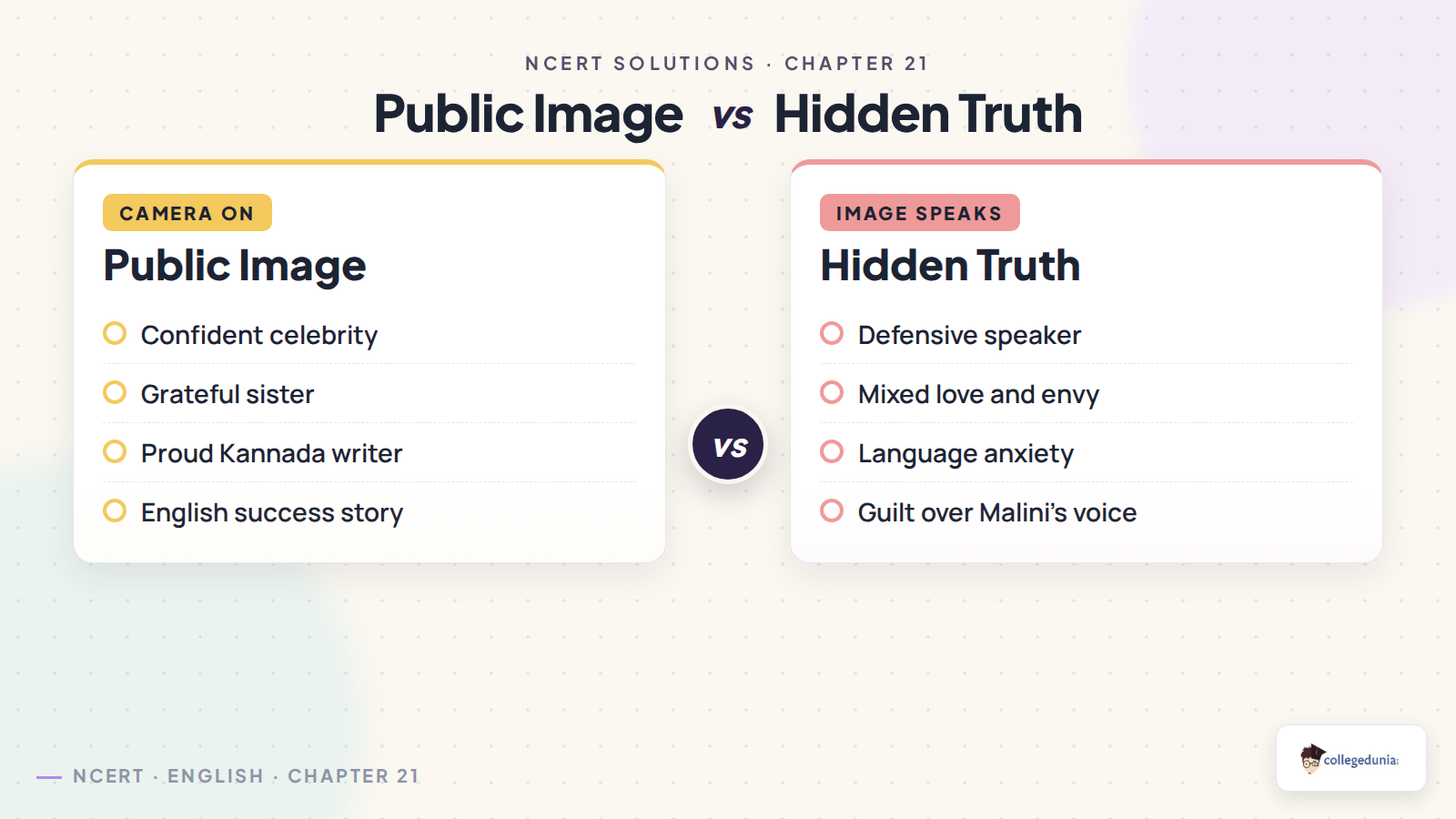
Public Image and Hidden Truth Compared
The play becomes easier when students separate what Manjula performs from what the Image uncovers. Karnad does not make the split simple; Manjula is neither purely false nor purely innocent.
Public Image
Hidden Truth
Confident celebrity writer with an international bestseller
Anxious sister who is not secure about the source of that success
Grateful caregiver who mourns Malini sincerely
Sibling whose love is mixed with envy, guilt and comparison
Proud Kannada writer who defends English as a creative choice
Writer caught between mother tongue, other tongue, market value and identity
Composed speaker before the camera
Defensive, irritated and afraid once the Image questions her
Language Politics in Broken Images
Broken Images uses Manjula's English bestseller to discuss a post-1947 Indian literary debate. English carries global reach, money and status, while Indian languages carry memory, belonging and cultural intimacy.
English as opportunity: Manjula argues that the novel came to her in English and reached a global readership.
Kannada as belonging: her critics see English success as a move away from regional commitment.
Malini's role: Malini's comfort in English makes the language debate personal, not only political.
Exam line: writing in another language is not betrayal by itself; dishonesty begins when language hides exploitation or falsehood.
Common Mistakes in Broken Images Answers
Watch Out: Weak answers turn Broken Images into only a plagiarism story. The play is also about media image, language politics, sibling rivalry and self-deception.
Do not say Manjula's love for Malini is completely fake; it is mixed and troubled.
Do not reduce Malini to physical illness; she is intellectually vivid and central to the play.
Do not treat the Image as a trick effect only; it is conscience, memory and public media at once.
Do not write a slogan for or against English; explain bilingual authorship with balance.
Practice cue: Write each answer with one theme statement, one dramatic detail and one sentence explaining how the Image changes Manjula's story.
More Supplementary Chapter 21 Resources
Use the table below to move between the main resource types for the same chapter.
All NCERT Solutions for Class 12 English Chapter 21 Broken Images with Step-by-Step Solutions
The cards below mirror the PDF question order. Open a Solution tab for a direct response, then use Expert Solution for the fuller interpretive route.
Q 21.1
How genuine is the love that Manjula expresses for her sister?
Concept used. The answer must balance Manjula's real affection for Malini with the envy, guilt and self-interest that the Image exposes.
Use both sides
Do not call Manjula's love completely false. The play makes it mixed and troubled.
Manjula's public speech shows tenderness for Malini.
She says Malini became like her child during the final months.
She also speaks of Malini's beauty, intelligence and lively nature.
These details suggest that her affection is not invented.
Yet the Image reveals that the love is not pure.
Manjula had lived for years as the less noticed sister.
She envied the attention, education and emotional space Malini received.
She also benefits from Malini's life story and perhaps from her writing.
Her tears therefore carry affection, guilt and performance together.
Manjula's love is genuine but not innocent. She does love Malini, yet that love is mixed with jealousy, guilt, rivalry and the need to protect her public image.
AM
Ananya Menon
M.A English, University of Delhi
Verified Expert
Mixed motive reading. Manjula's love is emotionally real, but Karnad does not let it remain simple or saintly.
Manjula's first version sounds sincere because she remembers Malini as gentle, beautiful and helpless.
Her moist eyes also show that the memory still affects her.
But the Image acts like a sharper conscience.
It makes her admit that Malini was more attractive, more intelligent and more central to the family.
That admission changes the meaning of her grief.
She loved Malini, but she also measured herself against Malini.
The bestselling novel makes this conflict even darker because Malini's pain becomes Manjula's fame.
So the love is genuine, but it is crossed by envy and self-defence.
The best answer should avoid one-sided judgement. Karnad presents love as a human mixture, not as a clean moral label.
Manjula's love is genuine but not innocent. She does love Malini, yet that love is mixed with jealousy, guilt, rivalry and the need to protect her public image.
Q 21.2
The sister does not appear in the play but is central to it. What picture of her is built in your mind from references in the play?
Concept used. Malini is an absent character whose personality is built through memory, comparison and accusation.
Absent but active
An absent character can still control the action through other people's memories.
Malini is physically absent because she has already died.
Still, almost every hidden conflict in the play leads back to her.
She was physically challenged and used a wheelchair.
Her upper body was normal, but her lower body was affected by illness.
She was attractive, intelligent, lively and hungry for knowledge.
She read widely in history, philosophy and anatomy.
She was more comfortable in English than in Kannada.
She shared a close bond with Pramod because he worked from home.
The play also hints that her inner life may have shaped the bestselling novel.
Malini emerges as sensitive, brilliant, attractive and life-loving despite physical disability. Though absent, she becomes the emotional and moral centre of Manjula's story.
RI
Rohit Iyer
M.A English, EFLU Hyderabad
Verified Expert
Character through echoes. Malini is created indirectly, but the picture is vivid because every speaker reveals something about her.
Manjula's speech first presents Malini as a helpless sister who inspired the novel.
The later dialogue makes that picture fuller.
Malini was not only a sufferer.
She had charm, intelligence, humour and intellectual curiosity.
The family gave her special care because of her illness.
That care shaped Manjula's jealousy.
Malini's English-speaking world also shaped the language debate in the play.
Her bond with Pramod adds emotional tension.
By the end, Malini feels absent from the stage but present inside every moral question.
The answer should stress that Malini is not a passive memory. She is the hidden force behind Manjula's guilt, career and self-image.
Malini emerges as sensitive, brilliant, attractive and life-loving despite physical disability. Though absent, she becomes the emotional and moral centre of Manjula's story.
Q 21.3
When the Image says: ``Her illness was unfortunate. But because of it, she got the best of everything.'' (i) What is the nature of Manjula's reply? (ii) How can it be related to what follows in the play?
Concept used. Manjula's reply is defensive, and that defensiveness opens the deeper truth about rivalry between the sisters.
Answer both parts
First name the tone of the reply. Then connect it with the later revelations.
Manjula's reply is defensive and slightly resentful.
She says Malini never asked for anything.
She explains that her parents moved to Bangalore for Malini's care.
She also says Malini became the apple of their eye.
The reply tries to sound fair, but it exposes buried bitterness.
What follows in the play confirms this bitterness.
Manjula admits that she was left with her grandparents in Dharwad.
She wonders whether she would have been brighter with the same love and attention.
The Image uses this opening to reveal rivalry, jealousy and guilt.
Manjula's reply is defensive. It seems sympathetic to Malini, but it reveals resentment, and the later dialogue develops that resentment into a confession of rivalry and guilt.
MN
Meera Nair
Ph.D English, JNU
Verified Expert
Defence as confession. The line matters because Manjula tries to defend herself, but the defence exposes what she wants to hide.
The Image's comment is deliberately provocative.
It suggests that Malini's illness also brought privilege.
Manjula cannot ignore this because the thought already exists inside her.
Her reply begins as a defence of Malini.
But the details she gives show family imbalance.
Malini receives parental attention, education at home and financial protection.
Manjula receives affection from grandparents, but not the same central place.
This prepares the later admissions about envy and second-best status.
The statement therefore acts as a hinge in the interrogation.
The reply is important because its surface sympathy contains the beginning of Manjula's self-exposure.
Manjula's reply is defensive. It seems sympathetic to Malini, but it reveals resentment, and the later dialogue develops that resentment into a confession of rivalry and guilt.
Q 21.4
What are the issues that the playwright satirises through this TV monologue of a celebrity?
Quick solution. In Broken Images, read the TV speech as a polished public performance broken by the Image's questioning. Karnad satirises celebrity manufacture, English-Kannada language politics, literary jealousy, media performance and moral self-deception.
Concept used. Satire exposes social vanity by making a public performance reveal private contradictions.
Satire has targets
Name the targets clearly: celebrity, language politics, media image, literary success and moral hypocrisy.
Karnad satirises celebrity culture through Manjula's carefully managed television speech.
She performs grief, modesty and cultural loyalty before a large public.
The play also satirises the debate over English and Indian languages.
Manjula defends English, yet wants to keep the image of a proud Kannada writer.
The playwright mocks the literary world's jealousy over fame, money and global recognition.
He also exposes the media's hunger for packaged success stories.
The Image satirises self-deception by turning Manjula's own face against her.
The monologue shows how public virtue can hide private envy, guilt or self-deception.
Karnad satirises celebrity culture, language politics, literary jealousy, media performance and moral hypocrisy. The TV monologue turns public success into a trial of hidden truth.
AR
Aditi Rao
M.A English, Jadavpur University
Verified Expert
Public image under pressure. The satire works because Manjula's studio speech sounds polished, but the Image breaks its polish.
Manjula arrives as a new literary celebrity.
Her speech gives students a ready-made story of talent and sacrifice.
Karnad questions that ready-made story.
He mocks the way television converts writers into marketable personalities.
He also mocks the moral panic around English writing in India.
The accusations against English hide anxiety about money and power.
At the same time, Manjula's defence of herself is not morally clean.
Her success may depend on another woman's suffering and voice.
Satire therefore touches both society and the individual conscience.
The answer should show that the play is not only about one dishonest writer. It also attacks the culture that rewards a perfect public image.
Karnad satirises celebrity culture, language politics, literary jealousy, media performance and moral hypocrisy. The TV monologue turns public success into a trial of hidden truth.
Q 21.5
``Broken Images'' takes up a debate that has grown steadily since 1947: the politics of language in Indian literary culture, specifically in relation to modern Indian languages and English. Discuss.
Quick solution. In Broken Images, follow Manjula's English bestseller into the wider post-1947 language debate. The chapter shows English as global power and Indian languages as cultural belonging, so language becomes a question of identity, market success and literary truth.
Concept used. The play uses Manjula's success in English to explore the uneasy place of English in Indian literary culture after independence.
Keep the debate balanced
Explain both sides: mother-tongue loyalty and the practical reach of English.
After 1947, Indian writers faced questions about language, identity and readership.
English carried colonial memory, but it also became a powerful Indian literary medium.
Modern Indian languages carried local culture, memory and emotional rootedness.
Manjula's move from Kannada to English triggers this debate.
Critics accuse her of betraying Kannada and writing for foreign students.
She argues that the novel came to her naturally in English.
She also points out that money, fame and global readership shape the debate.
The play shows that language politics is not only literary.
It involves class, market value, cultural pride and personal insecurity.
The play presents post-independence language politics as a conflict between mother-tongue loyalty and English's global power. It shows that identity, market success and literary truth all meet in this debate.
KS
Karan Sharma
M.A English, University of Mumbai
Verified Expert
Language as identity and market. Karnad does not reduce the debate to a simple choice between Kannada and English.
Manjula's public defence shows one side of the argument.
A writer may write in the language in which the work arrives.
But the accusations against her also reveal real cultural anxiety.
English can bring prestige, money and international attention.
Regional languages may then appear less rewarded, though they carry deep cultural life.
The play makes this tension sharper by making Manjula a Kannada writer turned English celebrity.
It also links language with Malini because Malini lived largely through English.
So the political debate becomes personal and psychological.
The play's strength lies in showing that language is never neutral. It carries history, ambition, belonging and guilt.
The play presents post-independence language politics as a conflict between mother-tongue loyalty and English's global power. It shows that identity, market success and literary truth all meet in this debate.
Q 21.6
The play deals with a Kannada woman writer who unexpectedly produces an international bestseller in English. (i) Can a writer be a truly bilingual practitioner? (ii) Does writing in an `other tongue' amount to betrayal of the mother tongue?
Quick solution. In Broken Images, separate language choice from moral honesty. A writer can be truly bilingual if both languages are creatively lived, and writing in another language is not betrayal unless it hides exploitation, falsehood or disowning of lived truth.
Concept used. Bilingual writing depends on creative honesty, not on a mechanical rule that one language must defeat another.
Avoid fixed answers
The play invites discussion, so give a reasoned view rather than a slogan.
A writer can be truly bilingual if both languages are lived, felt and shaped with skill.
Indian literary culture has many such examples.
Bilingual practice can widen experience instead of weakening it.
However, the writer must not use one language merely as a fashionable mask.
In the play, Manjula claims that the novel burst out in English.
The Image complicates this claim by linking English with Malini's world.
Writing in another tongue is not automatically betrayal.
Betrayal begins when the writer disowns, exploits or falsifies lived truth.
The moral issue is honesty, not language alone.
A writer can be truly bilingual when both languages are creatively alive. Writing in another tongue is not betrayal by itself; dishonesty begins when language is used to hide exploitation or falsehood.
SK
Sanya Kapoor
M.A English, University of Hyderabad
Verified Expert
Creative bilingualism. The play asks us to separate language choice from moral dishonesty.
A bilingual writer can belong to more than one linguistic world.
This is especially true in India, where many people think, speak and read across languages.
English may carry education, mobility and wider publication.
The mother tongue may carry childhood memory and cultural intimacy.
Neither space cancels the other automatically.
Manjula's problem is not simply that she writes in English.
Her problem is that her claim to the English novel may hide Malini's voice and experience.
Thus the play shifts the debate from purity of language to integrity of authorship.
A good answer may support bilingual writing while still criticising Manjula's possible misuse of another person's story.
A writer can be truly bilingual when both languages are creatively alive. Writing in another tongue is not betrayal by itself; dishonesty begins when language is used to hide exploitation or falsehood.
Q 21.7
Why do you think the playwright has used the technique of the image in the play?
Quick solution. In Broken Images, the screen Image lets Manjula's own public face question her hidden self. Karnad uses this device to dramatise conscience, split identity, media performance and the gap between success and truth.
Concept used. The Image turns Manjula's public face into a speaking conscience and makes inner conflict visible on stage.
Image as conscience
The screen is not decoration. It becomes the force that questions Manjula.
The play begins inside a television studio, so the screen is natural to the setting.
Karnad uses that screen creatively by making Manjula's own image speak.
The Image looks like Manjula, but it knows what she wants to hide.
It questions her speech, her love for Malini, her marriage and her authorship.
This technique makes private guilt visible to students watching the play.
It also suits the title, because Manjula's identity is broken into public and hidden selves.
The Image turns a monologue into a dramatic confrontation.
It also comments on modern media, where image can become more powerful than truth.
The Image is used to dramatise conscience, split identity and media performance. It exposes the gap between Manjula's public image and her hidden truth.
DP
Devika Pillai
Ph.D English, IIT Madras
Verified Expert
A visible double. The Image lets Karnad stage what would otherwise remain inside Manjula's mind.
A normal confession would make Manjula simply tell the truth.
Karnad chooses a sharper method.
He makes her own televised image interrogate her.
This device keeps the play theatrical, tense and modern.
It also fits the world of television, where a public image can be edited, polished and broadcast.
The Image refuses that polish.
It behaves like memory, conscience and accuser at once.
Through it, students see Manjula divided against herself.
The answer should connect the technique with the title and with the theme of public image versus hidden self.
The Image is used to dramatise conscience, split identity and media performance. It exposes the gap between Manjula's public image and her hidden truth.
Q 21.8
The play is called a monologue. Why is it made to turn dialogic?
Quick solution. In Broken Images, the opening is a monologue because Manjula controls her story. It turns dialogic when the Image speaks, because the second voice exposes contradictions, guilt and self-deception.
Concept used. The play starts as a public monologue, but it becomes dialogic because truth needs questioning, contradiction and self-confrontation.
Dialogic means two voices
Here the two voices are Manjula's public self and her questioning Image.
Manjula first speaks alone to the television public.
This opening is a monologue because she controls the story.
She chooses what to reveal and what to hide.
After the broadcast, the Image begins to speak.
The single voice is split into two voices.
This makes the play dialogic.
The dialogue is necessary because Manjula's public version is incomplete.
The Image questions her claims and forces contradictions into the open.
The form therefore matches the theme of divided identity.
The monologue turns dialogic because Manjula's public speech cannot hold the whole truth. The Image creates a second voice that exposes conflict, guilt and self-deception.
RS
Rahul Sen
M.A English, Presidency University
Verified Expert
From performance to interrogation. The dialogic turn is the play's main dramatic engine.
A monologue lets Manjula appear confident and in control.
She can shape herself as a wronged Kannada writer, loving sister and successful novelist.
Dialogue removes that control.
The Image interrupts her finished version of herself.
Every question forces another layer of truth.
Students then watch a debate inside one personality.
This is why the second voice is not a separate ordinary character.
It is Manjula's own image, made independent.
The form shows a mind arguing with itself.
The answer should note that dialogic form creates tension and turns a speech into drama.
The monologue turns dialogic because Manjula's public speech cannot hold the whole truth. The Image creates a second voice that exposes conflict, guilt and self-deception.
Q 21.9
What is the posture the celebrity adopts when the camera is on and when it is off?
Quick solution. In Broken Images, Manjula's on-camera posture is composed, grateful and controlled. Off-camera, after the Image starts questioning her, she becomes irritated, defensive, frightened and finally exposed.
Concept used. Manjula's posture changes from controlled public performance to private irritation, then to fear and exposure.
Track the change
Use the order: camera on, camera off, Image begins speaking.
When the camera is on, Manjula is polished and confident.
She speaks with wit, cultural pride and emotional control.
She presents herself as modest, sincere and grateful.
She performs love for Malini and thanks Pramod publicly.
When the camera is off, the posture changes.
She relaxes and says the speech will get her critics.
This shows irritation and calculation behind the public grace.
When the Image speaks, her posture changes again.
She becomes defensive, anxious and finally exposed.
With the camera on, Manjula adopts a polished celebrity posture of confidence, grief and cultural loyalty. Off camera, she becomes sharper, defensive and vulnerable before her Image.
PV
Priya Verma
M.A English, Banaras Hindu University
Verified Expert
Two performances. The question asks us to observe body language and moral posture together.
On camera, Manjula behaves like a practised public figure.
She smiles, jokes, manages pauses and presents a touching personal story.
Her posture says that she owns her success.
It also asks students to admire her courage and sensitivity.
Off camera, the polished mask loosens.
Her first private reaction is satisfaction that her critics have been answered.
The Image then destroys even that private confidence.
Manjula's body and voice move from control to confusion, anger and fear.
The contrast exposes celebrity as performance.
The answer should mention that the camera creates a public self, while the Image reveals the unstable self behind it.
With the camera on, Manjula adopts a polished celebrity posture of confidence, grief and cultural loyalty. Off camera, she becomes sharper, defensive and vulnerable before her Image.
Frequently Asked Questions
Ques. How many questions are solved in NCERT Solutions for Class 12 English Chapter 21 Broken Images?
Ans. The PDF and article solve all 9 NCERT tasks from Thinking about the Play, Talking about the Play and Appreciation.
Ques. What is the main idea of Broken Images by Girish Karnad?
Ans. The play exposes the gap between Manjula's public celebrity image and the private guilt, envy and language anxiety revealed by her screen Image.
Ques. Is Broken Images only about plagiarism?
Ans. No. Possible authorship of the novel is one layer, but the play also examines media performance, bilingual writing, sibling rivalry and self-deception.
Ques. Does this page follow the 2026-27 NCERT order?
Ans. Yes. The answers are arranged in the exact 2026-27 NCERT Kaleidoscope order for Class 12 English Supplementary Chapter 21.





Chapter21Kaleidoscope:BrokenImagesSolutions.pdf?page=1&dpi=150)
Chapter21Kaleidoscope:BrokenImagesSolutions.pdf?page=2&dpi=150)
Chapter21Kaleidoscope:BrokenImagesSolutions.pdf?page=3&dpi=150)
Chapter21Kaleidoscope:BrokenImagesSolutions.pdf?page=4&dpi=150)
Chapter21Kaleidoscope:BrokenImagesSolutions.pdf?page=5&dpi=150)
Chapter21Kaleidoscope:BrokenImagesSolutions.pdf?page=6&dpi=150)
Chapter21Kaleidoscope:BrokenImagesSolutions.pdf?page=7&dpi=150)
Chapter21Kaleidoscope:BrokenImagesSolutions.pdf?page=8&dpi=150)
Chapter21Kaleidoscope:BrokenImagesSolutions.pdf?page=9&dpi=150)
Chapter21Kaleidoscope:BrokenImagesSolutions.pdf?page=10&dpi=150)
Chapter21Kaleidoscope:BrokenImagesSolutions.pdf?page=11&dpi=150)
Chapter21Kaleidoscope:BrokenImagesSolutions.pdf?page=12&dpi=150)
Chapter21Kaleidoscope:BrokenImagesSolutions.pdf?page=13&dpi=150)
Chapter21Kaleidoscope:BrokenImagesSolutions.pdf?page=14&dpi=150)
Chapter21Kaleidoscope:BrokenImagesSolutions.pdf?page=15&dpi=150)
Chapter21Kaleidoscope:BrokenImagesSolutions.pdf?page=16&dpi=150)
Chapter21Kaleidoscope:BrokenImagesSolutions.pdf?page=17&dpi=150)
Chapter21Kaleidoscope:BrokenImagesSolutions_flat_MobileCard.pdf?page=1&dpi=150)
Chapter21Kaleidoscope:BrokenImagesSolutions_flat_MobileCard.pdf?page=2&dpi=150)
Chapter21Kaleidoscope:BrokenImagesSolutions_flat_MobileCard.pdf?page=3&dpi=150)
Chapter21Kaleidoscope:BrokenImagesSolutions_flat_MobileCard.pdf?page=4&dpi=150)
Chapter21Kaleidoscope:BrokenImagesSolutions_flat_MobileCard.pdf?page=5&dpi=150)
Chapter21Kaleidoscope:BrokenImagesSolutions_flat_MobileCard.pdf?page=6&dpi=150)
Chapter21Kaleidoscope:BrokenImagesSolutions_flat_MobileCard.pdf?page=7&dpi=150)
Chapter21Kaleidoscope:BrokenImagesSolutions_flat_MobileCard.pdf?page=8&dpi=150)
Chapter21Kaleidoscope:BrokenImagesSolutions_flat_MobileCard.pdf?page=9&dpi=150)
Chapter21Kaleidoscope:BrokenImagesSolutions_flat_MobileCard.pdf?page=10&dpi=150)
Chapter21Kaleidoscope:BrokenImagesSolutions_flat_MobileCard.pdf?page=11&dpi=150)
Chapter21Kaleidoscope:BrokenImagesSolutions_flat_MobileCard.pdf?page=12&dpi=150)
Chapter21Kaleidoscope:BrokenImagesSolutions_flat_MobileCard.pdf?page=13&dpi=150)
Chapter21Kaleidoscope:BrokenImagesSolutions_flat_MobileCard.pdf?page=14&dpi=150)
Chapter21Kaleidoscope:BrokenImagesSolutions_flat_MobileCard.pdf?page=15&dpi=150)
Chapter21Kaleidoscope:BrokenImagesSolutions_flat_MobileCard.pdf?page=16&dpi=150)
Chapter21Kaleidoscope:BrokenImagesSolutions_flat_MobileCard.pdf?page=17&dpi=150)
Chapter21Kaleidoscope:BrokenImagesSolutions_flat_MobileCard.pdf?page=18&dpi=150)
Chapter21Kaleidoscope:BrokenImagesSolutions_flat_MobileCard.pdf?page=19&dpi=150)
Chapter21Kaleidoscope:BrokenImagesSolutions_flat_MobileCard.pdf?page=20&dpi=150)
Chapter21Kaleidoscope:BrokenImagesSolutions_flat_MobileCard.pdf?page=21&dpi=150)
Chapter21Kaleidoscope:BrokenImagesSolutions_flat_MobileCard.pdf?page=22&dpi=150)
Chapter21Kaleidoscope:BrokenImagesSolutions_flat_MobileCard.pdf?page=23&dpi=150)
Chapter21Kaleidoscope:BrokenImagesSolutions_flat_MobileCard.pdf?page=24&dpi=150)
Chapter21Kaleidoscope:BrokenImagesSolutions_flat_MobileCard.pdf?page=25&dpi=150)
Chapter21Kaleidoscope:BrokenImagesSolutions_flat_MobileCard.pdf?page=26&dpi=150)
Chapter21Kaleidoscope:BrokenImagesSolutions_flat_MobileCard.pdf?page=27&dpi=150)
Chapter21Kaleidoscope:BrokenImagesSolutions_flat_MobileCard.pdf?page=28&dpi=150)
Chapter21Kaleidoscope:BrokenImagesSolutions_flat_MobileCard.pdf?page=29&dpi=150)
Chapter21Kaleidoscope:BrokenImagesSolutions_flat_MobileCard.pdf?page=30&dpi=150)
Chapter21Kaleidoscope:BrokenImagesSolutions_flat_MobileCard.pdf?page=31&dpi=150)
Chapter21Kaleidoscope:BrokenImagesSolutions_flat_MobileCard.pdf?page=32&dpi=150)
Chapter21Kaleidoscope:BrokenImagesSolutions_flat_MobileCard.pdf?page=33&dpi=150)
Chapter21Kaleidoscope:BrokenImagesSolutions_flat_MobileCard.pdf?page=34&dpi=150)





Comments