NCERT Solutions for Class 12 English (Suppl.) Chapter 16 Kaleidoscope: Film-Making cover all Stop and Think, Understanding the Text, Talking, Appreciation, Language Work and Things to Do tasks from the latest 2026-27 NCERT book. The PDF explains Ingmar Bergman's account of film craft in direct exam-ready answers.
Includes 21 solved question blocks from the full Film-Making chapter.
Covers childhood impressions, conjuring, adaptation, risk, public response and screenplay terms.
Uses Solution and Expert Solution tabs for quick revision before Class 12 English tests.
Each answer follows the 2026-27 NCERT exercise order and keeps the wording useful for school exam writing.
Student Feedback: In a Collegedunia student survey of 12,360 Class 12 English Elective students before the 2026 boards, many students said Film-Making becomes easier when Bergman's personal memories, cinema terms and adaptation ideas are revised together.
The exercise asks students to connect Bergman's personal memories with his professional view of cinema. Start with the Stop and Think questions, then move to the longer interpretation, vocabulary and screenplay tasks.
Exercise area
Questions
What it checks
Stop and Think
8 questions
Childhood memory, first impressions, conjuring, adaptation and public response
Understanding the Text
5 questions
Bergman's artistic process, invisible steps, risks and concerns
Talking and Appreciation
4 questions
Split-second impressions, life influences, autobiography and conversational tone
Language Work and Things to Do
4 tasks
Film terms, sentence grammar, elision and screenplay writing
The PDF solves all 21 tasks in the same order as the NCERT chapter. This helps students revise prose, vocabulary and writing practice without switching sources.
Bergman's Film-Making Process Explained for Class 12
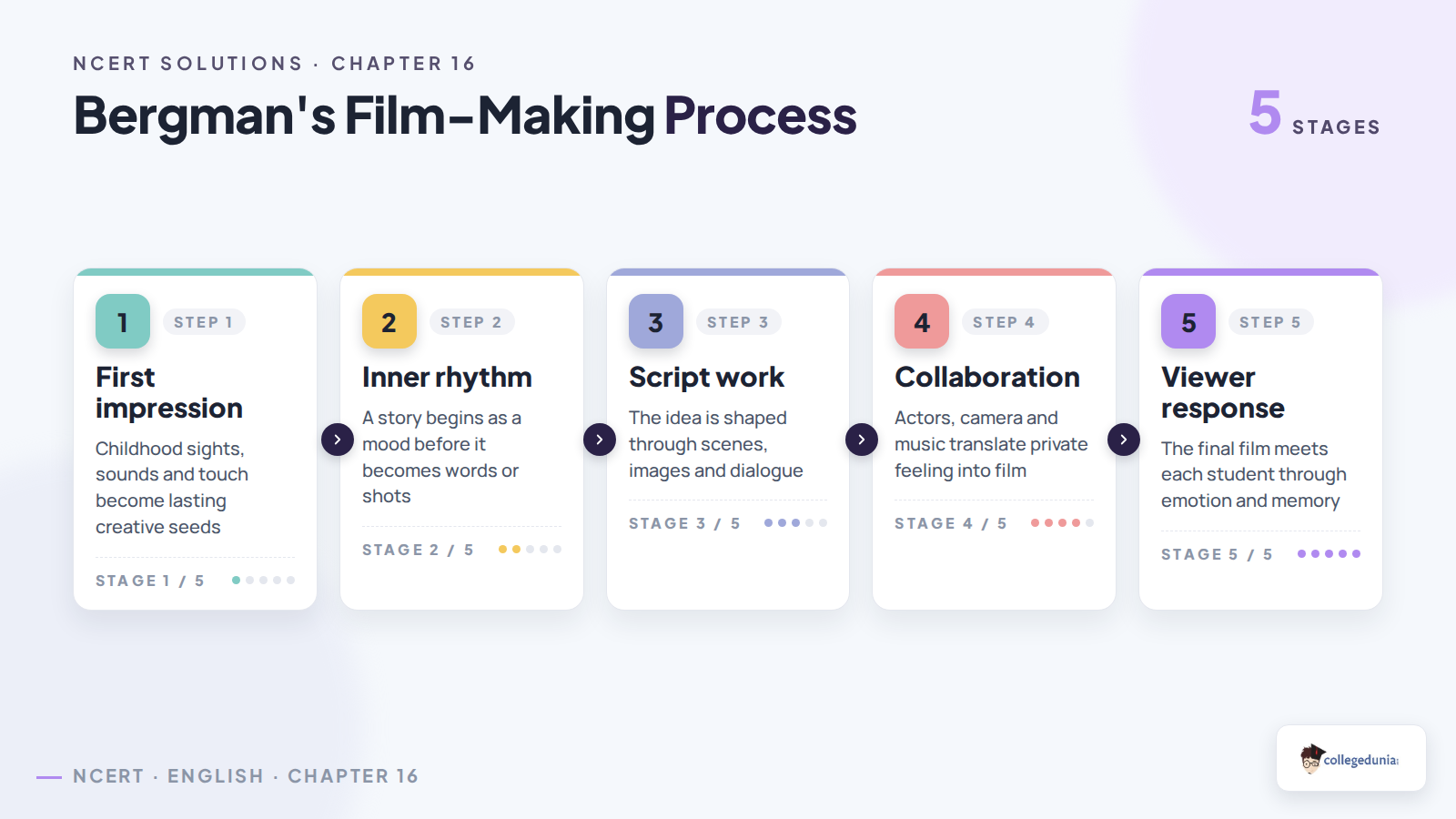
Bergman presents film-making as a movement from sensation to organised craft. A childhood moment, a sound or a play of light may stay in the mind for years before it becomes a scene. The artist then gives that private impression a public shape through script, camera, acting, music and editing.
First impression: the creative seed often arrives before analysis.
Screenplay stage: the mood must become scenes and dialogue.
Collaboration: actors, technicians and rhythm complete the film.
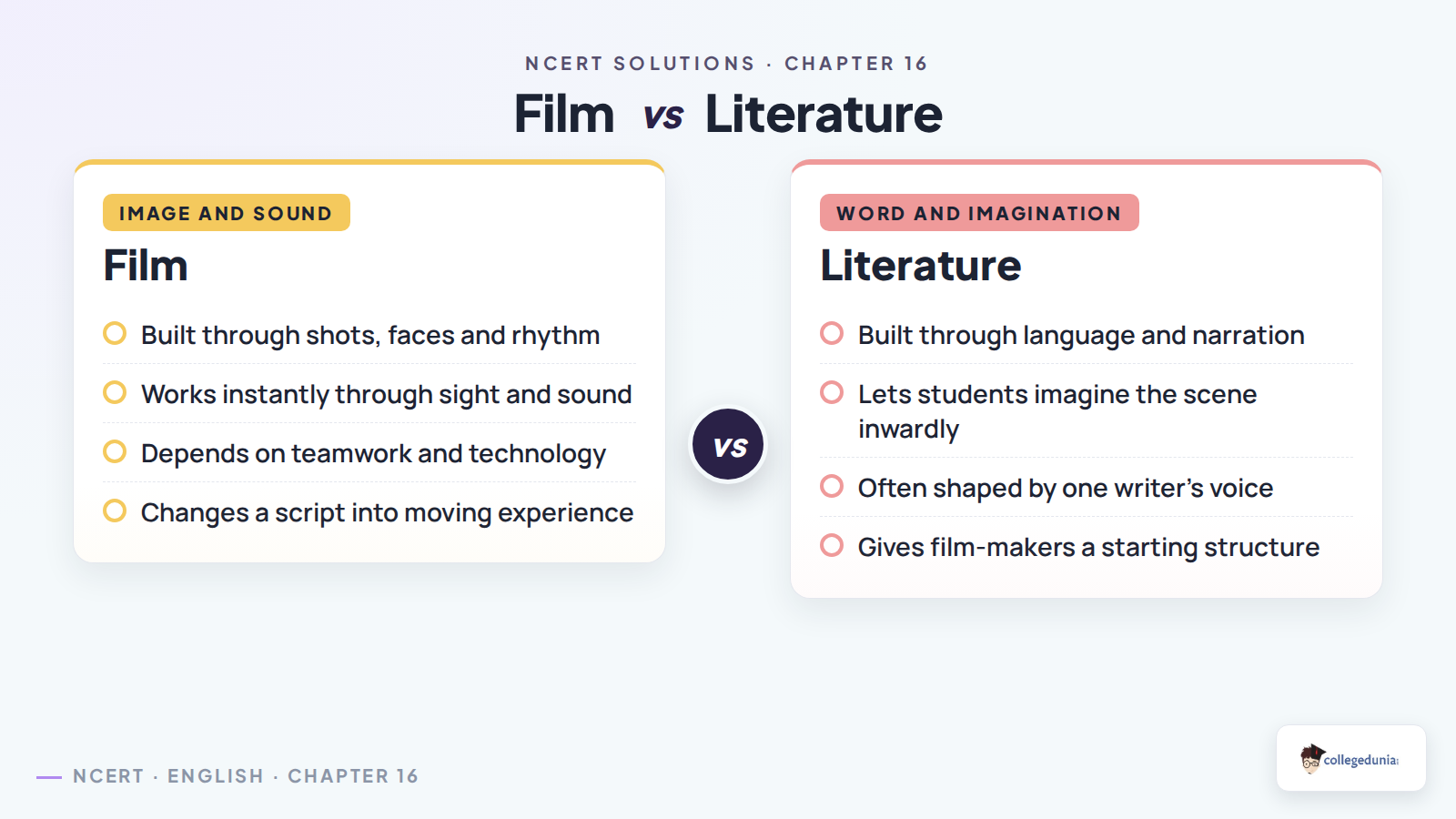
Bergman says film is closest to music because both work through rhythm and direct experience. Literature remains important, but a book cannot simply be transferred to film by keeping only the plot. The film-maker must translate inward language into visible and audible experience.
Form
Main strength
Answer cue
Film
Image, sound, rhythm and performance
Explain how movement and montage create meaning.
Literature
Language, narration and private thought
Explain why a book needs creative adaptation for cinema.
Music
Tempo, silence and emotional movement
Use Bergman's comparison to support film's rhythm.
Common Mistakes in Film-Making NCERT Answers
Watch Out: Most wrong answers reduce the chapter to a general note on cinema and miss Bergman's personal argument.
Do not ignore the childhood projector and the grandmother's apartment.
Do not call literature the closest art form to film; Bergman names music.
Do not treat adaptation as direct copying from a book.
Do not skip the film-terms and elision tasks in Language Work.
Practice cue: Write each answer with one Bergman idea, one text detail and one clear conclusion.
Film-Making Language Work and Screenplay Terms
The Language Work section is scoring if students keep the terms precise. Script, project, montage, flashback, footage, setting and flash-forward belong to the working vocabulary of film. The grammar and pronunciation tasks also test how sentences and speech are shaped.
Film terms: define the word first, then connect it to film practice.
Sentence parts: separate subject, verb and complement before labelling.
Elision: notice sounds that are dropped or weakened in connected speech.
Screenplay: include a title, actor list, scene description, dialogue and camera movement.
More Class 12 English Supplementary Chapter 16 Resources
Use these related resources when you want the same chapter in another format. The table is placed above the FAQ so students can move from solutions to notes, book PDF and handwritten revision without losing the chapter context.
All NCERT Solutions for Class 12 English Supplementary Chapters
The table below keeps the same resource type together, so students can move chapter by chapter through the Class 12 English supplementary Kaleidoscope question set.
All NCERT Solutions for Class 12 English (Suppl.) Chapter 16 Kaleidoscope: Film-Making with Step-by-Step Solutions
The expandable cards below reproduce the full solution set from the PDF. Use the Solution tab for a direct exam-ready answer and the Expert Solution tab for deeper notes on Bergman's film craft, adaptation and Language Work.
Each card separates the direct answer and expert explanation.
The vocabulary cards define the film terms in student-friendly language.
The screenplay card gives a complete sample scene structure.
Q 16.1
What childhood memories does the author recollect that had a bearing on his later involvement with film-making?
Concept used. A bearing means an influence or connection. Bergman remembers childhood scenes that trained his eye, ear and imagination before he became a film-maker.
Memory to cinema
Link each memory with a later film-making skill: image, sound, illusion, character and atmosphere.
Bergman remembers sitting under his grandmother's dining-room table in Uppsala.
He listened to sunlight through the large windows and heard cathedral bells.
A picture of Venice seemed to move when light fell on it.
The water seemed to flow, people seemed to gesture and bells seemed to ring.
His father's work in a vicarage made him familiar with life, death and the idea of evil.
His magic lantern gave shape to this imagination through coloured slides.
The wolf in Red Riding Hood became the Devil in his child's mind.
At ten, his first small film projector fascinated him with moving images.
These memories taught him that light, sound, fear and movement could create a whole inner world.
Bergman recollects the sunlit apartment, the Venice picture, the cathedral bells, the magic lantern and the first film projector. These memories shaped his later love for visual illusion and film-making.
AR
Ananya Rao
M.A English, University of Delhi
Verified Expert
Quick reading. Bergman does not treat childhood as background detail. He treats it as the first training ground of the film-maker's imagination.
The grandmother's apartment teaches him how light can change an ordinary space.
The Venice picture teaches him that still images can feel alive.
The vicarage teaches him dramatic contrasts such as life and death, good and evil.
The magic lantern joins story, fear, colour and projected image.
The small projector gives him his first direct experience of film as repeated visual movement.
Each memory is sensory, so it prepares him for cinema as a sensory art.
The memories also show that his later craft began in wonder, not in theory.
The childhood memories matter because they connect light, sound, movement, fear and fantasy. They prepare Bergman for cinema long before he enters the film industry.
Q 16.2
What connection does the author draw between film-making and conjuring?
Concept used. Conjuring depends on illusion. Bergman says cinema also uses illusion because it makes separate still frames appear as living movement.
Use the projector idea
Mention the blankness between frames. It is central to Bergman's comparison.
Bergman calls his small childhood projector his first conjuring set.
He says cinematography is based on deception of the human eye.
In a one-hour film, he calculates that viewers sit through many minutes of darkness.
The audience does not feel this darkness because the apparatus creates the illusion of continuous movement.
Through this illusion, the film-maker can make viewers laugh, fear, smile or feel deeply moved.
So the film-maker can appear to be either an impostor or a conjurer.
If the audience willingly accepts the illusion, the deceit becomes art.
Bergman connects film-making and conjuring because both depend on illusion. Film deceives the eye into seeing motion and then uses that illusion to move the audience emotionally.
RS
Ritwik Sen
M.A English, Jadavpur University
Verified Expert
Concept-first angle. The comparison is not casual. Bergman is explaining the very basis of cinema.
A conjurer makes people believe they have seen something impossible.
A film-maker makes people believe still images have become continuous life.
The machine hides the breaks between frames.
The audience agrees to be taken in because it wants the experience.
This makes the film-maker's deception creative rather than dishonest.
The result is emotional power, since viewers react as if the images are immediate and real.
Bergman therefore accepts the role of conjurer with childlike excitement.
Film-making resembles conjuring because both turn technique into wonder. The audience knows there is illusion, yet it accepts the illusion and responds with real emotion.
Q 16.3
What is the nature of the first impressions that form the basis for a film?
Concept used. Bergman describes the first source of a film as a mental state. It is not yet a plot, but a mood full of images and associations.
Do not call it a story
The first impression is earlier than story, screenplay and shooting.
A film may begin with a chance remark or a small piece of conversation.
It may begin with a hazy event that is not attached to any situation.
It may also begin with music, a shaft of light or an imagined actor.
These impressions appear suddenly and disappear quickly.
Even after they vanish, they leave behind a mood.
Bergman compares them to pleasant dreams.
They contain fertile associations and images, but not an actual story.
If he follows the thread carefully, a complete film can emerge.
The first impressions are vague, brief and sensory. They may be a remark, music, light or a hazy event. They form a mood rich with images, not a ready-made story.
MI
Meera Iyer
Ph.D English, University of Hyderabad
Verified Expert
Image logic. Bergman treats the origin of a film as something delicate. It must be followed before it becomes clear.
The first impression is tiny, but it carries emotional force.
It may be visual, musical or conversational.
It does not give the film-maker a finished plot.
It gives a rhythm, a colour, a tension or a mood.
Bergman calls it a brightly coloured thread from the unconscious.
The film-maker's task is to wind that thread patiently.
The story develops only when this inner material gains shape.
So film begins in sensation before it becomes narrative.
For Bergman, a film starts as a fleeting but charged impression. It is a mood or thread of association that later grows into form.
Q 16.4
Which art form is film-making closest to? What is the reason for the similarity?
Concept used. Bergman says film is closest to music. Both arts reach emotions directly through rhythm rather than through step-by-step intellectual explanation.
Rhythm matters
The answer should use Bergman's words about inhalation and exhalation in film.
Bergman says film has much in common with music.
Written literature is read by a conscious act of will and intellect.
Film works differently because the viewer makes way for illusion.
A sequence of pictures acts directly on feelings.
Music also acts directly on emotions.
Both film and music depend strongly on rhythm.
Bergman calls film inhalation and exhalation in continuous sequence.
He also says he often experiences a film or play musically.
Film-making is closest to music. The similarity lies in rhythm and direct emotional effect, because both film and music move feelings without depending mainly on intellectual reading.
DM
Devika Menon
M.A English, EFLU Hyderabad
Verified Expert
Structural observation. The comparison with music helps explain why a screenplay alone cannot fully describe a film.
A musical score suggests sound, but performance gives it life.
In the same way, a script gives only a technical base.
The film breathes through tempo, image sequence and montage.
These elements are hard to record fully in words.
Music and film both create feeling through timing.
A slight change in rhythm can change the whole emotional effect.
This is why Bergman finds musical experience close to cinematic experience.
The deepest likeness is therefore rhythmic and emotional.
Film is closest to music because both are rhythmic arts. They work on the viewer or listener's emotions directly and continuously.
Q 16.5
Quite often a film made out of a book is not very successful. Discuss.
Concept used. Adaptation means carrying a work from one form to another. Bergman argues that literature and film have different inner laws, so a direct transfer often fails.
Avoid a simple answer
Do not say books are always better than films. Explain the difference between the two forms.
A literary work is made of words, narration, inner reflection and a special irrational dimension.
A film is made of images, rhythm, movement, sound and montage.
Bergman says these two art forms are often in conflict.
What gives life to a book may not translate cleanly into visual terms.
A film adaptation must make many changes in order to become cinematic.
These changes may demand great effort and still produce little artistic reward.
The film may lose the book's depth while failing to gain its own rhythm.
Therefore many films based on books do not succeed.
A film made from a book may fail because literature and cinema work through different means. The book's inward life cannot always become visual rhythm without loss.
AM
Aarav Mehta
M.A English, University of Mumbai
Verified Expert
Comparative angle. Bergman is not rejecting all adaptation. He is warning that the film-maker must create a film, not merely photograph a book.
A novel may depend on thought, tone, private memory and language.
Cinema cannot reproduce all these by simply keeping the plot.
It must choose images, sounds, pauses and actor movement.
This selection changes the work's centre of power.
If the film remains too faithful to the book's surface, it may feel lifeless.
If it changes too much, students may feel the book has been damaged.
Success therefore needs a new cinematic form that respects but transforms the original.
Bergman feels this transformation is extremely difficult.
Such films often fail because adaptation must change the language of art. A book lives through words, while a film must live through image, rhythm and movement.
Q 16.6
What, according to Bergman, is the relationship between a film-maker and his audience?
Concept used. Bergman sees film as an act of communication. The film-maker needs artistic freedom, but the film must still create a reaction in the audience.
Balance both sides
Mention the public's importance and Bergman's refusal to explain his films to critics.
Bergman says he wants to speak to his fellow human beings through film.
He does not intend his work only for himself or a small group.
He accepts that the wishes of the public are important.
Yet he sometimes follows his own impulse and unconventional development.
He believes the public can respond with surprising sensitivity.
Once the film is made, critics and viewers may interpret it as they like.
He refuses to tell others what his work must mean.
A film should attract or repel, but it must not leave the audience indifferent.
Bergman's relationship with the audience is both respectful and independent. He wants public response, but he keeps creative freedom and allows each viewer to interpret the film personally.
NK
Nisha Kapoor
M.A English, University of Calcutta
Verified Expert
Balanced reading. Bergman does not present the audience as a passive crowd. He trusts their capacity to respond to difficult art.
The film-maker creates from personal vision and craft.
The audience completes the work through reaction.
Bergman knows public wishes matter because cinema is not made in isolation.
At the same time, he does not surrender his artistic impulse.
He values the viewer's freedom to understand a film differently.
This is why he will not interpret his work for critics.
The worst result is indifference, because it means the film has failed to touch anyone.
A strong film should awaken attraction, resistance, thought or emotion.
For Bergman, the film-maker offers a personal vision and the audience gives it life through response. Meaning is shared, but it is not forced.
Q 16.7
What is the story of the Cathedral of Chartres and how does the author relate it to his profession?
Concept used. Bergman uses the cathedral story as an analogy. An analogy explains one idea through another similar situation.
The key contrast
The cathedral workers were anonymous, but they worked together with purpose.
Bergman tells the story of the Cathedral of Chartres being burned after lightning struck it.
People came from many places to rebuild it on the old site.
Master builders, artists, labourers, nobles, priests and townspeople worked together.
They completed the building, but their individual names remain unknown.
Bergman admires this anonymous collective effort.
He feels art once had humility because it was connected with worship and shared purpose.
He relates this to film-making because cinema also needs many people working together.
He wants to be one artist among many in the collective building of art.
The Chartres story shows anonymous people rebuilding a cathedral together. Bergman relates it to film-making by presenting art as humble collective work, not as individual self-glorification.
KA
Kabir Anand
M.A English, University of Hyderabad
Verified Expert
Symbolic angle. The cathedral is Bergman's image of the ideal artistic community.
The ruined cathedral creates a common task.
People of different ranks join the task without seeking personal fame.
Their reward is the satisfaction of building something larger than themselves.
Bergman contrasts this with modern artistic individualism.
He feels that the artist's ego has become too important in contemporary art.
Film-making, at its best, can recover the cathedral spirit.
Actors, technicians, writers, producers and directors all contribute to one final work.
Bergman wants his own role to be one part of that shared construction.
Bergman uses Chartres to praise collective, humble and purposeful creation. He wishes film-making could carry the same spirit of shared craftsmanship.
Q 16.8
What are some of the flaws of the world of film-making today?
Concept used. Bergman criticises the film industry and modern art for mixing commerce, ego, anxiety and creative pressure.
Use both parts
Mention both the film business and the wider world of modern artistic creation.
The ambitious film-maker must walk a tightrope without a net.
Failure can remove the support of producers, banks and theatre owners.
Talent and initiative may be destroyed by the industry's harsh efficiency.
Public indifference, criticism and failure hurt the artist deeply.
The industry can turn creative play into struggle.
Bergman also criticises the modern worship of individual ego.
Artists become isolated and obsessed with their own wounds.
They may forget humility, shared purpose and the difference between true and false ideals.
Bergman sees modern film-making as risky, commercial, harsh and ego-driven. The industry can damage talent, while modern artists may lose humility and shared purpose.
SN
Shruti Nair
M.Phil English, University of Kerala
Verified Expert
Critical angle. Bergman's complaint is not only about money. It is also about the spirit in which art is made.
Film depends on expensive support, so commercial failure has serious results.
The producer and theatre owner may withdraw faith from the artist.
This pressure can make the artist compromise or lose courage.
Bergman feels the industry can destroy creative ability like a machine.
He also sees a moral flaw in modern art.
The individual artist has become too central.
Instead of listening to one another, artists may circle around private loneliness.
This weakens the collective energy that Bergman values in cathedral-building.
The flaws are commercial pressure, fear of failure, loss of freedom, cruel efficiency and excessive artistic ego. These forces weaken the true craft of film-making.
Q 16.9
Pick out examples from the text that show Bergman's sensitivity to sensory impressions which have made him a great film-maker.
Concept used. Sensory impressions are details received through sight, sound, touch, smell and bodily feeling. Bergman's essay repeatedly notices such details with unusual sharpness.
Quote through examples
Use several examples from different parts of the chapter, not one long summary.
During the shooting of The Virgin Spring, he notices the cold morning, snowflakes and grey sky.
He notices the rugged landscape, the little lake, the forest and the rusty rail.
The cranes floating above the fir trees become a powerful visual moment.
In childhood, he remembers sunlight moving through large windows.
He describes the cathedral bells as part of the sunlight's special sound.
The Venice picture seems to contain moving water, gestures, bells and music.
He remembers the smell of hot metal from the magic lantern.
His films also begin from music, light, mood, rhythm and atmosphere.
Bergman's sensitivity appears in his attention to cold, light, sound, movement, smell, landscape and rhythm. These sensory details become the raw material of his cinema.
FS
Farah Siddiqui
M.A English, Jamia Millia Islamia
Verified Expert
Close reading. Bergman notices not only what he sees, but also how each impression feels inside the mind.
The Dalarna scene shows his eye for weather, clothing and collective movement.
The cranes matter because they interrupt work and create shared wonder.
The grandmother's apartment shows his sensitivity to light and sound together.
The Venice picture shows how stillness can become imagined motion.
The magic lantern scene adds smell, colour, childhood fear and projection.
The first film projector gives him the excitement of moving image.
Later, he explains that a film may start with a shaft of light or a few bars of music.
These examples prove that his art grows from intense sensory awareness.
Bergman becomes a great film-maker because he receives ordinary sensory details as possible cinema. Light, sound, smell, movement and mood all speak to him.
Q 16.10
What do you understand of the complexity of the little invisible steps that go into the making of a good film?
Concept used. The little invisible steps are the hidden creative and technical changes through which an impression becomes a finished film.
Trace the process
Move from impression to screenplay to shooting to rhythm and teamwork.
A film begins as a vague impression, such as a sound, image, remark or mood.
The film-maker tests whether this impression has enough strength.
He then transforms rhythms, moods, tensions and images into words.
This creates the screenplay, which is only an imperfect technical basis.
Dialogue must be written, but delivery, tempo and pauses cannot be fully recorded.
Montage, rhythm and the relation of one picture to another must be shaped.
During shooting, many people must work in one direction.
The director must keep the original vision alive despite practical details.
Each small choice affects the film's final breath and continuity.
A good film grows through many invisible steps: impression, mood, screenplay, dialogue, rhythm, montage, shooting, coordination and revision. Their complexity lies in turning inner vision into shared visual form.
PG
Pallavi Gupta
M.A English, Banaras Hindu University
Verified Expert
Process angle. The visible film hides many mental, artistic and practical decisions.
The earliest material is private and unclear.
It must gain form without losing its original mood.
The screenplay tries to make this material understandable.
Yet a screenplay cannot carry every shade of performance, rhythm or atmosphere.
Actors, camera, sound, editing and direction must then translate the plan.
The director must remember the relation between part and whole.
Teamwork is needed because cinema is made by many hands.
The complexity is invisible because the audience sees the final flow, not the labour behind it.
The invisible steps are complex because they join imagination, writing, performance, rhythm, technology and teamwork into one continuous film experience.
Q 16.11
What are some of the risks that film-making involves?
Concept used. Risk in film-making includes artistic risk, financial risk, public risk and personal risk. Bergman presents all four.
Do not list money alone
The answer should include creative uncertainty and audience response too.
The first risk is that the original impression may not become a strong film.
The screenplay may fail to translate mood, rhythm and atmosphere.
The film may lose its inner structure during shooting.
The team may have conflicts unless everyone pulls in one direction.
The audience may refuse to respond to an unconventional idea.
Producers, banks and theatre owners may withdraw support if the public stays away.
Failure, criticism and indifference can hurt the artist deeply.
The film-maker may also lose creative freedom if forced to compromise.
Film-making involves creative, technical, financial and emotional risks. A film can fail in vision, teamwork, public response, commercial support or artistic freedom.
VS
Vivek Sharma
M.A English, University of Rajasthan
Verified Expert
Risk map. Bergman sees the film-maker as someone balancing imagination and the real business of cinema.
The artistic risk begins before shooting because the idea is fragile.
If the idea is forced too early, the film may become lifeless.
The technical risk appears when screenplay, dialogue, camera and montage must fit.
The human risk appears when the crew must work through conflict.
The public risk appears because viewers may not accept the film.
The money risk follows because cinema depends on expensive support.
The personal risk is the pain of failure and criticism.
Bergman's tightrope image gathers all these risks into one picture.
The film-maker risks vision, money, teamwork, audience acceptance and inner confidence. Bergman sees cinema as exciting because it is also precarious.
Q 16.12
What misgivings does Bergman have about the contemporary film industry?
Concept used. Misgivings are doubts or worries. Bergman worries that the film industry can be brutal, commercial and destructive of creative talent.
Use his own images
The tightrope and sausage machine images show the sharpness of his criticism.
Bergman says the ambitious film-maker walks a tightrope without a net.
This means the artist faces danger without protection.
The film industry depends on producers, banks, theatre owners and paying audiences.
If the public refuses a film, the film-maker may lose support.
Bergman feels talent and initiative can be destroyed by the industry's efficient machine.
He also feels failure hurts more deeply as one grows older.
Public indifference and criticism can turn play into struggle.
His main worry is that commerce may crush freedom and creativity.
Bergman's misgivings are that the contemporary film industry is harsh, risky and commercially driven. It can destroy talent, punish failure and threaten creative freedom.
IB
Ishita Banerjee
M.A English, Presidency University
Verified Expert
Critical reading. Bergman's worry comes from experience, not from romantic complaint.
Film is expensive, so the artist depends on institutions of money and distribution.
This dependence gives the industry power over creative work.
A film-maker may be praised as a conjurer only while the public pays.
If the film fails, the same system may take away the magic wand.
Bergman calls the industry brutal because it values efficiency over delicate talent.
He also fears compromise because he feels his work depends on freedom.
The contemporary industry therefore appears both necessary and dangerous.
It enables films, but it can also damage the artist's integrity.
Bergman doubts the industry's ability to protect art. He sees it as a powerful system that can support cinema but also injure creativity.
Q 16.13
Compare Bergman's views about making films out of books with that of Umberto Eco's.
Concept used. Comparison means showing likeness and difference. Bergman and Eco both see difficulty in adapting books, but their reasons come from different artistic positions.
Use both voices
Bergman speaks as a film-maker. Eco speaks as a novelist whose work was filmed.
Bergman says film and literature are different art forms.
He believes the irrational life of literature often cannot be translated into visual terms.
He therefore avoids treating books as easy raw material for cinema.
Eco speaks from the point of view of an author whose novel was adapted.
He accepts that a film cannot include all the layers of a complex novel.
He compares his novel to a club sandwich with many layers.
The film must choose only some layers, so it changes the reader's imagination.
Eco is also troubled because viewers may read the book after the film and see characters through the film-maker's choices.
Both Bergman and Eco feel that books cannot be transferred whole into films. Bergman stresses the difference between art forms, while Eco stresses the loss of layers and the film's control over the reader's imagination.
LT
Leela Thomas
M.A English, Madras University
Verified Expert
Two-position reading. Bergman and Eco agree on the difficulty of adaptation, but they stand on opposite sides of the process.
Bergman begins with cinema's needs: rhythm, image, montage and emotional movement.
A book may resist these needs because it lives through words.
For him, adaptation risks damaging both the literary and the cinematic dimension.
Eco begins with the novelist's layered construction.
A film has to simplify, select faces and guide the viewer's imagination.
This troubles Eco because the film may tell students how the novel should look.
Both writers therefore reject the idea that adaptation is simple.
The difference is that Bergman defends film's independent language, while Eco defends the novel's layered freedom.
Their views meet in caution. Bergman says film and literature obey different laws; Eco says cinema cannot carry every layer of a novel and may limit later reading.
Q 16.14
According to the author, split-second impressions form a mental state, not an actual story, but one abounding in fertile associations and images. Compare this with Virginia Woolf's experiment with the stream of consciousness technique in The Mark on the Wall.
Concept used. Both split-second impressions and stream of consciousness begin with a small trigger. The trigger opens a chain of images, feelings and associations.
Shared method
Bergman follows a visual or musical thread. Woolf follows the mental movement caused by a mark.
Bergman says a film may begin with a vague remark, light, music or mood.
This impression is not a story, but it contains many possible images.
If he follows it carefully, a film can grow from it.
Woolf's essay also begins with a small visual trigger: the mark on the wall.
The mark opens memories, guesses, social satire and philosophical thought.
Woolf does not arrange these ideas like a strict plot.
She records the flow of consciousness as one thought leads to another.
Both writers show that art can begin before clear story arrives.
Bergman's split-second impressions and Woolf's stream of consciousness both grow from small triggers. Each shows how a mental state can produce rich associations before it becomes ordered meaning.
MK
Maya Krishnan
M.A English, Christ University
Verified Expert
Comparative angle. Bergman is describing the beginning of film, while Woolf is showing a similar mental process in prose.
In Bergman, the impression is like a coloured thread from the unconscious.
It may later become images, scenes and rhythms in a film.
In Woolf, the mark keeps the mind moving while also holding it together.
Her associations include memory, history, knowledge, class and nature.
Neither writer begins with a ready-made plot.
Both trust the mind's ability to create connections.
The difference lies in medium: Bergman transforms impressions into cinema, while Woolf transforms them into prose rhythm.
The shared idea is that art grows from the living movement of consciousness.
The comparison shows that both writers value pre-story experience. A small impression becomes a field of associations that later takes artistic form.
Q 16.15
Bergman talks about the various influences in his life including his parents and his religious upbringing. To what extent are an individual's achievements dependent on the kind of influences he or she has had in life? Discuss.
Concept used. Influence means the effect of people, places, values and early experiences on a person's growth. Bergman shows that influences shape talent, but they do not replace personal effort.
Give a balanced answer
Avoid saying achievement is only inherited or only self-made.
Bergman's family created a world he could revolt against.
His parents also gave him values such as efficiency, punctuality and financial responsibility.
His religious upbringing kept certain questions alive in his mind.
Childhood objects such as the magic lantern and projector shaped his imagination.
Professional figures such as Hammaren, Alf Sjoberg, Marmstedt and Grevenius taught him craft and confidence.
These influences gave him material, discipline and guidance.
Yet Bergman also had to work hard and be severe with himself.
An individual's achievements therefore depend on influences and personal response together.
Influences matter greatly because they provide values, conflicts, skills and direction. But achievement also depends on how the individual uses those influences through discipline, choice and hard work.
NV
Nikhil Varma
M.A English, EFLU Hyderabad
Verified Expert
Life-reading angle. Bergman's account shows that influence is not always comfortable. Even resistance can become productive.
His strict middle-class home gave him something to push against.
This conflict sharpened his personality and artistic need.
The vicarage exposed him early to moral and religious questions.
His childhood play with images later became a serious artistic language.
Teachers and colleagues gave him professional tools.
A producer's faith gave him room to work with integrity.
At the same time, Bergman accepts responsibility for craft and self-criticism.
So influences are conditions, not guarantees.
The person must transform them into action, vision and discipline.
Achievements are strongly shaped by influences, but they are not mechanically produced by them. The individual must interpret, resist and develop those influences into work.
Q 16.16
Autobiographical accounts make interesting reading when the author selects episodes that are connected to the pursuit of excellence. How does this apply to Ingmar Bergman's narration of the details of film-making?
Concept used. An autobiographical account becomes interesting when personal memory explains artistic growth. Bergman selects episodes that show how excellence is made.
Select, do not summarise all
Name the episodes and explain how each relates to film-making excellence.
Bergman begins with the shooting of The Virgin Spring in cold Dalarna.
The scene shows teamwork, hardship and the sudden beauty that can interrupt labour.
Childhood memories explain his early attraction to light, sound and projection.
The magic lantern and film projector show the roots of his cinematic imagination.
His account of first impressions explains how a film begins in mood.
His comments on screenplay, rhythm and montage show the discipline behind craft.
His memories of teachers and producers show how professional excellence is learned.
The autobiography remains focused because every episode serves his idea of film-making.
Bergman's narration is interesting because his personal episodes are not random. Each memory explains some part of his pursuit of excellence as a film-maker.
PD
Pooja Desai
M.A English, University of Pune
Verified Expert
Appreciation angle. Bergman selects personal detail with artistic purpose. He does not merely tell the story of his life.
The Dalarna episode shows the conditions in which film is made.
It also shows the wonder that keeps the work alive.
The childhood scenes show how imagination begins before formal training.
The discussion of rhythm shows that cinema needs hidden order.
The remarks on collaboration show that excellence is collective.
The account of mentors shows humility before craft.
The cathedral story gives the personal account a larger artistic ideal.
Together, these choices make the essay both autobiographical and critical.
The essay fits the statement because Bergman chooses life episodes that reveal discipline, imagination, collaboration and artistic purpose. Personal memory becomes a lesson in excellence.
Q 16.17
Comment on the conversational tone of the narration. Compare this with the very informal style adopted by Umberto Eco in the interview.
Concept used. Conversational tone sounds close to spoken reflection. Bergman and Eco both sound direct, but Bergman's tone is meditative while Eco's interview style is more casual and witty.
Tone contrast
Bergman reflects at length. Eco answers quickly through anecdote, humour and comparison.
Bergman often writes as if he is thinking aloud about his craft.
He uses personal memories, direct statements and images from work.
His tone is conversational because he admits doubts, wishes and fears.
Yet the movement of his narration is reflective and serious.
Eco's style is shaped by the interview form.
He replies directly to questions and uses humour.
His club sandwich comparison is informal and memorable.
He also laughs while referring to Homer and cinema.
Thus Eco sounds more spontaneous, while Bergman sounds more inward and carefully reflective.
Bergman's tone is conversational but thoughtful, built through memory and reflection. Eco's interview style is more informal, witty and anecdotal, with quick comparisons and humorous turns.
SR
Sanya Reddy
M.A English, Osmania University
Verified Expert
Style angle. The difference in tone also comes from form: essay versus interview.
Bergman controls the pace of his own narration.
He moves from memory to theory and then to artistic belief.
His conversational quality comes from personal confession and simple directness.
Eco speaks inside a question-answer exchange.
This makes his answers shorter and more reactive.
He uses stories about publishers, students and films to make points lightly.
His humour makes difficult ideas feel accessible.
Bergman's voice invites reflection, while Eco's voice invites lively conversation.
Both voices are readable and personal. Bergman is conversational in a reflective essay mode; Eco is informal in a witty interview mode.
Q 16.18
Language Work A, Vocabulary: Find out and write down the definitions of the following terms used in the film industry: script, project, montage, flashback, stage prop and footlights.
Concept used. Film vocabulary names the tools, stages and techniques used in performance and screen production. Each term must be defined in plain language.
Keep definitions precise
Define the film meaning, not only the ordinary dictionary meaning.
Script: the written plan of a film, play or programme, with dialogue, scenes and action notes.
Project: a planned film or creative work that is being developed, financed, shot or completed.
Montage: a sequence made by editing several shots together to create meaning, pace or emotional effect.
Flashback: a scene that takes the story back to an earlier time.
Stage prop: an object used by actors during performance, such as a letter, chair, cup or book.
Footlights: lights placed along the front edge of a stage to illuminate actors from below.
The terms mean: script, written dialogue and action plan; project, planned film work; montage, edited shot sequence; flashback, earlier-time scene; stage prop, object used on stage; footlights, front-stage lights.
AC
Aditi Chatterjee
M.A Linguistics, University of Calcutta
Verified Expert
Vocabulary angle. These words belong to the working language of theatre and cinema, so the definition should show use in production.
Script tells actors what to say and gives the director a base for action.
Project refers to the whole planned creative undertaking.
Montage belongs to editing because it joins shots to make a rhythm or idea.
Flashback changes time order by showing something that happened earlier.
Stage prop is physical and practical because an actor handles or uses it.
Footlights belong to stage lighting and help the audience see performers.
Together, the terms cover writing, planning, editing, time structure, stage objects and stage light.
That range matches Bergman's point that film-making has many visible and invisible parts.
A strong answer defines each term through its production use. The six terms cover script-writing, planning, editing, time movement, stage objects and stage lighting.
Q 16.19
Language Work B, Grammar: Analyse the parts of the following sentences according to the pattern above: My association with film goes back to the world of childhood. This is an almost impossible task. Thus the script is a very imperfect technical basis for a film. I would play my part in the collective building of the cathedral. The ability to create was a gift.
Concept used. A sentence usually has a subject and a predicate. The predicate contains the verb and may include an object, complement or adjunct.
Use the NCERT pattern
Ask who or what before the verb for the subject. Ask what after the verb for an object or complement.
My association with film goes back to the world of childhood. Subject: My association with film. Predicate: goes back to the world of childhood. Verb: goes back. Adjunct: to the world of childhood.
This is an almost impossible task. Subject: This. Predicate: is an almost impossible task. Verb: is. Complement: an almost impossible task.
Thus the script is a very imperfect technical basis for a film. Subject: the script. Predicate: is a very imperfect technical basis for a film. Verb: is. Complement: a very imperfect technical basis. Adjunct: for a film.
I would play my part in the collective building of the cathedral. Subject: I. Predicate: would play my part in the collective building of the cathedral. Verb phrase: would play. Object: my part. Adjunct: in the collective building of the cathedral.
The ability to create was a gift. Subject: The ability to create. Predicate: was a gift. Verb: was. Complement: a gift.
The analysis above identifies each subject and predicate, then marks the verb, object or complement and adjunct where present.
KK
Karan Kapoor
M.A Linguistics, Delhi University
Verified Expert
Grammar angle. The main point is to separate the naming part of the sentence from what is said about it.
In the first sentence, association is the head of the subject, while with film adds detail.
Goes back is the verb group, and the prepositional phrase gives direction in meaning.
In the second sentence, is links the subject to a complement rather than to an object.
The third sentence works in the same way, with script linked to basis.
The phrase for a film adds extra information, so it works as an adjunct.
In the fourth sentence, would play is followed by the object my part.
The cathedral phrase tells where or in what context the part is played.
In the fifth sentence, ability to create forms one subject phrase.
Was links that subject to the complement a gift.
Use subject and predicate as the first division. Then identify whether the verb takes an object, a complement or an adjunct in each sentence.
Q 16.20
Language Work C, Pronunciation: Mark the consonants that are left out or elided in the following utterances: new textbooks, written scripts, he must be ill, mashed potatoes.
Concept used. Elision means leaving out a sound in fast speech. It often happens when consonants meet in a cluster.
Listen to clusters
The consonant most likely to disappear is often /t/ in a crowded group. In mashed, the written -ed is pronounced /t/ before it is elided.
new textbooks: in rapid speech, the /t/ in textbooks may be weakened or left out before the next consonant cluster.
written scripts: the /t/ in scripts may be left out in the final cluster, so scripts can sound like scrips.
he must be ill: the /t/ in must is often elided before be.
mashed potatoes: the -ed ending in mashed is pronounced /t/; that /t/ may be dropped before the /p/ of potatoes.
The exact pronunciation may vary by speaker, speed and accent.
The task trains us to notice sounds actually heard, not only letters printed on the page.
Common elisions are: new tex(t)books; written scrip(t)s; he mus(t) be ill; and mash(ed) potatoes, where the -ed is pronounced /t/ before elision.
IB
Ishaan Bhat
M.A Phonetics, EFLU Hyderabad
Verified Expert
Pronunciation angle. English spelling keeps many letters visible, but connected speech reduces crowded consonant groups.
Say each phrase slowly first, then say it at normal speed.
In new textbooks, the consonants gather around text-books, so /t/ may not be clearly released.
In written scripts, the difficult cluster is at the end of scripts, where /t/ may disappear.
In he must be ill, /t/ stands between /s/ and /b/, so it is easily lost.
In mashed potatoes, the final sound of mashed is /t/ in careful speech, and that /t/ is often simplified before /p/.
This does not mean the spelling changes.
It only means the spoken form becomes smoother in rapid speech.
Such elision helps natural rhythm and ease of articulation.
The main elided consonant is /t/: new tex(t)books, written scrip(t)s, he mus(t) be ill, and mash(ed) potatoes with the -ed pronounced /t/.
Q 16.21
Things to do: Think of a particular episode that could be enacted. Now imagine that you are a scriptwriter and write the screenplay for the first ten minutes of the episode, in the following format: Title, Actors, Scene 1, Description and Dialogue. The column Dialogue would contain the words to be actually spoken by the characters. Description would include instructions regarding stage props, position of lights, movement of actors and so on.
Concept used. A screenplay writes action for performance. It separates description from dialogue so actors, camera and stage movement are clear.
Use the given format
Keep description and dialogue separate. Mention props, light and movement when needed.
Title: The Missing Projector.
Actors: Asha, the school film-club secretary; Ravi, her friend; Mr Sen, the teacher in charge; Meera, the auditorium helper.
Scene 1 description: Morning in the school auditorium. Chairs are half-arranged. A white screen hangs on the back wall. Asha enters with a folder and checks the table. The projector is missing.
Dialogue: Asha says, The screening starts in ten minutes. Where is the projector?
Ravi says, I kept it here after rehearsal. The cable box is still here.
Mr Sen enters and says, Do not panic. Search the control room and the stage wings.
Meera calls from backstage, I found the tripod, but not the machine.
Asha notices a note under the cable box and reads, Projector moved to Room 12 for repair.
Ravi says, I will run to Room 12. Keep the audience busy.
Mr Sen turns to Asha and says, Introduce the film. Sometimes good shows begin with small accidents.
The sample screenplay gives a title, characters, scene description and performable dialogue for the opening ten minutes of an episode about a missing projector.
DJ
Diya Joshi
M.A Theatre Studies, University of Hyderabad
Verified Expert
Writing angle. This task checks whether the student can imagine performance, not only write a story.
The title is short and tells the central problem.
The actor list gives each character a clear role.
The description sets place, time, objects and movement.
The dialogue is brief because actors need speakable lines.
The missing projector creates immediate dramatic tension.
The note gives the first turn in action.
Ravi's exit creates movement beyond the stage.
Mr Sen's final line links the episode back to Bergman's idea that accidents and craft can shape film-making.
The screenplay can be expanded by adding camera angles, light changes and audience reaction.
A good screenplay answer must be enactable. It should show actors, setting, movement, props and spoken lines in the format given by NCERT.
Film-Making Class 12 English NCERT Solutions FAQs
Ques. How many questions are solved in Class 12 English Supplementary Chapter 16 Film-Making?
Ans. The PDF solves all 21 question blocks from the 2026-27 NCERT Film-Making chapter, including Stop and Think, Understanding the Text, Appreciation, Language Work and Things to Do.
Ques. What is the main idea of Film-Making by Ingmar Bergman?
Ans. Bergman shows that film-making begins with strong personal impressions and becomes art through screenplay, rhythm, images, sound and collaboration.
Ques. Which art form does Bergman call closest to film?
Ans. Bergman calls music closest to film because both work through rhythm, tempo and emotional movement rather than only through explained meaning.
Ques. Does this page include Language Work answers for Film-Making?
Ans. Yes. The solutions include film-term definitions, sentence part labels, elision examples and a sample screenplay scene.





Chapter16Kaleidoscope:Film-MakingSolutions.pdf?page=1&dpi=150)
Chapter16Kaleidoscope:Film-MakingSolutions.pdf?page=2&dpi=150)
Chapter16Kaleidoscope:Film-MakingSolutions.pdf?page=3&dpi=150)
Chapter16Kaleidoscope:Film-MakingSolutions.pdf?page=4&dpi=150)
Chapter16Kaleidoscope:Film-MakingSolutions.pdf?page=5&dpi=150)
Chapter16Kaleidoscope:Film-MakingSolutions.pdf?page=6&dpi=150)
Chapter16Kaleidoscope:Film-MakingSolutions.pdf?page=7&dpi=150)
Chapter16Kaleidoscope:Film-MakingSolutions.pdf?page=8&dpi=150)
Chapter16Kaleidoscope:Film-MakingSolutions.pdf?page=9&dpi=150)
Chapter16Kaleidoscope:Film-MakingSolutions.pdf?page=10&dpi=150)
Chapter16Kaleidoscope:Film-MakingSolutions.pdf?page=11&dpi=150)
Chapter16Kaleidoscope:Film-MakingSolutions.pdf?page=12&dpi=150)
Chapter16Kaleidoscope:Film-MakingSolutions.pdf?page=13&dpi=150)
Chapter16Kaleidoscope:Film-MakingSolutions.pdf?page=14&dpi=150)
Chapter16Kaleidoscope:Film-MakingSolutions.pdf?page=15&dpi=150)
Chapter16Kaleidoscope:Film-MakingSolutions.pdf?page=16&dpi=150)
Chapter16Kaleidoscope:Film-MakingSolutions.pdf?page=17&dpi=150)
Chapter16Kaleidoscope:Film-MakingSolutions.pdf?page=18&dpi=150)
Chapter16Kaleidoscope:Film-MakingSolutions.pdf?page=19&dpi=150)
Chapter16Kaleidoscope:Film-MakingSolutions.pdf?page=20&dpi=150)
Chapter16Kaleidoscope:Film-MakingSolutions.pdf?page=21&dpi=150)
Chapter16Kaleidoscope:Film-MakingSolutions.pdf?page=22&dpi=150)
Chapter16Kaleidoscope:Film-MakingSolutions.pdf?page=23&dpi=150)
Chapter16Kaleidoscope:Film-MakingSolutions.pdf?page=24&dpi=150)
Chapter16Kaleidoscope:Film-MakingSolutions.pdf?page=25&dpi=150)
Chapter16Kaleidoscope:Film-MakingSolutions.pdf?page=26&dpi=150)
Chapter16Kaleidoscope:Film-MakingSolutions.pdf?page=27&dpi=150)
Chapter16Kaleidoscope:Film-MakingSolutions.pdf?page=28&dpi=150)
Chapter16Kaleidoscope:Film-MakingSolutions.pdf?page=29&dpi=150)
Chapter16Kaleidoscope:Film-MakingSolutions.pdf?page=30&dpi=150)
Chapter16Kaleidoscope:Film-MakingSolutions.pdf?page=31&dpi=150)
Chapter16Kaleidoscope:Film-MakingSolutions.pdf?page=32&dpi=150)
Chapter16Kaleidoscope:Film-MakingSolutions.pdf?page=33&dpi=150)
Chapter16Kaleidoscope:Film-MakingSolutions.pdf?page=34&dpi=150)
Chapter16Kaleidoscope:Film-MakingSolutions_flat_MobileCard.pdf?page=1&dpi=150)
Chapter16Kaleidoscope:Film-MakingSolutions_flat_MobileCard.pdf?page=2&dpi=150)
Chapter16Kaleidoscope:Film-MakingSolutions_flat_MobileCard.pdf?page=3&dpi=150)
Chapter16Kaleidoscope:Film-MakingSolutions_flat_MobileCard.pdf?page=4&dpi=150)
Chapter16Kaleidoscope:Film-MakingSolutions_flat_MobileCard.pdf?page=5&dpi=150)
Chapter16Kaleidoscope:Film-MakingSolutions_flat_MobileCard.pdf?page=6&dpi=150)
Chapter16Kaleidoscope:Film-MakingSolutions_flat_MobileCard.pdf?page=7&dpi=150)
Chapter16Kaleidoscope:Film-MakingSolutions_flat_MobileCard.pdf?page=8&dpi=150)
Chapter16Kaleidoscope:Film-MakingSolutions_flat_MobileCard.pdf?page=9&dpi=150)
Chapter16Kaleidoscope:Film-MakingSolutions_flat_MobileCard.pdf?page=10&dpi=150)
Chapter16Kaleidoscope:Film-MakingSolutions_flat_MobileCard.pdf?page=11&dpi=150)
Chapter16Kaleidoscope:Film-MakingSolutions_flat_MobileCard.pdf?page=12&dpi=150)
Chapter16Kaleidoscope:Film-MakingSolutions_flat_MobileCard.pdf?page=13&dpi=150)
Chapter16Kaleidoscope:Film-MakingSolutions_flat_MobileCard.pdf?page=14&dpi=150)
Chapter16Kaleidoscope:Film-MakingSolutions_flat_MobileCard.pdf?page=15&dpi=150)
Chapter16Kaleidoscope:Film-MakingSolutions_flat_MobileCard.pdf?page=16&dpi=150)
Chapter16Kaleidoscope:Film-MakingSolutions_flat_MobileCard.pdf?page=17&dpi=150)
Chapter16Kaleidoscope:Film-MakingSolutions_flat_MobileCard.pdf?page=18&dpi=150)
Chapter16Kaleidoscope:Film-MakingSolutions_flat_MobileCard.pdf?page=19&dpi=150)
Chapter16Kaleidoscope:Film-MakingSolutions_flat_MobileCard.pdf?page=20&dpi=150)
Chapter16Kaleidoscope:Film-MakingSolutions_flat_MobileCard.pdf?page=21&dpi=150)
Chapter16Kaleidoscope:Film-MakingSolutions_flat_MobileCard.pdf?page=22&dpi=150)
Chapter16Kaleidoscope:Film-MakingSolutions_flat_MobileCard.pdf?page=23&dpi=150)
Chapter16Kaleidoscope:Film-MakingSolutions_flat_MobileCard.pdf?page=24&dpi=150)
Chapter16Kaleidoscope:Film-MakingSolutions_flat_MobileCard.pdf?page=25&dpi=150)
Chapter16Kaleidoscope:Film-MakingSolutions_flat_MobileCard.pdf?page=26&dpi=150)
Chapter16Kaleidoscope:Film-MakingSolutions_flat_MobileCard.pdf?page=27&dpi=150)
Chapter16Kaleidoscope:Film-MakingSolutions_flat_MobileCard.pdf?page=28&dpi=150)
Chapter16Kaleidoscope:Film-MakingSolutions_flat_MobileCard.pdf?page=29&dpi=150)
Chapter16Kaleidoscope:Film-MakingSolutions_flat_MobileCard.pdf?page=30&dpi=150)
Chapter16Kaleidoscope:Film-MakingSolutions_flat_MobileCard.pdf?page=31&dpi=150)
Chapter16Kaleidoscope:Film-MakingSolutions_flat_MobileCard.pdf?page=32&dpi=150)
Chapter16Kaleidoscope:Film-MakingSolutions_flat_MobileCard.pdf?page=33&dpi=150)
Chapter16Kaleidoscope:Film-MakingSolutions_flat_MobileCard.pdf?page=34&dpi=150)
Chapter16Kaleidoscope:Film-MakingSolutions_flat_MobileCard.pdf?page=35&dpi=150)
Chapter16Kaleidoscope:Film-MakingSolutions_flat_MobileCard.pdf?page=36&dpi=150)
Chapter16Kaleidoscope:Film-MakingSolutions_flat_MobileCard.pdf?page=37&dpi=150)
Chapter16Kaleidoscope:Film-MakingSolutions_flat_MobileCard.pdf?page=38&dpi=150)
Chapter16Kaleidoscope:Film-MakingSolutions_flat_MobileCard.pdf?page=39&dpi=150)
Chapter16Kaleidoscope:Film-MakingSolutions_flat_MobileCard.pdf?page=40&dpi=150)
Chapter16Kaleidoscope:Film-MakingSolutions_flat_MobileCard.pdf?page=41&dpi=150)
Chapter16Kaleidoscope:Film-MakingSolutions_flat_MobileCard.pdf?page=42&dpi=150)
Chapter16Kaleidoscope:Film-MakingSolutions_flat_MobileCard.pdf?page=43&dpi=150)
Chapter16Kaleidoscope:Film-MakingSolutions_flat_MobileCard.pdf?page=44&dpi=150)
Chapter16Kaleidoscope:Film-MakingSolutions_flat_MobileCard.pdf?page=45&dpi=150)
Chapter16Kaleidoscope:Film-MakingSolutions_flat_MobileCard.pdf?page=46&dpi=150)
Chapter16Kaleidoscope:Film-MakingSolutions_flat_MobileCard.pdf?page=47&dpi=150)
Chapter16Kaleidoscope:Film-MakingSolutions_flat_MobileCard.pdf?page=48&dpi=150)
Chapter16Kaleidoscope:Film-MakingSolutions_flat_MobileCard.pdf?page=49&dpi=150)
Chapter16Kaleidoscope:Film-MakingSolutions_flat_MobileCard.pdf?page=50&dpi=150)
Chapter16Kaleidoscope:Film-MakingSolutions_flat_MobileCard.pdf?page=51&dpi=150)
Chapter16Kaleidoscope:Film-MakingSolutions_flat_MobileCard.pdf?page=52&dpi=150)
Chapter16Kaleidoscope:Film-MakingSolutions_flat_MobileCard.pdf?page=53&dpi=150)
Chapter16Kaleidoscope:Film-MakingSolutions_flat_MobileCard.pdf?page=54&dpi=150)
Chapter16Kaleidoscope:Film-MakingSolutions_flat_MobileCard.pdf?page=55&dpi=150)
Chapter16Kaleidoscope:Film-MakingSolutions_flat_MobileCard.pdf?page=56&dpi=150)
Chapter16Kaleidoscope:Film-MakingSolutions_flat_MobileCard.pdf?page=57&dpi=150)
Chapter16Kaleidoscope:Film-MakingSolutions_flat_MobileCard.pdf?page=58&dpi=150)
Chapter16Kaleidoscope:Film-MakingSolutions_flat_MobileCard.pdf?page=59&dpi=150)
Chapter16Kaleidoscope:Film-MakingSolutions_flat_MobileCard.pdf?page=60&dpi=150)
Chapter16Kaleidoscope:Film-MakingSolutions_flat_MobileCard.pdf?page=61&dpi=150)
Chapter16Kaleidoscope:Film-MakingSolutions_flat_MobileCard.pdf?page=62&dpi=150)
Chapter16Kaleidoscope:Film-MakingSolutions_flat_MobileCard.pdf?page=63&dpi=150)
Chapter16Kaleidoscope:Film-MakingSolutions_flat_MobileCard.pdf?page=64&dpi=150)
Chapter16Kaleidoscope:Film-MakingSolutions_flat_MobileCard.pdf?page=65&dpi=150)
Chapter16Kaleidoscope:Film-MakingSolutions_flat_MobileCard.pdf?page=66&dpi=150)
Chapter16Kaleidoscope:Film-MakingSolutions_flat_MobileCard.pdf?page=67&dpi=150)
Chapter16Kaleidoscope:Film-MakingSolutions_flat_MobileCard.pdf?page=68&dpi=150)



Comments