NCERT Solutions for Class 12 English (Suppl.) Chapter 13 Kaleidoscope: Blood cover all poem questions according to the 2026-27 NCERT textbook. The PDF explains Kamala Das's ancestral house, old blood pride, class criticism, broken promise and adult guilt in clear exam-ready answers.
Includes all 8 solved tasks from Responding to the Poem and Language Study.
Follows the full NCERT 2026-27 Kaleidoscope question order for Class 12 English Elective revision.
Focuses on theme, imagery, class conflict and the speaker's final apology.
The downloadable PDF keeps the NCERT sequence intact and adds expert solution tabs for deeper poetry interpretation.
Student Feedback: In a Collegedunia survey of 12,860 Class 12 English students conducted before the 2026 boards, many students said Blood felt personal but hard to structure in answers. This page separates house imagery, family pride, class criticism and the speaker's guilt.
Scope note: This page covers the NCERT Kaleidoscope poem Blood by Kamala Das. Use it with the official poem text when your school includes English Elective poetry in the 2026-27 test plan.
Blood by Kamala Das: Important Ideas for Class 12 Answers
Blood is built around a ruined ancestral house. The house is not only a setting. It holds family memory, old status, religious custom and the speaker's childhood promise. The best answers connect the physical decay of the house with the moral unease inside the speaker.
NCERT area
What students explain
Best answer cue
House imagery
Cracked walls, fallen tiles, rats, weeds and shrine details
Start with exact images before moving to meaning.
Family pride
Old blood, royal marriage, jewels, elephant ride and inheritance
Show respect and criticism together.
Modern guilt
Broken promise, poverty, migration and final apology
Explain why the speaker cannot return to the old world.
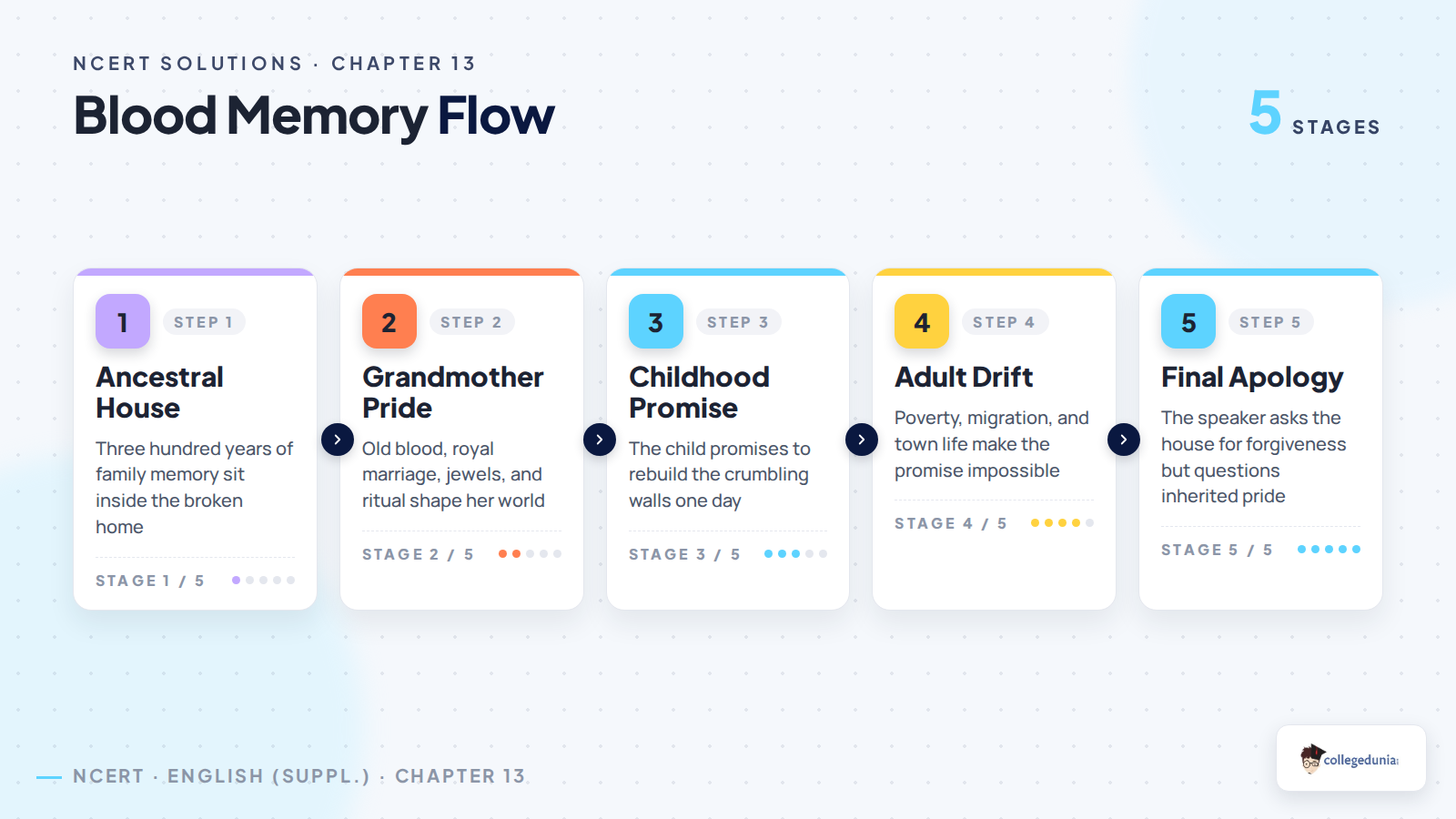
The poem moves from the broken home to the great-grandmother's pride, then to the child's promise and adult failure. A strong Class 12 answer follows that sequence instead of writing a general note on nostalgia.
Ancestral house gives the poem its emotional centre.
Old blood creates pride, but also exposes class hierarchy.
Adult apology shows guilt without accepting inherited superiority.
Tradition and Modernity in Blood Class 12 English
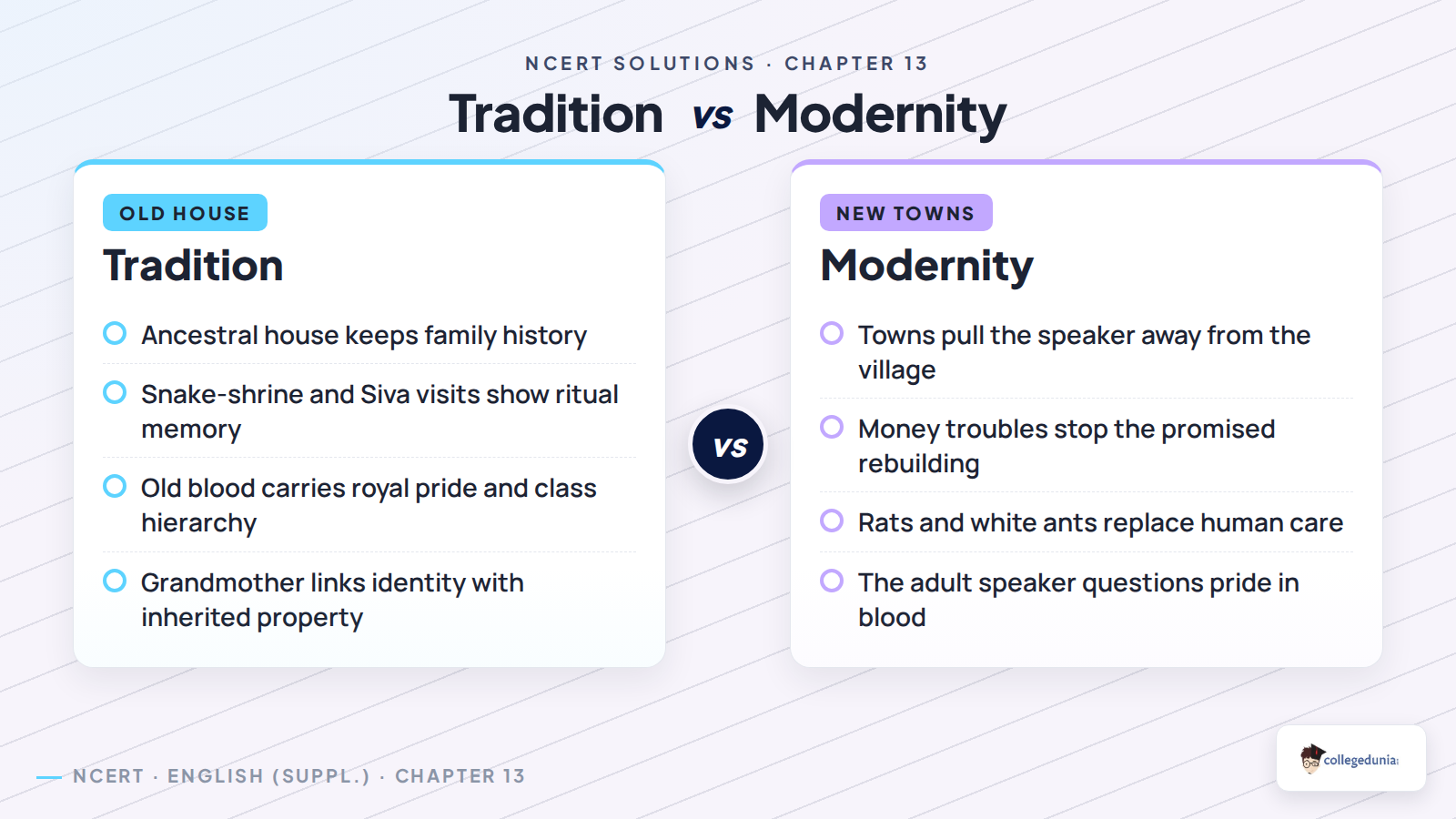
The poem does not simply praise tradition or reject modernity. Tradition gives the speaker memory, identity and affection. It also carries class pride. Modernity gives movement and survival, but it leaves the ancestral house uncared for.
Tradition
Modernity
Three-hundred-year-old house and family memory
Town life, money pressure and migration
Snake-shrine, Siva visits and inherited ritual
Broken promise and loss of daily care
Royal grandeur and pride in old blood
Self-questioning and refusal to blame blood
How to Write Better Blood NCERT Solutions
Begin with the exact NCERT demand. If the question asks for authenticity, quote the physical details of the house. If it asks about class, use the old blood contrast. If it asks about conscience, move to the speaker's final apology.
Do not write only that the poem is about family memory.
Use the house, shrine, rats, white ants and pyre as evidence.
Keep respect for the great-grandmother separate from support for class pride.
For the Language Study task, compare form, vocabulary, language and themes.
Blood Class 12 English Supplementary Resource Links
Use these related resources when you want the same chapter in another format. The table is placed above the FAQ so students can move from solutions to notes, book PDF and handwritten revision without losing the chapter context.
All NCERT Solutions for Class 12 English Supplementary Chapters
The table below keeps the same resource type together, so students can move chapter by chapter through the Class 12 English supplementary Kaleidoscope question set.
All NCERT Solutions for Class 12 English (Suppl.) Chapter 13 Kaleidoscope: Blood with Step-by-Step Solutions
The expandable cards below reproduce the full solution set from the PDF. Use the Solution tab for a direct exam-ready answer and the Expert Solution tab for deeper notes on Das's house image, old blood pride and class criticism.
Q 13.1
What makes the depiction of a crumbling village house so authentic in the poem? Is this a common feature of most village houses in the context of rapid urbanisation? Is the poet speaking from actual experience?
Concept used. Realistic description in poetry comes from exact observed details. Kamala Das makes the village house authentic by naming its broken parts, sounds, dampness, shrine, animals, and family memories.
Detail first
For this question, list the concrete details before writing the larger idea of urbanisation.
The house is not described vaguely as old or ruined.
The poet mentions cracked and torn walls.
The walls are moistened by rains, so decay feels physical.
Tiles have fallen here and there.
The windows whine and groan at night.
Rats come out of holes and run past doors.
The snake-shrine is dark with weeds.
The snake-gods have lichen on their hoods.
These details make the house feel seen from inside family life.
Such houses are common in many villages during rapid urbanisation.
Younger people leave for towns, and ancestral homes lose money, care, and daily use.
The poem strongly suggests actual experience because the speaker remembers childhood, the promise, the funeral, and later guilt.
The depiction is authentic because the house is shown through cracked walls, fallen tiles, dampness, groaning windows, rats, weeds, lichen, and family memory. Such neglected ancestral houses are common when families move to towns. The poet seems to speak from lived experience.
AS
Aditi Sharma
M.A English, University of Delhi
Verified Expert
Quick reading. The house matters because it is both a building and an inheritance. Das makes it believable by giving the reader small physical signs instead of a general complaint about decay.
A crumbling house becomes real when its separate parts are named.
The walls crack, tiles fall, and windows make sound.
Dampness from rain shows that the structure is exposed.
Rats and weeds show that human care has withdrawn.
The snake-shrine adds a cultural detail specific to the family home.
The great-grandmother's tears connect the house with emotional truth.
Rapid urbanisation explains why such homes are often abandoned.
Children and grandchildren move away for education, work, and survival.
The speaker's later guilt confirms that she has not invented the scene from outside.
She writes like someone remembering a house she failed to save.
The answer should therefore keep both levels together. The house is realistic as architecture, but it is also realistic as memory. Its decay records a social shift from village inheritance to town life.
The house feels authentic because Das uses exact sensory details and personal memory. The ruined home also reflects the common fate of many village houses after families move into modern urban life.
Q 13.2
What aspects of Indian society and history get highlighted in the poem?
Concept used. A social reading asks what the poem shows about family, class, caste-like pride, gender, religion, property, and historical change. Blood highlights all these through one ancestral house.
House as history
The old house is not only a setting. It stores social memory, status, ritual, loss, and family pride.
The poem shows joint-family memory through the speaker, brother, and great-grandmother.
The ancestral house points to older landed families and inherited property.
The snake-shrine and Monday visits to the Siva shrine show religious custom.
The elephant ride, jewels, brocade, perfumes, oils, and marriage to a prince recall feudal grandeur.
The great-grandmother's pride in old blood shows class consciousness.
Her contrast between old blood and the poor or new-rich shows hierarchy.
The speaker's later poverty and mobility show modern social change.
Rapid movement to towns weakens the old house and the old family order.
The poem also shows women's memory, because the family story is carried by the great-grandmother and the female speaker.
The poem highlights ancestral property, feudal pride, religious practice, class distinction, family memory, women's inheritance, and the shift from village life to modern towns. It shows Indian history as a movement from old landed grandeur toward urban change and personal guilt.
RM
Rahul Menon
M.A English, EFLU Hyderabad
Verified Expert
Structural observation. The poem turns a family story into a social document. The great-grandmother speaks from one historical world, while the adult speaker lives in another.
The house represents an older Kerala family structure.
Its age, shrine, and stories show that a home can hold community history.
The great-grandmother remembers elephant rides and princely marriage.
These images suggest aristocratic memory and older status.
Her language about old blood reveals class pride.
Her contempt for new-rich men and the always poor exposes a social prejudice.
The speaker does not fully accept that prejudice.
Her inability to rebuild the house shows the decline of inherited privilege.
Her movement through towns reflects modern migration.
The poem therefore highlights history as personal loss and social change.
This answer should not reduce the poem to nostalgia. Das remembers the old world, but she also questions it. That double attitude makes the social history richer.
Blood highlights the old aristocratic family, religious custom, class pride, inherited property, women's memory, poverty, new wealth, and migration. It presents Indian society as divided between old status and modern change.
Q 13.3
Does the poem bring out the contrast between tradition and modernity? Illustrate your answer with examples from the poem.
Concept used. Tradition means inherited customs, family pride, ancestral property, ritual, and memory. Modernity means movement, changed values, economic difficulty, and life away from the old home.
Use both sides
An answer on contrast should quote or name details from both tradition and modernity.
The old house represents tradition.
It is three hundred years old and tied to family identity.
The snake-shrine and Siva shrine connect the house with ritual practice.
The great-grandmother remembers elephant rides, jewels, brocade, oils, sandal, and a prince.
Her belief in old blood shows inherited status and pride.
Modernity appears through decay, migration, and broken promises.
The speaker grows up and finds that becoming rich is difficult.
She leaves for other towns instead of rebuilding the house.
The old house is taken over by rats and white ants.
The speaker seeks forgiveness because modern life has separated her from tradition.
Yes. Tradition appears in the ancestral house, shrine, old family blood, princely marriage, elephant ride, jewels, and rituals. Modernity appears in decay, poverty, migration to towns, and the speaker's inability to rebuild the house. The poem shows both attachment and revolt.
MK
Meera Krishnan
Ph.D English, University of Hyderabad
Verified Expert
Strategic angle. The contrast is not simple old versus new. The poem shows that tradition gives identity, but it also carries pride and class blindness. Modernity gives movement, but also guilt and loss.
The great-grandmother's world is built around land, house, ritual, and lineage.
She values the house because it holds the family's past.
She also values aristocratic memory, shown through jewels and royal marriage.
Her repeated old blood claim shows tradition as pride.
The speaker's adult life breaks that pattern.
She does not become rich enough to restore the walls.
She moves through towns and leaves the house behind.
Her modern life cannot carry the old domestic responsibility.
Yet her guilt shows that tradition still speaks inside her.
The poem's power comes from this unresolved pull.
So the answer should illustrate contrast through images, not abstract labels alone. The house, shrine, jewels, pyre, towns, ants, and apology are all examples.
The poem strongly contrasts tradition and modernity. The ancestral house and royal memories show tradition, while the speaker's urban movement and failure to rebuild it show modern change.
Q 13.4
While the poet respected her grandmother's sentiments of royal grandeur, we can also see that she revolts against it. Identify the lines which bring this out.
Concept used. A line-identification answer should name the relevant lines and explain their effect. Here the speaker respects the great-grandmother's memory, but resists her pride in lineage.
Respect and revolt
Do not choose only affectionate lines. The question asks for both respect and revolt.
Respect appears when the child promises to rebuild the fallen walls and make the ancient house new.
The speaker also remembers the great-grandmother tenderly when she touches her cheeks and smiles.
Royal grandeur appears in the memories of elephant rides, jewel box, brocade, perfumes, oils, sandal, and marriage to a prince.
Revolt appears later when the speaker refuses to let blood carry the blame.
The key lines are: Call me callous / Call me selfish / But do not blame my blood.
These lines reject the idea that old blood can explain or excuse everything.
The speaker accepts personal guilt but resists inherited class pride.
She will not let ancestry become a moral shield.
The revolt is clearest in the lines, "Call me callous / Call me selfish / But do not blame my blood." They show that the poet respects her grandmother's memories, but refuses to glorify lineage or royal blood as a complete moral answer.
NR
Nandini Rao
M.A English, Jadavpur University
Verified Expert
Quick reading. The speaker's revolt is quiet but firm. She does not mock the great-grandmother. She challenges the pride that turns family blood into superiority.
The childhood promise shows respect for the elder's pain.
The speaker's memory of the old woman's stories also shows affection.
But the poem does not accept all those stories without question.
The old blood claim is linked with class distinction.
The adult speaker knows that her failure is personal and economic.
She calls herself callous and selfish as possible charges.
Then she draws a clear line: do not blame my blood.
This line separates moral responsibility from inherited status.
It is the strongest act of revolt against royal grandeur in the poem.
The answer can also mention the apology to the old house. The speaker asks forgiveness, but she does not return to the old pride. That is why the revolt remains emotionally complex.
The lines "Call me callous / Call me selfish / But do not blame my blood" bring out the revolt. They reject the inherited pride attached to royal blood while retaining respect for the grandmother.
Q 13.5
Which lines reveal the poet's criticism of class distinctions?
Concept used. Class distinction means ranking people by inherited status, wealth, poverty, or social position. The poem exposes this through the great-grandmother's pride in old blood and the speaker's later resistance.
Quote the contrast
The answer works best when it quotes the old blood contrast and then explains why it is critical.
The first important lines are: That we had the oldest blood / The oldest blood in the world.
The great-grandmother calls this blood thin and clear and fine.
She compares it with the blood of the always poor.
She also compares it with the blood of the new-rich men.
Their blood is described as thick as gruel and muddy as a ditch.
These lines reveal class hierarchy in blunt physical language.
The poet's criticism becomes clearer near the end.
She says: Call me callous / Call me selfish / But do not blame my blood.
This rejects the belief that lineage decides a person's worth or fault.
The class criticism appears in the contrast between "the oldest blood" that is "thin and clear and fine" and the blood of the poor and new-rich, "thick as gruel" and "muddy as a ditch." It is also challenged in "do not blame my blood."
AS
Arjun Sen
M.A English, University of Calcutta
Verified Expert
Structural observation. Das lets the class language expose itself. The great-grandmother's phrases sound proud, but they also show how unfair class thinking can become.
Blood is used as a metaphor for lineage.
The old family claims purity through thin, clear, fine blood.
The poor are marked as always poor, which freezes them in one status.
The new-rich are also dismissed, even though they have gained wealth.
The similes gruel and ditch make their blood sound low and dirty.
This reveals the cruelty inside inherited pride.
The speaker's final refusal breaks that inherited logic.
She accepts blame as a person, but not as a representative of blood.
That refusal is the poem's criticism of class distinction.
The answer should not present the old blood lines as the poet's own simple belief. They belong to family memory, and the adult speaker puts pressure on them.
The critical lines are the old blood comparison with the poor and new-rich, followed by the speaker's plea: "do not blame my blood." Together they expose and question class pride.
Q 13.6
Is it "selfishness" and "callousness" that makes the poet break her childhood promise to her grandmother of renovating the house? Why does she do nothing about rebuilding the house?
Concept used. A motive question asks why a character acts or fails to act. In this poem, the failure is not simple cruelty. It grows from poverty, adult limitation, modern movement, and helpless guilt.
Promise and reality
Childhood promises are often made with love. Adult life tests them through money, distance, and survival.
As a child, the speaker promises to rebuild the fallen walls.
The promise is sincere because she wants to comfort her great-grandmother.
Later, she learns most lessons of defeat.
She also learns that to grow rich is a difficult feat.
This means she lacks the money and power needed to restore the house.
She leaves for other towns, so distance also grows between her and the house.
She calls herself callous and selfish because guilt troubles her.
Yet the poem suggests that these words are too harsh as a full explanation.
She does nothing because modern life, economic failure, and displacement make the promise impossible to keep.
The broken promise is not caused only by selfishness or callousness. The poet cannot rebuild the house because she does not become rich, moves away, and learns the limits of adult life. Her guilt is real, but her failure is also social and economic.
IM
Ira Mukherjee
M.A English, Presidency University
Verified Expert
Strategic angle. The poem asks students to separate guilt from cause. The speaker feels guilty, but guilt does not prove that she acted from cruelty.
The child speaks from affection, not calculation.
She believes she can become very rich and repair the old house.
The adult speaker discovers that wealth is not easy to achieve.
The phrase lessons of defeat shows repeated disappointment.
The house also becomes part of a village past she no longer inhabits.
Rebuilding it would need money, presence, and social stability.
The speaker has none of these in the poem.
She still hears the house dying from every town where she lives.
This proves that she has not forgotten it.
Her inaction comes from helplessness as much as personal failure.
So the answer should not excuse her completely, and should not condemn her cheaply. Das writes from the painful middle position: love remains, but action fails.
The poet breaks the promise because adult poverty, movement, and defeat make renovation impossible. She names selfishness and callousness out of guilt, but the poem shows deeper helplessness.
Q 13.7
What do you understand of the conflict in the poet's conscience?
Concept used. A conflict of conscience is an inner struggle between what a person feels morally bound to do and what the person actually does. The poet feels bound to the house, but leaves it to die.
Name both pressures
Write one sentence for love and duty. Write the next for revolt and helplessness.
The poet loves the old house because it belongs to her family memory.
She also loves the great-grandmother who grieved over it.
As a child, she promised to make the house new.
As an adult, she fails to keep that promise.
This failure creates guilt.
She imagines the house dying, with rats, white ants, creaking rafters, and whining windows.
She apologises to the old house and to her mother's mother's mother.
At the same time, she revolts against class pride and inherited blood superiority.
Her conscience is therefore divided between loyalty to ancestry and rejection of its unjust pride.
She wants forgiveness, but she also asks that her blood not be blamed.
The conflict in the poet's conscience lies between love for the ancestral house and the fact that she abandons it. She feels guilty for breaking her promise, yet she also rejects the false pride attached to old blood and royal ancestry.
DN
Devika Nair
Ph.D English, JNU
Verified Expert
Quick reading. The speaker is torn because every side of the memory makes a claim on her. The house asks for care, the grandmother asks for loyalty, and modern life pulls her away.
One voice inside her remembers affection, promise, and duty.
Another voice knows that she could not become rich enough to rebuild.
A third voice questions old aristocratic pride.
That is why the apology is not simple.
She says she has let the old house down.
She also says not to blame her blood.
The house becomes almost alive, with closed windows and groaning pillars.
Its imagined death increases her guilt.
Yet her refusal of blood-pride gives the poem moral clarity.
Her conscience carries love, failure, rebellion, and apology together.
This is the emotional centre of the poem. Das does not let the speaker return to the old house, but she also does not let her forget it.
The poet's conscience is torn between inherited love and modern failure. She feels guilty for abandoning the house, but she refuses to accept the class pride hidden inside the idea of noble blood.
Q 13.8
Comment on the changes in poetic expression in English from the time of Donne to that of Kamala Das with reference to prosodic features (rhyme, rhythm and metre), vocabulary, language, and themes.
Concept used. Poetic expression changes when poets change form, rhythm, diction, subject, and speaking voice. Donne's poetry and Kamala Das's poetry show two very different moments in English.
Use headings in the answer
The NCERT task gives four heads. Use those heads so no part is missed.
Prosodic features: Donne often uses tight stanza forms, rhyme, argument, and dramatic rhythm.
His lines may twist through wit, paradox, and controlled metrical variation.
Kamala Das uses freer movement, conversational pauses, and long flowing lines.
Her rhythm often follows memory and speech rather than a fixed pattern.
Vocabulary: Donne uses learned, religious, philosophical, and metaphysical vocabulary.
Language: Donne's language is compressed and argumentative.
Das's language is direct, personal, and emotionally open.
Themes: Donne explores love, faith, death, body, soul, and intellectual paradox.
Das explores memory, womanhood, family, ancestry, class, guilt, and modern Indian identity.
From Donne to Kamala Das, English poetic expression moves from tighter rhyme, metaphysical wit, and learned argument toward freer rhythm, direct vocabulary, personal memory, and modern social themes. Das uses English to voice Indian family history, class conflict, and inward guilt.
SK
Sanya Kapoor
M.A English, Jawaharlal Nehru University
Verified Expert
Structural observation. The comparison is really a movement from formal argument to intimate speech. Donne thinks through conceits; Das remembers through images and confession.
Donne belongs to the metaphysical tradition of seventeenth-century English poetry.
His poems often build an argument through rhyme, metre, conceit, and paradox.
His vocabulary can be theological, scientific, legal, or philosophical.
His speaker often debates love, death, body, soul, and God.
Kamala Das writes in a modern Indian English voice.
Her form is looser, and her line follows emotion and memory.
Her words are concrete and domestic.
Blood uses a house, shrine, rats, ants, pyre, and sea to carry feeling.
Her themes include gendered memory, family burden, class pride, and self-accusation.
The change shows how English poetry expanded from British metaphysical forms into modern postcolonial experience.
The answer should not say one style is better. It should show that different ages need different forms. Donne's compact wit suits argument. Das's open line suits memory and confession.
Donne's poetry is formally tighter, intellectually compressed, and built on conceits. Kamala Das's poetry is freer, plainer, more personal, and rooted in Indian memory, social change, and inner conflict.
Class 12 English Supplementary Chapter 13 Blood FAQs
Ques. How many questions are solved in Class 12 English Supplementary Chapter 13 Blood?
Ans. This page includes all 8 NCERT tasks from Responding to the Poem and Language Study for Kaleidoscope: Blood.
Ques. What is the main idea of Blood by Kamala Das?
Ans. Blood uses an ancestral house to explore family memory, pride in old blood, class distinction, urban movement and guilt over a broken promise.
Ques. How does Blood show tradition and modernity?
Ans. Tradition appears through the old house, shrine, royal memories and inherited pride. Modernity appears through migration, poverty, decay and the speaker's refusal to glorify blood.
Ques. Why should students use the PDF with the article?
Ans. The PDF keeps the full NCERT order and adds stepwise long answers plus expert solution support for quick 2026-27 revision.





Chapter13Kaleidoscope:BloodSolutions.pdf?page=1&dpi=150)
Chapter13Kaleidoscope:BloodSolutions.pdf?page=2&dpi=150)
Chapter13Kaleidoscope:BloodSolutions.pdf?page=3&dpi=150)
Chapter13Kaleidoscope:BloodSolutions.pdf?page=4&dpi=150)
Chapter13Kaleidoscope:BloodSolutions.pdf?page=5&dpi=150)
Chapter13Kaleidoscope:BloodSolutions.pdf?page=6&dpi=150)
Chapter13Kaleidoscope:BloodSolutions.pdf?page=7&dpi=150)
Chapter13Kaleidoscope:BloodSolutions.pdf?page=8&dpi=150)
Chapter13Kaleidoscope:BloodSolutions.pdf?page=9&dpi=150)
Chapter13Kaleidoscope:BloodSolutions.pdf?page=10&dpi=150)
Chapter13Kaleidoscope:BloodSolutions.pdf?page=11&dpi=150)
Chapter13Kaleidoscope:BloodSolutions.pdf?page=12&dpi=150)
Chapter13Kaleidoscope:BloodSolutions.pdf?page=13&dpi=150)
Chapter13Kaleidoscope:BloodSolutions.pdf?page=14&dpi=150)
Chapter13Kaleidoscope:BloodSolutions.pdf?page=15&dpi=150)
Chapter13Kaleidoscope:BloodSolutions.pdf?page=16&dpi=150)
Chapter13Kaleidoscope:BloodSolutions.pdf?page=17&dpi=150)
Chapter13Kaleidoscope:BloodSolutions_flat_MobileCard.pdf?page=1&dpi=150)
Chapter13Kaleidoscope:BloodSolutions_flat_MobileCard.pdf?page=2&dpi=150)
Chapter13Kaleidoscope:BloodSolutions_flat_MobileCard.pdf?page=3&dpi=150)
Chapter13Kaleidoscope:BloodSolutions_flat_MobileCard.pdf?page=4&dpi=150)
Chapter13Kaleidoscope:BloodSolutions_flat_MobileCard.pdf?page=5&dpi=150)
Chapter13Kaleidoscope:BloodSolutions_flat_MobileCard.pdf?page=6&dpi=150)
Chapter13Kaleidoscope:BloodSolutions_flat_MobileCard.pdf?page=7&dpi=150)
Chapter13Kaleidoscope:BloodSolutions_flat_MobileCard.pdf?page=8&dpi=150)
Chapter13Kaleidoscope:BloodSolutions_flat_MobileCard.pdf?page=9&dpi=150)
Chapter13Kaleidoscope:BloodSolutions_flat_MobileCard.pdf?page=10&dpi=150)
Chapter13Kaleidoscope:BloodSolutions_flat_MobileCard.pdf?page=11&dpi=150)
Chapter13Kaleidoscope:BloodSolutions_flat_MobileCard.pdf?page=12&dpi=150)
Chapter13Kaleidoscope:BloodSolutions_flat_MobileCard.pdf?page=13&dpi=150)
Chapter13Kaleidoscope:BloodSolutions_flat_MobileCard.pdf?page=14&dpi=150)
Chapter13Kaleidoscope:BloodSolutions_flat_MobileCard.pdf?page=15&dpi=150)
Chapter13Kaleidoscope:BloodSolutions_flat_MobileCard.pdf?page=16&dpi=150)
Chapter13Kaleidoscope:BloodSolutions_flat_MobileCard.pdf?page=17&dpi=150)
Chapter13Kaleidoscope:BloodSolutions_flat_MobileCard.pdf?page=18&dpi=150)
Chapter13Kaleidoscope:BloodSolutions_flat_MobileCard.pdf?page=19&dpi=150)
Chapter13Kaleidoscope:BloodSolutions_flat_MobileCard.pdf?page=20&dpi=150)
Chapter13Kaleidoscope:BloodSolutions_flat_MobileCard.pdf?page=21&dpi=150)
Chapter13Kaleidoscope:BloodSolutions_flat_MobileCard.pdf?page=22&dpi=150)
Chapter13Kaleidoscope:BloodSolutions_flat_MobileCard.pdf?page=23&dpi=150)
Chapter13Kaleidoscope:BloodSolutions_flat_MobileCard.pdf?page=24&dpi=150)
Chapter13Kaleidoscope:BloodSolutions_flat_MobileCard.pdf?page=25&dpi=150)
Chapter13Kaleidoscope:BloodSolutions_flat_MobileCard.pdf?page=26&dpi=150)
Chapter13Kaleidoscope:BloodSolutions_flat_MobileCard.pdf?page=27&dpi=150)
Chapter13Kaleidoscope:BloodSolutions_flat_MobileCard.pdf?page=28&dpi=150)
Chapter13Kaleidoscope:BloodSolutions_flat_MobileCard.pdf?page=29&dpi=150)
Chapter13Kaleidoscope:BloodSolutions_flat_MobileCard.pdf?page=30&dpi=150)
Chapter13Kaleidoscope:BloodSolutions_flat_MobileCard.pdf?page=31&dpi=150)
Chapter13Kaleidoscope:BloodSolutions_flat_MobileCard.pdf?page=32&dpi=150)
Chapter13Kaleidoscope:BloodSolutions_flat_MobileCard.pdf?page=33&dpi=150)



Comments