




The NCERT Solutions for Class 11 Geography Chapter 12 Water (Oceans) cover every textbook exercise answer from the latest 2026-27 NCERT book. Students can revise the hydrological cycle, ocean-floor relief, thermocline, ocean temperature and salinity with direct answers and a downloadable PDF.
- Includes the complete Chapter 12 solved PDF and a companion question-card HTML file.
- Explains key ocean terms such as continental margin, oceanic deep, thermocline and salinity.
- Useful for school exams because the answers combine definitions, diagrams, maps and stepwise explanation.
Solutions.pdf?page=1&dpi=150)
Solutions.pdf?page=2&dpi=150)
Solutions.pdf?page=3&dpi=150)
Solutions.pdf?page=4&dpi=150)
Solutions.pdf?page=5&dpi=150)
Solutions.pdf?page=6&dpi=150)
Solutions.pdf?page=7&dpi=150)
Solutions.pdf?page=8&dpi=150)
Solutions.pdf?page=9&dpi=150)
Solutions_flat_MobileCard.pdf?page=1&dpi=150)
Solutions_flat_MobileCard.pdf?page=2&dpi=150)
Solutions_flat_MobileCard.pdf?page=3&dpi=150)
Solutions_flat_MobileCard.pdf?page=4&dpi=150)
Solutions_flat_MobileCard.pdf?page=5&dpi=150)
Solutions_flat_MobileCard.pdf?page=6&dpi=150)
Solutions_flat_MobileCard.pdf?page=7&dpi=150)
Solutions_flat_MobileCard.pdf?page=8&dpi=150)
Solutions_flat_MobileCard.pdf?page=9&dpi=150)
Solutions_flat_MobileCard.pdf?page=10&dpi=150)
Solutions_flat_MobileCard.pdf?page=11&dpi=150)
Solutions_flat_MobileCard.pdf?page=12&dpi=150)
Solutions_flat_MobileCard.pdf?page=13&dpi=150)
Solutions_flat_MobileCard.pdf?page=14&dpi=150)
Solutions_flat_MobileCard.pdf?page=15&dpi=150)
Solutions_flat_MobileCard.pdf?page=16&dpi=150)
Solutions_flat_MobileCard.pdf?page=17&dpi=150)
Student Feedback: In a Collegedunia poll of 12,640 Class 11 Geography students preparing for the 2026-27 school exams, 78% said this chapter became easier after they revised ocean relief and salinity as separate tables.
Source: 2026-27 Class 11 Geography student poll across CBSE schools.
Every answer is checked against the 2026-27 NCERT Geography textbook and written so students can revise the term, example and exam wording together.
What Class 11 Geography Chapter 12 Covers
Water (Oceans) introduces the ocean as the largest store of water on earth and connects it with the movement of water through the hydrological cycle. The chapter then shifts to the relief of the ocean floor, the temperature structure of ocean water and the meaning of salinity.
| Chapter area | What students must know | Where it helps |
|---|---|---|
| Blue Planet | Why water covers most of the earth's surface | Short answers and definitions |
| Hydrological cycle | Evaporation, condensation, precipitation, runoff and storage | Long answers on water movement |
| Ocean-floor relief | Continental shelf, slope, rise, abyssal plain and oceanic deep | MCQs and diagram revision |
| Temperature and salinity | Thermocline, depth layers and dissolved salts per 1,000 grams of seawater | Concept-based textbook answers |
Start revision with the ocean-floor relief table. Once students separate major divisions from minor relief features, the multiple-choice questions become much easier to solve.
Hydrological Cycle and Ocean-Floor Relief
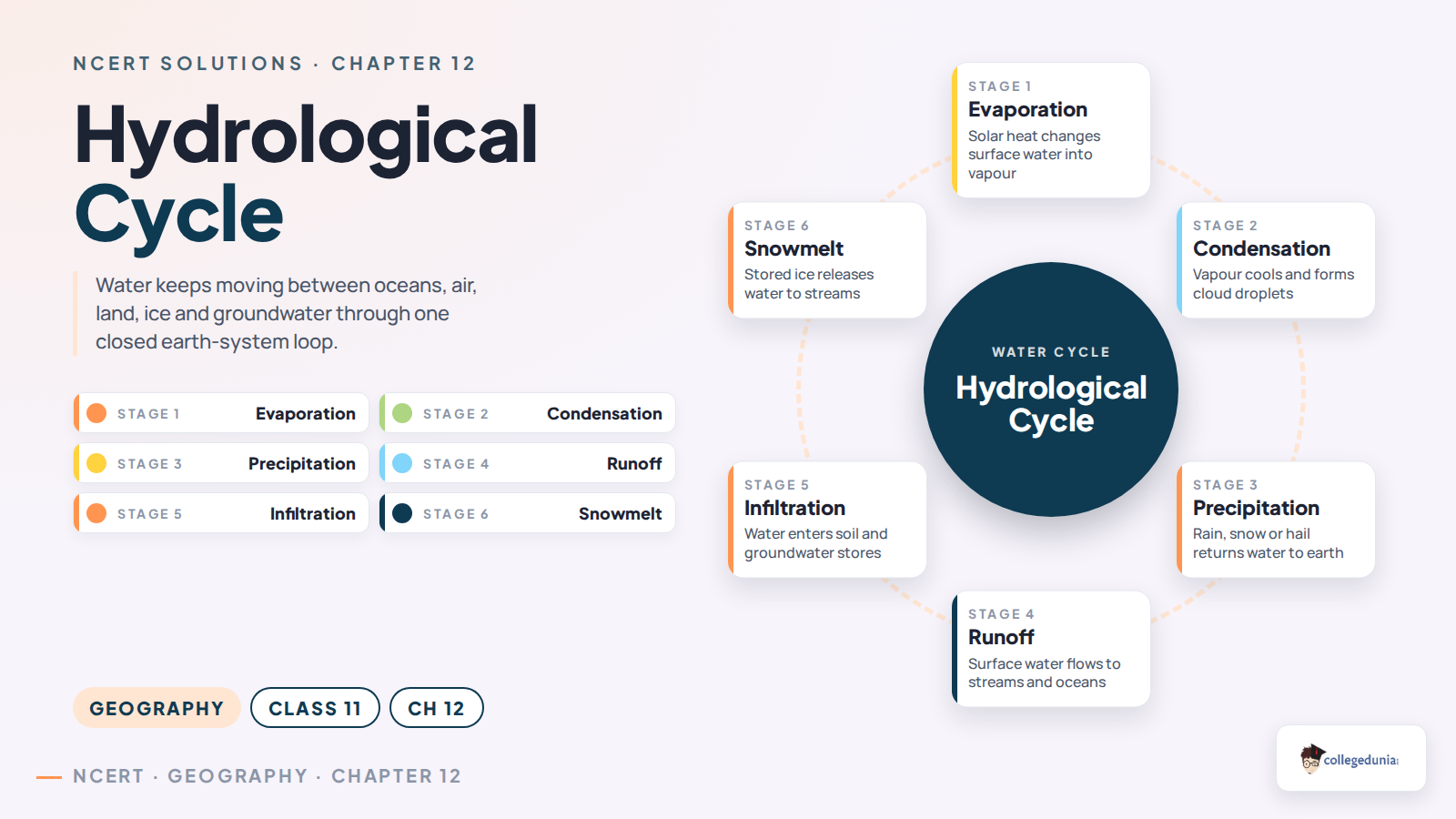
The hydrological cycle links oceans, atmosphere, land, groundwater and living systems. Solar energy converts surface water into vapour, clouds form through condensation, and precipitation returns water to the surface. Some water enters the soil, some moves as runoff, and a large part eventually reaches the oceans again.
- Evaporation: water changes from liquid to vapour, mainly from oceans and other water bodies.
- Condensation: water vapour cools and forms cloud droplets or ice crystals.
- Precipitation: water returns to the surface as rain, snow or hail.
- Runoff and infiltration: water either flows over the land or seeps into soil and groundwater.
Ocean-floor relief is revised in the same way: first identify the continental margin, then move toward the deep-ocean basin. Continental shelf, continental slope and continental rise form the margin. Abyssal plains, mid-oceanic ridges, seamounts, guyots and trenches help students describe the ocean floor in exam-ready language.
Water Oceans Class 11 Geography Video
Source: Magnet Brains on YouTube
Temperature, Thermocline and Salinity in Water (Oceans)
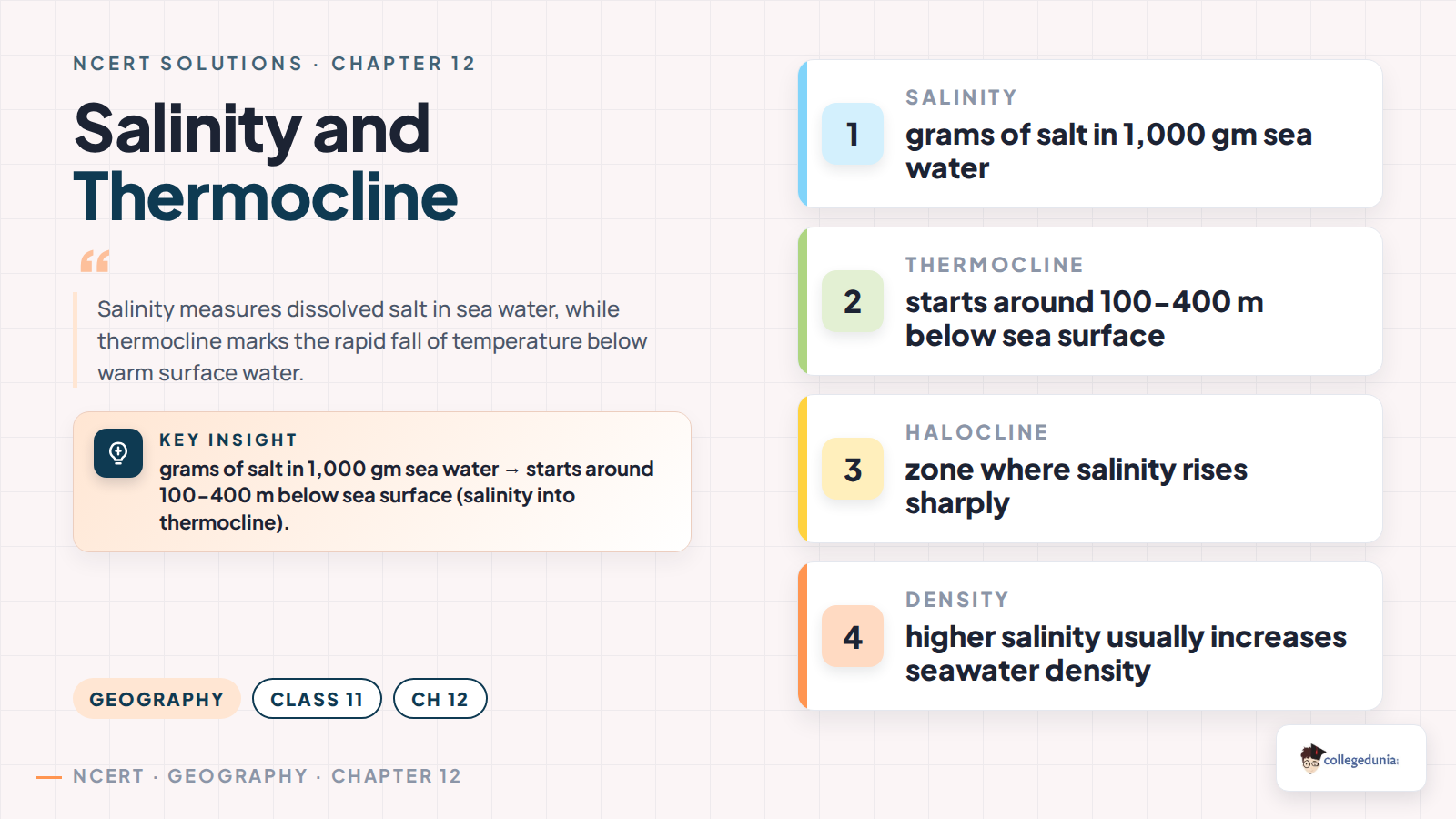
The chapter describes three broad thermal layers in the ocean. The surface layer receives the most solar energy and is warmer. The thermocline is the middle layer where temperature falls rapidly with depth. The deep layer remains cold and extends toward the ocean floor.
- Latitude: surface temperature generally decreases from the equator toward the poles.
- Land and water distribution: ocean temperature patterns differ between the northern and southern hemispheres.
- Prevailing winds: winds may push warm water away and bring cold water upward through upwelling.
- Ocean currents: warm currents raise nearby temperatures, while cold currents lower them.
Salinity means the amount of dissolved salts in seawater. NCERT expresses it as grams of salt dissolved in 1,000 grams of seawater. Evaporation, precipitation, river inflow, ice melting, ocean currents and wind-driven mixing all affect salinity distribution.
How to Answer Chapter 12 Exercise Questions
Chapter 12 answers score well when students write the controlling term first and then add the process, example or layer. For salinity, define the unit before naming factors. For thermocline, place it between the warm surface layer and the deep cold layer. For ocean-floor relief, separate major divisions from minor features.
- Use exact NCERT terms: hydrological cycle, continental margin, abyssal plain, thermocline and salinity.
- Answer MCQs from definitions: hydration is not part of the water cycle, and Arctic Ocean is the smallest ocean.
- Use sequence language: evaporation to condensation to precipitation makes the water-cycle answer clear.
- Keep the year correct: use the latest 2026-27 NCERT wording in titles and descriptions.
All NCERT Solutions for Class 11 Geography Chapter 12 Water (Oceans) with Step-by-Step Solutions
Open the solved question cards: Check Solution and Expert Solution tabs are available for all Chapter 12 textbook questions.
Related Geography Resources
| Resource | Use it for | Link |
|---|---|---|
| Revision Notes | Fast theory revision before solving the exercise | Open Notes |
| NCERT Book PDF | Reading the source chapter, maps and tables | Open Book PDF |
| Handwritten Notes | Last-minute recall of ocean relief, temperature and salinity | Open Handwritten Notes |
NCERT Solutions for All Chapters
| Class 11 Geography Solutions | Chapter focus |
|---|---|
| Chapter 9 Atmospheric Circulation and Weather Systems | Pressure belts, winds and weather systems |
| Chapter 10 Water in the Atmosphere | Humidity, clouds and precipitation |
| Chapter 11 World Climate and Climate Change | Climate classification and greenhouse gases |
| Class 11 Geography all chapters | Complete NCERT Geography resource hub |
Water (Oceans) NCERT Solutions FAQs
Ques. What is covered in Class 11 Geography Chapter 12 Water (Oceans)?
Ans. The chapter covers the hydrological cycle, ocean-floor relief, temperature layers, thermocline and salinity of seawater.
Ques. What is the thermocline in Class 11 Geography?
Ans. The thermocline is the ocean layer where temperature decreases rapidly with depth. It lies below the warm surface layer and above the deep cold layer.
Ques. How is salinity of seawater expressed in NCERT Geography?
Ans. Salinity is expressed as the amount of dissolved salt in grams per 1,000 grams of seawater.



Comments