The NCERT Solutions for Class 11 English Woven Words Chapter 7 Glory at Twilight answer every textbook question from the 2026-27 NCERT reader. The page covers Satyajit's financial crash, Uncle Srinath's expectations, the forgerer episode, the title image, Indian idiom and narrative style.
The chapter has 19 solved prompts across Understanding the Text, Talking about the Text, Appreciation and Language Work.
Use the PDF for answers on fallen glory, shame, social expectation and moral pressure.
The story is by Bhabani Bhattacharya and appears in the Short Stories section of Woven Words.
Student Feedback: In a Collegedunia student poll of 8,120 Class 11 English students before the 2026 exams, many students said the hardest part of Glory at Twilight was explaining Satyajit's shame without turning the answer into a plot summary.
Every answer here follows the latest 2026-27 NCERT Woven Words text and keeps the wording clear for school answer sheets.
Glory at Twilight Class 11 Question Pattern
The exercise after Glory at Twilight moves from direct reasons to discussion, appreciation and language analysis. Students should prepare Satyajit's crash and Srinath's expectations together because both ideas explain the title.
NCERT section
Number of prompts
What it tests
Understanding the Text
7
Reasons for Satyajit's choices and the cycle of his life
Talking about the Text
4
Fallen glory, failure, truth and punishment
Appreciation
4
Crash introduction, perspective, bank theft and title lines
Language Work
4
Description, Indian idiom and sentence fragments
Glory at Twilight Class 11 Explanation Video
Source: Magnet Brains
Satyajit's Fall from Glory in the Story
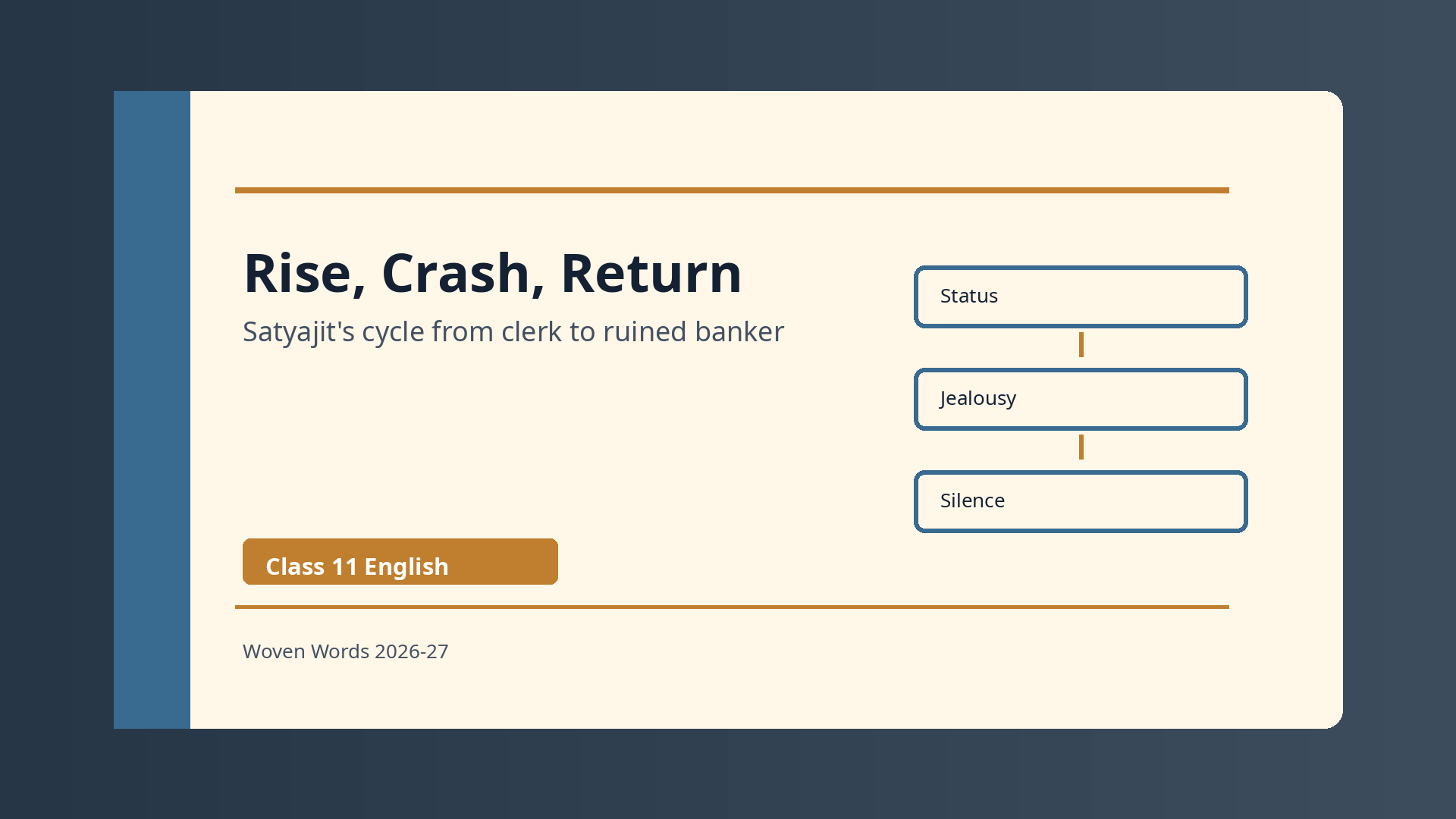
Satyajit's fall is painful because society still sees the successful Managing Director while he knows that the bank has collapsed. The key point is that his money falls first, but his public image fades more slowly.
He once rose from a village home to become a powerful banker.
The bank collapse takes away his assets, house, cars and confidence.
Srinath's family still expects generosity from the old Satyajit.
The village welcome turns honour into a source of shame.
Forgerer Episode and Moral Pressure
The forgerer episode explains the hidden moral cost of Satyajit's success. As a young clerk, Satyajit exposes a forged cheque and rises in the bank. Years later, after his own ruin, he remembers the desperate man with more sympathy.
Episode
What happens
Answer point
Forged cheque
Satyajit notices fear and verifies the account
His alertness begins his rise
Court scene
The forgerer says shame kills
Crime is linked with moral suffering
Train memory
Satyajit remembers him after losing everything
Success now looks morally complicated
Narrative Style and Language Work in Glory at Twilight
Bhattacharya keeps the narration close to Satyajit's mind. The reader moves through memory, shame, pride and fear as the train moves toward Shantipur. The language work also shows how English can carry Indian speech patterns.
Perspective: the story follows Satyajit's inner movement.
Indian idiom: expressions like benediction and reverent feet show cultural respect.
Fragments: broken sentence units imitate fast, troubled thought.
Common Mistakes Students Make in Glory at Twilight Answers
Avoid these answer-sheet mistakes:
Writing that Satyajit is only poor now without explaining fallen status.
Missing why the forgerer episode returns in his memory.
Calling Srinath selfish without noting his wedding pressure and old dependence.
Explaining the title without the image of twilight as fading afterglow.
Ignoring the Language Work questions on Indian idiom and fragments.
More Class 11 English Woven Words Chapter 7 Resources
Use the related Woven Words resources when you need the chapter text, quick notes or handwritten revision pages along with these solved answers.
All NCERT Solutions for Class 11 English Woven Words Chapter 7 Glory at Twilight with Step-by-Step Solutions
Questions
Q 7.1
Give reasons for Satyajit attending the village wedding.
Concept used. A reason-based answer links action with pressure, emotion and circumstance. Satyajit attends the wedding to escape his crisis and revisit his beginning.
Answer focus
Mention both the letter from Srinath and Satyajit's need to get away from the city.
Satyajit receives Uncle Srinath's letter about Beena's wedding and the need for his benediction.
Earlier, in prosperity, he had helped Srinath's daughters generously.
After the bank collapse, the city feels suffocating and humiliating to him.
He wants temporary relief from the wrenching feeling of failure.
He also wishes to see his ancestral house and fish pond, the last property left intact.
The village visit therefore becomes both social duty and emotional escape.
Satyajit attends the village wedding because Srinath requests his presence, old pride pulls him back, and he wants relief from the shame of his financial collapse.
RM
Rhea Menon
M.A English, University of Delhi
Verified Expert
Concept used. This expert route reads the answer through character, social setting and exam purpose, then connects the point back to the NCERT prompt.
The wedding is not only a family function for Satyajit.
It is a return to the village that once marked his humble beginning.
His earlier generosity had made him important before people like Srinath.
Now, after ruin, he wants a place where his old identity still seems alive.
He also hopes the physical return may give him strength for the coming struggle.
So the journey reveals denial, nostalgia and the need for dignity together.
The wedding gives Satyajit a reason to leave the ruined city and enter the twilight of his earlier glory.
Q 7.2
Give reasons for Satyajit's recollection of the forgerer when he was on the train.
Concept used. Recollection in fiction often appears when the present repeats an old moral situation. Satyajit remembers the forgerer because both men face shame and desperation.
Answer focus
Spell forgerer as the NCERT text does, but explain the meaning clearly.
The forgerer had tried to obtain money because his wife was dying of tuberculosis.
Satyajit exposed him when he was only a bank clerk.
That incident helped Satyajit rise in the bank and begin his successful career.
On the train, Satyajit is now ruined and needs a chance to live.
The old criminal's shame and helplessness return to Satyajit's mind.
He wonders whether he owed that man gratitude or mercy because his own rise began there.
Satyajit remembers the forgerer because the old case began his rise, and his present ruin makes him understand shame, helplessness and the need for another chance.
KS
Kunal Sen
M.A English, Jadavpur University
Verified Expert
Concept used. This expert route reads the answer through character, social setting and exam purpose, then connects the point back to the NCERT prompt.
The recollection is a moral mirror.
Earlier, Satyajit judged the forgerer with honest contempt.
Now his own life has collapsed, and he knows what desperation feels like.
The memory also undercuts his idea of self-made success.
His career was helped by another man's fall.
This makes the train journey a journey into conscience, not only into the village.
The forgerer returns in memory because Satyajit's present failure lets him see the older man's shame with new sympathy.
Q 7.3
Give reasons for Srinath and his family members' eager expectation of Satyajit's arrival.
Concept used. Expectation grows from reputation and need. Srinath's family sees Satyajit as a wealthy benefactor and village success story.
Answer focus
Use the public welcome at the station as evidence.
Satyajit had helped Srinath's earlier daughters during their marriages.
The family believes he is still the rich Managing Director they remember.
Srinath depends on his benediction and possible financial help for Beena's wedding.
The village also sees him as a son of Bengal who succeeded in trade and industry.
They welcome him with a garland, flag and public praise.
Their eagerness comes from admiration, dependence and ignorance of his ruin.
Srinath and his family eagerly expect Satyajit because they remember his wealth, past help and public success. They do not know that his bank has collapsed.
MS
Meera Sanyal
Ph.D English, University of Hyderabad
Verified Expert
Concept used. This expert route reads the answer through character, social setting and exam purpose, then connects the point back to the NCERT prompt.
The expectation is built on an outdated image.
For the village, Satyajit still represents achievement and money.
For Srinath's family, he is the man whose generosity can save the marriage arrangements.
This is why the welcome becomes ceremonial rather than private.
The irony is that the honoured guest has already lost the status being celebrated.
The eager reception therefore deepens his humiliation.
They await the old Satyajit: prosperous, powerful and useful. The real Satyajit arrives ruined and ashamed.
Q 7.4
Give reasons for Srinath's disappointment with Satyajit.
Concept used. Disappointment appears when expectation and reality clash. Srinath expects Satyajit's benediction to solve Beena's cash dowry crisis at once.
Answer focus
Focus on the Rs 2001 demand and Harish asking for house-and-pond security.
Srinath has built his plans around Satyajit's earlier generosity.
The groom's father demands Rs 2001 in cash before the ceremony can begin.
Srinath believes this is only a drop in the ocean of Satyajit's fortune.
Satyajit has not brought that much cash and tries to arrange a loan in the village.
Harish the moneylender refuses to trust Satyajit's signature without security.
Srinath is disappointed because the rich man's word now weighs less than the ancestral house and fish pond.
Srinath is disappointed because Satyajit cannot immediately produce the Rs 2001 cash dowry. Harish will lend only against Satyajit's house and fish pond, which hurts Srinath's faith in the millionaire's word.
AT
Arvind Thomas
M.A English, EFLU Hyderabad
Verified Expert
Concept used. This expert route reads the answer through character, social setting and exam purpose, then connects the point back to the NCERT prompt.
Srinath's disappointment is tied to the wedding's immediate danger.
If the cash is not paid before the ceremony, Beena's marriage may break.
He has worshipped Satyajit's wealth and assumes money will appear easily.
When cash does not appear, the illusion of unlimited power weakens.
Harish's demand for property security makes the insult sharper.
The scene shows that Satyajit's fading glory can no longer command trust in practical money matters.
Srinath is disappointed because the wedding crisis exposes the gap between Satyajit's remembered wealth and his present inability to command cash.
Q 7.5
Give reasons for Satyajit's feeling that he was an impostor.
Concept used. An impostor is someone treated as one thing while knowing the truth is different. Satyajit feels false because the village honours a success that no longer exists.
Answer focus
Connect the garlanded welcome with his hidden financial status.
At the station, Satyajit is welcomed as a successful son of Bengal.
The villagers praise him as a man who has conquered trade and industry.
He knows that his bank has collapsed and his private assets are gone.
The praise therefore feels undeserved and painful.
He continues to accept the honour because he cannot reveal the truth immediately.
This split between public image and private ruin makes him feel like an impostor.
Satyajit feels like an impostor because people treat him as a glorious success while he knows he is bankrupt, ashamed and unable to help them as before.
AR
Ananya Rao
M.A English, University of Mumbai
Verified Expert
Concept used. This expert route reads the answer through character, social setting and exam purpose, then connects the point back to the NCERT prompt.
The impostor feeling is central to the title.
The village sees sunset light and mistakes it for full daylight.
Satyajit's glory survives only as reputation, not as reality.
Every garland and word of praise sharpens the lie he is silently living.
His shame grows because he is not actively deceiving them at first, yet he lets the false image continue.
The result is a painful conflict between identity and truth.
He feels false because the honour belongs to his past, while his present self stands ruined inside it.
Q 7.6
Give reasons for Satyajit not disclosing his present financial status to his uncle.
Concept used. Concealment can come from shame, pride and concern for others. Satyajit hides his ruin because truth would destroy his last social dignity.
Answer focus
Do not make it simple dishonesty. Show his emotional pressure.
Satyajit has recently lost his bank, assets, house and cars.
He feels deep shame because his wife and village know him as a man of fortune.
Srinath has arranged the wedding while expecting his support.
A confession would humiliate Satyajit before the whole village.
It would also crush Srinath's hope during a family crisis.
So he delays the truth and tries to preserve the appearance of dignity.
Satyajit does not disclose his financial status because pride, shame, social expectation and Srinath's urgent wedding need make confession unbearable.
LM
Leena Mathew
M.A English, University of Kerala
Verified Expert
Concept used. This expert route reads the answer through character, social setting and exam purpose, then connects the point back to the NCERT prompt.
His silence is morally mixed.
On one side, it protects him from immediate humiliation.
On the other, it allows Srinath to continue believing in help that may not come.
This makes Satyajit both pitiable and flawed.
The story does not excuse him fully, but it helps us understand the pressure of fallen status.
His silence is the last fragile cover over a broken life.
Satyajit hides the truth because admitting ruin would end the last performance of glory he can still maintain.
Q 7.7
Describe the cycle of events in Satyajit's life that brought him back to where he began.
Concept used. A cycle means movement that returns to its starting point. Satyajit's life moves from village poverty to city success and then back to uncertainty.
Answer focus
Write the answer as a chain: humble beginning, rise, glory, crash, return.
Satyajit begins in a humble village home and educates himself through struggle.
He gets a clerkship in a bank and proves himself in the forgery incident.
That incident starts his rise from clerk to accountant and eventually Managing Director.
Prosperity brings status, house, cars, pride and influence over people like Srinath.
The bank then collapses suddenly, taking away his private assets and public confidence.
He returns to Shantipur with only the ancestral house and fish pond left as reminders of his beginning.
Satyajit's life forms a full cycle: poverty, hard work, banking success, public glory, financial crash and return to the village roots from which he started.
AR
Aditi Rao
M.A English, University of Calicut
Verified Expert
Concept used. This expert route reads the answer through character, social setting and exam purpose, then connects the point back to the NCERT prompt.
The cycle is both economic and emotional.
He starts with nothing but ambition and discipline.
Success lifts him far above the village that once underestimated him.
Failure then moves faster than success and strips away the signs of achievement.
His return to Shantipur is therefore not a vacation. It is a symbolic return to the starting line.
The title captures this moment: some light remains, but day has ended.
The cycle returns Satyajit to struggle, but not to innocence. He comes back carrying memory, guilt and fallen pride.
Q 7.8
Discuss the idea that it is difficult to adjust to a fall from glory.
Concept used. A fall from glory means loss of status after public success. Adjustment is hard because identity, pride and social expectation do not fall as quickly as money.
Answer focus
Use Satyajit's private shame and public welcome together.
Satyajit has known success as a Managing Director and village benefactor.
People around him still remember that image of prosperity.
After the collapse, he loses wealth but not the expectations attached to wealth.
He cannot smoke freely, cannot help as before and cannot speak openly about the ruin.
The village welcome makes the fall harder because it celebrates a vanished glory.
His struggle shows that status loss wounds self-respect as much as finances.
Satyajit's fall is difficult because money, reputation and identity collapse together. Society continues to expect the old man of glory, while he knows that glory has ended.
NK
Nisha Kapoor
M.A English, Jamia Millia Islamia
Verified Expert
Concept used. This expert route reads the answer through character, social setting and exam purpose, then connects the point back to the NCERT prompt.
The story is sensitive to the psychology of failure.
A person can lose property overnight, but the mind still lives inside the older image.
Satyajit has to ration cigarettes and count rupees, yet others still salute him.
That mismatch makes ordinary adjustment almost impossible.
The pain is not only poverty. It is the public death of a self he once believed in.
This is why twilight is the right image for his condition.
The fall hurts because Satyajit loses not only wealth, but also the role by which others and he himself knew him.
Q 7.9
Discuss the line, 'Failure had a tempo faster than success.'
Concept used. Tempo means speed or pace. The line contrasts slow earned success with the quick destruction caused by failure.
Answer focus
Give Satyajit's rise and collapse in the same answer.
Satyajit's success takes years of work, energy, initiative and banking discipline.
He rises gradually from clerk to accountant and then to Managing Director.
The bank's collapse, however, happens suddenly.
His assets, house, cars and confidence disappear almost overnight.
This speed shocks him because destruction moves faster than construction.
The line therefore expresses both financial reality and emotional shock.
The line means success grows slowly through effort, but failure can destroy that success very quickly. Satyajit's bank collapse proves this cruel speed.
IM
Ira Mukherjee
M.A English, University of Hyderabad
Verified Expert
Concept used. This expert route reads the answer through character, social setting and exam purpose, then connects the point back to the NCERT prompt.
The sentence is one of the story's clearest truths.
A career is built by repeated small gains.
A financial crash can undo those gains in one violent movement.
Satyajit understands the wrong steps clearly only after collapse.
The phrase tempo makes failure sound like a force with its own rhythm.
That rhythm overtakes him before he can prepare.
Failure is faster because it does not rebuild. It merely breaks what time and effort have slowly made.
Q 7.10
Discuss whether Satyajit should have revealed his predicament to his uncle.
Concept used. A predicament is a difficult situation with no easy choice. This answer needs a balanced view of truth, shame and responsibility.
Answer focus
Give both sides, then conclude clearly.
Satyajit should have revealed the truth because Srinath was making wedding expectations around him.
Honesty would have prevented false hope and later disappointment.
It would also have allowed Srinath to seek help elsewhere before the crisis became worse.
However, Satyajit's silence is understandable because his collapse is fresh and humiliating.
He is surrounded by public honour that makes confession harder.
A balanced answer is that he should have spoken, but the story helps us feel why he could not.
Satyajit should have revealed his predicament, yet his silence is psychologically understandable. Pride, shame and public expectation make the truth extremely hard to say.
SK
Samar Khanna
M.A Comparative Literature, Jadavpur University
Verified Expert
Concept used. This expert route reads the answer through character, social setting and exam purpose, then connects the point back to the NCERT prompt.
The ethical answer and the emotional answer do not fully match.
Ethically, Srinath deserved the truth because Beena's wedding depended on money.
Emotionally, Satyajit is still stunned by collapse and clings to dignity.
The story works because it does not reduce him to a liar.
It presents him as a fallen man trapped between honesty and shame.
That tension is exactly what makes the predicament tragic.
Truth would have been better, but the silence exposes how painful fallen glory can be.
Q 7.11
Discuss the author's comment on crime and punishment.
Concept used. The story places legal punishment beside moral punishment. It asks whether shame can wound more deeply than prison.
Answer focus
Use the forgerer's words, then connect them to Satyajit's own guilt.
The forgerer commits a legal crime by trying to cash a forged cheque.
He does it because his wife is dying and he needs money for medicine.
In court, he says he has put his wife to shame and that shame kills as fast as tuberculosis.
This statement shifts attention from law to conscience.
Satyajit later faces his own moral punishment through shame after financial failure.
The story suggests that punishment may be social, emotional and inward, not only legal.
The author shows that crime has legal punishment, but shame can be an even deeper punishment. The forgerer and Satyajit both suffer under moral pressure.
DN
Devika Nair
M.A English, University of Calicut
Verified Expert
Concept used. This expert route reads the answer through character, social setting and exam purpose, then connects the point back to the NCERT prompt.
Bhattacharya does not excuse crime.
The forgery is wrong, and the court can punish it.
Yet the story asks students to see the human desperation beneath the act.
The forgerer's idea that shame kills reveals punishment inside the self.
Satyajit's later shame echoes that earlier scene.
Thus the story links criminal guilt, social humiliation and personal conscience.
The comment on crime and punishment is compassionate: law judges the act, but conscience carries a slower wound.
Q 7.12
How is Satyajit's financial crash introduced to the reader?
Concept used. Narrative introduction means the way information is revealed. The crash is introduced through memory, denial and small signs rather than a plain report.
Answer focus
Mention rationed cigarettes and the repeated question, What now?
The story opens with Satyajit on a slow train, already troubled and withdrawn.
He stops himself from taking a cigarette because even smoking must be rationed.
His mind keeps returning to the question, What now?
The narrator then reveals that the bank has collapsed.
His house, equities and cars are gone, and his wife does not yet know the full extent.
This gradual method lets the reader feel the shock before receiving the complete facts.
The crash is introduced through Satyajit's tense thoughts, rationed cigarette, repeated What now, and then the revelation that the bank and his assets have collapsed.
KT
Kavya Thomas
M.A English, Christ University
Verified Expert
Concept used. This expert route reads the answer through character, social setting and exam purpose, then connects the point back to the NCERT prompt.
The introduction is psychological before it is informational.
Instead of announcing bankruptcy first, the story shows a man shrinking inside himself.
The withheld cigarette is a small symbol of large loss.
The repeated question gives the mind's rhythm after disaster.
Only then does the narration give the financial facts.
This method makes the crash feel personal and immediate.
The crash enters through mood, habit and memory, so the reader experiences Satyajit's anxiety before knowing the full cause.
Q 7.13
Comment on the way in which the story is narrated from Satyajit's perspective.
Concept used. Perspective means the angle of seeing. The story stays close to Satyajit's memories, fears and self-justifications.
Answer focus
Use the train journey as the frame for his inner movement.
The narration follows Satyajit's thoughts while he travels to Shantipur.
His memories of the bank, the forgerer, his rise and his collapse shape the plot.
The reader learns facts as they move through his mind.
This closeness creates sympathy because we feel his shame from inside.
It also exposes his pride and his inability to speak truthfully.
The perspective therefore makes him neither hero nor villain, but a flawed human being.
The story is narrated through Satyajit's inner perspective. His memories and anxieties guide the reader, making his fall from glory painful, complex and human.
PB
Parth Banerjee
M.A English Language, University of Calcutta
Verified Expert
Concept used. This expert route reads the answer through character, social setting and exam purpose, then connects the point back to the NCERT prompt.
The narration is built like a mind in motion.
The physical train journey carries an inward journey through memory.
Because we see mainly through Satyajit, the village welcome becomes almost unbearable.
We know the truth he is hiding while others do not.
This produces irony and sympathy at the same time.
The limited perspective is therefore central to the story's emotional force.
Satyajit's perspective turns the plot into an inward drama of shame, memory and fading reputation.
Q 7.14
How has the author used the episode of the bank theft to comment on Satyajit's success in his career?
Concept used. An episode can reveal a career's hidden foundation. The theft episode shows that Satyajit's rise begins with another man's fall.
Answer focus
Avoid saying he became successful only by luck. The answer needs luck plus ability plus moral irony.
As a clerk, Satyajit notices fear in the man presenting the cheque.
He verifies the signature and quickly contacts the account holder.
His alertness exposes the forged cheque and catches the forgerer.
This success helps him grow from clerk to accountant.
At that time he feels contempt for the criminal and pride in his own honesty.
Later, after his own fall, he sees the episode differently and feels troubled by its human cost.
The bank theft episode shows that Satyajit's success began with alertness and honesty, but also with another desperate man's ruin. It adds irony to his glory.
RS
Ritika Sharma
M.A English, Banaras Hindu University
Verified Expert
Concept used. This expert route reads the answer through character, social setting and exam purpose, then connects the point back to the NCERT prompt.
The scene complicates the idea of success.
Satyajit is capable and quick-minded, so his rise is not accidental.
Yet the turning point depends on catching a desperate man.
The forgerer's misery becomes Satyajit's opportunity.
This makes later success morally uneasy rather than pure triumph.
The author uses the episode to show how glory can rest on someone else's defeat.
The theft episode turns Satyajit's career into a mixture of merit, chance and moral debt.
Q 7.15
How do the lines about dead glory and lingering twilight splendour capture the essence of the story?
Concept used. Key lines capture essence when they express the story's main emotional truth. These lines show Satyajit's fallen status and his brief borrowed honour.
Answer focus
Explain twilight as fading light, not complete darkness.
Satyajit's success has ended after the bank collapse.
He feels that glory is covered by shame and therefore dead.
Yet the village still sees him through the light of his past prosperity.
Their welcome gives him a brief feeling of remembered greatness.
This is twilight splendour: a fading light after the real day has gone.
The lines capture the story's mix of humiliation, memory and fragile dignity.
The lines capture the story because Satyajit's real glory is dead, but its afterglow remains in the village's memory and lets him stand briefly in fading splendour.
MD
Manasvi Desai
M.A English, University of Pune
Verified Expert
Concept used. This expert route reads the answer through character, social setting and exam purpose, then connects the point back to the NCERT prompt.
The title itself depends on this image.
Twilight is neither full day nor full night.
Satyajit is neither the powerful man he was nor fully stripped of public honour.
The village welcome wraps him in an afterlight of reputation.
At the same time, he knows the darkness underneath it.
The lines therefore express the whole emotional design of the story.
The essence is fallen greatness: glory has ended, but its last light still deceives and comforts for a moment.
Q 7.16
Pick out descriptions of people from the story where physical features are related to mental qualities.
Concept used. Physical description can suggest inner quality. Bhattacharya often links face, gesture and body to pride, fear, poverty or expectation.
Answer focus
Use other examples from the story and quote short phrases before explaining them.
The phrase alarm vivid in the face, with the shaking hand, reveals the forgerer's fear and desperation.
The crouched figure with head between his hands shows shame and defeat after he is caught.
The prisoner with face frozen suggests a man inwardly deadened by guilt.
The small girl with an awestruck face shows village reverence for Satyajit.
Srinath's high cheekbones, grey stubble and clear elation show age, excitement and dependence.
Beena's large pensive eyes suggest shyness, anxiety and the weight of the wedding day.
The story links physical detail with character: the forgerer's shaking hand shows fear, his frozen face shows shame, Srinath's elated face shows dependence, and Beena's pensive eyes show quiet anxiety.
NP
Nivedita Paul
M.A English, Presidency University
Verified Expert
Concept used. This expert route reads the answer through character, social setting and exam purpose, then connects the point back to the NCERT prompt.
The descriptive method is economical.
Bhattacharya does not pause for long psychological explanation each time.
A hand, mouth, face or posture quickly tells us what the person feels.
This is especially useful because the story is full of hidden shame.
The body reveals what speech often conceals.
These quoted details also answer the NCERT instruction to pick out examples beyond the model description.
Physical description becomes a shortcut to inner life, especially fear, shame, reverence, excitement and anxiety.
Q 7.17
How do the expressions spoken by Srinath's family capture the Indian idiom?
Concept used. Indian idiom here means English shaped by Indian speech habits, respect formulas and emotional exaggeration.
Answer focus
Use the examples from NCERT and explain their cultural tone.
Expressions like We bask in your benediction use formal English with Indian respect patterns.
Our life-spark itself is held in your fist shows dependence through dramatic metaphor.
Let Beena wash and wipe the reverent feet reflects ritual honour given to a benefactor.
Such expressions are not ordinary British conversational English.
They carry Indian social ideas of blessing, reverence, obligation and auspiciousness.
The idiom makes the village speech sound local, emotional and culturally rooted.
The expressions capture Indian idiom by using English words for Indian ideas of blessing, reverent feet, auspicious honour and dependence on a benefactor.
HB
Harini Bose
M.A English, University of Madras
Verified Expert
Concept used. This expert route reads the answer through character, social setting and exam purpose, then connects the point back to the NCERT prompt.
The language is English, but its emotional structure is Indian.
Benediction, life-spark and reverent feet carry the sound of translated social speech.
This gives Srinath's family a voice rooted in village respect and ritual.
It also flatters Satyajit painfully because he knows he cannot meet their faith.
The idiom therefore serves both style and plot.
It helps create the atmosphere of excessive honour around fallen glory.
Indian idiom appears when English carries Indian manners of respect, dependence and ceremonial emotion.
Q 7.18
Explain how the sentence fragments in the lesson capture Satyajit's train of thought.
Concept used. Sentence fragments are incomplete sentences used deliberately. They imitate quick, broken or compressed thought.
Answer focus
Refer to the banking establishment and amazing tempo examples.
The fragments appear when Satyajit remembers his rise in the bank.
The banking establishment of which he had attained control is not a complete sentence.
The amazing tempo of it all is also a fragment.
Such broken pieces sound like memory flashing through the mind.
They avoid a neat external summary and keep the reader inside Satyajit's thought process.
The device suits a man whose mind circles around success, failure and the question What now.
The fragments capture Satyajit's train of thought by presenting memory in quick pieces. They make the narration feel inward, restless and psychologically close.
RM
Rohan Mehta
M.A Linguistics, EFLU Hyderabad
Verified Expert
Concept used. This expert route reads the answer through character, social setting and exam purpose, then connects the point back to the NCERT prompt.
Creative writing often breaks grammar to reproduce mental movement.
Satyajit is not preparing a formal report on his career.
He is remembering in bursts while travelling under emotional strain.
The fragments show pride, shock and speed together.
They also match the story's larger rhythm of rise and crash.
Thus form and feeling work together in the passage.
The fragments make thought visible as thought: incomplete, rapid and emotionally charged.
Glory at Twilight Class 11 English Woven Words NCERT Solutions FAQs
Ques. Who wrote Glory at Twilight in Class 11 Woven Words?
Ans. Bhabani Bhattacharya wrote Glory at Twilight. The story is taken from Steel Hawk and Other Stories.
Ques. What is the main conflict in Glory at Twilight?
Ans. The main conflict is Satyajit's struggle between his old public glory and his hidden financial ruin.
Ques. How many NCERT questions are solved in this PDF?
Ans. The PDF solves 19 NCERT prompts from Understanding the Text, Talking about the Text, Appreciation and Language Work.
Ques. What does twilight symbolise in the story?
Ans. Twilight symbolises the fading afterglow of Satyajit's former success. His glory has ended, but its memory still surrounds him briefly.





Chapter7GloryatTwilightSolutions.pdf?page=1&dpi=150)
Chapter7GloryatTwilightSolutions.pdf?page=2&dpi=150)
Chapter7GloryatTwilightSolutions.pdf?page=3&dpi=150)
Chapter7GloryatTwilightSolutions.pdf?page=4&dpi=150)
Chapter7GloryatTwilightSolutions.pdf?page=5&dpi=150)
Chapter7GloryatTwilightSolutions.pdf?page=6&dpi=150)
Chapter7GloryatTwilightSolutions.pdf?page=7&dpi=150)
Chapter7GloryatTwilightSolutions.pdf?page=8&dpi=150)
Chapter7GloryatTwilightSolutions.pdf?page=9&dpi=150)
Chapter7GloryatTwilightSolutions.pdf?page=10&dpi=150)
Chapter7GloryatTwilightSolutions.pdf?page=11&dpi=150)
Chapter7GloryatTwilightSolutions.pdf?page=12&dpi=150)
Chapter7GloryatTwilightSolutions.pdf?page=13&dpi=150)
Chapter7GloryatTwilightSolutions.pdf?page=14&dpi=150)
Chapter7GloryatTwilightSolutions.pdf?page=15&dpi=150)
Chapter7GloryatTwilightSolutions.pdf?page=16&dpi=150)
Chapter7GloryatTwilightSolutions.pdf?page=17&dpi=150)
Chapter7GloryatTwilightSolutions.pdf?page=18&dpi=150)
Chapter7GloryatTwilightSolutions.pdf?page=19&dpi=150)
Chapter7GloryatTwilightSolutions.pdf?page=20&dpi=150)
Chapter7GloryatTwilightSolutions.pdf?page=21&dpi=150)
Chapter7GloryatTwilightSolutions.pdf?page=22&dpi=150)
Chapter7GloryatTwilightSolutions.pdf?page=23&dpi=150)
Chapter7GloryatTwilightSolutions_flat_MobileCard.pdf?page=1&dpi=150)
Chapter7GloryatTwilightSolutions_flat_MobileCard.pdf?page=2&dpi=150)
Chapter7GloryatTwilightSolutions_flat_MobileCard.pdf?page=3&dpi=150)
Chapter7GloryatTwilightSolutions_flat_MobileCard.pdf?page=4&dpi=150)
Chapter7GloryatTwilightSolutions_flat_MobileCard.pdf?page=5&dpi=150)
Chapter7GloryatTwilightSolutions_flat_MobileCard.pdf?page=6&dpi=150)
Chapter7GloryatTwilightSolutions_flat_MobileCard.pdf?page=7&dpi=150)
Chapter7GloryatTwilightSolutions_flat_MobileCard.pdf?page=8&dpi=150)
Chapter7GloryatTwilightSolutions_flat_MobileCard.pdf?page=9&dpi=150)
Chapter7GloryatTwilightSolutions_flat_MobileCard.pdf?page=10&dpi=150)
Chapter7GloryatTwilightSolutions_flat_MobileCard.pdf?page=11&dpi=150)
Chapter7GloryatTwilightSolutions_flat_MobileCard.pdf?page=12&dpi=150)
Chapter7GloryatTwilightSolutions_flat_MobileCard.pdf?page=13&dpi=150)
Chapter7GloryatTwilightSolutions_flat_MobileCard.pdf?page=14&dpi=150)
Chapter7GloryatTwilightSolutions_flat_MobileCard.pdf?page=15&dpi=150)
Chapter7GloryatTwilightSolutions_flat_MobileCard.pdf?page=16&dpi=150)
Chapter7GloryatTwilightSolutions_flat_MobileCard.pdf?page=17&dpi=150)
Chapter7GloryatTwilightSolutions_flat_MobileCard.pdf?page=18&dpi=150)
Chapter7GloryatTwilightSolutions_flat_MobileCard.pdf?page=19&dpi=150)
Chapter7GloryatTwilightSolutions_flat_MobileCard.pdf?page=20&dpi=150)
Chapter7GloryatTwilightSolutions_flat_MobileCard.pdf?page=21&dpi=150)
Chapter7GloryatTwilightSolutions_flat_MobileCard.pdf?page=22&dpi=150)
Chapter7GloryatTwilightSolutions_flat_MobileCard.pdf?page=23&dpi=150)
Chapter7GloryatTwilightSolutions_flat_MobileCard.pdf?page=24&dpi=150)
Chapter7GloryatTwilightSolutions_flat_MobileCard.pdf?page=25&dpi=150)
Chapter7GloryatTwilightSolutions_flat_MobileCard.pdf?page=26&dpi=150)
Chapter7GloryatTwilightSolutions_flat_MobileCard.pdf?page=27&dpi=150)
Chapter7GloryatTwilightSolutions_flat_MobileCard.pdf?page=28&dpi=150)
Chapter7GloryatTwilightSolutions_flat_MobileCard.pdf?page=29&dpi=150)
Chapter7GloryatTwilightSolutions_flat_MobileCard.pdf?page=30&dpi=150)
Chapter7GloryatTwilightSolutions_flat_MobileCard.pdf?page=31&dpi=150)
Chapter7GloryatTwilightSolutions_flat_MobileCard.pdf?page=32&dpi=150)
Chapter7GloryatTwilightSolutions_flat_MobileCard.pdf?page=33&dpi=150)
Chapter7GloryatTwilightSolutions_flat_MobileCard.pdf?page=34&dpi=150)
Chapter7GloryatTwilightSolutions_flat_MobileCard.pdf?page=35&dpi=150)
Chapter7GloryatTwilightSolutions_flat_MobileCard.pdf?page=36&dpi=150)
Chapter7GloryatTwilightSolutions_flat_MobileCard.pdf?page=37&dpi=150)
Chapter7GloryatTwilightSolutions_flat_MobileCard.pdf?page=38&dpi=150)
Chapter7GloryatTwilightSolutions_flat_MobileCard.pdf?page=39&dpi=150)
Chapter7GloryatTwilightSolutions_flat_MobileCard.pdf?page=40&dpi=150)
Chapter7GloryatTwilightSolutions_flat_MobileCard.pdf?page=41&dpi=150)
Chapter7GloryatTwilightSolutions_flat_MobileCard.pdf?page=42&dpi=150)
Chapter7GloryatTwilightSolutions_flat_MobileCard.pdf?page=43&dpi=150)
Chapter7GloryatTwilightSolutions_flat_MobileCard.pdf?page=44&dpi=150)
Chapter7GloryatTwilightSolutions_flat_MobileCard.pdf?page=45&dpi=150)





Comments