




The NCERT Solutions for Class 11 English Woven Words Chapter 9 Let Me Not to the Marriage of True Minds answer every textbook question from the 2026-27 NCERT reader. The page covers Shakespeare's idea of constant love, the star and bark image, Time's sickle and the sonnet form.
- The chapter has 8 solved prompts across vocabulary, theme, poetic devices and sonnet structure.
- Use the PDF for direct school answers on constancy, negatives, personification and final couplet meaning.
- The poem is Shakespeare's Sonnet 116 and appears in the Poetry section of Woven Words.
Chapter9LetMeNottotheMarriageofTrueMindsSolutions.pdf?page=1&dpi=150)
Chapter9LetMeNottotheMarriageofTrueMindsSolutions.pdf?page=2&dpi=150)
Chapter9LetMeNottotheMarriageofTrueMindsSolutions.pdf?page=3&dpi=150)
Chapter9LetMeNottotheMarriageofTrueMindsSolutions.pdf?page=4&dpi=150)
Chapter9LetMeNottotheMarriageofTrueMindsSolutions.pdf?page=5&dpi=150)
Chapter9LetMeNottotheMarriageofTrueMindsSolutions.pdf?page=6&dpi=150)
Chapter9LetMeNottotheMarriageofTrueMindsSolutions.pdf?page=7&dpi=150)
Chapter9LetMeNottotheMarriageofTrueMindsSolutions.pdf?page=8&dpi=150)
Chapter9LetMeNottotheMarriageofTrueMindsSolutions.pdf?page=9&dpi=150)
Chapter9LetMeNottotheMarriageofTrueMindsSolutions.pdf?page=10&dpi=150)
Chapter9LetMeNottotheMarriageofTrueMindsSolutions.pdf?page=11&dpi=150)
Chapter9LetMeNottotheMarriageofTrueMindsSolutions.pdf?page=12&dpi=150)
Chapter9LetMeNottotheMarriageofTrueMindsSolutions.pdf?page=13&dpi=150)
Chapter9LetMeNottotheMarriageofTrueMindsSolutions_flat_MobileCard.pdf?page=1&dpi=150)
Chapter9LetMeNottotheMarriageofTrueMindsSolutions_flat_MobileCard.pdf?page=2&dpi=150)
Chapter9LetMeNottotheMarriageofTrueMindsSolutions_flat_MobileCard.pdf?page=3&dpi=150)
Chapter9LetMeNottotheMarriageofTrueMindsSolutions_flat_MobileCard.pdf?page=4&dpi=150)
Chapter9LetMeNottotheMarriageofTrueMindsSolutions_flat_MobileCard.pdf?page=5&dpi=150)
Chapter9LetMeNottotheMarriageofTrueMindsSolutions_flat_MobileCard.pdf?page=6&dpi=150)
Chapter9LetMeNottotheMarriageofTrueMindsSolutions_flat_MobileCard.pdf?page=7&dpi=150)
Chapter9LetMeNottotheMarriageofTrueMindsSolutions_flat_MobileCard.pdf?page=8&dpi=150)
Chapter9LetMeNottotheMarriageofTrueMindsSolutions_flat_MobileCard.pdf?page=9&dpi=150)
Chapter9LetMeNottotheMarriageofTrueMindsSolutions_flat_MobileCard.pdf?page=10&dpi=150)
Chapter9LetMeNottotheMarriageofTrueMindsSolutions_flat_MobileCard.pdf?page=11&dpi=150)
Chapter9LetMeNottotheMarriageofTrueMindsSolutions_flat_MobileCard.pdf?page=12&dpi=150)
Chapter9LetMeNottotheMarriageofTrueMindsSolutions_flat_MobileCard.pdf?page=13&dpi=150)
Chapter9LetMeNottotheMarriageofTrueMindsSolutions_flat_MobileCard.pdf?page=14&dpi=150)
Chapter9LetMeNottotheMarriageofTrueMindsSolutions_flat_MobileCard.pdf?page=15&dpi=150)
Chapter9LetMeNottotheMarriageofTrueMindsSolutions_flat_MobileCard.pdf?page=16&dpi=150)
Chapter9LetMeNottotheMarriageofTrueMindsSolutions_flat_MobileCard.pdf?page=17&dpi=150)
Chapter9LetMeNottotheMarriageofTrueMindsSolutions_flat_MobileCard.pdf?page=18&dpi=150)
Chapter9LetMeNottotheMarriageofTrueMindsSolutions_flat_MobileCard.pdf?page=19&dpi=150)
Chapter9LetMeNottotheMarriageofTrueMindsSolutions_flat_MobileCard.pdf?page=20&dpi=150)
Chapter9LetMeNottotheMarriageofTrueMindsSolutions_flat_MobileCard.pdf?page=21&dpi=150)
Chapter9LetMeNottotheMarriageofTrueMindsSolutions_flat_MobileCard.pdf?page=22&dpi=150)
Chapter9LetMeNottotheMarriageofTrueMindsSolutions_flat_MobileCard.pdf?page=23&dpi=150)
Chapter9LetMeNottotheMarriageofTrueMindsSolutions_flat_MobileCard.pdf?page=24&dpi=150)
Chapter9LetMeNottotheMarriageofTrueMindsSolutions_flat_MobileCard.pdf?page=25&dpi=150)
Student Feedback: In a Collegedunia student poll of 11,080 Class 11 English students before the 2026 exams, many students said the hardest part of this poem was explaining constancy without copying the lines word for word.
Every answer here follows the latest 2026-27 NCERT Woven Words text and keeps the wording direct for school answer sheets.
|
Table of Contents |
Let Me Not to the Marriage of True Minds Question Pattern
The exercise moves from word meanings to theme, poetic method and form. Students should prepare the sea image, the Time image and the couplet together because all three prove the same idea of steady love.
| NCERT focus | Number of prompts | What it tests |
|---|---|---|
| Vocabulary in context | 1 | Bark and compass meanings |
| Theme and evidence | 2 | Constancy and repeated negatives |
| Poetic images | 4 | Love, star, Time and sickle |
| Form | 1 | Sonnet structure and variations |
Let Me Not to the Marriage of True Minds Explained
Source: Magnet Brains on YouTube
Constancy Theme in Shakespeare's Sonnet 116
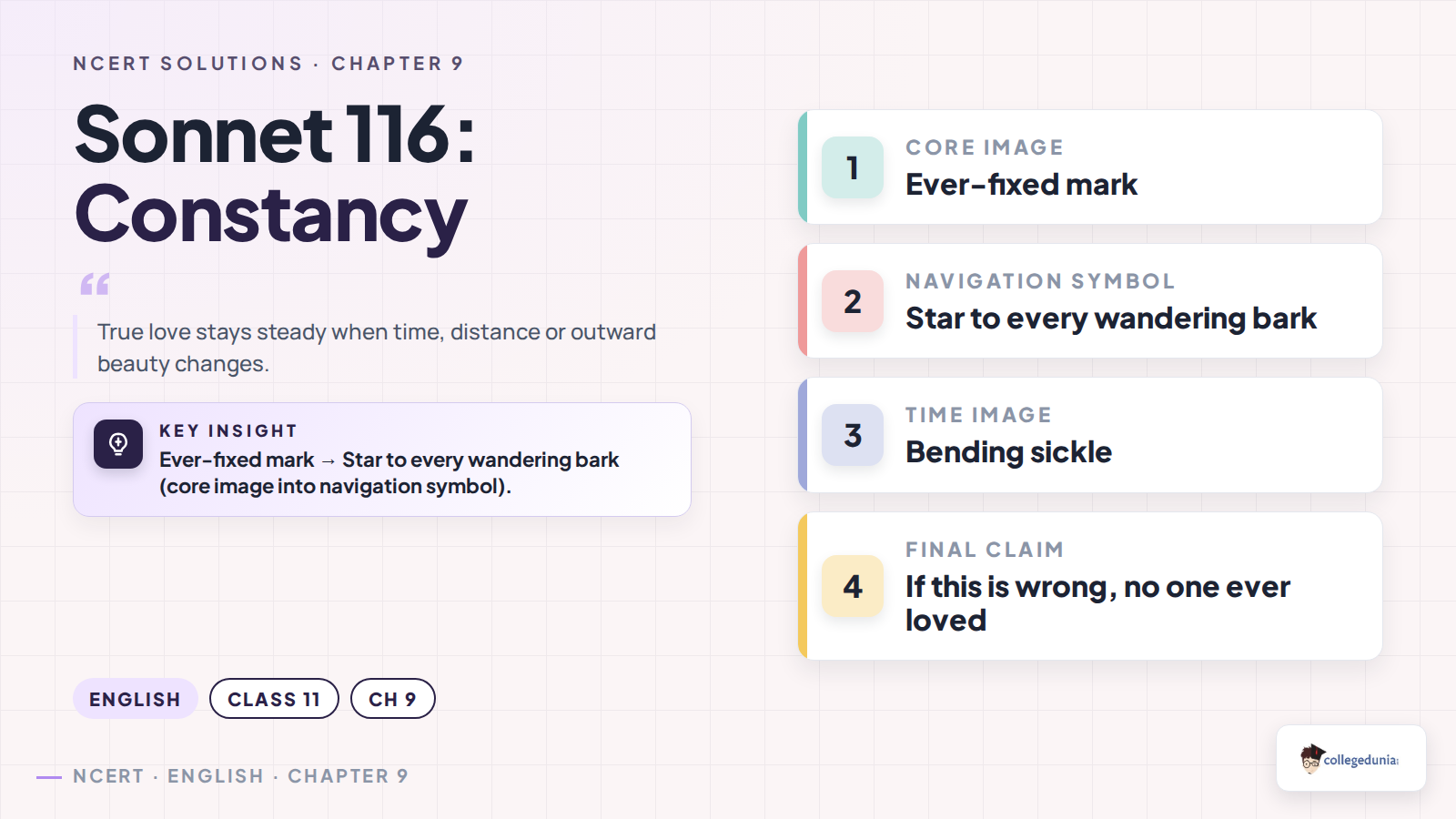
The poem defines true love by saying what it never does. The key idea is that real love remains steady even when people, beauty and time change. That is why words like alters not, ever-fixed mark and edge of doom are important.
- Ever-fixed mark: love stands firm like a sea mark.
- Star: love guides people when life feels uncertain.
- Not Time's fool: love is not controlled by ageing.
- Edge of doom: love lasts until the final limit of life.
Time and Love Images in Let Me Not to the Marriage of True Minds
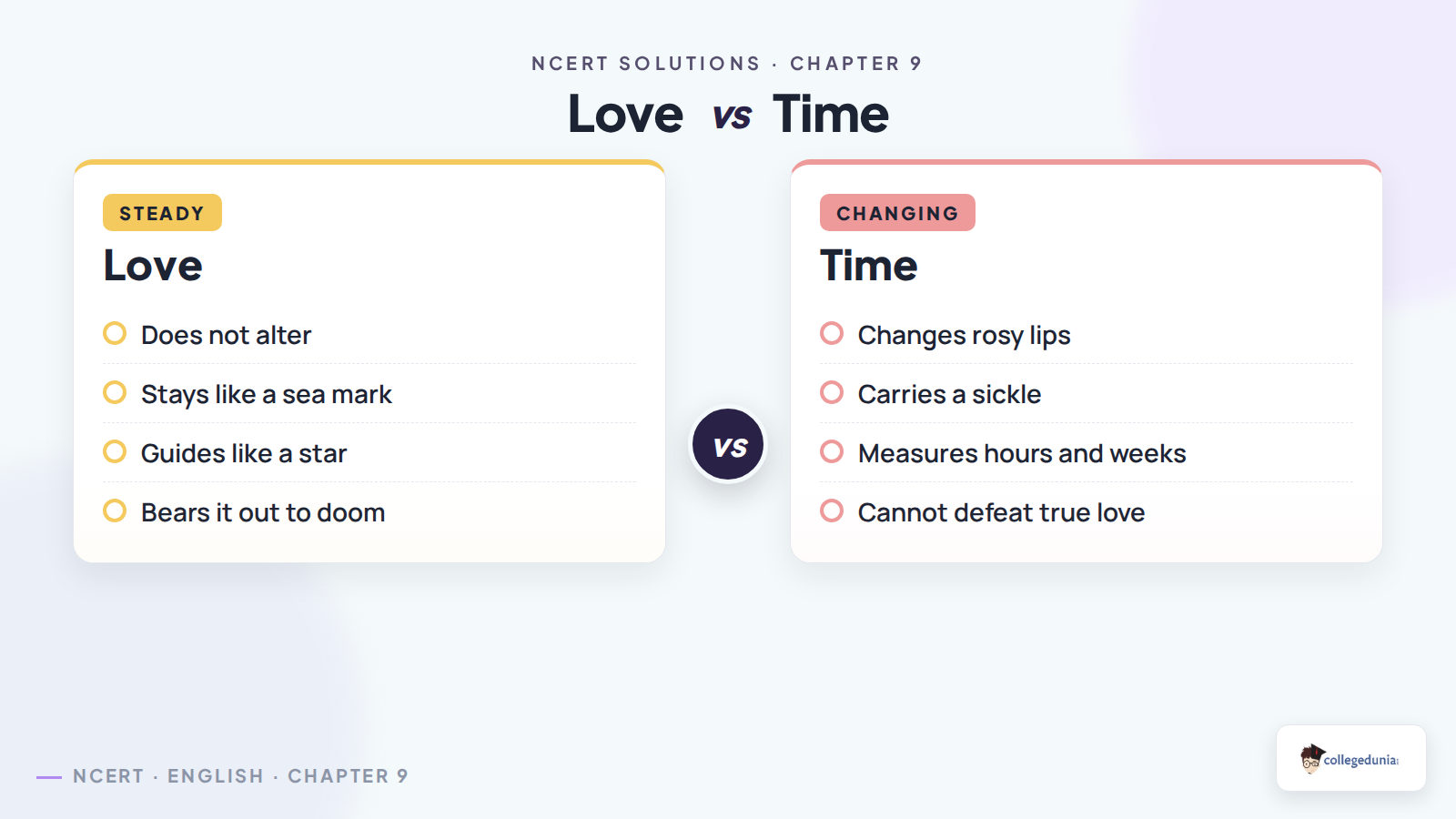
Shakespeare makes Love active and Time threatening. Love looks on tempests and stays firm. Time carries a bending sickle that can destroy rosy lips and cheeks, but it cannot change true love.
| Image | Meaning | Answer point |
|---|---|---|
| Wandering bark | A ship at sea | Love guides confused minds |
| Ever-fixed mark | A steady sea mark | Love does not move in storms |
| Bending sickle | Time as a reaper | Time harms beauty, not love |
How to Write Strong Answers for Let Me Not to the Marriage of True Minds
The best answers use short quoted phrases and explain the image in plain words. Do not retell the whole sonnet. Link every point to the central claim that true love is constant.
- Start with the direct meaning of the line or phrase.
- Add one quoted word or phrase from the poem.
- Explain the image in one simple sentence.
- Close with how it supports constancy.
Common Mistakes Students Make in Sonnet 116 Answers
Avoid these answer-sheet mistakes:
- Writing bark as the sound of a dog instead of a ship.
- Explaining compass as a drawing tool instead of range or reach.
- Calling the poem only romantic without explaining constancy.
- Missing how repeated negatives make the definition stronger.
- For the sonnet answer, forgetting the quatrain and couplet pattern.
More Class 11 English Woven Words Chapter 9 Resources
Use the related Woven Words resources when you need the poem text, quick notes or handwritten revision pages along with these solved answers.
| Resource | Use it for | Link |
|---|---|---|
| Revision Notes | Poem summary, line meanings and poetic devices | Let Me Not Notes |
| Handwritten Notes | One-shot visual revision before class tests | Let Me Not Handwritten Notes |
| NCERT Book PDF | Official Woven Words poem text and exercise | Let Me Not Book PDF |
All 23 Chapters of Class 11 English Woven Words NCERT Solutions
Use this table to move between the Class 11 English Woven Words NCERT Solutions chapters in the scheduler order.
All NCERT Solutions for Class 11 English Woven Words Chapter 9 Let Me Not to the Marriage of True Minds with Step-by-Step Solutions
- The poem says love is the star to every wandering bark.
- Here, bark means a small ship or boat that moves across the sea.
- The word fits the image because sailors use a star to find direction.
- The poem also says rosy lips and cheeks come within Time's bending sickle's compass.
- Here, compass means range, reach or circle of power.
- So physical beauty falls within Time's reach, but true love does not.
Expert's Solution
Concept used. This expert route reads the words through Shakespeare's imagery rather than through their most common modern meanings.
- The star image needs something that can be guided by a star.
- A wandering bark is therefore a ship that has to navigate through uncertain waters.
- Love becomes the fixed star that gives direction to that ship.
- The sickle image belongs to Time, imagined like a reaper cutting down youth and beauty.
- Compass means the zone covered by that sickle.
- The two words help Shakespeare contrast love's steadiness with the decay of physical charm.
- The phrase marriage of true minds suggests a union based on inward faithfulness, not merely outward attraction.
- Admit impediments shows that true love does not allow obstacles to break it.
- Love is not love which alters rejects change as a mark of real love.
- The image ever-fixed mark presents love as a permanent sea mark that tempests cannot shake.
- The star to every wandering bark shows love as a guiding point for those who are lost.
- The phrase bears it out even to the edge of doom shows love lasting until the end of life and beyond ordinary time.
Expert's Solution
Concept used. This expert route tracks the poem's movement from definition to image to final oath.
- Shakespeare first clears away false love by saying real love does not alter.
- He then gives constancy a visible form through the ever-fixed mark.
- A mark that looks on tempests and is never shaken suggests stability under violent pressure.
- The guiding star image adds another layer because a star remains high and constant while ships wander.
- The Time image tests love against ageing, beauty's decline and mortality.
- The final couplet turns the whole claim into a bold personal guarantee.
- The poem begins with let me not, which creates a tone of firm refusal.
- The poet refuses to admit impediments to the union of true minds.
- He says love is not love if it changes when circumstances change.
- The repeated not and no make the argument sound certain and uncompromising.
- The negatives also separate true love from attraction, convenience and temporary passion.
- After denying false love, the poet can present love as an ever-fixed mark and a guiding star.
Expert's Solution
Concept used. This expert route reads the negatives as a courtroom style of argument, where the poet blocks every objection before giving his proof.
- Sonnet 116 sounds like a declaration made with legal confidence.
- The negatives act like barriers against weaker meanings of love.
- Love that alters, bends or becomes Time's fool is rejected from the start.
- This makes true love seem rare, strict and almost absolute.
- The repeated denial also creates rhythm and emphasis in a very small poem.
- By the end, the speaker's final claim feels stronger because every false alternative has been dismissed.
- The poet has argued that true love does not change, bend or submit to Time.
- In the last couplet, he says that if this view is proved wrong, then he never wrote anything.
- He also says that if this is wrong, no person has ever truly loved.
- Since everyone knows Shakespeare has written, the line becomes a confident challenge.
- The statement means he is completely sure about his idea of true love.
- It closes the poem by turning the definition into an oath.
Expert's Solution
Concept used. This expert route reads the final couplet as a rhetorical wager.
- A wager is powerful when the speaker risks something valuable.
- Shakespeare risks his identity as a writer and the truth of all human love.
- Of course, the reader knows both cannot be denied easily.
- So the line does not weaken the argument.
- It makes the argument sound fearless.
- The couplet says that constant love is not just a private opinion, but a truth the poet trusts completely.
- The poem does not name any man, woman or personal situation.
- Instead, love becomes the central actor.
- Love does not alter, does not bend and is not Time's fool.
- This makes the quality of love more important than the changing moods of lovers.
- Human agents may fail, age, fear or change their minds.
- By making love the doer, the poet presents true love as an ideal force above ordinary human weakness.
Expert's Solution
Concept used. This expert route connects personification with the poem's universal tone.
- If the sonnet focused on individual lovers, the answer would depend on their personal story.
- Shakespeare wants a universal definition, so he removes private characters.
- Love itself becomes the subject of verbs and actions.
- This gives love moral authority, almost like a law or guiding principle.
- The contrast with Time also becomes clearer because two abstract powers face each other.
- Love wins because it remains constant while Time damages only physical beauty.
- His refers to Time, which is personified as a male figure.
- A sickle is a curved cutting tool used for harvesting.
- Bending describes the sickle's curved shape.
- Compass means the area or range within which the sickle can act.
- Rosy lips and cheeks represent physical beauty and youth.
- The phrase means that youth and beauty fall within Time's power and are eventually cut down by ageing.
Expert's Solution
Concept used. This expert route reads the phrase as part of the poem's larger contrast between body and love.
- Shakespeare first admits that physical beauty belongs to Time.
- Lips and cheeks lose freshness as people age.
- The sickle image makes that process look like harvesting or cutting.
- Compass marks the limit of Time's control.
- Time can cut down beauty, but it cannot make true love false.
- The phrase therefore strengthens the claim that love is deeper than outward appearance.
- Time changes the body, especially youth and physical beauty.
- Rosy lips and cheeks are examples of such temporary beauty.
- If love depended only on beauty, it would fade when beauty faded.
- Then love would be Time's fool because Time could control and mock it.
- Shakespeare says love is not Time's fool.
- This means true love does not become false just because hours, weeks and ageing pass.
Expert's Solution
Concept used. This expert route explains the phrase through contrast: beauty is vulnerable to Time, but love is not.
- Time can make a person older and can take away youthful freshness.
- Any love based only on beauty would therefore be weak.
- It would obey Time because it would rise and fall with physical attraction.
- Shakespeare refuses that idea.
- True love bears it out to the edge of doom, so it survives the passing of brief hours and weeks.
- The phrase makes love seem dignified because it is not mocked by time-bound change.
- A sonnet has fourteen lines.
- Shakespeare's sonnets usually have three quatrains followed by a closing couplet.
- A quatrain is a group of four lines, and a couplet is a pair of rhyming lines.
- The usual Shakespearean rhyme scheme is ABAB CDCD EFEF GG.
- Other sonnet forms are possible, such as the Petrarchan sonnet with an octave and a sestet.
- The structure may vary in rhyme scheme, placement of the turn and division of the argument.
Expert's Solution
Concept used. This expert route treats sonnet form as a container for argument.
- In a Shakespearean sonnet, each quatrain can advance one stage of an idea.
- The final couplet often sharpens, reverses or confirms the argument.
- Sonnet 116 uses the first quatrains to define love and reject change.
- It then tests love against Time.
- The couplet seals the claim with a strong personal oath.
- When we compare other sonnets, we may find different divisions, but the pressure of fourteen lines remains central.
\CTAButton{\CTAUrlSubjectHub}{Download the Full Class 11 English Woven Words Guide}
\RelatedResources
Let Me Not to the Marriage of True Minds Class 11 NCERT Solutions FAQs
Ques. What is the main theme of Let Me Not to the Marriage of True Minds?
Ans. The main theme is constancy in true love. Shakespeare says real love does not change when people change, when beauty fades or when time passes.
Ques. What does bark mean in the poem?
Ans. Bark means a ship or boat. In the poem, love is compared to a star that guides every wandering bark across the sea.
Ques. What does Time's fool mean in Sonnet 116?
Ans. Time's fool means something controlled or mocked by time. Shakespeare says true love is not Time's fool because ageing cannot defeat it.
Ques. How many questions are solved in this Class 11 Woven Words Chapter 9 PDF?
Ans. The PDF solves 8 textbook prompts, including vocabulary, constancy, negatives, personification, Time's sickle and sonnet form.



Comments