The NCERT Solutions for Class 11 English Woven Words Chapter 8 The Luncheon answer every textbook question from the 2026-27 NCERT reader. The page covers the lady's foibles, the expensive lunch at Foyot's, irony, humour, first person narration and the phrases that show the young author's poverty.
The chapter has 8 solved prompts across Understanding the Text, Talking about the Text, Appreciation and Language Work.
Use the PDF for answers on comic irony, social pretence, self-mockery and the author's delayed revenge.
The story is by William Somerset Maugham and appears in the Short Stories section of Woven Words.
Student Feedback: In a Collegedunia student poll of 8,030 Class 11 English students before the 2026 exams, many students said the hardest part of The Luncheon was explaining irony without simply retelling the restaurant scene.
Every answer here follows the latest 2026-27 NCERT Woven Words text and keeps the wording direct for school answer sheets.
The Luncheon Class 11 Question Pattern
The exercise after The Luncheon moves from direct comprehension to discussion, appreciation and evidence-based Language Work. Students should prepare the lunch sequence and the ending together because both explain the author's humour.
NCERT section
Number of prompts
What it tests
Understanding the Text
3
Revenge, financial panic and irony
Talking about the Text
2
Foibles and social pretence
Appreciation
2
Humour and first person narrative
Language Work
1
Words and phrases showing poverty
The Luncheon Class 11 Explanation Video
Source: Magnet Brains
Irony and Comic Contrast in The Luncheon
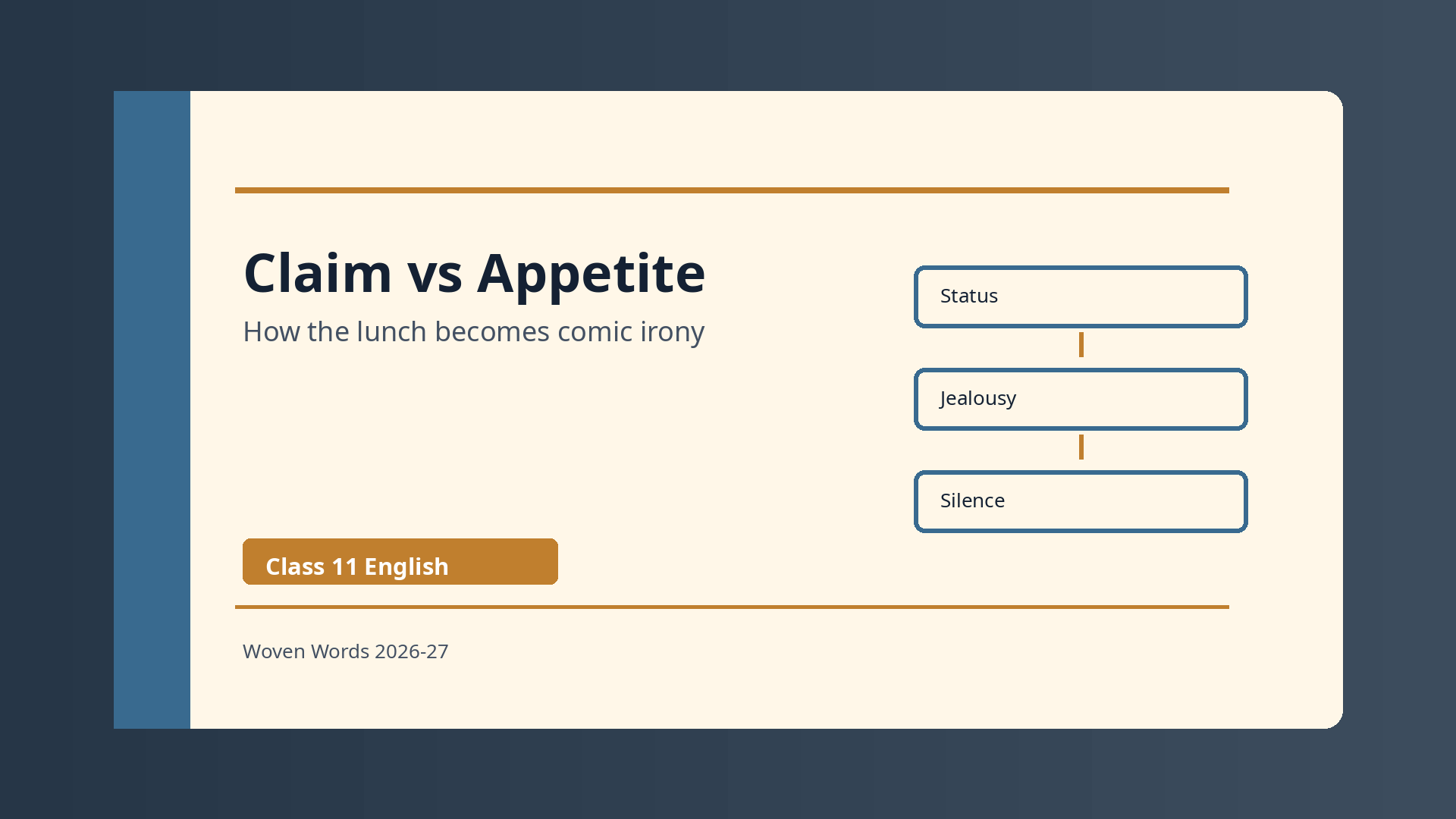
The main comedy comes from the guest saying that she never eats anything for luncheon while ordering a costly sequence of food. The key point is that her words claim restraint, but her actions show appetite and entitlement.
She asks for salmon after saying she eats only one thing.
She accepts caviare, champagne, asparagus, ice-cream, coffee and a peach.
She criticises the narrator's modest mutton chop as heavy food.
The final weight detail turns her advice into comic justice.
Why the Bill Creates Humour in The Luncheon
The bill creates humour because the reader knows the narrator's exact fear. He has eighty francs for the month, yet pride and politeness keep him ordering expensive items. The gap between his calm manners and his inner panic drives the scene.
Food or drink
Comic effect
Answer point
Salmon and caviare
The first expensive shock
His heart begins to sink
Champagne
Her exception breaks her rule
She never drinks except costly wine
Asparagus and peach
The bill becomes dangerous
His panic turns into comic suspense
First Person Narration and Self-Mockery in The Luncheon
The first person voice lets the reader hear the narrator's private anxiety while the lady hears only polite conversation. This makes the story intimate, ironic and funny.
Private panic: the reader follows his calculations about the bill.
Public politeness: he continues to behave like a generous host.
Self-mockery: he admits that youth, vanity and flattery trapped him.
Common Mistakes Students Make in The Luncheon Answers
Avoid these answer-sheet mistakes:
Calling the narrator cruel or vindictive without explaining comic revenge.
Listing food items without connecting them to the rising bill.
Explaining irony only through the ending and missing the repeated lunch claims.
Ignoring the role of first person narration in creating suspense.
For Language Work, giving general poverty words instead of phrases from the text.
More Class 11 English Woven Words Chapter 8 Resources
Use the related Woven Words resources when you need the chapter text, quick notes or handwritten revision pages along with these solved answers.
All NCERT Solutions for Class 11 English Woven Words Chapter 8 The Luncheon with Step-by-Step Solutions
Questions
Q 8.1
Although the author was not a vindictive man he was very happy to see the twenty one stone lady who had impoverished him twenty years ago, and says he had finally had his revenge. What makes him says this?
Concept used. Revenge in this story is comic, not cruel. The narrator feels amused because the guest who preached eating lightly has become very overweight.
Answer focus
Explain the contrast between her advice at Foyot's and her present size.
The lady had ordered costly salmon, caviare, champagne, asparagus, ice-cream, coffee and a peach.
All through the lunch, she kept saying that she never ate more than one thing.
Her appetite emptied the young author's pocket and left him without money for the month.
Twenty years later, he sees that she has become twenty one stone.
This turns her old advice into a joke because her own body contradicts it.
The narrator calls this revenge because time itself has exposed her greed and self-deception.
The author feels avenged because the woman who ruined his budget while claiming to eat lightly has become twenty one stone. Her present size becomes comic justice.
RM
Rhea Menon
M.A English, University of Delhi
Verified Expert
Concept used. This expert route reads the answer through character, social setting and exam purpose, then connects the point back to the NCERT prompt.
The revenge is delivered by irony rather than by the narrator's action.
He does not punish her, insult her or take money back.
He merely observes that life has answered her false modesty.
Her repeated claim of eating one thing collapses when set against her later weight.
That is why he can enjoy the result without becoming truly vindictive.
Maugham makes the ending funny because the punishment fits the pretence exactly.
His revenge is the satisfaction of seeing hypocrisy answered by time.
Q 8.2
There are quite a few places where the author uses the expressions 'my heart sank', 'panic seized' etc. What was the reason for this?
Concept used. These expressions show financial anxiety. The narrator is polite outside but terrified inside because every extra order threatens his small monthly budget.
Answer focus
Name the expensive items and connect them to his eighty francs.
The narrator has only eighty francs to last the rest of the month.
He expects a modest lunch to cost about fifteen francs.
The restaurant is Foyot's, a costly place beyond his normal means.
The guest orders expensive items while pretending that she hardly eats.
Caviare, champagne, asparagus and peaches make the bill rise quickly.
His heart sinks and panic seizes him because he fears he may not have enough money to pay.
The expressions show the author's fear that the lunch bill will exceed his eighty francs. His outward politeness hides panic about money.
KS
Kunal Sen
M.A English, Jadavpur University
Verified Expert
Concept used. This expert route reads the answer through character, social setting and exam purpose, then connects the point back to the NCERT prompt.
The comedy depends on two levels of experience.
On the surface, the author behaves like a generous host.
Inside, he is calculating the bill with growing horror.
Each new order turns hospitality into danger.
The phrases my heart sank and panic seized make the reader share his nervous arithmetic.
They also expose the gap between social manners and private fear.
His panic comes from the conflict between pride as host and poverty as a young writer.
Q 8.3
Locate instances of irony in the story.
Concept used. Irony appears when words or situations mean the opposite of what they seem. The Luncheon is built on the lady's false restraint and the author's silent suffering.
Answer focus
Use at least three examples, not just the ending.
The lady says she never eats anything for luncheon, yet she orders a long list of costly items.
She criticises the narrator for eating a heavy mutton chop while she eats salmon, caviare and asparagus.
She says she never drinks anything at lunch except champagne.
She advises him to follow her example and eat lightly after making him pay a huge bill.
She calls him a humorist when he says he will eat nothing for dinner.
The final irony is that she later weighs twenty one stone.
The main ironies are her claim of eating little, her criticism of the author's modest meal, her champagne exception, her advice to eat lightly and her later weight.
MS
Meera Sanyal
Ph.D English, University of Hyderabad
Verified Expert
Concept used. This expert route reads the answer through character, social setting and exam purpose, then connects the point back to the NCERT prompt.
Maugham's irony is gentle but sharp.
The guest uses the language of restraint while acting with appetite and entitlement.
The author uses the language of hospitality while feeling close to disaster.
Even the restaurant setting is ironic because he enters it to impress her and leaves it almost penniless.
The last line completes the pattern by showing that her preaching never matched her habits.
The story's humour grows from this repeated mismatch between claim and reality.
Irony lies in the distance between what the lady says, what she eats and what finally becomes of her.
Q 8.4
People with foibles are often not conscious of them.
Concept used. A foible is a small weakness or odd habit in character. The lady's foible is greedy self-indulgence hidden under self-satisfied talk of moderation.
Answer focus
Show that she is unaware of her own contradiction.
The lady believes she eats very little and repeatedly announces it.
She orders rich, expensive food while still describing herself as a light eater.
She does not notice the young author's financial discomfort.
She lectures him about heavy food although his meal is the cheapest dish.
Her foible is not only appetite but also complacency about her own habits.
The story suggests that people often excuse their weaknesses while seeing faults in others.
The lady is unaware of her foible. She sees herself as moderate, but her choices show greed, vanity and lack of sensitivity.
AT
Arvind Thomas
M.A English, EFLU Hyderabad
Verified Expert
Concept used. This expert route reads the answer through character, social setting and exam purpose, then connects the point back to the NCERT prompt.
The comedy would weaken if the lady openly admitted greed.
Her unconsciousness is the point.
She sincerely performs the role of a refined woman who barely eats.
At the same time, she drains the author's purse through polished exceptions.
This makes her both funny and irritating.
Maugham uses her to show how self-image can protect a person from recognising an obvious weakness.
Her foible is comic because she is its last person to recognise it.
Q 8.5
Discuss the author's attempts at keeping up his pretence of friendliness while he was mentally preoccupied with the expense of the luncheon.
Concept used. Pretence here means social performance. The author continues to act as a gracious host while secretly fearing the bill.
Answer focus
Balance manners and inner monologue.
The author invites the lady because he is flattered and too young to refuse.
At the restaurant, he remains polite even when prices shock him.
He orders salmon, caviare, champagne and asparagus because he cannot admit poverty.
He chooses a cheap mutton chop for himself and later worries about every extra item.
He imagines excuses such as claiming his pocket has been picked.
Even at the end, he replies with humour instead of showing anger.
The author keeps up friendliness through politeness, ordering what she wants and hiding his panic. His mind, however, stays fixed on the rising bill.
AR
Ananya Rao
M.A English, University of Mumbai
Verified Expert
Concept used. This expert route reads the answer through character, social setting and exam purpose, then connects the point back to the NCERT prompt.
The scene is funny because conversation and calculation run together.
The guest hears a polite host, but the reader hears an anxious young writer.
His pride prevents him from saying that Foyot's is too expensive.
His manners prevent him from stopping her orders.
So he becomes trapped by courtesy, vanity and financial fear at once.
The pretence makes the story socially observant, not merely farcical.
His friendliness is a mask over panic, and that mask creates the story's best comedy.
Q 8.6
The author is a humorist. (a) How does the story reflect his sense of humour? (b) What makes his lady friend remark, 'you are quite a humorist'? (c) Give instances of the author's ability to laugh at himself.
Concept used. Humour in the story comes from understatement, self-mockery and ironic contrast. The author presents his humiliation without self-pity.
Answer focus
This combines all three Appreciation sub-parts, so answer in connected points.
The story reflects humour through the contrast between the lady's words and appetite.
The narrator also makes fun of his younger self for being flattered and unable to say no.
He describes his fear about the bill in exaggerated comic detail.
The lady calls him a humorist when he says he will eat nothing for dinner that night.
He laughs at himself when he recalls his tiny income, nervous generosity and possible excuses for not paying.
The final sentence about her weight gives the story a neat comic revenge.
The story shows Maugham's humour through irony, self-mockery and comic timing. The lady calls him a humorist after his dinner remark, while he laughs at his own youthful vanity and poverty.
LM
Leena Mathew
M.A English, University of Kerala
Verified Expert
Concept used. This expert route reads the answer through character, social setting and exam purpose, then connects the point back to the NCERT prompt.
The humour feels controlled because the narrator does not shout his anger.
He lets the absurdity of the lunch reveal itself step by step.
He makes himself part of the joke by admitting his flattery, fear and helpless politeness.
The line about eating nothing for dinner is funny because it is literally true and socially witty.
His ability to laugh at his own humiliation keeps the tone light.
This is why the ending feels amused rather than bitter.
The author is a humorist because he turns embarrassment, poverty and hypocrisy into controlled comic storytelling.
Q 8.7
How does the first person narrative help in heightening the literary effects of the story?
Concept used. First person narrative lets the reader enter the narrator's private mind. In this story, that closeness creates irony, suspense and comic sympathy.
Answer focus
Mention what the lady sees and what the reader knows.
The story is told by the man who suffered through the expensive lunch.
Because he speaks in first person, the reader hears his private fear about money.
The lady sees only politeness, but the reader knows about his panic.
This gap heightens irony because her words become funnier and crueller.
The first person voice also allows self-mockery about his youth and vanity.
The ending feels satisfying because the same narrator calmly reports the final reversal.
First person narration heightens the story by giving direct access to the author's fear, self-mockery and comic judgement. It makes the irony more intimate.
IM
Ira Mukherjee
M.A English, University of Hyderabad
Verified Expert
Concept used. This expert route reads the answer through character, social setting and exam purpose, then connects the point back to the NCERT prompt.
If the story were told from outside, the bill would be only an event.
In first person, it becomes a sequence of anxious thoughts.
The reader shares every sinking feeling and every silent calculation.
The technique also lets Maugham control tone with understatement.
We trust the narrator because he admits his own weakness too.
That trust makes the final comic revenge sharper and more enjoyable.
The first person voice turns a costly meal into a lively inner comedy of pride, fear and delayed revenge.
Q 8.8
Pick out the words and phrases in the text that indicate that the author was not financially well off.
Concept used. Vocabulary evidence means quoting or naming textual details that prove a point. Here the point is the author's limited money.
Answer focus
Use short phrases and explain what each one proves.
He says he had a tiny apartment in the Latin quarter overlooking a cemetery.
He was earning barely enough money to keep the body and soul together.
He had eighty francs to last him the rest of the month.
He thinks he can manage only by cutting out coffee for two weeks.
He chooses the cheapest dish on the menu, a mutton chop.
After paying the bill, he has the whole month before him and not a penny in his pocket.
Key phrases are tiny apartment, barely enough money, eighty francs, cut out coffee, cheapest dish and not a penny in my pocket.
KT
Kavya Thomas
M.A English, Christ University
Verified Expert
Concept used. This expert route reads the answer through character, social setting and exam purpose, then connects the point back to the NCERT prompt.
The phrases build a steady picture of a young writer with very little money.
The tiny apartment suggests modest living.
Barely enough money shows that his income meets only basic needs.
The eighty francs detail gives the financial pressure exact shape.
Choosing the cheapest dish and losing every penny complete the proof.
Together, these details make the lady's extravagance feel more painful and funnier.
The text proves his poverty through living conditions, exact money details, food choices and the final empty pocket.
The Luncheon Class 11 English Woven Words NCERT Solutions FAQs
Ques. Who wrote The Luncheon in Class 11 Woven Words?
Ans. William Somerset Maugham wrote The Luncheon. The story appears in the Short Stories section of Woven Words.
Ques. What is the main irony in The Luncheon?
Ans. The main irony is that the lady repeatedly says she eats very little while ordering many expensive things at Foyot's.
Ques. How many NCERT questions are solved in this PDF?
Ans. The PDF solves 8 NCERT prompts from Understanding the Text, Talking about the Text, Appreciation and Language Work.
Ques. Why does the author say he had revenge?
Ans. He says he had revenge because the lady who preached light eating had later become twenty one stone, exposing her old hypocrisy.





Chapter8TheLuncheonSolutions.pdf?page=1&dpi=150)
Chapter8TheLuncheonSolutions.pdf?page=2&dpi=150)
Chapter8TheLuncheonSolutions.pdf?page=3&dpi=150)
Chapter8TheLuncheonSolutions.pdf?page=4&dpi=150)
Chapter8TheLuncheonSolutions.pdf?page=5&dpi=150)
Chapter8TheLuncheonSolutions.pdf?page=6&dpi=150)
Chapter8TheLuncheonSolutions.pdf?page=7&dpi=150)
Chapter8TheLuncheonSolutions.pdf?page=8&dpi=150)
Chapter8TheLuncheonSolutions.pdf?page=9&dpi=150)
Chapter8TheLuncheonSolutions.pdf?page=10&dpi=150)
Chapter8TheLuncheonSolutions.pdf?page=11&dpi=150)
Chapter8TheLuncheonSolutions_flat_MobileCard.pdf?page=1&dpi=150)
Chapter8TheLuncheonSolutions_flat_MobileCard.pdf?page=2&dpi=150)
Chapter8TheLuncheonSolutions_flat_MobileCard.pdf?page=3&dpi=150)
Chapter8TheLuncheonSolutions_flat_MobileCard.pdf?page=4&dpi=150)
Chapter8TheLuncheonSolutions_flat_MobileCard.pdf?page=5&dpi=150)
Chapter8TheLuncheonSolutions_flat_MobileCard.pdf?page=6&dpi=150)
Chapter8TheLuncheonSolutions_flat_MobileCard.pdf?page=7&dpi=150)
Chapter8TheLuncheonSolutions_flat_MobileCard.pdf?page=8&dpi=150)
Chapter8TheLuncheonSolutions_flat_MobileCard.pdf?page=9&dpi=150)
Chapter8TheLuncheonSolutions_flat_MobileCard.pdf?page=10&dpi=150)
Chapter8TheLuncheonSolutions_flat_MobileCard.pdf?page=11&dpi=150)
Chapter8TheLuncheonSolutions_flat_MobileCard.pdf?page=12&dpi=150)
Chapter8TheLuncheonSolutions_flat_MobileCard.pdf?page=13&dpi=150)
Chapter8TheLuncheonSolutions_flat_MobileCard.pdf?page=14&dpi=150)
Chapter8TheLuncheonSolutions_flat_MobileCard.pdf?page=15&dpi=150)
Chapter8TheLuncheonSolutions_flat_MobileCard.pdf?page=16&dpi=150)
Chapter8TheLuncheonSolutions_flat_MobileCard.pdf?page=17&dpi=150)
Chapter8TheLuncheonSolutions_flat_MobileCard.pdf?page=18&dpi=150)
Chapter8TheLuncheonSolutions_flat_MobileCard.pdf?page=19&dpi=150)
Chapter8TheLuncheonSolutions_flat_MobileCard.pdf?page=20&dpi=150)
Chapter8TheLuncheonSolutions_flat_MobileCard.pdf?page=21&dpi=150)



Comments