NCERT Solutions for Class 11 Business Studies Chapter 8 Sources of Business Finance cover all 10 short and long answer questions from the latest 2026-27 NCERT book. The chapter explains why every business needs finance, how funds are classified, and how sources such as equity shares, debentures, public deposits, trade credit and retained earnings are used.
PDF coverage: 6 short answer questions and 4 long answer questions with detailed answers and expert explanations.
Best for: revising owners funds, borrowed funds, public deposits, retained earnings, debentures, GDRs, ADRs, trade credit and bank credit.
Use this with: the official NCERT book, the chapter notes and the all-chapters solutions table below.
Student Feedback: In a Collegedunia poll of 11,260 Class 11 Business Studies students preparing for the 2026-27 school exams, 74% said Chapter 8 became easier after they sorted every finance source into owners funds, borrowed funds and short-term finance.
Source: 2026-27 Class 11 Business Studies student poll across CBSE schools.
Every answer in this chapter set is checked against the 2026-27 NCERT Business Studies textbook and written so students can connect each source of finance with its cost, risk, control impact and time period.
Sources of Business Finance Map for Class 11 Business Studies
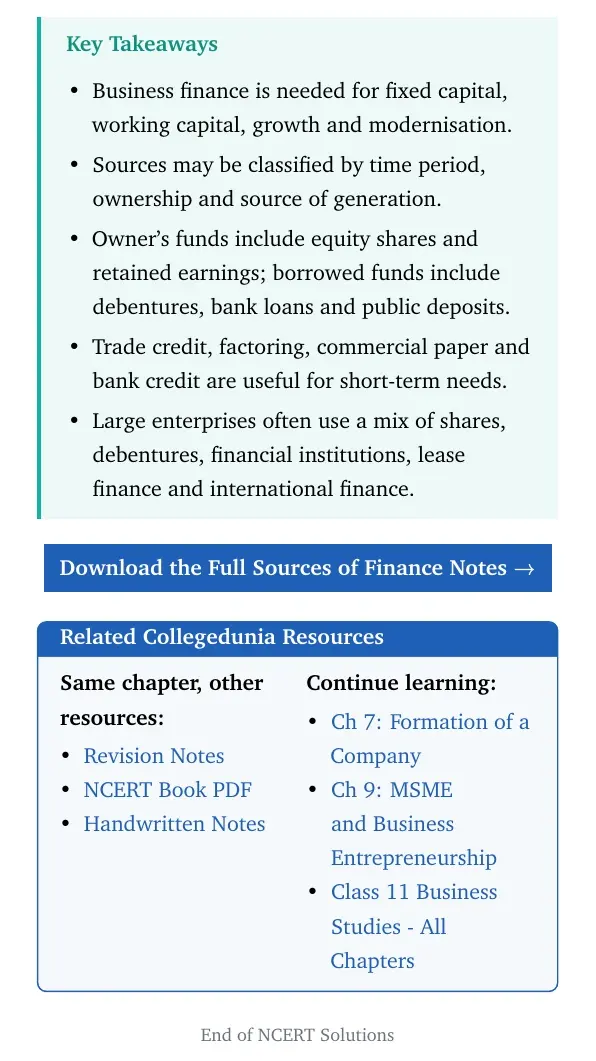
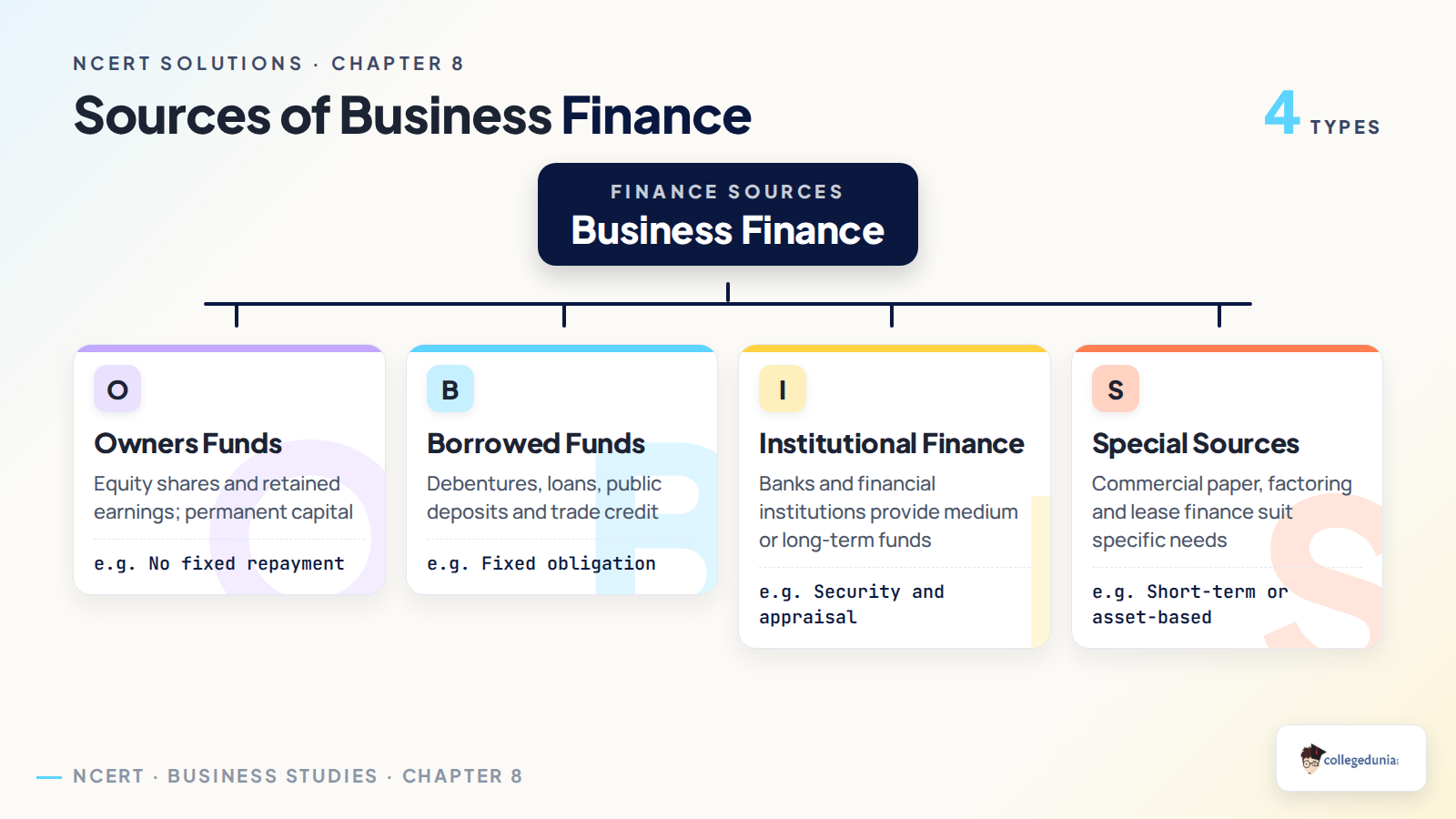
The main idea of Chapter 8 is that business finance means money required for carrying out business activities. A business needs funds for fixed assets, working capital, expansion, modernisation and day-to-day operations. NCERT then classifies sources by ownership, time period and source of generation.
Classification basis
Meaning
Examples
Ownership
Whether the fund belongs to owners or must be repaid to outsiders.
Owners Funds and Borrowed Funds in Sources of Business Finance
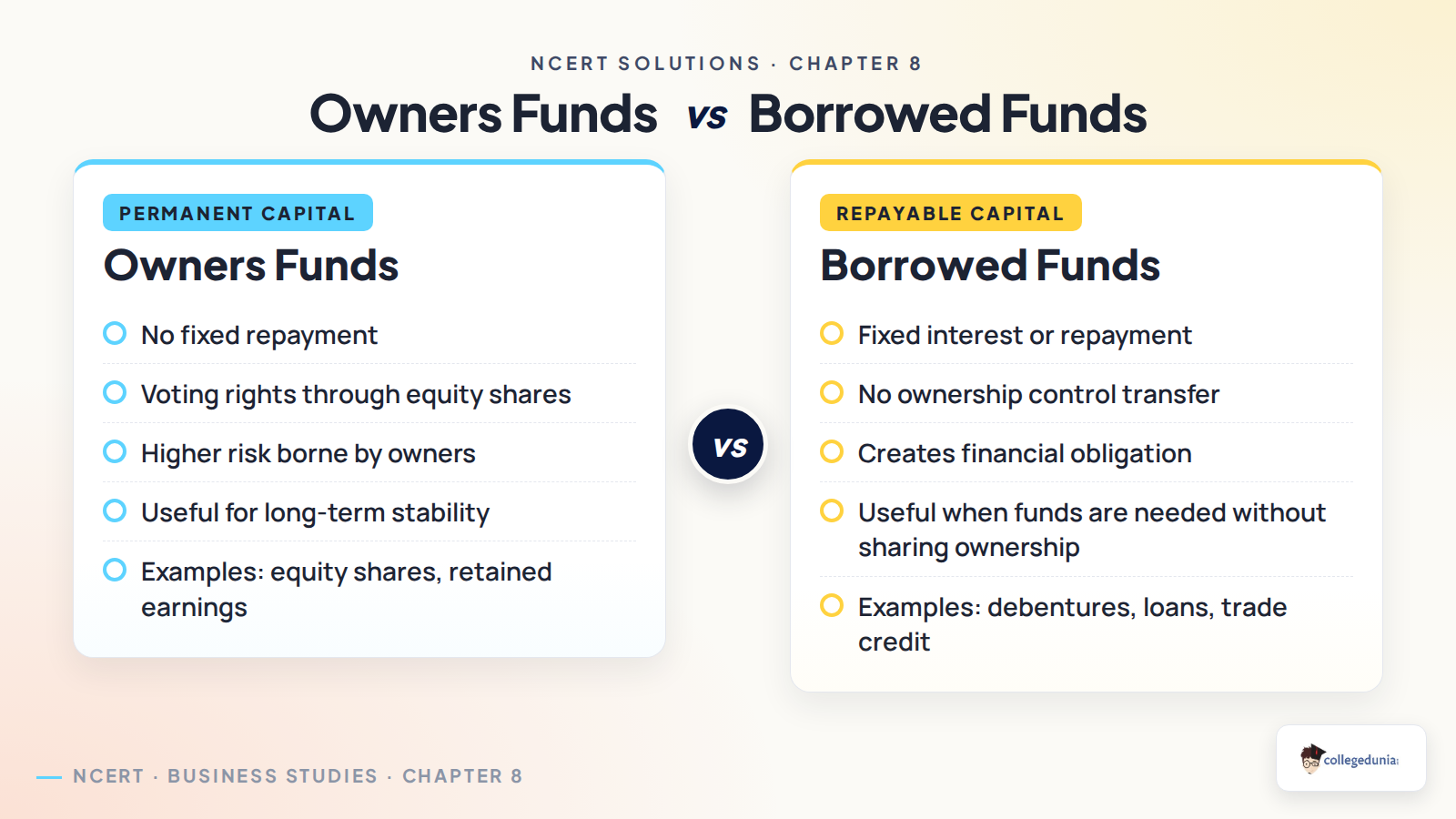
Owners funds are supplied by the owners of the business. They remain in the business for a longer time and carry ownership risk. Borrowed funds are taken from outsiders and create a fixed obligation to repay principal and usually interest. This difference is the base for most Chapter 8 answers.
Owners funds: equity shares, preference shares and retained earnings.
Borrowed funds: debentures, loans, public deposits, trade credit and bank credit.
Control impact: equity can dilute control, while debentures usually do not.
Equity shares are ownership capital. Equity shareholders receive dividend only when profits are available and the company decides to distribute them. They also carry voting rights, so issuing equity may reduce the existing owners' control. Debentures are borrowed funds. Debenture holders are creditors and receive fixed interest even when profits are low. Preference shares stand between the two because they get preferential dividend and repayment, but usually do not carry normal voting rights.
Source
Nature
Important NCERT point
Equity shares
Owners funds
Permanent capital with voting rights and highest risk.
Preference shares
Owners funds with preference
Preferential claim on dividend and capital repayment.
Debentures
Borrowed funds
Fixed interest, no ownership control and possible security charge.
Public Deposits, Retained Earnings and Trade Credit
Public deposits are funds raised directly from the public for a fixed period. They are simpler and often cheaper than bank loans, but they are not suitable for very large or very long-term needs. Retained earnings are profits kept in the business instead of being distributed as dividend. Trade credit is credit given by suppliers when goods are bought now and paid for later.
Public deposits: useful for medium-term funds, but limited by regulation and public confidence.
Retained earnings: internal, cost-free in the direct sense and helpful for financial independence.
Trade credit: short-term, convenient and linked to a firm's creditworthiness and supplier relations.
Bank credit: flexible short-term finance through loans, cash credit, overdraft and discounting of bills.
How to Write Sources of Business Finance Answers in Exams
Most NCERT questions in this chapter reward clear classification. Start with the type of fund, then mention two merits and two limitations where needed. For comparison answers, make a table and keep ownership, repayment, risk, control and return as separate rows.
Definition questions: define business finance, then add why funds are needed.
Merit and demerit questions: keep points balanced and source-specific.
Comparison questions: use owners funds versus borrowed funds or equity shares versus debentures.
Case questions: identify time period, amount, control preference and repayment capacity before choosing a source.
Related Business Studies Resources for Sources of Business Finance
Use the solutions PDF for solved NCERT answers. The notes and handwritten notes pages are useful when the chapter has to be revised quickly before a school test.
All NCERT Solutions for Class 11 Business Studies Chapter 8 Sources of Business Finance with Step-by-Step Solutions
Short Answer Questions
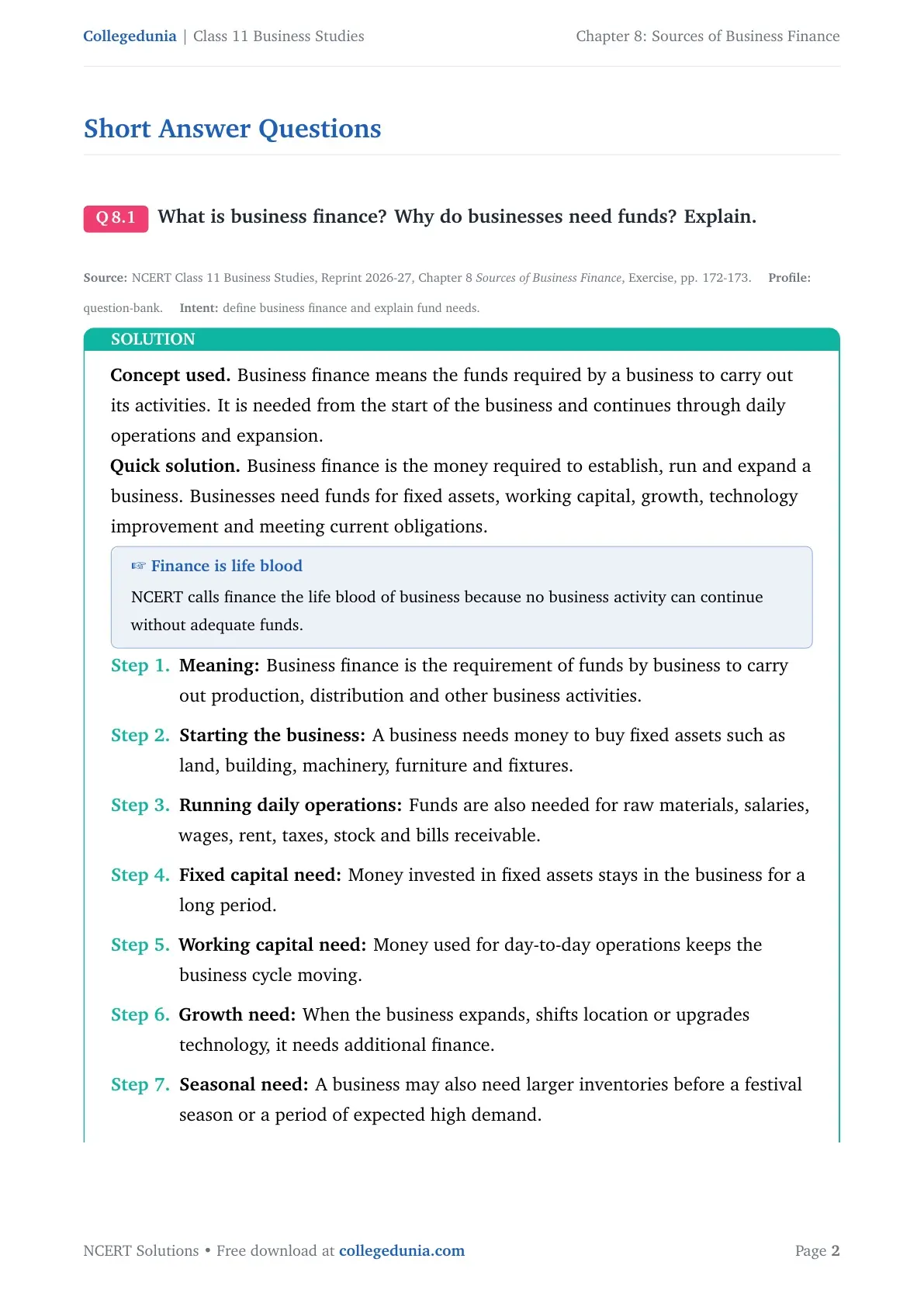
Q 8.1
What is business finance? Why do businesses need funds? Explain.
Concept used. Business finance means the funds required by a business to carry out its activities. It is needed from the start of the business and continues through daily operations and expansion.
Business finance is the money required to establish, run and expand a business. Businesses need funds for fixed assets, working capital, growth, technology improvement and meeting current obligations.
Finance is life blood
NCERT calls finance the life blood of business because no business activity can continue without adequate funds.
Meaning: Business finance is the requirement of funds by business to carry out production, distribution and other business activities.
Starting the business: A business needs money to buy fixed assets such as land, building, machinery, furniture and fixtures.
Running daily operations: Funds are also needed for raw materials, salaries, wages, rent, taxes, stock and bills receivable.
Fixed capital need: Money invested in fixed assets stays in the business for a long period.
Working capital need: Money used for day-to-day operations keeps the business cycle moving.
Growth need: When the business expands, shifts location or upgrades technology, it needs additional finance.
Seasonal need: A business may also need larger inventories before a festival season or a period of expected high demand.
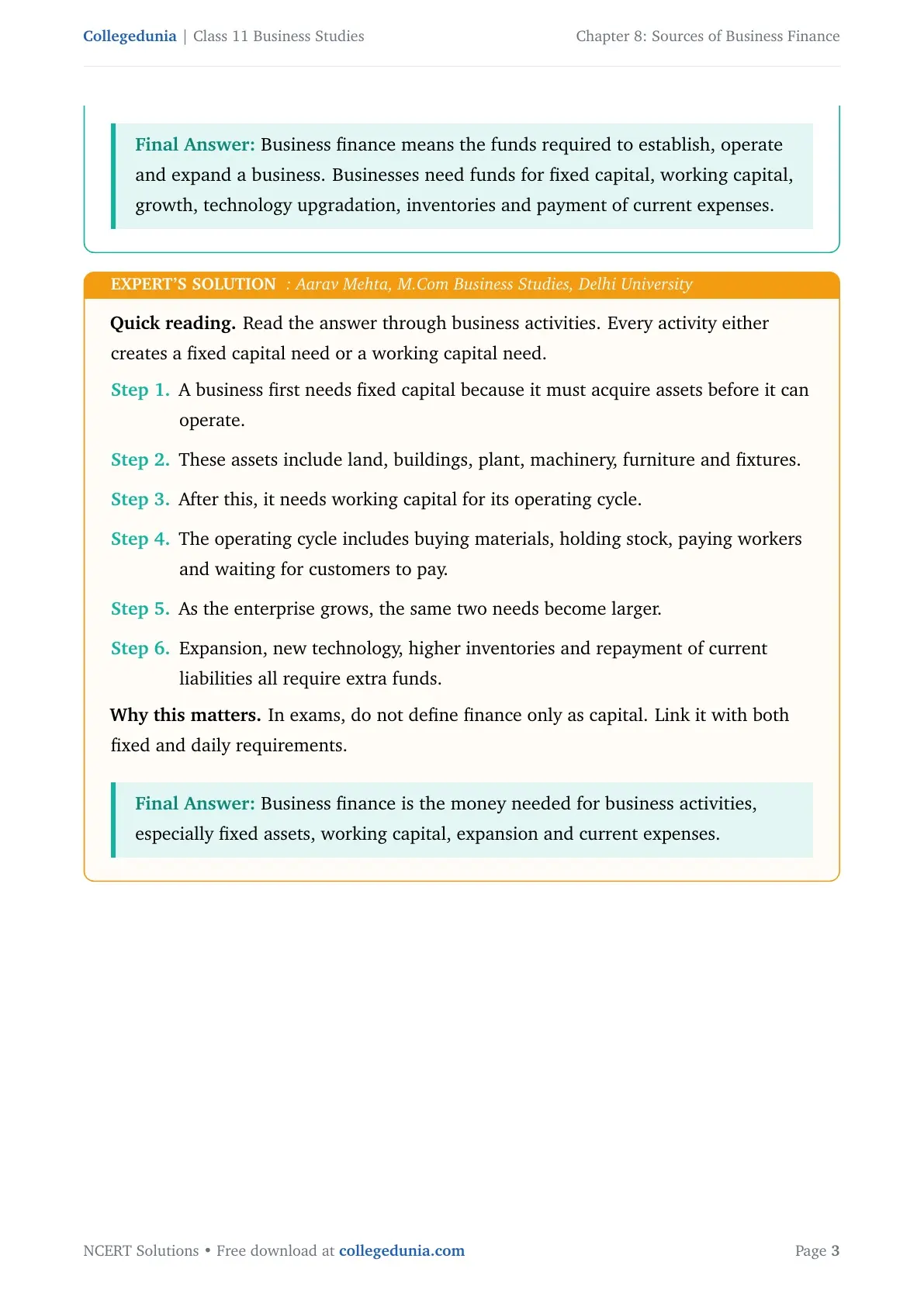
Business finance means the funds required to establish, operate and expand a business. Businesses need funds for fixed capital, working capital, growth, technology upgradation, inventories and payment of current expenses.
AM
Aarav Mehta
M.Com Business Studies, Delhi University
Verified Expert
Quick reading. Read the answer through business activities. Every activity either creates a fixed capital need or a working capital need.
A business first needs fixed capital because it must acquire assets before it can operate.
These assets include land, buildings, plant, machinery, furniture and fixtures.
After this, it needs working capital for its operating cycle.
The operating cycle includes buying materials, holding stock, paying workers and waiting for customers to pay.
As the enterprise grows, the same two needs become larger.
Expansion, new technology, higher inventories and repayment of current liabilities all require extra funds.
Why this matters. In exams, do not define finance only as capital. Link it with both fixed and daily requirements.
Business finance is the money needed for business activities, especially fixed assets, working capital, expansion and current expenses.
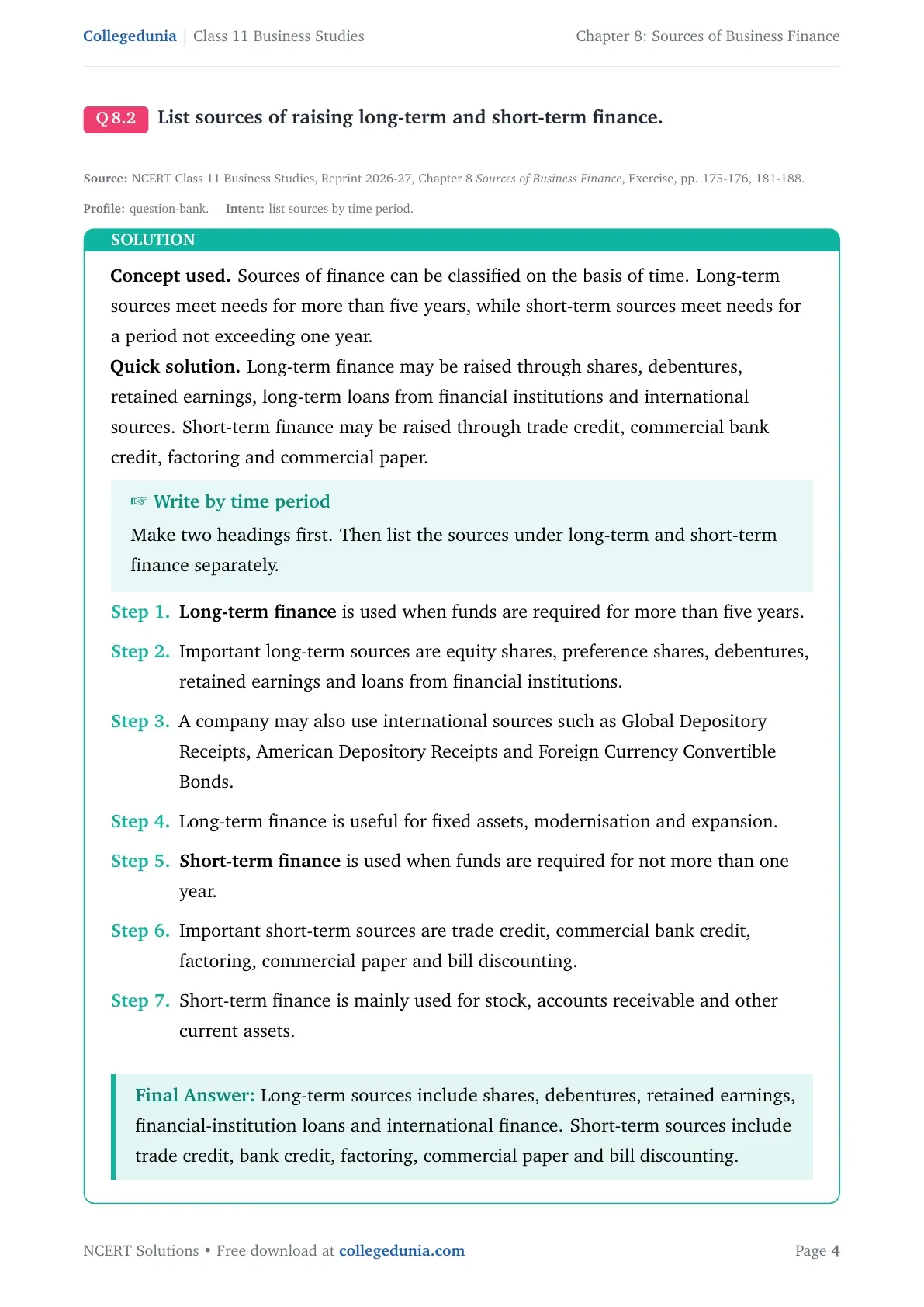
Q 8.2
List sources of raising long-term and short-term finance.
Concept used. Sources of finance can be classified on the basis of time. Long-term sources meet needs for more than five years, while short-term sources meet needs for a period not exceeding one year.
Long-term finance may be raised through shares, debentures, retained earnings, long-term loans from financial institutions and international sources. Short-term finance may be raised through trade credit, commercial bank credit, factoring and commercial paper.
Write by time period
Make two headings first. Then list the sources under long-term and short-term finance separately.
Long-term finance is used when funds are required for more than five years.
Important long-term sources are equity shares, preference shares, debentures, retained earnings and loans from financial institutions.
A company may also use international sources such as Global Depository Receipts, American Depository Receipts and Foreign Currency Convertible Bonds.
Long-term finance is useful for fixed assets, modernisation and expansion.
Short-term finance is used when funds are required for not more than one year.
Important short-term sources are trade credit, commercial bank credit, factoring, commercial paper and bill discounting.
Short-term finance is mainly used for stock, accounts receivable and other current assets.
Long-term sources include shares, debentures, retained earnings, financial-institution loans and international finance. Short-term sources include trade credit, bank credit, factoring, commercial paper and bill discounting.
PN
Priya Nair
MBA Finance, University of Mumbai
Verified Expert
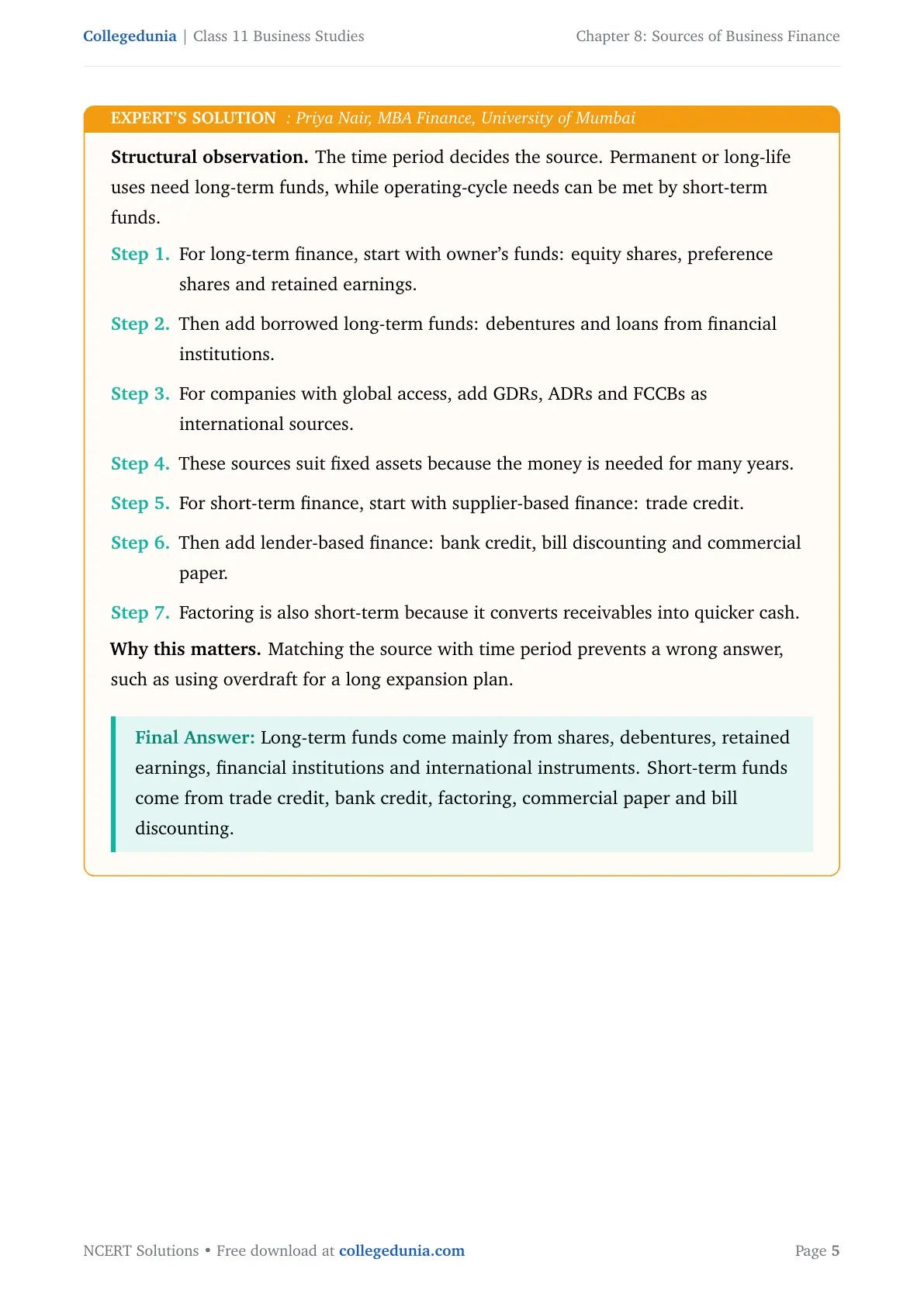
Structural observation. The time period decides the source. Permanent or long-life uses need long-term funds, while operating-cycle needs can be met by short-term funds.
For long-term finance, start with owner's funds: equity shares, preference shares and retained earnings.
Then add borrowed long-term funds: debentures and loans from financial institutions.
For companies with global access, add GDRs, ADRs and FCCBs as international sources.
These sources suit fixed assets because the money is needed for many years.
For short-term finance, start with supplier-based finance: trade credit.
Then add lender-based finance: bank credit, bill discounting and commercial paper.
Factoring is also short-term because it converts receivables into quicker cash.
Why this matters. Matching the source with time period prevents a wrong answer, such as using overdraft for a long expansion plan.
Long-term funds come mainly from shares, debentures, retained earnings, financial institutions and international instruments. Short-term funds come from trade credit, bank credit, factoring, commercial paper and bill discounting.
Q 8.3
What is the difference between internal and external sources of raising funds? Explain.
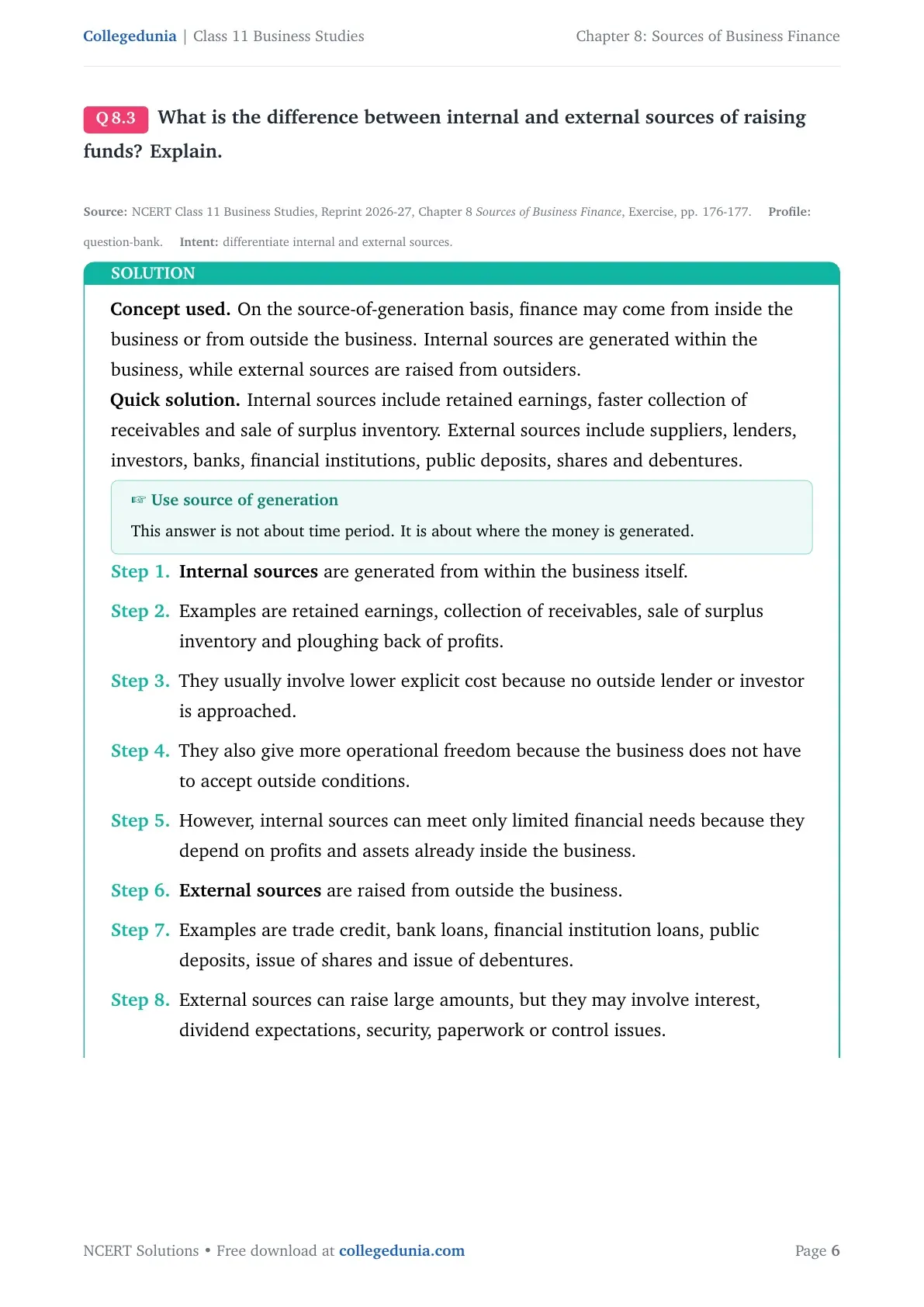
Concept used. On the source-of-generation basis, finance may come from inside the business or from outside the business. Internal sources are generated within the business, while external sources are raised from outsiders.
Internal sources include retained earnings, faster collection of receivables and sale of surplus inventory. External sources include suppliers, lenders, investors, banks, financial institutions, public deposits, shares and debentures.
Use source of generation
This answer is not about time period. It is about where the money is generated.
Internal sources are generated from within the business itself.
Examples are retained earnings, collection of receivables, sale of surplus inventory and ploughing back of profits.
They usually involve lower explicit cost because no outside lender or investor is approached.
They also give more operational freedom because the business does not have to accept outside conditions.
However, internal sources can meet only limited financial needs because they depend on profits and assets already inside the business.
External sources are raised from outside the business.
Examples are trade credit, bank loans, financial institution loans, public deposits, issue of shares and issue of debentures.
External sources can raise large amounts, but they may involve interest, dividend expectations, security, paperwork or control issues.
Internal sources are funds generated inside the business, such as retained earnings and faster collection of receivables. External sources are funds raised from outsiders, such as suppliers, banks, investors, public depositors and financial institutions.
KS
Kabir Sethi
BBA Business Studies, Christ University
Verified Expert
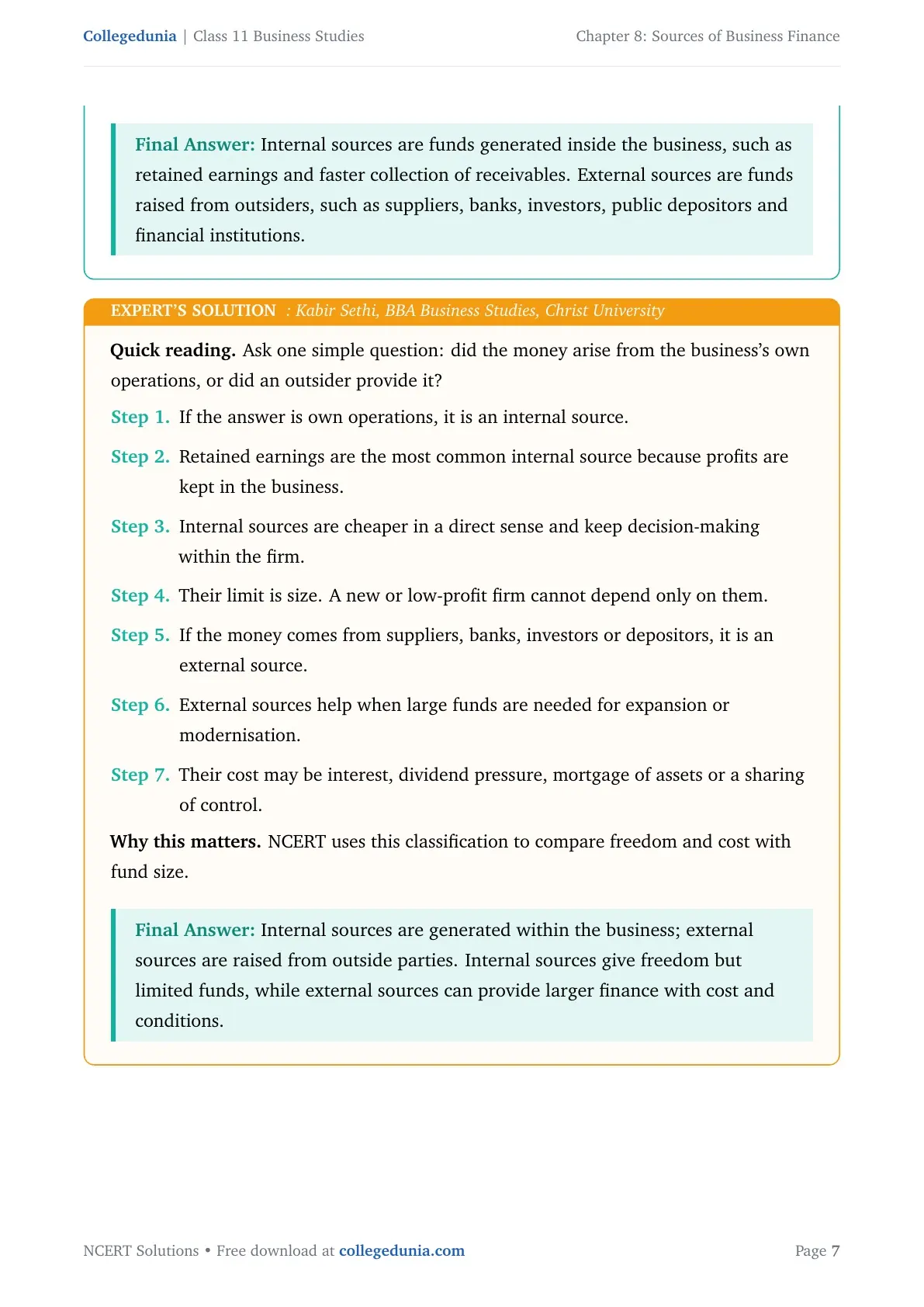
Quick reading. Ask one simple question: did the money arise from the business's own operations, or did an outsider provide it?
If the answer is own operations, it is an internal source.
Retained earnings are the most common internal source because profits are kept in the business.
Internal sources are cheaper in a direct sense and keep decision-making within the firm.
Their limit is size. A new or low-profit firm cannot depend only on them.
If the money comes from suppliers, banks, investors or depositors, it is an external source.
External sources help when large funds are needed for expansion or modernisation.
Their cost may be interest, dividend pressure, mortgage of assets or a sharing of control.
Why this matters. NCERT uses this classification to compare freedom and cost with fund size.
Internal sources are generated within the business; external sources are raised from outside parties. Internal sources give freedom but limited funds, while external sources can provide larger finance with cost and conditions.
Q 8.4
What preferential rights are enjoyed by preference shareholders. Explain.
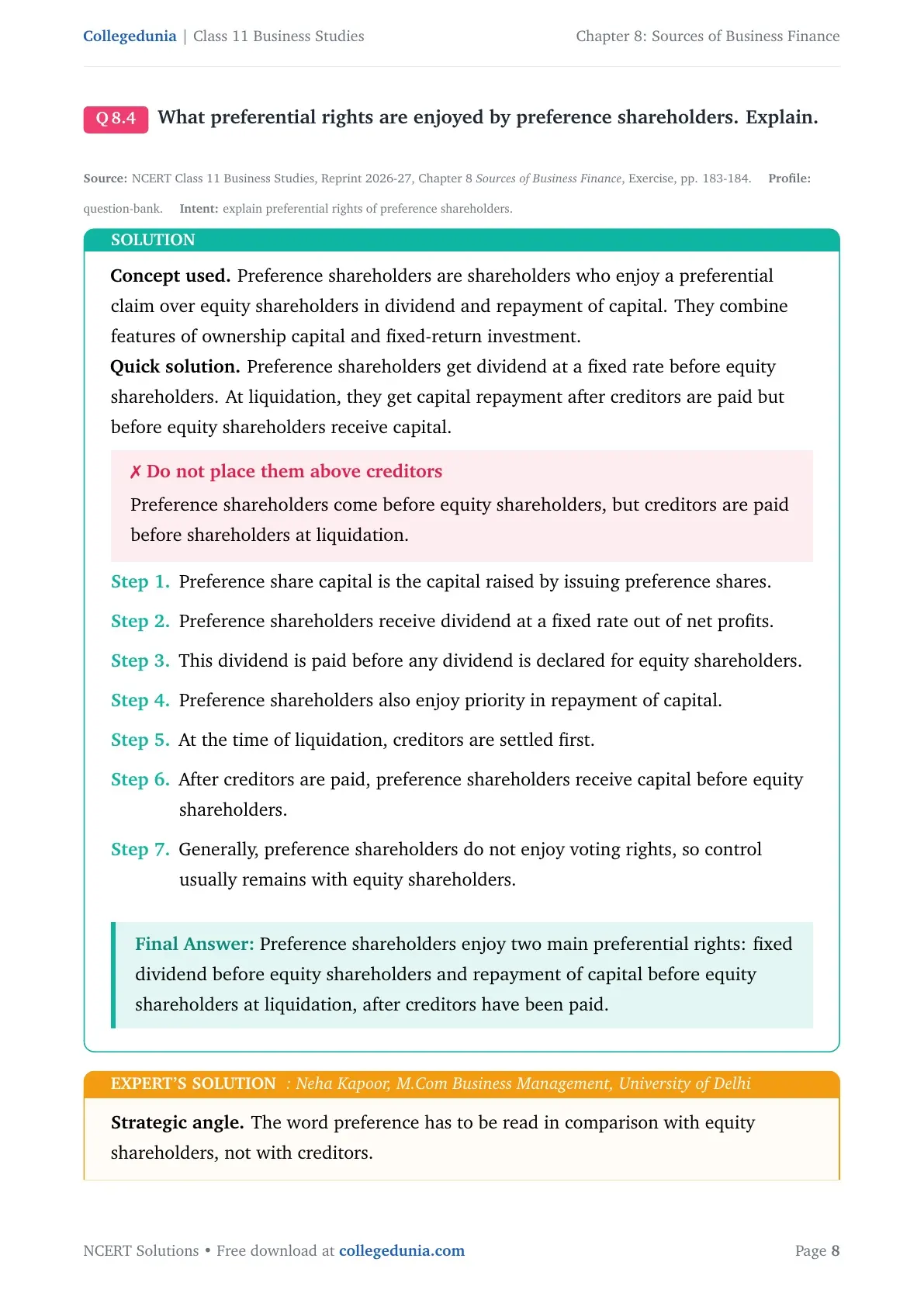
Concept used. Preference shareholders are shareholders who enjoy a preferential claim over equity shareholders in dividend and repayment of capital. They combine features of ownership capital and fixed-return investment.
Preference shareholders get dividend at a fixed rate before equity shareholders. At liquidation, they get capital repayment after creditors are paid but before equity shareholders receive capital.
Do not place them above creditors
Preference shareholders come before equity shareholders, but creditors are paid before shareholders at liquidation.
Preference share capital is the capital raised by issuing preference shares.
Preference shareholders receive dividend at a fixed rate out of net profits.
This dividend is paid before any dividend is declared for equity shareholders.
Preference shareholders also enjoy priority in repayment of capital.
At the time of liquidation, creditors are settled first.
After creditors are paid, preference shareholders receive capital before equity shareholders.
Generally, preference shareholders do not enjoy voting rights, so control usually remains with equity shareholders.
Preference shareholders enjoy two main preferential rights: fixed dividend before equity shareholders and repayment of capital before equity shareholders at liquidation, after creditors have been paid.
NK
Neha Kapoor
M.Com Business Management, University of Delhi
Verified Expert
Strategic angle. The word preference has to be read in comparison with equity shareholders, not with creditors.
Equity shareholders are the residual owners of the company.
Preference shareholders stand ahead of them for dividend.
If profits are available and dividend is declared, preference dividend is considered first.
They also stand ahead of equity shareholders for return of capital during winding up.
This right does not remove the claims of creditors.
Creditors still get priority because they are lenders, not shareholders.
Preference shareholders normally have no voting rights, so they get financial preference without normal management control.
Why this matters. The answer should clearly name both rights. Writing only fixed dividend is incomplete.
They have preference over equity shareholders in payment of dividend and repayment of capital, while creditors still rank above them.
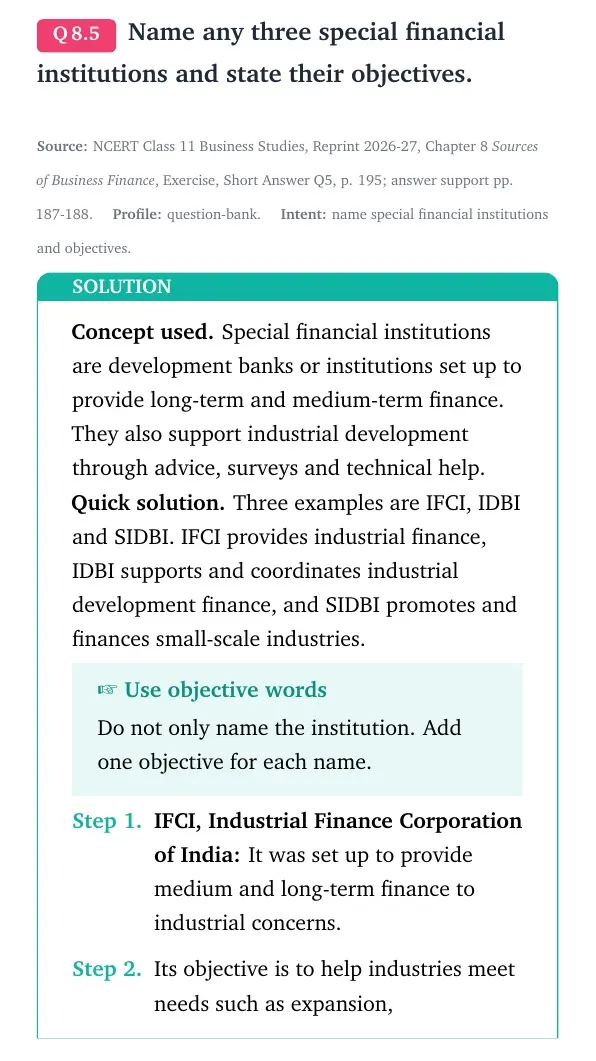
Q 8.5
Name any three special financial institutions and state their objectives.
Concept used. Special financial institutions are development banks or institutions set up to provide long-term and medium-term finance. They also support industrial development through advice, surveys and technical help.
Three examples are IFCI, IDBI and SIDBI. IFCI provides industrial finance, IDBI supports and coordinates industrial development finance, and SIDBI promotes and finances small-scale industries.
Use objective words
Do not only name the institution. Add one objective for each name.
IFCI, Industrial Finance Corporation of India: It was set up to provide medium and long-term finance to industrial concerns.
Its objective is to help industries meet needs such as expansion, modernisation and reorganisation.
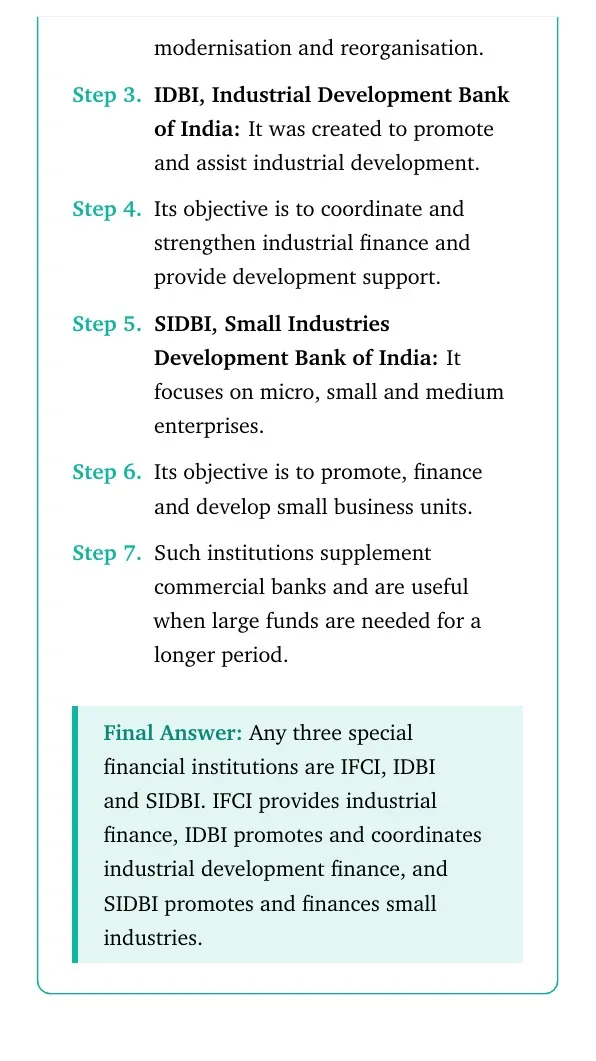
IDBI, Industrial Development Bank of India: It was created to promote and assist industrial development.
Its objective is to coordinate and strengthen industrial finance and provide development support.
SIDBI, Small Industries Development Bank of India: It focuses on micro, small and medium enterprises.
Its objective is to promote, finance and develop small business units.
Such institutions supplement commercial banks and are useful when large funds are needed for a longer period.
Any three special financial institutions are IFCI, IDBI and SIDBI. IFCI provides industrial finance, IDBI promotes and coordinates industrial development finance, and SIDBI promotes and finances small industries.
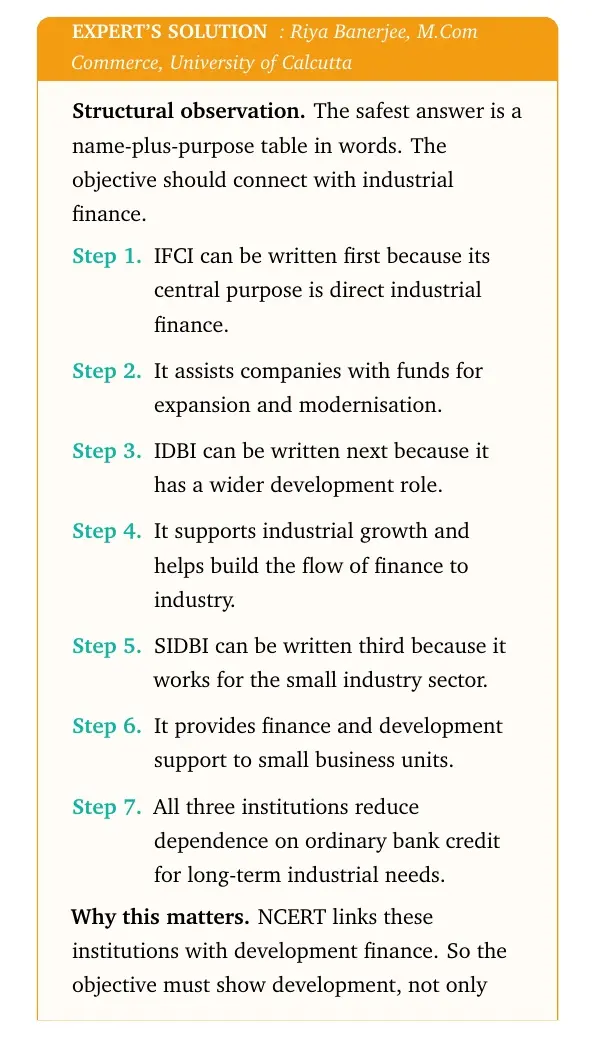
RB
Riya Banerjee
M.Com Commerce, University of Calcutta
Verified Expert
Structural observation. The safest answer is a name-plus-purpose table in words. The objective should connect with industrial finance.
IFCI can be written first because its central purpose is direct industrial finance.
It assists companies with funds for expansion and modernisation.
IDBI can be written next because it has a wider development role.
It supports industrial growth and helps build the flow of finance to industry.
SIDBI can be written third because it works for the small industry sector.
It provides finance and development support to small business units.
All three institutions reduce dependence on ordinary bank credit for long-term industrial needs.
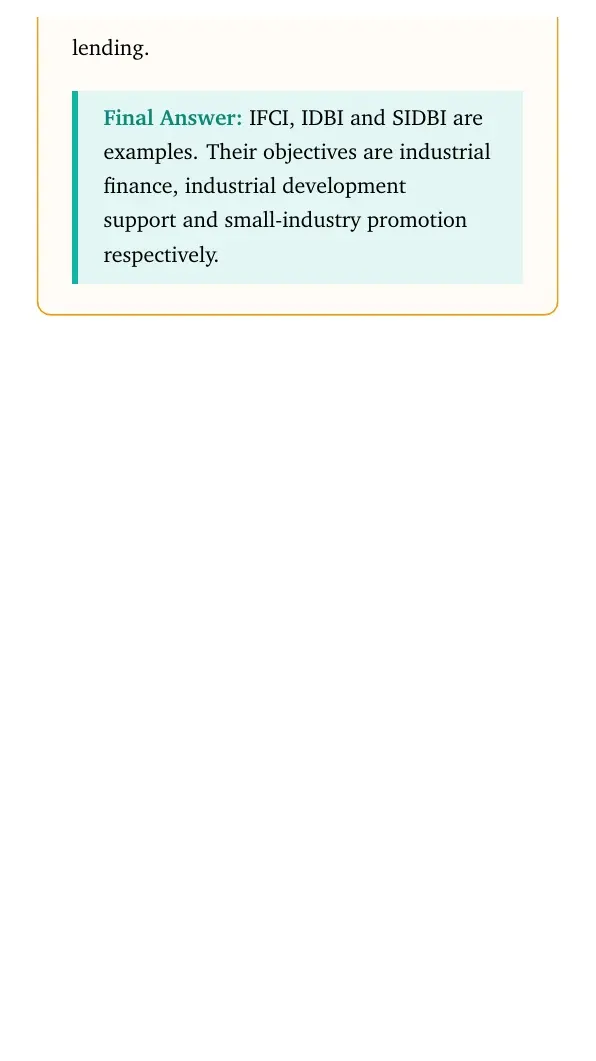
Why this matters. NCERT links these institutions with development finance. So the objective must show development, not only lending.
IFCI, IDBI and SIDBI are examples. Their objectives are industrial finance, industrial development support and small-industry promotion respectively.
Q 8.6
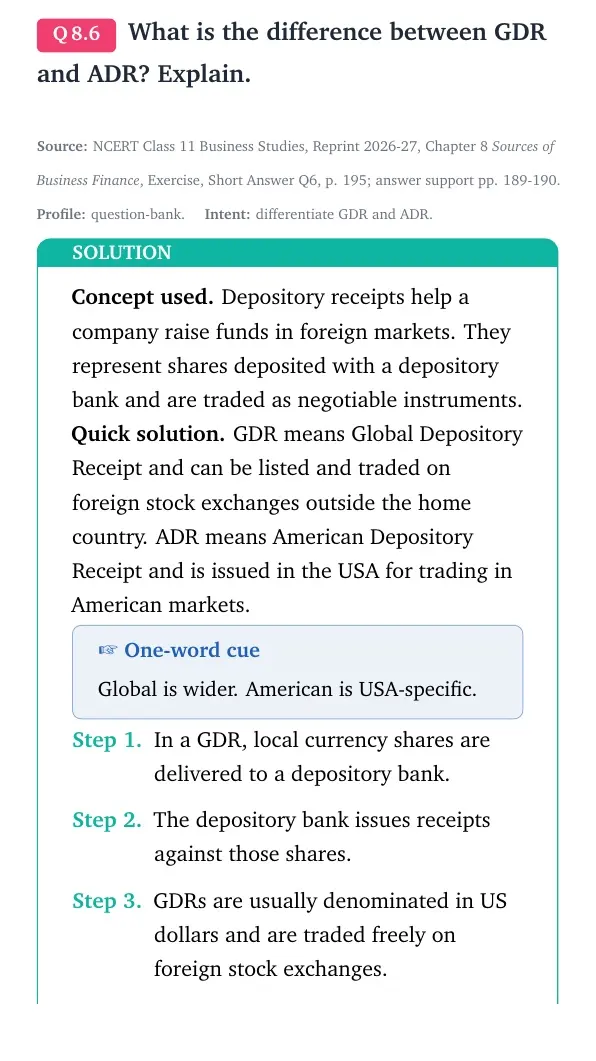
What is the difference between GDR and ADR? Explain.
Concept used. Depository receipts help a company raise funds in foreign markets. They represent shares deposited with a depository bank and are traded as negotiable instruments.
GDR means Global Depository Receipt and can be listed and traded on foreign stock exchanges outside the home country. ADR means American Depository Receipt and is issued in the USA for trading in American markets.
One-word cue
Global is wider. American is USA-specific.
In a GDR, local currency shares are delivered to a depository bank.
The depository bank issues receipts against those shares.
GDRs are usually denominated in US dollars and are traded freely on foreign stock exchanges.
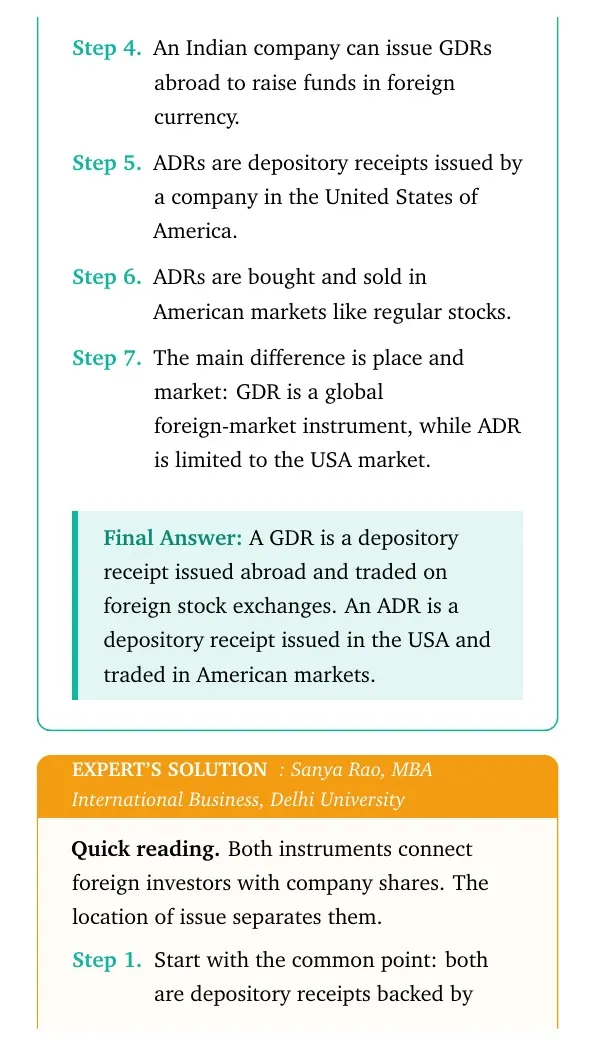
An Indian company can issue GDRs abroad to raise funds in foreign currency.
ADRs are depository receipts issued by a company in the United States of America.
ADRs are bought and sold in American markets like regular stocks.
The main difference is place and market: GDR is a global foreign-market instrument, while ADR is limited to the USA market.
A GDR is a depository receipt issued abroad and traded on foreign stock exchanges. An ADR is a depository receipt issued in the USA and traded in American markets.
SR
Sanya Rao
MBA International Business, Delhi University
Verified Expert
Quick reading. Both instruments connect foreign investors with company shares. The location of issue separates them.
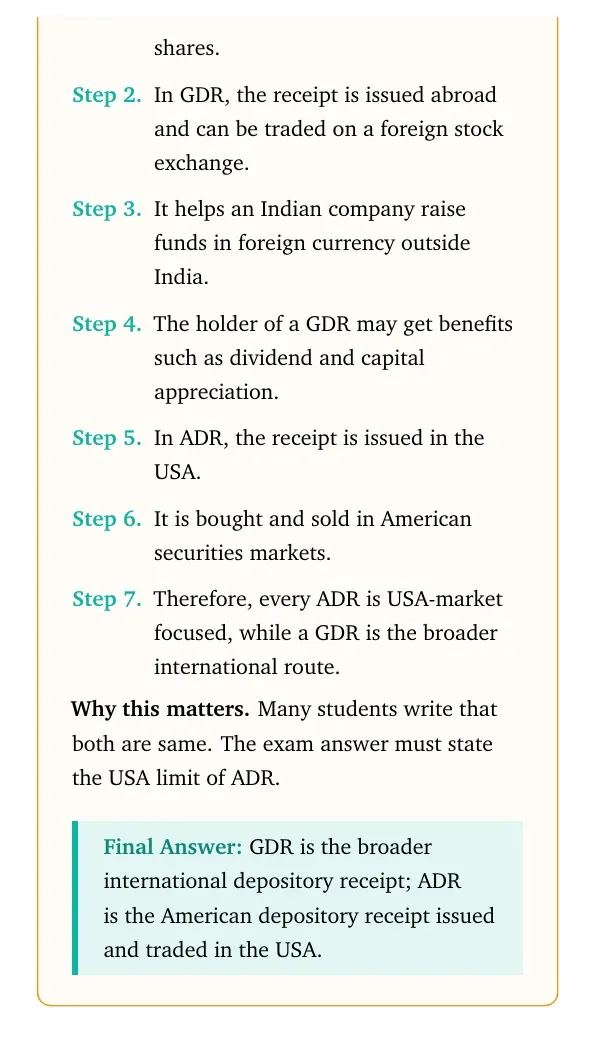
Start with the common point: both are depository receipts backed by shares.
In GDR, the receipt is issued abroad and can be traded on a foreign stock exchange.
It helps an Indian company raise funds in foreign currency outside India.
The holder of a GDR may get benefits such as dividend and capital appreciation.
In ADR, the receipt is issued in the USA.
It is bought and sold in American securities markets.
Therefore, every ADR is USA-market focused, while a GDR is the broader international route.
Why this matters. Many students write that both are same. The exam answer must state the USA limit of ADR.
GDR is the broader international depository receipt; ADR is the American depository receipt issued and traded in the USA.
Long Answer Questions
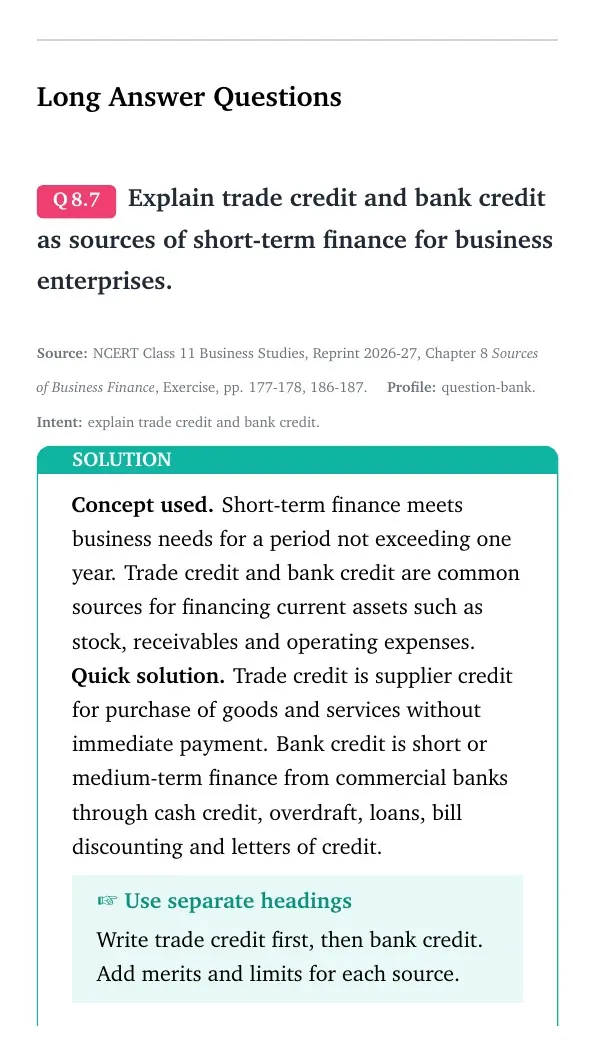
Q 8.7
Explain trade credit and bank credit as sources of short-term finance for business enterprises.
Concept used. Short-term finance meets business needs for a period not exceeding one year. Trade credit and bank credit are common sources for financing current assets such as stock, receivables and operating expenses.
Trade credit is supplier credit for purchase of goods and services without immediate payment. Bank credit is short or medium-term finance from commercial banks through cash credit, overdraft, loans, bill discounting and letters of credit.
Use separate headings
Write trade credit first, then bank credit. Add merits and limits for each source.
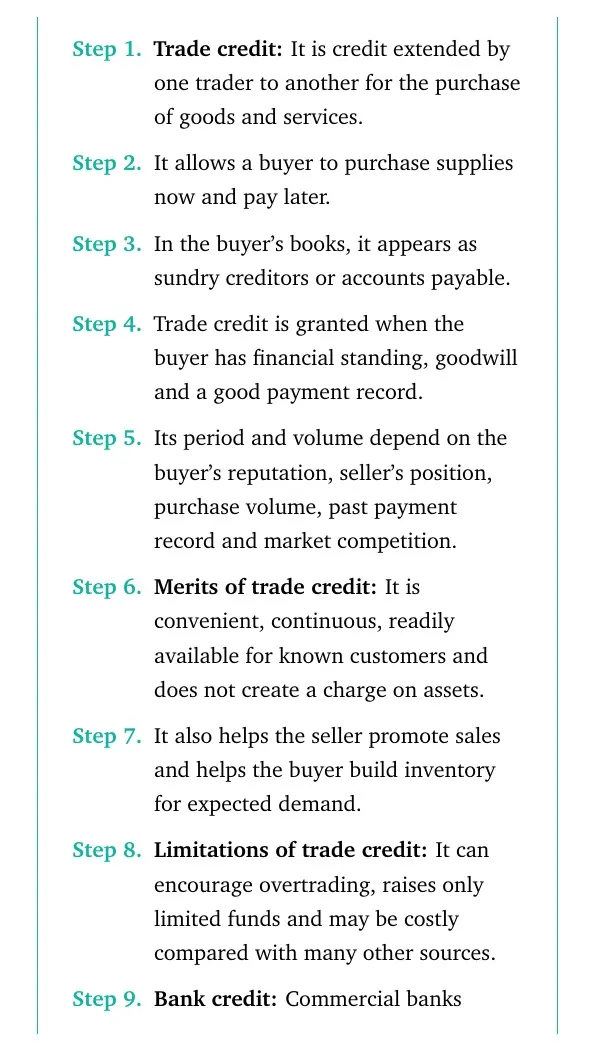
Trade credit: It is credit extended by one trader to another for the purchase of goods and services.
It allows a buyer to purchase supplies now and pay later.
In the buyer's books, it appears as sundry creditors or accounts payable.
Trade credit is granted when the buyer has financial standing, goodwill and a good payment record.
Its period and volume depend on the buyer's reputation, seller's position, purchase volume, past payment record and market competition.
Merits of trade credit: It is convenient, continuous, readily available for known customers and does not create a charge on assets.
It also helps the seller promote sales and helps the buyer build inventory for expected demand.
Limitations of trade credit: It can encourage overtrading, raises only limited funds and may be costly compared with many other sources.
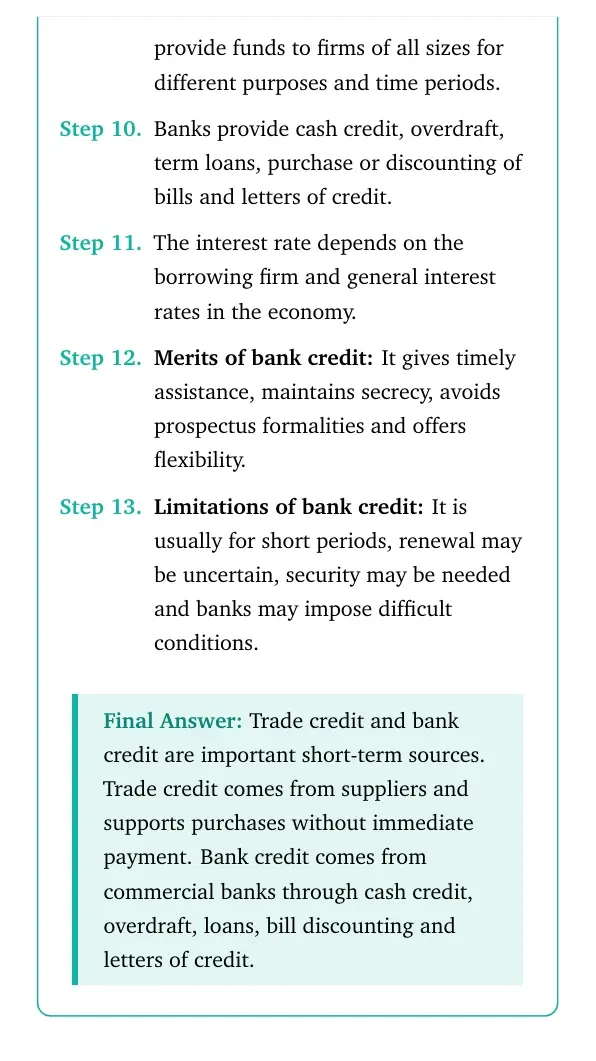
Bank credit: Commercial banks provide funds to firms of all sizes for different purposes and time periods.
Banks provide cash credit, overdraft, term loans, purchase or discounting of bills and letters of credit.
The interest rate depends on the borrowing firm and general interest rates in the economy.
Merits of bank credit: It gives timely assistance, maintains secrecy, avoids prospectus formalities and offers flexibility.
Limitations of bank credit: It is usually for short periods, renewal may be uncertain, security may be needed and banks may impose difficult conditions.
Trade credit and bank credit are important short-term sources. Trade credit comes from suppliers and supports purchases without immediate payment. Bank credit comes from commercial banks through cash credit, overdraft, loans, bill discounting and letters of credit.
DS
Dev Sharma
MBA Finance, Indian Institute of Foreign Trade
Verified Expert
Strategic angle. Compare the two by provider. Trade credit comes from a supplier in the normal purchase cycle. Bank credit comes from a financial institution.
In trade credit, the seller allows the buyer to delay payment for goods or services.
This makes it closely linked with stock purchases and routine business dealings.
It is easy for regular buyers because the seller already knows their payment behaviour.
It is useful when the buyer expects sales to rise and wants to hold more inventory.
The risk is that easy credit may lead the buyer to trade beyond its capacity.
In bank credit, the business approaches a commercial bank for finance.
The bank may give cash credit, overdraft, a term loan, bill discounting or a letter of credit.
Bank finance is more formal than trade credit because banks check financial position and security.
It is flexible because the amount may be adjusted and repayment may happen early when funds are no longer needed.
It is not permanent because bank loans normally have a period, interest cost and conditions.
Why this matters. A complete long answer explains meaning, forms, merits and limitations. That gives the answer balance.
Trade credit is supplier-based short-term finance, while bank credit is bank-based short or medium-term finance. Both support current needs, but they differ in provider, procedure, cost and conditions.
Q 8.8
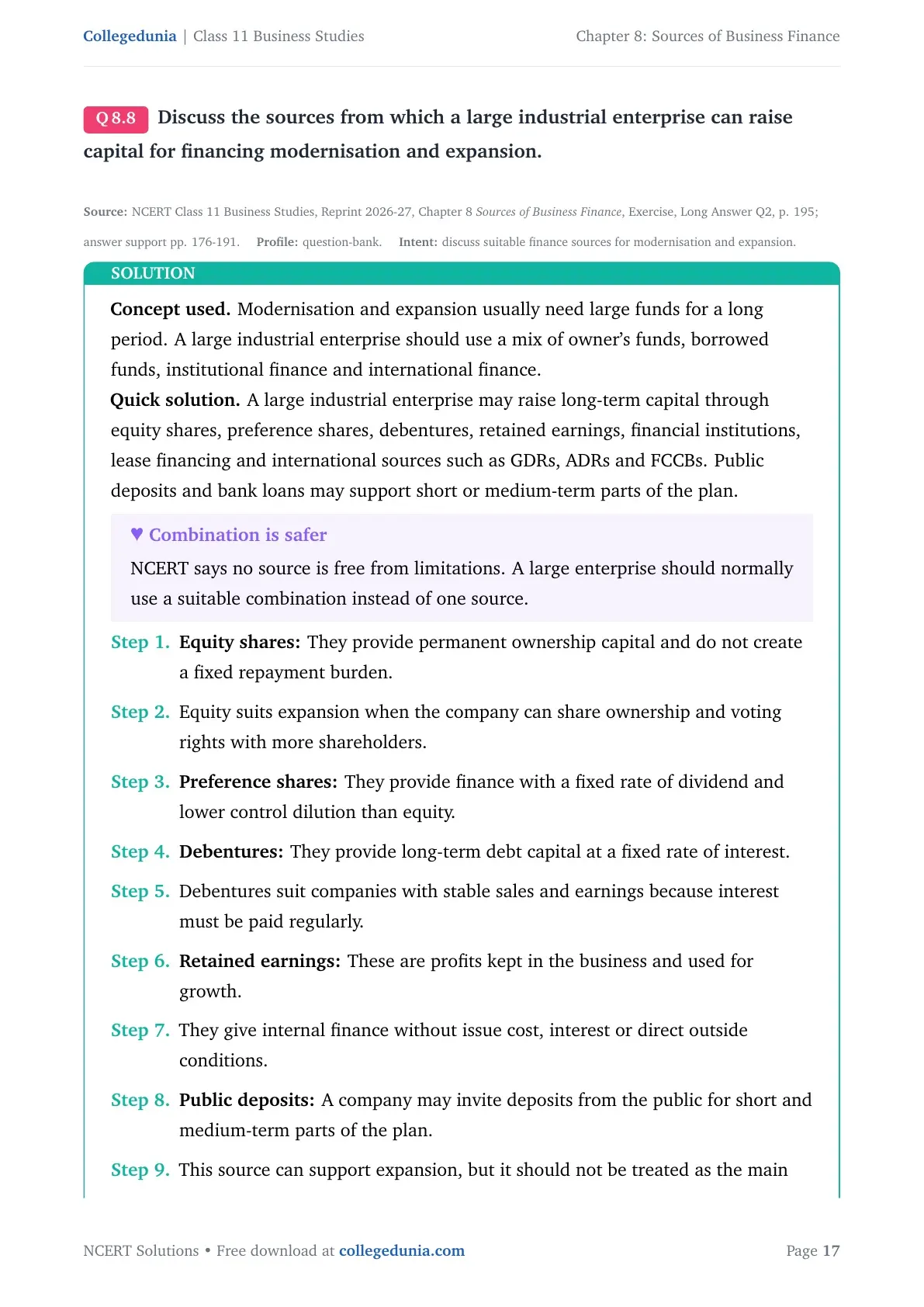
Discuss the sources from which a large industrial enterprise can raise capital for financing modernisation and expansion.
Concept used. Modernisation and expansion usually need large funds for a long period. A large industrial enterprise should use a mix of owner's funds, borrowed funds, institutional finance and international finance.
A large industrial enterprise may raise long-term capital through equity shares, preference shares, debentures, retained earnings, financial institutions, lease financing and international sources such as GDRs, ADRs and FCCBs. Public deposits and bank loans may support short or medium-term parts of the plan.
Combination is safer
NCERT says no source is free from limitations. A large enterprise should normally use a suitable combination instead of one source.
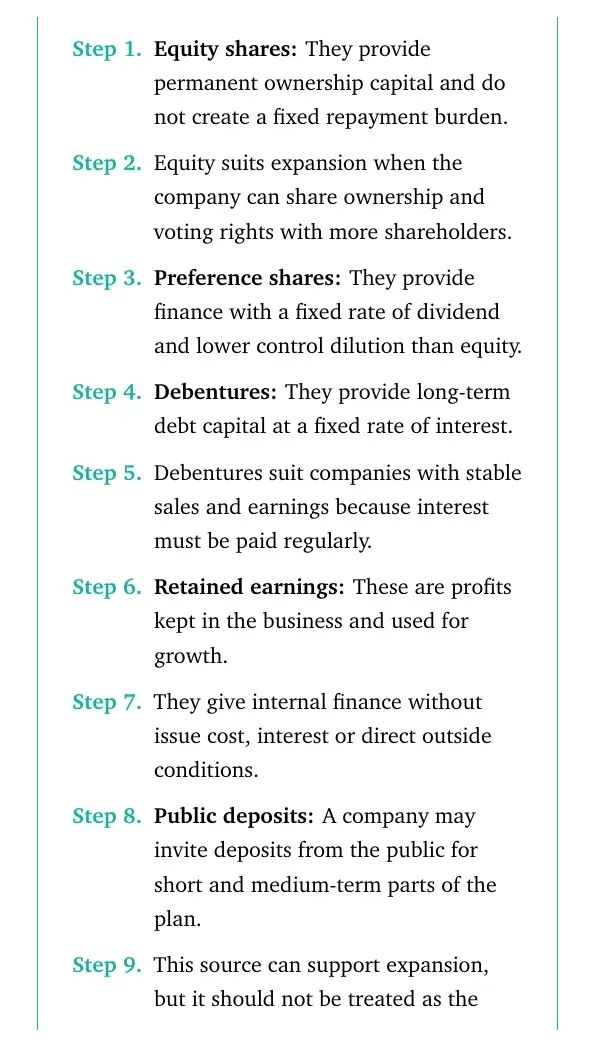
Equity shares: They provide permanent ownership capital and do not create a fixed repayment burden.
Equity suits expansion when the company can share ownership and voting rights with more shareholders.
Preference shares: They provide finance with a fixed rate of dividend and lower control dilution than equity.
Debentures: They provide long-term debt capital at a fixed rate of interest.
Debentures suit companies with stable sales and earnings because interest must be paid regularly.
Retained earnings: These are profits kept in the business and used for growth.
They give internal finance without issue cost, interest or direct outside conditions.
Public deposits: A company may invite deposits from the public for short and medium-term parts of the plan.
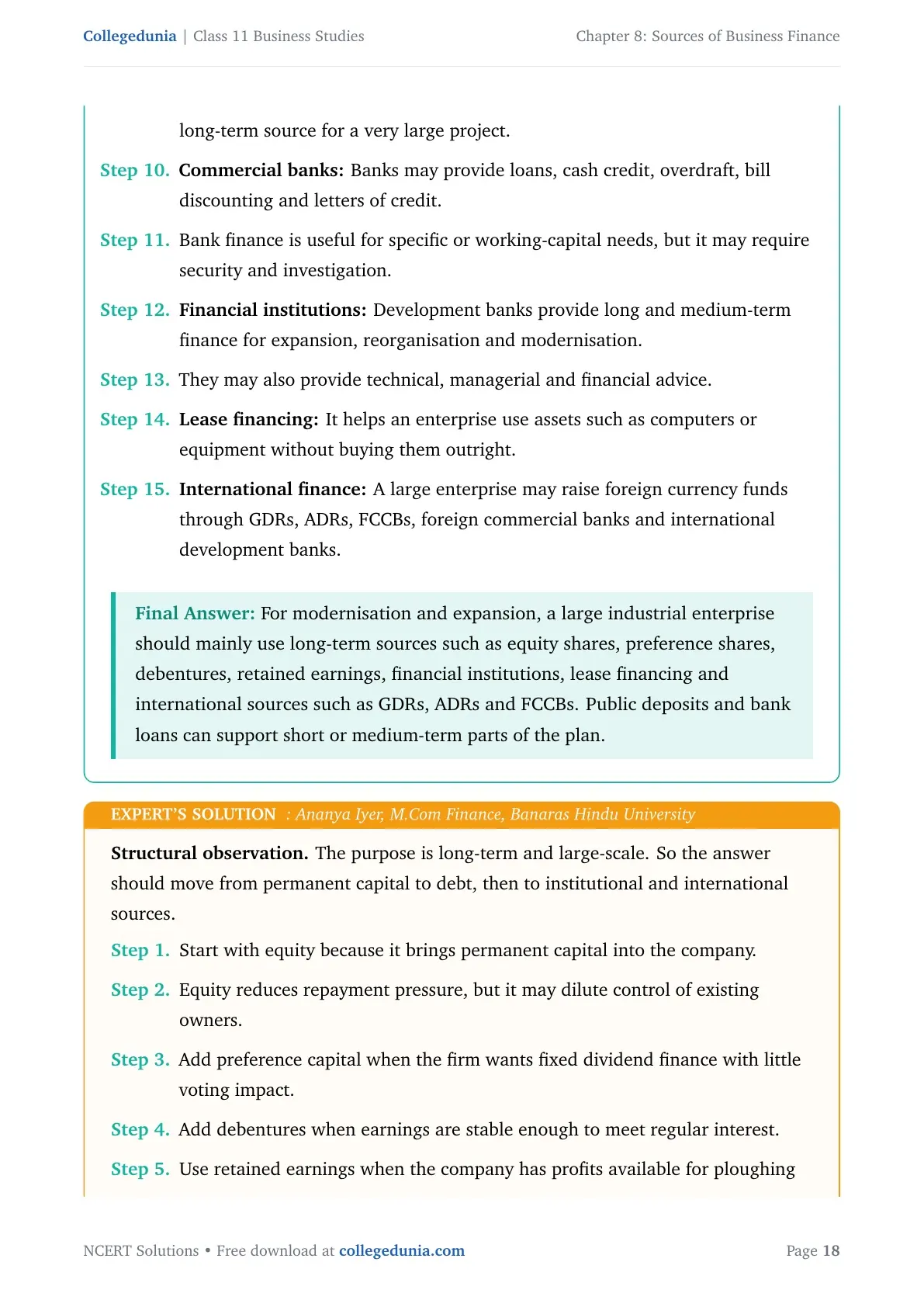
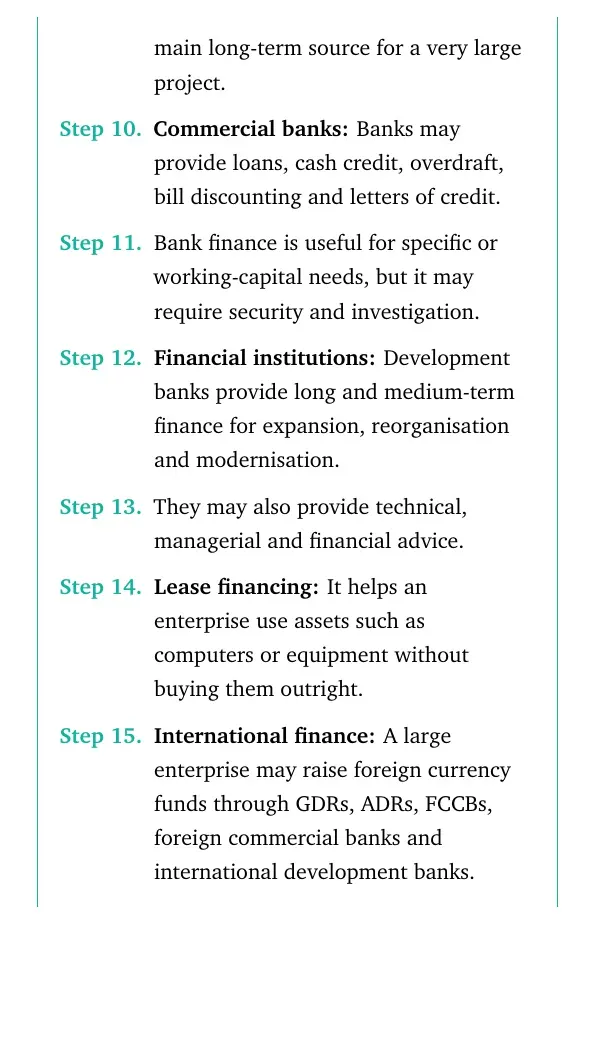
This source can support expansion, but it should not be treated as the main long-term source for a very large project.
Commercial banks: Banks may provide loans, cash credit, overdraft, bill discounting and letters of credit.
Bank finance is useful for specific or working-capital needs, but it may require security and investigation.
Financial institutions: Development banks provide long and medium-term finance for expansion, reorganisation and modernisation.
They may also provide technical, managerial and financial advice.
Lease financing: It helps an enterprise use assets such as computers or equipment without buying them outright.
International finance: A large enterprise may raise foreign currency funds through GDRs, ADRs, FCCBs, foreign commercial banks and international development banks.
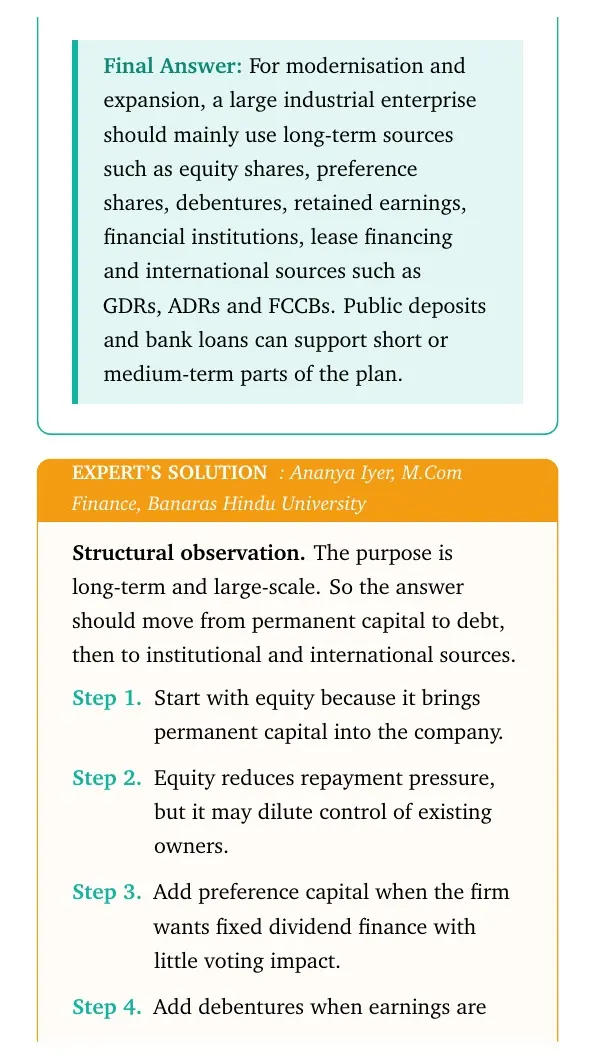
For modernisation and expansion, a large industrial enterprise should mainly use long-term sources such as equity shares, preference shares, debentures, retained earnings, financial institutions, lease financing and international sources such as GDRs, ADRs and FCCBs. Public deposits and bank loans can support short or medium-term parts of the plan.
AI
Ananya Iyer
M.Com Finance, Banaras Hindu University
Verified Expert
Structural observation. The purpose is long-term and large-scale. So the answer should move from permanent capital to debt, then to institutional and international sources.
Start with equity because it brings permanent capital into the company.
Equity reduces repayment pressure, but it may dilute control of existing owners.
Add preference capital when the firm wants fixed dividend finance with little voting impact.
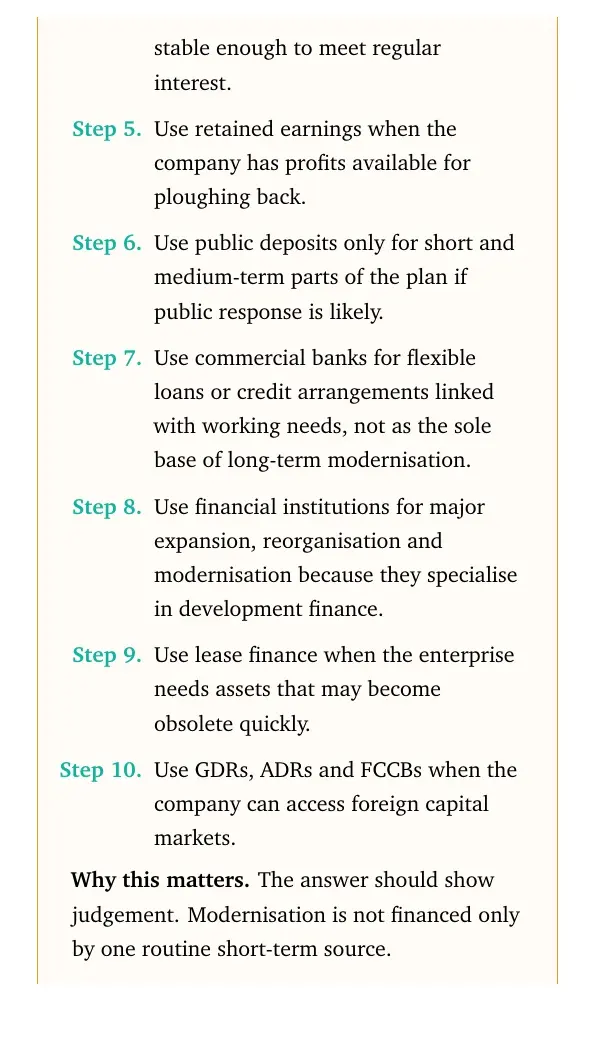
Add debentures when earnings are stable enough to meet regular interest.
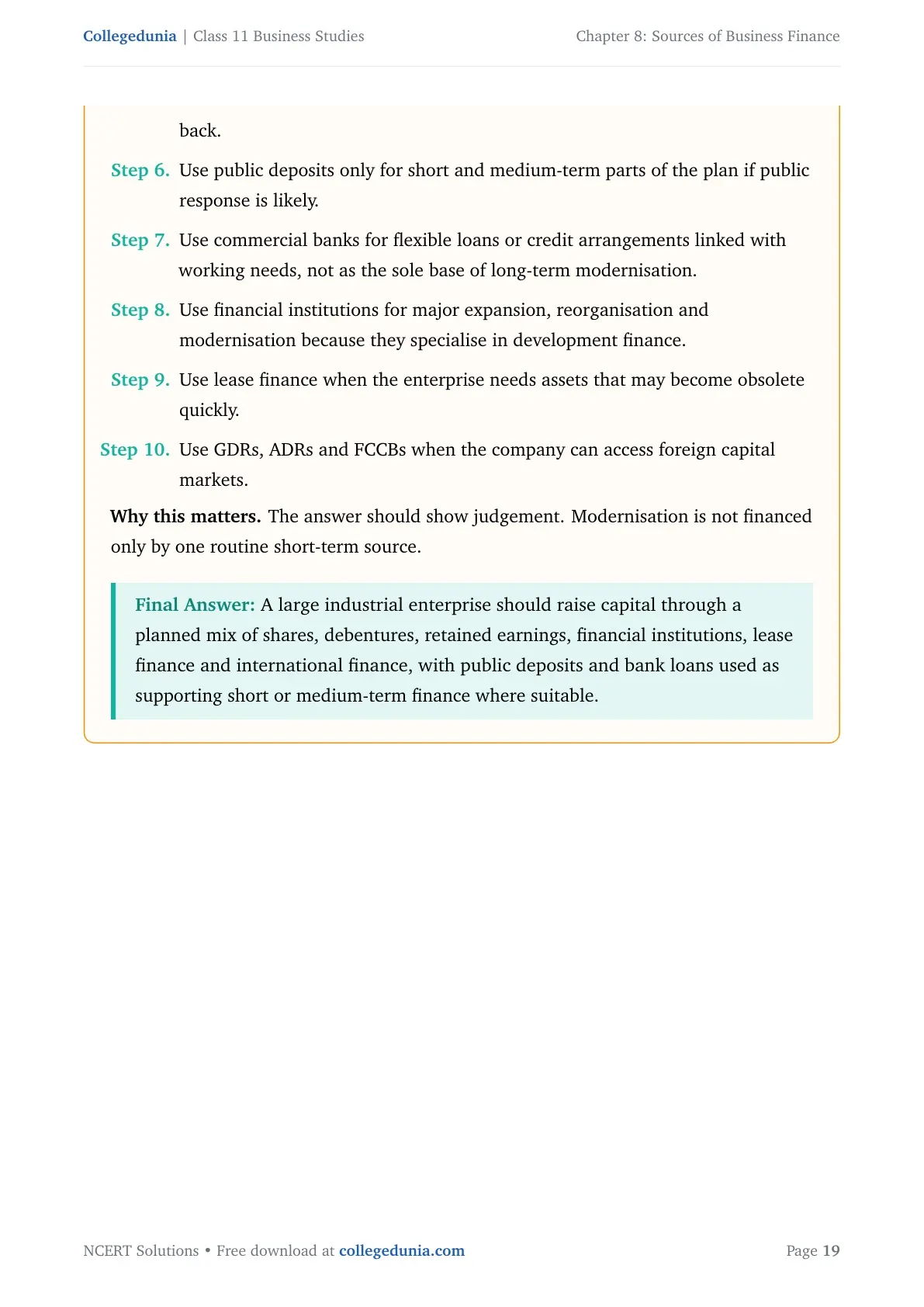
Use retained earnings when the company has profits available for ploughing back.
Use public deposits only for short and medium-term parts of the plan if public response is likely.
Use commercial banks for flexible loans or credit arrangements linked with working needs, not as the sole base of long-term modernisation.
Use financial institutions for major expansion, reorganisation and modernisation because they specialise in development finance.
Use lease finance when the enterprise needs assets that may become obsolete quickly.
Use GDRs, ADRs and FCCBs when the company can access foreign capital markets.
Why this matters. The answer should show judgement. Modernisation is not financed only by one routine short-term source.
A large industrial enterprise should raise capital through a planned mix of shares, debentures, retained earnings, financial institutions, lease finance and international finance, with public deposits and bank loans used as supporting short or medium-term finance where suitable.
Q 8.9
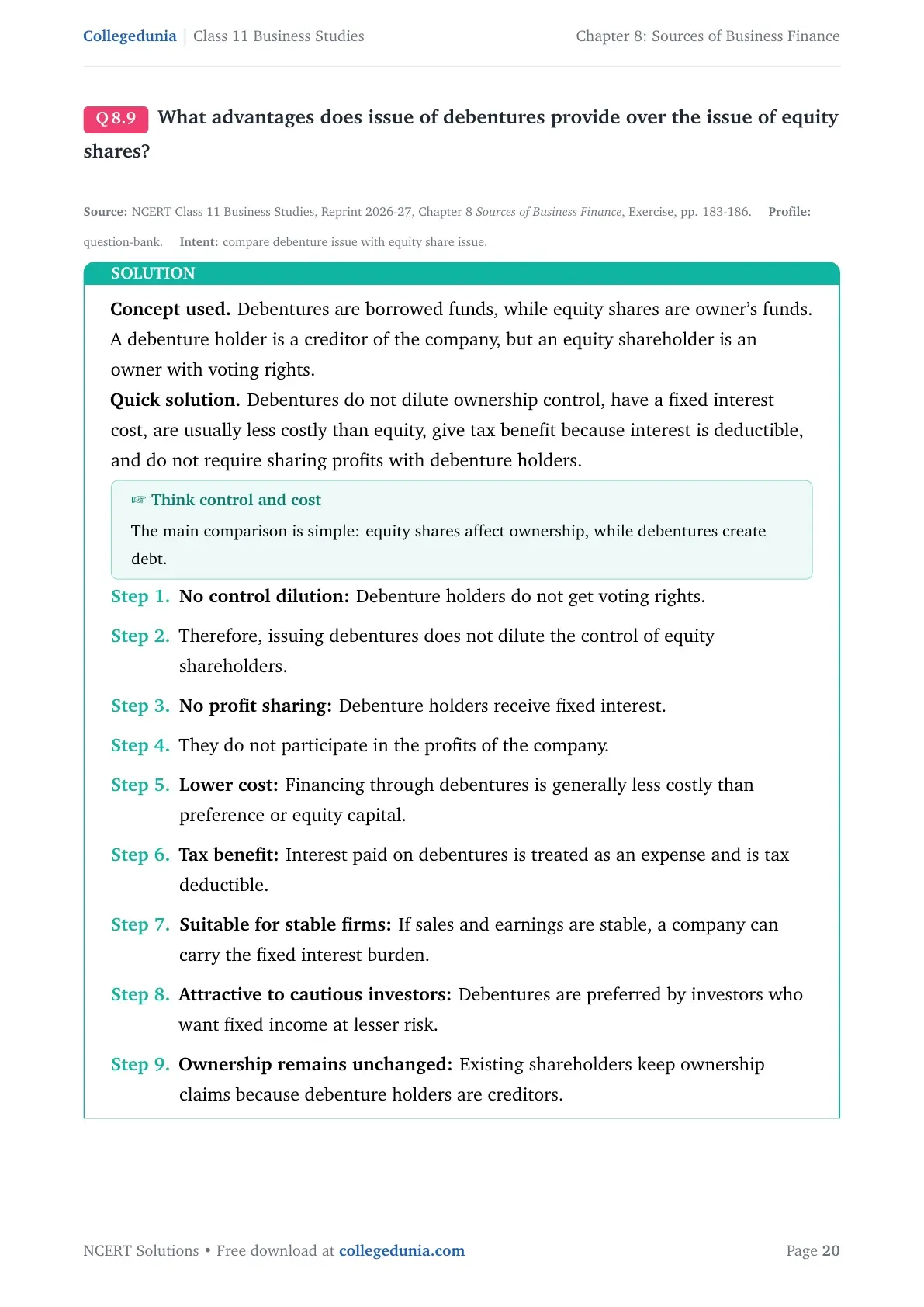
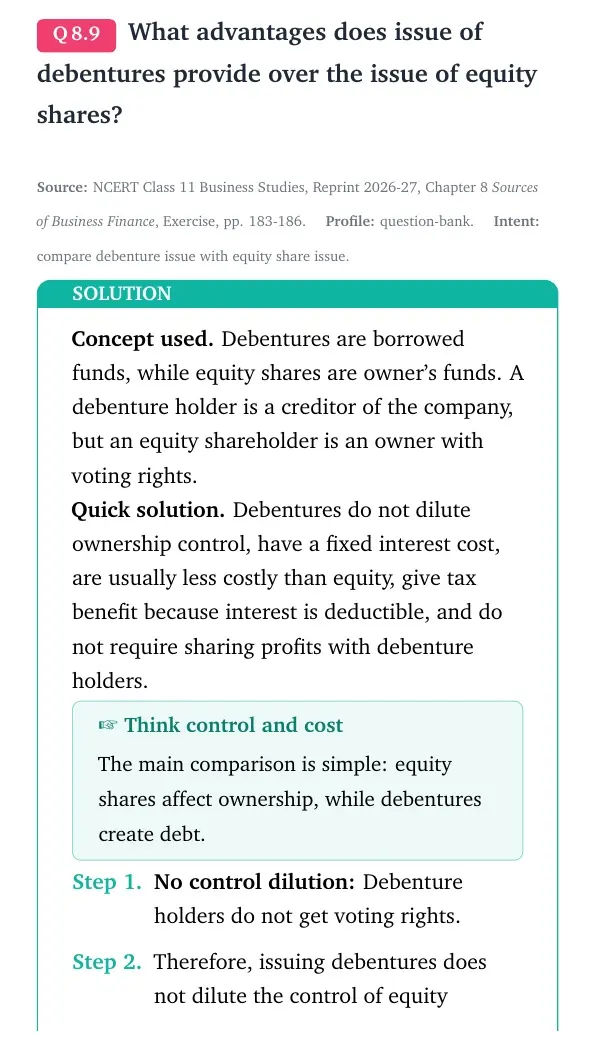
What advantages does issue of debentures provide over the issue of equity shares?
Concept used. Debentures are borrowed funds, while equity shares are owner's funds. A debenture holder is a creditor of the company, but an equity shareholder is an owner with voting rights.
Debentures do not dilute ownership control, have a fixed interest cost, are usually less costly than equity, give tax benefit because interest is deductible, and do not require sharing profits with debenture holders.
Think control and cost
The main comparison is simple: equity shares affect ownership, while debentures create debt.
No control dilution: Debenture holders do not get voting rights.
Therefore, issuing debentures does not dilute the control of equity shareholders.
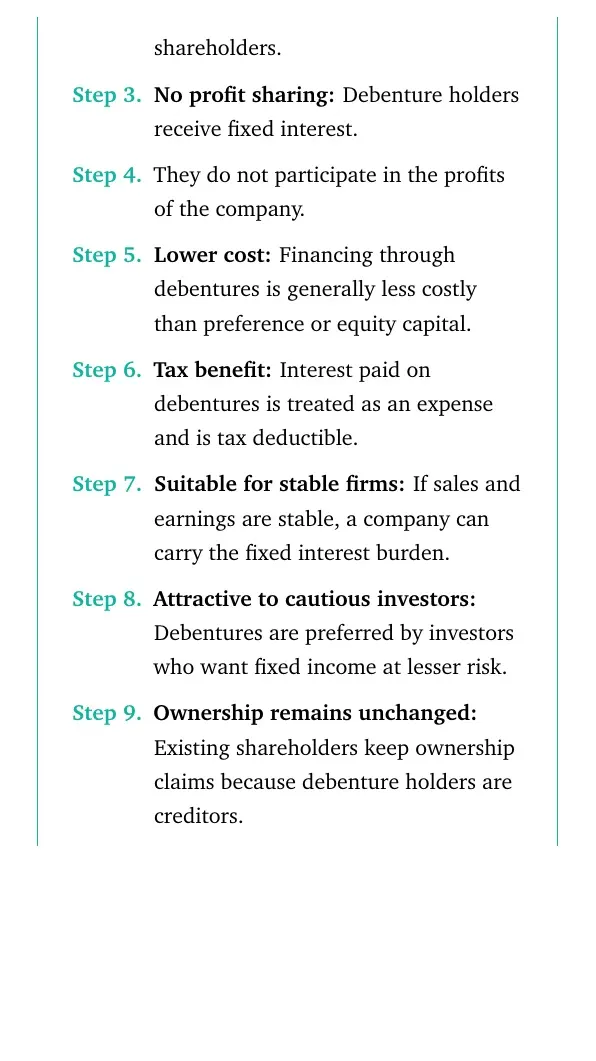
No profit sharing: Debenture holders receive fixed interest.
They do not participate in the profits of the company.
Lower cost: Financing through debentures is generally less costly than preference or equity capital.
Tax benefit: Interest paid on debentures is treated as an expense and is tax deductible.
Suitable for stable firms: If sales and earnings are stable, a company can carry the fixed interest burden.
Attractive to cautious investors: Debentures are preferred by investors who want fixed income at lesser risk.
Ownership remains unchanged: Existing shareholders keep ownership claims because debenture holders are creditors.
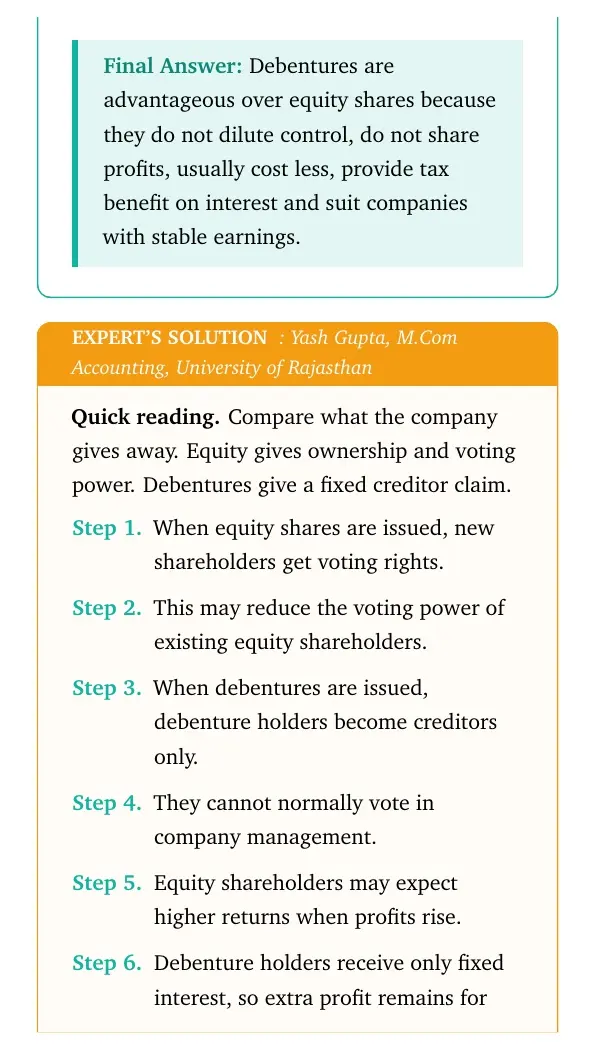
Debentures are advantageous over equity shares because they do not dilute control, do not share profits, usually cost less, provide tax benefit on interest and suit companies with stable earnings.
YG
Yash Gupta
M.Com Accounting, University of Rajasthan
Verified Expert
Quick reading. Compare what the company gives away. Equity gives ownership and voting power. Debentures give a fixed creditor claim.
When equity shares are issued, new shareholders get voting rights.
This may reduce the voting power of existing equity shareholders.
When debentures are issued, debenture holders become creditors only.
They cannot normally vote in company management.
Equity shareholders may expect higher returns when profits rise.
Debenture holders receive only fixed interest, so extra profit remains for shareholders after interest.
Interest on debentures reduces taxable profits because it is deductible.
Dividend on equity shares does not give the same tax saving.
Therefore, for a company with stable earnings, debentures may be a cheaper way to raise long-term funds.
Why this matters. The phrase "over equity" means the answer must compare both sources, not only define debentures.
Debenture issue protects control, fixes the finance cost, allows tax deduction of interest and avoids sharing ownership profits with new equity shareholders.
Q 8.10
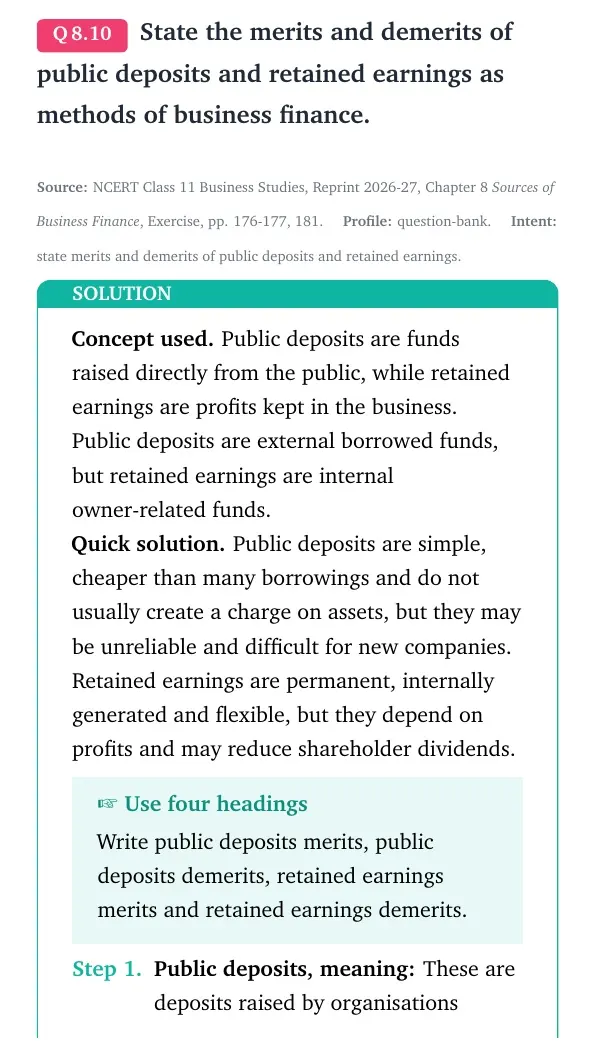
State the merits and demerits of public deposits and retained earnings as methods of business finance.
Concept used. Public deposits are funds raised directly from the public, while retained earnings are profits kept in the business. Public deposits are external borrowed funds, but retained earnings are internal owner-related funds.
Public deposits are simple, cheaper than many borrowings and do not usually create a charge on assets, but they may be unreliable and difficult for new companies. Retained earnings are permanent, internally generated and flexible, but they depend on profits and may reduce shareholder dividends.
Use four headings
Write public deposits merits, public deposits demerits, retained earnings merits and retained earnings demerits.
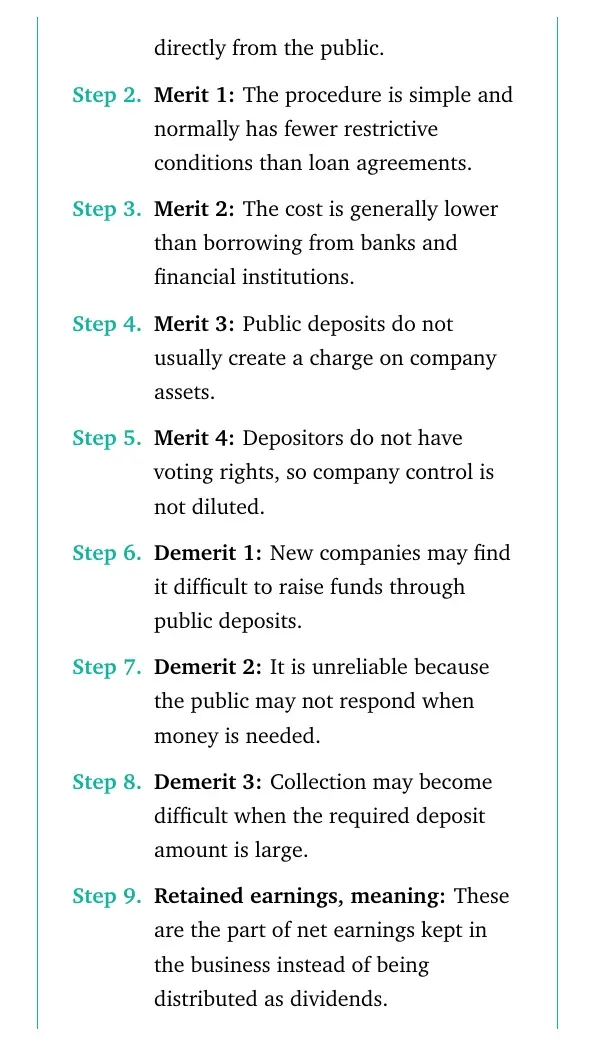
Public deposits, meaning: These are deposits raised by organisations directly from the public.
Merit 1: The procedure is simple and normally has fewer restrictive conditions than loan agreements.
Merit 2: The cost is generally lower than borrowing from banks and financial institutions.
Merit 3: Public deposits do not usually create a charge on company assets.
Merit 4: Depositors do not have voting rights, so company control is not diluted.
Demerit 1: New companies may find it difficult to raise funds through public deposits.
Demerit 2: It is unreliable because the public may not respond when money is needed.
Demerit 3: Collection may become difficult when the required deposit amount is large.
Retained earnings, meaning: These are the part of net earnings kept in the business instead of being distributed as dividends.
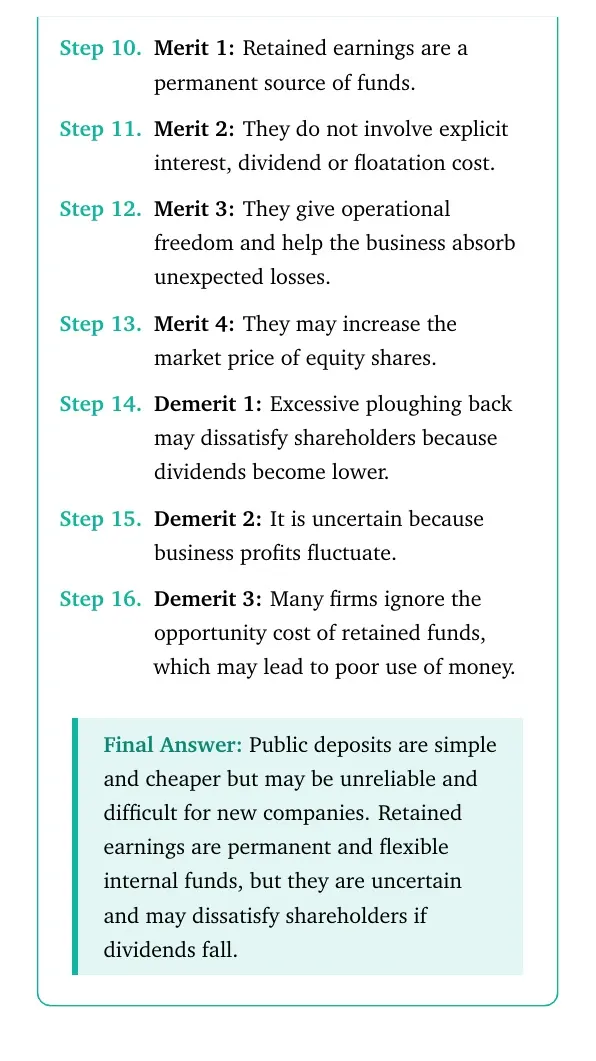
Merit 1: Retained earnings are a permanent source of funds.
Merit 2: They do not involve explicit interest, dividend or floatation cost.
Merit 3: They give operational freedom and help the business absorb unexpected losses.
Merit 4: They may increase the market price of equity shares.
Demerit 1: Excessive ploughing back may dissatisfy shareholders because dividends become lower.
Demerit 2: It is uncertain because business profits fluctuate.
Demerit 3: Many firms ignore the opportunity cost of retained funds, which may lead to poor use of money.
Public deposits are simple and cheaper but may be unreliable and difficult for new companies. Retained earnings are permanent and flexible internal funds, but they are uncertain and may dissatisfy shareholders if dividends fall.
MJ
Meera Joshi
M.Com Business Finance, Savitribai Phule Pune University
Verified Expert
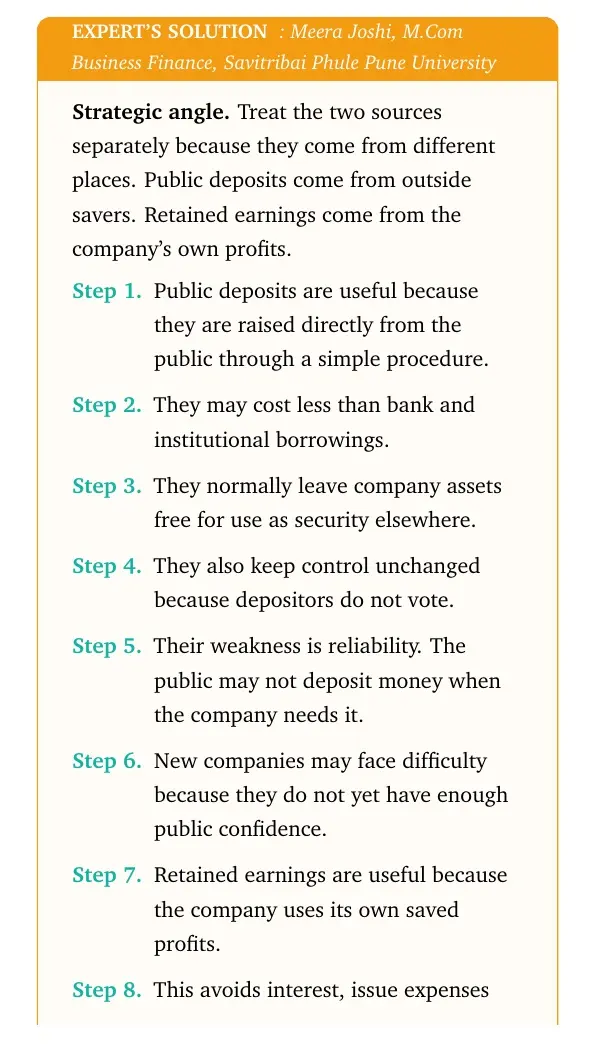
Strategic angle. Treat the two sources separately because they come from different places. Public deposits come from outside savers. Retained earnings come from the company's own profits.
Public deposits are useful because they are raised directly from the public through a simple procedure.
They may cost less than bank and institutional borrowings.
They normally leave company assets free for use as security elsewhere.
They also keep control unchanged because depositors do not vote.
Their weakness is reliability. The public may not deposit money when the company needs it.
New companies may face difficulty because they do not yet have enough public confidence.
Retained earnings are useful because the company uses its own saved profits.
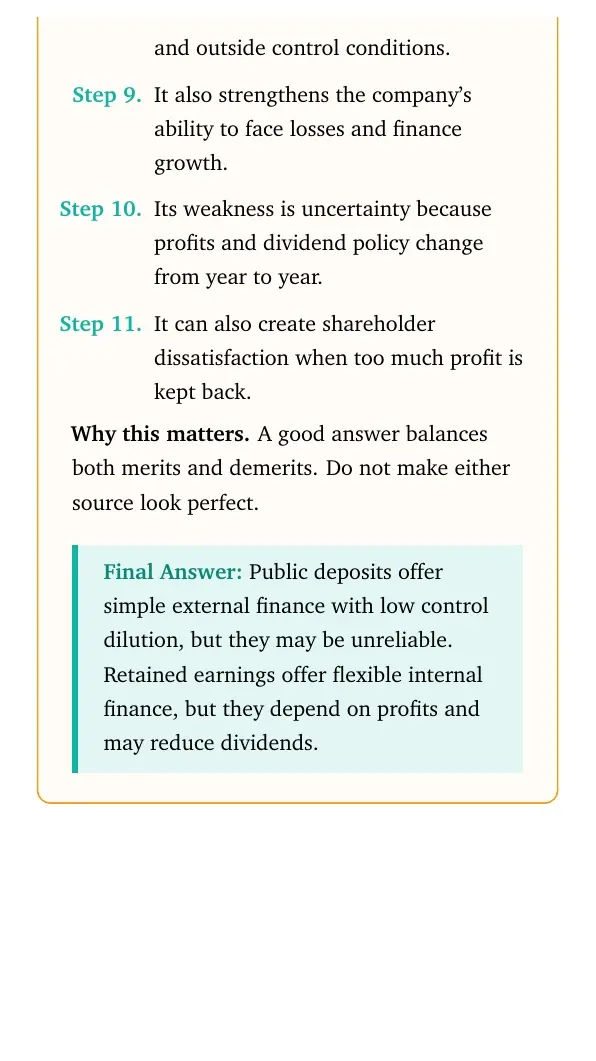
This avoids interest, issue expenses and outside control conditions.
It also strengthens the company's ability to face losses and finance growth.
Its weakness is uncertainty because profits and dividend policy change from year to year.
It can also create shareholder dissatisfaction when too much profit is kept back.
Why this matters. A good answer balances both merits and demerits. Do not make either source look perfect.
Public deposits offer simple external finance with low control dilution, but they may be unreliable. Retained earnings offer flexible internal finance, but they depend on profits and may reduce dividends.
Quick Doubts on Sources of Business Finance
Sources of Business Finance Class 11 NCERT Solutions FAQs
What is business finance in Class 11 Business Studies Chapter 8?
Business finance is the money required for carrying out business activities. A business needs it for fixed assets, current assets, expansion, modernisation and day-to-day operations.
How many questions are solved in the Chapter 8 NCERT Solutions PDF?
The PDF solves all 10 exercise questions from Chapter 8 Sources of Business Finance, including 6 short answer questions and 4 long answer questions.
Which source is better, equity shares or debentures?
Neither source is always better. Equity shares suit permanent risk capital, while debentures suit firms that want funds without sharing ownership control and can meet fixed interest payments.
What are retained earnings?
Retained earnings are the part of profit kept in the business instead of being distributed as dividend. They are an internal source of finance.
Are trade credit and bank credit short-term sources of finance?
Yes. Trade credit and bank credit are short-term sources used mainly for working capital needs such as stock, receivables and operating expenses.














Comments