




The The Address Class 11 notes explain Marga Minco's story for the 2026-27 NCERT Snapshots syllabus. Use this page to revise the plot, narrator, Mrs Dorling, war memory and the meaning of the ending before reading the full PDF.
- Download the Chapter 2 English Snapshots notes PDF for offline revision.
- Revise the story flow, character contrast, themes and exam answer angles.
- Student focus: the ending is about rejecting objects that can no longer restore a lost home.
Chapter2TheAddressNotes.pdf?page=1&dpi=150)
Chapter2TheAddressNotes.pdf?page=2&dpi=150)
Chapter2TheAddressNotes.pdf?page=3&dpi=150)
Chapter2TheAddressNotes.pdf?page=4&dpi=150)
Chapter2TheAddressNotes.pdf?page=5&dpi=150)
Chapter2TheAddressNotes.pdf?page=6&dpi=150)
Chapter2TheAddressNotes.pdf?page=7&dpi=150)
Chapter2TheAddressNotes.pdf?page=8&dpi=150)
Chapter2TheAddressNotes.pdf?page=9&dpi=150)
Chapter2TheAddressNotes.pdf?page=10&dpi=150)
Chapter2TheAddressNotes.pdf?page=11&dpi=150)
Chapter2TheAddressNotes.pdf?page=12&dpi=150)
Chapter2TheAddressNotes.pdf?page=13&dpi=150)
Chapter2TheAddressNotes.pdf?page=14&dpi=150)
Chapter2TheAddressNotes.pdf?page=15&dpi=150)
Chapter2TheAddressNotes.pdf?page=16&dpi=150)
Chapter2TheAddressNotes.pdf?page=17&dpi=150)
Chapter2TheAddressNotes.pdf?page=18&dpi=150)
Chapter2TheAddressNotes.pdf?page=19&dpi=150)
Chapter2TheAddressNotes.pdf?page=20&dpi=150)
Chapter2TheAddressNotes.pdf?page=21&dpi=150)
Chapter2TheAddressNotes.pdf?page=22&dpi=150)
Chapter2TheAddressNotes.pdf?page=23&dpi=150)
Chapter2TheAddressNotes_flat_MobileCard.pdf?page=1&dpi=150)
Chapter2TheAddressNotes_flat_MobileCard.pdf?page=2&dpi=150)
Chapter2TheAddressNotes_flat_MobileCard.pdf?page=3&dpi=150)
Chapter2TheAddressNotes_flat_MobileCard.pdf?page=4&dpi=150)
Chapter2TheAddressNotes_flat_MobileCard.pdf?page=5&dpi=150)
Chapter2TheAddressNotes_flat_MobileCard.pdf?page=6&dpi=150)
Chapter2TheAddressNotes_flat_MobileCard.pdf?page=7&dpi=150)
Chapter2TheAddressNotes_flat_MobileCard.pdf?page=8&dpi=150)
Chapter2TheAddressNotes_flat_MobileCard.pdf?page=9&dpi=150)
Chapter2TheAddressNotes_flat_MobileCard.pdf?page=10&dpi=150)
Chapter2TheAddressNotes_flat_MobileCard.pdf?page=11&dpi=150)
Chapter2TheAddressNotes_flat_MobileCard.pdf?page=12&dpi=150)
Chapter2TheAddressNotes_flat_MobileCard.pdf?page=13&dpi=150)
Chapter2TheAddressNotes_flat_MobileCard.pdf?page=14&dpi=150)
Chapter2TheAddressNotes_flat_MobileCard.pdf?page=15&dpi=150)
Chapter2TheAddressNotes_flat_MobileCard.pdf?page=16&dpi=150)
Chapter2TheAddressNotes_flat_MobileCard.pdf?page=17&dpi=150)
Chapter2TheAddressNotes_flat_MobileCard.pdf?page=18&dpi=150)
Chapter2TheAddressNotes_flat_MobileCard.pdf?page=19&dpi=150)
Chapter2TheAddressNotes_flat_MobileCard.pdf?page=20&dpi=150)
Chapter2TheAddressNotes_flat_MobileCard.pdf?page=21&dpi=150)
Chapter2TheAddressNotes_flat_MobileCard.pdf?page=22&dpi=150)
Chapter2TheAddressNotes_flat_MobileCard.pdf?page=23&dpi=150)
Chapter2TheAddressNotes_flat_MobileCard.pdf?page=24&dpi=150)
Chapter2TheAddressNotes_flat_MobileCard.pdf?page=25&dpi=150)
Chapter2TheAddressNotes_flat_MobileCard.pdf?page=26&dpi=150)
Chapter2TheAddressNotes_flat_MobileCard.pdf?page=27&dpi=150)
Chapter2TheAddressNotes_flat_MobileCard.pdf?page=28&dpi=150)
Chapter2TheAddressNotes_flat_MobileCard.pdf?page=29&dpi=150)
Chapter2TheAddressNotes_flat_MobileCard.pdf?page=30&dpi=150)
Chapter2TheAddressNotes_flat_MobileCard.pdf?page=31&dpi=150)
Chapter2TheAddressNotes_flat_MobileCard.pdf?page=32&dpi=150)
Chapter2TheAddressNotes_flat_MobileCard.pdf?page=33&dpi=150)
These Class 11 English Snapshots notes are checked against the 2026-27 NCERT chapter and built for fast board revision.
Student Feedback on The Address Chapter
In a Collegedunia poll of 12,640 Class 11 English students before the 2026 annual exams, many students understood the visit to Mrs Dorling but missed why the narrator finally refuses the address.
- 69% wanted a clearer split between plot memory and theme meaning.
- 6 out of 10 students first treated Mrs Dorling only as a thief, not as a symbol of moral failure.
- 43% needed help with the last line. The notes connect it with closure and emotional survival.
Source: 2026-27 Class 11 English Core student poll. Sample of 12,640 students from CBSE schools across 16 states.
The Address Class 11 Story Flow
The Address is built around two visits to 46 Marconi Street. The narrator goes there after the war because her mother once gave Mrs Dorling the family belongings for safekeeping. The visit should have restored something familiar, but it exposes how objects lose meaning when they are separated from love, home and memory.
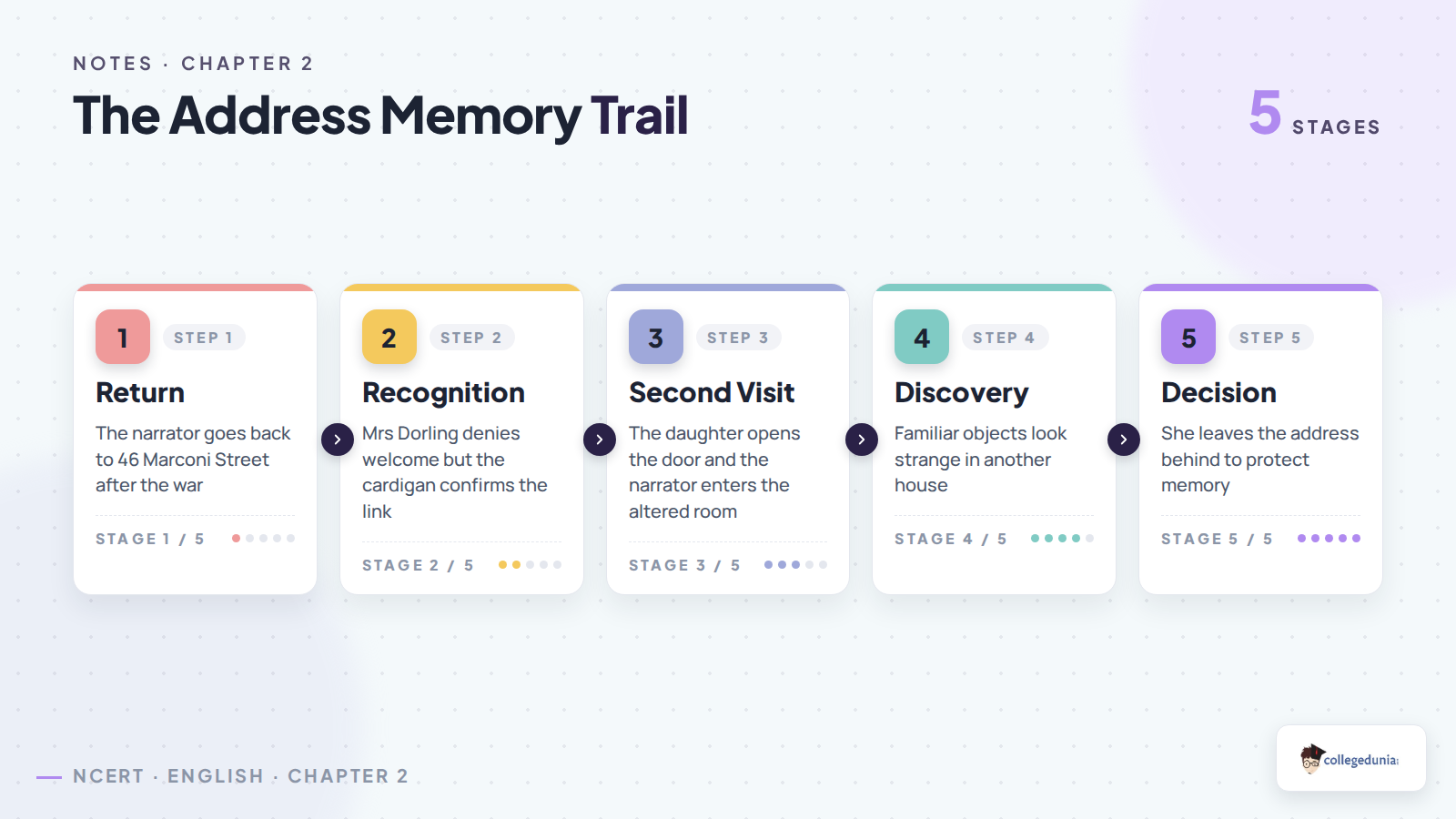
- The narrator first recognises Mrs Dorling by the cardigan that belonged to her mother.
- Mrs Dorling refuses warmth and keeps the visit short.
- On the second visit, the narrator sees her own family things arranged in a strange room.
- She leaves without claiming them because the objects can no longer rebuild her earlier life.
The Address Class 11 Explanation Video
Source: Magnet Brains on YouTube
The Address Summary for Class 11 English Snapshots
Before the war, the narrator's mother trusted Mrs Dorling with silver, cutlery, crockery, table linen and antique plates. Mrs Dorling regularly visited the house and carried items away, saying she was saving them from wartime loss. Years later, the narrator reaches Mrs Dorling's house and finds the woman wearing her mother's green knitted cardigan.
The first visit ends coldly. Mrs Dorling denies recognition and does not invite the narrator in. The second visit happens when Mrs Dorling is away. Her daughter lets the narrator enter. Inside, the narrator recognises familiar objects, but they look wrong in the new setting. The tablecloth, crockery and silver do not bring comfort. They sharpen the pain of loss.
The ending is the most important exam point. The narrator decides she does not want the address any more. Forgetting the address is not weakness. It is her way of refusing to let dead objects trap her in grief.
Mrs S and Mrs Dorling Character Contrast
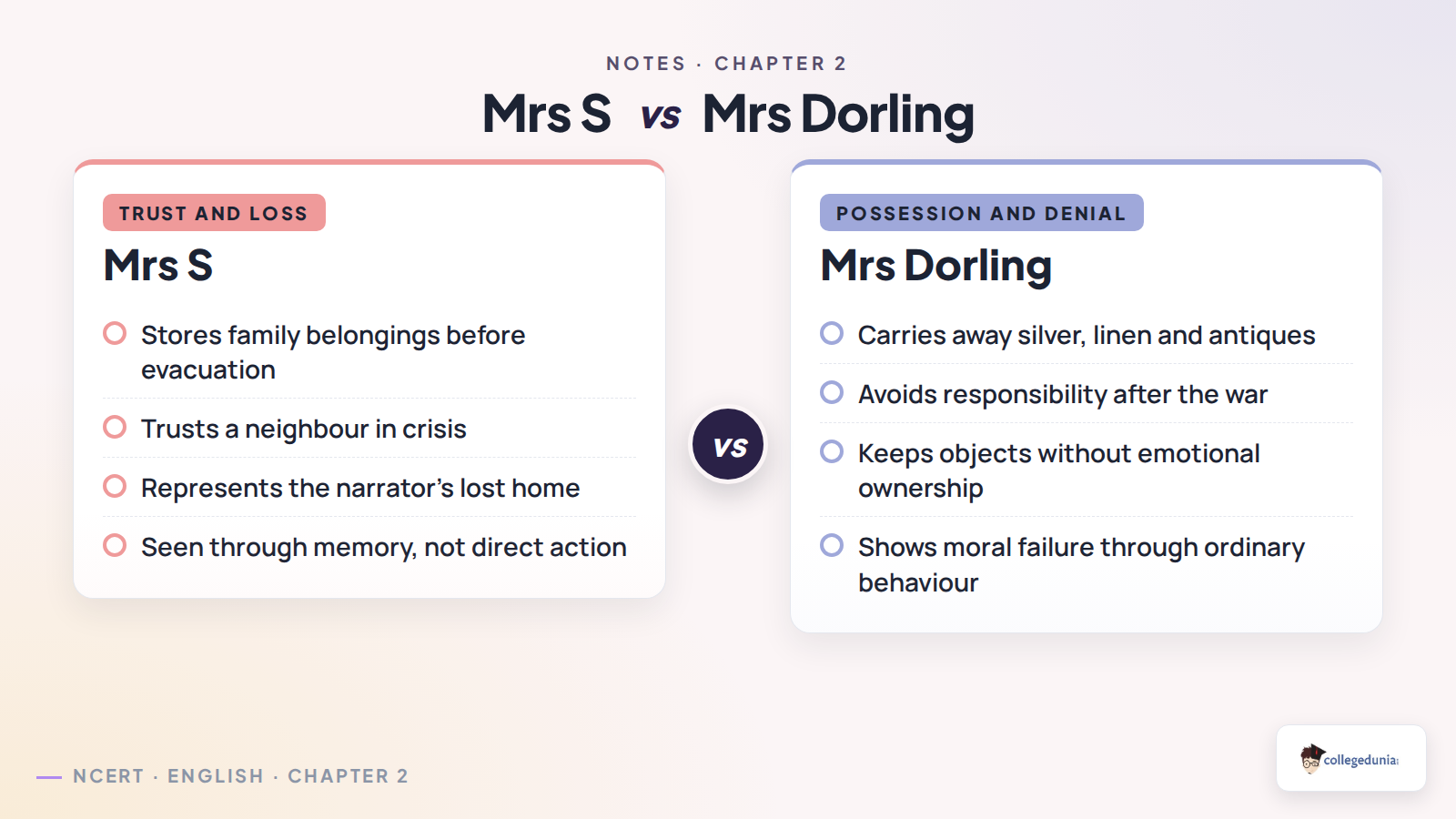
The chapter gives very little direct action from Mrs S, yet her presence controls the story. She represents trust, affection and the vanished home. Mrs Dorling represents selfish possession. She physically owns the things, but she never owns their memories or moral value.
| Character | What to remember | Exam use |
|---|---|---|
| Narrator | Wounded, observant and finally self-protective | Use for the ending and memory theme. |
| Mrs S | Trusting mother who loses home and belongings in war | Use for pre-war trust and emotional loss. |
| Mrs Dorling | Greedy, evasive and morally cold | Use for betrayal and possession without feeling. |
| Mrs Dorling's daughter | Innocent witness to inherited objects | Use for the second visit scene. |
Important Themes in The Address
The story is not only about stolen household goods. It is about war, memory, betrayal and the limits of material recovery. NCERT students should connect every theme with one concrete moment from the story.
| Theme | Core idea | Proof from the story |
|---|---|---|
| War and displacement | War breaks homes, families and ordinary routines. | The narrator returns after the war to search for traces of home. |
| Memory | Objects matter only when they keep a living emotional link. | The familiar things feel strange in Mrs Dorling's room. |
| Betrayal | Trust can be exploited during crisis. | Mrs Dorling takes the belongings and later avoids the narrator. |
| Closure | Healing may require refusing what cannot truly be recovered. | The narrator chooses to forget the address. |
How to Write Better Answers on The Address
Most answers on this chapter become strong when they stop retelling every event and instead explain the emotional change in the narrator. Use the visit to Mrs Dorling's house as evidence, then explain how the objects shift from hope to discomfort.
- For summary answers: write both visits and the final decision.
- For character answers: prove Mrs Dorling's selfishness through her cold reception and her possession of the objects.
- For theme answers: connect war loss with memory, not only with material theft.
- For ending answers: state that the narrator protects herself by refusing false restoration.
Related Resources for The Address
| Resource | Use it for | Link |
|---|---|---|
| NCERT Solutions | Full answers to textbook questions | Open NCERT Solutions |
| NCERT Book PDF | Official Snapshots source chapter | Open NCERT Book PDF |
| Handwritten Notes | Topper-style last-minute revision | Open Handwritten Notes |
All Class 11 English Snapshots Notes Chapters
| Chapter | Title | Notes Link |
|---|---|---|
| Chapter 1 | The Summer of the Beautiful White Horse | Open Notes |
| Chapter 2 | The Address | You are here |
| Chapter 3 | Mother's Day | Open Notes |
| Chapter 4 | Birth | Open Notes |
| Chapter 5 | The Tale of Melon City | Open Notes |
The Address Class 11 Notes FAQs
Ques. What is the main idea of The Address?
Ans. The main idea is that war damages memory, home and trust. The narrator learns that familiar objects cannot restore the life she has lost.
Ques. Why does the narrator forget the address?
Ans. She forgets it because the belongings look lifeless in Mrs Dorling's house. Leaving the address behind helps her move away from painful memory.
Ques. Who is Mrs Dorling in The Address?
Ans. Mrs Dorling is the woman who takes Mrs S's belongings before the war and later refuses to return emotional warmth or responsibility.
Ques. How should students revise The Address for exams?
Ans. Students should revise both visits, Mrs Dorling's character, the meaning of the objects, and the ending as an act of closure.



Comments