




The NCERT solutions for Business Studies Class 11 Chapter 10 Internal Trade cover Short Answer, Long Answer and project questions, according to the latest 2026-27 NCERT book. Each answer is based on wholesale trade, retail trade, retailer types and GST activity work from the chapter.
- PDF coverage: 19 solved items, including 9 short answers, 5 long answers and 5 projects.
- Best for: revising wholesalers, retailers, fixed shops, departmental stores and chain stores.
- Use this with: the official NCERT book, chapter notes and the all-chapters solutions table below.
Student Feedback: In a Collegedunia poll of 11,360 Class 11 Business Studies students preparing for the 2026-27 school exams, 72% said Internal Trade became easier when wholesaler and retailer services were revised in a comparison table.
Source: 2026-27 Class 11 Business Studies student poll across CBSE schools.
Every answer in this chapter set is checked against the 2026-27 NCERT Business Studies textbook and written so that students can connect the definition, service and example in one answer.
Internal Trade Meaning and Chapter Scope for Class 11
Internal Trade explains how goods move inside a country from producers to final consumers. The chapter starts with the meaning of trade, then moves into the roles of wholesalers, retailers and organised retail formats. For exam answers, students should keep the difference between wholesale and retail trade clear.
| Chapter area | What students must know | Where it helps |
|---|---|---|
| Internal trade | Buying and selling within national boundaries | Question 1 |
| Wholesalers | Bulk buying, storage, finance, advice and distribution | Questions 3, 4, 5 and 8 |
| Retailers | Final consumer link, service, selection and after-sales support | Questions 2, 6, 7 and 9 |
| Large-scale retail | Departmental stores, chain stores, cooperatives and mail order houses | Long answers 2, 3 and 5 |
| Projects | Local shop survey, resale study, retail change and GST classification | Project questions 1 to 5 |
Wholesale to Retail Flow in Internal Trade
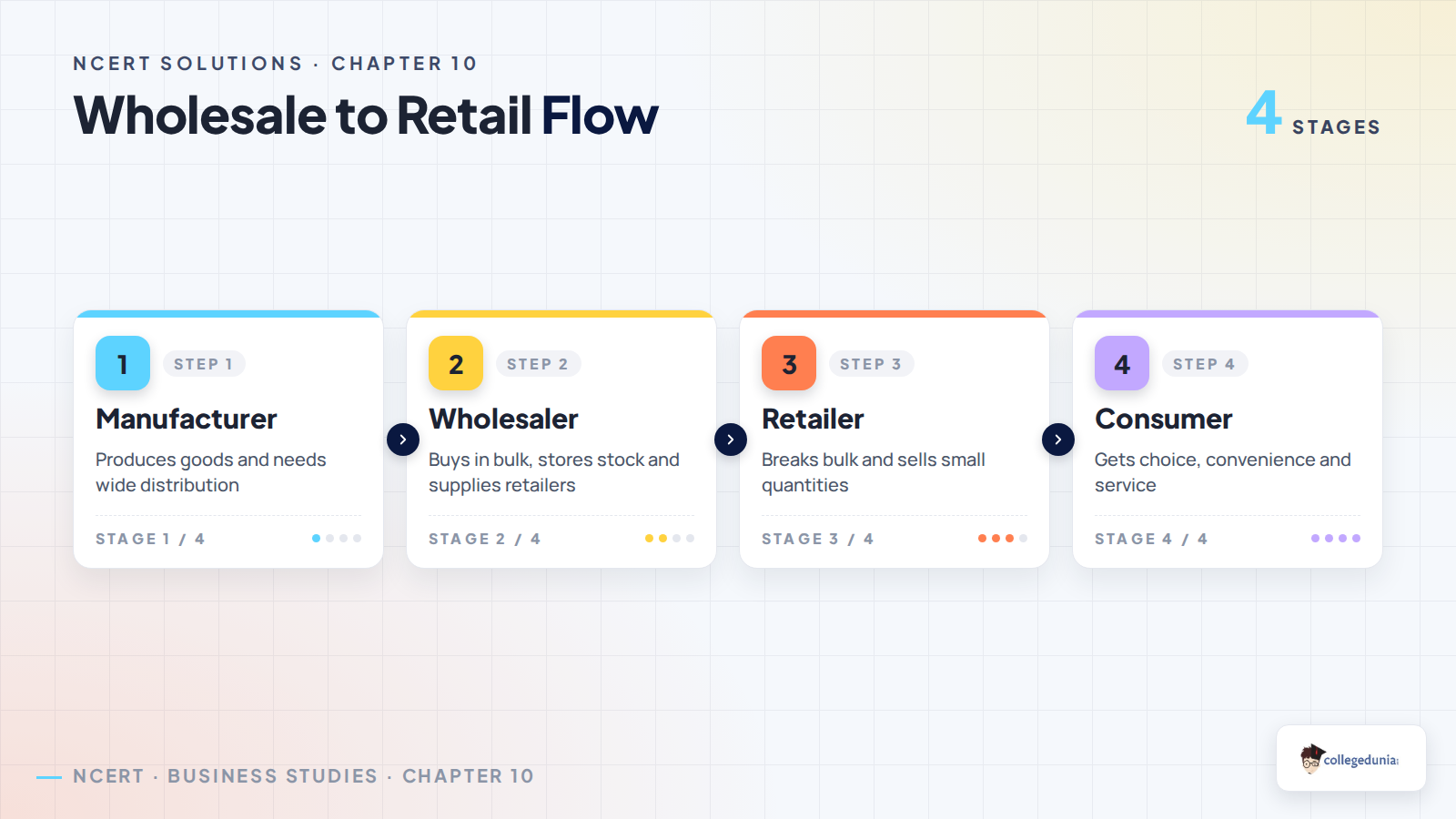
Wholesale trade means buying and selling in large quantities for resale or intermediate use. Retail trade means selling goods and services directly to final consumers. The two stages work together because manufacturers cannot reach every buyer directly across the country.
- Manufacturer: produces goods and needs wide distribution.
- Wholesaler: buys in bulk, stores goods and supplies retailers.
- Retailer: sells small quantities to final consumers.
- Consumer: receives choice, convenience, information and service.
Retailer Types Students Must Know in Internal Trade
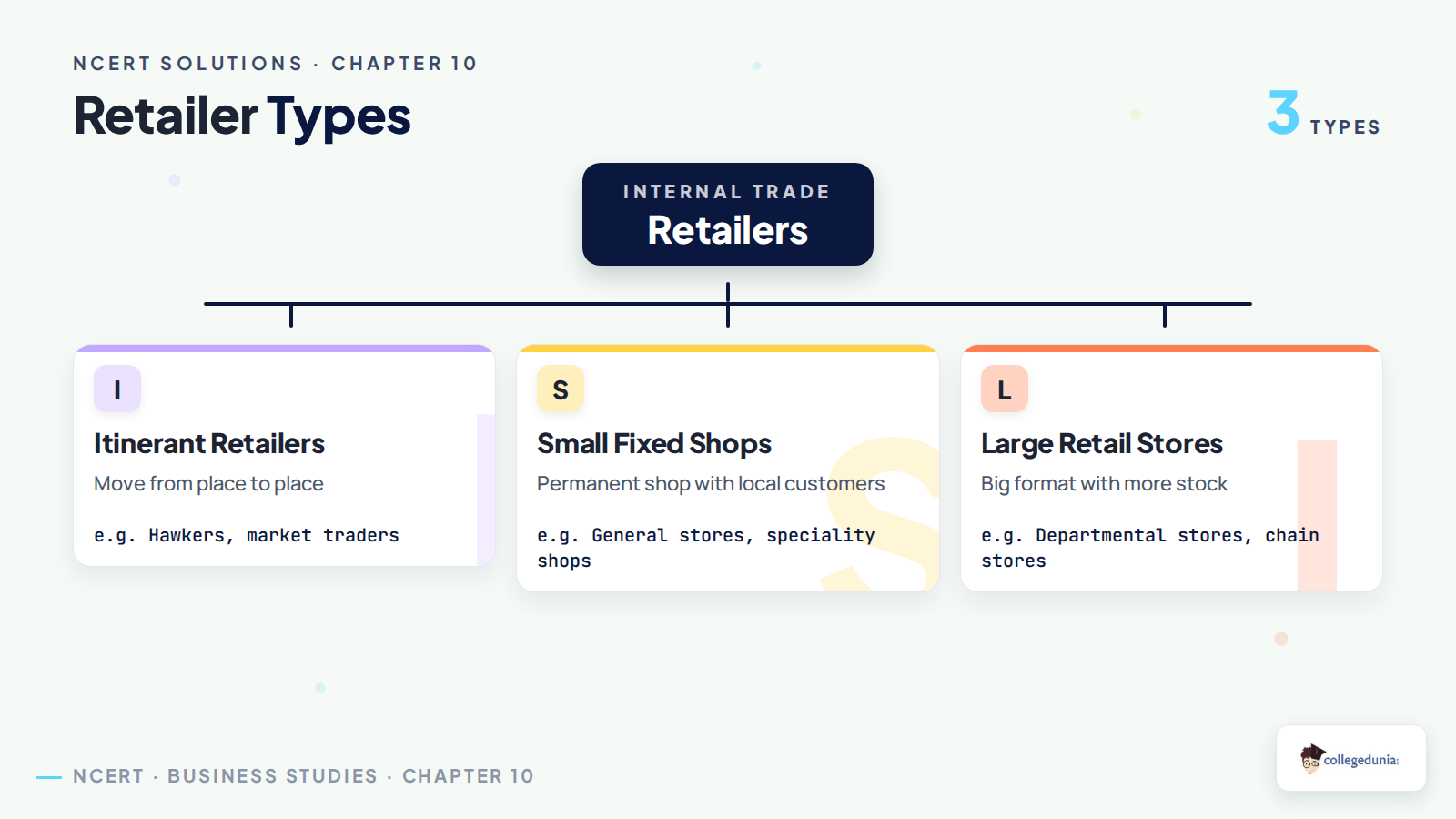
NCERT classifies retailers by movement, size and product range. Itinerant traders move from place to place, while fixed shop retailers operate from a permanent place. Fixed shops can be small stores or large retail formats.
| Retailer type | Main clue | Example |
|---|---|---|
| Peddlers and hawkers | Move door to door or street to street | Vegetable seller or toy seller |
| General stores | Sell many daily-use goods | Neighbourhood grocery shop |
| Speciality stores | Focus on one specific product category | School uniform shop |
| Departmental stores | Many departments under one roof | Large urban retail store |
| Chain stores | Many similar branches under one ownership | Branded outlet network |
How to Write Better Internal Trade Answers
Internal Trade answers score well when students use the exact retail category before explaining the example. Do not write only "shop" or "market". Name the type, then state the service, customer benefit or business feature that NCERT connects with it.
- Definition questions: write the exact meaning before examples.
- Service questions: split points into manufacturer, wholesaler, retailer and consumer sides.
- Difference questions: compare location, product range, ownership, service and customer type.
- Project answers: use real local shops and add an observation table.
Internal Trade Video Recap for Class 11 Boards
Source: Magnet Brains on YouTube
Related Business Studies Resources for Internal Trade
Use the solutions PDF for solved answers, then move to the NCERT book and notes when you want to revise the theory in a different format.
| Resource | Best use | Link |
|---|---|---|
| NCERT Book PDF | Original NCERT reading and exercise questions | Internal Trade Class 11 NCERT Book PDF |
| Notes | Quick chapter summary, retailer types and wholesaler services | Internal Trade Class 11 Notes |
| Handwritten Notes | Fast recall before a school test | Internal Trade Class 11 Handwritten Notes |
NCERT Solutions for All Class 11 Business Studies Chapters
All NCERT Solutions for Class 11 Business Studies Chapter 10 Internal Trade with Step-by-Step Solutions
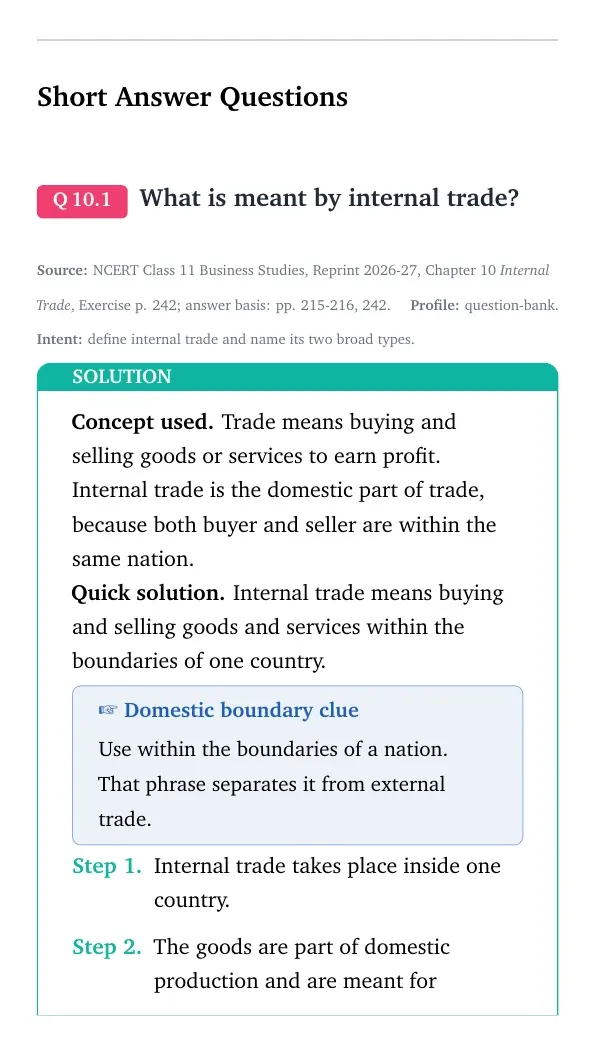
Question 1
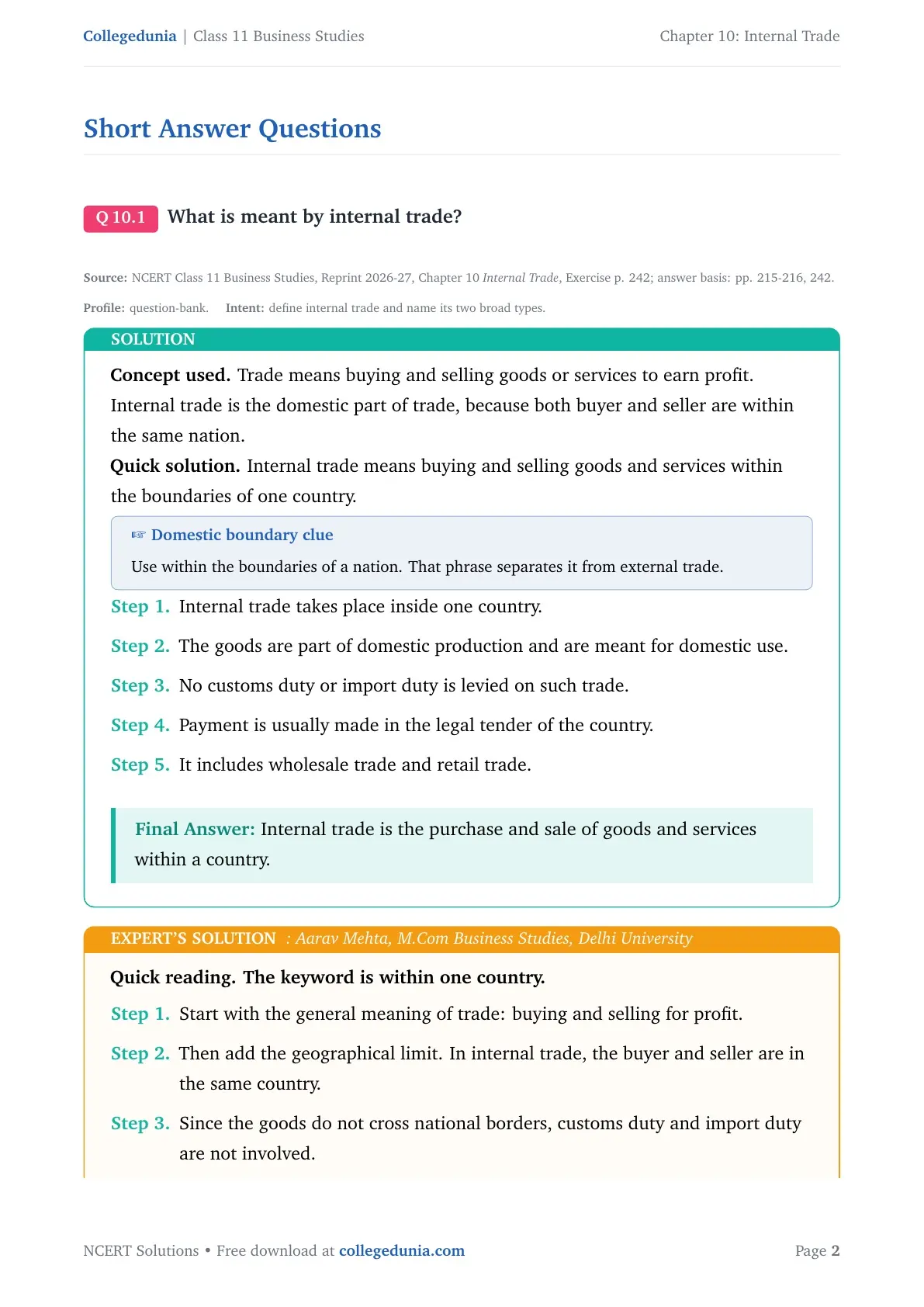
What is meant by internal trade?
Quick solution. Internal trade means buying and selling goods and services within the boundaries of one country.
Concept used. Trade means buying and selling goods or services to earn profit. Internal trade is the domestic part of trade, because both buyer and seller are within the same nation.
- Internal trade takes place inside one country.
- The goods are part of domestic production and are meant for domestic use.
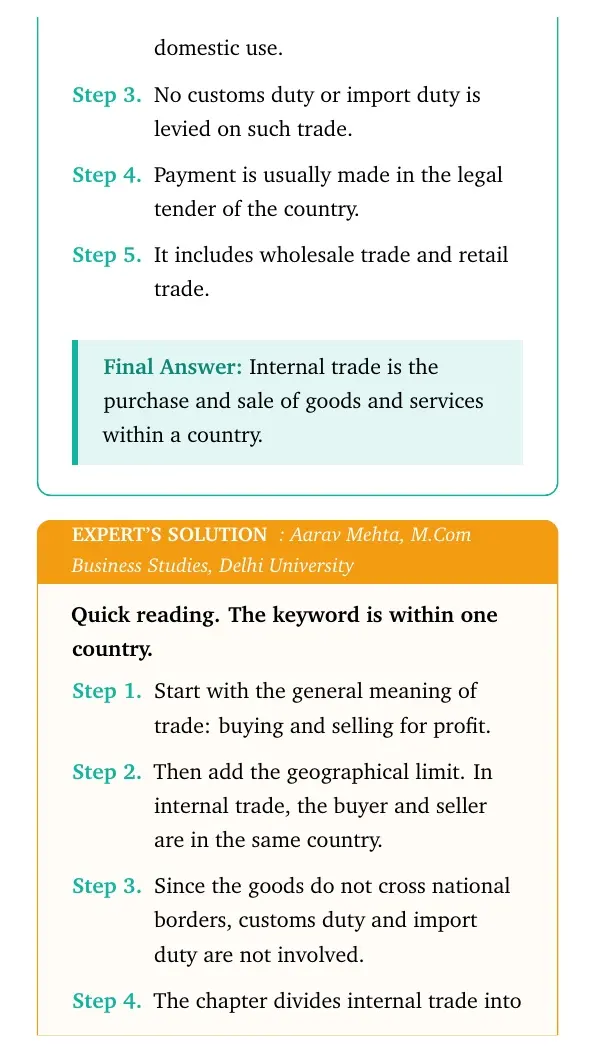
- No customs duty or import duty is levied on such trade.
- Payment is usually made in the legal tender of the country.
- It includes wholesale trade and retail trade.
Final answer: Internal trade is the purchase and sale of goods and services within a country.
Quick reading. The keyword is within one country.
- Start with the general meaning of trade: buying and selling for profit.
- Then add the geographical limit. In internal trade, the buyer and seller are in the same country.
- Since the goods do not cross national borders, customs duty and import duty are not involved.
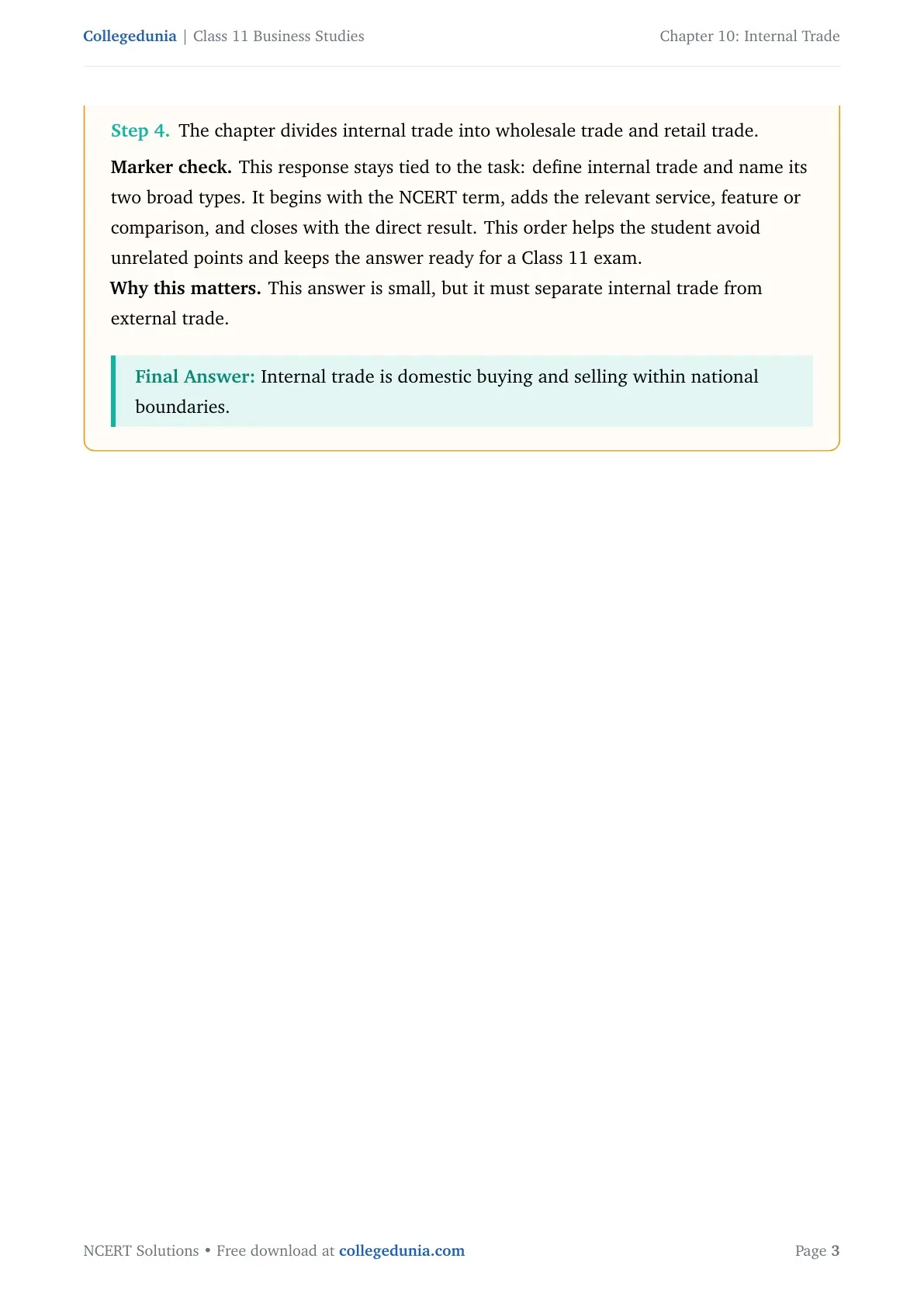
- The chapter divides internal trade into wholesale trade and retail trade.
Why this matters. This answer is small, but it must separate internal trade from external trade.
Expert answer: Internal trade is domestic buying and selling within national boundaries.
Question 2
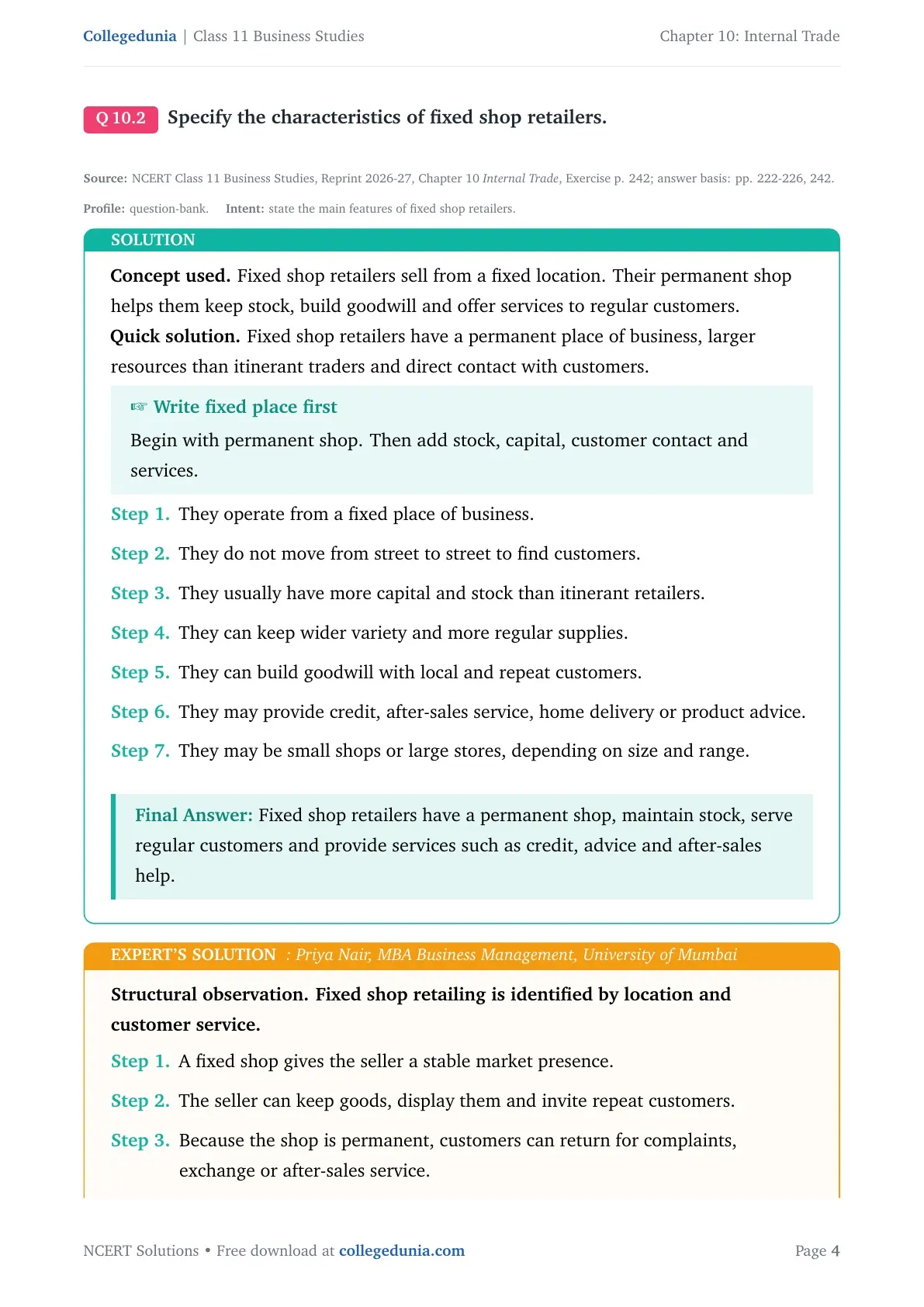
Specify the characteristics of fixed shop retailers.
Quick solution. Fixed shop retailers have a permanent place of business, larger resources than itinerant traders and direct contact with customers.
Concept used. Fixed shop retailers sell from a fixed location. Their permanent shop helps them keep stock, build goodwill and offer services to regular customers.
- They operate from a fixed place of business.
- They do not move from street to street to find customers.
- They usually have more capital and stock than itinerant retailers.
- They can keep wider variety and more regular supplies.
- They can build goodwill with local and repeat customers.
- They may provide credit, after-sales service, home delivery or product advice.
- They may be small shops or large stores, depending on size and range.
Final answer: Fixed shop retailers have a permanent shop, maintain stock, serve regular customers and provide services such as credit, advice and after-sales help.
Structural observation. Fixed shop retailing is identified by location and customer service.
- A fixed shop gives the seller a stable market presence.
- The seller can keep goods, display them and invite repeat customers.
- Because the shop is permanent, customers can return for complaints, exchange or after-sales service.
- This also allows the retailer to build trust and offer credit to known customers.
- The category includes both small fixed shops and large retail stores.
Why this matters. A feature answer scores well when each feature is a separate point.
Expert answer: Fixed shop retailers sell from a permanent place, keep regular stock and build continuing customer relations.
Question 3
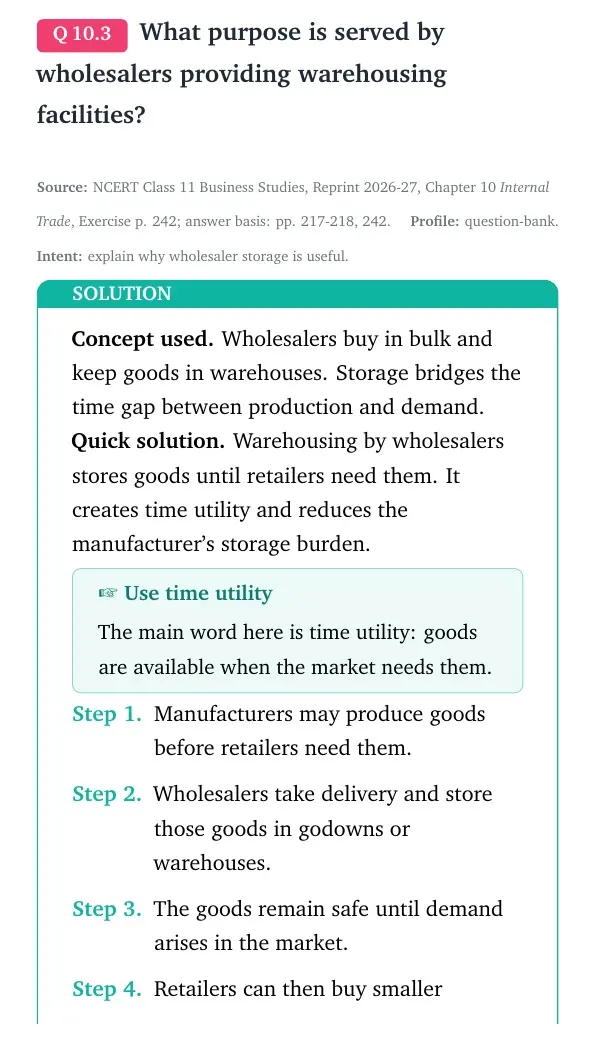
What purpose is served by wholesalers providing warehousing facilities?
Quick solution. Warehousing by wholesalers stores goods until retailers need them. It creates time utility and reduces the manufacturer's storage burden.
Concept used. Wholesalers buy in bulk and keep goods in warehouses. Storage bridges the time gap between production and demand.
- Manufacturers may produce goods before retailers need them.
- Wholesalers take delivery and store those goods in godowns or warehouses.
- The goods remain safe until demand arises in the market.
- Retailers can then buy smaller quantities as needed.
- Manufacturers do not need to keep large storage space for finished goods.
- This creates time utility because goods are available at the right time.
Final answer: Warehousing stores goods safely until demand arises, creates time utility and reduces the manufacturer's storage burden.
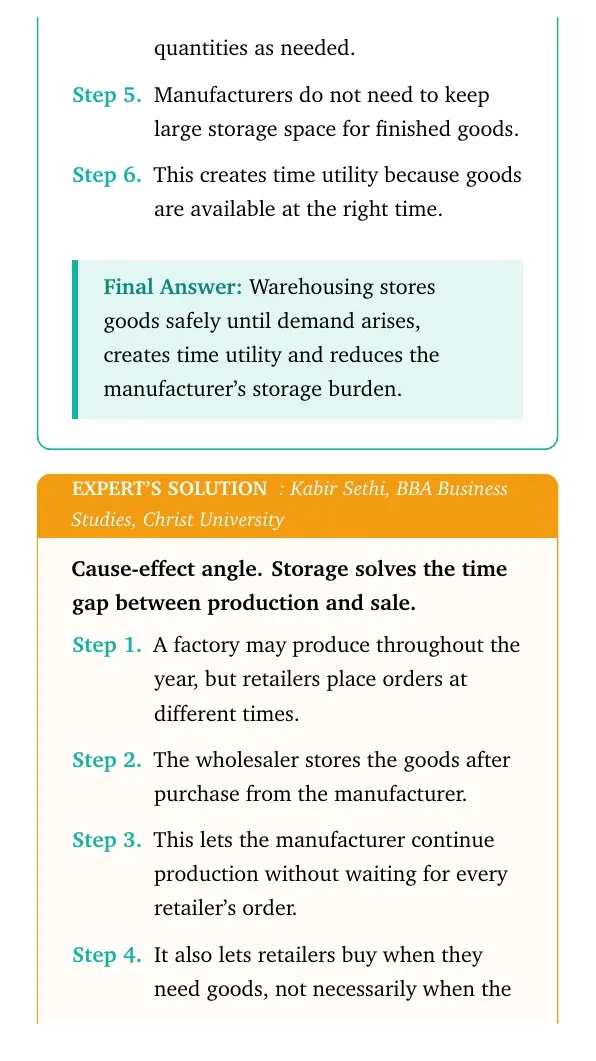
Cause-effect angle. Storage solves the time gap between production and sale.
- A factory may produce throughout the year, but retailers place orders at different times.
- The wholesaler stores the goods after purchase from the manufacturer.
- This lets the manufacturer continue production without waiting for every retailer's order.
- It also lets retailers buy when they need goods, not necessarily when the factory produces them.
- So warehousing supports regular supply and smoother distribution.
Why this matters. The answer should mention both manufacturer relief and market availability.
Expert answer: Wholesaler warehousing keeps goods ready for retailers and gives manufacturers relief from storage work.
Question 4
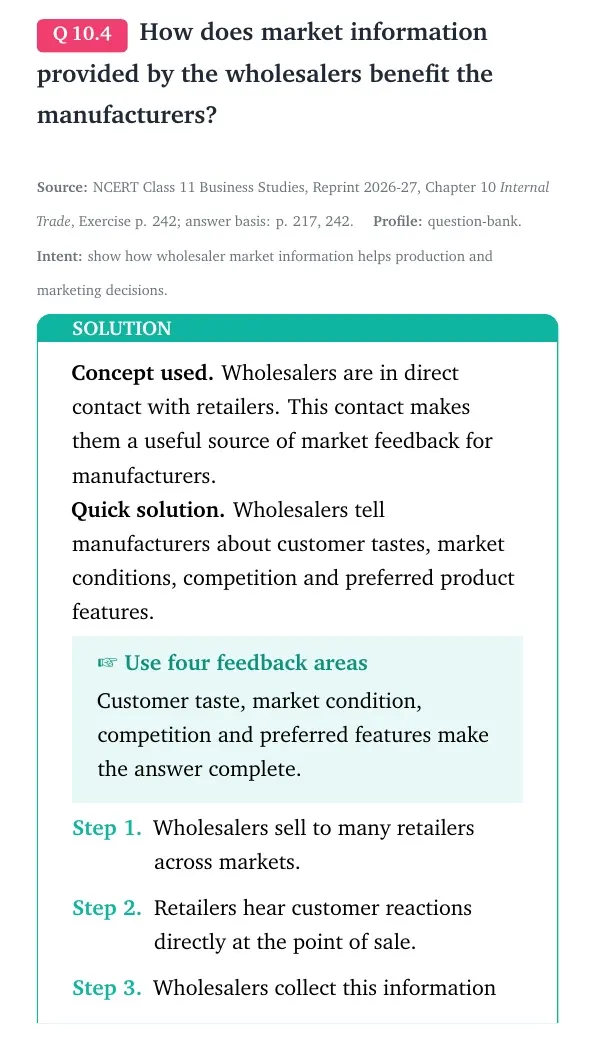
How does market information provided by the wholesalers benefit the manufacturers?
Quick solution. Wholesalers tell manufacturers about customer tastes, market conditions, competition and preferred product features.
Concept used. Wholesalers are in direct contact with retailers. This contact makes them a useful source of market feedback for manufacturers.
- Wholesalers sell to many retailers across markets.
- Retailers hear customer reactions directly at the point of sale.
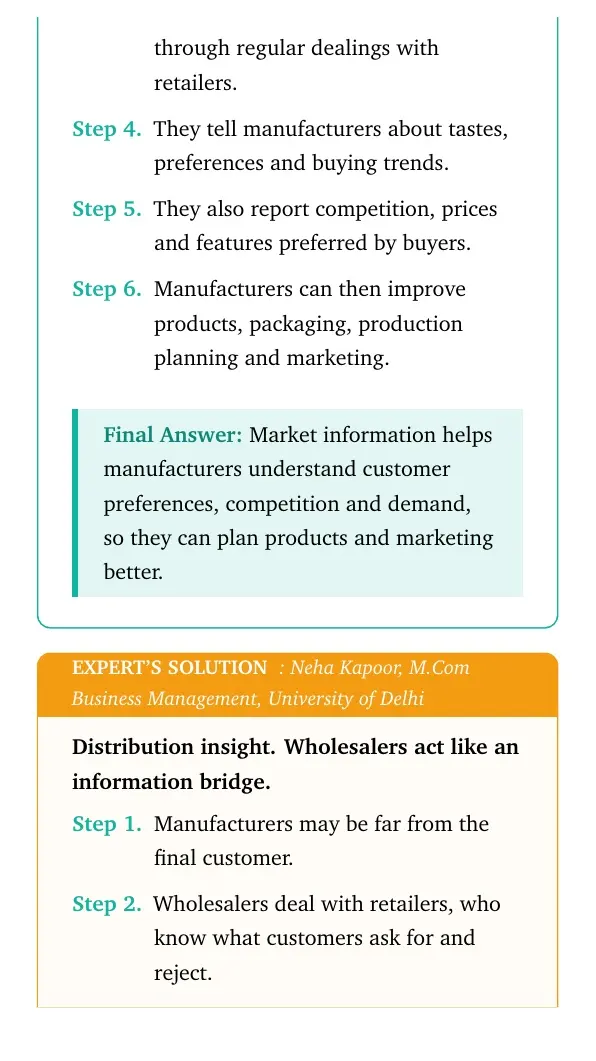
- Wholesalers collect this information through regular dealings with retailers.
- They tell manufacturers about tastes, preferences and buying trends.
- They also report competition, prices and features preferred by buyers.
- Manufacturers can then improve products, packaging, production planning and marketing.
Final answer: Market information helps manufacturers understand customer preferences, competition and demand, so they can plan products and marketing better.
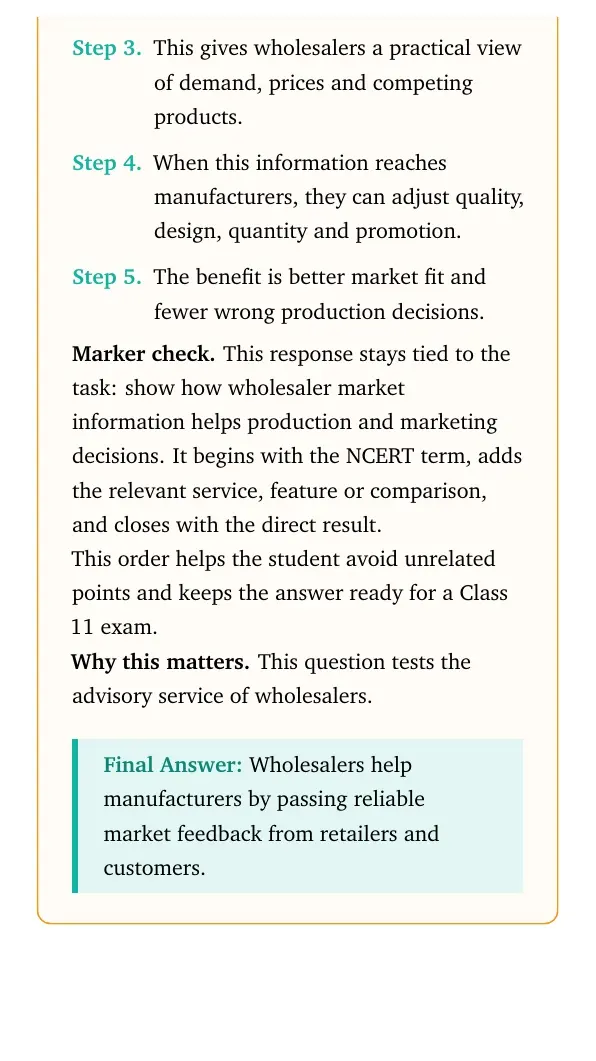
Distribution insight. Wholesalers act like an information bridge.
- Manufacturers may be far from the final customer.
- Wholesalers deal with retailers, who know what customers ask for and reject.
- This gives wholesalers a practical view of demand, prices and competing products.
- When this information reaches manufacturers, they can adjust quality, design, quantity and promotion.
- The benefit is better market fit and fewer wrong production decisions.
Why this matters. This question tests the advisory service of wholesalers.
Expert answer: Wholesalers help manufacturers by passing reliable market feedback from retailers and customers.
Question 5
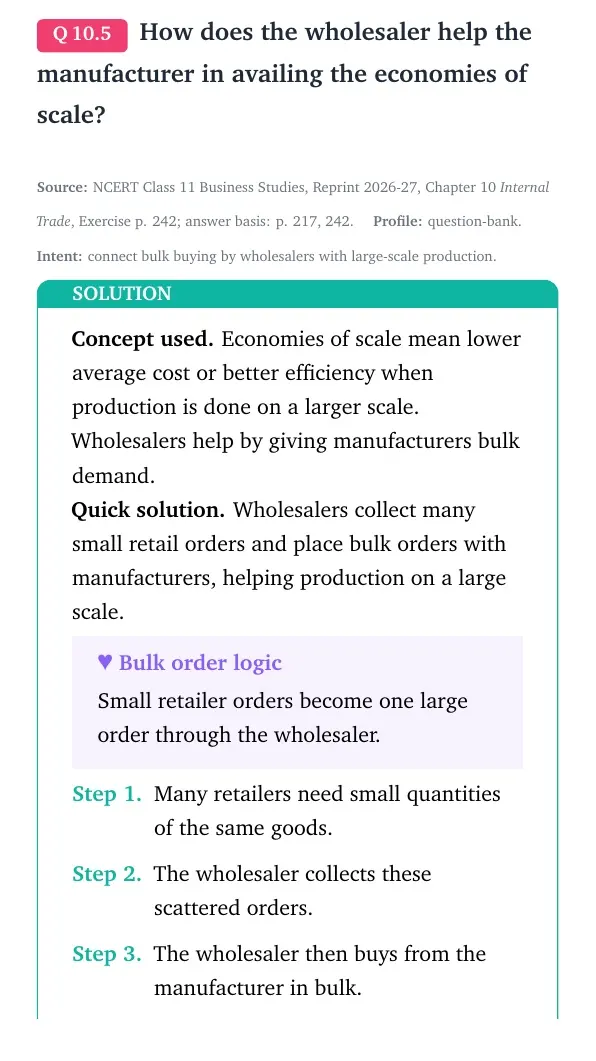
How does the wholesaler help the manufacturer in availing the economies of scale?
Quick solution. Wholesalers collect many small retail orders and place bulk orders with manufacturers, helping production on a large scale.
Concept used. Economies of scale mean lower average cost or better efficiency when production is done on a larger scale. Wholesalers help by giving manufacturers bulk demand.
- Many retailers need small quantities of the same goods.
- The wholesaler collects these scattered orders.
- The wholesaler then buys from the manufacturer in bulk.
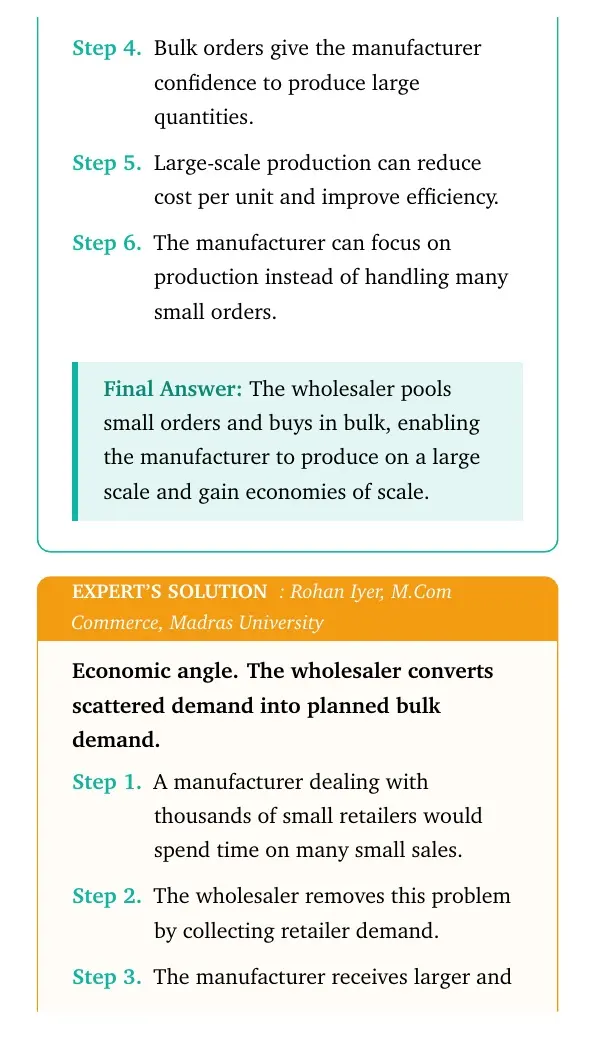
- Bulk orders give the manufacturer confidence to produce large quantities.
- Large-scale production can reduce cost per unit and improve efficiency.
- The manufacturer can focus on production instead of handling many small orders.
Final answer: The wholesaler pools small orders and buys in bulk, enabling the manufacturer to produce on a large scale and gain economies of scale.
Economic angle. The wholesaler converts scattered demand into planned bulk demand.
- A manufacturer dealing with thousands of small retailers would spend time on many small sales.
- The wholesaler removes this problem by collecting retailer demand.
- The manufacturer receives larger and more regular orders from the wholesaler.
- This makes large-scale production possible.
- Larger output can spread fixed costs and make use of machines, workers and material more efficiently.
Why this matters. The answer must link wholesaler service to cost advantage.
Expert answer: Wholesalers help economies of scale by giving manufacturers regular bulk orders.
Question 6
Distinguish between single line stores and speciality stores. Can you identify such stores in your locality?
Quick solution. Single line stores sell one product line with many varieties. Speciality stores focus on one specialised product category or customer need.
Concept used. Both are fixed shop small retailers. The difference is breadth within a line versus narrow specialisation.
- Single line stores deal in one product line, such as ready-made garments, watches or shoes.
- They keep different sizes, qualities, designs and prices within that line.
- Speciality stores sell a specific type of product or serve a specific need.
- Examples are children's garments, men's wear, school uniforms, college books or electronic accessories.
- In a locality, a footwear shop may be a single line store.
- A sports-shoe-only store or school-uniform shop may be a speciality store.
Final answer: Single line stores carry one broad line with variety. Speciality stores narrow the focus to a specific product or customer need.
Comparison method. Keep the difference in one table-like contrast.
- Single line means the shop chooses one broad line, then offers variety inside it.
- A shoe store may keep formal shoes, sandals, sports shoes and school shoes.
- Speciality means the shop narrows its identity further.
- For example, a store selling only school shoes or only children's footwear is a speciality store.
- Local examples can vary, but the classification depends on what the shop mainly sells.
Why this matters. A distinction question needs both meaning and example.
Expert answer: Single line stores are broad within one line; speciality stores are narrow and expert within one segment.
Question 7
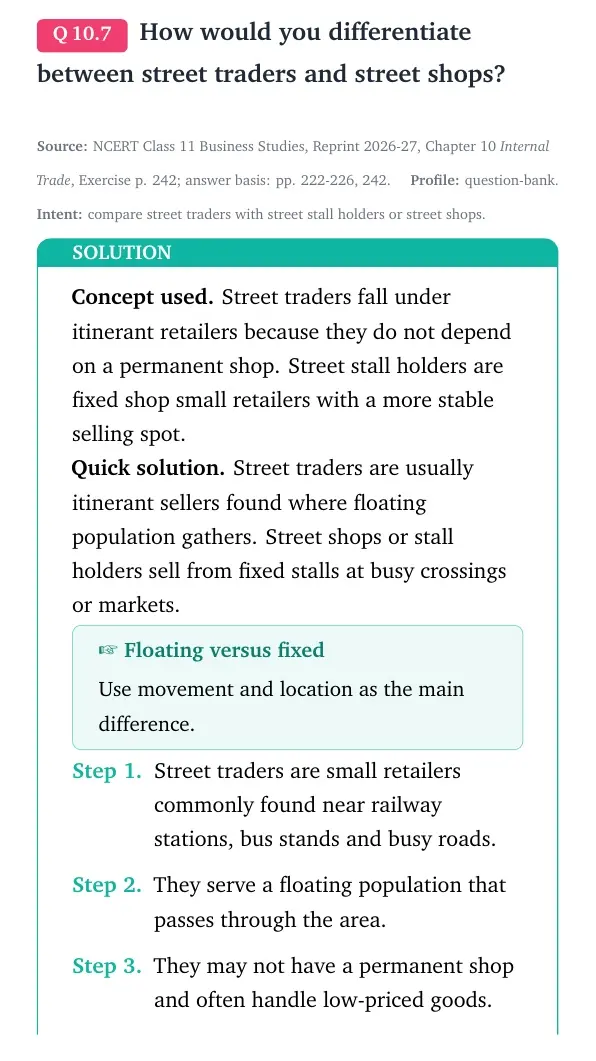
How would you differentiate between street traders and street shops?
Quick solution. Street traders are usually itinerant sellers found where floating population gathers. Street shops or stall holders sell from fixed stalls at busy crossings or markets.
Concept used. Street traders fall under itinerant retailers because they do not depend on a permanent shop. Street stall holders are fixed shop small retailers with a more stable selling spot.
- Street traders are small retailers commonly found near railway stations, bus stands and busy roads.
- They serve a floating population that passes through the area.
- They may not have a permanent shop and often handle low-priced goods.
- Street shops or street stall holders operate from a fixed stall or fixed place.
- They are also located where traffic is heavy, but customers can find them at the same spot.
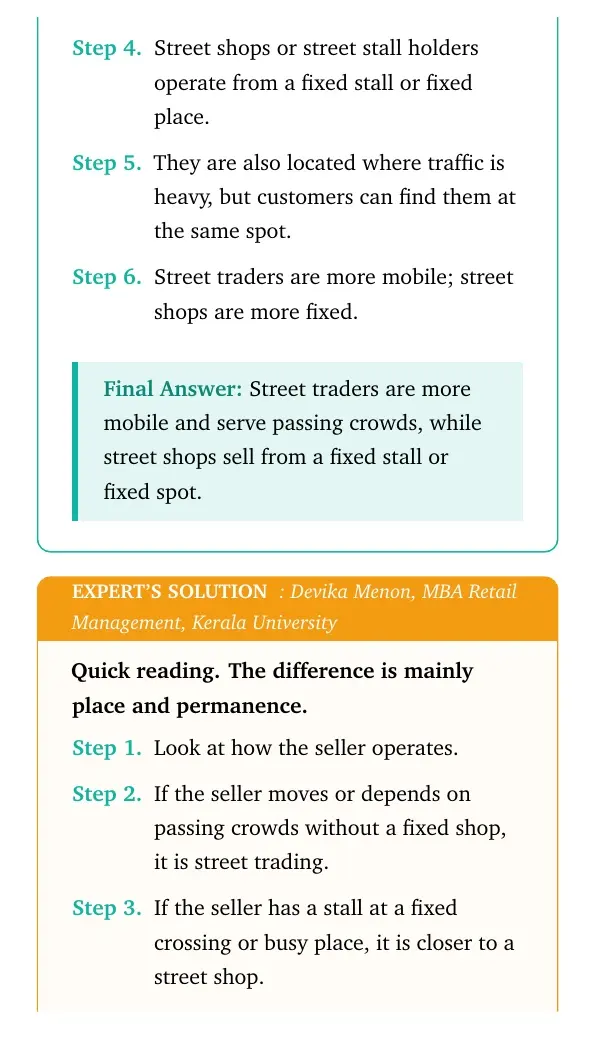
- Street traders are more mobile; street shops are more fixed.
Final answer: Street traders are more mobile and serve passing crowds, while street shops sell from a fixed stall or fixed spot.
Quick reading. The difference is mainly place and permanence.
- Look at how the seller operates.
- If the seller moves or depends on passing crowds without a fixed shop, it is street trading.
- If the seller has a stall at a fixed crossing or busy place, it is closer to a street shop.
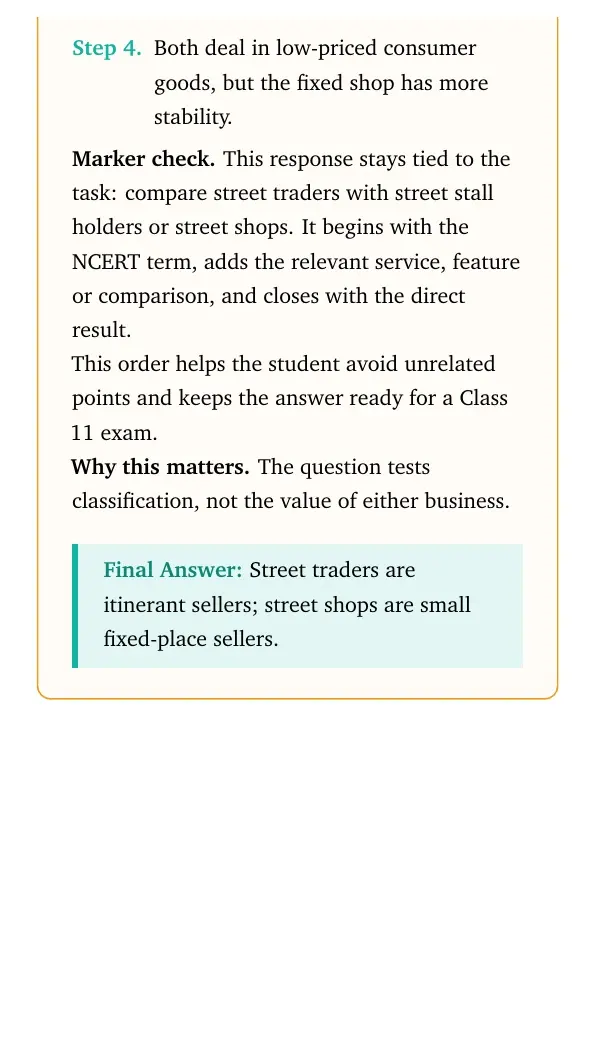
- Both deal in low-priced consumer goods, but the fixed shop has more stability.
Why this matters. The question tests classification, not the value of either business.
Expert answer: Street traders are itinerant sellers; street shops are small fixed-place sellers.
Question 8
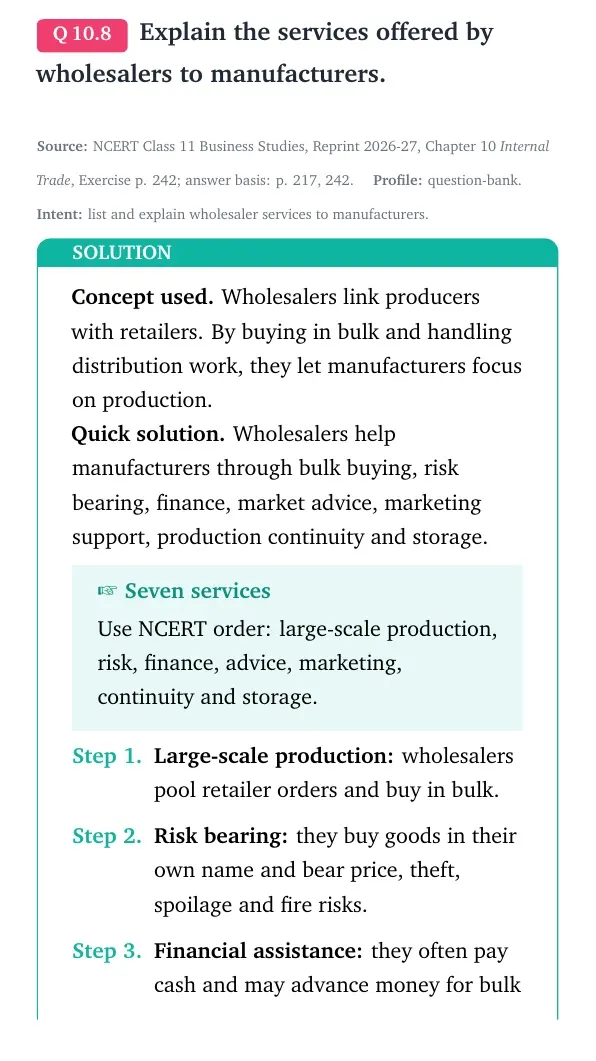
Explain the services offered by wholesalers to manufacturers.
Quick solution. Wholesalers help manufacturers through bulk buying, risk bearing, finance, market advice, marketing support, production continuity and storage.
Concept used. Wholesalers link producers with retailers. By buying in bulk and handling distribution work, they let manufacturers focus on production.
- Large-scale production: wholesalers pool retailer orders and buy in bulk.
- Risk bearing: they buy goods in their own name and bear price, theft, spoilage and fire risks.
- Financial assistance: they often pay cash and may advance money for bulk orders.
- Expert advice: they report customer tastes, market conditions and competition.
- Marketing function: they distribute goods to many retailers across areas.
- Production continuity: they buy goods as produced and store them until demand arises.
- Storage: they keep goods in warehouses and create time utility.
Final answer: Wholesalers serve manufacturers by enabling bulk production, taking risk, giving finance, sharing market information, handling distribution, supporting continuous production and storing goods.
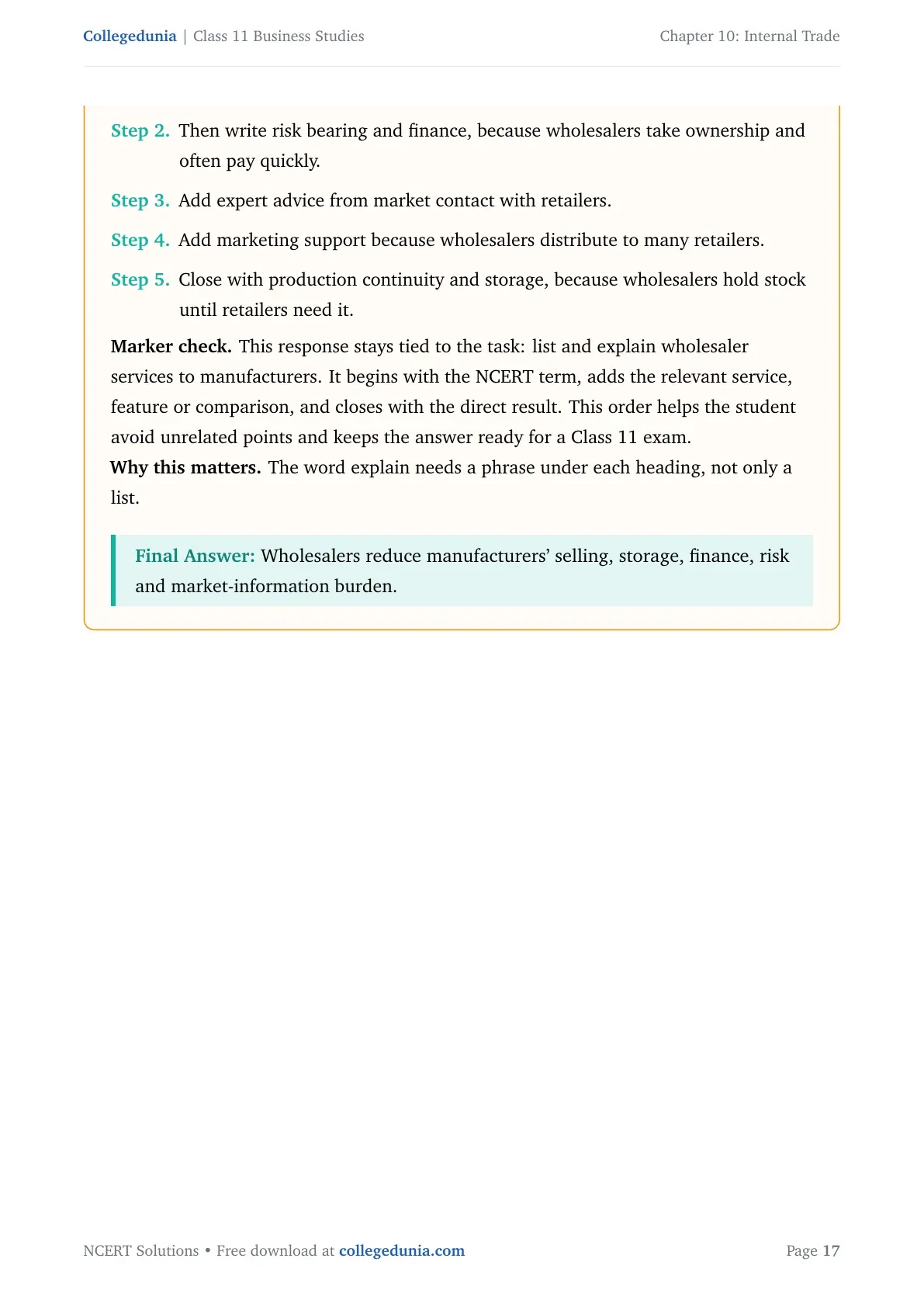
Marker checklist. This answer is best written as seven headings.
- Start with bulk buying, because it directly helps large-scale production.
- Then write risk bearing and finance, because wholesalers take ownership and often pay quickly.
- Add expert advice from market contact with retailers.
- Add marketing support because wholesalers distribute to many retailers.
- Close with production continuity and storage, because wholesalers hold stock until retailers need it.
Why this matters. The word explain needs a phrase under each heading, not only a list.
Expert answer: Wholesalers reduce manufacturers' selling, storage, finance, risk and market-information burden.
Question 9
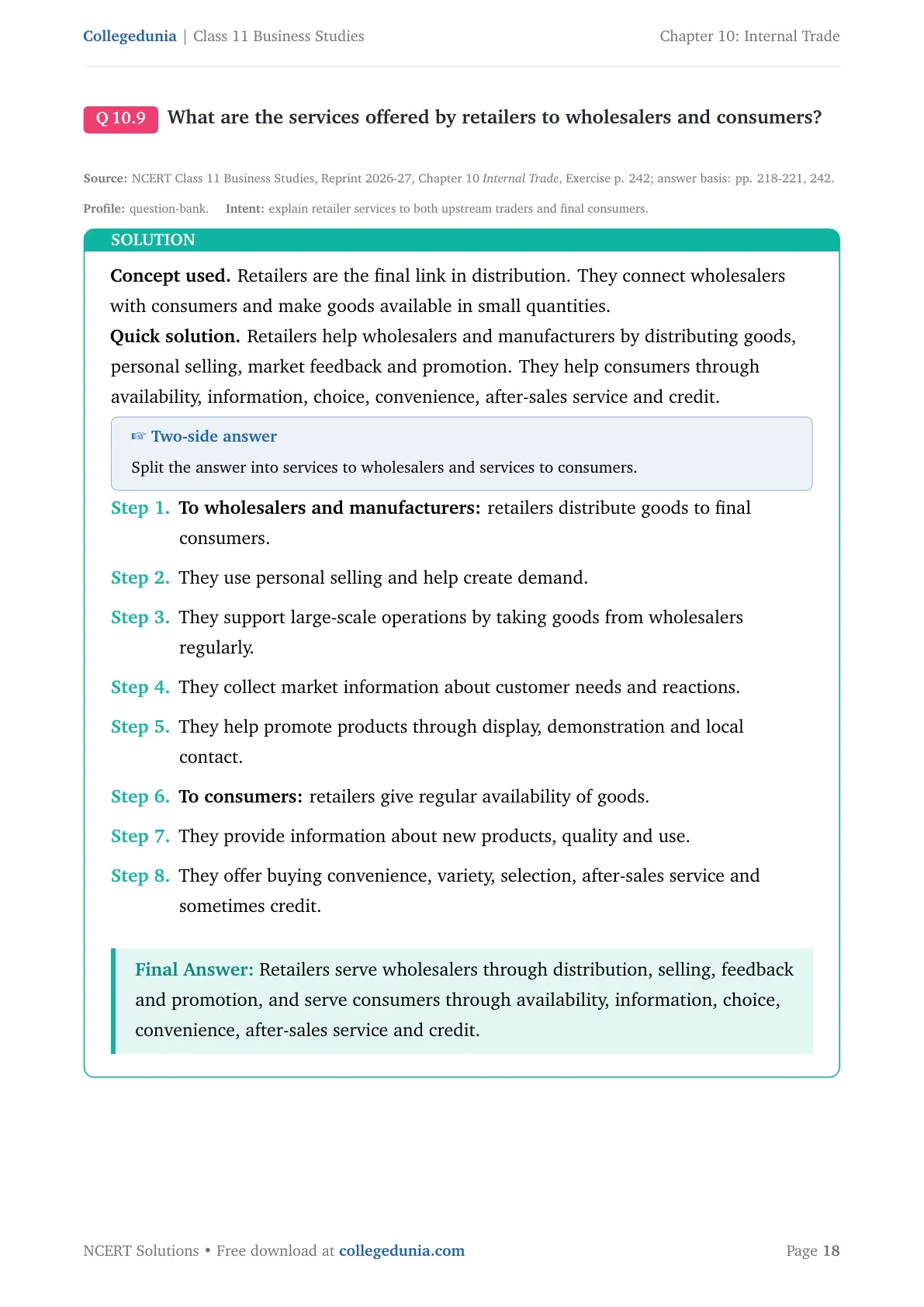
What are the services offered by retailers to wholesalers and consumers?
Quick solution. Retailers help wholesalers and manufacturers by distributing goods, personal selling, market feedback and promotion. They help consumers through availability, information, choice, convenience, after-sales service and credit.
Concept used. Retailers are the final link in distribution. They connect wholesalers with consumers and make goods available in small quantities.
- To wholesalers and manufacturers: retailers distribute goods to final consumers.
- They use personal selling and help create demand.
- They support large-scale operations by taking goods from wholesalers regularly.
- They collect market information about customer needs and reactions.
- They help promote products through display, demonstration and local contact.
- To consumers: retailers give regular availability of goods.
- They provide information about new products, quality and use.
- They offer buying convenience, variety, selection, after-sales service and sometimes credit.
Final answer: Retailers serve wholesalers through distribution, selling, feedback and promotion, and serve consumers through availability, information, choice, convenience, after-sales service and credit.
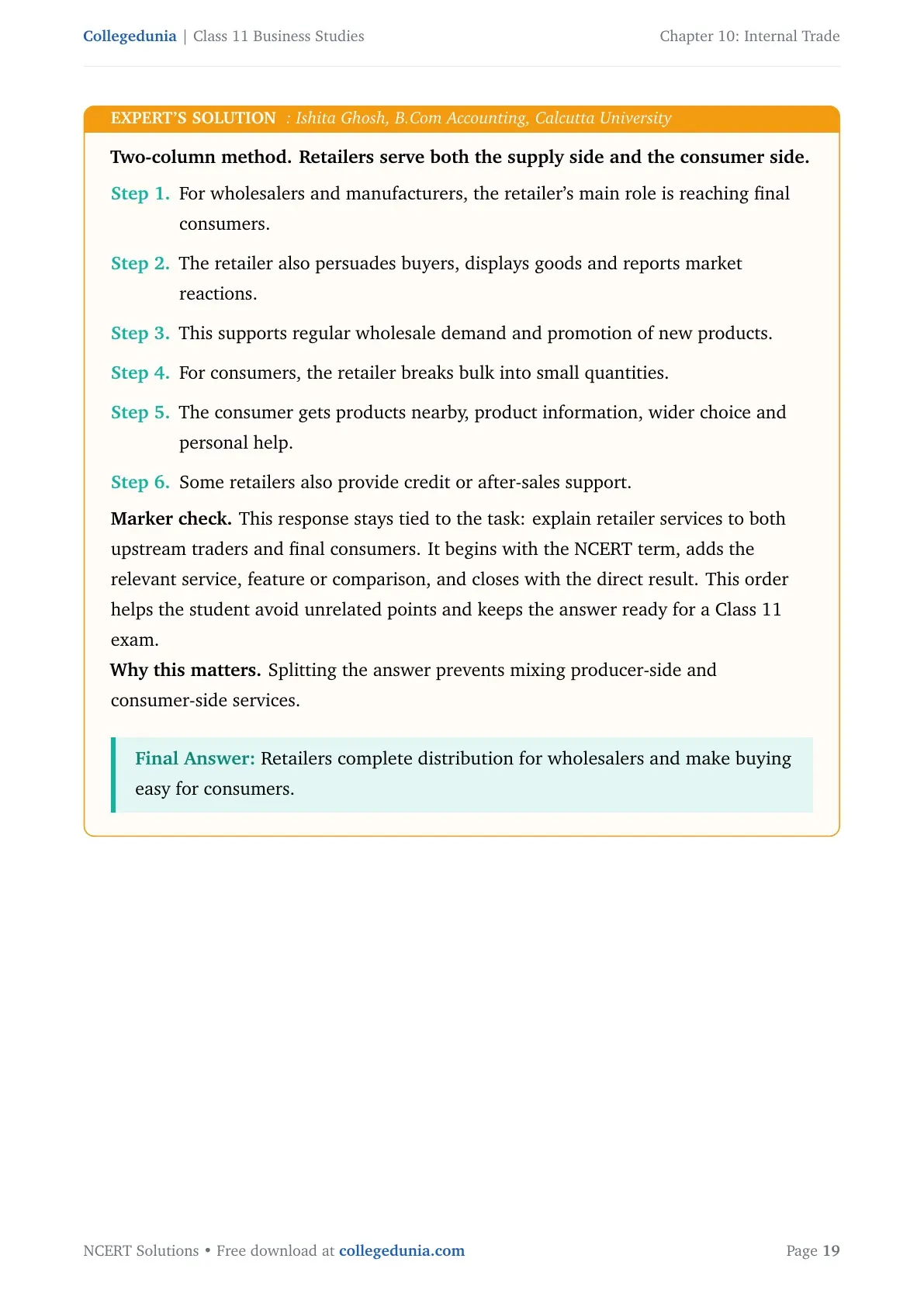
Two-column method. Retailers serve both the supply side and the consumer side.
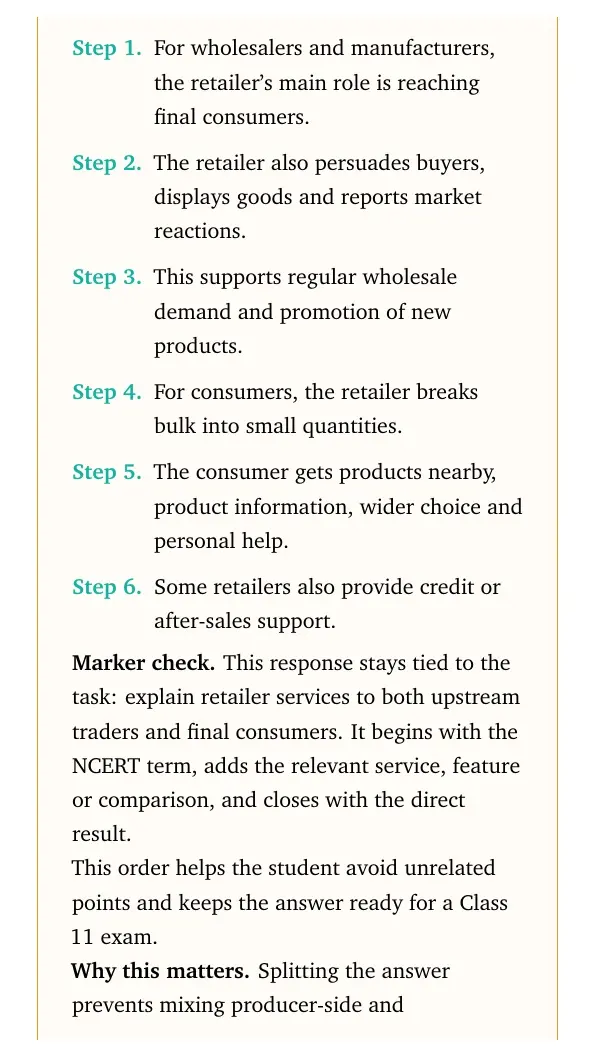
- For wholesalers and manufacturers, the retailer's main role is reaching final consumers.
- The retailer also persuades buyers, displays goods and reports market reactions.
- This supports regular wholesale demand and promotion of new products.
- For consumers, the retailer breaks bulk into small quantities.
- The consumer gets products nearby, product information, wider choice and personal help.
- Some retailers also provide credit or after-sales support.
Why this matters. Splitting the answer prevents mixing producer-side and consumer-side services.
Expert answer: Retailers complete distribution for wholesalers and make buying easy for consumers.
Question 10
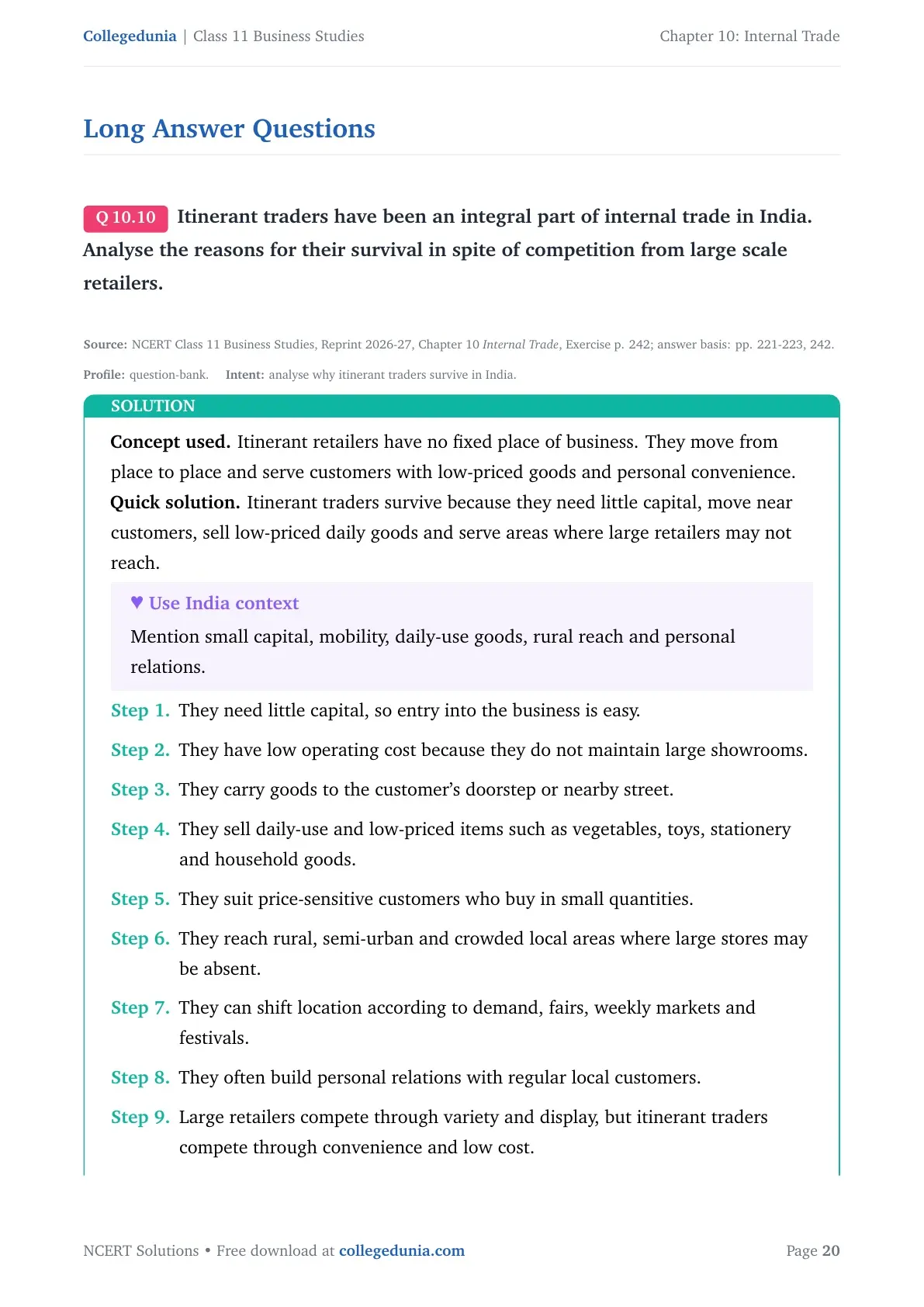
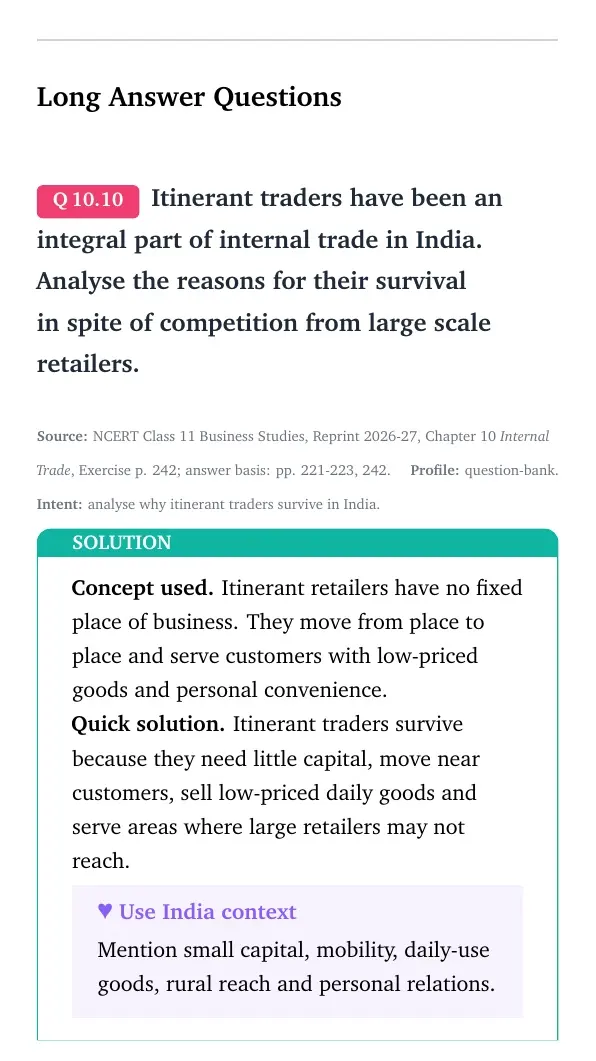
Itinerant traders have been an integral part of internal trade in India. Analyse the reasons for their survival in spite of competition from large scale retailers.
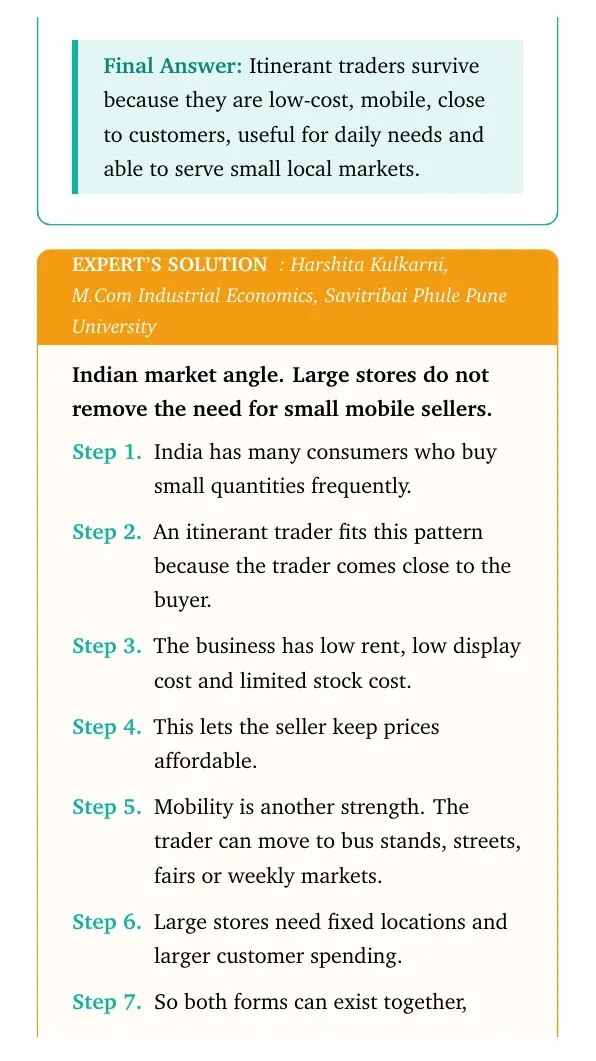
Quick solution. Itinerant traders survive because they need little capital, move near customers, sell low-priced daily goods and serve areas where large retailers may not reach.
Concept used. Itinerant retailers have no fixed place of business. They move from place to place and serve customers with low-priced goods and personal convenience.
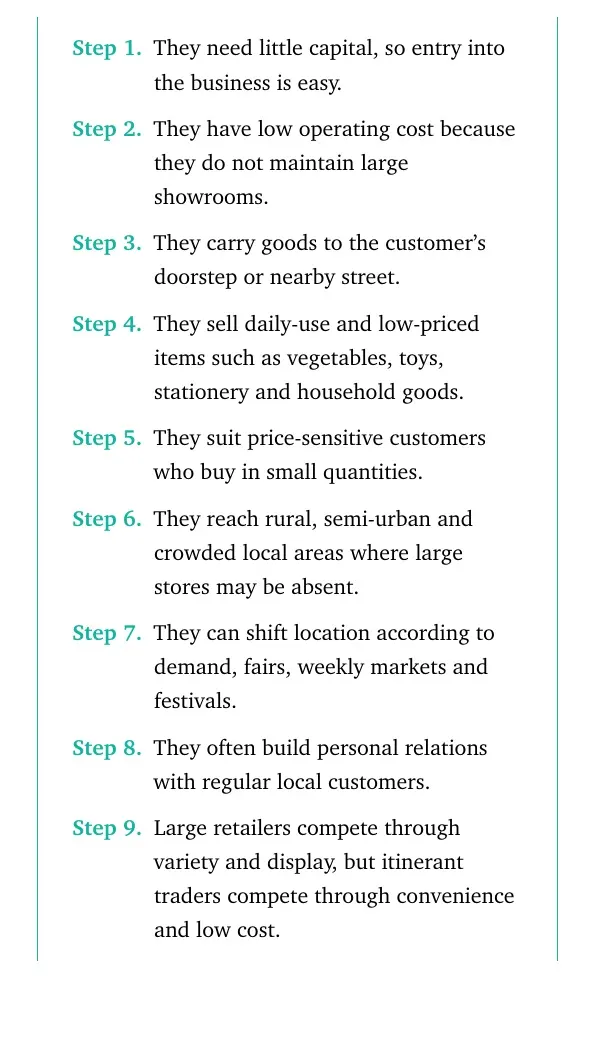
- They need little capital, so entry into the business is easy.
- They have low operating cost because they do not maintain large showrooms.
- They carry goods to the customer's doorstep or nearby street.
- They sell daily-use and low-priced items such as vegetables, toys, stationery and household goods.
- They suit price-sensitive customers who buy in small quantities.
- They reach rural, semi-urban and crowded local areas where large stores may be absent.
- They can shift location according to demand, fairs, weekly markets and festivals.
- They often build personal relations with regular local customers.
- Large retailers compete through variety and display, but itinerant traders compete through convenience and low cost.
Final answer: Itinerant traders survive because they are low-cost, mobile, close to customers, useful for daily needs and able to serve small local markets.
Indian market angle. Large stores do not remove the need for small mobile sellers.
- India has many consumers who buy small quantities frequently.
- An itinerant trader fits this pattern because the trader comes close to the buyer.
- The business has low rent, low display cost and limited stock cost.
- This lets the seller keep prices affordable.
- Mobility is another strength. The trader can move to bus stands, streets, fairs or weekly markets.
- Large stores need fixed locations and larger customer spending.
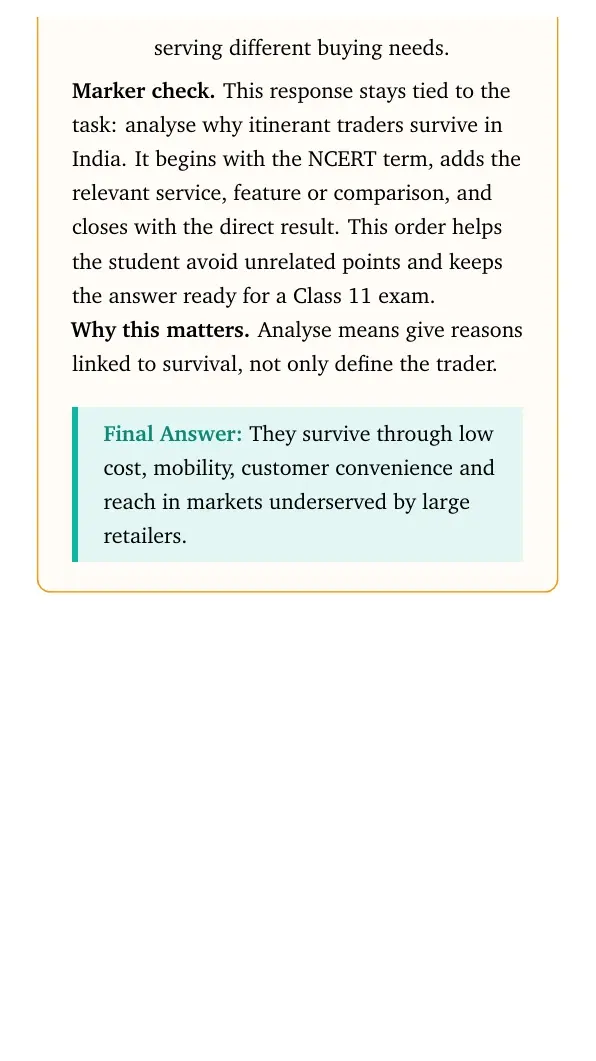
- So both forms can exist together, serving different buying needs.
Why this matters. Analyse means give reasons linked to survival, not only define the trader.
Expert answer: They survive through low cost, mobility, customer convenience and reach in markets underserved by large retailers.
Question 11
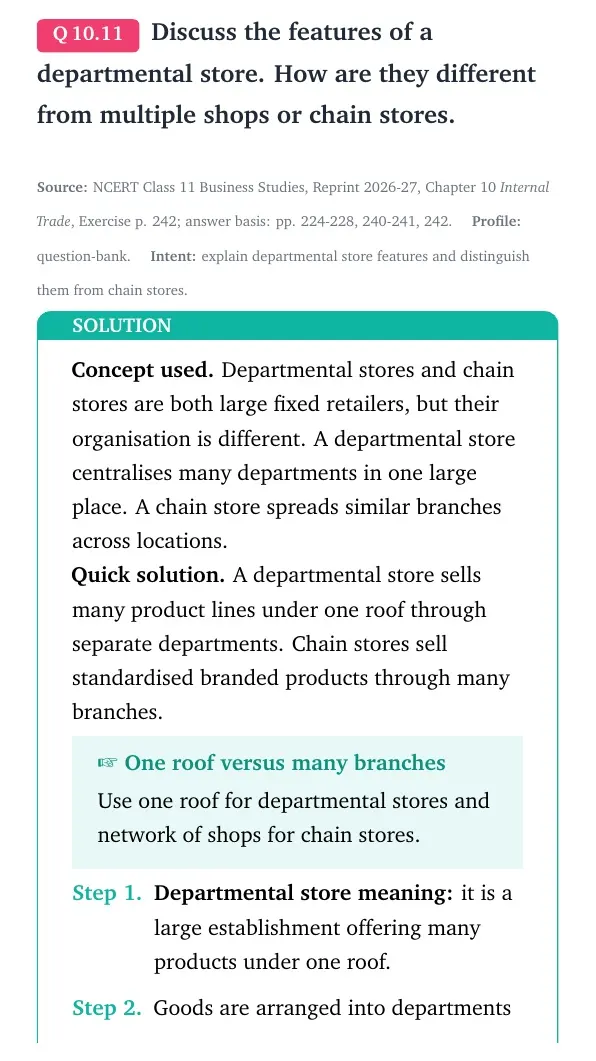
Discuss the features of a departmental store. How are they different from multiple shops or chain stores.
Quick solution. A departmental store sells many product lines under one roof through separate departments. Chain stores sell standardised branded products through many branches.
Concept used. Departmental stores and chain stores are both large fixed retailers, but their organisation is different. A departmental store centralises many departments in one large place. A chain store spreads similar branches across locations.
- Departmental store meaning: it is a large establishment offering many products under one roof.
- Goods are arranged into departments such as garments, groceries, furniture, cosmetics and stationery.
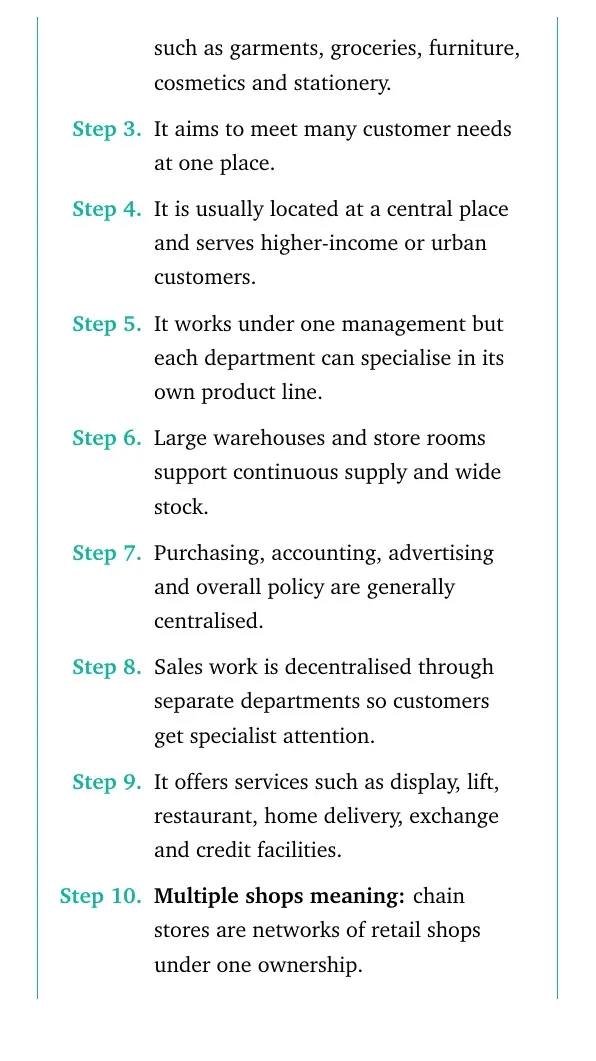
- It aims to meet many customer needs at one place.
- It is usually located at a central place and serves higher-income or urban customers.
- It works under one management but each department can specialise in its own product line.
- Large warehouses and store rooms support continuous supply and wide stock.
- Purchasing, accounting, advertising and overall policy are generally centralised.
- Sales work is decentralised through separate departments so customers get specialist attention.
- It offers services such as display, lift, restaurant, home delivery, exchange and credit facilities.
- Multiple shops meaning: chain stores are networks of retail shops under one ownership.
- They sell standardised and branded goods with rapid turnover.
- Branches are located in different areas and follow common pricing and policy.
- Location: departmental stores are usually at a central place; chain stores open branches in many localities.
- Range: departmental stores carry many product lines; chain stores carry a limited range of standardised goods.
- Services: departmental stores provide wider services; chain stores usually keep services limited.
- Pricing: departmental stores may charge higher prices for facilities; chain stores use fixed and uniform prices.
- Class of customers: departmental stores mainly attract urban and higher-income customers; chain stores serve a wider mass market.
- Credit facilities: departmental stores may provide credit; chain stores usually sell on cash terms.
- Flexibility: chain stores can shift or close a branch more easily; departmental stores are less flexible because one large establishment needs heavy capital.
Final answer: Departmental stores offer many departments, large stock, centralised buying and rich services under one roof, while chain stores operate many similar branches selling standardised goods with uniform prices and limited services.
Comparison frame. Departmental stores are centralised variety; chain stores are distributed standardisation.
- A departmental store is built around customer convenience at one place.
- A customer can buy many unrelated product lines from different departments.
- This store needs heavy capital, central location, trained staff, warehousing and attractive services.
- Its organisation combines centralised buying, accounts and advertising with department-wise selling.
- A multiple shop or chain store follows a different model.
- It opens many branches under the same ownership and sells standardised goods.
- The chain gains economies of scale through central buying and uniform display.
- So the comparison should cover location, range, services, pricing, class of customers, credit and flexibility.
Why this matters. This long answer should explain features before the contrast.
Expert answer: Departmental stores centralise wide variety, services and credit at one location; chain stores multiply similar outlets with standardised goods, uniform pricing, cash sales and greater branch flexibility.
Question 12
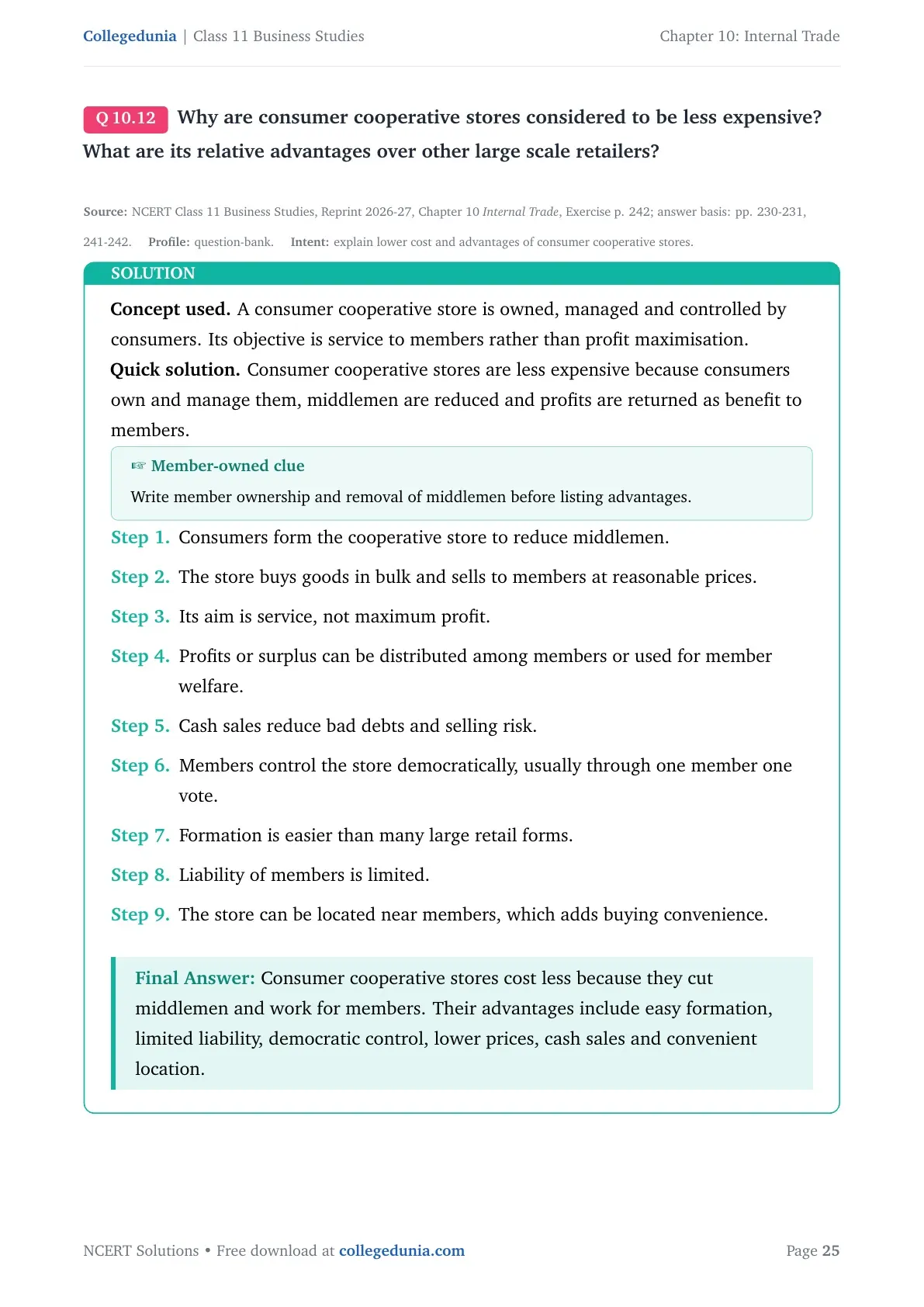
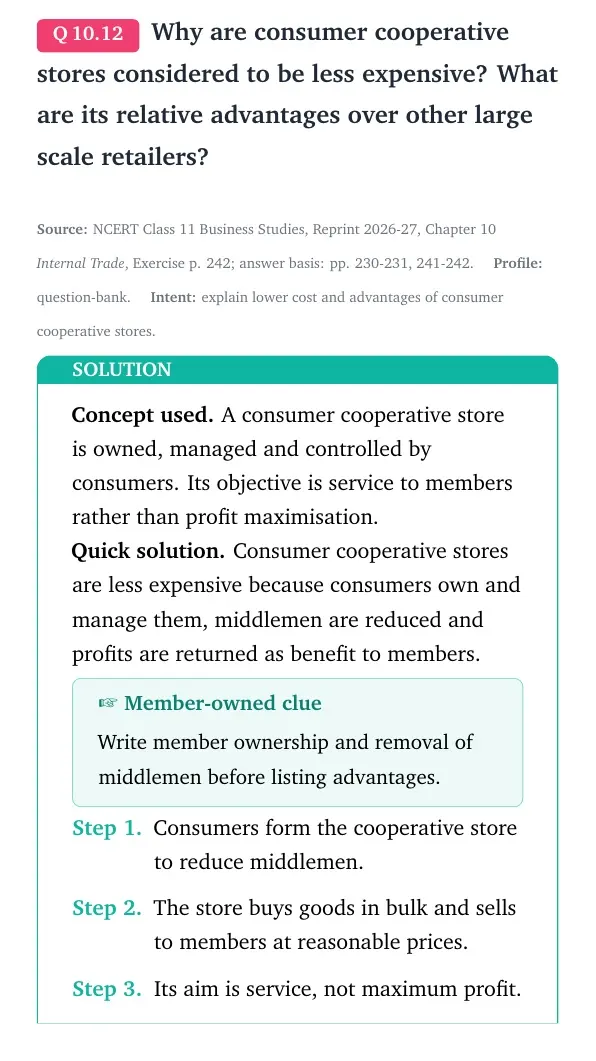
Why are consumer cooperative stores considered to be less expensive? What are its relative advantages over other large scale retailers?
Quick solution. Consumer cooperative stores are less expensive because consumers own and manage them, middlemen are reduced and profits are returned as benefit to members.
Concept used. A consumer cooperative store is owned, managed and controlled by consumers. Its objective is service to members rather than profit maximisation.
- Consumers form the cooperative store to reduce middlemen.
- The store buys goods in bulk and sells to members at reasonable prices.
- Its aim is service, not maximum profit.
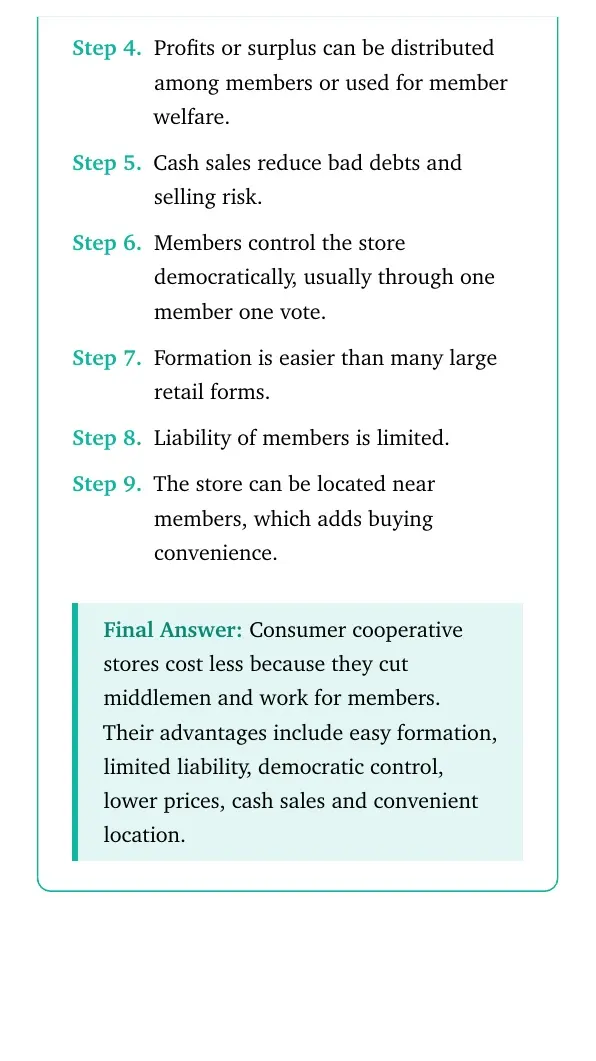
- Profits or surplus can be distributed among members or used for member welfare.
- Cash sales reduce bad debts and selling risk.
- Members control the store democratically, usually through one member one vote.
- Formation is easier than many large retail forms.
- Liability of members is limited.
- The store can be located near members, which adds buying convenience.
Final answer: Consumer cooperative stores cost less because they cut middlemen and work for members. Their advantages include easy formation, limited liability, democratic control, lower prices, cash sales and convenient location.
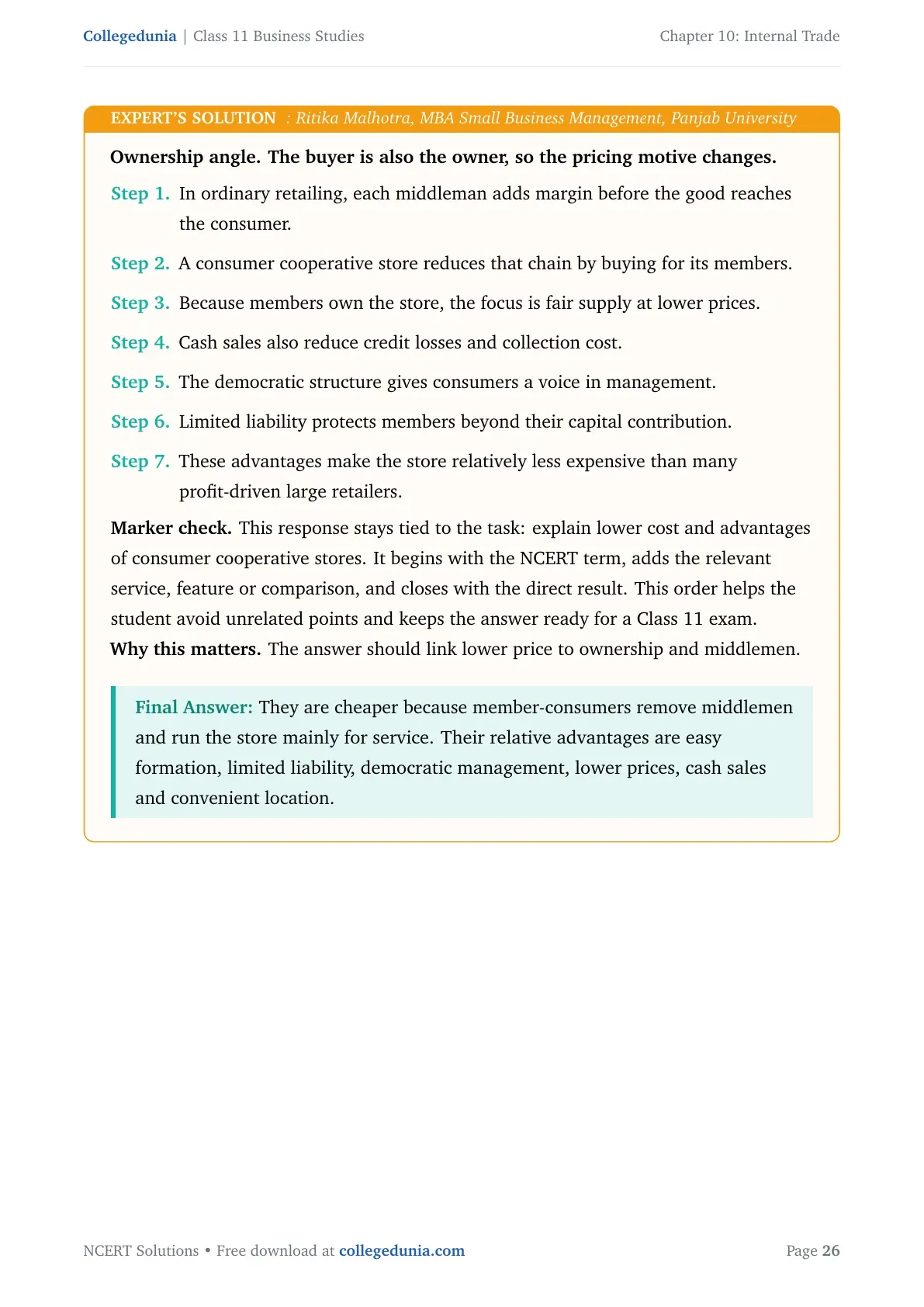
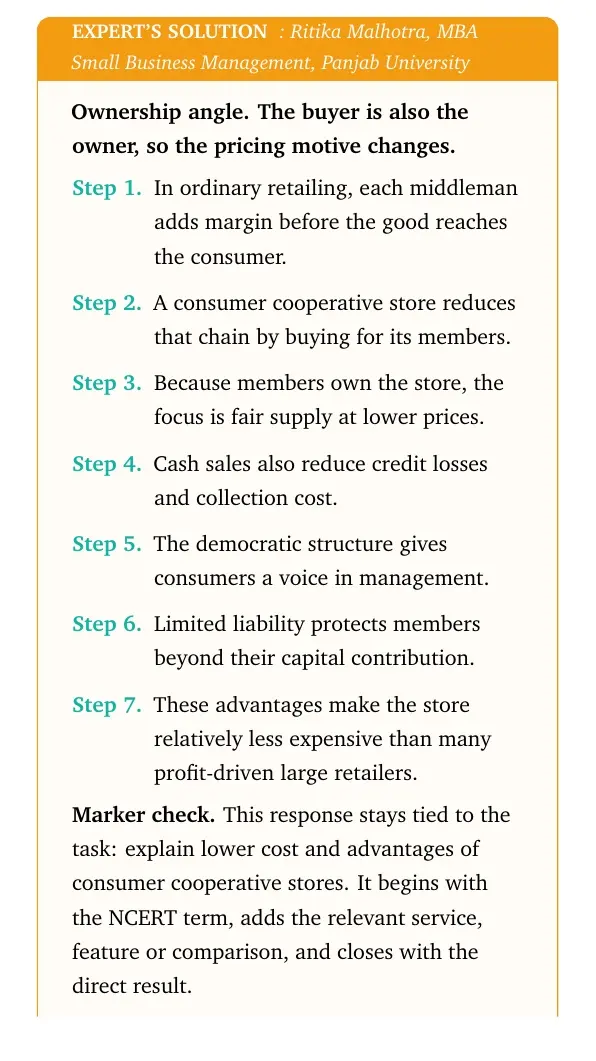
Ownership angle. The buyer is also the owner, so the pricing motive changes.
- In ordinary retailing, each middleman adds margin before the good reaches the consumer.
- A consumer cooperative store reduces that chain by buying for its members.
- Because members own the store, the focus is fair supply at lower prices.
- Cash sales also reduce credit losses and collection cost.
- The democratic structure gives consumers a voice in management.
- Limited liability protects members beyond their capital contribution.
- These advantages make the store relatively less expensive than many profit-driven large retailers.
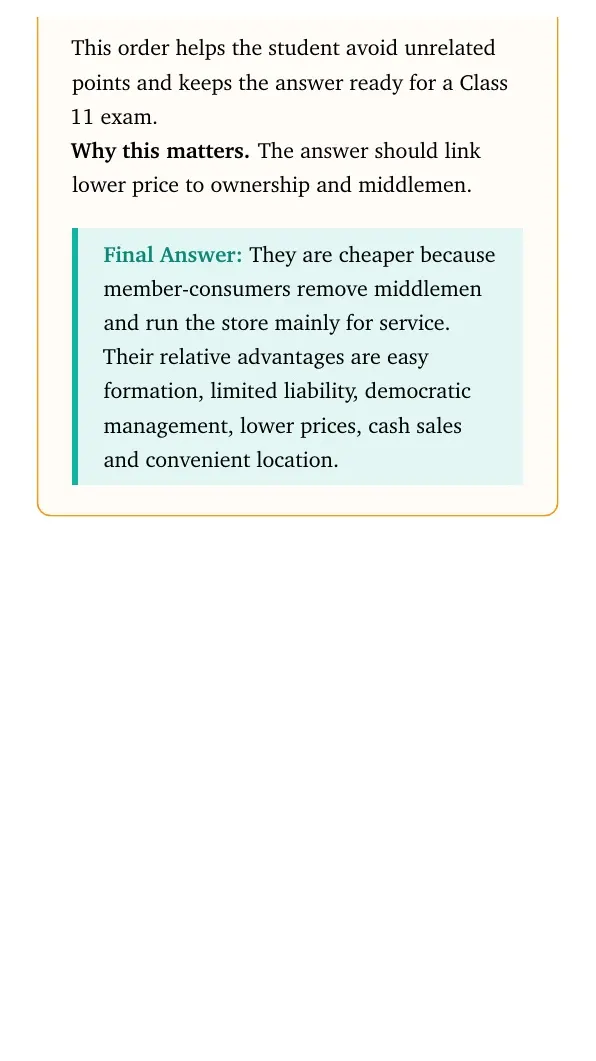
Why this matters. The answer should link lower price to ownership and middlemen.
Expert answer: They are cheaper because member-consumers remove middlemen and run the store mainly for service. Their relative advantages are easy formation, limited liability, democratic management, lower prices, cash sales and convenient location.
Question 13
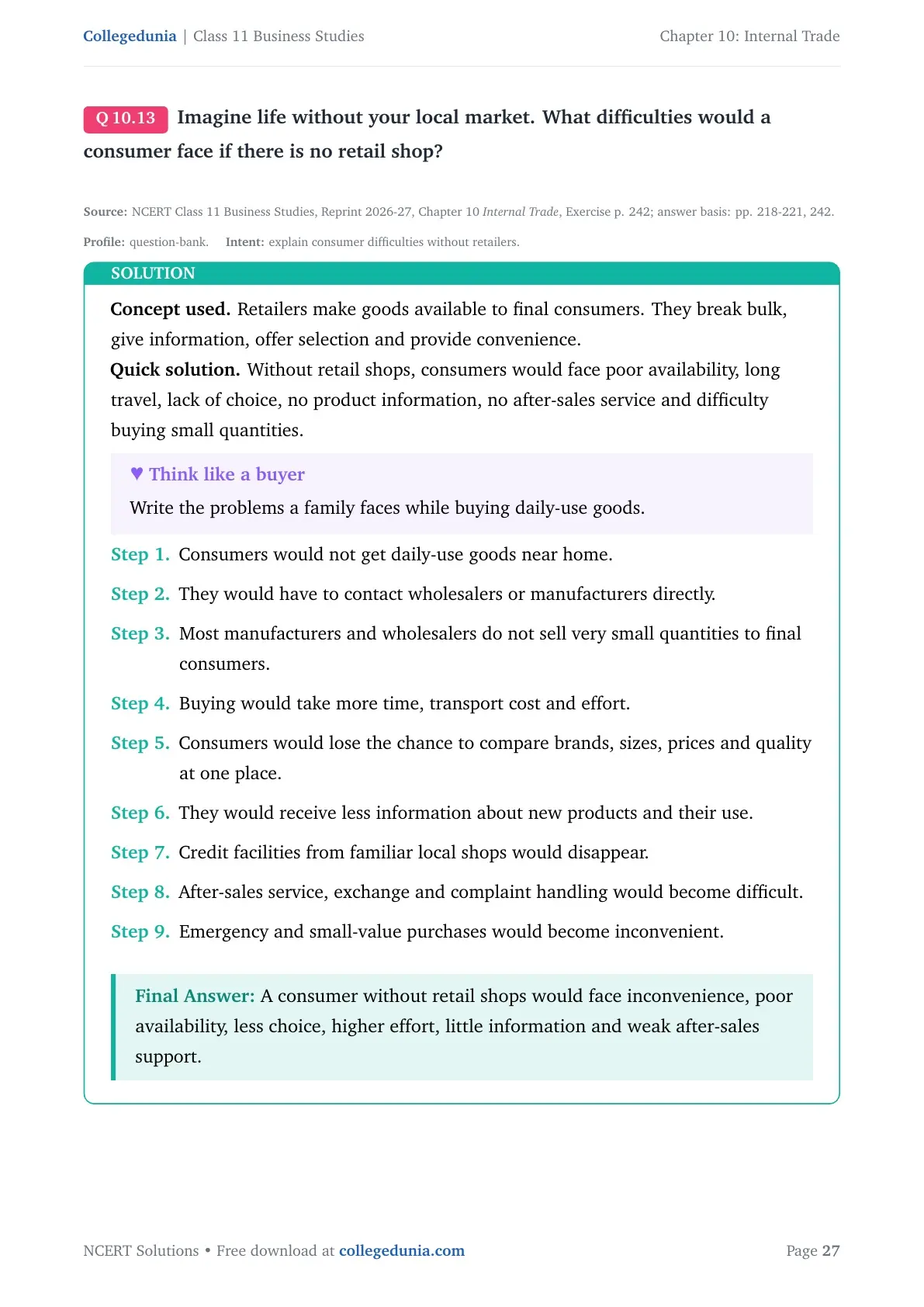
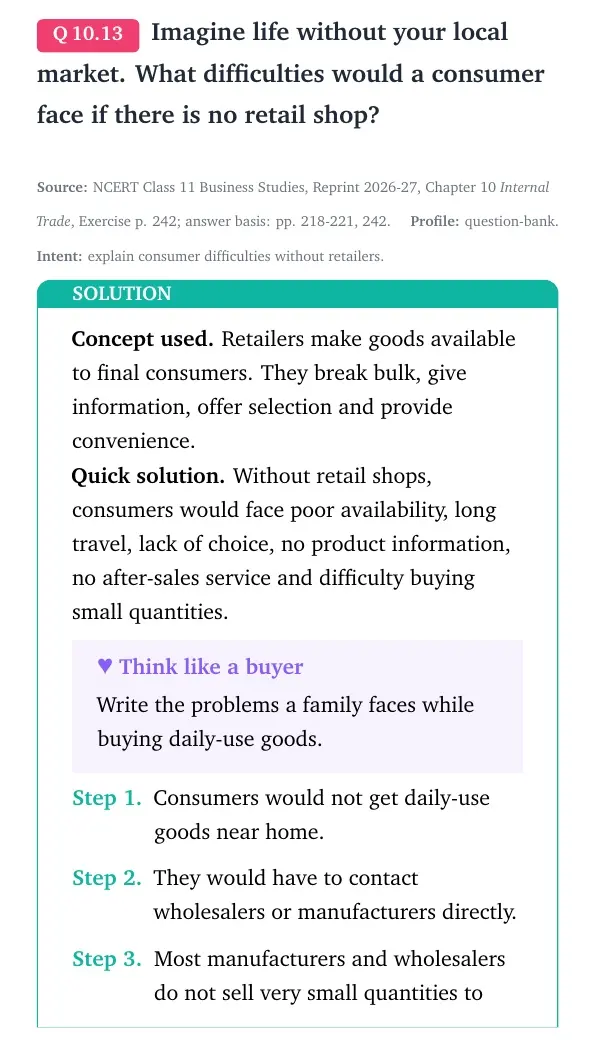
Imagine life without your local market. What difficulties would a consumer face if there is no retail shop?
Quick solution. Without retail shops, consumers would face poor availability, long travel, lack of choice, no product information, no after-sales service and difficulty buying small quantities.
Concept used. Retailers make goods available to final consumers. They break bulk, give information, offer selection and provide convenience.
- Consumers would not get daily-use goods near home.
- They would have to contact wholesalers or manufacturers directly.
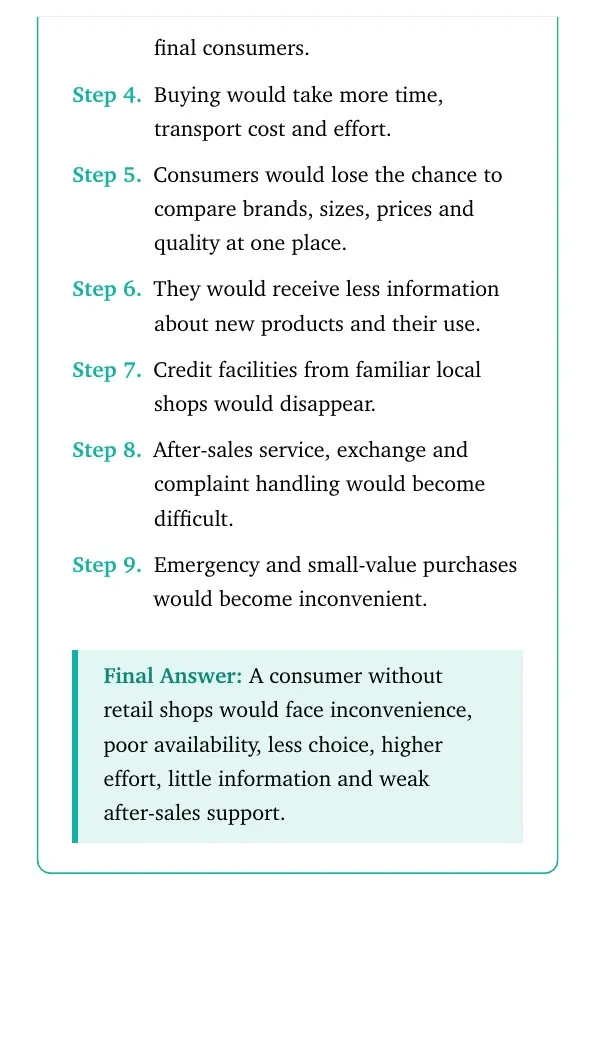
- Most manufacturers and wholesalers do not sell very small quantities to final consumers.
- Buying would take more time, transport cost and effort.
- Consumers would lose the chance to compare brands, sizes, prices and quality at one place.
- They would receive less information about new products and their use.
- Credit facilities from familiar local shops would disappear.
- After-sales service, exchange and complaint handling would become difficult.
- Emergency and small-value purchases would become inconvenient.
Final answer: A consumer without retail shops would face inconvenience, poor availability, less choice, higher effort, little information and weak after-sales support.
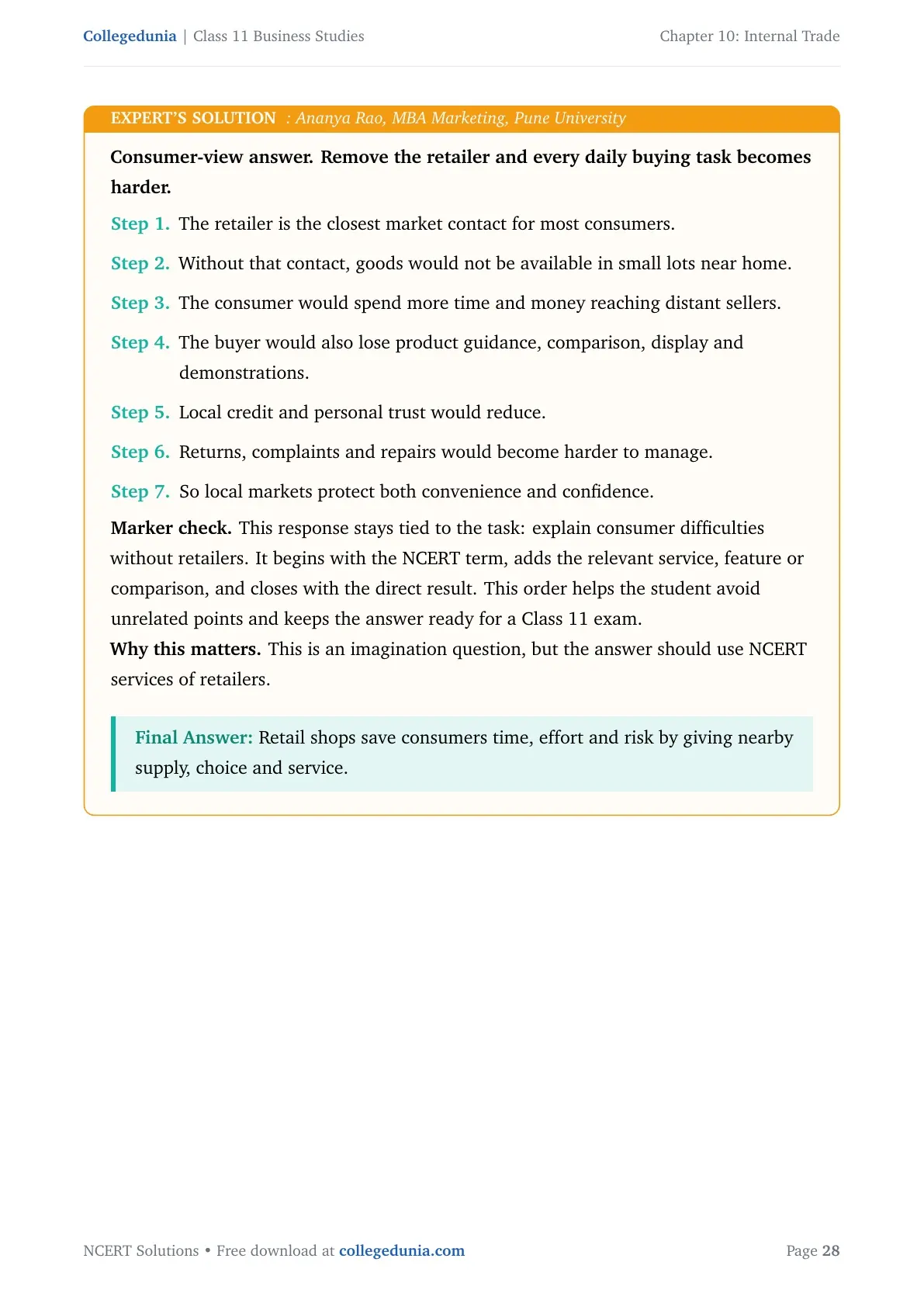
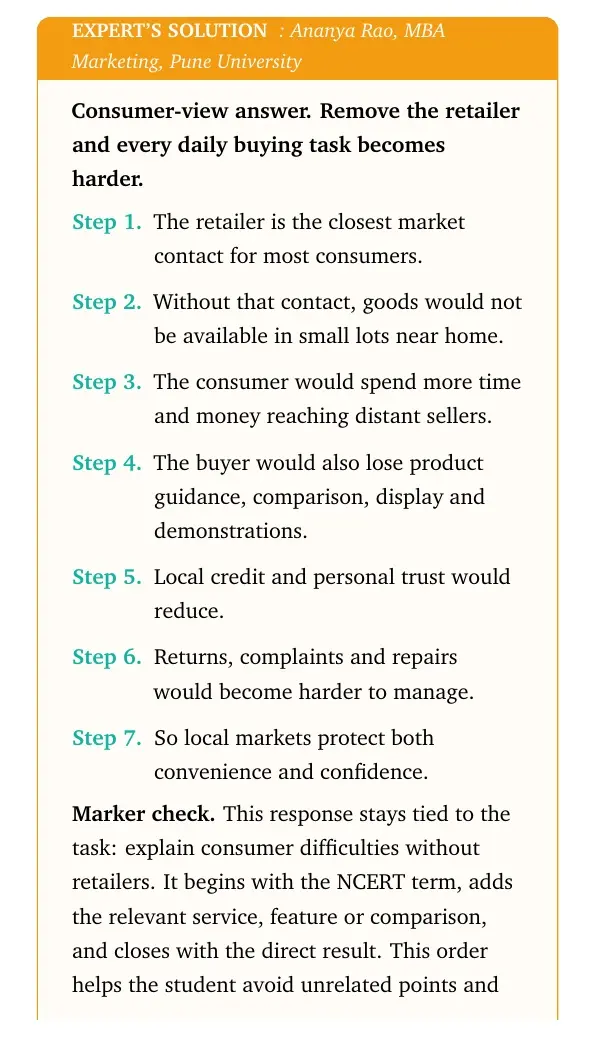
Consumer-view answer. Remove the retailer and every daily buying task becomes harder.
- The retailer is the closest market contact for most consumers.
- Without that contact, goods would not be available in small lots near home.
- The consumer would spend more time and money reaching distant sellers.
- The buyer would also lose product guidance, comparison, display and demonstrations.
- Local credit and personal trust would reduce.
- Returns, complaints and repairs would become harder to manage.
- So local markets protect both convenience and confidence.
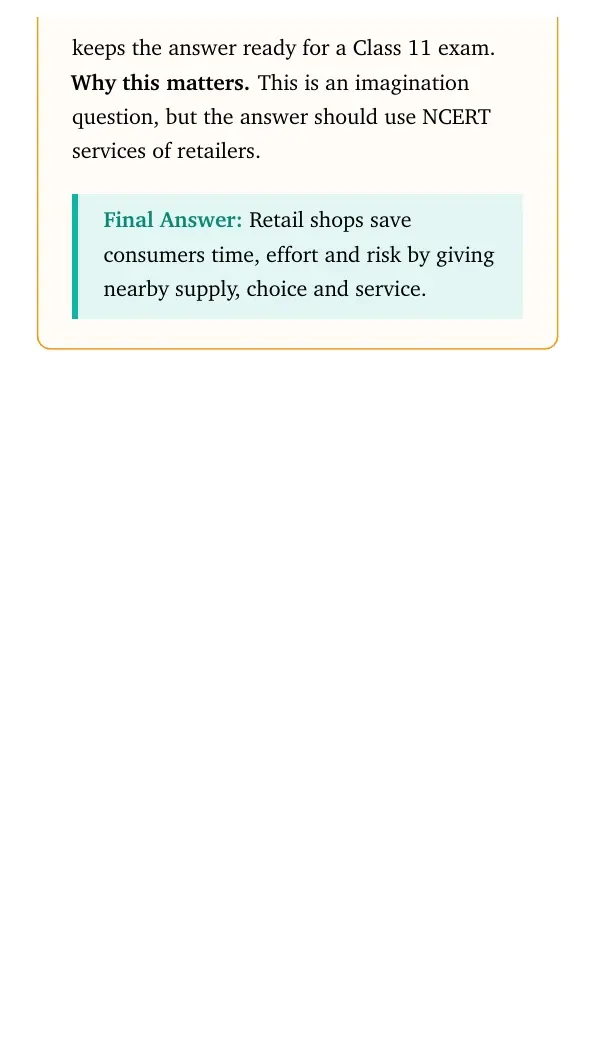
Why this matters. This is an imagination question, but the answer should use NCERT services of retailers.
Expert answer: Retail shops save consumers time, effort and risk by giving nearby supply, choice and service.
Question 14
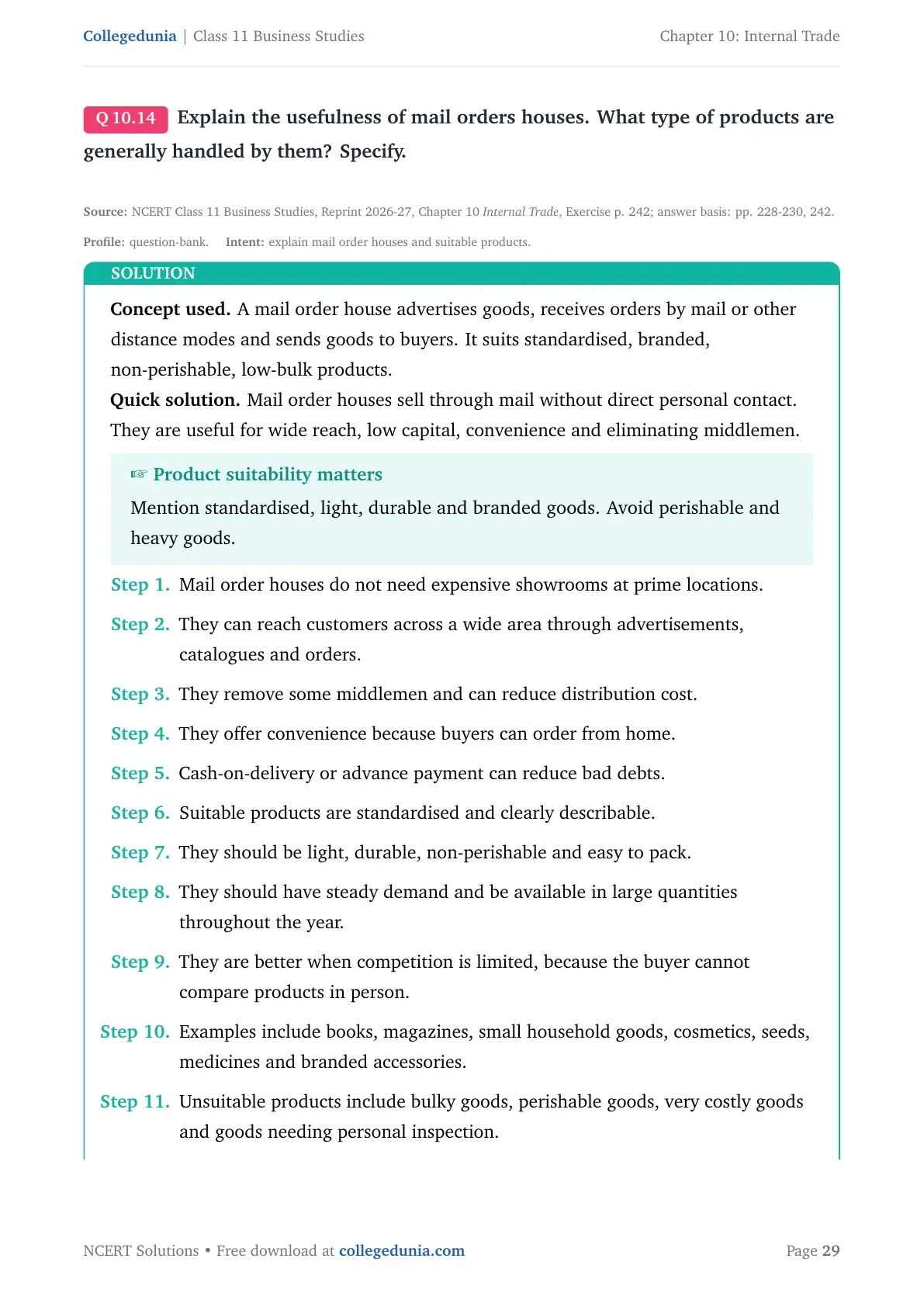
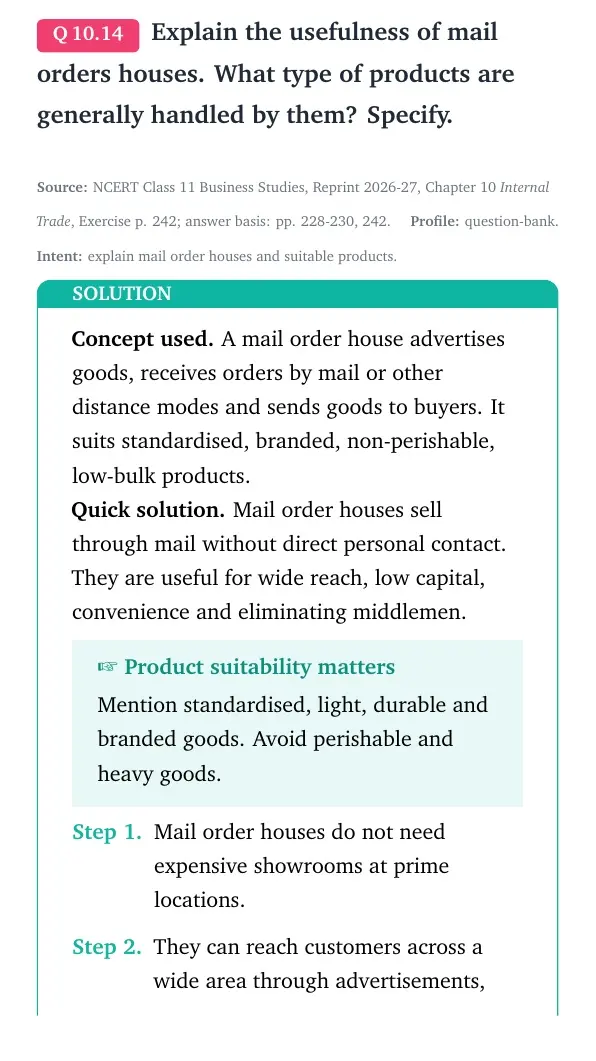
Explain the usefulness of mail orders houses. What type of products are generally handled by them? Specify.
Quick solution. Mail order houses sell through mail without direct personal contact. They are useful for wide reach, low capital, convenience and eliminating middlemen.
Concept used. A mail order house advertises goods, receives orders by mail or other distance modes and sends goods to buyers. It suits standardised, branded, non-perishable, low-bulk products.
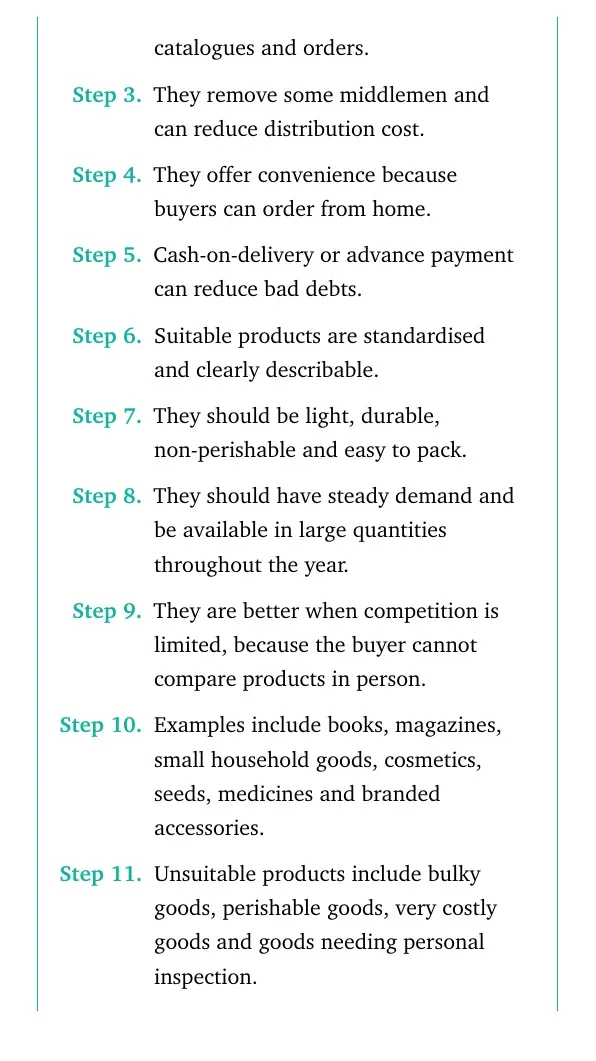
- Mail order houses do not need expensive showrooms at prime locations.
- They can reach customers across a wide area through advertisements, catalogues and orders.
- They remove some middlemen and can reduce distribution cost.
- They offer convenience because buyers can order from home.
- Cash-on-delivery or advance payment can reduce bad debts.
- Suitable products are standardised and clearly describable.
- They should be light, durable, non-perishable and easy to pack.
- They should have steady demand and be available in large quantities throughout the year.
- They are better when competition is limited, because the buyer cannot compare products in person.
- Examples include books, magazines, small household goods, cosmetics, seeds, medicines and branded accessories.
- Unsuitable products include bulky goods, perishable goods, very costly goods and goods needing personal inspection.
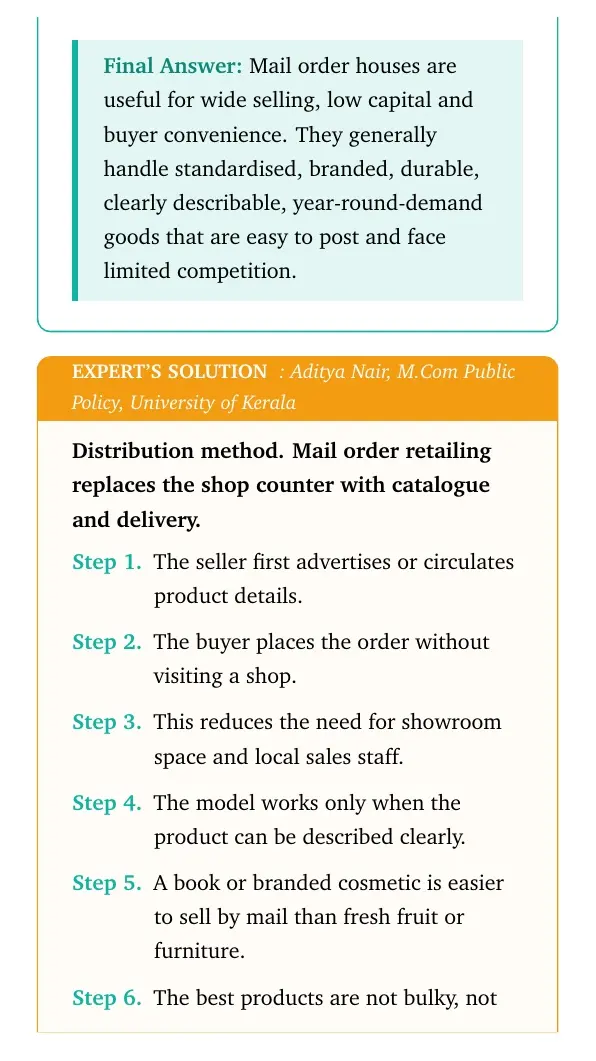
Final answer: Mail order houses are useful for wide selling, low capital and buyer convenience. They generally handle standardised, branded, durable, clearly describable, year-round-demand goods that are easy to post and face limited competition.
Distribution method. Mail order retailing replaces the shop counter with catalogue and delivery.
- The seller first advertises or circulates product details.
- The buyer places the order without visiting a shop.
- This reduces the need for showroom space and local sales staff.
- The model works only when the product can be described clearly.
- A book or branded cosmetic is easier to sell by mail than fresh fruit or furniture.
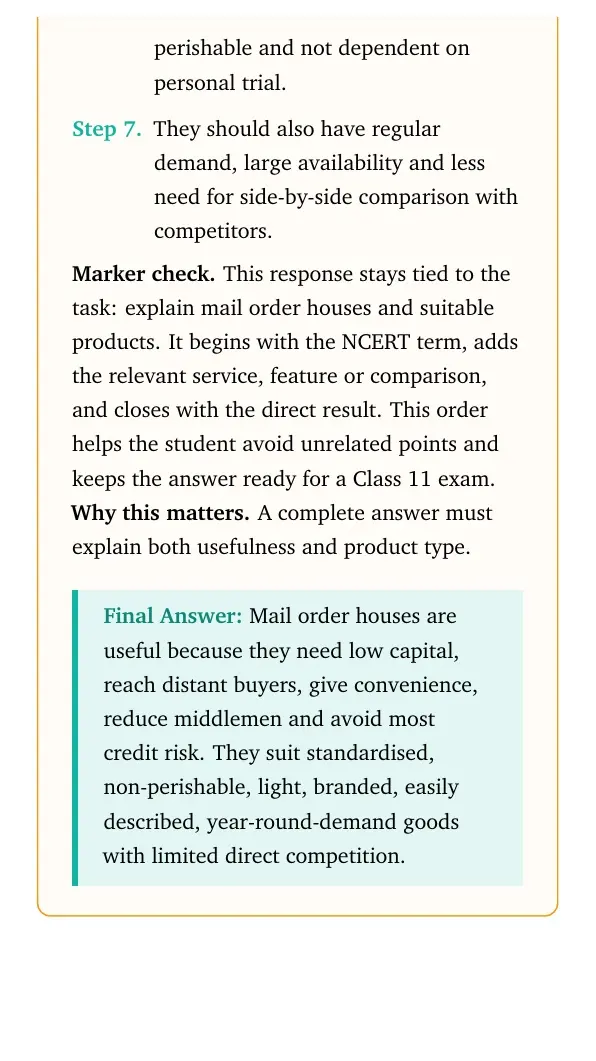
- The best products are not bulky, not perishable and not dependent on personal trial.
- They should also have regular demand, large availability and less need for side-by-side comparison with competitors.
Why this matters. A complete answer must explain both usefulness and product type.
Expert answer: Mail order houses are useful because they need low capital, reach distant buyers, give convenience, reduce middlemen and avoid most credit risk. They suit standardised, non-perishable, light, branded, easily described, year-round-demand goods with limited direct competition.
Question 15
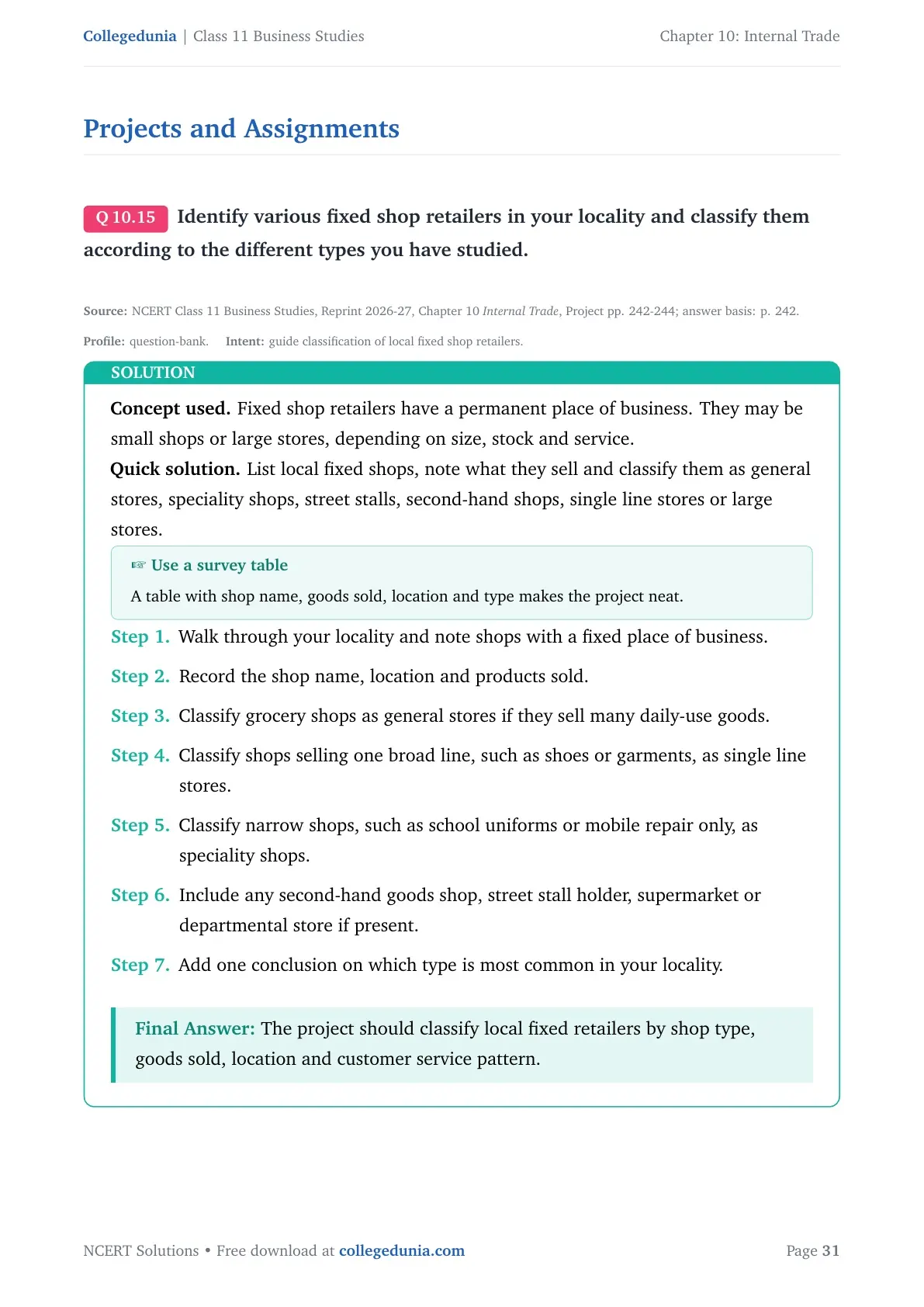
Identify various fixed shop retailers in your locality and classify them according to the different types you have studied.
Quick solution. List local fixed shops, note what they sell and classify them as general stores, speciality shops, street stalls, second-hand shops, single line stores or large stores.
Concept used. Fixed shop retailers have a permanent place of business. They may be small shops or large stores, depending on size, stock and service.
- Walk through your locality and note shops with a fixed place of business.
- Record the shop name, location and products sold.
- Classify grocery shops as general stores if they sell many daily-use goods.
- Classify shops selling one broad line, such as shoes or garments, as single line stores.
- Classify narrow shops, such as school uniforms or mobile repair only, as speciality shops.
- Include any second-hand goods shop, street stall holder, supermarket or departmental store if present.
- Add one conclusion on which type is most common in your locality.
Final answer: The project should classify local fixed retailers by shop type, goods sold, location and customer service pattern.
Fieldwork method. The answer depends on observing real shops, not copying a fixed list.
- Start with shops that do not move from place to place.
- Use NCERT categories as labels for your table.
- Write evidence for each label. For example, a grocery store is a general store because it sells many daily-use products.
- A shoe store is single line because it sells one product line with variety.
- A uniform shop is speciality because it serves one specific need.
- Finish with a short finding about the retail pattern in your area.
Why this matters. Project answers score through correct classification and local examples.
Expert answer: Make a locality survey table and classify each fixed shop by NCERT retail type.
Question 16
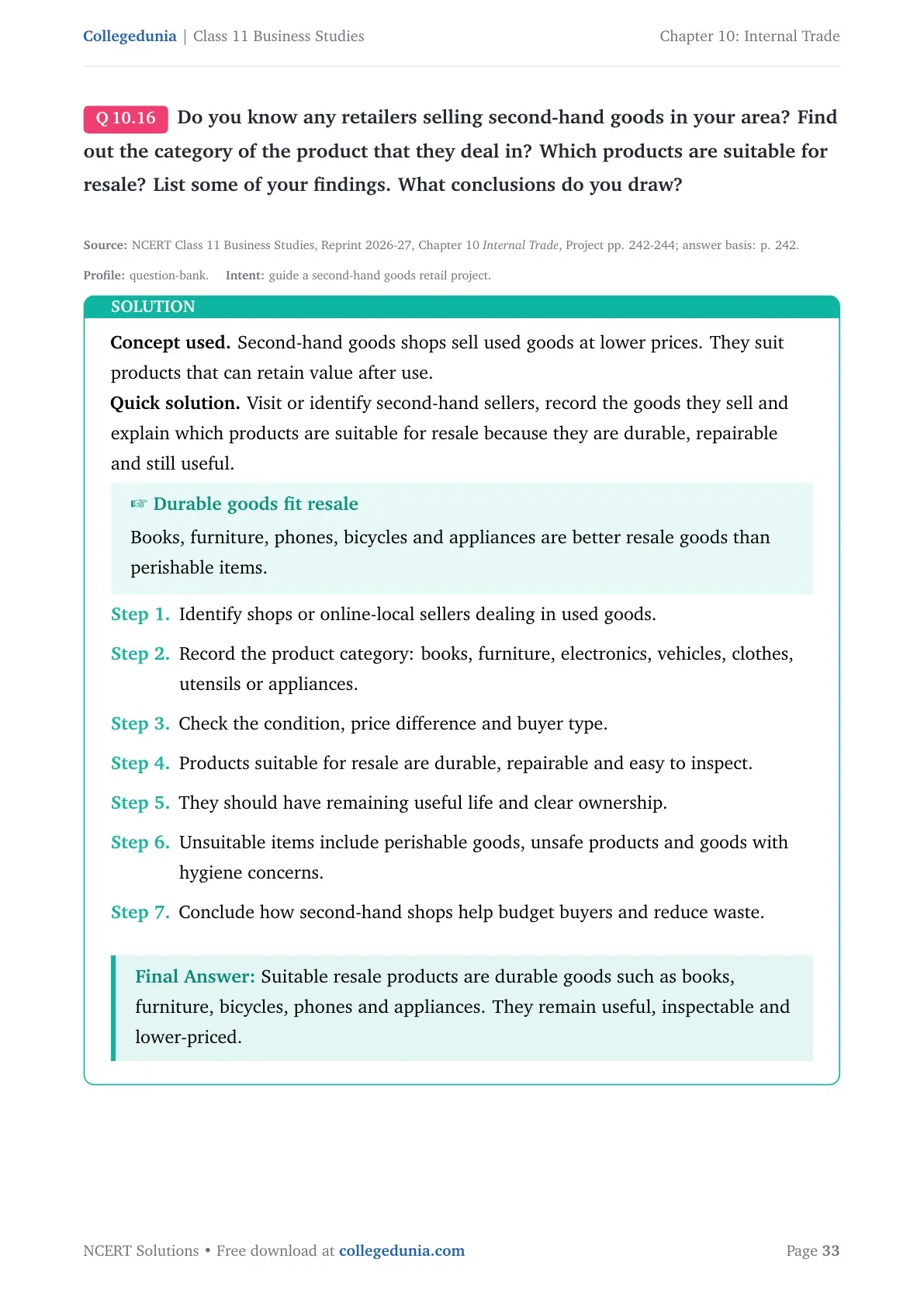
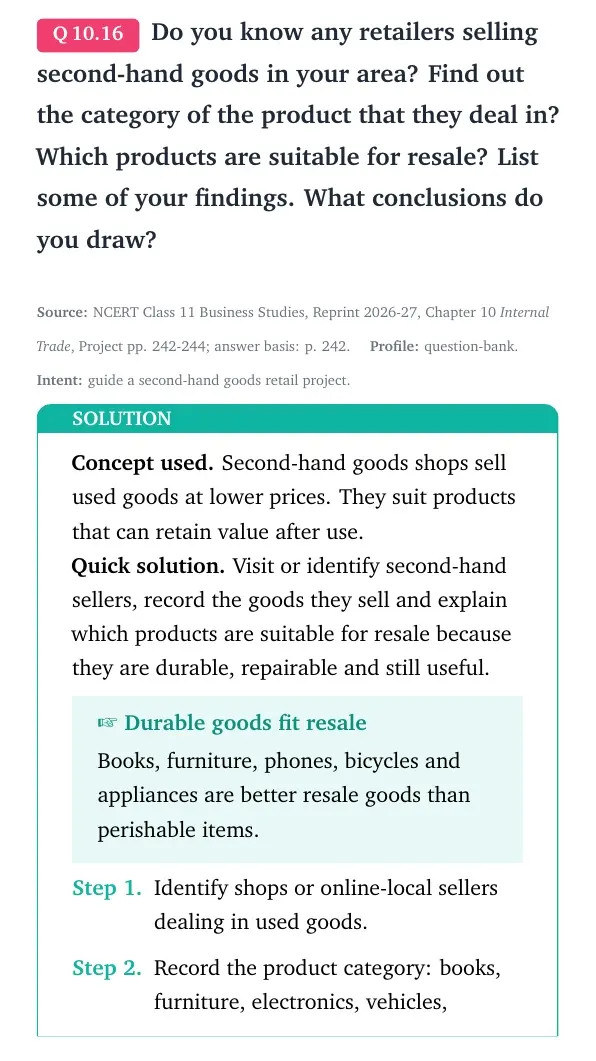
Do you know any retailers selling second-hand goods in your area? Find out the category of the product that they deal in? Which products are suitable for resale? List some of your findings. What conclusions do you draw?
Quick solution. Visit or identify second-hand sellers, record the goods they sell and explain which products are suitable for resale because they are durable, repairable and still useful.
Concept used. Second-hand goods shops sell used goods at lower prices. They suit products that can retain value after use.
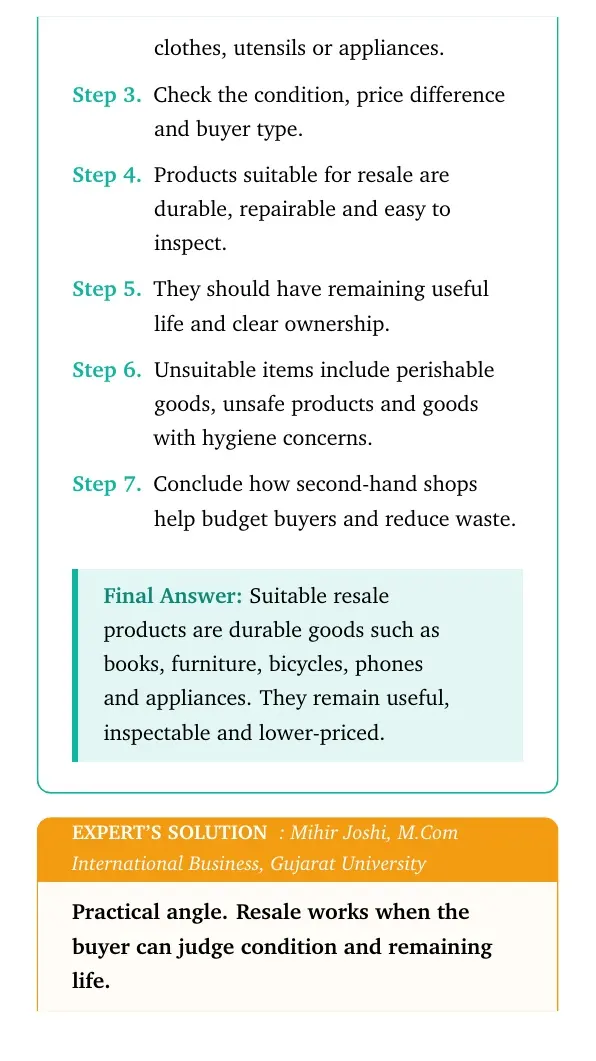
- Identify shops or online-local sellers dealing in used goods.
- Record the product category: books, furniture, electronics, vehicles, clothes, utensils or appliances.
- Check the condition, price difference and buyer type.
- Products suitable for resale are durable, repairable and easy to inspect.
- They should have remaining useful life and clear ownership.
- Unsuitable items include perishable goods, unsafe products and goods with hygiene concerns.
- Conclude how second-hand shops help budget buyers and reduce waste.
Final answer: Suitable resale products are durable goods such as books, furniture, bicycles, phones and appliances. They remain useful, inspectable and lower-priced.
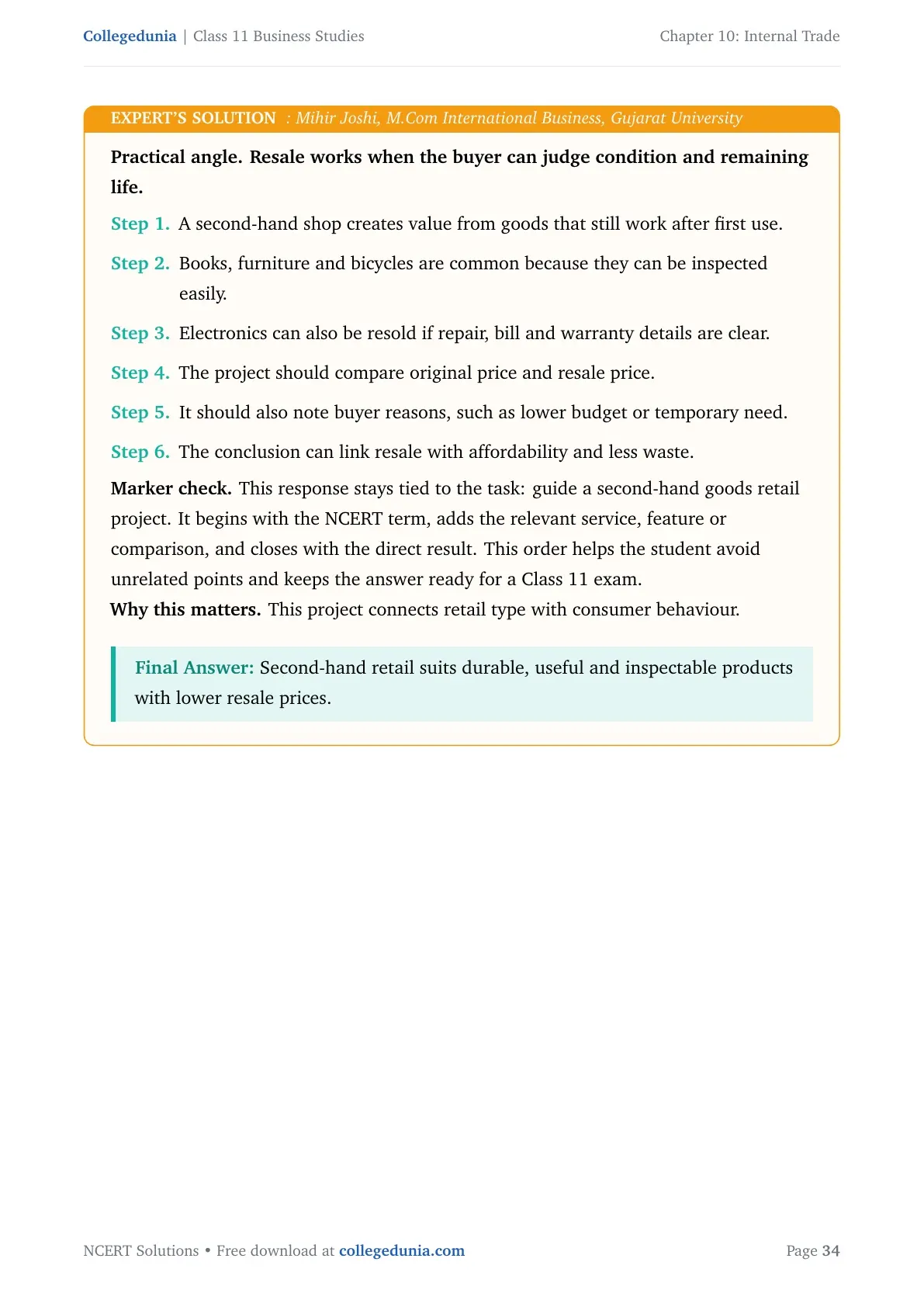
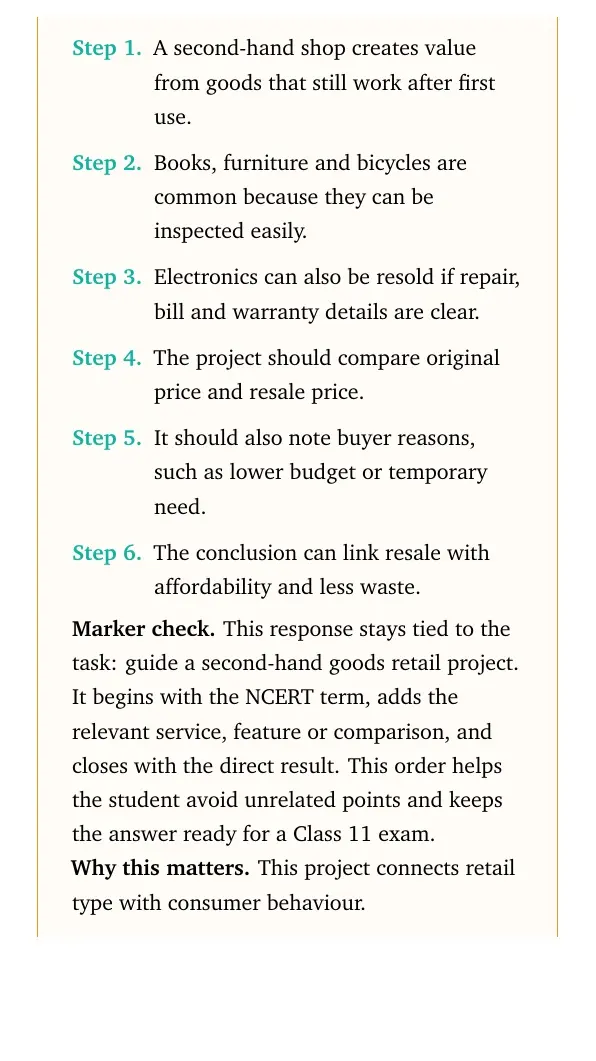
Practical angle. Resale works when the buyer can judge condition and remaining life.
- A second-hand shop creates value from goods that still work after first use.
- Books, furniture and bicycles are common because they can be inspected easily.
- Electronics can also be resold if repair, bill and warranty details are clear.
- The project should compare original price and resale price.
- It should also note buyer reasons, such as lower budget or temporary need.
- The conclusion can link resale with affordability and less waste.
Why this matters. This project connects retail type with consumer behaviour.
Expert answer: Second-hand retail suits durable, useful and inspectable products with lower resale prices.
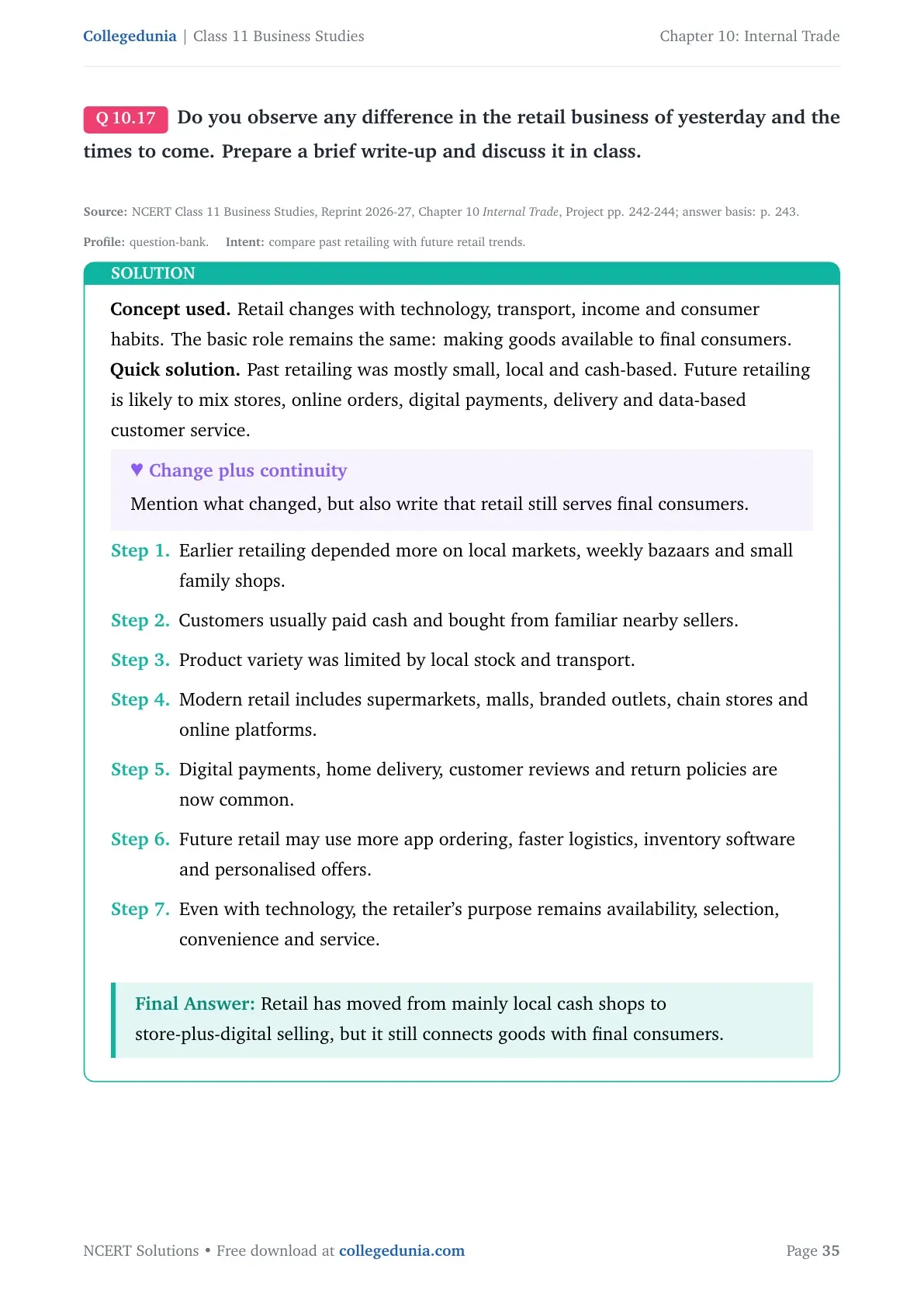
Question 17
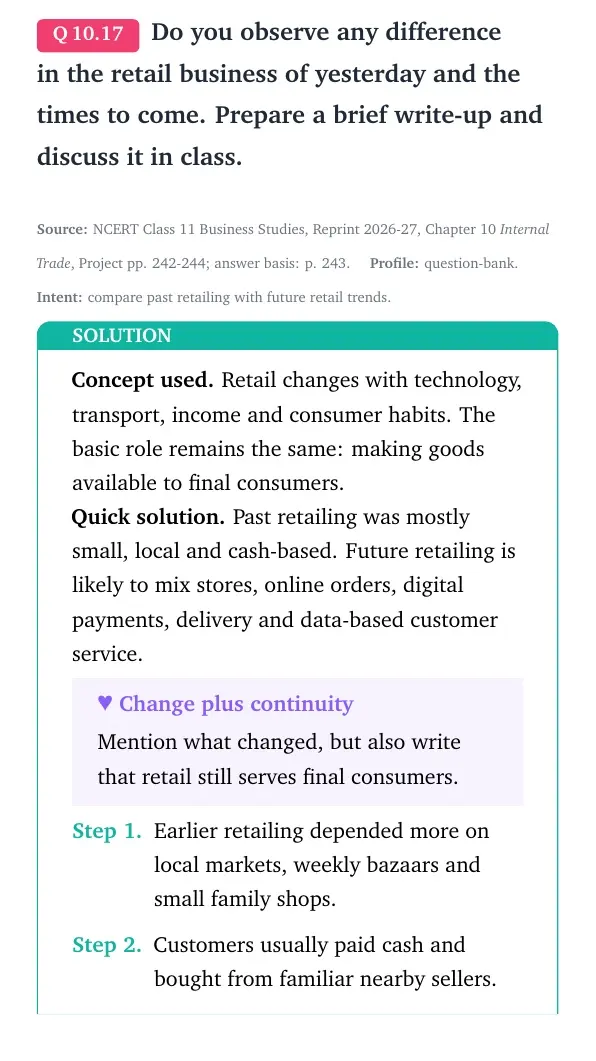
Do you observe any difference in the retail business of yesterday and the times to come. Prepare a brief write-up and discuss it in class.
Quick solution. Past retailing was mostly small, local and cash-based. Future retailing is likely to mix stores, online orders, digital payments, delivery and data-based customer service.
Concept used. Retail changes with technology, transport, income and consumer habits. The basic role remains the same: making goods available to final consumers.
- Earlier retailing depended more on local markets, weekly bazaars and small family shops.
- Customers usually paid cash and bought from familiar nearby sellers.
- Product variety was limited by local stock and transport.
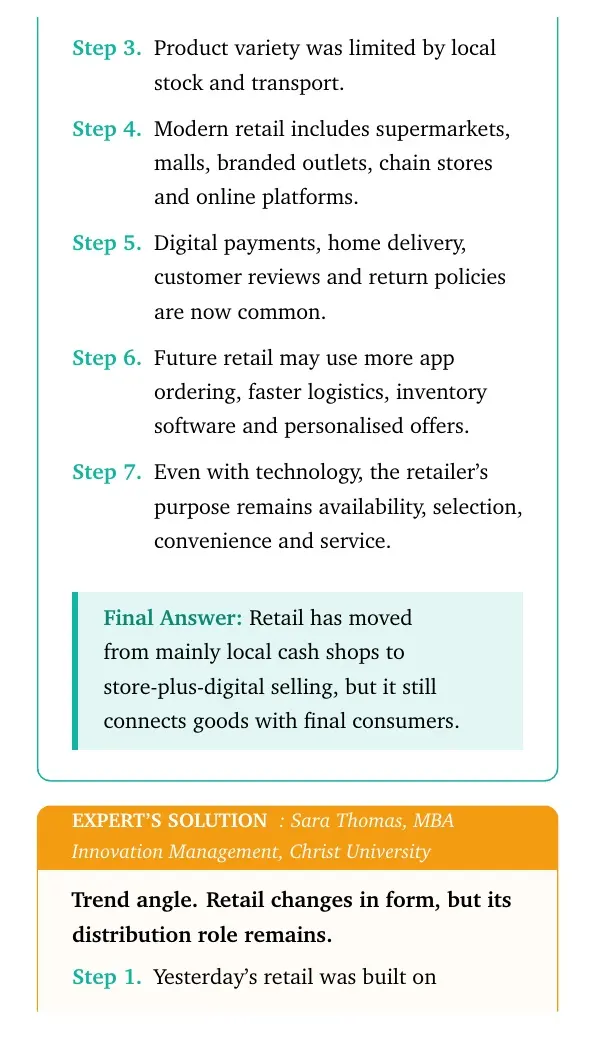
- Modern retail includes supermarkets, malls, branded outlets, chain stores and online platforms.
- Digital payments, home delivery, customer reviews and return policies are now common.
- Future retail may use more app ordering, faster logistics, inventory software and personalised offers.
- Even with technology, the retailer's purpose remains availability, selection, convenience and service.
Final answer: Retail has moved from mainly local cash shops to store-plus-digital selling, but it still connects goods with final consumers.
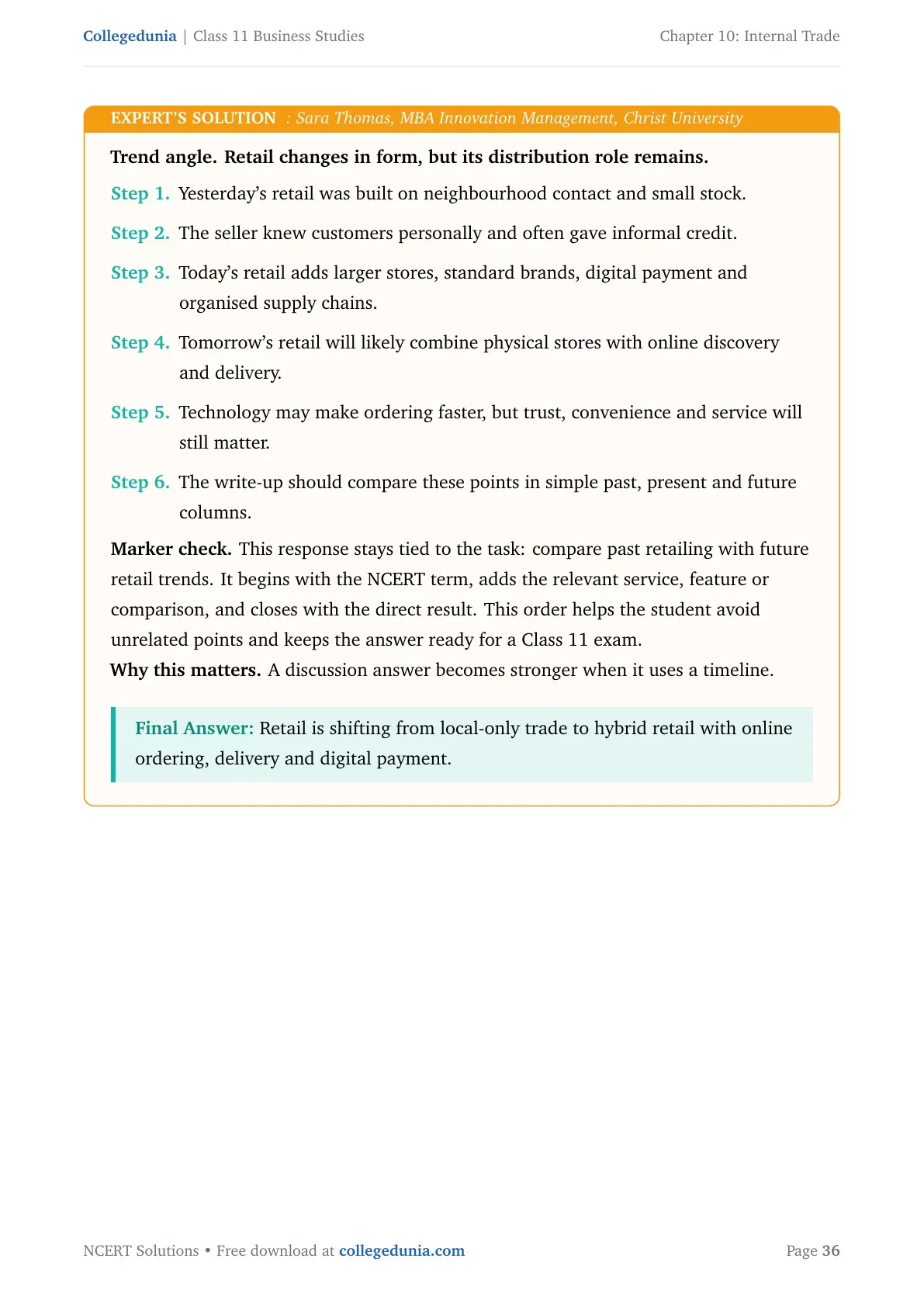
Trend angle. Retail changes in form, but its distribution role remains.
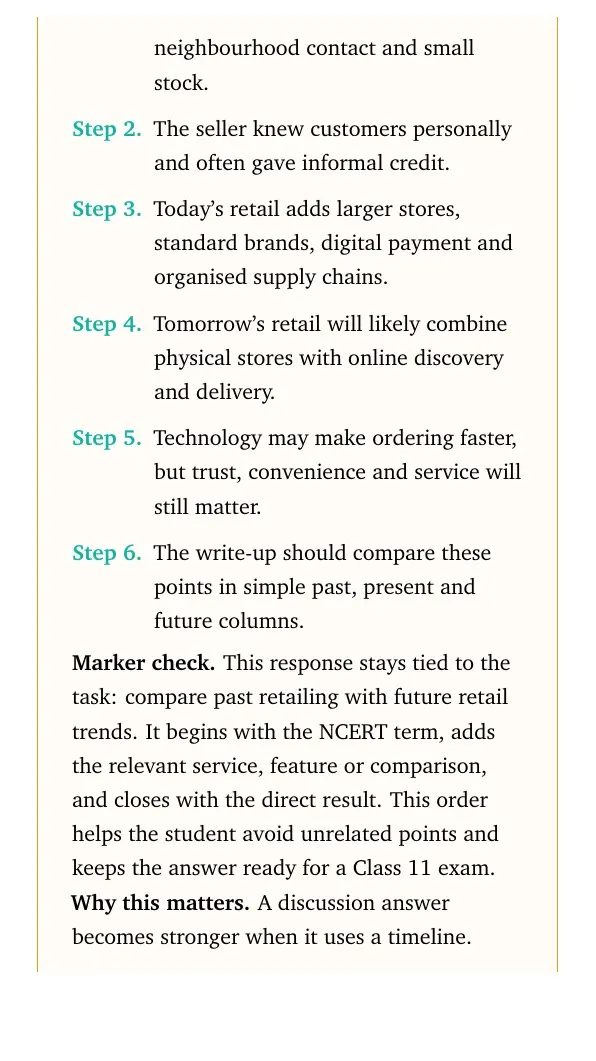
- Yesterday's retail was built on neighbourhood contact and small stock.
- The seller knew customers personally and often gave informal credit.
- Today's retail adds larger stores, standard brands, digital payment and organised supply chains.
- Tomorrow's retail will likely combine physical stores with online discovery and delivery.
- Technology may make ordering faster, but trust, convenience and service will still matter.
- The write-up should compare these points in simple past, present and future columns.
Why this matters. A discussion answer becomes stronger when it uses a timeline.
Expert answer: Retail is shifting from local-only trade to hybrid retail with online ordering, delivery and digital payment.
Question 18
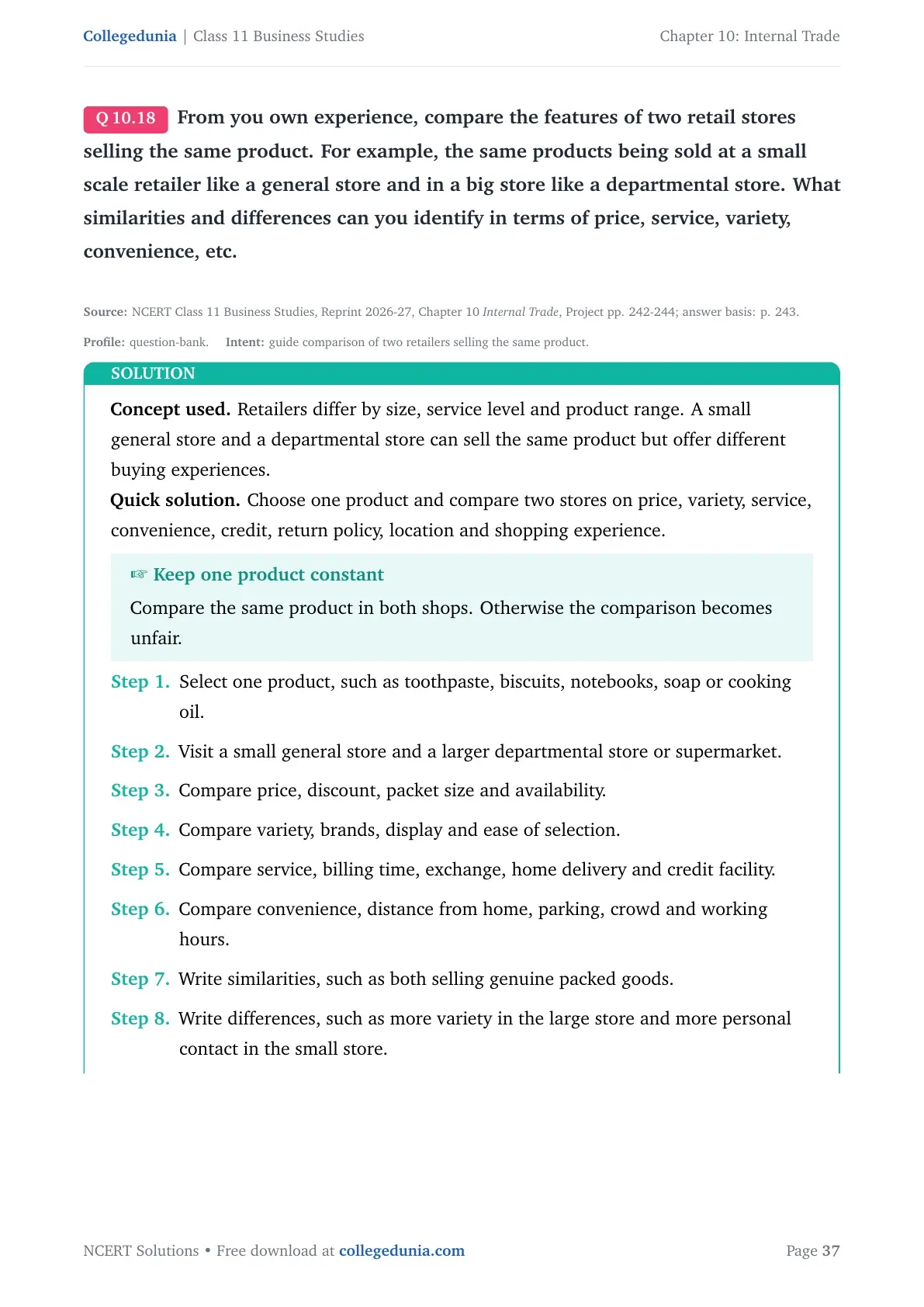
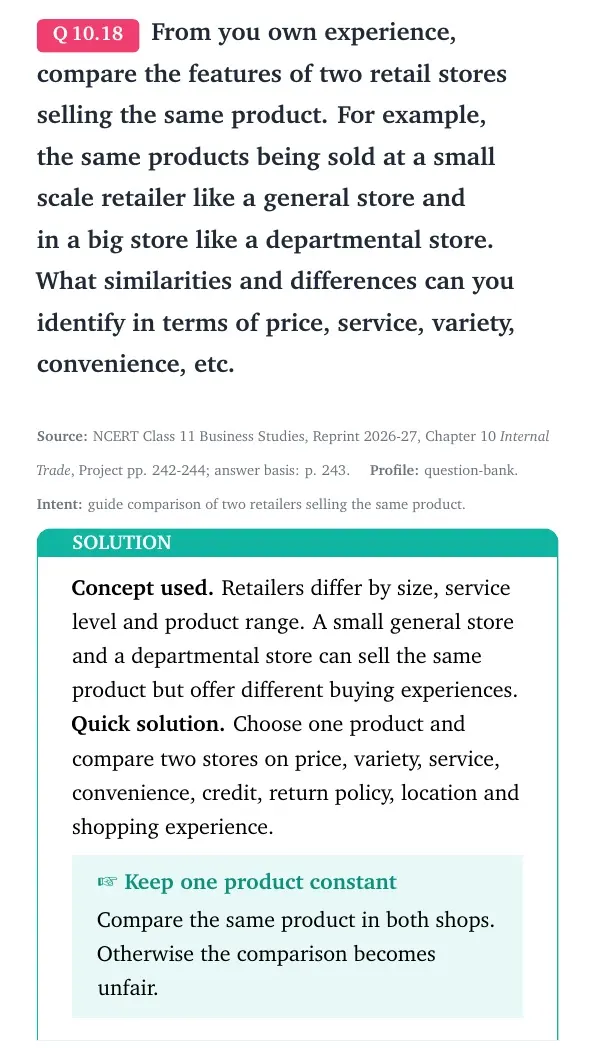
From you own experience, compare the features of two retail stores selling the same product. For example, the same products being sold at a small scale retailer like a general store and in a big store like a departmental store. What similarities and differences can you identify in terms of price, service, variety, convenience, etc.
Quick solution. Choose one product and compare two stores on price, variety, service, convenience, credit, return policy, location and shopping experience.
Concept used. Retailers differ by size, service level and product range. A small general store and a departmental store can sell the same product but offer different buying experiences.
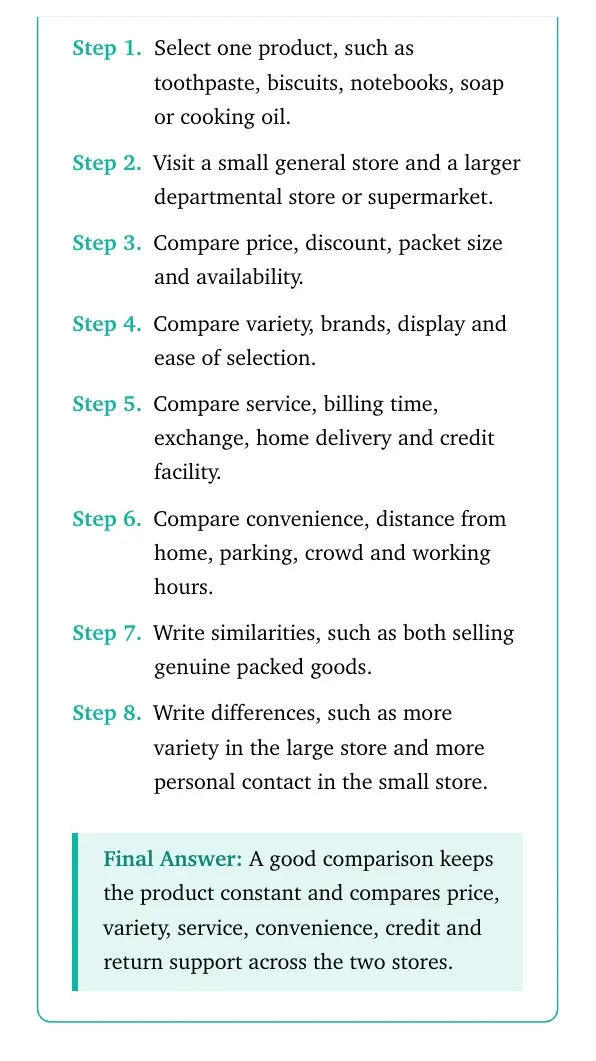
- Select one product, such as toothpaste, biscuits, notebooks, soap or cooking oil.
- Visit a small general store and a larger departmental store or supermarket.
- Compare price, discount, packet size and availability.
- Compare variety, brands, display and ease of selection.
- Compare service, billing time, exchange, home delivery and credit facility.
- Compare convenience, distance from home, parking, crowd and working hours.
- Write similarities, such as both selling genuine packed goods.
- Write differences, such as more variety in the large store and more personal contact in the small store.
Final answer: A good comparison keeps the product constant and compares price, variety, service, convenience, credit and return support across the two stores.
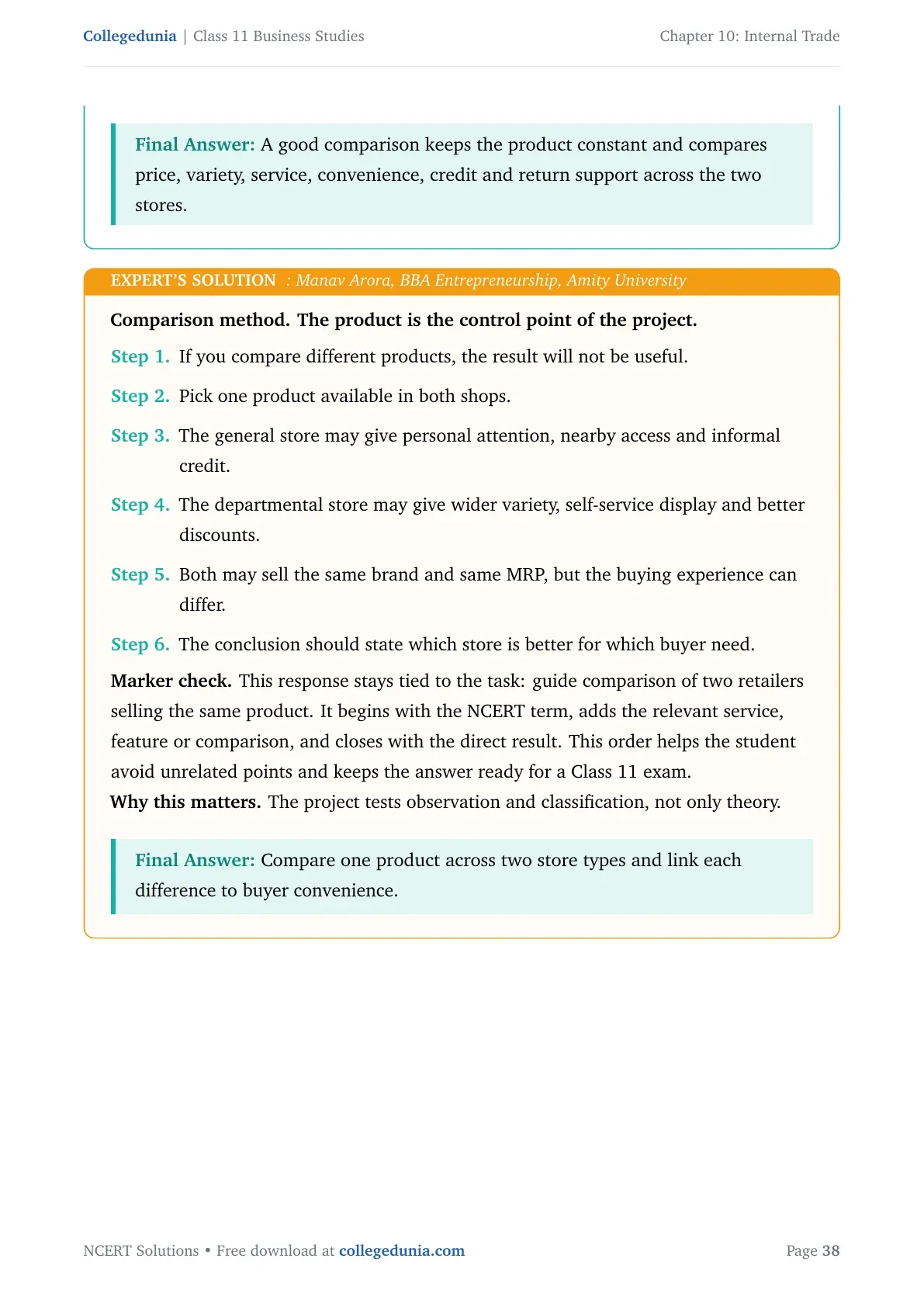
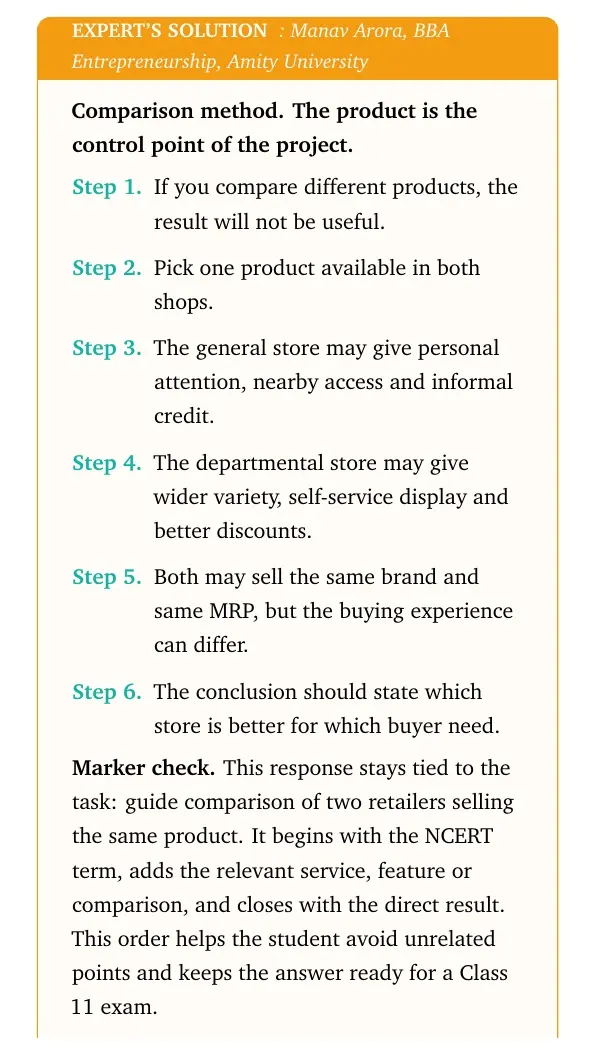
Comparison method. The product is the control point of the project.
- If you compare different products, the result will not be useful.
- Pick one product available in both shops.
- The general store may give personal attention, nearby access and informal credit.
- The departmental store may give wider variety, self-service display and better discounts.
- Both may sell the same brand and same MRP, but the buying experience can differ.
- The conclusion should state which store is better for which buyer need.
Why this matters. The project tests observation and classification, not only theory.
Expert answer: Compare one product across two store types and link each difference to buyer convenience.
Question 19
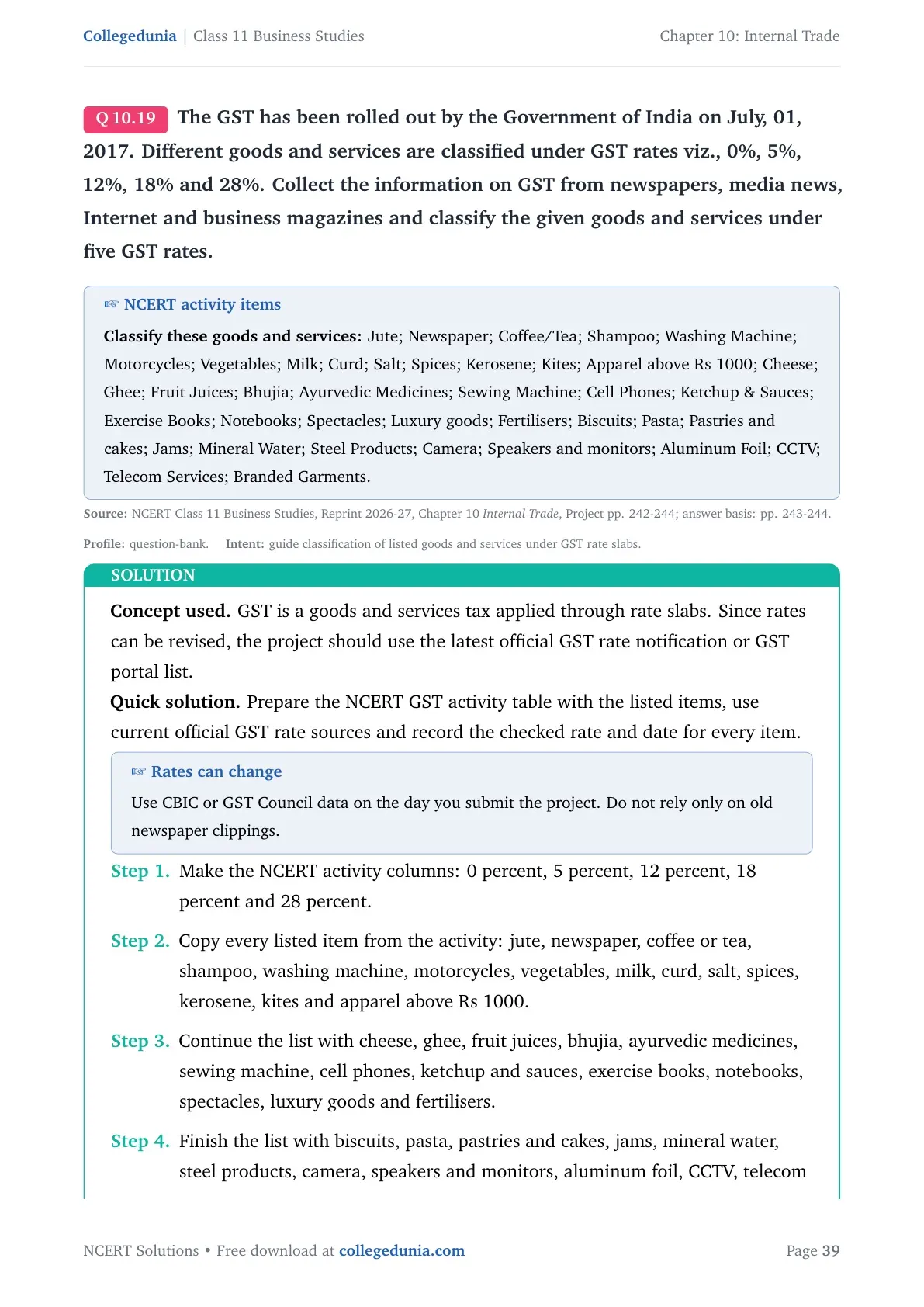
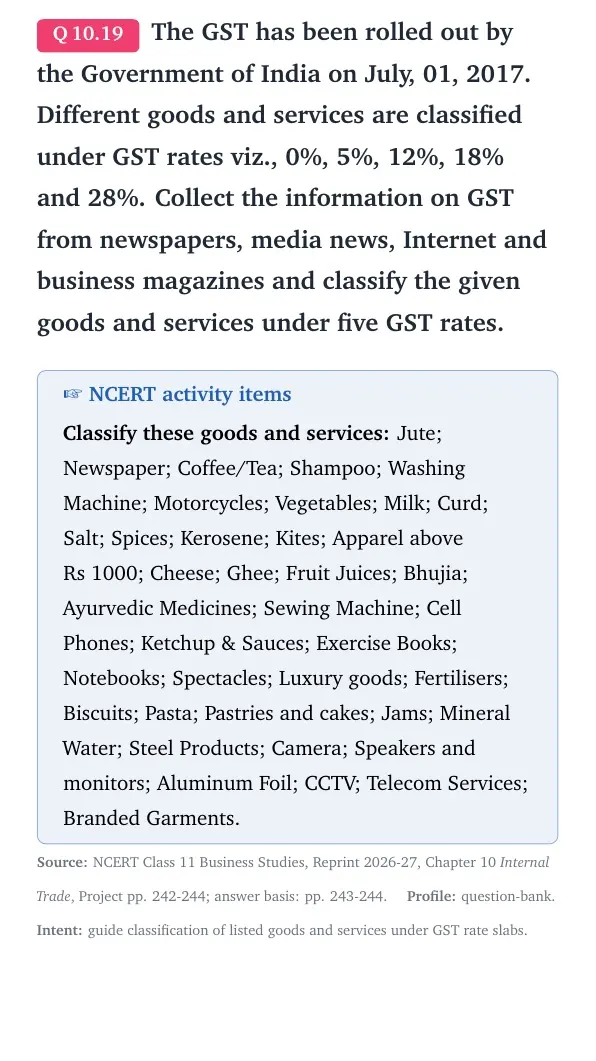
The GST has been rolled out by the Government of India on July, 01, 2017. Different goods and services are classified under GST rates viz., 0%, 5%, 12%, 18% and 28%. Collect the information on GST from newspapers, media news, Internet and business magazines and classify the given goods and services under five GST rates.
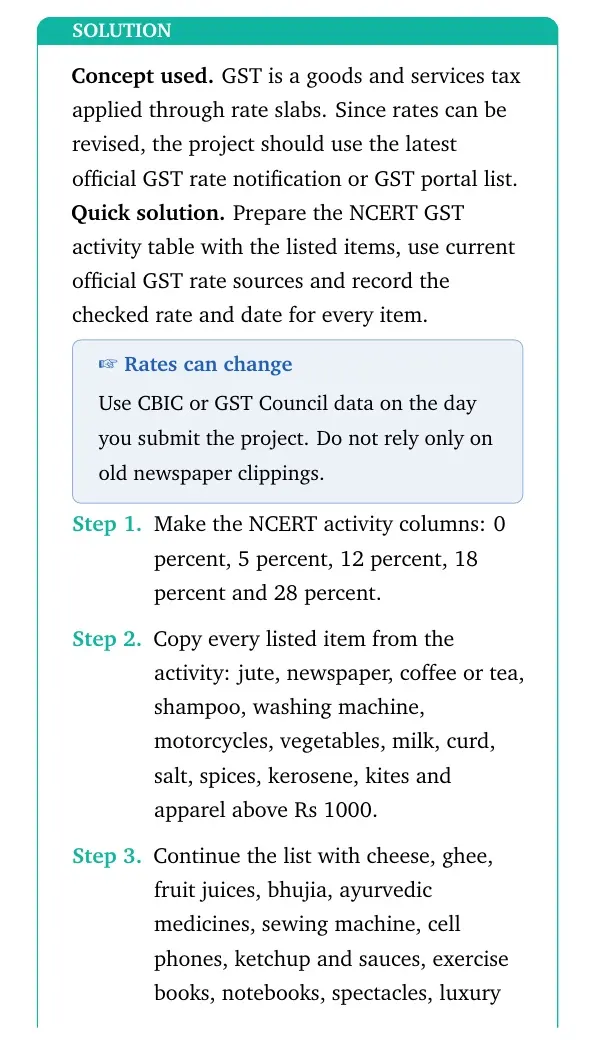
Quick solution. Prepare the NCERT GST activity table with the listed items, use current official GST rate sources and record the checked rate and date for every item.
Concept used. GST is a goods and services tax applied through rate slabs. Since rates can be revised, the project should use the latest official GST rate notification or GST portal list.
- Make the NCERT activity columns: 0 percent, 5 percent, 12 percent, 18 percent and 28 percent.
- Copy every listed item from the activity: jute, newspaper, coffee or tea, shampoo, washing machine, motorcycles, vegetables, milk, curd, salt, spices, kerosene, kites and apparel above Rs 1000.
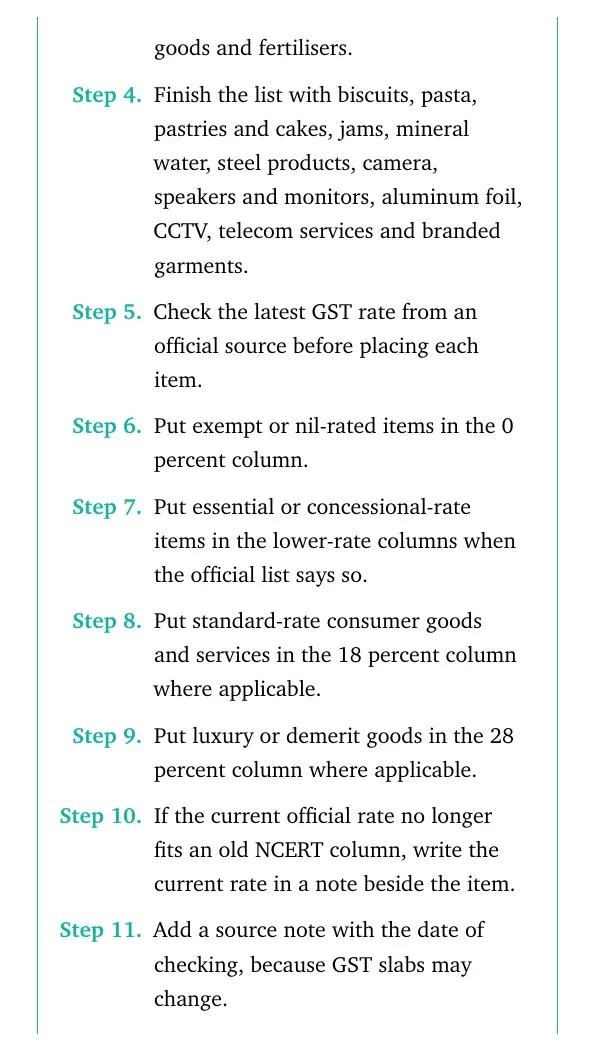
- Continue the list with cheese, ghee, fruit juices, bhujia, ayurvedic medicines, sewing machine, cell phones, ketchup and sauces, exercise books, notebooks, spectacles, luxury goods and fertilisers.
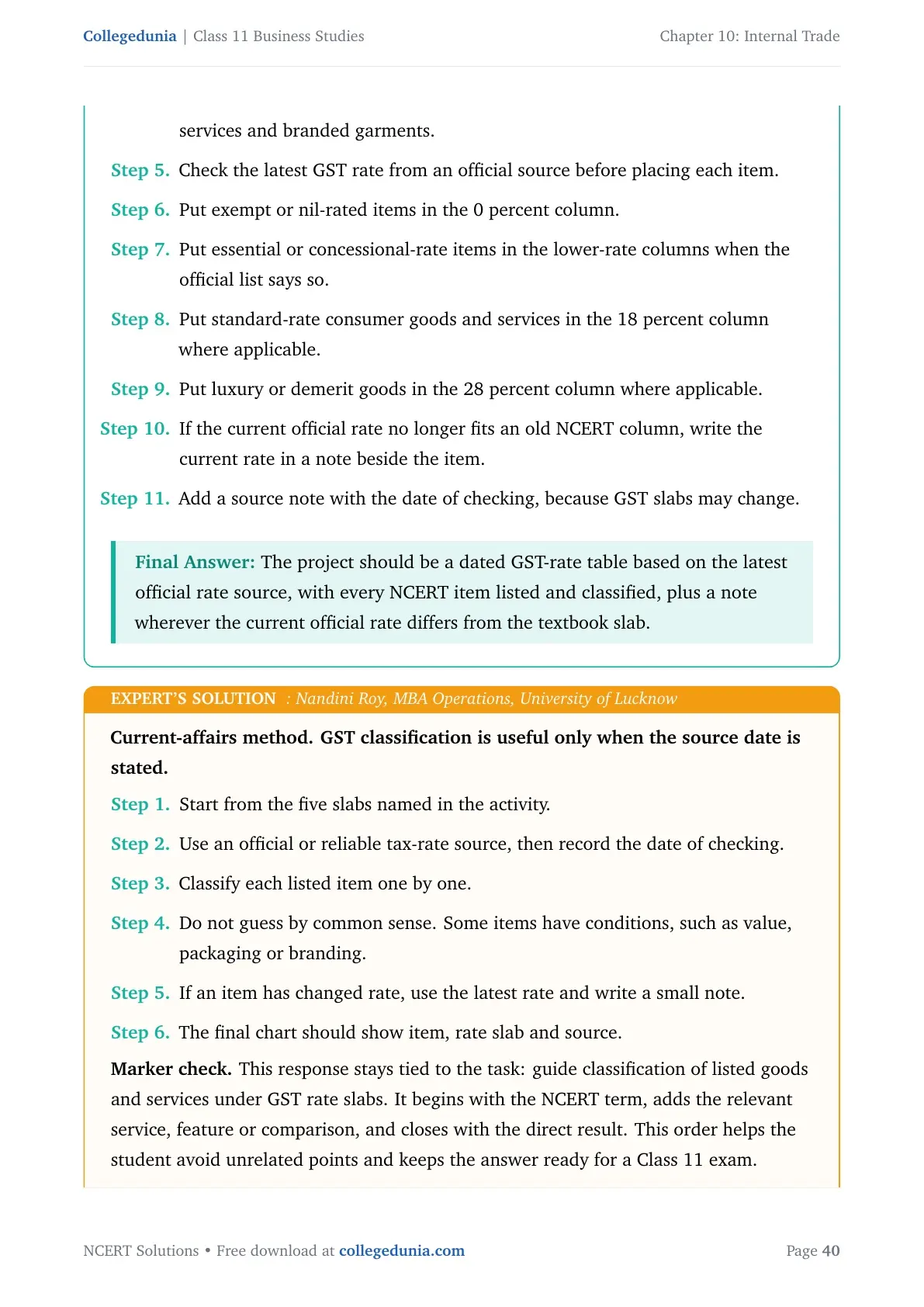
- Finish the list with biscuits, pasta, pastries and cakes, jams, mineral water, steel products, camera, speakers and monitors, aluminum foil, CCTV, telecom services and branded garments.
- Check the latest GST rate from an official source before placing each item.
- Put exempt or nil-rated items in the 0 percent column.
- Put essential or concessional-rate items in the lower-rate columns when the official list says so.
- Put standard-rate consumer goods and services in the 18 percent column where applicable.
- Put luxury or demerit goods in the 28 percent column where applicable.
- If the current official rate no longer fits an old NCERT column, write the current rate in a note beside the item.
- Add a source note with the date of checking, because GST slabs may change.
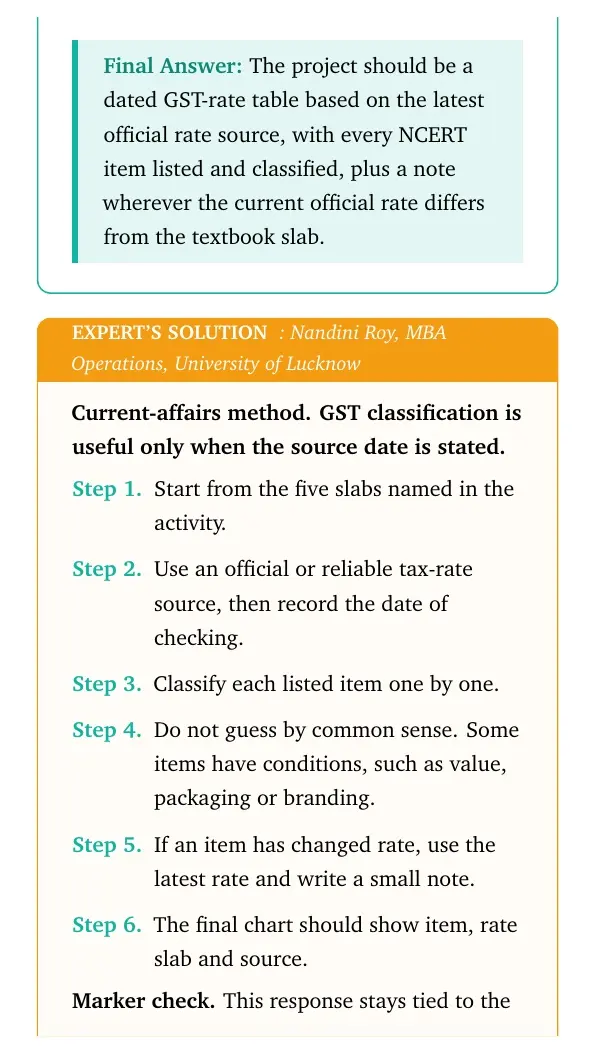
Final answer: The project should be a dated GST-rate table based on the latest official rate source, with every NCERT item listed and classified, plus a note wherever the current official rate differs from the textbook slab.
Current-affairs method. GST classification is useful only when the source date is stated.
- Start from the five slabs named in the activity.
- Use an official or reliable tax-rate source, then record the date of checking.
- Classify each listed item one by one.
- Do not guess by common sense. Some items have conditions, such as value, packaging or branding.
- If an item has changed rate, use the latest rate and write a small note.
- The final chart should show item, rate slab and source.
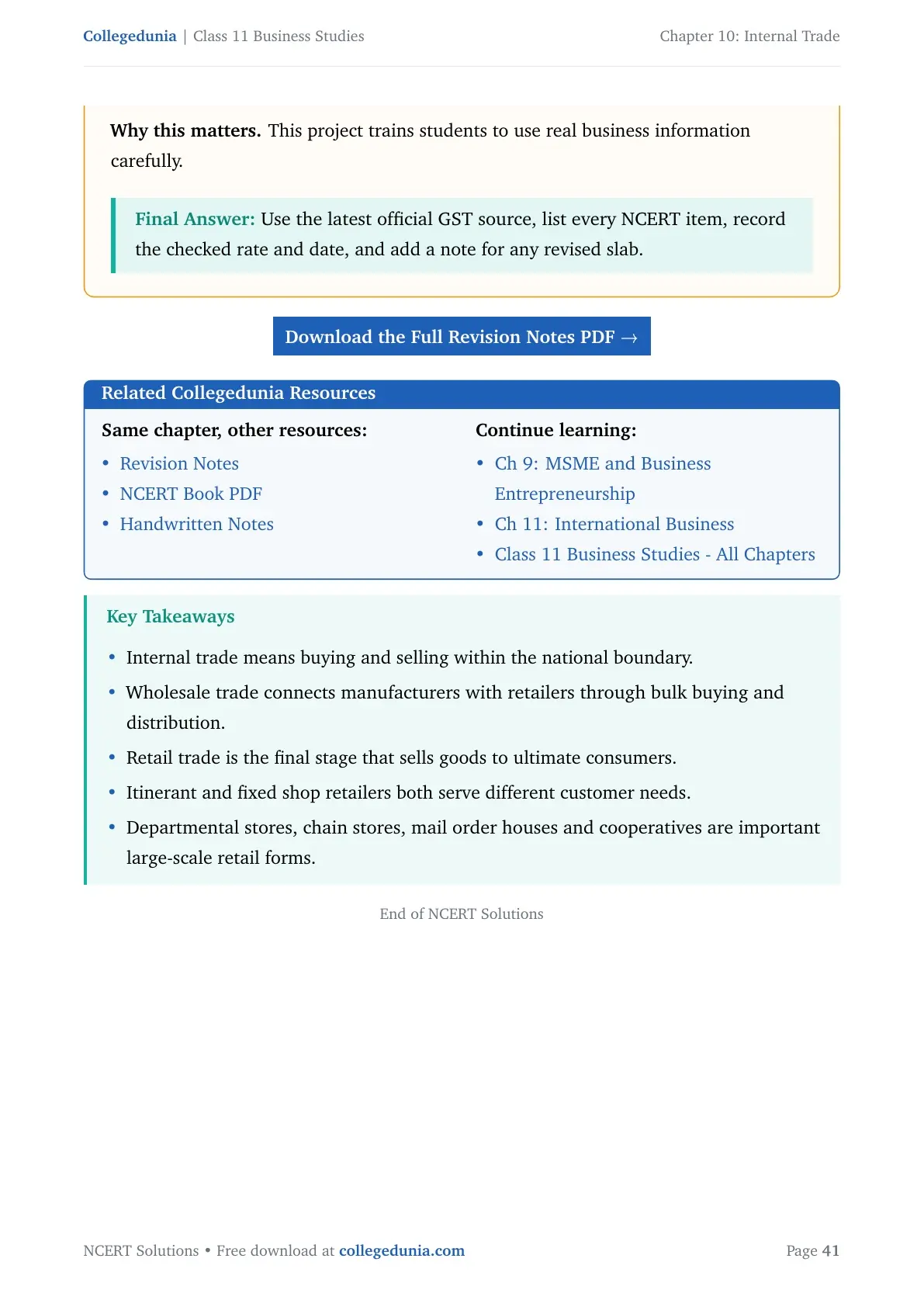
Why this matters. This project trains students to use real business information carefully.
Expert answer: Use the latest official GST source, list every NCERT item, record the checked rate and date, and add a note for any revised slab.
Internal Trade Class 11 NCERT Solutions FAQs
Ques. How many questions are solved in Class 11 Business Studies Chapter 10 Internal Trade?
Ans. This page solves 19 NCERT items. It includes 9 short answers, 5 long answers and 5 projects with expert explanations.
Ques. What is internal trade in Class 11 Business Studies?
Ans. Internal trade means buying and selling goods and services within the boundaries of one country. It includes wholesale trade and retail trade.
Ques. Why are wholesalers important in Internal Trade?
Ans. Wholesalers buy in bulk, store goods, bear risk, give credit, collect market information and supply retailers in smaller lots.
Ques. What are the main types of retailers in this chapter?
Ans. NCERT covers itinerant retailers, fixed shop small retailers and fixed shop large retailers such as departmental stores, chain stores, cooperatives and supermarkets.
Ques. How should students prepare Internal Trade project questions?
Ans. Use a local observation table. Record shop type, products sold, price, service, variety, convenience and source date for GST-related activity work.



Comments