The NCERT Solutions for Class 10 Maths Chapter 7 Coordinate Geometry Exercise 7.1 cover all 10 questions on the distance formula, collinearity, and triangle and quadrilateral types, according to the latest 2026-27 CBSE syllabus. Each answer follows the step-by-step working the board expects, with an Expert Solution that adds exam strategy.
Questions covered: 10 in total, from finding distances between point pairs to deciding whether a quadrilateral formed by given vertices is a square, rhombus, or parallelogram.
Core formula:PQ = √[(x2−x1)2 + (y2−y1)2]; write it once, then substitute; every question in this exercise reduces to this one line.
Board value: Exercise 7.1 carries 4 to 6 marks in the CBSE Class 10 board paper and appears almost every year in the 3-mark or 4-mark short-answer section.
Solved by Collegedunia: Every Exercise 7.1 question below is solved by Mathematics subject experts, checked against the official 2026-27 NCERT textbook, and written with full working so each step earns its marks in the CBSE Class 10 board paper.
What Exercise 7.1 of Coordinate Geometry Covers for Class 10
Exercise 7.1 is the first set in Chapter 7. It uses one tool throughout: the distance formula. You apply it to find lengths between pairs of points, then use those lengths to settle bigger questions about triangles, quadrilaterals, or the position of a point on an axis. The table further down lists the exact task for each of the 10 questions.
How to Solve Exercise 7.1 Question by Question
Every question starts the same way: write the distance formula, substitute, simplify. Only the final comparison changes. The table below maps each question to its task.
Question
What it asks
Method
Final answer
Q1(i)
Distance between (2,3) and (4,1)
Distance formula
2√(2) units
Q1(ii)
Distance between (-5,7) and (-1,3)
Distance formula
4√(2) units
Q1(iii)
Distance between (a,b) and (-a,-b)
Distance formula (algebraic)
2√(a2+b2) units
Q2
Distance from origin to (36,15)
Distance formula; Pythagorean triple
39 km
Q3
Are (1,5),(2,3),(-2,-11) collinear?
Find 3 pairwise distances; check AB+BC=AC
Not collinear
Q4
Do (5,-2),(6,4),(7,-2) form an isosceles triangle?
Check if any two sides equal
Yes; AB=BC=√(37)
Q5
Are classroom seats A(3,4),B(6,7),C(9,4),D(6,1) a square?
Four sides + two diagonals
Square; Champa is right
Q6
Name the type of quadrilateral for three sets of points
Check sides + diagonals; collinearity test
(i) Square (ii) No quad (iii) Parallelogram
Q7
Point on x-axis equidistant from (2,-5) and (-2,9)
Set PA2=PB2; linear equation
(-7,0)
Q8
Values of y for PQ=10 with P(2,-3),Q(10,y)
Square both sides; solve quadratic
y=3 or y=-9
Q9
Q(0,1) equidistant from P(5,-3) and R(x,6)
Equate squared distances; find x, QR, PR
x=±4; QR=√(41); PR=√(82) or 9√(2)
Q10
Relation between x and y so (x,y) is equidistant from (3,6) and (-3,4)
Set PA2=PB2; expand and simplify
3x+y=5
Quick Tip: Always square both sides before expanding when distances are set equal. Keeping the square roots through the algebra is slower and more error-prone. Squaring first collapses the surds and leaves a simple linear or quadratic equation.
Distance Formula and Collinearity: Class 10 Maths Chapter 7 Exercise 7.1 Key Concepts
The distance formula is the only new formula here. It comes from the Pythagoras theorem applied to the horizontal and vertical gaps between two points. For any two points P(x1, y1) and Q(x2, y2):
PQ = √((x2 - x1)2 + (y2 - y1)2)
Three points are collinear when one pairwise distance equals the sum of the other two. If no pairing fits, they form a triangle.
Distance from the origin: special case where (x1, y1) = (0,0), so OP = √(x2 + y2).
A quadrilateral is a square when all four sides are equal AND both diagonals are equal.
A quadrilateral is a rhombus when all four sides are equal but the diagonals are unequal.
A quadrilateral is a parallelogram when opposite sides are equal and the diagonals are unequal.
Remember: A rhombus also has four equal sides. So equal sides alone only prove a rhombus, not a square. Always check the diagonals to separate the two.
Step-by-Step Solution Approach for Exercise 7.1 Class 10 Maths
Use this four-step approach for every question. It keeps the working neat and earns full marks.
Step
What to write
Why it earns marks
1. State the formula
Write d = √((x2-x1)2 + (y2-y1)2) once at the start
Shows the examiner which formula you are using
2. Name the points
Label them A, B, C etc. with the given coordinates
Prevents sign errors when subtracting
3. Substitute and simplify
Write each squared difference, add, then take the root
Each arithmetic line is a step mark
4. State the conclusion
Name the shape or give the required point/relation
The conclusion mark is the final mark for the question
Watch Out:Simplify the surd completely.√(8) must become 2√(2) and √(32) must become 4√(2). Leaving √(8) in the final answer costs the simplification mark in CBSE.
Common Mistakes Students Make in Coordinate Geometry Exercise 7.1
Exercise 7.1 is mostly arithmetic, but these errors cost marks in the board paper.
Not simplifying the surd: always pull out the largest perfect square from under the root.
Dropping the negative root in Q8 and Q9:(y+3)2 = 36 gives y+3 = ± 6, so two answers. Writing one loses a mark.
Calling a rhombus a square in Q5 or Q6: equal sides alone prove only a rhombus. Check the diagonals first.
Skipping the collinearity test in Q6(ii): if three of the four vertices are collinear, there is no quadrilateral.
Exercise 7.1 Marks and CBSE Board Relevance for Class 10 Maths
Coordinate Geometry carries 6 marks in the board paper. Exercise 7.1 material shows up in the 2-mark or 3-mark slots most years.
Question type from Exercise 7.1
Where it appears in the board paper
Typical marks
Distance between two given points (Q1 style)
1-mark or 2-mark MCQ / very short answer
1 to 2
Classifying triangle or deciding collinearity (Q3/Q4 style)
2-mark or 3-mark short answer
2 to 3
Classifying quadrilateral by sides and diagonals (Q5/Q6 style)
3-mark or 4-mark short answer
3 to 4
Finding an unknown coordinate given a distance or equidistance (Q7-Q10 style)
2-mark or 3-mark short answer
2 to 3
Other Resources for This Chapter: Class 10 Maths Coordinate Geometry
Jump to the other exercise of Chapter 7 and the other resource types below.
All NCERT Solutions for Class 10 Maths Chapter 7 Coordinate Geometry Exercise 7.1 with Step-by-Step Solutions
Exercise 7.1
Q 7.1
Find the distance between the following pairs of points:
(i) (2,3), (4,1)
(ii) (-5,7), (-1,3)
(iii) (a,b), (-a,-b)
Concept used. The distance formula gives the
straight-line distance between two points P(x1,y1) and
Q(x2,y2):
PQ=√(x2-x1)2+(y2-y1)2.
It comes from the Pythagoras theorem applied to the right triangle
whose legs are the horizontal gap (x2-x1) and the vertical gap
(y2-y1). Distance is never negative, so we keep only the positive
square root.
(i) Take (x1,y1)=(2,3) and (x2,y2)=(4,1).
aligned
distance&=√(4-2)2+(1-3)2
&=√(2)2+(-2)2
&=√4+4=√8=2√2 units.
aligned
(ii) Take (x1,y1)=(-5,7) and (x2,y2)=(-1,3).
aligned
distance&=√(-1-(-5))2+(3-7)2
&=√(4)2+(-4)2
&=√16+16=√32=4√2 units.
aligned
(iii) Take (x1,y1)=(a,b) and (x2,y2)=(-a,-b).
aligned
distance&=√(-a-a)2+(-b-b)2
&=√(-2a)2+(-2b)2
&=√4a2+4b2=2√a2+b2 units.
aligned
(i) 2√2 units, (ii) 4√2 units, (iii) 2√a2+b2 units.
AI
Ananya Iyer
M.Sc Mathematics, University of Hyderabad
Verified Expert
How to present this for full marks. Write the formula once,
then the substitution, then the arithmetic, then the simplified surd.
Part (i): the two points differ by 2 across and 2
down, so the gap is √22+22=√8. Always pull out
the largest perfect square here, giving 2√2.
Part (ii): the differences are 4 and -4, and the
signs vanish on squaring, so the length is √32=4√2.
Part (iii): treat the letters like numbers. The point
(-a,-b) is the reflection of (a,b) through the origin, so the
segment is twice the distance of (a,b) from the origin.
Why surds: a neat surd answer tells the examiner you
handled the radical correctly, which earns more than a rounded
decimal in a proof-style question.
2√2, 4√2 and 2√a2+b2 units respectively.
Q 7.2
Find the distance between the points (0,0) and (36,15).
Can you now find the distance between the two towns A and B
discussed in Section 7.2?
Concept used. The distance of a point (x,y) from the origin
(0,0) is a special case of the distance formula:
OP=√x2+y2.
In Section 7.2 the town B lies 36 km east and 15 km north of town
A. Placing A at the origin makes B the point (36,15), so the
straight-line distance between the towns equals OB.
Substitute x=36 and y=15 into the formula:
distance=√362+152.
Square each term:
362=1296, 152=225.
Add and take the square root:
distance=√1296+225=√1521=39 units.
Since 1 unit stands for 1 km, towns A and B are 39 km
apart in a straight line.
Distance =39 units; towns A and B are 39 km apart.
RV
Rohan Verma
B.Tech Civil Engineering, NIT Trichy
Verified Expert
Spot the Pythagorean triple. Trained eyes read (36,15) as a
scaled standard triple, so the distance comes out at sight.
Factor: pull the common 3 out, since 36=3× 12
and 15=3× 5, leaving the clean leg pair (12,5).
Recognise: the pair (12,5) has hypotenuse
√122+52=13, one of the standard right-triangle triples.
Scale back: multiply by the factor 3 to get the
distance 3× 13=39 km, with √1521 used only as a check.
Why it helps: knowing the common triples saves time in
the board exam, where many distance questions are built from them
on purpose, and the straight 39 km beats the 51 km road path.
39 units, so towns A and B are 39 km apart.
Q 7.3
Determine if the points (1,5), (2,3) and (-2,-11) are
collinear.
Concept used. Three points are collinear (lie on one
straight line) only if one of the three pairwise distances equals the
sum of the other two. We use the distance formula
√(x2-x1)2+(y2-y1)2 to find all three lengths and then
test that condition.
Name the points A(1,5), B(2,3), C(-2,-11) and find AB:
AB=√(2-1)2+(3-5)2=√1+4=√5≈ 2.24.
Compare. The largest length is AC≈ 16.28. The sum of
the other two is AB+BC≈ 2.24+14.56=16.80, which is
not equal to 16.28. No pairing of the three distances
adds up exactly, so the points cannot lie on one line.
The points are not collinear (no pairwise sum of distances matches the third).
MN
Meera Nair
M.Sc Mathematics, Savitribai Phule Pune University
Verified Expert
A faster slope check. Computing three surds is slow, so compare
the slopes of two segments instead with only subtraction and division.
Slope of AB: the rise over run from A to B is
3-52-1=-2, a clean whole number.
Slope of AC: the rise over run from A to C is
-11-5-2-1=163≈ 5.33, a different value.
Verdict: the slopes differ, so the two segments point in
different directions from the shared point A. The three points
are therefore not collinear, agreeing with the distance test.
The rule: equal slopes through a shared point mean
collinear, while unequal slopes mean a genuine triangle. Both
methods score, but the slope check is quicker when the numbers
are ugly under the root.
Not collinear, confirmed by unequal slopes -2 and 163.
Q 7.4
Check whether (5,-2), (6,4) and (7,-2) are the vertices
of an isosceles triangle.
Concept used. A triangle is isosceles when at least
two of its sides have equal length. We find the three side lengths with
the distance formula and check for a matching pair.
Name the points A(5,-2), B(6,4), C(7,-2). Find AB:
AB=√(6-5)2+(4-(-2))2=√1+36=√37.
Find BC:
BC=√(7-6)2+(-2-4)2=√1+36=√37.
Find CA:
CA=√(5-7)2+(-2-(-2))2=√4+0=√4=2.
Compare: AB=BC=√37 while CA=2. Two sides are equal, so
the triangle is isosceles.
Yes; since AB=BC=√37, the three points form an isosceles triangle.
KR
Karthik Reddy
M.Sc Mathematics, Osmania University
Verified Expert
Symmetry tells the story. The vertex B sits exactly above the
mid-point of the base AC, which proves the triangle isosceles at sight.
Find the base mid-point: the mid-point of A(5,-2) and
C(7,-2) is (5+72,-2-22)=(6,-2).
Spot the alignment: the vertex B(6,4) lies directly
above (6,-2) on the vertical line x=6, which is the
perpendicular bisector of the base AC.
Conclude: any point on the perpendicular bisector of
AC is equidistant from A and C, so the two slant sides are
equal without any further calculation and the triangle is isosceles.
Carry it forward: this perpendicular-bisector idea
reappears whenever a question asks for a point equidistant from
two others, so it is worth recognising early.
Isosceles: B lies on the perpendicular bisector of AC, so AB=BC=√37.
Q 7.5
In a classroom, 4 friends are seated at the points A, B,
C and D as shown in Fig. 7.8. Champa and Chameli walk into the class
and after observing for a few minutes Champa asks Chameli, ``Don't you
think ABCD is a square?'' Chameli disagrees. Using the distance
formula, find which of them is correct.
Concept used. A quadrilateral is a square when all
four sides are equal and the two diagonals are equal. We read the
coordinates off the grid, find the four sides and both diagonals with
the distance formula, and check both conditions.
From the figure the seats are A(3,4), B(6,7), C(9,4),
D(6,1). Find the four sides:
aligned
AB&=√(6-3)2+(7-4)2=√9+9=√18=3√2,
BC&=√(9-6)2+(4-7)2=√9+9=√18=3√2,
CD&=√(6-9)2+(1-4)2=√9+9=√18=3√2,
DA&=√(3-6)2+(4-1)2=√9+9=√18=3√2.
aligned
All four sides equal 3√2, so ABCD is at least a
rhombus. Now test the diagonals:
aligned
AC&=√(9-3)2+(4-4)2=√36+0=6,
BD&=√(6-6)2+(1-7)2=√0+36=6.
aligned
The diagonals are equal (AC=BD=6). Equal sides plus equal
diagonals means the figure is a square.
ABCD is a square (sides 3√2, diagonals 6), so Champa is correct.
SP
Sneha Pillai
M.Sc Mathematics, University of Kerala
Verified Expert
Why both checks are needed. Equal sides alone do not prove a
square, because a tilted rhombus also has four equal sides.
Equal sides: all four sides came out as 3√2,
which only guarantees a rhombus at this stage and nothing more.
Diagonals decide: in a rhombus the diagonals are usually
unequal, and they become equal only when every angle is a right
angle, that is, when the figure is actually a square.
Apply it here: the diagonals come out equal, so they
force right angles and the figure is a square, which means
Chameli is mistaken and Champa is right.
The trap: a common board mistake is to give four equal
sides and stop, calling the figure a square too soon. Always
finish with the diagonal comparison to separate rhombus from square.
Square confirmed by equal sides and equal diagonals; Champa is right.
Q 7.6
Name the type of quadrilateral formed, if any, by the
following points, and give reasons for your answer:
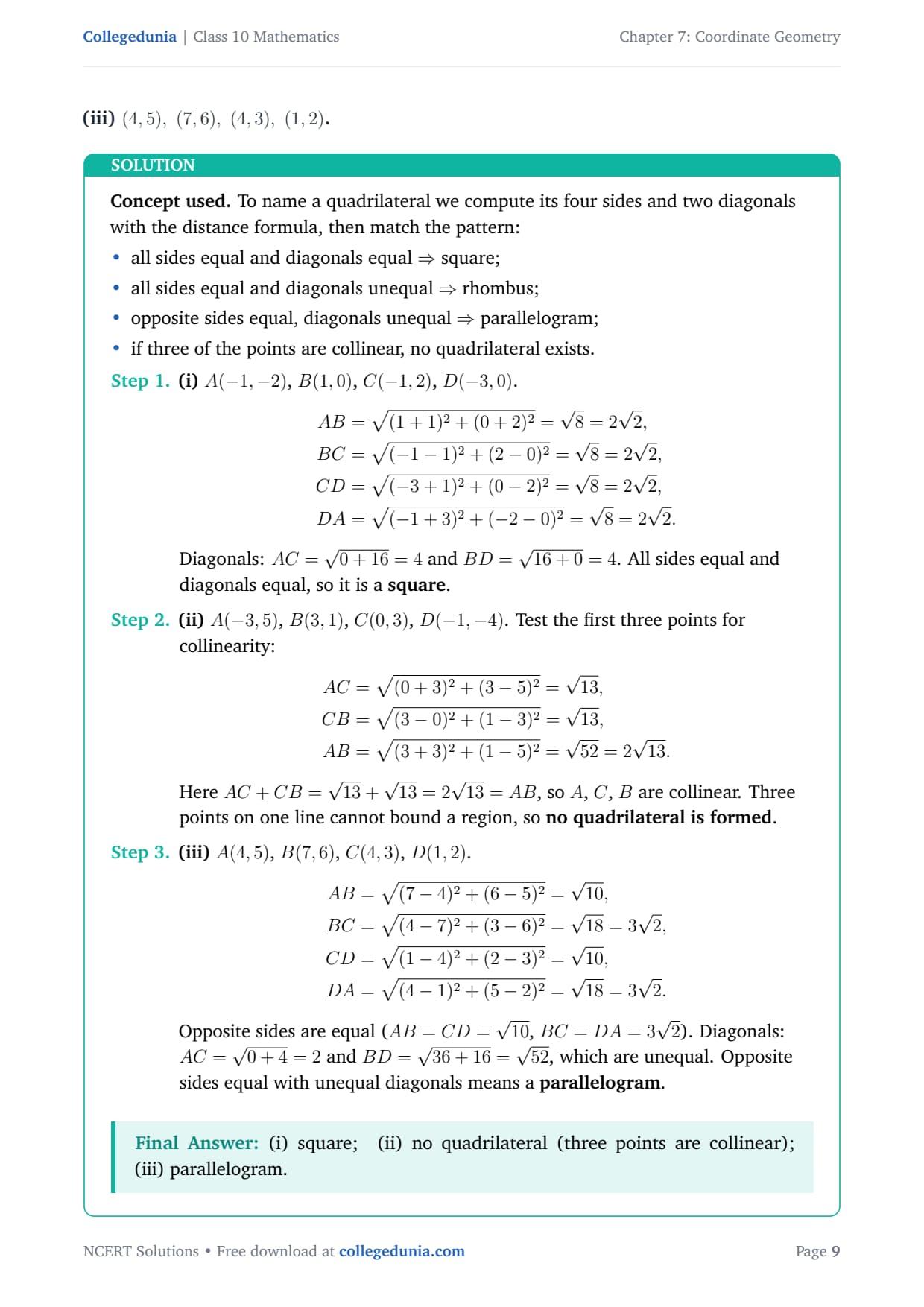
(i) (-1,-2), (1,0), (-1,2), (-3,0);
(ii) (-3,5), (3,1), (0,3), (-1,-4);
(iii) (4,5), (7,6), (4,3), (1,2).
Concept used. To name a quadrilateral we compute its four
sides and two diagonals with the distance formula, then match the
pattern:
if three of the points are collinear, no quadrilateral exists.
(i)A(-1,-2), B(1,0), C(-1,2), D(-3,0).
aligned
AB&=√(1+1)2+(0+2)2=√8=2√2,
BC&=√(-1-1)2+(2-0)2=√8=2√2,
CD&=√(-3+1)2+(0-2)2=√8=2√2,
DA&=√(-1+3)2+(-2-0)2=√8=2√2.
aligned
Diagonals: AC=√0+16=4 and BD=√16+0=4. All sides
equal and diagonals equal, so it is a square.
(ii)A(-3,5), B(3,1), C(0,3), D(-1,-4). Test
the first three points for collinearity:
aligned
AC&=√(0+3)2+(3-5)2=√13,
CB&=√(3-0)2+(1-3)2=√13,
AB&=√(3+3)2+(1-5)2=√52=2√13.
aligned
Here AC+CB=√13+√13=2√13=AB, so A, C, B
are collinear. Three points on one line cannot bound a region,
so no quadrilateral is formed.
(iii)A(4,5), B(7,6), C(4,3), D(1,2).
aligned
AB&=√(7-4)2+(6-5)2=√10,
BC&=√(4-7)2+(3-6)2=√18=3√2,
CD&=√(1-4)2+(2-3)2=√10,
DA&=√(4-1)2+(5-2)2=√18=3√2.
aligned
Opposite sides are equal (AB=CD=√10, BC=DA=3√2).
Diagonals: AC=√0+4=2 and BD=√36+16=√52,
which are unequal. Opposite sides equal with unequal diagonals
means a parallelogram.
(i) square; (ii) no quadrilateral (three points are collinear); (iii) parallelogram.
AJ
Aditya Joshi
M.Sc Mathematics, University of Mumbai
Verified Expert
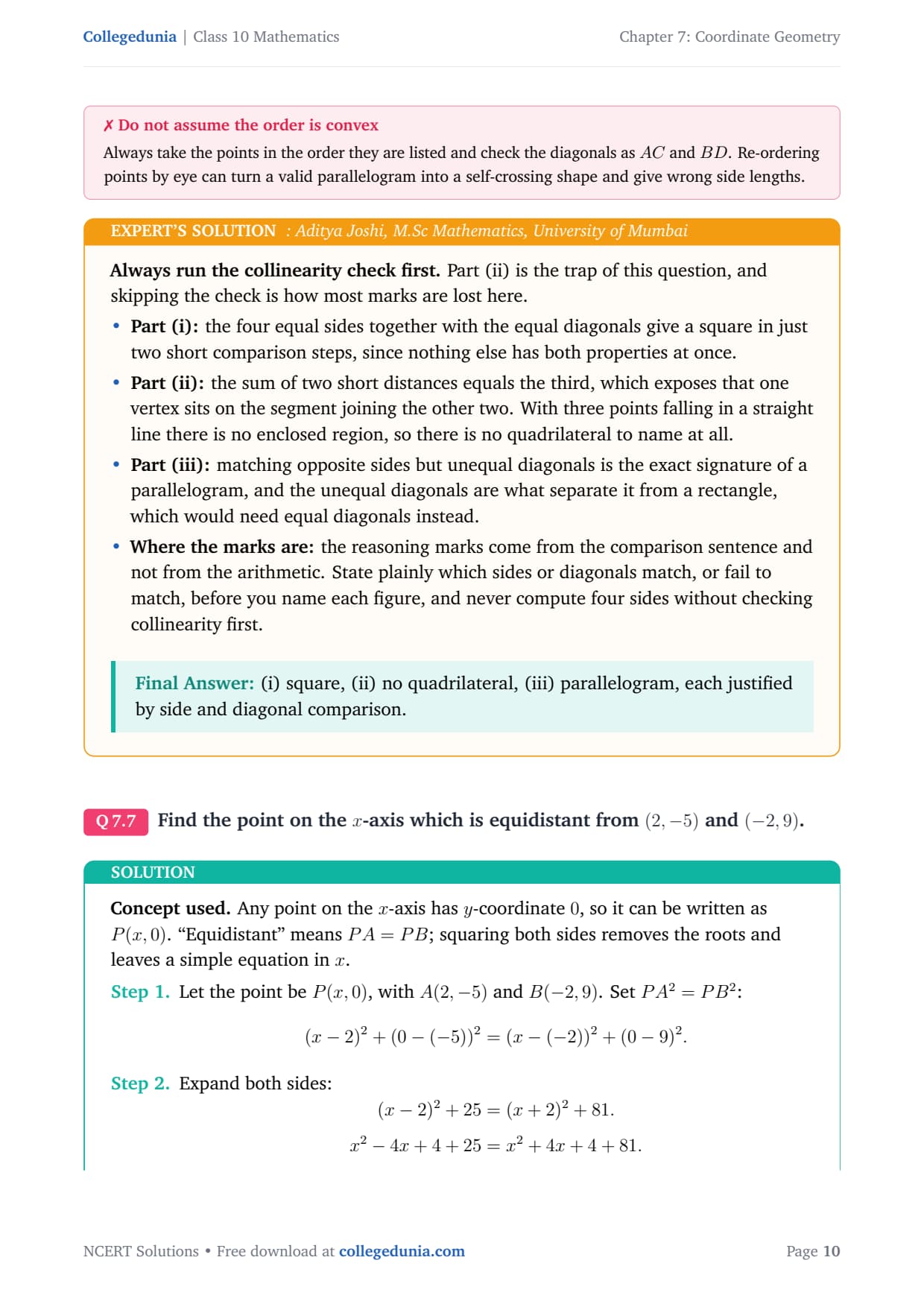
Always run the collinearity check first. Part (ii) is the trap
of this question, and skipping the check is how most marks are lost here.
Part (i): the four equal sides together with the equal
diagonals give a square in just two short comparison steps, since
nothing else has both properties at once.
Part (ii): the sum of two short distances equals the
third, which exposes that one vertex sits on the segment joining
the other two. With three points falling in a straight line there
is no enclosed region, so there is no quadrilateral to name at all.
Part (iii): matching opposite sides but unequal diagonals
is the exact signature of a parallelogram, and the unequal
diagonals are what separate it from a rectangle, which would need
equal diagonals instead.
Where the marks are: the reasoning marks come from the
comparison sentence and not from the arithmetic. State plainly
which sides or diagonals match, or fail to match, before you name
each figure, and never compute four sides without checking
collinearity first.
(i) square, (ii) no quadrilateral, (iii) parallelogram, each justified by side and diagonal comparison.
Q 7.7
Find the point on the x-axis which is equidistant from
(2,-5) and (-2,9).
Concept used. Any point on the x-axis has y-coordinate
0, so it can be written as P(x,0). ``Equidistant'' means PA=PB;
squaring both sides removes the roots and leaves a simple equation in
x.
Let the point be P(x,0), with A(2,-5) and B(-2,9). Set
PA2=PB2:
(x-2)2+(0-(-5))2=(x-(-2))2+(0-9)2.
Expand both sides:
(x-2)2+25=(x+2)2+81. x2-4x+4+25=x2+4x+4+81.
Cancel x2 and 4 from both sides:
-4x+25=4x+81.
Collect terms:
-4x-4x=81-25 -8x=56 x=-7.
The required point on the x-axis is (-7,0).
PM
Priya Menon
M.Sc Mathematics, University of Calicut
Verified Expert
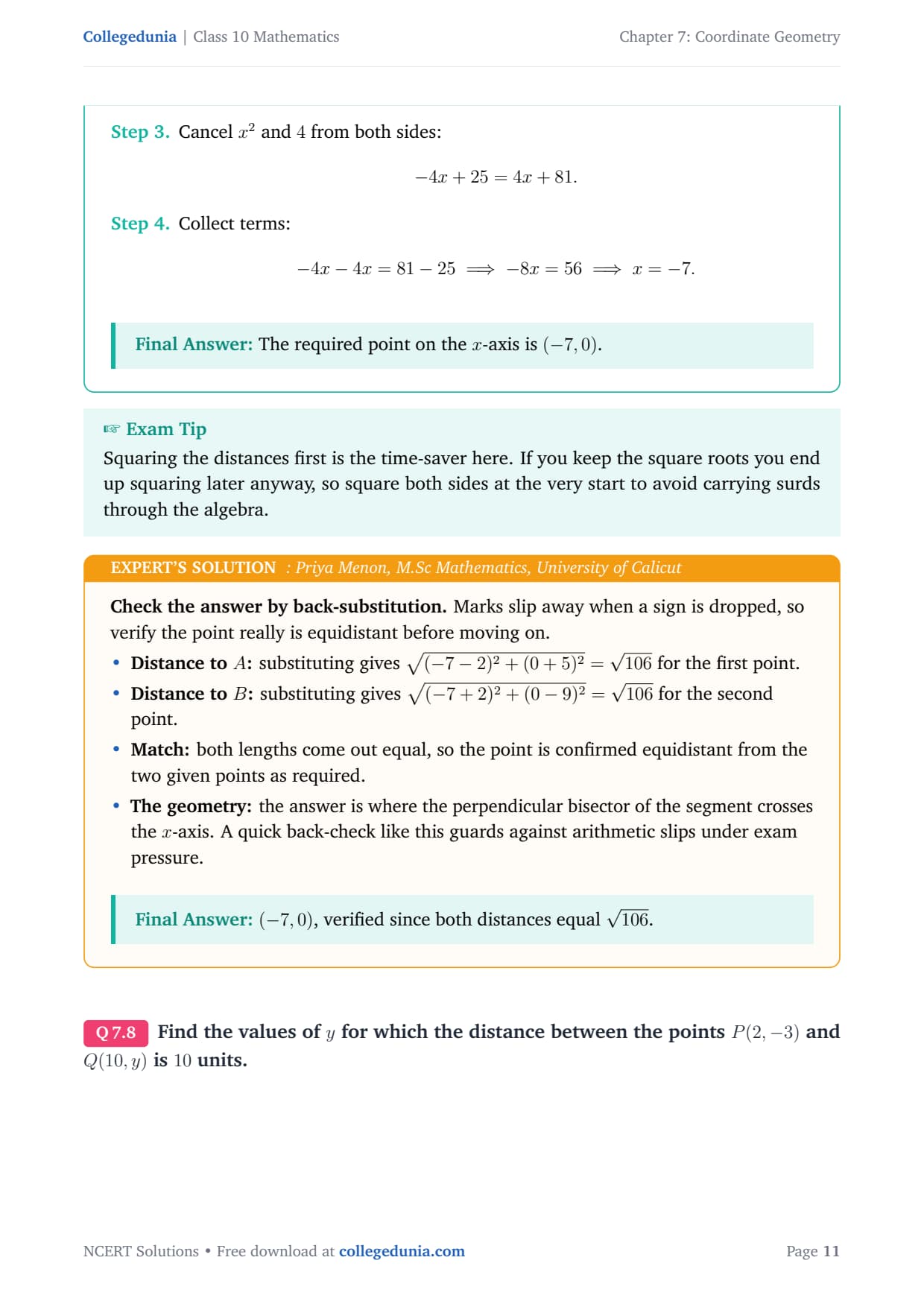
Check the answer by back-substitution. Marks slip away when a
sign is dropped, so verify the point really is equidistant before moving on.
Distance to A: substituting gives
√(-7-2)2+(0+5)2=√106 for the first point.
Distance to B: substituting gives
√(-7+2)2+(0-9)2=√106 for the second point.
Match: both lengths come out equal, so the point is
confirmed equidistant from the two given points as required.
The geometry: the answer is where the perpendicular
bisector of the segment crosses the x-axis. A quick back-check
like this guards against arithmetic slips under exam pressure.
(-7,0), verified since both distances equal √106.
Q 7.8
Find the values of y for which the distance between the
points P(2,-3) and Q(10,y) is 10 units.
Concept used. The distance formula
PQ=√(x2-x1)2+(y2-y1)2 sets up an equation when the
distance is given. Squaring both sides turns it into a quadratic in y,
which usually has two solutions.
Write the distance and set it equal to 10:
√(10-2)2+(y-(-3))2=10.
Square both sides:
(8)2+(y+3)2=100 64+(y+3)2=100.
Isolate the squared term:
(y+3)2=100-64=36.
Take the square root, keeping both signs:
y+3=± 6 y=-3+6=3 y=-3-6=-9.
y=3 or y=-9.
VS
Vikram Singh
M.Sc Mathematics, University of Rajasthan
Verified Expert
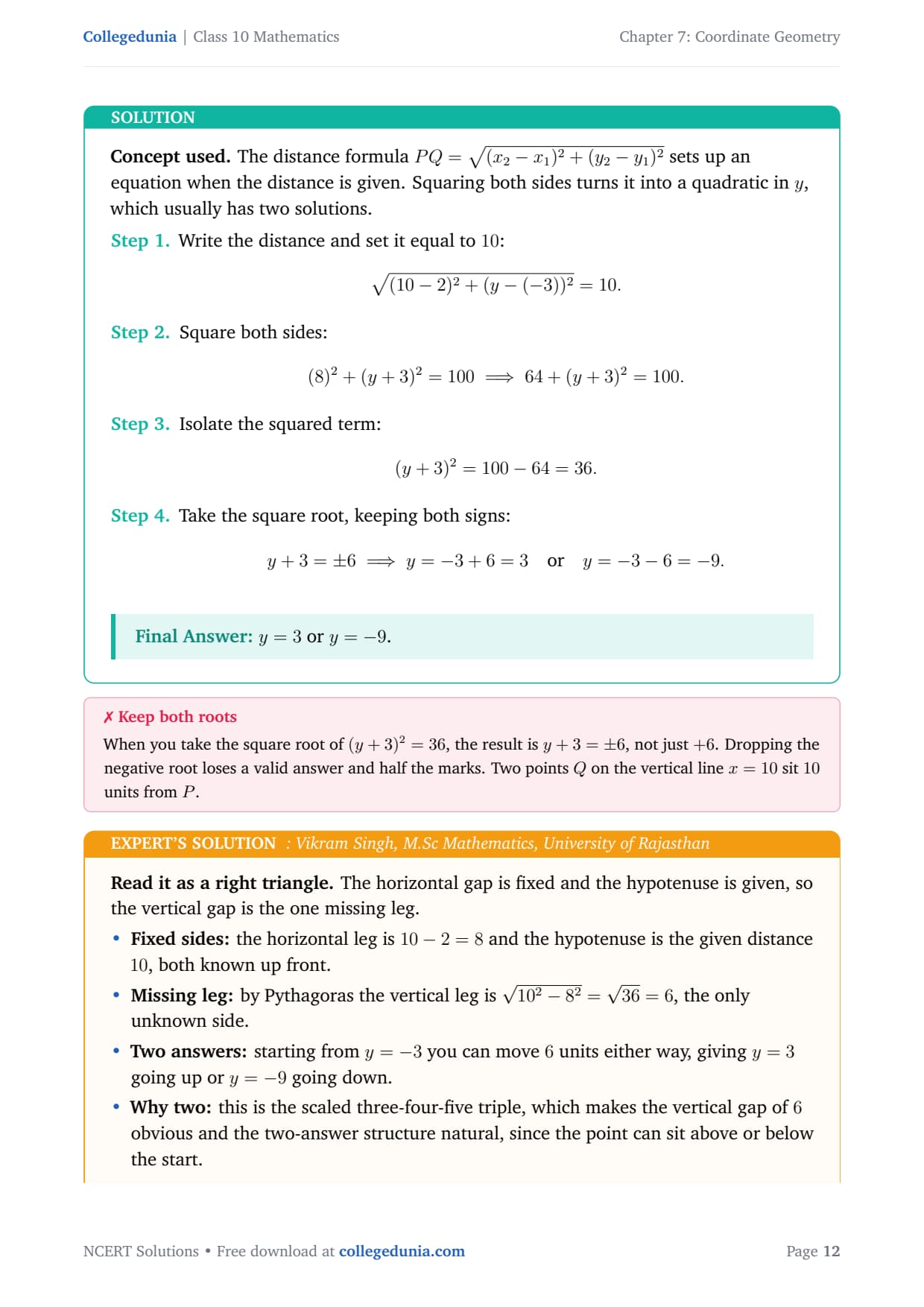
Read it as a right triangle. The horizontal gap is fixed and the
hypotenuse is given, so the vertical gap is the one missing leg.
Fixed sides: the horizontal leg is 10-2=8 and the
hypotenuse is the given distance 10, both known up front.
Missing leg: by Pythagoras the vertical leg is
√102-82=√36=6, the only unknown side.
Two answers: starting from y=-3 you can move 6 units
either way, giving y=3 going up or y=-9 going down.
Why two: this is the scaled three-four-five triple, which
makes the vertical gap of 6 obvious and the two-answer structure
natural, since the point can sit above or below the start.
y=3 or y=-9.
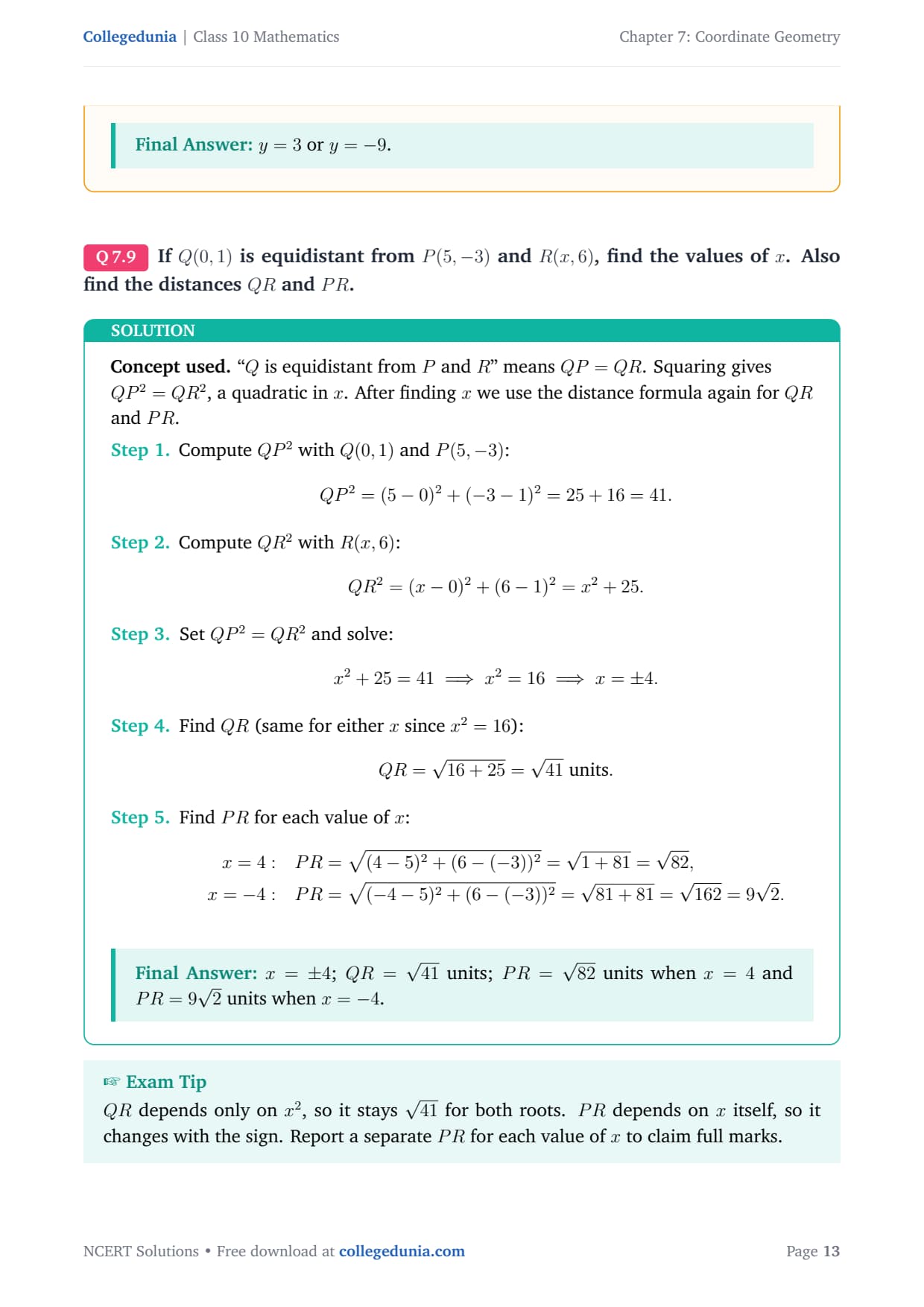
Q 7.9
If Q(0,1) is equidistant from P(5,-3) and R(x,6), find
the values of x. Also find the distances QR and PR.
Concept used. ``Q is equidistant from P and R'' means
QP=QR. Squaring gives QP2=QR2, a quadratic in x. After finding
x we use the distance formula again for QR and PR.
Compute QP2 with Q(0,1) and P(5,-3):
QP2=(5-0)2+(-3-1)2=25+16=41.
Compute QR2 with R(x,6):
QR2=(x-0)2+(6-1)2=x2+25.
Set QP2=QR2 and solve:
x2+25=41 x2=16 x=± 4.
Find QR (same for either x since x2=16):
QR=√16+25=√41 units.
Find PR for each value of x:
aligned
x=4:& PR=√(4-5)2+(6-(-3))2=√1+81=√82, x=-4:& PR=√(-4-5)2+(6-(-3))2=√81+81=√162=9√2.
aligned
x=± 4; QR=√41 units; PR=√82 units when x=4 and PR=9√2 units when x=-4.
NR
Nandini Rao
M.Sc Mathematics, Bangalore University
Verified Expert
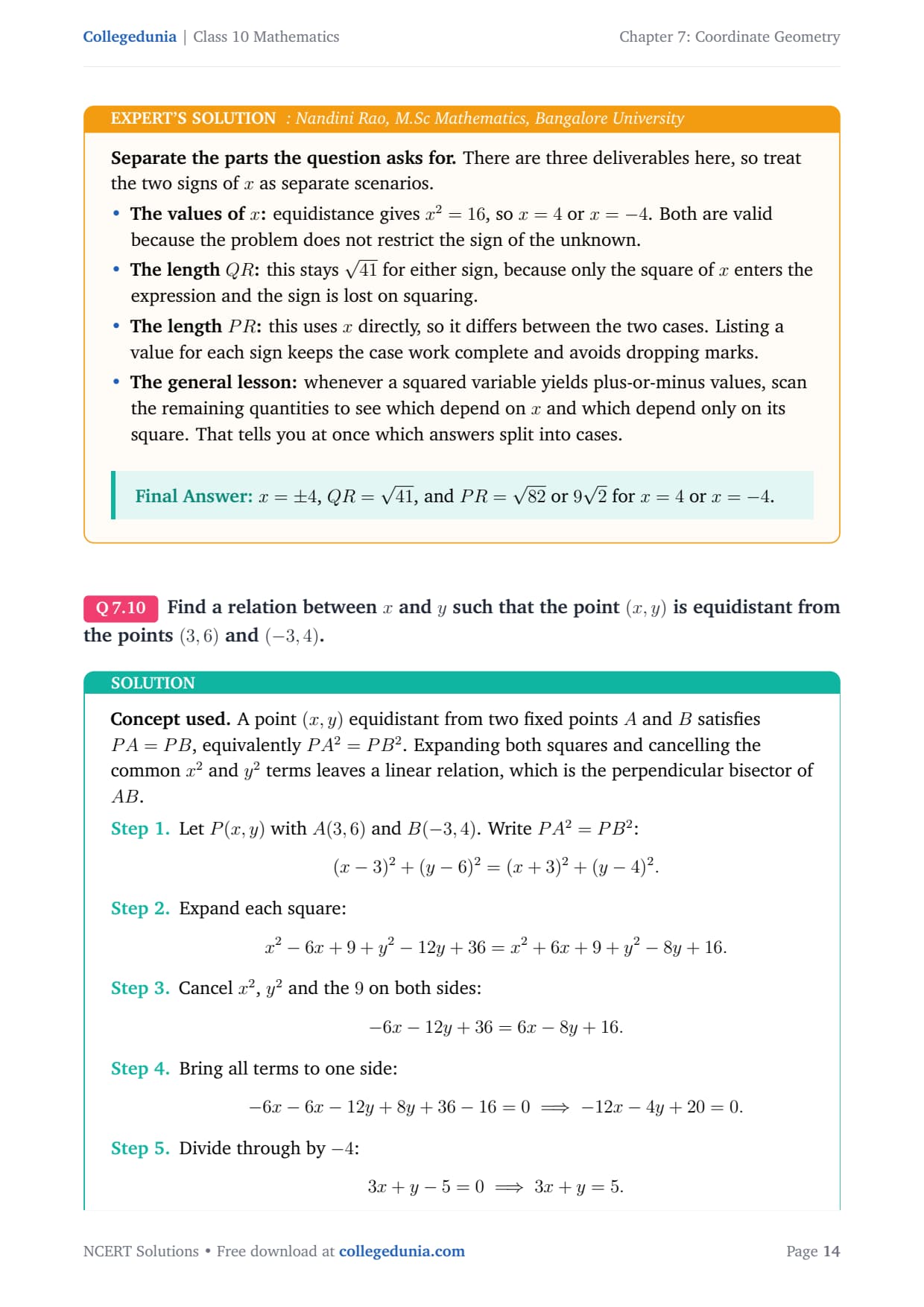
Separate the parts the question asks for. There are three
deliverables here, so treat the two signs of x as separate scenarios.
The values of x: equidistance gives x2=16, so x=4
or x=-4. Both are valid because the problem does not restrict
the sign of the unknown.
The length QR: this stays √41 for either sign,
because only the square of x enters the expression and the sign
is lost on squaring.
The length PR: this uses x directly, so it differs
between the two cases. Listing a value for each sign keeps the
case work complete and avoids dropping marks.
The general lesson: whenever a squared variable yields
plus-or-minus values, scan the remaining quantities to see which
depend on x and which depend only on its square. That tells you
at once which answers split into cases.
x=± 4, QR=√41, and PR=√82 or 9√2 for x=4 or x=-4.
Q 7.10
Find a relation between x and y such that the point
(x,y) is equidistant from the points (3,6) and (-3,4).
Concept used. A point (x,y) equidistant from two fixed points
A and B satisfies PA=PB, equivalently PA2=PB2. Expanding both
squares and cancelling the common x2 and y2 terms leaves a linear
relation, which is the perpendicular bisector of AB.
Let P(x,y) with A(3,6) and B(-3,4). Write PA2=PB2:
(x-3)2+(y-6)2=(x+3)2+(y-4)2.
Expand each square:
x2-6x+9+y2-12y+36=x2+6x+9+y2-8y+16.
Cancel x2, y2 and the 9 on both sides:
-6x-12y+36=6x-8y+16.
Bring all terms to one side:
-6x-6x-12y+8y+36-16=0 -12x-4y+20=0.
Divide through by -4:
3x+y-5=0 3x+y=5.
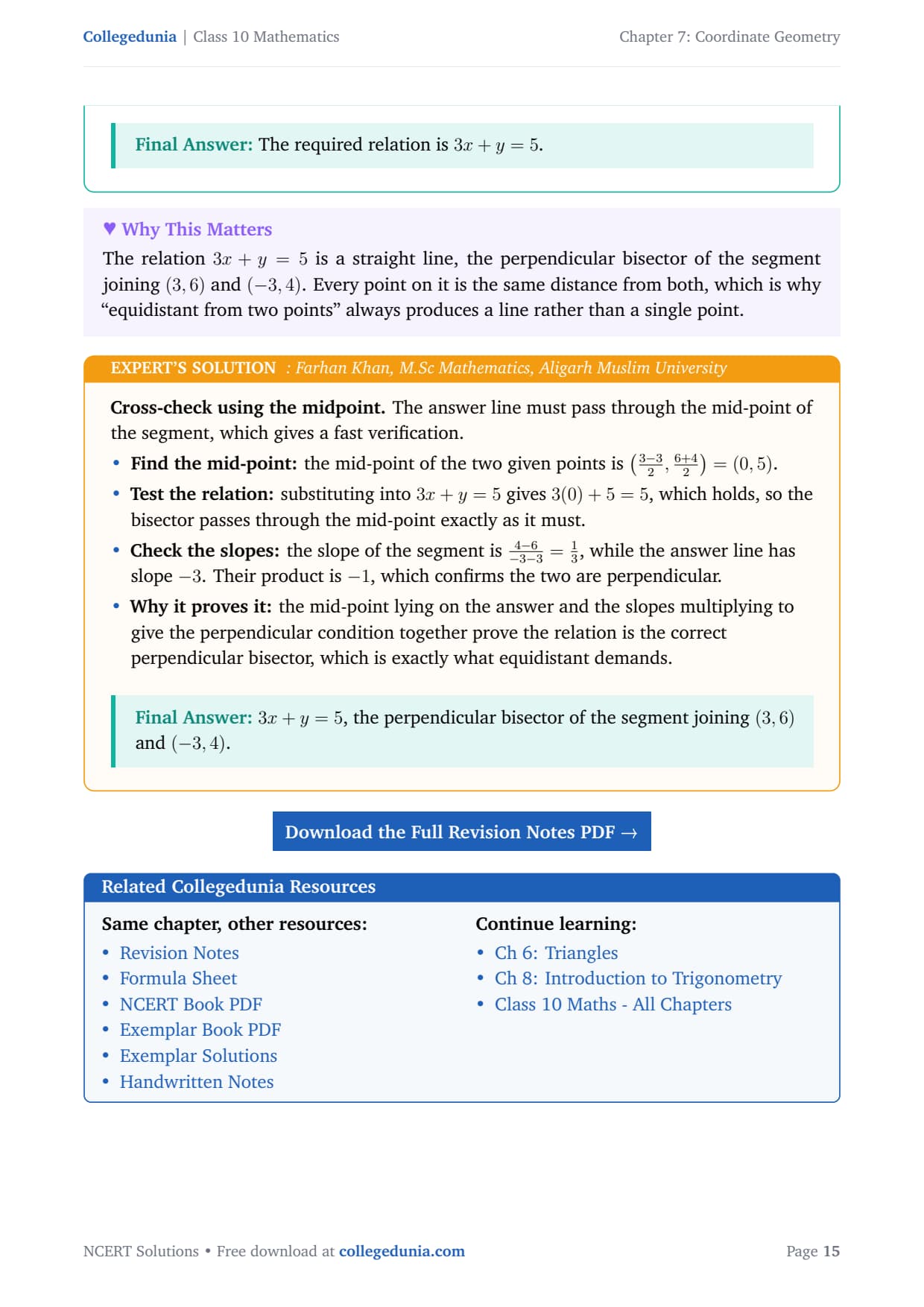
The required relation is 3x+y=5.
FK
Farhan Khan
M.Sc Mathematics, Aligarh Muslim University
Verified Expert
Cross-check using the midpoint. The answer line must pass
through the mid-point of the segment, which gives a fast verification.
Find the mid-point: the mid-point of the two given
points is (3-32,6+42)=(0,5).
Test the relation: substituting into 3x+y=5 gives
3(0)+5=5, which holds, so the bisector passes through the
mid-point exactly as it must.
Check the slopes: the slope of the segment is
4-6-3-3=13, while the answer line has slope
-3. Their product is -1, which confirms the two are perpendicular.
Why it proves it: the mid-point lying on the answer and
the slopes multiplying to give the perpendicular condition together
prove the relation is the correct perpendicular bisector, which is
exactly what equidistant demands.
3x+y=5, the perpendicular bisector of the segment joining (3,6) and (-3,4).
Student Feedback
Out of 5,800 students surveyed before the 2026 boards, 81% said Exercise 7.1 became easy once they memorised just one formula (the distance formula). The most common slip was forgetting to simplify the surd at the end, which lost them the final simplification mark.
Source: Collegedunia Class 10 Maths student survey, 2026 board cohort.
Coordinate Geometry Class 10 Maths Exercise 7.1 NCERT Solutions FAQs
Ques. How many questions are there in Class 10 Maths Chapter 7 Coordinate Geometry Exercise 7.1?
Ans. Exercise 7.1 has 10 questions. They cover finding distances between pairs of points, checking collinearity, deciding whether three points form an isosceles triangle, classifying quadrilaterals as square, rhombus, or parallelogram, and finding unknown coordinates using given distance conditions.
Ques. What is the distance formula used in Exercise 7.1 of Class 10 Maths?
Ans. The distance formula used throughout Exercise 7.1 is PQ = square root of [(x2 - x1) squared + (y2 - y1) squared]. It comes from the Pythagoras theorem applied to the horizontal and vertical gaps between two points. All 10 questions in this exercise reduce to applying this one formula and then comparing the resulting lengths.
Ques. How do you prove that a quadrilateral is a square using the distance formula in Exercise 7.1?
Ans. To prove a quadrilateral is a square, you need two conditions: all four sides must be equal, and both diagonals must be equal. In Exercise 7.1 Q5, the four seating positions A(3,4), B(6,7), C(9,4), D(6,1) all have sides equal to 3 root 2 and diagonals equal to 6. Both conditions are satisfied, so ABCD is a square. Equal sides alone only prove a rhombus, not a square.
Ques. How many values of y are there in Q8 of Exercise 7.1?
Ans. There are two values of y. When you set the distance PQ equal to 10 and square both sides, you get (y + 3) squared = 36, which gives y + 3 = plus or minus 6. This yields y = 3 or y = -9. Both values are valid because the point Q(10, y) can sit either above or below the horizontal level of P, and both positions are exactly 10 units away.
Ques. Where can I download the Class 10 Maths Chapter 7 Exercise 7.1 NCERT Solutions PDF?
Ans. You can download the Coordinate Geometry Exercise 7.1 NCERT Solutions PDF directly from this page using the download card at the top. It is free and follows the 2026-27 NCERT textbook. The full chapter PDF with both exercises (7.1 and 7.2) is also available on the Coordinate Geometry chapter solutions page.







Comments