




The NCERT Class 11 Biotechnology Handwritten Notes Chapter 4 Enzymes and Bioenergetics are scanned notebook pages built for a single revision sitting against the 2026-27 syllabus. They carry the active site, the lock and key and induced fit models, the seven IUB classes, cofactors and their precursor vitamins, the temperature, pH and substrate curves, Michaelis-Menten kinetics with Km, the three reversible inhibitions, and the bioenergetics half from free energy to ATP.
- Length: 42 handwritten pages covering both sections of the chapter, all thirteen textbook figures and every exercise question.
- Must-learn pair: competitive against non-competitive inhibition, the comparison that decides the five-mark question almost every year.
- Also on this page: the coenzyme and vitamin table, a Km cheat line, a six-point mistake list and links to the sibling biotechnology chapters.
Every page in these Enzymes and Bioenergetics notes is written by hand, checked against the 2026-27 NCERT Biotechnology print, and matched to the way Class 11 papers ask about Km, inhibition curves and the ATP cycle.
Student Feedback: In a Collegedunia survey of 8,730 Class 11 Biotechnology students, 71% named enzyme inhibition the single hardest topic in the whole first-year course. Toppers reported one fix that works. Draw the two Michaelis-Menten curves first, then write the theory under the drawing instead of the other way round.
Source: 2026-27 Class 11 Biotechnology student survey. Sample of 8,730 students from schools across 14 states.
What an Enzyme Is: The Biocatalyst Definition to Memorise
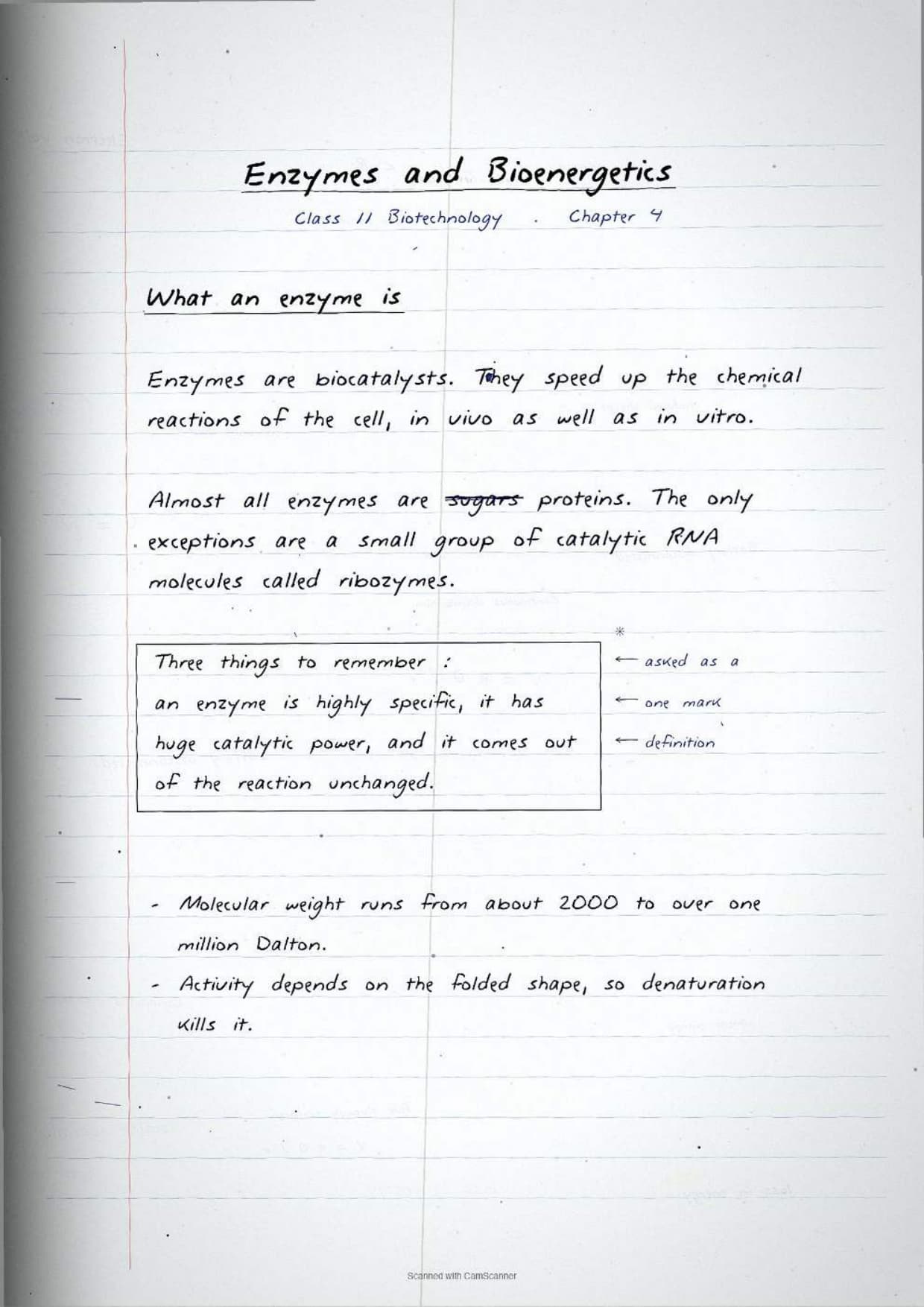
The chapter opens with one sentence that carries a full mark on its own. Enzymes are biocatalysts which catalyse biochemical reactions both in vivo and in vitro. Three properties follow immediately, and all three belong in the answer.
- High specificity: an enzyme works on one substrate or on a small family of closely related substrates, not on anything that comes near it.
- Great catalytic power: the rate of reaction rises enormously, and the enzyme is not changed by the reaction it speeds up.
- Protein nature: all enzymes are proteins, with one exception the chapter names, a small group of catalytic RNA molecules called ribozymes.
Because they are proteins, enzymes behave like proteins. Their molecular weight runs from about 2000 to more than one million Dalton, and their activity depends on conformational structure. Anything that denatures the protein, whether heat or extreme pH, destroys the catalytic power with it.
Tip: the phrase in vivo as well as in vitro is worth writing out. It is the line that separates an enzyme from a hormone, which only works inside the body, and it explains why enzymes can be used industrially in detergents and diagnostics.
The Active Site: Where Catalysis Actually Happens
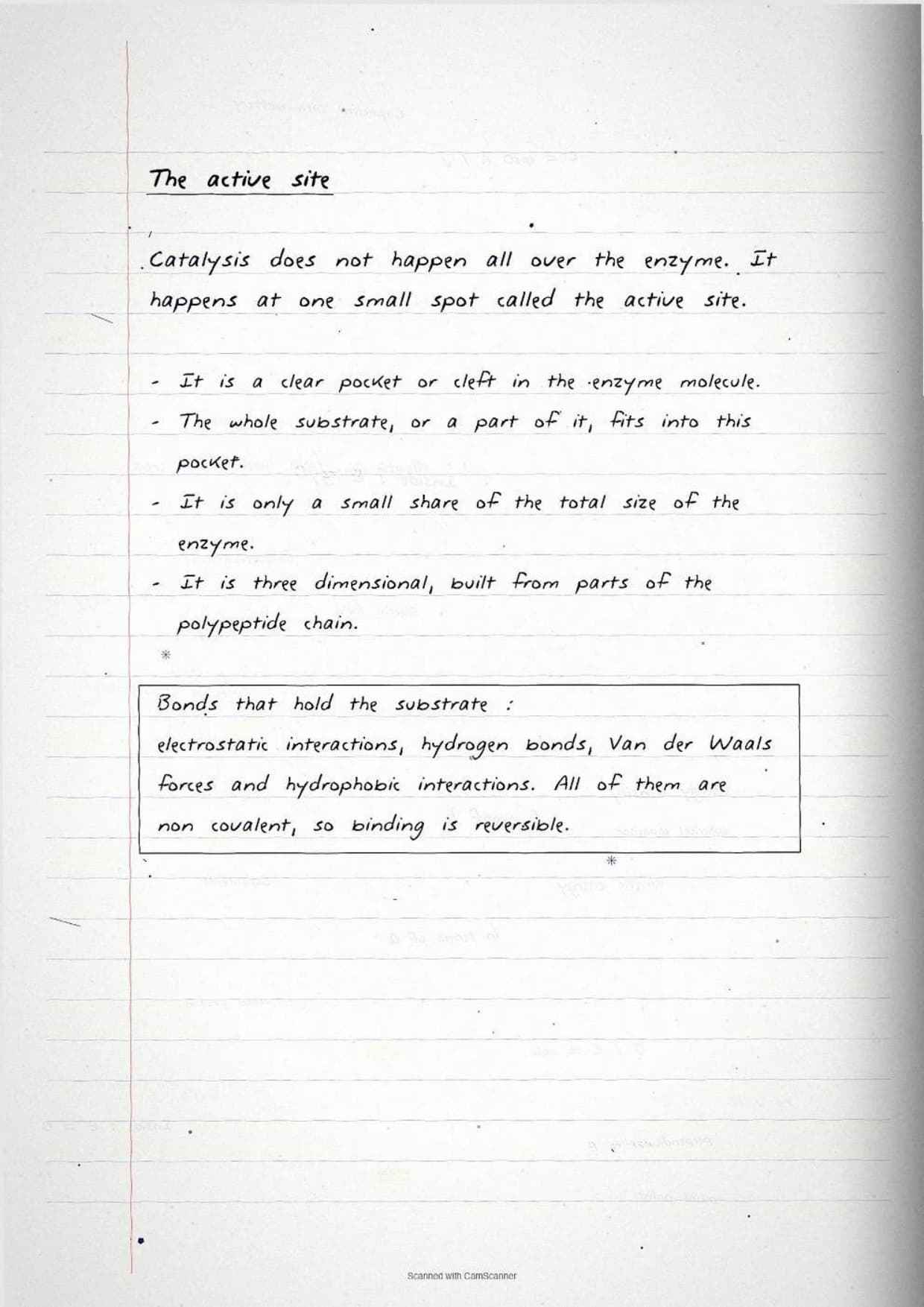
Catalysis does not happen across the whole enzyme. It happens at one small region called the active site, which is a clearly defined pocket or cleft in the enzyme molecule where the whole substrate, or a portion of it, can fit. The active site is only a small part of the total size of the enzyme, and it has a three-dimensional structure because it is built from portions of a polypeptide chain folded together.
What holds the substrate in place is not a covalent bond. The chapter lists four non-covalent interactions, and a question on enzyme substrate binding expects all four.
| Interaction | What it does at the active site |
|---|---|
| Electrostatic interactions | Attract oppositely charged groups on enzyme and substrate |
| Hydrogen bonds | Position the substrate precisely against polar residues |
| Van der Waals forces | Add weak short-range grip once the fit is close |
| Hydrophobic interactions | Pull non-polar parts of the substrate into the pocket, away from water |
All four are weak and reversible, which is exactly the point. The substrate has to leave once it has become product, so the binding must be strong enough to hold and weak enough to let go.
Lock and Key Against Induced Fit: The Two Models of Enzyme Action
Two named models explain how substrate and active site come together, and the paper usually asks for both with the scientist and the year attached.
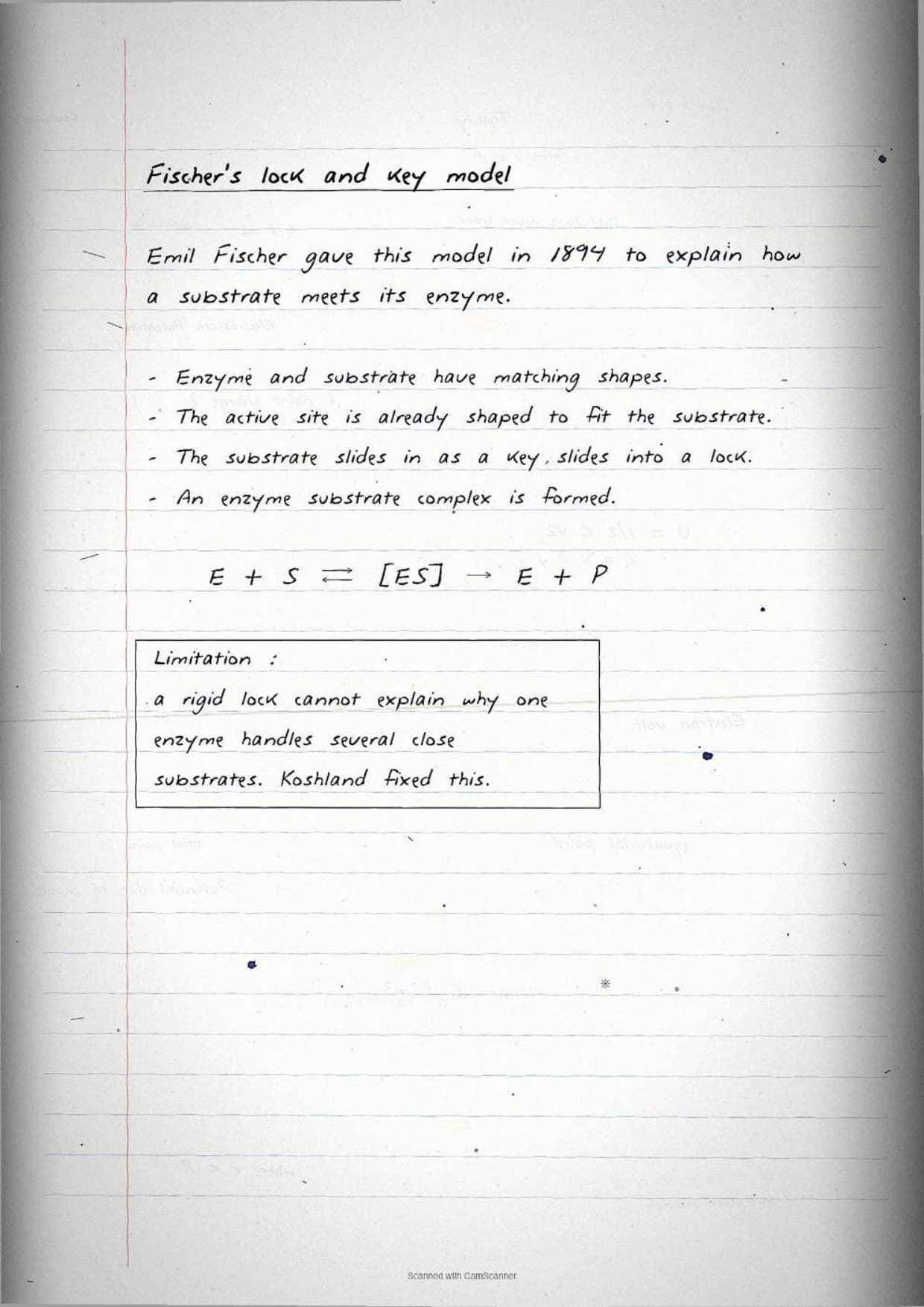
Fischer's Lock and Key Model was proposed by Emil Fischer in 1894. Complementary structural features already exist between enzyme and substrate, and the active site is pre-shaped to fit. The substrate slides into its complementary site the way a key slides into a lock, and an enzyme-substrate complex forms.
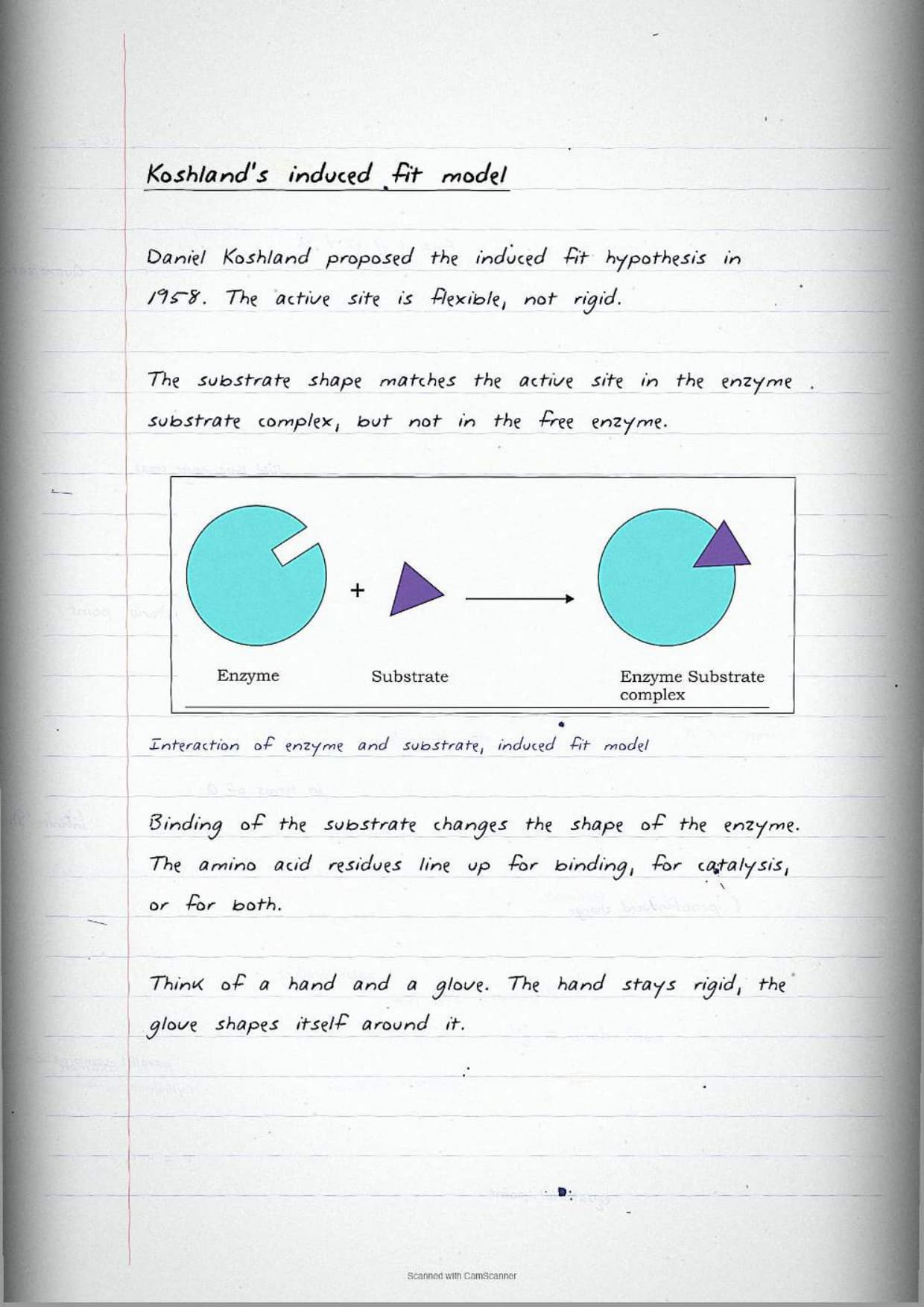
Koshland's Induced Fit Hypothesis was proposed by Daniel Koshland in 1958, and it corrects the rigid picture. The substrate is complementary to the active site in the enzyme-substrate complex, but not in the free enzyme. Interaction with the substrate induces a conformational change in the enzyme, which aligns the amino acid residues for substrate binding, for catalysis, or for both.
| Point of difference | Lock and key model | Induced fit model |
|---|---|---|
| Proposed by | Emil Fischer, 1894 | Daniel Koshland, 1958 |
| Nature of the active site | Rigid and pre-shaped | Flexible, reshapes on contact |
| When complementarity exists | Already in the free enzyme | Only in the enzyme-substrate complex |
| Everyday analogy | Key into a lock | Hand into a glove |
| Status today | Modified, no longer complete | The modern accepted model |
The glove analogy is worth quoting exactly as the book puts it. During interaction the structure of one component, the substrate or the hand, stays rigid, while the shape of the second component, the active site or the glove, is flexible and becomes complementary to the first.
Enzyme Specificity: The Four Types the Chapter Names
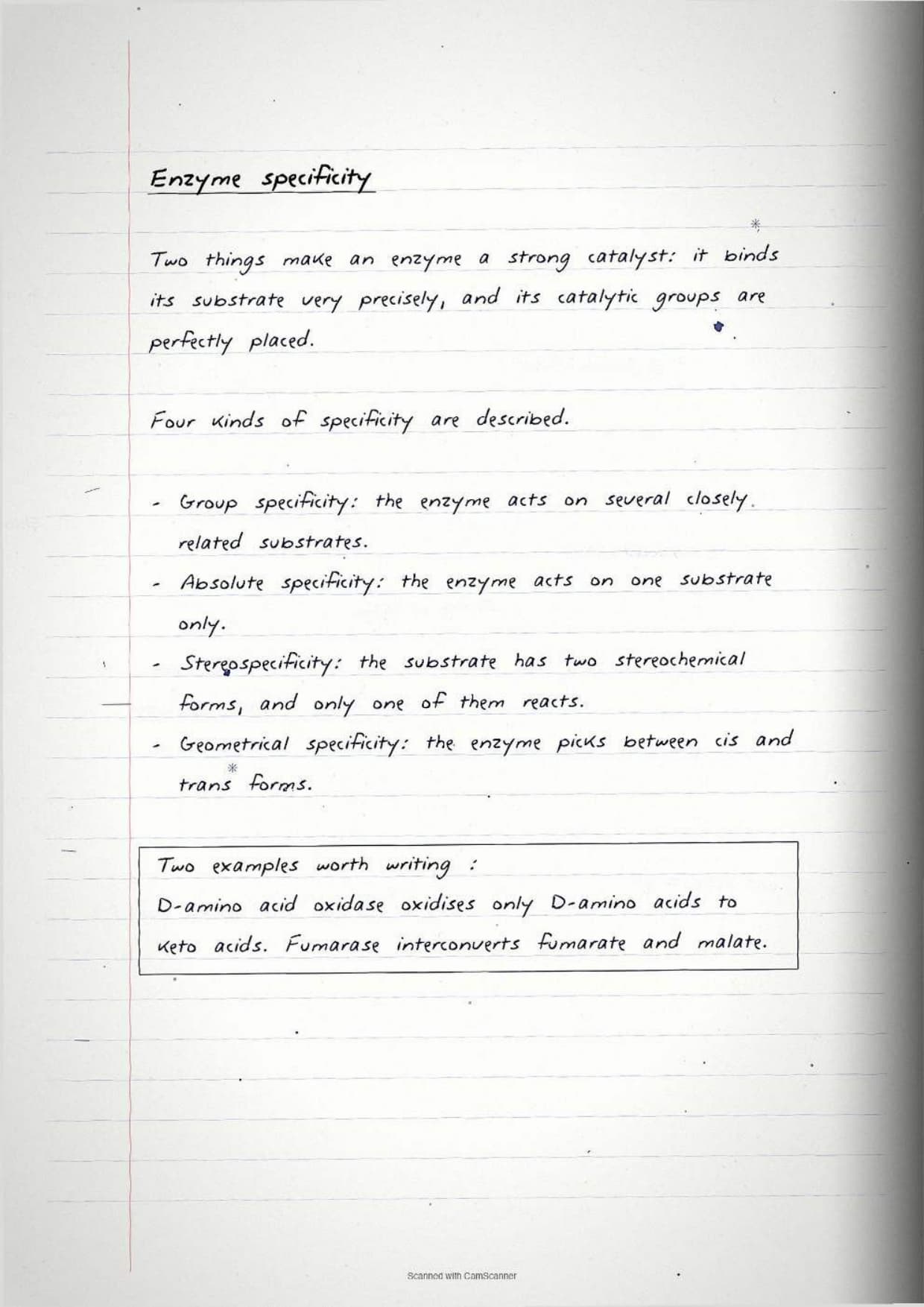
Specificity of substrate binding, together with an ideal arrangement of catalytic groups, is what makes an enzyme such a strong catalyst. The chapter sorts specificity into four types, and each one has a one-line definition.
- Group specificity: the enzyme acts on several different but closely related substrates.
- Absolute specificity: the enzyme acts on one particular substrate and nothing else.
- Stereochemical or optical specificity: when a substrate exists in two stereochemical forms, chemically identical but differing in the arrangement of atoms in space, only one isomer reacts. D-amino acid oxidase oxidises D-amino acids to keto acids and leaves the L forms alone.
- Geometrical specificity: the enzyme distinguishes cis and trans forms. Fumarase catalyses the interconversion of fumarate and malate.
Tip: examiners like the two named examples far more than the definitions. Write D-amino acid oxidase next to stereospecificity and fumarase next to geometrical specificity every single time.
Classification of Enzymes: The Six IUB Classes and the Seventh
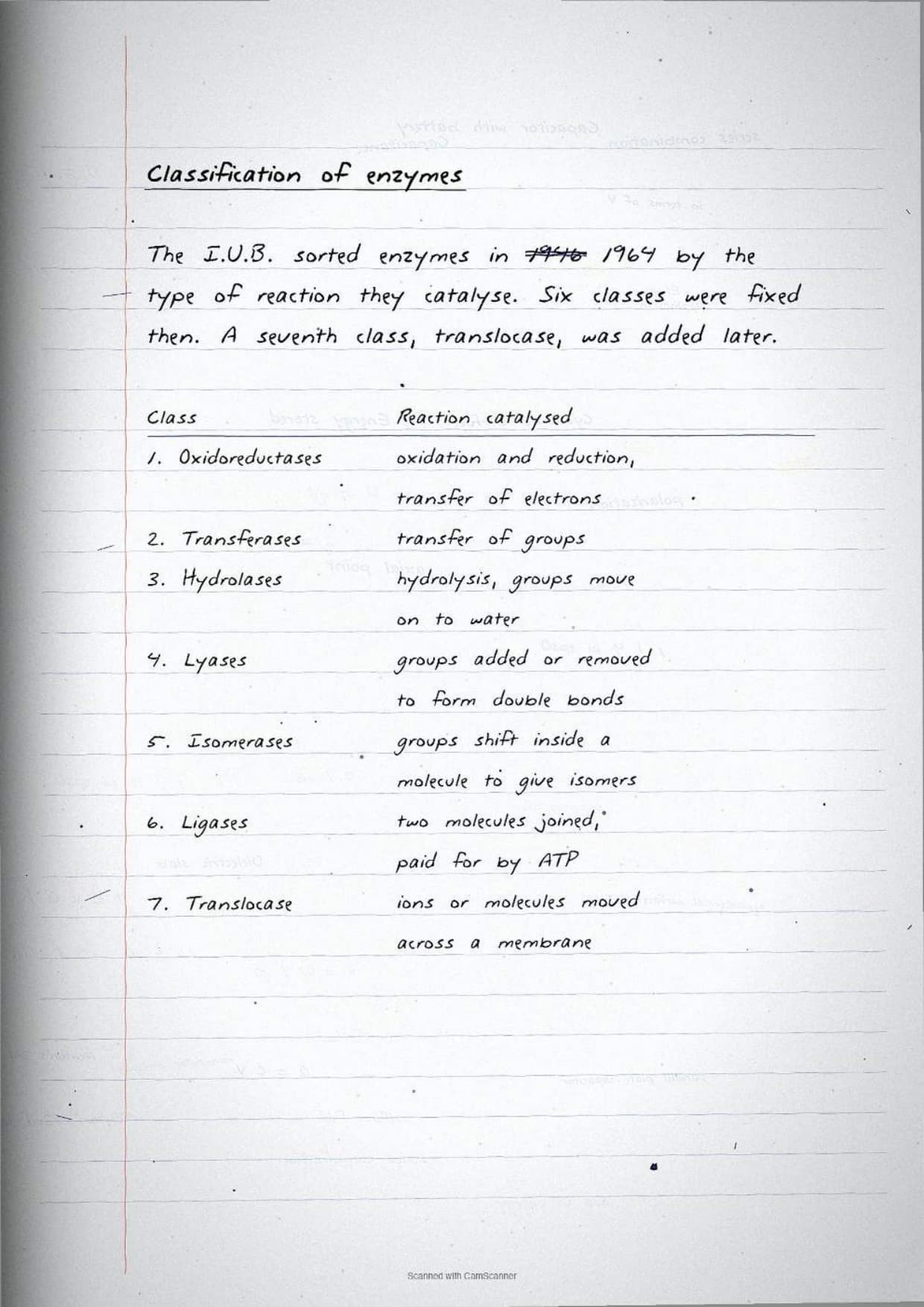
To keep naming systematic as new enzymes kept appearing, the International Union of Biochemistry adopted a classification in 1964 based on the type of reaction catalysed. It set up six major classes, and a seventh class, translocases, has been added more recently. Class number and class name are both examinable, so learn the order.
| Class number | Class name | Type of reaction catalysed |
|---|---|---|
| 1 | Oxidoreductases | Oxidation and reduction reactions, that is transfer of electrons |
| 2 | Transferases | Transfer of groups from one molecule to another |
| 3 | Hydrolases | Hydrolytic reactions, transfer of functional groups to water |
| 4 | Lyases | Addition or removal of groups to form double bonds |
| 5 | Isomerases | Transfer of groups within a molecule to yield isomeric forms |
| 6 | Ligases | Condensation of two molecules coupled through ATP hydrolysis |
| 7 | Translocases | Transfer of ions or molecules across a membrane |
Two entries in that table quietly link the two halves of the chapter. Class 1 is defined by electron transfer, which is redox chemistry, and class 6 is defined by coupling to ATP hydrolysis. Enzyme classification already tells you that biological catalysis and biological energy are the same story told twice.
Isozymes: One Reaction, Several Molecular Forms
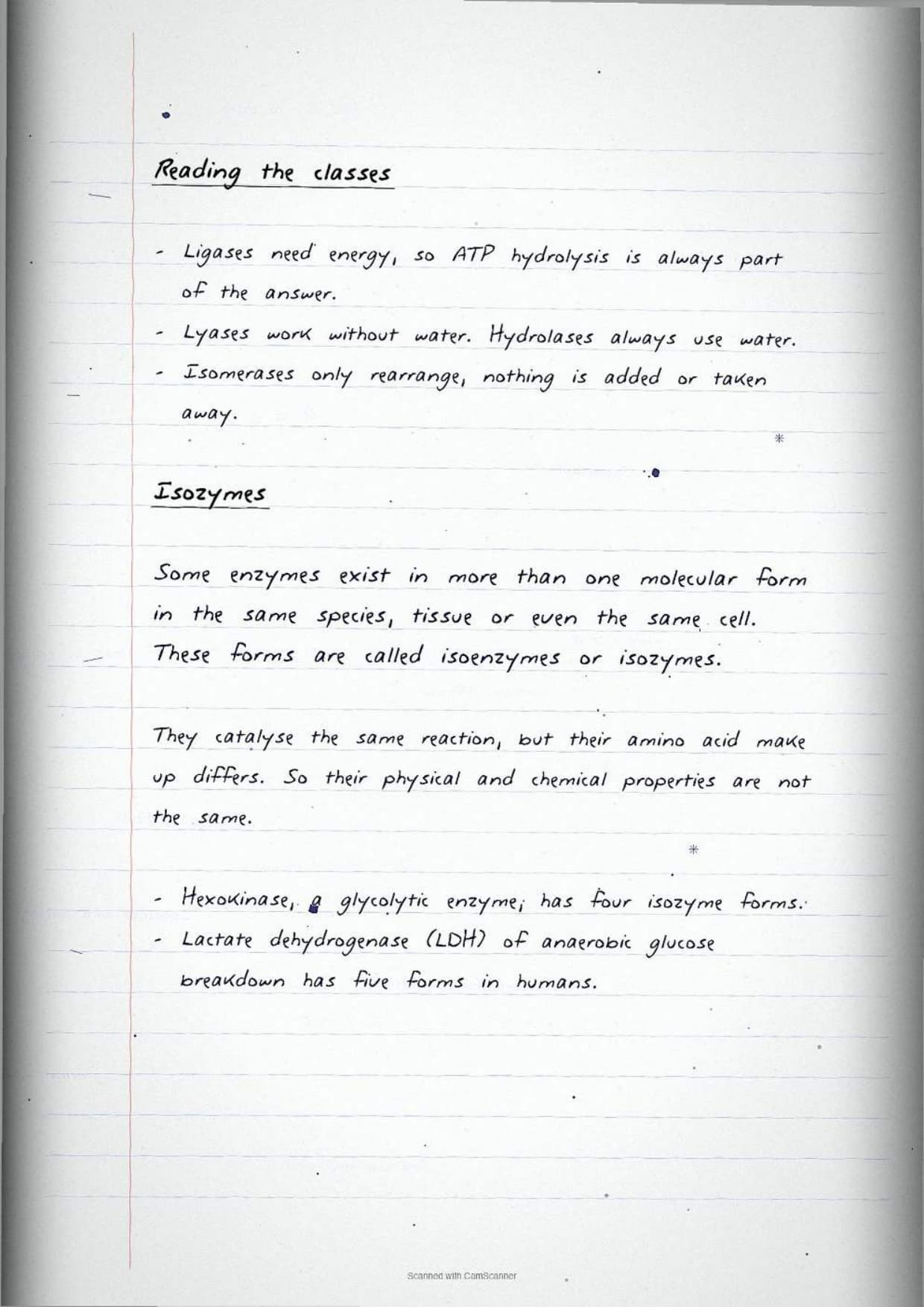
Many enzymes exist in more than one molecular form inside the same species, the same tissue, or even the same cell. These are called isoenzymes or isozymes. They catalyse the same reaction but differ in amino acid composition, so their physicochemical properties differ too.
- Hexokinase, a glycolytic enzyme, exists in four isozyme forms across various tissues.
- Lactate dehydrogenase, or LDH, which works in anaerobic glucose metabolism, has five isozyme forms in humans.
The numbers four and five are the whole question. Students who remember only the word isozyme lose the mark that the counts carry.
Cofactors, Coenzymes and the Vitamins Behind Them
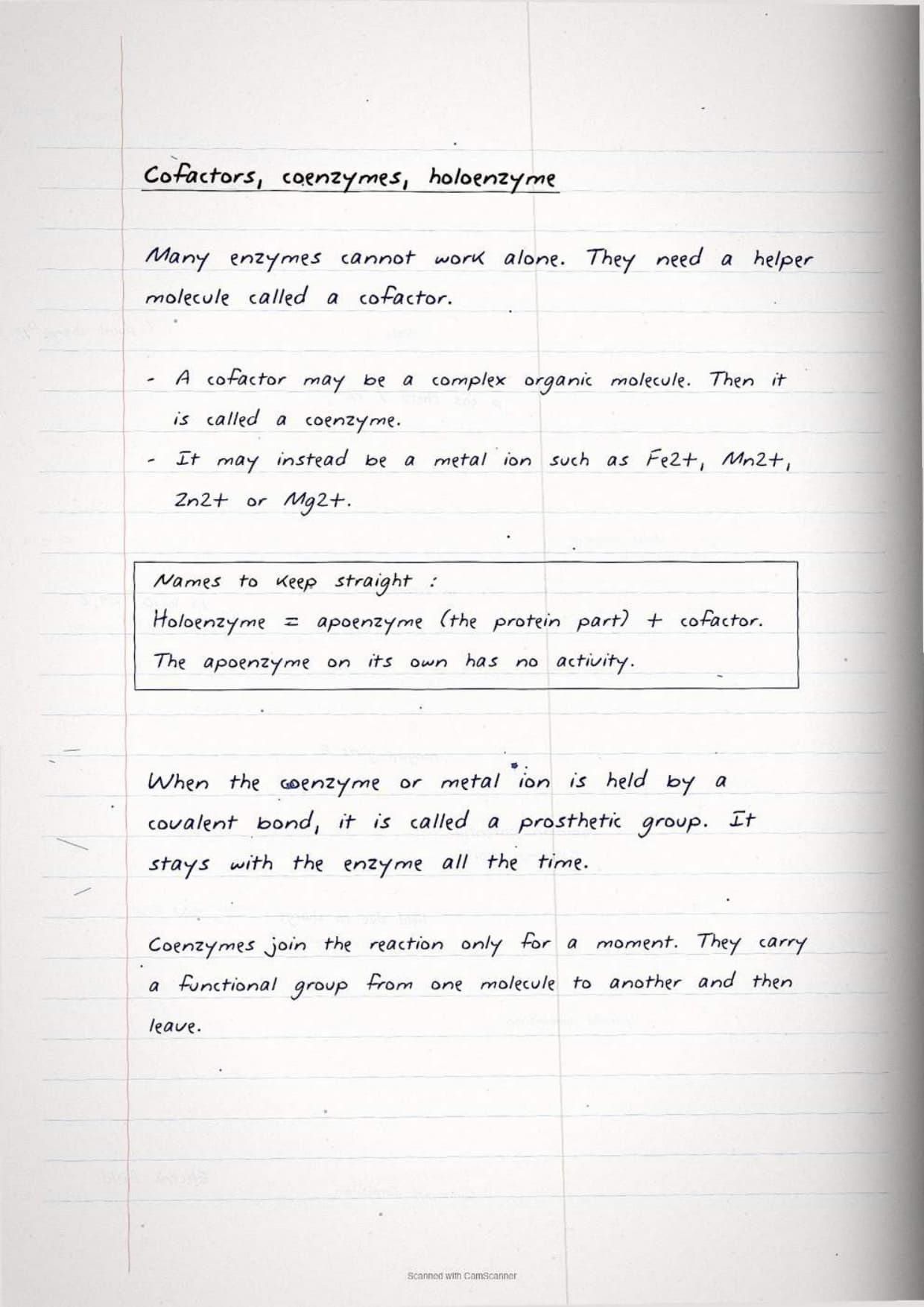
Many enzymes cannot work on protein alone. They need a cofactor, which is either a complex organic molecule called a coenzyme or a metal ion. Three names hang off this idea and they are constantly swapped in answers.
| Term | What it means |
|---|---|
| Apoenzyme | The protein component of a cofactor-requiring enzyme, catalytically inactive on its own |
| Cofactor | The non-protein partner, either a coenzyme or a metal ion |
| Holoenzyme | The complete active enzyme, that is apoenzyme plus cofactor |
| Prosthetic group | A coenzyme or metal ion bound tightly to the enzyme protein through a covalent bond |
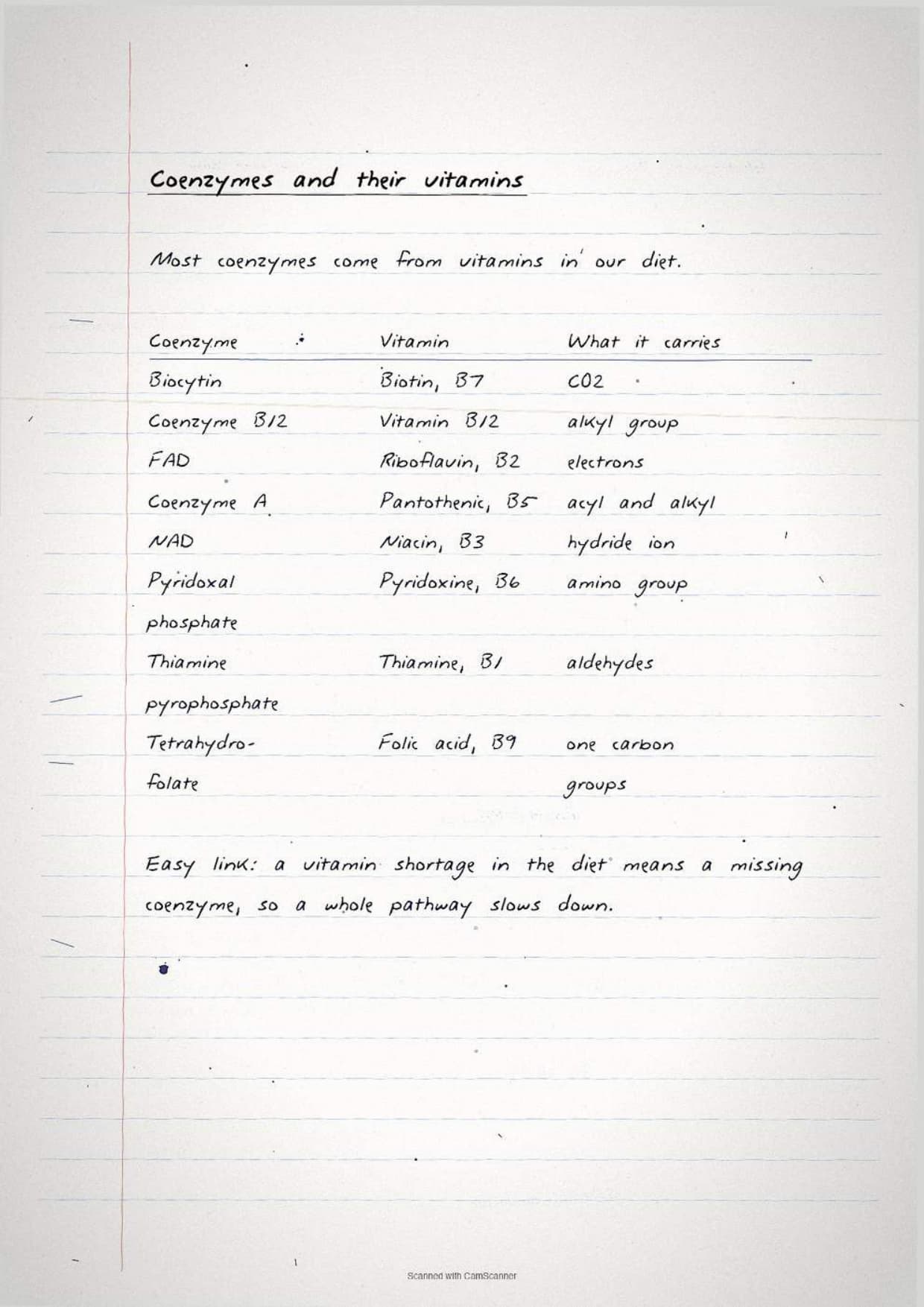
Coenzymes take part in catalysis only transiently and act as carriers of specific functional groups. Most of them are derived from vitamins, the organic nutrients needed in small amounts in the diet, which is exactly the relationship exercise question 3 asks about. Table 4.1 of the chapter is reproduced below in full because every row is a possible one-mark match-the-column item.
| Coenzyme | Precursor vitamin | Role in catalysis |
|---|---|---|
| Biocytin | Biotin, vitamin B7 | Transfer of carbon dioxide |
| Coenzyme B12, 5-adenosylcobalamin | Vitamin B12 | Transfer of an alkyl group |
| Flavin adenine dinucleotide, FAD | Riboflavin, vitamin B2 | Transfer of electrons |
| Coenzyme A | Pantothenic acid, vitamin B5 | Transfer of acyl and alkyl groups |
| Nicotinamide adenine dinucleotide, NAD | Niacin, vitamin B3 | Transfer of hydride |
| Pyridoxal phosphate | Pyridoxine, vitamin B6 | Transfer of an amino group |
| Thiamine pyrophosphate | Thiamine, vitamin B1 | Transfer of aldehydes |
| Tetrahydrofolate | Folic acid, vitamin B9 | Transfer of a one carbon group |
Tip: two of these coenzymes come back in the bioenergetics half. NAD carries hydride and FAD carries electrons, which makes both of them redox coenzymes. Bracket those two rows in the notebook and the link to respiration writes itself.
Metal Ion Cofactors and the Enzymes That Need Them
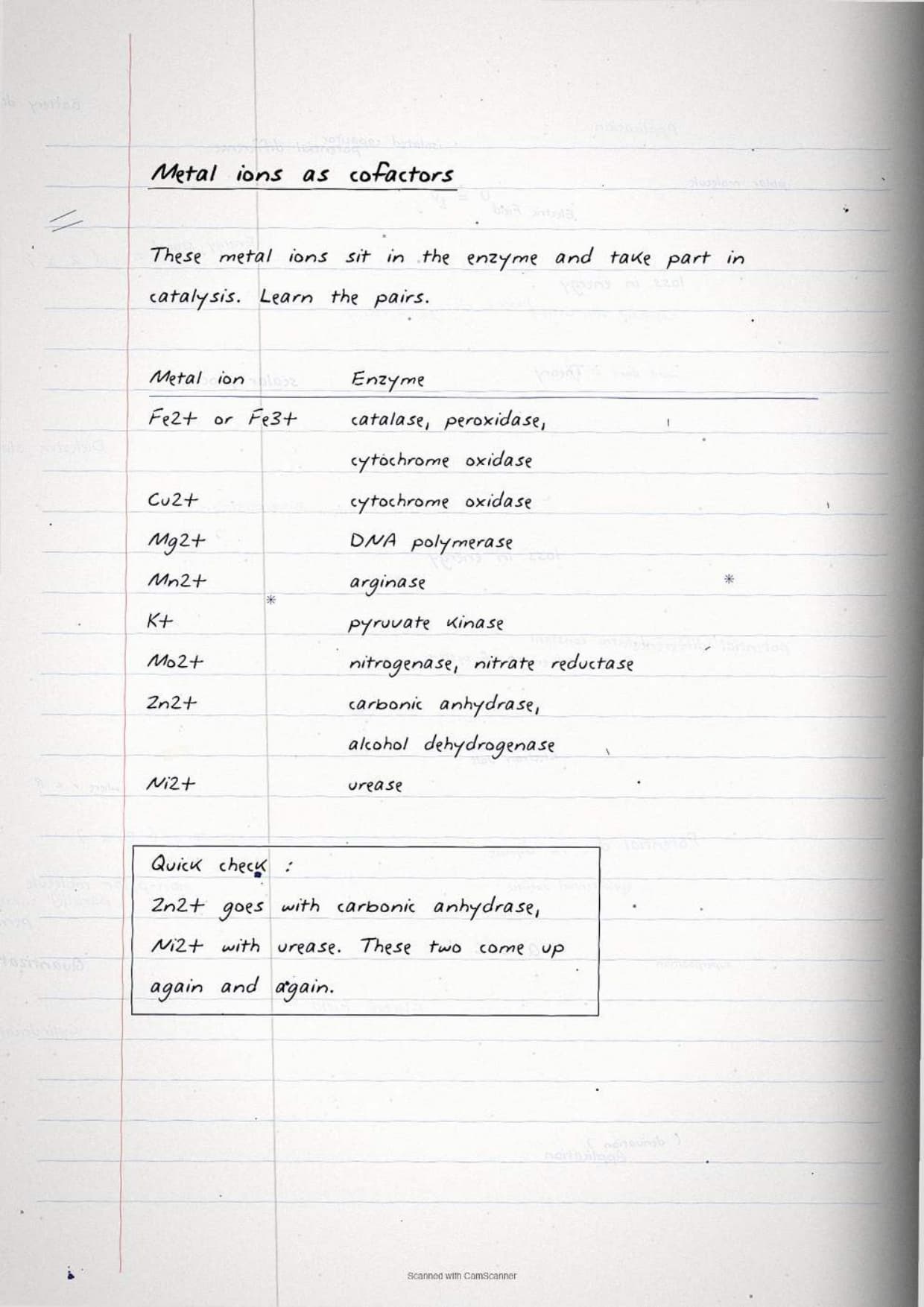
The second kind of cofactor is a metal ion. The chapter prints eight of them with named enzymes, and the pairing is the question, not the list.
| Metal ion | Enzyme it serves |
|---|---|
| Fe2+ or Fe3+ | Catalase, peroxidase, cytochrome oxidase |
| Cu2+ | Cytochrome oxidase |
| Mg2+ | DNA polymerase |
| Mn2+ | Arginase |
| K+ | Pyruvate kinase |
| Mo2+ | Nitrogenase, nitrate reductase |
| Zn2+ | Carbonic anhydrase, alcohol dehydrogenase |
| Ni2+ | Urease |
Notice that magnesium serves DNA polymerase. That single row explains why every polymerase chain reaction buffer a biotechnology student will ever mix contains magnesium chloride.
Enzymes and Bioenergetics Explained in Simple Language
Source: Magnet Brains on YouTube
Factors Affecting Enzyme Activity: Temperature, pH and Substrate Concentration
Exercise question 4 asks for the effect of temperature, pH and substrate concentration on catalytic activity, so this section is a guaranteed long answer. The chapter names four influences in all, the fourth being modulators. Each one has its own curve, and the curve is half the marks.
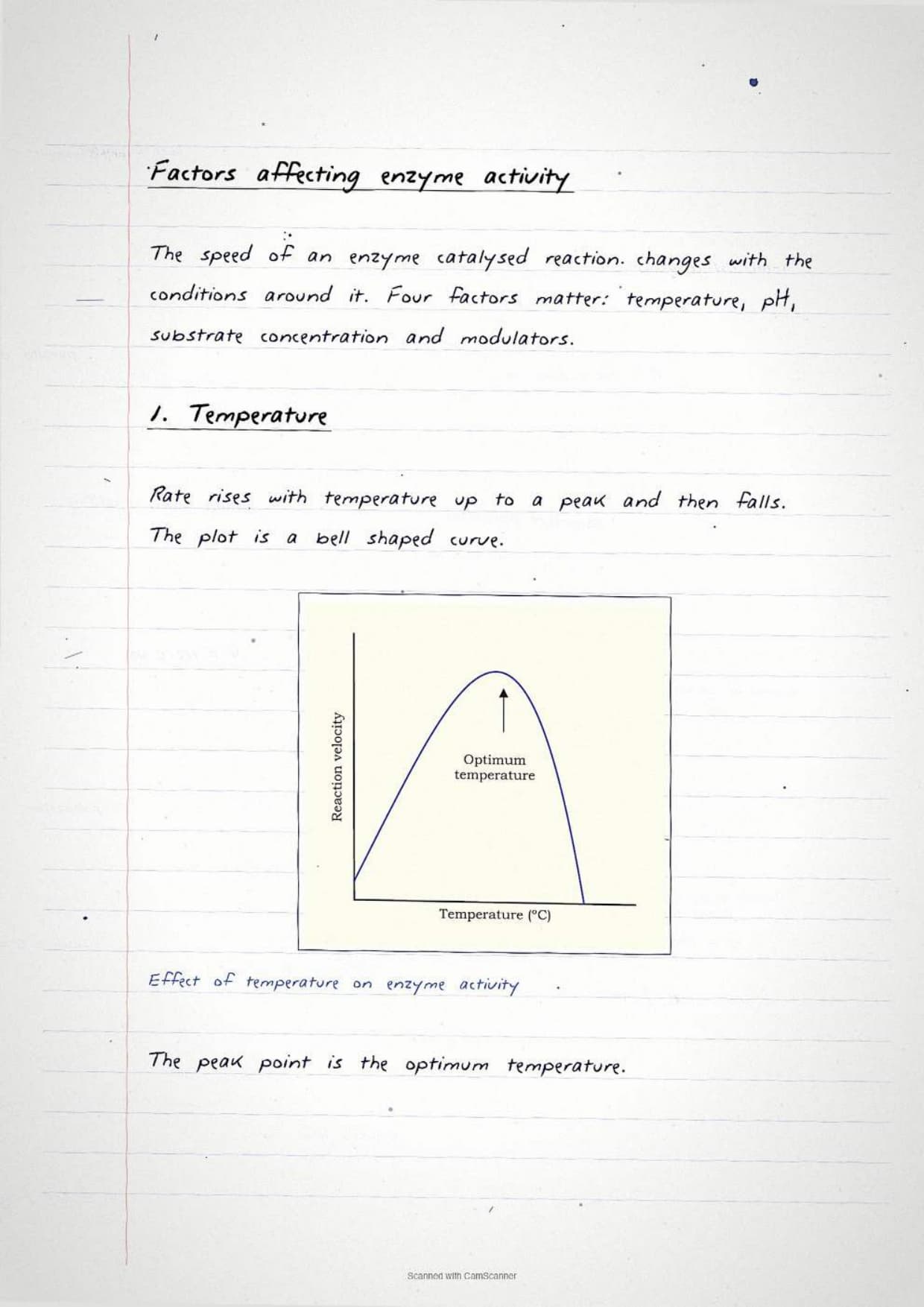
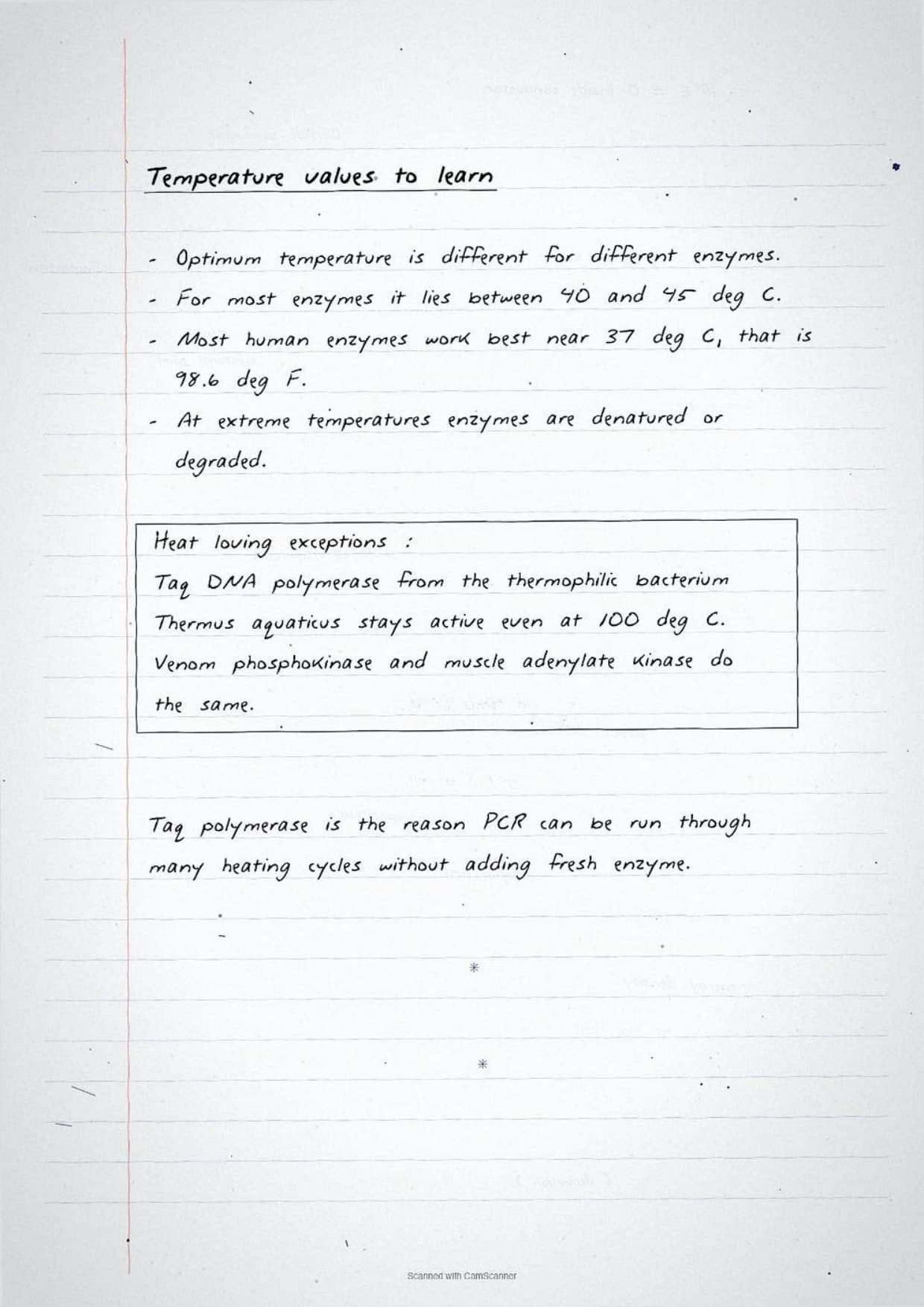
1. Temperature. The rate rises with temperature up to a maximum and then falls, giving a bell-shaped curve. The temperature at which the rate is highest is the optimum temperature. It differs between enzymes, but for most it lies between 40 and 45 degrees Celsius, and the majority of enzymes in the human body peak at about 37 degrees Celsius, which is 98.6 degrees Fahrenheit. Beyond that the enzyme is denatured or degraded, which is why the curve falls instead of levelling off.
The chapter names three heat-tolerant exceptions that stay active even at 100 degrees Celsius, and the first of them is the reason modern biotechnology exists at all.
- Taq DNA polymerase, from the thermophilic bacterium Thermus aquaticus, which survives the repeated heating steps of the polymerase chain reaction.
- Venom phosphokinase.
- Muscle adenylate kinase.
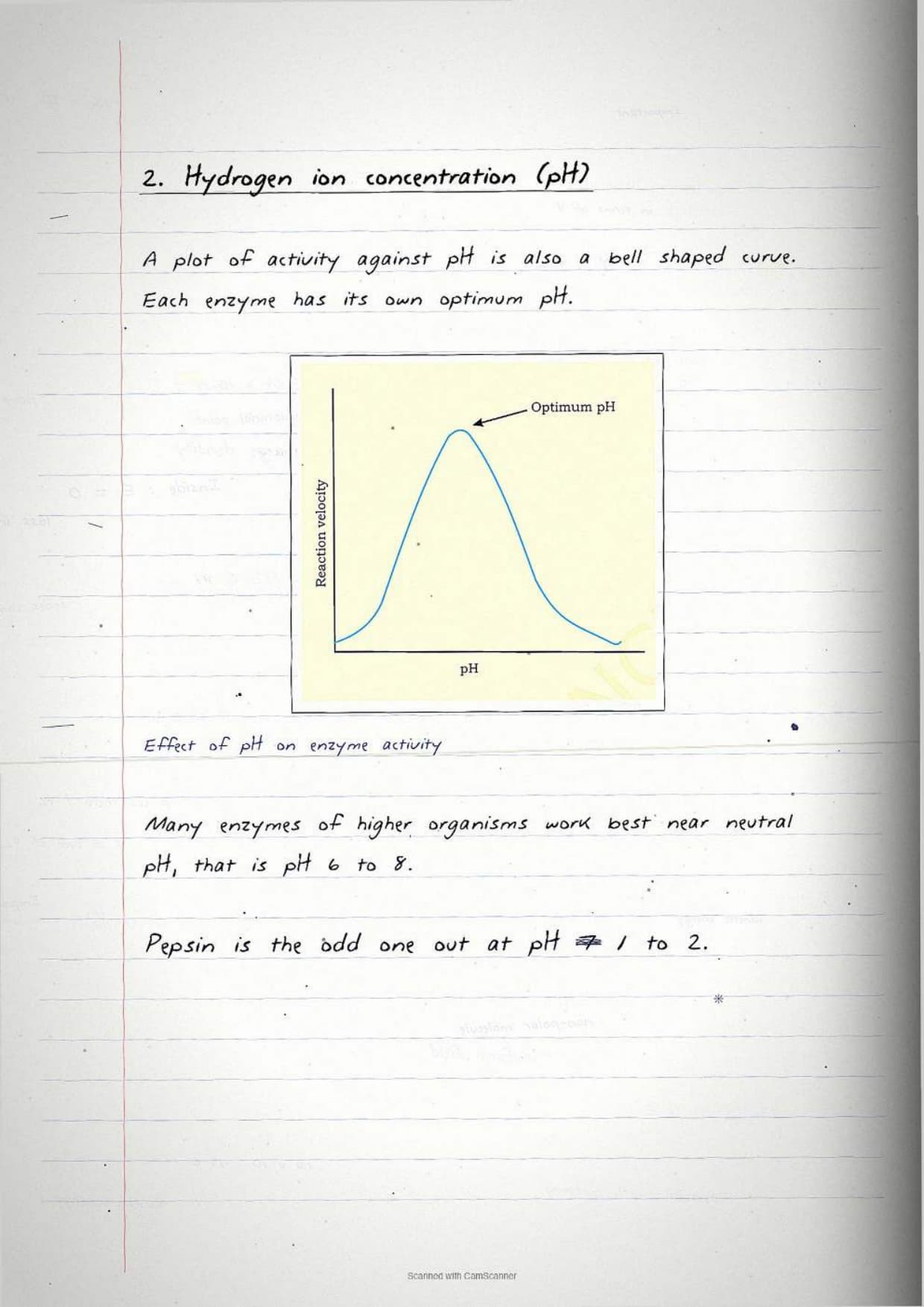
2. Hydrogen ion concentration. A plot of activity against pH also gives a bell-shaped curve, and each enzyme has a unique optimum pH at which the rate is greatest. Many enzymes of higher organisms peak around neutral pH, between pH 6 and 8, but the exceptions carry the marks.
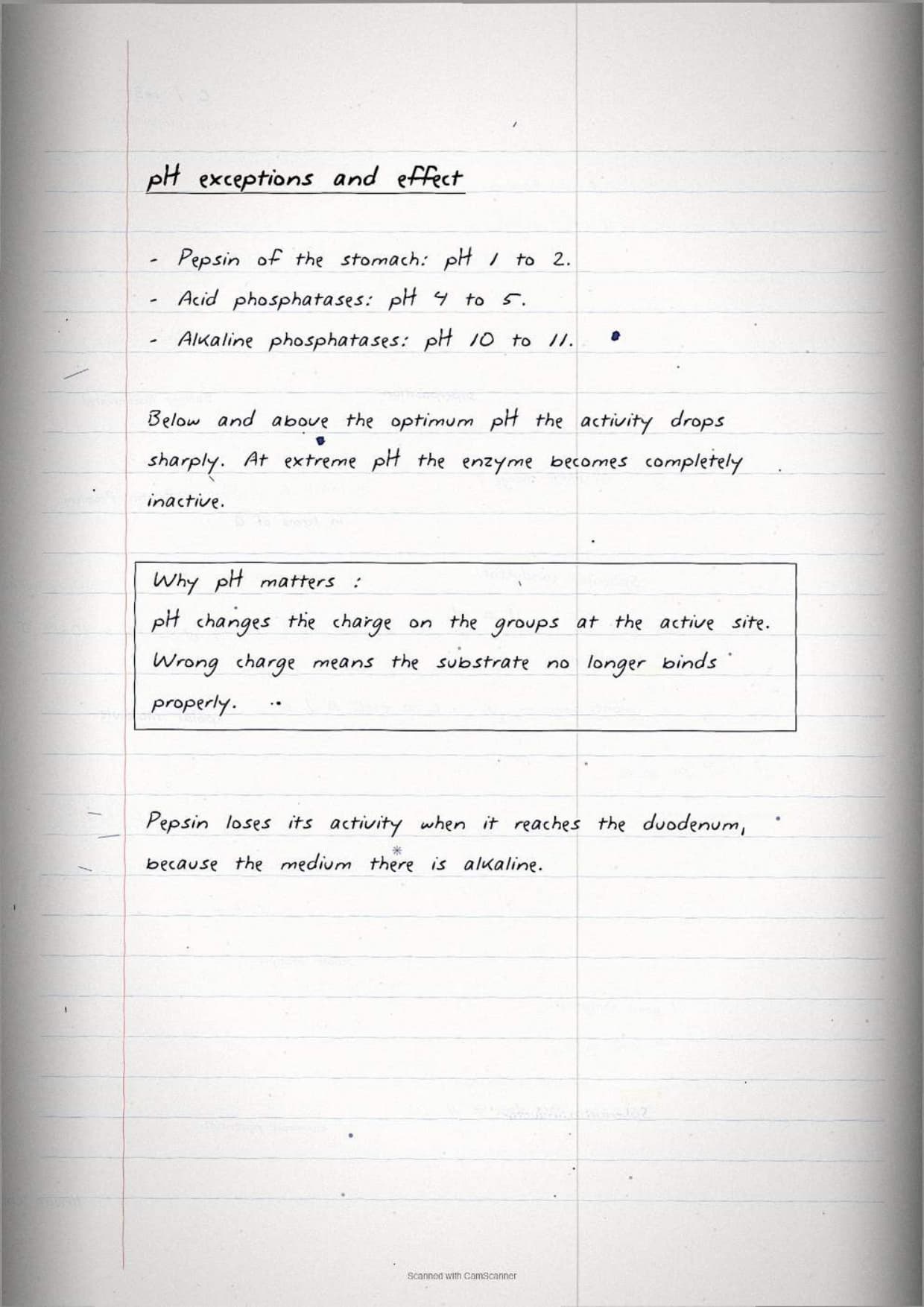
| Enzyme or group | Optimum pH |
|---|---|
| Most enzymes of higher organisms | 6 to 8 |
| Pepsin, the gastric enzyme | 1 to 2, strongly acidic |
| Acid phosphatases | 4 to 5 |
| Alkaline phosphatases | 10 to 11 |
Above and below the optimum the activity is much lowered, and at extreme pH the enzyme becomes totally inactive. That is the whole answer to exercise question 2. Pepsin has an acidic optimum pH, so when it passes from the stomach into the alkaline duodenum it loses activity and is denatured.
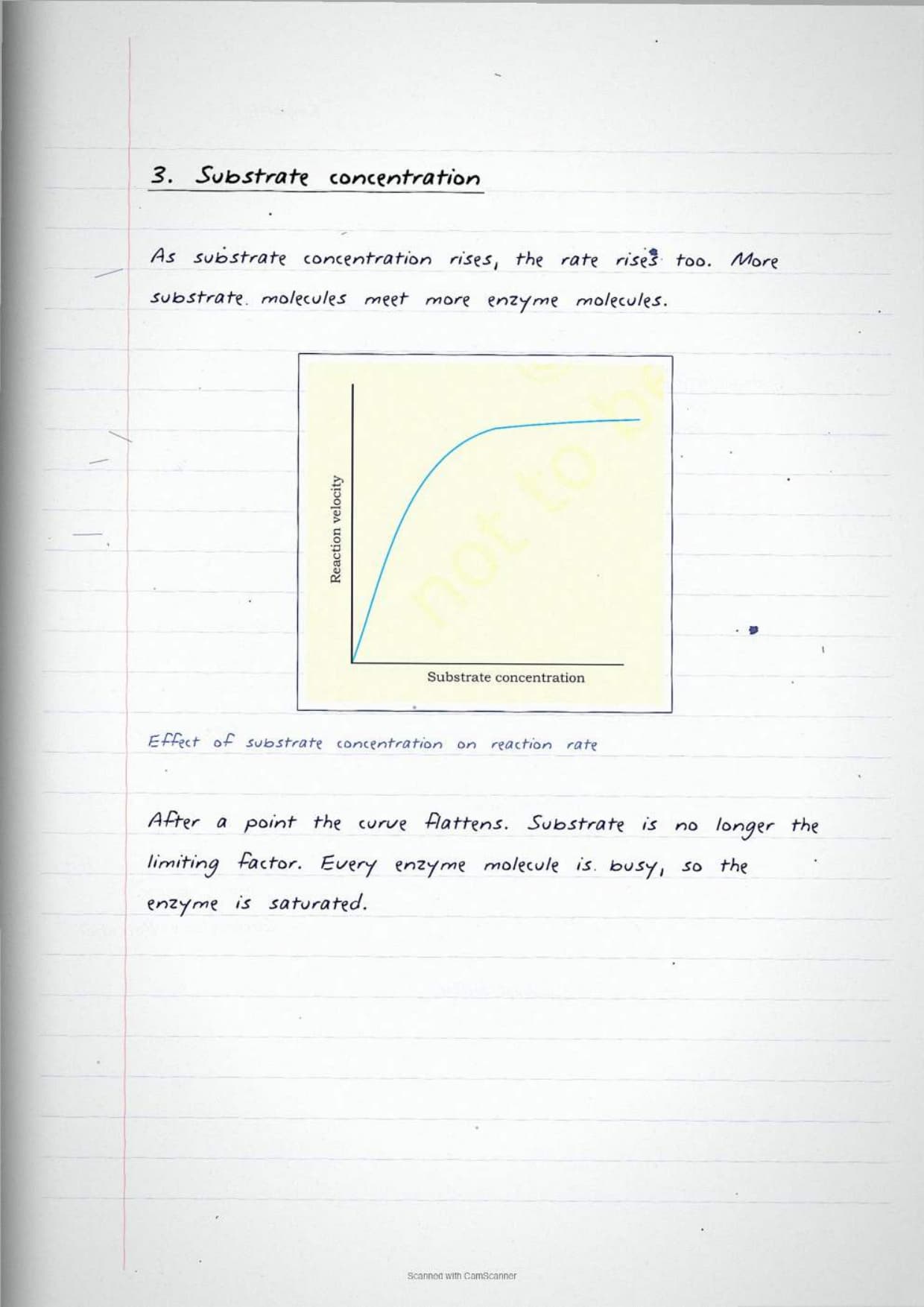
3. Substrate concentration. As substrate concentration rises, more substrate molecules meet enzyme molecules and more product forms, so the rate rises. Past a certain concentration, further increase has no effect. The substrate is no longer the limiting factor, every enzyme molecule is saturated, and the enzyme is working at its maximum possible rate. The curve is not a bell. It climbs and then flattens into a plateau, and that plateau is the value called Vmax.
Unit of Enzyme Activity and Specific Activity
Two short definitions sit between the curves and the kinetics, and both are direct one-mark questions, numbers 7 and 8 in the exercises.
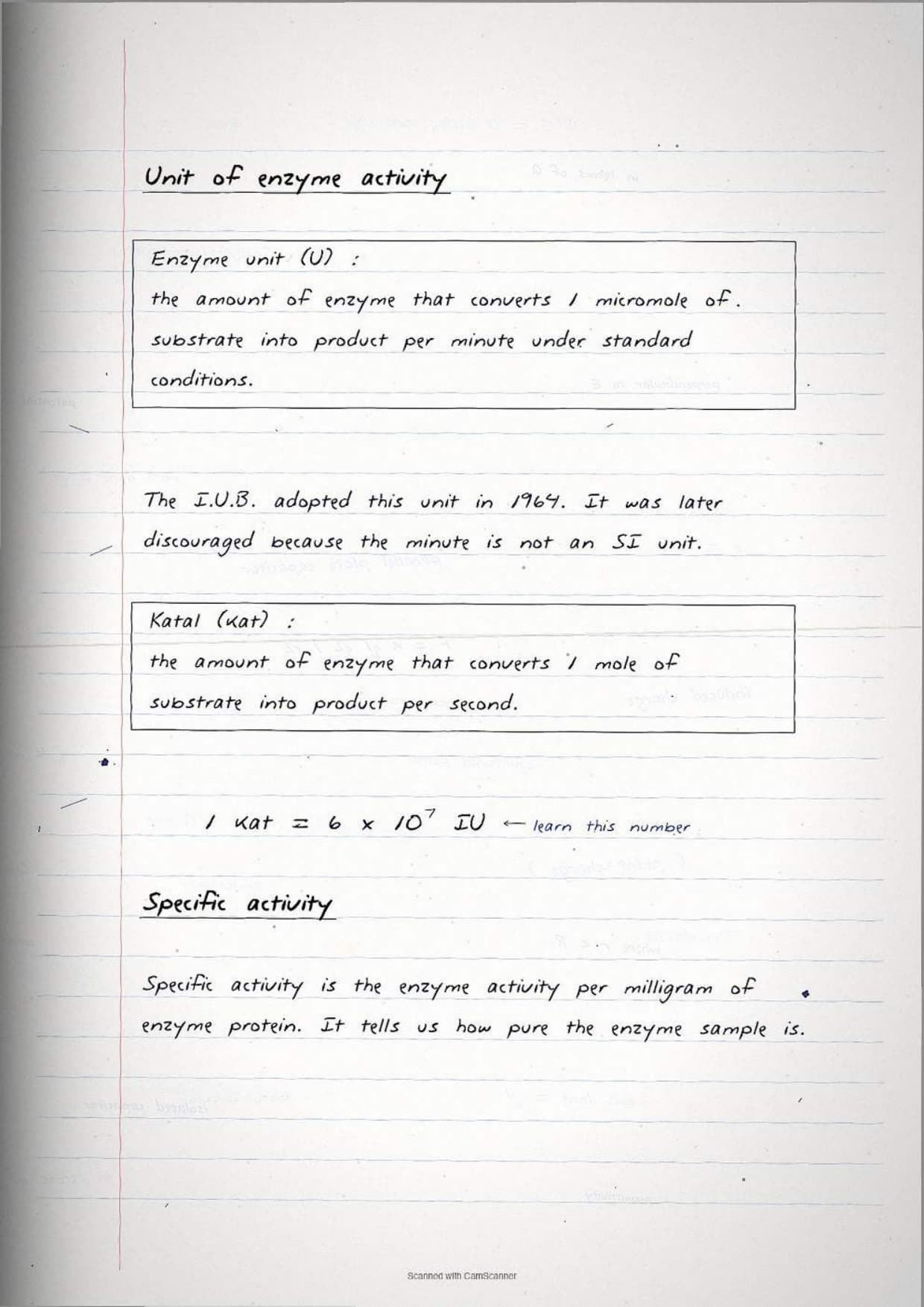
- Enzyme unit, U. The amount of enzyme that catalyses the conversion of 1 micromole of substrate into product per minute under standard conditions. The International Union of Biochemistry adopted it in 1964.
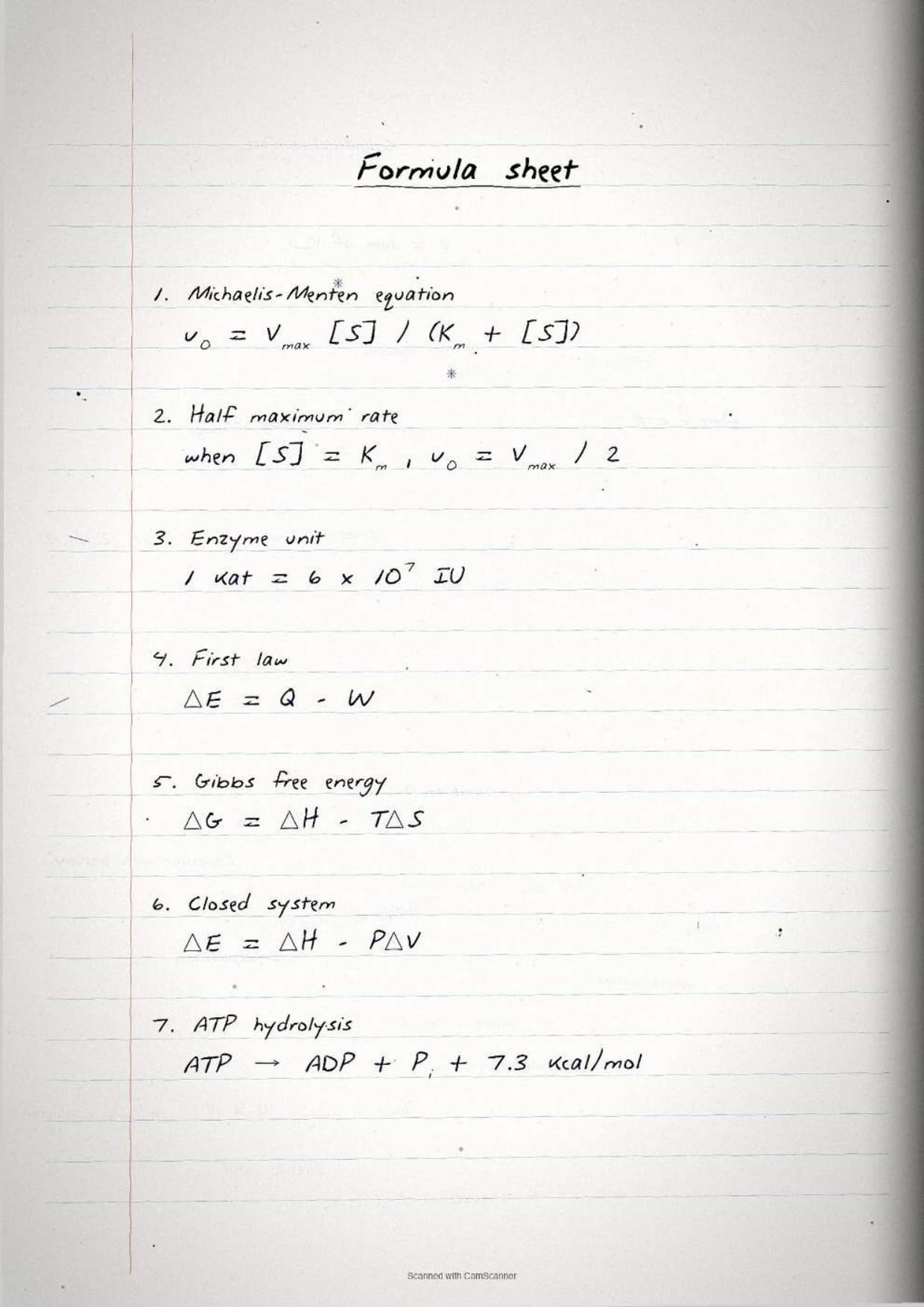
- Katal, kat. The amount of enzyme that catalyses conversion of 1 mole of substrate per second. It replaced the enzyme unit because the minute is not an SI unit, and 1 kat equals 6 into 107 IU.
- Specific activity. The units of enzyme activity per milligram of enzyme protein. It is a measure of enzyme purity in a mixture, so it rises at every step of a purification.
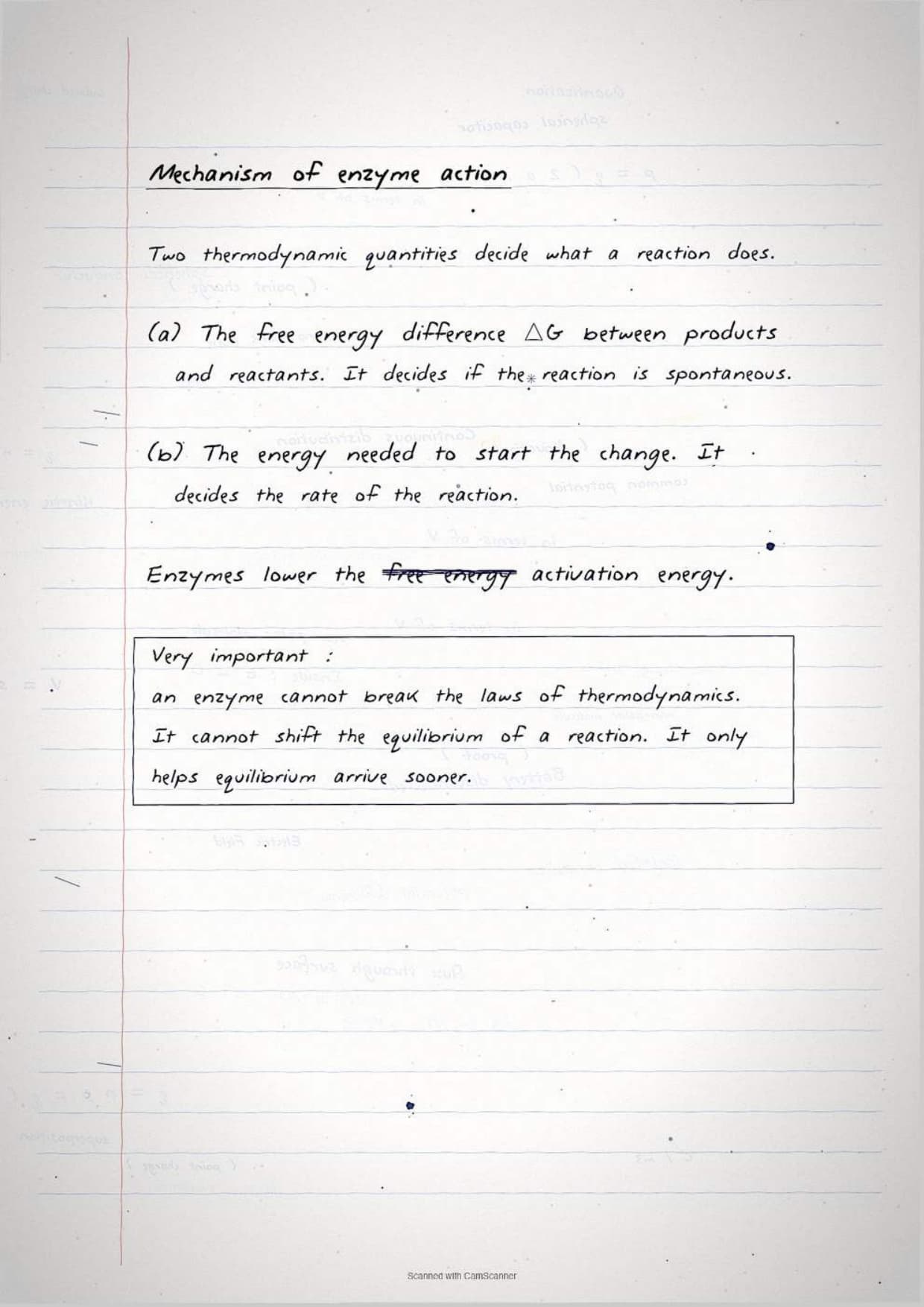
Mechanism of Enzyme Action: Activation Energy Against Free Energy
Understanding the mechanism means holding two thermodynamic quantities apart, and most lost marks in this chapter come from mixing them up.
| Quantity | What it decides | Does the enzyme change it |
|---|---|---|
| Free energy difference between products and reactants | Whether the reaction is spontaneous | No |
| Free energy of activation | The rate of the reaction | Yes, it lowers it |
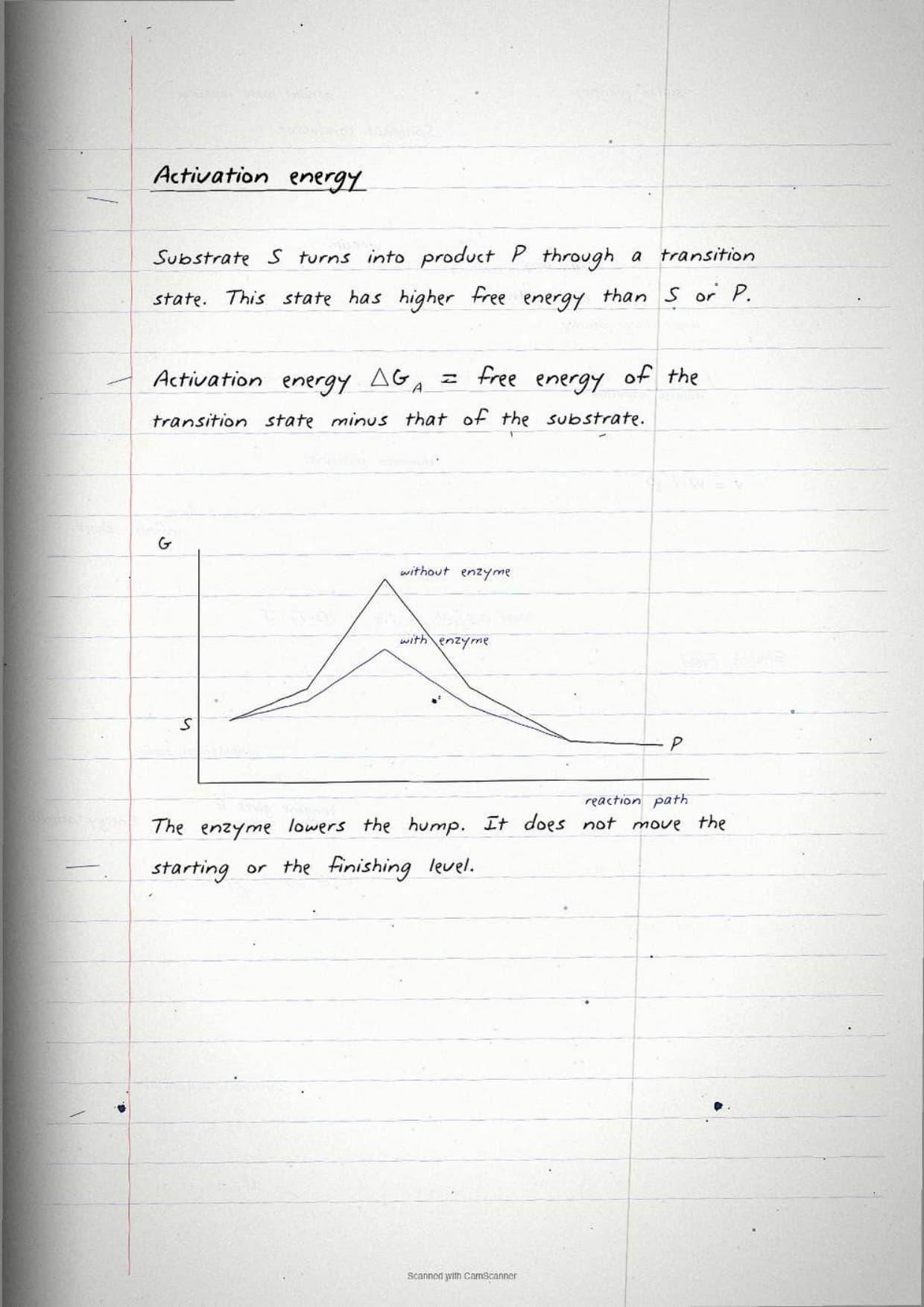
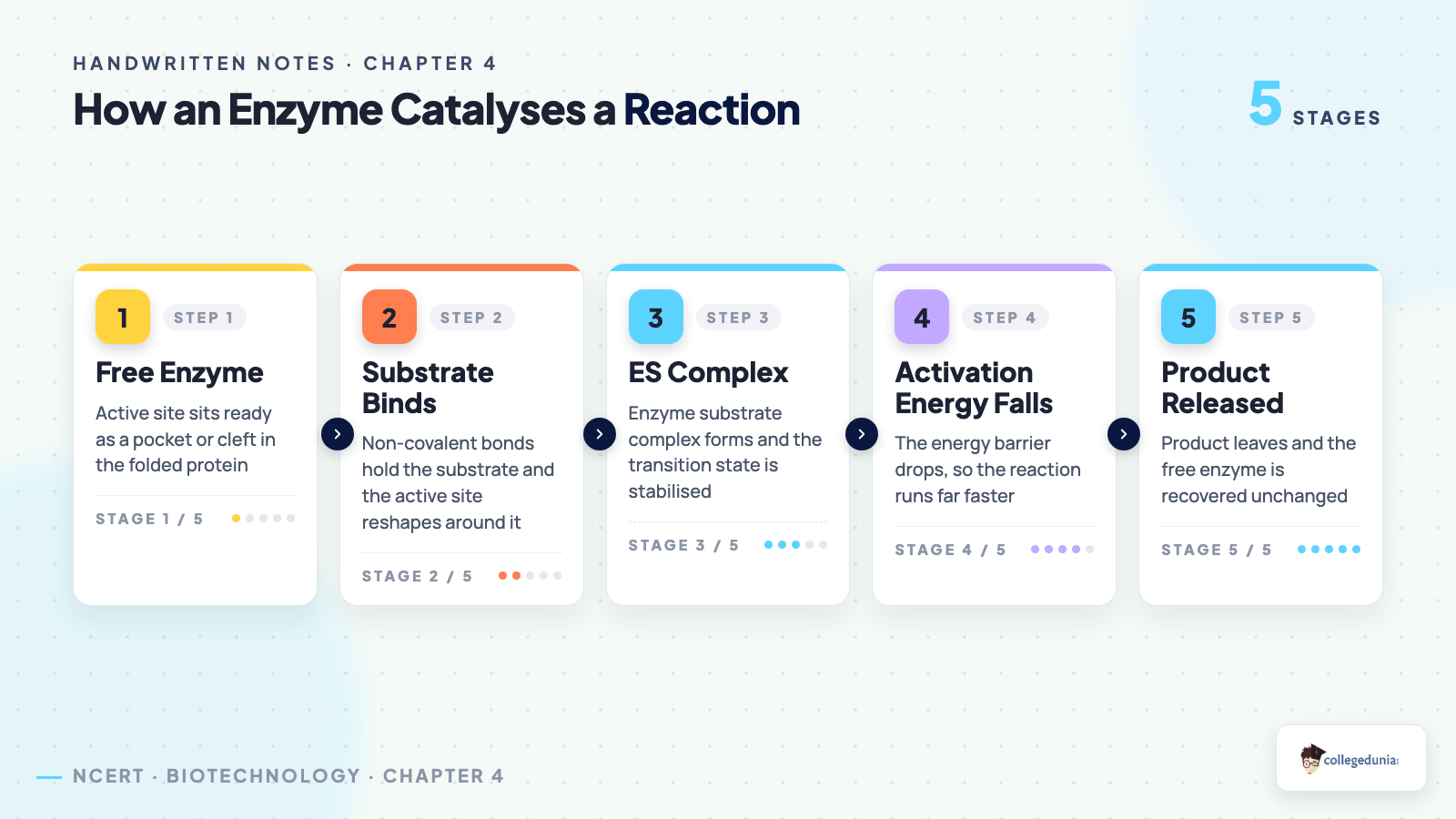
The substrate S is converted into product P through a transition state that has higher free energy than either S or P. The difference between the free energy of the transition state and that of the substrate is the Gibbs free energy of activation, usually shortened to activation energy. Enzymes enhance the reaction rate by lowering that activation energy, and by nothing else.
Enzymes cannot change the laws of thermodynamics, so they cannot alter the equilibrium of a biochemical reaction. They only speed up how fast equilibrium is reached. This is the reasoning behind exercise question 1, where the correct option is that an enzyme decreases the activation energy. Increasing the equilibrium constant is the trap, and it is wrong for exactly this reason.
Michaelis-Menten Kinetics and the Meaning of Km
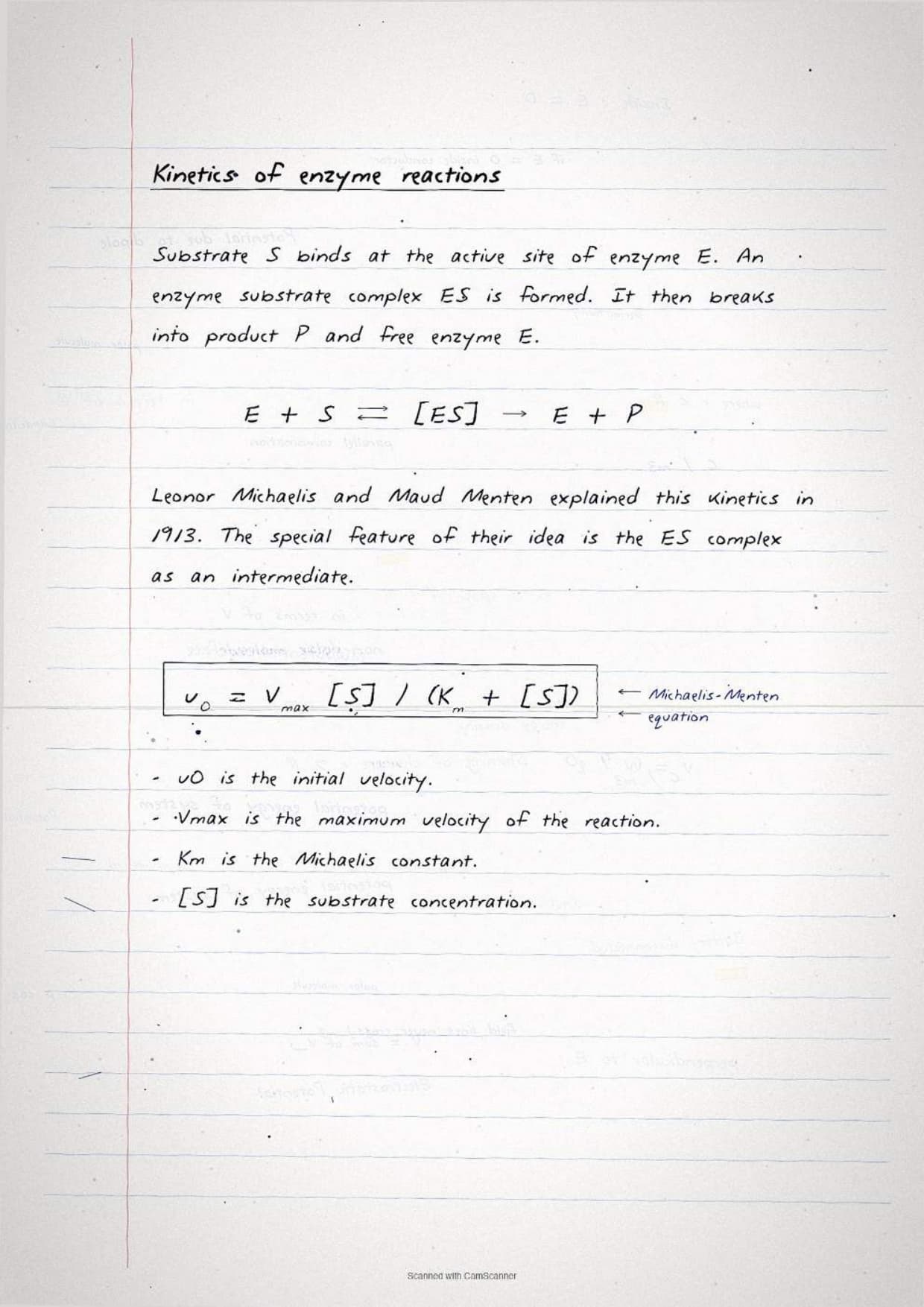
During catalysis the substrate binds at the active site, forms an enzyme-substrate complex, and that complex breaks down to give product and free enzyme. The scheme is written as E plus S giving ES, and ES giving E plus P, where the ES complex is weakly bonded and reversible.
The kinetics of this scheme was explained by Leonor Michaelis and Maud Menten in 1913, and its most remarkable feature is that a specific ES complex exists as an intermediate during catalysis. For a one-substrate reaction they derived the equation below.
v0 = Vmax [S] / (Km + [S])
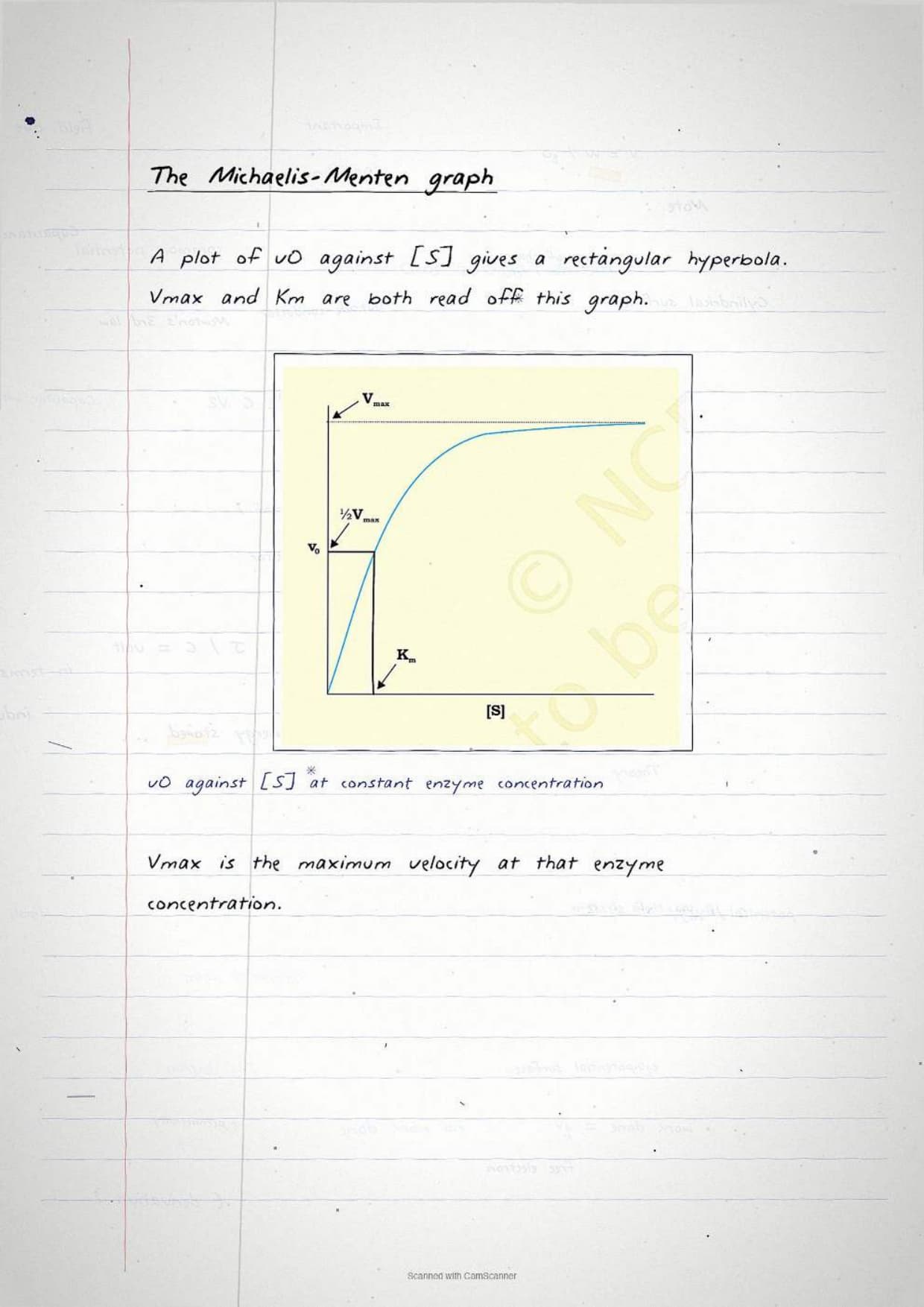
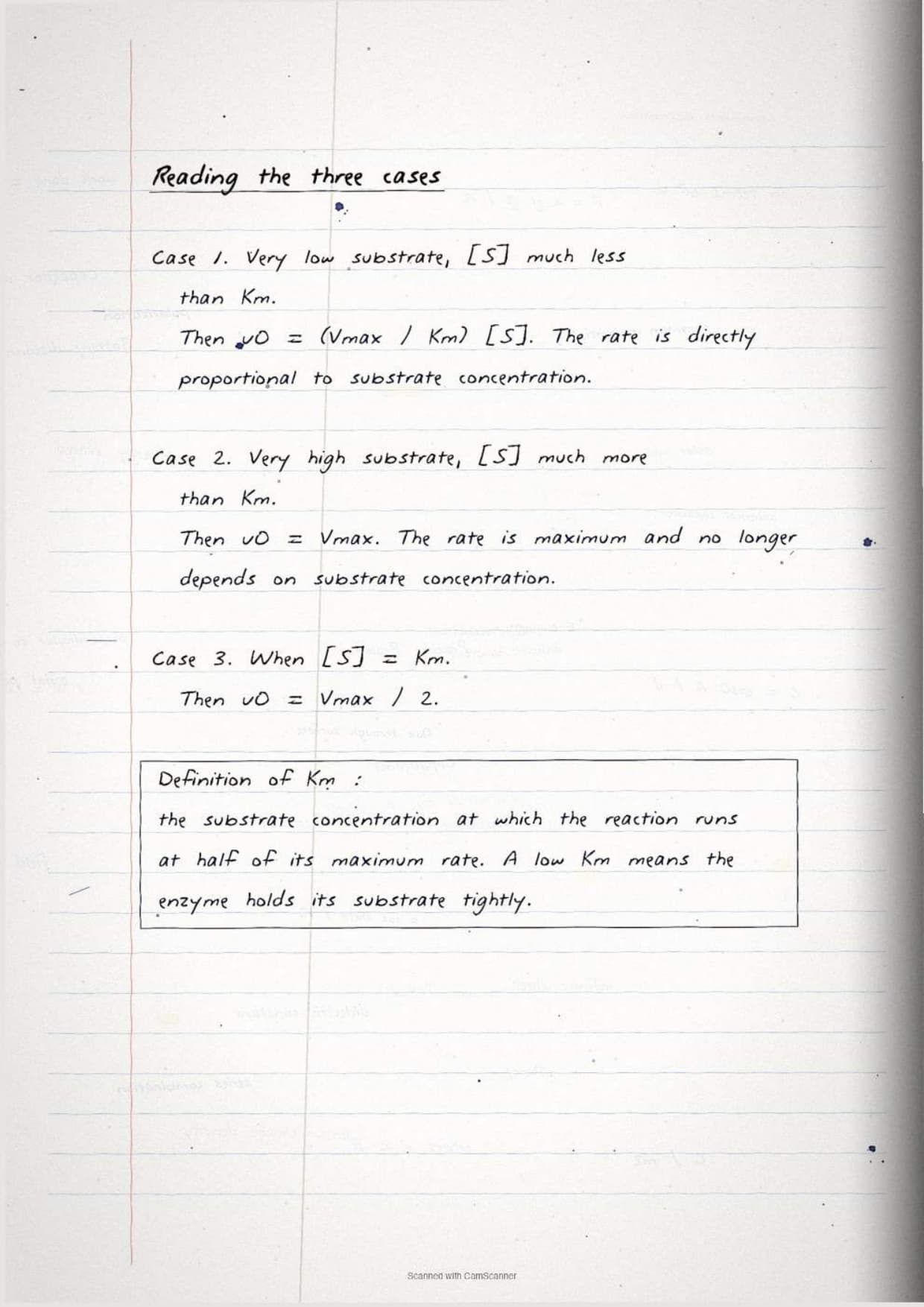
Here v0 is the initial velocity, Vmax is the maximum velocity at a given enzyme concentration, [S] is the substrate concentration and Km is the Michaelis constant. Plotting v0 against [S] gives a rectangular hyperbola, and both constants can be read straight off that graph.
| Condition | What the equation reduces to | What the curve looks like there |
|---|---|---|
| [S] much smaller than Km | Rate is directly proportional to substrate concentration | The steep, near-straight rising part |
| [S] much larger than Km | v0 equals Vmax, independent of substrate | The flat plateau at the top |
| [S] equal to Km | v0 equals half of Vmax | The midpoint of the climb |
That last row is the definition exercise question 6 wants. Km is the substrate concentration at which the reaction reaches half of its maximum rate. Its significance is what students forget to add. A low Km means the enzyme reaches half speed at a small substrate concentration, so it has a high affinity for that substrate. A high Km means the opposite. Km is also a constant for a given enzyme and substrate pair, so it is used to identify and compare enzymes.
Enzyme Inhibition: Reversible Against Irreversible
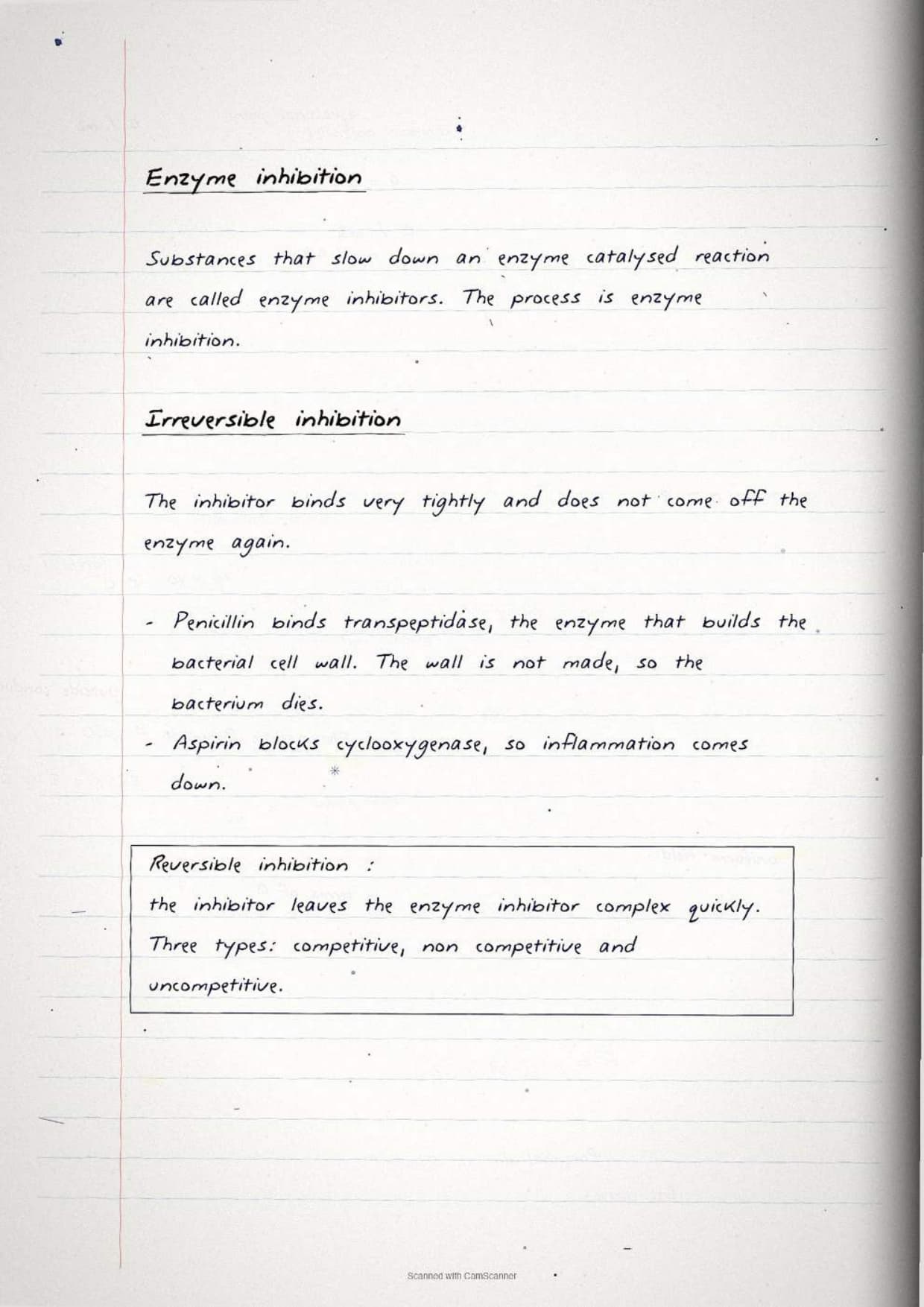
Substances that decrease the rate of an enzyme catalysed reaction are enzyme inhibitors, and the process is enzyme inhibition. The first split is by whether the inhibitor lets go.
In irreversible inhibition the inhibitor binds very tightly and does not dissociate from the enzyme. Two of medicine's most familiar drugs work this way, and both examples are printed in the chapter.
- Penicillin binds the enzyme transpeptidase, which builds the bacterial cell wall. With the enzyme blocked, wall synthesis stops and the bacterium dies.
- Aspirin inhibits the enzyme cyclooxygenase, which is how it reduces inflammation.
In reversible inhibition the inhibitor dissociates rapidly from the enzyme-inhibitor complex. There are three types, and the next two sections take them apart.
Competitive Against Non-Competitive Inhibition: The Comparison That Decides the Question
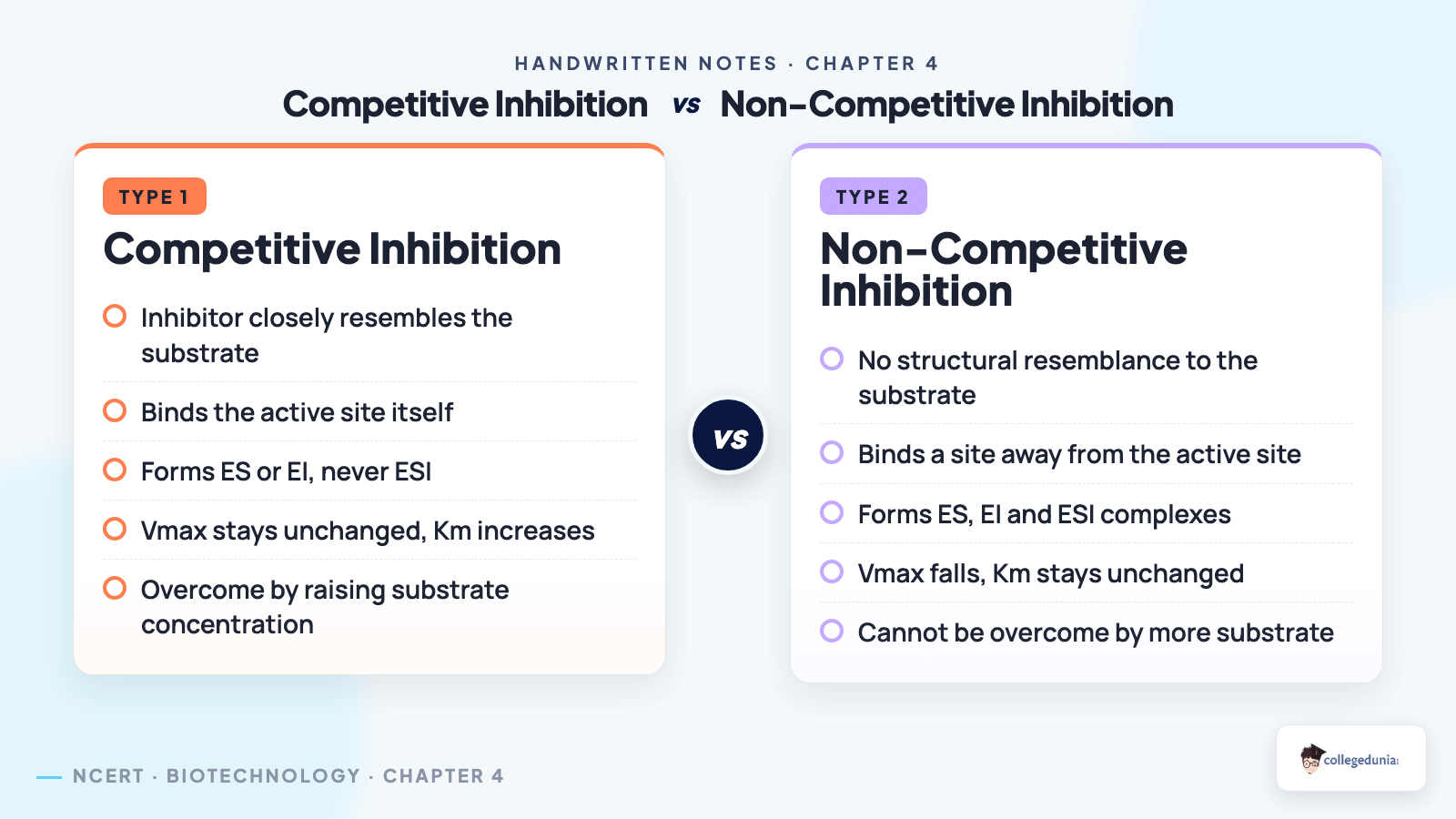
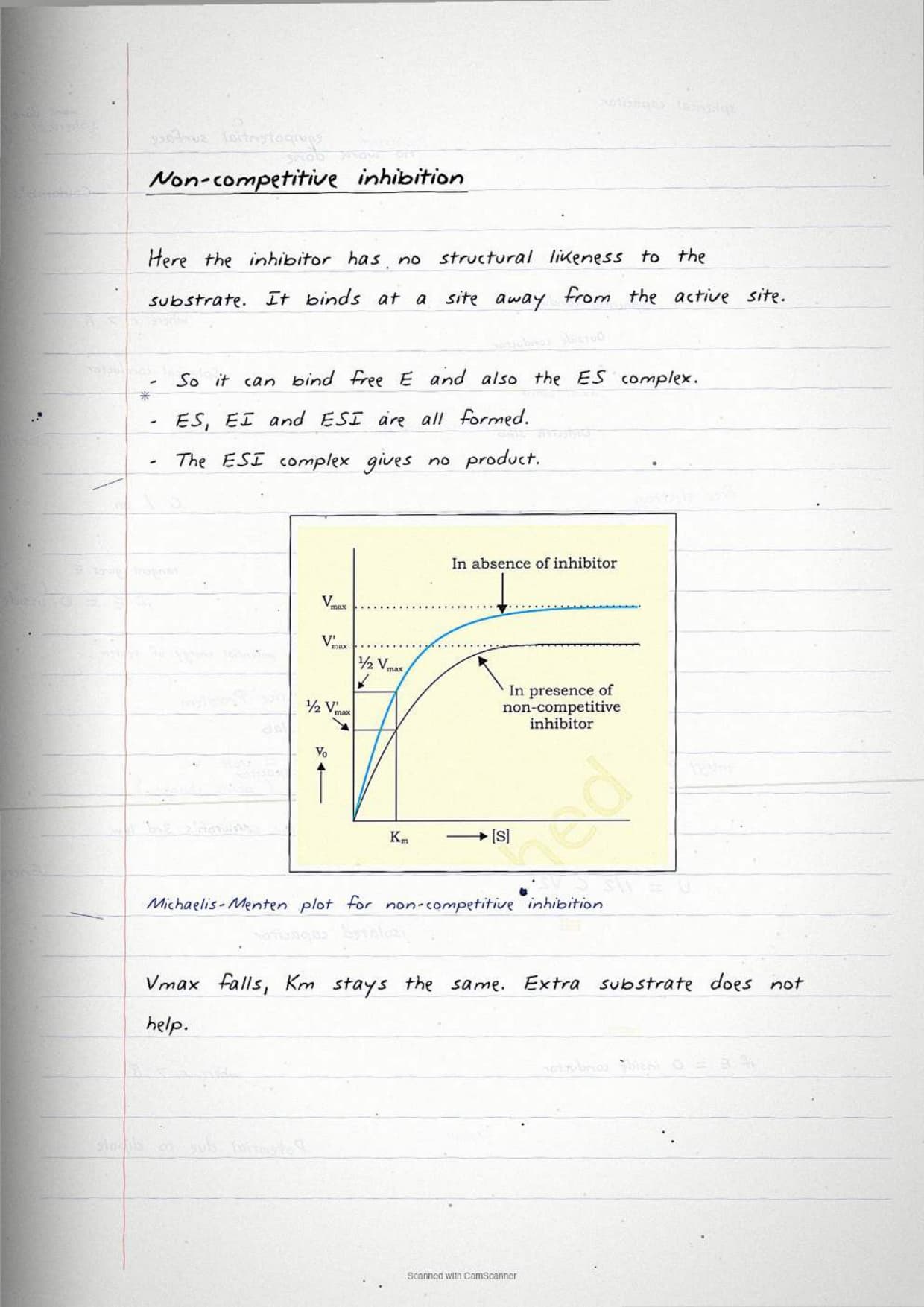
This is the pair that the Collegedunia survey flagged as the hardest topic in the course, so the notebook gives it four full pages with both graphs drawn twice.
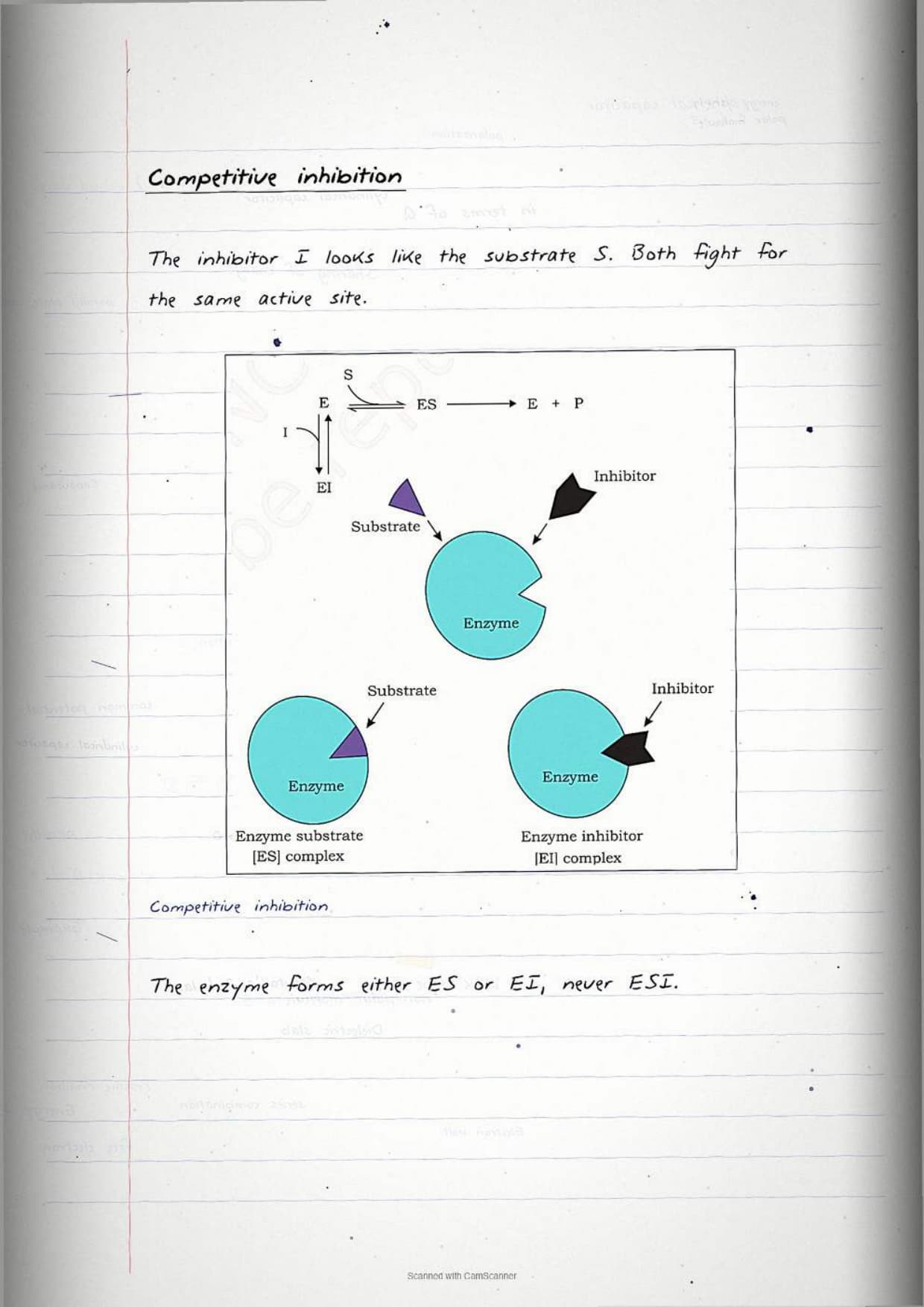
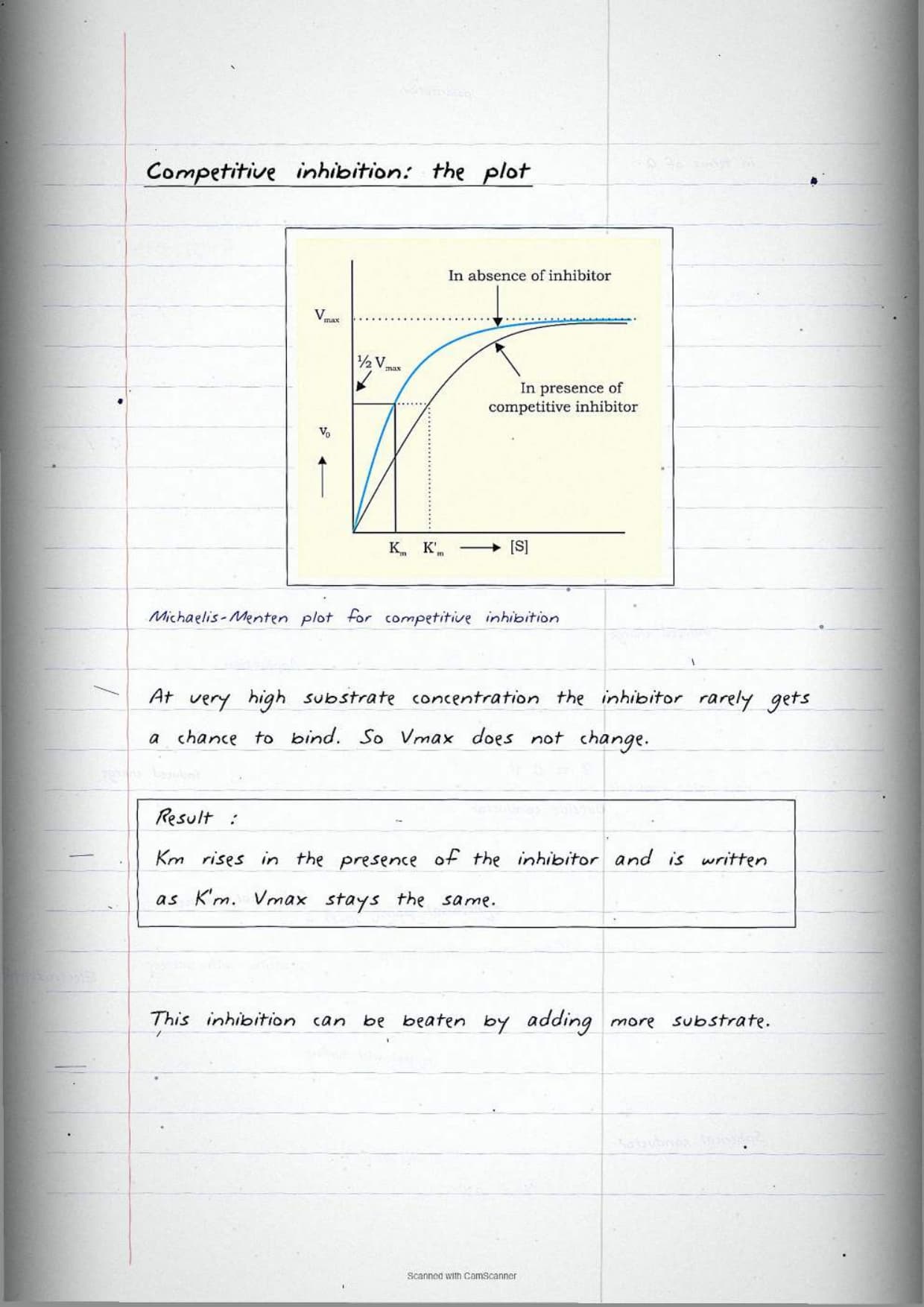
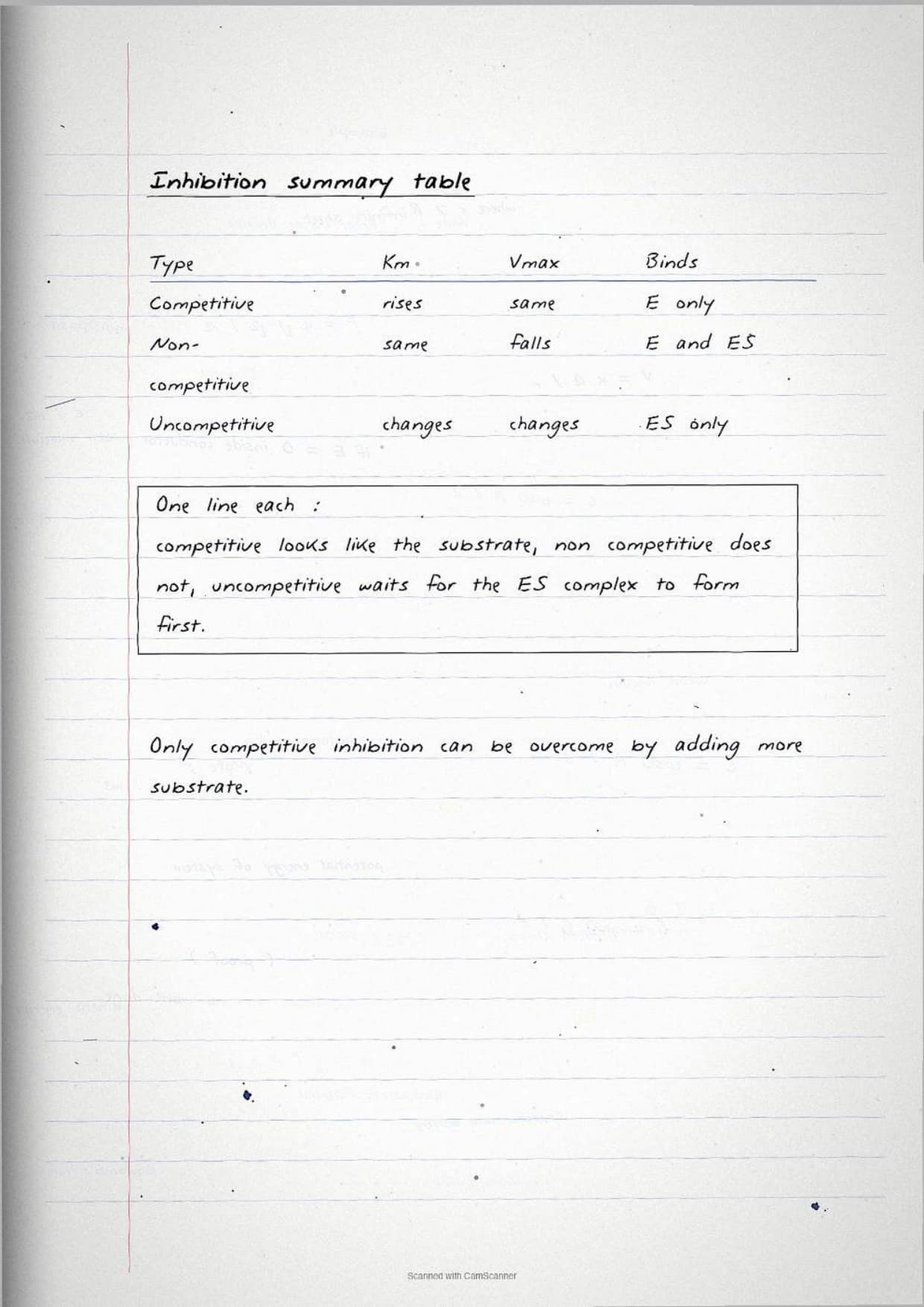
Competitive inhibition. The inhibitor closely resembles the substrate in structure, so both compete for the same active site. The enzyme can form either an ES complex or an EI complex, but never an ESI complex. The inhibitor works by reducing the number of active enzyme molecules bound to substrate. At very high substrate concentration the inhibitor has little chance of binding, so Vmax is unchanged, while Km increases and is written as K prime m.
Non-competitive inhibition. The inhibitor has no structural similarity to the substrate and binds at a site other than the active site. Because the two binding sites do not overlap, inhibitor and substrate can bind the same enzyme molecule at the same time, so ES, EI and ESI complexes all form. The ESI complex simply does not release product. The inhibitor effectively lowers the concentration of active enzyme, so Vmax falls while Km stays the same, and no amount of extra substrate can overcome it.
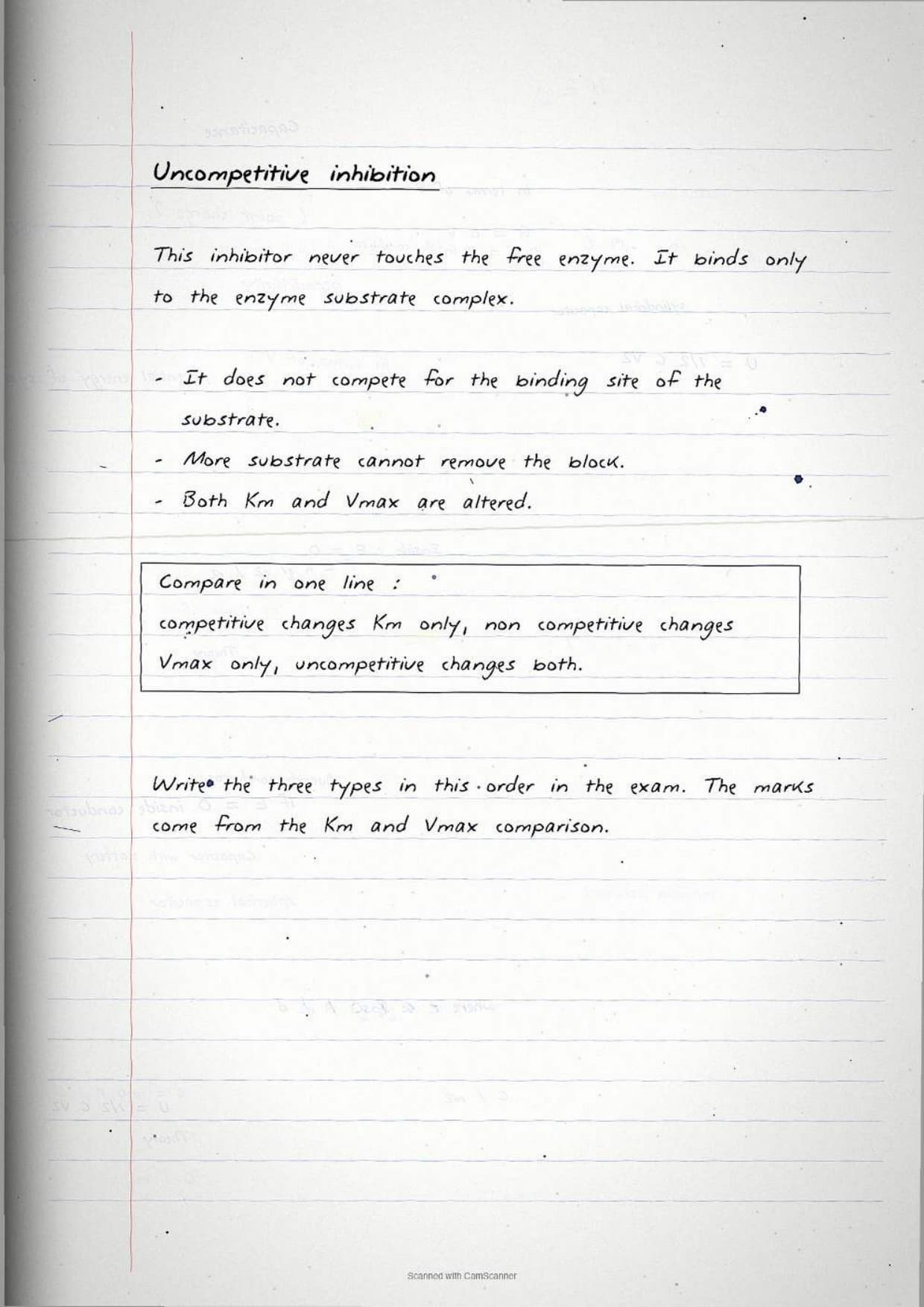
| Point of difference | Competitive inhibition | Non-competitive inhibition | Uncompetitive inhibition |
|---|---|---|---|
| Resemblance to substrate | Close structural resemblance | None | None |
| Where the inhibitor binds | The active site itself | A site other than the active site, on free enzyme or on ES | Only the ES complex, never free enzyme |
| Complexes formed | ES or EI, never ESI | ES, EI and ESI | ES and ESI |
| Effect on Vmax | Unchanged | Lowered | Altered |
| Effect on Km | Increased | Unchanged | Altered |
| Overcome by more substrate | Yes | No | No |
Uncompetitive inhibition is the third reversible type and the one most often left out of answers. The inhibitor does not bind the free enzyme at all. It binds only the enzyme-substrate complex, it does not compete for the substrate binding site, and both Km and Vmax are altered. Since it needs ES to exist before it can act, adding more substrate makes the inhibition worse rather than better.
Allosteric Enzymes and the Sigmoid Curve
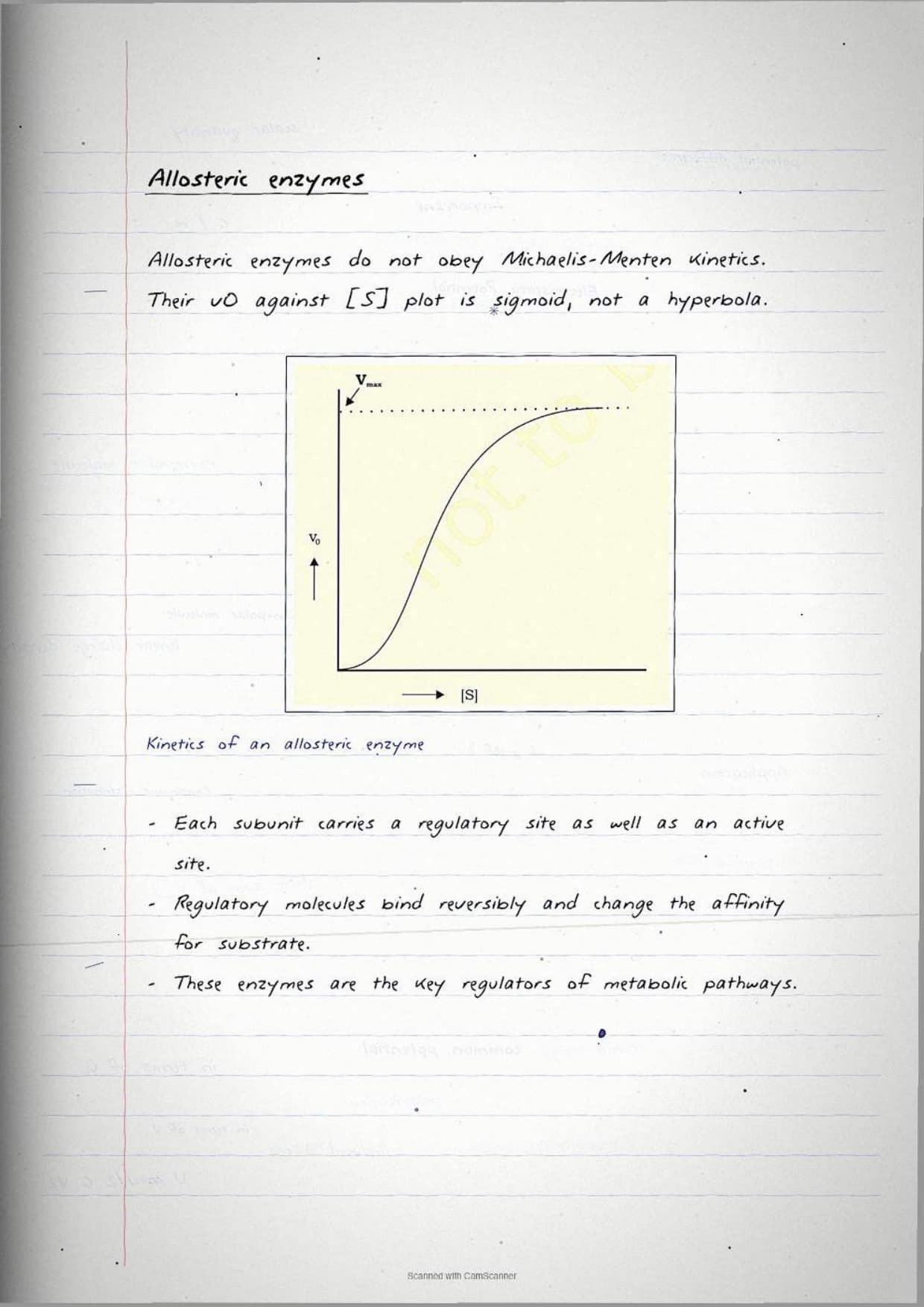
Allosteric enzymes break the pattern of everything above. They do not obey Michaelis-Menten kinetics, and plotting initial velocity against substrate concentration gives a sigmoidal curve instead of a rectangular hyperbola. That shape alone is enough to identify an allosteric enzyme in a graph-based question.
- Two sites per subunit: each subunit carries a regulatory site in addition to its active site.
- Reversible regulation: regulatory molecules bind reversibly at the regulatory site and alter the affinity of the enzyme for its substrate.
- Role in the cell: enzymes that obey Michaelis-Menten kinetics are the normal working enzymes, while allosteric enzymes are the key regulators of metabolic pathways.
An allosteric enzyme is a switch, not a workhorse. That one line is usually enough to explain why a cell needs a class of enzymes whose activity can be turned up or down by molecules that are not their substrates.
Bioenergetics and the Two Laws of Thermodynamics
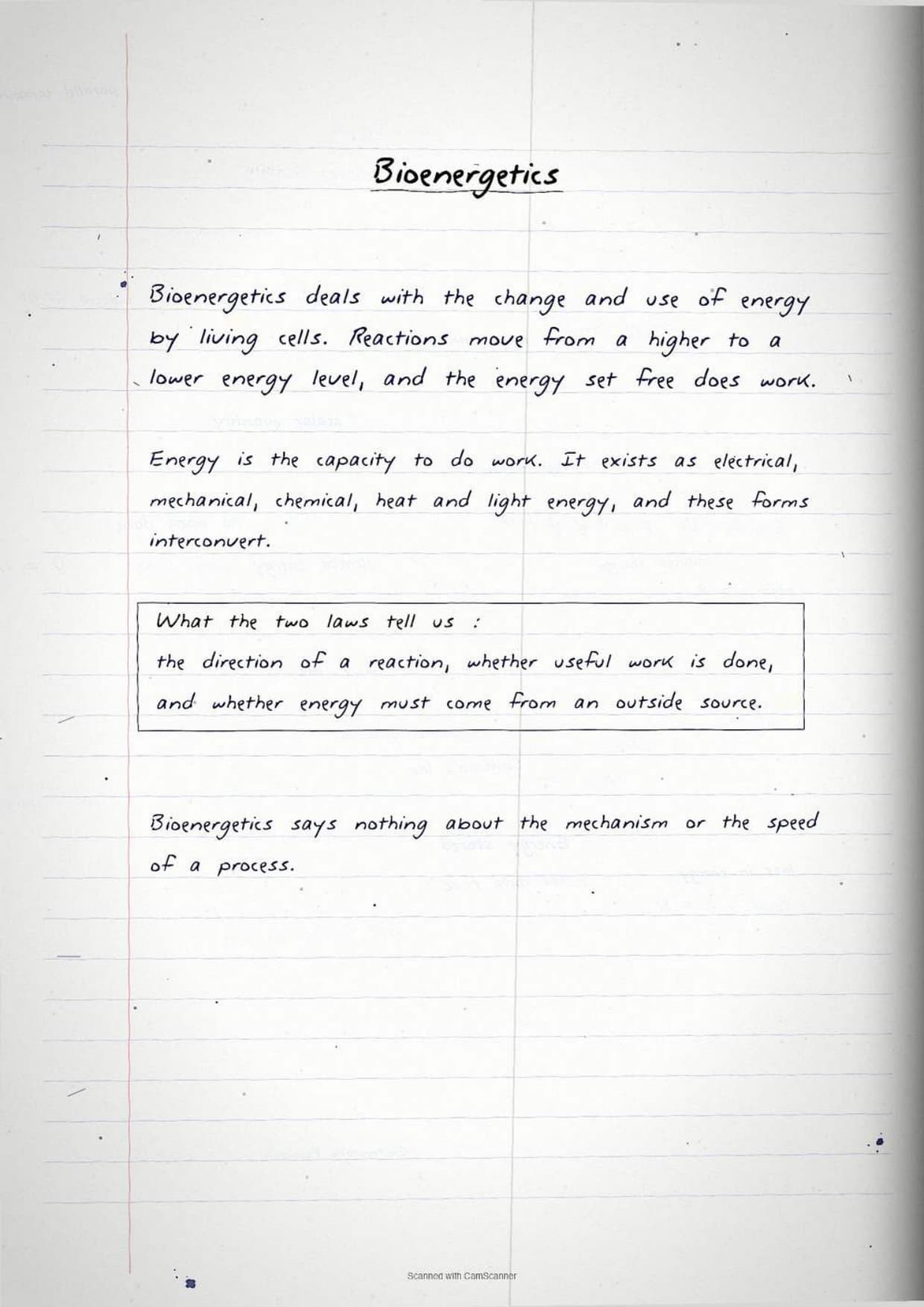
Section 4.2 changes subject cleanly. Bioenergetics, also called biological energetics, deals with the transformation and use of energy by living cells. In biological reactions energy is released as the system moves from a higher to a lower energy level, and the liberated energy is used to perform work.
Energy is the capacity to do work and exists as electrical, mechanical, chemical, heat and light energy, all of which are interconvertible. Bioenergetics is concerned only with energy changes during biochemical processes. It says nothing about the mechanism or the speed of a process, which is why enzymes and thermodynamics are two separate halves of one chapter. The two laws together answer three questions.
- The direction of a reaction, whether forward or reverse.
- The accomplishment of work, whether useful or non-useful.
- Whether the energy for the reaction must be delivered from an external source.
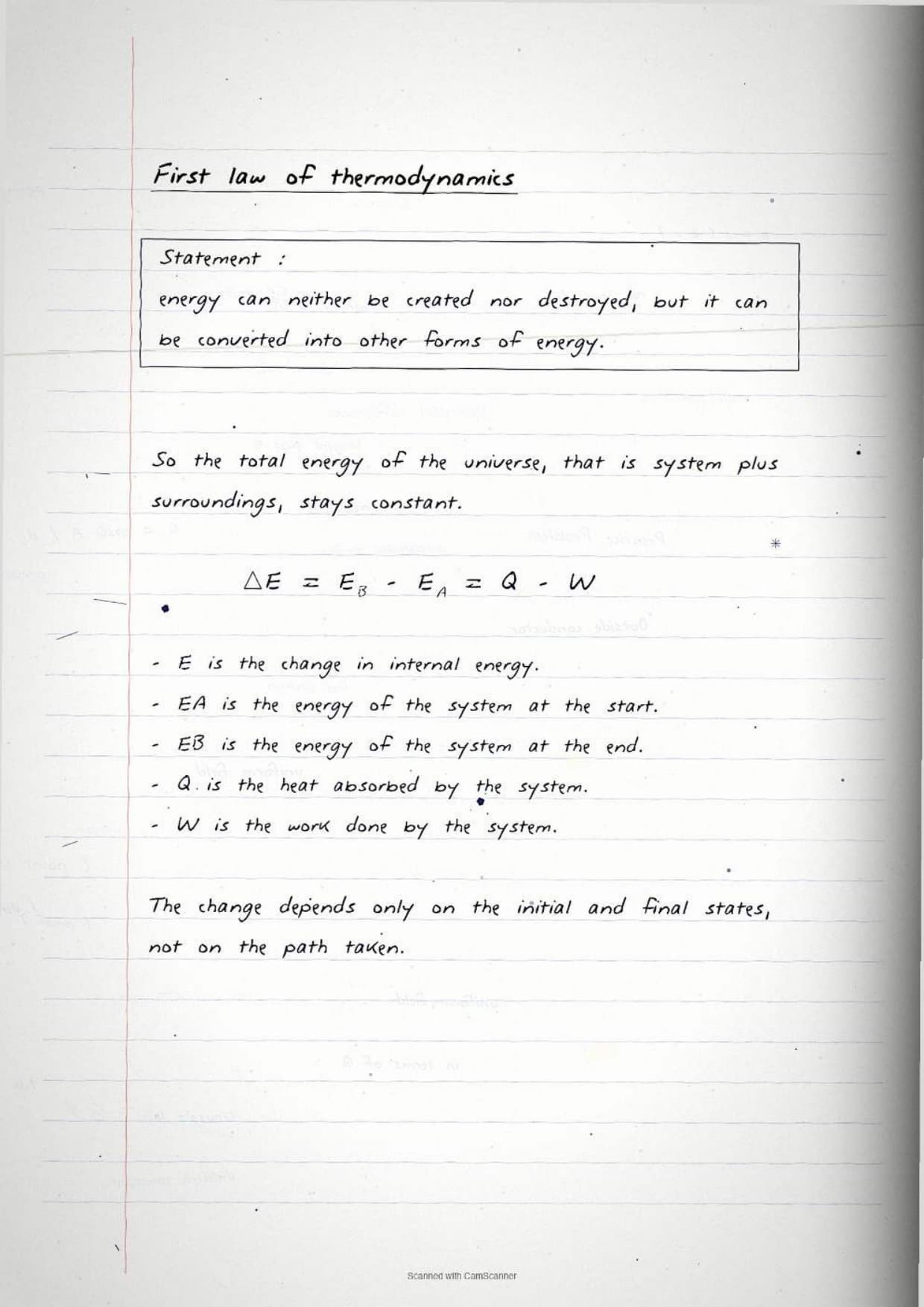
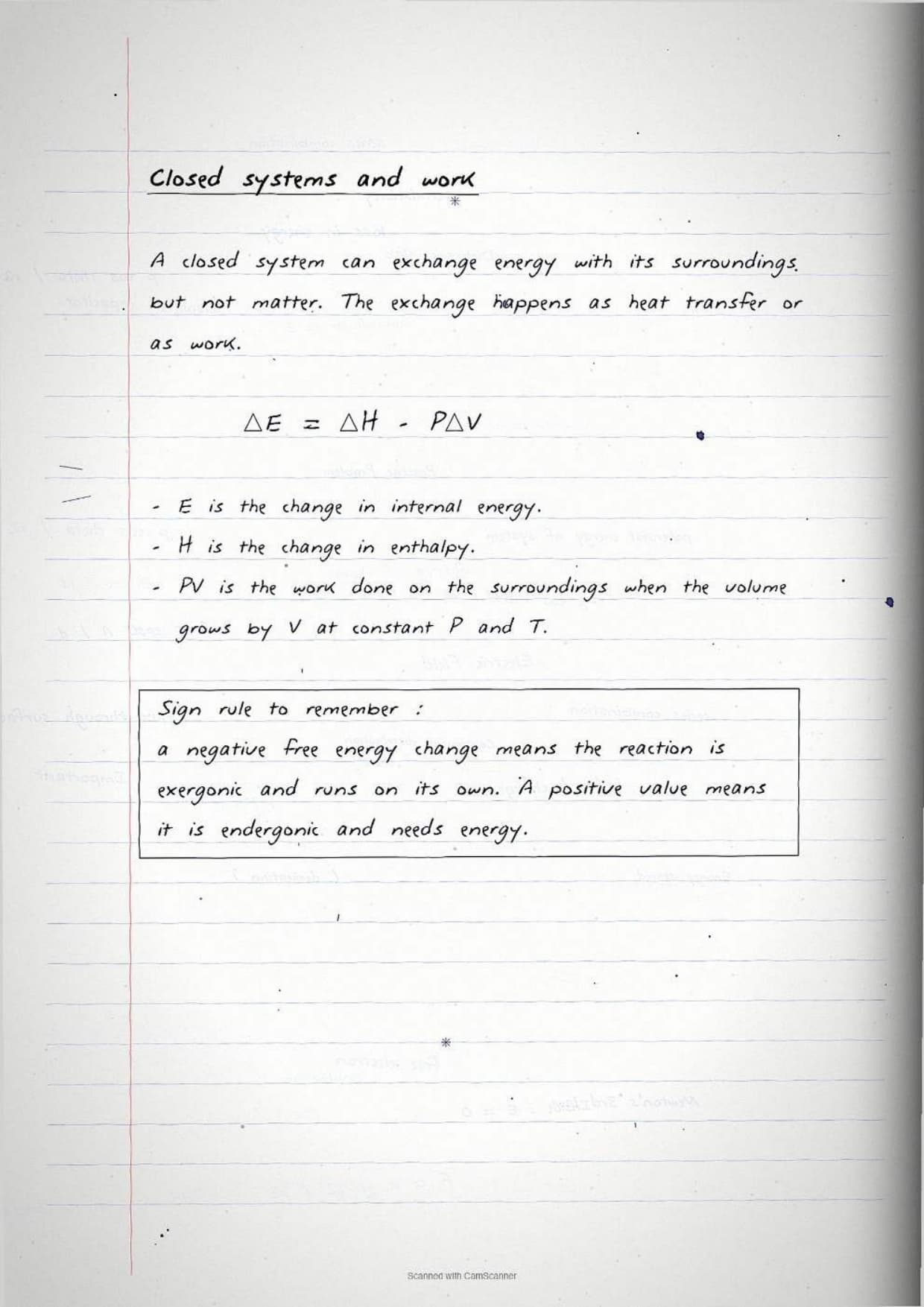
The first law of thermodynamics states that energy can neither be created nor destroyed but can be converted into other forms. The total energy of the universe, meaning the system plus its surroundings, stays constant. A system is matter within a defined region and the surroundings are matter in the rest of the universe. The law is written as a change in internal energy equal to the heat absorbed by the system minus the work done by the system. The change in energy depends only on the initial and final states, never on the path taken.
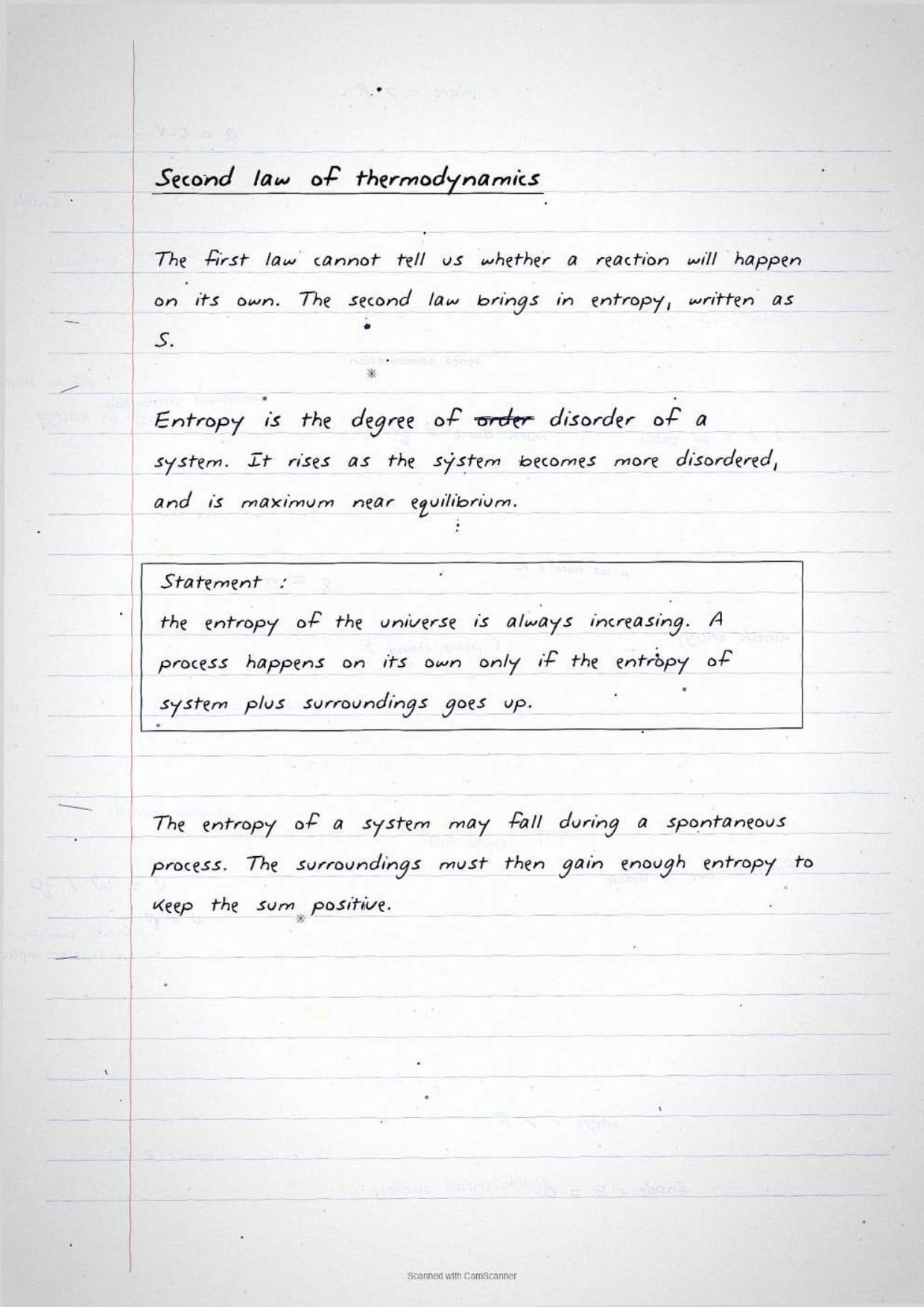
The second law of thermodynamics introduces entropy, written as S, which is the degree of randomness or disorder of a system. Entropy increases as a system becomes more disordered and reaches a maximum near equilibrium. The law states that the entropy of the universe is always increasing, and a process can occur spontaneously only if the sum of the entropy changes of the system and its surroundings is greater than zero. The entropy of the system alone may fall during a spontaneous process, as long as the surroundings gain enough to keep the sum positive.
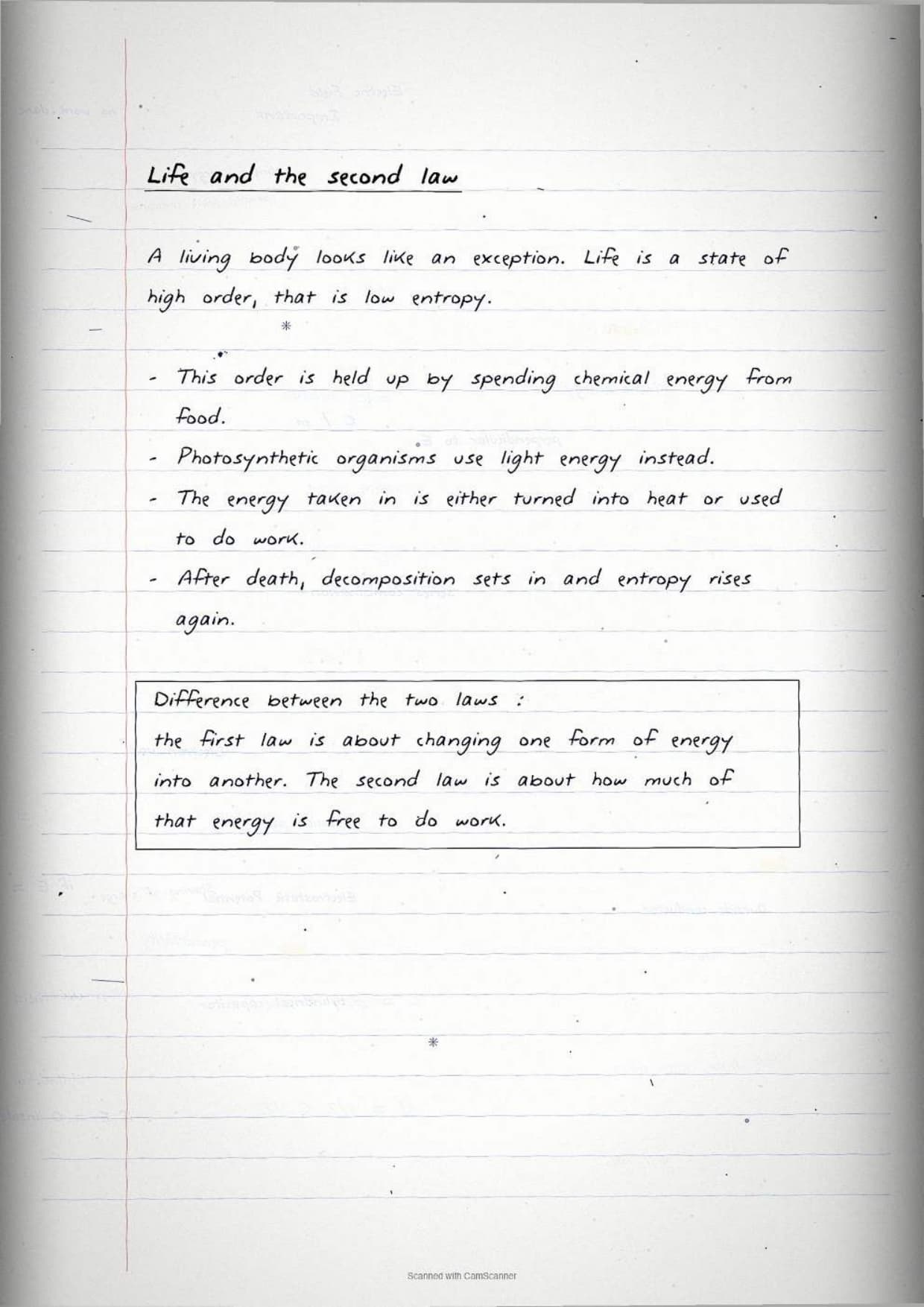
Living things look like an objection to this law, and the chapter meets it head on. Life is a state of higher organisation, meaning lower entropy, and that order is maintained by consuming chemical energy as food, or light energy in photosynthetic organisms. The energy is either downgraded to heat or used to do work. Thermodynamic equilibrium is only postponed, because entropy rises after death and decomposition.
| Point of difference | First law | Second law |
|---|---|---|
| Central statement | Energy is conserved and only changes form | Entropy of the universe always increases |
| Key quantity | Internal energy, heat and work | Entropy |
| What it is concerned with | Transformation of energy in a process | Availability of energy for doing work |
| Predicts spontaneity | No | Yes |
Free Energy: Combining the Two Laws Into One Usable Number
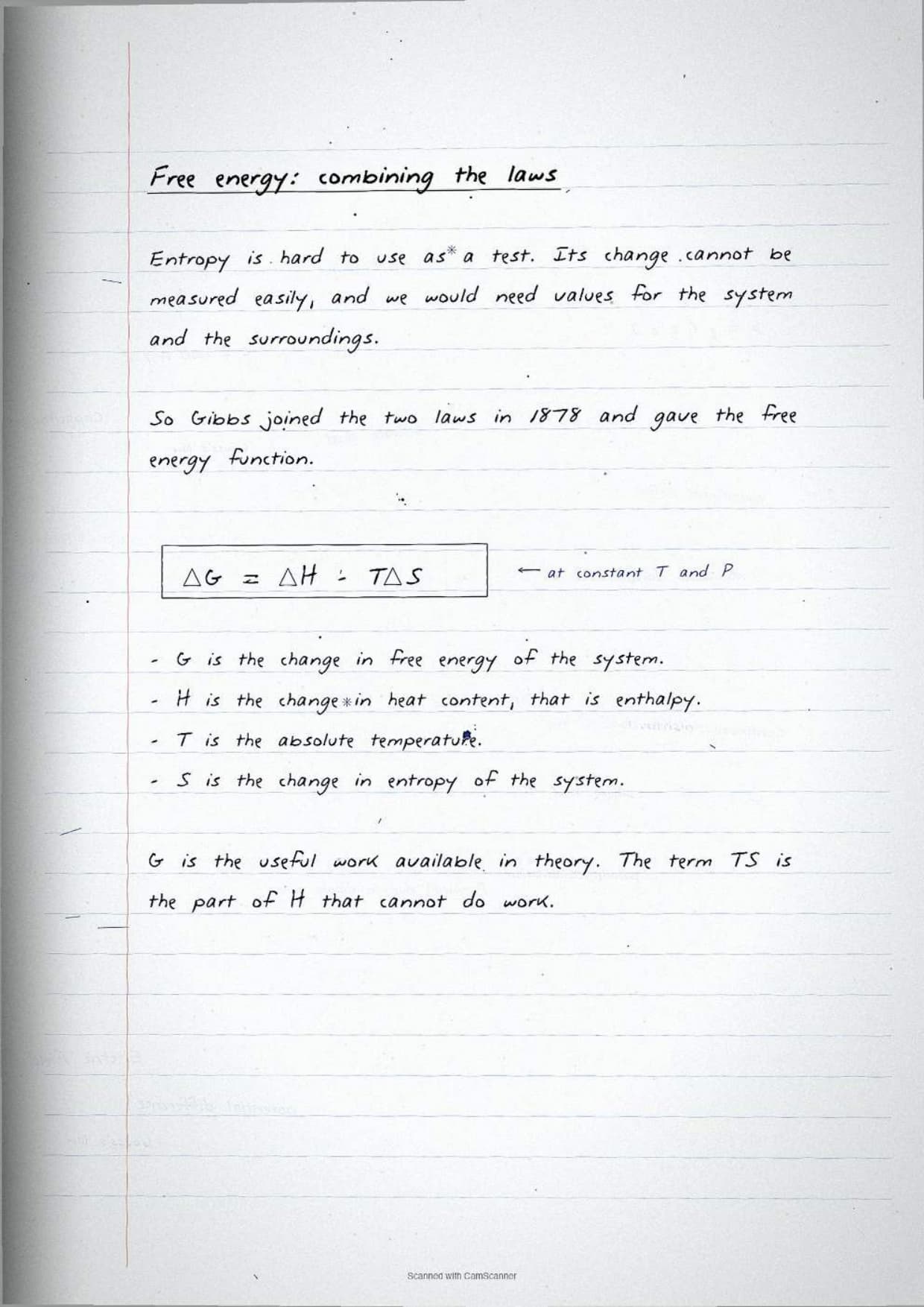
Entropy is not used directly to decide whether a biochemical reaction is spontaneous, for two practical reasons the chapter gives. Entropy changes of a reaction cannot be measured, and spontaneity would need the entropy change of both the system and the surroundings. So a different function is used, free energy.
In 1878 Gibbs combined the first and second laws into a single relation between the change in free energy, the change in heat content or enthalpy, the absolute temperature and the change in entropy of the system.
Change in free energy = change in enthalpy minus (temperature into change in entropy)
The free energy change is the theoretically available useful work. The temperature and entropy term is the part of the enthalpy change that cannot be used to perform work. Biochemical reactions happen at constant temperature and pressure, which is exactly the condition this equation assumes, so it applies directly to the cell. A closed system, defined here as one that exchanges energy but not matter with its surroundings, gives the companion relation in which the change in internal energy equals the change in enthalpy minus the pressure volume work done on the surroundings.
| Type of reaction | Sign of the free energy change | What it means for the cell |
|---|---|---|
| Exergonic | Negative, energy is released | Runs on its own and can pay for other work, for example oxidation of food |
| Endergonic | Positive, energy is consumed | Cannot run alone and must be driven, for example building a macromolecule |
Tip: exergonic and endergonic describe the reaction. Spontaneous and non-spontaneous describe whether it will go. They line up, but the examiner marks the vocabulary, so use the pair the question uses.
ATP: The Universal Currency of Free Energy
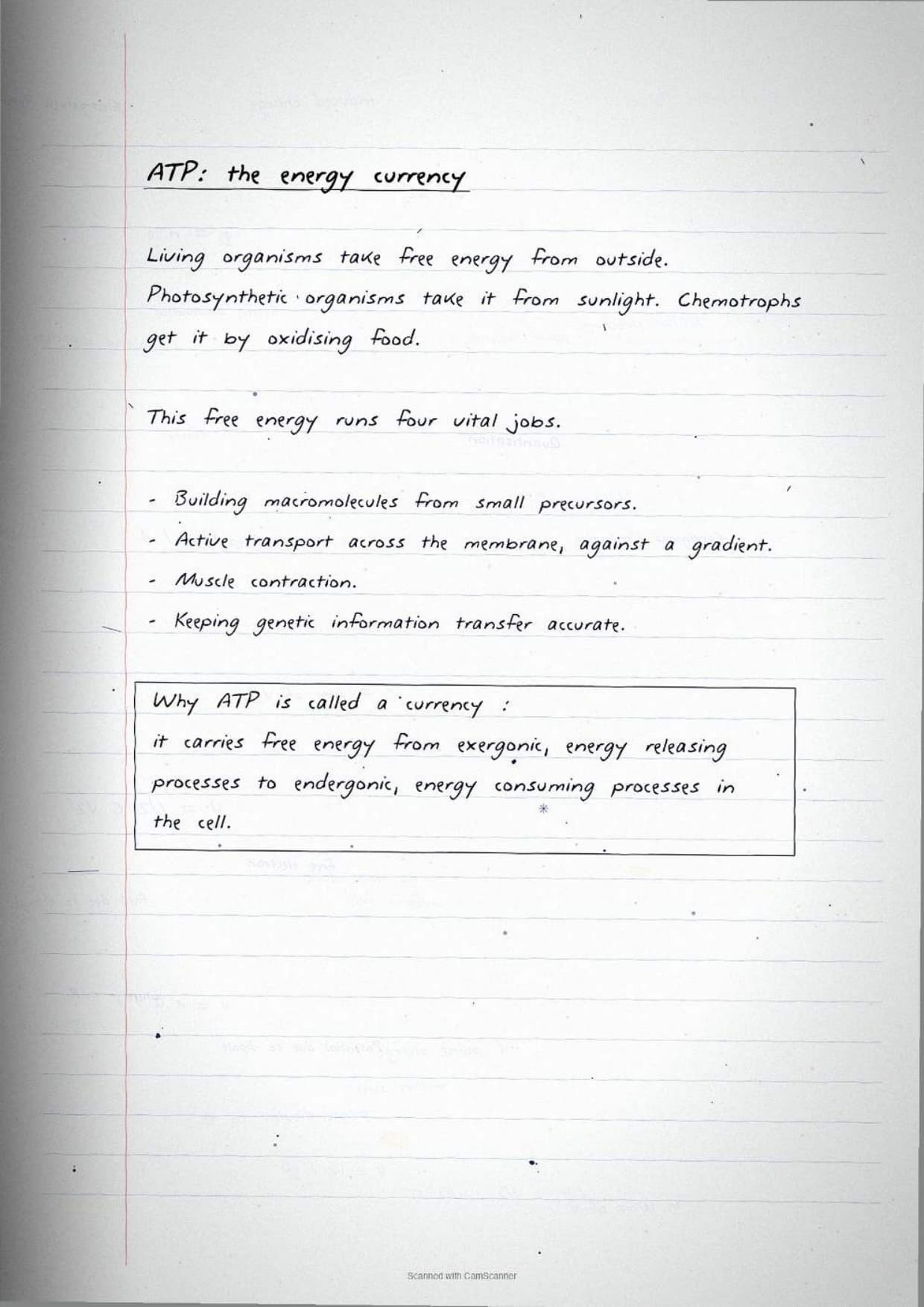
Living organisms take free energy from the environment. Photosynthetic organisms take it from sunlight, while chemotrophs, the non-photosynthetic organisms, obtain it by oxidation of foodstuff. Before that energy is spent it is partly converted into one special form, adenosine triphosphate, which the chapter calls the universal currency of free energy. The chapter names four vital processes it pays for.
- Synthesis of macromolecules from small precursors.
- Active transport across a membrane, that is transport against a gradient.
- Muscle contraction.
- Fidelity of genetic information transfer.
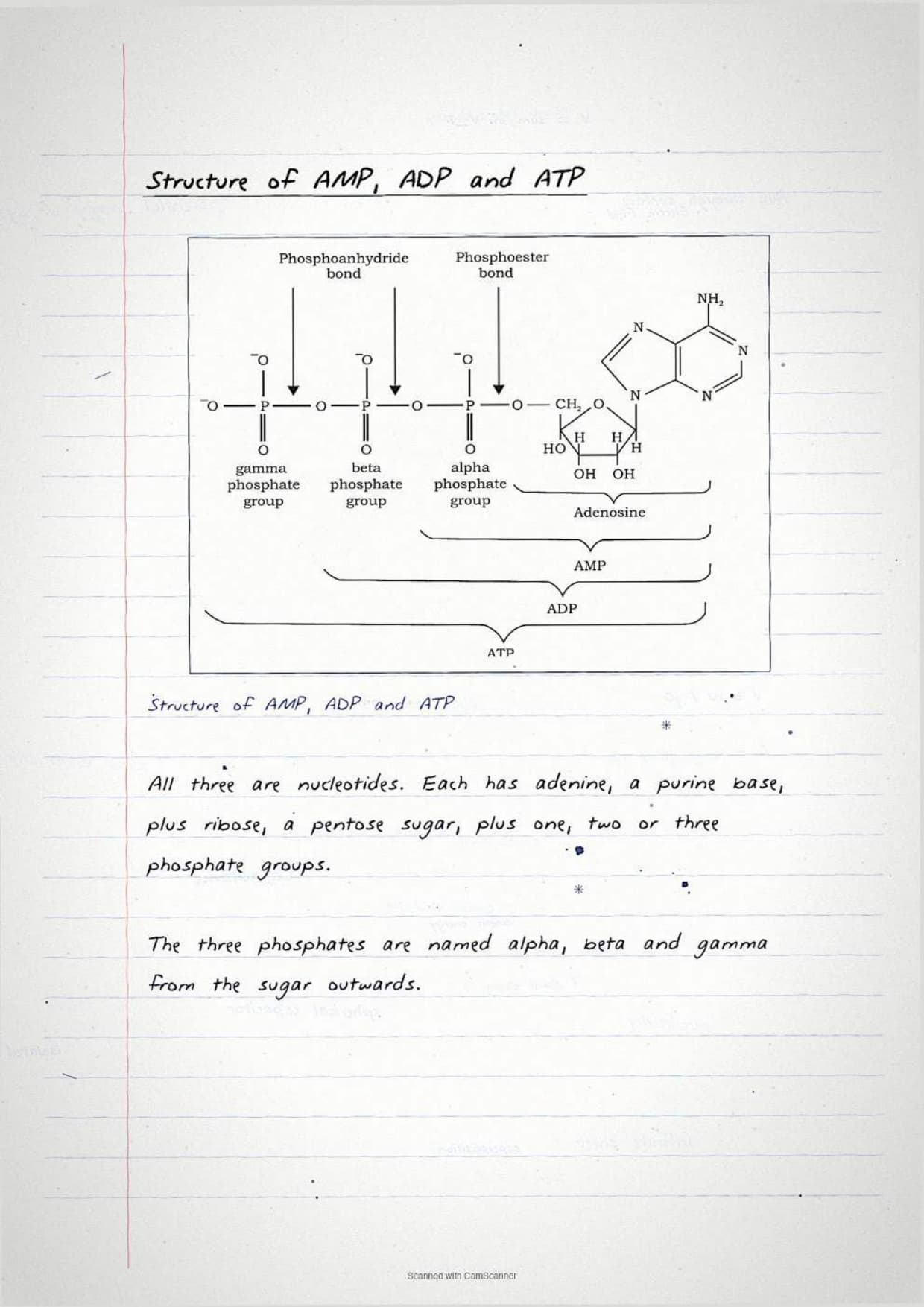
Structurally, ATP and its hydrolysis products are nucleotides. Each is built from adenine, a purine base that also occurs in DNA and RNA, a ribose sugar, which is a pentose, and a chain of phosphate groups. The count of phosphates is the only difference between the three.
| Nucleotide | Phosphate groups | Where it appears in the cycle |
|---|---|---|
| AMP, adenosine monophosphate | One | Formed with pyrophosphate when ATP donates energy in some processes |
| ADP, adenosine diphosphate | Two | The everyday partner, recharged back into ATP |
| ATP, adenosine triphosphate | Three, named alpha, beta and gamma | The charged form the cell spends |
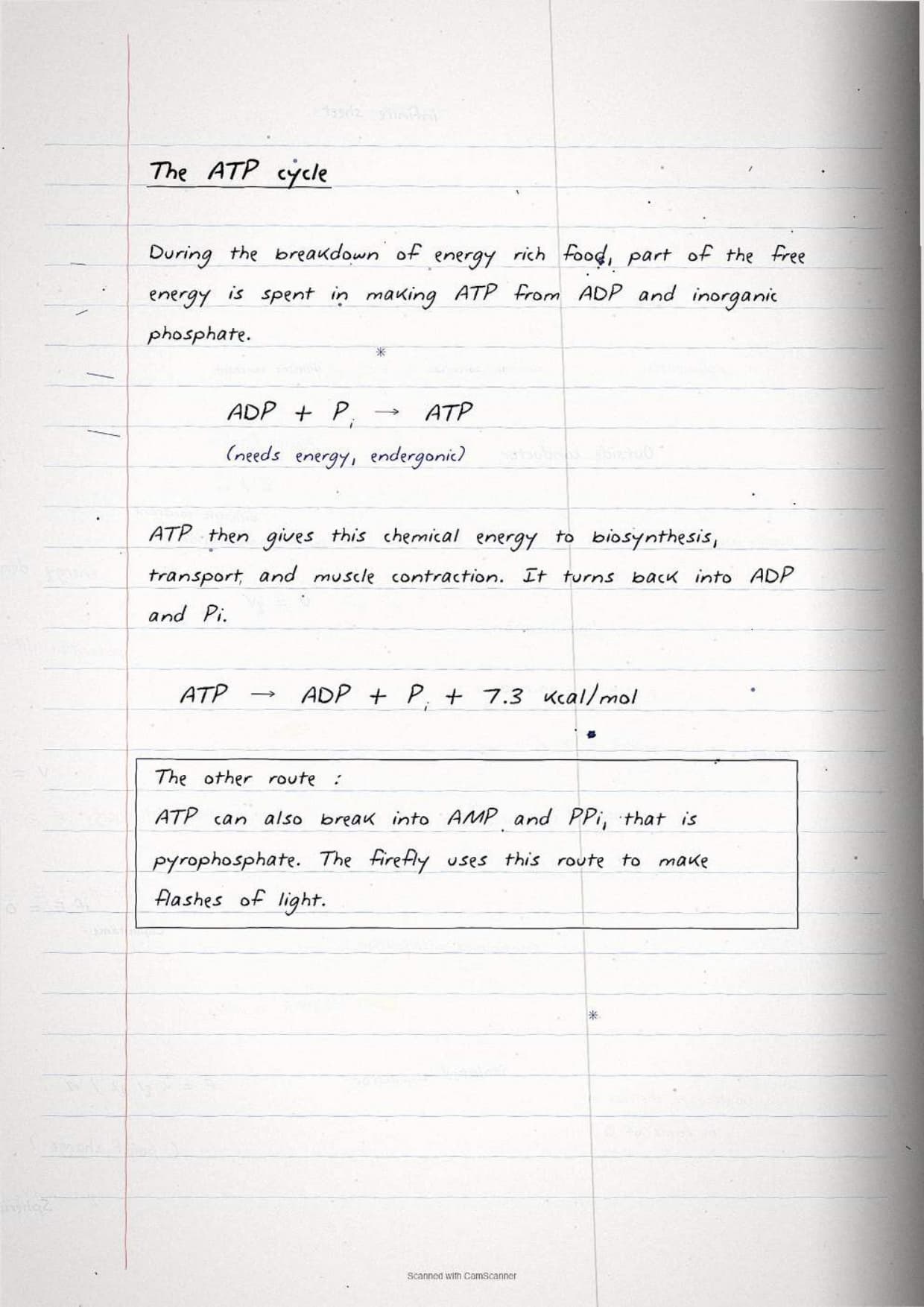
Exercise question 11 asks why ATP is called the universal energy currency, and the answer is a cycle rather than a fact. During breakdown of energy-rich foodstuff some free energy is consumed in making ATP from ADP and inorganic phosphate, and ATP then donates that chemical energy to energy-requiring processes by converting back into ADP and inorganic phosphate, releasing 7.3 kilocalories per mole. In a few reactions ATP goes further and yields AMP plus pyrophosphate, which is what powers the light flashes of a firefly.
Coupled Reactions and Redox: How the Cell Pays for Uphill Work
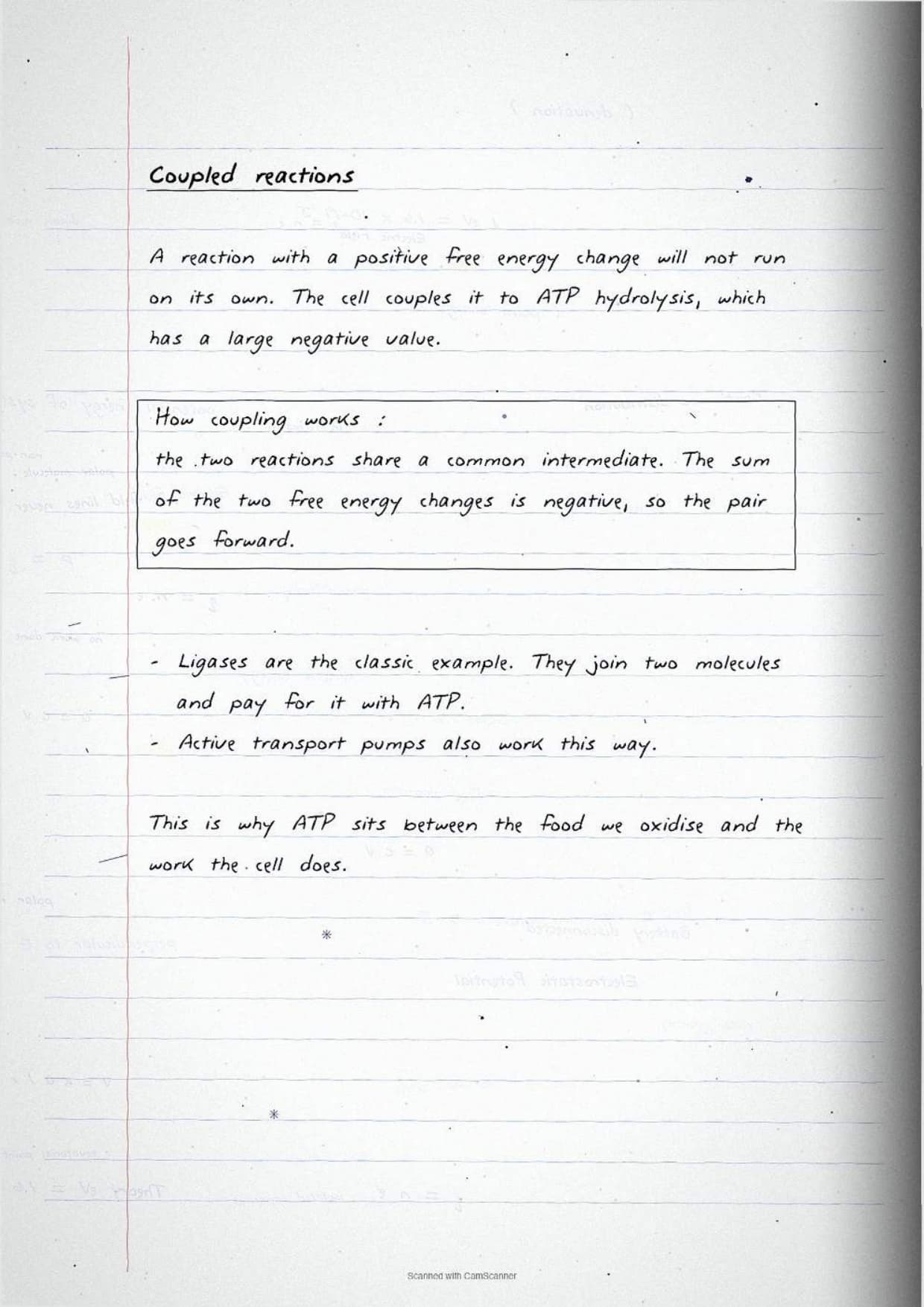
The word currency is doing real work in that phrase, and it is worth unpacking for a five-mark answer. A currency is useful because it sits between earning and spending, and ATP does exactly that. It plays a central role in transferring free energy from exergonic processes, which release energy, to endergonic processes, which consume it.
That transfer is what a coupled reaction means. An endergonic step that could never run on its own is linked to the strongly exergonic breakdown of ATP, and the two are treated as one reaction whose overall free energy change is negative. Class 6 of the IUB list, the ligases, is defined by precisely this trick, since it catalyses condensation of two molecules coupled through ATP hydrolysis.
- Earning: oxidation of foodstuff, or capture of sunlight, releases free energy and drives the synthesis of ATP from ADP and inorganic phosphate.
- Spending: ATP breaks back down to ADP and inorganic phosphate and the released energy drives biosynthesis, transport and muscle contraction.
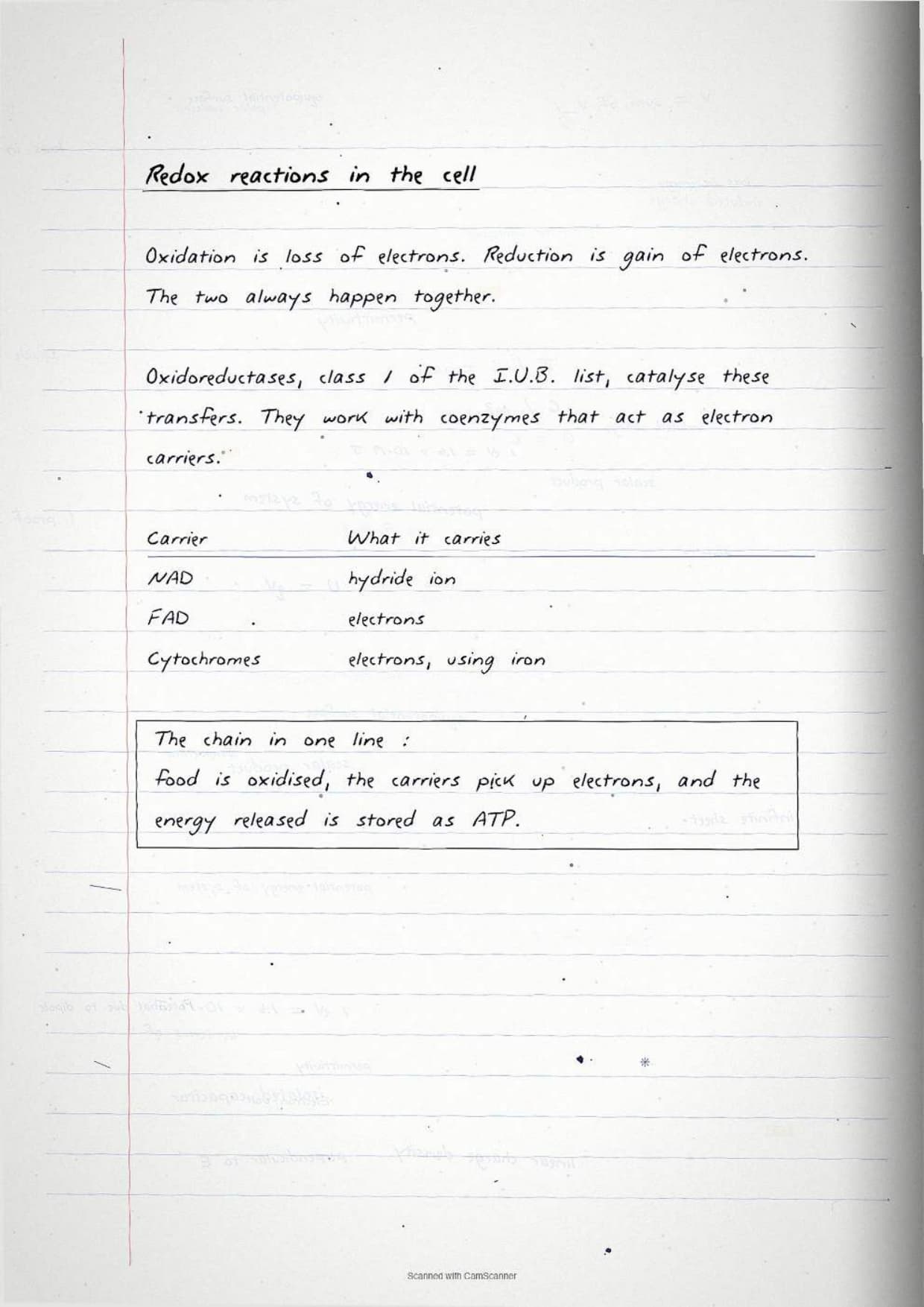
- Carrying: the same free energy travels between the two as reducing power held by coenzymes such as NAD and FAD.
That last bullet is the redox link. Oxidation is loss of electrons and reduction is gain of electrons, and class 1 of the enzyme classification, the oxidoreductases, exists only to move electrons between molecules. The coenzyme table earlier in the chapter shows how the electrons travel, because NAD transfers hydride and FAD transfers electrons. Foodstuff is oxidised, the coenzymes are reduced, and the energy released along that path is banked as ATP.
Common Mistakes Students Make in Enzymes and Bioenergetics
Six traps that cost easy marks in the Class 11 Biotechnology paper:
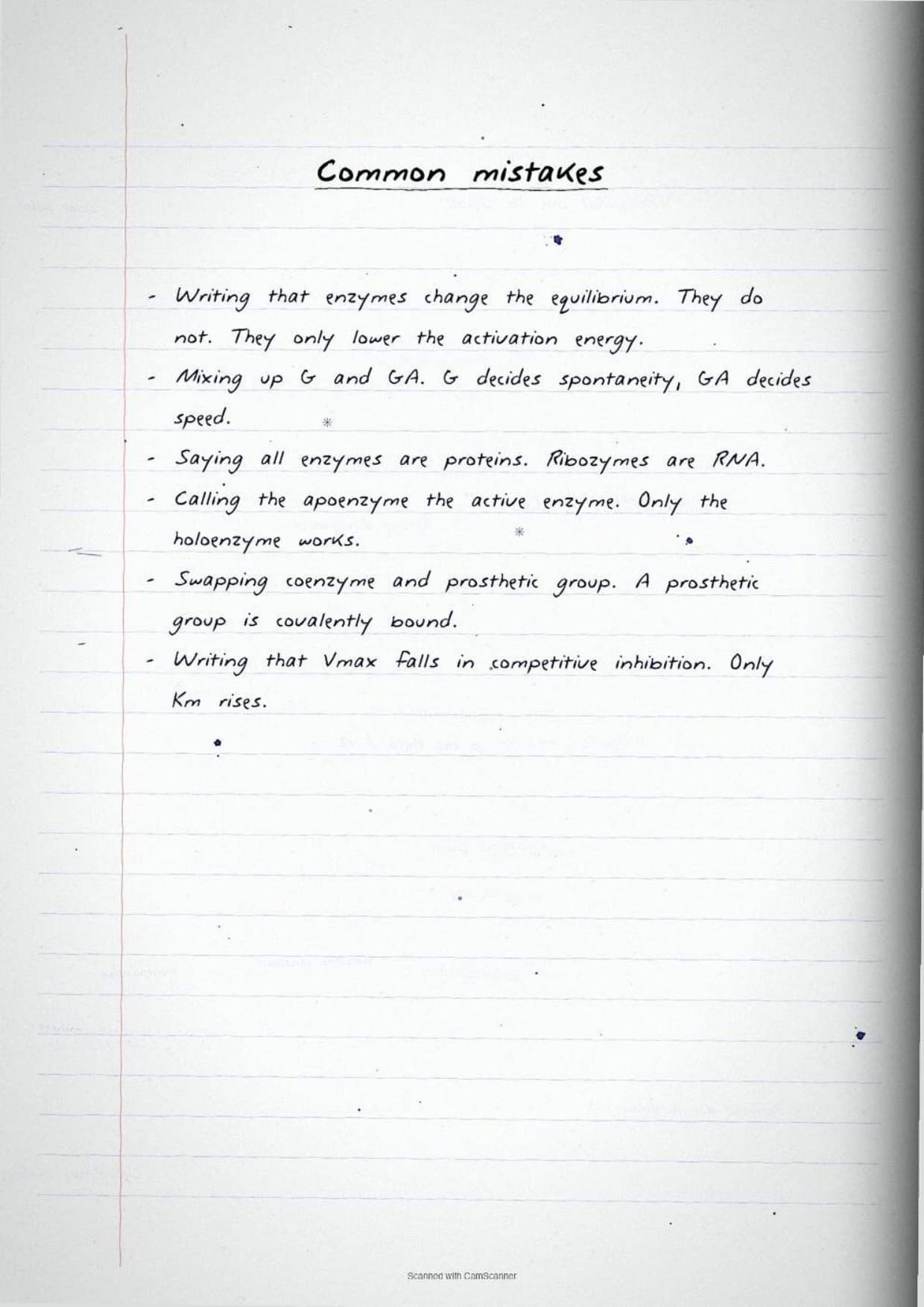
- Saying enzymes change the equilibrium. They lower activation energy only. Equilibrium and free energy change stay exactly where they were.
- Swapping apoenzyme and holoenzyme. Apoenzyme is the protein alone, holoenzyme is protein plus cofactor. A prosthetic group is a cofactor bound covalently.
- Getting the inhibition effects backwards. Competitive raises Km and leaves Vmax alone. Non-competitive lowers Vmax and leaves Km alone.
- Defining Km as maximum velocity. Km is a substrate concentration, the one that gives half of Vmax, and a low Km means high affinity.
- Mixing the two scientists and years. Fischer proposed lock and key in 1894, Koshland proposed induced fit in 1958.
- Drawing a hyperbola for an allosteric enzyme. Allosteric enzymes give a sigmoidal curve because they do not obey Michaelis-Menten kinetics.
Tick each trap off only after you have answered it correctly once in a written attempt. Students who did this reported that the inhibition question stopped costing them marks within two revision rounds.
Quick Recall Sheet for Enzymes and Bioenergetics
This is the page to read the night before and again in the morning. Every term the chapter can ask sits in one place.
| Term | One-line meaning |
|---|---|
| Enzyme | Biocatalyst that speeds biochemical reactions in vivo and in vitro without being changed |
| Ribozyme | Catalytic RNA molecule, the one exception to enzymes being proteins |
| Active site | Small three-dimensional pocket or cleft where the substrate binds |
| Lock and key | Fischer, 1894, rigid pre-shaped active site |
| Induced fit | Koshland, 1958, flexible active site that reshapes on binding |
| Absolute specificity | Enzyme acts on one particular substrate only |
| Isozymes | Multiple molecular forms catalysing the same reaction, LDH has five in humans |
| Apoenzyme | Protein part of a cofactor-requiring enzyme |
| Holoenzyme | Apoenzyme plus cofactor, the complete active enzyme |
| Prosthetic group | Coenzyme or metal ion covalently bound to the enzyme |
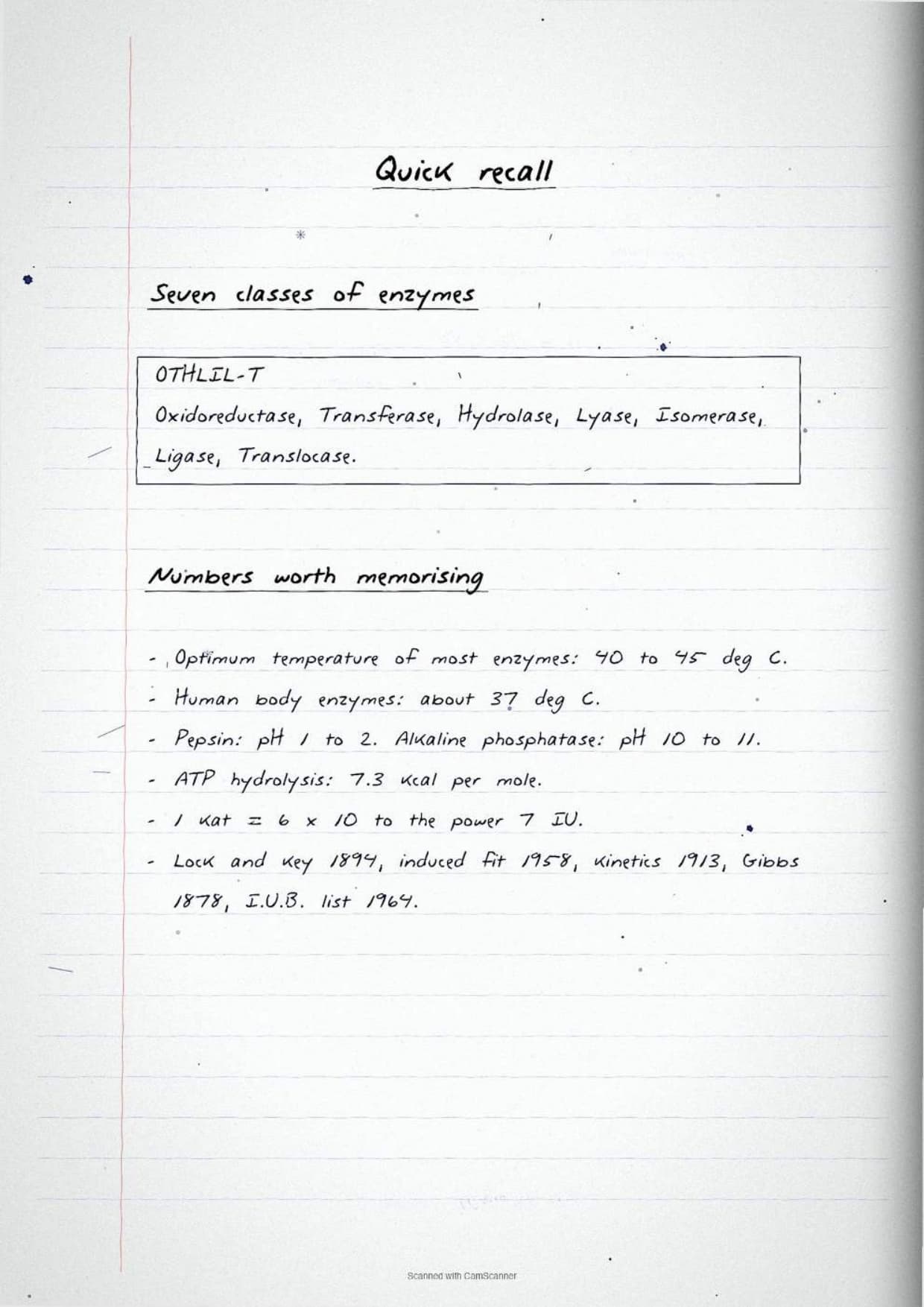
| Optimum temperature | 40 to 45 degrees Celsius for most enzymes, about 37 in the human body |
| Optimum pH of pepsin | 1 to 2, against 6 to 8 for most enzymes of higher organisms |
| Enzyme unit | 1 micromole of substrate converted per minute under standard conditions |
| Katal | 1 mole of substrate converted per second, the SI-compatible unit |
| Specific activity | Units of activity per milligram of enzyme protein, a purity measure |
| Activation energy | Free energy gap between transition state and substrate, lowered by the enzyme |
| Km | Substrate concentration giving half of Vmax, low value means high affinity |
| Competitive inhibitor | Resembles substrate, raises Km, leaves Vmax unchanged |
| Non-competitive inhibitor | Binds away from the active site, lowers Vmax, leaves Km unchanged |
| Allosteric enzyme | Sigmoidal kinetics, regulatory site per subunit, controls metabolic pathways |
| Entropy | Degree of randomness or disorder, always increasing for the universe |
| Free energy | Gibbs, 1878, the theoretically available useful work of a reaction |
| ATP | Universal currency of free energy, gives 7.3 kilocalories per mole on hydrolysis to ADP |
The notebook also carries a mnemonic for the seven IUB classes in order: OTHLIL T, standing for Oxidoreductases, Transferases, Hydrolases, Lyases, Isomerases, Ligases and Translocases.
What the Enzymes and Bioenergetics Handwritten Notes PDF Contains
The file is a scanned notebook written on ruled paper, with the textbook figures placed where the chapter uses them. Nothing is typed, so it reads the way a classmate's notes read.
- Pages 1 to 8: cover, the biocatalyst definition, ribozymes, cofactors, coenzymes with their precursor vitamins and the metal ion table.
- Pages 9 to 16: the seven IUB classes, isozymes, the active site with all four non-covalent interactions, and both models drawn out.
- Pages 17 to 24: the four types of specificity, the temperature and pH bell curves, the substrate saturation curve, enzyme units and specific activity.
- Pages 25 to 32: activation energy, the Michaelis-Menten derivation, the hyperbola with Km and Vmax marked, and all three inhibition graphs.
- Pages 33 to 42: allosteric kinetics, both laws of thermodynamics, free energy, the ATP structure figure, the quick recall sheet and every exercise question worked out.
Textbook Exercise Questions and How These Notes Answer Them
The chapter closes with eleven exercises, two of them multiple choice. The notebook writes out a model answer for each, and the table below shows where the material for each answer is built.
| Exercise question | Where the answer is built |
|---|---|
| What an enzyme is required to do in order to catalyse a reaction | The mechanism section, the correct option is decreasing the activation energy |
| Whether pepsin has an acidic or alkaline optimum pH, and what happens in the duodenum | The pH table, optimum 1 to 2, denatured and inactivated in the alkaline duodenum |
| The relationship between vitamins and enzyme cofactors | The full coenzyme and precursor vitamin table |
| Effect of temperature, pH and substrate concentration on catalytic activity | The three curves with optimum values and the saturation plateau |
| The rate determining step of Michaelis-Menten kinetics | The kinetics section, built around the ES complex as intermediate |
| Define Km and its significance | The half of Vmax definition plus the affinity interpretation |
| What is meant by one unit of enzyme | 1 micromole per minute under standard conditions, with the katal comparison |
| What is specific activity of an enzyme | Units per milligram of protein, used as a purity measure |
| Briefly describe the first and second laws of thermodynamics | The bioenergetics section with the four-row comparison table |
| Define entropy, and relate free energy to entropy | The free energy section built on the Gibbs relation of 1878 |
| Why ATP is called the universal energy currency | The ATP cycle with the 7.3 kilocalorie figure and the four processes it funds |
How to Use These Handwritten Notes Most Effectively
This chapter is half vocabulary and half graphs, so drawing beats reading. Students who split it into four blocks reported finishing it in about three and a half hours.
- Block 1, 45 minutes. Definition, ribozymes, active site, both models and the four types of specificity. Draw the lock and the glove from memory.
- Block 2, 50 minutes. The seven IUB classes, isozymes, cofactors, the coenzyme and vitamin table and the metal ion table. Cover one column and rebuild it.
- Block 3, 55 minutes. Temperature, pH and substrate curves, enzyme units, activation energy, the Michaelis-Menten equation and Km.
- Block 4, 50 minutes. All three inhibitions with their graphs, allosteric kinetics, both laws, free energy and the ATP cycle.
- Night before, 15 minutes. The quick recall table and the six common mistakes, nothing else.
How These Handwritten Notes Pair with Other Biotechnology Resources
Also Check: enzymes appear twice in the school syllabus, first as a class of biomolecules and later as the tools of genetic engineering. Read this chapter for the kinetics, then use the pages below for the chemistry on one side and the applications on the other.
| Resource | Best used for | Open it |
|---|---|---|
| Class 11 Biology Notes | Enzymes treated as biomolecules, with protein structure, nature of enzyme action and classification | Biomolecules Class 11 Biology Notes |
| Class 11 Biology Handwritten Notes | A scanned revision pass over the same enzyme chemistry | Biomolecules Class 11 Biology Handwritten Notes |
| Class 12 Biology Notes | Restriction enzymes, ligases and polymerases put to work in genetic engineering | Biotechnology Principles and Processes Class 12 Notes |
| Class 11 Biotechnology Handwritten Notes | The opening chapter of this same textbook, for the vocabulary that runs through the course | An Introduction to Biotechnology Class 11 Handwritten Notes |
| Class 11 Biotechnology Notes | Typed revision notes for this chapter with every term explained | Enzymes and Bioenergetics Class 11 Notes (coming soon) |
| Class 11 Biotechnology Book PDF | The official Class 11 Biotechnology chapter text with all thirteen figures | Enzymes and Bioenergetics Class 11 Book PDF (coming soon) |
NCERT Handwritten Notes for Class 11 Biotechnology: All Chapters
Related Links: handwritten revision notes for every chapter of the Class 11 Biotechnology textbook, written to the 2026-27 syllabus.
| Chapter | Class 11 Biotechnology Handwritten Notes |
|---|---|
| Chapter 1 | An Introduction to Biotechnology Class 11 Handwritten Notes |
| Chapter 2 | Cellular Organelles Class 11 Handwritten Notes (coming soon) |
| Chapter 3 | Biomolecules Class 11 Handwritten Notes (coming soon) |
| Chapter 4 | Enzymes and Bioenergetics Class 11 Handwritten Notes (this page) |
| Chapter 5 | Cellular Processes Class 11 Handwritten Notes (coming soon) |
| Chapter 6 | Basic Principles of Inheritance Class 11 Handwritten Notes (coming soon) |
| Chapter 7 | Basic Processes of DNA Class 11 Handwritten Notes (coming soon) |
| Chapter 8 | Genetic Disorder Class 11 Handwritten Notes (coming soon) |
| Chapter 9 | Introduction to Bioinformatics Class 11 Handwritten Notes (coming soon) |
| Chapter 10 | Protein Informatics and Cheminformatics Class 11 Handwritten Notes (coming soon) |
| Chapter 11 | Programming and Systems Biology Class 11 Handwritten Notes (coming soon) |
Enzymes and Bioenergetics Class 11 Handwritten Notes FAQs
Questions Students Ask Before Downloading These Notes
Ques. What is the difference between the lock and key model and the induced fit model?
Ans. Emil Fischer proposed the lock and key model in 1894, in which the active site is rigid and already shaped to fit the substrate, the way a key fits a lock. Daniel Koshland proposed the induced fit model in 1958, in which the substrate is complementary to the active site only in the enzyme-substrate complex. Contact with the substrate induces a conformational change that aligns the amino acid residues for binding and catalysis, and the relationship is compared to a hand and a glove.
Ques. Define Km and explain its significance.
Ans. Km, the Michaelis constant, is the substrate concentration at which the reaction reaches half of its maximum velocity. Its significance is that it measures the affinity of an enzyme for its substrate. A low Km means the enzyme reaches half speed at a small substrate concentration and therefore binds tightly, while a high Km means weak binding. Km is constant for a given enzyme and substrate pair, so it is used to compare and identify enzymes.
Ques. How do competitive and non-competitive inhibition differ?
Ans. A competitive inhibitor closely resembles the substrate and binds the active site itself, so only ES or EI complexes form. It raises Km but leaves Vmax unchanged, and adding more substrate overcomes it. A non-competitive inhibitor has no structural resemblance to the substrate and binds at a separate site on the free enzyme or on the ES complex, giving ES, EI and ESI. It lowers Vmax, leaves Km unchanged, and cannot be overcome by extra substrate.
Ques. What are the six classes of enzymes adopted by the International Union of Biochemistry?
Ans. The 1964 classification names oxidoreductases for oxidation and reduction, transferases for group transfer, hydrolases for hydrolytic reactions, lyases for adding or removing groups to form double bonds, isomerases for rearrangement within a molecule, and ligases for condensation of two molecules coupled to ATP hydrolysis. A seventh class, translocases, was added later for transfer of ions or molecules across a membrane.
Ques. What is the relationship between vitamins and enzyme cofactors?
Ans. Most coenzymes are derived from vitamins, which are organic nutrients required in small amounts in the diet. FAD comes from riboflavin, NAD from niacin, coenzyme A from pantothenic acid, pyridoxal phosphate from pyridoxine, thiamine pyrophosphate from thiamine, biocytin from biotin, tetrahydrofolate from folic acid, and coenzyme B12 from vitamin B12. This is why a vitamin deficiency shows up as a metabolic disorder.
Ques. Does pepsin have an acidic or alkaline optimum pH, and what happens in the duodenum?
Ans. Pepsin is a gastric enzyme with a strongly acidic optimum pH of 1 to 2, which suits the stomach. When the food mixture passes into the duodenum the pH becomes alkaline, moving far from the optimum. Activity drops sharply and the enzyme is denatured and rendered inactive, which is why protein digestion in the small intestine is taken over by other enzymes.
Ques. Why is ATP called the universal currency of free energy?
Ans. Because it sits between energy release and energy use in every cell. During breakdown of energy-rich food, part of the free energy is used to make ATP from ADP and inorganic phosphate. ATP then donates that chemical energy to energy-requiring processes such as biosynthesis, active transport and muscle contraction by converting back into ADP and inorganic phosphate, releasing 7.3 kilocalories per mole. The same molecule serves every pathway, so it works like money.
Ques. How do allosteric enzymes differ from ordinary enzymes?
Ans. Allosteric enzymes do not obey Michaelis-Menten kinetics. A plot of initial velocity against substrate concentration gives a sigmoidal curve rather than a rectangular hyperbola. Each subunit carries a regulatory site alongside its active site, and regulatory molecules bind reversibly there to alter the affinity of the enzyme for its substrate. Ordinary enzymes do the routine work of the cell, while allosteric enzymes act as the key regulators of metabolic pathways.
Ques. Where can I download the Class 11 Biotechnology Chapter 4 handwritten notes PDF?
Ans. Use the download link at the top of this page. The file is free and printable, runs to 42 handwritten pages, and follows the 2026-27 chapter order, so it can sit beside the textbook while you revise.



Comments