




About 15 to 20 marks of the Class 10 Social Science board paper come from Geography, and Forest and Wildlife Resources is one of its most asked chapters.
Chapter2ForestandWildlifeResourcesSolutions.pdf?page=1&dpi=150)
Chapter2ForestandWildlifeResourcesSolutions.pdf?page=2&dpi=150)
Chapter2ForestandWildlifeResourcesSolutions.pdf?page=3&dpi=150)
Chapter2ForestandWildlifeResourcesSolutions.pdf?page=4&dpi=150)
Chapter2ForestandWildlifeResourcesSolutions.pdf?page=5&dpi=150)
Chapter2ForestandWildlifeResourcesSolutions.pdf?page=6&dpi=150)
Chapter2ForestandWildlifeResourcesSolutions.pdf?page=7&dpi=150)
Chapter2ForestandWildlifeResourcesSolutions.pdf?page=8&dpi=150)
Chapter2ForestandWildlifeResourcesSolutions.pdf?page=9&dpi=150)
Chapter2ForestandWildlifeResourcesSolutions.pdf?page=10&dpi=150)
Chapter2ForestandWildlifeResourcesSolutions.pdf?page=11&dpi=150)
The NCERT Solutions for Class 10 Geography Chapter 2 Forest and Wildlife Resources cover every textbook question, per the 2026-27 CBSE syllabus. Each answer names the place, law and movement the NCERT text uses.
- 6 NCERT questions solved: 1 MCQ, 1 match, 2 short (30-word) and 2 long (120-word) answers, each step by step.
- This chapter is a regular source of 3 and 5 mark questions in the Class 10 board paper.
- Free PDF download in Normal and HD, plus a Hindi-medium read of every answer.
Every answer here is written by Collegedunia subject experts, checked against the 2026-27 NCERT textbook, and refined using the last five years of CBSE board papers.
What This Class 10 Geography Chapter Covers for the Boards
This chapter studies India's rich biodiversity and the rapid loss of its plants and animals. It also shows how the government, communities and individuals protect forests and wildlife, from the IUCN species categories to the Chipko Movement.
- Biodiversity and its importance: the variety of all life and why humans depend on it for air, water, soil and food.
- Depletion of flora and fauna: how deforestation, mining, dams, grazing, hunting and pollution destroy habitats.
- IUCN species categories: normal, endangered, vulnerable, rare, endemic and extinct species.
- Conservation and the law: the Wildlife (Protection) Act 1972 and Project Tiger of 1973.
- Forest types and community conservation: Reserved, Protected and Unclassed forests, plus Chipko and Joint Forest Management.
Forest and Wildlife Resources Explained in Simple Language
Source: Magnet Brains on YouTube
Forest and Wildlife Resources Class 10 Question Answer: MCQ and Match Section
The first two NCERT questions are an MCQ and a match-the-following. They test quick recall of the conservation movements and the three forest classes. In the forest and wildlife resources class 10 question answer set, these are common 1-mark picks. Here is what each answer must carry.
| Question | What a full-mark answer must include |
|---|---|
| Which conservation strategy does not directly involve community participation? | Answer is (d) Demarcation of Wildlife sanctuaries. Joint Forest Management, Beej Bachao Andolan and Chipko are people-driven; sanctuary demarcation is a government task. |
| Match Reserved, Protected and Unclassed forests with their definitions | Reserved forests are the most valuable for conservation; Protected forests are saved from further depletion; Unclassed forests are other forests and wastelands of government and communities. |
Tip: in the MCQ, underline the word "not" before you choose. Three options are community movements; only sanctuary demarcation is a government act, so it is the answer.
Forest and Wildlife Resources Important Question: Descriptive Section
The four descriptive questions carry the main marks. Each forest and wildlife resources important question asks you to define a term or explain a process. A full-mark answer needs a clear definition, named examples, and a short close.
- What is biodiversity (30 words): the variety of all plants, animals and micro-organisms; vital because it sustains air, water, soil, food and medicines for human life.
- How human activities deplete flora and fauna (30 words): deforestation, mining, dams, over-grazing, shifting cultivation, hunting and pollution destroy habitats and reduce the number of species.
- How communities conserve forests and wildlife (120 words): Sariska legal action, Alwar's Bhairodev Sonchuri, the Chipko Movement, and sacred groves.
- Good practices for conservation (120 words): the Wildlife (Protection) Act 1972, Project Tiger, Joint Forest Management, and ecological farming.
Memorise the Wildlife (Protection) Act of 1972 and Project Tiger of 1973; the conservation and good-practices questions appear most years.
Types of Forests and Wildlife in India Every Class 10 Student Must Know
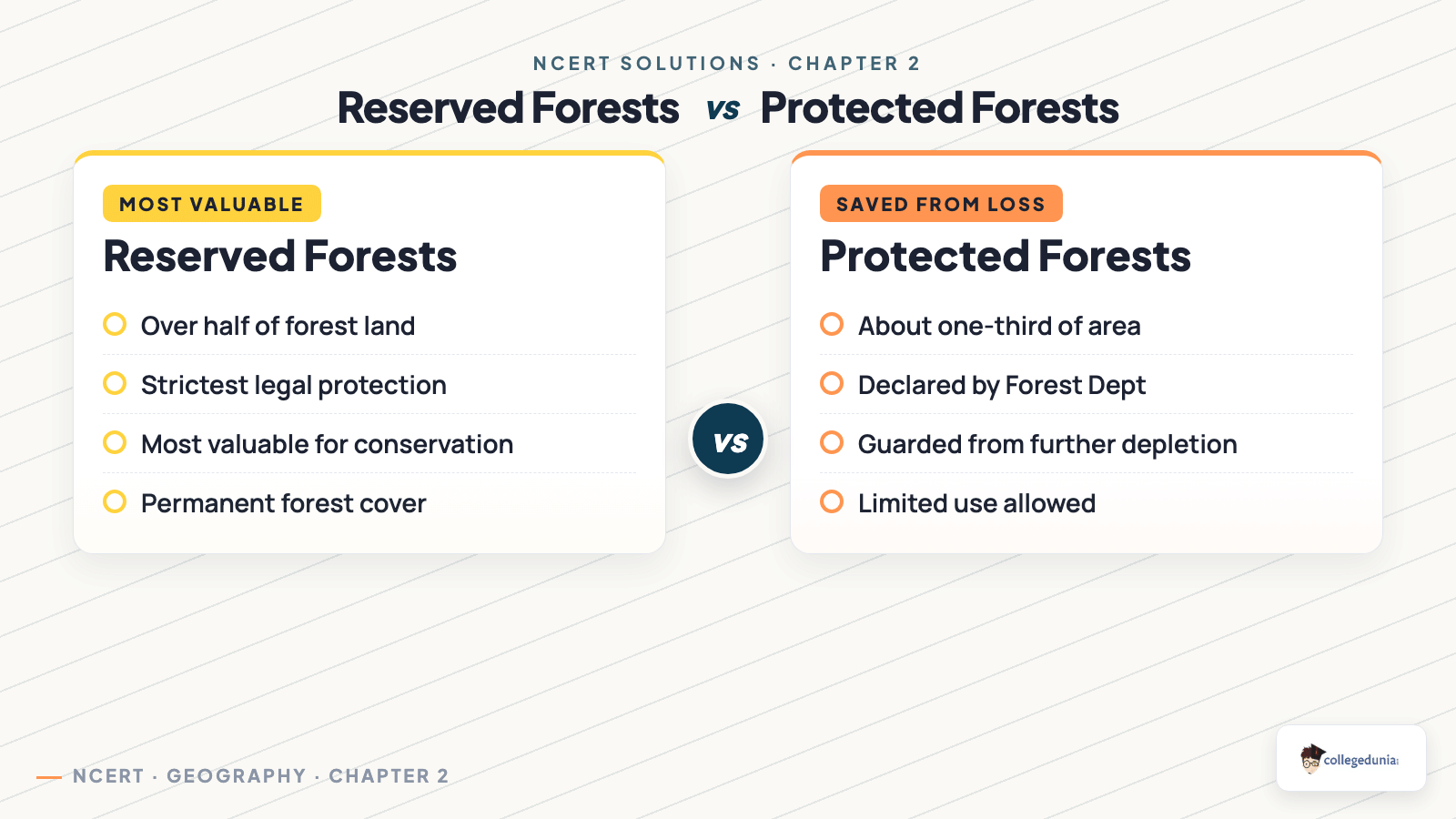
India manages its forest land in three classes by how strictly each is protected. Knowing the order makes the match question easy: "Reserved is strongest, Unclassed is loosest".
| Forest Class | What it means |
|---|---|
| Reserved forests | More than half of India's forest land; the most valuable and most strictly protected for conservation. |
| Protected forests | About one-third of forest area; declared by the Forest Department and guarded against any further depletion. |
| Unclassed forests | Other forests and wastelands belonging to the government, private people and communities. |
A sacred grove is a patch of virgin forest left untouched out of religious belief, and an endemic species is one found only in a particular area. Stating these clearly is worth a mark.
How Communities Have Conserved Forests and Wildlife in India
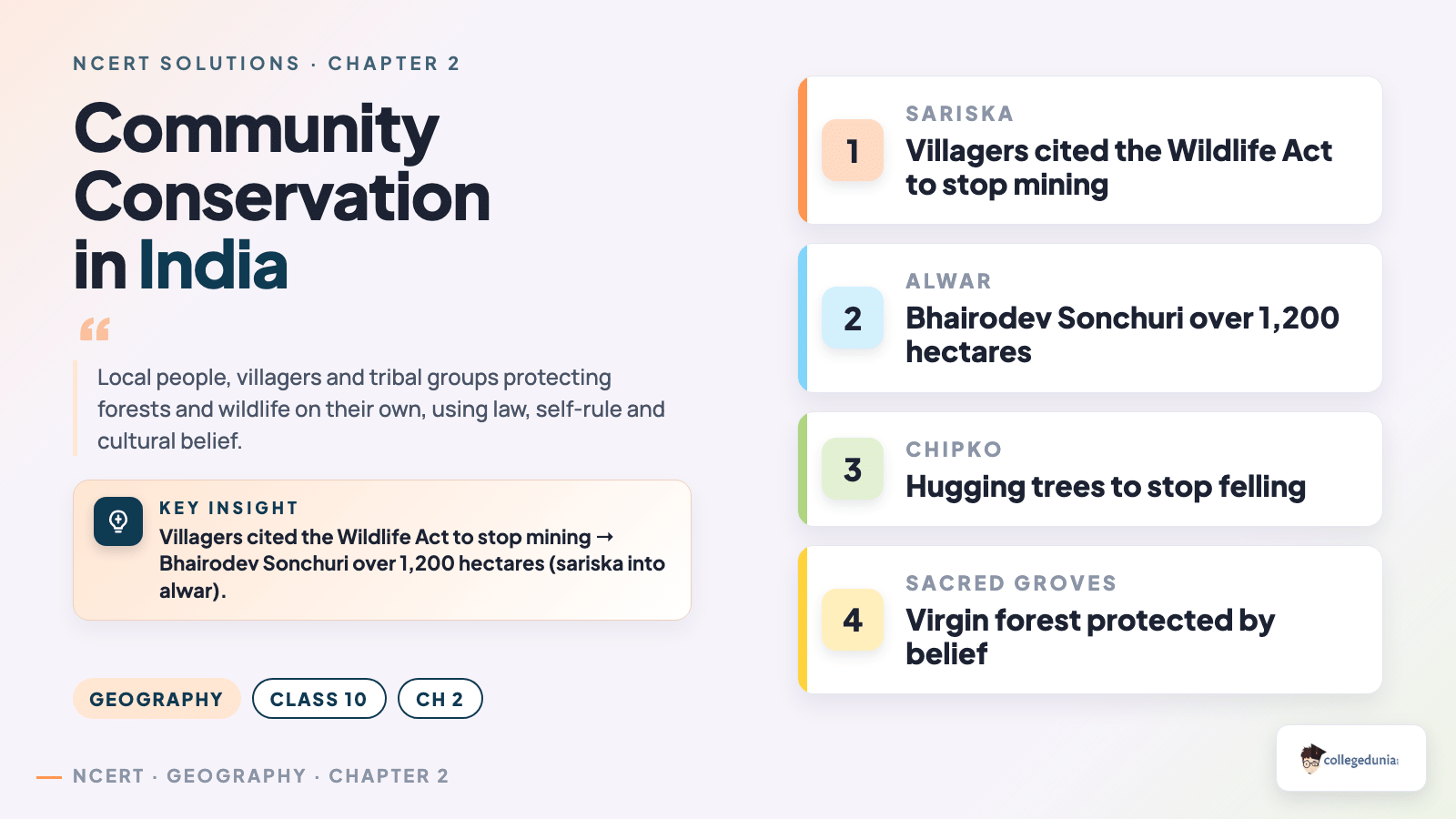
The 120-word community conservation question is a board favourite. This answer uses four named examples with place names, because the board rewards facts over general lines. Each shows local people protecting nature on their own.
| Example | What the community did |
|---|---|
| Sariska, Rajasthan | Villagers fought mining inside the Tiger Reserve by citing the Wildlife (Protection) Act. |
| Alwar, Rajasthan | Five villages declared 1,200 hectares as the Bhairodev Dakav Sonchuri with their own rules against hunting. |
| The Chipko Movement | Himalayan villagers hugged trees to stop felling and revived planting of local species. |
| Sacred groves | Tribal beliefs protect patches of virgin forest and treat many trees and animals as sacred. |
A boycott of mining and a self-declared sanctuary are both community actions. Naming the place with each example, like Sariska or Alwar, lifts a plain answer to full marks.
Common Mistakes Students Make in this Class 10 Geography Chapter
A few slips lose easy marks every year. Fix these before the exam.
- Swapping Reserved and Protected forests. Reserved is the strongest and most valuable; Protected is saved from further loss.
- Writing only "cutting trees" for habitat loss. The board answer must name mining, dams, grazing, shifting cultivation, hunting and pollution too.
- Giving the community conservation answer with no place names. Always name Sariska, Alwar, Chipko and sacred groves.
- Forgetting the years: Wildlife (Protection) Act 1972 and Project Tiger 1973.
How to Use the NCERT Solutions Class 10 Geography Chapter 2 Page
Use this page in three short blocks so revision stays focused. Read the chapter, attempt the questions yourself, then compare with the solutions and fix the gaps.
- Read and list: read the chapter and note every law, place and movement.
- Attempt first: answer all 6 questions before opening the solutions.
- Compare and flag: match your answer with the solution and mark the missing fact-lines.
For long-answer practice, write the community conservation and good-practices answers in full at least once. The ncert solutions class 10 geography chapter 2 forest and wildlife resources set mirrors the board's 5-mark pattern, so each answer doubles as a model for revision.
Practice All NCERT Solutions for this Class 10 Geography Chapter with Step-by-Step Solutions
Open the question bank below to attempt all 6 solved questions with collapsible Solution and Expert Solution tabs. Every answer is mapped to the NCERT text, so it reads the way a board examiner expects.
All Solved Questions for this Class 10 Geography Chapter
Practise every MCQ, match and descriptive question with step-by-step solutions and an expert version for board marks.
Student Feedback on this Class 10 Geography Chapter
What 12,840 students told us about studying this chapter before the 2026 boards.
- 64% of students rated the 120-word community conservation question as the one they most often answered without enough place names.
- 57% of students said they mixed up Reserved and Protected forests in the match question.
- Most-skipped topic in revision: the IUCN species categories, left for last by about 33% of students.
Source: 2026-27 Class 10 Geography student poll. Sample of 12,840 students from CBSE schools across 14 states.
Class 10 Geography Other Resources for this Chapter
Pair these solutions with the other Class 10 Geography resources for the same chapter, all linked below.
| Resource | Best used for |
|---|---|
| Forest and Wildlife Resources Class 10 Notes | Quick concept recap before the exam |
| Forest and Wildlife Resources Class 10 Handwritten Notes | Last-minute scanned revision |
| Forest and Wildlife Resources Class 10 NCERT Book PDF | Reading the original chapter text |
All Chapters NCERT Solutions for Class 10 Geography (Contemporary India II)
Browse the full set of ncert solutions for class 10 geography chapter by chapter. Each link opens that chapter's solved questions.
| Chapter | NCERT Solutions |
|---|---|
| Chapter 1 | Resources and Development Class 10 NCERT Solutions |
| Chapter 2 | Forest and Wildlife Resources Class 10 NCERT Solutions |
| Chapter 3 | Water Resources Class 10 NCERT Solutions |
| Chapter 4 | Agriculture Class 10 NCERT Solutions |
| Chapter 5 | Minerals and Energy Resources Class 10 NCERT Solutions |
| Chapter 6 | Manufacturing Industries Class 10 NCERT Solutions |
| Chapter 7 | Lifelines of National Economy Class 10 NCERT Solutions |
Ques. Where can I download the NCERT Solutions Class 10 Geography Chapter 2 Forest and Wildlife Resources PDF?
Ans. You can download the forest and wildlife resources class 10 solution PDF directly from this page. Both the Normal and HD versions are free, and a Hindi-medium read is available too.
Ques. How many questions are solved in forest and wildlife resources class 10 question answer?
Ans. All 6 NCERT questions are solved: one MCQ, one match, two 30-word answers and two 120-word answers, each with a step-by-step solution and an expert version for the long-answer marks.
Ques. Is this NCERT Solutions page aligned with the 2026-27 syllabus?
Ans. Yes. This page reflects the current 2026-27 syllabus for Class 10 Geography, and every answer is checked against the latest NCERT edition of Contemporary India II.
Ques. What is biodiversity in Class 10 Geography?
Ans. Biodiversity is the variety of all plants, animals and micro-organisms and the ecosystems they form. It is important because it sustains the air, water, soil, food and medicines that human life depends on.
Ques. What are the three types of forests in India?
Ans. India's forests are managed in three classes: Reserved forests (the most valuable and strictly protected), Protected forests (saved from further depletion), and Unclassed forests (other forests and wastelands of government and communities).
Ques. How have human activities depleted flora and fauna?
Ans. Human activities like deforestation for farming, mining, dams, over-grazing, shifting cultivation, hunting and pollution have destroyed and degraded habitats. This has rapidly reduced the number and variety of India's plants and animals.
Ques. How did communities conserve forests in the forest and wildlife resources class 10 solution?
Ans. Communities conserved nature through legal action at Sariska, the self-declared Bhairodev Sonchuri at Alwar, the Chipko Movement in the Himalayas, and by protecting sacred groves and revering trees and animals.



Comments