



Class 12 Maths Handwritten Notes PDF for Chapter 9 Differential Equations is available here. The Class 12 Maths Handwritten Notes PDF is very useful as a revision resource alongwith the Revision Notes of the same topic as each formula, order-and-degree rule, and integrating-factor step are available here with solved questions.
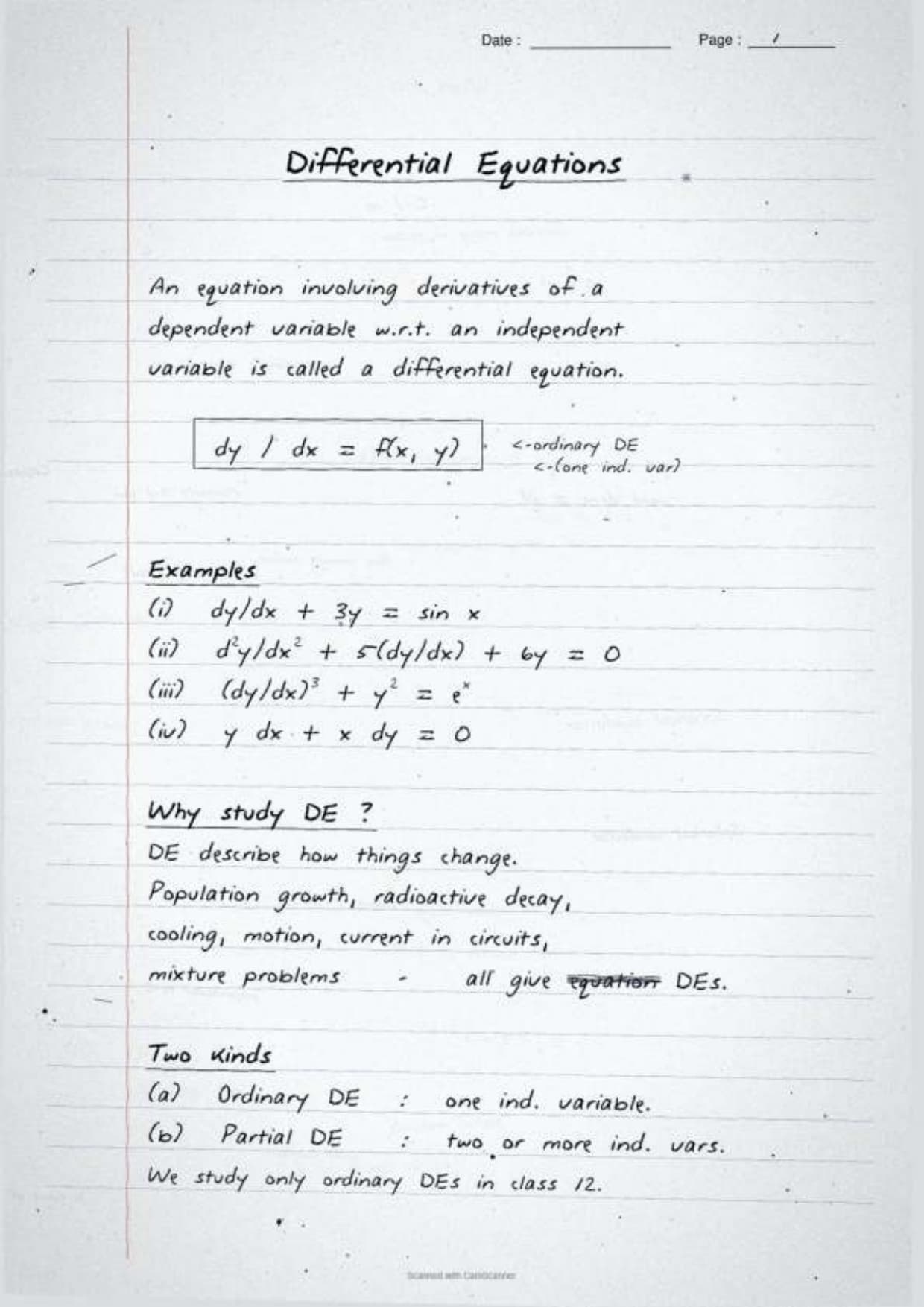
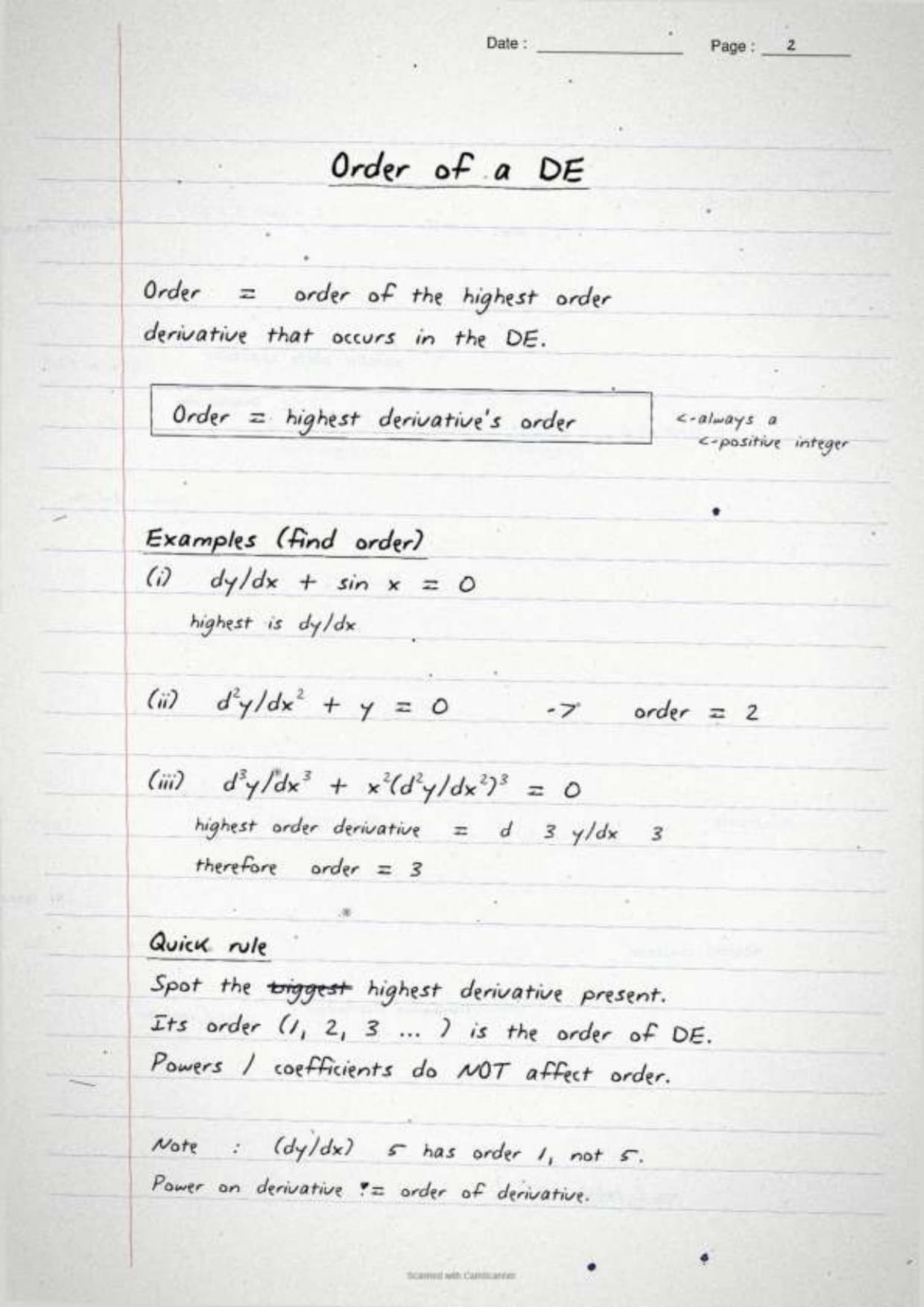
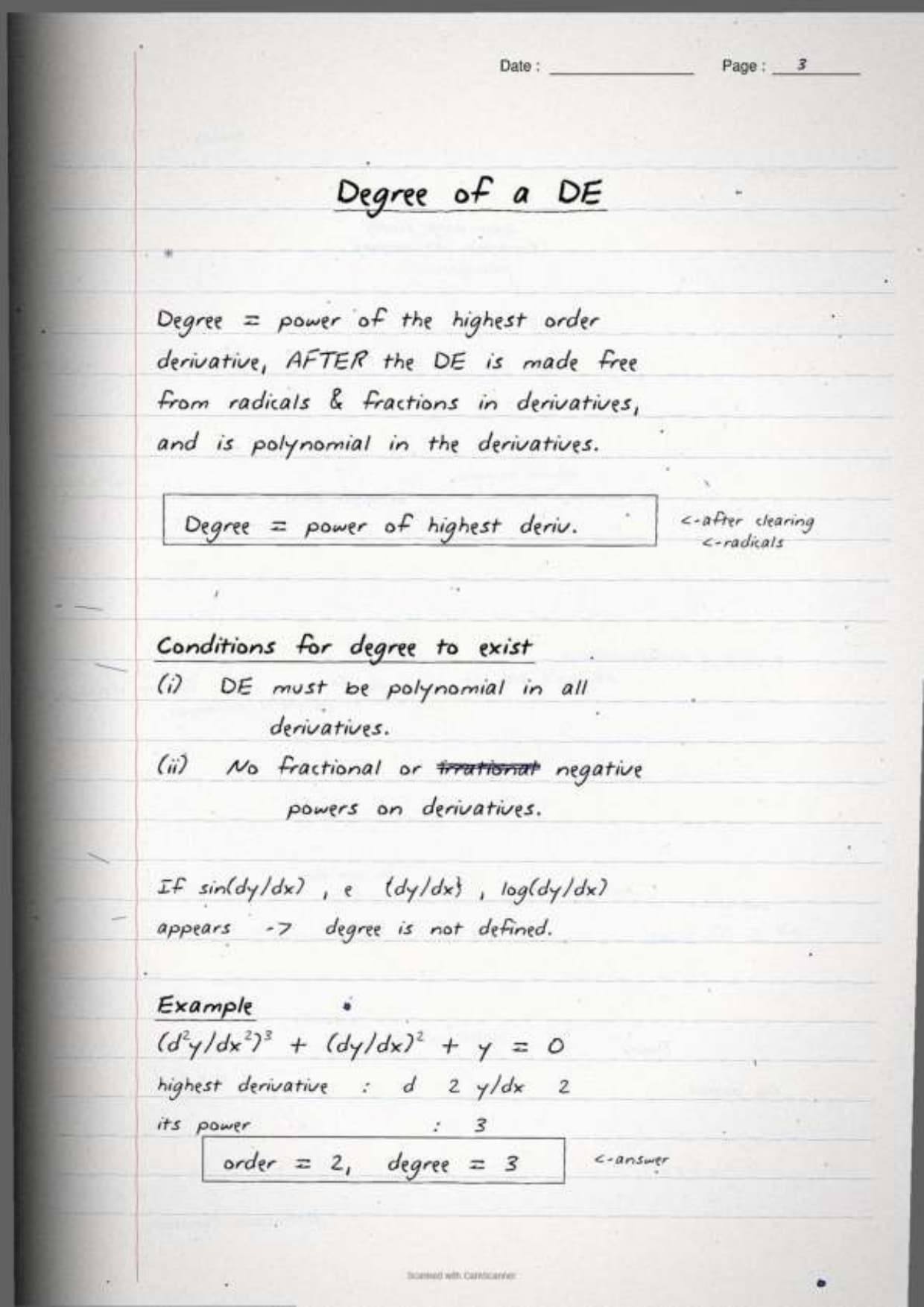
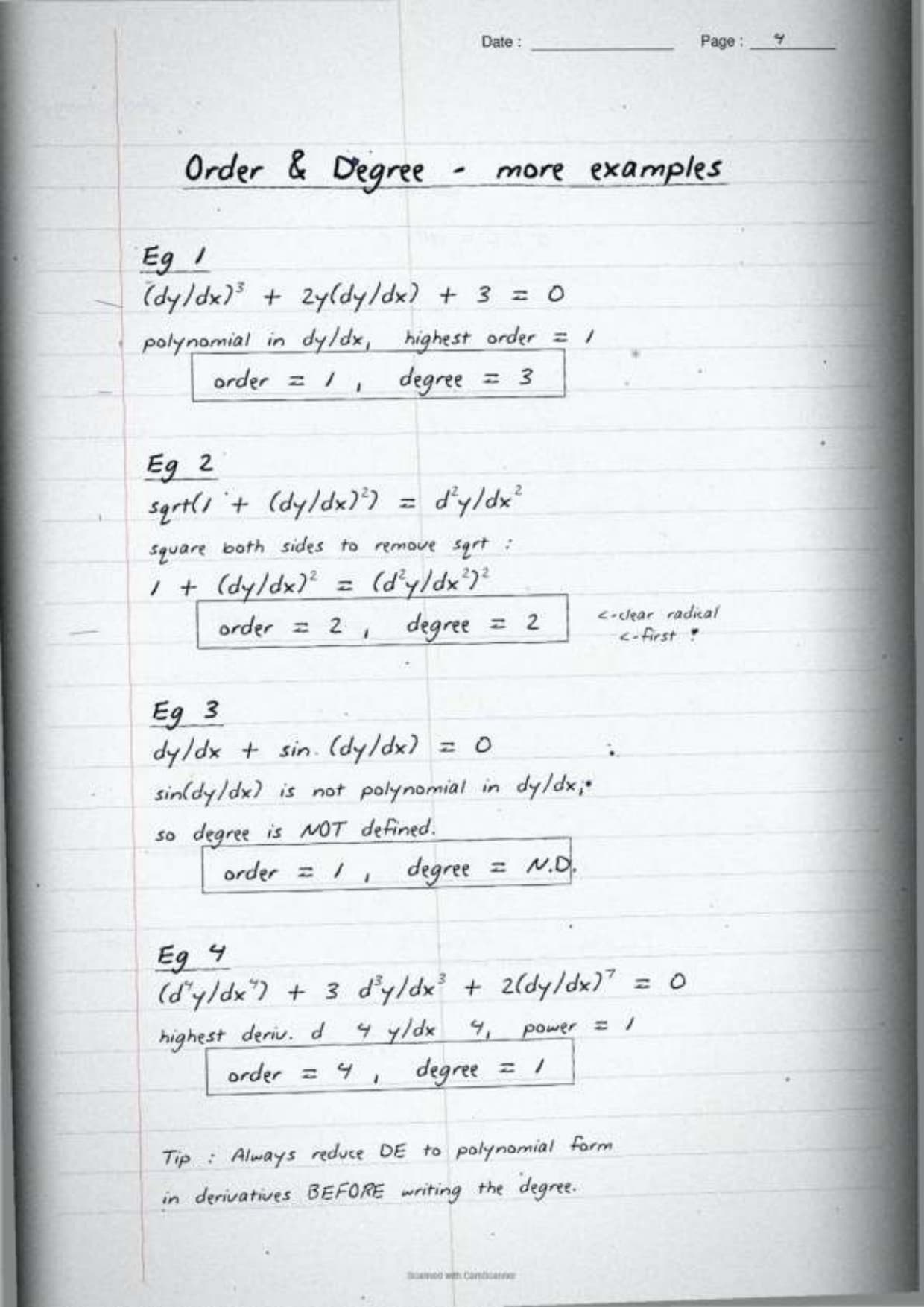
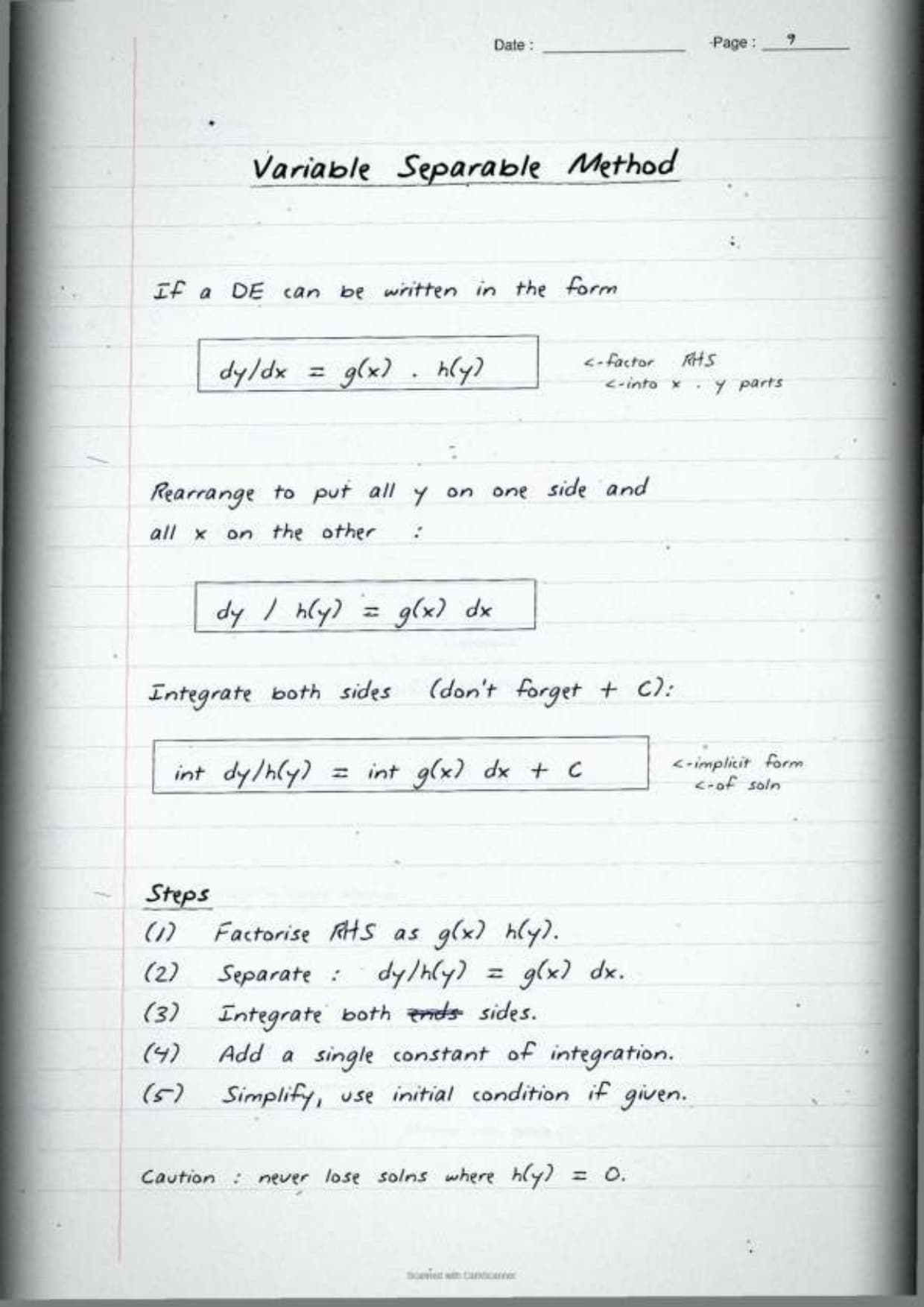
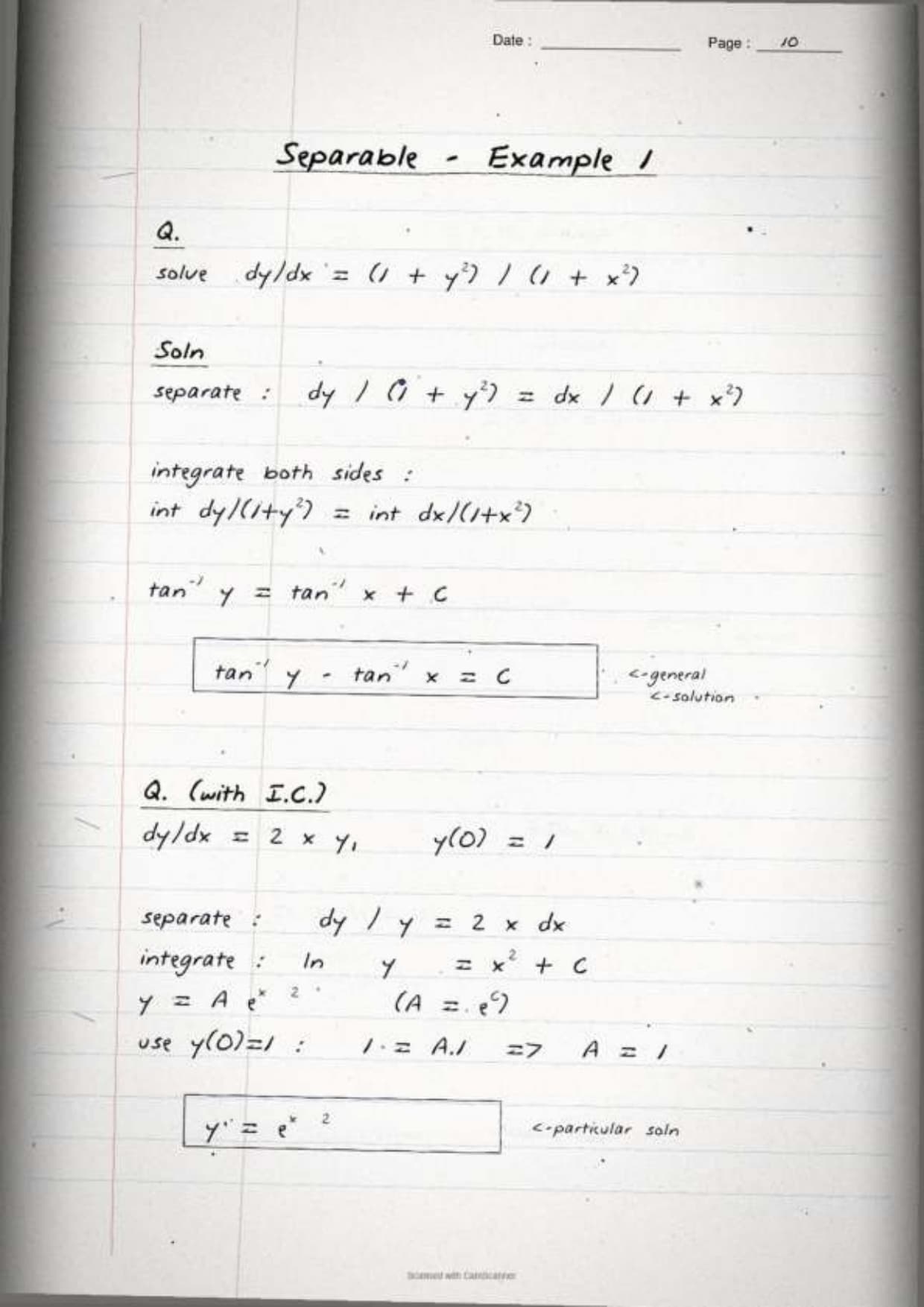
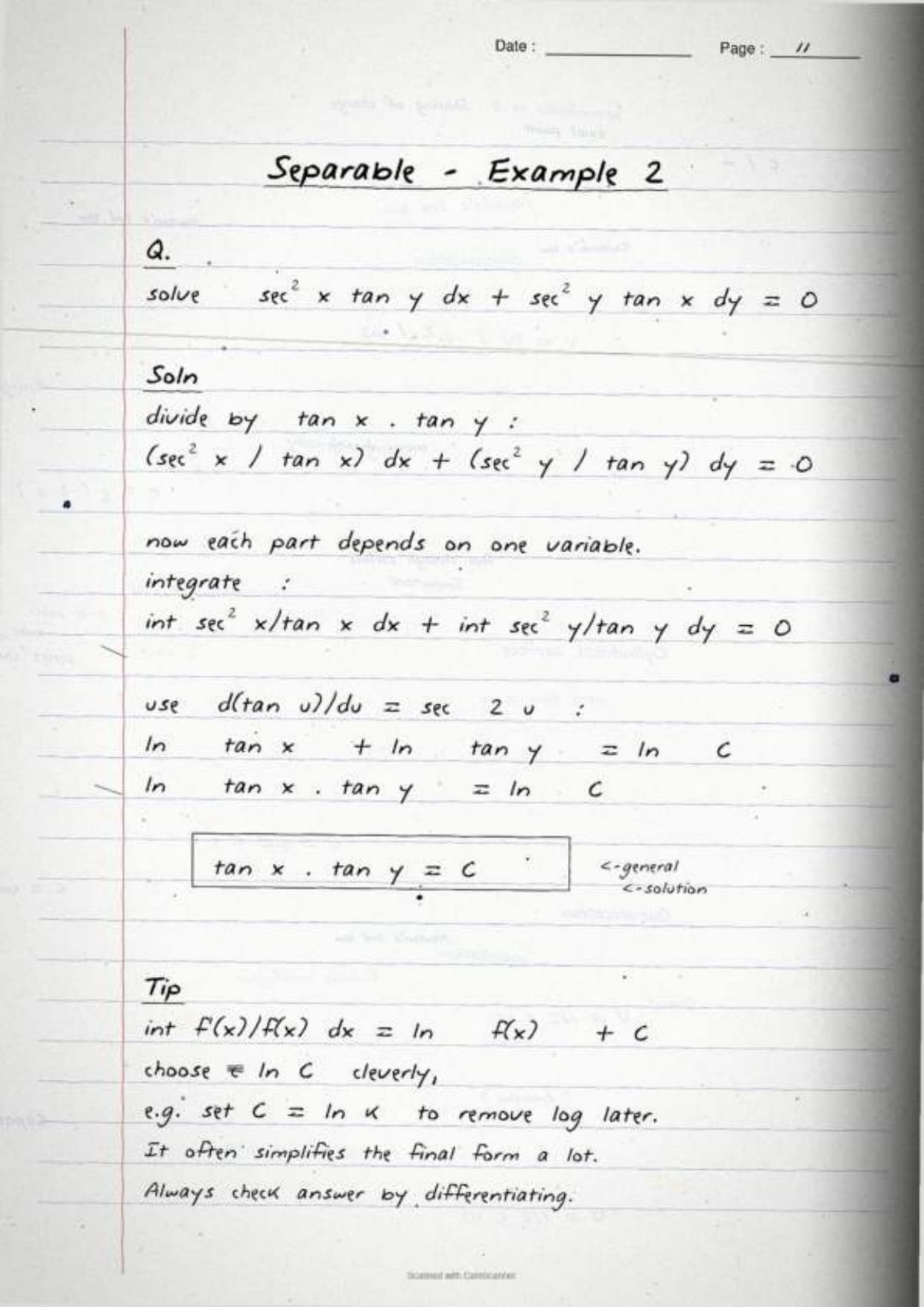
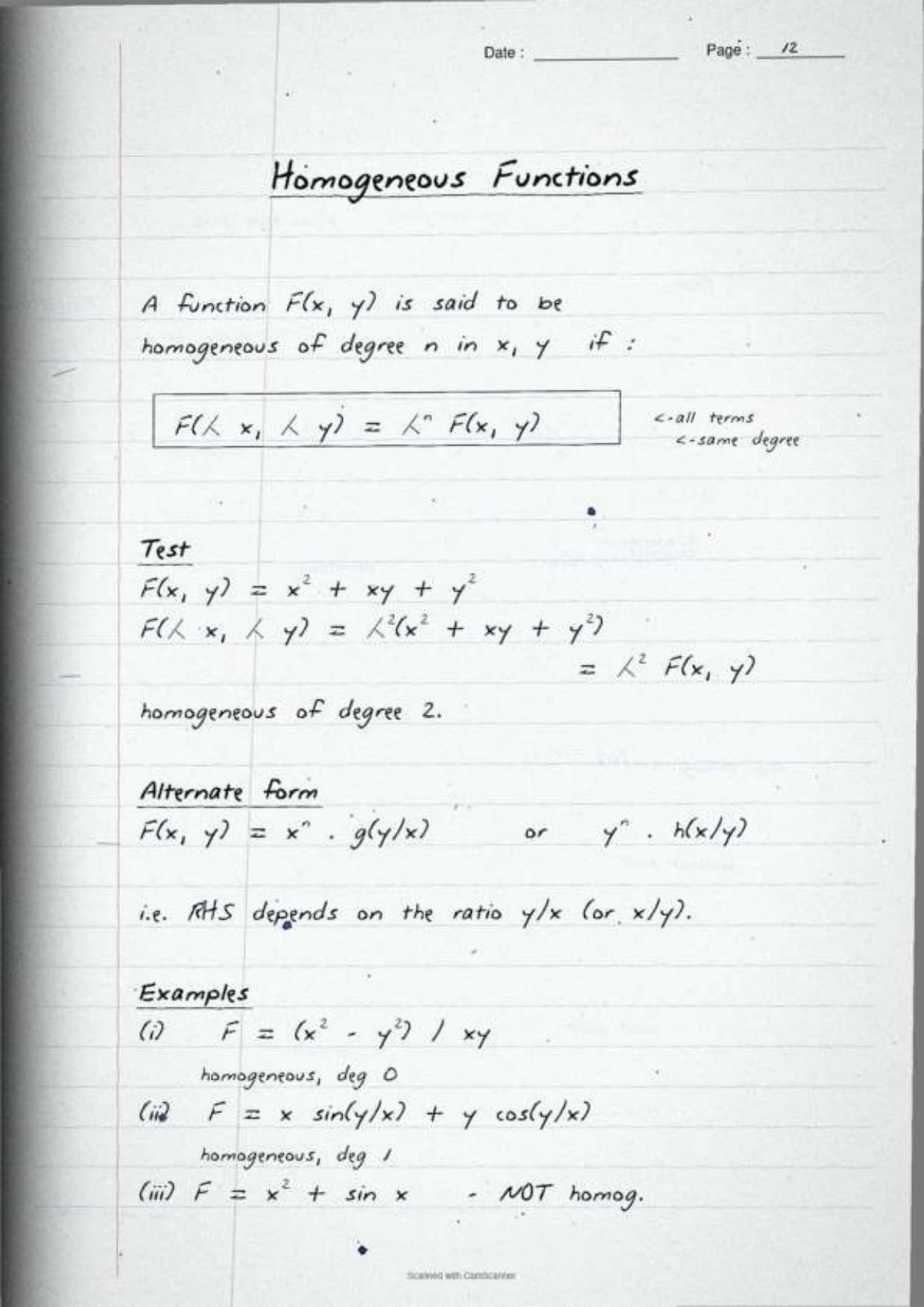
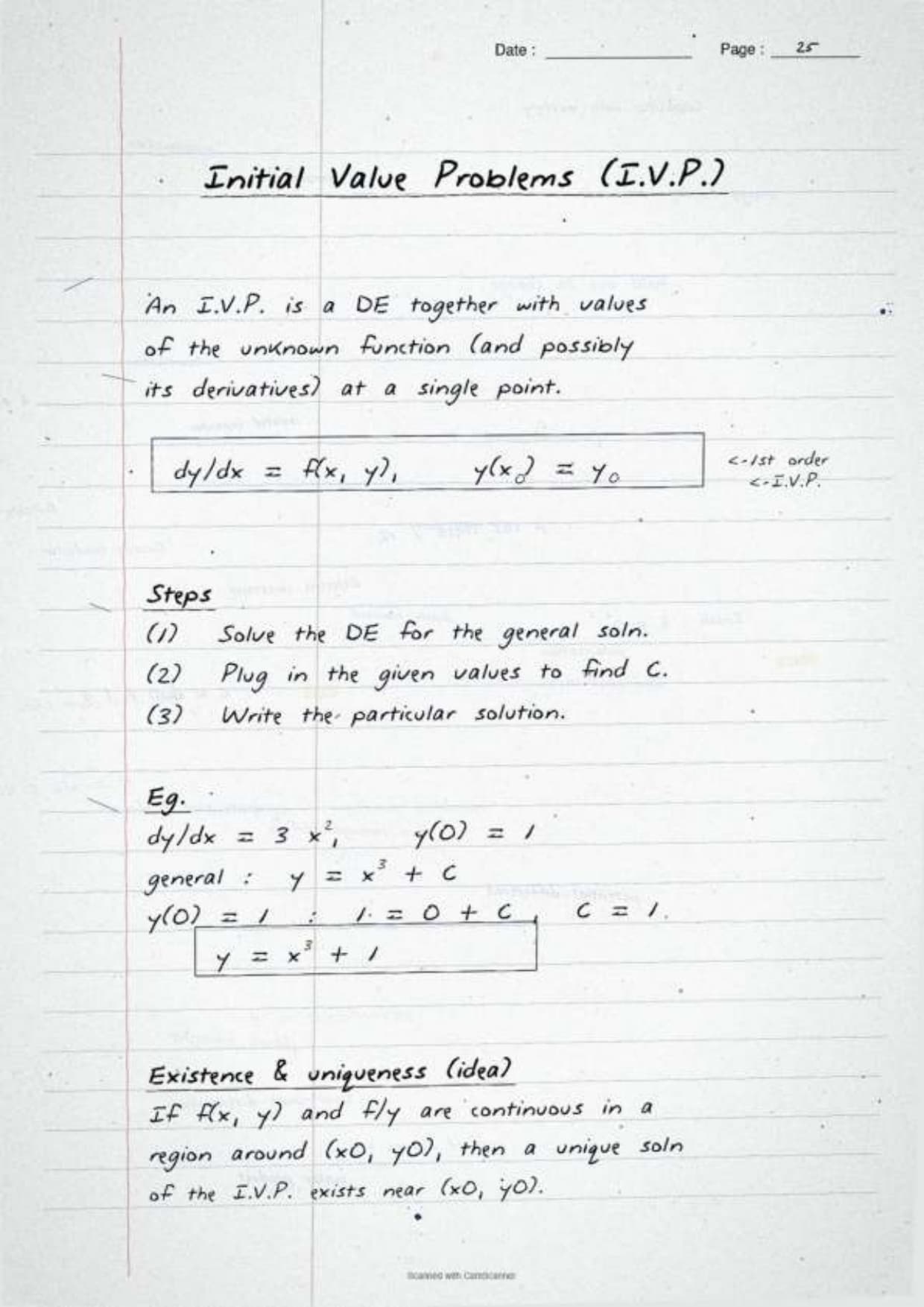
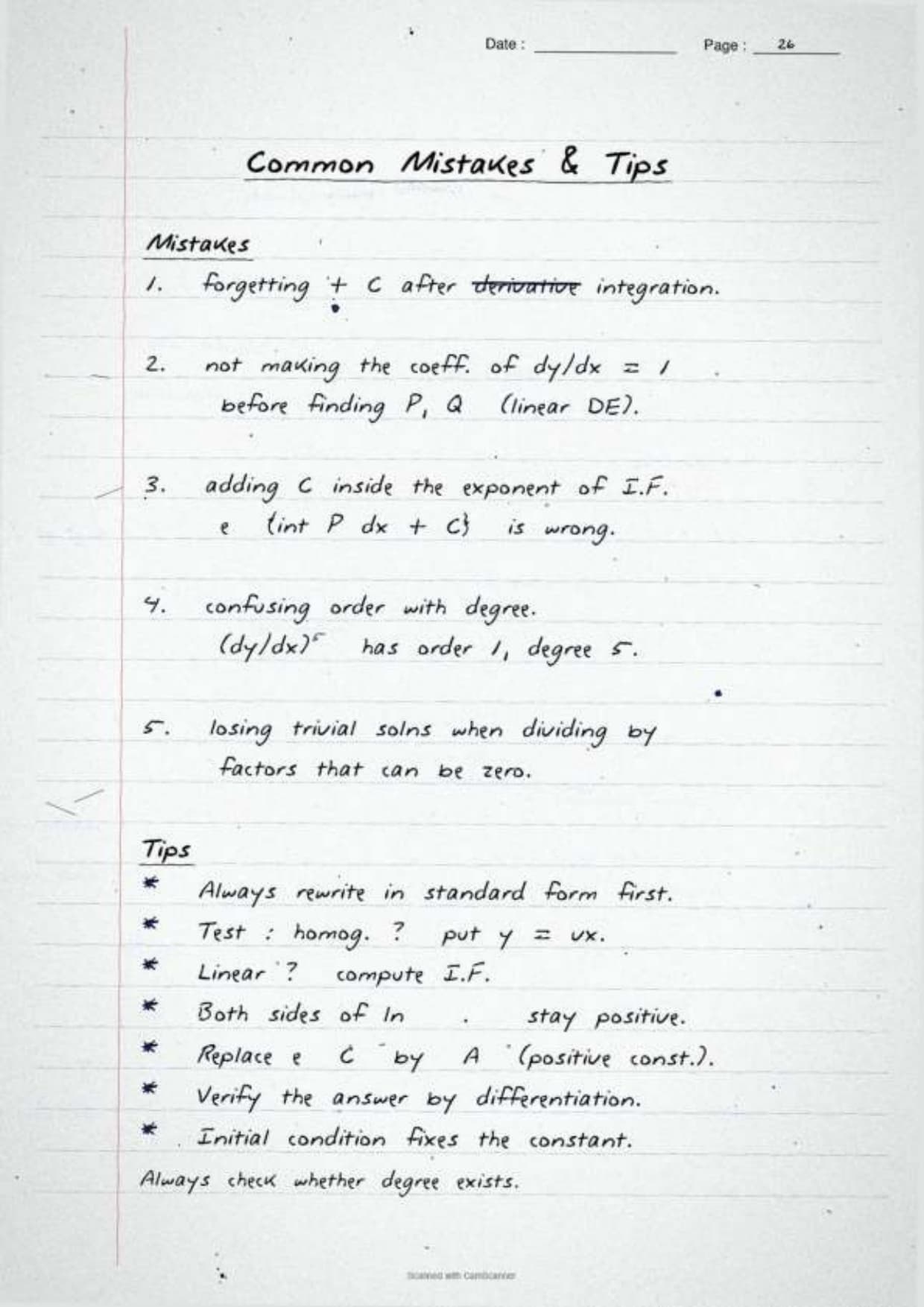
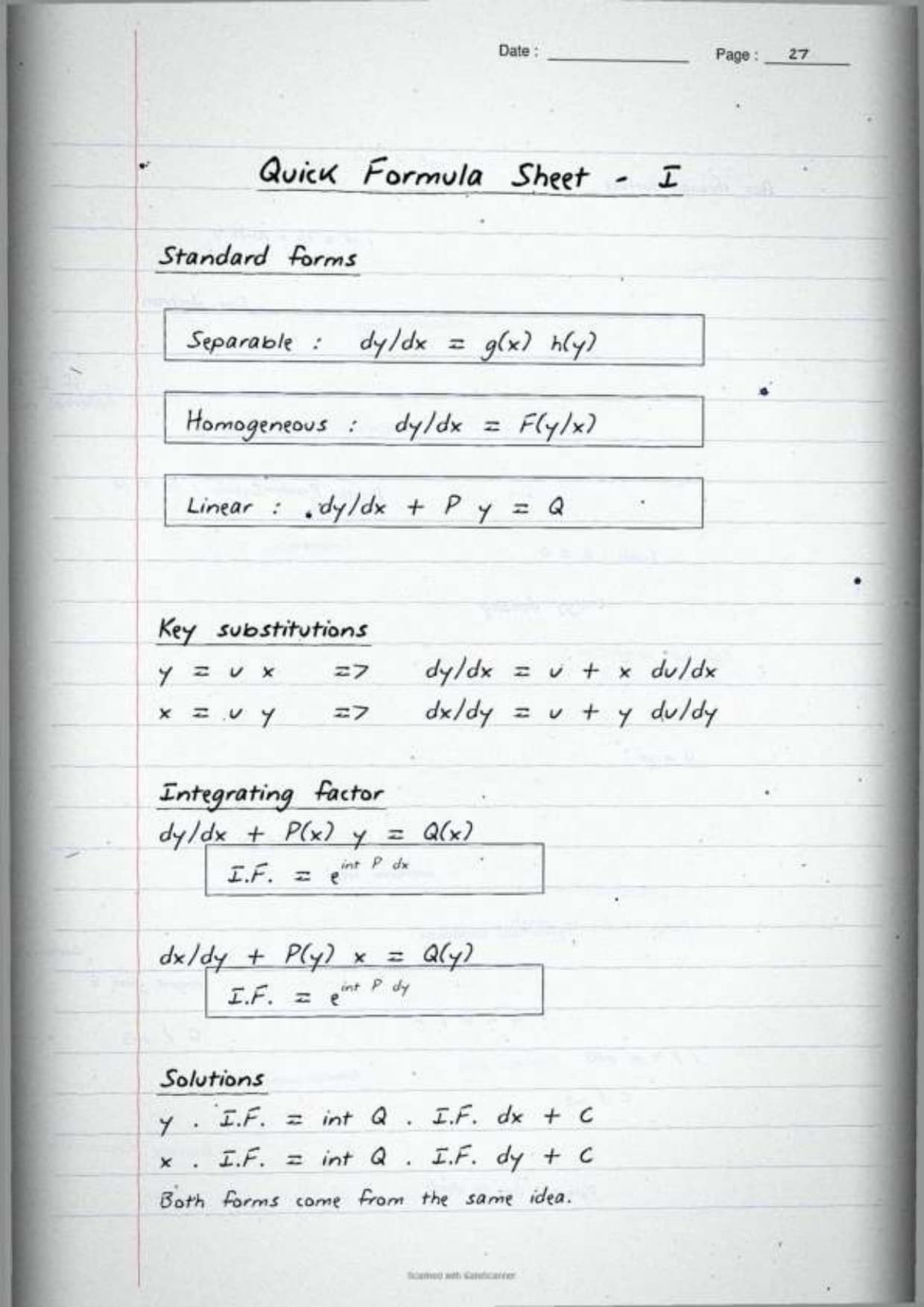
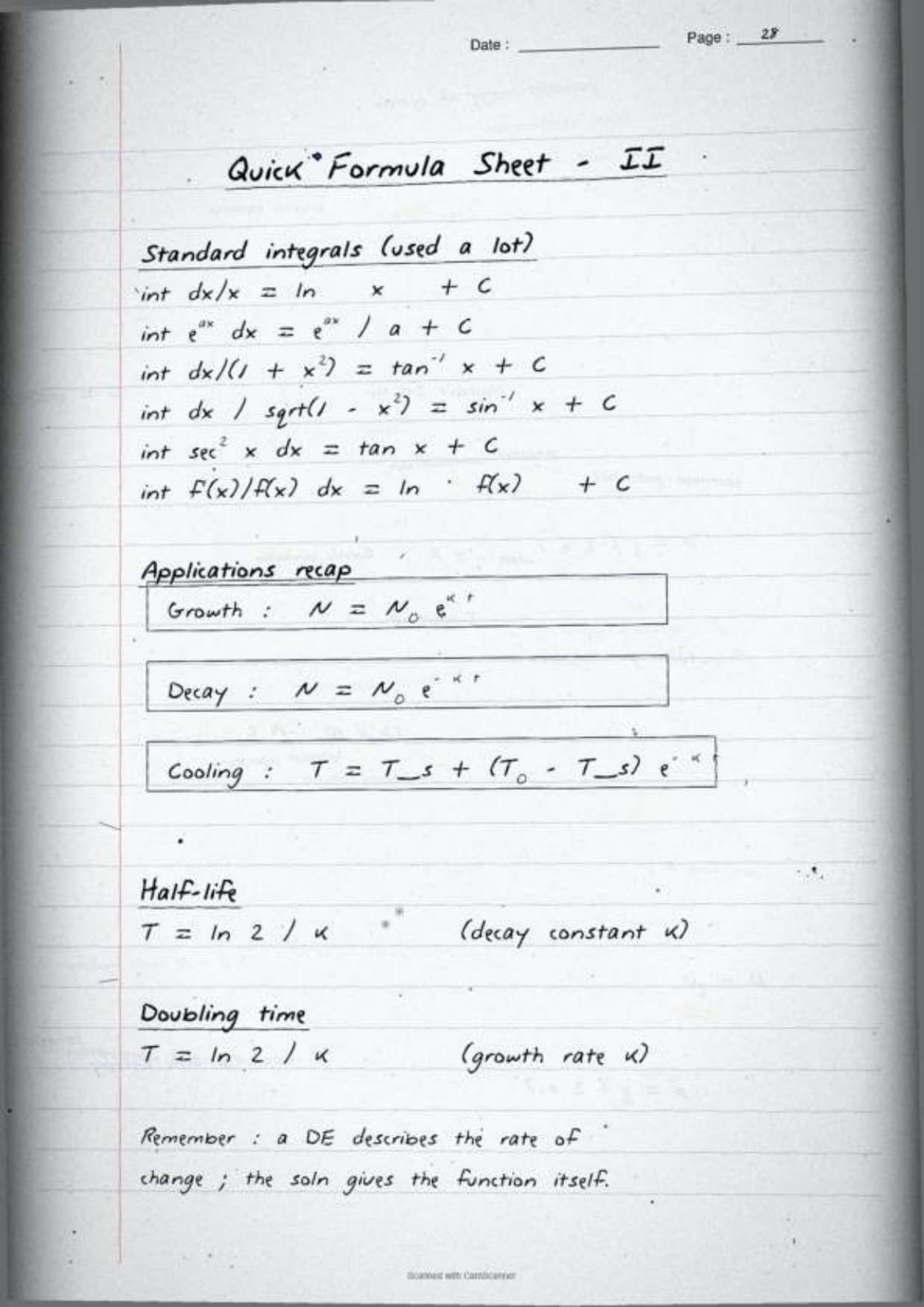
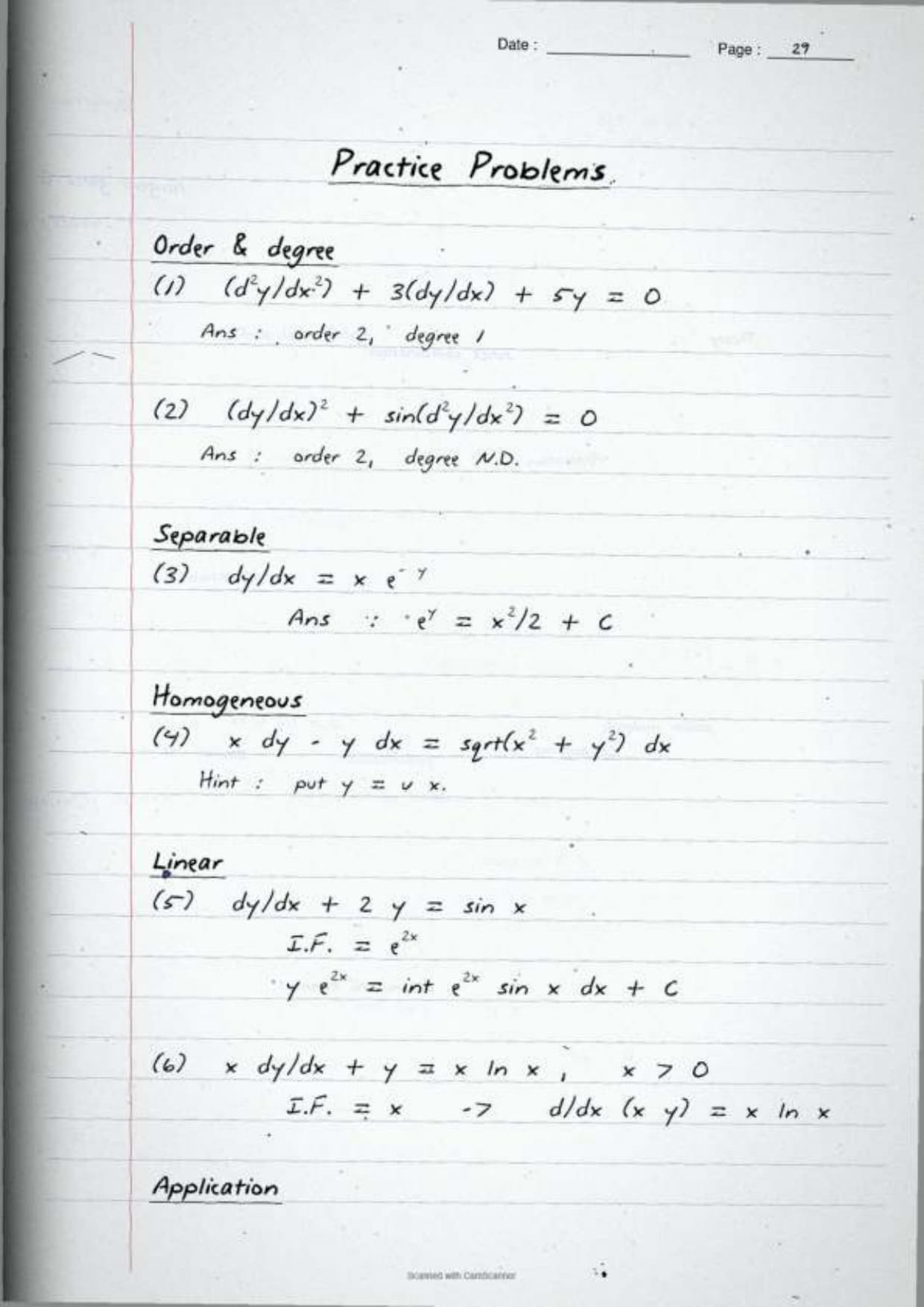
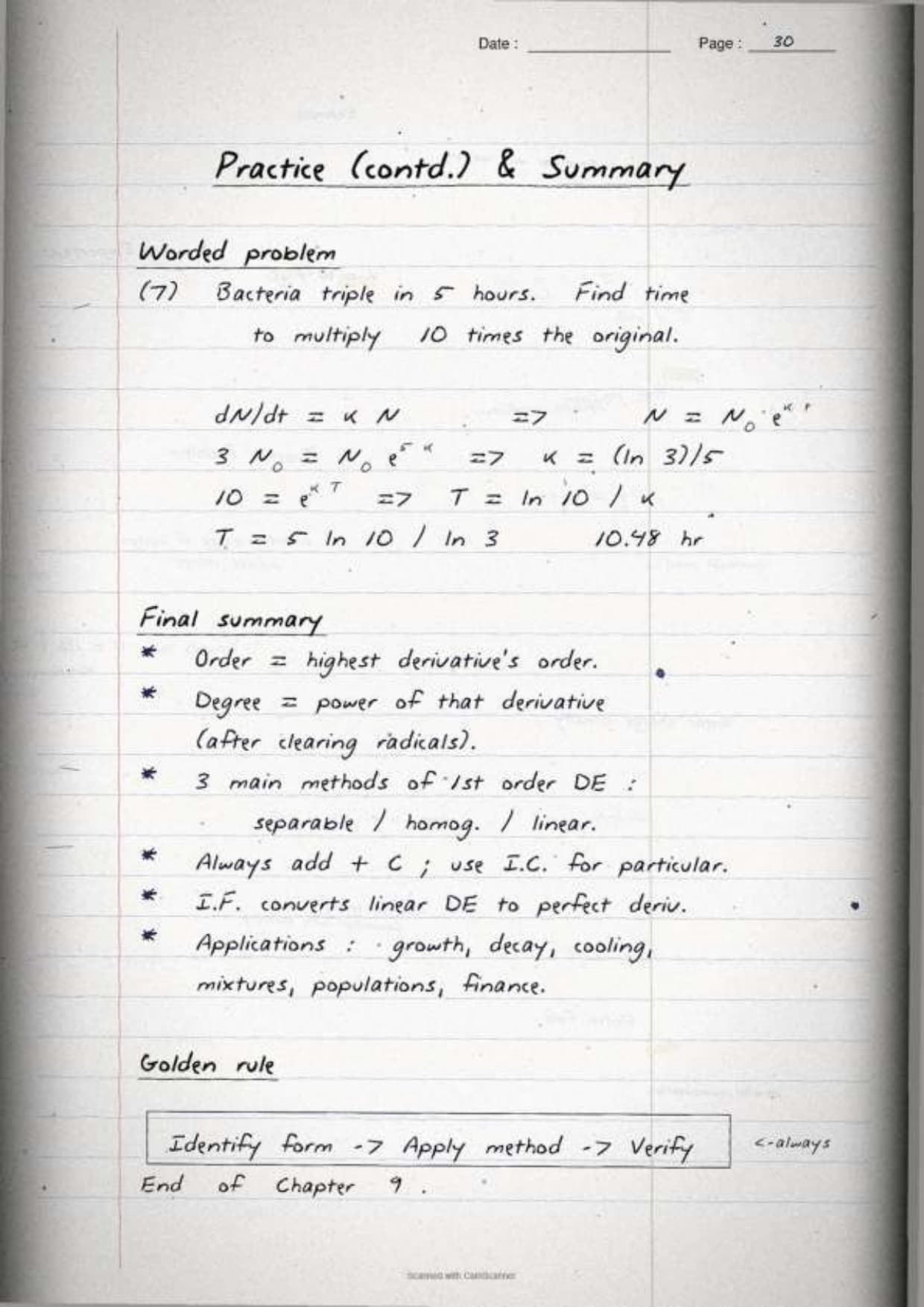
- CBSE Weightage: 5 to 7 marks (expect one 3-marker on order and degree or variable-separable, and one 5-marker on linear DE with integrating factor or homogeneous substitution)
- JEE Main Weightage: 6 to 8% (2 to 3 questions per shift on linear DE, homogeneous substitution, and family-of-curves general solutions)
- JEE Main Weightage: Not in JEE Main syllabus (Maths-only chapter; high weight for JEE Main, JEE Advanced, CUET Mathematics, and ISI / CMI entrance papers)
30 ruled-paper pages · hand-drawn solution-curve families · slope field · cooling-curve sketch · dashed IF and homogeneous-substitution boxes · 2026-27 NCERT
- Differential Equations Class 12 Maths Notes
- Differential Equations Class 12 Maths NCERT Solutions
- Differential Equations Class 12 Maths Formula Sheet
Why Differential Equations Rewards a Visual Notebook over Typed Notes
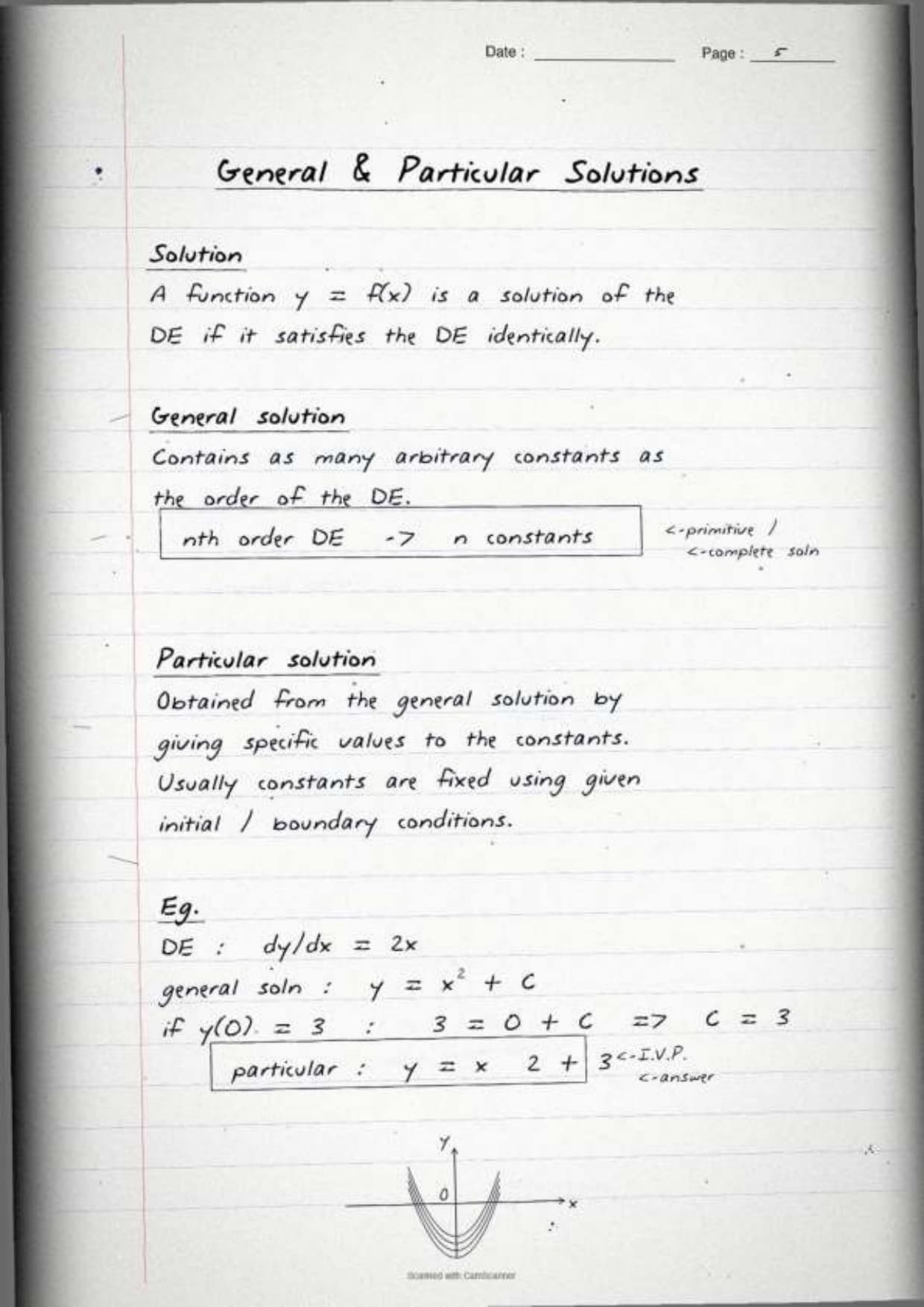
- Hand-drawn solution-curve families: Each archetype family (parabola y2 = 4ax , circle x2 + y2 = c2 , exponential y = cekx ) is sketched as five overlapping curves for five values of the arbitrary constant, so you see what "general solution = a one-parameter family" actually means.
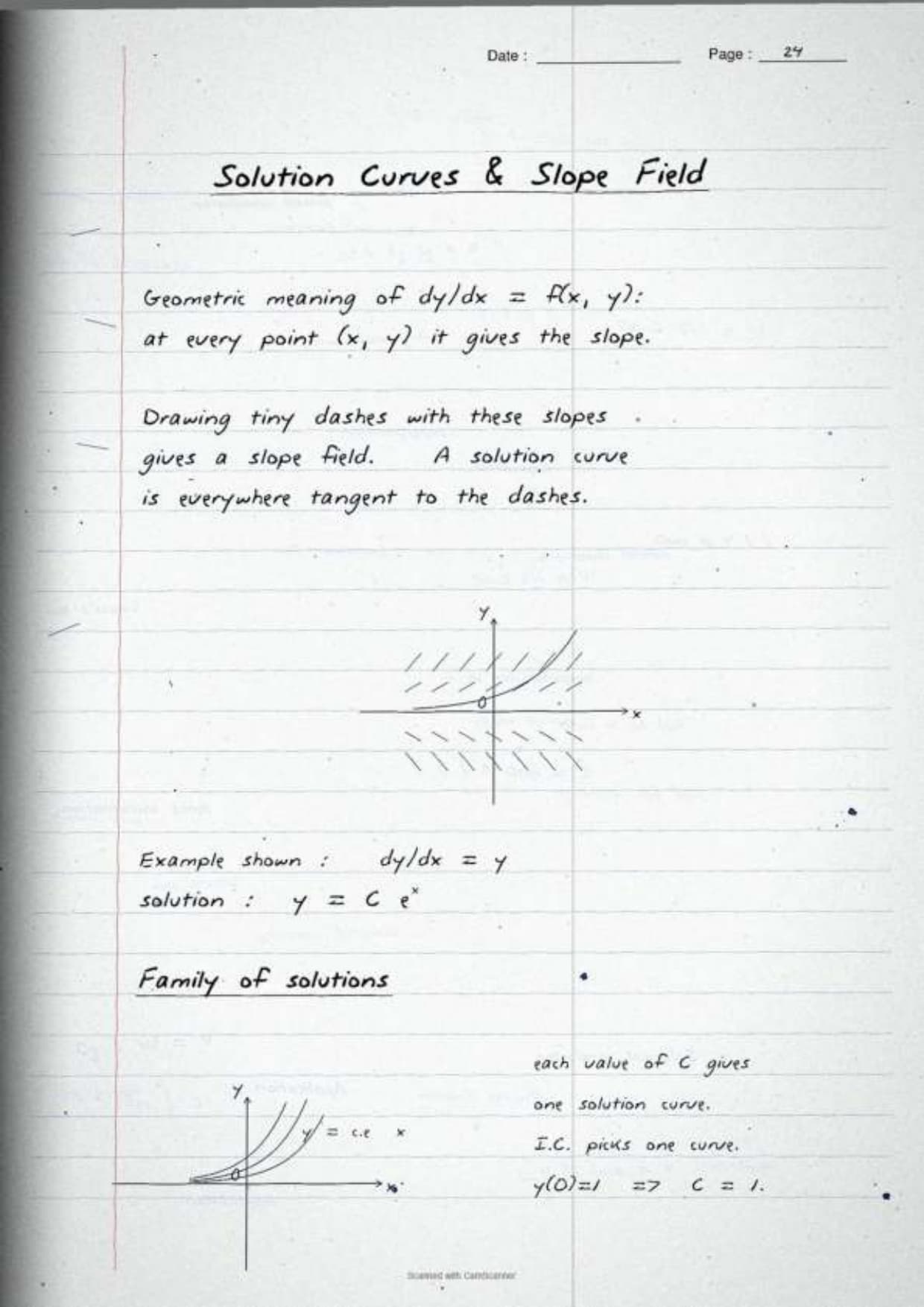
- Slope-field grid: A 6 × 6 grid of short slope-arrows is drawn for dy/dx = y/x , with two integral curves traced through it. The grid makes the geometric interpretation of a first-order DE physically obvious.
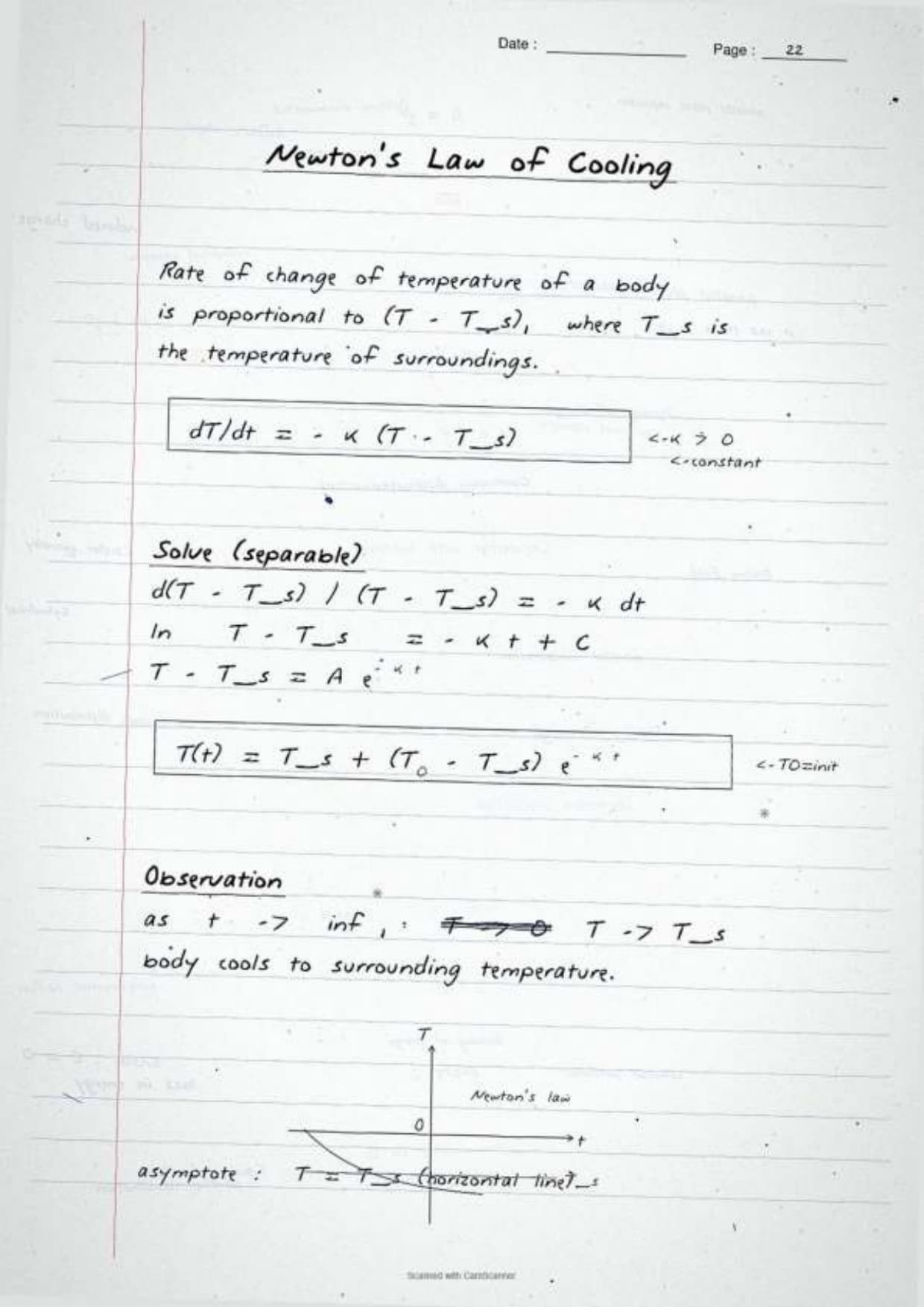
- Newton-cooling asymptote sketch: The exponential decay T(t) = Ts + (T0 - Ts)e-kt is drawn with a dashed asymptote at y = Ts , the practical anchor JEE re-uses every year as a modelling question.
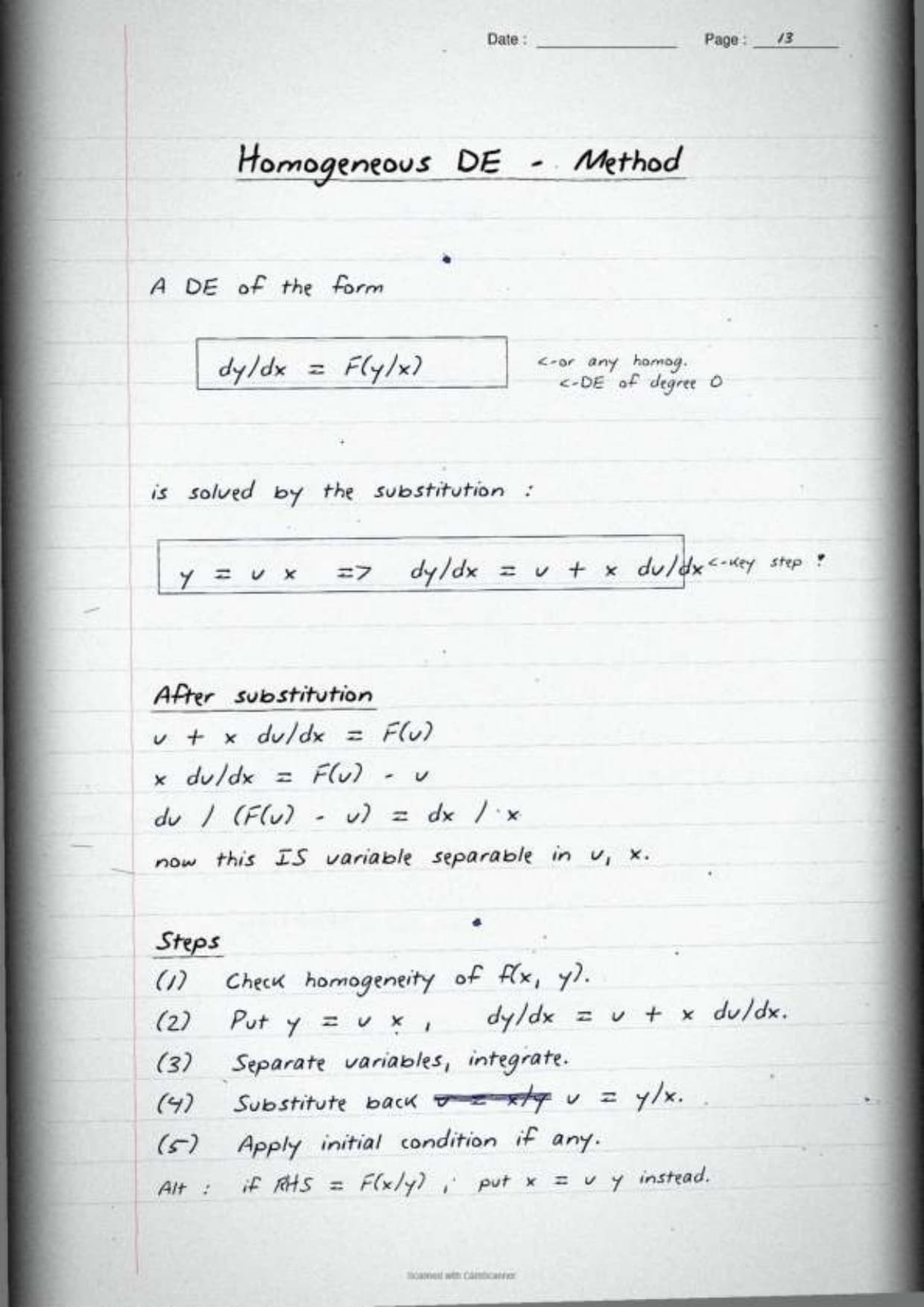
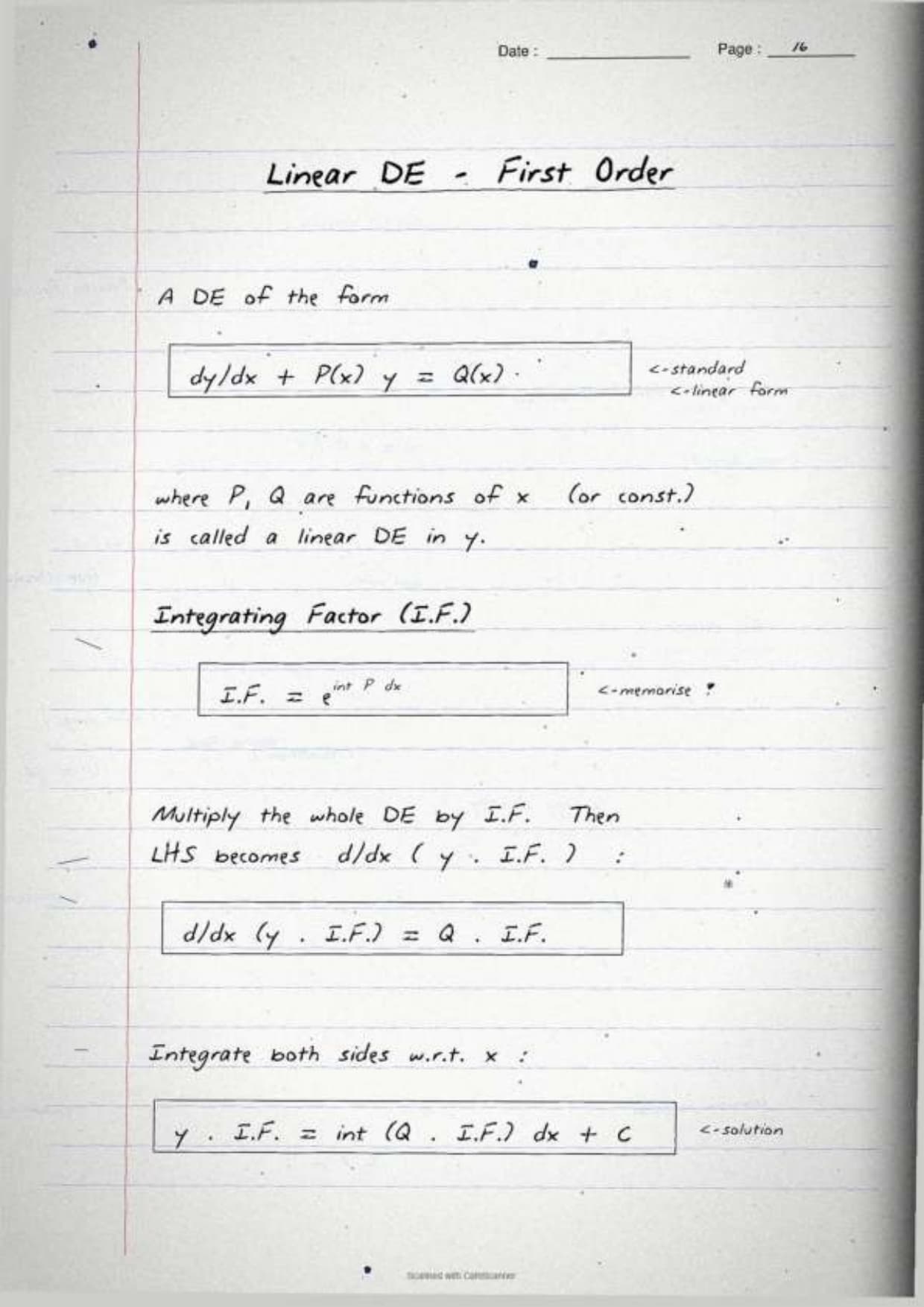
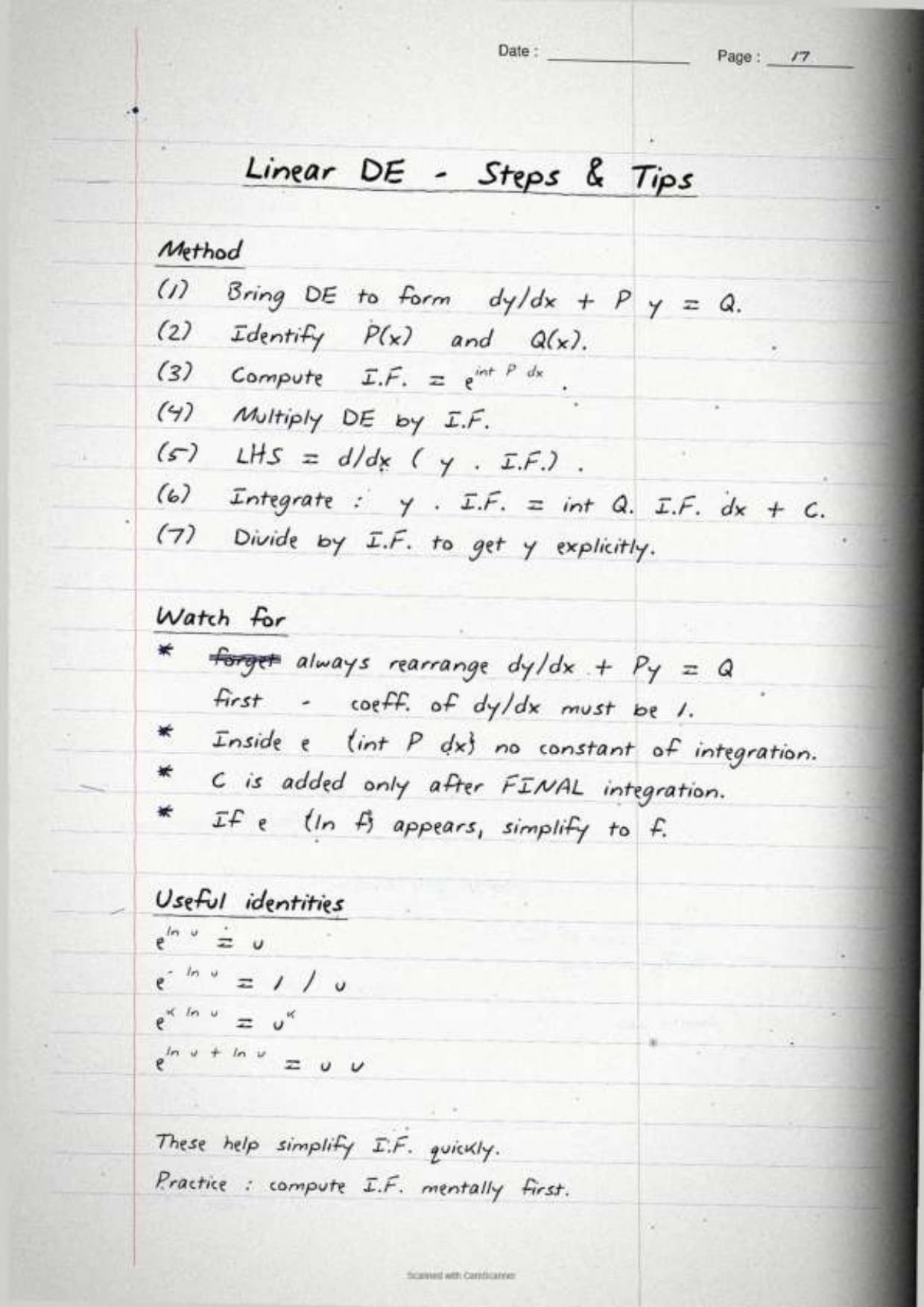
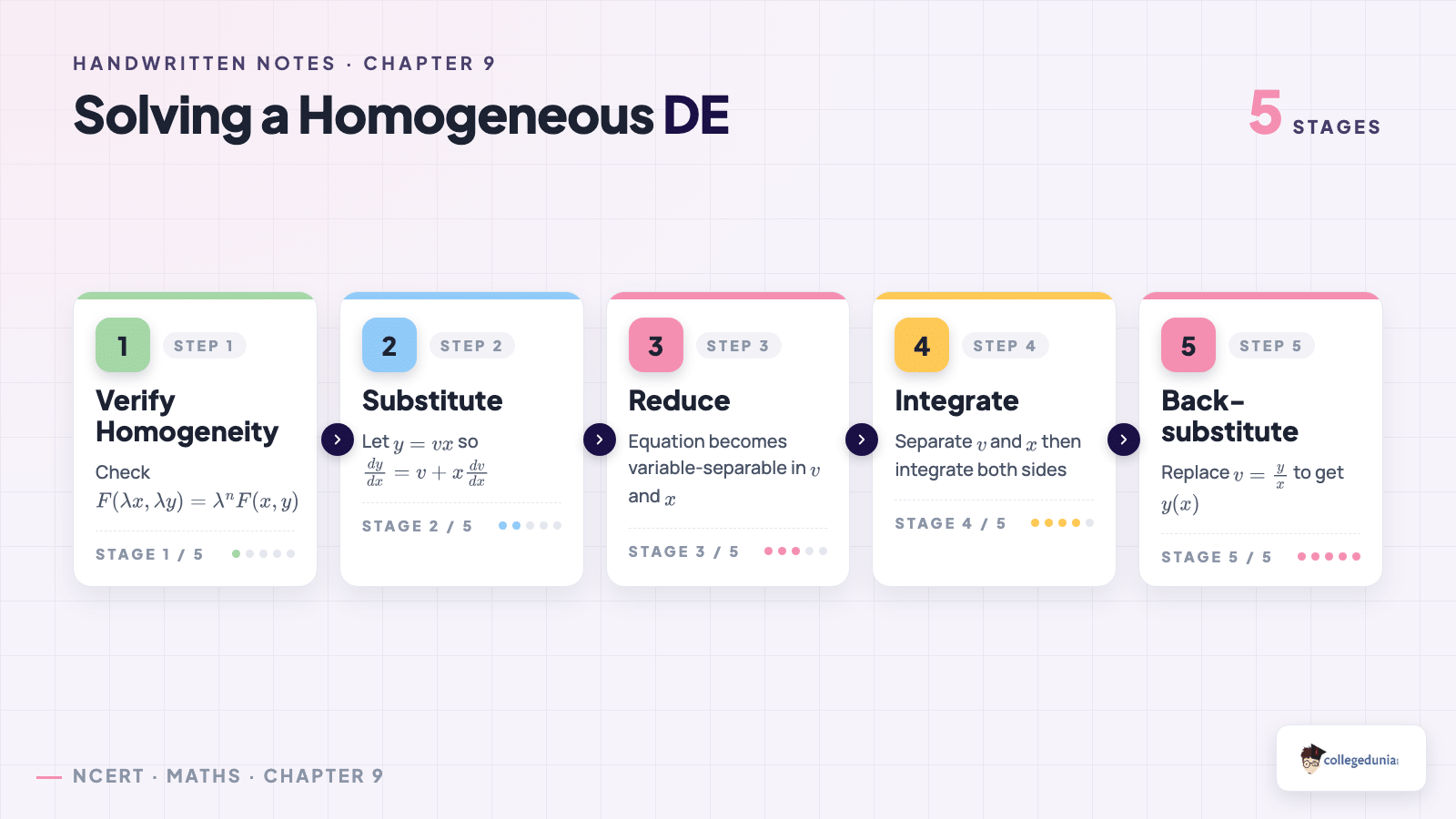
- Dashed IF and substitution boxes: The integrating-factor formula μ = e∫ P dx and the homogeneous substitution y = vx, dy/dx = v + x dv/dx each sit inside their own hand-drawn dashed rectangle so the eye locates them in under a second.
Differential Equations Video Walkthrough
Source: Magnet Brains on YouTube
How the Handwritten Notes on Ordinary Differential Equations on the Handwritten Notes on Ordinary Differential Equations Help You
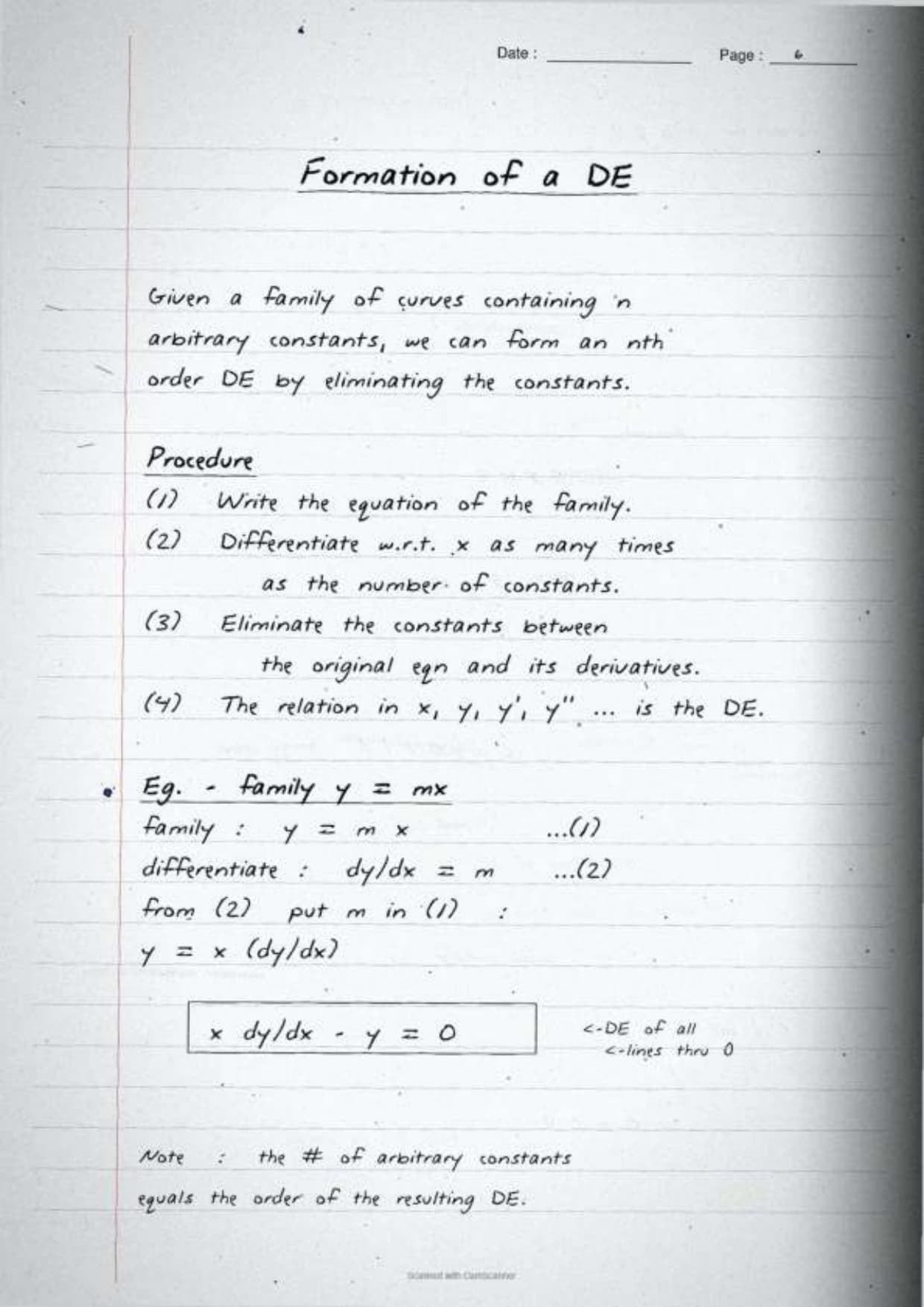
- Family-of-curves drawings on every method page: Variable-separable, homogeneous, and linear DE methods each end with a sample family sketched out, so the general-solution constant c is something you see varying, not an algebraic afterthought.
- Boxed key templates: The integrating-factor recipe μ = e∫ P dx, yμ = ∫ Qμ dx + c and the homogeneous-substitution chain v = y/x → v + x dv/dx = f(v) → ∫ dvf(v)-v = ∫ dxx are each enclosed in their own hand-drawn rectangle.
- 2026-27 NCERT alignment: The notebook reflects the current 2026-27 syllabus. NCERT retained the entire chapter, order-degree through linear DE, after the most recent edition review, including the applications section that JEE uses as a modelling problem source.
- Solved Newton-cooling case study: One fully solved cooling-law problem with the dashed-asymptote sketch beside it serves as the template you can match against any modelling-type Board or JEE question in the Handwritten Notes on Ordinary Differential Equations.
Differential Equations Diagram Inventory in the Class 12 Maths Notebook
| Page | Diagram | What It Shows |
|---|---|---|
| 2 | Order-degree decision tree | Branches off "is the highest derivative raised to an integer power after rationalising radicals?"; ends with order = highest derivative, degree = its exponent |
| 5 | Variable-separable family | Five overlapping curves of y = cex for c ∈ -2, -1, 1, 2, 3 ; illustrates that the general solution is a one-parameter family |
| 8 | Slope-field grid for dy/dx = y/x | 6 × 6 grid of short slope-arrows with two integral curves y = kx traced through it; the geometric interpretation panel |
| 11 | Homogeneous-DE family | Family of straight lines y = vx through the origin; same slope on every ray, motivating the y = vx substitution |
| 13 | Dashed homogeneous-substitution box | y = vx, dy/dx = v + x dv/dx enclosed in a dashed rectangle; the substitution that turns a homogeneous DE into a variable-separable one in v and x |
| 17 | Dashed integrating-factor box | μ(x) = e∫ P(x) dx, ddx(yμ) = Qμ enclosed in a dashed rectangle; the linear-DE learn recipe |
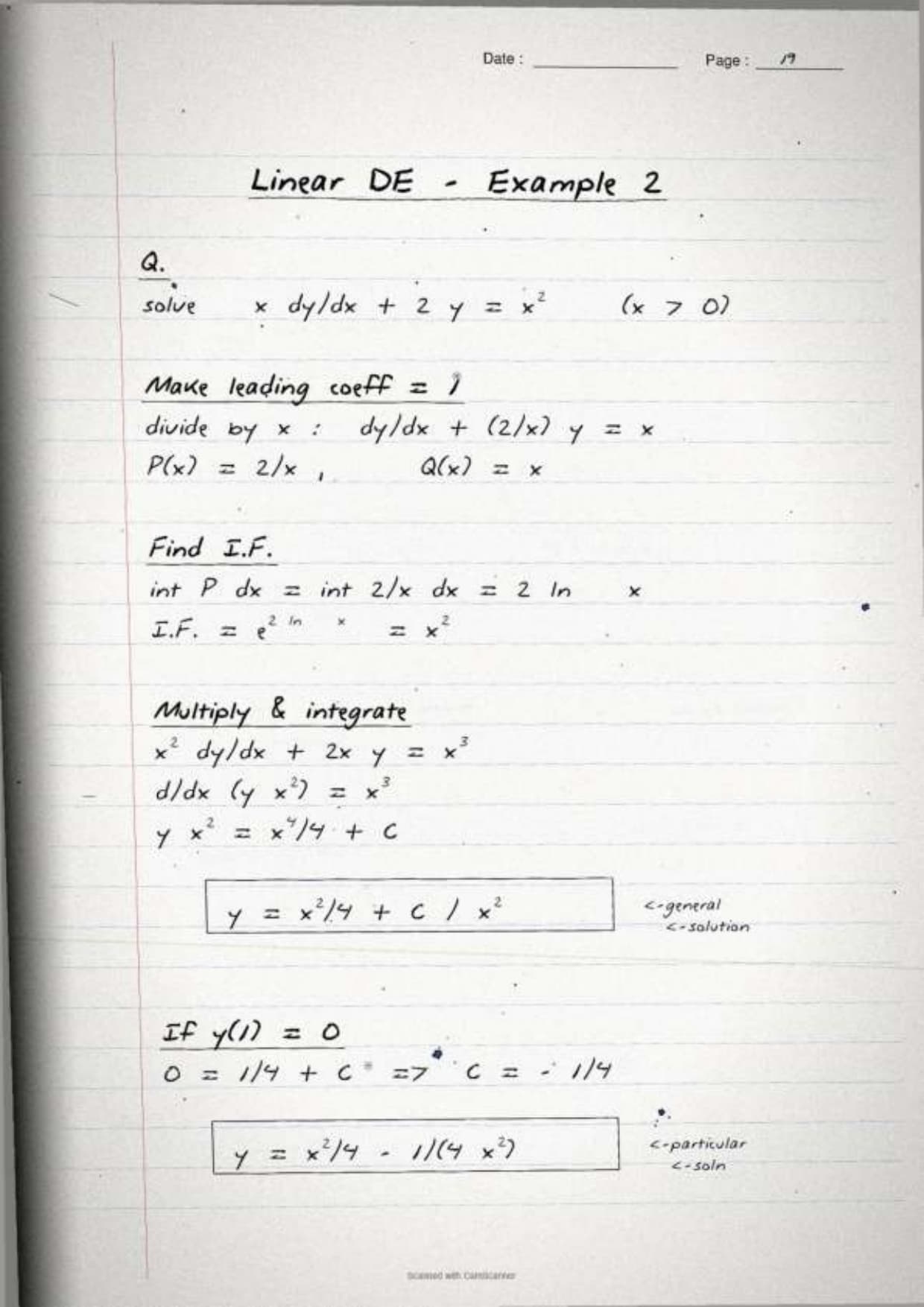
| 20 | Linear-DE solved example | dy/dx + (1/x)y = x2 solved through with μ = x ; final answer y = x3/4 + c/x with three sample curves sketched for different c |
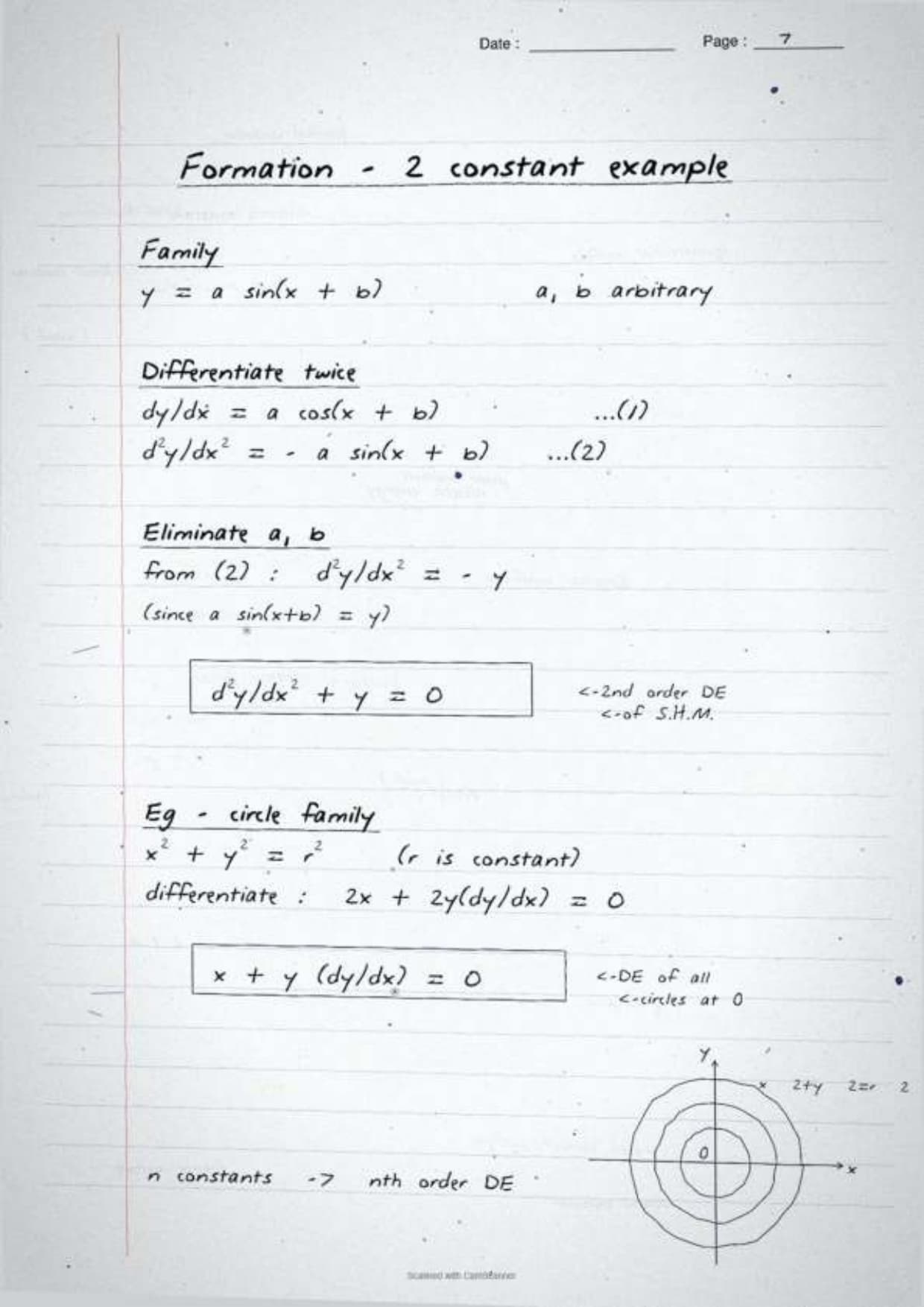
| 23 | Circle family x2 + y2 = c2 | Five concentric circles for c ∈ 1, 2, 3, 4, 5 ; the geometry behind a general solution derived from a perpendicular-trajectory problem |
| 26 | Newton-cooling curve with asymptote | Exponential decay T(t) = Ts + (T0 - Ts)e-kt on T vs t axes with dashed horizontal asymptote at T = Ts |
| 28 | Parabola family y2 = 4ax | Five right-opening parabolas for a ∈ 0.5, 1, 1.5, 2, 3 ; accompanies the orthogonal-trajectory solved examples |
| 30 | One-page method decision card | Flowchart: separable? homogeneous? linear in y ? linear in x ? Bernoulli? exact? Branches to the matching method box on the relevant page |
Quick Tip: Photograph page 30 (the method decision card) and page 17 (the dashed IF box) onto your phone. 90% of CBSE 5-mark questions on the Handwritten Notes on Ordinary Differential Equations reduce to picking the right method off page 30 and applying the template on page 17 or page 13.
Differential Equations Concept Mnemonics for Class 12 Maths Quick Recall
Order is the Highest Derivative, Degree is its Power: Order counts how many times you differentiate; degree is the exponent of that highest derivative after the equation has been freed of radicals and fractional powers. CBSE asks this verbatim every year as the warm-up MCQ.
General Solution = Family, Particular Solution = One Curve: Solving a first-order DE gives a one-parameter family; an initial condition picks one curve from the family. Forgetting the + c on the general solution costs 1 mark every time.
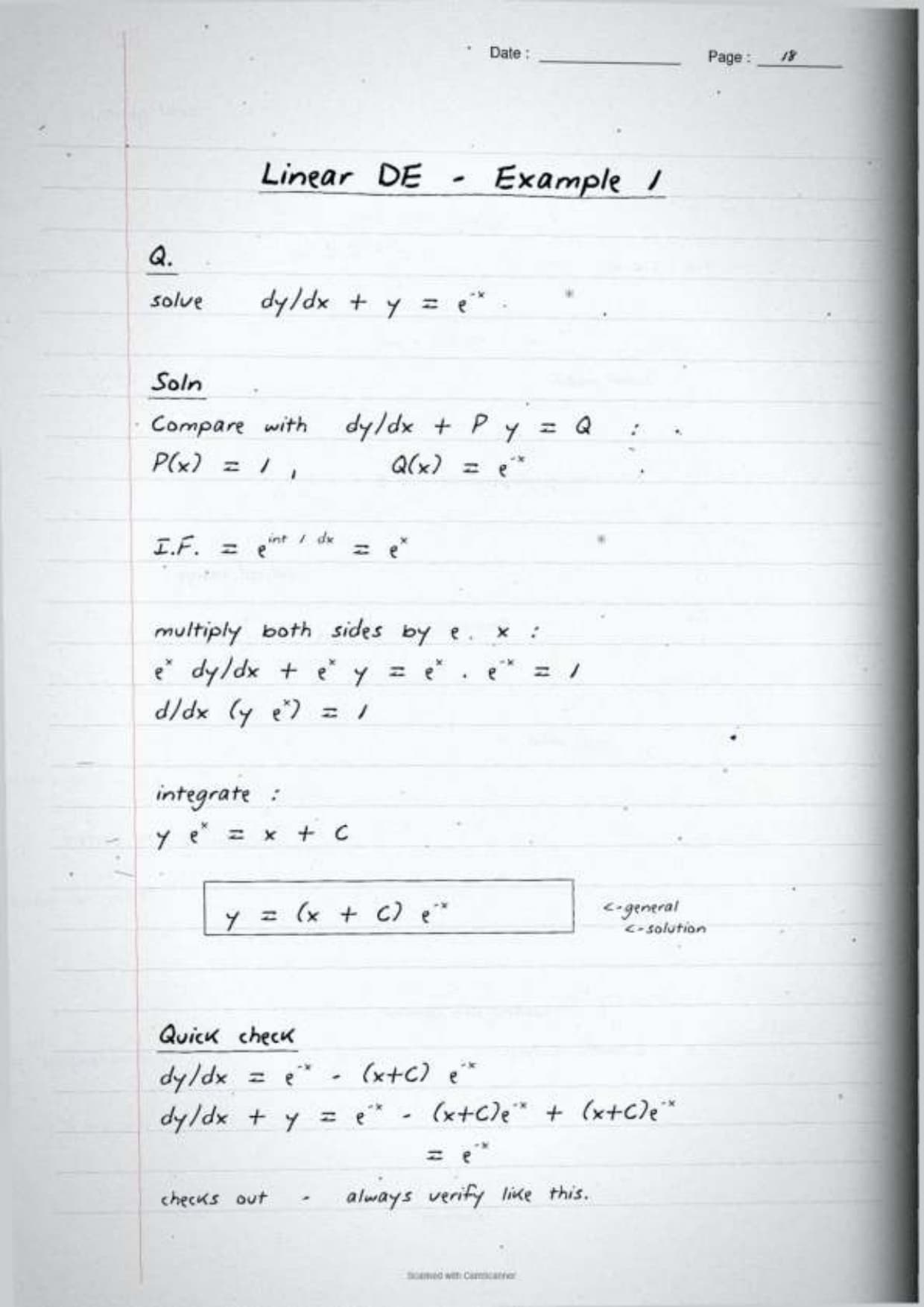
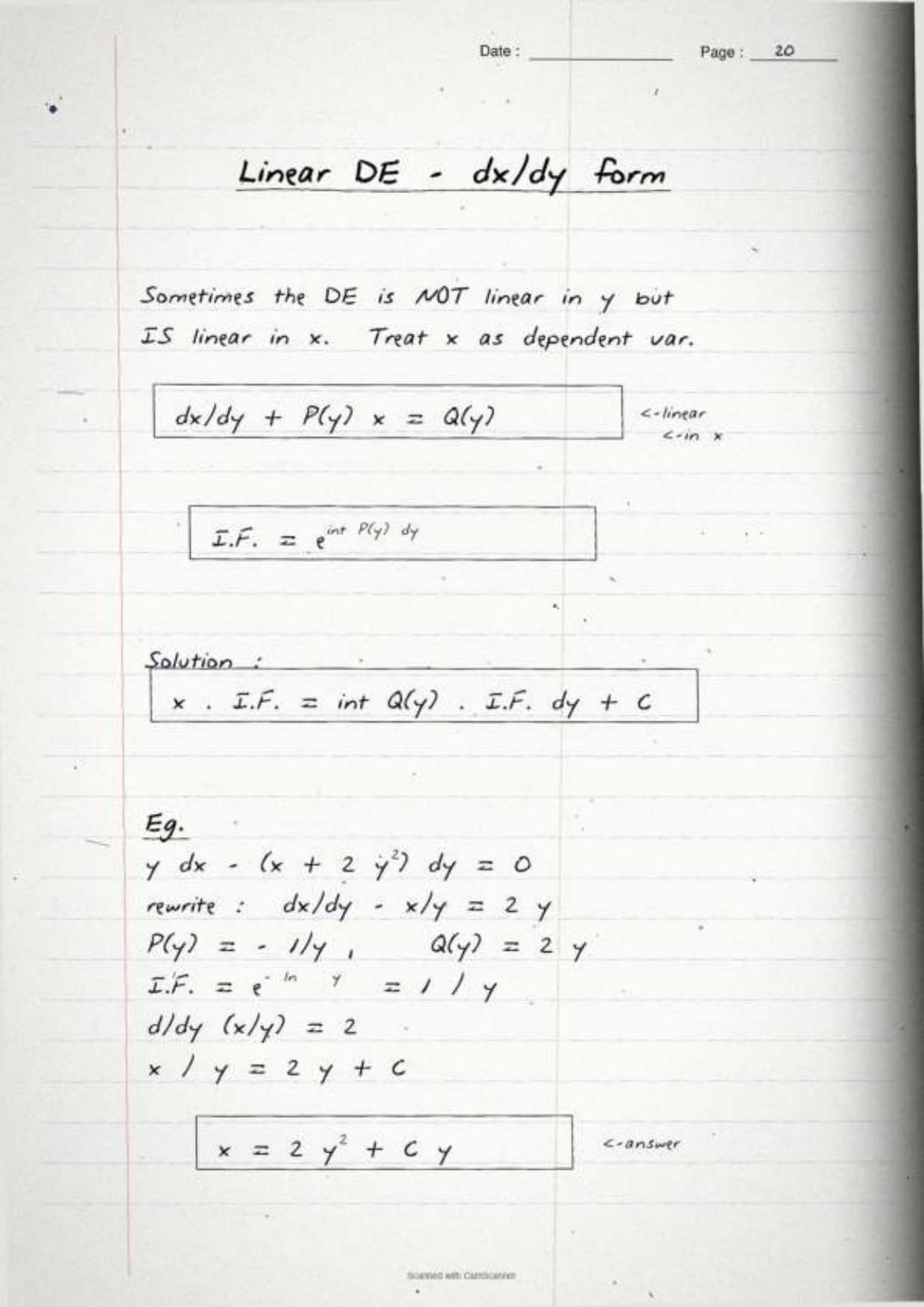
Linear in y Means Integrating Factor: If the DE can be written dy/dx + P(x)y = Q(x) , the integrating factor is e∫ P dx . If it is linear in x instead, write dx/dy + P(y)x = Q(y) and the IF is e∫ P(y) dy . The most-tested CBSE 5-mark template.
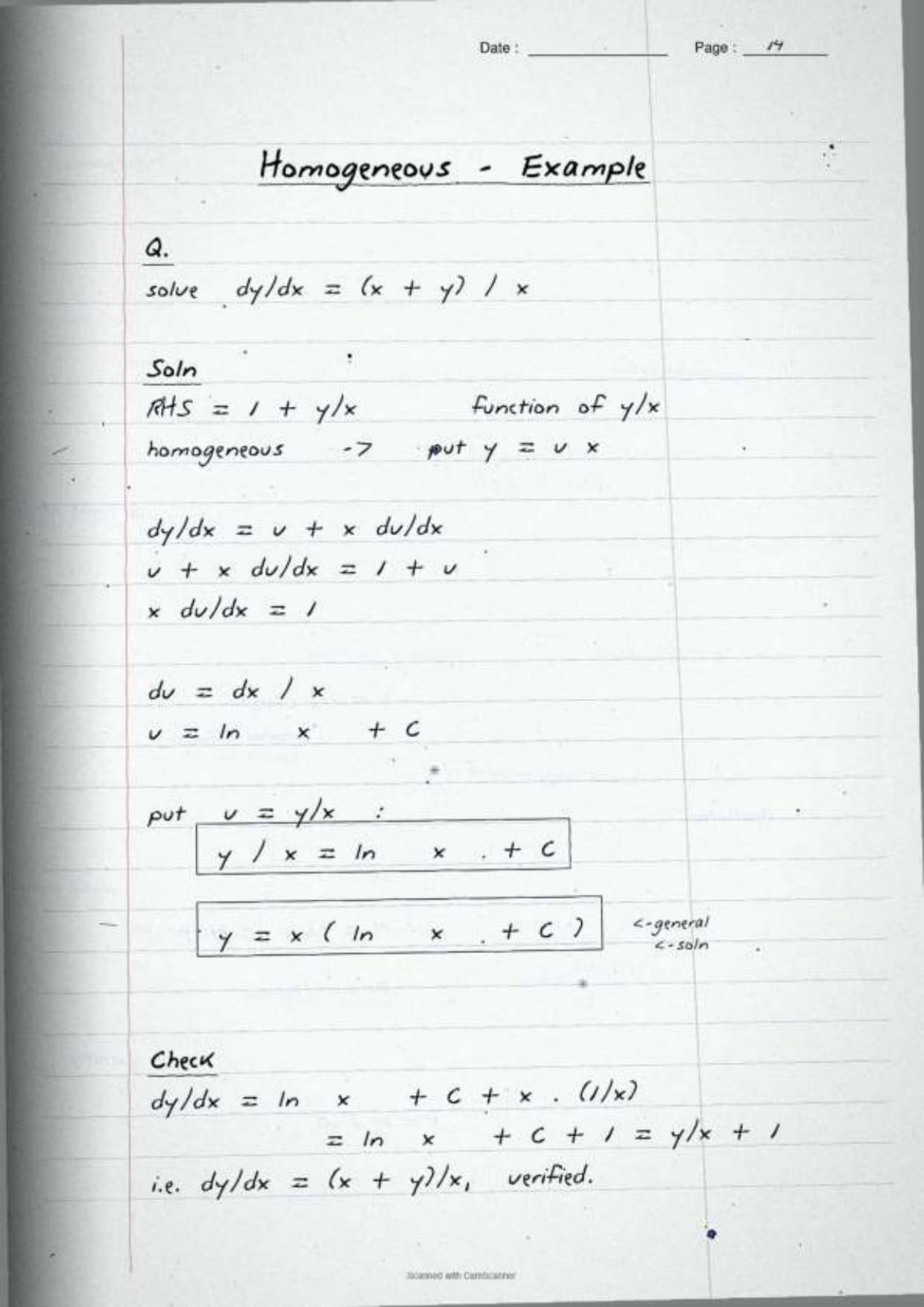
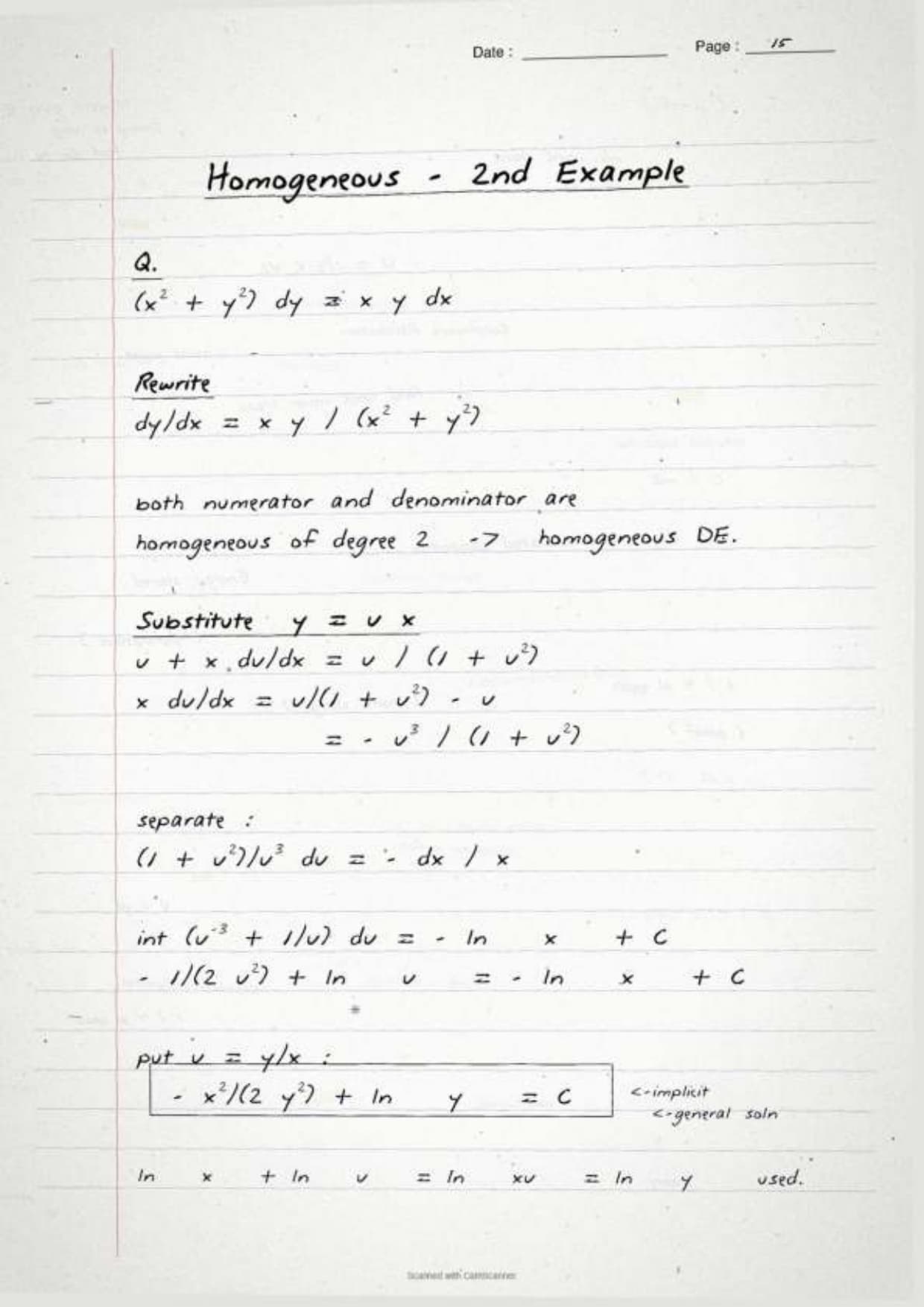
Homogeneous Means Substitute y = vx : A first-order DE dy/dx = f(y/x) is homogeneous. The substitution y = vx, dy/dx = v + x dv/dx converts it to a variable-separable DE in v and x . Reverse-substitute v = y/x at the end.
Differential Equations Top 6 Key Formulae for Class 12 Maths Quick Recall
| Concept | Result |
|---|---|
| Variable-Separable | dydx = g(x) h(y) ⇒ ∫ dyh(y) = ∫ g(x) dx + c |
| Homogeneous Substitution | dydx = f(yx) ⇒ y = vx, v + xdvdx = f(v) |
| Linear DE in y | dydx + P(x) y = Q(x); μ = e∫ P dx; yμ = ∫ Qμ dx + c |
| Linear DE in x | dxdy + P(y) x = Q(y); μ = e∫ P dy; xμ = ∫ Qμ dy + c |
| Order & Degree | Order = order of the highest derivative; degree = its integer power after the DE is rationalised in derivatives |
| Newton's Cooling Law | dTdt = -k(T - Ts) ⇒ T(t) = Ts + (T0 - Ts)e-kt |
Differential Equations: Last 24-Hour Revision Card for Class 12 Maths
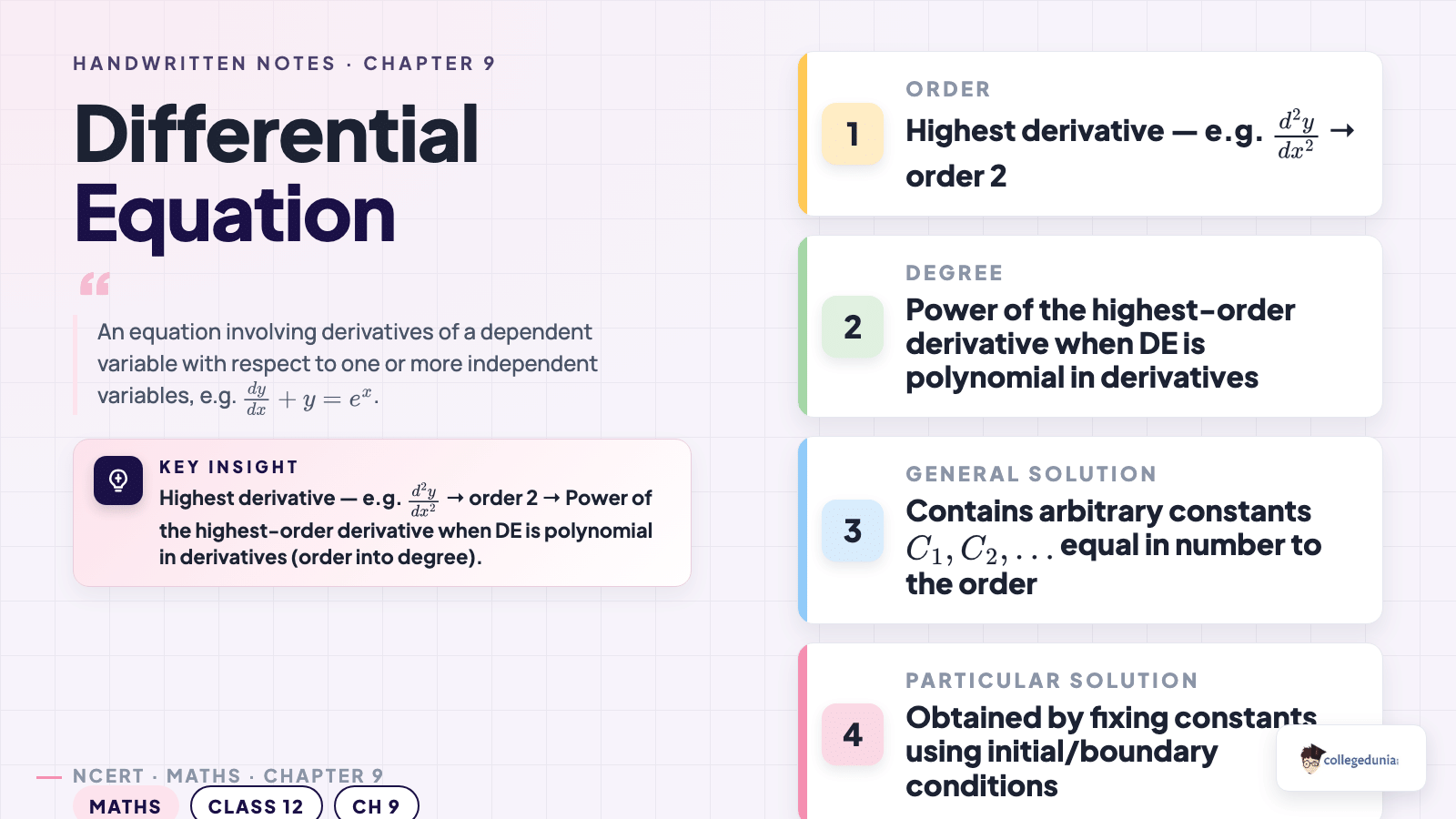
- Order and degree: Order = the order of the highest derivative present. Degree = its integer power once radicals and fractional exponents in derivatives are cleared. If the DE cannot be made polynomial in derivatives, degree is not defined.
- General vs particular: General solution has n arbitrary constants for an n -th order DE and represents an n -parameter family of curves. Particular solution fits one initial / boundary condition and picks one curve.
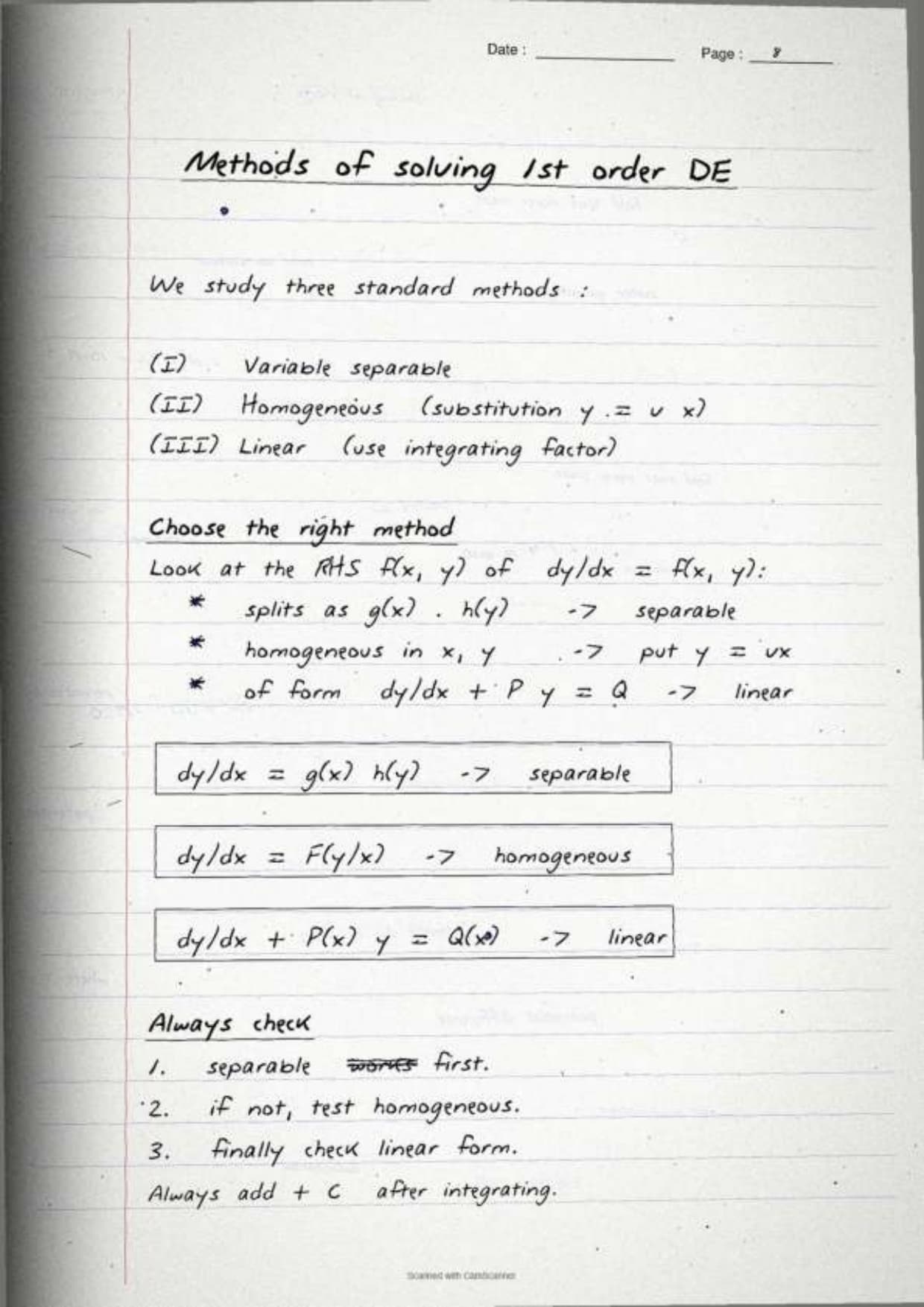
- Variable-separable: Rewrite as h(y) dy = g(x) dx , integrate both sides, attach + c . The single most common 3-marker on this chapter.
- Homogeneous: Spot the form dy/dx = f(y/x) . Substitute y = vx , reduce to a separable DE in v and x , integrate, then reverse-substitute v = y/x . 5-mark CBSE favourite.
- Linear DE in y : Standard form dy/dx + P(x) y = Q(x) . Integrating factor μ = e∫ P dx . General solution yμ = ∫ Qμ dx + c . If the DE is linear in x instead, mirror the recipe with roles of x and y swapped.
- Family of curves: A one-parameter family F(x, y, c) = 0 gives a first-order DE by differentiating once and eliminating c . An n -parameter family gives an n -th order DE.
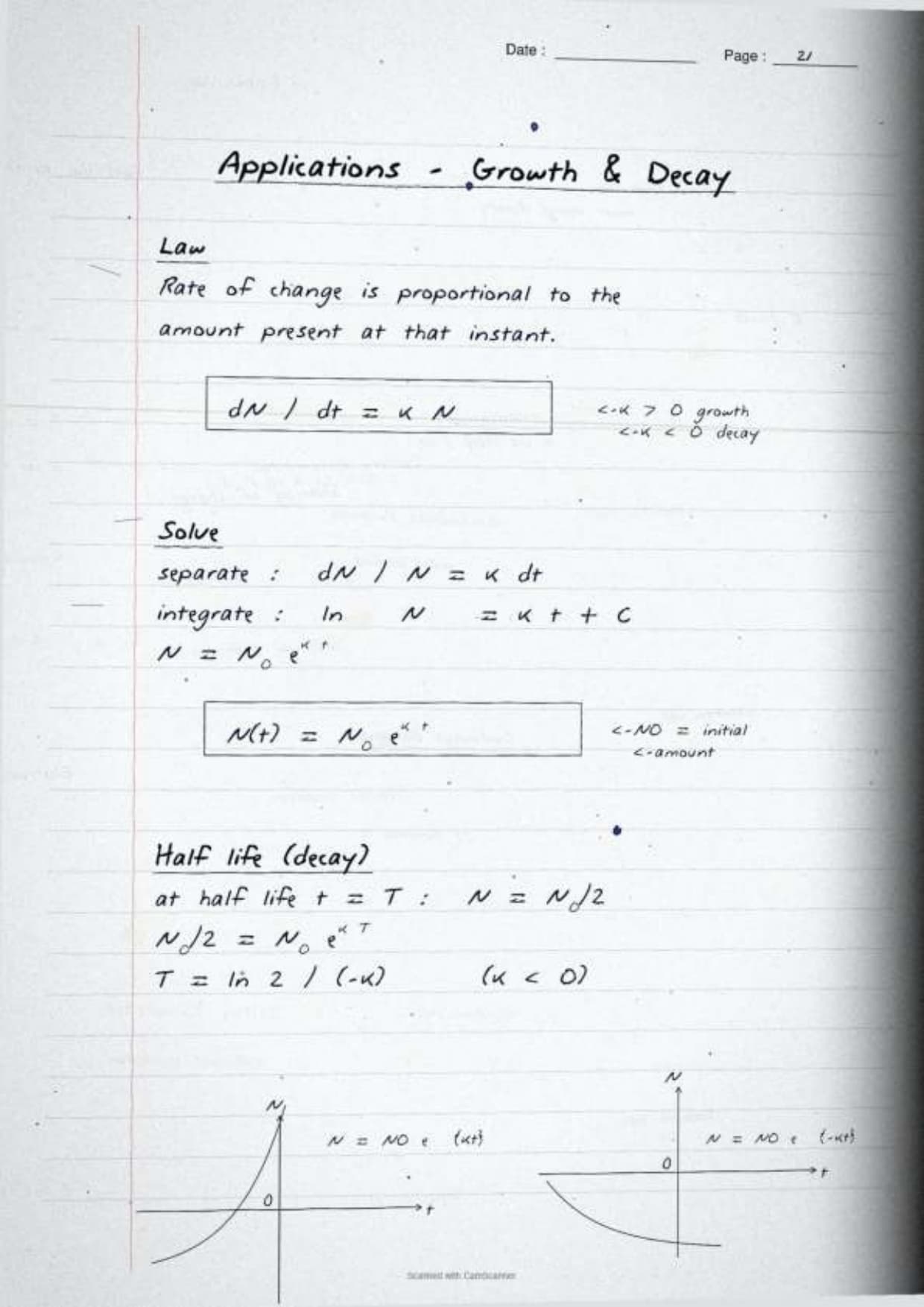
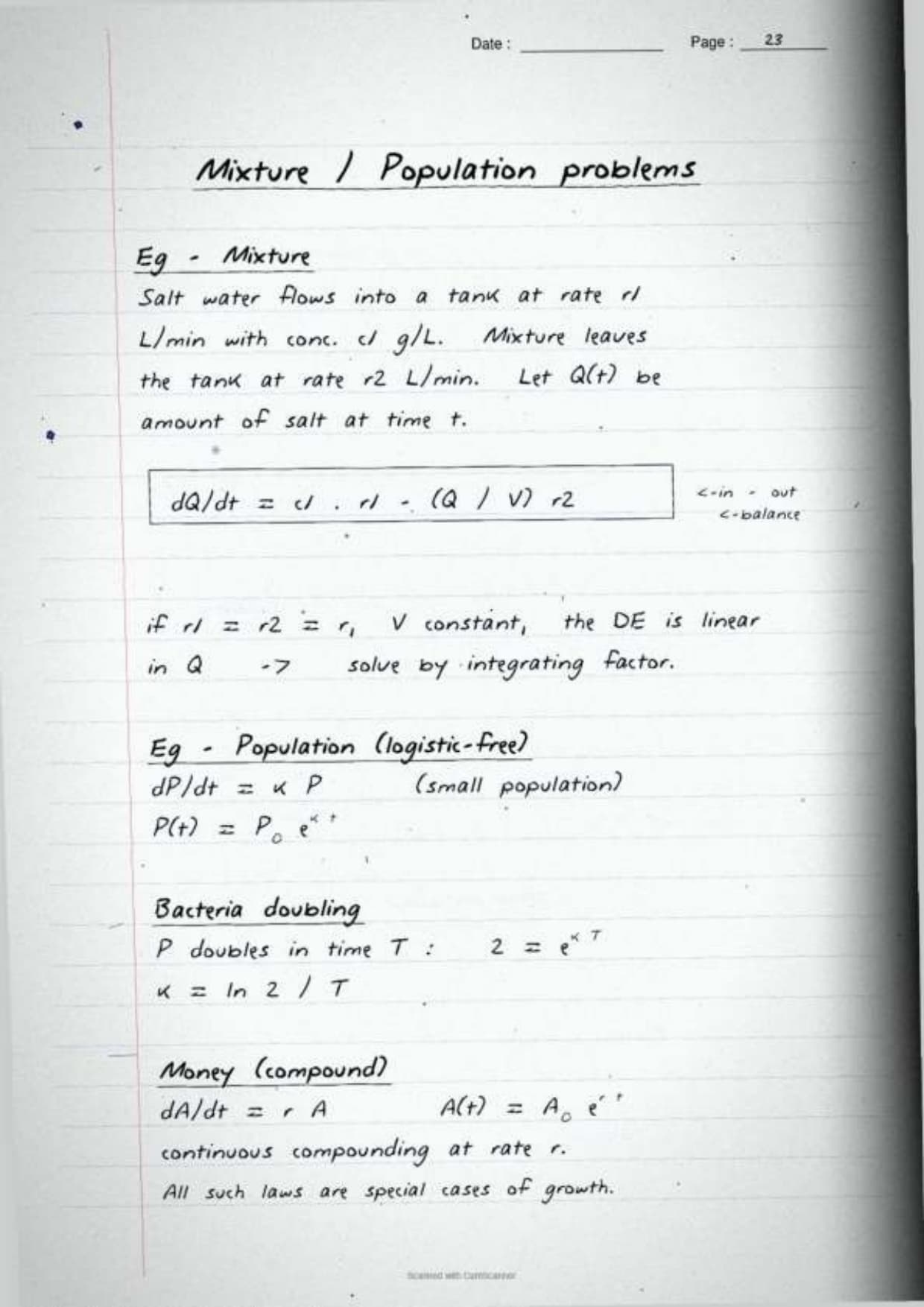
- Application templates: Newton's cooling T = Ts + (T0 - Ts)e-kt ; radioactive decay N = N0 e-λ t ; population / bank-interest growth P = P0 ert . Each is a separable DE in disguise.
Watch Out: Students routinely forget to rationalise radicals before reading off the degree, write the integrating factor as ∫ P dx instead of e∫ P dx , or drop the constant c on the general solution. Each slip costs 1 to 2 marks of a 5-mark CBSE question.
Handwritten Notes vs Printed Notes for Differential Equations: When to Use Which
| Resource | Best For | Time Per Pass |
|---|---|---|
| Typed Notes | First read, formal definitions, method derivations, family-of-curves geometry build-up | 120 to 150 min |
| Handwritten Notes | Second and third revision passes, visual method recall, slope-field and family-of-curves geometry, last-24-hour skim | 40 to 60 min |
| Formula Sheet | Final 10 minutes before the paper: IF formula, homogeneous substitution, order-degree definition recall | 10 min |
- Differential Equations Class 12 Maths NCERT Book PDF
- Differential Equations Class 12 Maths NCERT Exemplar Solutions
Class 12th Maths Chapter 9 Differential Equations Pen-Colour Convention
| Ink Colour | What It Marks | What's Inside |
|---|---|---|
| Blue | Definition / statement | NCERT one-line definitions: differential equation, order, degree, general and particular solution, homogeneous, linear DE |
| Orange | Method box (dashed) | The four standard methods, variable-separable, homogeneous y = vx , linear in y , linear in x , each in its own dashed rectangle with a solved examples |
| Yellow highlight | Solution-curve family sketch | The general-solution family for each archetype: parabola, circle, line, exponential decay. The geometric content of the Handwritten Notes on Ordinary Differential Equations |
| Red | Common-mistake box | Frequent slips: forgetting + c , missing the e in the IF, mis-counting degree before rationalising, applying linear-DE recipe to a non-linear equation |
Differential Equations Weightage Across Class 12 Maths Chapters
Ch 1 Relations and Functions
5 marks
Ch 2 Inverse Trigonometric Functions
4 marks
Ch 3 Matrices
6 marks
Ch 4 Determinants
6 marks
Ch 5 Continuity and Differentiability
8 marks
Ch 6 Application of Derivatives
6 marks
Ch 7 Integrals
9 marks
Ch 8 Application of Integrals
4 marks
Ch 9 Differential Equations
5 marks
Ch 10 Vector Algebra
5 marks
Ch 11 Three Dimensional Geometry
5 marks
Ch 12 Linear Programming
5 marks
Ch 13 Probability
6 marks
More Differential Equations Maths Class 12 Resources
- Differential Equations Class 12 Maths NCERT Solutions
- Differential Equations Class 12 Maths Notes
- Differential Equations Class 12 Maths Formula Sheet
- Differential Equations Class 12 Maths NCERT Book PDF
- Differential Equations Class 12 Maths NCERT Exemplar Book PDF
- Differential Equations Class 12 Maths NCERT Exemplar Solutions
NCERT Handwritten Notes for Class 12 Maths: All Chapters
| Chapter | Handwritten Notes |
|---|---|
| Chapter 1 | Relations and Functions Handwritten Notes |
| Chapter 2 | Inverse Trigonometric Functions Handwritten Notes |
| Chapter 3 | Matrices Handwritten Notes |
| Chapter 4 | Determinants Handwritten Notes |
| Chapter 5 | Continuity and Differentiability Handwritten Notes |
| Chapter 6 | Application of Derivatives Handwritten Notes |
| Chapter 7 | Integrals Handwritten Notes |
| Chapter 8 | Application of Integrals Handwritten Notes |
| Chapter 10 | Vector Algebra Handwritten Notes |
| Chapter 11 | Three Dimensional Geometry Handwritten Notes |
| Chapter 12 | Linear Programming Handwritten Notes |
| Chapter 13 | Probability Handwritten Notes |
Exercise-wise Breakdown of the Differential Equations Chapter
| Exercise | Topic Tested |
|---|---|
| Exercise 9.1 | Basic concepts; order and degree of a differential equation |
| Exercise 9.2 | General and particular solutions |
| Exercise 9.3 | Formation of differential equation from family of curves |
| Exercise 9.4 | Variable separable differential equations |
| Exercise 9.5 | Homogeneous and linear differential equations |
| Miscellaneous Exercise | Mixed differential equations problems |
PDF Download Formats and Languages for the Differential Equations Chapter
| Format | Best for | Approx. size |
|---|---|---|
| Normal-resolution PDF | Phone reading, quick revision between classes | 2-3 MB |
| HD PDF | Print-ready, desk study, board hall photocopy | 8-10 MB |
| Handwritten Notes PDF | Mirrors how a topper writes the chapter under Sunday-revision pace | 5-7 MB |
- NCERT-faithful: Every definition, theorem and exercise on the differential equations class 12 ncert pdf matches the printed textbook line for line.
- Hindi-medium edition: The differential equations class 12 pdf is also available in Hindi - same page numbering, same equation labels.
- Formula PDF separate: The differential equations class 12 formulas pdf is a one-page A4 reference sheet listing every identity used in the chapter.
- Solutions PDF separate: The differential equations class 12 solutions pdf gives every NCERT exercise worked out step by step.
- State-board alignment: Students on the Maharashtra board, HSC, or any state-board syllabus will find the same definitions in this differential equations class 12 pdf - only the exercise numbers differ.
Important Questions and Previous Year Trends for the Differential Equations Chapter
| Template | Typical Marks | What it tests |
|---|---|---|
| Proof / property verification | 3 marks | Students show that a given relation/function/expression satisfies the chapter's definitions. |
| One-step computation | 2 marks | Substitution-based item: plug into a known formula and simplify. |
| Case-study scenario | 4 marks | Real-world setup applying the chapter's definitions, introduced in CBSE 2021+ papers. |
- differential equations class 12 previous year questions for 2019-2024 are linked from the PYQ block at the bottom of this page - the exact CBSE phrasings.
- The differential equations class 12 important questions with solutions set is reused by toppers in the last fortnight of revision.
- For NCERT Exemplar practice, the matching differential equations class 12 extra questions set adds advanced problems suitable for JEE Main and JEE Advanced.
- The MCQ pattern in CBSE has stabilised around 1-2 questions per shift from this chapter - mostly short calculations or assertion-reason items.
Year-wise PYQ Distribution
| Year | Dominant Question Type | Approx. Marks |
|---|---|---|
| 2024 | Property verification + case-study item | 5-6 marks |
| 2023 | Computation with proof + assertion-reason MCQ | 5-6 marks |
| 2022 | Long-answer derivation + 2-mark substitution | 5-7 marks |
| 2021 | Definition recall + property check | 4-5 marks |
| 2020 | One-step computation + 3-mark proof | 5 marks |
How the Differential Equations Notes Pair with NCERT Solutions and the Formula Sheet
| Resource | Use it for | When |
|---|---|---|
| Differential Equations Notes (this page) | Theory, definitions, exam patterns | First pass, before practice |
| differential equations class 12 ncert solutions PDF | Step-by-step solved exercises | Second pass, during NCERT practice |
| differential equations class 12 formulas PDF | One-page identity recall | Third pass, alongside mock papers |
| Handwritten Notes PDF | Quick reading in topper's handwriting | Anytime, especially commute revision |
- The differential equations class 12 ncert solutions cover every back-of-chapter exercise plus the miscellaneous exercise.
- The differential equations class 12 solutions for each individual exercise are indexed by exercise number on the sister NCERT Solutions page (see the Exercise-wise Breakdown table above for direct links).
- The differential equations class 12 formulas reference sheet is the same A4 file students sometimes refer to as differential equations class 12 all formulas - it lists every identity used in the chapter.
- State-board references: RD Sharma, ML Aggarwal, Teachoo and the Maharashtra board differential equations class 12 textbook PDF all share the same core definitions.
- For class-first search phrasings - class 12 differential equations solutions, class 12 differential equations ncert solutions, ncert class 12 differential equations solutions - the same files cover the request.
Reference Books and State-Board Mapping
| Reference | How it maps to Differential Equations Class 12 |
|---|---|
| RD Sharma Class 12 Differential Equations | Question patterns overlap with NCERT at ~70%; an advanced supplement. |
| ML Aggarwal Class 12 Differential Equations | Solutions style is closer to JEE; good for problem-solving practice. |
| Teachoo differential equations class 12 | Free online walkthroughs; useful for video-style learning. |
| Shaalaa differential equations class 12 solutions | State-board (Maharashtra HSC) phrasings; same core definitions. |
| Maharashtra board differential equations class 12 textbook PDF | Same chapter content under the HSC syllabus; exercise numbers differ. |
| NCERT Exemplar Class 12 Differential Equations | Advanced problems for JEE Main/JEE Advanced preparation. |
How to Use the Differential Equations Notes Page Most Effectively
| Sitting | Duration | What to do |
|---|---|---|
| Sitting 1: Theory | ~90 minutes | Read the printed NCERT chapter cover to cover. Mark every definition and theorem statement. Then read the formula recall section on this page. |
| Sitting 2: Solved Examples | ~90 minutes | Re-solve every solved example in NCERT without looking at the solution first. Compare your steps against the printed working. Use the differential equations class 12 ncert solutions PDF if stuck. |
| Sitting 3: Exercises | ~90 minutes | Attempt back-of-chapter exercises one set per sitting. Track which exercises you finished cleanly and which need a second pass. Click into the linked exercise pages above for verification. |
- 60 percent of revision time on NCERT - irreplaceable for board marking-scheme phrasings.
- 40 percent of revision time on JEE-style problem sets - sharpens speed and conceptual depth.
- The differential equations class 12 important questions set on the previous-year page is the closest free analogue to a JEE-style problem set for this chapter.
- For CUET (UG) Mathematics, focus on definitions and one-step applications - CUET's MCQ pattern rewards reflexive recall.
This Collegedunia NCERT Class 12 Mathematics page is reviewed against every CBSE board paper release.
This Collegedunia NCERT Class 12 Mathematics page is reviewed against every CBSE board paper release.
Handwritten Notes on Ordinary Differential Equations - Frequently Asked Questions
Ques. Are these Class 12 Maths Chapter 9 Differential Equations handwritten notes aligned with the 2026-27 NCERT syllabus?



Comments