




The Class 12 Geography Chapter 3 Land Resources and Agriculture textbook PDF is the official NCERT source for every board question on land-use categories, agricultural development strategies, cropping seasons, major crops, and problems of Indian agriculture. It carries about 5 to 6 marks in the CBSE board exam and is one of the most data-rich chapters in the India: People and Economy book.
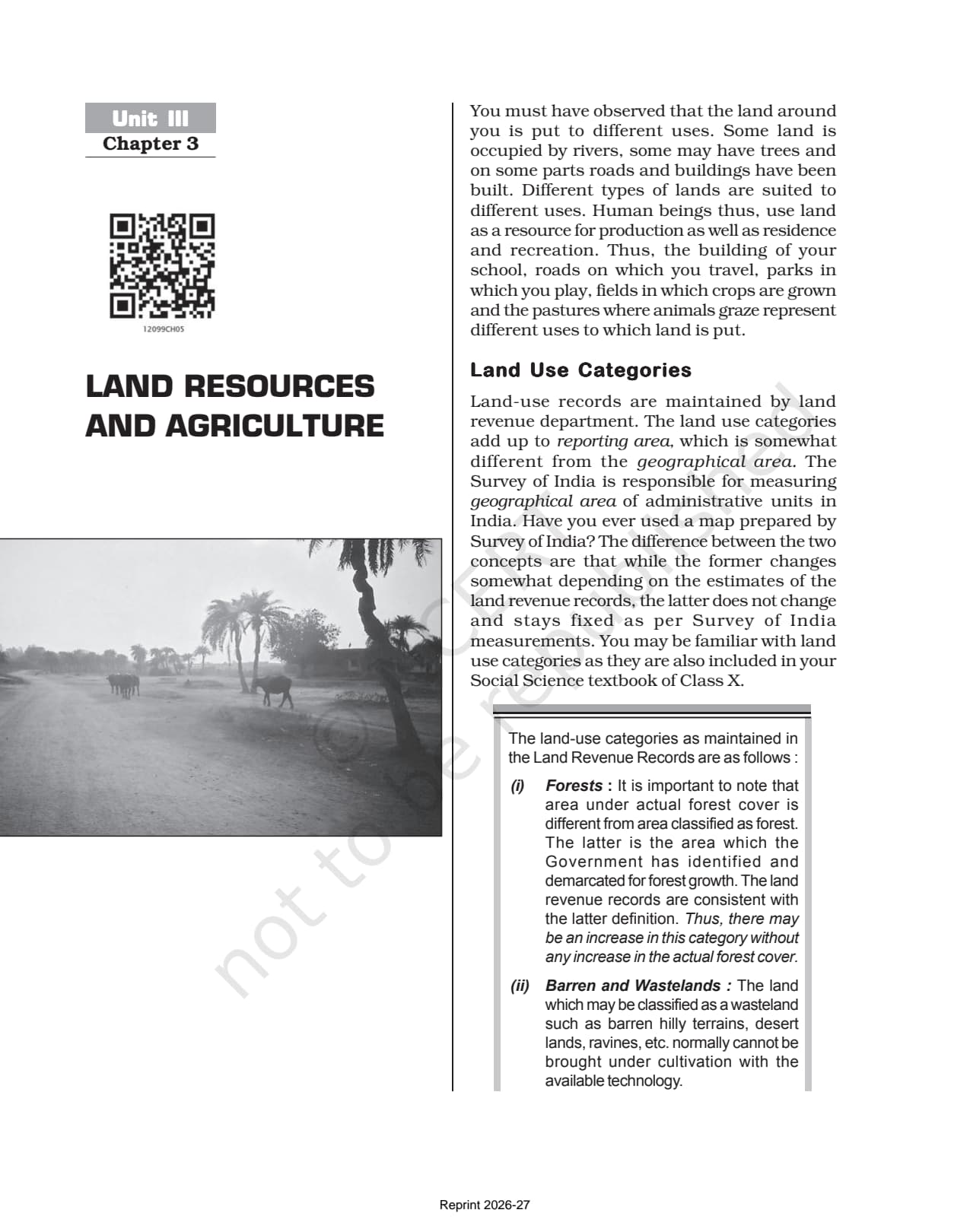
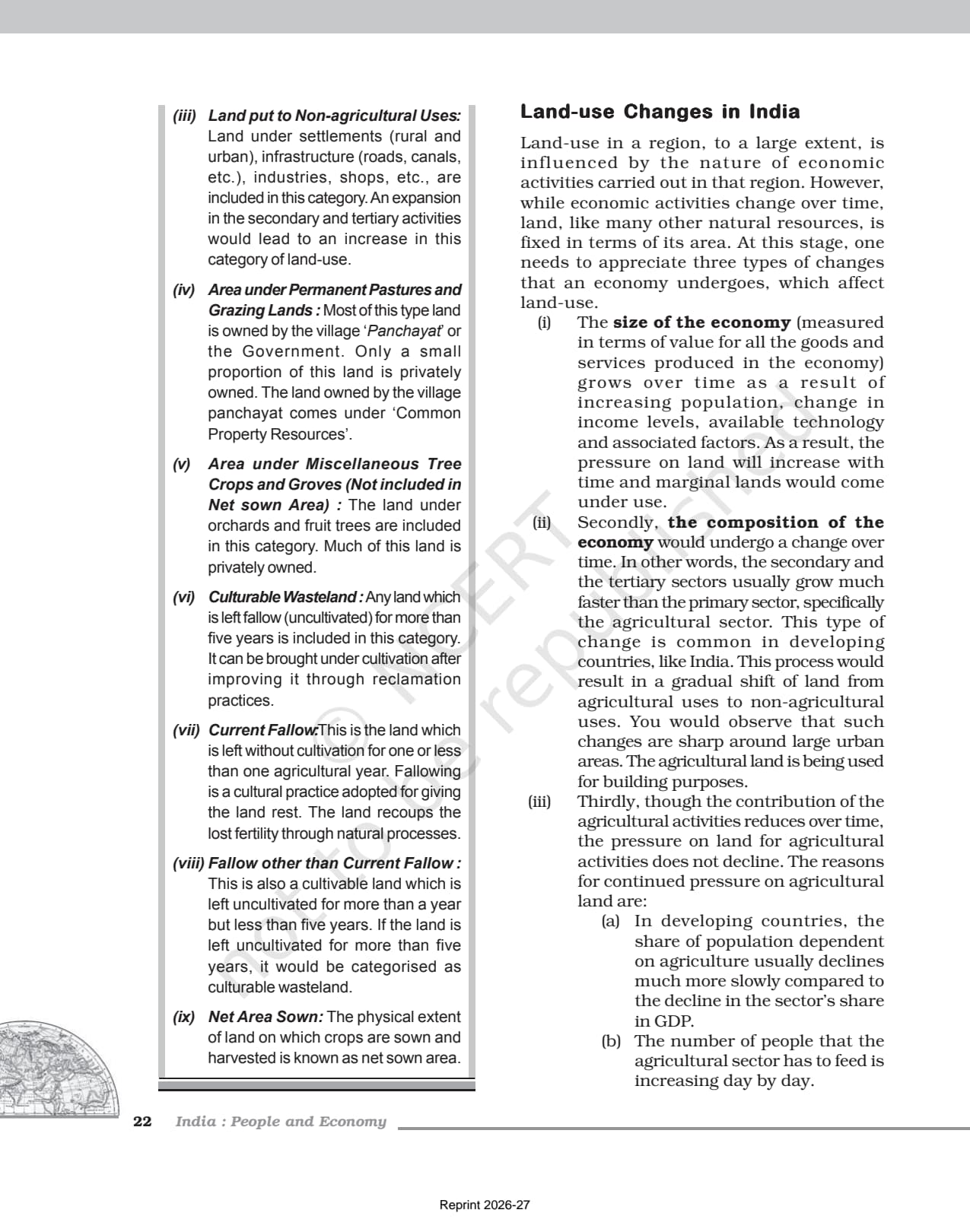
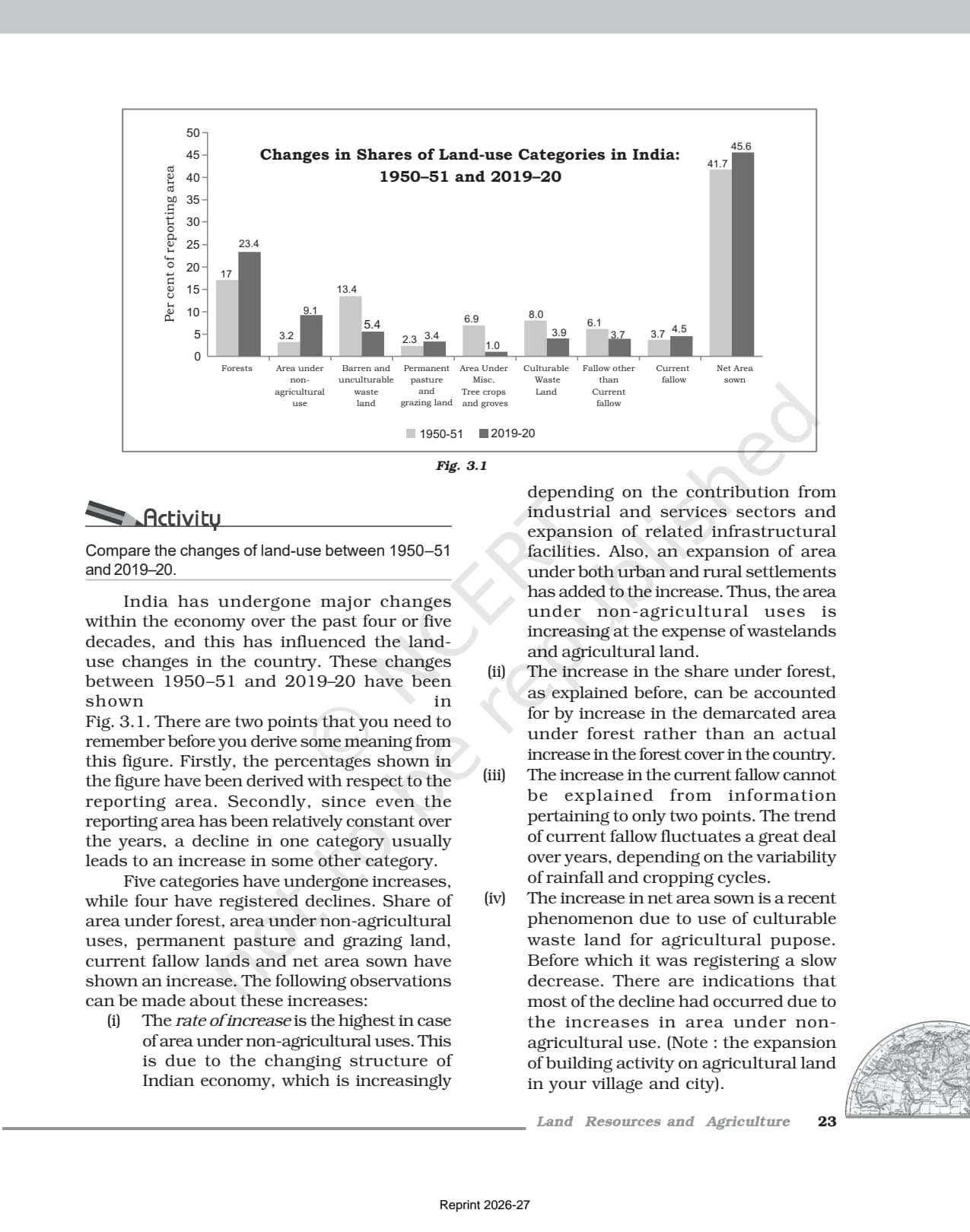
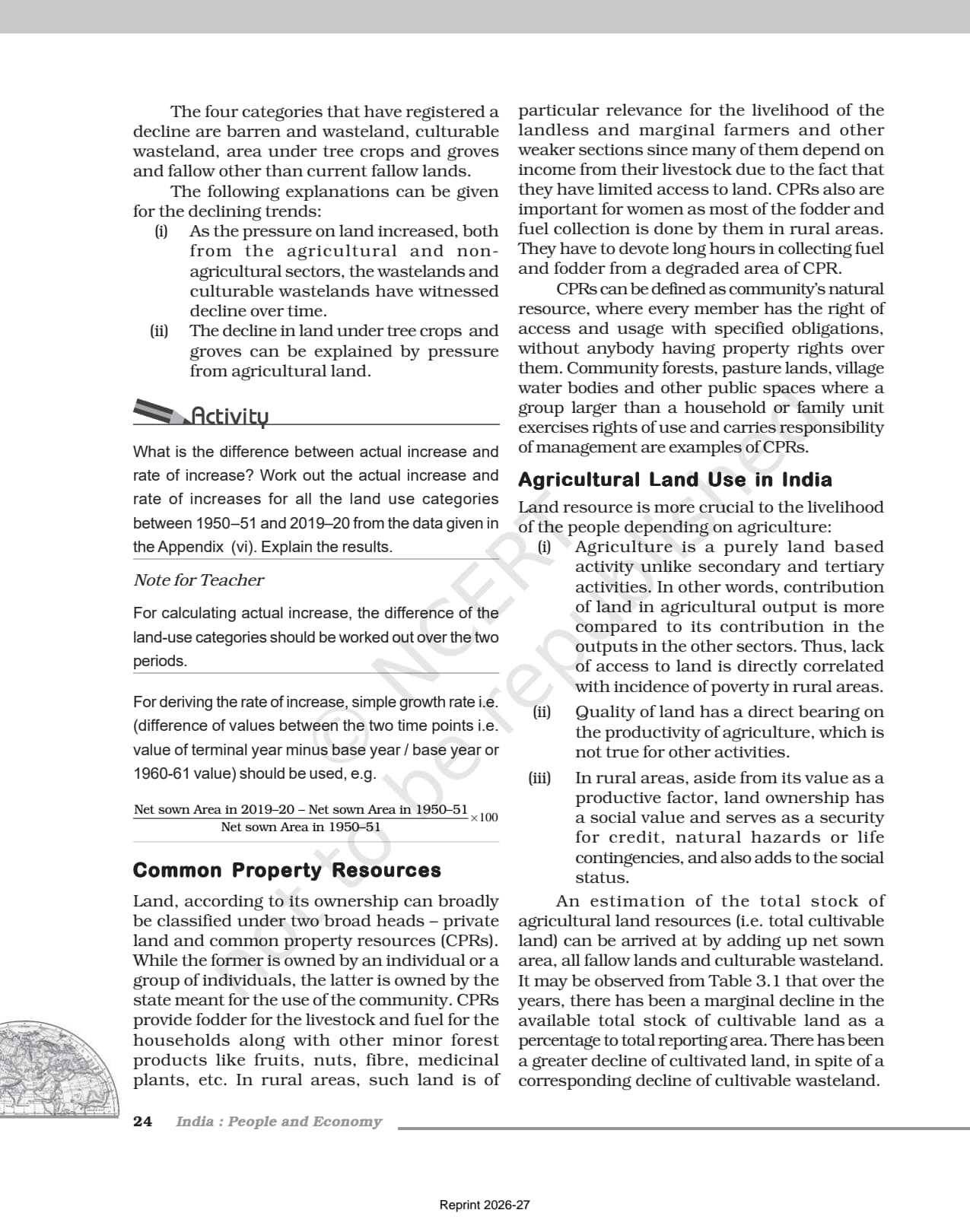
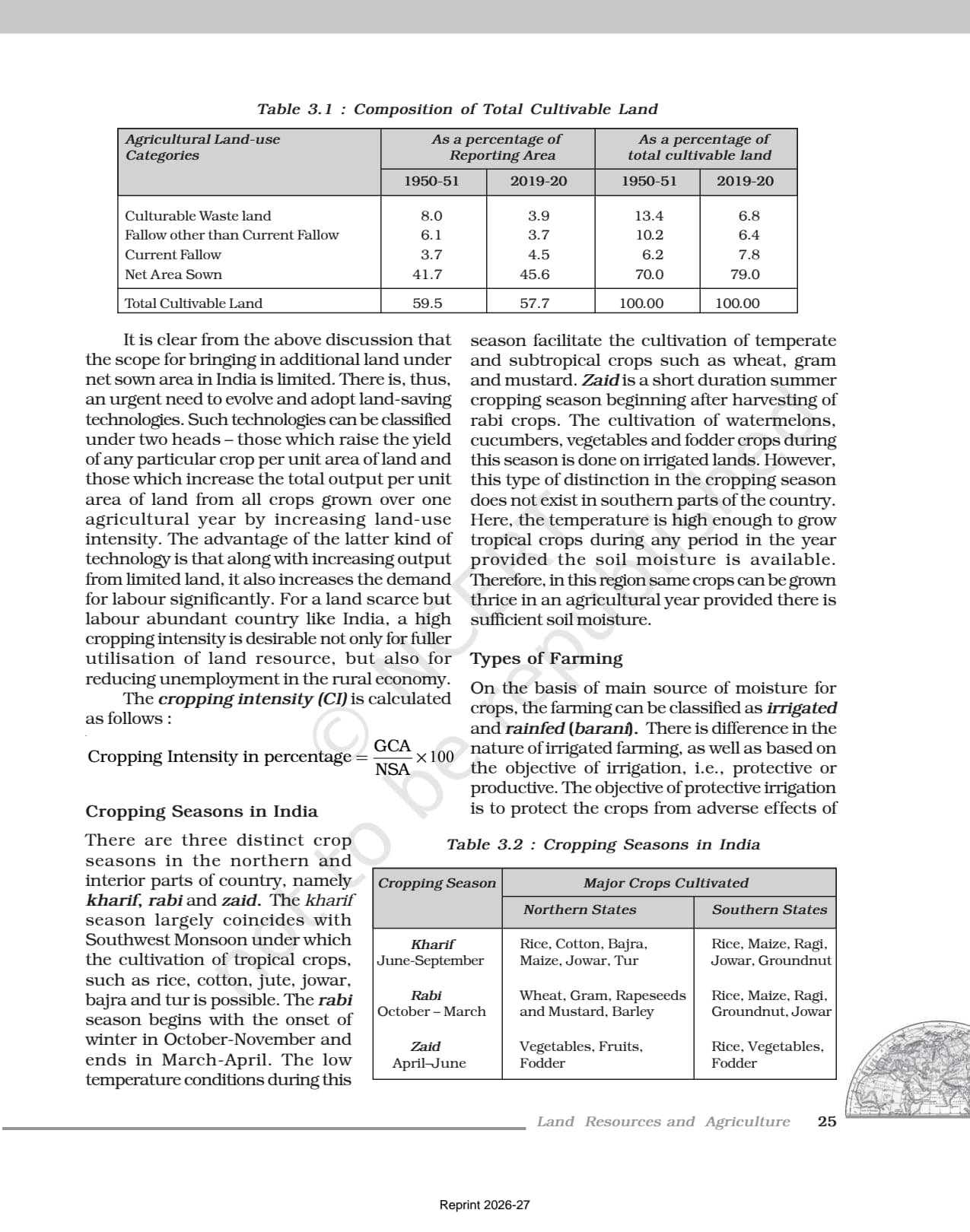
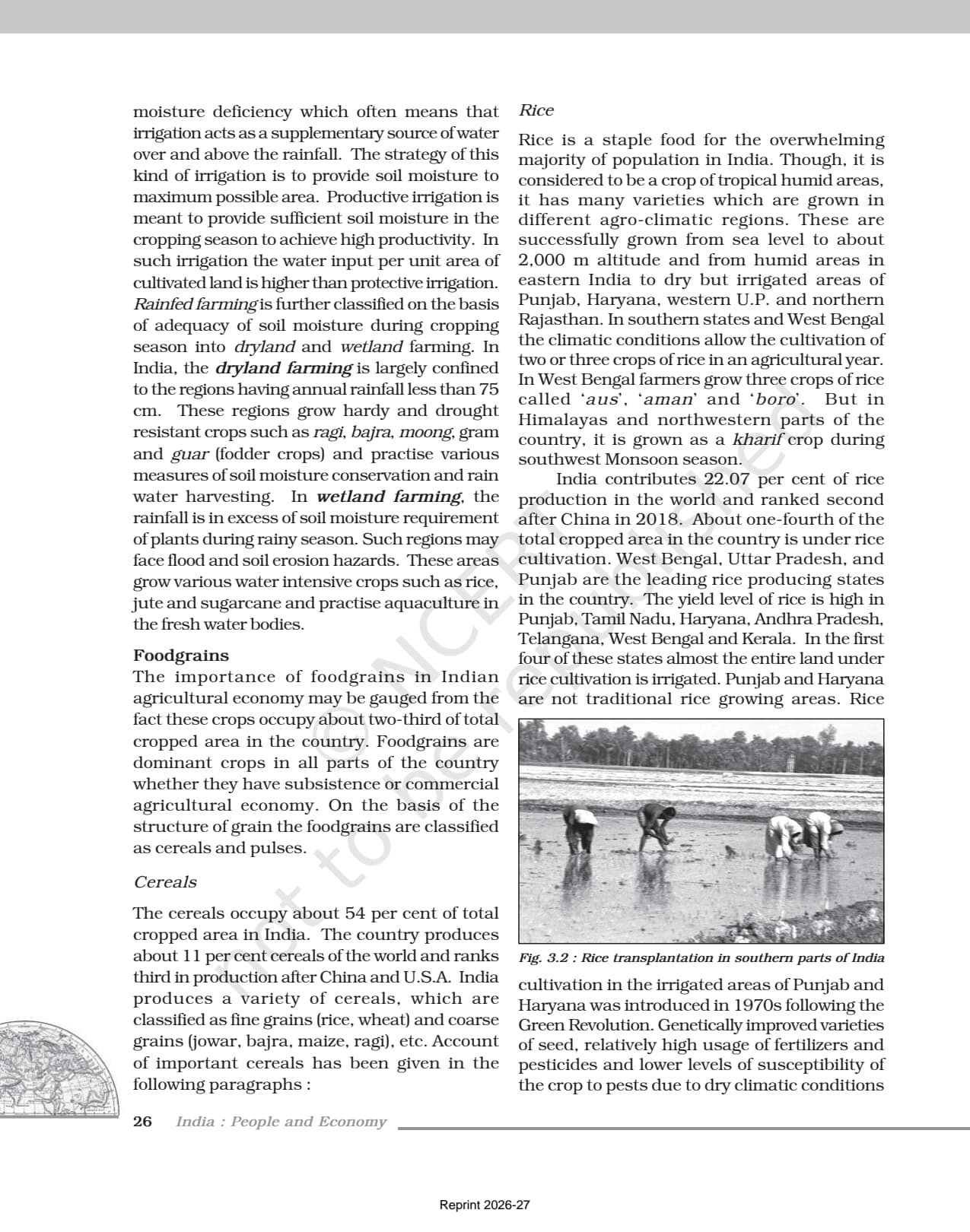
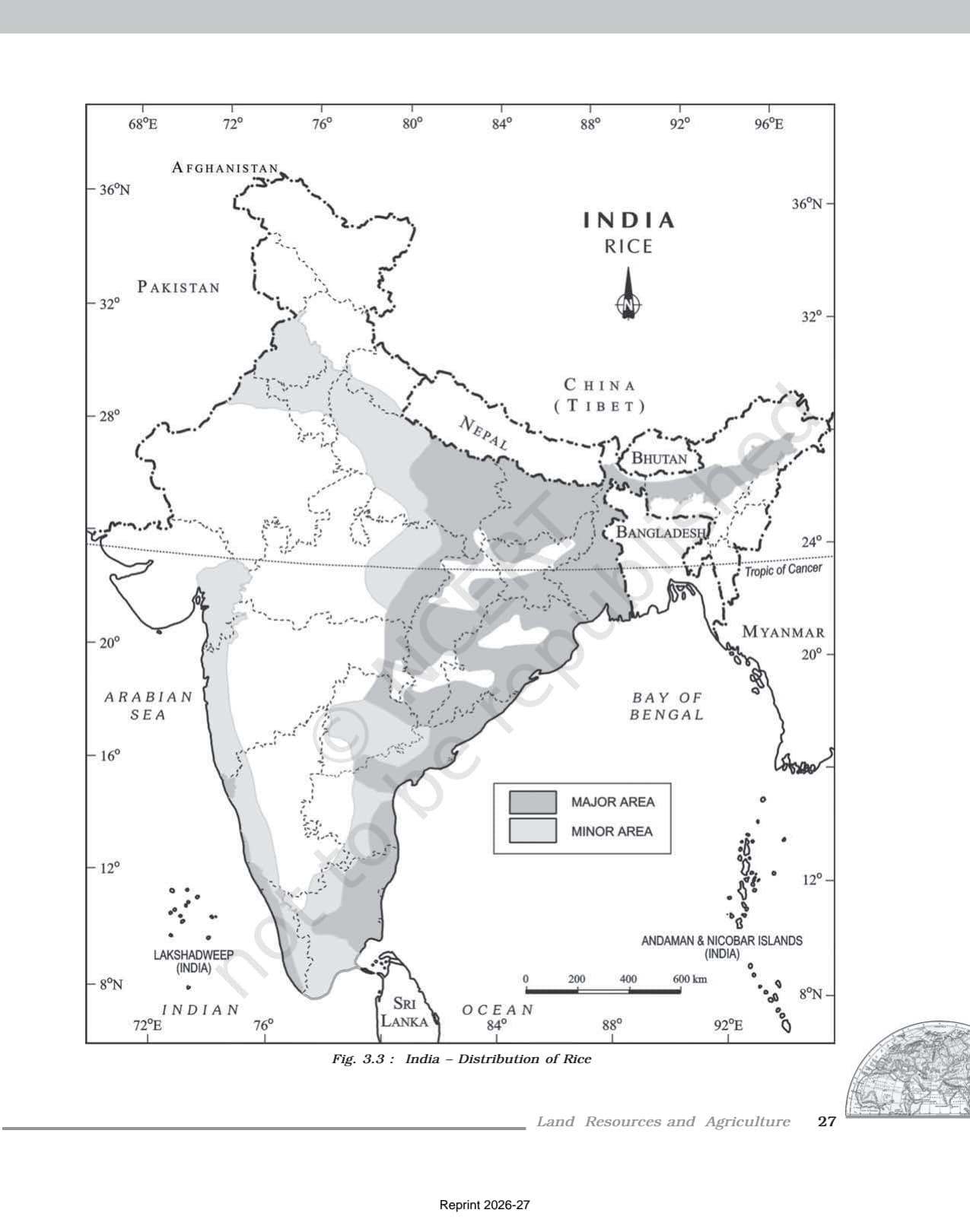
- Official NCERT India: People and Economy Class 12 Chapter 3 PDF covering nine land-use categories, land-use changes from 1950-51 to 2019-20, three cropping seasons, major foodgrain and commercial crops, and problems of Indian agriculture.
- 5-6 marks CBSE board-paper weightage for Chapter 3; the official textbook is the only source CBSE references when it sets definition, data-based, and map-based questions on land resources and agriculture.
- Pair with the matching NCERT Solutions, Notes and Handwritten Notes for full chapter coverage.
Student Feedback
In a 2026 Collegedunia poll of 10,400 students, 81% said reading this NCERT PDF improved their board answers.
What This Chapter Covers in the NCERT Class 12 Book
The official NCERT PDF is the only document CBSE references for data-based, map-based, and definition questions from this chapter, so students preparing for the 2026-27 board paper should read it first. It covers the nine land-use categories, land-use changes from 1950-51 to 2019-20, Common Property Resources, cropping intensity, the three cropping seasons, types of farming, and a crop-by-crop account of rice, wheat, coarse cereals, pulses, oilseeds, fibre crops, sugarcane, tea, and coffee, then closes with the problems and development strategies of Indian agriculture.
Source: Humanities Wallah on YouTube
Topics in the Chapter (Section-Wise Map of the NCERT PDF)
The table below maps each section of the land resources and agriculture class 12 PDF to its dominant exam concept.
| Section | NCERT Sub-topic | Dominant Exam Concept |
|---|---|---|
| 3.1 | Land Use Categories | Nine categories: Forests, Barren Wastelands, Non-agricultural Use, Permanent Pastures, Miscellaneous Tree Crops, Culturable Wasteland, Current Fallow, Fallow Other than Current Fallow, Net Area Sown |
| 3.2 | Land-use Changes in India | Changes between 1950-51 and 2019-20; five categories increased, four declined; role of economic structural change |
| 3.3 | Common Property Resources | Definition of CPRs; role for landless and marginal farmers; fodder and fuel collection |
| 3.4 | Agricultural Land Use | Total cultivable land; cropping intensity formula (GCA/NSA x 100); three cropping seasons |
| 3.5 | Types of Farming | Irrigated vs rainfed (barani); dryland vs wetland; protective vs productive irrigation |
| 3.6 | Foodgrains and Commercial Crops | Rice, wheat, coarse cereals, pulses, oilseeds, fibre crops, sugarcane, tea, coffee - production and leading states |
| 3.7 | Agricultural Development Strategies | Land reforms, Green Revolution, agro-climatic planning, NMSA, diversification |
| 3.8 | Problems of Indian Agriculture | Dependence on erratic monsoon, low productivity, indebtedness, lack of land reforms, small farm size, land degradation |
Sections 3.6 and 3.8 account for the largest share of board-paper questions, because crop distribution and the problems of Indian agriculture are the most frequently tested topics.
Key Concepts From the NCERT Class 12 Geography Textbook
Reproducing the NCERT phrasing of these ideas in the board paper is the fastest route to full marks on theory questions, because CBSE examiners reward exact textbook language.
The Nine Land-use Categories
Nine categories are maintained in Land Revenue Records. Forests include notified forest areas, not just actual cover. Barren and Wastelands include deserts, ravines, and hilly terrain that cannot be cultivated with current technology. Net Area Sown is the land on which crops are sown and harvested. Culturable Wasteland is land left fallow for more than five years but reclaimable, while Current Fallow is left uncultivated for one agricultural year or less to regain fertility. This fallow distinction appears almost every year in one- and two-mark questions.
Cropping Seasons and Intensity
Three crop seasons apply in northern and interior India. Kharif (June-September) follows the Southwest Monsoon (rice, cotton, jute, jowar, bajra). Rabi (October-March) is the winter season (wheat, gram, mustard). Zaid (April-June) is a short summer season for vegetables, fruits, and fodder on irrigated land. Cropping Intensity = (Gross Cropped Area / Net Sown Area) x 100; high intensity is desirable for a land-scarce, labour-abundant country like India.
The Green Revolution and Agricultural Strategies
High Yielding Varieties (HYVs) of wheat from Mexico and rice from the Philippines arrived from the mid-1960s. The Green Revolution used a package of HYVs, chemical fertilisers, and assured irrigation, first in Punjab, Haryana, and western Uttar Pradesh, then spreading. Agro-climatic planning began in 1988 for regionally balanced development. The National Mission for Sustainable Agriculture (NMSA) aims to make farming productive, sustainable, and climate-resilient.
Problems of Indian Agriculture
The chapter lists six major problems: dependence on erratic monsoon (only about 33% of cultivated area is irrigated), low productivity (per-hectare yields far below the USA, Russia, and Japan), indebtedness of marginal and small farmers, lack of effective land reforms, small and fragmented holdings, and land degradation through salinisation, alkalisation, and waterlogging in irrigated areas.
Previous Year Question Trends From This Chapter
The land resources and agriculture class 12 important questions follow a consistent pattern. Students preparing for 2026-27 should expect a similar distribution, since CBSE has announced no structural change. This chapter has contributed 5 to 6 marks across recent board papers through MCQs, short answers, and data- and map-based questions.
| Year | Marks | Question Types | Most Common Topic |
|---|---|---|---|
| 2025 | 5 | 1 MCQ + 1 short answer + 1 long answer | Problems of Indian agriculture; land-use categories |
| 2024 | 6 | 2 MCQs + 1 short answer + 1 long answer | Dryland vs wetland farming; Green Revolution |
| 2023 | 5 | 1 MCQ + 2 short answers + 1 data question | Cropping seasons; leading crop-producing states |
| 2022 | 4 | 1 MCQ + 1 short answer + 1 long answer | Environmental problems of land degradation |
| 2020 | 6 | 2 MCQs + 1 short + 1 long + 1 map | Land-use changes; agricultural development strategies |
The most repeated type is a three- or five-mark question on the problems of Indian agriculture or agricultural development strategies since Independence, both of which need NCERT phrasing and specific reasons, not a bare list.
Connecting This Chapter to the Rest of India: People and Economy
This chapter sits at the heart of the India: People and Economy book. Land-use categories and agricultural patterns underpin water resources (Chapter 4), mineral and energy pressures (Chapter 5), and sustainable development planning (Chapter 6), so later chapters build on its data.
| Later Chapter | Concept Inherited From Chapter 3 |
|---|---|
| Chapter 4: Water Resources | Irrigation coverage (only 33% of cultivated area); dependence on monsoon for the rest; canal water and groundwater use in agriculture |
| Chapter 5: Mineral and Energy Resources | Agriculture's demand for energy (farm machinery, fertiliser production); agrarian states and rural energy needs |
| Chapter 6: Planning and Sustainable Development | Degradation of land resources through salinisation and waterlogging; need for sustainable land-use planning; NMSA goals |
| Chapter 7: Transport and Communication | Agricultural produce movement; roads and canals as infrastructure for agricultural markets |
| Chapter 9: Geographical Perspective on Selected Issues | Land degradation as an environmental issue; farmer indebtedness as a social issue |
Quick Glossary From the NCERT Chapter
Students should be able to define each of these testable terms in a single line for one- and two-mark questions.
- Net Area Sown (NAS): The physical extent of land on which crops are sown and harvested; the basic unit of cultivated land measurement.
- Gross Cropped Area (GCA): Total area sown one or more times in an agricultural year; GCA is always equal to or greater than NAS.
- Cropping Intensity: GCA divided by NAS, expressed as a percentage; shows how intensively the same land is being used across seasons.
- Culturable Wasteland: Land left fallow for more than five years but which can be reclaimed through improvement practices.
- Current Fallow: Land left without cultivation for one agricultural year or less, to allow soil fertility to recover naturally.
- Common Property Resources (CPRs): Community-owned natural resources like village forests, pastures, and water bodies where every member has access rights but no individual property right.
- Dryland Farming: Rainfed farming in regions with annual rainfall below 75 cm; grows hardy crops like ragi, bajra, moong, gram, and guar.
- Wetland Farming: Rainfed farming in regions where rainfall exceeds soil moisture requirement; grows water-intensive crops like rice, jute, and sugarcane.
- High Yielding Varieties (HYVs): Improved seed varieties of wheat (from Mexico) and rice (from Philippines) that triggered the Green Revolution in India from the mid-1960s.
Also Explore Other Resources for Class 12 Geography Chapter 3
| Resource | Link |
|---|---|
| NCERT Solutions | Class 12 Geography Chapter 3 NCERT Solutions |
| Revision Notes | Class 12 Geography Chapter 3 Notes |
| Handwritten Notes | Class 12 Geography Chapter 3 Handwritten Notes |
| Subject Hub | Class 12 Geography All Chapters |
All Chapters: Class 12 Geography India: People and Economy NCERT Book PDF
| Chapter | NCERT Book PDF |
|---|---|
| Chapter 1 | Population Distribution, Density, Growth and Composition NCERT Book PDF |
| Chapter 2 | Human Settlements NCERT Book PDF |
| Chapter 3 | Land Resources and Agriculture NCERT Book PDF (You are here) |
| Chapter 4 | Water Resources NCERT Book PDF |
| Chapter 5 | Mineral and Energy Resources NCERT Book PDF |
| Chapter 6 | Planning and Sustainable Development NCERT Book PDF |
| Chapter 7 | Transport and Communication NCERT Book PDF |
| Chapter 8 | International Trade NCERT Book PDF |
| Chapter 9 | Geographical Perspective on Selected Issues and Problems NCERT Book PDF |
Frequently Asked Questions on Class 12 Geography Chapter 3 Land Resources and Agriculture NCERT Book PDF
Ques. Where can students download the official NCERT Class 12 Geography Chapter 3 PDF?
Ans. Students can download the official land resources and agriculture class 12 NCERT book PDF directly from the download card at the top of this page. The PDF is the single-chapter file from the NCERT India: People and Economy textbook, aligned to the 2026-27 CBSE syllabus.
Ques. What are the nine land-use categories in the NCERT Class 12 Geography Chapter 3?
Ans. The nine land-use categories maintained in Land Revenue Records are: Forests, Barren and Wastelands, Land put to Non-agricultural Uses, Area under Permanent Pastures and Grazing Lands, Area under Miscellaneous Tree Crops and Groves, Culturable Wasteland, Current Fallow, Fallow other than Current Fallow, and Net Area Sown. These categories add up to the reporting area, which is somewhat different from the geographical area measured by the Survey of India.
Ques. What is the difference between current fallow and culturable wasteland?
Ans. Current Fallow is land left without cultivation for one agricultural year or less, giving the soil a rest to recover lost fertility naturally. Culturable Wasteland is land left fallow for more than five years; it can still be brought under cultivation after reclamation. If land is left uncultivated for more than a year but less than five years, it is called Fallow Other than Current Fallow.
Ques. What are the three cropping seasons in India according to the NCERT textbook?
Ans. The three cropping seasons are Kharif (June-September, coinciding with the Southwest Monsoon; crops include rice, cotton, jute, jowar, and bajra), Rabi (October-March, the winter season; crops include wheat, gram, rapeseed, and mustard), and Zaid (April-June, a short summer season on irrigated land; crops include vegetables, fruits, and fodder). This three-season distinction applies to the northern and interior parts of India; in the southern states the year-round warm temperature allows growing the same crops more than once annually.
Ques. What is cropping intensity and how is it calculated?
Ans. Cropping Intensity (CI) measures how intensively the same piece of land is used over an agricultural year. It is calculated as: CI = (Gross Cropped Area / Net Sown Area) x 100. A CI of 100% means each piece of land grows one crop per year; a CI of 150% means on average each piece of land grows 1.5 crops per year. For a land-scarce but labour-abundant country like India, high cropping intensity is desirable to maximise output from limited land and to reduce rural unemployment.
Ques. What is the difference between dryland farming and wetland farming?
Ans. Dryland farming is confined to regions with annual rainfall below 75 cm. These areas grow hardy and drought-resistant crops such as ragi, bajra, moong, gram, and guar, and practise soil moisture conservation and rainwater harvesting. Wetland farming is practised in regions where rainfall exceeds the soil moisture requirement of plants; these regions may face flood and erosion hazards and grow water-intensive crops like rice, jute, and sugarcane.
Ques. What was the Green Revolution and what were its limitations according to the NCERT?
Ans. The Green Revolution refers to the introduction of a package technology comprising High Yielding Varieties (HYVs) of wheat and rice, along with chemical fertilisers in irrigated areas, from the mid-1960s. It made India self-reliant in foodgrain production. However, the NCERT chapter explains that Green Revolution was initially confined to irrigated areas only (Punjab, Haryana, western UP, Andhra Pradesh, and Gujarat), which led to regional disparities in agricultural development. The technology spread to eastern and central parts of the country only after the 1970s.
Ques. What are the main problems of Indian agriculture mentioned in the NCERT chapter?
Ans. The NCERT chapter lists six major problems. Dependence on erratic monsoon - only about 33% of cultivated area is irrigated. Low productivity - per-hectare yields are much below international levels. Indebtedness - marginal and small farmers cannot afford modern inputs and resort to credit from moneylenders. Lack of effective land reforms - continuation of inequitable land distribution. Small and fragmented landholdings - average holding size is shrinking under population pressure. Degradation of cultivable land - salinisation, alkalisation, waterlogging, and excessive chemical use reduce soil fertility.
Ques. What are Common Property Resources and why are they important?
Ans. Common Property Resources (CPRs) are community-owned natural resources like village forests, pasture lands, and water bodies where every member of the community has the right of access and usage, but no individual has property rights over them. CPRs are particularly important for the livelihood of landless and marginal farmers and other weaker sections who depend on fodder from CPRs for their livestock. CPRs are also critical for rural women, who collect most of the fodder and fuel from these common lands.
Ques. Which states are the leading producers of rice in India as per the NCERT chapter?
Ans. The NCERT chapter states that West Bengal, Uttar Pradesh, and Punjab are the leading rice-producing states. High yields are recorded in Punjab, Tamil Nadu, Haryana, Andhra Pradesh, Telangana, West Bengal, and Kerala. Punjab and Haryana, though not traditional rice states, achieved high yields after Green Revolution introduced irrigated rice cultivation there in the 1970s. Low yields occur in rainfed areas of Madhya Pradesh, Chhattisgarh, and Odisha.
Ques. Is the Class 12 Geography syllabus changing for 2026-27?
Ans. No major changes. The India: People and Economy textbook chapter structure is unchanged for 2026-27, and the official NCERT PDF on this page is aligned to the 2026-27 CBSE syllabus. CBSE marking schemes continue to reward textbook phrasing in theory questions and complete, reasoned answers in long-answer questions from this chapter.
Ques. What is the best order to use the NCERT PDF, Notes, and Solutions for Class 12 Geography Chapter 3?
Ans. Read the NCERT PDF cold first to get the full chapter narrative. Then read the matching Class 12 Geography Chapter 3 Notes alongside the PDF for a structured revision of all nine land-use categories, crop distribution data, and agricultural problems. Attempt all exercise questions and verify against the NCERT Solutions. Use the handwritten notes for last-mile revision the night before the board exam.



Comments