




The NCERT Book for Class 10 Science Chapter 4 Carbon and its Compounds is the official CBSE textbook chapter, free to read and download for the 2026-27 session. This chapter explains the covalent bond, the allotropes of carbon, the versatile nature of carbon through catenation and tetravalency, saturated and unsaturated compounds, functional groups, the homologous series, and the chemistry of ethanol and ethanoic acid.
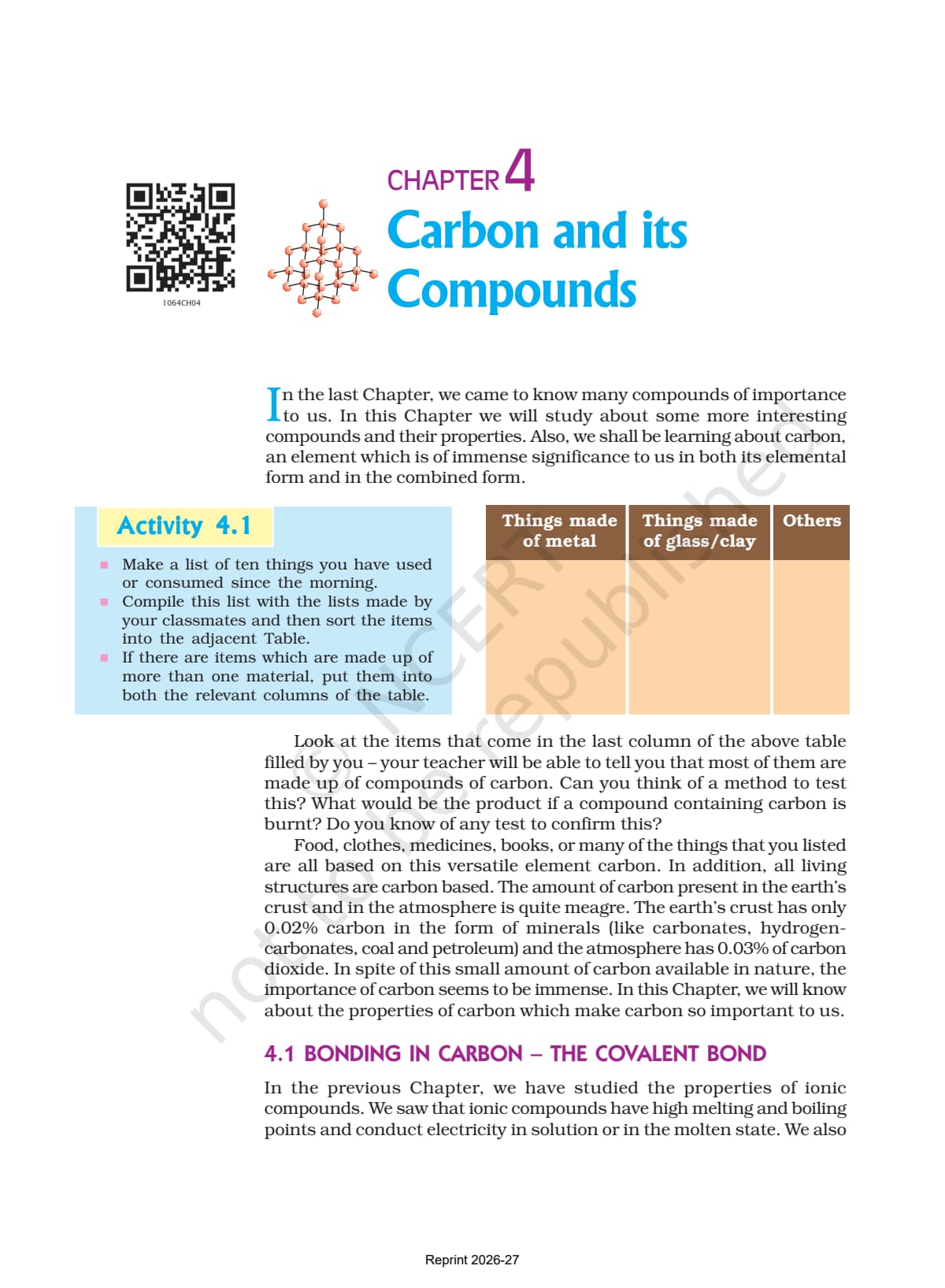
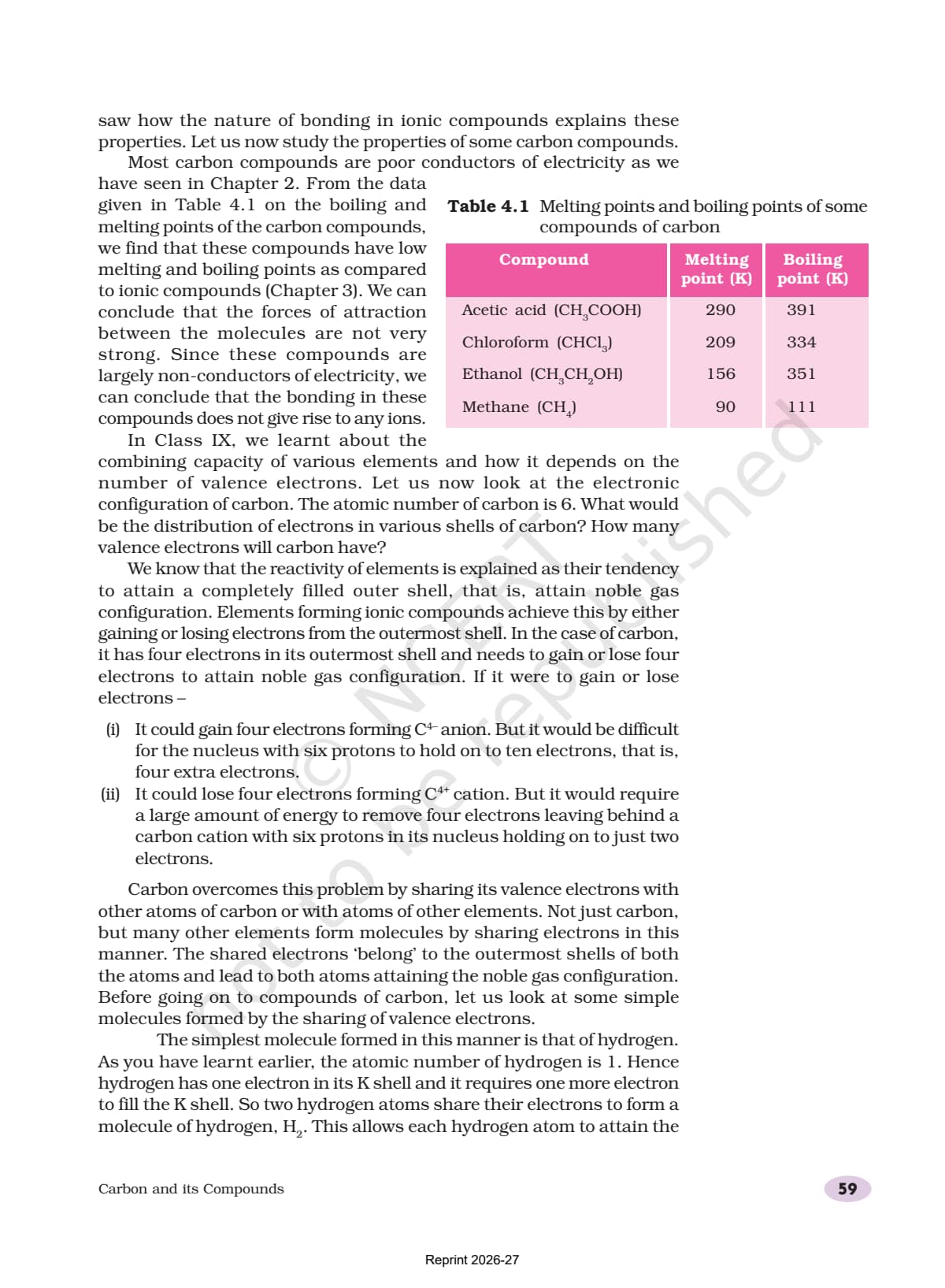
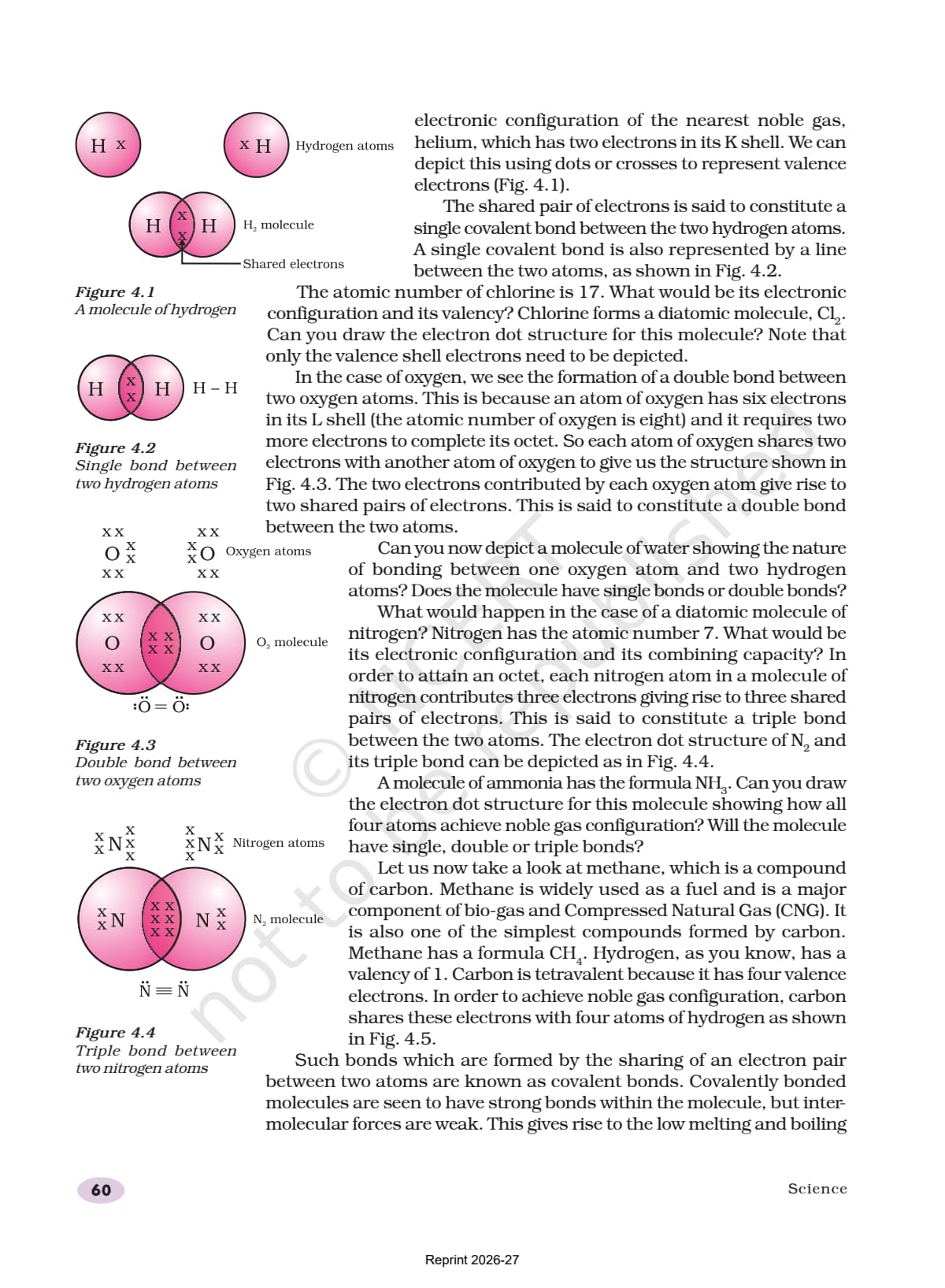
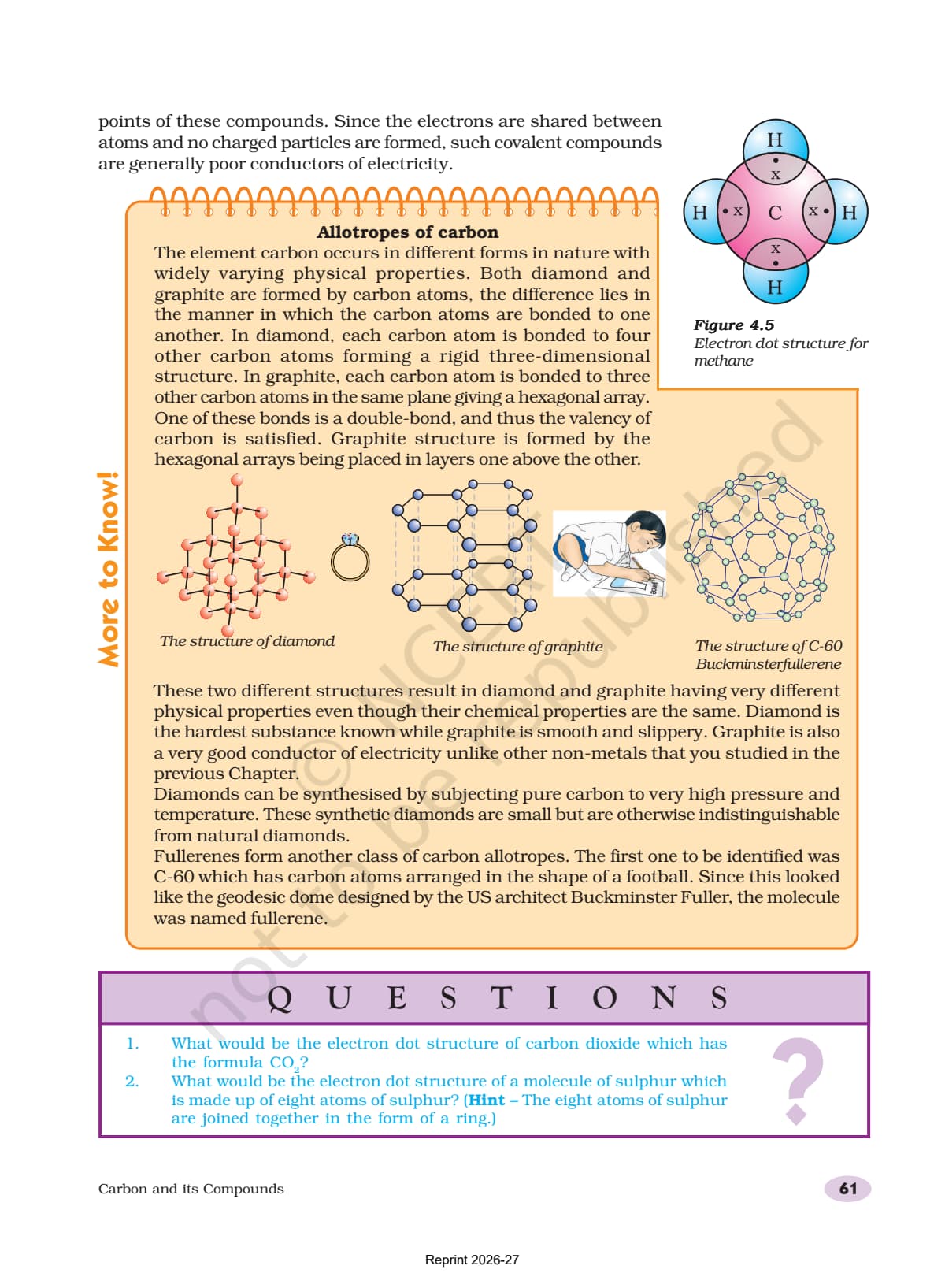
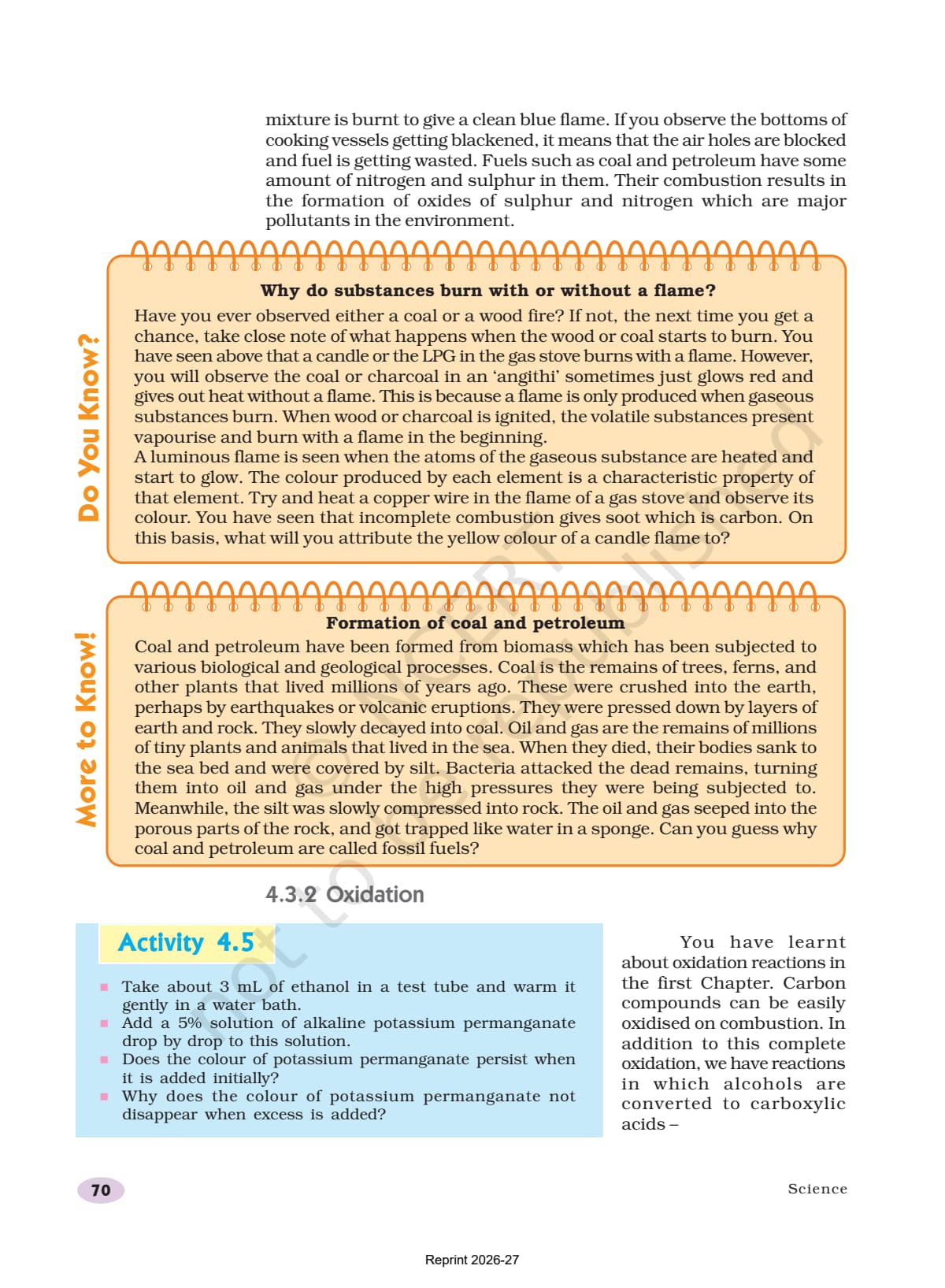
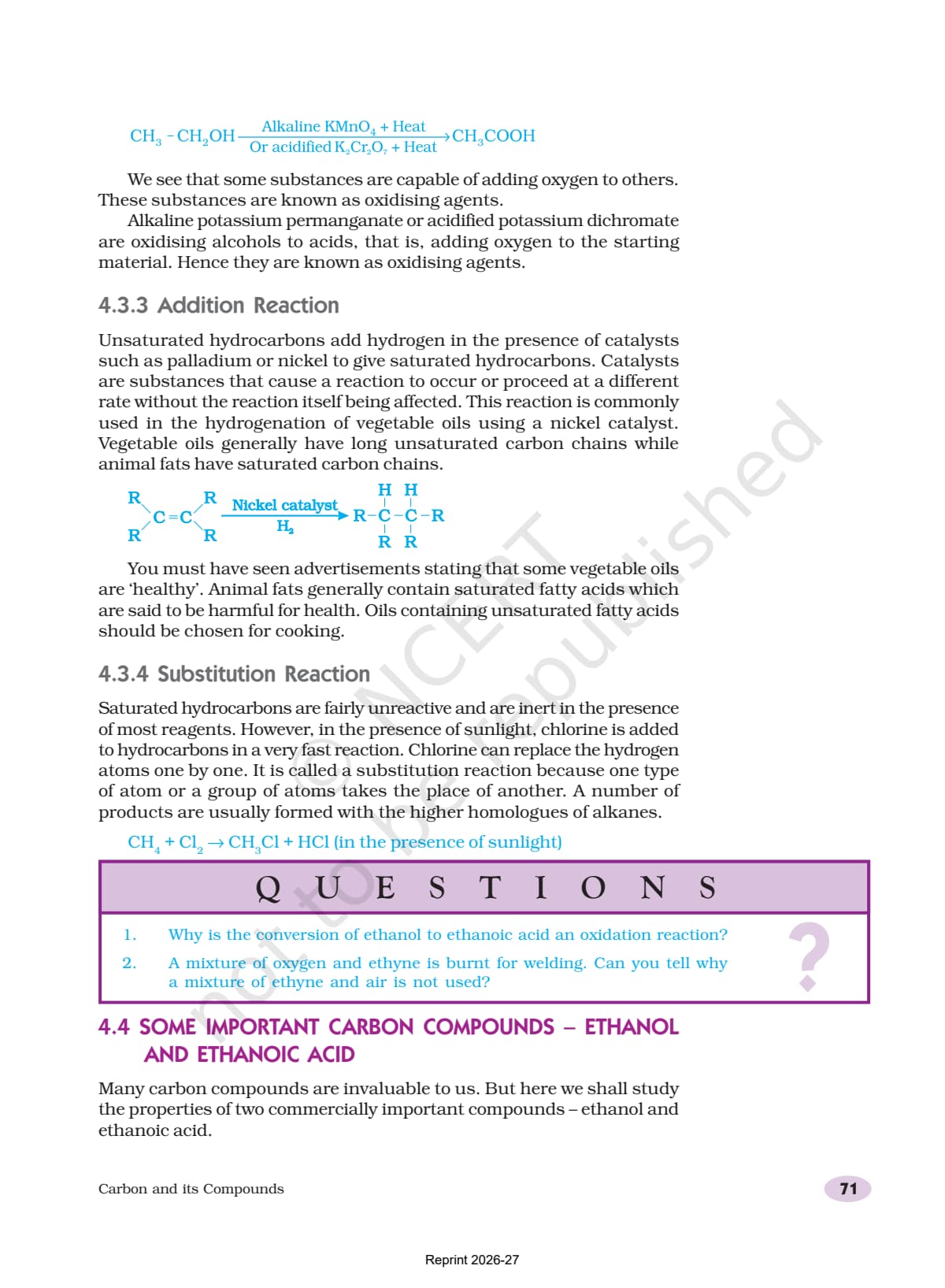
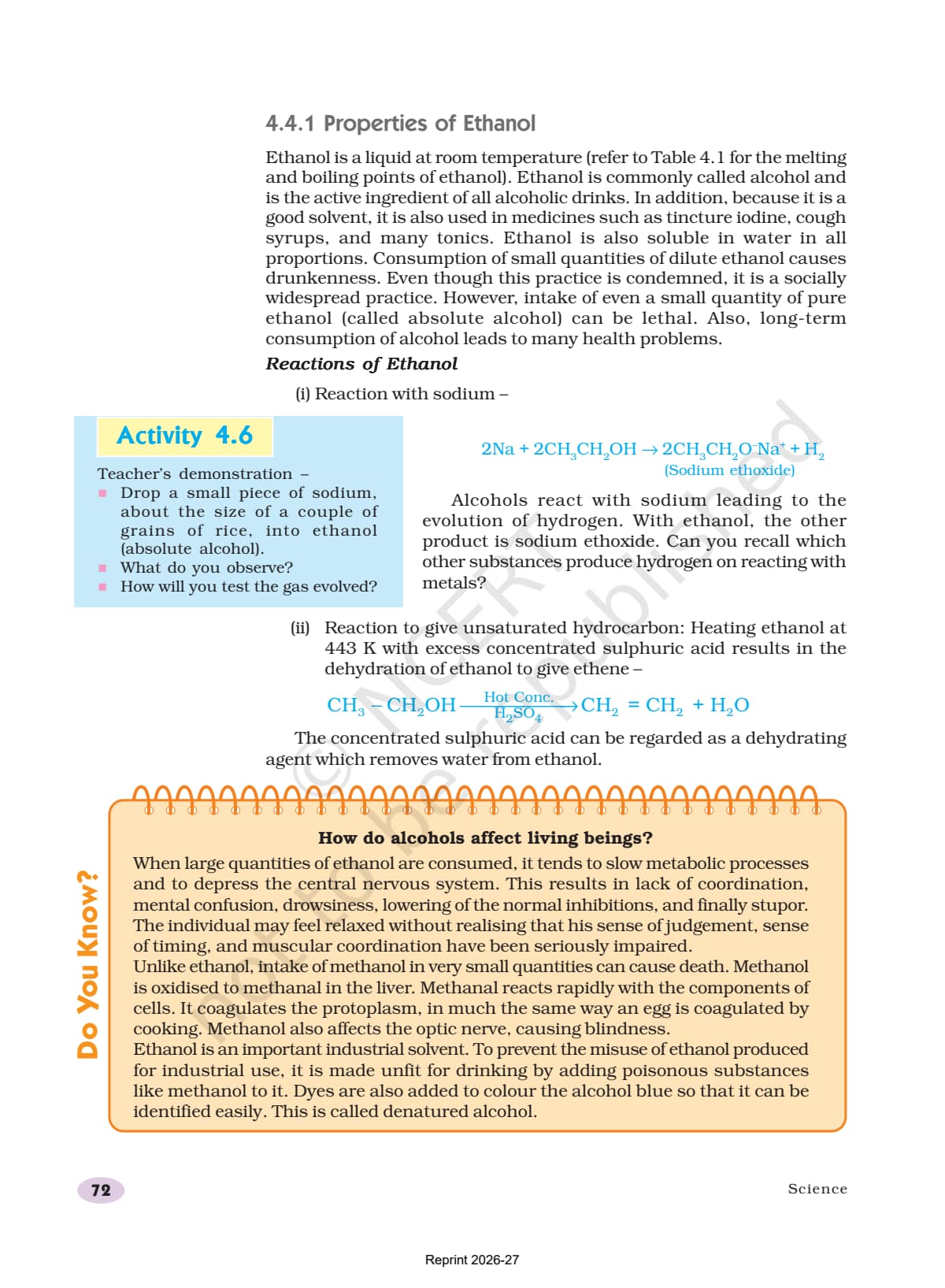
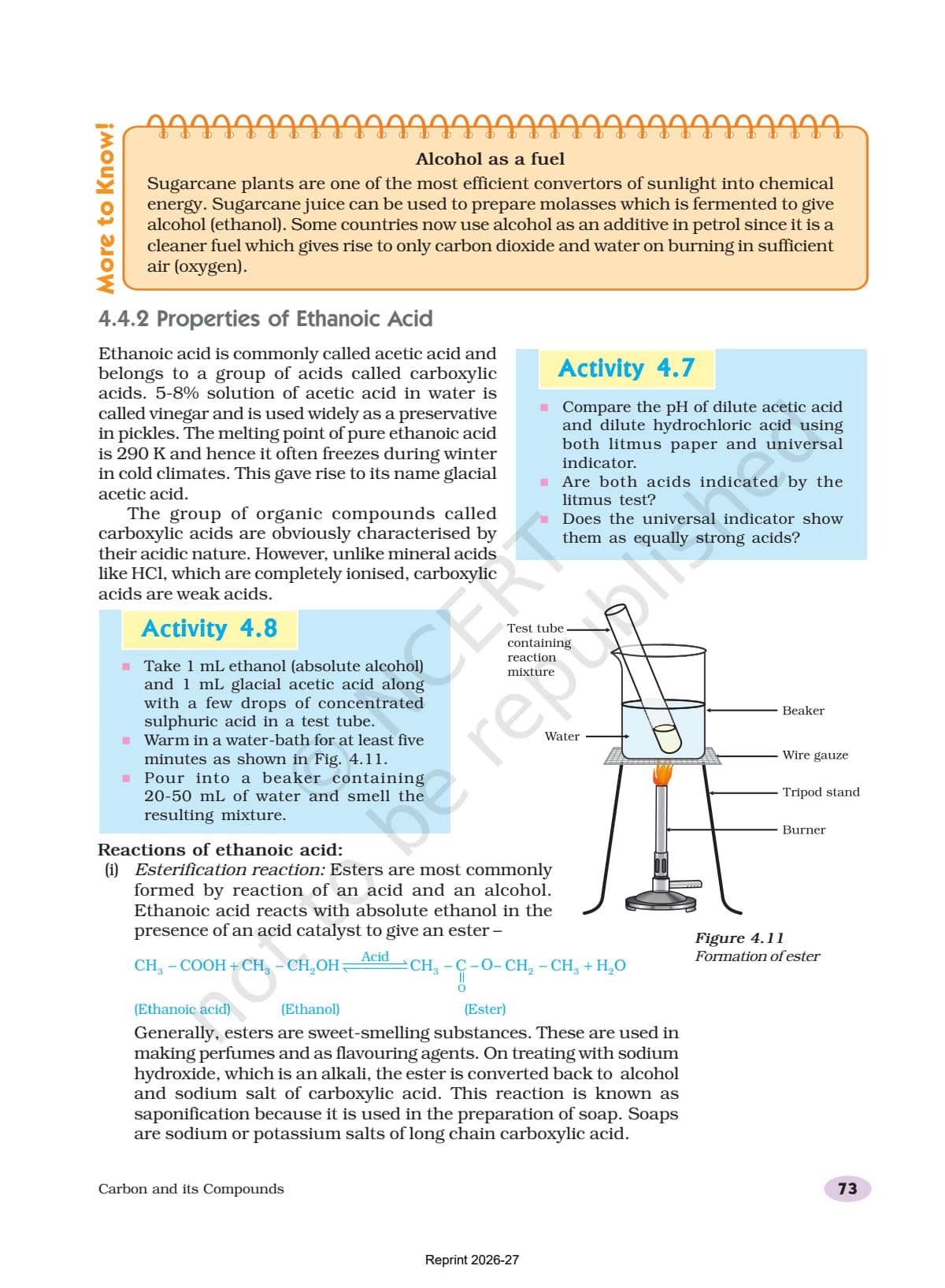
- Official NCERT textbook PDF of Chapter 4, with every activity, figure, in-text question and exercise exactly as printed.
- Covers covalent bonding, allotropes of carbon, catenation and tetravalency, structural isomers, functional groups, the homologous series, nomenclature, and the reactions of ethanol and ethanoic acid.
- Aligned with the 2026-27 CBSE Class 10 Science syllabus, useful for board exam revision and as the base text for the solutions and notes.
This page hosts the official NCERT Class 10 Science textbook chapter, mapped to the 2026-27 CBSE syllabus and checked page by page against the printed Carbon and its Compounds chapter.
Student Feedback: What 11,800 students told us about this chapter
74% of Class 10 students said nomenclature and the homologous series were the parts of this chapter they found hardest to keep straight in class tests. 3 out of 5 students told us drawing the electron dot structures from the official NCERT figures, rather than copying them, was what finally made covalent bonding click.
Students reported spending on average 3 to 4 hours on the full chapter across the first read and revision, and toppers said reading the official book figures for ethanol and ethanoic acid stopped them from writing the wrong reaction product in the board exam.
Source: 2026-27 Class 10 Science student poll. Sample of 11,800 students from CBSE schools across 13 states, taken before the 2026 board exams.
What the NCERT Book for Class 10 Science Chapter 4 Carbon and its Compounds Covers
The PDF above is the complete official NCERT chapter for 2026-27. It moves from how carbon forms bonds, to the allotropes of carbon, why carbon makes millions of compounds, how they are named, and the chemistry of ethanol and ethanoic acid.
- Covalent bonding: how carbon shares its four valence electrons to form single, double and triple bonds.
- Versatile nature: catenation and tetravalency, the two reasons carbon forms so many compounds.
- Functional groups and homologous series: alcohols, aldehydes, ketones and carboxylic acids, and families differing by a CH2 unit.
- Important compounds: ethanol, ethanoic acid, and the cleaning action of soaps and detergents.
Carbon and its Compounds Class 10 Science Full Chapter Video
Source: Magnet Brains on YouTube
Covalent Bonding in Carbon: The Covalent Bond in Class 10 Science
Carbon has the electron arrangement 2,4, giving it four valence electrons. Gaining or losing four electrons is too difficult, so carbon shares its electrons to form covalent bonds, a bond formed by sharing a pair of electrons between two atoms.
A single bond shares one electron pair (CH4), a double bond shares two (O2), and a triple bond shares three (N2). The standard example is methane, CH4: carbon shares one electron pair with each of four hydrogens. Because no ions form, covalent compounds differ from ionic compounds:
- Low melting and boiling points: forces between molecules are weak, so little heat is needed to separate them.
- Poor conductors: no free ions or electrons form, so most carbon compounds do not conduct electricity.
- Mostly molecular: they exist as separate molecules, unlike the giant lattices of ionic solids.
Allotropes of Carbon in Class 10 Science Chapter 4
Carbon occurs in different forms with very different physical properties, called allotropes. The difference is only how the carbon atoms are arranged, which is why the same element can be the hardest substance and also a soft, slippery conductor.
| Allotrope | Structure | Key property |
|---|---|---|
| Diamond | Each carbon bonded to 4 others in a rigid 3D network | Hardest natural substance; does not conduct electricity |
| Graphite | Each carbon bonded to 3 others in hexagonal layers | Soft and slippery; a good conductor of electricity |
| Fullerene (C-60) | Carbon atoms arranged like a football (geodesic dome) | The first identified member of a class of carbon allotropes |
In diamond every carbon uses all four bonds in a tight 3D cage, making it very hard. In graphite each carbon bonds to only three others in flat sheets, and the free fourth electron is why graphite conducts electricity even though it is a non-metal. Both are the same element; only their physical properties differ.
The Versatile Nature of Carbon: Catenation and Tetravalency
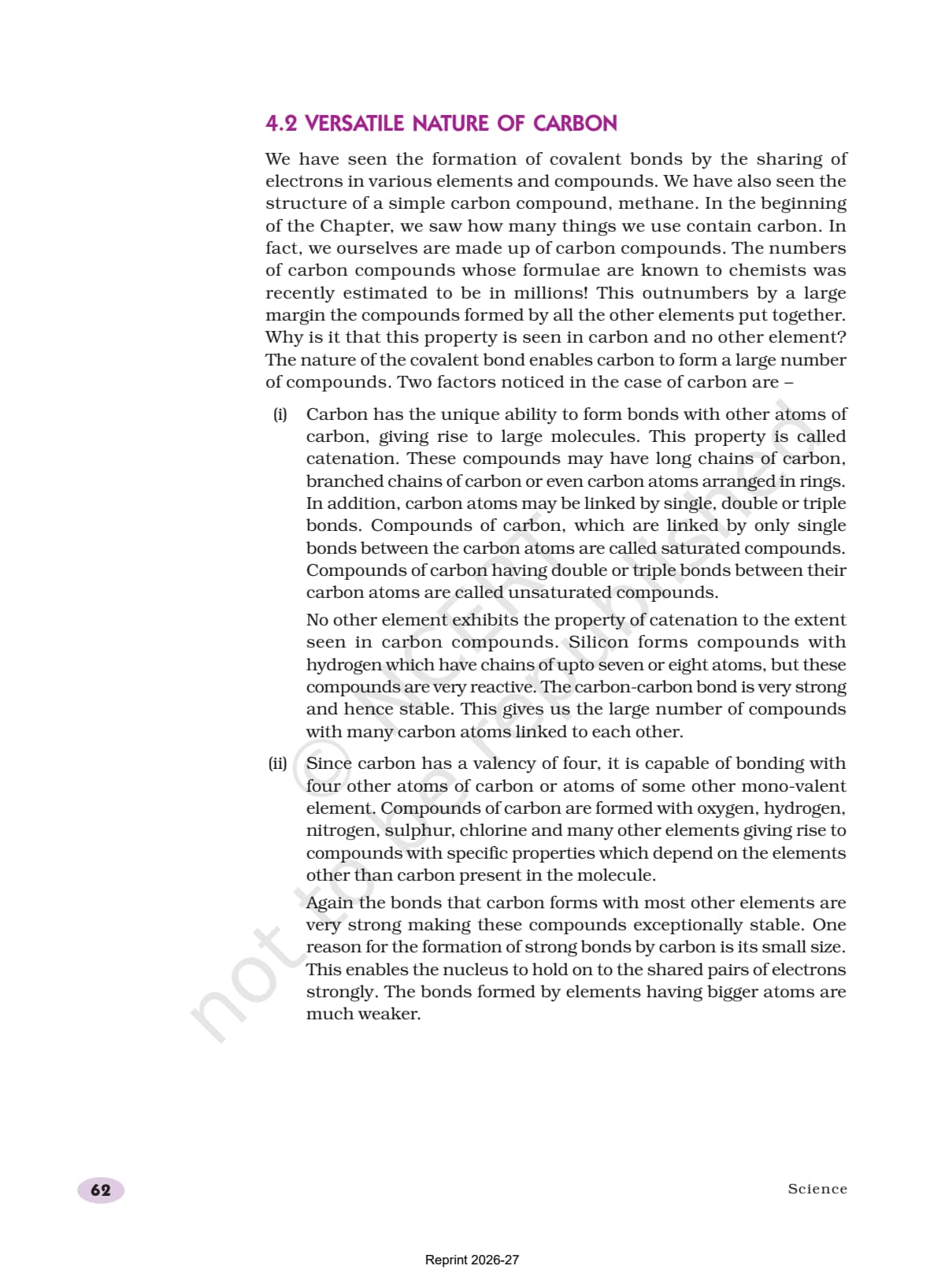
Why does carbon form millions of compounds? The NCERT book gives two reasons, and naming both is worth full marks:
- Catenation: carbon bonds to other carbon atoms to form long chains, branched chains and rings; the C-C bond is strong, so chains do not break easily.
- Tetravalency: carbon has a valency of four, so each atom bonds with four others, of carbon or of elements like hydrogen, oxygen, nitrogen and the halogens.
A third reason is the small size of the carbon atom, which lets the nucleus hold the shared electrons strongly. Molecules of only carbon and hydrogen are called hydrocarbons.
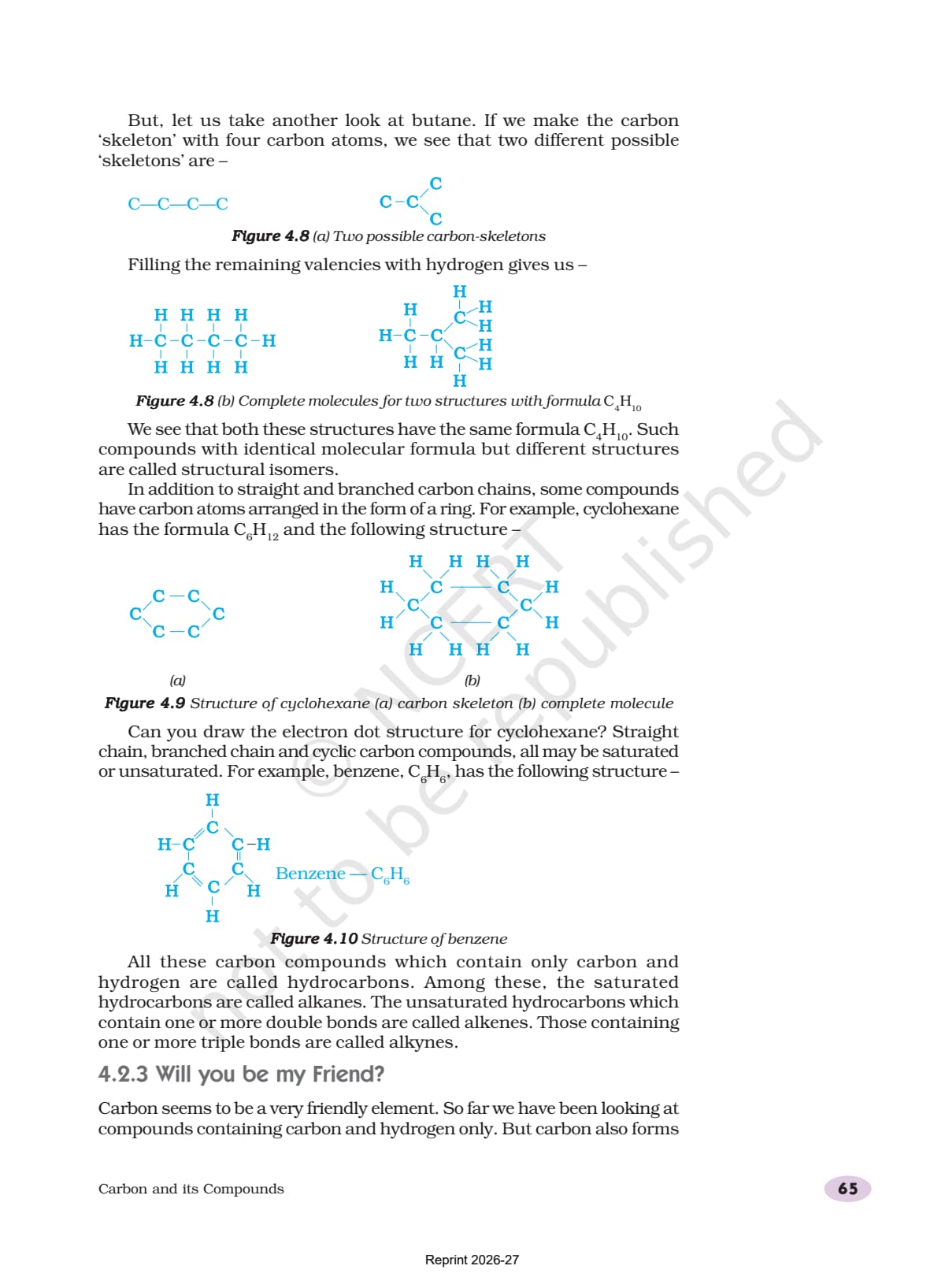
Carbon skeletons can be straight chains, branched chains, or rings such as cyclohexane and benzene. Compounds with the same molecular formula but different structures are called structural isomers; the textbook shows two skeletons for butane, C4H10. Be ready to draw both.
Saturated and Unsaturated Carbon Compounds in Class 10 Science
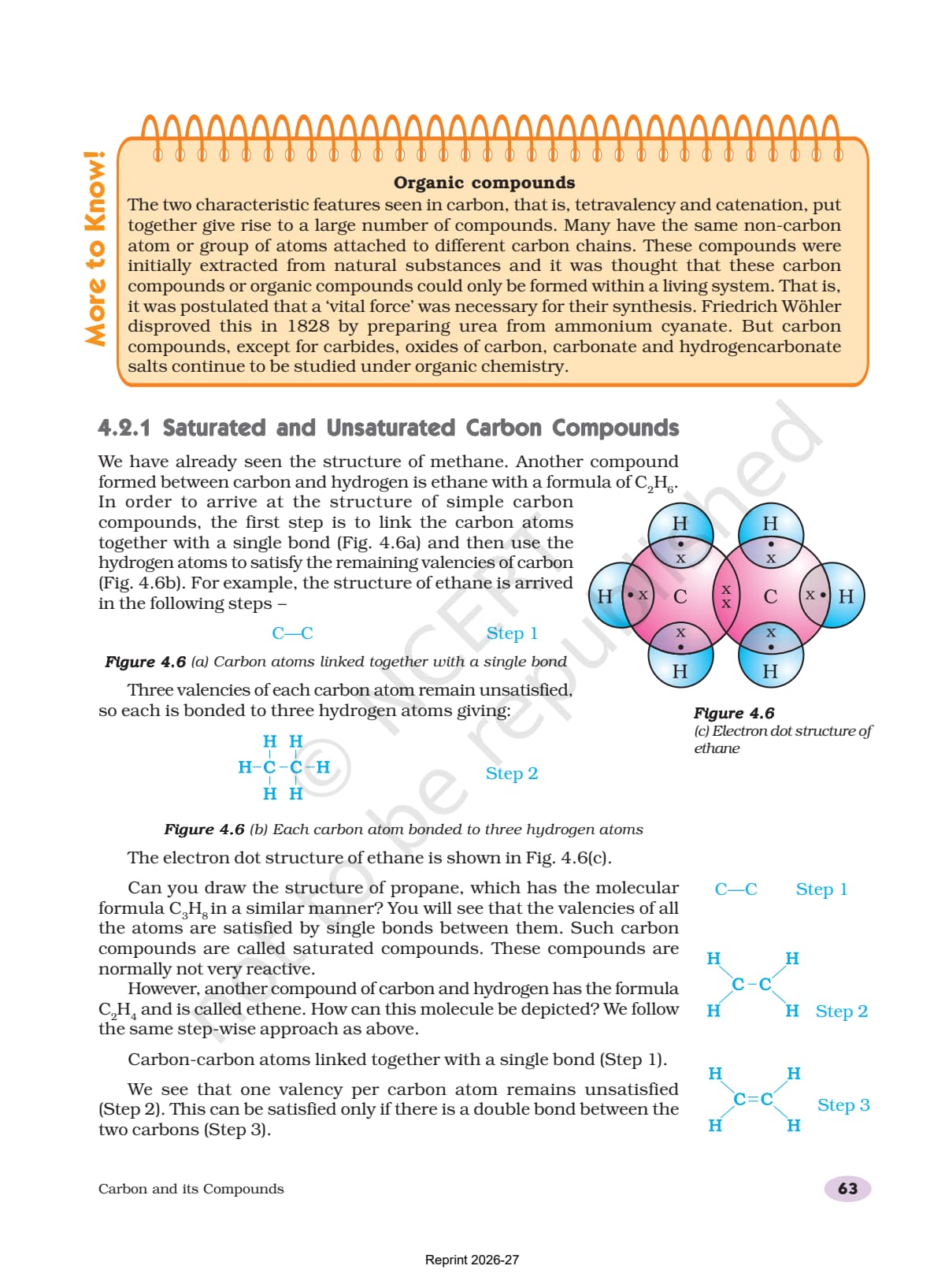
A saturated compound has only single bonds, while an unsaturated compound has at least one double or triple bond. This difference decides how reactive the compound is and how it is named.
| Type | Bond between carbons | Family name and example |
|---|---|---|
| Saturated | Only single bonds (C−C) | Alkanes, e.g. methane CH4, ethane C2H6 |
| Unsaturated (double) | At least one double bond (C=C) | Alkenes, e.g. ethene C2H4 |
| Unsaturated (triple) | At least one triple bond (C≡C) | Alkynes, e.g. ethyne C2H2 |
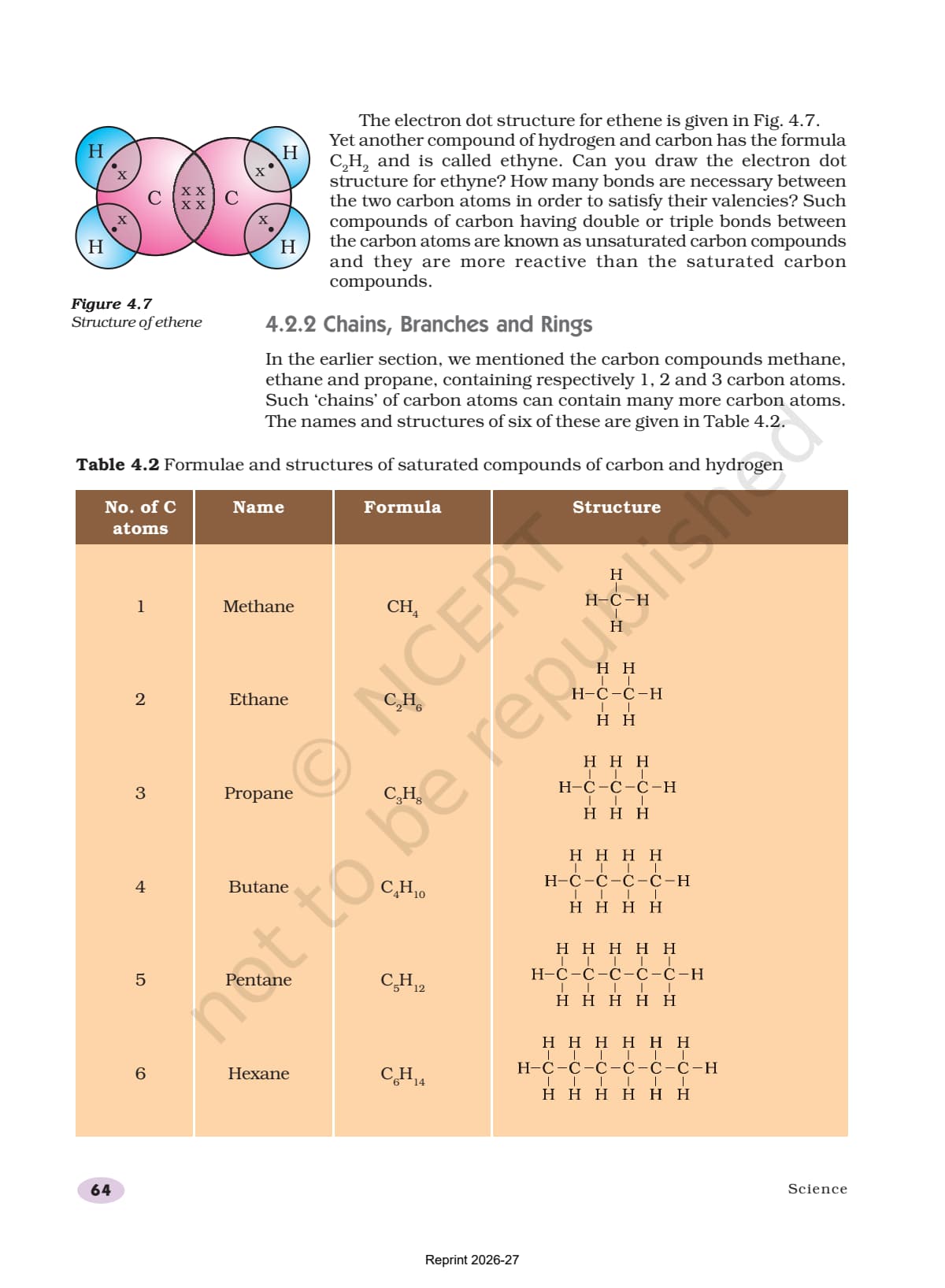
The general formula for alkenes is CnH2n. The simplest members are ethane, ethene and ethyne. Saturated hydrocarbons are not very reactive; unsaturated ones are more reactive, which is why ethene and ethyne undergo addition reactions but ethane does not.
Functional Groups and the Homologous Series in Class 10 Science Chapter 4
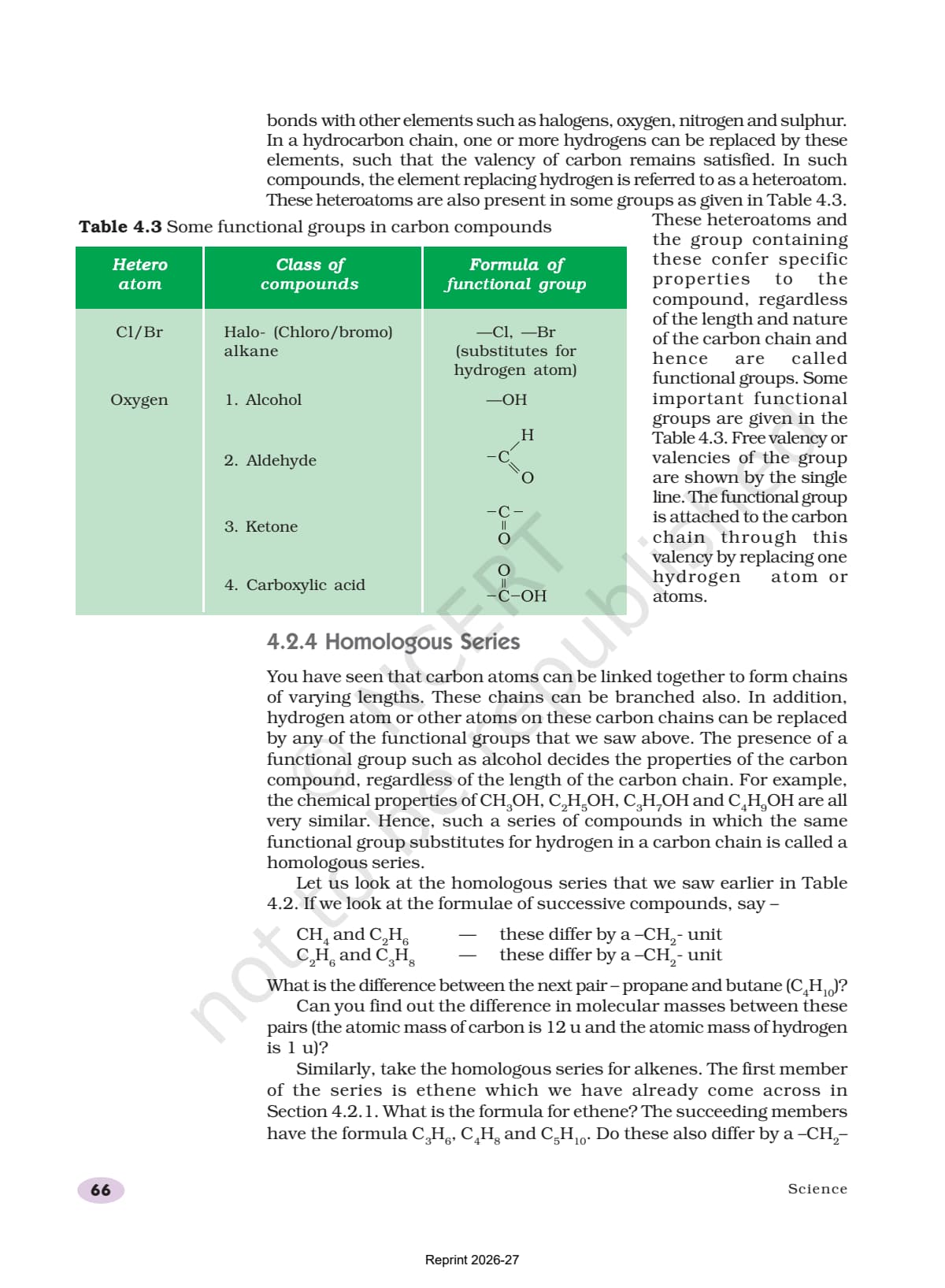
The functional group decides the chemistry of a carbon compound. One or more hydrogen atoms in the chain are replaced by another atom or group, which gives the compound its specific properties, whatever the chain length.
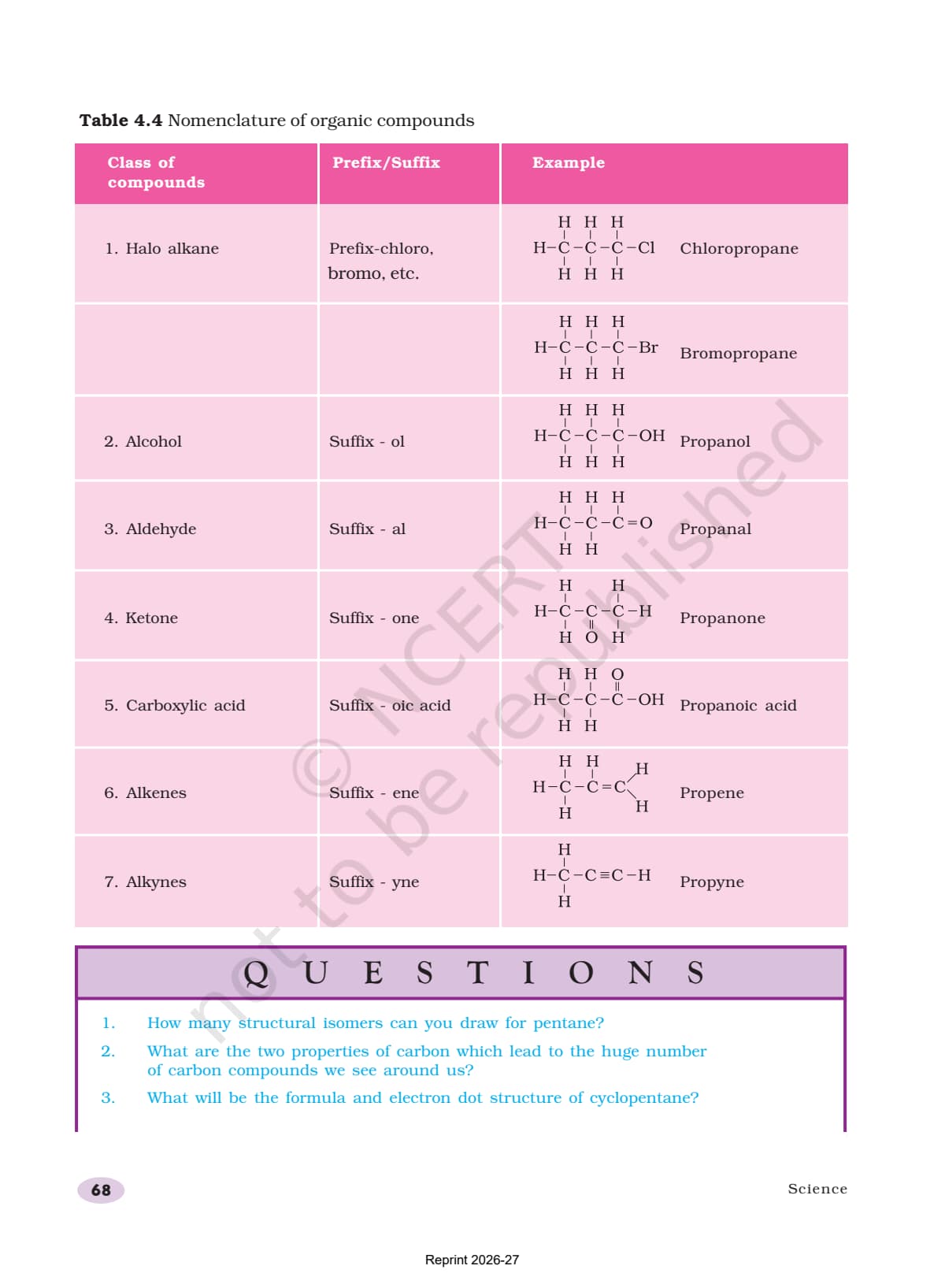
| Class of compound | Functional group | Suffix or prefix |
|---|---|---|
| Haloalkane | −Cl, −Br | Prefix: chloro-, bromo- |
| Alcohol | −OH | Suffix: -ol |
| Aldehyde | −CHO | Suffix: -al |
| Ketone | −CO− | Suffix: -one |
| Carboxylic acid | −COOH | Suffix: -oic acid |
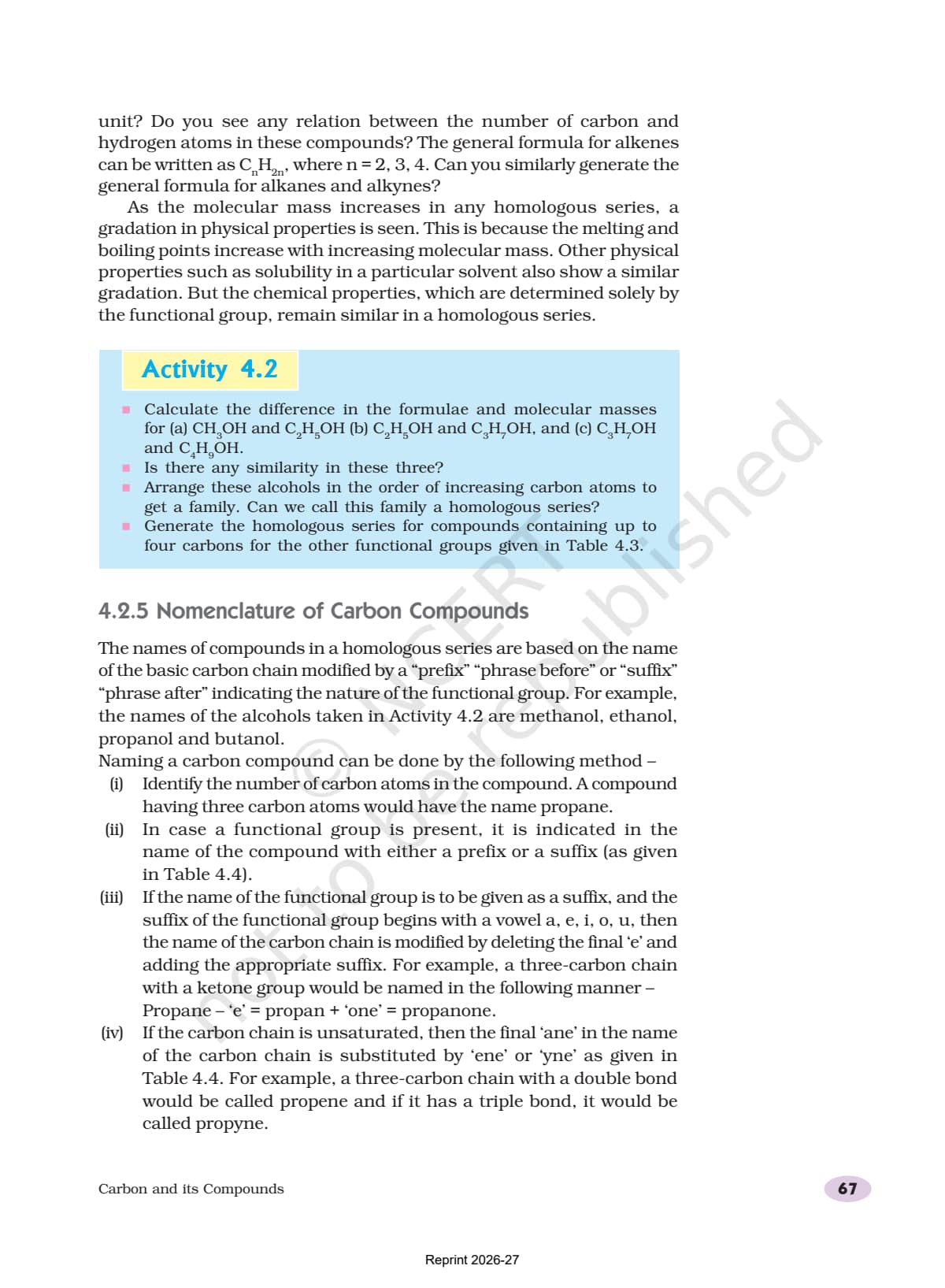
A homologous series is a series of compounds with the same functional group, where each member differs from the next by a −CH2− unit (mass 14 u). Methanol, ethanol, propanol and butanol all share the −OH group and have similar chemical properties; melting and boiling points rise along the series, but the chemistry stays the same.
For nomenclature, count the carbon atoms for the chain name, then add a prefix or suffix for the functional group. If the suffix begins with a vowel, the final "e" is dropped: a three-carbon ketone is propanone (likewise propanol, propanal, propanoic acid).
Chemical Properties of Carbon Compounds in Class 10 Science
Four reactions are tested almost every year: combustion, oxidation, addition and substitution, each with a standard balanced example.
| Reaction | What happens | NCERT example |
|---|---|---|
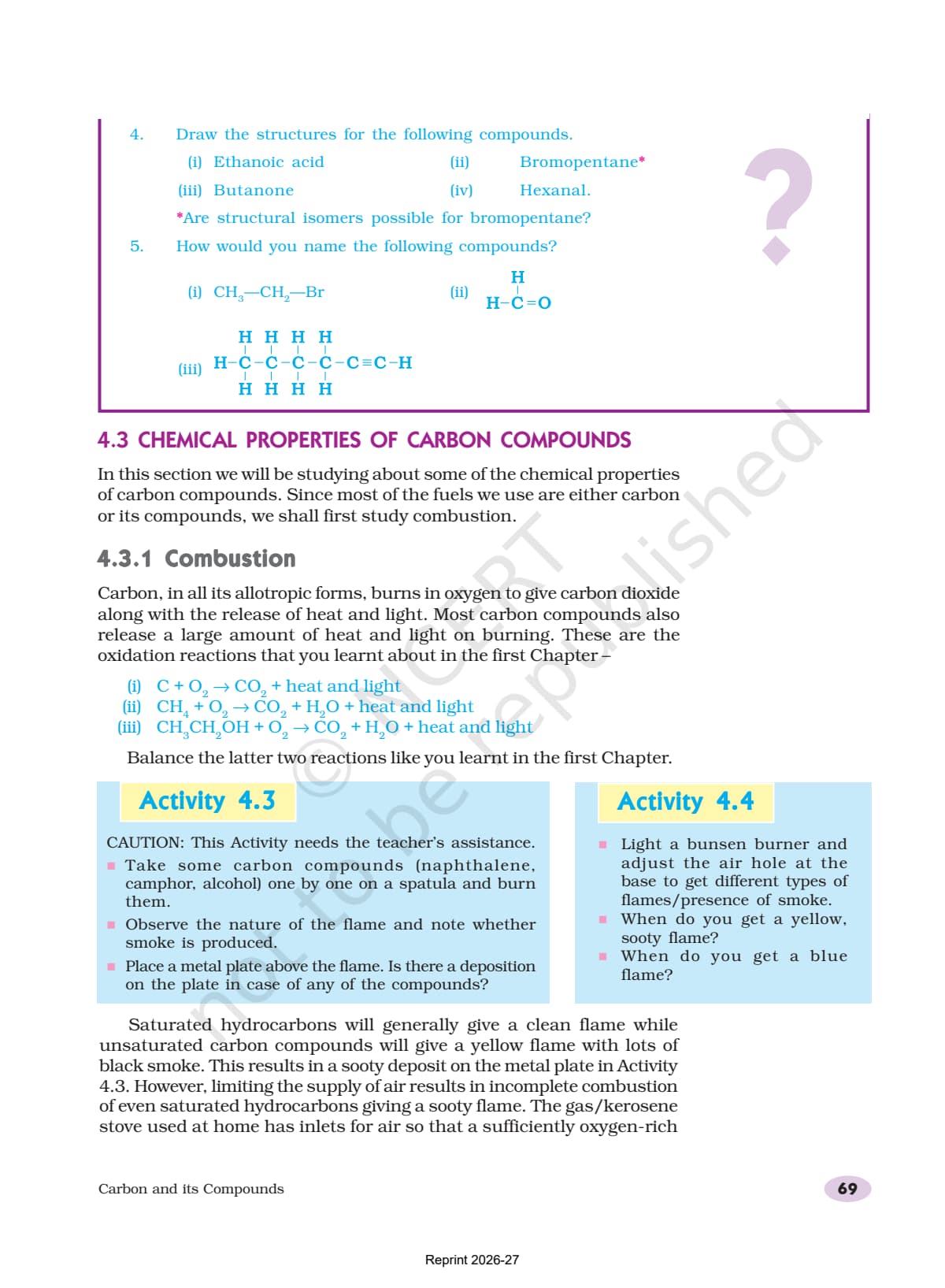
| Combustion | Burns in oxygen, giving CO2, water, heat and light | CH4 + 2O2 → CO2 + 2H2O |
| Oxidation | Alcohol is oxidised to a carboxylic acid | Ethanol → ethanoic acid (with alkaline KMnO4) |
| Addition | Unsaturated compound adds hydrogen to become saturated | Vegetable oil + H2 → vegetable ghee (Ni catalyst) |
| Substitution | One atom replaces another in a saturated compound | CH4 + Cl2 → CH3Cl + HCl (in sunlight) |
Saturated hydrocarbons burn with a clean blue flame, unsaturated ones with a yellow, sooty flame. Oxidising agents like alkaline KMnO4 convert ethanol to ethanoic acid. Addition hardens vegetable oils into vanaspati ghee with a nickel catalyst; substitution replaces methane's hydrogens with chlorine in sunlight.
Ethanol, Ethanoic Acid, Soaps and Detergents in Class 10 Science
Ethanol (CH3CH2OH) is a liquid alcohol and good solvent. Ethanoic acid (CH3COOH), or acetic acid, is a weak carboxylic acid; a 5 to 8 percent solution is vinegar, and pure ethanoic acid is called glacial acetic acid.
| Reaction | Compound | NCERT equation |
|---|---|---|
| Dehydration | Ethanol (hot conc. H2SO4) | CH3CH2OH → CH2=CH2 + H2O |
| Esterification | Ethanoic acid + ethanol | CH3COOH + C2H5OH → ester + H2O |
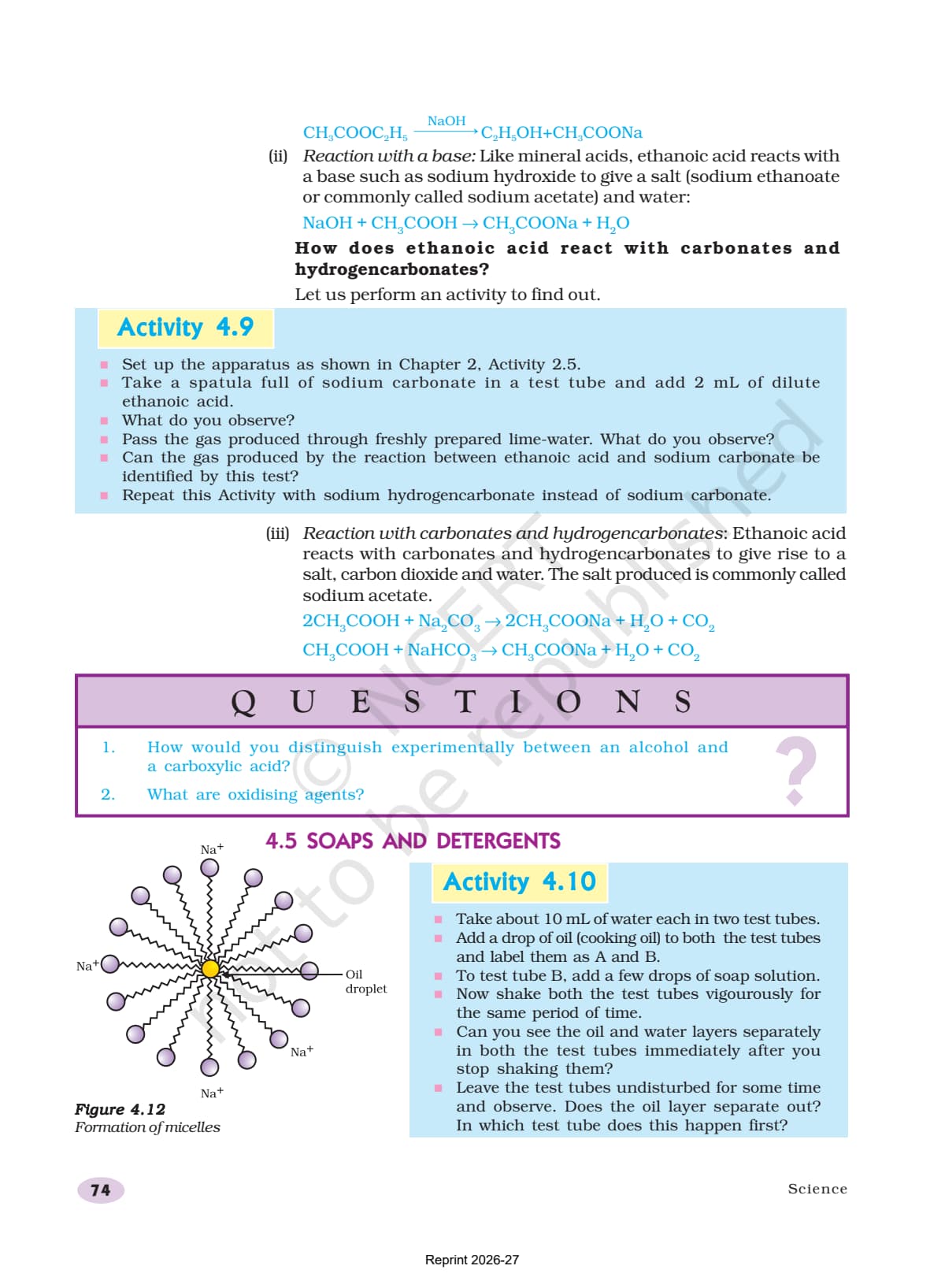
| With carbonate | Ethanoic acid | 2CH3COOH + Na2CO3 → 2CH3COONa + H2O + CO2 |
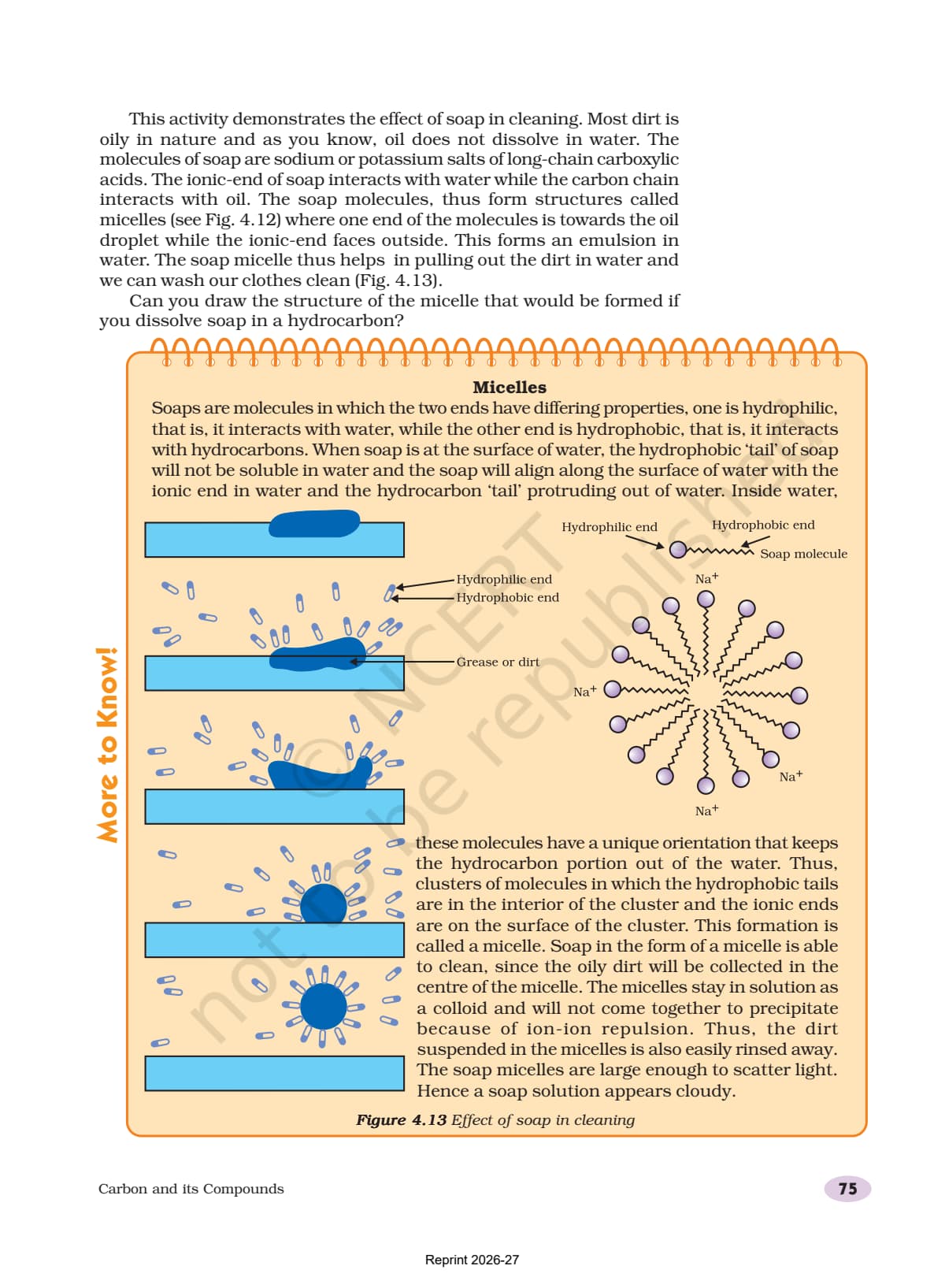
Ethanoic acid plus an alcohol forms a sweet-smelling ester (esterification); the reverse with NaOH is saponification, used to make soap. Soaps are salts of long-chain carboxylic acids; each molecule has a water-loving ionic end and an oil-loving tail.
- Micelle formation: soap molecules cluster with tails toward the oily dirt and ionic heads out, forming a micelle that lifts the dirt away.
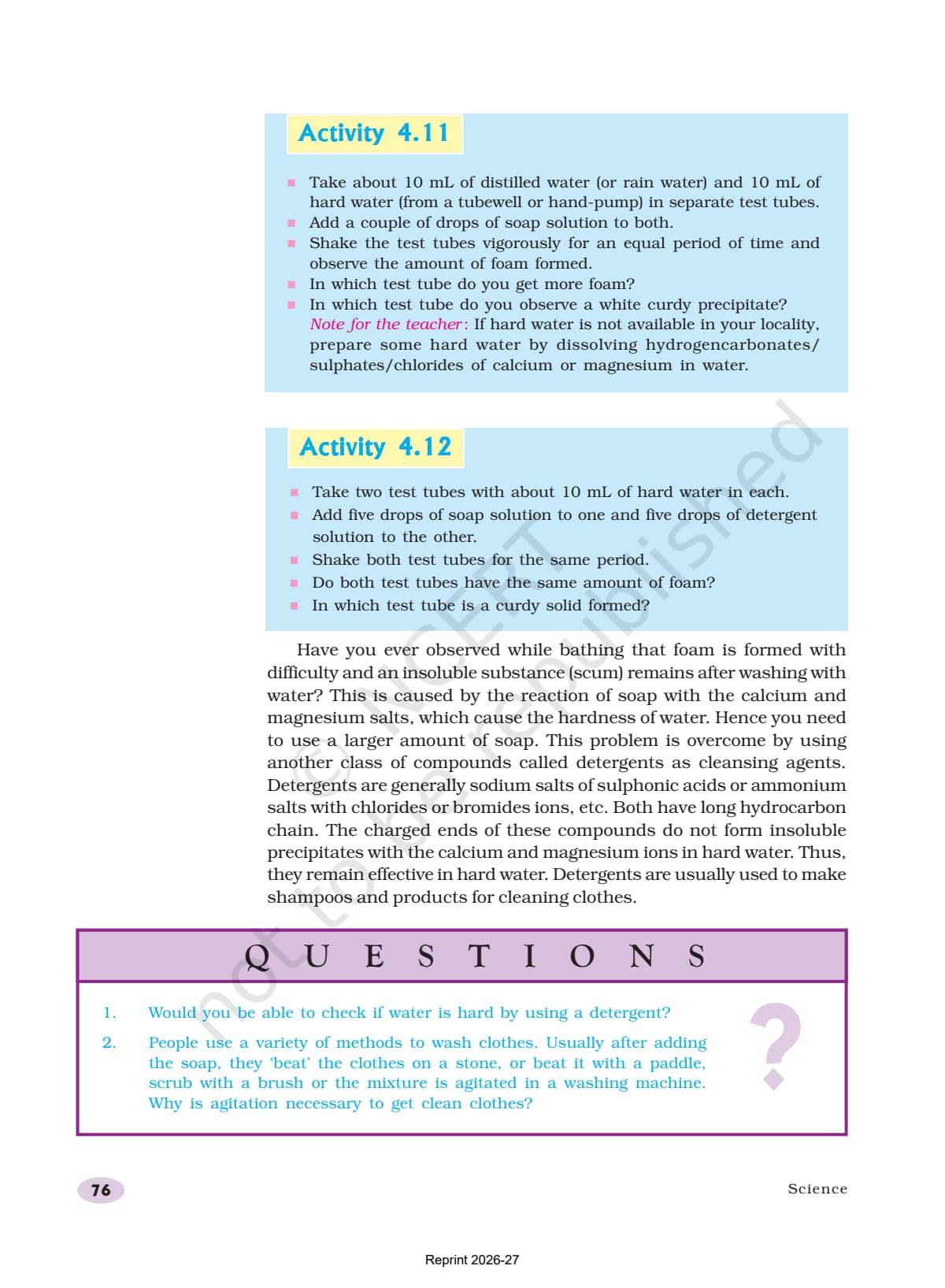
- Hard water problem: soap reacts with calcium and magnesium salts to form an insoluble scum, wasting soap.
- Detergents: do not form a scum, so they work even in hard water.
Other Resources for Class 10 Science Chapter 4 Carbon and its Compounds
Read the official NCERT Book chapter above, then revise with the matching NCERT Solutions, revision notes, formula sheet and handwritten notes. All resources for Class 10 Science Chapter 4 Carbon and its Compounds are linked in the table below.
| Resource | What it covers | Open |
|---|---|---|
| NCERT Book PDF | Official Class 10 Science Chapter 4 textbook, with every activity, figure and exercise. | You are here |
| NCERT Solutions | Step-by-step answers to all in-text and exercise questions of the chapter. | Class 10 Science Chapter 4 NCERT Solutions |
| Notes | Concept-first revision notes on covalent bonding, functional groups and nomenclature. | Class 10 Science Chapter 4 Notes |
| Formula Sheet | Quick reference of key reactions, general formulae and the homologous series for fast revision. | Class 10 Science Chapter 4 Formula Sheet |
| Handwritten Notes | Scanned-style handwritten pages for last-minute board revision. | Class 10 Science Chapter 4 Handwritten Notes |
NCERT Book for Class 10 Science: All Chapters
Related Links: Use the table below to open the official NCERT Book PDF for the other chapters of Class 10 Science. Every chapter ships with the same official textbook PDF, chapter overview, and board-ready FAQ.
| Chapter | NCERT Book PDF link |
|---|---|
| Chapter 1 | Chemical Reactions and Equations NCERT Book PDF |
| Chapter 2 | Acids, Bases and Salts NCERT Book PDF |
| Chapter 3 | Metals and Non-metals NCERT Book PDF |
| Chapter 4 | Carbon and its Compounds NCERT Book PDF (You are here) |
| Chapter 5 | Life Processes NCERT Book PDF |
| Chapter 6 | Control and Coordination NCERT Book PDF |
| Chapter 7 | How do Organisms Reproduce NCERT Book PDF |
| Chapter 8 | Heredity NCERT Book PDF |
| Chapter 9 | Light Reflection and Refraction NCERT Book PDF |
| Chapter 10 | The Human Eye and the Colourful World NCERT Book PDF |
| Chapter 11 | Electricity NCERT Book PDF |
| Chapter 12 | Magnetic Effects of Electric Current NCERT Book PDF |
| Chapter 13 | Our Environment NCERT Book PDF |
NCERT Book Class 10 Science Chapter 4 Carbon and its Compounds FAQs
Ques. What does Chapter 4 Carbon and its Compounds cover in the Class 10 Science NCERT Book?
Ans. Chapter 4 of the Class 10 Science NCERT Book covers the chemistry of carbon and the compounds it forms. It explains the covalent bond and how carbon shares its four valence electrons to form single, double and triple bonds, the allotropes of carbon such as diamond, graphite and fullerene, and the versatile nature of carbon through catenation and tetravalency. It then covers saturated and unsaturated compounds, structural isomers, functional groups, the homologous series and nomenclature, the chemical properties of carbon compounds, and finally the properties of ethanol and ethanoic acid and the cleaning action of soaps and detergents. The chapter is aligned with the 2026-27 CBSE syllabus.
Ques. Why does carbon form a large number of compounds in Class 10 Science Chapter 4?
Ans. Carbon forms a very large number of compounds because of two properties. The first is catenation, the unique ability of carbon to bond with other carbon atoms to form long chains, branched chains and rings, since the carbon-carbon bond is very strong and stable. The second is tetravalency, because carbon has a valency of four and can bond with four other atoms, of carbon or of elements like hydrogen, oxygen, nitrogen, sulphur and the halogens. The small size of the carbon atom also lets it form very strong, stable bonds, which is why the number of carbon compounds runs into millions.
Ques. What is the difference between saturated and unsaturated carbon compounds?
Ans. A saturated carbon compound has only single bonds between its carbon atoms, while an unsaturated carbon compound has at least one double or triple bond between its carbon atoms. Saturated hydrocarbons are called alkanes, for example methane and ethane, and they are usually not very reactive. Unsaturated hydrocarbons with a double bond are alkenes, like ethene, and those with a triple bond are alkynes, like ethyne, and they are more reactive. Because of this, unsaturated compounds take part in addition reactions while saturated compounds take part in substitution reactions.
Ques. What is a homologous series in Class 10 Science Chapter 4?
Ans. A homologous series is a series of carbon compounds that have the same functional group, in which each member differs from the next by a CH2 unit, which adds a mass of 14 u. For example, the alcohols methanol, ethanol, propanol and butanol all contain the OH group and form a homologous series. The members of a homologous series have similar chemical properties because the chemistry is decided by the functional group, while their physical properties such as melting point and boiling point change gradually as the molecular mass increases along the series.
Ques. What is the difference between diamond and graphite in Class 10 Science?
Ans. Diamond and graphite are both allotropes of carbon, so they are the same element with the same chemical properties but very different physical properties because the carbon atoms are arranged differently. In diamond, each carbon atom is bonded to four other carbon atoms in a rigid three-dimensional network, which makes it the hardest natural substance and a non-conductor of electricity. In graphite, each carbon atom is bonded to only three others in flat hexagonal layers, leaving a free electron, which makes graphite soft, slippery and a good conductor of electricity even though it is a non-metal.
Ques. How can you distinguish between ethanol and ethanoic acid in Class 10 Science?
Ans. Ethanol and ethanoic acid can be told apart by the sodium hydrogencarbonate test. When sodium hydrogencarbonate is added to ethanoic acid, it reacts to give carbon dioxide gas with brisk effervescence, and the gas turns lime-water milky. Ethanol does not react with sodium hydrogencarbonate, so no gas is produced. Another difference is that ethanoic acid turns blue litmus red because it is an acid, while ethanol is neutral and does not. Ethanoic acid is the weak carboxylic acid found in vinegar, while ethanol is the alcohol found in alcoholic drinks.
Ques. Is the Class 10 Science Chapter 4 NCERT Book PDF free to download for 2026-27?
Ans. Yes. The official NCERT Book PDF for Class 10 Science Chapter 4 Carbon and its Compounds is free to read and download on this page for the 2026-27 session. It is the complete chapter as printed in the CBSE textbook, including every activity, figure, in-text question and end-of-chapter exercise. You can pair the book with the linked NCERT Solutions and revision notes for the same chapter so that you read the textbook and revise from one place.
Ques. Are these NCERT Book contents aligned with the 2026-27 CBSE syllabus?
Ans. Yes. This page hosts the official NCERT Class 10 Science textbook chapter for the current 2026-27 CBSE syllabus. The Carbon and its Compounds chapter is unchanged for this cycle, so the covalent bonding, allotropes, functional groups, nomenclature and reactions you read here are exam-correct. Because it is the official book, it is the safest base text for board preparation, and the linked solutions, notes and formula sheet for the same chapter all follow this textbook order.



Comments