




These on the face of it class 12 notes follow the 2026-27 NCERT Vistas print and condense Susan Hill's radio play into an exam-ready revision set. They move through four passes CBSE markers reward: context, plot, character arcs, and theme-tagged value points.
- CBSE Weightage: 6 marks per Vistas Long Answer in Section C, from the Reading with Insight questions
- Coverage: 8 sections, character sketches, a scene-by-scene plot map, and a sample 6-mark answer
These Collegedunia notes are curated by senior English educators and mapped to the 2026-27 NCERT Vistas textbook.
On the Face of It Class 12 Notes: What the Chapter Covers
On the Face of It is Chapter 5 of the Class 12 Vistas reader, a one-act BBC radio play by Susan Hill (b. 1942). Derry, a fourteen-year-old whose face is burnt by acid, climbs into the garden of Mr Lamb, an old man with a tin leg. The two outsiders meet, argue, and almost reach a friendship before Mr Lamb's fall from the ladder ends the play.
| Section | What It Covers | Mark Yield |
|---|---|---|
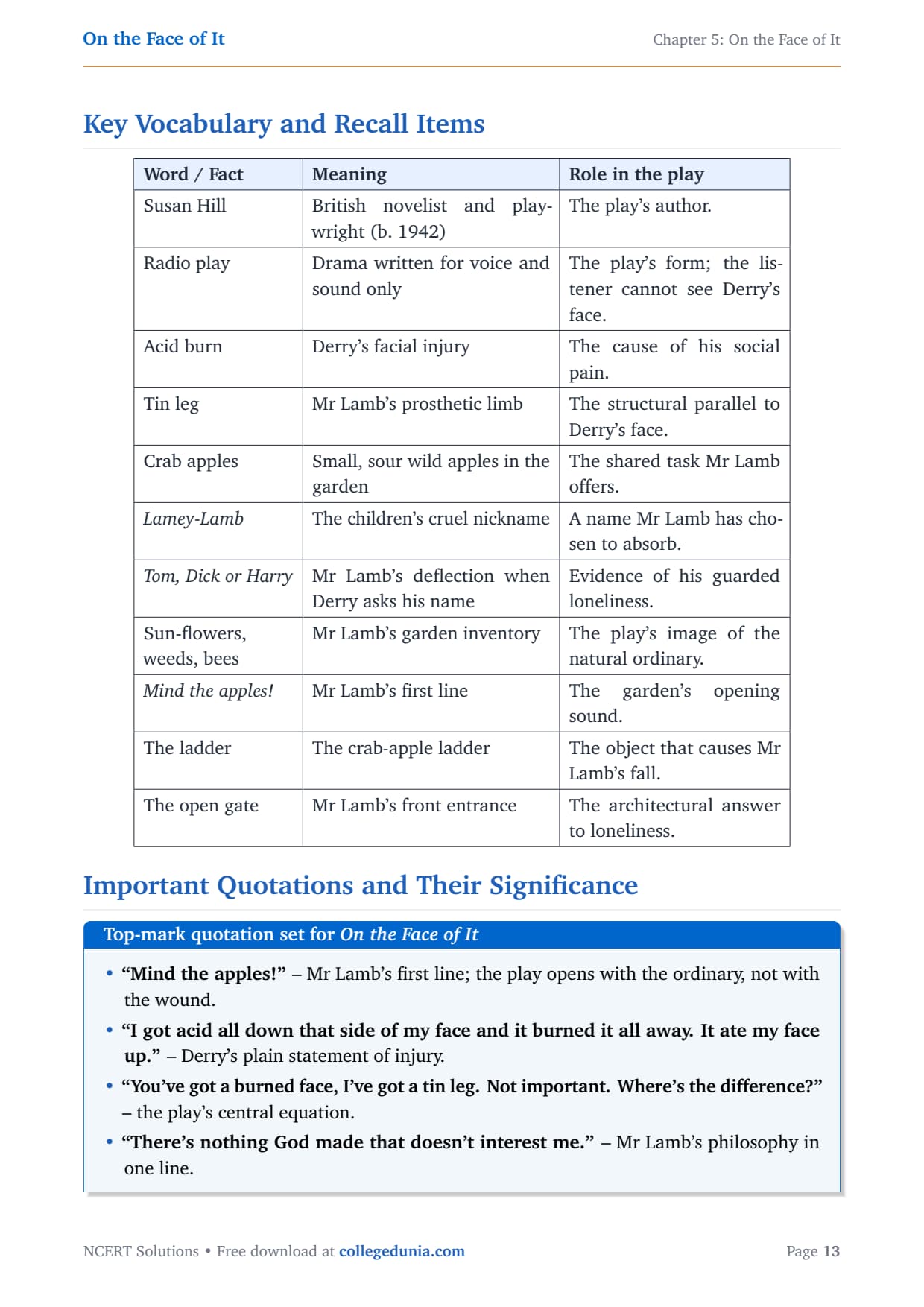
| Setting and Author | Susan Hill; radio-play form; garden and Derry's house | 1-2 MCQ |
| Plot Summary | The garden meeting, the mother's showdown, the fall | 2-3 SA |
| Character of Derry | Withdrawn, defiant, articulate | 3-6 LA |
| Character of Mr Lamb | Hospitable, refuses bitterness, quietly lonely | 3-6 LA |
| Themes | Disability, loneliness, self-image, friendship, nature | 4-6 LA |
| Literary Devices | Radio-play form, symbolism, open ending | 2-3 SA |
On the Face of It Video Explanation (Class 12 English)
Source: Magnet Brains on YouTube
The Four-Pass Framework for Reading and Revising On the Face of It
Every Vistas chapter breaks into the same four passes, applied in fixed order. The mnemonic here is C-P-C-T.
- Context. Learn the radio-play form, the garden setting, Derry's acid burn, and Mr Lamb's tin leg.
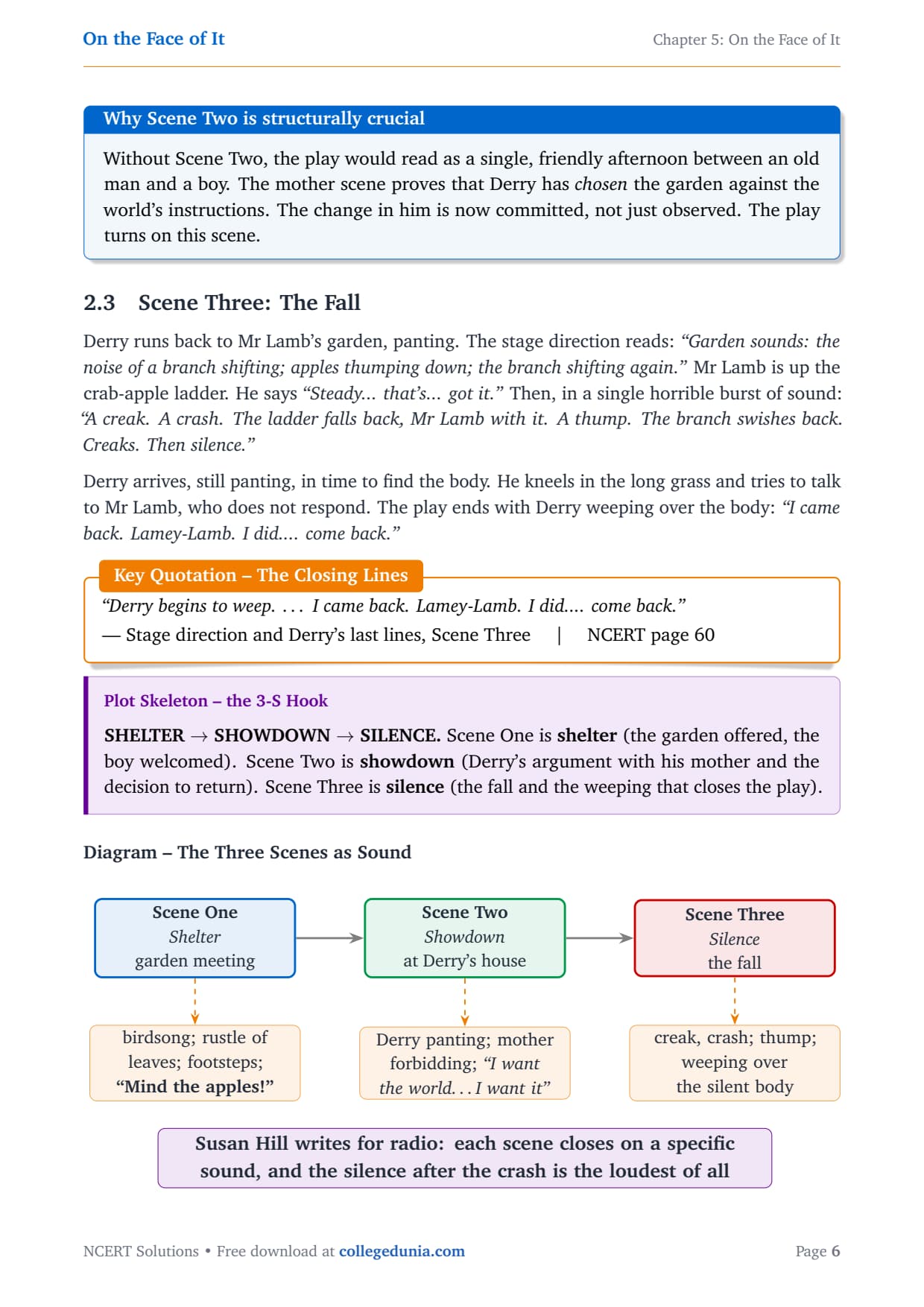
- Plot. Walk the three scenes: the garden meeting, the showdown with the mother, the fall.
- Character. Track Derry's arc and Mr Lamb's arc through their markers.
- Theme. Tag every quotation with one of five themes: disability, loneliness, self-image, friendship, nature.
Setting: Mr Lamb's Garden and Derry's House
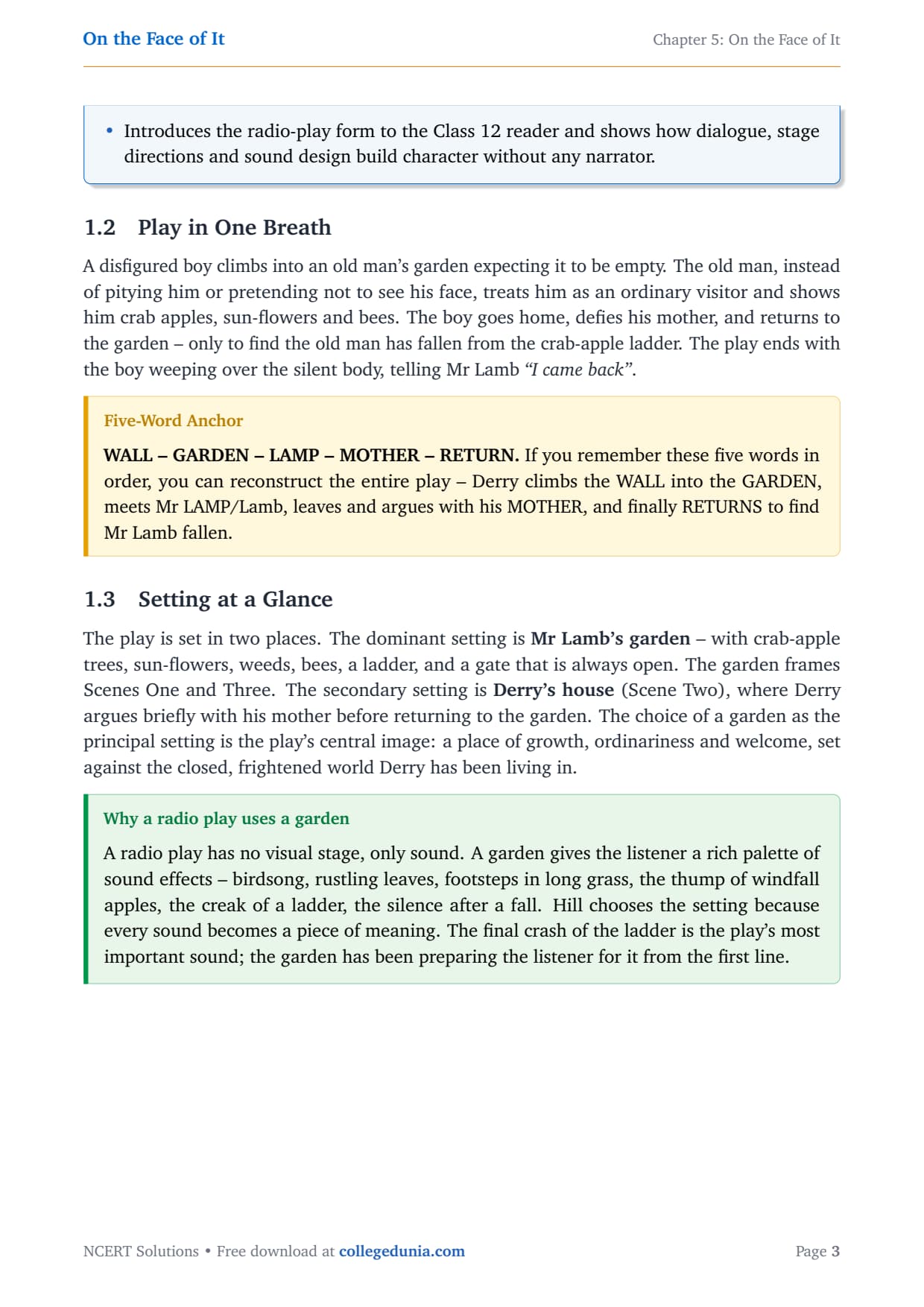
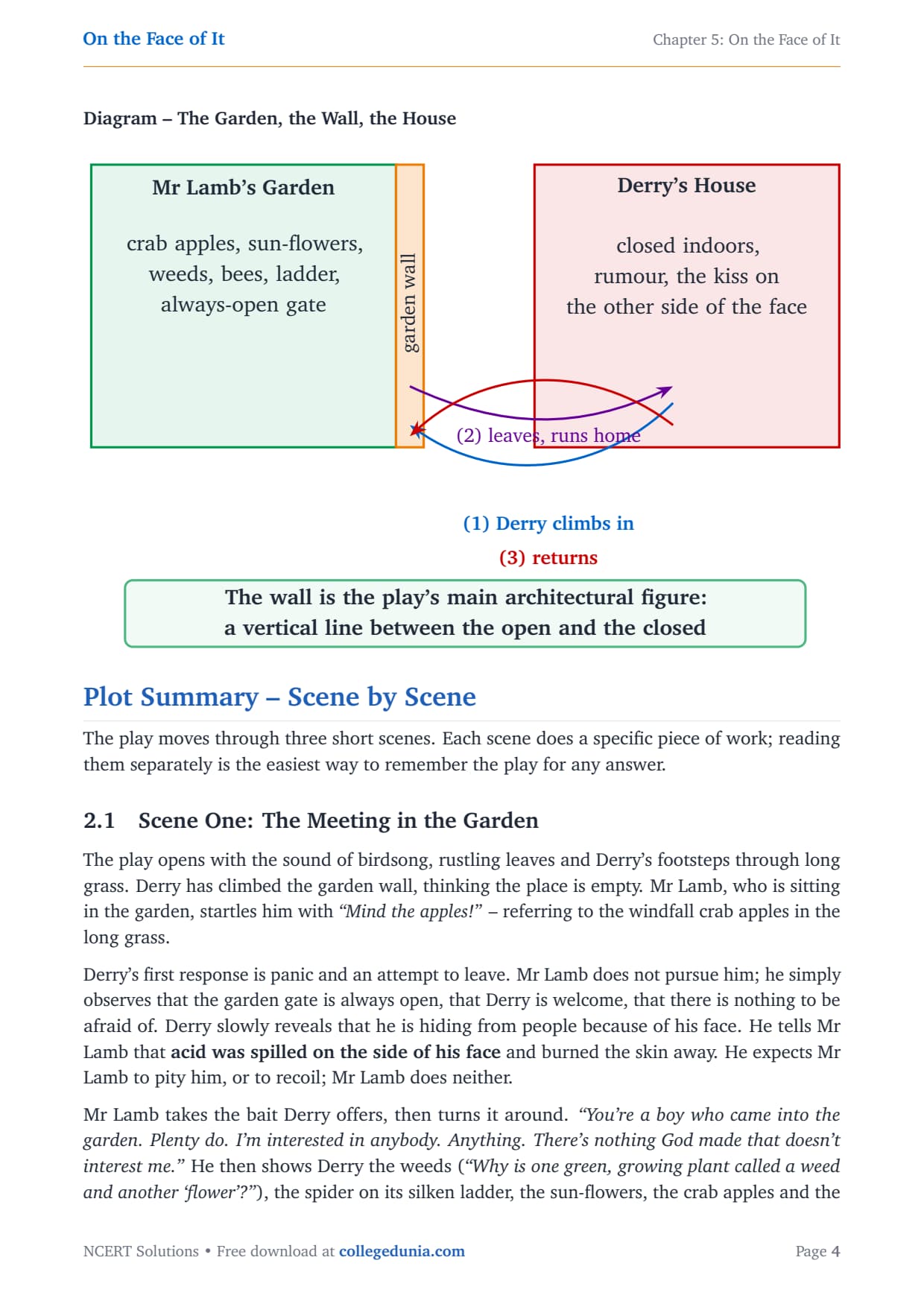
The play has two places. The main setting is Mr Lamb's garden, full of crab-apple trees, sunflowers, bees, and a gate that is always open (Scenes One and Three). The second is Derry's house (Scene Two). The garden, a place of growth and welcome, stands against the closed world Derry has been hiding in. Because it is a radio play, the garden works through sound: birdsong, windfall apples, and the silence after the fall.
Character Sketch: Derry, the Withdrawn Adolescent
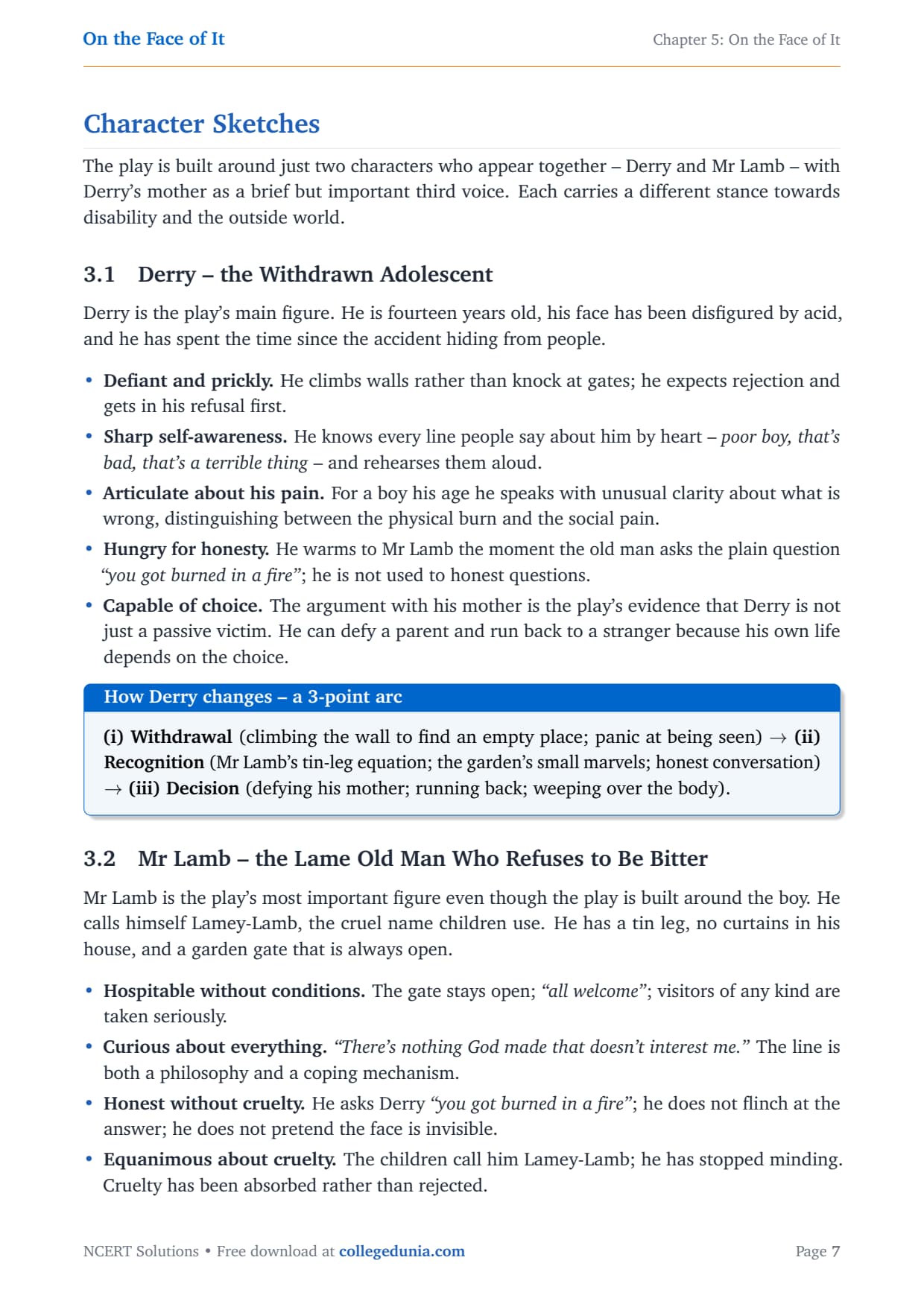
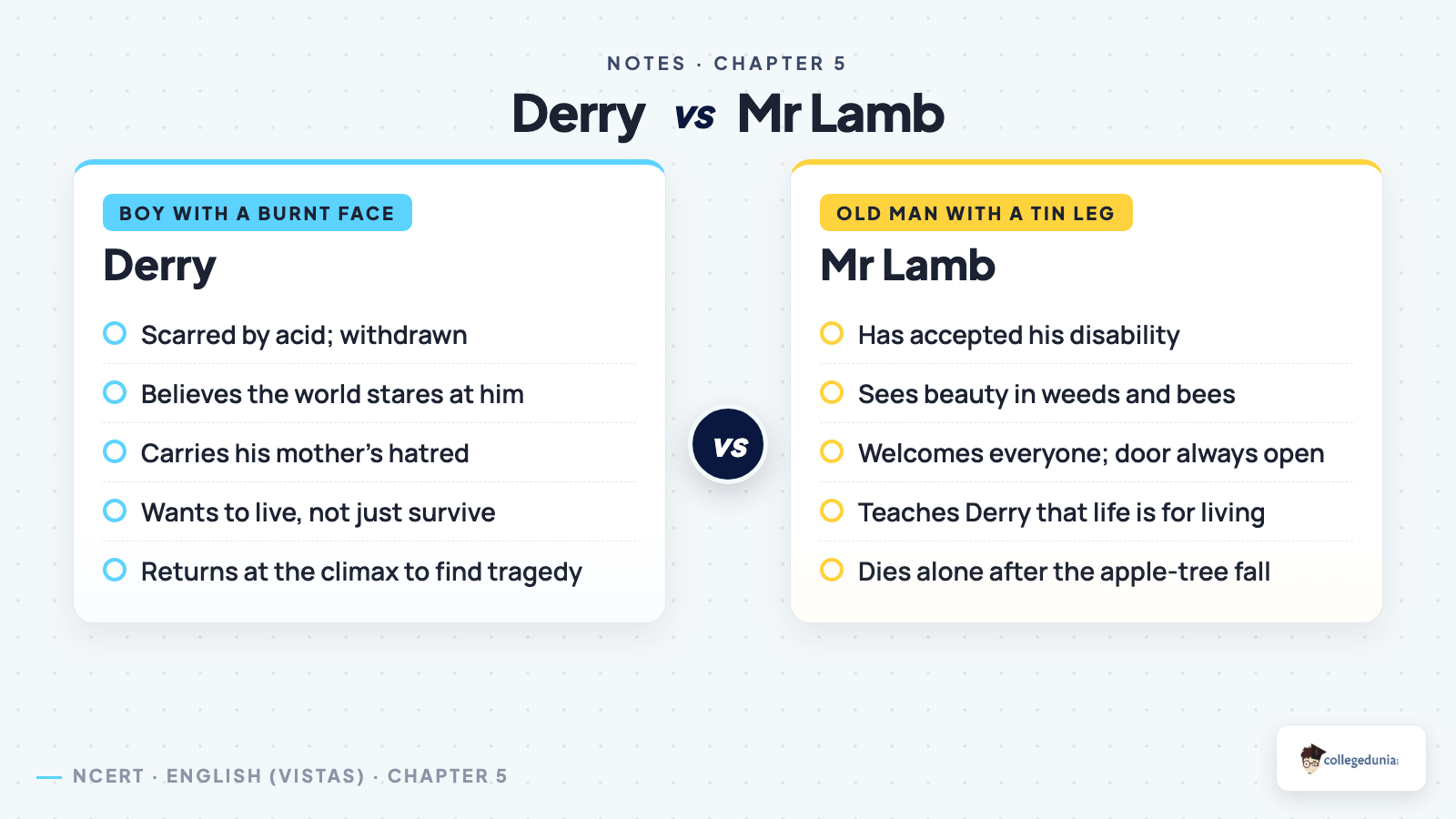
Derry is the play's central figure: fourteen, his face burnt by acid, and hiding from people.
- Defiant and prickly. He climbs walls rather than knock; he expects rejection and refuses first.
- Articulate about social pain. He speaks clearly about the gap between the physical burn and the social wound.
- Hungry for honesty. He warms to Mr Lamb the moment the old man asks a plain question.
- Capable of choice. He defies his mother and runs back because his life depends on it.
Character Sketch: Mr Lamb, the Lame Old Man Who Refuses Bitterness
Mr Lamb is the play's guiding figure. He calls himself Lamey-Lamb, the cruel name children use, and has a tin leg, no curtains, and a gate that is always open.
- Hospitable without conditions. The gate stays open; "all welcome"; every visitor matters.
- Honest without cruelty. He asks the plain question and does not pretend the face is invisible.
- Quietly lonely. The open gate, the dictionary reading, and "Come back. I'll be here" hint at loneliness he never names.
- Believer in the ordinary. Crab apples, sunflowers, bees: his consolation.
Themes in On the Face of It - The Five Big Ideas
The play packs five big ideas into a short text; the 6-mark Long Answer draws from this set.
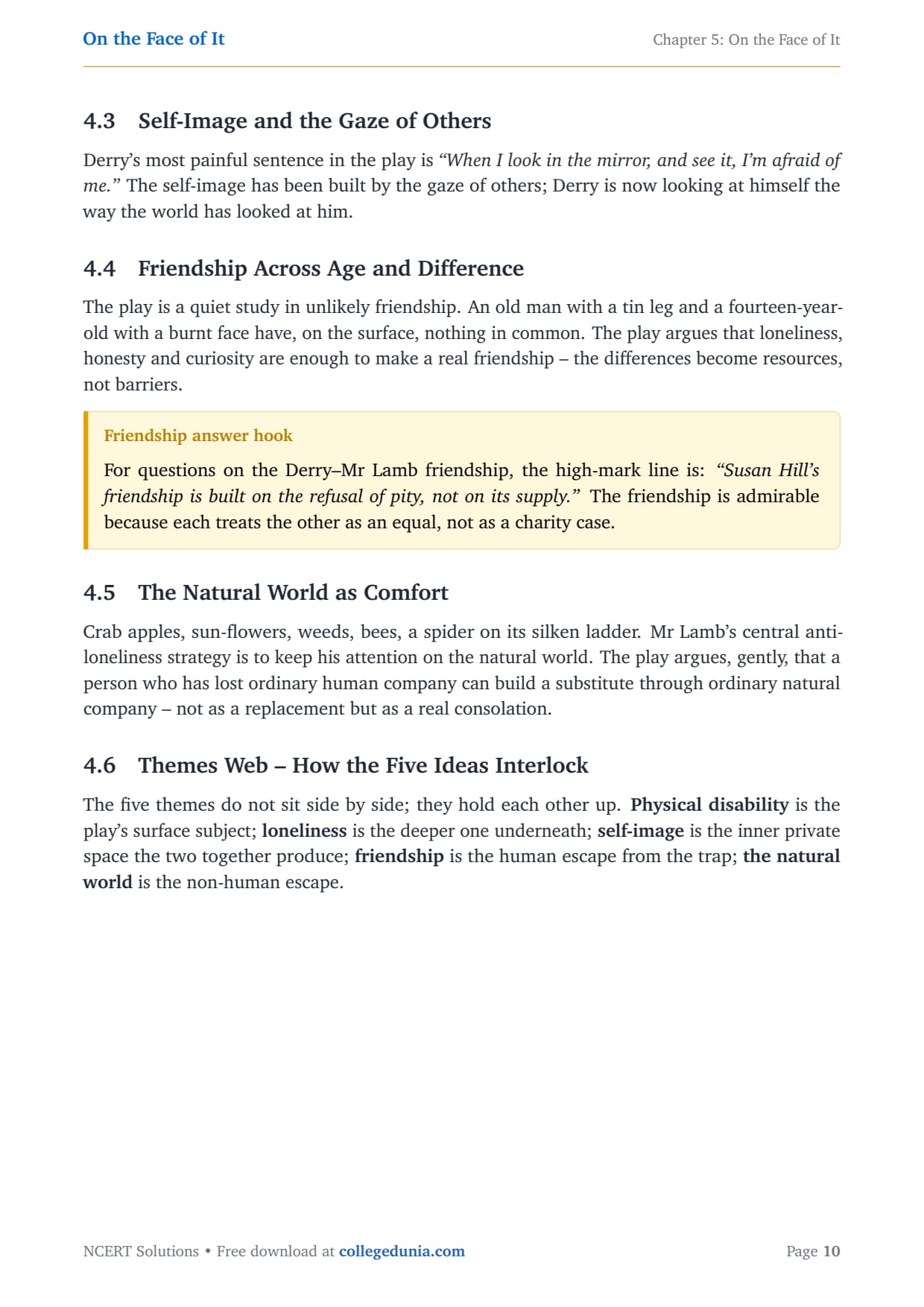
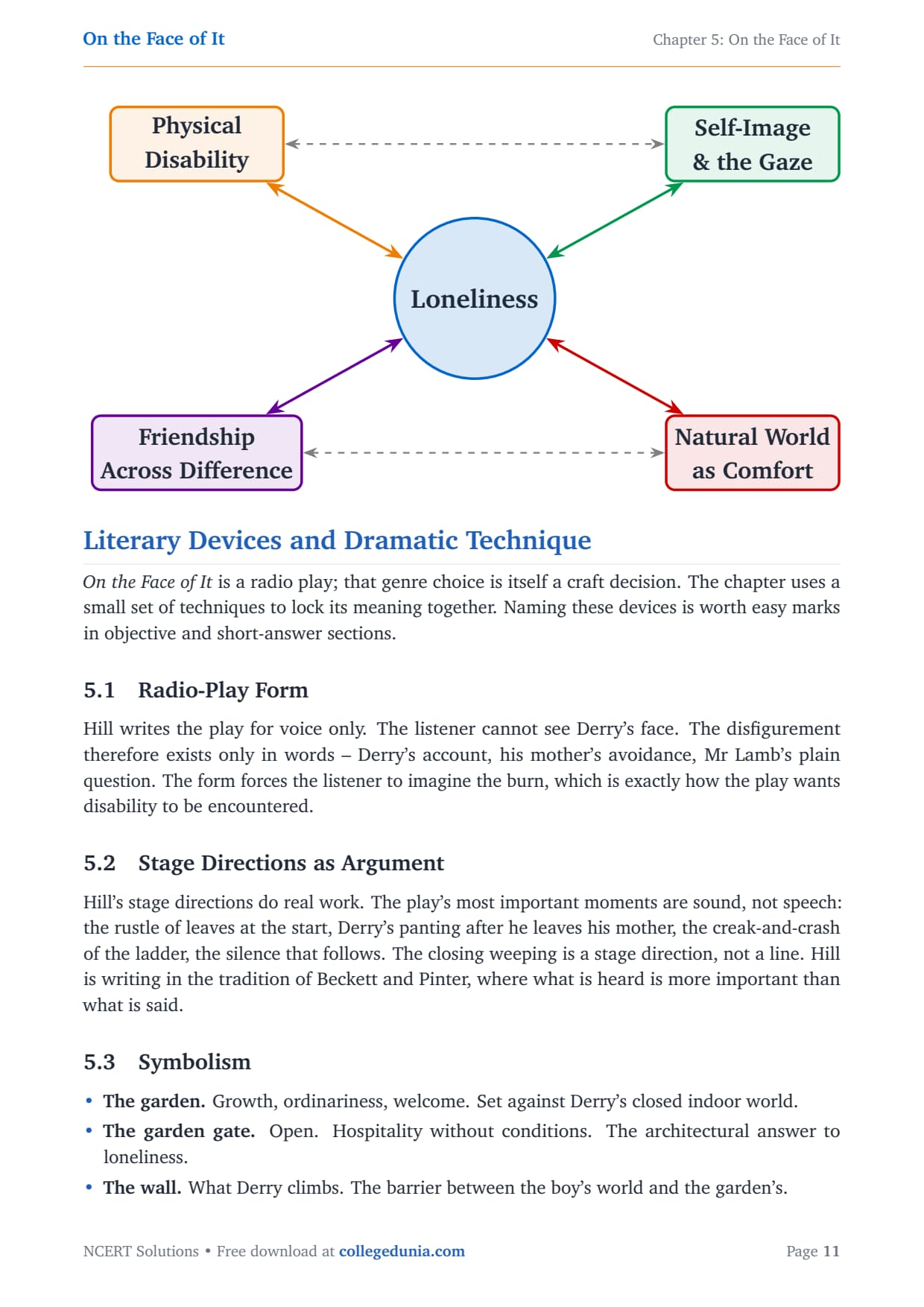
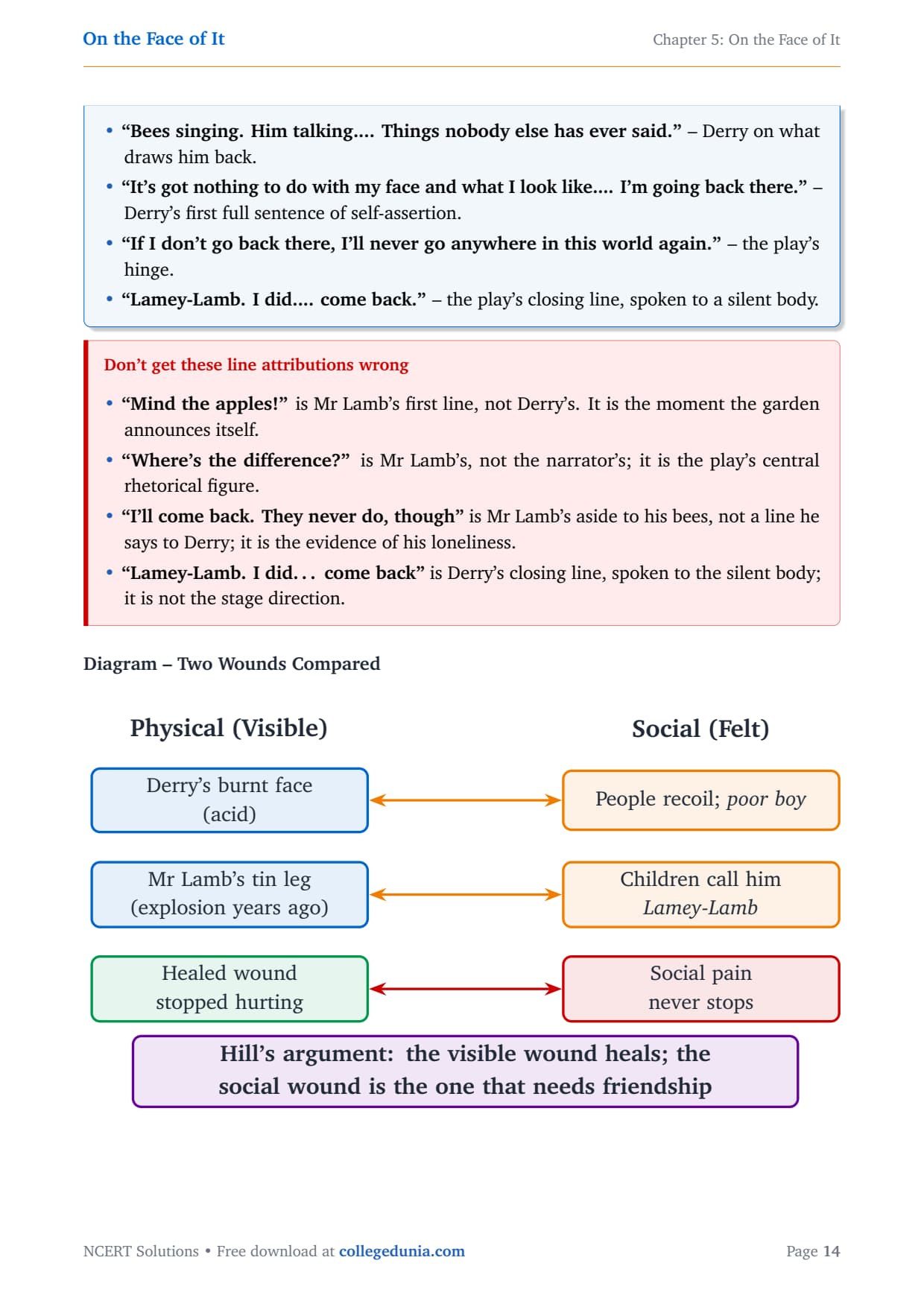
- Pain of Physical Disability. The visible wound has stopped hurting; the social wound is endless. Disability here is a problem of how society reacts.
- Loneliness and Alienation. Derry's loneliness is loud; Mr Lamb's is quiet. Both are one isolation.
- Self-Image and the Gaze of Others. "When I look in the mirror, I'm afraid of me." Others' looks have built his self-image.
- Friendship Across Difference. The bond rests on refusing pity.
- The Natural World as Comfort. Mr Lamb fights loneliness by attending to crab apples, sunflowers, and bees.
Symbolism and Reading Hill's Five Embedded Markers
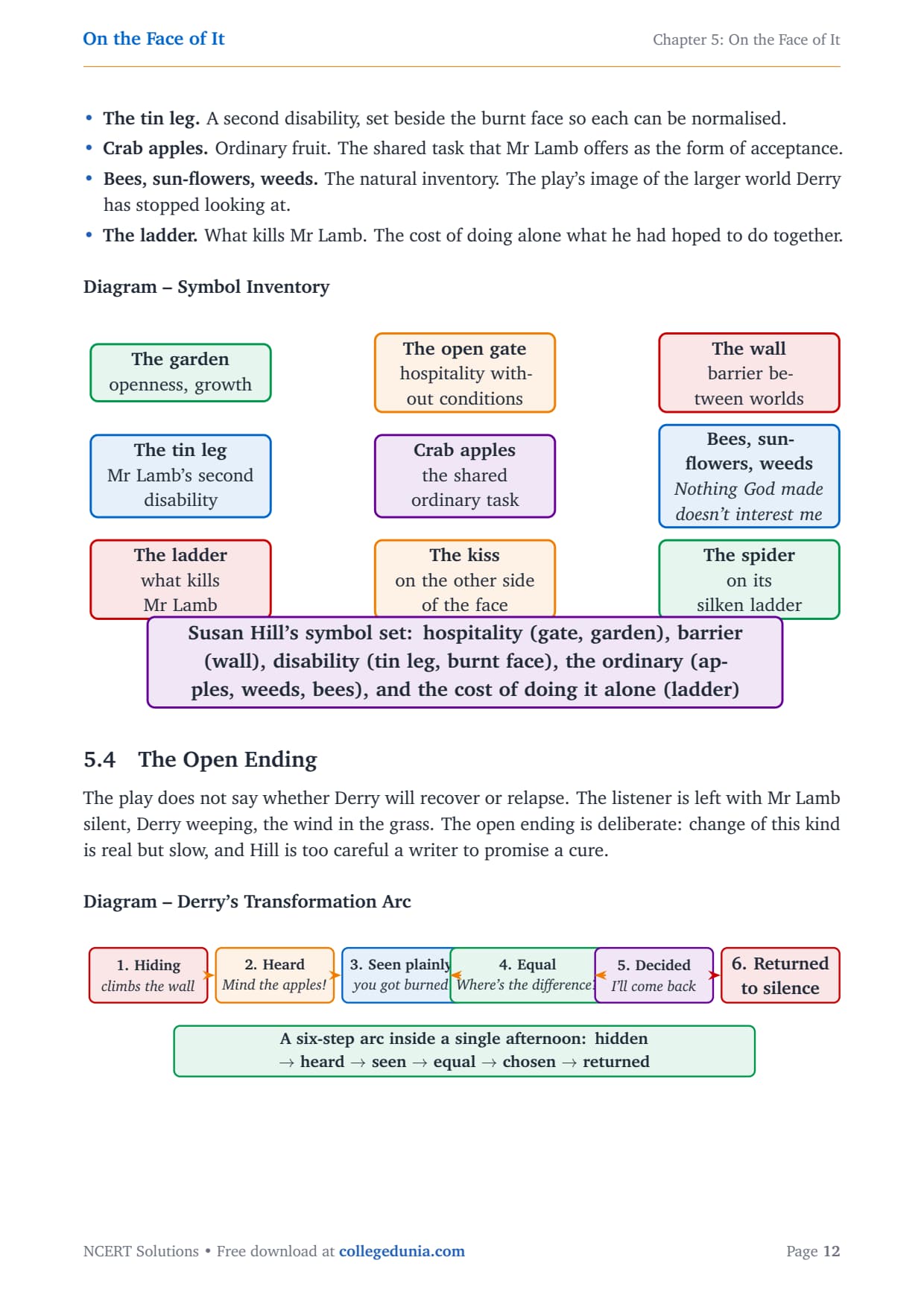
The play turns on five recurring images. Tag each by meaning for quick MCQ recall.
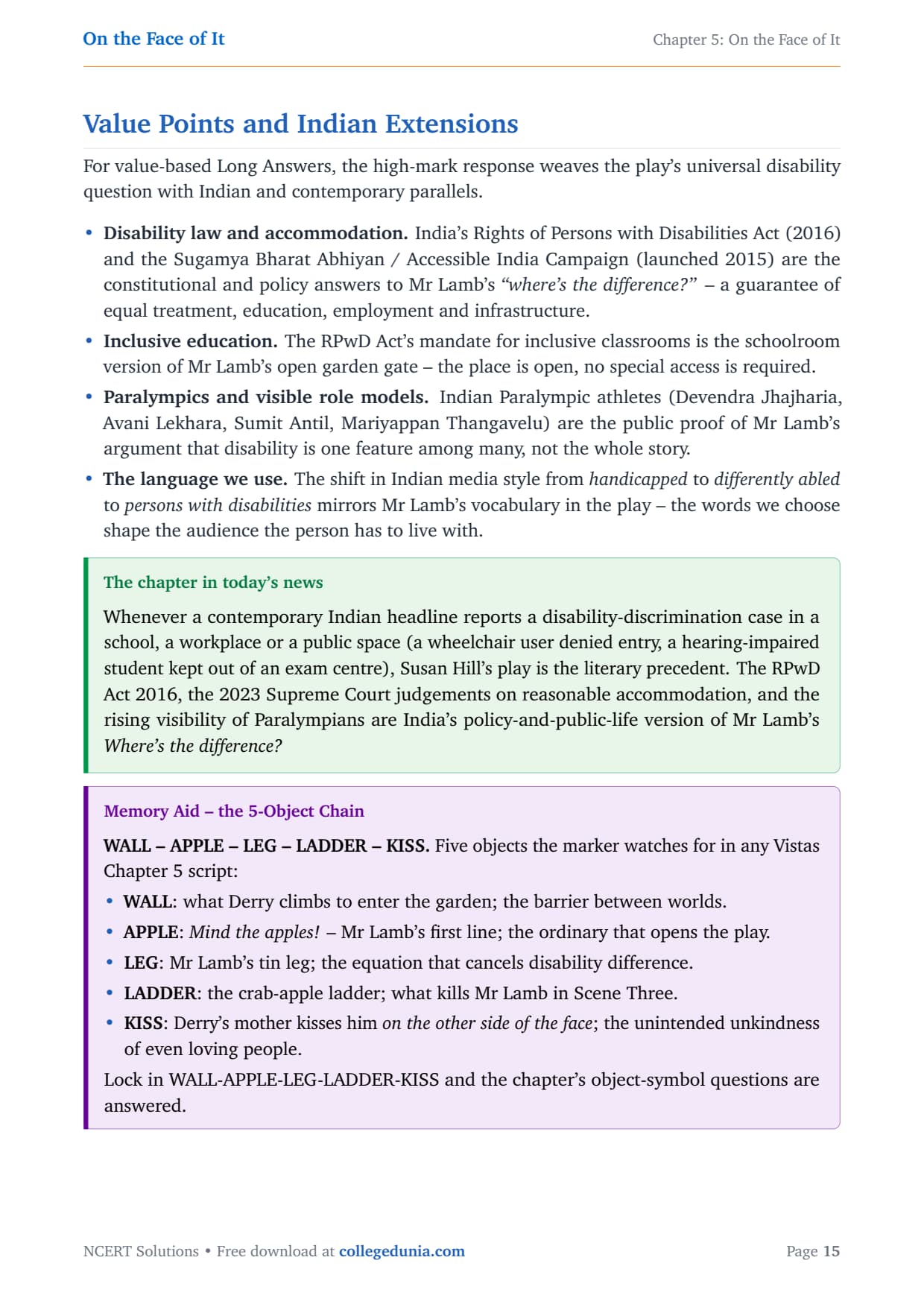
| Marker | Surface Image | Meaning |
|---|---|---|
| The Garden Wall | The wall Derry climbs, though the gate is open | His habit of separation from the world |
| The Always-Open Gate | "The gate's always open. All welcome." | Unconditional hospitality; the opposite of the wall |
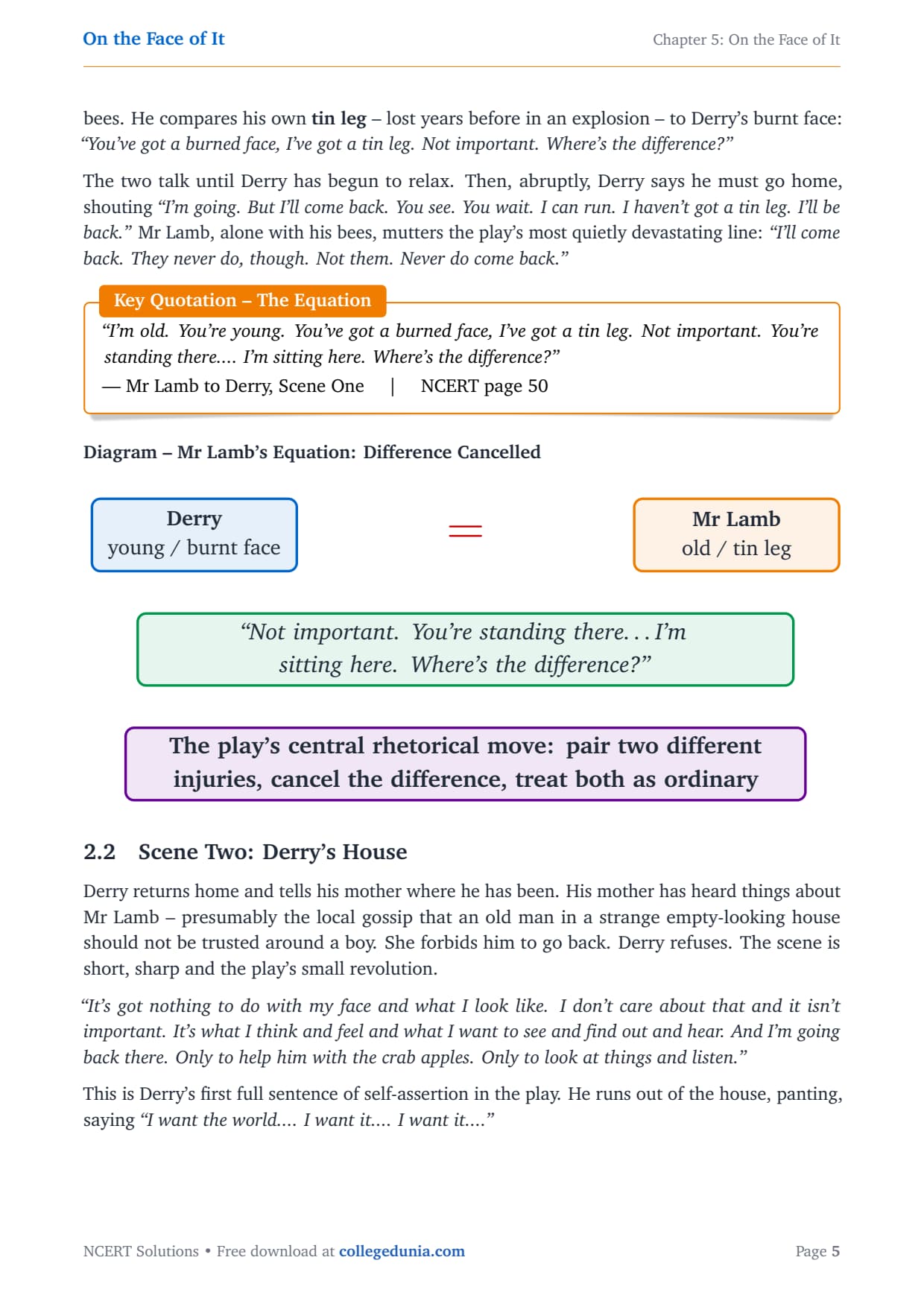
| Tin Leg and Burnt Face | "Where's the difference?" | The central equation; one disability beside another |
| The Crab-Apple Ladder | The ladder that falls in Scene Three | The ordinary turns lethal |
| The Curtain-less House | No curtains; dictionaries read for company | Quiet evidence of loneliness |
Scene-by-Scene Summary
| # | Scene | Key Detail |
|---|---|---|
| 1 | The garden meeting | Derry climbs the wall; the tin-leg equation; he runs home |
| 2 | The showdown with mother | Derry defies her: "If I don't go back there, I'll never go anywhere again" |
| 3 | The fall from the ladder | Mr Lamb falls; Derry returns to find him silent: "Lamey-Lamb. I did... come back." |
Important Quotations to Memorise
- "You've got a burned face, I've got a tin leg. Where's the difference?" - the central equation.
- "There's nothing God made that doesn't interest me." - Mr Lamb's philosophy.
- "If I don't go back there, I'll never go anywhere in this world again." - the play's hinge.
- "Lamey-Lamb. I did... come back." - the closing line, spoken to a silent body.
How Collegedunia's NCERT Notes Help You Score in On the Face of It
- The C-P-C-T framework gives a fixed sequence to apply on every Vistas chapter.
- Every theme is paired with the exact phrase that triggers full-mark recall.
- Character arcs are written as marker sketches, the shape a 6-mark answer expects.
Common Mistakes Students Make in On the Face of It
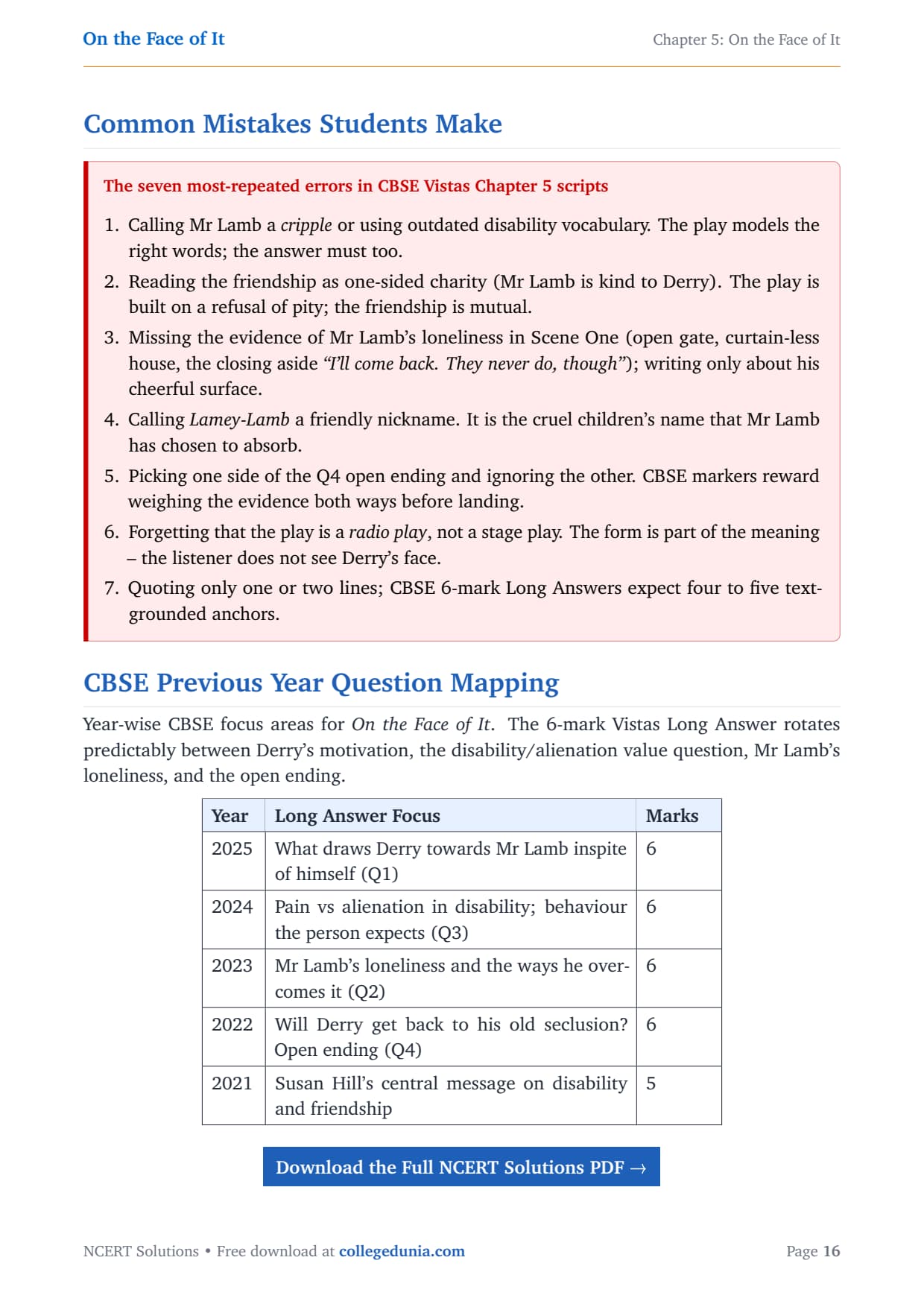
- Reading the friendship as one-sided charity. It rests on a refusal of pity and is mutual.
- Writing only about Mr Lamb's cheerful surface and missing the evidence of his loneliness.
- Picking one side of the open ending; markers reward weighing both ways.
CBSE Previous Year Question Mapping for On the Face of It
The 6-mark slot rotates between Derry's motivation, the disability question, Mr Lamb's loneliness, and the open ending.
| Year | Long Answer Focus | Marks |
|---|---|---|
| 2025 | What draws Derry towards Mr Lamb | 6 |
| 2024 | Pain versus alienation in disability | 6 |
| 2023 | Mr Lamb's loneliness and how he overcomes it | 6 |
| 2022 | Will Derry return to seclusion? The open ending | 6 |
| 2021 | Hill's message on disability and friendship | 5 |
Sample 6-Mark Long Answer: What Draws Derry Towards Mr Lamb?
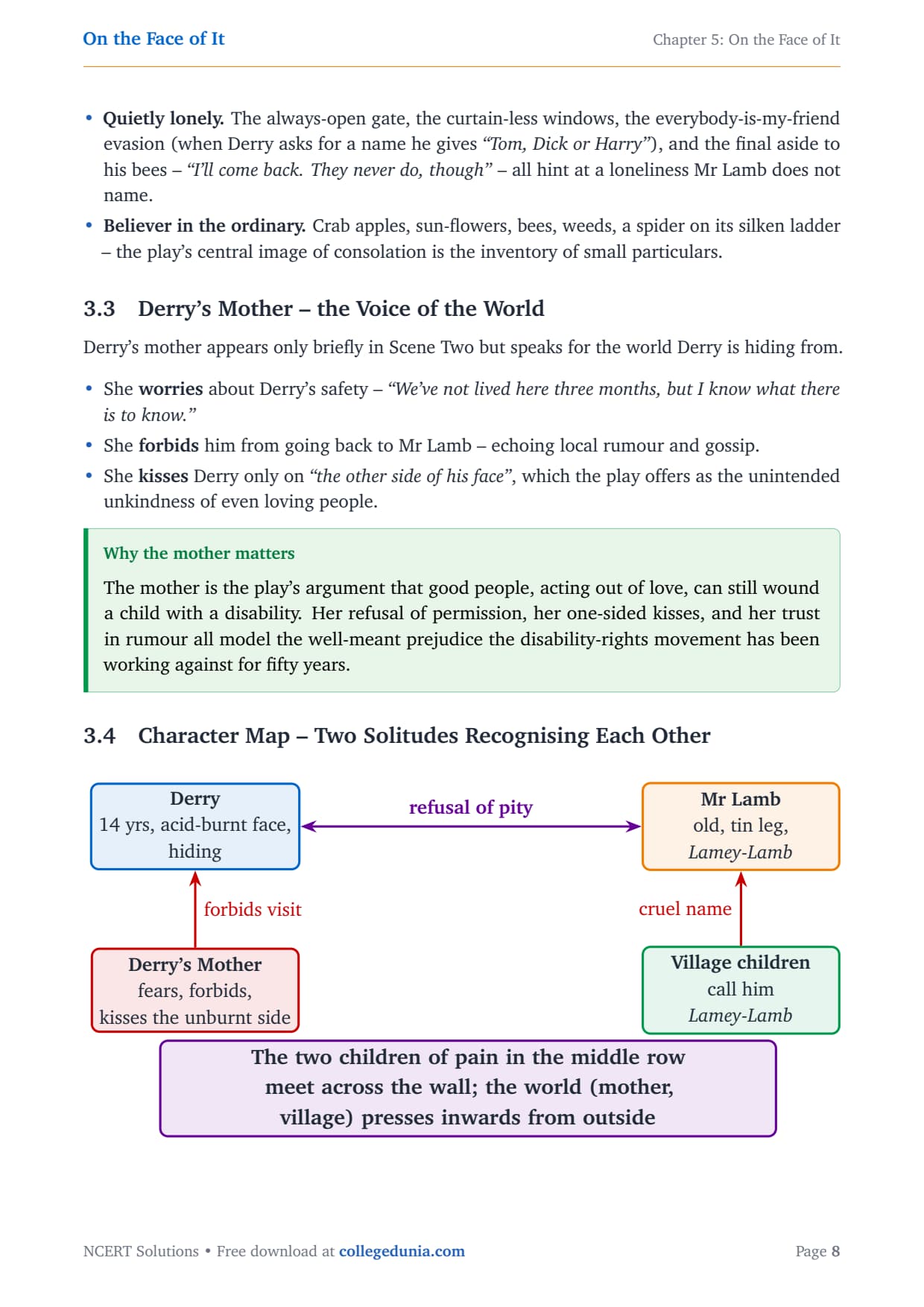
Several small things, together, draw Derry back. Mr Lamb does not pretend not to see the burnt face, and the honesty relieves Derry. He refuses the "poor boy" script and normalises disability by placing his tin leg beside Derry's face: "Where's the difference?" He turns attention outwards, to the crab apples and bees, which for a boy fixed on his scar is a quiet rescue. Above all, Mr Lamb listens, and his loneliness is a mirror Derry recognises. Two solitudes recognise each other.
Other Resources for On the Face of It (Class 12 English)
| Resource | Link |
|---|---|
| Notes (this page) | On the Face of It Notes |
| NCERT Solutions | On the Face of It Class 12 English NCERT Solutions |
| CBSE Syllabus | CBSE Class 12 English Core Syllabus 2026-27 |
NCERT Notes for Class 12 English Vistas: All Chapters
| Chapter | Notes Link |
|---|---|
| Chapter 1 | The Third Level Notes |
| Chapter 2 | The Tiger King Notes |
| Chapter 3 | Journey to the End of the Earth Notes |
| Chapter 4 | The Enemy Notes |
| Chapter 6 | Memories of Childhood Notes |
Student Feedback
In a Collegedunia poll of 1,200 Class 12 students, 78% said the C-P-C-T framework made the Vistas Long Answer easier to plan, and 71% rated the quotation bank and symbol table as their most-used revision tools for this chapter.
FAQs on On the Face of It Class 12 Notes
FAQs on On the Face of It Class 12 Notes
Who is the author of On the Face of It Class 12?
On the Face of It is written by Susan Hill (born 1942), a British novelist and playwright. The chapter is a one-act radio play originally written for the BBC in the 1970s, included in the NCERT Class 12 Vistas reader. Hill is also the author of the novel The Woman in Black.
What is the main theme of On the Face of It?
The central theme is that the social pain of a visible disability (alienation, staring, pity, false reassurance) is often greater than the physical pain itself. The play argues that the person with a disability needs honest address, inclusion in ordinary tasks, and refusal of both pity and false reassurance. Mr Lamb's treatment of Derry is the model.
Why does Derry climb the wall into Mr Lamb's garden?
Derry climbs the garden wall thinking the house is empty - he wants to be alone, away from people who stare at his face. Mr Lamb, who is sitting in the garden, surprises him with "Mind the apples!" The gate is actually always open, but Derry had not expected anyone to be there.
How did Mr Lamb lose his leg in On the Face of It?
Mr Lamb lost his real leg in a wartime explosion years before the play opens. He now wears a tin leg. The children in the neighbourhood call him Lamey-Lamb, a cruel name he has chosen to absorb rather than resent. The tin leg is structurally important because Mr Lamb places his disability beside Derry's burnt face and asks "Where's the difference?"
How does the play On the Face of It end?
The play ends with Mr Lamb falling from the crab-apple ladder in Scene Three. Derry, who has just returned to the garden after defying his mother, finds Mr Lamb silent on the ground. Derry kneels in the grass and weeps over the body, saying "I came back. Lamey-Lamb. I did... come back." The ending is deliberately ambiguous - the play does not say whether Mr Lamb survives.
How many Reading with Insight questions are in On the Face of It?
There are four Reading with Insight questions at the end of Chapter 5 On the Face of It in the Class 12 Vistas textbook, covering Derry's motivation, Mr Lamb's loneliness, the disability-alienation value question, and the open ending. All four are answered in the corresponding NCERT Solutions PDF.



Comments