





Class 12 Physics Chapter 1 Electric Charges and Fields covers electric charge and its properties through continuous charge distributions. The chapter carries 6 marks in CBSE and 4 to 5 percent in JEE Main. This page hosts the class 12 physics NCERT notes chapter 1 electric charges and fields PDF.
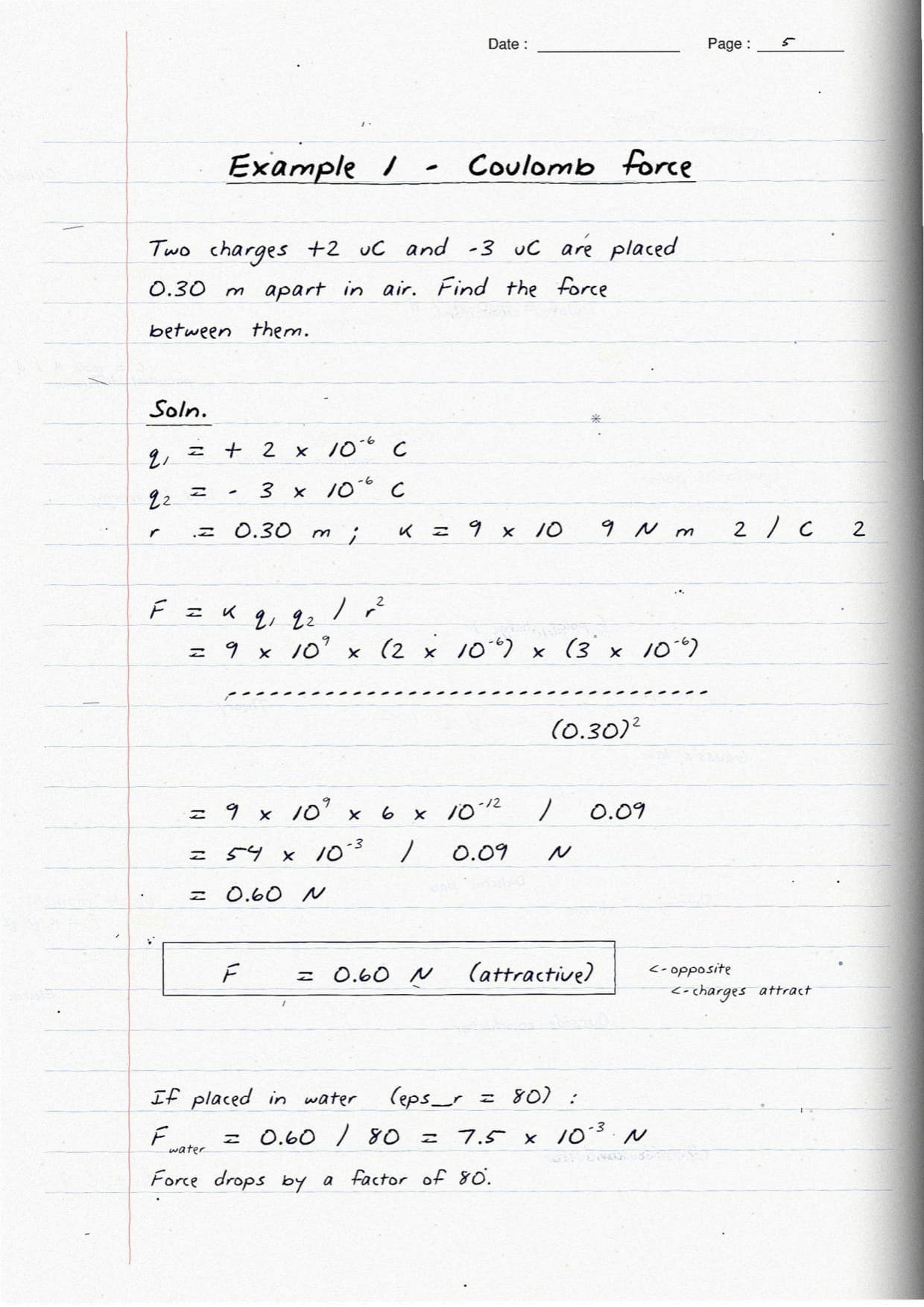
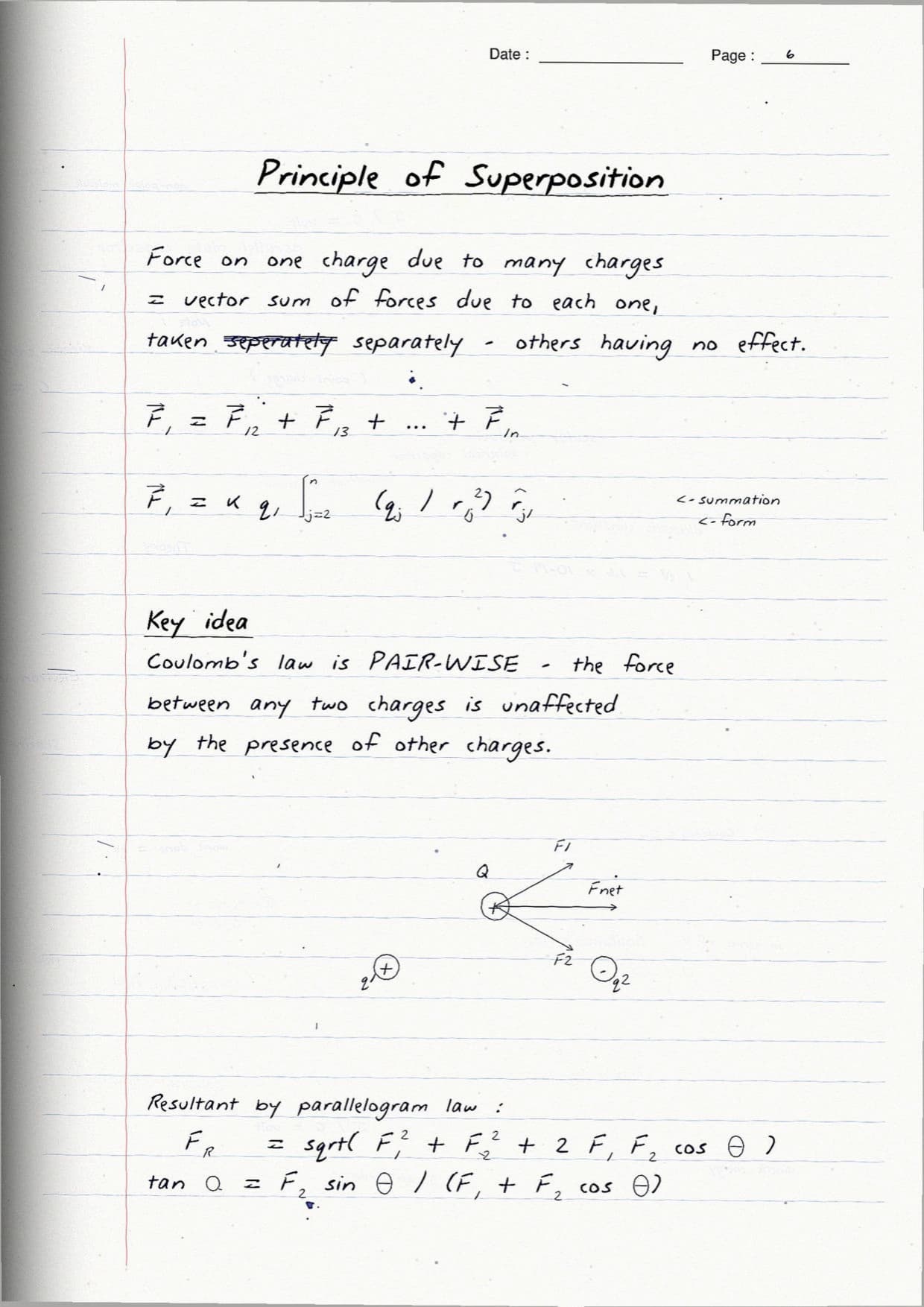
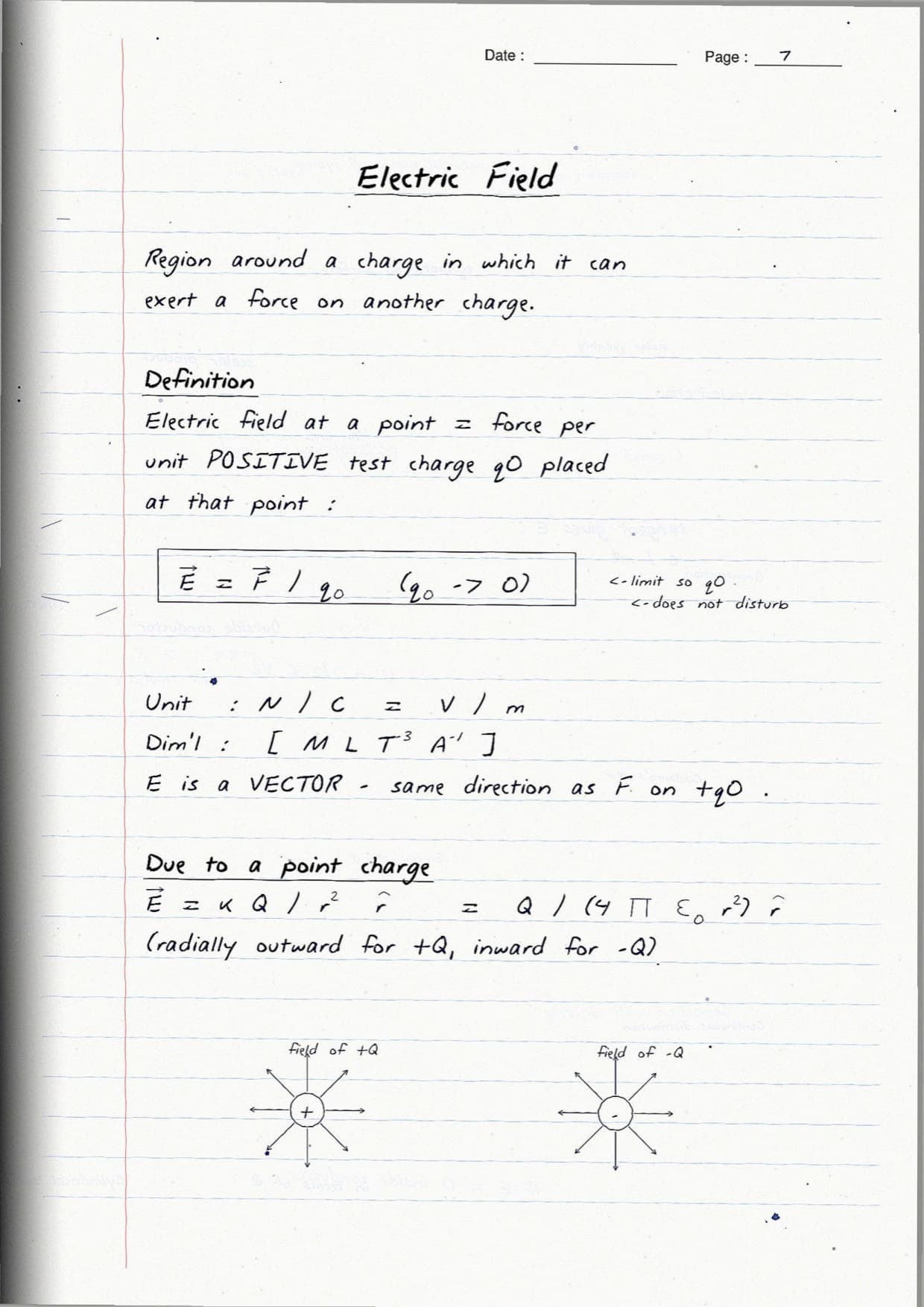
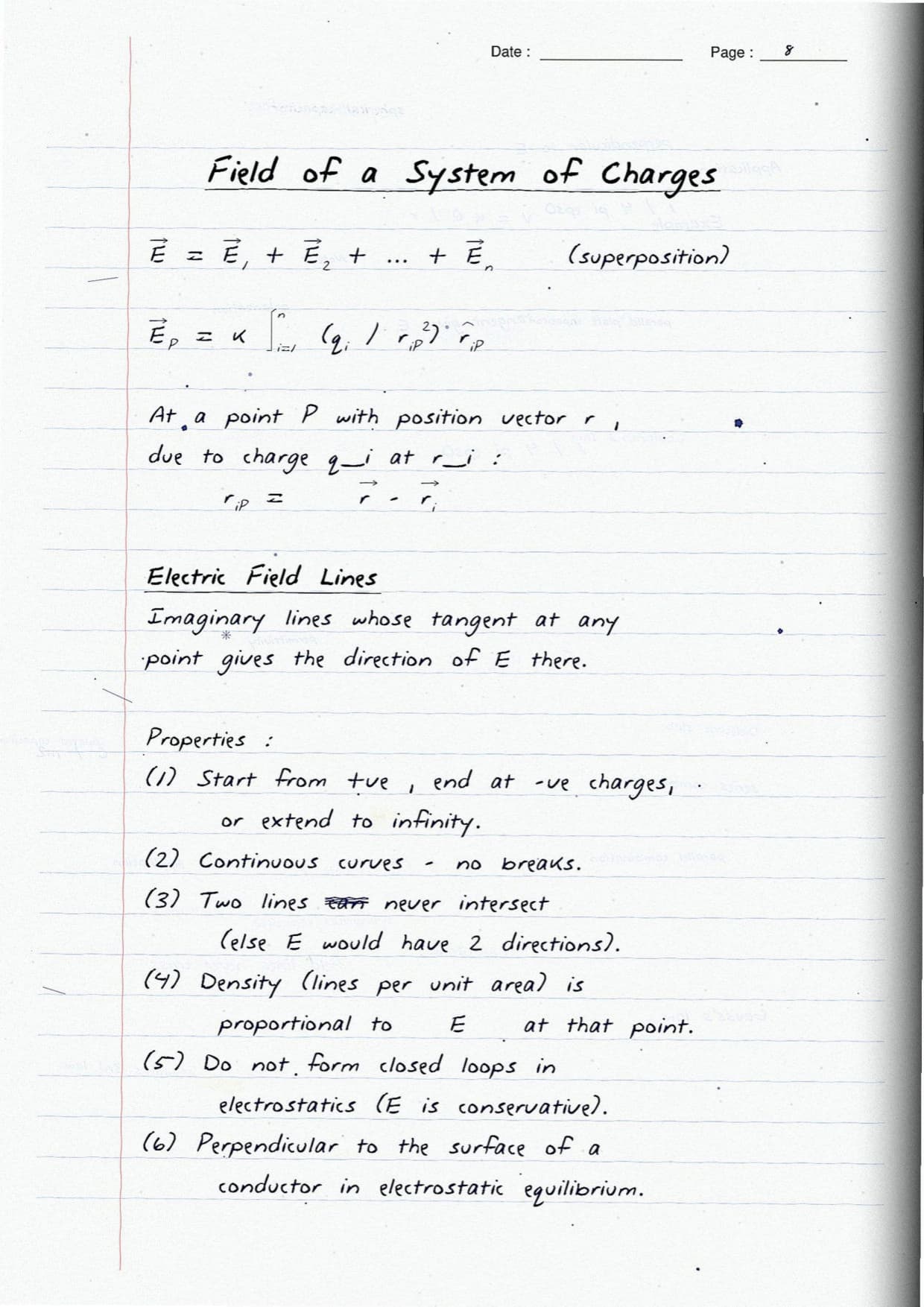
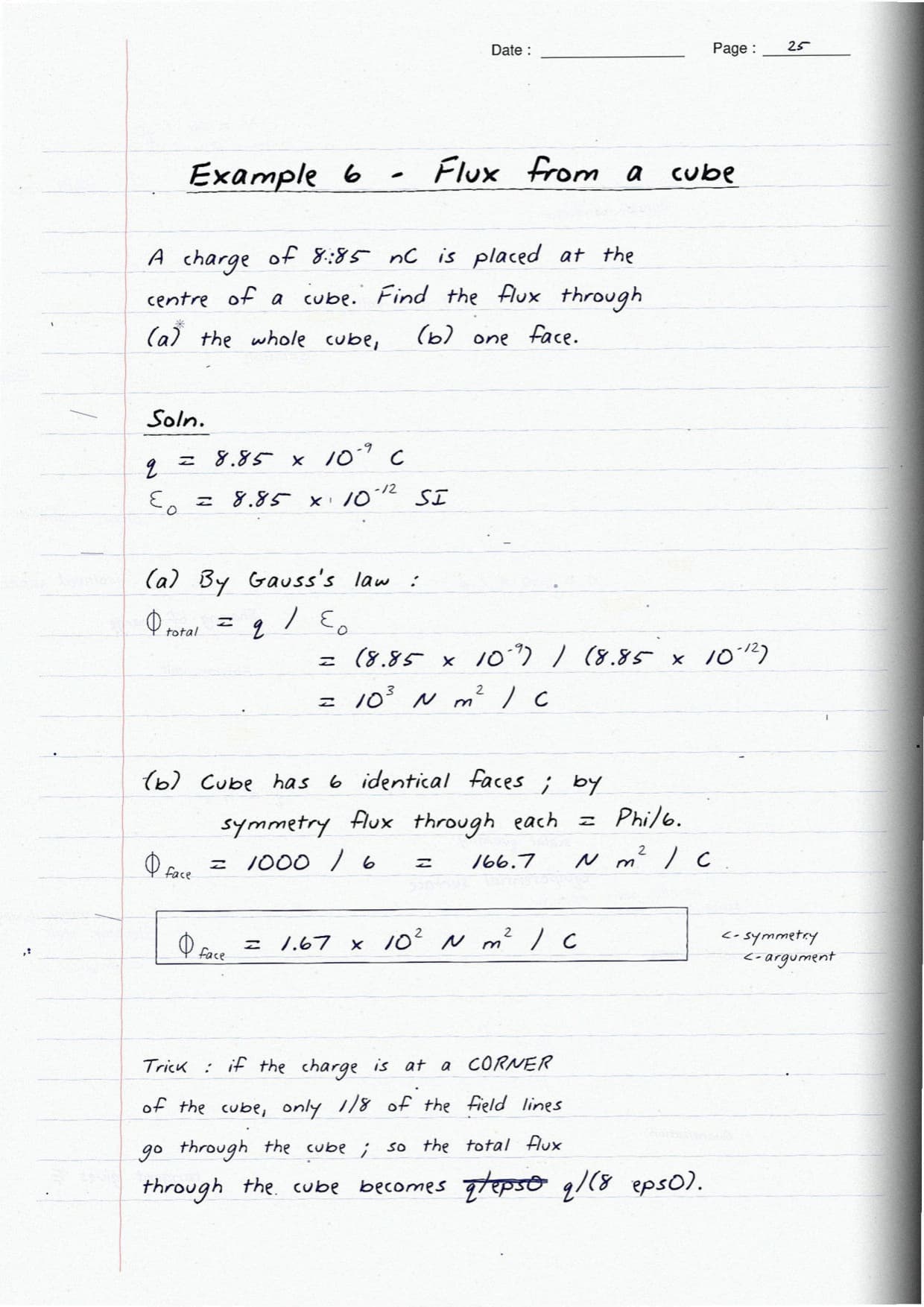
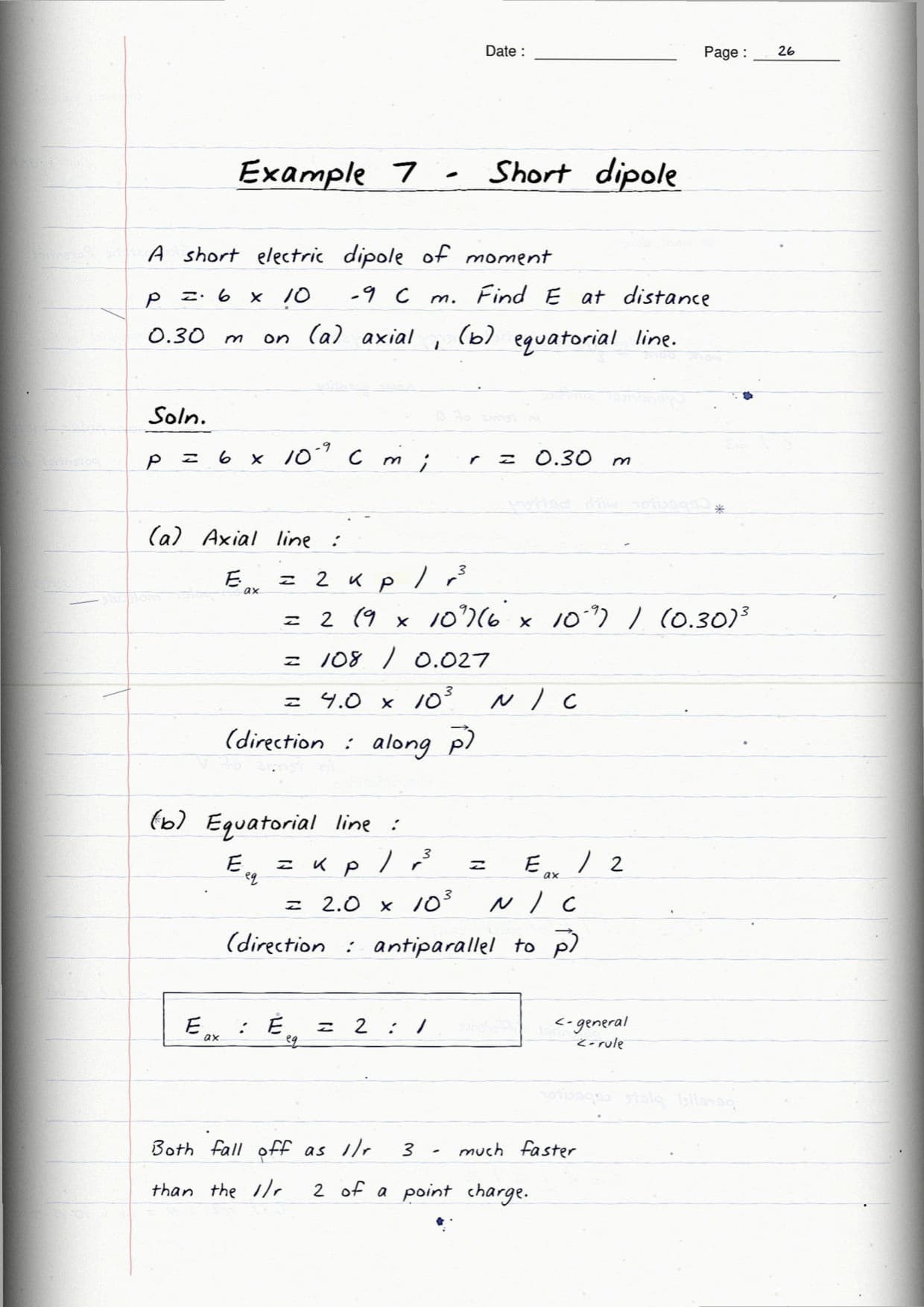
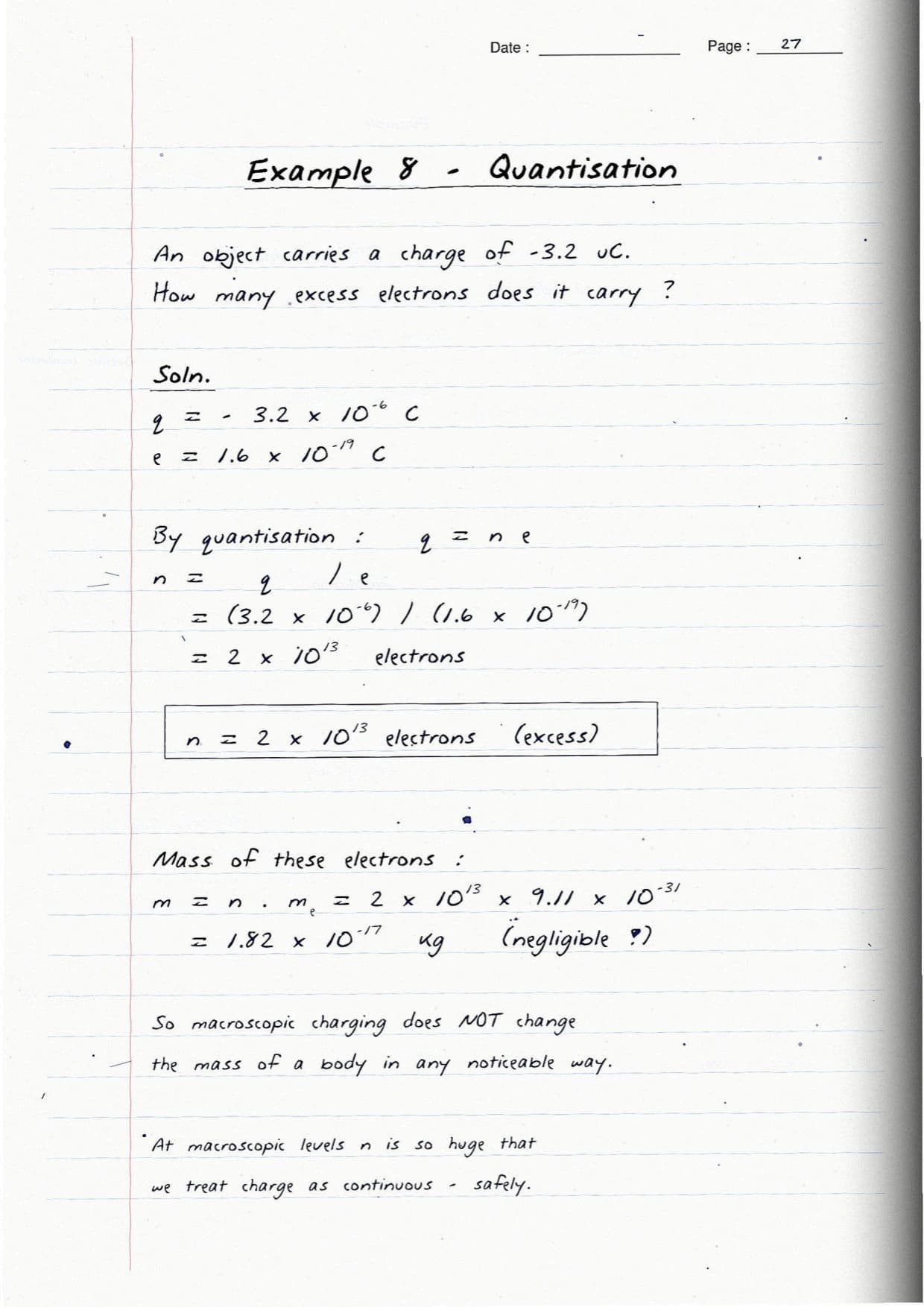
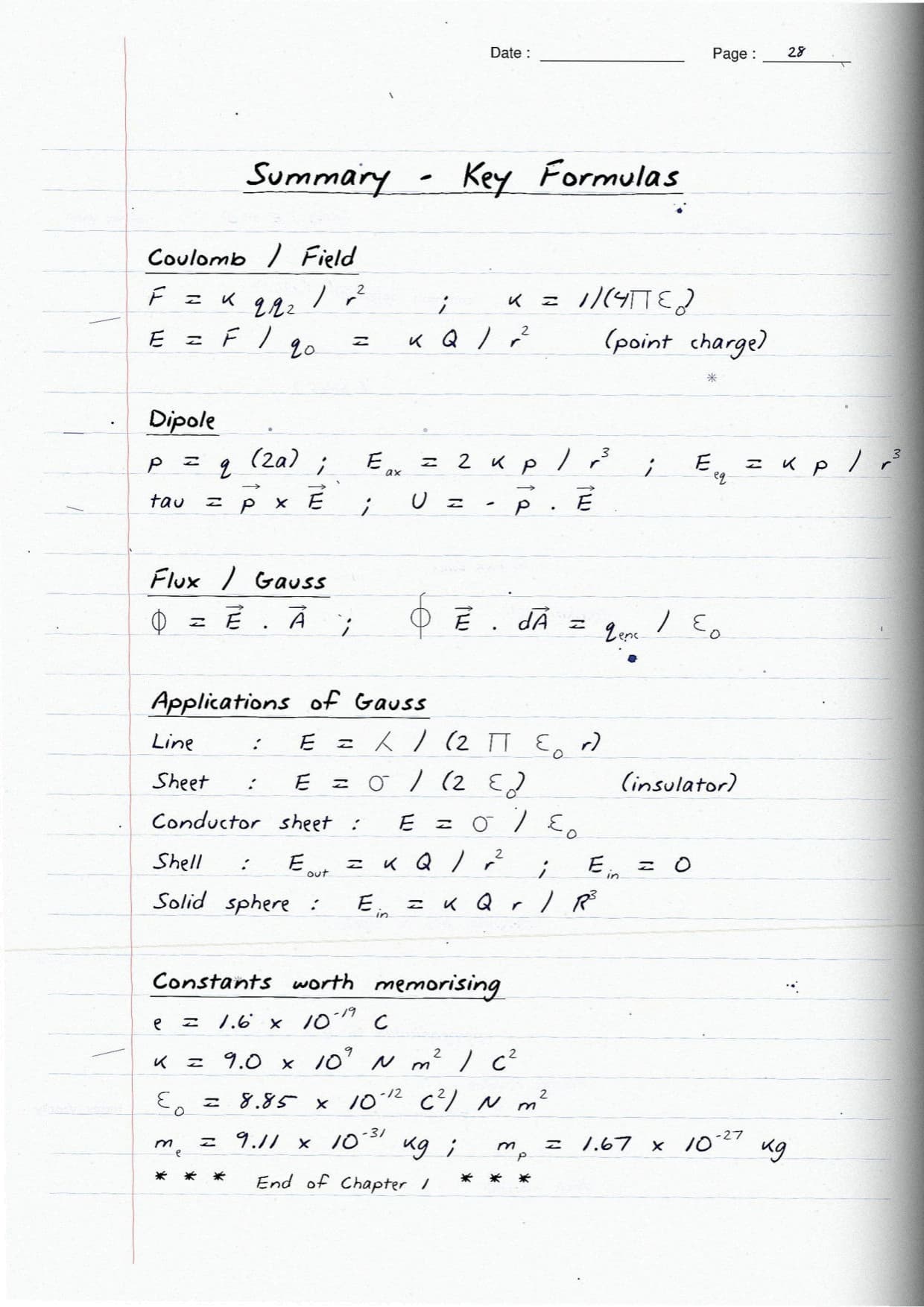
Before you start, here is what this chapter is worth across the main exams:
- CBSE Boards: 6 marks, usually one derivation block plus one short-answer concept question.
- JEE Main: 4 to 5 percent, with steady annual coverage on derivations and numericals.
- NEET: 1 to 2 questions every year on chapter concepts.
What the Electric Charges and Fields Handwritten Notes Cover
The chapter splits into five revision blocks, and the notebook gives each one a page with its CBSE marking pattern noted in the margin:
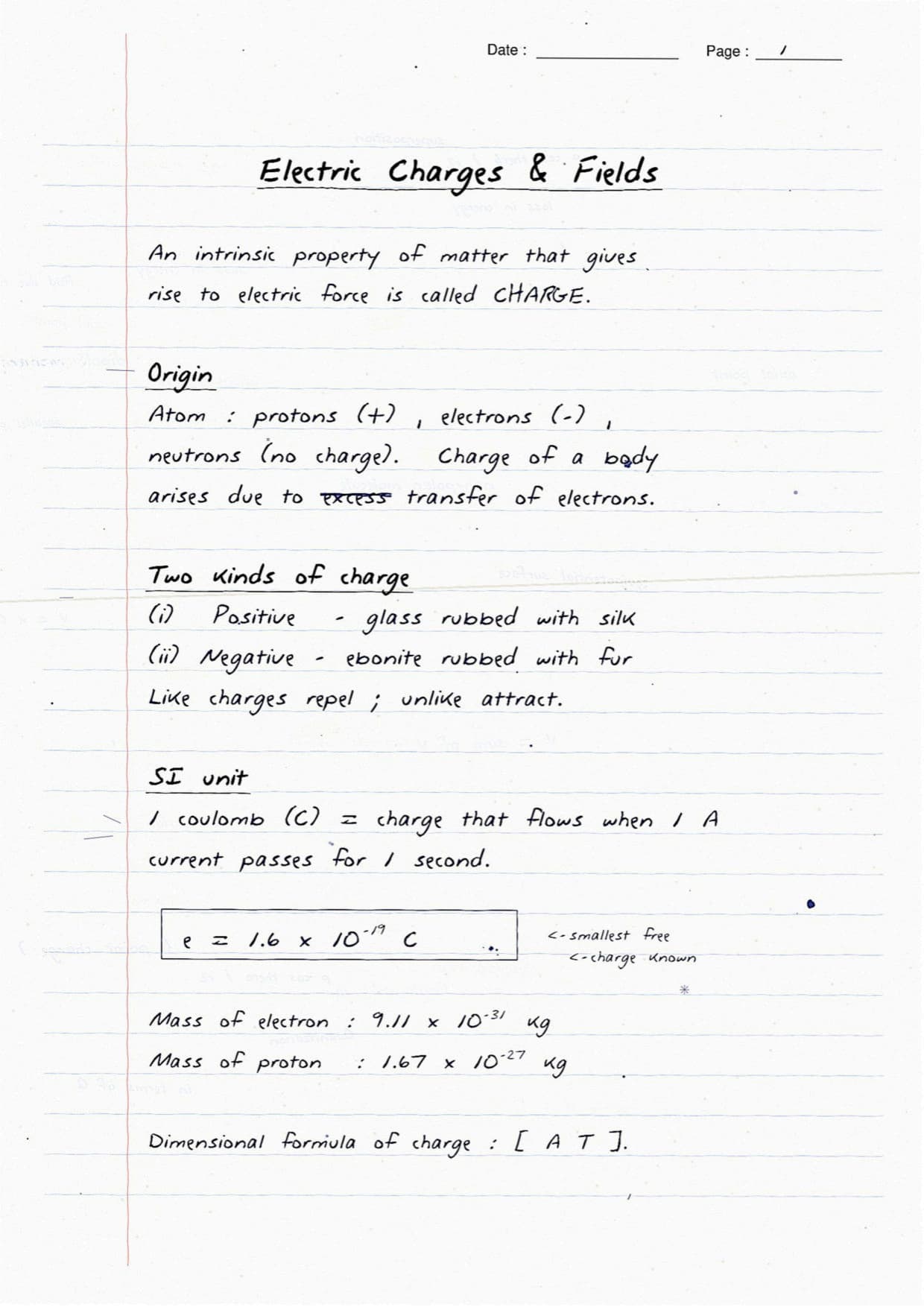
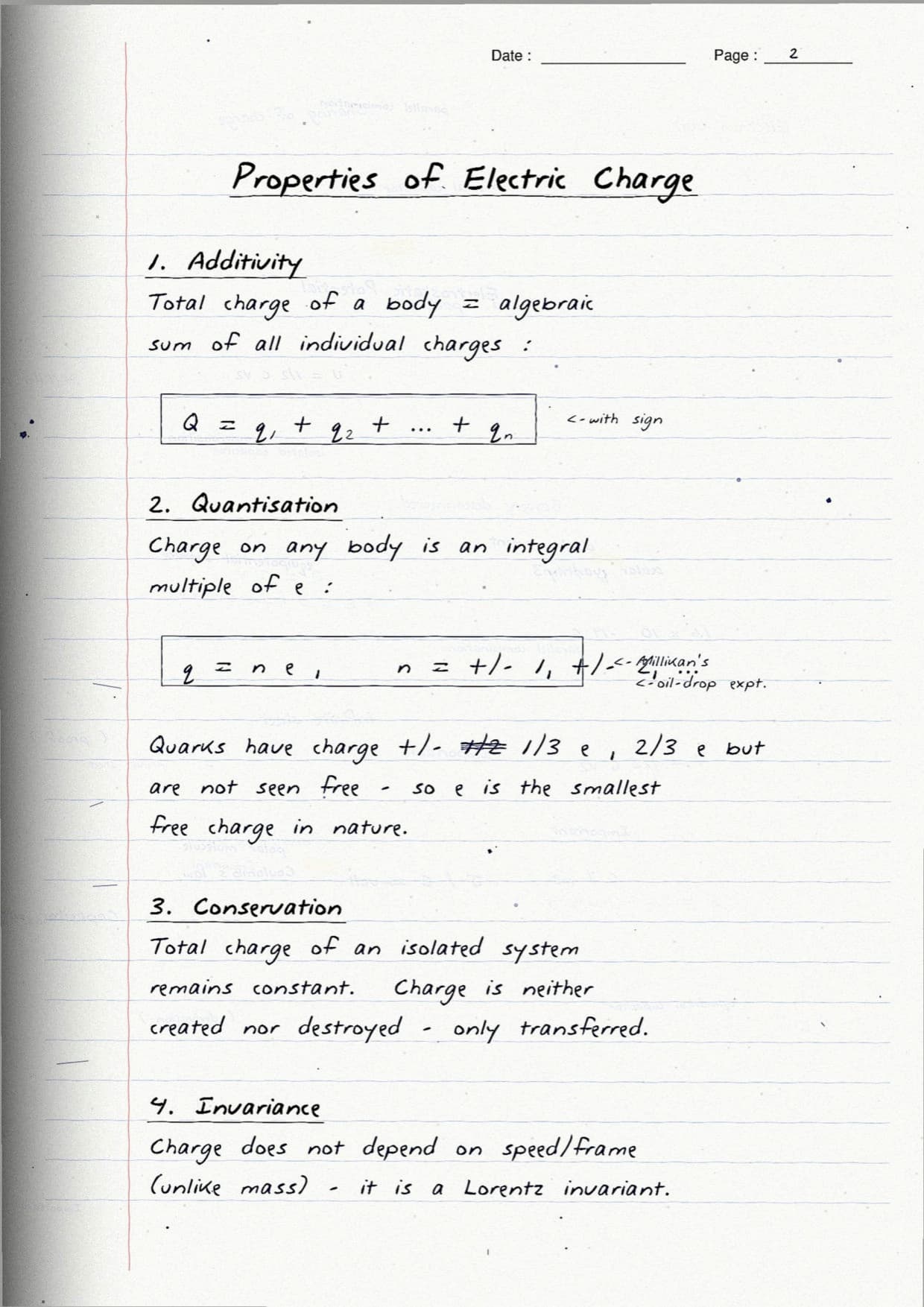
- Charge and its properties (1 mark): quantisation q = ne, conservation and additivity.
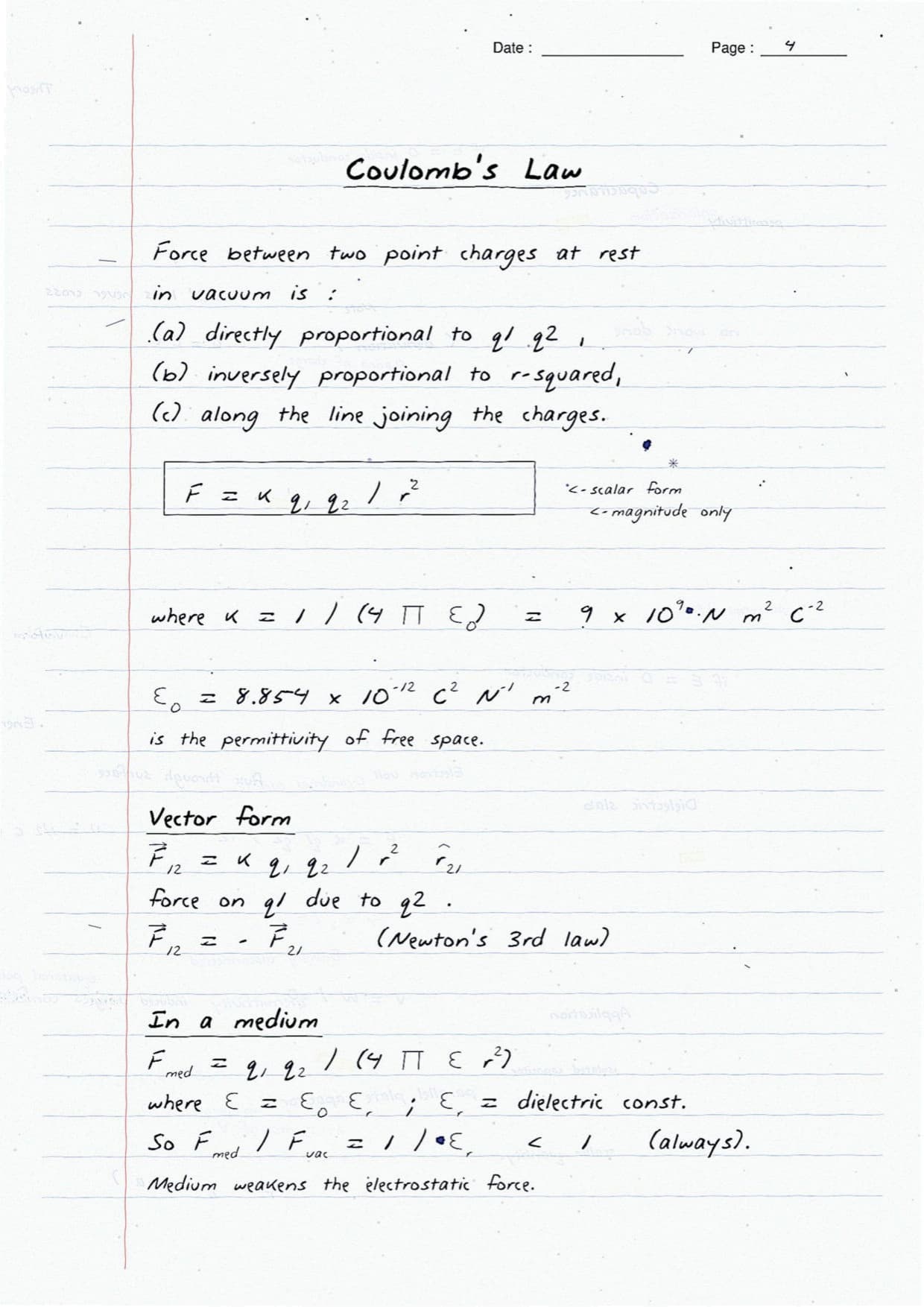
- Coulomb's law (3 marks): the vector form and superposition of three charges.
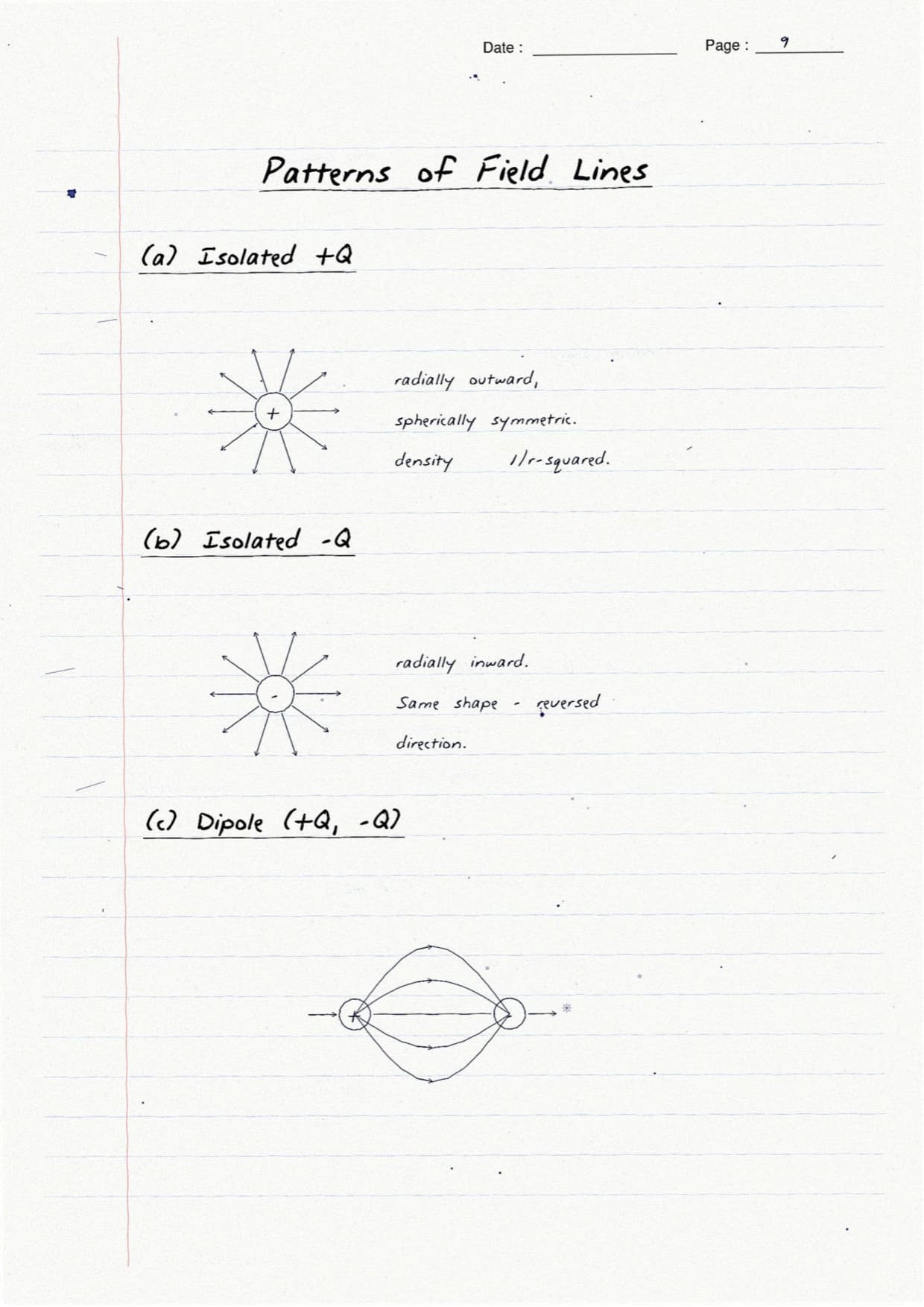
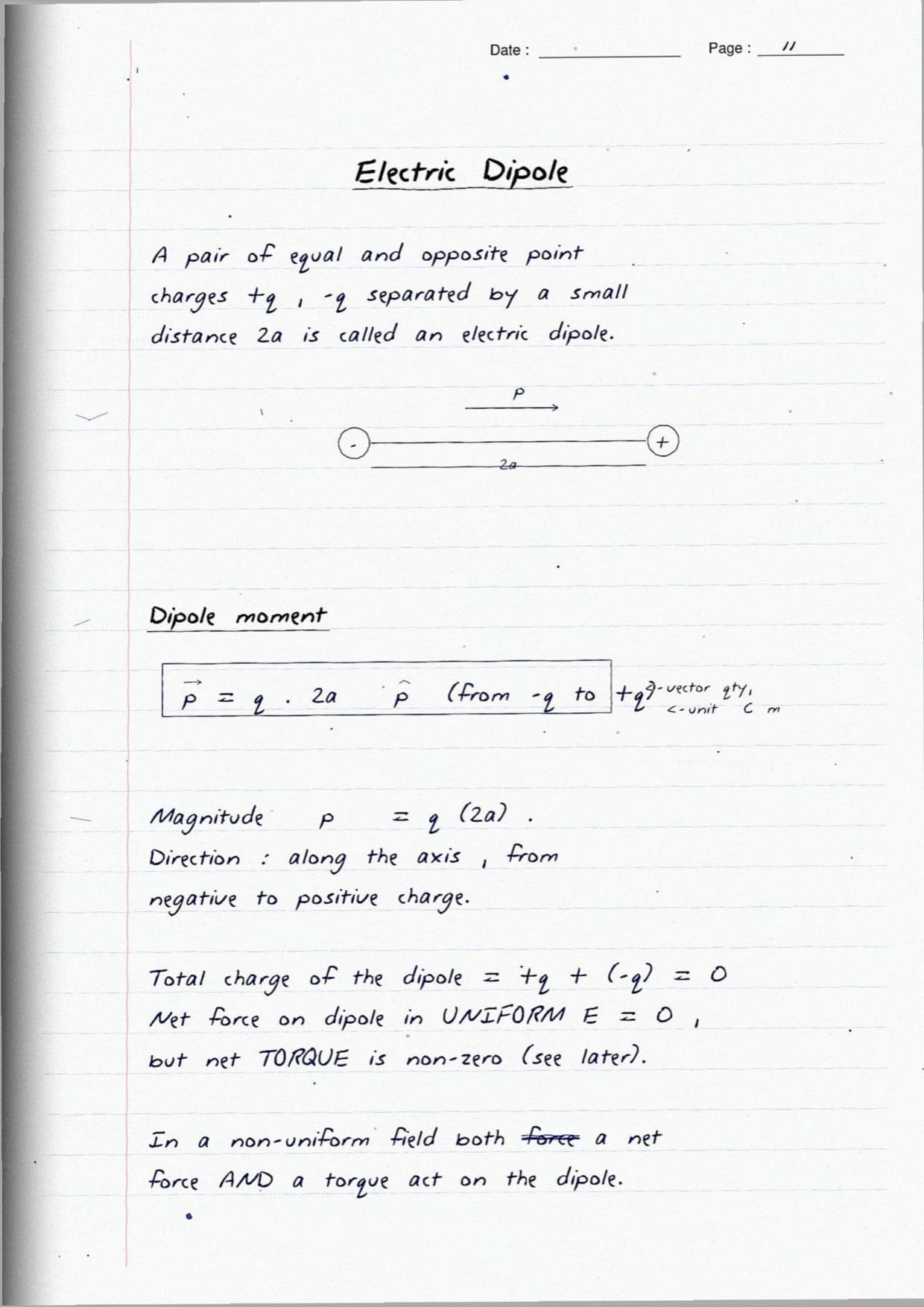
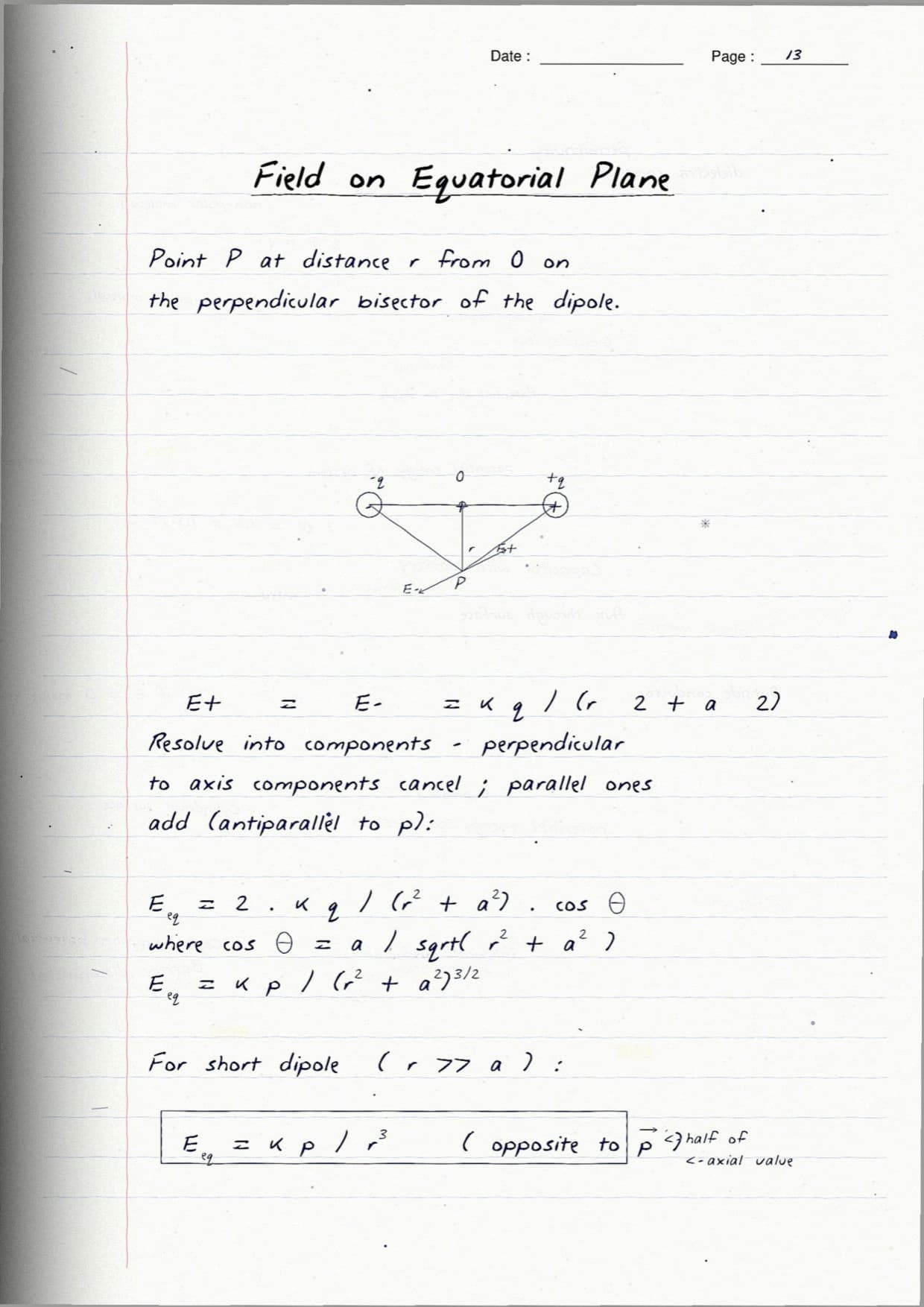
- Electric field and dipole (3 to 5 marks): field lines, plus the axial and equatorial dipole field.
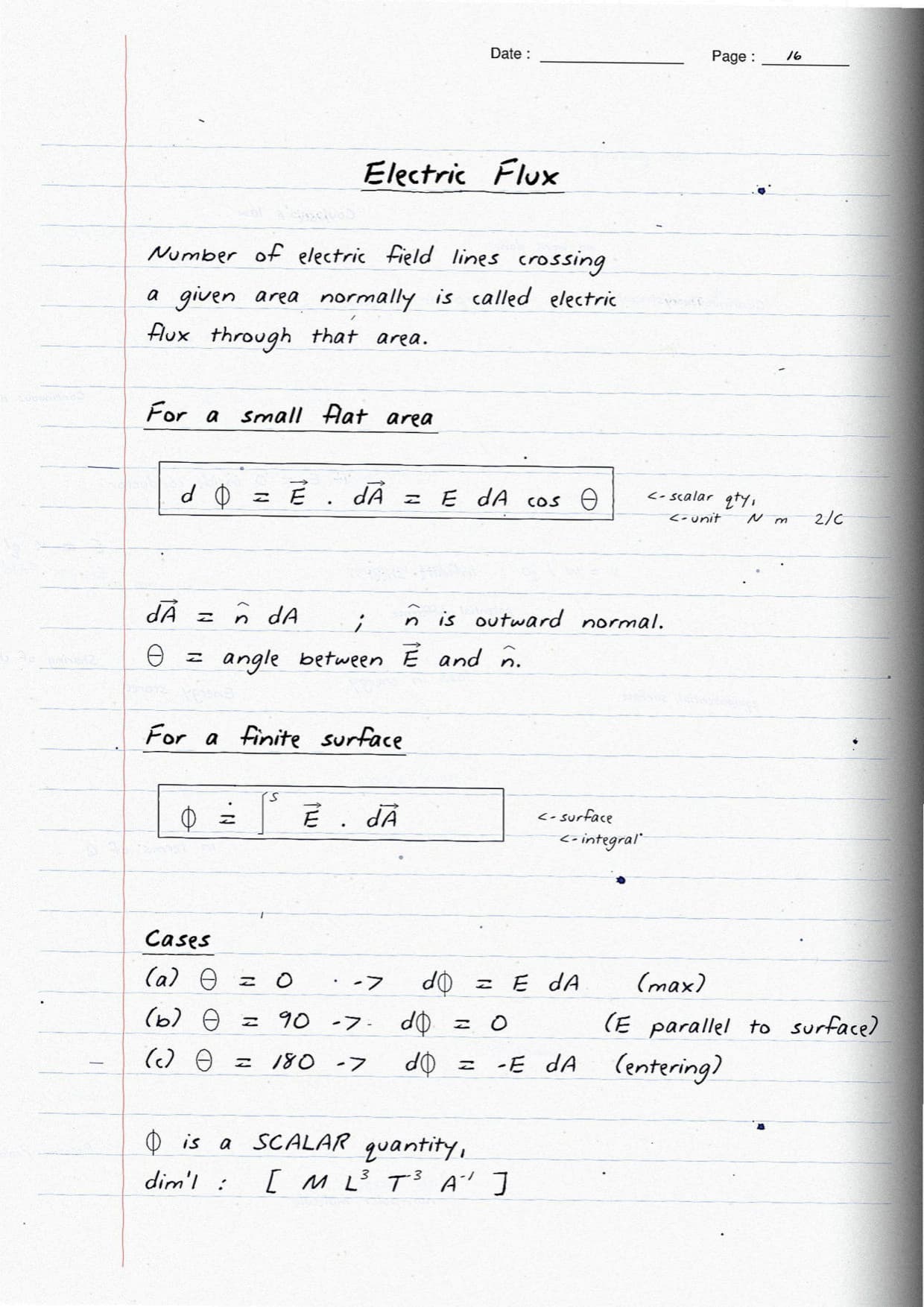
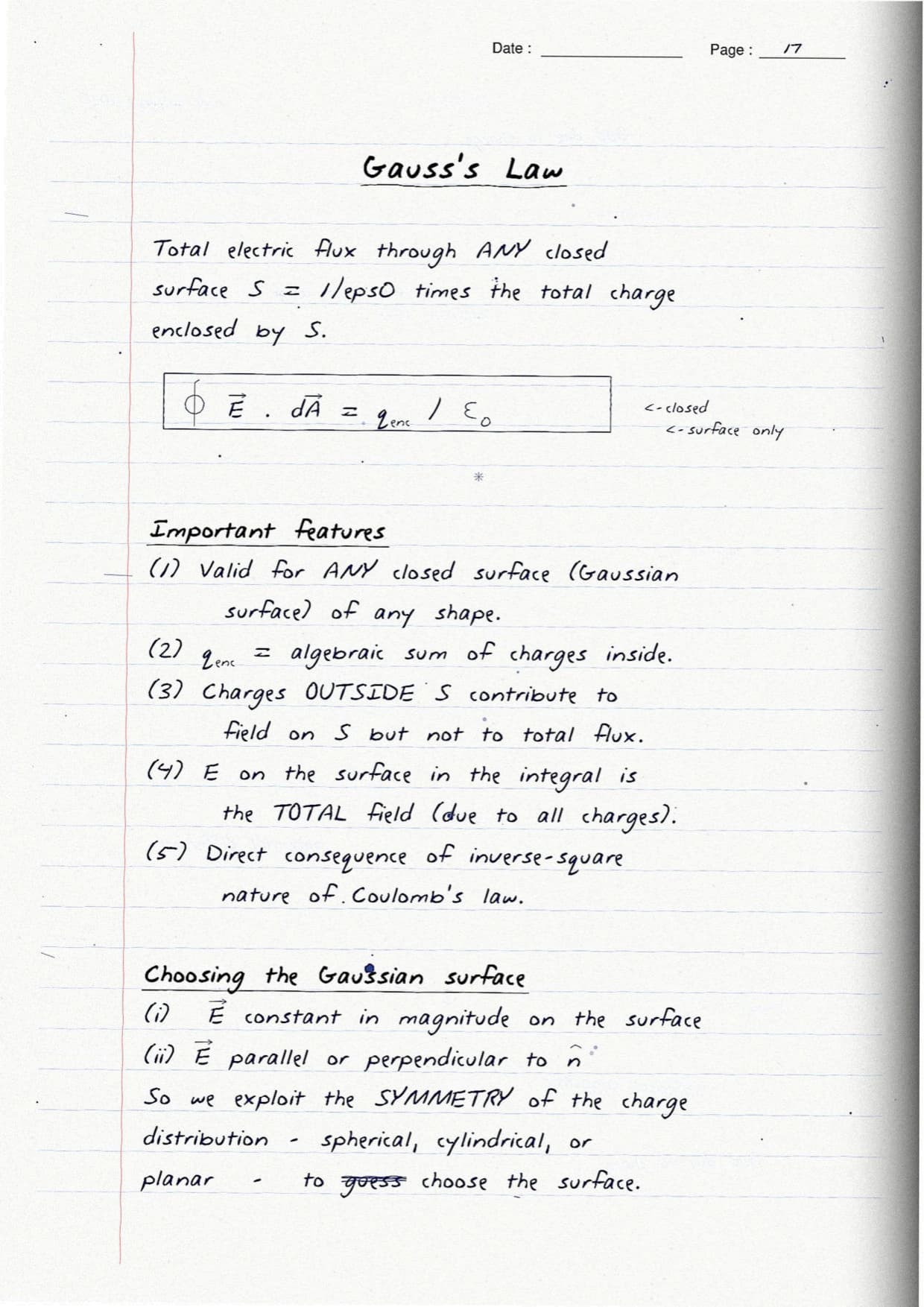
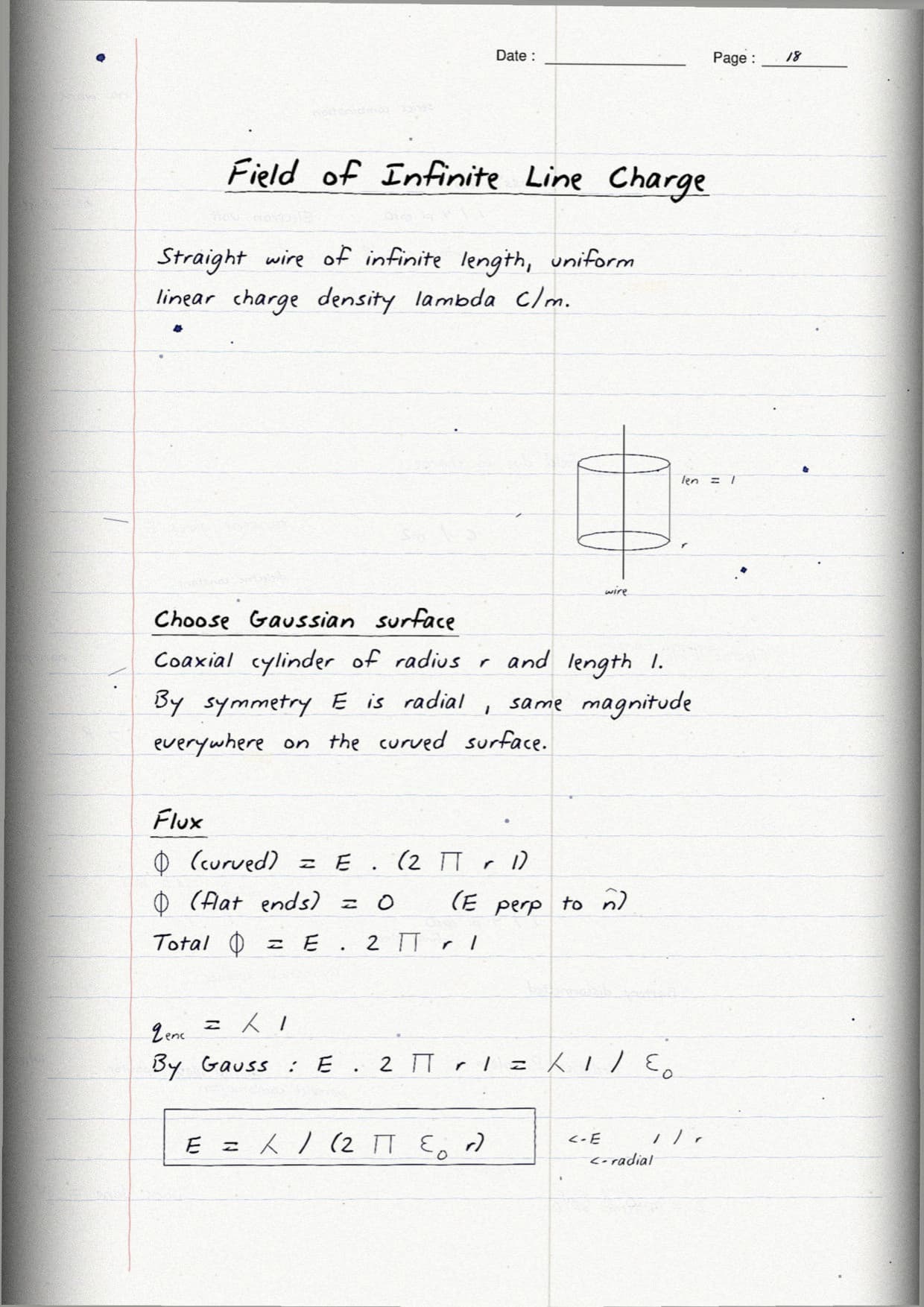
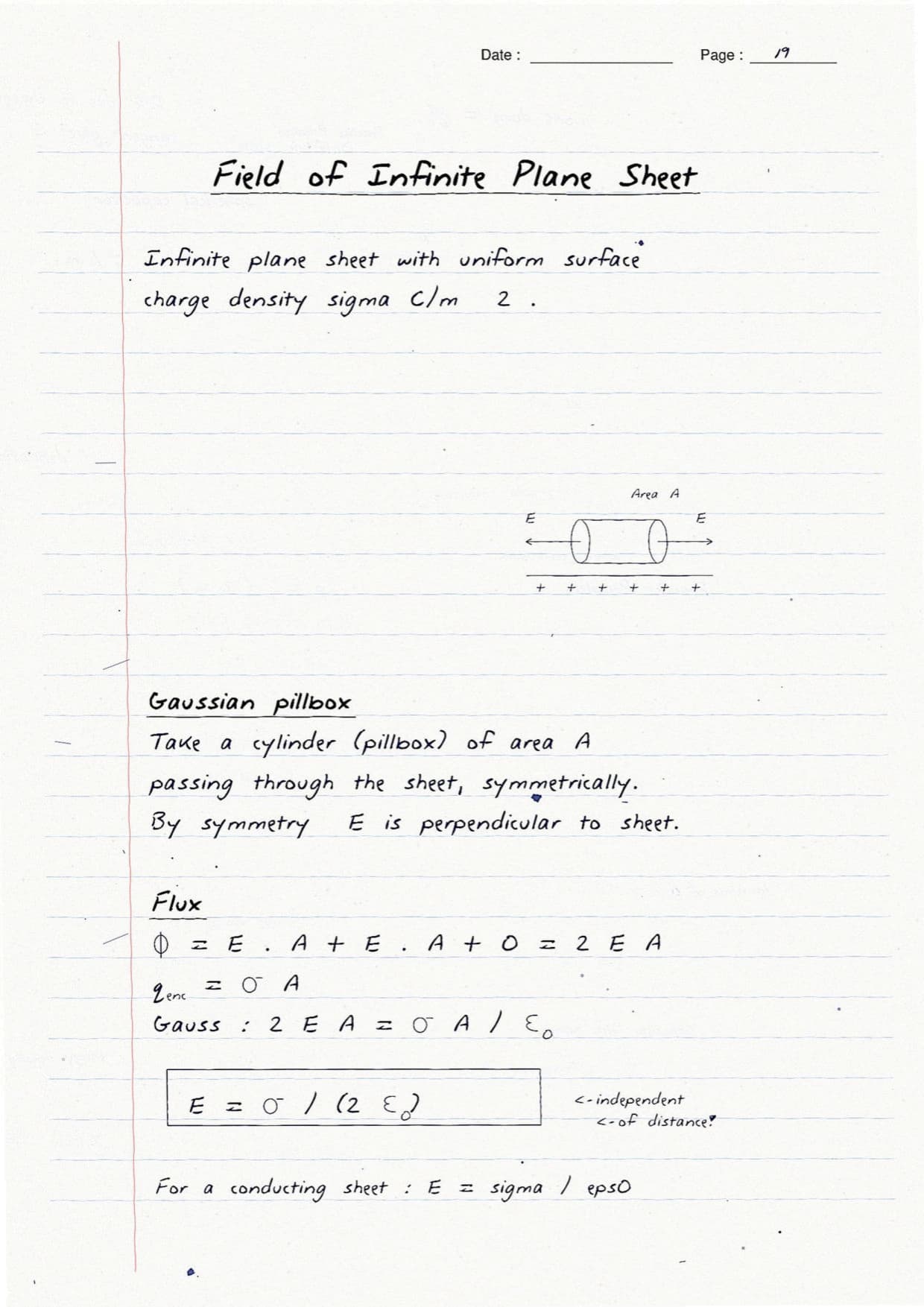
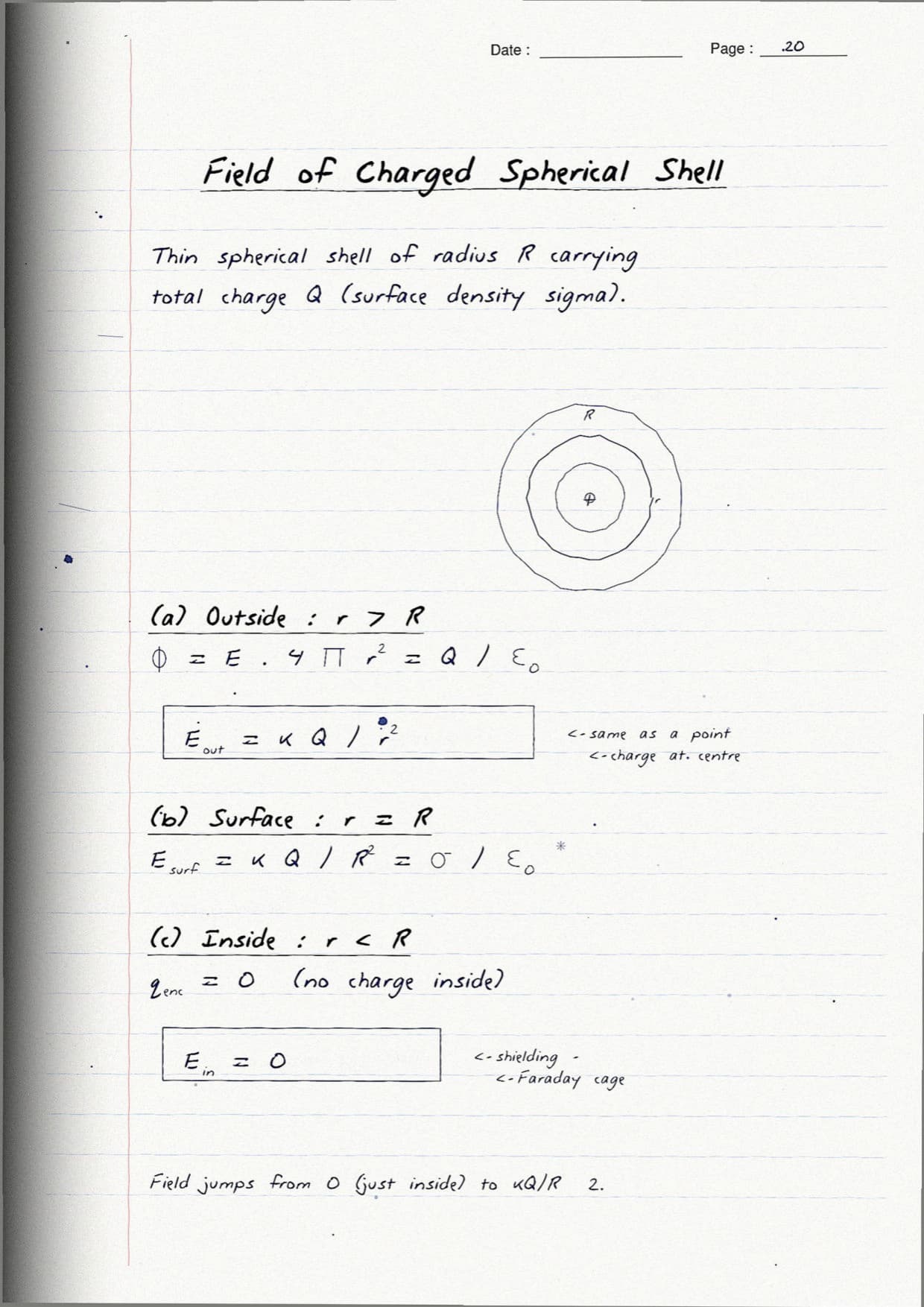
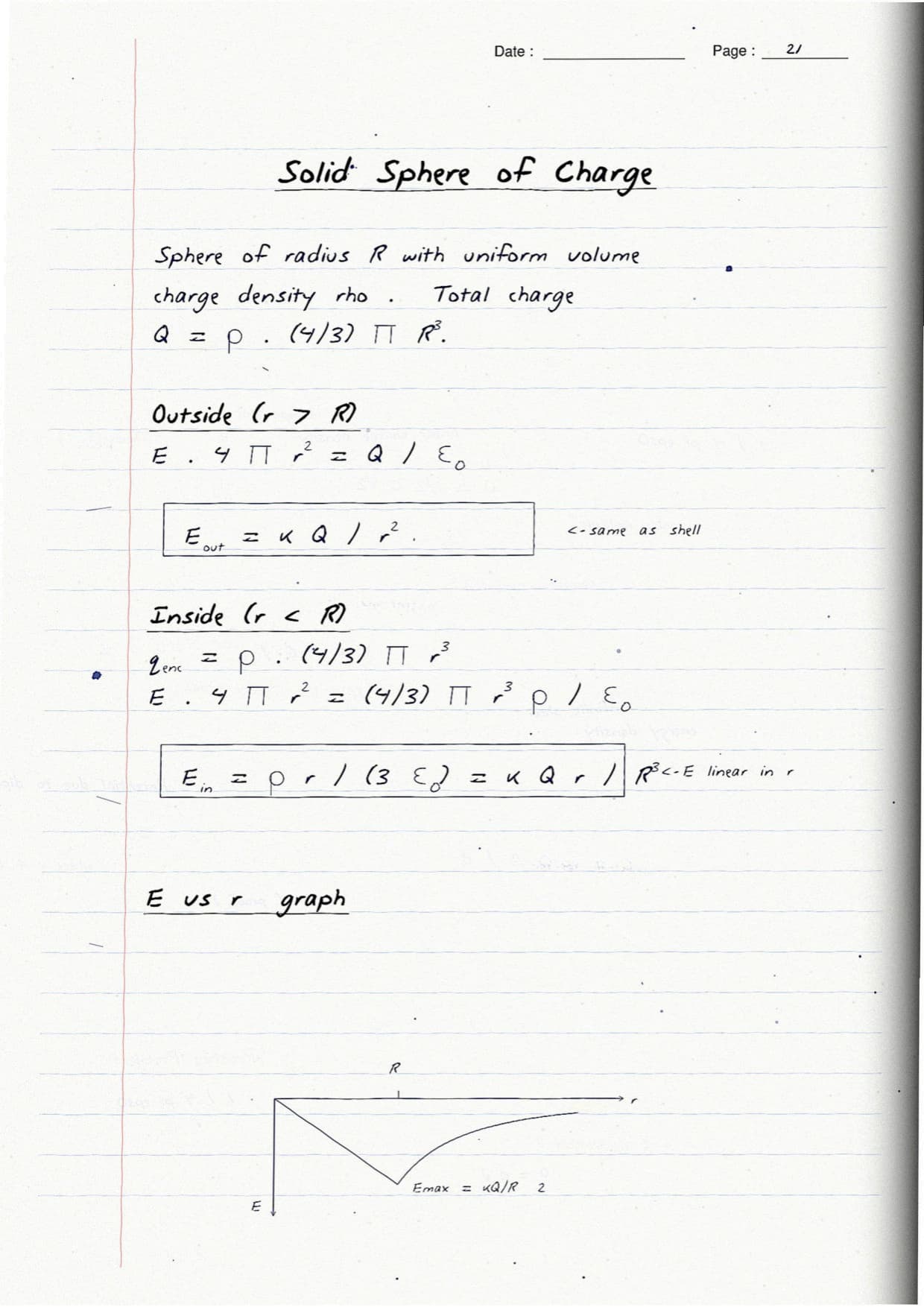
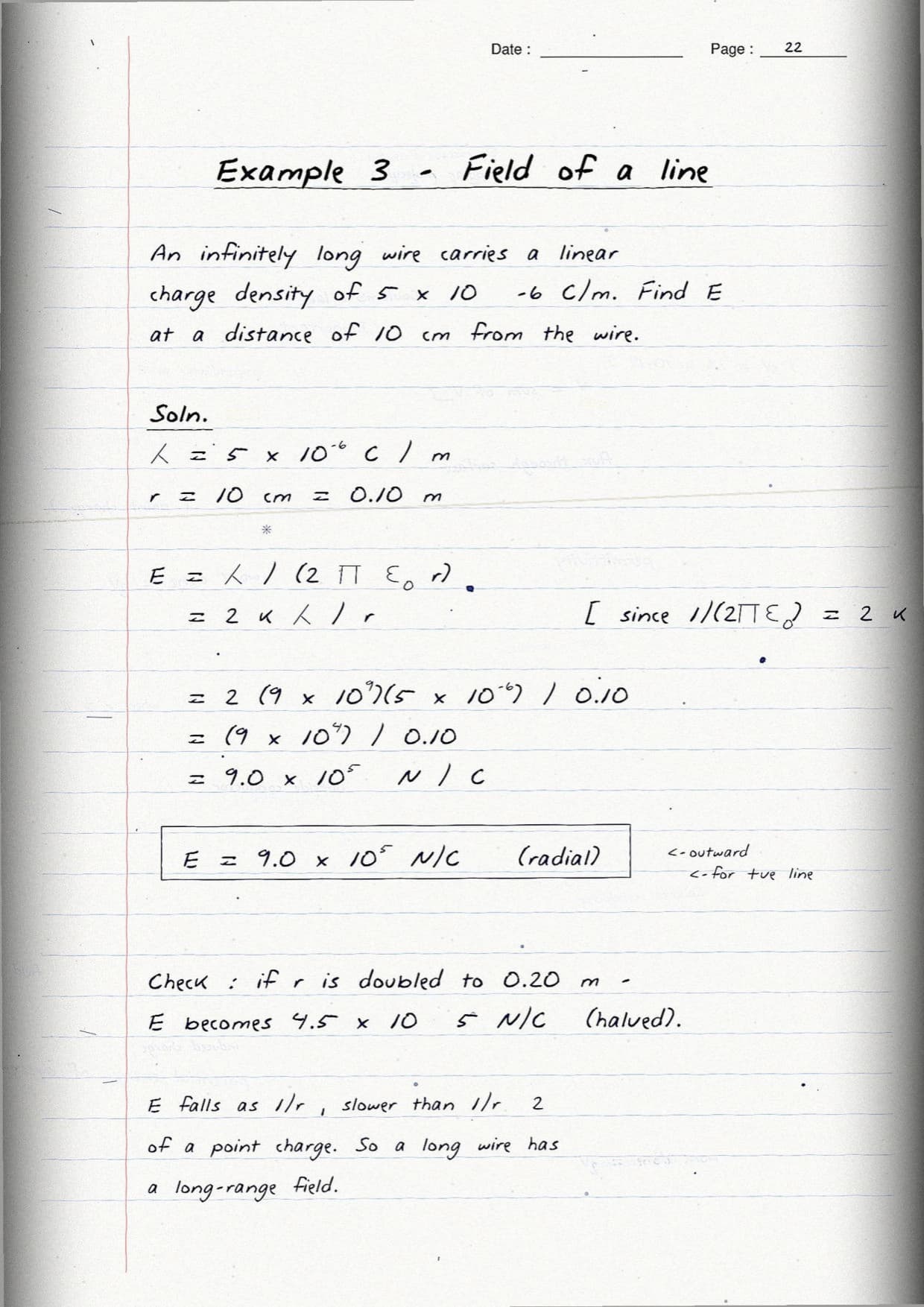
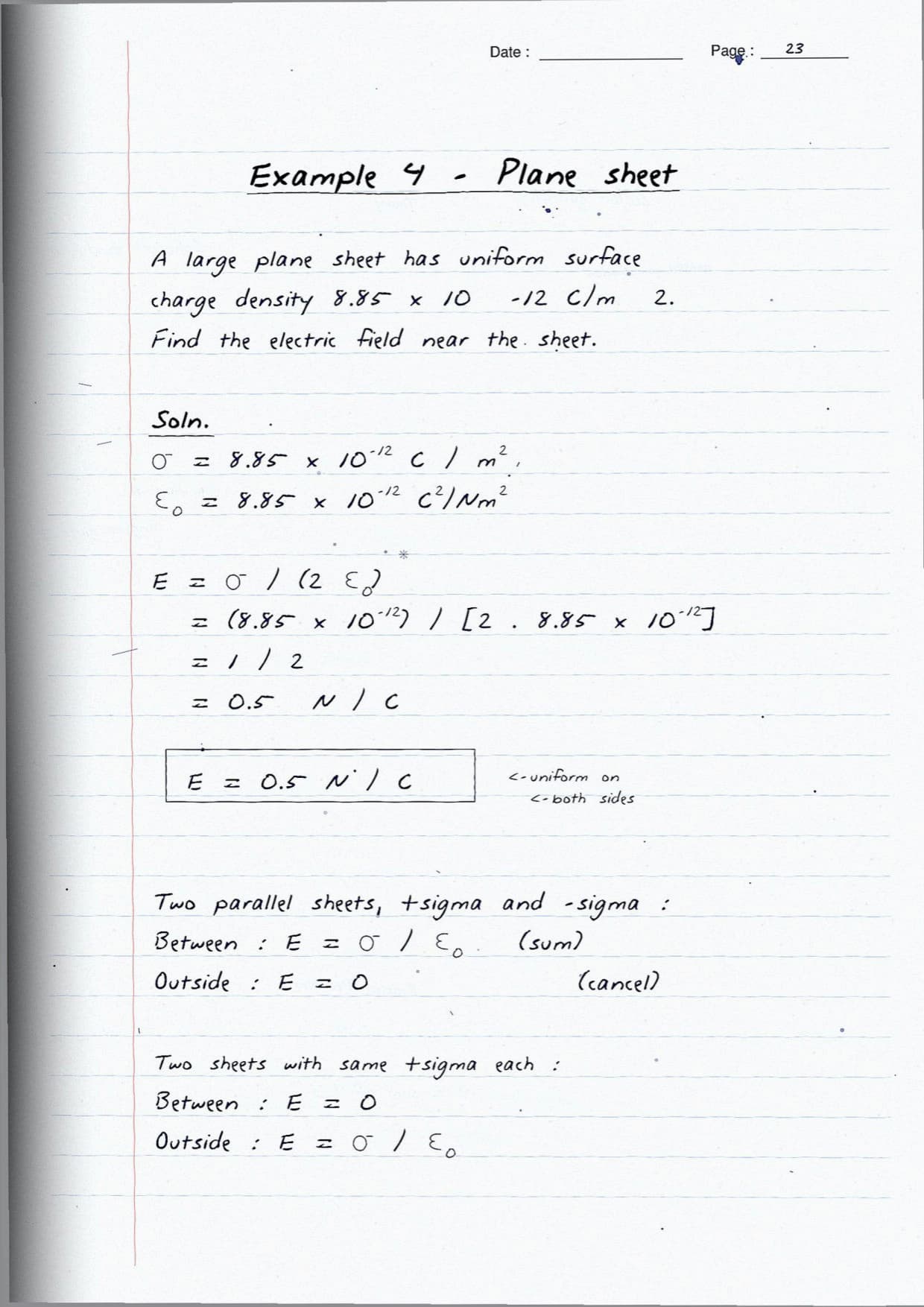
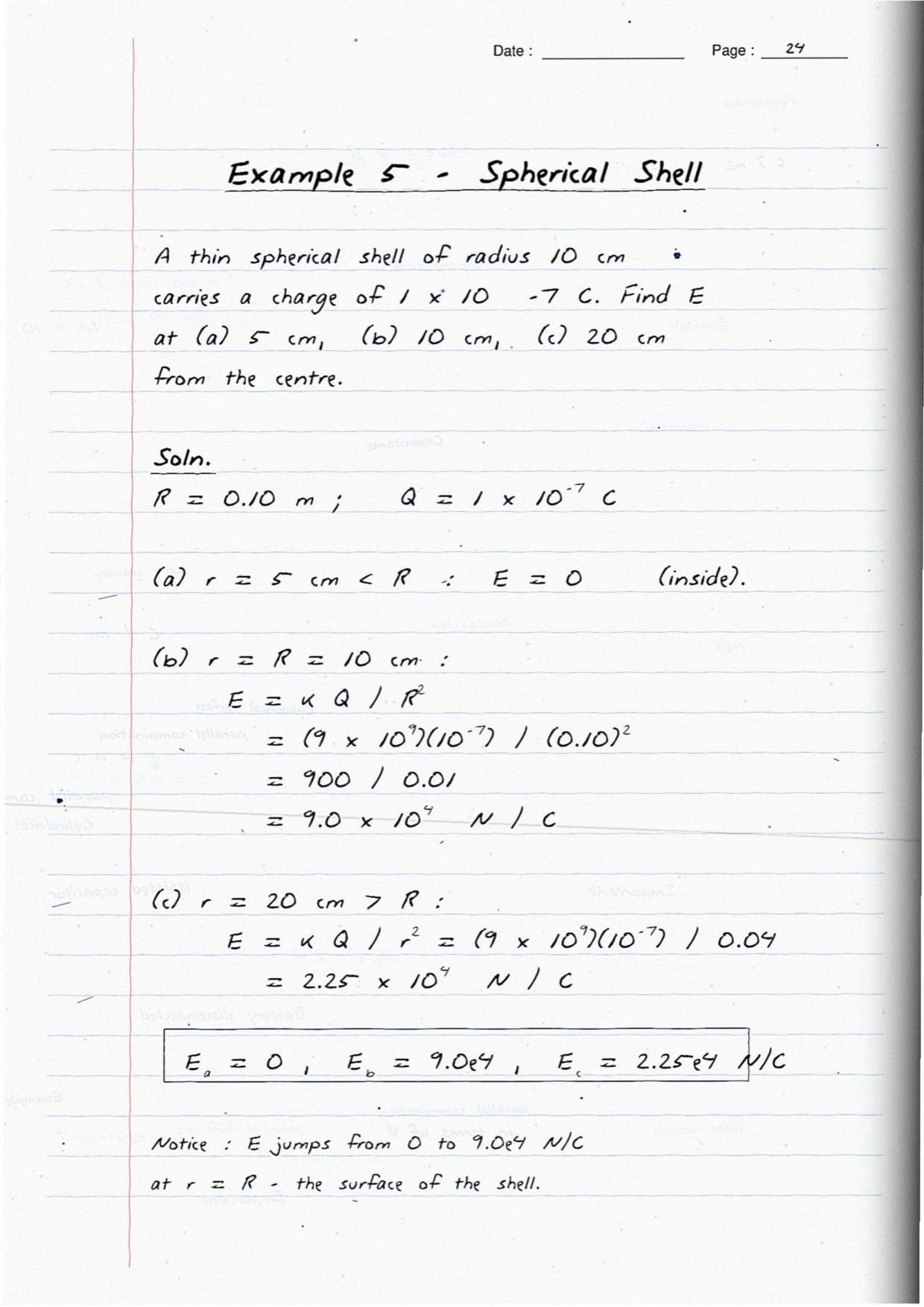
- Flux and Gauss's law (5 marks): applied to a wire, a sheet and a shell.
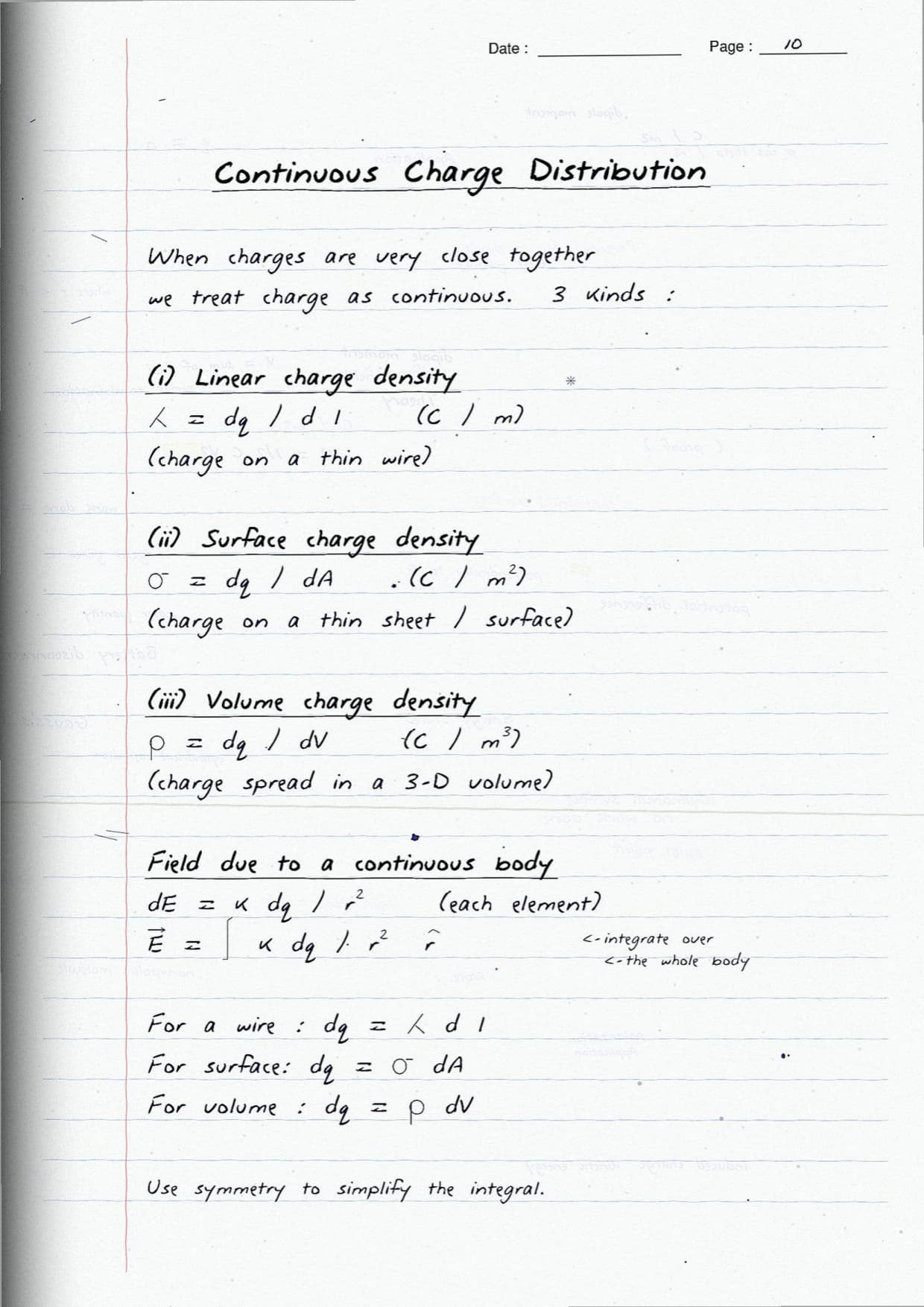
- Charge distributions (3 marks): linear λ, surface σ and volume ρ densities.
Class 12 Physics Chapter 1 All Formulas
Every numerical in the chapter comes from these 10 formulas, also printed on the PDF cover sheet for a last-minute glance.
| Concept | Formula | SI Unit |
|---|---|---|
| Coulomb's law | F = k q₁q₂ / r² | newton |
| Electric field (point charge) | E = k Q / r² | N/C |
| Dipole moment | p = q × 2a | C m |
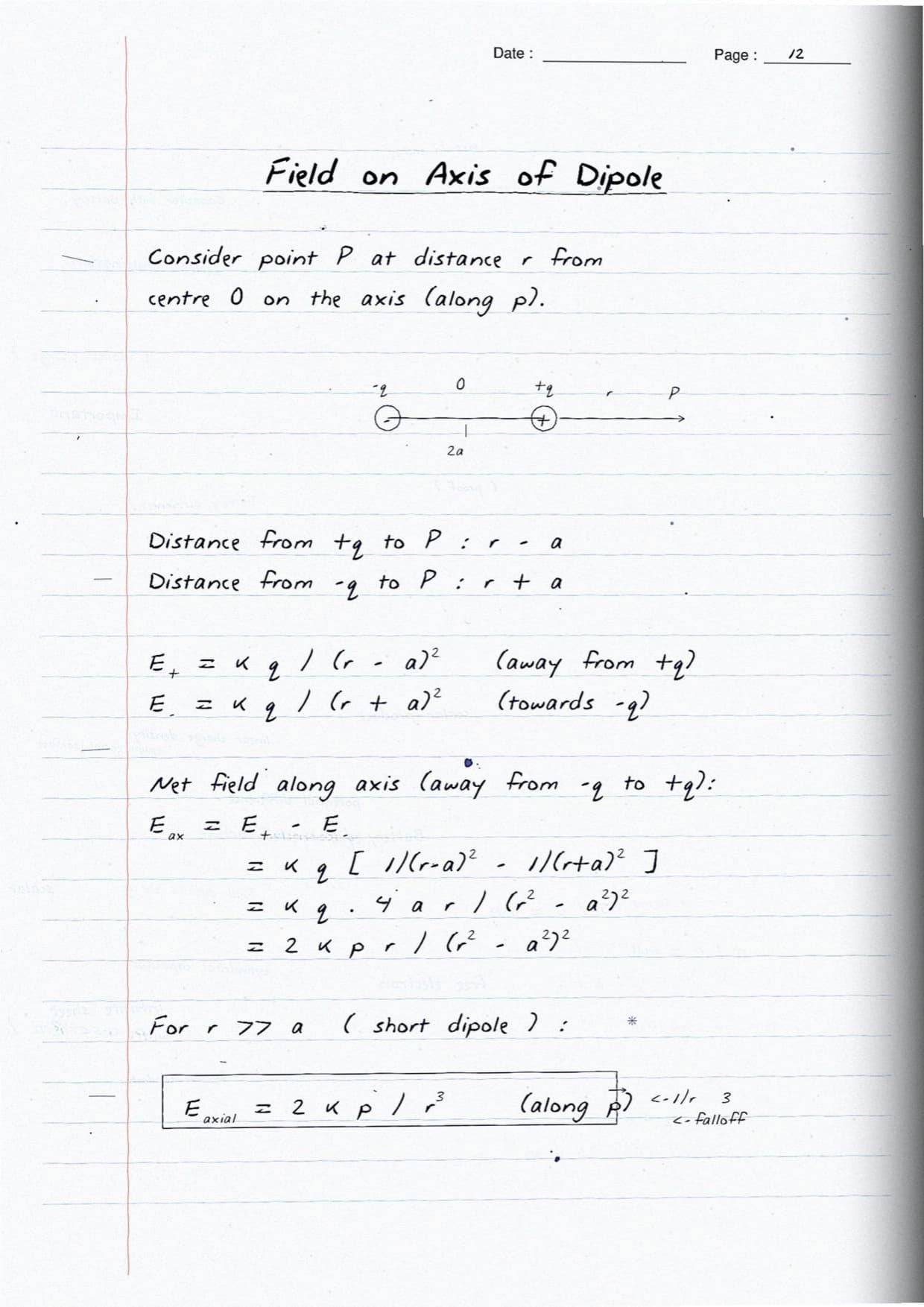
| Dipole field (axial) | E = 2kp / r³ | N/C |
| Dipole field (equatorial) | E = kp / r³ | N/C |
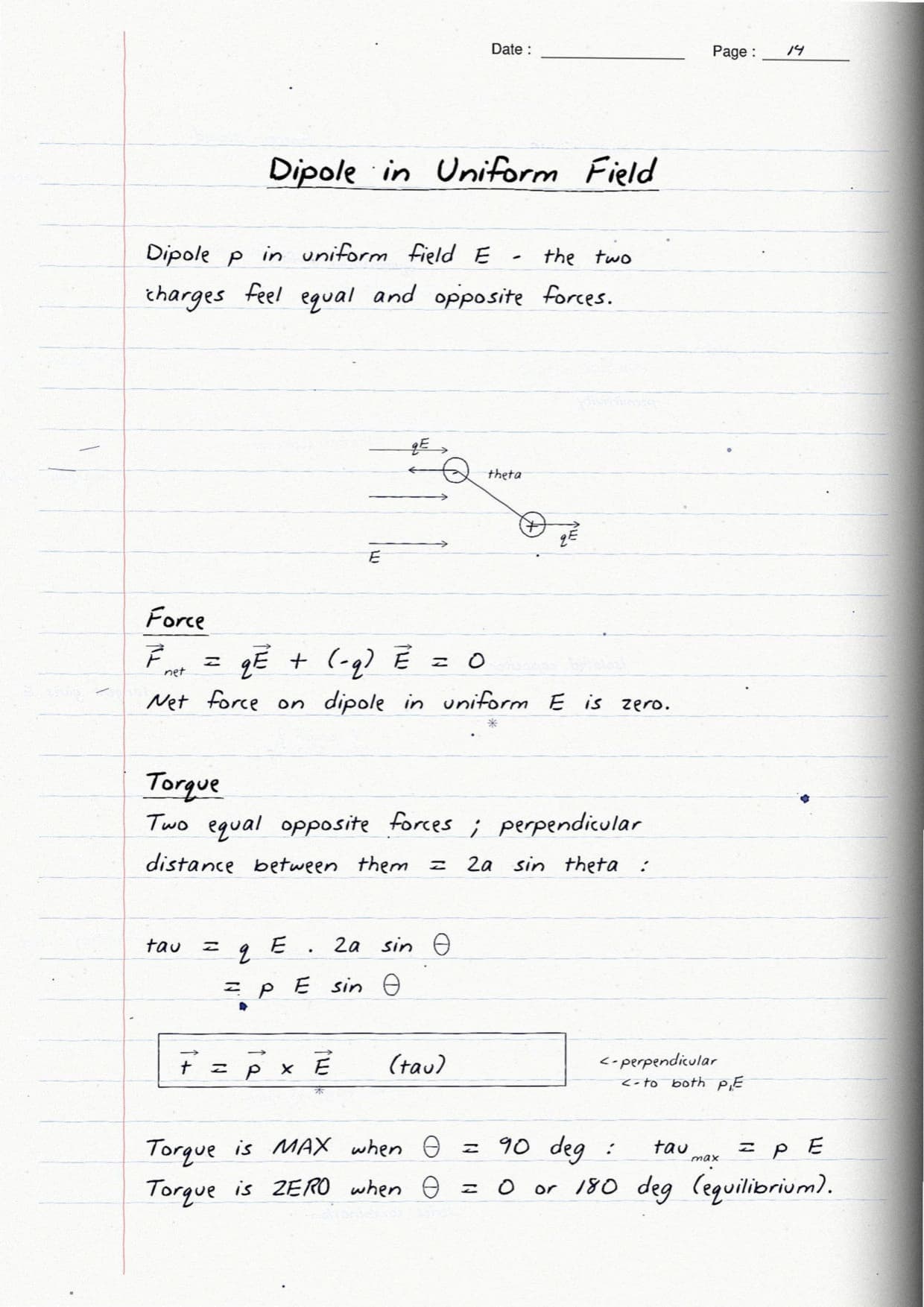
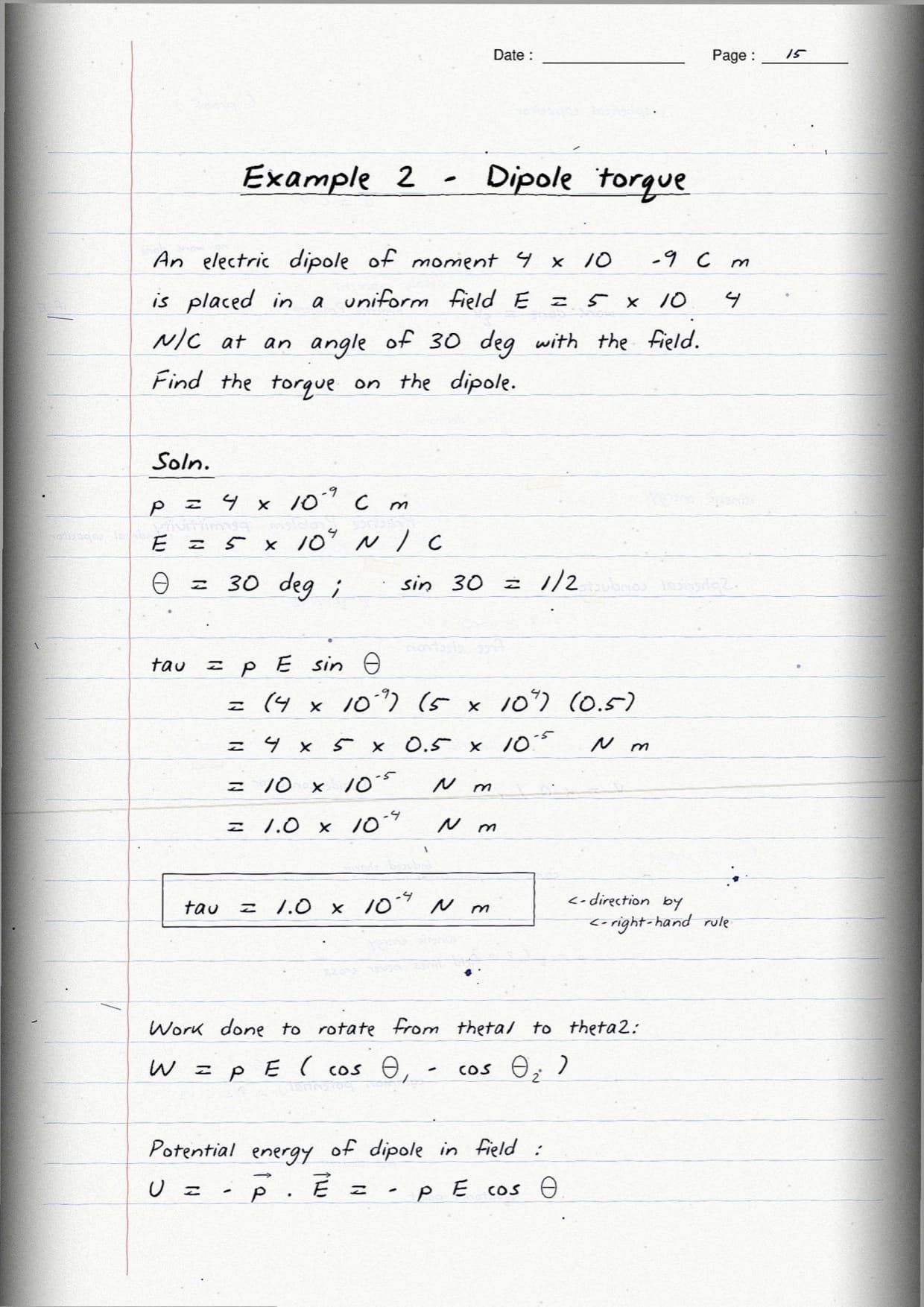
| Torque on dipole | τ = p × E | N m |
| Electric flux | Φ = ∮ E·dA | V m |
| Gauss's law | ∮ E·dA = qenc / ε₀ | N m²/C |
| Field of infinite wire | E = λ / 2πε₀r | N/C |
| Field of plane sheet | E = σ / 2ε₀ | N/C |
Full derivations: Class 12 Physics Chapter 1 Formula Sheet
Key Derivations in Electric Charges and Fields
Six derivations carry most of the marks. Each one in the notebook shows the geometry sketch, the integral set-up and the boundary condition:
- Coulomb's law in vector form (3 marks).
- Dipole field on the axial line (3 marks).
- Dipole field on the equatorial line (3 marks).
- Gauss's law for an infinite line charge (5 marks).
- Gauss's law for an infinite plane sheet (5 marks).
- Gauss's law for a uniformly charged shell (5 marks).
Electric Charges and Fields Class 12 Video Lecture
Source: NCERT Wallah on YouTube
Common Mistakes in Electric Charges and Fields
- Mixing scalars and vectors. Add forces as components; this is the top reason the Coulomb superposition answer goes wrong.
- Swapping the axial and equatorial dipole field. Axial is 2kp/r³, equatorial is kp/r³. The notebook boxes the factor of 2.
- Choosing the wrong Gaussian surface. Use a cylinder for a wire or sheet, a sphere for a shell. The wrong surface loses all 5 marks.
- Skipping the unit-check step. CBSE awards a mark for dimensional consistency, so never substitute numbers too early.
Each slip costs 1 to 2 marks.
Electric Charges and Fields Weightage in CBSE, JEE and NEET
Chapter 1 has stayed at a steady 6 marks in CBSE. The table below maps where its topics appeared across all three exams.
| Year | CBSE Board | JEE Main | NEET |
|---|---|---|---|
| 2025 | Coulomb force on three charges (5) | Flux through a closed surface (4) | Field due to a dipole (4) |
| 2024 | Field of an infinite sheet (3) | Force between charges in a medium | Quantisation of charge MCQ |
| 2023 | Dipole in a uniform field (5) | Linear charge density on a wire | Coulomb's law SI unit MCQ |
| 2022 | Gauss's law for a charged shell (3) | Superposition of three charges | Field-line property |
| 2021 | Field due to a point charge (2) | Dipole in a non-uniform field | Field due to a point charge |
Student Feedback: We asked 13,150 Class 12 students about this chapter. 69% found the dipole equatorial-field derivation the hardest part, and 4 out of 5 said the hand-drawn Gauss's law diagrams were easier to remember than typed notes.
How to Revise Electric Charges and Fields in 2 Hours
- 0 to 30 min: Charge properties and Coulomb's law. Solve two superposition numericals.
- 30 to 60 min: Electric field, field lines and both dipole derivations.
- 60 to 90 min: Flux and Gauss's law for wire, sheet and shell.
- 90 to 120 min: Flush through the 10-formula table and the 6-derivation index.
Other Resources for Class 12 Physics Chapter 1
Pair these handwritten notes with the Solutions, Formula Sheet and official NCERT chapter linked below.
| Resource | What it covers | Open |
|---|---|---|
| Handwritten Notes | Scanned notebook pages for last-mile revision. | You are here |
| NCERT Solutions | Step-by-step answers to every exercise question. | Chapter 1 NCERT Solutions |
| Formula Sheet | All 10 formulas with full derivations. | Chapter 1 Formula Sheet |
| NCERT Book PDF | Official NCERT textbook chapter. | Chapter 1 NCERT Book PDF |
| Exemplar Solutions | Worked answers to the NCERT Exemplar problems. | Chapter 1 Exemplar Solutions |
All Chapters Handwritten Notes for Class 12 Physics
| Chapter | Handwritten Notes link |
|---|---|
| Chapter 1 | Electric Charges and Fields (you are here) |
| Chapter 2 | Electrostatic Potential and Capacitance |
| Chapter 3 | Current Electricity |
| Chapter 4 | Moving Charges and Magnetism |
| Chapter 5 | Magnetism and Matter |
| Chapter 6 | Electromagnetic Induction |
| Chapter 7 | Alternating Current |
| Chapter 8 | Electromagnetic Waves |
| Chapter 9 | Ray Optics and Optical Instruments |
| Chapter 10 | Wave Optics |
| Chapter 11 | Dual Nature of Radiation and Matter |
| Chapter 12 | Atoms |
| Chapter 13 | Nuclei |
| Chapter 14 | Semiconductor Electronics |
Electric Charges and Fields Class 12 Handwritten Notes FAQs
Ques. What topics do these Class 12 Physics Chapter 1 handwritten notes cover?
Ans. They cover all five blocks: charge and its properties, Coulomb's law, the electric field and dipole, flux and Gauss's law, and charge distributions, with all 10 formulas and 6 derivations drawn out by hand.
Ques. What is the weightage of Electric Charges and Fields in Class 12?
Ans. The chapter carries about 6 marks in the CBSE Class 12 Physics board paper, 4 to 5 percent in JEE Main, and 1 to 2 questions a year in NEET. Most of the marks sit in the Gauss's law and dipole derivations.
Ques. Which derivation is the hardest in this chapter?
Ans. Students rate the dipole equatorial-field derivation the trickiest, mainly because they forget the equatorial field is kp/r³ while the axial field is 2kp/r³. The notebook boxes the factor of 2 to fix this.
Ques. How should I use these handwritten notes before the board exam?
Ans. Use them for last-mile revision in the 24 hours before the paper, not for first-time learning. Read the typed Notes first, then switch to the handwritten file to lock in the formulas, sketches and the Gauss's law surface choice.
Ques. Where can I download the Electric Charges and Fields handwritten notes PDF?
Ans. The PDF is on this page via the download card at the top. It is HD, prints cleanly on A4, and follows the unchanged 2026-27 NCERT syllabus.



Comments