




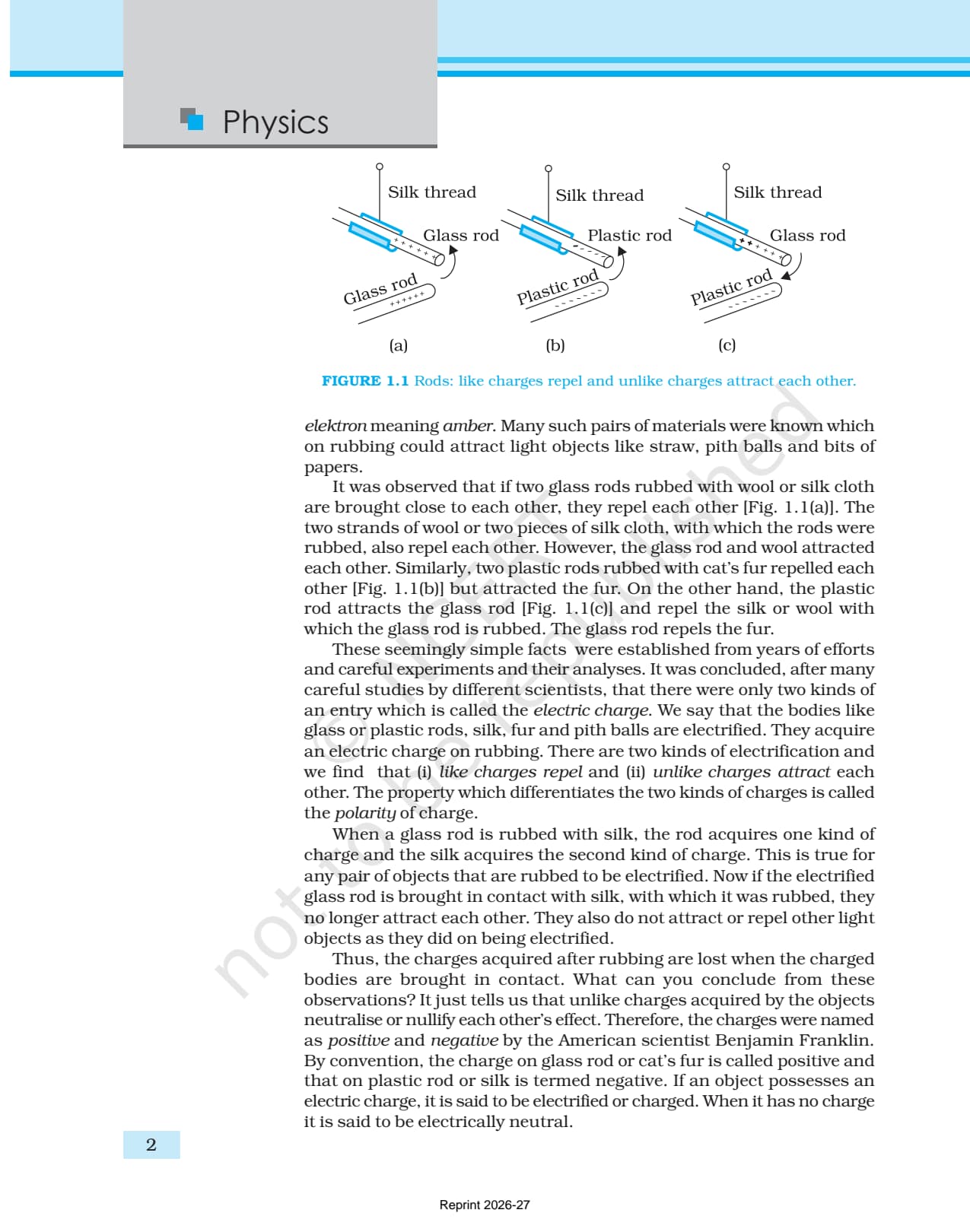
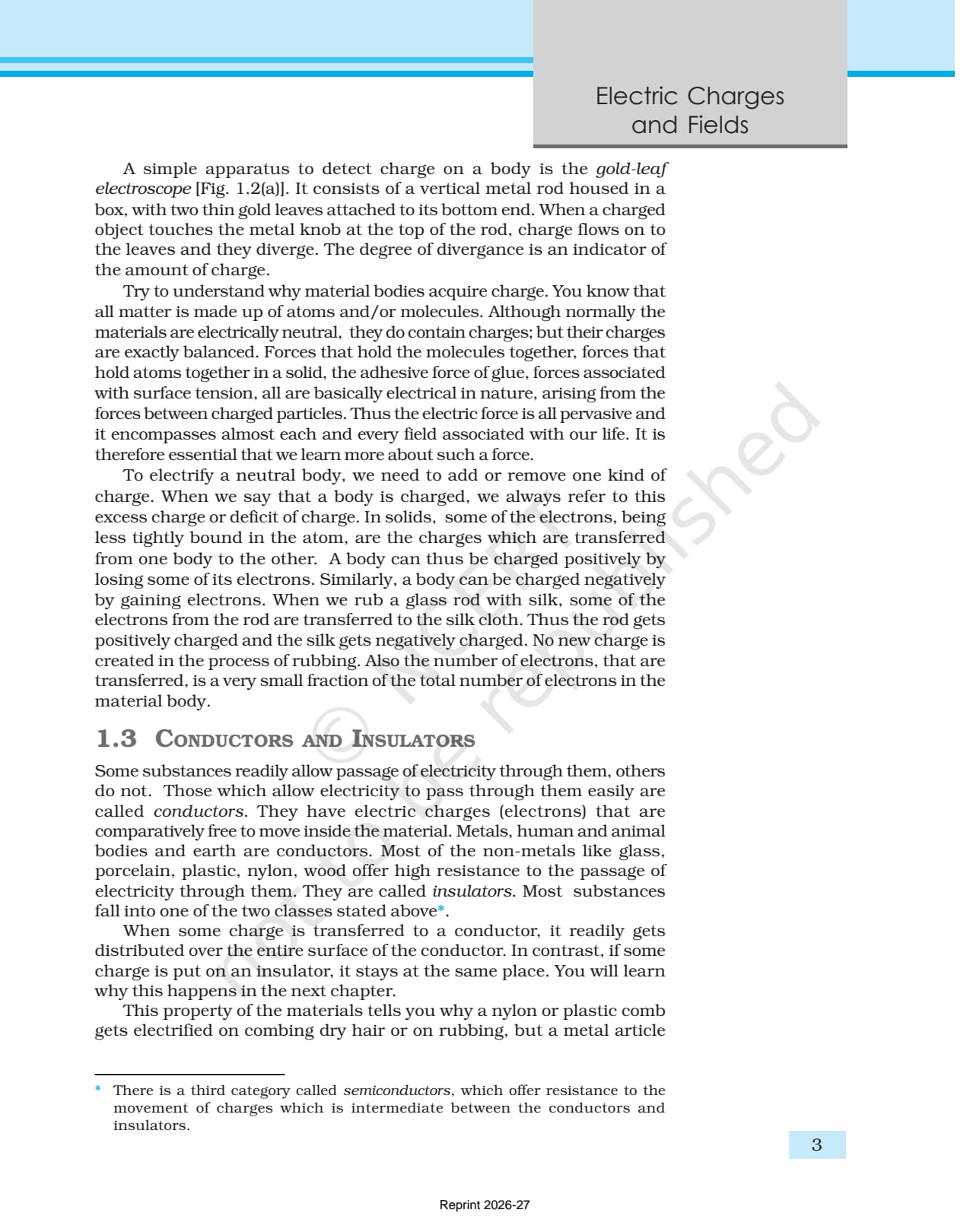
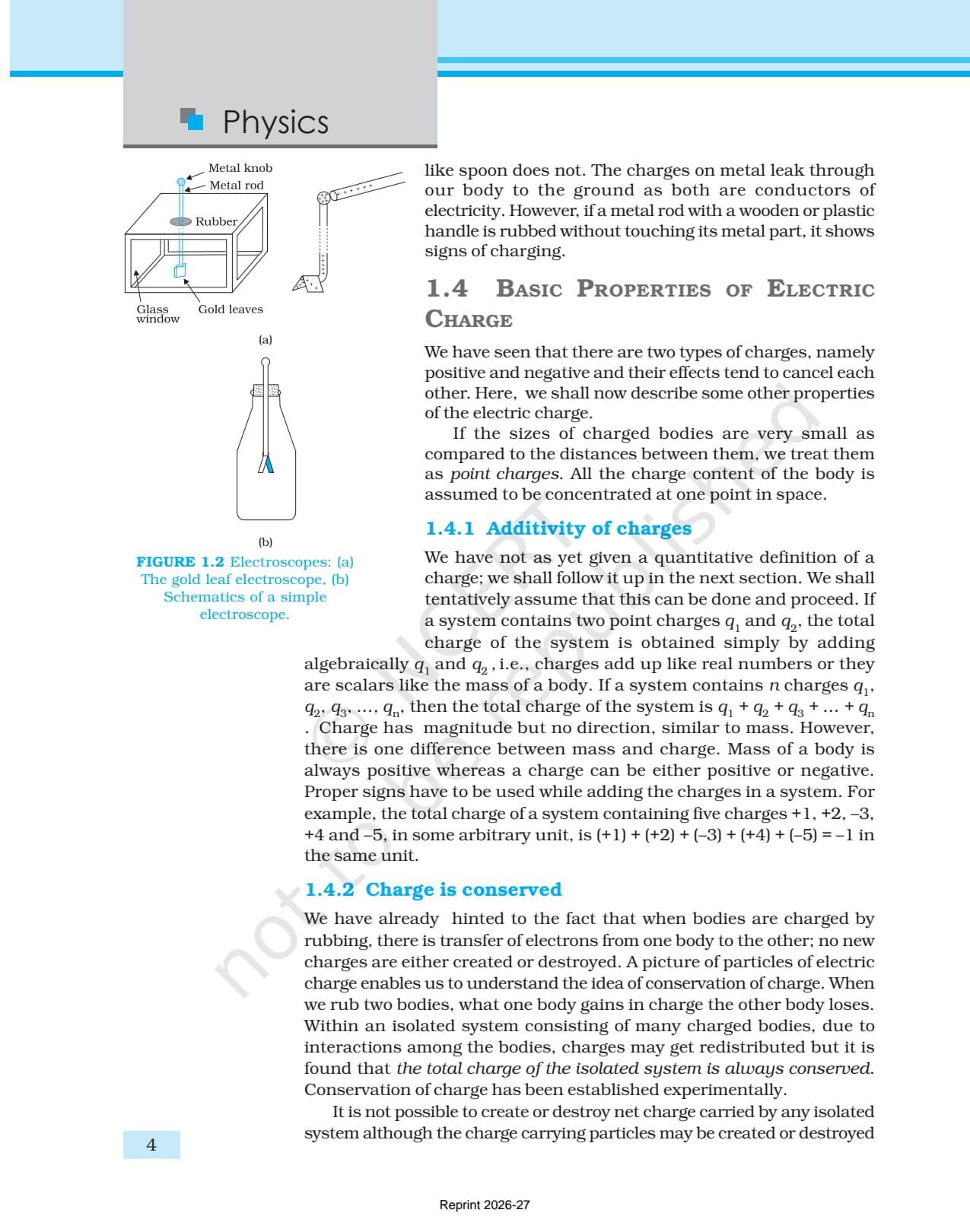
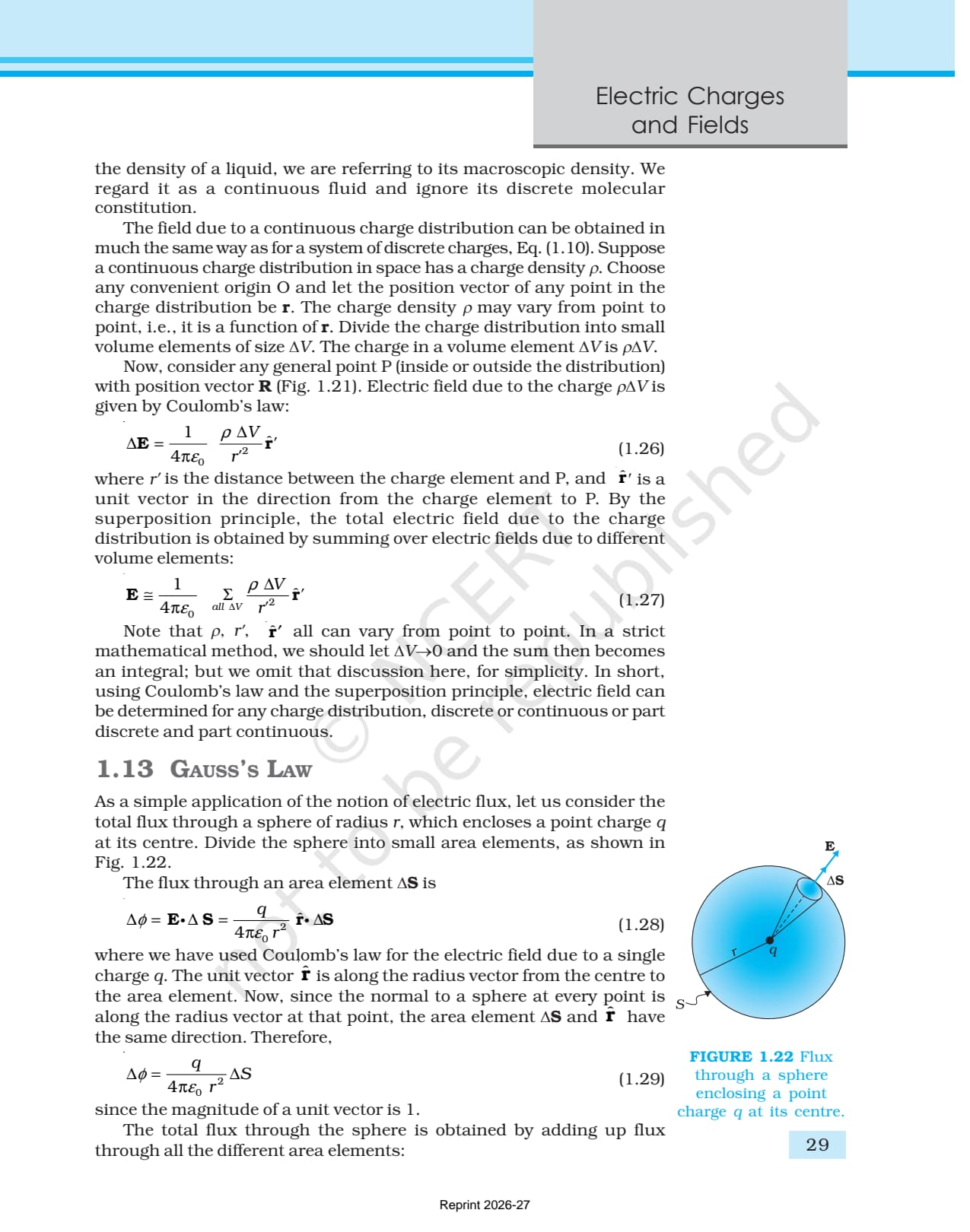
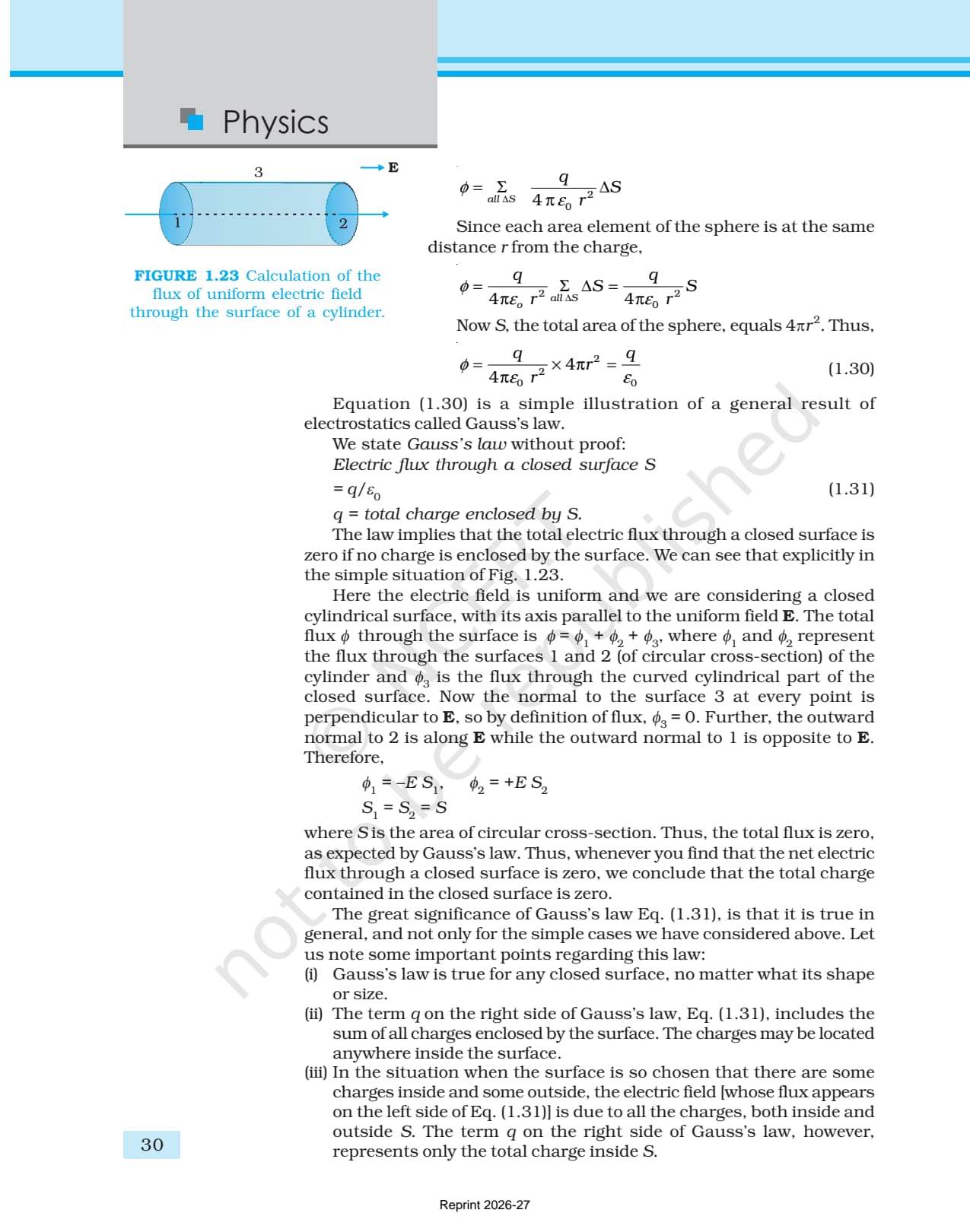
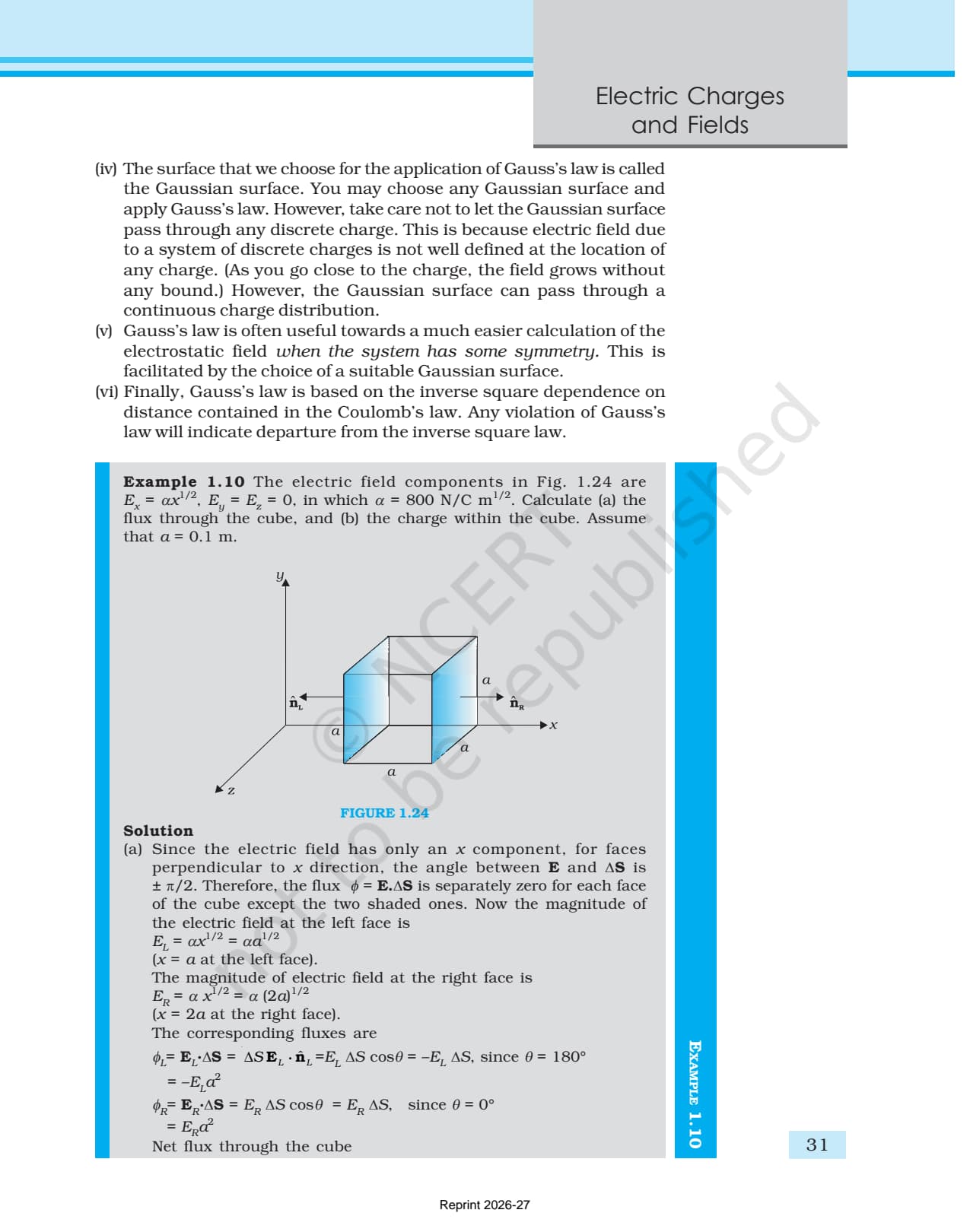
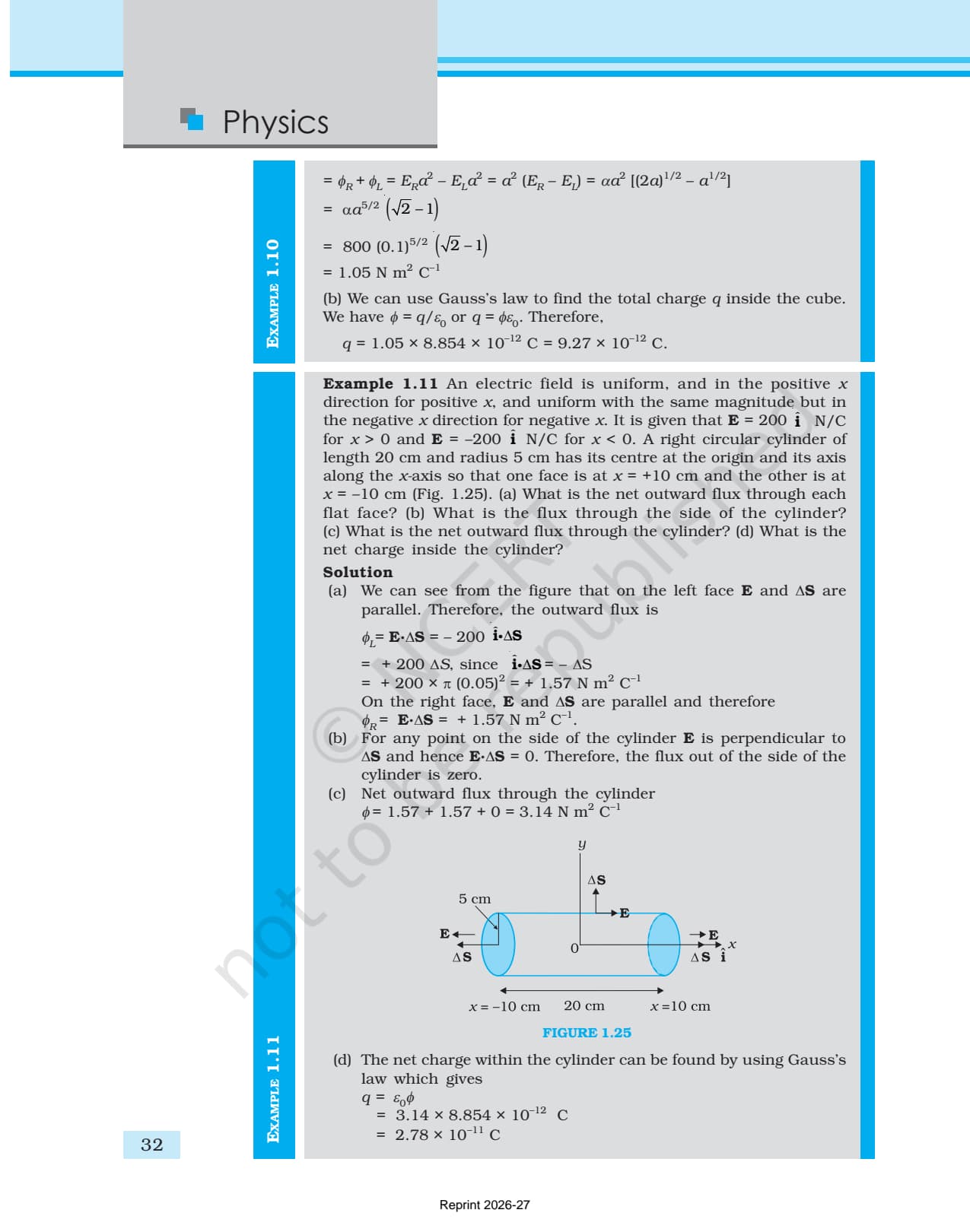
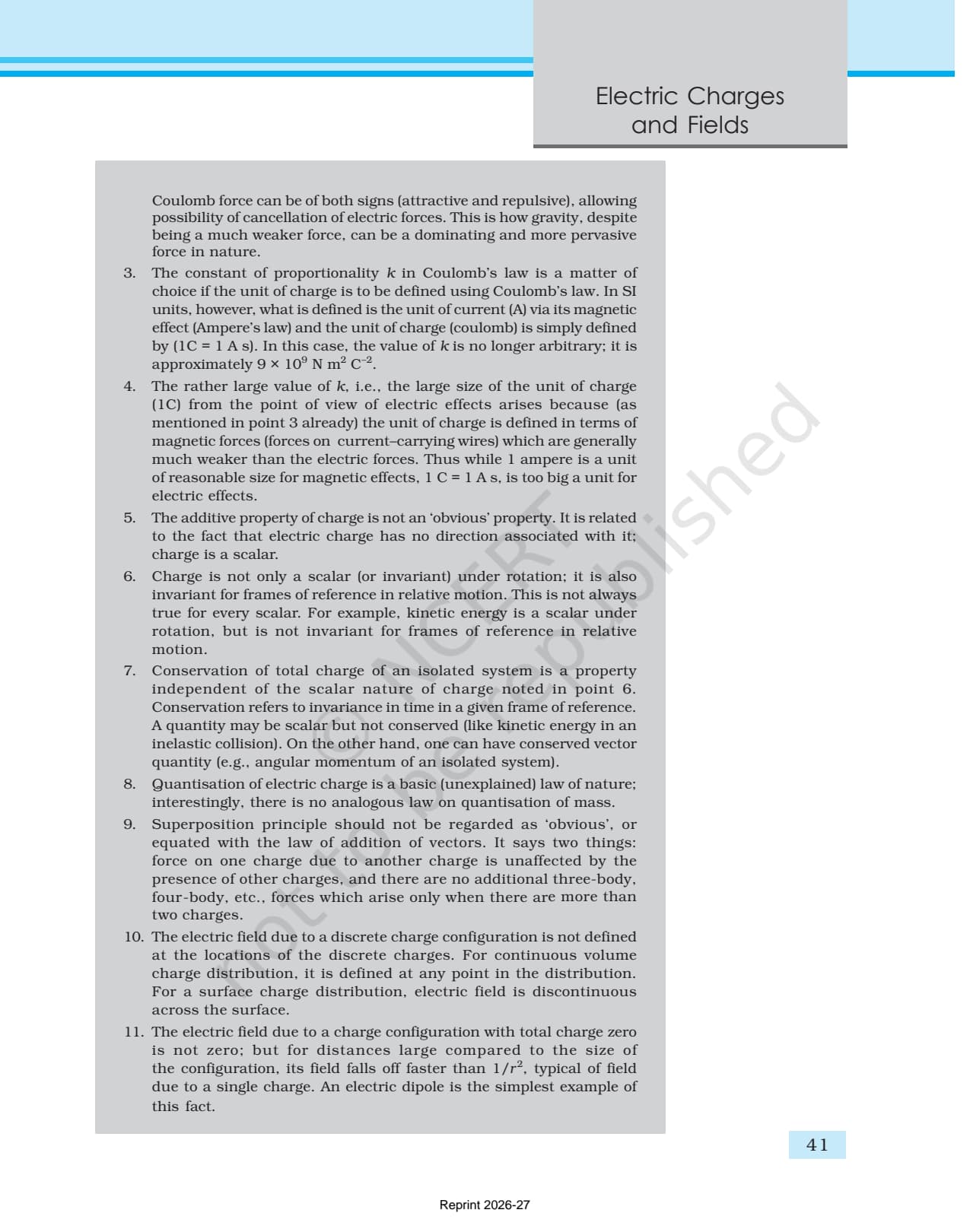
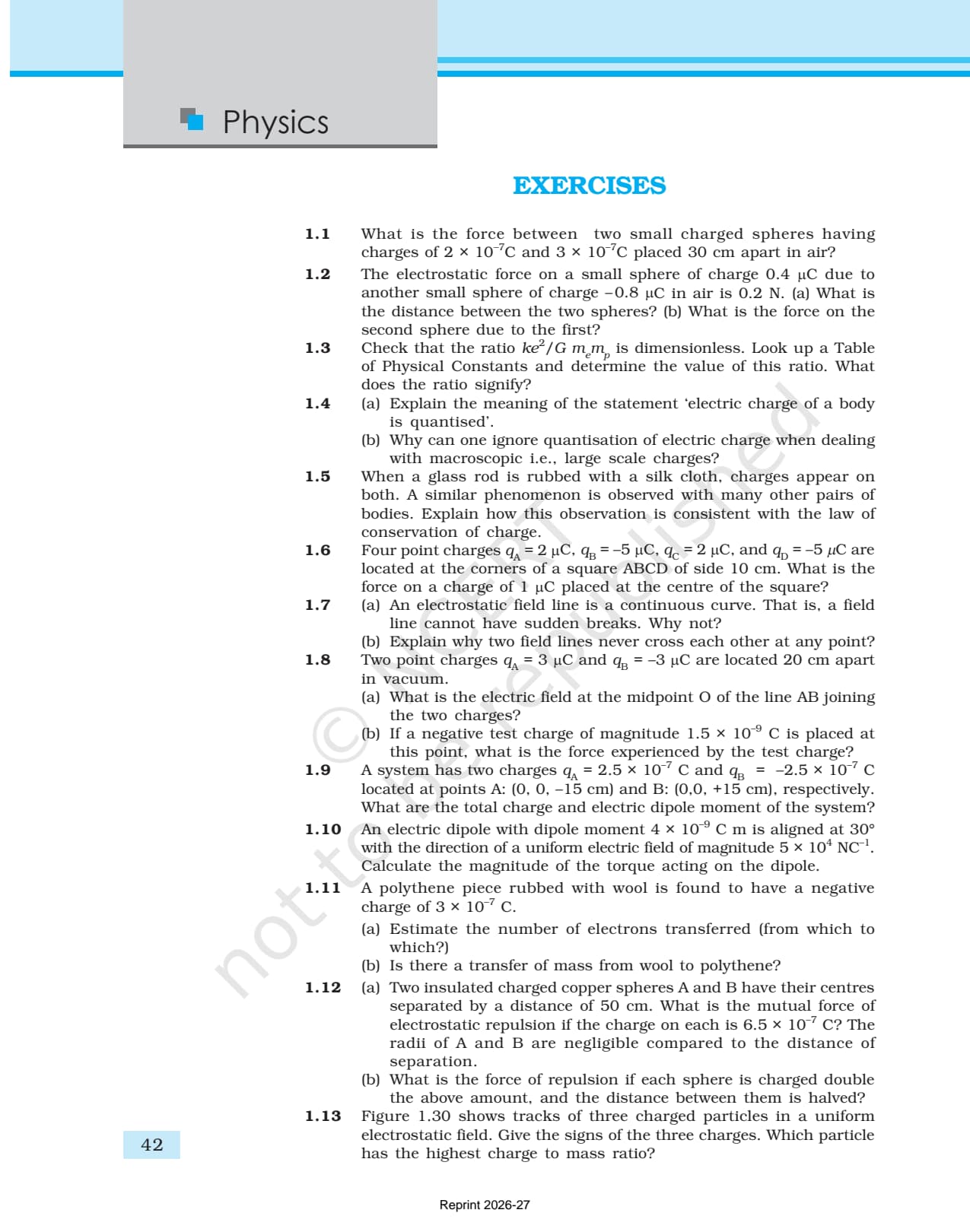
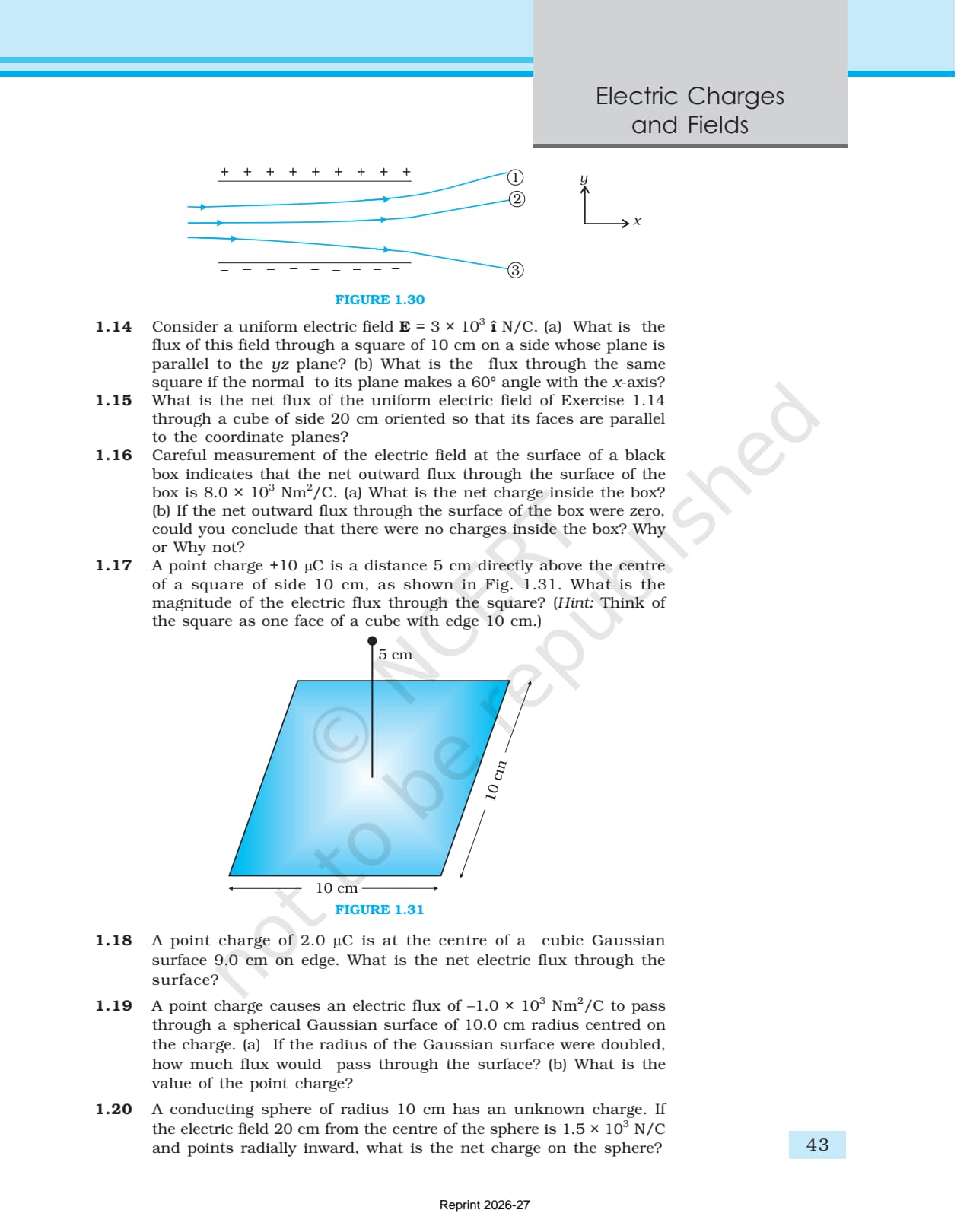
Download the Electric Charges and Fields NCERT PDF free from this page, the official NCERT textbook chapter for Class 12 Physics Chapter 1 Electric Charges and Fields aligned to the 2026-27 print. The Electric Charges and Fields NCERT PDF carries every section, solved example and end-of-chapter exercise printed in the official textbook. Use the PDF for offline study, classroom reference and exam-day revision.
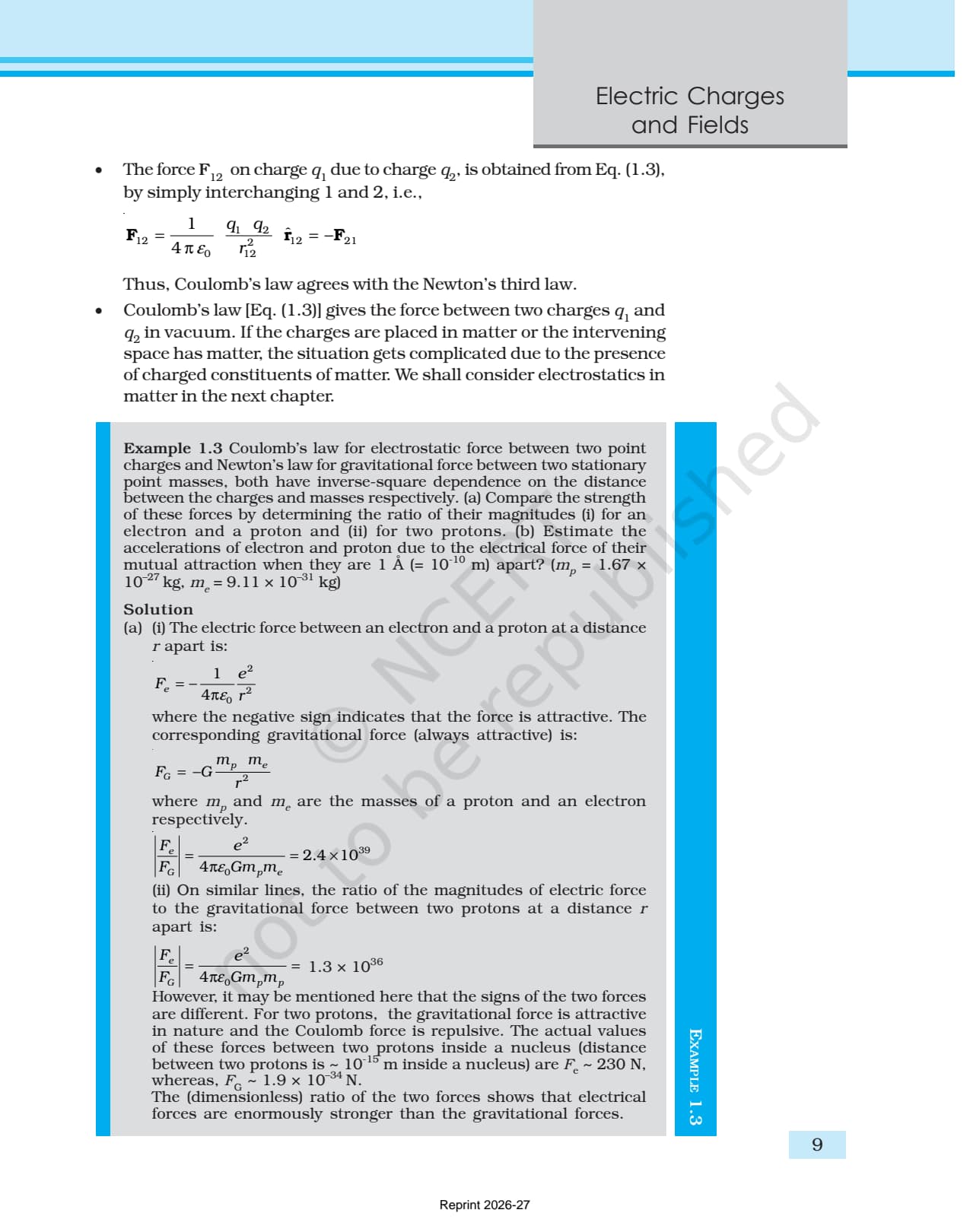
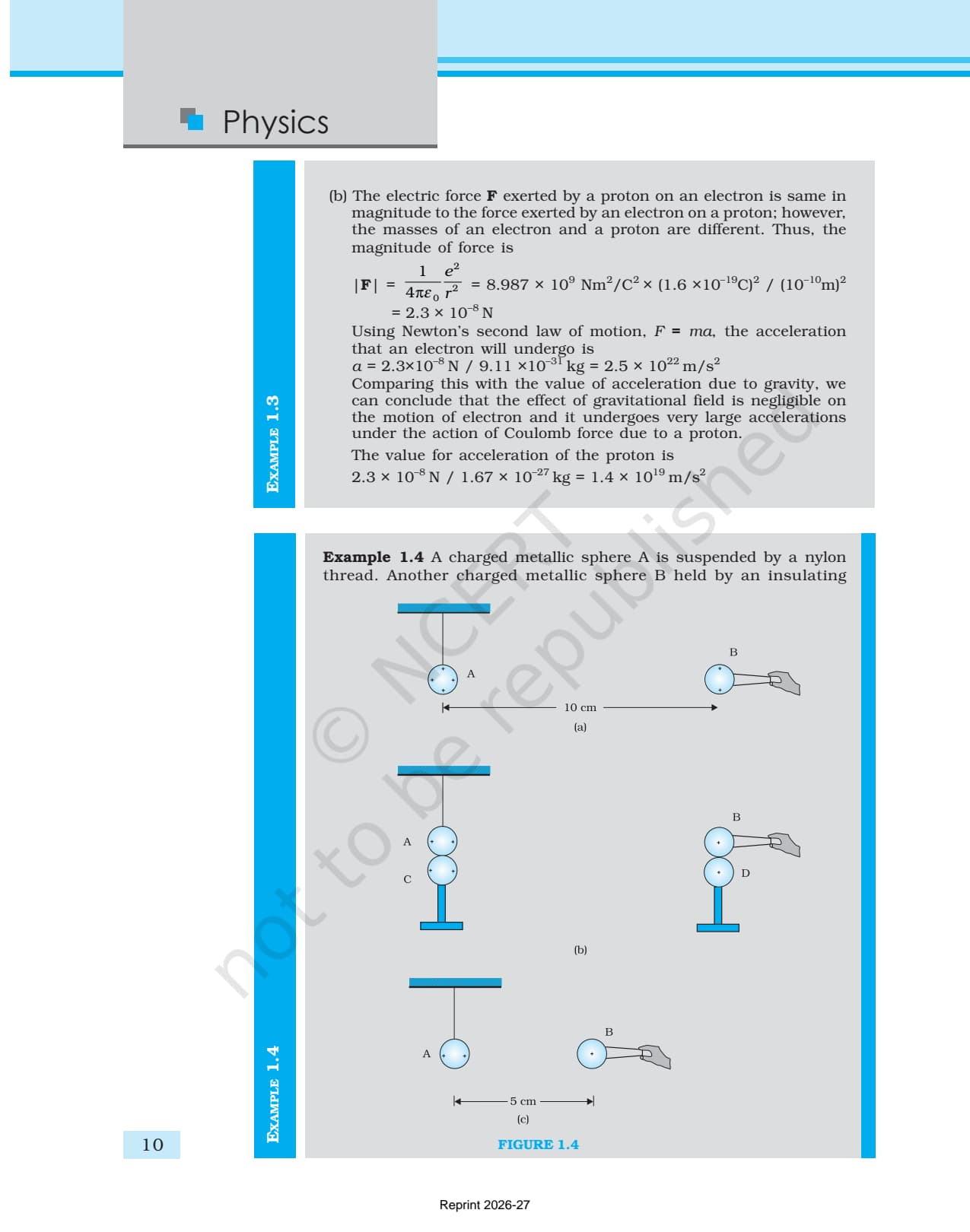
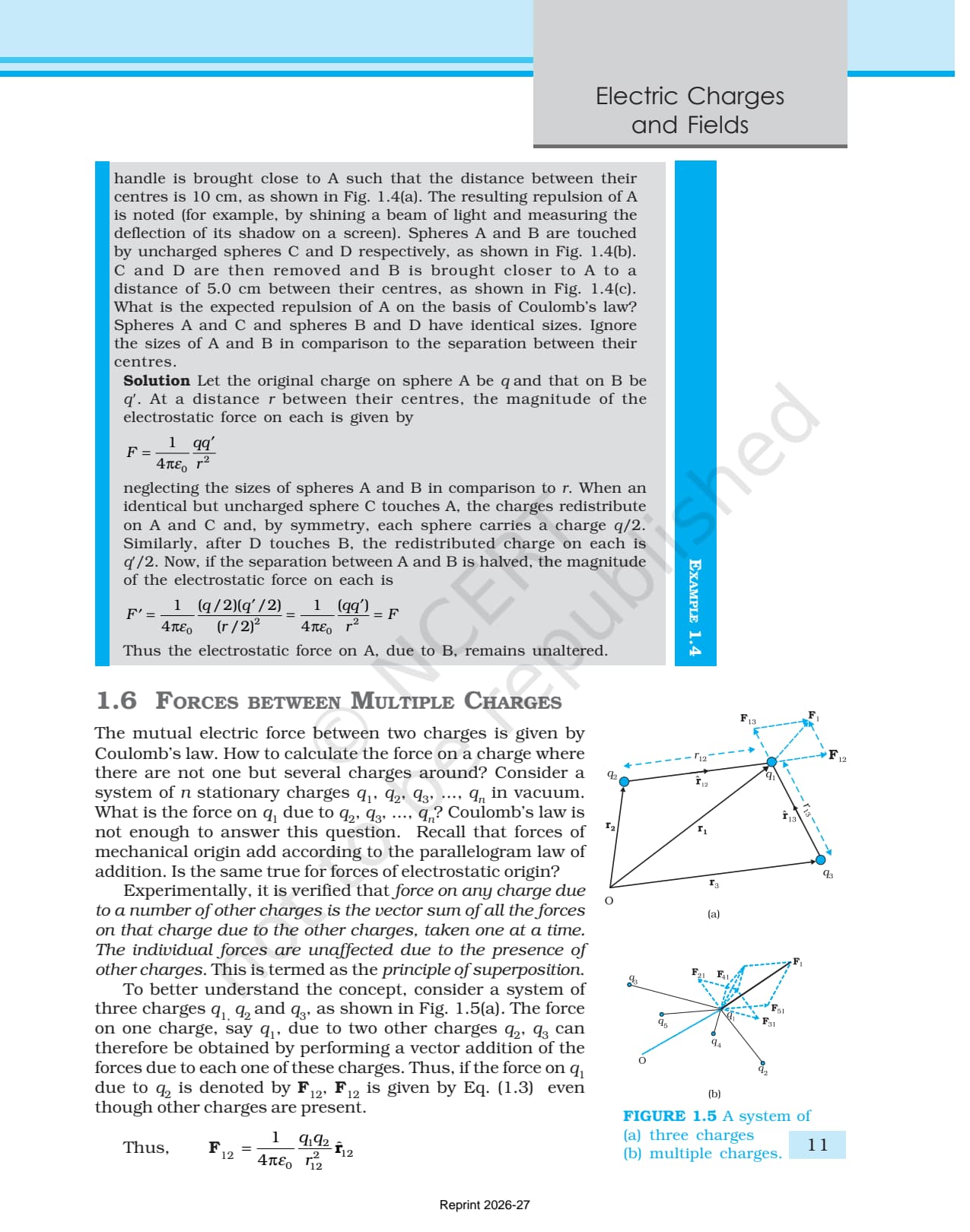
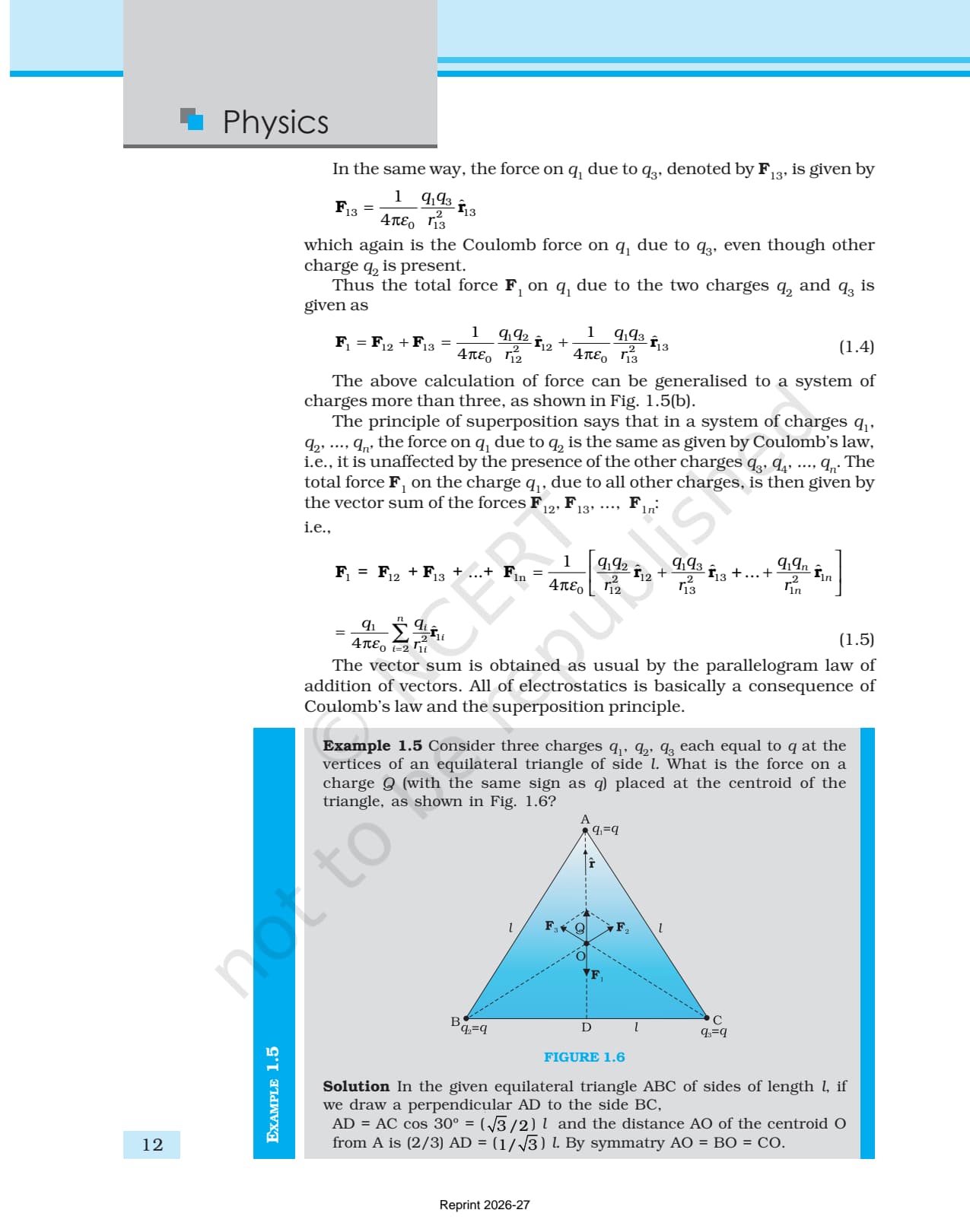
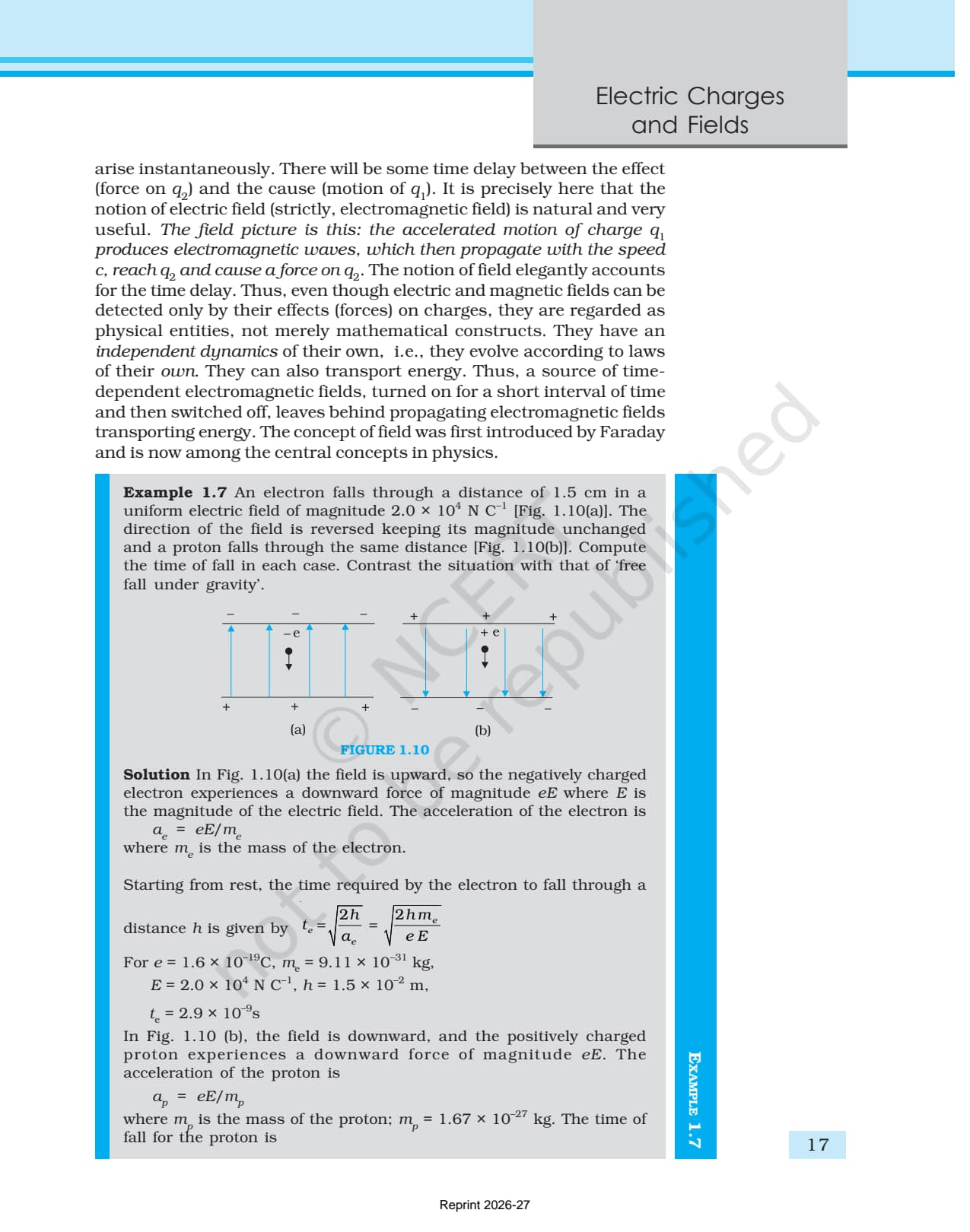
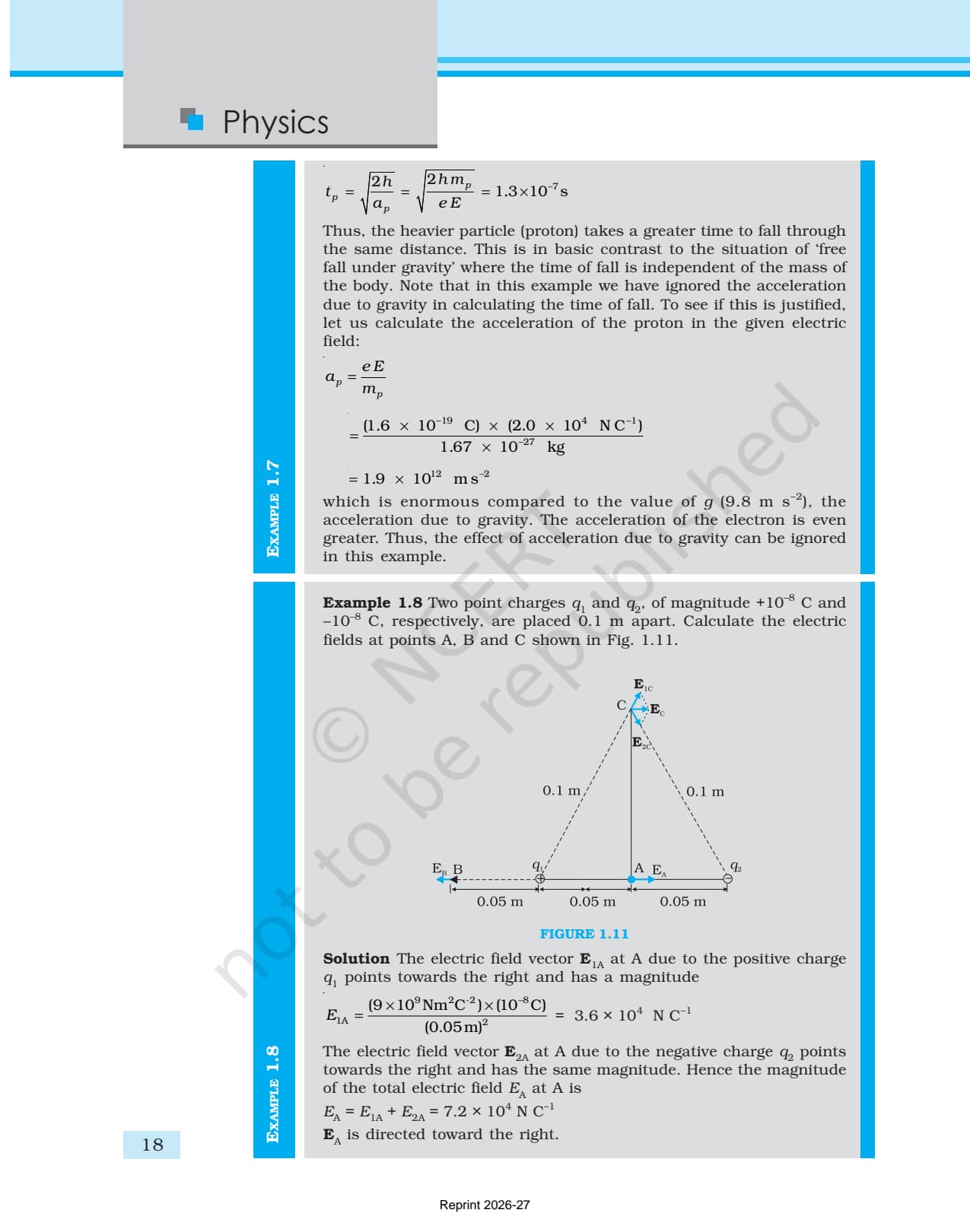
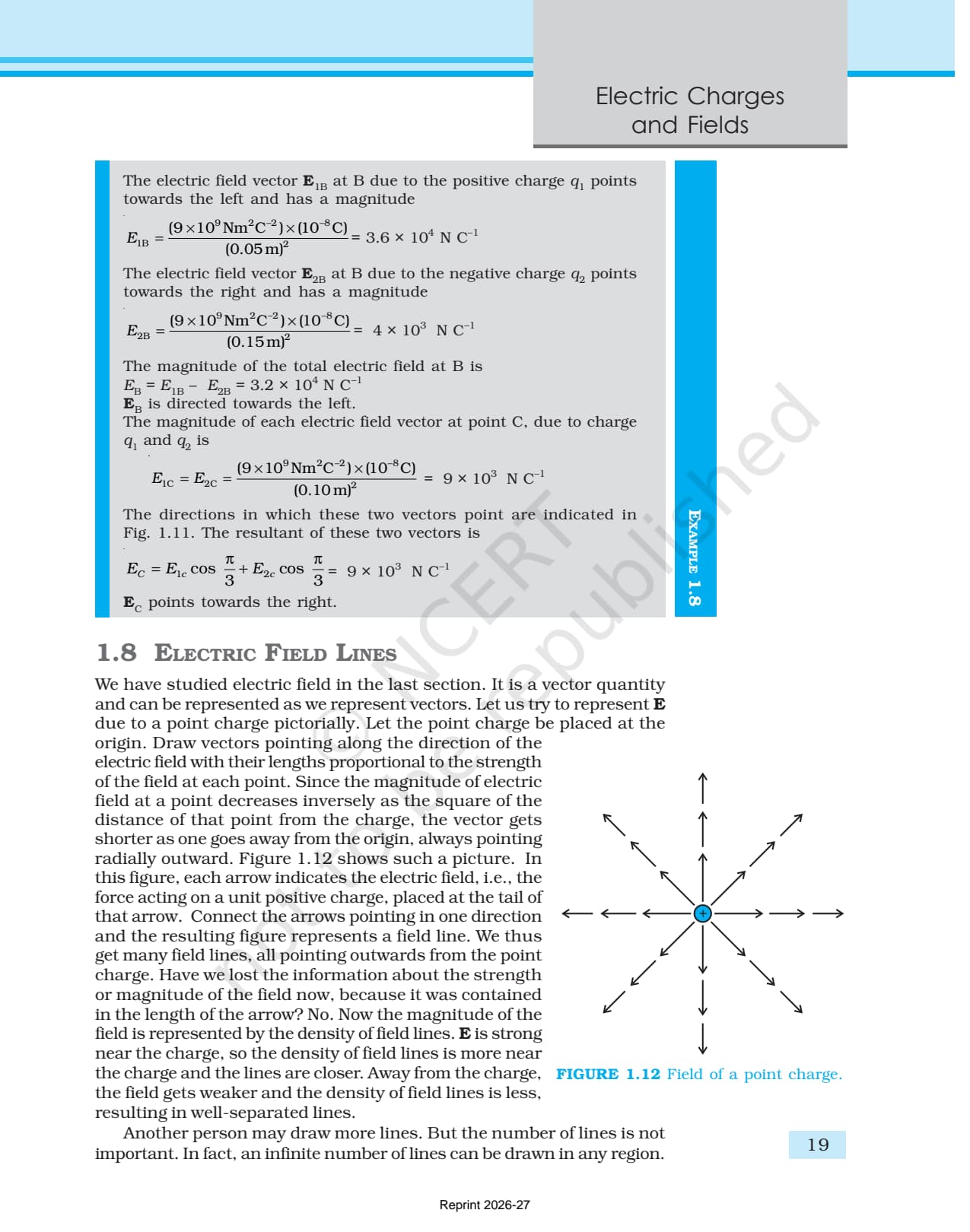
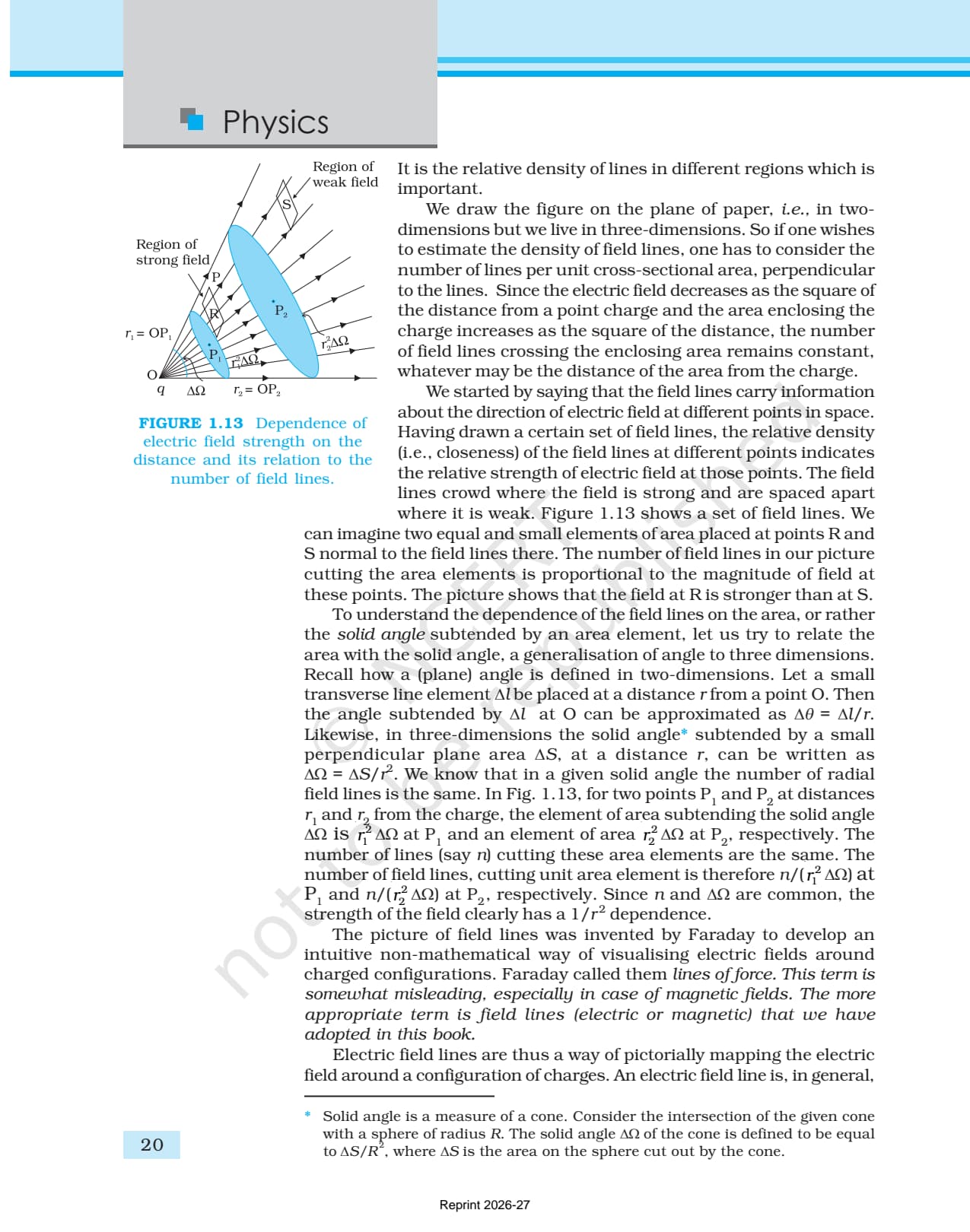
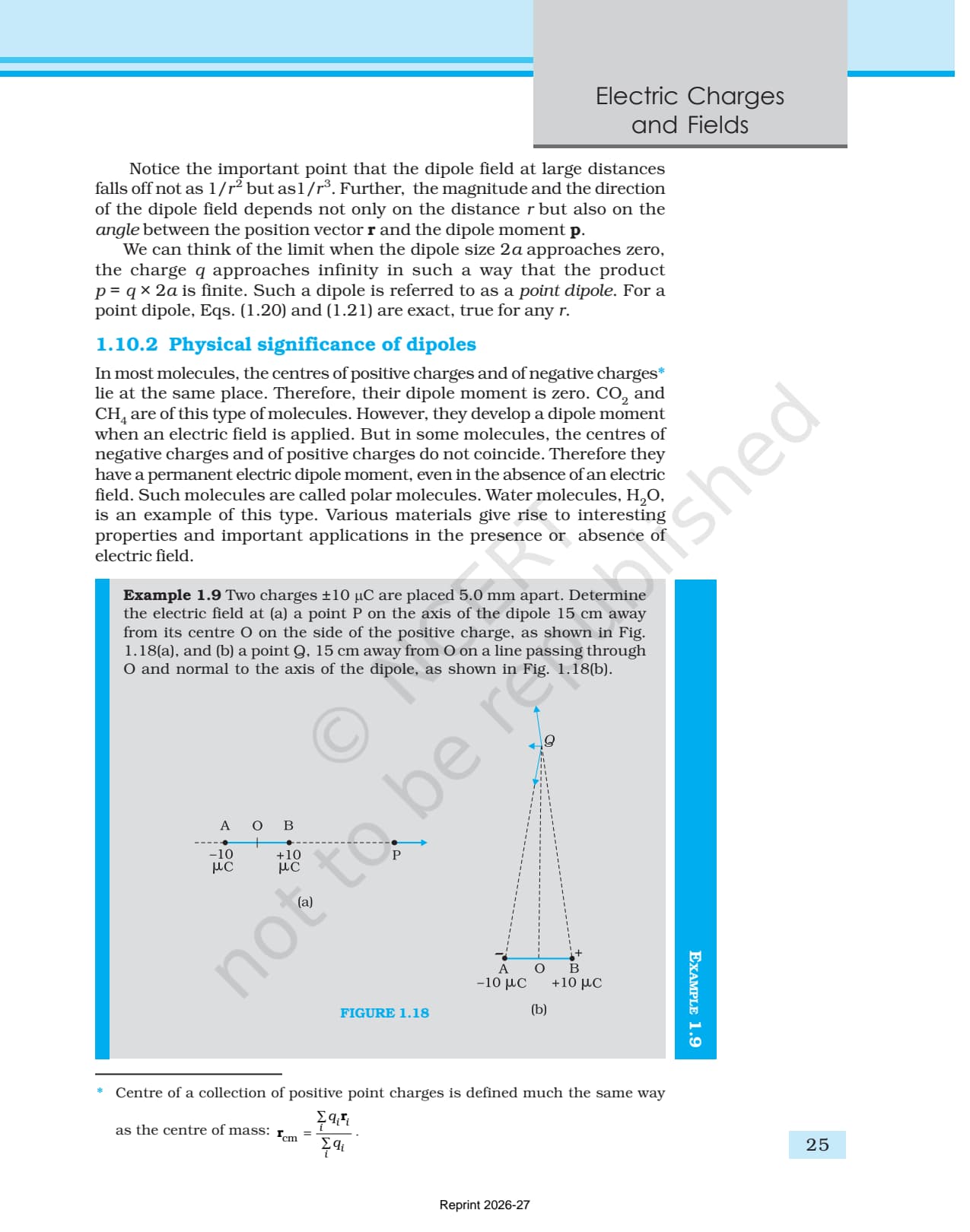
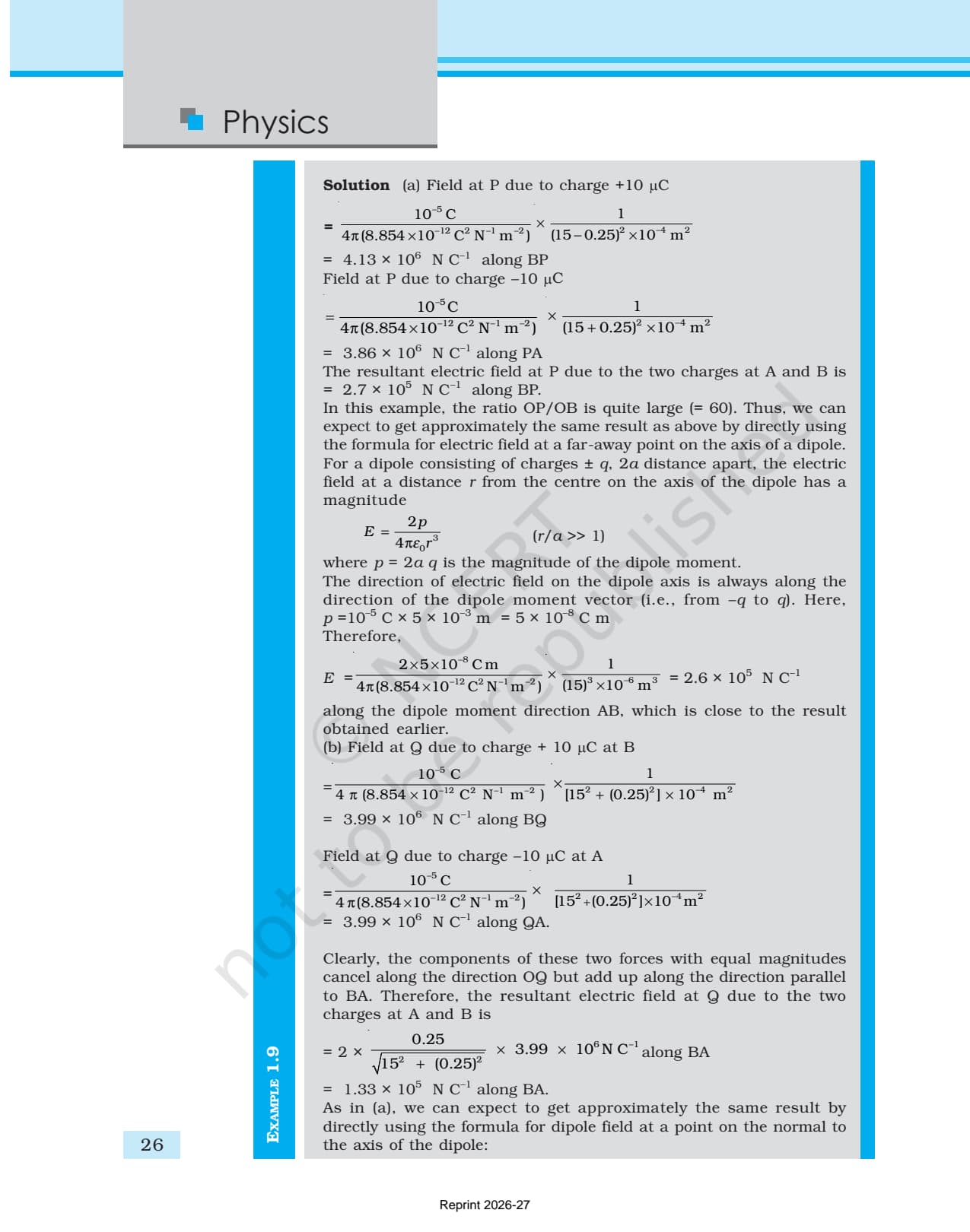
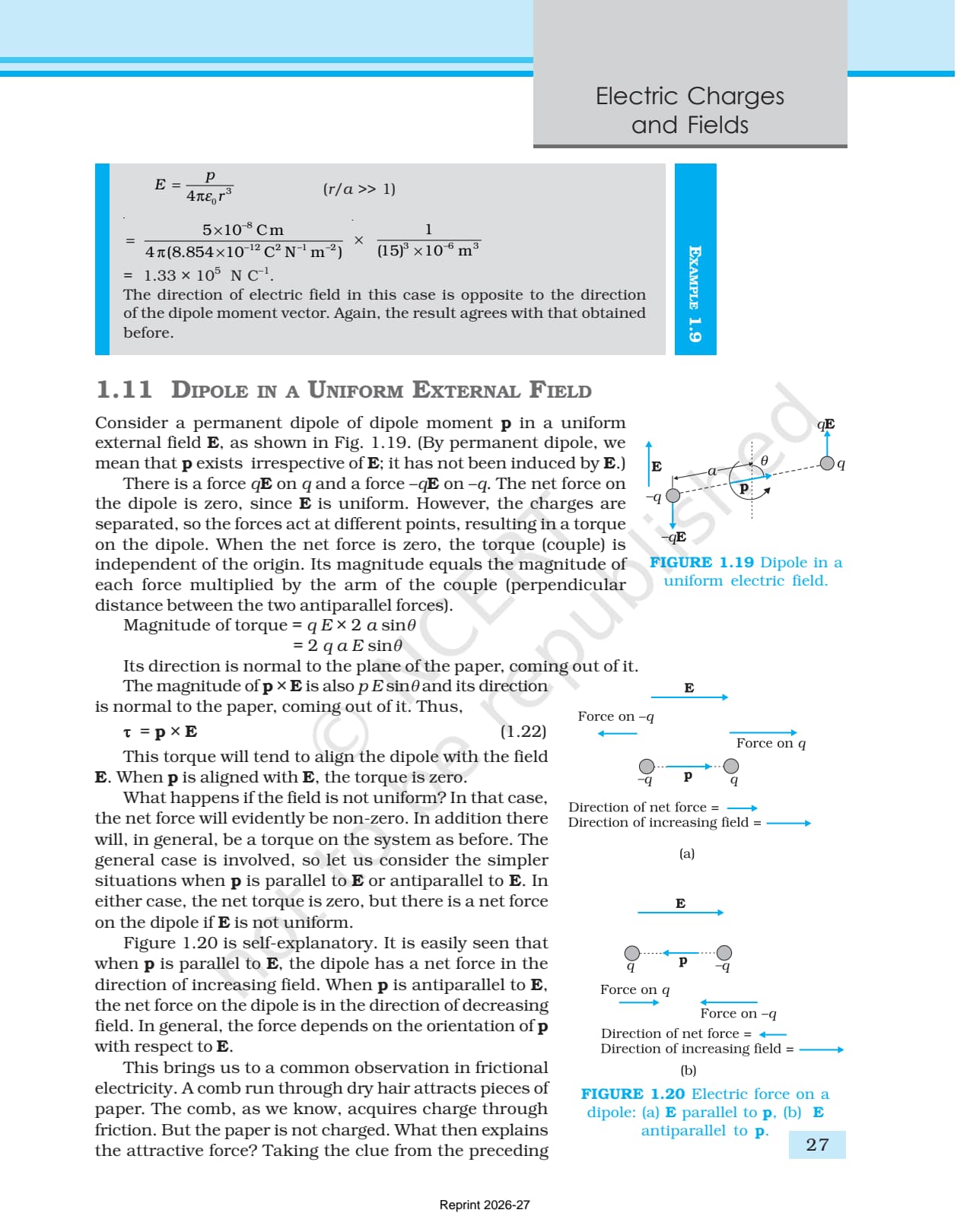
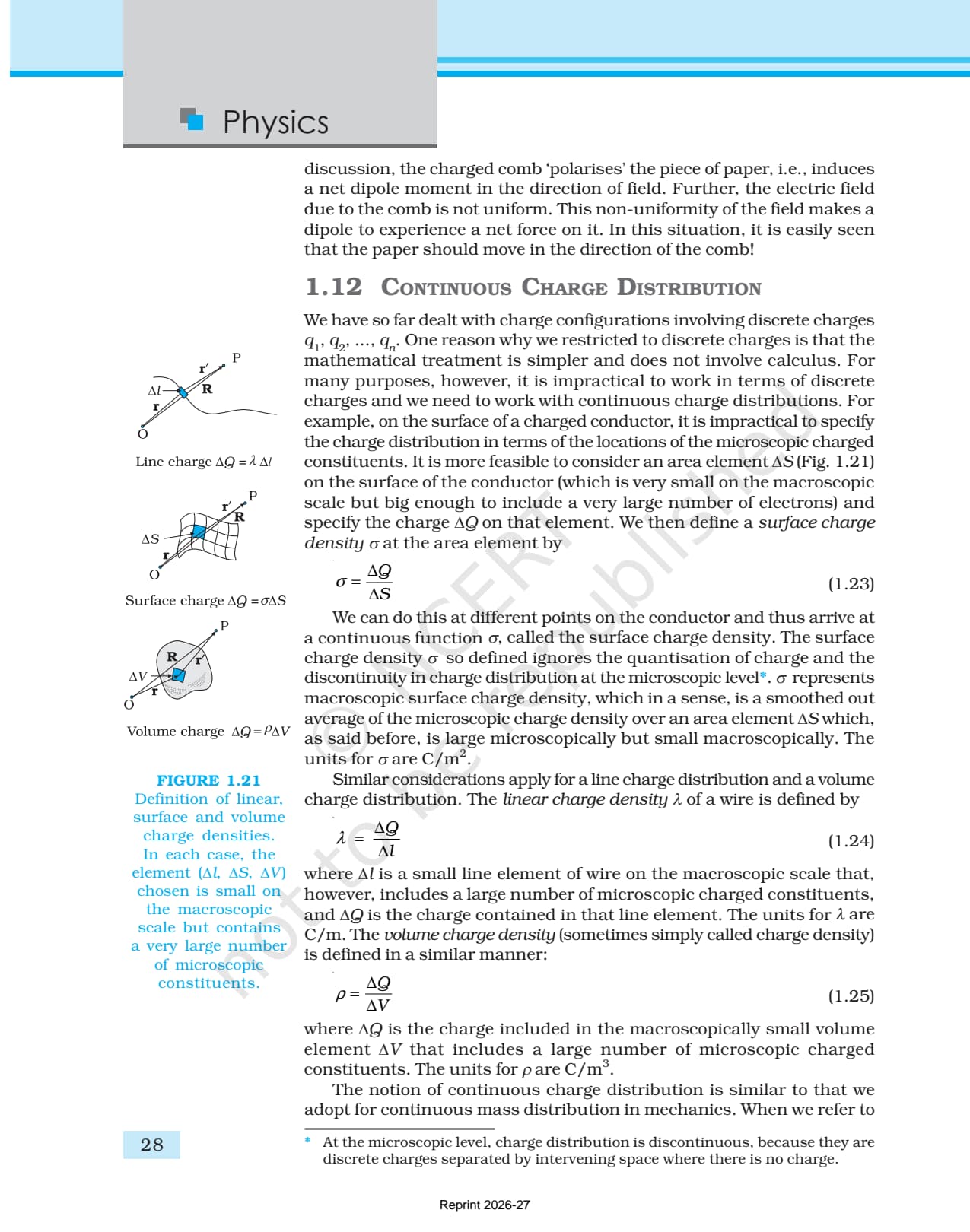
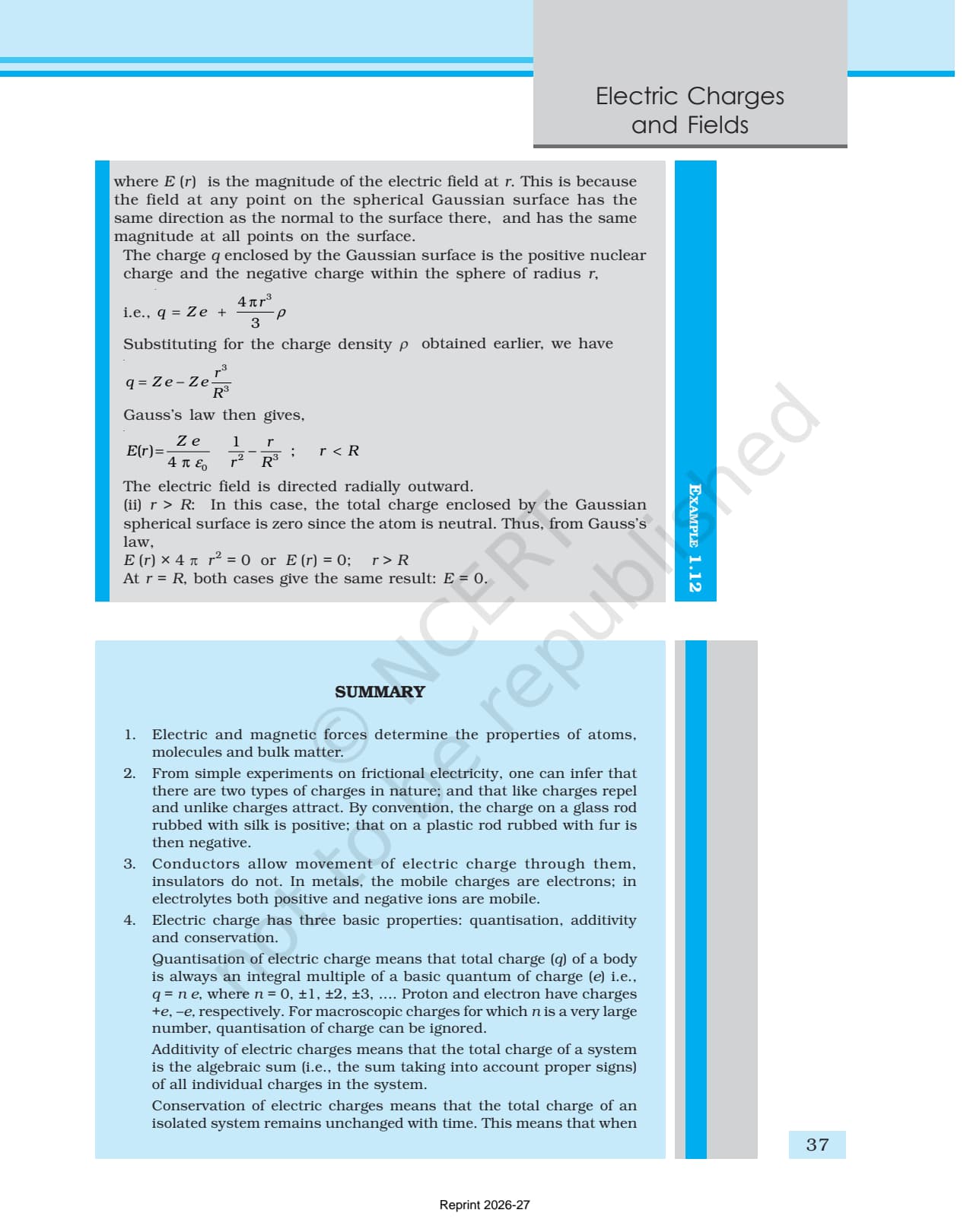
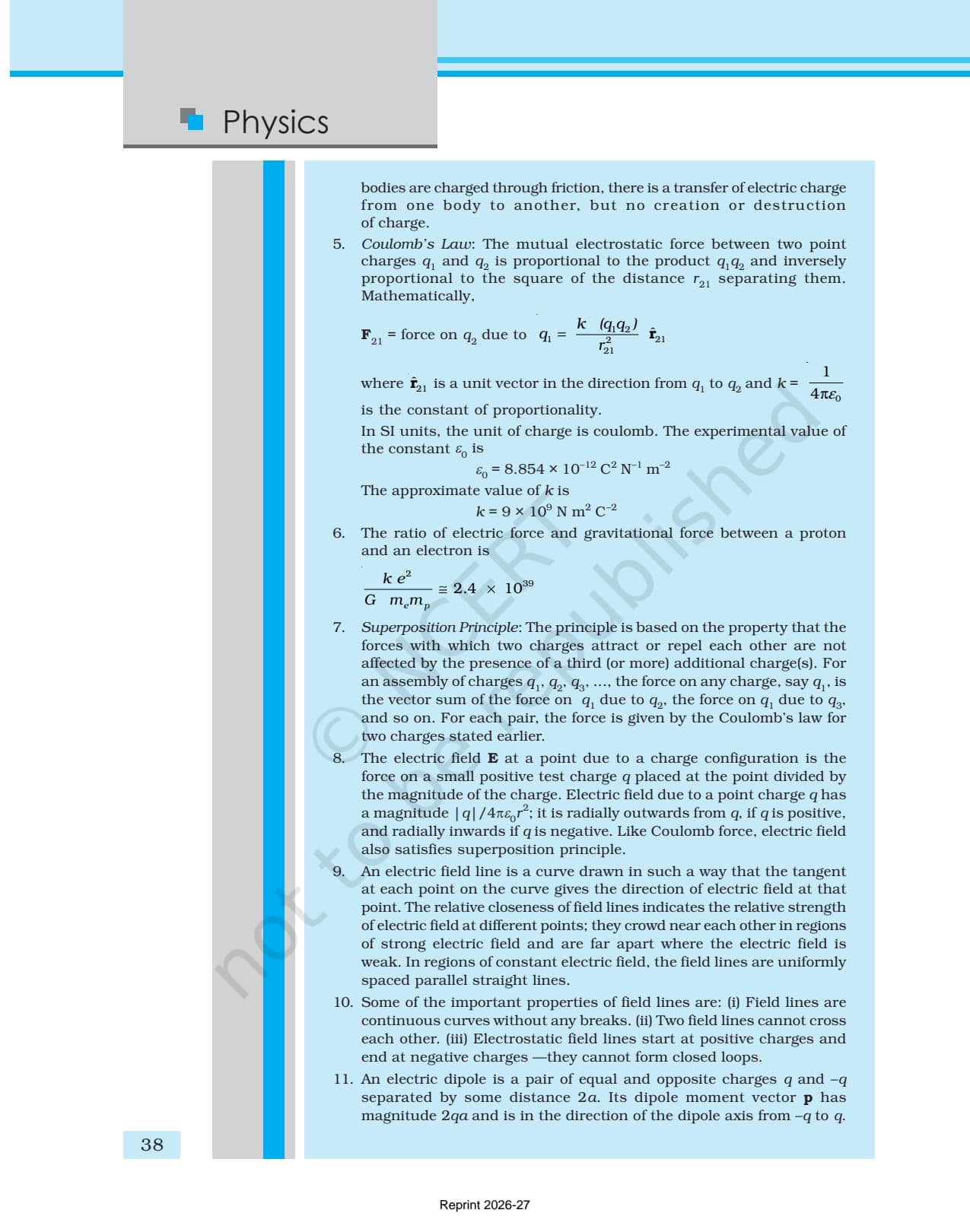
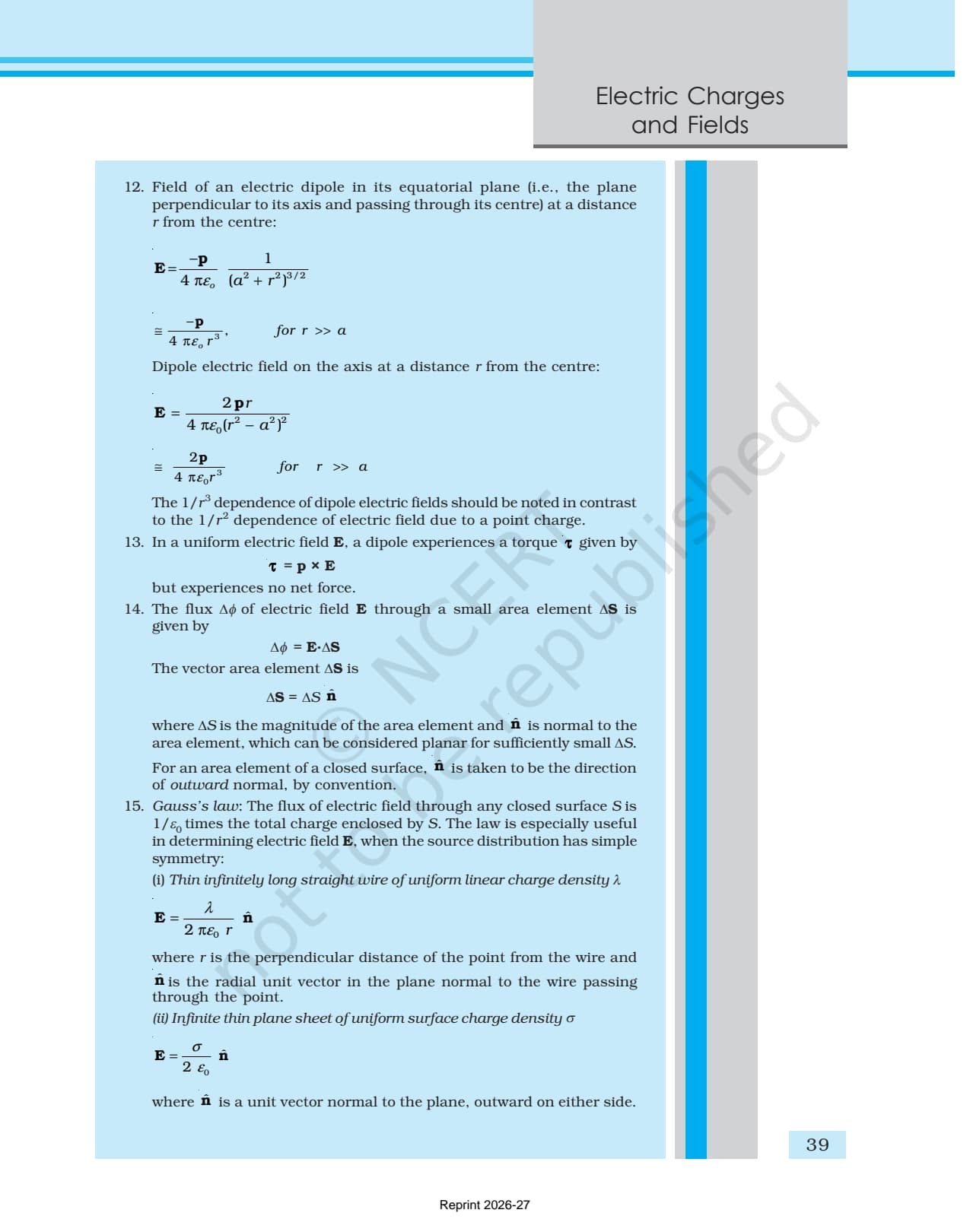
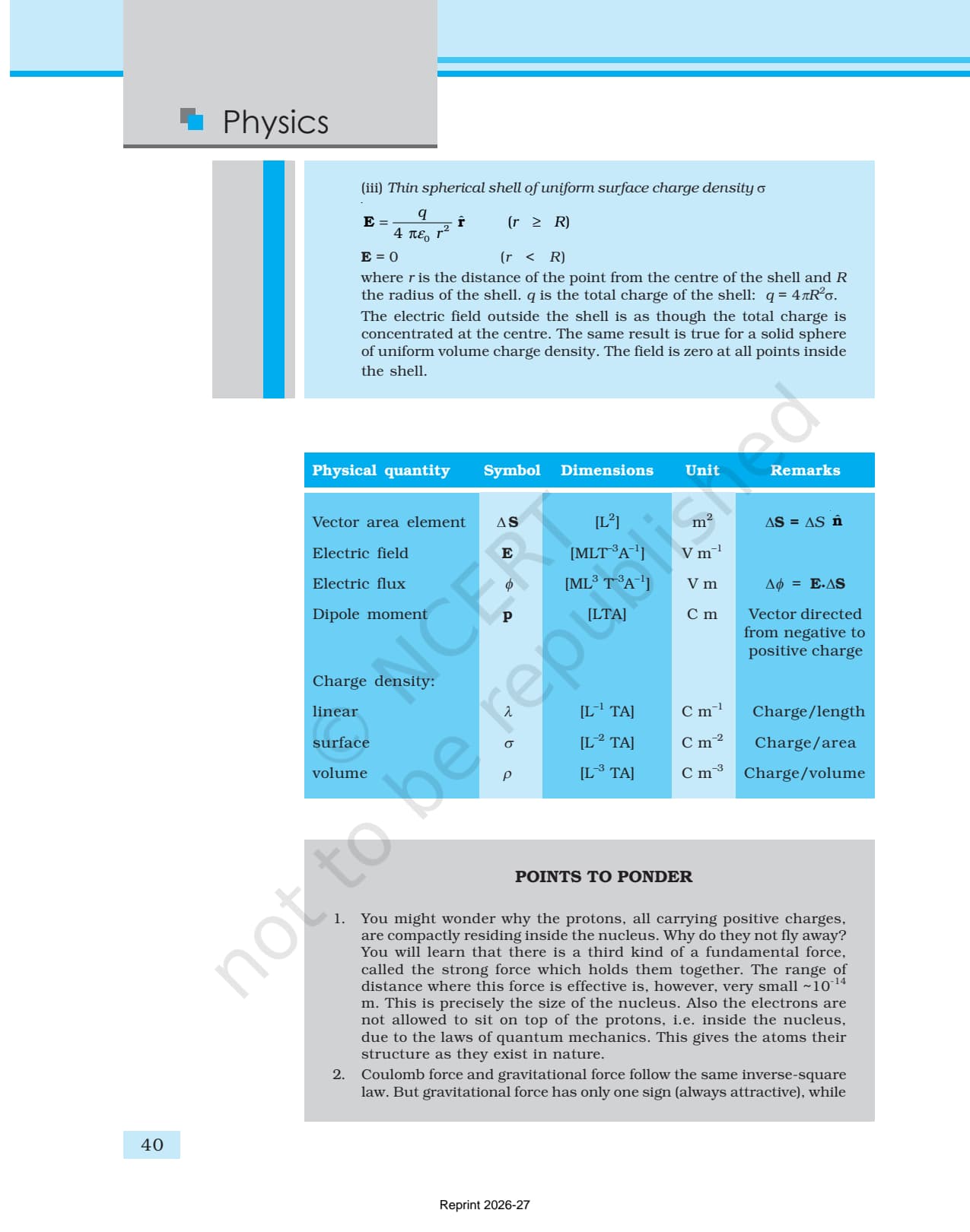
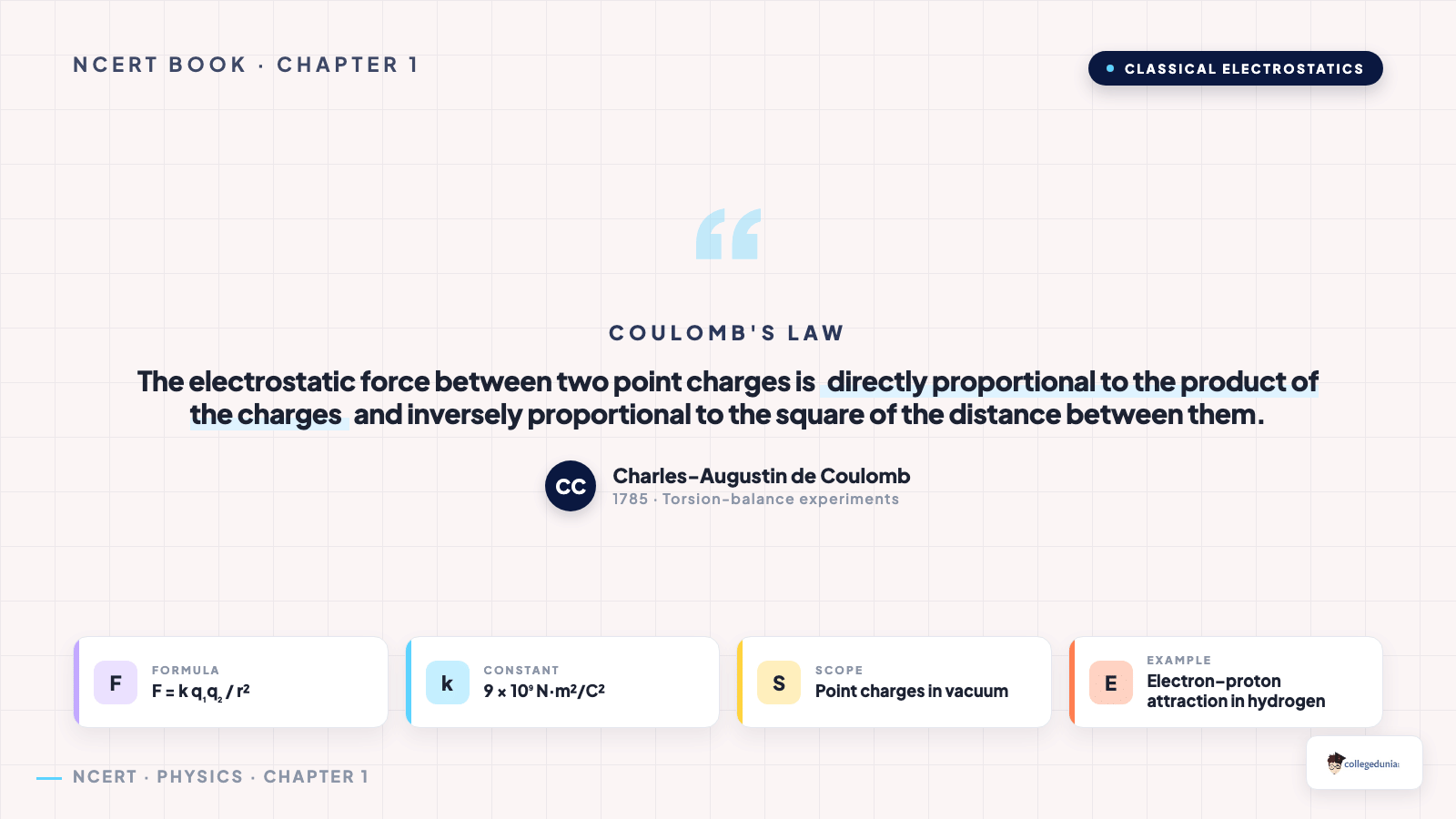
- CBSE Weightage: 6–8 marks
- JEE Main Weightage: 3–4% (1–2 questions per shift)
- NEET Weightage: 1–2 questions per year
Both downloads of the Electric Charges and Fields Class 12 Notes PDF on this page are free and updated for the 2026-27 NCERT syllabus.
Electric Charges and Fields Weightage Compared Across Class 12 Physics Chapters
Chapter 1 sits in the high-yield Electrostatics unit, carrying 6-8 marks in CBSE Board exams.
Electric Charges and Fields Video Lecture - Class 12 Physics Chapter 1
Source: NCERT Wallah on YouTube
Electric Charges and Fields NCERT Intext Examples and Their Sub-Topics
The chapter carries 16 solved examples (Example 1.1 to 1.16). The inventory below tags each by sub-topic and skill.
| Example | Sub-Topic | What it Covers |
|---|---|---|
| Example 1.1 | Number of electrons | Charge quantisation |
| Example 1.2 | Coulomb force comparison | Electrostatic vs gravitational |
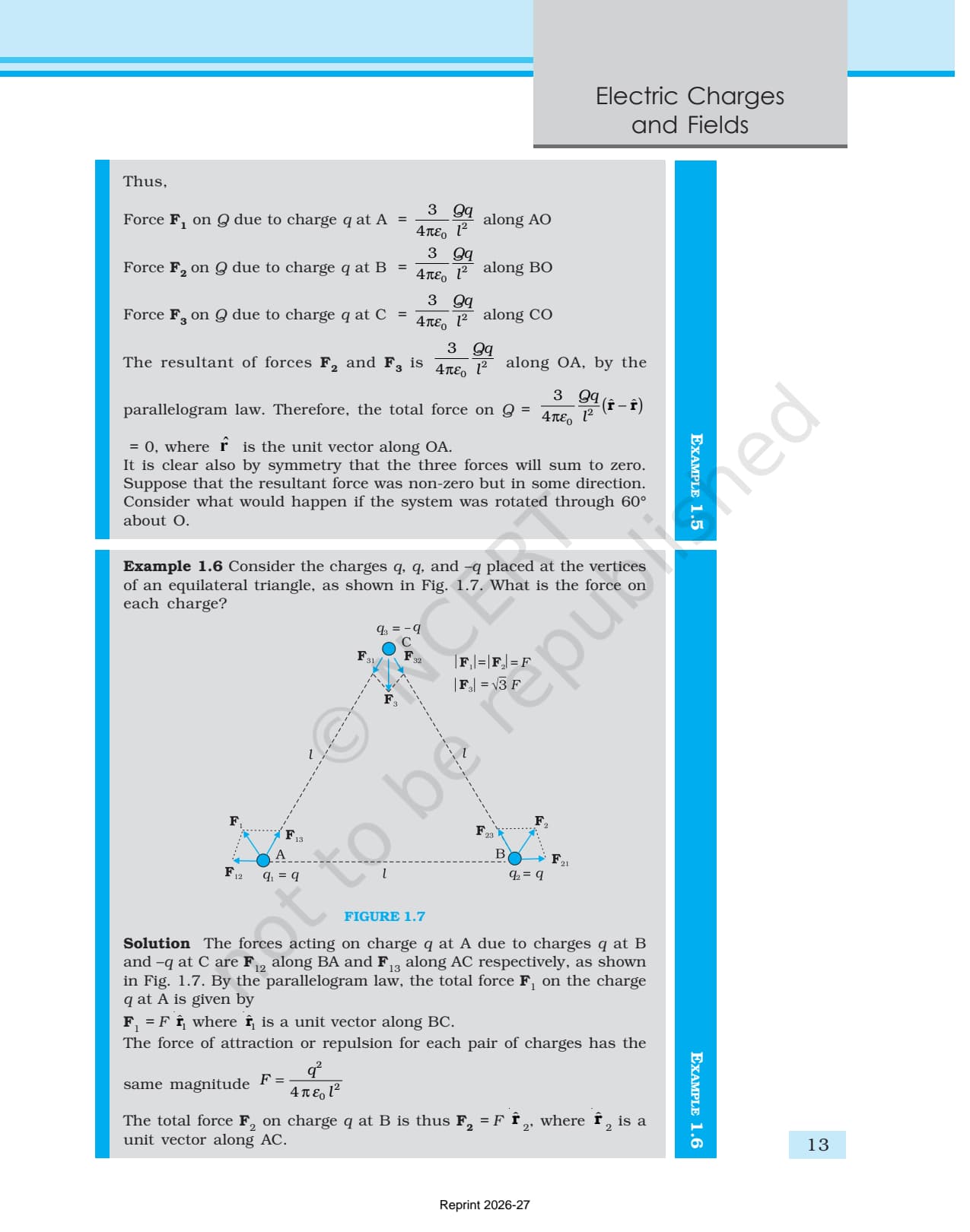
| Example 1.3 | Force between point charges | Vector Coulomb's law |
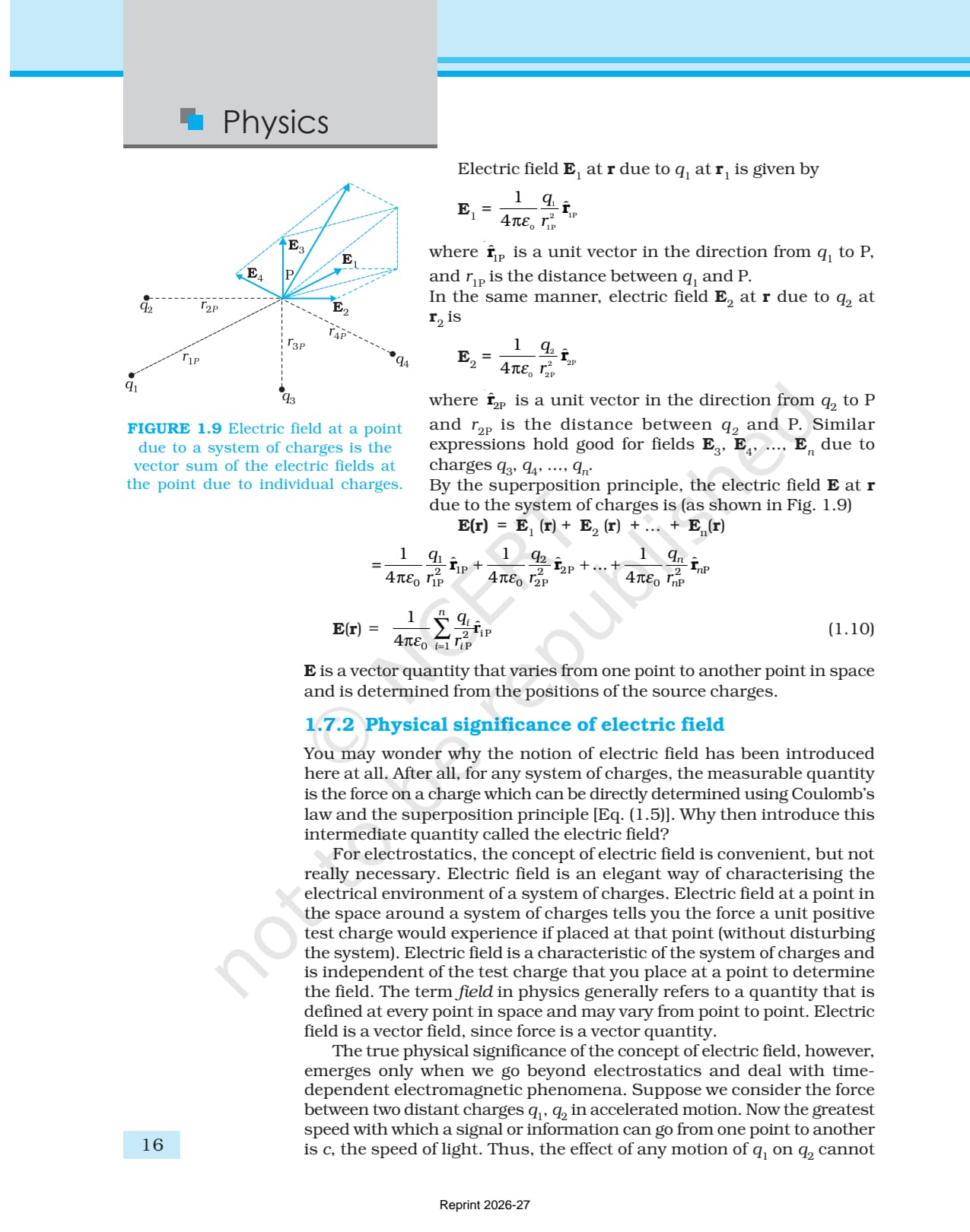
| Example 1.4 | Forces from multiple charges | Superposition principle |
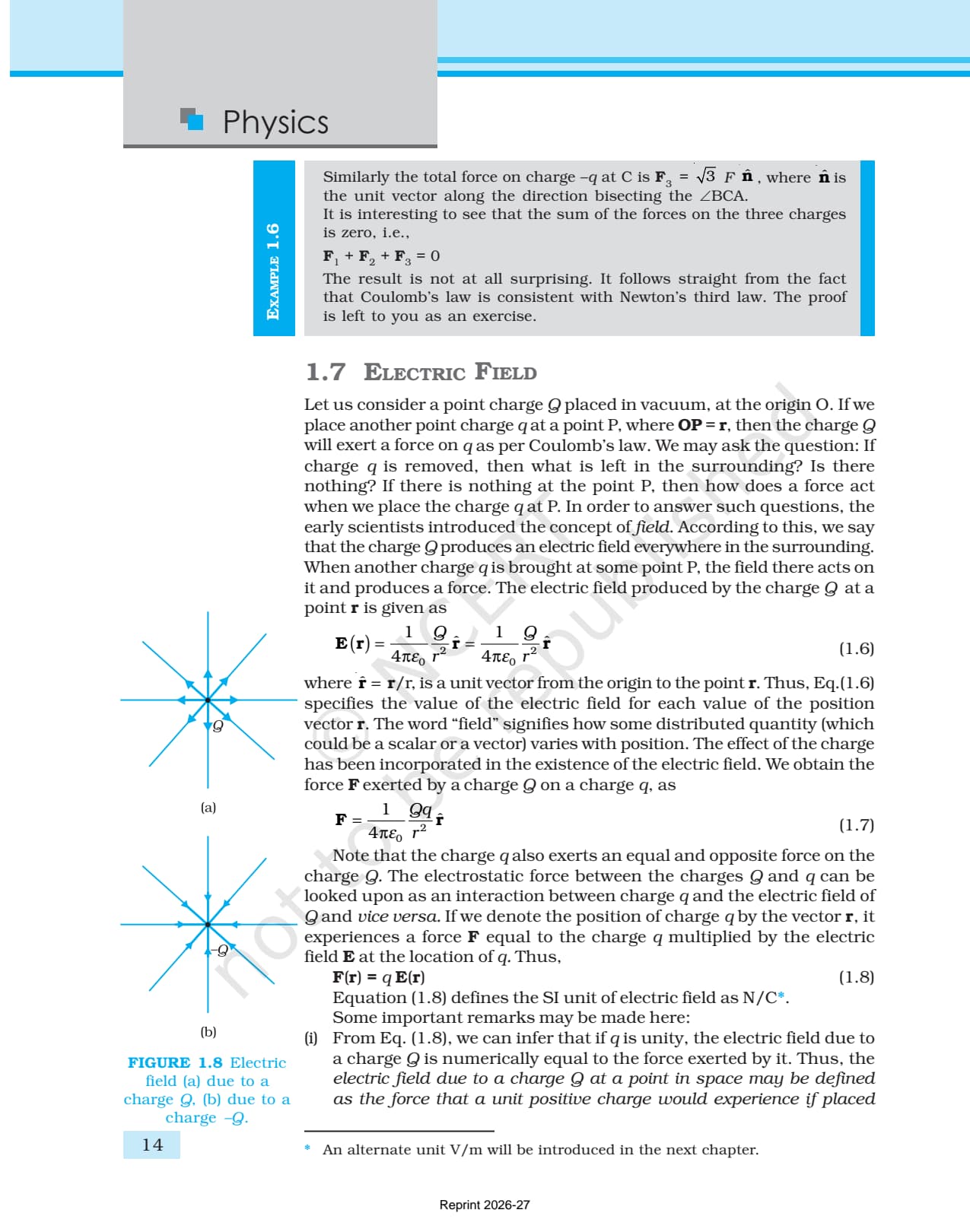
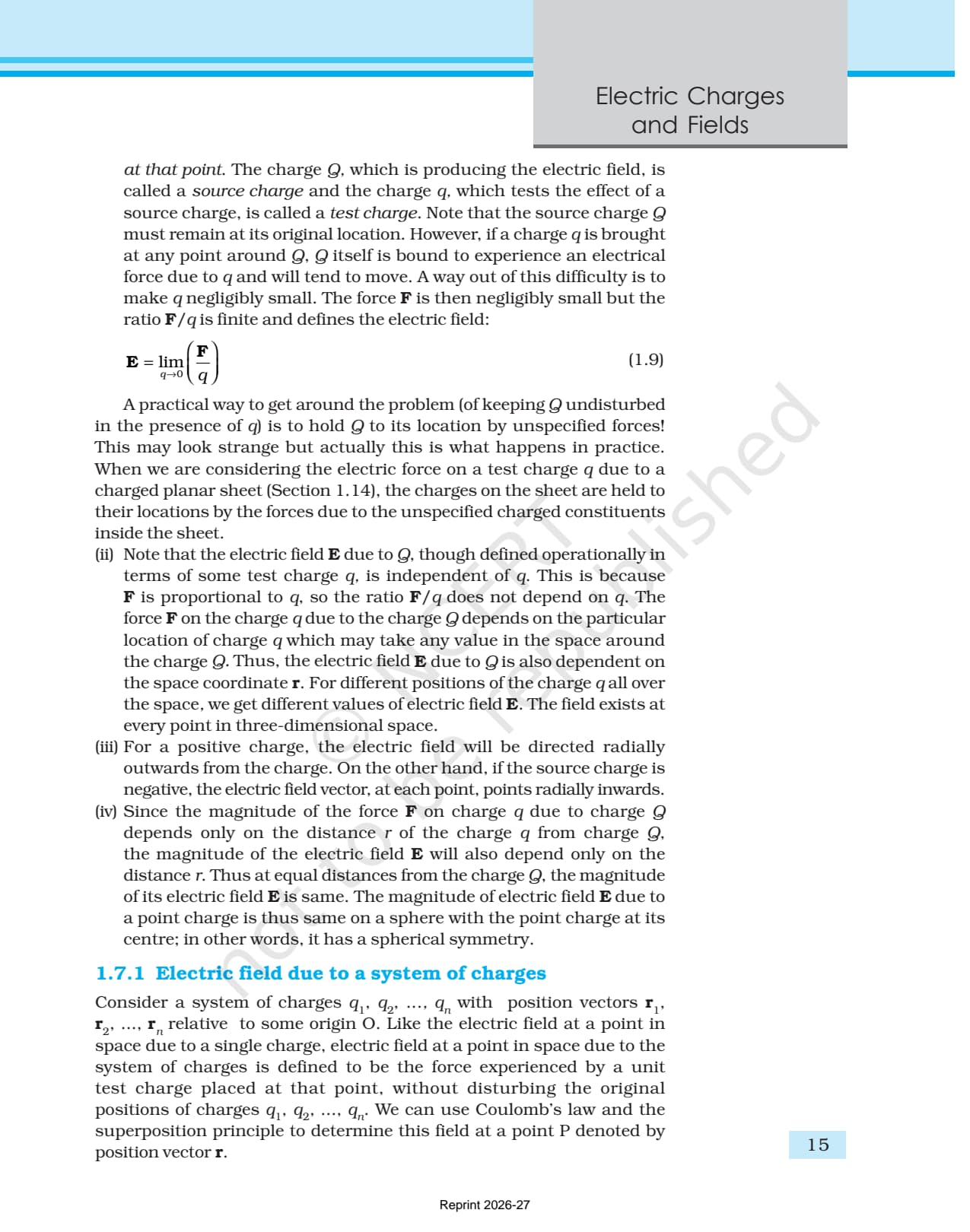
| Example 1.5 | Electric field of point charges | Magnitude and direction of E |
| Example 1.6 | Equilibrium under multiple fields | Resolving fields |
| Example 1.7 | Dipole moment | Dipole geometry |
| Example 1.8 | Field on dipole axis | Axial-line calculation |
| Example 1.9 | Torque on a dipole | Torque formula |
| Example 1.10 | Electric flux | Flux as dot product |
| Example 1.11 | Net flux through closed surface | Gauss's law |
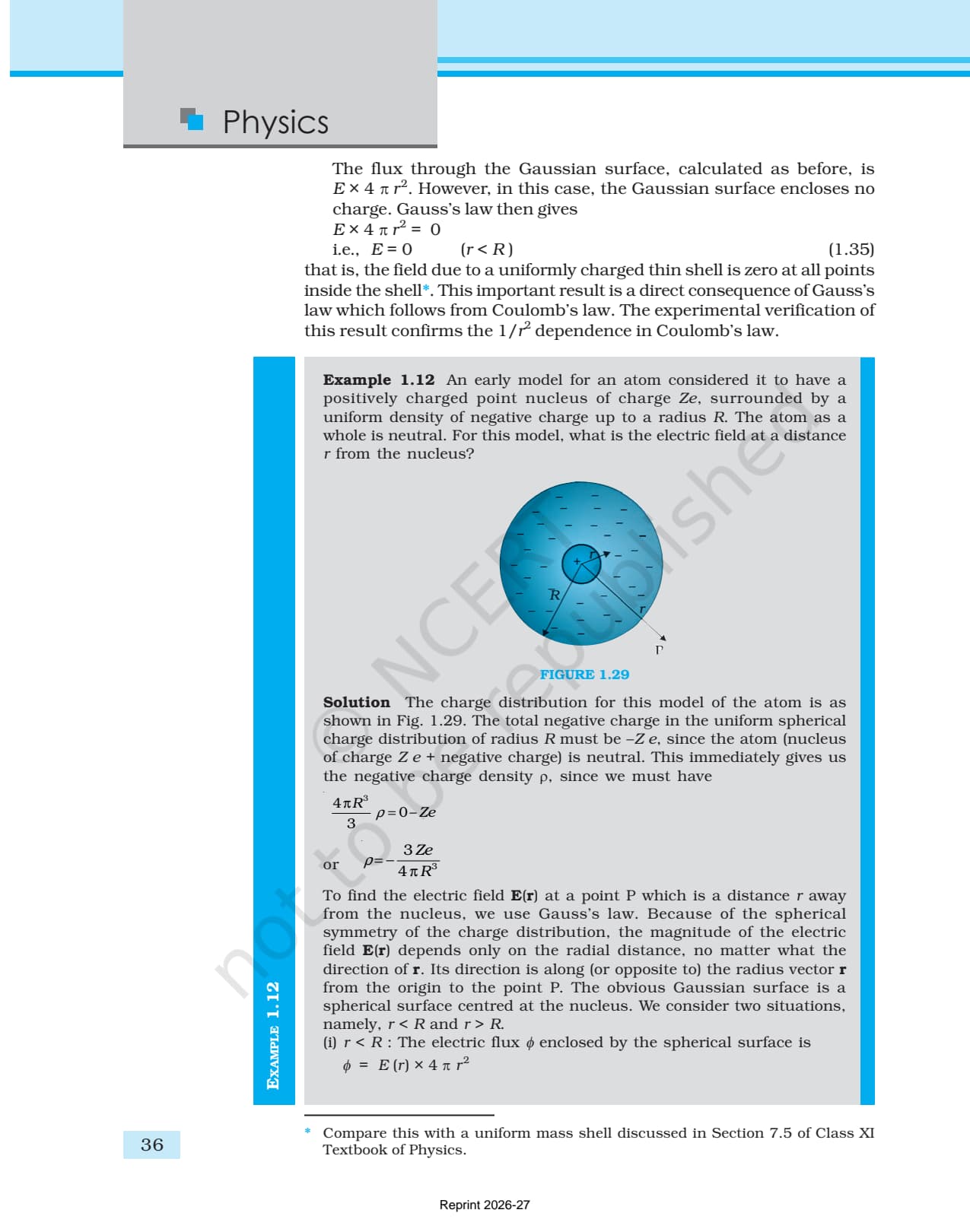
| Example 1.12 | Uniformly charged sphere | Gaussian surface choice |
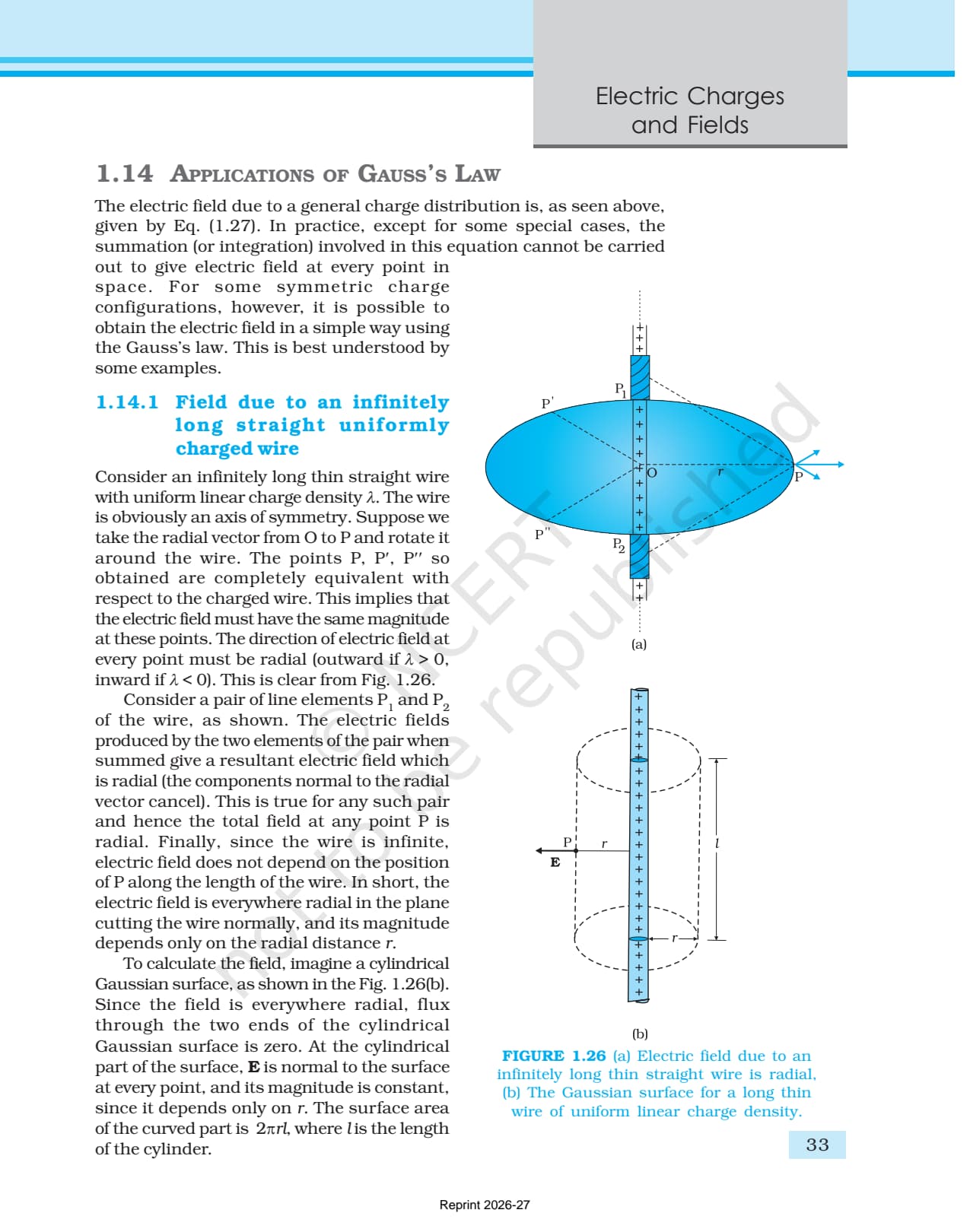
| Example 1.13 | Infinite line charge | Cylindrical Gaussian surface |
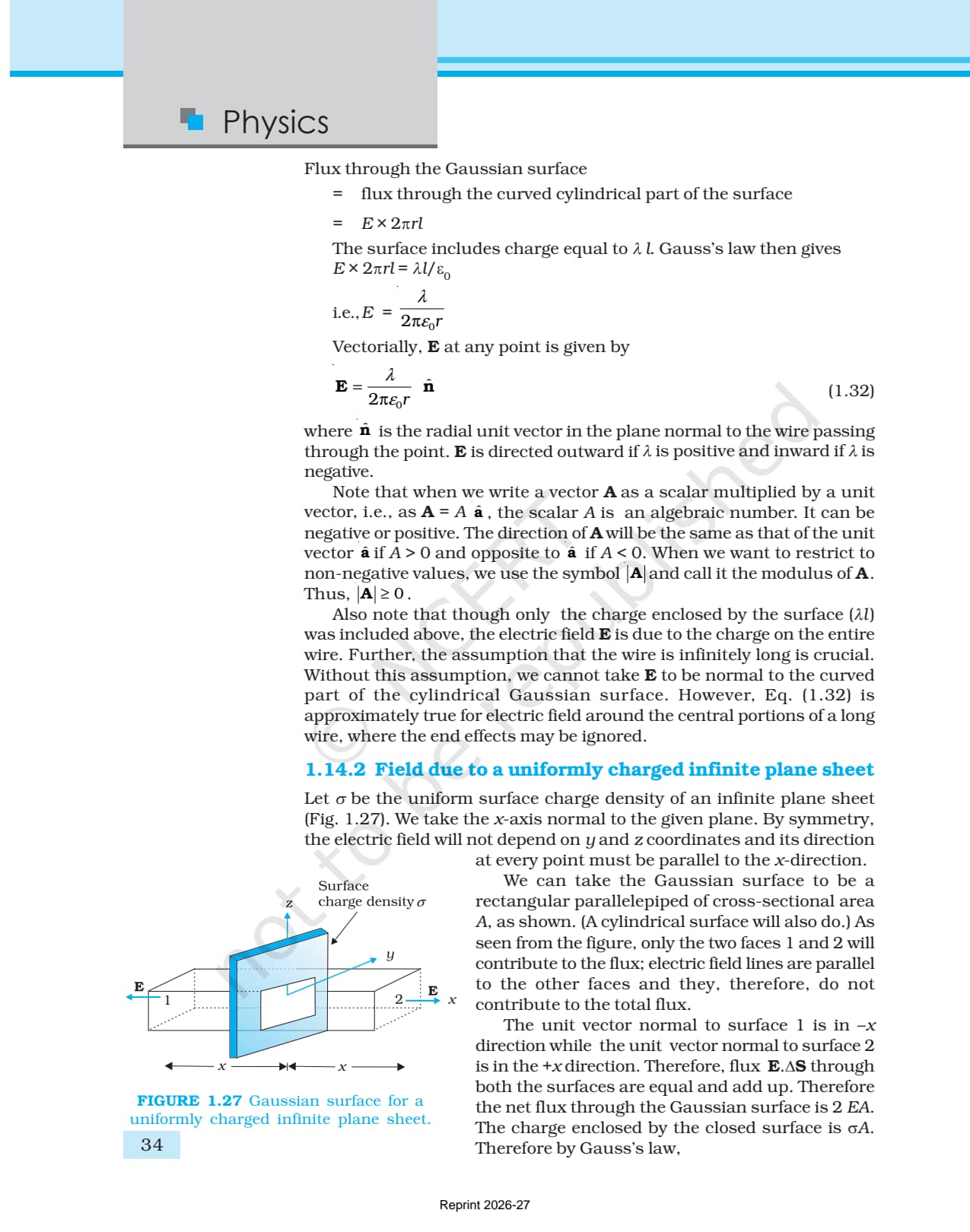
| Example 1.14 | Infinite plane sheet | Pillbox Gaussian surface |
| Example 1.15 | Two parallel plates | Superposition of sheet fields |
| Example 1.16 | Mixed charge distribution | Revision numerical |
Electric Charges and Fields NCERT Book: Section-by-Section Breakdown with Page Numbers
| Section | Title | PDF Pages | What It Covers |
|---|---|---|---|
| 1.1 | Introduction | 1–2 | Historical context, overview |
| 1.2 | Electric Charge | 2–4 | Charge properties, gold-leaf electroscope |
| 1.3 | Conductors and Insulators | 4–5 | Free electron picture |
| 1.4 | Basic Properties of Electric Charge | 5–7 | Additivity, quantisation, conservation |
| 1.5 | Coulomb's Law | 7–11 | Scalar and vector form |
| 1.6 | Forces between Multiple Charges | 11–13 | Principle of superposition |
| 1.7 | Electric Field | 13–17 | Field of a point charge |
| 1.8 | Electric Field Lines | 17–20 | Properties, sketching |
| 1.9 | Electric Flux | 20–22 | Flux as dot product |
| 1.10 | Electric Dipole | 22–27 | Axial and equatorial fields |
| 1.11 | Dipole in a Uniform External Field | 27–29 | Torque τ⃗ = p⃗ × E⃗ |
| 1.12 | Continuous Charge Distribution | 29–31 | Linear, surface, volume densities |
| 1.13 | Gauss's Law | 31–34 | Statement and proof |
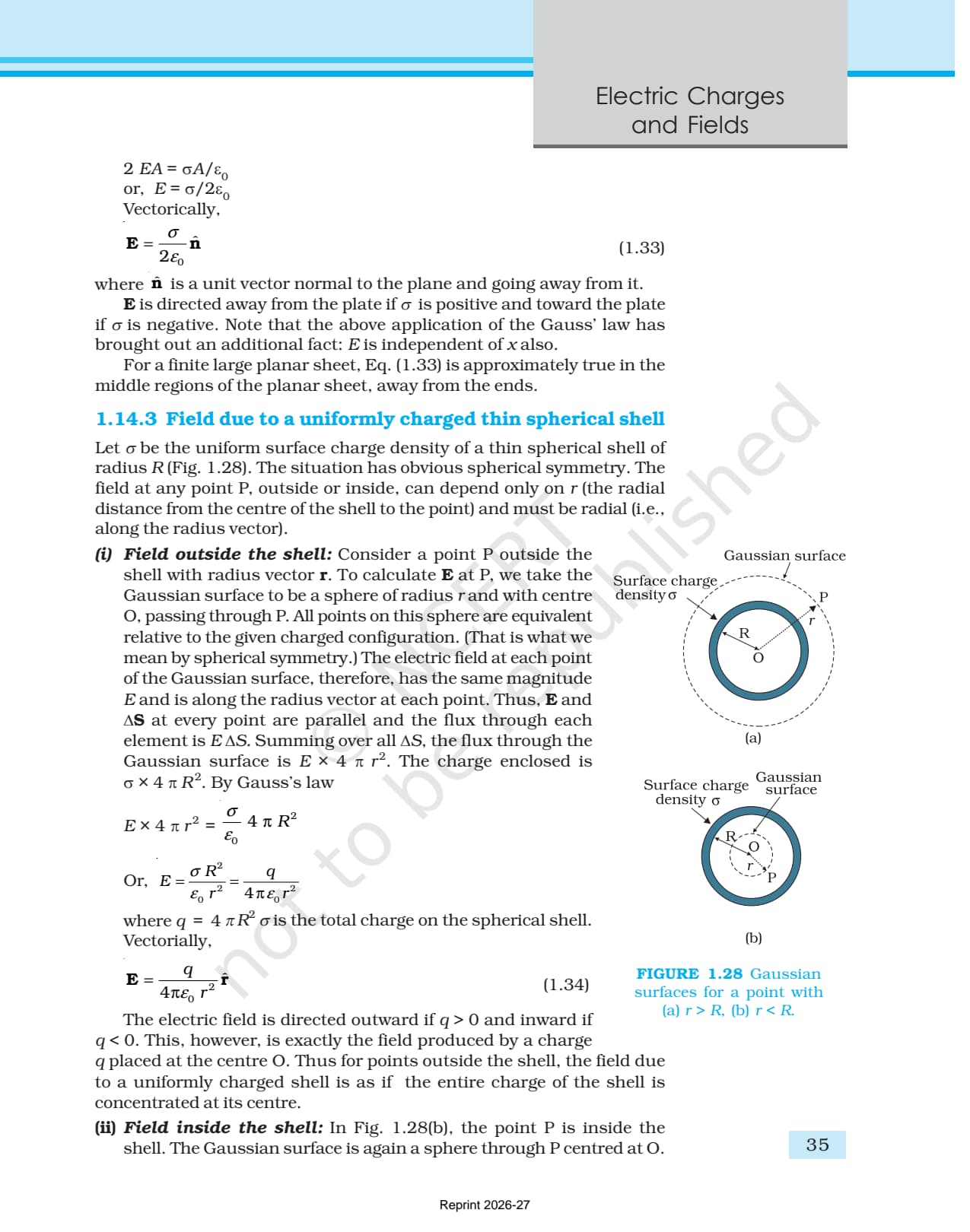
| 1.14 | Applications of Gauss's Law | 34–41 | Line charge, sheet, spherical shell |
| Summary & Exercises | Summary, Points to Ponder, Exercises 1.1 to 1.24 | 41–44 | Recap and exercise problems |
How to Read the Electric Charges and Fields Class 12 Notes Pdf (Pass-Sequence Plan)
- Pass 1, Skim (45 minutes): Read sections 1.1 to 1.4 fully; skim later sections for boxed formulas and figure captions.
- Pass 2, Detailed (3 hours): solve every section. Pause at 1.10, 1.13, 1.14 to re-derive on paper.
- Pass 3, Examples and Exercises (4 hours): Solve all 16 examples without peeking, then attempt Exercises 1.1 to 1.24.
- Pass 4, Targeted Revision (1 hour): Re-read sub-topics tied to unsolved questions plus the chapter summary.
Electric Charges and Fields Multi-Day Study Plan for the NCERT PDF
The chapter splits cleanly across three study days.
| Day | Sections to Read | Examples to Solve | Output |
|---|---|---|---|
| Day 1 | 1.1 to 1.6 (Coulomb's law and superposition) | Examples 1.1 to 1.4 | Formula card for Coulomb's law |
| Day 2 | 1.7 to 1.11 (Field, lines, dipole) | Examples 1.5 to 1.9 | Diagram sheet for field lines and dipole |
| Day 3 | 1.12 to 1.14 (Continuous distribution, Gauss's law) | Examples 1.10 to 1.16 + Exercises 1.1–1.24 | Derivation page for the three Gauss applications |
What Changed in Electric Charges and Fields for 2026-27 NCERT (Rationalisation Note)
The current 2026-27 NCERT keeps Chapter 1 largely intact. The flow from Coulomb's law to Gauss's law is unchanged, with only minor trimming in the historical introduction.
| Topic | Status in 2026-27 NCERT | Note |
|---|---|---|
| Coulomb's law (scalar and vector) | Kept | Both forms tested |
| Superposition of forces | Kept | Multi-charge numericals |
| Electric field and field lines | Kept | Diagram-based MCQs |
| Electric dipole (axial, equatorial, torque) | Kept | Most-asked derivation |
| Continuous charge distribution | Kept | Feeds Gauss applications |
| Gauss's law and three applications | Kept | Line, sheet, spherical shell |
| Extensive historical material | Trimmed | Shorter introduction |
Top 5 Formulae from Electric Charges and Fields for Quick Recall
The five formulae below cover roughly 80% of numericals from this chapter. The full master table with units sits on the Formula Sheet page.
| Quantity | Formula |
|---|---|
| Coulomb force between two point charges | F = 14π0 q1 q2r2 |
| Electric field of a point charge | E = 14π0 qr2 |
| Torque on dipole in uniform field | τ⃗ = p⃗ × E⃗ |
| Gauss's law | ∮ E⃗ · dA⃗ = qenc0 |
| Field of infinite plane sheet | E = σ20 |
Full master table: Electric Charges and Fields Class 12 Physics Formula Sheet
3 Most Asked Topics from Electric Charges and Fields in CBSE, JEE and NEET
Across the last five years of board, JEE and NEET papers, three sub-topics dominate. The full year-wise PYQ map sits on the NCERT Solutions page.
- Gauss's law applications: almost every CBSE paper, frequent JEE Main numericals on line charges and sheets.
- Electric dipole (torque, field on axis or equator): recurring 3-mark or 5-mark Board question.
- Coulomb's law numericals with superposition: JEE Main and NEET MCQs, often with vector geometry.
Other Resources for Electric Charges and Fields - Class 12 Physics Chapter 1
| Resource Type | Link |
|---|---|
| NCERT Book PDF | Electric Charges and Fields NCERT Book PDF |
| NCERT Solutions | Electric Charges and Fields NCERT Solutions |
| Notes | Electric Charges and Fields Notes |
| Formula Sheet | Electric Charges and Fields Formula Sheet |
| Exemplar Book PDF | Electric Charges and Fields Exemplar Book PDF |
| Exemplar Solutions | Electric Charges and Fields Exemplar Solutions |
| Handwritten Notes | Electric Charges and Fields Handwritten Notes |
NCERT Book PDF for Class 12 Physics: All Chapters
| Chapter | Resource |
|---|---|
| Chapter 1 | Electric Charges and Fields NCERT PDF |
| Chapter 2 | Electrostatic Potential and Capacitance NCERT PDF |
| Chapter 3 | Current Electricity NCERT PDF |
| Chapter 4 | Moving Charges and Magnetism NCERT PDF |
| Chapter 5 | Magnetism and Matter NCERT PDF |
| Chapter 6 | Electromagnetic Induction NCERT PDF |
| Chapter 7 | Alternating Current NCERT PDF |
| Chapter 8 | Electromagnetic Waves NCERT PDF |
| Chapter 9 | Ray Optics and Optical Instruments NCERT PDF |
| Chapter 10 | Wave Optics NCERT PDF |
| Chapter 11 | Dual Nature of Radiation and Matter NCERT PDF |
| Chapter 12 | Atoms NCERT PDF |
| Chapter 13 | Nuclei NCERT PDF |
| Chapter 14 | Semiconductor Electronics NCERT PDF |
Electric Charges and Fields Class 12 Notes PDF: available above as a free PDF download, fully aligned to the 2026-27 NCERT release.
Student Feedback
"The section-by-section page map is the most useful thing on this page. I stopped hunting through all 44 pages and just went straight to the section I needed." - Class 12 student, CBSE Board 2026
"Gauss's law derivations took me three reads. The study plan here helped me split the chapter into manageable chunks." - JEE Main 2026 aspirant
Electric Charges and Fields Class 12 Notes PDF - Frequently Asked Questions
Ques. Where can I download the Electric Charges and Fields Class 12 Notes PDF for free?
Ans. You can download the Electric Charges and Fields Class 12 Notes Pdf directly from this page. Both the Normal and HD versions are available, and both are free.
Ques. Is this Electric Charges and Fields Class 12 Notes PDF aligned with the 2026-27 CBSE syllabus?
Ans. Yes. The PDF on this page is the current 2026-27 edition of Class 12 Physics Part I. Every major derivation in Chapter 1, including Coulomb's law, dipole torque and the three applications of Gauss's law, is retained from the older edition.
Ques. How many pages is the Class 12th Physics Electric Charges and Fields NCERT Book PDF?
Ans. The chapter runs about 44 pages and covers 14 sections from electric charge through Gauss's law, along with 16 solved examples and 24 exercise problems.
Ques. How many solved examples and exercise questions does Chapter 1 have?
Ans. Chapter 1 has 16 solved examples (Example 1.1 to 1.16) inside the chapter body and 34 questions in the end-of-chapter exercises numbered 1.1 to 1.24, including a few multi-part numericals on Gauss's law and dipoles.
Ques. Was anything removed from Electric Charges and Fields in the new NCERT edition?
Ans. The core derivations remain untouched. Only some background historical material around early electrostatics experiments was compressed in the latest NCERT print. All formulas and Gauss's law applications students are tested on for CBSE Boards, JEE Main and NEET stay in the chapter.
Ques. Is the official NCERT Book PDF enough for JEE Main and NEET preparation in this chapter?
Ans. The official NCERT chapter PDF is the starting point for both exams. For JEE Main and NEET you should supplement it with the NCERT Exemplar problems (linked above) and the year-wise PYQ map, but every concept and formula tested in these exams traces back to this chapter.
Ques. How much time should I budget to finish Class 12 Physics Chapter 1 from the NCERT PDF?
Ans. A first-time student needs about eight to nine hours of focused study split across three sittings to finish all 14 sections, the 16 examples, and the 24 end-of-chapter exercises. Use the three-day plan above to spread it out.



Comments