




The Poems by Blake Class 12 notes explain The Divine Image and The Human Abstract from the NCERT Kaleidoscope 2026-27 reprint. Use this page to revise innocence and experience, the four virtues, social criticism, syllable pattern and answer cues before downloading the full PDF.
- Download the Class 12 English Supplementary Chapter 8 notes PDF for quick revision.
- Compare The Divine Image and The Human Abstract in one short study path.
- Student focus: the chapter tests contrast, close reading and precise use of poem phrases.
Chapter8Kaleidoscope:PoemsbyBlakeNotes.pdf?page=1&dpi=150)
Chapter8Kaleidoscope:PoemsbyBlakeNotes.pdf?page=2&dpi=150)
Chapter8Kaleidoscope:PoemsbyBlakeNotes.pdf?page=3&dpi=150)
Chapter8Kaleidoscope:PoemsbyBlakeNotes.pdf?page=4&dpi=150)
Chapter8Kaleidoscope:PoemsbyBlakeNotes.pdf?page=5&dpi=150)
Chapter8Kaleidoscope:PoemsbyBlakeNotes.pdf?page=6&dpi=150)
Chapter8Kaleidoscope:PoemsbyBlakeNotes.pdf?page=7&dpi=150)
Chapter8Kaleidoscope:PoemsbyBlakeNotes.pdf?page=8&dpi=150)
Chapter8Kaleidoscope:PoemsbyBlakeNotes.pdf?page=9&dpi=150)
Chapter8Kaleidoscope:PoemsbyBlakeNotes.pdf?page=10&dpi=150)
Chapter8Kaleidoscope:PoemsbyBlakeNotes.pdf?page=11&dpi=150)
Chapter8Kaleidoscope:PoemsbyBlakeNotes.pdf?page=12&dpi=150)
Chapter8Kaleidoscope:PoemsbyBlakeNotes.pdf?page=13&dpi=150)
Chapter8Kaleidoscope:PoemsbyBlakeNotes.pdf?page=14&dpi=150)
Chapter8Kaleidoscope:PoemsbyBlakeNotes.pdf?page=15&dpi=150)
Chapter8Kaleidoscope:PoemsbyBlakeNotes.pdf?page=16&dpi=150)
Chapter8Kaleidoscope:PoemsbyBlakeNotes.pdf?page=17&dpi=150)
Chapter8Kaleidoscope:PoemsbyBlakeNotes.pdf?page=18&dpi=150)
Chapter8Kaleidoscope:PoemsbyBlakeNotes.pdf?page=19&dpi=150)
Chapter8Kaleidoscope:PoemsbyBlakeNotes.pdf?page=20&dpi=150)
Chapter8Kaleidoscope:PoemsbyBlakeNotes.pdf?page=21&dpi=150)
Chapter8Kaleidoscope:PoemsbyBlakeNotes_flat_MobileCard.pdf?page=1&dpi=150)
Chapter8Kaleidoscope:PoemsbyBlakeNotes_flat_MobileCard.pdf?page=2&dpi=150)
Chapter8Kaleidoscope:PoemsbyBlakeNotes_flat_MobileCard.pdf?page=3&dpi=150)
Chapter8Kaleidoscope:PoemsbyBlakeNotes_flat_MobileCard.pdf?page=4&dpi=150)
Chapter8Kaleidoscope:PoemsbyBlakeNotes_flat_MobileCard.pdf?page=5&dpi=150)
Chapter8Kaleidoscope:PoemsbyBlakeNotes_flat_MobileCard.pdf?page=6&dpi=150)
Chapter8Kaleidoscope:PoemsbyBlakeNotes_flat_MobileCard.pdf?page=7&dpi=150)
Chapter8Kaleidoscope:PoemsbyBlakeNotes_flat_MobileCard.pdf?page=8&dpi=150)
Chapter8Kaleidoscope:PoemsbyBlakeNotes_flat_MobileCard.pdf?page=9&dpi=150)
Chapter8Kaleidoscope:PoemsbyBlakeNotes_flat_MobileCard.pdf?page=10&dpi=150)
Chapter8Kaleidoscope:PoemsbyBlakeNotes_flat_MobileCard.pdf?page=11&dpi=150)
Chapter8Kaleidoscope:PoemsbyBlakeNotes_flat_MobileCard.pdf?page=12&dpi=150)
Chapter8Kaleidoscope:PoemsbyBlakeNotes_flat_MobileCard.pdf?page=13&dpi=150)
Chapter8Kaleidoscope:PoemsbyBlakeNotes_flat_MobileCard.pdf?page=14&dpi=150)
Chapter8Kaleidoscope:PoemsbyBlakeNotes_flat_MobileCard.pdf?page=15&dpi=150)
Chapter8Kaleidoscope:PoemsbyBlakeNotes_flat_MobileCard.pdf?page=16&dpi=150)
Chapter8Kaleidoscope:PoemsbyBlakeNotes_flat_MobileCard.pdf?page=17&dpi=150)
Chapter8Kaleidoscope:PoemsbyBlakeNotes_flat_MobileCard.pdf?page=18&dpi=150)
Chapter8Kaleidoscope:PoemsbyBlakeNotes_flat_MobileCard.pdf?page=19&dpi=150)
Chapter8Kaleidoscope:PoemsbyBlakeNotes_flat_MobileCard.pdf?page=20&dpi=150)
Chapter8Kaleidoscope:PoemsbyBlakeNotes_flat_MobileCard.pdf?page=21&dpi=150)
Chapter8Kaleidoscope:PoemsbyBlakeNotes_flat_MobileCard.pdf?page=22&dpi=150)
Chapter8Kaleidoscope:PoemsbyBlakeNotes_flat_MobileCard.pdf?page=23&dpi=150)
Chapter8Kaleidoscope:PoemsbyBlakeNotes_flat_MobileCard.pdf?page=24&dpi=150)
Chapter8Kaleidoscope:PoemsbyBlakeNotes_flat_MobileCard.pdf?page=25&dpi=150)
Chapter8Kaleidoscope:PoemsbyBlakeNotes_flat_MobileCard.pdf?page=26&dpi=150)
These Class 12 English Supplementary notes are checked against the 2026-27 NCERT chapter and built for fast NCERT revision.
Scope note: These notes follow the NCERT Kaleidoscope chapter from the 2026-27 reprint. For board-only revision, confirm your school or board's prescribed chapter shortlist before prioritising this poem.
Student Feedback on Poems by Blake
In a Collegedunia poll of 13,420 Class 12 English students using NCERT literature resources, many students understood the virtue words but missed how Blake changes their meaning across the two poems.
- 74% wanted a simpler innocence versus experience comparison.
- 67% needed help with Mercy, Pity, Peace and Love as poem terms.
- 58% found the syllable pattern question hard to write clearly.
Source: 2026-27 Class 12 English student poll. Sample of 13,420 students using NCERT-aligned study resources.
|
Table of Contents |
Poems by Blake Summary for Class 12 Kaleidoscope
Poems by Blake brings together two companion poems. The Divine Image belongs to Songs of Innocence and presents Mercy, Pity, Peace and Love as divine virtues that can be seen in human life.
The Human Abstract belongs to Songs of Experience and questions what happens when those virtues are used inside a society shaped by poverty, fear, selfishness and cruelty.
- The Divine Image gives an ideal picture of human and divine virtue.
- The Human Abstract gives a darker picture of the human mind under social pressure.
- The Language Work asks students to notice syllable pattern and stress.
Poems by Blake Class 12 Video Recap
Source: Magnet Brains on YouTube
The Divine Image and The Human Abstract Compared
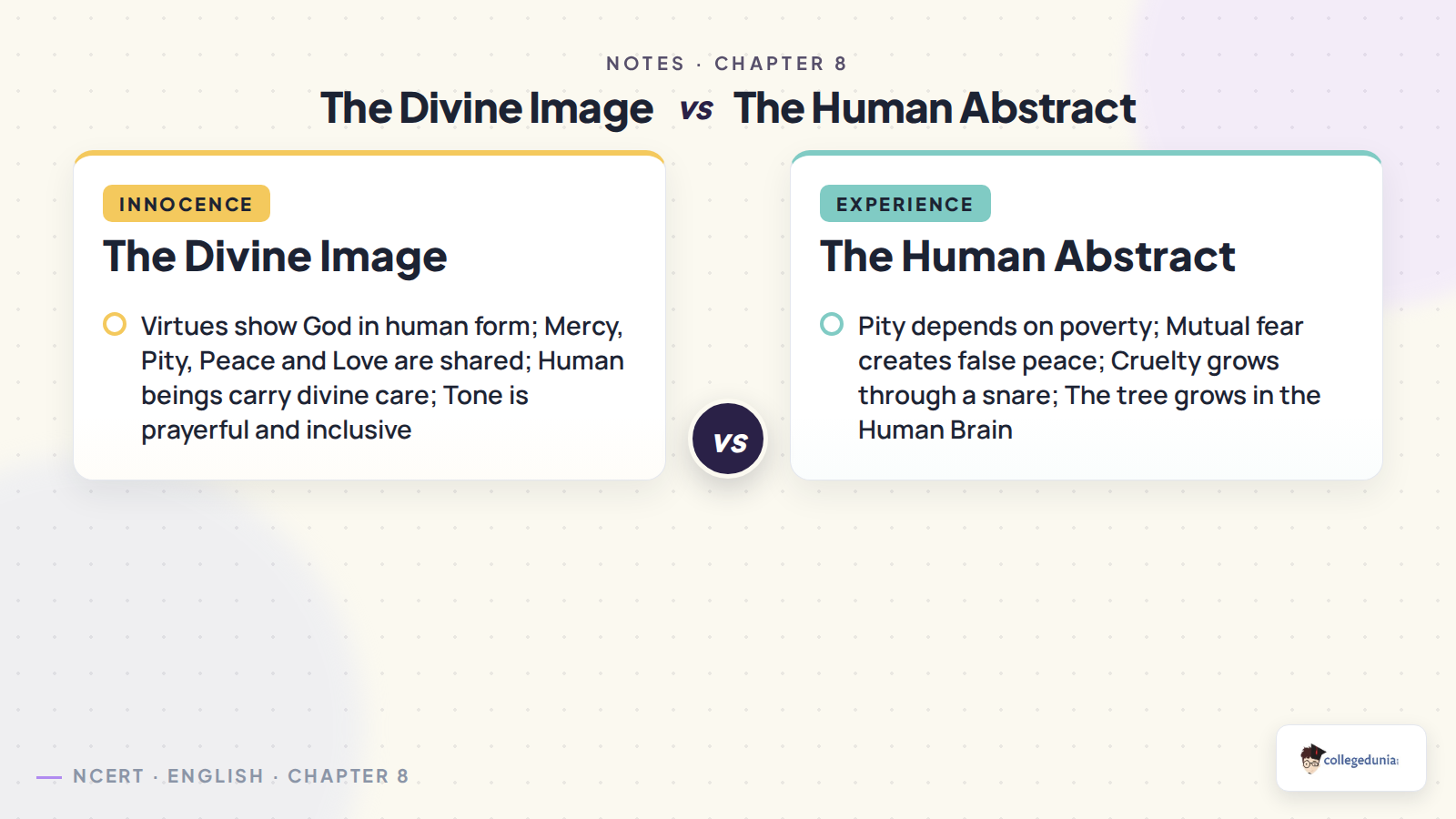
The chapter is best revised as a pair. The Divine Image names virtues as marks of God and humanity, while The Human Abstract shows how similar moral words can become complicated when society creates suffering.
| Point | The Divine Image | The Human Abstract |
|---|---|---|
| Book group | Songs of Innocence | Songs of Experience |
| Central idea | Virtues reveal the divine in human form | Virtues become troubled by poverty and fear |
| Mood | Trusting, prayer-like and inclusive | Darker, critical and analytical |
| Answer cue | Use Mercy, Pity, Peace and Love | Use poverty, fear, cruelty, mystery and deceit |
Mercy Pity Peace and Love in The Divine Image
The Divine Image says people pray to Mercy, Pity, Peace and Love in distress. Blake then connects these virtues to God and to human form, making the poem a statement about universal humanity.
- Mercy: compassion shown when another person suffers.
- Pity: emotional recognition of another person's pain.
- Peace: harmony between people and within the soul.
- Love: the binding virtue that makes all the others living.
Cruelty Mystery and Deceit in The Human Abstract
The Human Abstract does not simply reject the earlier virtues. It asks why pity exists only when poverty is present and why mercy is praised only when people are unhappy. The poem becomes a social criticism.
The image of a tree growing in the human brain is important. It is not a real tree in nature. It is a mental and moral structure built by fear, selfishness and hidden cruelty.
NCERT Language Work and Syllable Pattern
The Language Work asks students to read the syllable pattern of The Divine Image. The safest method is to count beats by line, mark repeated rhythm and then explain how the song-like pattern suits the poem's prayerful tone.
| Step | How to write it |
|---|---|
| Count | Count the syllables in a sample line slowly. |
| Compare | Check whether the next line keeps a similar movement. |
| Explain | Connect regular rhythm to simplicity, prayer and song. |
| Avoid | Do not force technical terms unless you can justify them from the line. |
Answer Plan for Poems by Blake Questions
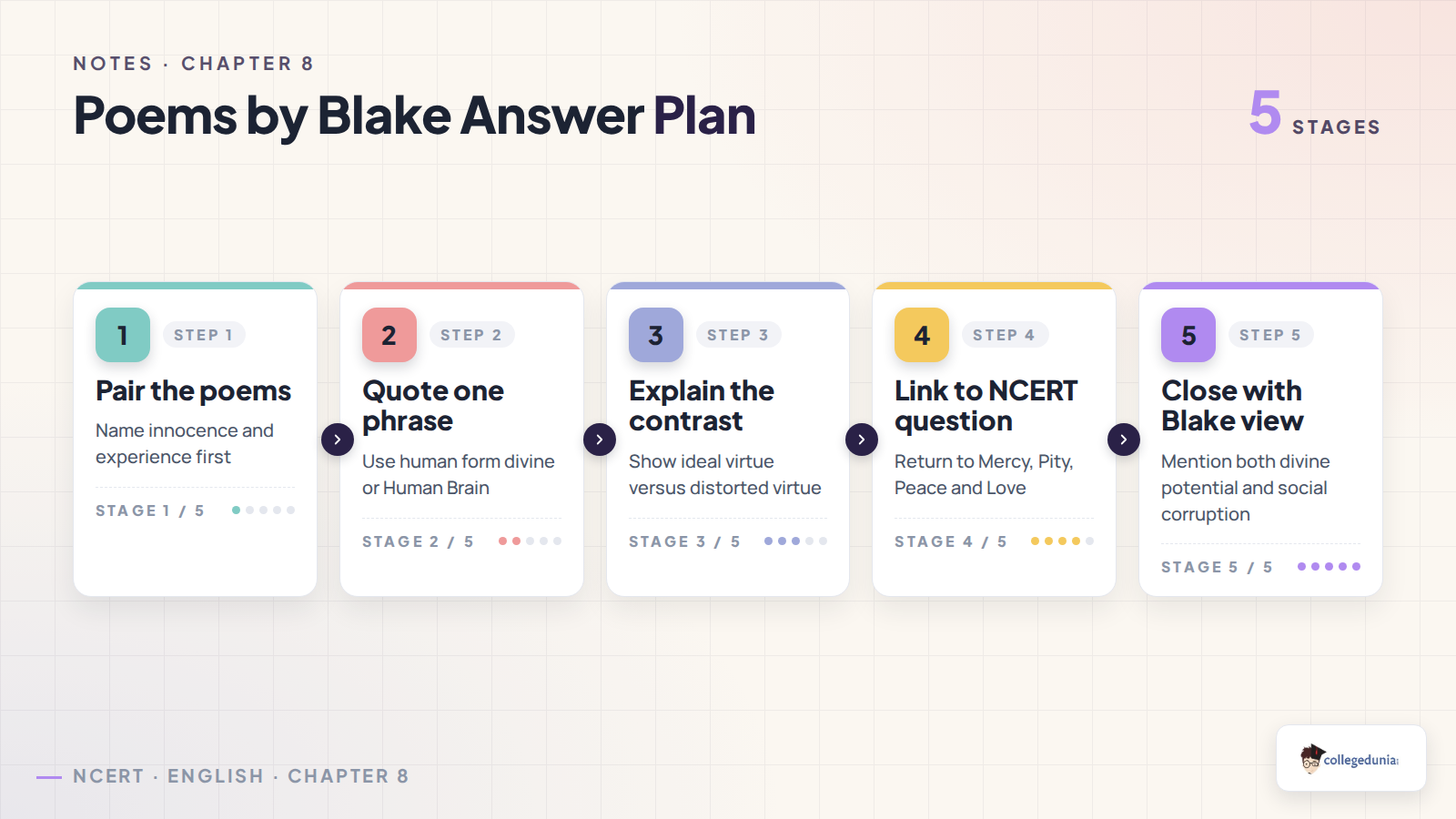
Strong answers in this chapter begin with the specific poem and then move to contrast. Students lose marks when they give only a general moral explanation without naming the poem's language.
- Short answers: name the poem, state the key contrast and quote one phrase.
- Long answers: write one paragraph on each poem and one paragraph comparing them.
- Language Work: use the syllable pattern to explain tone, not just count sounds.
Related Resources for Poems by Blake
| Resource | Use it for | Link |
|---|---|---|
| NCERT Solutions | Full textbook answers for Chapter 8 | Open NCERT Solutions |
| Chapter 7 Notes | Previous poetry chapter revision | Open Chapter 7 Notes |
| Chapter 9 Solutions | Next poetry chapter textbook answers | Open Chapter 9 Solutions |
All Class 12 English Supplementary Notes Chapters
| Chapter | Notes link |
|---|---|
| Chapter 1: Kaleidoscope: I Sell My Dreams | Open Notes |
| Chapter 3: Kaleidoscope: A Wedding in Brownsville | Open Notes |
| Chapter 6: Kaleidoscope: A Lecture upon the Shadow | Open Notes |
| Chapter 7: Kaleidoscope: Poems by Milton | Open Notes |
| Chapter 9: Kaleidoscope: Kubla Khan | Open Notes |
Poems by Blake Quick Questions
Frequently Asked Questions
Ques. What are the two poems in Poems by Blake?
Ans. The chapter includes The Divine Image from Songs of Innocence and The Human Abstract from Songs of Experience.
Ques. What does The Divine Image say about virtues?
Ans. It presents Mercy, Pity, Peace and Love as divine virtues that also appear in human form and connect all people.
Ques. What is the main idea of The Human Abstract?
Ans. The poem shows how poverty, fear and selfishness can distort moral language into cruelty, mystery and deceit.
Ques. How should students revise Poems by Blake?
Ans. Students should revise the innocence and experience contrast, four virtues, the human brain tree image and the syllable pattern task.



Comments