




The Freedom Class 12 notes explain the NCERT Kaleidoscope chapter for the 2026-27 reprint. Use this page to revise G.B. Shaw on social freedom, J. Krishnamurti on inner freedom, discipline, exploitation, leisure and exam-ready answer cues before downloading the full PDF.
- Download the Class 12 English Supplementary Chapter 14 notes PDF for quick revision.
- Revise Shaw's social argument and Krishnamurti's inward argument in one place.
- Student focus: the chapter tests comparison, conceptual clarity and exact explanation of freedom.
Chapter14Kaleidoscope:FreedomNotes.pdf?page=1&dpi=150)
Chapter14Kaleidoscope:FreedomNotes.pdf?page=2&dpi=150)
Chapter14Kaleidoscope:FreedomNotes.pdf?page=3&dpi=150)
Chapter14Kaleidoscope:FreedomNotes.pdf?page=4&dpi=150)
Chapter14Kaleidoscope:FreedomNotes.pdf?page=5&dpi=150)
Chapter14Kaleidoscope:FreedomNotes.pdf?page=6&dpi=150)
Chapter14Kaleidoscope:FreedomNotes.pdf?page=7&dpi=150)
Chapter14Kaleidoscope:FreedomNotes.pdf?page=8&dpi=150)
Chapter14Kaleidoscope:FreedomNotes.pdf?page=9&dpi=150)
Chapter14Kaleidoscope:FreedomNotes.pdf?page=10&dpi=150)
Chapter14Kaleidoscope:FreedomNotes.pdf?page=11&dpi=150)
Chapter14Kaleidoscope:FreedomNotes.pdf?page=12&dpi=150)
Chapter14Kaleidoscope:FreedomNotes.pdf?page=13&dpi=150)
Chapter14Kaleidoscope:FreedomNotes.pdf?page=14&dpi=150)
Chapter14Kaleidoscope:FreedomNotes.pdf?page=15&dpi=150)
Chapter14Kaleidoscope:FreedomNotes.pdf?page=16&dpi=150)
Chapter14Kaleidoscope:FreedomNotes.pdf?page=17&dpi=150)
Chapter14Kaleidoscope:FreedomNotes.pdf?page=18&dpi=150)
Chapter14Kaleidoscope:FreedomNotes.pdf?page=19&dpi=150)
Chapter14Kaleidoscope:FreedomNotes.pdf?page=20&dpi=150)
Chapter14Kaleidoscope:FreedomNotes_flat_MobileCard.pdf?page=1&dpi=150)
Chapter14Kaleidoscope:FreedomNotes_flat_MobileCard.pdf?page=2&dpi=150)
Chapter14Kaleidoscope:FreedomNotes_flat_MobileCard.pdf?page=3&dpi=150)
Chapter14Kaleidoscope:FreedomNotes_flat_MobileCard.pdf?page=4&dpi=150)
Chapter14Kaleidoscope:FreedomNotes_flat_MobileCard.pdf?page=5&dpi=150)
Chapter14Kaleidoscope:FreedomNotes_flat_MobileCard.pdf?page=6&dpi=150)
Chapter14Kaleidoscope:FreedomNotes_flat_MobileCard.pdf?page=7&dpi=150)
Chapter14Kaleidoscope:FreedomNotes_flat_MobileCard.pdf?page=8&dpi=150)
Chapter14Kaleidoscope:FreedomNotes_flat_MobileCard.pdf?page=9&dpi=150)
Chapter14Kaleidoscope:FreedomNotes_flat_MobileCard.pdf?page=10&dpi=150)
Chapter14Kaleidoscope:FreedomNotes_flat_MobileCard.pdf?page=11&dpi=150)
Chapter14Kaleidoscope:FreedomNotes_flat_MobileCard.pdf?page=12&dpi=150)
Chapter14Kaleidoscope:FreedomNotes_flat_MobileCard.pdf?page=13&dpi=150)
Chapter14Kaleidoscope:FreedomNotes_flat_MobileCard.pdf?page=14&dpi=150)
Chapter14Kaleidoscope:FreedomNotes_flat_MobileCard.pdf?page=15&dpi=150)
Chapter14Kaleidoscope:FreedomNotes_flat_MobileCard.pdf?page=16&dpi=150)
Chapter14Kaleidoscope:FreedomNotes_flat_MobileCard.pdf?page=17&dpi=150)
Chapter14Kaleidoscope:FreedomNotes_flat_MobileCard.pdf?page=18&dpi=150)
Chapter14Kaleidoscope:FreedomNotes_flat_MobileCard.pdf?page=19&dpi=150)
Chapter14Kaleidoscope:FreedomNotes_flat_MobileCard.pdf?page=20&dpi=150)
Chapter14Kaleidoscope:FreedomNotes_flat_MobileCard.pdf?page=21&dpi=150)
Chapter14Kaleidoscope:FreedomNotes_flat_MobileCard.pdf?page=22&dpi=150)
Chapter14Kaleidoscope:FreedomNotes_flat_MobileCard.pdf?page=23&dpi=150)
Chapter14Kaleidoscope:FreedomNotes_flat_MobileCard.pdf?page=24&dpi=150)
These Class 12 English Supplementary Freedom notes are checked against the 2026-27 NCERT chapter and built for fast conceptual revision.
Student Feedback on Freedom
In a Collegedunia poll of 13,180 Class 12 English students using NCERT literature resources, many students understood the broad theme but needed help separating Shaw's social argument from Krishnamurti's psychological argument.
- 81% wanted a clearer split between outer freedom and inner freedom.
- 73% needed support with Shaw's link between need, work, government and exploitation.
- 68% found Krishnamurti's claim about discipline and inward discovery hard to frame briefly.
Source: 2026-27 Class 12 English student poll. Sample of 13,180 students using NCERT-aligned study resources.
Freedom Summary for Class 12 Kaleidoscope
Freedom places two prose arguments side by side. Shaw explains freedom through society, labour and material need. Krishnamurti explains freedom through the mind, discipline and independent discovery.
- Main idea: freedom is not merely doing what one likes.
- Shaw's focus: people are not free when need forces them into exhausting work.
- Krishnamurti's focus: people are not free when fear, imitation and mental frames control them.
- Answer cue: define the kind of freedom first, then connect it to the speaker's example.
Freedom Class 12 Video Recap
Source: Magnet Brains on YouTube
Need, Work and Exploitation in Shaw
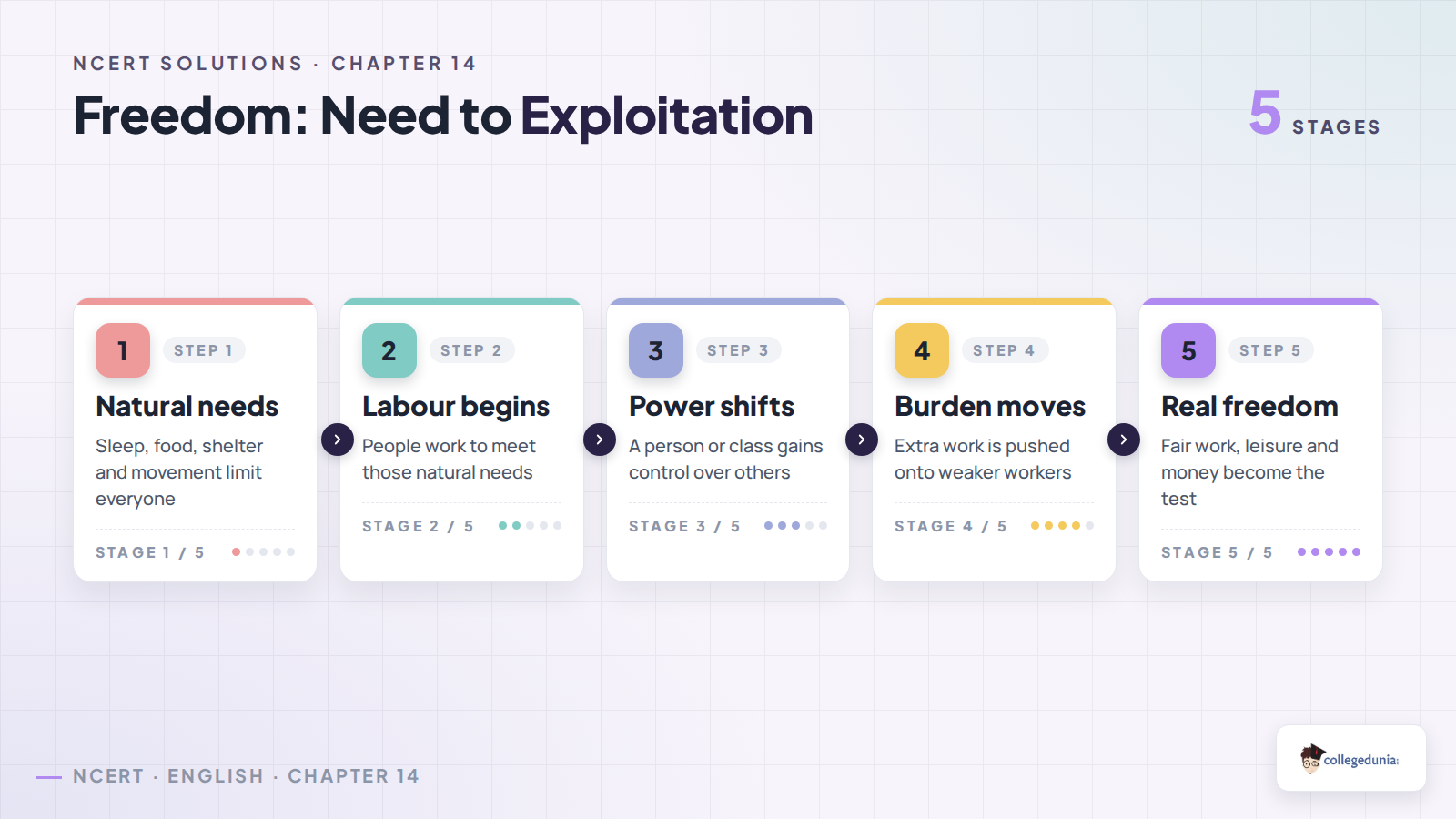
Shaw begins from ordinary pressure. A person must eat, keep a home, pay for clothing and survive in society. This need forces labour. Once the person depends on labour for survival, employers and institutions can control time, wages and dignity.
| Stage | Shaw's idea | Revision cue |
|---|---|---|
| Need | Food, shelter and basic security are unavoidable | Freedom cannot ignore material life. |
| Work | People sell time and energy to meet needs | Labour is not always freely chosen. |
| Exploitation | Powerful groups benefit from others' dependence | Social freedom needs fair conditions. |
| Leisure | Real freedom needs time beyond forced labour | Shaw calls leisure an old name for freedom. |
Shaw on Government, Vote and Leisure
Shaw does not reject law or democracy. He warns that political rights alone do not make citizens free. A vote has value only when citizens also have enough education, leisure and economic security to use judgement rather than fear.
| Topic | What Shaw questions | Exam value |
|---|---|---|
| Government | Authority can preserve order yet still limit people | Do not write that all rule is freedom. |
| Vote | Voting is weak if citizens remain dependent and uninformed | Political freedom needs social support. |
| Leisure | Time to think and choose is central to liberty | Use for short-answer conceptual questions. |
| Responsibility | Freedom includes discipline chosen by reason | Prevents careless meaning of freedom. |
Exam cue: Shaw's freedom is social and practical. Connect each answer to need, power, leisure or public responsibility.
Krishnamurti on Discipline and Inner Freedom
Krishnamurti shifts the chapter inward. He argues that real freedom cannot be produced by obedience, fear or imitation. A mind trapped inside a frame may look disciplined from outside, but it cannot discover truth freshly.
- Frame: fixed habits, beliefs and imposed patterns restrict the mind.
- Discipline: external control can create order, but it can also create fear.
- Discovery: freedom begins when the learner observes and understands directly.
- Education link: the classroom should not reduce students to imitation.
| Key phrase | Simple meaning | How to use it |
|---|---|---|
| Freedom from the frame | Freedom from mental limits | Use for answers on inward liberty. |
| Discipline and fear | Obedience may block understanding | Use for the education question. |
| Discovering truth | Truth must be understood, not copied | Use for long conceptual answers. |
Shaw versus Krishnamurti Comparison
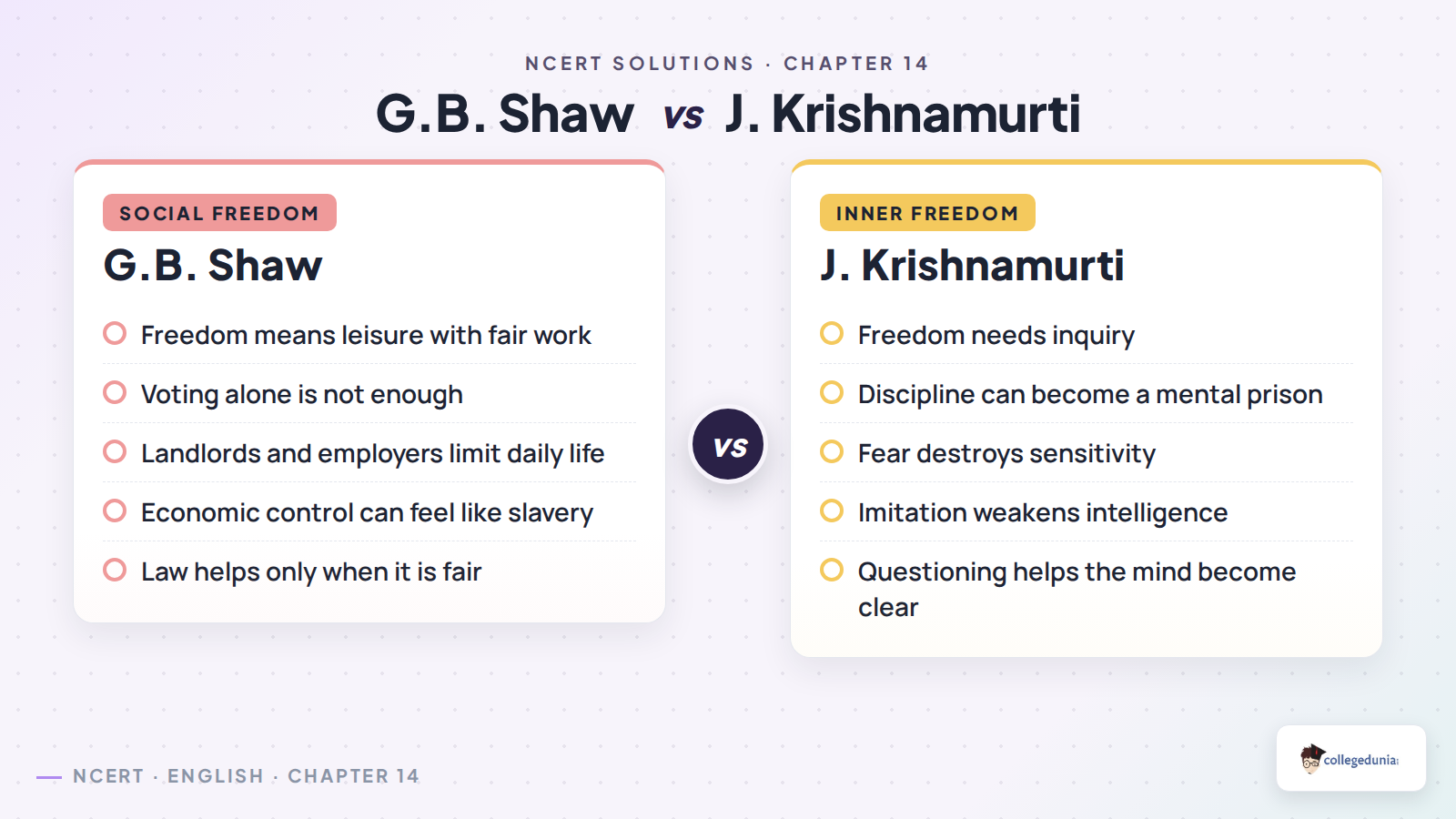
The chapter becomes easier when the two writers are not mixed. Shaw asks whether society gives people the conditions needed for freedom. Krishnamurti asks whether the mind can be free from fear, imitation and imposed frames.
| Point | G.B. Shaw | J. Krishnamurti |
|---|---|---|
| Level | Social, economic and political | Psychological and educational |
| Main obstacle | Need, forced labour and exploitation | Fear, imitation and mental conditioning |
| Positive freedom | Leisure, fair conditions and responsible citizenship | Awareness, enquiry and independent discovery |
| Best answer use | Questions on democracy, work and public life | Questions on discipline, learning and inner truth |
NCERT Questions Answer Plan for Freedom
Write every answer by naming the writer, defining the kind of freedom and then giving one example. This prevents broad moral writing and keeps the response tied to the chapter.
| Question focus | What to include | Final effect |
|---|---|---|
| Meaning of freedom | Show that freedom is not license or mere comfort | The answer becomes conceptual. |
| Shaw's argument | Need, labour, vote, leisure and exploitation | Social context stays clear. |
| Krishnamurti's argument | Frame, discipline, fear, enquiry and discovery | Inner freedom stays clear. |
| Comparison | Outer conditions versus inward independence | The chapter's two-part structure is visible. |
| Education | Freedom from imposed mental patterns | Use Krishnamurti, not Shaw, as the main reference. |
Related Resources for Freedom Class 12 English
| Resource | Use it for | Link |
|---|---|---|
| NCERT Solutions | Full textbook answers for Chapter 14 | Open NCERT Solutions |
All Class 12 English Supplementary Notes Chapters
| Chapter | Notes link |
|---|---|
| Chapter 10: Kaleidoscope: Trees | Open Notes |
| Chapter 11: Kaleidoscope: The Wild Swans at Coole | Open Notes |
| Chapter 12: Kaleidoscope: Time and Time Again | Open Notes |
| Chapter 13: Kaleidoscope: Blood | Open Notes |
| Chapter 14: Kaleidoscope: Freedom | Open Notes |
| Chapter 15: Kaleidoscope: The Mark on the Wall | Open Notes |
Freedom Class 12 English Notes FAQs
Ques. What is Freedom in Class 12 English Kaleidoscope about?
Ans. Freedom compares two ideas of liberty. Shaw discusses social and economic freedom, while Krishnamurti discusses inner freedom from fear, imitation and imposed frames.
Ques. What does Shaw mean by freedom?
Ans. Shaw means that people are not truly free if material need forces them into dependence. He links freedom with fair social conditions, leisure and responsible public life.
Ques. What does Krishnamurti mean by inner freedom?
Ans. Krishnamurti means freedom from fear, imitation and fixed mental patterns. He believes truth must be discovered through awareness, not copied through discipline.
Ques. How should students revise Freedom notes?
Ans. Students should revise Shaw's need-work-leisure argument, Krishnamurti's frame-and-discovery argument, and a comparison table that separates outer freedom from inner freedom.



Comments