The NCERT Solutions for Class 11 English Woven Words Chapter 2 A Pair of Mustachios answer every textbook question from the 2026-27 NCERT reader. The page covers Ramanand's business sense, Azam Khan's pride, the moustache class code, Mulk Raj Anand's satire and the language work printed after the story.
The chapter has 11 answerable prompts across text, discussion, appreciation and language work.
Use the PDF for answers on class pride, social symbols and Ramanand's business acumen.
The story is from the Short Stories section of Woven Words, Class 11 English elective.
Student Feedback: In a Collegedunia student poll of 7,860 Class 11 English students before the 2026 exams, many students said the hardest part of A Pair of Mustachios was explaining why a comic moustache quarrel becomes a serious class satire.
Every answer here is written for the latest 2026-27 NCERT Woven Words text and keeps the wording short enough for school answer sheets.
The exercise after A Pair of Mustachios is compact, but it asks students to move from plot recall to social satire. The strongest answers connect Ramanand, Azam Khan and the village witnesses to the chapter's larger comment on rank.
NCERT section
Number of prompts
What it tests
Understanding the Text
3
Character, business acumen and final advantage
Talking about the Text
3
Social mores, British references and the message
Appreciation
2
Theme introduction and dialogue
Language Work
3
French borrowings, Indian idiom and collocations
Moustaches as Class Symbols in A Pair of Mustachios
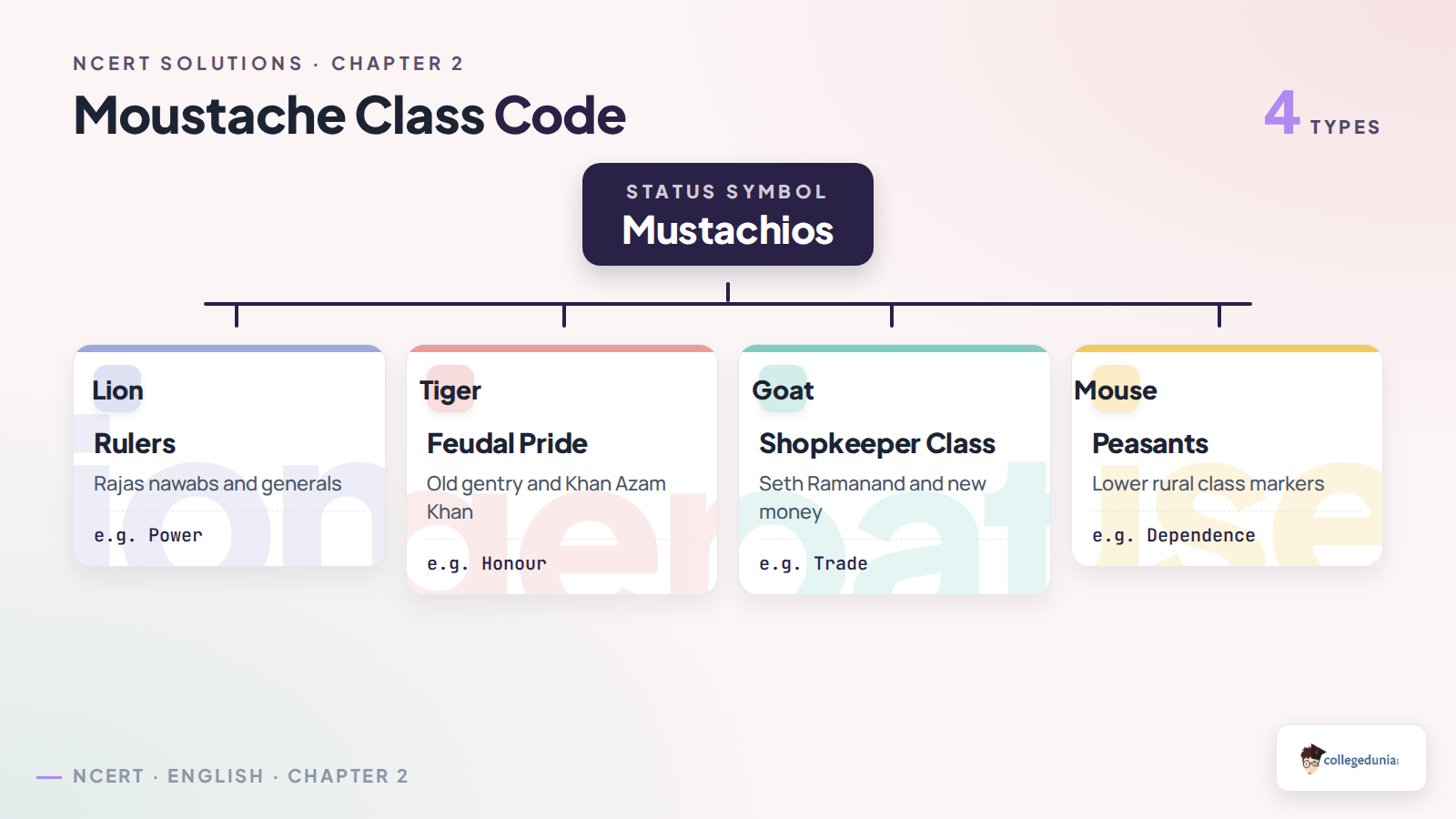
Anand opens the chapter with a funny classification of moustaches. The humour works because each style is treated like a social badge. The moustache is not only facial hair in this story, it is a public claim about class.
Lion moustache: linked with rulers, generals and official power.
Tiger moustache: linked with feudal pride and old nobility.
Goat moustache: linked with traders, moneylenders and new wealth.
Mouse moustache: linked with peasants and lower rural status.
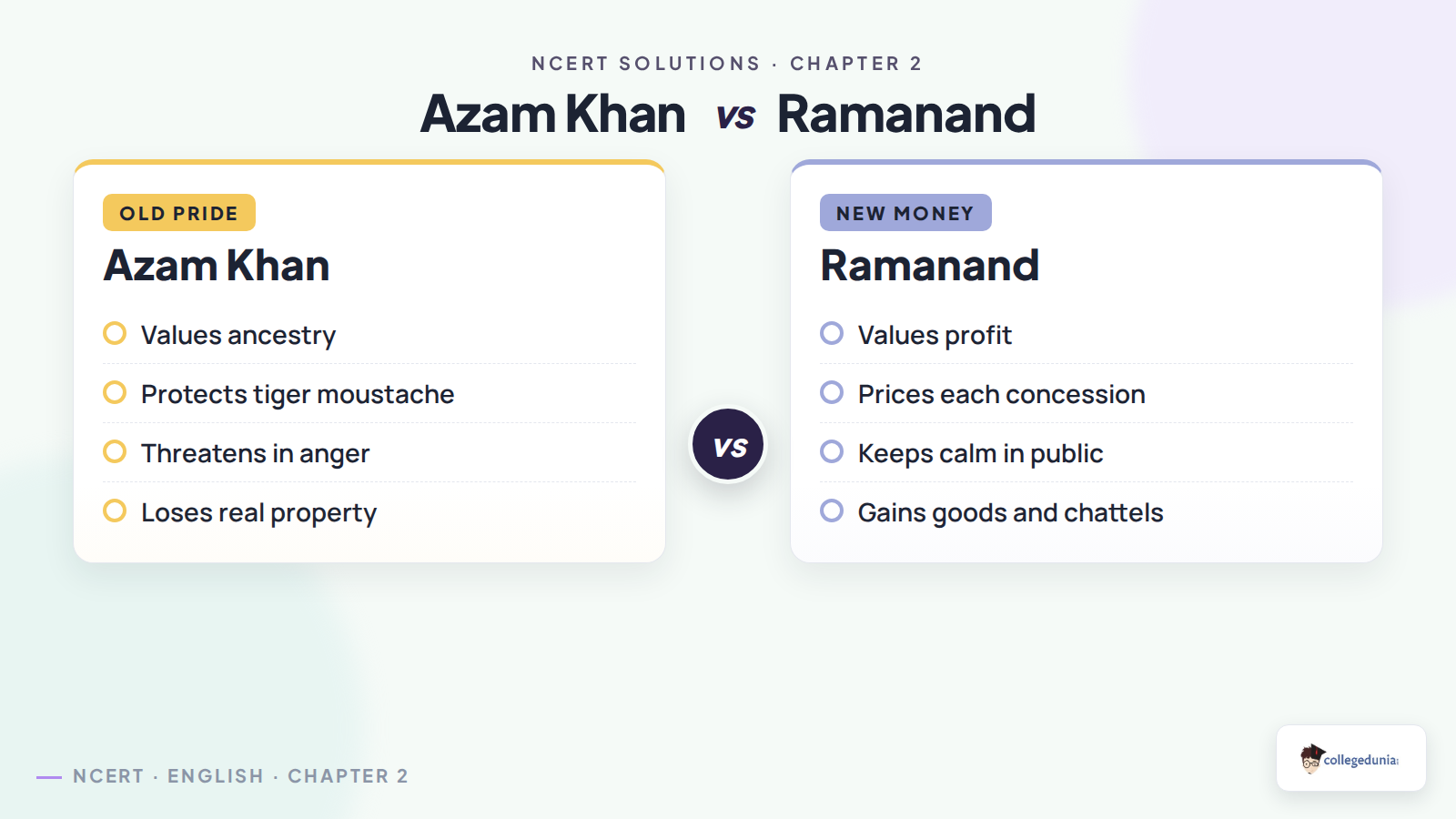
Ramanand and Azam Khan are both stubborn, but they are stubborn about different things. Azam Khan guards inherited honour. Ramanand guards profit. That difference decides the end of the story.
Character
What he values
How he acts
Result
Azam Khan
Lineage and tiger moustache honour
Threatens, shouts and pawns family property
Keeps pride but loses possessions
Ramanand
Profit and social advantage
Stays calm and prices each concession
Gets goods, jewellery and a signed deed
Social Satire and the Message of A Pair of Mustachios
The story laughs at a society where rank can be marked by a moustache tip. It also shows the shift from old feudal prestige to new money power. Ramanand does not need a noble family name because he has practical control over village credit.
Azam Khan's pride is sincere, but it is also self-destructive.
Ramanand's humility is not moral goodness. It is a business tactic.
The landlord, priest and elders make the absurd bargain look respectable.
The final joke is bitter: Khan walks away upright, but poorer than before.
Dialogue and Light Vein in the Story
The dialogue makes the chapter lively because the reader hears Khan's anger and Ramanand's calm bargaining directly. Khan's threats sound grand, while the cause is only a moustache tip. This gap creates the light comic tone.
Khan's speech reveals pride, insult and social contempt.
Ramanand's replies reveal patience and business calculation.
The village voices turn the quarrel into a public performance.
Language Work Answers for A Pair of Mustachios
The Language Work section is easy to score if the phrase meanings and collocations are learned as full units. Do not translate each word separately.
seed of a donkey, lentil-eating shopkeepers, pride of generations, my father was a Sultan
Collocations
keep one's word, make one's will, make ends meet, take out a loan, turn a deaf ear to
Common Mistakes Students Make in A Pair of Mustachios Answers
Avoid these answer-sheet mistakes:
Writing only a plot summary when the question asks about social mores.
Calling Azam Khan foolish without explaining the feudal pride behind his action.
Calling Ramanand humble without noting that his humility is strategic.
Ignoring the British monarchy references in the satire question.
Writing French examples without meanings in the Language Work answer.
How to Revise A Pair of Mustachios in 30 Minutes
The chapter can be revised quickly if students keep the social code clear. Read the opening moustache classification, the bargaining scene and the final deed scene before writing answers.
10 minutes: revise the four moustache types and the class groups attached to them.
10 minutes: compare Ramanand and Azam Khan in two columns.
10 minutes: memorise the language work collocations and two French examples.
More Class 11 English Woven Words Chapter 2 Resources
Use the related Woven Words resources when you need the chapter text, quick notes or handwritten revision pages along with these solved answers.
All NCERT Solutions for Class 11 English Woven Words Chapter 2 A Pair of Mustachios with Step-by-Step Solutions
NCERT Solutions Class 12 Physics Chapter 2 A Pair of Mustachios
Class 11 English Woven Words Chapter 2: A Pair of Mustachios NCERT Solutions
All 11 questions with collapsible Solution and Expert Solution. Tap a button to reveal the working.
Questions
Q 2.1
What do you understand of the natures of Ramanand and Azam Khan from the episode described?
Concept used. A character answer should infer nature from action, speech and choices. In this episode, Ramanand and Azam Khan are shown through their argument over the moustache.
Character clue
Azam Khan values inherited honour. Ramanand values profit and knows how to use another man's weakness.
Ramanand is a grocer and moneylender who has become rich through trade.
He is shrewd, calm and practical. He understands that Azam Khan's pride is stronger than his need for money.
He first lowers one tip of his moustache to keep the business moving.
When Khan demands more, Ramanand raises the price of obedience by asking for more valuables.
This shows business acumen, patience and clever manipulation.
Azam Khan is proud, impulsive and tied to old ideas of nobility.
He has almost no property left, yet he treats the tiger moustache as a sacred symbol of family honour.
He is emotionally sincere but foolish, because he sacrifices real possessions for a symbol.
Ramanand is practical, cunning and business-minded, while Azam Khan is proud, hot-tempered and trapped in the memory of feudal status. Ramanand controls the situation because he understands money and human weakness better than Khan understands his own pride.
MS
Meera Sanyal
M.A English, University of Delhi
Verified Expert
Quick reading. The episode sets up two opposite temperaments. Ramanand thinks in bargains, while Azam Khan thinks in rank and honour.
Ramanand never loses control of the exchange. Even when threatened, he speaks with calculated calm.
He uses small concessions to draw Khan deeper into the deal.
He turns every demand about the moustache into a fresh business opportunity.
Azam Khan reacts from wounded pride, not from practical judgment.
His language is violent because he feels his whole ancestry has been insulted.
Yet his violence leads nowhere, because he signs away his goods to protect a symbol.
The contrast is comic but sharp. Ramanand may be morally slippery, but he understands the real world. Azam Khan may look dignified, but his dignity has become impractical vanity.
Ramanand is tactful, calculating and worldly. Azam Khan is brave in manner but vain, rash and helpless before his own class pride.
Q 2.2
Identify instances in the story that show the business acumen of Ramanand.
Concept used. Business acumen means skill in judging profit, risk and customer behaviour. Ramanand shows it by turning a quarrel into a series of profitable transactions.
Evidence answer
Use separate incidents. Do not only call Ramanand clever. Show where the cleverness appears.
Before the moustache episode, Ramanand has already profited from the fall in wheat prices by buying crops cheaply and selling later at higher prices.
When Khan first comes to pawn the nose-ring, Ramanand lowers one tip of his moustache to keep the customer satisfied.
He accepts Khan's insult without anger because the business matters more to him than pride.
When Khan demands the second tip to be lowered, Ramanand says that a bigger concession requires more expensive jewellery.
This prompts Khan to bring a family necklace, which Ramanand accepts as another pawned item.
Ramanand then lets the other tip rise, knowing that Khan's pride will force a larger bargain.
Finally, he makes Khan sell all his goods and chattels in return for a written promise about the moustache.
He gets the deed signed before witnesses, so the bargain becomes legally and socially secure.
Ramanand's business acumen appears in his wheat trading, his calm handling of Khan, his staged moustache concessions, his demand for more valuable pledges and his final deed for Khan's goods and chattels. He converts pride into profit at every step.
RM
Raghav Menon
M.A English, EFLU Hyderabad
Verified Expert
Strategic angle. Ramanand behaves less like an angry rival and more like a careful trader reading market demand. Here the demand is Khan's need to preserve status.
He first studies Khan's emotional pressure point: the tiger moustache.
He gives just enough concession to keep the negotiation alive.
He never gives the full concession for free. Each fresh demand must bring a fresh asset.
He uses witnesses and a deed, which shows awareness of enforceable proof.
He keeps his language mild, so Khan appears unreasonable while he appears fair.
The funniest part is also the cleverest part. Ramanand sells the lowering of a moustache tip as if it were a valuable commodity. That shows his practical intelligence.
Ramanand proves his business skill by pricing even his humiliation. He turns Khan's wounded honour into pledged jewellery, household goods and a signed agreement.
Q 2.3
Both Ramanand and Azam Khan seem to have very fixed views. How does Ramanand score over Azam Khan towards the end of the story?
Concept used. A fixed view can be either rigid pride or steady practical purpose. Azam Khan is fixed in social pride, while Ramanand is fixed in profit and advantage.
Satire point
The story does not reward noble pride. It rewards the person who understands how society actually works.
Azam Khan's fixed view is that only a man of noble ancestry may wear the tiger moustache.
He treats Ramanand's upturned moustache as an attack on his inherited rank.
Ramanand's fixed view is that business profit matters more than symbolic honour.
He is willing to lower his moustache if the price is right.
Towards the end, Ramanand gets Khan to transfer all his household goods and chattels.
The deal is written and witnessed, so Ramanand's gain becomes secure.
Khan walks away with his moustache still upright, but he has become a pauper.
Ramanand loses nothing important, because his honour is not tied to moustache style.
Ramanand scores over Azam Khan because his fixed practical sense defeats Khan's fixed pride. Khan protects the symbol of nobility, but Ramanand gains the property. The ending shows Ramanand as the real winner of the bargain.
AR
Aditi Rao
Ph.D English, University of Hyderabad
Verified Expert
Structural observation. The ending reverses visible dignity and real power. Khan looks noble, but Ramanand owns the material advantage.
Khan believes status lives in outward signs like the tiger moustache.
Ramanand understands that outward signs can be performed, altered or sold.
Khan spends real assets to control a symbolic insult.
Ramanand accepts symbolic lowering because it brings material gain.
The village elders make the transaction socially legitimate.
Khan's final proud twist becomes comic because the reader knows what it has cost him.
Ramanand scores because he adapts without giving up his main aim. Azam Khan refuses to adapt and loses everything except the appearance of honour.
Ramanand wins by separating symbol from substance. He sacrifices the look of pride and gains property, while Khan preserves the look of nobility and loses his goods.
Q 2.4
The episode has been narrated in a light vein. What social mores does the author seem to ridicule?
Concept used. Social mores are accepted customs and habits of a community. Anand uses humour to ridicule customs based on class, inherited rank and empty prestige.
Tone clue
Light vein means comic narration, but the target of the comedy is serious social foolishness.
The story mocks the habit of judging people by outward signs such as moustache style.
It ridicules the obsession with ancestry and blue blood.
It questions feudal pride, where a poor man still behaves as if birth gives him natural superiority.
It also mocks commercial respectability, because Ramanand's wealth comes with cunning and opportunism.
The village accepts class boundaries as if they were natural laws.
Even the landlord, priest and elders support the performance of honour rather than question its absurdity.
The humour exposes how social hierarchy can become petty, cruel and ridiculous.
The author ridicules class pride, feudal ancestry, caste-like social boundaries, blind respect for symbols and the belief that outward signs prove inner worth. The light tone makes these customs look comic and hollow.
KT
Kavya Thomas
M.A English, Christ University
Verified Expert
Social reading. The story laughs at a society that treats moustaches like official badges of rank.
Moustaches become social labels: lion, tiger, goat, sheep and mouse.
This classification exposes how rigidly people imagine social order.
Khan's anger shows feudal pride at its most absurd.
Ramanand's behaviour shows the rise of money power in place of old aristocracy.
The witnesses do not challenge the foolishness. They help formalise it.
The humour is therefore not random. Anand uses exaggeration to make social customs visible. Once visible, they appear silly and unjust.
Anand ridicules the social habit of confusing rank with symbols, birth with worth and money with respectability. The comic moustache dispute reveals the absurdity of these mores.
Q 2.5
What do you think are the reasons for the references made to the English people and the British monarchy?
Concept used. Literary references often widen a local incident into a larger social comment. The references to English people and the monarchy place Indian class vanity beside colonial forms of status.
Context clue
The story compares Indian pride in moustaches with European pride in clothes and imperial titles.
The narrator says that outsiders may find Indian moustache customs strange, but every society has its own symbols of rank.
The English are mentioned with frock coats, striped trousers and top hats.
This comparison suggests that European class signs are also artificial and costly.
The references to His Majesty and Her Majesty mock the formal language of imperial approval.
Rajas, nawabs and English army generals are grouped together through the lion moustache.
This links Indian feudal pride with colonial power and public display.
The references help the satire move beyond one village quarrel to a broader critique of status symbols.
The English and monarchy references show that class display is not only Indian. Anand uses them to mock both Indian feudal vanity and British imperial respectability, suggesting that all societies create artificial signs of rank.
DN
Devika Nair
M.A English, University of Calicut
Verified Expert
Comparative angle. Anand's narrator does not let the reader laugh only at the village. He compares Indian signs of rank with British signs of rank.
English clothing works like the Indian moustache, because both announce social position.
Royal references make the moustache system sound almost officially sanctioned.
This mock-official tone increases the comedy.
The colonial setting also matters because Indian elites often borrowed or competed with imperial symbols.
By bringing monarchy into a moustache quarrel, Anand exposes the emptiness of all ceremonial pride.
The references therefore make the satire wider and sharper. A local argument becomes a joke about empire, aristocracy and social performance.
They are used to broaden the satire. British monarchy and English manners become examples of the same human weakness: turning costume, title and style into proof of superiority.
Q 2.6
What do you think is the message that the author seems to convey through the story?
Concept used. The message of a satire is usually found by asking what human weakness is being exposed. Here the weakness is blind pride in social symbols.
Message answer
Keep the message tied to the story. Mention Khan, Ramanand and the moustache symbol.
The story shows that class signs can become more important to people than real welfare.
Khan loses property because he cannot bear a moneylender imitating the tiger moustache.
His pride is inherited, but it does not feed his family or preserve his house.
Ramanand's cleverness shows another truth: practical intelligence often defeats empty prestige.
The village society supports the dispute instead of questioning its foolish basis.
Anand suggests that rigid social hierarchy harms judgment.
The final image is comic and sad: Khan keeps his proud moustache but becomes poorer.
The story conveys that empty pride in class, ancestry and outward symbols is foolish and self-destructive. Real intelligence lies in practical judgment, not in clinging to signs of social superiority.
AD
Arunima Das
M.A English, Presidency University
Verified Expert
Theme reading. The message is not simply that Ramanand is clever and Khan is foolish. It is that a whole society gives power to meaningless signs.
The moustache becomes a badge of identity because society treats it that way.
Khan is foolish, but his foolishness is encouraged by the social code around him.
Ramanand wins because he knows that such codes can be exploited.
The elders and priest make the absurd bargain look respectable.
This shows how customs can protect vanity rather than wisdom.
The story asks students to laugh, but also to recognise the cost of pride. Khan's final posture hides a real defeat.
Anand's message is that social pride based on birth and symbols is hollow. A person who values appearance over sense can lose everything while still imagining himself noble.
Q 2.7
Comment on the way in which the theme of the story has been introduced.
Concept used. Theme introduction means how the opening prepares the reader for the main idea. Anand introduces the theme through a comic classification of moustaches.
Opening method
Before the plot begins, the narrator explains the social meaning of different moustache styles.
The story opens not with Ramanand or Khan, but with a general comment on moustaches.
The narrator says that moustaches mark class boundaries in his country.
He lists lion, tiger, goat, Charlie Chaplin, sheep and mouse moustaches.
Each style is linked with a social group, from rulers to peasants.
The tone is playful, but the classification shows a rigid social world.
This prepares the reader to understand why Khan takes Ramanand's moustache so seriously.
The opening also makes the later quarrel comic because the reader already sees the absurdity of the system.
The theme is introduced through humorous social commentary on moustache styles. By presenting moustaches as class markers, Anand prepares the reader for a plot where pride, rank and imitation become the centre of conflict.
SK
Samar Khanna
M.A Comparative Literature, Jadavpur University
Verified Expert
Narrative design. Anand begins with a mock-serious theory of moustaches. This is an effective way to introduce satire.
The opening sounds analytical, almost like a social science lecture.
Its subject, however, is comic: moustache shapes.
This mismatch creates humour and signals satire.
The classification also builds the story's logic, because Khan's tiger moustache and Ramanand's goat moustache have social meaning.
When the plot starts, the reader already understands the rules of this comic world.
The introduction is therefore both funny and functional. It gives the key to the whole story before the quarrel begins.
The theme is introduced by turning moustaches into a comic social code. This prepares the conflict and exposes the absurd link between appearance and status.
Q 2.8
How does the insertion of dialogue in the story contribute to its interest?
Concept used. Dialogue adds direct speech, pace and character. In this story, dialogue makes the moustache quarrel lively and reveals personality without long explanation.
Dialogue answer
Mention both effects: it entertains the reader and exposes character.
Dialogue brings the quarrel between Khan and Ramanand directly before the reader.
Khan's harsh words show his anger, pride and aristocratic contempt.
Ramanand's calm replies show his control and business sense.
The landlord, priest and peasants add the voice of the village community.
Their comments make the scene feel public, like a small village performance.
The back-and-forth movement creates suspense about how far Khan will go.
Dialogue also increases humour because Khan sounds grand while the issue remains a moustache tip.
Dialogue makes the story vivid, comic and dramatic. It reveals Khan's pride, Ramanand's shrewdness and the village's role in the quarrel, while keeping the pace lively and theatrical.
NK
Nisha Kapoor
M.A English, Jamia Millia Islamia
Verified Expert
Style note. Without dialogue, the episode might read like a summary of a dispute. With dialogue, it becomes a staged comic scene.
Khan's threats give the story energy and show his wounded vanity.
Ramanand's polite bargaining makes him seem even cleverer.
The public witnesses turn a private irritation into a village event.
The reader can hear differences of class, temper and motive in the speech.
The comic contrast between big words and a small cause keeps the story entertaining.
Dialogue also prevents the satire from becoming heavy. The reader laughs because the characters expose themselves through their own words.
The dialogue contributes interest by dramatizing the satire. It turns social pride into action, gives each character a distinct voice and makes the quarrel memorable.
Q 2.9
Nouveau riche and bourgeoise are French words. Collect from newspapers, magazines and other sources some more French words or expressions that are commonly used in English.
Concept used. Many French words and expressions have entered English, especially in writing about food, art, society, fashion and public life.
Language work
Give examples with simple meanings. That makes the answer useful, not just a list.
Rendezvous means a meeting or meeting place.
Debut means a first public appearance.
Cuisine means a style of cooking.
Cliche means an overused expression or idea.
Faux pas means a social mistake.
Bon voyage means good wishes for a journey.
Carte blanche means full freedom to act.
Entrepreneur means a person who starts and runs a business.
Avant-garde means new, experimental or ahead of its time.
Common French expressions used in English include rendezvous, debut, cuisine, cliche, faux pas, bon voyage, carte blanche, entrepreneur and avant-garde.
LM
Leena Mathew
M.A Linguistics, University of Kerala
Verified Expert
Language angle. English often borrows words when a borrowed term becomes fashionable, precise or widely recognised.
Words like cuisine and chef are common in food writing.
Words like debut and avant-garde are common in arts coverage.
Expressions like faux pas and carte blanche are common in social and political writing.
These words keep a French flavour but function naturally in English sentences.
The chapter's use of nouveau riche similarly points to social class and newly acquired wealth.
The best answer can include any familiar French borrowings, provided their meanings are clear.
Examples include chef, cuisine, debut, faux pas, rendezvous, bon voyage, carte blanche, cliche, entrepreneur and avant-garde.
Q 2.10
Locate expressions in the text which reflect the Indian idiom, for example, the pride of the generations of his ancestors.
Concept used. Indian idiom in English often reflects local speech patterns, social relations and culturally rooted expressions. Anand's prose carries this flavour throughout the story.
Idiom
An idiom is a natural expression of a language or culture. Here the English sentence often carries Indian social meaning.
``seed of a donkey'' reflects an Indian style of insult translated into English.
``lentil-eating shopkeepers'' carries caste and class contempt in a local idiom.
``the pride of generations of his ancestors'' reflects inherited family honour.
``the symbol of his honour'' shows the cultural weight given to external signs.
``goods and chattels'' is formal English, but in context it evokes household possessions in a traditional setting.
``come to your senses'' is used in the bargaining scene with a familiar spoken rhythm.
``my father was a Sultan'' reflects boastful lineage in a direct Indian social idiom.
Expressions reflecting Indian idiom include ``seed of a donkey'', ``lentil-eating shopkeepers'', ``the pride of generations of his ancestors'', ``the symbol of his honour'' and ``my father was a Sultan''.
PB
Parth Banerjee
M.A English Language, University of Calcutta
Verified Expert
Usage note. Anand's English often keeps the flavour of Indian speech rather than smoothing it into neutral British English.
The insults sound like translated village speech.
The repeated concern with ancestry, caste-like food labels and honour reflects Indian social life.
The phrases are meaningful because they carry local attitudes, not only dictionary meaning.
They help create setting and character at the same time.
Khan's speech especially sounds shaped by inherited rank and local insult.
So the answer should quote expressions and explain their cultural flavour. The point is not grammar alone, but the local idiom behind the English.
The Indian idiom appears in translated insults, ancestry phrases and honour-based expressions such as ``seed of a donkey'', ``lentil-eating shopkeepers'' and ``the pride of generations of his ancestors''.
Q 2.11
We ``draw up a deed''. Complete the following phrases with appropriate words: one one's word, one one's will, ends meet, a loan, a deaf ear to.
Concept used. This exercise tests common English collocations. A collocation is a natural word partnership, such as ``keep one's word'' or ``make ends meet''.
Collocation clue
Choose the verb that native usage expects. Literal meaning may not be enough.
We say keep one's word. It means to do what one promised.
We say make one's will. It means to prepare a legal document about property after death.
We say make ends meet. It means to manage one's expenses with available income.
We say take out a loan. It means to borrow money formally.
We say turn a deaf ear to. It means to ignore a request or warning.
a. keep one's word; b. make one's will; c. make ends meet; d. take out a loan; e. turn a deaf ear to.
IM
Ira Mukherjee
M.A English, University of Hyderabad
Verified Expert
Language angle. These are fixed or semi-fixed phrases. Changing the verb can make the phrase sound unnatural.
``Keep'' pairs naturally with ``word'' because a promise is something one keeps.
``Make'' pairs with ``will'' because a will is formally prepared.
``Make ends meet'' is an idiom about balancing income and expenses.
``Take out a loan'' is the standard phrase for borrowing from a bank or lender.
``Turn a deaf ear to'' uses a physical image for ignoring someone.
Learning these as whole phrases is better than translating each word separately.
The completed phrases are: keep one's word, make one's will, make ends meet, take out a loan and turn a deaf ear to.
A Pair of Mustachios Class 11 English Woven Words NCERT Solutions FAQs
Ques. What is the main theme of A Pair of Mustachios?
Ans. The main theme is the foolishness of class pride. Anand shows how a small moustache dispute exposes social hierarchy, feudal vanity and money power.
Ques. Why does Ramanand win over Azam Khan?
Ans. Ramanand wins because he stays practical. He treats each moustache concession as a bargain, while Azam Khan sacrifices property to protect inherited honour.
Ques. How many NCERT questions are solved in this PDF?
Ans. The PDF solves 11 NCERT prompts from Understanding the Text, Talking about the Text, Appreciation and Language Work for the 2026-27 Woven Words chapter.
Ques. What does the tiger moustache represent in the story?
Ans. The tiger moustache represents old feudal nobility, inherited rank and public honour. Khan Azam Khan treats it as the symbol of his family status.





Chapter2APairofMustachiosSolutions.pdf?page=1&dpi=150)
Chapter2APairofMustachiosSolutions.pdf?page=2&dpi=150)
Chapter2APairofMustachiosSolutions.pdf?page=3&dpi=150)
Chapter2APairofMustachiosSolutions.pdf?page=4&dpi=150)
Chapter2APairofMustachiosSolutions.pdf?page=5&dpi=150)
Chapter2APairofMustachiosSolutions.pdf?page=6&dpi=150)
Chapter2APairofMustachiosSolutions.pdf?page=7&dpi=150)
Chapter2APairofMustachiosSolutions.pdf?page=8&dpi=150)
Chapter2APairofMustachiosSolutions.pdf?page=9&dpi=150)
Chapter2APairofMustachiosSolutions.pdf?page=10&dpi=150)
Chapter2APairofMustachiosSolutions.pdf?page=11&dpi=150)
Chapter2APairofMustachiosSolutions.pdf?page=12&dpi=150)
Chapter2APairofMustachiosSolutions.pdf?page=13&dpi=150)
Chapter2APairofMustachiosSolutions.pdf?page=14&dpi=150)
Chapter2APairofMustachiosSolutions.pdf?page=15&dpi=150)
Chapter2APairofMustachiosSolutions.pdf?page=16&dpi=150)
Chapter2APairofMustachiosSolutions.pdf?page=17&dpi=150)
Chapter2APairofMustachiosSolutions.pdf?page=18&dpi=150)
Chapter2APairofMustachiosSolutions_flat_MobileCard.pdf?page=1&dpi=150)
Chapter2APairofMustachiosSolutions_flat_MobileCard.pdf?page=2&dpi=150)
Chapter2APairofMustachiosSolutions_flat_MobileCard.pdf?page=3&dpi=150)
Chapter2APairofMustachiosSolutions_flat_MobileCard.pdf?page=4&dpi=150)
Chapter2APairofMustachiosSolutions_flat_MobileCard.pdf?page=5&dpi=150)
Chapter2APairofMustachiosSolutions_flat_MobileCard.pdf?page=6&dpi=150)
Chapter2APairofMustachiosSolutions_flat_MobileCard.pdf?page=7&dpi=150)
Chapter2APairofMustachiosSolutions_flat_MobileCard.pdf?page=8&dpi=150)
Chapter2APairofMustachiosSolutions_flat_MobileCard.pdf?page=9&dpi=150)
Chapter2APairofMustachiosSolutions_flat_MobileCard.pdf?page=10&dpi=150)
Chapter2APairofMustachiosSolutions_flat_MobileCard.pdf?page=11&dpi=150)
Chapter2APairofMustachiosSolutions_flat_MobileCard.pdf?page=12&dpi=150)
Chapter2APairofMustachiosSolutions_flat_MobileCard.pdf?page=13&dpi=150)
Chapter2APairofMustachiosSolutions_flat_MobileCard.pdf?page=14&dpi=150)
Chapter2APairofMustachiosSolutions_flat_MobileCard.pdf?page=15&dpi=150)
Chapter2APairofMustachiosSolutions_flat_MobileCard.pdf?page=16&dpi=150)
Chapter2APairofMustachiosSolutions_flat_MobileCard.pdf?page=17&dpi=150)
Chapter2APairofMustachiosSolutions_flat_MobileCard.pdf?page=18&dpi=150)
Chapter2APairofMustachiosSolutions_flat_MobileCard.pdf?page=19&dpi=150)
Chapter2APairofMustachiosSolutions_flat_MobileCard.pdf?page=20&dpi=150)
Chapter2APairofMustachiosSolutions_flat_MobileCard.pdf?page=21&dpi=150)
Chapter2APairofMustachiosSolutions_flat_MobileCard.pdf?page=22&dpi=150)
Chapter2APairofMustachiosSolutions_flat_MobileCard.pdf?page=23&dpi=150)
Chapter2APairofMustachiosSolutions_flat_MobileCard.pdf?page=24&dpi=150)
Chapter2APairofMustachiosSolutions_flat_MobileCard.pdf?page=25&dpi=150)
Chapter2APairofMustachiosSolutions_flat_MobileCard.pdf?page=26&dpi=150)
Chapter2APairofMustachiosSolutions_flat_MobileCard.pdf?page=27&dpi=150)
Chapter2APairofMustachiosSolutions_flat_MobileCard.pdf?page=28&dpi=150)
Chapter2APairofMustachiosSolutions_flat_MobileCard.pdf?page=29&dpi=150)
Chapter2APairofMustachiosSolutions_flat_MobileCard.pdf?page=30&dpi=150)
Chapter2APairofMustachiosSolutions_flat_MobileCard.pdf?page=31&dpi=150)
Chapter2APairofMustachiosSolutions_flat_MobileCard.pdf?page=32&dpi=150)
Chapter2APairofMustachiosSolutions_flat_MobileCard.pdf?page=33&dpi=150)
Chapter2APairofMustachiosSolutions_flat_MobileCard.pdf?page=34&dpi=150)



Comments