The NCERT Solutions for Class 11 English Woven Words Chapter 21 Patterns of Creativity answer all textbook questions from the 2026-27 NCERT reader. The page covers S. Chandrasekhar's discussion of Shelley, Wordsworth, Keats, Darwin, Desmond King-Hele and the meeting point of poetry and science.
The chapter has 14 solved prompts across Understanding the Text, Talking about the Text, Appreciation and Language Work.
Use the PDF for answers on science, poetry, creativity, The Cloud and Shelley's defence of poetry.
The essay is part of the Woven Words English elective reader for Class 11.
Student Feedback: In a Collegedunia student poll of 6,880 Class 11 English students before the 2026 exams, many students said this essay became easier when Shelley, Darwin and King-Hele were revised as three separate answer points.
Every answer here follows the latest 2026-27 NCERT Woven Words text and keeps the wording direct for school answer sheets.
Patterns of Creativity Class 11 Question Pattern
The exercise after Patterns of Creativity asks students to read Chandrasekhar's lecture as an argument, not as a simple summary. Strong answers name the example, explain the contrast and then connect it to the science-poetry debate.
NCERT section
Number of prompts
What it tests
Understanding the Text
5
Shelley, King-Hele, Darwin and the central argument
Talking about the Text
3
Poets as legislators, compatibility and a defence of science
Appreciation
3
Lecture method, commentary and The Cloud
Language Work
3
Cryptic criticism, contradiction and metaphor
Patterns of Creativity Class 11 Explanation Video
Source: English Academy on YouTube
Poetry and Science in Patterns of Creativity
The essay does not say that poetry and science are identical. It says that both depend on imagination, pattern and disciplined attention. Science proves its ideas through evidence, while poetry proves itself through language, rhythm and felt truth.
Shelley shows how scientific ideas can become poetic energy.
Darwin shows how one-sided specialisation can weaken aesthetic pleasure.
King-Hele shows how a scientist can become a sensitive literary critic.
Shelley, Wordsworth and Keats: Three Attitudes to Science
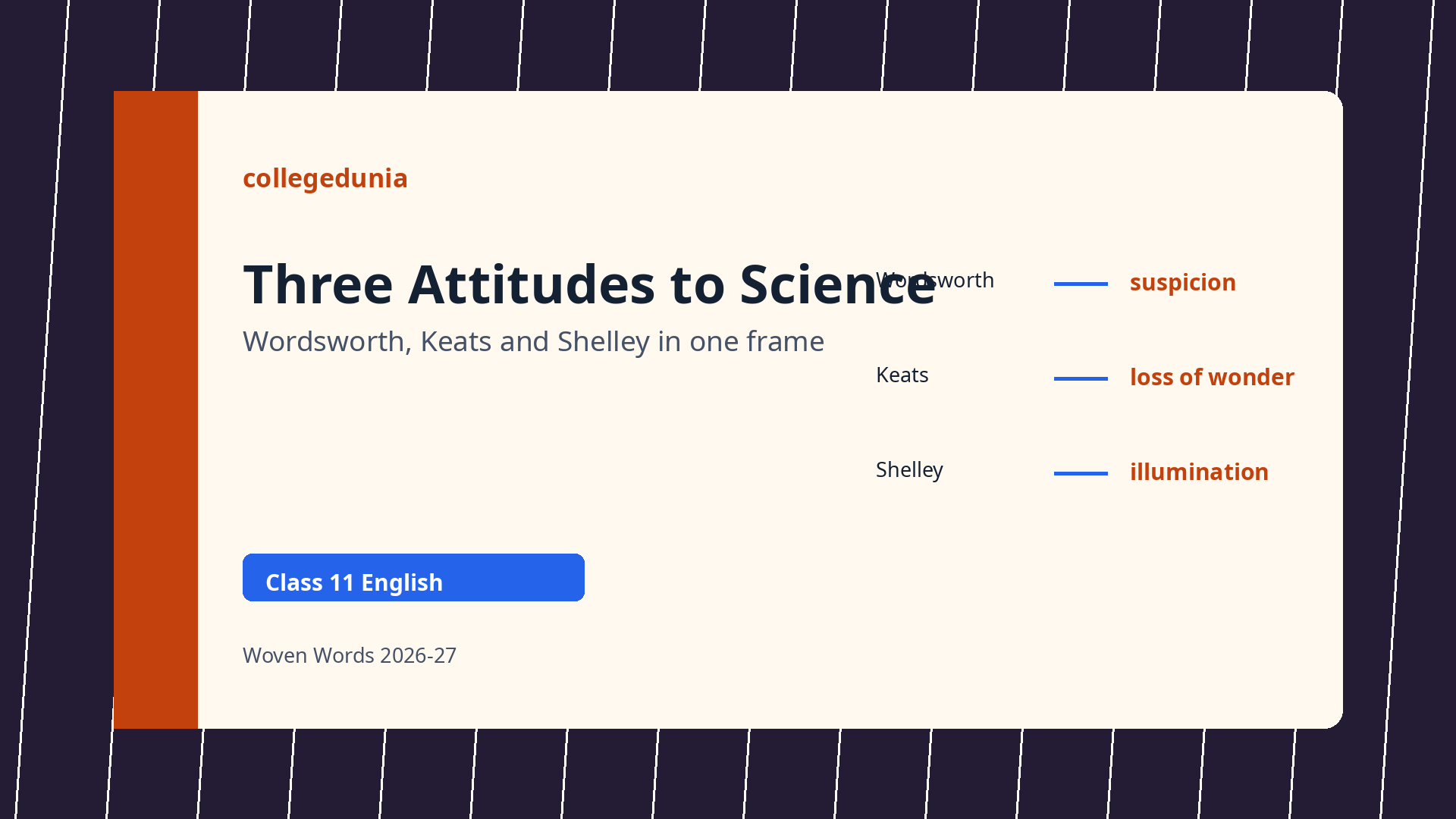
Wordsworth and Keats fear that analysis can reduce wonder. Shelley is the counter-example because he welcomes science into poetry. This contrast is the easiest way to answer the first NCERT question.
Writer
Attitude in the essay
Exam-ready point
Wordsworth
Suspicious of the meddling intellect
Science can distort living natural beauty
Keats
Suspicious of cold philosophy
Explanation can drain wonder from beauty
Shelley
Open to scientific imagination
Science can give poetry joy, peace and illumination
Common Mistakes Students Make in Patterns of Creativity Answers
Avoid these answer-sheet mistakes:
Writing that all poets hate science, when Shelley clearly does not.
Calling Darwin anti-literature without mentioning his regret and self-criticism.
Explaining King-Hele without saying why his identity as a scientist matters.
Treating The Cloud only as a nature poem and missing its scientific energy.
Forgetting that Language Work answers need word-level explanation, not chapter summary.
More Class 11 English Woven Words Chapter 21 Resources
Use the related Woven Words resources when you need chapter notes, the official NCERT text or a one-shot revision page along with these solved answers.
All NCERT Solutions for Class 11 English Woven Words Chapter 21 Patterns of Creativity with Step-by-Step Solutions
Understanding the Text
Q 21.1
How does Shelley's attitude to science differ from that of Wordsworth and Keats?
Concept used. Attitude to science means the way a writer emotionally and intellectually responds to scientific knowledge. Chandrasekhar contrasts Shelley with Wordsworth and Keats to show that poets need not share one fixed view of science.
Answer focus
Use the contrast clearly: Wordsworth and Keats distrust analysis, while Shelley welcomes science as part of imagination.
Wordsworth treats science with suspicion because he feels it can damage the living beauty of Nature.
His lines about the meddling intellect suggest that analysis can miss the wholeness of natural forms.
Keats also distrusts cold philosophy because it reduces wonder to explanation.
For Keats, the rainbow loses charm when it is broken into a scientific catalogue.
Shelley is different because scientific ideas excite rather than repel him.
His poetry uses images of clouds, electricity, motion and natural process with admiration.
Chandrasekhar therefore presents Shelley as a poet whose imagination is enlarged by science.
Shelley sees science as a source of joy, clarity and imaginative power. Wordsworth and Keats often fear that science reduces beauty by dissecting Nature and weakening wonder.
RM
Rhea Menon
M.A English, University of Delhi
Verified Expert
Concept used. This expert route reads the point through the essay's science-poetry debate and then returns it to the NCERT prompt.
The important point is not that Shelley is a scientist and the others are not.
All three are poets, but their imaginative temperaments differ.
Wordsworth wants Nature to be received through the heart.
Keats fears that rational explanation may destroy sensuous delight.
Shelley absorbs scientific discovery into poetry and turns it into energy, movement and illumination.
That makes Shelley the meeting figure between poetic imagination and scientific curiosity.
His example proves that a scientific mind and a poetic mind can strengthen each other when neither becomes narrow.
Shelley differs because he accepts science as creative material, while Wordsworth and Keats often see scientific analysis as a threat to natural beauty.
Q 21.2
It is not an accident that the most discriminating literary criticism of Shelley's thought and work is by a distinguished scientist, Desmond King-Hele. How does this statement bring out the meeting point of poetry and science?
Concept used. A meeting point is a shared space where two fields illuminate each other. Chandrasekhar uses Desmond King-Hele to show that scientific training can sharpen literary understanding, especially for a poet like Shelley.
Answer focus
Name King-Hele as both scientist and Shelley critic. That dual identity is the answer's centre.
Desmond King-Hele was a scientist, yet he wrote fine criticism of Shelley's thought and work.
This matters because Shelley's poetry often uses scientific ideas and natural processes.
A critic with scientific training can notice those ideas with special accuracy.
King-Hele can understand both Shelley's poetic language and his scientific imagination.
The statement therefore shows that poetry and science are not sealed worlds.
Both fields need observation, pattern-making, disciplined imagination and precision.
Chandrasekhar uses this example to show that one field can deepen appreciation of the other.
The statement shows the meeting point of poetry and science because a scientist, King-Hele, can best read Shelley's science-rich poetry. Scientific insight helps literary criticism here.
KS
Kunal Sen
M.A English, Jadavpur University
Verified Expert
Concept used. This expert route reads the point through the essay's science-poetry debate and then returns it to the NCERT prompt.
Shelley's work invites a reader who understands metaphor and natural law together.
A purely literary reader may notice the beauty of the lines.
A scientist may also notice the accuracy and boldness of the scientific imagination.
King-Hele becomes a bridge because he reads Shelley with both sensitivity and technical awareness.
The example weakens the idea that science kills poetic feeling.
It suggests that trained reason can support, not destroy, aesthetic response.
King-Hele's criticism proves that science can make poetry more visible. In Shelley's case, scientific knowledge becomes a tool of literary insight.
Q 21.3
What do you infer from Darwin's comment on his indifference to literature as he advanced in years?
Concept used. Inference means reading the larger idea behind a comment. Darwin's remark suggests that intense scientific specialisation can weaken some forms of aesthetic enjoyment if they are not kept alive.
Answer focus
Do not insult science. The point is about imbalance and loss of aesthetic taste.
Darwin says that he once enjoyed poetry, music and literature deeply.
As he grew older and worked intensely as a scientist, that enjoyment faded.
He even describes his mind as a kind of machine for grinding general laws out of facts.
This shows how repeated intellectual habit can narrow a person's responses.
His comment does not prove that science and literature are enemies.
It shows that any one-sided mental discipline may reduce sensitivity to other forms of experience.
Chandrasekhar uses Darwin's honesty as evidence for a real tension in creative life.
Darwin's comment suggests that intense scientific habit can dull literary and musical enjoyment if aesthetic taste is neglected. It shows imbalance, not the natural failure of science.
AR
Ananya Rao
M.A English, University of Mumbai
Verified Expert
Concept used. This expert route reads the point through the essay's science-poetry debate and then returns it to the NCERT prompt.
Darwin's statement is moving because it is self-critical.
He does not boast that science has replaced poetry.
He mourns a loss in his own mind.
The remark suggests that creativity needs more than factual processing.
A mind trained only for laws and data may become less responsive to rhythm, beauty and emotional suggestion.
Chandrasekhar uses this example to keep the science-poetry debate honest and humane.
Darwin's regret also warns students that knowledge should remain broad enough to include feeling, music and literature.
Darwin's indifference warns that specialisation can narrow the mind. The best creative life keeps scientific discipline and aesthetic response in balance.
Q 21.4
How do the patterns of creativity displayed by scientists differ from those displayed by poets?
Concept used. Patterns of creativity are recurring ways in which creative minds work. Chandrasekhar compares poets and scientists without claiming that either group is superior.
Answer focus
Avoid a simple science equals logic and poetry equals emotion answer. Both use imagination, but differently.
Scientists usually create by discovering laws, structures and explanations that are valid beyond the individual self.
Their work needs measurement, proof, correction and public verification.
Poets create through language, rhythm, metaphor and emotional insight.
Their truths are not tested like equations, but they can still be profound and lasting.
Scientists often move from facts toward general laws.
Poets often move from feeling, image or experience toward a larger human meaning.
Both need imagination, but the scientific imagination seeks demonstrable order while poetic imagination seeks felt truth.
Scientific creativity generally forms testable patterns, laws and explanations. Poetic creativity forms images, rhythms and meanings that reveal emotional and human truth.
MS
Meera Sanyal
Ph.D English, University of Hyderabad
Verified Expert
Concept used. This expert route reads the point through the essay's science-poetry debate and then returns it to the NCERT prompt.
Chandrasekhar's contrast is subtle because he does not deny imagination to scientists.
A great scientific theory also needs a leap of form and pattern.
The difference lies in the discipline that follows the leap.
Science must submit the idea to evidence and mathematical or experimental checks.
Poetry must make the experience alive in language.
So both fields create, but they answer to different standards of validity.
Scientists create verified structures of knowledge; poets create verbal forms of experience. Both depend on imagination, but they shape and test it differently.
Q 21.5
What is the central argument of the speaker?
Concept used. Central argument means the main idea holding the lecture together. Chandrasekhar examines why creativity in science and art appears different, yet also deeply connected.
Answer focus
Mention the method: he does not give one blunt answer, he builds the argument through examples.
The speaker is interested in the difference between artistic and scientific creativity.
He asks why poets and scientists often seem to create in different patterns.
Instead of giving a quick answer, he gathers remarks from poets, scientists and critics.
Wordsworth, Keats, Shelley, Darwin and King-Hele become examples in the discussion.
The lecture suggests that science and poetry are not natural enemies.
Both fields involve imagination, pattern, discipline and a search for truth or beauty.
The central argument is that creativity changes form across fields, but its deeper impulse connects them.
The speaker argues that science and poetry show different patterns of creativity, yet both depend on imagination, discipline and the search for truth, beauty and meaning.
AT
Arvind Thomas
M.A English, EFLU Hyderabad
Verified Expert
Concept used. This expert route reads the point through the essay's science-poetry debate and then returns it to the NCERT prompt.
The lecture works by comparison rather than by slogan.
Chandrasekhar does not flatten science and poetry into one thing.
He also does not separate them as hostile worlds.
His examples show resistance, attraction, loss and mutual illumination.
Shelley and King-Hele show closeness, while Darwin's comment shows tension.
The central idea is that creativity has many patterns, and the richest mind can recognise more than one.
This is why the lecture stays exploratory: it invites comparison instead of reducing creativity to a fixed formula.
The argument is that scientific and poetic creativity differ in method, but they meet in imagination, pattern-making and disciplined wonder.
Talking about the Text
Q 21.6
Poets are the unacknowledged legislators of the world. Discuss.
Concept used. This statement by Shelley means poets shape human thought, values and imagination without holding formal political power. It is a claim about moral and cultural influence.
Answer focus
Explain unacknowledged and legislators separately, then connect them.
Legislators make laws, but Shelley uses the word in a wider moral sense.
Poets do not usually pass official rules or command governments.
They shape feelings, language, ideals and social imagination.
A poem can make people see injustice, beauty or human suffering more clearly.
That change in perception may later influence public opinion and social action.
Poets are unacknowledged because this influence is indirect and often not officially credited.
Poets are unacknowledged legislators because they influence society's imagination, values and moral awareness without formal authority. Their power works through language and feeling.
KT
Kavya Thomas
M.A English, Christ University
Verified Expert
Concept used. This expert route reads the point through the essay's science-poetry debate and then returns it to the NCERT prompt.
Shelley's statement is not a literal job description.
It is a defence of poetry's hidden social power.
Law changes behaviour from outside, but poetry can change perception from within.
When perception changes, the idea of what is just or possible also changes.
That is why poets can affect the future even without office, army or wealth.
The claim is bold, but it captures literature's long cultural reach.
Poets legislate indirectly by changing how people imagine the world. Their authority is cultural and moral, not legal.
Q 21.7
Poetry and science are incompatible. Discuss.
Concept used. Incompatible means unable to exist together. Chandrasekhar's essay challenges this extreme claim by showing conflict as well as connection.
Answer focus
Take a balanced position. The essay gives examples for both tension and meeting.
Poetry and science can seem incompatible because their methods differ.
Science seeks proof, measurable evidence and general laws.
Poetry works through image, rhythm, metaphor and emotional truth.
Wordsworth and Keats feared that scientific analysis could damage wonder.
Yet Shelley shows that a poet can embrace science imaginatively.
King-Hele shows that a scientist can become a fine reader of poetry.
So poetry and science are different, but not necessarily incompatible.
Poetry and science are not incompatible. They use different methods, but both need imagination, pattern and wonder. Shelley and King-Hele show that the two can meet fruitfully.
NK
Nisha Kapoor
M.A English, Jamia Millia Islamia
Verified Expert
Concept used. This expert route reads the point through the essay's science-poetry debate and then returns it to the NCERT prompt.
The stronger answer rejects a simple yes or no.
There is tension because science explains and poetry often preserves mystery.
But explanation does not always kill mystery.
A scientific idea can become a poetic image when handled by a mind like Shelley's.
Similarly, a scientist can read poetic structure with deep care.
The two fields become incompatible only when either side becomes narrow.
Poetry and science differ in language and proof, but they can enrich each other when imagination remains open.
Q 21.8
On reading Shelley's A Defence of Poetry, the question insistently occurs why there is no similar A Defence of Science written by a scientist of equal endowment. Discuss.
Concept used. A defence is a reasoned justification of value. The question asks why poetry received a grand literary defence while science did not receive an equally famous one from a scientist-poet of comparable power.
Answer focus
The issue is not that science has no value. It is about who articulates that value and how.
Shelley wrote A Defence of Poetry to argue for poetry's value in human life.
Chandrasekhar wonders why no equally gifted scientist wrote a matching defence of science.
One reason may be that scientists usually defend science through discoveries rather than manifestos.
Scientific work often proves its worth through results, explanation and technology.
Another reason is that scientists may not always command the same public literary language.
The question also suggests that science needs eloquent cultural advocates.
A great defence of science would show its beauty, imagination and moral seriousness.
The question suggests that science has often been defended by results, not by a literary manifesto like Shelley's. Chandrasekhar implies that science also deserves an eloquent defence of its imagination and beauty.
AR
Aditi Rao
M.A Comparative Literature, University of Hyderabad
Verified Expert
Concept used. This expert route reads the point through the essay's science-poetry debate and then returns it to the NCERT prompt.
Shelley's defence is powerful because it is both argument and art.
Science has many achievements, but achievement alone does not always explain cultural value.
A scientist of equal literary gift could show non-scientists why discovery is beautiful.
Chandrasekhar's question is therefore partly a challenge to scientists.
He wants science to be understood as a creative human enterprise.
The absence of such a text points to a communication gap between science and culture.
A defence of science would not replace experiments; it would explain why the scientific search itself deserves wonder and respect.
Science may not lack value, but it often lacks a Shelley-like public defence. Chandrasekhar asks for science's creative beauty to be articulated with equal force.
Appreciation
Q 21.9
How does the assortment of remarks compiled by the author give us an understanding of the ways of science and poetry?
Concept used. An assortment of remarks is a set of carefully chosen observations. Chandrasekhar uses this method to let students compare attitudes rather than receive a single forced conclusion.
Answer focus
Name at least three examples from the essay: Wordsworth, Keats, Shelley, Darwin or King-Hele.
Wordsworth's remarks show anxiety about analysis and its effect on Nature's wholeness.
Keats's remarks show fear that cold philosophy can strip beauty of wonder.
Shelley's example shows a poet who welcomes scientific imagery and energy.
Darwin's comment shows the possible narrowing effect of intense scientific habit.
King-Hele's criticism shows that scientific training can enrich literary reading.
Together, these remarks reveal disagreement, overlap and mutual need.
The reader understands science and poetry through contrast rather than through a flat definition.
The author's collected remarks show that science and poetry meet in complex ways. Some poets fear science, Shelley welcomes it, Darwin shows tension, and King-Hele shows fruitful connection.
LM
Leena Mathew
M.A Linguistics, University of Kerala
Verified Expert
Concept used. This expert route reads the point through the essay's science-poetry debate and then returns it to the NCERT prompt.
The essay's method is important.
Chandrasekhar does not build a textbook classification.
He creates a conversation between writers and scientists across time.
Each remark adds a different angle to the same question.
The result is more flexible than a direct lecture because students see the debate unfold.
This method suits the theme of creativity, which itself resists a single formula.
The assortment works like a mosaic. Each remark supplies one piece, and together they reveal the varied relation between scientific and poetic creativity.
Q 21.10
Considering that this is an excerpt from a lecture, how does the commentary provided by the speaker string the arguments together?
Concept used. Commentary is the speaker's connecting explanation. In a lecture, it guides listeners from one example to the next so that the argument does not feel like a loose list.
Answer focus
Focus on structure: question, example, comment, transition.
The speaker begins with a broad question about different patterns of creativity.
He then brings in remarks from poets, scientists and critics.
After each example, his commentary explains why it matters to the larger question.
The commentary prevents the quotations from becoming random.
It shows links between Wordsworth's suspicion, Keats's fear, Shelley's openness, Darwin's loss and King-Hele's criticism.
Because the text is a lecture, the speaker also uses transitions that carry the listener forward.
The commentary therefore acts like a thread joining separate observations into one argument.
The speaker's commentary strings the lecture together by explaining each example and linking it to the central question about scientific and poetic creativity.
PB
Parth Banerjee
M.A English Language, University of Calcutta
Verified Expert
Concept used. This expert route reads the point through the essay's science-poetry debate and then returns it to the NCERT prompt.
A lecture must be easy to follow when heard aloud.
Chandrasekhar's commentary gives that oral clarity.
He frames a problem, presents evidence and then tells students how to read it.
This linking voice is necessary because the material comes from several writers.
Without commentary, the lecture would be a pile of references.
With commentary, it becomes a guided inquiry into creativity.
The commentary is the lecture's organising thread. It turns quotations and examples into a connected argument.
Q 21.11
The Cloud fuses together a creative myth, a scientific monograph and a gay picaresque tale of cloud adventure. Explain.
Concept used. To fuse means to blend elements into one whole. The description of Shelley's The Cloud shows poetry, science and story working together in the same poem.
Answer focus
Explain all three terms: myth, scientific monograph and picaresque tale.
The poem is like a creative myth because the cloud speaks as if it were a living being.
This personified voice gives the cloud a magical and imaginative identity.
It is like a scientific monograph because it describes natural processes linked with cloud, rain, lightning, sunlight and change.
Shelley does not merely decorate the cloud; he tracks its transformations.
It is also a picaresque tale because the cloud moves through many adventures in the sky.
The movement is lively, changing and playful.
The poem therefore joins mythic imagination, scientific process and adventurous narrative.
The Cloud fuses myth, science and adventure because the cloud becomes a speaking figure, follows natural processes and travels through lively episodes of transformation.
IM
Ira Mukherjee
M.A English, University of Hyderabad
Verified Expert
Concept used. This expert route reads the point through the essay's science-poetry debate and then returns it to the NCERT prompt.
This description captures why Shelley matters in the essay.
He does not keep poetry and science apart.
The cloud is a character, a natural phenomenon and an adventurous traveller at once.
The mythic element gives wonder.
The scientific element gives precision.
The picaresque element gives movement and delight.
Together, they show how science can become poetic without losing its energy.
The poem is therefore a practical example of Chandrasekhar's larger claim about joined creative patterns.
Shelley's poem blends imaginative personification, scientific observation and story-like movement. That blend proves the compatibility of poetic and scientific creativity.
Language Work
Q 21.12
How do the key words 'meddling', 'misshapes', 'murder' and 'dissect', in the lines 'Our meddling intellect / Misshapes the beauteous forms of things: / We murder to dissect', illustrate the poet's ability to convey criticism cryptically?
Concept used. Cryptic criticism is criticism packed into a few suggestive words. Wordsworth criticises excessive analysis by choosing verbs that make intellect sound intrusive and destructive.
Answer focus
Explain the force of meddling, misshapes, murder and dissect.
Meddling suggests interference where one should be receptive and humble.
Misshapes suggests that the intellect distorts what is naturally beautiful.
Murder is a shocking word because it turns analysis into an act of killing.
Dissect suggests cutting a living whole into parts for study.
Together, the words criticise a cold habit of analysis.
Wordsworth does not write a long argument against science here.
He compresses the criticism into strong verbs and images.
The words convey criticism cryptically because they make analytical intellect seem intrusive, deforming and violent. Wordsworth suggests that dissection can destroy living beauty.
SK
Samar Khanna
M.A Comparative Literature, Jadavpur University
Verified Expert
Concept used. This expert route reads the point through the essay's science-poetry debate and then returns it to the NCERT prompt.
The power of the lines lies in compression.
Each bold word carries more force than an explanatory sentence.
Meddling gives moral judgement.
Misshapes gives aesthetic judgement.
Murder to dissect gives a sharp paradox: knowledge gained by cutting may destroy what made the object alive.
This is why the criticism feels brief but severe.
Wordsworth criticises analytical intellect through compressed, violent diction. The words turn scientific dissection into a metaphor for lost beauty.
Q 21.13
Explain the contradiction in the similes, Like a child from the womb, like a ghost from the tomb.
Concept used. Contradiction here means the joining of opposite images. The child suggests birth and beginning, while the ghost suggests death and return from the grave.
Answer focus
Show why both images can apply to cloud movement or transformation.
A child from the womb suggests birth, freshness and entry into life.
A ghost from the tomb suggests death, mystery and return from the world of the dead.
The two similes therefore pull in opposite directions.
Their contradiction captures transformation as both beginning and return.
In Shelley's cloud imagery, natural forms disappear and reappear constantly.
The cloud can seem newly born and yet also like something returning from absence.
The contradiction gives the image energy and strangeness.
The similes are contradictory because one suggests birth and the other suggests death. Together, they express the cloud's mysterious cycle of disappearance and return.
DN
Devika Narain
M.A English, University of Calcutta
Verified Expert
Concept used. This expert route reads the point through the essay's science-poetry debate and then returns it to the NCERT prompt.
Shelley often uses opposites to make natural change feel dramatic.
Birth and death are usually separate conditions.
In cloud movement, however, forms dissolve, reform and appear again.
The child image gives freshness.
The ghost image gives mystery.
Their combination suits a natural process that is both ordinary and uncanny.
The contradiction joins birth and death to show transformation. The cloud seems newly born and strangely returned at the same time.
Q 21.14
Explain the metaphor in the line: Poets are the mirrors of gigantic shadows that futurity casts on the present.
Concept used. A metaphor explains one thing through another. Here poets are called mirrors because they reflect future possibilities before society fully recognises them.
Answer focus
Break the line into three parts: poets, mirrors, future shadows on the present.
A mirror reflects what stands before it, but Shelley's metaphor makes the image more visionary.
Gigantic shadows suggest large future events, ideas or changes.
Futurity means the future.
The future is imagined as casting shadows backward onto the present.
Poets reflect those shadows because they sense possibilities before others do.
They give language to coming changes, hopes and fears.
The metaphor therefore presents poets as visionary interpreters of the future.
The metaphor means that poets reflect large future possibilities already falling across the present. They sense and express changes before society clearly sees them.
NR
Neel Roy
M.A English Literature, Presidency University
Verified Expert
Concept used. This expert route reads the point through the essay's science-poetry debate and then returns it to the NCERT prompt.
Shelley gives poets prophetic value through this metaphor.
They are not fortune-tellers in a simple sense.
They are sensitive mirrors of forces that are beginning to shape human life.
The word shadows is important because the future is not fully visible yet.
Poets catch its outline through imagination.
Their writing helps the present recognise what is coming.
Poets are mirrors because they reflect the shadowy outline of the future. Their imagination makes hidden historical possibilities visible.
Patterns of Creativity Class 11 NCERT Solutions FAQs
Ques. Who wrote Patterns of Creativity in Class 11 Woven Words?
Ans. Patterns of Creativity is by S. Chandrasekhar, the Nobel Prize-winning astrophysicist.
Ques. What is the central idea of Patterns of Creativity?
Ans. The essay studies how scientific and poetic creativity differ, overlap and illuminate each other.
Ques. How many questions are solved in this PDF?
Ans. The PDF solves 14 NCERT prompts from Understanding the Text, Talking about the Text, Appreciation and Language Work.
Ques. Why is Shelley important in Patterns of Creativity?
Ans. Shelley is important because he shows a poet using science as a source of joy, peace and illumination.





Chapter21PatternsofCreativitySolutions.pdf?page=1&dpi=150)
Chapter21PatternsofCreativitySolutions.pdf?page=2&dpi=150)
Chapter21PatternsofCreativitySolutions.pdf?page=3&dpi=150)
Chapter21PatternsofCreativitySolutions.pdf?page=4&dpi=150)
Chapter21PatternsofCreativitySolutions.pdf?page=5&dpi=150)
Chapter21PatternsofCreativitySolutions.pdf?page=6&dpi=150)
Chapter21PatternsofCreativitySolutions.pdf?page=7&dpi=150)
Chapter21PatternsofCreativitySolutions.pdf?page=8&dpi=150)
Chapter21PatternsofCreativitySolutions.pdf?page=9&dpi=150)
Chapter21PatternsofCreativitySolutions.pdf?page=10&dpi=150)
Chapter21PatternsofCreativitySolutions.pdf?page=11&dpi=150)
Chapter21PatternsofCreativitySolutions.pdf?page=12&dpi=150)
Chapter21PatternsofCreativitySolutions.pdf?page=13&dpi=150)
Chapter21PatternsofCreativitySolutions.pdf?page=14&dpi=150)
Chapter21PatternsofCreativitySolutions.pdf?page=15&dpi=150)
Chapter21PatternsofCreativitySolutions.pdf?page=16&dpi=150)
Chapter21PatternsofCreativitySolutions.pdf?page=17&dpi=150)
Chapter21PatternsofCreativitySolutions.pdf?page=18&dpi=150)
Chapter21PatternsofCreativitySolutions.pdf?page=19&dpi=150)
Chapter21PatternsofCreativitySolutions.pdf?page=20&dpi=150)
Chapter21PatternsofCreativitySolutions_flat_MobileCard.pdf?page=1&dpi=150)
Chapter21PatternsofCreativitySolutions_flat_MobileCard.pdf?page=2&dpi=150)
Chapter21PatternsofCreativitySolutions_flat_MobileCard.pdf?page=3&dpi=150)
Chapter21PatternsofCreativitySolutions_flat_MobileCard.pdf?page=4&dpi=150)
Chapter21PatternsofCreativitySolutions_flat_MobileCard.pdf?page=5&dpi=150)
Chapter21PatternsofCreativitySolutions_flat_MobileCard.pdf?page=6&dpi=150)
Chapter21PatternsofCreativitySolutions_flat_MobileCard.pdf?page=7&dpi=150)
Chapter21PatternsofCreativitySolutions_flat_MobileCard.pdf?page=8&dpi=150)
Chapter21PatternsofCreativitySolutions_flat_MobileCard.pdf?page=9&dpi=150)
Chapter21PatternsofCreativitySolutions_flat_MobileCard.pdf?page=10&dpi=150)
Chapter21PatternsofCreativitySolutions_flat_MobileCard.pdf?page=11&dpi=150)
Chapter21PatternsofCreativitySolutions_flat_MobileCard.pdf?page=12&dpi=150)
Chapter21PatternsofCreativitySolutions_flat_MobileCard.pdf?page=13&dpi=150)
Chapter21PatternsofCreativitySolutions_flat_MobileCard.pdf?page=14&dpi=150)
Chapter21PatternsofCreativitySolutions_flat_MobileCard.pdf?page=15&dpi=150)
Chapter21PatternsofCreativitySolutions_flat_MobileCard.pdf?page=16&dpi=150)
Chapter21PatternsofCreativitySolutions_flat_MobileCard.pdf?page=17&dpi=150)
Chapter21PatternsofCreativitySolutions_flat_MobileCard.pdf?page=18&dpi=150)
Chapter21PatternsofCreativitySolutions_flat_MobileCard.pdf?page=19&dpi=150)
Chapter21PatternsofCreativitySolutions_flat_MobileCard.pdf?page=20&dpi=150)
Chapter21PatternsofCreativitySolutions_flat_MobileCard.pdf?page=21&dpi=150)
Chapter21PatternsofCreativitySolutions_flat_MobileCard.pdf?page=22&dpi=150)
Chapter21PatternsofCreativitySolutions_flat_MobileCard.pdf?page=23&dpi=150)
Chapter21PatternsofCreativitySolutions_flat_MobileCard.pdf?page=24&dpi=150)
Chapter21PatternsofCreativitySolutions_flat_MobileCard.pdf?page=25&dpi=150)
Chapter21PatternsofCreativitySolutions_flat_MobileCard.pdf?page=26&dpi=150)
Chapter21PatternsofCreativitySolutions_flat_MobileCard.pdf?page=27&dpi=150)
Chapter21PatternsofCreativitySolutions_flat_MobileCard.pdf?page=28&dpi=150)
Chapter21PatternsofCreativitySolutions_flat_MobileCard.pdf?page=29&dpi=150)
Chapter21PatternsofCreativitySolutions_flat_MobileCard.pdf?page=30&dpi=150)
Chapter21PatternsofCreativitySolutions_flat_MobileCard.pdf?page=31&dpi=150)
Chapter21PatternsofCreativitySolutions_flat_MobileCard.pdf?page=32&dpi=150)
Chapter21PatternsofCreativitySolutions_flat_MobileCard.pdf?page=33&dpi=150)
Chapter21PatternsofCreativitySolutions_flat_MobileCard.pdf?page=34&dpi=150)
Chapter21PatternsofCreativitySolutions_flat_MobileCard.pdf?page=35&dpi=150)
Chapter21PatternsofCreativitySolutions_flat_MobileCard.pdf?page=36&dpi=150)
Chapter21PatternsofCreativitySolutions_flat_MobileCard.pdf?page=37&dpi=150)
Chapter21PatternsofCreativitySolutions_flat_MobileCard.pdf?page=38&dpi=150)
Chapter21PatternsofCreativitySolutions_flat_MobileCard.pdf?page=39&dpi=150)
Chapter21PatternsofCreativitySolutions_flat_MobileCard.pdf?page=40&dpi=150)



Comments