




The The Mark on the Wall Class 12 notes explain Virginia Woolf's modernist essay for the 2026-27 NCERT Kaleidoscope chapter. Use this page to revise stream of consciousness, the snail reveal, war-time patriarchy, exact answer cues and Language Work before downloading the full PDF.
- Download the Class 12 English Supplementary Chapter 15 notes PDF for quick revision.
- Revise Woolf's wandering thought pattern, symbols, tone and grammar tasks in one place.
- Student focus: the chapter tests interpretation, not plot summary.
Chapter15Kaleidoscope:TheMarkontheWallNotes.pdf?page=1&dpi=150)
Chapter15Kaleidoscope:TheMarkontheWallNotes.pdf?page=2&dpi=150)
Chapter15Kaleidoscope:TheMarkontheWallNotes.pdf?page=3&dpi=150)
Chapter15Kaleidoscope:TheMarkontheWallNotes.pdf?page=4&dpi=150)
Chapter15Kaleidoscope:TheMarkontheWallNotes.pdf?page=5&dpi=150)
Chapter15Kaleidoscope:TheMarkontheWallNotes.pdf?page=6&dpi=150)
Chapter15Kaleidoscope:TheMarkontheWallNotes.pdf?page=7&dpi=150)
Chapter15Kaleidoscope:TheMarkontheWallNotes.pdf?page=8&dpi=150)
Chapter15Kaleidoscope:TheMarkontheWallNotes.pdf?page=9&dpi=150)
Chapter15Kaleidoscope:TheMarkontheWallNotes.pdf?page=10&dpi=150)
Chapter15Kaleidoscope:TheMarkontheWallNotes.pdf?page=11&dpi=150)
Chapter15Kaleidoscope:TheMarkontheWallNotes.pdf?page=12&dpi=150)
Chapter15Kaleidoscope:TheMarkontheWallNotes.pdf?page=13&dpi=150)
Chapter15Kaleidoscope:TheMarkontheWallNotes.pdf?page=14&dpi=150)
Chapter15Kaleidoscope:TheMarkontheWallNotes.pdf?page=15&dpi=150)
Chapter15Kaleidoscope:TheMarkontheWallNotes.pdf?page=16&dpi=150)
Chapter15Kaleidoscope:TheMarkontheWallNotes.pdf?page=17&dpi=150)
Chapter15Kaleidoscope:TheMarkontheWallNotes.pdf?page=18&dpi=150)
Chapter15Kaleidoscope:TheMarkontheWallNotes.pdf?page=19&dpi=150)
Chapter15Kaleidoscope:TheMarkontheWallNotes.pdf?page=20&dpi=150)
Chapter15Kaleidoscope:TheMarkontheWallNotes.pdf?page=21&dpi=150)
Chapter15Kaleidoscope:TheMarkontheWallNotes_flat_MobileCard.pdf?page=1&dpi=150)
Chapter15Kaleidoscope:TheMarkontheWallNotes_flat_MobileCard.pdf?page=2&dpi=150)
Chapter15Kaleidoscope:TheMarkontheWallNotes_flat_MobileCard.pdf?page=3&dpi=150)
Chapter15Kaleidoscope:TheMarkontheWallNotes_flat_MobileCard.pdf?page=4&dpi=150)
Chapter15Kaleidoscope:TheMarkontheWallNotes_flat_MobileCard.pdf?page=5&dpi=150)
Chapter15Kaleidoscope:TheMarkontheWallNotes_flat_MobileCard.pdf?page=6&dpi=150)
Chapter15Kaleidoscope:TheMarkontheWallNotes_flat_MobileCard.pdf?page=7&dpi=150)
Chapter15Kaleidoscope:TheMarkontheWallNotes_flat_MobileCard.pdf?page=8&dpi=150)
Chapter15Kaleidoscope:TheMarkontheWallNotes_flat_MobileCard.pdf?page=9&dpi=150)
Chapter15Kaleidoscope:TheMarkontheWallNotes_flat_MobileCard.pdf?page=10&dpi=150)
Chapter15Kaleidoscope:TheMarkontheWallNotes_flat_MobileCard.pdf?page=11&dpi=150)
Chapter15Kaleidoscope:TheMarkontheWallNotes_flat_MobileCard.pdf?page=12&dpi=150)
Chapter15Kaleidoscope:TheMarkontheWallNotes_flat_MobileCard.pdf?page=13&dpi=150)
Chapter15Kaleidoscope:TheMarkontheWallNotes_flat_MobileCard.pdf?page=14&dpi=150)
Chapter15Kaleidoscope:TheMarkontheWallNotes_flat_MobileCard.pdf?page=15&dpi=150)
Chapter15Kaleidoscope:TheMarkontheWallNotes_flat_MobileCard.pdf?page=16&dpi=150)
Chapter15Kaleidoscope:TheMarkontheWallNotes_flat_MobileCard.pdf?page=17&dpi=150)
Chapter15Kaleidoscope:TheMarkontheWallNotes_flat_MobileCard.pdf?page=18&dpi=150)
Chapter15Kaleidoscope:TheMarkontheWallNotes_flat_MobileCard.pdf?page=19&dpi=150)
Chapter15Kaleidoscope:TheMarkontheWallNotes_flat_MobileCard.pdf?page=20&dpi=150)
Chapter15Kaleidoscope:TheMarkontheWallNotes_flat_MobileCard.pdf?page=21&dpi=150)
Chapter15Kaleidoscope:TheMarkontheWallNotes_flat_MobileCard.pdf?page=22&dpi=150)
Chapter15Kaleidoscope:TheMarkontheWallNotes_flat_MobileCard.pdf?page=23&dpi=150)
Chapter15Kaleidoscope:TheMarkontheWallNotes_flat_MobileCard.pdf?page=24&dpi=150)
Chapter15Kaleidoscope:TheMarkontheWallNotes_flat_MobileCard.pdf?page=25&dpi=150)
Chapter15Kaleidoscope:TheMarkontheWallNotes_flat_MobileCard.pdf?page=26&dpi=150)
Chapter15Kaleidoscope:TheMarkontheWallNotes_flat_MobileCard.pdf?page=27&dpi=150)
Chapter15Kaleidoscope:TheMarkontheWallNotes_flat_MobileCard.pdf?page=28&dpi=150)
These Class 12 English Supplementary The Mark on the Wall notes are checked against the 2026-27 NCERT chapter and built for fast conceptual revision.
Student Feedback on The Mark on the Wall
In a Collegedunia poll of 12,940 Class 12 English students using NCERT literature resources, many students understood the essay better after separating the visible mark from Woolf's chain of thought.
- 79% wanted a clear stream-of-consciousness map.
- 72% needed help connecting Whitaker's Almanack, patriarchy and social rules.
- 67% found content words and function words easier after seeing examples from the essay.
Source: 2026-27 Class 12 English student poll. Sample of 12,940 students using NCERT-aligned study resources.
The Mark on the Wall Summary for Class 12 Kaleidoscope
The Mark on the Wall begins with a small mark seen above the mantelpiece. Woolf turns that ordinary detail into a moving record of thought. The essay is less about the object and more about how the mind travels.
- Main idea: the mind can move from a tiny visual detail to history, society and self-reflection.
- Ending: the mark is only a snail, but the thought-journey has already revealed Woolf's concerns.
- Answer cue: write about movement of thought before writing about the object itself.
The Mark on the Wall Class 12 Video Recap
Source: Magnet Brains on YouTube
Stream of Consciousness in The Mark on the Wall
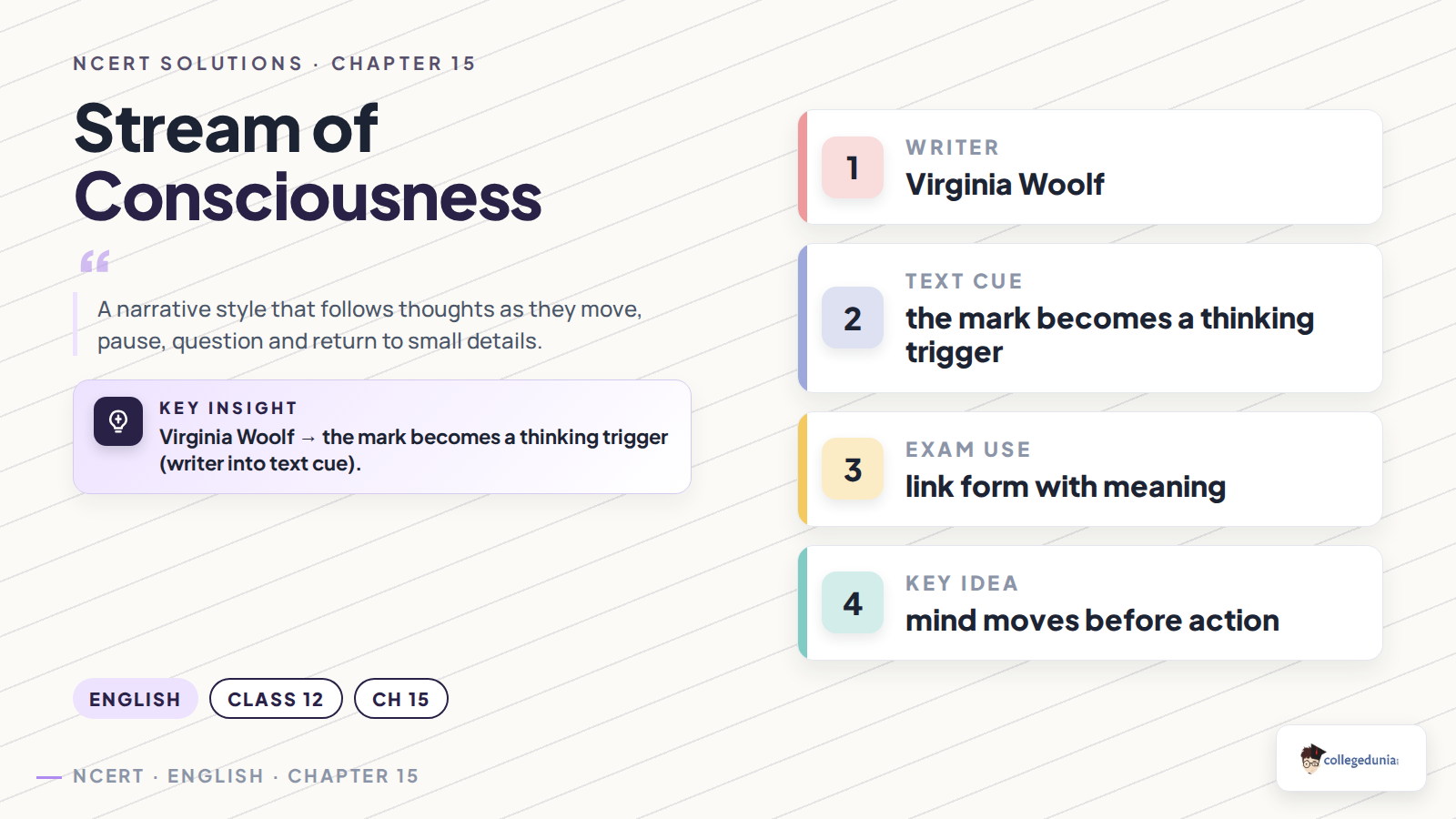
Woolf uses stream of consciousness to show thought before it becomes a neat argument. One idea suggests another. A mark leads to a nail hole, an old picture, property, history, habits of knowledge and social rules.
| Movement | What it shows | Revision cue |
|---|---|---|
| Observation | The speaker notices a mark on the wall | Begin with the visible trigger. |
| Guessing | The mind imagines possible explanations | Use uncertainty as a key feature. |
| Association | Thought moves toward history and society | Do not force a plot summary. |
| Return | The object turns out to be a snail | The ending undercuts certainty. |
The Mark, the Snail and Woolf's Central Contrast
The mark is important because it lets Woolf compare fixed reality with free thought. The wall object is small and factual. The mind's response is wide, shifting and creative. The snail reveal matters because it makes certainty look smaller than imagination.
| Element | Meaning in the essay | Exam value |
|---|---|---|
| The wall | Domestic space and ordinary reality | Use for the opening situation. |
| The mark | A trigger for speculation | Use for stream-of-consciousness answers. |
| The snail | The plain fact discovered at the end | Use for irony and anti-climax. |
| The mind | A free, wandering, questioning force | Use for Woolf's modernist method. |
War, Patriarchy and Whitaker's Almanack
Woolf also questions the world outside the room. Her references to learned names, fixed facts and Whitaker's Almanack show irritation with systems that claim authority. The chapter also carries a war-time mood through a male voice entering at the end.
- Patriarchy: social habits tell people what knowledge should count as important.
- War: the final voice brings the outside world sharply into the room.
- Knowledge: Woolf prefers living thought over dry lists of facts.
- Answer cue: connect the reference to freedom of thought, not only to gender.
Content Words and Function Words
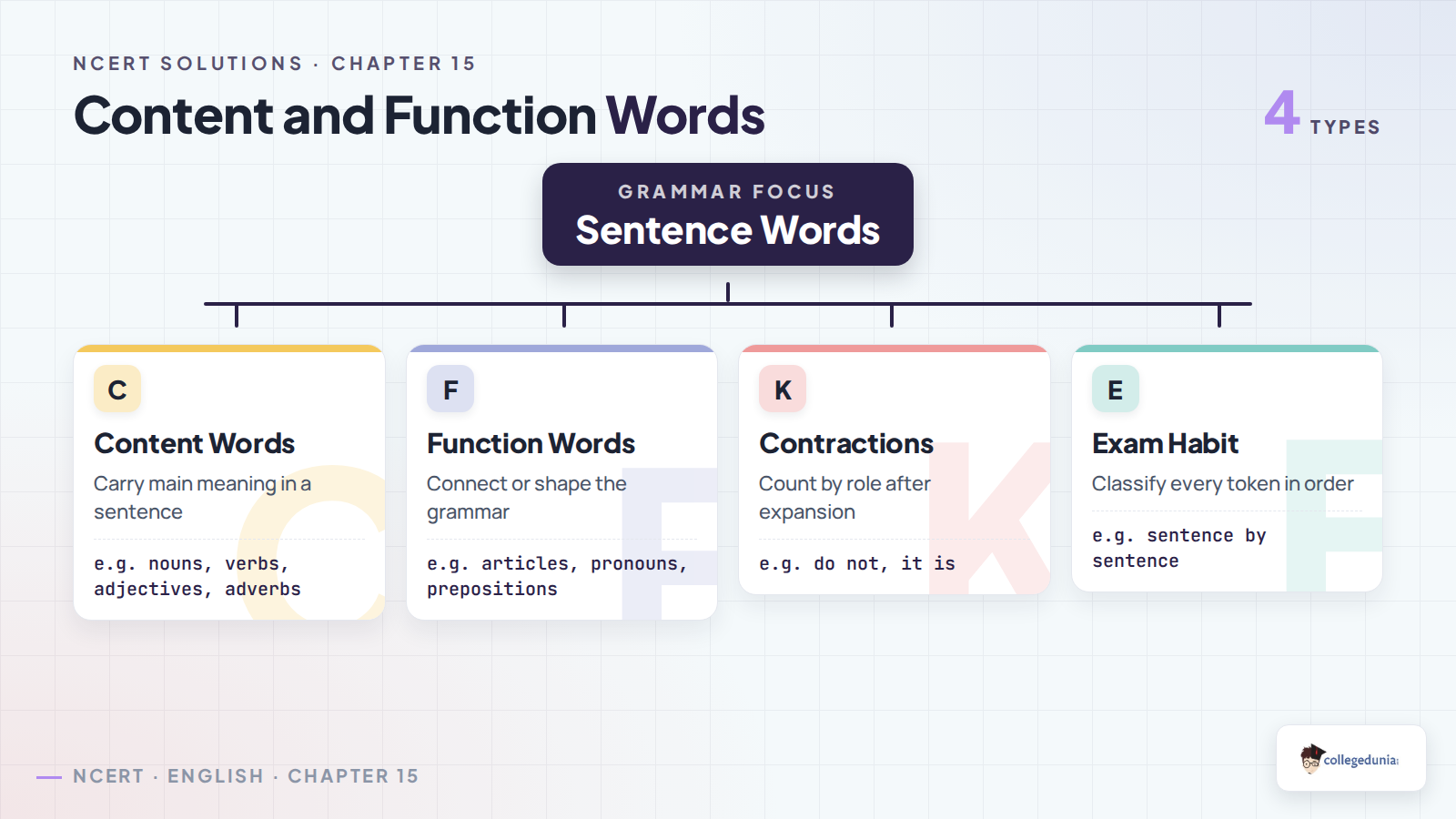
The Language Work asks students to notice how meaning is carried. Content words name people, things, actions and qualities. Function words hold the sentence together and show relation.
| Type | Examples | How to identify |
|---|---|---|
| Content words | mark, wall, snail, think, old, strange | They carry the main meaning. |
| Function words | the, on, and, of, to, in | They connect grammar parts. |
| Exam use | word classification and sentence analysis | Check the role inside the sentence. |
NCERT Questions Answer Plan for The Mark on the Wall
Write each answer by naming the trigger, then the thought movement, and then the larger idea. This keeps the response tied to Woolf's method instead of becoming a vague comment on imagination.
| Question focus | What to include | Final effect |
|---|---|---|
| Stream of consciousness | Observation, association and return to the object | The technique becomes clear. |
| The mark | Small object that opens a large chain of thought | The title becomes meaningful. |
| Snail reveal | Plain reality after a rich mental journey | The irony is visible. |
| Whitaker's Almanack | Fixed public knowledge and authority | The social criticism stays linked to the text. |
| Language Work | Content words versus function words | The grammar answer stays precise. |
Related Resources for The Mark on the Wall Class 12 English
| Resource | Use it for | Link |
|---|---|---|
| NCERT Solutions | Full textbook answers for Chapter 15 | Open NCERT Solutions |
All Class 12 English Supplementary Notes Chapters
| Chapter | Notes link |
|---|---|
| Chapter 11: Kaleidoscope: The Wild Swans at Coole | Open Notes |
| Chapter 12: Kaleidoscope: Time and Time Again | Open Notes |
| Chapter 13: Kaleidoscope: Blood | Open Notes |
| Chapter 14: Kaleidoscope: Freedom | Open Notes |
| Chapter 16: Kaleidoscope: Film-Making | Open Notes |
The Mark on the Wall Class 12 English Notes FAQs
Ques. What is The Mark on the Wall in Class 12 English Kaleidoscope about?
Ans. The Mark on the Wall is about a speaker who notices a small mark and lets her mind move through memory, history, authority, imagination and reality.
Ques. What technique does Virginia Woolf use in The Mark on the Wall?
Ans. Woolf uses stream of consciousness. The essay follows the speaker's changing thoughts instead of a fixed plot or step-by-step argument.
Ques. Why is the snail important in The Mark on the Wall?
Ans. The snail reveals the simple truth behind the mark. It creates irony because the speaker's rich thought journey ends with a plain physical object.
Ques. How should students revise The Mark on the Wall notes?
Ans. Students should revise stream of consciousness, the mark-to-snail movement, Woolf's social criticism and the Language Work on content and function words.



Comments