




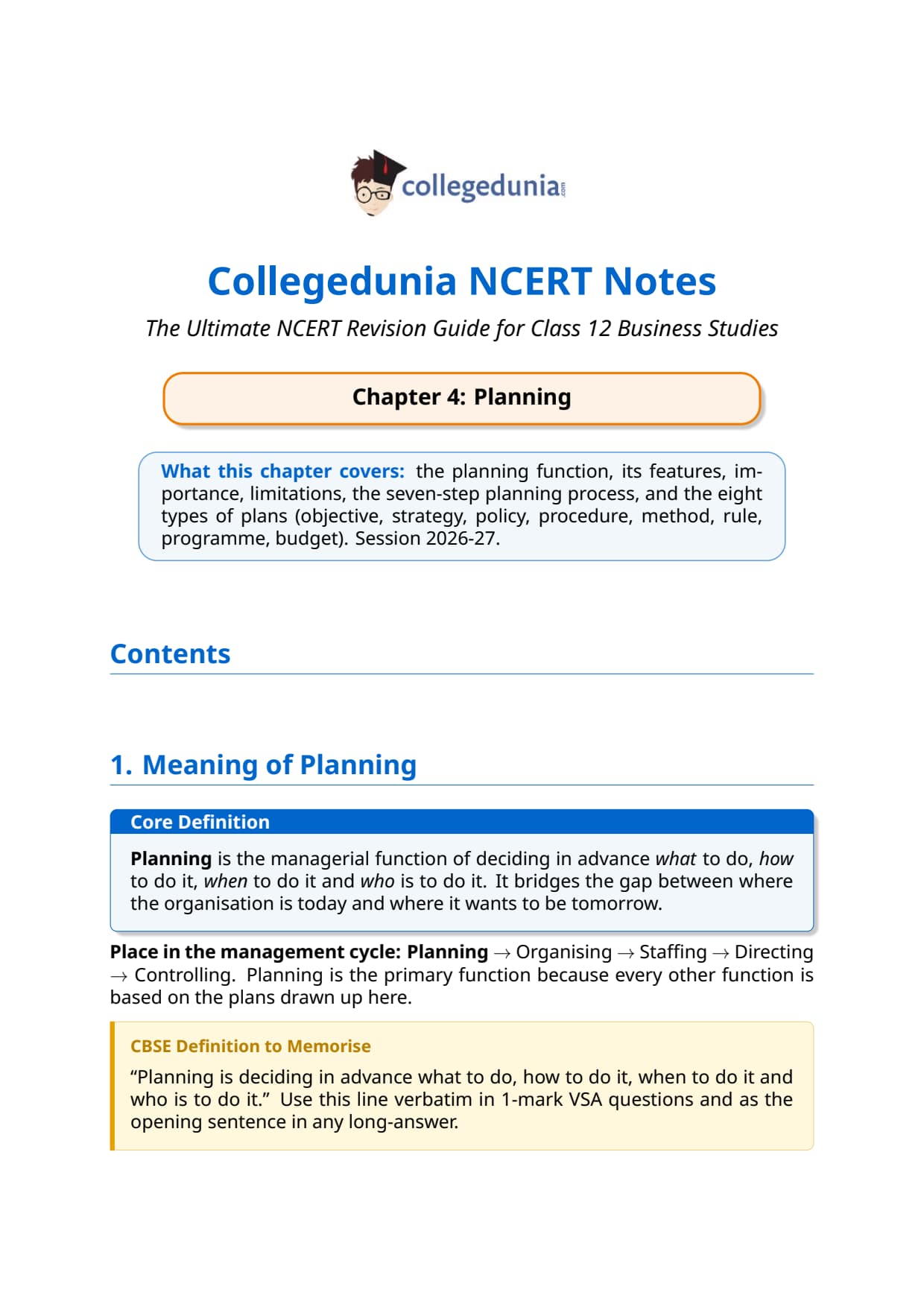
Inside these Class 12 Business Studies Chapter 4 Planning notes you get the Koontz and O'Donnell meaning, the seven features, the importance and limitations, the seven-step process and all eight types of plans, condensed for 2026-27 revision.
- CBSE Weightage: 5 to 8 marks (Unit 2, Principles and Functions of Management).
- Notes Coverage: 10 sections, 12 numbered lists, 2 difference tables, S-D-I-E-S-I-F mnemonic for the planning process, and case-study identification rules for all eight plan types.
These Notes are written for a one-night revision: open the PDF, scan the bolded section heads, and you have every CBSE-tested concept of Planning in front of you. The lists are deliberately short so you can memorise them in a single sitting.
These Notes are curated by senior Commerce educators, mapped to the 2026-27 NCERT Business Studies textbook, and refined against the last five years of CBSE Class 12 board papers.
Planning Notes Class 12: What Each Section Covers
The notes are organised into 10 sections that match the CBSE answer template. Each section is short enough to revise in under five minutes.
| Section | Concept | CBSE Mark Range |
|---|---|---|
| 1 | Meaning of Planning (Koontz and O'Donnell, what-how-when-who) | 1 mark |
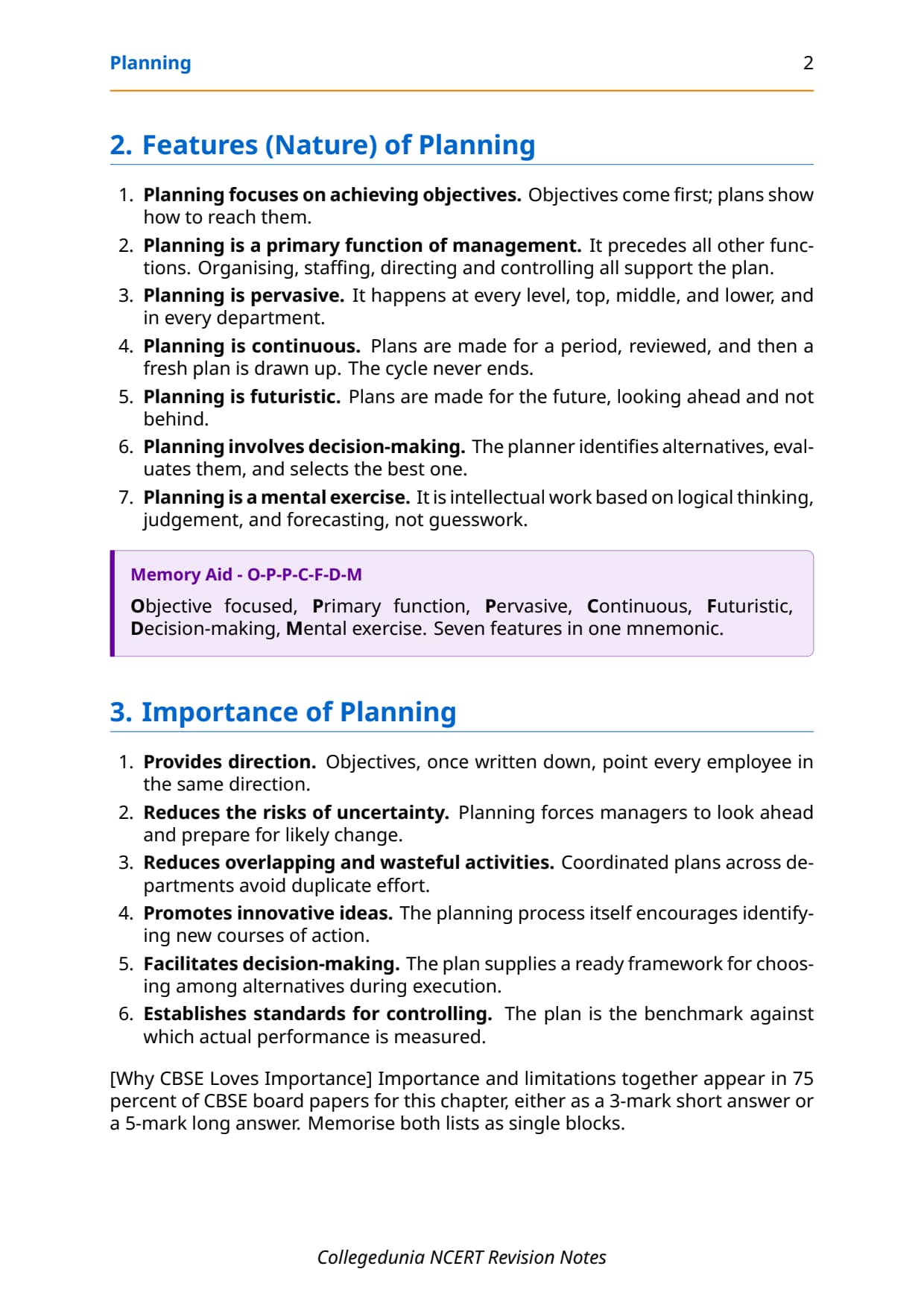
| 2 | Seven Features (O-P-P-C-F-D-M mnemonic) | 3 to 5 marks |
| 3 | Six Points of Importance | 3 to 5 marks |
| 4 | Six Limitations | 3 to 6 marks |
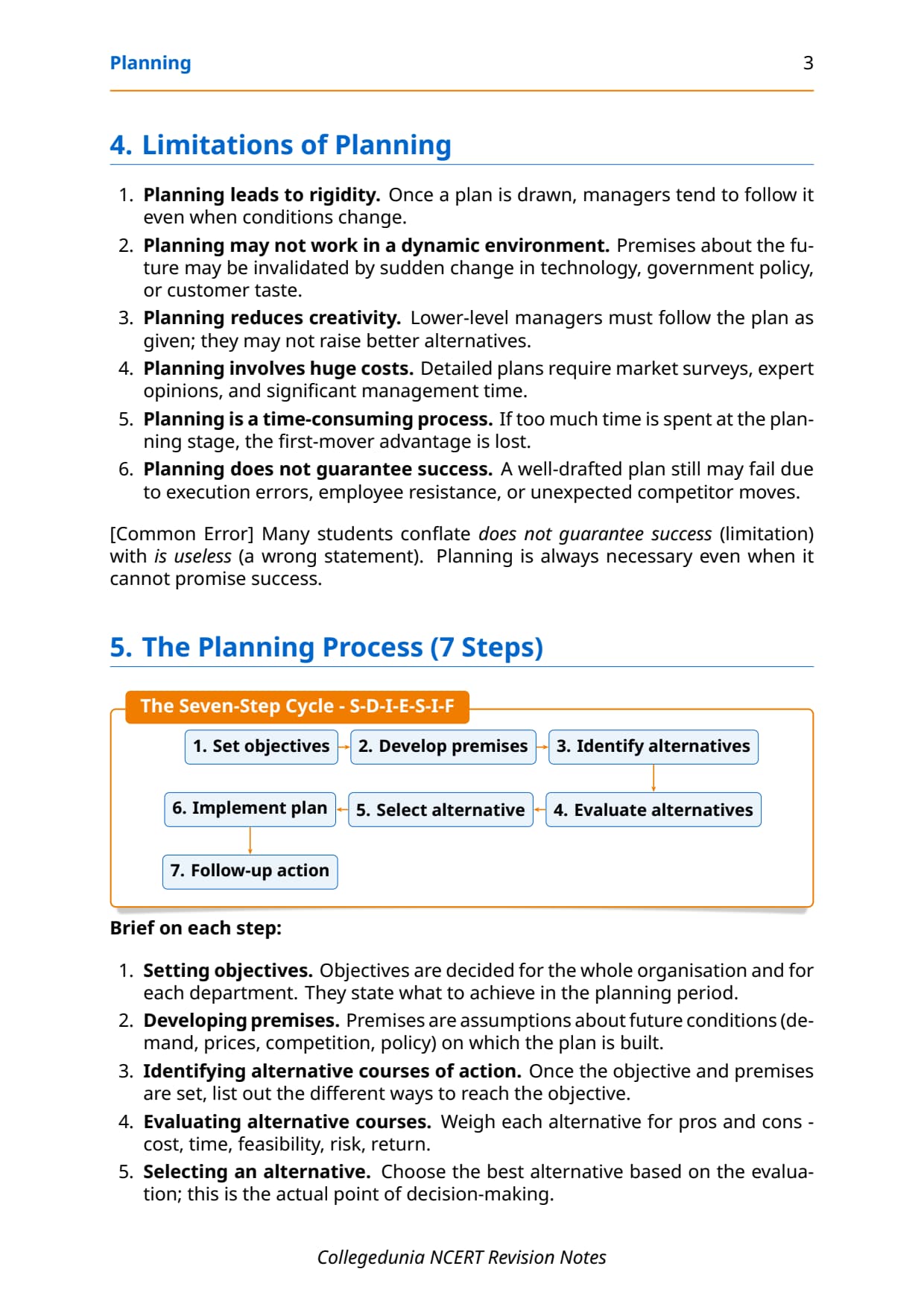
| 5 | Seven-Step Planning Process (S-D-I-E-S-I-F) | 5 to 6 marks |
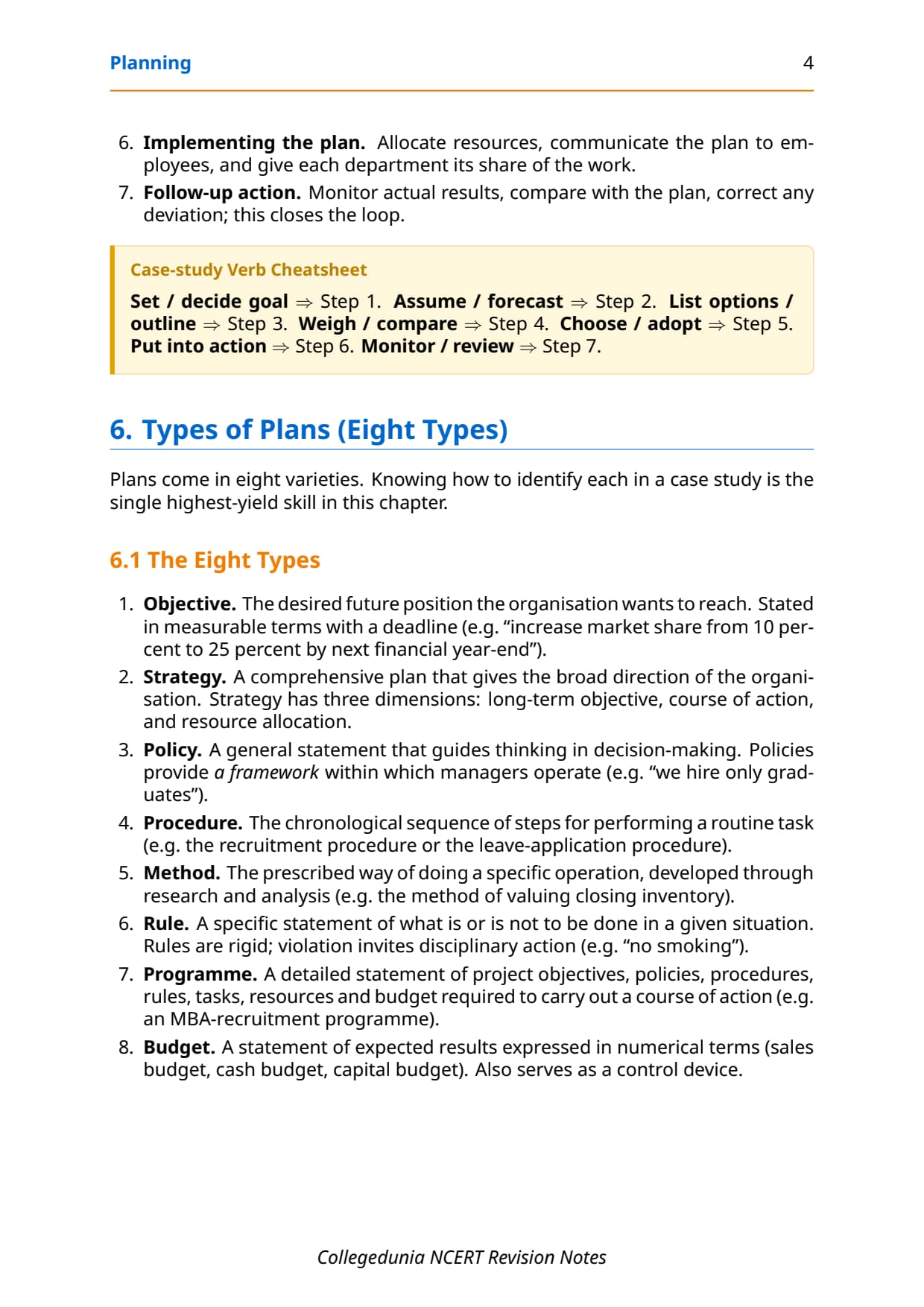
| 6 | Eight Types of Plans, Single-Use vs Standing | 3 to 6 marks |
| 7 | Tested Differences: Policy vs Procedure vs Rule, Strategy vs Policy | 3 to 4 marks |
| 8 | Case-Study Identification Patterns | 4 to 6 marks (case) |
| 9 | JEE/CUET Conceptual Cuts (for toppers) | extension |
| 10 | 10-Point Cheat Sheet (last-minute revision) | 1 to 3 marks |
Planning Video Walkthrough
Source: Magnet Brains on YouTube
How Collegedunia's Planning Notes Help You Score
- Single-Block Memorisation: Features, importance, limitations, and process are presented as standalone numbered lists you can memorise without context switching.
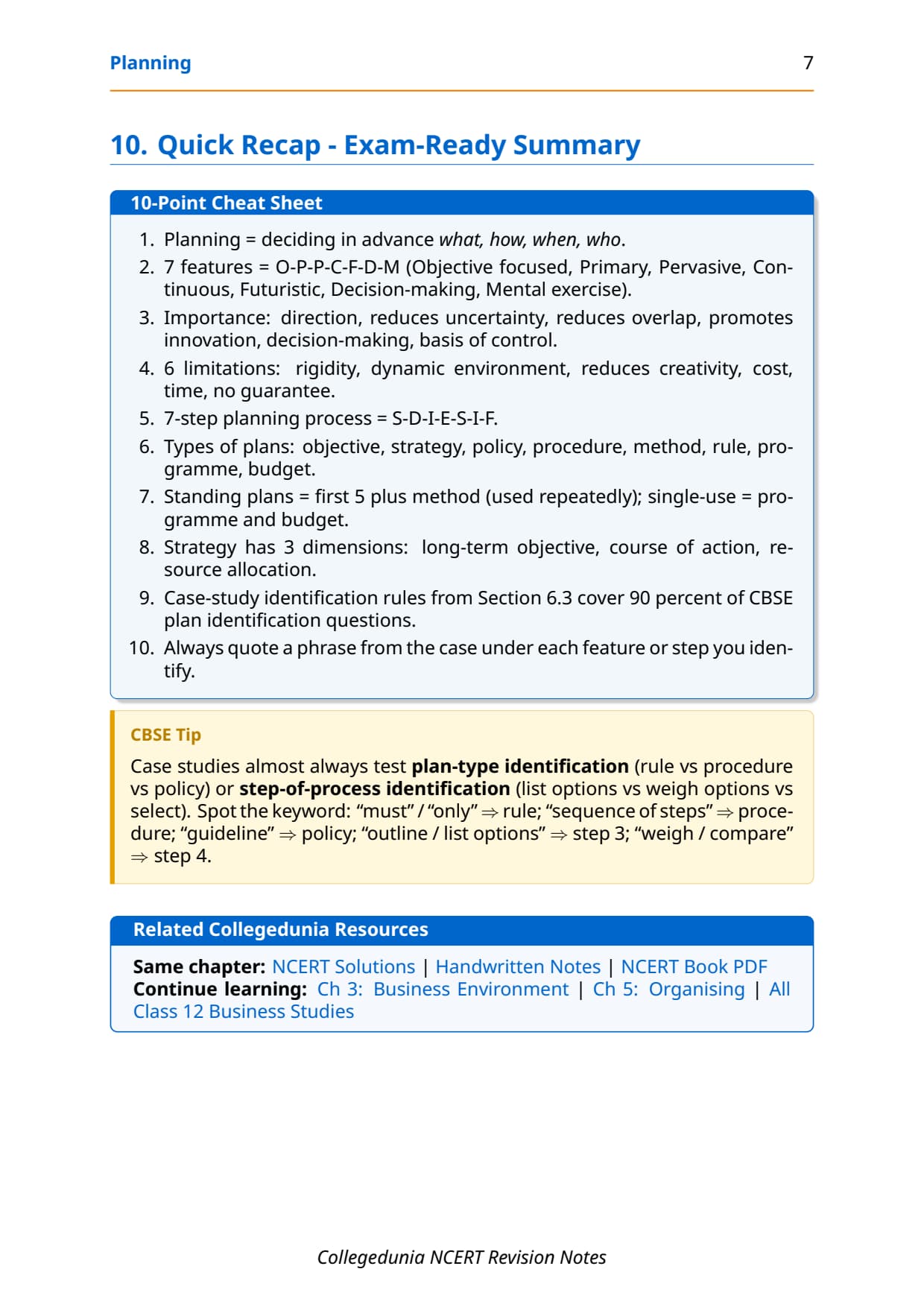
- Mnemonic Engine: O-P-P-C-F-D-M for features and S-D-I-E-S-I-F for the planning process let you recall the answers under exam pressure.
- Case-Study Verb Cheatsheet: Maps every English verb CBSE uses (outline, weigh, choose, monitor) to the corresponding planning step.
- Difference Tables: Policy vs Procedure vs Rule and Strategy vs Policy in side-by-side format, exactly the structure CBSE rewards.
- 2026-27 Alignment: Every concept matches the latest NCERT chapter order and CBSE marking scheme.
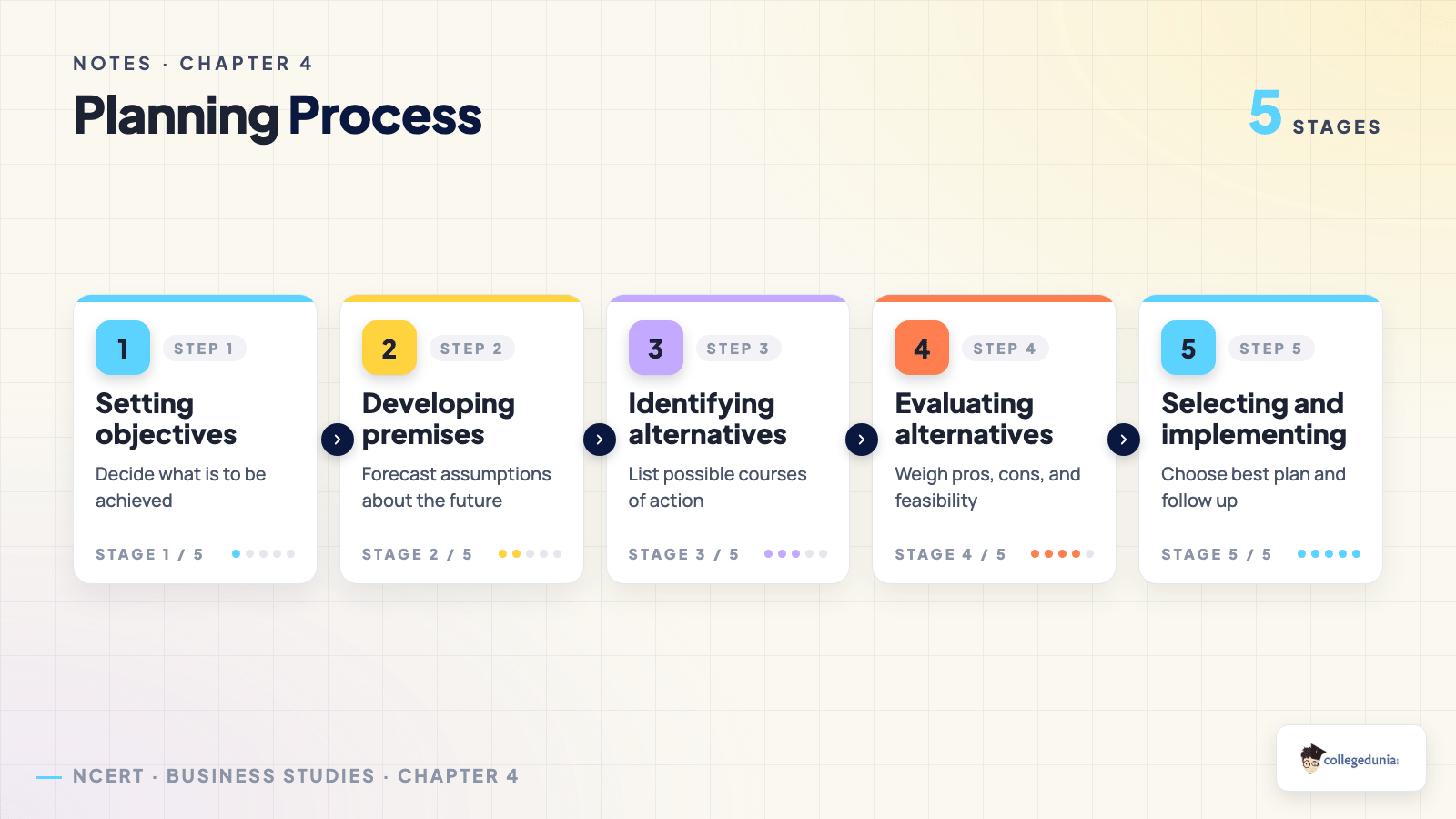
Top Five Concepts That Almost Always Appear in CBSE Board Papers
- Seven-Step Planning Process. The 5-6 mark long answer in 4 of the last 6 sessions. Use the S-D-I-E-S-I-F mnemonic so you do not forget step 7 (follow-up).
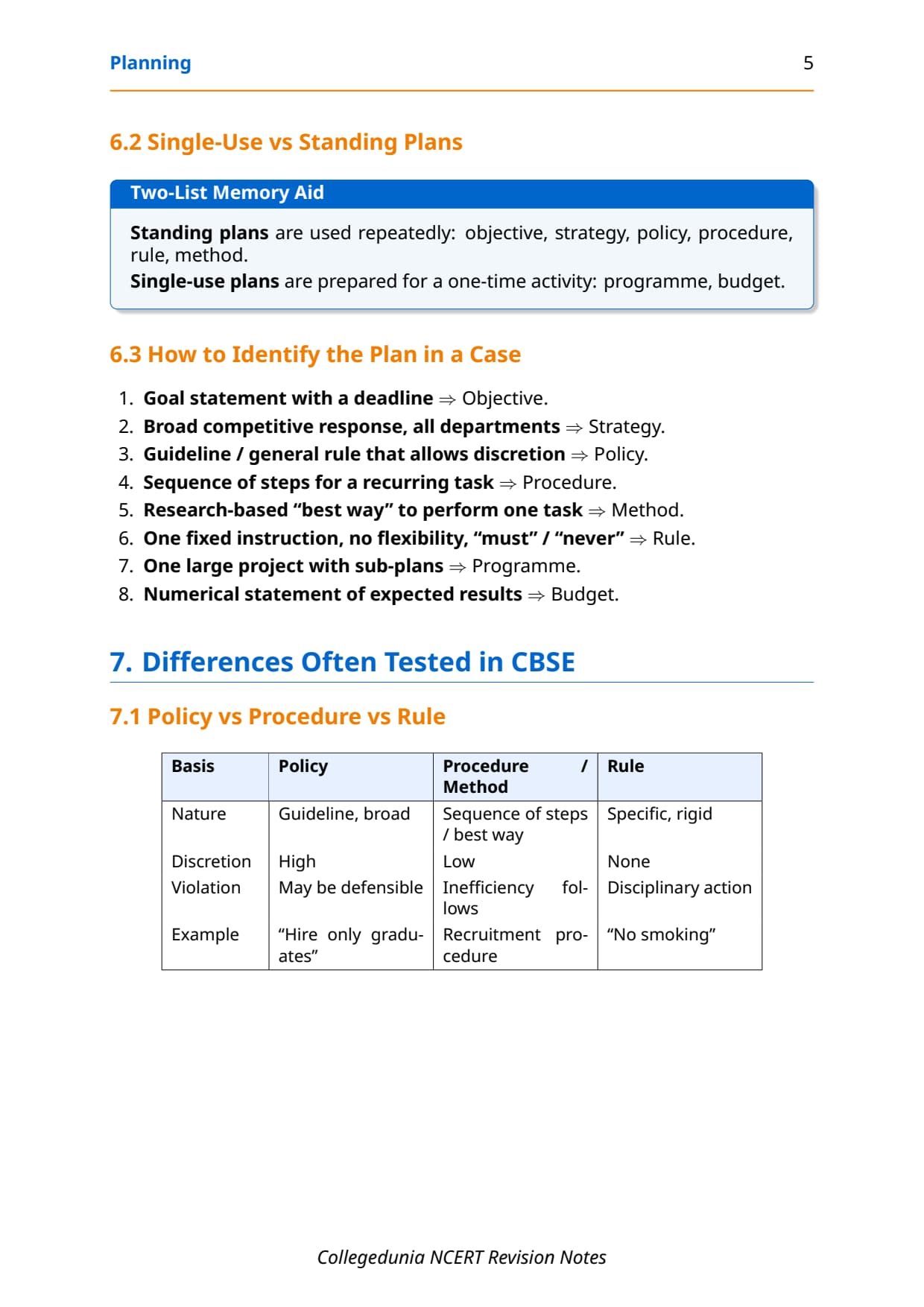
- Types of Plans Identification. A 1-2 mark VSA almost every year. The trick is to match the case keyword to the plan type from Section 6.3 of the notes.
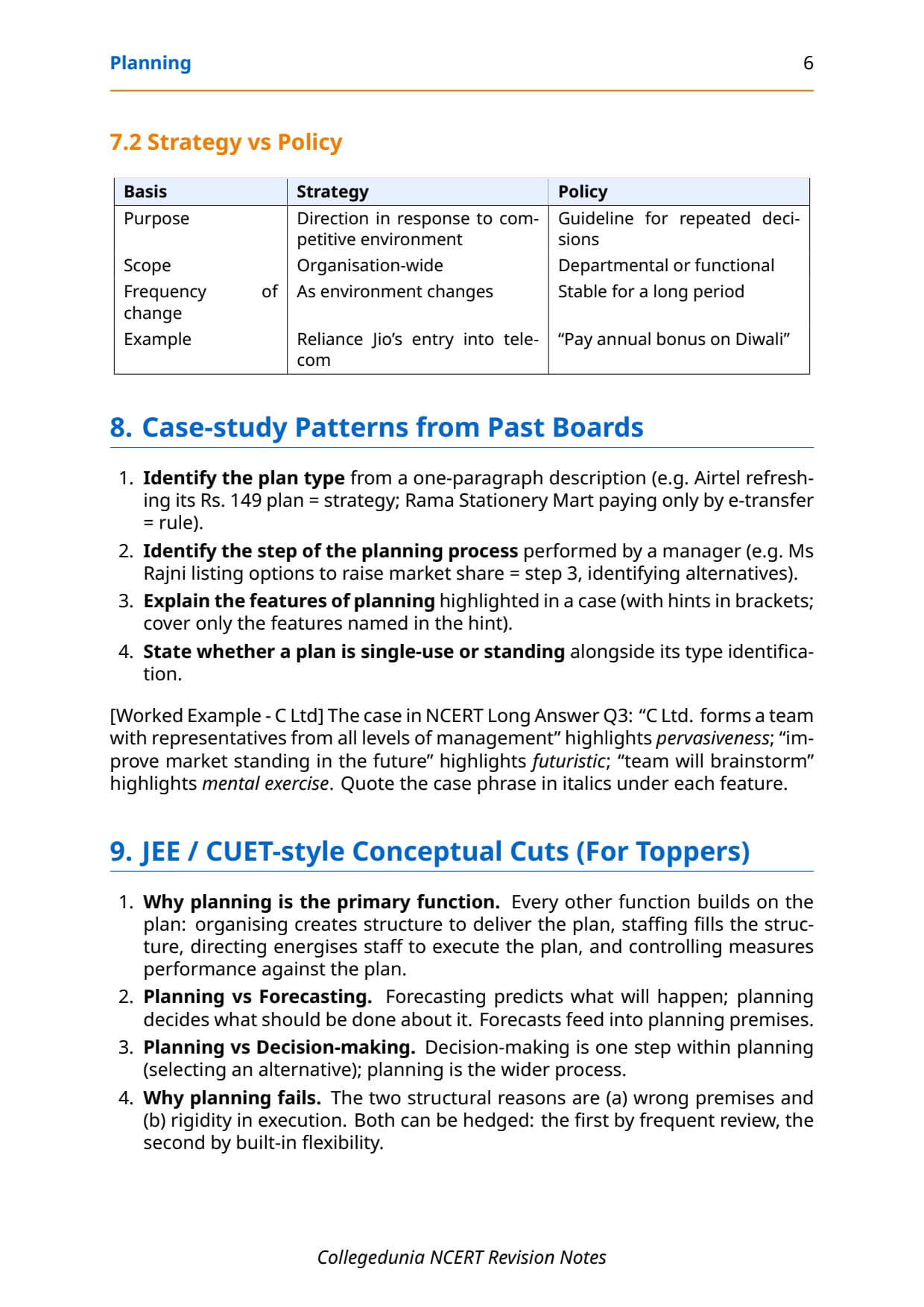
- Features of Planning Case Study. 4-6 mark case-based long answer. Hints in brackets tell you which features to cover.
- Limitations of Planning. 5 marks long answer that recurs in alternate sessions. Six limitations, each developed in two lines.
- Strategy with Three Dimensions. 6 marks case-based answer when an environment-driven competitive response is described in the case.
Common Mistakes to Avoid in Planning
- Writing only 4 or 5 steps of the planning process. CBSE assigns roughly one mark per step, so an incomplete answer caps the marks.
- Confusing rule, procedure, and policy. Rule = single fixed instruction; procedure = sequence of steps; policy = broad guideline.
- Treating planning as a "useless function in dynamic environments". The textbook says it does not guarantee success, not that it is useless.
- Skipping follow-up. Step 7 closes the loop and is the most-dropped step.
- Not quoting the case in case-based answers. Quoting the literal case phrase under each feature or step earns half a mark per anchor.
Student Feedback
In a Collegedunia poll of 940 Class 12 Commerce students, 82% said the S-D-I-E-S-I-F mnemonic made the seven-step planning process easier to recall in the exam. 3 in 4 said the Policy vs Procedure vs Rule difference table was the part of these Planning notes they revised most before the board.
Other Resources for Class 12 Business Studies Chapter 4 Planning
| Resource | Link |
|---|---|
| NCERT Solutions | Planning NCERT Solutions |
| Revision Notes | Planning Class 12 Notes |
| Handwritten Notes | Planning Handwritten Notes |
| NCERT Book PDF | Planning NCERT Book PDF |
Frequently Asked Questions on Class 12 Business Studies Chapter 4 Notes
Frequently Asked Questions on Class 12 Business Studies Chapter 4 Notes
Q1. Are the Class 12 Business Studies Chapter 4 Notes free to download?
Yes. The complete Collegedunia Notes PDF for Planning is free to download from this page, aligned to the 2026-27 CBSE syllabus.
Q2. What is the difference between a standing plan and a single-use plan?
A standing plan is used repeatedly over time (objective, strategy, policy, procedure, rule, method). A single-use plan is prepared for a one-time activity or planning period (programme, budget) and is rewritten fresh each time.
Q3. What are the eight types of plans?
Objective, strategy, policy, procedure, method, rule, programme, and budget. The first six are standing plans (used repeatedly) and the last two are single-use plans (prepared afresh each time).
Q4. How many features of planning are there?
Seven features: planning focuses on achieving objectives, is a primary function, is pervasive, is continuous, is futuristic, involves decision-making, and is a mental exercise. Remember the mnemonic O-P-P-C-F-D-M.
Q5. Are these Notes aligned to the 2026-27 CBSE Business Studies syllabus?
Yes. Every section and definition uses the 2026-27 NCERT Business Studies textbook and the latest CBSE marking scheme.



Comments