




NCERT Class 11 English (Woven Words) Chapter 11 Telephone Conversation Notes explain Wole Soyinka's poem through racial prejudice, colour imagery, silence, capital letters, satire and answer-writing frames for the 2026-27 syllabus.
- Download the Chapter 11 Notes PDF for quick offline revision.
- Revise HOW DARK, hide-and-speak, sepia, brunette and the final comeback.
- Student focus: connect every device with Soyinka's attack on racism.
Chapter11TelephoneConversationNotes.pdf?page=1&dpi=150)
Chapter11TelephoneConversationNotes.pdf?page=2&dpi=150)
Chapter11TelephoneConversationNotes.pdf?page=3&dpi=150)
Chapter11TelephoneConversationNotes.pdf?page=4&dpi=150)
Chapter11TelephoneConversationNotes.pdf?page=5&dpi=150)
Chapter11TelephoneConversationNotes.pdf?page=6&dpi=150)
Chapter11TelephoneConversationNotes.pdf?page=7&dpi=150)
Chapter11TelephoneConversationNotes.pdf?page=8&dpi=150)
Chapter11TelephoneConversationNotes.pdf?page=9&dpi=150)
Chapter11TelephoneConversationNotes.pdf?page=10&dpi=150)
Chapter11TelephoneConversationNotes.pdf?page=11&dpi=150)
Chapter11TelephoneConversationNotes.pdf?page=12&dpi=150)
Chapter11TelephoneConversationNotes.pdf?page=13&dpi=150)
Chapter11TelephoneConversationNotes.pdf?page=14&dpi=150)
Chapter11TelephoneConversationNotes.pdf?page=15&dpi=150)
Chapter11TelephoneConversationNotes.pdf?page=16&dpi=150)
Chapter11TelephoneConversationNotes.pdf?page=17&dpi=150)
Chapter11TelephoneConversationNotes.pdf?page=18&dpi=150)
Chapter11TelephoneConversationNotes.pdf?page=19&dpi=150)
Chapter11TelephoneConversationNotes.pdf?page=20&dpi=150)
Chapter11TelephoneConversationNotes.pdf?page=21&dpi=150)
Chapter11TelephoneConversationNotes_flat_MobileCard.pdf?page=1&dpi=150)
Chapter11TelephoneConversationNotes_flat_MobileCard.pdf?page=2&dpi=150)
Chapter11TelephoneConversationNotes_flat_MobileCard.pdf?page=3&dpi=150)
Chapter11TelephoneConversationNotes_flat_MobileCard.pdf?page=4&dpi=150)
Chapter11TelephoneConversationNotes_flat_MobileCard.pdf?page=5&dpi=150)
Chapter11TelephoneConversationNotes_flat_MobileCard.pdf?page=6&dpi=150)
Chapter11TelephoneConversationNotes_flat_MobileCard.pdf?page=7&dpi=150)
Chapter11TelephoneConversationNotes_flat_MobileCard.pdf?page=8&dpi=150)
Chapter11TelephoneConversationNotes_flat_MobileCard.pdf?page=9&dpi=150)
Chapter11TelephoneConversationNotes_flat_MobileCard.pdf?page=10&dpi=150)
Chapter11TelephoneConversationNotes_flat_MobileCard.pdf?page=11&dpi=150)
Chapter11TelephoneConversationNotes_flat_MobileCard.pdf?page=12&dpi=150)
Chapter11TelephoneConversationNotes_flat_MobileCard.pdf?page=13&dpi=150)
Chapter11TelephoneConversationNotes_flat_MobileCard.pdf?page=14&dpi=150)
Chapter11TelephoneConversationNotes_flat_MobileCard.pdf?page=15&dpi=150)
Chapter11TelephoneConversationNotes_flat_MobileCard.pdf?page=16&dpi=150)
Chapter11TelephoneConversationNotes_flat_MobileCard.pdf?page=17&dpi=150)
Chapter11TelephoneConversationNotes_flat_MobileCard.pdf?page=18&dpi=150)
Chapter11TelephoneConversationNotes_flat_MobileCard.pdf?page=19&dpi=150)
Chapter11TelephoneConversationNotes_flat_MobileCard.pdf?page=20&dpi=150)
Chapter11TelephoneConversationNotes_flat_MobileCard.pdf?page=21&dpi=150)
Chapter11TelephoneConversationNotes_flat_MobileCard.pdf?page=22&dpi=150)
Chapter11TelephoneConversationNotes_flat_MobileCard.pdf?page=23&dpi=150)
Chapter11TelephoneConversationNotes_flat_MobileCard.pdf?page=24&dpi=150)
Chapter11TelephoneConversationNotes_flat_MobileCard.pdf?page=25&dpi=150)
Chapter11TelephoneConversationNotes_flat_MobileCard.pdf?page=26&dpi=150)
Chapter11TelephoneConversationNotes_flat_MobileCard.pdf?page=27&dpi=150)
Chapter11TelephoneConversationNotes_flat_MobileCard.pdf?page=28&dpi=150)
Chapter11TelephoneConversationNotes_flat_MobileCard.pdf?page=29&dpi=150)
Chapter11TelephoneConversationNotes_flat_MobileCard.pdf?page=30&dpi=150)
Chapter11TelephoneConversationNotes_flat_MobileCard.pdf?page=31&dpi=150)
Chapter11TelephoneConversationNotes_flat_MobileCard.pdf?page=32&dpi=150)
Chapter11TelephoneConversationNotes_flat_MobileCard.pdf?page=33&dpi=150)
Chapter11TelephoneConversationNotes_flat_MobileCard.pdf?page=34&dpi=150)
Chapter11TelephoneConversationNotes_flat_MobileCard.pdf?page=35&dpi=150)
Chapter11TelephoneConversationNotes_flat_MobileCard.pdf?page=36&dpi=150)
Student Feedback on Telephone Conversation
In a Collegedunia revision poll of 8,120 Class 11 English students, most students said this poem became easier when they linked each colour word to satire.
In This Article
Telephone Conversation Class 11 Notes PDF Overview
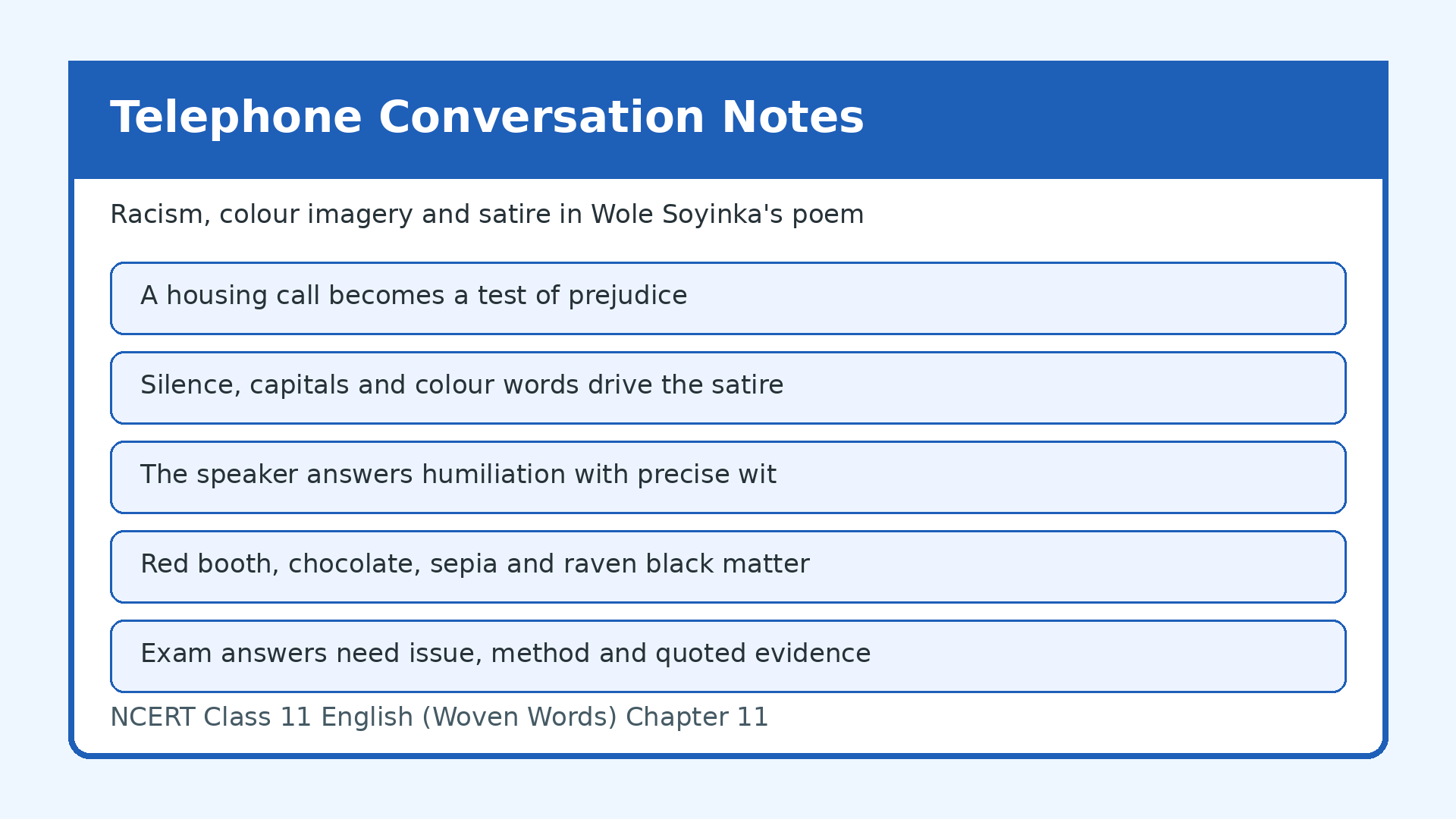
The poem begins as a practical call about rent and location, but it changes when the speaker says, I am African. The landlady's silence and her question about darkness expose racial prejudice in ordinary housing talk.
Telephone Conversation Explained for Class 11
Source: Magnet Brains on YouTube
Colour Imagery in Telephone Conversation
Colour is the poem's main satirical tool. The landlady uses light and dark as a racist scale, while the speaker uses chocolate, sepia, brunette, peroxide blonde and raven black to mock that scale.
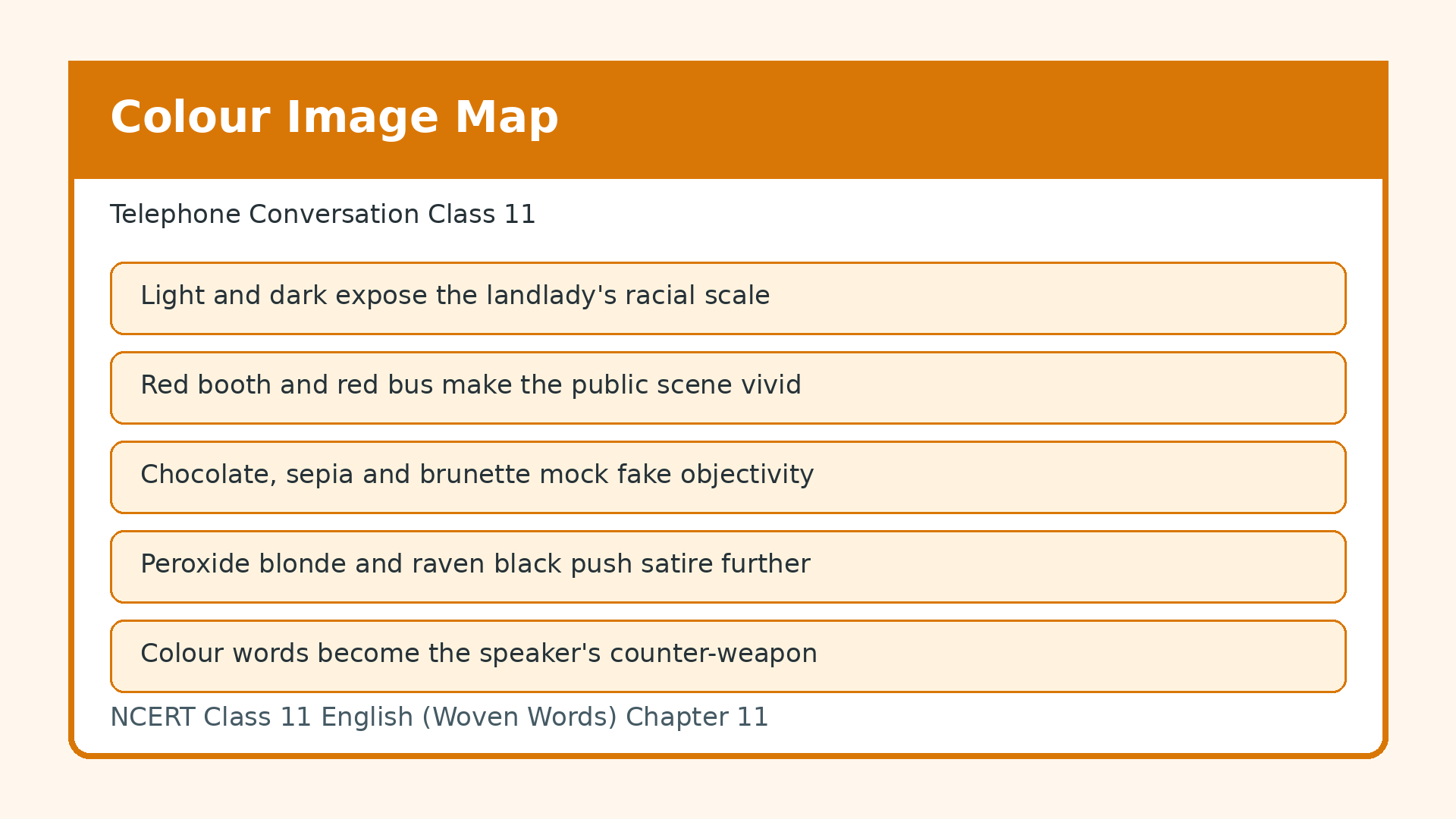
| Colour Word | Use in Poem | Exam Point |
|---|---|---|
| Light and dark | Landlady's racial test | Shows prejudice directly |
| Red | Booth, pillar-box and bus | Makes the public setting vivid |
| Sepia and brunette | Speaker's self-description | Turns colour into satire |
| Peroxide blonde and raven black | Comic body contrast | Exposes absurd classification |
How to Write Telephone Conversation Answers
Use a simple frame: name the issue, quote one phrase, name the device, and explain how it exposes racism. For capital-letter questions, mention emphasis, shock and crude social power.
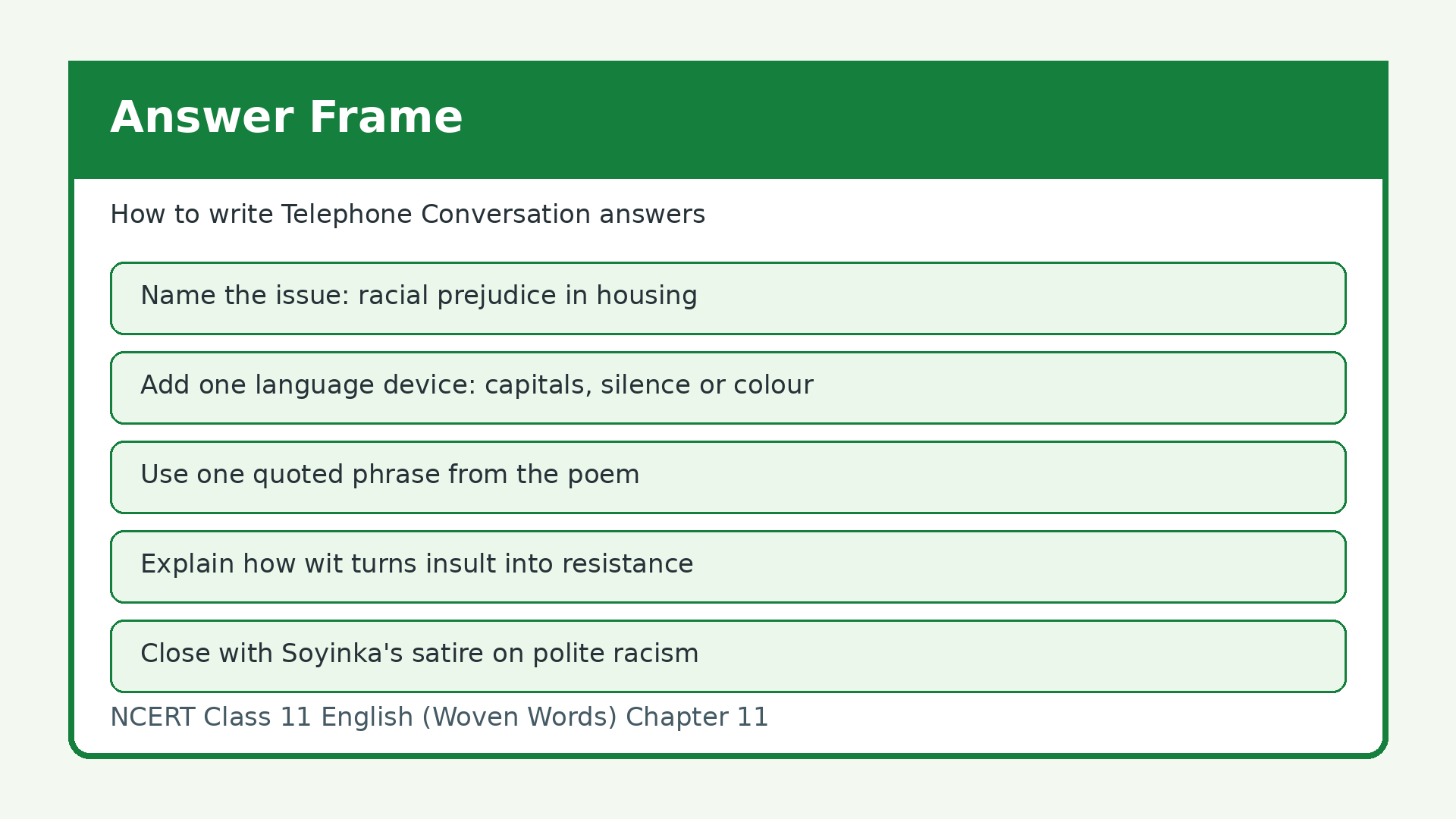
- Central issue: racial prejudice in a housing call.
- Silence: prejudice, shock and confusion.
- Title: racism heard through ordinary conversation.
- Understatement: serious insult shown through controlled humour.
Related Resources for Telephone Conversation
| Resource | Use it for | Link |
|---|---|---|
| NCERT Solutions | Practise textbook answers | Open Solutions |
| NCERT Book PDF | Read the source poem | Open Book PDF |
| Handwritten Notes | Revise with visual notes | Open Handwritten Notes |
All Class 11 English Woven Words Notes Chapters
| Chapter | Notes Link |
|---|---|
| Chapter 8 The Luncheon | Open Notes |
| Chapter 9 Let Me Not to the Marriage of True Minds | Open Notes |
| Chapter 10 Coming | Open Notes |
| Chapter 11 Telephone Conversation | Current chapter notes |
Telephone Conversation Class 11 Notes FAQs
Ques. What is the central issue in Telephone Conversation?
Ans. The central issue is racial prejudice, shown through the landlady's question about the speaker's skin colour.
Ques. Why are some words in capital letters in the poem?
Ans. The capital letters show loud emphasis, shock and the crude force behind the landlady's racist question.
Ques. What does hide-and-speak mean?
Ans. Hide-and-speak means speaking while hidden, as in a phone booth, where bodies are unseen but prejudice is exposed.
Ques. Why is colour imagery important in Telephone Conversation?
Ans. Colour imagery exposes the absurdity of judging a person through shade labels like dark, light, sepia and raven black.



Comments