




NCERT Class 11 English (Woven Words) Chapter 8 The Luncheon Notes explain W. Somerset Maugham's comic story through plot flow, irony, character contrast, vocabulary, themes and answer-writing frames for the 2026-27 syllabus.
- Download the Chapter 8 Notes PDF for quick offline revision.
- Revise the Paris lunch, the narrator's money panic, the guest's repeated claims and the final comic reversal.
- Student focus: connect humour with the gap between what the guest says and what she eats.
Chapter8TheLuncheonNotes.pdf?page=1&dpi=150)
Chapter8TheLuncheonNotes.pdf?page=2&dpi=150)
Chapter8TheLuncheonNotes.pdf?page=3&dpi=150)
Chapter8TheLuncheonNotes.pdf?page=4&dpi=150)
Chapter8TheLuncheonNotes.pdf?page=5&dpi=150)
Chapter8TheLuncheonNotes.pdf?page=6&dpi=150)
Chapter8TheLuncheonNotes.pdf?page=7&dpi=150)
Chapter8TheLuncheonNotes.pdf?page=8&dpi=150)
Chapter8TheLuncheonNotes.pdf?page=9&dpi=150)
Chapter8TheLuncheonNotes.pdf?page=10&dpi=150)
Chapter8TheLuncheonNotes.pdf?page=11&dpi=150)
Chapter8TheLuncheonNotes.pdf?page=12&dpi=150)
Chapter8TheLuncheonNotes.pdf?page=13&dpi=150)
Chapter8TheLuncheonNotes.pdf?page=14&dpi=150)
Chapter8TheLuncheonNotes.pdf?page=15&dpi=150)
Chapter8TheLuncheonNotes.pdf?page=16&dpi=150)
Chapter8TheLuncheonNotes.pdf?page=17&dpi=150)
Chapter8TheLuncheonNotes.pdf?page=18&dpi=150)
Chapter8TheLuncheonNotes.pdf?page=19&dpi=150)
Chapter8TheLuncheonNotes.pdf?page=20&dpi=150)
Chapter8TheLuncheonNotes.pdf?page=21&dpi=150)
Chapter8TheLuncheonNotes.pdf?page=22&dpi=150)
Chapter8TheLuncheonNotes_flat_MobileCard.pdf?page=1&dpi=150)
Chapter8TheLuncheonNotes_flat_MobileCard.pdf?page=2&dpi=150)
Chapter8TheLuncheonNotes_flat_MobileCard.pdf?page=3&dpi=150)
Chapter8TheLuncheonNotes_flat_MobileCard.pdf?page=4&dpi=150)
Chapter8TheLuncheonNotes_flat_MobileCard.pdf?page=5&dpi=150)
Chapter8TheLuncheonNotes_flat_MobileCard.pdf?page=6&dpi=150)
Chapter8TheLuncheonNotes_flat_MobileCard.pdf?page=7&dpi=150)
Chapter8TheLuncheonNotes_flat_MobileCard.pdf?page=8&dpi=150)
Chapter8TheLuncheonNotes_flat_MobileCard.pdf?page=9&dpi=150)
Chapter8TheLuncheonNotes_flat_MobileCard.pdf?page=10&dpi=150)
Chapter8TheLuncheonNotes_flat_MobileCard.pdf?page=11&dpi=150)
Chapter8TheLuncheonNotes_flat_MobileCard.pdf?page=12&dpi=150)
Chapter8TheLuncheonNotes_flat_MobileCard.pdf?page=13&dpi=150)
Chapter8TheLuncheonNotes_flat_MobileCard.pdf?page=14&dpi=150)
Chapter8TheLuncheonNotes_flat_MobileCard.pdf?page=15&dpi=150)
Chapter8TheLuncheonNotes_flat_MobileCard.pdf?page=16&dpi=150)
Chapter8TheLuncheonNotes_flat_MobileCard.pdf?page=17&dpi=150)
Chapter8TheLuncheonNotes_flat_MobileCard.pdf?page=18&dpi=150)
Chapter8TheLuncheonNotes_flat_MobileCard.pdf?page=19&dpi=150)
Chapter8TheLuncheonNotes_flat_MobileCard.pdf?page=20&dpi=150)
Chapter8TheLuncheonNotes_flat_MobileCard.pdf?page=21&dpi=150)
Chapter8TheLuncheonNotes_flat_MobileCard.pdf?page=22&dpi=150)
Chapter8TheLuncheonNotes_flat_MobileCard.pdf?page=23&dpi=150)
Chapter8TheLuncheonNotes_flat_MobileCard.pdf?page=24&dpi=150)
Chapter8TheLuncheonNotes_flat_MobileCard.pdf?page=25&dpi=150)
Chapter8TheLuncheonNotes_flat_MobileCard.pdf?page=26&dpi=150)
Chapter8TheLuncheonNotes_flat_MobileCard.pdf?page=27&dpi=150)
Chapter8TheLuncheonNotes_flat_MobileCard.pdf?page=28&dpi=150)
Chapter8TheLuncheonNotes_flat_MobileCard.pdf?page=29&dpi=150)
Chapter8TheLuncheonNotes_flat_MobileCard.pdf?page=30&dpi=150)
Chapter8TheLuncheonNotes_flat_MobileCard.pdf?page=31&dpi=150)
Chapter8TheLuncheonNotes_flat_MobileCard.pdf?page=32&dpi=150)
Chapter8TheLuncheonNotes_flat_MobileCard.pdf?page=33&dpi=150)
Chapter8TheLuncheonNotes_flat_MobileCard.pdf?page=34&dpi=150)
Student Feedback on The Luncheon
In a Collegedunia revision poll of 9,860 Class 11 English students, most students said the chapter became easier when they tracked the guest's words beside the menu items she actually ordered.
The Luncheon Class 11 Notes PDF Overview
The Luncheon is a humorous short story by W. Somerset Maugham. A young writer agrees to lunch with an admirer at Foyot's in Paris, only to watch a supposed light meal become an expensive lesson in vanity, politeness and social embarrassment.
| Point | Revision note | Exam use |
|---|---|---|
| Central conflict | The narrator wants to appear polite while silently fearing the bill. | Use for humour and character questions. |
| Main irony | The guest repeatedly says she eats very little while ordering costly food. | Use for theme and appreciation answers. |
| Setting | Foyot's is an elite restaurant beyond the narrator's means. | Use for social contrast. |
| Ending | The narrator's delayed revenge comes when the guest's present weight disproves her old advice. | Use for final reversal answers. |
The Luncheon Class 11 Story Explanation Video
Source: Magnet Brains on YouTube
Plot Summary of The Luncheon
The story begins many years later at a play, where the narrator meets the woman again. Her casual question brings back the memory of Paris, when he was a young writer living on very little money and trying to survive the month with eighty francs.
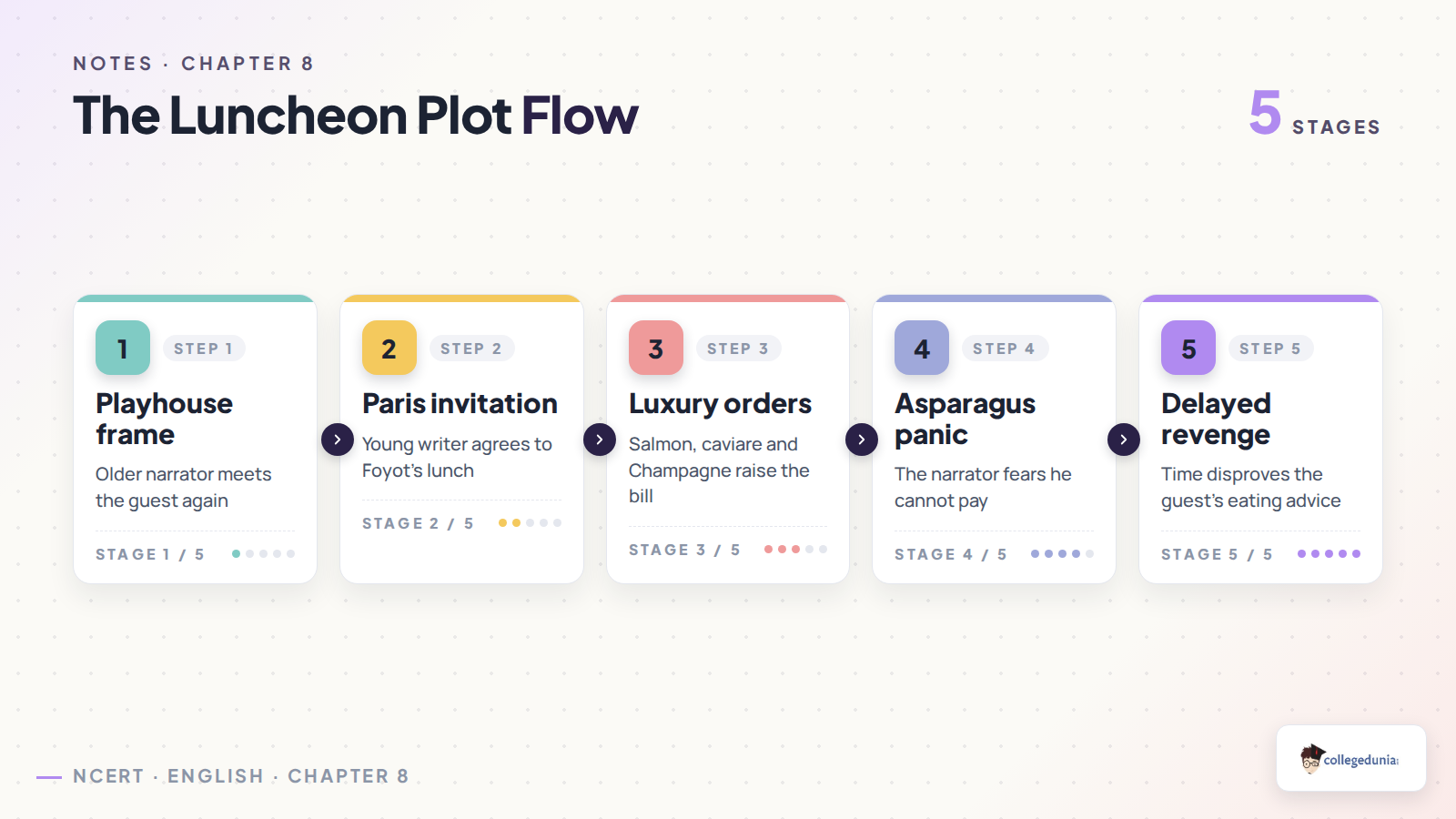
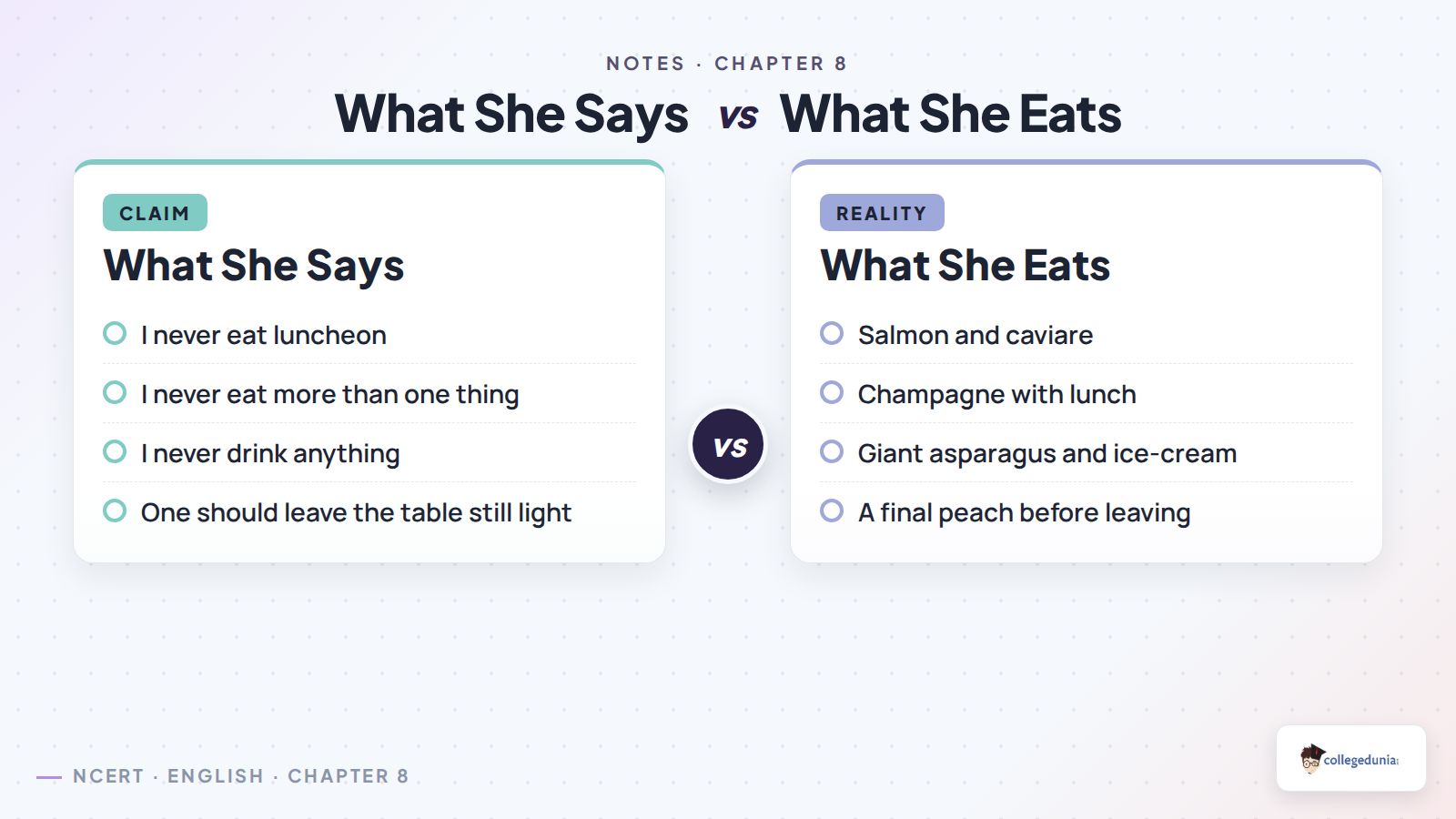
The woman had written to him after reading his book and asked for lunch at Foyot's. The narrator was flattered and too young to refuse. At the restaurant, she said she never ate anything for luncheon, but soon chose salmon, caviare, Champagne, asparagus, ice-cream, coffee and a peach.
The narrator ordered only a cheap mutton chop and water. As each dish arrived, he worried whether he had enough money to pay. When the bill came, he paid it but had only a poor tip left. The woman still advised him never to eat more than one thing. Years later, he calls his final revenge complete because she now weighs twenty-one stone.
Character Sketches in The Luncheon
The narrator is young, poor, polite and proud. He cannot admit that Foyot's is beyond his means, so he keeps acting like a generous host while silently calculating the bill.
The woman guest is talkative, vain and insensitive. Her comedy comes from contradiction: she speaks like a disciplined eater but keeps accepting expensive food and drink.
The waiters sharpen the comic pressure. The waiter confirms the salmon, praises the asparagus and brings peaches at the worst possible moment for the narrator's pocket.
| Character | Key quality | Supporting detail |
|---|---|---|
| Narrator | Polite but anxious | He orders costly items for her while choosing the cheapest dish for himself. |
| Woman | Self-deceiving | She says she eats one thing, then accepts several luxuries. |
| Headwaiter | Tempting presence | He appears with peaches and makes the final expense possible. |
The Luncheon Themes and Irony
The chapter's strongest theme is the gap between speech and action. The guest's words create an image of restraint, but her actions reveal appetite, vanity and a lack of sensitivity toward the young host.
| Theme | Story evidence | Answer line |
|---|---|---|
| Comic irony | Every claim of eating little is followed by a costly order. | Maugham builds humour through contradiction. |
| Politeness | The narrator cannot say no because he fears seeming rude or poor. | Social manners become a financial trap. |
| Class and money | Foyot's belongs to a world of comfort that the narrator cannot afford. | The setting turns lunch into suspense. |
| Delayed revenge | The guest's later weight disproves her old advice. | Time completes the comic punishment. |
How to Write Answers on The Luncheon
For NCERT answers, begin with the direct idea, then add one food example and one sentence explaining the irony. A strong answer should not only list the dishes; it should show how each dish makes the narrator's money fear worse.
- For humour questions, use the contrast between ``I never eat'' and the menu.
- For character questions, describe the narrator as poor, polite, proud and observant.
- For ending questions, explain why the twenty-one stone detail is a comic reversal.
- For vocabulary questions, connect words like mortifying, complacency and vindictive to the narrator's feelings.
Related Resources for The Luncheon
| Resource | Use it for | Link |
|---|---|---|
| NCERT Solutions | Practise textbook answers for the chapter | Open Solutions |
| NCERT Book PDF | Read the source chapter before revision | Open Book PDF |
| Handwritten Notes | Revise with visual notes when available | Open Handwritten Notes |
All Class 11 English Woven Words Notes Chapters
| Chapter | Notes Link |
|---|---|
| Chapter 1 The Lament | Open Notes |
| Chapter 2 A Pair of Mustachios | Open Notes |
| Chapter 3 The Rocking-horse Winner | Open Notes |
| Chapter 4 The Adventure of the Three Garridebs | Open Notes |
| Chapter 5 Pappachi's Moth | Open Notes |
| Chapter 6 The Third and Final Continent | Open Notes |
| Chapter 7 Glory at Twilight | Open Notes |
| Chapter 8 The Luncheon | Current chapter notes |
The Luncheon Class 11 Notes FAQs
Ques. What is the main idea of The Luncheon?
Ans. The main idea is the comic gap between the guest's claim that she eats little and the costly meal she actually consumes.
Ques. Why does the narrator panic during the lunch?
Ans. He panics because each order raises the bill, and he fears he may not have enough money to pay at Foyot's.
Ques. How does Maugham create humour in the story?
Ans. Maugham creates humour through irony, repeated contradictions, vivid food details and the narrator's helpless politeness.
Ques. Why is the ending of The Luncheon effective?
Ans. The ending is effective because the guest's later weight becomes a comic answer to her old advice about eating lightly.



Comments