




NCERT Class 11 English Woven Words Chapter 13 Mother Tongue Notes explain Padma Sachdev's poem through Dogri, Shahni, the reed, the quill, Sharade script and answer frames for the 2026-27 syllabus.
- Download the Chapter 13 Notes PDF for offline revision.
- Revise Dogri, Shahni, quill symbolism, personification and language preservation.
- Student focus: write every answer with Dogri, Shahni and service to the mother tongue.
Chapter13MotherTongueNotes.pdf?page=1&dpi=150)
Chapter13MotherTongueNotes.pdf?page=2&dpi=150)
Chapter13MotherTongueNotes.pdf?page=3&dpi=150)
Chapter13MotherTongueNotes.pdf?page=4&dpi=150)
Chapter13MotherTongueNotes.pdf?page=5&dpi=150)
Chapter13MotherTongueNotes.pdf?page=6&dpi=150)
Chapter13MotherTongueNotes.pdf?page=7&dpi=150)
Chapter13MotherTongueNotes.pdf?page=8&dpi=150)
Chapter13MotherTongueNotes.pdf?page=9&dpi=150)
Chapter13MotherTongueNotes.pdf?page=10&dpi=150)
Chapter13MotherTongueNotes.pdf?page=11&dpi=150)
Chapter13MotherTongueNotes.pdf?page=12&dpi=150)
Chapter13MotherTongueNotes.pdf?page=13&dpi=150)
Chapter13MotherTongueNotes.pdf?page=14&dpi=150)
Chapter13MotherTongueNotes.pdf?page=15&dpi=150)
Chapter13MotherTongueNotes.pdf?page=16&dpi=150)
Chapter13MotherTongueNotes.pdf?page=17&dpi=150)
Chapter13MotherTongueNotes.pdf?page=18&dpi=150)
Chapter13MotherTongueNotes.pdf?page=19&dpi=150)
Chapter13MotherTongueNotes.pdf?page=20&dpi=150)
Chapter13MotherTongueNotes.pdf?page=21&dpi=150)
Chapter13MotherTongueNotes_flat_MobileCard.pdf?page=1&dpi=150)
Chapter13MotherTongueNotes_flat_MobileCard.pdf?page=2&dpi=150)
Chapter13MotherTongueNotes_flat_MobileCard.pdf?page=3&dpi=150)
Chapter13MotherTongueNotes_flat_MobileCard.pdf?page=4&dpi=150)
Chapter13MotherTongueNotes_flat_MobileCard.pdf?page=5&dpi=150)
Chapter13MotherTongueNotes_flat_MobileCard.pdf?page=6&dpi=150)
Chapter13MotherTongueNotes_flat_MobileCard.pdf?page=7&dpi=150)
Chapter13MotherTongueNotes_flat_MobileCard.pdf?page=8&dpi=150)
Chapter13MotherTongueNotes_flat_MobileCard.pdf?page=9&dpi=150)
Chapter13MotherTongueNotes_flat_MobileCard.pdf?page=10&dpi=150)
Chapter13MotherTongueNotes_flat_MobileCard.pdf?page=11&dpi=150)
Chapter13MotherTongueNotes_flat_MobileCard.pdf?page=12&dpi=150)
Chapter13MotherTongueNotes_flat_MobileCard.pdf?page=13&dpi=150)
Chapter13MotherTongueNotes_flat_MobileCard.pdf?page=14&dpi=150)
Chapter13MotherTongueNotes_flat_MobileCard.pdf?page=15&dpi=150)
Chapter13MotherTongueNotes_flat_MobileCard.pdf?page=16&dpi=150)
Chapter13MotherTongueNotes_flat_MobileCard.pdf?page=17&dpi=150)
Chapter13MotherTongueNotes_flat_MobileCard.pdf?page=18&dpi=150)
Chapter13MotherTongueNotes_flat_MobileCard.pdf?page=19&dpi=150)
Chapter13MotherTongueNotes_flat_MobileCard.pdf?page=20&dpi=150)
Chapter13MotherTongueNotes_flat_MobileCard.pdf?page=21&dpi=150)
Chapter13MotherTongueNotes_flat_MobileCard.pdf?page=22&dpi=150)
Chapter13MotherTongueNotes_flat_MobileCard.pdf?page=23&dpi=150)
Chapter13MotherTongueNotes_flat_MobileCard.pdf?page=24&dpi=150)
Chapter13MotherTongueNotes_flat_MobileCard.pdf?page=25&dpi=150)
Chapter13MotherTongueNotes_flat_MobileCard.pdf?page=26&dpi=150)
Chapter13MotherTongueNotes_flat_MobileCard.pdf?page=27&dpi=150)
Chapter13MotherTongueNotes_flat_MobileCard.pdf?page=28&dpi=150)
Chapter13MotherTongueNotes_flat_MobileCard.pdf?page=29&dpi=150)
Chapter13MotherTongueNotes_flat_MobileCard.pdf?page=30&dpi=150)
Chapter13MotherTongueNotes_flat_MobileCard.pdf?page=31&dpi=150)
Chapter13MotherTongueNotes_flat_MobileCard.pdf?page=32&dpi=150)
Chapter13MotherTongueNotes_flat_MobileCard.pdf?page=33&dpi=150)
Student Feedback on Mother Tongue
In a Collegedunia revision poll of 7,180 Class 11 English students, many students said Mother Tongue became easier after linking Shahni, quill and Sharade script together.
Mother Tongue Class 11 Notes PDF Overview
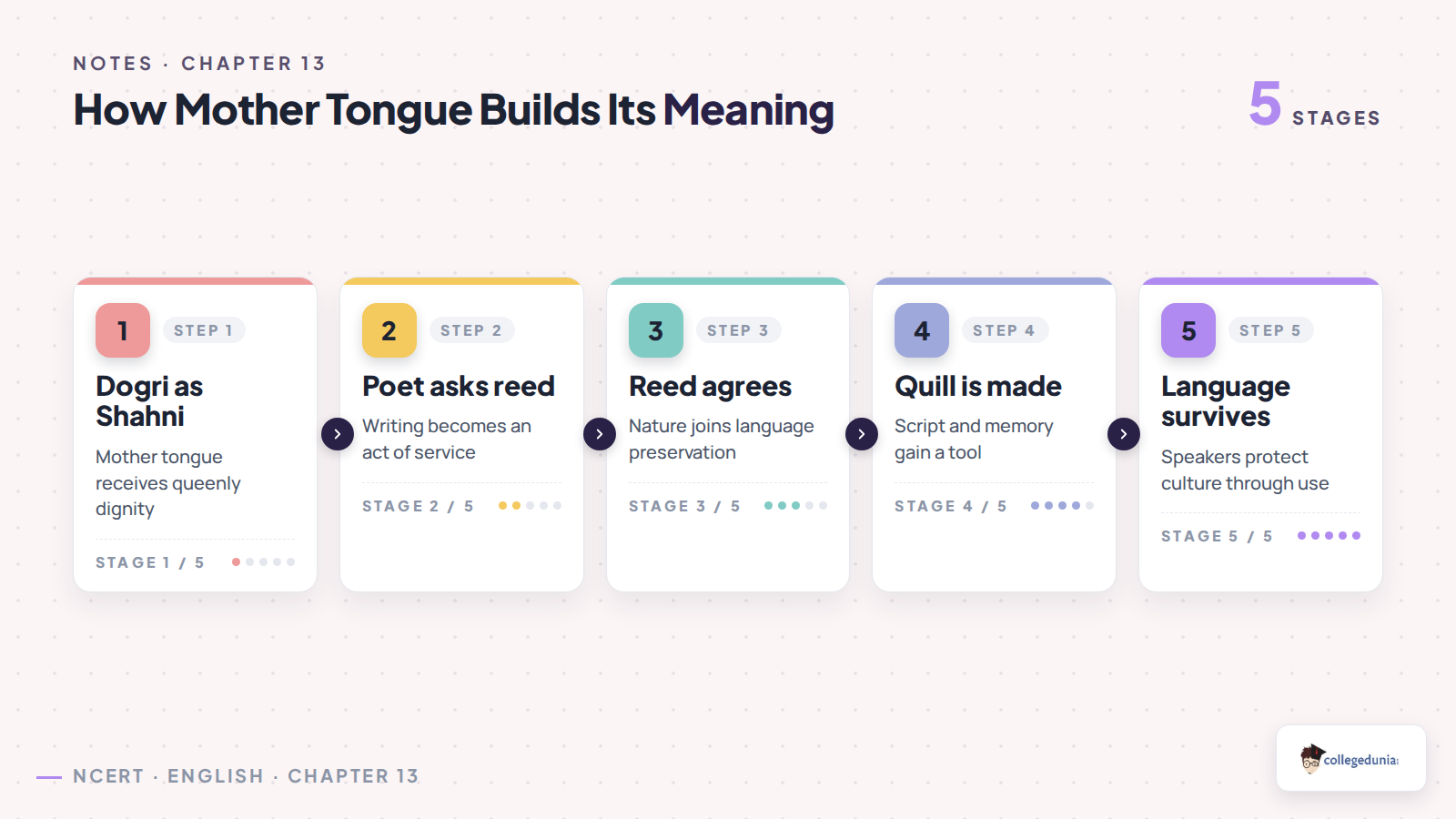
Mother Tongue is Padma Sachdev's poem on loving and preserving Dogri. The PDF explains how the poem turns language into Shahni, a queen who receives service through writing.
Mother Tongue Class 11 Poem Explanation Video
Source: Magnet Brains on YouTube
Mother Tongue Summary and Meaning
The poem presents Dogri as Shahni, a queen. The poet asks the reed for a quill so that she can serve and preserve her mother tongue through writing.
| Element | Meaning | Exam cue |
|---|---|---|
| Dogri | The mother tongue honoured in the poem | Central identity |
| Shahni | Queenly personification of Dogri | Personification |
| Reed | Natural material that offers service | Dramatic helper |
| Quill | Writing tool and symbol of preservation | Main symbol |
Symbols and Literary Devices in Mother Tongue
The poem uses personification and symbolism. Dogri becomes Shahni, the reed speaks like a loyal servant and the quill becomes a sign of script and cultural memory.
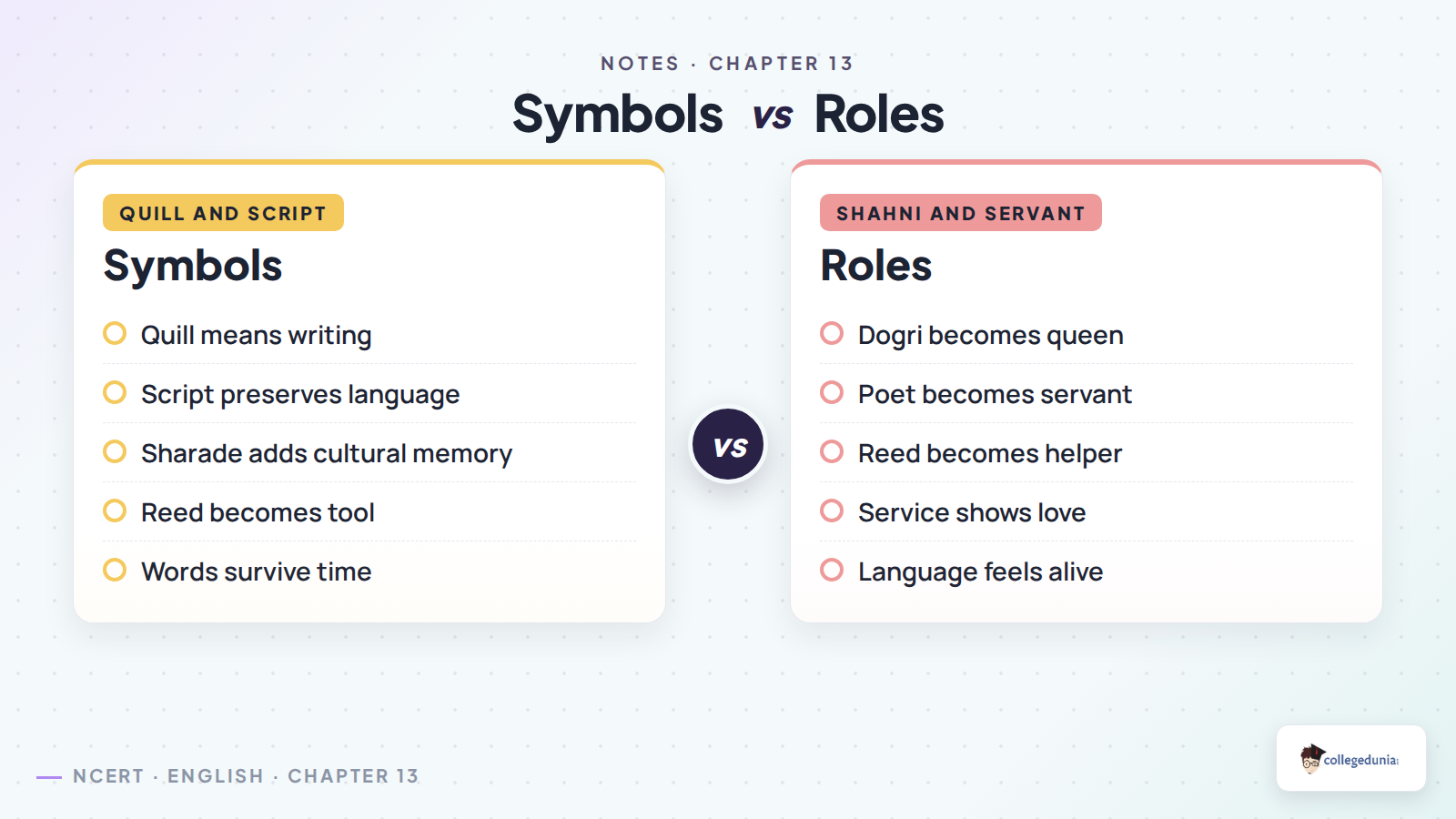
| Device | Where it appears | Effect |
|---|---|---|
| Personification | Dogri as Shahni and reed as speaker | Makes language feel alive |
| Symbolism | Quill and script | Shows preservation through writing |
| Dialogue | Poet and reed | Adds urgency and movement |
| Image | Queen, reed and quill | Turns abstract love into visible action |
How to Write NCERT Answers for Mother Tongue
For NCERT answers, name the symbol or device first, then connect it to Dogri and the duty to preserve a mother tongue.
- For the quill question, explain writing, script and preservation.
- For urgency, write that language weakens when speakers delay service.
- For emotional attachment, use Shahni and the servant image.
- For personification, mention Dogri as Shahni and the reed as a speaking helper.
Related Resources for Mother Tongue
| Resource | Use it for | Link |
|---|---|---|
| NCERT Solutions | Practise textbook answers | Open Solutions |
| NCERT Book PDF | Read the source poem | Open Book PDF |
| Handwritten Notes | Revise with visual notes | Open Handwritten Notes |
All Class 11 English Woven Words Notes Chapters
| Chapter | Notes Link |
|---|---|
| Chapter 10 Coming | Open Notes |
| Chapter 11 Telephone Conversation | Open Notes |
| Chapter 12 The World is Too Much With Us | Open Notes |
| Chapter 13 Mother Tongue | Current chapter notes |
| Chapter 14 Hawk Roosting | Open Notes |
Mother Tongue Class 11 Notes FAQs
Ques. What is the main theme of Mother Tongue?
Ans. The main theme is love and service to one's mother tongue. Padma Sachdev shows Dogri as Shahni, a queen who deserves preservation.
Ques. What does the quill symbolise in Mother Tongue?
Ans. The quill symbolises writing, script and the active effort needed to preserve Dogri.
Ques. Who is Shahni in the poem Mother Tongue?
Ans. Shahni is the poet's personified mother tongue, Dogri, shown as a queen worthy of loyal service.
Ques. Why does the poem feel urgent?
Ans. It feels urgent because the poet suggests that a mother tongue may weaken if speakers delay writing, using and preserving it.



Comments