




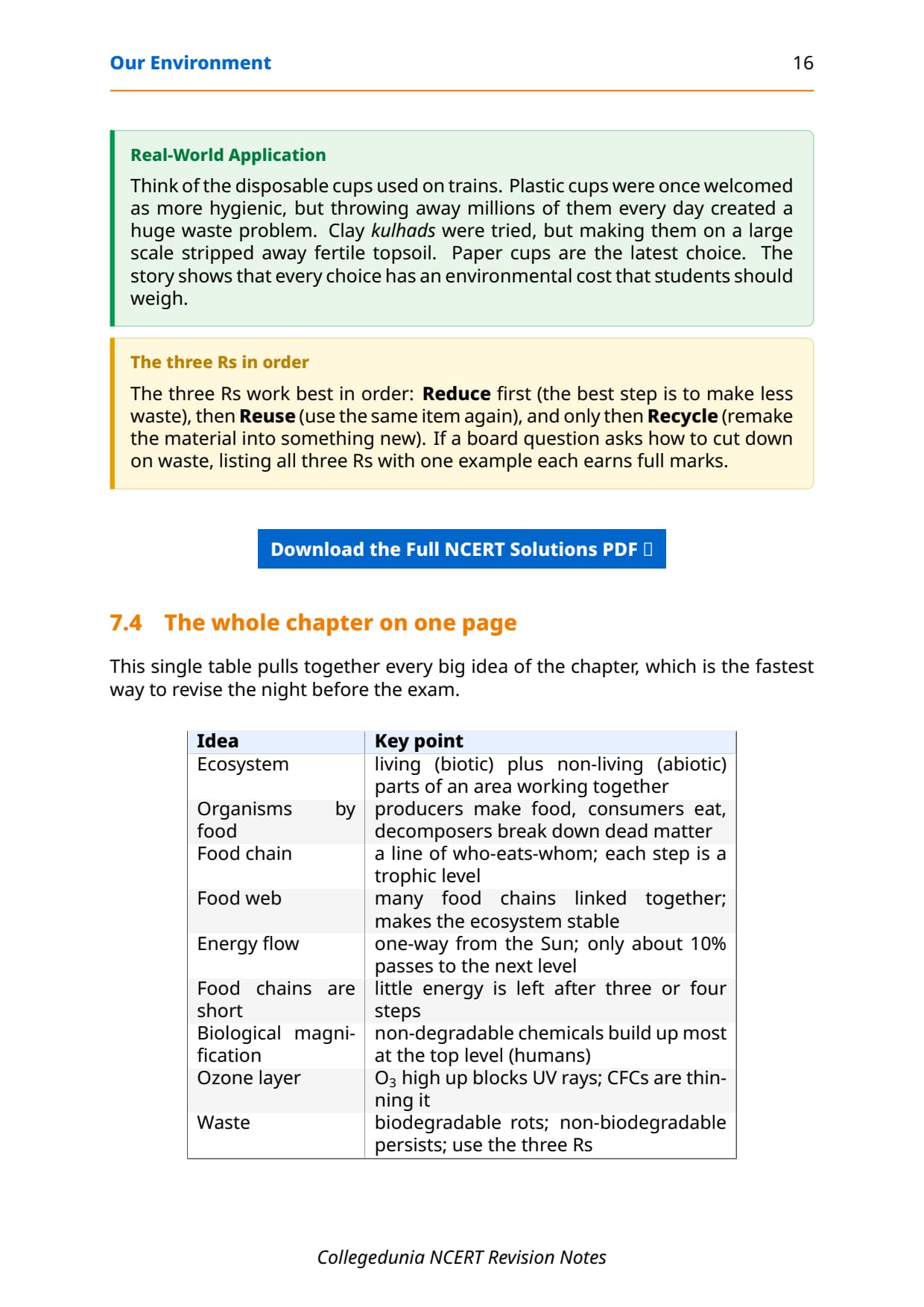
These Notes for Class 10 Science Chapter 13 Our Environment give you a quick, concept-first revision of the whole chapter, built on the latest 2026-27 CBSE syllabus. They cover the ecosystem and its biotic and abiotic parts, food chains, food webs and trophic levels, the flow of energy and the ten per cent law, biological magnification, the ozone layer, and how we manage biodegradable and non-biodegradable waste.
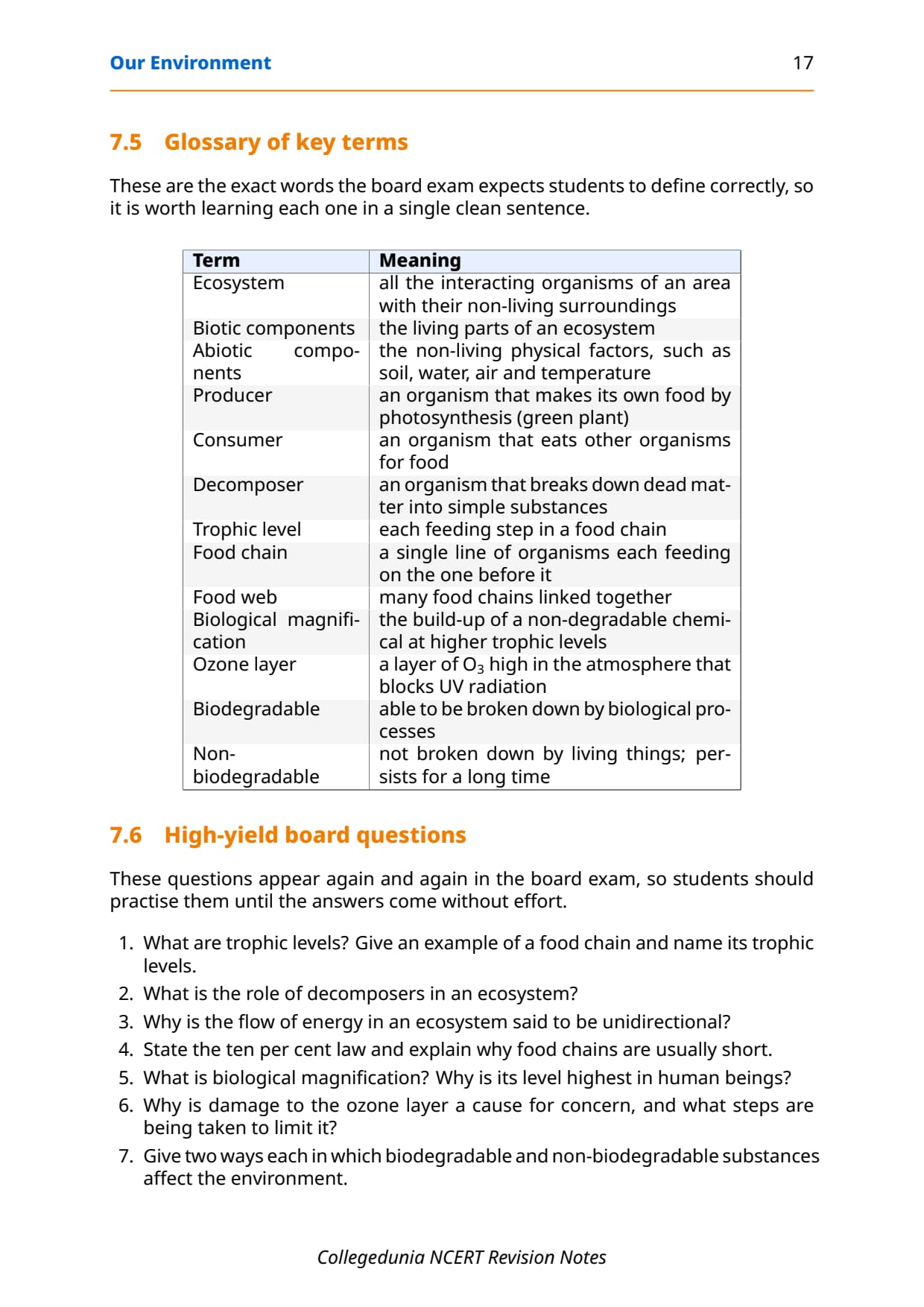
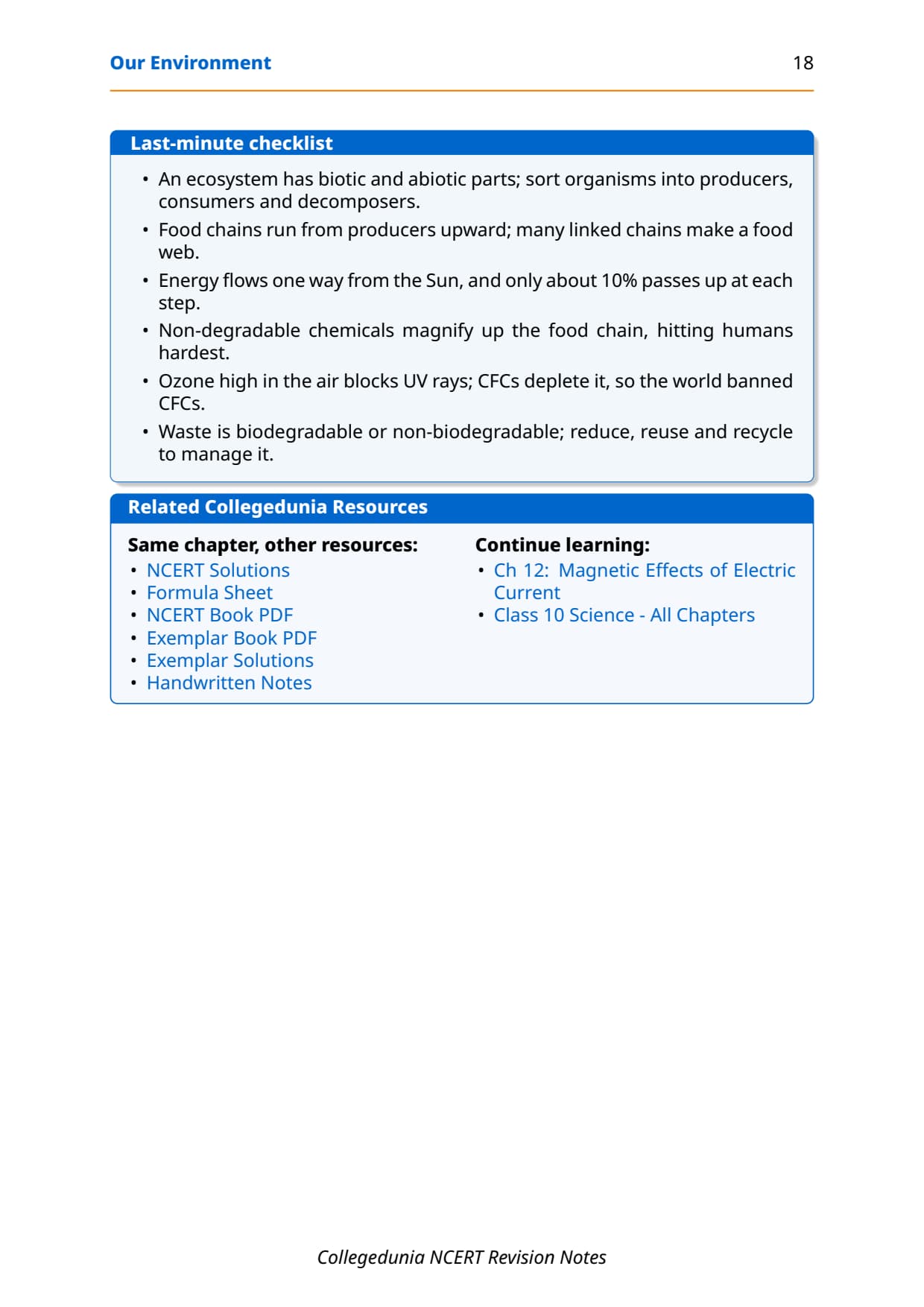
- Every key term explained in one clean sentence, with simple diagrams and the exact way the CBSE board paper asks it.
- Full coverage of producers, consumers and decomposers, the 10% law, CFCs and ozone depletion, and the three Rs of waste management.
- Notes mapped to the 2026-27 CBSE Class 10 Science syllabus, written for the board exam, so students can revise the chapter in one sitting.
These Collegedunia revision notes are curated by Science subject experts, mapped to the 2026-27 NCERT textbook, and refined against the last five years of CBSE Class 10 Science board papers.
Student Feedback: What 9,400 students told us about this chapter
68% of Class 10 students said the ten per cent law numericals and the difference between energy flow and nutrient cycling were the parts they got wrong most often. 3 out of 5 students told us a one-page summary of producers, consumers and decomposers helped them lock the chapter the night before the exam.
Toppers found that a quick revision strip linking each food-chain term to one example saved 10 to 15 minutes in the exam, and the average student spent 1 to 2 hours on these notes across the first read and the final revision.
Source: 2026-27 Class 10 Science student poll. Sample of 9,400 students from CBSE schools across 12 states, conducted before the 2026 boards.
Solved by Collegedunia: These notes are written and checked by Collegedunia's in-house Science team, follow the NCERT Chapter 13 order, and stay aligned with the 2026-27 CBSE Class 10 syllabus so students can trust every definition and diagram.
What the Notes for Class 10 Science Chapter 13 Our Environment Cover
This chapter answers one big question: how do the living and non-living things in an area work together as one unit? These Our Environment Class 10 notes compress the NCERT chapter into revision-ready blocks students can recall fast in the exam.
- Ecosystem, food chains and the 10% law: how food and energy pass from green plants up the trophic levels, and why food chains stay short.
- Environmental problems: biological magnification, ozone depletion by CFCs, and managing biodegradable and non-biodegradable waste.
Source: Magnet Brains on YouTube
The Ecosystem and Its Biotic and Abiotic Components
All the living things in an area, together with the non-living surroundings they live in, form a single working unit called an ecosystem. A pond, a forest or a school garden is one such unit. It always has two kinds of parts, which the board paper often asks students to name and sort: biotic components (all living organisms, such as plants, animals, fungi and bacteria) and abiotic components (non-living physical factors, such as temperature, rainfall, wind, soil and minerals).
Ecosystems are of two kinds. Natural ecosystems like forests, ponds and lakes form on their own. Artificial (human-made) ecosystems like gardens, crop fields and an aquarium are set up and looked after by people. The organisms and physical factors keep affecting each other, which keeps a balance in nature.
Producers, Consumers and Decomposers in an Ecosystem
The organisms of an ecosystem are grouped by how they get their food, because food is really energy on the move. The image below sums up the three groups: producers (autotrophs) like green plants make their own food by photosynthesis, consumers (heterotrophs) eat other organisms, and decomposers (saprophytes) like bacteria and fungi break dead remains into simple substances.
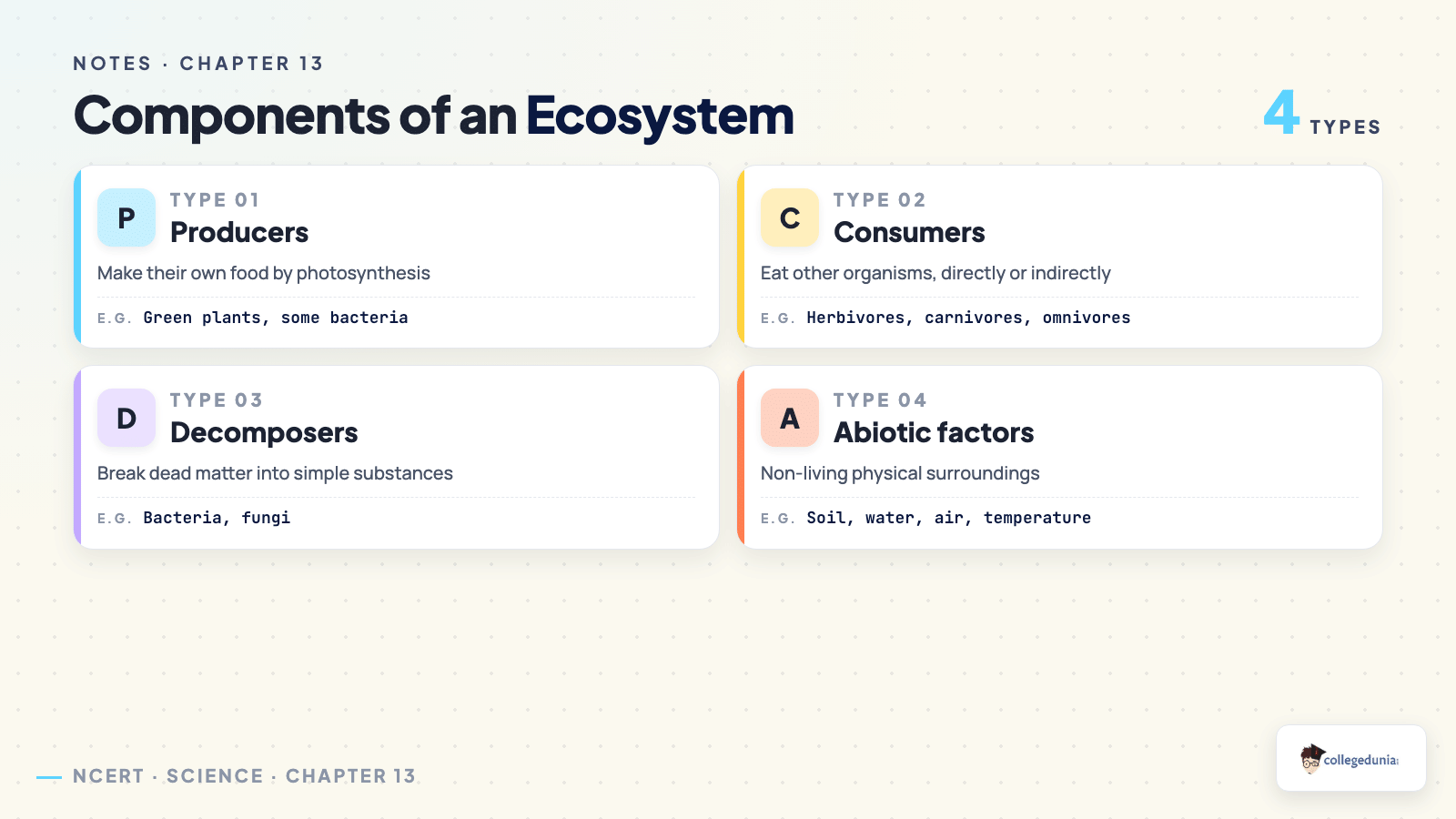
Producers are the gateway through which the Sun's energy enters the living world. Consumers cannot make their own food, so they feed on producers or on each other:
- Herbivores eat only plants (deer, goat, grasshopper).
- Carnivores eat only other animals (lion, frog, snake).
- Omnivores eat both plants and animals (crow, human, bear).
- Parasites live on or in a host and take food from it (ticks, lice).
Decomposers break down the dead bodies and waste of plants and animals into simple substances that return to the soil, where plants use them again. So decomposers complete the cycle of materials and keep the soil fertile.
Food Chain, Food Web and Trophic Levels in Class 10 Science
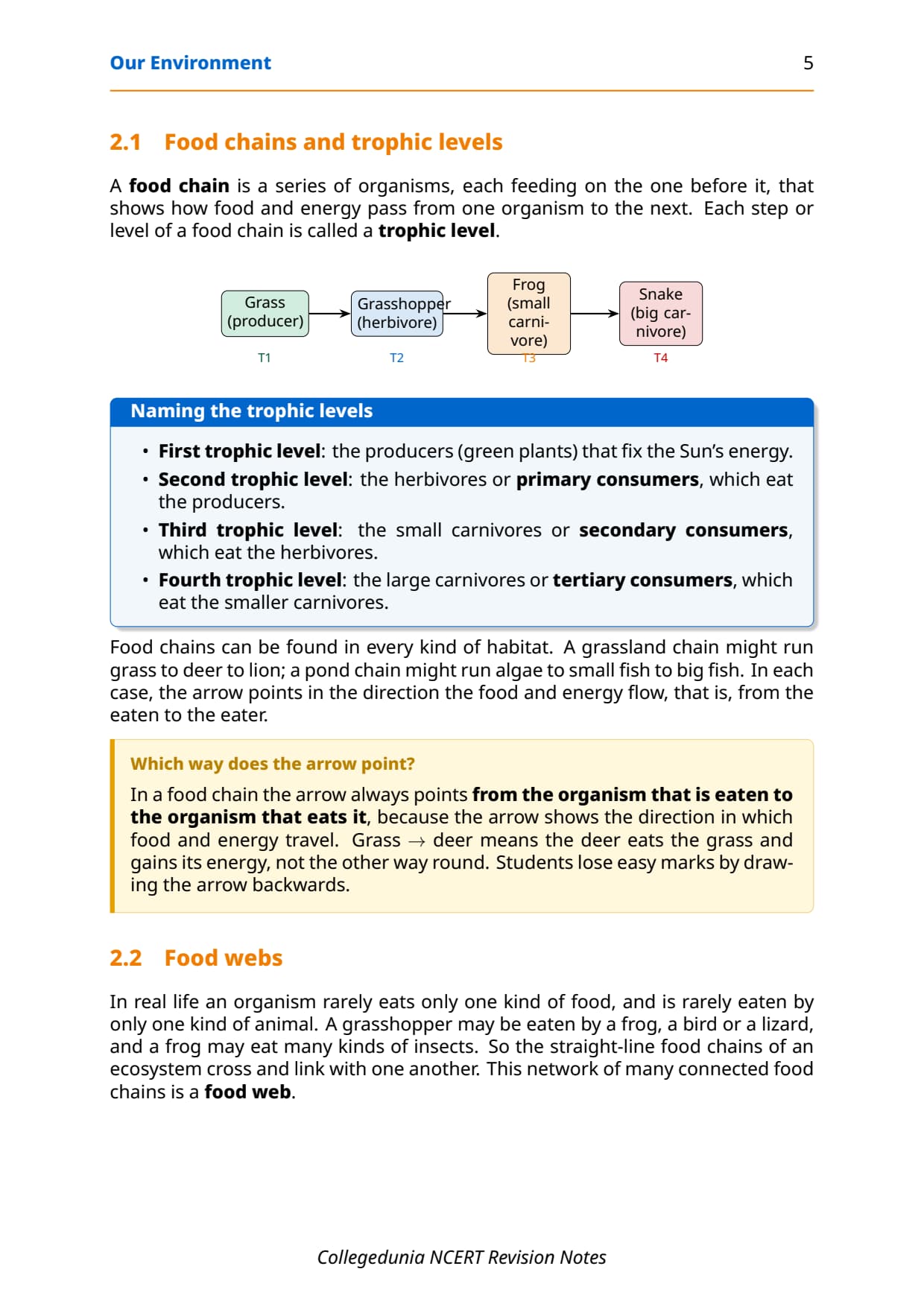
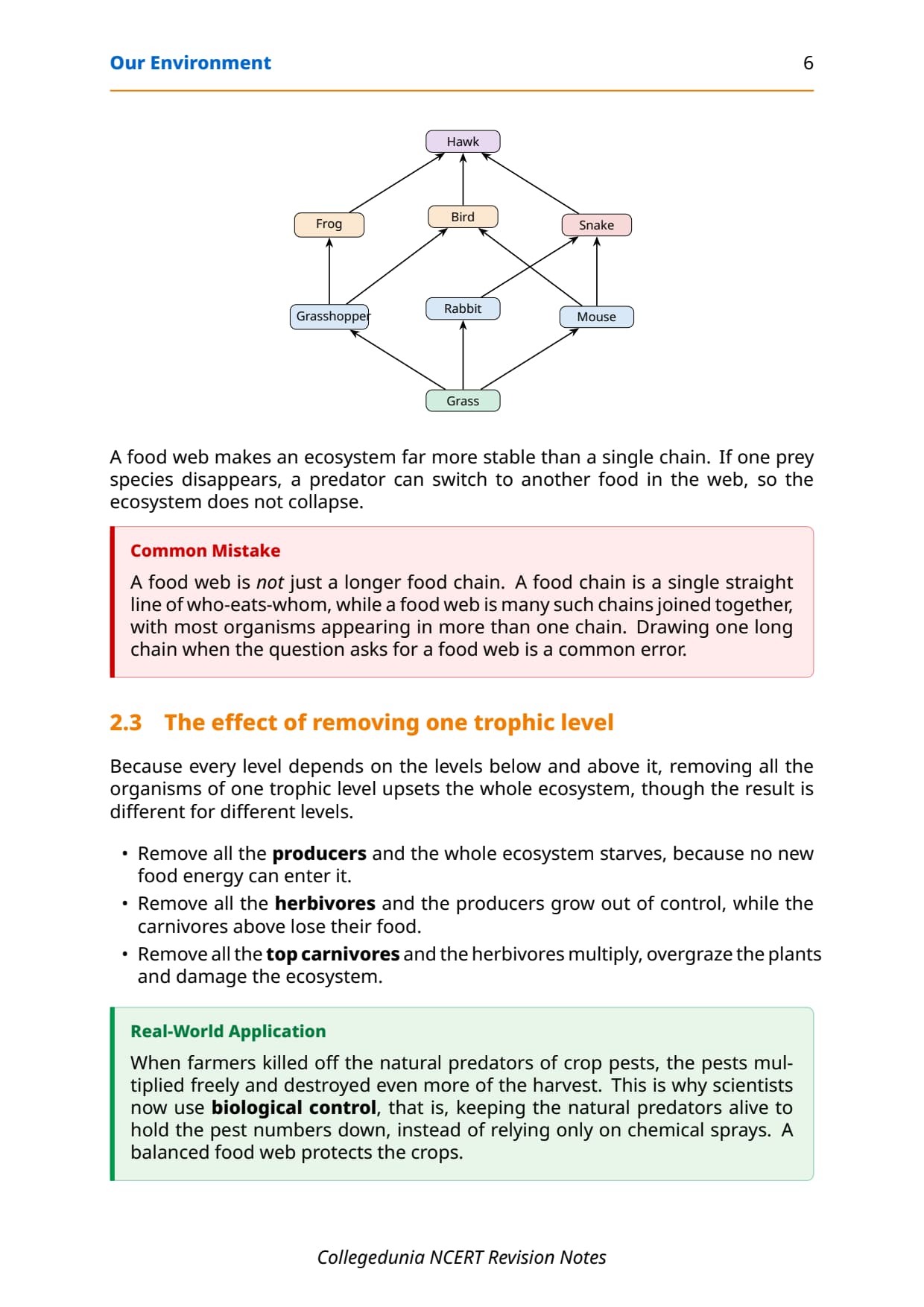
A food chain is a series of organisms, each feeding on the one before it, that shows how food and energy pass from one to the next. Each step is a trophic level: producers first (grass), then herbivores (deer), then small carnivores (frog), then large carnivores (snake). The arrow always points from the eaten to the eater, the direction food and energy travel. So grass to deer means the deer eats the grass, not the other way round. In real life an organism rarely eats only one kind of food, so the straight-line chains cross and link into a food web. This makes an ecosystem more stable, because if one prey species disappears, a predator can switch to another food in the web. Removing one whole trophic level still upsets the balance: remove the producers and the ecosystem starves, remove the herbivores and plants grow wild while carnivores starve, remove the top carnivores and herbivores multiply and overgraze.
Flow of Energy in an Ecosystem and the Ten Per Cent Law
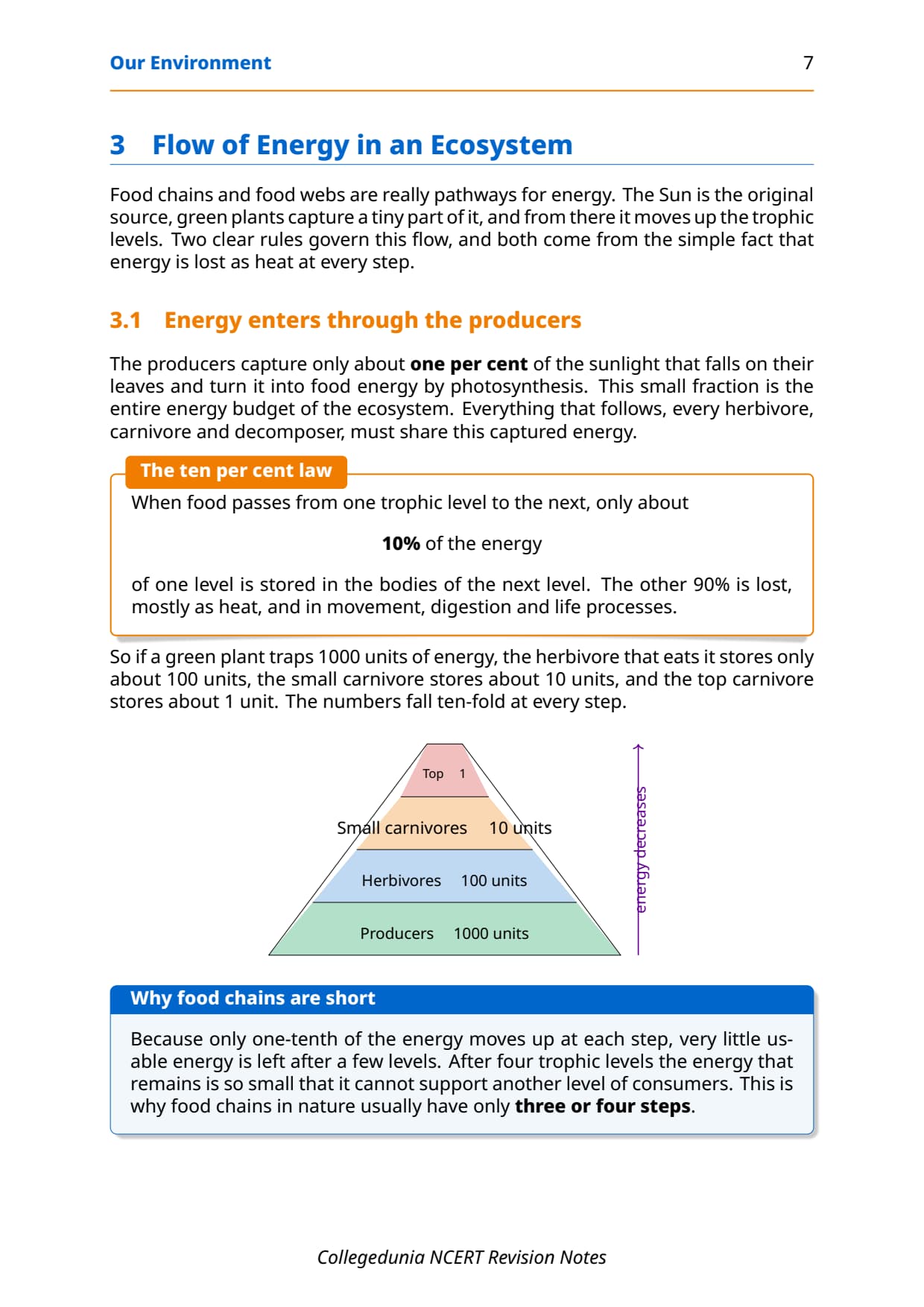
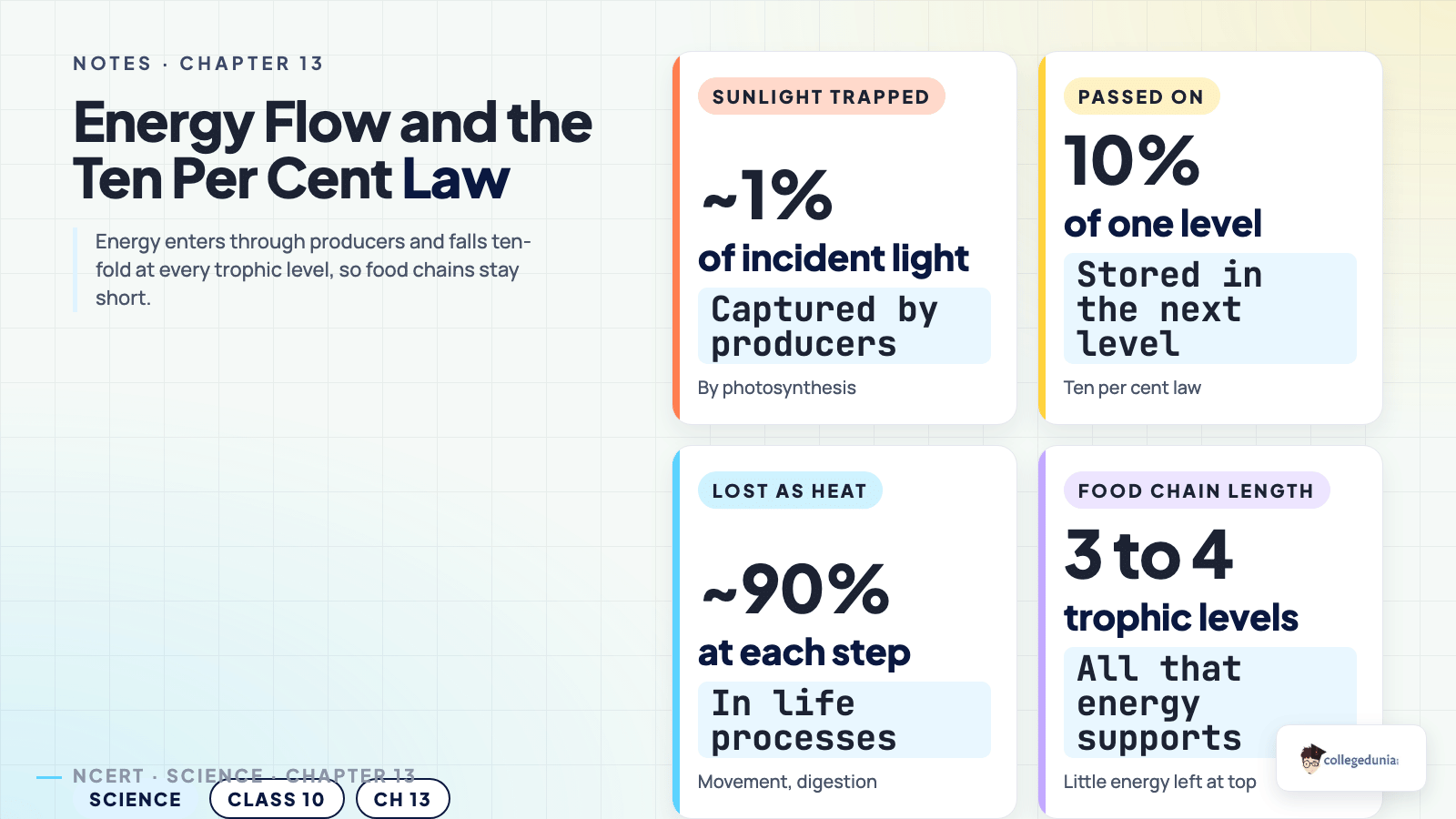
Food chains are really pathways for energy. The Sun is the source, and producers capture only about 1% of the sunlight falling on their leaves, the entire energy budget of the ecosystem. The diagram below shows how the energy shrinks at each step.
Worked example: A green plant fixes 20,000 J. How much reaches the third trophic level?
- Plant (T1): 20,000 J; herbivore (T2): 10% = 2,000 J; small carnivore (T3): 10% = 200 J.
Only 200 J of the original 20,000 J reaches T3. Almost all the energy is lost as heat.
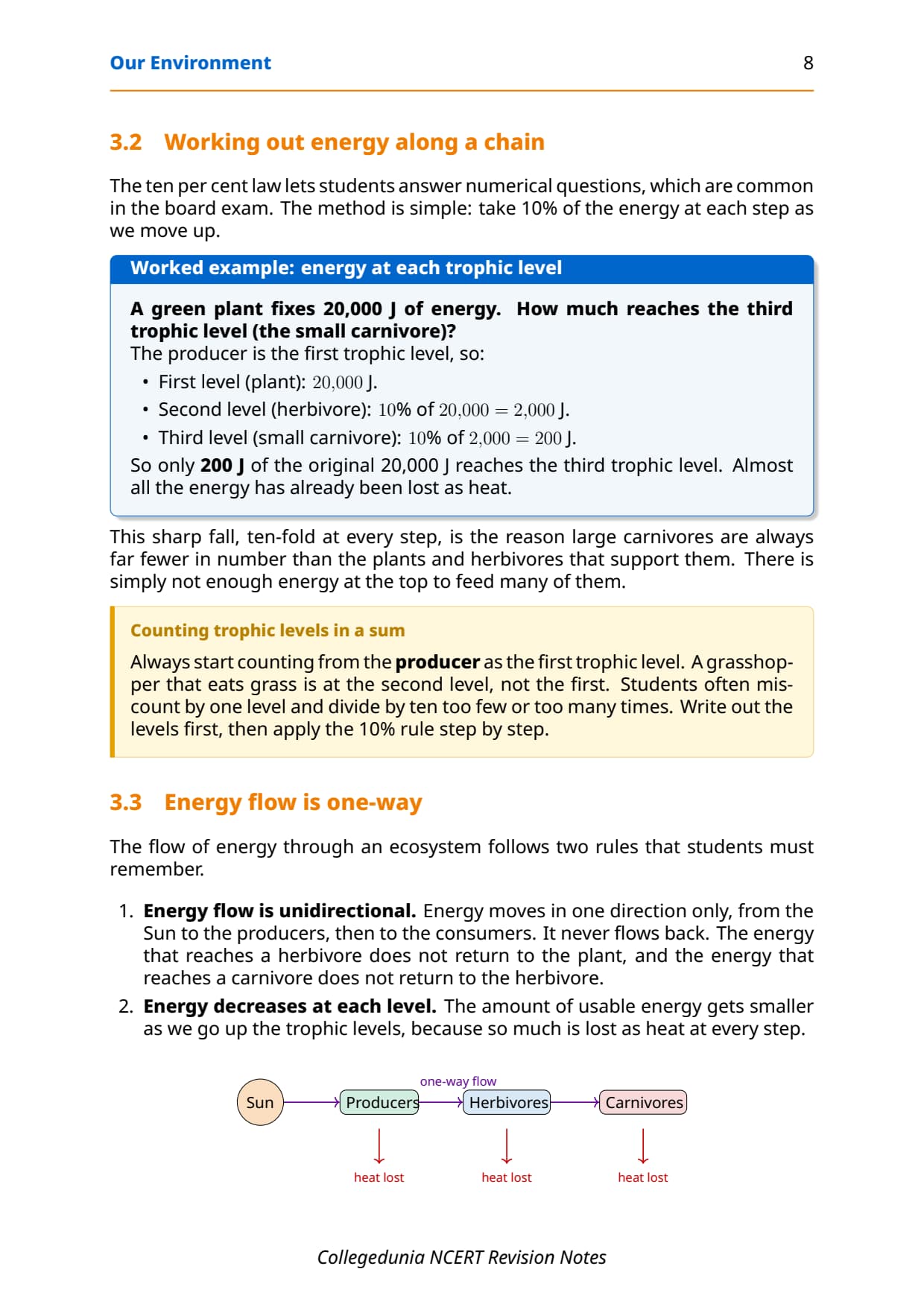
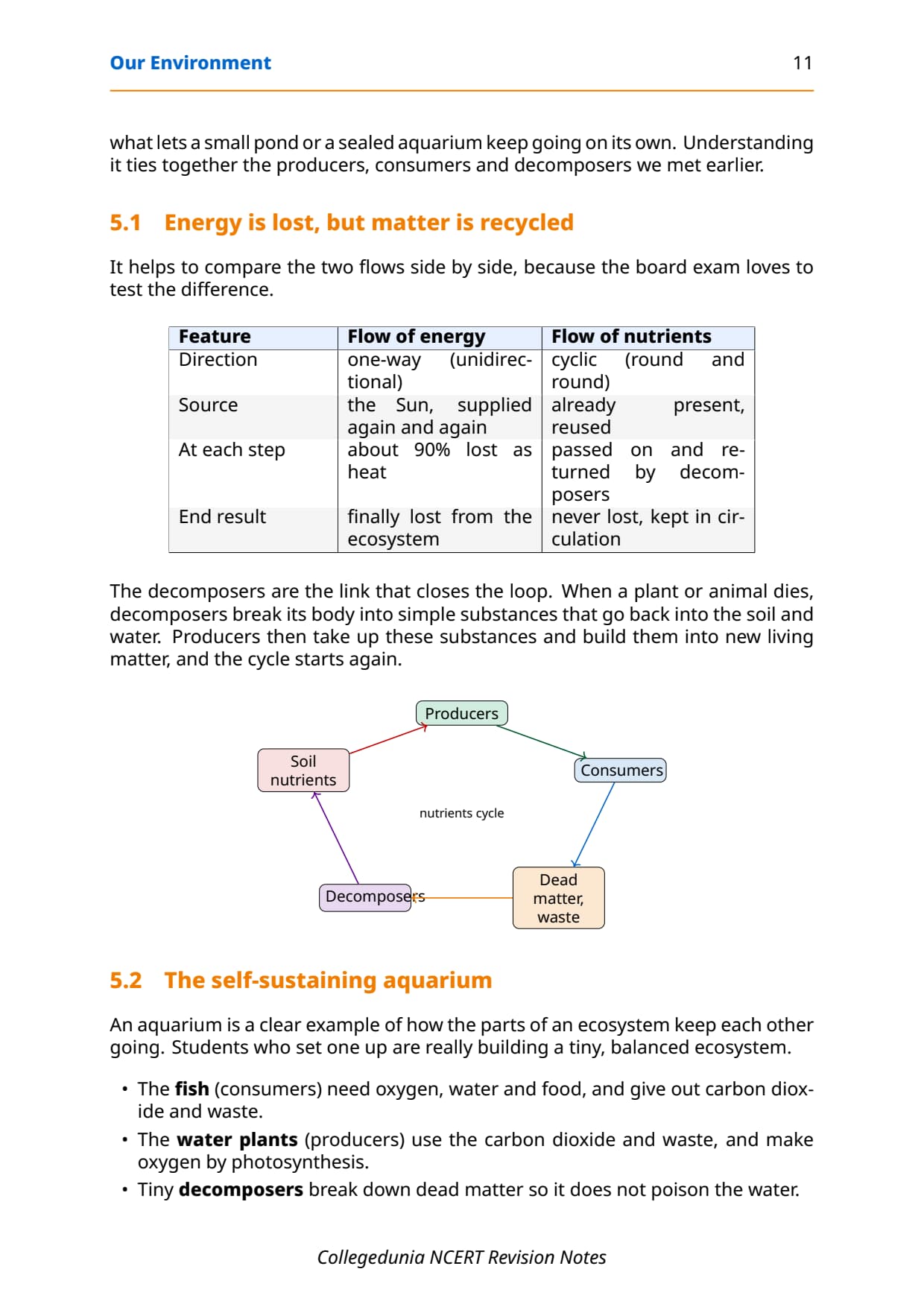
Energy flow follows two rules. First, it is unidirectional: from the Sun to producers to consumers, never back. Second, energy decreases at each level, lost as heat. This is why food chains usually have only three or four steps. Note the contrast with nutrients like carbon and nitrogen, which are recycled round and round by the decomposers instead of being lost.
Biological Magnification in a Food Chain
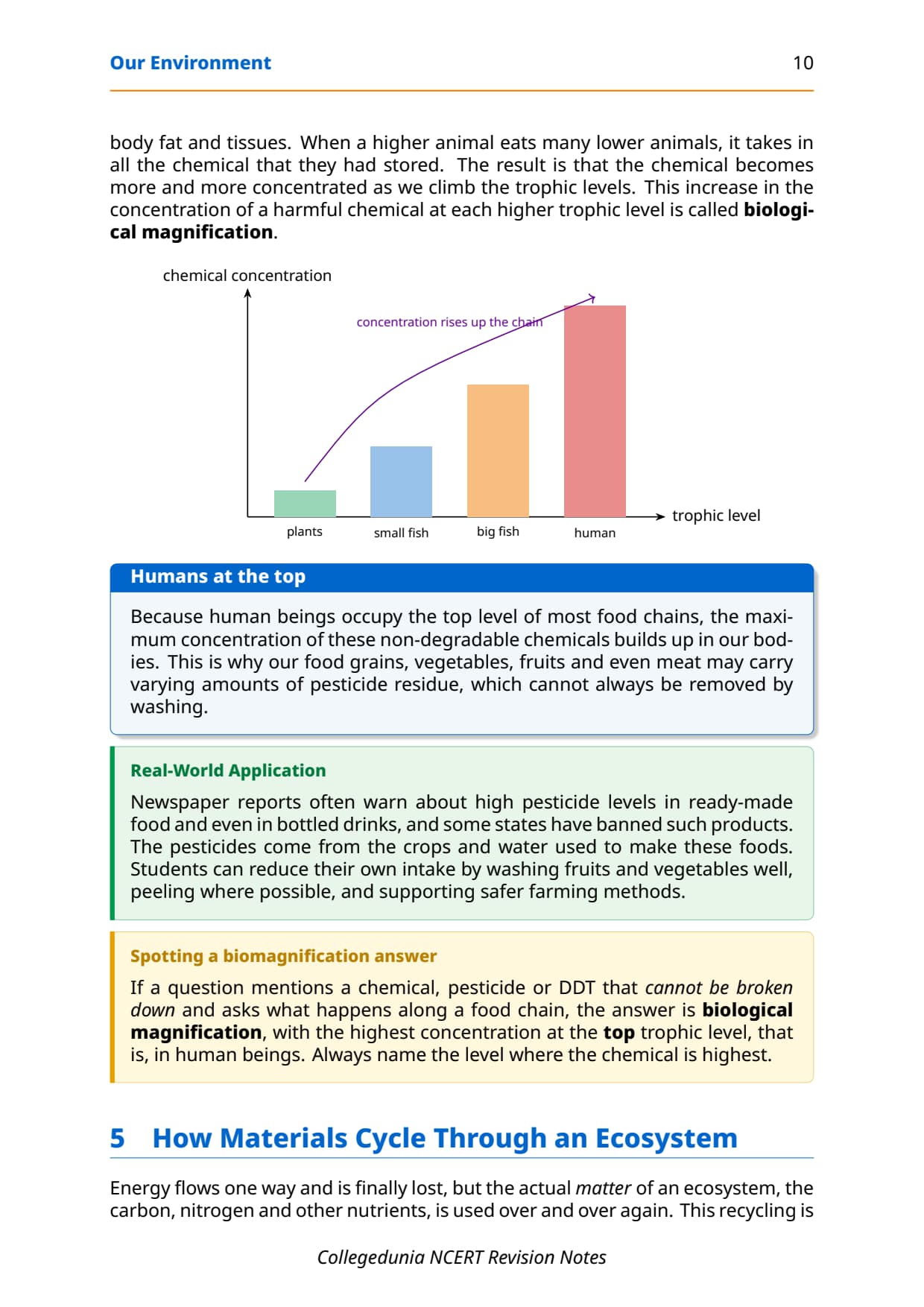
The same food chains that carry energy can also carry poison. Farmers use pesticides to protect crops, which rain washes into soil, rivers and lakes, where plants and water organisms absorb them, so they enter the food chain. Many are not degradable, so bodies cannot break them down and the chemical stays stored in fat and tissues. When a higher animal eats many lower animals, it takes in all the chemical they had stored, so the concentration becomes higher and higher as we climb the trophic levels. This increase at each higher level is called biological magnification.
So along a pond chain the concentration climbs from lowest in the water plants, to higher in small fish, higher still in big fish, and highest in the human beings who eat them. Because human beings occupy the top level of most food chains, the maximum concentration of these non-degradable chemicals builds up in our bodies. This is why our food grains, vegetables, fruits and even meat may carry pesticide residue that washing cannot always remove.
The Ozone Layer and Its Depletion in Class 10 Science
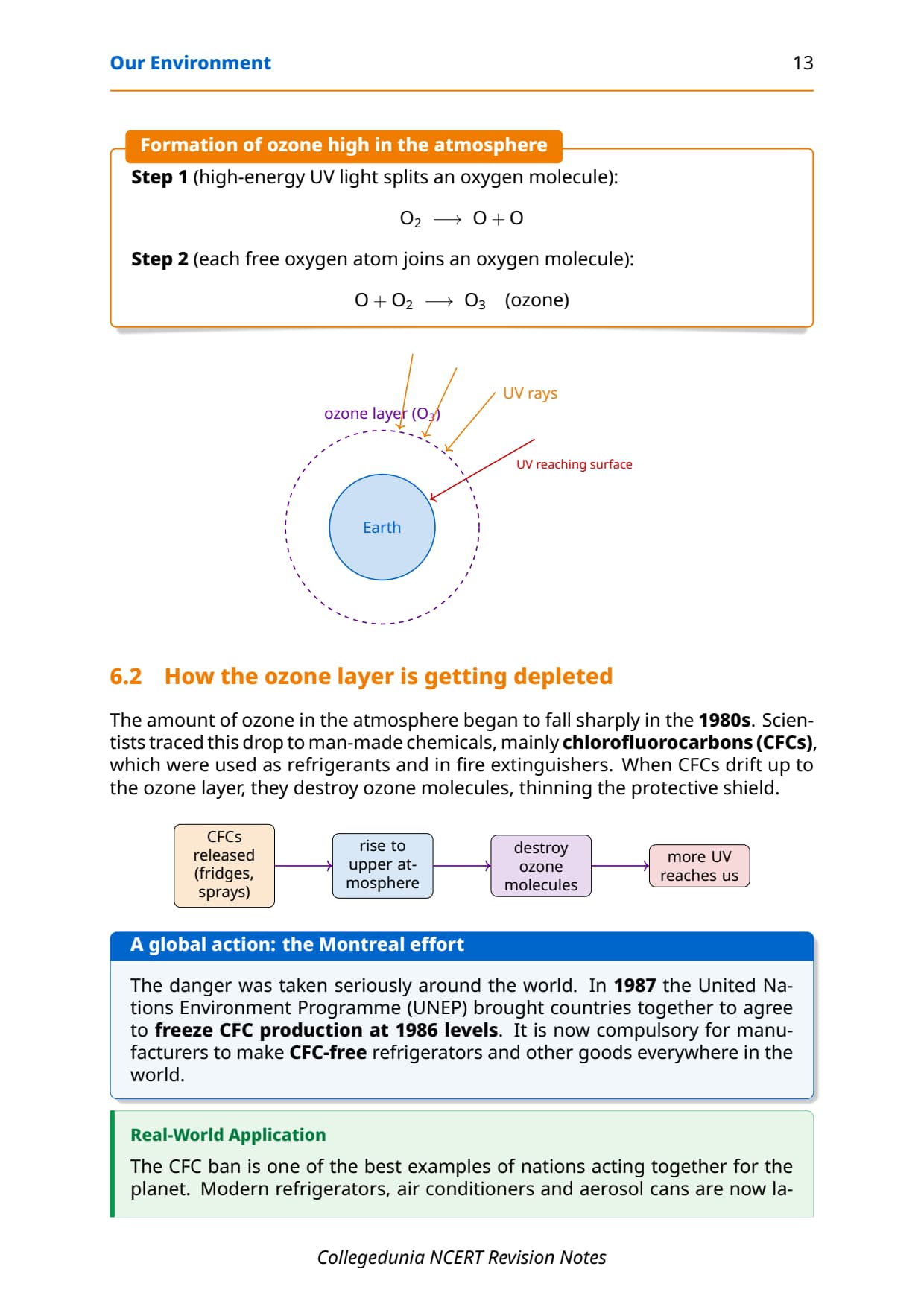
Ozone (O3) is a molecule of three oxygen atoms, and where it sits decides whether it helps or harms. Near the ground it is a deadly poison, but high in the atmosphere it forms a layer that shields the Earth from ultraviolet (UV) radiation. UV is highly damaging and causes skin cancer in humans, so the ozone shield protects our health. High up, ozone forms when UV rays split an oxygen molecule into free atoms, and each free atom joins another oxygen molecule:
Step 1 (UV light splits oxygen): O2 → O + O
Step 2 (free atom joins oxygen): O + O2 → O3 (ozone)
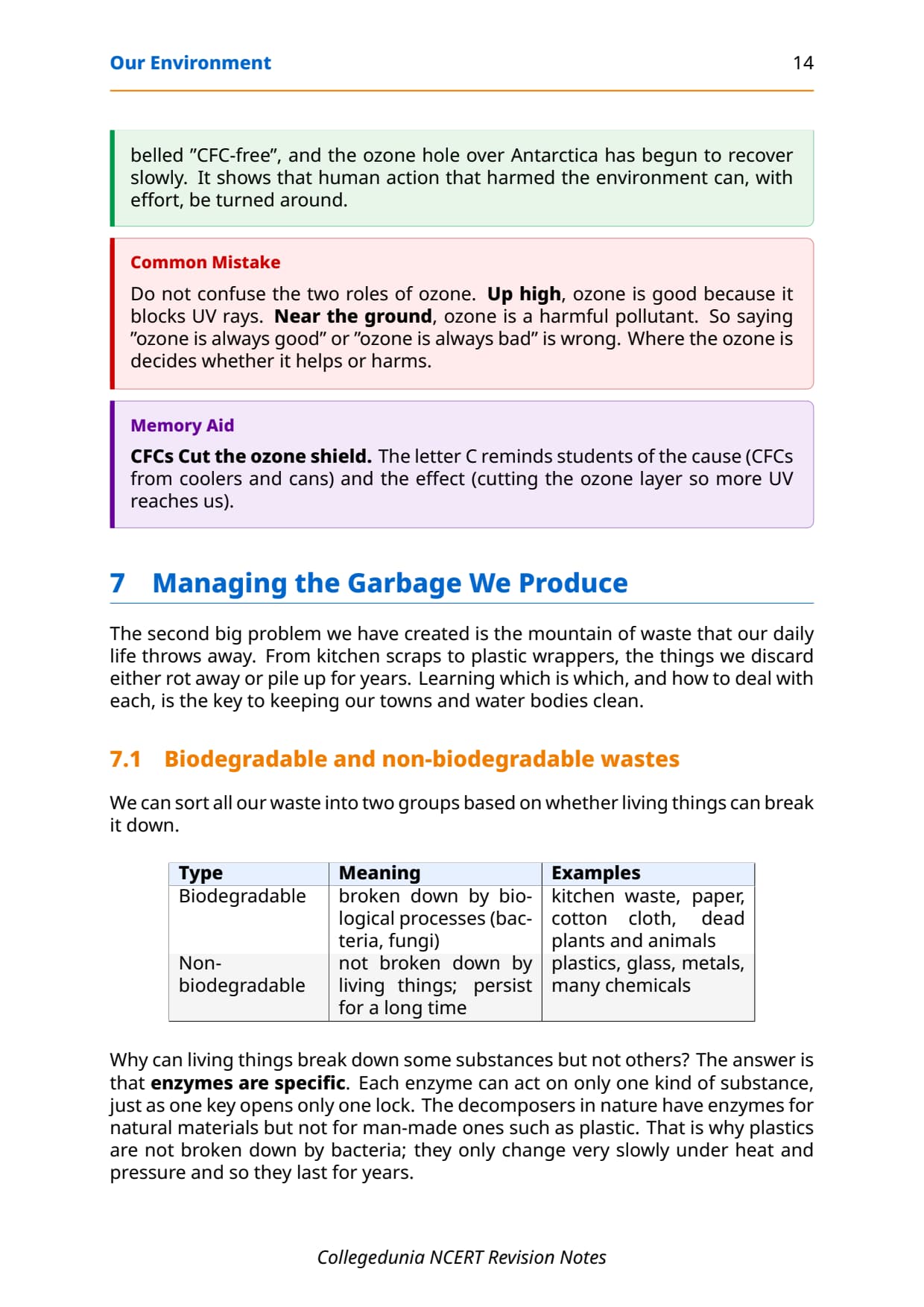
Ozone began to fall sharply in the 1980s. The drop was traced to man-made chlorofluorocarbons (CFCs), released from refrigerators, air conditioners and aerosol sprays. They drift up to the upper atmosphere, break apart ozone molecules and thin the layer, so more harmful UV reaches the surface. In 1987 the world acted together: a UNEP agreement froze CFC production at 1986 levels, and CFC-free goods are now compulsory. Remember the two roles of ozone: up high it shields us from UV, near the ground it is a harmful pollutant.
Biodegradable and Non-biodegradable Waste Management
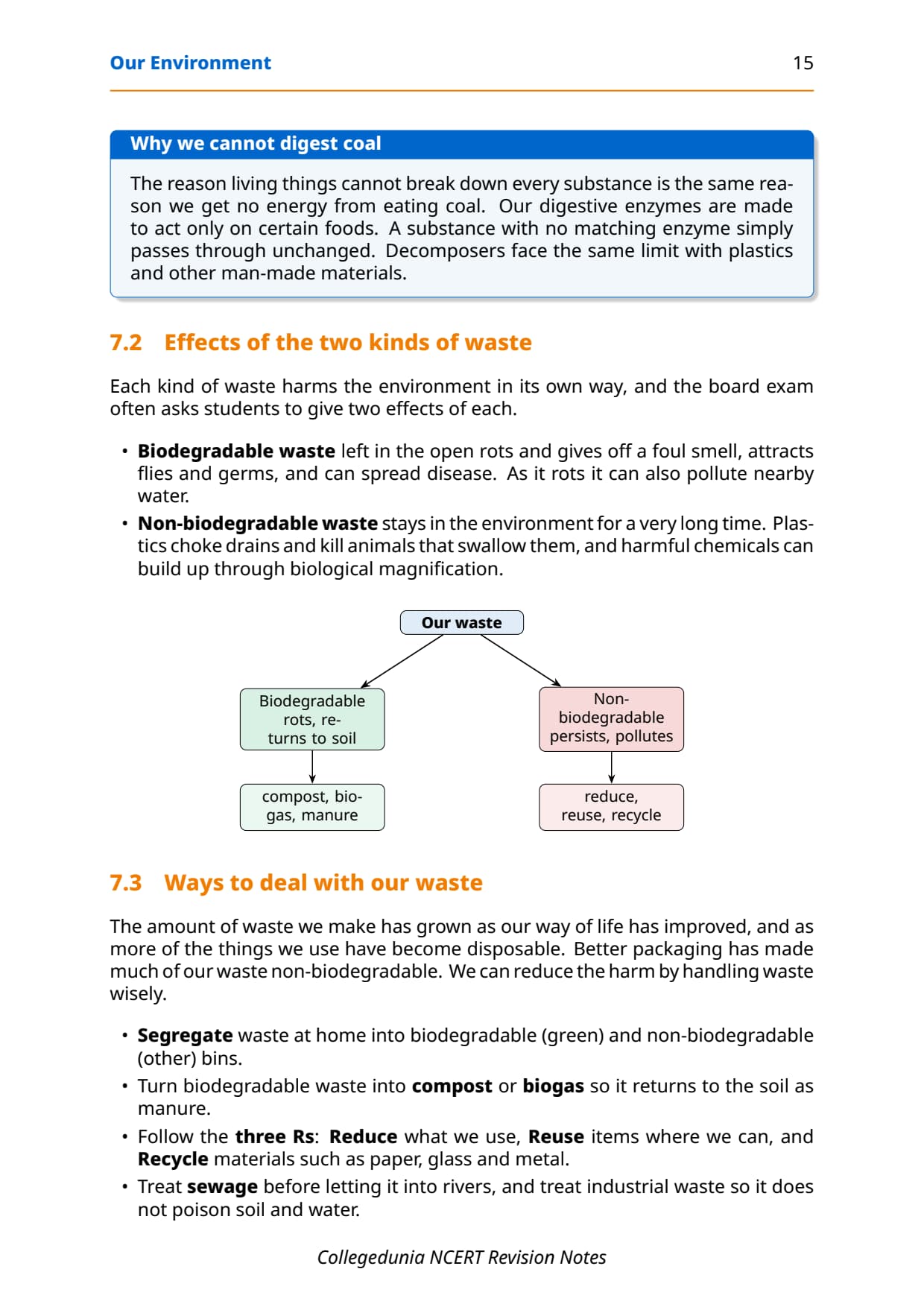
The second big problem is the mountain of waste our daily life throws away. We sort it into two groups by whether living things can break it down. Biodegradable waste is broken down by bacteria and fungi: kitchen waste, paper, cotton cloth, dead plants and animals. Non-biodegradable waste is not, and persists for a long time: plastics, glass, metals and many chemicals.
Living things break down some substances but not others because enzymes are specific: each acts on only one kind of substance, like one key for one lock. Decomposers have enzymes for natural materials but not for man-made ones such as plastic, which is why plastics last for years. Each kind of waste harms in its own way: biodegradable waste left in the open rots, smells foul, attracts flies and germs and can pollute water; non-biodegradable waste persists, chokes drains, kills animals that swallow it, and builds up through biological magnification.
We reduce the harm by handling waste wisely: turn biodegradable waste into compost or biogas, treat sewage before letting it into rivers, and follow the three Rs in order, Reduce (make less waste), then Reuse (use the same item again), then Recycle (remake the material into something new).
One-Glance Revision Strip and Common Exam Traps
These are the traps that cost students marks in Our Environment board answers every year. Read them in the last five minutes before the exam.
The repeat-offender mistakes:
- Drawing the food-chain arrow backwards: the arrow points from the eaten to the eater, the direction energy flows.
- Saying 10% is lost: about 10% is passed on to the next level and about 90% is lost as heat.
- Miscounting trophic levels: always count the producer as the first level before applying the 10% rule.
- Calling ozone always good or always bad: up high it shields us; near the ground it is a pollutant.
- Confusing the two wastes: biodegradable rots and pollutes water, non-biodegradable persists and chokes drains.
Other Resources for Class 10 Science Chapter 13 Our Environment
Pair these revision notes with the matching NCERT Solutions, handwritten notes, the formula and key-facts sheet and the official NCERT book chapter. All resources for Class 10 Science Chapter 13 Our Environment are linked below.
| Resource | What it covers | Open |
|---|---|---|
| Notes | Concept-first revision notes on ecosystems, food chains, energy flow, biological magnification, ozone and waste. | You are here |
| NCERT Solutions | Step-by-step answers to all the exercise questions, with an Expert Solution for each. | Class 10 Science Chapter 13 NCERT Solutions |
| Handwritten Notes | Scanned-style handwritten pages for last-minute board revision. | Class 10 Science Chapter 13 Handwritten Notes |
| Formula Sheet | Quick key-facts reference: trophic levels, the 10% law and key terms on one page. | Class 10 Science Chapter 13 Formula Sheet |
| NCERT Book PDF | Official NCERT Science Chapter 13 Our Environment textbook in PDF form. | Class 10 Science Chapter 13 NCERT Book PDF |
Notes for Class 10 Science: All Chapters
Related Links: Use the table below to open the revision notes for the other chapters of Class 10 Science. Every chapter ships with the same concept-first notes style, full PDF download, and revision FAQ.
| Chapter | Notes link |
|---|---|
| Chapter 1 | Chemical Reactions and Equations Notes |
| Chapter 2 | Acids, Bases and Salts Notes |
| Chapter 3 | Metals and Non-metals Notes |
| Chapter 4 | Carbon and its Compounds Notes |
| Chapter 5 | Life Processes Notes |
| Chapter 6 | Control and Coordination Notes |
| Chapter 7 | How do Organisms Reproduce? Notes |
| Chapter 8 | Heredity Notes |
| Chapter 9 | Light - Reflection and Refraction Notes |
| Chapter 10 | The Human Eye and the Colourful World Notes |
| Chapter 11 | Electricity Notes |
| Chapter 12 | Magnetic Effects of Electric Current Notes |
| Chapter 13 | Our Environment Notes (You are here) |
Notes Class 10 Science Chapter 13 Our Environment FAQs
Ques. What does Chapter 13 Our Environment cover in Class 10 Science?
Ans. Chapter 13 covers how the living and non-living things of an area work together as one unit called an ecosystem. The notes explain biotic and abiotic components, producers, consumers and decomposers, food chains, food webs and trophic levels, the one-way flow of energy and the ten per cent law, biological magnification, the ozone layer and its depletion by CFCs, and the management of biodegradable and non-biodegradable waste through the three Rs, all aligned with the 2026-27 CBSE syllabus.
Ques. What is the ten per cent law in the flow of energy?
Ans. The ten per cent law states that when food passes from one trophic level to the next, only about 10% of the energy stored at one level is transferred to the bodies of the next level. The remaining 90% is lost, mostly as heat and in life processes such as movement, respiration and digestion. Because so little energy carries over at each step, very little is left after a few levels, which is why food chains in nature usually have only three or four trophic levels.
Ques. What is biological magnification and why is it highest in humans?
Ans. Biological magnification is the increase in the concentration of a harmful, non-degradable chemical, such as a pesticide, at each higher trophic level of a food chain. These chemicals cannot be broken down by living bodies, so they stay stored in body fat and tissues. When a higher animal eats many lower animals, it takes in all the chemical they had stored, so the concentration keeps rising up the chain. Because human beings sit at the top of most food chains, the maximum concentration builds up in our bodies.
Ques. Why is the flow of energy in an ecosystem unidirectional?
Ans. The flow of energy is unidirectional because energy moves in one direction only, from the Sun to the producers, then to the herbivores, and then to the carnivores, and it never flows back. The energy that reaches a herbivore does not return to the plant, and the energy that reaches a carnivore does not return to the herbivore. At every step a large part of the energy is lost as heat, so the Sun must keep supplying fresh energy. Nutrients, on the other hand, are recycled round and round by decomposers.
Ques. What is the difference between biodegradable and non-biodegradable waste?
Ans. Biodegradable waste is material that can be broken down into simple substances by biological processes, that is by the action of bacteria and fungi. Examples are kitchen waste, paper, cotton cloth, and dead plants and animals. Non-biodegradable waste cannot be broken down by living things and persists in the environment for a very long time. Examples are plastics, glass, metals and many chemicals. The reason living things break down some substances but not others is that enzymes are specific, so decomposers have no enzyme for man-made materials like plastic.
Ques. How is the ozone layer being depleted and what is being done about it?
Ans. The ozone layer, made of ozone (O3) high in the atmosphere, shields the Earth from harmful ultraviolet radiation. Its amount began falling sharply in the 1980s because of man-made chemicals, mainly chlorofluorocarbons (CFCs) used in refrigerators, air conditioners and aerosol sprays. When CFCs rise to the upper atmosphere they destroy ozone molecules, so more UV reaches the surface and can cause skin cancer. In 1987, the United Nations Environment Programme brought countries together to freeze CFC production at 1986 levels, and CFC-free goods are now made compulsory worldwide.
Ques. How many pages is the Class 10 Science Our Environment Notes PDF?
Ans. The Our Environment Notes PDF runs about 22 pages and covers the full chapter in concept-first revision blocks, with simple labelled diagrams, tables, worked numericals on the ten per cent law, common traps and a one-glance revision strip. The PDF is free to download for the 2026-27 session, and a green Handwritten Notes button on this page opens the scanned-style version for last-minute revision.
Ques. Are these Notes for Class 10 Science Chapter 13 aligned with the 2026-27 syllabus?
Ans. Yes. This page reflects the current 2026-27 CBSE syllabus for Class 10 Science. The Our Environment chapter is part of the current cycle, and these notes follow the NCERT textbook, covering ecosystems, food chains and food webs, the flow of energy and the ten per cent law, biological magnification, the ozone layer and CFCs, and biodegradable and non-biodegradable waste. The notes are written for the CBSE board exam and help students revise the whole chapter quickly.



Comments