




These Notes for Class 10 Science Chapter 10 The Human Eye and the Colourful World give a fast, concept-first revision of the whole chapter, built on the 2026-27 CBSE syllabus: the structure of the eye, the power of accommodation, the three defects of vision and their correcting lenses, dispersion through a prism, atmospheric refraction, and the scattering of light.
- Every defect of vision explained with its cause, the kind of lens that corrects it, and a fully solved lens-power numerical so you can attempt board questions with confidence.
- Full coverage of the human eye, accommodation, myopia, hypermetropia, presbyopia, prism, dispersion, VIBGYOR, atmospheric refraction and scattering of light with labelled diagrams.
- Notes aligned with the 2026-27 CBSE Class 10 Science syllabus and written for the board exam; no NEET or JEE references because this is a Class 10 board chapter.
These Collegedunia revision notes are curated by Science subject experts, mapped to the 2026-27 NCERT textbook, and refined against the last five years of CBSE Class 10 Science board papers.
Student Feedback: What 12,800 students told us about this chapter
76% of Class 10 students said they mixed up myopia and hypermetropia, choosing the wrong lens in the correction question. 3 out of 5 students told us that the one-line rule "Myopia, near clear, concave lens, negative power" stopped that slip for good before the board exam.
Toppers found that keeping atmospheric refraction (twinkling, early sunrise) separate from scattering (blue sky, red Sun) saved 10 to 15 minutes of confusion in the exam, and the average student spent 2 to 3 hours on these notes across the first read and the final revision.
Source: 2026-27 Class 10 Science student poll. Sample of 12,800 students from CBSE schools across 14 states, conducted before the 2026 boards.
What the Notes for Class 10 Science Chapter 10 The Human Eye and the Colourful World Cover
Why can your eye see both this line and a distant hill, and why does the sky look blue by day but red at sunset? This chapter answers both: it uses refraction by lenses to explain the human eye, then turns to light in nature, where a prism splits white light, air bends it, and tiny particles scatter it.
- The human eye: the parts of the eye, accommodation, and the near and far point of a normal eye.
- Defects of vision: myopia, hypermetropia and presbyopia, their causes, and the correcting lens for each.
- Light through a prism: refraction, angle of deviation, dispersion into VIBGYOR, and the rainbow.
- Light in the sky: atmospheric refraction (twinkling stars, early sunrise) and scattering (blue sky, red Sun).
Source: Magnet Brains on YouTube
The Human Eye: Structure and Working in Class 10 Science
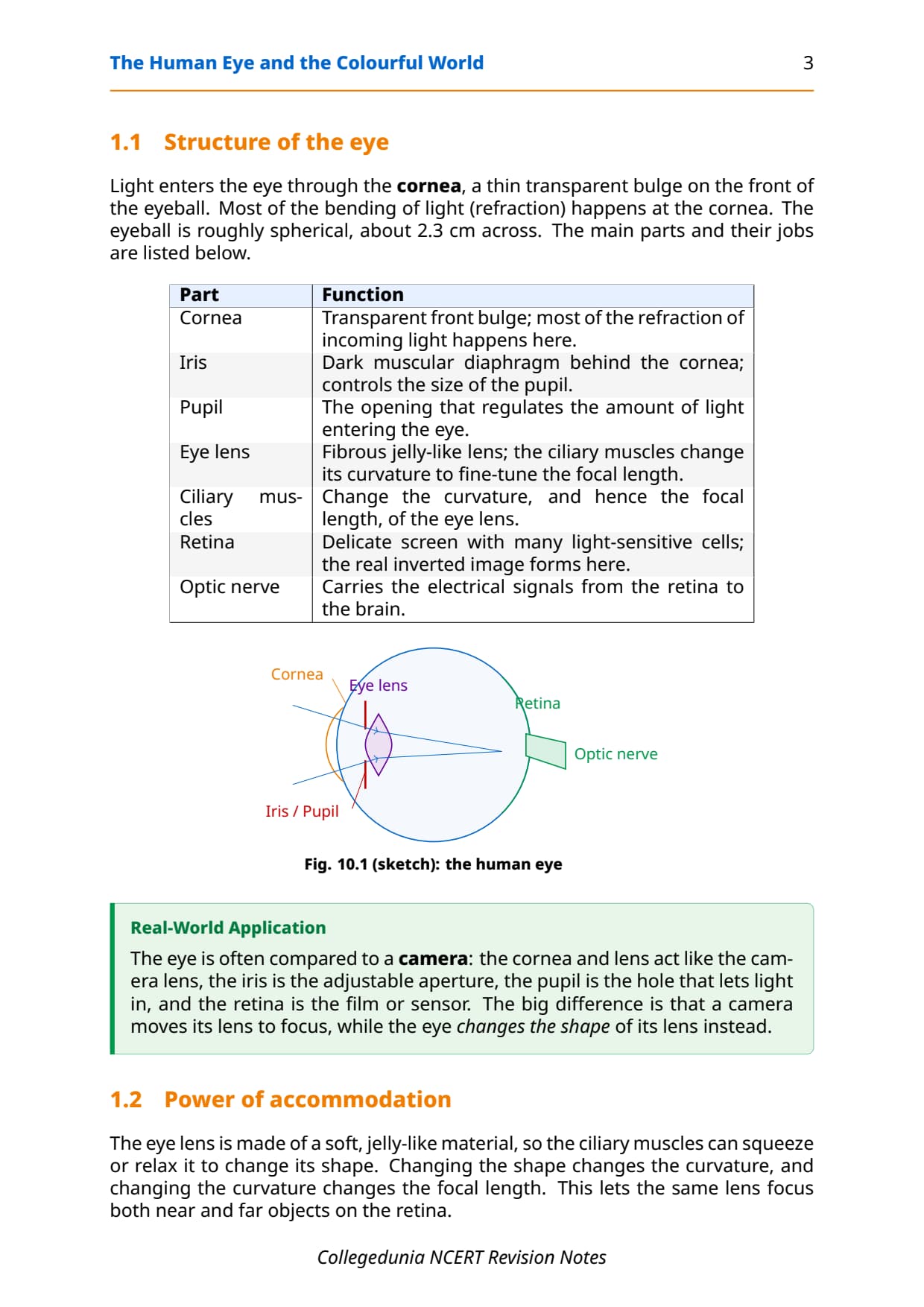
The human eye works like a camera. Light enters through the cornea, where most of the bending of light happens, then passes through the pupil and eye lens to form a real, inverted image on the retina, which the optic nerve carries to the brain as signals. Unlike a camera, which moves its lens to focus, the eye changes the shape of its lens.
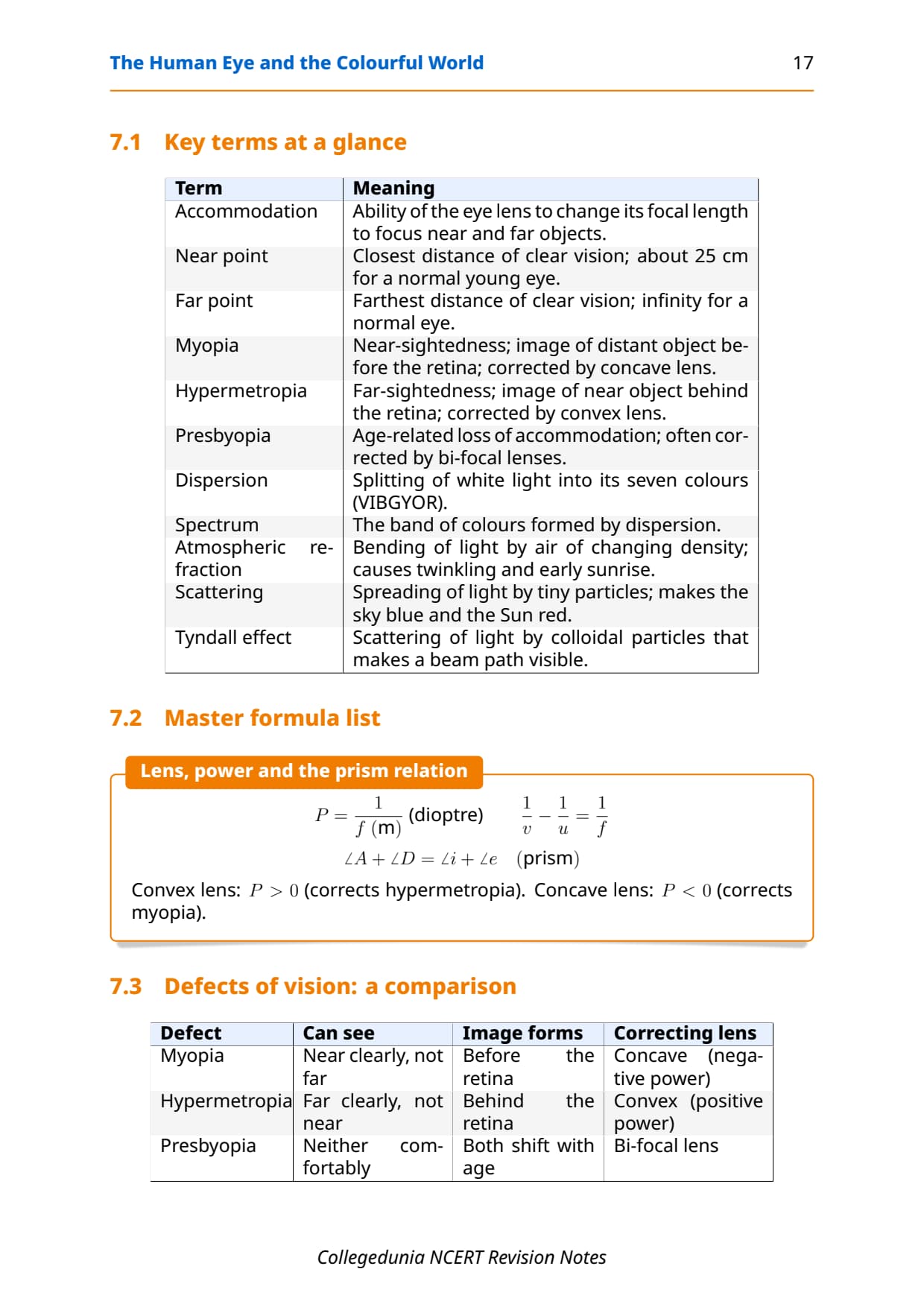
| Part of the eye | Its job |
|---|---|
| Cornea | Transparent front bulge; most refraction of light happens here |
| Iris | Muscular diaphragm that controls the size of the pupil |
| Pupil | Opening that regulates how much light enters the eye |
| Eye lens | Ciliary muscles change its curvature to fine-tune the focal length |
| Retina | Light-sensitive screen where the real, inverted image forms |
Power of Accommodation, Near Point and Far Point in Class 10 Science
The ciliary muscles squeeze or relax the soft eye lens to change its focal length. This ability to keep near and far objects both sharp is the power of accommodation: the muscles relax and the lens thins for distant objects, and contract and thicken it for near ones. The focal length cannot drop below a minimum, so very close objects look blurred.
| Limit | Meaning | Normal eye |
|---|---|---|
| Near point | Closest distance of clear vision (least distance of distinct vision) | About 25 cm |
| Far point | Farthest distance the eye sees clearly | Infinity |
Defects of Vision and Their Correction in Class 10 Science
When the eyeball or lens has the wrong shape, the image no longer forms on the retina and vision blurs. There are three defects of vision, and naming the right correcting lens is the most-asked part of the chapter.
- Myopia (near-sightedness): sees near but not far; image forms before the retina; corrected with a concave lens.
- Hypermetropia (far-sightedness): sees far but not near; image forms behind the retina; corrected with a convex lens.
- Presbyopia: age weakens the ciliary muscles, so the near point recedes; corrected with bi-focal lenses.
| Defect | Can see | Image forms | Correcting lens |
|---|---|---|---|
| Myopia | Near clearly, not far | Before the retina | Concave (negative power) |
| Hypermetropia | Far clearly, not near | Behind the retina | Convex (positive power) |
| Presbyopia | Neither comfortably | Both limits shift with age | Bi-focal lens |
Lens Power Numericals for Defects of Vision in Class 10 Science
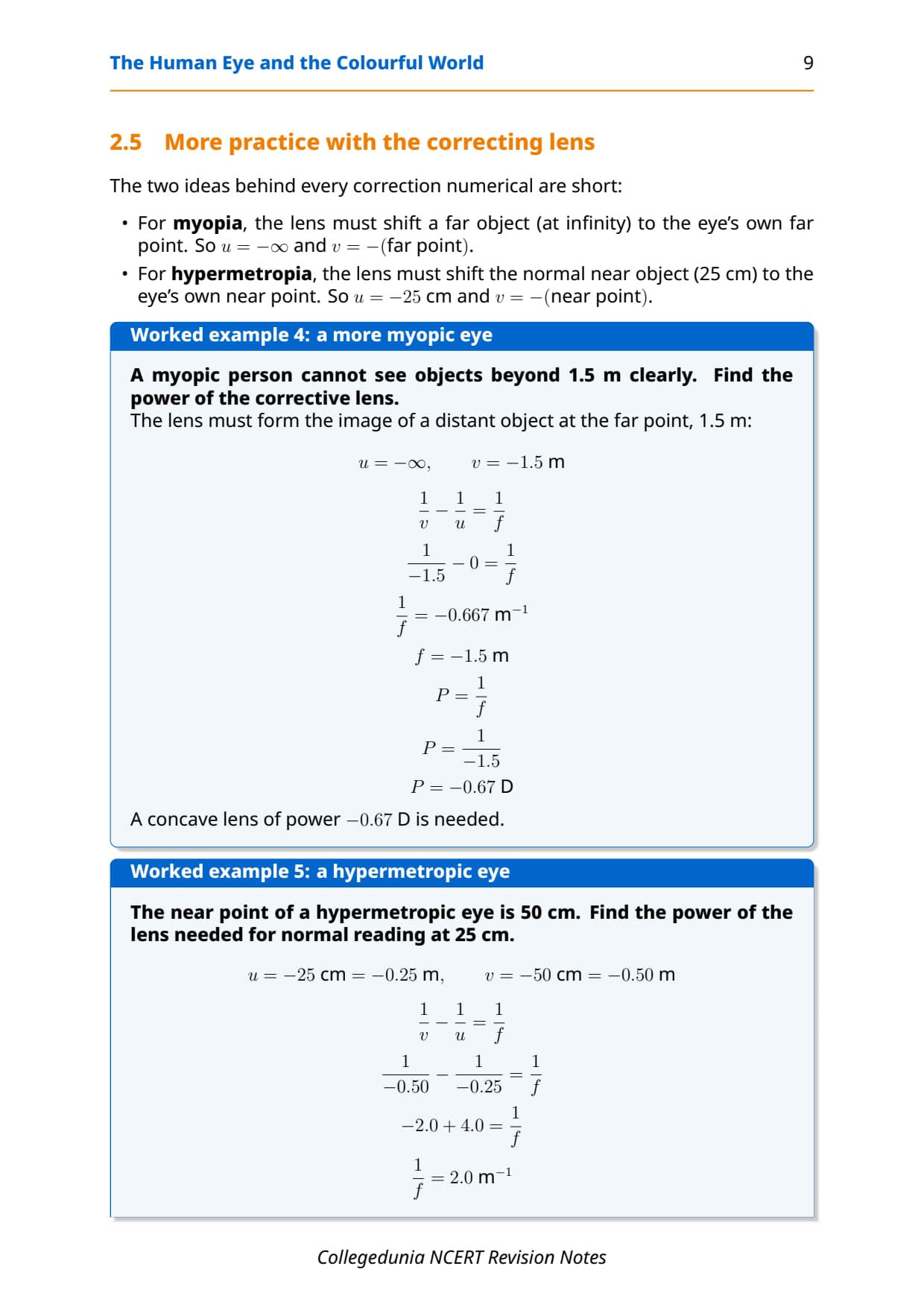
The correcting lens is described by its power in dioptre (D). Getting the signs right is the whole game: a convex lens has positive power, a concave lens negative.
Lens formula: 1/v − 1/u = 1/f
For myopia, the lens shifts a far object (at infinity) onto the eye's own far point. The worked example below is the classic 3-mark question:
Given: u = −∞, v = −80 cm = −0.80 m
1/f = 1/v − 1/u = 1/(−0.80) − 0 = −1.25
f = −0.80 m, so P = 1/f = −1.25 D
Answer: a concave lens of power −1.25 D is required.
Refraction of Light Through a Prism in Class 10 Science
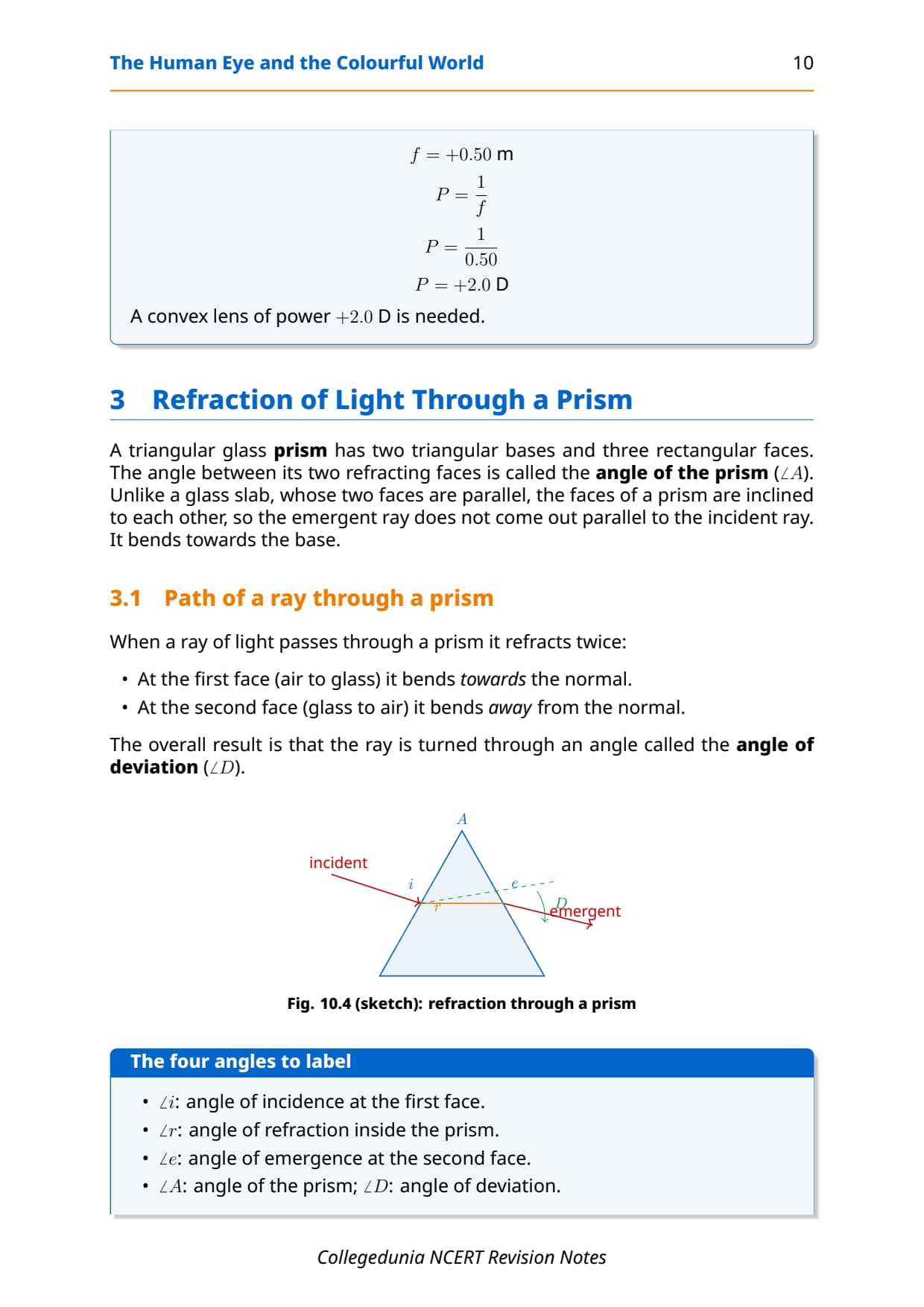
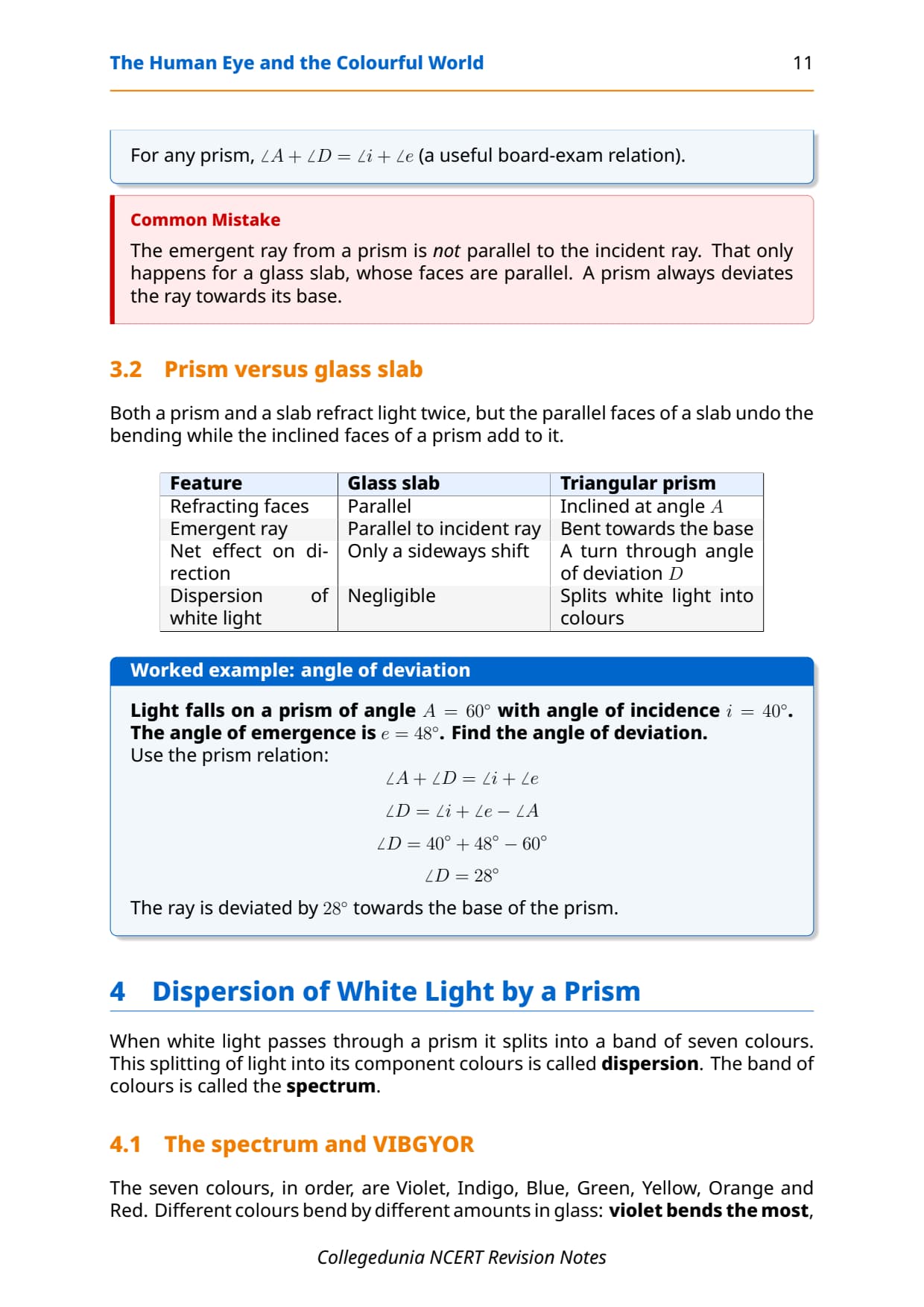
A triangular glass prism has inclined faces, so a ray refracts twice and the emergent ray is not parallel to the incident ray: it bends towards the base. The overall turn is the angle of deviation (D), linked to the prism angle (A) and the angles of incidence (i) and emergence (e).
Dispersion of White Light and VIBGYOR in Class 10 Science
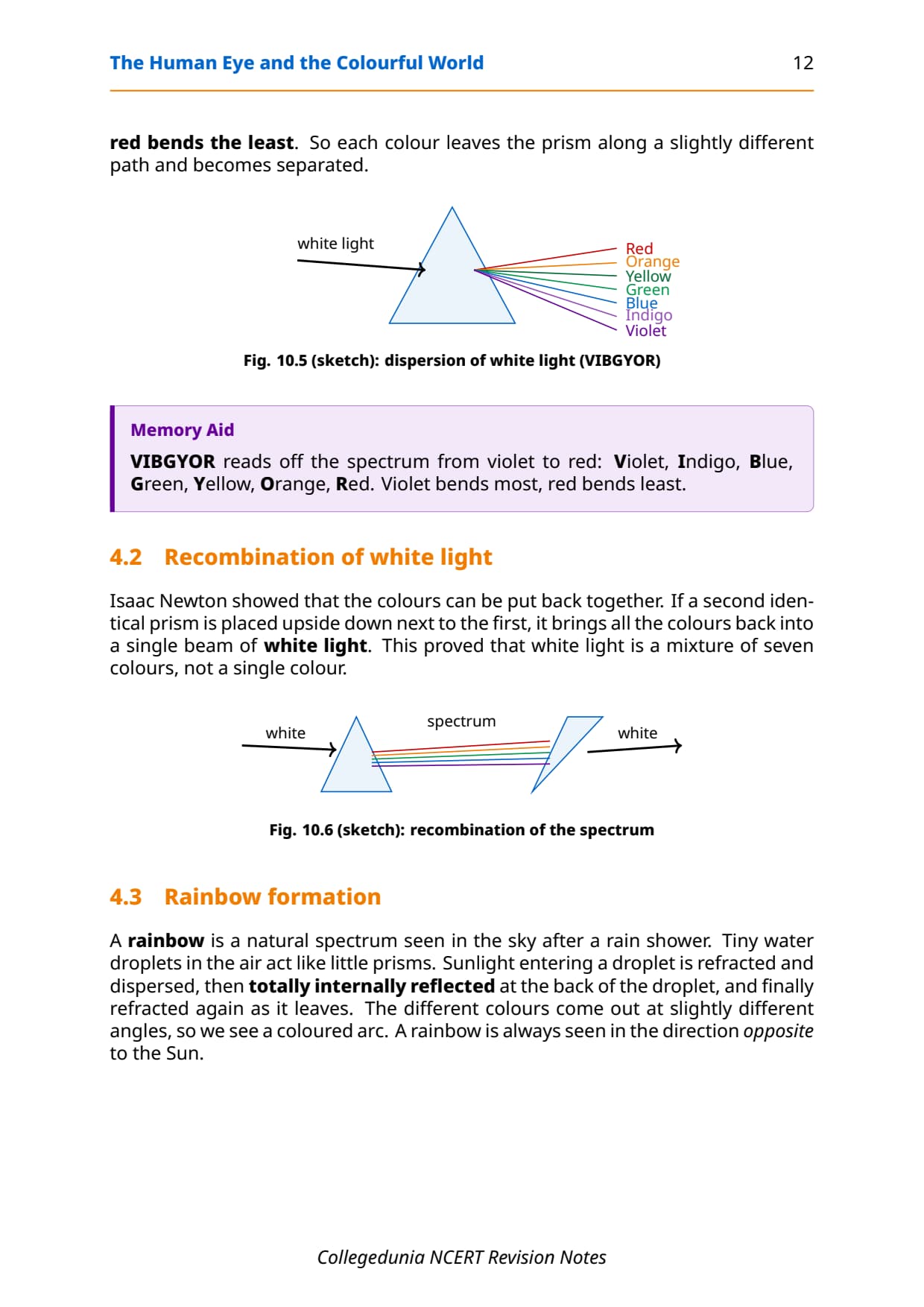
When white light passes through a prism it splits into a band of seven colours called the spectrum. This splitting is dispersion. It happens because violet bends the most and red the least, so each colour leaves along a slightly different path.
- The seven colours, in order, are VIBGYOR: Violet, Indigo, Blue, Green, Yellow, Orange, Red.
- A second, inverted prism recombines the colours into white light, proving white light is a mixture of seven colours.
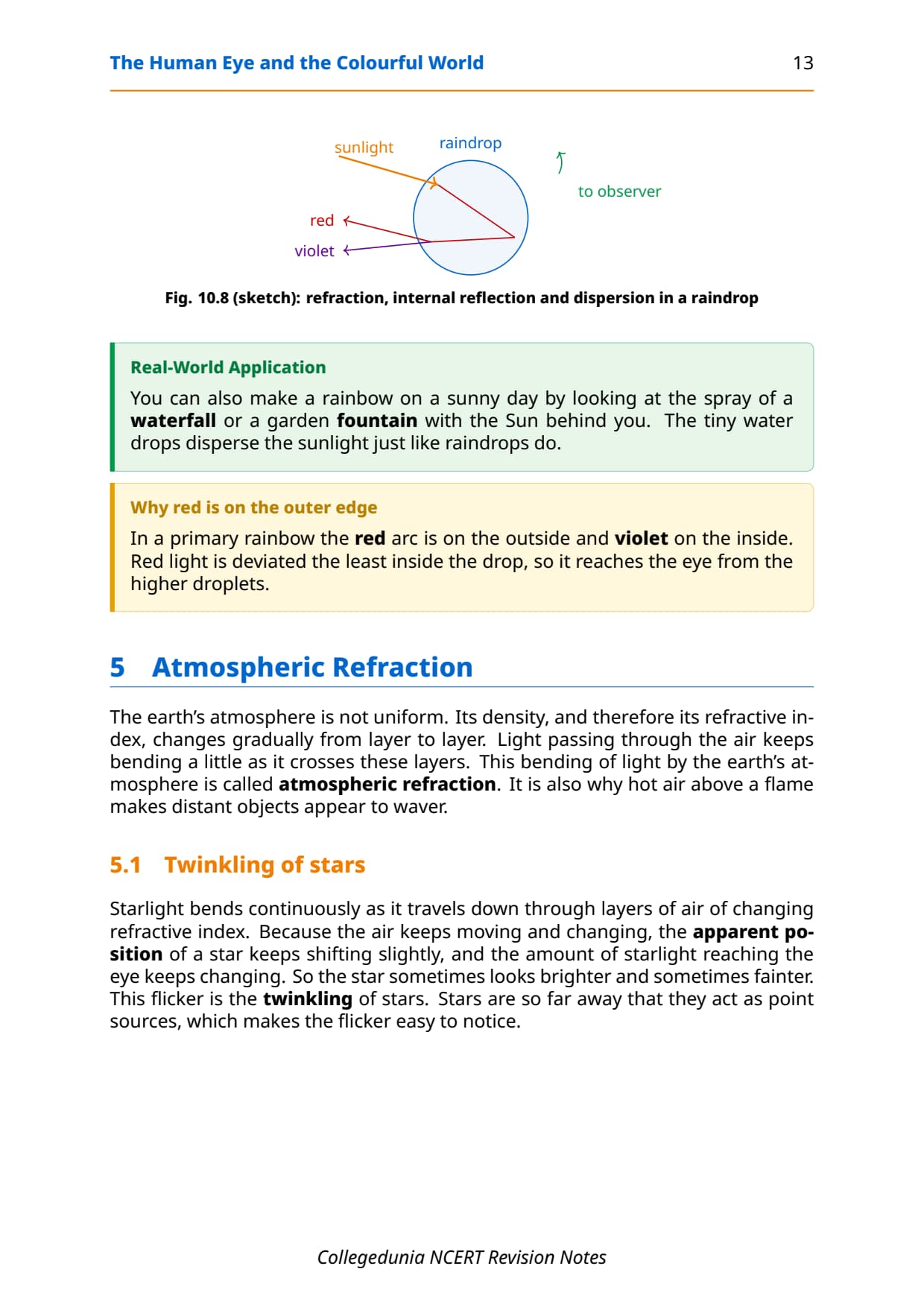
- A rainbow is a natural spectrum: water droplets refract, internally reflect and disperse sunlight, always opposite the Sun.
Atmospheric Refraction: Twinkling Stars and Early Sunrise in Class 10 Science
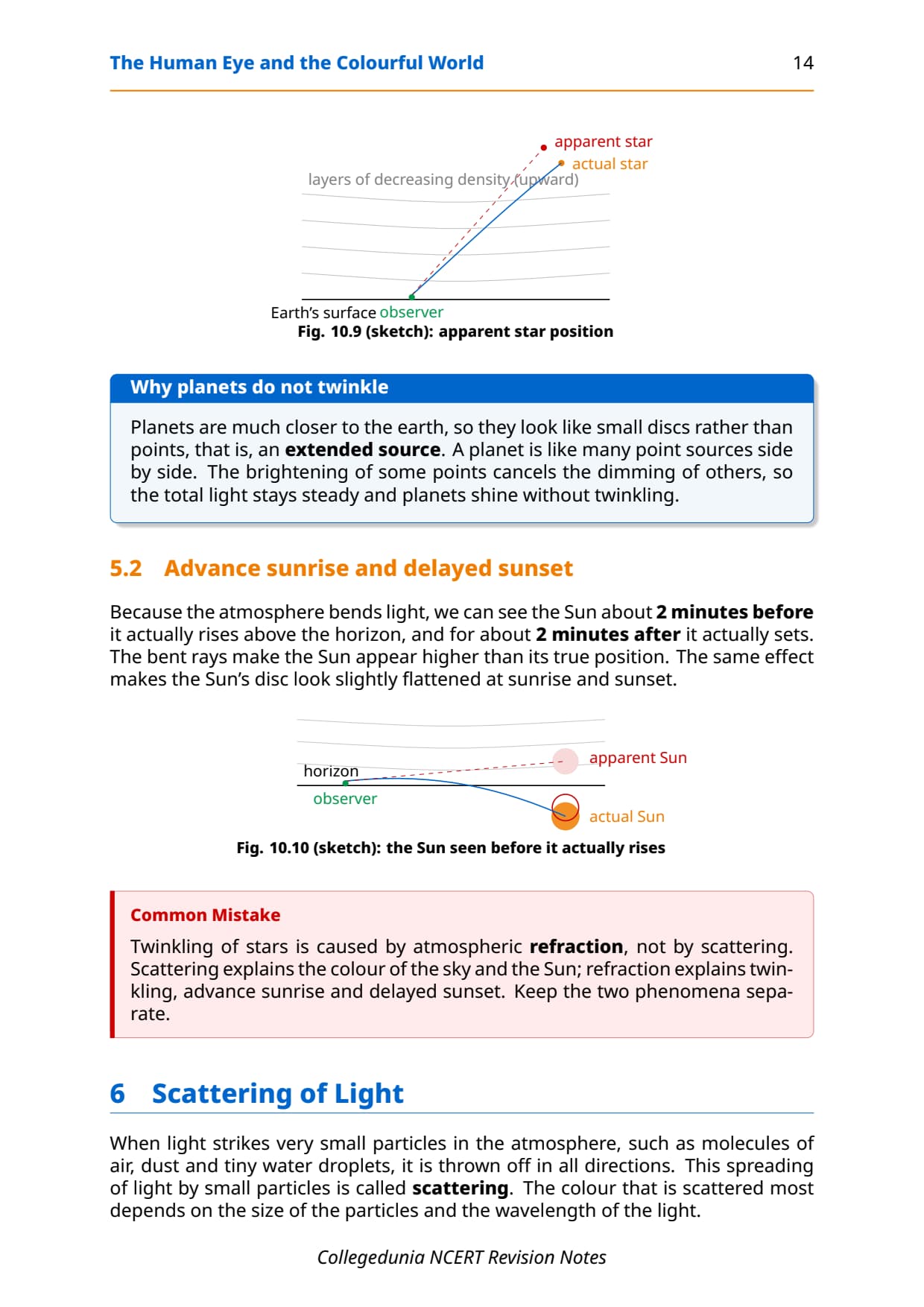
The atmosphere's density, and so its refractive index, changes from layer to layer, so light keeps bending as it crosses them. This is atmospheric refraction.
- Twinkling of stars: starlight bends through changing layers of air, so a star's apparent position and brightness keep shifting. Stars act as point sources, which makes the flicker easy to see.
- Why planets do not twinkle: planets are closer and look like discs (extended sources), so brightening at some points cancels dimming at others.
- Advance sunrise, delayed sunset: bending lets us see the Sun about 2 minutes before it rises and after it sets.
Scattering of Light: Blue Sky and Red Sun in Class 10 Science
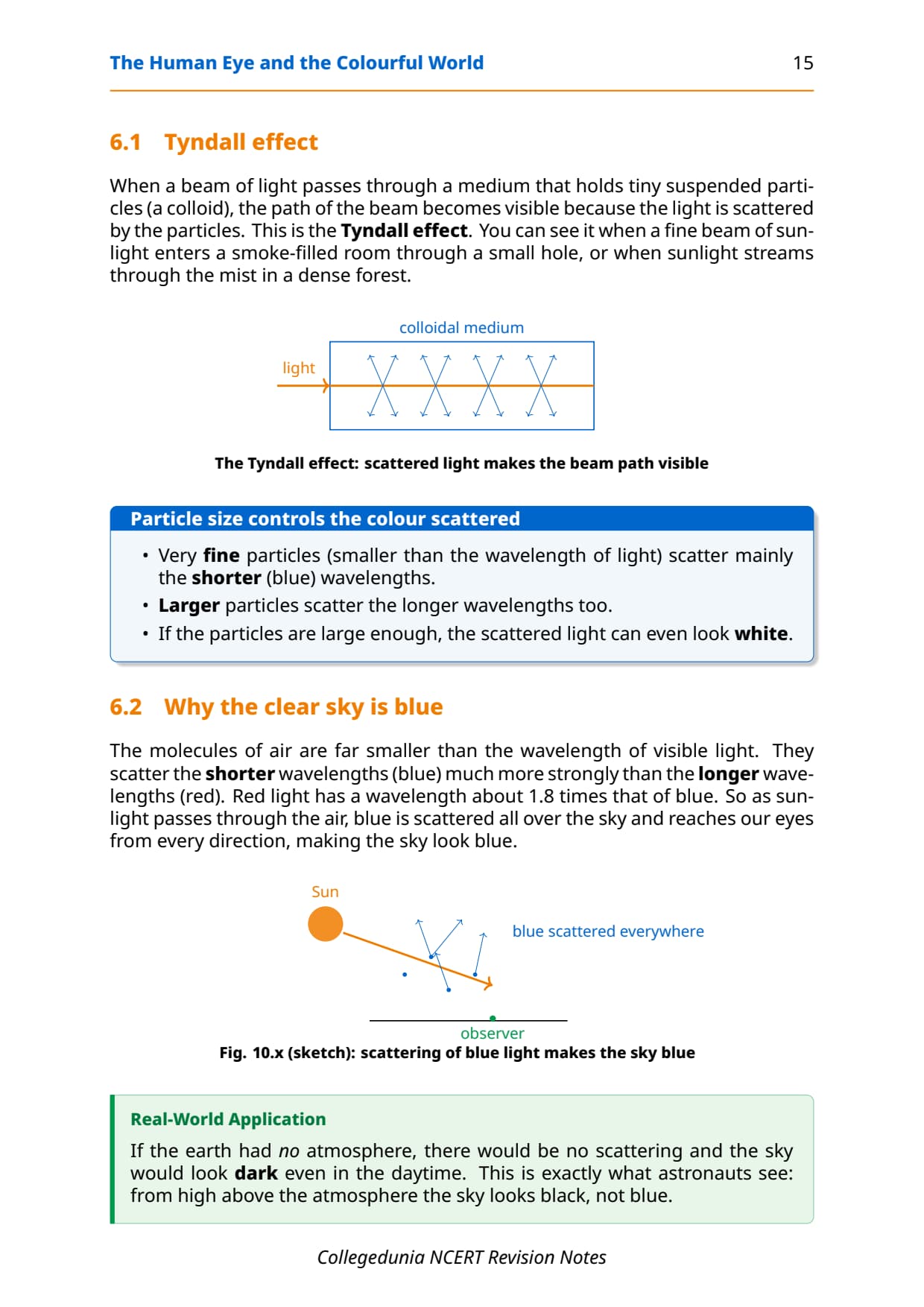
When light hits very small particles in the air it is thrown off in all directions. This is scattering, and one rule explains nearly every sky colour: shorter (blue) wavelengths scatter the most. The Tyndall effect is scattering by colloidal particles that makes a beam's path visible.
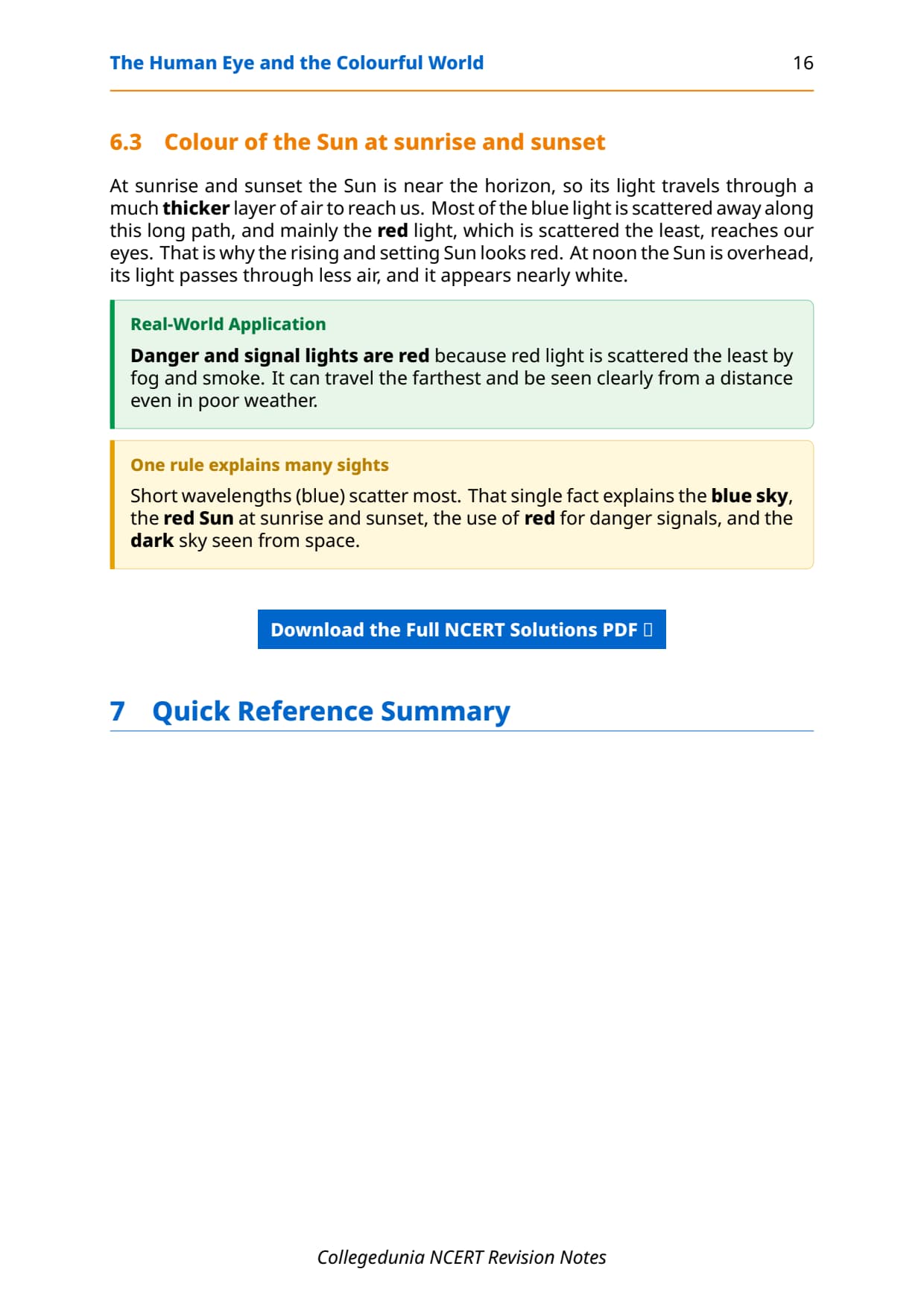
- Blue sky: air molecules scatter blue strongly in every direction, so the sky looks blue. With no atmosphere the sky would look dark, as astronauts see.
- Red Sun at sunrise and sunset: light travels through thicker air, blue is scattered away, and mainly red reaches us. The same reason makes danger signals red.
Quick Revision Strip for The Human Eye and the Colourful World
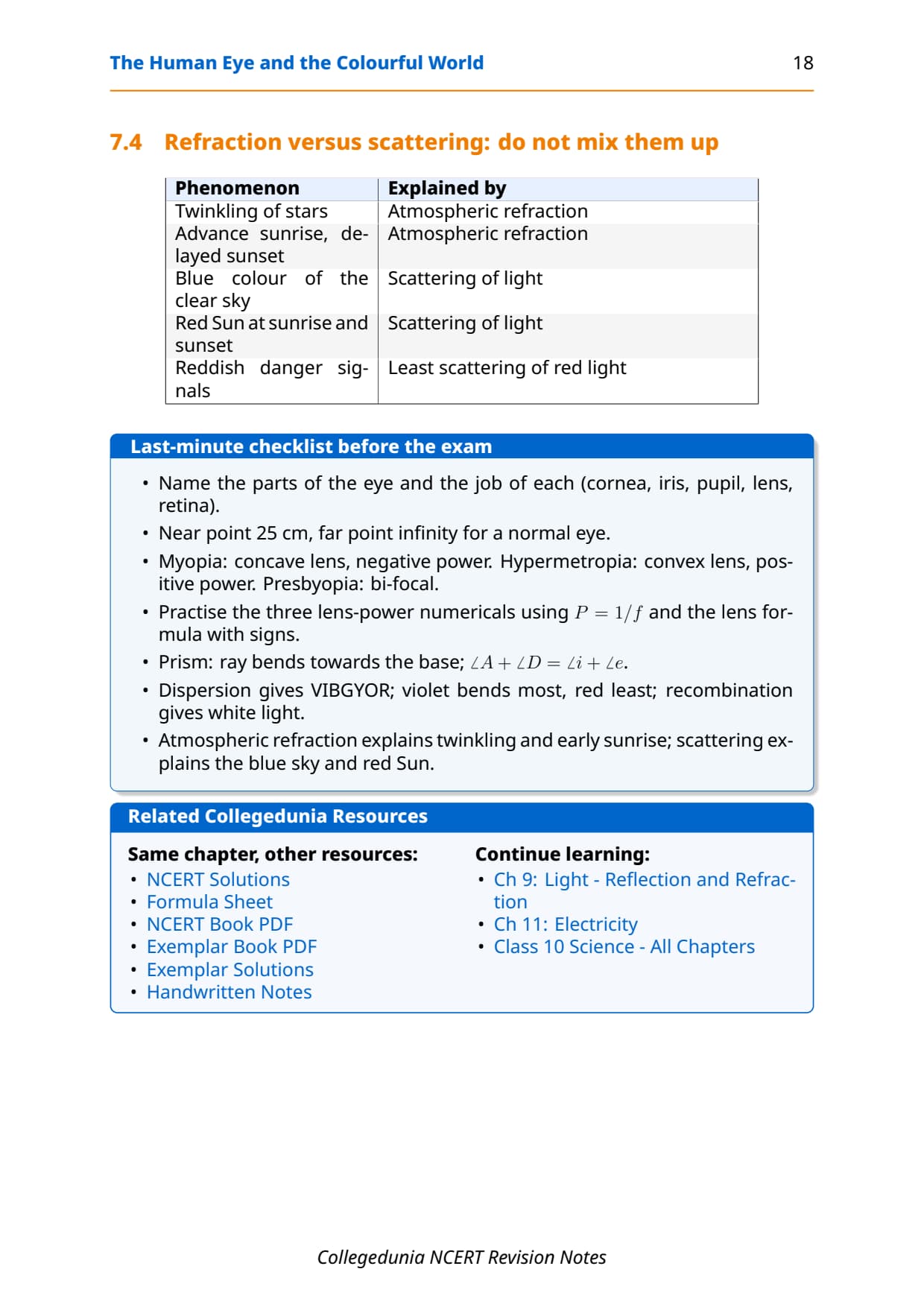
| Idea | Key point |
|---|---|
| Parts of the eye | Cornea bends most light; retina forms the real, inverted image |
| Accommodation | Eye lens changes its focal length; image distance stays fixed |
| Near and far point | 25 cm and infinity for a normal eye |
| Myopia | Near clear, image before retina, concave lens, negative power |
| Hypermetropia | Far clear, image behind retina, convex lens, positive power |
| Prism relation | A + D = i + e; ray bends towards the base |
| Dispersion | White light splits into VIBGYOR; violet bends most, red least |
| Refraction vs scattering | Refraction: twinkling, early sunrise. Scattering: blue sky, red Sun |
Also Check: The full set of CBSE board paper questions for this chapter, with step-by-step answers, is in the downloadable PDF above, updated for the 2026-27 cycle.
Other Resources for Class 10 Science Chapter 10 The Human Eye and the Colourful World
Pair these revision notes with the matching NCERT Solutions, the formula sheet, handwritten notes and the official NCERT book chapter. All resources for Class 10 Science Chapter 10 The Human Eye and the Colourful World are linked below.
| Resource | What it covers | Open |
|---|---|---|
| Notes | Concept-first revision notes on the human eye, accommodation, defects of vision, the prism, dispersion, atmospheric refraction and scattering of light. | You are here |
| NCERT Solutions | Step-by-step answers to all in-text and exercise questions, with an Expert Solution for each. | Class 10 Science Chapter 10 NCERT Solutions |
| Formula Sheet | Quick reference of the must-know formulae, the prism relation and the defect-correction rules of the chapter. | Class 10 Science Chapter 10 Formula Sheet |
| Handwritten Notes | Scanned-style handwritten pages for last-minute board revision. | Class 10 Science Chapter 10 Handwritten Notes |
| NCERT Book PDF | Official NCERT Science Chapter 10 The Human Eye and the Colourful World textbook in PDF form. | Class 10 Science Chapter 10 NCERT Book PDF |
Notes for Class 10 Science: All Chapters
Related Links: Use the table below to open the revision notes for the other chapters of Class 10 Science. Every chapter ships with the same concept-first notes style, full PDF download, and revision FAQ.
| Chapter | Notes link |
|---|---|
| Chapter 1 | Chemical Reactions and Equations Notes |
| Chapter 2 | Acids, Bases and Salts Notes |
| Chapter 3 | Metals and Non-metals Notes |
| Chapter 4 | Carbon and its Compounds Notes |
| Chapter 5 | Life Processes Notes |
| Chapter 6 | Control and Coordination Notes |
| Chapter 7 | How do Organisms Reproduce? Notes |
| Chapter 8 | Heredity Notes |
| Chapter 9 | Light - Reflection and Refraction Notes |
| Chapter 10 | The Human Eye and the Colourful World Notes (You are here) |
| Chapter 11 | Electricity Notes |
| Chapter 12 | Magnetic Effects of Electric Current Notes |
| Chapter 13 | Our Environment Notes |
Notes Class 10 Science Chapter 10 The Human Eye and the Colourful World FAQs
Ques. What does Chapter 10 The Human Eye and the Colourful World cover in Class 10 Science?
Ans. Chapter 10 covers the human eye and the behaviour of light in nature. The notes explain the structure of the eye and the job of each part, the power of accommodation, and the near point and far point of a normal eye. They then cover the three defects of vision, myopia, hypermetropia and presbyopia, with their causes and correcting lenses, and the lens-power numericals used to find them. The chapter ends with refraction and dispersion through a prism (VIBGYOR), atmospheric refraction (twinkling of stars and early sunrise) and the scattering of light that makes the sky blue and the Sun red, all aligned with the 2026-27 CBSE syllabus.
Ques. What is the difference between myopia and hypermetropia?
Ans. Myopia, or near-sightedness, is when a person can see nearby objects clearly but not distant ones, because the image of a distant object forms in front of the retina; the far point has shifted closer than infinity. It is corrected with a concave lens of negative power. Hypermetropia, or far-sightedness, is the opposite: the person sees distant objects clearly but not nearby ones, because the image of a near object forms behind the retina; the near point has moved farther than 25 cm. It is corrected with a convex lens of positive power. A simple way to remember it is "Myopia, near clear, concave lens, negative power," with the opposite for hypermetropia.
Ques. What is the power of accommodation of the human eye?
Ans. The power of accommodation is the ability of the eye lens to adjust its focal length so that both near and far objects are focused sharply on the retina. The eye lens is soft and jelly-like, so the ciliary muscles can change its curvature: for distant objects the muscles relax and the lens becomes thin with a large focal length, while for nearby objects the muscles contract and the lens becomes thick with a small focal length. The focal length cannot fall below a minimum, which is why very close objects cannot be focused and look blurred. Importantly, the image always forms on the retina, so the image distance is fixed and only the focal length changes.
Ques. Why does the sky appear blue and the Sun look red at sunrise and sunset?
Ans. Both are explained by the scattering of light, with the rule that shorter (blue) wavelengths are scattered the most. The molecules of air are much smaller than the wavelength of visible light, so they scatter blue light strongly in every direction; this scattered blue light reaches our eyes from all over the sky, making it look blue. At sunrise and sunset the Sun is near the horizon, so its light travels through a much thicker layer of air. Most of the blue light is scattered away along this long path, and mainly the red light, which is scattered the least, reaches our eyes, so the Sun looks red. At noon the light passes through less air and the Sun appears nearly white.
Ques. Why do stars twinkle but planets do not?
Ans. Stars twinkle because of atmospheric refraction. Starlight bends continuously as it passes through layers of air of changing refractive index, and because the air keeps moving and changing, the apparent position and brightness of the star keep shifting slightly, so it looks brighter at one moment and fainter the next. Stars are so far away that they act as point sources, which makes this flicker easy to notice. Planets are much closer to the earth and look like small discs, that is, extended sources made of many point sources side by side. The brightening of some points cancels the dimming of others, so the total light stays steady and planets shine without twinkling.
Ques. What is dispersion of light and what is VIBGYOR?
Ans. Dispersion is the splitting of white light into its seven component colours when it passes through a prism, and the band of colours produced is called the spectrum. It happens because different colours bend by different amounts in glass: violet bends the most and red the least, so each colour leaves the prism along a slightly different path and becomes separated. The seven colours in order are remembered by the word VIBGYOR, which stands for Violet, Indigo, Blue, Green, Yellow, Orange and Red. Newton showed that a second, inverted prism can recombine these colours back into white light, proving that white light is a mixture of seven colours.
Ques. How many pages is the Class 10 Science The Human Eye and the Colourful World Notes PDF?
Ans. The The Human Eye and the Colourful World Notes PDF runs about 18 to 20 pages and covers the full chapter in concept-first revision blocks, with a labelled diagram of the eye, the three defects of vision and their correcting lenses, three solved lens-power numericals, the prism and dispersion diagrams, the atmospheric-refraction and scattering sketches, comparison tables, common-mistake boxes, memory aids and a one-glance revision strip. The PDF is free to download for the 2026-27 session, and a green Handwritten Notes button on this page opens the scanned-style version for last-minute revision.
Ques. Are these Notes for Class 10 Science Chapter 10 aligned with the 2026-27 syllabus?
Ans. Yes. This page reflects the current 2026-27 CBSE syllabus for Class 10 Science. The The Human Eye and the Colourful World chapter is part of the current cycle, and these notes follow the NCERT textbook, covering the structure of the eye, the power of accommodation, the near point and far point, the three defects of vision with their correcting lenses, the lens-power numericals, refraction and dispersion through a prism, atmospheric refraction and the scattering of light. The notes are written for the CBSE board exam, with the high-frequency question types, the key formulae and the common traps highlighted throughout.



Comments