



These Notes for Class 10 Maths Chapter 6 Triangles give you a concept-first revision of the whole chapter. They cover similar triangles, the Basic Proportionality Theorem (Thales' Theorem), the similarity criteria (AA, SSS, SAS), and the Pythagoras Theorem with its converse. These are the results the board paper loves to test.
- Every key theorem explained in plain words, with short proofs, solved examples, and board-exam tips.
- Full coverage of similar triangles, BPT, the AA/SSS/SAS criteria, areas of similar triangles, and the Pythagoras Theorem, including their converses.
- Built on the rationalised 2026-27 CBSE syllabus, written for the board exam.
These Collegedunia revision notes are curated by Maths subject experts, according to the 2026-27 NCERT textbook, and refined against the last five years of CBSE Class 10 Maths board papers.
Student Feedback: What 9,800 students told us about this chapter
68% of Class 10 students said the hardest part was picking the right similarity criterion (AA, SSS, or SAS). The board often gives partial information and expects you to choose the right test. 3 out of 4 students said practising the Pythagoras Theorem proof in full, at least twice, locked the logic for the exam.
Toppers said drawing a clear labelled diagram before any proof saved them the most time. The average student spent 3 to 4 hours on a first read, theorem practice, and revision.
Source: 2026-27 Class 10 Maths student poll. Sample of 9,800 students from CBSE schools across 14 states, conducted before the 2026 boards.
|
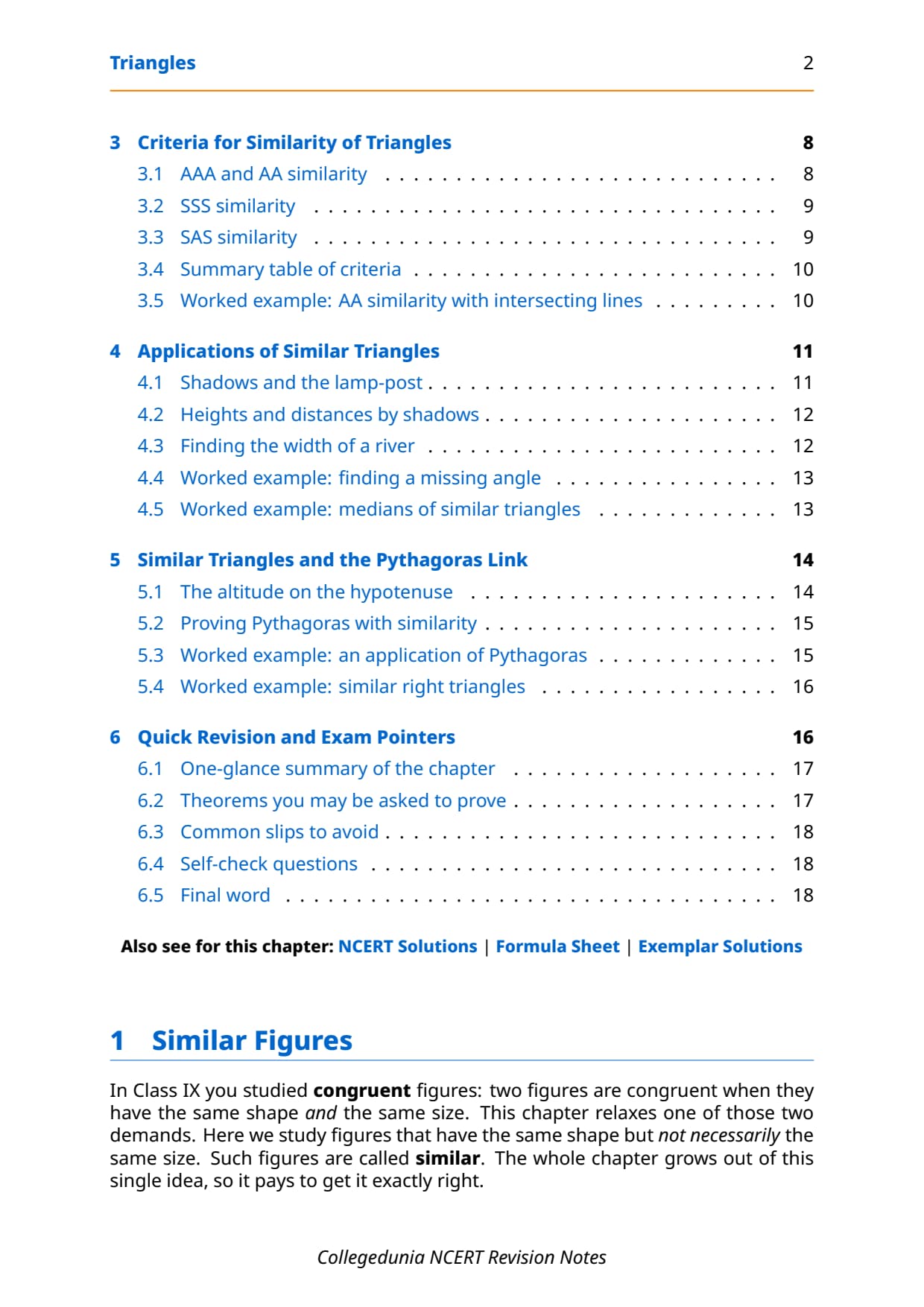
Table of Contents |
Watch Triangles Class 10 Maths Explained
Source: Magnet Brains on YouTube
What These Triangles Notes Cover
The chapter builds on congruence from Class 9 and adds similarity: figures with the same shape but not the same size. It is proof-heavy, and three theorems show up in board papers. The 2026-27 syllabus rests on four big ideas.
- Similar triangles: what they are and why the angle test reduces to just two angles (AA).
- Basic Proportionality Theorem (BPT): a line parallel to one side divides the other two sides in the same ratio, plus its converse.
- Areas of similar triangles: the ratio of areas equals the square of the ratio of sides, a 3-mark board question every year.
- Pythagoras Theorem: the theorem and its converse, with the NCERT proof.
Similar Triangles: Definition and Properties
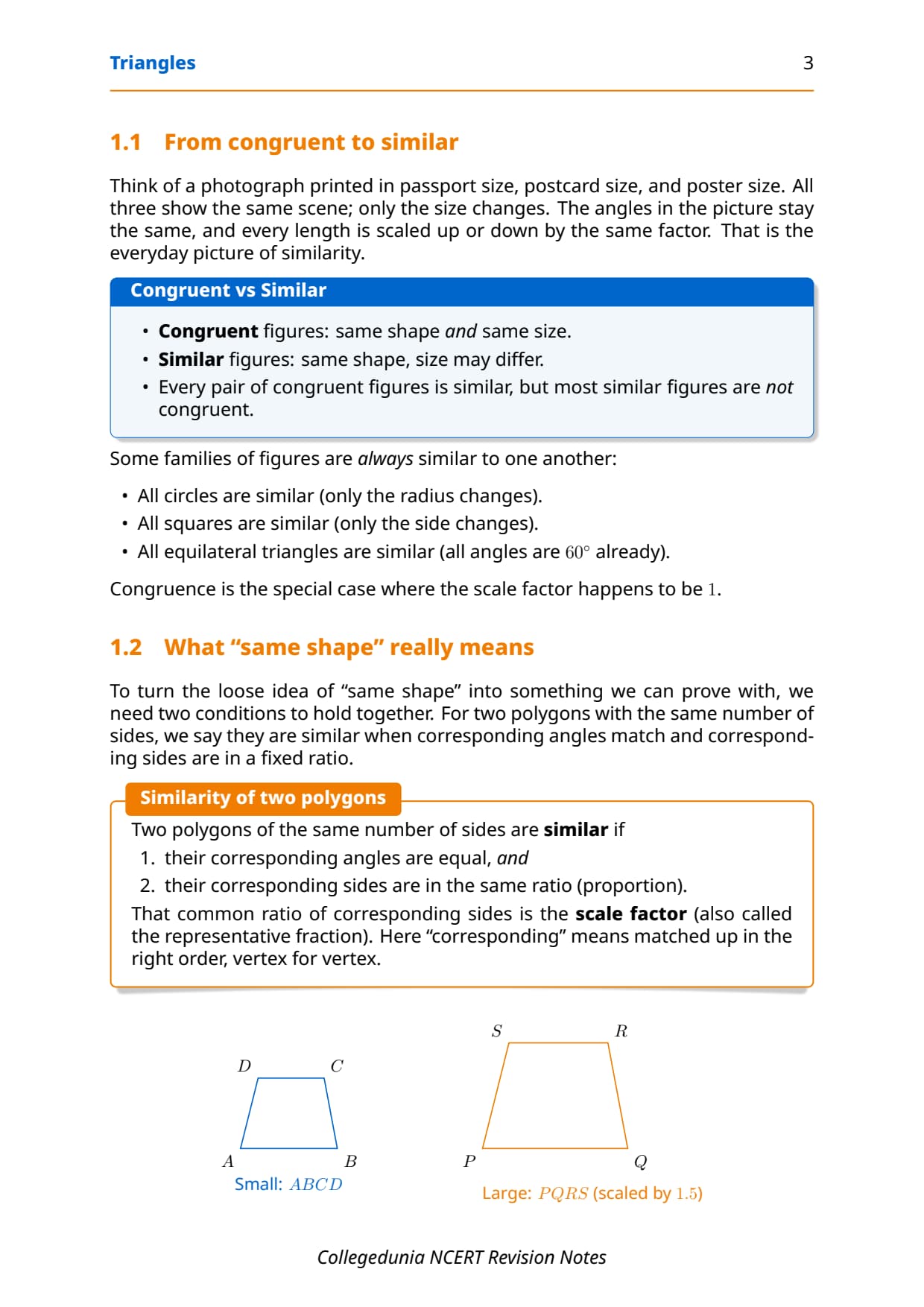
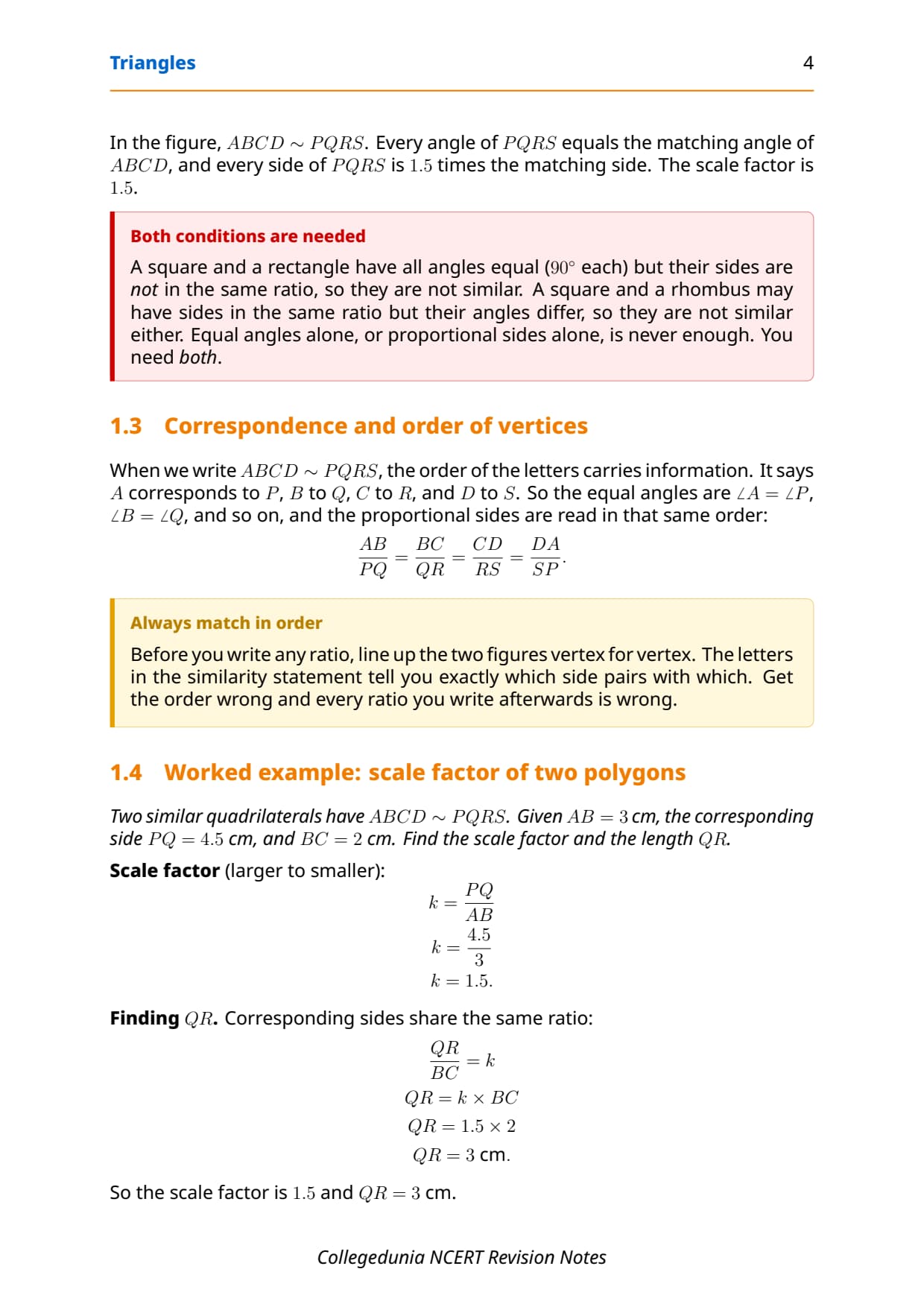
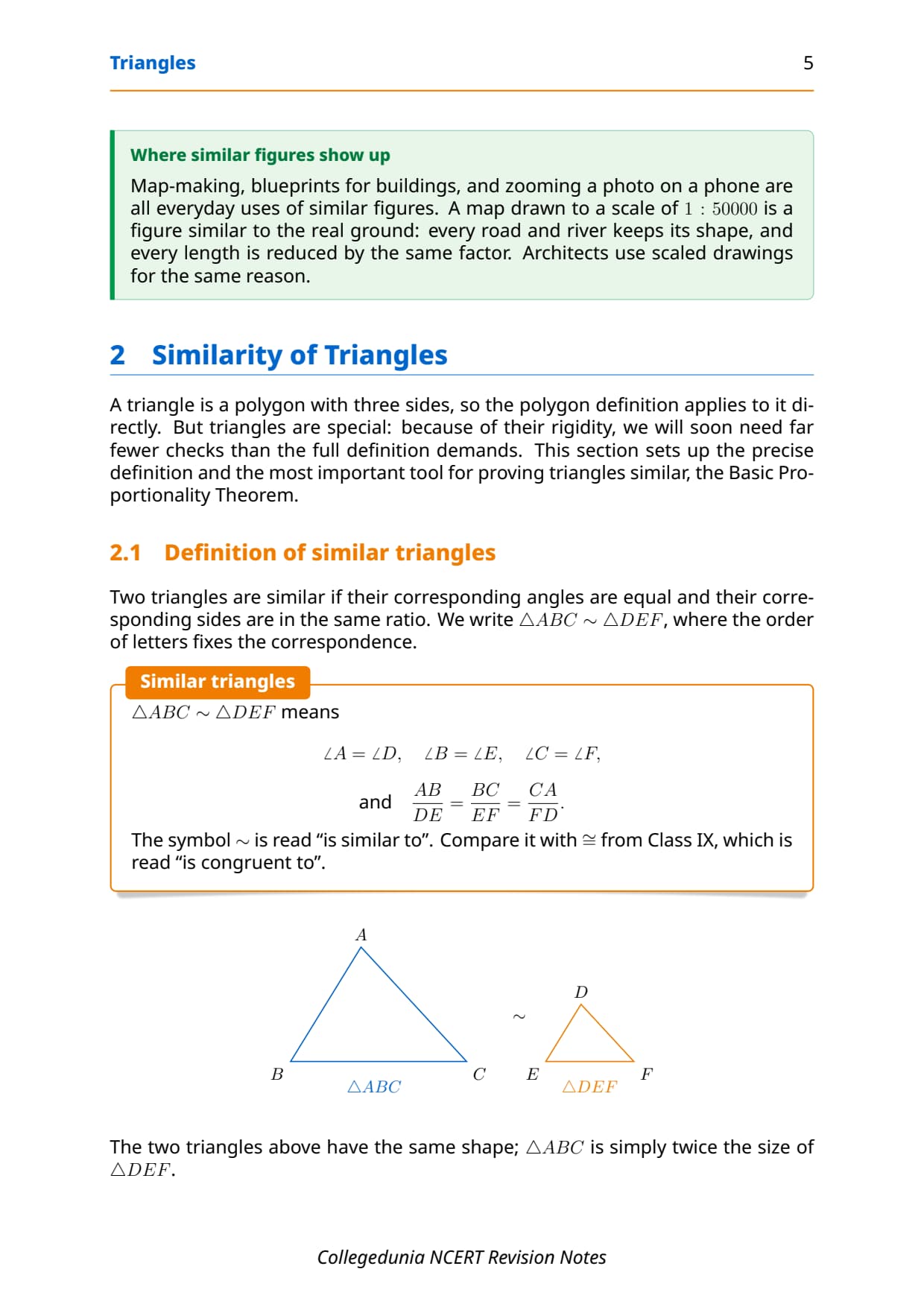
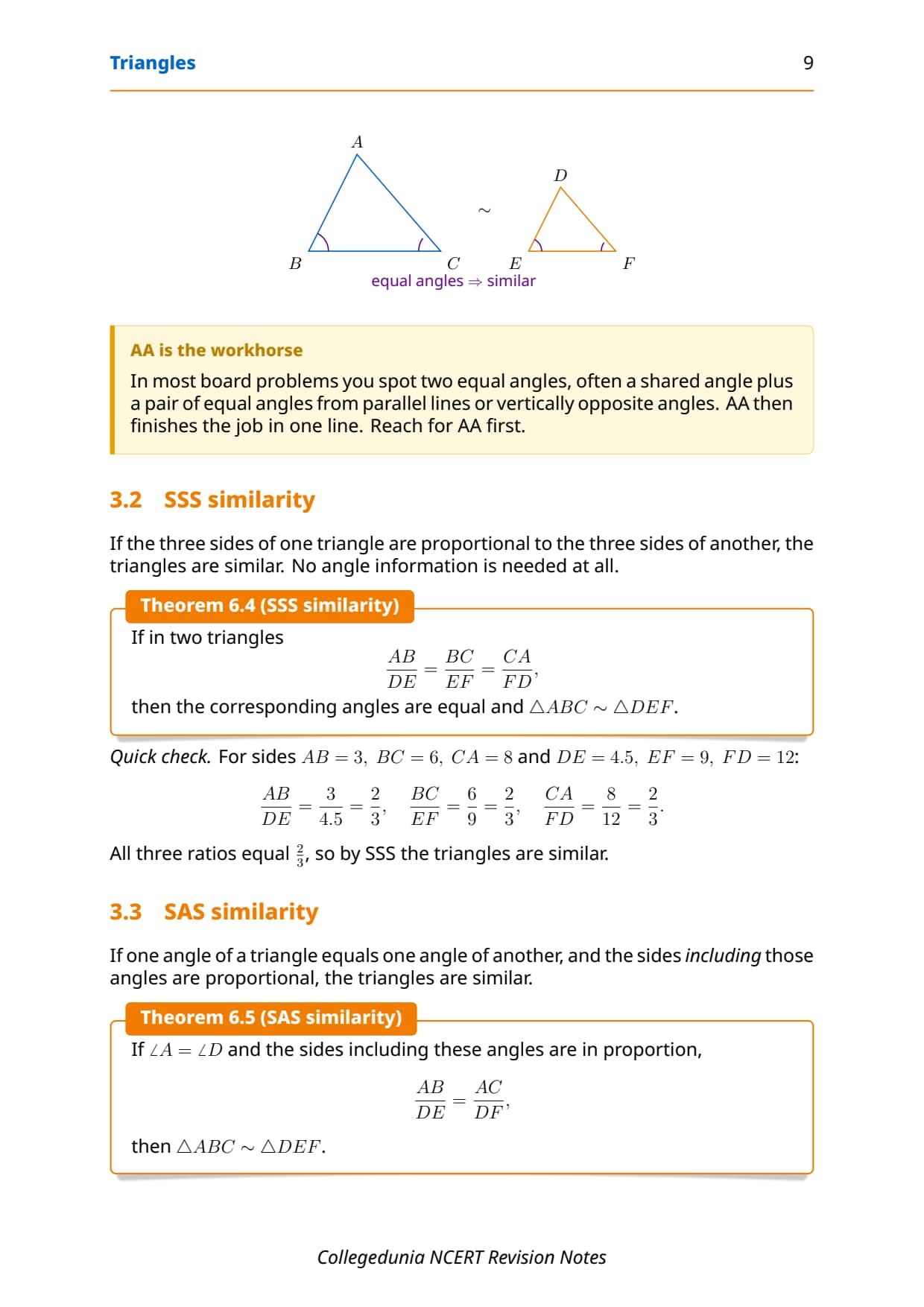
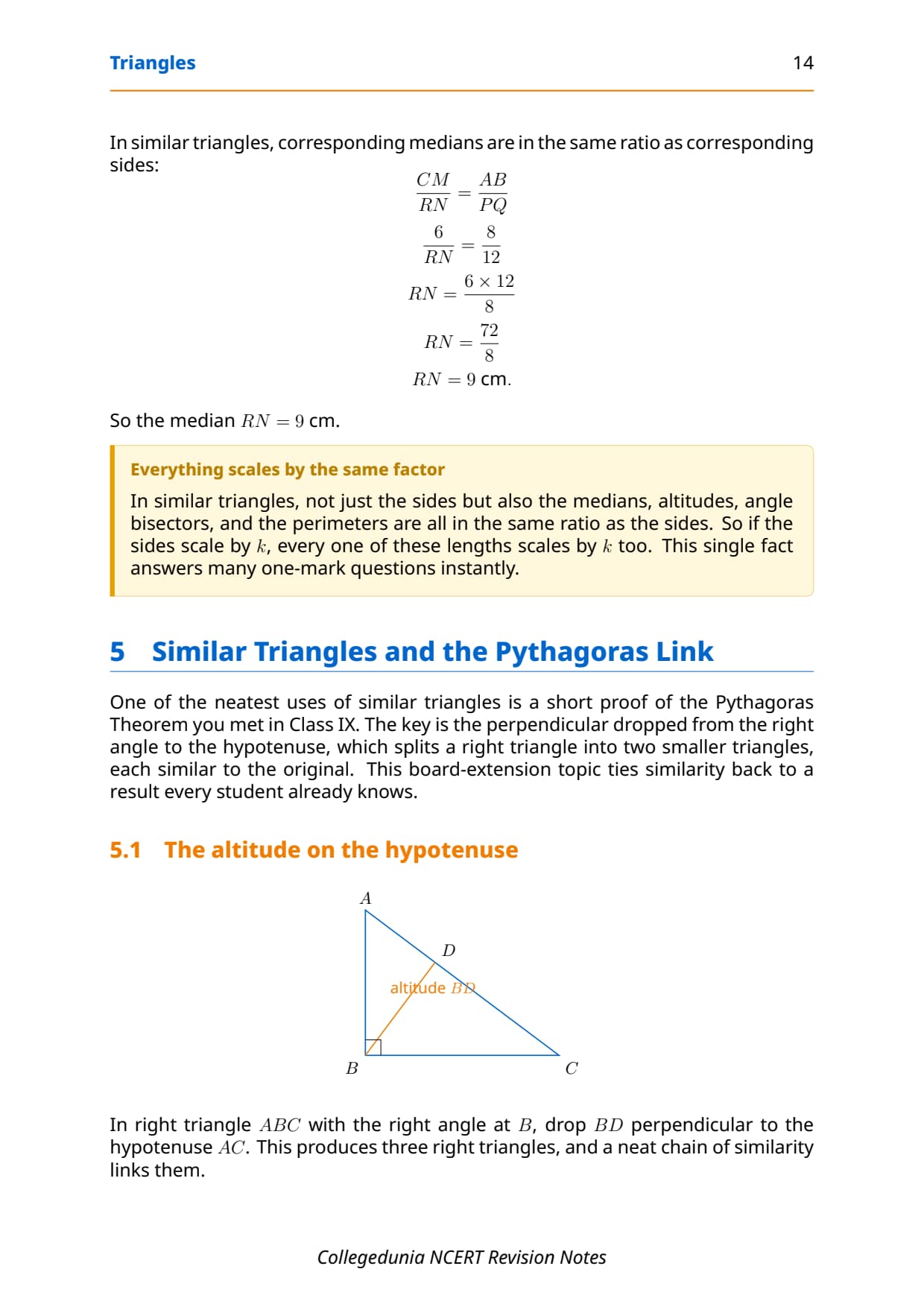
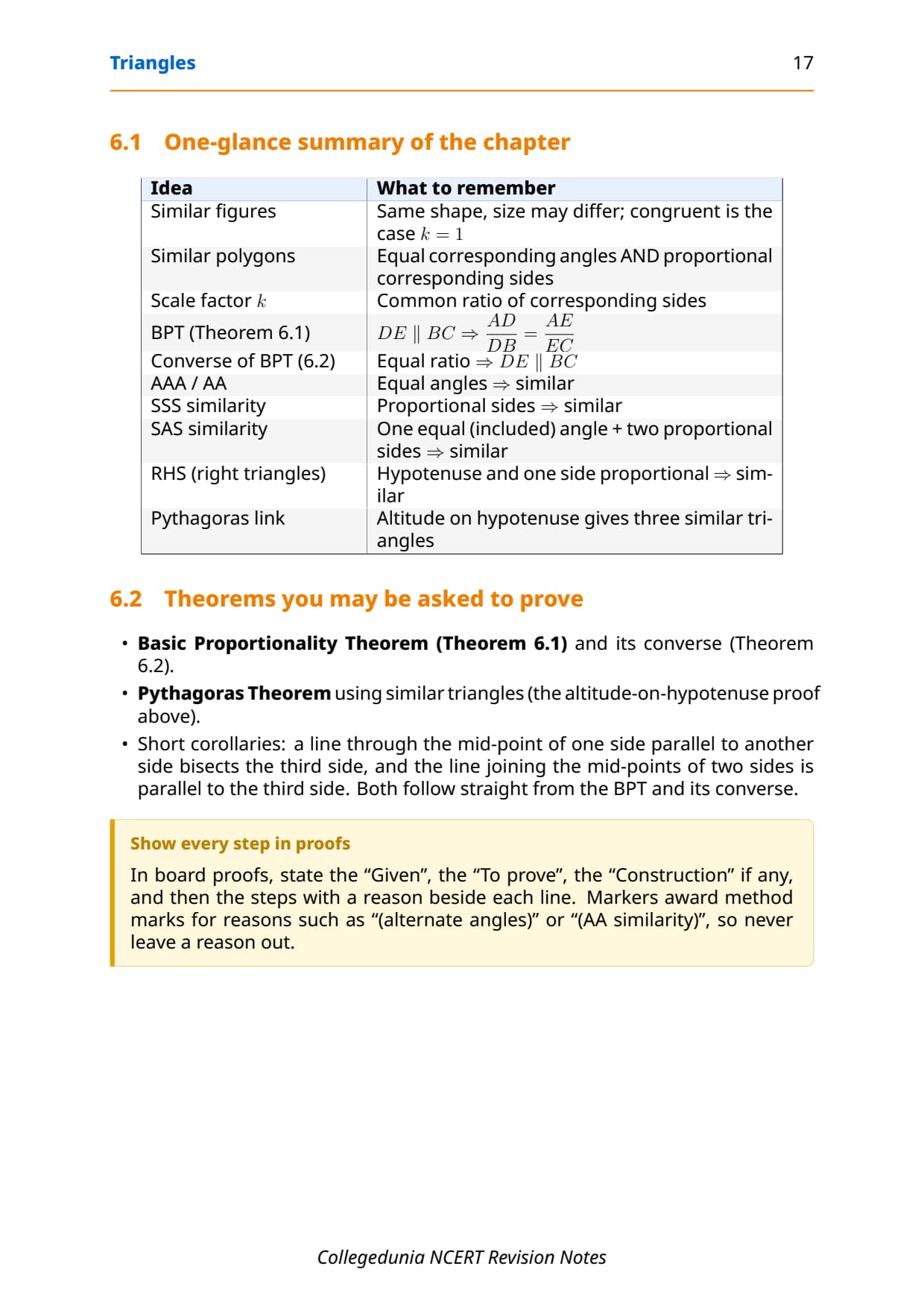
Two triangles are similar when their corresponding angles are equal and their corresponding sides are in the same ratio. Unlike congruence, the sides need not be equal: similarity keeps the shape but lets the size scale. When △ABC ~ △DEF:
- Angle A = Angle D, Angle B = Angle E, Angle C = Angle F.
- AB/DE = BC/EF = CA/FD (the scale factor).
- The letter order tells you which vertices correspond: A to D, B to E, C to F.
| Property | Congruent triangles | Similar triangles |
|---|---|---|
| Corresponding angles | Equal | Equal |
| Corresponding sides | Equal (same length) | Proportional (same ratio) |
| Shape | Same | Same |
| Size | Same | May differ |
| Symbol | ≅ | ~ |
Quick check: any two equilateral triangles are always similar, and any two squares too, but two rectangles need not be, since the length-to-breadth ratio can differ.
Basic Proportionality Theorem (Thales' Theorem)
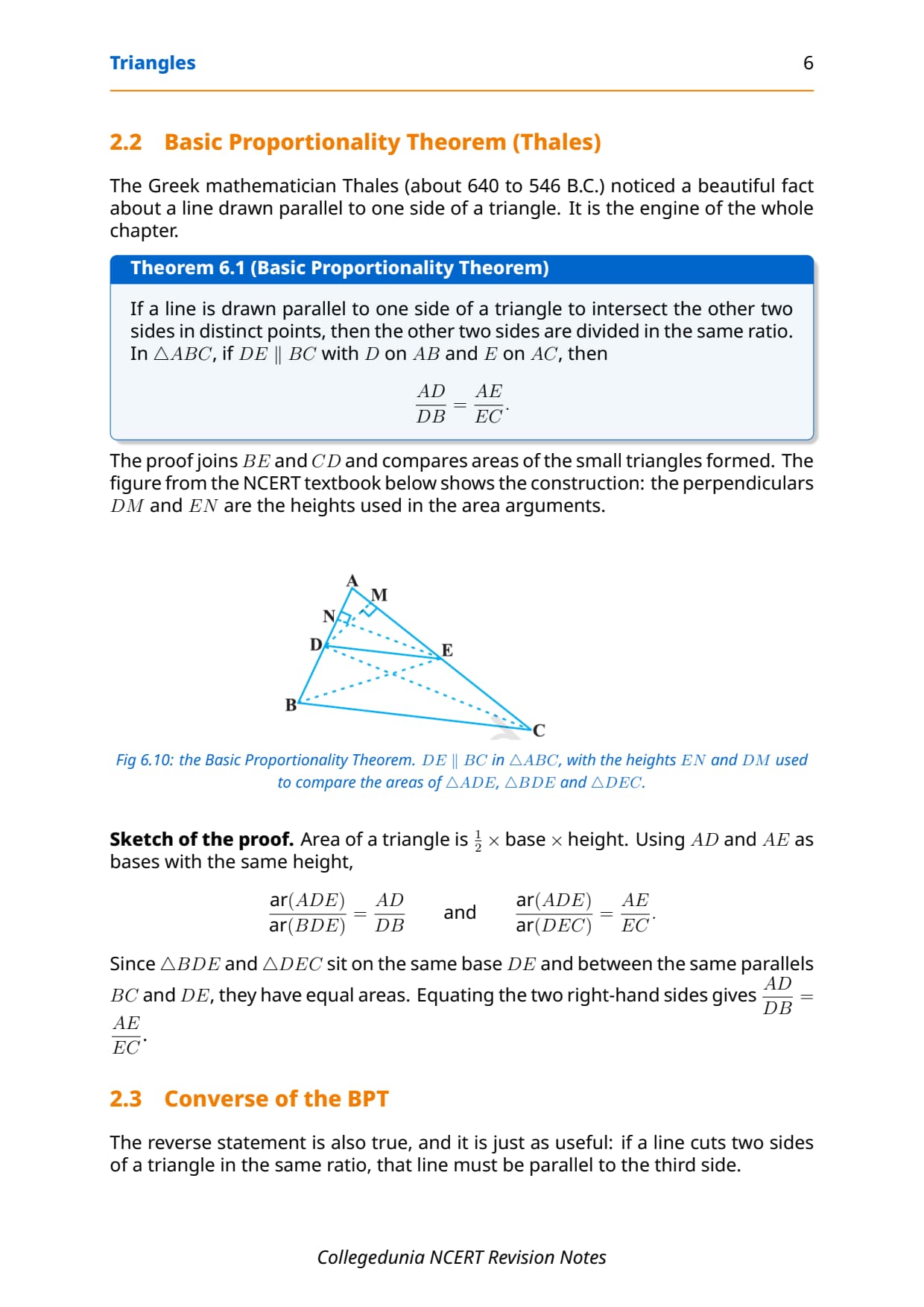
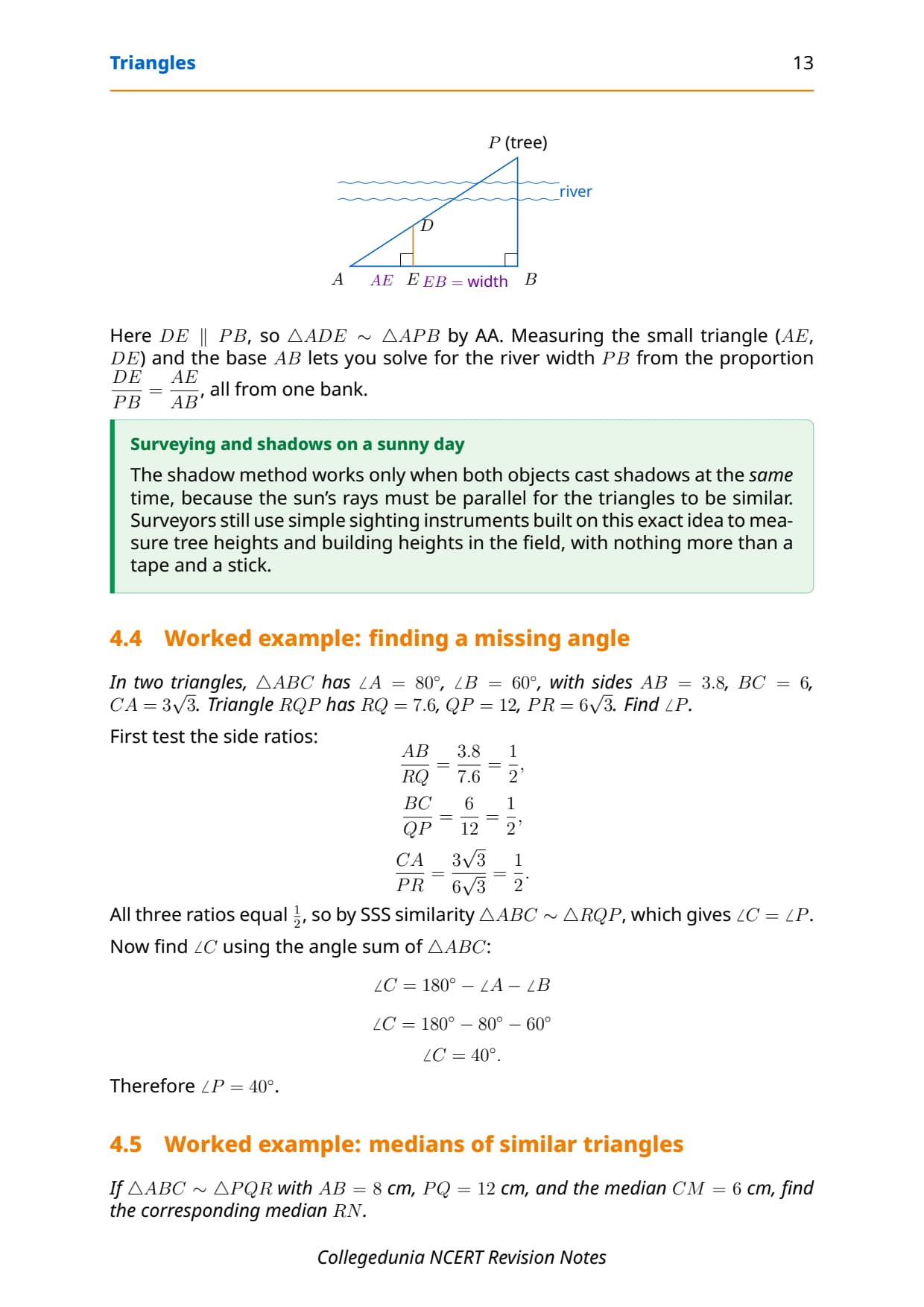
The Basic Proportionality Theorem (Thales' Theorem) is the first major result. A line parallel to one side of a triangle divides the other two sides in the same ratio. So if DE is parallel to BC in triangle ABC (D on AB, E on AC):
AD/DB = AE/EC
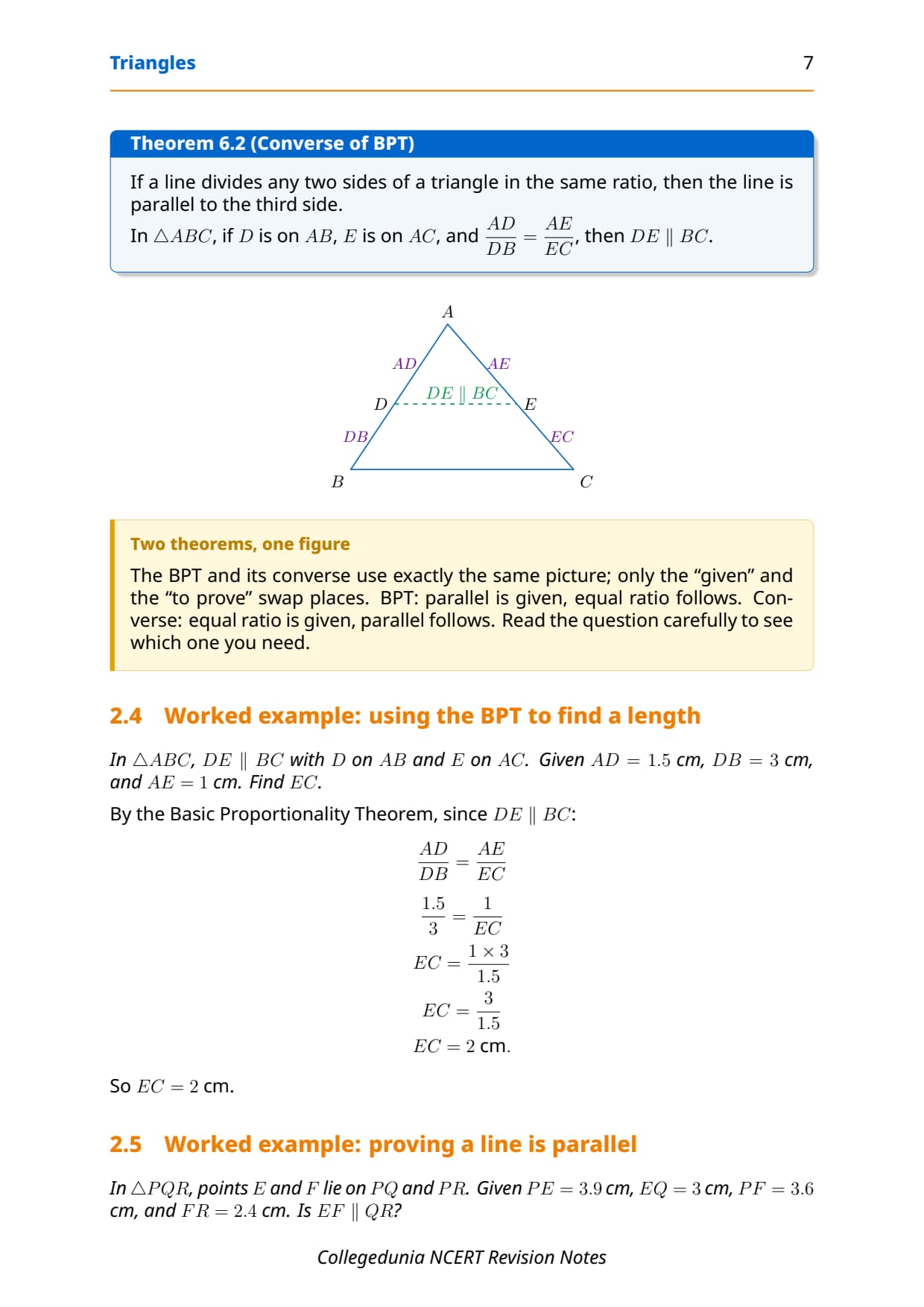
The converse matters just as much: if a line divides two sides in the same ratio, it must be parallel to the third side. Board papers use both directions.
| Statement | Given | Conclusion |
|---|---|---|
| BPT (Thales' Theorem) | DE || BC in △ABC, D on AB, E on AC | AD/DB = AE/EC |
| Converse of BPT | D on AB, E on AC, AD/DB = AE/EC | DE || BC |
Example: in triangle ABC, D on AB with AD = 4 cm, DB = 6 cm, E on AC, DE || BC. Find AE if EC = 9 cm. By BPT, 4/6 = AE/9, so AE = 6 cm.
Criteria for Similarity: AA, SSS & SAS
You do not need all six conditions to prove similarity. Three short criteria do the job, and the key skill is picking the right one from what you are given.
- AA (Angle-Angle): two angles of one triangle equal two of another. (The third follows, since angles sum to 180°.)
- SSS (Side-Side-Side): all three pairs of corresponding sides in the same ratio.
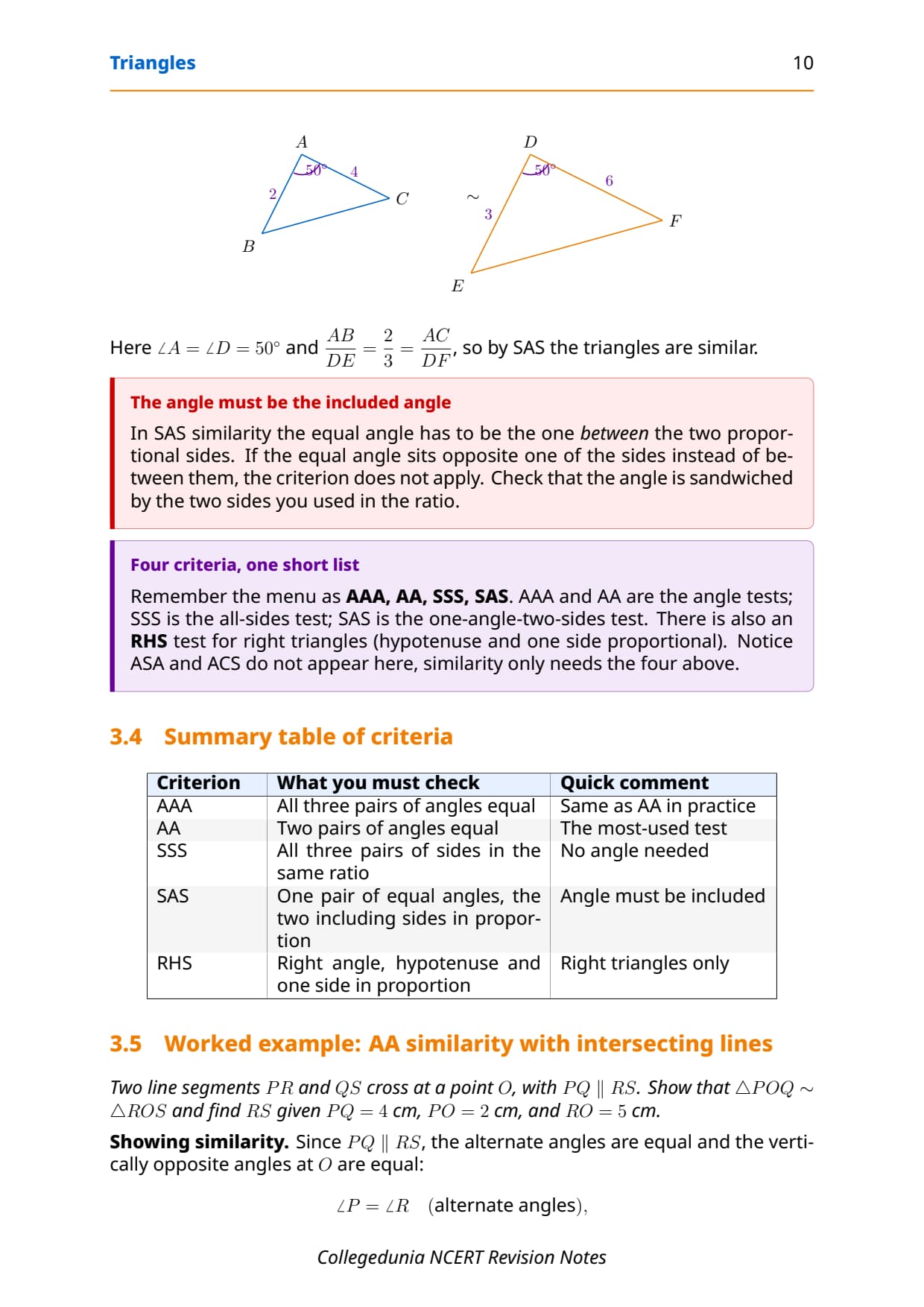
- SAS (Side-Angle-Side): one pair of equal angles, and the sides including them in the same ratio.
AA is the most tested criterion. The steps are always the same: find two pairs of equal angles, name the criterion (AA), and write the similarity statement in the correct vertex order.
Areas of Similar Triangles
The theorem on areas of similar triangles says the ratio of their areas equals the square of the ratio of their corresponding sides.
Area(△ABC) / Area(△DEF) = (AB/DE)² = (BC/EF)² = (CA/FD)²
The same square holds for corresponding altitudes, medians, and angle-bisectors, since base and height both scale by the same factor. So if sides are in ratio 2:3, areas are in ratio 4:9; conversely, if areas are in ratio 4:9, sides are in ratio 2:3 (take the square root).
Example: two similar triangles have areas 25 cm² and 64 cm². If one side of the first is 10 cm, the side ratio = 5/8, so the matching side = 10 × 8/5 = 16 cm.
Pythagoras Theorem and Its Converse
The Pythagoras Theorem: in a right-angled triangle, the square of the hypotenuse equals the sum of the squares of the other two sides.
AC² = AB² + BC² (where angle B = 90°)
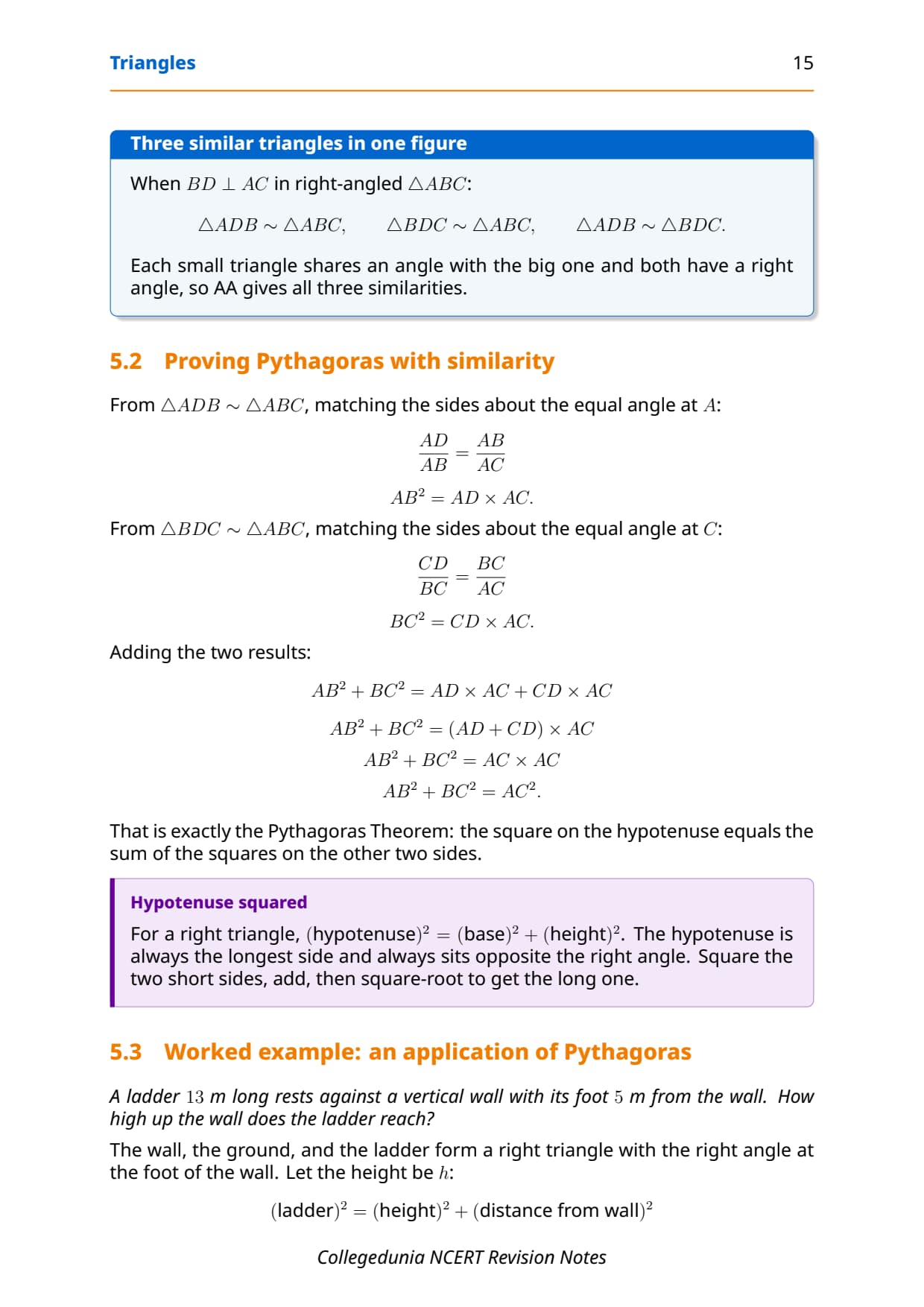
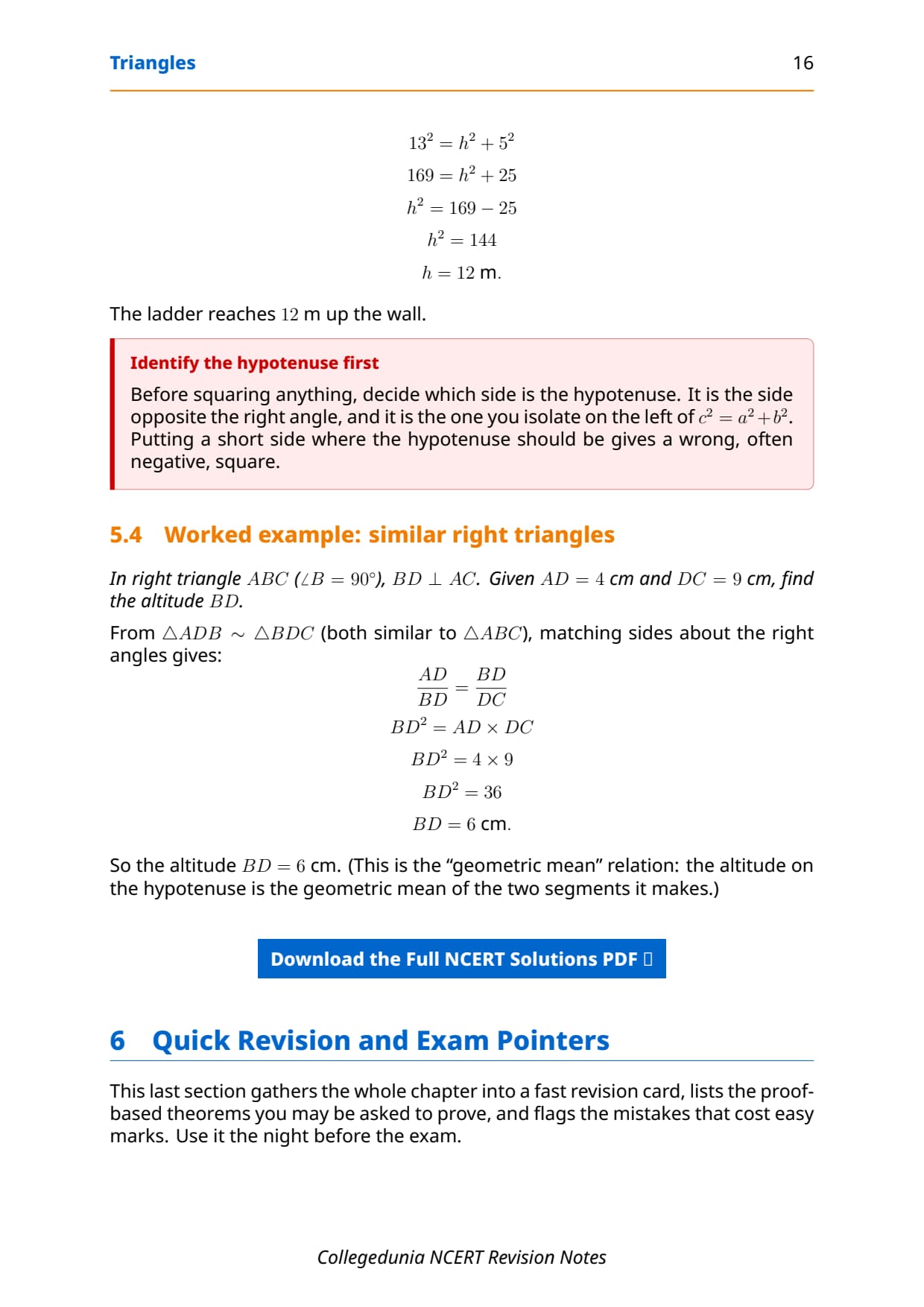
The NCERT proof uses similar triangles, which is why the theorem sits in this chapter. Dropping an altitude from the right angle to the hypotenuse makes two smaller triangles, each similar to the original and to each other; the theorem follows.
The converse: if the square of one side equals the sum of the squares of the other two, the angle opposite the longest side is a right angle. Use it to check whether a triangle is right-angled.
| Theorem | Given | Conclusion |
|---|---|---|
| Pythagoras Theorem | Angle B = 90° in ▵ABC | AC² = AB² + BC² |
| Converse of Pythagoras | AC² = AB² + BC² in ▵ABC | Angle B = 90° |
Common Pythagorean triples: (3, 4, 5), (5, 12, 13), (8, 15, 17), (7, 24, 25). The hypotenuse is always the side opposite the right angle, so find the right angle first.
How to Revise Triangles for the Board Exam
Tackle the four theorem families (BPT, similarity criteria, areas, Pythagoras) in that order:
- First: definitions of similar triangles and BPT, with two or three numerical examples; then the three criteria, drawing a diagram and writing one proof for each.
- Second: the areas result (mind the square), then Pythagoras and its converse with a full proof; then 3 to 5 past board questions.
- Board focus: learn each theorem statement, practise its proof twice, then drill 10 to 15 problems from Exercises 6.1 to 6.3. Write the similarity statement in the right vertex order every time.
Previous Year Question Trends
Triangles is one of the highest-weightage geometry chapters, appearing almost every year with both proofs and sums. The table maps recent question types.
| Year | Question type asked | Marks |
|---|---|---|
| 2025 | Prove that two triangles are similar using AA criterion; find a missing side | 5 |
| 2024 | Apply BPT to find a length; verify converse of BPT | 3 |
| 2023 | Use the areas-of-similar-triangles result to find an area or side ratio | 3 |
| 2022 | Pythagoras Theorem proof or application in a given triangle | 5 |
| 2021 | Identify similar triangles in a combined figure; state the similarity criterion | 2 |
Also Check: The full set of board questions for this chapter, with step-by-step answers, sits in the PDF above, updated for 2026-27.
Common Mistakes to Avoid
Repeat-offender mistakes in Triangles board answers:
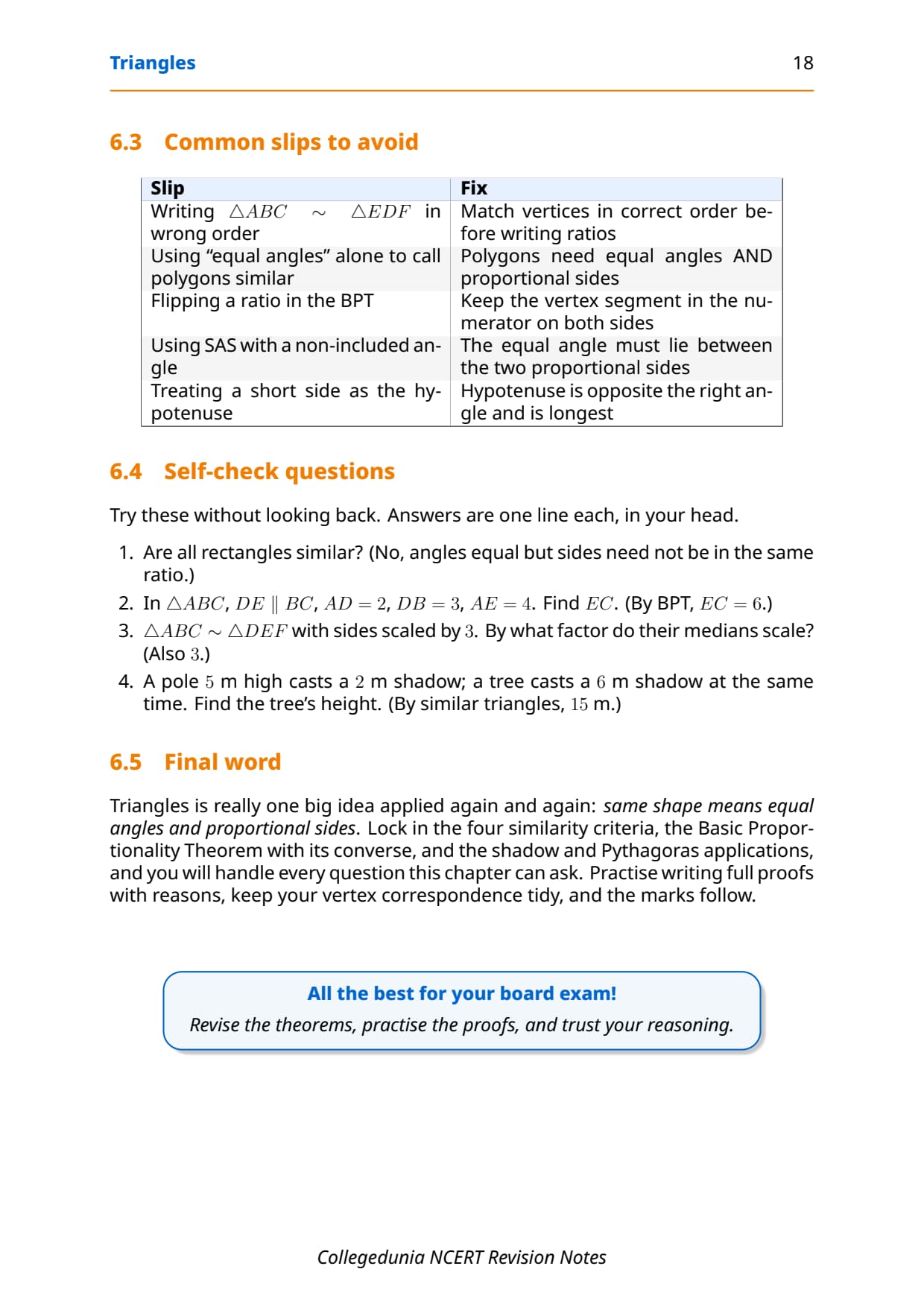
- Wrong vertex order: △ABC ~ △DEF means A matches D, B matches E, C matches F; a wrong order gives wrong ratios.
- Forgetting the square in areas: area ratio = (side ratio)², not the side ratio.
- Wrong hypotenuse: it is opposite the right angle; find the right angle first.
- Not naming the criterion: state AA, SSS, or SAS by name in proofs.
Other Triangles Resources for Class 10 Maths
Pair these notes with the matching NCERT Solutions, formula sheet, handwritten notes and the official NCERT book chapter. All Triangles resources are linked below.
| Resource | What it covers | Open |
|---|---|---|
| Notes | Concept-first revision notes on similar triangles, BPT, similarity criteria, areas, and Pythagoras' Theorem for the board exam. | You are here |
| NCERT Solutions | Step-by-step answers to all Exercise 6.1 to 6.3 questions, with an Expert Solution for each. | Class 10 Maths Chapter 6 NCERT Solutions |
| Formula Sheet | One-page list of BPT, similarity criteria, areas result, and Pythagoras Theorem for fast revision. | Class 10 Maths Chapter 6 Formula Sheet |
| Handwritten Notes | Scanned-style handwritten pages for last-minute board revision. | Class 10 Maths Chapter 6 Handwritten Notes |
| NCERT Book PDF | Official NCERT Maths Chapter 6 Triangles textbook in PDF form. | Class 10 Maths Chapter 6 NCERT Book PDF |
| Exemplar Solutions | Worked answers to the harder NCERT Exemplar problems for extra practice. | Class 10 Maths Chapter 6 Exemplar Solutions |
Notes for Class 10 Maths: All Chapters
Related Links: Use the table below to open the notes for the other Class 10 Maths chapters. Each one has the same concept-first style, full PDF download, and revision FAQ.
| Chapter | Notes link |
|---|---|
| Chapter 1 | Real Numbers Notes |
| Chapter 2 | Polynomials Notes |
| Chapter 3 | Pair of Linear Equations in Two Variables Notes |
| Chapter 4 | Quadratic Equations Notes |
| Chapter 5 | Arithmetic Progressions Notes |
| Chapter 6 | Triangles Notes (You are here) |
| Chapter 7 | Coordinate Geometry Notes |
| Chapter 8 | Introduction to Trigonometry Notes |
| Chapter 9 | Some Applications of Trigonometry Notes |
| Chapter 10 | Circles Notes |
| Chapter 11 | Areas Related to Circles Notes |
| Chapter 12 | Surface Areas and Volumes Notes |
| Chapter 13 | Statistics Notes |
| Chapter 14 | Probability Notes |
Notes Class 10 Maths Chapter 6 Triangles FAQs
Ques. What does Chapter 6 Triangles cover in Class 10 Maths?
Ans. Chapter 6 covers four ideas in the 2026-27 CBSE syllabus. First, similar triangles: same shape, proportional sides, equal angles, and the right notation. Second, the Basic Proportionality Theorem (Thales' Theorem): a line parallel to one side divides the other two sides proportionally, plus its converse. Third, the similarity criteria: AA, SSS, and SAS. Fourth, the Pythagoras Theorem and its converse, where the square of the hypotenuse equals the sum of the squares of the other two sides.
Ques. What is the Basic Proportionality Theorem (BPT) in Class 10 Maths?
Ans. The Basic Proportionality Theorem (Thales' Theorem) says a line parallel to one side of a triangle divides the other two sides in the same ratio. If DE is parallel to BC in triangle ABC (D on AB, E on AC), then AD/DB = AE/EC. The converse: if a line divides two sides in the same ratio, it is parallel to the third side. To use it, spot the parallel line and the two sides it cuts, set up the ratio, and solve. Keep the order consistent: the part near vertex A over the part near the base.
Ques. What are the three criteria for similarity of triangles?
Ans. The three criteria are AA, SSS, and SAS. AA (Angle-Angle): two triangles are similar if two pairs of angles are equal; the third pair follows, since angles sum to 180 degrees. SSS (Side-Side-Side): similar if all three pairs of sides are in the same ratio. SAS (Side-Angle-Side): similar if one pair of angles is equal and the sides around them are in the same ratio. AA is the most used in board proofs, because parallel lines and common angles give equal-angle pairs for free. Always name the criterion and keep the vertex order correct.
Ques. What is the theorem on areas of similar triangles?
Ans. The ratio of the areas of two similar triangles equals the square of the ratio of their sides. If triangle ABC is similar to triangle DEF with AB/DE = k, then Area(ABC)/Area(DEF) = k squared. For sides in ratio 3:5, areas are in ratio 9:25. The same holds for corresponding altitudes, medians, and angle-bisectors: their ratios all equal k, so squaring any one gives the area ratio. When a question gives areas and asks for a side, take the square root of the area ratio to get the side ratio, then multiply or divide.
Ques. How do you prove the Pythagoras Theorem in Class 10 Maths?
Ans. The NCERT proof uses similar triangles. In triangle ABC with the right angle at B, draw the altitude BD to the hypotenuse AC (D on AC). This makes two smaller triangles, ABD and CBD. By AA, triangle ABD is similar to ABC (shared angle A, right angle in each). By AA, triangle CBD is similar to ABC (shared angle C, right angle in each). The first gives AB squared = AD times AC; the second gives BC squared = CD times AC. Adding them: AB squared + BC squared = AC times (AD + CD) = AC squared. Proof complete.
Ques. What is the converse of Pythagoras' Theorem?
Ans. The converse says that if the square of the longest side equals the sum of the squares of the other two, the angle opposite the longest side is 90 degrees, so the triangle is right-angled. Take sides 5 cm, 12 cm, 13 cm: 5 squared + 12 squared = 25 + 144 = 169 = 13 squared. So the angle opposite the 13 cm side is a right angle. Board questions use this to check whether a given triangle is right-angled. Square all three sides, find the largest, and check if its square equals the sum of the other two squares.
Ques. Which exercises are covered in Chapter 6 Triangles in Class 10 Maths?
Ans. The 2026-27 NCERT syllabus has three exercises. Exercise 6.1 covers similar figures and similar triangles, with real-life examples and checks on whether triangles are similar. Exercise 6.2 covers the Basic Proportionality Theorem: finding unknown lengths with a parallel line, and using the converse. Exercise 6.3 covers the similarity criteria (AA, SSS, SAS), the areas theorem, and the Pythagoras Theorem with its converse. Step-by-step solutions to all three sit in the PDF above.
Ques. Are these Triangles Notes for Class 10 aligned with the 2026-27 CBSE syllabus?
Ans. Yes. These notes follow the current 2026-27 CBSE syllabus. Triangles is in the Geometry unit and covers similar triangles, the Basic Proportionality Theorem, the similarity criteria, the areas theorem, and the Pythagoras Theorem with its converse. Some older optional topics were dropped in the rationalisation. The notes keep the NCERT chapter order and are built for the board exam. The similarity and proof skills here also help in Class 11 and Class 12 geometry.



Comments