




NCERT Handwritten Notes for Class 7 Arts (Kriti) Chapter 7 Ragas and Talas/Taal have been carefully prepared for fast revision, according to the 2026-27 NCERT syllabus. The PDF covers Carnatic tala angas, Ra Ra Venu, Hindustani taals, Raga Bhairavi and Ustad Zakir Hussain in neat topper-style pages.
- Download a 25-page handwritten revision PDF for Class 7 Arts Chapter 7.
- Revise sapta swara, Carnatic talas, Jhaptal, Rupak, Ektaal, Teentaal and Bhairavi.
- Use the notes before music practice, textbook exercises and self-assessment.
Chapter7RagasandTalasTaalHandwrittenNotes.pdf?page=1&dpi=150)
Chapter7RagasandTalasTaalHandwrittenNotes.pdf?page=2&dpi=150)
Chapter7RagasandTalasTaalHandwrittenNotes.pdf?page=3&dpi=150)
Chapter7RagasandTalasTaalHandwrittenNotes.pdf?page=4&dpi=150)
Chapter7RagasandTalasTaalHandwrittenNotes.pdf?page=5&dpi=150)
Chapter7RagasandTalasTaalHandwrittenNotes.pdf?page=6&dpi=150)
Chapter7RagasandTalasTaalHandwrittenNotes.pdf?page=7&dpi=150)
Chapter7RagasandTalasTaalHandwrittenNotes.pdf?page=8&dpi=150)
Chapter7RagasandTalasTaalHandwrittenNotes.pdf?page=9&dpi=150)
Chapter7RagasandTalasTaalHandwrittenNotes.pdf?page=10&dpi=150)
Chapter7RagasandTalasTaalHandwrittenNotes.pdf?page=11&dpi=150)
Chapter7RagasandTalasTaalHandwrittenNotes.pdf?page=12&dpi=150)
Chapter7RagasandTalasTaalHandwrittenNotes.pdf?page=13&dpi=150)
Chapter7RagasandTalasTaalHandwrittenNotes.pdf?page=14&dpi=150)
Chapter7RagasandTalasTaalHandwrittenNotes.pdf?page=15&dpi=150)
Chapter7RagasandTalasTaalHandwrittenNotes.pdf?page=16&dpi=150)
Chapter7RagasandTalasTaalHandwrittenNotes.pdf?page=17&dpi=150)
Chapter7RagasandTalasTaalHandwrittenNotes.pdf?page=18&dpi=150)
Chapter7RagasandTalasTaalHandwrittenNotes.pdf?page=19&dpi=150)
Chapter7RagasandTalasTaalHandwrittenNotes.pdf?page=20&dpi=150)
Chapter7RagasandTalasTaalHandwrittenNotes.pdf?page=21&dpi=150)
Chapter7RagasandTalasTaalHandwrittenNotes.pdf?page=22&dpi=150)
Chapter7RagasandTalasTaalHandwrittenNotes.pdf?page=23&dpi=150)
Chapter7RagasandTalasTaalHandwrittenNotes.pdf?page=24&dpi=150)
Chapter7RagasandTalasTaalHandwrittenNotes.pdf?page=25&dpi=150)
Clear colour-coded notes on ragas, talas and taal practice.
Ragas and Talas/Taal Snapshot
Chapter 7 explains two major parts of Indian classical music. Raga shapes melody and mood, while tala or taal keeps the rhythm cycle steady.
Students should revise the chapter as a practice map: notes first, rhythm cycles second, raga profiles third.
| Area | What to Remember |
|---|---|
| Sapta swara | Sadaj, Rishabh, Gandhar, Madhyam, Pancham, Dhaivat and Nishad. |
| Carnatic music | Sapta tala alankaras use angas such as Laghu, Drutam and Anudrutam. |
| Hindustani music | Taals use matras, bols and signs such as x, 0, 2 and 3. |
Carnatic Talas and Angas
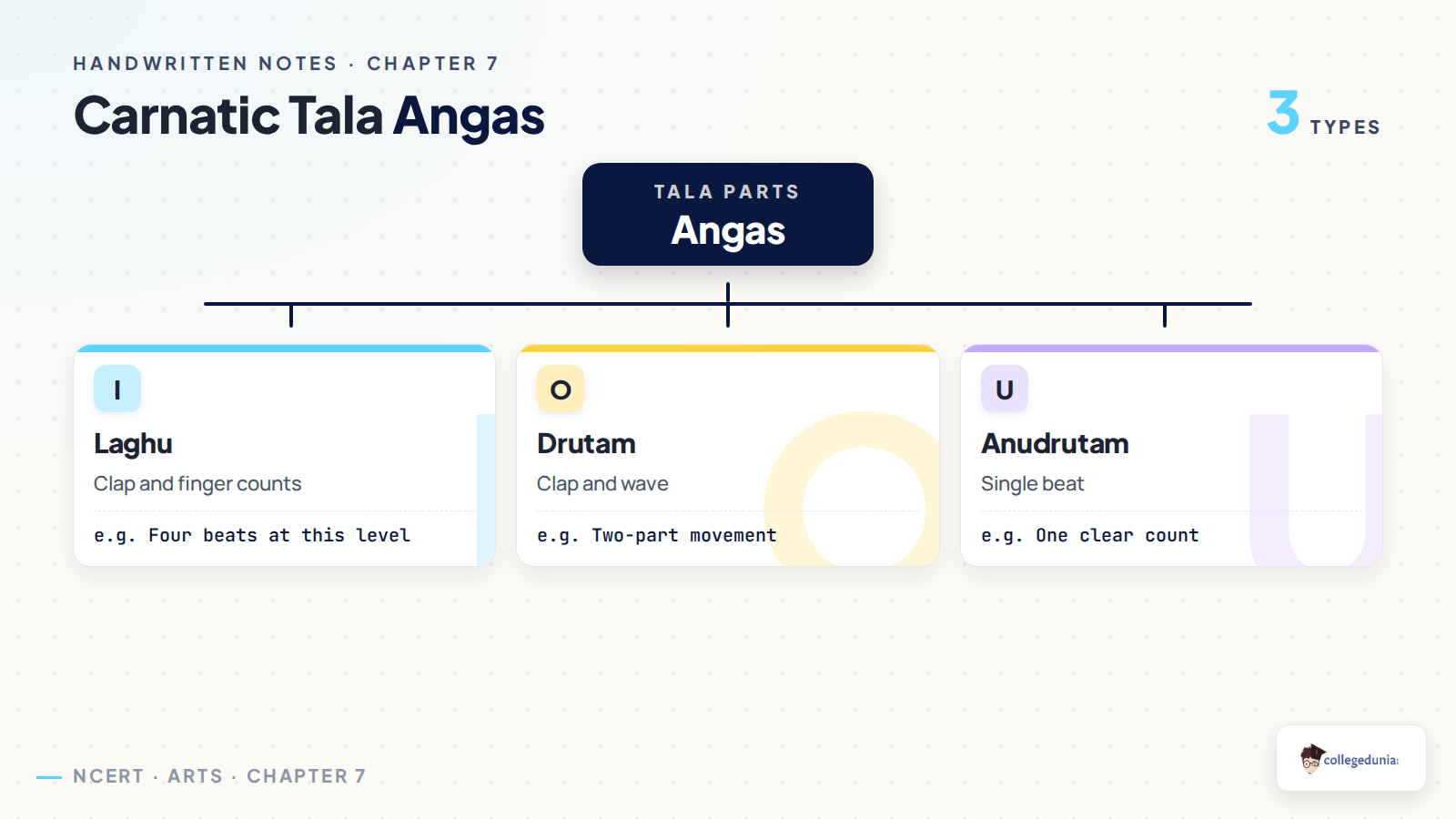
The chapter lists seven main Carnatic talas: Dhruva, Matya, Rupaka, Jhampa, Triputa, Ata and Eka. These are revised through sapta tala alankaras.
The three main angas are easy to remember. Laghu is clap with finger counts, Drutam is clap and wave, and Anudrutam is one beat.
- Laghu: marked I, four beats at this level.
- Drutam: marked O, clap and wave.
- Anudrutam: marked U, one beat.
Ra Ra Venu and Bilahari
The Carnatic composition in this chapter is Ra Ra Venu. Its ragam is Bilahari, its talam is Adi, and its language is Telugu.
Before singing the composition, students revise arohanam and avarohanam. This helps them understand the raga movement before adding lyrics.
| Item | Revision Point |
|---|---|
| Ragam | Bilahari |
| Talam | Adi, 8 beats |
| Composer | Patnam Subramania Iyer |
Hindustani Taals
Hindustani taals are revised through matras, bols and signs. Matra means count unit, and bol means the spoken rhythm syllable.
Jhaptal has 10 matras. Rupak has 7 units. Ektaal has 12 matras. Teentaal has 16 beats and appears with Raga Bhairavi compositions.
- Jhaptal: Dhee Naa Dhee Dhee Naa Tee Naa Dhee Dhee Naa.
- Rupak: Tee Tee Naa Dhee Naa Dhee Naa.
- Ektaal: uses Dhin, Dhage Tirkit, Tu, Naa, Kat and Taa.
Ragas and Raga Bhairavi
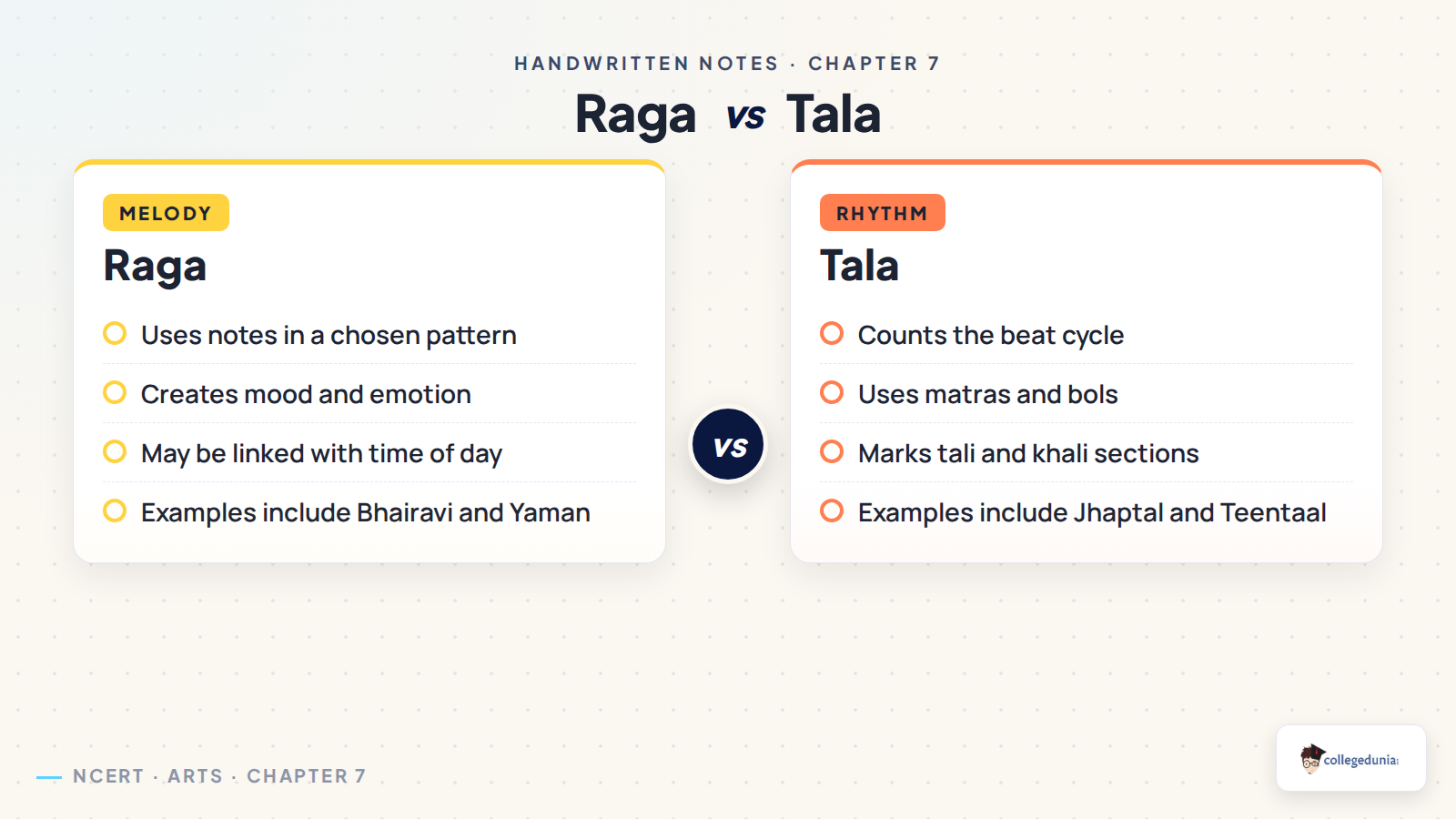
Ragas express emotions and create moods. In Hindustani music, some ragas are linked with particular times of day.
The chapter gives Bhairav as a morning raga and Yaman as an evening raga. It then explains Raga Bhairavi, with its thaat, jati, komal swaras and singing time.
For exams, students should not mix up raga and tala. Raga is melodic mood, while tala is rhythm cycle.
Zakir Hussain and Tabla Practice
Ustad Zakir Hussain was a renowned tabla maestro. He learned from his father Ustad Alla Rakha and performed from a young age.
The chapter connects his life with tabla practice. It also asks students to learn simple rhythms from a tabla teacher if the school has one.
- He performed as a soloist and accompanist.
- He helped found the world music band Shakti.
- He received major honours, including the Padma Vibhushan and three Grammy awards.
Ragas and Talas/Taal Chapter Video
Source: NCERT OFFICIAL on YouTube
Related NCERT Class 7 Arts (Kriti) Resources
Use these related resources when you want the official book chapter or nearby handwritten notes for the same music unit.
| Resource | Link |
|---|---|
| NCERT Book PDF | Class 7 Arts Chapter 7 NCERT Book PDF |
| Previous Chapter | Class 7 Arts Chapter 6 Handwritten Notes |
| Earlier Chapter | Class 7 Arts Chapter 5 Handwritten Notes |
All Chapters for Class 7 Arts (Kriti) Handwritten Notes
| Chapter | Handwritten Notes |
|---|---|
| Chapter 2 Say More without Speech Mime | Download Notes |
| Chapter 3 Let's Design Stage Technicals 2 | Download Notes |
| Chapter 4 Story of India's Storytelling Tradition | Download Notes |
| Chapter 5 Making Music | Download Notes |
| Chapter 6 Music, Emotions and Creativity | Download Notes |
| Chapter 7 Ragas and Talas/Taal | Download Notes |
FAQs on NCERT Class 7 Arts Chapter 7 Handwritten Notes
Ques. What is covered in Class 7 Arts Chapter 7 Ragas and Talas/Taal?
Ans. The chapter covers sapta swara, Carnatic talas, Ra Ra Venu, Hindustani taals, Raga Bhairavi and tabla practice.
Ques. What is the difference between raga and tala?
Ans. Raga gives melodic shape and mood, while tala or taal gives the rhythm cycle used while singing or playing.
Ques. Which Carnatic tala angas are important in this chapter?
Ans. Laghu, Drutam and Anudrutam are important. They are marked as I, O and U in the chapter.
Ques. Why are these handwritten notes useful?
Ans. The notes turn the chapter into short visual pages with charts, quick points and easy revision cues.



Comments