




NCERT Handwritten Notes for Class 7 Arts (Kriti) Chapter 11 Dance Vocabulary and Techniques help students revise nritta, nritya, natya, basic steps, rhythm counts, samyuta hastas, jumps and spins for the 2026-27 NCERT syllabus. The PDF arranges the chapter into clear handwritten pages for quick classroom and home revision.
- Download a 25-page handwritten revision PDF for Class 7 Arts Chapter 11.
- Revise dance vocabulary, 5, 6 and 7 beat patterns, hastas, jumps and pirouettes.
- Use the notes before activity practice, group performance and chapter assessment.
Chapter11DanceVocabularyandTechniquesHandwrittenNotes.pdf?page=1&dpi=150)
Chapter11DanceVocabularyandTechniquesHandwrittenNotes.pdf?page=2&dpi=150)
Chapter11DanceVocabularyandTechniquesHandwrittenNotes.pdf?page=3&dpi=150)
Chapter11DanceVocabularyandTechniquesHandwrittenNotes.pdf?page=4&dpi=150)
Chapter11DanceVocabularyandTechniquesHandwrittenNotes.pdf?page=5&dpi=150)
Chapter11DanceVocabularyandTechniquesHandwrittenNotes.pdf?page=6&dpi=150)
Chapter11DanceVocabularyandTechniquesHandwrittenNotes.pdf?page=7&dpi=150)
Chapter11DanceVocabularyandTechniquesHandwrittenNotes.pdf?page=8&dpi=150)
Chapter11DanceVocabularyandTechniquesHandwrittenNotes.pdf?page=9&dpi=150)
Chapter11DanceVocabularyandTechniquesHandwrittenNotes.pdf?page=10&dpi=150)
Chapter11DanceVocabularyandTechniquesHandwrittenNotes.pdf?page=11&dpi=150)
Chapter11DanceVocabularyandTechniquesHandwrittenNotes.pdf?page=12&dpi=150)
Chapter11DanceVocabularyandTechniquesHandwrittenNotes.pdf?page=13&dpi=150)
Chapter11DanceVocabularyandTechniquesHandwrittenNotes.pdf?page=14&dpi=150)
Chapter11DanceVocabularyandTechniquesHandwrittenNotes.pdf?page=15&dpi=150)
Chapter11DanceVocabularyandTechniquesHandwrittenNotes.pdf?page=16&dpi=150)
Chapter11DanceVocabularyandTechniquesHandwrittenNotes.pdf?page=17&dpi=150)
Chapter11DanceVocabularyandTechniquesHandwrittenNotes.pdf?page=18&dpi=150)
Chapter11DanceVocabularyandTechniquesHandwrittenNotes.pdf?page=19&dpi=150)
Chapter11DanceVocabularyandTechniquesHandwrittenNotes.pdf?page=20&dpi=150)
Chapter11DanceVocabularyandTechniquesHandwrittenNotes.pdf?page=21&dpi=150)
Chapter11DanceVocabularyandTechniquesHandwrittenNotes.pdf?page=22&dpi=150)
Chapter11DanceVocabularyandTechniquesHandwrittenNotes.pdf?page=23&dpi=150)
Chapter11DanceVocabularyandTechniquesHandwrittenNotes.pdf?page=24&dpi=150)
Chapter11DanceVocabularyandTechniquesHandwrittenNotes.pdf?page=25&dpi=150)
Clear handwritten notes on dance vocabulary, rhythm, hastas, jumps and storytelling.
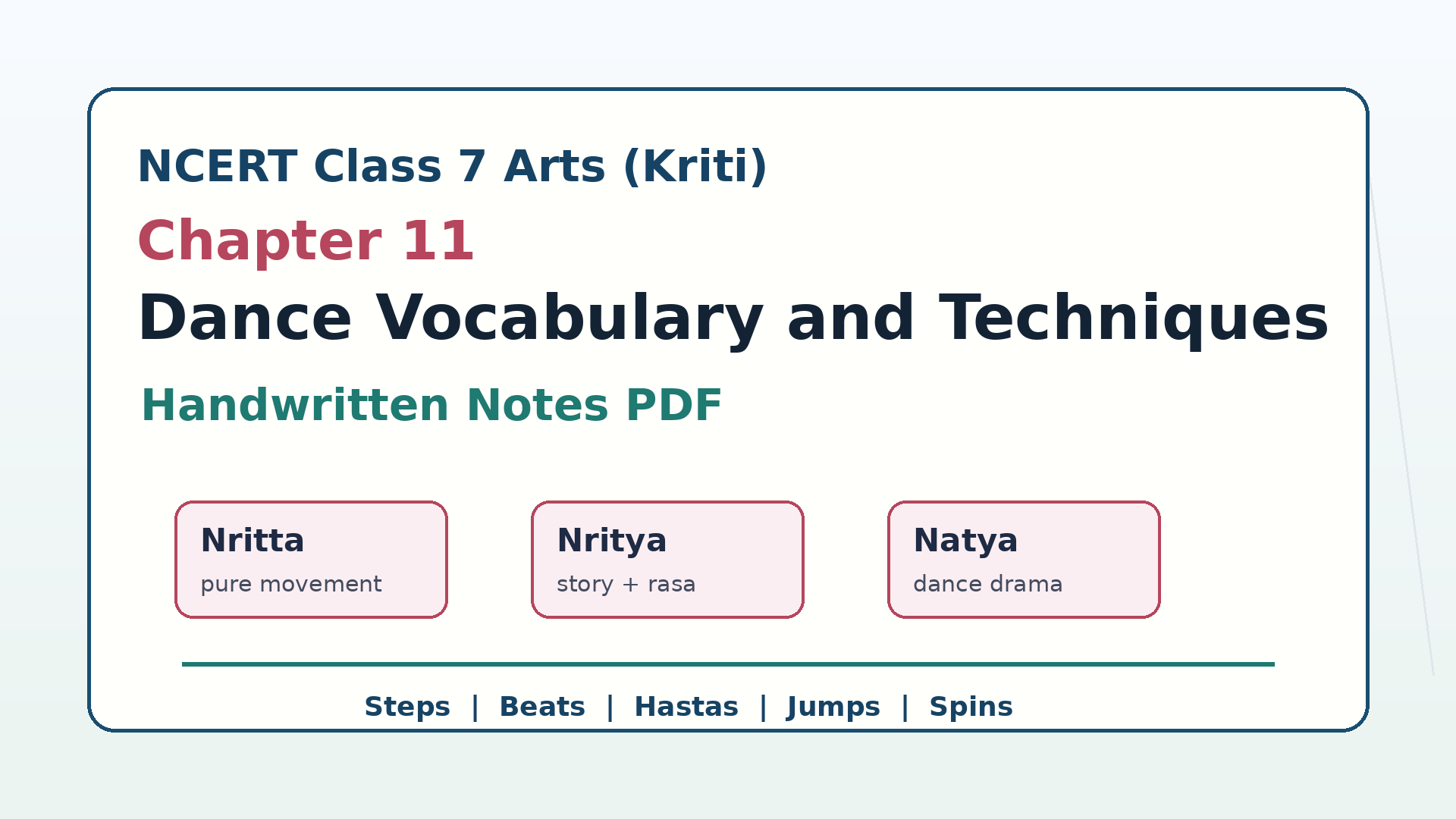
Dance Vocabulary Chapter Snapshot
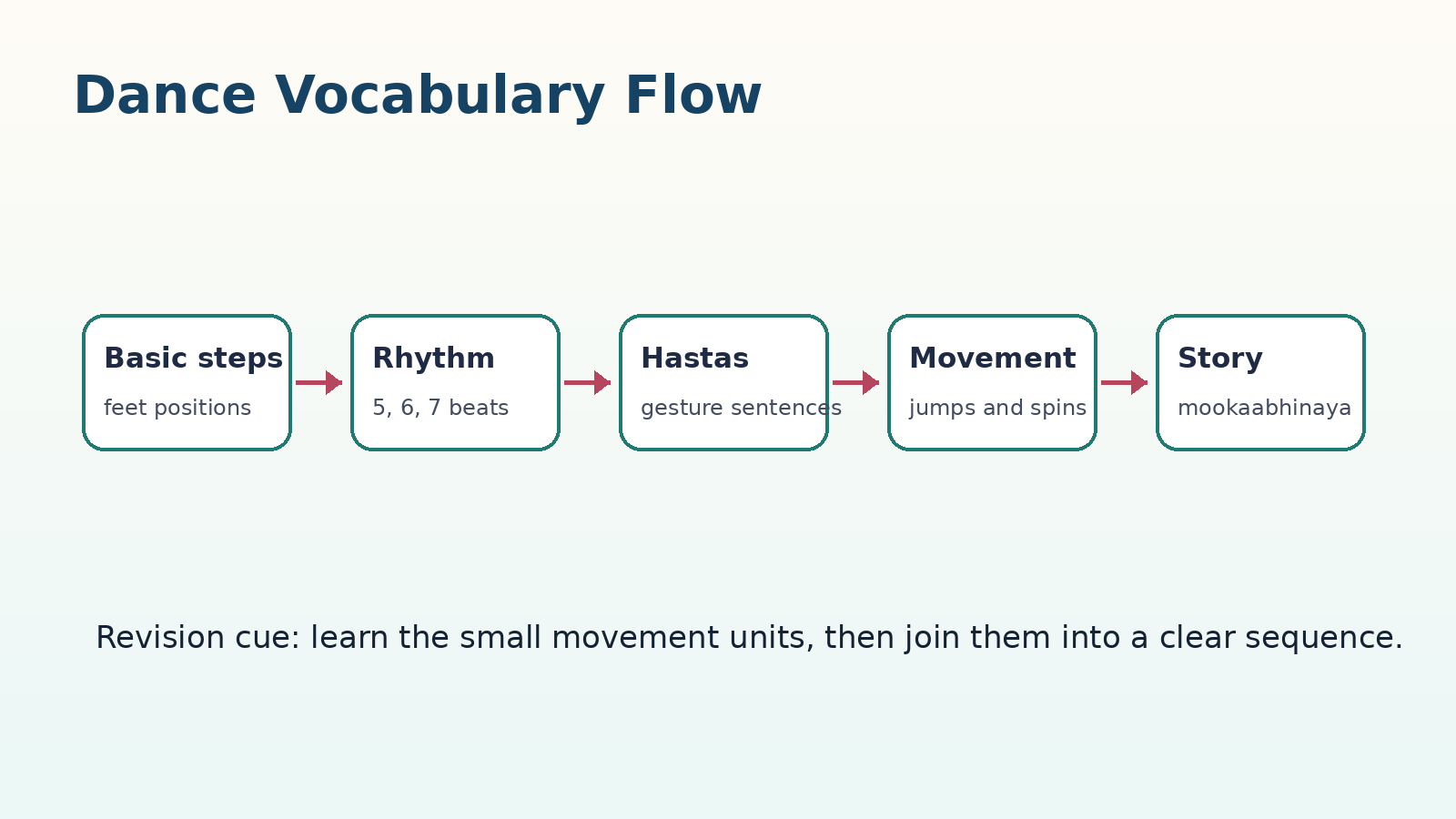
Chapter 11 explains how small dance units become a full performance sequence. Students first revise the meaning of nritta, nritya and natya. Then they practise steps, rhythm counts, hastas, jumps, spins and storytelling activities.
The easiest way to revise the chapter is to treat every topic as a dance vocabulary word. A step, beat, hasta, jump or spin becomes useful when a student can name it, perform it safely and explain its purpose.
| Topic | What to Remember |
|---|---|
| Nritta | Pure movement without story or emotive content. |
| Nritya | Movement with narration, rasa and bhava. |
| Natya | Dance drama where performance parts tell a full story. |
Nritta, Nritya and Natya
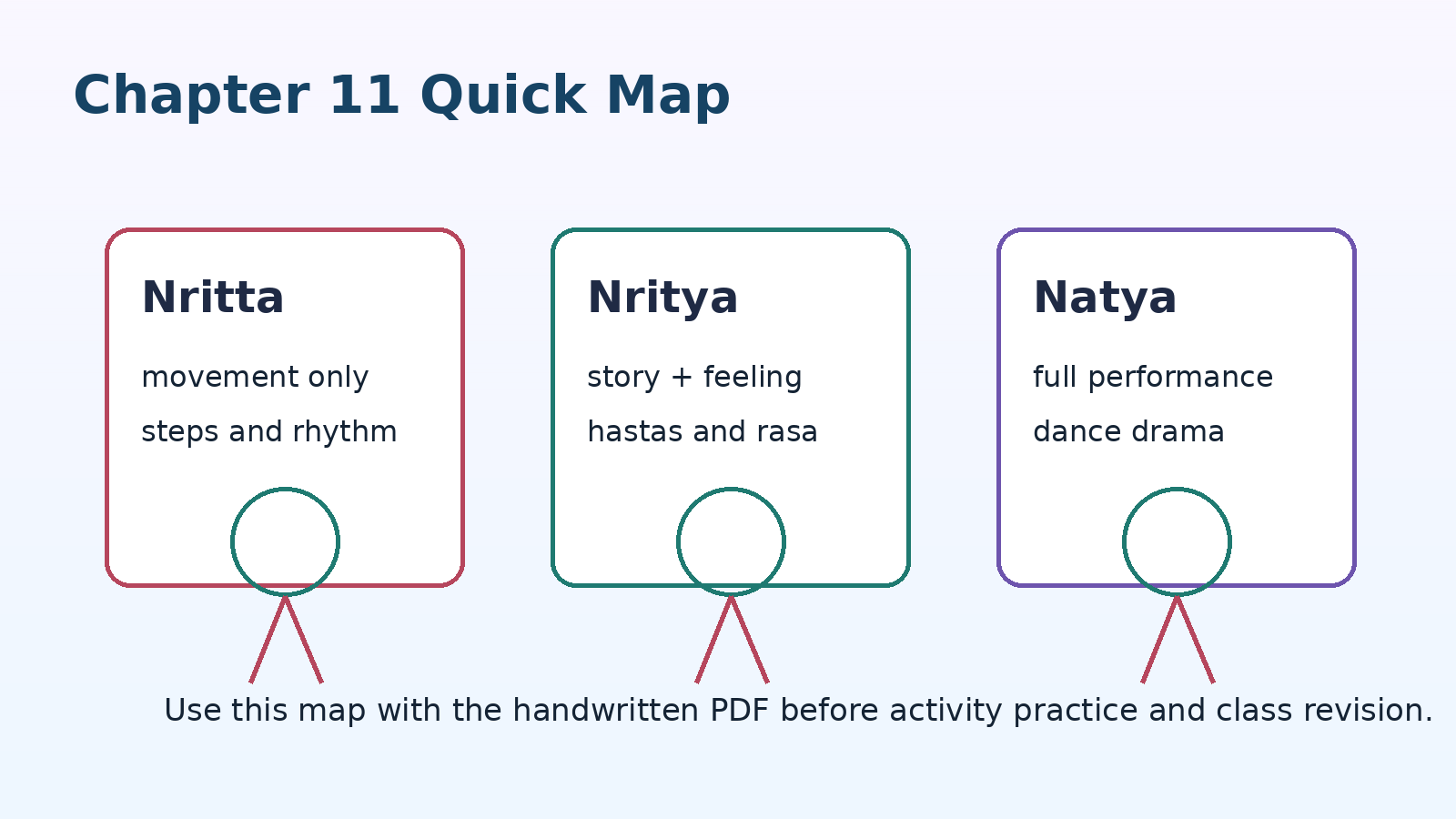
The chapter begins with definitions from Abhinaya Darpana. Nritta is dance made of movement only. Nritya connects dance with stories or situations through rasa and bhava. Natya brings performance elements together to narrate a full story.
Students should revise these terms as a sequence. First comes clear movement, then expressive movement, and then full performance. This order makes the difference between the three terms easy to remember.
- Nritta helps students practise body control and rhythm.
- Nritya uses gesture, expression and attention.
- Natya combines dance, acting and story.
Basic Steps and Rhythm Counts
Chapter 11 calls basic steps the most important unit of a dance form. Feet together, heel front, toe front, cross in front, cross at the back and jumps can be combined into different rhythm patterns.
The chapter asks students to practise 5 beats, 6 beats and 7 beats. Five beats can be grouped as 2 + 3. Six beats can be grouped as 3 + 3. Seven beats can be grouped as 3 + 4, 3 + 2 + 2 or 4 + 3.
| Beat Count | Revision Cue |
|---|---|
| 5 beats | Practise stamp, heel, jump, step and cross patterns. |
| 6 beats | Use two groups of three and repeat with both legs. |
| 7 beats | Try more than one grouping and keep the final count clear. |
Samyuta Hastas and Gesture Sentences
The chapter recalls how hastas help communication. Samyuta hastas use both hands together. Examples include Anjali for namaskar, Pushpaputa for offering flowers, Shankha for blowing a conch shell, Pasha for a knot and Garuda for a bird shape.
Activity 11.3 asks students to converse using asamyuta and samyuta hastas. Short phrases such as welcome my friend or do not be angry and fight can become full gesture sentences.
- Choose a simple idea first.
- Use clear hand shapes and matching facial expression.
- Let friends guess the meaning before explaining it.
Jumps, Pirouettes and Storytelling
Jumps, utplavana, pirouettes and bhramaris are another part of dance vocabulary. They may be used in pure dance or to improve expressive content. A jump or spin should be controlled, safe and connected to the rhythm or story.
The chapter shows jumps with one leg raised, folded legs, open legs and spins on one leg or with hands spread in air. It also asks students to observe dance forms such as Yakshagana, Kalbelia, Pung Cholom and Kathak.
Activity 11.6 brings the chapter together. Students create a situation using steps, expression, hastas, jumps and pirouettes. The Mookaabhinaya game checks whether the group can communicate without spoken explanation.
Dance Vocabulary Chapter Video
Source: Prof.Analysis on YouTube
Related NCERT Class 7 Arts (Kriti) Resources
Use these related resources when you want the official book chapter or nearby handwritten notes from the same Arts (Kriti) unit.
| Resource | Link |
|---|---|
| NCERT Book PDF | Class 7 Arts Chapter 11 NCERT Book PDF |
| Previous Chapter | Class 7 Arts Chapter 10 Handwritten Notes |
| Next Chapter | Class 7 Arts Chapter 12 Handwritten Notes |
All Chapters for Class 7 Arts (Kriti) Handwritten Notes
| Chapter | Handwritten Notes |
|---|---|
| Chapter 7 Ragas and Talas/Taal | Download Notes |
| Chapter 8 The Music of the People | Download Notes |
| Chapter 9 Performance | Download Notes |
| Chapter 10 Dance and Sculpture | Download Notes |
| Chapter 11 Dance Vocabulary and Techniques | Download Notes |
FAQs on NCERT Class 7 Arts Chapter 11 Handwritten Notes
Ques. What is covered in Class 7 Arts Chapter 11 Dance Vocabulary and Techniques?
Ans. The chapter covers nritta, nritya, natya, basic steps, 5, 6 and 7 beat rhythm patterns, samyuta hastas, jumps, pirouettes and storytelling activities.
Ques. What is the main difference between nritta, nritya and natya?
Ans. Nritta is pure movement, nritya adds story and feeling, and natya is a full dance drama with different performance parts.
Ques. Why are samyuta hastas important in this chapter?
Ans. Samyuta hastas use both hands and help students communicate ideas, objects, emotions and short sentences through dance gestures.
Ques. Why are these handwritten notes useful?
Ans. The notes turn the chapter into short handwritten revision pages with tables, movement cues, quick points and activity reminders.



Comments