




NCERT Handwritten Notes for Class 7 Arts (Kriti) Chapter 13 Personalities help students revise Shambhu Maharaj, Kedar Nath Sahu, Kathak, Seraikella Chhau and Activity 13.1 for the 2026-27 NCERT syllabus. The PDF turns the short chapter into colourful handwritten revision pages with names, dates, traditions and project-work cues.
- Download a 24-page handwritten revision PDF for Class 7 Arts Chapter 13.
- Revise Shambhu Maharaj with Kathak, Lucknow Gharana, abhinaya and awards.
- Revise Kedar Nath Sahu with Seraikella Chhau, Guru-Sishya Parampara and disciples.
Chapter13PersonalitiesHandwrittenNotes.pdf?page=1&dpi=150)
Chapter13PersonalitiesHandwrittenNotes.pdf?page=2&dpi=150)
Chapter13PersonalitiesHandwrittenNotes.pdf?page=3&dpi=150)
Chapter13PersonalitiesHandwrittenNotes.pdf?page=4&dpi=150)
Chapter13PersonalitiesHandwrittenNotes.pdf?page=5&dpi=150)
Chapter13PersonalitiesHandwrittenNotes.pdf?page=6&dpi=150)
Chapter13PersonalitiesHandwrittenNotes.pdf?page=7&dpi=150)
Chapter13PersonalitiesHandwrittenNotes.pdf?page=8&dpi=150)
Chapter13PersonalitiesHandwrittenNotes.pdf?page=9&dpi=150)
Chapter13PersonalitiesHandwrittenNotes.pdf?page=10&dpi=150)
Chapter13PersonalitiesHandwrittenNotes.pdf?page=11&dpi=150)
Chapter13PersonalitiesHandwrittenNotes.pdf?page=12&dpi=150)
Chapter13PersonalitiesHandwrittenNotes.pdf?page=13&dpi=150)
Chapter13PersonalitiesHandwrittenNotes.pdf?page=14&dpi=150)
Chapter13PersonalitiesHandwrittenNotes.pdf?page=15&dpi=150)
Chapter13PersonalitiesHandwrittenNotes.pdf?page=16&dpi=150)
Chapter13PersonalitiesHandwrittenNotes.pdf?page=17&dpi=150)
Chapter13PersonalitiesHandwrittenNotes.pdf?page=18&dpi=150)
Chapter13PersonalitiesHandwrittenNotes.pdf?page=19&dpi=150)
Chapter13PersonalitiesHandwrittenNotes.pdf?page=20&dpi=150)
Chapter13PersonalitiesHandwrittenNotes.pdf?page=21&dpi=150)
Chapter13PersonalitiesHandwrittenNotes.pdf?page=22&dpi=150)
Chapter13PersonalitiesHandwrittenNotes.pdf?page=23&dpi=150)
Chapter13PersonalitiesHandwrittenNotes.pdf?page=24&dpi=150)
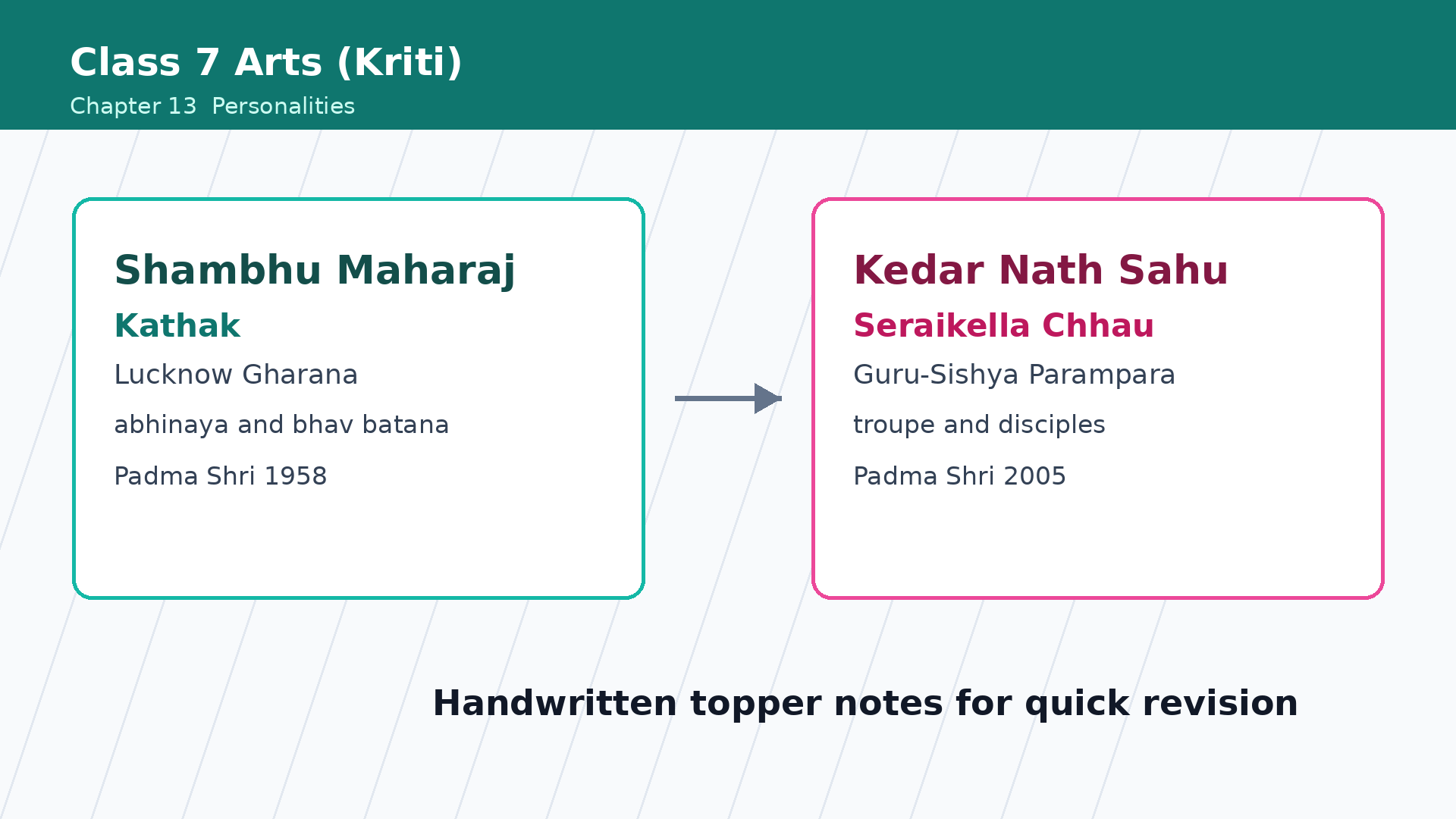
Personalities Chapter Snapshot
Chapter 13 introduces students to two dance personalities. Shambhu Maharaj belongs to the Kathak tradition, while Kedar Nath Sahu belongs to Seraikella Chhau. Both artists show how Indian dance traditions continue through family, training, performance and teaching.
The easiest way to revise the chapter is to attach every name to a dance form and one strong contribution. This keeps the chapter simple because the textbook is short, but it expects accurate names and dates.
| Personality | Dance Tradition | Main Cue |
|---|---|---|
| Shambhu Maharaj | Kathak, Lucknow Gharana | Abhinaya, bhav batana and teaching in Delhi. |
| Kedar Nath Sahu | Seraikella Chhau | Guru-Sishya Parampara, masks, troupe work and disciples. |
Shambhu Maharaj Revision Notes
Shambhu Maharaj was a scion of the Lucknow Gharana of Kathak. His father was Kalka Prasad and his uncle was Binda Deen, who helped consolidate the Lucknow Gharana. He trained under Binda Deen and later became known as a great performer and guru.
He made his debut in Lucknow in 1926 at the All India Music Conference. He moved to Delhi in 1955 and taught Kathak at Shriram Bharatiya Kala Kendra. The chapter especially notes his abhinaya and bhav batana.
- Dance form: Kathak.
- Gharana: Lucknow Gharana.
- Awards: Padma Shri in 1958 and Sangeet Natak Academy Award in 1967.
- Legacy: He taught Birju Maharaj and many other Kathak dancers.
Kedar Nath Sahu Revision Notes
Kedar Nath Sahu was a leading exponent of Seraikella Chhau. He came from a traditional family of Chhau dancers belonging to the Kanasari caste. The chapter explains that this family also made household utensils.
He learned the dance form at an early age from his father and grandfather. The art followed Guru-Sishya Parampara and was orally transmitted from one generation to the next. He first performed in the troupe of Kumar Bijoy Pratap Singh Deo and later formed his own troupe with disciples.
- Dance form: Seraikella Chhau.
- Training: Father, grandfather and oral tradition.
- Awards: Sangeet Natak Academy Award in 1981 and Padma Shri in 2005.
- Students: Shashadhar Acharya, Gopal Prasad Dubey and Sharon Lowen.
Shambhu Maharaj and Kedar Nath Sahu Comparison
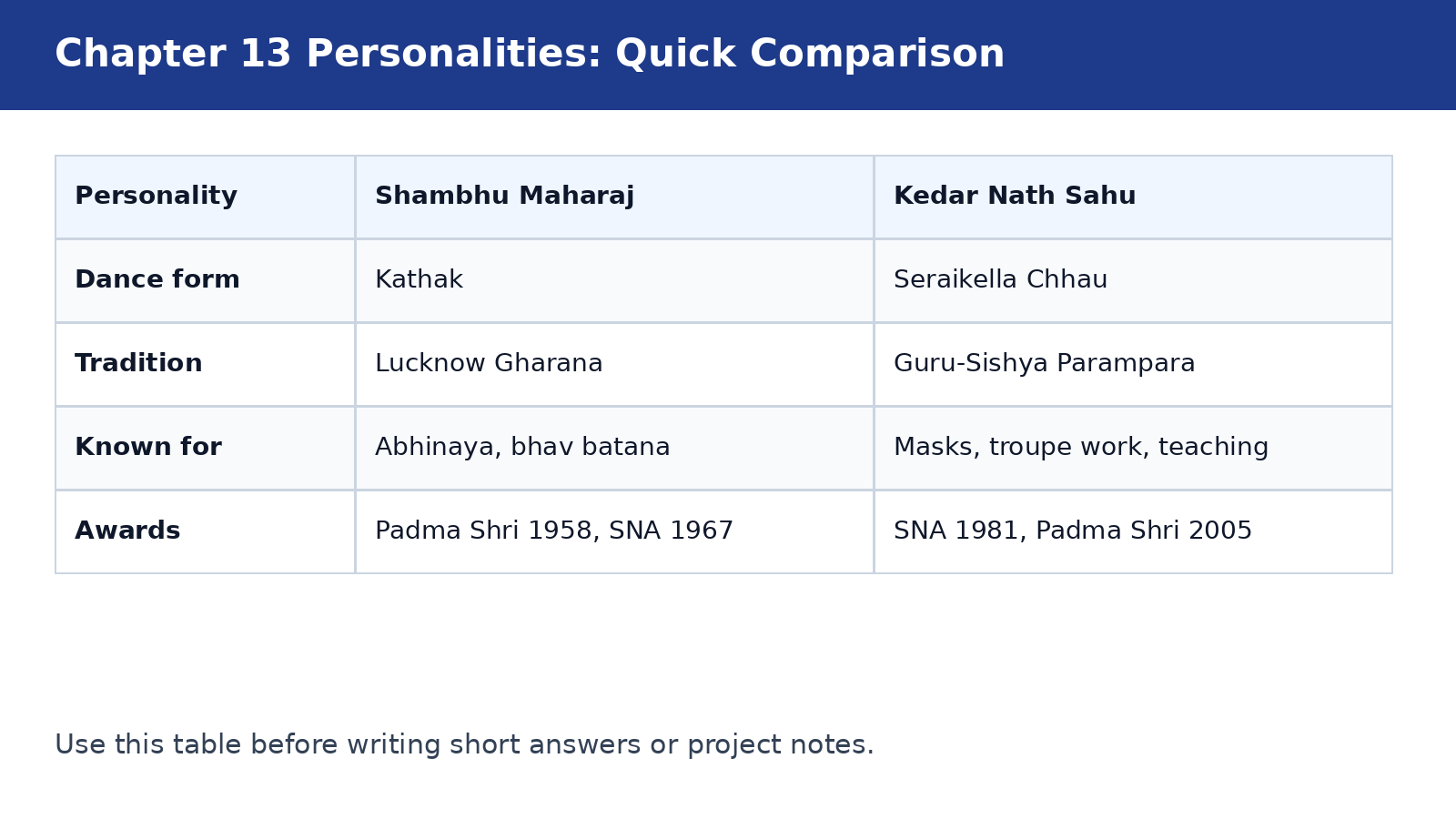
A comparison table helps students avoid mixing the two artists. Shambhu Maharaj should be connected with Kathak and Lucknow Gharana. Kedar Nath Sahu should be connected with Seraikella Chhau and Guru-Sishya Parampara.
For a short answer, write one line on the dance form, one line on training or teaching and one line on awards. This is enough for a neat school-level response.
Activity 13.1 Project Work
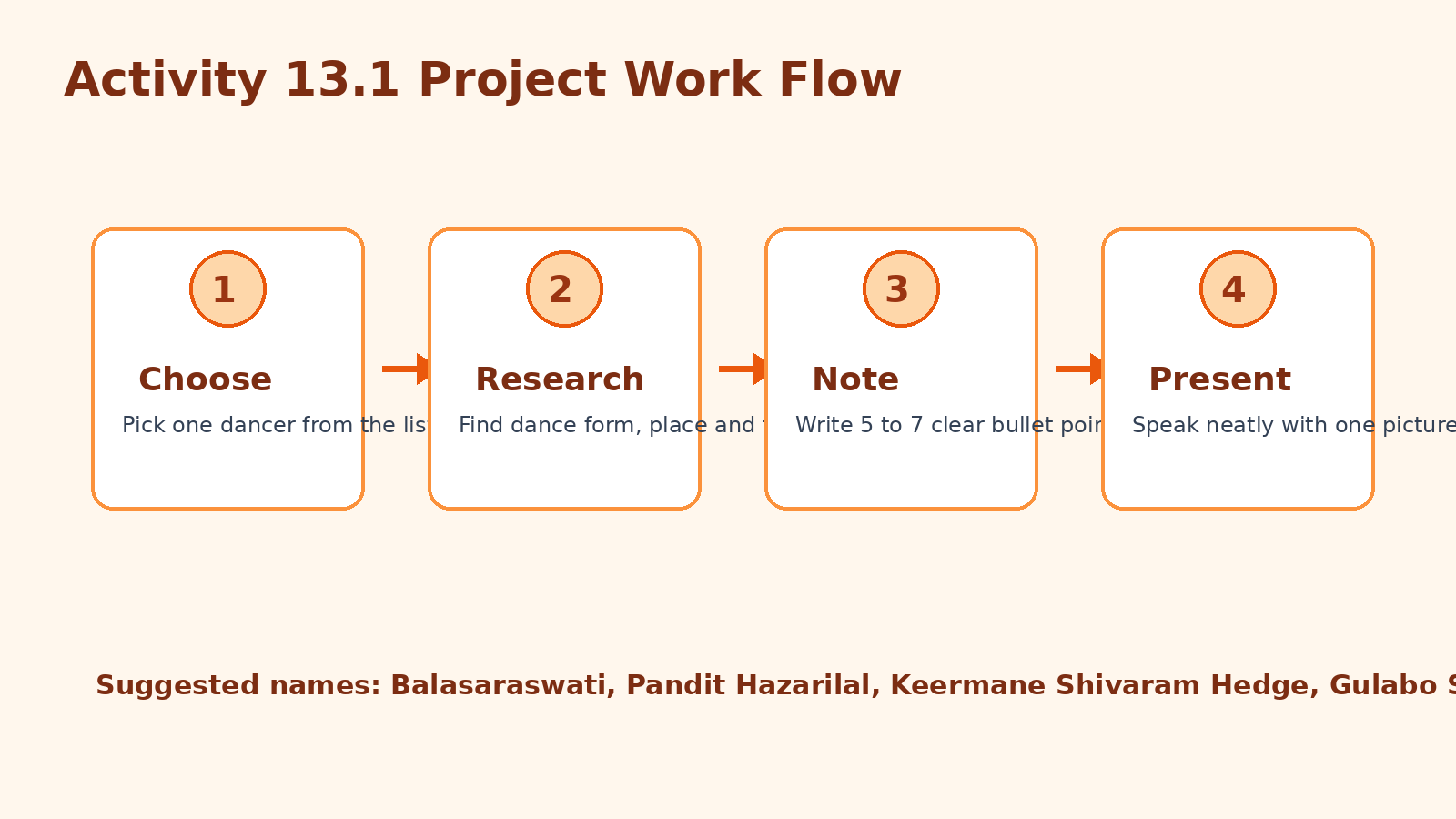
Activity 13.1 asks students to research any one more dance personality. The textbook suggests Balasaraswati, Pandit Hazarilal, Keermane Shivaram Hedge and Gulabo Sapera. Students must present the work as a class project.
- Choose one artist and write the full name clearly.
- Add the dance form, region, teacher or community link.
- Write five to seven useful points in your own words.
- End with one contribution or reason the artist matters.
Personalities Chapter Video Lesson
The video below can be used as a quick support lesson for revising the Class 7 Arts (Kriti) syllabus before reading the handwritten notes.
Source: Prof.Analysis on YouTube
Related NCERT Class 7 Arts (Kriti) Resources
Use these related resources when you want the official book chapter or nearby handwritten notes from the same Arts (Kriti) dance and personalities unit.
| Resource | Link |
|---|---|
| NCERT Book PDF | Class 7 Arts Chapter 13 NCERT Book PDF |
| Previous Chapter | Class 7 Arts Chapter 12 Handwritten Notes |
| Next Chapter | Class 7 Arts Chapter 14 Handwritten Notes |
All Chapters for Class 7 Arts (Kriti) Handwritten Notes
| Chapter | Handwritten Notes |
|---|---|
| Chapter 8 The Music of the People | Download Notes |
| Chapter 9 Performance | Download Notes |
| Chapter 10 Dance and Sculpture | Download Notes |
| Chapter 11 Dance Vocabulary and Techniques | Download Notes |
| Chapter 12 Dance, You and Creativity | Download Notes |
| Chapter 13 Personalities | Current Chapter |
FAQs on NCERT Class 7 Arts Chapter 13 Handwritten Notes
Ques. What is covered in Class 7 Arts Chapter 13 Personalities?
Ans. The chapter covers Shambhu Maharaj, Kedar Nath Sahu, their dance traditions, awards, students and a research project on another dance personality.
Ques. Who was Shambhu Maharaj?
Ans. Shambhu Maharaj was a Kathak dancer from the Lucknow Gharana. He was known for abhinaya, bhav batana and teaching Kathak in Delhi.
Ques. Who was Kedar Nath Sahu?
Ans. Kedar Nath Sahu was a leading exponent of Seraikella Chhau. He learned through Guru-Sishya Parampara and later trained many disciples.
Ques. Why are these handwritten notes useful?
Ans. The notes turn the chapter into short handwritten revision pages with comparison points, award years, project-work steps and quick recall cues.



Comments