




NCERT Handwritten Notes for Class 7 Arts (Kriti) Chapter 12 Dance, You and Creativity help students revise hip movements, character work, dance-drama traditions, Tagore, Uday Shankar and choreography for the 2026-27 NCERT syllabus. The PDF turns the chapter into short handwritten revision pages for classroom practice and pre-assessment recap.
- Download a 22-page handwritten revision PDF for Class 7 Arts Chapter 12.
- Revise twisting, side-to-side, back-and-front and circular hip movements.
- Use the notes before activity practice, mask work and group choreography.
Chapter12Dance,YouandCreativityHandwrittenNotes.pdf?page=1&dpi=150)
Chapter12Dance,YouandCreativityHandwrittenNotes.pdf?page=2&dpi=150)
Chapter12Dance,YouandCreativityHandwrittenNotes.pdf?page=3&dpi=150)
Chapter12Dance,YouandCreativityHandwrittenNotes.pdf?page=4&dpi=150)
Chapter12Dance,YouandCreativityHandwrittenNotes.pdf?page=5&dpi=150)
Chapter12Dance,YouandCreativityHandwrittenNotes.pdf?page=6&dpi=150)
Chapter12Dance,YouandCreativityHandwrittenNotes.pdf?page=7&dpi=150)
Chapter12Dance,YouandCreativityHandwrittenNotes.pdf?page=8&dpi=150)
Chapter12Dance,YouandCreativityHandwrittenNotes.pdf?page=9&dpi=150)
Chapter12Dance,YouandCreativityHandwrittenNotes.pdf?page=10&dpi=150)
Chapter12Dance,YouandCreativityHandwrittenNotes.pdf?page=11&dpi=150)
Chapter12Dance,YouandCreativityHandwrittenNotes.pdf?page=12&dpi=150)
Chapter12Dance,YouandCreativityHandwrittenNotes.pdf?page=13&dpi=150)
Chapter12Dance,YouandCreativityHandwrittenNotes.pdf?page=14&dpi=150)
Chapter12Dance,YouandCreativityHandwrittenNotes.pdf?page=15&dpi=150)
Chapter12Dance,YouandCreativityHandwrittenNotes.pdf?page=16&dpi=150)
Chapter12Dance,YouandCreativityHandwrittenNotes.pdf?page=17&dpi=150)
Chapter12Dance,YouandCreativityHandwrittenNotes.pdf?page=18&dpi=150)
Chapter12Dance,YouandCreativityHandwrittenNotes.pdf?page=19&dpi=150)
Chapter12Dance,YouandCreativityHandwrittenNotes.pdf?page=20&dpi=150)
Chapter12Dance,YouandCreativityHandwrittenNotes.pdf?page=21&dpi=150)
Chapter12Dance,YouandCreativityHandwrittenNotes.pdf?page=22&dpi=150)
Clear handwritten notes on hip movements, traditions, choreography and creative dance.
Dance, You and Creativity Chapter Snapshot
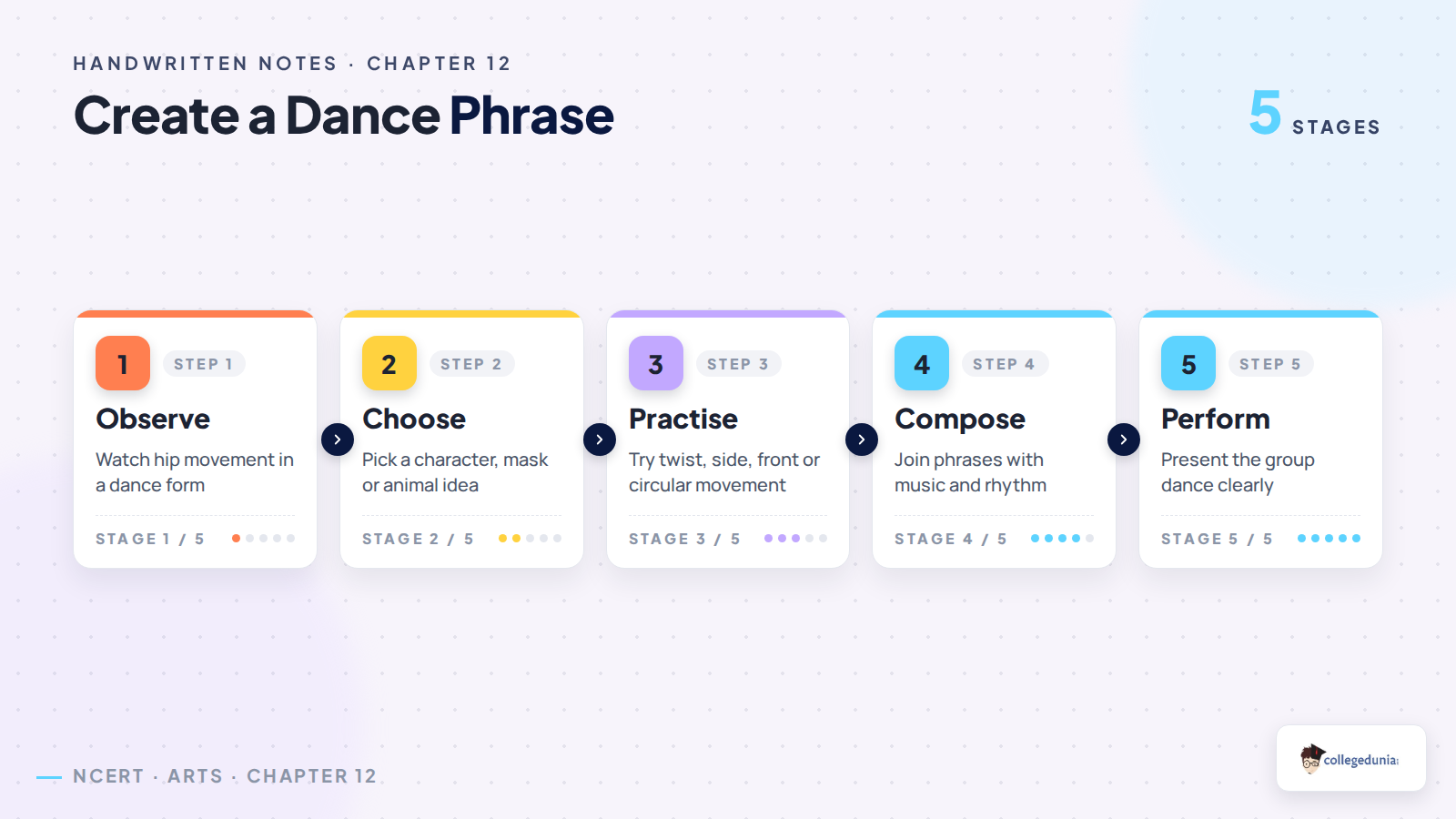
Chapter 12 shows how a student can use movement with imagination. It begins with hip movements and then connects those movements with characters, masks, dance-drama traditions, modern Indian dance and cinema choreography.
The easiest way to revise the chapter is to group it into four parts: movement, character, tradition and creation. This keeps the chapter practical because every topic leads to an activity or performance task.
| Chapter Part | What to Remember |
|---|---|
| Hip movement | Twisting, side-to-side, back-and-front and circular actions. |
| Character work | Costume, mask and movement should match the role. |
| Creative dance | Groups join short phrases into one choreographed presentation. |
Hip Movements in Dance
The chapter studies the hips and kati after students have already explored torso, arms and legs. Hip movements help a dancer show rhythm and emotion. NCERT lists twisting, side-to-side, back-and-front and circular movement as important examples.
Twisting is linked with Garba style turning. Side-to-side movement appears in many folk dances, including Kalbelia. Back-and-front movement is seen in dances such as Bihu and Chhau. Circular motion is explained through the hula hoop and snake-dance idea.
- Keep movement safe and controlled.
- Match the movement with rhythm.
- Use the action only when it suits the character.
Characters, Masks and Costumes
The chapter explains that a solo dancer can play different roles in one performance. Costume, mask, facial expression and movement help students understand each role. NCERT also mentions traditions where male dancers have traditionally performed female characters.
Activity 12.2 asks students to choose a character and then select a hip movement, costume or mask for that character. Movement should not be random. It should show who the character is.
| Choice | Revision Cue |
|---|---|
| Lady character | Use graceful side-to-side movement if it fits the scene. |
| Peacock costume | Use front-and-back or circular action with clear body shape. |
| Mask character | Let the mask guide posture, movement and energy for viewers. |
Bhagavata Mela and Ankiya Bhaona
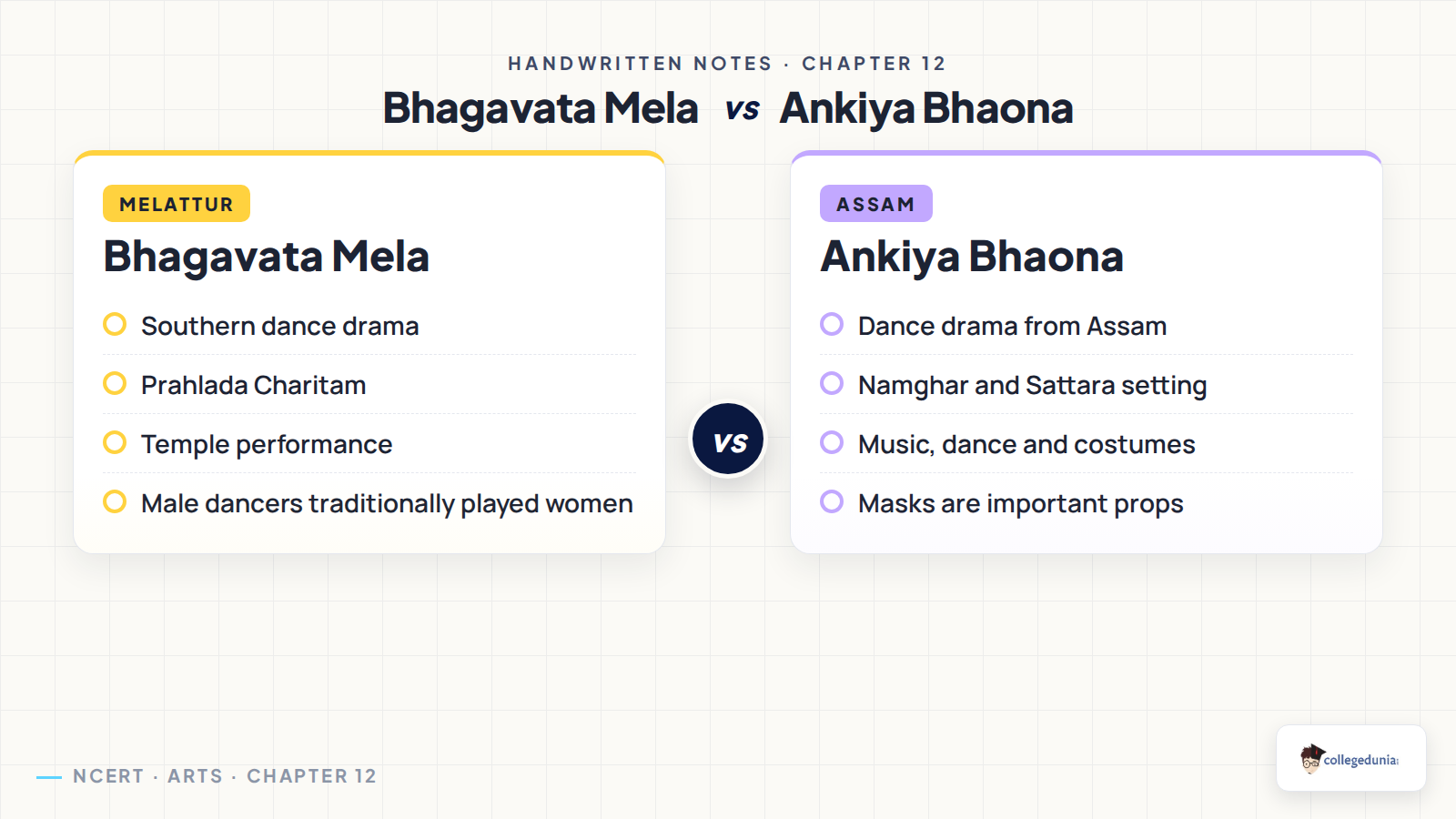
NCERT discusses two performance traditions where dance, music, costume and story work together. Bhagavata Mela Natakam is linked with Melattur, Tamil Nadu. Ankiya Bhaona is a dance-drama tradition from Assam.
Bhagavata Mela is connected with Prahlada Charitam and temple performance. Ankiya Bhaona developed with Vaishnavism, namghars and sattaras. Masks are important props in this tradition, and the songs are in Brajaboli.
Tagore, Uday Shankar and Cinema
The later part of the chapter shows how dance traditions move through transition and transformation. Rabindranath Tagore established Vishwabharati University in Shantiniketan in 1921. It helped shape a new dance vocabulary called Rabindra Nritya.
Uday Shankar is described as a pioneer of modern Indian dance. He creatively blended classical, folk, traditional and tribal movement. His film Kalpana, made in 1948, is mentioned as an important dance film.
The chapter also connects choreography with cinema. Students read about Mughal-e-Azam, Jhanak Jhanak Payal Baje, M S Subbulakshmi, Birju Maharaj and Garba sequences. Activity 12.3 then asks students to make their own creative dance in groups.
Dance, You and Creativity Chapter Video
Source: Prof.Analysis on YouTube
Related NCERT Class 7 Arts (Kriti) Resources
Use these related resources when you want the official book chapter or nearby handwritten notes from the same Arts (Kriti) dance unit.
| Resource | Link |
|---|---|
| NCERT Book PDF | Class 7 Arts Chapter 12 NCERT Book PDF |
| Previous Chapter | Class 7 Arts Chapter 11 Handwritten Notes |
| Next Chapter | Class 7 Arts Chapter 13 Handwritten Notes |
All Chapters for Class 7 Arts (Kriti) Handwritten Notes
| Chapter | Handwritten Notes |
|---|---|
| Chapter 8 The Music of the People | Download Notes |
| Chapter 9 Performance | Download Notes |
| Chapter 10 Dance and Sculpture | Download Notes |
| Chapter 11 Dance Vocabulary and Techniques | Download Notes |
| Chapter 12 Dance, You and Creativity | Download Notes |
FAQs on NCERT Class 7 Arts Chapter 12 Handwritten Notes
Ques. What is covered in Class 7 Arts Chapter 12 Dance, You and Creativity?
Ans. The chapter covers hip movements, characters, masks, Bhagavata Mela, Ankiya Bhaona, Tagore, Uday Shankar, cinema choreography and creative dance activities.
Ques. What are the main hip movements in this chapter?
Ans. The main hip movements are twisting, side-to-side, back-and-front and circular movement.
Ques. Why are masks and costumes important in Chapter 12?
Ans. Masks and costumes help define the character. They also guide how the dancer moves and how students understand the role.
Ques. Why are these handwritten notes useful?
Ans. The notes turn the chapter into short handwritten revision pages with movement cues, comparison points, quick tables and activity reminders.



Comments