




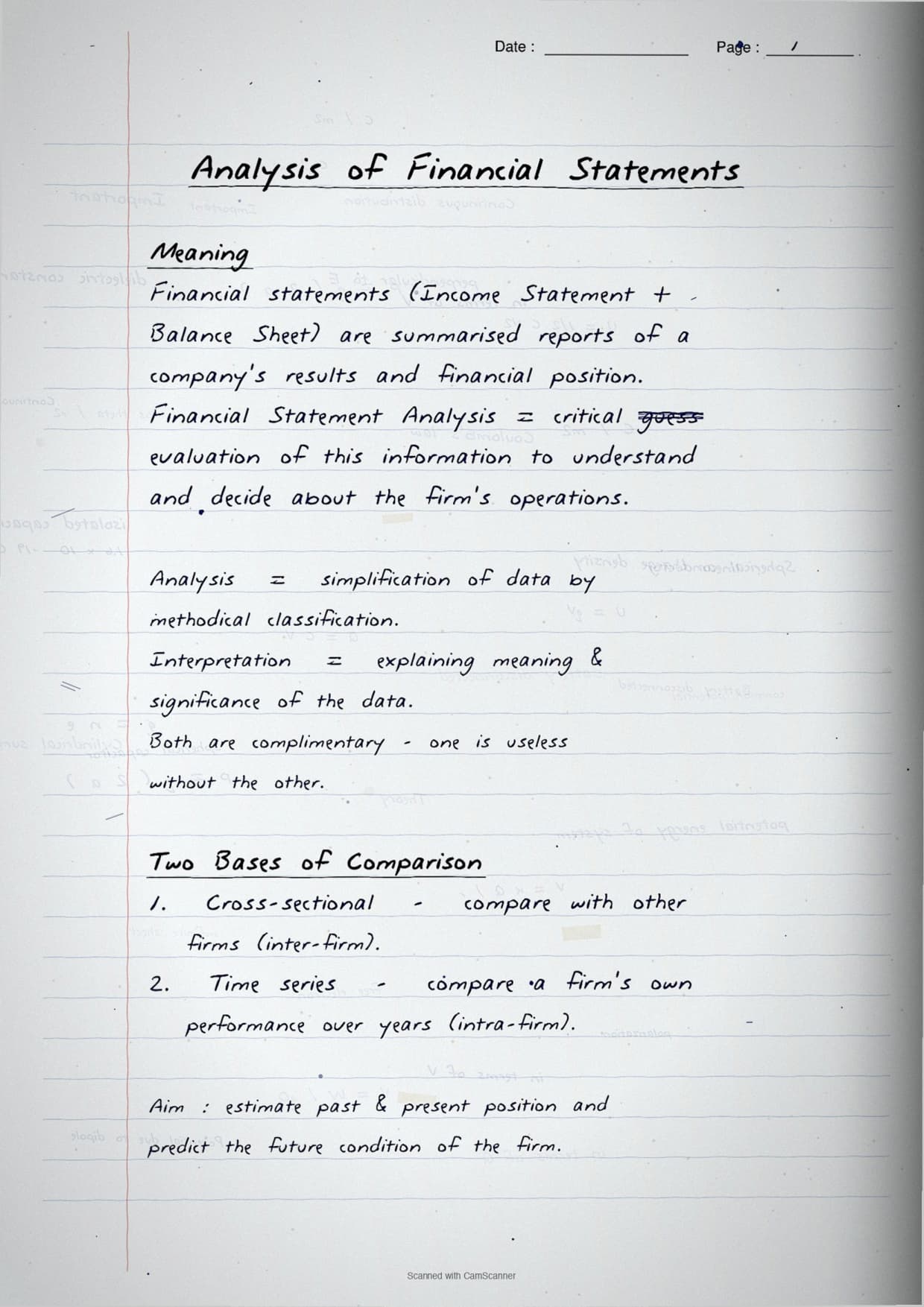
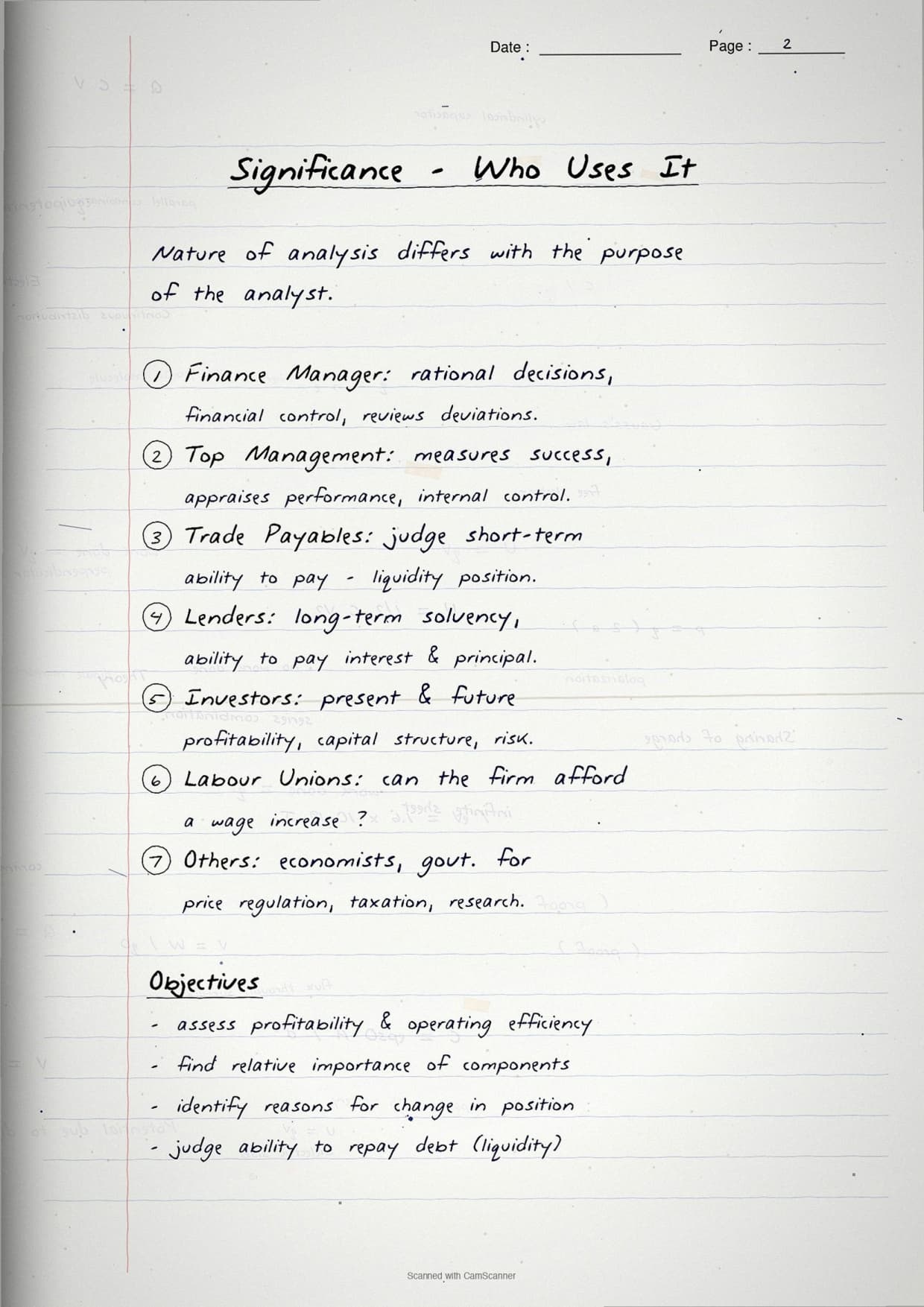
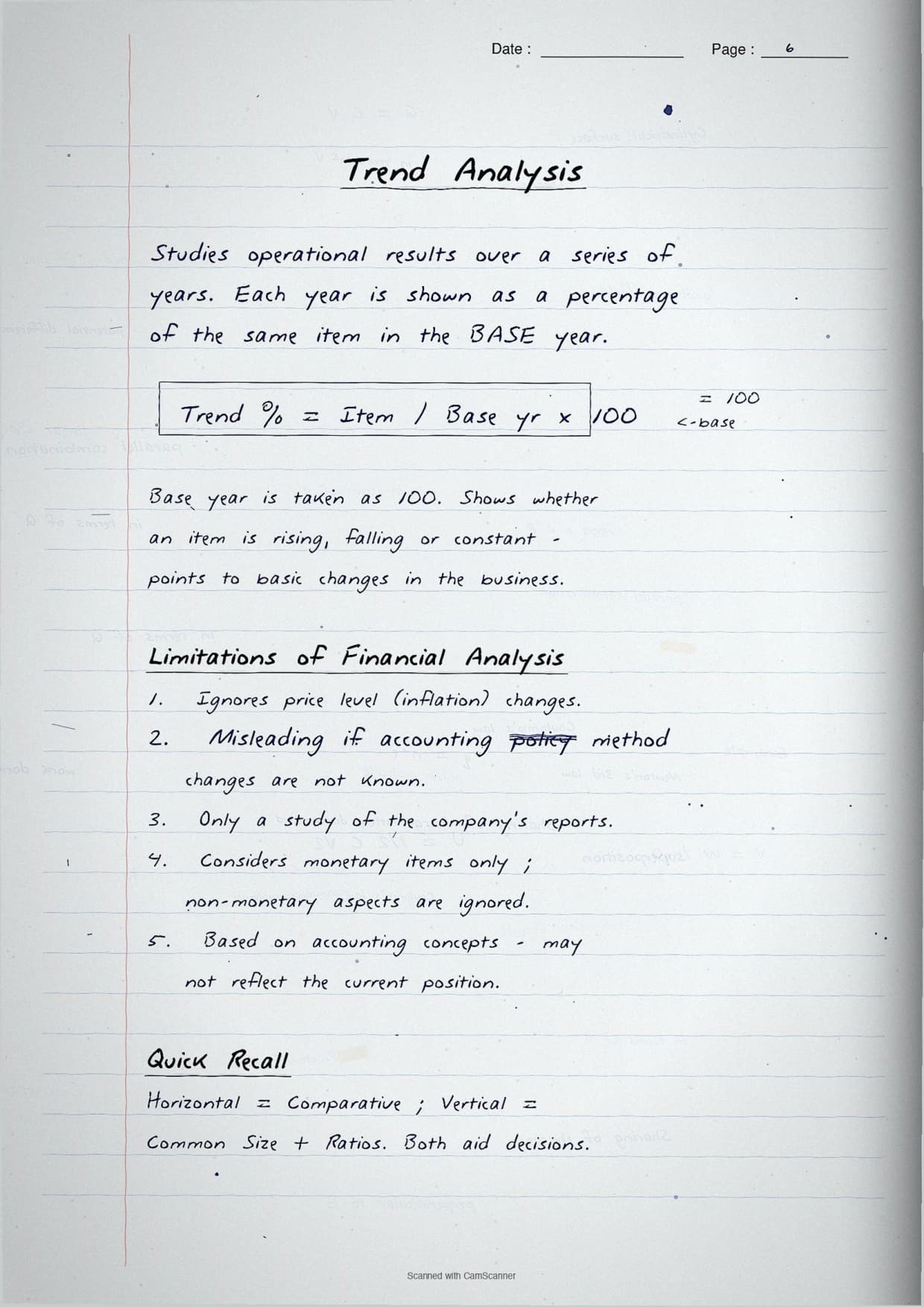
These Analysis of Financial Statements class 12 accountancy handwritten notes are a 6-page scanned blue-ink booklet covering the meaning and types of analysis, the five tools, and the Comparative and Common-size formats for the 2026-27 CBSE Accountancy Part B paper.

| Quick Stat | Value |
|---|---|
| CBSE Weightage (Part B) | 6 to 8 marks |
| CUET / commerce-stream relevance | High (recurring Comparative and Common-size stem) |
| Notebook pages in this PDF | 6 pages, scanned blue-ink format |
These handwritten notes are curated by subject experts, mapped to the 2026-27 NCERT and refined against the last five years of CBSE Board Accountancy papers.
Also Check:
- Analysis of Financial Statements Class 12 Notes (Typeset)
- Analysis of Financial Statements Class 12 NCERT Book PDF
Analysis of Financial Statements Class 12 Accountancy Handwritten Notes: What the 6 Pages Cover
These six pages each cover a block the CBSE Part B paper tests. The table below maps all six pages.
| Page | Focus | What you copy first |
|---|---|---|
| Page 1 | Meaning, objectives and parties interested | The four objectives of analysis. |
| Page 2 | Types of analysis (horizontal, vertical, internal, external, inter-firm, intra-firm) | The horizontal versus vertical split. |
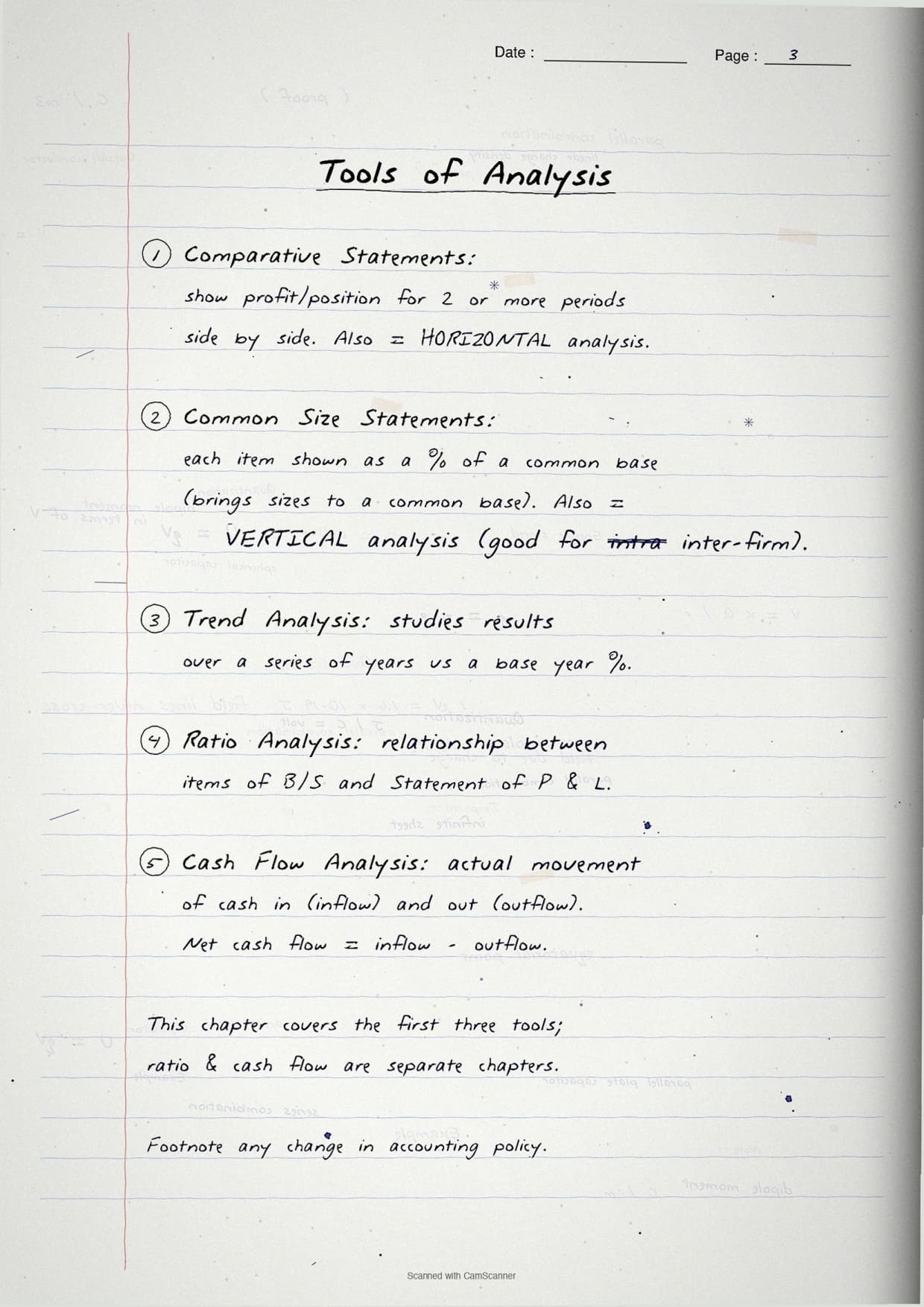
| Page 3 | Tools of financial analysis: the five-tool list | Comparative, Common-size, Trend, Ratio, Cash Flow. |
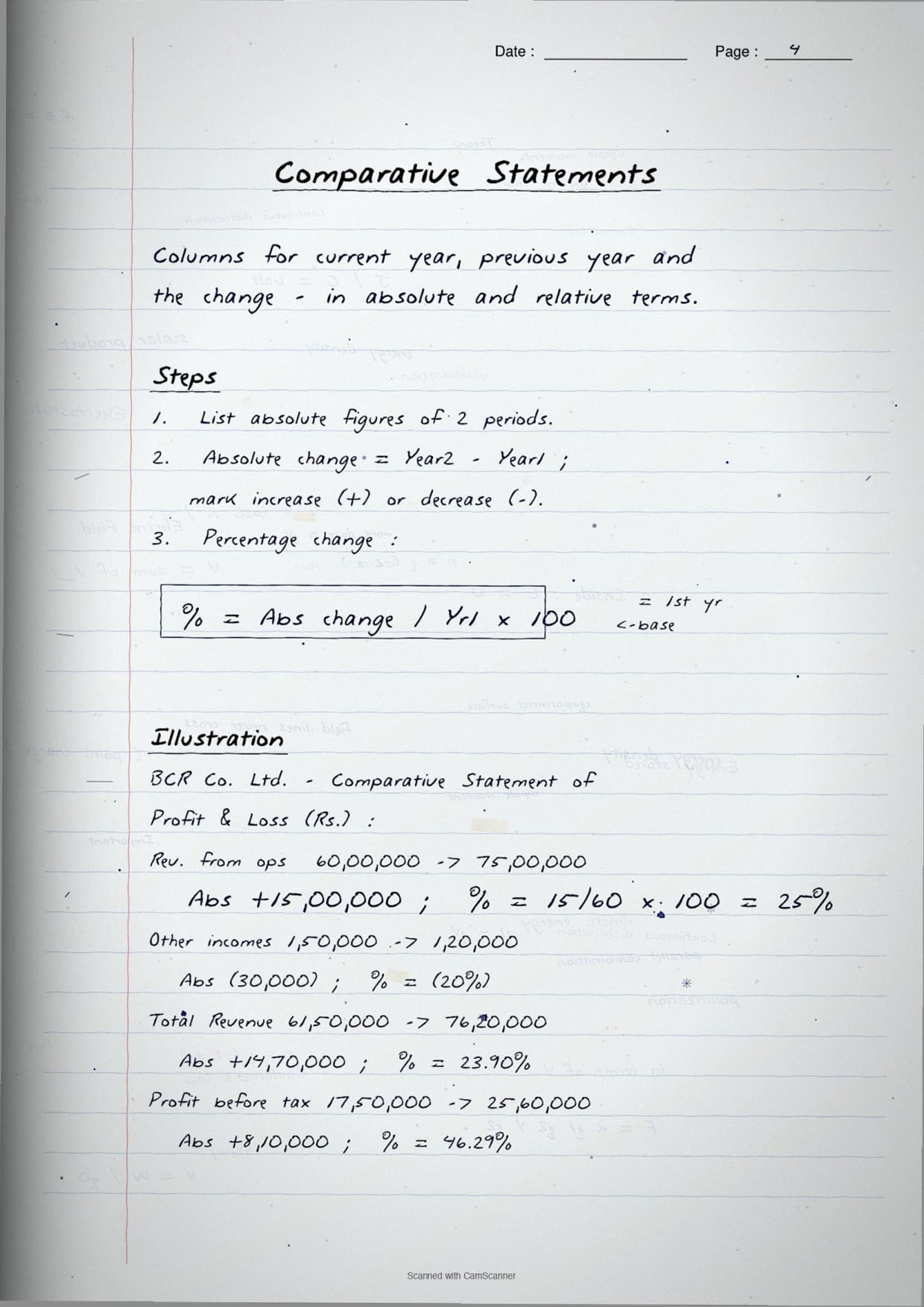
| Page 4 | Comparative Statement of Profit and Loss format | The absolute-change and percentage-change columns. |
| Page 5 | Comparative Balance Sheet and Common-size formats | The base-figure rule for each statement. |
| Page 6 | Limitations of analysis and slip warnings | Red-pen margin arrows. |
Class 12 Accountancy Part 2 Chapter 4 Analysis Of Financial Statements Handwritten Notes
Source: takshila learn on YouTube
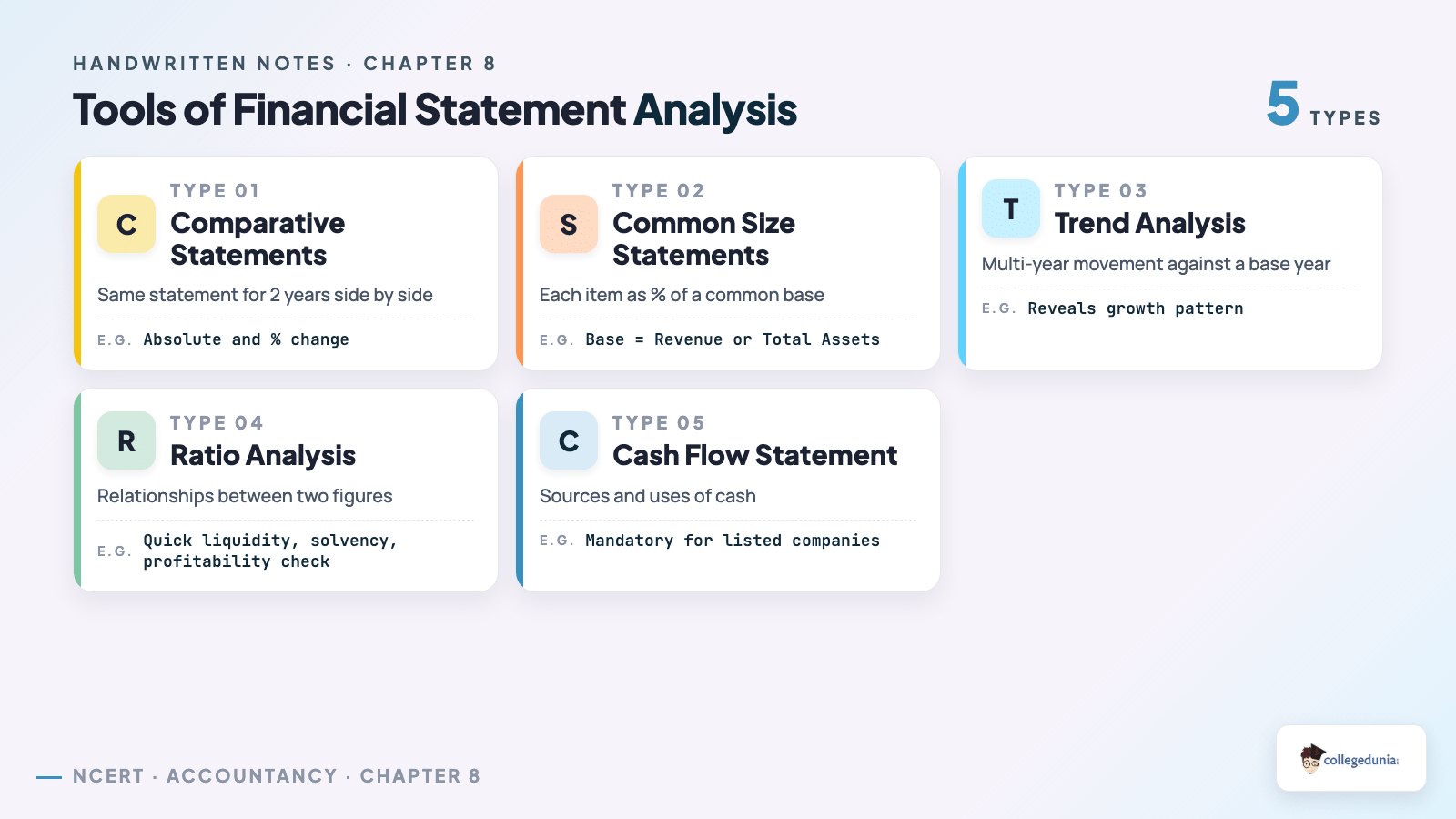
Tools of Financial Analysis: The Page-3 Five-Tool Skeleton
Page 3 lists the five tools with the base figure for each, so you know which format to use for exam questions.
| Tool | What it measures | Base figure |
|---|---|---|
| Comparative Statements | Change between two years, absolute and percentage | Previous year's figure |
| Common-size Statements | Each item as a percentage of a common base | Revenue from Operations / Total Assets |
| Trend Analysis | Movement over several years against a base year | Base-year figure = 100 |
| Ratio Analysis | Relationship between two related figures | Covered in Part 2 Chapter 5 |
| Cash Flow Analysis | Inflows and outflows of cash and cash equivalents | Covered in Part 2 Chapter 6 |
Comparative Statement Format: The Page-4 Five-Column Grid
Page 4 shows the Comparative Statement of Profit and Loss five-column grid. You fill in absolute and percentage change for the two years the exam gives you.
| Column | Heading | What goes here |
|---|---|---|
| 1 | Particulars | Revenue from Operations down to Profit after Tax. |
| 2 | Previous Year | The earlier year's figure. |
| 3 | Current Year | The later year's figure. |
| 4 | Absolute Change | Current Year minus Previous Year. |
| 5 | Percentage Change | Absolute ChangePrevious Year figure × 100 |
The percentage-change formula is the most penalised step. The margin note reads "the denominator is always the previous year's figure, never the current year."
Common-size Statement: The Page-5 Percentage-of-Base Block
In a Common-size Statement of Profit and Loss every item is a percentage of Revenue from Operations; in a Common-size Balance Sheet every item is a percentage of Total Assets.
How will Collegedunia's Handwritten Notes Help You with Analysis of Financial Statements?
- Both Formats, Hand-Drawn: The Comparative five-column grid and the Common-size percentage block are pre-drawn so you fill in numbers, not column headings.
- 2026-27 NCERT Alignment: The five-tool list, base-figure rules, and limitations match the current edition.
- Formula Recall: The percentage-change and percentage-of-base formulae are boxed in red so the denominator rule is the first thing you see.
- Last-Day Recall: Folded lengthwise the booklet rebuilds both formats from memory in under two minutes.
How to Read These Analysis of Financial Statements Handwritten Notes (Colour Legend)
Blue ink marks grids and headings; red pen marks formulae and slip warnings; green underline marks the base figure; yellow shading marks the most-penalised step.
Best Way to Use These Analysis of Financial Statements Handwritten Notes
Use these as a revision tool in the final week. Pass 1: redraw the grids from memory, then check the booklet. Pass 2: recite the formulas and rules aloud.
Memory Mnemonics for Analysis of Financial Statements Quick Recall
| Mnemonic | Unpacks to |
|---|---|
| C-C-T-R-C | The five tools in NCERT order: Comparative, Common-size, Trend, Ratio, Cash Flow. |
| "Previous on the Bottom" | In the percentage-change formula the previous year's figure is always the denominator. |
Analysis of Financial Statements Self-Assessment Quiz
Quick check: answers are hidden until you click each line.
1. In a Comparative Statement, what is the denominator for the percentage change?
The previous year's figure for that item.
2. What is the common base in a Common-size Statement of Profit and Loss?
Revenue from Operations.
3. What is the common base in a Common-size Balance Sheet?
Total Assets (equal to total of Equity and Liabilities).
4. Name the five tools of financial analysis in NCERT order.
Comparative Statements, Common-size Statements, Trend Analysis, Ratio Analysis, Cash Flow Analysis.
5. Which analysis studies one year's statements only?
Vertical (static) analysis; horizontal analysis compares several years.
Analysis of Financial Statements: Last 24-Hour Revision Card
- The Comparative five-column structure: Particulars, Previous, Current, Absolute Change, Percentage Change.
- Percentage change formula with the previous-year denominator rule.
- Common-size bases: Revenue from Operations for the P&L, Total Assets for the Balance Sheet.
- The five tools in order (C-C-T-R-C).
- Three limitations of analysis: ignores price-level change, affected by window dressing, no substitute for judgement.
Six Frequent Analysis of Financial Statements Slip Warnings: Page 6 Red-Pen Margin Arrows
More Analysis of Financial Statements Accountancy Class 12 Resources
Use the typeset Notes for theory and Solutions for worked problems.
- Full typeset summary: Analysis of Financial Statements Class 12 Notes
- Solved Comparative and Common-size questions: Analysis of Financial Statements Class 12 NCERT Solutions
Other Resources for Class 12 Accountancy Part 2 Chapter 4
- Analysis of Financial Statements Handwritten Notes
- Analysis of Financial Statements Class 12 Notes
- Analysis of Financial Statements Class 12 NCERT Solutions
- Analysis of Financial Statements Class 12 NCERT Book PDF
- Analysis of Financial Statements Class 12 Formula Sheet
NCERT Handwritten Notes for Class 12 Accountancy: All Chapters
| Chapter | Resource |
|---|---|
| Chapter 1 | Accounting for Partnership Firms: Fundamentals Handwritten Notes |
| Chapter 2 | Reconstitution: Admission of a Partner Handwritten Notes |
| Chapter 3 | Reconstitution: Retirement or Death of a Partner Handwritten Notes |
| Chapter 4 | Dissolution of Partnership Firm Handwritten Notes |
| Part 2 Chapter 1 | Accounting for Share Capital Handwritten Notes |
| Part 2 Chapter 2 | Issue and Redemption of Debentures Handwritten Notes |
| Part 2 Chapter 3 | Financial Statemen ts of a Company Handwritten Notes |
Student Feedback
In a Collegedunia poll of 1,240 Class 12 Commerce students, 76% rated Analysis of Financial Statements among the tougher parts of the Accountancy syllabus. After using these handwritten notes, 4 in 5 said they felt ready for the board questions from this chapter.
Analysis of Financial Statements Class 12 Accountancy Handwritten Notes FAQs
Ques. Where can I download the Analysis of Financial Statements class 12 accountancy handwritten notes PDF?
Ans. You can download the Analysis of Financial Statements Class 12 Accountancy Handwritten Notes PDF directly from this page. The scanned blue-ink booklet runs six pages and is free, sized for last-day CBSE revision after one read of the typeset Notes.
Ques. What does the Analysis of Financial Statements handwritten notes PDF contain?
Ans. Six ruled pages: the meaning and objectives of analysis, the types of analysis, the five tools, the Comparative Statement five-column format, the Common-size percentage-of-base block, and six red-pen slip warnings on the percentage-change and base-figure rules.
Ques. What are the tools of financial statement analysis in Class 12 Accountancy?
Ans. The NCERT lists five tools: Comparative Statements, Common-size Statements, Trend Analysis, Ratio Analysis, and Cash Flow Analysis. Comparative and Common-size statements carry the bulk of the 6 to 8 marks for Part 2 Chapter 4; Ratio and Cash Flow are examined formally in Chapters 9 and 10.
Ques. What is the difference between Comparative and Common-size statements?
Ans. A Comparative Statement shows the absolute and percentage change in each item between two years, so it compares change over time. A Common-size Statement shows each item as a percentage of a common base, Revenue from Operations for the Profit and Loss and Total Assets for the Balance Sheet, so it compares structure.
Ques. Is this resource aligned with the 2026-27 NCERT?
Ans. Yes. The booklet reflects the current 2026-27 syllabus for Class 12 Accountancy Part B. The five-tool list, the base-figure rules, the Schedule III alignment, and the limitations of analysis all match the new NCERT edition.
Ques. How many pages is the Class 12th Accountancy Analysis of Financial Statements handwritten notes PDF?
Ans. The handwritten notes PDF runs six pages and covers the meaning and types of analysis, the five tools, the Comparative Statement and Common-size formats, and the percentage-change and base-figure traps the CBSE Part B paper tests.
Ques. Are handwritten notes enough to cover Analysis of Financial Statements for CBSE 2026?
Ans. The handwritten notes are a final-day revision aid, not a first-read resource. Pair them with the Collegedunia typeset Notes PDF and at least six solved Comparative and Common-size questions from the NCERT textbook for full 6 to 8 mark coverage in the Accountancy Part B paper.



Comments