




These Management of Resources handwritten notes turn the whole of Chapter 4 into clean, handwritten pages for fast last-minute revision. They follow the 2026-27 NCERT syllabus and Chapter 4 of Class 11 Home Science (Human Ecology and Family Sciences, Part I). Students get the meaning of a resource, human versus non-human resources, individual, shared, natural and community resources, the six characteristics of resources, why resources must be managed, the five-step management process with its feedback loop, decision making and time and energy management, all in a pen-on-paper format that is easy to skim before a test.
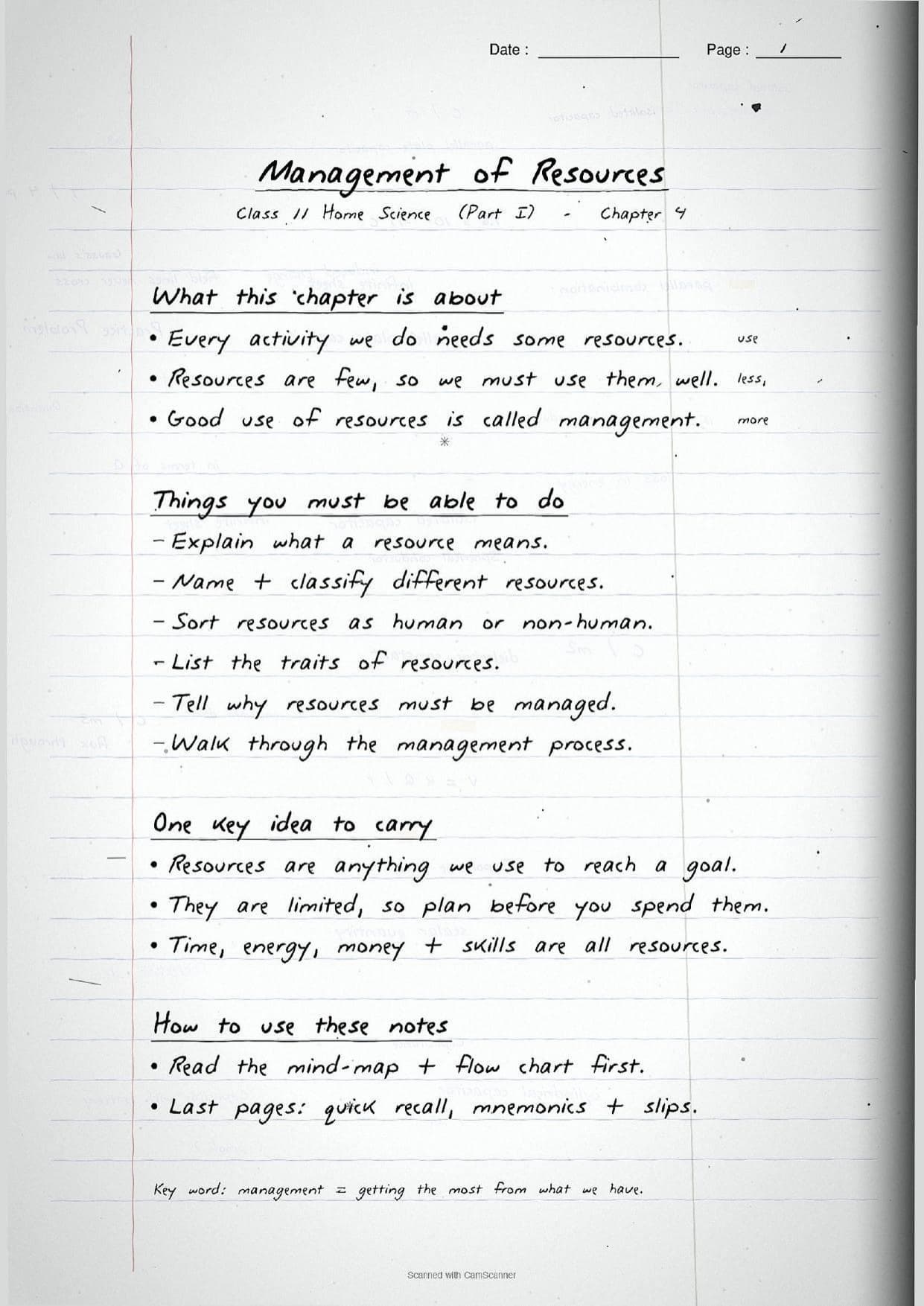
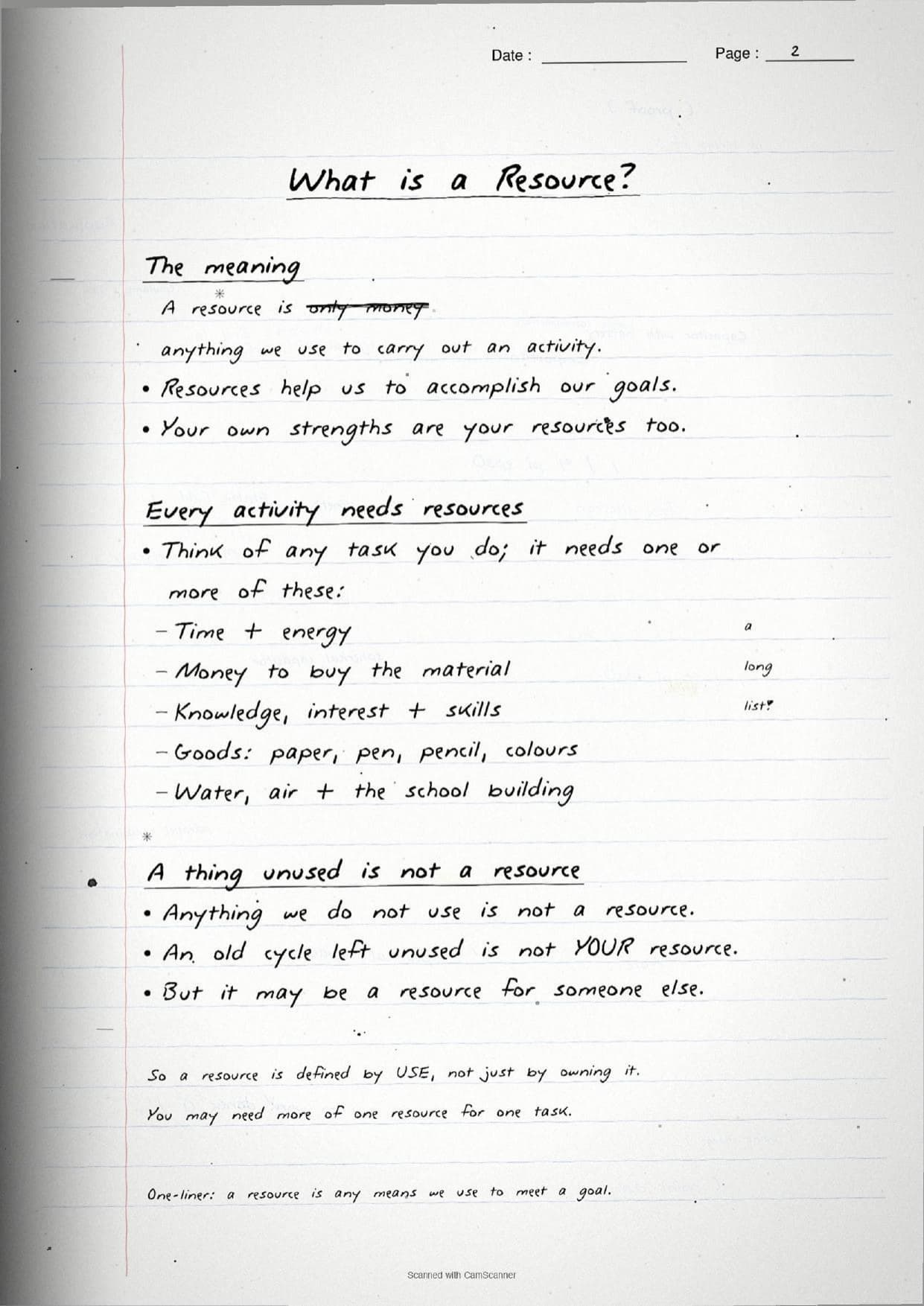
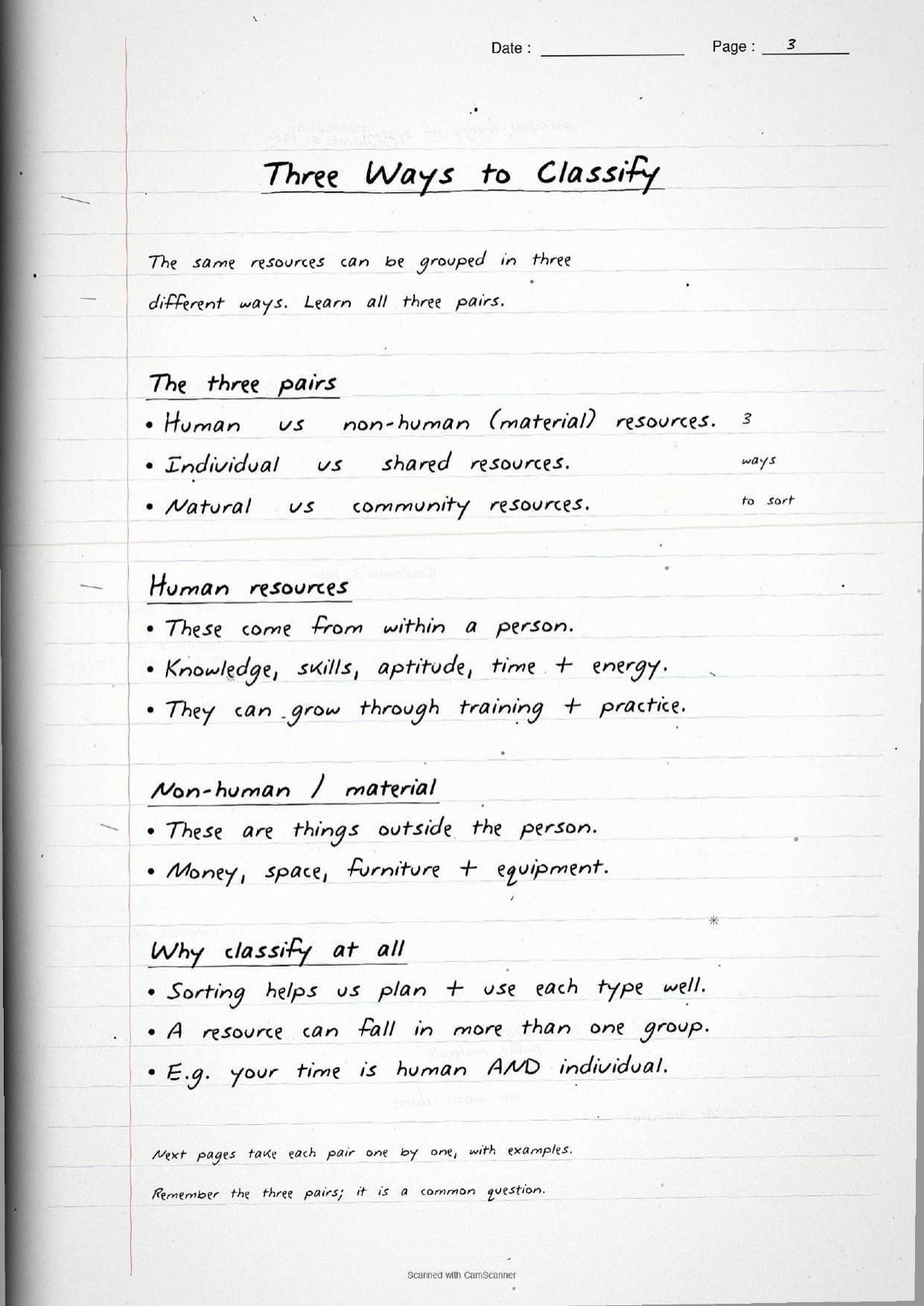
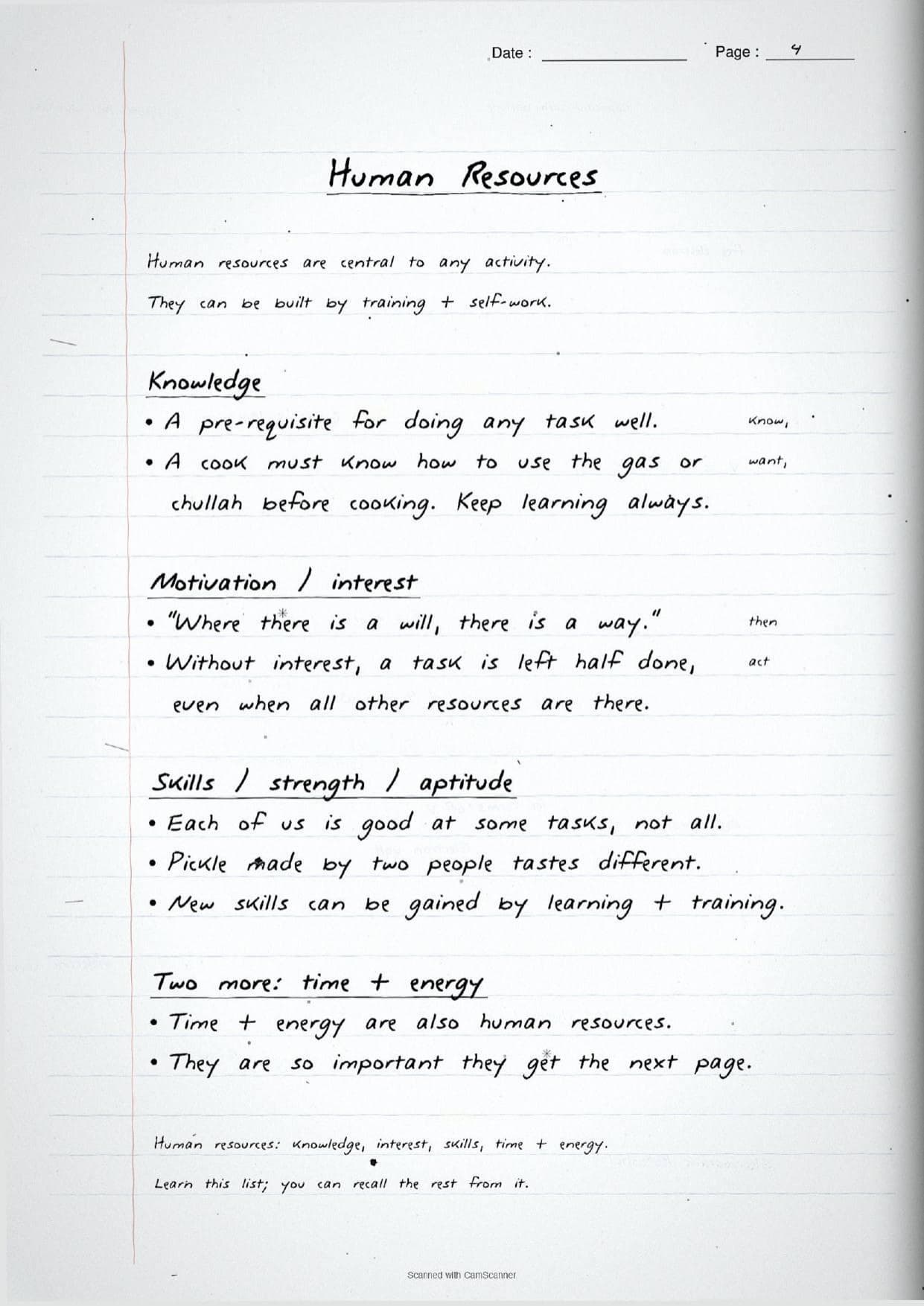
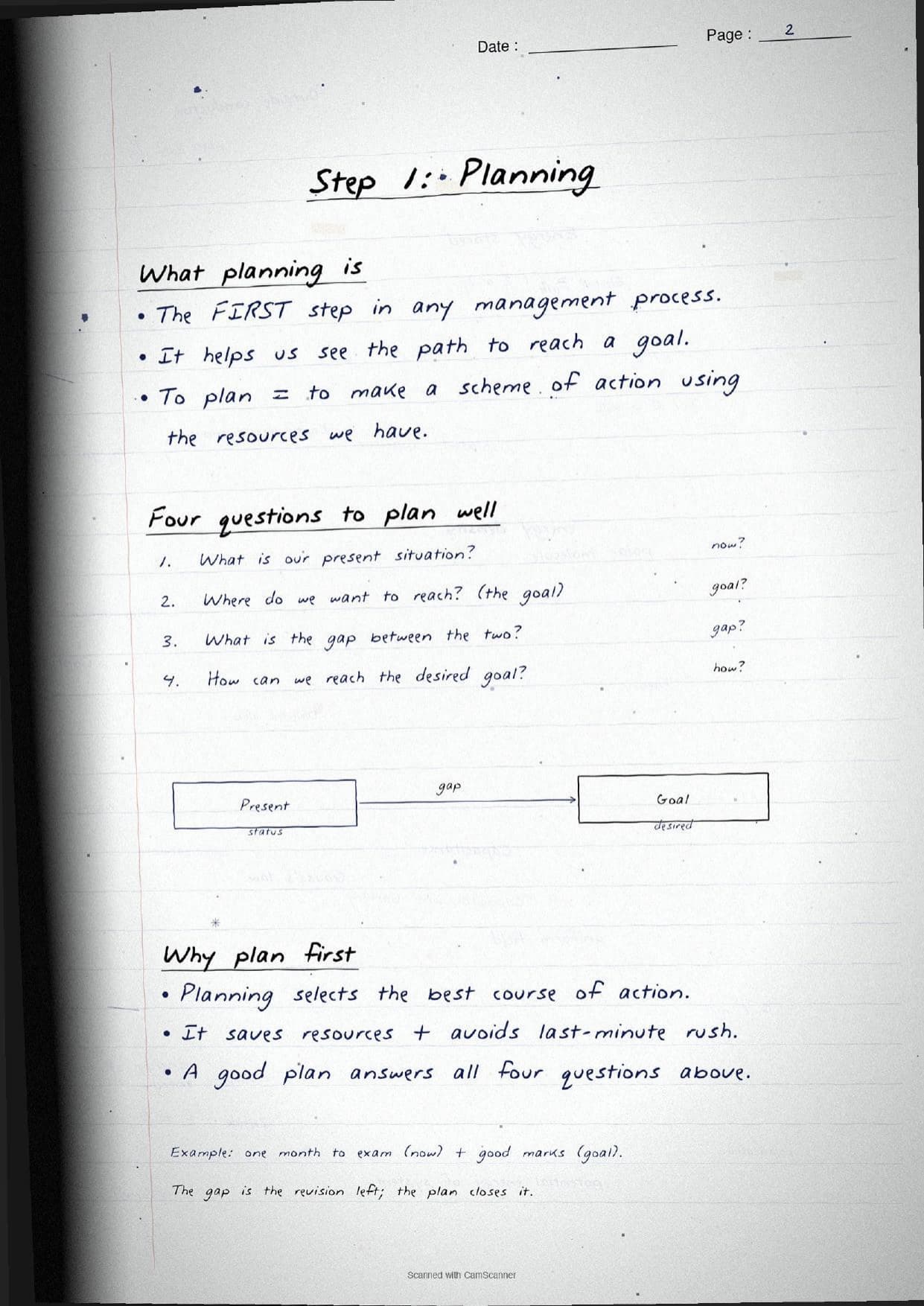
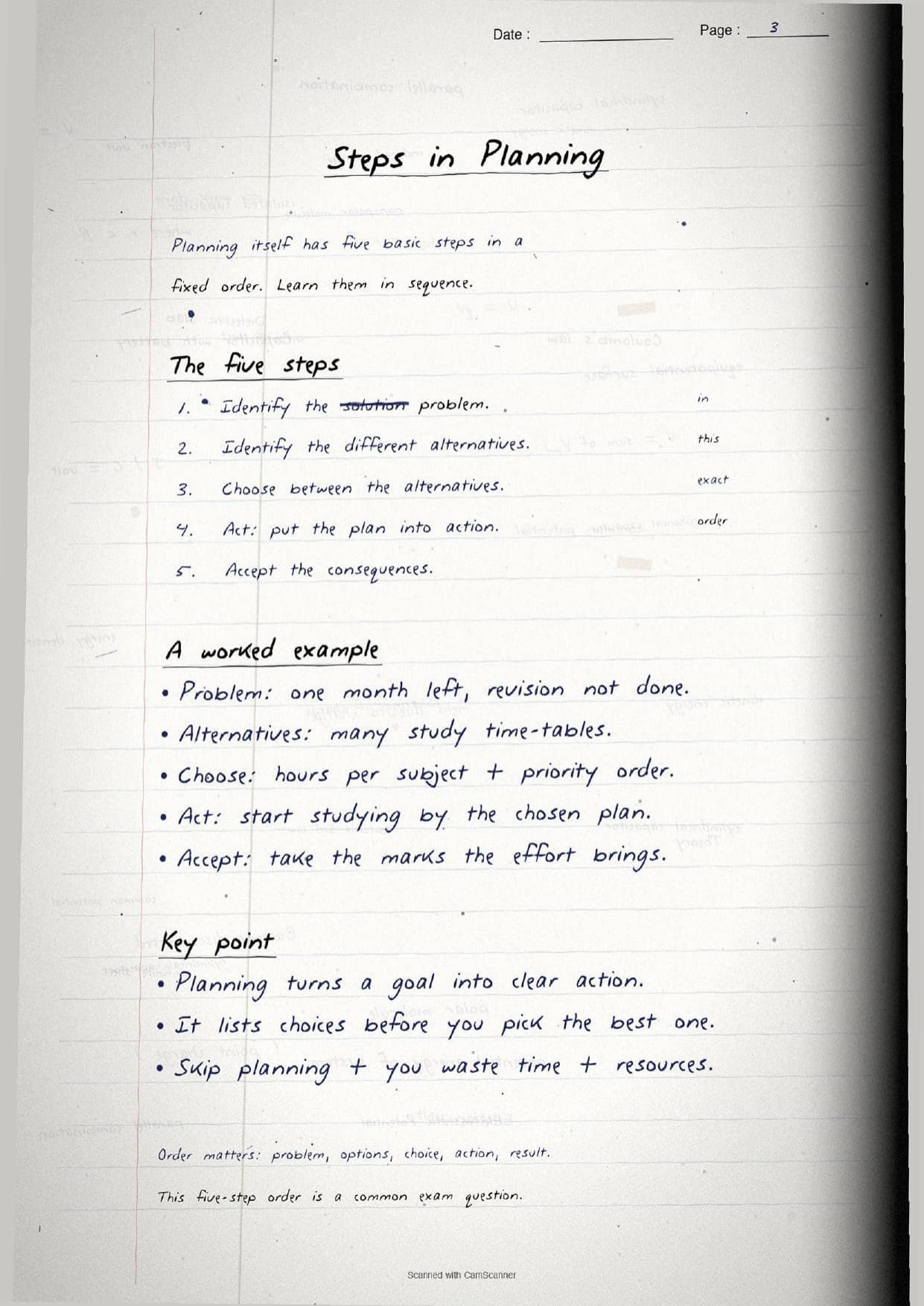
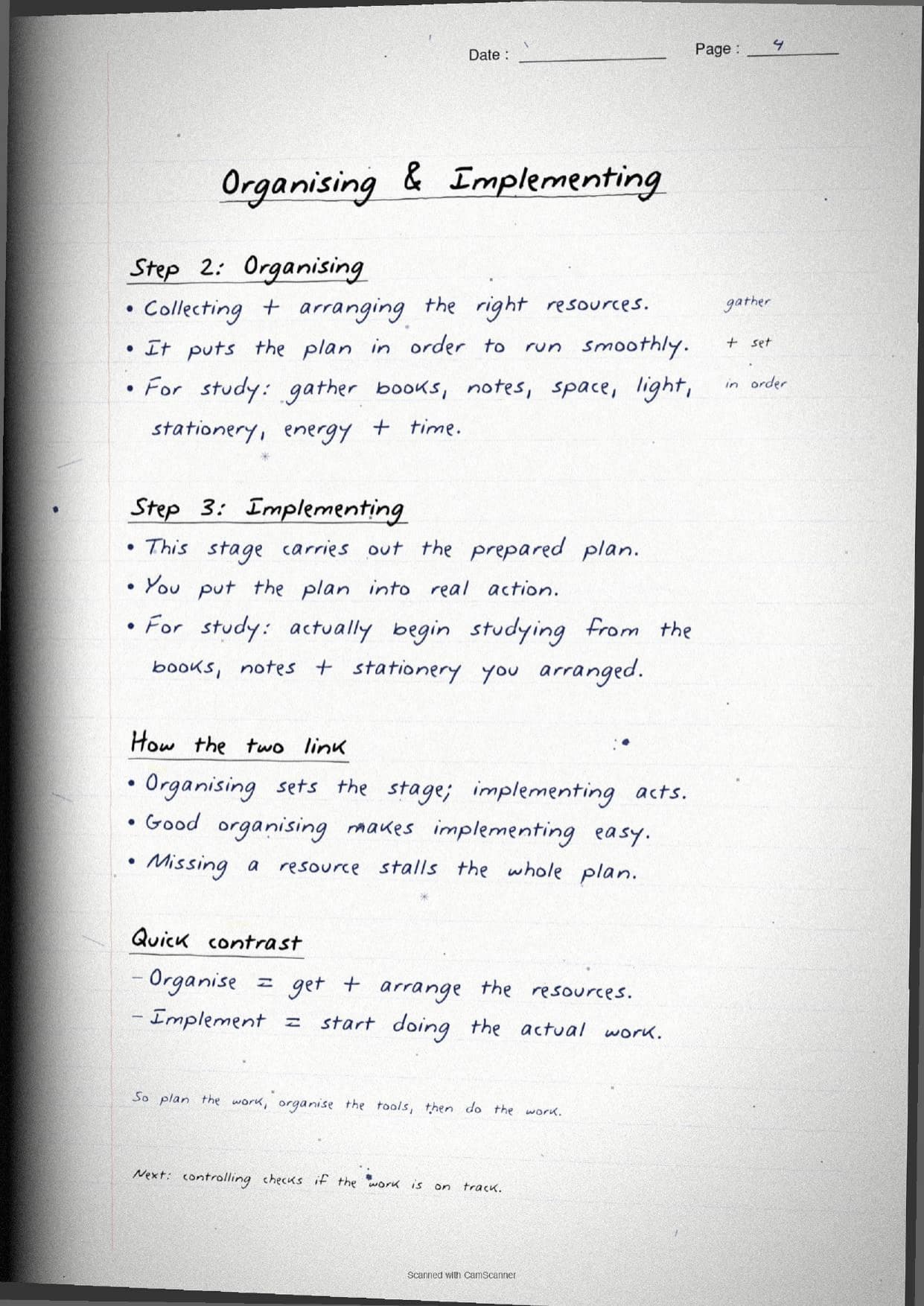
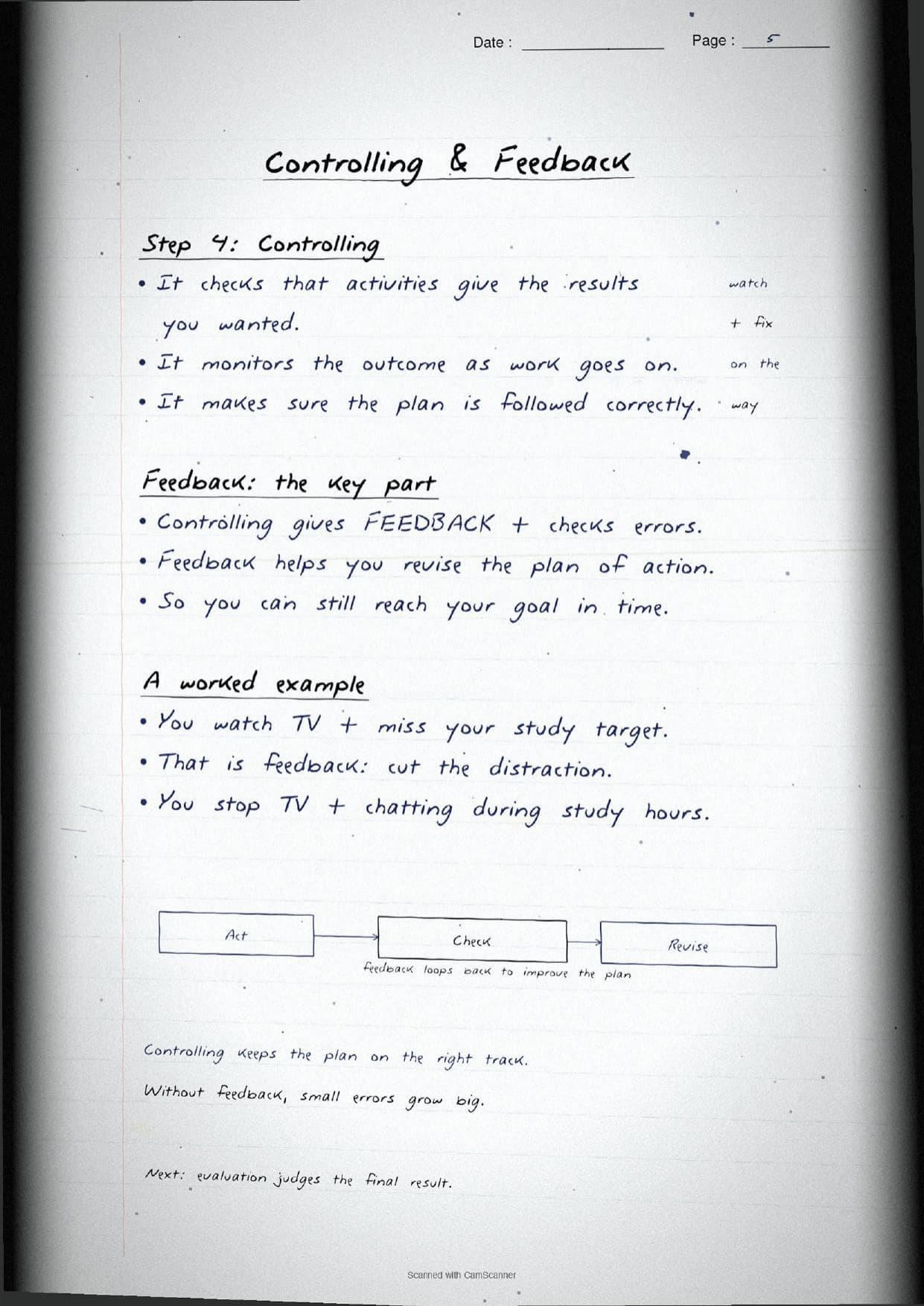
- Handwritten pages with a boxed resources mind-map, a five-step management flow chart, and quick tables of traits and key terms.
- This chapter builds core management ideas that run through the Class 11 Home Science course, so its terms are worth learning early.
- Pairs with the NCERT Solutions, Notes and Book PDF linked lower on this page.
These Management of Resources handwritten notes are prepared from the official NCERT Home Science (Human Ecology and Family Sciences) textbook and checked against recent CBSE Class 11 question papers.
Student Feedback: In a Collegedunia poll of 4,760 Class 11 Home Science students, 69% of students said the handwritten pages helped them recall the five steps of the management process and the six characteristics of resources faster than printed text, because the flow chart and boxed tables made the sequence stick.
Source: 2026-27 Class 11 Home Science student poll. Sample of 4,760 students from CBSE schools across 9 states.
What These Management of Resources Handwritten Notes Contain
Management of Resources is Chapter 4 of Class 11 Home Science. It explains what a resource is, the different kinds of resources, the traits they share, and the step-by-step process used to manage them well. These handwritten notes condense the chapter into neat pages that read like a topper's own notebook, with colour-coded sub-headings and boxes drawn by hand.
The notes are organised under three threads, each on its own set of pages:
- The concept: what a resource means, why every activity needs resources, and the three ways to classify them.
- The traits: the six characteristics of resources and the reason all of them must be managed.
- The process: the five management steps with a feedback loop, decision making, and how to manage time and energy.
Because the pages are handwritten, the key terms sit in boxes and arrows rather than long paragraphs. A student can flip through the Management of Resources Class 11 pages in a few minutes and still pick up the definition, the classifications and the steps before an exam.
Meaning of a Resource and Its Classification
The opening pages settle what a resource actually is. A resource is anything we use to carry out an activity or reach a goal. It is not only money. Your own knowledge, skills, time and energy are resources too. The notes box one point: a thing that is not used is not a resource. An old cycle lying unused is not your resource, though it may be one for someone else. So a resource is defined by use, not just by owning it.
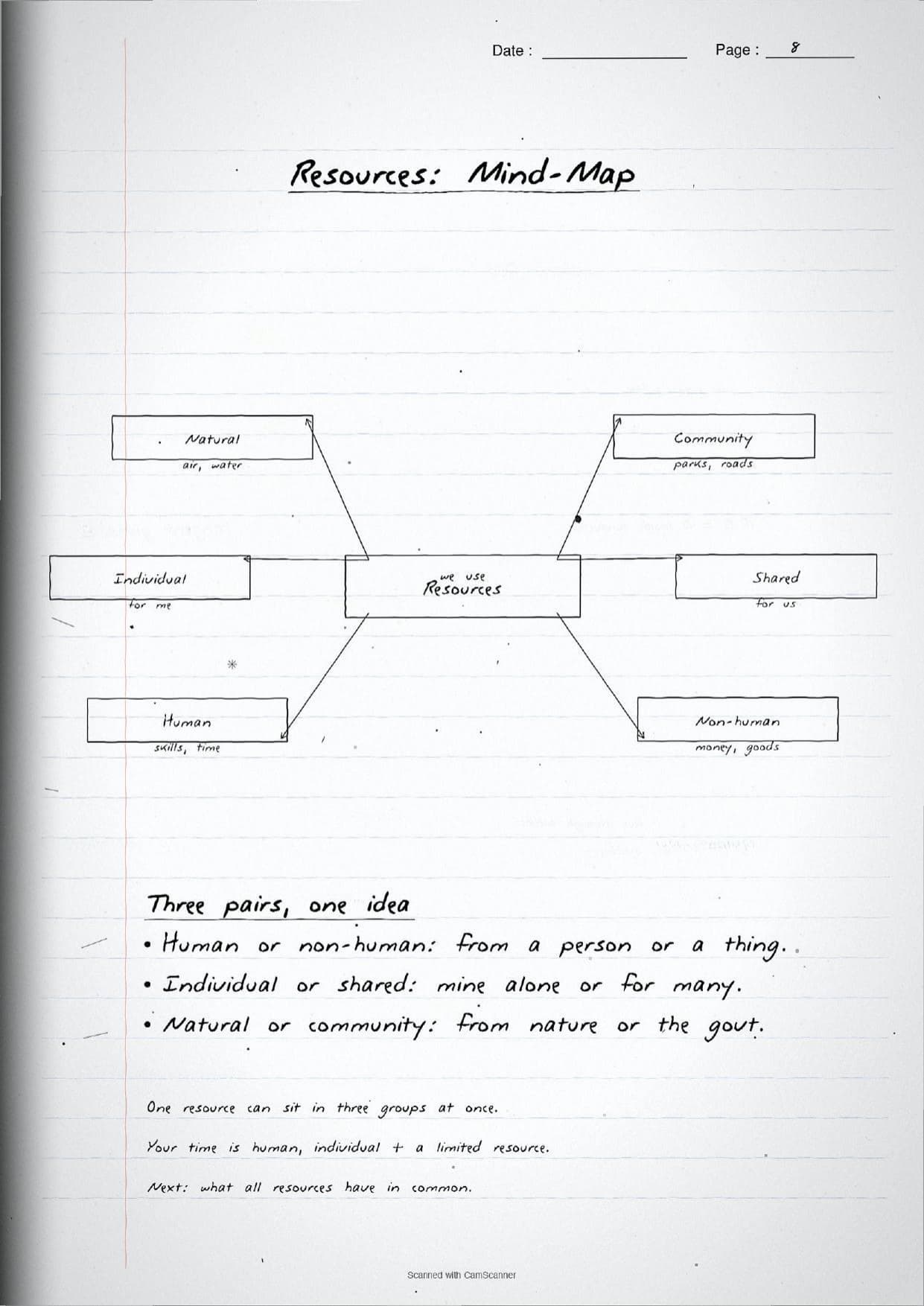
The same resources can be grouped in three ways, drawn as a simple mind-map so students remember them together.
| Classification | What the page shows |
|---|---|
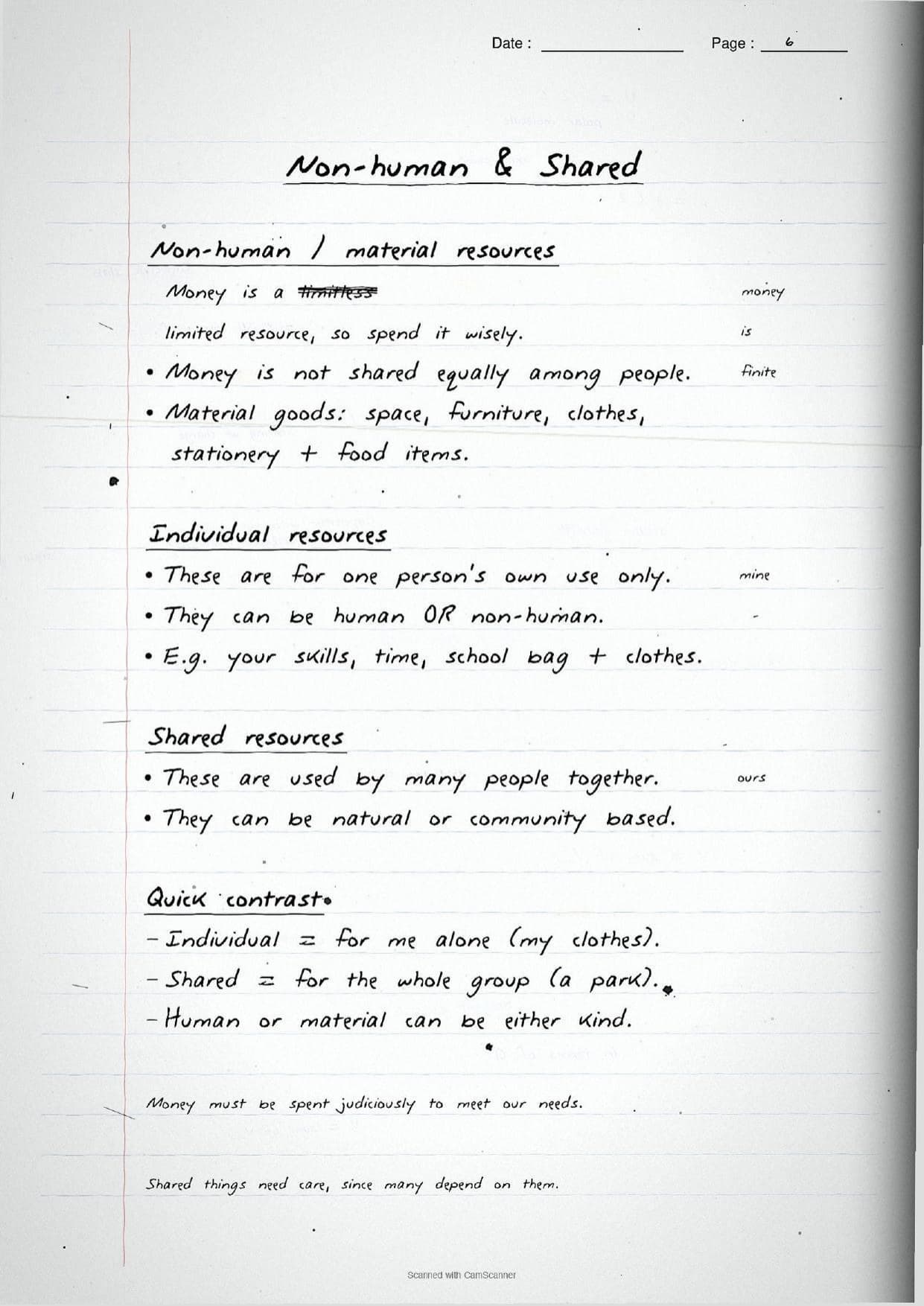
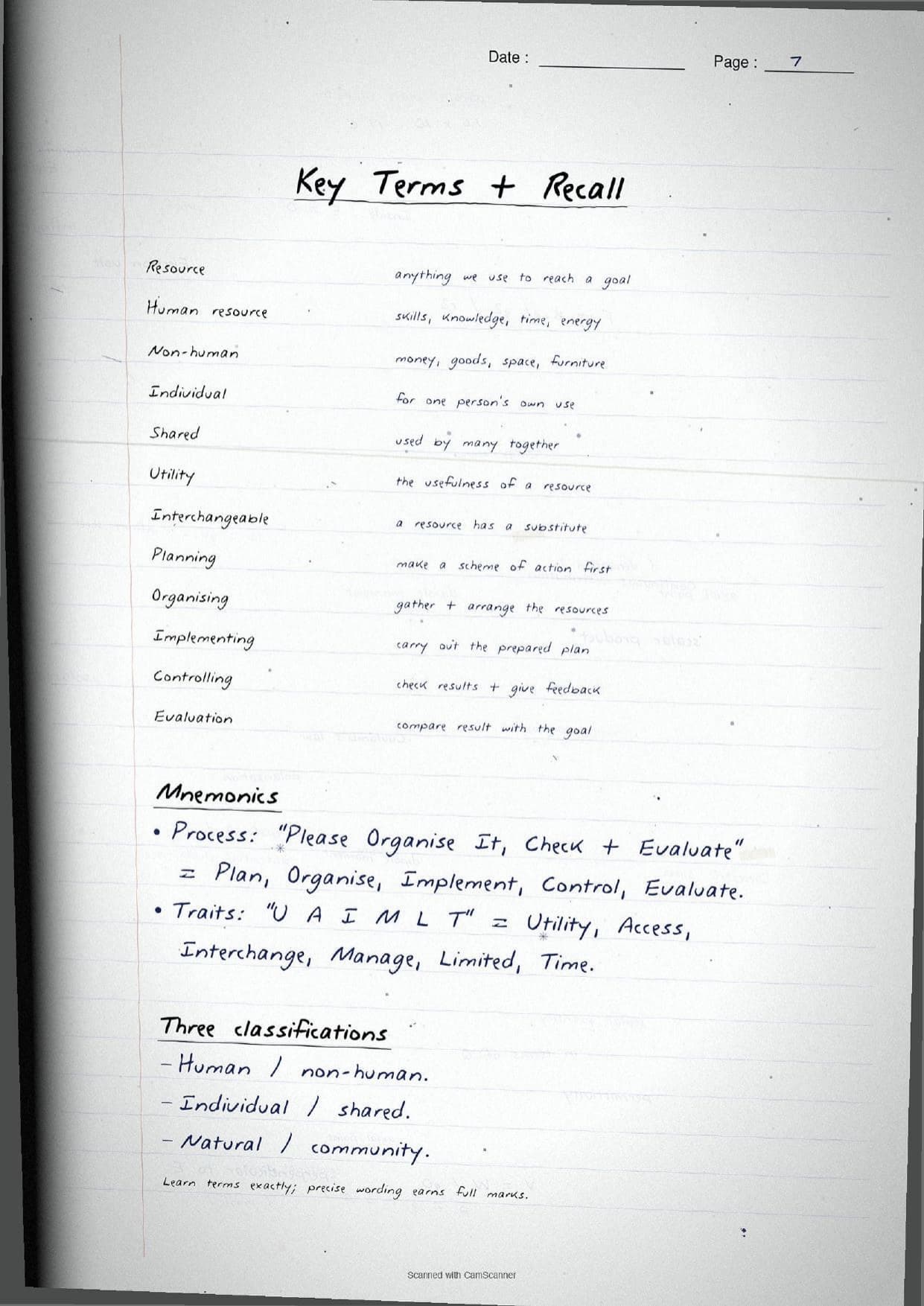
| Human vs non-human | Human come from within a person: knowledge, motivation, skills, time and energy. Non-human or material are outside: money, goods, space and furniture. |
| Individual vs shared | Individual are for one person's own use, like your time or clothes. Shared are used by many together, like a park. |
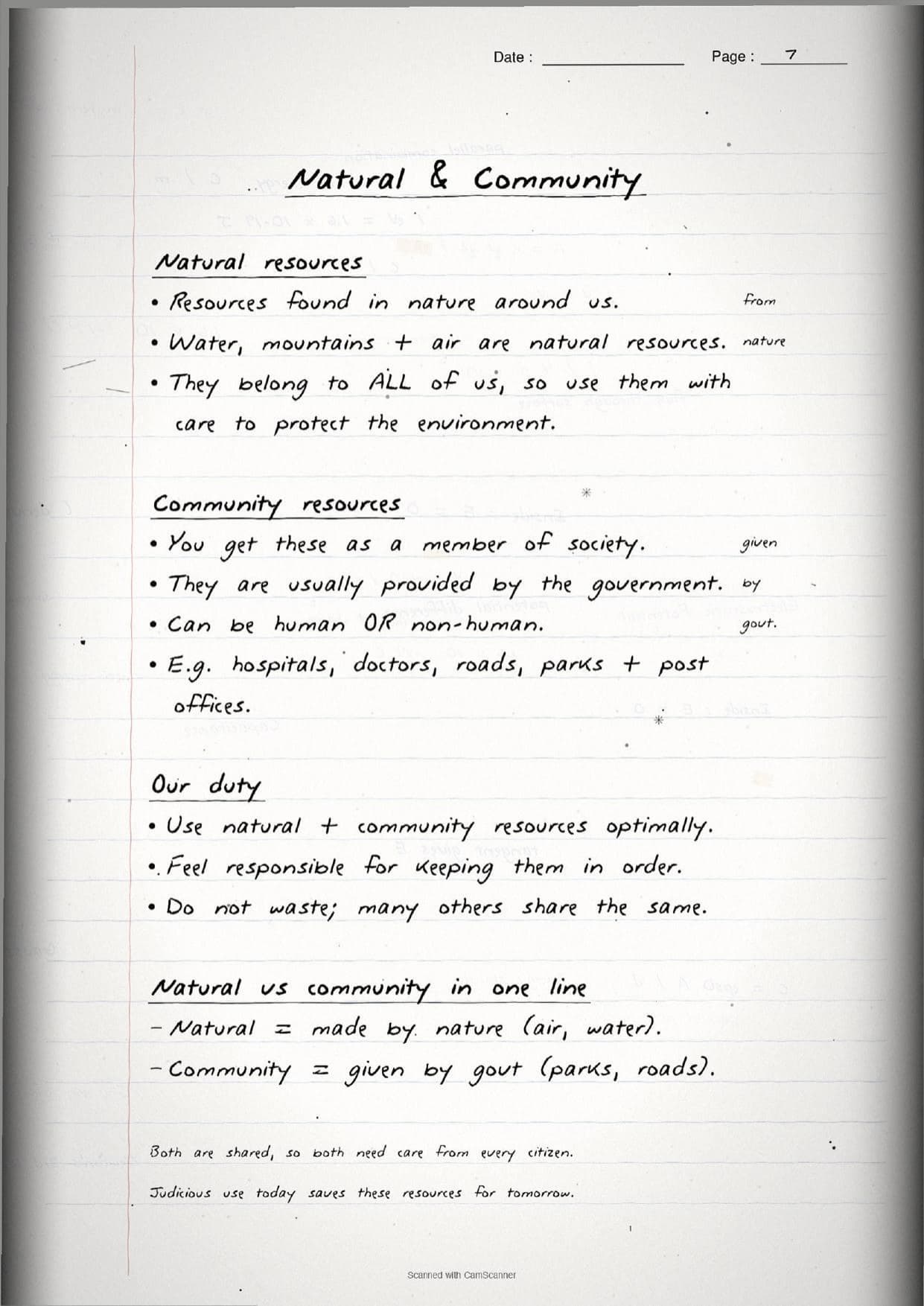
| Natural vs community | Natural are found in nature, like air, water and mountains. Community are provided by the government, like hospitals, roads and parks. |
One resource can sit in more than one group at once. Your time, for example, is human, individual and limited all at once. Human resources such as knowledge, skills, time and energy can be built up through learning and practice, so the chapter treats them as the heart of any activity. Money is a limited material resource, while natural and community resources are shared and need care from every citizen.
Characteristics of Resources and Why We Manage Them
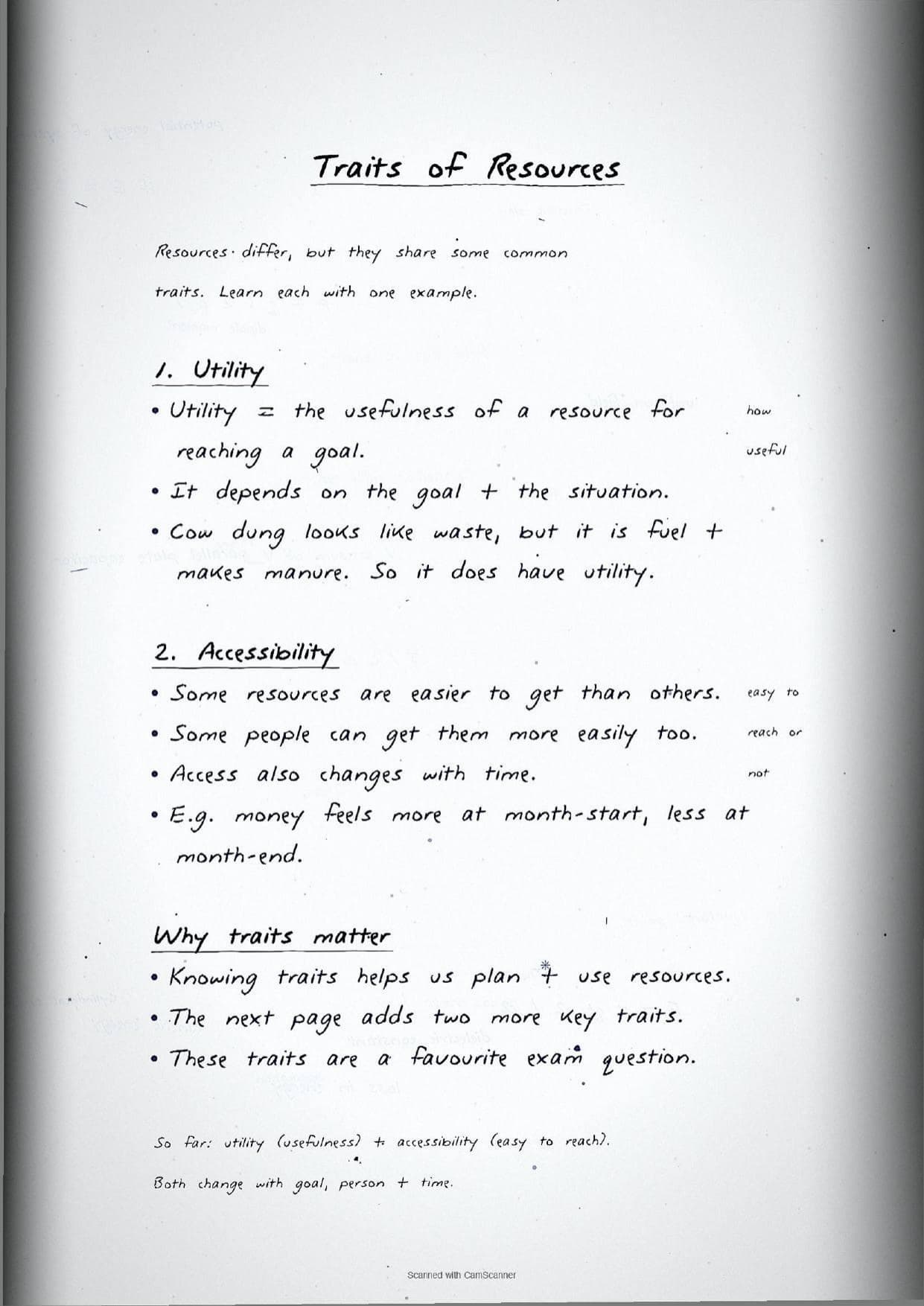
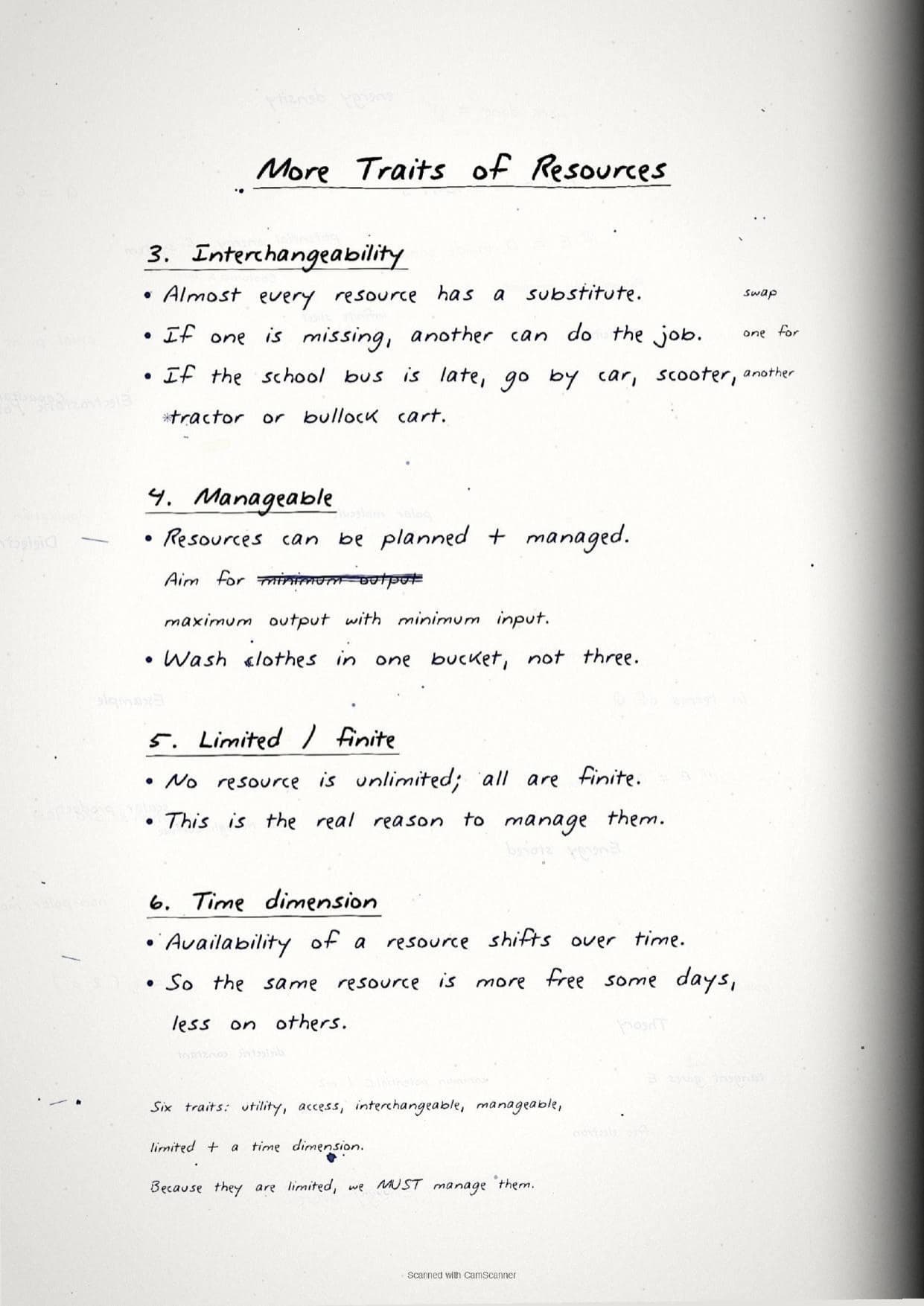
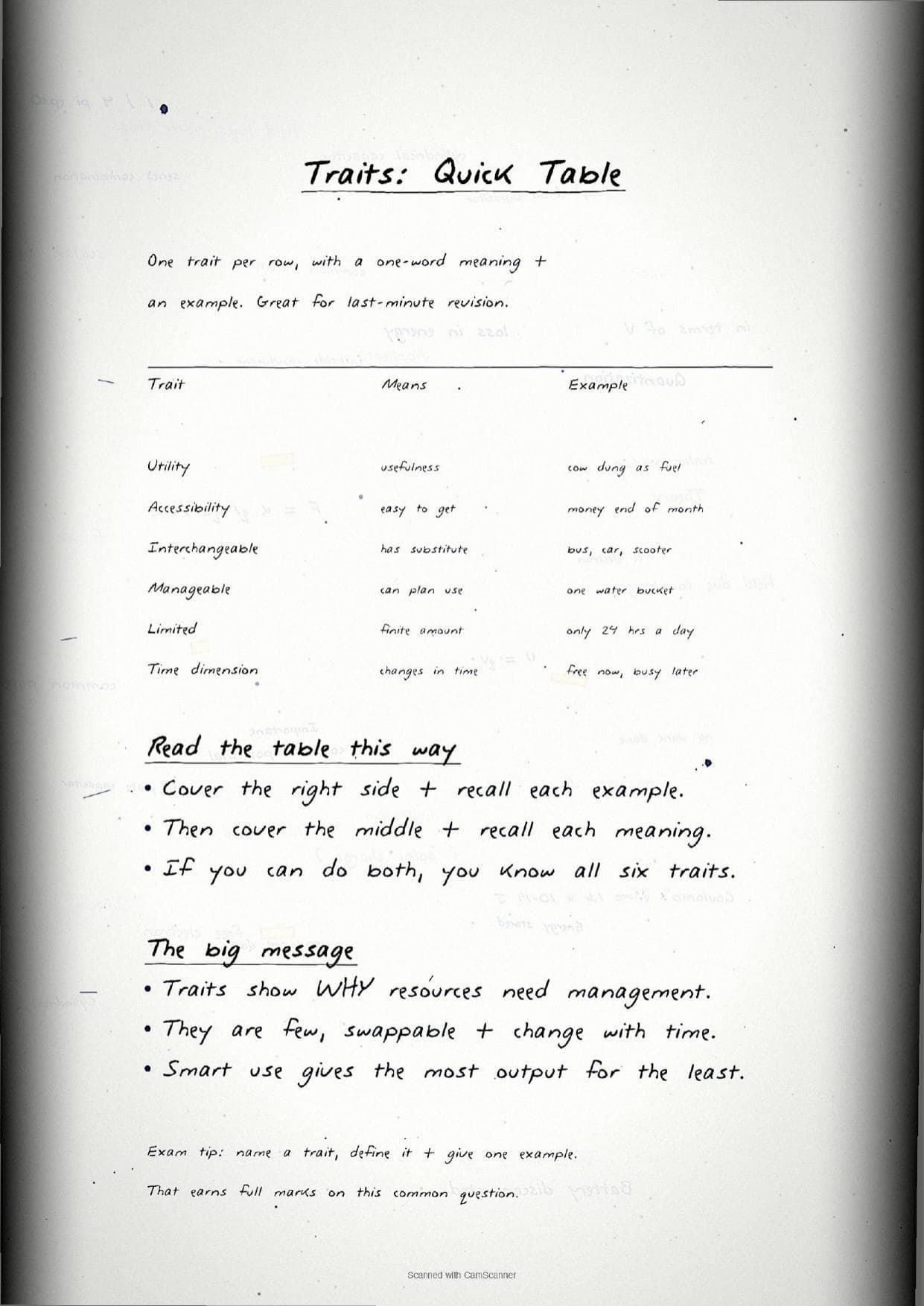
Resources differ, but they share six common traits. The handwritten pages give each trait a one-word meaning and a single example, which is exactly how a full-marks answer is written. This is a favourite Class 11 question, so the notes box the whole list.
| Trait | Means | Example on the page |
|---|---|---|
| Utility | usefulness for a goal | cow dung used as fuel and manure |
| Accessibility | easy or hard to get | money feels more at month-start, less at month-end |
| Interchangeability | has a substitute | if the bus is late, go by car, scooter or cart |
| Manageable | can be planned and used | wash clothes in one bucket, not three |
| Limited or finite | never unlimited | only 24 hours in a day |
| Time dimension | availability shifts over time | free some days, busy on others |
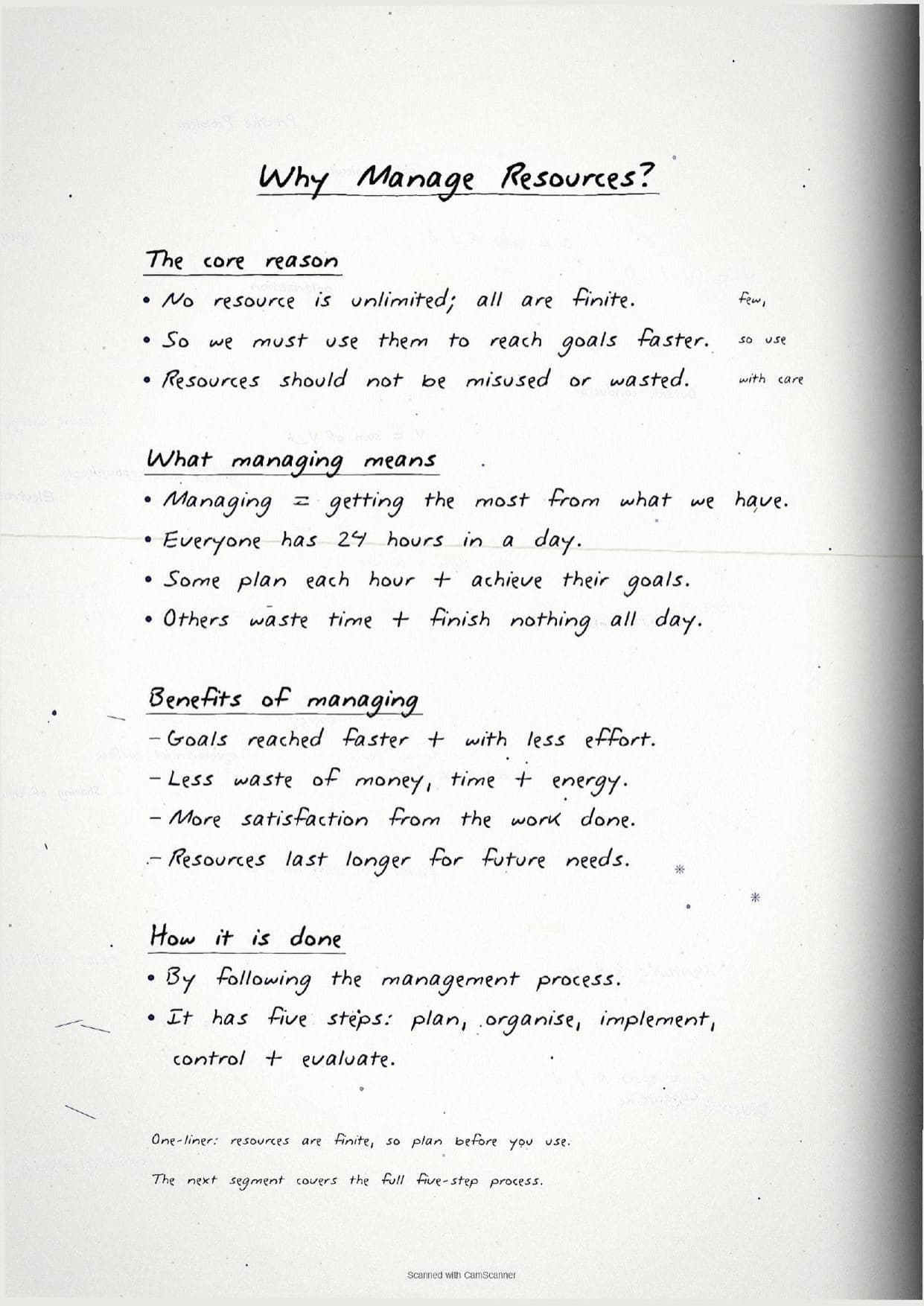
The pages then answer the chapter's central question: why manage resources at all? Because no resource is unlimited, managing means getting the most from what we have, with maximum output for minimum input. Everyone gets the same 24 hours, yet some plan each hour and reach their goals while others waste time and finish nothing. Good management means goals are reached with less effort, less money, time and energy are wasted, the work gives more satisfaction, and resources last longer for future needs.
The Management Process, Decisions and Time and Energy Management
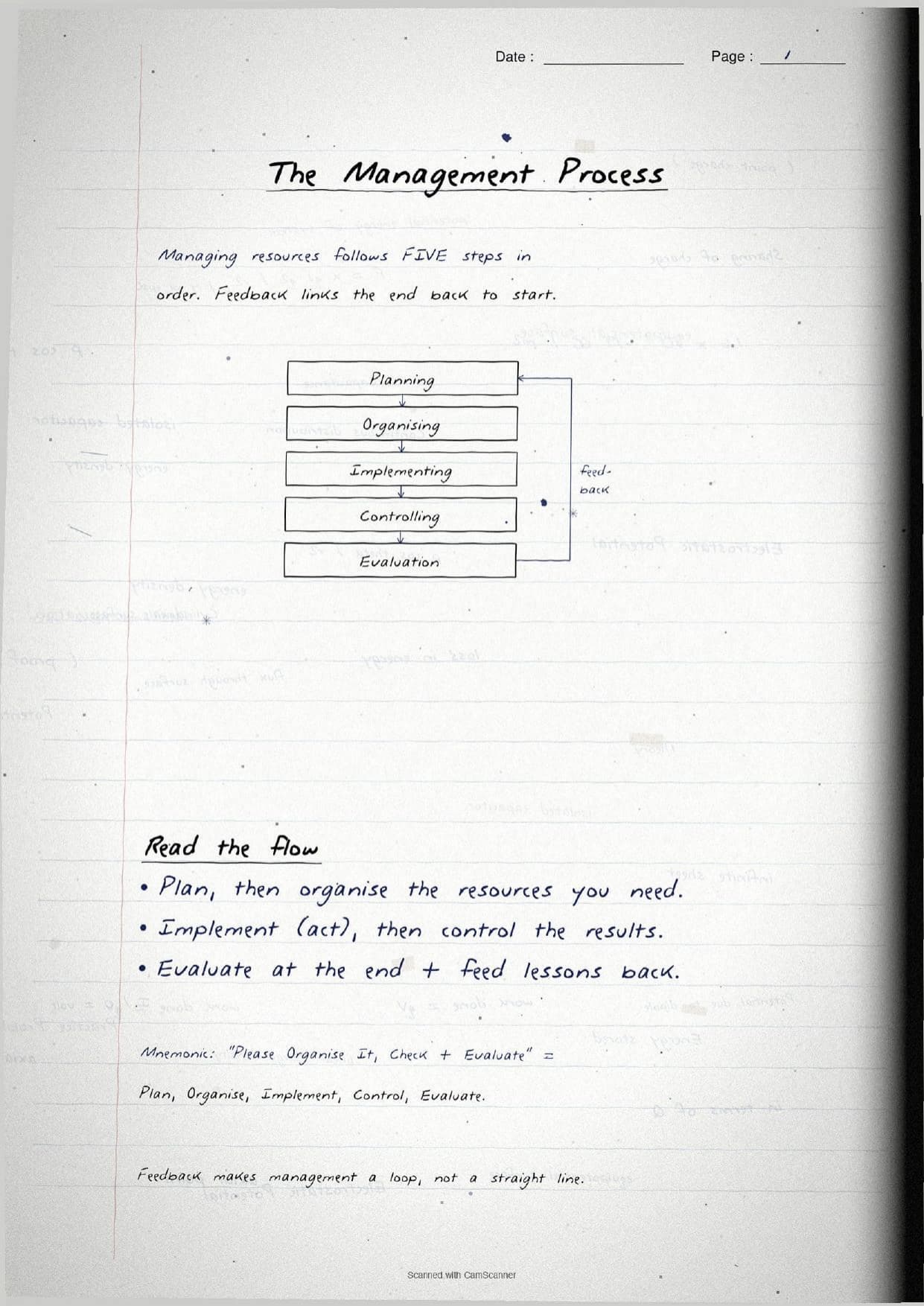
The last set of pages draws the management process as a clear flow chart. Managing resources follows five steps in a fixed order, and a feedback loop links the end back to the start, which makes management a loop rather than a straight line.
| Step | What happens |
|---|---|
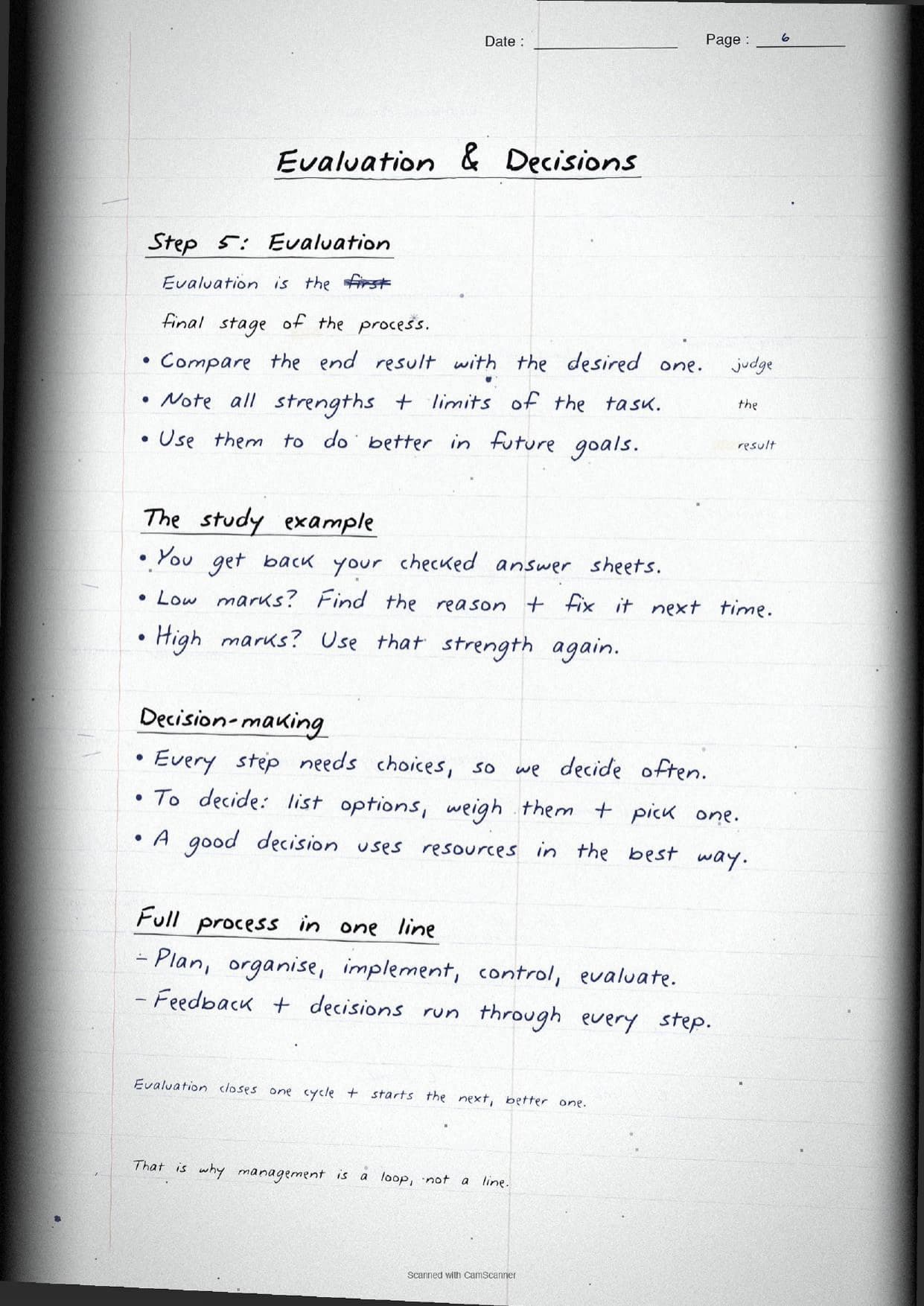
| 1. Planning | The first step. Make a scheme of action by asking where we are now, where we want to reach, the gap between the two, and how to close it. |
| 2. Organising | Collect and arrange the right resources so the plan runs smoothly, like gathering books, notes, space and time before studying. |
| 3. Implementing | Carry out the prepared plan by putting it into real action. |
| 4. Controlling | Check that the work gives the wanted results. This stage gives feedback, spots errors and lets you revise the plan in time. |
| 5. Evaluation | The final step. Compare the end result with the desired one and use the strengths and limits to do better next time. |
The notes teach an easy mnemonic for the order: Please Organise It, Check and Evaluate, which stands for Plan, Organise, Implement, Control, Evaluate. Planning itself has its own five steps in sequence: identify the problem, identify the alternatives, choose between them, act on the choice, and accept the consequences. Feedback is the key part of controlling, because without it small errors grow big.
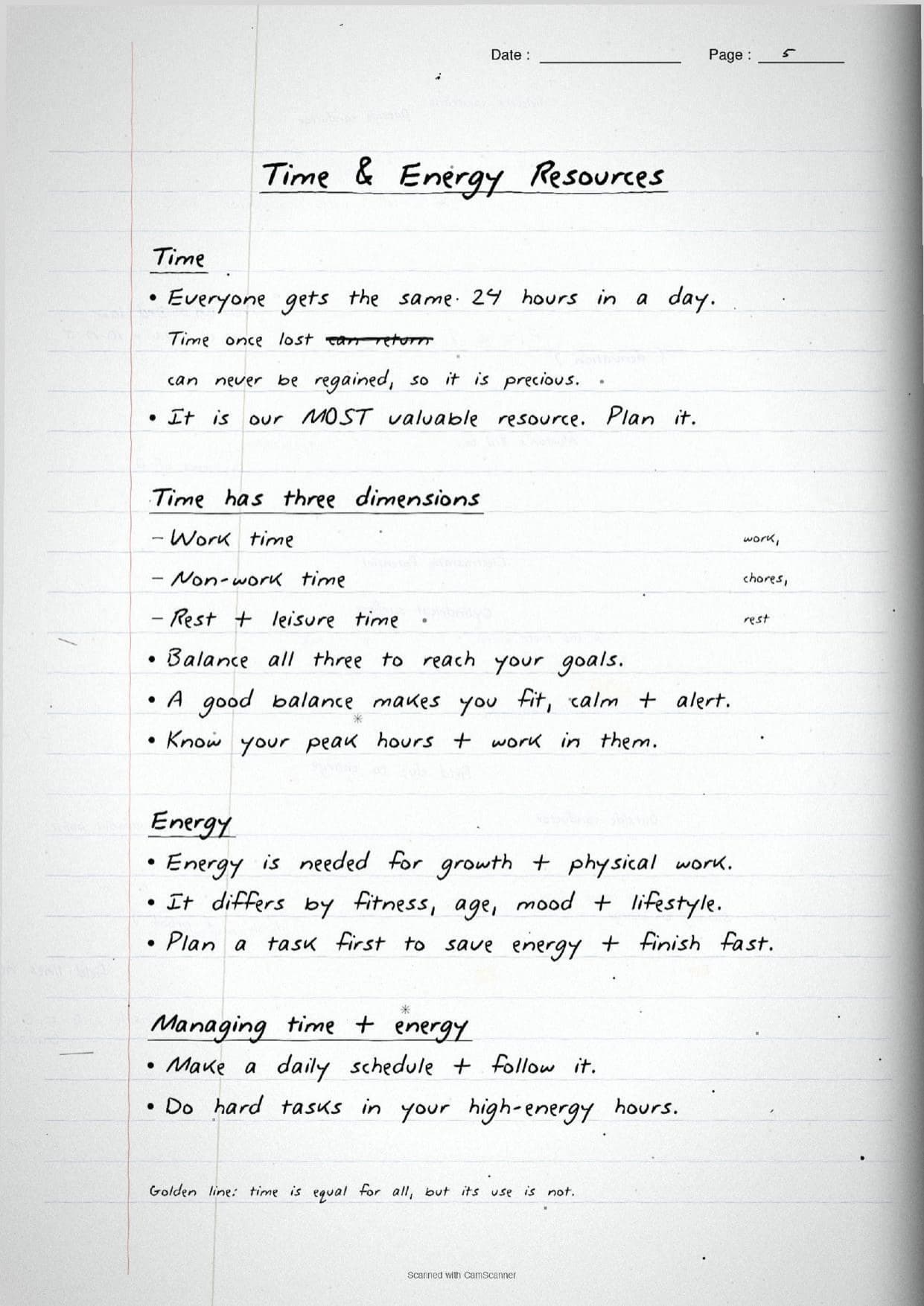
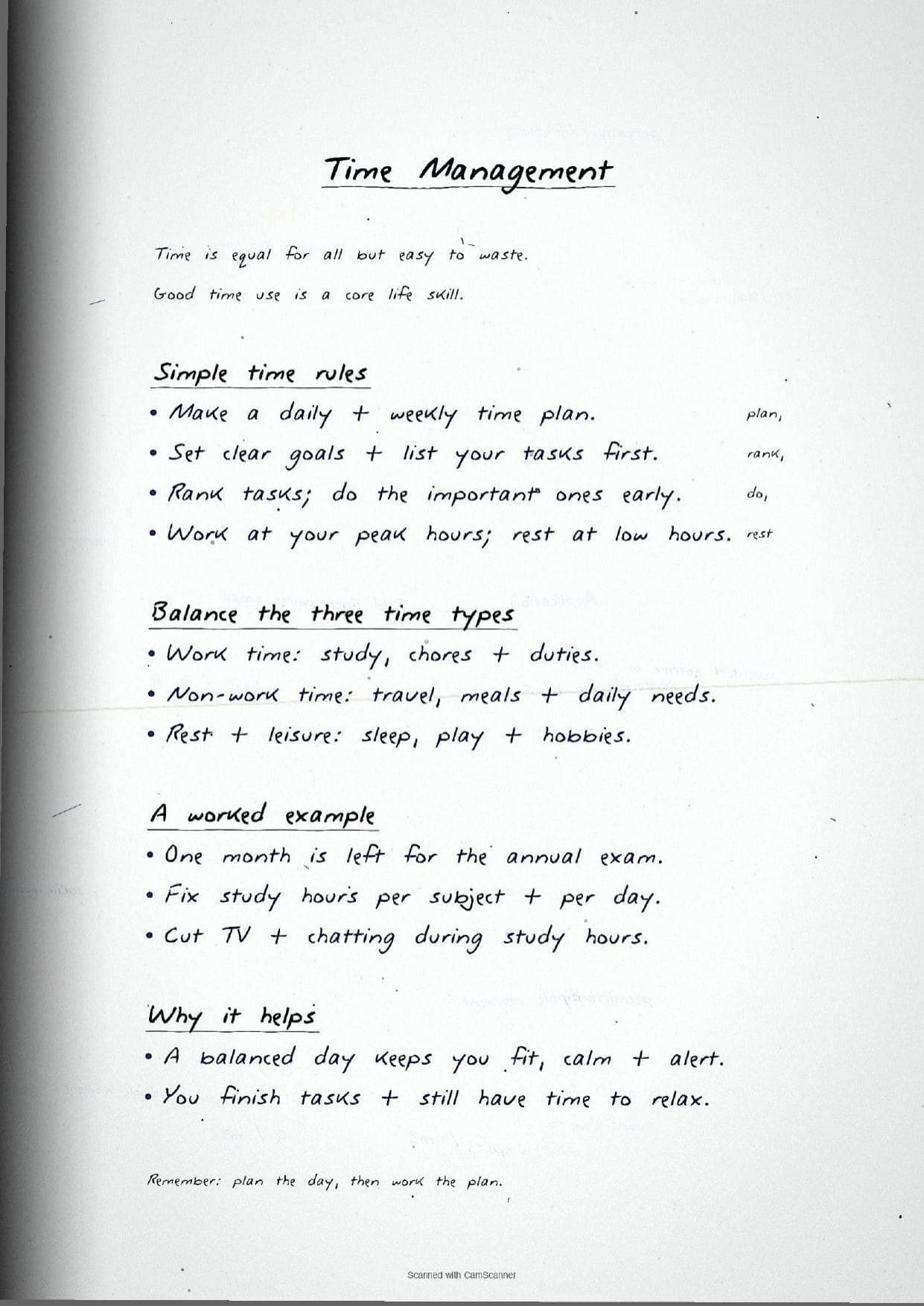
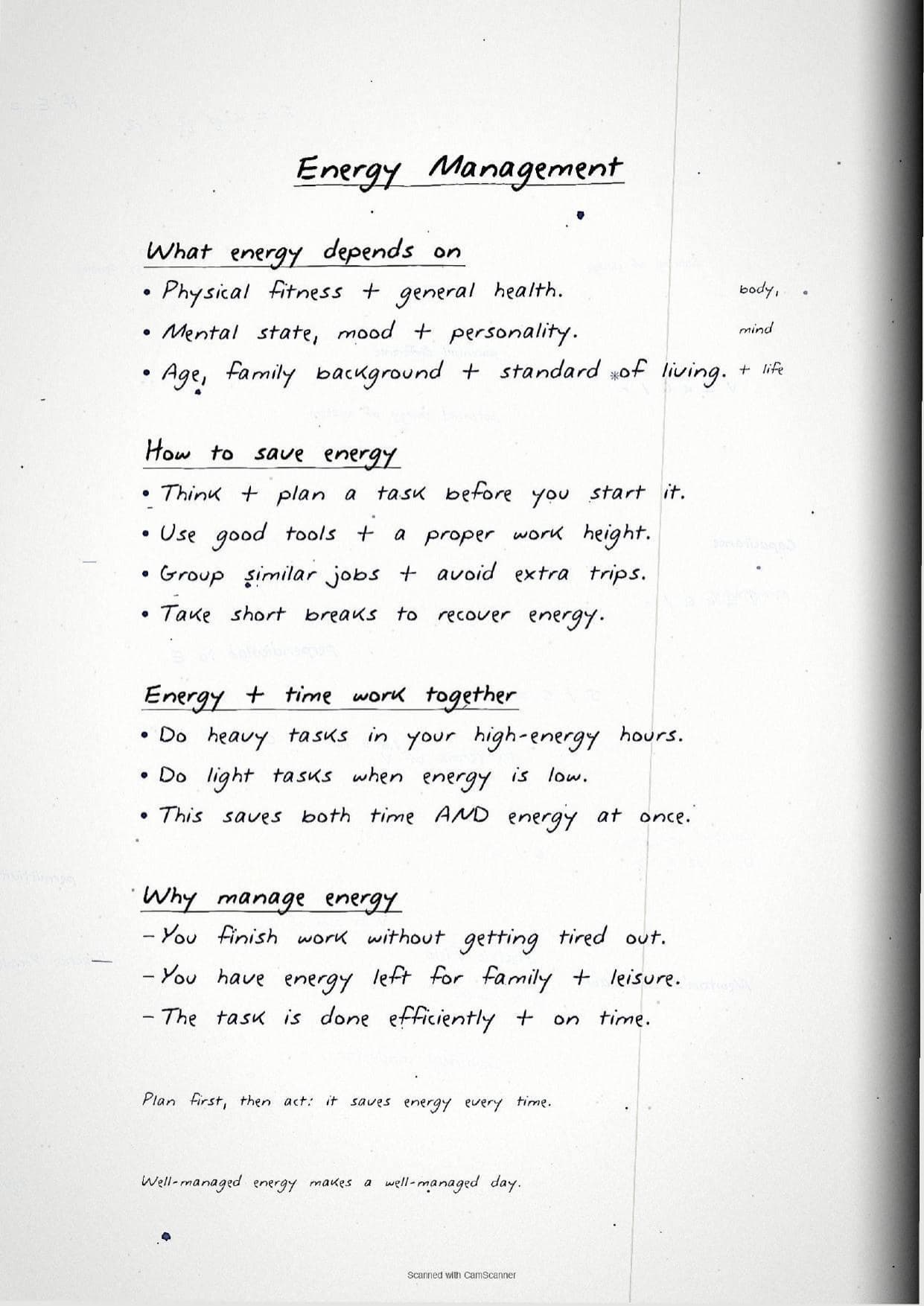
Decision making runs through every step: students list the options, weigh them and pick one that uses resources in the best way. The pages close with time and energy management, the two human resources students waste most. Time is equal for all but cannot be regained once lost, so it is the most valuable resource of all.
- Time management: make a daily plan, rank tasks, do the important ones first, and work during your peak hours.
- Three time types: balance work time, non-work time, and rest and leisure to stay fit, calm and alert.
- Energy management: plan a task before you start, group similar jobs, and do heavy tasks in your high-energy hours to save both time and energy.
How to Use These Handwritten Notes
Handwritten notes work best as a final-revision tool, not a first read. The steps below show how to get the most out of the Management of Resources handwritten notes before a test.
- Download: tap the download card above to save the handwritten pages to your device.
- First read: read the printed Notes once so the handwritten pages act as a refresher, not a first source.
- Recall drill: cover the page and try to write the three classifications, the six traits and the five management steps from memory.
- Night before: flip through the mind-map and the flow chart for a quick last-minute recall of the process and the feedback loop.
Many students search for Class 11 Home Science Chapter 4 notes on their phone the night before a test, so a saved set of handwritten pages means you can revise offline. Use them for speed, then check the solutions to confirm your answer points. The same habits also help for CUET Home Science, where the management steps and the classifications come up often.
Common Mistakes These Notes Help You Avoid
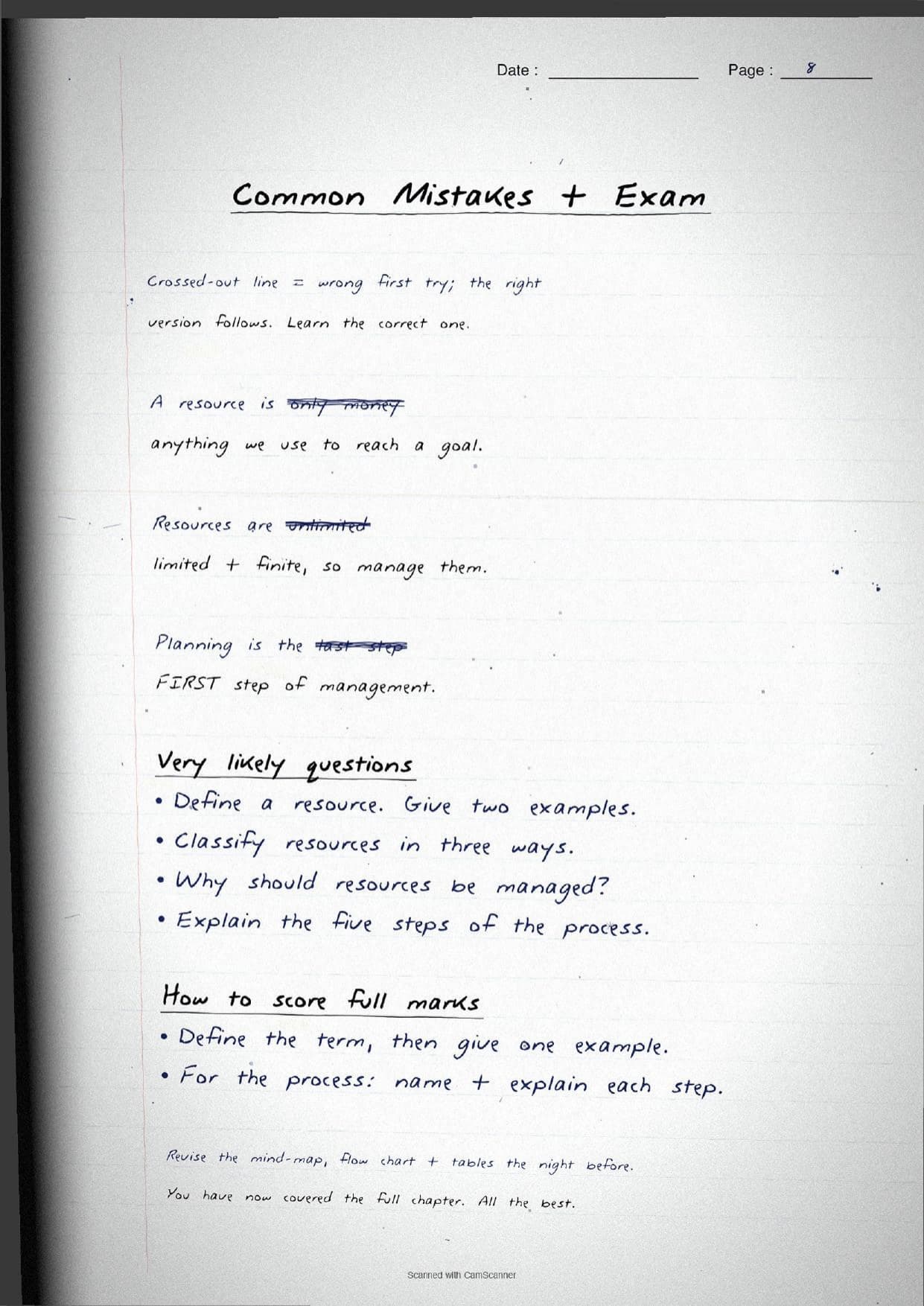
A few errors cost marks every year. The handwritten notes flag each one in the margin, often as a crossed-out first try with the correct version below it, so you can fix them before the exam. These five are the most common.
- Thinking a resource is only money. A resource is anything we use to reach a goal, including time, energy and skills.
- Saying resources are unlimited. They are limited and finite, which is the real reason we must manage them.
- Calling planning the last step. Planning is the first step of the management process.
- Forgetting a classification or a trait. The exam expects all three classifications and all six traits in full.
- Leaving out feedback. Feedback is part of controlling and turns the process into a loop, not a straight line.
Students who fix these five points usually move from average to high marks. The notes box the definition, list every classification and trait, and draw the five steps in order, so the soft points are hard to miss.
How These Handwritten Notes Pair with the Solutions and Book PDF
These handwritten notes are a fast revision tool. To prepare fully, students should use them alongside the other resources for the same chapter, linked below. Read the printed Notes, test yourself with the solutions, then use these pages for a final recall.
| Resource | Best used for |
|---|---|
| Management of Resources NCERT Solutions | Step-by-step answers to all the chapter review questions |
| Management of Resources Class 11 Notes | Quick chapter summary with all classifications, traits and steps in one place |
| Management of Resources NCERT Book PDF | Reading the original NCERT chapter text and examples |
Tip: read the printed Notes first, then attempt the solutions, and keep these handwritten pages for the final night-before flip. Using them for recall, not for the first read, builds memory faster.
All Class 11 Home Science Handwritten Notes by Chapter
The table links the handwritten notes for every chapter in Class 11 Home Science, so students can move across the course in one click. Management of Resources is highlighted.
| Chapter | Handwritten Notes |
|---|---|
| Chapter 1 | Human Ecology and Family Sciences |
| Chapter 2 | Understanding the Self |
| Chapter 3 | Food, Nutrition, Health and Fitness |
| Chapter 4 | Management of Resources |
| Chapter 5 | Fabrics Around Us |
| Chapter 6 | Media and Communication Technology |
| Chapter 7 | Concerns and Needs in Diverse Contexts |
| Chapter 8 | Nutrition, Health and Well-being |
| Chapter 9 | Our Apparel |
| Chapter 10 | Financial Management and Planning |
| Chapter 11 | Care and Maintenance of Fabrics |
FAQs on Management of Resources Handwritten Notes
Management of Resources Class 11 Home Science Handwritten Notes Common Questions
Ques. Where can I download the Management of Resources handwritten notes PDF?
Ans. You can download the Management of Resources Class 11 Home Science handwritten notes PDF directly from this page. It is free, follows the 2026-27 NCERT, and presents the meaning of a resource, the three classifications, the six traits and the five management steps as neat handwritten pages.
Ques. What is a resource in Class 11 Home Science Chapter 4?
Ans. A resource is anything we use to carry out an activity or to reach a goal. It is not only money. Knowledge, skills, time and energy are resources too. A thing that is not used is not a resource, so a resource is defined by its use, not just by owning it. The handwritten notes box this definition.
Ques. What topics do these handwritten notes cover?
Ans. They cover the meaning of a resource, human versus non-human resources, individual, shared, natural and community resources, the six characteristics (utility, accessibility, interchangeability, manageable, limited and time dimension), why resources must be managed, the five-step management process with feedback, decision making, and time and energy management.
Ques. What are the five steps of the management process?
Ans. The five steps are planning, organising, implementing, controlling and evaluation, in that order. A feedback loop links the end back to the start, which makes management a loop rather than a straight line. An easy way to recall the order is Please Organise It, Check and Evaluate.
Ques. Are handwritten notes good for revising Class 11 Home Science Chapter 4?
Ans. Yes. Handwritten notes are best for fast, last-minute revision because the boxed key terms, the mind-map and the flow chart make the ideas easy to skim. Use them after a first read of the printed Notes, not as your only source, and pair them with the NCERT Solutions to check your answer points.



Comments