




The handwritten notes on Class 11 Applied Mathematics Chapter 3 Set have been carefully prepared for quick revision, according to the latest 2026-27 CBSE syllabus. The PDF covers set notation, roster form, set-builder form, subsets, power set, intervals, Venn diagrams and counting formulas.
Student Feedback: In a Collegedunia poll of 10,000+ students, most students said Set becomes easier when notation, Venn diagrams and counting formulas are revised together before practice.
- Best for one-shot revision: all key Set definitions and symbols are grouped in one PDF.
- Aligned to 2026-27: follows the current Class 11 Applied Mathematics Unit 2 scope.
- Practice ready: counting formulas, Venn diagrams and interval notation are placed close to examples.
|
Table of Contents |
Set Handwritten Notes: What the PDF Covers
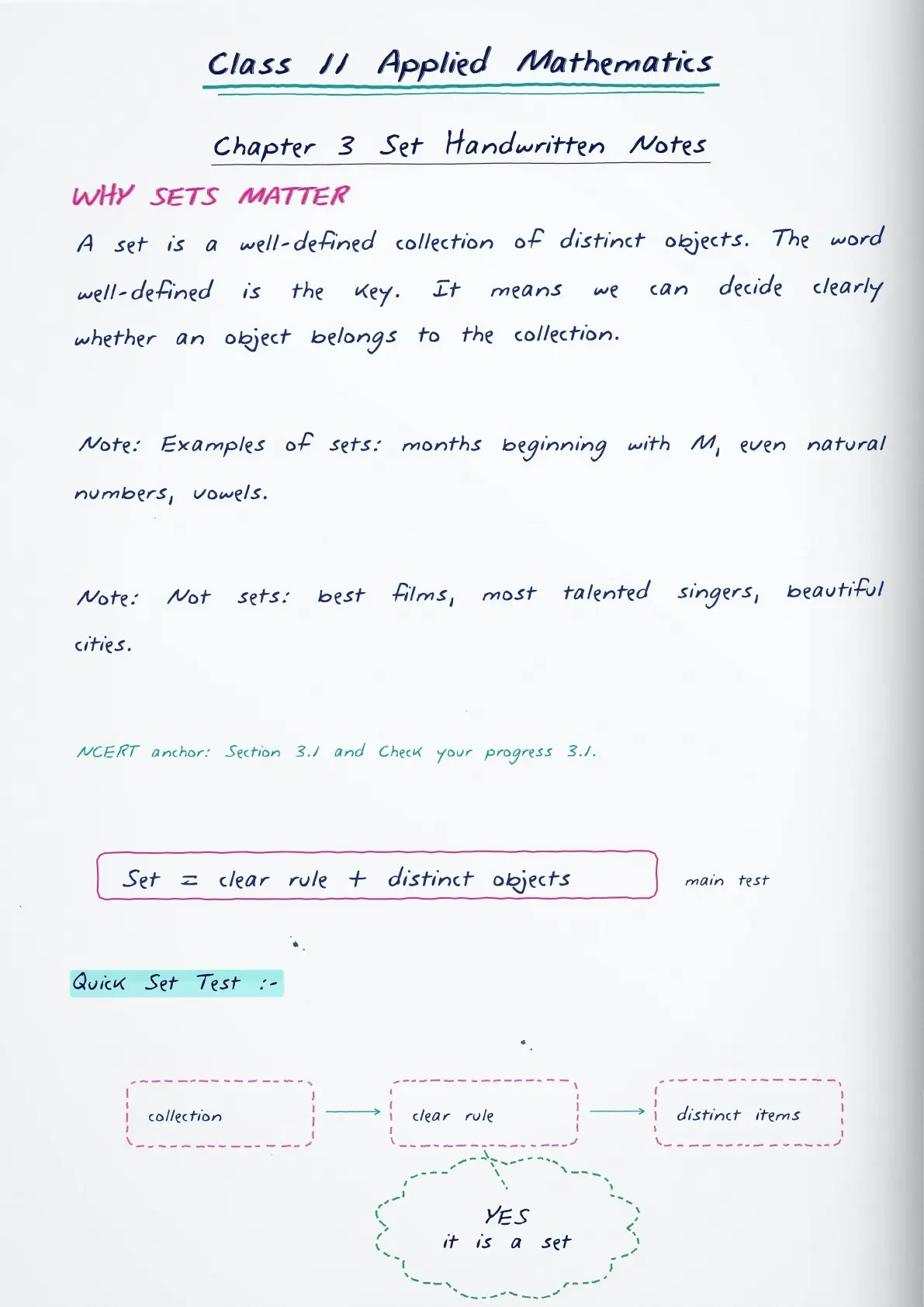
Set builds the language used later in relations, probability and data handling. The chapter starts with a well-defined collection, then moves to notation, representation, types of sets, subset rules and operations.
| Block | What students revise | First check |
|---|---|---|
| Set language | Elements, membership and braces | Do not repeat elements |
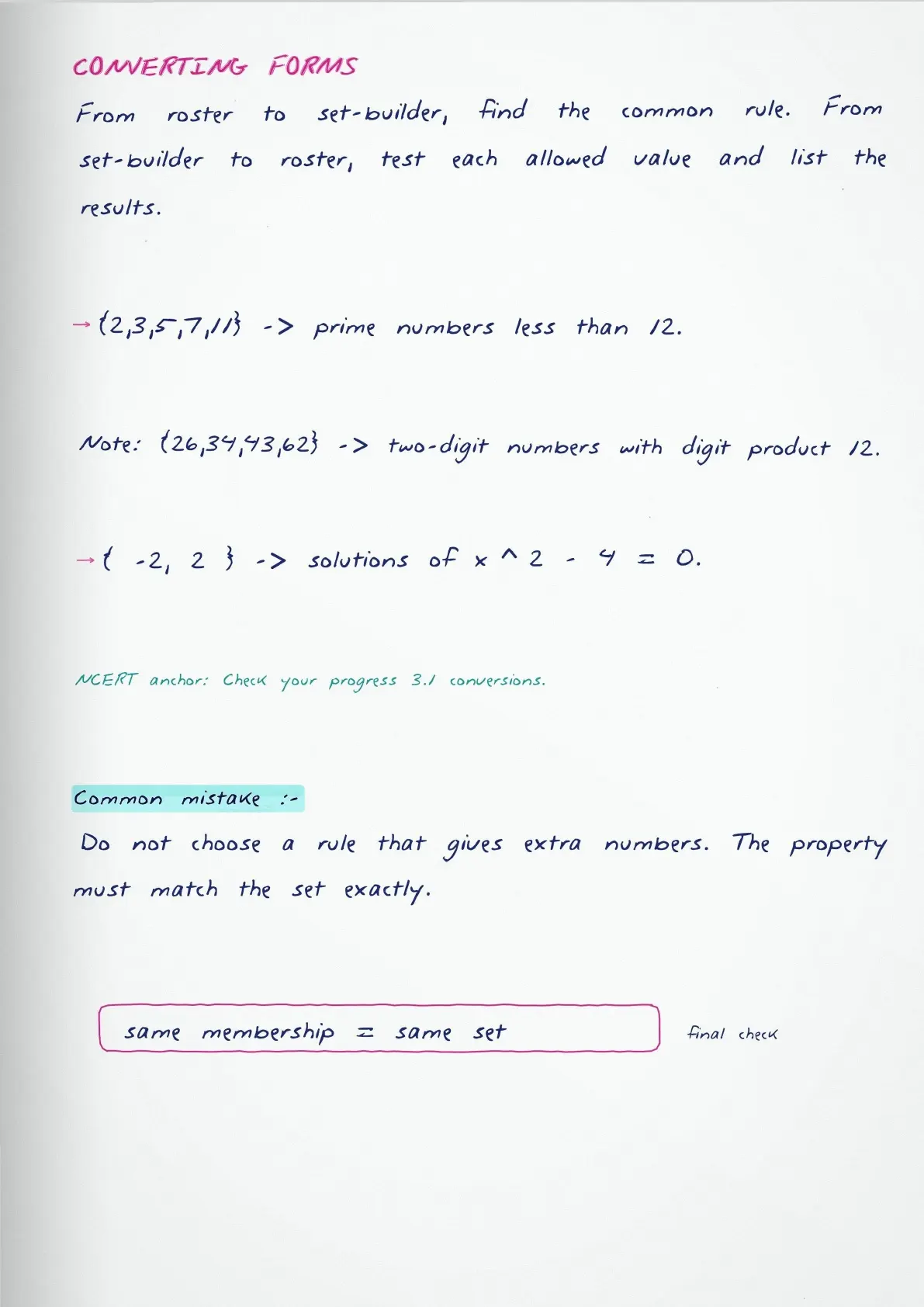
| Representation | Roster and set-builder forms | The rule must match every member |
| Subsets | Subset, proper subset and power set | n(P(A)) = 2 to the power n(A) |
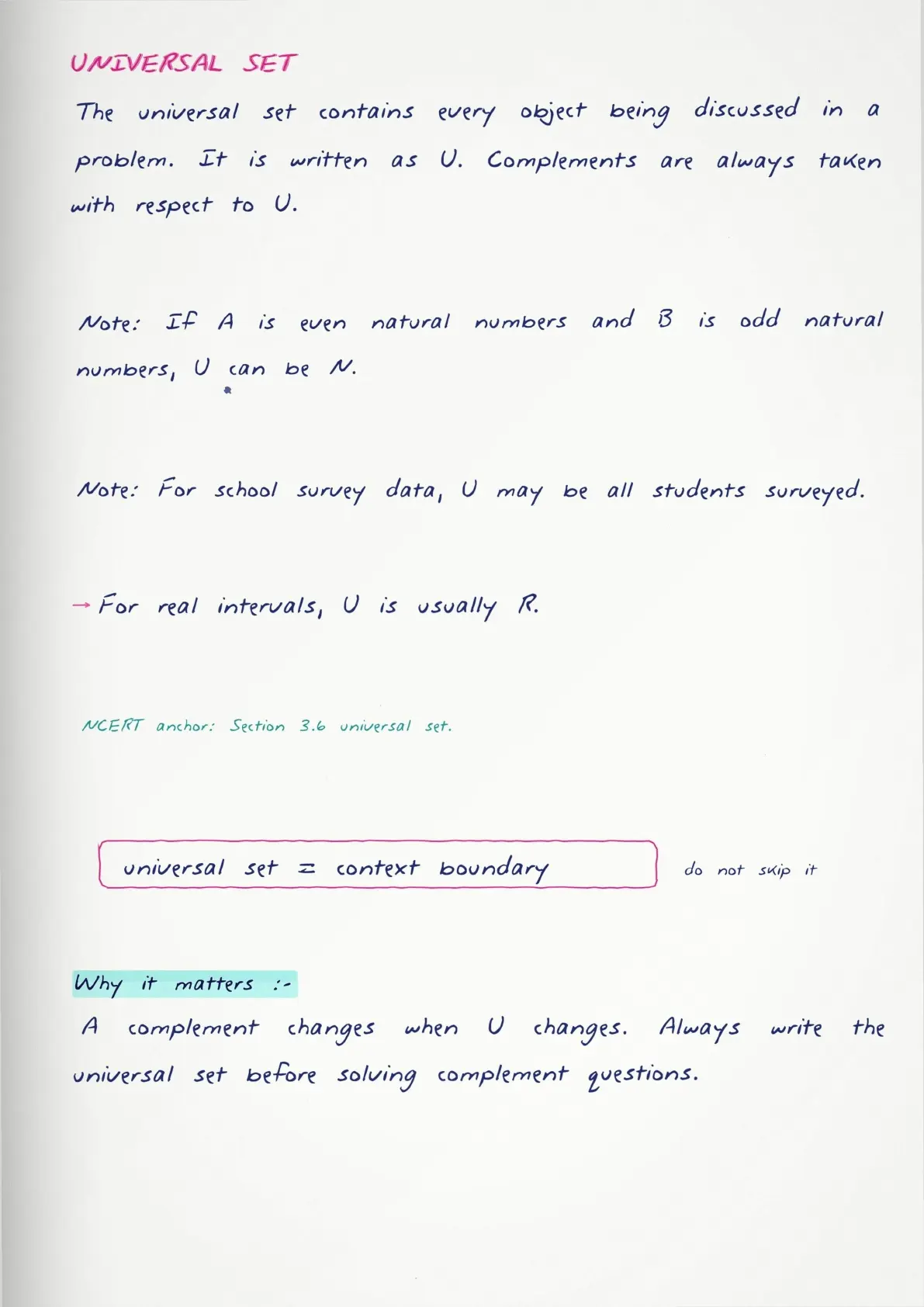
| Operations | Union, intersection, difference and complement | Write the universal set first |
Set Quick Revision Video for Class 11
Source: Magnet Brains on YouTube
Roster Form and Set-Builder Form in Set
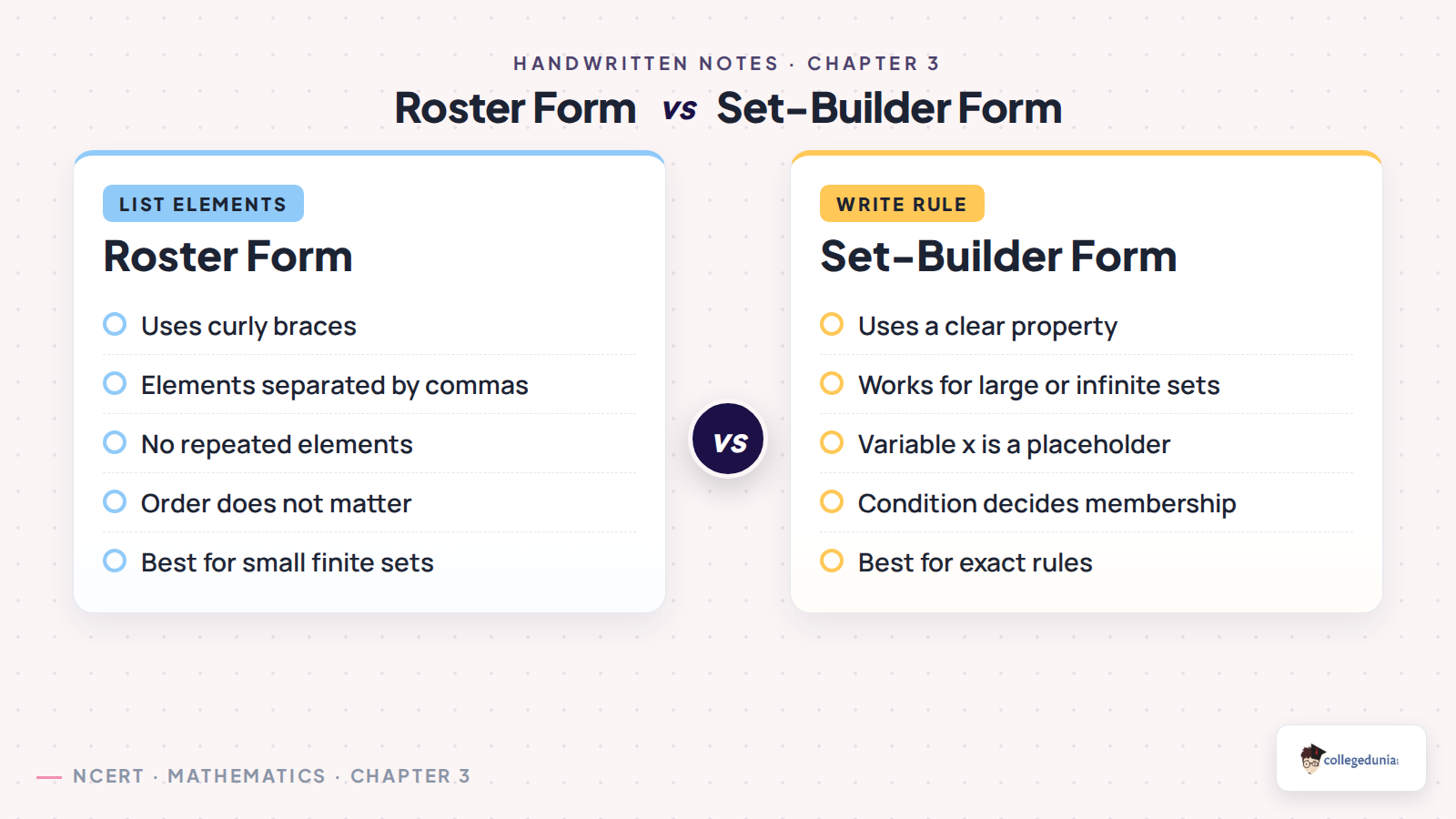
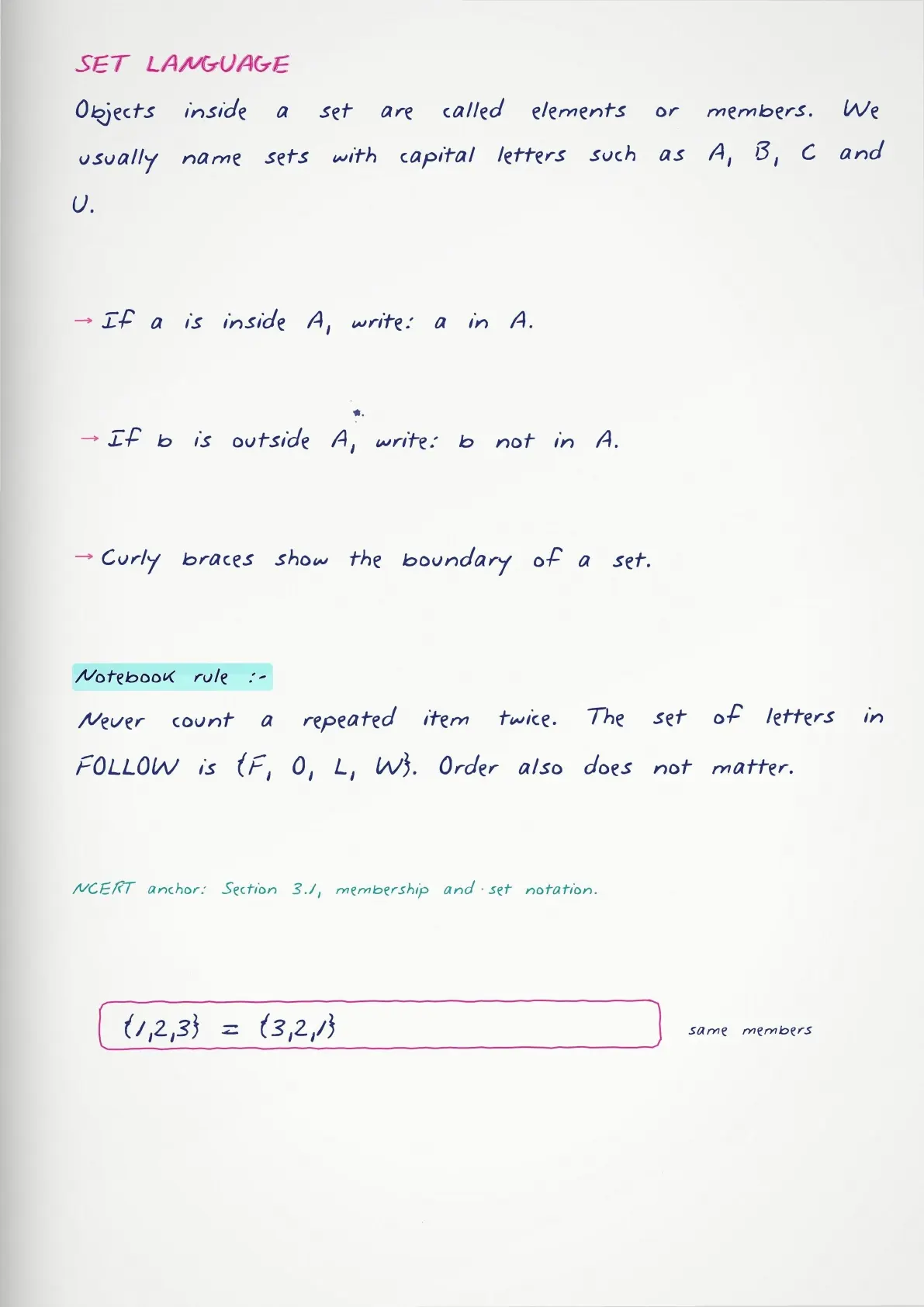
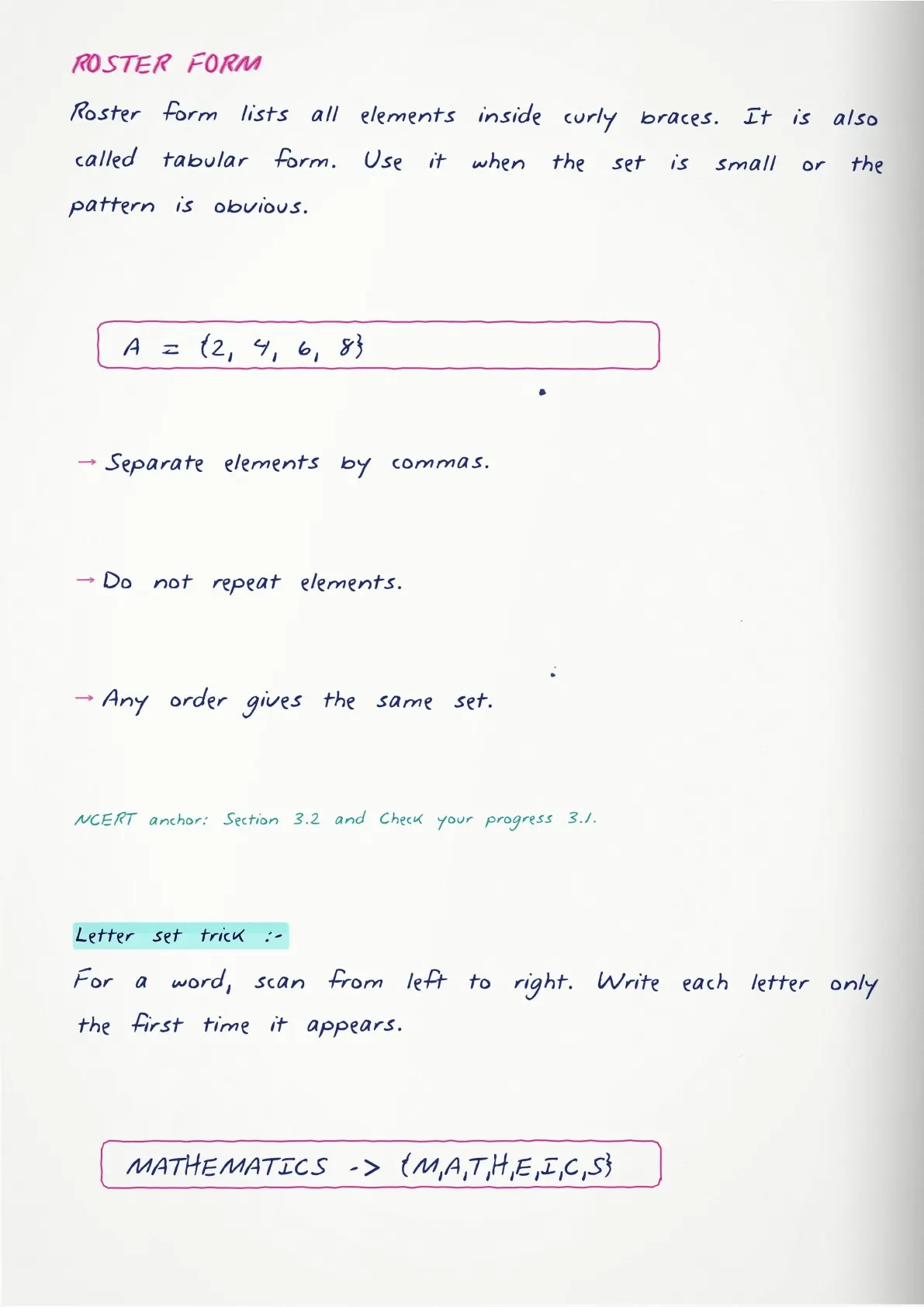
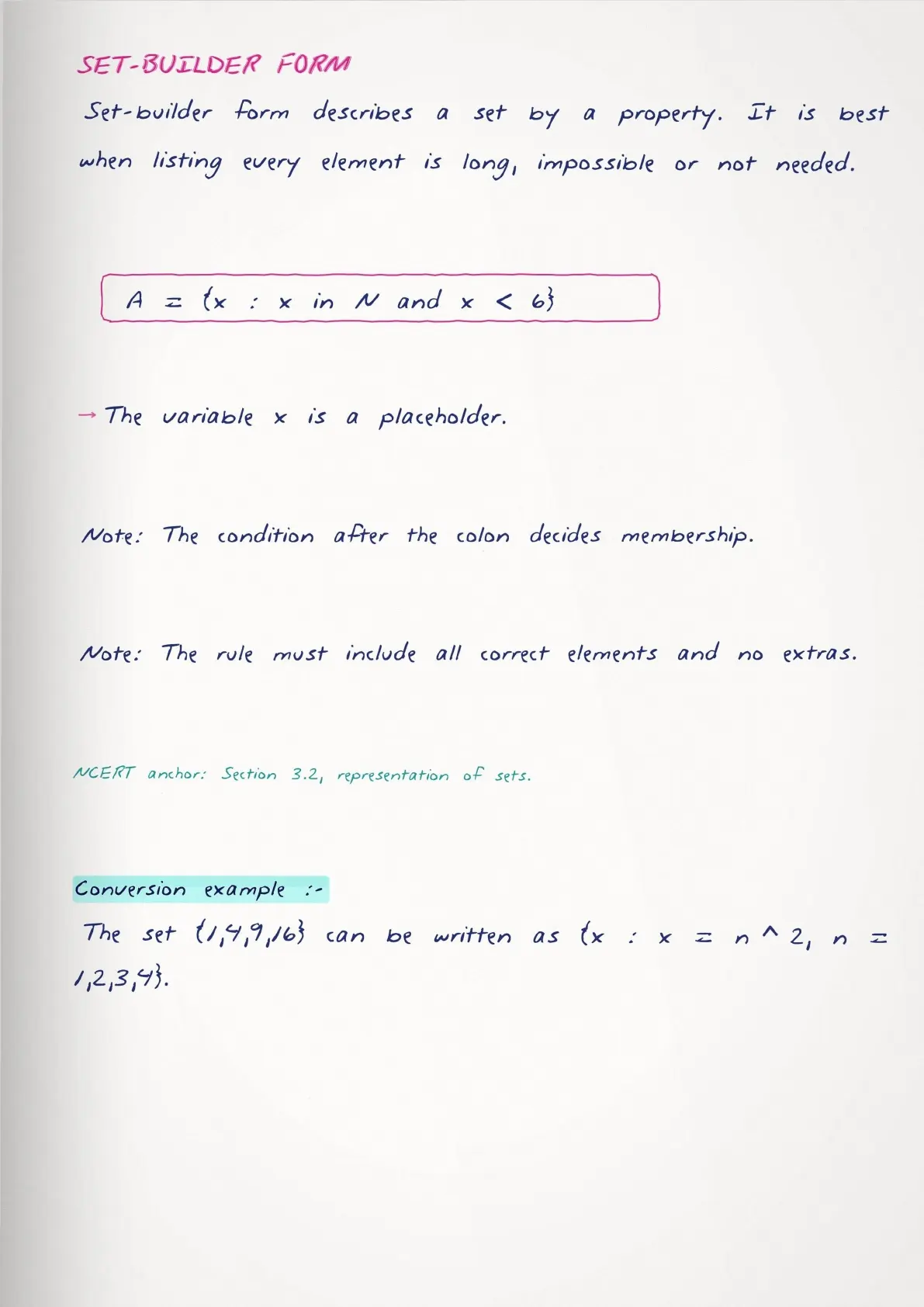
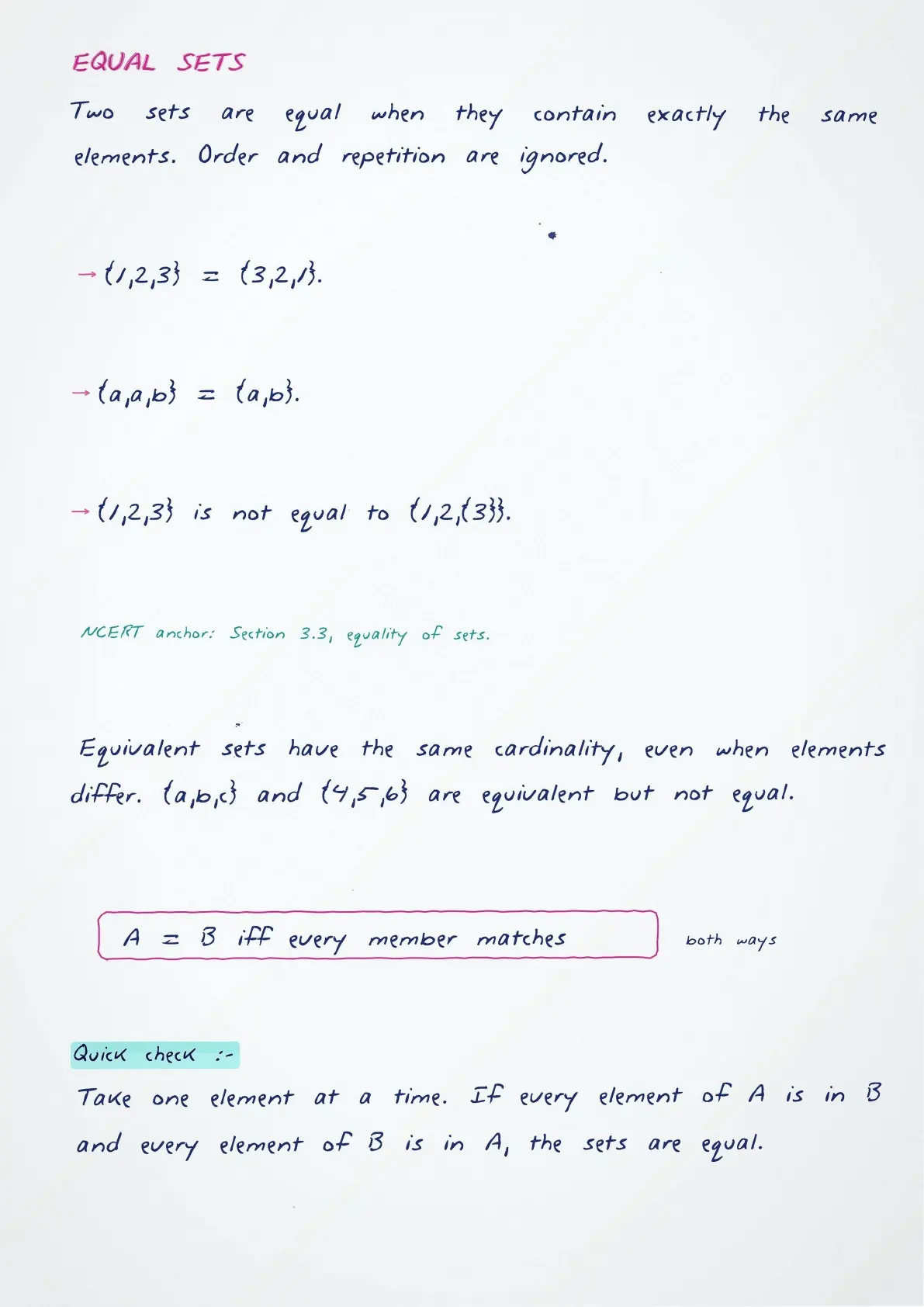
Roster form lists the members inside braces. For example, the set of even natural numbers less than 10 is {2, 4, 6, 8}. Order and repetition do not change a set, so {1, 2, 3} and {3, 2, 1} are equal.
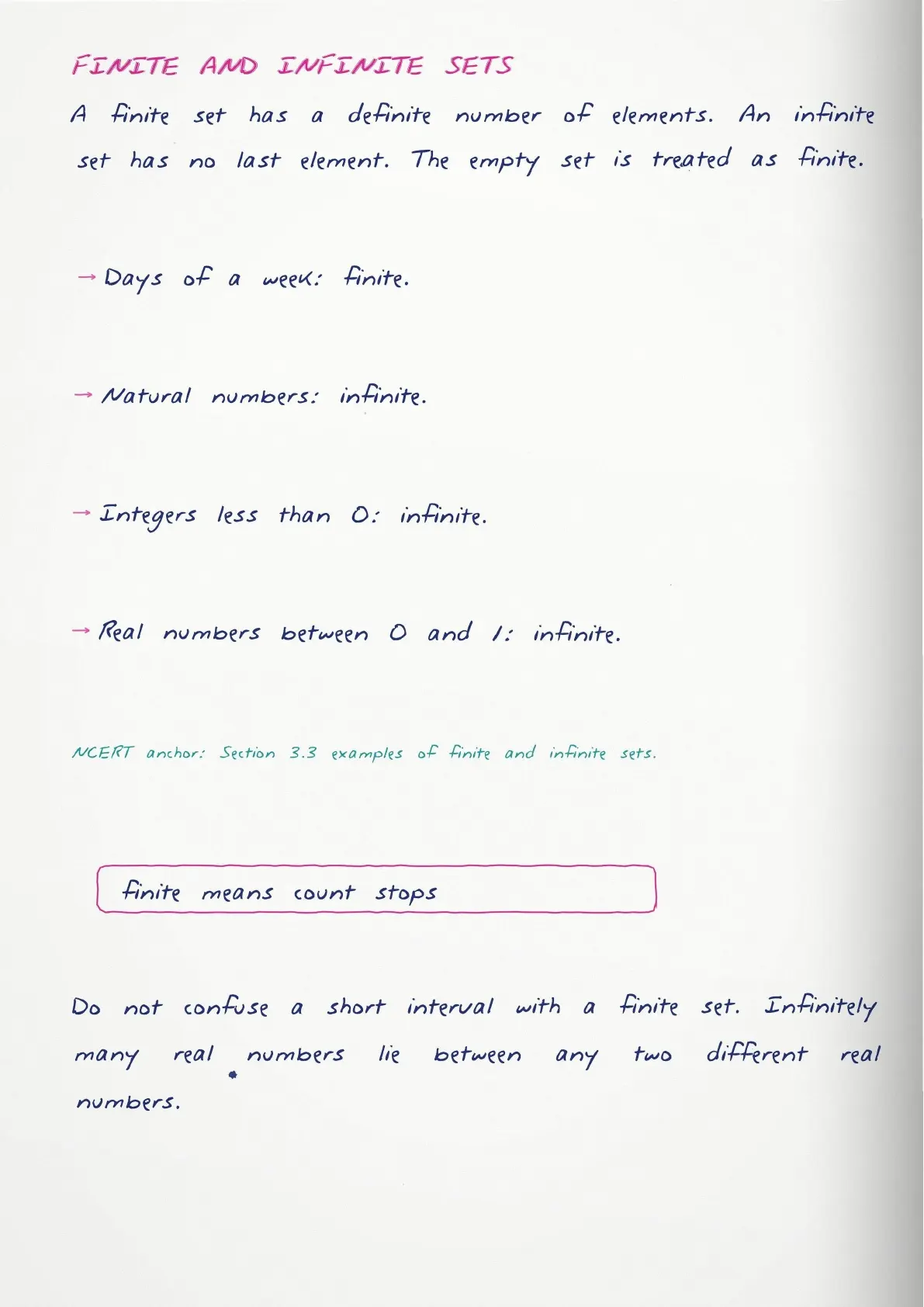
Set-builder form writes the rule instead of the full list. For example, {x : x is an even natural number less than 10}. Use set-builder form when the list is long or infinite.
- Check whether every listed element follows the rule.
- Remove repeated elements before counting cardinality.
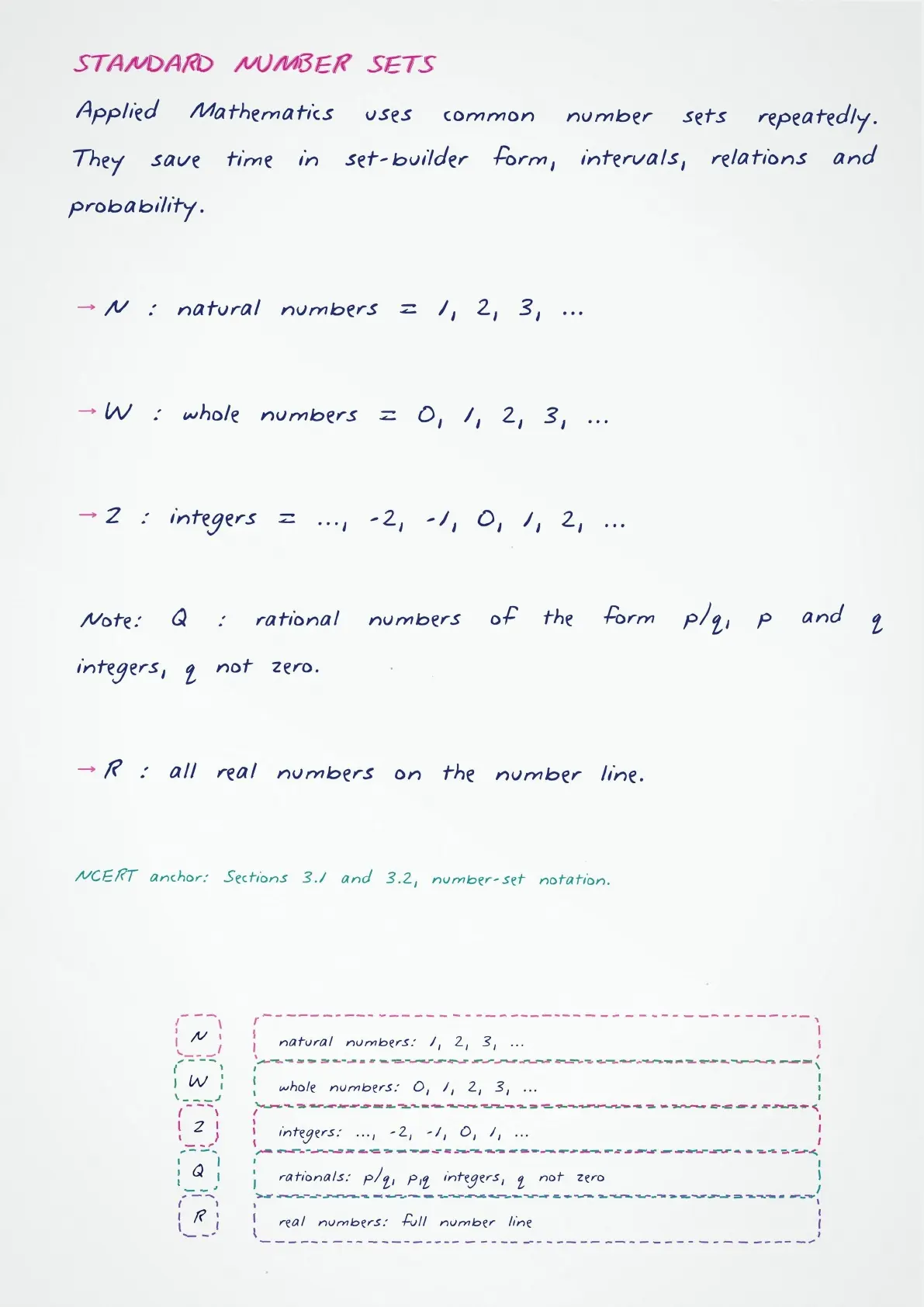
- Use clear conditions such as x in N, x in Z or x in R.
Types of Sets, Subsets and Power Set
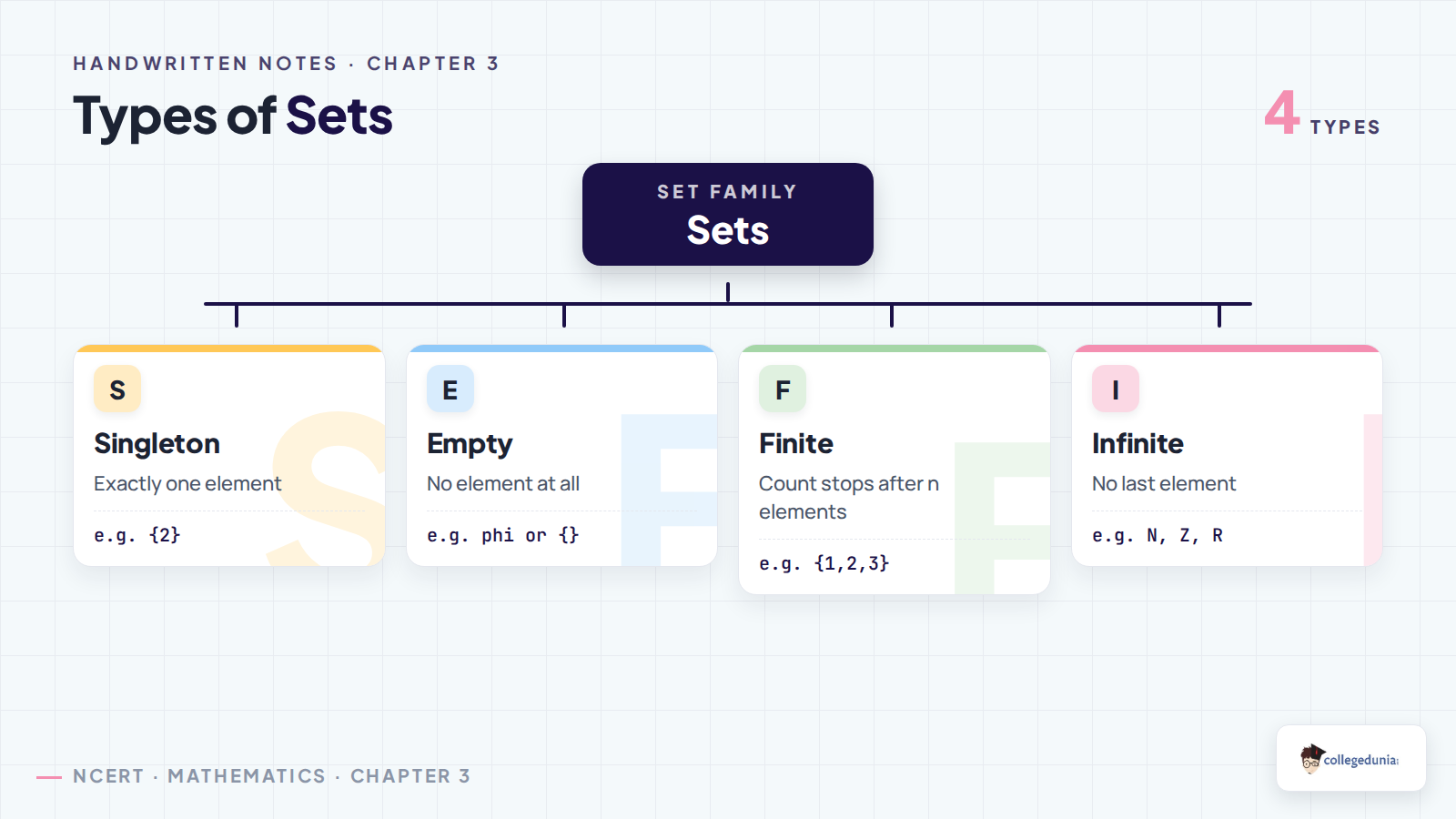
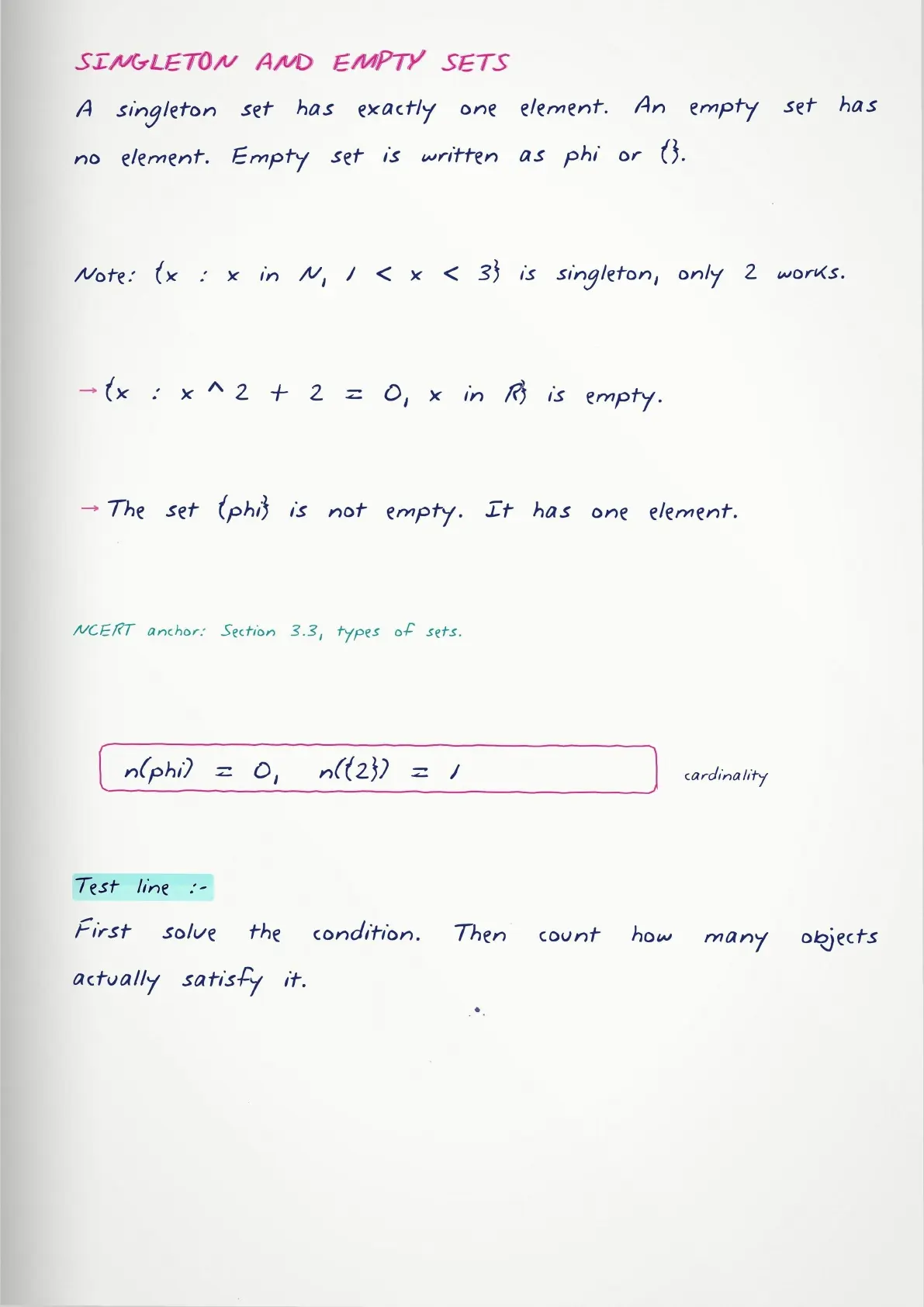
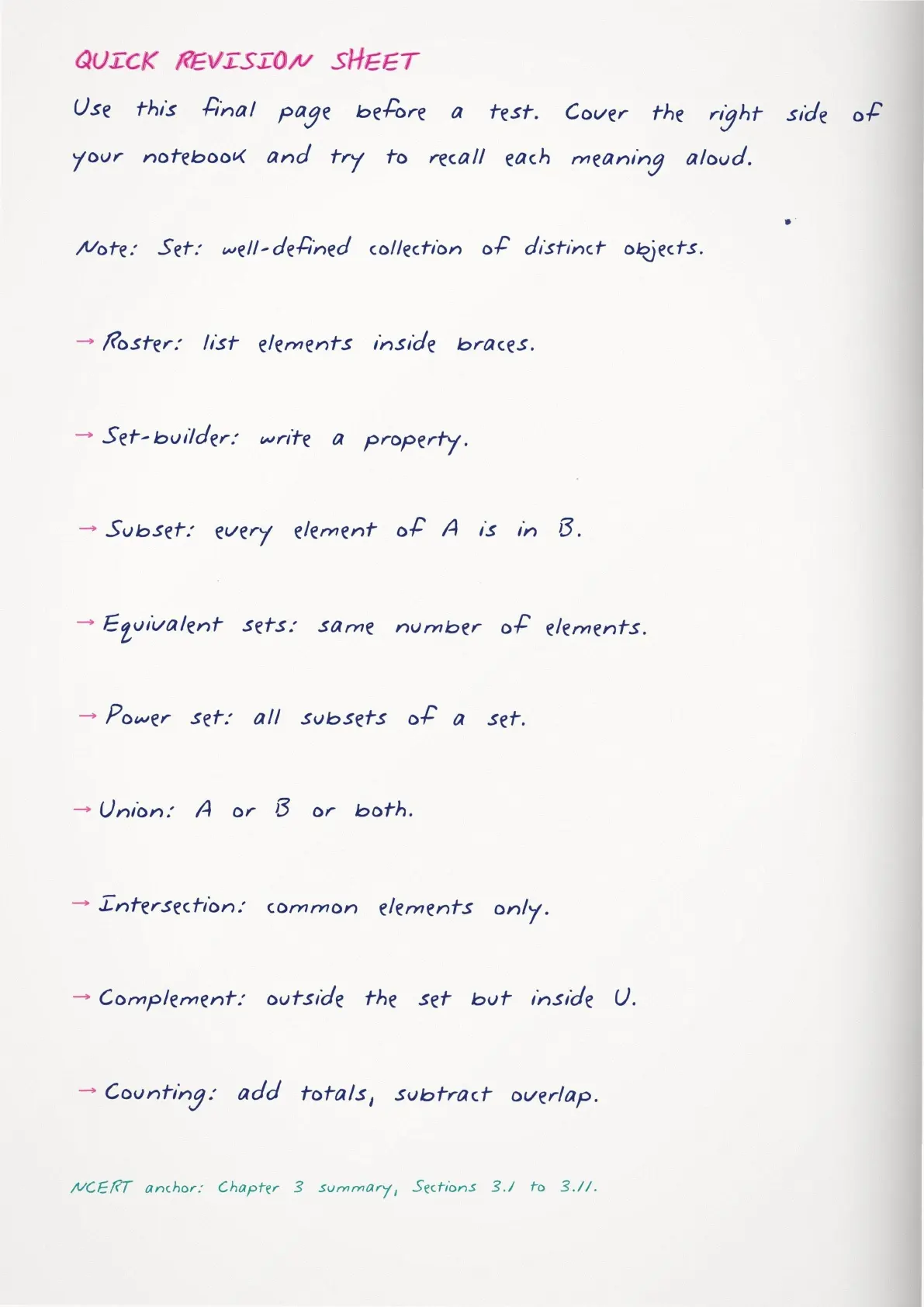
The notes separate empty, singleton, finite, infinite, equal and equivalent sets. Equal sets have the same elements. Equivalent sets have the same number of elements, even when the elements are different.
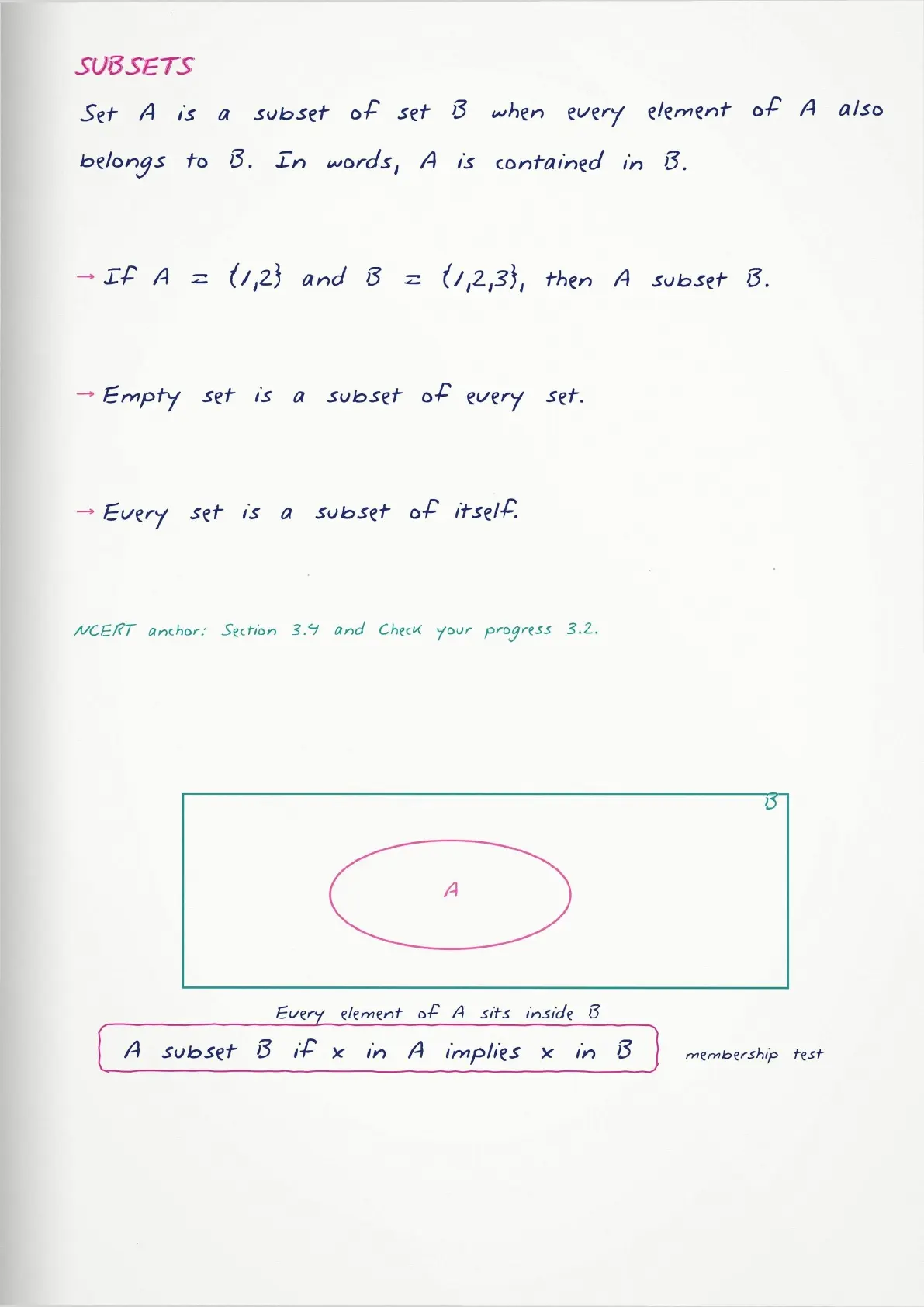
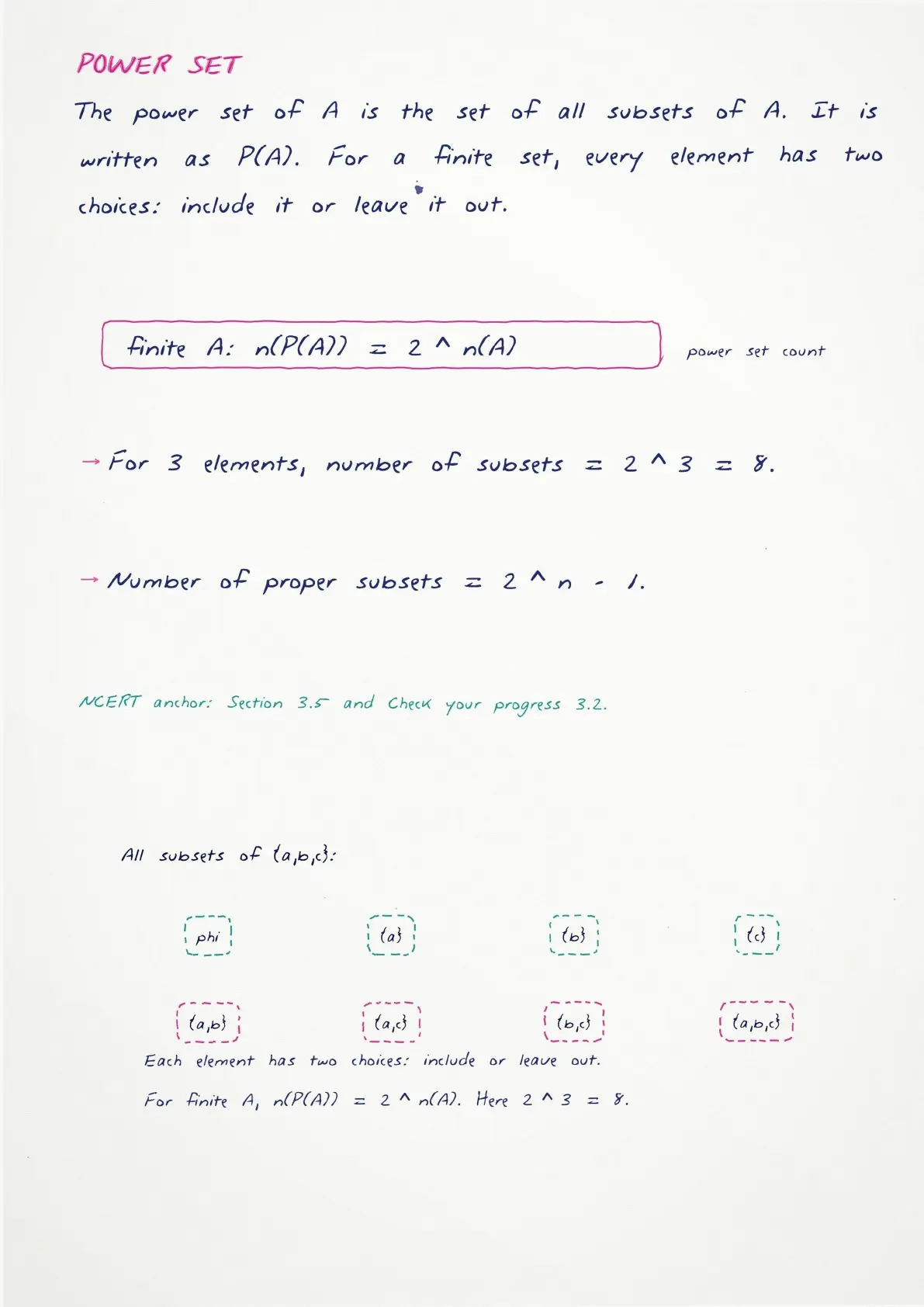
A set A is a subset of B when every element of A is also in B. The empty set is a subset of every set. The power set of A contains all subsets of A, and a finite set with n elements has 2 to the power n subsets.
- {a, b, c} and {4, 5, 6} are equivalent, not equal.
- If A = {1, 2}, then P(A) has 4 subsets.
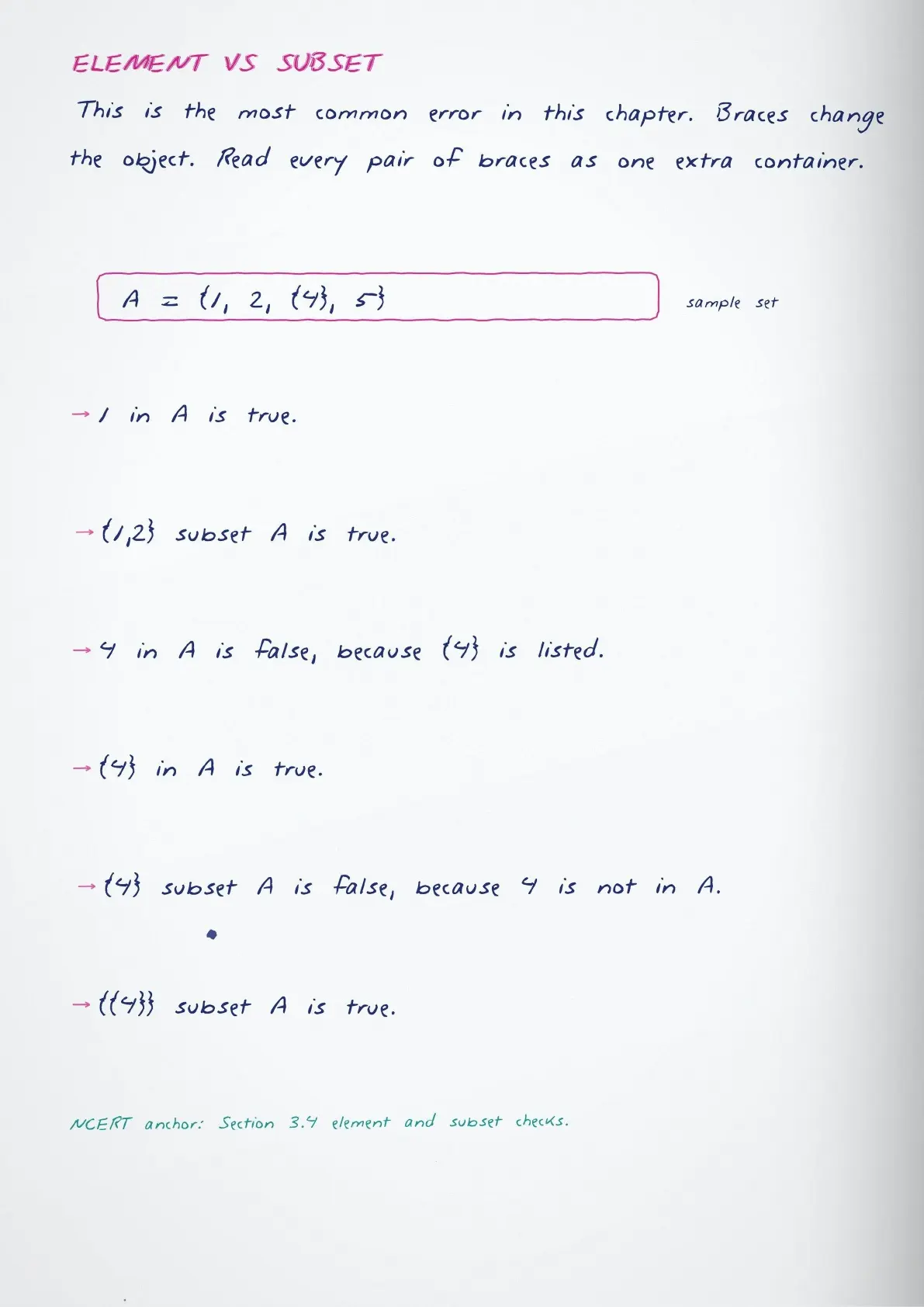
- Do not confuse 4, {4} and {{4}} in subset questions.
Intervals and Venn Diagrams in Set
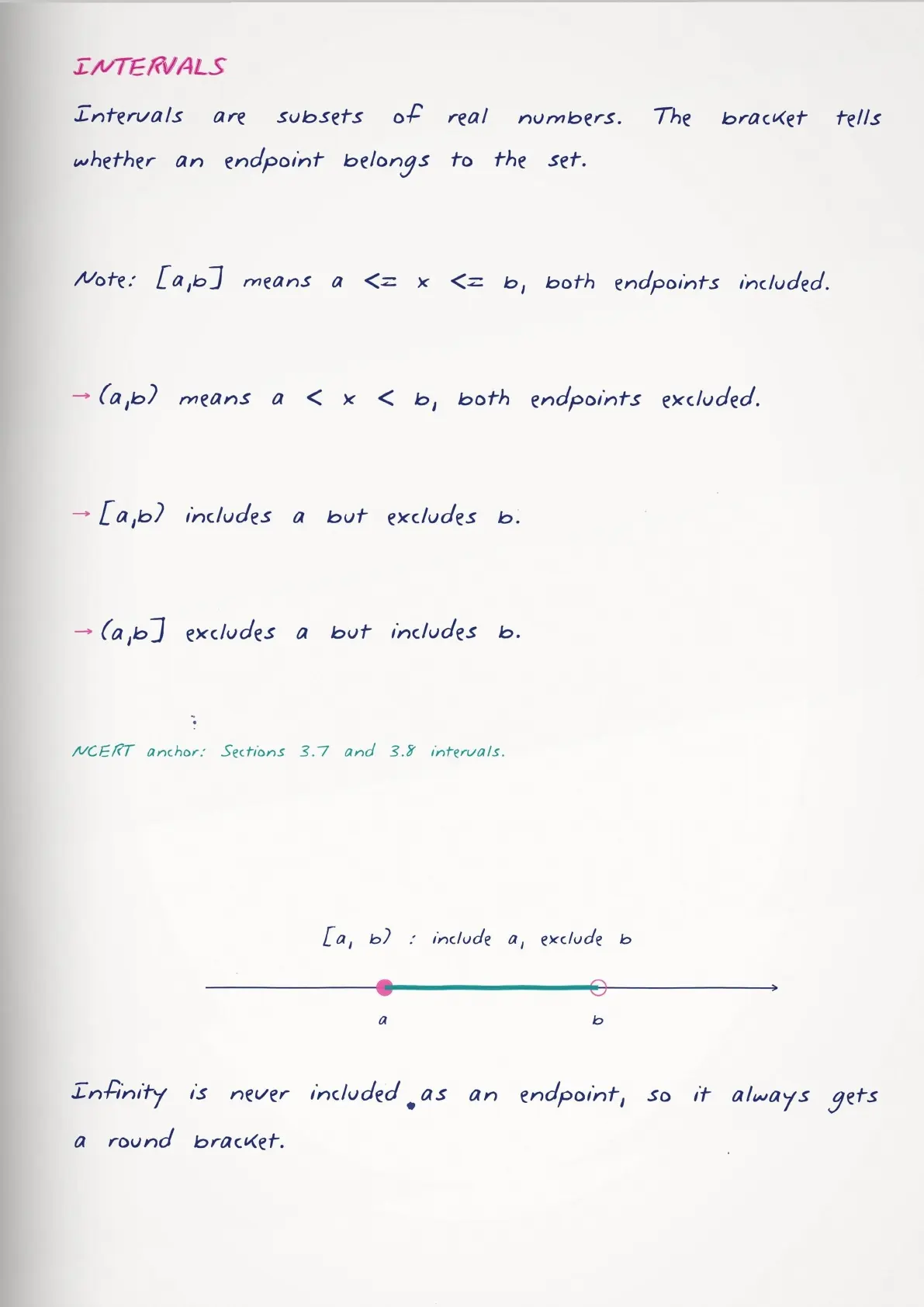
Intervals are subsets of real numbers. Square brackets include endpoints, while round brackets exclude endpoints. For example, [a, b) means a is included and b is excluded. Infinity always takes a round bracket.
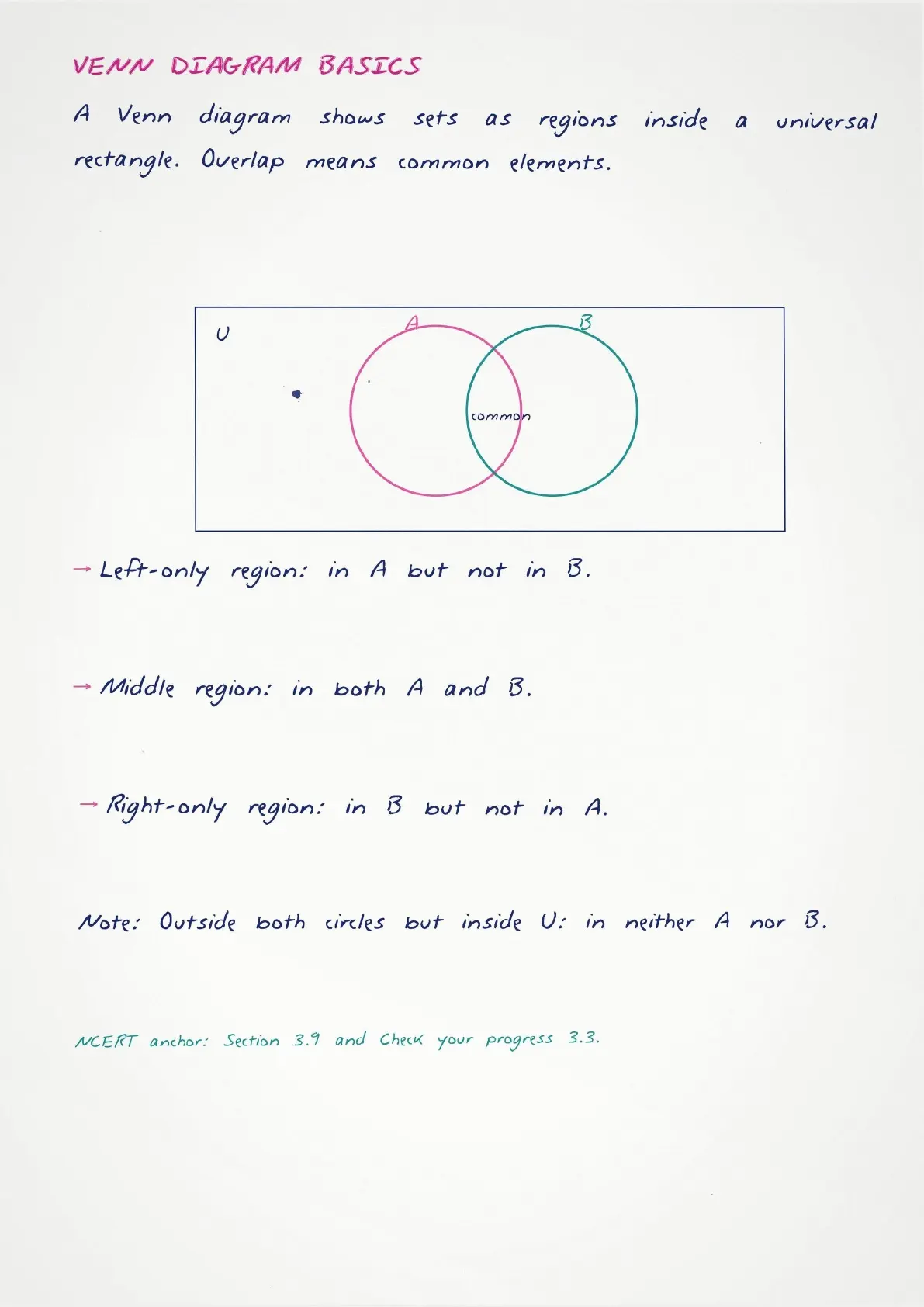
Venn diagrams show set regions inside a universal rectangle. The middle region shows common elements. The outside region inside U shows elements in neither set. A complement always depends on the universal set.
| Symbol | Meaning | Revision cue |
|---|---|---|
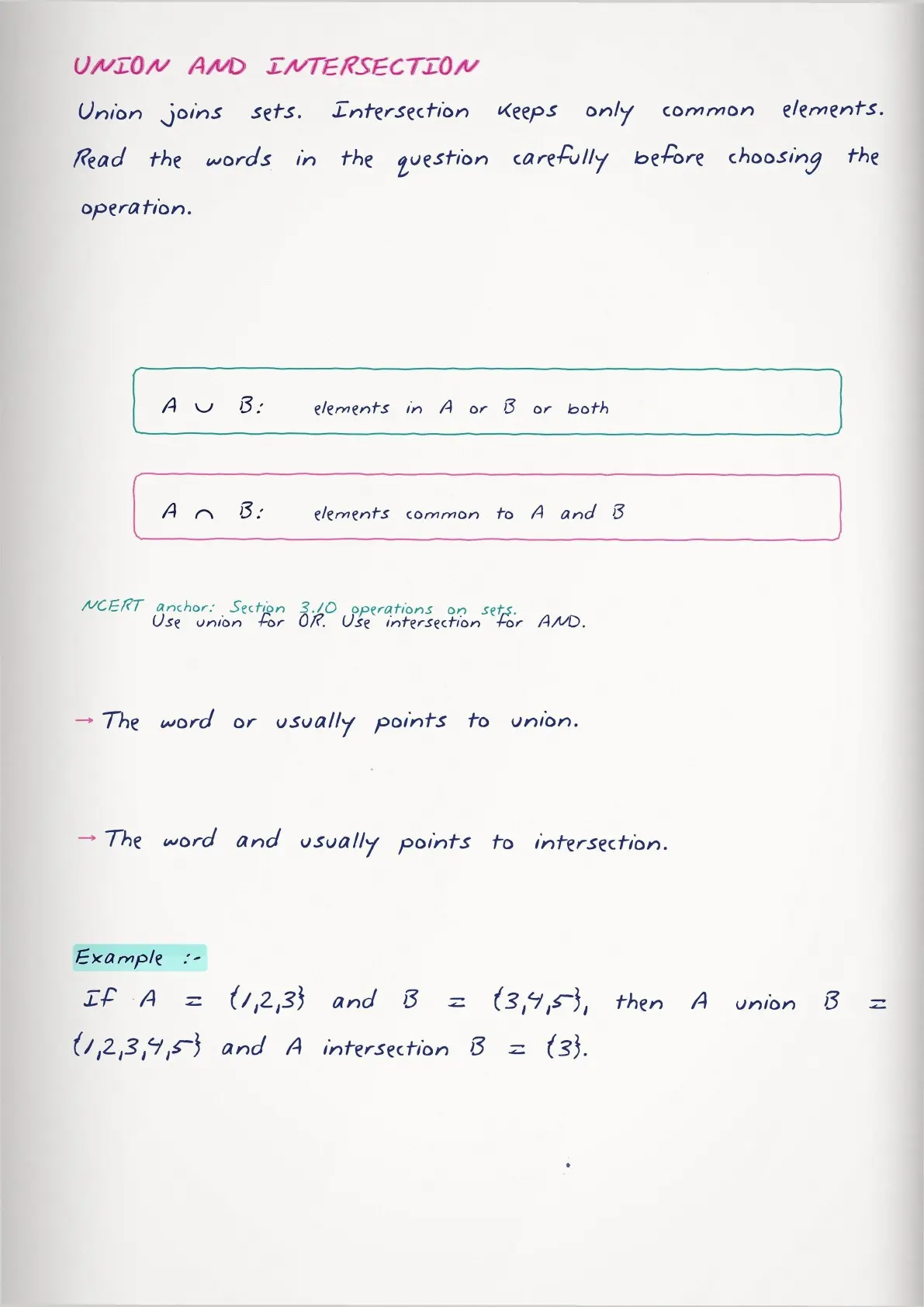
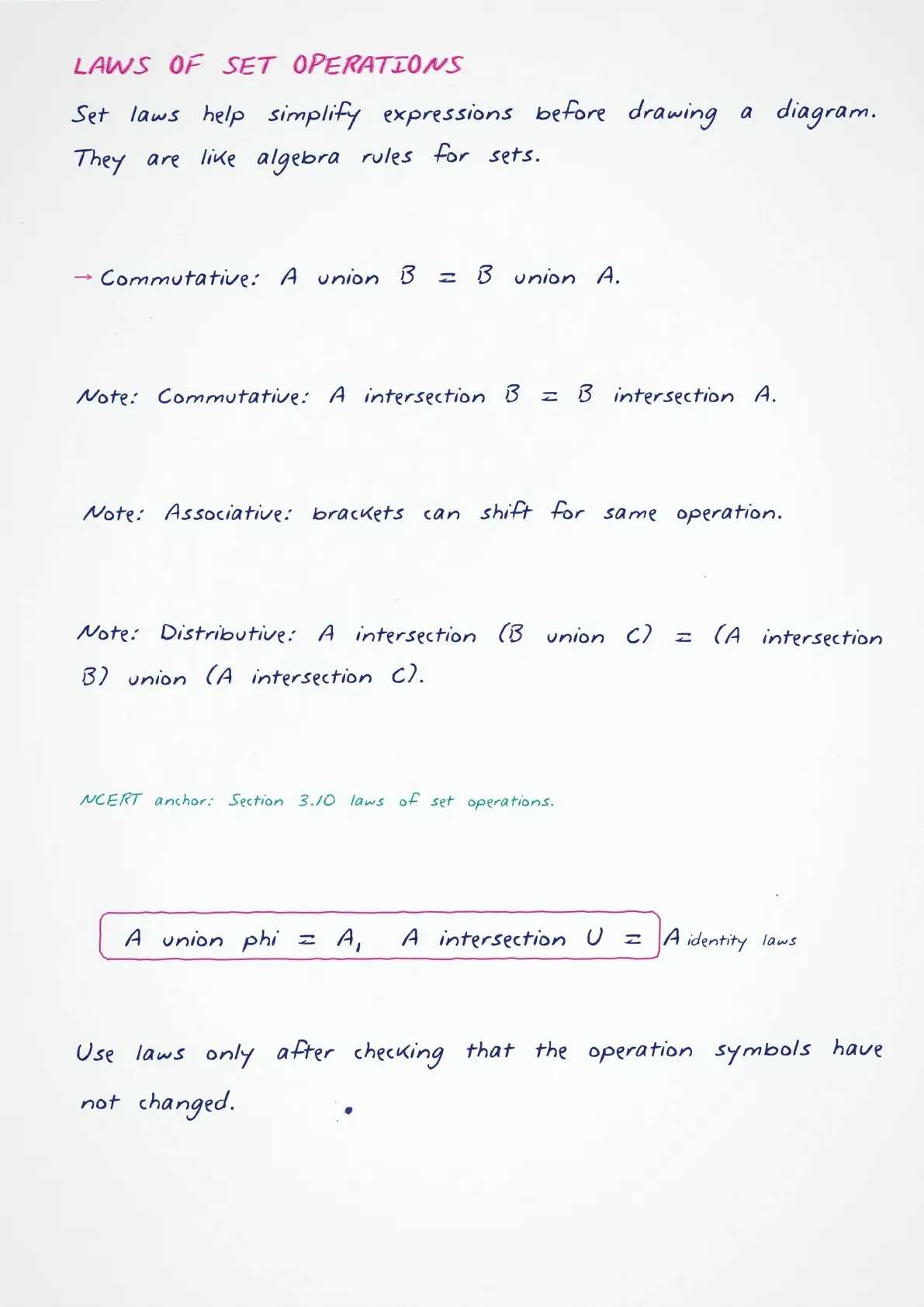
| A union B | In A or B or both | Join regions |
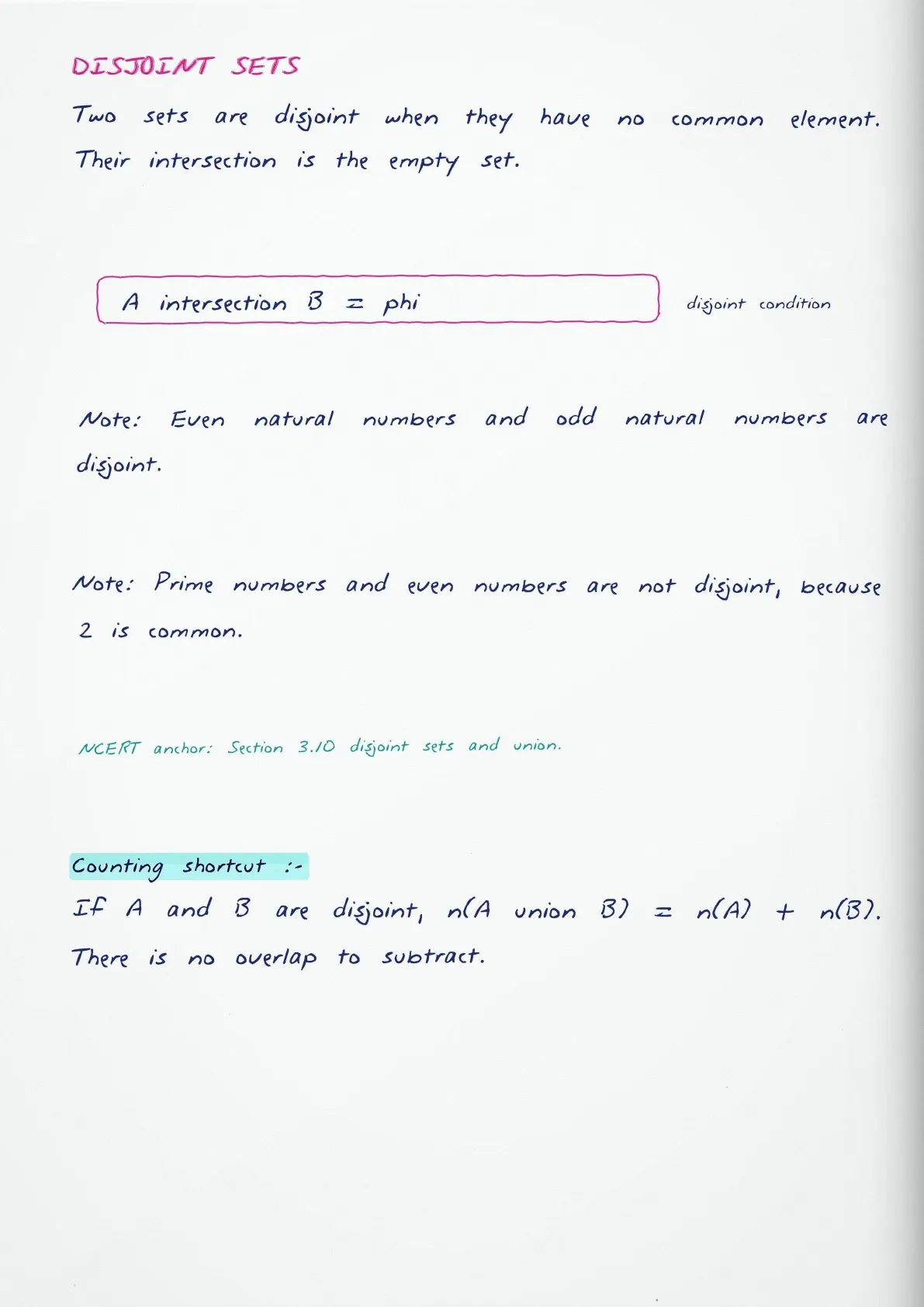
| A intersection B | Common to A and B | Keep overlap |
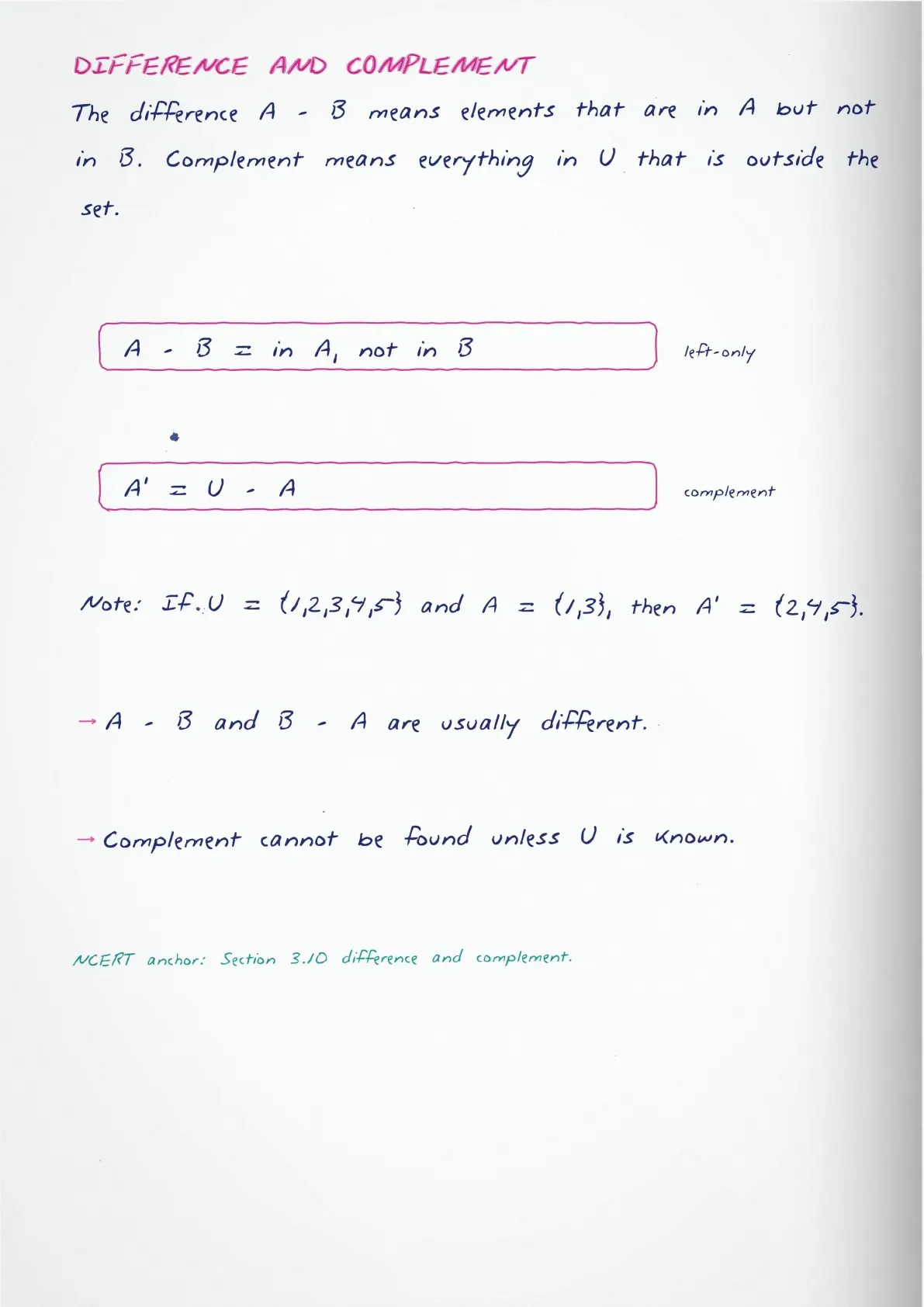
| A - B | In A but not in B | Left-only region |
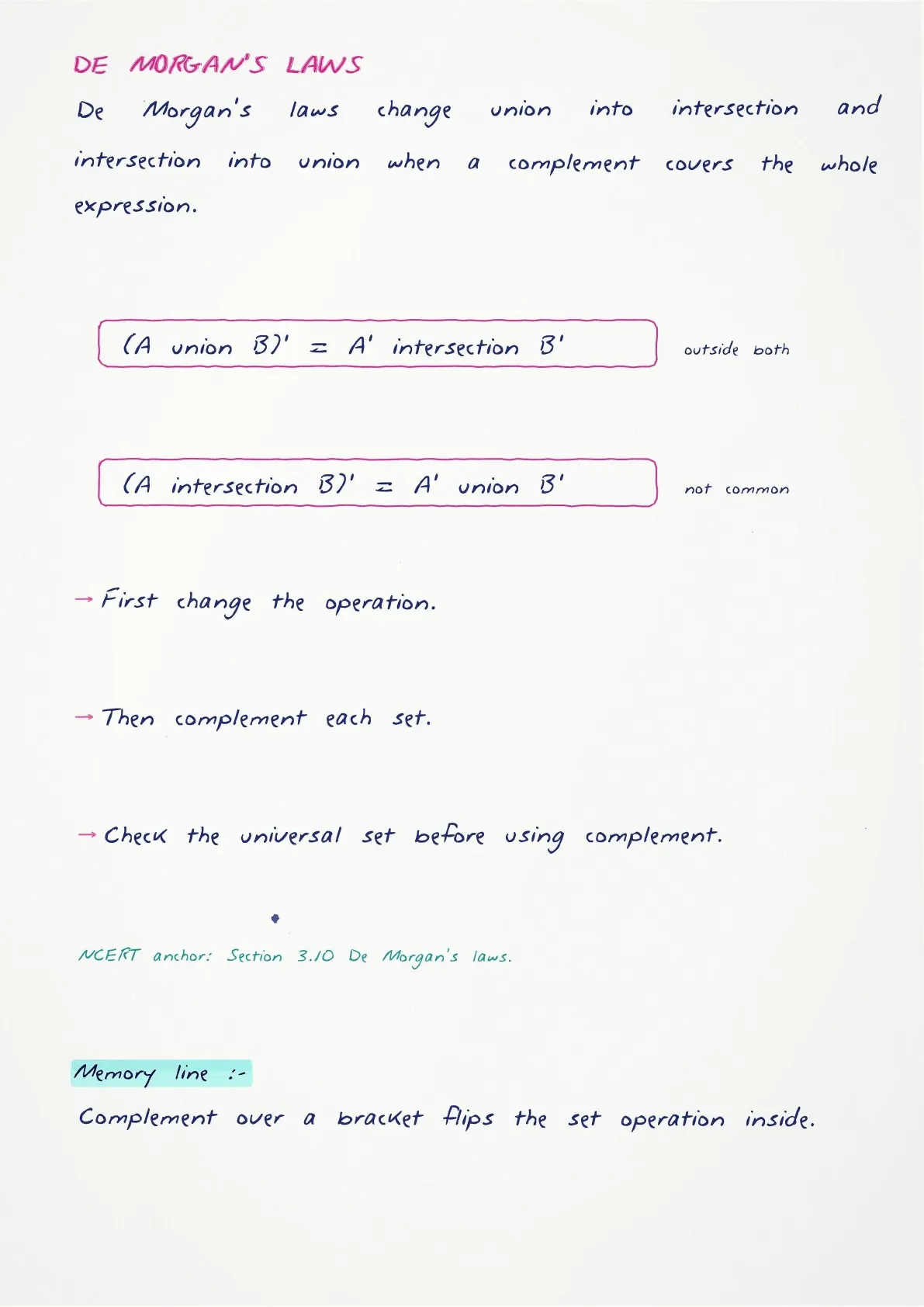
| A' | Outside A but inside U | Check U first |
Counting Formulas for Set Questions
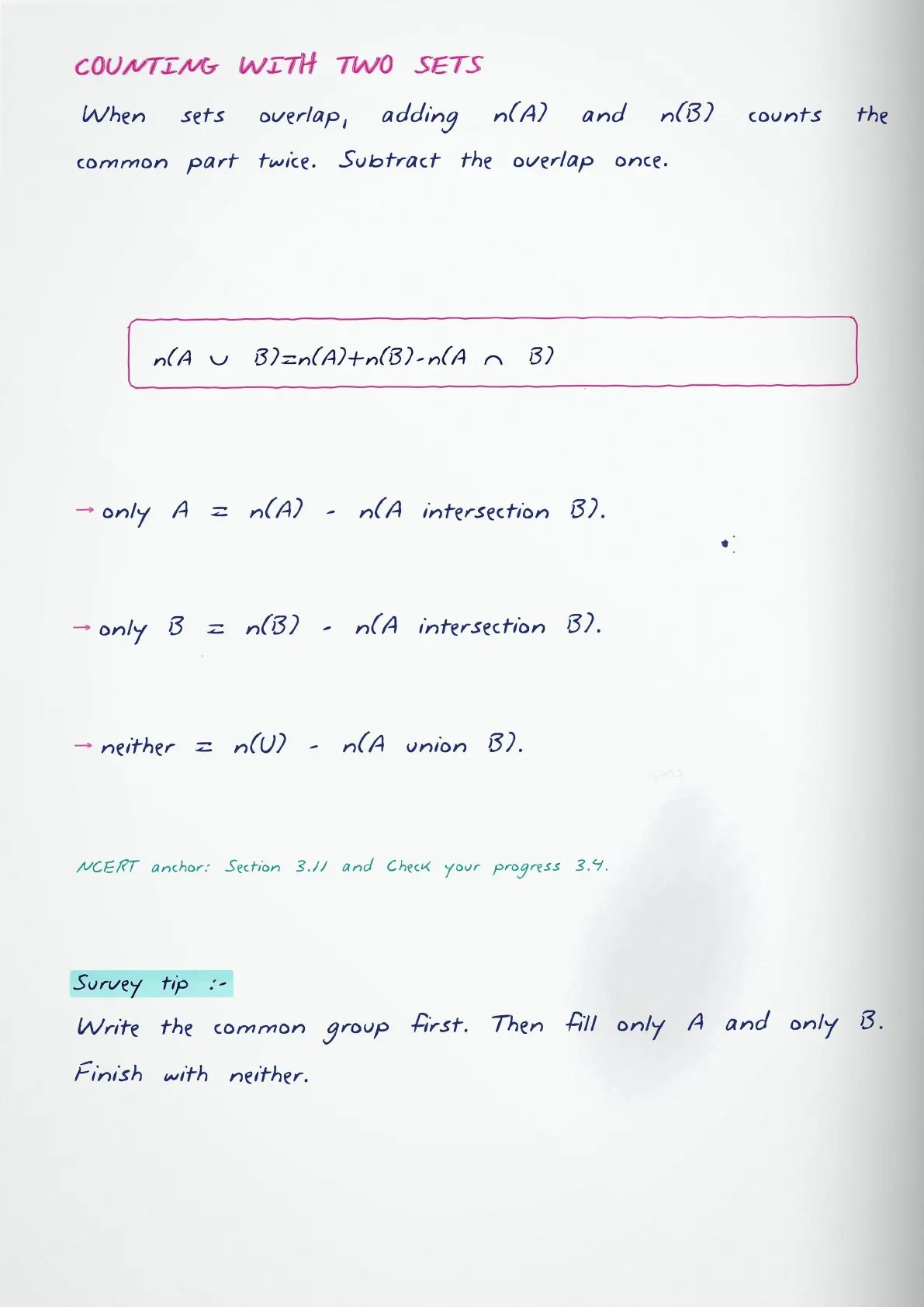
Counting questions are survey-style questions. Start by writing the overlap first. Then fill only-A, only-B and neither. This order prevents double-counting.
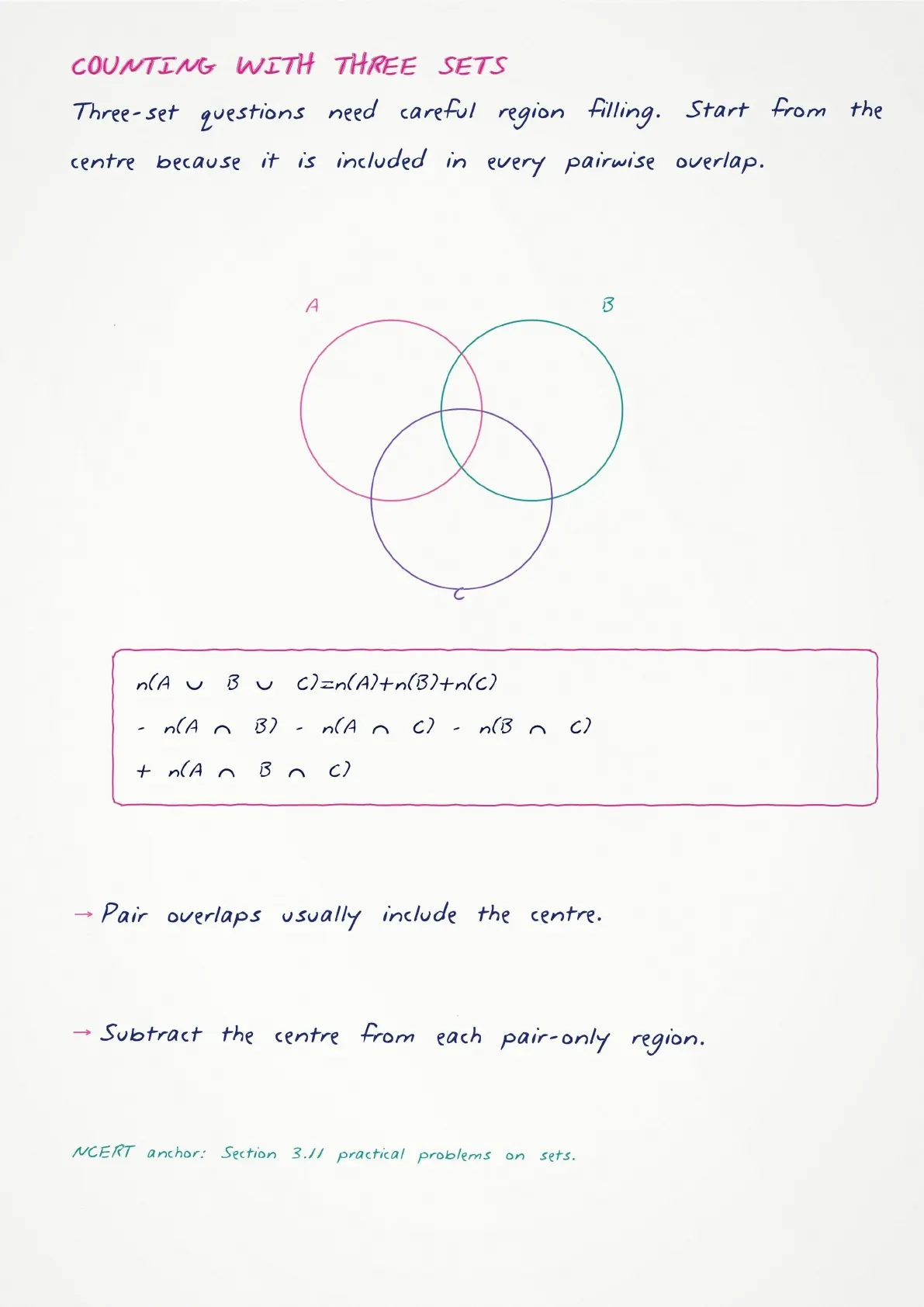
The two-set formula is n(A union B) = n(A) + n(B) - n(A intersection B). For three sets, subtract all pairwise intersections and add the triple intersection once.
- Use n(U) when the question asks for neither.
- Pair overlaps in three-set questions usually include the centre.
- Draw a Venn diagram before substituting numbers.
How to Revise Set Before Tests
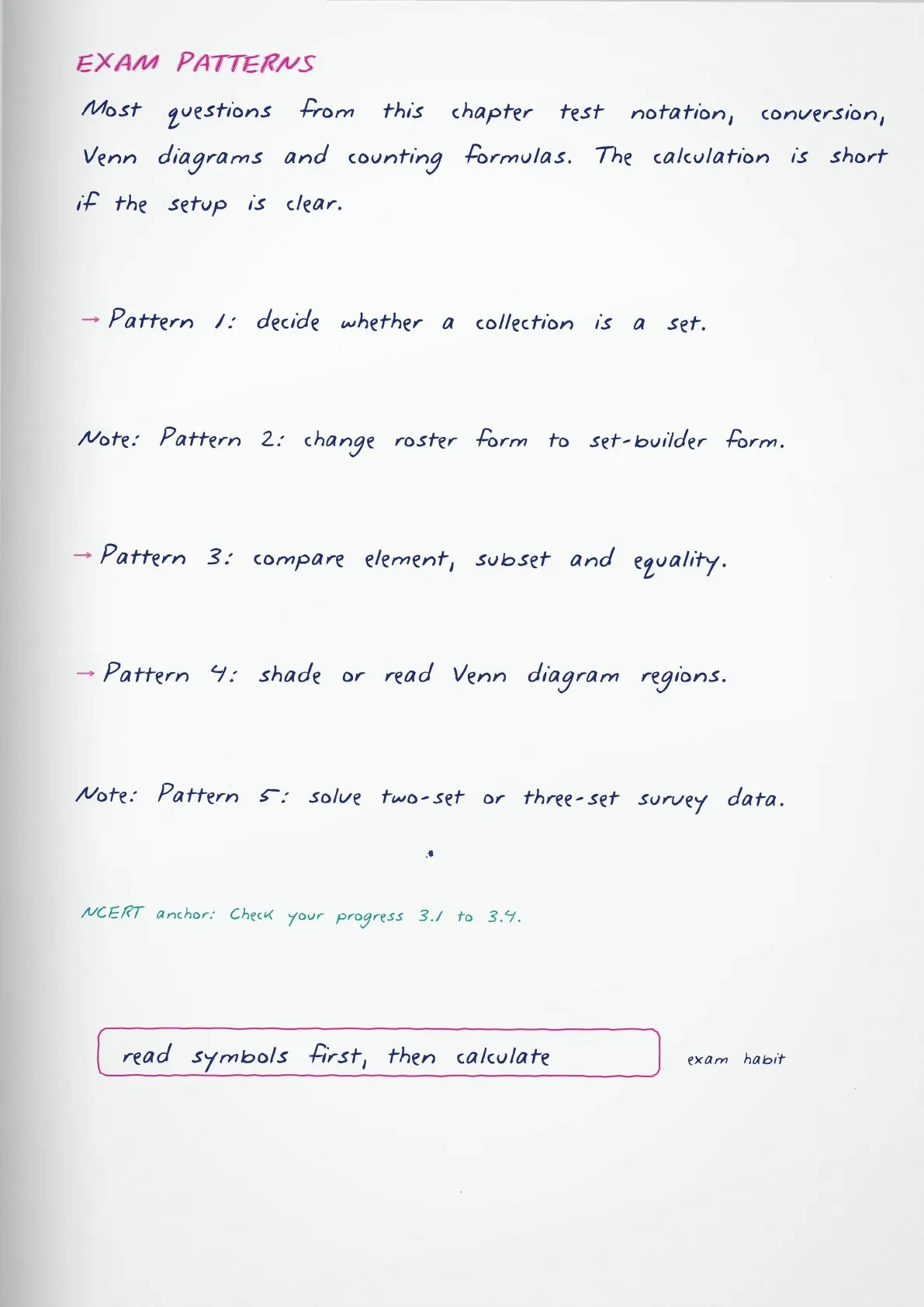
Use the Set handwritten notes in two passes. First, revise definitions and symbols. Second, solve one example each on roster form, subset checks, interval notation, two-set counting and Venn diagrams.
- Copy the symbol table on one page.
- Practise one roster-to-set-builder conversion.
- List all subsets of a 3-element set once.
- Finish with one two-set survey question.
Related Resources for Set
| Resource | Use it for | Link |
|---|---|---|
| NCERT Book PDF | Official explanation and Check Your Progress questions | Set Class 11 NCERT Book PDF |
| NCERT Notes | Typed explanation with tables and examples | Set Class 11 Notes |
| NCERT Solutions | Step-by-step answers for chapter questions | Set Class 11 NCERT Solutions |
| Formula Sheet | Formula-only revision before practice | Set Class 11 Formula Sheet |
Applied Mathematics Handwritten Notes for All Chapters
| Chapter | Handwritten Notes |
|---|---|
| Chapter 1 | Numbers and Quantification Class 11 Handwritten Notes |
| Chapter 2 | Numerical Applications Class 11 Handwritten Notes |
| Chapter 4 | Relations Class 11 Handwritten Notes |
| Chapter 5 | Sequences and Series Class 11 Handwritten Notes |
| Chapter 6 | Permutations and Combinations Class 11 Handwritten Notes |
| Chapter 7 | Mathematical and Logical Reasoning Class 11 Handwritten Notes |
Set Class 11 Applied Mathematics Handwritten Notes FAQs
Ques. What is covered in Class 11 Applied Mathematics Chapter 3 Set handwritten notes?
Ans. The handwritten notes cover set notation, roster form, set-builder form, types of sets, subsets, power set, universal set, intervals, Venn diagrams and counting formulas.
Ques. What is the difference between equal and equivalent sets?
Ans. Equal sets have exactly the same elements. Equivalent sets have the same number of elements, even when the elements are different.
Ques. How many subsets does a set with n elements have?
Ans. A finite set with n elements has 2 to the power n subsets. Its proper subsets are one less than this count.
Ques. What is the main counting formula for two sets?
Ans. The main formula is n(A union B) = n(A) + n(B) - n(A intersection B). It subtracts the common part counted twice.
Ques. Are these Set handwritten notes aligned with the 2026-27 syllabus?
Ans. Yes. The notes follow the current 2026-27 Class 11 Applied Mathematics scope for Set under Unit 2 Algebra.



Comments