




Class 10 Science Chapter 9 Light - Reflection and Refraction is the most formula-heavy physics chapter of the 2026-27 NCERT, and a single page of relations covers almost every board numerical. This Light Reflection and Refraction formula sheet puts the laws of reflection, the mirror formula, magnification, Snell's law, refractive index, the lens formula, and the power of a lens on one page. Use it as a quick reference before any CBSE Class 10 board test.
- CBSE Weightage: part of the Natural Phenomena and Optics block, worth 6 to 8 marks across one numerical and one reasoning question.
- Best used for: the mirror and lens formulae, magnification signs, refractive index numericals, the power-of-a-lens conversion, and last-minute board revision.
You can find the complete Formula Sheet for Light - Reflection and Refraction, with the laws of reflection, the mirror formula, magnification, Snell's law, refractive index, the lens formula, and the power of a lens mapped to the 2026-27 NCERT, in the article below.
This Formula Sheet is curated by Science subject experts, mapped to the 2026-27 NCERT, and refined against the last five years of CBSE Class 10 board papers.
Also Check:
- Light - Reflection and Refraction Class 10 Science NCERT Solutions
- Light - Reflection and Refraction Class 10 Science Notes
How Collegedunia's Light - Reflection and Refraction Formula Sheet Helps You
This sheet gathers every relation you need for Chapter 9 numericals, in NCERT order.
- 2026-27 NCERT Alignment: every formula, from the laws of reflection to the power of a lens, matches the current syllabus.
- SI units beside every formula, so you can sanity-check a numerical without re-deriving the dimension.
- Sign convention built in: the New Cartesian Sign Convention sits next to the mirror and lens formulae.
- Quick-fact cards for MCQs: key constants in a colour-coded card row for last-minute recall.
Light - Reflection and Refraction Class 10 Science Video Revision
Source: Magnet Brains on YouTube
Light - Reflection and Refraction Class 10 Science Complete Formula Reference
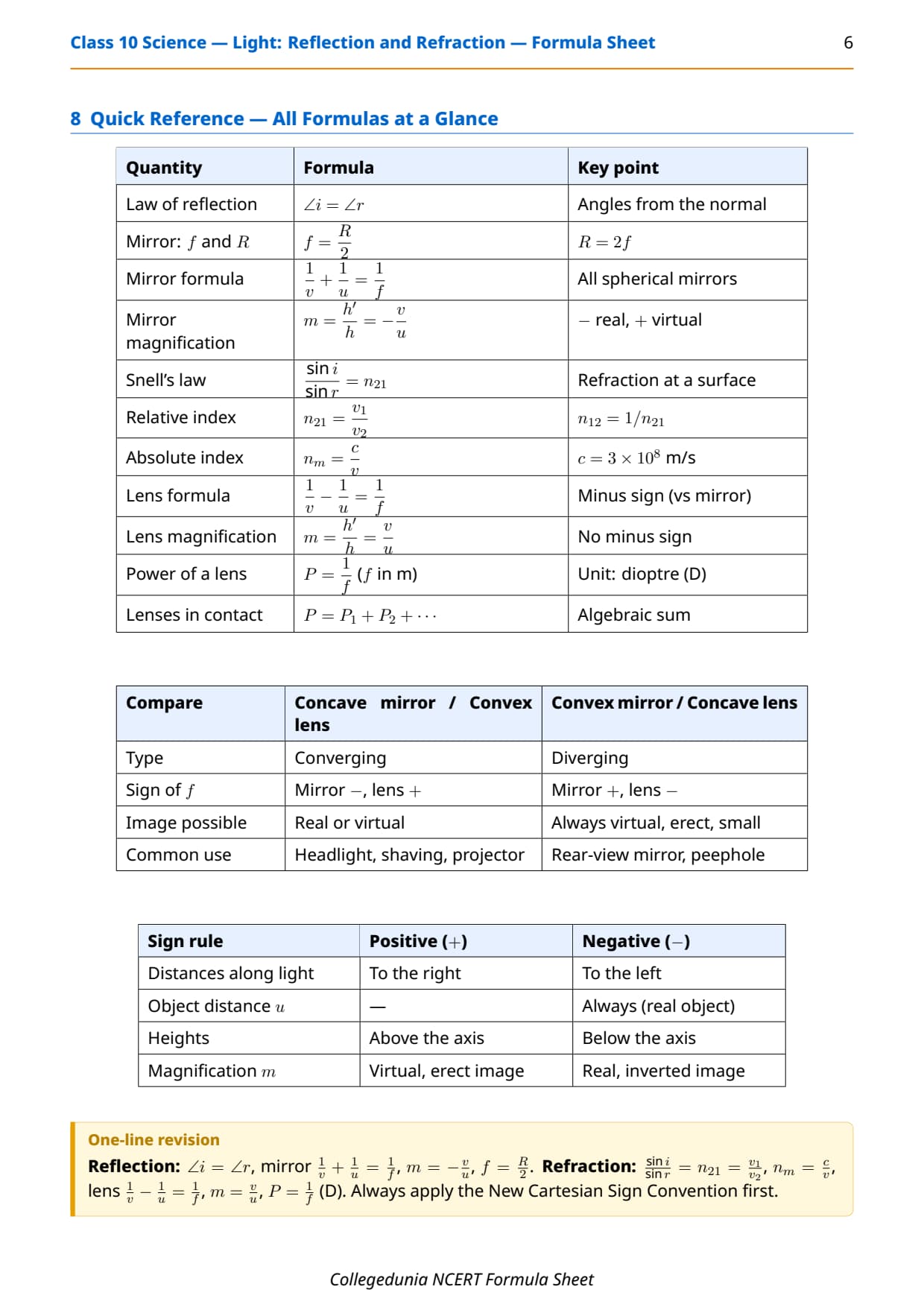
The table lists every formula in Chapter 9, with its NCERT section and typical question setup.
| Concept | Formula | SI Unit | NCERT Section | Typical Use |
|---|---|---|---|---|
| Laws of reflection | ∠i = ∠r | degree | 9.1 | Plane and spherical mirror rays |
| Focal length and radius | f = R2 | m | 9.2.1 | Convert R to f for any mirror |
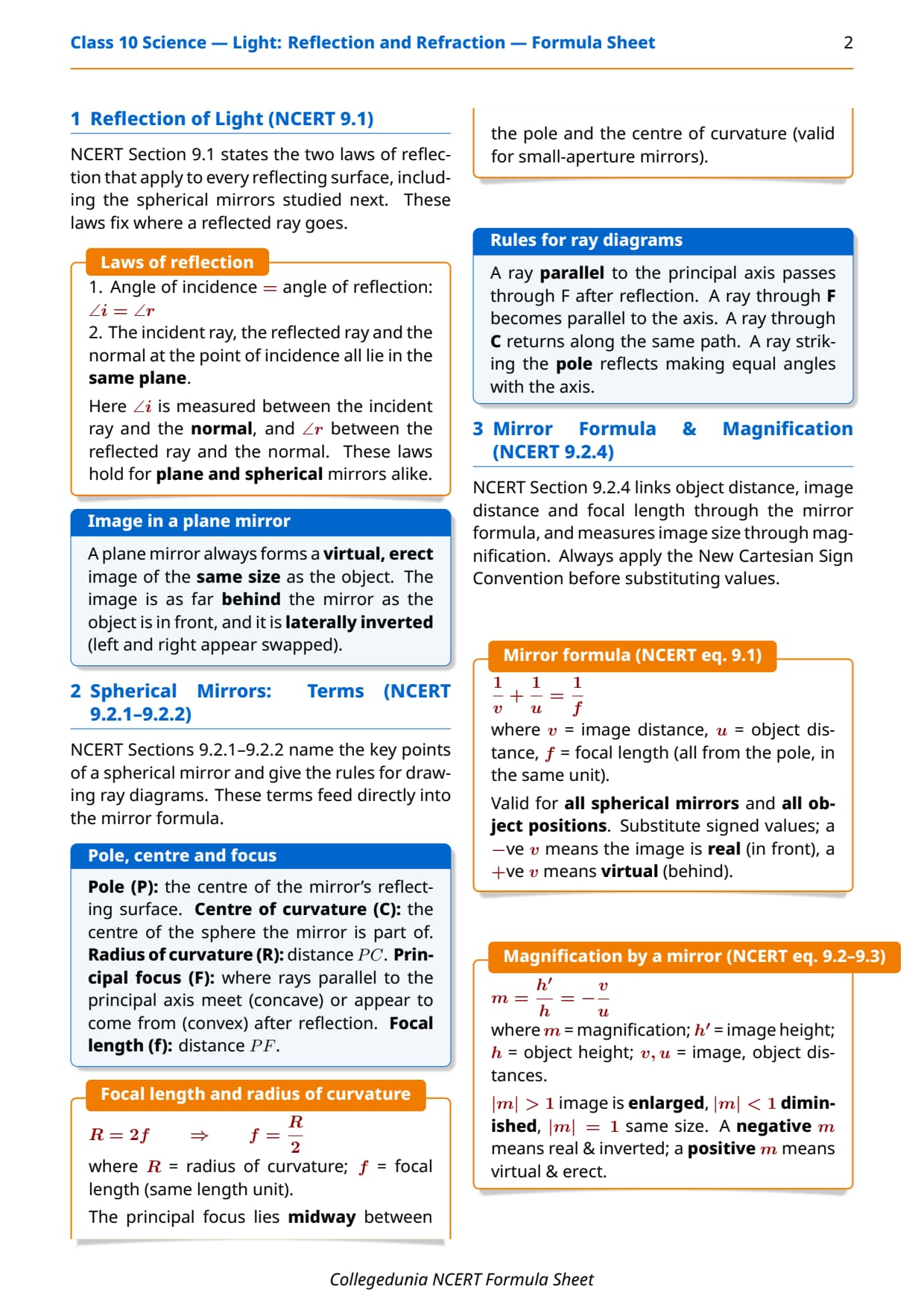
| Mirror formula | 1v + 1u = 1f | m-1 | 9.2.4 | Image position from any mirror |
| Magnification (mirror) | m = h'h = −vu | - | 9.2.4 | Image size and nature for a mirror |
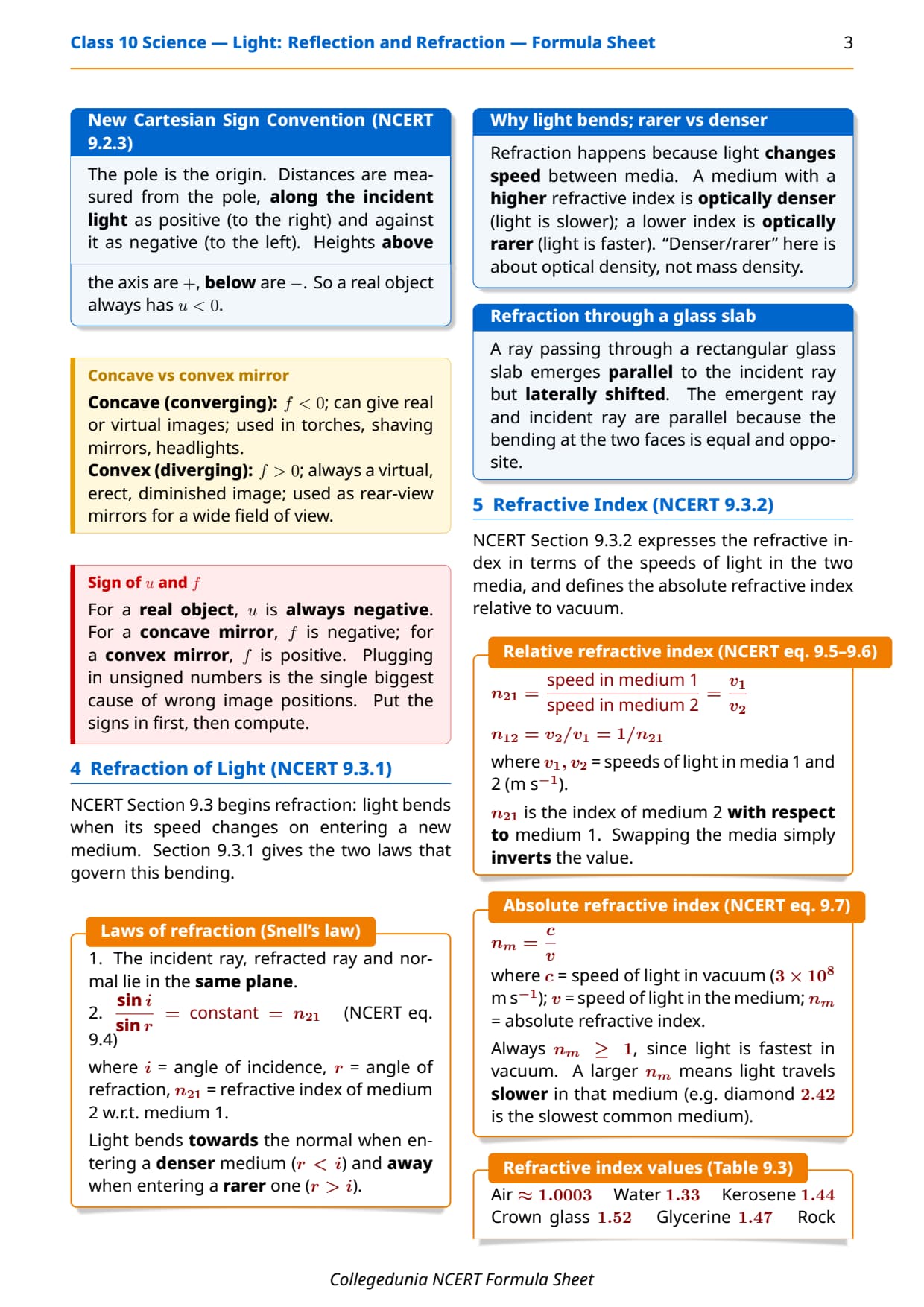
| Snell's law | sin isin r = n21 | - | 9.3.1 | Bending of light at a surface |
| Relative refractive index | n21 = v1v2 | - | 9.3.2 | Index of medium 2 w.r.t. medium 1 |
| Absolute refractive index | nm = cv | - | 9.3.2 | Speed of light in a medium |
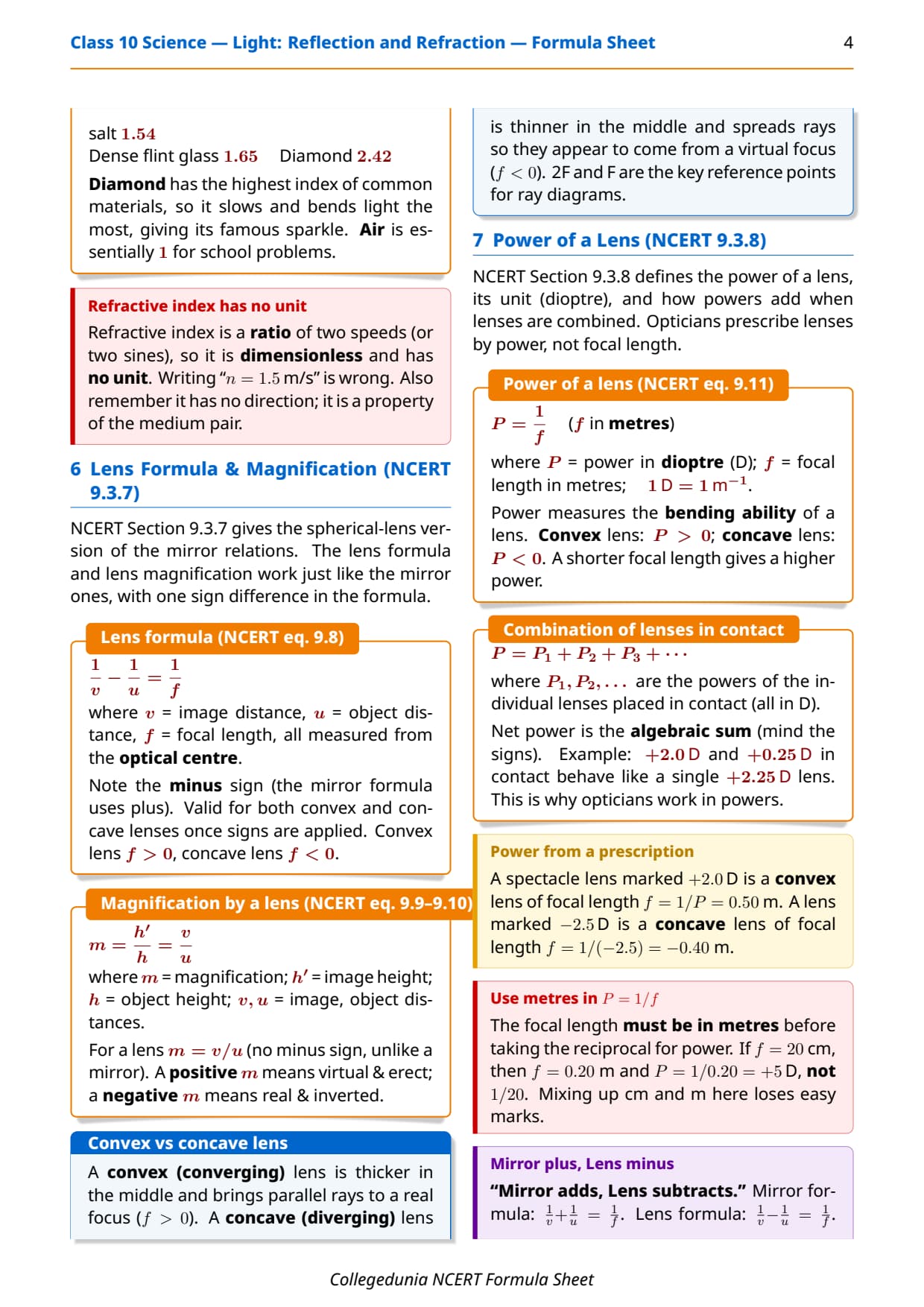
| Lens formula | 1v − 1u = 1f | m-1 | 9.3.7 | Image position from any lens |
| Magnification (lens) | m = h'h = vu | - | 9.3.7 | Image size and nature for a lens |
| Power of a lens | P = 1f | dioptre (D) | 9.3.8 | Bending ability; f in metres |
| Lenses in contact | P = P1 + P2 + … | D | 9.3.8 | Net power of combined lenses |
These 11 formulae cover nearly every Light numerical asked in CBSE Class 10 board papers from 2021 to 2025.
When to Use Which Formula in Light - Reflection and Refraction Class 10
Picking the right formula based on what the question hands you:
- Image position from a mirror: mirror formula (plus), u negative for a real object, f negative for concave.
- Image position from a lens: lens formula (minus), f positive for convex, negative for concave.
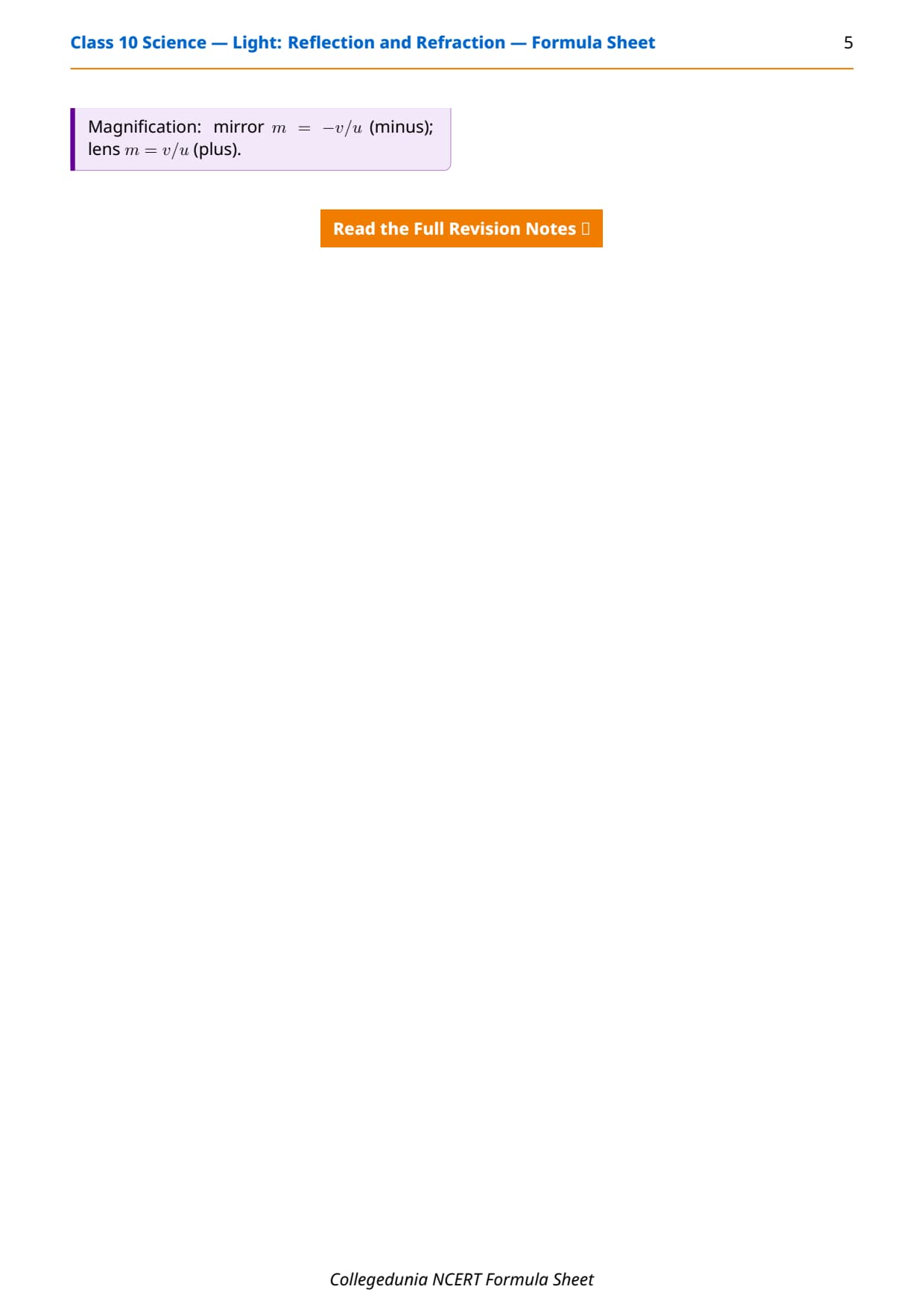
- Image size or nature: magnification, −v/u for a mirror, v/u for a lens.
- Angles given: Snell's law sin i / sin r = n21 .
- Speed of light given: nm = c/v ; for two media, n21 = v1/v2 .
- Power of a lens: P = 1/f with f in metres; lenses in contact, add powers.
Light - Reflection and Refraction Class 10 Quick-Fact Cards for MCQ Recall
The atomic facts MCQ writers reach for most often:
Symbol Glossary and Sign Convention for Class 10 Science Chapter 9
Every variable decoded, with the New Cartesian Sign Convention attached.
| Symbol | What it means | SI Unit | Sign / note |
|---|---|---|---|
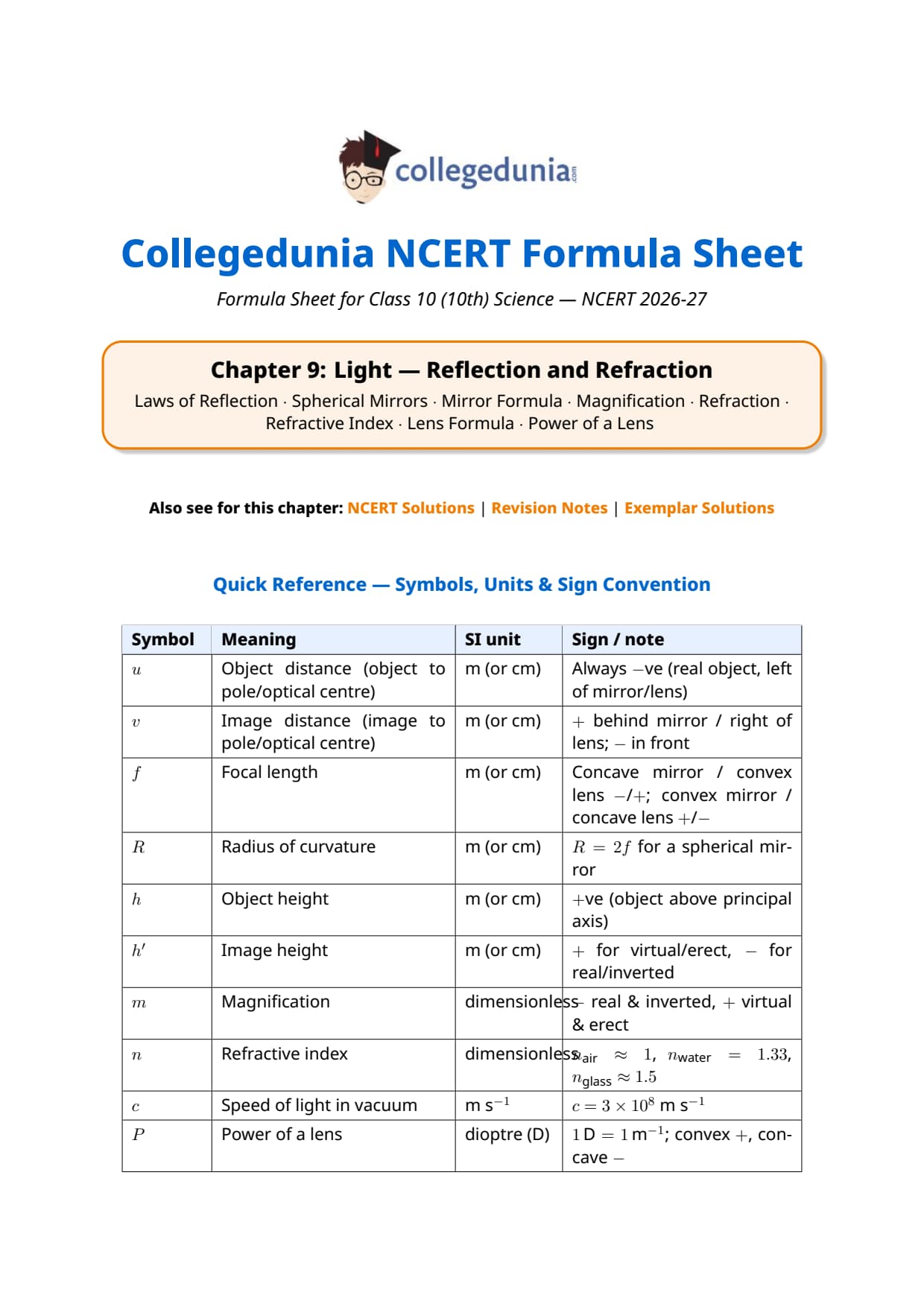
| u | Object distance from pole or optical centre | m | Always −ve for a real object |
| v | Image distance from pole or optical centre | m | −ve real image (front), +ve virtual (behind) |
| f | Focal length | m | Concave mirror / convex lens favour − / + |
| R | Radius of curvature | m | R = 2f for a mirror |
| h, h' | Object height and image height | m | h' +ve erect, −ve inverted |
| m | Magnification | - | − real and inverted, + virtual and erect |
| n, n21 | Refractive index and relative index | - | Dimensionless; air ≈ 1 |
| c | Speed of light in vacuum | m/s | 3 × 10⁸ m/s |
| P | Power of a lens | D | Convex +, concave −; f in metres |
A sign slip in the mirror or lens formula is the most-marked mistake; apply the sign convention before you substitute.
Light - Reflection and Refraction Top 5 Formulae Recap: Quick PYQ Map for Class 10
The five formulae below carry the largest share of marks in CBSE Class 10 board papers from 2021 to 2025.
| Formula | Most-recent exam appearance |
|---|---|
| 1v + 1u = 1f | CBSE 2025 (3 marks), CBSE 2024 numerical |
| 1v − 1u = 1f | CBSE 2025 (3 marks), CBSE 2023 numerical |
| m = −v/u | CBSE 2024 (2 marks), CBSE 2022 |
| P = 1/f | CBSE 2025 (1 mark), CBSE 2023 MCQ |
| nm = c/v | CBSE 2024 (2 marks), CBSE 2022 MCQ |
Full year-wise PYQ map: Light - Reflection and Refraction Class 10 Science NCERT Solutions
One-Shot Revision Tips for Light - Reflection and Refraction Class 10
The night-before checklist:
- "Mirror plus, Lens minus". The one sign difference between the two formulae decides every numerical.
- Two magnification rules. Mirror m = −v/u (minus); lens m = v/u (no minus). The sign of m tells you real or virtual.
- Sign convention first. A real object always has u < 0 . Put the signs in before computing.
- Constants: c = 3 × 10⁸ m/s, water 1.33, glass 1.52, diamond 2.42, R = 2f .
- Focal length in metres for power. A lens of f = 25 cm has P = +4 D.
Light - Reflection and Refraction Top 5 Concept Recall for Class 10 Science
The five concepts to keep in active memory alongside the formulae:
- Laws of reflection: angle of incidence equals angle of reflection; incident ray, reflected ray and normal lie in the same plane.
- Concave vs convex mirror: a concave mirror gives real or virtual images (torches, shaving mirrors); a convex mirror always gives a virtual, erect, diminished image (rear-view mirror).
- Refraction: light bends towards the normal entering a denser medium, away entering a rarer one. Diamond (2.42) bends light the most.
- Convex vs concave lens: a convex lens is thicker in the middle and forms a real focus; a concave lens is thinner and spreads rays to a virtual focus.
- Power of a lens: P = 1/f in dioptre; convex positive, concave negative, powers add in contact.
Full topic-by-topic walkthrough: Light - Reflection and Refraction Class 10 Science Notes
More Light - Reflection and Refraction Class 10 Science Resources
Use the table below to move between the other Collegedunia resources for this same chapter, from full solutions to handwritten notes.
| Resource | Link |
|---|---|
| NCERT Solutions | Light - Reflection and Refraction NCERT Solutions |
| Revision Notes | Light - Reflection and Refraction Notes |
| Handwritten Notes | Light - Reflection and Refraction Handwritten Notes |
| Exemplar Solutions | Light - Reflection and Refraction Exemplar Solutions |
| NCERT Book PDF | Light - Reflection and Refraction NCERT Book PDF |
NCERT Formula Sheet for Class 10 Science: All Chapters
Use the table below to jump to the Formula Sheet for any other chapter in the Class 10 Science NCERT.
| Chapter | Resource |
|---|---|
| Chapter 1 | Chemical Reactions and Equations Formula Sheet |
| Chapter 2 | Acids, Bases and Salts Formula Sheet |
| Chapter 3 | Metals and Non-metals Formula Sheet |
| Chapter 4 | Carbon and its Compounds Formula Sheet |
| Chapter 5 | Life Processes Formula Sheet |
| Chapter 6 | Control and Coordination Formula Sheet |
| Chapter 7 | How do Organisms Reproduce? Formula Sheet |
| Chapter 8 | Heredity Formula Sheet |
| Chapter 10 | The Human Eye and the Colourful World Formula Sheet |
| Chapter 11 | Electricity Formula Sheet |
| Chapter 12 | Magnetic Effects of Electric Current Formula Sheet |
| Chapter 13 | Our Environment Formula Sheet |
Light - Reflection and Refraction Class 10 Formula Sheet FAQs
Ques. Where can I download the Light - Reflection and Refraction Class 10 Formula Sheet PDF?
Ans. You can download the Light - Reflection and Refraction Class 10 Science Formula Sheet PDF directly from this page. It is free and covers the laws of reflection, the mirror formula, magnification, Snell's law, refractive index, the lens formula, and the power of a lens in the 2026-27 NCERT Chapter 9.
Ques. Is this Formula Sheet aligned with the 2026-27 NCERT?
Ans. Yes. The sheet reflects the current 2026-27 syllabus for Class 10 Science. Chapter 9 retains the laws of reflection, spherical mirrors, the mirror formula, refraction, refractive index, the lens formula, and the power of a lens.
Ques. What is the mirror formula in Class 10 Science Chapter 9?
Ans. The mirror formula is 1v + 1u = 1f , where v is the image distance, u is the object distance, and f is the focal length, all measured from the pole. It applies to all spherical mirrors and all object positions once the New Cartesian Sign Convention is applied.
Ques. What is the difference between the mirror formula and the lens formula?
Ans. The mirror formula is 1v + 1u = 1f (a plus sign) and the lens formula is 1v − 1u = 1f (a minus sign). The single sign difference is the most common point of confusion, so remember "Mirror adds, Lens subtracts".
Ques. What is magnification and how do the mirror and lens versions differ?
Ans. Magnification is the ratio of image height to object height. For a mirror it is m = h'/h = −v/u (with a minus sign); for a lens it is m = h'/h = v/u (no minus sign). A negative m means the image is real and inverted; a positive m means it is virtual and erect.
Ques. What is the New Cartesian Sign Convention in Class 10 Science?
Ans. The pole or optical centre is the origin. Distances measured along the incident light are positive (to the right) and against it are negative (to the left). Heights above the principal axis are positive and below are negative. As a result, a real object always has u < 0 , which is the first thing to set before using any formula.
Ques. What is the refractive index and is it a unit or a ratio?
Ans. The refractive index is a ratio of two speeds (or two sines), so it is dimensionless and has no unit. The absolute refractive index is nm = c/v , where c = 3 × 10⁸ m/s, and the relative index is n21 = v1/v2 . Water is 1.33, glass about 1.52, and diamond 2.42.
Ques. What is Snell's law of refraction?
Ans. Snell's law states that for a light ray crossing a surface, sin i / sin r = n21 , a constant equal to the refractive index of the second medium with respect to the first. The incident ray, refracted ray, and normal all lie in the same plane. Light bends towards the normal entering a denser medium and away entering a rarer one.
Ques. What is the power of a lens and what is its unit?
Ans. The power of a lens measures its bending ability and is the reciprocal of its focal length in metres, P = 1/f . The SI unit is the dioptre (D), where 1 D = 1 m-1. A convex lens has positive power and a concave lens negative power. A lens of f = 0.20 m has a power of +5 D.
Ques. How do you find the net power of two lenses placed in contact?
Ans. When lenses are placed in contact, their powers add algebraically: P = P1 + P2 + … . For example, a +2.0 D lens and a +0.25 D lens together behave like a single +2.25 D lens. Mind the signs, since a concave lens contributes a negative power.
Ques. What is the relation between focal length and radius of curvature?
Ans. For a spherical mirror, the radius of curvature is twice the focal length: R = 2f , so f = R/2 . The principal focus lies midway between the pole and the centre of curvature. This relation is valid for mirrors of small aperture.
Ques. Which is the most important formula in Light - Reflection and Refraction Class 10?
Ans. The mirror formula 1v + 1u = 1f and the lens formula 1v − 1u = 1f , together with magnification, are the highest-yield formulae. They account for the bulk of the numericals asked in CBSE Class 10 board papers between 2021 and 2025.
Ques. What is the CBSE weightage of Chapter 9 Light - Reflection and Refraction in Class 10 Science?
Ans. Light - Reflection and Refraction sits in the Natural Phenomena and Optics block and usually carries 6 to 8 marks in the CBSE Class 10 Science board exam, asked across one numerical (mirror or lens formula) and one reasoning or diagram question on reflection, refraction, or the power of a lens.



Comments