




Class 10 Science Chapter 8 Heredity is a high-scoring biology chapter of the 2026-27 NCERT, and a single page of key facts covers almost every board question. This Heredity formula sheet puts variation, Mendel's rules, the dominant and recessive traits, the monohybrid and dihybrid cross ratios, genes and chromosomes, and human sex determination on one page. Use it as a quick reference before any CBSE Class 10 board test.
- CBSE Weightage: part of the World of Living unit, worth 5 to 7 marks across one or two questions.
- Best used for: the monohybrid and dihybrid cross ratios, the gene-to-trait chain, the sex-determination logic, and last-minute board revision.
You can find the complete Formula Sheet for Heredity, with variation, Mendel's rules, the dominant and recessive traits, the monohybrid and dihybrid cross ratios, genes and chromosomes, and human sex determination mapped to the 2026-27 NCERT, in the article below.
This Formula Sheet is curated by Science subject experts, mapped to the 2026-27 NCERT, and refined against the last five years of CBSE Class 10 board papers.
Also Check:
How Collegedunia's Heredity Formula Sheet Helps You
This Formula Sheet gathers variation, Mendel's rules, the cross ratios, genes and chromosomes, and human sex determination from Class 10 Science Chapter 8, in NCERT order.
- One-page recall: the terms table, the two Mendel ratios, and the sex-determination logic sit side by side.
- Key ratios: monohybrid 3:1, dihybrid 9:3:3:1, hidden 1:2:1 genotype, plus the gene-to-protein-to-trait chain.
- Board focus: the most-asked facts are flagged as quick tips.
Heredity Class 10 Science Video Revision
Source: Magnet Brains on YouTube
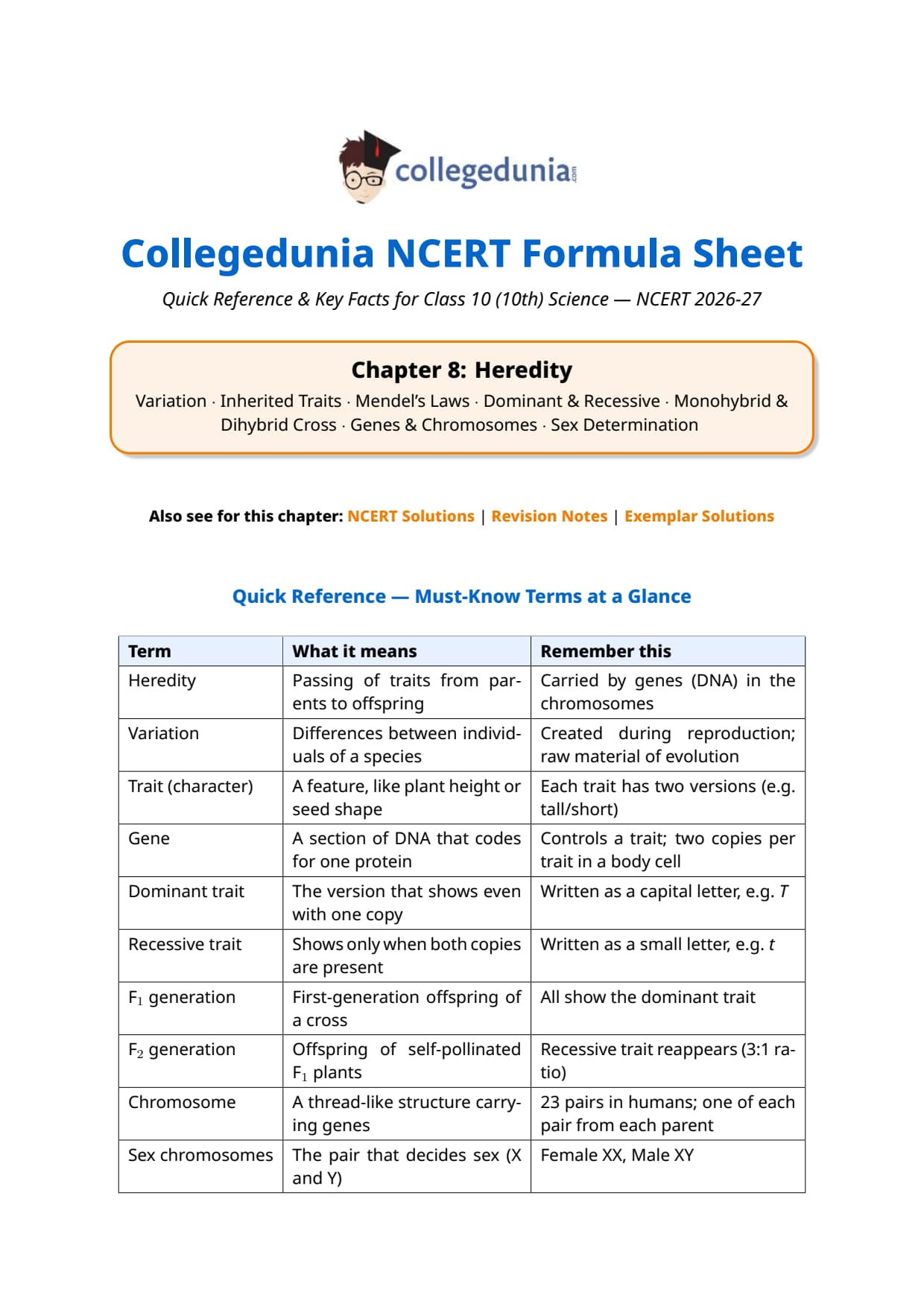
Must-Know Terms at a Glance in Class 10 Science Chapter 8
NCERT Chapter 8 opens with terms that recur in board questions. Lock these first; almost every one-mark question is built on them.
| Term | Meaning | Remember this |
|---|---|---|
| Heredity | Passing of traits from parents to offspring | Carried by genes (DNA) on chromosomes |
| Variation | Differences between individuals of a species | Raw material of evolution |
| Trait (character) | A feature, like plant height or seed shape | Two versions each (tall / short) |
| Gene | A section of DNA that codes for one protein | Two copies per trait in a body cell |
| Dominant trait | Shows even with one copy | Capital letter, e.g. T |
| Recessive trait | Shows only when both copies present | Small letter, e.g. t |
| F1 generation | First-generation offspring of a cross | All show the dominant trait |
| F2 generation | Offspring of self-pollinated F1 | Recessive reappears (3:1) |
| Chromosome | Thread-like structure carrying genes | 23 pairs in humans |
| Sex chromosomes | The pair that decides sex (X and Y) | Female XX, Male XY |
Variation and Why It Matters in Class 10 Science Chapter 8
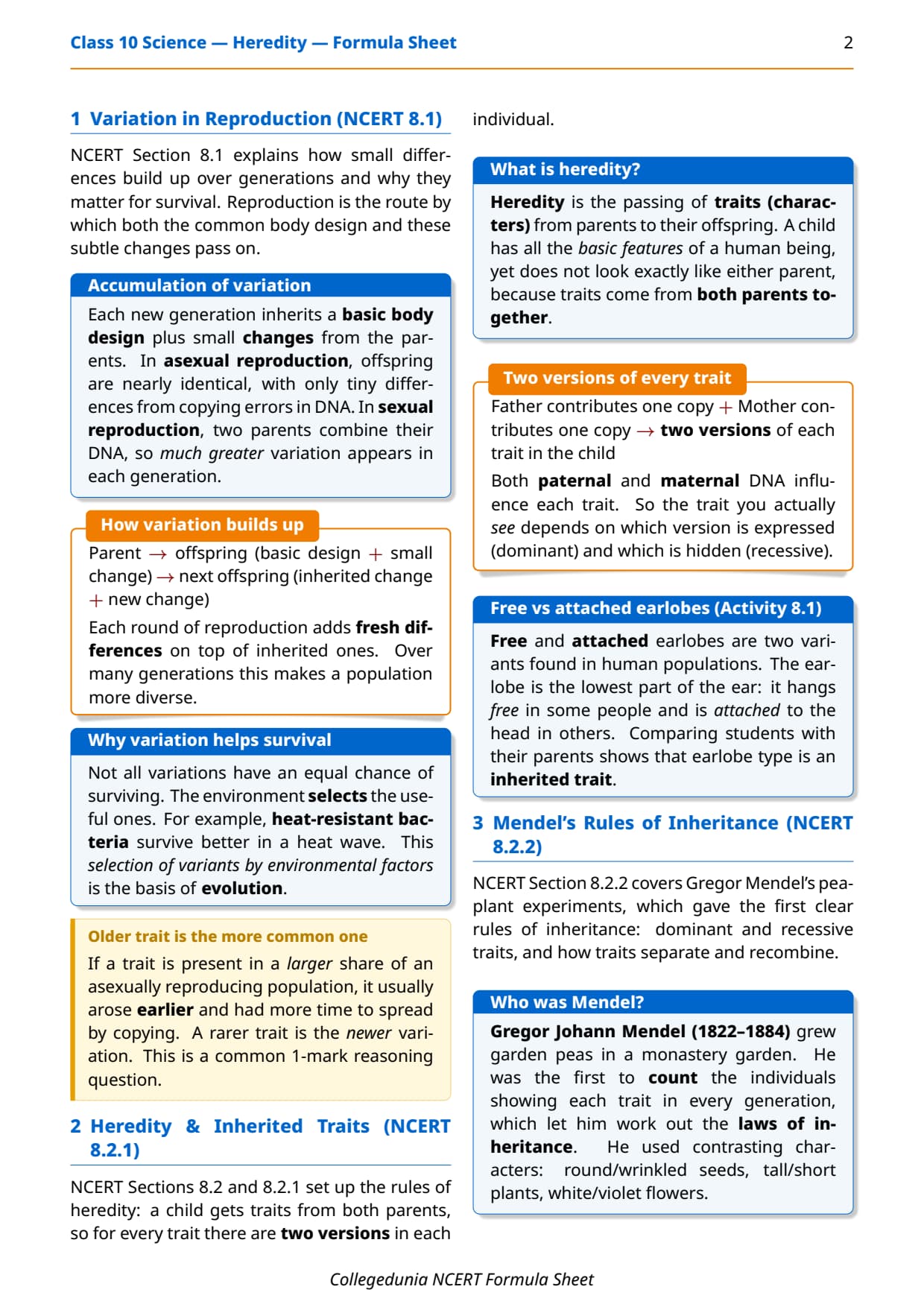
NCERT Section 8.1 explains how small differences build up over generations. Reproduction passes on both the common body design and subtle changes.
- Asexual vs sexual variation: in asexual reproduction, offspring are nearly identical, with tiny differences from DNA-copying errors. In sexual reproduction, two parents combine their DNA, so much greater variation appears.
- Why variation helps survival: the environment selects useful variations. For example, heat-resistant bacteria survive better in a heat wave.
- Link to evolution: this selection of variants over many generations is the basis of evolution. Variation is the raw material natural selection works on.
Heredity and Inherited Traits in Class 10 Science Chapter 8
NCERT Sections 8.2 and 8.2.1 set up the rules of heredity: a child gets traits from both parents, so for every trait there are two versions in each individual. The version you see is the dominant one; the other is hidden.
- Two versions of every trait: both paternal and maternal DNA influence each trait; you see the dominant version, the recessive one is hidden.
- Inherited trait example (Activity 8.1): free and attached earlobes are two variants; comparing students with parents shows earlobe type is inherited.
- Inherited vs acquired: an inherited trait (earlobe type, eye colour) passes on through genes; an acquired trait (a scar, learned skills) is not passed on, as it is not carried in the gametes. A common 2-mark question.
Mendel's Rules of Inheritance: Monohybrid and Dihybrid Cross
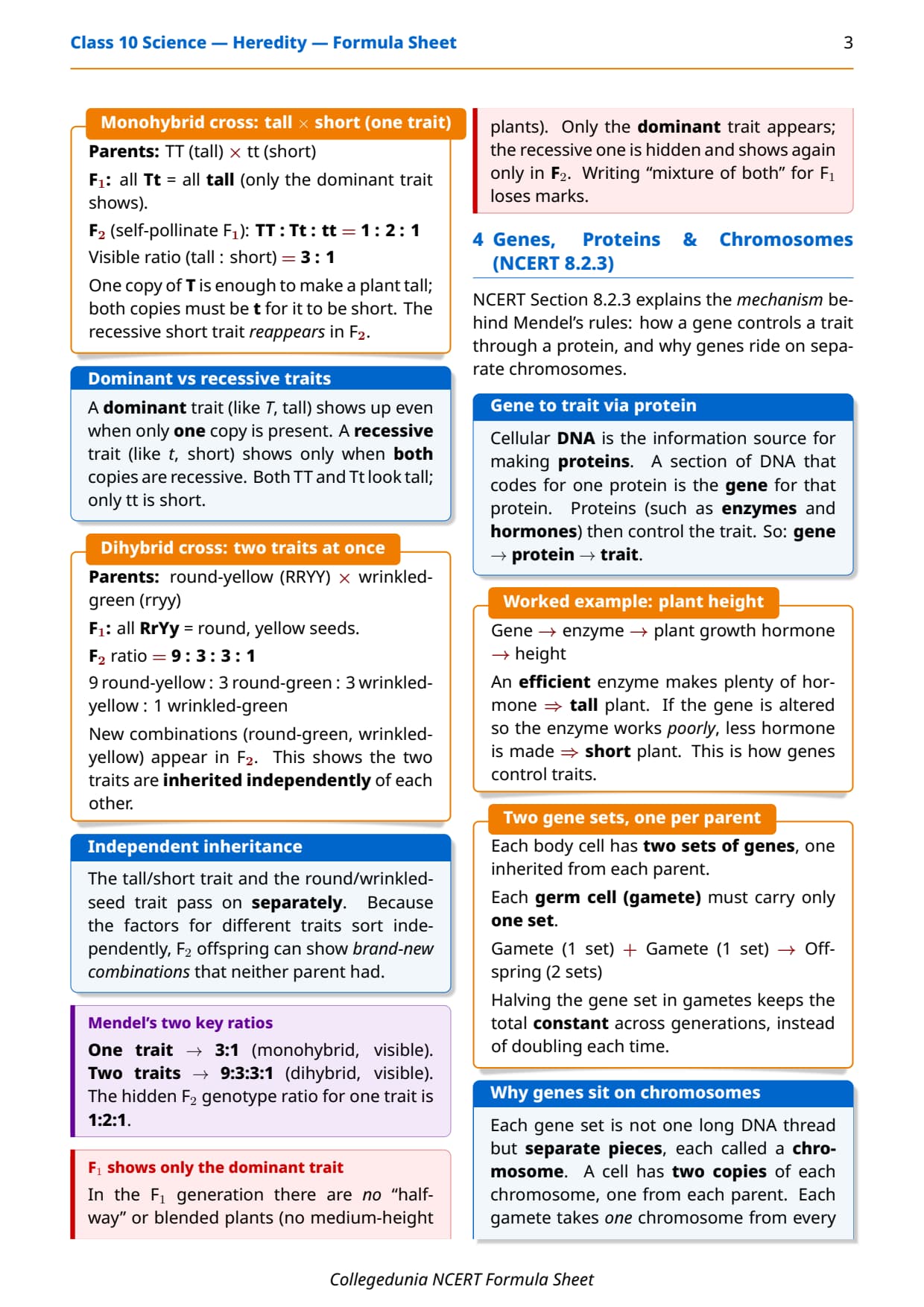
NCERT Section 8.2.2 covers Gregor Mendel's pea-plant experiments, the first clear rules of inheritance. He was the first to count individuals showing each trait, using contrasting characters like round / wrinkled seeds.
| Cross | Parents and F1 | F2 ratio to remember |
|---|---|---|
| Monohybrid | TT × tt → F1 all Tt | Visible 3 : 1; genotype 1 : 2 : 1 |
| Dihybrid | RRYY × rryy → F1 all RrYy | Visible 9 : 3 : 3 : 1 |
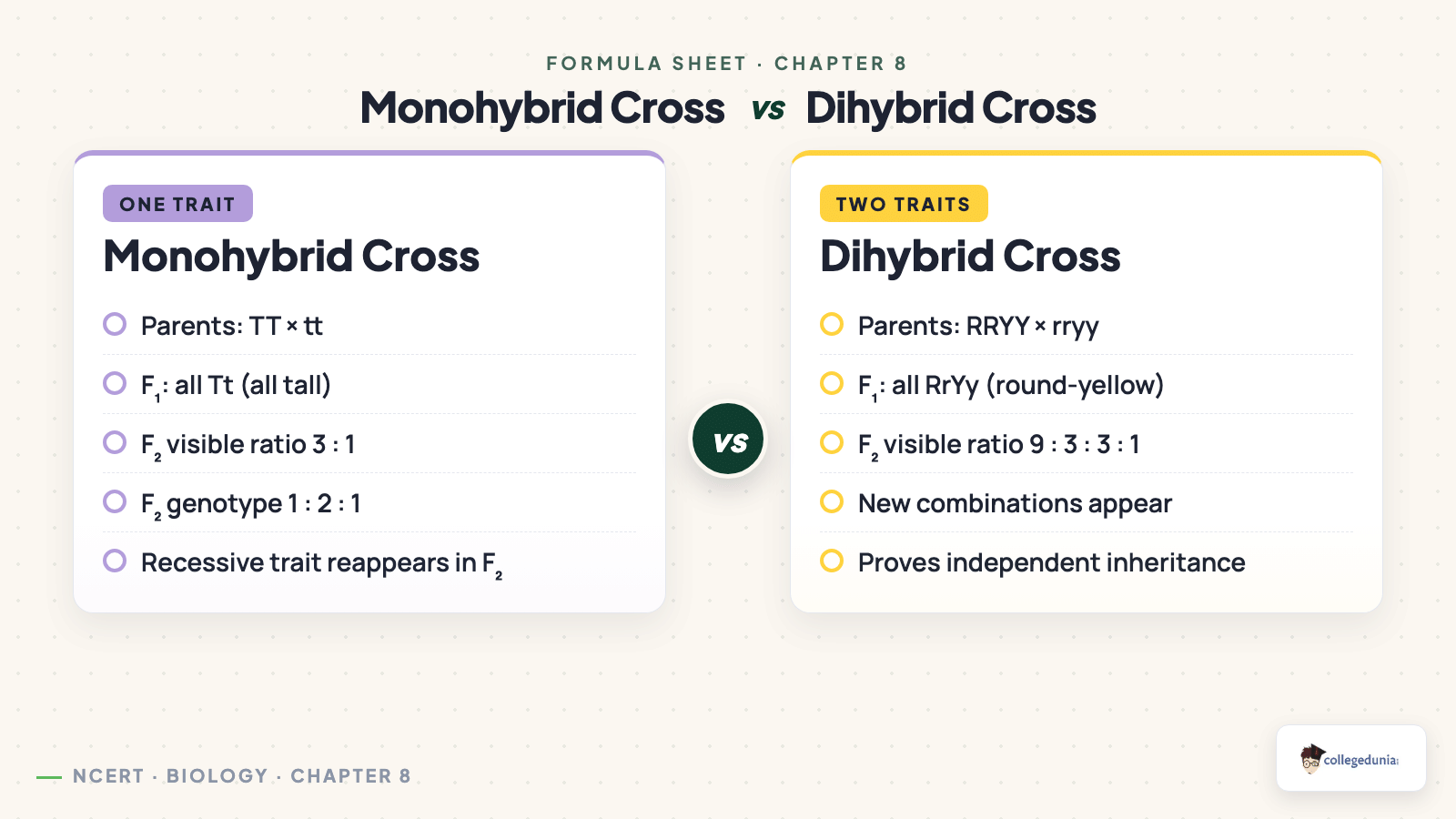
- Monohybrid (one trait): TT × tt gives all-tall F1 (Tt). Self-pollinating gives F2 visible 3 : 1 and hidden genotype 1 : 2 : 1. One T makes a plant tall; both copies must be t for short.
- Dihybrid (two traits): RRYY × rryy gives round-yellow F1 (RrYy); F2 shows 9 : 3 : 3 : 1. The new combinations prove the traits are inherited independently.
Genes, Proteins and Chromosomes in Class 10 Science Chapter 8
NCERT Section 8.2.3 explains the mechanism behind Mendel's rules: how a gene controls a trait through a protein, and why genes ride on separate chromosomes.
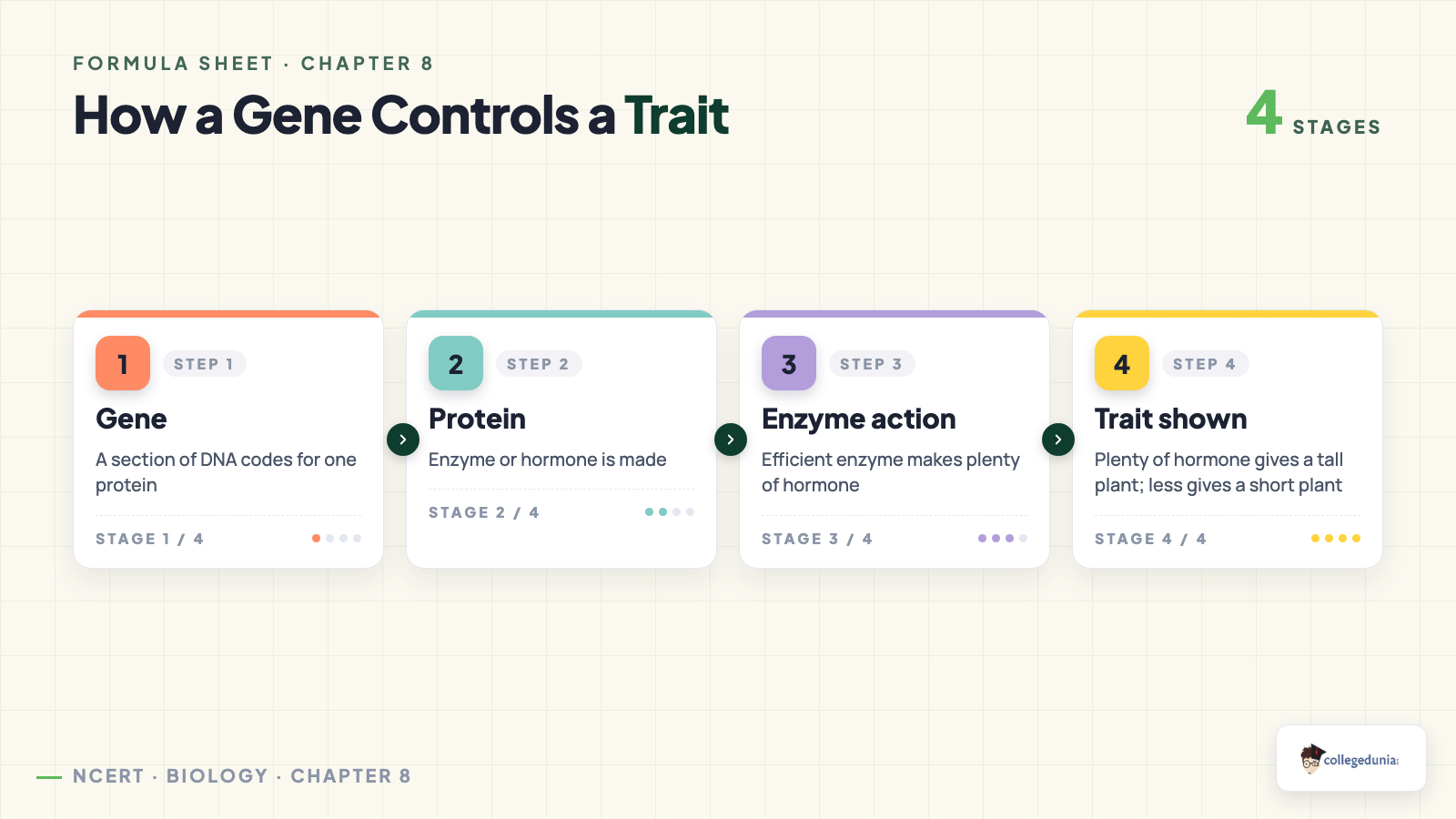
- Gene to trait via protein: a gene codes for a protein (enzyme or hormone) that controls the trait. An efficient enzyme makes plenty of growth hormone, giving a tall plant; an altered gene gives a short plant.
- Two gene sets, one per parent: each gamete carries only one set, so gamete + gamete → offspring (2 sets) . This keeps the chromosome number constant across generations.
- Why genes sit on chromosomes: a gene set is separate pieces called chromosomes. Each gamete takes one from every pair, so traits are inherited independently.
Sex Determination in Humans in Class 10 Science Chapter 8
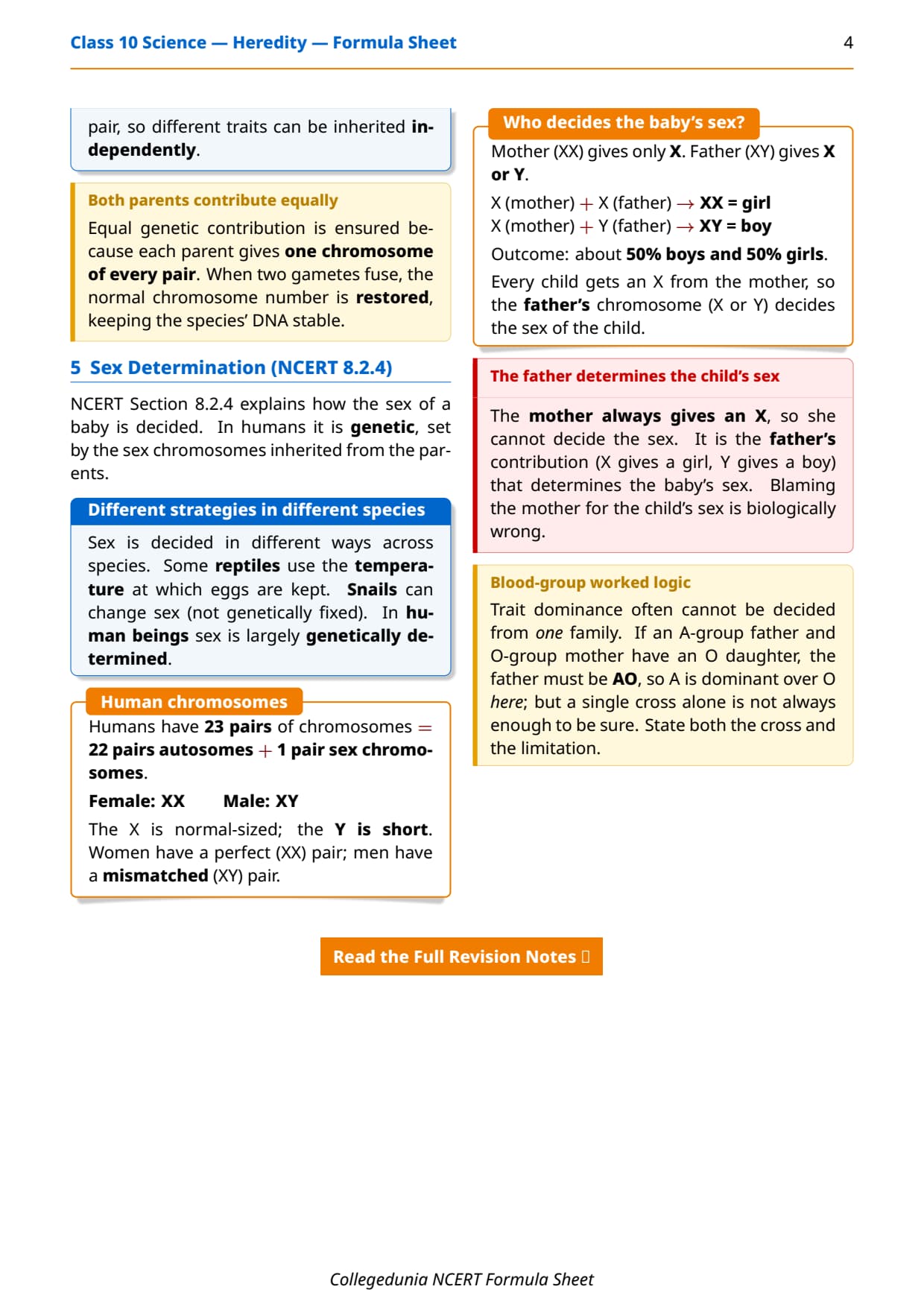
NCERT Section 8.2.4 explains how the sex of a baby is decided. In humans it is genetic. Humans have 23 pairs of chromosomes: 22 pairs of autosomes plus one pair of sex chromosomes.
| Parent | Sex chromosomes | Gamete can give |
|---|---|---|
| Mother | XX | Only X |
| Father | XY | X or Y |
| Child (girl) | X + X = XX | Girl |
| Child (boy) | X + Y = XY | Boy |
- Who decides the sex: the mother always gives an X, so the father's chromosome (X → girl, Y → boy) decides the sex, roughly 50% each. Blaming the mother is biologically wrong, a favourite reasoning question.
- Different strategies in nature: some reptiles use egg temperature; snails can change sex.
- Autosomes vs sex chromosomes: the 22 pairs of autosomes carry body-trait genes; the sex chromosomes (XX or XY) decide the sex.
One-Shot Revision Tips for Heredity Class 10
Treat this Formula Sheet as a checklist you tick off the night before a test. Recall each block out loud, then check it against the sheet.
- Lock the three Mendel ratios. Monohybrid visible 3:1, monohybrid genotype 1:2:1, dihybrid visible 9:3:3:1.
- Fix the dominant-recessive rule. Dominant shows with one copy (TT and Tt tall); recessive needs two (only tt short); recessive reappears in F2.
- Learn the gene-to-trait chain. Gene → protein (enzyme or hormone) → trait.
- Sex-determination facts. Humans have 23 pairs of chromosomes; the mother always gives X, and the father's X or Y decides the sex (XX girl, XY boy).
Whole Heredity Chapter at a Glance for Class 10 Science
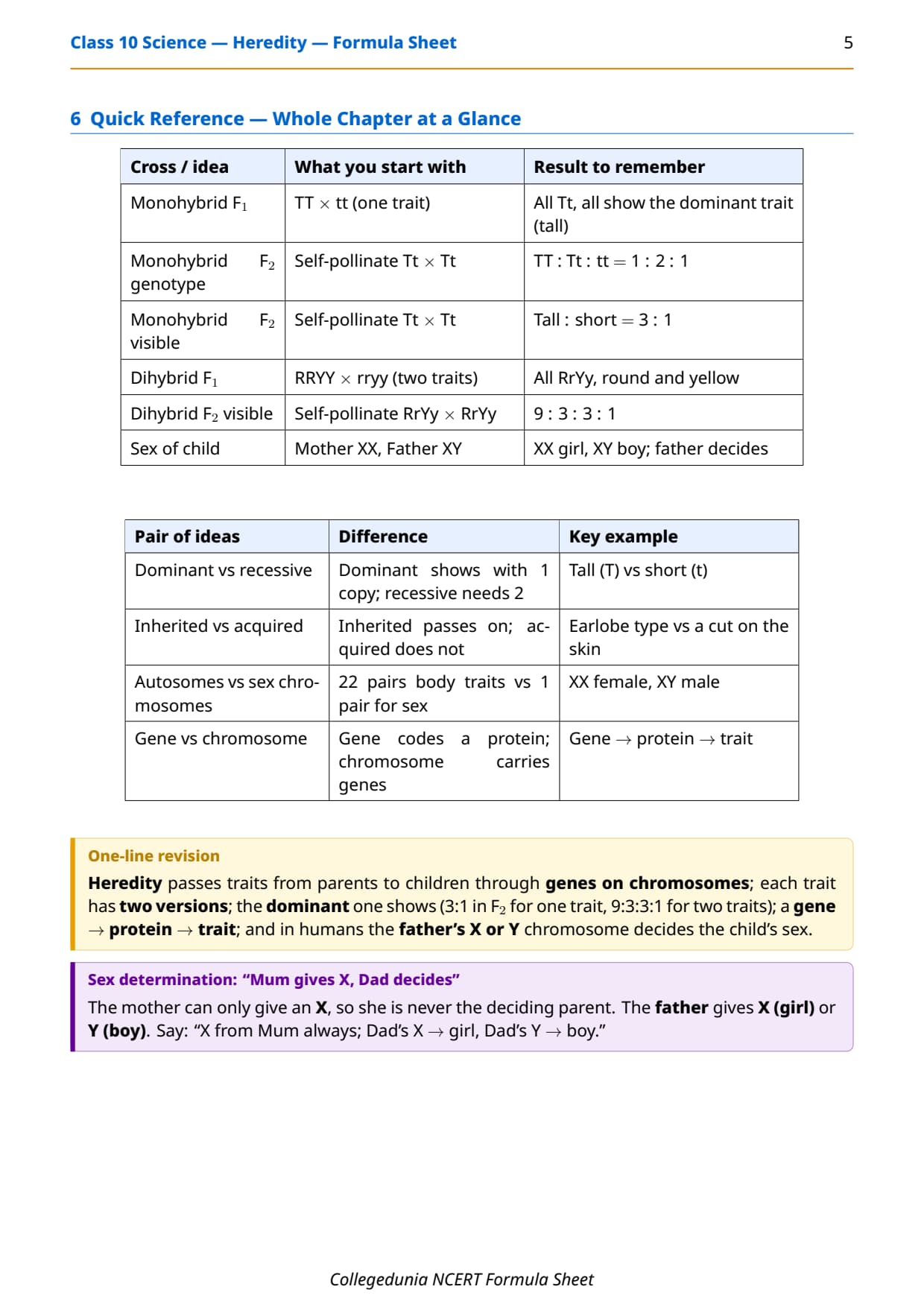
This single table pulls the key crosses into one block for fast recall before the exam.
| Cross / idea | Result to remember |
|---|---|
| Monohybrid F2 | Visible 3 : 1; genotype TT : Tt : tt = 1 : 2 : 1 |
| Dihybrid F2 | 9 : 3 : 3 : 1 |
| Sex of child | XX girl, XY boy; father decides |
Full topic-by-topic walkthrough: Heredity Class 10 Science Notes
More Heredity Class 10 Science Resources
Use the table below to move between the other Collegedunia resources for this same chapter, from full solutions to handwritten notes.
| Resource | Link |
|---|---|
| NCERT Solutions | Heredity NCERT Solutions |
| Revision Notes | Heredity Notes |
| Handwritten Notes | Heredity Handwritten Notes |
| Exemplar Solutions | Heredity Exemplar Solutions |
| NCERT Book PDF | Heredity NCERT Book PDF |
NCERT Formula Sheet for Class 10 Science: All Chapters
Use the table below to jump to the Formula Sheet for any other chapter in the Class 10 Science NCERT.
| Chapter | Resource |
|---|---|
| Chapter 1 | Chemical Reactions and Equations Formula Sheet |
| Chapter 2 | Acids, Bases and Salts Formula Sheet |
| Chapter 3 | Metals and Non-metals Formula Sheet |
| Chapter 4 | Carbon and its Compounds Formula Sheet |
| Chapter 5 | Life Processes Formula Sheet |
| Chapter 6 | Control and Coordination Formula Sheet |
| Chapter 7 | How do Organisms Reproduce? Formula Sheet |
| Chapter 9 | Light - Reflection and Refraction Formula Sheet |
| Chapter 10 | The Human Eye and the Colourful World Formula Sheet |
| Chapter 11 | Electricity Formula Sheet |
| Chapter 12 | Magnetic Effects of Electric Current Formula Sheet |
| Chapter 13 | Our Environment Formula Sheet |
Heredity Class 10 Formula Sheet FAQs
Ques. Where can I download the Heredity Class 10 Formula Sheet PDF?
Ans. You can download the Heredity Class 10 Science Formula Sheet PDF directly from this page. It is free and covers variation, Mendel's rules, the dominant and recessive traits, the monohybrid and dihybrid cross ratios, genes and chromosomes, and human sex determination in the 2026-27 NCERT Chapter 8.
Ques. Is this Formula Sheet aligned with the 2026-27 NCERT?
Ans. Yes. The sheet reflects the current 2026-27 syllabus for Class 10 Science. Chapter 8 retains variation, heredity and inherited traits, Mendel's rules of inheritance, genes and chromosomes, and sex determination.
Ques. What are the monohybrid and dihybrid cross ratios in Class 10 Science?
Ans. The monohybrid cross gives a visible F2 ratio of 3 : 1 (dominant : recessive) and a hidden genotype ratio of 1 : 2 : 1 (TT : Tt : tt). The dihybrid cross gives a visible F2 ratio of 9 : 3 : 3 : 1. These three numbers cover almost every Mendel question in the board exam.
Ques. What is the difference between a dominant and a recessive trait?
Ans. A dominant trait shows up even when only one copy is present, so both TT and Tt look tall. A recessive trait shows only when both copies are recessive, so only tt is short. The recessive trait stays hidden in F1 and reappears in F2 in a 3 : 1 ratio.
Ques. What is heredity in Class 10 Science Chapter 8?
Ans. Heredity is the passing of traits, or characters, from parents to their offspring. The traits are carried by genes, which are sections of DNA on the chromosomes. A child gets one copy of every trait from each parent, so for every trait there are two versions in each individual.
Ques. Why does the recessive trait reappear in the F2 generation?
Ans. In F1, every plant is Tt, so the dominant trait (tall) shows and the recessive one (short) is hidden. When F1 plants are self-pollinated, some F2 plants get two recessive copies (tt), so the short trait reappears. The visible F2 ratio is 3 tall : 1 short, with a hidden 1 : 2 : 1 genotype ratio.
Ques. How does a gene control a trait in Class 10 Science?
Ans. A gene is a section of DNA that codes for one protein. The protein, often an enzyme or hormone, then controls the trait. For plant height, the chain is gene to enzyme to growth hormone to height: an efficient enzyme makes plenty of hormone and a tall plant, while an altered gene makes a poor enzyme, less hormone, and a short plant.
Ques. Why does each gamete carry only one set of genes?
Ans. Each body cell has two sets of genes, one from each parent. Each gamete carries only one set so that when two gametes fuse, the zygote gets two sets again. If gametes carried two sets, the amount of DNA would double in every generation. Halving the set in gametes keeps the chromosome number constant across generations.
Ques. How is the sex of a child determined in humans?
Ans. Humans have 23 pairs of chromosomes, including one pair of sex chromosomes. A female is XX and a male is XY. The mother always gives an X, while the father can give an X or a Y. An X from the father gives a girl (XX) and a Y gives a boy (XY), so the father's chromosome decides the sex of the child.
Ques. Why is the father, not the mother, responsible for the sex of the child?
Ans. The mother is XX, so every egg she makes carries an X chromosome. The father is XY, so his sperm carry either an X or a Y. Since the child's sex depends on whether the father's sperm carried an X (girl) or a Y (boy), it is the father, not the mother, who determines the sex of the child.
Ques. What is the difference between inherited and acquired traits?
Ans. An inherited trait, such as earlobe type or eye colour, is set by the genes and is passed on to offspring. An acquired trait, such as a scar or muscles built by exercise, is gained during a person's life and is not carried in the gametes, so it is not passed to the next generation. Only changes in the DNA of germ cells can be inherited.
Ques. Who was Gregor Mendel and why is he important in Class 10 Science?
Ans. Gregor Johann Mendel was a scientist who grew garden peas and was the first to count the individuals showing each trait in every generation. By using contrasting characters like round and wrinkled seeds, he worked out the laws of inheritance, including dominant and recessive traits and the 3 : 1 and 9 : 3 : 3 : 1 ratios. He is called the Father of Genetics.
Ques. What is the CBSE weightage of Chapter 8 Heredity in Class 10 Science?
Ans. Heredity sits in the World of Living unit and usually carries 5 to 7 marks in the CBSE Class 10 Science board exam, asked across one or two questions on variation, Mendel's rules and the cross ratios, the gene-to-trait chain, genes and chromosomes, or human sex determination.



Comments