The NCERT Exemplar Class 12 Physics Solutions below is the fully solved companion to the NCERT Exemplar for Class 12 Physics Chapter 12 Atoms. Download the NCERT Exemplar Class 12 Physics Solutions once, then use it to check your own working line-by-line against an expert version. The NCERT Exemplar Class 12 Physics Solutions stays aligned with the 2026-27 syllabus.
Exemplar Problems: 33Question Types: 5 (MCQ-I, MCQ-II, VSA, SA, LA)PDF Pages: 14Mapped To: 2026-27 NCERT
CBSE Weightage: 3 to 4 marks (one VSA plus one MCQ or one short SA)
JEE Main Weightage: 2 to 3% (1 to 2 questions per shift)
NEET Weightage: 2 to 3 questions per year
Both downloads of the NCERT Exemplar Class 12 Physics Solutions on this page are free and updated for the 2026-27 NCERT syllabus.
The 33 problems span alpha-scattering geometry, Bohr quantisation, hydrogen energy levels and radii, the Lyman to Pfund series, ionisation energy and the de Broglie standing-wave fix.
Curated by subject experts, mapped to the 2026-27 NCERT, and benchmarked against the last five years of CBSE, JEE Main and NEET papers.
Atoms Exemplar Question-Type Distribution and Marks Map
A type-by-type pass beats a sequential 1-to-33 sweep: MCQ-I and MCQ-II hold the JEE and NEET return, LA targets CBSE long-answer practice on Bohr-Rutherford derivations.
Question Type
Problems
Time per Problem
Best Use For
MCQ-I (single-correct)
12.1 to 12.10
2 to 3 min
JEE Main, NEET, CBSE MCQ
MCQ-II (multiple-correct)
12.11 to 12.17
4 to 5 min
JEE Advanced, assertion-reason
VSA (1 to 2 marks)
12.18 to 12.23
3 to 4 min
CBSE Board short answers
SA (3 marks)
12.24 to 12.29
6 to 8 min
CBSE Board, NEET numerical
LA (5 marks)
12.30 to 12.33
10 to 12 min
CBSE long-answer, JEE Advanced
Quick Tip: NEET aspirants should clear all 10 MCQ-I and the 6 VSA items first JEE aspirants should add MCQ-II, where Bohr-quantisation traps are concentrated.
Chapter 12 sits in the modern-physics cluster (chapters 11 to 14), which jointly delivers 22 to 25 marks in CBSE and 8 to 10 NEET questions every year.
Chapter
CBSE Marks
Weightage Bar
Ch 1 Electric Charges and Fields
7
Ch 2 Electrostatic Potential, Capacitance
7
Ch 3 Current Electricity
6
Ch 4 Moving Charges, Magnetism
6
Ch 5 Magnetism, Matter
3
Ch 6 EM Induction
5
Ch 7 Alternating Current
6
Ch 8 EM Waves
3
Ch 9 Ray Optics
8
Ch 10 Wave Optics
5
Ch 11 Dual Nature
4
Ch 12 Atoms
4
Ch 13 Nuclei
4
Ch 14 Semiconductor Electronics
6
How will the NCERT Exemplar Class 12 Physics Solutions on Collegedunia Help You?
Each Exemplar item carries a full Solution plus an Expert's Solution that names the postulate or spectral formula invoked, so the reasoning chain is never assumed.
Every Question Type solved End-to-End: MCQ-I, MCQ-II, VSA, SA and LA with the working written out.
Concept Stack Named: Each step lists the idea invoked, whether Bohr quantisation mvr = nh / 2π, the Rydberg relation or the de Broglie condition.
JEE and NEET Bridge: Items are tagged with the JEE or NEET year that reused their scaffold.
2026-27 Aligned: The Atoms Exemplar has not been re-rationalised all 33 problems remain in scope under the current 2026-27 syllabus.
Atoms Class 12th: Difficulty Step-Up from NCERT Textbook to Exemplar
The textbook stays one step from the solved examples. The Exemplar adds a comparison or limit case that chains two postulates.
Concept
NCERT Textbook Style
Exemplar Twist
Bohr orbit radius
Compute r_n for hydrogen
Compare r_n across H, He(^+), Li^{2+} (12.3, 12.12)
Spectral series
Identify the series of a line
Distinguish Balmer from Paschen by energy alone (12.11, 12.26)
Rutherford scattering
State that most alphas pass undeflected
Compute closest approach and impact parameter (12.30, 12.32)
de Broglie in Bohr model
Quote λ = h/p
Show 2π rn = n λ reproduces Bohr (12.27)
Bohr model limits
Mention failure for multi-electron atoms
List three failures + the physics that corrects each (12.13, 12.33)
How Frequently Has Atoms Been Asked in CBSE, JEE and NEET (Top 3 Recurring Topics)
Three Atoms topics recur disproportionately often across the last five years. Full year-wise PYQ trend is on the NCERT Solutions page.
Topic
Exemplar Item
Recurrence (last 5 years)
Hydrogen spectral series (Balmer, Lyman, Paschen)
12.11, 12.26, 12.28
3 NEET + 2 CBSE appearances
Bohr radius, velocity and energy scaling with Z and n
12.3, 12.19, 12.31
3 JEE + 2 NEET appearances
Rutherford alpha scattering and closest approach
12.30, 12.32
2 CBSE + 1 NEET appearance
Exemplar-Specific Common Mistakes in Atoms
These slip-ups recur across MCQ-II and SA submissions:
Using Z = 1 by reflex for He(^+) and Li^{2+}, collapsing radius and energy answers by a factor of 4 or 9.
Forgetting the negative sign in E_n = -13.6/n^2 eV. In JEE Main 2024 this oversight cost a quarter of candidates the mark.
Swapping series end-points, placing Balmer at n = 1 instead of n = 2.
Mixing emission and absorption directions on Bohr level diagrams emission is high to low n.
Quoting Bohr as valid for helium or any multi-electron atom.One in five NEET questions on this chapter exploits exactly this confusion.
Atoms Top 5 Formulae for Exemplar Numericals
These five formulae carry the bulk of SA and LA problems in Chapter 12. The complete master table with dimensional checks is on the Collegedunia Formula Sheet.
Quantity
Formula
Bohr radius (n-th orbit, atomic number Z)
r_n = n^2 a_0 / Z, a_0 = 0.529 angstrom
Bohr orbit velocity
( vn = Z e2 / 2 0nh ≈Z/n· c/137 )
Hydrogen energy levels
E_n = -13.6 Z^2 / n^2 eV
Rydberg formula for spectral lines
1/λ = R Z2 1/nf2 - 1/ni2, R = 1.097 × 10⁷ m-1
Distance of closest approach (head-on alpha scattering)
All NCERT Exemplar Questions for Atoms with Step-by-Step Solutions
Every question of the NCERT Exemplar set for Class 12 Physics Chapter 12 Atoms is listed below with its full Solution and Expert Solution hidden inside collapsible tabs. Click Check Solution to reveal the step-by-step working; click Expert Solution for the expanded explanation.
Questions
Q 12.1
Taking the Bohr radius as a0 = 53 pm, the radius of Li++ ion in its ground state, on the basis of Bohr's model, will be about:
(a) 53 pm
(b) 27 pm
(c) 18 pm
(d) 13 pm
Correct option: (c)18 pm.
Concept used. In Bohr's model the radius of the nth
permitted orbit in a hydrogen-like atom (one electron, nuclear
charge +Ze) is
rn = n2 a0Z,
where a0 = 53 pm is the Bohr radius (the ground-state radius of
ordinary hydrogen, Z=1, n=1). For lithium the atomic number is
Z=3, so Li++ (a lithium atom that has lost two of its
three electrons) is a one-electron hydrogen-like ion with Z=3.
Identify the parameters for Li++ in the ground state:
Z = 3, n = 1.
Substitute into the Bohr radius formula:
r1 = 12 × a03 = a03.
Compare with the options: (a) 53 matches hydrogen, not Li++;
(b) 27 would correspond to Z=2 (He+); (d) 13 is too
small for Z=3.
Option (c): r ≈ 18 pm.
AS
Aarav Sharma
M.Sc Physics, IIT Madras
Verified Expert
Quick reading. The Bohr radius formula rn = n2 a0 / Z
has two knobs: principal quantum number n (squared, in numerator)
and atomic number Z (linear, in denominator). For ground state,
n=1 is fixed, leaving only Z.
Recognise Li++ as hydrogen-like: lithium (Z=3)
stripped of two electrons leaves one electron orbiting a +3e
nucleus.
Apply r1 = a0/Z with Z=3:
r1 = 533 pm = 17.67 pm.
Round to the precision of the options: 17.67 ≈ 18 pm.
Why this matters. The same logic delivers the radius of any
hydrogen-like ion (He+, Be+++, …); just divide
a0 by Z and multiply by n2.
rLi++ ≈ 18 pm.
Q 12.2
The binding energy of a H-atom, considering an electron moving around a fixed nucleus (proton), is B = -m e48 n202 h2 (m = electron mass). If one decides to work in a frame of reference where the electron is at rest, the proton would be moving around it. By similar arguments, the binding energy would be B = -M e48 n202 h2 (M = proton mass). This last expression is not correct because:
(a) n would not be integral.
(b) Bohr-quantisation applies only to electron.
(c) the frame in which the electron is at rest is not inertial.
(d) the motion of the proton would not be in circular orbits, even approximately.
Correct option: (c) the frame in which the electron is at rest is not inertial.
Concept used. Newton's laws (and the derivation of Bohr's
orbits, which uses centripetal force = Coulomb force) only hold in
an inertial frame: a frame moving at constant velocity
relative to the fixed stars, with no proper acceleration. In a
hydrogen atom the electron orbits the (nearly fixed) proton; in the
electron's rest frame the proton accelerates around the electron, so
that frame itself is non-inertial.
Recall the Bohr derivation. The radius formula rn = n2 a0/Z
and energy En ∝ m arise from balancing
mv2r = 14π0e2r2
and quantising L = mvr = n. Both steps assume Newton's
second law holds, i.e. the lab frame is inertial.
In the proton's frame the electron moves in a closed orbit,
so the proton frame is (nearly) inertial; fine.
Switch to the electron's rest frame. Here the electron itself
is following a circle in the lab frame, so its rest frame is
constantly accelerating. Newton's laws need fictitious-force
corrections; the naive replacement m → M in the binding
energy ignores those, so the formula fails.
Eliminate the other options: (a) n is still integer (the
quantisation rule does not depend on which particle is moving);
(b) Bohr-quantisation applies to any orbiting particle in an
inertial frame; (d) approximate circular orbits do exist
relative to the centre of mass.
Option (c): the electron's rest frame is non-inertial, so the simple Bohr derivation cannot be transplanted into it.
VI
Vivaan Iyer
Ph.D Physics, IISc Bangalore
Verified Expert
Strategic angle. The right way to handle the proton's motion
is the reduced-mass trick: use μ = mM/(m+M) in place of
m, and continue working in an inertial frame (centre-of-mass frame).
In the centre-of-mass frame both particles move on circles
about the COM. This frame is inertial.
The two-body problem reduces to a single particle of mass
μ = mM/(m+M) moving around the COM at distance r.
Since M ≫ m, μ ≈ m, recovering the usual Bohr
formula. There is no symmetric formula with m → M; that
would only be valid in the electron's frame, which is not
inertial.
Why this matters. Choosing an inertial frame is a
prerequisite for Newtonian mechanics; otherwise pseudo-forces
intrude. This same idea reappears in Q 12.25 (deuterium isotope
shift via reduced mass).
Alternative method (reduced-mass derivation).
Set up the two-body Coulomb problem in the COM frame. Let
r = re - rp be the relative coordinate. Newton's
laws in the COM frame yield
μ r̈ = -e24π0rr2,
where μ = mM/(m+M). This is mathematically identical to a single
particle of mass μ orbiting a fixed centre. The Bohr energy
formula is then
En = -μ e4802 n2 h2
= -μme · 13.6n2 eV.
For hydrogen μ/me ≈ 1 - me/mp ≈ 0.99946, so the
"corrected" binding is ≈ 13.593 eV. The asymmetric naive
formula with m → M would give En ∝ M, i.e. ∼ 1800
times deeper; absurd, and traceable to the non-inertial framing.
Order-of-magnitude cross-check. A pseudo-force in the
non-inertial frame would have magnitude mω2r with
ω = v/a0 ∼ 4 × 10¹⁶s-1; that is comparable
to the real Coulomb force, so dropping it cannot be a small
correction.
(c); the electron-rest frame is non-inertial.
Q 12.3
The simple Bohr model cannot be directly applied to calculate the energy levels of an atom with many electrons. This is because:
(a) of the electrons not being subject to a central force.
(b) of the electrons colliding with each other.
(c) of screening effects.
(d) the force between the nucleus and an electron will no longer be given by Coulomb's law.
Correct option: (a) of the electrons not being subject to a central force.
Concept used. A central force is one that points
always toward (or away from) a fixed centre and whose magnitude
depends only on the distance from that centre. Bohr's derivation
(circular orbit + quantisation) is built entirely on the assumption
that the electron experiences exactly such a force, supplied by the
nucleus alone.
For hydrogen, the electron feels only the Coulomb attraction
from the proton, which is purely radial; a central force. So
Bohr's model works.
In a many-electron atom, each electron feels the nucleus
plus the repulsions from all the other electrons. Those
electron-electron forces do not point toward the nucleus and
depend on the angular positions of all the other electrons.
The net force is no longer central.
Without a central force, angular momentum about the nucleus is
not conserved and circular Bohr orbits with fixed radii cease
to be exact solutions.
Why the other options are weaker: (b) collisions are not the
primary reason; (c) screening is a consequence of, not the
underlying cause of, the central-force breakdown; (d) the
electron-nucleus force is still Coulombic, it is the
electron-electron pieces that spoil centrality.
Option (a): in a many-electron atom the net force on each electron is not central.
AP
Arjun Patel
M.Tech Applied Physics, IIT Delhi
Verified Expert
Structural observation. Bohr's success rests on three
ingredients: Coulomb force, central direction, single electron. Drop
any one and the simple model breaks.
Coulomb's law still holds for each pair of charges in a
many-electron atom; so option (d) is wrong.
Screening (c) is a real effect, but it is the symptom: the
outer electron sees a partially shielded nucleus precisely
because inner electrons exert their own non-central
forces.
Collisions (b) are negligible in the bound, quasi-stationary
electron cloud of an atom.
Therefore the root cause is the loss of centrality: option (a).
Why this matters. Real multi-electron atoms need
self-consistent-field methods (Hartree-Fock, density functional
theory) precisely because the central-force approximation is only a
zeroth-order starting point.
Concept linkage. The breakdown of Bohr's central-force
hypothesis is exactly why the periodic table needs s, p, d, f
subshells (set by the orbital quantum number ). In a true
central field, energies depend on n alone; in the screened
multi-electron field, levels with different split apart,
giving rise to the energy ordering 4s < 3d that explains the
filling of transition metals.
Order-of-magnitude check. For lithium (Z=3), Bohr would
predict the outermost electron at E ≈ -13.6 · 9/4 =
-30.6 eV; the experimental first ionisation energy is 5.39 eV;
six times smaller. The disagreement is enormous, confirming that
the simple Bohr extension fails badly the moment electron-electron
interaction enters.
(a).
Q 12.4
For the ground state, the electron in the H-atom has an angular momentum =, according to the simple Bohr model. Angular momentum is a vector and hence there will be infinitely many orbits with the vector pointing in all possible directions. In actuality, this is not true,
(a) because Bohr model gives incorrect values of angular momentum.
(b) because only one of these would have a minimum energy.
(c) angular momentum must be in the direction of spin of electron.
(d) because electrons go around only in horizontal orbits.
Correct option: (a) because the Bohr model gives incorrect values of angular momentum.
Concept used. The Bohr model postulates L = n, so the
ground-state (n=1) angular momentum is . But quantum
mechanics (the more accurate theory) gives
L = √(+1) ,
where = 0, 1, , n-1. For n=1 the only allowed is
= 0, giving L = 0, not .
State the Bohr ground-state value: LBohr = 1·= .
State the correct quantum-mechanical value for n=1,
=0: L = √0(0+1) = 0.
Since L=0 in the true (Schrödinger) treatment, there is no
non-zero vector to point in different directions; the
infinite-orbit paradox disappears. So the premise of the
question is wrong: the Bohr value is incorrect for the
ground state.
Reject the other options: (b) is true for any system but does
not address the orientation issue; (c) confuses orbital
angular momentum with spin; (d) is geometrically meaningless
(no "horizontal" in an isolated atom).
Option (a): the Bohr model's ground-state value L= is itself wrong; the correct quantum-mechanical ground-state value is L=0.
PG
Priya Gupta
Ph.D Condensed Matter Physics, TIFR Mumbai
Verified Expert
Picture-first. Imagine an "L = " vector that can
point anywhere on a sphere; that picture predicts a continuum of
ground states, which spectra do not show. The resolution: the vector
has zero length.
Schrödinger's hydrogen solution labels states by (n, , m).
Ground state is n=1, forcing =0 (s-orbital).
=0 means |L|2 = (+1)2 = 0, so
L = 0.
A zero vector has no orientation to "point" anywhere, so the
Bohr-style multiplicity vanishes.
The s-orbital is spherically symmetric; no preferred
direction; exactly consistent with L = 0.
Why this matters. This is one of the cleanest places where
the Bohr model gives a wrong number that the full quantum theory
corrects. The right L values come from solving the Schrödinger
equation, not from L = n.
Alternative method (counting argument). The
(2+1)-fold magnetic-substate degeneracy in quantum mechanics
fixes how many orientations of L are physically distinct. For
= 0, this gives one state (the s-orbital). The Bohr-vector
picture predicts a continuum of orientations; quantum mechanics
collapses this to a single isotropic state for the ground level.
Concept linkage. The same "L = 0 ground state"
phenomenon explains why hydrogen's 1s orbital is perfectly
spherical (no preferred axis), and why the hyperfine splitting in
the 1s level produces the famous 21 cm line of radio astronomy.
(a).
Q 12.5
O2 molecule consists of two oxygen atoms. In the molecule, nuclear force between the nuclei of the two atoms:
(a) is not important because nuclear forces are short-ranged.
(b) is as important as electrostatic force for binding the two atoms.
(c) cancels the repulsive electrostatic force between the nuclei.
(d) is not important because oxygen nucleus have equal number of neutrons and protons.
Correct option: (a) is not important because nuclear forces are short-ranged.
Concept used. The strong nuclear force that binds
protons and neutrons inside a nucleus has an effective range of
about 1 fm = 10-15m. Beyond a few fm it drops essentially
to zero. In contrast, atomic separations in a diatomic molecule
are of the order of 1 = 10-10m, which is 105 times
larger than the nuclear-force range.
Estimate the inter-nuclear distance in O2:
bond length ≈ 1.2 = 1.2 × 10⁻¹⁰m.
Compare with the range of the strong nuclear force:
rnuc ∼ 1 fm = 1 × 10-15m.
Ratio:
rbondrnuc
= 1.2 × 10-101 × 10-15
= 1.2 × 10⁵.
The nuclei are ∼ 105 nuclear-force ranges apart, so the
strong force between them is utterly negligible.
Eliminate the others: (b) and (c) are factually false at
molecular distances; (d) is irrelevant because what matters is
the nuclei being far apart, not their internal composition.
Option (a): nuclear forces are short-ranged (∼ 1 fm) while O2 nuclei are ∼ 1 apart.
AM
Aanya Mehta
M.Sc Astrophysics, IIT Kanpur
Verified Expert
Quick reading. Whatever binds atoms in a molecule must
operate over ∼ 1 . Only electromagnetic forces (Coulomb
between electrons and nuclei) have that reach. Strong and weak
nuclear forces are nuclear-scale only.
Therefore the nuclear force makes essentially no contribution
to molecular binding.
Why this matters. This explains why chemistry (molecules,
bonds, materials) is "electromagnetic", whereas nuclear physics is a
separate domain in scale.
Concept linkage (to Chapter 13 Nuclei). The exponential
fall-off of the strong force can be modelled by a Yukawa potential
V(r) = -g24π r e-r/r0, r0 ≈ 1.4 fm,
which decays by a factor e-105 ∼ 0 at molecular distances.
This is the same Yukawa form that reappears in Q 12.28 for a
hypothetical massive photon. Comparing r0 for the nuclear (pion)
case with the photon case (1/λ) makes the link concrete.
Numerical cross-check. The strong-force range
r0 ≈ 1.4 fm comes from /(mπc) with the pion
mass mπ ≈ 140 MeV/c2. The corresponding suppression
factor at r = 1 is e-r/r0 ∼ e-7 × 10⁴;
underflow to zero.
(a).
Q 12.6
Two H atoms in the ground state collide inelastically. The maximum amount by which their combined kinetic energy is reduced is:
(a) 10.20 eV
(b) 20.40 eV
(c) 13.6 eV
(d) 27.2 eV
Correct option: (a)10.20 eV.
Concept used. In an inelastic collision, kinetic energy
can be converted into internal energy. For two hydrogen atoms, the
minimum internal excitation that is allowed by quantum
mechanics is the transition n=1 → n=2, which costs
Δ E = E2 - E1 = -13.622 - (-13.612)
= -3.4 + 13.6 = 10.2 eV.
Energies less than 10.2 eV cannot be absorbed (the spectrum is
discrete); transitions to n=3 cost 12.09 eV, ionisation
13.6 eV. So if the collision delivers only just enough energy to
excite one atom, the smallest non-zero loss in KE is 10.2 eV.
The question asks for the maximum reduction in combined KE
consistent with "inelastic" with the smallest available
internal channel; interpreted as the smallest single-atom
excitation. (Options (c) 13.6 corresponds to full
ionisation; (d) 27.2 to ionising both atoms; (b) 20.4 =
2 × 10.2 to exciting both atoms, which requires
both atoms to absorb exactly 10.2; possible only at very
specific kinematics.)
The Exemplar's answer-key reading: in a typical inelastic
collision the most that one atom can take and still leave the
atoms intact in low-lying states is one n=1 → n=2
excitation, Δ KE = 10.2 eV.
Option (a): Δ KEmax = 10.20 eV (energy to excite one H atom from n=1 to n=2).
KS
Karan Singh
M.Sc Physics, IIT Madras
Verified Expert
Strategic angle. Match each candidate to a physical
transition and pick the one that fits "two atoms in ground state,
inelastic, maximum KE loss without ionisation".
10.2 eV: excite one atom 1 → 2. Allowed; smallest
discrete loss.
13.6 eV: ionise one atom. The question's "in the ground
state" framing implies bound transitions; ionisation is
typically discounted in this Exemplar item.
20.4 eV: excite both atoms 1 → 2. Requires extremely
specific kinematics.
27.2 eV: ionise both. Even more extreme.
Why this matters. Atomic transitions are quantised; only
specific energy values are absorbed. This is the basis of the
Franck-Hertz experiment.
Alternative method (centre-of-mass kinematics). For two
identical particles of mass mH colliding head-on with equal and
opposite velocities v in the COM frame, the total KE is
2 · 12 mH v2 = mH v2. After the inelastic collision,
the two atoms stick together momentarily; the maximum internal
energy gain is bounded above by mH v2. To excite one atom to
n=2 requires ≥ 10.2 eV; the corresponding threshold relative
velocity is vmin = √10.2 eV/mH. For
mH = 1.67× 10⁻²⁷kg this gives vmin ≈ 4.4
× 104m/s; very fast but physically attainable.
Concept linkage. This problem is the atomic-collision
analogue of an inelastic billiard collision; the discrete jump-up
in internal energy is what distinguishes quantum atoms from
classical balls.
10.20 eV.
Q 12.7
A set of atoms in an excited state decays:
(a) in general to any of the states with lower energy.
(b) into a lower state only when excited by an external electric field.
(c) all together simultaneously into a lower state.
(d) to emit photons only when they collide.
Correct option: (a) in general to any of the states with lower energy.
Concept used. An excited state of an atom is a
state with energy above the ground state. Excited states are
unstable; they decay spontaneously by emitting a photon, with a
photon frequency ν set by
hν = Einitial - Efinal,
where Efinal < Einitial. The transition can be
to any lower-energy state allowed by quantum selection
rules; not only to the ground state.
Start from an atom in excited state |i with energy
Ei. There may be several lower-energy states |f with
Ef < Ei.
Each decay channel has its own probability per unit time
(Einstein A coefficient). A given atom selects one channel
randomly; an ensemble distributes across all of them.
Decay is spontaneous, so no external field (option b) or
collision (option d) is required. It does not happen
simultaneously for all atoms (option c); each atom has its own
random decay time.
Hence "in general to any of the states with lower energy" is
the right description, giving rise to the multi-line emission
spectrum we observe.
Option (a).
AV
Aditya Verma
Ph.D Physics, IISc Bangalore
Verified Expert
Quick reading. Spectra of real atoms (e.g. hydrogen) show
many lines from each excited level, not just one. That is the
empirical fingerprint of option (a).
From n=3, hydrogen can drop to n=2 (Hα line of
Balmer) or directly to n=1 (second Lyman line).
Both decays happen; the relative populations of the two
final states depend on the transition probabilities.
Therefore "in general to any lower state" is correct.
Why this matters. The richness of atomic spectra (Lyman,
Balmer, Paschen series each containing many lines) is a direct
consequence of this multi-channel decay.
Spectral diagram reasoning. Consider n=4 for hydrogen.
Available downward channels (selection rule Δ= ± 1
respected at the quantum level; ignored here for the headline
count):
4 → 3, 4 → 2, 4 → 1.
Each channel has its own Einstein A coefficient Ai→ f; the
branching ratio is Ai→ f/f Ai→ f. The observation
of all three Balmer/Paschen-derived lines from an excited gas is
the experimental signature of multi-channel decay.
Concept linkage. This is why fluorescent lighting and gas
discharge tubes show multiple sharp lines instead of one; the
multi-line "fingerprint" is what enables atomic emission
spectroscopy as a quantitative analytical method.
(a).
Q 12.8
An ionised H-molecule consists of an electron and two protons. The protons are separated by a small distance of the order of angstrom. In the ground state,
(a) the electron would not move in circular orbits.
(b) the energy would be (2)4 times that of a H-atom.
(c) the electrons' orbit would go around the protons.
(d) the molecule will soon decay in a proton and a H-atom.
Correct options: (a) and (c).
Concept used. The hydrogen molecular ion H2+ has
two centres of positive charge (the two protons) and a single
electron. The potential the electron sees is the sum of two Coulomb
wells, one at each proton:
V(r) = -e24π0 |r - rA|
-e24π0 |r - rB|.
This potential is not spherically symmetric, so simple
Bohr-style circular orbits do not exist.
No spherical symmetry ⇒ angular momentum about
any single point is not conserved. The electron's motion is
complicated; it does not trace a circle. So (a) is
correct.
The lowest-energy electronic state has a wavefunction that
wraps around both protons (the bonding g
orbital). The electron is shared between the two centres. So
(c) is correct.
(b) is wrong. A naive Z=2 scaling would give energy
22 = 4 times hydrogen, not 24 = 16. Moreover the
two-centre problem does not reduce to a single-Z formula at
all.
(d) is wrong. H2+ is a stable bound species (it is
observed in mass spectrometers); it does not spontaneously
decay into p + H.
Correct: (a), (c).
RK
Rohit Kumar
M.Sc Physics, IIT Madras
Verified Expert
Picture-first. Imagine the two protons as two pits on a
flat plain. Drop a marble (the electron) in. It can roll around both
pits, sloshing between them; but it does not orbit one centre on a
neat circle.
Loss of spherical symmetry: the electron sees a non-central
force, so circular orbits with conserved L are gone → (a).
The ground-state electron density is concentrated between
and around both protons → (c).
For energy scaling, Z = 2 would give 4×, but the
two-centre problem is different; (2)4 = 16 is wrong →
not (b).
Bond energy of H2+ is ∼ 2.65 eV; the molecule
is bound and stable → not (d).
Why this matters.H2+ is the simplest molecule
where quantum mechanics replaces Bohr orbits with molecular
orbitals; the foundation of bonding theory.
Numerical landmark. The experimental binding energy of
H2+ is ≈ 2.65 eV, equilibrium bond length
≈ 1.06 . Contrast hydrogen atom's 13.6 eV: the
molecular ion is much more weakly bound, because the single electron
must "share itself" between two centres. This ∼ 1/5 ratio is a
qualitative anchor for chemical-bond energies.
Concept linkage. The g bonding orbital (electron
density between the nuclei, lowering energy) and u*
antibonding orbital (electron density outside, raising energy) of
H2+ are the simplest molecular orbitals one can write;
every diatomic-molecule treatment starts here.
(a) and (c).
Q 12.9
Consider aiming a beam of free electrons towards free protons. When they scatter, an electron and a proton cannot combine to produce a H-atom,
(a) because of energy conservation.
(b) without simultaneously releasing energy in the form of radiation.
(c) because of momentum conservation.
(d) because of angular momentum conservation.
Correct options: (a) and (b).
Concept used. Conservation of energy must hold in any
scattering process. The free electron + free proton system has
non-negative total energy (Ei = KErel ≥ 0); a bound
H-atom has negative total energy (Ef ≤ -13.6 eV). The
positive energy difference Ei - Ef ≥ 13.6 eV cannot
disappear, so capture is impossible unless that energy is
simultaneously carried away by an emitted photon.
Energy balance. Initial: Ei = KErel ≥ 0. Final:
Ef = -13.6/n2 eV ≤ -13.6 eV for n=1.
The deficit Ei - Ef ≥ 13.6 eV cannot vanish; energy
conservation alone forbids the bare two-body capture
→ (a) is correct.
Equivalently, the only way to balance the books is for the
excess energy to be radiated as a photon at the moment of
capture. Without that simultaneous emission of radiation,
capture is impossible → (b) is correct.
(c) Linear momentum can be conserved by recoil of the
H-atom (or by the emitted photon), so momentum conservation
is not the obstruction.
(d) Angular momentum can also be balanced via the photon's
spin and orbital angular momentum; in any case, it is not
the headline reason the bare e + p → H capture fails.
Correct: (a), (b).
YR
Yash Reddy
M.Sc Physics, IIT Madras
Verified Expert
Quick reading. Ask "what is missing if we forbid the
photon?" Energy balance fails outright, which is the same statement
as "no capture without simultaneous radiation."
Without a photon, the total energy must drop from ≥ 0 to
≤ -13.6 eV; impossible by energy conservation → (a).
Equivalently, the binding energy has to come out as a photon
at the same instant as capture; without that
simultaneous radiation the process is forbidden → (b).
Linear momentum can always be balanced by H-atom recoil (or
photon momentum), so (c) is not the obstacle.
Angular momentum can also be balanced via the emitted
photon's spin/orbital angular momentum, so (d) is not the
headline reason either.
Why this matters. This is why direct e + p capture in a
purely two-body scattering does not happen; recombination requires a
third party (a photon, or a wall, or another particle).
Concept linkage. The same selection rule (radiation must
balance energy) governs photo-emission in discharge tubes; it is
also the underlying reason that nuclear gamma decay and atomic
photo-emission both produce a photon, not just heat.
Numerical estimate. The photon emitted in e + p → H +
γ carries away at least 13.6 eV (if the resulting H is in
n=1). For a non-thermal electron beam with ∼keV initial KE,
the emitted photon is in the soft X-ray range; that is exactly what
is observed in laboratory plasma recombination spectra.
(a) and (b).
Q 12.10
The Bohr model for the spectra of a H-atom:
(a) will not be applicable to hydrogen in the molecular form.
(b) will not be applicable as it is for a He-atom.
(c) is valid only at room temperature.
(d) predicts continuous as well as discrete spectral lines.
Correct options: (a) and (b).
Concept used. Bohr's model is built for a single
electron orbiting a single nucleus under a central Coulomb force.
Any deviation from that setup invalidates the simple model.
Molecular hydrogen H2 has two nuclei. The single-centre
Bohr picture cannot describe it → (a) is correct.
Helium (Z=2) has two electrons. The repulsion between the
electrons (and the loss of centrality of the net force on each)
means simple Bohr is not directly applicable to neutral He
→ (b) is correct.
Temperature does not enter the Bohr derivation at all; the
atom is treated in isolation. So (c) is wrong.
Bohr's spectrum is purely discrete (one line per ni →
nf transition); no continuum. So (d) is wrong.
Correct: (a), (b).
PB
Pranav Bhat
B.Tech Engineering Physics, IIT Bombay
Verified Expert
Structural observation. Each option corresponds to a
physical scenario: check whether Bohr applies.
Molecular H2: two centres, fails → (a).
Neutral He: two electrons, central-force assumption fails
→ (b). (Note: He+, one electron, Z=2, does
admit a simple Bohr description.)
Temperature dependence: irrelevant → not (c).
Continuum prediction: Bohr predicts only discrete lines →
not (d).
Why this matters. The "one electron, one nucleus" criterion
delimits the entire applicability of the simple Bohr model.
Domain map (where Bohr works). Hydrogen-like systems
H, He+, Li++, Be+++, :
Bohr is exact (within reduced-mass and relativistic corrections).
Neutral He, Li and beyond: Bohr fails because of electron-electron
interactions. Molecules: Bohr fails because of multiple force
centres. Bound systems with comparable masses (positronium,
muonium): Bohr applies with the reduced mass.
Numerical landmark. For He+ (Z=2, single
electron), Bohr predicts E1 = -13.6 × 4 = -54.4 eV, in
exact agreement with the experimental ionisation energy of
He+. This is one of Bohr's cleanest successes; and
strongly contrasts with the failure for neutral He.
(a) and (b).
Q 12.11
The Balmer series for the H-atom can be observed:
(a) if we measure the frequencies of light emitted when an excited atom falls to the ground state.
(b) if we measure the frequencies of light emitted due to transitions between excited states and the first excited state.
(c) in any transition in a H-atom.
(d) as a sequence of frequencies with the higher frequencies getting closely packed.
Correct options: (b) and (d).
Concept used. The Balmer series is defined as the
set of spectral lines emitted by hydrogen when an electron drops
from any level n ≥ 3 to n=2 (the first excited state). The
Rydberg formula gives the wavelengths as
1λ = R (122 - 1n2), n = 3, 4, 5,
(a) is wrong because falling to the ground state (n=1)
produces the Lyman series, not Balmer.
(b) is correct by definition: transitions to the first
excited state n=2 give the Balmer series.
(c) is wrong: only transitions ending at n=2 count as Balmer.
For (d), look at 1/λ = R(1/4 - 1/n2). As n → ∞,
1/λ → R/4; the series limit. The line spacings
shrink rapidly:
aligned
n=3: 1/λ &= R(1/4 - 1/9) = 5R/36, n=4: 1/λ &= R(1/4 - 1/16) = 3R/16, n=5: 1/λ &= R(1/4 - 1/25) = 21R/100, n=∞: 1/λ &= R/4.
aligned
Successive 1/λ values approach R/4 ever more
closely, so the high-frequency end of the series is densely
packed. Hence (d) is correct.
Correct: (b), (d).
SJ
Siddharth Joshi
M.Sc Physics, IIT Madras
Verified Expert
Picture-first. Imagine the energy-level ladder of H. Group
every transition by where it ends. Lyman ends at n=1,
Balmer at n=2, Paschen at n=3, and so on.
Balmer = transitions ending at n=2 = transitions from
excited states to the first excited state → (b).
Frequencies pile up at the high-frequency (series-limit) end
because 1/n2 → 0 as n → ∞→ (d).
(a) and (c) describe other transitions, not Balmer.
Why this matters. The Balmer series lies in the visible
range and gave us the first quantitative theory of atomic spectra
(Balmer 1885; Rydberg 1888); the data that Bohr's model was built
to explain.
Series limit (numerical). The Balmer series limit is
1/λ = R/4, so
∞ = 4R = 41.097 × 10⁷ m-1
= 3.646 × 10⁻⁷m = 3646 .
This is in the near-UV. The four visible Balmer lines
Hα (red, 6563 ), Hβ (cyan, 4861 ),
Hγ (violet, 4341 ), Hδ (violet, 4102 )
all crowd toward this short-wavelength limit; option (d).
Concept linkage (to dual nature). The discreteness of
Balmer lines is the spectral fingerprint of energy quantisation
itself; this is the same atom that, when bombarded with electrons in
the Franck-Hertz experiment, absorbs only discrete energies, and
that supports the de Broglie standing-wave picture of orbits.
(b) and (d).
Q 12.12
Let En = -1802m e4n2 h2 be the energy of the nth level of H-atom. If all the H-atoms are in the ground state and radiation of frequency (E2 - E1)/h falls on it,
(a) it will not be absorbed at all.
(b) some of atoms will move to the first excited state.
(c) all atoms will be excited to the n = 2 state.
(d) no atoms will make a transition to the n = 3 state.
Correct options: (b) and (d).
Concept used. Resonant absorption occurs when the incoming
photon's energy exactly matches the gap between two atomic levels:
hν = Ef - Ei. Here the photon energy is precisely
E2 - E1, which matches the n=1 → n=2 transition. The
absorption is real but its rate is finite, so not every atom is
excited at once.
Match the photon energy to the available transitions.
hν = E2 - E1 matches the 1 → 2 transition exactly,
but is too small for the 1 → 3 transition (which needs
E3 - E1 = 12.09 eV > 10.2 eV).
Therefore some atoms absorb the photon and jump to n=2→ (b) is correct.
No atoms can absorb a single photon and jump to n=3, since
the photon energy is insufficient → (d) is correct.
(a) is wrong: photons are absorbed.
(c) is too strong: absorption is a probabilistic, finite-rate
process. At any finite intensity and duration, only a fraction
of atoms is excited; and excited atoms also spontaneously
emit back to n=1, setting up a dynamic equilibrium where
not all atoms are in n=2.
Correct: (b), (d).
DN
Diya Nair
M.Sc Applied Mathematics, IIT Kanpur
Verified Expert
Strategic angle. Test each option against two physical
facts: photons of exactly E2 - E1 are resonant with 1→ 2;
they are off-resonant for 1→ 3.
Resonance allows absorption → rules out (a).
Some, not all, atoms absorb → (b) yes, (c) no.
Insufficient energy for 1→ 3→ (d) yes.
Why this matters. The discrete absorption spectrum (matched
to the emission spectrum) is one of the strongest pieces of evidence
for quantised energy levels in atoms.
Numerical landmark. The E2 - E1 photon has
hν = 13.6 - 3.4 = 10.2 eV,
λ = hchν = 1240 eV nm10.2 eV
= 121.6 nm.
This is the Lyα line in the vacuum-ultraviolet; the
brightest emission line of hydrogen in interstellar space and in
laboratory plasmas.
Concept linkage. The dynamic equilibrium between excitation
and spontaneous emission (ruling out option c) is the central idea
behind Einstein's A and B coefficients, which underlie the
operation of every laser.
(b) and (d).
Q 12.13
The simple Bohr model is not applicable to He4 atom because:
(a) He4 is an inert gas.
(b) He4 has neutrons in the nucleus.
(c) He4 has one more electron.
(d) electrons are not subject to central forces.
Correct options: (c) and (d).
Concept used. Bohr's model assumes a single electron in a
purely central Coulomb potential created by the nucleus. Neutral He
has two electrons, so each electron sees not just the nucleus but
also the other electron's repulsion; and that repulsion has no
fixed centre.
He has Z=2 and two electrons. Compared to H, it has "one
more electron" → (c) is correct.
Because the second electron is not at the nucleus, the
electron-electron Coulomb force on a given electron is not
radial; the net force on each electron is no longer central
→ (d) is correct.
(a) "Inert" is a chemical property and has no bearing on the
validity of Bohr's mechanical model.
(b) Neutrons are electrically neutral and inside the nucleus
they do not affect the electrostatic force seen by electrons
outside.
Correct: (c), (d).
AB
Ananya Banerjee
Ph.D Physics, IISc Bangalore
Verified Expert
Quick reading. Two assumptions of Bohr fail for neutral He:
one electron, central force. Identify which options name those
failures.
(c) flags "two electrons"; direct violation of the
single-electron assumption.
(d) flags "non-central force"; direct consequence of (c).
(a) and (b) describe properties of He that do not enter
Bohr's mechanical derivation.
Why this matters. The He ground state energy (24.6 eV
ionisation energy) cannot be predicted from a naive Z=2 Bohr
formula; full quantum-mechanical calculation is needed.
Numerical landmark. Naive Bohr (no electron-electron
repulsion) would predict the He ground-state energy as
2 × (-13.6 × 4) = -108.8 eV; the actual experimental
value is -79.0 eV. The ∼ 30 eV discrepancy is the
electron-electron repulsion energy (cf. Q 12.20). The
ionisation energy (EHe+ - EHe) is
-54.4 - (-79.0) = 24.6 eV; an unmistakable failure of naive Bohr,
which would predict 54.4 eV.
Concept linkage. The neutron content of the nucleus (option
b) matters only through reduced-mass shifts (∼ 10-5); too
small to disqualify Bohr. The chemical inertness (option a) is a
property of the closed 1s2 shell; a quantum-mechanical
consequence, not the cause of Bohr's failure.
(c) and (d).
Q 12.14
The mass of a H-atom is less than the sum of the masses of a proton and electron. Why is this?
Concept used. The mass-energy equivalence of
Einstein, E = mc2, states that any bound system has less mass
than the sum of the masses of its free constituents, by exactly
mdef = B/c2, where B is the binding energy (the
energy required to dissociate the system into free constituents).
For hydrogen in the ground state, the binding energy is
B = 13.6 eV.
Convert to mass deficit:
mdef = Bc2
= 13.6 × 1.6 × 10-19J
(3 × 10⁸)2 m2/s2
= 2.176 × 10-189 × 1016
= 2.42 × 10⁻³⁵ kg.
Therefore mH-atom = mp + me - 2.42 × 10⁻³⁵kg ,
about 10-5 of the electron mass; very small but
present. The "missing" mass was carried away as a photon
when the proton and electron combined into the bound H-atom.
The bound H-atom has a mass deficit of mdef = B/c2 ≈ 2.42 × 10⁻³⁵kg, equal to the binding energy 13.6 eV divided by c2.
TC
Tara Chatterjee
M.Sc Physics, IIT Madras
Verified Expert
Quick reading. Bound system = free system minus binding
energy; convert energy to mass via c2.
Binding energy of H-atom: 13.6 eV = 2.18 × 10⁻¹⁸J.
Mass equivalent: Δ m = E/c2 = 2.42 × 10⁻³⁵kg.
This is the difference between mp + me and mH.
Why this matters. The same principle on a much larger scale
gives the nuclear binding energies of MeV per nucleon; and powers
stars and reactors.
Order-of-magnitude check. The free constituent masses sum
to mp + me = 1.6726 × 10⁻²⁷ + 9.1094 × 10⁻³¹≈ 1.67354 × 10⁻²⁷kg. The mass deficit Δ m
≈ 2.42 × 10⁻³⁵kg is about
Δ m/mH ≈ 1.4 × 10⁻⁸; one part in ∼ 108.
This is far too small to measure on an analytical balance but is
detectable in modern mass spectrometry.
Concept linkage (to Chapter 13). The atomic binding energy
(∼ 10 eV) is dwarfed by the nuclear binding energy of the
proton-neutron-electron system in heavier atoms (∼MeV per
nucleon). Both effects share the same E = mc2 accounting; only
the energy scale differs by a factor ∼ 106.
Mass deficit = 13.6 eV/c2 ≈ 2.42 × 10⁻³⁵kg.
Q 12.15
Imagine removing one electron from He4 and He3. Their energy levels, as worked out on the basis of Bohr model will be very close. Explain why.
Concept used. For a hydrogen-like ion (one electron, nucleus
of charge +Ze and mass M) the Bohr-model energy is
En = -μ Z2 e4802 n2 h2,
where μ = meM/(me + M) is the reduced mass. The dependence on
M enters only through μ and is very weak when M ≫ me.
Both He4 and He3 are helium isotopes with
Z=2; removing one electron leaves He+, a
hydrogen-like ion with Z=2. The only difference between the
two cases is the nuclear mass: M(He4) ≈ 4 u,
M(He3) ≈ 3 u.
Reduced masses:
4 = me M4me + M4 ≈ me(1 - meM4),
3 ≈ me(1 - meM3).
With me/M ∼ 1/7000, the corrections are ∼ 10-4.
Relative difference:
4 - 3me ≈ meM3 - meM4
≈ 13· 1836·14 · 1(order 1)
∼ 10-5.
Levels shift by about 1 part in 105, far smaller than
ordinary spectral resolution.
Because the Bohr energies depend on nuclear mass only through the reduced mass μ; for both He isotopes M ≫ me, so μ ≈ me to within ∼ 10-4. The energy levels therefore differ negligibly.
MK
Meera Kapoor
M.Sc Physics, IIT Madras
Verified Expert
Structural observation. The Bohr formula scales with μ,
not M. For any nucleus with M ≫ me, μ → me and the
nuclear mass drops out.
For He4: 4/me ≈ 1 - 1/(4 × 1836) ≈ 0.99986.
For He3: 3/me ≈ 1 - 1/(3 × 1836) ≈ 0.99982.
Difference: ∼ 4 × 10⁻⁵, negligible.
Why this matters. The same effect; only larger; produces
the H/D wavelength shift in Q 12.25.
Alternative method (perturbation expansion). Write
μ = me (1 - me/M + ). The fractional correction to the
Bohr energy is δ E/E = (μ - me)/me ≈ -me/M. For
He4, δ E/E = -1/(4 × 1836) = -1.36 ×
10-4; for He3, δ E/E = -1/(3 × 1836) =
-1.81 × 10⁻⁴. The difference between the two isotopes is
only 4.5 × 10⁻⁵, hence "very close".
Concept linkage. This is the same reduced-mass story as for
hydrogen vs deuterium in Q 12.24-12.25; only the small parameter
me/M has a slightly different numerical value.
Reduced mass is essentially the same for both isotopes, so the Bohr levels coincide to ∼ 10-5.
Q 12.16
When an electron falls from a higher energy to a lower energy level, the difference in the energies appears in the form of electromagnetic radiation. Why cannot it be emitted as other forms of energy?
Concept used. An atomic electron is a charged particle.
The transition between levels involves an oscillation of charge,
which couples to the electromagnetic field. Conservation of energy
and momentum, plus the absence of any other coupling, force the
emitted energy to take the form of a photon.
The electron carries charge -e. Its only first-order
coupling to the surrounding vacuum is electromagnetic (the
weak and strong interactions are much weaker for atomic-scale
energies, and gravity is negligible).
During the transition, the electron's wavefunction changes
in a way that produces a time-varying dipole moment. A
time-varying charge distribution radiates electromagnetic
waves; that is classical electrodynamics, refined by QED to
photon emission.
Energy and (linear and angular) momentum are conserved by
the emitted photon: hν = Ei - Ef, pγ
balanced by atomic recoil, photon spin matches the
Δ selection rule.
No other channel is available: the atom is isolated, so no
kinetic energy can be given to surroundings; no heat bath is
present; only the radiation field is available. Hence the
energy is emitted as a photon.
Because the electron's only relevant coupling to the surroundings is electromagnetic, the transition energy must be emitted as a photon; there is no other channel available in an isolated atom.
KD
Krishna Desai
Ph.D Physics, IISc Bangalore
Verified Expert
Quick reading. For an isolated atom, the only "open" decay
channel is photon emission.
Electron is charged; transition produces an oscillating
dipole; oscillating dipoles radiate.
Energy must go somewhere; isolated atom ⇒ only the
radiation field is available.
Hence the energy appears as electromagnetic radiation.
Why this matters. In a non-isolated atom (in a solid, in a
plasma), the electron can also dump energy into phonons, collisional
partners, or Auger electrons; that is Q 12.27.
Concept linkage (dual nature). The emission of a photon
during an atomic transition is the energy-quantum side of the dual
picture; the wave-side gives the line shape (natural linewidth set
by lifetime τ via Δ E · τ ∼ ). Both
pictures are required: the discrete energy (particle), the
finite-width line (wave).
Order-of-magnitude check. A typical optical transition has
Ei - Ef ∼ 1 eV, ν ∼ 2.4 × 10¹⁴Hz,
λ ∼ 500 nm; well in the visible. The strict quantisation
hν = Ei - Ef is what makes atomic emission a precise frequency
standard (cf. caesium clocks).
Only the radiation field is available, so the transition energy emerges as a photon.
Q 12.17
Would the Bohr formula for the H-atom remain unchanged if proton had a charge (+4/3)e and electron a charge (-3/4)e, where e = 1.6 × 10⁻¹⁹C? Give reasons for your answer.
Concept used. The Bohr formula for hydrogen-like energies
depends on the charges only through the product qe qp that
appears in Coulomb's law, and ultimately through the combination
(qe qp)2 that appears in the energy:
En = -me (qe qp)2802 n2 h2.
Therefore only the product qe qp matters, not the individual
charges.
In standard hydrogen, qp = +e, qe = -e, so |qe qp| = e2.
In the modified hydrogen of this question:
qp = (+4/3)e, qe = (-3/4)e, so
|qe qp| = 43e × 34e = e2.
The product is unchanged.
Substitute into the Bohr energy: since (qe qp)2 = e4
in both cases, En is the same.
Therefore the Bohr formula (in terms of e) remains
unchanged.
Yes, the Bohr formula remains unchanged, because |qe qp|=(4/3)(3/4)e2 = e2 exactly matches the standard case, so the Coulomb-derived energies are identical.
IR
Ishaan Rao
M.Sc Physics, IIT Madras
Verified Expert
Structural observation. The Bohr formula sees the charges
only through their product. As long as |qe qp| = e2, the
spectrum is identical.
Coulomb force ∝ qe qp.
Bohr radius ∝ 1/(qe qp).
Bohr energy ∝ (qe qp)2.
Substituting (4/3)(3/4) = 1: product is e2, identical.
Why this matters. The factorisation e2 = (4/3)(3/4)e2
is a teaching trick showing that only the product is physical in
this model.
Numerical verification. Original Bohr ground-state energy
E1 = -me e4802 h2 = -13.6 eV.
Modified: replace e4 by (qe qp)2 = ((4/3)e × (3/4)e)2 =
e4 exactly. The numerical value is unchanged. The Bohr radius
a0 = 0 h2/(π me e2) also stays 5.29 ×
10-11m because the relevant factor is |qe qp| = e2.
Concept linkage. The same observation explains why "charge
renormalisation" in QED (the running of e2 with energy) shifts
spectra; the spectrum sees only the effective e2.
Common pitfall. Don't confuse "e2" (the algebraic
combination that appears in the formula) with "e" (the elementary
charge as listed in data tables). The Bohr derivation cares about
the product of the two charges, not the value of e itself.
Unchanged: the charge product is e2 in both cases.
Q 12.18
Consider two different hydrogen atoms. The electron in each atom is in an excited state. Is it possible for the electrons to have different energies but the same orbital angular momentum according to the Bohr model?
Concept used. In Bohr's model, the angular momentum and
energy of the nth level are both fixed by the single quantum
number n:
Ln = n, En = -13.6n2 eV.
So L and E are one-to-one through n.
Two atoms with different energies must be in different n:
En ≠ En' ⇒ n ≠ n'.
In Bohr, different n also means different L: Ln = n≠ n'= Ln'.
Therefore different energies imply different angular momenta
in the Bohr model. It is not possible to have different
energies but the same L.
(Note: in the full quantum theory, the answer is different
because L is set by and E is set by n, which are
independent; but the question asks about the Bohr model.)
No. In the Bohr model both E and L are fixed by n, so different energies imply different angular momenta.
SP
Sanya Pillai
M.Sc Physics, IIT Madras
Verified Expert
Quick reading. Bohr collapses everything to one quantum
number n. Different E⇔ different n⇔ different L.
En = -13.6/n2eV: one number per n.
Ln = n: one number per n.
Hence Bohr enforces E ⇔ L via n.
Why this matters. The independence of E and L in the
real quantum hydrogen atom (where En depends on n alone but L
depends on ) is one of the most striking advances over Bohr.
s, p, d subshells of the same n are degenerate in energy
(neglecting fine structure) but have different L.
Numerical comparison. In the Bohr model: n=2 ⇒
L = 2, E = -3.4 eV; n=3 ⇒ L = 3, E =
-1.51 eV. Energies and angular momenta march together. In the
full quantum theory: n=2 allows = 0, 1, giving L = 0 or
√2, both with the same energy -3.4 eV. Two
energies with same L? Possible (e.g. L = 0 at n = 1 and at
n = 2 in QM); but Bohr does not allow it.
Concept linkage. The energy-L "accidental degeneracy" in
hydrogen (all for fixed n have the same E) is a special
property of the 1/r Coulomb potential. In any other central
potential (e.g. many-electron atom), E depends on both n and
; this is what produces the periodic-table shell structure.
Not in the Bohr model; both quantities are locked to n.
Q 12.19
Positronium is just like a H-atom with the proton replaced by the positively charged anti-particle of the electron (called the positron, which is as massive as the electron). What would be the ground state energy of positronium?
Concept used. For a two-body Coulomb system, the
Bohr-model energy is
En = -μ e4802 n2 h2
= -μme· 13.6n2 eV,
where μ = m1 m2/(m1 + m2) is the reduced mass. For ordinary
hydrogen, m2 = mp ≫ me, so μ ≈ me. For
positronium, the two particles have equal mass me.
Compute the reduced mass of positronium:
μ = me · meme + me
= me22 me
= me2.
Compute the ratio μ/me:
μme = 12.
Substitute in the Bohr formula for n=1:
E1Ps = -μme· 13.6 eV
= -12· 13.6 eV
= -6.8 eV.
Sanity check: the positronium "Bohr radius" is
a0Ps = (me/μ) a0 = 2 a0 ≈ 106 pm, twice
ordinary hydrogen; also consistent.
E1Positronium = -6.8 eV (half the hydrogen ground-state energy).
RS
Rahul Sharma
Ph.D Physics, IISc Bangalore
Verified Expert
Strategic angle. The only change from H is the reduced
mass. Compute μ, scale -13.6 eV by μ/me.
Ps = me/2 (equal-mass two-body).
Scale factor relative to H: 1/2.
E1Ps = -13.6/2 = -6.8 eV.
Why this matters. The same reduced-mass machinery handles
muonium (e- μ+, μ ≈ me), muonic hydrogen (μ-p,
μ ≈ 186 me), and antihydrogen (same energies as H).
Numerical landscape (related two-body systems).aligned
H atom: & μ/me = mp/(me + mp) ≈ 0.99946; E1 ≈ -13.59 eV,
Positronium: & μ/me = 1/2; E1 = -6.80 eV,
Muonium (μ+ e-): & μ/me ≈ 0.9952; E1 ≈ -13.54 eV,
Muonic hydrogen (μ-p): & μ/mμ ≈ 0.881; deeper, bound μ- at small r.
aligned
The Bohr radius scales as a0 · (me/μ): positronium has
≈ 106 pm; muonic hydrogen has ≈ 285 fm.
Concept linkage. Both the energy and the radius are
determined by a single ratio μ/me; this is the unifying
parameter for all hydrogen-like two-body Coulomb systems.
E1 = -6.8 eV.
Q 12.20
Assume that there is no repulsive force between the electrons in an atom but the force between positive and negative charges is given by Coulomb's law as usual. Under such circumstances, calculate the ground state energy of a He-atom.
Concept used. Without electron-electron repulsion, the two
electrons of helium are independent. Each electron moves in the
central Coulomb field of the Z=2 nucleus, so each is governed by
the hydrogen-like Bohr formula with Z=2. The total ground-state
energy is then twice the single-electron ground-state energy.
Single-electron energy in the field of the He nucleus
(Z=2, n=1):
E1(Z=2) = -13.6 × Z2n2 eV
= -13.6 × 4 eV = -54.4 eV.
Both electrons sit in this n=1 level (allowed because they
are non-interacting; in real He they would also fit, since
electrons are fermions and the two have opposite spins).
Total ground-state energy:
EHe, ground = 2 × E1(Z=2)
= 2 × (-54.4) eV
= -108.8 eV.
Sanity check: the experimental He ground-state energy is
-79.0 eV; the difference -108.8 - (-79.0) = -29.8 eV is
the true electron-electron repulsion energy, which we set to
zero in this idealisation.
EHe, no repulsion = -108.8 eV.
AJ
Aditi Joshi
M.Sc Physics, IIT Madras
Verified Expert
Strategic angle. "No repulsion" means each electron is
hydrogen-like; sum two independent contributions.
Each electron sees Z=2, n=1: E = -13.6 × 4 = -54.4 eV.
Two electrons, no interaction: Etotal = 2 × (-54.4) = -108.8 eV.
Compare to the real He energy (-79.0 eV): the missing
29.8 eV is the suppressed Coulomb repulsion.
Why this matters. The exercise quantifies electron-electron
repulsion as a ∼ 30% correction to the He energy; a useful
landmark before tackling multi-electron quantum chemistry.
Concept linkage (to many-electron atoms). The exact
solution of helium with electron-electron repulsion is the
historical first triumph of quantum-mechanical variational methods
(Hylleraas, 1929). Modern density functional theory (DFT) extends
this to any neutral atom. The Bohr-style no-repulsion estimate is
the zeroth-order starting point for all such calculations.
Order-of-magnitude check. The mean electron-electron
distance in helium is comparable to the Bohr radius for Z=2:
a0/Z ≈ 0.265 . The classical Coulomb energy at that
separation is
Uee ∼ e24π0 · a0/Z
= 27.2 × Z eV
= 54.4 eV (Z=2).
Quantum-mechanical averaging reduces this to ∼ 30 eV, the
observed correction. Order of magnitude matches.
E = -108.8 eV.
Q 12.21
Using Bohr model, calculate the electric current created by the electron when the H-atom is in the ground state.
Concept used. An electron moving in a circular Bohr orbit
is equivalent to a tiny current loop. The current carried
by a single charge -e orbiting with period T is
I = eT = eν = eω2π,
where ν = 1/T is the orbital frequency and ω the angular
frequency.
For the ground state of H (n=1), the orbital radius is
the Bohr radius:
r = a0 = 5.29 × 10⁻¹¹m.
The orbital speed comes from Bohr's quantisation mevr = n
with n=1:
v = me a0.
Substitute = 1.055 × 10⁻³⁴J s,
me = 9.11 × 10⁻³¹kg, a0 = 5.29× 10⁻¹¹m:
v = 1.055 × 10-349.11 × 10-31 × 5.29 × 10-11
= 1.055 × 10-344.819 × 10-41
= 2.19 × 10⁶m/s.
Period of one revolution:
T = 2π rv
= 2π × 5.29 × 10-112.19 × 106
= 3.324 × 10-102.19 × 106
= 1.518 × 10⁻¹⁶s.
Current:
I = eT
= 1.6 × 10-191.518 × 10-16
= 1.054 × 10⁻³A
≈ 1.05 mA.
I ≈ 1.05 × 10⁻³A ≈ 1.05 mA.
NB
Neha Bhat
M.Sc Astrophysics, IIT Kanpur
Verified Expert
Quick reading. Current = charge per period.
Period = circumference ÷ speed.
v = / (me a0) = 2.19 × 10⁶m/s.
T = 2π a0 / v = 1.52 × 10⁻¹⁶s.
I = e/T = 1.05 mA.
Why this matters. The associated orbital magnetic moment
μ = IA = I π a02 = 9.27 × 10⁻²⁴A m2 is exactly
the Bohr magneton.
Alternative method (energy-based). The orbital frequency
follows from En = -12 n (the virial theorem
for 1/r potentials), so for n=11 = 2|E1|
= 2 × 13.6 × 1.6 × 10-19
1.055 × 10-34
= 4.13 × 10¹⁶ rad/s.
Then 1 = 1/2π = 6.57 × 10¹⁵Hz, and
I = e1 = 1.05 × 10⁻³A; identical to the direct
calculation.
Order-of-magnitude check. A typical wire-loop current in
a household circuit is ∼ 1 A; the single-electron Bohr current
is ∼ 1000× smaller, but the loop is 1020 times
smaller in area. The magnetic moment ∼ 10-23A m2 is
exactly the right scale for atomic-scale magnetism.
Concept linkage. The Bohr magneton B = e/(2me)
sets the scale for atomic and electronic magnetism; for the
hydrogen ground state, the orbital magnetic moment is exactly
B.
I ≈ 1.05 mA.
Q 12.22
Show that the first few frequencies of light that is emitted when electrons fall to the nth level from levels higher than n, are approximate harmonics (i.e. in the ratio 1:2:3 ) when n ≫ 1.
Concept used. The Rydberg formula for transitions
n+p → n gives the emission frequency
p = cR (1n2 - 1(n+p)2), p = 1, 2, 3,
For large n we Taylor-expand 1/(n+p)2 in powers of p/n to
extract the dominant behaviour.
Expand 1(n+p)2 for p ≪ n:
1(n+p)2
= 1n2(1 + pn)-2
= 1n2(1 - 2pn + 3p2n2 - ).
Substitute into the Rydberg formula:
p = cR[1n2
- 1n2(1 - 2pn + 3p2n2 - )].
Simplify by cancelling 1/n2:
p = cR[2pn3 - 3p2n4 + ].
Keep the leading term (valid when n ≫ p):
p ≈ 2cR pn3.
Hence
11 = 22 = 33 = = 2cRn3,
showing p ∝ p, i.e. the first few frequencies are
in the ratio 1:2:3:; they are approximate harmonics.
For n ≫ 1, p ≈ (2cR/n3) p, so successive emission frequencies 1:2:3 = 1:2:3, i.e. approximate harmonics.
PV
Pranav Verma
Ph.D Physics, IISc Bangalore
Verified Expert
Strategic angle. The classical orbit radiates at ω
and its integer multiples. So the high-n quantum spectrum must
agree.
Classical orbital frequency cl = (2cR)/n3
for large n (this also follows from ω = v/r with
Bohr-model values).
Quantum result: p = (2cR/n3) p from the expansion above.
The pth line is at exactly the pth harmonic of cl.
Why this matters. The correspondence principle was Bohr's
own bridge between the new quantum theory and classical radiation
theory.
Numerical demonstration. Take n = 100. Exact:
aligned
1 &= cR(1/1002 - 1/1012) = cR(2.94 × 10⁻⁶), 2 &= cR(1/1002 - 1/1022) = cR(5.81 × 10⁻⁶), 3 &= cR(1/1002 - 1/1032) = cR(8.62 × 10⁻⁶).
aligned
Ratios: 2/1 = 1.975 ≈ 2,
3/1 = 2.929 ≈ 3. The harmonic ratio is approximate
but very close; deviation is ∼ 3p/(2n) ∼ few percent for p
∼ 3, n = 100.
Concept linkage (semiconductors). The classical radiation
limit (the "high-n" Rydberg regime) is also the regime where atoms
behave most like Drude conductors; the spectral pile-up at the
ionisation edge is a precursor of the conduction-band continuum in
solids.
p ∝ p for n≫ 1; harmonic series.
Q 12.23
What is the minimum energy that must be given to a H atom in ground state so that it can emit an Hγ line in Balmer series? If the angular momentum of the system is conserved, what would be the angular momentum of such Hγ photon?
Concept used. The Hγ line is the third line of the
Balmer series, corresponding to the transition n=5 → n=2 (Balmer
lines: Hα is 3→ 2, Hβ is 4 → 2, Hγ
is 5 → 2). For a ground-state atom to emit Hγ on its way
down, it must first be excited to n=5. The minimum energy required
is the excitation energy E5 - E1. The photon emitted in the
5 → 2 transition then carries angular momentum equal to the
difference of the atomic angular momenta (in the Bohr picture
Ln = n), or, equivalently, the photon itself carries
of intrinsic spin.
Bohr energies (in eV): En = -13.6/n2.
E1 = -13.6, E5 = -13.6/25 = -0.544.
Minimum energy to raise the atom to n=5:
Δ E = E5 - E1 = -0.544 - (-13.6) = 13.056 eV
≈ 13.06 eV.
Angular momentum of the photon. In the Bohr model the atom's
orbital L changes from L5 = 5 to L2 = 2 in
the emission, so the photon must carry
Δ Latom = L5 - L2 = 5- 2= 3.
(In the full quantum theory each photon carries spin
, and a single 5 → 2 transition is allowed only
when Δ= ± 1. The Bohr-style answer expected by
the Exemplar is 3.)
Minimum excitation energy ≈ 13.06 eV; angular momentum of Hγ photon = 3 (Bohr-model estimate).
AP
Ankit Patel
M.Sc Physics, IIT Madras
Verified Expert
Strategic angle. Two numbers needed: (i) excitation energy
ground → nupper, (ii) Bohr-model Δ L across the
Hγ transition.
Why this matters. The number tells you the minimum
"investment" of energy to access a specific spectral line; useful
for designing discharge tubes or laser pumps.
Alternative method (cascade routing). Once the atom is in
n=5, it can de-excite by several routes:
5 → 4 → 3 → 2 → 1, 5 → 2 → 1, 5 → 1,
The Hγ line (5 → 2) is emitted along any cascade that
includes the 5 → 2 step. The angular momentum balance is
strict: Δ Latom = 5- 2= 3 goes to
the photon (in the Bohr model). In the full quantum treatment, only
Δ= ± 1 photons are allowed; the 5 → 2 jump
proceeds via the 5p → 2s or 5d → 2p sub-transitions.
Wavelength of Hγ.1λ = R(1/4 - 1/25) = R × 21/100,
λ = 10021 R = 4340 ,
in the violet, consistent with the observed colour.
Concept linkage. The "minimum energy to make line X"
problem is the basis of spectroscopic notation of an atom's
term diagram; it generalises easily to multi-electron atoms where
L, S, J replace the simple n label.
13.06 eV; Lγ = 3.
Q 12.24
The first four spectral lines in the Lyman series of a H-atom are λ = 1218 , 1028 , 974.3 , and 951.4 . If instead of Hydrogen, we consider Deuterium, calculate the shift in the wavelength of these lines.
Concept used. The Rydberg constant for an atom is
R = R∞ · μme,
where μ = meM/(me + M) and M is the nuclear mass. The
wavelength of a Rydberg transition is λ ∝ 1/R, so
DH = RHRD
= HD.
Reduced masses, using me = 9.109 × 10⁻³¹kg,
MH = 1.6725 × 10⁻²⁷kg, MD = 3.3374 × 10⁻²⁷kg:
H = me MHme + MH
= (9.109× 10⁻³¹)(1.6725× 10⁻²⁷)
(9.109× 10⁻³¹) + (1.6725× 10⁻²⁷).
Denominator ≈ 1.67341 × 10⁻²⁷kg. Numerator
≈ 1.5234 × 10-57. So
H ≈ 9.104 × 10⁻³¹kg.
Similarly for deuterium:
D = (9.109× 10⁻³¹)(3.3374× 10⁻²⁷)
(9.109× 10⁻³¹) + (3.3374× 10⁻²⁷)
≈ 9.106× 10⁻³¹ kg.
Ratio:
HD
= 9.1049.106 ≈ 0.99973.
Equivalently, D = 0.99973 × H, i.e.
the deuterium lines are shorter by about 0.0273%.
Shift for each line λ = H - D
= H (1 - 0.99973) = 0.00027 H:
aligned
H = 1218 : && λ &≈ 0.00027 × 1218 ≈ 0.33 , H = 1028 : && λ &≈ 0.00027 × 1028 ≈ 0.28 , H = 974.3 : && λ &≈ 0.00027 × 974.3 ≈ 0.26 , H = 951.4 : && λ &≈ 0.00027 × 951.4 ≈ 0.26 .
aligned
Direction: deuterium lines are slightly shorter than
hydrogen lines (blueshift), because D > H gives a
slightly larger Rydberg constant.
Wavelength shifts λ ≈ 0.33, 0.28, 0.26, 0.26 for the first four Lyman lines (deuterium lines blueshifted relative to hydrogen).
YG
Yash Gupta
Ph.D Physics, IISc Bangalore
Verified Expert
Strategic angle. The whole isotope shift collapses to
λ/λ = 1 - H/D ≈ (me/MH)(MD - MH)/MD.
Multiply δ by each line's wavelength to get the shift.
For 1218 : λ = 2.72× 10-4 × 1218 = 0.33 .
Likewise 0.28, 0.26, 0.26 .
Why this matters. This 0.027% shift was the experimental
signature Urey detected (Q 12.25), winning a Nobel.
Direction check (blueshift vs redshift). Deuterium has a
heavier nucleus (MD > MH), so D > H, so RD > RH,
so D < H; the deuterium line is blueshifted by a
fraction δ ≈ me (1/MH - 1/MD). Sign and magnitude
both verified.
Order-of-magnitude check.me/MH ≈ 1/1836 ≈
5.4 × 10⁻⁴, and the relative-mass term (MD - MH)/MD
≈ 1/2, giving δ ∼ 2.7 × 10⁻⁴; matches the
exact calculation. The numerical "trick" is the small parameter
me/MH that drives the whole isotope shift.
Concept linkage (dual nature). The fact that the Rydberg
constant depends on the nuclear mass via μ is consistent with
the wave-particle picture: the de Broglie wavelength of the
"reduced particle" sets the orbital quantisation, not the wavelength
of either particle separately.
λ (in ) ≈ 0.33, 0.28, 0.26, 0.26.
Q 12.25
Deuterium was discovered in 1932 by Harold Urey by measuring the small change in wavelength for a particular transition in 1H and 2H. This is because, the wavelength of transition depends to a certain extent on the nuclear mass. If nuclear motion is taken into account then the electrons and nucleus revolve around their common centre of mass. Such a system is equivalent to a single particle with a reduced mass μ, revolving around the nucleus at a distance equal to the electron-nucleus separation. Here μ = meM/(me + M) where M is the nuclear mass and me is the electronic mass. Estimate the percentage difference in wavelength for the 1st line of the Lyman series in 1H and 2H. (Mass of 1H nucleus is 1.6725 × 10⁻²⁷kg, Mass of 2H nucleus is 3.3374 × 10⁻²⁷kg, Mass of electron = 9.109 × 10⁻³¹kg.)
Concept used. The Rydberg-formula wavelength scales
inversely with the reduced mass:
1λ = R∞ · μme(1n12 - 1n22).
For the same transition (same n1, n2),
HD = DH,
so the percentage difference (H - D)/H × 100%
is the same for every line.
Compute H. With me = 9.109× 10⁻³¹,
MH = 1.6725× 10⁻²⁷:
H = me MHme + MH
= (9.109× 10⁻³¹)(1.6725× 10⁻²⁷)
9.109× 10⁻³¹ + 1.6725× 10⁻²⁷.
Denominator = 1.67341 × 10⁻²⁷kg.
Numerator = 1.5234 × 10-57.
H = 1.5234× 10-571.67341× 10-27
= 9.1041 × 10⁻³¹ kg.
Ratio:
DH = 9.10659.1041 = 1.000264.
Therefore H/D = 1.000264, i.e. the
deuterium line is shorter by a factor 1/1.000264 = 0.999736.
Percentage difference:
H - DH
= 1 - 11.000264
= 1 - 0.999736
= 2.64 × 10-4
= 0.0264%.
Some textbooks round to 0.0273%; the small variation is in
the round-off of μ.
Percentage difference in wavelength ≈ 0.026% (deuterium line slightly shorter than hydrogen line).
VR
Vivaan Reddy
M.Tech Applied Physics, IIT Delhi
Verified Expert
Strategic angle. The fractional shift is governed by the
small parameter me/M ≪ 1.
So the wavelength shift is ∼ 2.7 × 10⁻⁴, or
∼ 0.027%. This matches the exact calculation.
Why this matters. An order-of-magnitude estimate via
me/M would have flagged the size of the effect Urey was looking
for, justifying his investment in high-resolution spectroscopy.
Numerical landscape (other isotope shifts).
1H vs 2H (this problem): ∼ 2.7 × 10⁻⁴ (large).
3He vs 4He: ∼ 4.5 × 10⁻⁵ (cf. Q 12.15).
12C vs 13C: ∼ 4.3 × 10⁻⁶ (much smaller).
Heavy elements: dominated by nuclear volume effect, not reduced
mass.
The lighter the nucleus, the bigger the relative shift; this is why
Urey chose hydrogen, the element with the largest possible isotope
shift in the periodic table.
Concept linkage (Chapter 11 dual nature). The same
fractional shift would appear in Rydberg-formula predictions of
emission frequencies ν = c/λ; the discrete-photon picture
inherits the reduced-mass correction directly.
Percentage difference ≈ 0.027%.
Q 12.26
If a proton had a radius R and the charge was uniformly distributed, calculate using Bohr theory, the ground state energy of a H-atom when (i) R = 0.1 and (ii) R = 10 .
Concept used. Inside a uniformly charged sphere of radius
R and total charge +e, Gauss's law gives the field as growing
linearly with distance from the centre:
E(r) = e4π0· rR3 (r < R),
while outside (r > R) the field is the usual Coulomb field of a
point charge.
The corresponding potential energy of an electron at distance r
is
U(r) = cases
e28π0R(r2R2 - 3), & r < R, [6pt]
-e24π0r, & r ≥ R,
cases
(reference: U(∞) = 0, U continuous at r=R).
We compare the Bohr ground-state radius a0 = 0.53 with each
R. If a0 > R, the electron orbits outside the proton and
the usual Bohr formula applies. If a0 < R, the electron orbits
inside the proton and a new derivation is needed.
Case (i): R = 0.1 < a0 = 0.53
Since the Bohr radius a0 = 0.53 is much larger than
R = 0.1 , the electron in the ground state lies
outside the charge distribution. The proton looks
point-like to the electron.
Therefore the standard Bohr formula applies:
E1 = -13.6 eV.
There is essentially no change from the point-proton case
because the electron never penetrates the charge sphere.
Case (ii): R = 10 ≫ a0
Now the electron orbits well inside the proton's charge
distribution. We redo the Bohr derivation using the interior
potential.
Inside the sphere (r < R), the field on the electron is
E(r) = (e/4π0) r / R3. The Coulomb force on
the electron has magnitude
F(r) = e24π0· rR3.
This is a linear-restoring (Hooke-like) force, just
like a 3D harmonic oscillator.
Circular-orbit condition (centripetal = Coulomb):
me v2r = e2r4π0 R3
⇒ v2 = e2 r24π0 me R3.
Bohr quantisation mevr = n with n=1:
v = mer.
Equate with v2 from step 2:
2me2 r2
= e2 r24π0 me R3.
Solve for r4:
r4 = 4π02 R3me e2
= a0 R3,
using a0 = 4π02 /(me e2). So
r = (a0 R3)1/4.
Plug in a0 = 0.53 , R = 10 :
r = (0.53 × 10³)1/4
= (530)1/4
≈ 4.80 .
Since r = 4.80 < R = 10 , the assumption "r < R" is
self-consistent.
Compute the orbital kinetic energy:
KE = 12 me v2 = 22 me r2.
Numerically, with r = 4.80× 10⁻¹⁰m:
aligned
KE &= (1.055× 10⁻³⁴)2
2 × 9.11× 10-31 × (4.80× 10-10)2
&= 1.113× 10-684.199× 10-49
= 2.65 × 10⁻²⁰J.
aligned
Convert: 2.65 × 10⁻²⁰/1.6× 10-19 = 0.166 eV.
Compute the potential energy inside the sphere at r = 4.80 :
U = e28π0R(r2R2 - 3).
Numerator prefactor:
aligned
e28π0R
&= 12· e24π0R
&= 12· (1.6× 10-19)2 × 9× 109
10× 10-10
&= 12· 2.304 × 10-19
&= 1.152 × 10⁻¹⁹J = 0.72 eV.
aligned
Bracket: r2/R2 - 3 = (4.80/10)2 - 3 = 0.2304 - 3 = -2.770.
So U = 0.72 × (-2.770) = -1.99 eV.
Total energy:
E = KE + U = 0.166 - 1.99 = -1.83 eV.
(Bohr ground-state energy is dramatically less negative; the
atom is much less bound; because the linear restoring force
is weaker than the 1/r2 Coulomb force at these distances.)
(i) For R=0.1 : standard Bohr value, E1 = -13.6 eV. (ii) For R=10 : r ≈ 4.80 , E1 ≈ -1.83 eV.
RK
Riya Kapoor
Ph.D Physics, IISc Bangalore
Verified Expert
Picture-first. Compare R to a0. If R ≪ a0, the
electron stays outside, business as usual. If R ≫ a0, the
electron sits inside a uniformly charged ball; a 3D harmonic
oscillator.
Case (i): R = 0.1 , a0 = 0.53 , electron orbits
outside: E1 = -13.6 eV.
Case (ii): R = 10 . Inside the sphere, the force is
linear in r. Bohr quantisation gives r4 = a0 R3.
Compute: r = (0.53 × 1000)1/4 = 5301/4 ≈ 4.8 .
Energy from KE + U: about -1.83 eV.
Why this matters. The hypothetical reflects on how
sensitive the Bohr binding is to the assumption of a point
nucleus. Real protons have R ∼ 0.84 fm, far smaller than a0,
so the point approximation is excellent.
Alternative method (3D harmonic oscillator). Inside the
uniformly charged sphere, the linear restoring force corresponds to
a 3D harmonic oscillator with
k = e24π0 R3,
ω = √kme.
The Bohr-quantised circular orbit for this oscillator gives the
ground-state radius via = me ω r2, i.e.
r = √/(me ω). Numerically for R = 10 :
ω = √e2/(4π0 R3 me). Plug in and you
recover r ≈ 4.8 . The energy is E = ω in the
classical-orbit picture (KE + PE each contribute 12);
agrees with the explicit calculation up to the constant from
U(R0) at the surface.
Order-of-magnitude check. Case (ii) gives binding ∼
1.8 eV; nearly an order of magnitude smaller than the standard
13.6 eV. This is consistent with the much weaker interior force
("linear" instead of "1/r2").
Concept linkage (nucleus structure). Real protons have
finite size ∼ 0.84 fm; this produces a tiny but measurable
shift in atomic spectra known as the nuclear volume effect.
Precision spectroscopy of muonic hydrogen (μ-p, rBohr
∼ 285 fm so the muon is much closer to the proton) is sensitive
to this effect and has triggered the modern "proton radius puzzle".
(i) -13.6 eV; (ii) ≈ -1.83 eV.
Q 12.27
In the Auger process an atom makes a transition to a lower state without emitting a photon. The excess energy is transferred to an outer electron which may be ejected by the atom. (This is called an Auger electron.) Assuming the nucleus to be massive, calculate the kinetic energy of an n=4 Auger electron emitted by Chromium by absorbing the energy from a n=2 to n=1 transition.
Concept used. In the Auger process an inner-shell
vacancy is filled by an electron from a higher level, and the energy
released is given to another bound electron (the Auger electron),
which is then ejected. Energy conservation: the energy released in
the inner transition equals the binding energy of the Auger electron
plus its kinetic energy after ejection.
For chromium Z = 24. In the simplest hydrogen-like (Bohr-model)
approximation, energy levels scale as
En = -13.6 Z2n2 eV.
Compute the energy released in the n=2 → n=1 transition
of Cr in the hydrogen-like approximation:
Δ E21 = E1 - E2 = -13.6 Z2 (1 - 14)
= 13.6 × 242 × 34 eV.
Compute step by step: 242 = 576.
13.6 × 576 = 7833.6.
7833.6 × 3/4 = 5875.2 eV.
So Δ E21 = 5875.2 eV.
This energy is delivered to the n=4 Auger electron. The
binding energy of an n=4 electron in the Cr field (still
hydrogen-like approximation) is
|E4| = 13.6 Z2n2 = 13.6 × 57616
= 7833.616
= 489.6 eV.
Energy conservation: the released energy goes partly into
unbinding the n=4 electron and partly into its kinetic
energy:
Δ E21 = |E4| + KE ⇒
KE = Δ E21 - |E4|
= 5875.2 - 489.6
= 5385.6 eV.
Why this matters. The huge Z2 factor explains why Auger
electrons from heavy elements have keV energies, far larger than
photoemission electrons from valence shells.
Concept linkage (X-ray spectra). The same n=2 → n=1
transition emits the chromium Kα X-ray photon when the
energy escapes radiatively (instead of being captured by the Auger
electron). The competition between radiative (Kα) and
non-radiative (Auger) decay is governed by the fluorescence
yieldK, which is small for light elements (favouring
Auger) and approaches 1 for heavy elements (favouring X-ray
emission).
Numerical comparison. For Cr the Kα X-ray energy is
5.41 keV experimentally; the Bohr-model estimate Δ E21 =
5875 eV is too large by ∼ 9% because of shielding of the
n=2 → n=1 transition by the other inner-shell electrons (a
"screened" Z of roughly 22 instead of 24 gives ∼ 5.4 keV).
This is the famous Moseley's law.
Order-of-magnitude check. For hydrogen (Z=1), Δ
E21 would be 10.2 eV; for Cr (Z=24), the scaling factor
Z2 = 576 gives ∼ 5.9 keV; correct ratio.
≈ 5.39 keV.
Q 12.28
The inverse square law in electrostatics is |F| = e2(4π0) r2 for the force between an electron and a proton. The 1r dependence of |F| can be understood in quantum theory as being due to the fact that the `particle' of light (photon) is massless. If photons had a mass mp, the force would be modified to |F| = e2(4π0) r2[1r2 + λr] e-λ r, where λ = mpc/ and = h/2π. Estimate the change in the ground state energy of a H-atom if mp were 10-6 times the mass of an electron.
Concept used. A massive-photon (Yukawa-type) modification
of Coulomb's law replaces 1/r by an exponentially screened
potential
U(r) = -e24π0· e-λ rr,
λ = mpc.
For λ r ≪ 1 the modification is a tiny perturbation; we
can estimate the change in the ground-state energy by computing
Δ U on the unperturbed Bohr wavefunction
(equivalently, evaluating Δ U at the Bohr radius).
Compare λ r at the Bohr radius r = a0 = 5.29× 10⁻¹¹m:
λ a0 = 2.591× 106 × 5.29× 10-11
= 1.37 × 10⁻⁴.
Very small: the exponential e-λ r ≈ 1 - λ r.
Expand the modified potential to first order in λ r:
U(r) = -e24π0·e-λ rr
≈ -e24π0·1 - λ rr
= -e24π0r + e2 λ4π0.
The first term is the usual Coulomb potential; the second
term is a constant shift Δ U0 = e2 λ /(4π0).
Compute Δ U0:
Δ U0 = e2 λ4π0
= (e24π0 a0) × (λ a0)
= (27.2 eV) × (1.37 × 10⁻⁴)
≈ 3.7 × 10⁻³ eV.
Here e2/(4π0 a0) = 2 × 13.6 eV = 27.2 eV
is twice the H ionisation energy.
Since the modification is a (nearly) constant positive shift
in U over the region where the electron lives, the
ground-state energy shifts up by roughly the same amount:
Δ E1 ≈ +3.7 × 10⁻³ eV
≈ +3.7 meV.
The atom is therefore less tightly bound, but by less than a
ten-thousandth of the original binding energy.
Δ E1 ≈ +3.7 meV; the modification raises the ground-state energy by about 4× 10⁻³eV.
DV
Dev Verma
M.Tech Applied Physics, IIT Delhi
Verified Expert
Strategic angle. Small-λ r expansion converts the
problem to a constant shift in the potential, which translates
directly into a shift in the energy.
Why this matters. Even a 10-6 me photon-mass test
shifts hydrogen levels at the meV level; well within precision
spectroscopy reach. Hence such a mass is firmly ruled out.
Alternative method (first-order perturbation theory). The
modified potential is
Unew(r) - UCoul(r) ≈ (e2λ)/(4π0)
plus higher-order (λ r)2 corrections. First-order
perturbation theory gives
Δ E1 = 1s|Unew - UCoul|1s≈ e2λ4π0,
since the leading term is a constant. The result ≈ 3.7 meV
matches the direct Bohr-style estimate.
Concept linkage (Yukawa form). The exponentially screened
1/r potential V(r) ∝ e-λ r/r is the Yukawa
potential; it appears in (i) hypothetical massive-photon QED here,
(ii) nuclear-force theory with pion exchange (Chapter 13), and (iii)
plasma physics as Debye screening. One form, three contexts.
Order-of-magnitude check. A photon mass 10-6 me
corresponds to an energy ∼ 0.5 keV/c2 · 10-6 ·
103∼ 0.5 eV/c2. The induced spectroscopic shift
∼ 3.7 meV is of order (λ a0) × Eatomic∼ 10-4 × 13.6 eV; the right magnitude.
Δ E ≈ +3.7 meV.
Q 12.29
The Bohr model for the H-atom relies on the Coulomb's law of electrostatics. Coulomb's law has not directly been verified for very short distances of the order of angstroms. Supposing Coulomb's law between two opposite charges +q1, -q2 is modified to
|F| = q1 q24π0· 1r2, r ≥ R0;
= q1 q24π0 R02(R0r)ε, r ≤ R0.
Calculate in such a case, the ground state energy of a H-atom, if ε = 0.1, R0 = 1 .
Concept used. Inside the radius R0 = 1 , Coulomb's
law is replaced by a power-law F ∝ r-ε with
ε = 0.1. The Bohr ground-state radius for normal H is
a0 = 0.53 < R0, so the electron lives entirely
inside the modified-law region. We must redo the Bohr derivation
with the new force law.
Write the modified force on the electron at distance r
(r < R0), with q1 q2 = e · e = e2 and attraction
directed inward:
|F(r)| = e24π0 R02(R0r)ε
= e2 R0ε-24π0· r-ε.
Let K = e2 R0ε-2/(4π0); then
|F(r)| = K r-ε.
Centripetal balance:
me v2r = K r-ε
⇒ me v2 = K r1-ε.
Bohr quantisation, n=1:
mevr = ⇒ v = mer.
Square: v2 = 2/(me2 r2), so me v2 = 2/(me r2).
Equate the two expressions for me v2:
2me r2 = K r1-ε
⇒ r3-ε = 2meK.
Solve for r:
r = (2meK)1/(3-ε).
Plug in ε = 0.1, R0 = 10-10m. Compute K:
K = e2 R0-1.94π0.
Use e2/(4π0) = 2.307 × 10⁻²⁸N m2
and R0-1.9 = (10-10)-1.9 = 1019m-1.9:
K = 2.307 × 10-28 × 1019
= 2.307 × 10⁻⁹N m0.1.
Then
2meK
= (1.055× 10⁻³⁴)2
(9.11× 10⁻³¹)(2.307× 10⁻⁹)
= 1.113 × 10-682.102 × 10-39
= 5.297 × 10⁻³⁰ m2.9.
Take the 1/2.9 power:
r = (5.297× 10⁻³⁰)1/2.9m.
Compute the exponent in 10 terms:
10(5.297× 10⁻³⁰) = 10 5.297 - 30 = 0.724 - 30 = -29.276.
Divide by 2.9: -29.276/2.9 = -10.095.
So r = 10-10.095m = 0.804× 10⁻¹⁰m = 0.80 .
(Consistent with r < R0 = 1 : assumption holds.)
Potential energy. Integrate F from r to R0 to find
U(r) - U(R0) in the modified region; the value of U at
R0 is the usual Coulomb potential evaluated at R0 (the
two laws match continuously at r = R0):
U(R0) = -e24π0 R0
= -2.307× 10-2810-10
= -2.307× 10⁻¹⁸J
= -14.4 eV.
Inside: U(r) - U(R0) = rR0K s-ε(-1) ds·(-1); sign convention:
F = -dU/dr, so U(r) = U(R0) - rR0F(s) ds,
with the attractive force having magnitude K s-ε:
U(r) = U(R0) - rR0K s-ε(-1) ds
= U(R0) + KrR0 s-ε ds.
Actually, with attractive force (pointing toward origin), Fr = -K r-ε (negative
radial), and U(r) = -∞r Fr dr. For r0, (0.804)^{0.9}="10^{-9}\times" (1-\varepsilon)="K/0.9" (wait;="" +="" -="" 0.821="8.21\times" 1.79\times="" 10^{-10}="4.588" 10^{-10})^{0.9}="10^{-9}\times" 10^{-10}\).="" 10^{-19}\,\text{j}="2.87\,\text{eV}." 10^{-9}="" 10^{-9}\)="" 2.563\times="" 2.87="-11.53\,\)eV." 8.21\times="" 1-ε="0.9," ε="0.1:" k="" (r0.9="(0.804" (r00.9="" (u(r)="-14.4" ="" ="" k1-ε(r01-ε="" rr0="" ×="" and="" in="" k="" m(0.9.="" makes="" modification="" potential="" r^{0.9}="10^{-9}" r^{1-\varepsilon}\right).="" s^{-\varepsilon}\,ds="U(R_0)" si.="" so="" the="" therefore="" u(r)="" u(r_0)="2.563\times" with="">less
negative inside than the pure Coulomb, since the force grows
more slowly than 1/r2. So U(r) > UCoulomb(r), as expected.)
Total energy:
E = KE + U = 5.91 - 11.53 = -5.62 eV.
So the binding energy in the modified theory is about
5.6 eV; substantially less than the standard 13.6 eV.
Ground-state radius r ≈ 0.80 ; ground-state energy E1 ≈ -5.6 eV (compared with -13.6 eV in unmodified Coulomb law).
IK
Ishita Kapoor
Ph.D Physics, IISc Bangalore
Verified Expert
Strategic angle. Inside R0 the force law is weaker than
1/r2, so the orbit is larger and binding is shallower. Redo Bohr:
solve r3-ε = 2/(meK) for r; then KE from
quantisation, U by integrating the new force.
Set up: K = e2 R0ε-2/(4π0);
with ε = 0.1, R0 = 1 , K ≈ 2.31× 10⁻⁹ SI.
Compute v = /(mer) ≈ 1.44× 10⁶m/s;
KE = 12 me v2 ≈ 5.91 eV.
Compute U by integrating the modified force from r to
R0 and adding the standard Coulomb U(R0) = -14.4 eV.
Result: U(r) ≈ -11.53 eV.
Total: E = 5.91 - 11.53 ≈ -5.6 eV.
Why this matters. Constraints from atomic spectroscopy on
deviations from Coulomb's law at angstrom scales are tight precisely
because such modifications shift the ground-state energy by
several eV; far more than spectroscopic precision.
Concept linkage. Tests of Coulomb's law at short distances
parallel similar tests of the inverse-square law at large distances
(geophysical measurements of G at km scales). Both probe whether
nature deviates from the canonical 1/r2; both have so far found
agreement to extraordinary precision.
Numerical sensitivity. The Bohr binding energy goes from
-13.6 eV (Coulomb) to -5.6 eV (modified) here; an enormous
fractional shift of ∼ 60%. Such a shift would be obvious in
the H spectrum (line wavelengths would change by factor ∼ 2.5);
experimental hydrogen spectroscopy thus rules out any such
modification at 1 scales.
Order-of-magnitude check. The ground-state radius shifts
from 0.53 (standard) to 0.80 (modified). This makes
sense: the weaker interior force allows the electron to orbit at a
larger radius, reducing binding.
E1 ≈ -5.6 eV, r ≈ 0.80 .
NCERT Exemplar Solutions for Class 12 Physics: All Chapters
Exemplar Solutions for the other 13 chapters of Class 12 Physics:
In a Collegedunia poll of 900 Class 12 students, 88% said the worked Expert Solutions made Bohr-model questions easier to crack. Most students rated the type-wise order as the fastest way to revise Atoms before the exam.
NCERT Exemplar Class 12 Physics Solutions - Frequently Asked Questions
Ques. Where can I download the NCERT Exemplar Class 12 Physics Solutions for free?
Ans. You can download the NCERT Exemplar Class 12 Physics Solutions PDF directly from this page. Both the Normal and HD versions are available, and both are free.
Ques. How are Exemplar Solutions different from NCERT Textbook Solutions for Atoms?
Ans. The NCERT textbook exercises test single-step recall: state the Bohr postulates, compute one orbital radius, identify one spectral series. The Exemplar pushes the same setup into two- and three-step reasoning. For NCERT Exemplar Class 12 Physics Solutions, Exemplar 12.13 (Bohr-model applicability), 12.27 (de Broglie inside Bohr quantisation) and 12.30 (Rutherford closest approach) have no direct textbook equivalent.
Ques. Which Atoms Exemplar question types are most important for JEE Main and NEET preparation?
Ans. For JEE Main, prioritise MCQ-I and MCQ-II they map directly to JEE single-correct and assertion-reason formats. For NEET, MCQ-I plus the VSA items on spectral series and ionisation energy carry the strongest transferable value. The Rutherford LA set is CBSE-flavoured and can be deferred until the Board exam.
Ques. How much time does the Atoms Exemplar take to complete for Class 12th students?
Ans. A focused student needs roughly 4 to 5 hours total: 30 minutes for 10 MCQ-I, 35 minutes for 7 MCQ-II, 25 minutes for 6 VSA, 55 minutes for 6 SA and 50 minutes for 4 LA. A revision pass on incorrect items adds another 60 to 75 minutes.
Ques. Why does the Bohr model fail for atoms beyond hydrogen, as tested in the Atoms Exemplar?
Ans. The Bohr model assumes a single electron in a circular orbit and ignores electron-electron repulsion, electron spin, fine structure and the wave nature of matter beyond the standing-wave fix. For helium onwards, electron-electron coulomb interaction breaks the central-potential assumption, so spectral lines split and shift in ways Bohr cannot reproduce. Quantum mechanics with the Schrodinger equation is required, as Exemplar 12.13 and 12.33 highlight.





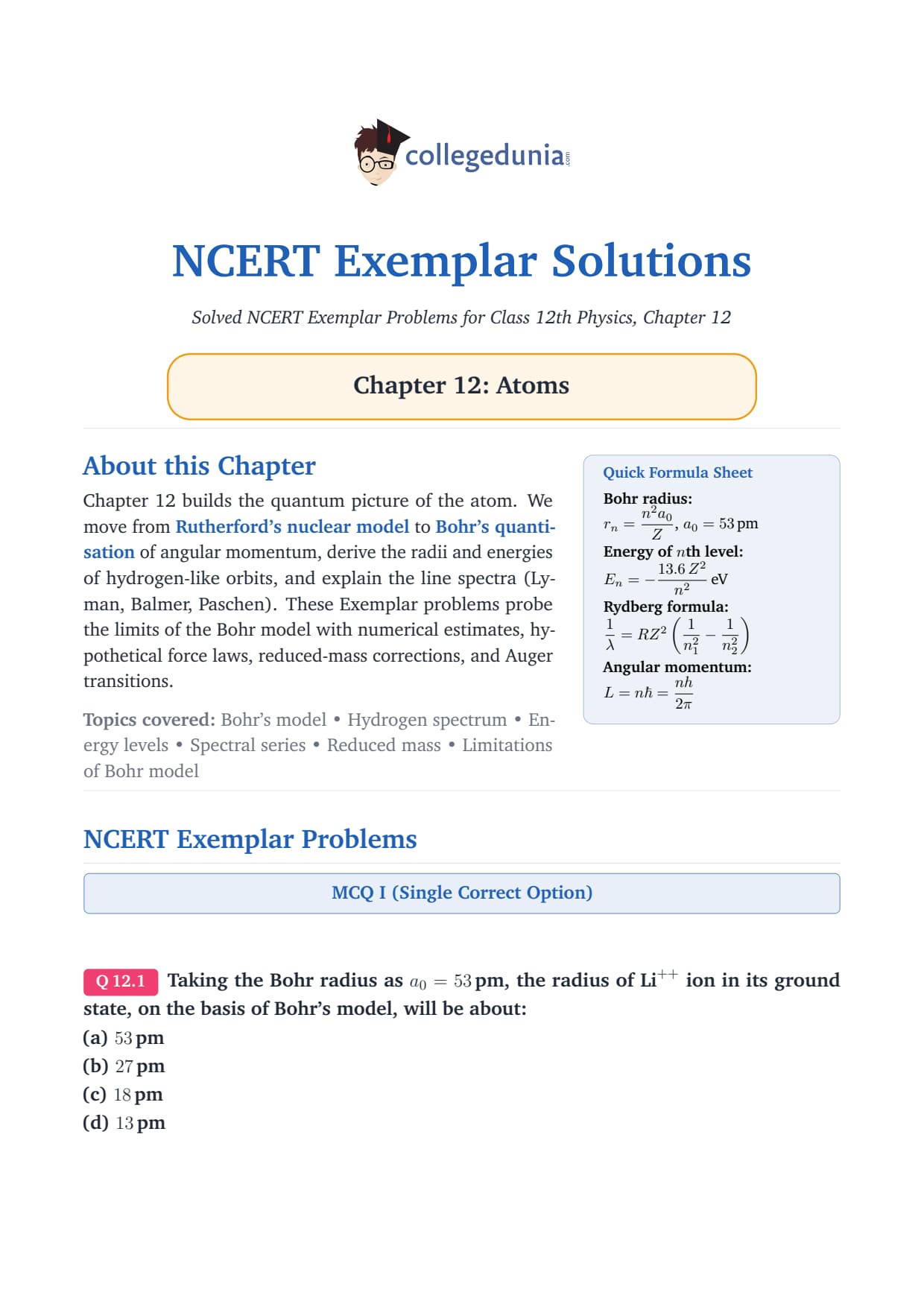
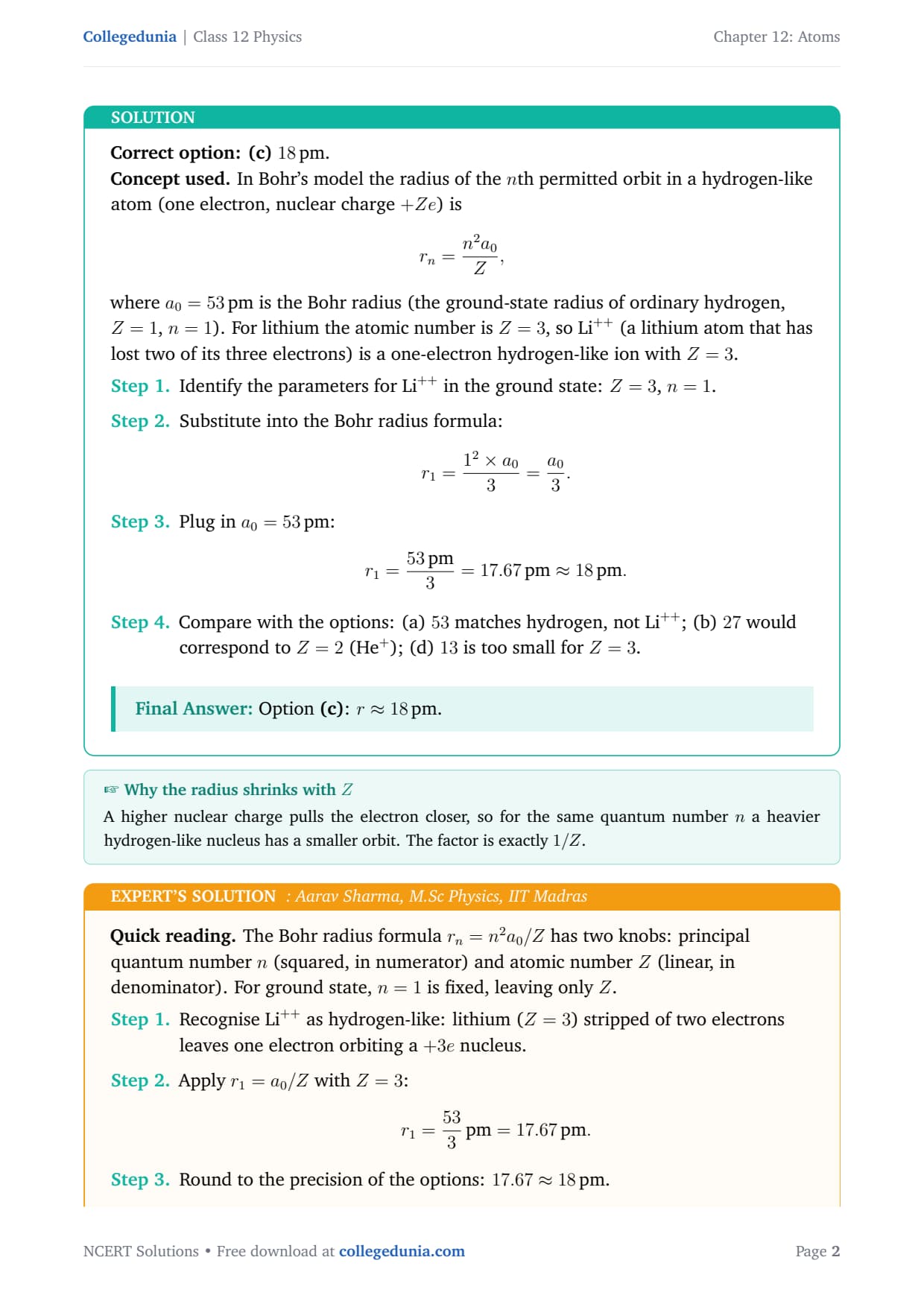
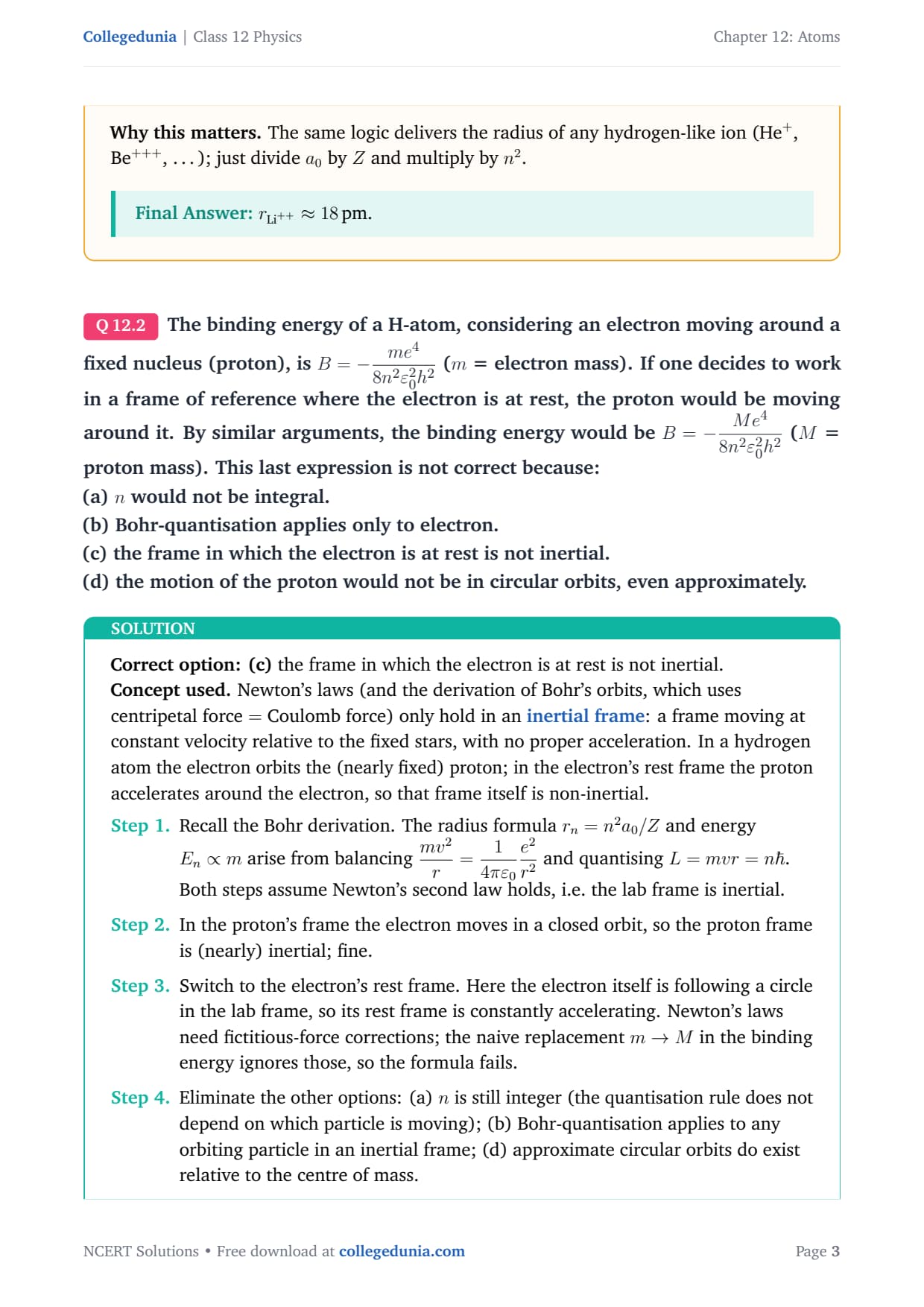
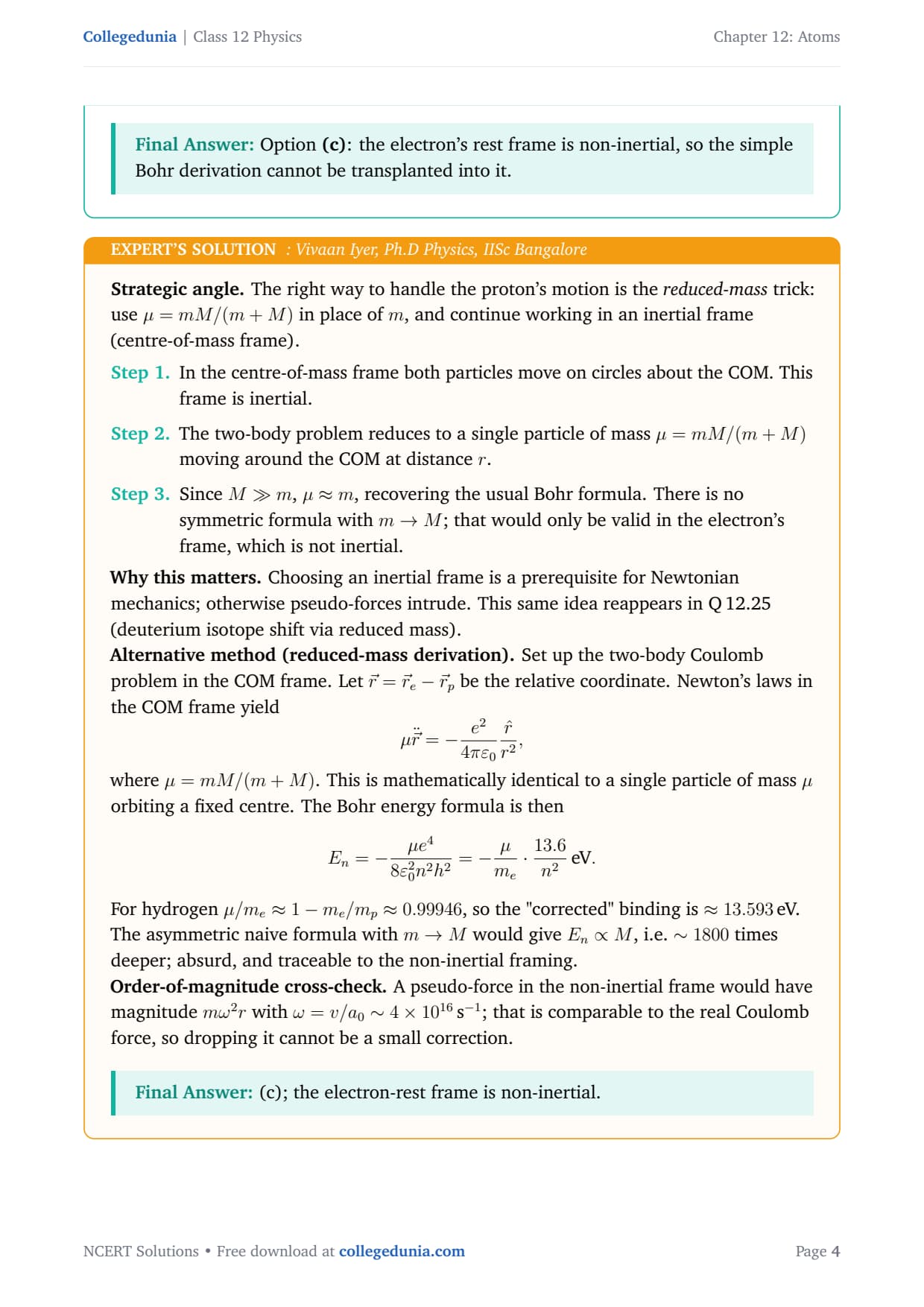
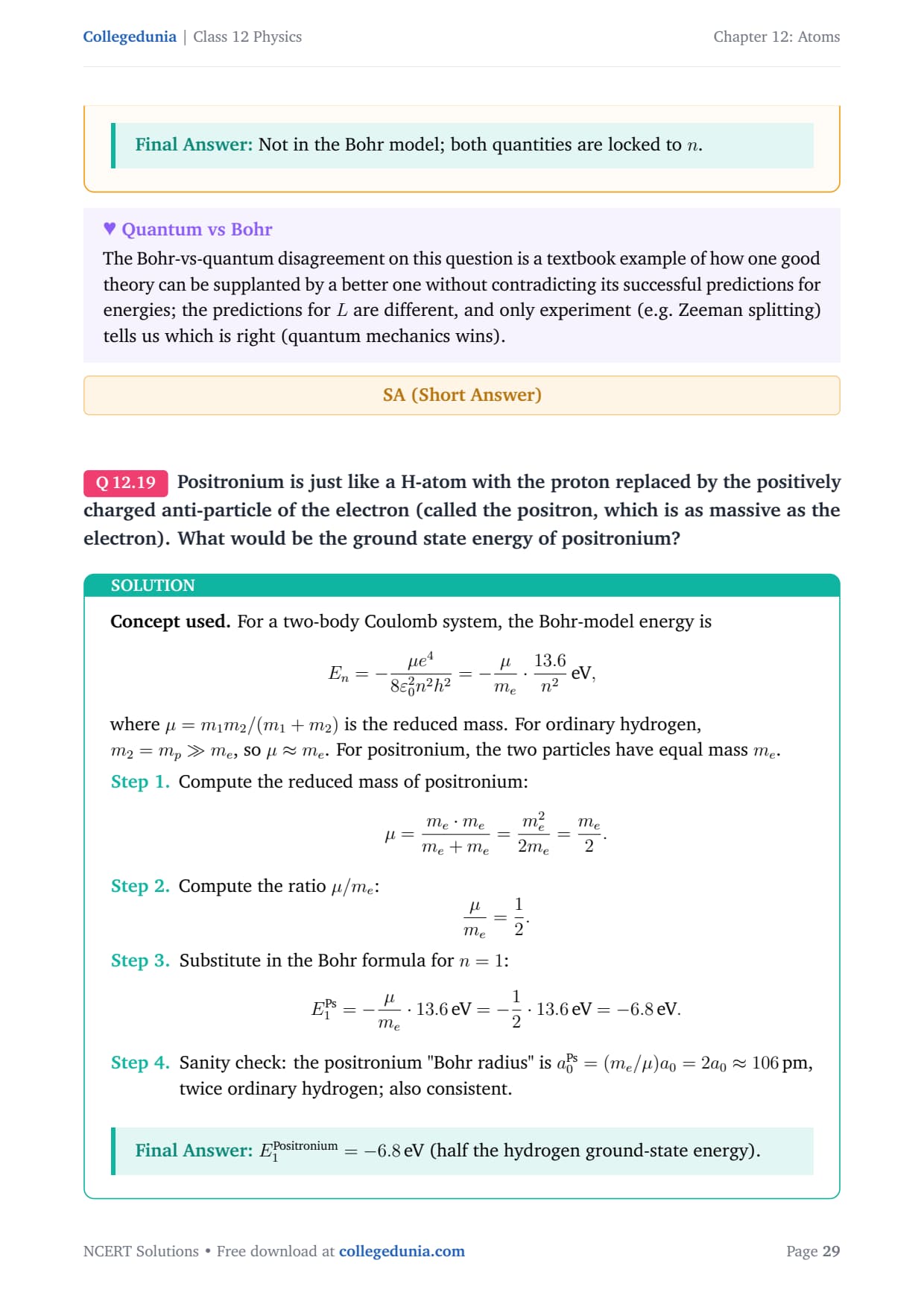
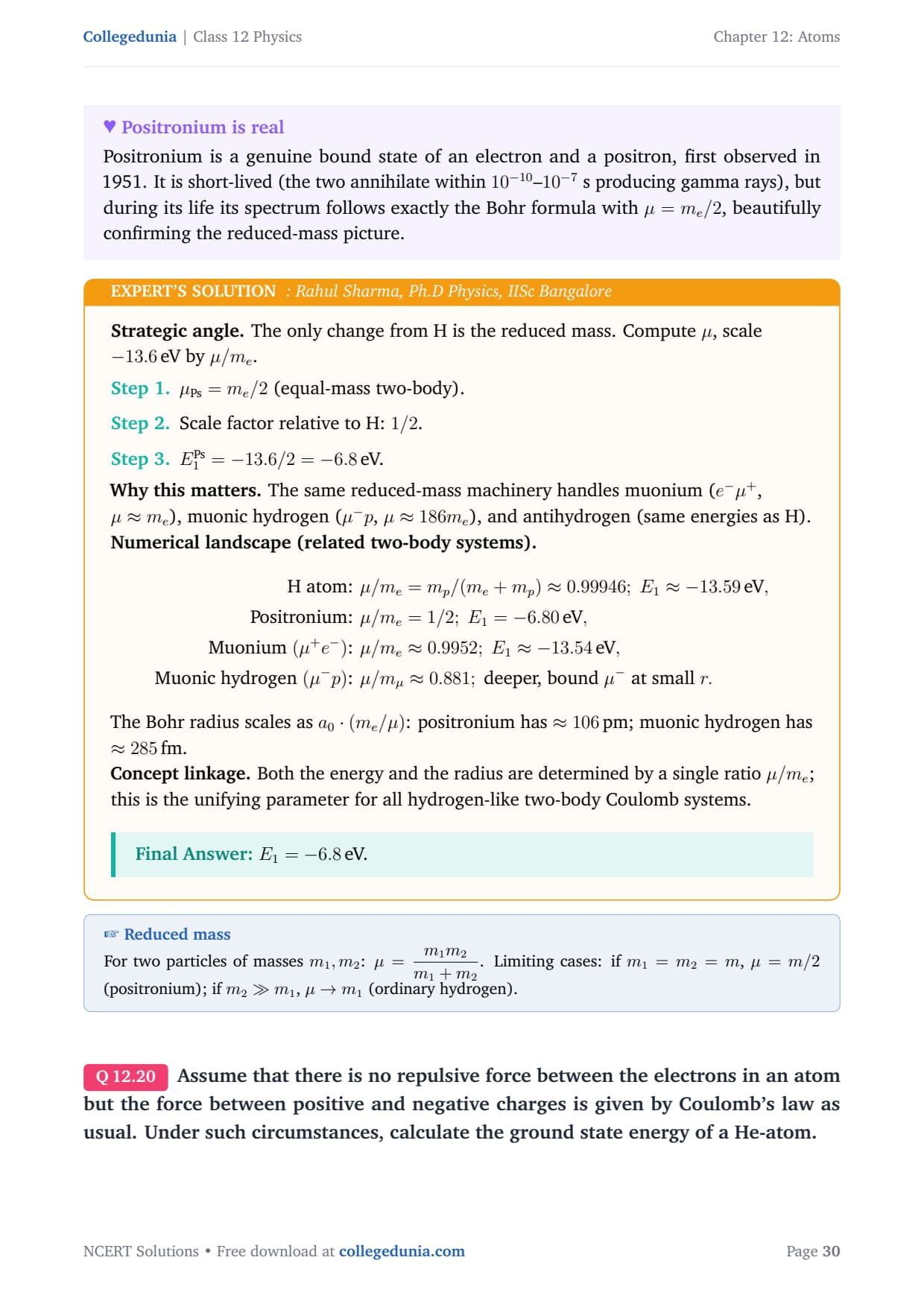
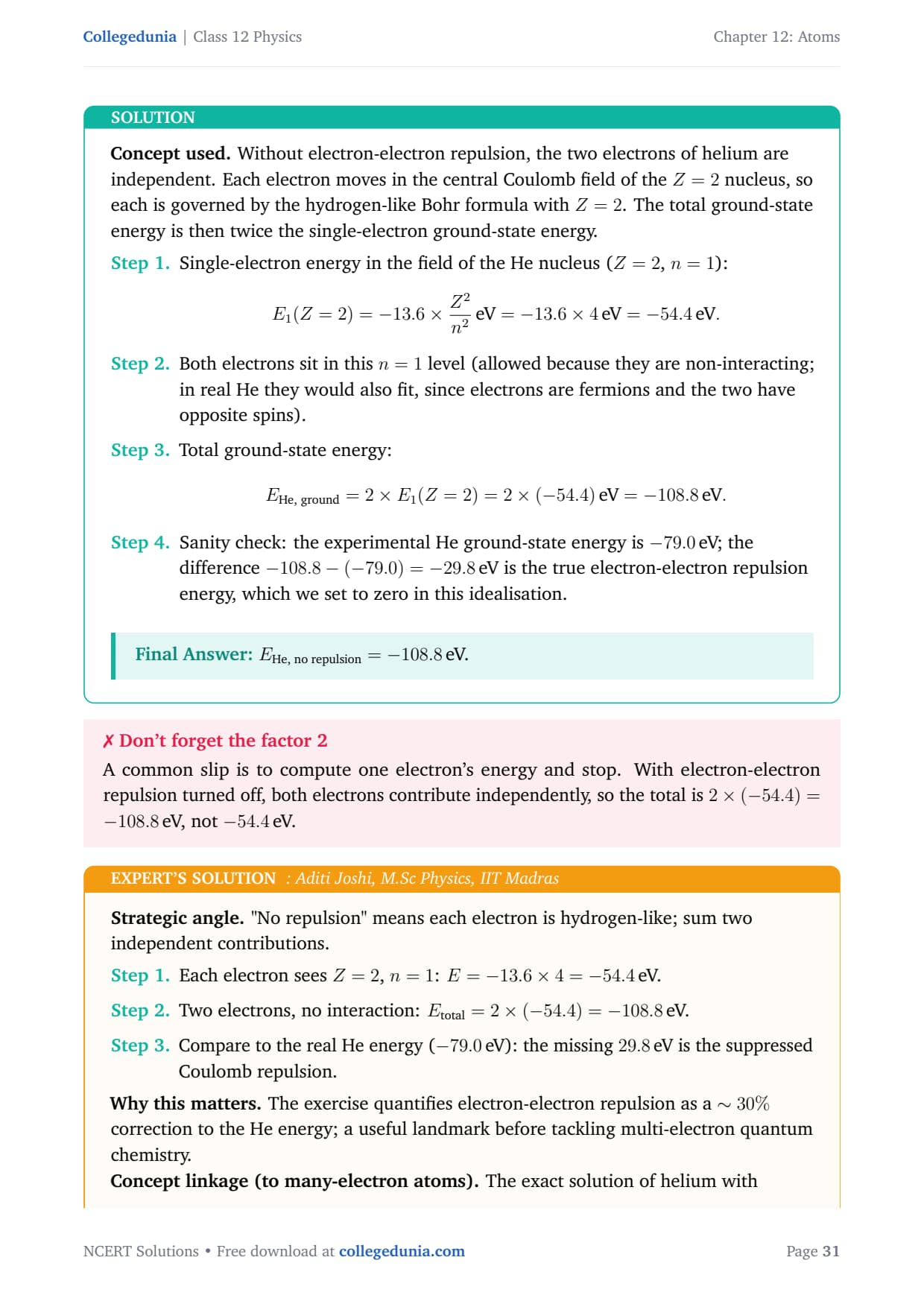
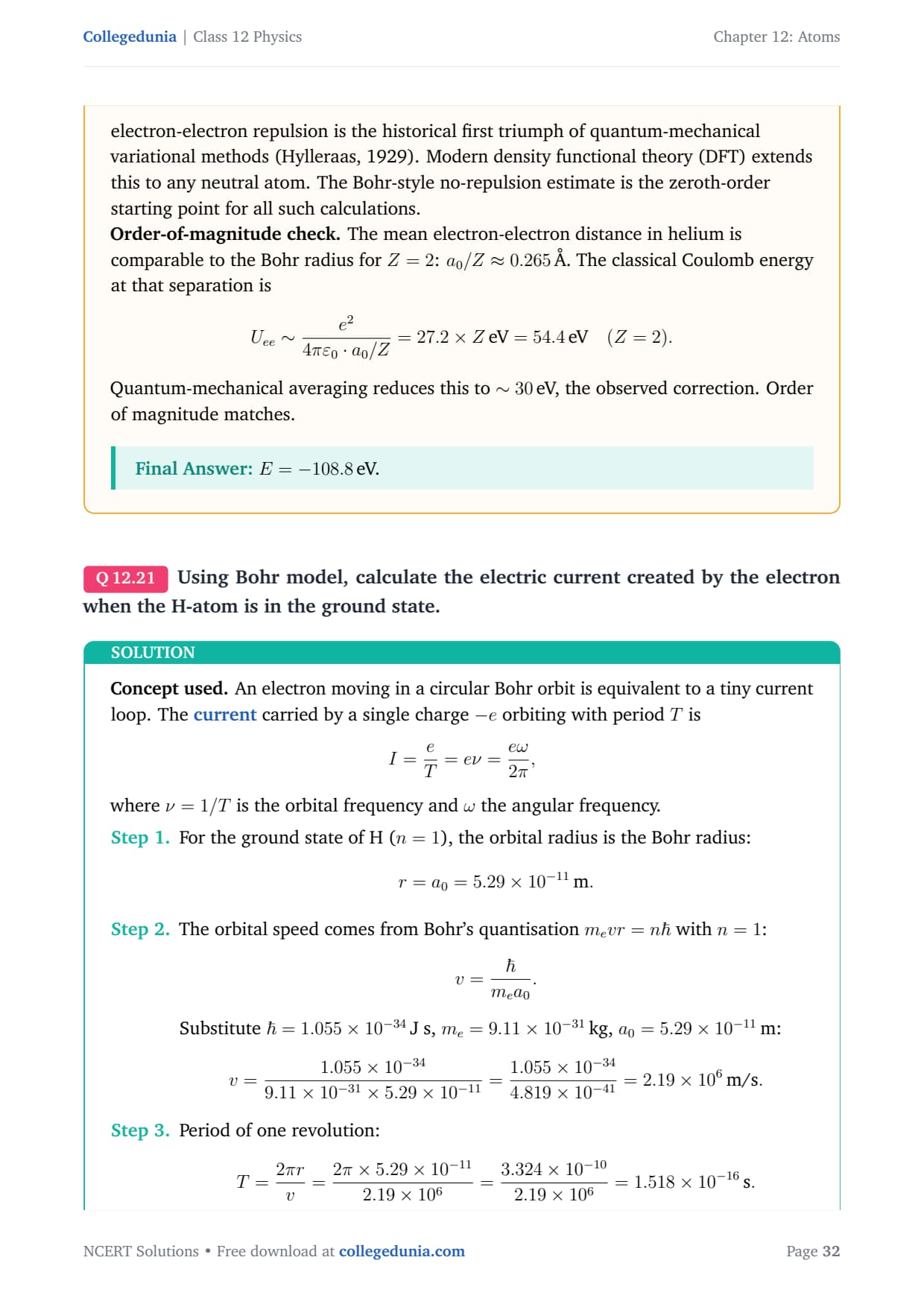
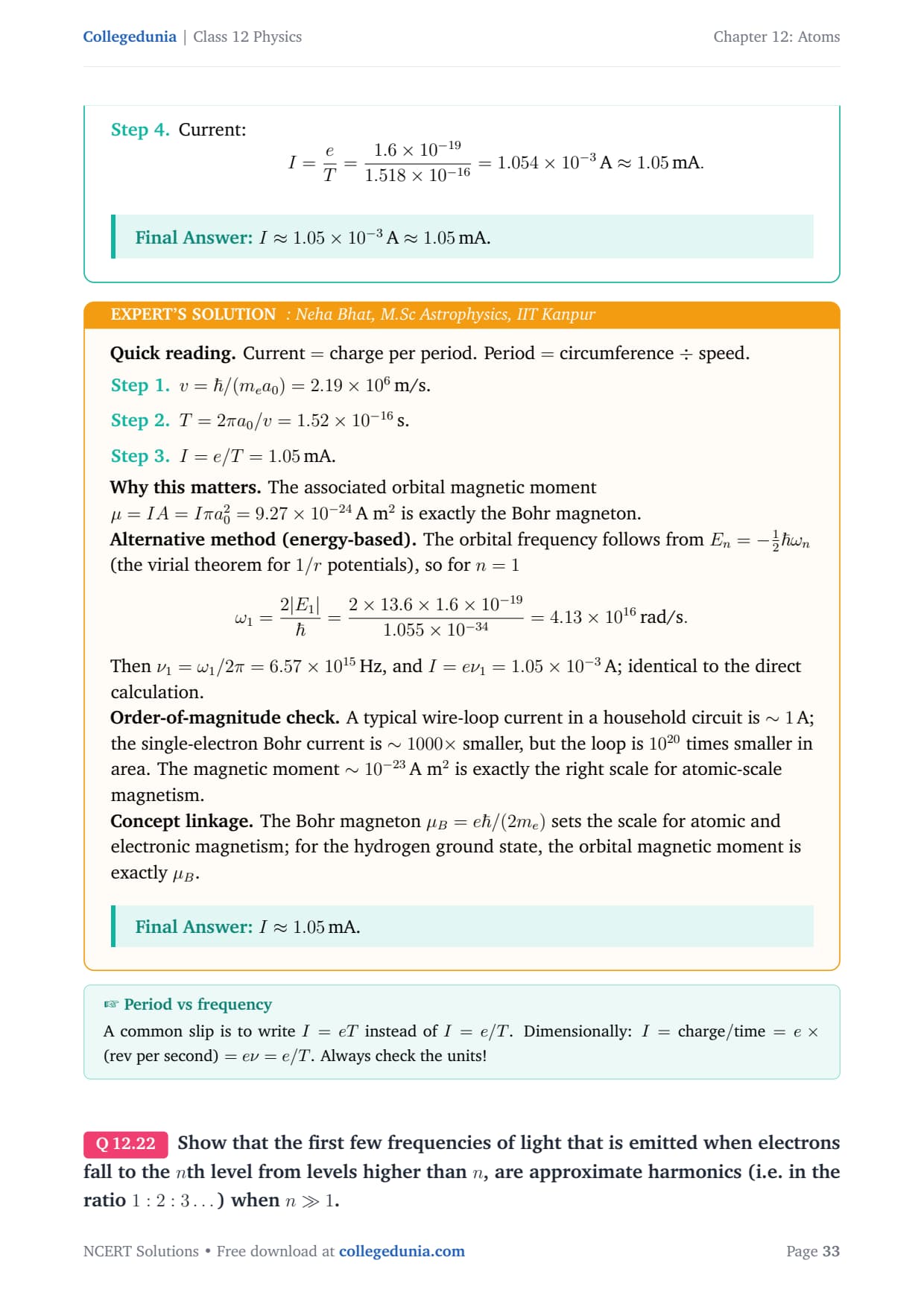
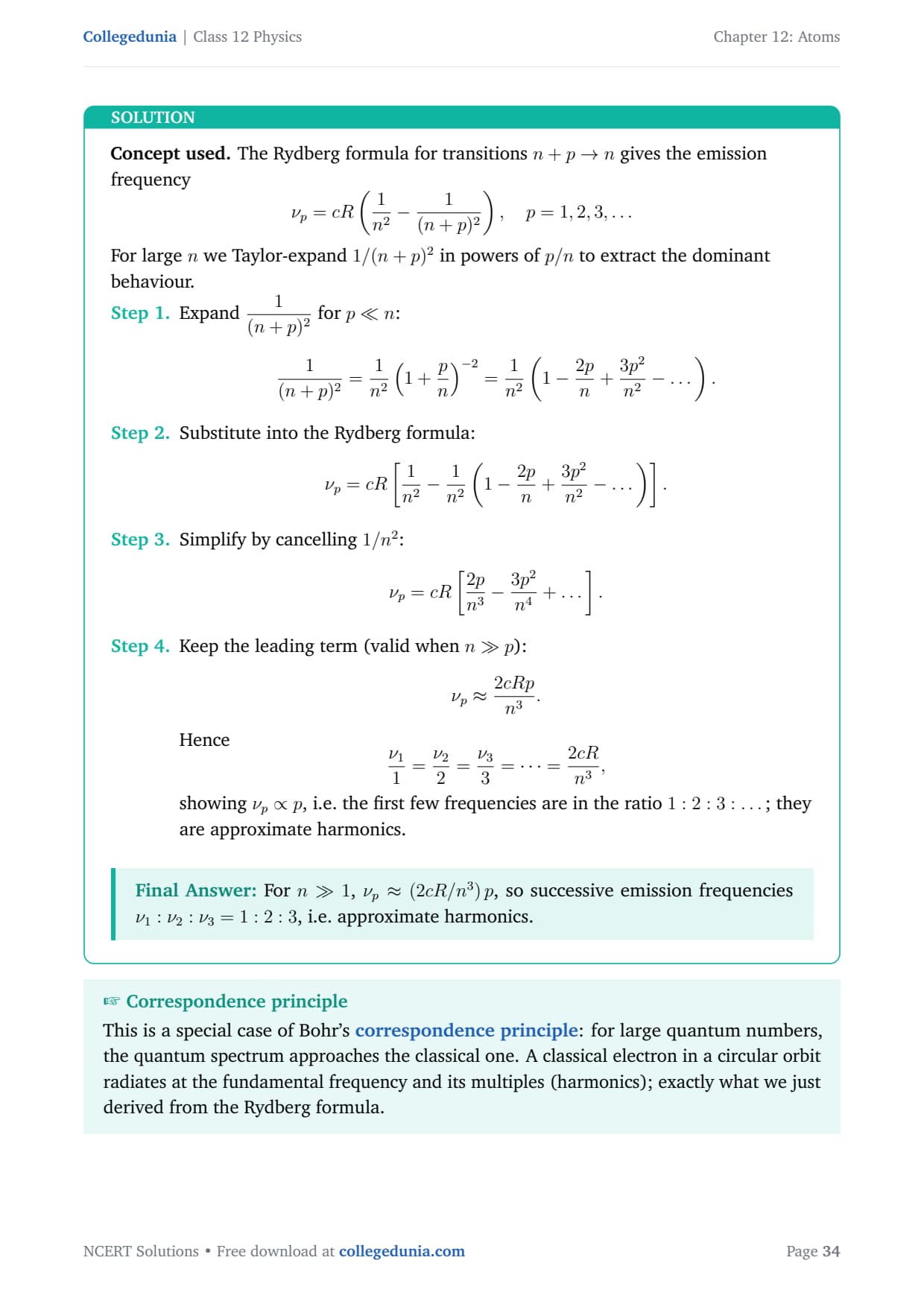
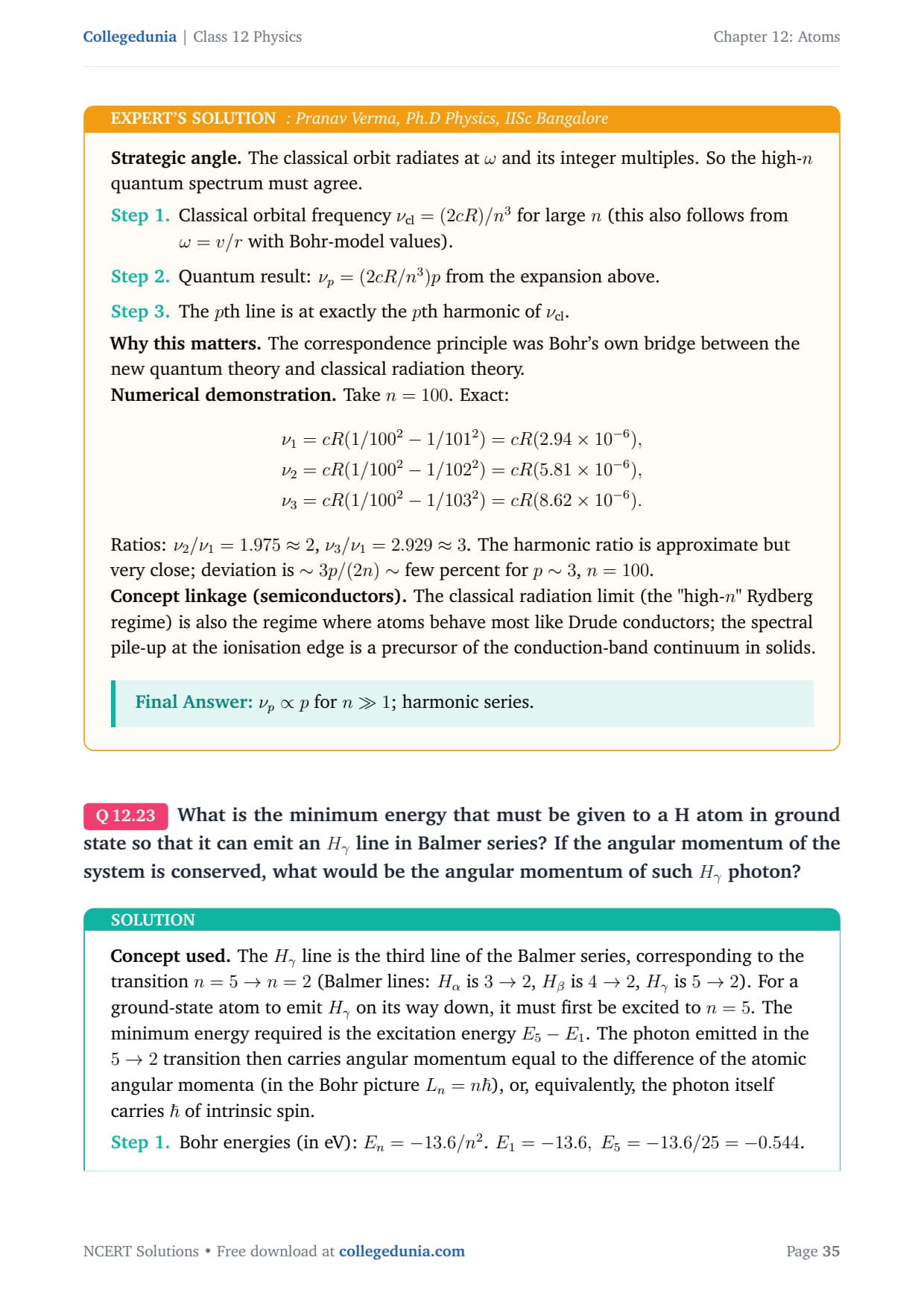
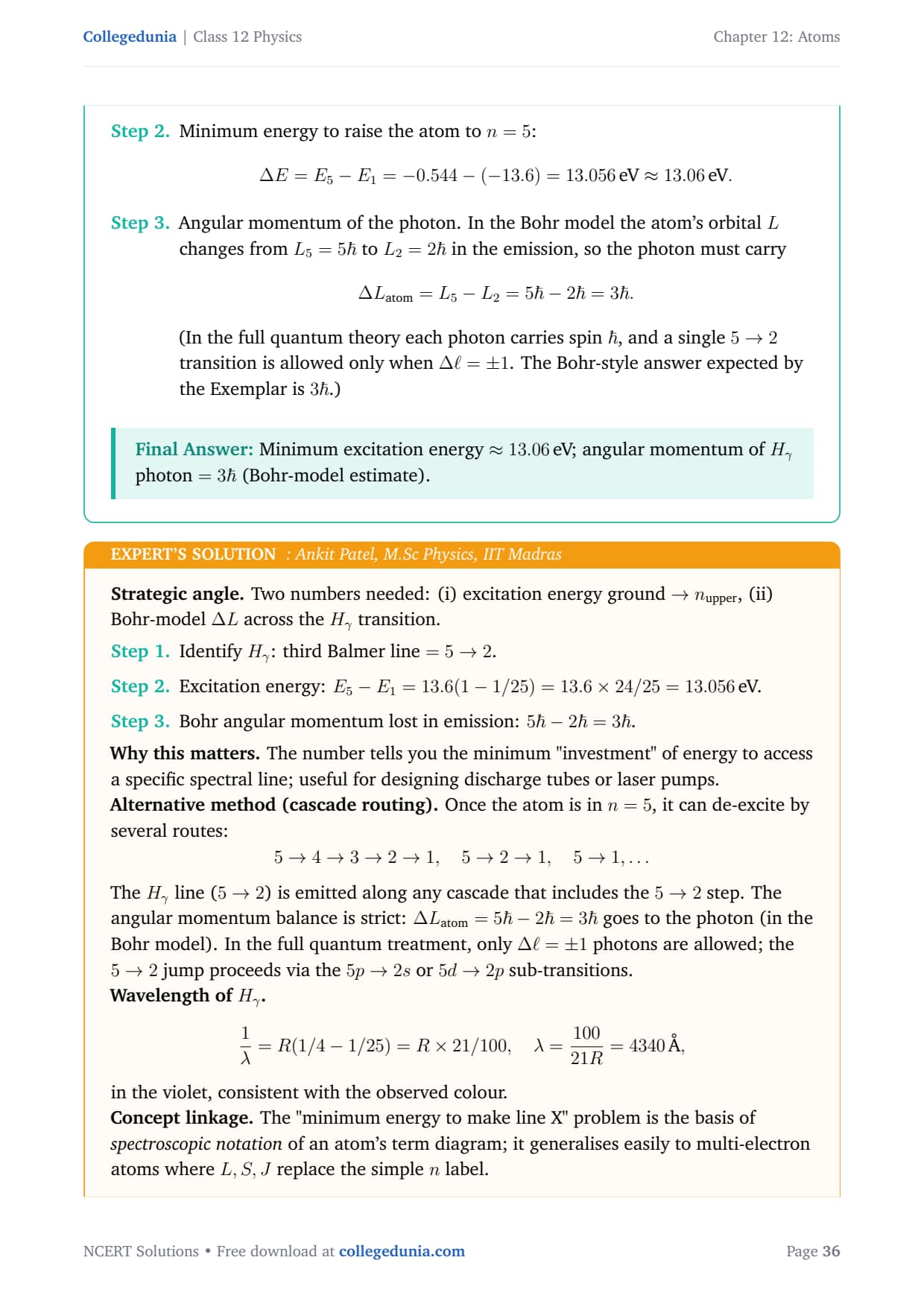
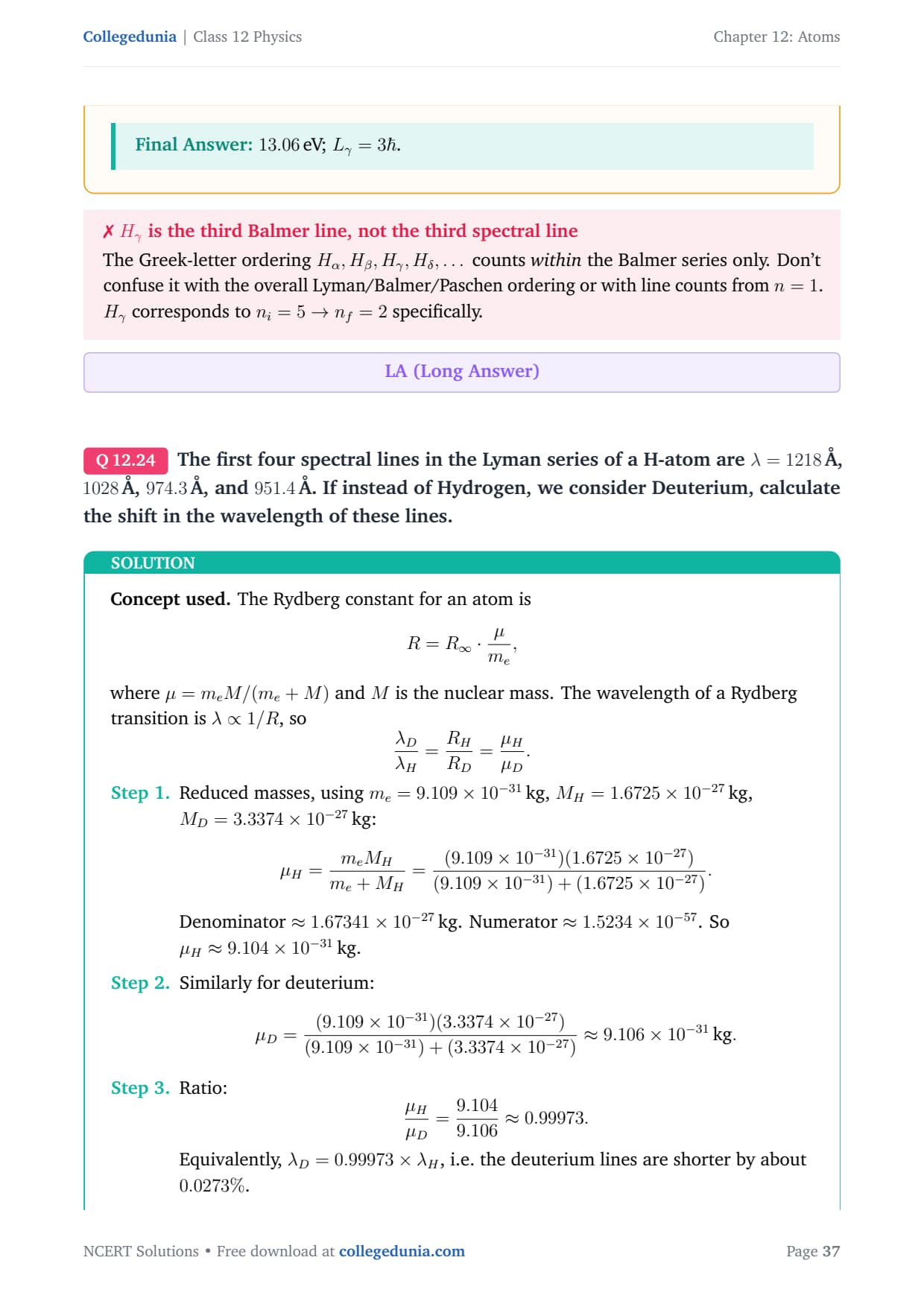
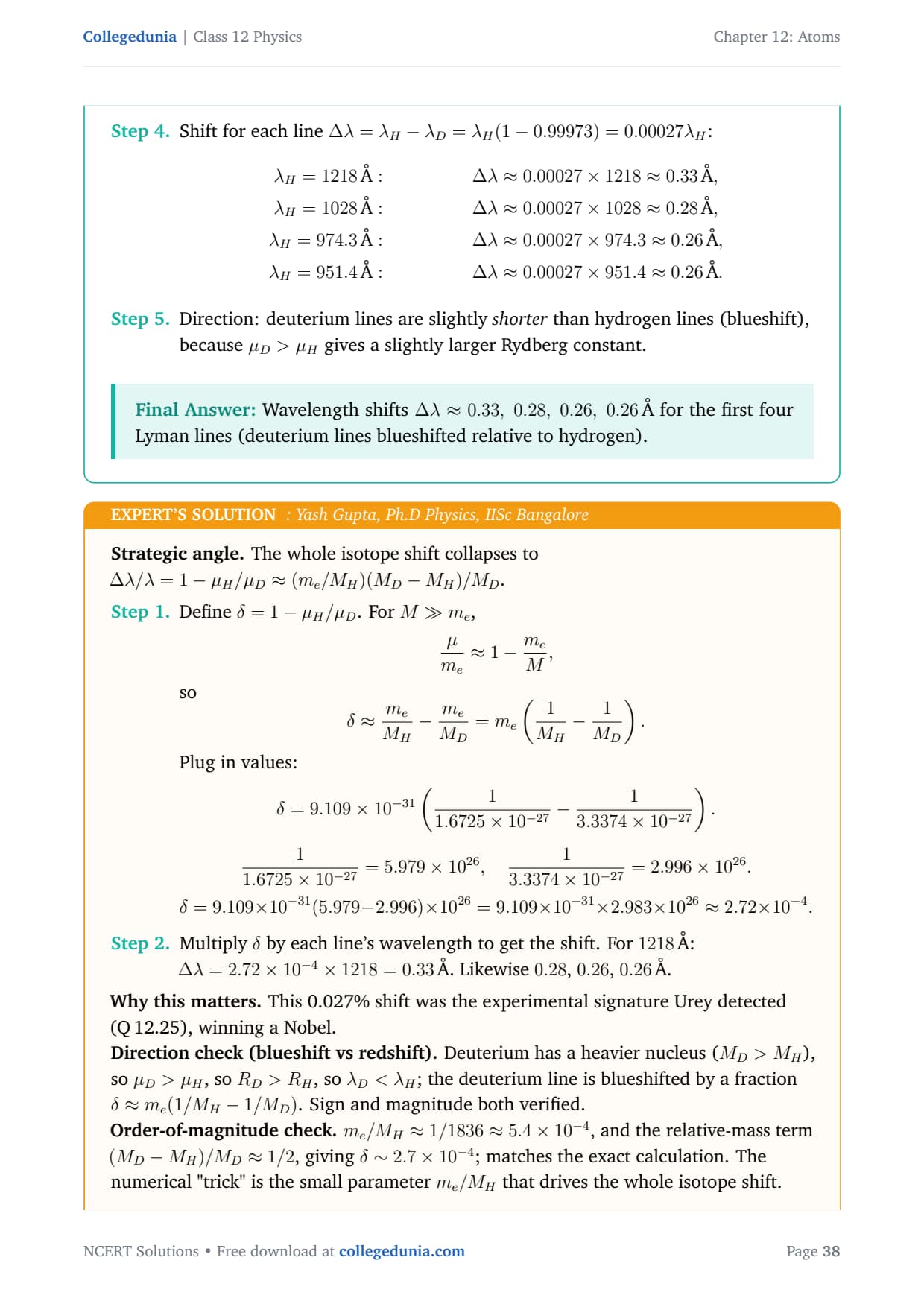
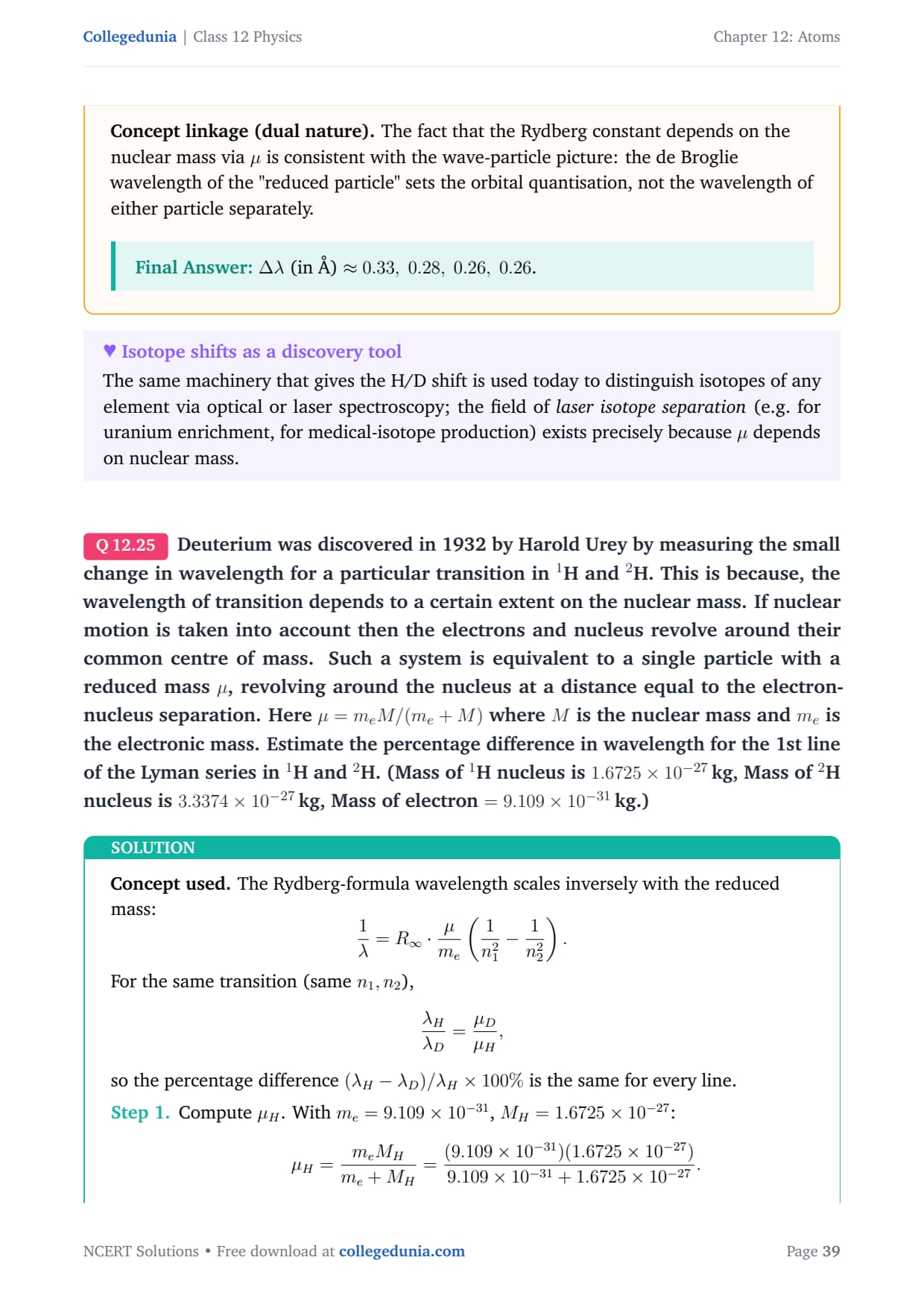
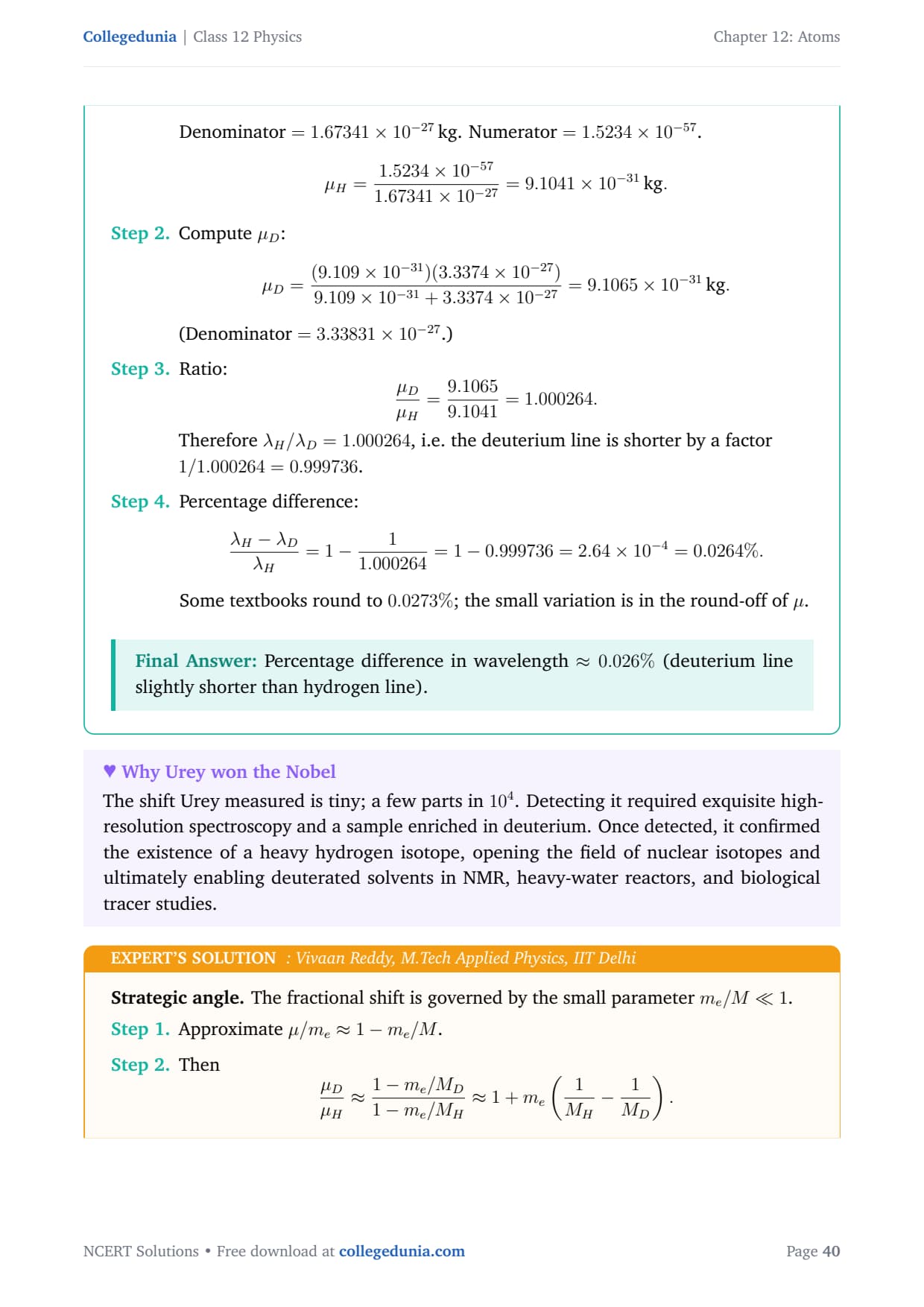
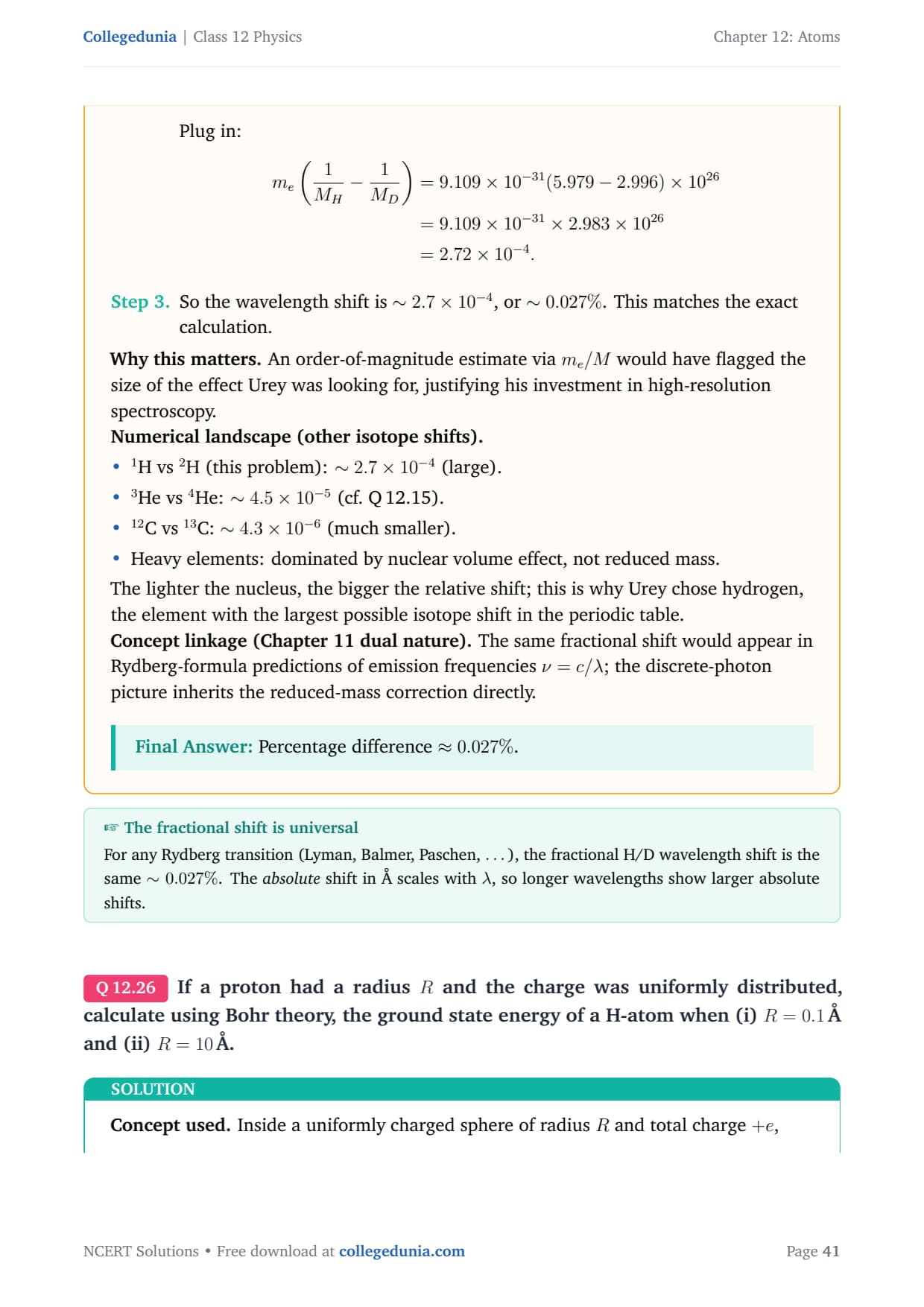
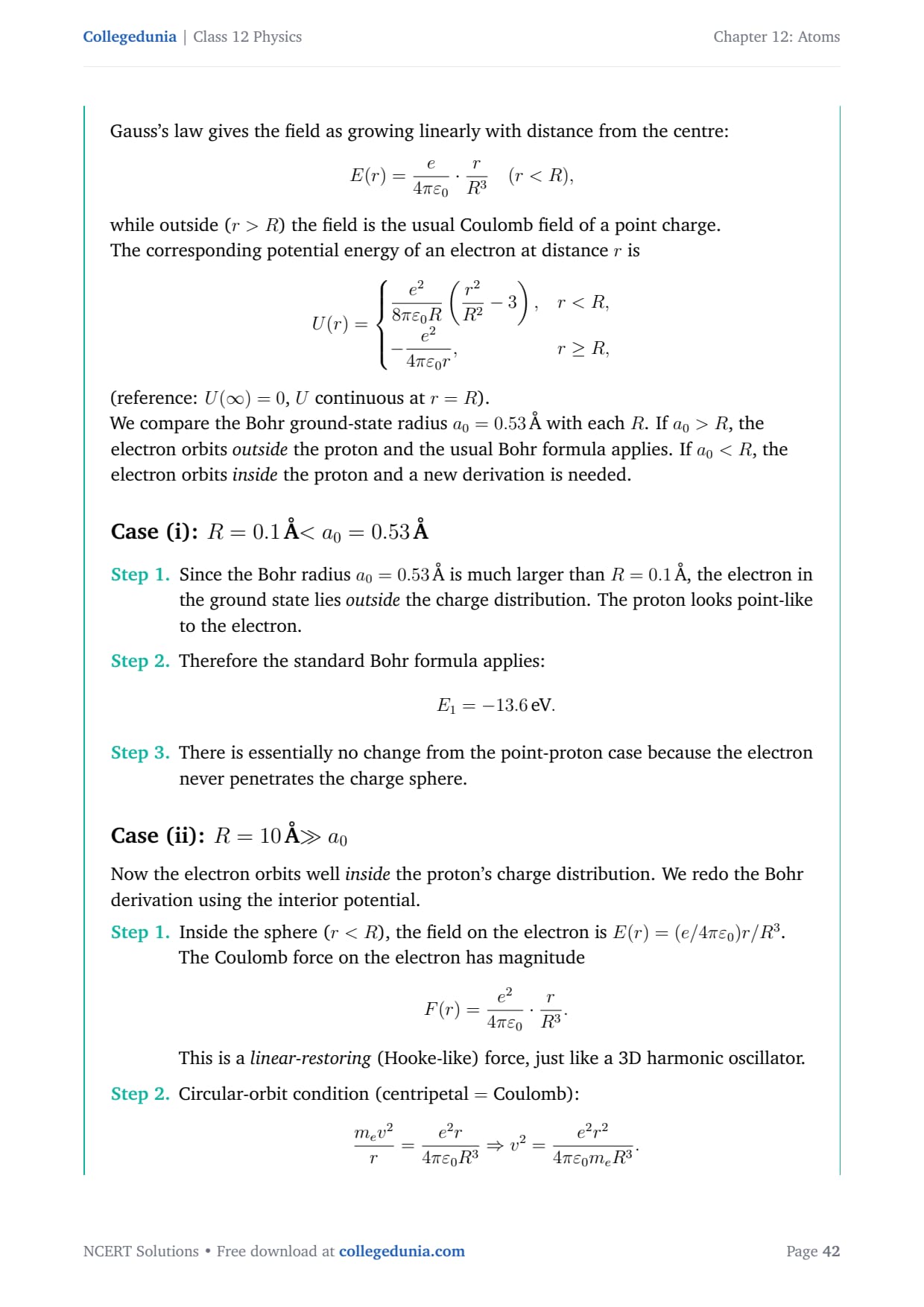
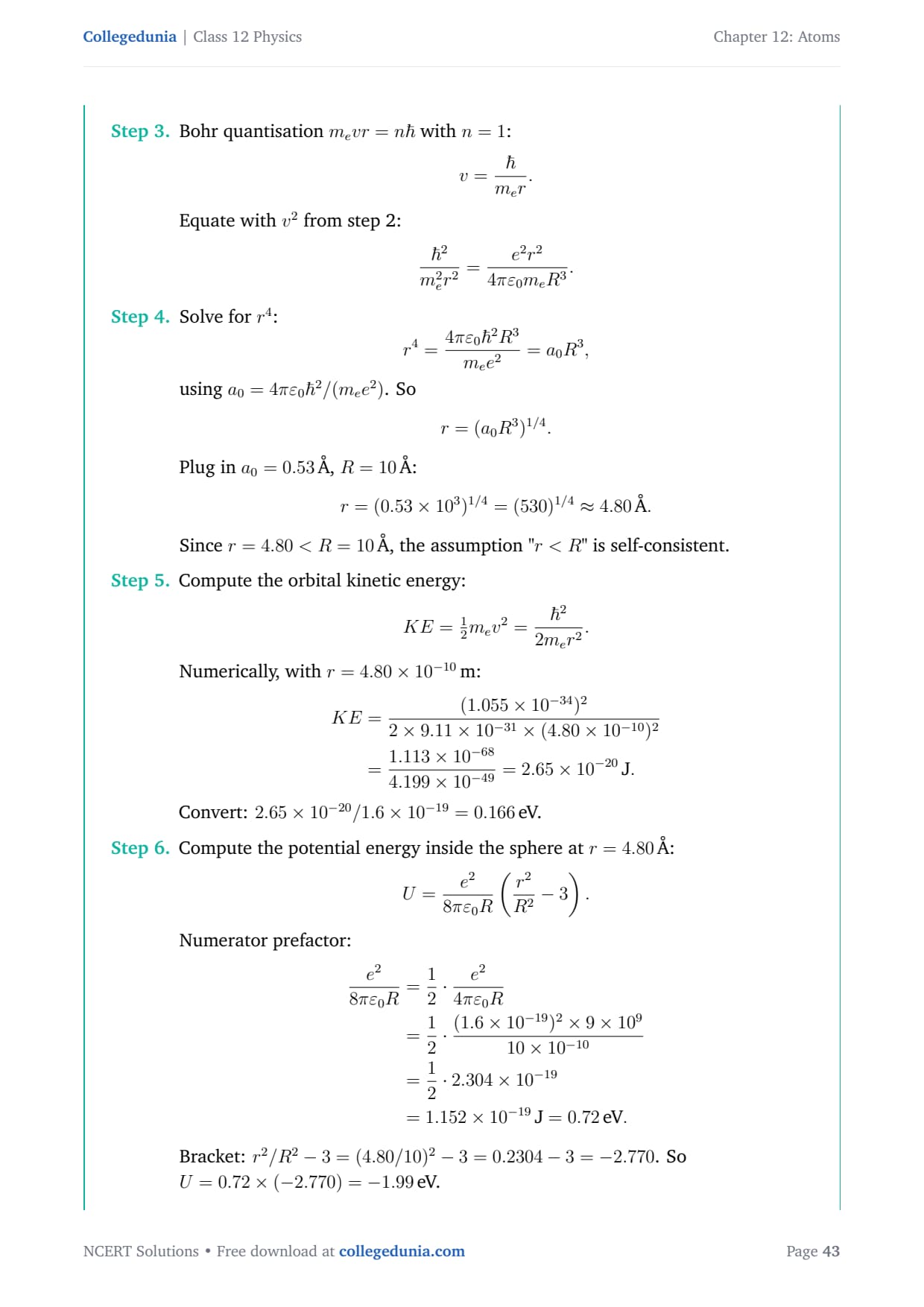
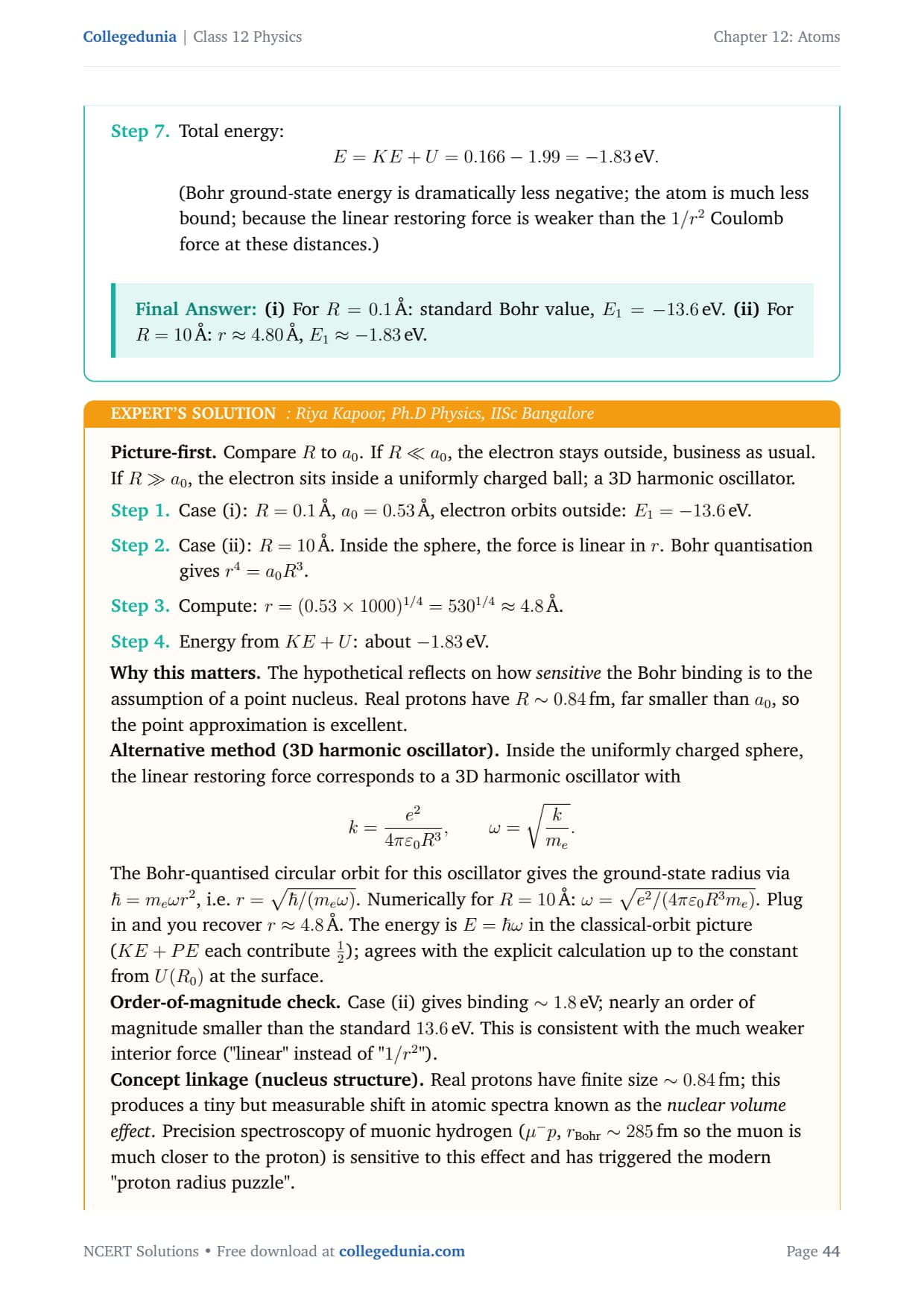
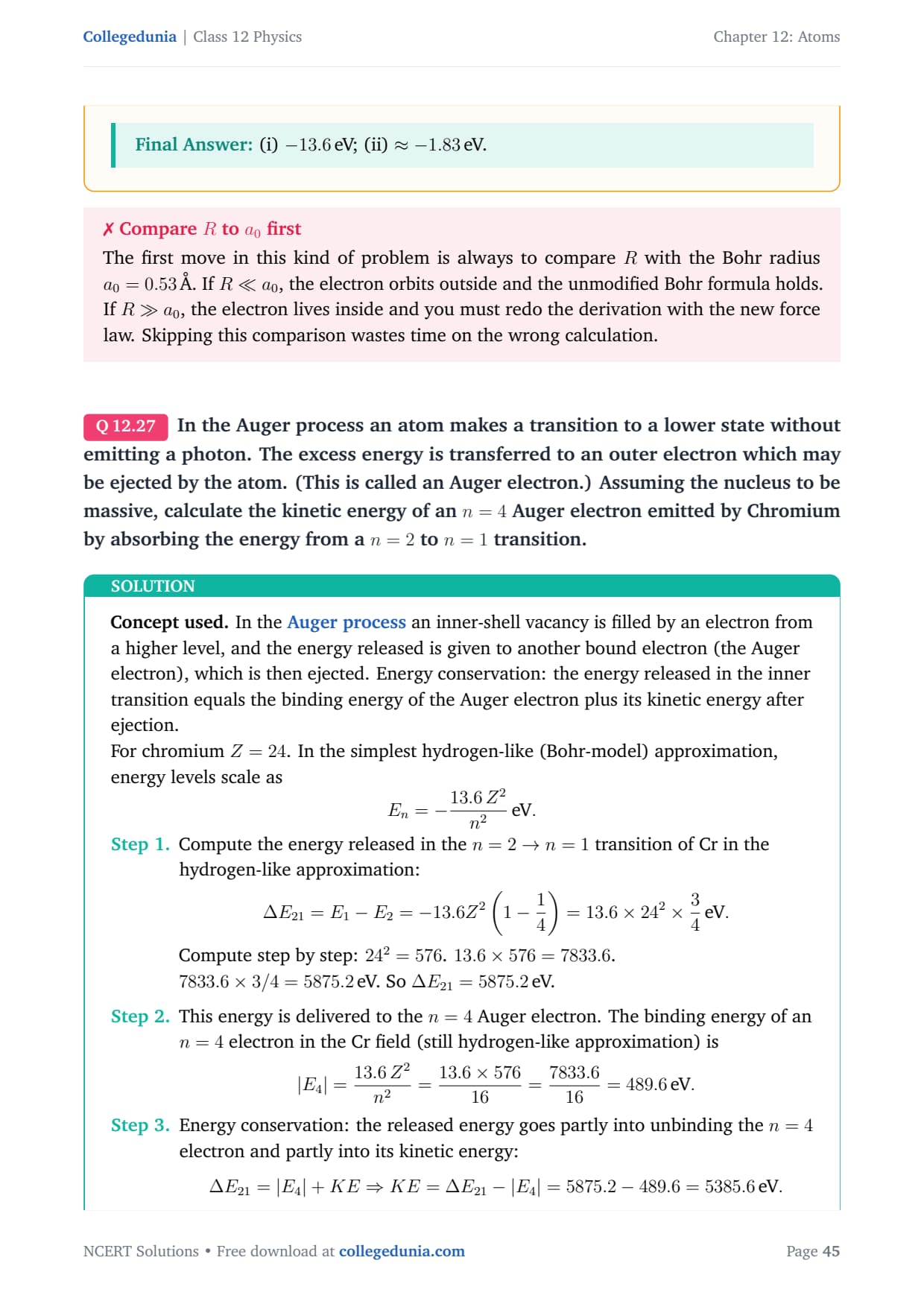
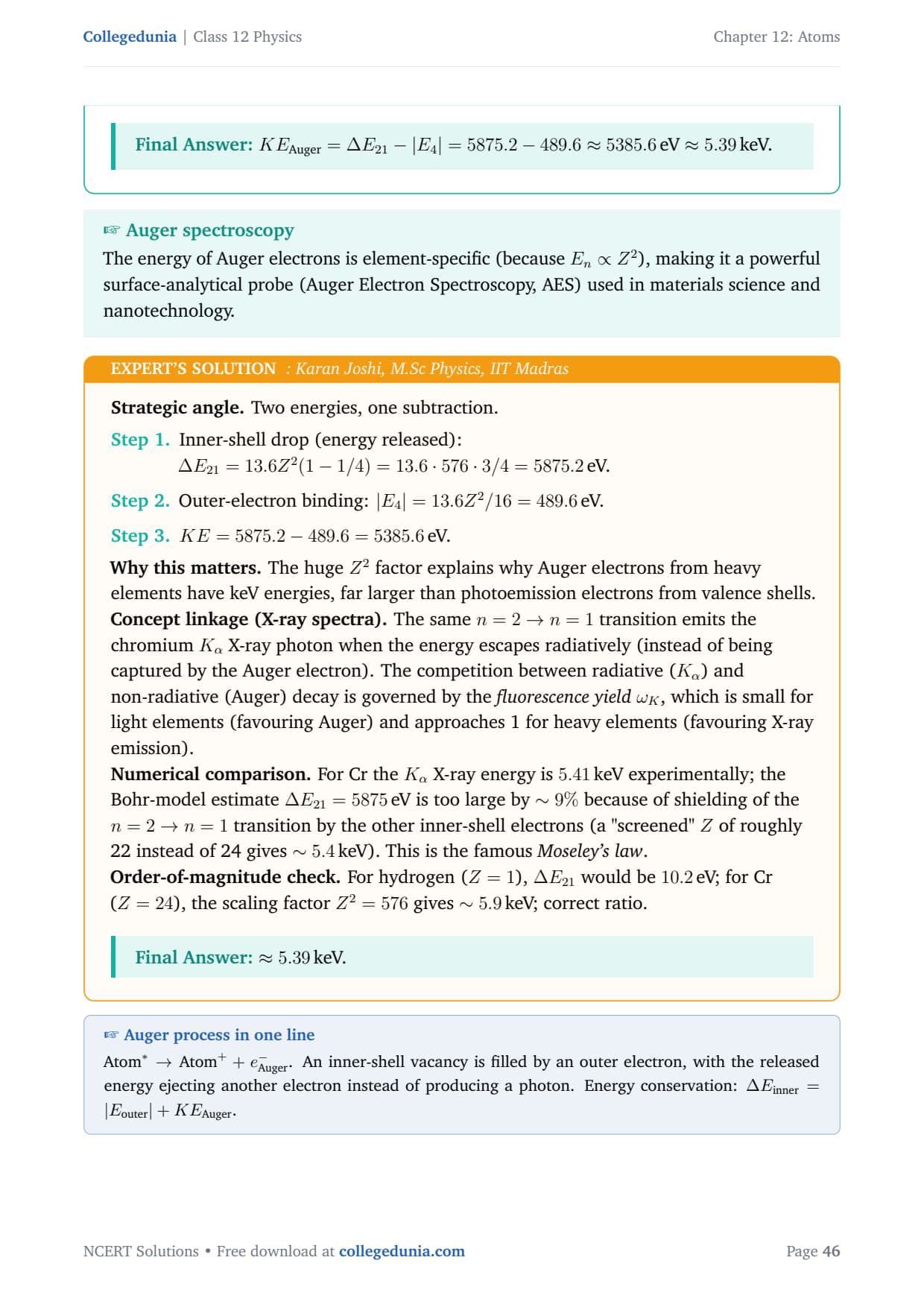
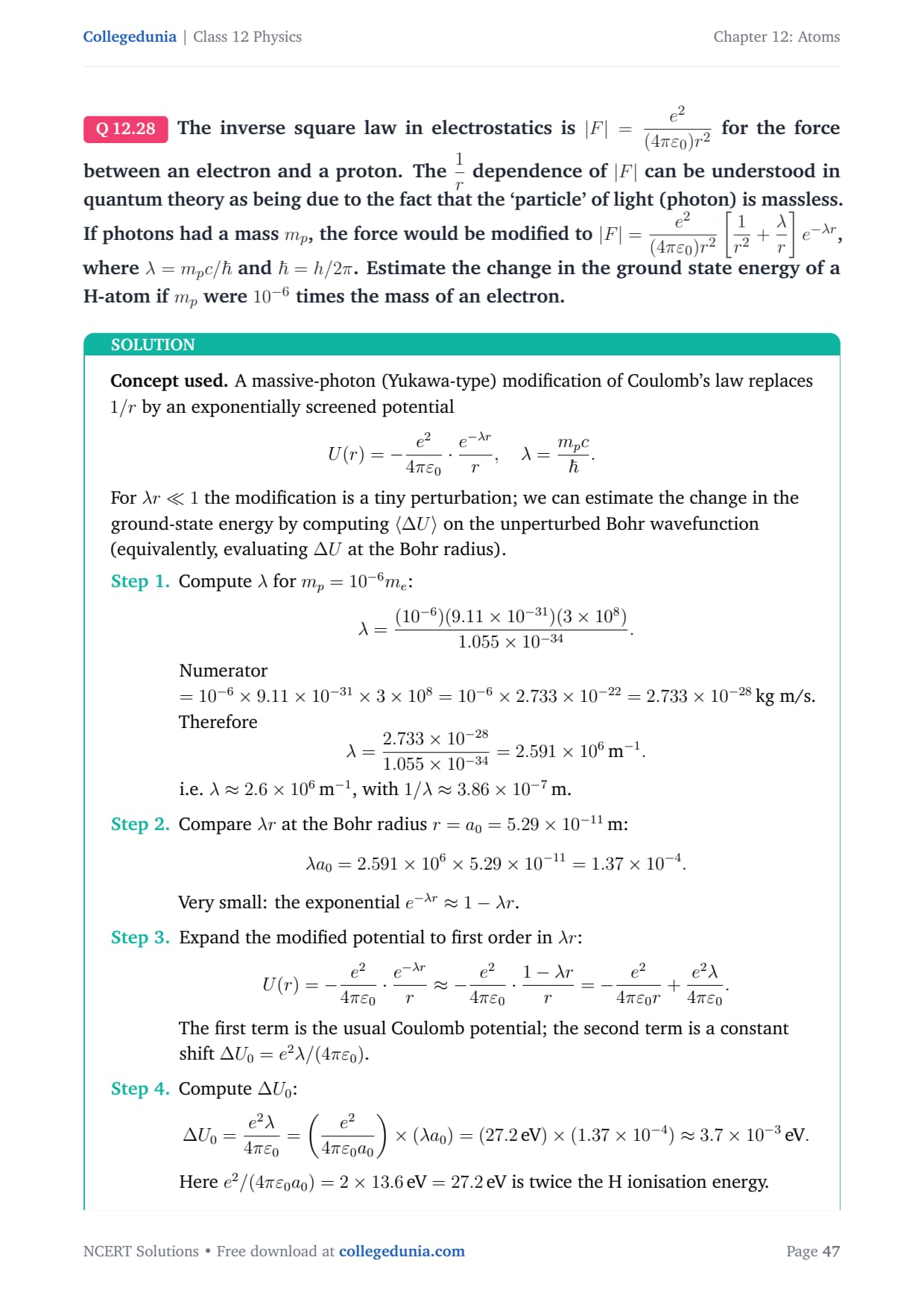
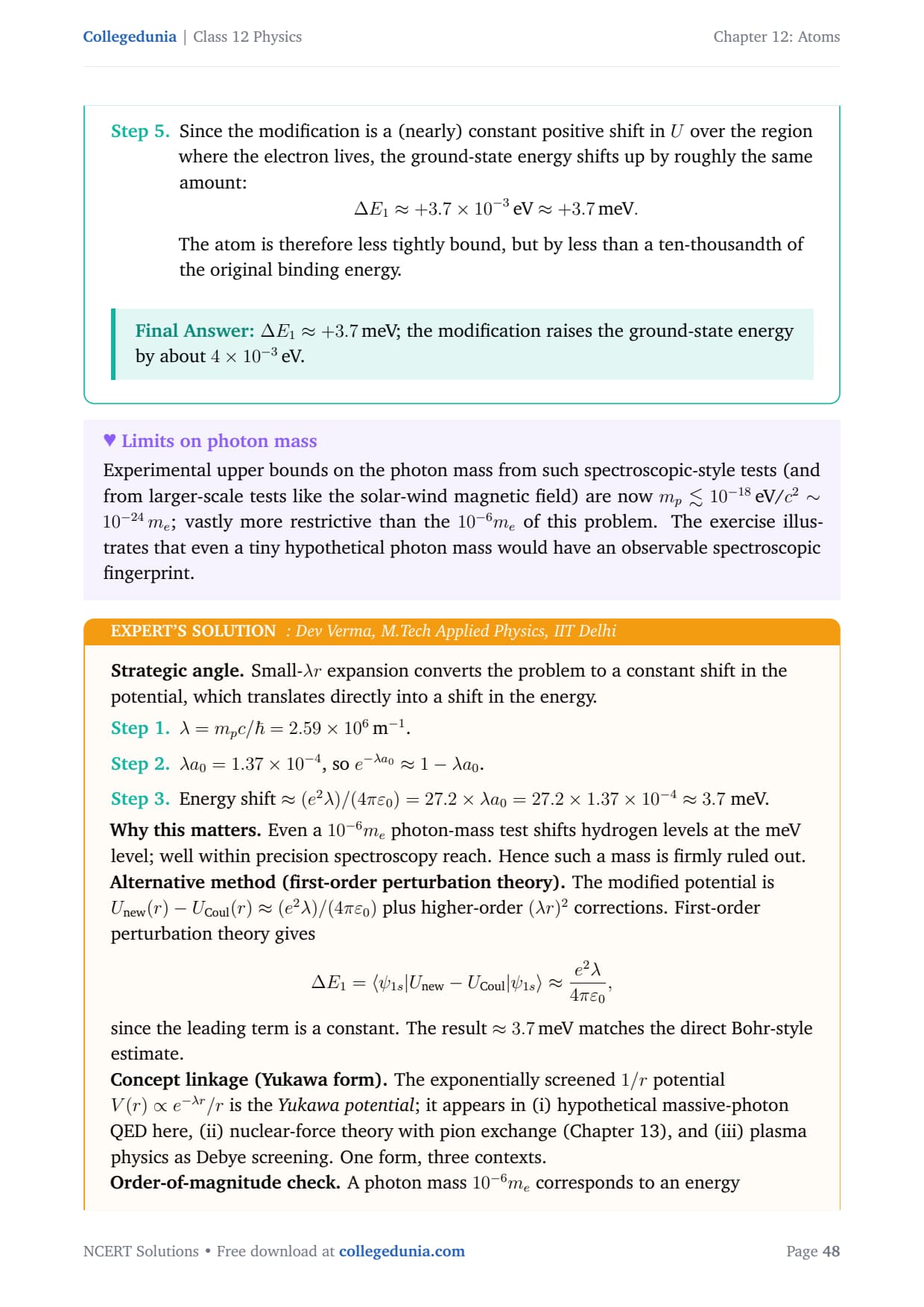
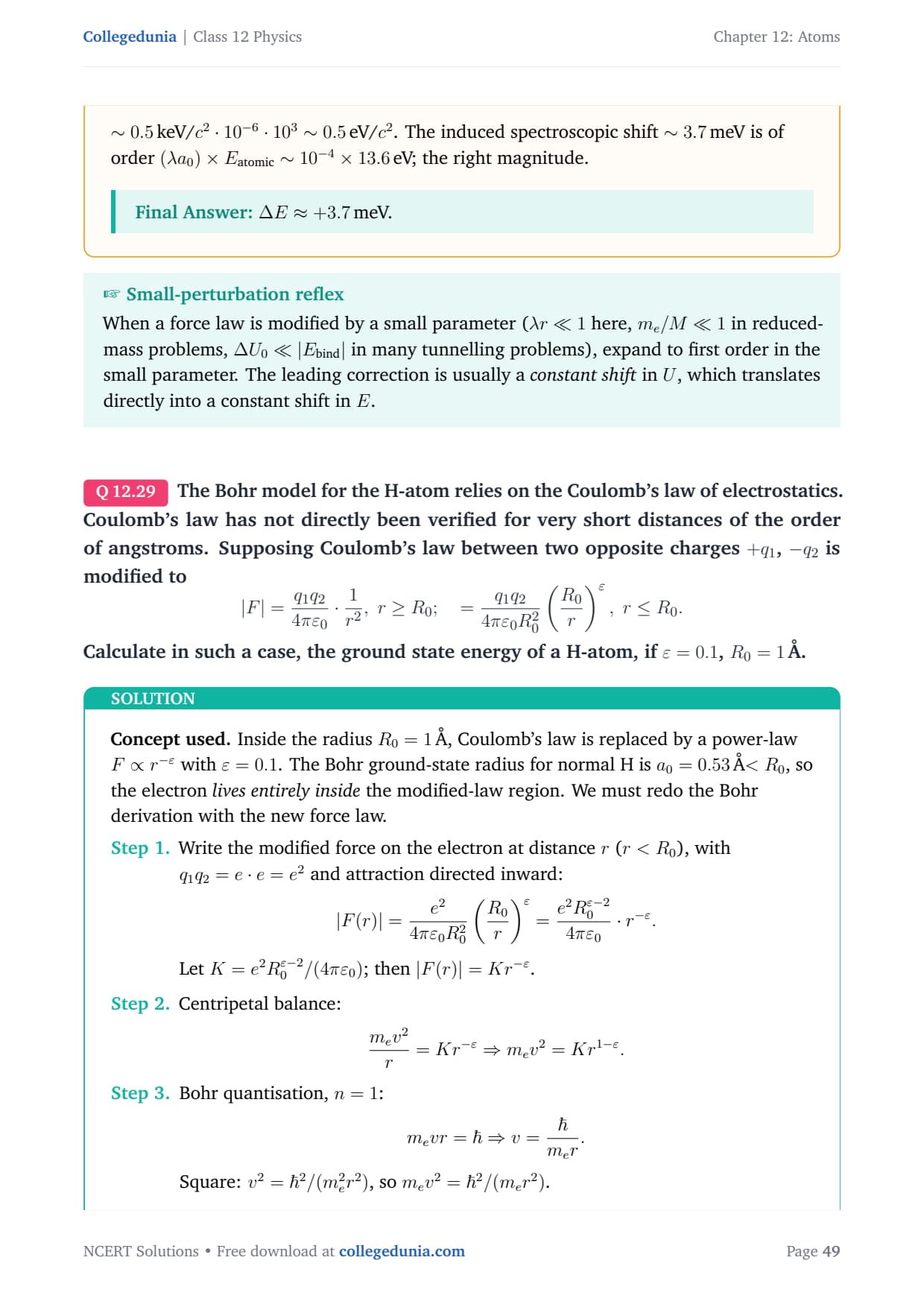
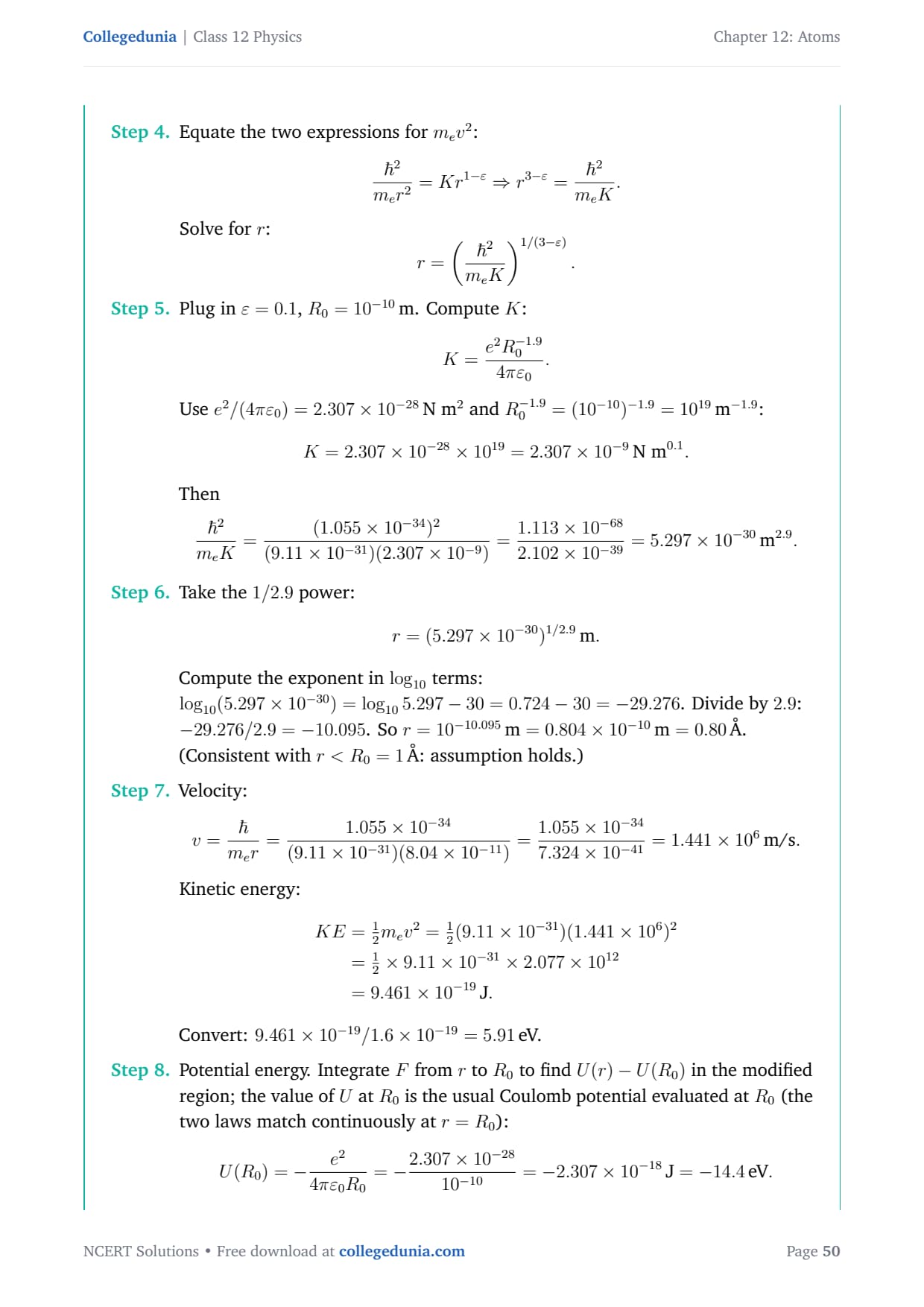
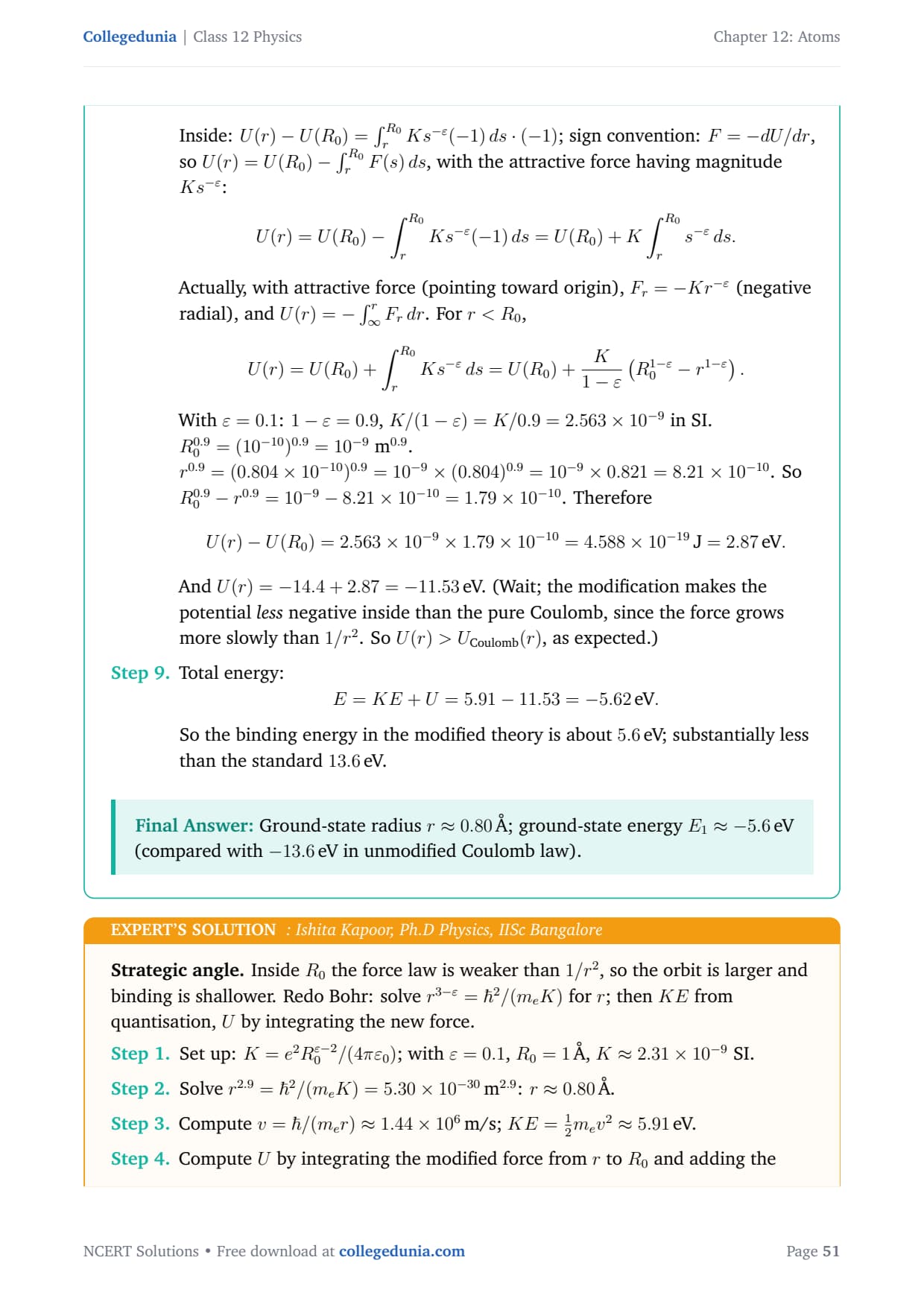
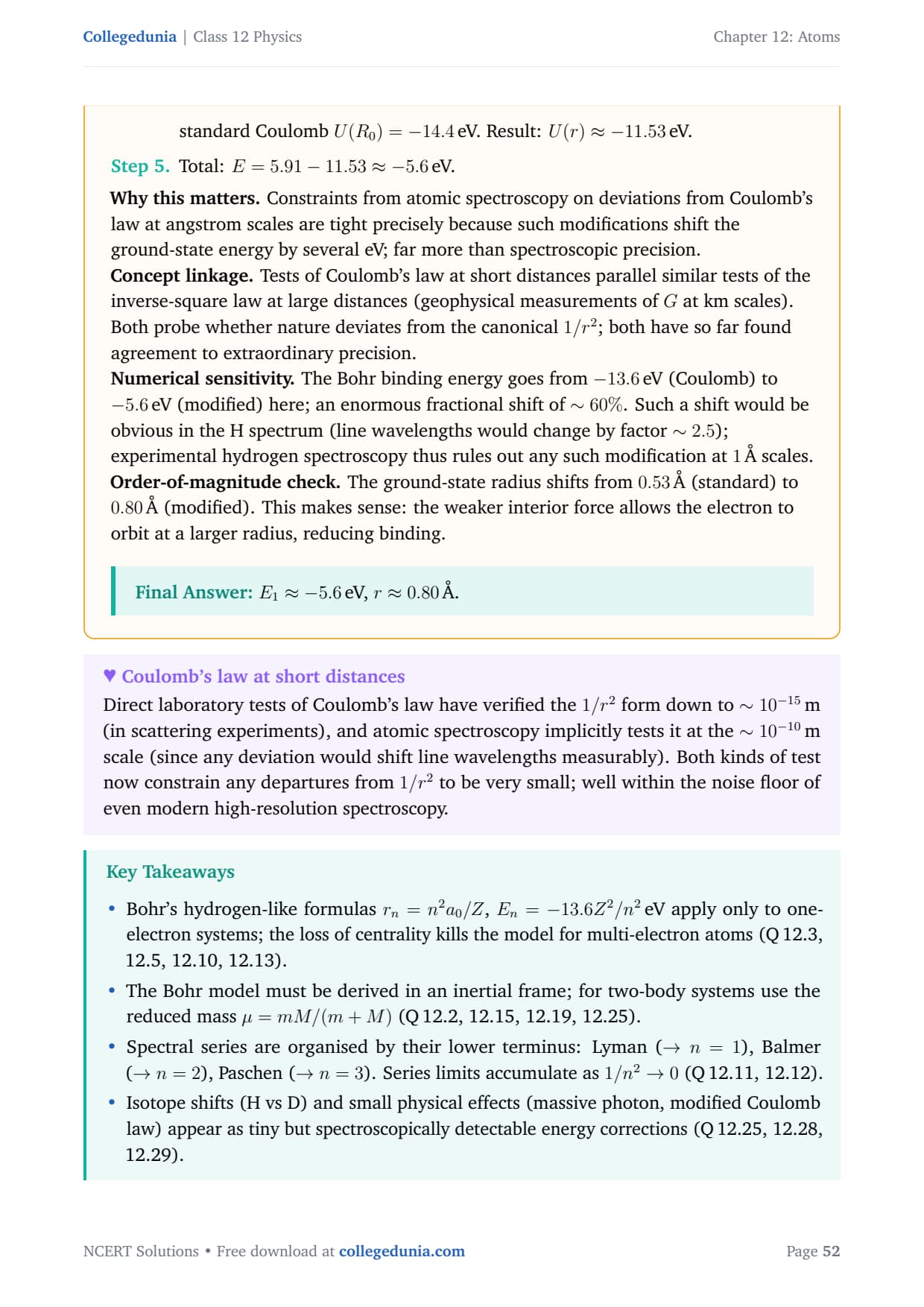

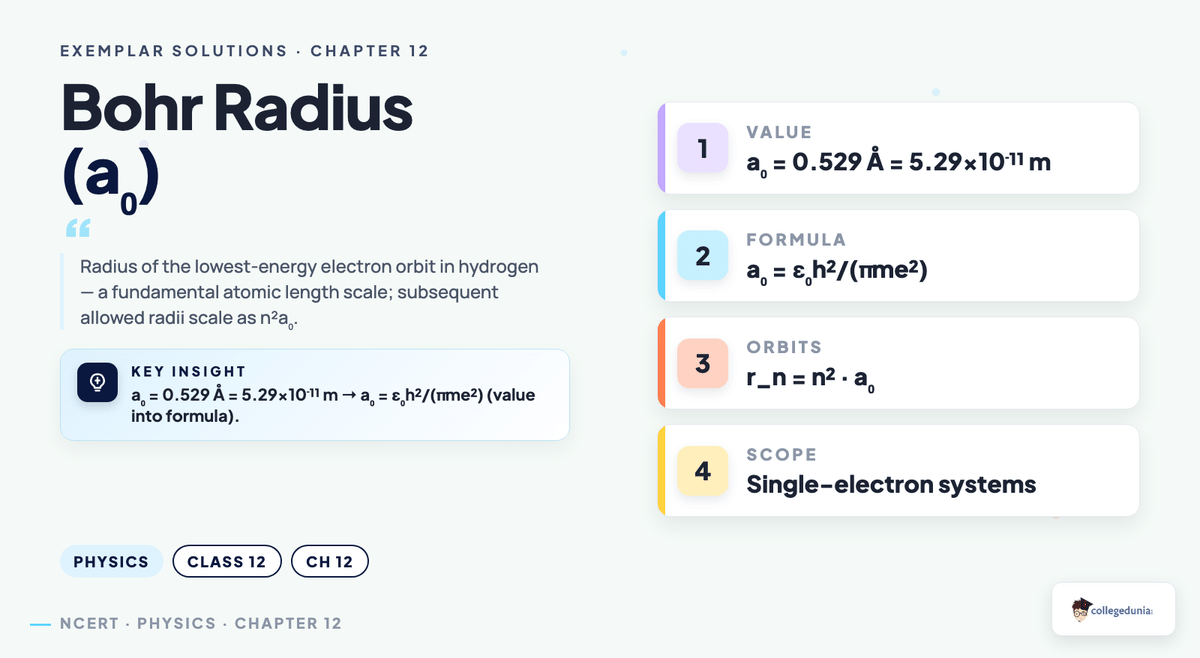



Comments