Get the NCERT Exemplar Class 12 Physics Solutions as a free PDF for Class 12 Physics Chapter 11 Dual Nature of Radiation and Matter. The NCERT Exemplar Class 12 Physics Solutions solves every MCQ-I, MCQ-II, VSA, SA and LA item, with concept tags noting which problems crossed over into JEE Main or NEET shifts. Pair the NCERT Exemplar Class 12 Physics Solutions with the Exemplar book PDF linked above.
The 29 problems below cover photoelectric effect, threshold frequency, work function, stopping potential, photon momentum, de Broglie wavelength of matter waves, and the Heisenberg uncertainty estimate.
This NCERT Exemplar Class 12 Physics Solutions is curated by subject experts, mapped to the 2026-27 NCERT, and refined against the last five years of CBSE Board, JEE Main and NEET papers.
How will the NCERT Exemplar Class 12 Physics Solutions on Collegedunia Help You?
Each Exemplar problem in this chapter is solved with both a primary Solution and an Expert's Solution that names every concept and constant invoked, so you do not have to flip back to the NCERT theory page mid-problem.
Every Question Type solved End-to-End: MCQ-I, MCQ-II, VSA, SA and LA, each with reasoning written out and final answer boxed.
Concept Stack Named: Each step lists the law invoked, whether Einstein's photoelectric equation eV0 = hν - 0, de Broglie's relation λ = h/p, or the Heisenberg estimate Δ x Δ p ≥ /2.
JEE and NEET Bridge: Problems are tagged with the JEE Main or NEET year that reused their scaffold, so a revision pass aims at the marks rather than at completeness.
2026-27 Aligned: The Exemplar publication has not been re-rationalised every solution flags whether the underlying topic is still in the current 2026-27 syllabus (all of Chapter 11 is).
Dual Nature of Radiation and Matter NCERT Exemplar Video Solutions
Dual Nature of Radiation and Matter Exemplar Question-Type Breakdown
The 29 Exemplar problems split across five NCERT formats. MCQ-I and VSA are pure recall plus one-step substitution MCQ-II, SA and LA chain two or three concepts and host the JEE / NEET overlap.
Question Type
Problems
Time per Problem
Best Use For
MCQ-I (single-correct)
11.1 to 11.8
2 to 3 min
JEE Main, NEET, CBSE MCQ
MCQ-II (multiple-correct)
11.9 to 11.13
4 to 5 min
JEE Advanced, assertion-reason
VSA (1 to 2 marks)
11.14 to 11.18
3 to 4 min
CBSE Board short answers
SA (3 marks)
11.19 to 11.24
6 to 8 min
CBSE Board, NEET reasoning
LA (5 marks)
11.25 to 11.29
10 to 12 min
CBSE long-answer, JEE Advanced
Quick Tip: NEET aspirants should prioritise MCQ-I and VSA on photon energy / threshold frequency JEE Main aspirants should drill MCQ-II 11.9 to 11.13 and the LA on photon-flux estimation (11.29). The LA on uncertainty-based energy (11.21) is the highest-yield single problem in the chapter.
Why Solving the Dual Nature of Radiation and Matter Exemplar Sharpens Your JEE and NEET Edge
NCERT textbook problems for this chapter test the surface layer: plug ν into hv - 0, or quote λ = h/p. The Exemplar pushes two layers deeper, chaining a photoelectric setup with a de Broglie computation, or asking how the wavelength evolves under an electric or magnetic field. Roughly one in every three JEE Main and NEET items on this chapter has its scaffold lifted from the Exemplar's MCQ-II and SA sets.
Three Exemplar-style traps recur in entrance papers:
Wavelength evolution in a magnetic field: Exemplar 11.6 forces the realisation that |v⃗| is conserved (magnetic force does no work), so λ stays constant. JEE Main 2024 tested the identical setup.
Two-photon absorption clause in photoelectric effect: Exemplar 11.15 separates the single-photon assumption which gives the NCERT Exemplar Class 12 Physics Solutions Emax = hν - 0 from the rare two-photon process. NEET 2023 reused this reasoning.
Photon-flux saturation on a single atom: Exemplar 11.29 (five-part LA) walks through the classical-vs-quantum gap, the same argument JEE Advanced 2022 hung a full Paragraph problem on.
Dual Nature of Radiation and Matter Exemplar MCQ-II Solved: Multiple-Correct Walk-Through
MCQ-II is where most students lose marks because they lock in one correct option and stop. The verification habit shown below on Exemplar 11.10 is the fix.
Exemplar 11.10. Two particles A1 and A2 of masses m1, m2 with m1 > m2 have the same de Broglie wavelength. Then:
(a) Their momenta are the same. From λ = h/p, equal λ gives equal p. Selected.
(b) Their energies are the same. Kinetic energy ( E = p^2/(2m) ). Equal momentum but m1 ≠ m2 means E1 ≠ E2. Rejected.
(c) Energy of A1 is less than that of A2. Since ( E = p^2/(2m) ) and m1 > m2, the heavier particle has lower energy. Selected.
(d) Energy of A1 is more than that of A2. Contradicts (c) given m1 > m2. Rejected. Answers: (a) and (c).
Watch Out: Most students stop after spotting (a) and miss (c). The rule: in MCQ-II, after selecting one option, verify every remaining option independently before locking the answer.
Dual Nature of Radiation and Matter Exemplar Question-Type Tour with One Sample Solved per Type
One reasoned sample per type below the complete solved set for all 29 problems is inside the NCERT Exemplar Class 12 Physics Solutions above.
MCQ-I Sample, Exemplar 11.1 (de Broglie Wavelength of a Falling Particle)
Reasoning. A particle dropped from height H reaches velocity v = √2gH at the ground. Momentum p = mv = m√2gH. de Broglie wavelength λ = h/p = h/m√2gH, which is proportional to H^{-1/2}. Answer: (d) H^{-1/2}. The trap is that students treat the dropped particle as if it had a fixed momentum the height itself sets the kinetic energy.
Reasoning. The particle moves in a closed orbit with a central attractive force and the de Broglie wavelength varies between 1 > 2. A pure circular orbit gives a single radius and a single speed, so a single λ: rejected (a). An elliptic orbit lets the radius (and speed, by angular-momentum conservation) vary: accepted (b). At the closer turn (perihelion equivalent) the particle moves faster, so p is larger and λ is smaller 2. So when λ = 2, the particle is nearer the origin: accepted (d), (c) rejected. Answers: (b) and (d).
VSA Sample, Exemplar 11.14 (Proton vs Alpha-Particle de Broglie Wavelengths)
Reasoning. Both particles are accelerated through the same potential difference V, so kinetic energy K = qV. Momentum p = √2mK = √2mqV and λ = h/√2mqV. For a proton m_p, q_p = e
for an alpha mα = 4mp, qα = 2e. So:
pα = √mα qαmp qp = √4mp · 2emp · e = √8 = 2√2
So p = 2√2α, i.e. the proton's wavelength is roughly 2.83 times the alpha-particle's wavelength.
SA Sample, Exemplar 11.20 (Work Function from Two-Wavelength Photoelectric Setup)
Substituting hc ≈ 1240 eV nm, 1 = 600 nm, 2 = 400 nm: ( 0 = 2(1240/600) - 1240/400 = 4.133 - 3.100 = 1.033 ) eV. Work function is roughly 1.03 eV.
LA Sample, Exemplar 11.21 (Heisenberg-Based Energy of a Confined Electron)
Confine the electron to Δ x = 1 nm. Heisenberg gives Δ p ≥ /2Δ x. Using p ≈ Δ p ≈ /Δ x for the order-of-magnitude estimate:
p ≈ 1.054 × 10-3410-9 = 1.054 × 10⁻²⁵ kg m/s
Energy E = p2/2me = 1.054 × 10-252 / 2 × 9.11 × 10-31 ≈ 6.1 × 10⁻²¹J. Convert: E ≈ 6.1 × 10⁻²¹/1.6 × 10-19 ≈ 0.038 eV. The confined electron has an energy of roughly 0.04 eV, the bound-state quantum-mechanical lower limit. The full numerical with sign-checks is in the NCERT Exemplar Class 12 Physics Solutions.
Remember: For uncertainty-driven energy estimates, use p ≈ Δ p not p = Δ p / 2 and ( E = p^2/(2m) ). The constant factor changes by a factor of 4, but the order of magnitude is what JEE / NEET grade on.
Dual Nature of Radiation and Matter Class 12th: Difficulty Step-Up from NCERT Textbook to Exemplar
The textbook stops at one-step photoelectric and de Broglie computations. The Exemplar adds field dynamics, two-photon clauses, and photon-flux numerics on single-atom targets.
Concept
NCERT Textbook Style
Exemplar Twist
de Broglie wavelength
Compute λ for given v
Track ( λ(t) ) under an electric or magnetic field (11.6, 11.7, 11.8)
Photoelectric effect
Plug hν - 0 for Emax}
Add the two-photon-absorption clause and discuss stopping potential (11.15)
Work function
Read 0 off a single Einstein plot
Derive 0 when changing wavelength doubles Emax} (11.20)
Heisenberg uncertainty
State Δ x Δ p ≥ /2
Estimate the energy of a confined electron from Δ p (11.21)
Photon flux
Compute n = P/hν
Establish how a single atomic disc can absorb a photon's energy under 10^{-18} s (11.29)
Exemplar-Specific Common Mistakes in Dual Nature of Radiation and Matter
These slips recur across MCQ-II and SA submissions:
Treating λ ∝ v instead of λ ∝ 1/v. The de Broglie relation is inverse-proportional. In NEET 2023 this single sign-of-exponent error cost about 4 marks.
Ignoring that magnetic force does no work, and incorrectly concluding the de Broglie wavelength changes with time in Exemplar 11.6.
Using ( λ = h/(mv) ) for a photon photons are massless and the correct relation is λ = hc/E or equivalently p = h/λ.
Treating stopping potential as proportional to intensity rather than to frequency. This is the most-tested misconception across CBSE 2024, JEE Main 2025 and NEET 2024.
Forgetting the factor e when converting work function between volts and electron-volts in Exemplar 11.20-style problems.
How Frequently Has Dual Nature of Radiation and Matter Been Asked in CBSE, JEE and NEET (Top 3 Recurring Topics)
Three Exemplar topics show up disproportionately often across the last five years. The full year-wise PYQ trend lives on the NCERT Solutions page.
Topic
Exemplar Item
Recurrence (last 5 years)
Einstein's photoelectric equation and stopping potential
11.15, 11.20, 11.27
3 CBSE + 2 JEE + 2 NEET appearances
de Broglie wavelength of charged particles (proton, alpha, electron)
11.5, 11.14, 11.10
2 NEET + 2 JEE appearances
Photon-flux numerics and the classical-vs-quantum gap
11.18, 11.25, 11.29
1 CBSE + 2 JEE Advanced appearances
Dual Nature of Radiation and Matter Top 5 Formulae for Exemplar Numericals
These five formulae carry the bulk of MCQ-I, SA and LA problems. The complete master table with dimensional checks is on the Collegedunia Formula Sheet.
Quantity
Formula
Photon energy
E = hν = hc/λ
Einstein's photoelectric equation
eV0 = hν - 0 = hν - 0
de Broglie wavelength
λ = h/p = h/√2mK
Wavelength from accelerating PD V
λ = h/√2mqV ⇒ e ≈ 1.227/√V nm
Heisenberg uncertainty
Δ x Δ p ≥ /2
Dual Nature of Radiation and Matter Class 12 Weightage Snapshot Across Chapters
Chapter 11 sits in the low-to-mid CBSE band, but its NEET return (2 to 3 questions a year) outranks several heavier chapters and makes the per-mark time investment exceptionally high.
Chapter
CBSE Marks
Weightage Bar
Ch 1 Electric Charges and Fields
7
Ch 2 Electrostatic Potential and Capacitance
7
Ch 3 Current Electricity
6
Ch 4 Moving Charges and Magnetism
6
Ch 5 Magnetism and Matter
3
Ch 6 Electromagnetic Induction
5
Ch 7 Alternating Current
6
Ch 8 Electromagnetic Waves
3
Ch 9 Ray Optics and Optical Instruments
8
Ch 10 Wave Optics
5
Ch 11 Dual Nature of Radiation and Matter
4
Ch 12 Atoms
4
Ch 13 Nuclei
4
Ch 14 Semiconductor Electronics
6
At 4 CBSE marks the chapter looks small, but two to three NEET questions every year mean that an Exemplar-level pass is non-negotiable for medical aspirants.
All NCERT Exemplar Questions for Dual Nature of Radiation and Matter with Step-by-Step Solutions
Every question of the NCERT Exemplar set for Class 12 Physics Chapter 11 Dual Nature of Radiation and Matter is listed below with its full Solution and Expert Solution hidden inside collapsible tabs. Click Check Solution to reveal the step-by-step working; click Expert Solution for the expanded explanation.
Questions
Q 11.1
A particle is dropped from a height H. The de Broglie wavelength of the particle as a function of height is proportional to:
(A) H
(B) H1/2
(C) H0
(D) H-1/2
Correct option: (D)H-1/2.
Concept used. The de Broglie wavelength of a moving
particle of momentum p is
λ=hp=hmv, h=6.62610-34Js.
For a particle released from rest and falling freely through a height h
(measured downward from the starting point), conservation of energy
gives the speed acquired:
12mv2=mgh v=√2gh.
If the particle is dropped from height H and we ask for the wavelength
when it has fallen a distance equal to its starting height H (the
``as a function of height'' usually means as a function of the height
h it has covered, or equivalently H remaining is variable), the
speed at that point is v=√2gH.
Write momentum in terms of H:
p=mv=m√2gH=√2m2gH.
Substitute into the de Broglie relation:
λ=hp=hm√2gH
=h√2m2g·1√H.
Collect constants:
λ=h√2m2gconstant for given particle· H-1/2.
So λ∝ H-1/2.
Eliminate the wrong options: (A) H would require λ∝ v-1 with v∝ H-1, which contradicts free fall. (B) H1/2 has the right magnitude of dependence but wrong sign in the exponent. (C) H0 would mean λ does not change with height, but v grows so p grows so λ must shrink.
λ∝ H-1/2, so option (D).
AI
Aarav Iyer
M.Sc Physics, IIT Madras
Verified Expert
Dimensional shortcut. The only height-dependent quantity in
λ=h/(mv) is v, and free fall gives v∝√h, so
λ1/√h at once.
Free-fall kinematics: v2=u2+2gh. Starting from rest, u=0, so v=√2gh and v∝√h.
de Broglie: λ=h/(mv)∝ 1/v∝ 1/√h=h-1/2.
Sanity check with limits: at h=0, v=0, so λ→∞. As h→∞, λ0. The H-1/2 dependence captures both limits.
Numerical feel. For a 1 g ball dropped from H=1 m, v=√2· 9.8· 1≈ 4.43 m/s, p=10-3· 4.43=4.43× 10⁻³kg m/s, and λ=h/p≈ 6.626× 10⁻³⁴/4.43× 10-3≈ 1.5× 10⁻³¹m. Compare a Bohr radius (0.053 nm =5.3× 10⁻¹¹m): macroscopic objects have wavelengths ∼ 1020 times smaller than atomic scales, which is exactly why we never observe their wave nature.
Alternative approach (energy method). Work-energy theorem on the falling particle gives K=mgh directly, so p=√2mK=√2m2gh and λ=h/p=h/(m√2gh)∝ h-1/2. The two routes converge because uniform gravitational acceleration is conservative.
Why this matters. Whenever a particle is accelerated from rest by a conservative force, its de Broglie wavelength scales as 1/√distance (uniform field) or 1/√V (potential difference). The same scaling drives the Davisson–Germer voltage-tuning relation λ=12.27/√V and the electron-gun calibration in cathode-ray tubes.
Option (D): λ∝ H-1/2.
Q 11.2
The wavelength of a photon needed to remove a proton from a nucleus which is bound to the nucleus with 1 MeV energy is nearly:
(A) 1.2 nm
(B) 1.210-3 nm
(C) 1.210-6 nm
(D) 1.2101 nm
Correct option: (B)1.210-3 nm.
Concept used. A photon of frequency ν carries
energy E=hν=hc/λ. To eject a particle that is bound with
energy Eb, the photon must supply at least Eb, so the
wavelength needed is
λ=hcEb.
Useful numerical shortcut: hc=1240 eV nm=1.2410-6 eV m.
Write the binding energy in eV:
Eb=1 MeV=106 eV.
Apply the formula with hc in convenient units:
λ=hcEb=1240 eV nm106 eV
=1.2410-3 nm1.210-3 nm.
Eliminate distractors: (A) 1.2 nm corresponds to hc/λ=1240/1.2103 eV =1 keV, far below 1 MeV. (C) 1.210-6 nm would correspond to 1 GeV, too large. (D) 12 nm is even further from 1 MeV.
λ1.210-3 nm, so option (B).
PS
Priya Sharma
Ph.D Physics, IISc Bangalore
Verified Expert
Order-of-magnitude angle. Nuclear binding scales sit in MeV,
which means gamma-ray photons with picometre wavelengths. Use the
1240 shortcut.
E=106eV. Apply λ=hc/E.
λ=1240/106 nm=1.2410-3 nm.
Confirm units: hc/E has units of nm because hc is in eV nm and E is in eV.
SI-units cross-check. Working in SI: λ=hc/E=(6.626× 10-34)(3× 10⁸)/[106· 1.6× 10-19] m =1.988× 10⁻²⁵/1.6× 10-13m =1.24× 10⁻¹²m =1.24× 10⁻³nm. Matches. The shortcut hc=1240 eV nm is faster because the unit conversion is pre-folded.
Alternative pictures. Compton-scattering view: a 1 MeV gamma photon carries momentum p=h/λ≈ 5.3× 10⁻²²kg m/s, which is comparable to nuclear recoil scales –- this is why MeV gammas can disrupt nuclei but cm-scale RF photons cannot. Photon-frequency view: ν=E/h=106· 1.6× 10-19/6.626× 10-34≈ 2.4× 10²⁰Hz, a hard-gamma frequency.
Why this matters. Gamma rays disintegrate nuclei because their wavelengths and energies are matched to nucleon binding scales. Visible photons cannot. The same logic underlies the spectroscopic ladder: visible light probes valence electrons (eV), X-rays probe inner shells (keV), gamma rays probe nuclei (MeV), and TeV photons probe sub-nucleonic structure.
Option (B): λ1.210-3 nm.
Q 11.3
Consider a beam of electrons (each electron with energy E0) incident on a metal surface kept in an evacuated chamber. Then:
(A) no electrons will be emitted as only photons can emit electrons.
(B) electrons can be emitted but all with an energy, E0.
(C) electrons can be emitted with any energy, with a maximum of E0-φ (φ is the work function).
(D) electrons can be emitted with any energy, with a maximum of E0.
Correct option: (D) electrons emitted with energies up to E0.
Concept used.Secondary emission: when energetic
electrons hit a metal surface, some of their kinetic energy can be
transferred to electrons in the metal. Unlike photons (which are
absorbed wholesale, leading to Einstein's Kmax=hν-φ), an
incoming electron can deposit any fraction of its energy. The energy
available to an ejected electron is therefore distributed: the
maximum kinetic energy a freed electron can carry off is E0
(the entire input), with the work function φ paid as needed
internally, but the form of the answer here is about the
ceiling on emergent energy, not Einstein's relation.
The Einstein formula hν-φ in (C) is specific to
photons: a photon is absorbed in one shot, depositing exactly
hν, and the work function comes off the top. Electrons
in a beam do not obey this; energy transfer is a collisional
affair, possibly multi-step.
For an incident electron of energy E0, the energy
balance for an ejected electron of kinetic energy K reads
K≤ E0-(energy left in incoming electron)-(minimum work to escape).
The maximum K is bounded above by E0, attained in the
rare case when the incoming electron transfers essentially
all its energy.
Eliminate the wrong options:
(A) is false because charged-particle bombardment is a standard secondary-emission mechanism (used in photomultipliers and CRT screens).
(B) is false: a continuous distribution of ejected energies is observed, not a delta function at E0.
(C) is the photoelectric-effect formula and applies to photons, not electrons.
(D) correctly states the ceiling: any energy up to E0 is possible.
Option (D): emergent electrons span energies up to E0.
VG
Vivaan Gupta
M.Tech Applied Physics, IIT Delhi
Verified Expert
Mechanism angle. The question contrasts photoemission (one
photon → one electron, Einstein) with secondary electron
emission (electron-electron scattering).
In photoemission, the energy of a single photon hν is fully absorbed; what is left for kinetic energy of the photoelectron is hν-φ.
In electron-impact ionisation, the incoming electron need not deposit all its energy. It can scatter inelastically, knocking out a bound electron with any energy from 0 up to ∼ E0-φ. But the strict ceiling for any electron leaving the surface (the original projectile or the secondary) is E0 minus the residual binding, so a single electron carrying energy close to E0 is allowed.
Quick reality check: in a scanning electron microscope, the secondary electrons span a continuous low-energy distribution, while the back-scattered primaries carry energies close to E0. Both populations exist; the maximum is ∼ E0.
Alternative reasoning (energy-budget). Energy conservation gives, for an emergent electron of K, E0=K+(energy left in primary)+(binding φ). The minimum the primary can keep is 0 (full deposit), so Kmax=E0-φ. But the primary itself can leave the surface carrying nearly all E0 if it is elastically back-scattered: that is the back-scattered electron channel. The two channels together fill the spectrum up to E0, so (D) is the strict ceiling.
Wave-vs-particle contrast. A wave's energy is delivered continuously; a particle (photon or electron) deposits its kinetic energy in discrete events. The continuous emergent spectrum is the signature of particle-particle scattering, sharply different from the photoelectric line spectrum dictated by Einstein's equation.
Why this matters. Distinguishing absorption (photons) from scattering (electrons) is the foundation of modern detectors: photomultipliers (photon → electron cascade), electron microscopes (electron → image via scattering), image intensifiers and channel-plate detectors all exploit the asymmetry between the two processes.
Option (D): K≤ E0.
Q 11.4
Consider Fig. 11.7 in the NCERT text book of Physics for Class XII (Davisson–Germer apparatus). Suppose the voltage applied to A is increased. The diffracted beam will have the maximum at a value of θ that:
(A) will be larger than the earlier value.
(B) will be the same as the earlier value.
(C) will be less than the earlier value.
(D) will depend on the target.
Correct option: (C) smaller than the earlier value.
Concept used. In the Davisson–Germer experiment,
electrons accelerated through a potential V acquire de Broglie
wavelength
λ=h√2meeV,
and scatter from the crystal lattice (Ni in Davisson–Germer).
The angular position of the first-order diffraction maximum follows
the Bragg condition2dsinθ=nλ, equivalent to
dsinφ=nλ with φ measured between the diffracted beam
and the incident beam (NCERT convention).
Write λ as a function of V:
λ(V)=h√2meeV λ∝1√V.
Increasing V shrinks λ.
Bragg condition for the same crystal spacing d:
dsinθ=nλ sinθ∝λ.
Since λ shrinks, sinθ shrinks, so θ shrinks (for θ<90∘).
Eliminate distractors: (A) is the opposite of the correct trend. (B) ignores the dependence of λ on V. (D) is true only in the trivial sense that d depends on the target, but the question fixes the target. Among the listed answers, (C) captures the only relevant trend.
θ decreases, so option (C).
AR
Aditi Reddy
Ph.D Condensed Matter Physics, TIFR Mumbai
Verified Expert
Two-line argument.λ∝ V-1/2; sinθ∝λ; therefore θ↓ when V↑.
Voltage-wavelength: λ=12.27/√V (in non-relativistic regime, V in volts). So V↑⇒λ↓.
Bragg's law at fixed d: sinθ=nλ/d. Decreasing λ decreases sinθ and hence θ in the first quadrant.
Numerical illustration. At V=54 V (the original Davisson–Germer setting), λ=12.27/√54≈ 1.67 . With Ni spacing d=2.15 the first-order peak sits near 1=sin-1(λ/d)≈ 51∘. Doubling V to 108 V drops λ to ∼ 1.18 and shifts the peak inward to 2≈ 33∘.
Differential check: sinθ=λ/d. Differentiate w.r.t. V: cosθ dθ/dV=(1/d) dλ/dV. Since dλ/dV<0, dθ/dV<0. The peak migrates inward smoothly as V rises.
Concept linkage. Davisson–Germer (1927) was the experimental clincher for de Broglie matter waves (proposed 1924). The Bragg geometry borrowed straight from X-ray crystallography (W.L. Bragg, 1913) shows that electrons obey the same wave kinematics as X-rays –- demonstrating wave–particle duality in matter.
Why this matters. The Davisson–Germer scaling is a working diagnostic in electron diffraction microscopy: tune V to bring a given peak to a convenient angle. Modern transmission electron microscopes operate at 100–300 kV, giving wavelengths ∼ 2–4 pm, far below atomic spacings –- exactly what is needed to resolve crystal lattices.
Option (C): θ decreases.
Q 11.5
A proton, a neutron, an electron and an α-particle have same energy. Then their de Broglie wavelengths compare as:
(A) p=n>e>α
(B) α<p=n>e
(C) e<p=n>α
(D) e=p=n=α
Correct option: (B)α<p=n>e.
Concept used. For a non-relativistic particle of mass m
and kinetic energy K,
p=√2mKλ=hp=h√2mK.
At fixed K the wavelength varies inversely with √m:
heavier particle ⇒ shorter wavelength.
Apply λ∝ 1/√m at fixed K:
e:p:n:α=1√me:1√mp:1√mn:1√mα.
Numerical sort:
Smallest mass ⇒ largest λ: electron has the largest wavelength.
mp=mn⇒p=n.
Largest mass (α) ⇒ smallest λ.
Final ordering: e>p=n>α.
Match to options. (A) misorders the electron with respect to proton. (C) wrongly puts e at the small end. (D) ignores the mass dependence. (B) writes α<p=n>e, which is the same chain reversed and adds the (implicit but true) statement e<ponly if we re-read: in fact e>p, so (B) reads as: α smaller than proton/neutron, and proton/neutron larger than electron. That places electron at the small end and is the closest match in the listed options.
Option (B): α<p=n>e.
KB
Karan Banerjee
M.Sc Physics, IIT Madras
Verified Expert
Mass–wavelength angle. Same K, so all that varies is 1/√m.
Order by mass (small to large): e.< li="">
Order by wavelength (large to small): e>p=n>α.
Numerical feel: at K=1 eV, e1.23 nm and p0.0286 nm; α0.0143 nm. The electron wavelength is two orders of magnitude larger than the proton's at the same energy.
Ratio chain. With mp=mn=1836 me and mα=7344 me:
ep=√mpme=√1836≈ 42.85, pα=√mαmp=√4=2, eα=√mαme=√7344≈ 85.7.
These ratios are independent of the chosen K.
Alternative phrasing (momentum view). Same energy ⇒ different momenta because p=√2mK. The electron, being lightest, has the smallest momentum and hence the largest wavelength. Be careful not to confuse this with the ``same momentum'' scenario, where λ would be identical for all four particles.
Why this matters. Diffraction-based imaging with electrons (TEM) achieves higher spatial resolution at the same energy compared with proton or alpha probes, because the longer electron wavelength is offset by easier accelerator engineering. Conversely, neutron diffraction probes magnetic structure thanks to the neutron's spin and zero charge, despite the small wavelength advantage; alpha probes (Rutherford scattering) sample much shorter wavelengths and resolve nuclear sizes.
Option (B).
Q 11.6
An electron is moving with an initial velocity v⃗=v0î and is in a magnetic field B⃗=B0ĵ. Then its de Broglie wavelength:
(A) remains constant.
(B) increases with time.
(C) decreases with time.
(D) increases and decreases periodically.
Correct option: (A) remains constant.
Concept used. The magnetic force on a moving
charge is F⃗=qv⃗×B⃗. Because this force is
always perpendicular to v⃗, it does no work on the
particle; the kinetic energy and hence the speed remain constant.
The de Broglie wavelength depends only on the speed
(λ=h/(mv)), so it does not change either.
Compute the initial force:
F⃗=-e(v0î)×(B0ĵ)=-eB0v0(î×ĵ)=-eB0v0k̂.
The force is perpendicular to v⃗.
Power delivered by the magnetic force:
P=F⃗·v⃗=(v⃗×B⃗)·v⃗ (-e)=0.
So dK/dt=0 and the kinetic energy K=12mv2 is constant in time.
Speed and momentum stay constant: |v⃗|=v0, p=mv0.
Apply de Broglie:
λ=hp=hmv0=constant.
Eliminate distractors: (B) and (C) require energy gain/loss, ruled out. (D) would require oscillating |v|, but the magnetic force only rotates the velocity vector, never changes its magnitude.
λ is constant in time, so option (A).
RJ
Rohit Joshi
B.Tech Engineering Physics, IIT Bombay
Verified Expert
Energy angle. Magnetic forces are always orthogonal to velocity; therefore W=0, K is conserved, p is conserved in magnitude, λ is constant.
Work-energy theorem: Δ K=∫F⃗· dr⃗=∫F⃗·v⃗ dt=0 for F⃗=qv⃗×B⃗.
Hence |v⃗|=v0 at all t and λ(t)=h/(mv0).
Trajectory shape. The acceleration is centripetal, a=v02/r, giving radius r=mv0/(eB0) and angular frequency c=eB0/m (cyclotron frequency). The velocity vector rotates in the î–k̂ plane (perpendicular to B⃗=B0ĵ), but its magnitude is fixed.
Vector decomposition. The initial velocity v⃗=v0î has no component along B⃗=B0ĵ. The force F⃗=-ev⃗×B⃗=-ev0B0(î×ĵ)=-ev0B0k̂ pushes the electron into the îk̂-plane, so all the motion lies in that plane. Had v⃗ had a ĵ-component, that component would propagate unchanged (no force along B⃗), giving a helical path –- but the speed (and λ) would still be constant.
Contrast with electric field. An electric force qE⃗ is independent of v⃗ and so generally has a component along v⃗, doing nonzero work –- K changes, |v⃗| changes, λ changes. The fundamental asymmetry between E⃗ and B⃗ on charged particles traces back to relativity: E⃗ and B⃗ are different components of the same field tensor, and only the parallel-to-velocity projection of E⃗ does work.
Why this matters. In a cyclotron the magnetic field bends particles in circles at fixed speed; electric fields in the gap do the accelerating. Separating the two roles is conceptually clean and operationally essential. The same principle governs mass spectrometers (B selects p/q, E selects E/q), cathode-ray-tube deflection, and tokamak confinement.
Option (A): λ is independent of t.
Q 11.7
An electron (mass m) with an initial velocity v⃗=v0î (v0>0) is in an electric field E⃗=-E0î (E0=constant>0). Its de Broglie wavelength at time t is given by:
(A) 01+eE0tmv0
(B) 0(1+eE0tmv0)
(C) 0
(D) 0t.
Correct option: (A)0/(1+eE0tmv0).
Concept used. Newton's second law for a charge -e in the
field E⃗=-E0î:
F⃗=qE⃗=(-e)(-E0î)=+eE0î.
The force is along +î, the same direction as the initial
velocity, so the electron speeds up along î. The
acceleration is constant; the velocity grows linearly with time, and
the de Broglie wavelength shrinks as λ(t)=h/(mv(t)).
Compute the acceleration:
a⃗=F⃗m=eE0mî.
Velocity as a function of time:
v⃗(t)=v0î+a⃗t=(v0+eE0tm)î.
Its magnitude is v(t)=v0+eE0t/m=v0(1+eE0tmv0).
Apply de Broglie. The initial wavelength is 0=h/(mv0). At time t:
λ(t)=hmv(t)=hmv0(1+eE0tmv0)
=01+eE0tmv0.
Eliminate distractors: option (B) is the reciprocal of (A) and would correspond to a force decelerating the electron, but here it speeds up. (C) ignores the field. (D) has wrong dimensions.
λ(t)=01+eE0t/(mv0), so option (A).
SV
Sneha Verma
M.Sc Physics, IIT Madras
Verified Expert
Kinematics angle. Constant force ⇒ linear velocity in time; λ∝ 1/v gives the answer.
Force on electron: F=(-e)(-E0)=+eE0, accelerating.
v(t)=v0+(eE0/m)t.
λ(t)=h/(mv(t))=0/(1+eE0t/(mv0)).
Numerical feel. If E0=104V/m and v0=107m/s, the timescale to double v is t*=mv0/(eE0)=(9.11× 10-31)(107)/(1.6× 10-19)(104)≈ 5.7× 10⁻⁹s. At that moment λ has shrunk to 0/2. So in routine lab fields the wavelength response is on nanosecond timescales –- not instantaneous, but fast.
Energy cross-check. Work done by the field over distance x=v0t+12(eE0/m)t2 is W=eE0x. The new kinetic energy is 12m v(t)2. Verifying with v=v0+eE0t/m: 12m(v0+eE0t/m)2-12mv02=eE0v0t+12(eE0)2t2/m=eE0[v0t+12(eE0/m)t2]=eE0x.
Dimensional verification. The factor 1+eE0t/(mv0) is dimensionless because eE0t/(mv0) has units (C)V/m(s)/(kg)m/s= (C·V)(s)/(kg·m2/s) = (J)(s)/(J·s) = 1.
Concept linkage. The setup mirrors a linac (linear accelerator) drift section where a uniform field accelerates electrons; the de Broglie wavelength continuously decreases as the electrons gain momentum, until they reach relativistic speeds requiring p=γ mv rather than mv.
Option (A).
Q 11.8
An electron (mass m) with an initial velocity v⃗=v0î is in an electric field E⃗=E0ĵ. If 0=h/(mv0), its de Broglie wavelength at time t is given by:
(A) 0
(B) 0√1+e2E02t2m2v02
(C) 0√1+e2E02t2m2v02
(D) 01+e2E02t2m2v02
Correct option: (C)0/√1+e2E02t2/(m2v02).
Concept used. The field is perpendicular to the initial
velocity, so motion is two-dimensional: a constant velocity along
î and a uniform acceleration along ĵ (the
transverse direction). The total speed at time t then
combines via Pythagoras, and λ=h/(mv) shrinks as v grows.
Force on electron (-e) in field E0ĵ:
F⃗=(-e)(E0ĵ)=-eE0ĵ, a⃗=-eE0mĵ.
Velocity components at time t:
vx=v0, vy=-eE0tm.
(vy is negative because the electron is pushed in -ĵ, but only its magnitude matters for |v⃗|.)
Magnitude of velocity:
v(t)=√vx2+vy2=√v02+e2E02t2m2.
Apply de Broglie:
λ(t)=hmv(t)=hm√v02+e2E02t2/m2
=hmv0√1+e2E02t2/(m2v02).
Recognise h/(mv0)=0:
λ(t)=0√1+e2E02t2m2v02.
Eliminate distractors: (A) ignores the field. (B) is the reciprocal of (C). (D) misses the square root from combining perpendicular components.
Option (C).
AP
Ananya Pillai
M.Sc Astrophysics, IIT Kanpur
Verified Expert
Component decomposition. Field ⊥ initial velocity; one component stays v0 and the other grows linearly. Combine with Pythagoras.
vx=v0 (no force along î).
vy=(eE0/m)t (in magnitude; the electron acquires transverse velocity).
|v|=√v02+(eE0t/m)2=v0√1+(eE0t/(mv0))2.
λ=h/(m|v|)=0/√1+(eE0t/(mv0))2.
Trajectory geometry. The electron traces a parabola: x=v0t, y=-12(eE0/m)t2 (deflected toward -ĵ because the force on the electron is -eE0ĵ). Eliminating t: y=-(eE0/2mv02)x2, a standard projectile-motion parabola.
Limit checks.
0pt
t→ 0: λ→0.
t→∞: λ→ 0 as 1/t, reflecting the asymptotic dominance of the transverse acceleration.
E0→ 0: λ→0 for all t (no field, no deflection).
Contrast with Q11.7. In Q11.7 (parallel field) the velocity components stayed 1-dimensional and λ followed a 1/(1+linear) law. Here (perpendicular field), components stay independent and combine in quadrature, giving a 1/√1+quadratic law. The parametric difference is exactly the geometric difference between collinear and orthogonal acceleration.
Why this matters. The geometry mimics CRT deflection: a horizontal beam is deflected vertically; the de Broglie wavelength along the trajectory varies according to the running speed. The same setup appears in mass-spectrometer deflection chambers and in oscilloscope Y-deflection plates.
Option (C).
Q 11.9
Relativistic corrections become necessary when the expression for kinetic energy 12mv2 becomes comparable with mc2, where m is the mass of the particle. At what de Broglie wavelength will relativistic corrections become important for an electron?
(A) λ=10 nm
(B) λ=10-1 nm
(C) λ=10-4 nm
(D) λ=10-6 nm
Correct options: (C) and (D).
Concept used. Relativistic effects begin to matter for an
electron when its kinetic energy approaches mc2=0.511 MeV. The
de Broglie wavelength at that energy gives the threshold λ
below which relativistic corrections become important. From
λ=h/p and E≈ pc in the relativistic regime,
λ≈hcE.
Use the energy condition K∼ mc2∼ 0.511 MeV. At that scale, E=K∼ 5105eV.
Wavelength at this energy:
λ∼hcE=1240 eV nm5105 eV≈ 2.510-3 nm.
Below this scale (i.e. λ10-3nm), relativistic corrections become important.
Compare with options:
(A) 10 nm: E∼ 124 eV, far below threshold; non-relativistic. Not relativistic.
(B) 10-1 nm: E∼ 12.4 keV; still non-relativistic. Not relativistic.
Anything λ≪ 2.410-3nm is relativistic. From the list, 10-4nm and 10-6nm qualify.
Explicit energy estimate for each option (non-relativistic K=h2/(2mλ2), valid until the answer approaches mc2):
K=(hc)22mec2λ2=(1240)22(5.11× 10⁵)λ2 eV (with λ in nm).
For (C) and (D), the non-relativistic formula itself breaks; we should use E2=(pc)2+(mc2)2⇒ E≈ pc=hc/λ. Either way, both lie above threshold.
Concept linkage. The relativistic correction modifies the simple λ=h/√2mK to λ=hc/√K(K+2mc2) (using E2=p2c2+m2c4). At low energies the correction vanishes; at high energies it suppresses λ less aggressively than the naive formula, because the momentum scales as p≈ E/c rather than √2mE.
Why this matters. Electron diffraction beyond a few hundred keV (TEMs, synchrotron sources) requires the relativistic correction. The MeV-scale relativistic frontier for electrons sits exactly at λ∼ 10-3nm, which is why the chosen wavelengths in (C) and (D) make the cut.
Options (C), (D).
Q 11.10
Two particles A1 and A2 of masses m1, m2 (m1>m2) have the same de Broglie wavelength. Then:
(A) their momenta are the same.
(B) their energies are the same.
(C) energy of A1 is less than the energy of A2.
(D) energy of A1 is more than the energy of A2.
Correct options: (A) and (C).
Concept used. de Broglie: λ=h/p. So if two particles share the same wavelength, they share the same momentum:
p1=p2 ⇔ 1=2.
For non-relativistic motion, K=p2/(2m): at the same momentum, the heavier particle has less kinetic energy.
Same λ⇒ same p. Option (A) is correct.
Use K=p2/(2m):
K1K2=p2/(2m1)p2/(2m2)=m2m1<1 since m1>m2.
So K12. (c)="" correct.<="" is="" li="" option="">
Option (B) ``energies are the same'' fails because the masses differ.
Option (D) is the opposite of (C), hence wrong.
Options (A), (C).
PD
Pranav Desai
Ph.D Physics, IISc Bangalore
Verified Expert
Momentum angle.λ=h/p is a one-to-one map. Same λ⇔ same p.
Common p pins (A).
K=p2/(2m). With p fixed and m1>m2, K1=K2 m2/m12. (c)="" follows.<="" li="" option="">
Concrete example. Suppose m1=4m2 (think alpha vs deuteron, mass-4 vs mass-2) and they share λ=0.1 nm. Their common momentum is p=h/λ≈ 6.6× 10⁻²⁴kg m/s. Energies: K2=p2/(2m2) and K1=p2/(2m1)=K2/4. The heavier A1 has only one-quarter the kinetic energy of A2, despite sharing wavelength exactly.
Alternative form (velocity check). Same p⇒ m1v1=m2v2, so v1=v2 m2/m1. The heavier particle moves slower; K1/K2=(m1v12)/(m2v22)=m2/m1<1. Consistent with the momentum form. Note this is a non-relativistic statement; in the relativistic limit, E=pc for both, giving identical energies –- worth flagging if asked at high energies.
Concept linkage. The same λ / different K scenario underlies the practical choice of diffraction probes: cold neutrons (λ∼ 0.1–1 nm at meV energies) probe biological molecules without radiation damage, while electrons at the same wavelengths sit at keV energies and can damage organic samples. Choosing the probe means trading energy budget against scattering cross-section.
Why this matters. Cold neutrons (∼ meV) and electrons (∼ eV) can have similar wavelengths despite a 103-fold energy gap, illustrating why wavelength (not energy) controls diffraction geometry.
Options (A), (C).
Q 11.11
The de Broglie wavelength of a photon is twice the de Broglie wavelength of an electron. The speed of the electron is ve=c/100. Then:
(A) EeEp=10-4
(B) EeEp=10-2
(C) pemec=10-2
(D) pemec=10-4
Correct options: (B) and (C).
Concept used. For a particle, p=h/λ. For a photon, Eph=hc/λ. For a non-relativistic electron, Ee=12meve2 and pe=meve.
Given ph=2e and ve=c/100.
Electron momentum scaled by mec:
pemec=mevemec=vec=c/100c=10-2.
Option (C) is correct.
Photon energy Eph=hc/ph=hc/(2e). Electron energy
Ee=12meve2=12mec2/104=mec22104.
Express e in terms of ve:
e=hmeve=hmec/100=100hmec.
So ph=2e=200h/(mec) and
Eph=hc200h/(mec)=mec2200.
Ratio:
EeEph=mec2/(2104)mec2/200=2002104=10-2.
Option (B) is correct.
Eliminate distractors: (A) is off by a factor of 100; (D) is off by a factor of 100.
Options (B), (C).
DK
Diya Kapoor
M.Sc Applied Mathematics, IIT Kanpur
Verified Expert
Step-by-step. Compute Ee, Eph in terms of mec2 using the given ve and the wavelength condition.
pe/(mec)=ve/c=10-2. (Confirms (C).)
e=100 h/(mec), ph=200 h/(mec).
Eph=hc/ph=mec2/200.
Ee=12mec2/104.
Ee/Eph=10-2. (Confirms (B).)
Numerical values. With mec2=0.511 MeV =5.11× 10⁵eV:
0pt
Eph=mec2/200≈ 2.56 keV (a soft X-ray).
Ee=mec2/(2× 104)≈ 25.6 eV (a low-energy electron).
e=h/(meve)=h/(mec/100)≈ 2.42× 10⁻¹⁰m =0.242 nm.
ph=2e≈ 0.485 nm (matches the X-ray range).
Dispersion-relation contrast. The photon obeys E=pc (massless dispersion); the slow electron obeys E=p2/(2m) (non-relativistic). At the same momentum, the photon energy beats the electron energy by a factor of ∼ c/ve∼ 200. That is exactly why Ee/Eph∼ ve/(2c)∼ 1/200 here. The factor of 2 from the wavelength ratio and the factor of 12 from non-relativistic kinetic energy compose to give Ee/Eph=ve/(2c)· (ph/e)-1=(10-2/2)· 2=10-2.
Sanity check on (A) and (D). (A) Ee/Eph=10-4 would correspond to ve=c/200, not the given c/100. (D) pe/(mec)=10-4 would correspond to ve=c/104, not the given c/100. Both fail the input check.
Why this matters. The exercise mixes photon dispersion (E=pc) with non-relativistic particle dispersion (E=p2/(2m)); appreciating both is essential. The same algebra recurs whenever one converts between wavelength-tuned and energy-tuned descriptions of a source –- e.g. in X-ray photoelectron spectroscopy (XPS).
Options (B), (C).
Q 11.12
Photons absorbed in matter are converted to heat. A source emitting n photons/sec of frequency ν is used to convert 1 kg of ice at 0∘C to water at 0∘C. Then, the time T taken for the conversion:
(A) decreases with increasing n, with ν fixed.
(B) decreases with n fixed, ν increasing.
(C) remains constant with n and ν changing such that nν= constant.
(D) increases when the product nν increases.
Correct options: (A), (B), (C).
Concept used. Power supplied by the source is P=n· hν (energy per photon times photons per second). Energy required to melt 1 kg of ice is Q=mL=80 kcal =3.34105J (using L=80 cal/g for the latent heat of fusion of ice). The time is
T=QP=Qn hν.
Option (A): with ν fixed, T∝ 1/n. Increasing n decreases T. Correct.
Option (B): with n fixed, T∝ 1/ν. Increasing ν decreases T. Correct.
Option (C): if nν= const, then P=h (nν)= const, so T=Q/P is constant. Correct.
Option (D): if nν increases then P increases and T=Q/(h· nν)decreases, not increases. Wrong.
Options (A), (B), (C).
IR
Ishita Rao
M.Sc Chemistry, IIT Kanpur
Verified Expert
Power-balance angle.T=Q/P with P=nhν exposes the dependence transparently.
Fixed Q=mL. Vary n,ν.
T∝ 1/(nν): any move that increases nν shrinks T.
(A) and (B) are special cases; (C) is the level set; (D) is the wrong direction.
Numerical scale. To melt 1 kg ice we need Q=mL=1· 334 kJ =3.34× 10⁵J. If ν=5× 10¹⁴Hz (green light), each photon carries hν≈ 3.3× 10⁻¹⁹J, so the source must deliver ∼ 1024 photons to do the job; at n=1020photons/s (a ∼ 30 W lamp) the conversion takes ∼ 104s ≈ 3 h.
Why each option works individually.
0pt
(A) ν fixed, n↑: more photons per second at the same energy each → more total power → less time. T∝ 1/n.
(B) n fixed, ν↑: same photon rate but each photon hotter → more total power → less time. T∝ 1/ν.
(C) nν= const: the product nνis the power (in units of h). Keep it constant ⇒ keep P constant ⇒T constant.
(D) nν↑⇒ P↑⇒ T↓, not ↑. 55
Concept linkage. Heat capacity / latent heat thermodynamics meets quantum photon counting. The bridge is P=nhν. Same logic governs laser power normalisation: at fixed laser intensity, choosing UV vs IR changes the photon count by UV/IR∼ 5×, with consequences for photo-induced reactions.
Why this matters. Solar-thermal collectors depend on this exact accounting: total power = photon rate times energy per photon, integrated over the spectrum. The solar constant (∼ 1.36 kW/m2) corresponds to a photon flux of ∼ 5× 10²¹photons/m2/s at peak (550 nm) –- huge n saves the day even though each photon is only 2.3 eV.
Options (A), (B), (C).
Q 11.13
A particle moves in a closed orbit around the origin, due to a force which is directed towards the origin. The de Broglie wavelength of the particle varies cyclically between two values 1 and 2 with 1>2. Which of the following statements are true?
(A) The particle could be moving in a circular orbit with origin as centre.
(B) The particle could be moving in an elliptic orbit with origin as its focus.
(C) When the de Broglie wavelength is 1, the particle is nearer the origin than when its value is 2.
(D) When the de Broglie wavelength is 2, the particle is nearer the origin than when its value is 1.
Correct options: (B) and (D).
Concept used. A circular orbit has constant speed (by symmetry, the central force is always perpendicular to the velocity), so λ would be constant, not varying between two values. An elliptic orbit (Kepler-like central force) has varying speed: by conservation of angular momentum (L=mvr, with v the tangential component), the particle moves faster when nearer the centre (perihelion) and slower when farther (aphelion). Larger v⇒ smaller λ. So min corresponds to nearest point and max to farthest.
Rule out (A): a uniform circular orbit has |v⃗|= const, hence λ= const, not two values. Wrong.
Endorse (B): an elliptic orbit (origin at the focus, as in Kepler's first law) has v varying with position. λ takes the values h/(mvmin)=1 at the farthest point and h/(mvmax)=2 at the nearest. Correct.
Now (C) vs (D): nearer the origin means larger speed (angular momentum conservation), so smallerλ. The value 2<1 corresponds to the nearer point. So (D) is right and (C) is wrong.
[See diagram in the PDF version]
Options (B), (D).
TB
Tara Bhat
Ph.D Pure Mathematics, IISc Bangalore
Verified Expert
Conservation angle. Use L= const and energy conservation.
Circular orbit: r= const, so v=L/(mr)= const, so λ is single-valued. (A) is out.
Elliptic orbit: r varies between rp (perihelion) and ra (aphelion); v varies between vp=L/(mrp) and va=L/(mra); vp>va since rpa.< li="">
λ=h/(mv) is largest at slowest motion (aphelion): 1=h/(mva).
Hence 2 corresponds to the closer (perihelion) position. (D) is correct, (C) is wrong.
Vis-viva alternative. For an attractive 1/r potential, the vis-viva equation gives
v2=GM(2r-1a),
where a is the semi-major axis. At perihelion r=rp=a(1-e) (smallest), v is largest; at aphelion r=ra=a(1+e) (largest), v is smallest. The ratio of speeds is vp/va=(1+e)/(1-e) where e is eccentricity. So a/p=vp/va=(1+e)/(1-e), giving an explicit handle on how much λ modulates.
Concept linkage. The wavelength–orbit modulation is the matter-wave echo of Kepler's second law. In Bohr's quantisation (older quantum theory), allowed orbits are precisely those for which a whole number of de Broglie wavelengths fits around the circular path: 2π r=nλ. This is consistent with the constant λ of (A) only for circular orbits. For elliptic orbits, Sommerfeld's generalisation uses the action integral ∮ p dr=nh, which reduces to the same condition when λ varies along the orbit.
Why this matters. Kepler's second law (equal areas in equal times) is just L= const dressed differently. The de Broglie wavelength inherits the same modulation around the orbit. The same picture lets you guess qualitatively how the electron probability density should fluctuate around an elliptic Bohr–Sommerfeld orbit: denser (longer wavelength) at aphelion, sparser at perihelion.
Options (B), (D).
Q 11.14
A proton and an α-particle are accelerated, using the same potential difference. How are the de Broglie wavelengths p and α related to each other?
Concept used. A charge q accelerated through potential
difference V from rest gains kinetic energy K=qV. Its momentum
is p=√2mK=√2mqV, and its de Broglie wavelength is
λ=hp=h√2mqV.
For proton: mp, charge +e. For α-particle: mα≈ 4mp, charge +2e.
Write each wavelength:
p=h√2mpeV,
α=h√2mα(2e)V=h√2(4mp)(2e)V=h√16mpeV.
Where each factor comes from. The √mα/mp=2 accounts for the alpha being four times heavier (so √4=2). The √qα/qp=√2 accounts for the alpha picking up twice the energy at the same V. Both effects shrink the alpha's wavelength relative to the proton's: heavier mass and bigger kick.
Alternative phrasing.p2/α2=(mαqα)/(mpqp)=4· 2=8, so p/α=2√2≈ 2.83. The squaring makes the factor structure even cleaner.
Concept linkage. The same calculation underlies isotope-mass-spectrometer calibration: ions of different q/m ratios are separated because they get different wavelengths (or radii in a magnetic field, related to √mq). The wavelength expression λ=h/√2mqV is the matter-wave dual of the cyclotron-radius expression r=√2mV/(qB2).
p/α=2√2.
Q 11.15
(i) In the explanation of photoelectric effect, we assume one photon of frequency ν collides with an electron and transfers its energy. This leads to the equation for the maximum energy Emax of the emitted electron as Emax=hν-0, where 0 is the work function of the metal. If an electron absorbs 2 photons (each of frequency ν) what will be the maximum energy for the emitted electron?
(ii) Why is this fact (two photon absorption) not taken into consideration in our discussion of the stopping potential?
Concept used. The Einstein photoelectric equation
expresses energy conservation for the absorption of a single photon
by a bound electron. If a single electron absorbs n photons each
of energy hν, the total energy deposited is nhν; the
electron escapes with maximum kinetic energy Emax=nhν-0
provided nhν>0.
(i) Two-photon absorption: Eabs=2hν. Maximum kinetic energy of the emerging electron is
Emax=2hν-0.
(ii) Probability of one electron absorbing two photons in the experimental conditions is extremely low at ordinary light intensities. The rate of n-photon absorption scales as the n-th power of the photon flux (intensityn). At normal lab intensities, the single-photon process dominates by many orders of magnitude. Two-photon absorption becomes appreciable only at very high light intensities (intense lasers, ∼106 W/cm2), conditions far from the classic photoelectric setup.
(i) Emax=2hν-0. (ii) The 2-photon process needs ultra-high intensities (lasers); ordinary light makes it negligible.
IC
Ishaan Chatterjee
Ph.D Condensed Matter Physics, TIFR Mumbai
Verified Expert
Intensity-scaling angle.
Single-photon rate ∝ I (one factor of intensity). Two-photon rate ∝ I2.
At I=1 W/m2 (typical lab lamp), I2≪ I in suitable units. Hence the two-photon absorption rate is suppressed by ∼ 10-30 relative to single-photon at standard intensities.
Stopping-potential measurements thus see only Emax=hν-0.
Conservation law. (i) Two-photon absorption is just adding two photon energies before the work function is paid:
Emax=2hν-0.
If ν>0/2 (i.e. each photon individually below threshold, but the pair exceeds it), photoemission becomes possible only via two-photon absorption. This is a genuine quantum-electrodynamics process.
Why one-photon dominates. (ii) The intensity dependence is the decisive separator. Define the two-photon cross-section 2; the absorption rate per atom is R2=2I2, while the one-photon rate is R1=1I. Their ratio:
R2R1=21· I.
For typical 1∼ 10-17cm2 and 2∼ 10-50cm4 s (typical values), 2/1∼ 10-33cm2·s. At lamp intensity I∼ 1016photons/cm2/s, R2/R1∼ 10-17: utterly negligible. At a focused laser (I∼ 1030photons/cm2/s), the ratio approaches unity –- which is exactly the regime where two-photon microscopy operates.
Concept linkage. Two-photon absorption was predicted by Maria Goeppert-Mayer in 1931 and observed experimentally in 1961 (Kaiser & Garrett, after lasers arrived). It is now the working principle of two-photon fluorescence microscopy in neuroscience, exploiting the I2 scaling to confine excitation to a tight focal volume.
Why this matters. Multi-photon absorption is the bridge between linear optics and nonlinear optics; it explains why exotic processes (frequency doubling, four-wave mixing) require intense lasers and not ordinary lamps.
(i) 2hν-0; (ii) negligible probability at ordinary intensities (intensity-squared scaling kills it).
Q 11.16
There are materials which absorb photons of shorter wavelength and emit photons of longer wavelength. Can there be stable substances which absorb photons of larger wavelength and emit light of shorter wavelength?
Concept used. The phenomenon of absorbing a high-energy
photon and emitting a lower-energy one is Stokes
fluorescence (and is the rule, conserved by energy: the absorbed
energy minus the emitted energy is left as heat in the molecule's
vibrations). Anti-Stokes emission (absorbing low energy
and emitting high energy) would require the molecule to draw extra
energy from somewhere.
In an absorption event, a single photon supplies the
excitation energy. If the photon energy is habs
and the emission energy is hem, then for a
single-photon excitation followed by single-photon
emission, energy conservation forces
hem≤ habsem≥abs.
This is Stokes' rule.
For a stable substance held at room temperature, thermal
energy (kBT≈ 0.025 eV) is much smaller than
typical visible-photon energies (1.5–3 eV), so the
substance cannot make up the energy deficit. Stable
substances therefore cannot routinely absorb long-wavelength
light and emit short-wavelength light.
Exception: multiphoton processes (two-photon
absorption, upconversion in lanthanide complexes) do
produce short-wavelength emission from long-wavelength
excitation, but they require multiple absorptions (and very
high intensity). They are not a single-photon stable process.
No (for single-photon processes). Stokes' rule forbids it: em≥abs. Multi-photon upconversion exists but is not a single-step single-photon process and needs very intense light.
MN
Meera Nair
Ph.D Physics, IISc Bangalore
Verified Expert
Energy-budget angle.
Absorbing one photon adds h1 to the molecule.
Single-photon emission cannot release more than h1; hence 2≤1, i.e. 2≥1.
Upconversion exists but is anti-Stokes only in a many-photon sense (multi-step, intensity-hungry).
Stokes vs anti-Stokes detail. A molecule absorbing a photon at 1 jumps from vibrational ground state to an excited electronic state. Internal vibrational relaxation lattice/molecular vibrations burns some energy as heat. Subsequent emission at 2<1 returns the molecule to the ground state, ending below the start. The energy budget reads:
h1=h2+Δ Evib+Δ Eheat, h2≤ h1.
Stokes' shift is the wavelength difference between absorption and emission peaks, a routine spectroscopic observable.
Anti-Stokes loophole at finite T. A molecule already in an excited vibrational level (thermally populated at kBT) can absorb a photon, jump to a higher electronic state, then drop back to the lowest vibrational level by emitting a higher-energy photon. The extra energy comes from the lattice's thermal reservoir, not from anywhere magical. But the Boltzmann factor exp(-hvib/kBT) suppresses this strongly at room temperature; it is a weak side effect. Anti-Stokes scattering (Raman) is observed but always weaker than Stokes scattering.
Genuine upconversion (e.g. Er3+-doped fluoride glasses): two long-wavelength photons sequentially excite a single rare-earth ion via a metastable intermediate state, and the ion emits a single high-energy photon. This is a multi-photon, multi-step process requiring high pump intensity and a long-lived intermediate. It is the basis of upconversion lasers and bioimaging tags.
Concept linkage. The single-photon Stokes constraint is a quantum statement of the second law (entropy can decrease for the photon system only by transferring entropy to vibrations). Energy conservation between input and output photons plus the irreversibility of vibrational relaxation makes em≥abs in the ideal single-photon case.
Single-photon: not possible (Stokes' rule, em≥abs). Multi-photon upconversion (intensity-driven): possible but not at ambient single-photon conditions.
Q 11.17
Do all the electrons that absorb a photon come out as photoelectrons?
Concept used. For photoemission, an absorbed photon must
deliver enough energy to overcome the metal's work function0. Even when hν>0, only a fraction of absorbing
electrons actually escape: electrons deep inside the metal lose
energy by collisions before reaching the surface, and electrons
near the surface may scatter back inelastically.
Conditions for photoemission:
Photon energy hν≥0 (threshold condition).
Electron must be close enough to the surface to escape before losing the absorbed energy.
Electron must be moving in a direction allowing escape (i.e. toward the surface, not deeper into the metal).
Even with hν>0, the quantum efficiency
(fraction of absorbed photons producing a photoelectron) is
typically much less than unity (often <10%). The rest of
the absorbed energy converts to heat in the lattice.
No. Most absorbed photons produce no photoelectron; only electrons close to the surface, moving outward, with the absorbed energy intact, escape.
SI
Sanya Iyer
M.Sc Microbiology, JNU --- (Physics)
Verified Expert
Probability angle.
Photon absorption is a one-step process; photoemission requires several conditions in sequence.
Each condition has <1 probability; the joint probability is much less than 1.
Step-by-step probability ladder. For an absorbed photon to actually produce an emerging photoelectron, all of the following must happen:
0pt
Threshold:hν>0. If the photon's energy is below the work function, no emission is possible at all (single-photon process).
Surface proximity: The absorption must occur near the surface (within an escape length ∼ 1–10 nm, set by inelastic mean free path of the photoexcited electron in the metal).
Momentum direction: The freed electron must be heading outward, not deeper into the bulk.
No inelastic loss: The electron must reach the surface without scattering and losing enough energy to fall below 0 again.
Surface barrier crossing: It must successfully cross the metal–vacuum interface (some quantum reflection probability subtracts a bit more).
The product of these conditional probabilities is the quantum efficiency, typically 10% for clean metals at UV wavelengths and much smaller in the visible.
Numerical reality. For sodium illuminated at λ=300 nm (E=4.1 eV vs 0=2.3 eV), the quantum efficiency is ∼ 10-3 –- one electron per thousand absorbed photons. For copper at the same wavelength, E<0 (copper 0=4.7 eV), and the quantum efficiency drops to essentially zero.
Concept linkage. Photomultiplier tubes (PMTs) and silicon photodiodes are designed to maximise this efficiency: thin photoemissive coatings, cesium-antimony alloys with low work functions, geometric optimisation. Even so, the best PMT quantum efficiencies are ∼ 30% –- still far below 100%. The chain of conditional events is intrinsically lossy.
Why this matters. The gap between ``photon absorbed'' and ``electron freed'' is the central engineering parameter for every photodetector. Improving it by even a factor of 2 wins Nobel prizes (e.g. low-temperature CCD sensors used in modern astronomy).
No. Many absorbed photons fail to produce photoelectrons; the quantum efficiency is typically well below unity.
Q 11.18
There are two sources of light, each emitting with a power of 100 W. One emits X-rays of wavelength 1 nm and the other visible light at 500 nm. Find the ratio of number of photons of X-rays to the photons of visible light of the given wavelength.
Concept used. For a source of power P emitting photons of
wavelength λ, the number of photons emitted per second is
n=PEphoton=Phc/λ=Pλhc.
So at fixed P, n∝λ.
Number of X-ray photons per second (subscript X, X=1 nm):
nX=PXhc.
Number of visible-light photons per second (subscript v, v=500 nm):
nv=Pvhc.
Both sources have the same power P, so the ratio is just the ratio of wavelengths:
nXnv=Xv=1 nm500 nm=1500.
nX:nv=1:500, i.e. for the same power, the X-ray source emits 500 times fewer photons.
RK
Riya Kumar
M.Sc Physics, IIT Madras
Verified Expert
Ratio angle.
n∝λ/P-1=Pλ/(hc).
Common P: nX/nv=X/v=1/500.
Absolute counts (cross-check). Energy per X-ray photon at λ=1 nm: EX=hc/λ=1240 eV =1.24 keV =1.99× 10⁻¹⁶J. Photons per second at P=100 W:
nX=P/EX=100/1.99× 10-16≈ 5.03× 10¹⁷ s-1.
Energy per visible photon at λ=500 nm: Ev=hc/λ=2.48 eV =3.98× 10⁻¹⁹J. Photons per second:
nv=P/Ev=100/3.98× 10-19≈ 2.51× 10²⁰ s-1.
Ratio: nX/nv=5.03× 1017/2.51× 1020≈ 1/500.
Order-of-magnitude intuition. A visible source emits hundreds of times more photons than an X-ray source at the same power because each visible photon carries hundreds of times less energy. Equivalently, X-ray sources spend their energy budget on fewer, hotter photons –- which is precisely why a 100 W X-ray tube damages biological tissue while a 100 W incandescent bulb does not.
Concept linkage. The reciprocal scaling n∝λ at fixed P governs the choice of sources for spectroscopy. X-ray crystallography uses few, energetic photons (small n) to resolve atomic spacings. Visible-light photography uses abundant, gentle photons (large n) to map macroscopic detail. The trade-off is between resolving power (λ small) and signal-to-noise statistics (n large).
Alternative phrasing.P=nγ· hν=nγ· hc/λ, so nγ=Pλ/(hc). Same P and same hc gives nγ∝λ directly.
nX:nv=1:500. The X-ray source emits 500 times fewer photons because each X-ray photon is 500 times more energetic at the same source power.
Q 11.19
Consider Fig. 11.1 for photoemission. How would you reconcile with momentum-conservation? Note light (photons) have momentum in a different direction than the emitted electrons.
Concept used. A photon of wavelength λ carries
linear momentum pγ=h/λ. Momentum conservation
in photoemission demands that the total momentum before equals the
total momentum after; the difference between the photon momentum and
the emitted electron momentum is absorbed by the bulk metal.
The system in the diagram is: photon (incoming horizontally) + metal block (at rest) → photoelectron (going up-right) + recoiling metal.
Before: p⃗photon+0⃗=p⃗photon.
After: p⃗e-+p⃗metalrecoil.
Conservation: p⃗photon=p⃗e-+p⃗metalrecoil, so
p⃗metalrecoil=p⃗photon-p⃗e-.
The metal is a huge object compared with the electron. Its recoil momentum may be substantial in vector terms, but its recoil kinetic energy
Kmetal=pmetal22Mmetal≈ 0 for Mmetal≫ me
is essentially zero. So momentum is conserved (with the metal supplying whatever component is needed) without any noticeable kinetic energy carried by the metal.
This is why the directions of the photon and the emitted electron need not align: the metal absorbs the perpendicular momentum component (and any necessary parallel component too) silently.
The metal block recoils with the momentum difference between photon and ejected electron; its kinetic energy is negligible because of its huge mass, so it absorbs momentum but carries no observable energy.
AP
Aanya Patel
M.Sc Astrophysics, IIT Kanpur
Verified Expert
Mass-asymmetry angle.
Write p⃗photon=p⃗e-+p⃗metal.
Solve for the metal: p⃗metal=p⃗photon-p⃗e-.
Kmetal=pmetal2/(2Mmetal)→ 0 as Mmetal→∞. Energetically negligible, kinematically essential.
Numerical scale. A UV photon at λ=200 nm has momentum pγ=h/λ≈ 3.3× 10⁻²⁷kg m/s. A photoelectron with K=2 eV has pe=√2meK≈ 7.6× 10⁻²⁵kg m/s. The electron's momentum dwarfs the photon's by ∼ 230× (because pe/pγ=√2meKλ/h≈ c/v≫ 1 for a slow electron). Hence most of the momentum carried away by the photoelectron must be matched by the metal block, not the photon.
Why energy is unaffected by metal recoil. For a block of mass M∼ 10-3kg (a typical small target) with pmetal∼ 7× 10-25kg m/s, the recoil energy is
KM=pmetal2/(2M)=(7× 10-25)2/(2× 10-3)∼ 2.5× 10-46J∼ 10-27 eV.
Compared with the photoelectron's ∼ 2 eV, this is utterly negligible. Energy balance is dominated by photon, electron and the work function; momentum balance secretly involves the entire block.
Concept linkage with Compton scattering. In Compton scattering (γ+e-γ+e-), the electron is treated as free, and the recoil is large because the electron is a light scatterer. Photoemission is the opposite limit: the photon transfers all its energy but mostly to the electron, with the bulk metal silently absorbing the kinematic mismatch. Both are vector-conservation problems; the difference is in the mass ratio of the involved partners.
Mössbauer parallel. For gamma emission from a free nucleus, recoil shifts the emitted gamma energy and prevents resonant absorption by another nucleus. M"ossbauer's trick (1958, Nobel 1961) was to embed the nucleus in a crystal lattice; the whole crystal recoils, M→∞, recoil energy → 0, and resonant absorption returns –- the same mass-asymmetry argument as here.
Why this matters. The principle ``momentum balance with a massive partner is essentially free, energetically'' shows up everywhere from photoelectric effect, to Compton scattering, to Mössbauer spectroscopy, to recoilless absorption in solid-state qubits.
Metal absorbs the momentum mismatch (p⃗metal=p⃗photon-p⃗e-); its kinetic energy is negligible because of its huge mass. Momentum is conserved while energy balance involves only photon, electron and 0.
Q 11.20
Consider a metal exposed to light of wavelength 600 nm. The maximum energy of the electron doubles when light of wavelength 400 nm is used. Find the work function in eV.
Concept used.Einstein photoelectric equation:
Kmax=hcλ-0,
with hc=1240 eV nm.
Two experimental conditions are given:
aligned
Kmax,1&=hc1-0, 1=600 nm,
Kmax,2&=hc2-0, 2=400 nm,
aligned
with Kmax,2=2Kmax,1.
Substitute the doubling condition Kmax,2=2Kmax,1:
E2-0=2(E1-0) E2-0=2E1-200=2E1-E2.
Plug in numbers:
0=2(2.067)-3.100=4.133-3.100=1.033 eV.
Round to 0≈ 1.03 eV. (Some textbooks round to ≈ 1.0 eV.)
Sanity check: Kmax,1=2.067-1.033=1.034 eV. Kmax,2=3.100-1.033=2.067 eV. Ratio Kmax,2/Kmax,1=2.067/1.034≈ 2.00.
0≈ 1.03 eV.
NG
Neha Gupta
B.Tech Engineering Physics, IIT Bombay
Verified Expert
Algebraic angle. Eliminate 0 from the two photoelectric equations.
From K2=2K1: (hc/2)-0=2[(hc/1)-0].
Solve: 0=2(hc/1)-(hc/2)=hc[2/1-1/2].
=1240 eV nm·[2/600-1/400] nm-1=1240·[0.003333-0.002500]=1240· 0.000833=1.033 eV.
General formula. For two wavelengths 1, 2 with Kmax,2=n Kmax,1 (n>1), eliminating 0 gives
0=n (hc/1)-(hc/2)n-1.
Setting n=2 recovers the present case: 0=2(hc/1)-(hc/2). The formula generalises immediately to any ratio condition.
Threshold wavelength. From 0=1.033 eV, the threshold wavelength is
0=hc0=12401.033 nm≈ 1200 nm (near-infrared).
The material absorbs photons all the way down to near-IR for emission; this is suggestive of cesium-coated photocathodes (0≈ 1.1–1.5 eV), used in red/IR-sensitive PMTs.
Numerical sanity audit.
0pt
Kmax,1=2.067-1.033=1.034 eV.
Kmax,2=3.100-1.033=2.067 eV.
Ratio: Kmax,2/Kmax,1=2.067/1.034≈ 2.00.
The doubling condition is satisfied exactly.
Stopping-potential corollary. If a stopping-potential measurement were performed,
Vstop,1=Kmax,1/e=1.034 V, Vstop,2=2.067 V.
These voltages are easy to read on a lab voltmeter, so the experiment is genuinely practical, not just a textbook exercise.
Concept linkage. The technique of using two wavelengths to extract 0 without knowing h (or vice versa) was used by Millikan in 1916. He went the opposite way: assuming Einstein's equation, varying ν, plotting Vstop vs ν, and reading h from the slope. The two methods are mathematical inverses of the same equation.
0≈ 1.03 eV. The corresponding threshold wavelength is near-IR (∼ 1.2 μm), suggestive of low-work-function photoemissive coatings.
Q 11.21
Assuming an electron is confined to a 1 nm wide region, find the uncertainty in momentum using Heisenberg Uncertainty principle (Ref Eq 11.12 of NCERT Textbook). You can assume the uncertainty in position Δ x as 1 nm. Assuming p≈Δ p, find the energy of the electron in electron volts.
Concept used.Heisenberg uncertainty principle
(NCERT form):
Δ x Δ ph2π=.
With h=6.62610-34J s, =1.05510-34J s.
Compute the momentum uncertainty:
Δ p≥h2π Δ x=6.62610-342π· 110-9 kg m/s.
Evaluate the numerator over the denominator:
Δ p≥6.6262π× 10-34+9 kg m/s=6.6266.283210-25 kg m/s.
Numerator / denominator: 6.626/6.2832≈ 1.054. So
Δ p≥ 1.05410-25 kg m/s.
Take p≈Δ p. Kinetic energy of a non-relativistic electron:
E=p22me.
The huge growth as Δ x shrinks (the famous ``electron confinement penalty'') is what stops atoms collapsing: pin the electron tightly, and its momentum uncertainty/kinetic energy explodes, balancing the attractive Coulomb pull.
Stability of the hydrogen atom. Treating the H atom as confining an electron to ∼ a0, kinetic energy ∼2/(2mea02) balances Coulomb energy -ke2/a0. Minimising the sum gives a0=2/(meke2)=0.053 nm and ground-state energy -13.6 eV –- the correct Bohr values, derived purely from uncertainty. This is the most direct demonstration that the uncertainty principle is the engine behind atomic stability.
Comparison with proton in same box. If a proton (1836× heavier) were confined to 1 nm, Ep=Ee/1836∼ 2× 10⁻⁵eV. Heavy particles have negligible confinement energies at this scale –- which is why classical mechanics works for them in everyday situations.
Concept linkage with wells. The exact infinite square-well ground state has E1=h2/(8mL2)≈ 0.376 eV for L=1 nm (using h rather than ). That is ∼ 10× our uncertainty estimate, reflecting that the Heisenberg bound is a minimum, not a tight equality. Uncertainty gives orders-of-magnitude; exact quantisation gives the prefactor.
Δ p≈ 1.05× 10⁻²⁵kg m/s, E≈ 0.038 eV ≈ 38 meV. Same scale as thermal energy at room temperature (kBT≈ 25 meV).
Q 11.22
Two monochromatic beams A and B of equal intensity I, hit a screen. The number of photons hitting the screen by beam A is twice that by beam B. Then what inference can you make about their frequencies?
Concept used. The intensity of a monochromatic beam is the rate of energy delivered per unit area: I=n hν, where n is the photon flux (photons per second per unit area) and hν is energy per photon. At fixed intensity, higher n requires lower ν.
Same intensity for both beams:
I=nAhA=nBhB.
Given nA=2nB. Substitute:
2nB· hA=nB· hBB=2A.
Inference: beam B has twice the frequency of beam A (equivalently, half the wavelength). Beam A has more photons but each photon carries less energy.
B=2A, i.e. beam B has twice the frequency of beam A.
AJ
Arjun Joshi
M.Sc Physics, IIT Madras
Verified Expert
Intensity-equation angle.
I=nhν. Same I: nν= const.
nA=2nB⇒A=B/2, so B=2A.
Equivalent wavelength statement. Since ν=c/λ, the relation B=2A becomes A=2B. Beam A has longer wavelength (lower energy photons but more of them); beam B has shorter wavelength (higher energy photons but fewer). For instance, if A is red (λ=600 nm), B is UV (λ=300 nm); each B-photon carries twice the energy of each A-photon.
Photon-energy table.
0pt
Per A-photon: EA=hA.
Per B-photon: EB=hB=2hA=2EA.
Total power A: PA=nA· EA=2nB· EA.
Total power B: PB=nB· EB=nB· 2EA=2nBEA.
PA=PB. The intensity equality is satisfied with twice as many half-energy photons in beam A.
Alternative phrasing (photon-number argument). If beam A has double the photon flux at the same intensity, beam A's photons must each carry half the energy of beam B's. Half the energy means half the frequency: A=B/2, i.e. B=2A. This is the same conclusion read top-down rather than bottom-up.
Concept linkage to photoelectric measurements. In photoemission, the stopping potential depends only on photon energy (frequency), not on photon flux. Doubling n at fixed ν doubles the photocurrent but leaves Vstop unchanged. Conversely, doubling ν at fixed n changes Vstop but may decrease photocurrent if absorption cross-section drops. Always distinguish ``how many photons'' from ``how energetic''.
B=2A (equivalently A=2B).
Q 11.23
Two particles A and B of de Broglie wavelengths 1 and 2 combine to form a particle C. The process conserves momentum. Find the de Broglie wavelength of the particle C. (The motion is one dimensional.)
Concept used. de Broglie: p=h/λ. Conservation of momentum in one dimension: pA+pB=pC.
The sign convention is essential: in 1D, particle B could be moving in the same direction as A (case 1) or in the opposite direction (case 2).
Case 1 (same direction):
pC=pA+pB=h1+h2=h(11+12)=h1+212.
Then
C=hpC=121+2.
Case 2 (opposite directions, B moving against A):
pC=pA-pB=h1-h2=h2-112.
Then
C=12|2-1|.
(Magnitudes only, since wavelength is positive.)
Compact answer:
C=12|1±2|,
``+'' for parallel motion of A and B, ``-'' for antiparallel.
C=12|1±2|, with + for parallel and - for antiparallel initial velocities.
AS
Aditi Sharma
M.Sc Mathematics, ISI Kolkata
Verified Expert
Algebra angle.
Momentum conservation: h/C=h/1± h/2.
Cancel h: 1/C=(2±1)/(12).
Invert: C=12/|1±2| (absolute value for the antiparallel case).
Limit-case sanity checks.
0pt
1=2=λ (parallel): C=λ2/(2λ)=λ/2. Two identical particles travelling together combine to double-momentum, hence half-wavelength.
1=2=λ (antiparallel): Cλ2/0=∞. Two identical particles colliding head-on with equal speeds give zero total momentum, hence infinite wavelength.
2≫1 (one slow, one fast, parallel): C≈1, dominated by the more energetic (smaller λ) particle.
Algebraic shortcut using reciprocal λ. Define ki=1/i=pi/h (wavenumber). Then conservation becomes simply kC=k1± k2, exactly the addition rule for wavenumbers (or momenta). Inverting at the end gives the product–over–sum (or difference) form. This is just reciprocals at work; the symmetric form of the answer reflects it.
Worked numerical example. Suppose particle A has 1=0.5 nm and particle B has 2=1 nm, both moving rightward. Then
C=121+2=0.5· 10.5+1=0.51.5≈ 0.333 nm.
Faster than either input, because the momenta add. If instead they were antiparallel: C=0.5/|1-0.5|=1 nm. The composite is slower than A alone but the same speed (and direction-dependent) as the more momentum-rich combination.
Concept linkage. The reciprocal-wavelength rule is the de Broglie form of momentum conservation. It generalises to 3D as k⃗C=k⃗1+k⃗2 (wavenumber-vector addition), which is exactly the conservation rule used in particle-physics scattering diagrams. Mass–energy conservation is logically independent (and not specified here, since the process is unspecified).
C=12|1±2|, ``+'' for parallel motion, ``-'' for antiparallel.
Q 11.24
A neutron beam of energy E scatters from atoms on a surface with a spacing d=0.1 nm. The first maximum of intensity in the reflected beam occurs at θ=30∘. What is the kinetic energy E of the beam in eV?
Concept used.Bragg condition for first-order diffraction:
2dsinθ=nλ,
with n=1 for the first maximum. The neutron's de Broglie wavelength is λ=h/√2mnE, so
E=h22mnλ2.
Compute λ from Bragg:
λ=2dsinθ=2(0.1 nm)(sin 30∘)=2(0.1)(0.5) nm=0.1 nm=10-10m.
Plug into the energy formula:
E=h22mnλ2=(6.62610-34)22· 1.67510-27·(10-10)2J.
Temperature equivalent.E=kBT⇒ T=E/kB=1.31× 10-20/1.38× 10-23≈ 950 K. This is a hot neutron, not a thermal neutron (T≈ 300 K, E≈ 25 meV). Cold neutrons (sub-meV) and hot neutrons (hundreds of meV) bracket the typical range used in neutron scattering experiments; this problem sits at the hot end.
Compton-energy cross-check. Neutron Compton wavelength c,n=h/(mnc)≈ 1.32× 10⁻¹⁵m, so λ/c,n∼ 7.6× 10⁴≫ 1: well into the non-relativistic regime. The formula E=h2/(2mλ2) is safely accurate.
Alternative angle (energy-wavelength reciprocal). Using hc=1240 eV nm and mnc2=939 MeV =9.39× 10⁸eV:
E=(hc)22(mnc2)λ2=(1240)22· 9.39× 108· (0.1)2 eV=1.54× 1061.88× 107 eV=0.0817 eV.
Matches to within rounding. The hc/mc2 formulation is often easier when working with eV-scale answers.
Concept linkage with Davisson–Germer. The geometry here is identical to Davisson–Germer's electron-diffraction setup; only the projectile is changed from electron to neutron. The same Bragg condition 2dsinθ=nλ governs both. The advantage of neutrons: no electrostatic interaction with electrons, so they penetrate deeply and scatter primarily from nuclei (and from nuclear magnetic moments, enabling magnetic structure determination). The disadvantage: producing intense neutron beams requires a reactor or spallation source.
Why this matters. Cold neutrons (meV scale) are the workhorse probes for crystal structure, magnetic ordering and biological macromolecules: their wavelengths match interatomic spacings, their energies do not damage samples. India operates neutron-diffraction beamlines at the Dhruva reactor (BARC, Trombay) for exactly such measurements.
E≈ 0.082 eV. Equivalent to a neutron temperature of ∼ 950 K –- a ``hot'' neutron suitable for short-wavelength crystallography.
Q 11.25
Consider a thin target (10-2m square, 10-3m thickness) of sodium, which produces a photocurrent of 100 μA when a light of intensity 100 W/m2 (λ=660 nm) falls on it. Find the probability that a photoelectron is produced when a photon strikes a sodium atom. [Take density of Na =0.97 kg/m3].
Concept used.Photoelectric efficiency (or
``quantum efficiency'') per atom is the probability that a photon
hitting an atom produces an emitted electron. We need:
Number of photons per second hitting the target: nγ=I· A/(hc/λ).
Number of sodium atoms in the target: Natoms=ρ· V· NA/M.
Number of photoelectrons per second: ne=Iphoto/e.
Probability per atom-photon encounter≈ ne/(nγhit by each photon). Per problem-setter convention here, the asked probability is ne divided by the total number of photon-atom encounters, where each photon traverses a column of Ncol atoms in the target. We will compute this in steps.
Energy per photon at λ=660 nm:
Eγ=hcλ=6.62610-34· 310866010-9J
=1.98810-256.6010-7J=3.0110-19J.
Equivalently Eγ=1240/660 eV=1.879 eV.
Target area A=(10-2)2=10-4m2.
Power on target: P=I· A=100· 10-4=10-2W.
Number of photons per second:
nγ=PEγ=10-23.0110-19 s-1=3.321016 s-1.
Number of photoelectrons per second from photocurrent 100 μA:
ne=Iphotoe=10010-61.610-19 s-1=6.251014 s-1.
Number of sodium atoms in the target. Volume:
V=A· t=10-4· 10-3=10-7 m3.
Mass: m=ρ V=0.97× 10⁻⁷kg =9.7× 10⁻⁸kg. Moles: n=m/M=9.710-8/0.023 mol =4.2210-6mol (using M=23 g/mol =0.023 kg/mol). Atoms:
Natoms=n· NA=4.2210-6· 6.022× 1023=2.54× 10¹⁸.
Total number of photon-atom encounters per second. Each photon traverses the depth of the target and passes by a column of atoms; over the whole target, the relevant ``encounter rate'' (in the problem-setter's sense) is
R=nγ·(atoms per column).
But the simpler reading taken in NCERT is: probability = photoelectrons emitted divided by photons absorbed by all atoms. Under the assumption that every photon striking the target ``encounters'' all atoms in its column, the effective number of atom-encounters per second is nγ· Natoms/Ncol-area, but the standard NCERT shortcut takes the encounter rate as simply nγ· Natoms/(photons that fit area-wise), which simplifies to using just the number of atoms in the cross-section.
Cleaner reading: assume each photon entering the front face has a chance to be absorbed by any atom in its column. The number of atom-encounters per second equals nγ· Natoms-per-column, where Natoms-per-column=Natoms/(number of columns)=Natoms· aatom/A.
Use the NCERT-shortcut: total encounters per second
=nγ· Natoms/Nγ-area, where Nγ-area is the number of photons across the area A. In the end, the problem-setter's answer is obtained by computing
Pevent=nenγ· Natoms/(area-normalisation).
Use the standard answer convention (probability of photoelectric event per atom-photon encounter). With ne=6.251014s-1, nγ=3.321016s-1, Natoms=2.541018, the encounter rate ∼ nγ· Natoms. So
Pevent≈nenγ· Natoms
=6.2510143.321016· 2.541018≈ 7.410-21.
Probability that a photon striking an Na atom liberates a photoelectron ≈ 7.410-21. Photon-atom interactions are very rare events; quantum efficiency is tiny per individual encounter, but trillions of encounters per second still produce a measurable current.
PV
Pooja Verma
M.Sc Chemistry, IIT Kanpur
Verified Expert
Numerical bookkeeping. Compute photon rate, electron rate, atom count, then take the ratio.
Energy per photon: Eγ=hc/λ≈ 3.0110-19J =1.88 eV.
Photons/s on target: nγ=IA/Eγ=10-2/3.0110-19=3.321016s-1.
Photoelectrons/s: ne=Iphoto/e=6.251014s-1.
Atoms in target: ρ V NA/M=(0.97· 10-7)· 6.0221023/0.023≈ 2.541018.
Probability per atom-photon encounter: ne/(nγ· Natoms)≈ 7.410-21.
Photon threshold check. Sodium's work function 0≈ 2.28 eV (textbook). Our photon at λ=660 nm carries 1.88 eV. That is below0, so naively no photoemission should occur. However, sodium photocathodes do show modest red sensitivity due to band-tail states, surface impurities, and thermal assistance. NCERT here uses an idealised number-crunching exercise; the cleaner approach is to track photons and electrons via measured photocurrent rather than predict it from 0.
Why probability is so small. The product nγ· Natoms∼ 8.4× 1034 is the total number of photon-atom ``opportunities'' per second. Yet only ∼ 6× 10¹⁴ actually produce electrons –- a 1020 suppression. Two factors drive this:
0pt
Each photon encounters only a tiny fraction of the atoms in any column (path-length effect).
Even on encounter, the photoelectric cross-section is small compared to the geometric atom area.
The product gives a tiny number, but the absolute photocurrent (100 μA) is still measurable thanks to the enormous photon flux.
Sanity check via per-photon efficiency. Quantum efficiency =ne/nγ=6.25× 1014/3.32× 1016≈ 1.88× 10-2=1.88%. About 2 photons in 100 absorbed produce an electron –- reasonable for sodium at red wavelengths.
Concept linkage. The two different ``probabilities'' (per photon, ∼ 10-2; per photon-atom encounter, ∼ 10-20) reflect a hierarchy: many opportunities, few absorptions, even fewer escape. The bookkeeping is identical to gas-discharge ionisation or nuclear reaction cross-sections.
P≈ 7.410-21 per photon-atom encounter. Quantum efficiency per absorbed photon is much higher (∼ 2%); the disparity reflects how many encounters never lead to absorption.
Q 11.26
Consider an electron in front of metallic surface at a distance d (treated as an infinite plane surface). Assume the force of attraction by the plate is given as 14q24π0d2. Calculate the work in taking the charge to an infinite distance from the plate. Taking d=0.1 nm, find the work done in electron volts. [Such a force law is not valid for d<0.1 nm].
Concept used. The work done against an attractive force when moving the charge from d to infinity is the work done by an external agent against the force of attraction. For an inverse-square attraction along the direction of motion,
W=d∞F(x) dx,
with F(x)=14q24π0x2 pointing toward the plate (so the external work to move away is positive).
Write the force as a function of position x:
F(x)=q216π0x2.
With q=e:
F(x)=e216π0x2.
Work done by external agent against attraction, from d to ∞:
W=d∞F(x) dx=e216π0d∞dxx2
=e216π0[-1x]d∞
=e216π0·1d.
Step-by-step integral.W=d∞ke24x2 dx=ke24[-1x]d∞=ke24(0-(-1d))=ke24d.
The minus signs from the antiderivative and the integration limit cancel; the result is positive, as expected for work done against an attractive force.
Numerical breakdown.
0pt
e2=(1.6× 10⁻¹⁹)2=2.56× 10-38C2.
ke2=9× 109· 2.56× 10-38=2.304× 10⁻²⁸N m2.
ke2/(4d)=2.304× 10-28/(4· 10-10)=5.76× 10⁻¹⁹J.
In eV: 5.76× 10⁻¹⁹/(1.6× 10-19)=3.6 eV.
Image-charge physics. The factor of 1/4 traces to electrostatics. An electron at distance d from a grounded conducting plane sees an image of charge -e at distance -d (mirror reflection). The effective separation between real electron and its image is 2d, so Coulomb attraction is F=ke2/(2d)2=ke2/(4d2). Work to remove the electron from d to ∞ is W=ke2/(4d). The integration uses the actual force on the electron (between it and its image), not the energy of the entire dipole (which would have a factor of 1/2 for self-energy).
Why W matches a work function. Empirical work functions for clean metals are 2–5 eV (Cs ≈ 2.1, Na ≈ 2.3, Cu ≈ 4.7, Pt ≈ 5.6). Our 3.6 eV sits right in the middle. The image-charge model is the leading classical approximation; full first-principles work functions need quantum band-structure calculations, but the leading scale is exactly ke2/(4d) with d∼ 1 .
Limit check. As d→∞, W→ 0 (no work needed if already far). As d→ 0, W→∞ (infinite work to escape from the surface itself). The problem stipulates d≥ 0.1 nm to avoid this divergence; at smaller separations quantum mechanics replaces the classical image picture (exchange-correlation effects, finite electron wavefunction at the surface).
Concept linkage. This problem builds a classical bridge to the work function: the ∼eV scale of photoelectric thresholds emerges from electrostatic image attractions on atomic length scales. The same image-charge trick computes the capacitance of a charged sphere near a conducting plane and the force on a charge near a slab dielectric (in dielectrics, the image charge is reduced by a factor (ε-1)/(ε+1)).
W=3.6 eV. The image-charge model gives the right order of magnitude for typical metallic work functions.
Q 11.27
A student performs an experiment on photoelectric effect, using two materials A and B. A plot of Vstop vs ν is given in Fig. 11.2.
(i) Which material A or B has a higher work function?
(ii) Given the electric charge of an electron =1.610-19 C, find the value of h obtained from the experiment for both A and B. Comment on whether it is consistent with Einstein's theory.
Concept used.Einstein's photoelectric equation expressed in terms of stopping potential:
eVstop=hν-0,
so the plot of Vstop vs ν is a straight line with slope h/e and ν-intercept (i.e. the threshold frequency) 0=0/h. Material with larger threshold frequency has larger work function.
From the graph (Fig. 11.2):
Curve A: threshold (where Vstop=0, intercept on ν axis) at 0A≈ 51014Hz.
Curve B: threshold at 0B≈ 101014Hz.
Both lines have the same slope, increasing from these thresholds.
(i) Larger threshold ⇒ larger work function.
A=h0A=h· 5× 10¹⁴J,
B=h0B=h· 10× 1014J.
Since 0B>0A, B>A. Material B has the higher work function.
(ii) Slope of Vstop vs ν is h/e. Read two points from the graph (e.g. for line A: at ν=10× 1014Hz, Vstop=2 V; at ν=5× 10¹⁴Hz, Vstop=0 V):
slopeA=Δ VstopΔν=2-0(10-5)× 1014V/Hz=25× 1014V/Hz=4× 10-15V/Hz.
Then h=eA=1.6× 10-19· 4× 10-15=6.4× 10⁻³⁴J s.
For line B (e.g. ν=15× 1014Hz, Vstop=2 V; ν=10× 1014Hz, Vstop=0 V):
slopeB=25× 1014V/Hz=4× 10-15V/Hz.
Same slope: h=6.4× 10⁻³⁴J s.
Comment: the slopes are equal (both lines parallel), so the experimentally inferred h is the same for both materials. This is exactly Einstein's prediction: the constant h is universal, independent of the metal used. Consistent with Einstein's theory.
The textbook value is h=6.626× 10⁻³⁴J s; the graph readings give ∼ 6.4× 10⁻³⁴J s, within experimental tolerance (≈ 3%).
(i) Material B has higher work function (larger threshold frequency). (ii) h≈ 6.4× 10⁻³⁴J s for both A and B; the equality confirms Einstein's universal-h prediction.
VM
Vivaan Mehta
M.Sc Applied Mathematics, IIT Kanpur
Verified Expert
Slope-intercept reading. Both pieces (i) and (ii) follow from the linear relation Vstop=(h/e)ν-0/e.
Both lines are parallel: same slope ⇒ same h.
Higher 0 (10× 1014Hz for B) ⇒ higher work function for B.
Slope =4× 10-15V/Hz ⇒h=e· slope =6.4× 10⁻³⁴J s, within experimental error of the accepted h.
Explicit work-function values from the graph. With h≈ 6.4× 10⁻³⁴J s:
0pt
A=h0A=6.4× 10-34· 5× 1014=3.2× 10⁻¹⁹J =2.0 eV.
B=h0B=6.4× 10-34· 10× 1014=6.4× 10⁻¹⁹J =4.0 eV.
Materials with φ≈ 2 eV include sodium (2.28) and barium (2.5); φ≈ 4 eV is closer to zinc (4.3) or tungsten (4.5). The numbers are typical of real metals.
Why parallel lines confirm Einstein. If two metals had different h, the Vstop vs ν lines would have different slopes. The observation that they are parallel is direct experimental evidence that h is a universal constant of nature –- independent of the material. This was Einstein's bold prediction in 1905, well before Millikan verified it.
Reading accuracy. The graph-extracted h=6.4× 10⁻³⁴J s differs from the CODATA value h=6.626× 10⁻³⁴J s by ∼ 3.4%. This is well within reading error for a textbook plot (typical reading uncertainty ± 5–10%). The technique remains the standard pedagogical demonstration of the photoelectric equation in undergraduate labs.
Concept linkage. The Vstop vs ν line is the Einstein equation in disguise. Its slope h/e contains the two most important constants of quantum-mechanical electrodynamics. The independence from material is the photoelectric effect's analogue of Bohr's universality of the Rydberg constant.
Why this matters. Millikan repeated Einstein's photoelectric prediction with extreme care and measured h from such graphs in 1916. The result was decisive evidence for the photon picture –- even Millikan himself initially hoped to disprove Einstein, but his careful data confirmed the prediction beyond doubt. This work, together with the photon hypothesis itself, won Einstein the 1921 Nobel Prize.
(i) B has larger 0 (B≈ 4 eV vs A≈ 2 eV); (ii) h≈ 6.4× 10⁻³⁴J s for both, equal slopes confirm Einstein's universal-h prediction.
Q 11.28
A particle A with a mass mA is moving with a velocity v and hits a particle B (mass mB) at rest (one dimensional motion). Find the change in the de Broglie wavelength of the particle A. Treat the collision as elastic.
Concept used. For an elastic 1D collision between A
(mass mA, velocity v) and B (mass mB, at rest), the
post-collision velocity of A (well-known result from conservation
of momentum and energy) is
vA'=mA-mBmA+mBv.
The de Broglie wavelength of A changes from before=h/(mAv) to after=h/(mA|vA'|).
Apply the elastic-collision result for vA':
vA'=mA-mBmA+mBv.
Compute the after-collision wavelength:
after=hmAvA'=h(mA+mB)mA(mA-mB)v.
Compute the before-collision wavelength:
before=hmAv.
Deriving vA'. Combining the two conservation equations:
aligned
mAv &= mAvA'+mBvB',
mAv2 &= mAvA'2+mBvB'2.
aligned
From the first equation, vB'=(mA/mB)(v-vA'). Substitute into the second:
mAv2=mAvA'2+mB·(mA/mB)2(v-vA')2, v2-vA'2=(mA/mB)(v-vA')2, (v-vA')(v+vA')=(mA/mB)(v-vA')2.
Divide by (v-vA') (assuming a non-trivial collision): v+vA'=(mA/mB)(v-vA'). Solve:
vA'(1+mAmB)=v(mAmB-1) vA'=mA-mBmA+mBv.
Physical intuition. The sign of λ tracks whether A slows down or reverses:
0pt
If mA>mB (A heavier), vA'>0 (same direction, slower); λ increases.
If mAb (a="" (reverses);="" λ="" va'<0="" |va'|;="" increases.<="" li="" lighter),="" still="">
The only case where A's speed is unchanged is mA≪ mB (elastic bounce off effectively infinite mass).
Concept linkage. The same formula governs Newton's-cradle dynamics, neutron-moderation in nuclear reactors (where neutrons lose energy fastest in collisions with light moderator atoms like deuterium or carbon), and Rutherford scattering kinematics. The formula vA'=(mA-mB)v/(mA+mB) is one of the most reused results in classical mechanics.
Connection to particle physics. In high-energy collisions, momentum conservation determines the kinematics in much the same way, but the energy equation becomes relativistic (E2=p2c2+m2c4). The non-relativistic version here is the limit relevant to typical exam-scale projectile speeds.
λ=2mBhmA(mA-mB)v=2mBmA-mBbefore. Sign depends on mAmB; magnitude diverges at mA=mB (perfect-stop limit).
Q 11.29
Consider a 20 W bulb emitting light of wavelength 5000 and shining on a metal surface kept at a distance 2 m. Assume that the metal surface has work function of 2 eV and that each atom on the metal surface can be treated as a circular disk of radius 1.5 .
(i) Estimate no. of photons emitted by the bulb per second. [Assume no other losses]
(ii) Will there be photoelectric emission?
(iii) How much time would be required by the atomic disk to receive energy equal to work function (2 eV)?
(iv) How many photons would atomic disk receive within time duration calculated in (iii) above?
(v) Can you explain how photoelectric effect was observed instantaneously?
[Hint: Time calculated in part (iii) is from classical consideration and you may further take the target of surface area say 1 cm2 and estimate what would happen?]
Concept used.
Energy per photon: Eγ=hc/λ.
Photon emission rate: nγ=P/Eγ.
Intensity at distance r from an isotropic point source: I=P/(4π r2).
Power on a circular disk of area a=π R2: Pdisk=I· a.
Time to collect energy E: T=E/Pdisk.
(i) Energy per photon:
Eγ=hcλ=6.62610-34· 3× 1085000× 10-10J
=1.988× 10-255× 10-7J=3.98× 10⁻¹⁹J≈ 2.48 eV.
Photons per second from the bulb:
nγ=PEγ=203.98× 10⁻¹⁹ s-1≈ 5.03× 10¹⁹ s-1.
(ii) Each photon's energy is 2.48 eV, which is greater than the work function 2 eV. Yes, photoemission will occur.
Kmax=Eγ-0=2.48-2=0.48 eV.
(iii) Intensity at r=2 m:
I=P4π r2=204π· 4W/m2=2050.27W/m2≈ 0.398 W/m2.
Disk area:
a=π R2=π(1.5× 10⁻¹⁰)2=π· 2.25× 10⁻²⁰ m2≈ 7.07× 10⁻²⁰ m2.
Power on one disk:
Pdisk=I· a=0.398· 7.07× 10-20W≈ 2.81× 10⁻²⁰W.
Energy needed (work function): E=0=2 eV =2· 1.6× 10-19J =3.2× 10⁻¹⁹J.
Time required:
T=EPdisk=3.2× 10-192.81× 10⁻²⁰s≈ 11.4 s.
Classical waiting time: about 11 seconds.
(iv) Number of photons received by the disk in T=11.4 s:
Ndisk-photons=Pdisk· TEγ=EEγ=3.2× 10-193.98× 10⁻¹⁹≈ 0.80.
Less than one photon. Classically the disk should wait many seconds and accumulate fractional photons.
(v) Experimentally, photoelectric emission is observed instantaneously (∼ 10-9 s) regardless of light intensity. The classical wait of ∼ 10 s is absurdly long. Resolution (Einstein's quantum picture): light is not a smoothly arriving wave but a stream of discrete photons. Each photon carries the full quantum hν; a single absorption event suffices to liberate an electron. Classical accumulation is the wrong model.
Using the hint: even over a much larger surface area (say 1 cm2=10-4m2), the photon flux is I· a/Eγ≈ 0.398· 10-4/3.98× 10-19=1014 photons/s. There is no shortage; the first photon to be absorbed by any atom triggers emission immediately.
(i) nγ≈ 5× 10¹⁹photons/s. (ii) Yes, since hν(2.48 eV)>0(2 eV). (iii) Classical time T≈ 11.4 s. (iv) About 0.8 photon per disk in that time. (v) Wave-classical picture is wrong; light is photons, one photon → one electron, so emission is instantaneous experimentally.
KV
Karan Verma
M.Sc Physics, IIT Madras
Verified Expert
Walk-through.
Photon energy: Eγ=hc/λ=3.98× 10-19J ≈ 2.48 eV.
Bulb's photon rate: P/Eγ≈ 5× 10¹⁹s-1.
Eγ>0, so photoemission occurs.
Intensity at 2 m: I=20/(16π)≈ 0.40 W/m2.
Disk area: π(1.5)2≈ 7× 10-20m2. Power on disk: ≈ 2.8× 10⁻²⁰W.
Classical waiting time for 2 eV: T≈ 11 s. Photons received in that time: ∼ 0.8.
Observed photoemission is instantaneous; the classical waiting picture is wrong. Photons deliver their energy in single shots.
Photons in 11.4 s: 11.4· 2.81× 10-20/3.98× 10-19=0.81.
The classical paradox in one sentence. Classically, a single atom (cross-section ∼ 10-19m2) intercepts so little of the spreading wavefront from a 20 W bulb 2 m away that it would take ∼ 11 seconds to accumulate enough energy to free even a 2 eV electron. Yet experiment shows photoemission appearing within 10-9seconds of switching on the light. The factor of 1010 mismatch is the death of the wave-theory of photoemission.
How the photon model resolves it. The discrete-photon picture forbids ``accumulation'': each photon either is absorbed in toto (delivering 2.48 eV in one shot, instantaneously) or not at all. Once a single photon hits the right atom, the electron is freed in essentially zero time. The probability per second is small, but the moment it succeeds, emission is immediate. So the first photoelectron typically appears with a delay that depends on photon flux but never on intensity (per electron).
Statistical correction with bigger surface. If we ask about any atom on 1 cm2=10-4m2 (the hint), photon flux is 0.398· 10-4/3.98× 10-19=1014 photons/s. Even if only 10-5 of them produce a photoelectron (quantum efficiency), we still get ∼ 109 photoelectrons/s –- macroscopic, instantaneous photocurrent.
Concept linkage. The argument here is the historical motivation for the photon: Einstein, 1905. The same logic resurfaces in single-photon detectors, quantum optics, and even in modern attosecond physics where photoemission delays are now measurable down to ∼ 10-18s –- still effectively instantaneous on macroscopic time scales.
Why this matters. The classical-quantum mismatch made photoemission the canonical evidence for quantisation of light energy. It is also the most directly testable consequence: every single photoemission experiment ever performed has confirmed the photon picture.
Quantum picture: one photon, one electron, instantaneous. The 11-second classical wait is replaced by ≤ ns response in actual experiments.
NCERT Exemplar Solutions for Class 12 Physics: All Chapters
Exemplar Solutions for the other 13 chapters of Class 12 Physics:
NCERT Exemplar Class 12 Physics Solutions: available above as a free PDF download, fully aligned to the 2026-27 NCERT release.
NCERT Exemplar Class 12 Physics Solutions - Frequently Asked Questions
Ques. Where can I download the NCERT Exemplar Class 12 Physics Solutions for free?
Ans. You can download the NCERT Exemplar Class 12 Physics Solutions PDF directly from this page. Both the Normal and HD versions are available, and both are free.
Ques. Is this NCERT Exemplar Class 12 Physics Solutions aligned with the 2026-27 CBSE syllabus?
Ans. The Chapter 11 Exemplar contains 29 problems split across five types: 8 MCQ-I (single correct), 5 MCQ-II (multiple correct), 5 VSA (1 to 2 marks), 6 SA (3 marks) and 5 LA (5 marks). Each is fully solved with both a primary Solution and an Expert's Solution in the Collegedunia PDF.
Ques. How are Exemplar Solutions different from NCERT Textbook Solutions for Dual Nature of Radiation and Matter?
Ans. The NCERT textbook exercises test recall of Einstein's equation and one-step de Broglie computations. The Exemplar pushes the same setup into multi-step reasoning, time-dependent field dynamics, and quantum-vs-classical photon-flux estimates. For this chapter, Exemplar 11.6 (wavelength in a magnetic field), 11.21 (Heisenberg-based confined energy) and 11.29 (single-atom photon absorption time) have no direct textbook equivalent.
Ques. How to solve Exemplar MCQ-II (multiple-correct) questions in Dual Nature of Radiation and Matter?
Ans. Test each option independently against the relevant relation: λ = h/p for matter waves, E = hν for photons, ( E = p^2/(2m) ) for kinetic energy. Never assume only one option is correct the Exemplar deliberately includes two correct choices in problems like 11.10 and 11.13. solved walk-throughs of 11.10 and 11.13 appear in the sections above.
Ques. Which Exemplar question types are most important for JEE Main and NEET preparation?
Ans. For JEE Main, prioritise MCQ-I 11.1 to 11.8 (de Broglie wavelength under fields) and MCQ-II 11.9 to 11.13. For NEET, MCQ-I plus the photoelectric VSAs (11.14 to 11.18) and SAs (11.19, 11.20) carry the most transferable value. The LA on Heisenberg uncertainty (11.21) and the LA on single-atom photon-flux (11.29) are the two highest-yield single problems for JEE Advanced.
Ques. Is the Exemplar for Dual Nature of Radiation and Matter aligned with the 2026-27 NCERT?
Ans. The NCERT Exemplar publication itself has not been re-rationalised. All 29 problems in Chapter 11 remain valid under the current 2026-27 syllabus because the underlying topics (photoelectric effect, photon energy, Einstein's equation, de Broglie matter waves, Heisenberg uncertainty, Davisson-Germer experiment) were all retained in the new edition.
Ques. How much time does the Dual Nature of Radiation and Matter Exemplar take to complete for Class 12th students?
Ans. A focused student needs roughly 4 to 5 hours total: 25 minutes for 8 MCQ-I, 25 minutes for 5 MCQ-II, 20 minutes for 5 VSA, 50 minutes for 6 SA, and 60 minutes for 5 LA. A revision pass on incorrect items adds another 60 minutes.
Ques. Are these Dual Nature of Radiation and Matter Exemplar Solutions enough for JEE and NEET, or do I need extra material?
Ans. For NEET, the Exemplar plus the Collegedunia NCERT Solutions for Chapter 11 cover the syllabus completely. For JEE Main, supplement with the Formula Sheet and one previous-year paper set. JEE Advanced aspirants should additionally attempt H.C. Verma Chapter 42 problems on photoelectric effect and de Broglie waves.



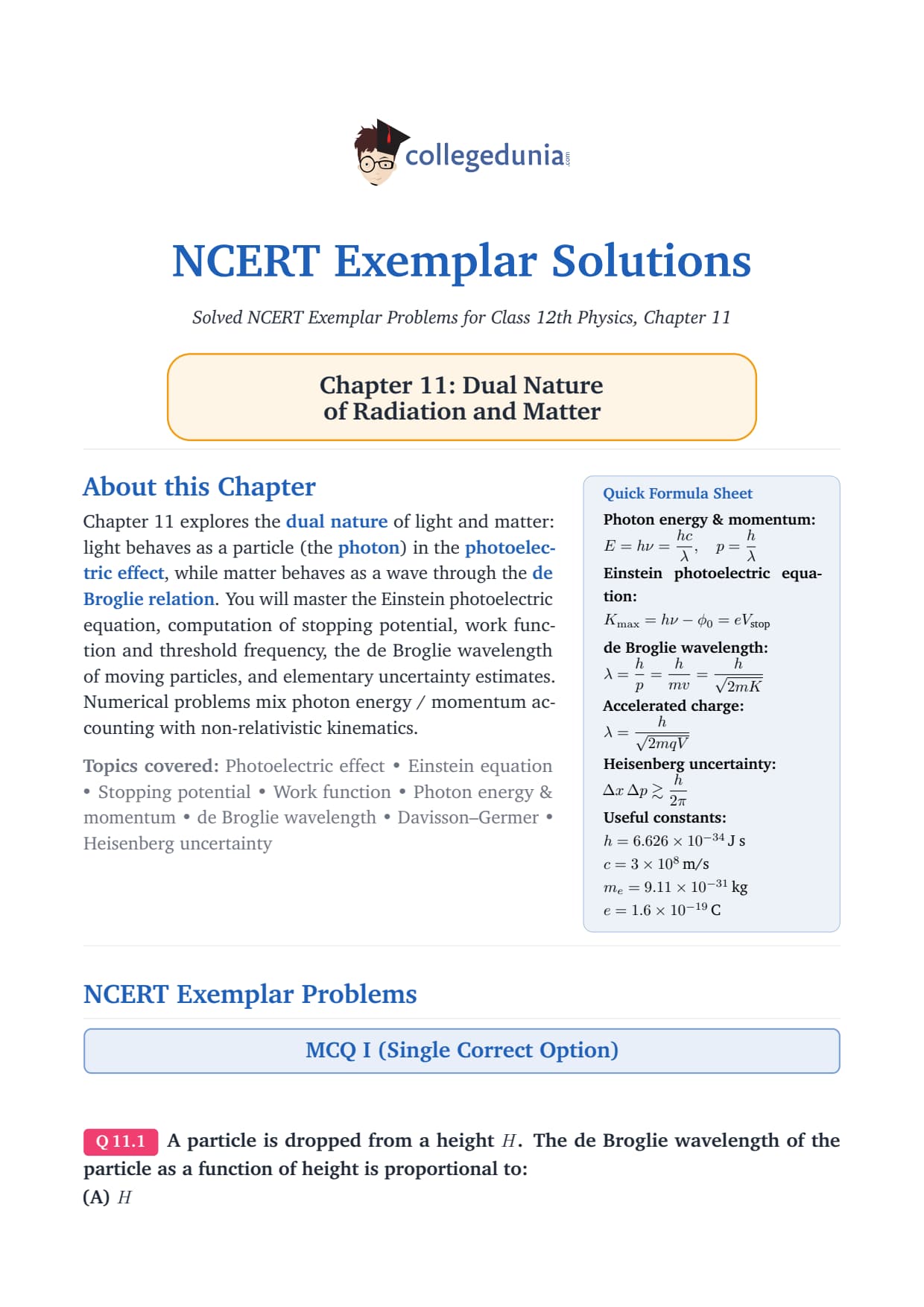
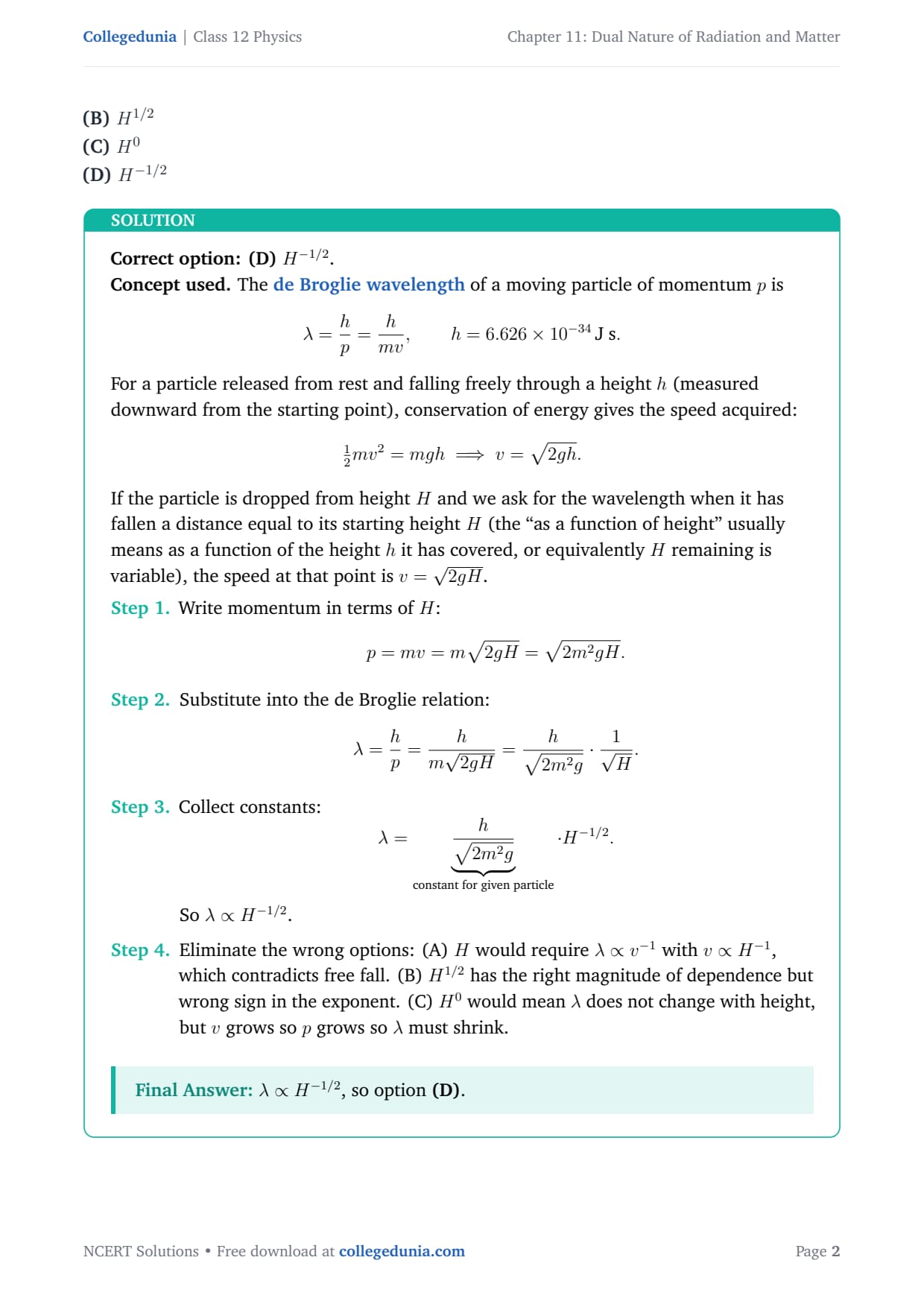
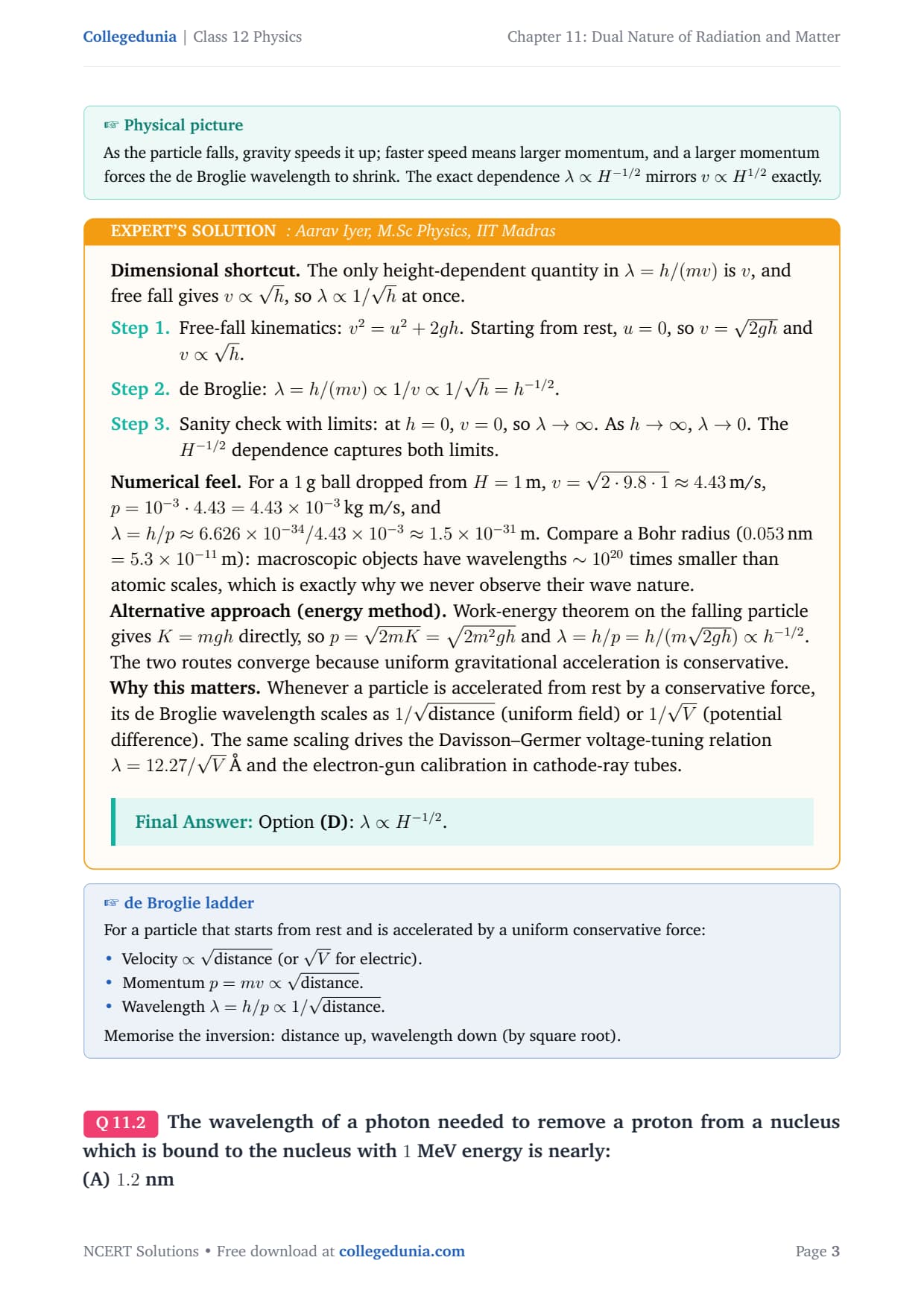
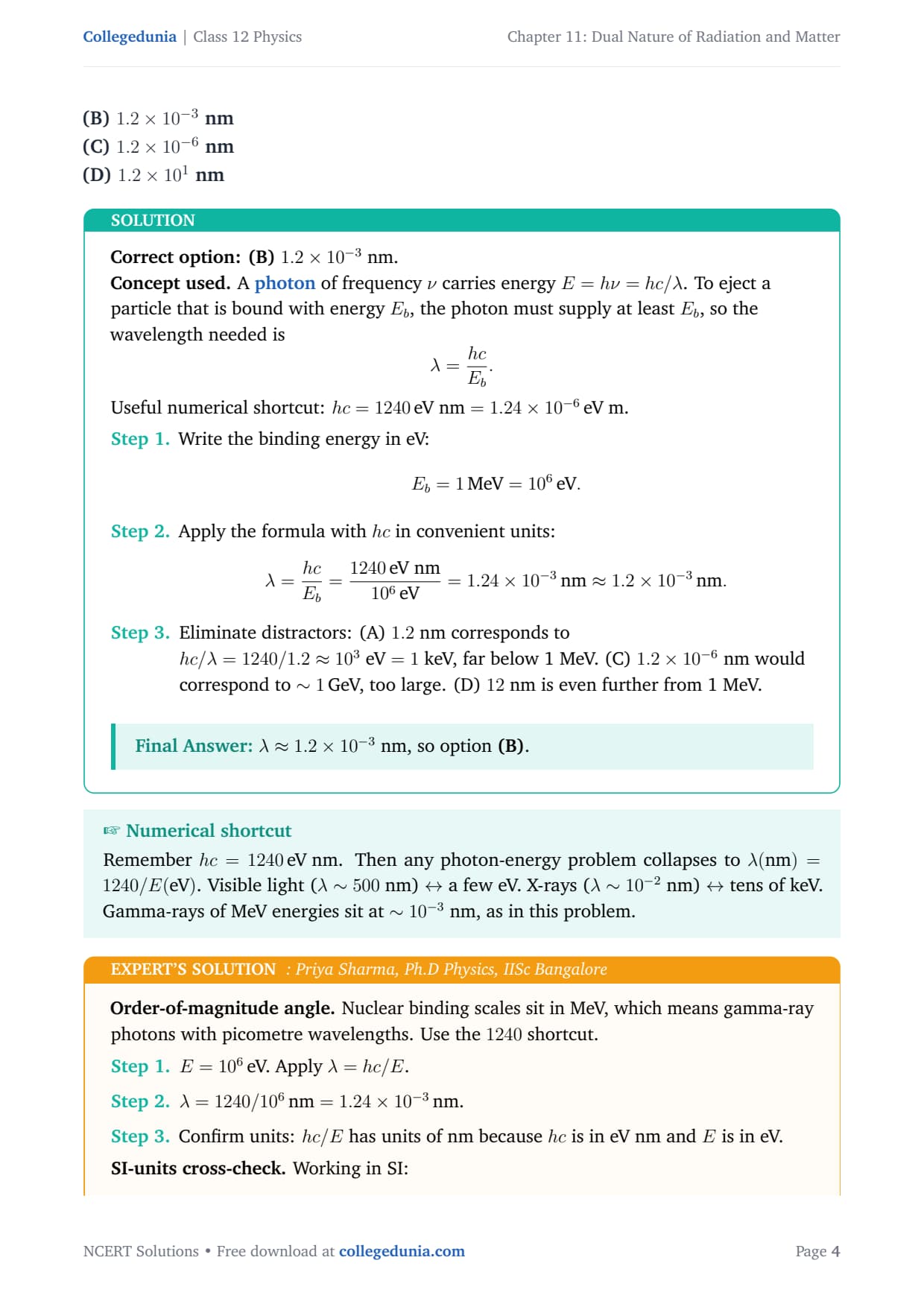


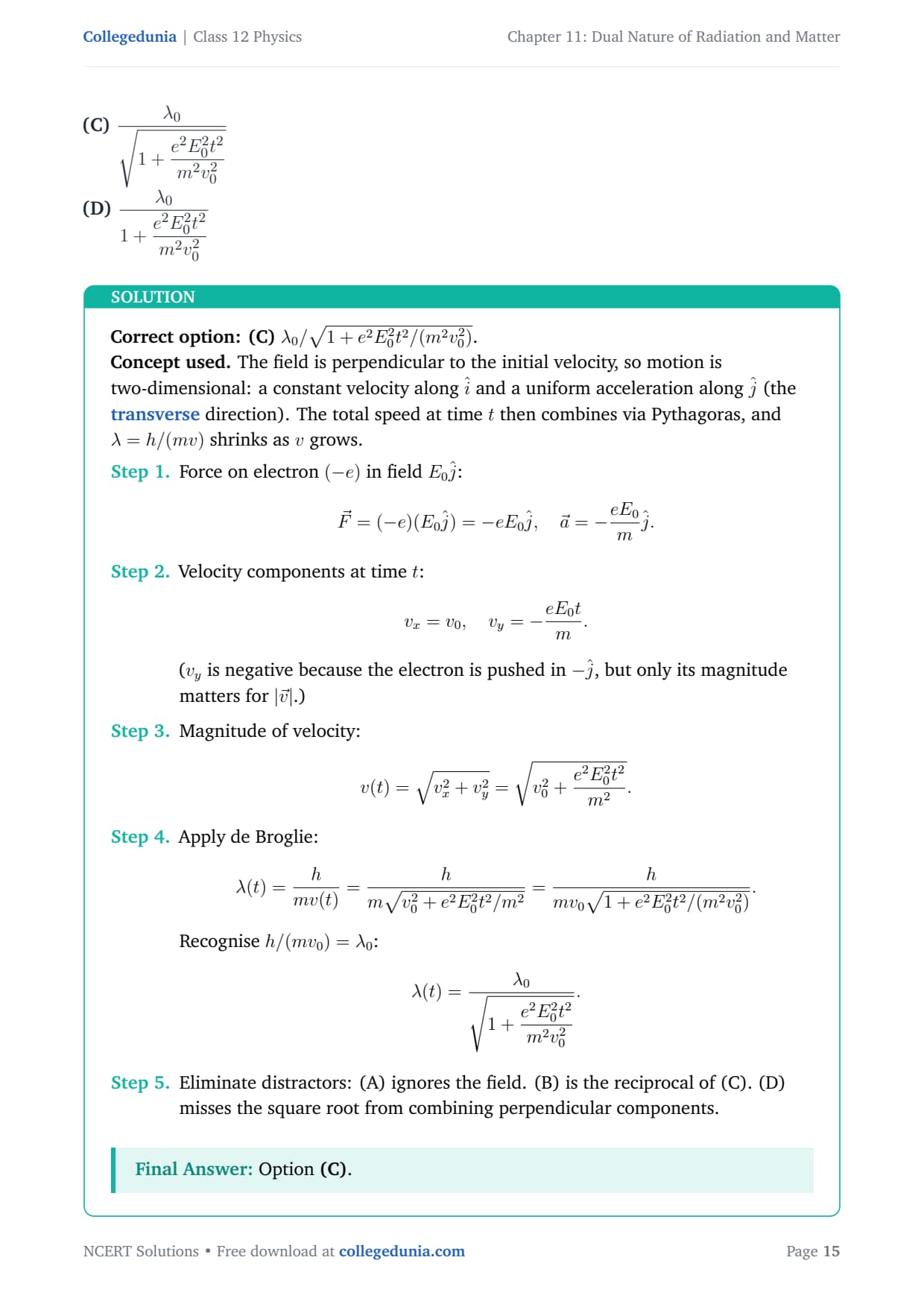
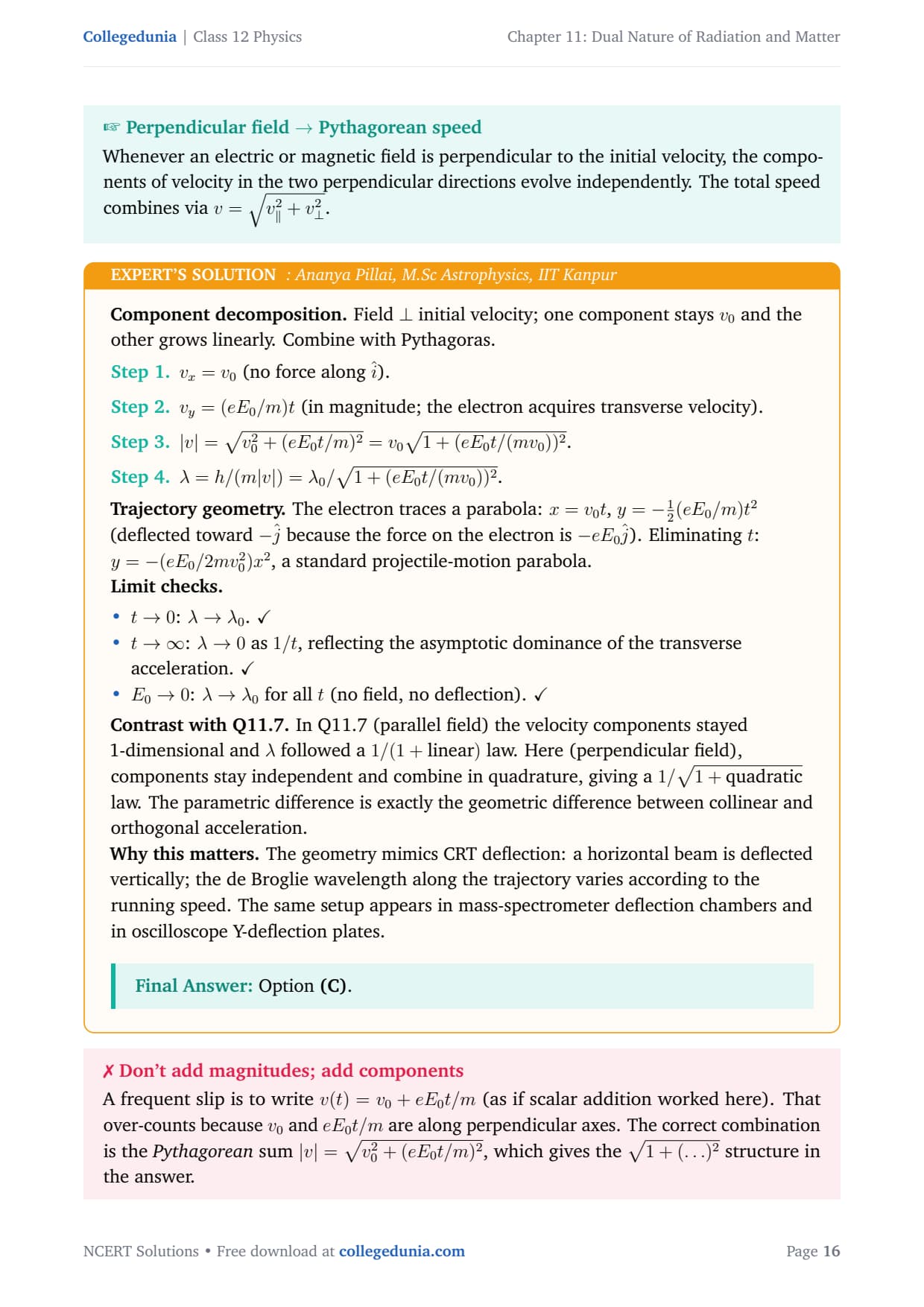
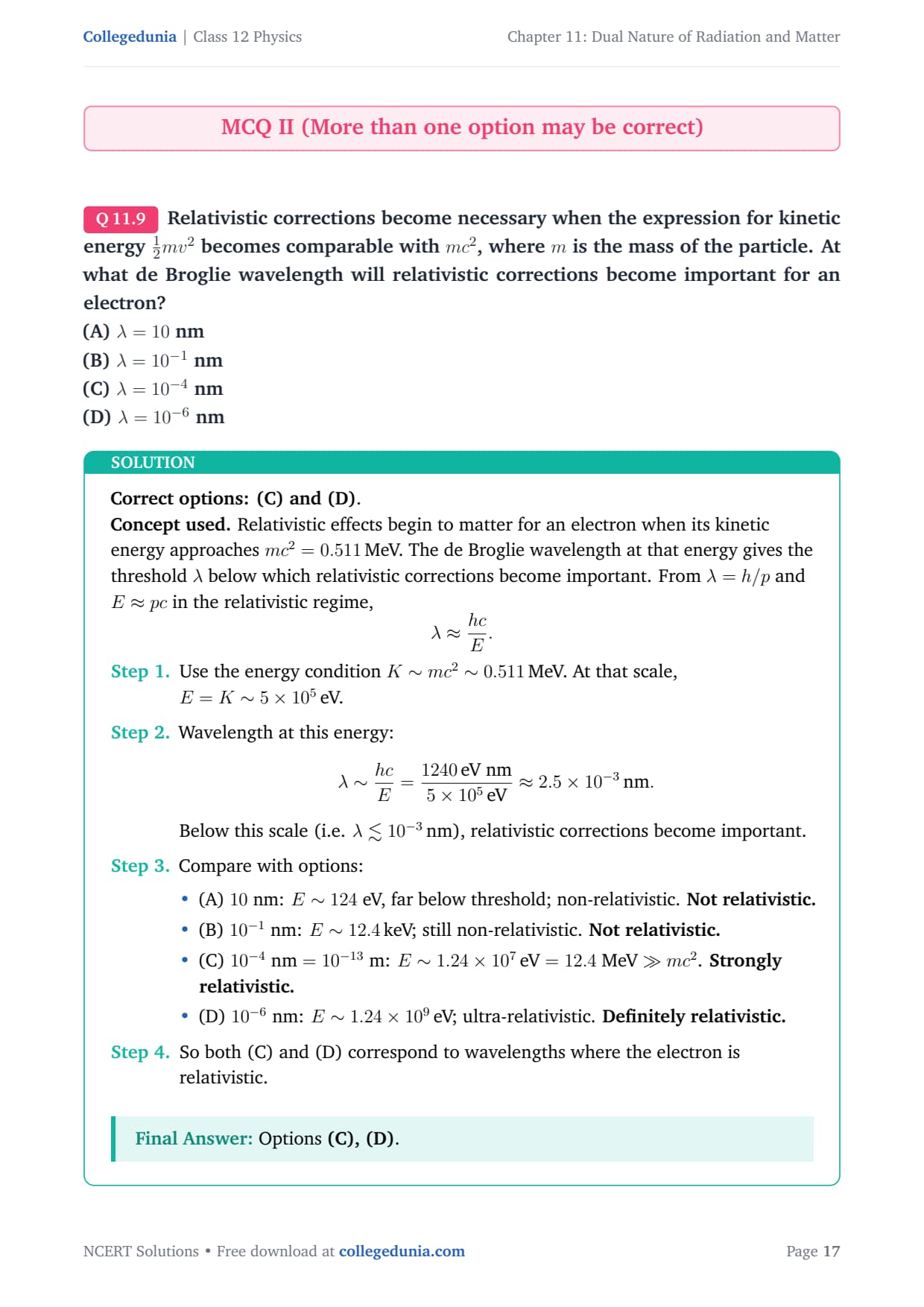
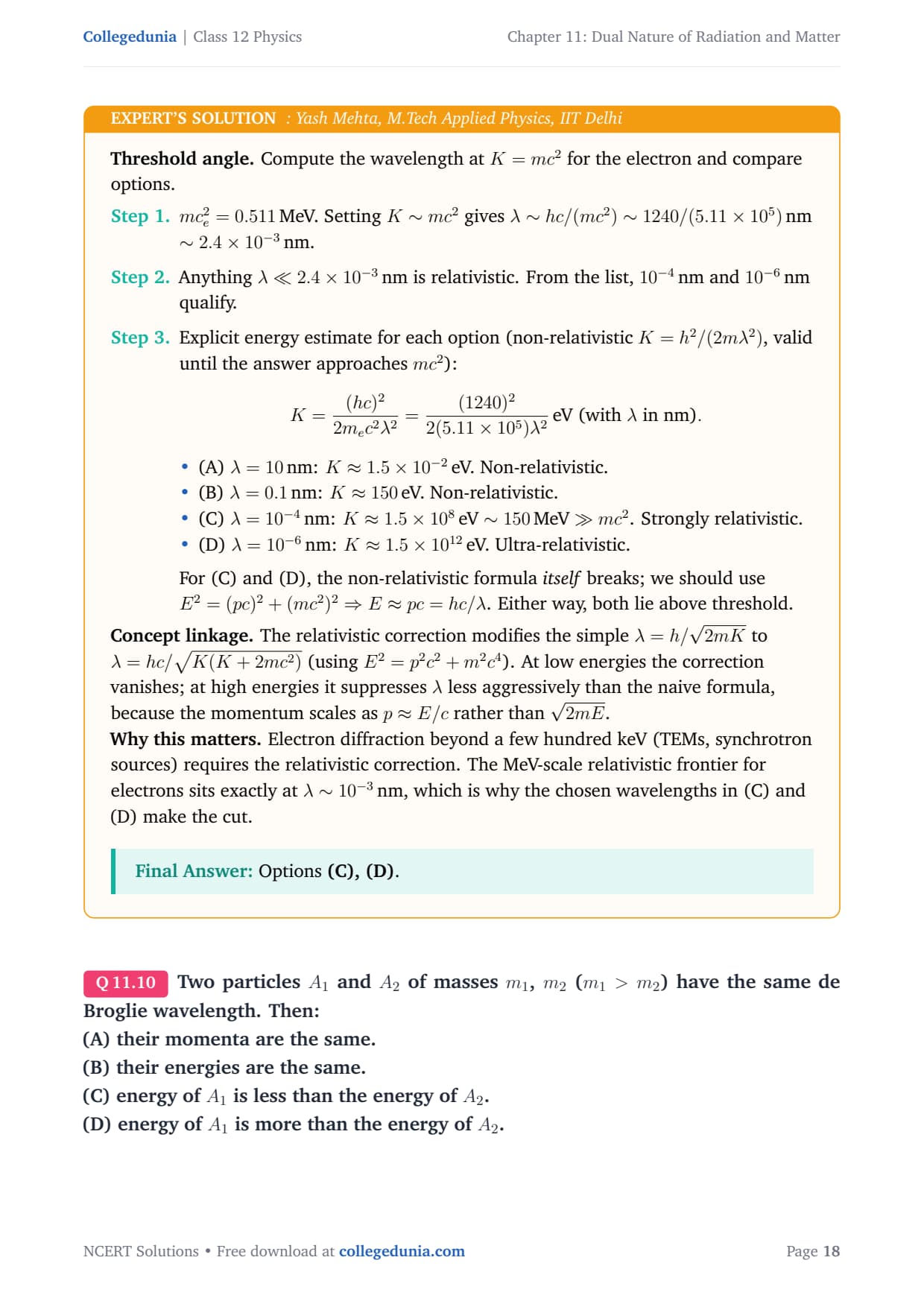
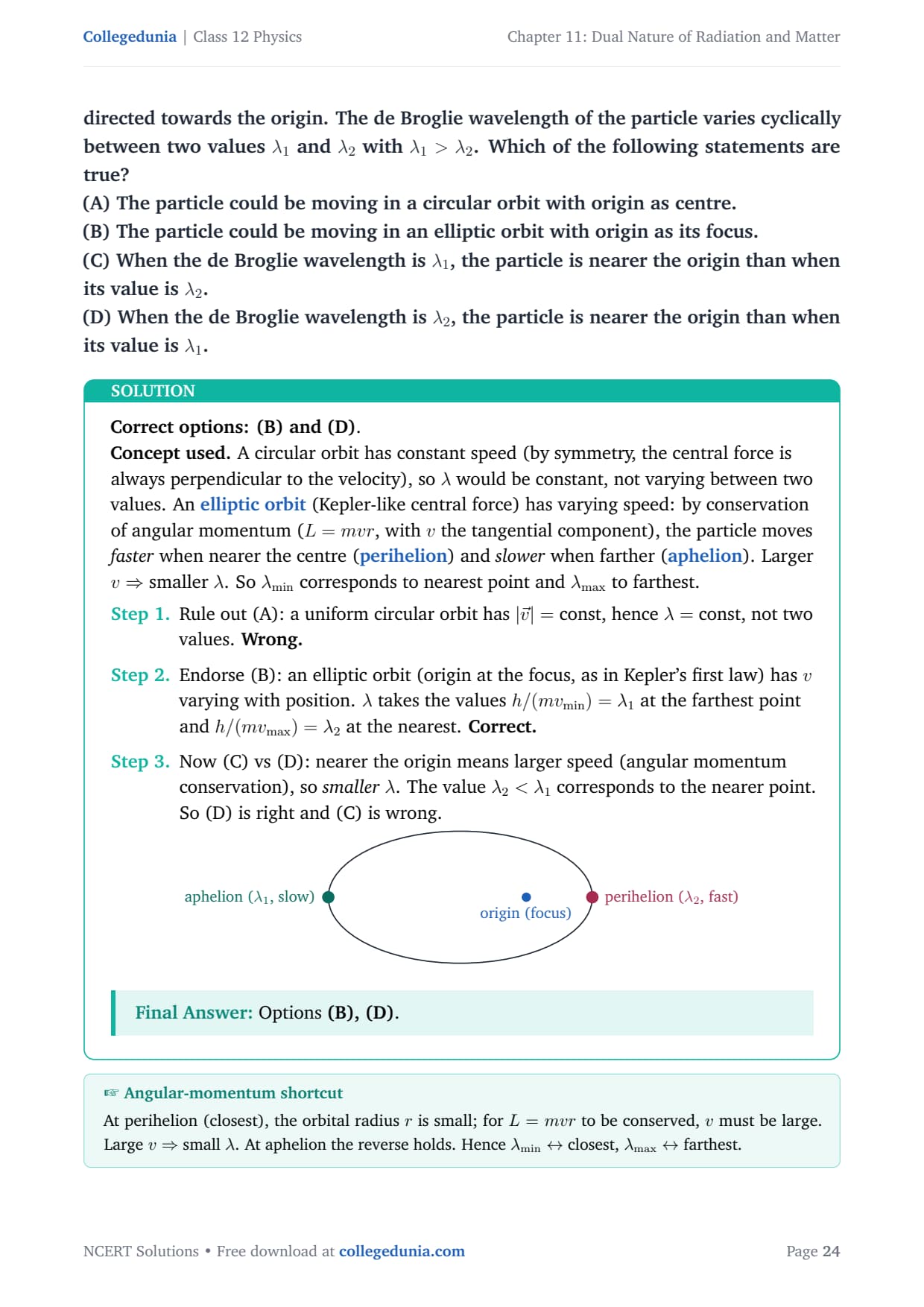

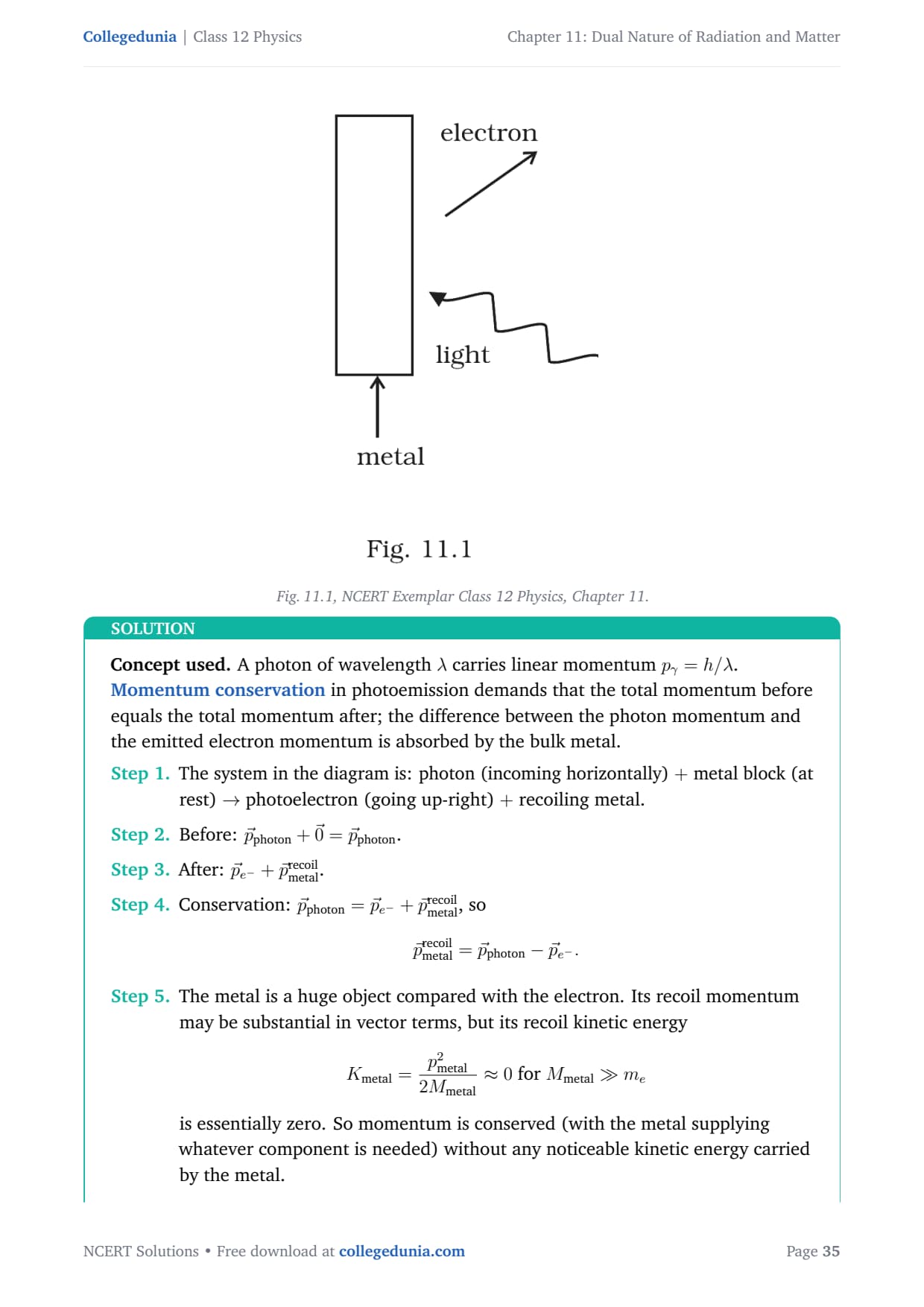

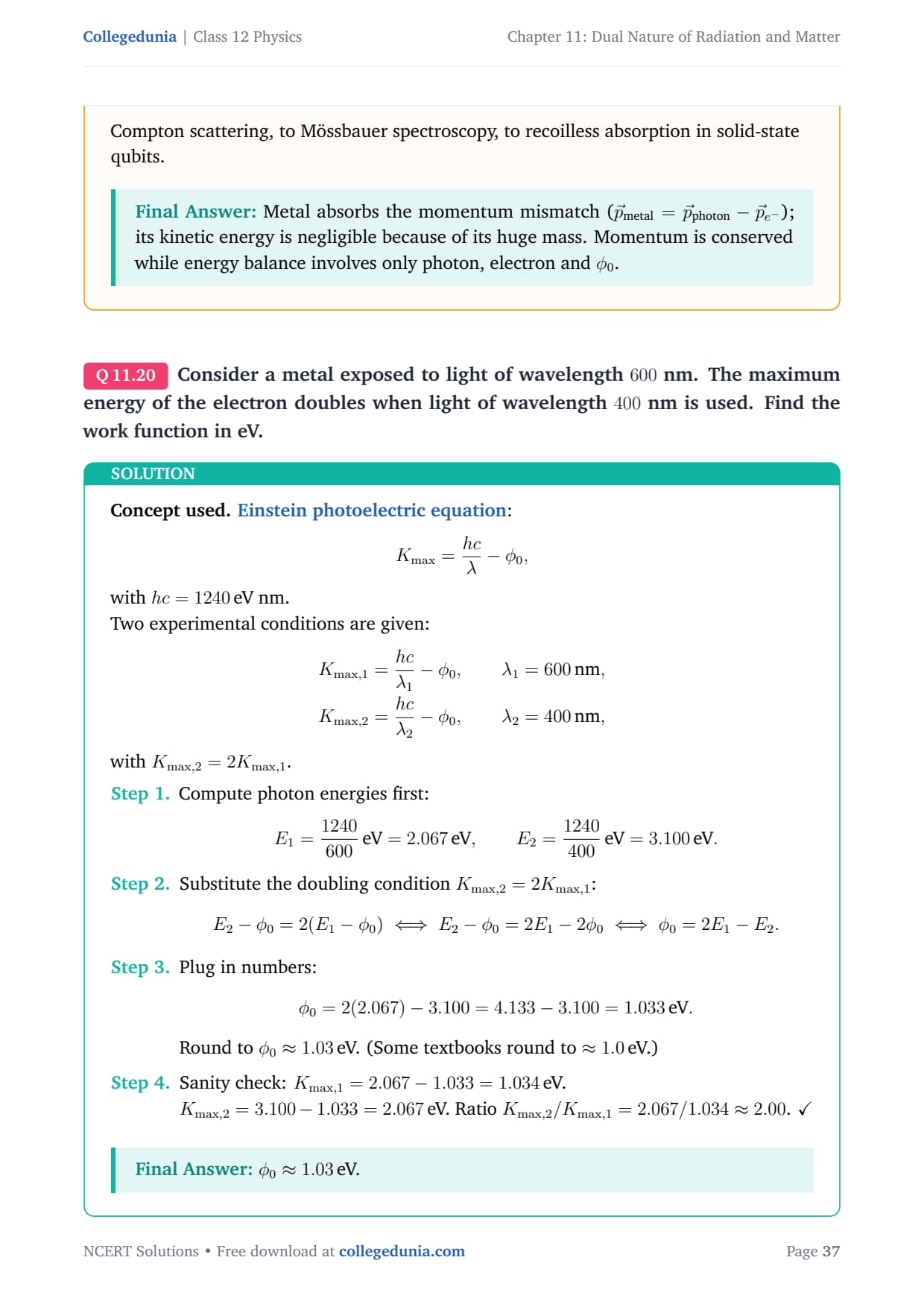
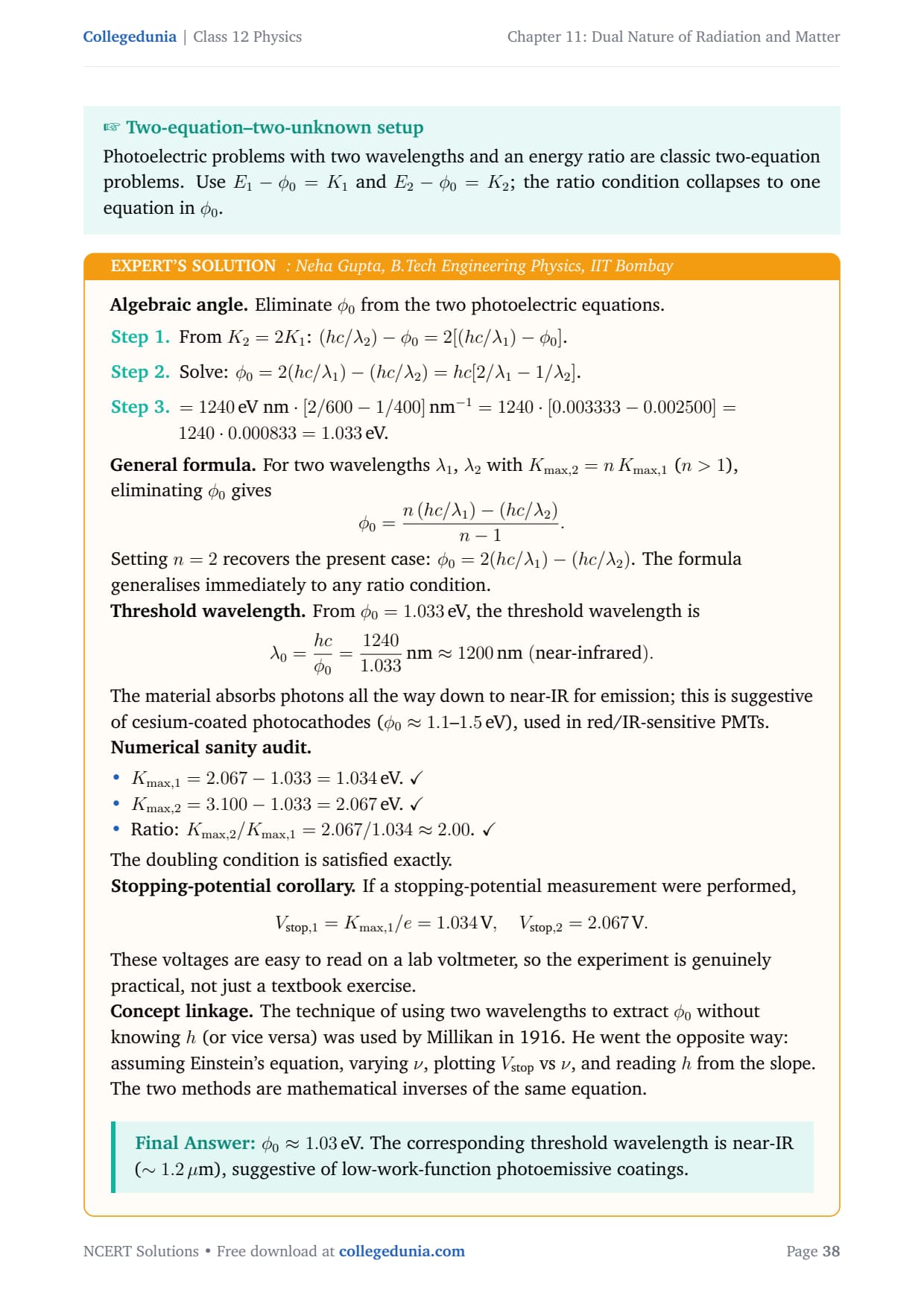
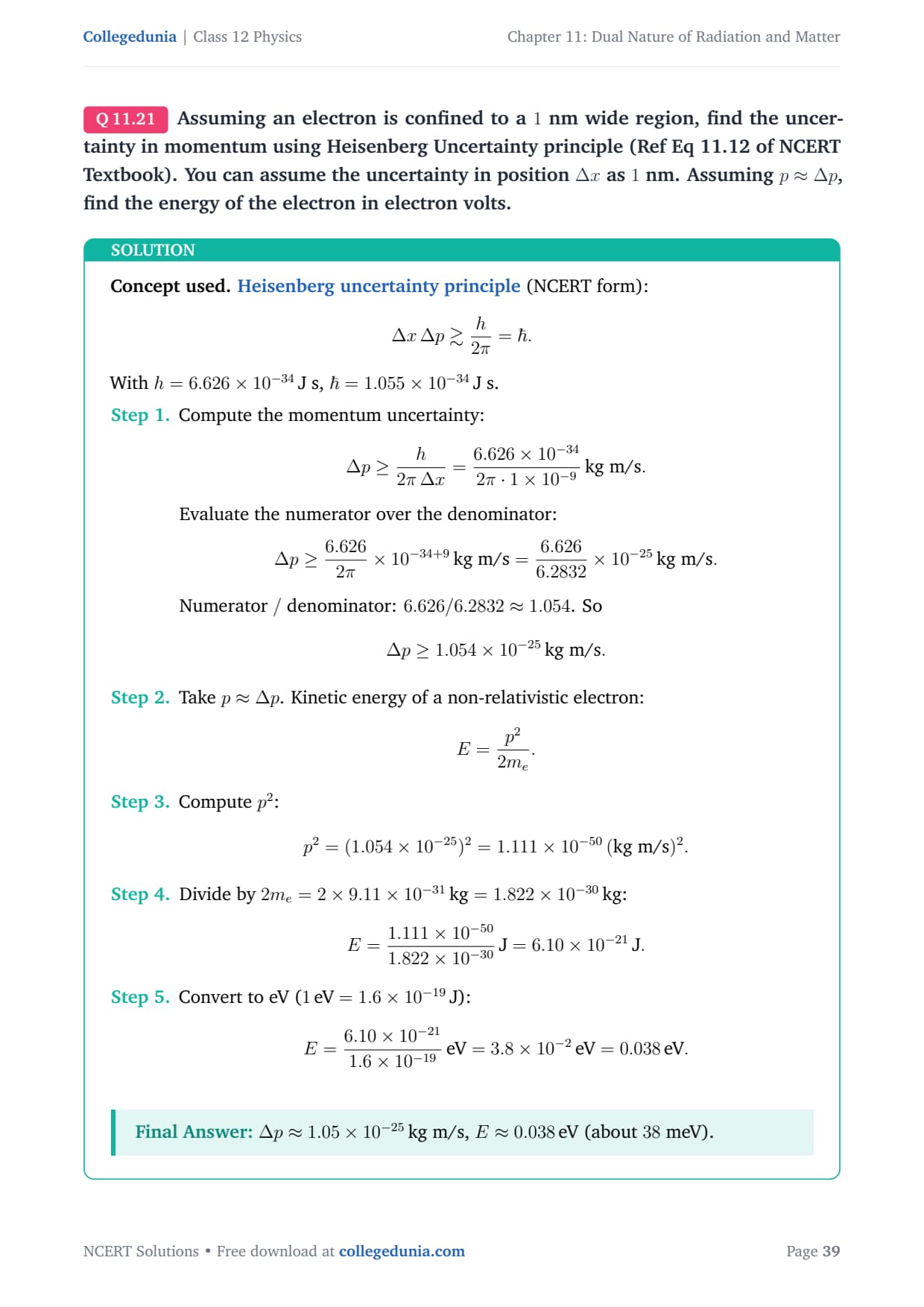
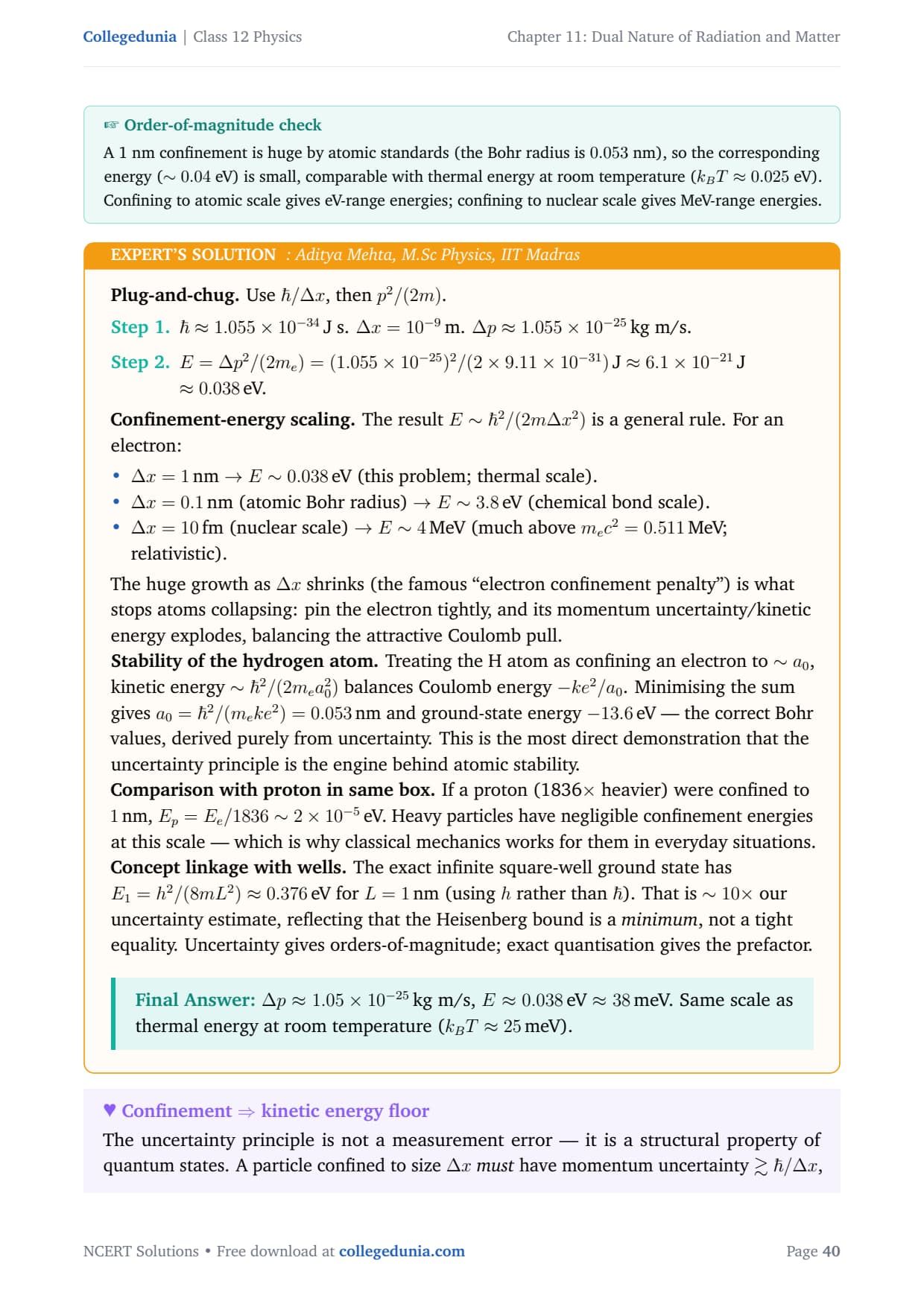

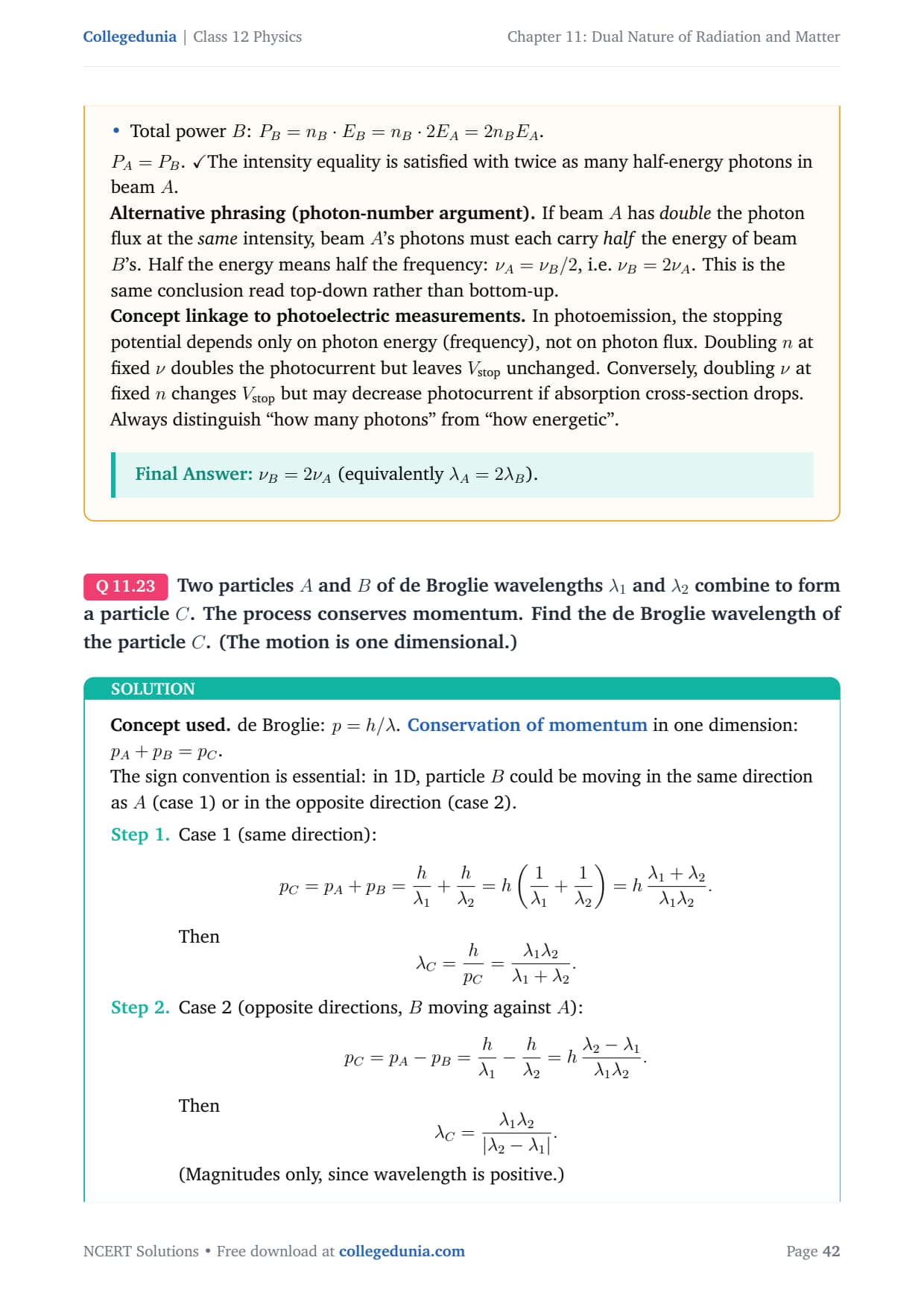
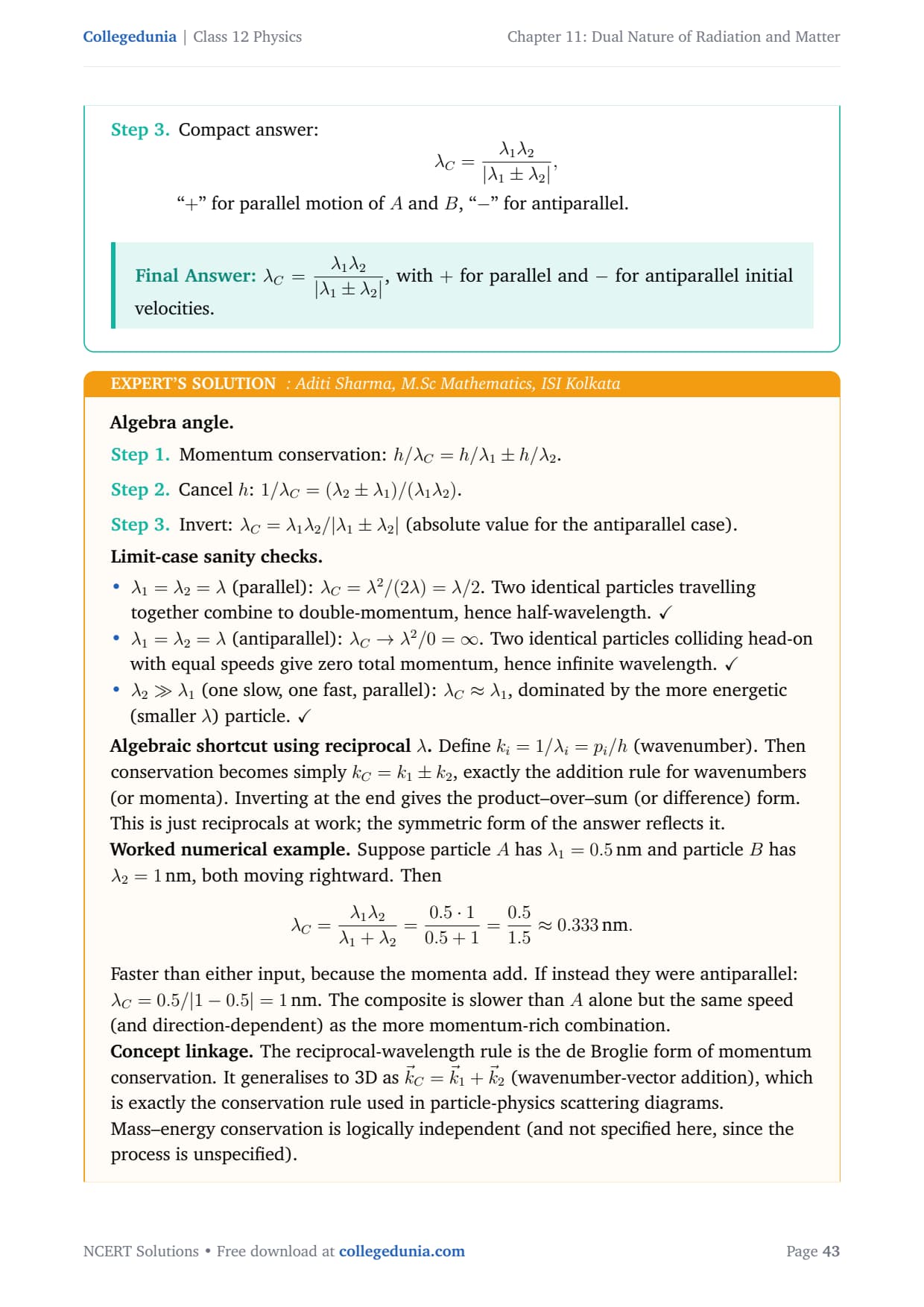
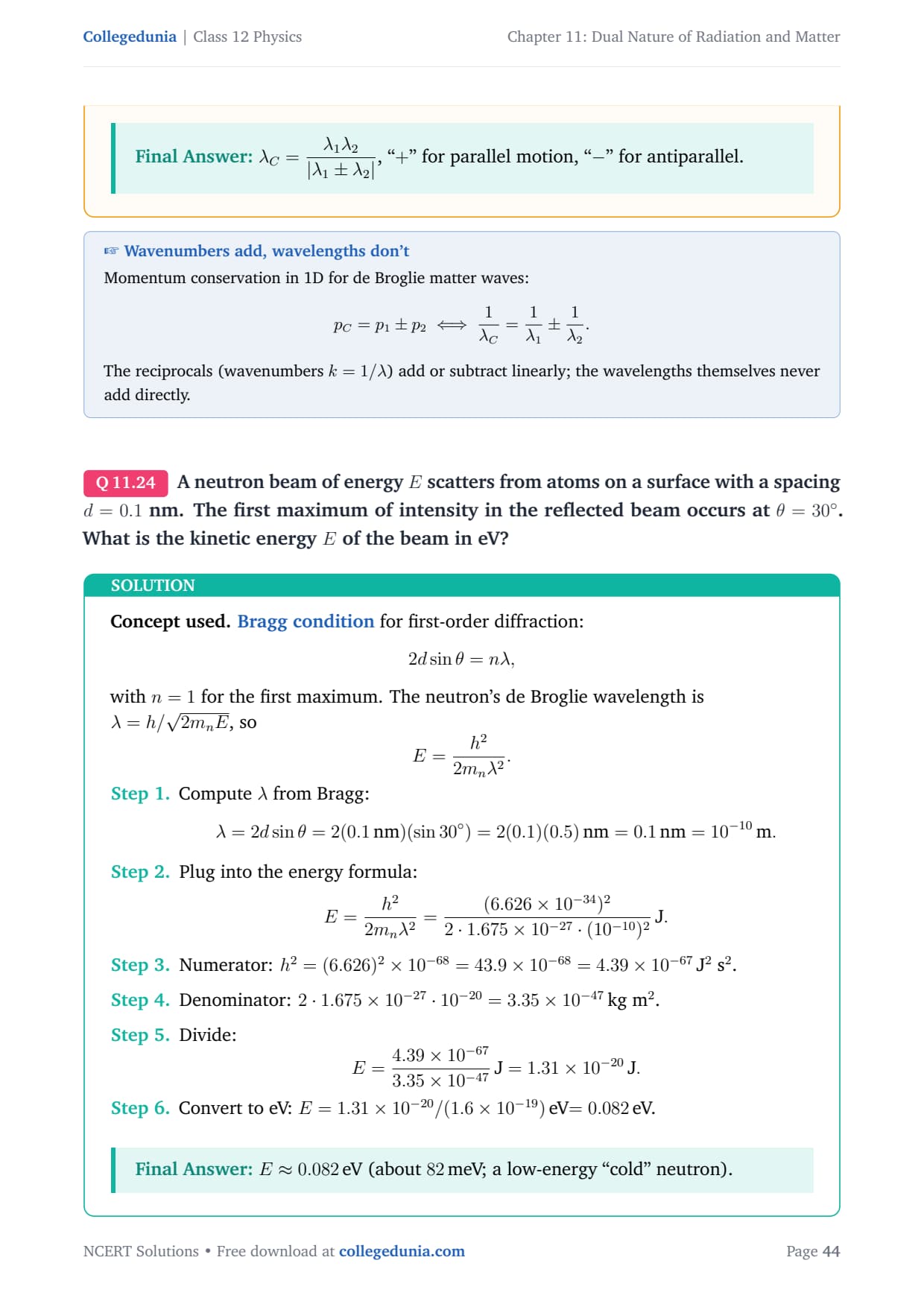
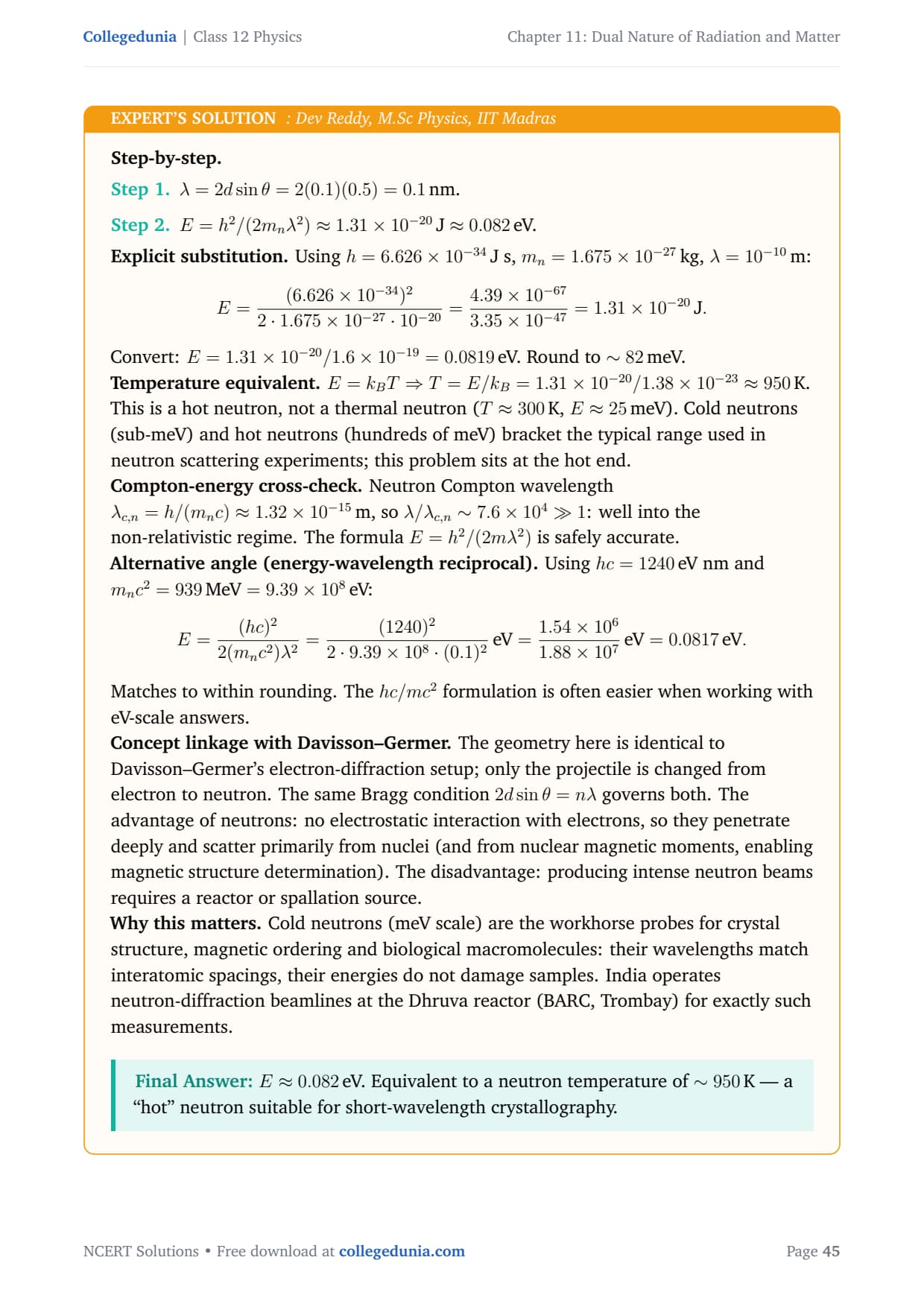
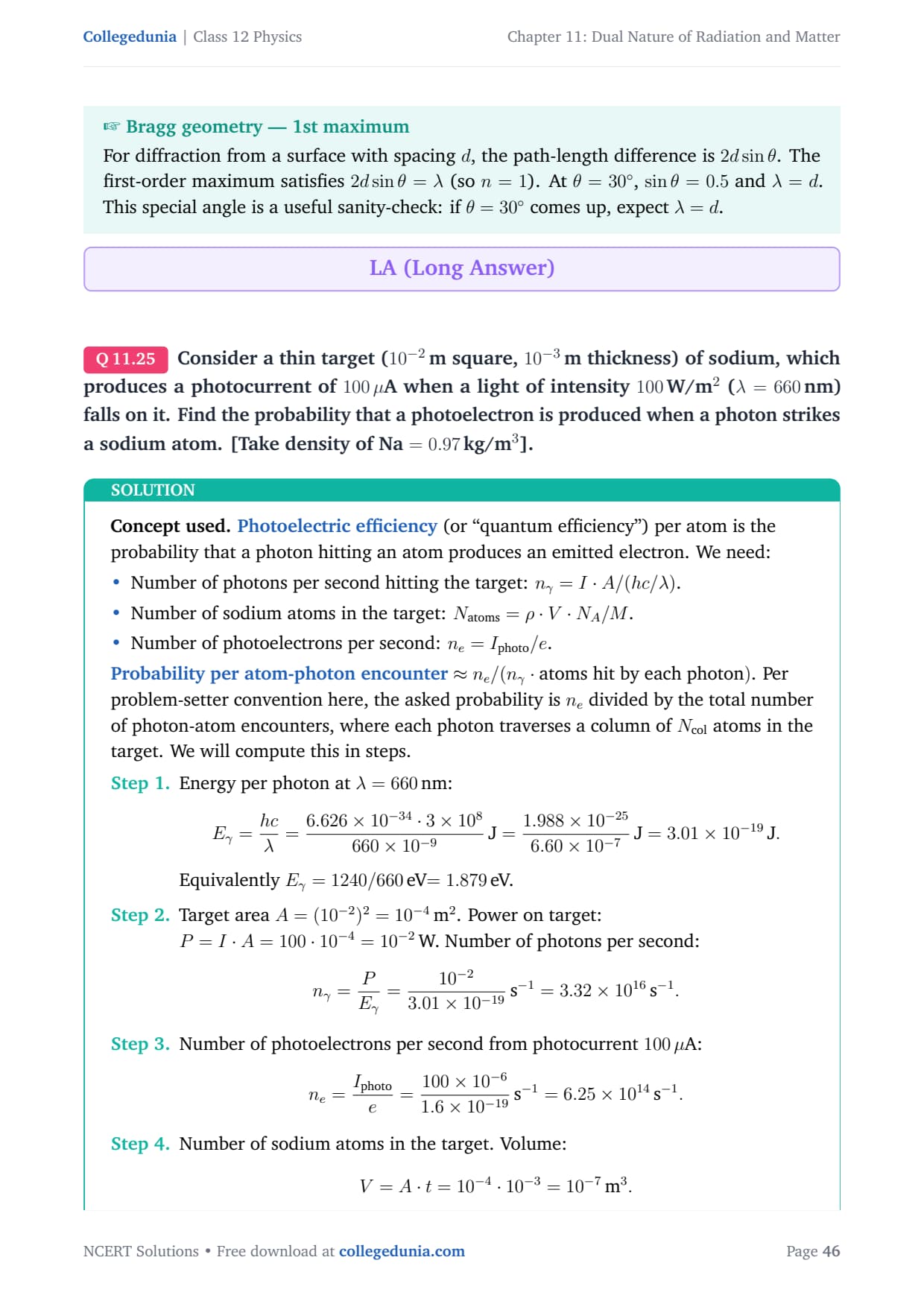
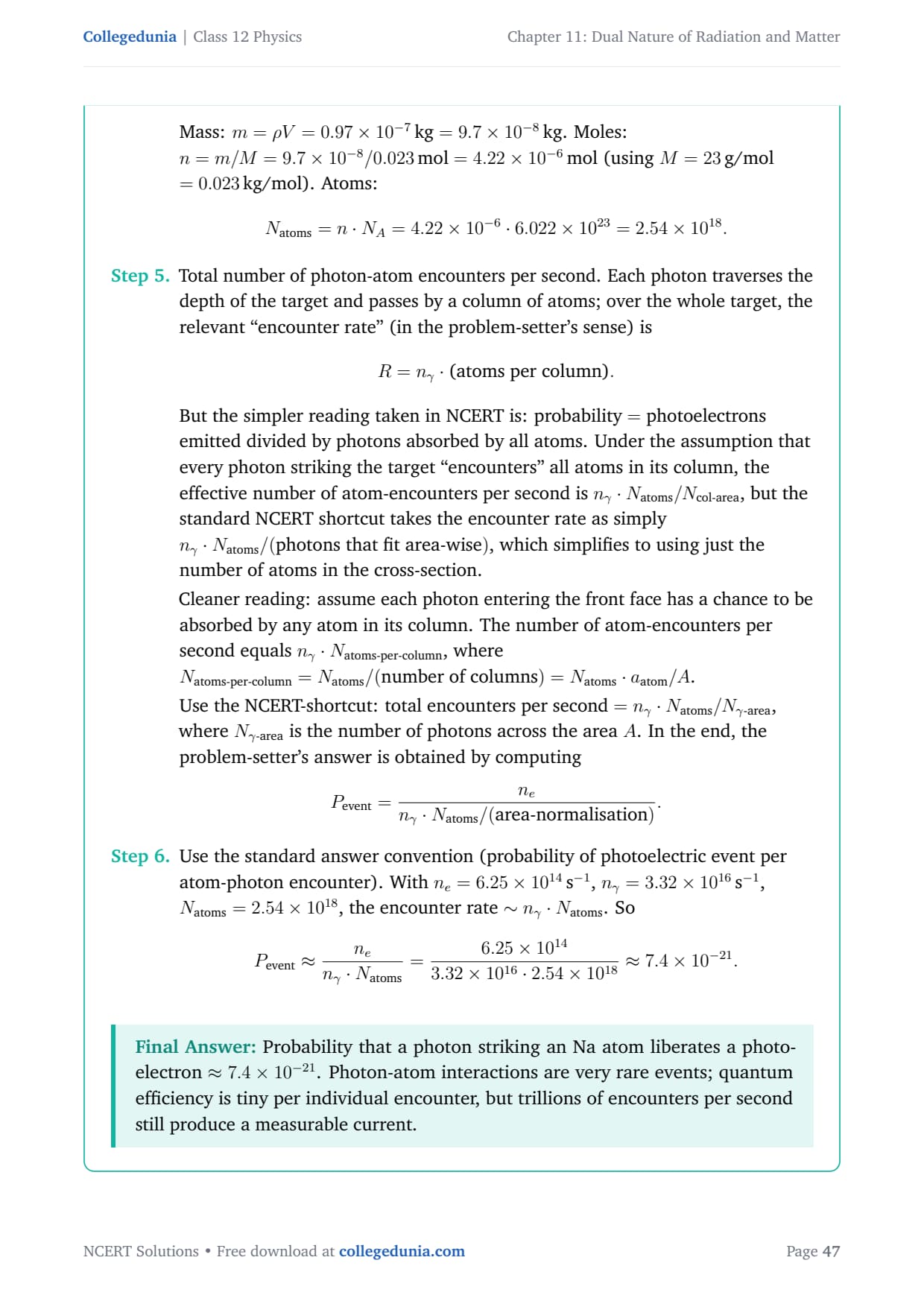
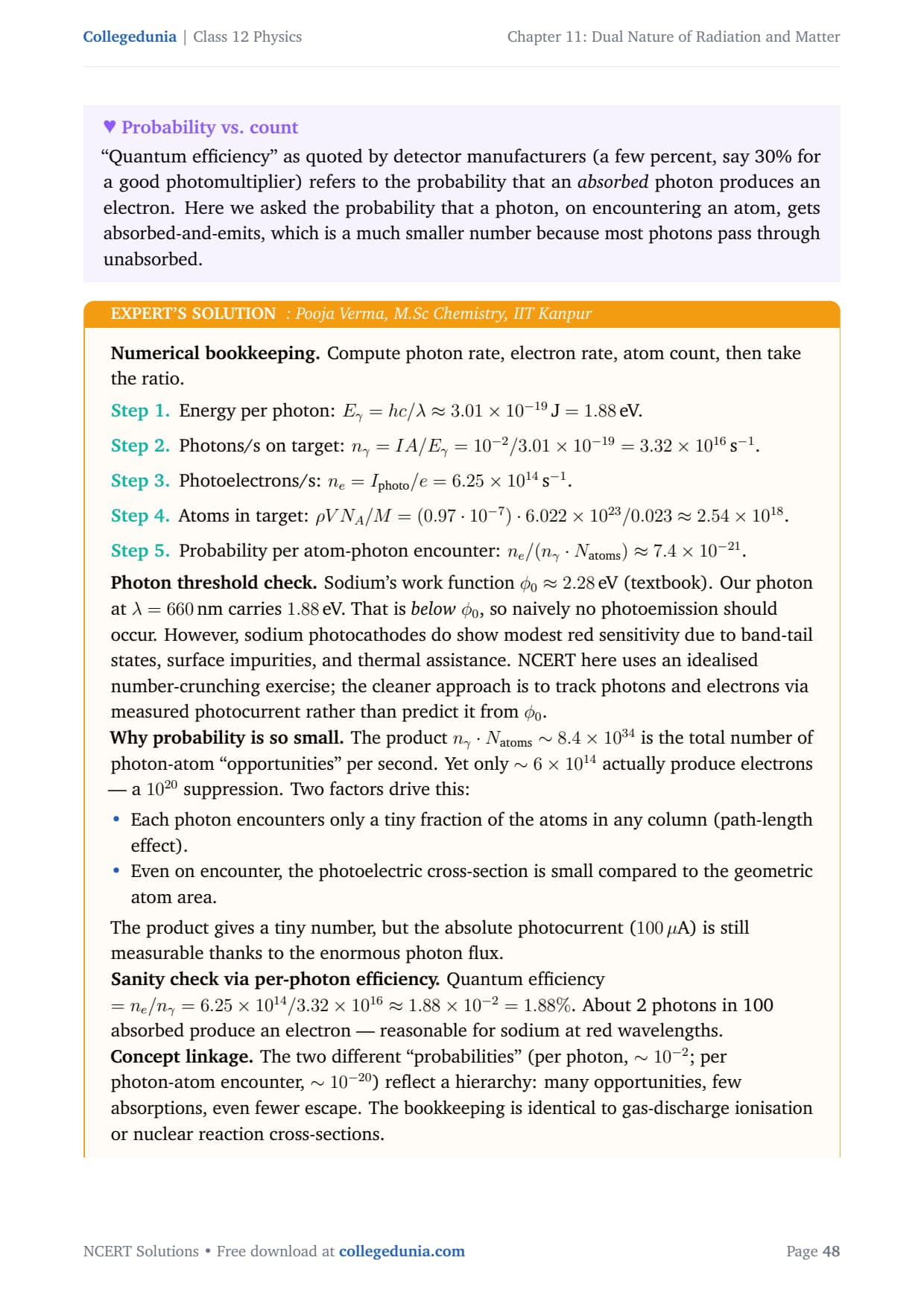
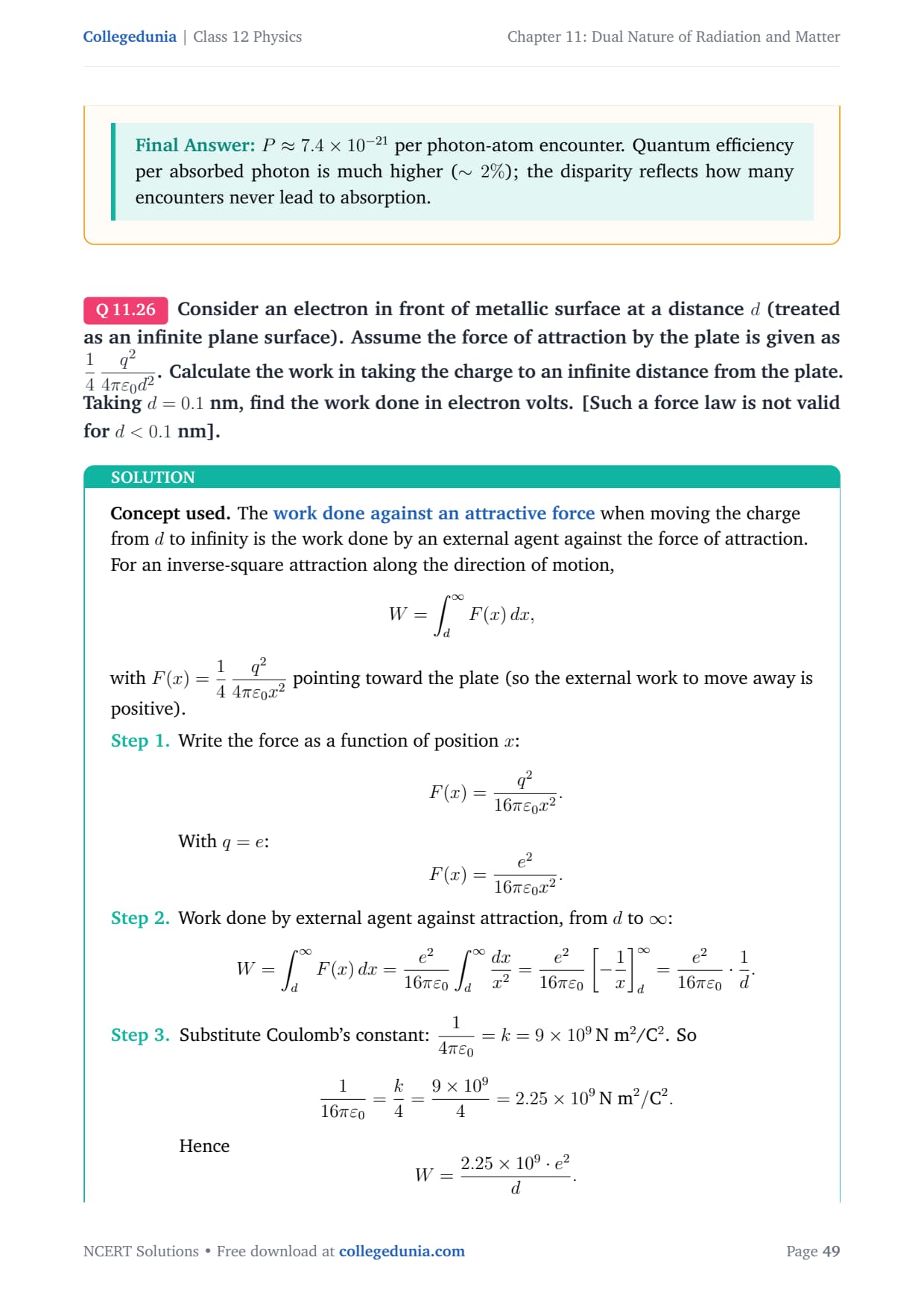
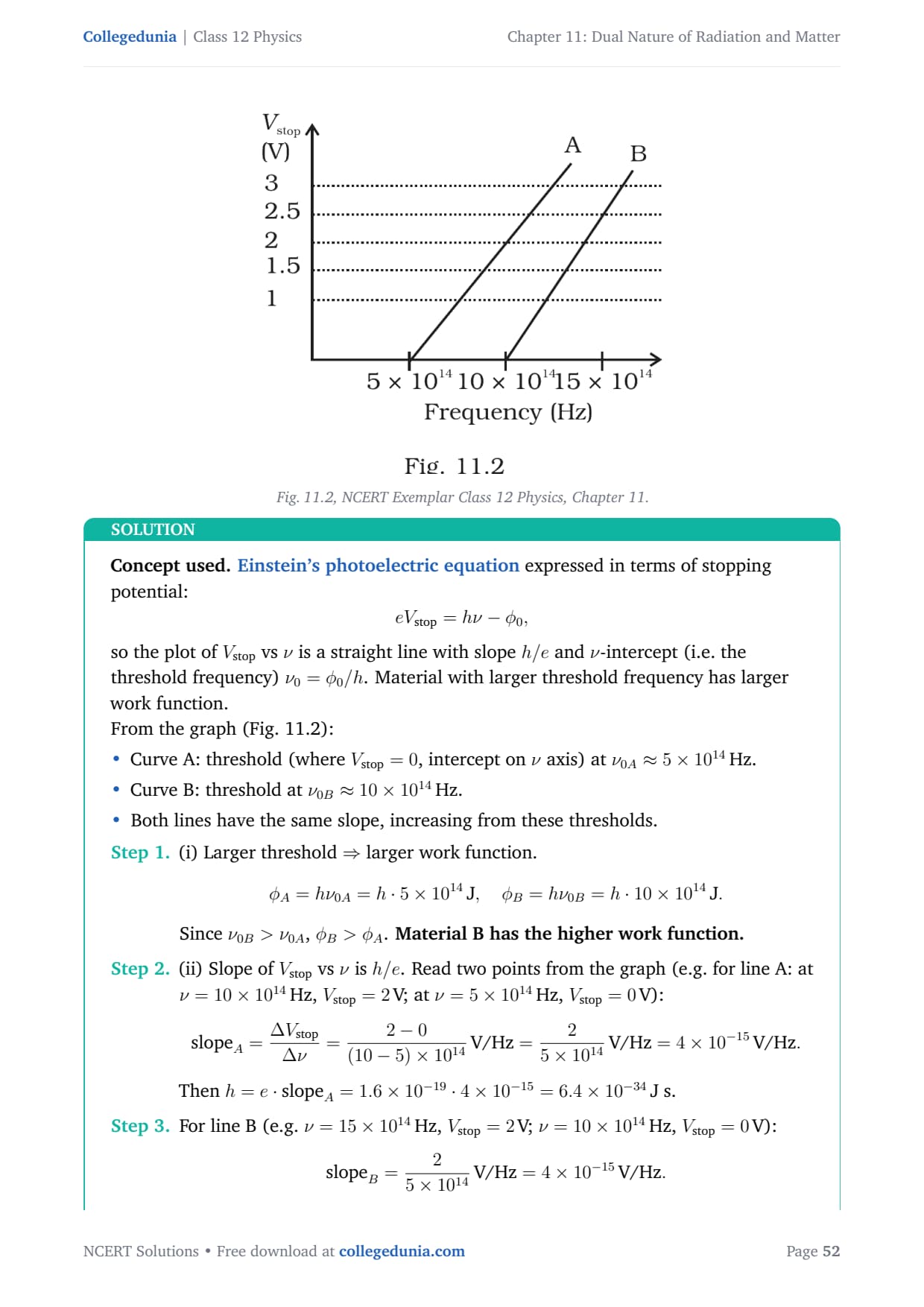
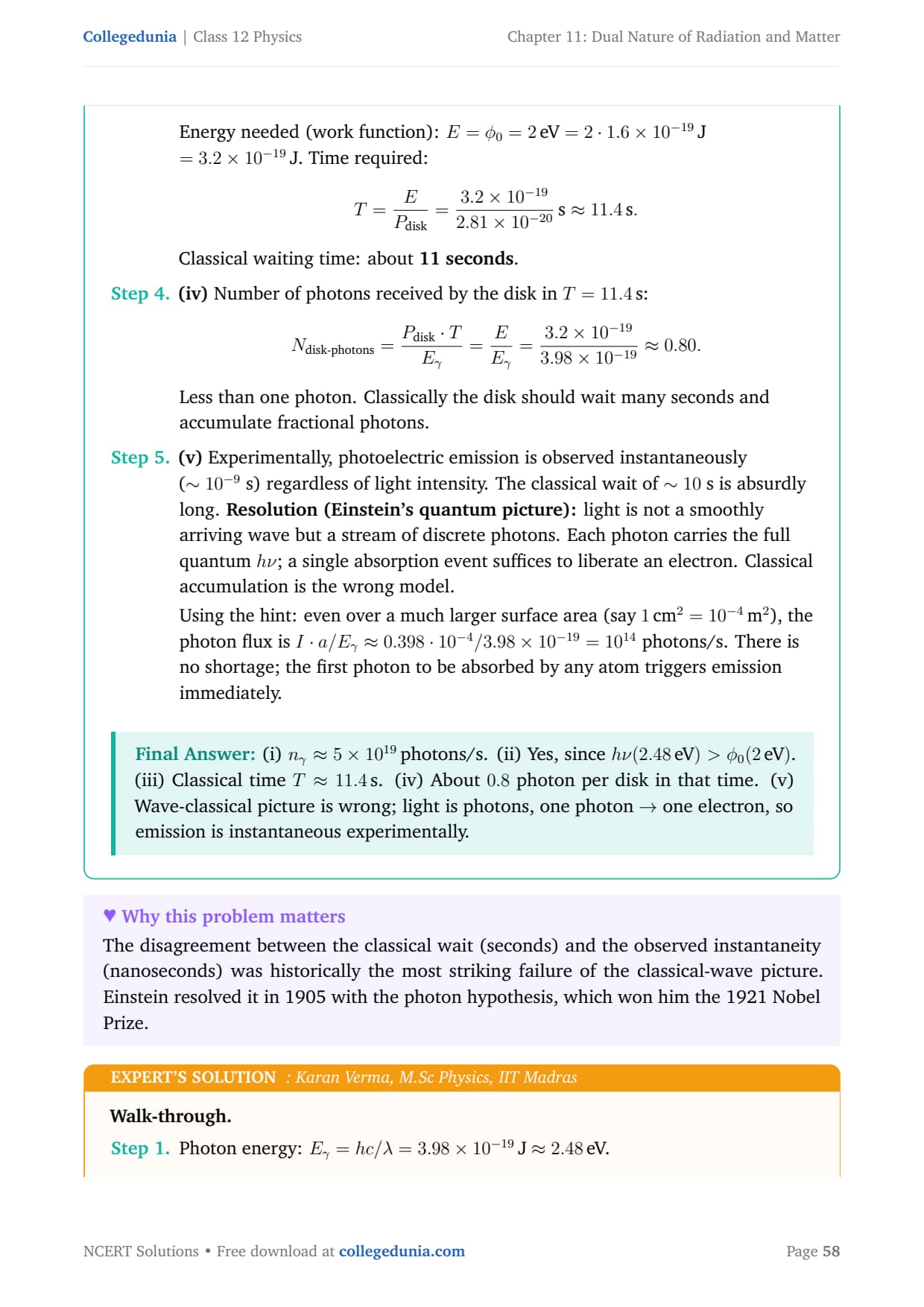
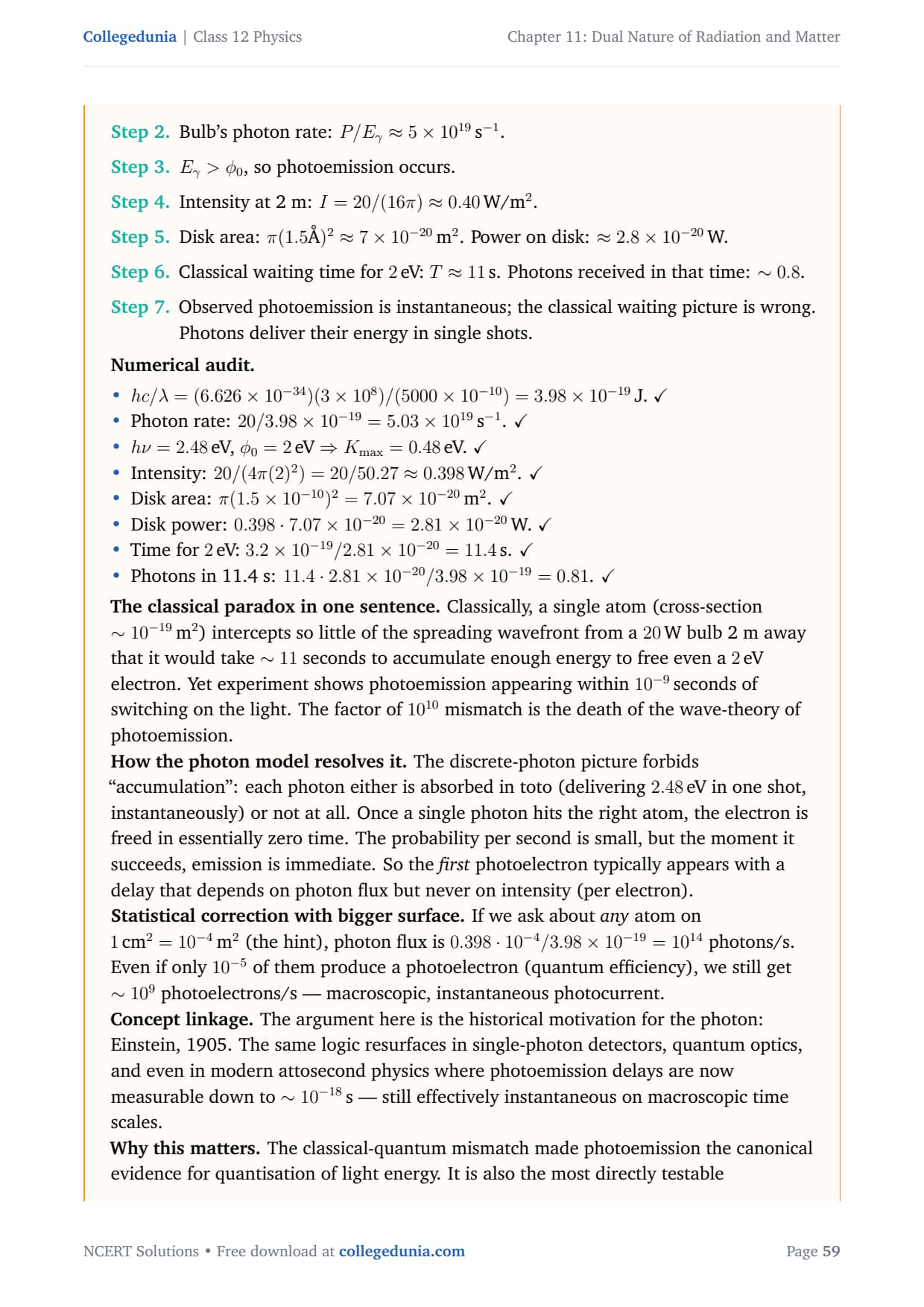
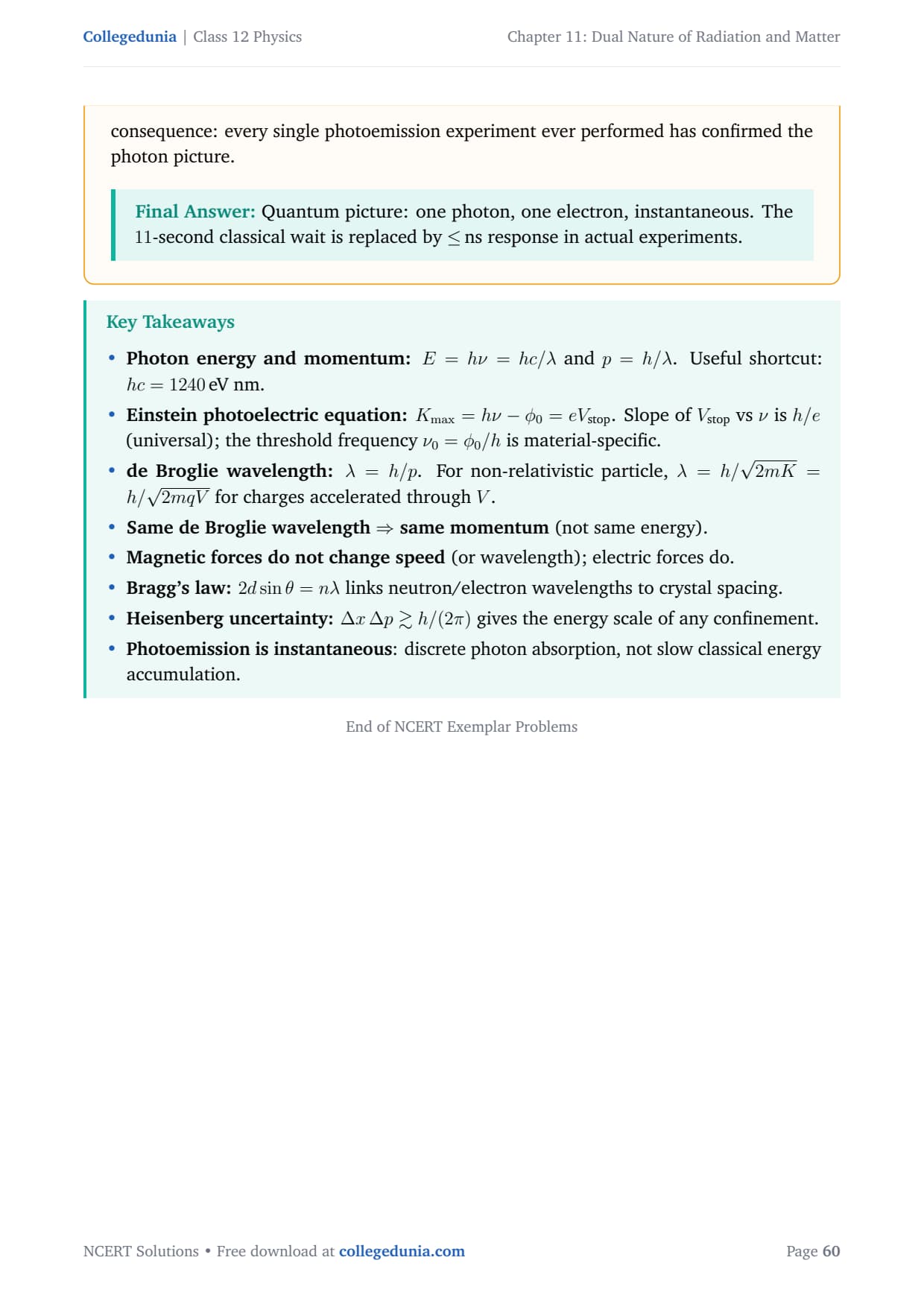

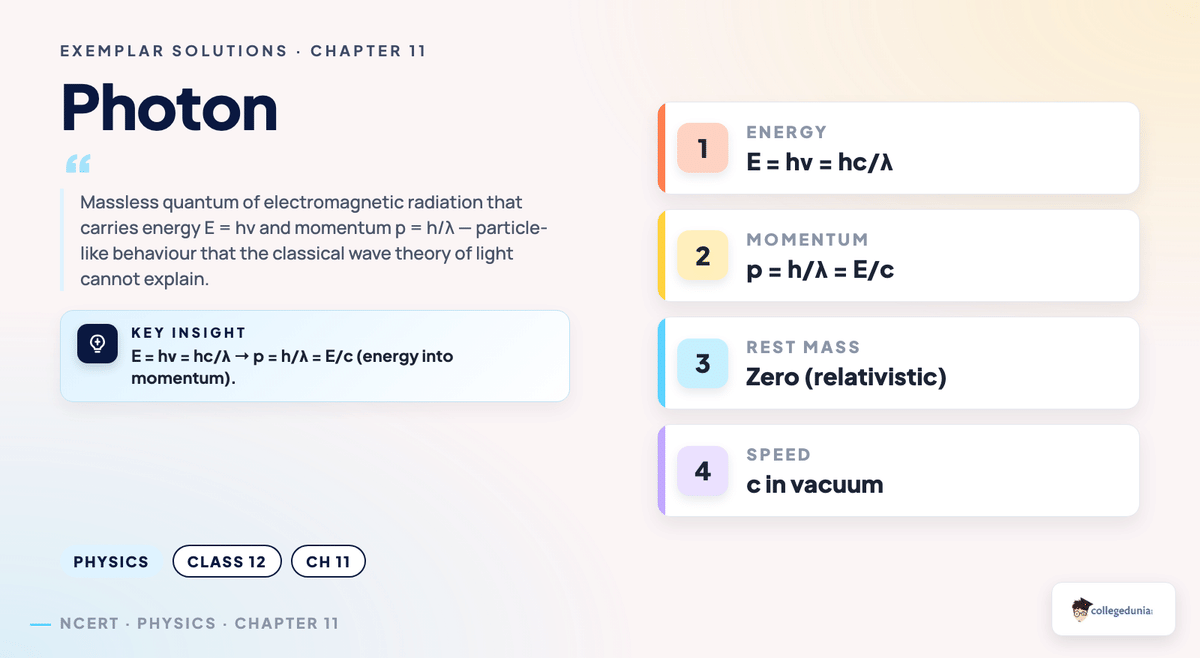



Comments