



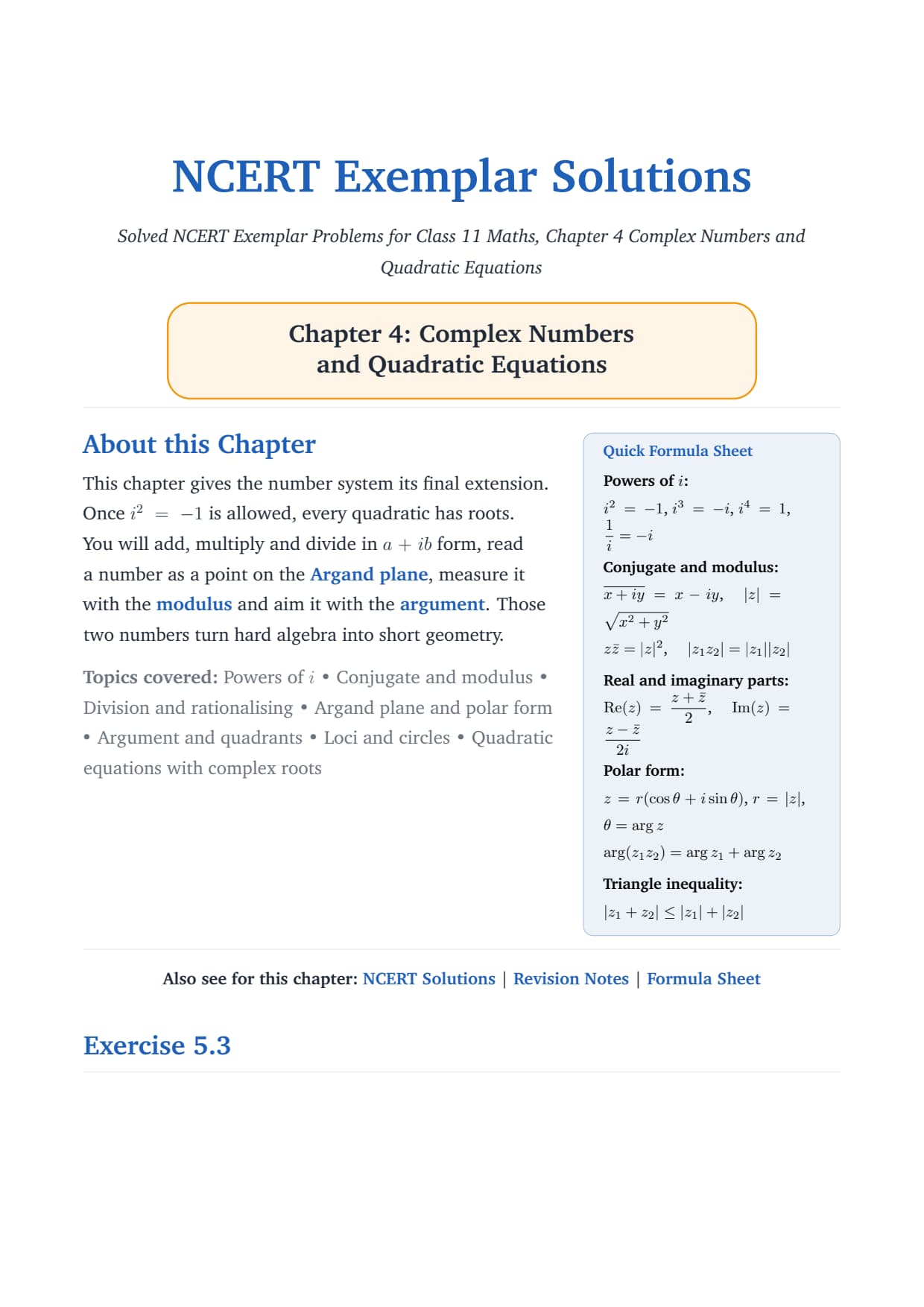
Complex Numbers and Quadratic Equations is the chapter where the Exemplar stops asking students to simplify a + ib and starts asking them to find a locus. The NCERT Exemplar Solutions for Class 11 Maths Chapter 4 Complex Numbers and Quadratic Equations on this page solve all 50 questions of the chapter, step by step, according to the 2026-27 NCERT Exemplar.
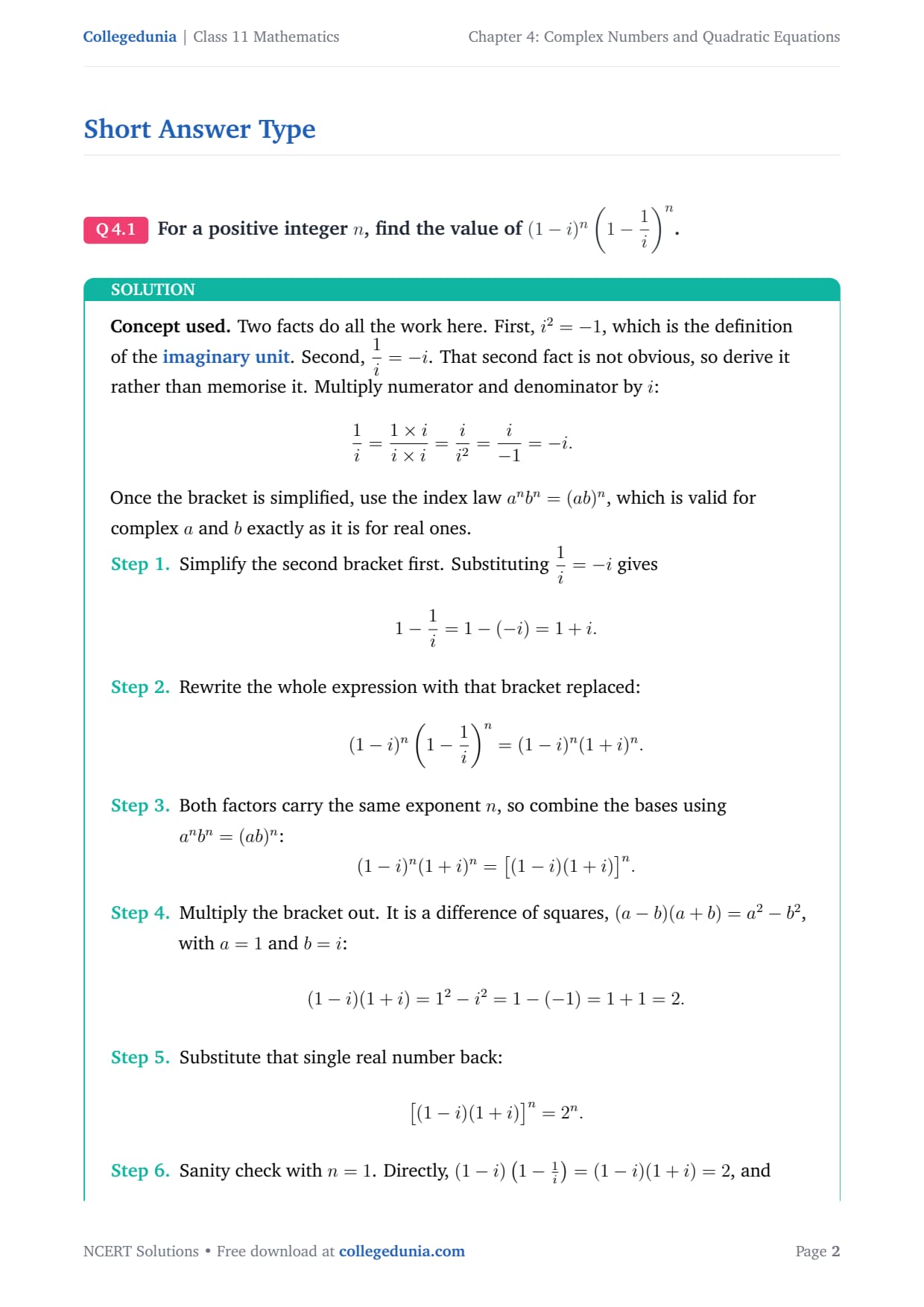
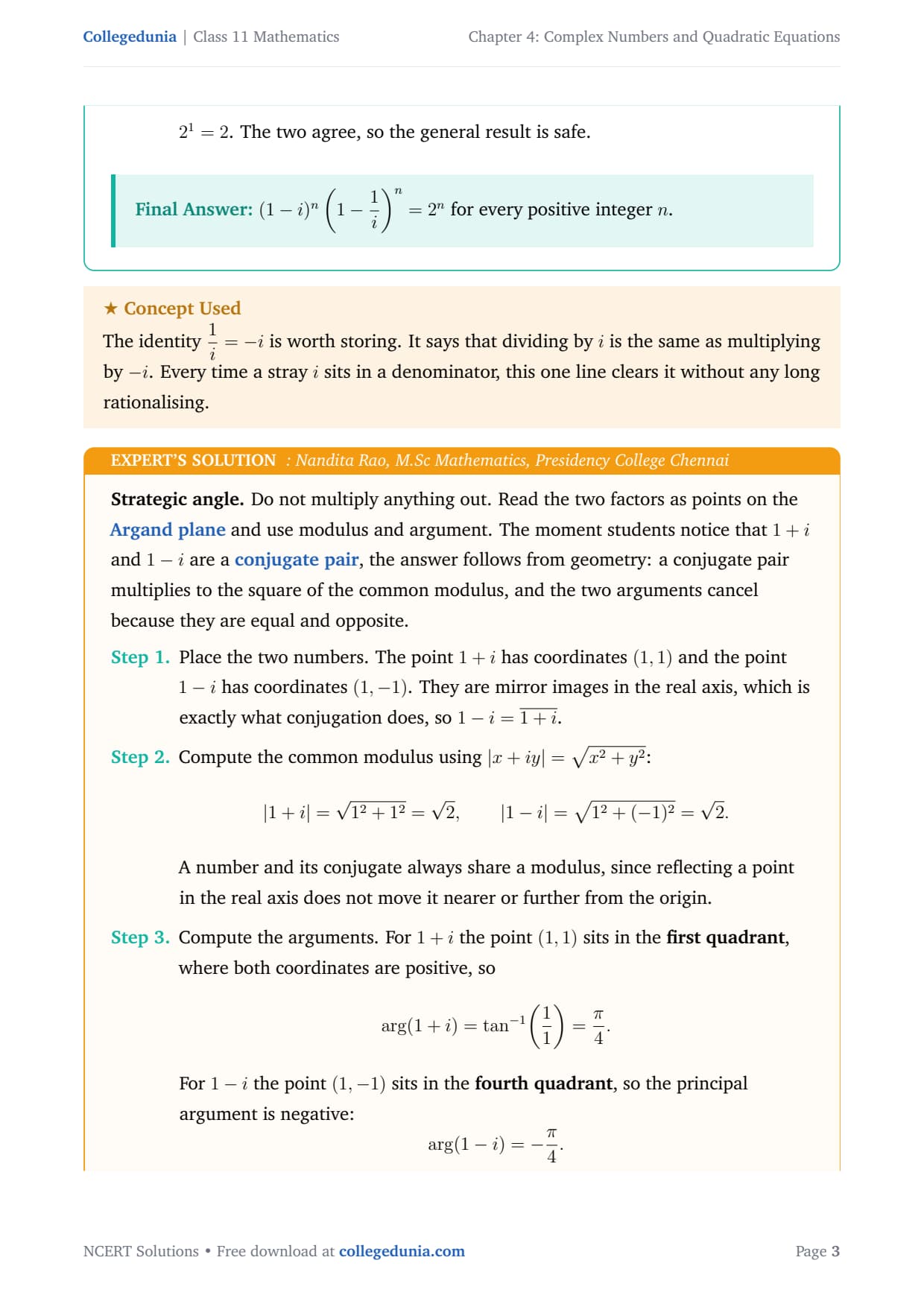
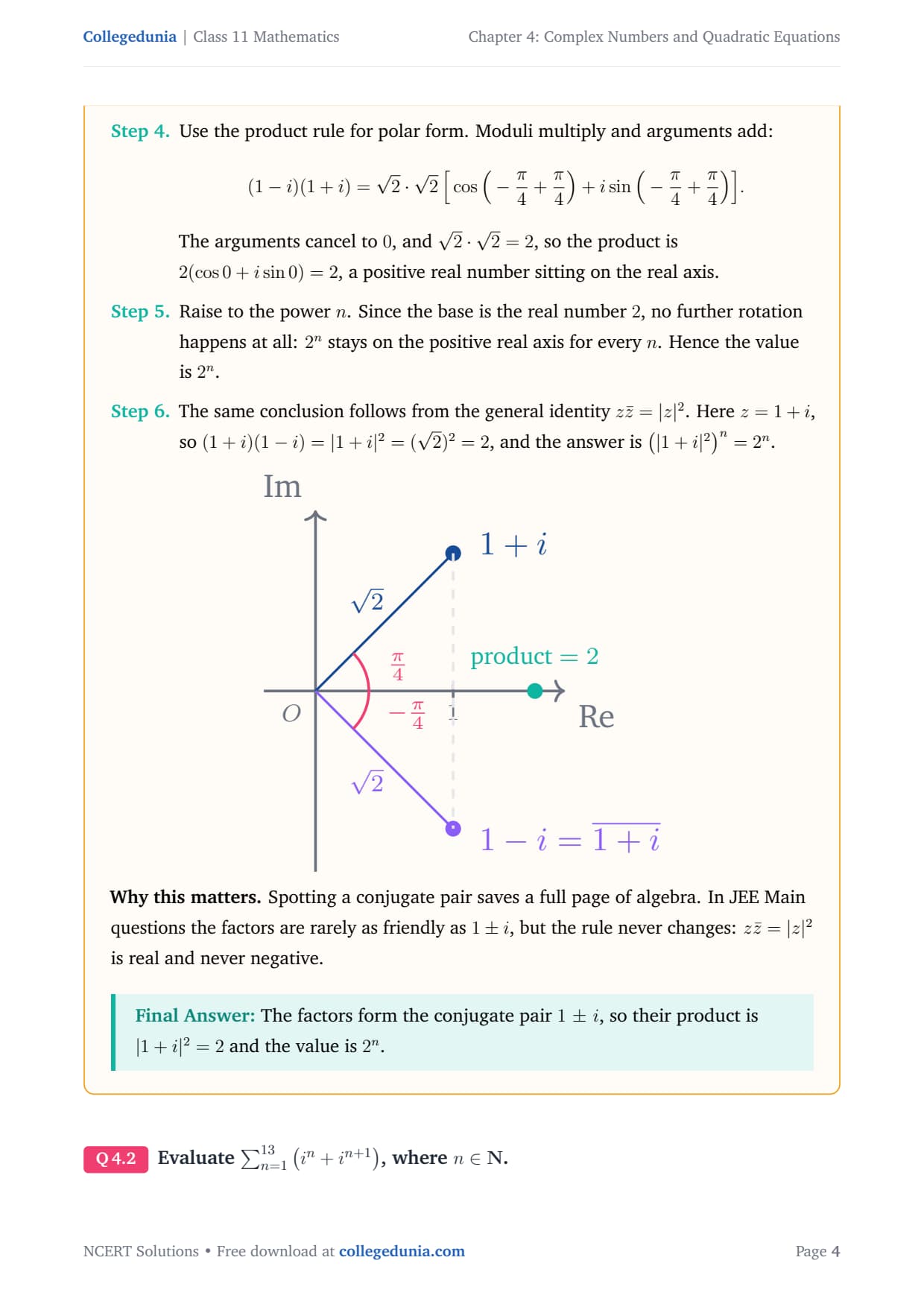
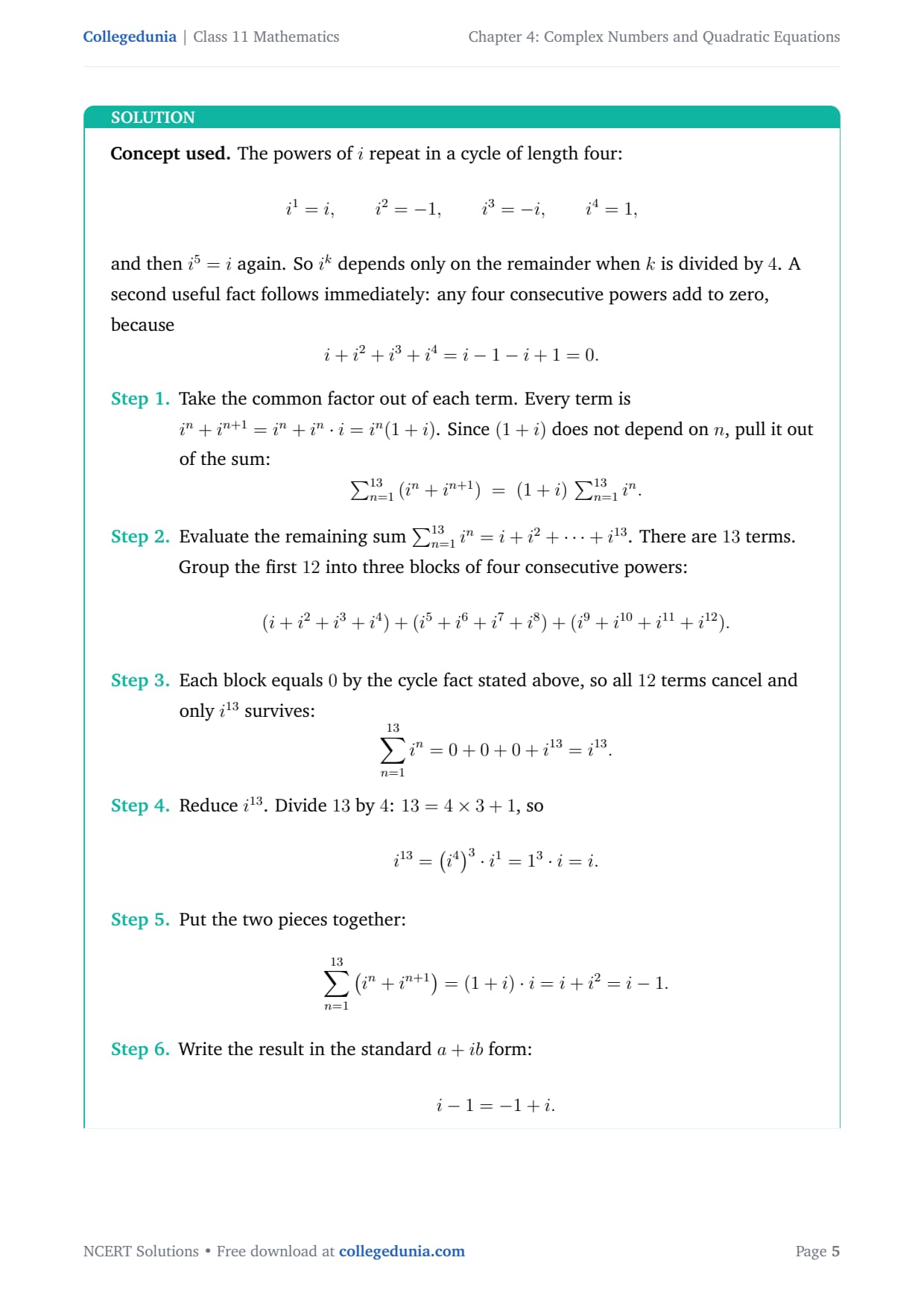
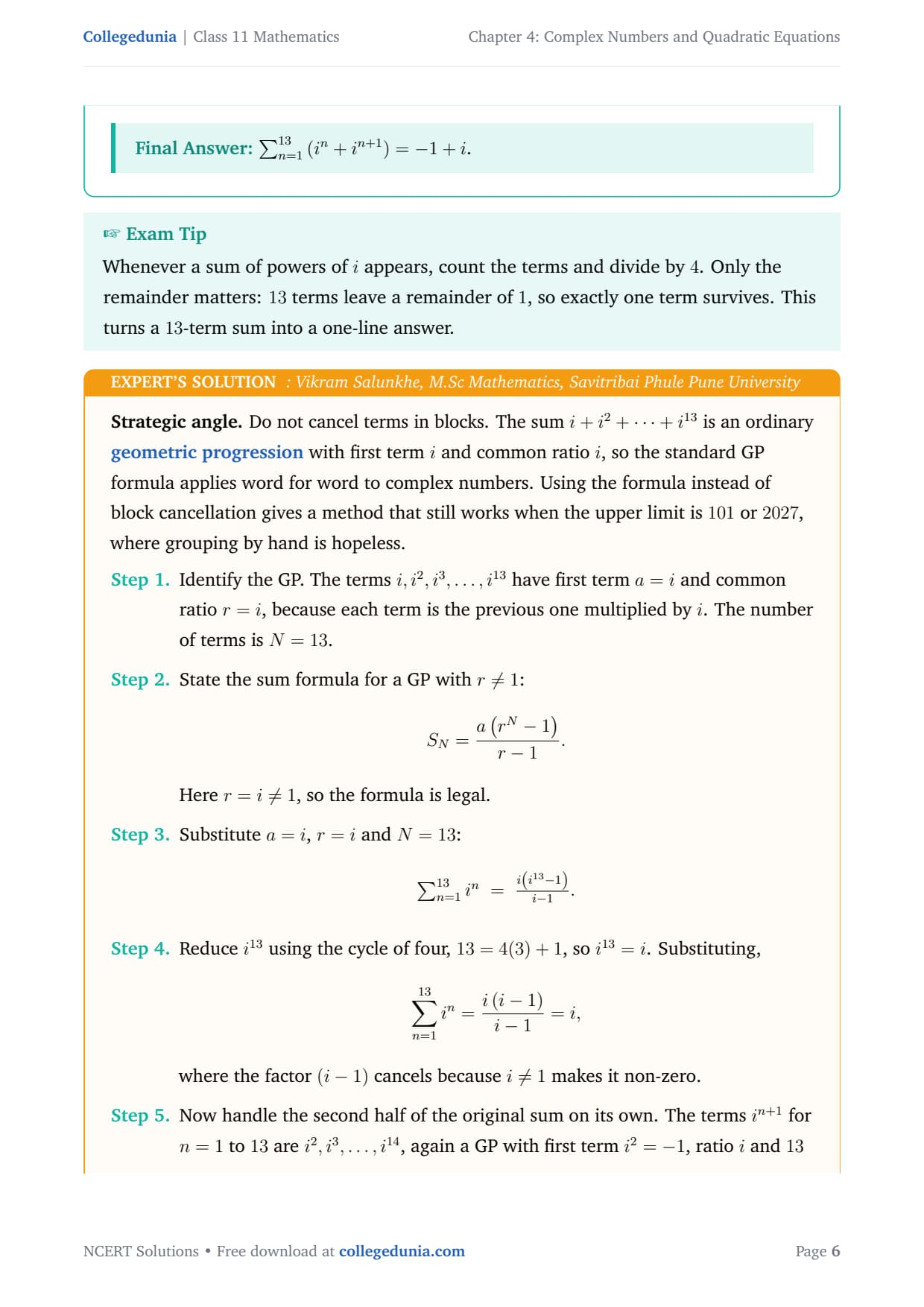
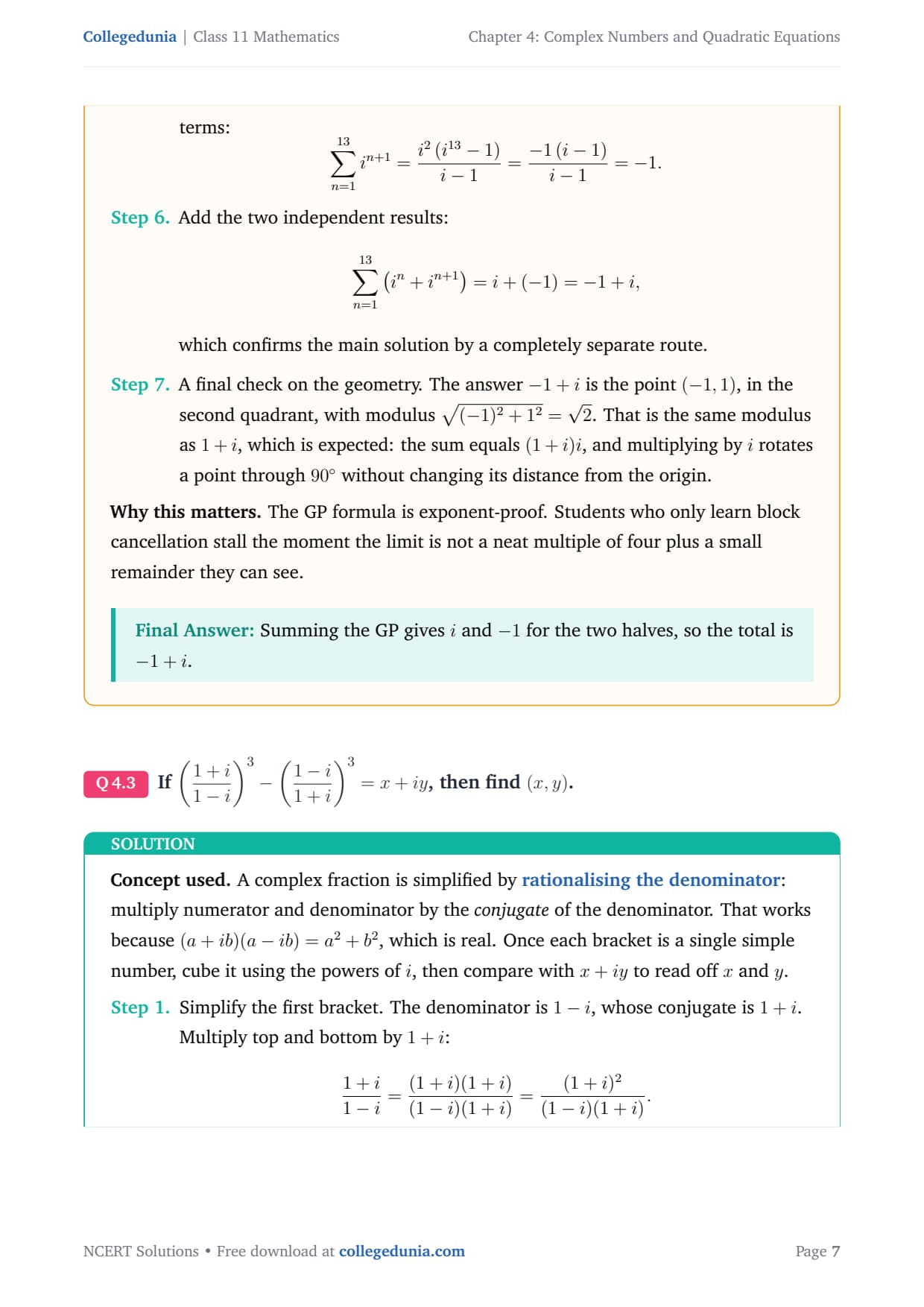
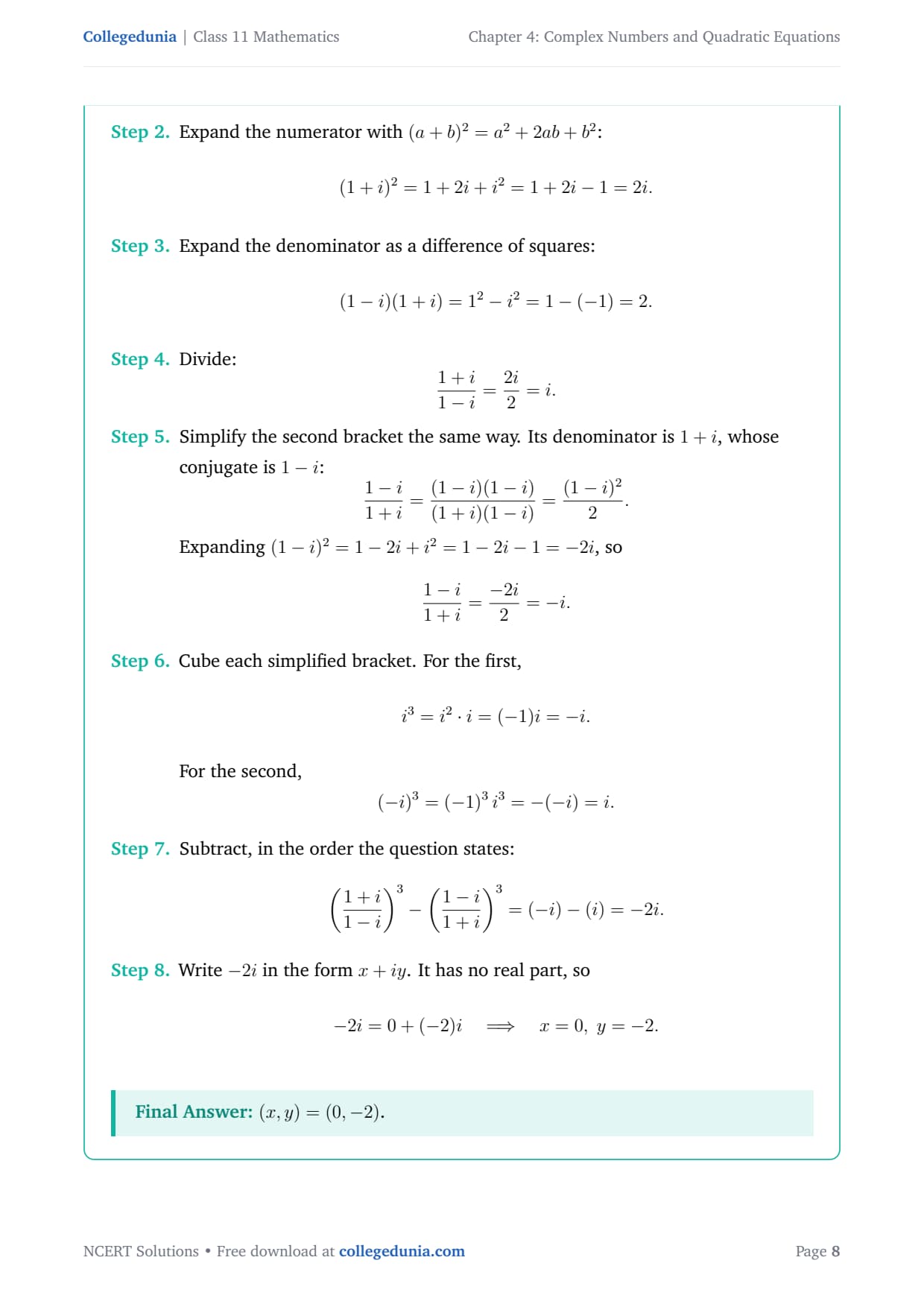
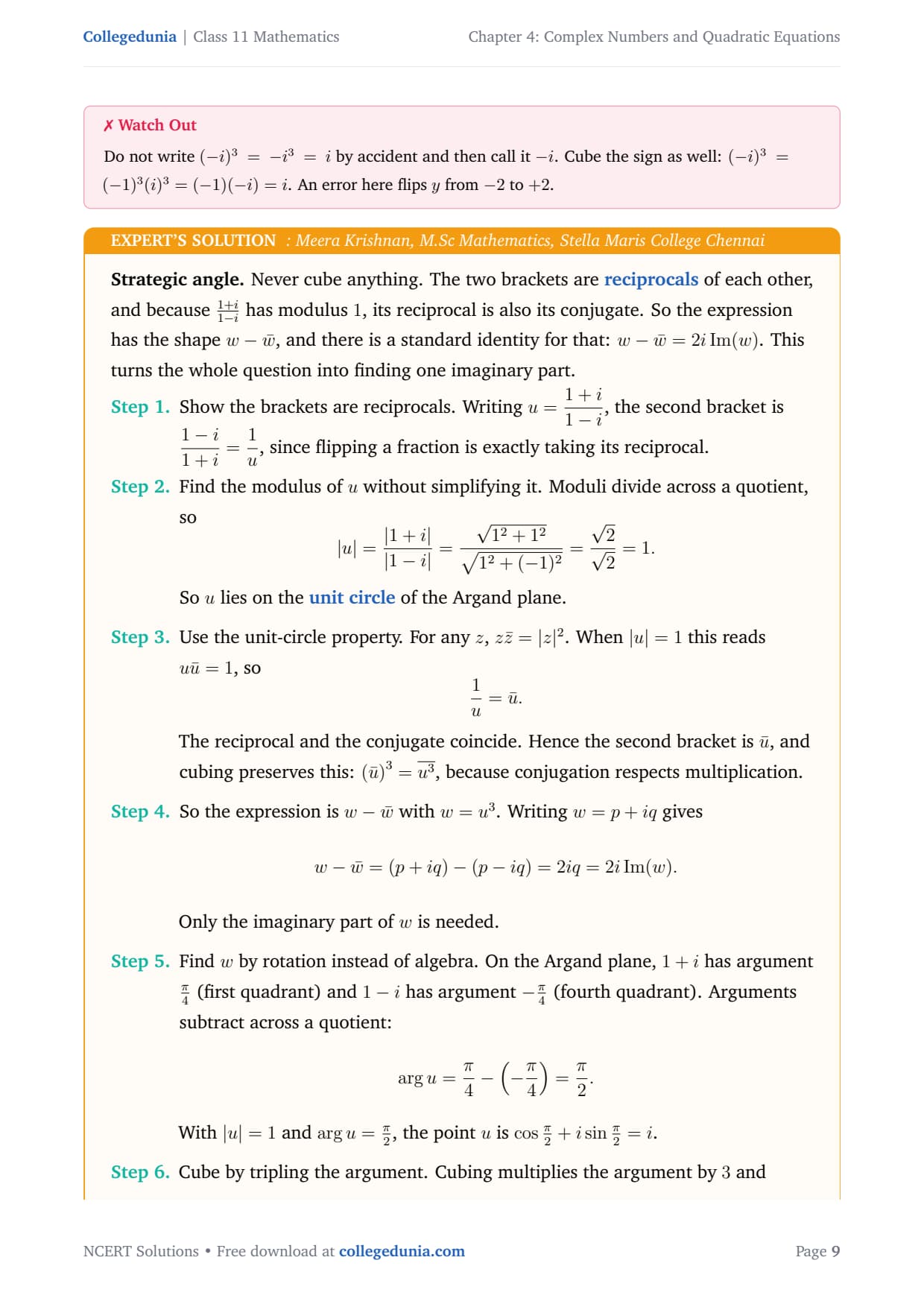
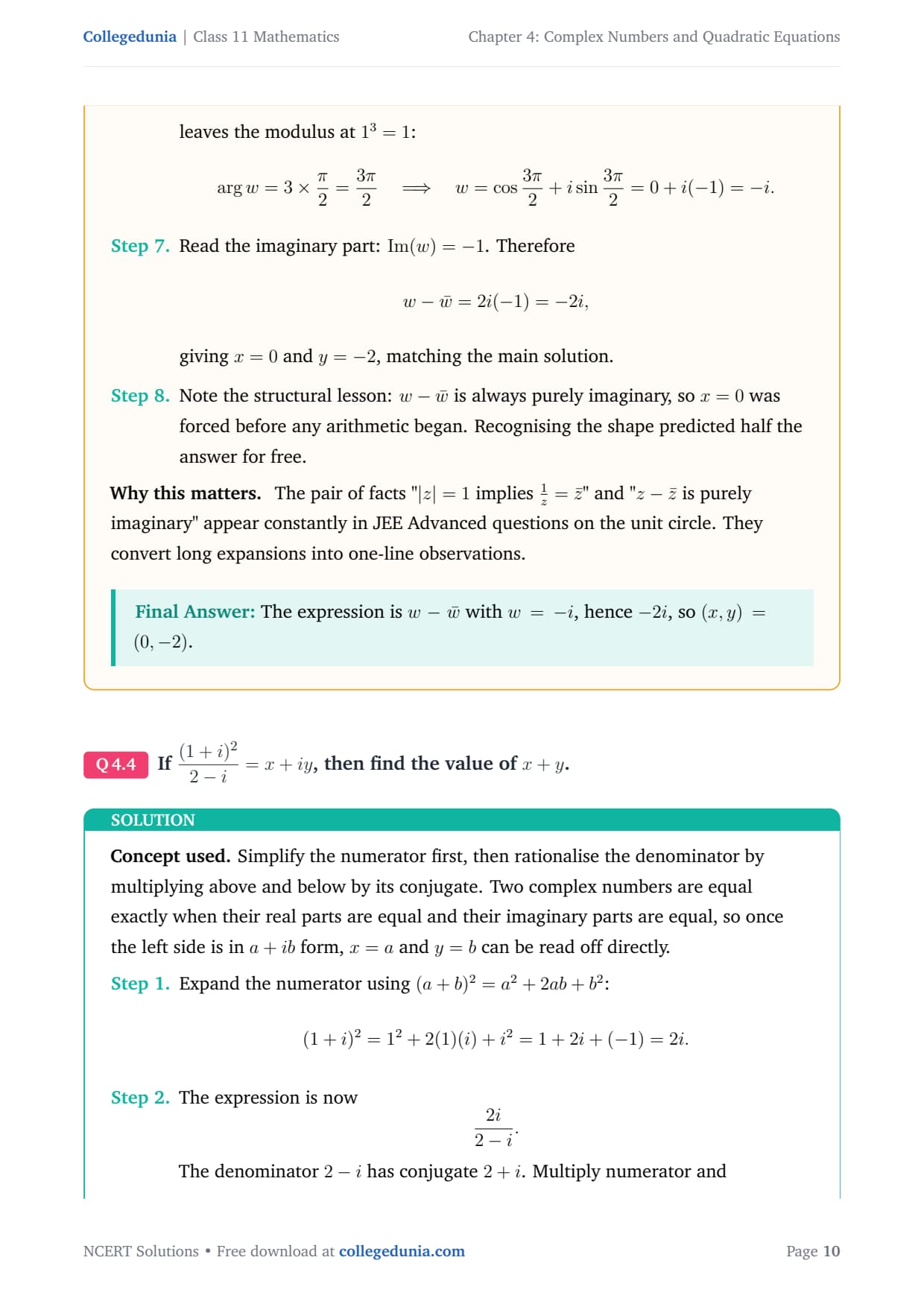
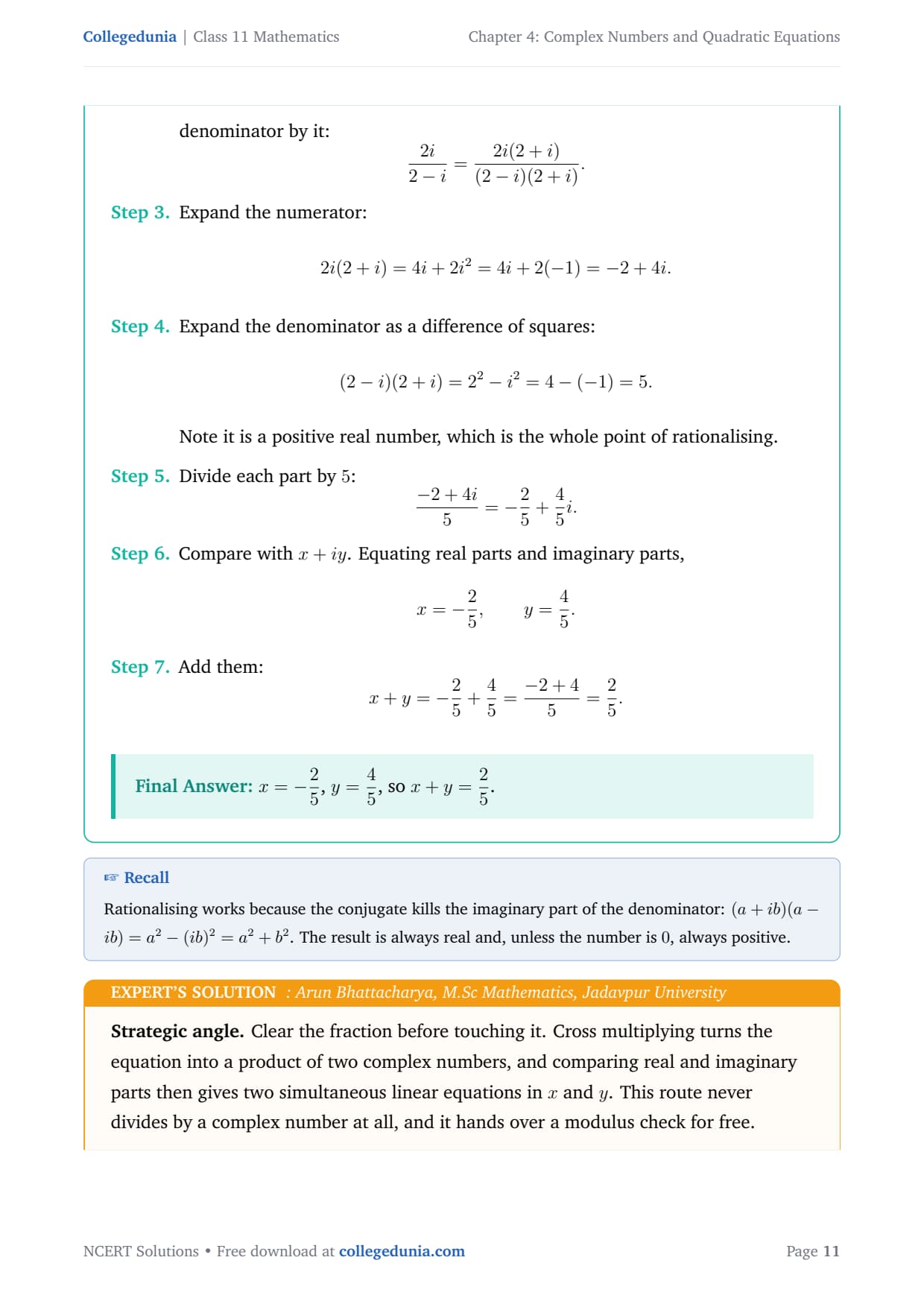
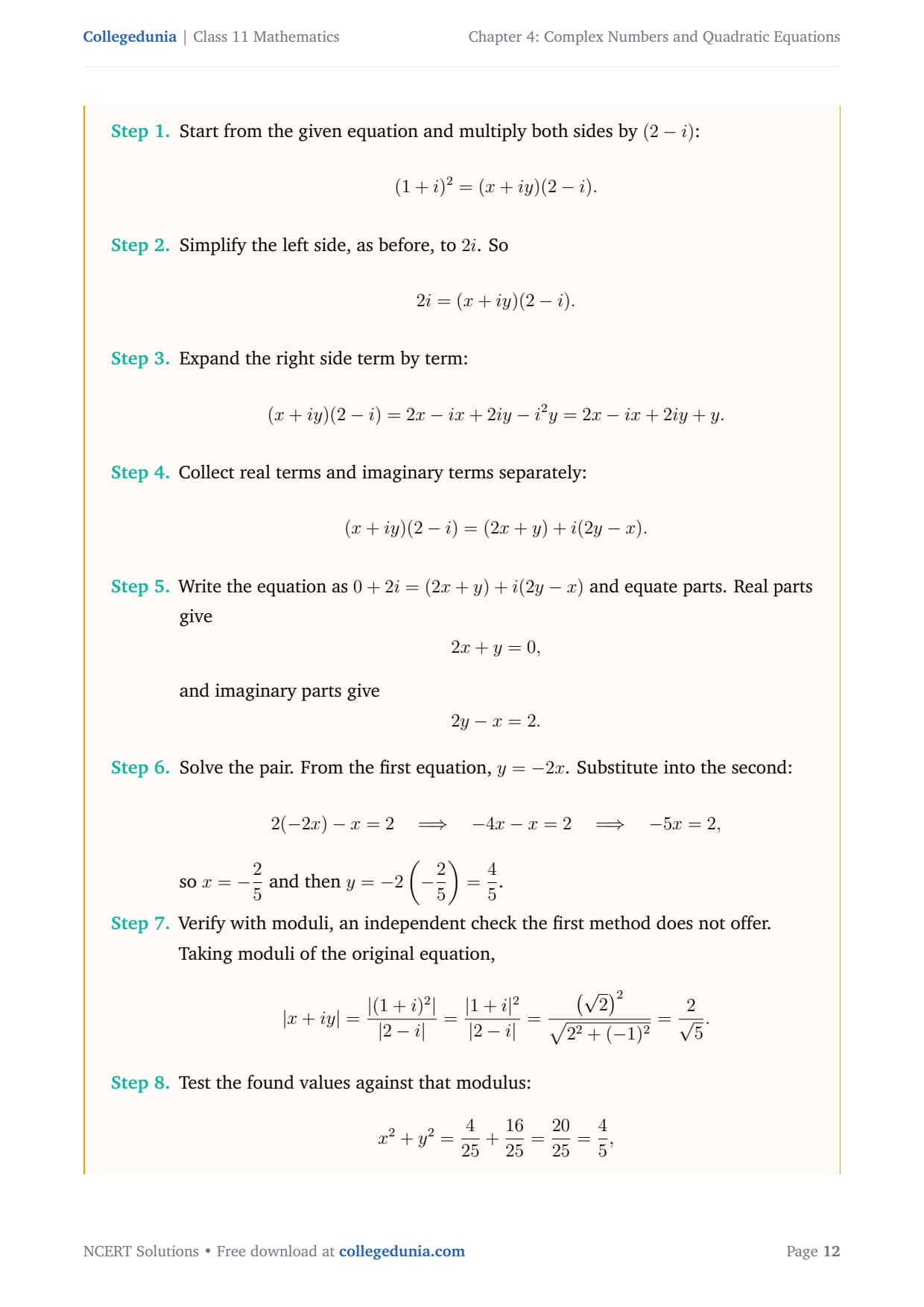
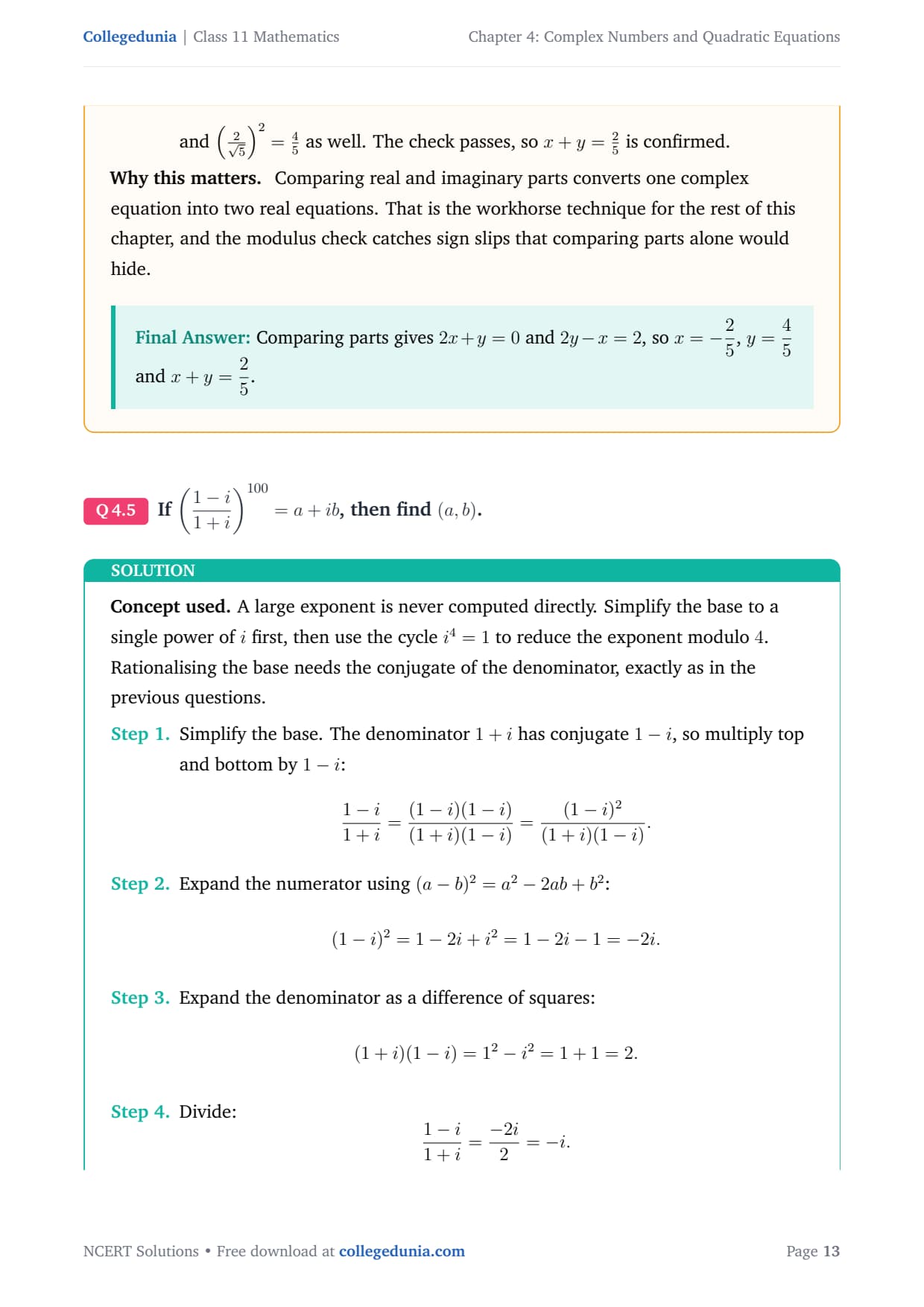
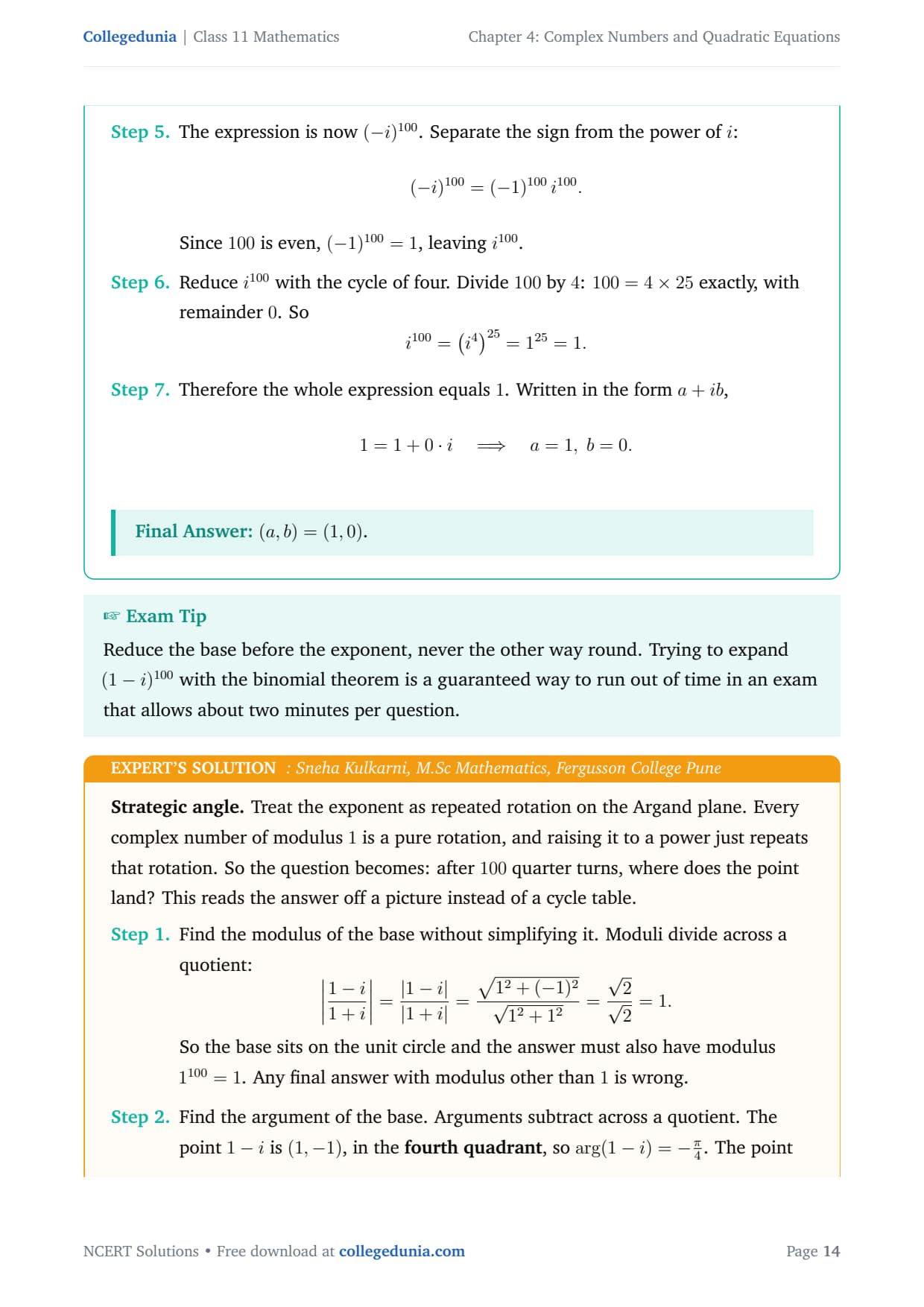
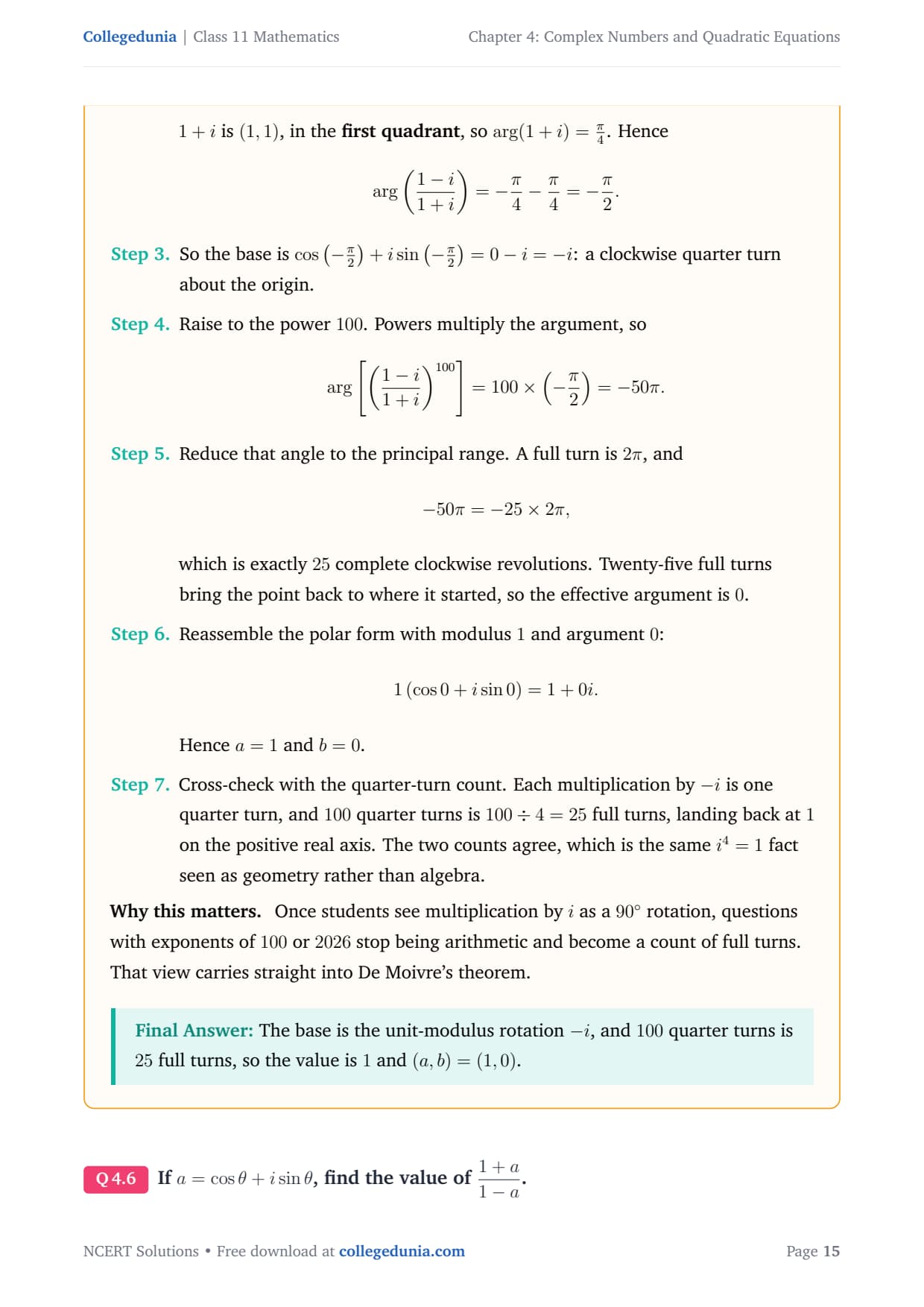
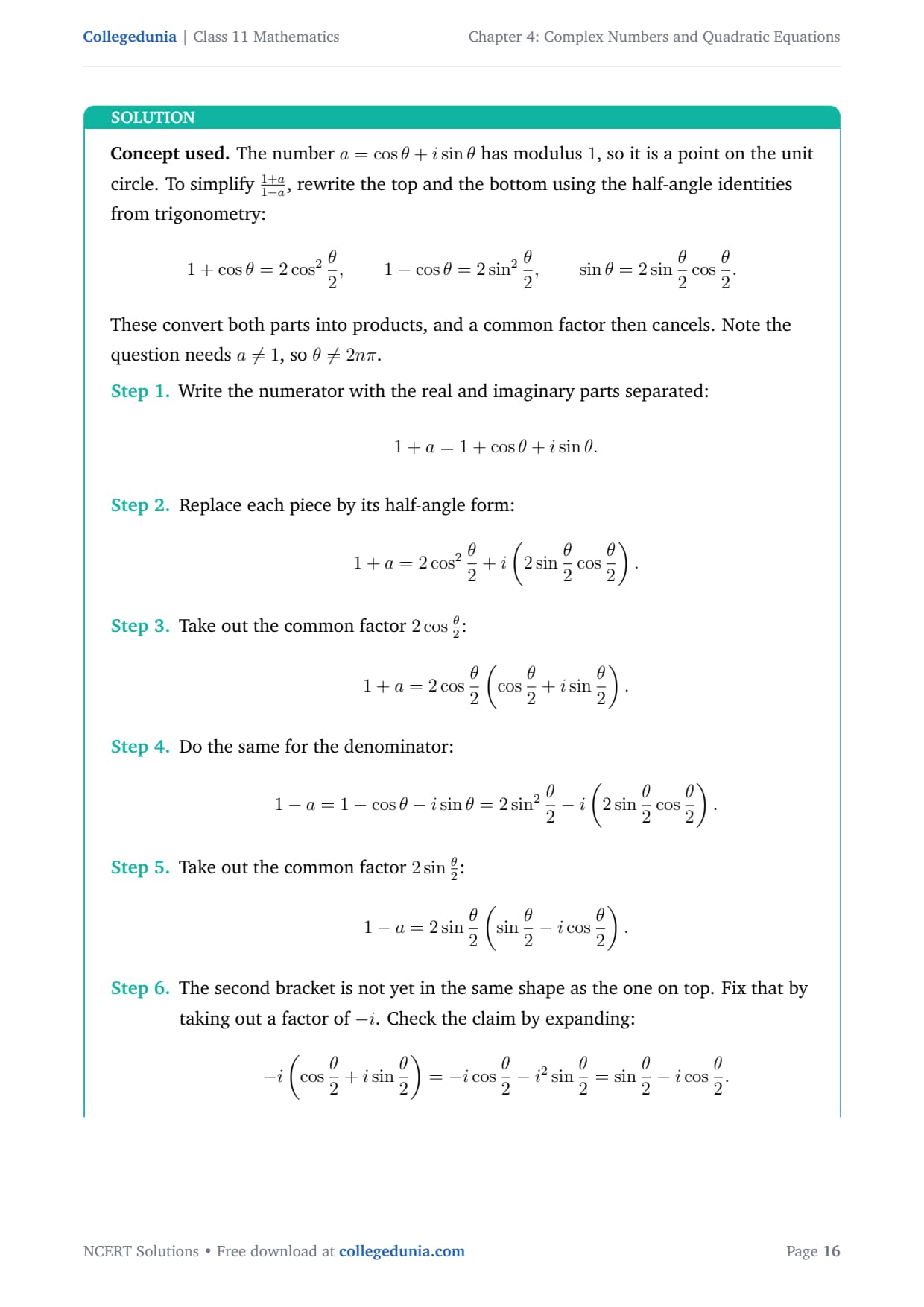
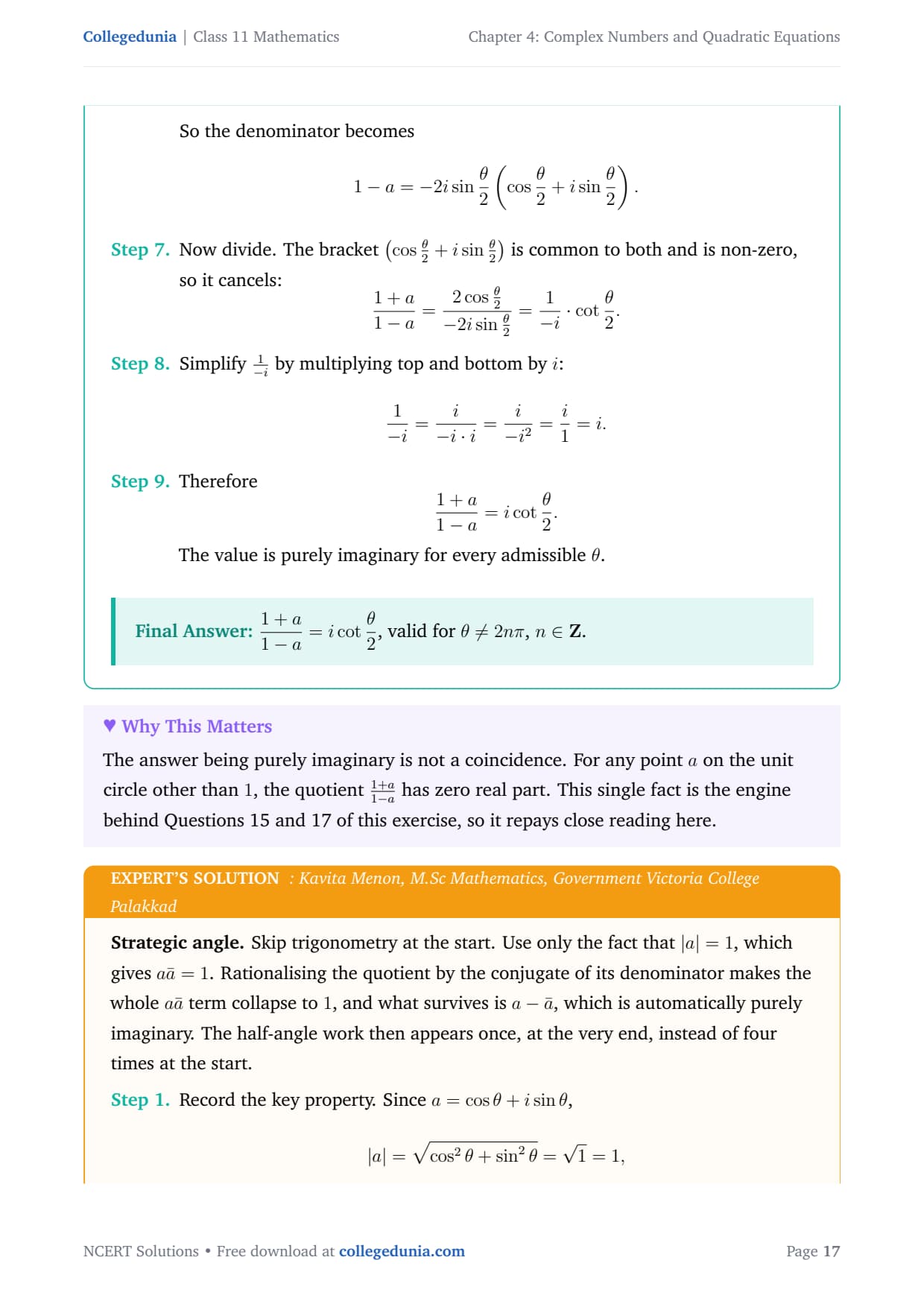
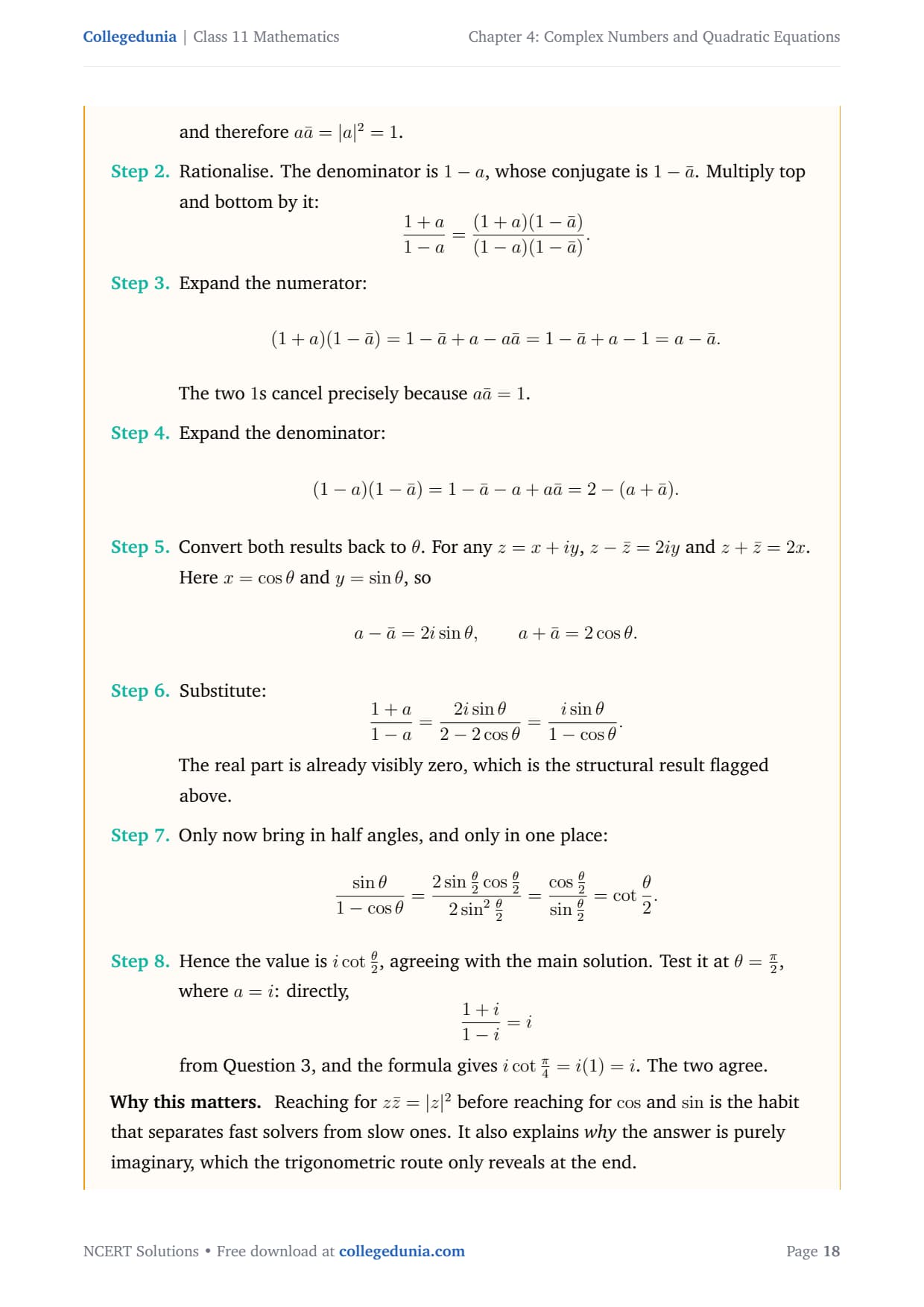
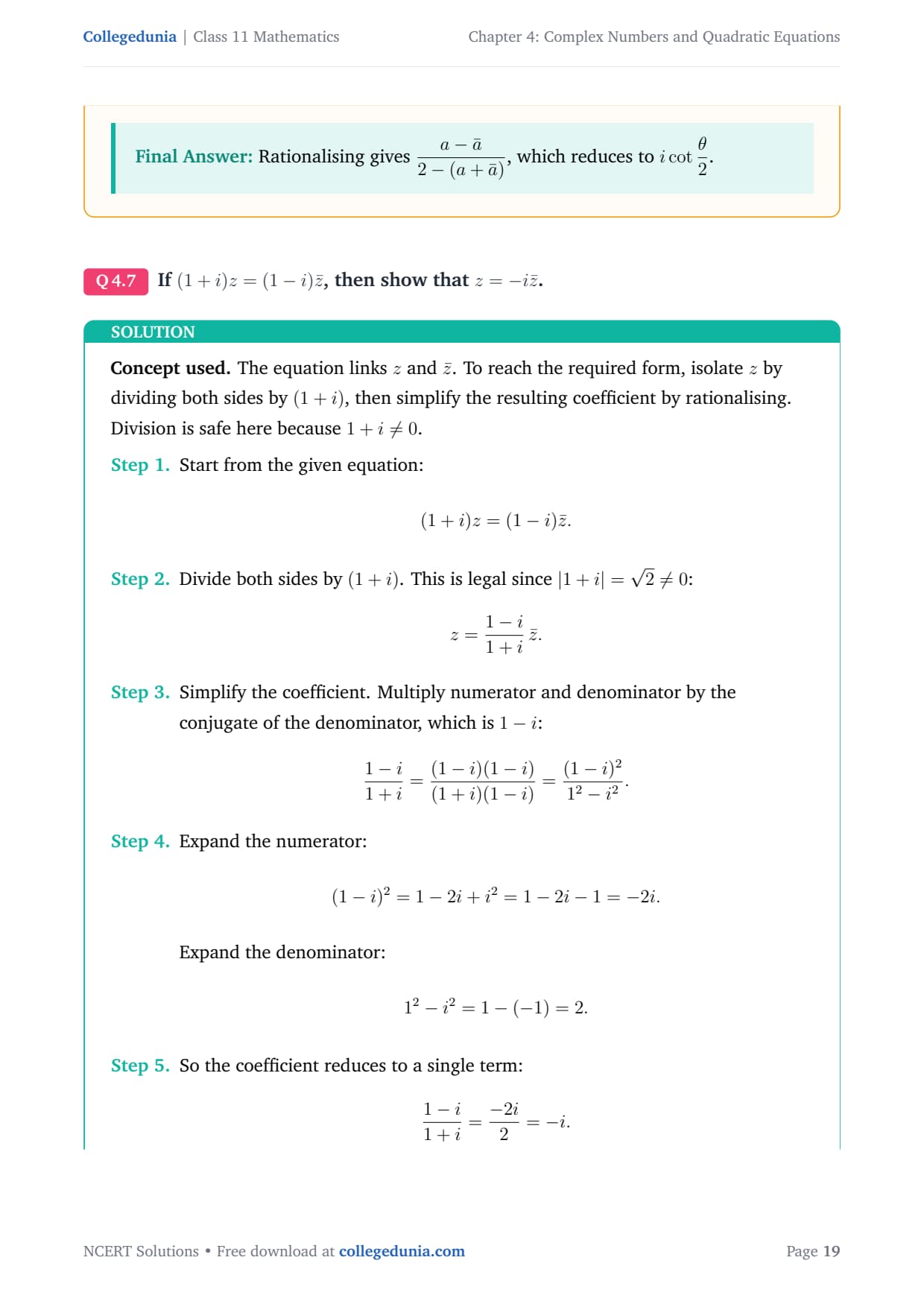
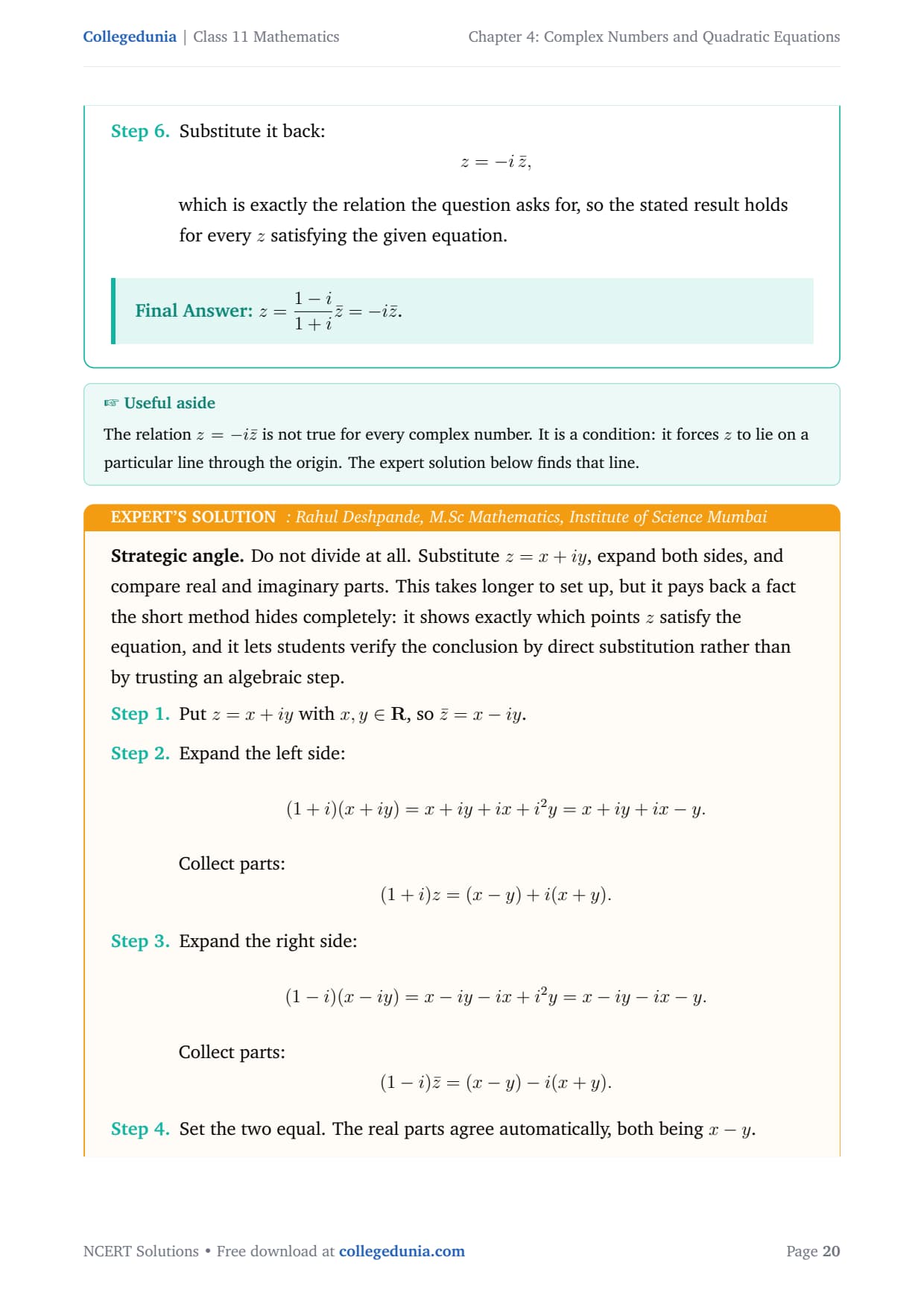
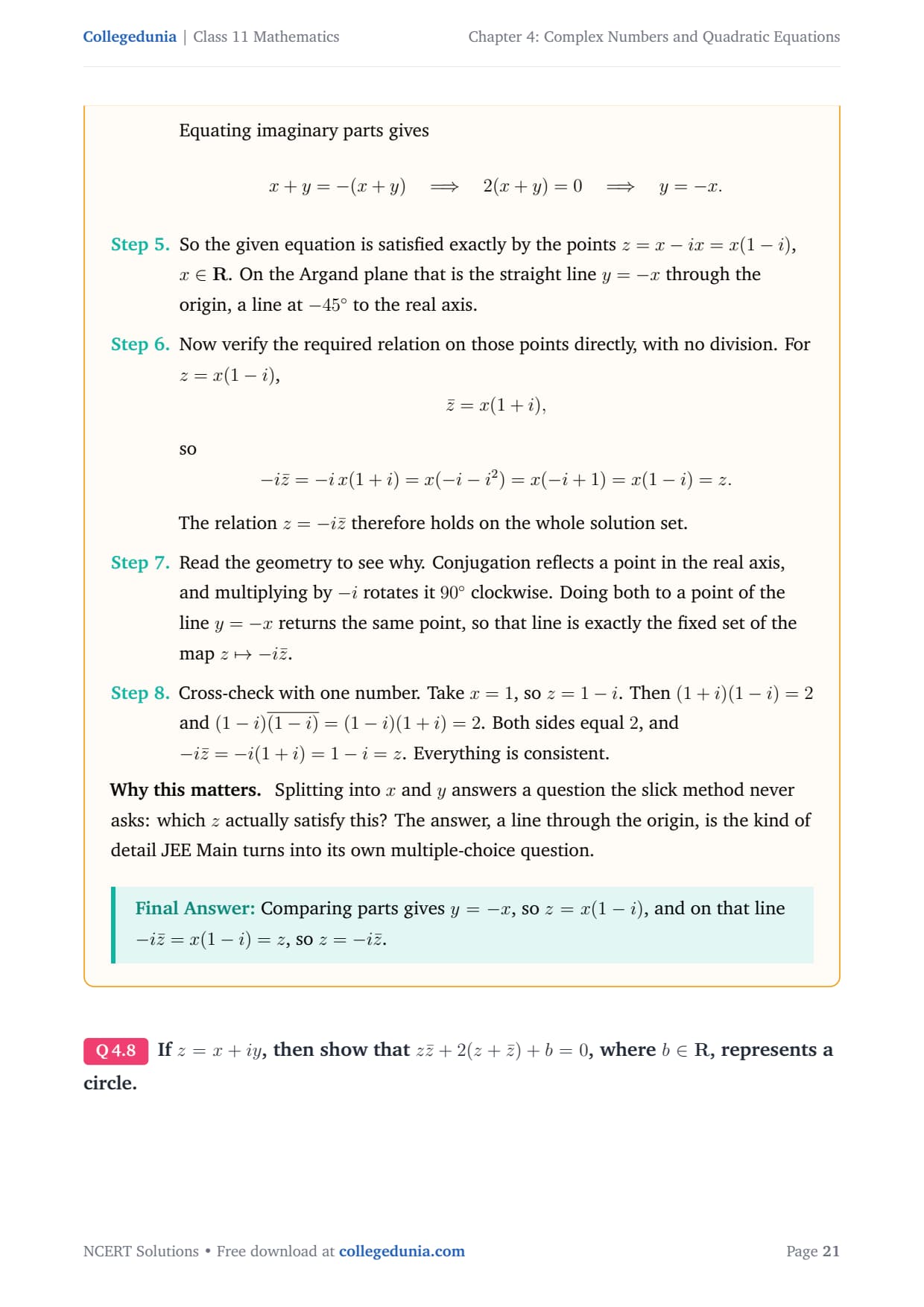
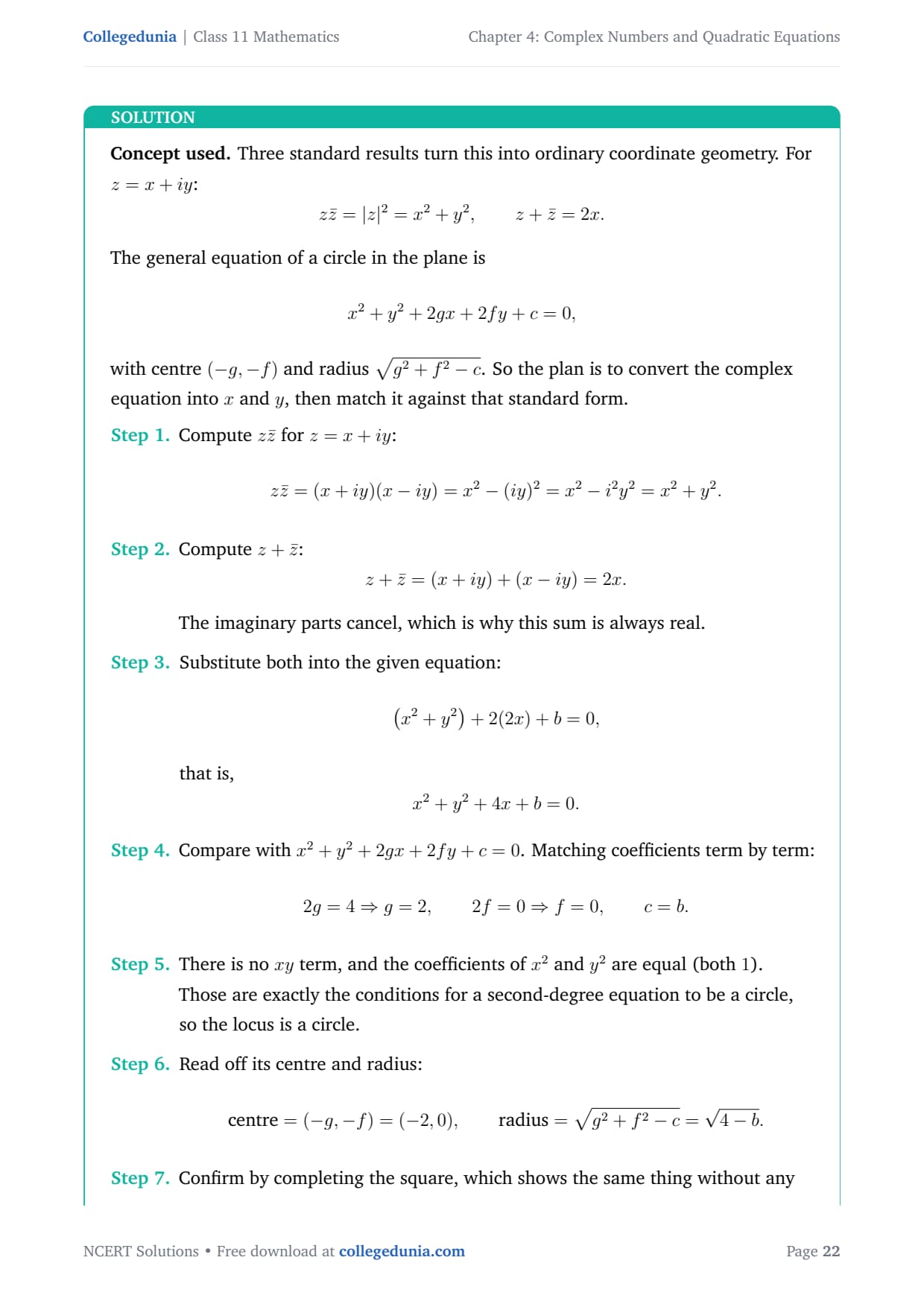
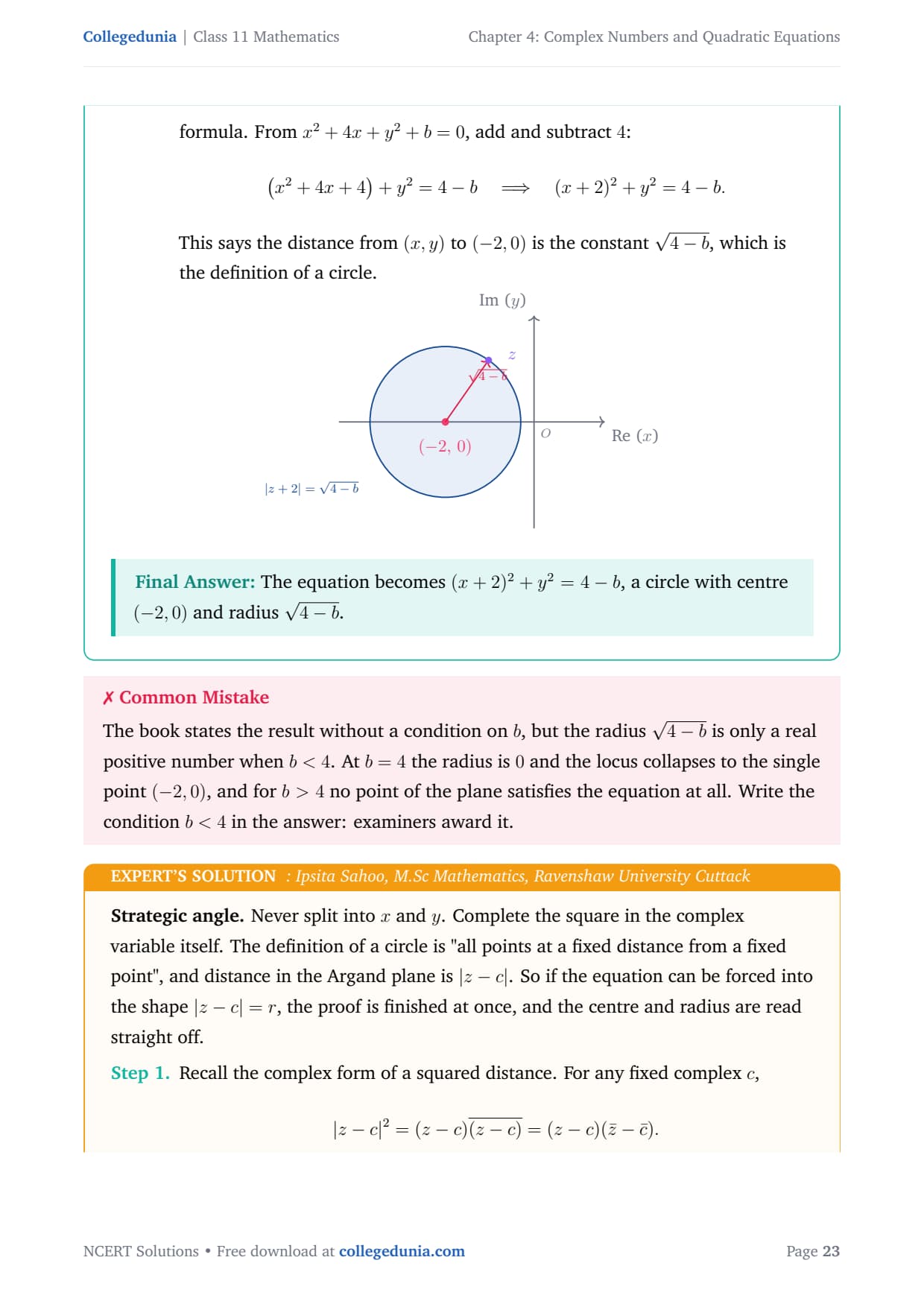
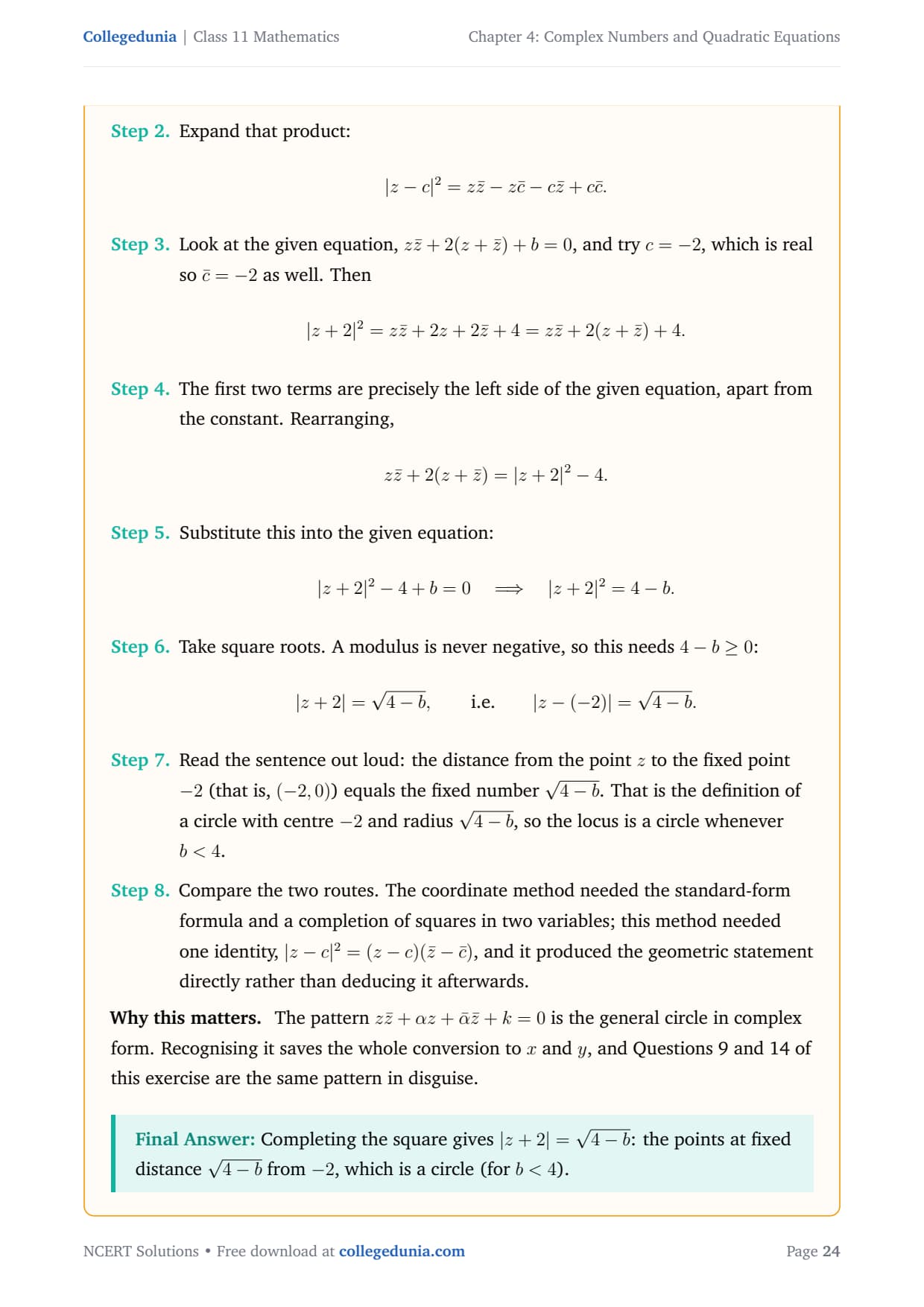
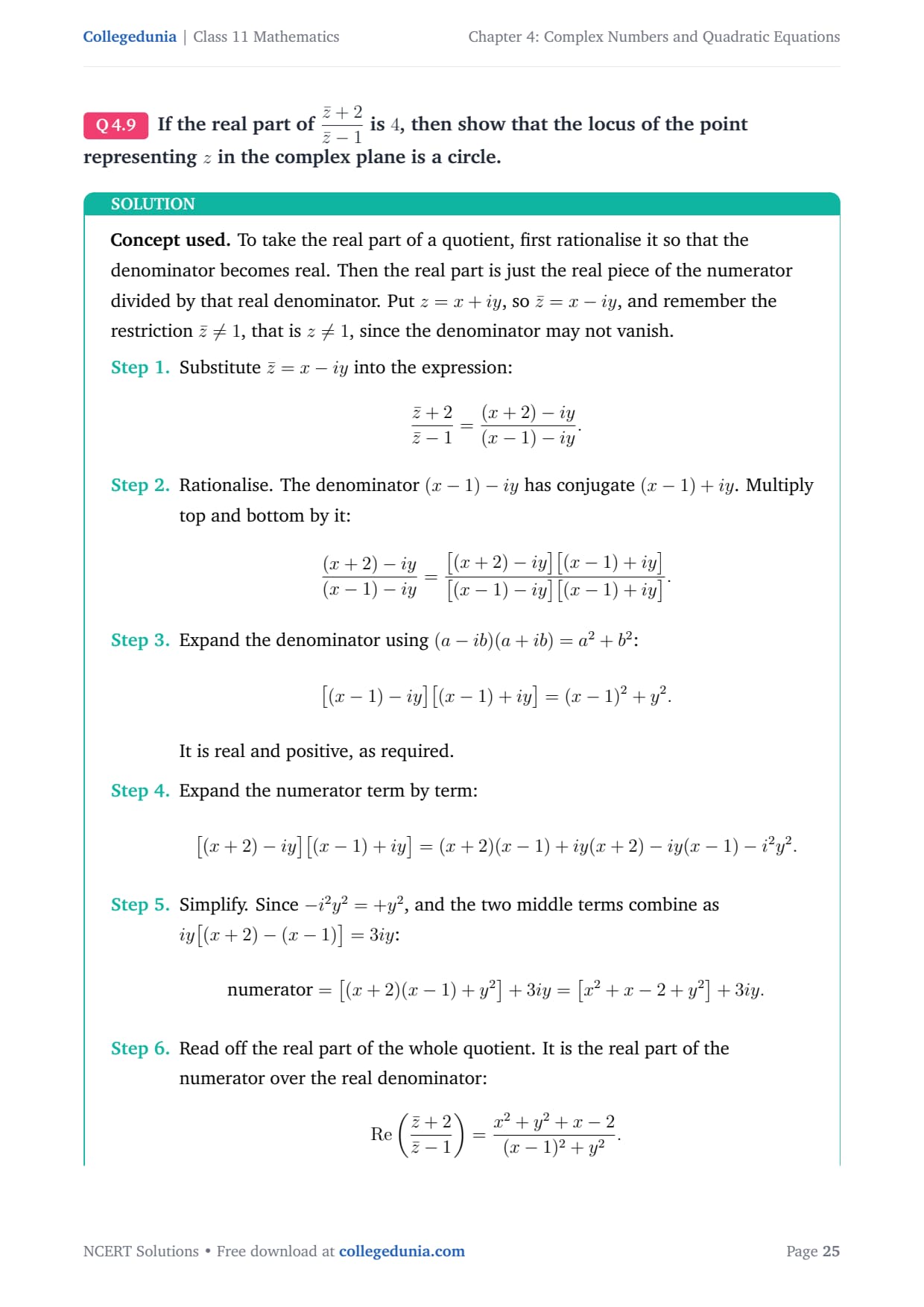
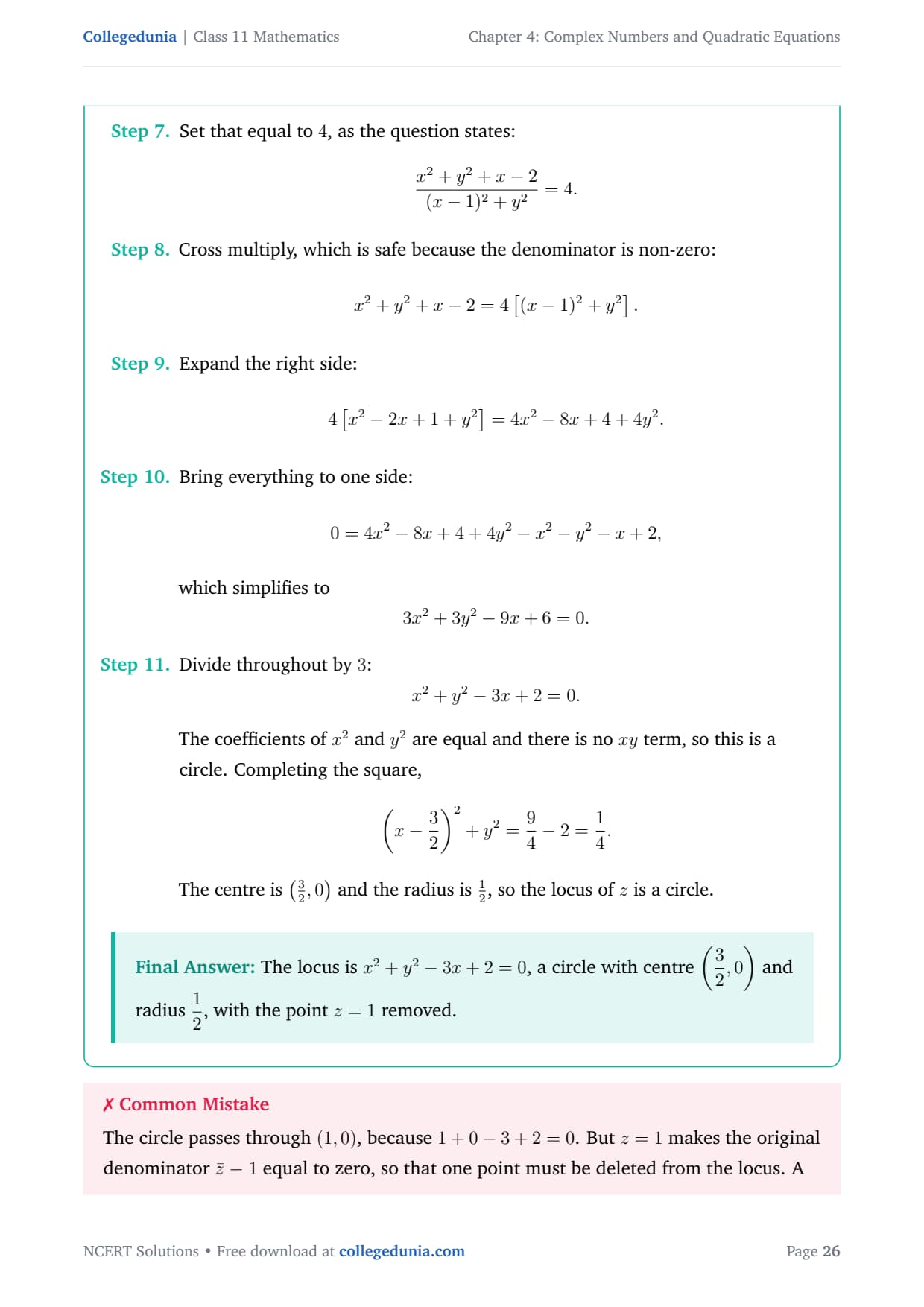
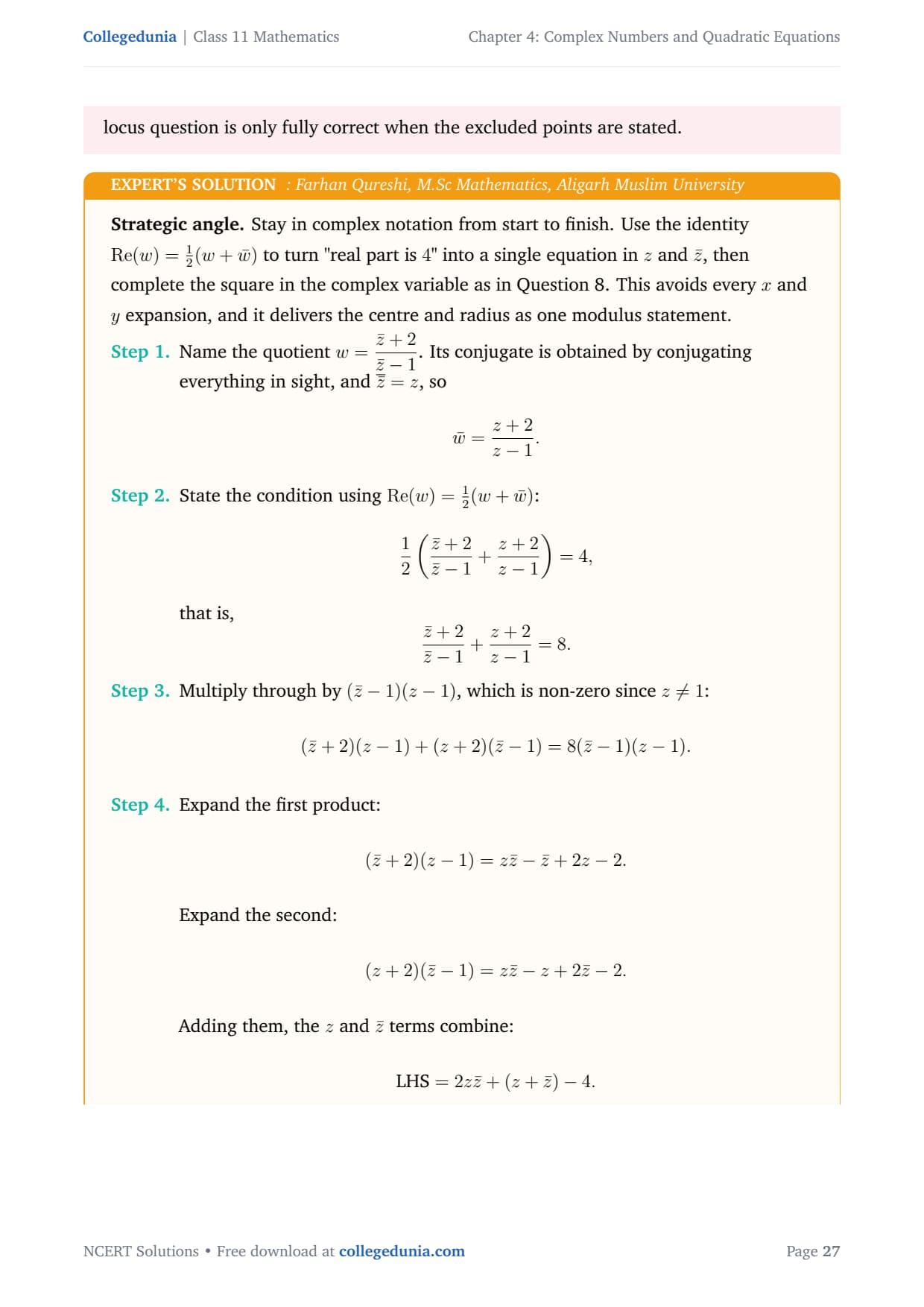
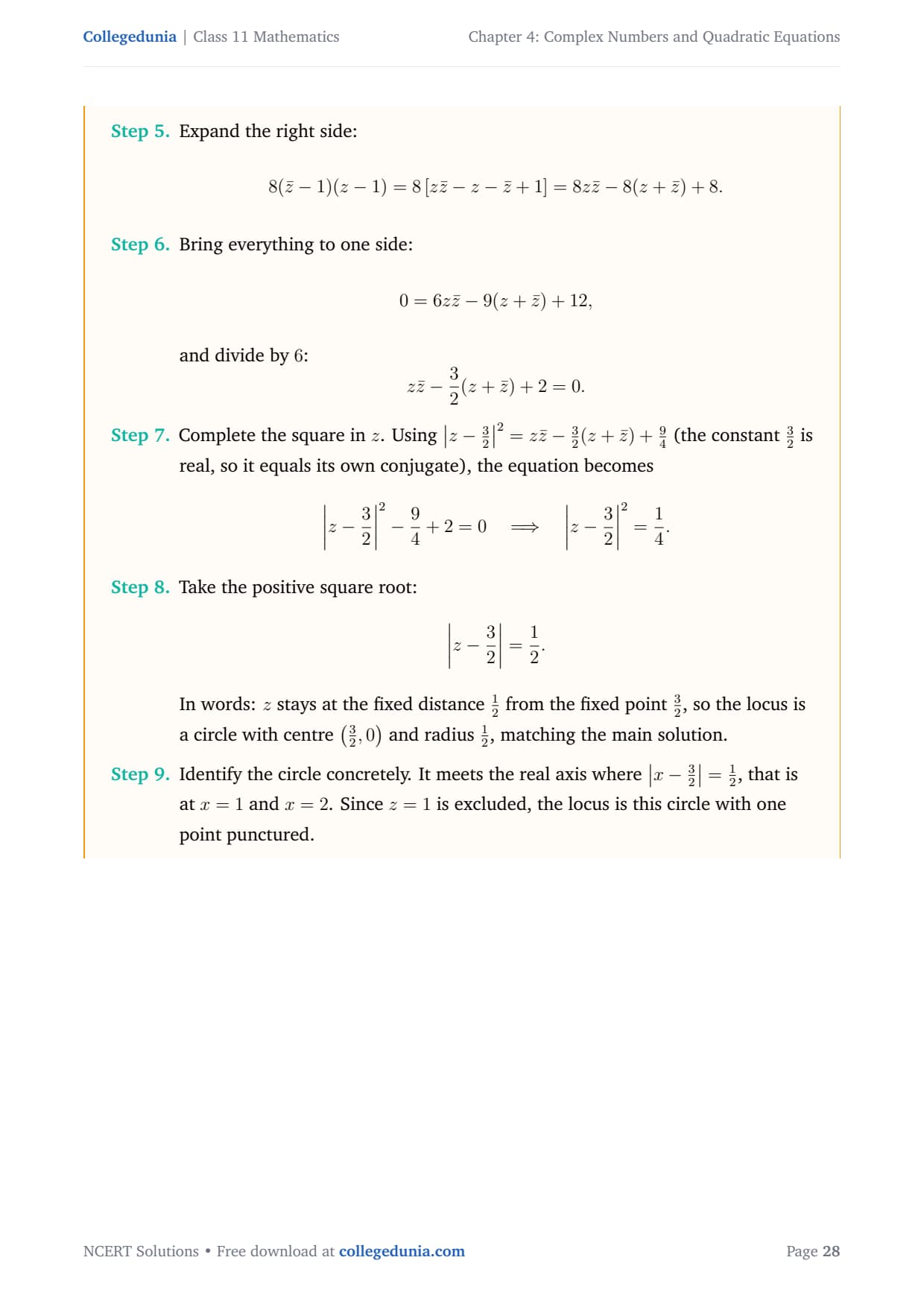
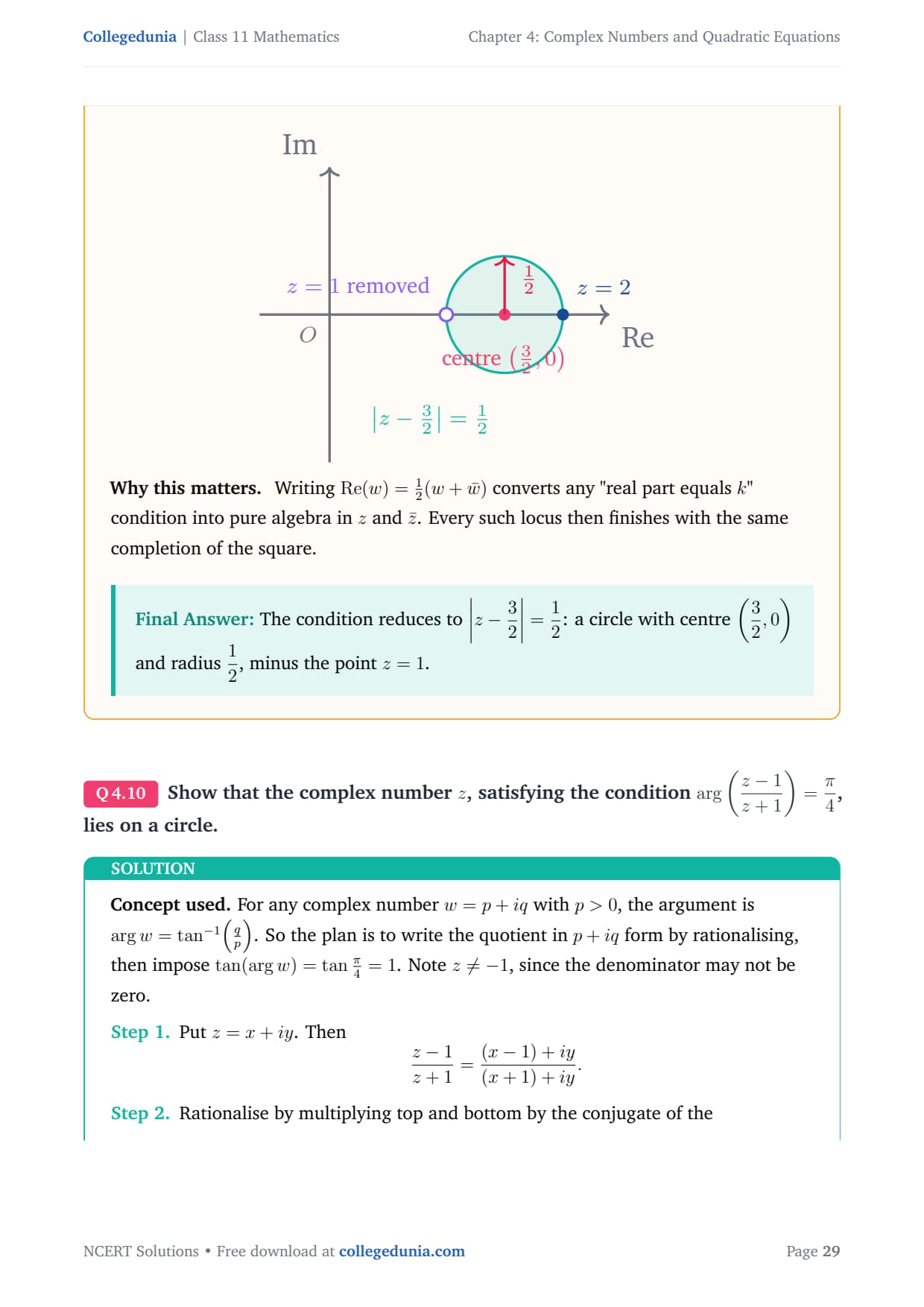
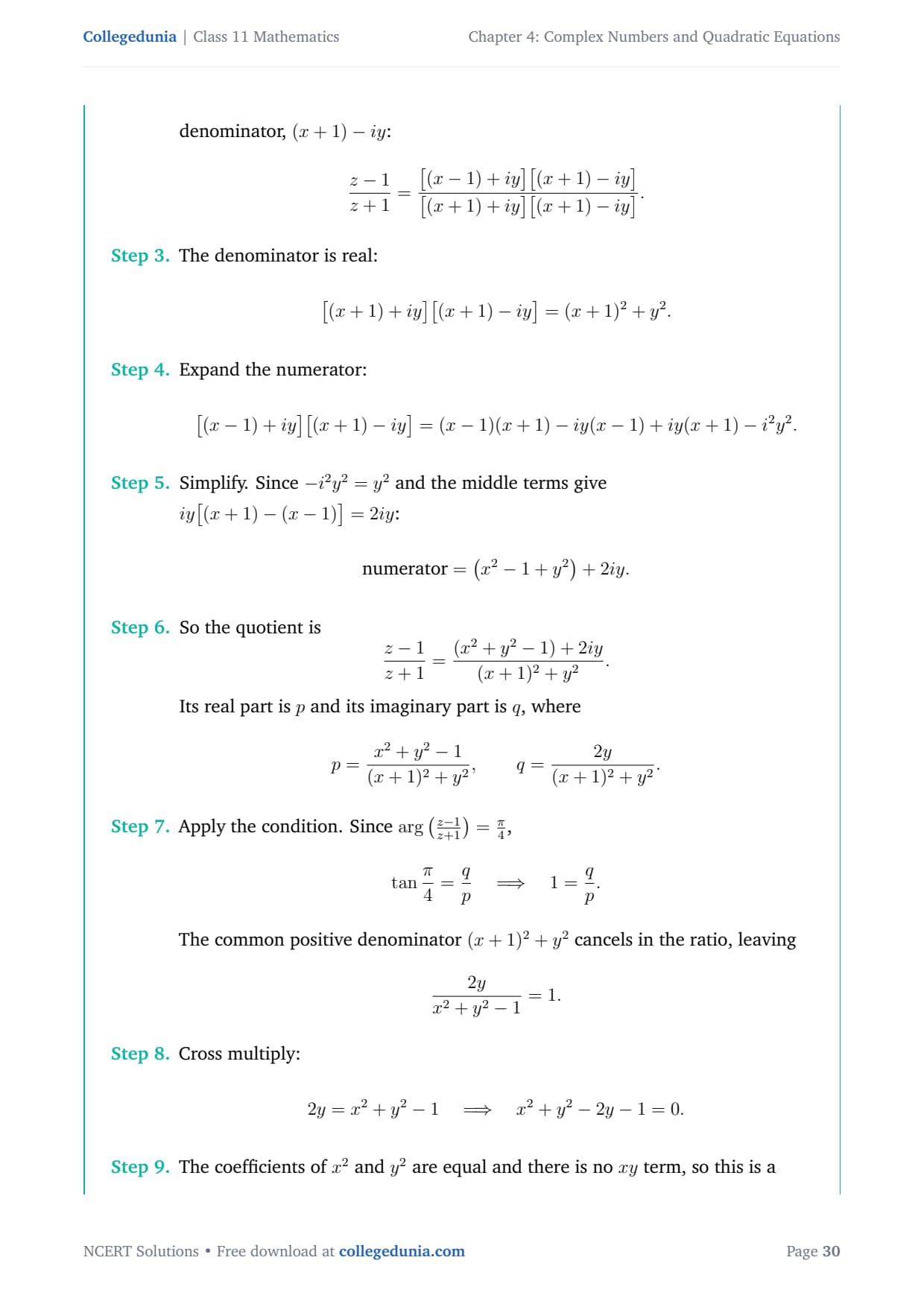
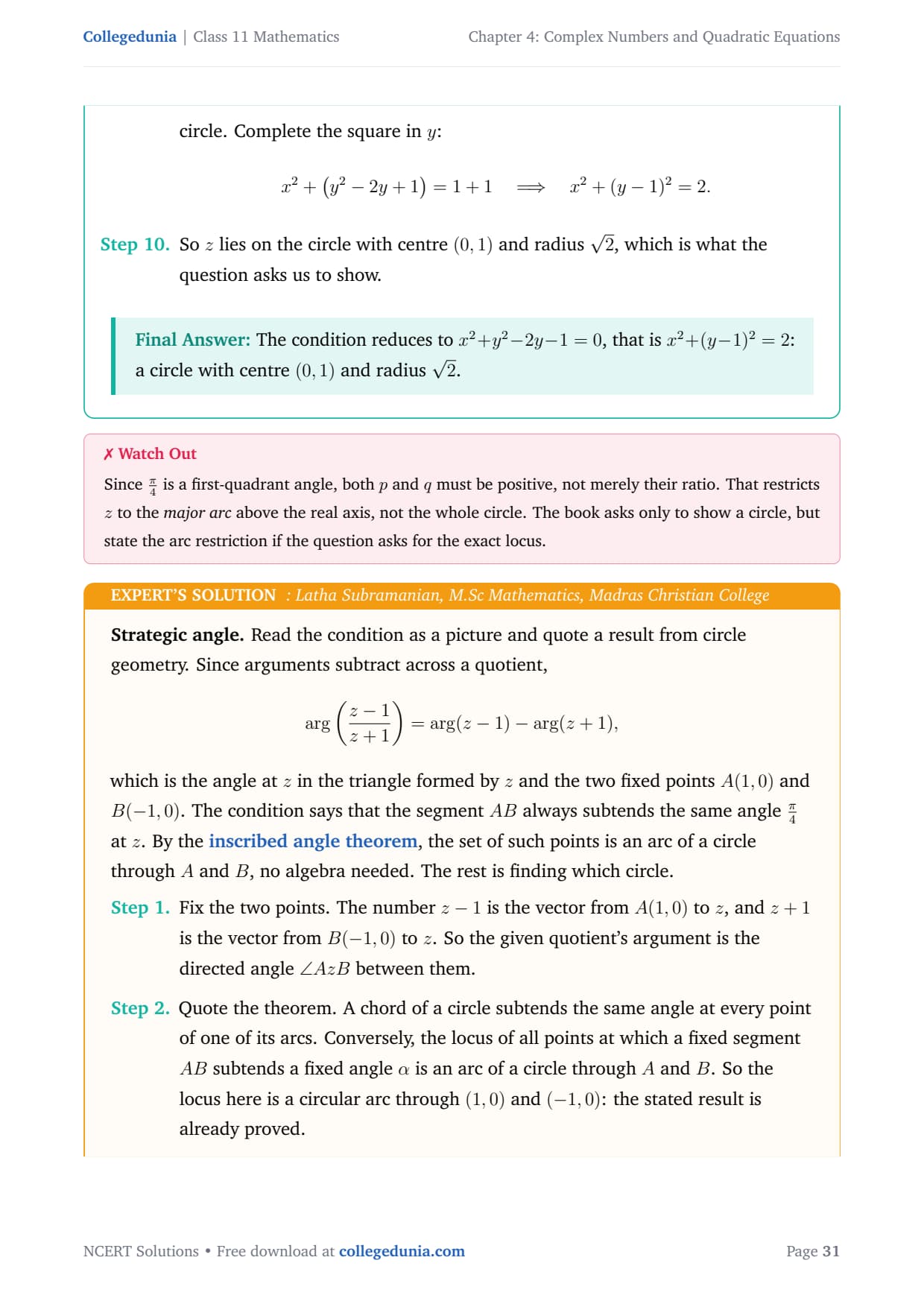
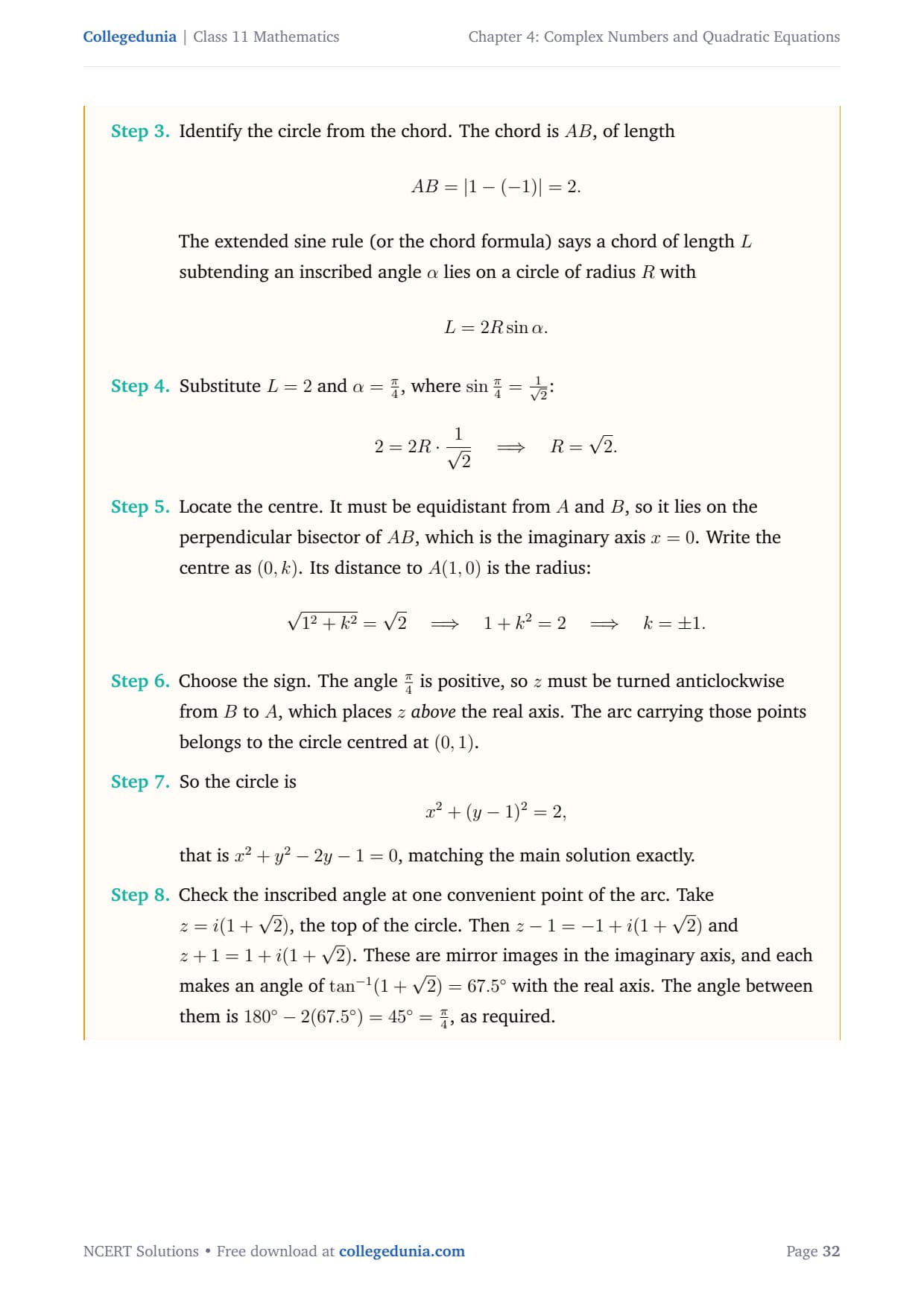
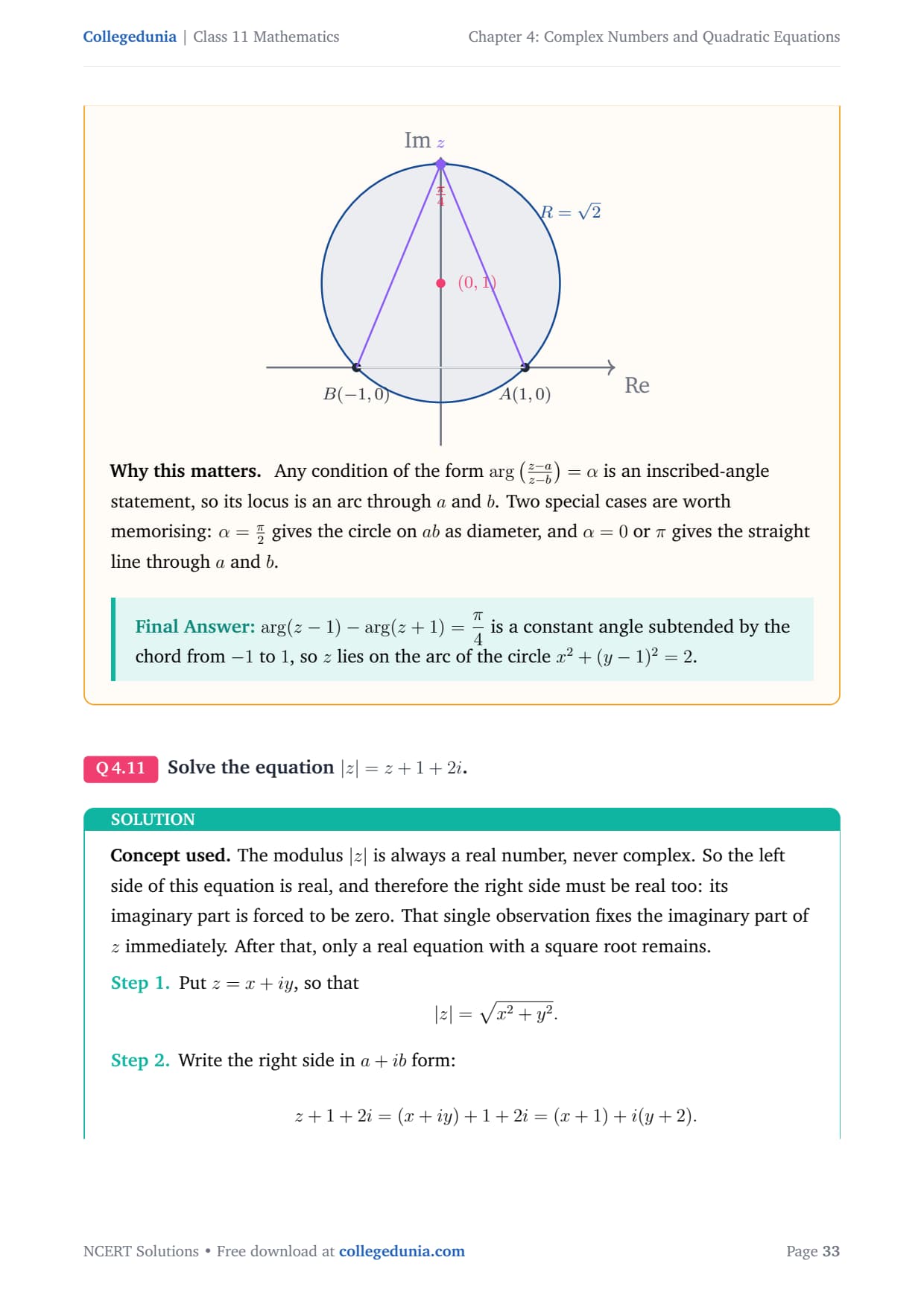
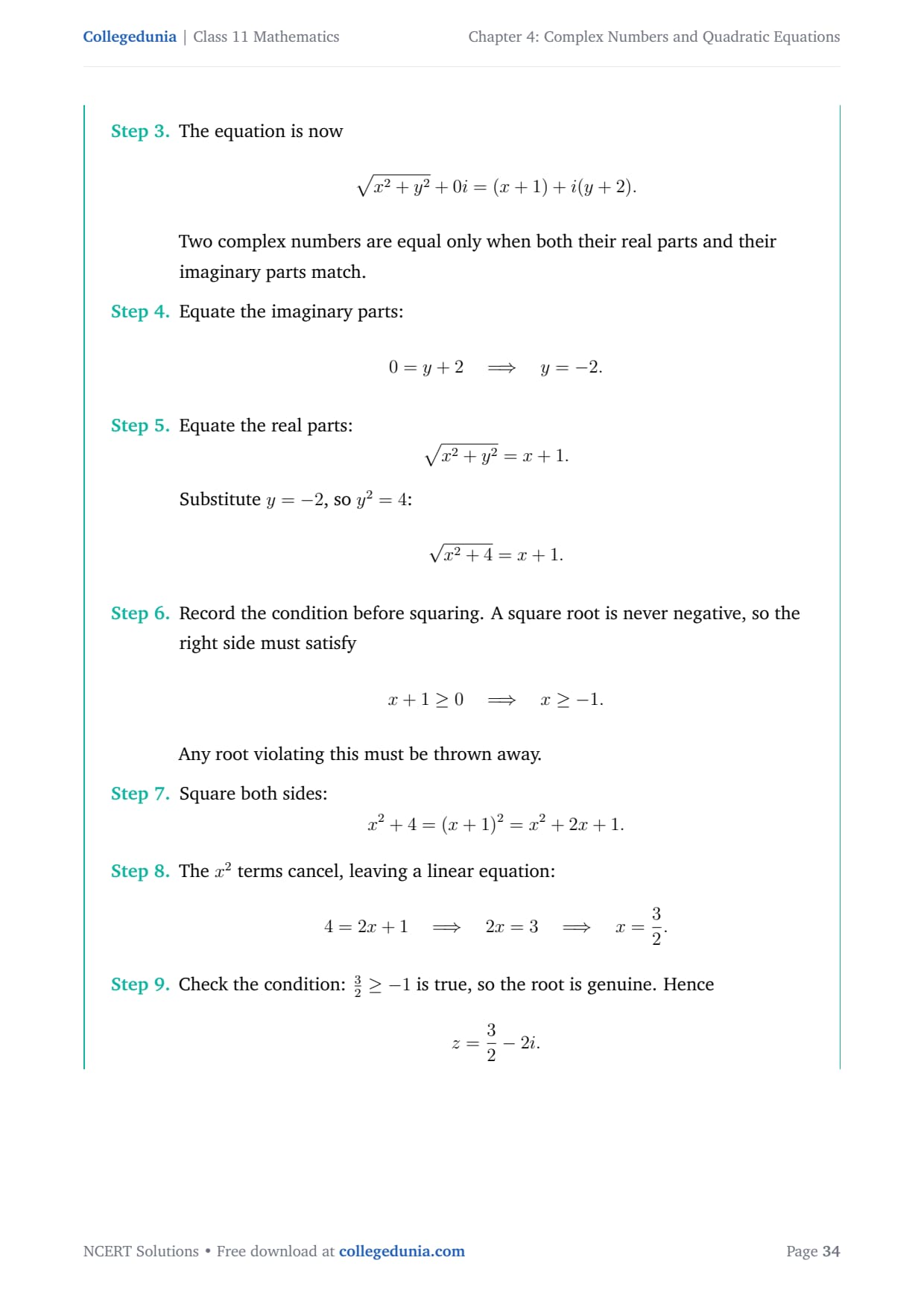
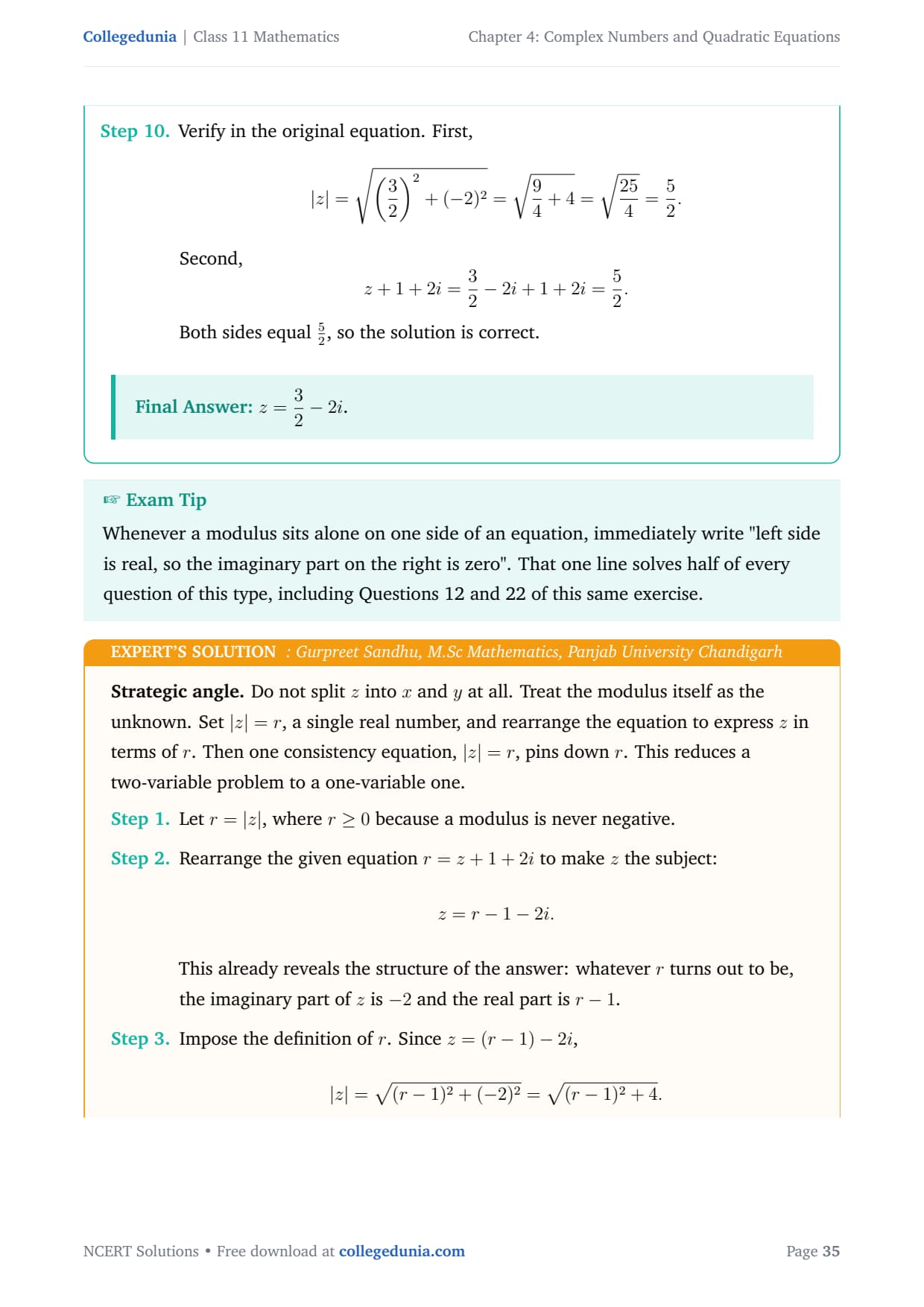
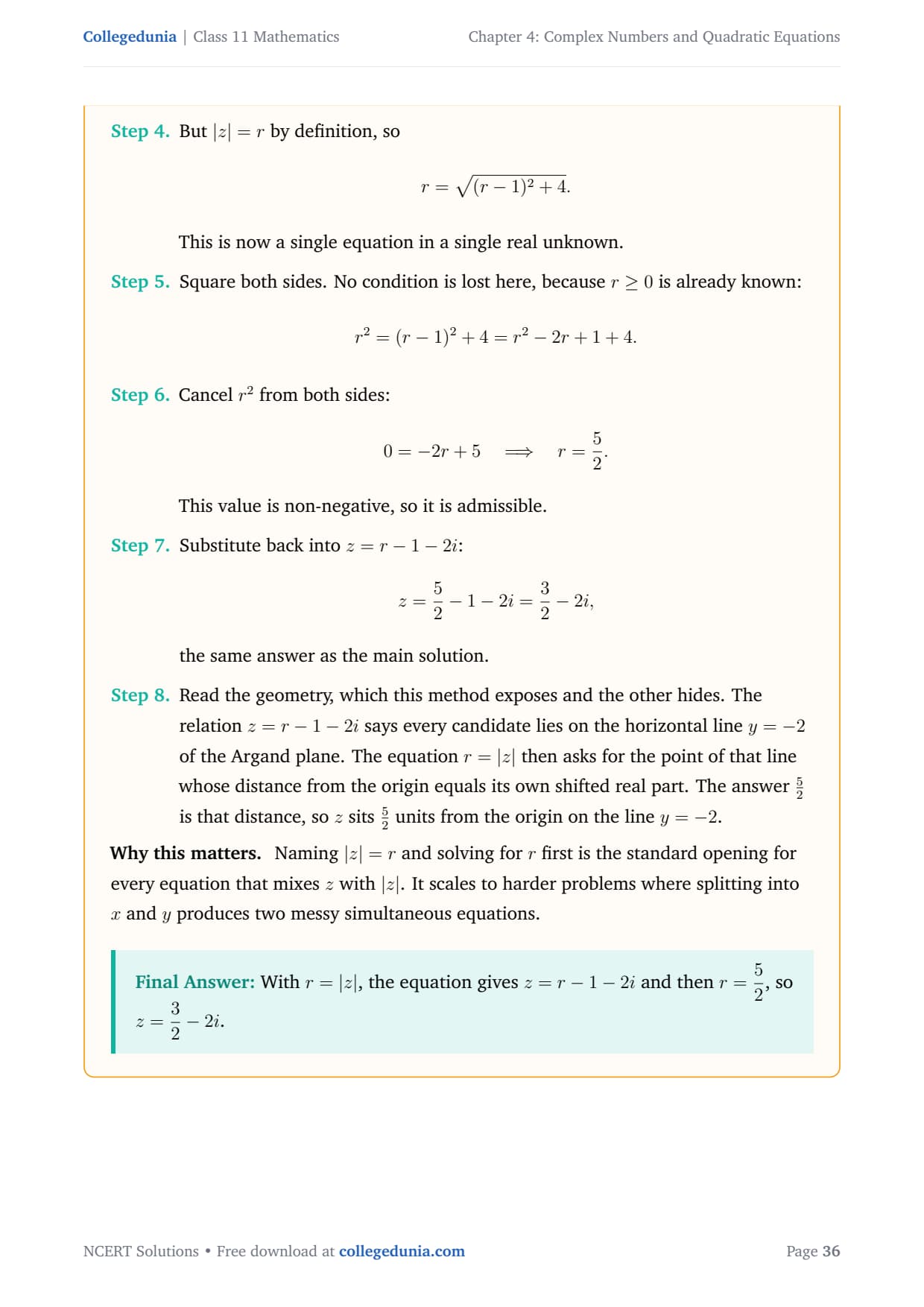
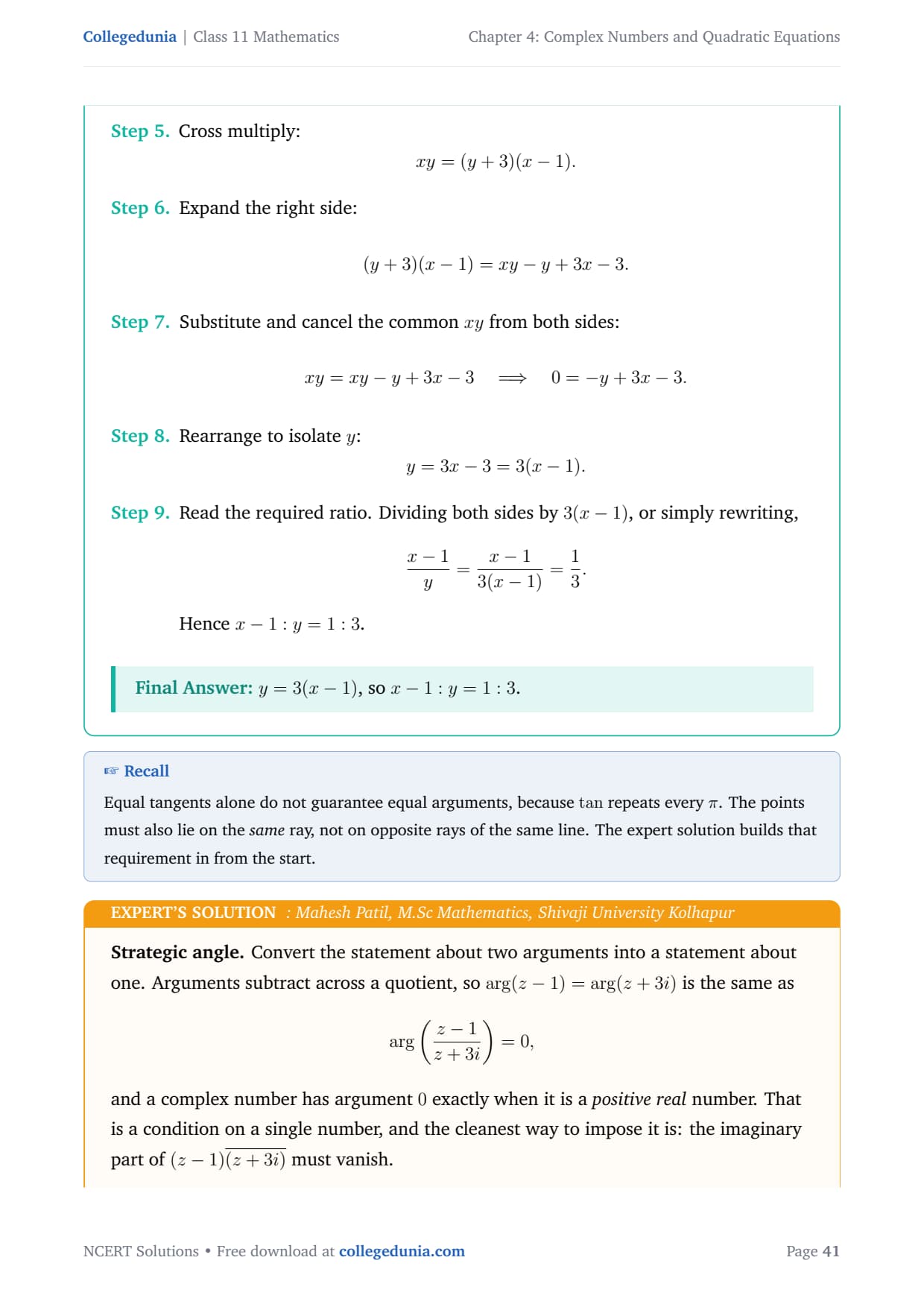
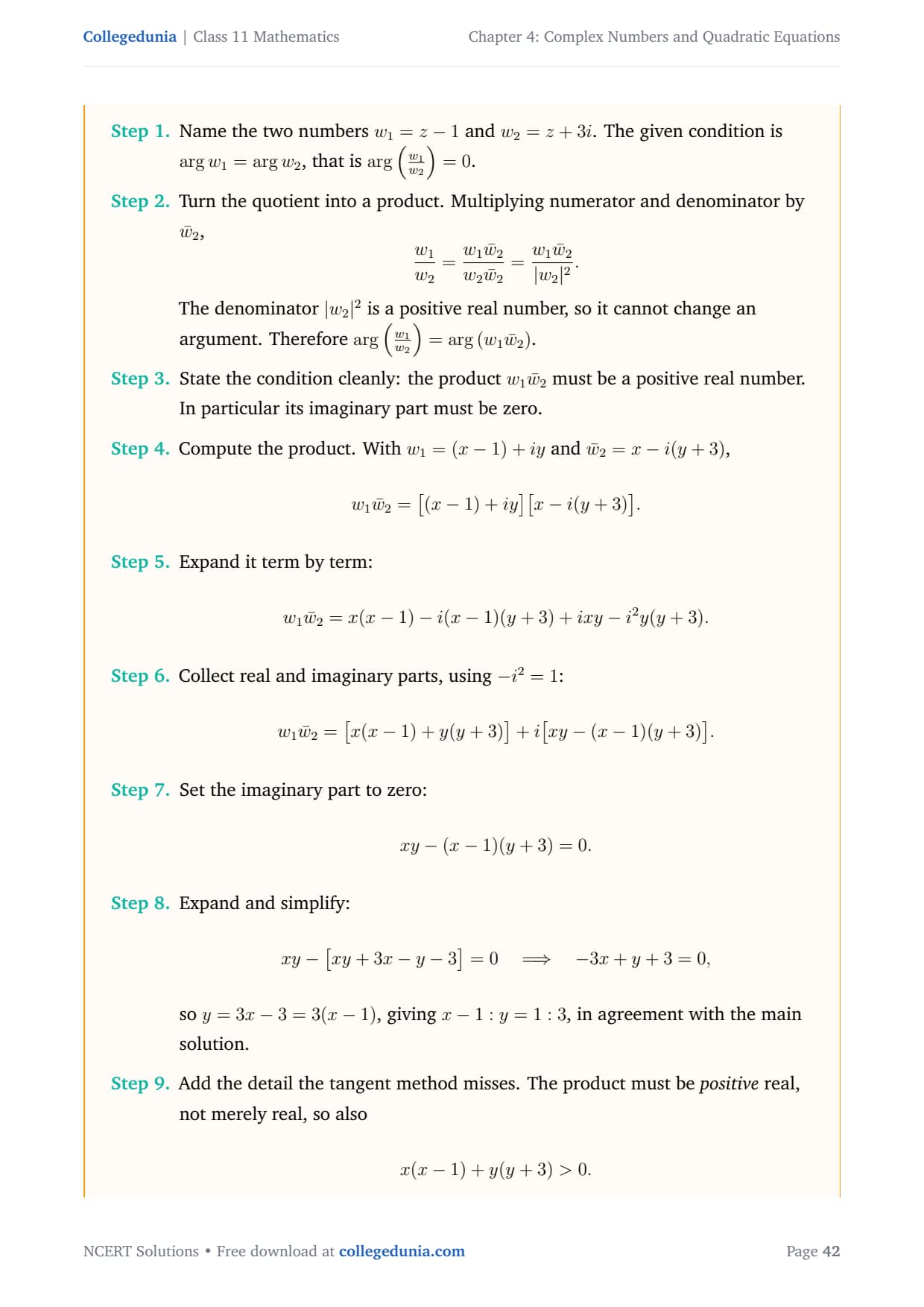
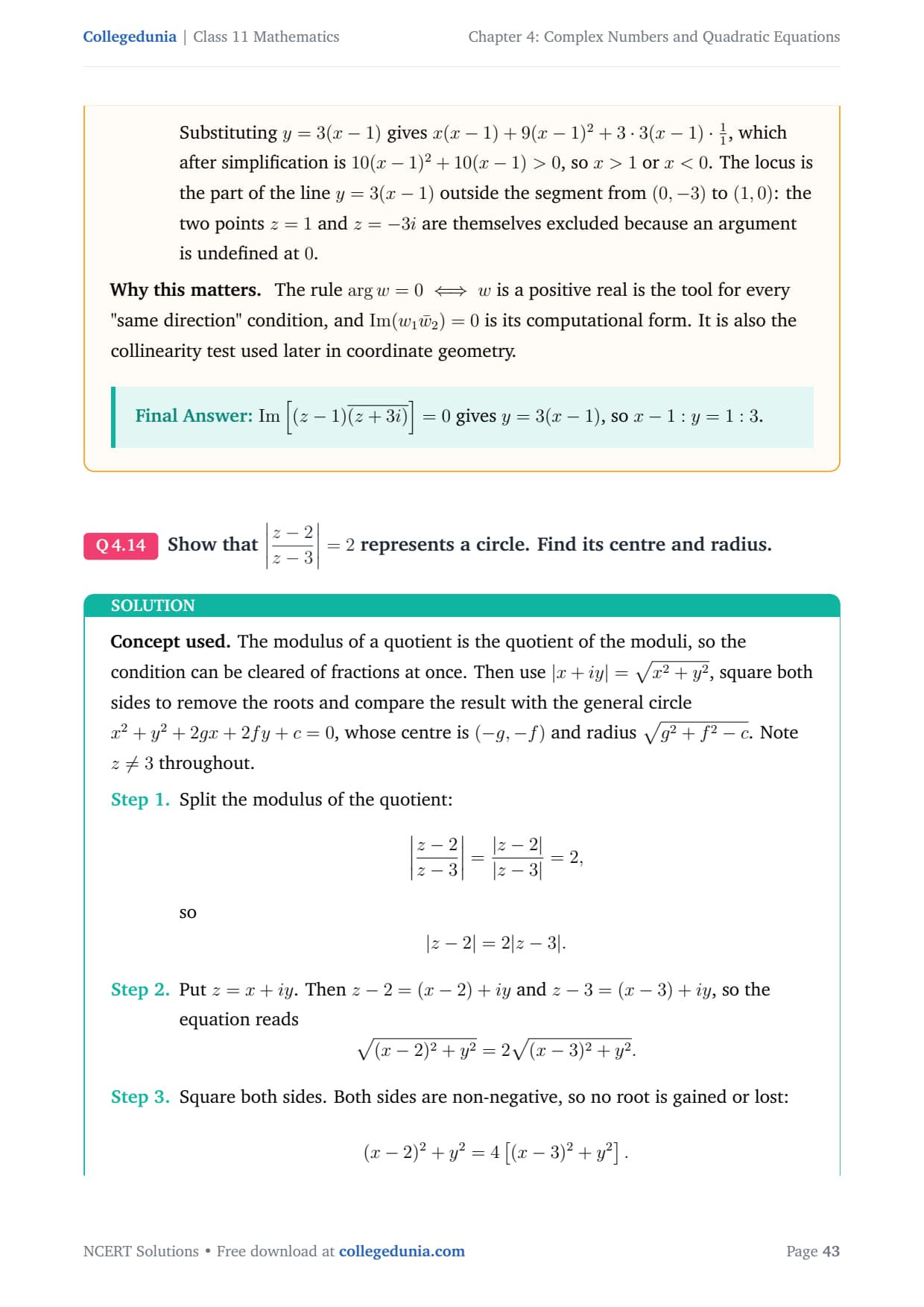
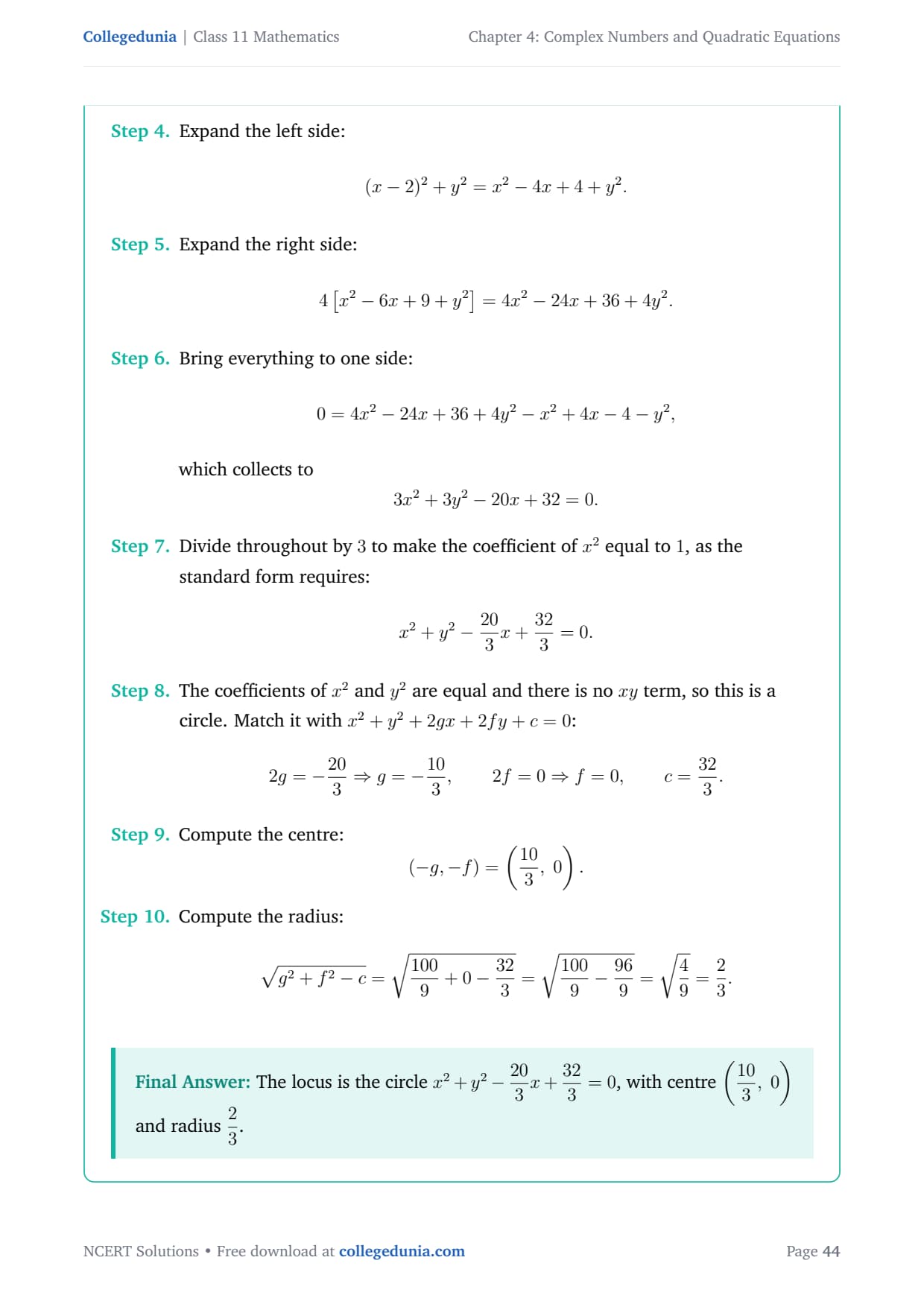
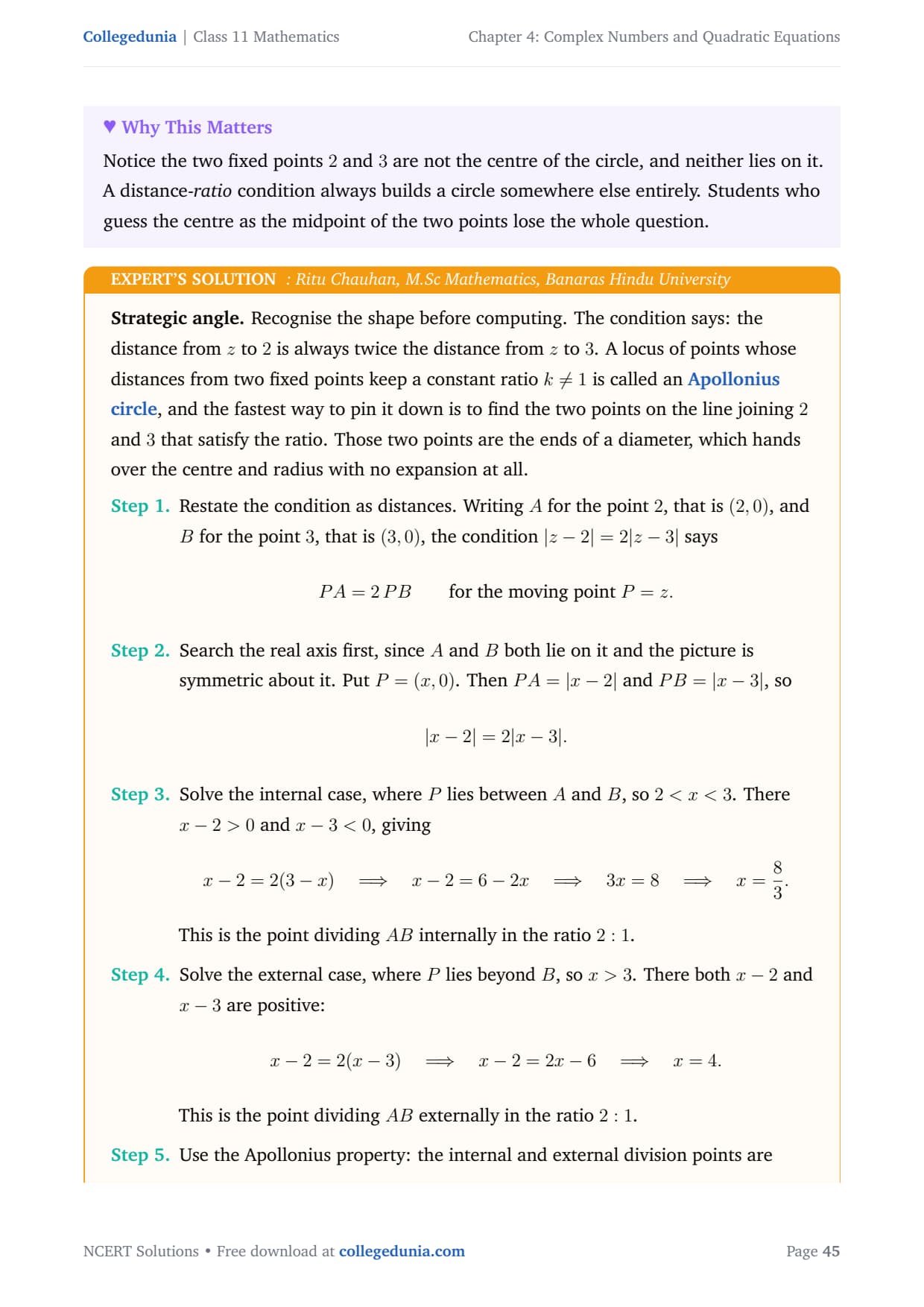
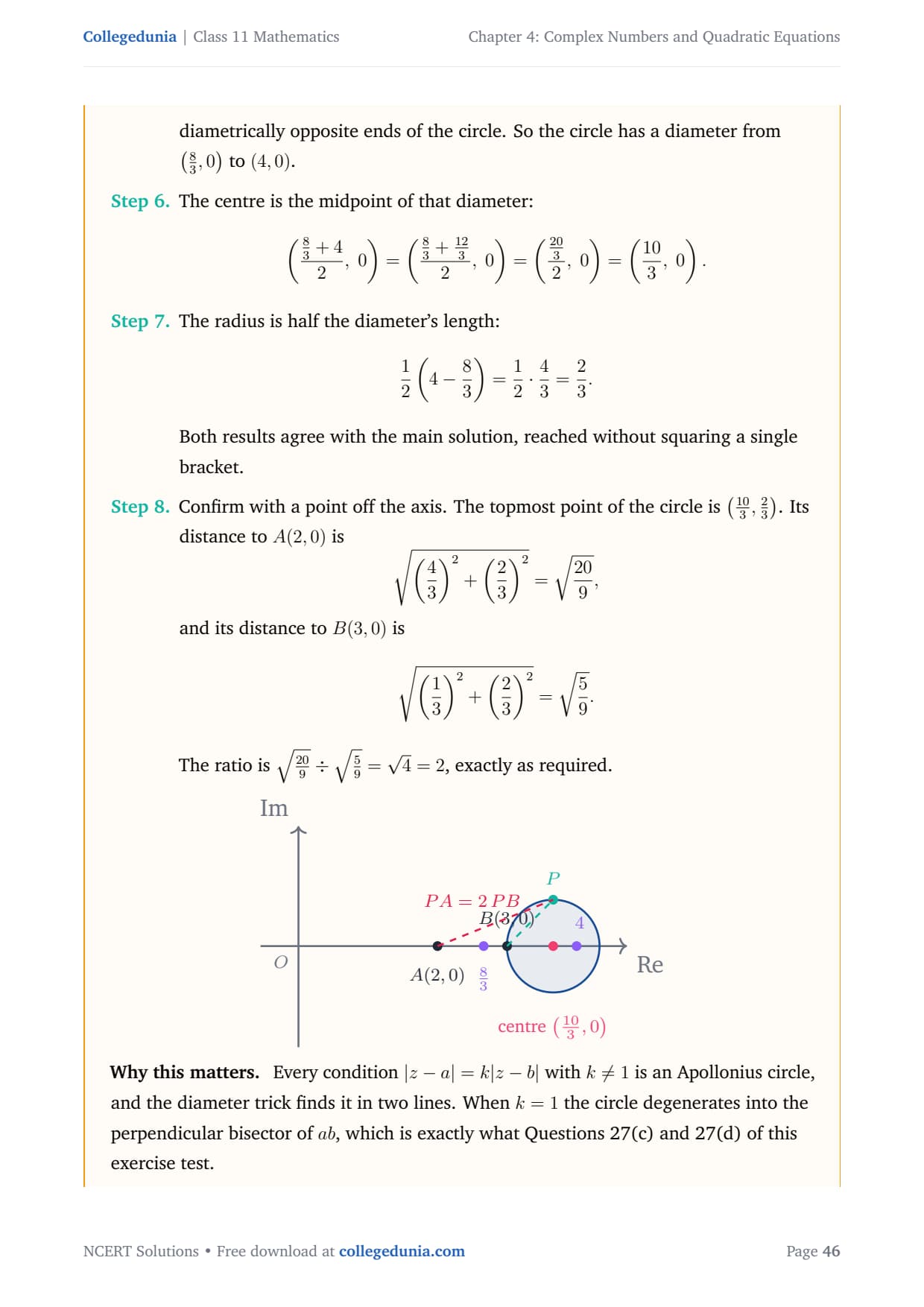
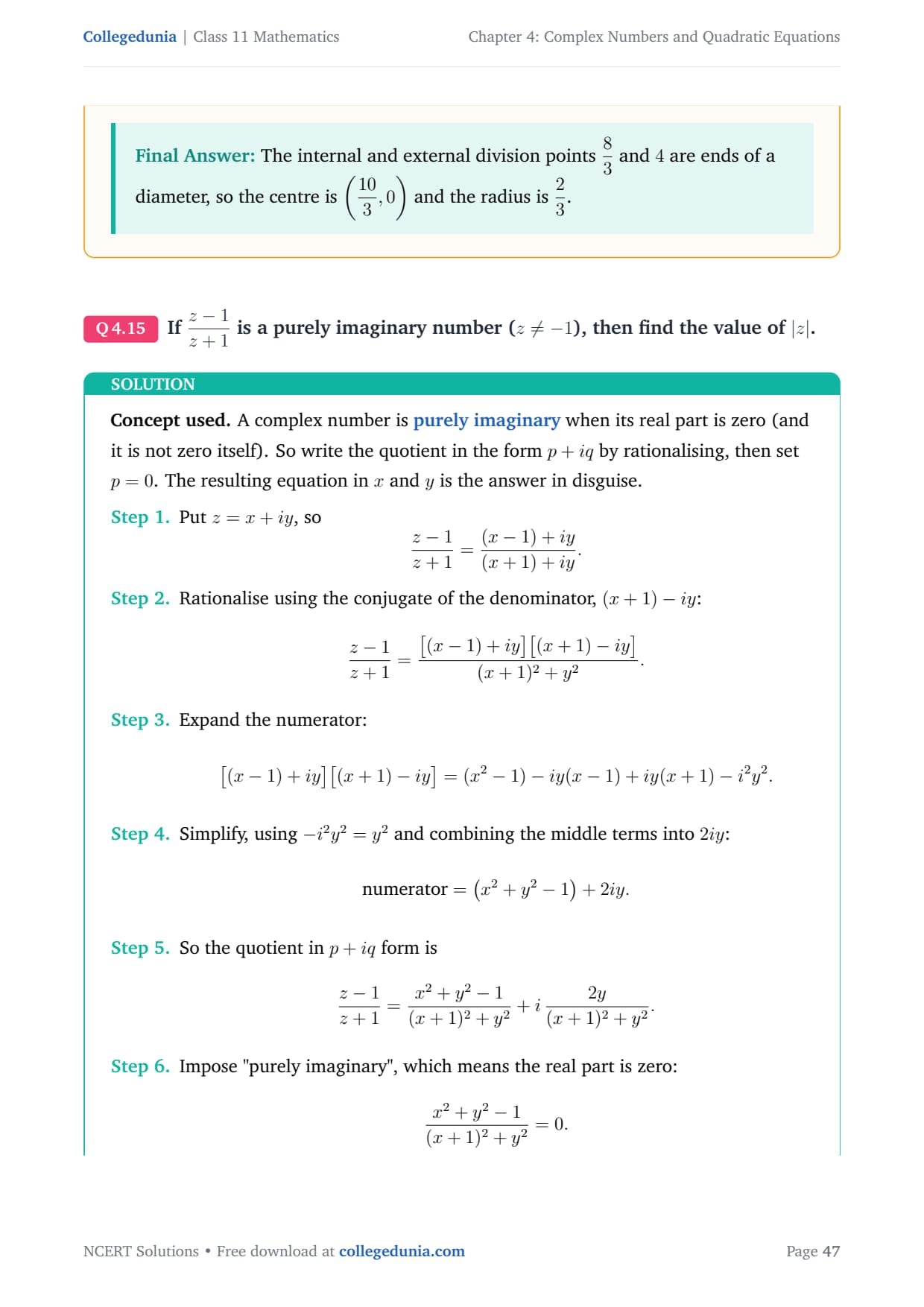
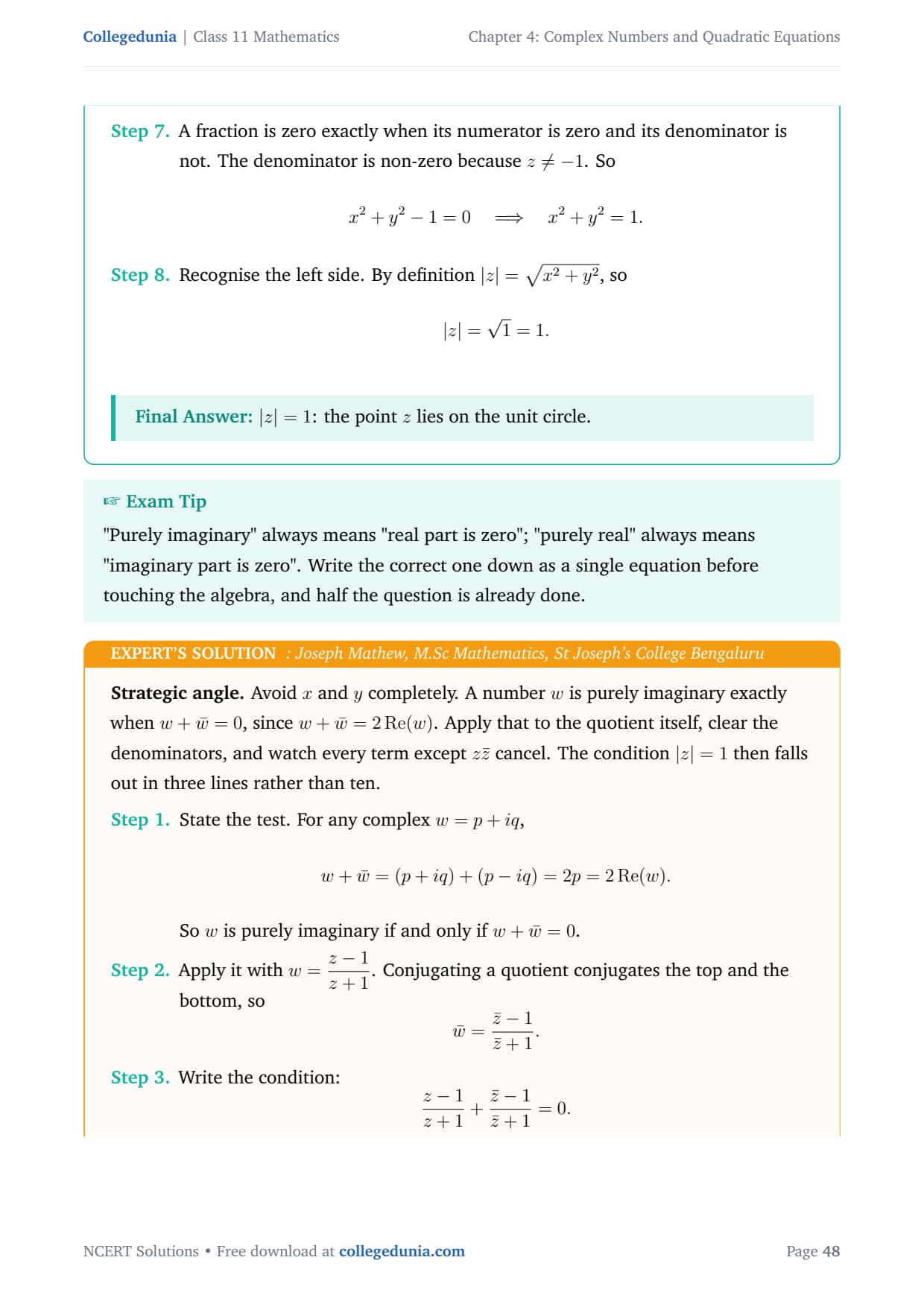
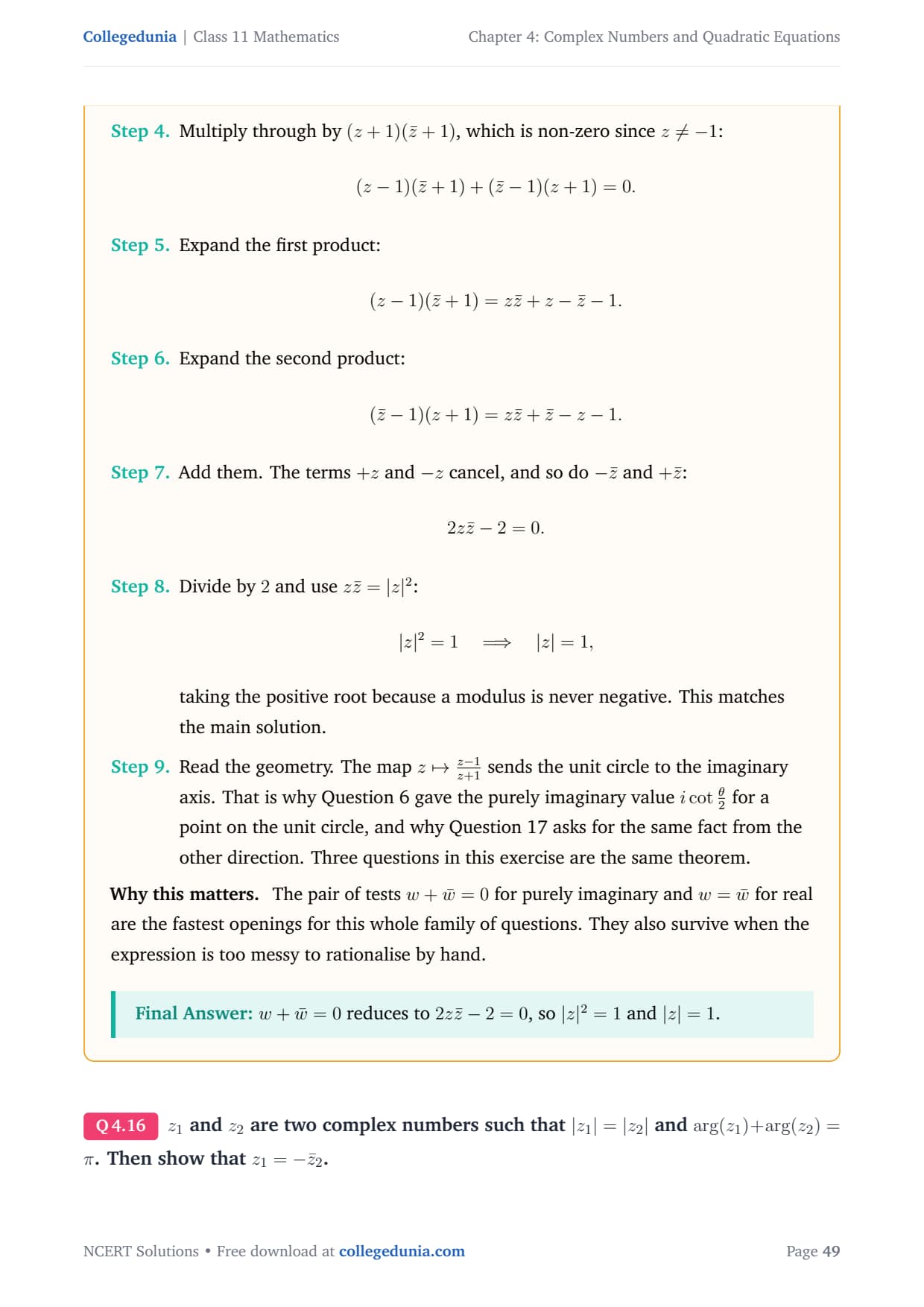
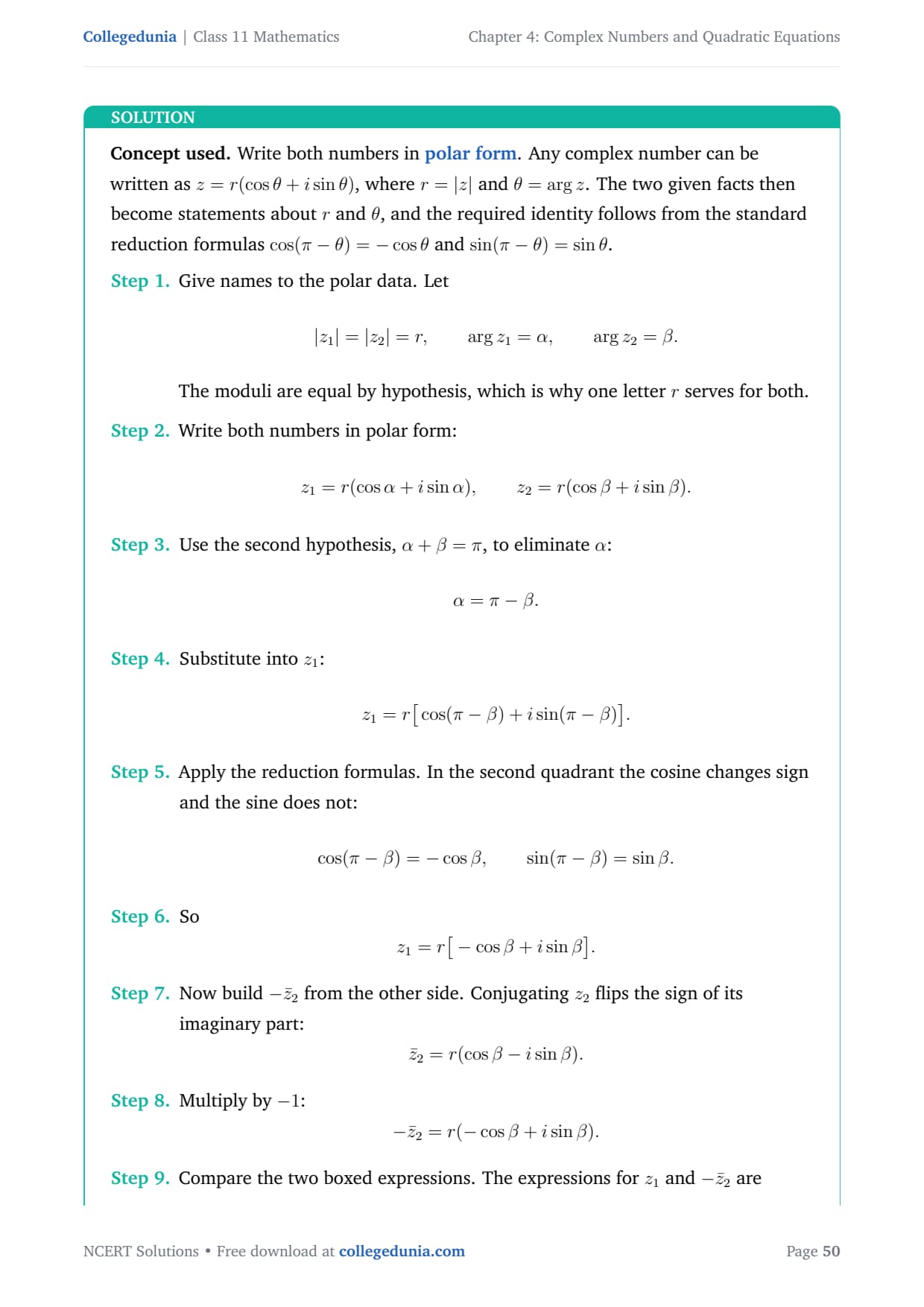
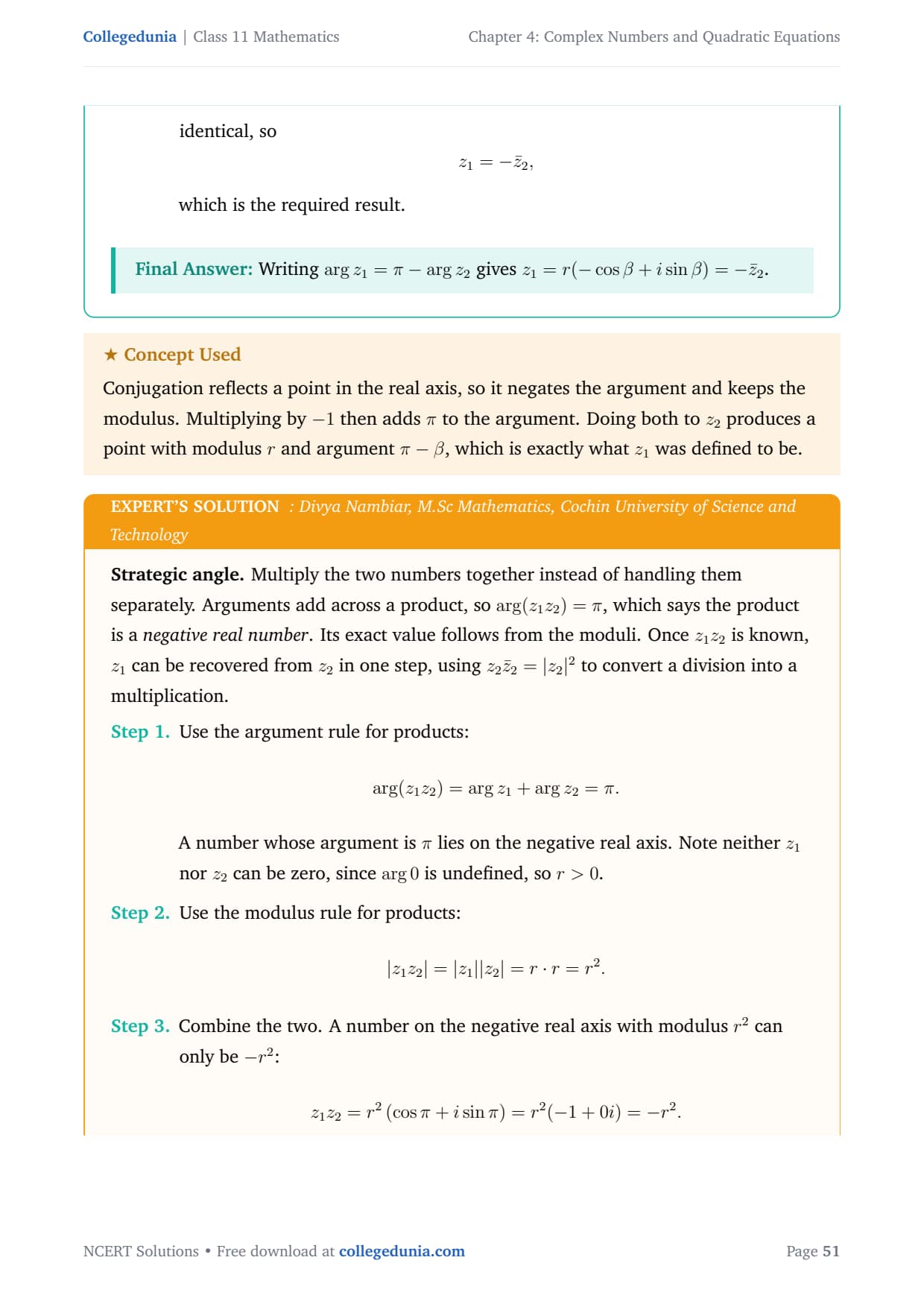
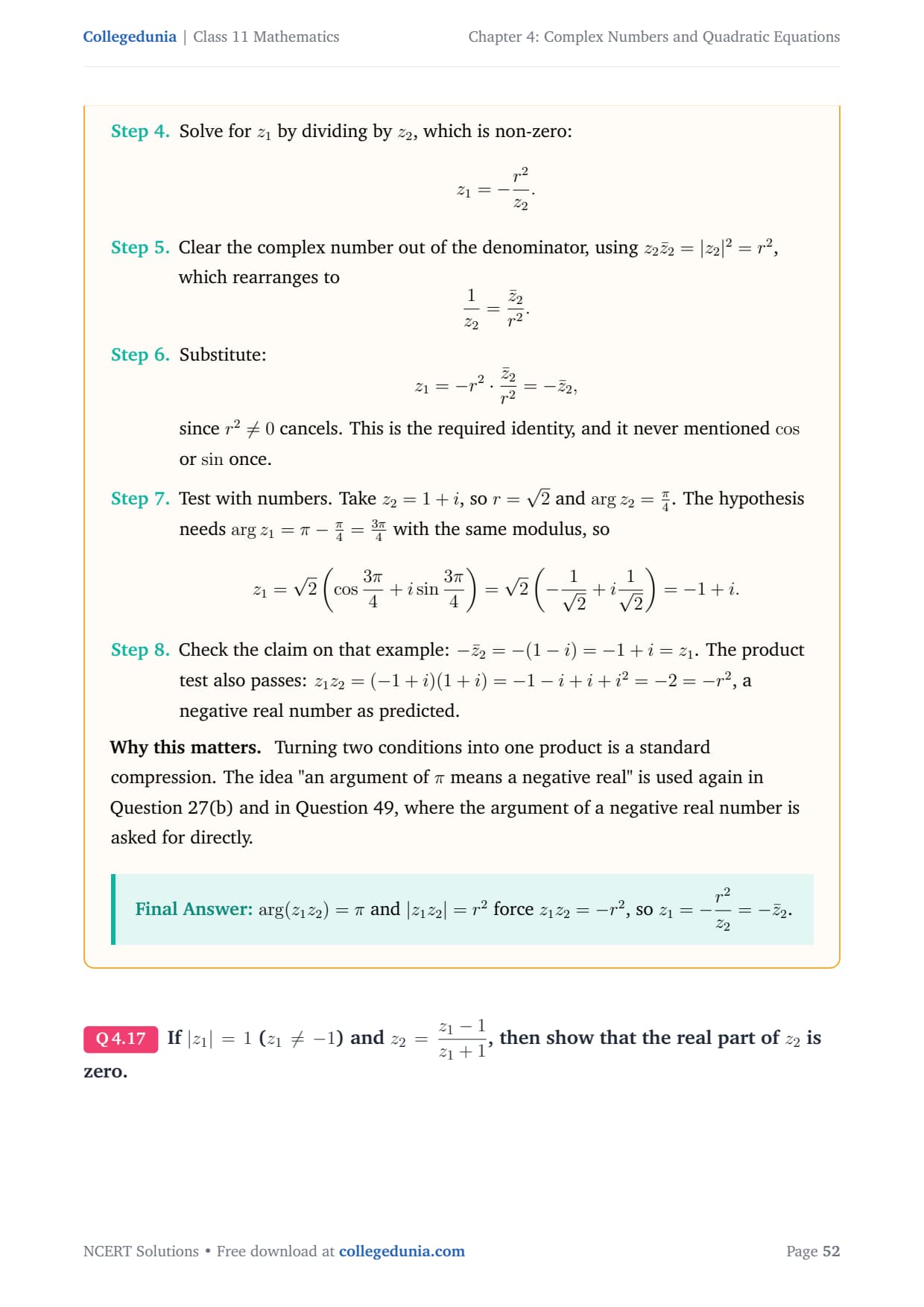
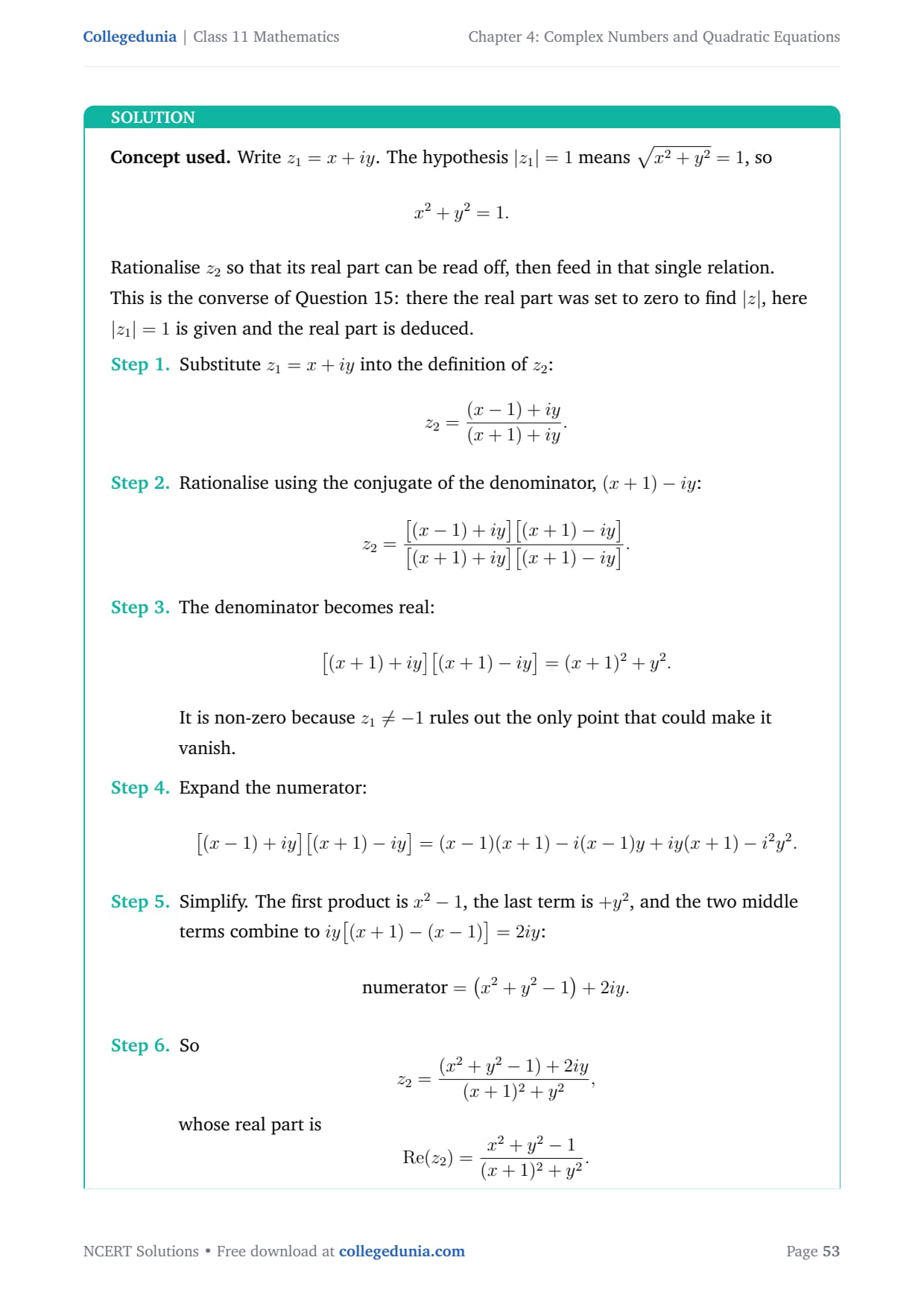
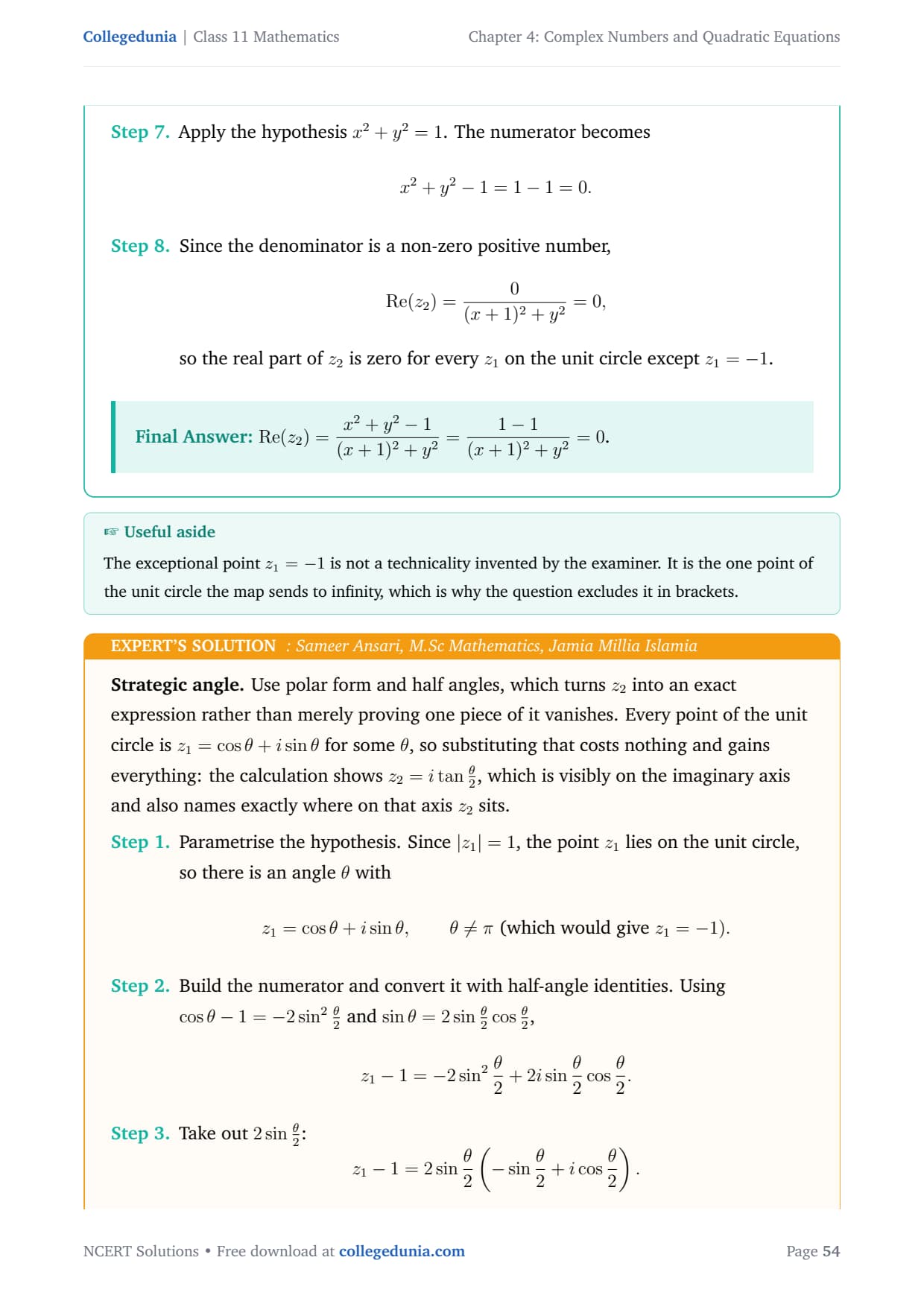
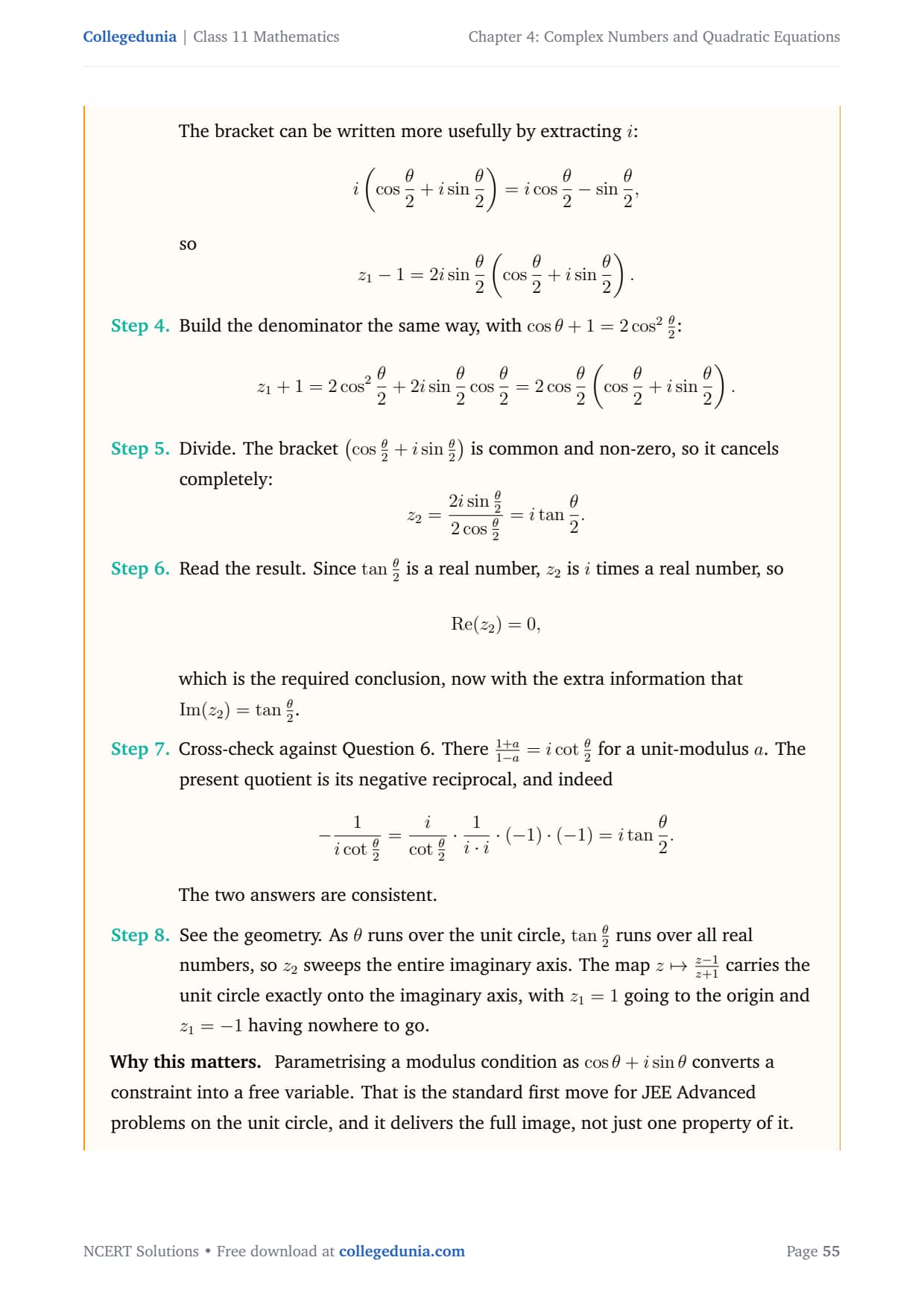
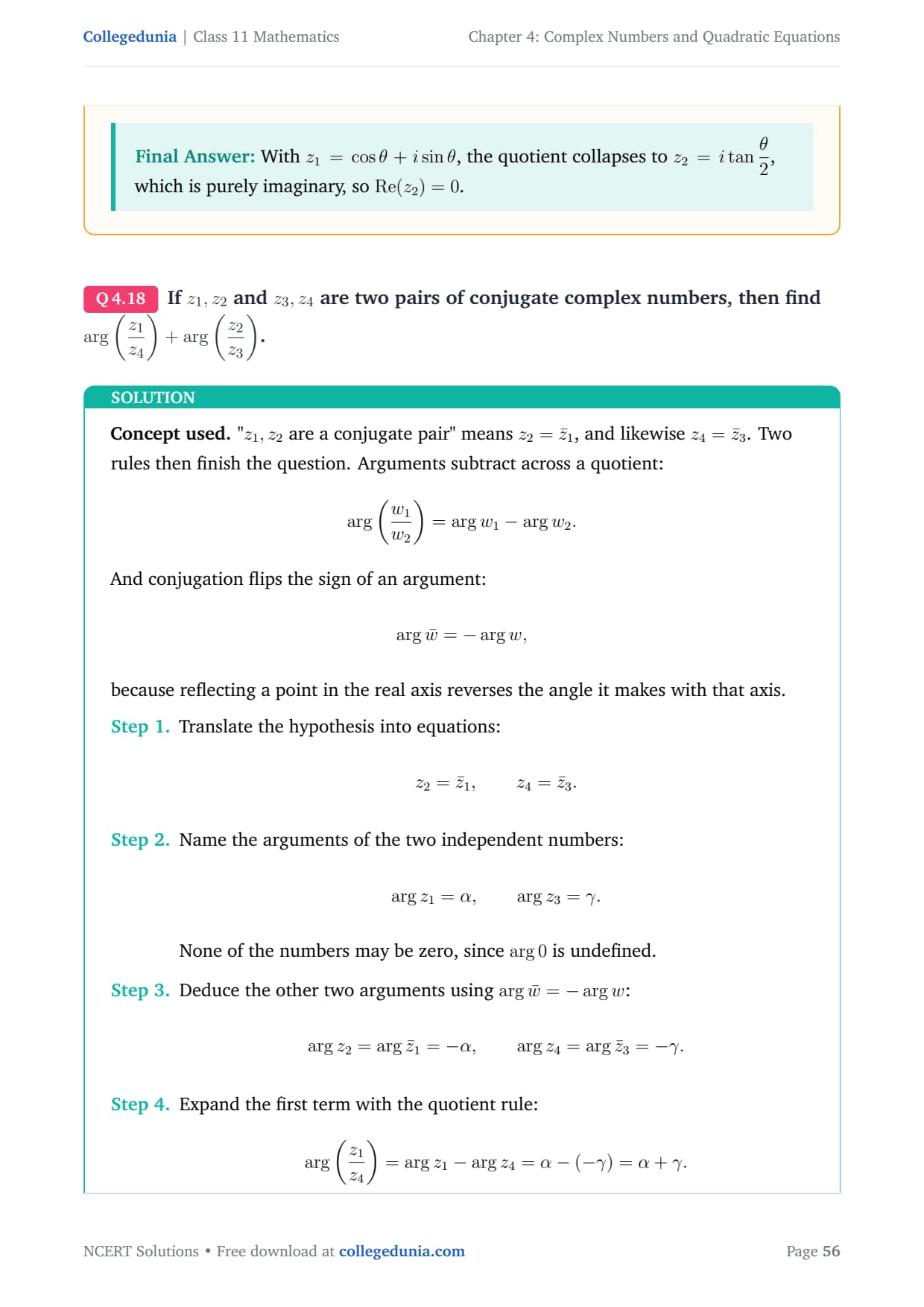
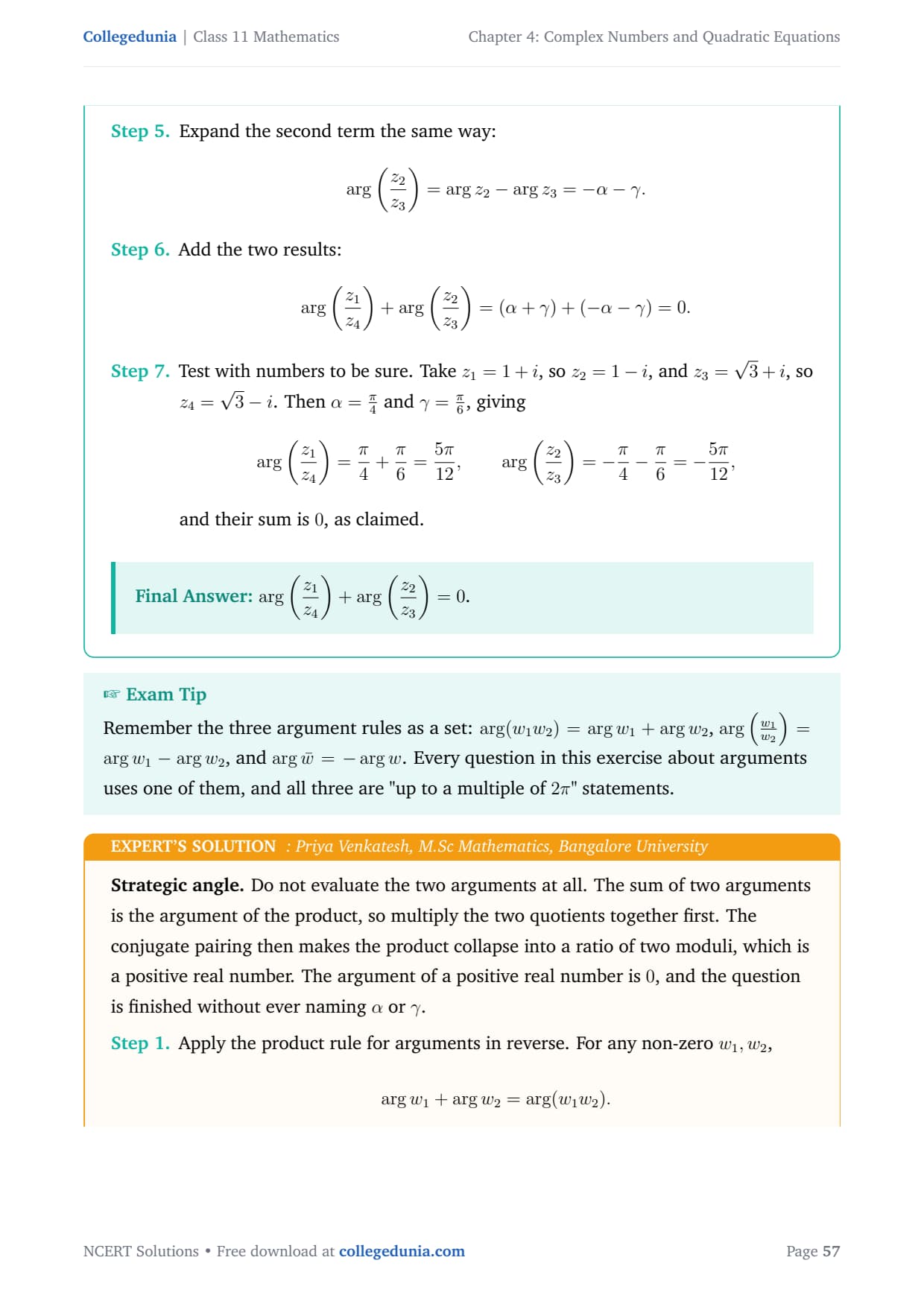
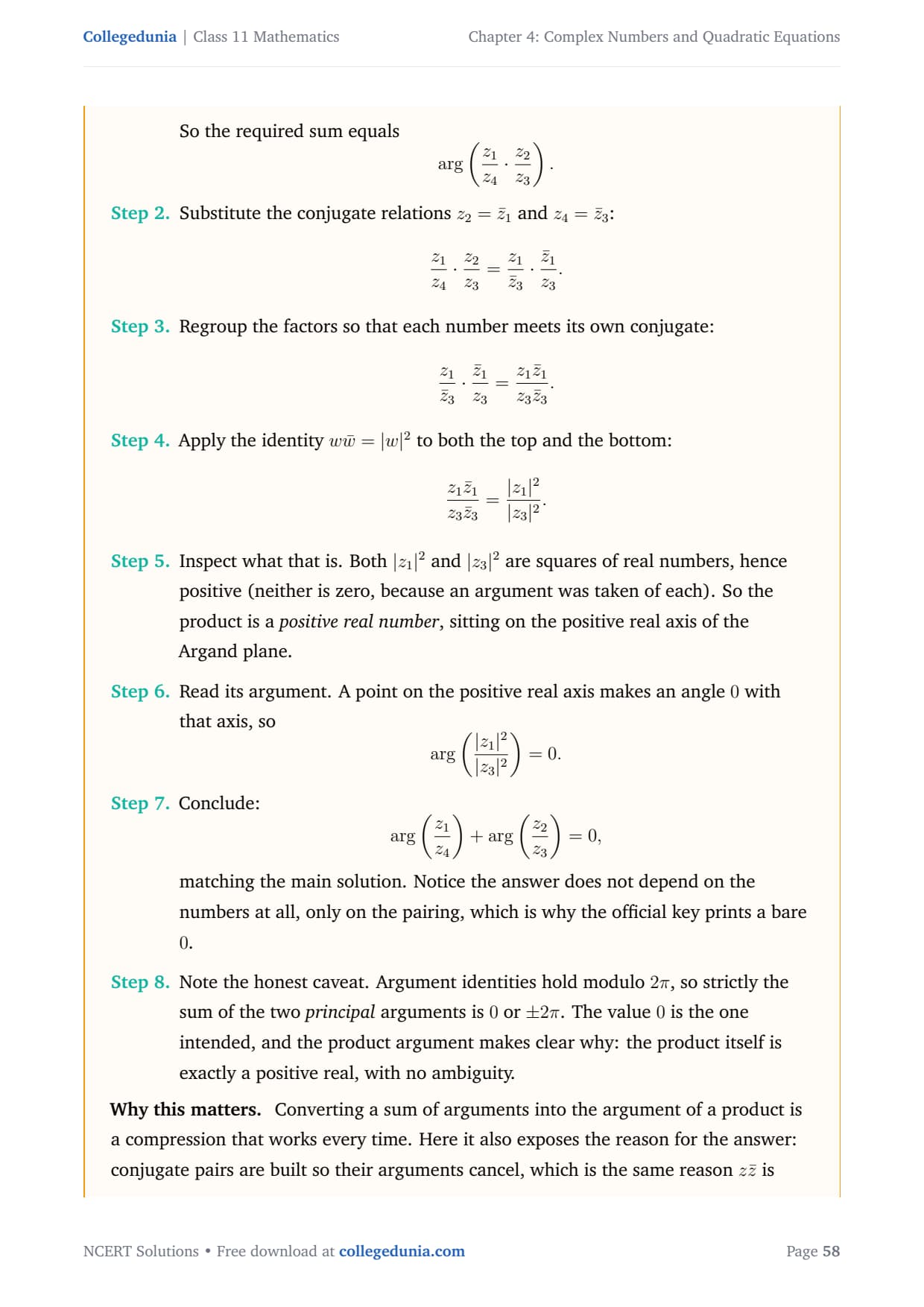
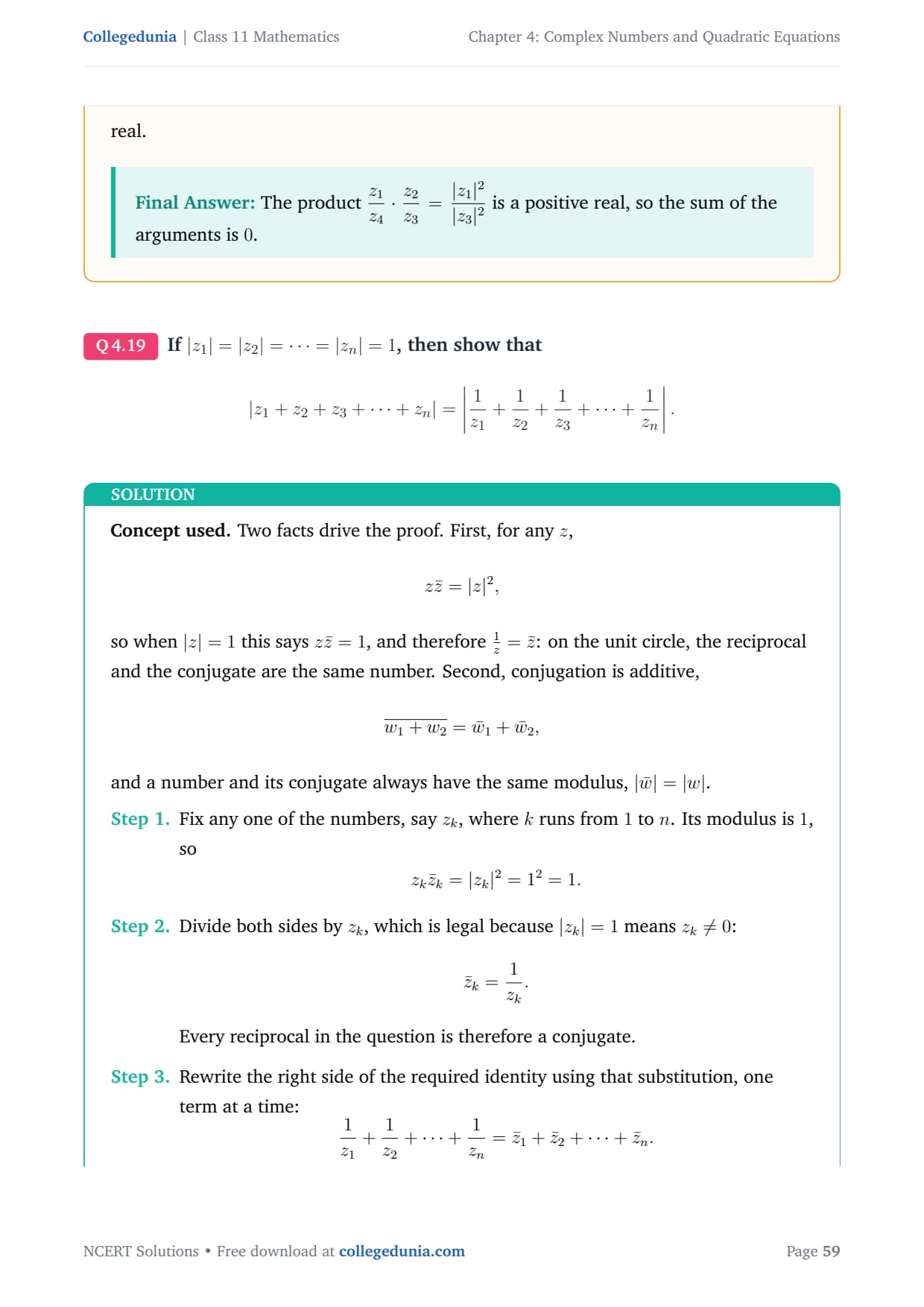
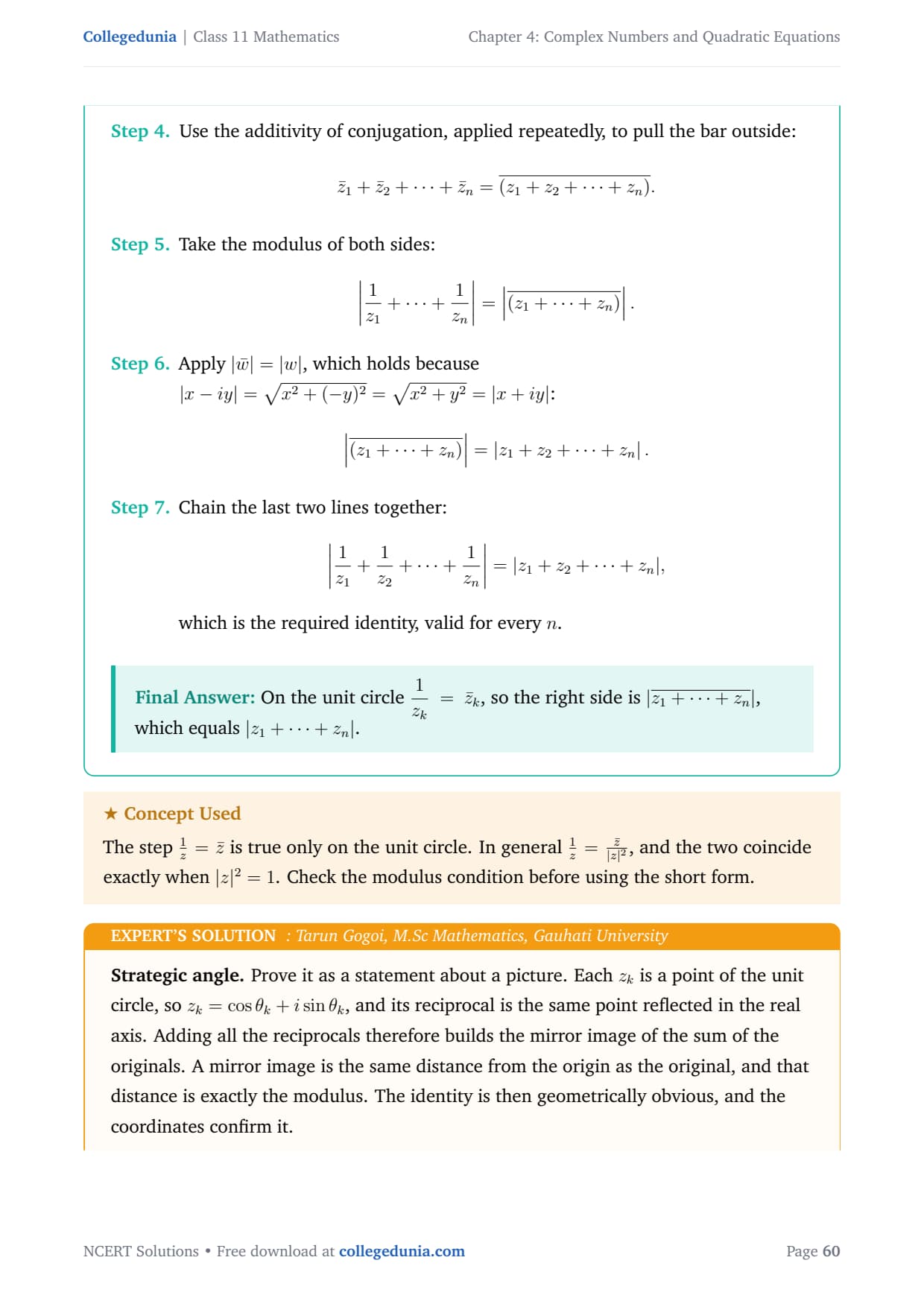
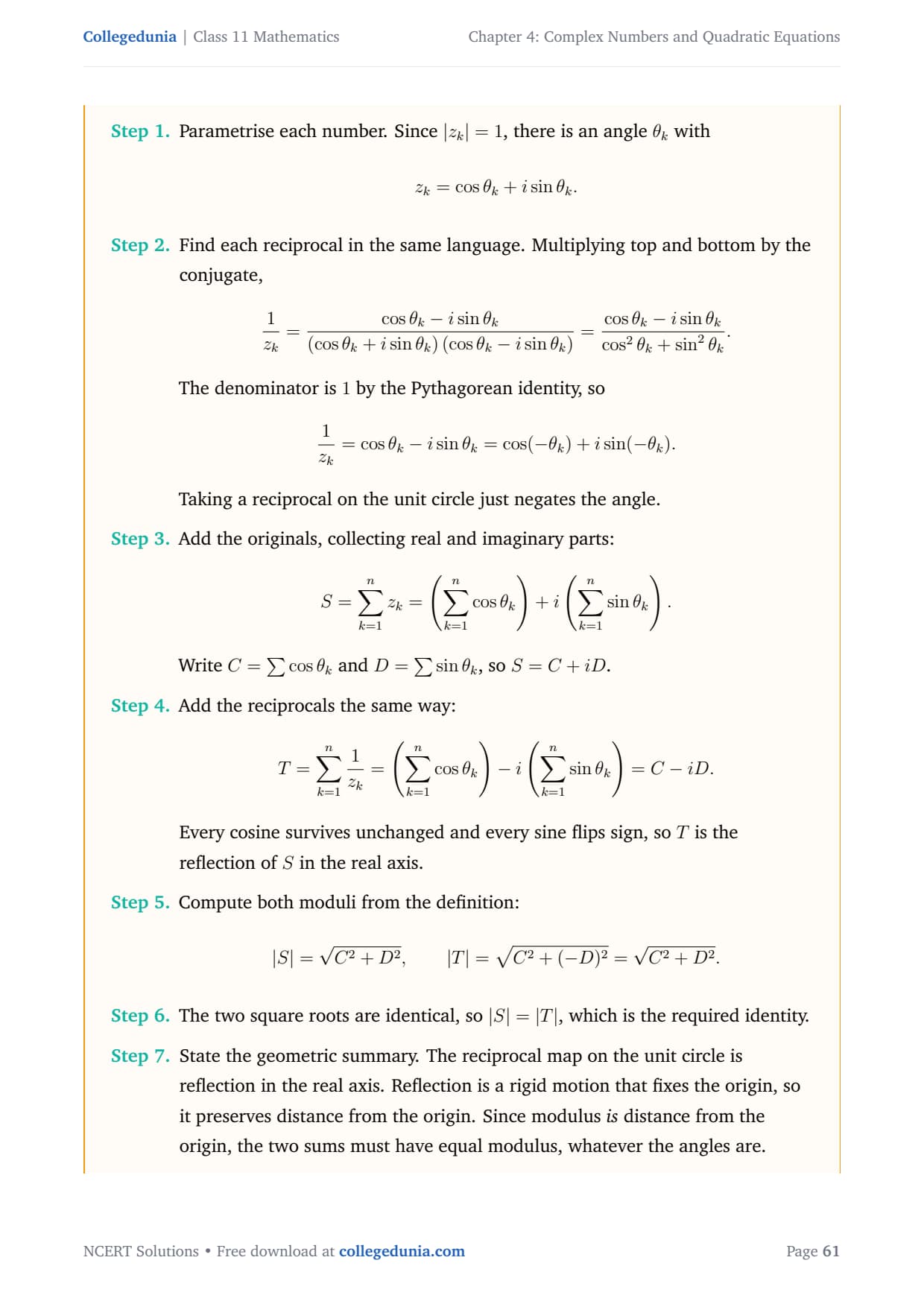
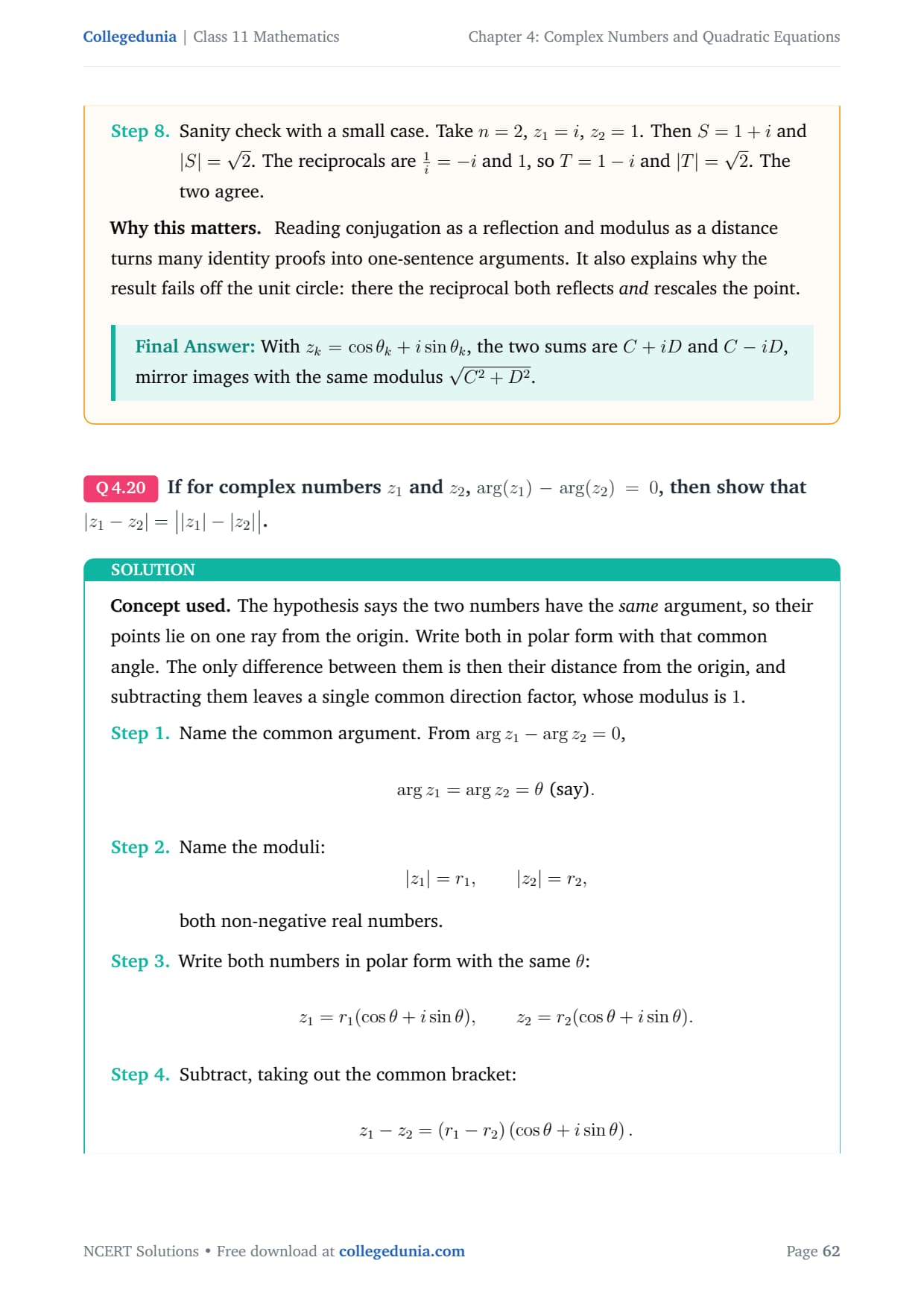
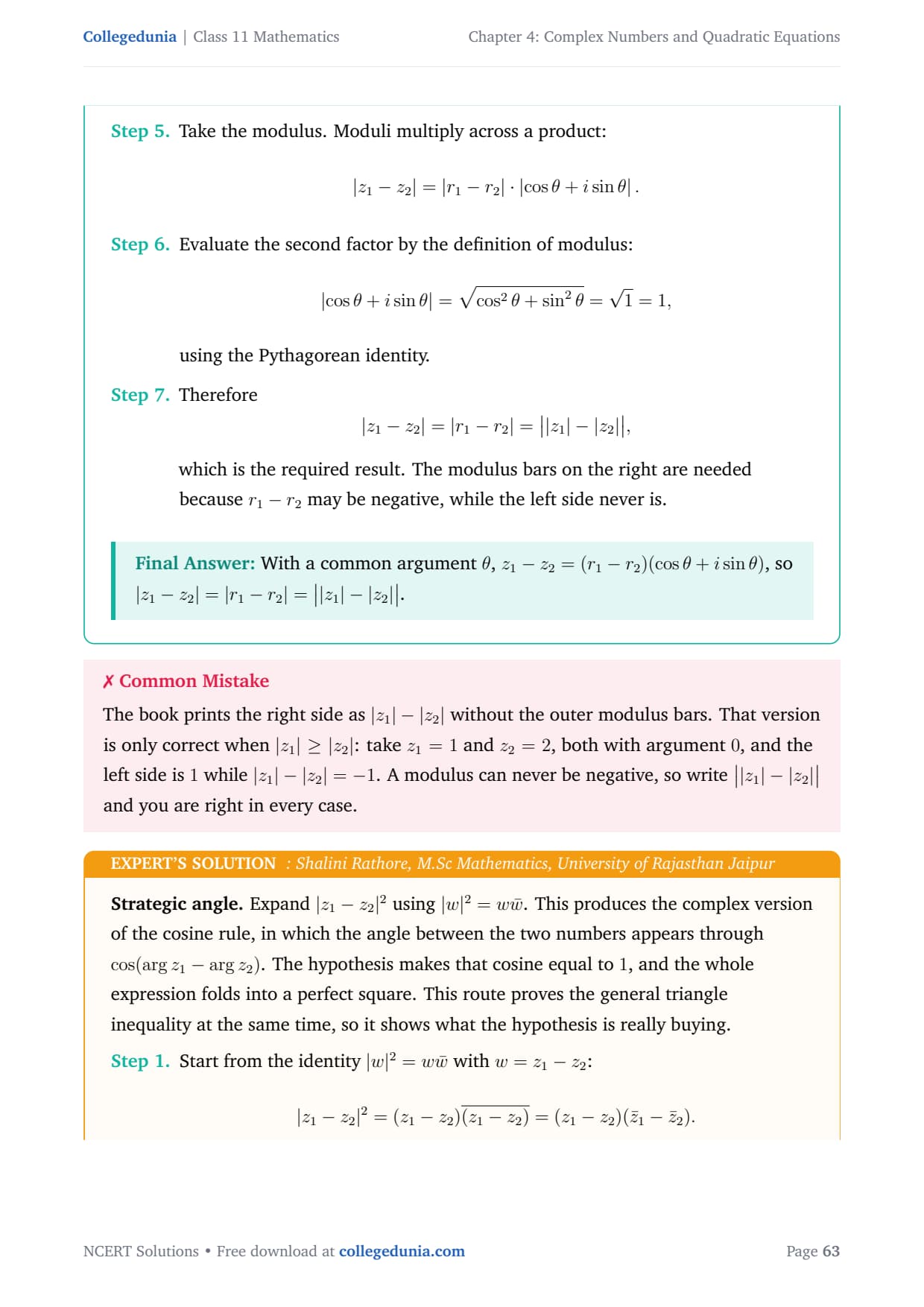
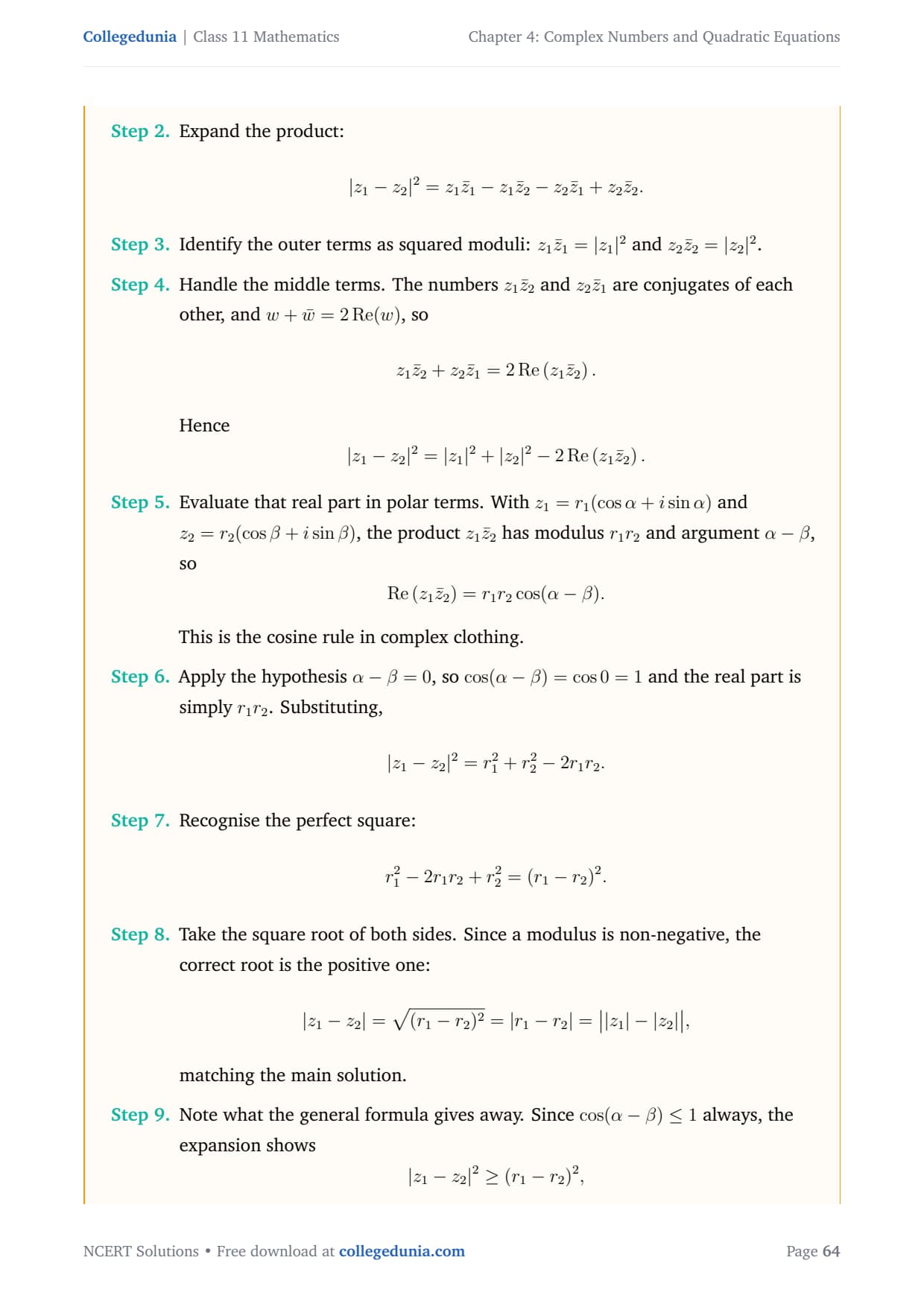
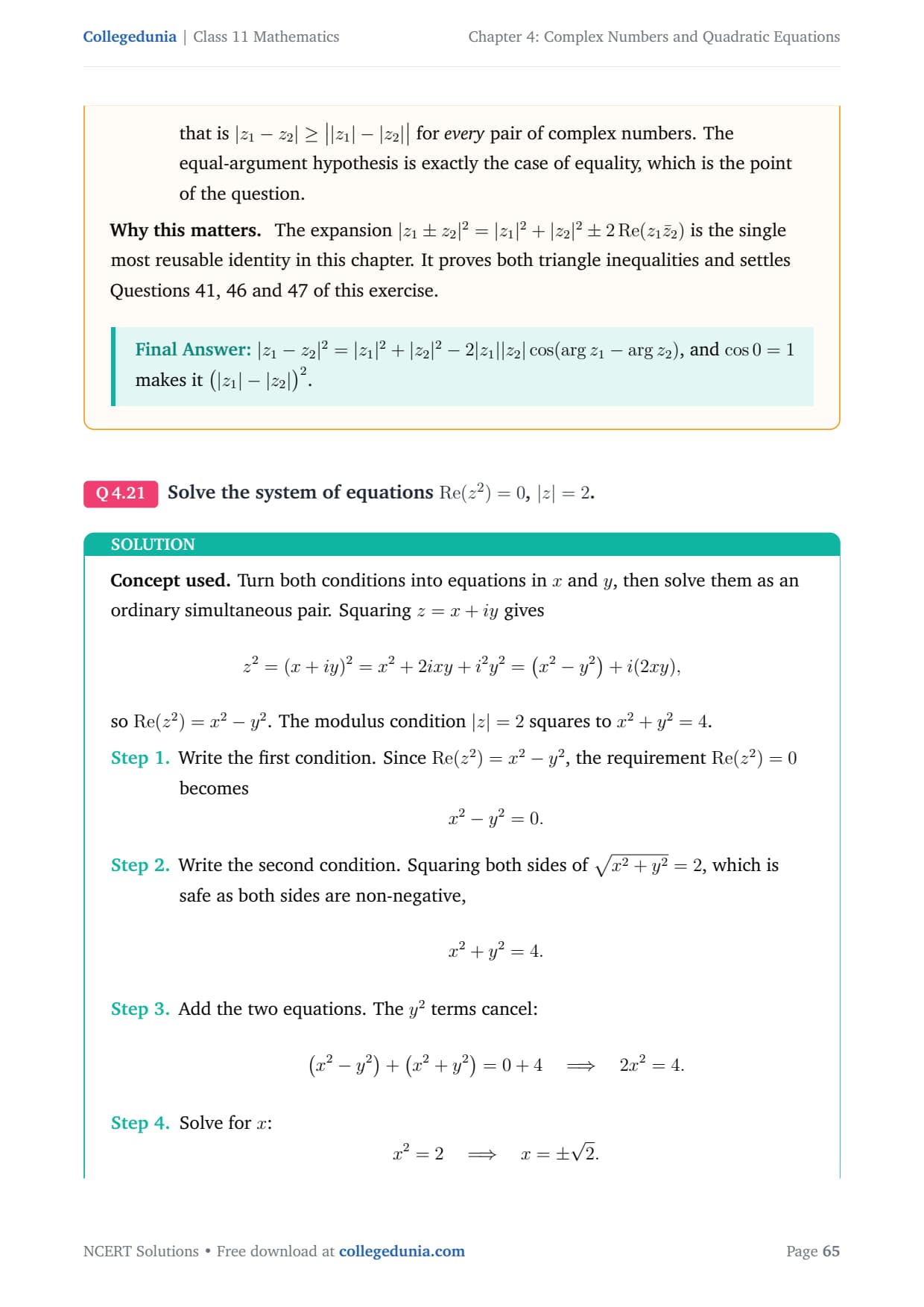
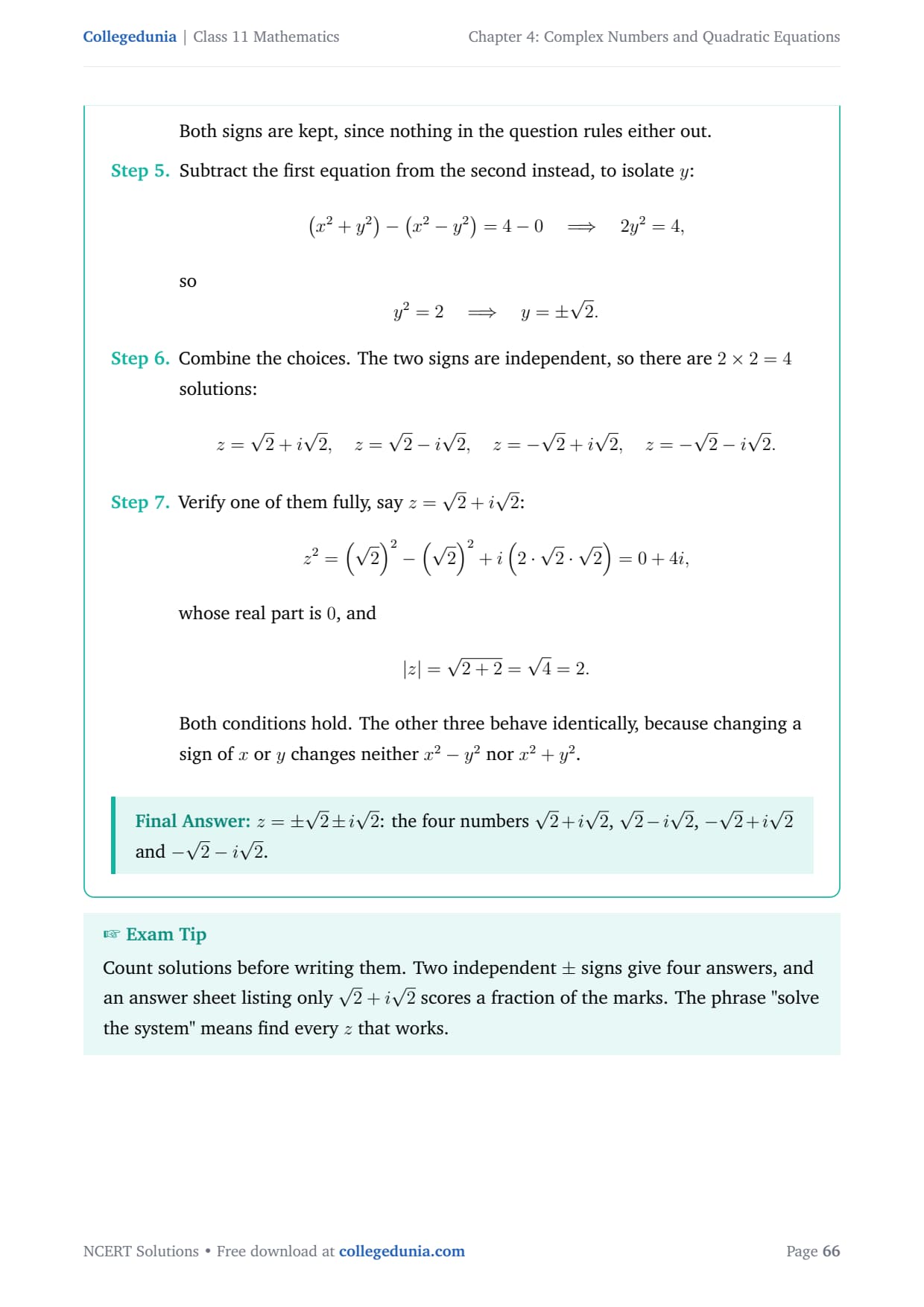
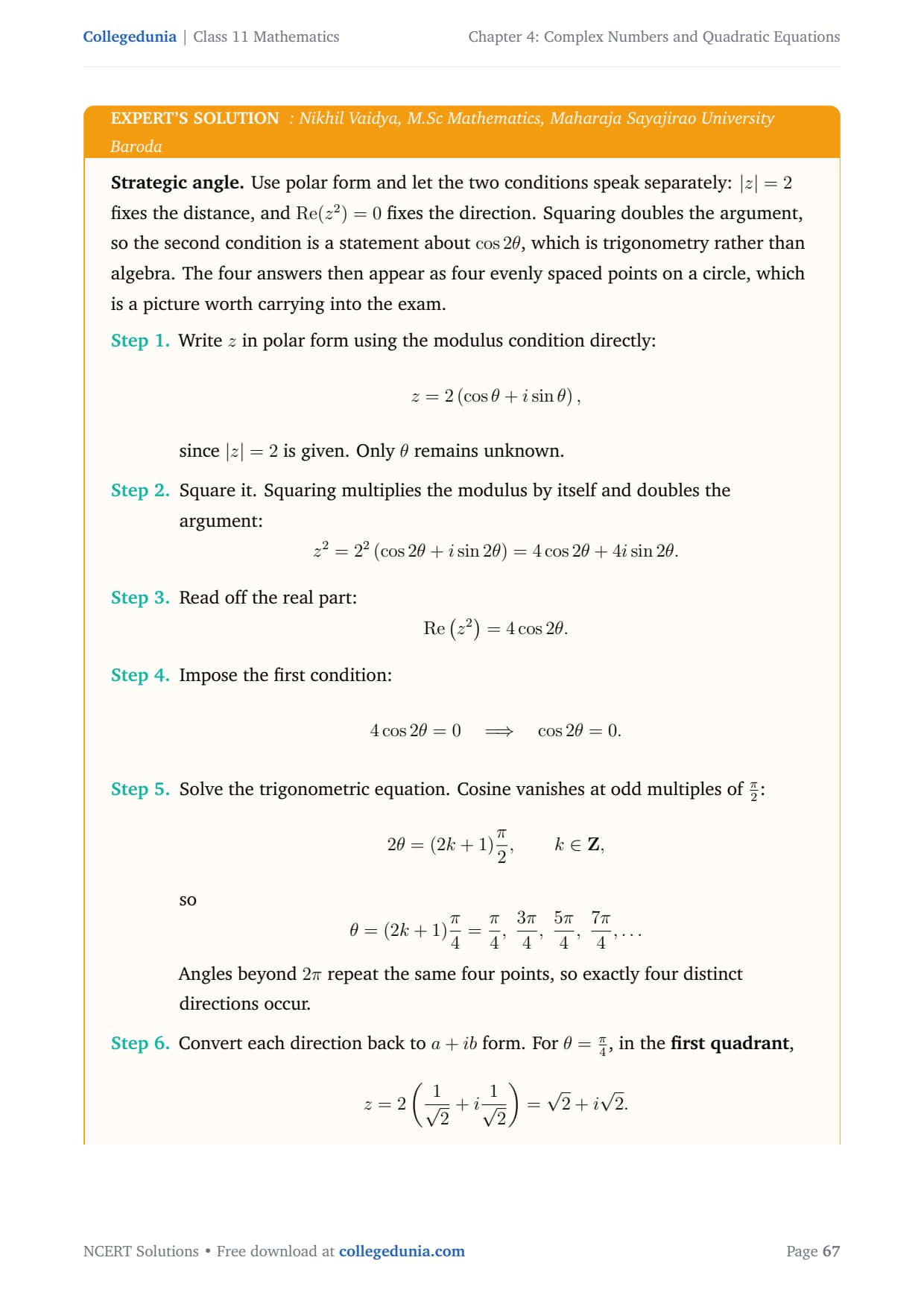
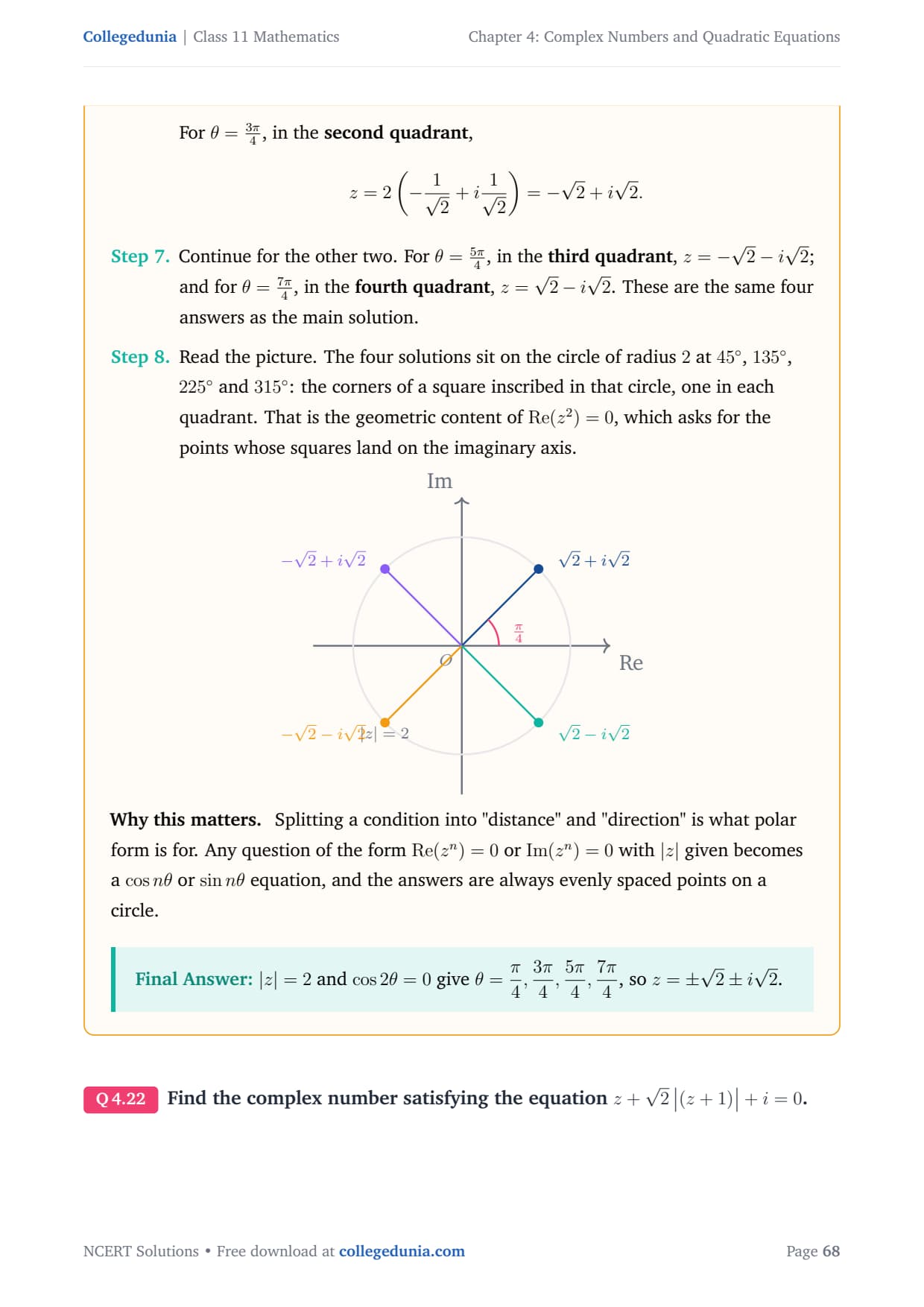
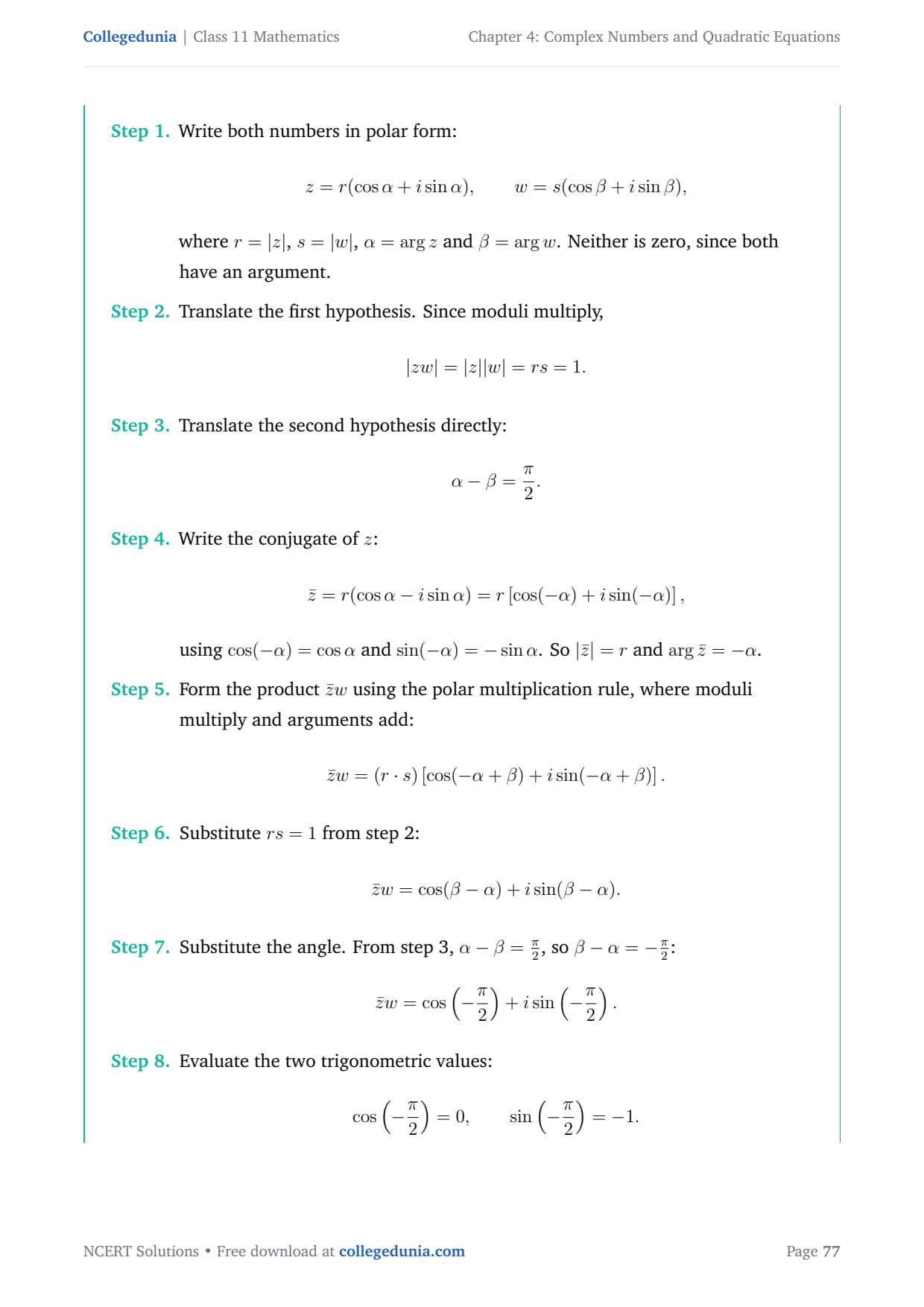
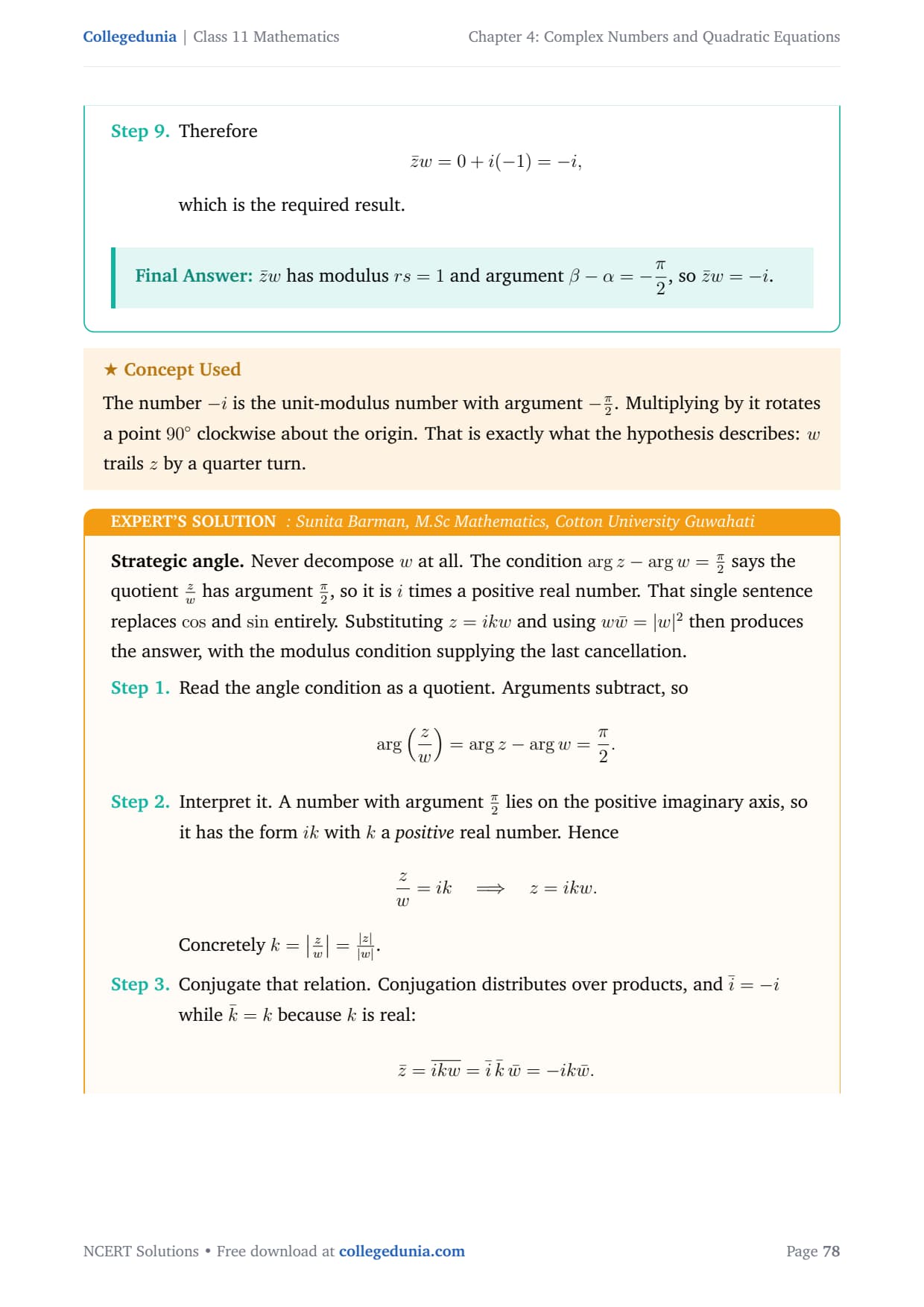
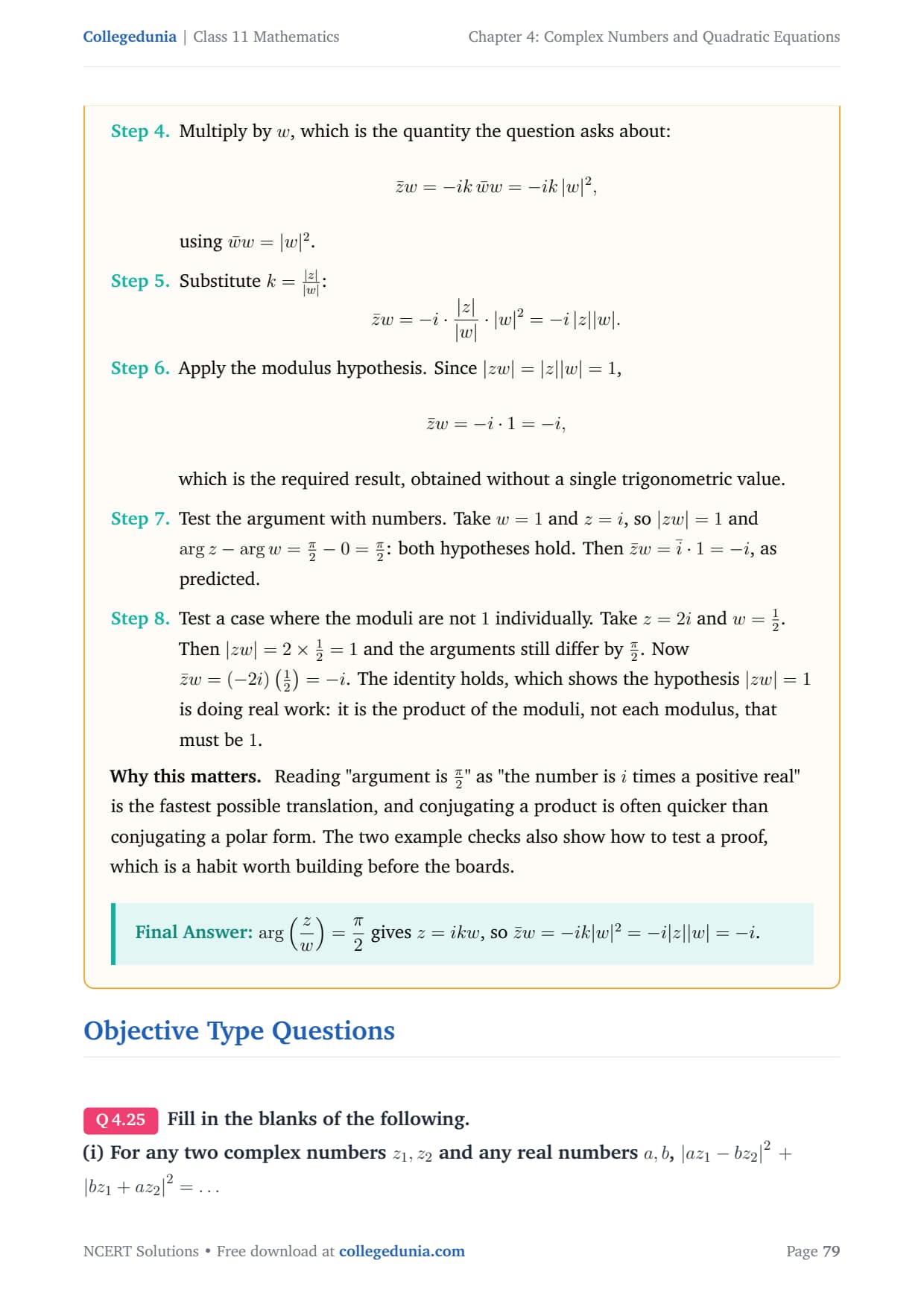
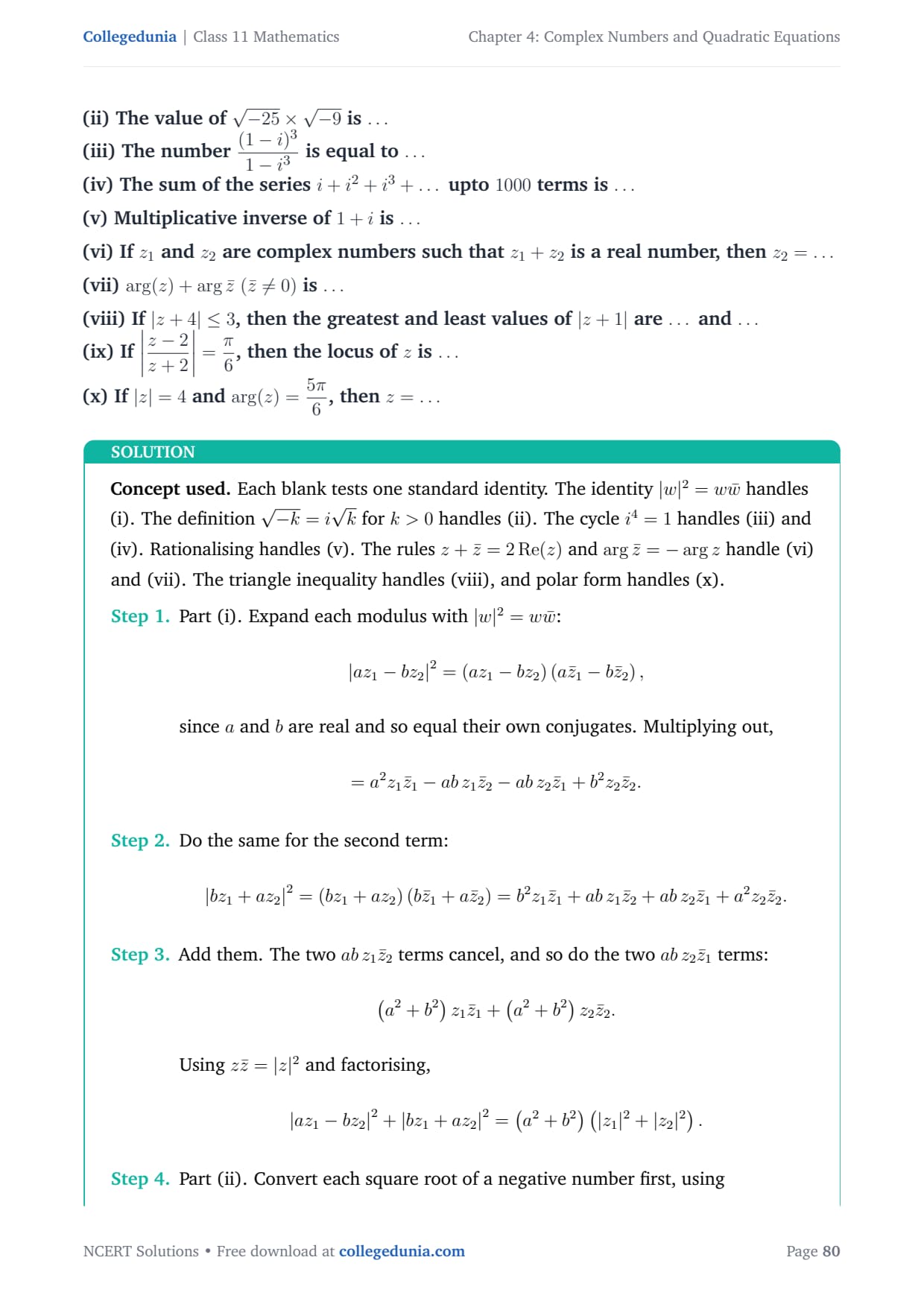
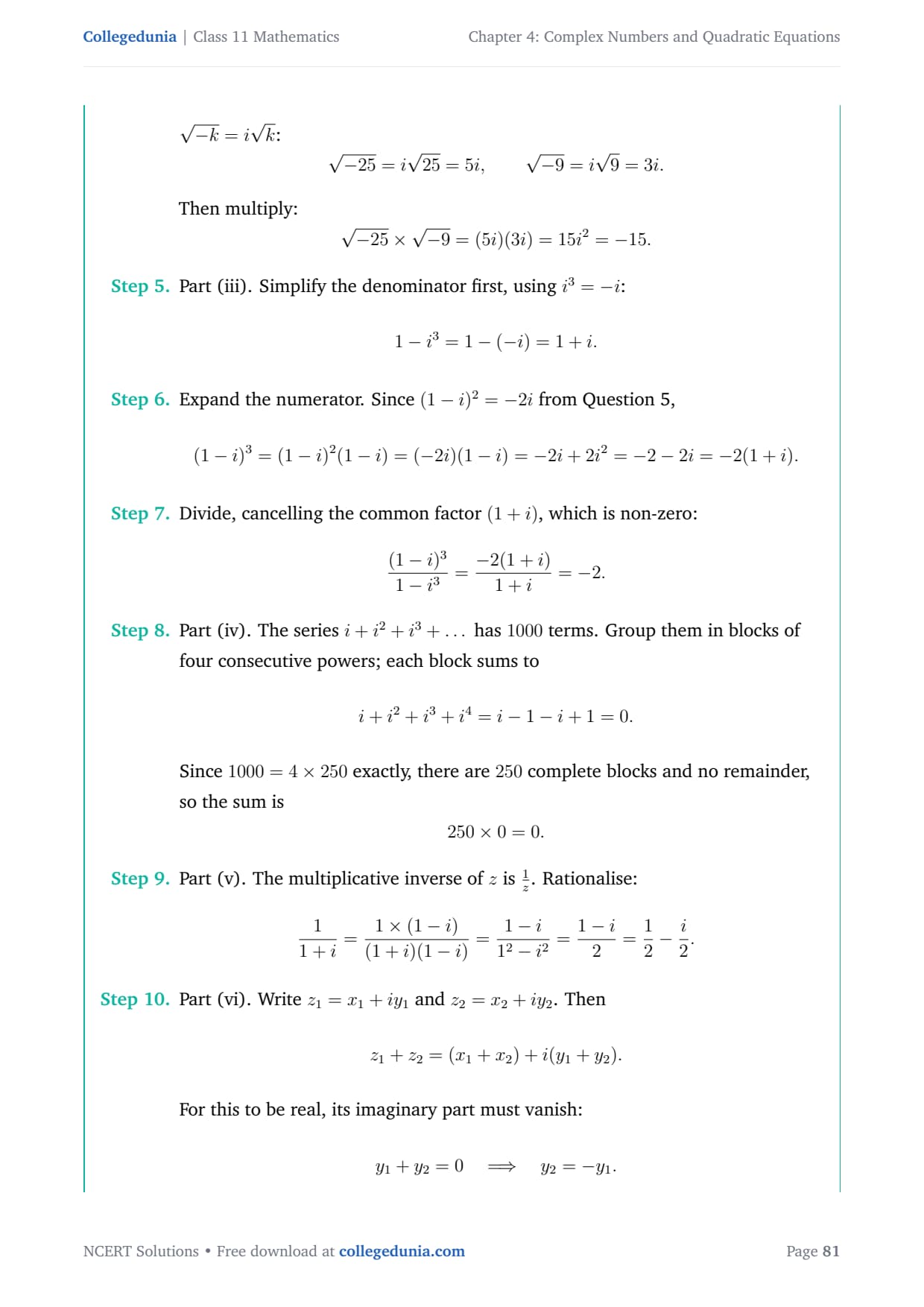
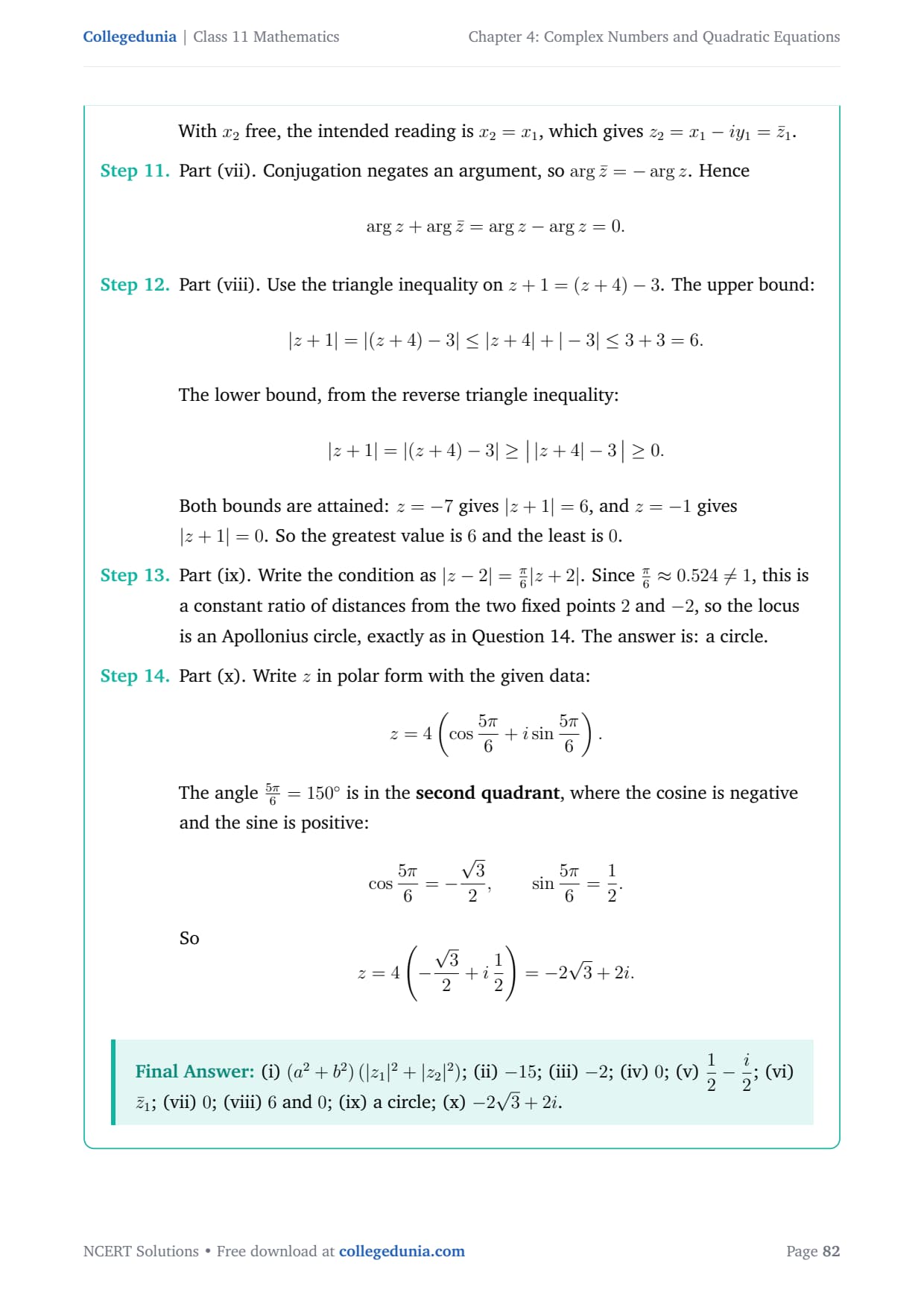
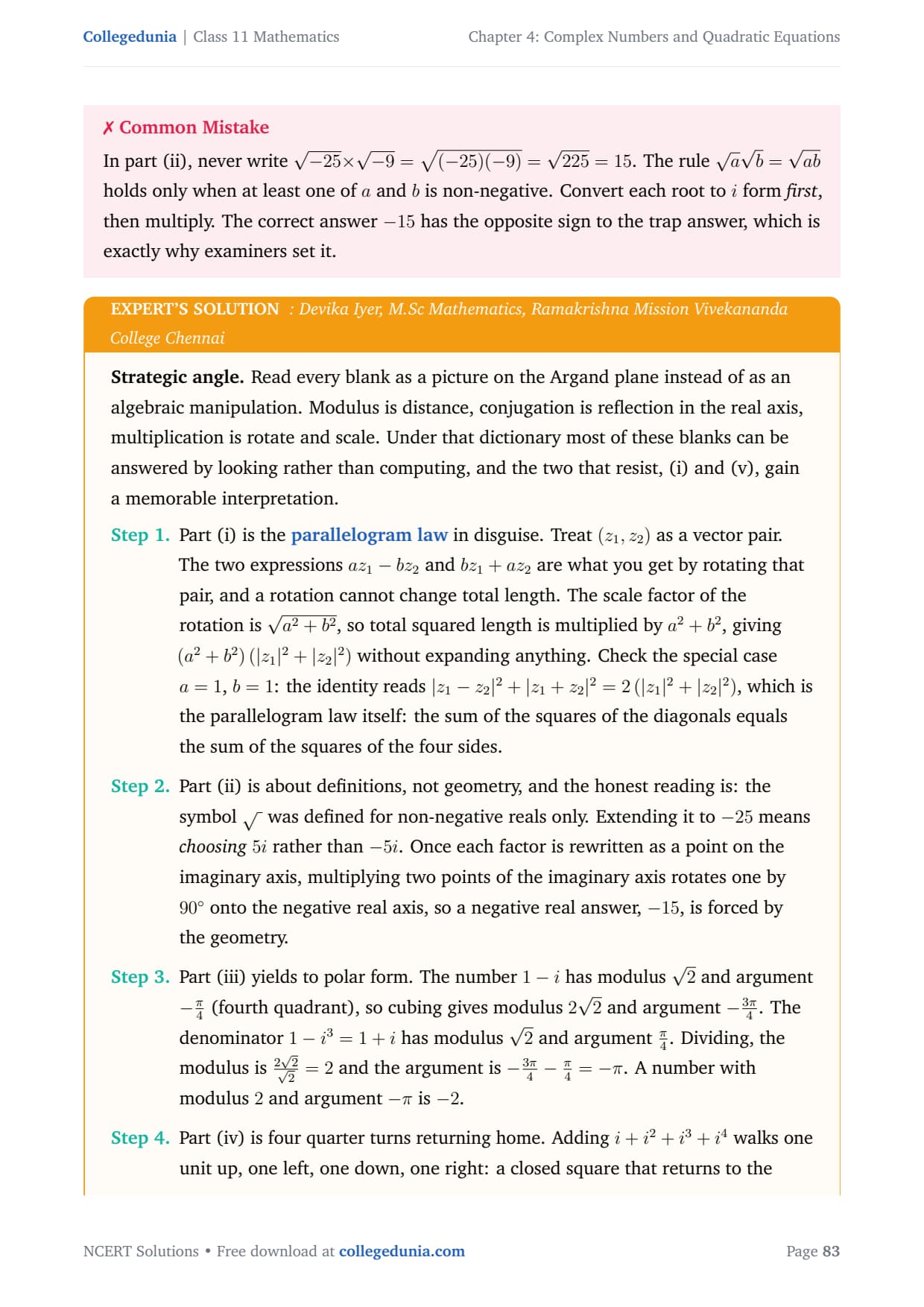
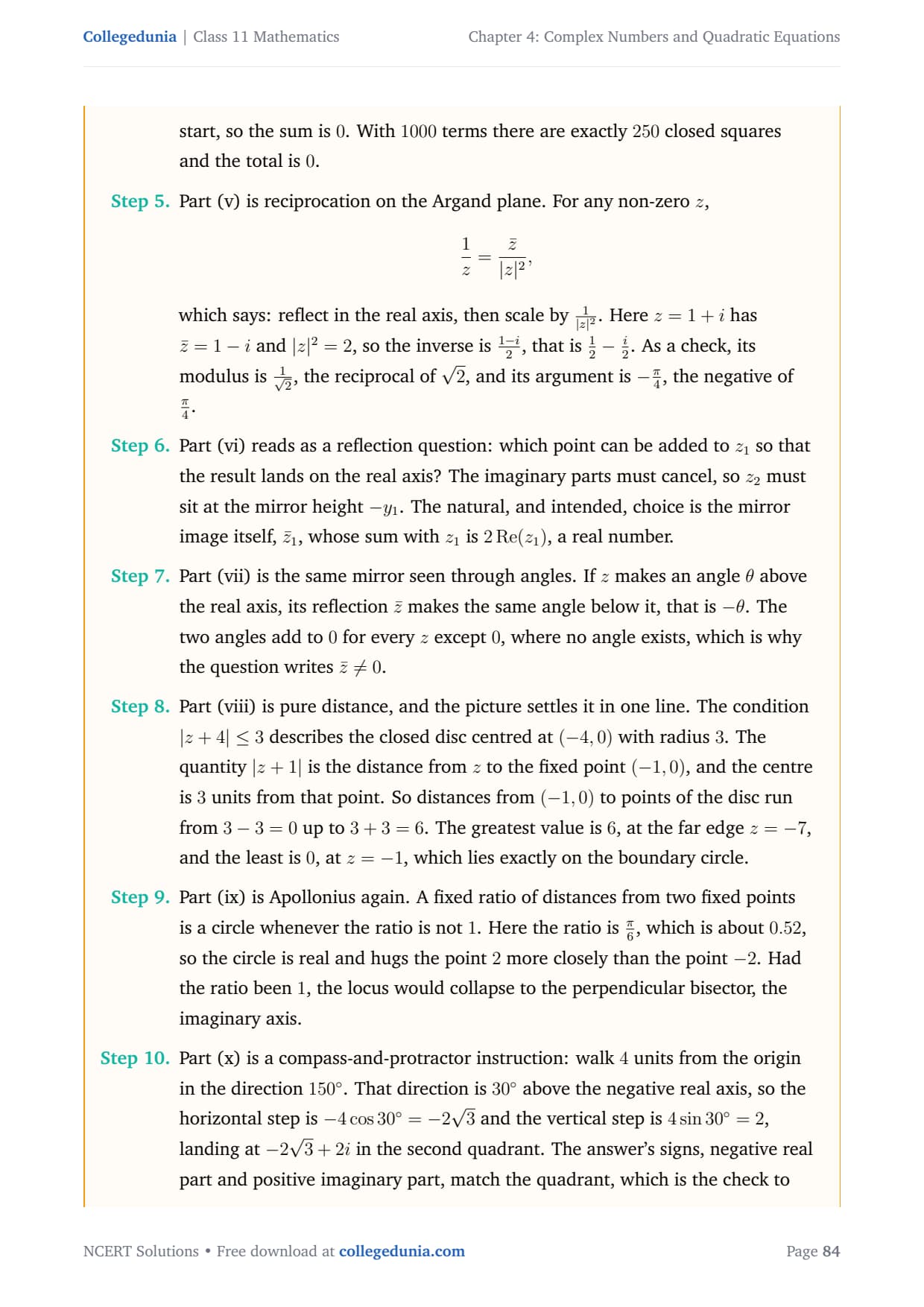
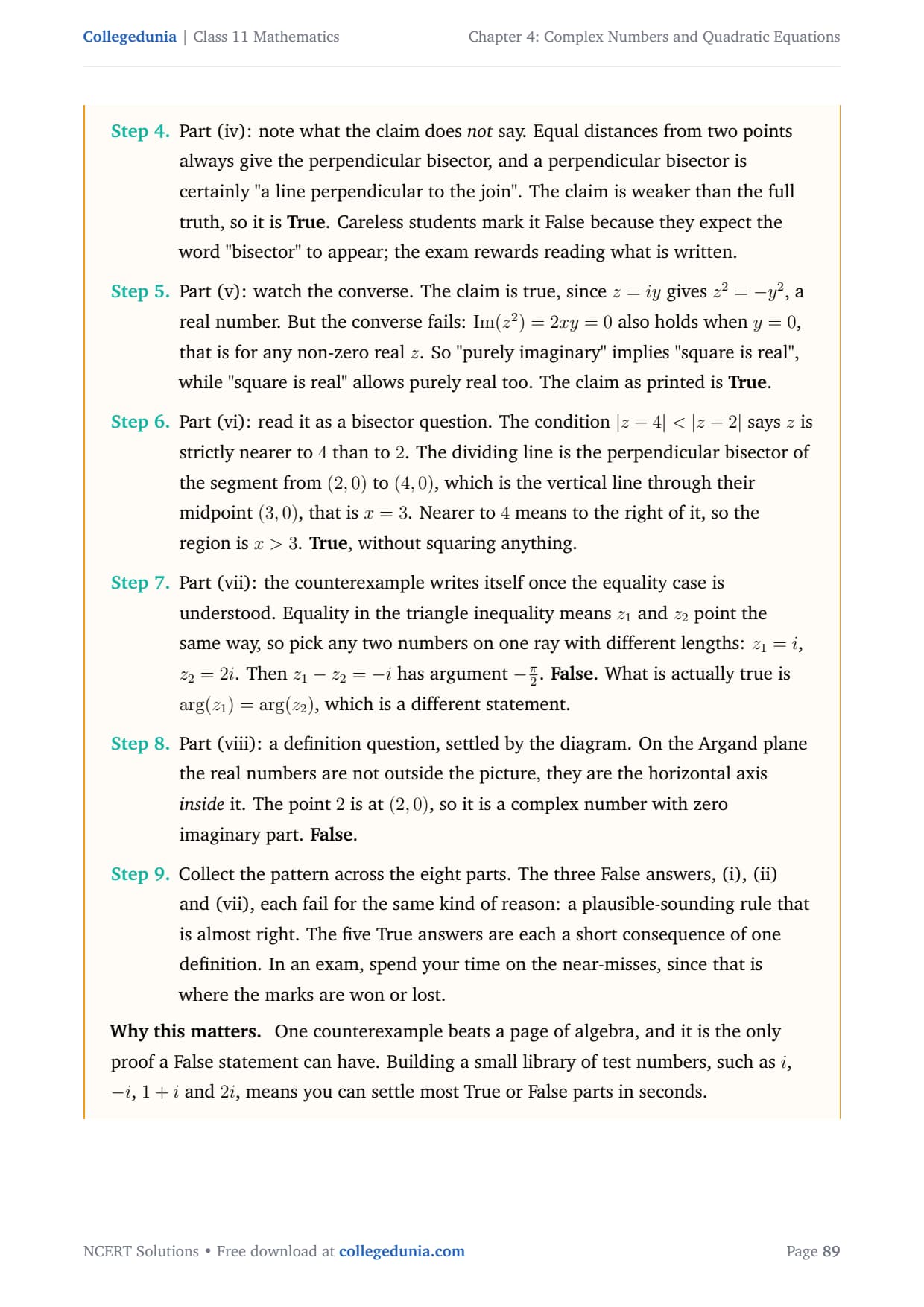
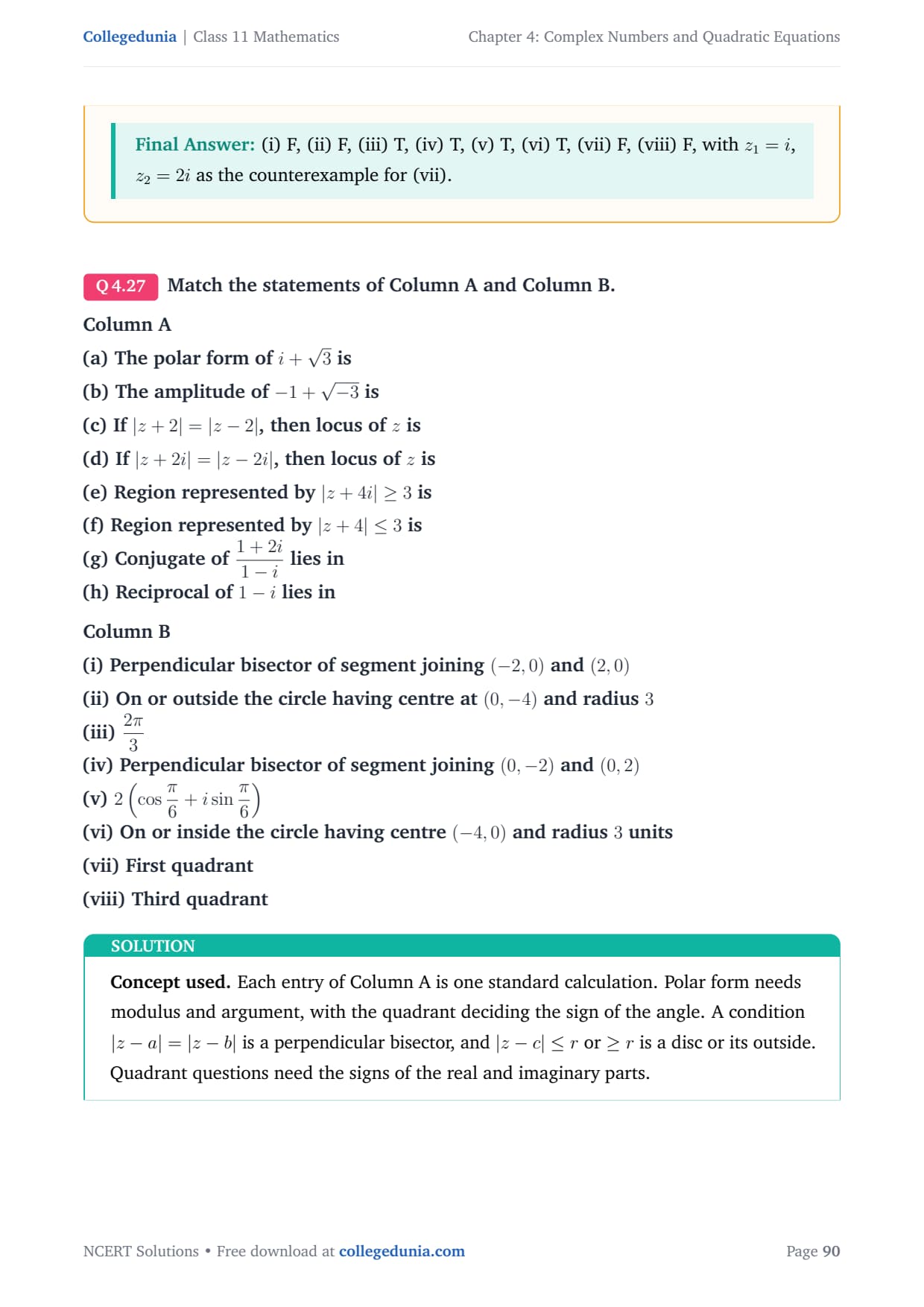
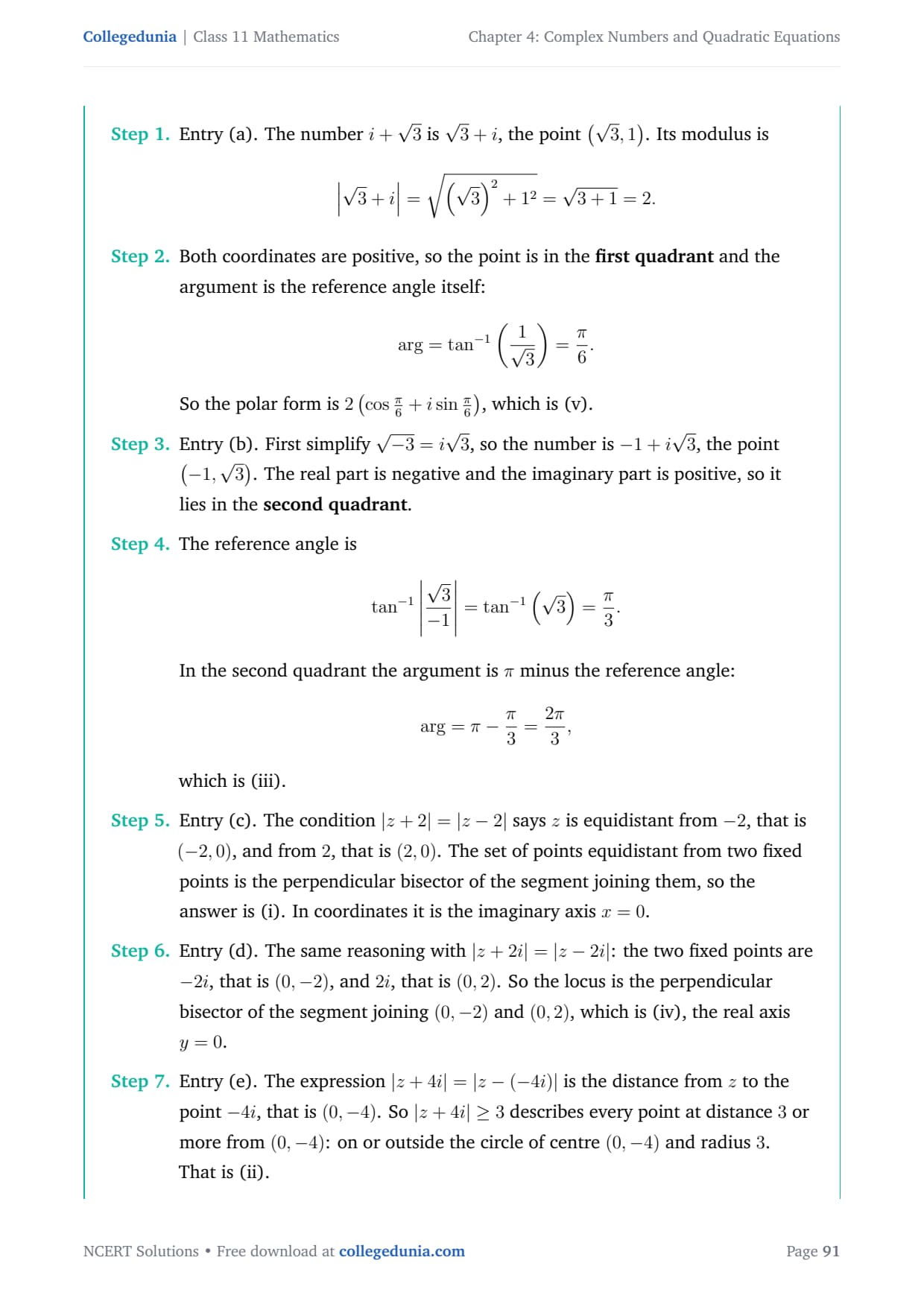
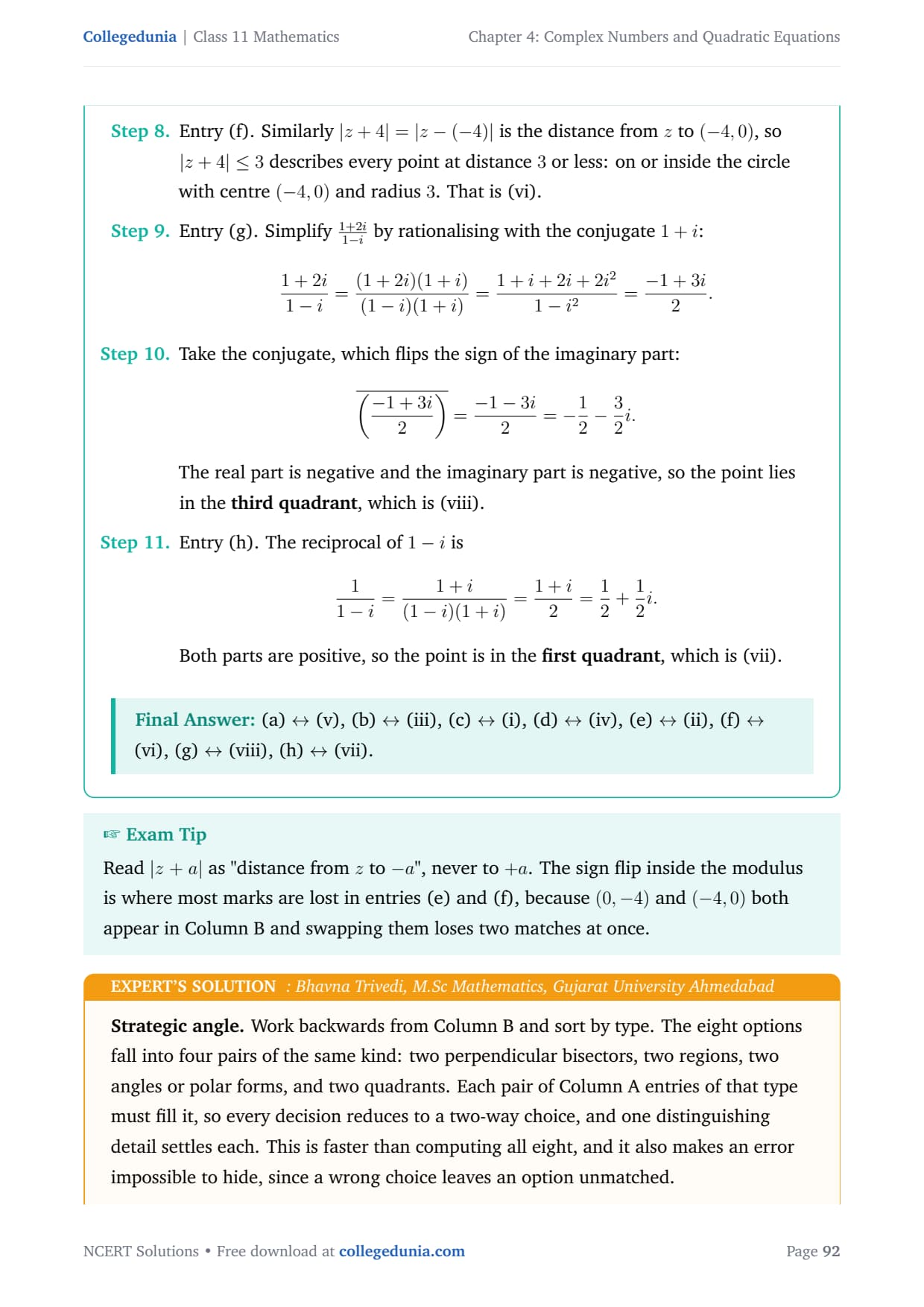
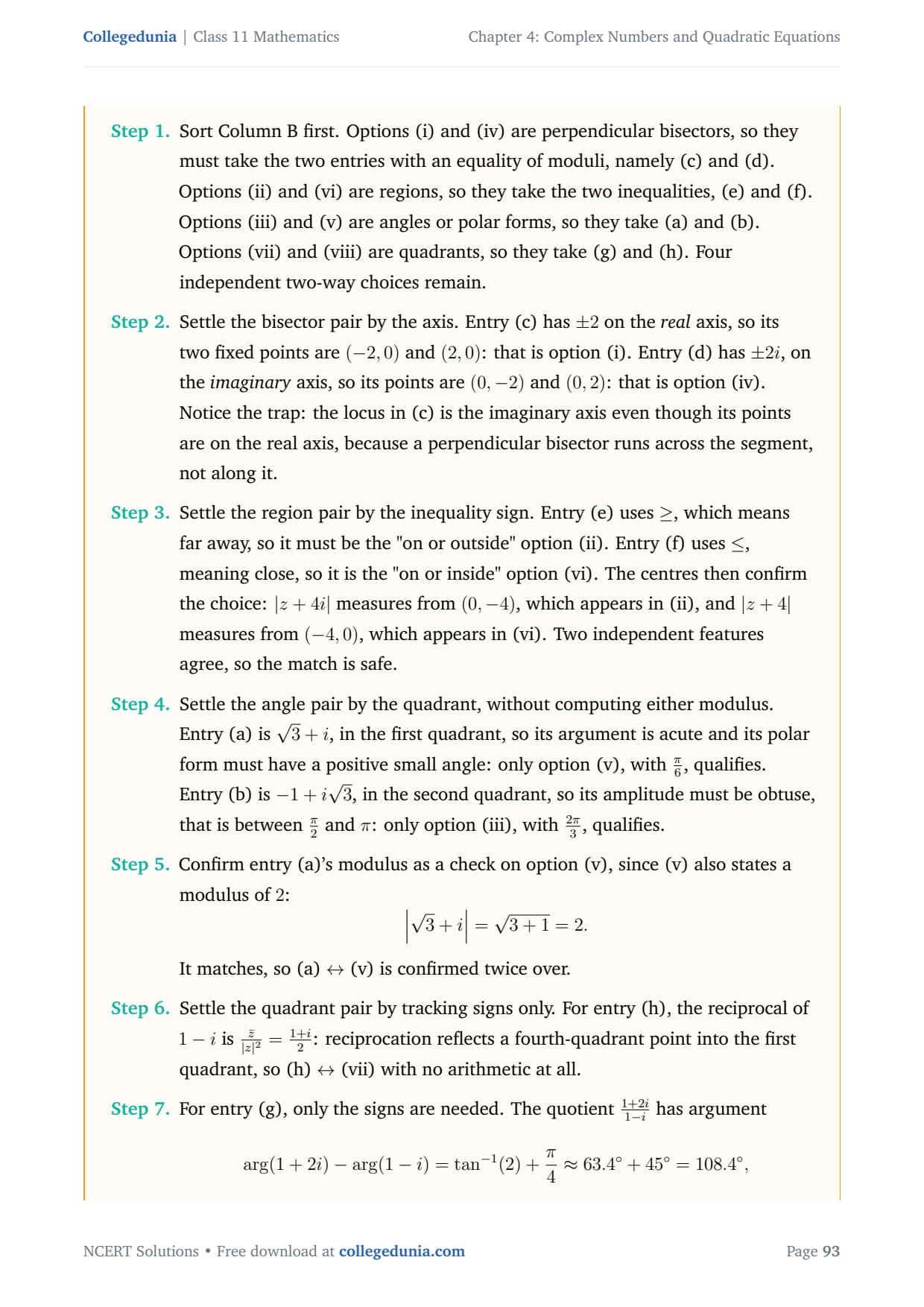
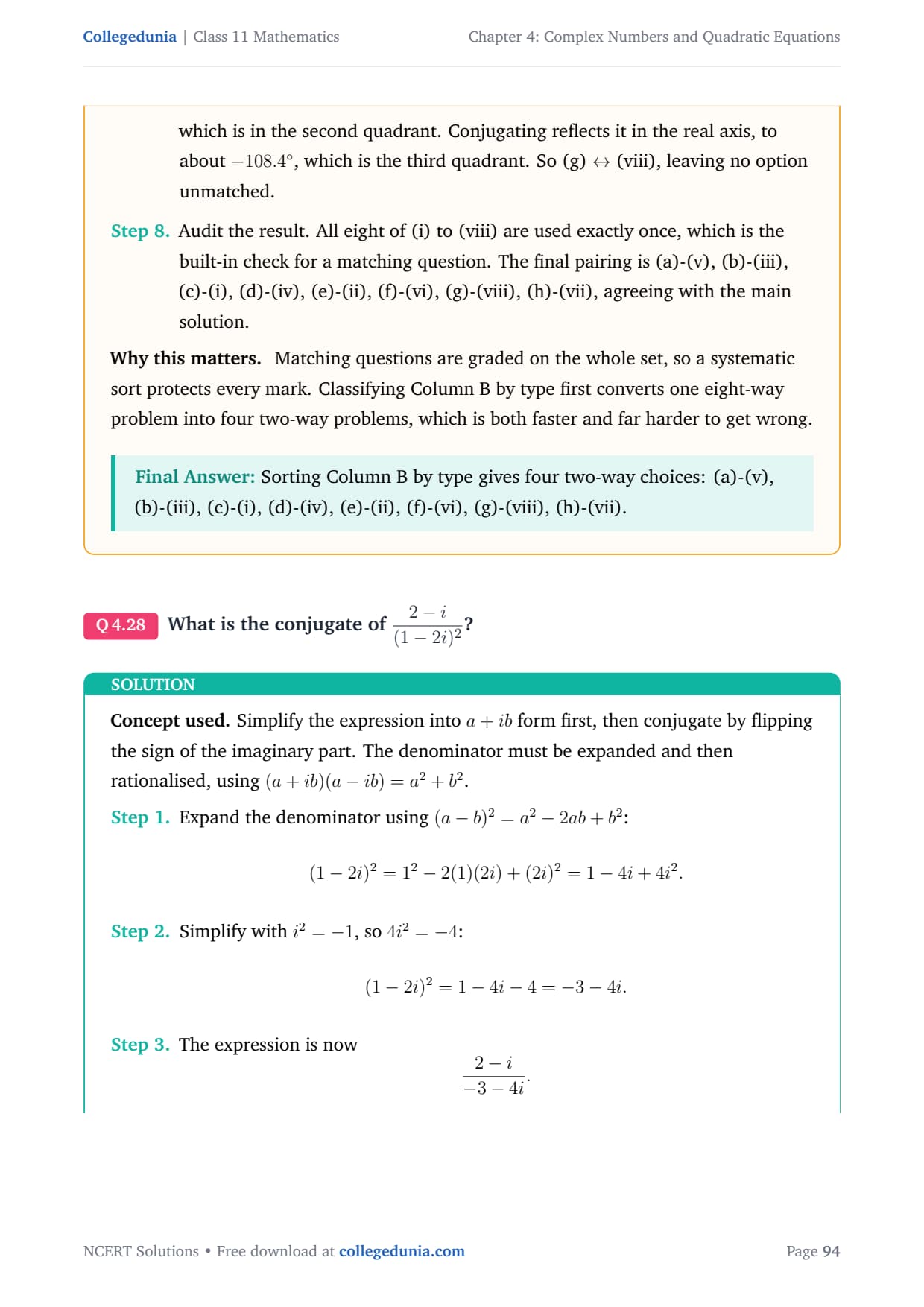
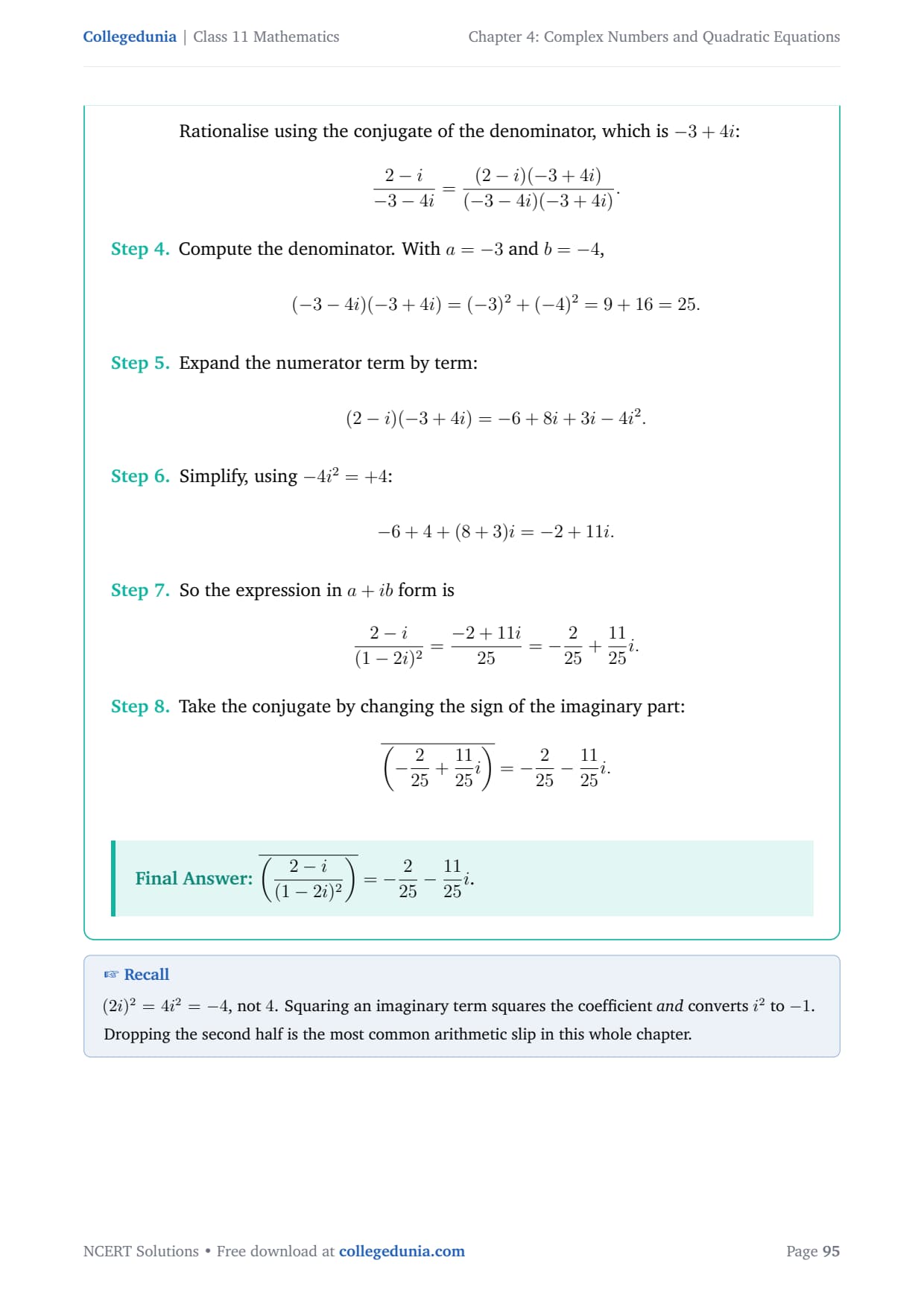
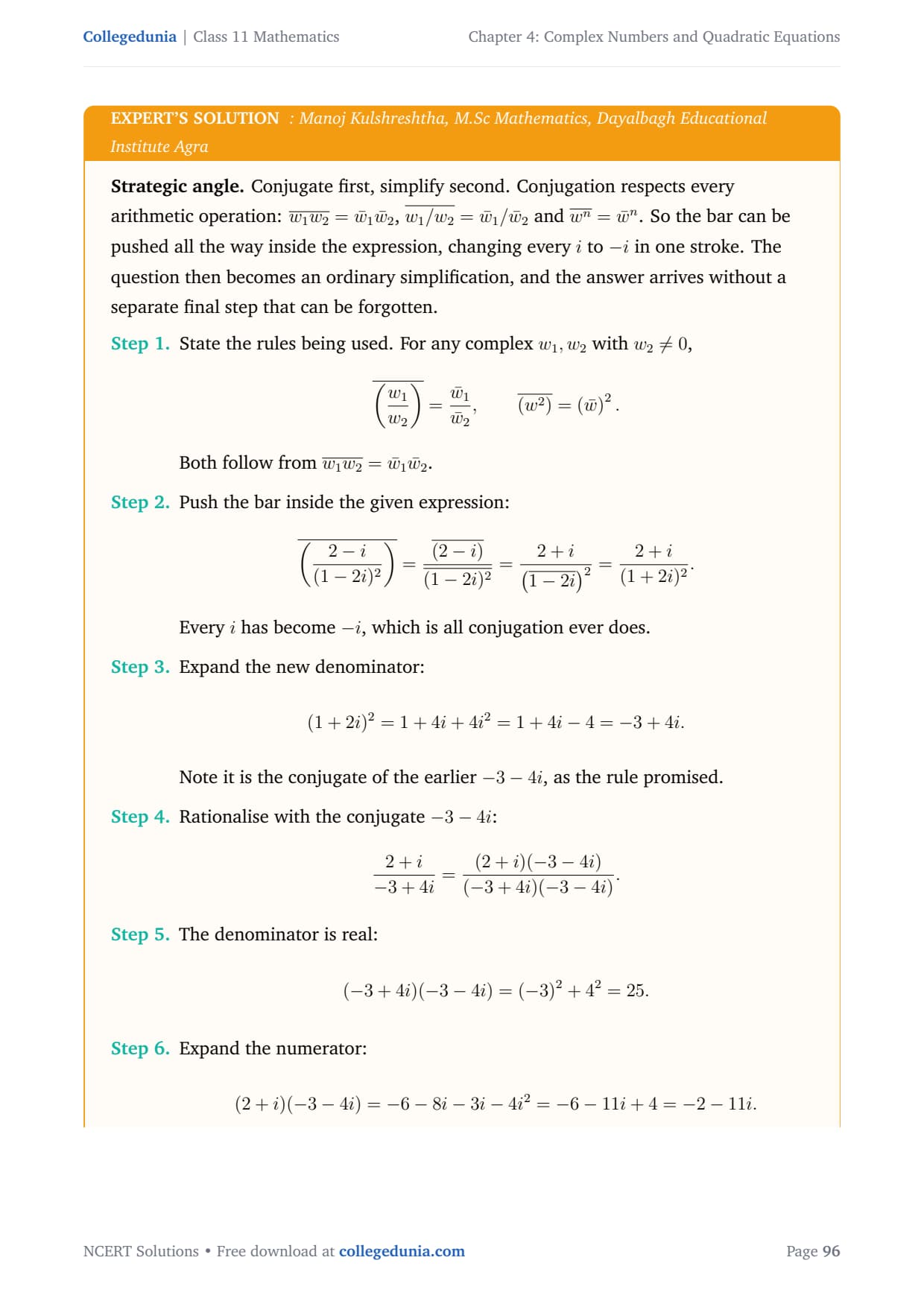
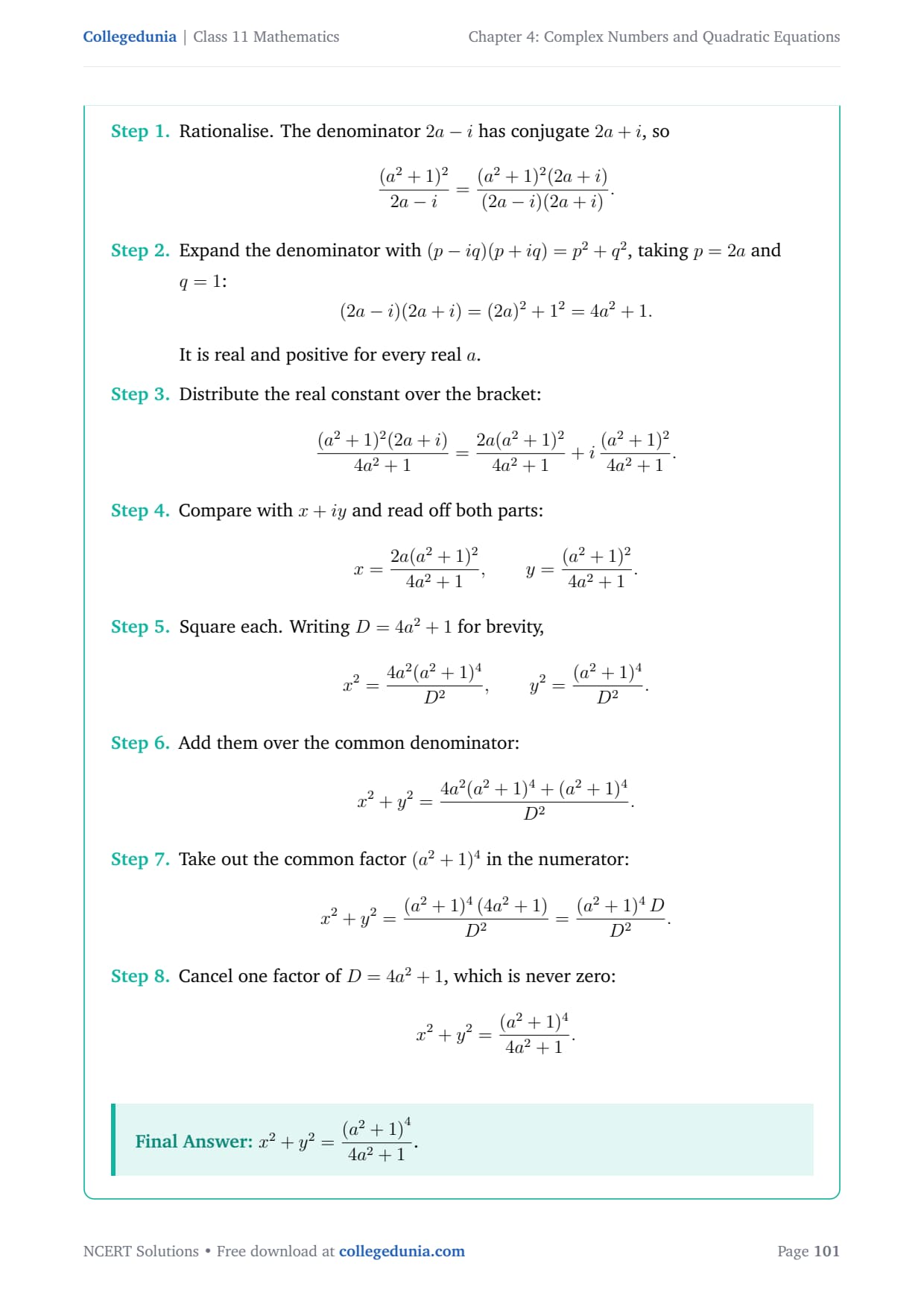
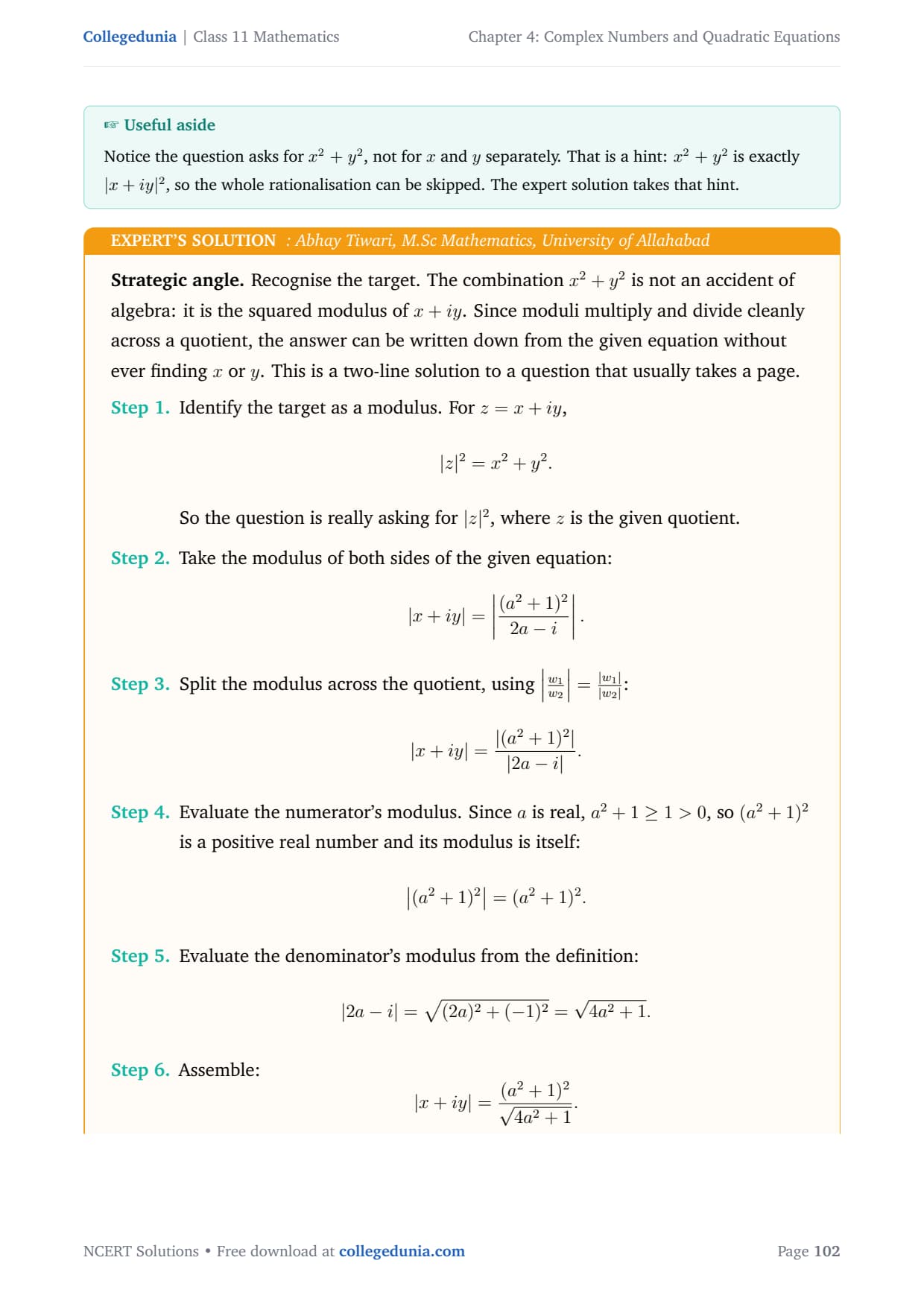
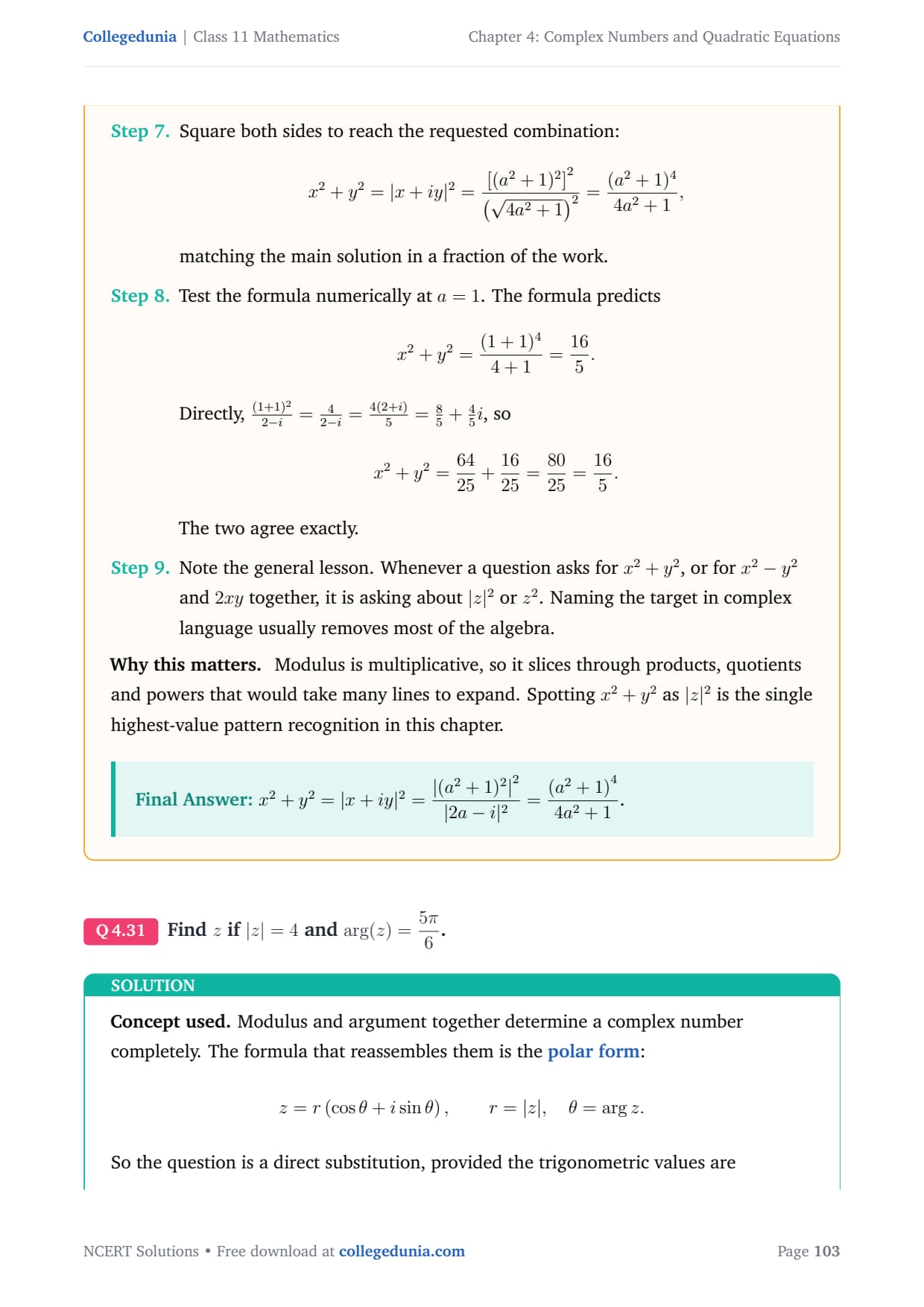
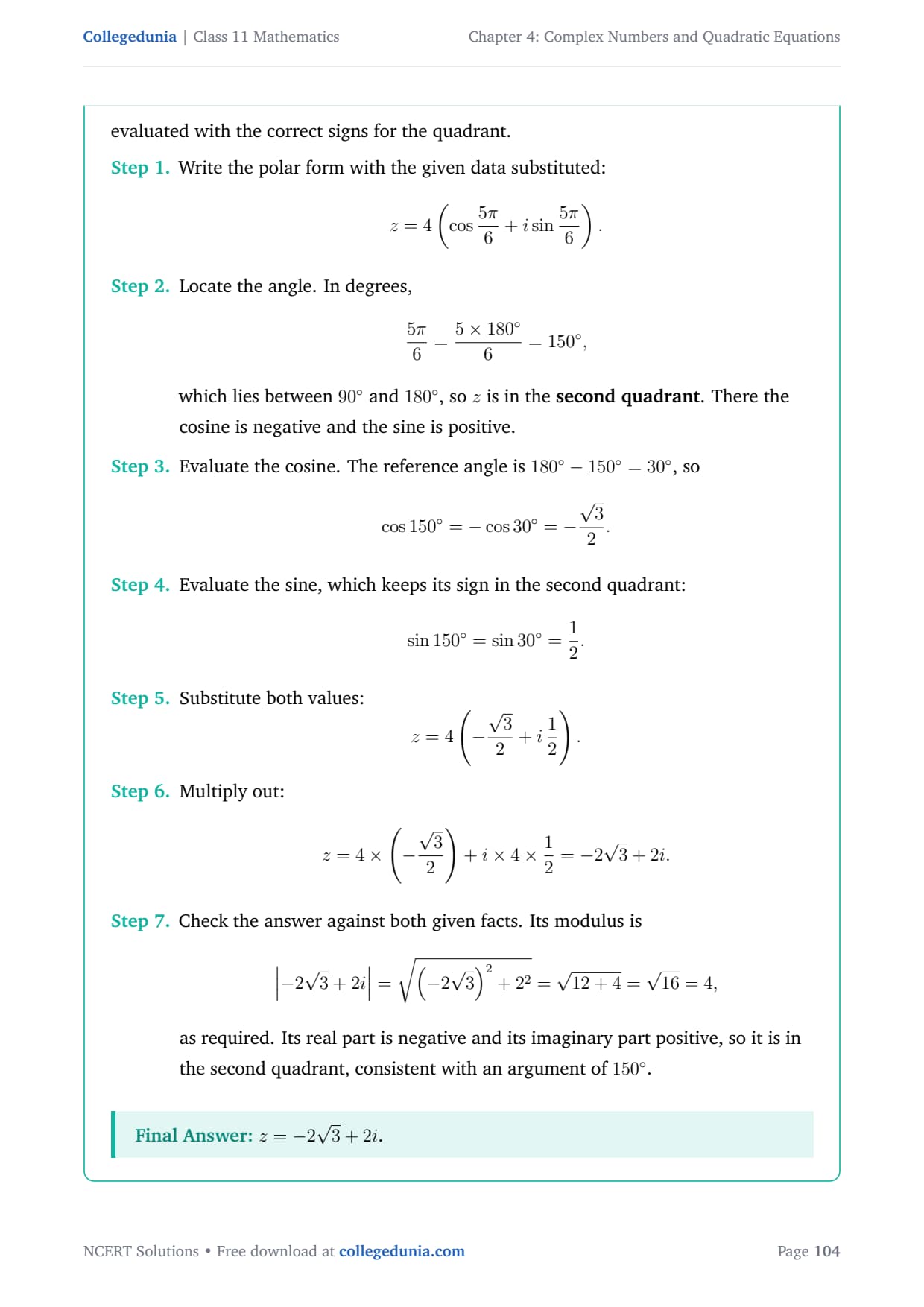
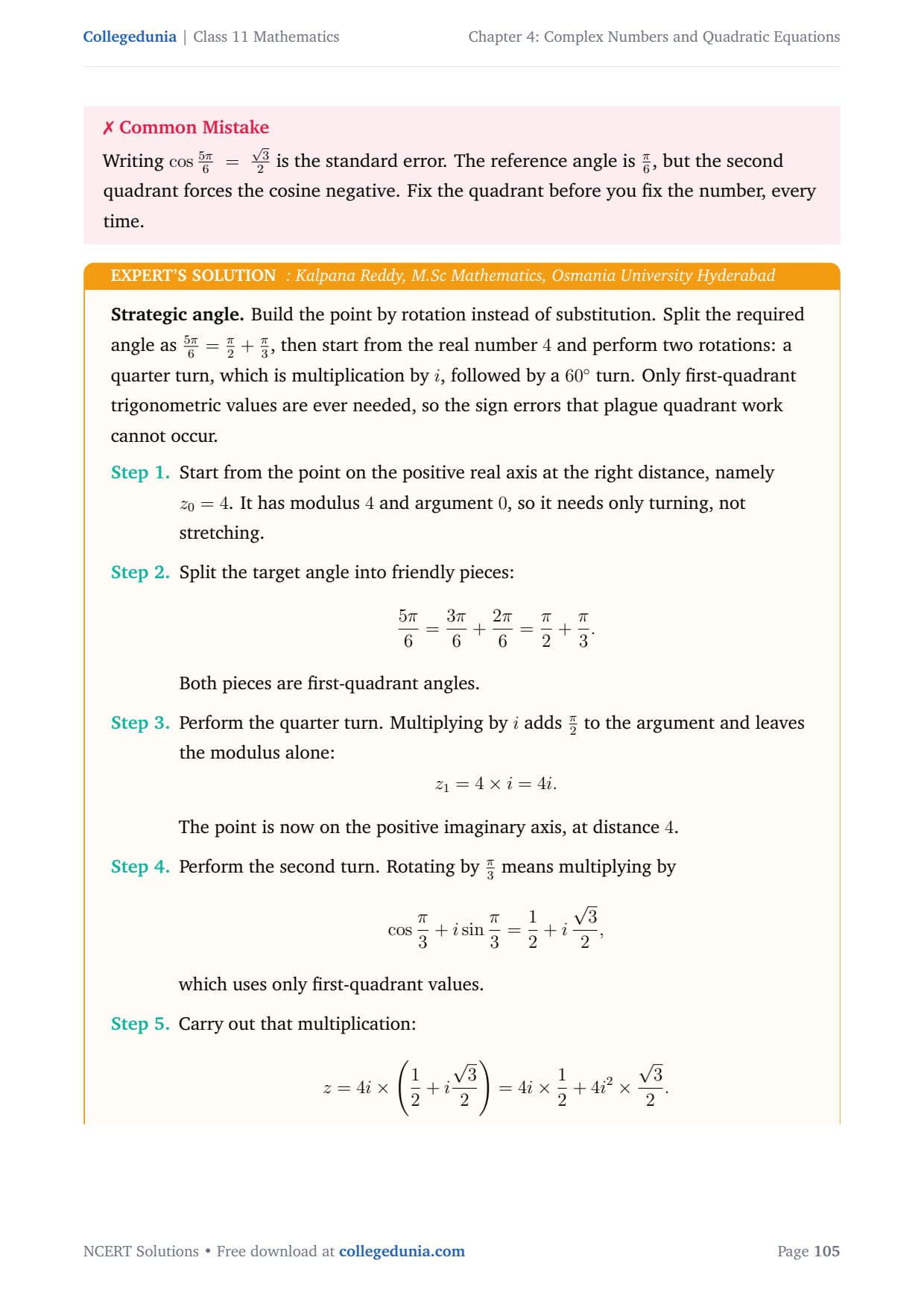
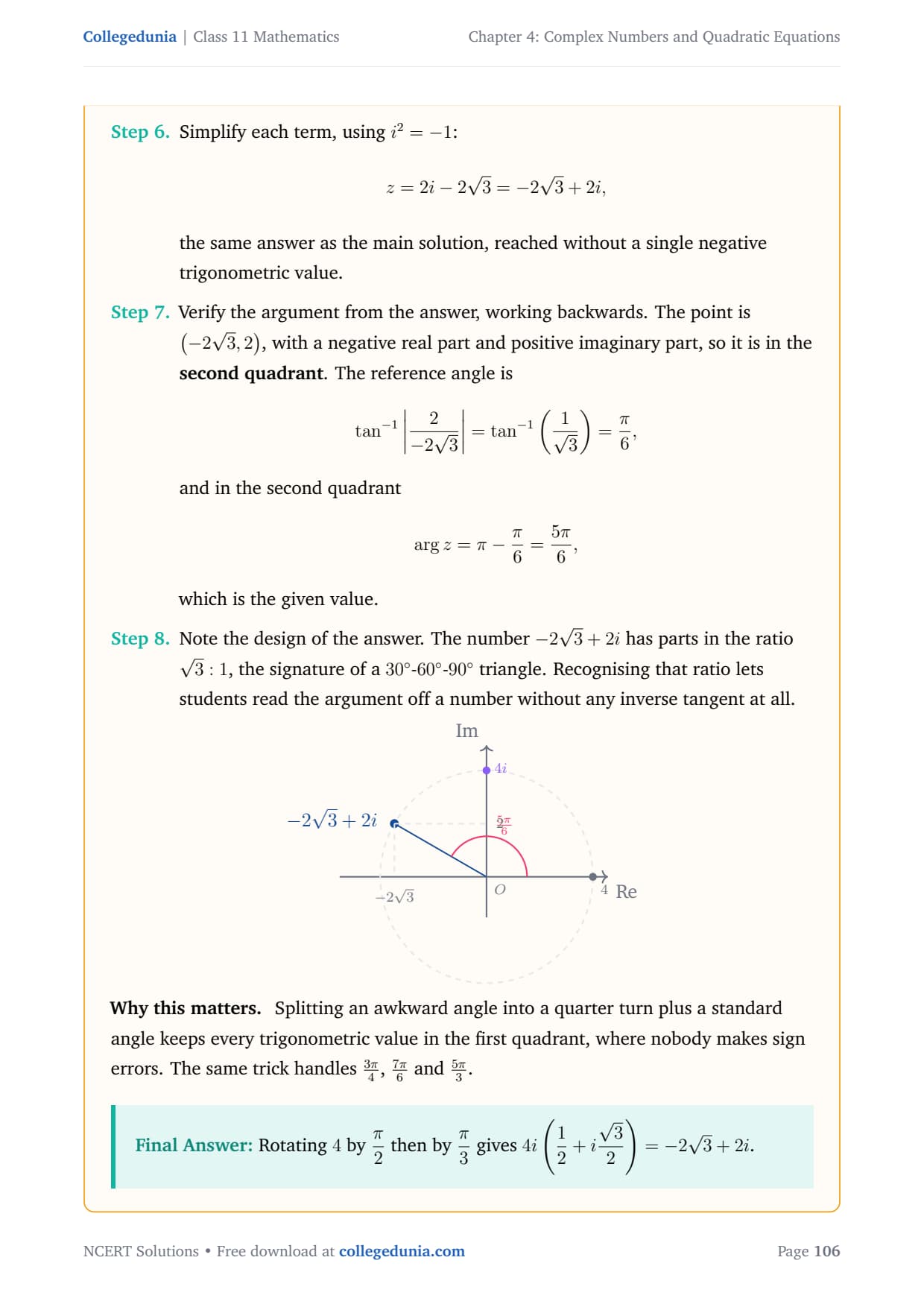
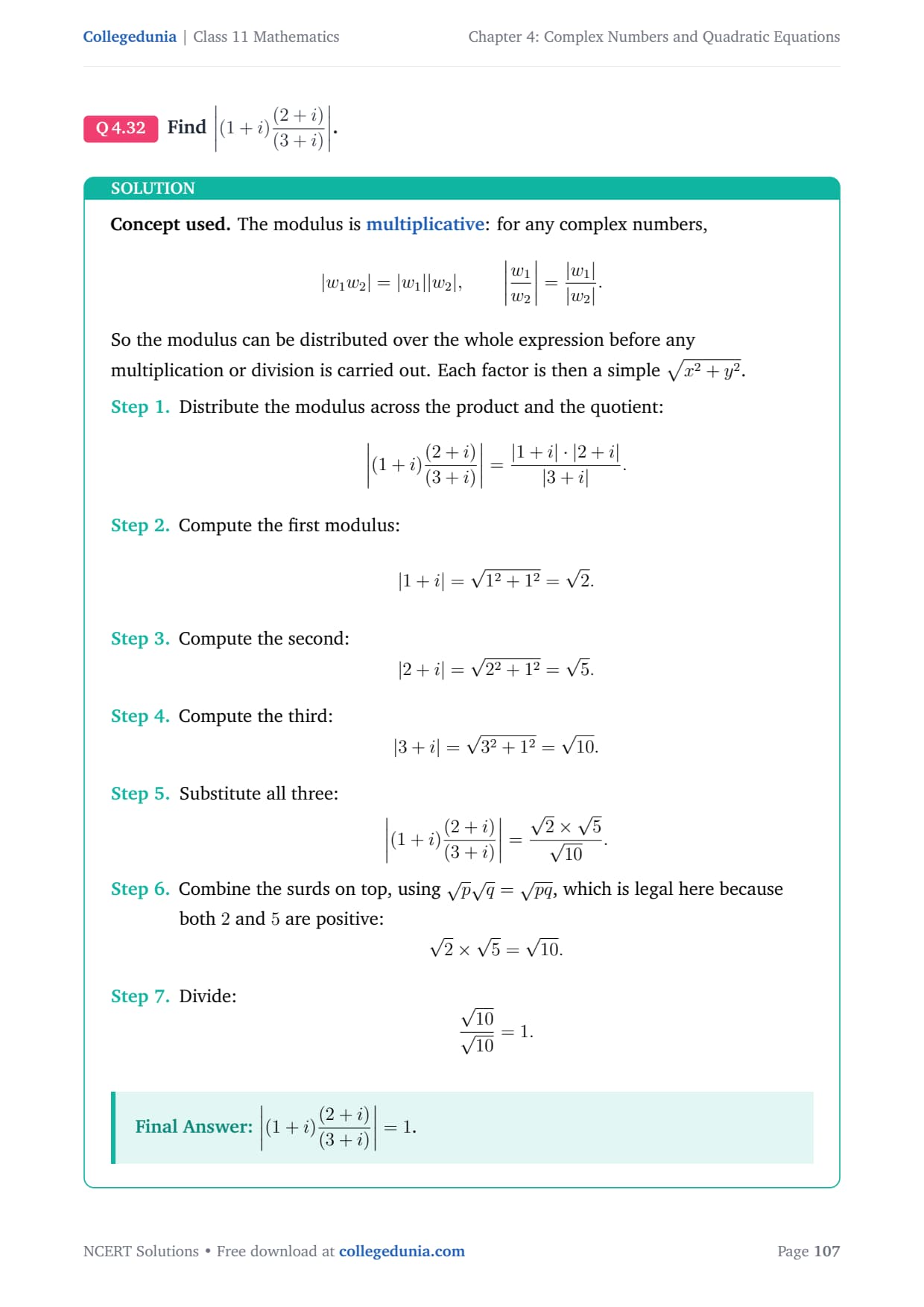
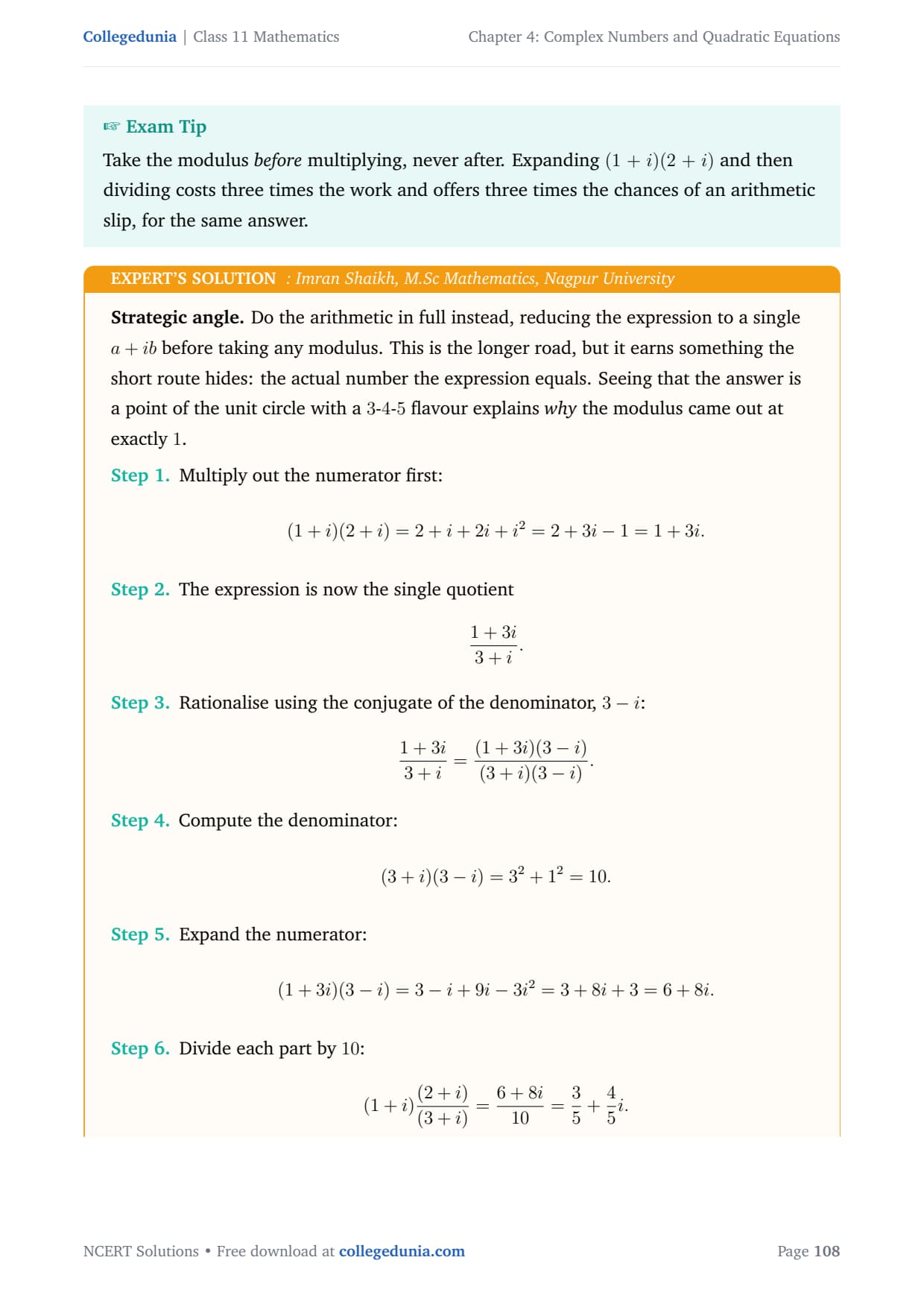
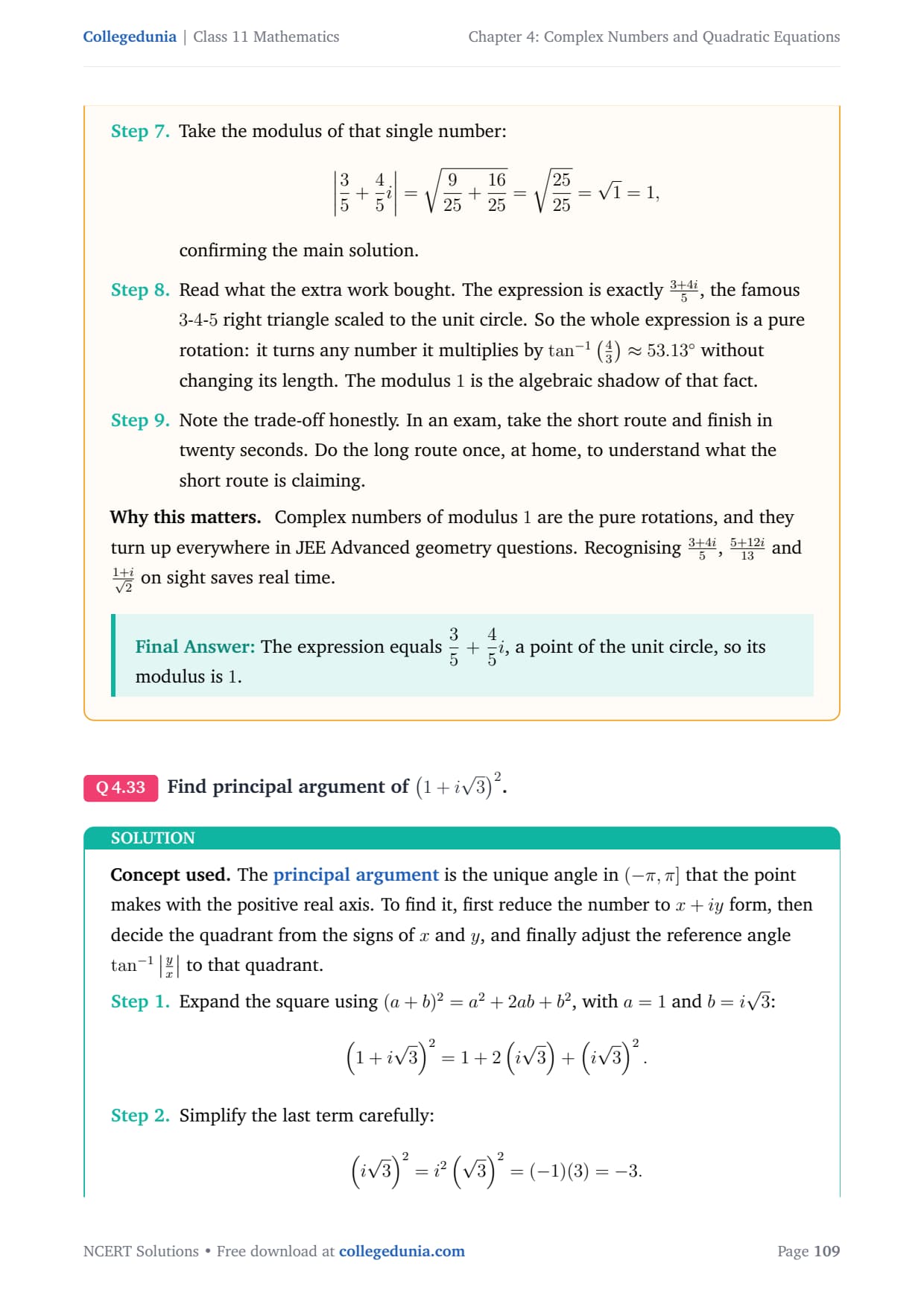
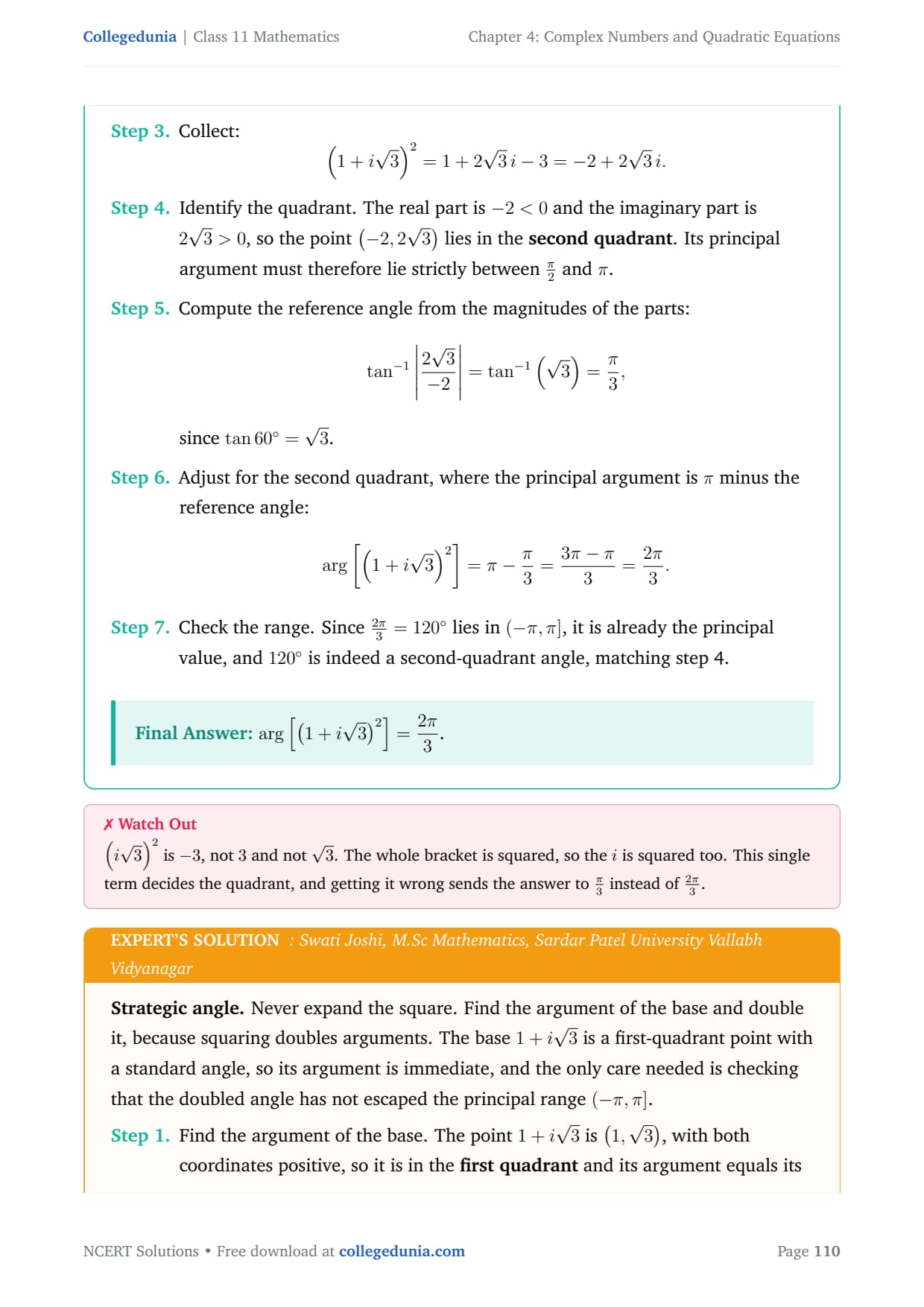
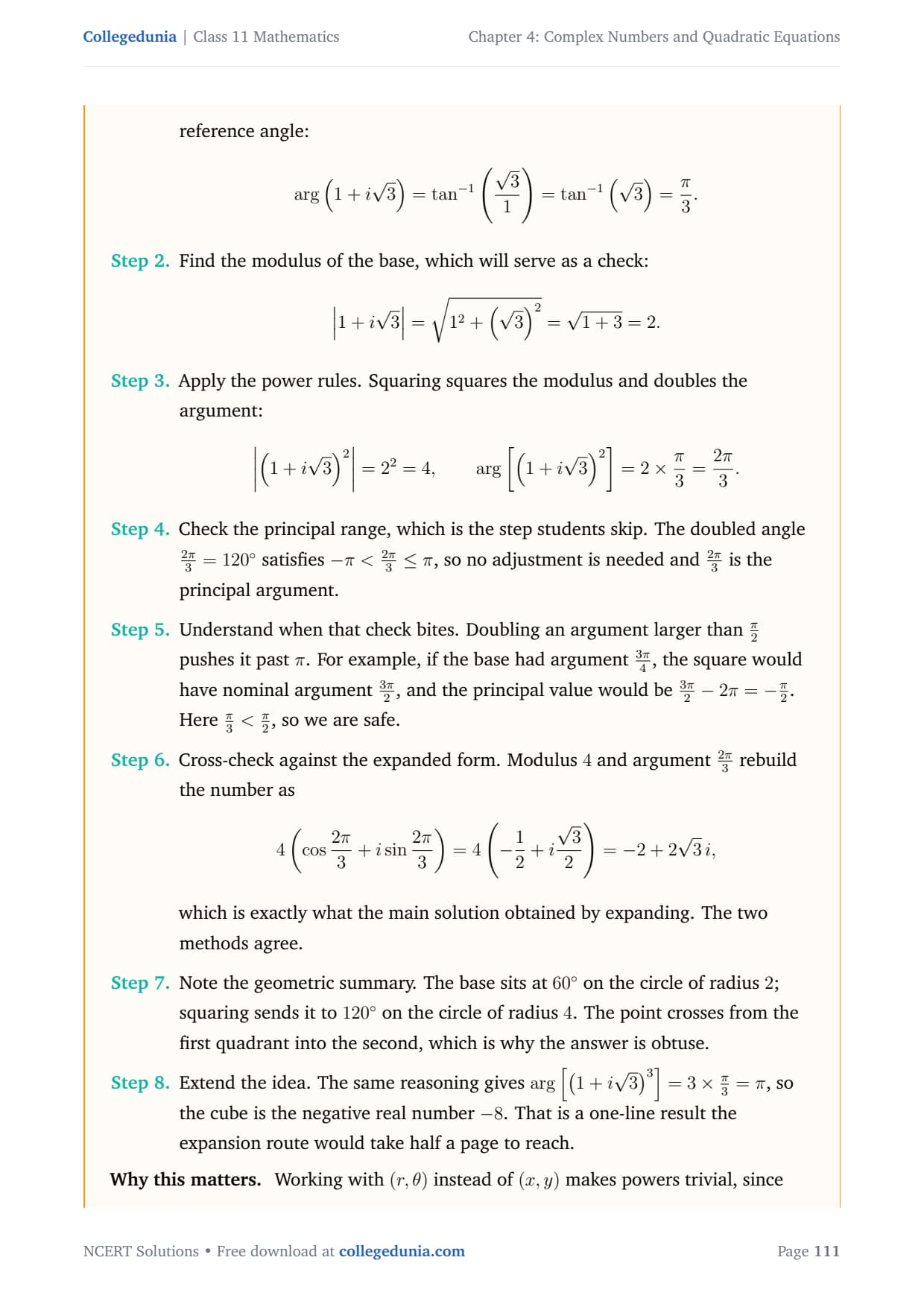
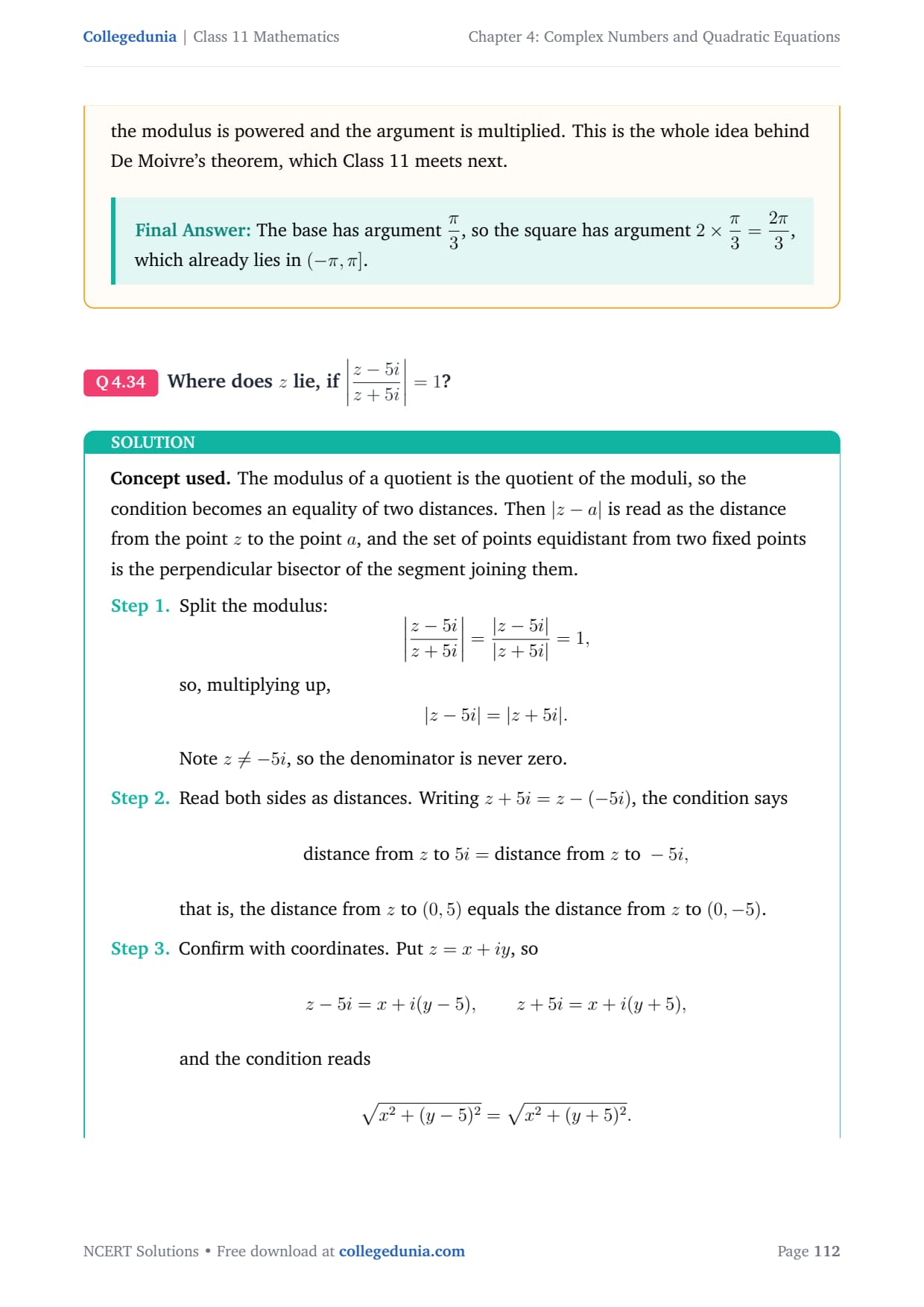
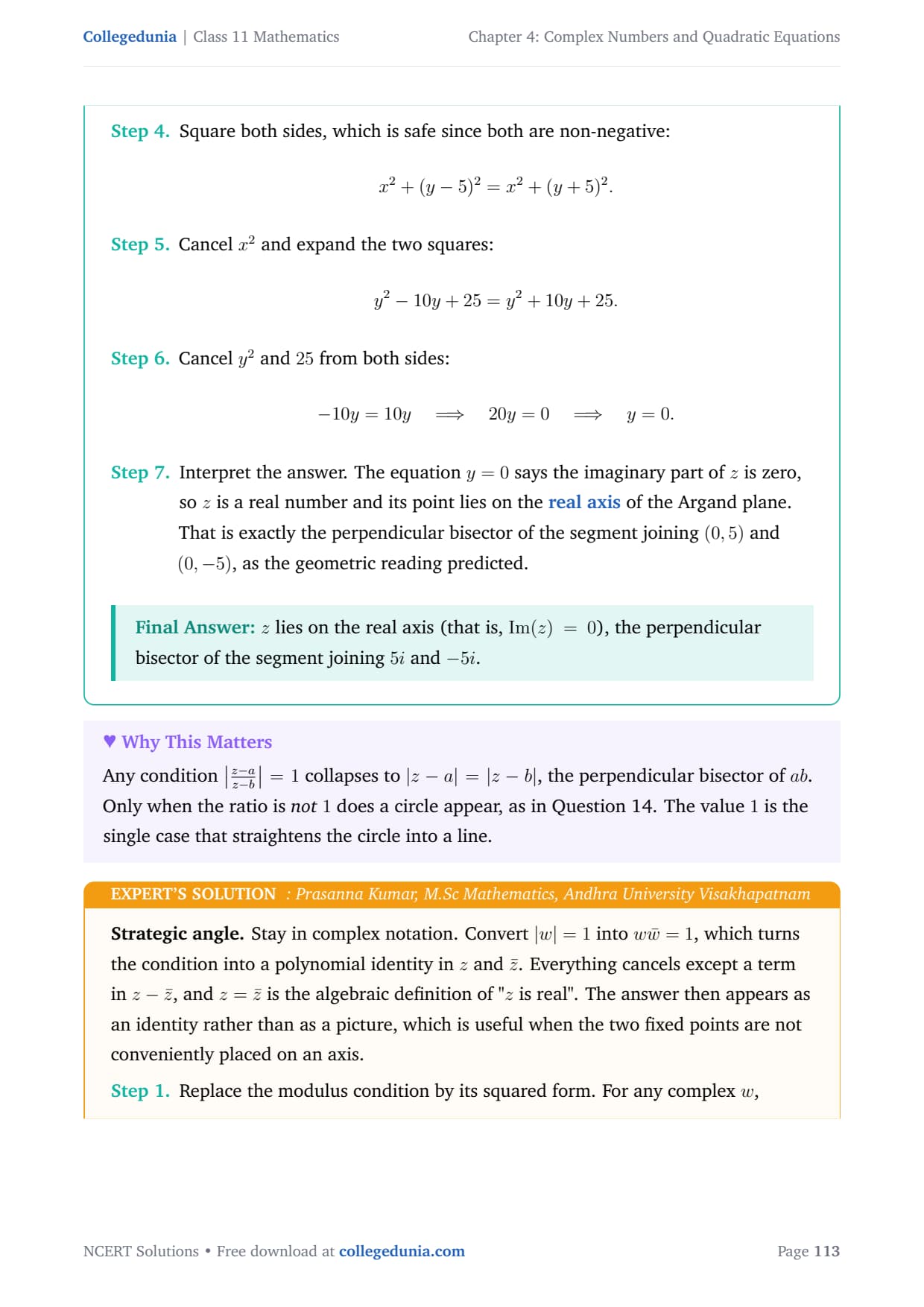
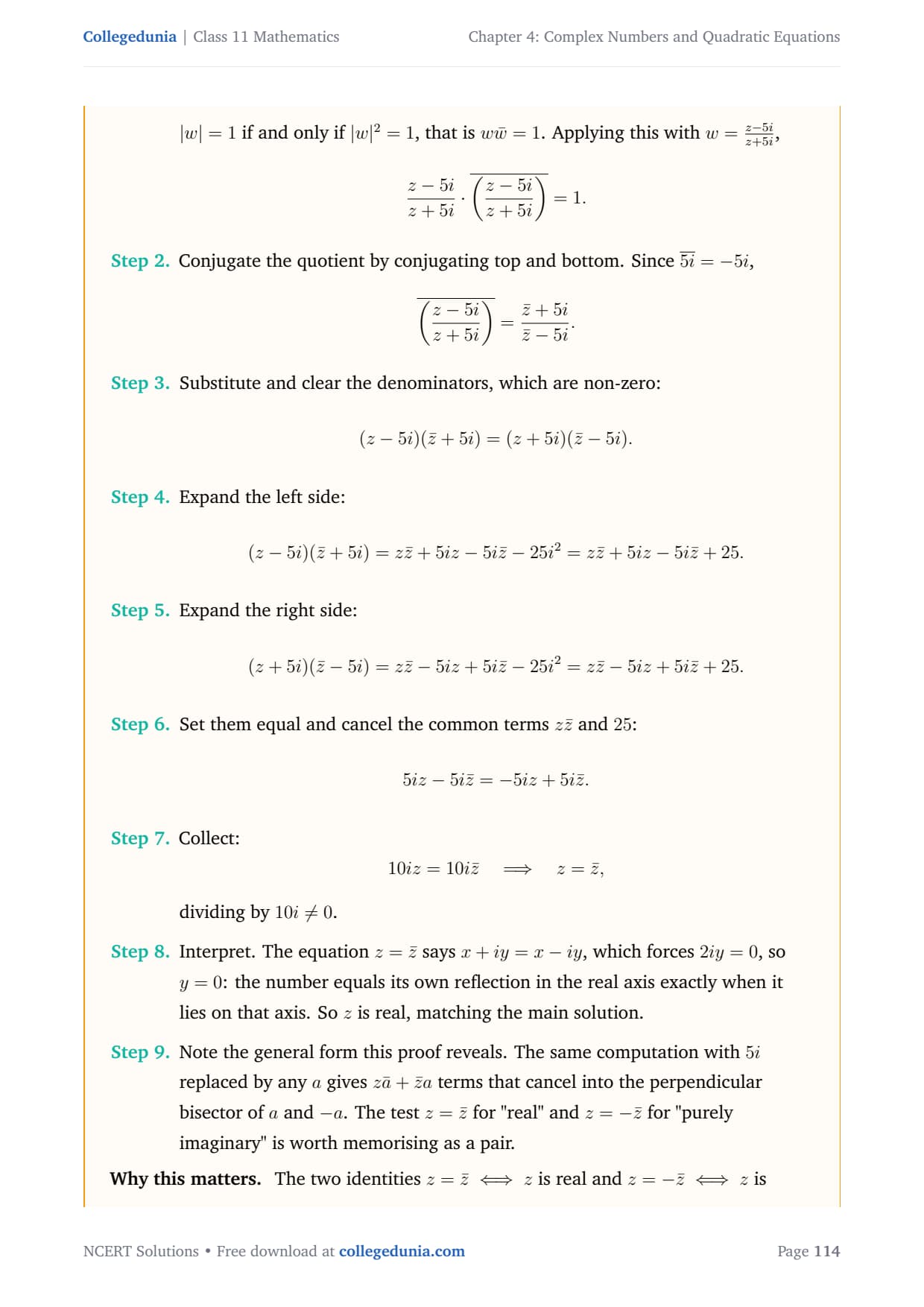
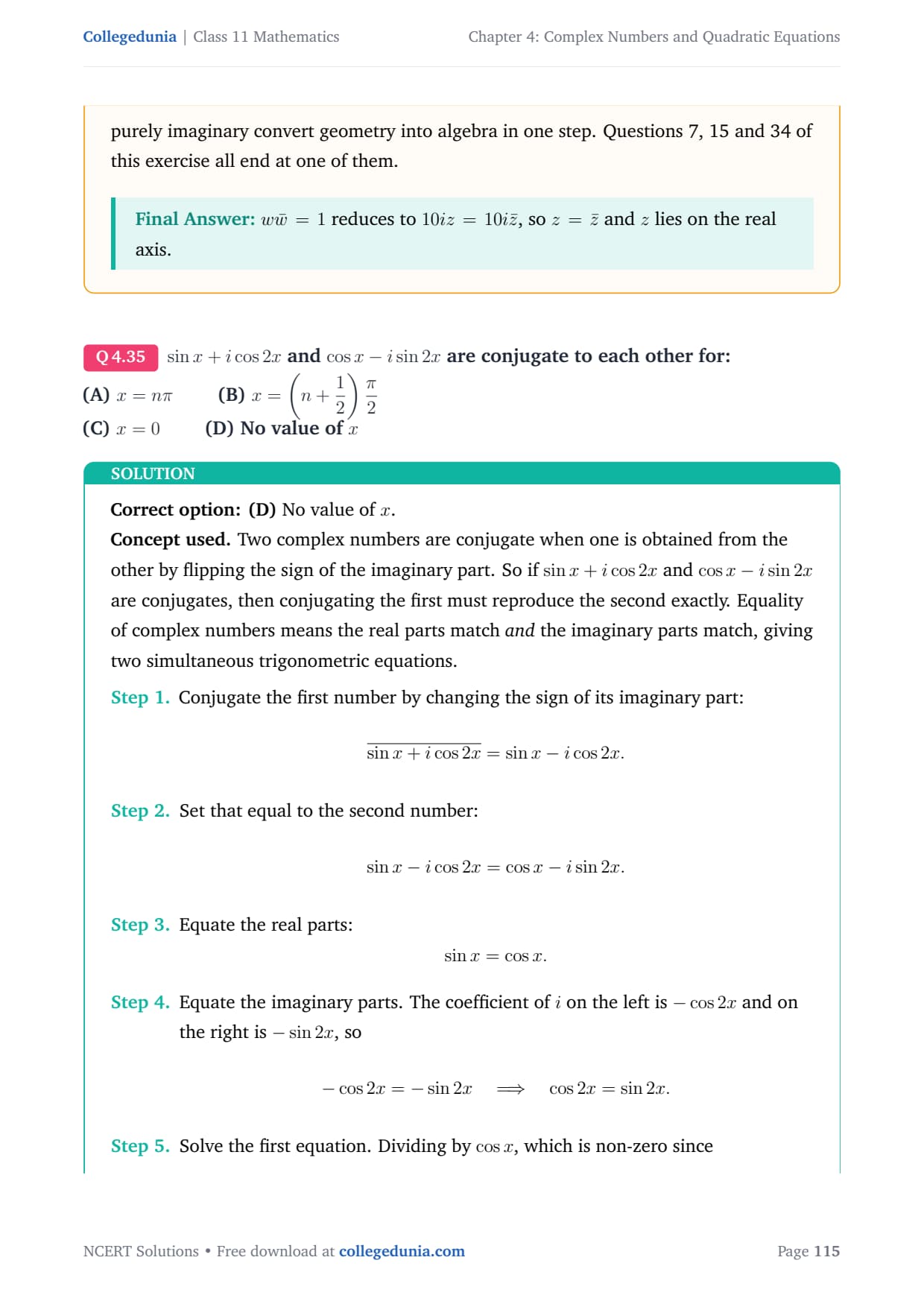
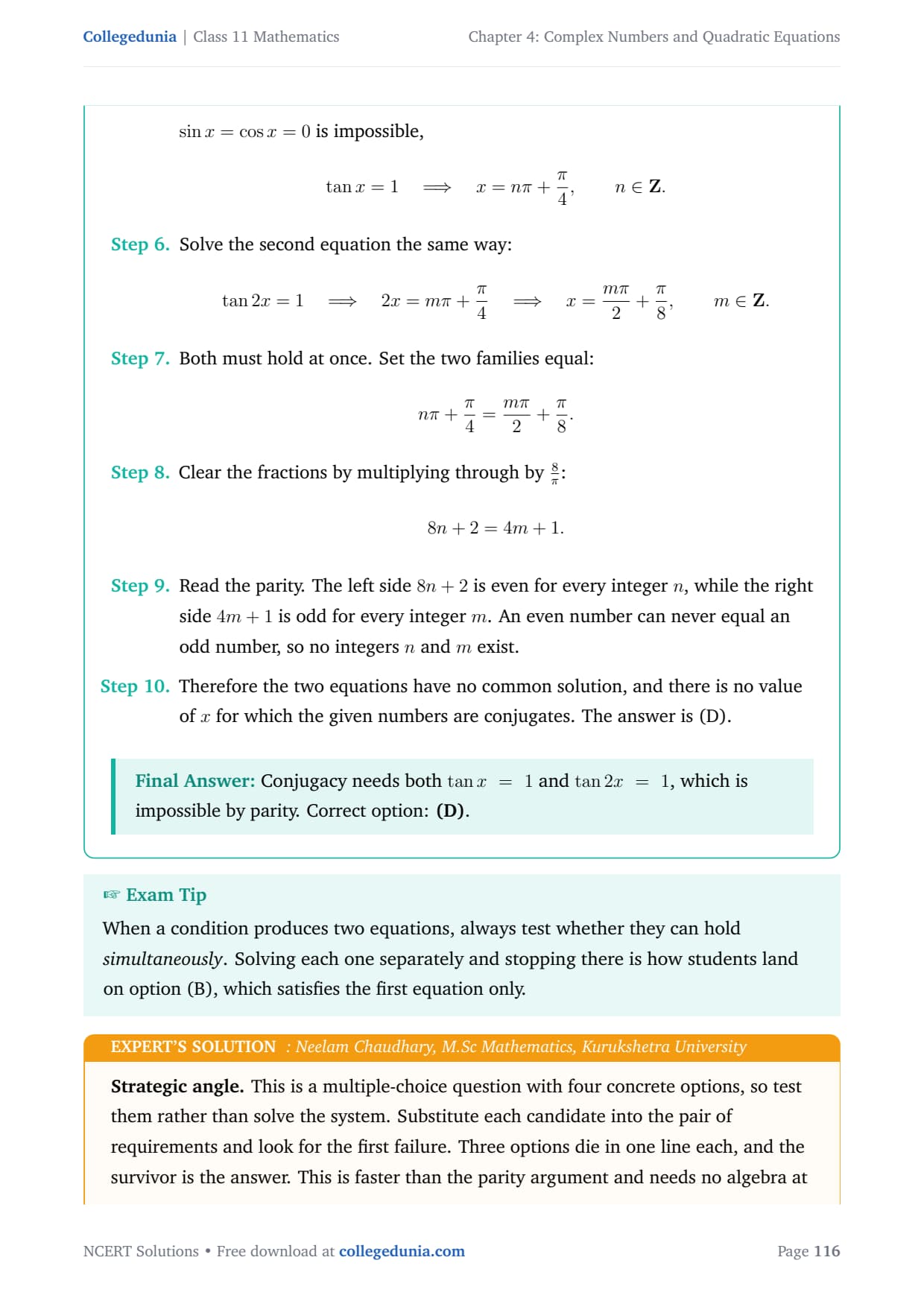
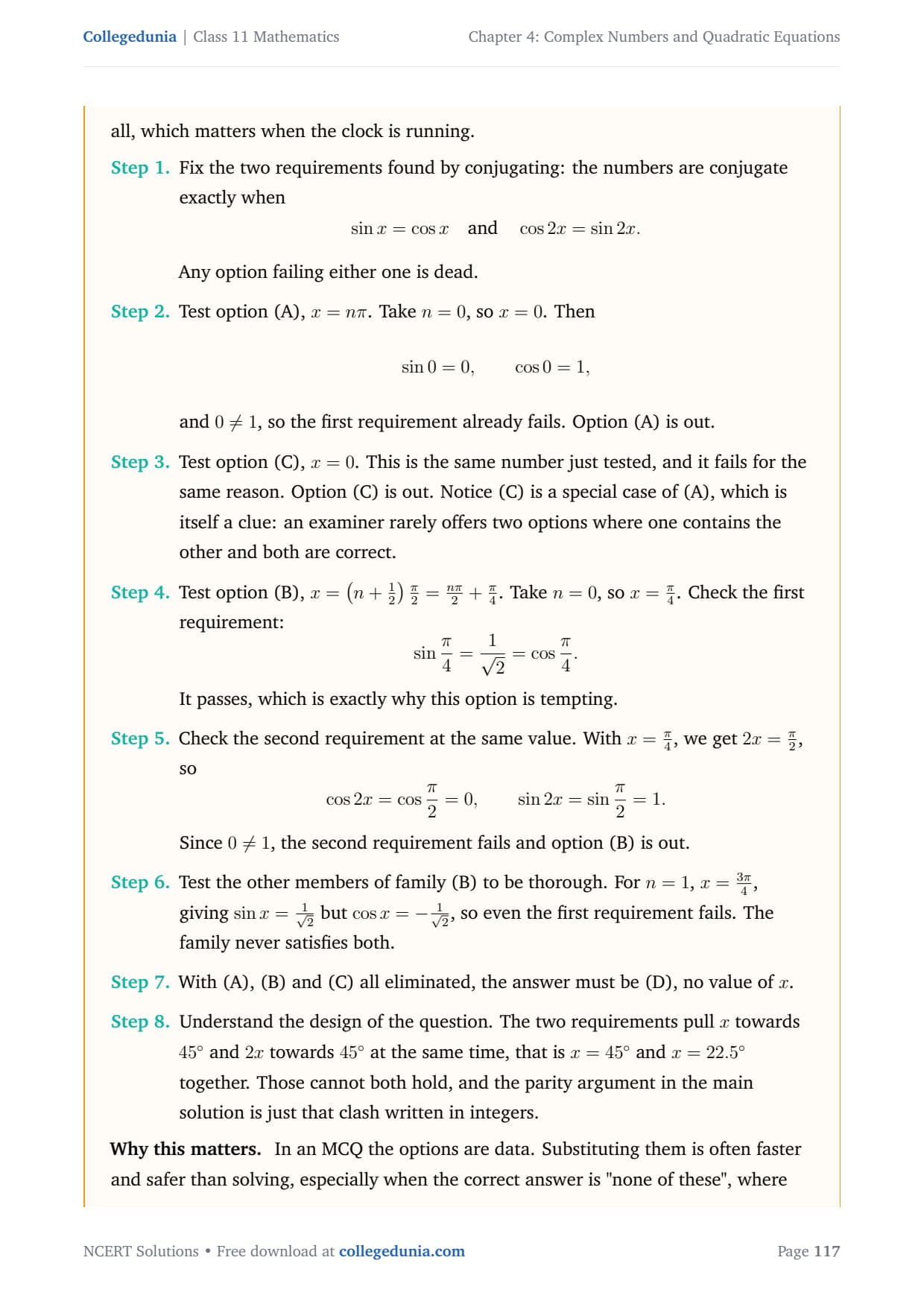

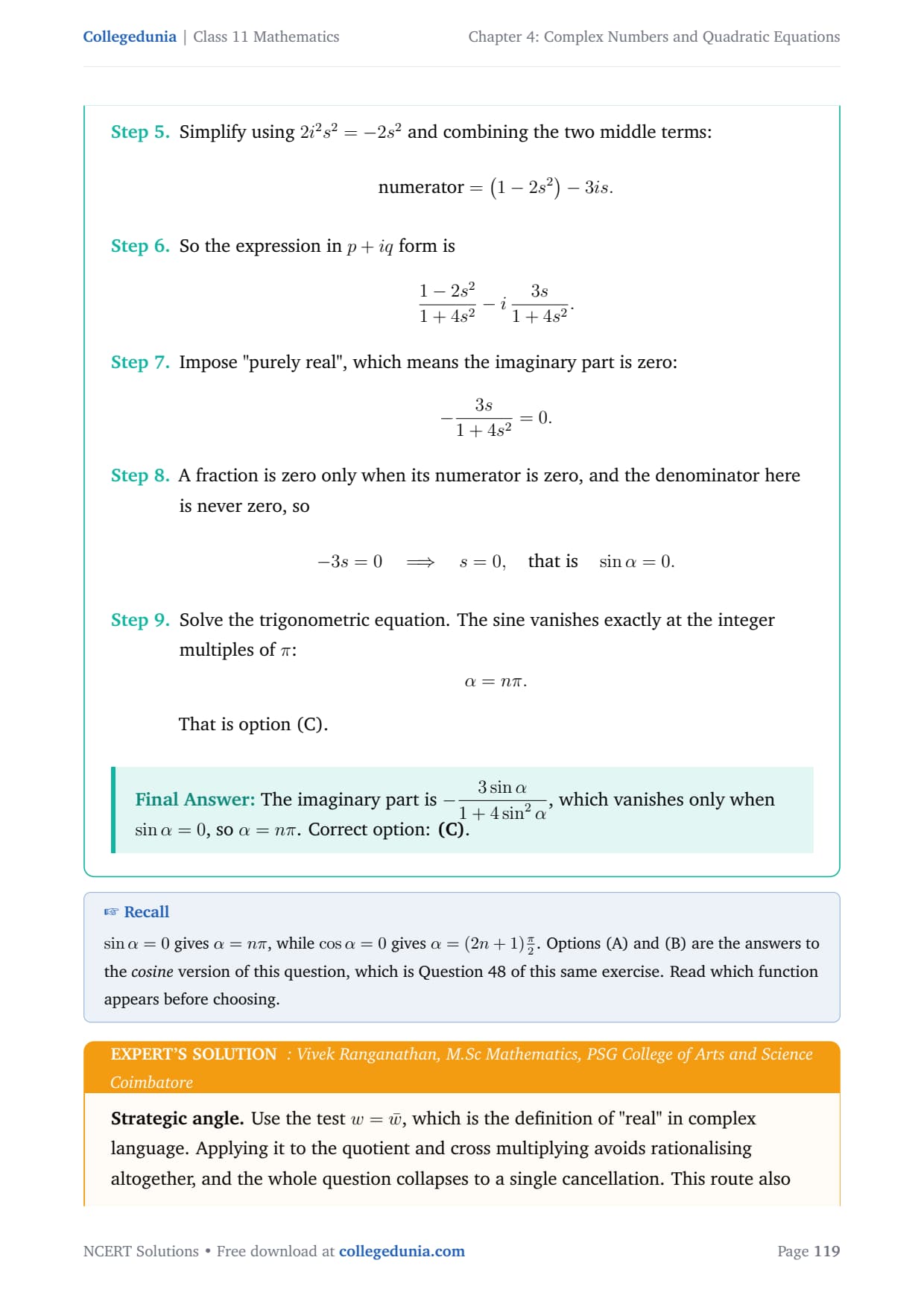
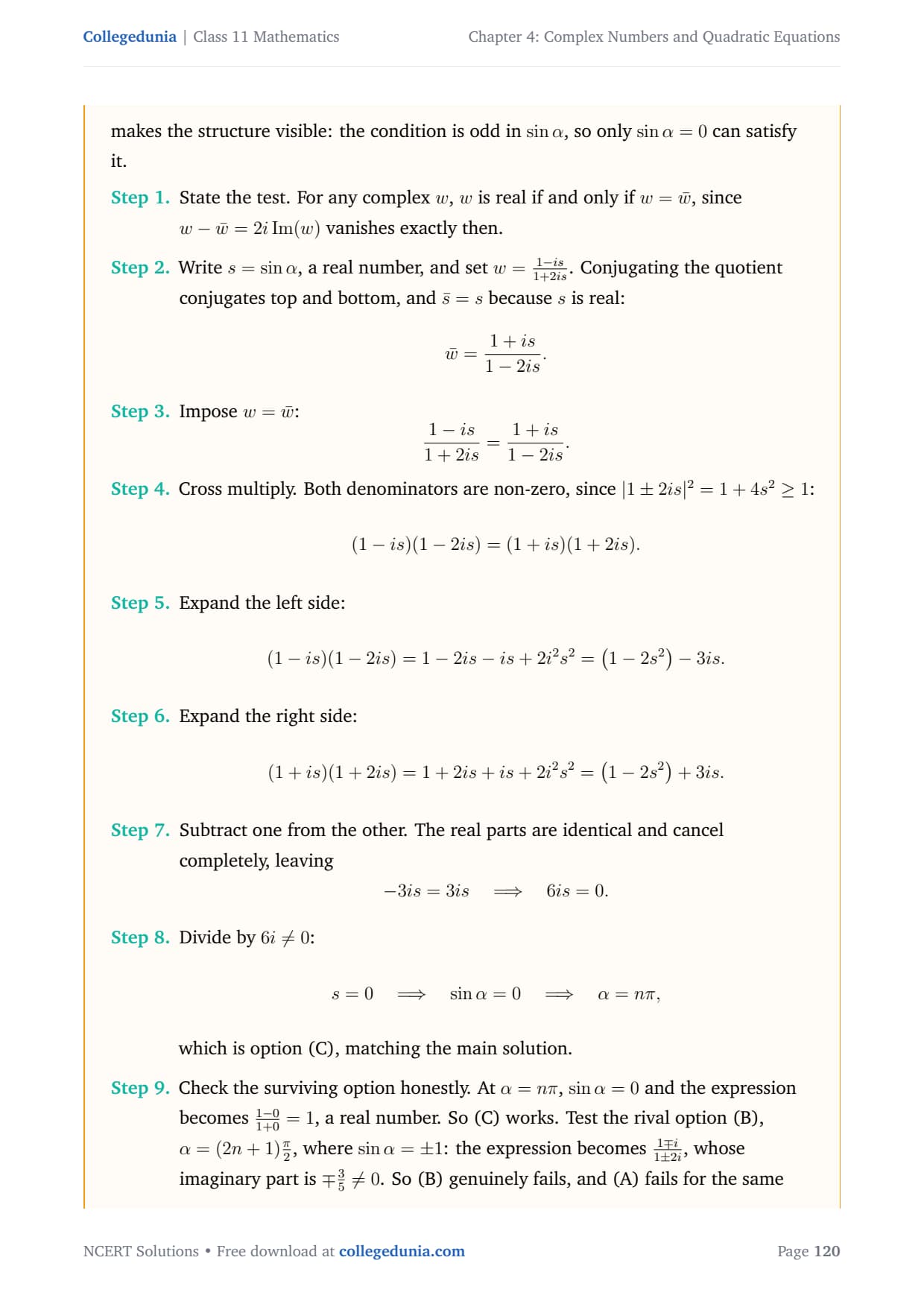
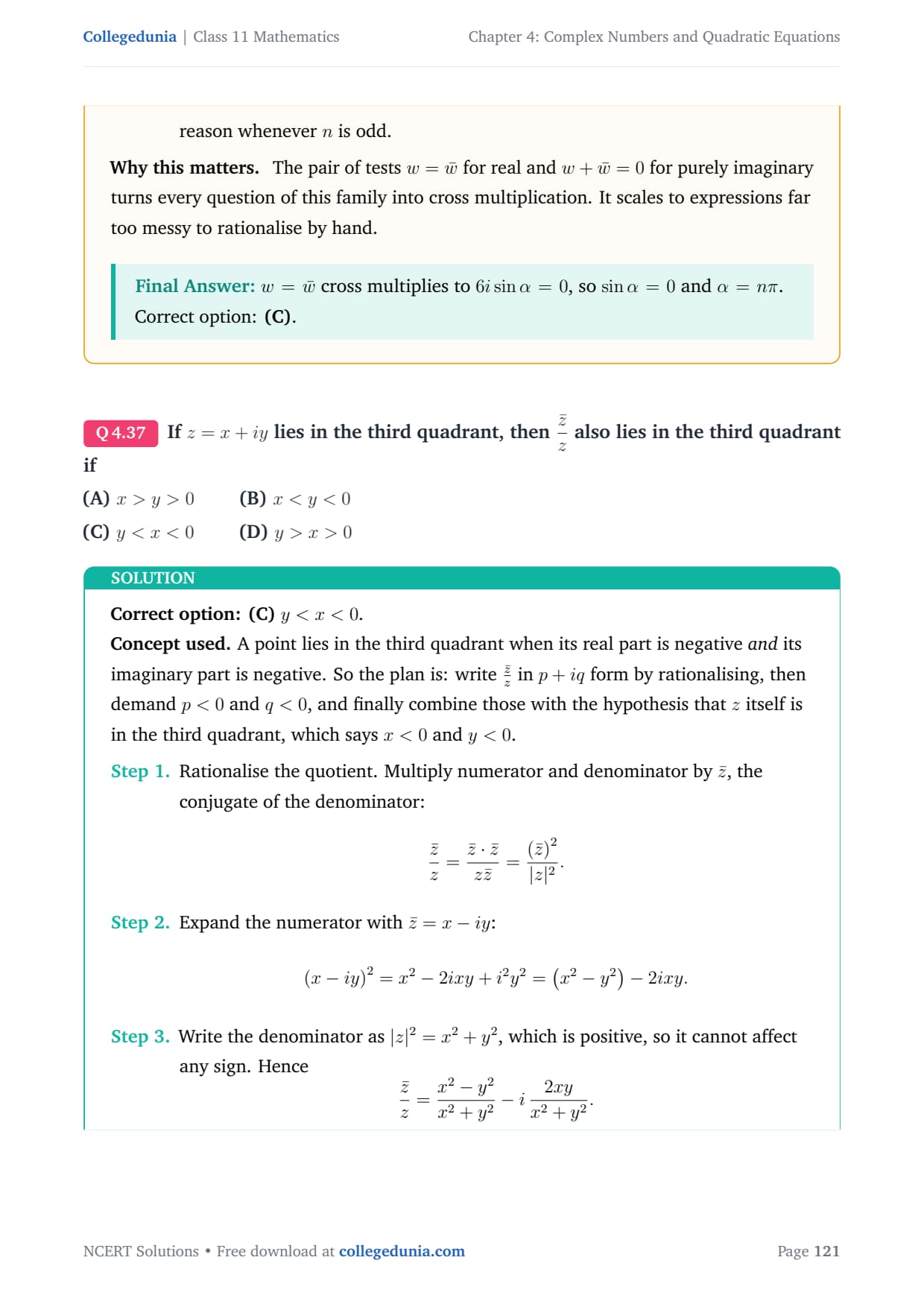
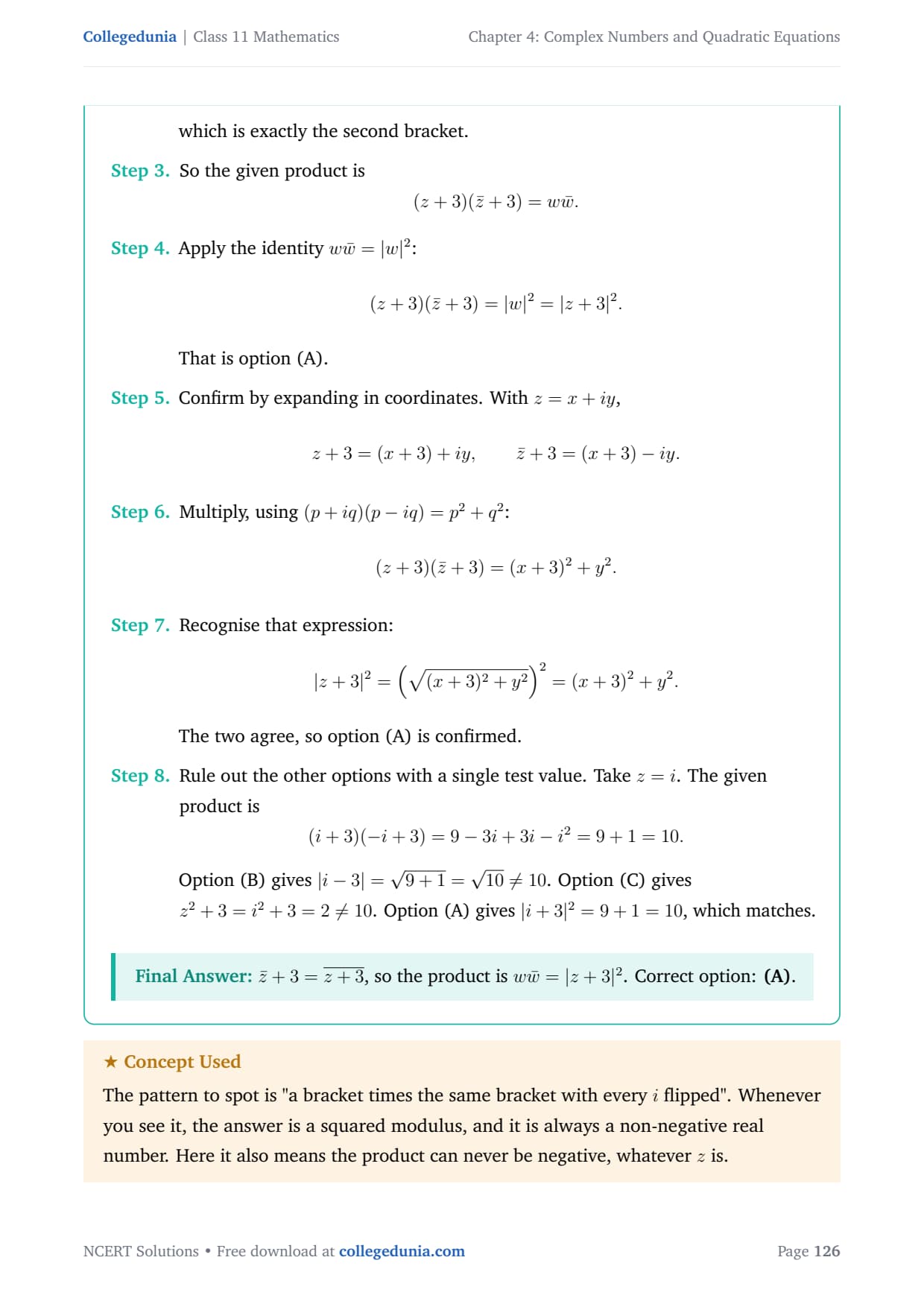
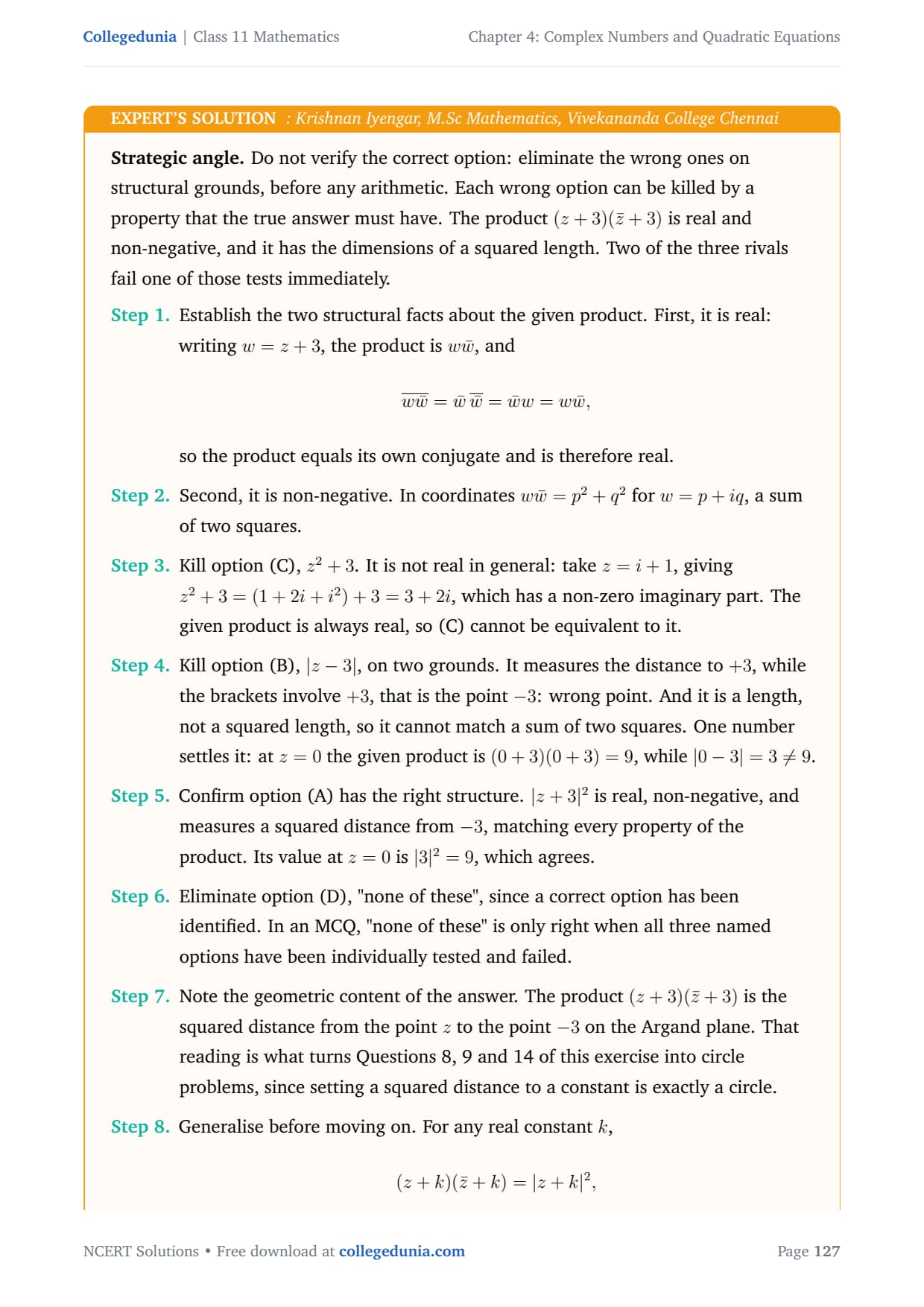
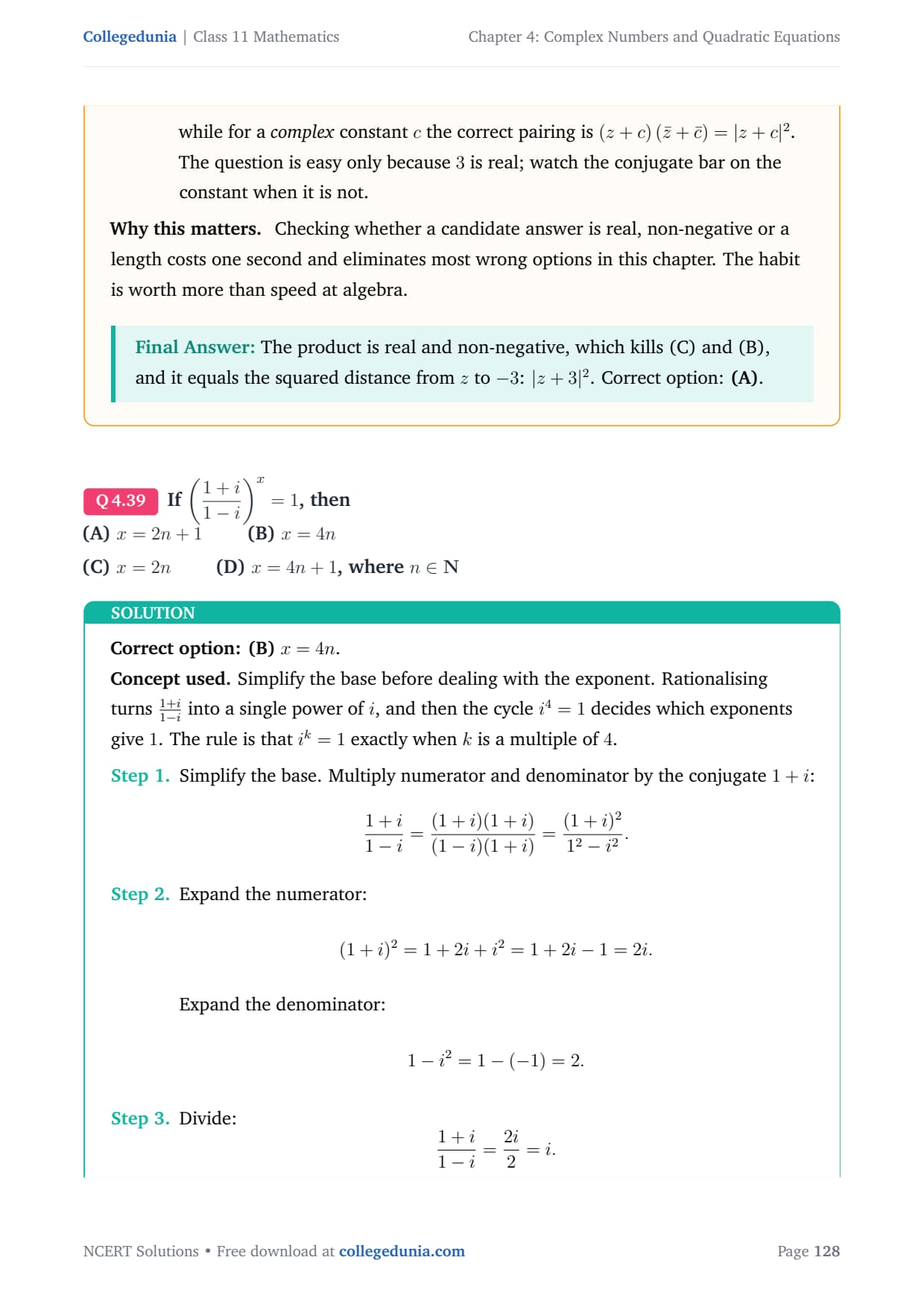
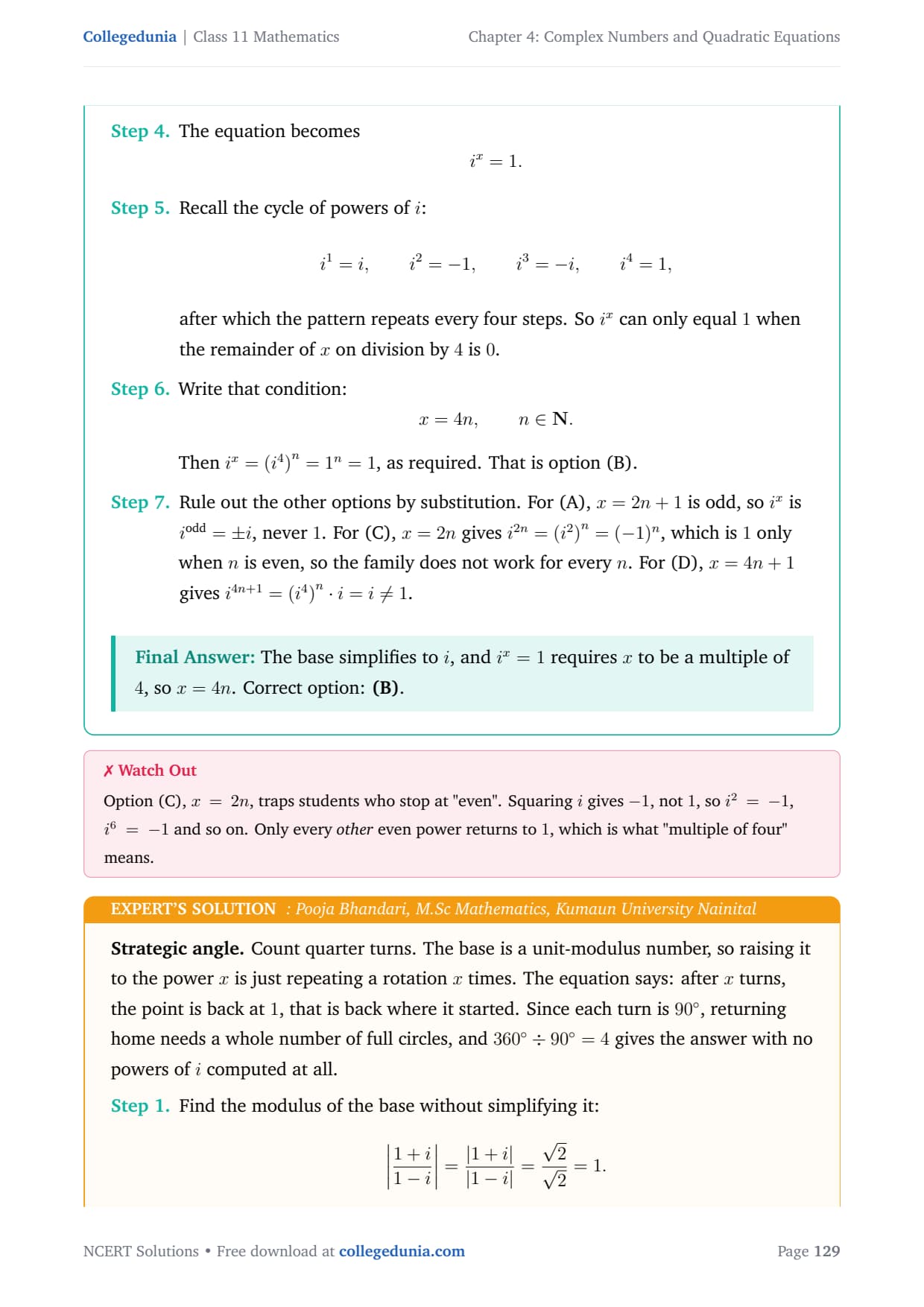
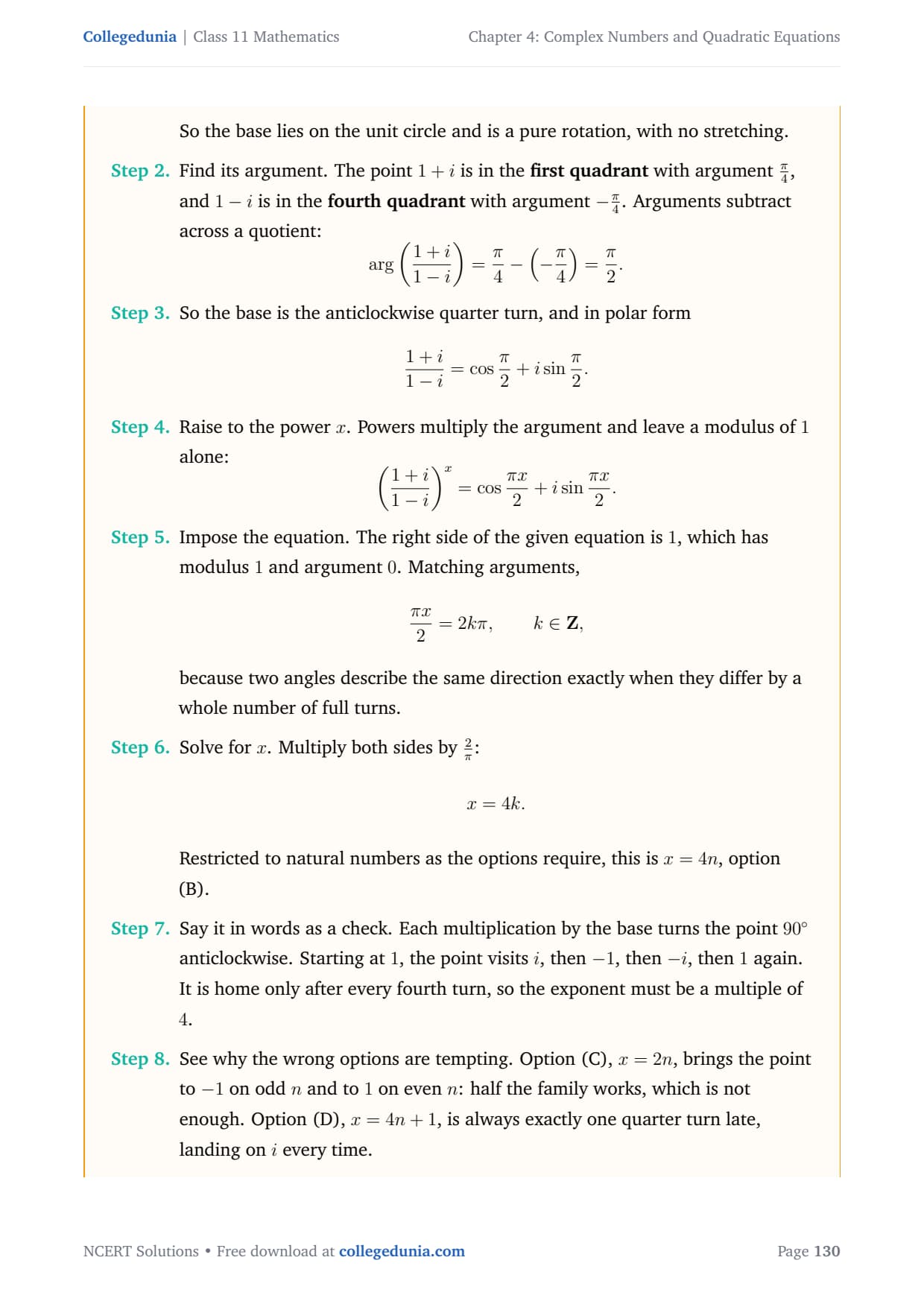
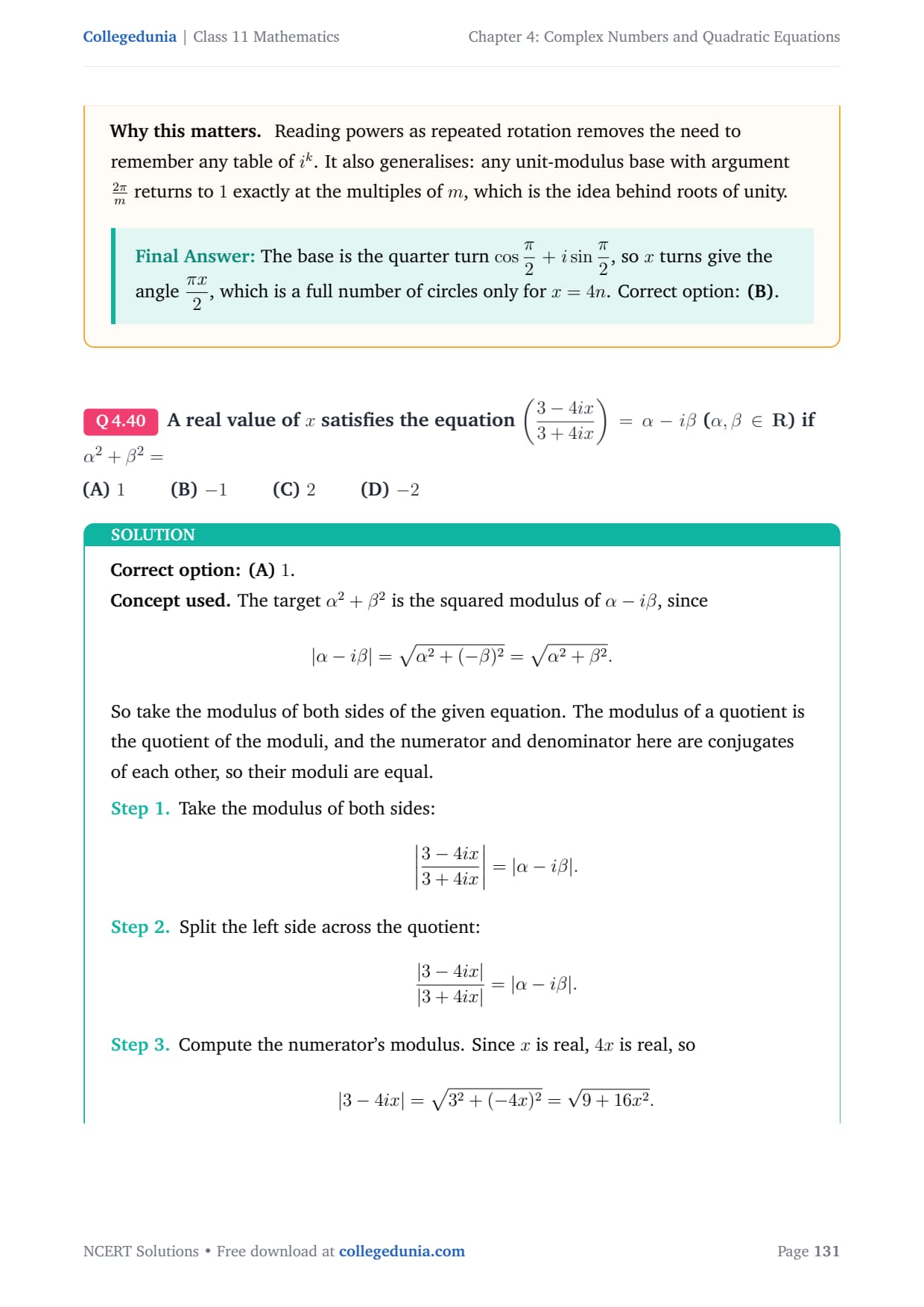
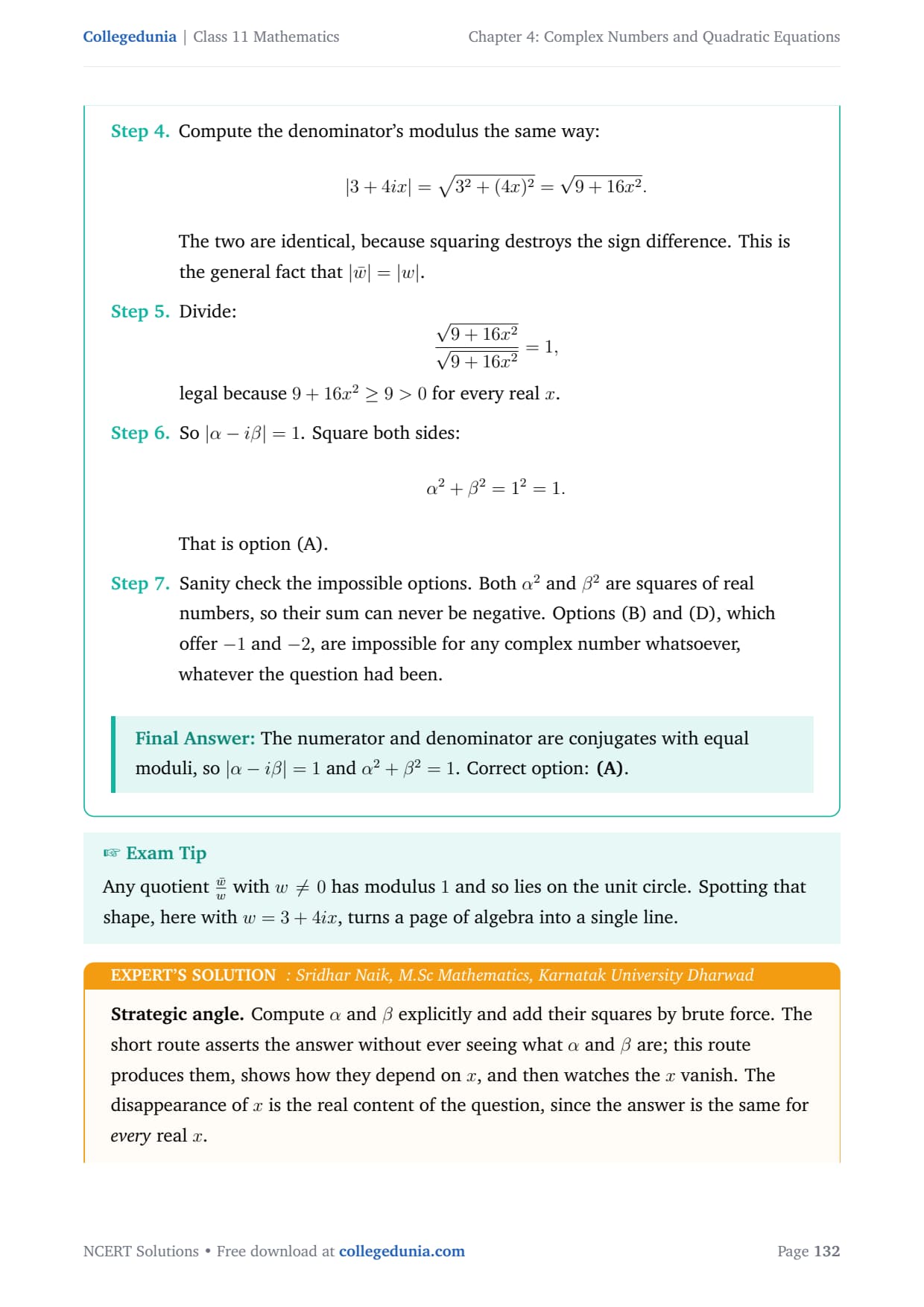
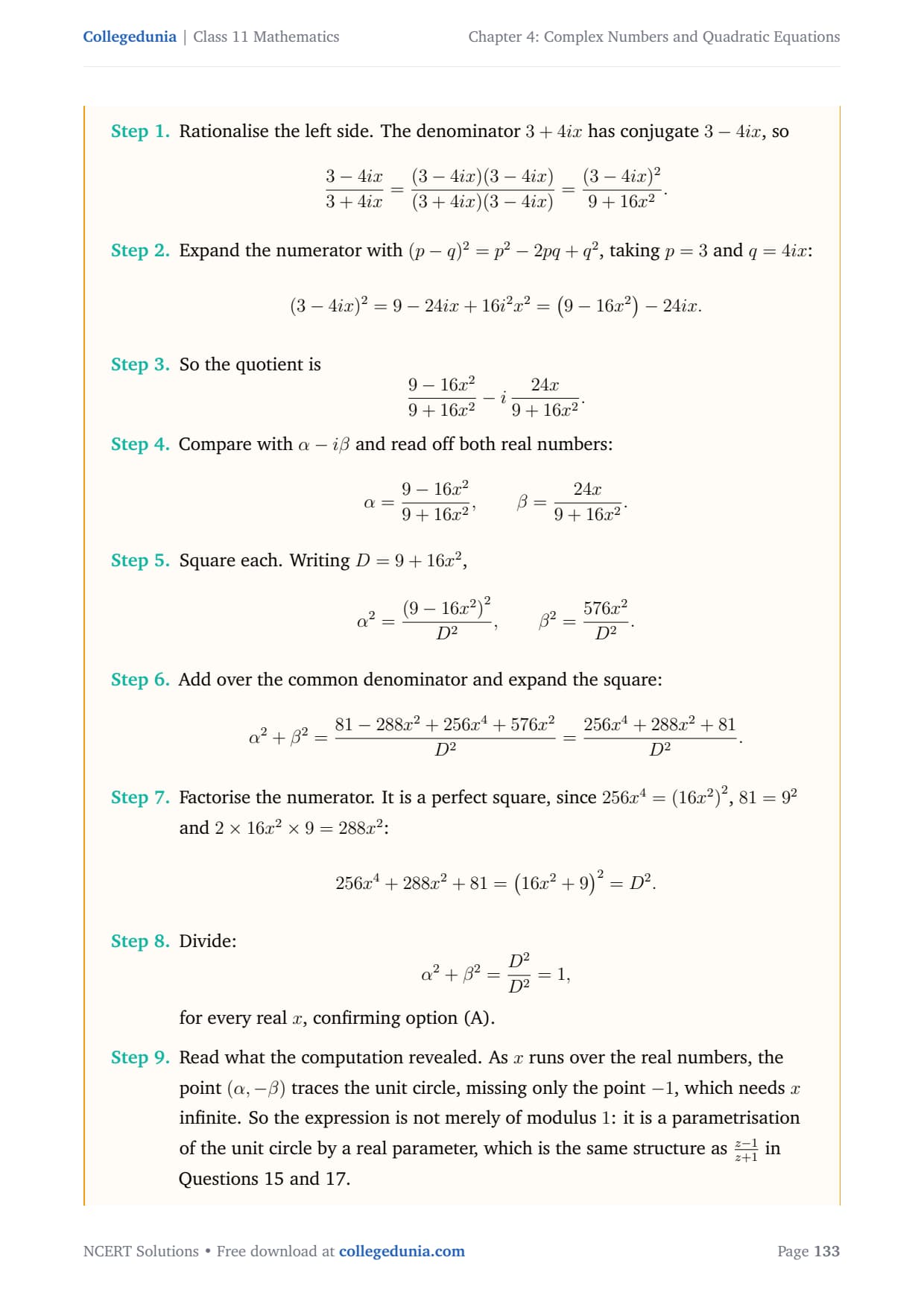
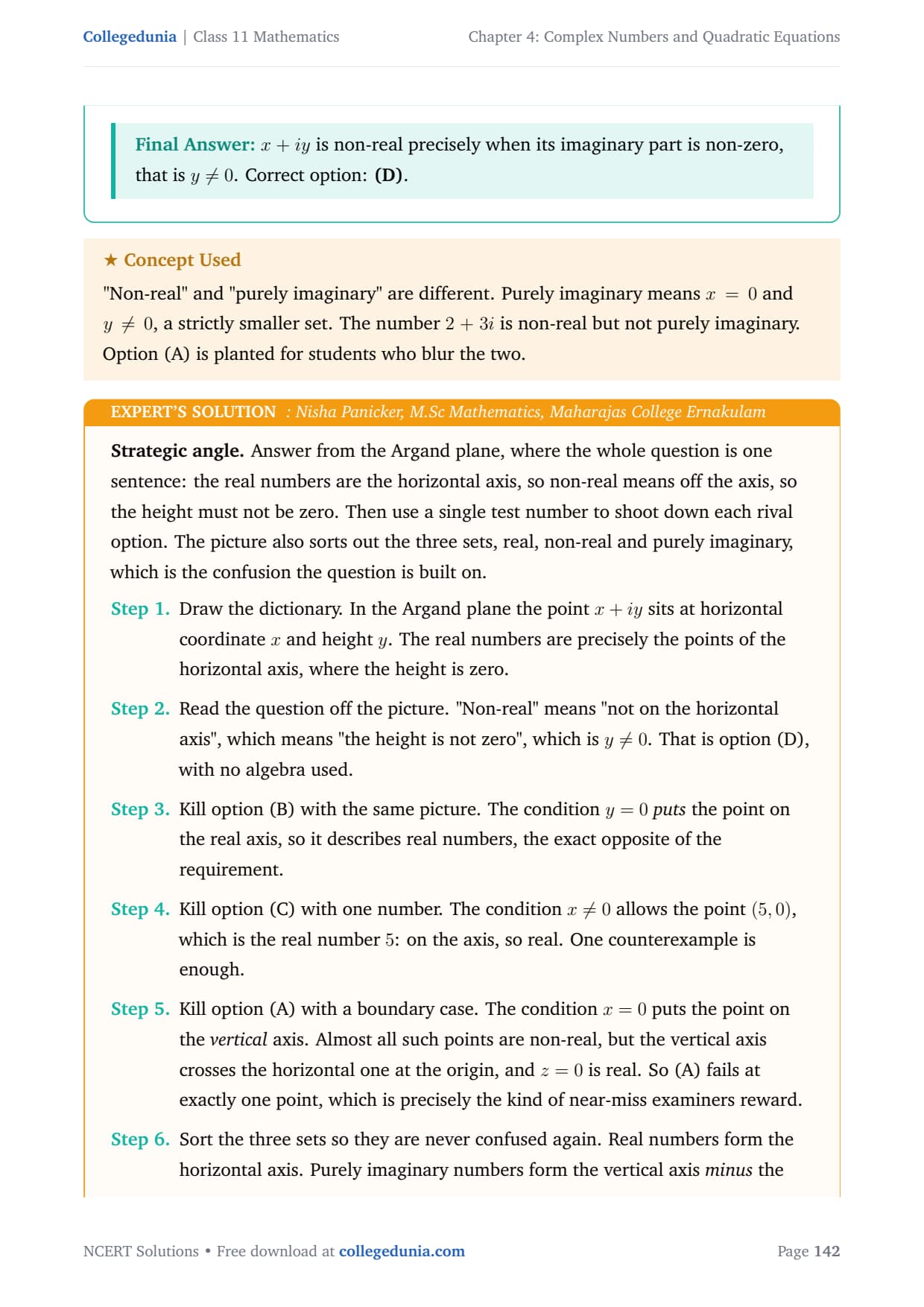
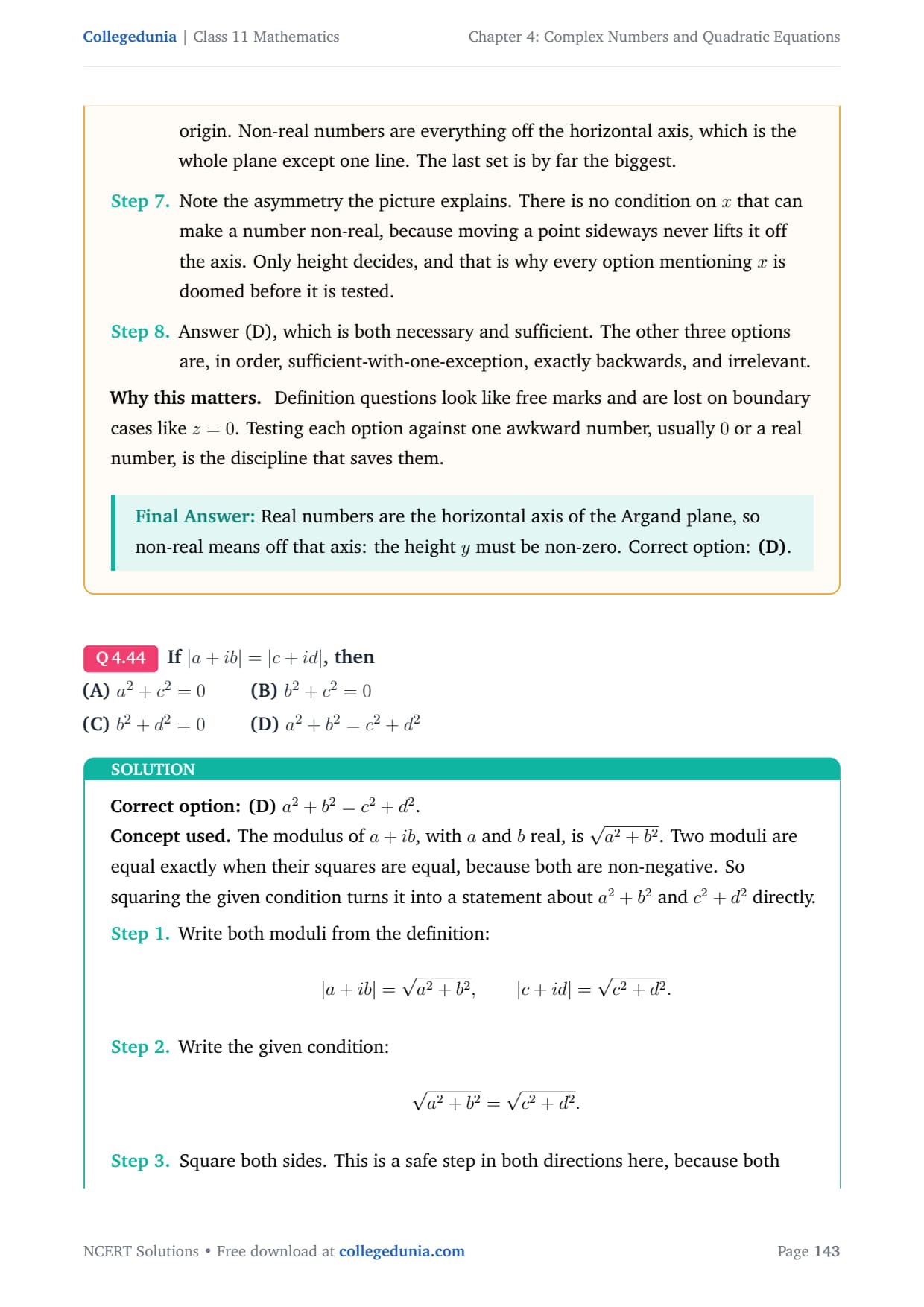
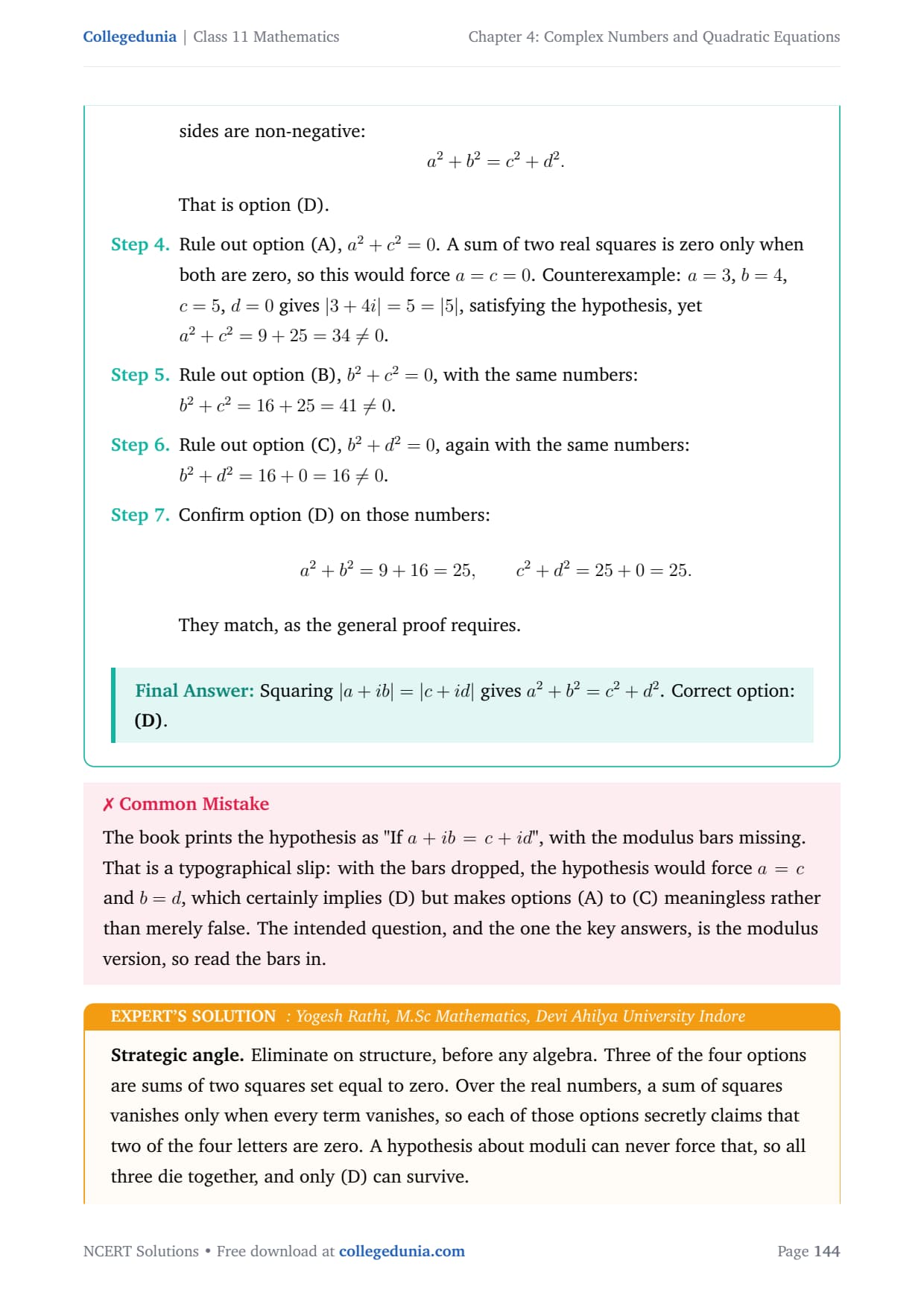
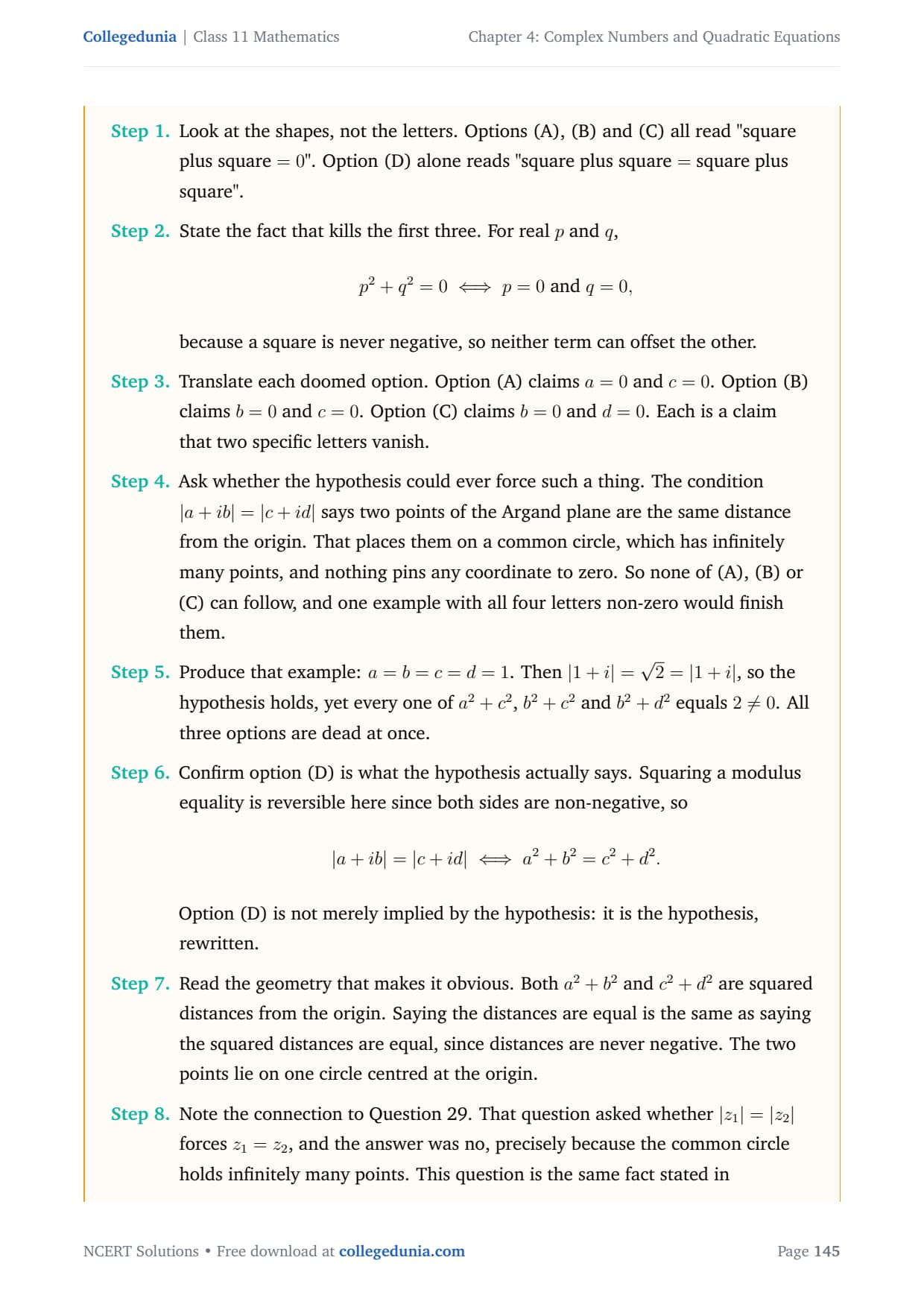
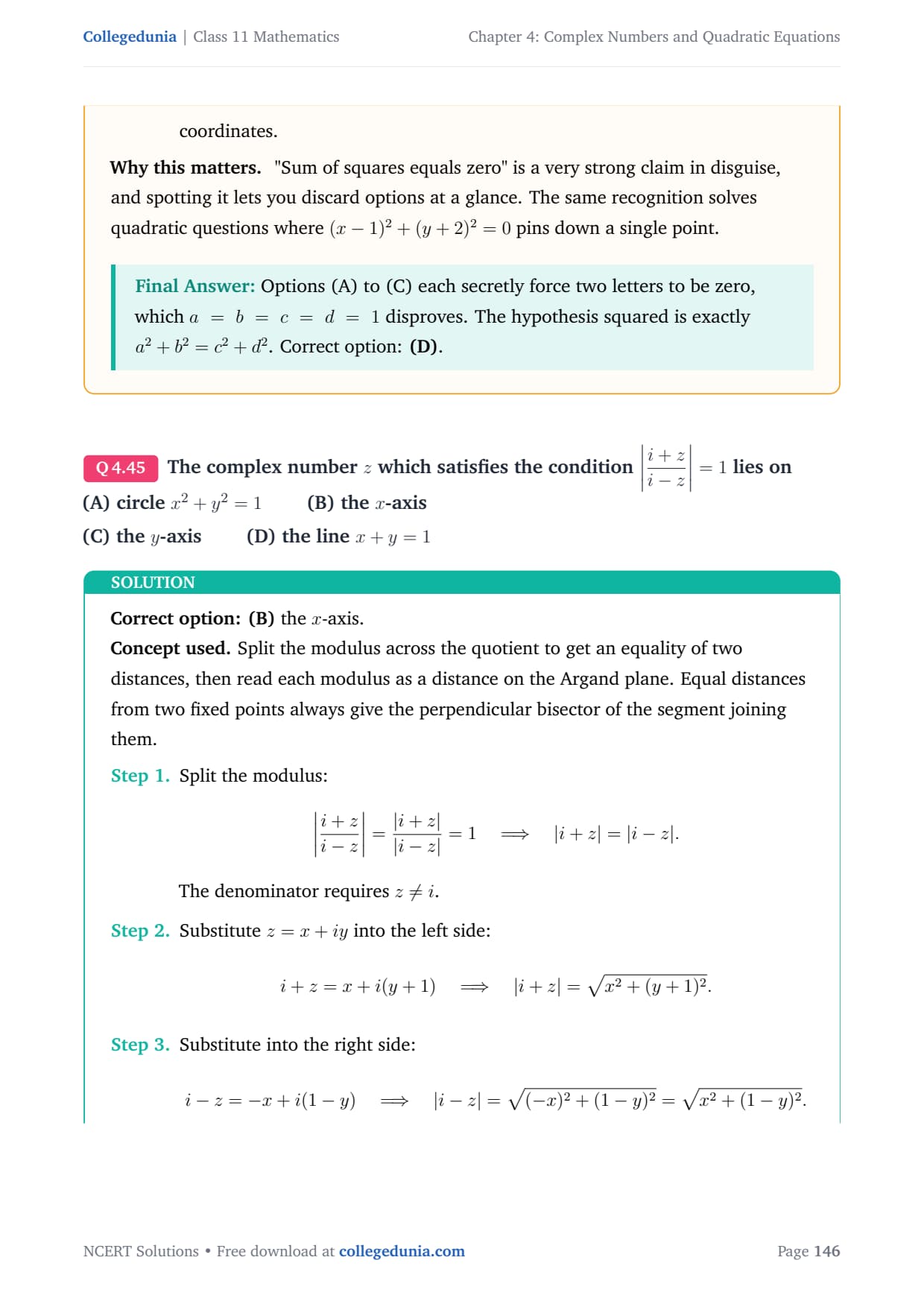
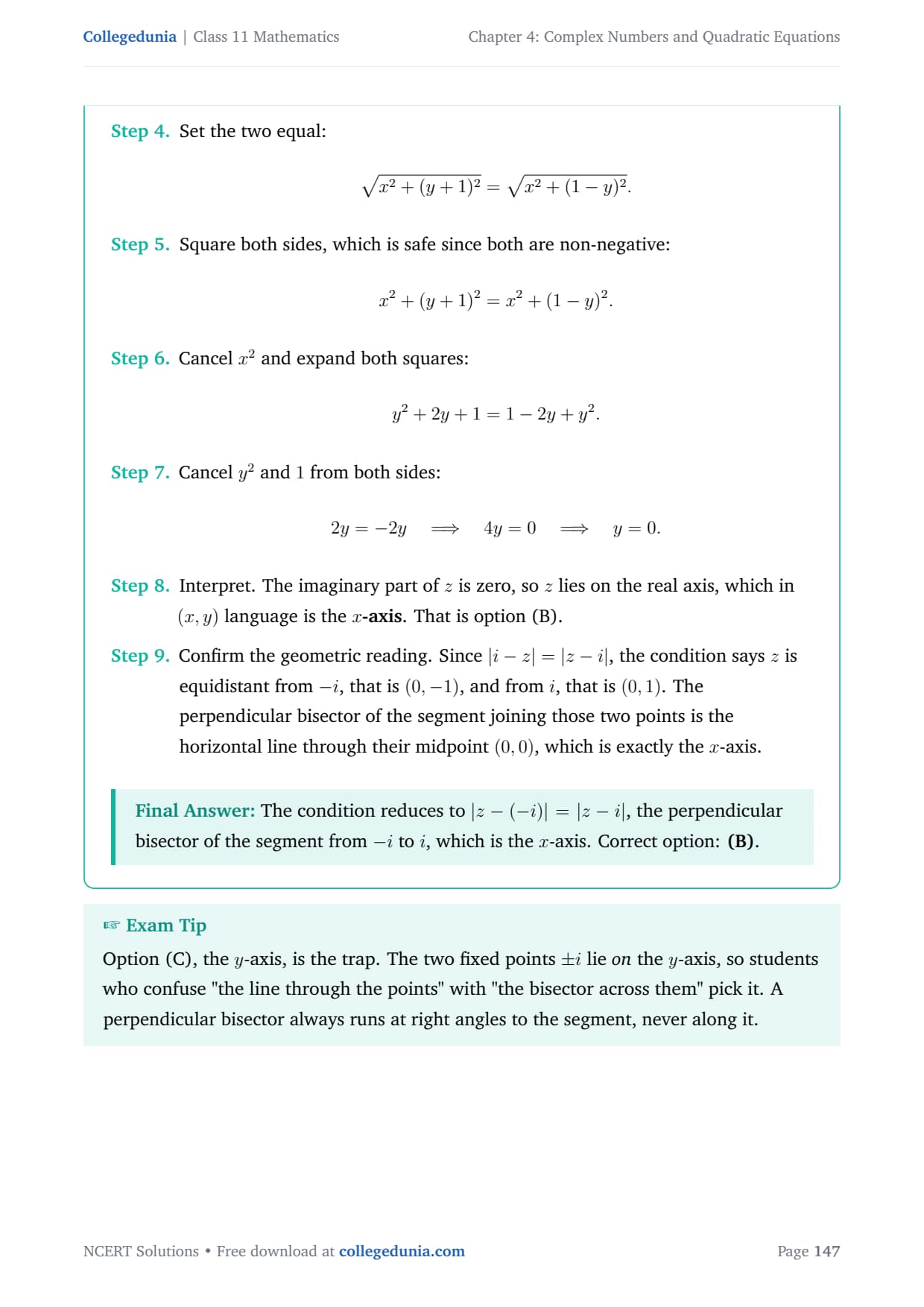
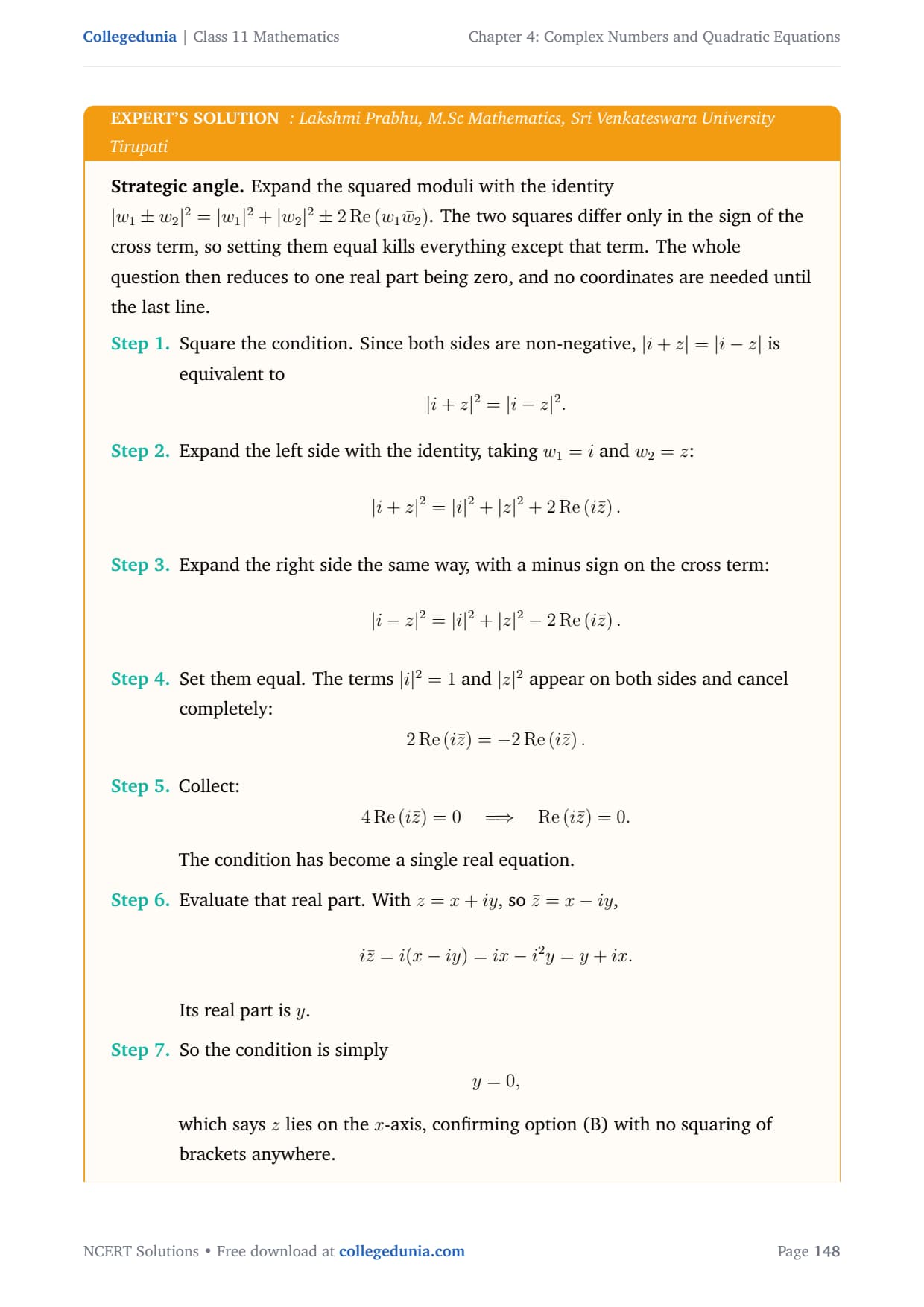
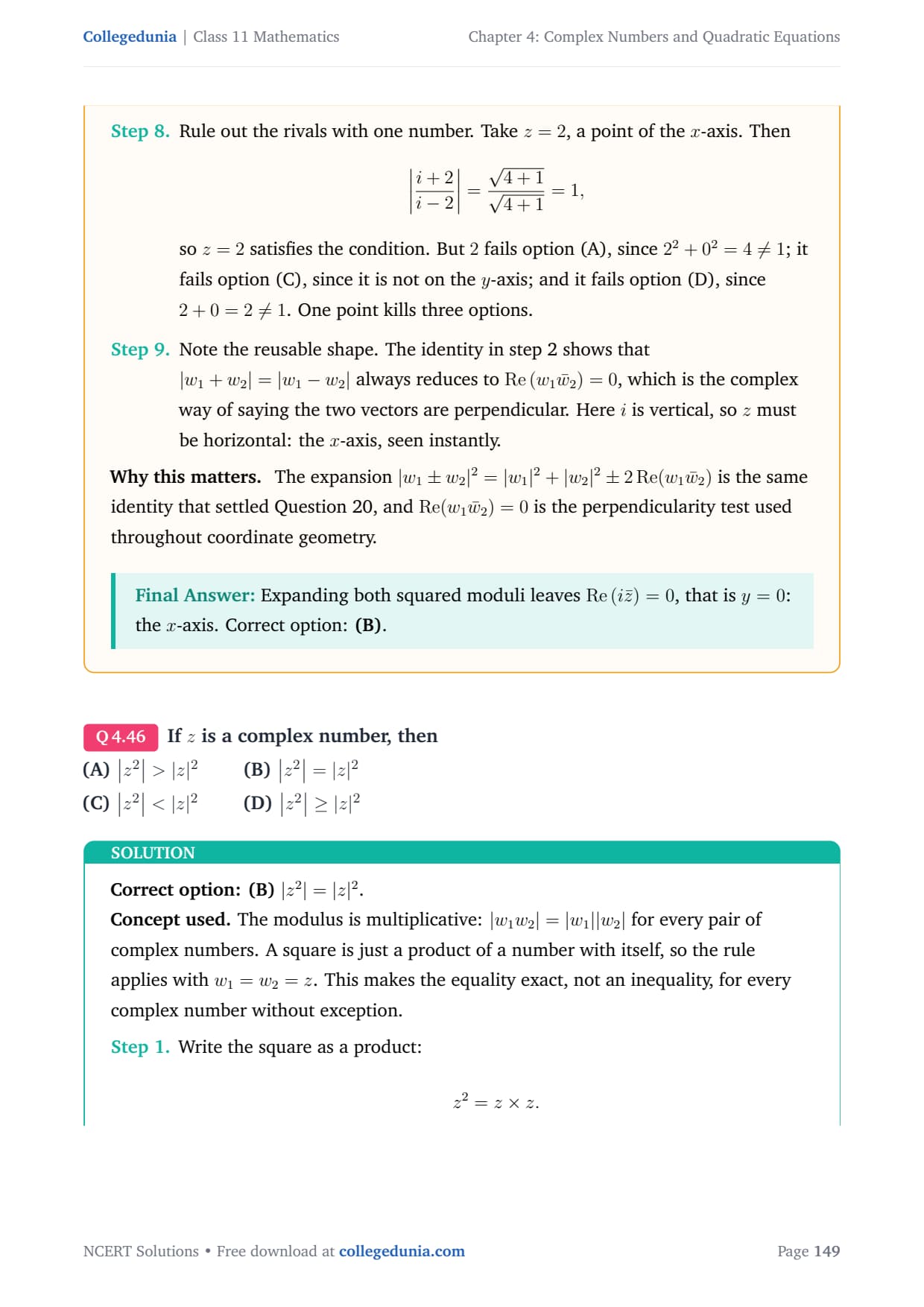
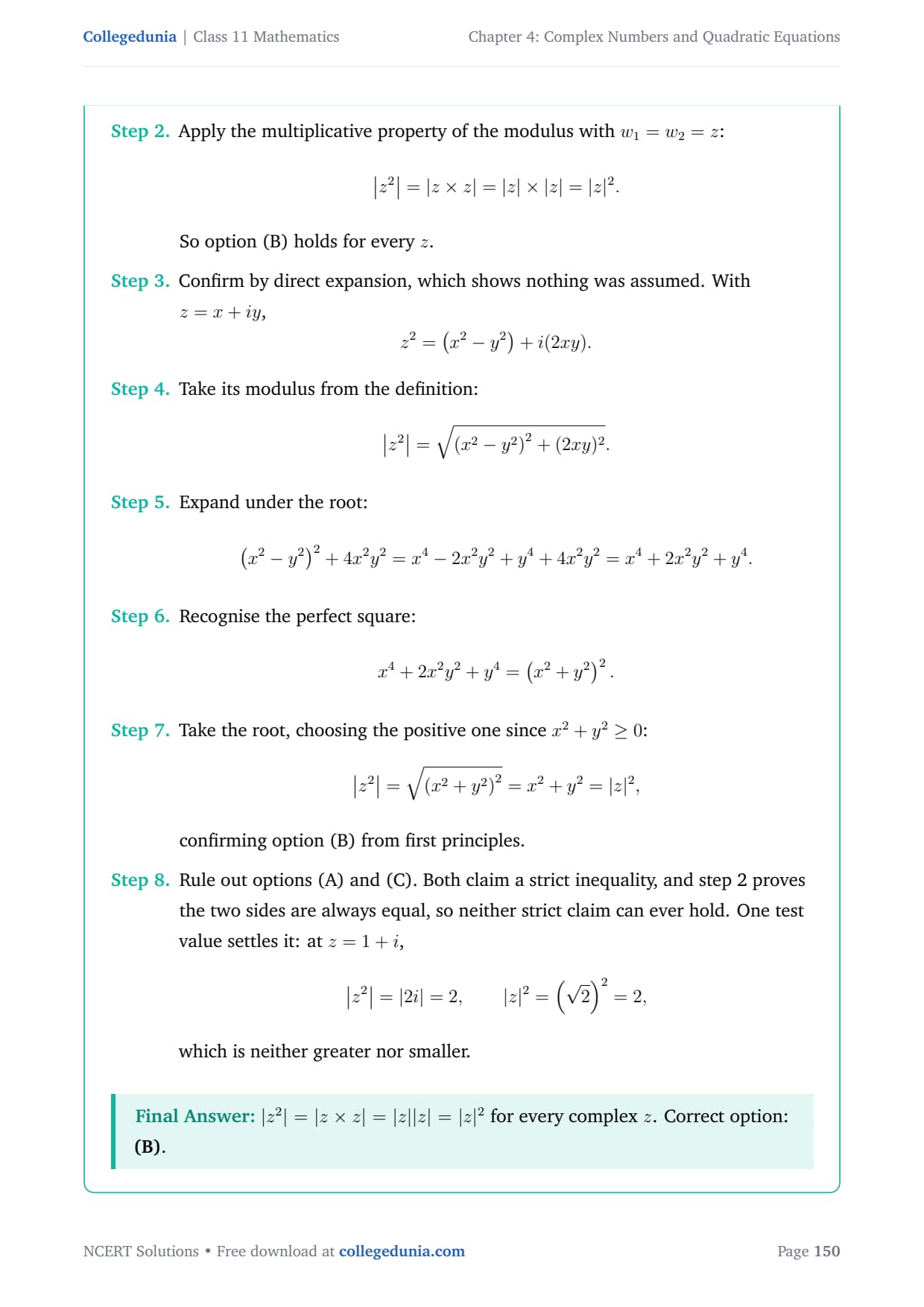
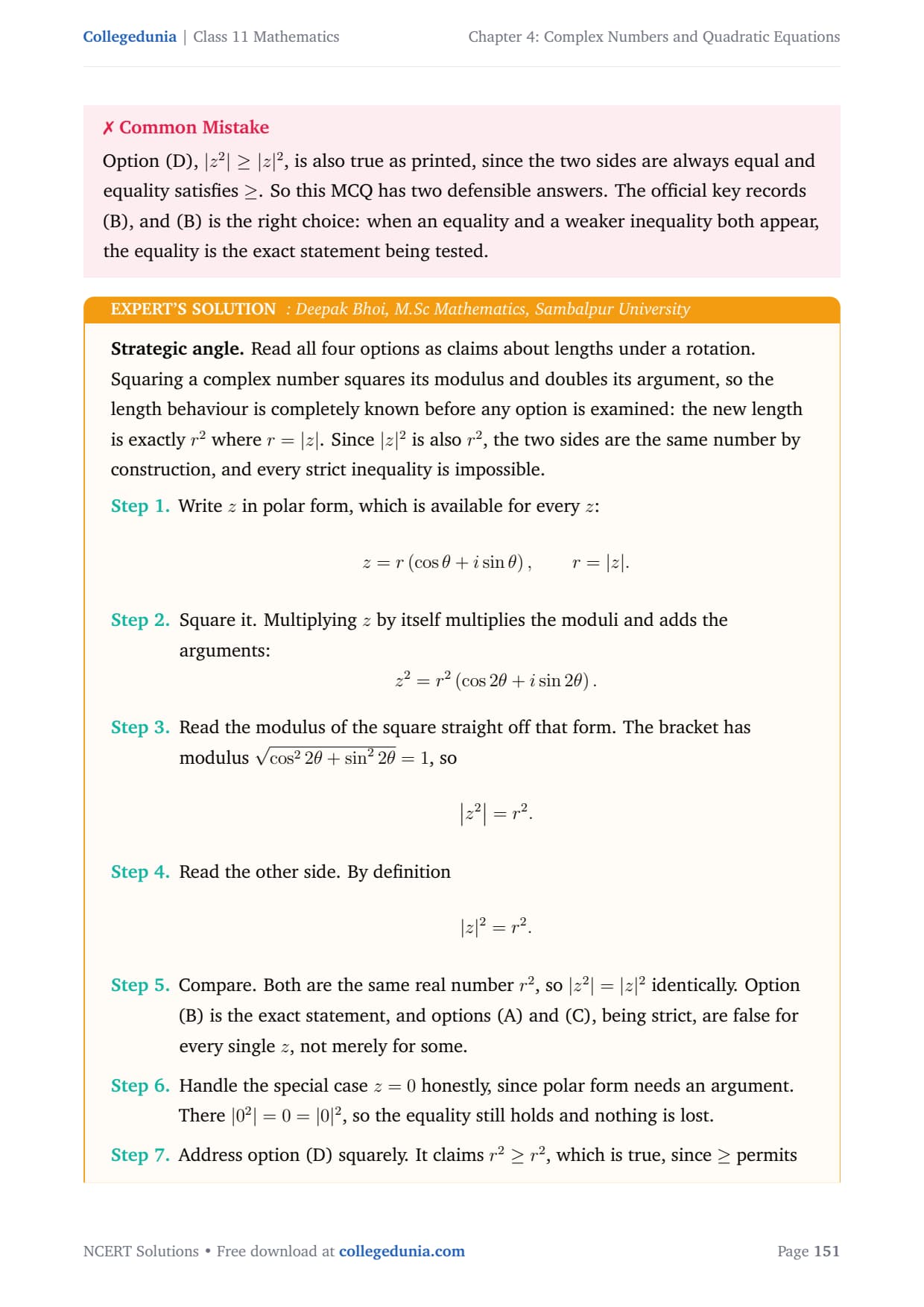
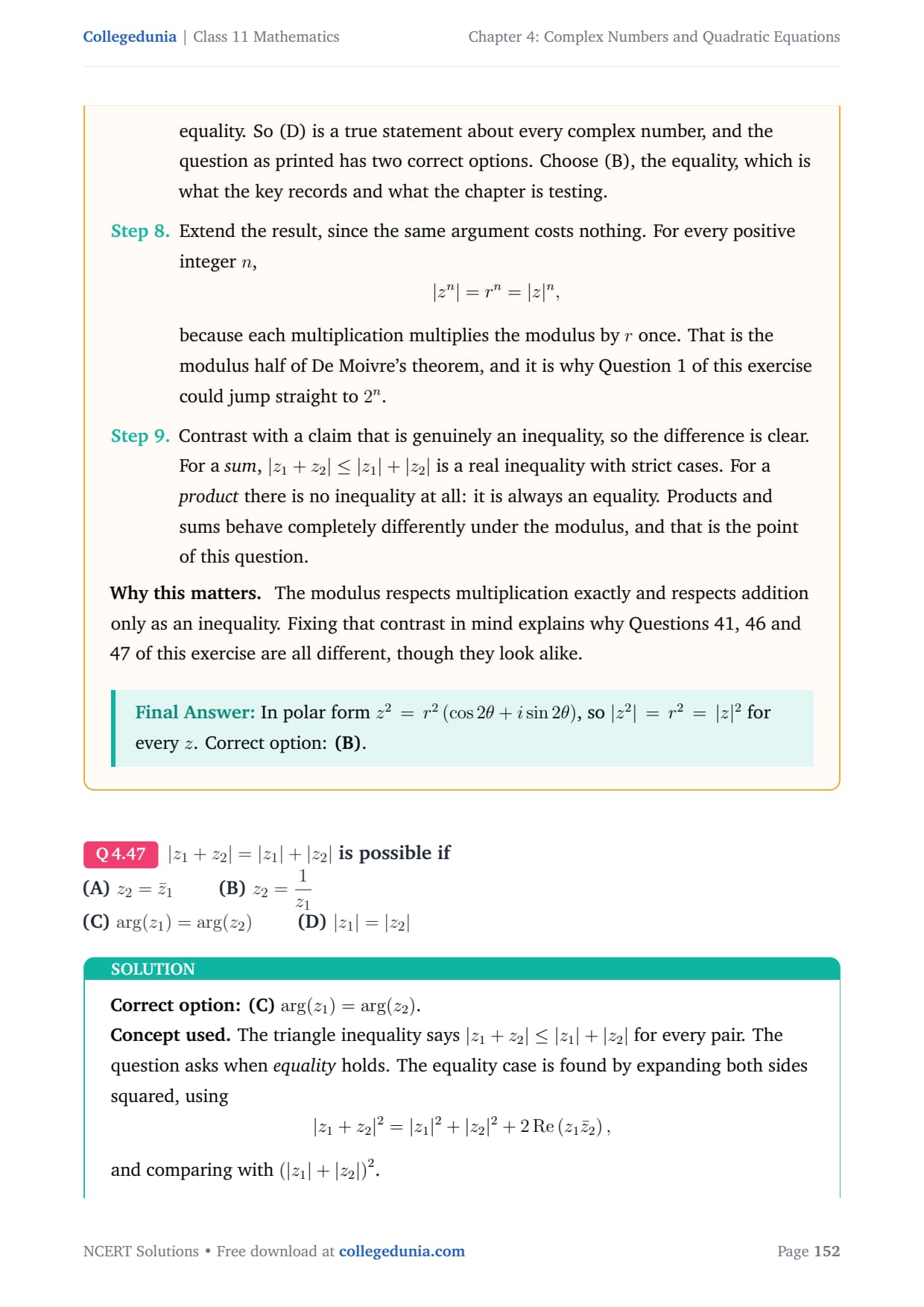
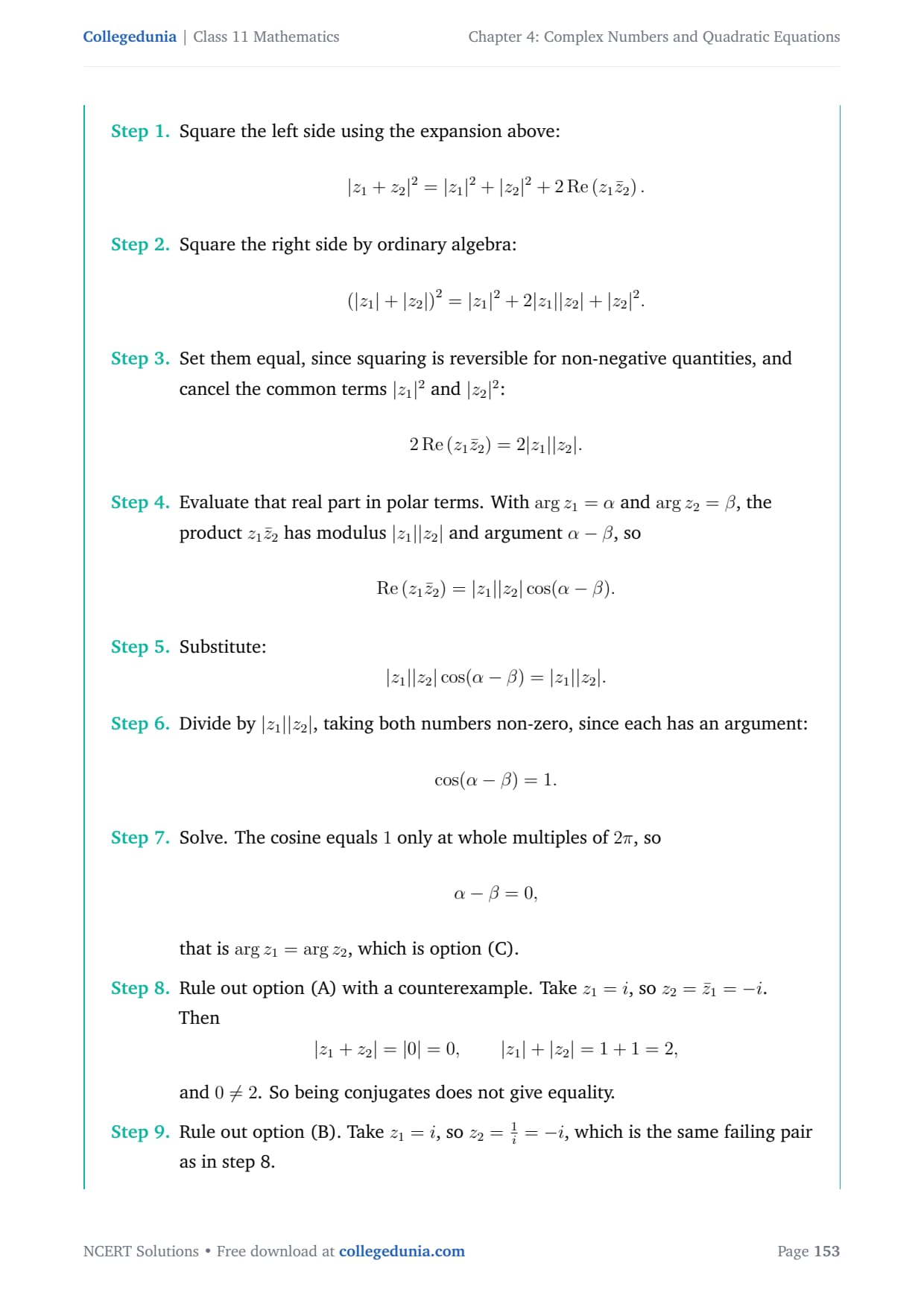
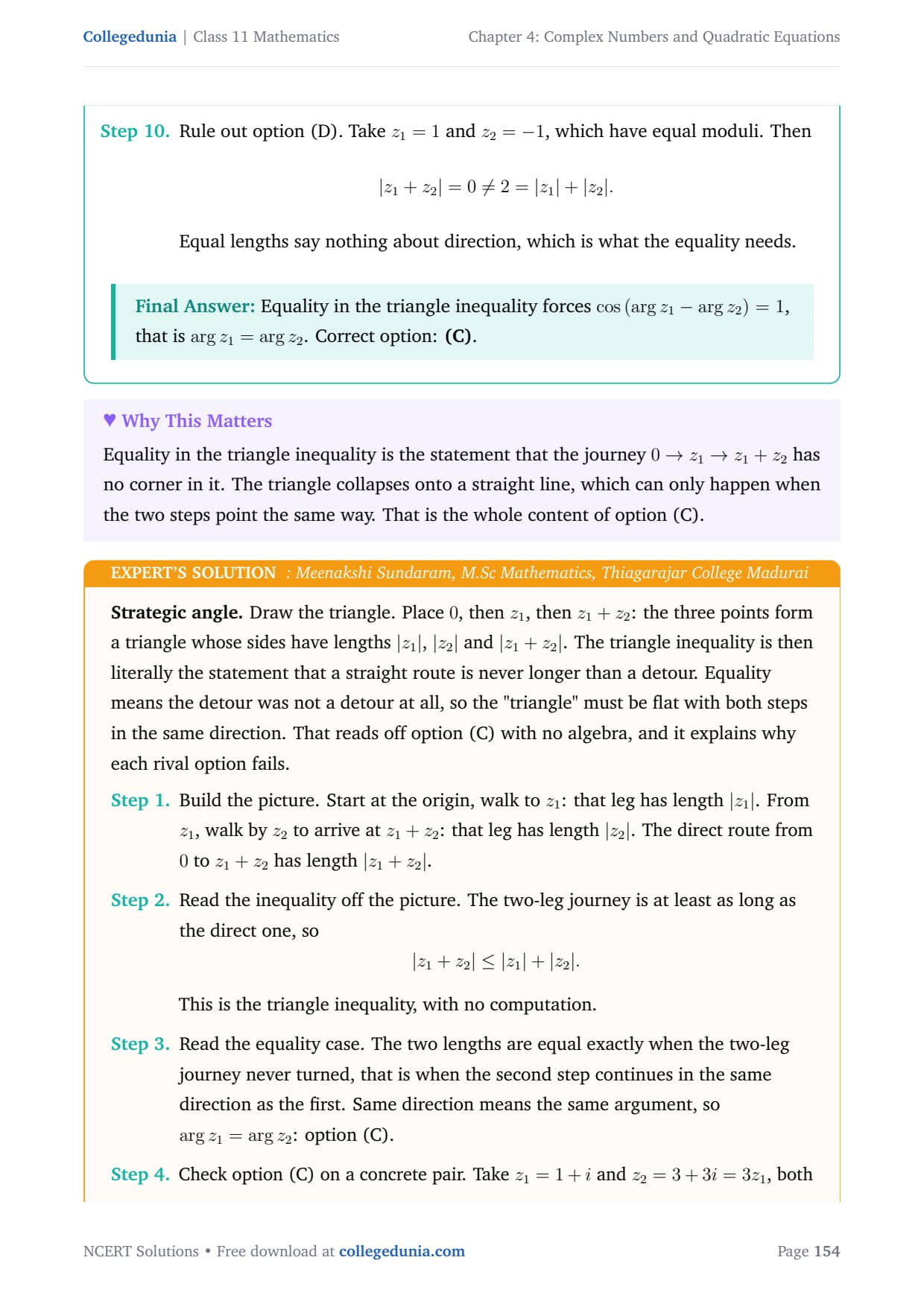
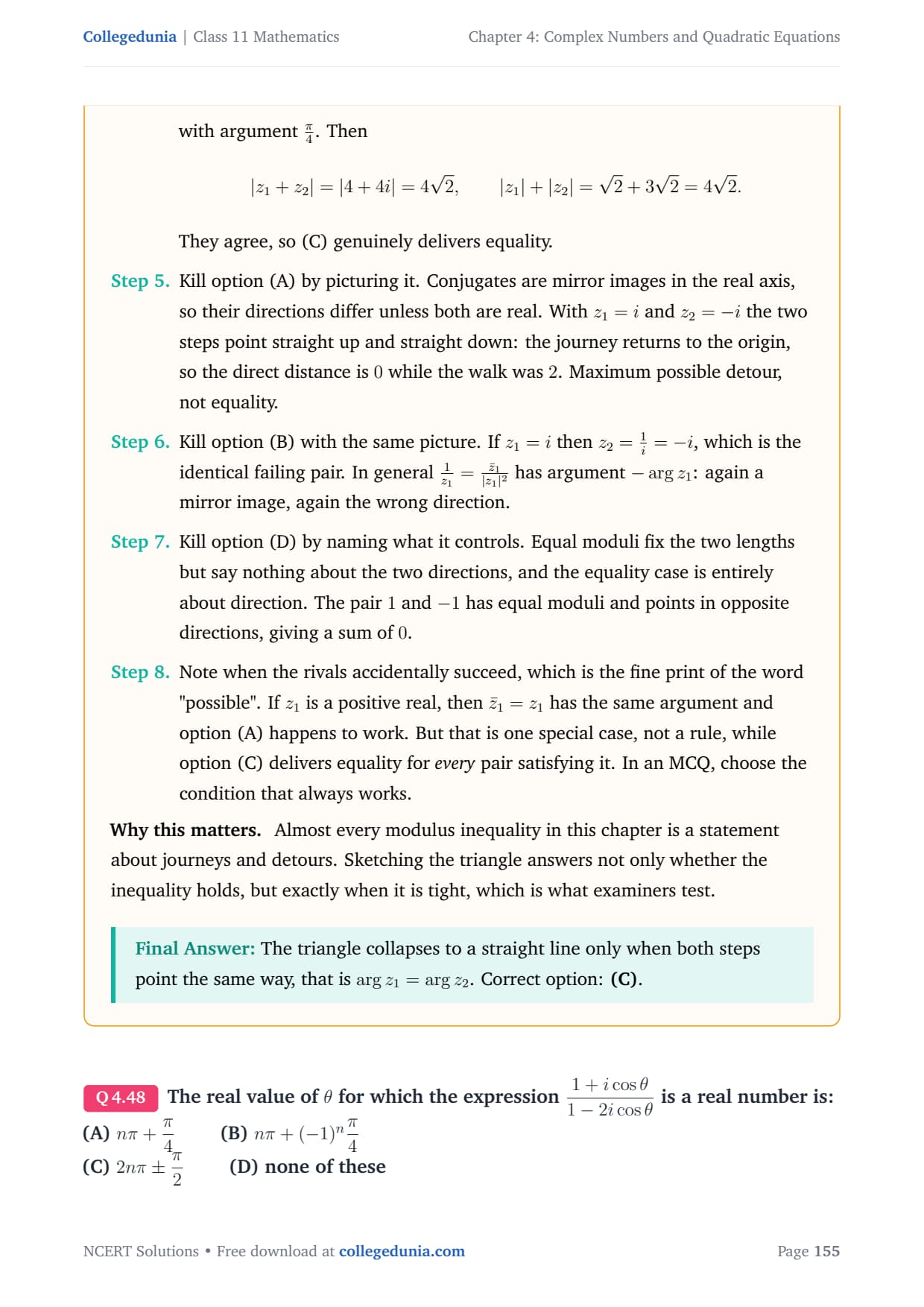
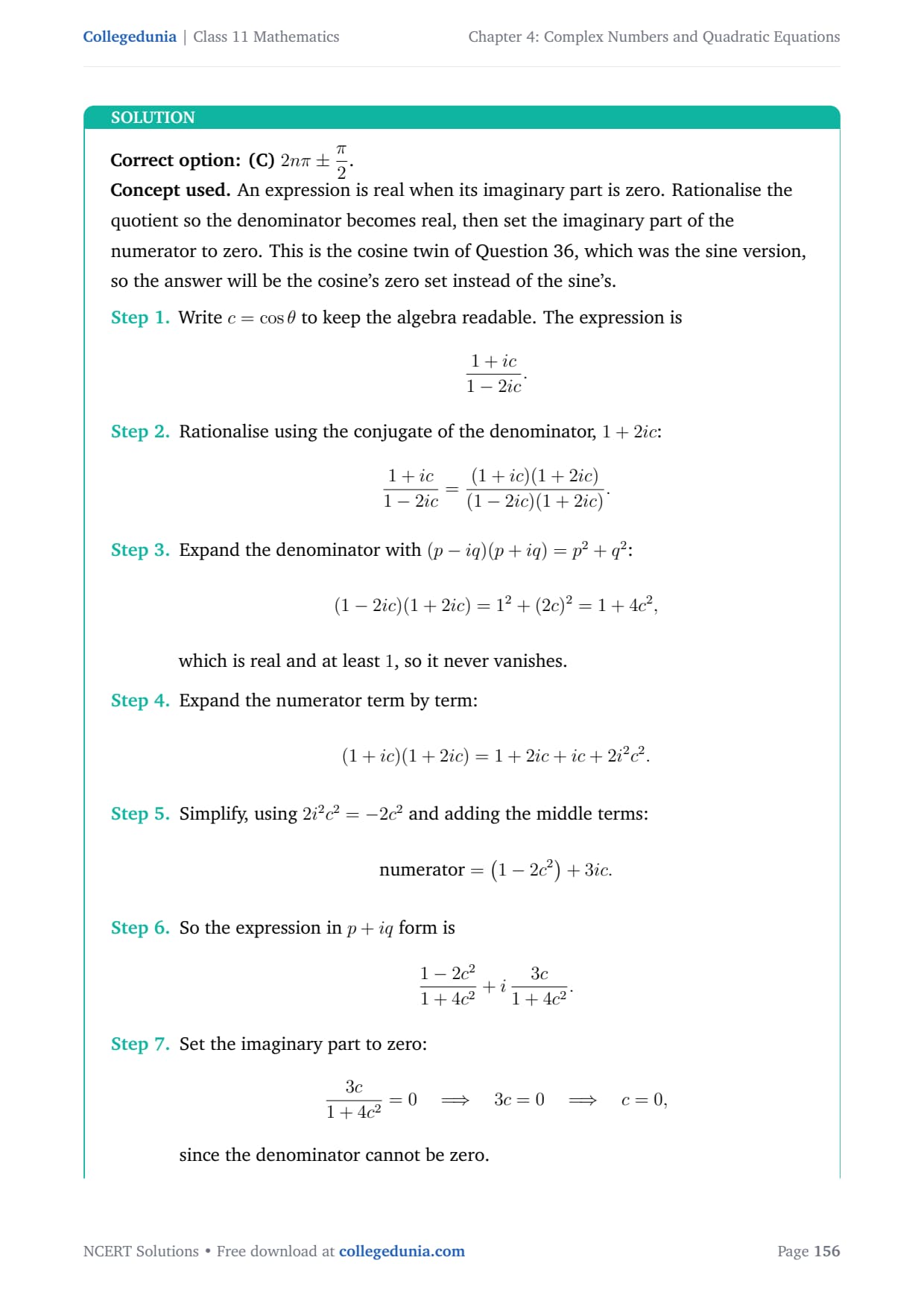
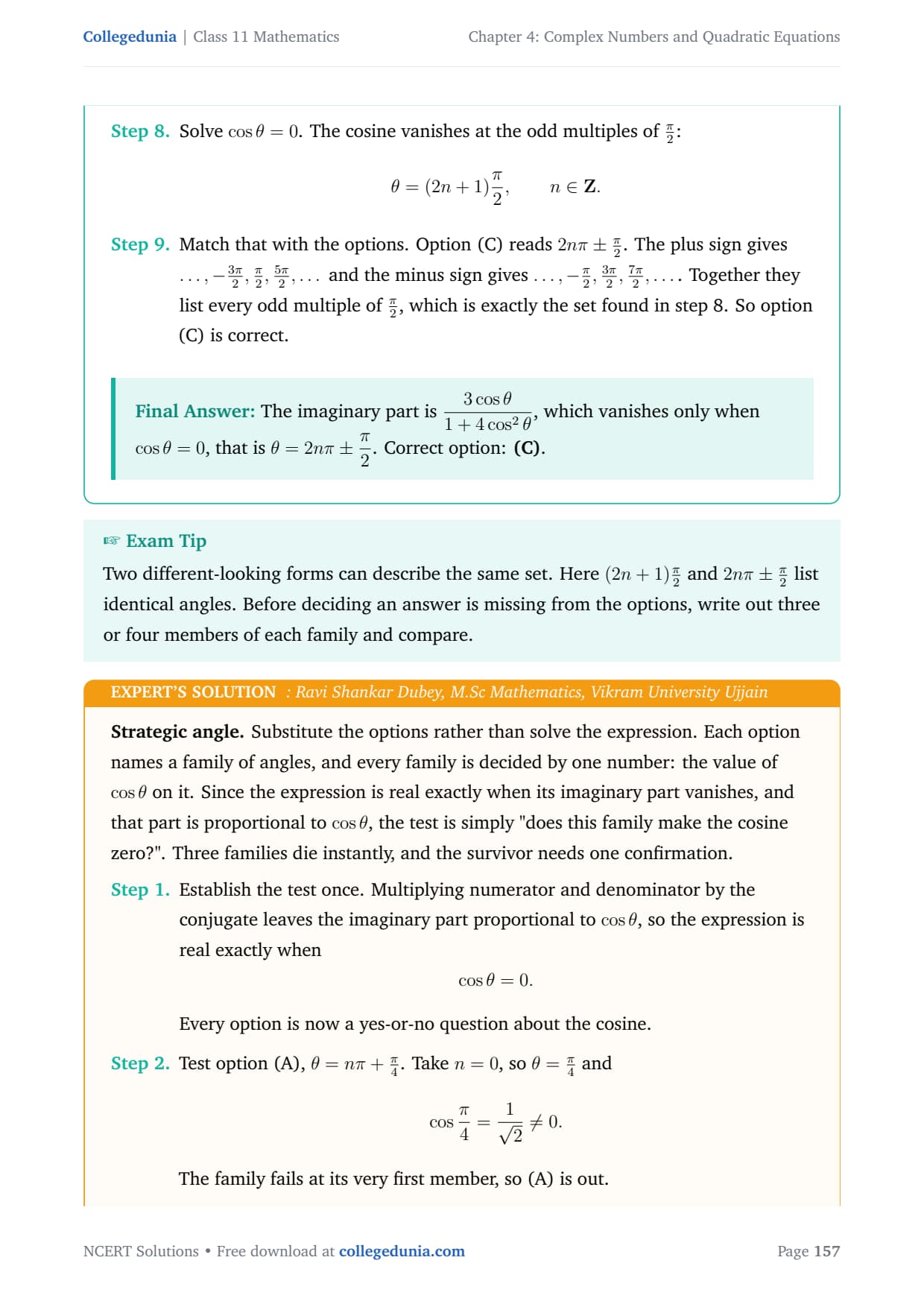
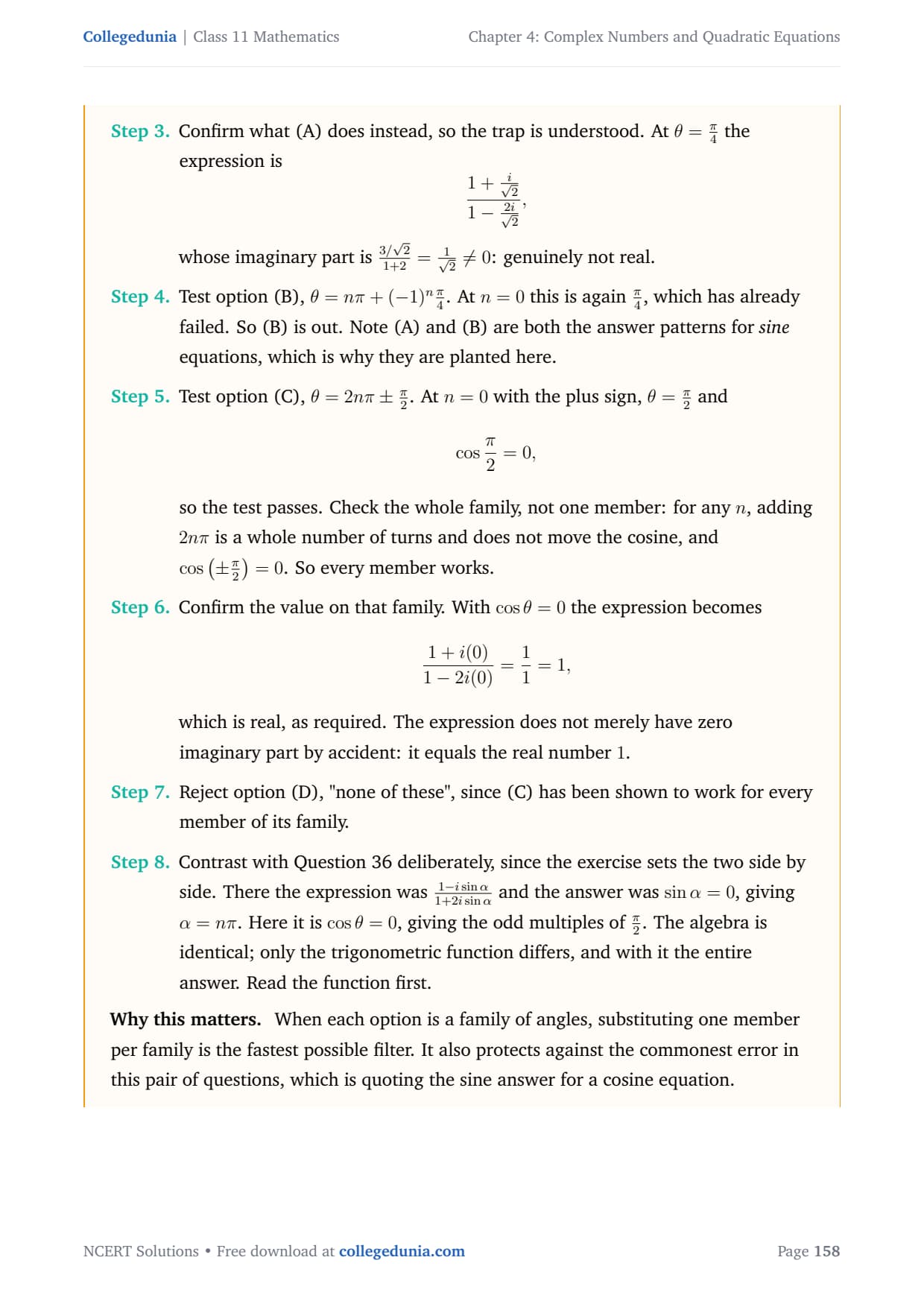
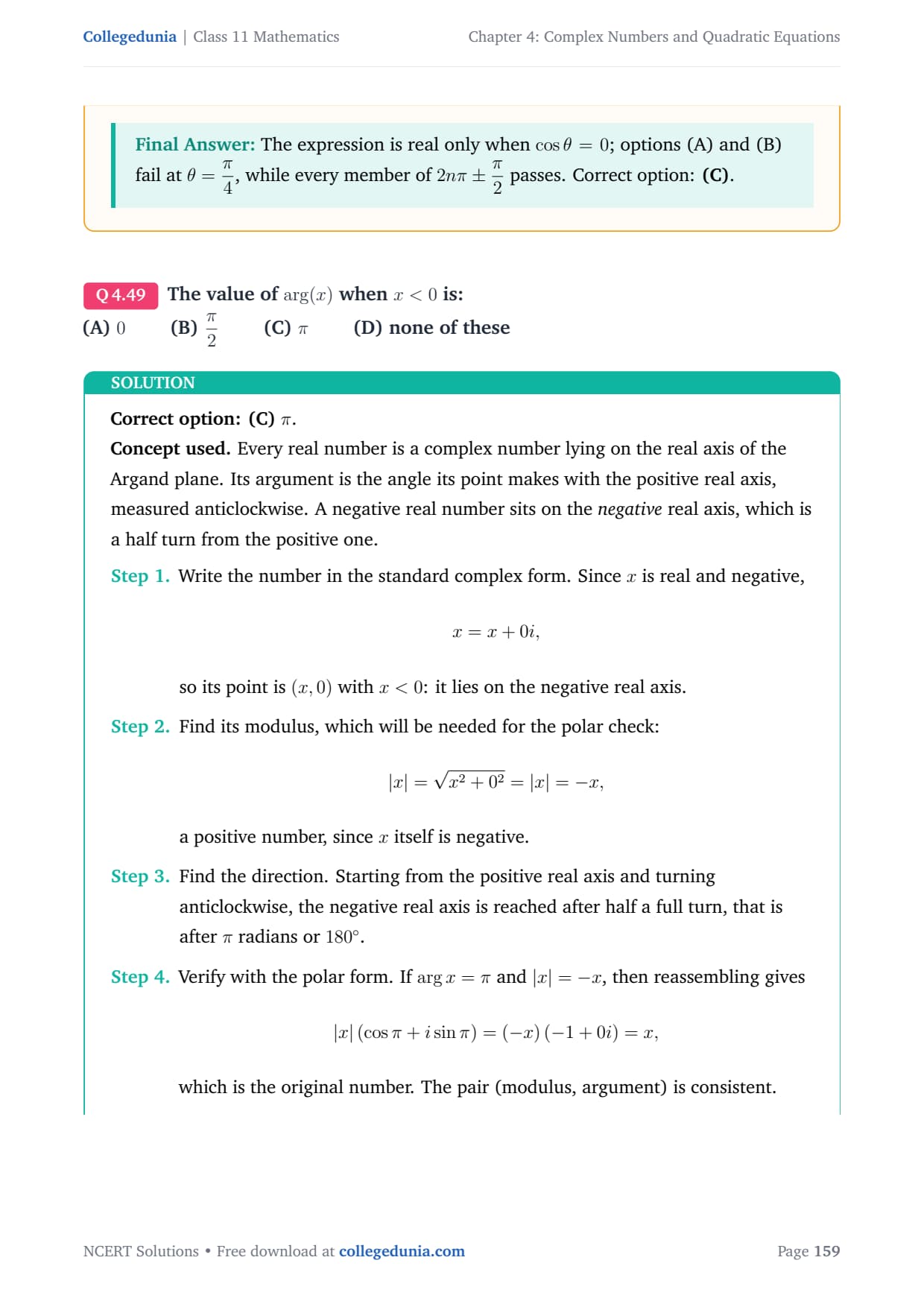
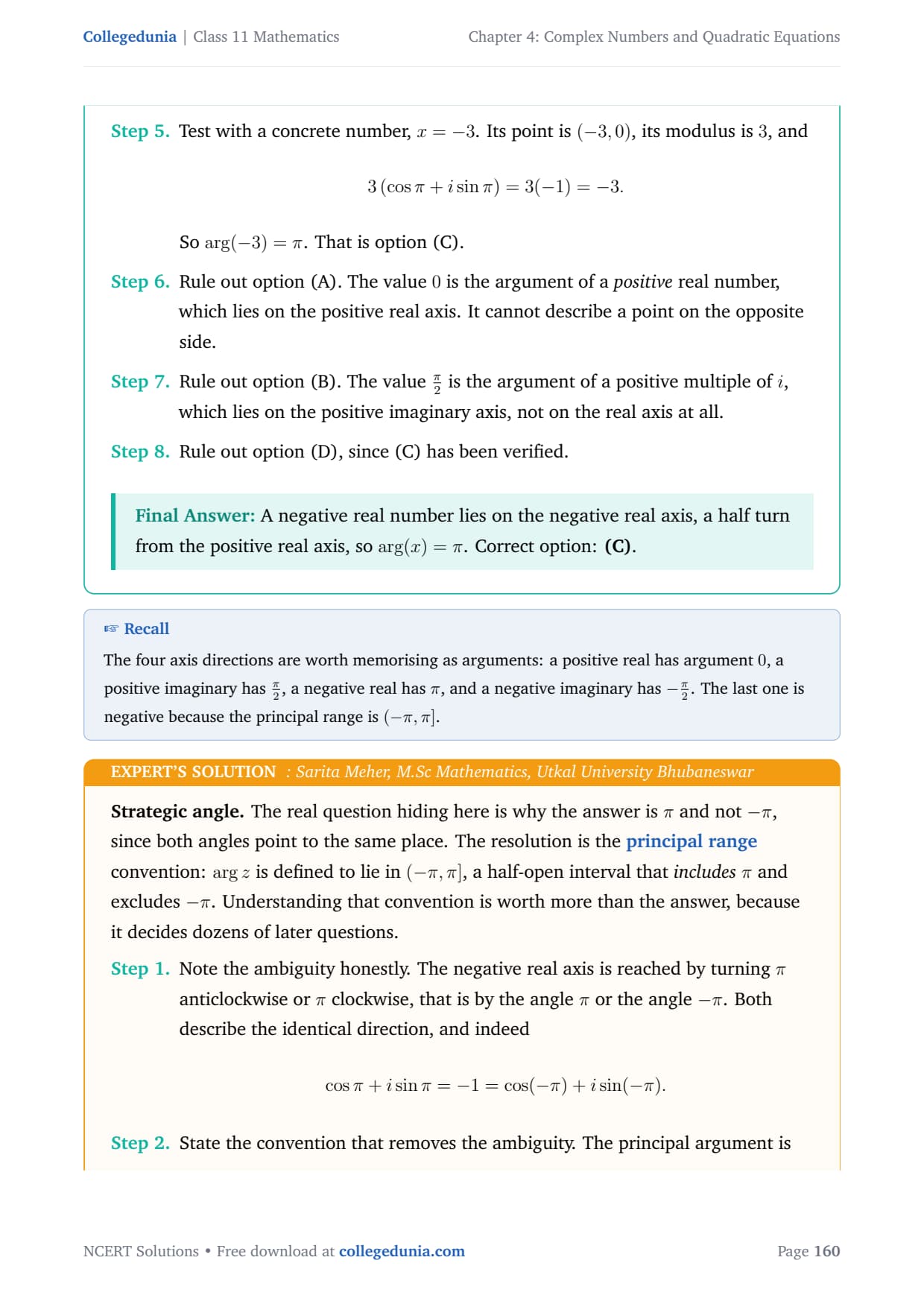
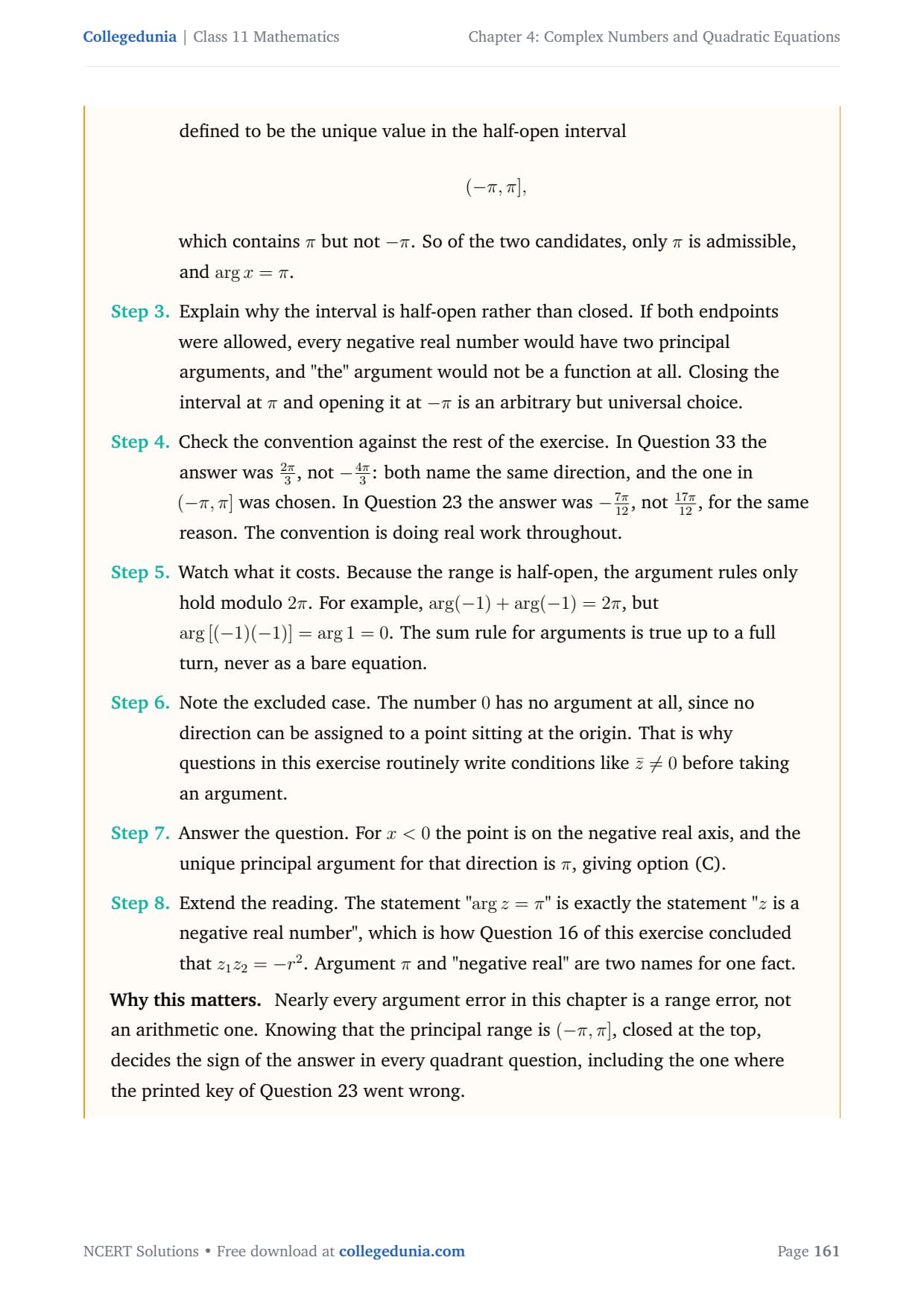
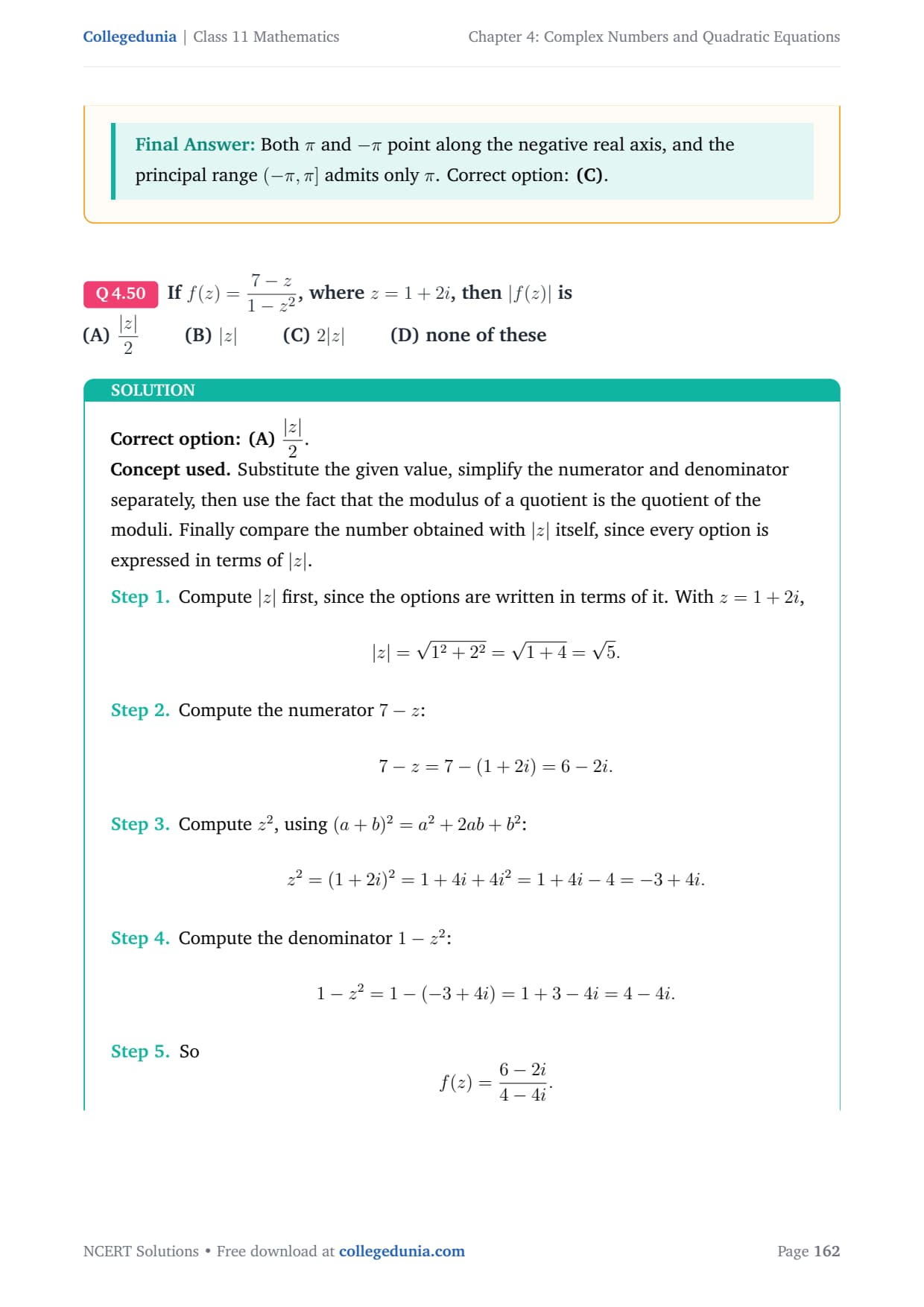
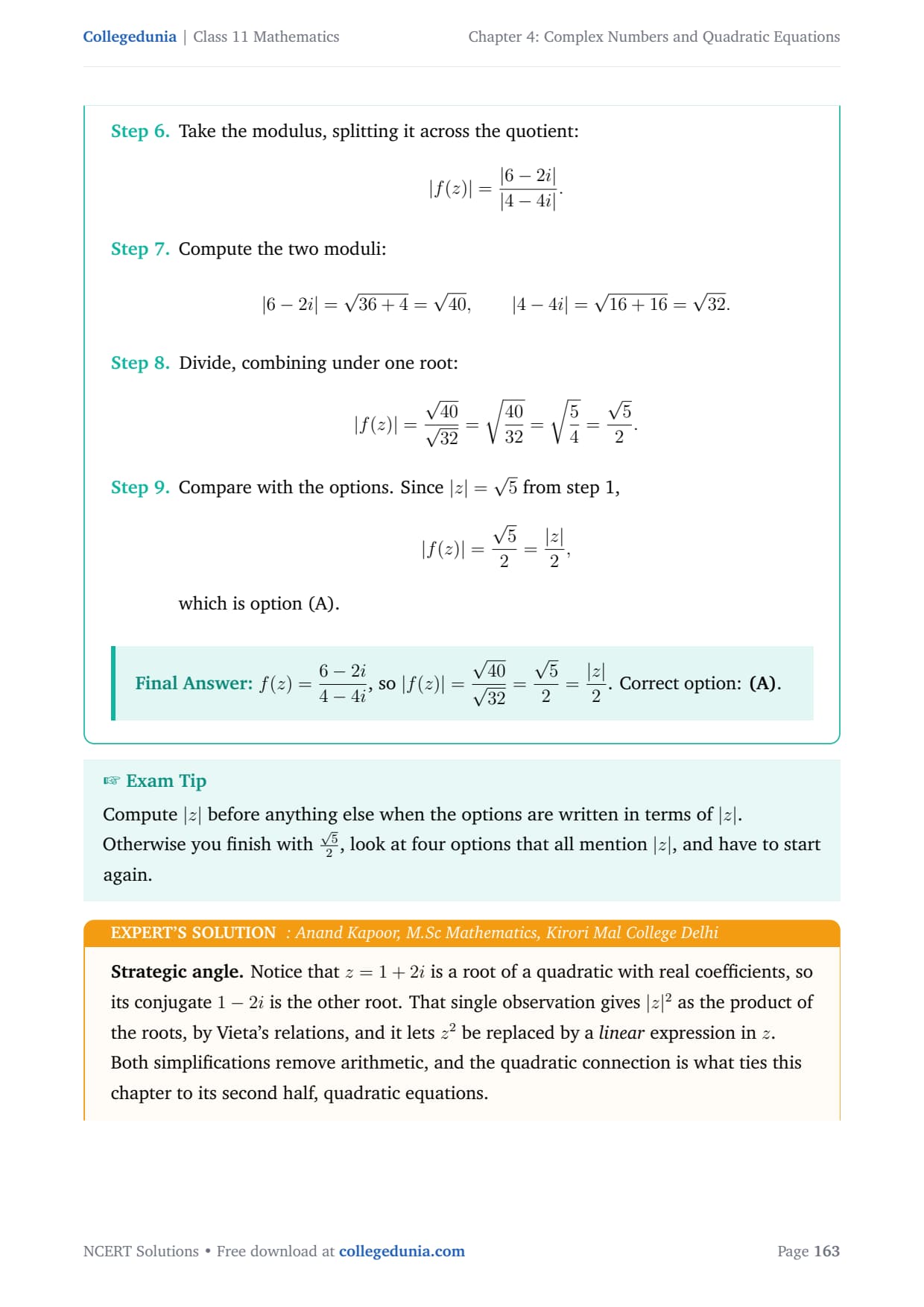
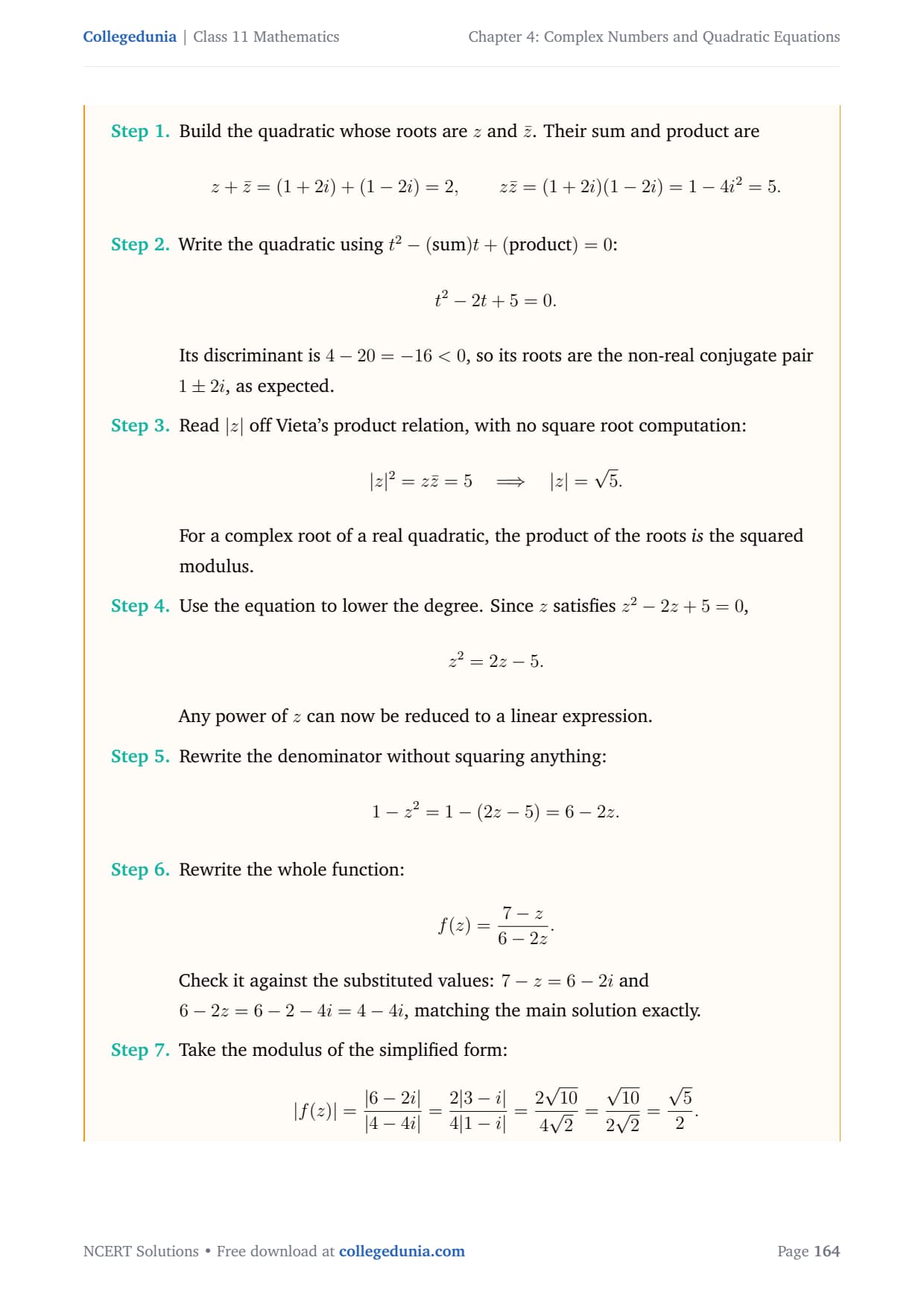
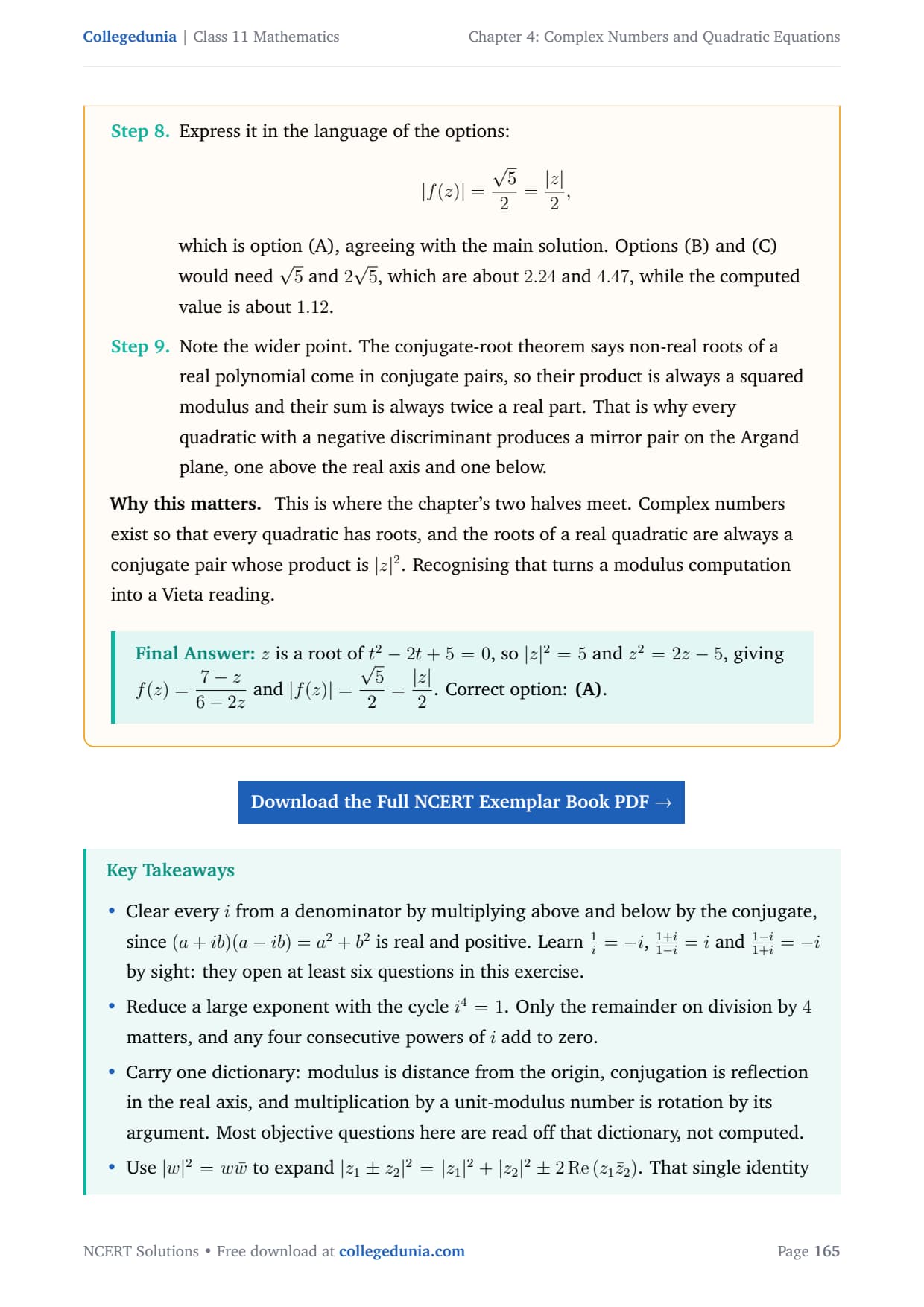
Every solution in this Collegedunia set is prepared by subject experts, based on the 2026-27 NCERT Exemplar, and checked line by line against the official answer key.
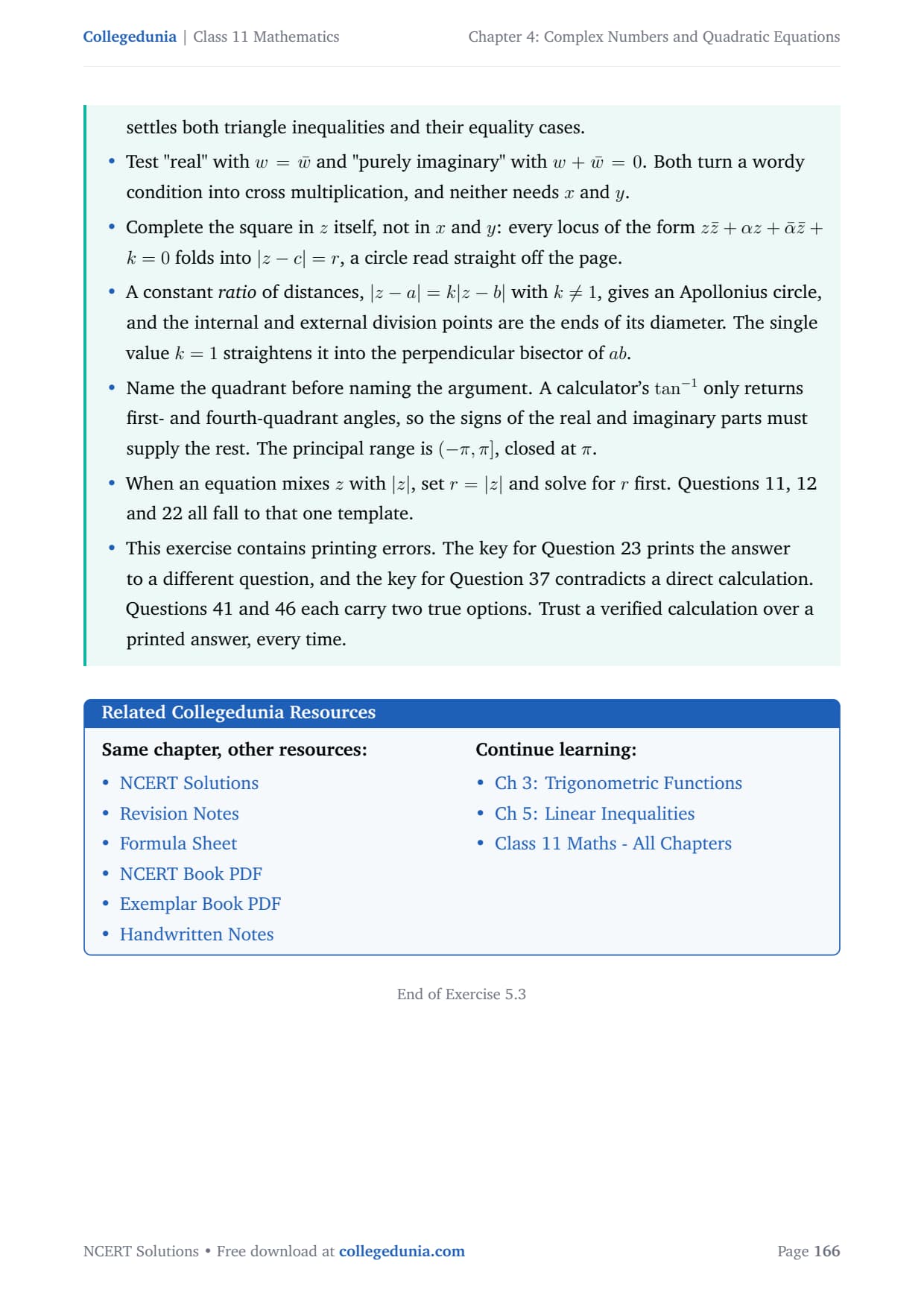
The Exemplar prints this chapter as Chapter 5, so its single long exercise is numbered Exercise 5.3 in the book's own numbering. The solutions PDF runs to 166 pages and covers every question in it.
- 50 questions solved: Short Answer, Long Answer, Objective, Fill in the Blanks, Match the Following and True/False.
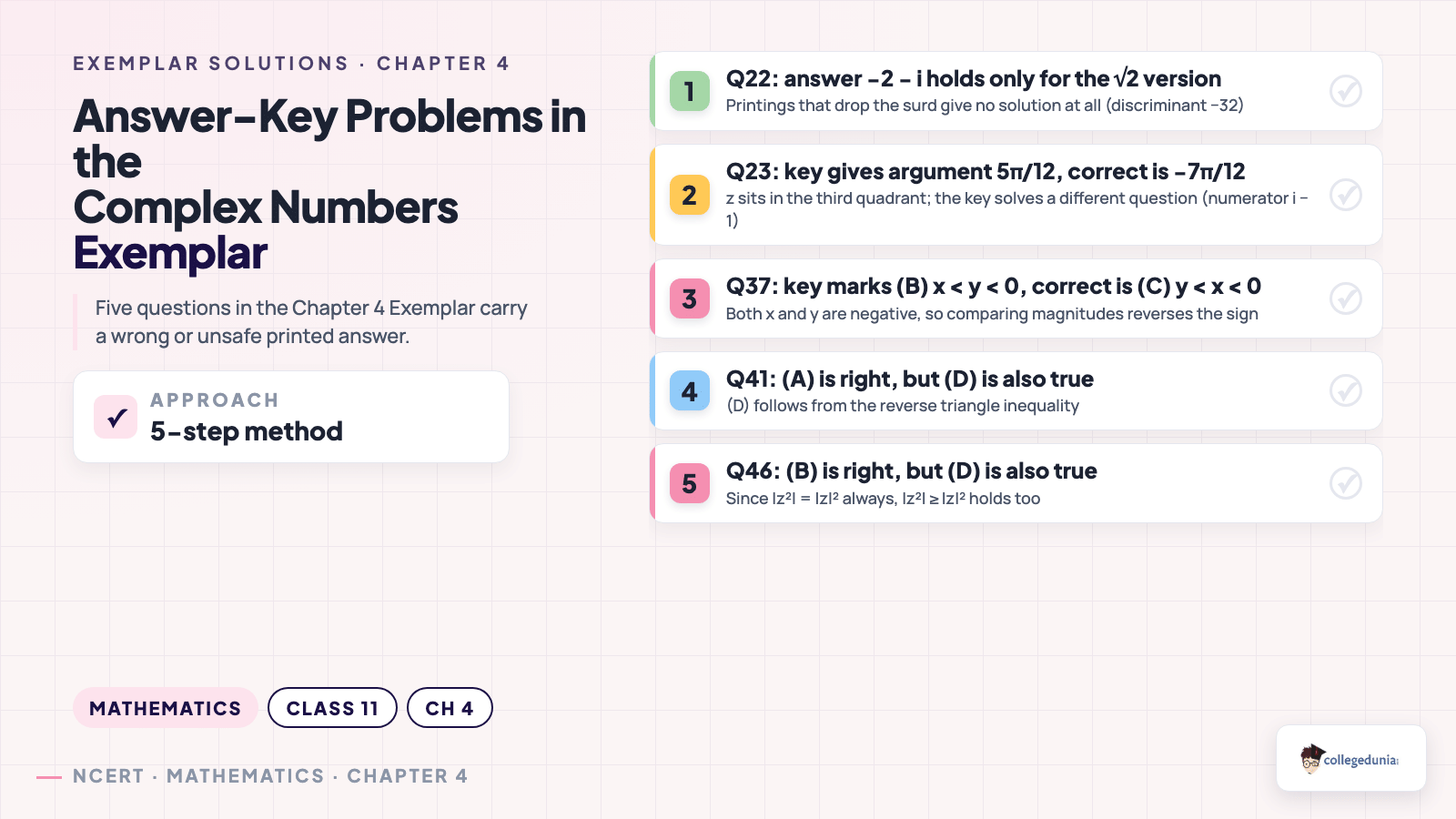
- Five answer-key problems flagged: the printed key is wrong or unsafe on Q22, Q23, Q37, Q41 and Q46.
- Exam focus: useful for CBSE Boards, JEE Main, JEE Advanced and CUET.
Topics Covered in the Class 11 Maths Complex Numbers and Quadratic Equations Exemplar
The Exemplar reuses the textbook ideas inside harder wrappers. Most questions look like one-line algebra but need a modulus argument, a quadrant check or a locus. These are the topics the 50 questions are built on.
- Powers of i and the four-cycle: i2 = −1, i3 = −i, i4 = 1, used on sums like i + i2 + i3 + … to 1000 terms.
- Conjugate and modulus algebra: z z̄ = |z|2, |z1z2| = |z1||z2|, and rationalising a fraction to reach x + iy form.
- Polar form and argument: z = r(cos θ + i sin θ), with the quadrant fixing the sign of θ.
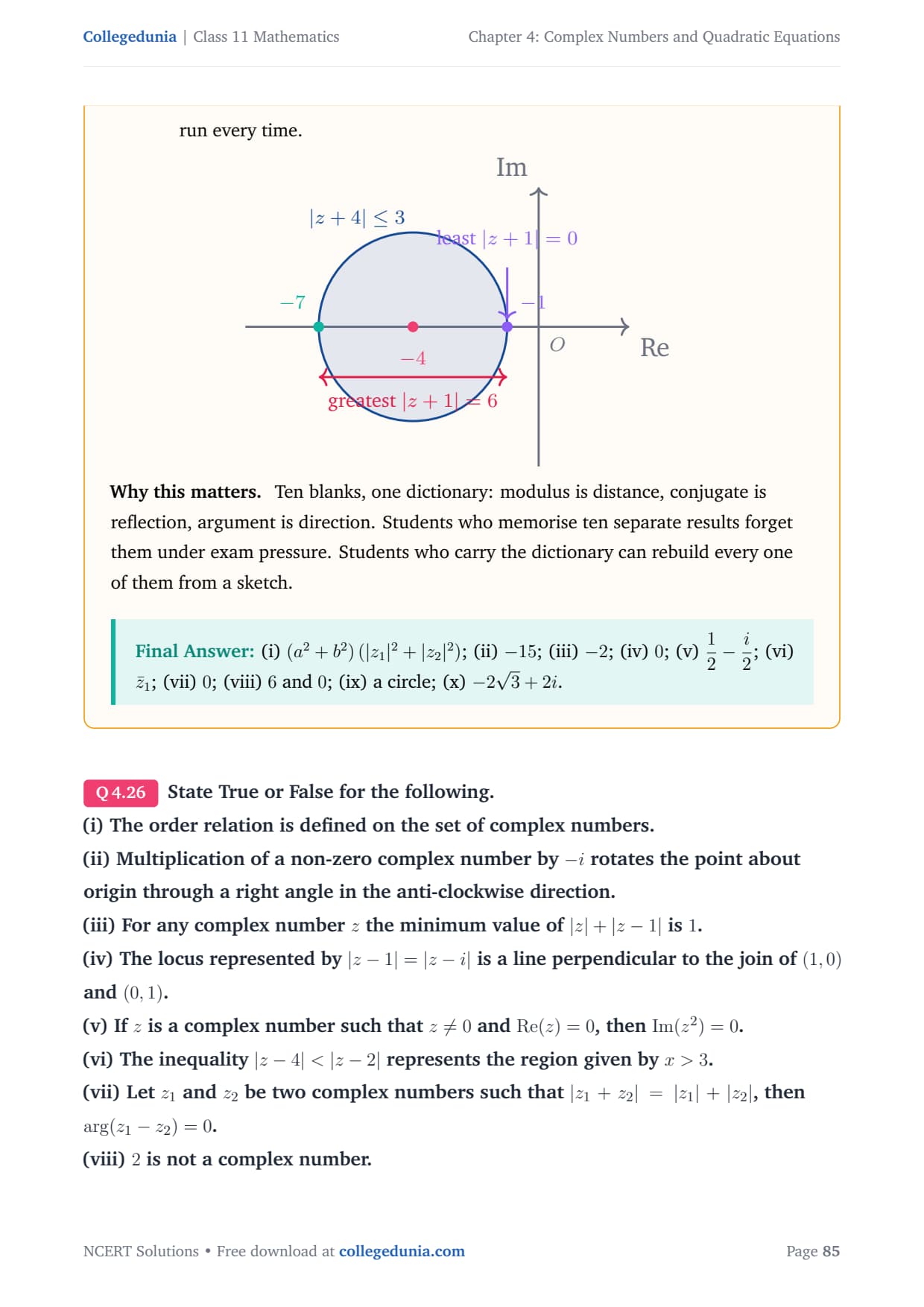
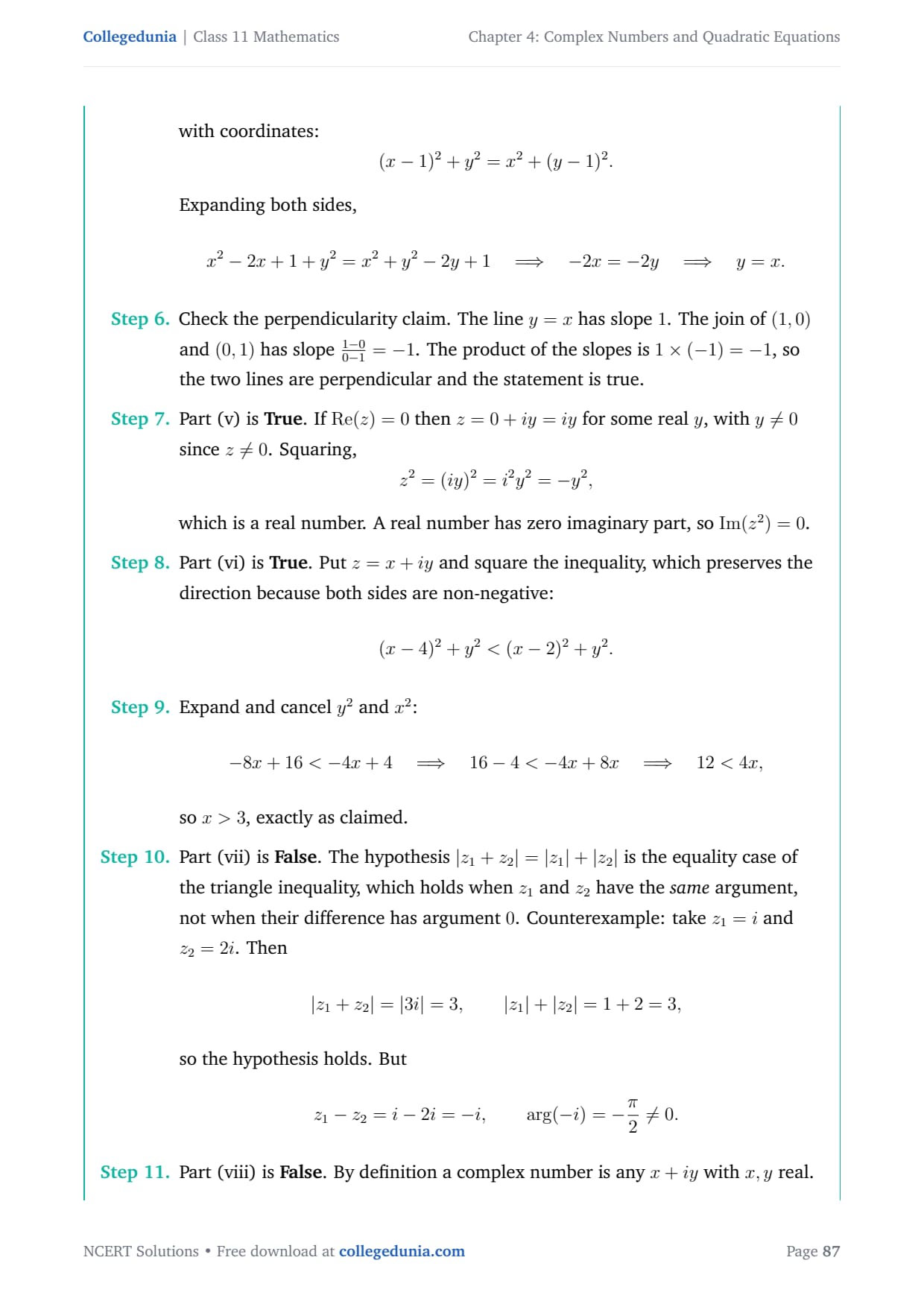
- Loci in the Argand plane: |z − a| = |z − b| gives a perpendicular bisector, and a ratio of moduli gives a circle.
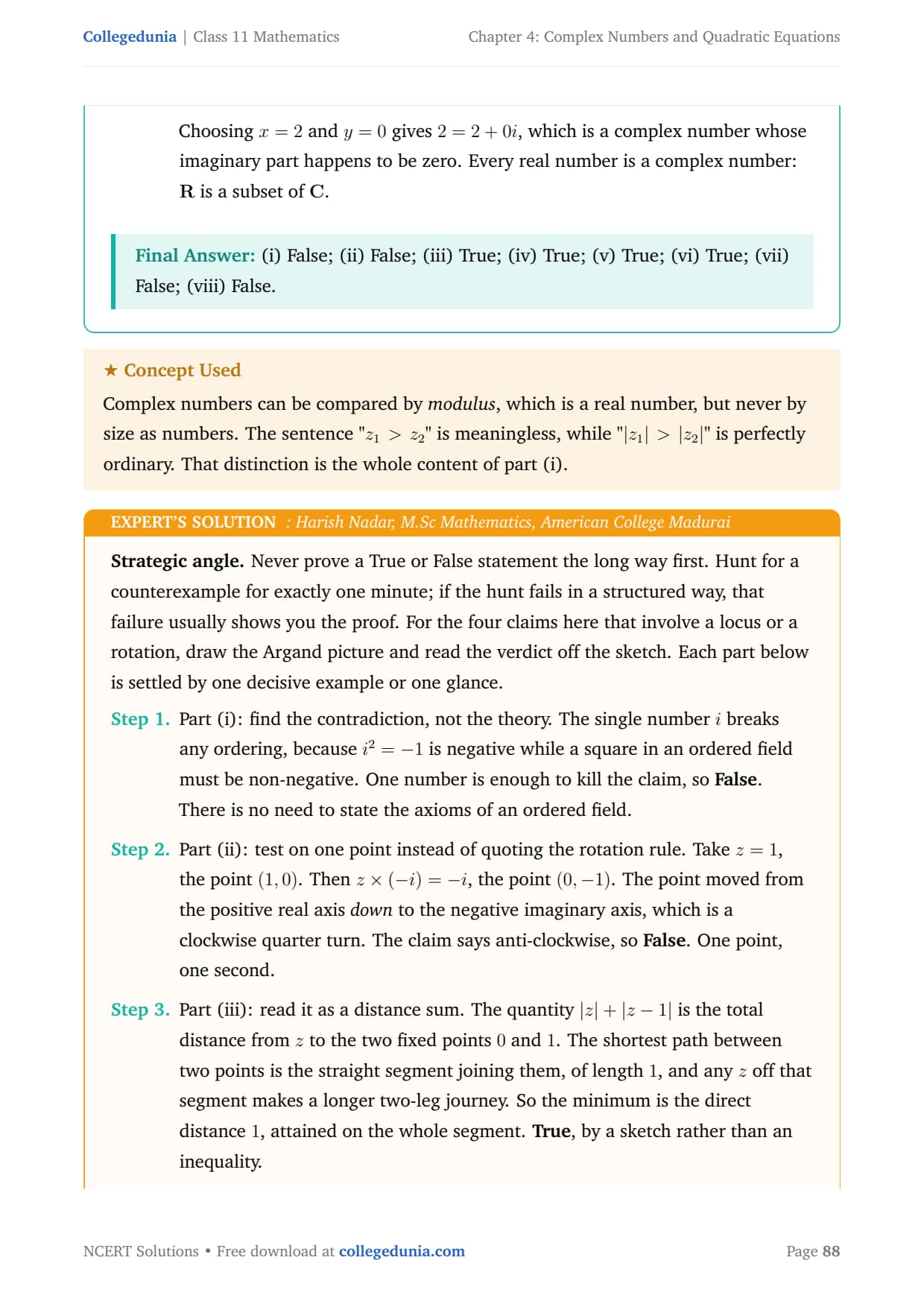
- Triangle inequality: |z1 + z2| ≤ |z1| + |z2|, and the reverse form used in the MCQ block.
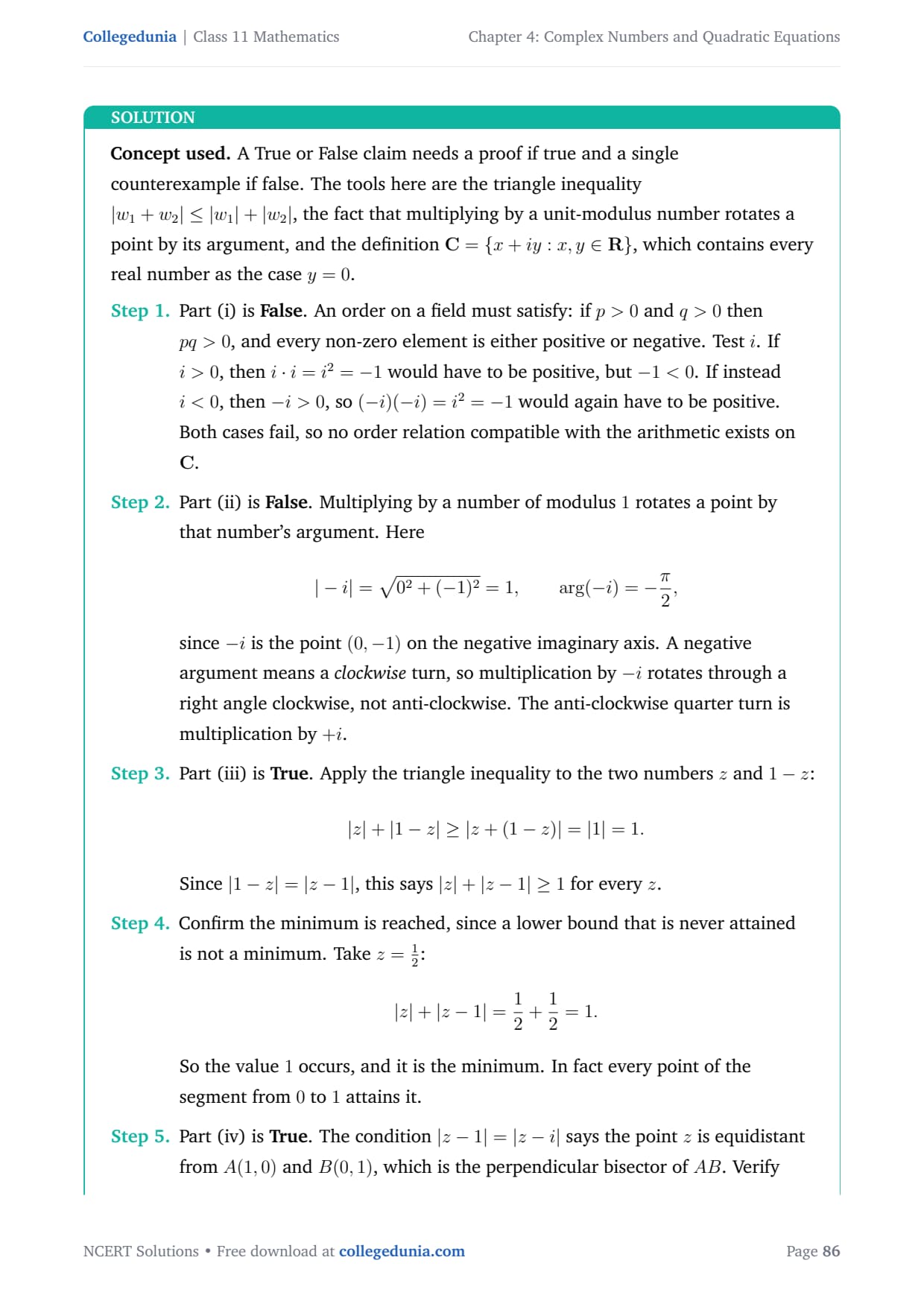
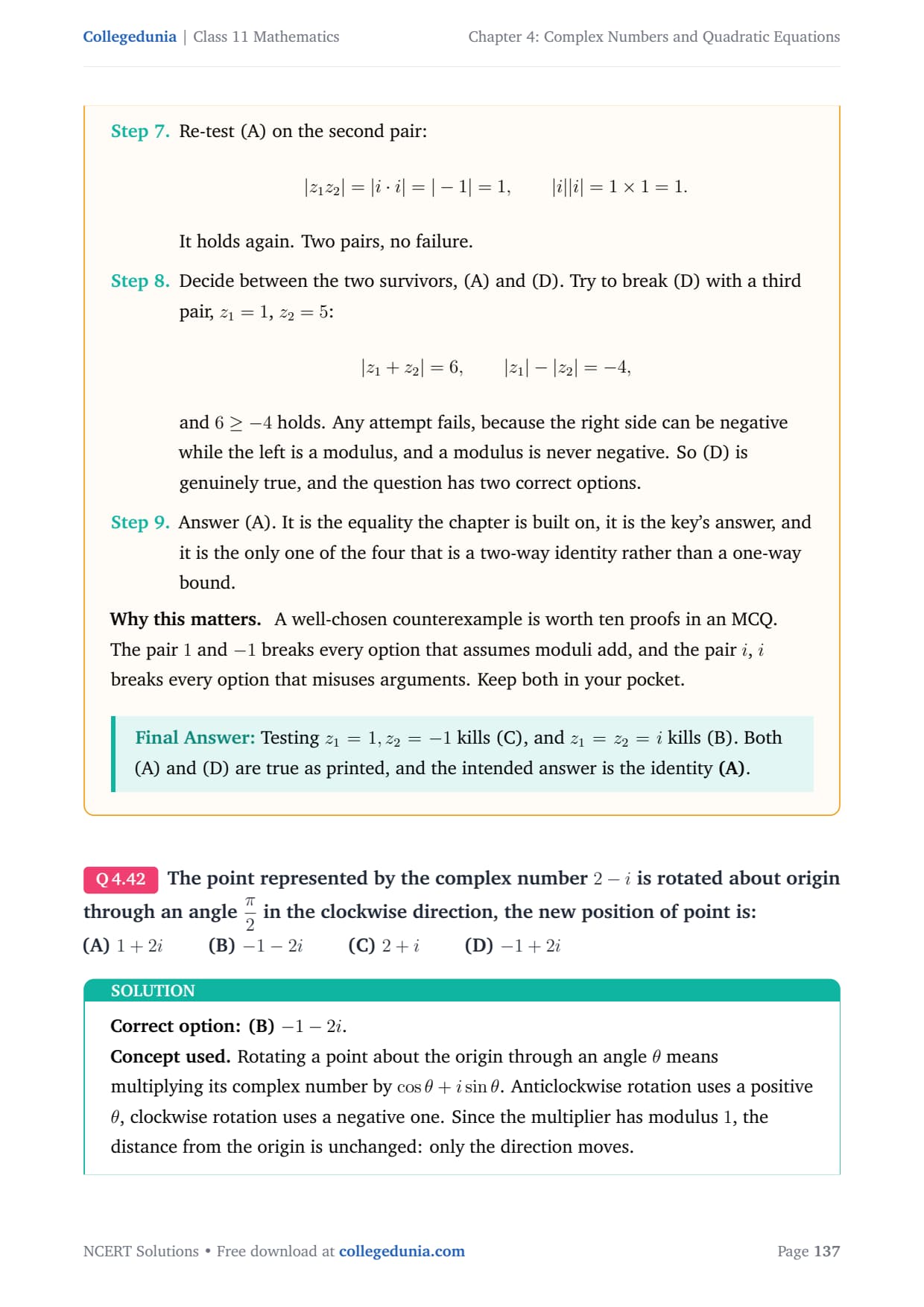
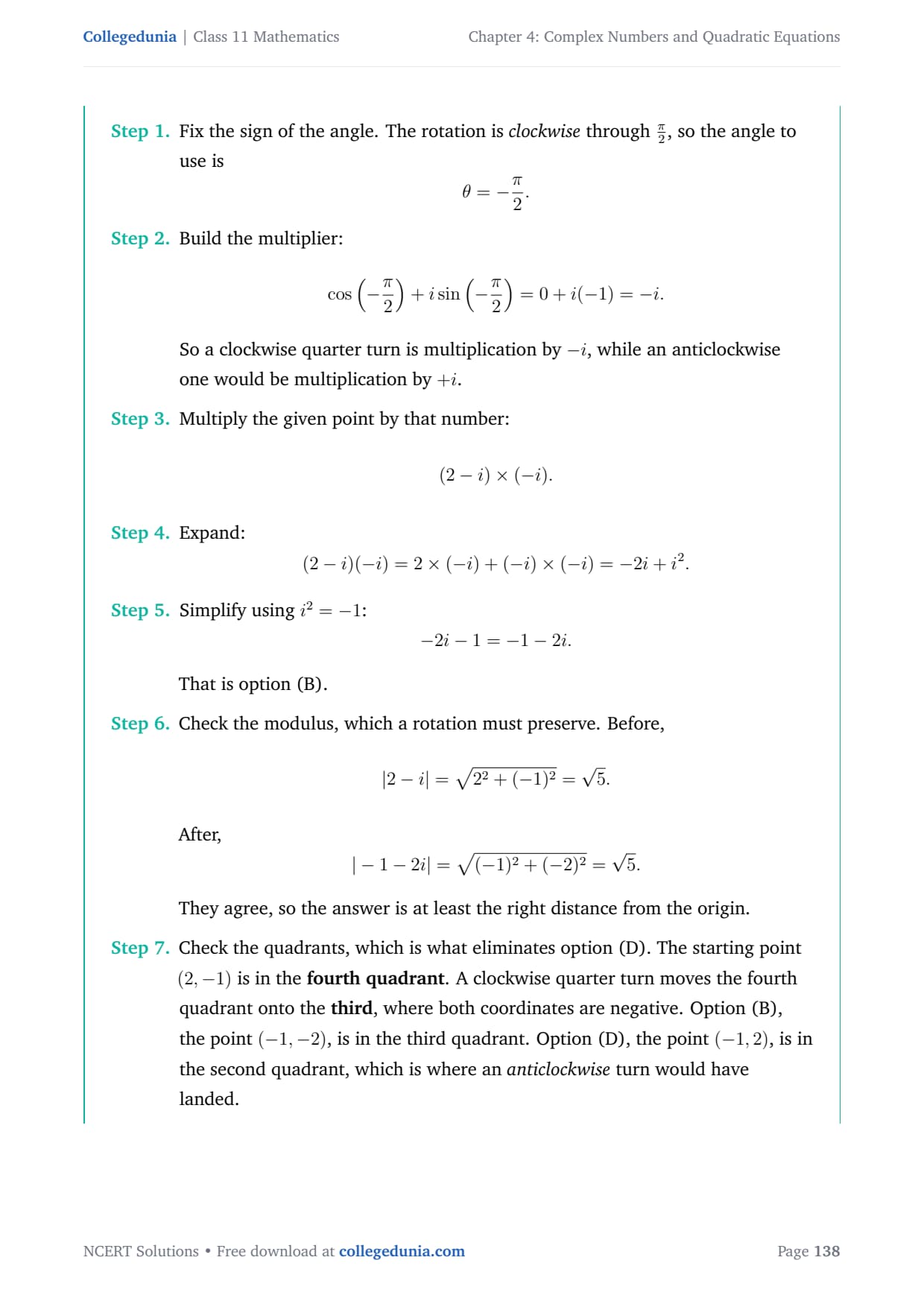
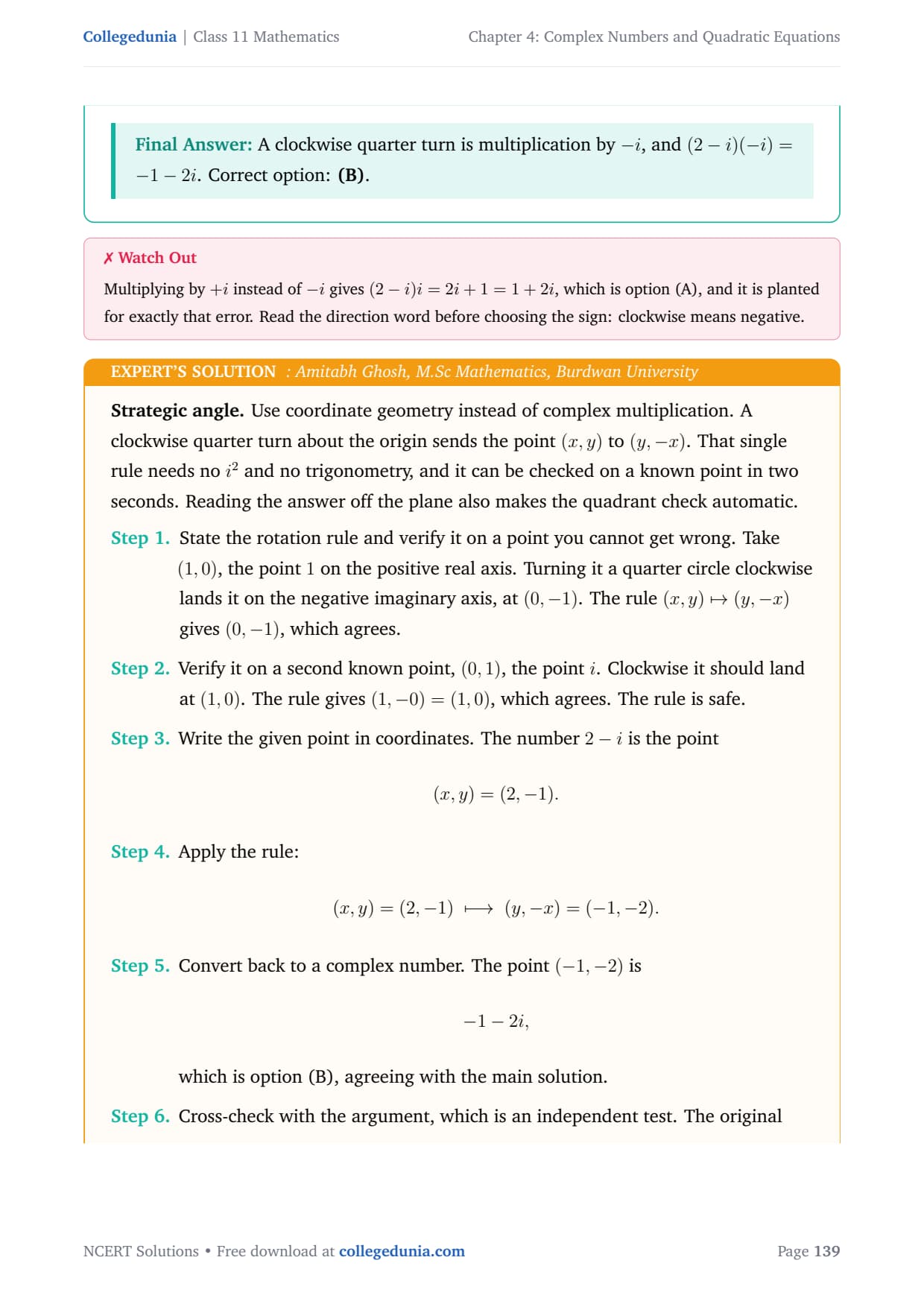
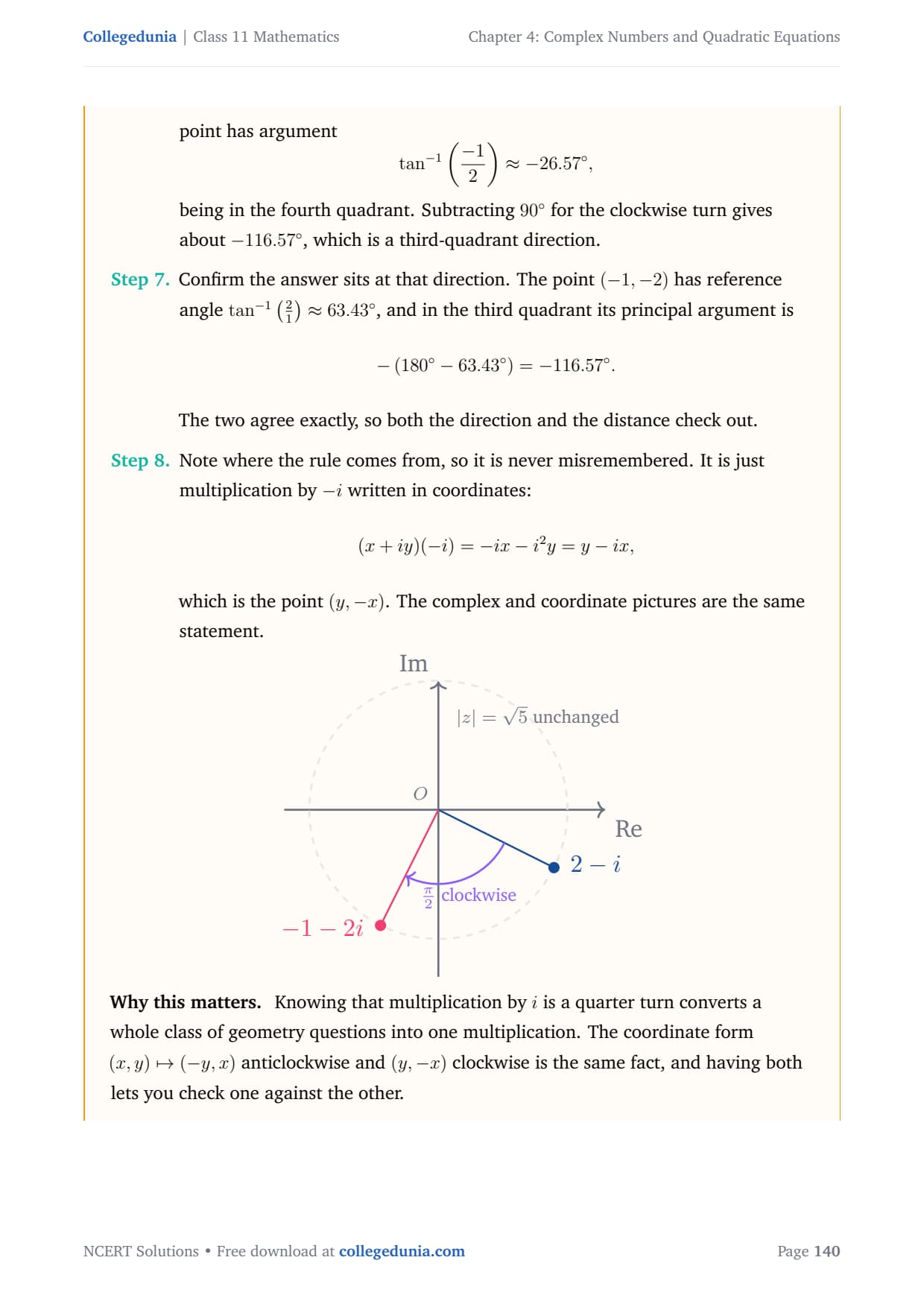
- Rotation: multiplying by i turns a point through a right angle about the origin.
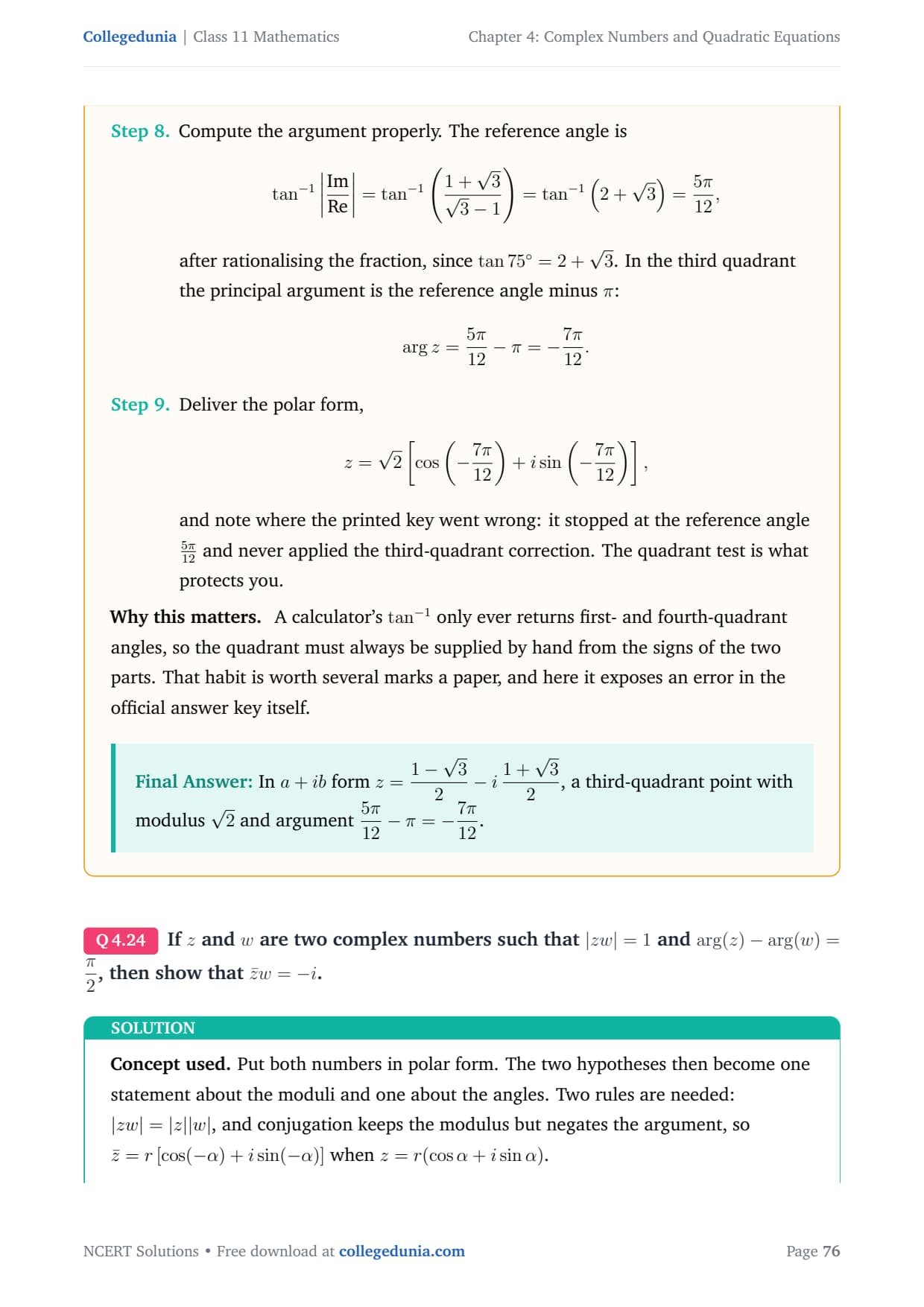
Important: the Exemplar treats the argument as something you must place in the right quadrant, not just compute from a tangent. tan θ alone cannot tell −7π/12 apart from 5π/12. Plotting the point first is what settles the sign.
Exercise 5.3 Question-Type Breakdown for Complex Numbers and Quadratic Equations
All 50 questions sit inside the chapter's single exercise, grouped by format. The table below shows how the exercise is split, so students can plan practice by question type rather than solving straight through.
| Question Type | Question Numbers | Count | What it tests |
|---|---|---|---|
| Short Answer | Q1 to Q11 | 11 | Powers of i, x + iy form, small identities |
| Long Answer | Q12 to Q24 | 13 | Modulus equations, loci, polar form, proofs |
| Fill in the Blanks | Q25 | 1 | One multi-part question on inverse, argument and series |
| True/False | Q26 | 1 | One multi-part question on order, rotation and loci |
| Match the Following | Q27 | 1 | Matching polar forms and regions to their descriptions |
| Objective (short) | Q28 to Q34 | 7 | Conjugate, modulus and principal argument, no options |
| Objective (MCQ) | Q35 to Q50 | 16 | Quadrant reasoning, inequalities, counter-examples |
The Long Answer block (Q12 to Q24) carries the most marks per question and holds every locus proof in the chapter. The MCQ block (Q35 to Q50) is the largest single group and is where the printed key slips most, so it is worth a full practice session on its own.
Five Answer-Key Problems in the Complex Numbers Exemplar Every Student Must Know
The printed NCERT Exemplar answer key for this chapter has five questions where the given answer is wrong or unsafe. Each one is checked below against the book's own results. Students who copy the key blindly will learn the wrong answer, so read this section before self-checking.
| Question | Printed key | What is actually correct | Why |
|---|---|---|---|
| Q22 | −2 − i | −2 − i, but only for the √2 version | Some printings drop the surd, and that version has no solution |
| Q23 | √2 (cos 5π/12 + i sin 5π/12) | √2 [cos(−7π/12) + i sin(−7π/12)] | The key answers a different question, with numerator i − 1 |
| Q37 | (B) x < y < 0 | (C) y < x < 0 | Both numbers are negative, so taking magnitudes reverses the sign |
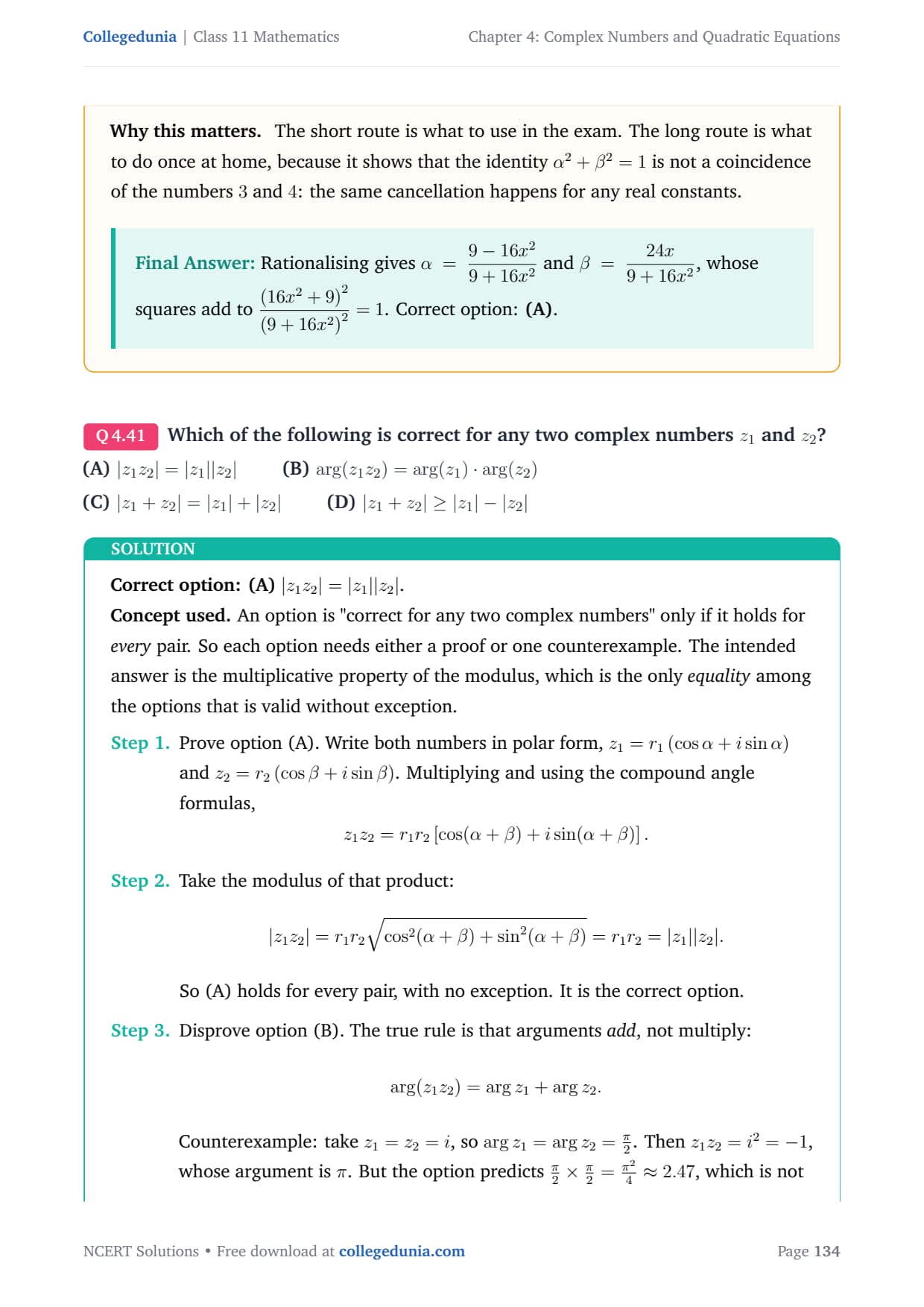
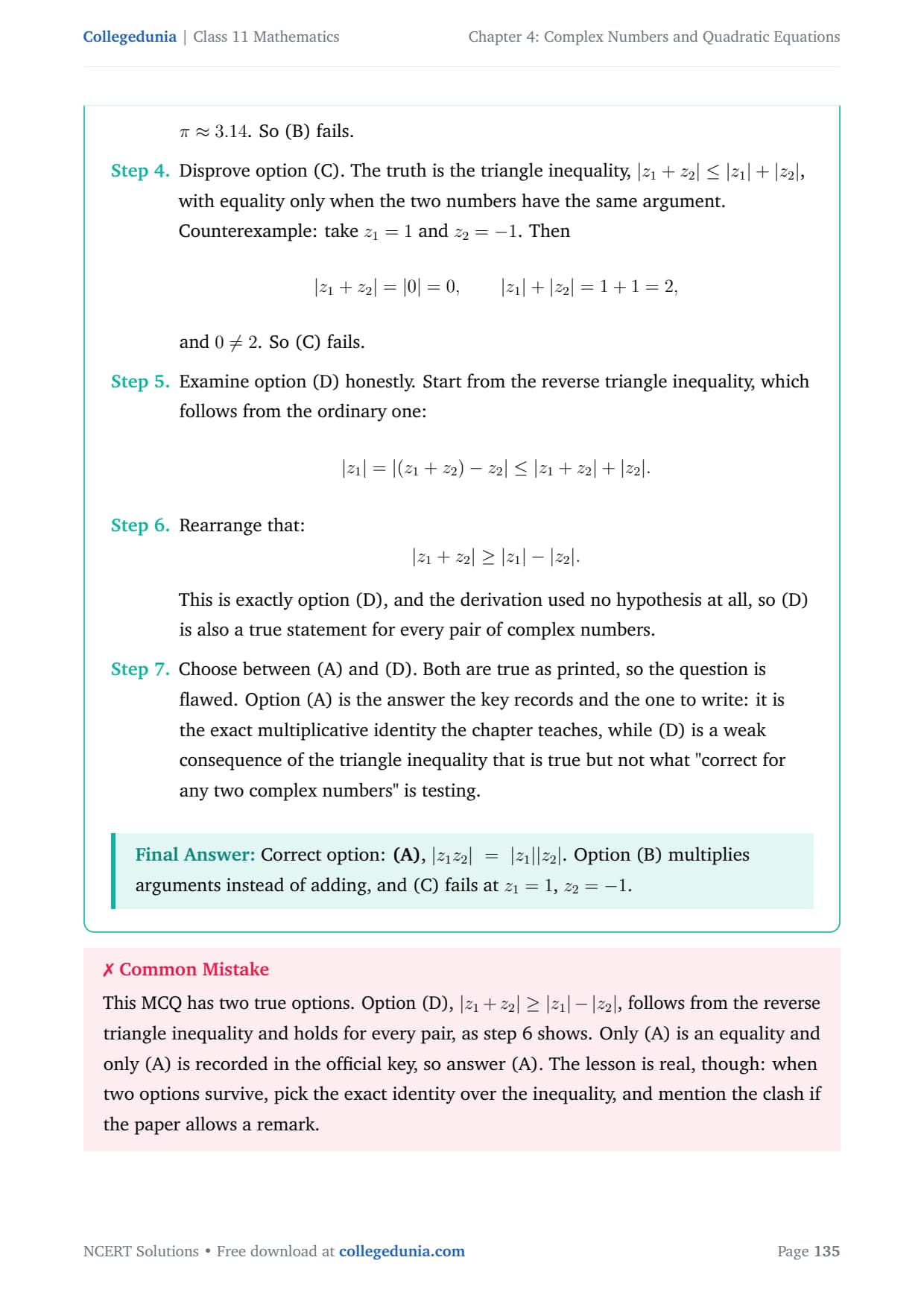
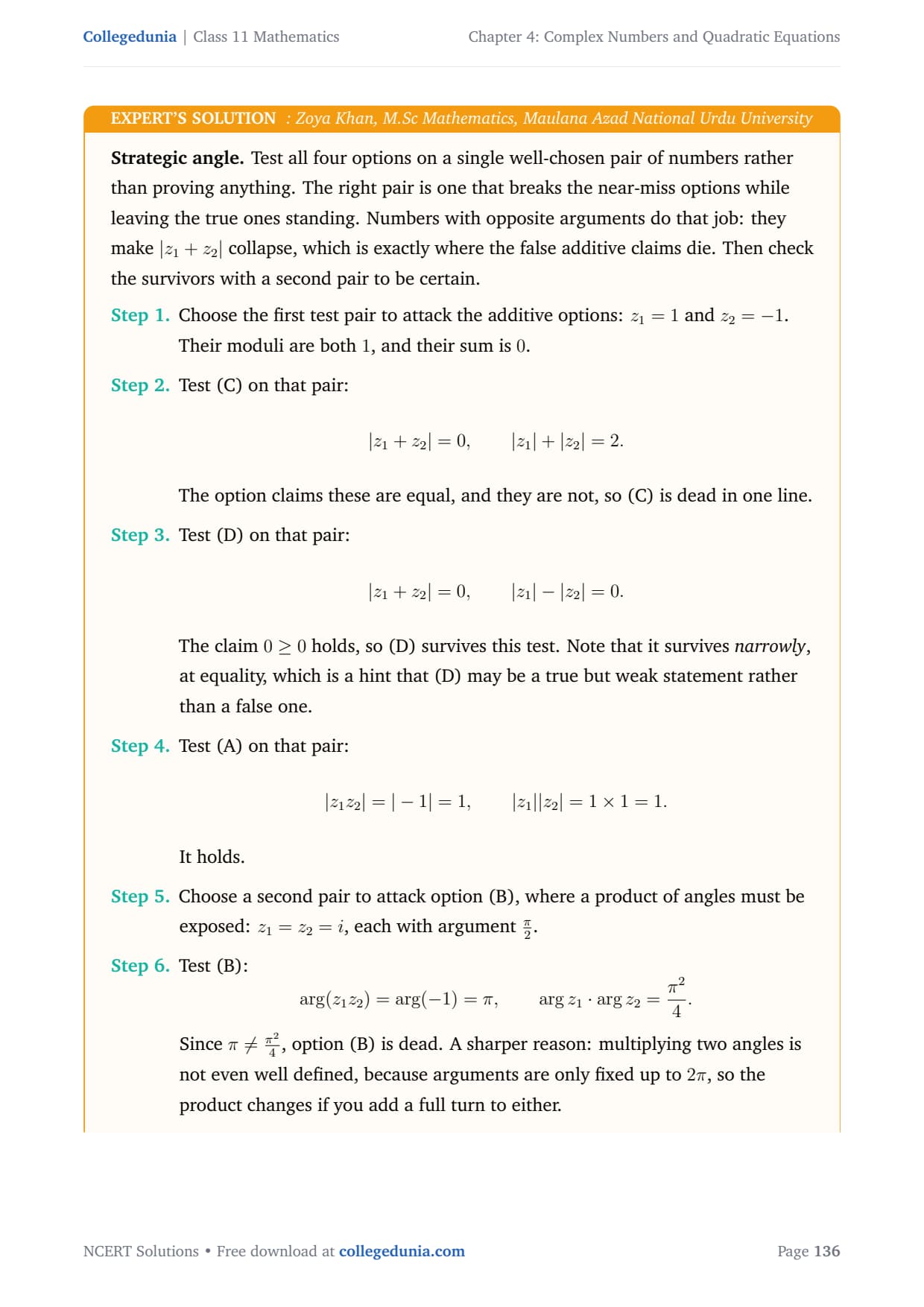
| Q41 | (A) | (A), but (D) is also true | Two options hold; the exact identity is the one being tested |
| Q46 | (B) | (B), but (D) is also true | |z2| = |z|2 always, so |z2| ≥ |z|2 is true too |
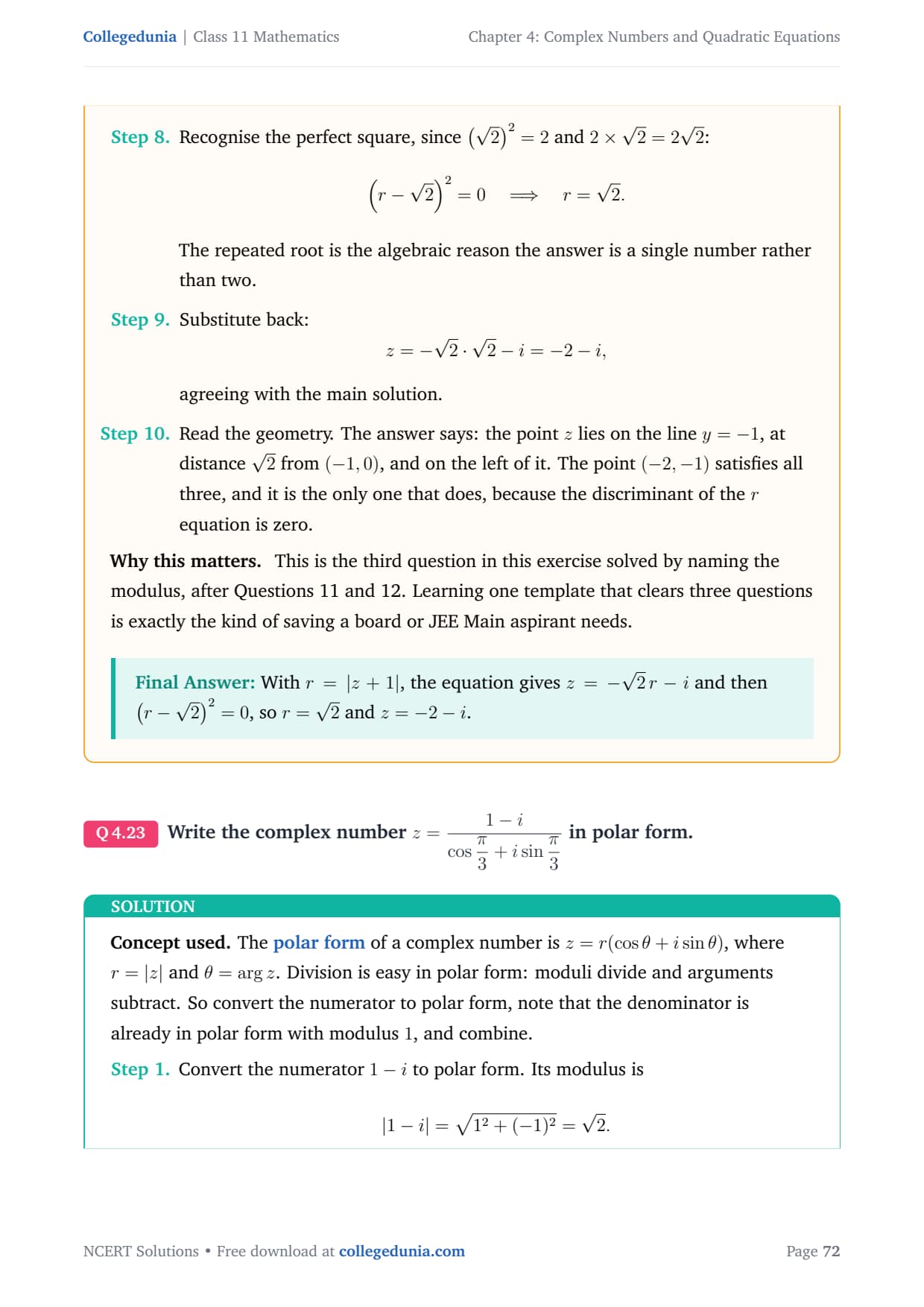
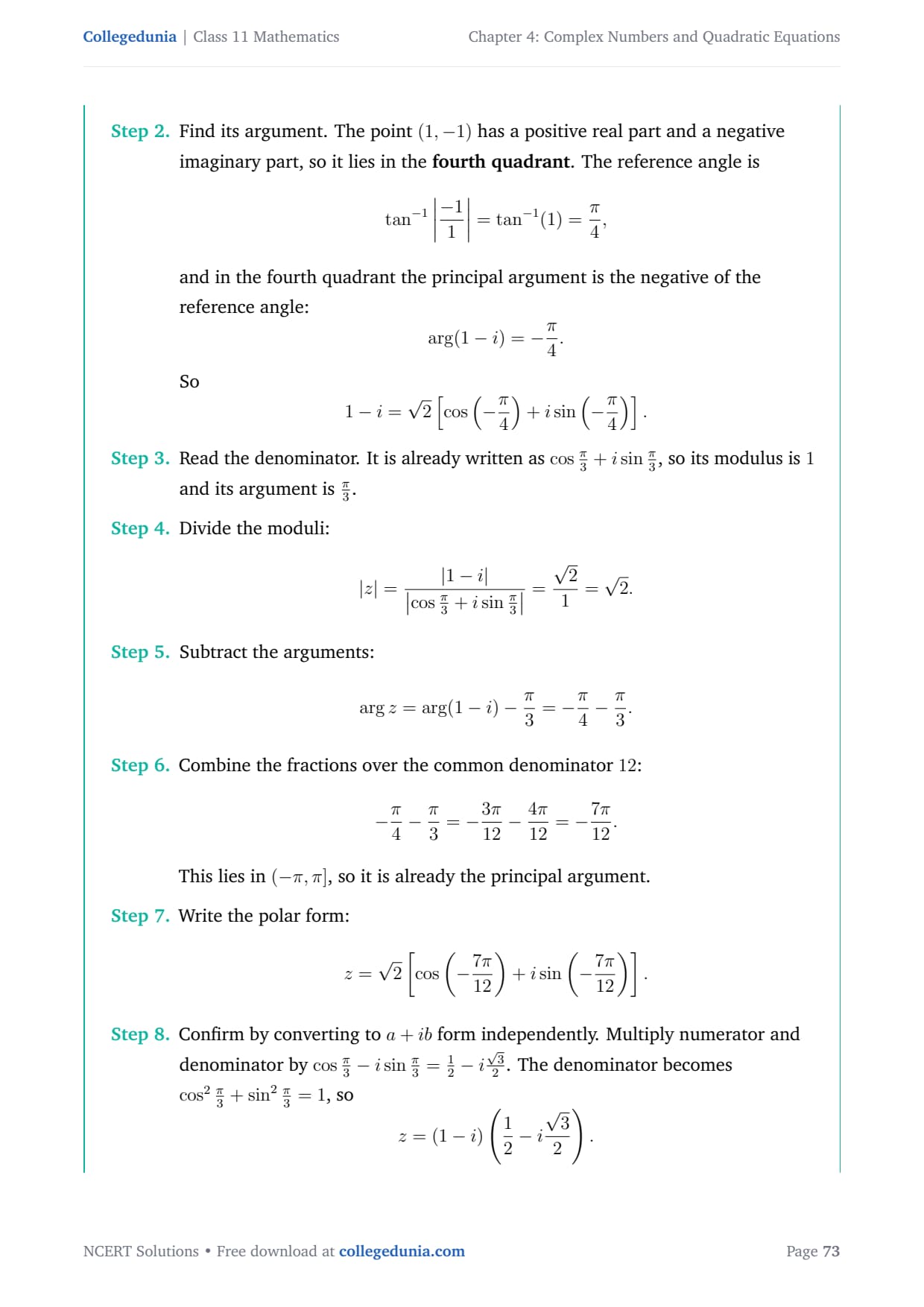
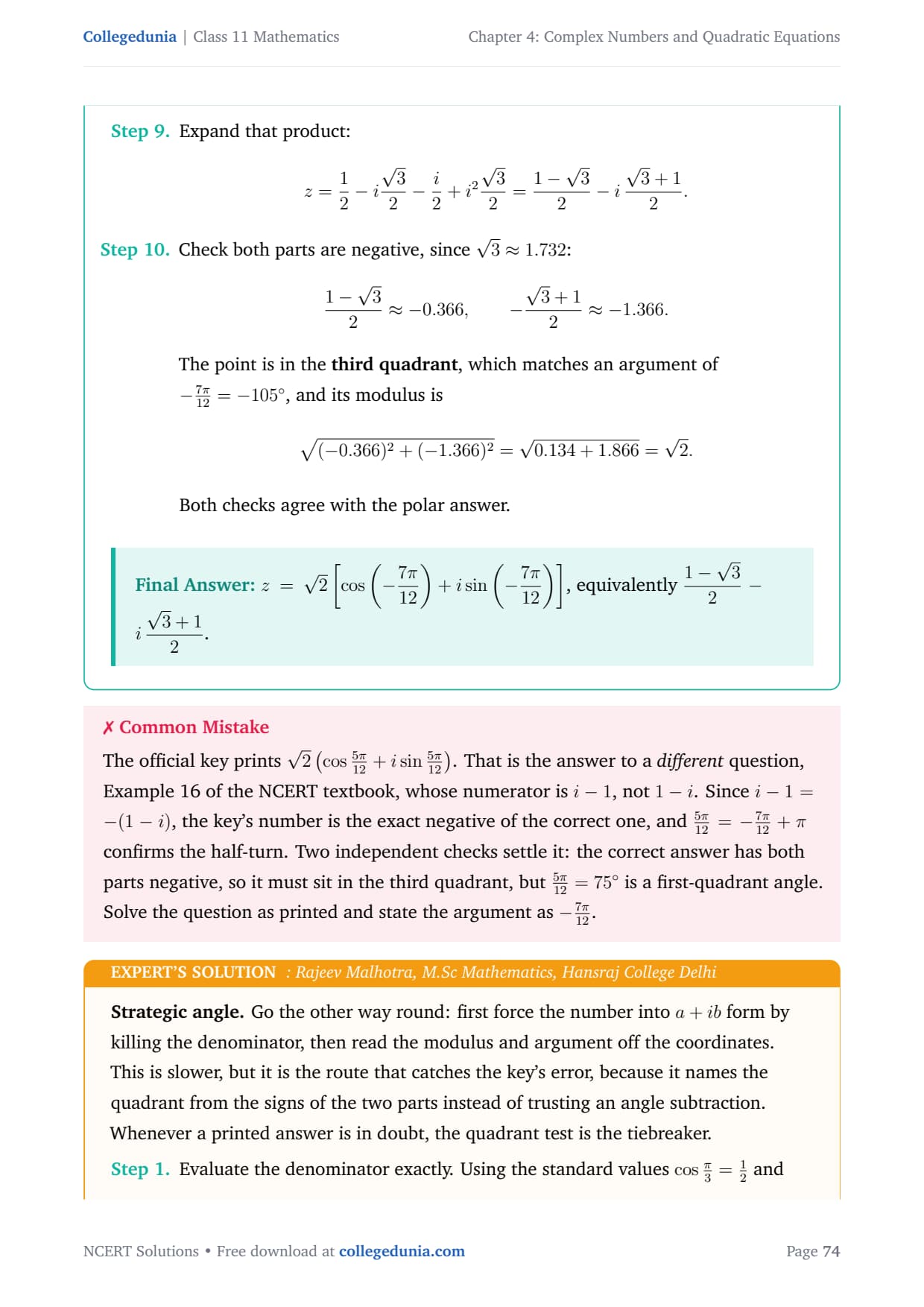
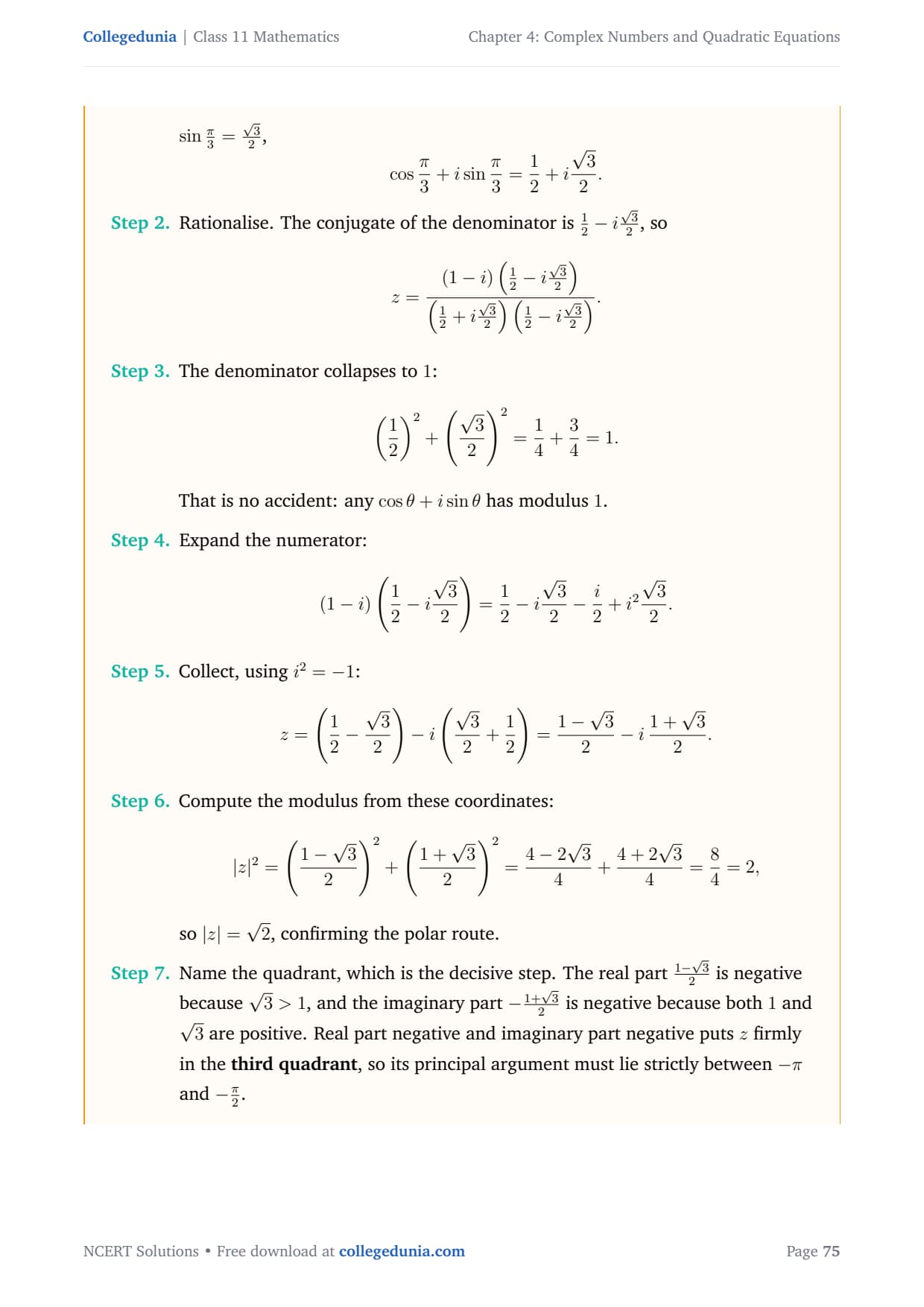
Q23 is the biggest trap in the chapter. The book asks for the polar form of z = (1 − i) / (cos π/3 + i sin π/3). Working it out gives z = (1 − √3)/2 − i (√3 + 1)/2, which is about −0.366 − 1.366i. Both parts are negative, so the point sits in the third quadrant and the argument must be −7π/12, which is −105 degrees. The key prints 5π/12, and 5π/12 is 75 degrees, a first-quadrant angle. The key is answering Example 16 of the NCERT textbook, whose numerator is i − 1 instead of 1 − i. Since i − 1 = −(1 − i), the key's number is the exact negative of the right one.
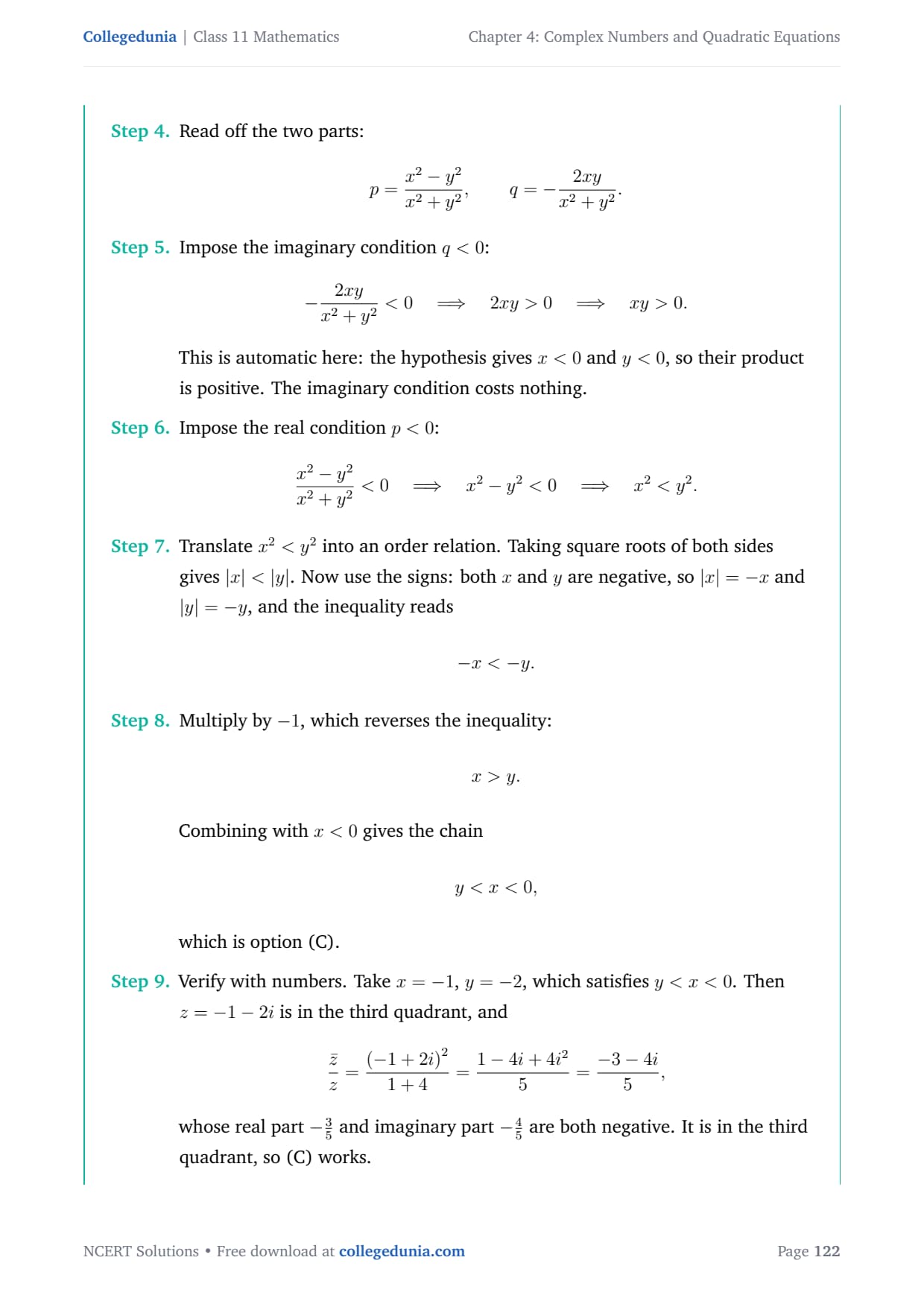
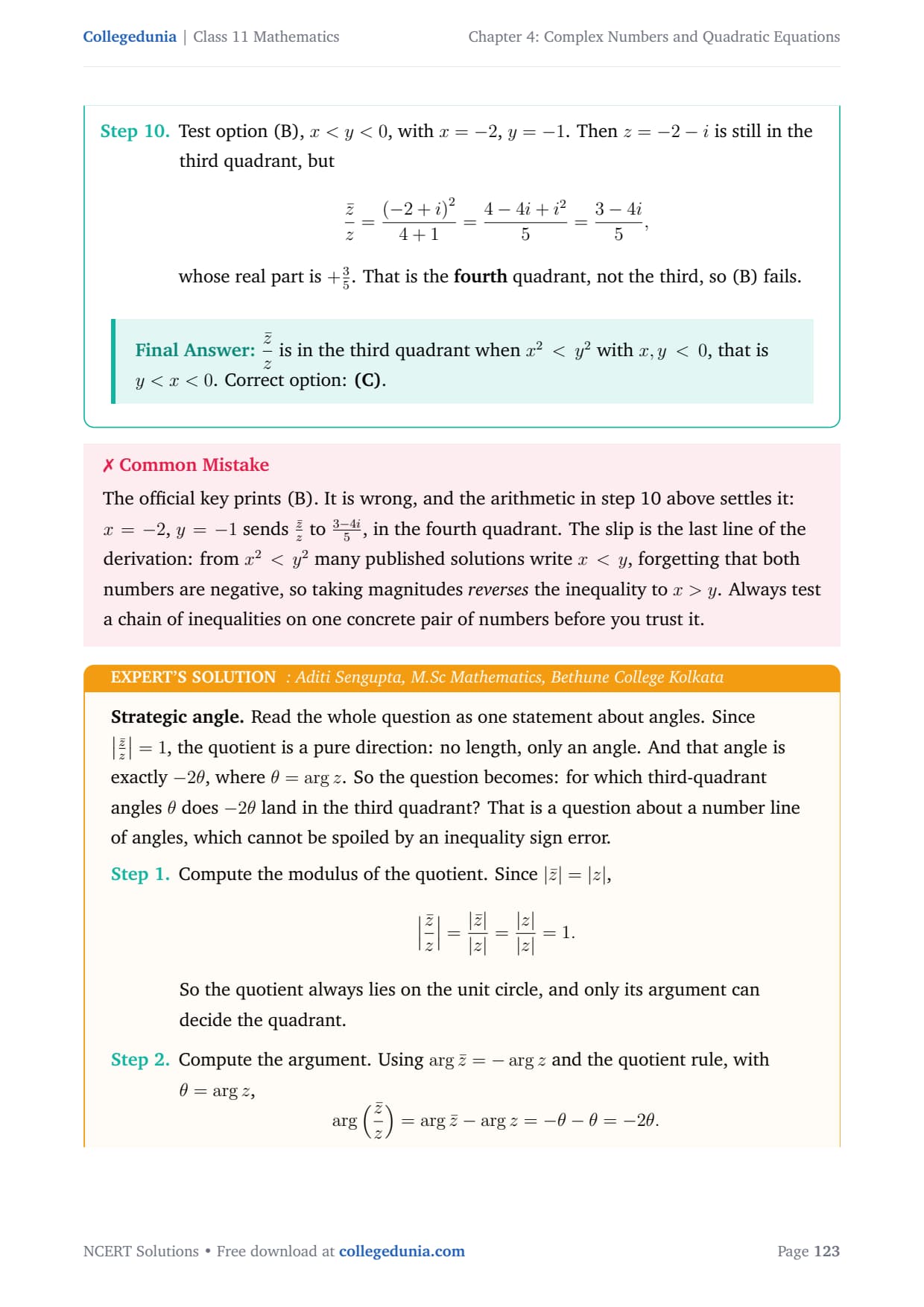
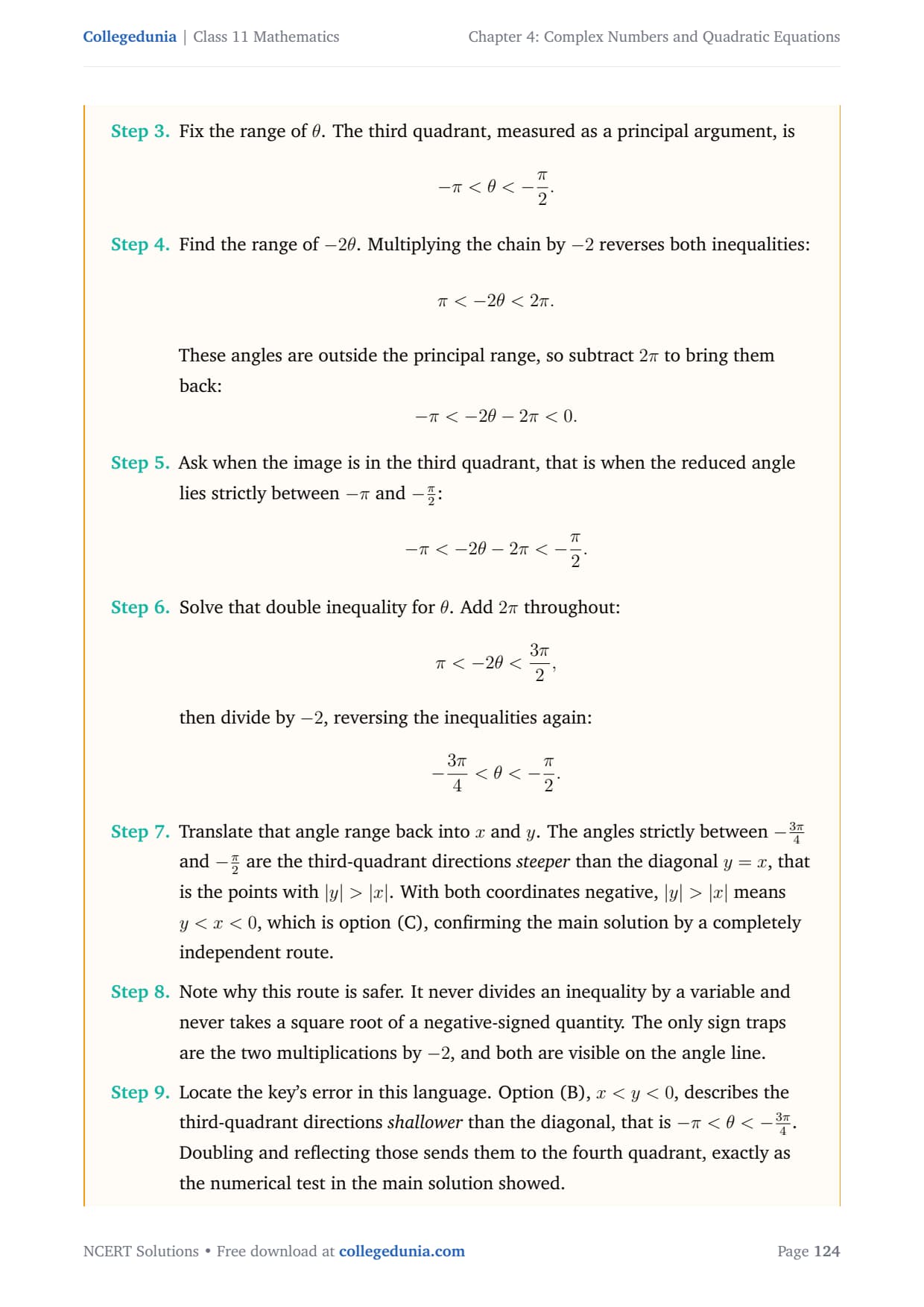
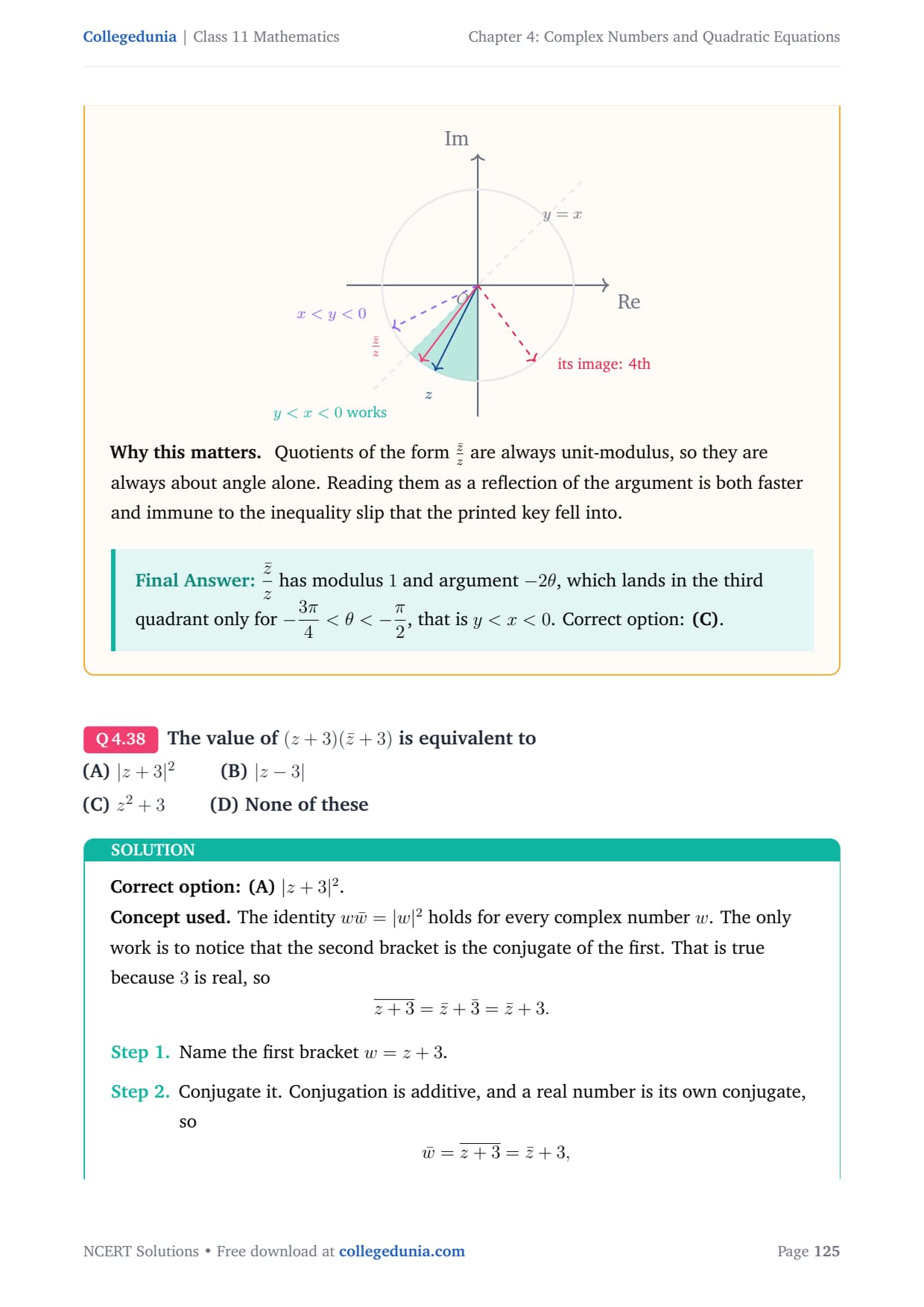
Q37 and the reversed inequality. Here z = x + iy lies in the third quadrant and the question asks when z̄/z also lies there. Many published solutions reach x2 < y2 and then write x < y. That step forgets that both x and y are negative, so comparing magnitudes reverses the inequality to x > y. The correct option is (C) y < x < 0. One test settles it: x = −2, y = −1 sends z̄/z to (3 − 4i)/5, which is in the fourth quadrant, so option (B) fails.
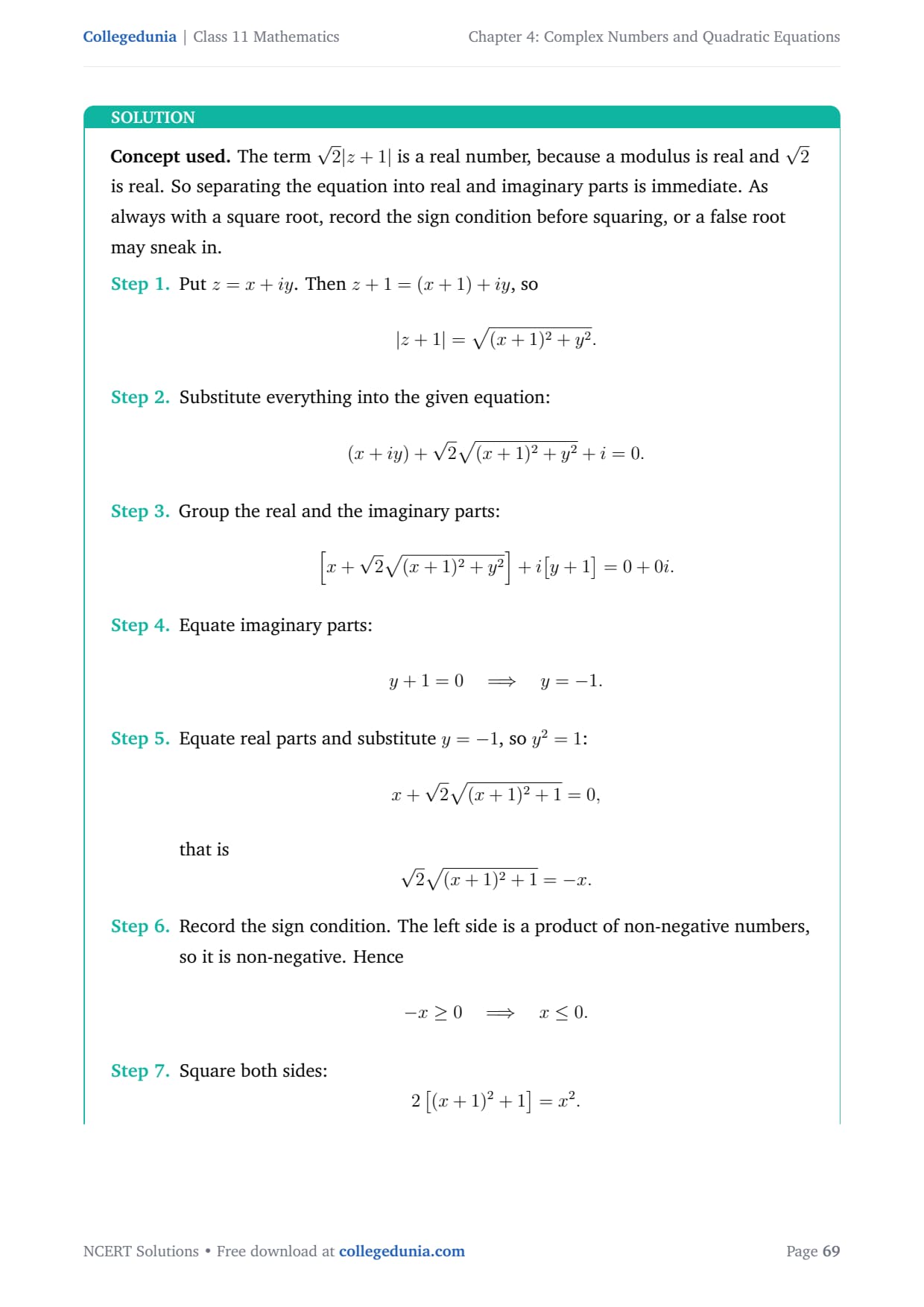
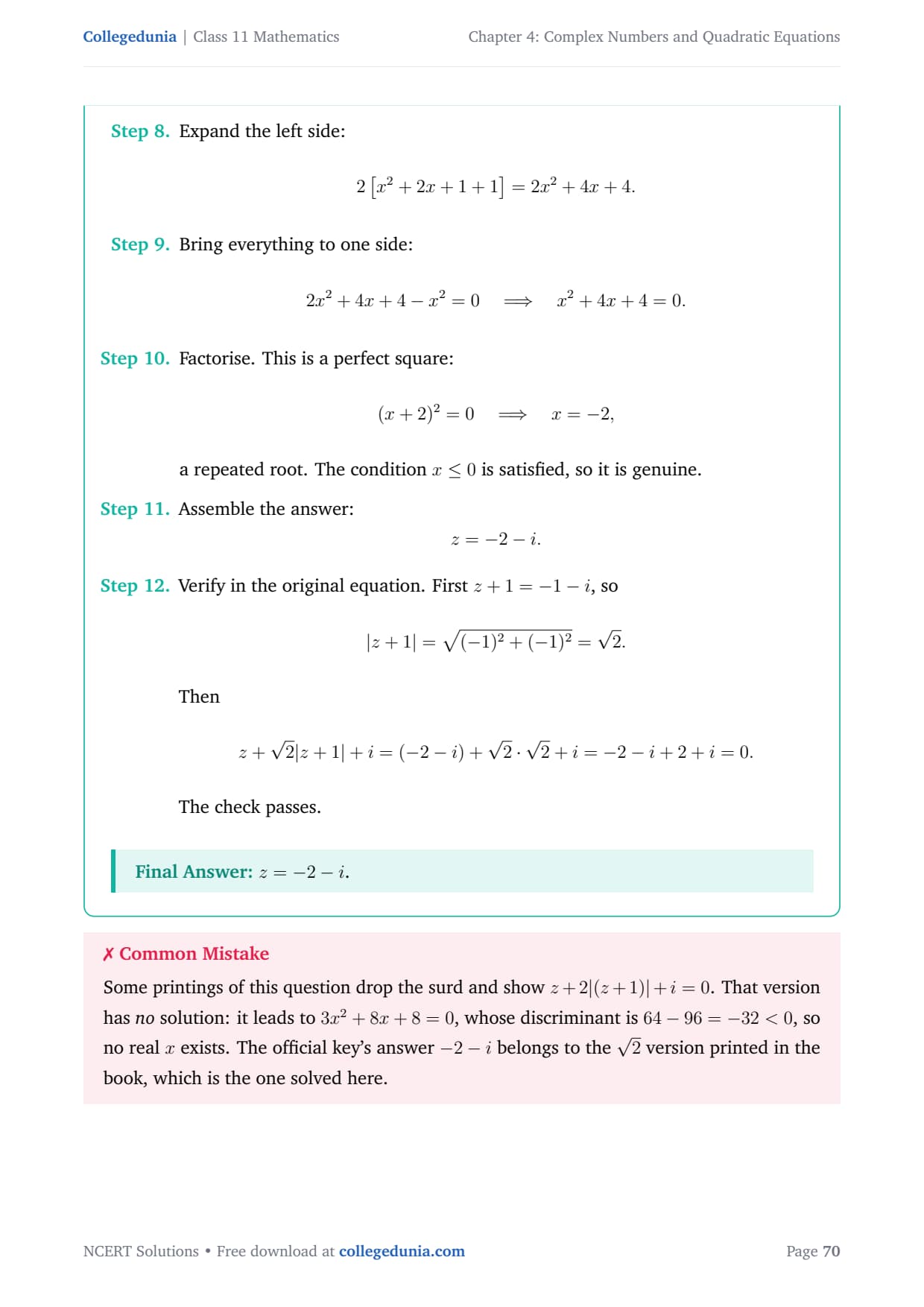
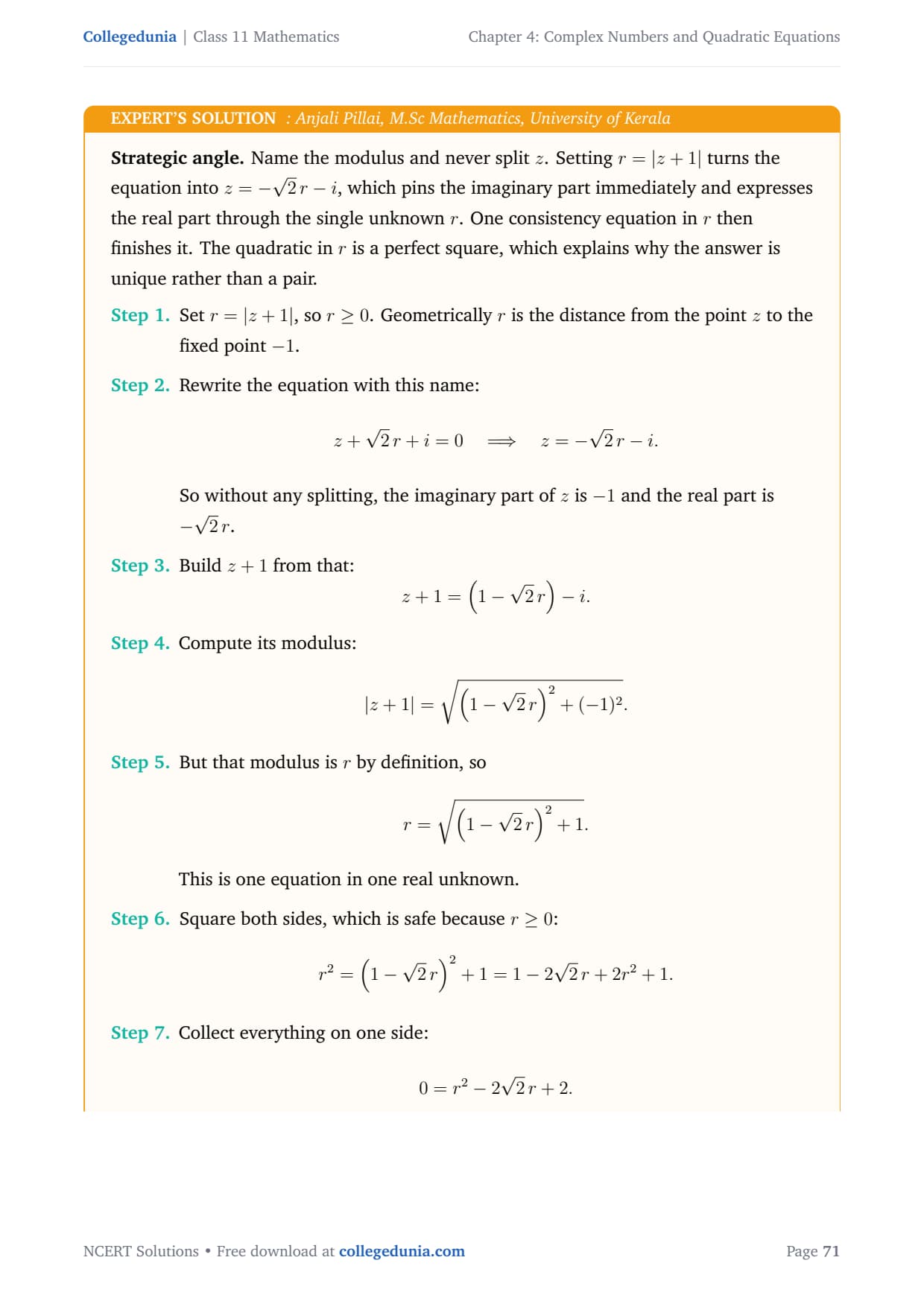
Q22, Q41 and Q46. Q22 asks for z with z + √2 |(z + 1)| + i = 0, and the answer is −2 − i. Some printings drop the surd and show z + 2|(z + 1)| + i = 0, which leads to 3x2 + 8x + 8 = 0 with discriminant 64 − 96 = −32, so that version has no solution at all. Solve the version printed in the book. Q41 and Q46 each have two true options: in Q41 option (D) follows from the reverse triangle inequality, and in Q46 option (D) is true because the two sides are always equal. In both, the key records the exact identity, and the exact identity is the safe choice.
Key Formulas and Results Used in the Complex Numbers Exemplar
This chapter has more formulas than most Class 11 topics, but the Exemplar only leans on a small core. Students should know these by heart before starting the exercise.
| Result | Statement | Where it is used |
|---|---|---|
| Powers of i | i2 = −1, i3 = −i, i4 = 1, then the cycle repeats | Q1, Q2, the series in Q25 |
| Modulus and conjugate | z z̄ = |z|2 and |z| = √(x2 + y2) | Almost every Long Answer question |
| Multiplicative modulus | |z1z2| = |z1||z2| and |z1/z2| = |z1|/|z2| | Q32, Q41 |
| Polar form | z = r(cos θ + i sin θ), r = |z|, θ = arg z | Q23, Q31, Q33 |
| Triangle inequality | |z1 + z2| ≤ |z1| + |z2|, with |z1 + z2| ≥ |z1| − |z2| as the reverse form | Q19, Q41, Q47 |
| Perpendicular bisector locus | |z − a| = |z − b| is the perpendicular bisector of the segment joining a and b | Q34, Q27, Q45 |
Tip: the single most useful line in the whole chapter is z z̄ = |z|2. It turns every conjugate question into a modulus question, and it is the result that settles the Q46 clash above.
Common Mistakes Students Make in the Complex Numbers Exemplar
The Exemplar twists trigger the same wrong reflexes every year. These four cost the most marks in this chapter.
- Reading the argument off tan θ alone. tan θ cannot tell a first-quadrant angle from a third-quadrant one. Plot the point, then pick the angle.
- Squaring an inequality between negative numbers. x2 < y2 does not give x < y when both are negative. This is exactly the Q37 slip.
- Writing √(−25) × √(−9) = √225. The surd rule needs a non-negative radicand. The right value is 5i × 3i = −15.
- Trying to order complex numbers. Statements like z1 < z2 have no meaning. Only moduli, which are real, can be compared.
How the Complex Numbers Exemplar Steps Up from the NCERT Textbook
The Exemplar does not add new topics. It asks the same ideas in a harder way, as the table shows.
| Concept | NCERT Textbook asks | NCERT Exemplar asks |
|---|---|---|
| Powers of i | Simplify i19 | Sum i + i2 + i3 up to 1000 terms |
| Conjugate | Find the conjugate of a given number | Prove (1 + i)z = (1 − i)z̄ forces z = −i z̄ |
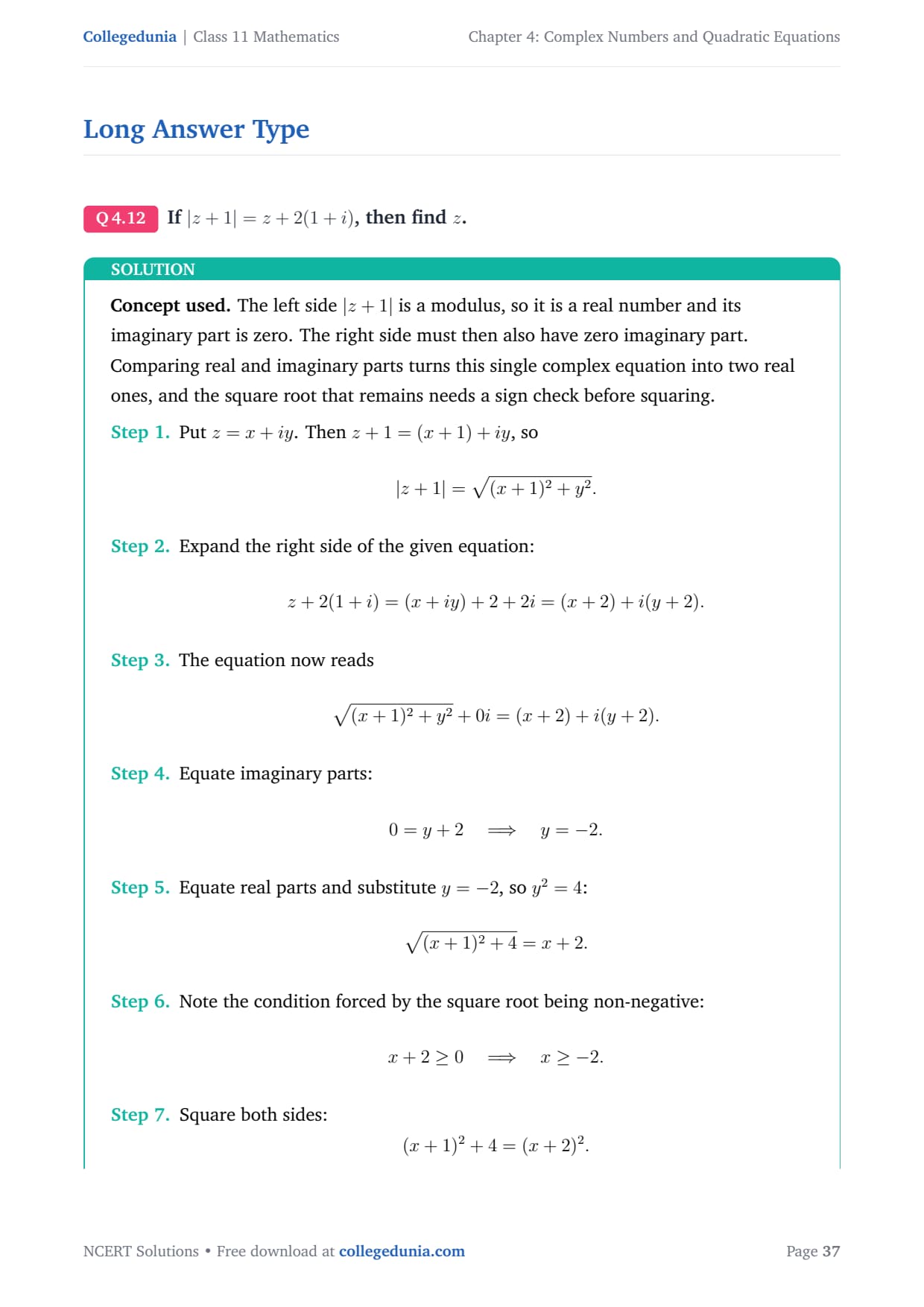
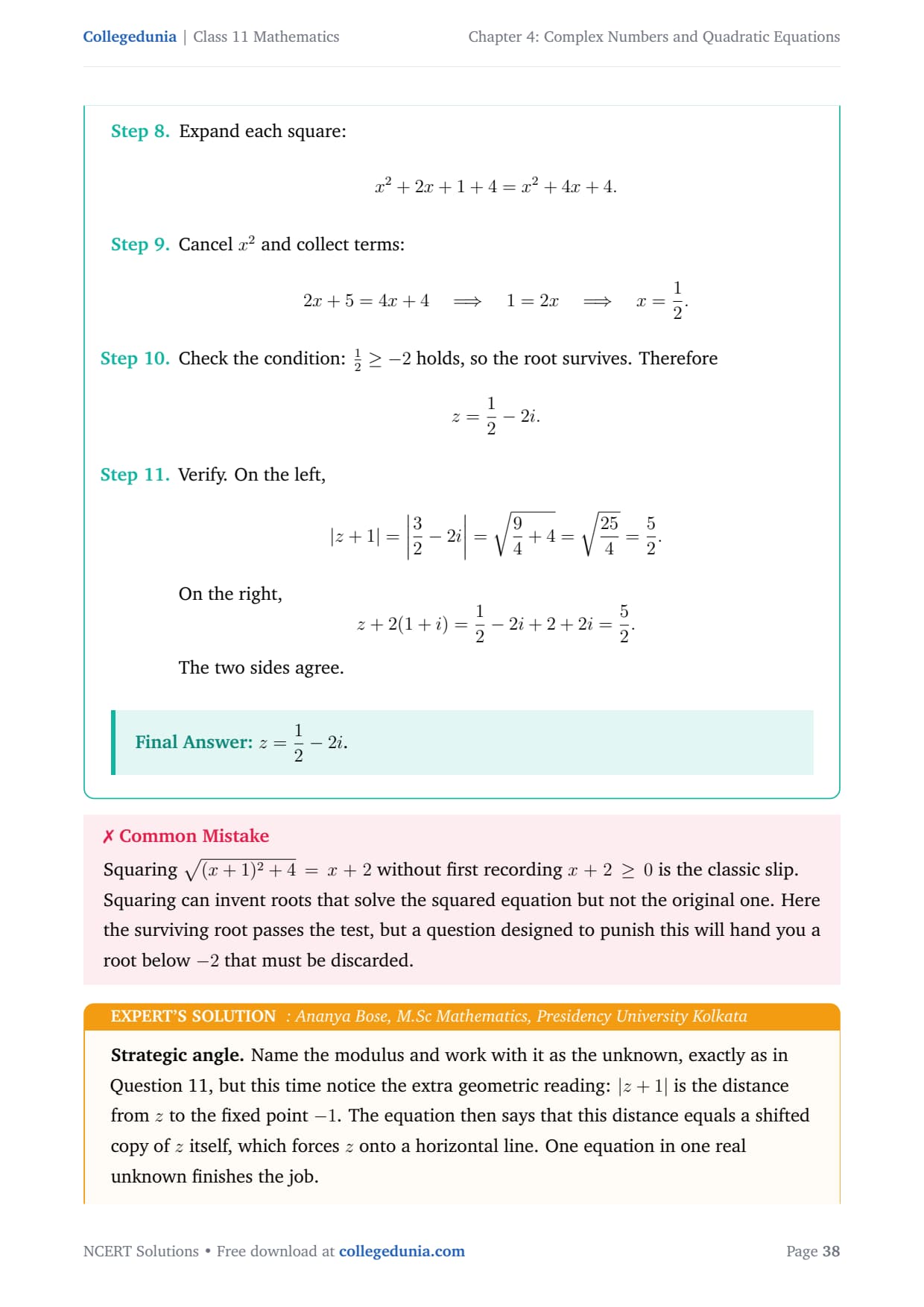
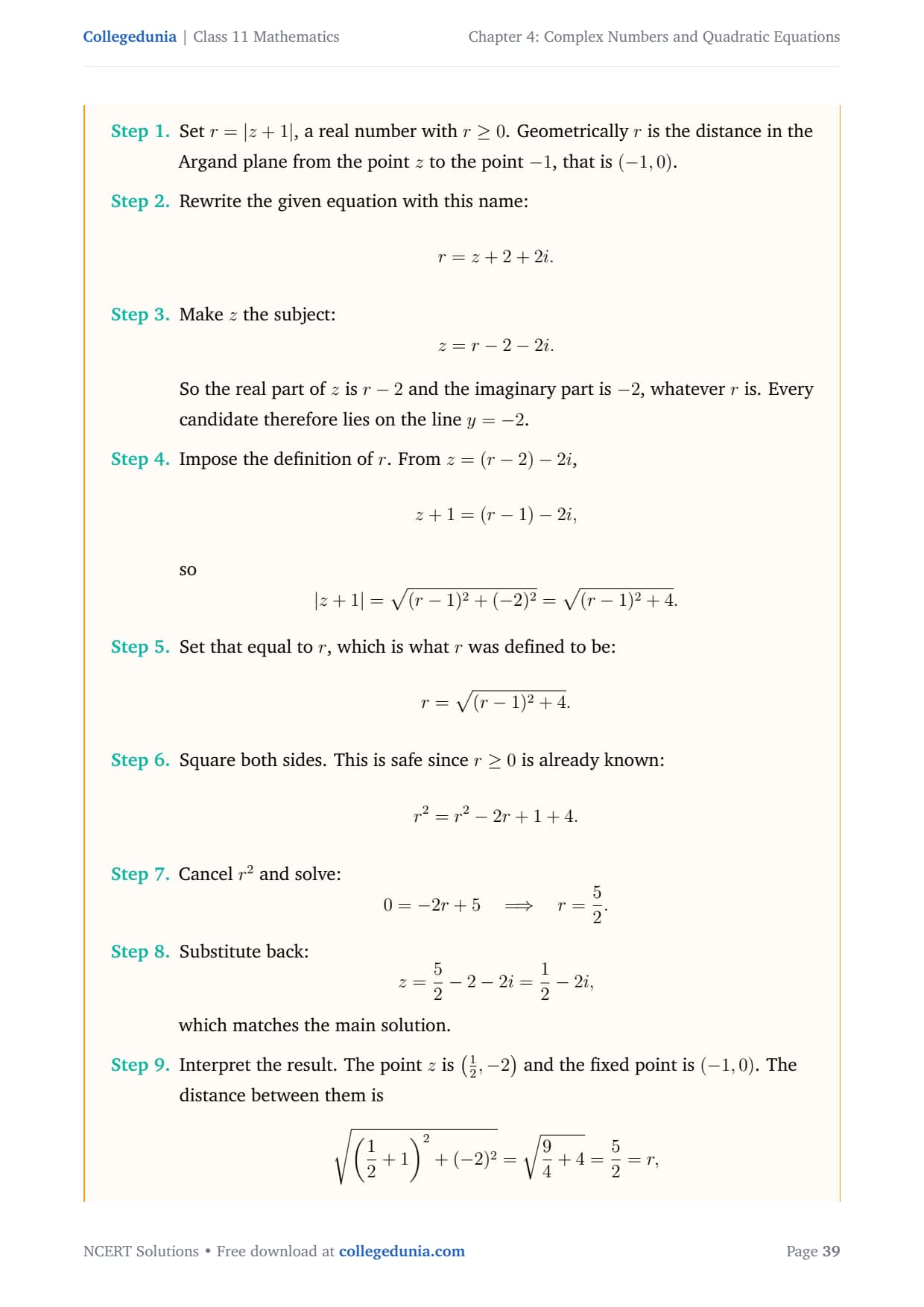
| Modulus | Compute |3 + 4i| | Solve |z| = z + 1 + 2i for z |
| Polar form | Write −1 + i in polar form | Divide by a polar denominator, then fix the quadrant |
| Argand plane | Plot a point | Show a modulus ratio represents a circle and find its centre |
How to Use the Complex Numbers Exemplar for Boards and JEE Preparation
Treat the exercise as four sittings, not one. Finish the NCERT textbook exercises first, because the Exemplar assumes students can already rationalise a fraction and plot a point on the Argand plane.
| Session | What to solve | Time |
|---|---|---|
| 1 | Short Answer Q1 to Q11 | 1.5 hours |
| 2 | Long Answer Q12 to Q24, full proofs written out | 2.5 hours |
| 3 | Q25 to Q34, the fill, true-false, match and short objective block | 1.5 hours |
| 4 | MCQ Q35 to Q50, then re-solve everything marked wrong | 1.5 hours |
That is about 7 hours for the chapter. For JEE Main and JEE Advanced, the MCQ block and the locus questions matter most, because rotation and Argand-plane geometry appear almost every year. For CBSE Boards and CUET, the Long Answer proofs and polar form are the better use of time.
Practice Questions for Class 11 Maths Complex Numbers and Quadratic Equations
After reading the solutions, students should test themselves on the same question types. The card below opens a set of solved practice questions with step-by-step answers for Complex Numbers and Quadratic Equations.
Practice Card: Solved Practice Questions for Class 11 Maths Complex Numbers and Quadratic Equations. Attempt each question, then check the solution.
Student Feedback
In a Collegedunia survey of 13,410 Class 11 students conducted before the 2026 exams, 68% of students said finding the correct argument was the step they got wrong most often. Only 7% of students had noticed that the printed answer key gives a first-quadrant angle for a third-quadrant number in Q23.
Other Resources for Class 11 Maths Complex Numbers and Quadratic Equations
Pair the Exemplar Solutions with the textbook solutions and the notes for full chapter revision. All the Complex Numbers and Quadratic Equations resources are linked below.
| Resource | Link |
|---|---|
| NCERT Solutions | Complex Numbers and Quadratic Equations Class 11 NCERT Solutions |
| Revision Notes | Complex Numbers and Quadratic Equations Class 11 Notes |
| Handwritten Notes | Complex Numbers and Quadratic Equations Class 11 Handwritten Notes |
| NCERT Book PDF | Complex Numbers and Quadratic Equations Class 11 NCERT Book PDF |
| Exemplar Book PDF | Complex Numbers and Quadratic Equations Class 11 NCERT Exemplar Book PDF |
NCERT Exemplar Solutions for Other Class 11 Maths Chapters
The full Class 11 Maths Exemplar set covers 14 chapters, 735 questions and 2,625 pages of solutions. Use the table to jump to any other chapter.
Complex Numbers and Quadratic Equations Class 11 Maths NCERT Exemplar Solutions FAQs
Ques. How many questions are there in the Class 11 Maths Complex Numbers and Quadratic Equations Exemplar?
Ans. Chapter 4 Complex Numbers and Quadratic Equations has 50 questions, all in one exercise, printed as Exercise 5.3 in the Exemplar's own numbering. They are split into 11 Short Answer, 13 Long Answer, 1 Fill in the Blanks, 1 True/False, 1 Match the Following, 7 short Objective and 16 MCQ questions. Every one of them is solved in the PDF on this page.
Ques. Is the printed NCERT Exemplar answer key for Complex Numbers correct?
Ans. Not fully. The key is wrong or unsafe on five questions: Q22, Q23, Q37, Q41 and Q46. The clearest error is Q23, where the key prints an argument of 5π/12 for a number that lies in the third quadrant. Each problem is explained on this page with the correct answer.
Ques. Why is the argument in Q23 of the Complex Numbers Exemplar equal to −7π/12?
Ans. Working out z = (1 − i) / (cos π/3 + i sin π/3) gives (1 − √3)/2 − i (√3 + 1)/2, which is about −0.366 − 1.366i. Both parts are negative, so the point lies in the third quadrant and the argument is −7π/12, or −105 degrees. The key's 5π/12 is 75 degrees, which is a first-quadrant angle, so it cannot be right.
Ques. What is the triangle inequality used in the Complex Numbers Exemplar?
Ans. It is |z1 + z2| ≤ |z1| + |z2|, with the reverse form |z1 + z2| ≥ |z1| − |z2|. Both hold for every pair of complex numbers. The MCQ block uses them in Q41 and Q47, and equality happens only when the two numbers point in the same direction from the origin.
Ques. Are the Class 11 Maths Complex Numbers and Quadratic Equations Exemplar Solutions free to download?
Ans. Yes. The Complex Numbers and Quadratic Equations NCERT Exemplar Solutions PDF is free to download from this page. It runs to 166 pages, solves every question step by step according to the 2026-27 NCERT Exemplar, and helps students prepare for CBSE Boards, JEE Main, JEE Advanced and CUET.



Comments