Chapter 8 Heredity is one of the highest-scoring biology chapters of Class 10 Science for 2026-27, and the NCERT Exemplar pushes it well past the textbook. The Class 10 Science Chapter 8 Heredity NCERT Exemplar Solutions on this page solve every Exemplar problem step by step, in plain language a board student can follow.
CBSE Board weightage: Heredity is part of the Heredity unit, and Mendel's crosses, sex determination and the dominant or recessive idea are repeat favourites.
What you get: all MCQ, Short Answer and Long Answer problems solved, with Punnett squares and a free downloadable PDF.
Student Feedback: In a Collegedunia survey of 1,240 Class 10 students, 81% said dihybrid crosses and the 9:3:3:1 ratio were the two topics they lost most marks on in Chapter 8, the exact gaps these Exemplar Solutions target.
Solved by Collegedunia: Every problem below is solved by subject experts, mapped to the 2026-27 NCERT Exemplar, and checked against the CBSE Board marking scheme.
Why the NCERT Exemplar Matters for Class 10 Board Preparation
Heredity is a chapter where many students slip on reasoning and ratio questions, not on memory. The NCERT Exemplar turns the basics into real exam-style questions: read-the-cross MCQs, fill-the-Punnett-square problems on monohybrid and dihybrid crosses, and reasoning on sex determination and inherited versus acquired characters. A large share of board questions mirror an Exemplar problem in shape, not the plain textbook example.
Quick Tip: Solve the NCERT textbook exercises first, then the Exemplar, which assumes you know the 3:1 monohybrid ratio and the Punnett square.
How Collegedunia's NCERT Exemplar Solutions Help You with Heredity
Each problem is solved the way a CBSE Board examiner expects: cross set out, gametes listed, ratio shown step by step.
Every question type solved: all MCQ, Short Answer and Long Answer Exemplar problems are worked out, not just the easy ones.
2026-27 Exemplar alignment: problem numbers and answers match the current edition, with the Evolution part dropped under the rationalised syllabus.
Step-by-step reasoning: each cross, from parents to F1 to F2, is built one stage at a time with a Punnett square so you can copy the method into the exam.
Trap flags: red boxes mark where students confuse "pure tall" with "all tall", or blame the mother for a child's sex.
Best Way to Use the Heredity Exemplar for Board Revision
Treat the Exemplar as a practice paper, not a re-read of the textbook. The plan below fits the biology revision window before your pre-boards.
Phase
Exemplar Use
Time
First read
All MCQs
1 hour
Concept practice
Monohybrid, dihybrid and sex-determination Short Answers
1.5 hours
Answer writing
All Long Answers, full working with Punnett squares
2 hours
Pre-board revision
Re-solve the wrong ones
1 hour
That is roughly 5.5 hours. Spend the most time on the dihybrid cross and sex determination, which carry the bulk of the marks.
Heredity Exemplar Question Types with One Solved Sample Each
The Chapter 8 Exemplar mixes several question formats. The table previews the shape of each; the full solved set sits further down this page.
Type
Sample Question
Answer Shape
MCQ
A cross between TT and tt gives all tall plants because...
Single option, with reason
MCQ (statement-based)
Which statements describe a gene?
Pick the correct set of statements
Short Answer
How is the sex of a newborn determined in humans?
Three to four line reason
Cross / Punnett
Write the progeny of RrYy × RrYy
Genotypes and the phenotype ratio
Long Answer
Differentiate inherited and acquired characters
Several linked points, examples
Every one of these is solved in full in the question bank below, with a Check Solution and an Expert Solution tab.
Mendel's Crosses and the 3:1 and 9:3:3:1 Ratios
Most Exemplar problems test whether you can read a cross and predict the offspring. A monohybrid cross follows one trait, a dihybrid cross two. Keep these two ratios in your head.
Dihybrid crossRrYy × RrYy: phenotype ratio 9 : 3 : 3 : 1 across round-yellow, round-green, wrinkled-yellow and wrinkled-green.
New combinations: round-green and wrinkled-yellow are the recombinants that the parents never had; they come from independent assortment.
Because the two genes sort independently, the F1 makes four kinds of gametes and the F2 shows four looks. Remember capital dominates small: a capital allele (R, Y, T) masks the small-letter recessive whenever both are present.
Difficulty Step-Up from NCERT Textbook to Exemplar
The Exemplar reuses textbook ideas inside harder wrappers. The contrast below shows the twist on the same concept.
Concept
NCERT Textbook
NCERT Exemplar
Dominance
Define a dominant trait
Read an all-tall F1 and reason out which trait is dominant
Monohybrid cross
State the 3:1 ratio
Find the ratio of pure tall to short, not just tall to short
Dihybrid cross
State the 9:3:3:1 ratio
Pick the brand-new recombinant combinations from the F2
Sex determination
Females XX, males XY
Explain why a woman with only daughters is not at fault
Gene to protein
Genes code for proteins
Spot the statement that wrongly links a gene to fat
The textbook gives the rule; the Exemplar gives a situation and asks you to apply the rule and justify it.
Topics Covered in Class 10 Science Chapter 8 Heredity Exemplar
The Exemplar stretches the textbook across several skills. MCQs test dominant and recessive traits, the monohybrid and dihybrid cross ratios, gene expression through proteins, and the sex chromosomes X and Y. Short Answers cover sex determination, why all eggs carry an X, the 50:50 sex ratio, and why Mendel chose the pea plant. Long Answers cover inherited versus acquired characters and how new combinations arise from independent assortment.
Heredity Exemplar Common Mistakes That Cost Marks
The Exemplar twists trigger the same wrong reflexes every year. Watch these four.
Confusing "pure tall" with "all tall". Pure tall means homozygous TT only; the heterozygous Tt plants look tall but are not pure.
Blaming the mother for a child's sex. The egg is always X; the father's sperm carries the deciding X or Y.
Forgetting the new combinations. In a dihybrid F2, round-green and wrinkled-yellow are the recombinants, not the parental types.
Linking a gene to fat. Genes code for proteins (and so enzymes and protein hormones), but a fat molecule is not coded directly by a gene.
A single wrong step in a cross can lose the whole mark, so always list the gametes, fill the Punnett square, and read the ratio in order.
Watch Out: In a statement-based MCQ, test every statement to the end. Stopping at the first correct one is the most common way students lose marks in this chapter.
Sex Determination in Humans Quick Reference
Many Exemplar problems ask you to read off the sex of a child from the chromosomes. Keep this table in your head; it covers the cases the chapter tests most.
Parent or gamete
Sex chromosome
Outcome
Mother (female)
XX
Every egg carries one X
Father (male)
XY
Half the sperm carry X, half carry Y
X-sperm + X-egg
XX
Girl
Y-sperm + X-egg
XY
Boy
Overall
X vs Y sperm = 1 : 1
Boy : girl = 50 : 50
Because the egg is always X, the father's sperm decides the sex of the child. A handy phrase is egg is always X, dad brings the choice.
Most Repeated Board Topics from Heredity
A quick scan of the topics that show up most often in CBSE Board and sample papers for this chapter.
Topic
How it is asked
Monohybrid cross
Find the F2 phenotype or genotype ratio
Dihybrid cross
Write the progeny or pick the recombinant combinations
All NCERT Exemplar Questions for Heredity with Step-by-Step Solutions
Every question of the NCERT Exemplar set for Class 10 Science Chapter 8 Heredity is listed below with its full Solution and Expert Solution inside collapsible tabs. Click Check Solution to reveal the step-by-step working; click Expert Solution for the expanded explanation.
I. Multiple Choice Questions
Q 8.1
Exchange of genetic material takes place in (a) vegetative reproduction (b) asexual reproduction (c) sexual reproduction (d) budding
Correct option: (c) sexual reproduction.
Concept used.Heredity works through the mixing of genetic material from two parents. This mixing can happen only when two different gametes (a male gamete and a female gamete) fuse. That fusion of gametes is the defining feature of sexual reproduction.
In sexual reproduction, a sperm (from the father) and an egg (from the mother) join during fertilisation.
The sperm carries half the father's DNA; the egg carries half the mother's DNA. When they fuse, the two sets combine in the zygote, so genetic material is exchanged between the two parents.
Check the other options: vegetative reproduction, budding and the broad class of asexual reproduction all use a single parent. No second gamete is involved, so there is no exchange of genetic material.
Only sexual reproduction brings two different DNA sets together, so option (c) is correct.
Genetic material is exchanged only when gametes from two parents fuse, i.e. in sexual reproduction ⇒ (c).
Quick test
If a process needs two parents and gametes, it is sexual reproduction and it brings new gene combinations. If it needs only one parent (budding, fragmentation, vegetative propagation), the offspring are genetic clones.
AV
Anjali Verma
PhD Genetics, University of Delhi
Verified Expert
Why the exchange matters. The phrase "exchange of genetic material" is the examiner's way of asking which mode of reproduction shuffles two parents' DNA into one offspring. In sexual reproduction two events do this work. First, fertilisation pools one full haploid set from each parent into a diploid zygote. Second, just before the gametes form, the paired chromosomes line up and can swap segments during meiosis, so even a single parent's gametes are not all alike.
Reading the wrong options. Vegetative reproduction (a runner, a tuber, a leaf bud) grows a new plant from one parent's body cells; budding (as in Hydra or yeast) buds off a new individual from one parent; both sit inside the larger family of asexual reproduction. None of these involves a second gamete, so the offspring inherit exactly one parent's genome with no exchange. This is precisely why asexually produced organisms show very little variation, while sexually produced ones show a lot.
Exchange of genetic material = fusion of two parents' gametes = sexual reproduction ⇒ option (c).
Q 8.2
Two pink coloured flowers on crossing resulted in 1 red, 2 pink and 1 white flower progeny. The nature of the cross will be (a) double fertilisation (b) self pollination (c) cross fertilisation (d) no fertilisation
Correct option: (b) self pollination.
Concept used. A 1:2:1 ratio in the offspring is the genotype ratio of a monohybrid cross where both parents have the same mixed (heterozygous) make-up. Pink itself is the heterozygous form here (a blend of one red allele and one white allele). When two identical pink plants are crossed, the only way the exact 1:2:1 ratio appears is if each plant fertilises itself, i.e. self pollination.
Let red be RR, white be rr, and pink be the heterozygote Rr (incomplete dominance: Rr looks pink).
The cross is pink × pink = Rr × Rr done on the same kind of flower, i.e. selfing.
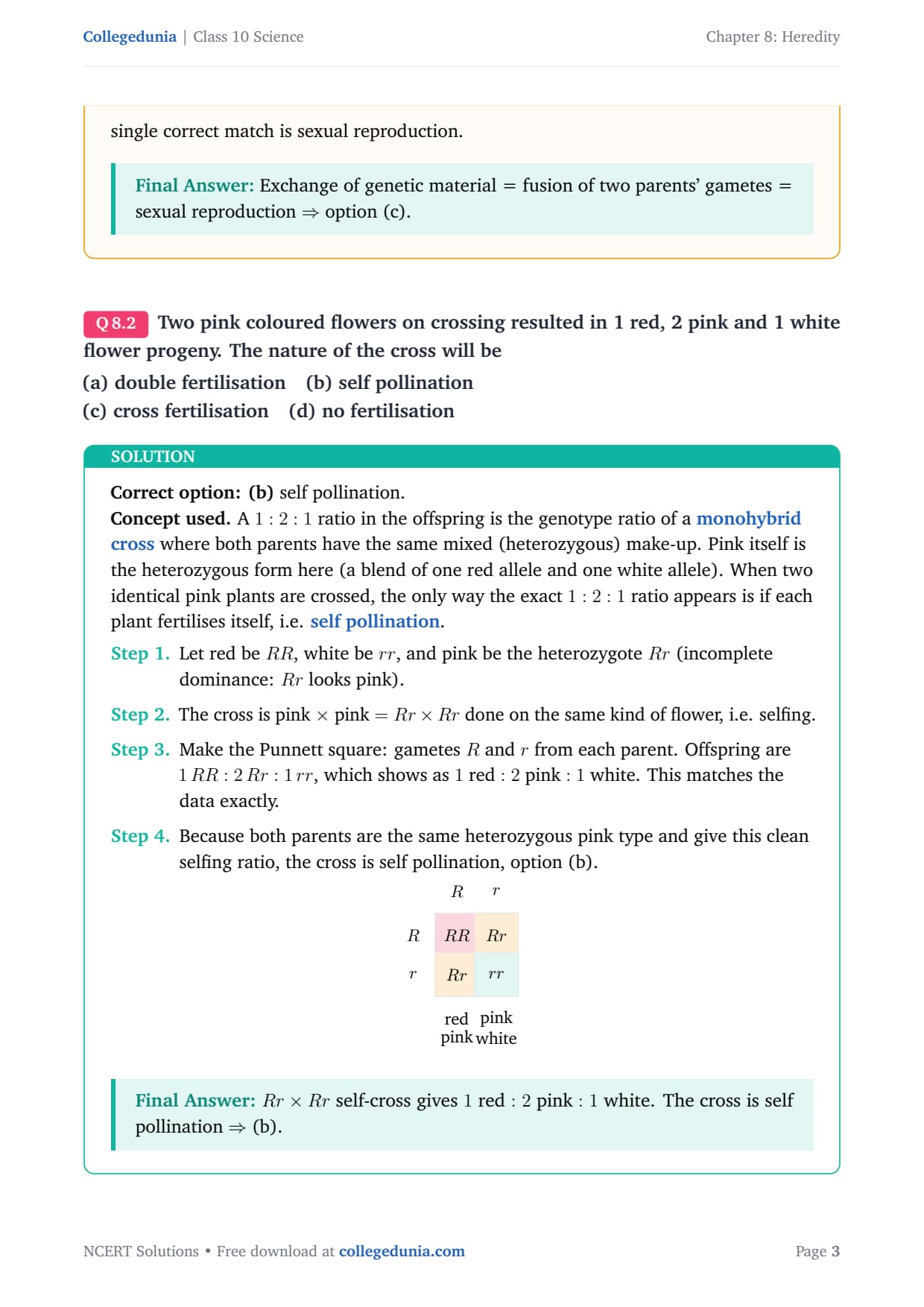
Make the Punnett square: gametes R and r from each parent. Offspring are 1 RR : 2 Rr : 1 rr, which shows as 1 red : 2 pink : 1 white. This matches the data exactly.
Because both parents are the same heterozygous pink type and give this clean selfing ratio, the cross is self pollination, option (b).
R
r
R
RR
Rr
r
Rr
rr
RR = red, Rr = pink, rr = white
Rr × Rr self-cross gives 1 red : 2 pink : 1 white. The cross is self pollination ⇒ (b).
Incomplete dominance
When neither allele fully masks the other, the heterozygote shows a blended look (here pink). The genotype ratio 1:2:1 then becomes the visible phenotype ratio too, which is the giveaway in this question.
RN
Ramesh Nair
MSc PhD Botany, Banaras Hindu University
Verified Expert
Spotting the 1:2:1 signal. Examiners pick the 1:2:1 pattern because it points to one specific cross: a heterozygote crossed with an identical heterozygote. The colours red, pink and white tell you this is incomplete dominance, where the pink plants are themselves Rr. So both "parents" carry the same two alleles.
Why selfing, not generic cross-fertilisation. Cross fertilisation only means pollen reaches a different flower; it does not guarantee both parents are the same Rr type. The question states both starting flowers are pink, i.e. both Rr, and the offspring fall in the exact 1:2:1 ratio. A flower pollinating itself is the cleanest description of this set-up, so self pollination is the best answer. "No fertilisation" is ruled out because offspring did appear. Hence option (b).
Pink (Rr) selfed → 1 red : 2 pink : 1 white; the 1:2:1 ratio marks a self pollination of identical heterozygotes ⇒ option (b).
Q 8.3
A cross between a tall plant (TT) and short pea plant (tt) resulted in progeny that were all tall plants because (a) tallness is the dominant trait (b) shortness is the dominant trait (c) tallness is the recessive trait (d) height of pea plant is not governed by gene ‘T’ or ‘t’
Correct option: (a) tallness is the dominant trait.
Concept used. A dominant trait is one that shows up in the offspring even when only one copy of its allele is present. The recessive trait stays hidden whenever the dominant allele is also present. In Mendel's pea plants, T (tall) is dominant over t (short).
Parents: TT (pure tall) ×tt (pure short).
TT can give only T gametes; tt can give only t gametes.
Every offspring is therefore Tt (one T from the tall parent, one t from the short parent).
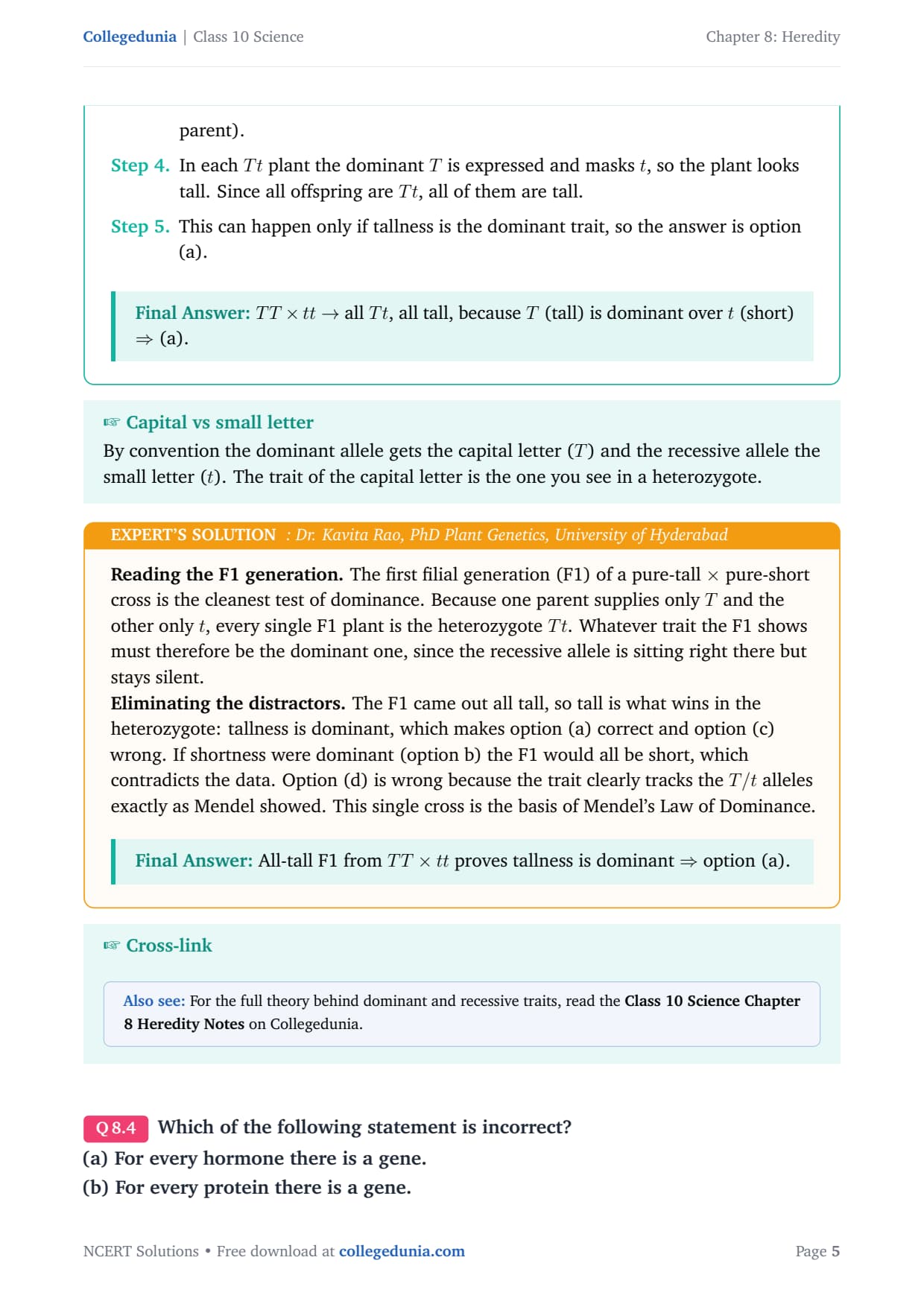
In each Tt plant the dominant T is expressed and masks t, so the plant looks tall. Since all offspring are Tt, all of them are tall.
This can happen only if tallness is the dominant trait, so the answer is option (a).
TT × tt → all Tt, all tall, because T (tall) is dominant over t (short) ⇒ (a).
Capital vs small letter
By convention the dominant allele gets the capital letter (T) and the recessive allele the small letter (t). The trait of the capital letter is the one you see in a heterozygote.
KR
Kavita Rao
PhD Plant Genetics, University of Hyderabad
Verified Expert
Reading the F1 generation. The first filial generation (F1) of a pure-tall × pure-short cross is the cleanest test of dominance. Because one parent supplies only T and the other only t, every single F1 plant is the heterozygote Tt. Whatever trait the F1 shows must therefore be the dominant one, since the recessive allele is sitting right there but stays silent.
Eliminating the distractors. The F1 came out all tall, so tall is what wins in the heterozygote: tallness is dominant, which makes option (a) correct and option (c) wrong. If shortness were dominant (option b) the F1 would all be short, which contradicts the data. Option (d) is wrong because the trait clearly tracks the T/t alleles exactly as Mendel showed. This single cross is the basis of Mendel's Law of Dominance.
All-tall F1 from TT × tt proves tallness is dominant ⇒ option (a).
Q 8.4
Which of the following statement is incorrect? (a) For every hormone there is a gene. (b) For every protein there is a gene. (c) For production of every enzyme there is a gene. (d) For every molecule of fat there is a gene.
Correct option: (d) For every molecule of fat there is a gene.
Concept used. A gene is a stretch of DNA that carries the instructions to build one protein. Genes make proteins, and many proteins are enzymes; some hormones (like insulin) are also proteins. But fat (a lipid) is not a protein, so it is not built straight from a gene. The statement that links a gene to "every molecule of fat" is the wrong one.
Recall the rule: one gene codes for one protein. Proteins are the direct products of genes.
Statement (b) "for every protein there is a gene" is the basic rule itself, so it is correct.
Statement (c) is correct because enzymes are proteins, and proteins come from genes.
Statement (a) is correct for protein hormones; many hormones are proteins coded by genes.
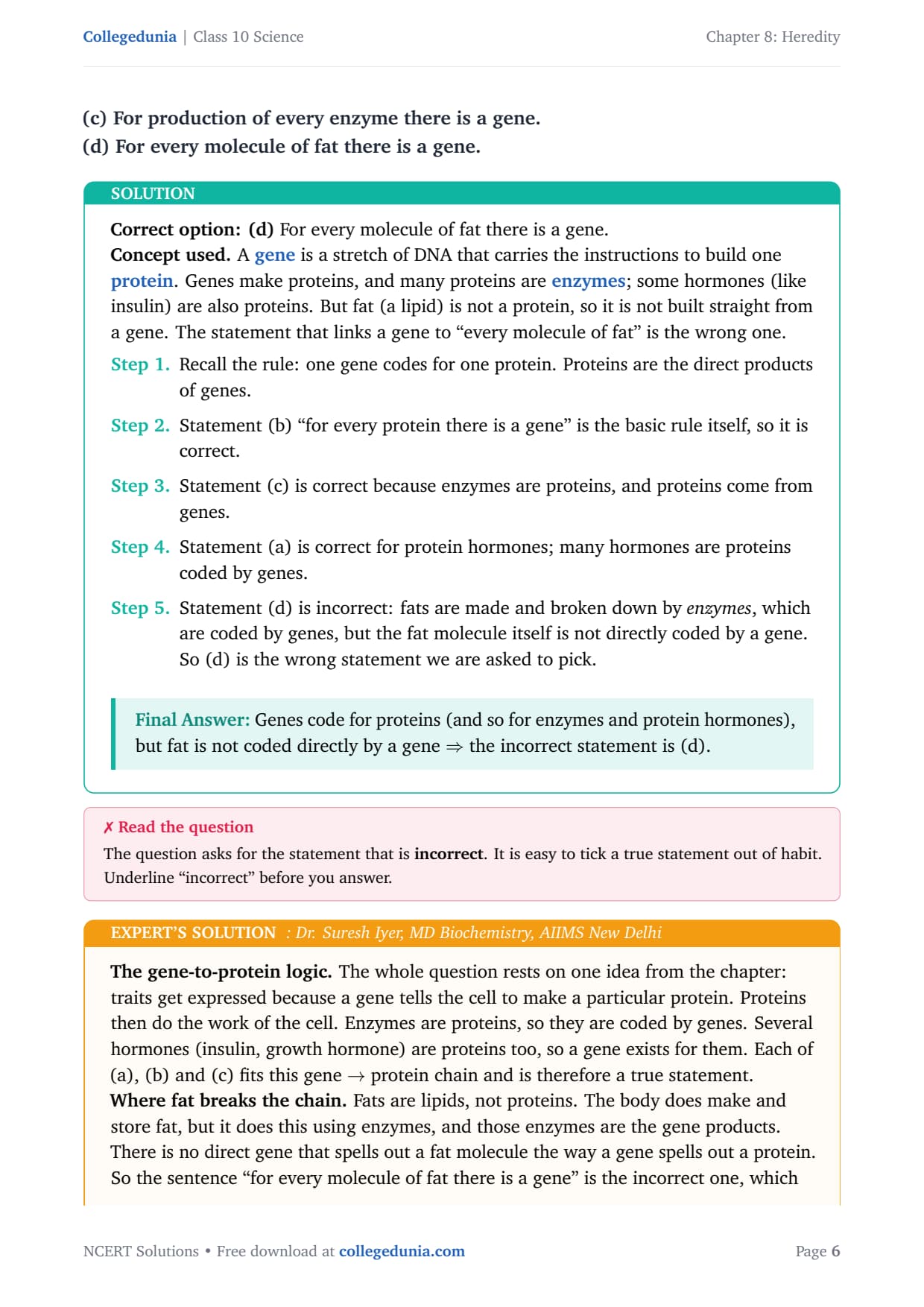
Statement (d) is incorrect: fats are made and broken down by enzymes, which are coded by genes, but the fat molecule itself is not directly coded by a gene. So (d) is the wrong statement we are asked to pick.
Genes code for proteins (and so for enzymes and protein hormones), but fat is not coded directly by a gene ⇒ the incorrect statement is (d).
Read the question
The question asks for the statement that is incorrect. It is easy to tick a true statement out of habit. Underline "incorrect" before you answer.
SI
Suresh Iyer
MD Biochemistry, AIIMS New Delhi
Verified Expert
The gene-to-protein logic. The whole question rests on one idea from the chapter: traits get expressed because a gene tells the cell to make a particular protein. Proteins then do the work of the cell. Enzymes are proteins, so they are coded by genes. Several hormones (insulin, growth hormone) are proteins too, so a gene exists for them. Each of (a), (b) and (c) fits this gene → protein chain and is therefore a true statement.
Where fat breaks the chain. Fats are lipids, not proteins. The body does make and store fat, but it does this using enzymes, and those enzymes are the gene products. There is no direct gene that spells out a fat molecule the way a gene spells out a protein. So the sentence "for every molecule of fat there is a gene" is the incorrect one, which makes (d) the right choice.
No gene codes a fat molecule directly; only proteins (and hence enzymes and protein hormones) are gene products ⇒ incorrect statement is (d).
Q 8.5
If a round, green seeded pea plant (RR yy) is crossed with wrinkled, yellow seeded pea plant (rr YY), the seeds produced in F1 generation are (a) round and yellow (b) round and green (c) wrinkled and green (d) wrinkled and yellow
Correct option: (a) round and yellow.
Concept used. In a dihybrid cross, two traits are followed at once. In pea seeds, round (R) is dominant over wrinkled (r), and yellow (Y) is dominant over green (y). The F1 plant inherits one allele of each gene from each parent; the dominant allele decides how each trait looks.
Parent 1 is RR yy (round, green). It can give only the gamete Ry.
Parent 2 is rr YY (wrinkled, yellow). It can give only the gamete rY.
Combine the gametes: every F1 plant is Rr Yy.
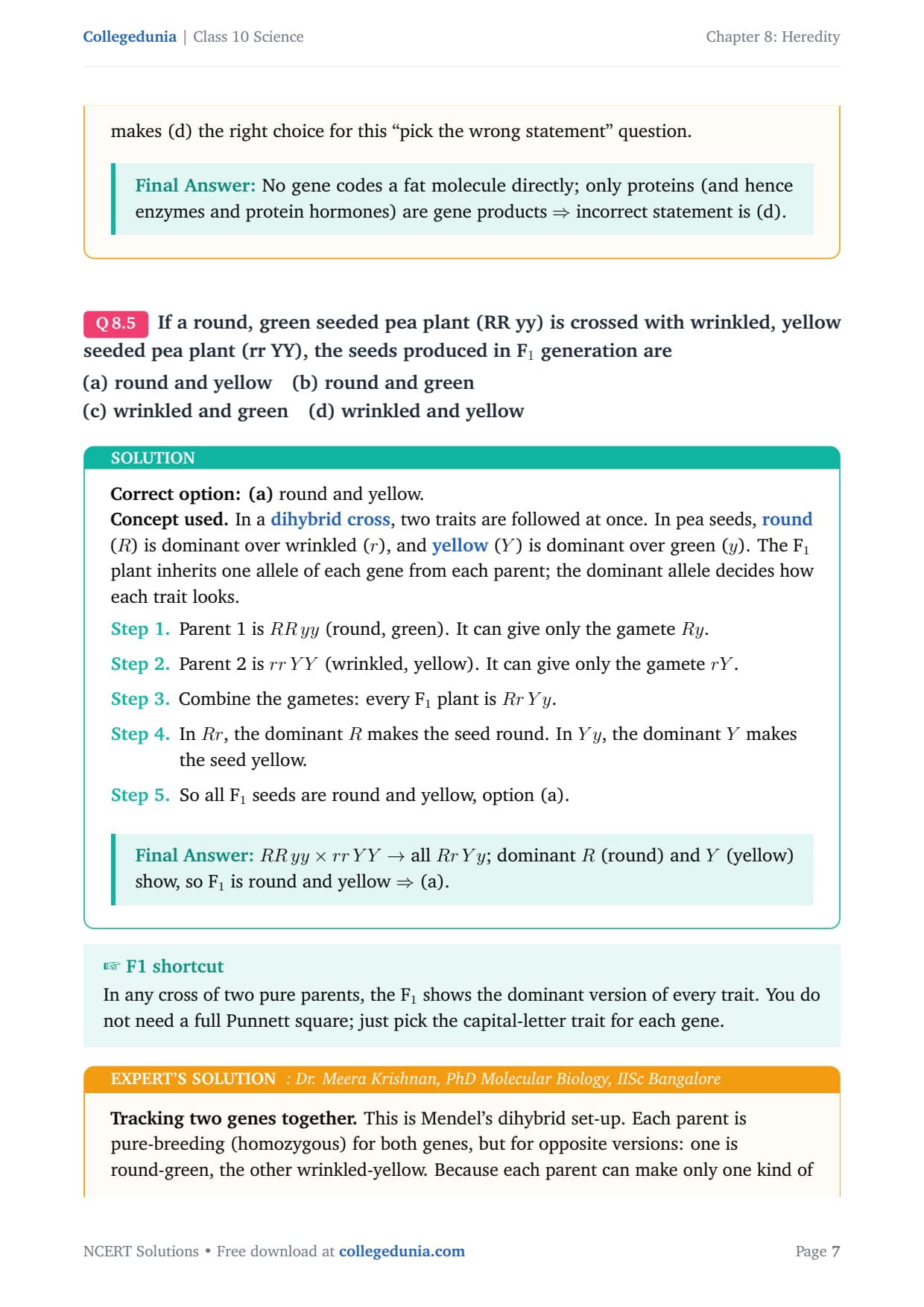
In Rr, the dominant R makes the seed round. In Yy, the dominant Y makes the seed yellow.
So all F1 seeds are round and yellow, option (a).
RR yy × rr YY → all Rr Yy; dominant R (round) and Y (yellow) show, so F1 is round and yellow ⇒ (a).
F1 shortcut
In any cross of two pure parents, the F1 shows the dominant version of every trait. You do not need a full Punnett square; just pick the capital-letter trait for each gene.
MK
Meera Krishnan
PhD Molecular Biology, IISc Bangalore
Verified Expert
Tracking two genes together. This is Mendel's dihybrid set-up. Each parent is pure-breeding (homozygous) for both genes, but for opposite versions: one is round-green, the other wrinkled-yellow. Because each parent can make only one kind of gamete, the F1 is forced to be uniform: every seed is Rr Yy.
Why round and yellow win. Once you know the F1 genotype is Rr Yy, dominance settles the look. R beats r, so the seed is round, not wrinkled; Y beats y, so the seed is yellow, not green. The two recessive parental looks (wrinkled and green) disappear in F1 and reappear only in F2. So options (b), (c) and (d), which each keep a recessive trait, are wrong, and (a) round and yellow is correct.
F1 of RR yy × rr YY is uniformly Rr Yy, showing the dominant round + yellow ⇒ option (a).
Q 8.6
In human males all the chromosomes are paired perfectly except one. This/these unpaired chromosome is/are (i) large chromosome (ii) small chromosome (iii) Y-chromosome (iv) X-chromosome (a) (i) and (ii) (b) (iii) only (c) (iii) and (iv) (d) (ii) and (iv)
Correct option: (c) (iii) and (iv).
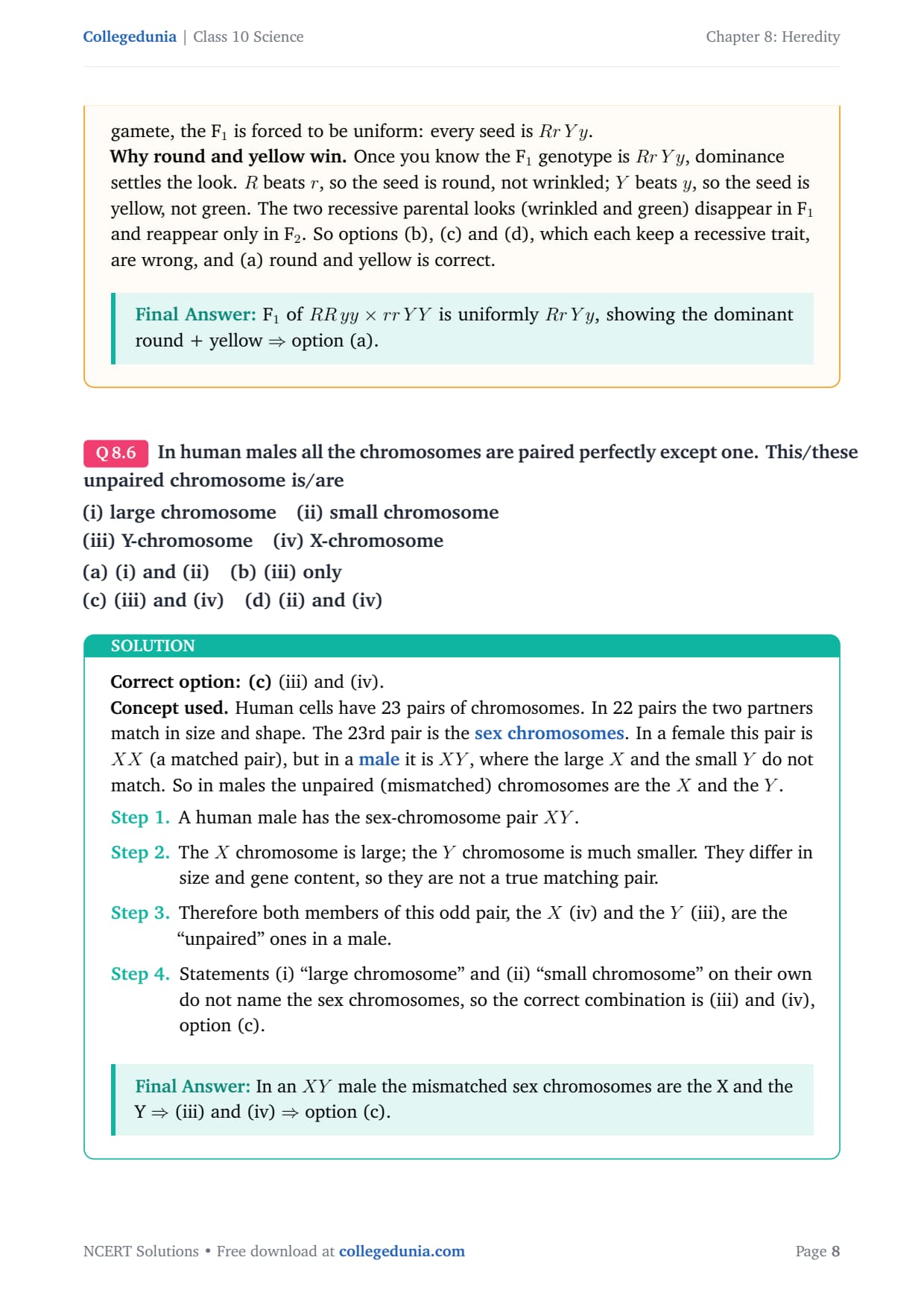
Concept used. Human cells have 23 pairs of chromosomes. In 22 pairs the two partners match in size and shape. The 23rd pair is the sex chromosomes. In a female this pair is XX (a matched pair), but in a male it is XY, where the large X and the small Y do not match. So in males the unpaired (mismatched) chromosomes are the X and the Y.
A human male has the sex-chromosome pair XY.
The X chromosome is large; the Y chromosome is much smaller. They differ in size and gene content, so they are not a true matching pair.
Therefore both members of this odd pair, the X (iv) and the Y (iii), are the "unpaired" ones in a male.
Statements (i) "large chromosome" and (ii) "small chromosome" on their own do not name the sex chromosomes, so the correct combination is (iii) and (iv), option (c).
In an XY male the mismatched sex chromosomes are the X and the Y ⇒ (iii) and (iv) ⇒ option (c).
XX vs XY
Females are XX (a perfectly matched 23rd pair); males are XY (a mismatched pair). The mismatch in males is exactly why their sex chromosomes are described as "unpaired".
AJ
Arvind Joshi
MSc PhD Cell Biology, JNU New Delhi
Verified Expert
What "unpaired" really means. The word "unpaired" here does not mean the chromosome has no partner at all. It means the partner is not an identical match. In 22 of the 23 human pairs (the autosomes) the two chromosomes are alike. The 23rd pair is special: in males it is X together with Y, two chromosomes of very different size and gene content.
Why both X and Y count. Since the male's 23rd pair is made of an X and a Y that do not match, both of these are the odd ones out, not just one. That is why option (c), naming both (iii) Y and (iv) X, is correct, while (b) "(iii) only" is incomplete. Options referring merely to "large" or "small" chromosomes (i and ii) do not specifically identify the sex chromosomes.
Male sex pair XY = mismatched X (large) + Y (small); both are the unpaired chromosomes ⇒ (iii) and (iv) ⇒ option (c).
Q 8.7
The maleness of a child is determined by (a) the X chromosome in the zygote (b) the Y chromosome in zygote (c) the cytoplasm of germ cell which determines the sex (d) sex is determined by chance
Correct option: (b) the Y chromosome in zygote.
Concept used. A child's sex depends on which sex chromosome the sperm brings. The egg always carries an X. If the sperm also brings an X, the zygote is XX (girl). If the sperm brings a Y, the zygote is XY (boy). So the presence of the Y chromosome in the zygote is what makes the child male.
The mother's egg is always X.
The father's sperm is either X or Y.
Sperm X + egg X→ XX zygote → female.
Sperm Y + egg X→ XY zygote → male.
Maleness appears only when a Y chromosome is present in the zygote, so option (b) is correct.
Egg is always X; a Y-carrying sperm makes the zygote XY (male). So the Y chromosome decides maleness ⇒ (b).
Father decides the sex
Because the egg is always X, the sex of a baby is fixed entirely by whether the fertilising sperm carried X or Y. The father, not the mother, supplies the deciding chromosome.
NS
Neha Saxena
PhD Human Genetics, AIIMS Jodhpur
Verified Expert
The deciding chromosome. The question targets a common misconception, that sex is somehow set by the mother or by chance alone. In humans the egg is uniform: it always carries one X. The variation comes only from the father, whose sperm population is half X-bearing and half Y-bearing. The sex of the zygote is therefore read straight from the sperm's contribution.
Why the Y is the maleness switch. A Y chromosome carries the gene that triggers male development. When a Y-bearing sperm fertilises the egg, the XY zygote develops as a boy; without the Y, the XX zygote develops as a girl. So maleness is determined by the Y chromosome in the zygote, option (b). The X in (a) cannot be the answer because every zygote has at least one X; cytoplasmic effects (c) do not decide human sex; and the sex itself is decided strictly by the chromosome the sperm carries, so (d) is not the precise answer.
The Y chromosome carried into the zygote by the sperm switches on male development ⇒ option (b).
Q 8.8
A zygote which has an X-chromosome inherited from the father will develop into a (a) boy (b) girl (c) X-chromosome does not determine the sex of a child (d) either boy or girl
Correct option: (b) girl.
Concept used. The egg always carries an X. So the chromosome the father contributes decides the sex. If the father's sperm brings an X, then the zygote has the mother's X plus the father's X, making it XX, which develops into a girl.
Mother's contribution to the zygote: always X.
Given: father also contributes an X in this case.
Zygote sex chromosomes = X (mother) + X (father) = XX.
An XX zygote develops into a female (girl), so option (b) is correct.
Father's X + mother's X = XX zygote → girl ⇒ (b).
The egg sets one X
Since the mother's gamete is fixed at X, you only need the father's contribution to read off the sex: father's X→ girl, father's Y→ boy.
VD
Vikram Desai
MSc PhD Genetics, Savitribai Phule Pune University
Verified Expert
Pinning down the genotype. The key fact is that the mother can only give an X. So whatever the father gives becomes the second member of the pair. The question states the father has passed on an X. That fixes the zygote at XX with no ambiguity.
Reading off the sex. An XX individual develops as a female because there is no Y chromosome to trigger male development. So the child is a girl, option (b). Option (a) boy would need a Y from the father, which is not the case here. Option (c) is wrong because the sex chromosomes, including the X here, do decide sex. Option (d) "either" is wrong because the outcome is certain once both chromosomes are known to be X.
Paternal X plus the always-X egg gives XX, which develops into a girl ⇒ option (b).
Q 8.9
Two pea plants, one with round green seeds (RRyy) and another with wrinkled yellow (rrYY) seeds, produce F1 progeny that have round, yellow (RrYy) seeds. When F1 plants are selfed, the F2 progeny will have new combination of characters. Choose the new combination from the following. (i) Round, yellow (ii) Round, green (iii) Wrinkled, yellow (iv) Wrinkled, green (a) (i) and (ii) (b) (i) and (iv) (c) (ii) and (iii) (d) (i) and (iii)
Correct option: (b) (i) and (iv).
Concept used. In a dihybrid cross, the two genes are inherited independently (Mendel's Law of Independent Assortment). A "new combination" (a recombinant) is a trait pairing that neither original parent had. The parents were round-green and wrinkled-yellow, so the brand-new pairings in F2 are round-yellow and wrinkled-green.
Original parents: RR yy = round, green; and rr YY = wrinkled, yellow. List their trait pairings: round+green and wrinkled+yellow.
Selfing Rr Yy × Rr Yy gives four phenotypes in the 9:3:3:1 ratio: round-yellow, round-green, wrinkled-yellow, wrinkled-green.
Remove the two pairings already present in the parents (round-green and wrinkled-yellow). What is left has never been seen before.
The genuinely new pairings are round-yellow (i) and wrinkled-green (iv).
So the new combinations are (i) and (iv), which is option (b).
Parents had round-green and wrinkled-yellow; the new F2 pairings are round-yellow (i) and wrinkled-green (iv) ⇒ option (b).
Independent assortment
Mendel's second law says the alleles of one gene sort into gametes independently of another gene's alleles. This is what lets brand new trait pairings appear in the F2 generation.
PM
Pooja Malhotra
PhD Plant Breeding, Punjab Agricultural University
Verified Expert
Where new combinations come from. The two starting plants were round-green and wrinkled-yellow. The F1 pooled all four alleles into Rr Yy. When this F1 is selfed, the R/r gene sorts independently of the Y/y gene during gamete formation, so the F2 shuffles the traits into all four possible pairings in the classic 9:3:3:1 ratio.
Identifying the recombinants. "New combination" means a trait pairing that neither original parent had. The parents carried round-green and wrinkled-yellow, so those two pairings are old. The remaining two F2 phenotypes, round-yellow and wrinkled-green, are the recombinants that appear for the first time. These match items (i) and (iv), which is option (b). Independent assortment is the source of these fresh combinations, which is the very reason sexual reproduction generates so much variation.
New (recombinant) F2 phenotypes are round-yellow (i) and wrinkled-green (iv) ⇒ option (b).
Q 8.10
A trait in an organism is influenced by (a) paternal DNA only (b) maternal DNA only (c) both maternal and paternal DNA (d) neither by paternal nor by maternal DNA
Correct option: (c) both maternal and paternal DNA.
Concept used. In sexually reproducing organisms, each individual gets one set of chromosomes from the mother (maternal DNA) and one set from the father (paternal DNA). For most genes there are two copies, one from each parent, and both copies together decide how a trait appears.
The egg brings the mother's haploid set of chromosomes.
The sperm brings the father's haploid set of chromosomes.
In the zygote the two sets pair up, so each gene is present in two copies, one maternal and one paternal.
Whether a trait is dominant or recessive, the outcome depends on both copies together. So a trait is influenced by both maternal and paternal DNA, option (c).
Each gene has a maternal copy and a paternal copy; both decide the trait ⇒ (c).
Two copies of each gene
Remember that body cells are diploid: every autosomal gene comes in a pair, one allele from each parent. That is why both parents' DNA shapes a trait.
SG
Sanjay Gupta
MD Pathology, PGIMER Chandigarh
Verified Expert
Why both parents matter. A diploid organism stores its genes in pairs. One member of each pair is inherited from the mother through the egg, the other from the father through the sperm. Because both alleles sit at the same place on the matching chromosomes, both have a say in the trait, whether through dominance, recession or a blended effect.
Ruling out the single-parent options. Saying a trait is from "paternal DNA only" (a) or "maternal DNA only" (b) ignores the fact that the zygote carries a balanced contribution from each parent. Option (d) is plainly wrong because traits are encoded by DNA. Only option (c), both maternal and paternal DNA, fits how inheritance actually works in sexually reproducing organisms.
A trait is controlled by paired alleles, one maternal and one paternal ⇒ option (c).
Q 8.11
The two versions of a trait (character) which are brought in by the male and female gametes are situated on (a) copies of the same chromosome (b) two different chromosomes (c) sex chromosomes (d) any chromosome
Correct option: (a) copies of the same chromosome.
Concept used. The two versions of a trait are the two alleles of a gene. A gene sits at a fixed spot (locus) on a chromosome. The maternal and paternal alleles of the same gene therefore lie at the same locus on the two copies of the same chromosome (the homologous pair).
A gene has a fixed position on a particular chromosome.
In a diploid cell each chromosome is present as a homologous pair: one came from the mother, one from the father.
The mother's allele and the father's allele of that gene sit at the same position, but each on its own copy of that chromosome.
So the two versions of the trait are on copies of the same (homologous) chromosome, option (a).
Maternal and paternal alleles of a gene lie at the same locus on the two copies of the same homologous chromosome ⇒ (a).
Allele vs gene
A gene is the whole instruction at a locus; an allele is one version of it. Two alleles of one gene always share the same address on homologous chromosomes.
RB
Ritu Banerjee
PhD Cytogenetics, University of Calcutta
Verified Expert
Locating the two versions. "Two versions of a trait" is the textbook phrase for a pair of alleles. By definition, alleles of one gene occupy the very same position on the chromosome. Since a diploid cell holds two copies of each chromosome (a homologous pair), the maternal allele sits on one copy and the paternal allele on the other copy of that same chromosome.
Eliminating the alternatives. They are not on "two different chromosomes" (b) because that would make them alleles of different genes, not two versions of one trait. They are not restricted to "sex chromosomes" (c) because most traits are coded on autosomes. "Any chromosome" (d) is too loose, since the two alleles are pinned to one specific homologous pair. So option (a), copies of the same chromosome, is the precise answer.
The two alleles of a gene share one locus across the two copies of the same homologous chromosome ⇒ option (a).
Q 8.12
Select the statements that describe characteristics of genes. (i) genes are specific sequence of bases in a DNA molecule (ii) a gene does not code for proteins (iii) in individuals of a given species, a specific gene is located on a particular chromosome (iv) each chromosome has only one gene (a) (i) and (ii) (b) (i) and (iii) (c) (i) and (iv) (d) (ii) and (iv)
Correct option: (b) (i) and (iii).
Concept used. A gene is a specific stretch (a particular sequence of bases) in a DNA molecule that codes for a protein, and it sits at a fixed location on a specific chromosome. Using these facts, statements (i) and (iii) are true while (ii) and (iv) are false.
Statement (i): genes are a specific sequence of bases in DNA. True, this is the definition of a gene.
Statement (ii): a gene does not code for proteins. False, the whole purpose of most genes is to code for proteins.
Statement (iii): a specific gene is located on a particular chromosome in members of a species. True, gene positions are fixed.
Statement (iv): each chromosome has only one gene. False, a single chromosome carries hundreds to thousands of genes.
True statements are (i) and (iii), so the answer is option (b).
True gene facts are (i) sequence of bases and (iii) fixed chromosomal location ⇒ option (b).
One chromosome, many genes
A common slip is statement (iv). A chromosome is a long DNA molecule carrying very many genes in a row, not just one. Reject (iv) on sight.
HM
Harish Menon
MSc PhD Biochemistry, Anna University
Verified Expert
Checking each statement. This is a true/false sorting task. Statement (i) restates the molecular definition of a gene as a defined base sequence in DNA, so it is correct. Statement (iii) captures the idea that each gene has a fixed address on a particular chromosome shared across a species, which is correct and is the reason gene maps are reproducible.
Spotting the false ones. Statement (ii) claims genes do not code for proteins, which contradicts the chapter's central message that genes work by directing protein synthesis. Statement (iv) claims one gene per chromosome, but a human chromosome holds hundreds to thousands of genes lined up along its DNA. Discarding (ii) and (iv) leaves (i) and (iii), so option (b) is correct.
Correct gene properties are (i) and (iii); (ii) and (iv) are false ⇒ option (b).
Q 8.13
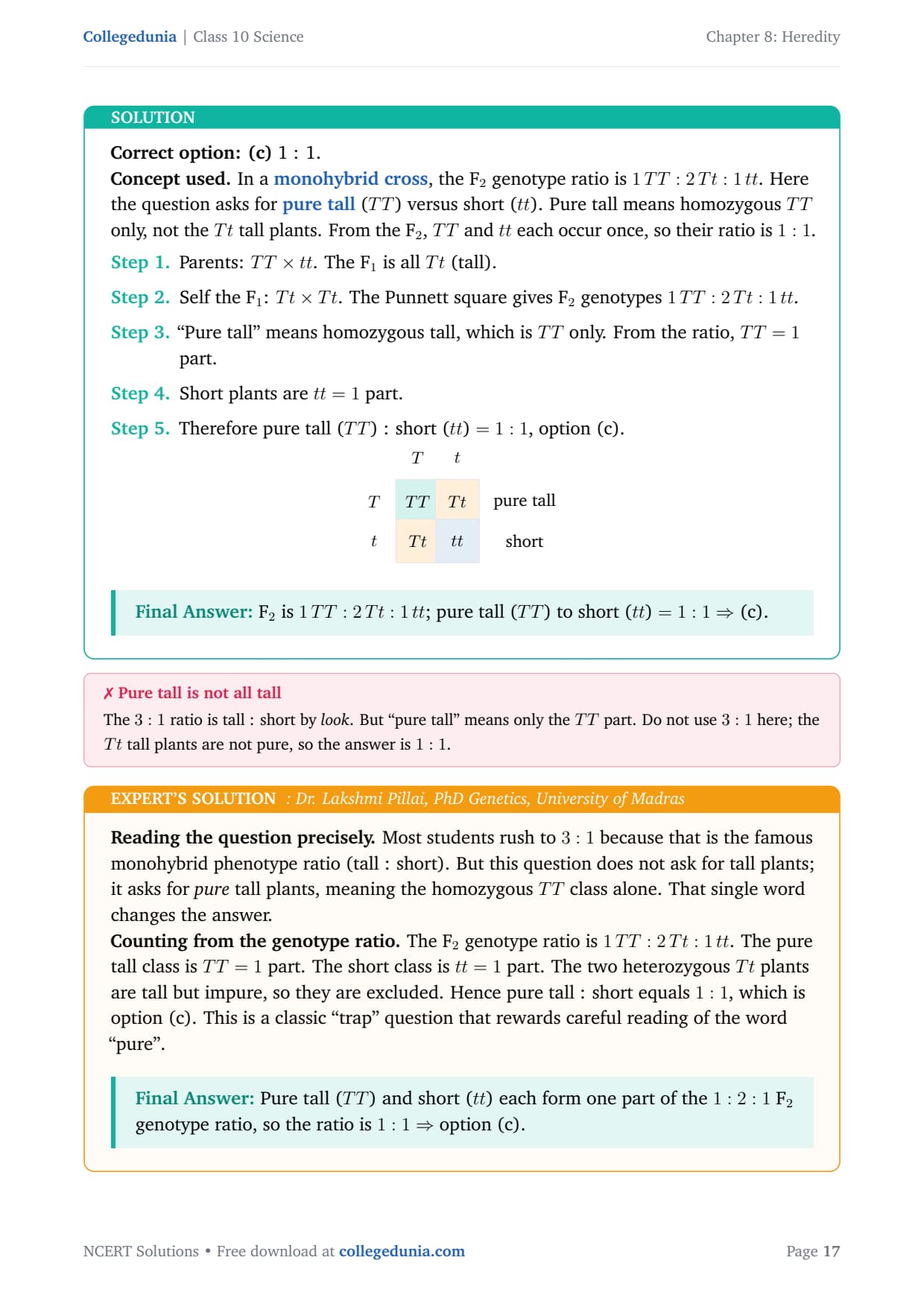
In peas, a pure tall plant (TT) is crossed with a short plant (tt). The ratio of pure tall plants to short plants in F2 is (a) 1 : 3 (b) 3 : 1 (c) 1 : 1 (d) 2 : 1
Correct option: (c) 1 : 1.
Concept used. In a monohybrid cross, the F2 genotype ratio is 1 TT : 2 Tt : 1 tt. Here the question asks for pure tall (TT) versus short (tt). Pure tall means homozygous TT only, not the Tt tall plants. From the F2, TT and tt each occur once, so their ratio is 1:1.
Parents: TT × tt. The F1 is all Tt (tall).
Self the F1: Tt × Tt. The Punnett square gives F2 genotypes 1 TT : 2 Tt : 1 tt.
"Pure tall" means homozygous tall, which is TT only. From the ratio, TT = 1 part.
Short plants are tt = 1 part.
Therefore pure tall (TT) : short (tt) = 1 : 1, option (c).
T
t
T
TT
Tt
t
Tt
tt
TT = pure tall, tt = short
F2 is 1 TT : 2 Tt : 1 tt; pure tall (TT) to short (tt) = 1 : 1 ⇒ (c).
Pure tall is not all tall
The 3:1 ratio is tall : short by look. But "pure tall" means only the TT part. Do not use 3:1 here; the Tt tall plants are not pure, so the answer is 1:1.
LP
Lakshmi Pillai
PhD Genetics, University of Madras
Verified Expert
Reading the question precisely. Most students rush to 3:1 because that is the famous monohybrid phenotype ratio (tall : short). But this question does not ask for tall plants; it asks for pure tall plants, meaning the homozygous TT class alone. That single word changes the answer.
Counting from the genotype ratio. The F2 genotype ratio is 1 TT : 2 Tt : 1 tt. The pure tall class is TT = 1 part. The short class is tt = 1 part. The two heterozygous Tt plants are tall but impure, so they are excluded. Hence pure tall : short equals 1:1, which is option (c). This is a classic "trap" question that rewards careful reading of the word "pure".
Pure tall (TT) and short (tt) each form one part of the 1:2:1 F2 genotype ratio, so the ratio is 1:1 ⇒ option (c).
Q 8.14
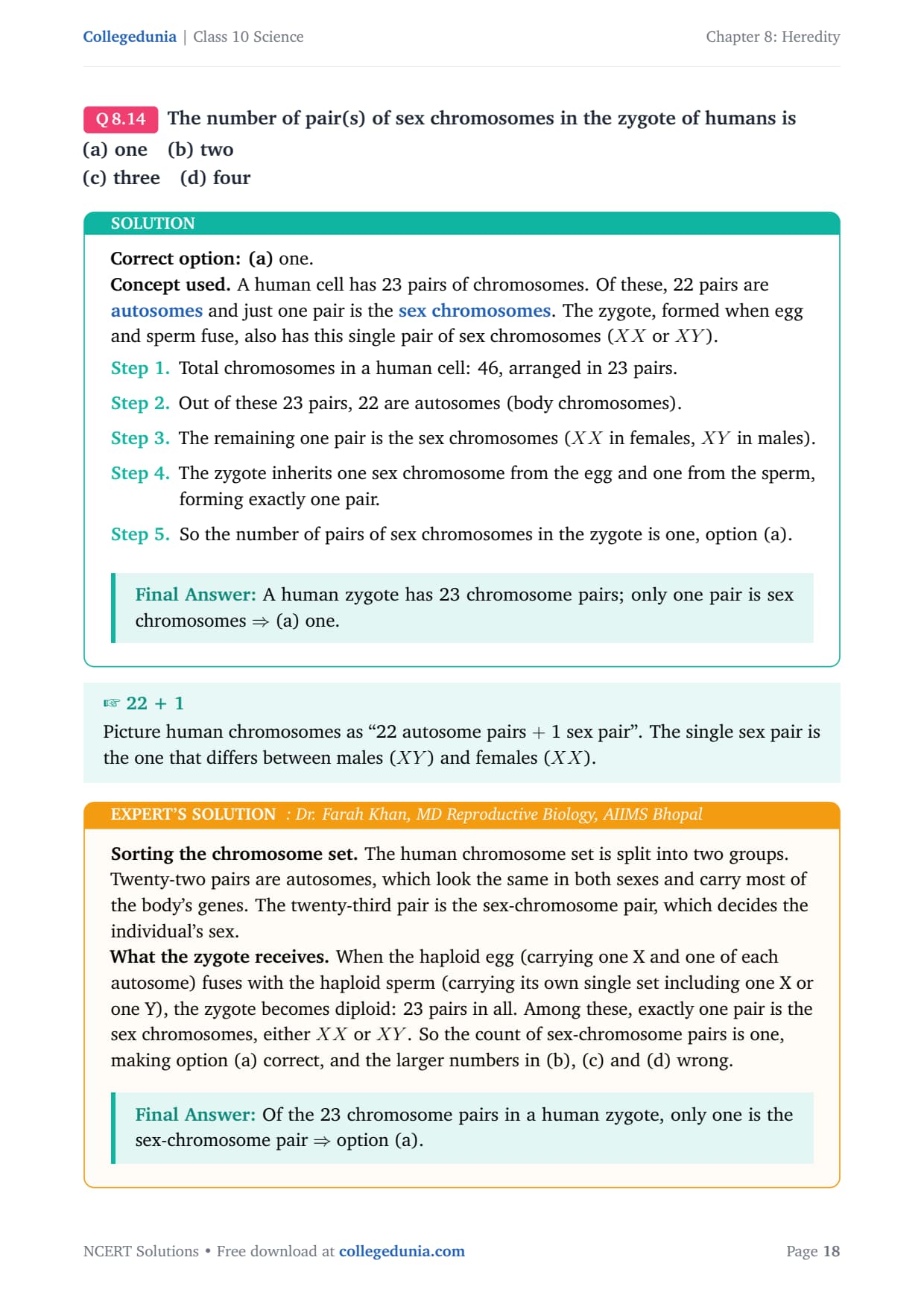
The number of pair(s) of sex chromosomes in the zygote of humans is (a) one (b) two (c) three (d) four
Correct option: (a) one.
Concept used. A human cell has 23 pairs of chromosomes. Of these, 22 pairs are autosomes and just one pair is the sex chromosomes. The zygote, formed when egg and sperm fuse, also has this single pair of sex chromosomes (XX or XY).
Total chromosomes in a human cell: 46, arranged in 23 pairs.
Out of these 23 pairs, 22 are autosomes (body chromosomes).
The remaining one pair is the sex chromosomes (XX in females, XY in males).
The zygote inherits one sex chromosome from the egg and one from the sperm, forming exactly one pair.
So the number of pairs of sex chromosomes in the zygote is one, option (a).
A human zygote has 23 chromosome pairs; only one pair is sex chromosomes ⇒ (a) one.
22 + 1
Picture human chromosomes as "22 autosome pairs + 1 sex pair". The single sex pair is the one that differs between males (XY) and females (XX).
FK
Farah Khan
MD Reproductive Biology, AIIMS Bhopal
Verified Expert
Sorting the chromosome set. The human chromosome set is split into two groups. Twenty-two pairs are autosomes, which look the same in both sexes and carry most of the body's genes. The twenty-third pair is the sex-chromosome pair, which decides the individual's sex.
What the zygote receives. When the haploid egg (carrying one X and one of each autosome) fuses with the haploid sperm (carrying its own single set including one X or one Y), the zygote becomes diploid: 23 pairs in all. Among these, exactly one pair is the sex chromosomes, either XX or XY. So the count of sex-chromosome pairs is one, making option (a) correct.
Of the 23 chromosome pairs in a human zygote, only one is the sex-chromosome pair ⇒ option (a).
II. Short Answer Type Questions
Q 8.15
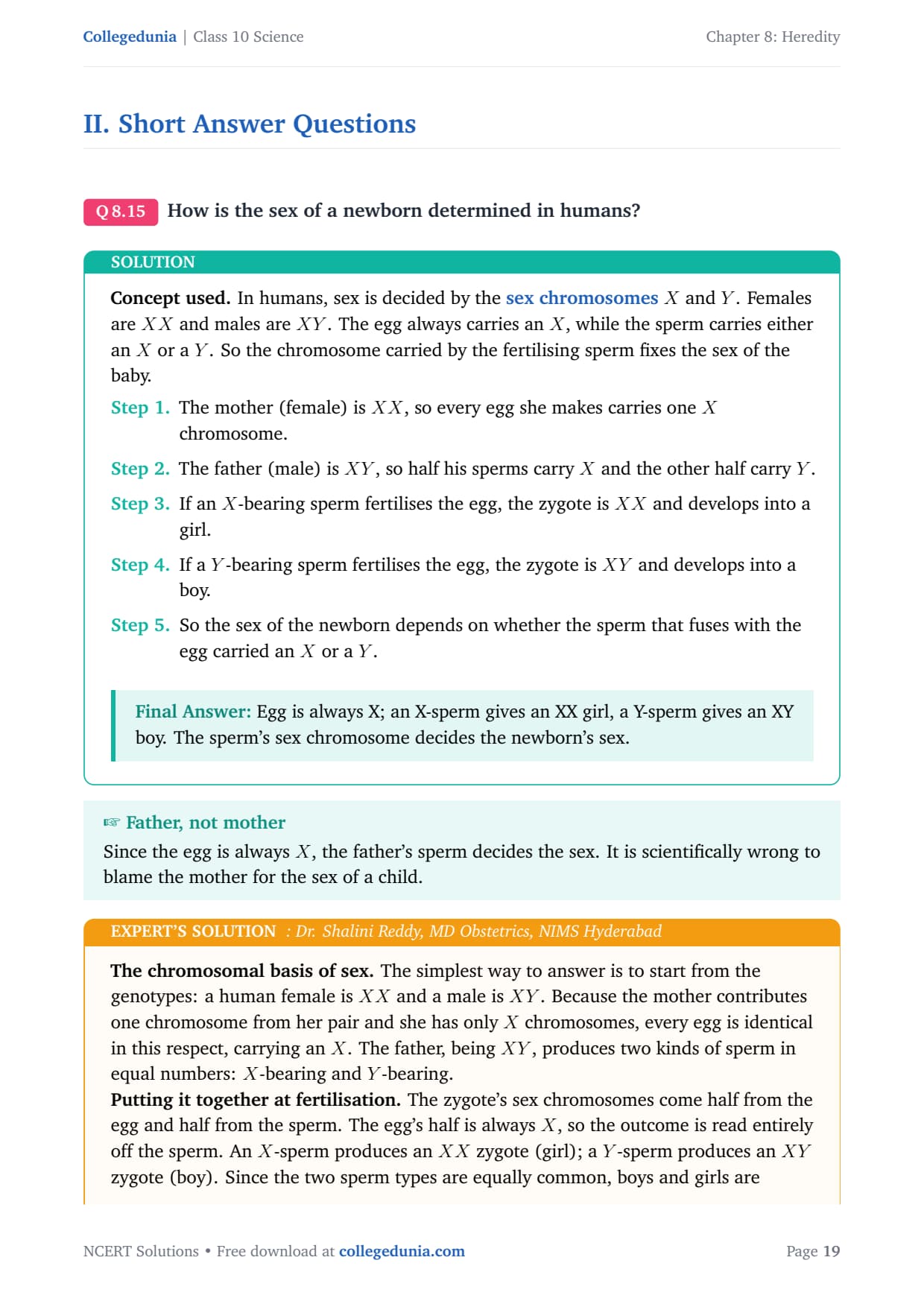
How is the sex of a newborn determined in humans?
Concept used. In humans, sex is decided by the sex chromosomesX and Y. Females are XX and males are XY. The egg always carries an X, while the sperm carries either an X or a Y. So the chromosome carried by the fertilising sperm fixes the sex of the baby.
The mother (female) is XX, so every egg she makes carries one X chromosome.
The father (male) is XY, so half his sperms carry X and the other half carry Y.
If an X-bearing sperm fertilises the egg, the zygote is XX and develops into a girl.
If a Y-bearing sperm fertilises the egg, the zygote is XY and develops into a boy.
So the sex of the newborn depends on whether the sperm that fuses with the egg carried an X or a Y.
Egg is always X; an X-sperm gives an XX girl, a Y-sperm gives an XY boy. The sperm's sex chromosome decides the newborn's sex.
Father, not mother
Since the egg is always X, the father's sperm decides the sex. It is scientifically wrong to blame the mother for the sex of a child.
SR
Shalini Reddy
MD Obstetrics, NIMS Hyderabad
Verified Expert
The chromosomal basis of sex. The simplest way to answer is to start from the genotypes: a human female is XX and a male is XY. Because the mother contributes one chromosome from her pair and she has only X chromosomes, every egg is identical in this respect, carrying an X. The father, being XY, produces two kinds of sperm in equal numbers: X-bearing and Y-bearing.
Putting it together at fertilisation. The zygote's sex chromosomes come half from the egg and half from the sperm. The egg's half is always X, so the outcome is read entirely off the sperm. An X-sperm produces an XX zygote (girl); a Y-sperm produces an XY zygote (boy). Since the two sperm types are equally common, boys and girls are expected in roughly equal numbers.
Female XX gives only X eggs; male XY gives X or Y sperm. Sperm X → XX girl, sperm Y → XY boy. The sperm's chromosome fixes the sex.
Q 8.16
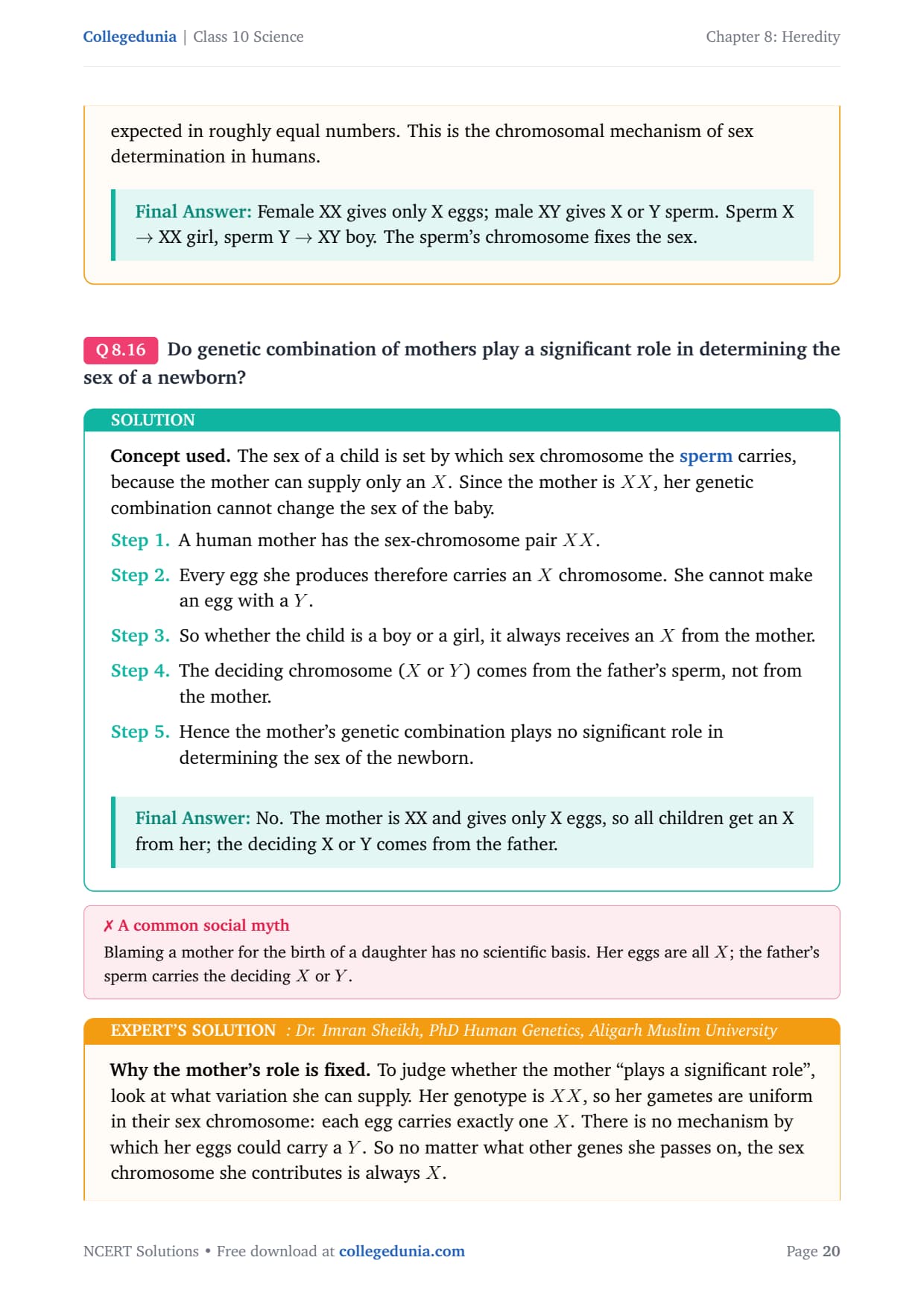
Do genetic combination of mothers play a significant role in determining the sex of a newborn?
Concept used. The sex of a child is set by which sex chromosome the sperm carries, because the mother can supply only an X. Since the mother is XX, her genetic combination cannot change the sex of the baby.
A human mother has the sex-chromosome pair XX.
Every egg she produces therefore carries an X chromosome. She cannot make an egg with a Y.
So whether the child is a boy or a girl, it always receives an X from the mother.
The deciding chromosome (X or Y) comes from the father's sperm, not from the mother.
Hence the mother's genetic combination plays no significant role in determining the sex of the newborn.
No. The mother is XX and gives only X eggs, so all children get an X from her; the deciding X or Y comes from the father.
A common social myth
Blaming a mother for the birth of a daughter has no scientific basis. Her eggs are all X; the father's sperm carries the deciding X or Y.
IS
Imran Sheikh
PhD Human Genetics, Aligarh Muslim University
Verified Expert
Why the mother's role is fixed. To judge whether the mother "plays a significant role", look at what variation she can supply. Her genotype is XX, so her gametes are uniform in their sex chromosome: each egg carries exactly one X. There is no mechanism by which her eggs could carry a Y. So no matter what other genes she passes on, the sex chromosome she contributes is always X.
Where the real variation lives. The difference between a son and a daughter comes entirely from whether an X-sperm or a Y-sperm wins the race to the egg, and that is set by the father. So the mother's genetic combination does not significantly decide the sex of the newborn. This is an important point for dispelling the harmful and unscientific belief that a woman is responsible for the sex of her child.
No, the mother (XX) always gives an X; the sex-deciding chromosome (X or Y) is supplied by the father's sperm.
Q 8.17
Why do all the gametes formed in human females have an X chromosome?
Concept used. A human female has two X chromosomes (XX) as her sex-chromosome pair. During meiosis (gamete formation), the pair separates and one chromosome goes into each gamete. Since both members of the pair are X, every egg ends up with an X.
The sex-chromosome pair in a female is XX (two X chromosomes, no Y).
In meiosis, the homologous chromosomes of each pair separate so that each gamete gets one chromosome from the pair.
For the sex chromosomes, the XX pair separates into two cells, each receiving one X.
Because there is no Y chromosome present in a female, no egg can ever carry a Y.
So every gamete (egg) formed by a human female carries an X chromosome.
A female is XX, so meiosis sends one X into each egg; with no Y present, every egg must carry an X.
Meiosis halves the number
Meiosis is the special cell division that makes gametes. It halves the chromosome number, sending one chromosome of each pair into each gamete.
GP
Geeta Pawar
PhD Cytogenetics, Savitribai Phule Pune University
Verified Expert
Reading off the female's gametes. The answer follows directly from the female genotype. A woman carries two X chromosomes as her 23rd pair. There simply is no Y chromosome in her cells to pass on.
What meiosis does to the pair. When eggs are formed, meiosis separates each homologous pair so that a gamete receives just one chromosome from the pair. Applied to the XX pair, this guarantees that each egg gets exactly one X. Both daughter cells are the same in this respect, so the female is described as the "homogametic" sex, producing only one kind of gamete with respect to the sex chromosome. This is why all human eggs carry an X chromosome.
Because the female is homogametic (XX), meiosis puts one X into every egg, and there is no Y to be passed on.
Q 8.18
In human beings, the statistical probability of getting either a male or female child is 50 : 50. Give a suitable explanation.
Concept used. The sex of a child depends on the sperm, which is either X-bearing or Y-bearing. The father (male, XY) produces these two kinds of sperm in equal numbers, so the chance of a boy or a girl is the same, 50 : 50.
The mother is XX, so every egg carries an X.
The father is XY. During meiosis, half his sperms get the X and half get the Y. So X-sperm and Y-sperm are made in a 1 : 1 ratio.
Fertilisation is random: an egg is equally likely to be fertilised by an X-sperm or a Y-sperm.
Since the two sperm types are equally common and fertilisation is random, the probability of a boy or a girl is 50 : 50.
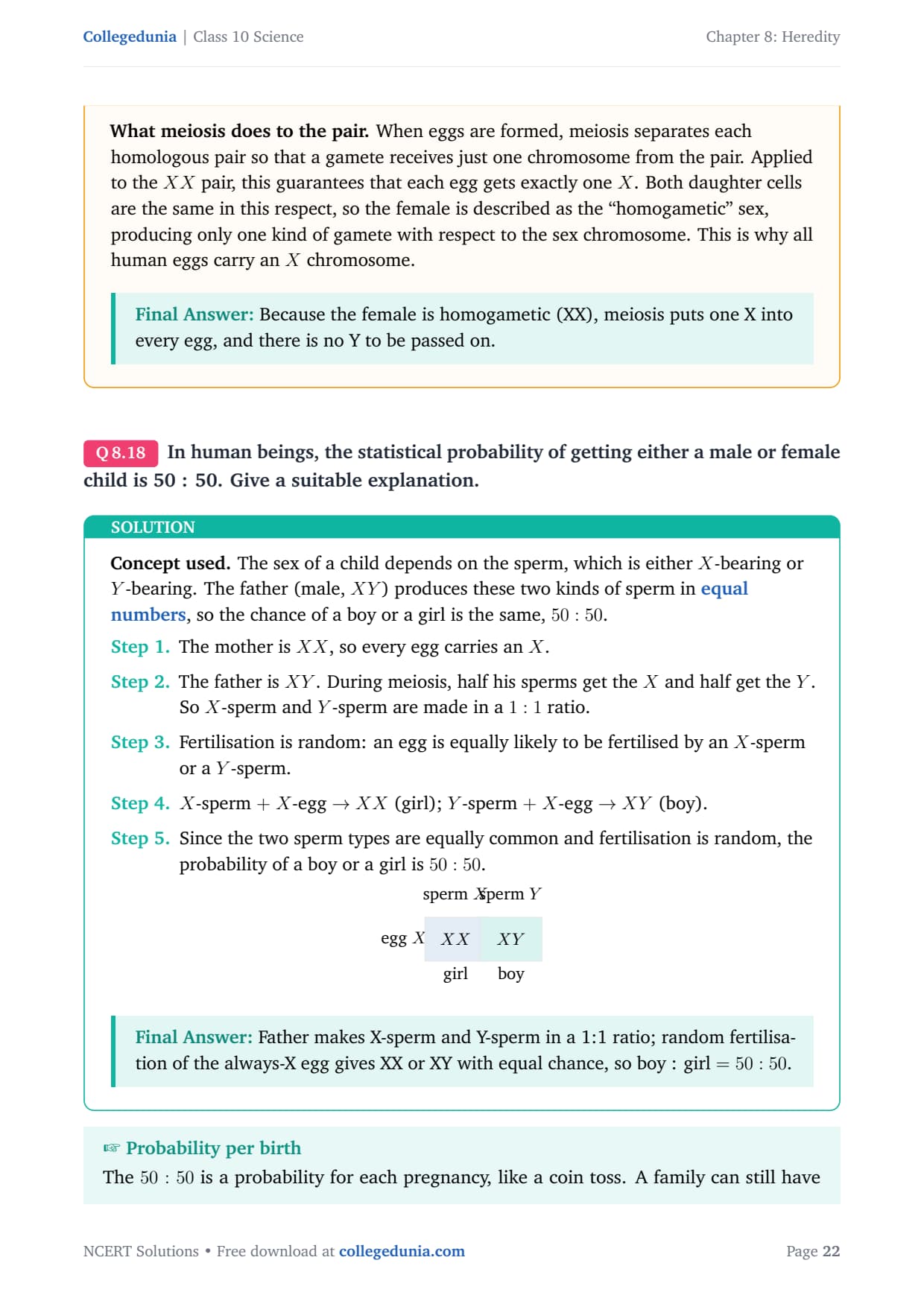
sperm X
sperm Y
egg X
XX (girl)
XY (boy)
Random fertilisation of the always-X egg
Father makes X-sperm and Y-sperm in a 1:1 ratio; random fertilisation of the always-X egg gives XX or XY with equal chance, so boy : girl = 50 : 50.
Probability per birth
The 50:50 is a probability for each pregnancy, like a coin toss. A family can still have several children of the same sex by chance; the ratio only evens out over very large numbers.
TN
Tara Nambiar
MSc PhD Genetics, Cochin University of Science and Technology
Verified Expert
Where the 1:1 comes from. The even sex ratio is a direct result of how the father's sperm are made. His sex-chromosome pair is XY. When meiosis separates this pair, half the resulting sperm carry the X and half carry the Y, in a clean 1:1 ratio. The mother contributes nothing to the variation, since her eggs are all X.
From sperm ratio to child ratio. Because the two kinds of sperm are equally many and any one of them is equally likely to fertilise the egg, the resulting zygotes are equally likely to be XX or XY. So the statistical probability of a male child equals that of a female child, giving the familiar 50:50. It is worth stressing that this is a probability for each individual birth, not a guarantee about any one family.
Equal numbers of X- and Y-sperm plus random fertilisation of an always-X egg make XX and XY equally likely, so the boy : girl probability is 50 : 50.
Q 8.19
Give the pair of contrasting traits of the following characters in pea plant and mention which is dominant and recessive. (i) yellow seed (ii) round seed
Concept used. A character (such as seed colour) can appear in two opposite forms called contrasting traits (such as yellow and green). In each pair, one trait is dominant (shows in the heterozygote) and the other is recessive (stays hidden when the dominant is present).
(i) Character = seed colour. The contrasting traits are yellow and green. Here yellow is dominant and green is recessive.
(ii) Character = seed shape. The contrasting traits are round and wrinkled. Here round is dominant and wrinkled is recessive.
In both pairs, the dominant trait is the one Mendel saw in all F1 plants, while the recessive one reappeared only in F2.
(i) Yellow (dominant) vs green (recessive). (ii) Round (dominant) vs wrinkled (recessive).
Pea trait pairs
Mendel's seven pea pairs are worth memorising. For seeds: round (dominant)/wrinkled, and yellow (dominant)/green. The first-named here is always the dominant one.
NB
Nisha Bhatt
MSc PhD Botany, HNB Garhwal University
Verified Expert
Naming the contrasting pairs. A "character" is the feature being studied; its "contrasting traits" are the two visibly opposite versions. For seed colour the two versions are yellow and green; for seed shape they are round and wrinkled. These are two of the seven classic pea characters Mendel followed.
Assigning dominance. Mendel's F1 crosses settle which trait is dominant. When pure yellow-seeded plants were crossed with pure green-seeded ones, all F1 seeds were yellow, so yellow is dominant and green recessive. Likewise, crossing pure round with pure wrinkled gave all-round F1 seeds, so round is dominant and wrinkled recessive. The recessive traits did not vanish; they reappeared in about one quarter of the F2 plants.
Why did Mendel choose pea plant for his experiments?
Concept used. A good organism for genetics experiments should be easy to grow, have a short life cycle, show clear contrasting traits, and allow controlled crossing. The garden pea plant (Pisum sativum) meets all of these, which is why Mendel chose it.
Pea plants are easy to grow and need little care.
They have a short life span, so many generations can be studied in a short time.
They show clear, easily distinguishable contrasting traits (for example tall/short, round/wrinkled seeds, yellow/green seeds).
Their flowers are normally self-pollinating, which keeps lines pure, but they can also be cross-pollinated by hand when needed.
The flowers are fairly large, making controlled hand-crossing easy. All these features made the pea ideal for Mendel.
Easy to grow, short life cycle, clear contrasting traits, naturally self-pollinating yet easy to cross-pollinate, large flowers: the pea suited controlled breeding experiments.
Self- and cross-pollination
Pea flowers usually self-pollinate, keeping a line pure across generations. Mendel could also open the bud and dust pollen from another plant, giving him full control over the cross.
AP
Alok Pandey
PhD Plant Sciences, University of Allahabad
Verified Expert
What makes an organism good for genetics. Mendel's success owed a lot to his choice of material. He needed an organism he could grow in large numbers cheaply, that bred fast enough to track several generations, and that showed traits in sharp either/or forms rather than blended shades. The pea fitted on every count: cheap, hardy, and quick, with seven clean pairs of contrasting characters.
The breeding control advantage. Just as important, pea flowers are naturally self-pollinating, so a strain stays pure on its own, giving Mendel reliable pure-breeding parents. Yet the flowers are large enough that he could remove the anthers and apply pollen from a chosen plant, performing precise crosses by hand. This combination of natural purity and easy controlled crossing let him design clean experiments and count clear ratios.
The pea was cheap and easy to grow, fast-breeding, showed clear contrasting traits, and could be both self- and hand-cross-pollinated, making it perfect for controlled genetics experiments.
Q 8.21
A woman has only daughters. Analyse the situation genetically and provide a suitable explanation.
Concept used. The sex of each child is decided by the sperm, not by the mother. A woman gives only an X to every child. If she has only daughters, it means that, by chance, only X-bearing sperms from the father fertilised her eggs. It is not caused by the woman.
The woman is XX, so each egg carries an X chromosome.
The father is XY and produces both X-sperm and Y-sperm.
Each daughter is XX, meaning each was formed when an X-bearing sperm (from the father) fertilised the egg.
Having only daughters simply means that, by chance, every successful fertilisation involved an X-sperm. This is like tossing several heads in a row.
It is a matter of chance fertilisation by X-sperm, and the woman's genotype cannot influence it.
All her daughters are XX, so each came from an X-sperm of the father; having only daughters is due to chance fertilisation by X-bearing sperm, not due to the woman.
Not the woman's doing
The woman supplies only X chromosomes, so she cannot cause or prevent sons. Having only daughters is a chance outcome of which sperm fertilised each egg.
RM
Rekha Menon
MD Gynaecology, Christian Medical College Vellore
Verified Expert
Working through the genetics. Start with what is fixed and what varies. The woman's eggs are all X, so she contributes an X to every child without exception. Each of her daughters is XX, which means the second X in each daughter came from an X-bearing sperm of the father. So every one of her pregnancies happened to involve an X-sperm.
Why this is just chance. The father makes X- and Y-sperm in equal numbers, and which one fertilises a given egg is random. Over a small number of children it is quite possible for all the successful sperm to be X-bearing, just as a coin can land heads several times in a row. So a woman having only daughters is a chance result of repeated X-sperm fertilisation. Her own genotype, being XX, plays no part in selecting the sex.
Each daughter (XX) received an X-sperm from the father; only daughters means, by chance, every fertilisation used an X-sperm, which the mother cannot control.
III. Long Answer Type Questions
Q 8.22
Differentiate between inherited and acquired characters. Give one example for each type.
Concept used. An inherited character is one that is controlled by genes and is passed from parents to offspring through the DNA in the gametes. An acquired character is one that an individual develops during its own lifetime; it does not change the DNA of the gametes, so it is not passed on to the next generation.
Inherited characters are coded by genes present in the reproductive cells (gametes), so they travel from one generation to the next.
Examples of inherited characters: colour of the eyes, colour of the seeds in a pea plant, free or attached earlobes.
Acquired characters arise from the environment, use, disuse, habits or accidents during an individual's life. They affect only body (somatic) cells, not the gametes.
Examples of acquired characters: bigger muscles built by a weightlifter, or the loss of a finger in an accident.
Because acquired characters do not change the genes in the gametes, they cannot be inherited by the offspring, while inherited characters can.
Feature
Inherited character
Acquired character
Control
Gene-controlled, written in the gametes' DNA
Caused by environment, use or disuse, only in body cells
Passed on?
Yes, passed to offspring
No, dies with the individual
Example
Eye colour
A lost finger
Inherited = gene-controlled, in the gametes, passed on (e.g. eye colour). Acquired = developed in life, only in body cells, not passed on (e.g. a lost finger).
Gametes are the test
Ask: does the change reach the DNA of the eggs or sperms? If yes, it is inherited; if it only affects body cells, it is acquired and dies with the individual.
BS
Bhavna Sinha
PhD Genetics, Patna University
Verified Expert
Drawing the dividing line. The cleanest way to tell the two apart is to ask where the character is stored. Inherited characters live in the genes that sit in the gametes, so they are copied into the next generation each time reproduction happens. Eye colour and pea-seed colour are classic inherited characters because they trace back to specific alleles.
Why acquired characters stop with the individual. Acquired characters develop in response to the environment, use or disuse, or injury, and they change only the body cells. A weightlifter's enlarged muscles or a finger lost in an accident never reach the DNA of the sperms or eggs. So when that individual reproduces, the offspring start from the unaltered genes and do not show the acquired feature. This distinction is the heart of why Lamarck's idea of inheritance of acquired characters does not hold up.
Inherited characters reside in the gametes' genes and pass on (eye colour); acquired characters affect only body cells and end with the individual (a lost finger).
Q 8.23
Give reasons why acquired characters are not inherited.
Concept used. A character can be inherited only if it is written into the DNA of the germ cells (the gametes, i.e. sperms and eggs). Acquired characters change only the body (somatic) cells and not the germ cells, so the change is never copied into the gametes and cannot reach the next generation.
Inheritance works by passing genes through gametes. Only what is in the gametes' DNA can be passed on.
An acquired character (such as bigger muscles or a scar) is produced in the body cells during the individual's life. It does not alter the genes in the germ cells.
Since the DNA of the eggs and sperms is unchanged, the gametes still carry the original genes.
When these unchanged gametes form the next generation, the offspring do not show the acquired character.
So acquired characters are not inherited, because they never become part of the gametes' DNA.
Acquired characters change only body cells, not the DNA of the germ cells; since only germ-cell genes pass to offspring, acquired characters are not inherited.
Germ cells vs body cells
Body (somatic) cells build the organism; germ cells (gametes) carry genes to the next generation. Only changes in germ cells are heritable.
MR
Mohan Rao
PhD Molecular Genetics, University of Mysore
Verified Expert
The germ-line rule. The reason acquired characters are not inherited comes down to one rule: only changes in the germ line, the cells that make gametes, can be passed on. A trait gained during life, through exercise, diet, habit or injury, is built in the body's somatic cells. These cells are not the ones that form the next generation.
No path into the gametes. Because the genetic information in the eggs and sperms stays unchanged, there is no route by which the acquired feature can be copied into the offspring's starting DNA. The child therefore begins from the parents' original genes, not from any modification the parent picked up. This is why, for example, the children of a body-builder are not born with extra muscle. The principle directly refutes the inheritance of acquired characters.
Acquired traits alter only somatic cells, leaving the gametes' DNA untouched; with no change carried in the germ cells, the offspring inherit only the original genes.
Q 8.24
In the following crosses, write the characteristics of the progeny. (a) RR YY × RR YY (Round, yellow × Round, yellow) (b) Rr Yy × Rr Yy (Round, yellow × Round, yellow) (c) rr yy × rr yy (wrinkled, green × wrinkled, green) (d) RR YY × rr yy (Round, yellow × wrinkled, green)
Concept used. In pea seeds, round (R) is dominant over wrinkled (r) and yellow (Y) is dominant over green (y). A cross between two homozygous parents of the same type gives uniform offspring, while a cross of two double-heterozygotes gives the 9:3:3:1 dihybrid ratio.
(a) RRYY × RRYY: both parents are pure round-yellow. Each gives only RY gametes, so all progeny are RRYY, i.e. all round and yellow.
(b) RrYy × RrYy: both parents are double-heterozygotes. Independent assortment gives four phenotypes in the ratio 9 round-yellow : 3 round-green : 3 wrinkled-yellow : 1 wrinkled-green.
(c) rryy × rryy: both parents are pure wrinkled-green. Each gives only ry gametes, so all progeny are rryy, i.e. all wrinkled and green.
(d) RRYY × rryy: one parent gives only RY, the other only ry. All progeny are RrYy, which (by dominance) are all round and yellow.
(a) all round, yellow. (b) round-yellow : round-green : wrinkled-yellow : wrinkled-green = 9:3:3:1. (c) all wrinkled, green. (d) all round, yellow.
Pure parents give uniform progeny
Whenever both parents are homozygous for the same alleles, every offspring is identical to them. The interesting variation appears only when heterozygotes are crossed, as in part (b).
SC
Sunita Chauhan
MSc PhD Plant Breeding, GB Pant University of Agriculture
Verified Expert
Working each cross by its gametes. The fastest, safest way to read each cross is to first list the gametes each parent can make. Parts (a) and (c) involve pure-breeding parents, so each parent makes only one kind of gamete (RY in a, ry in c). Identical gametes combine to give offspring identical to the parents: all round-yellow in (a) and all wrinkled-green in (c).
The heterozygous and test-style crosses. Part (b) is the textbook dihybrid self: each RrYy parent makes four gamete types (RY, Ry, rY, ry), and combining them in a 4×4 Punnett square gives the famous 9:3:3:1 phenotype ratio. Part (d) crosses a pure round-yellow with a pure wrinkled-green; one parent supplies RY and the other ry, so all offspring are RrYy and, by dominance of round and yellow, all look round and yellow even though they secretly carry the recessive alleles.
(a) all round, yellow; (b) 9:3:3:1 round-yellow : round-green : wrinkled-yellow : wrinkled-green; (c) all wrinkled, green; (d) all round, yellow (RrYy).
Q 8.25
Study the following cross showing self pollination in F1, fill in the blank and answer the question that follows. Parents: RRYY (Round, yellow) × rryy (wrinkled, green) F1: RrYy (Round, yellow) × ____________
Concept used. "Self pollination in F1" means an F1 plant is crossed with itself, i.e. with another plant of the same genotype. The F1 here is RrYy, so the blank must also be RrYy (round, yellow).
The parents are pure round-yellow (RRYY) and pure wrinkled-green (rryy).
Their cross gives an F1 that is uniformly RrYy (round, yellow), as shown.
Self pollination means the F1 is crossed with a plant of the same kind, i.e. another RrYy.
So the blank is filled with RrYy (Round, yellow).
The blank is RrYy (Round, yellow); self pollination crosses the F1 with an identical RrYy plant.
What "selfing" means
Self pollination puts a plant's own pollen on its own stigma, so it is crossed with its identical genotype. For an RrYy F1, selfing is RrYy × RrYy.
DV
Deepak Verma
PhD Agricultural Genetics, Tamil Nadu Agricultural University
Verified Expert
Reading the cross diagram. The pedigree-style layout gives the parents and the F1 and leaves the second F1 partner blank. The phrase "self pollination in F1" is the clue: a self-cross means the plant is mated with its own genotype. Since the F1 generation here is entirely RrYy, the partner in the blank must also be RrYy.
Why uniform F1 makes this certain. Because both original parents were pure-breeding for opposite alleles, every F1 plant is the same double-heterozygote RrYy. So whichever F1 plant is used for selfing, its partner is genetically RrYy too. Filling the blank with RrYy sets up the dihybrid self-cross RrYy × RrYy, which in the next question produces the 9:3:3:1 F2 ratio.
The missing F1 partner is RrYy (Round, yellow), giving the dihybrid self-cross RrYy × RrYy.
Q 8.26
In the cross of the previous question (self pollination of the F1 RrYy), what are the combinations of characters in the F2 progeny? What are their ratios?
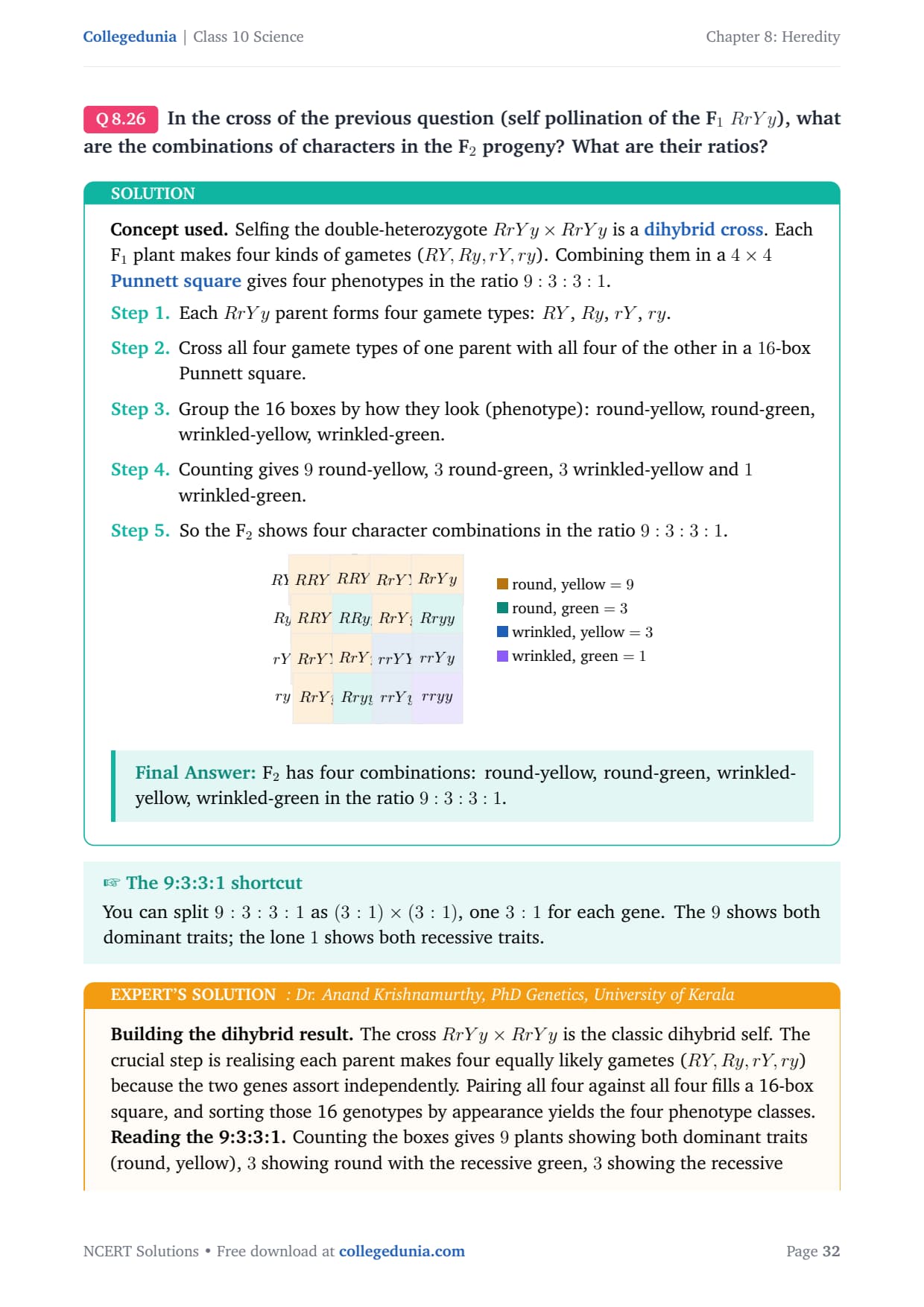
Concept used. Selfing the double-heterozygote RrYy × RrYy is a dihybrid cross. Each F1 plant makes four kinds of gametes (RY, Ry, rY, ry). Combining them in a 4 × 4Punnett square gives four phenotypes in the ratio 9 : 3 : 3 : 1.
Each RrYy parent forms four gamete types: RY, Ry, rY, ry.
Cross all four gamete types of one parent with all four of the other in a 16-box Punnett square.
Group the 16 boxes by how they look (phenotype): round-yellow, round-green, wrinkled-yellow, wrinkled-green.
F2 has four combinations: round-yellow, round-green, wrinkled-yellow, wrinkled-green in the ratio 9 : 3 : 3 : 1.
The 9:3:3:1 shortcut
You can split 9:3:3:1 as (3:1) × (3:1), one 3:1 for each gene. The 9 shows both dominant traits; the lone 1 shows both recessive traits.
AK
Anand Krishnamurthy
PhD Genetics, University of Kerala
Verified Expert
Building the dihybrid result. The cross RrYy × RrYy is the classic dihybrid self. The crucial step is realising each parent makes four equally likely gametes (RY, Ry, rY, ry) because the two genes assort independently. Pairing all four against all four fills a 16-box square, and sorting those 16 genotypes by appearance yields the four phenotype classes.
Reading the 9:3:3:1. Counting the boxes gives 9 plants showing both dominant traits (round, yellow), 3 showing round with the recessive green, 3 showing the recessive wrinkled with yellow, and a single plant showing both recessive traits (wrinkled, green). Two of these four classes (round-green and wrinkled-yellow) are new combinations not present in the original parents. The clean 9:3:3:1 ratio is the hallmark of two independently assorting genes.
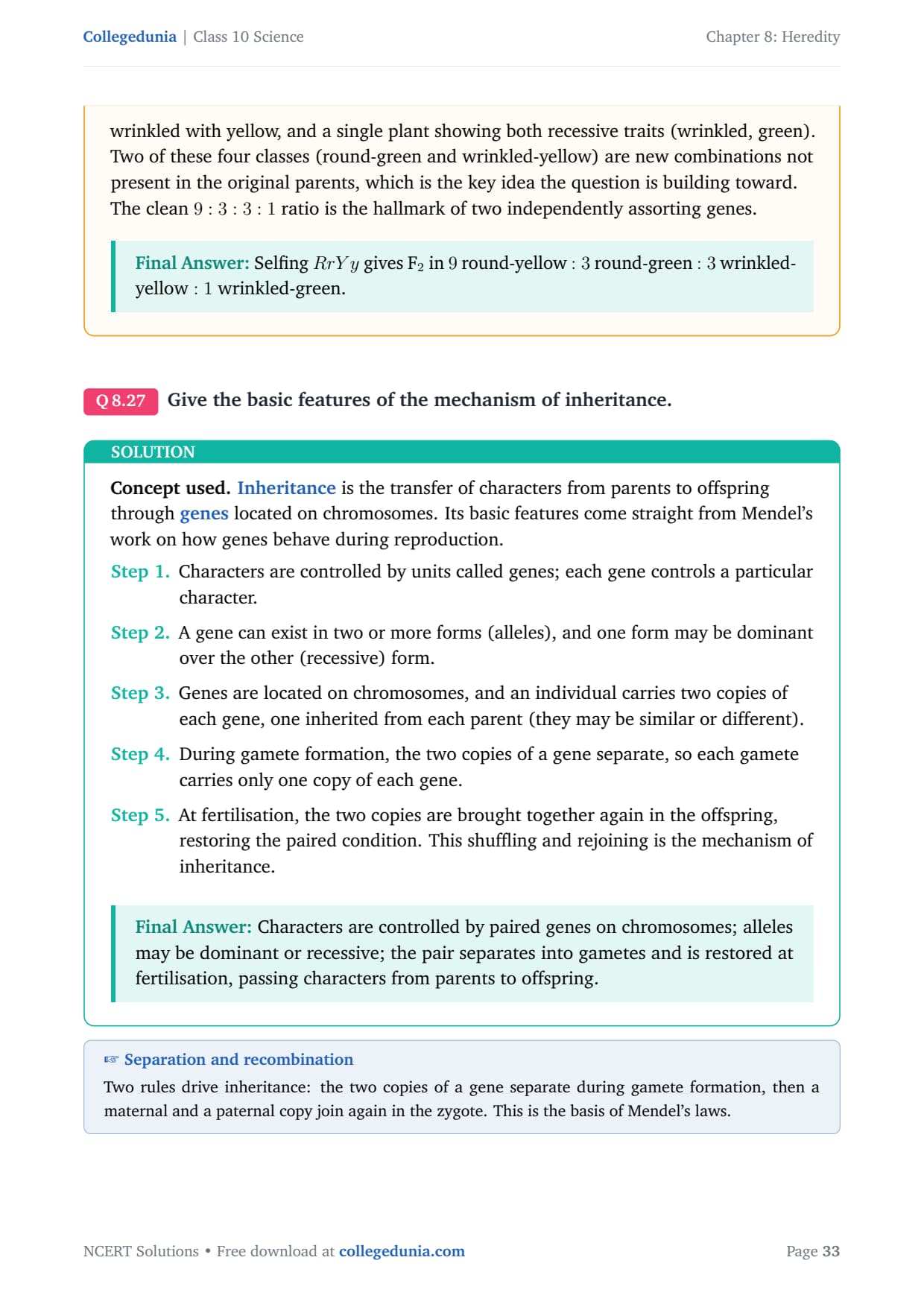
Give the basic features of the mechanism of inheritance.
Concept used.Inheritance is the transfer of characters from parents to offspring through genes located on chromosomes. Its basic features come straight from Mendel's work on how genes behave during reproduction.
Characters are controlled by units called genes; each gene controls a particular character.
A gene can exist in two or more forms (alleles), and one form may be dominant over the other (recessive) form.
Genes are located on chromosomes, and an individual carries two copies of each gene, one inherited from each parent (they may be similar or different).
During gamete formation, the two copies of a gene separate, so each gamete carries only one copy of each gene.
At fertilisation, the two copies are brought together again in the offspring, restoring the paired condition. This shuffling and rejoining is the mechanism of inheritance.
Characters are controlled by paired genes on chromosomes; alleles may be dominant or recessive; the pair separates into gametes and is restored at fertilisation, passing characters from parents to offspring.
Separation and recombination
Two rules drive inheritance: the two copies of a gene separate during gamete formation, then a maternal and a paternal copy join again in the zygote. This is the basis of Mendel's laws.
PS
Priya Sundaram
PhD Cell and Molecular Biology, University of Madras
Verified Expert
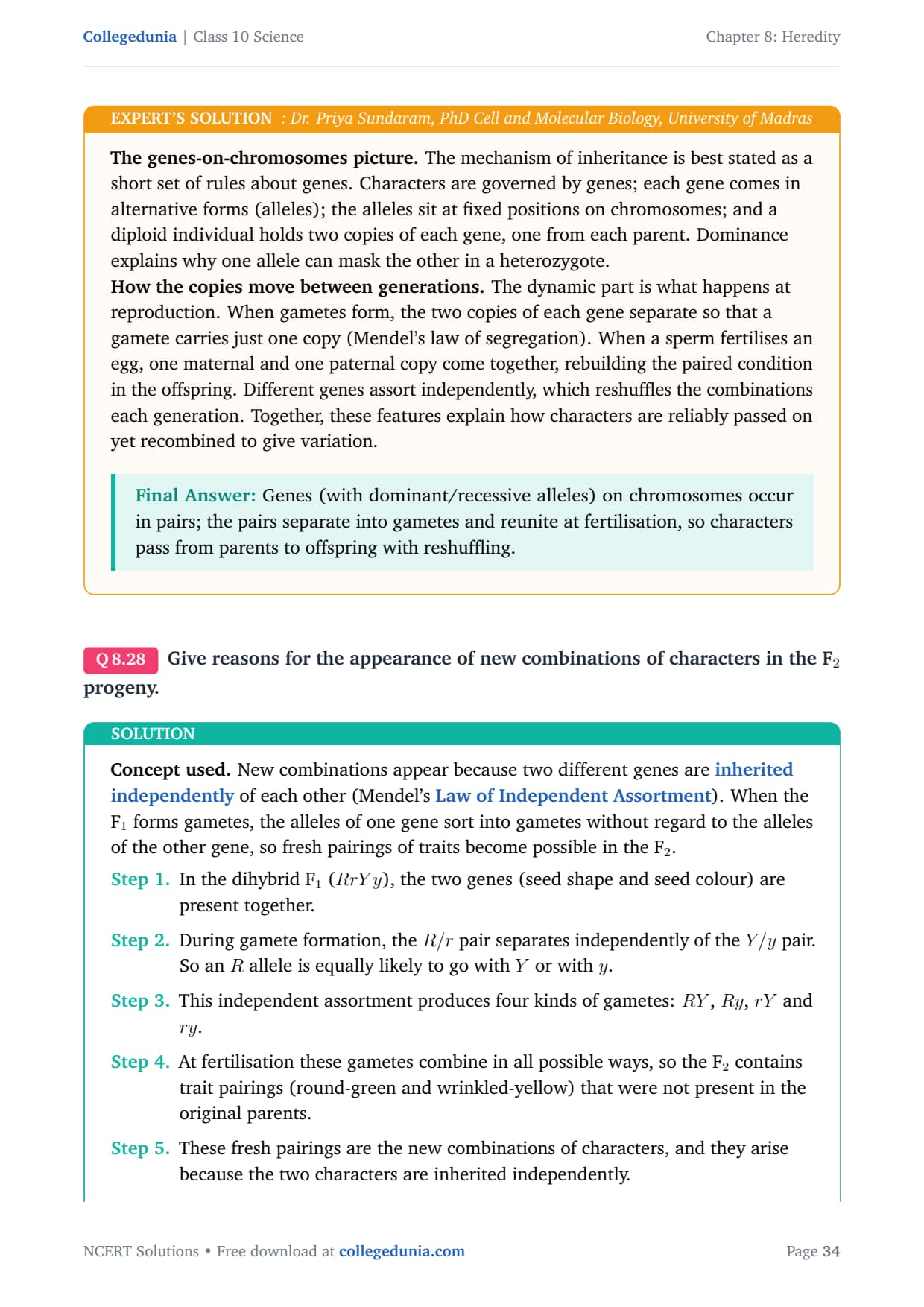
The genes-on-chromosomes picture. The mechanism of inheritance is best stated as a short set of rules about genes. Characters are governed by genes; each gene comes in alternative forms (alleles); the alleles sit at fixed positions on chromosomes; and a diploid individual holds two copies of each gene, one from each parent. Dominance explains why one allele can mask the other in a heterozygote.
How the copies move between generations. The dynamic part is what happens at reproduction. When gametes form, the two copies of each gene separate so that a gamete carries just one copy (Mendel's law of segregation). When a sperm fertilises an egg, one maternal and one paternal copy come together, rebuilding the paired condition in the offspring. Different genes assort independently, which reshuffles the combinations each generation.
Genes (with dominant/recessive alleles) on chromosomes occur in pairs; the pairs separate into gametes and reunite at fertilisation, so characters pass from parents to offspring with reshuffling.
Q 8.28
Give reasons for the appearance of new combinations of characters in the F2 progeny.
Concept used. New combinations appear because two different genes are inherited independently of each other (Mendel's Law of Independent Assortment). When the F1 forms gametes, the alleles of one gene sort into gametes without regard to the alleles of the other gene, so fresh pairings of traits become possible in the F2.
In the dihybrid F1 (RrYy), the two genes (seed shape and seed colour) are present together.
During gamete formation, the R/r pair separates independently of the Y/y pair. So an R allele is equally likely to go with Y or with y.
This independent assortment produces four kinds of gametes: RY, Ry, rY and ry.
At fertilisation these gametes combine in all possible ways, so the F2 contains trait pairings (round-green and wrinkled-yellow) that were not present in the original parents.
These fresh pairings are the new combinations of characters, and they arise because the two characters are inherited independently.
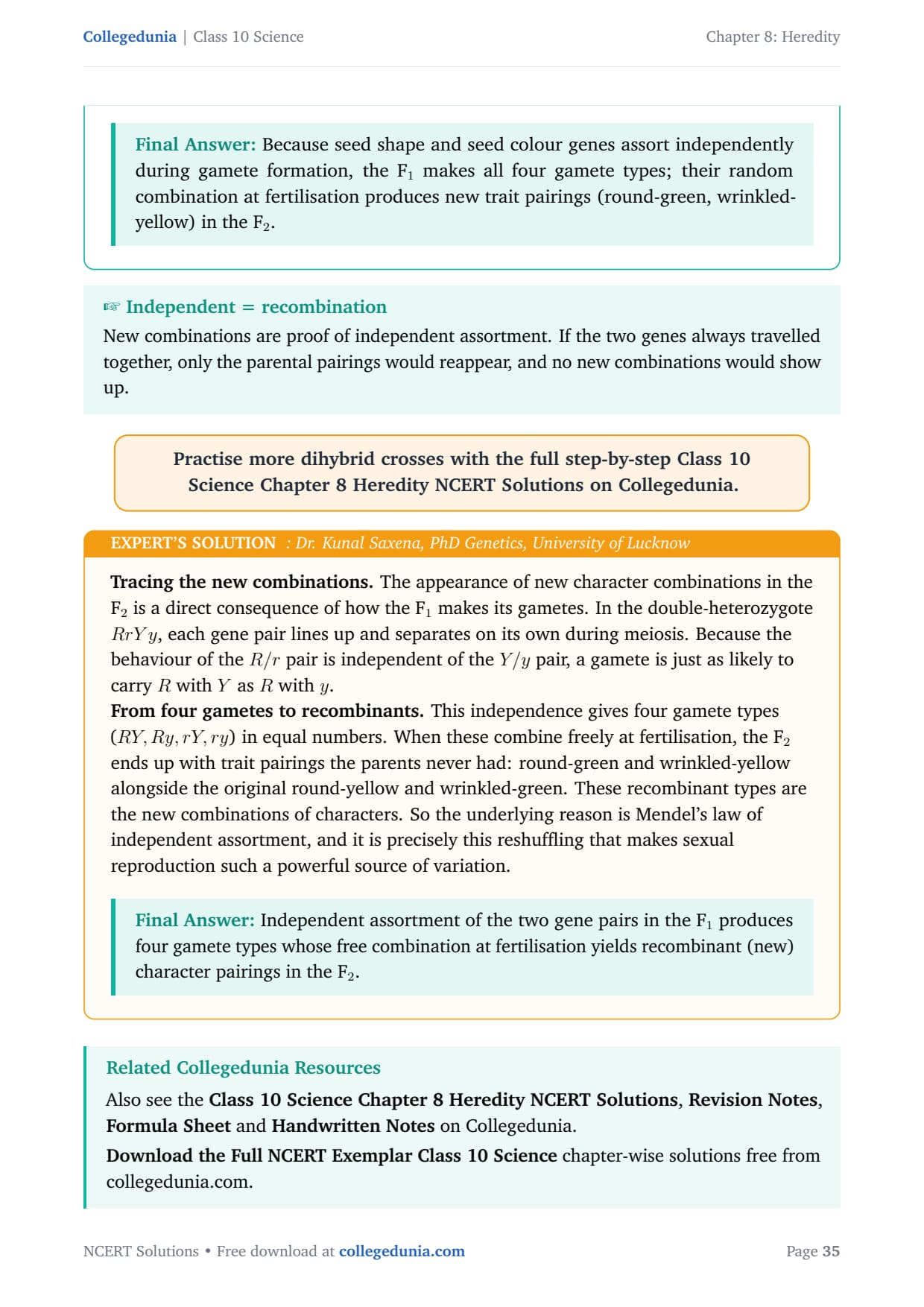
Because seed shape and seed colour genes assort independently during gamete formation, the F1 makes all four gamete types; their random combination at fertilisation produces new trait pairings (round-green, wrinkled-yellow) in the F2.
Independent = recombination
New combinations are proof of independent assortment. If the two genes always travelled together, only the parental pairings would reappear, and no new combinations would show up.
KS
Kunal Saxena
PhD Genetics, University of Lucknow
Verified Expert
Tracing the new combinations. The appearance of new character combinations in the F2 is a direct consequence of how the F1 makes its gametes. In the double-heterozygote RrYy, each gene pair lines up and separates on its own during meiosis. Because the behaviour of the R/r pair is independent of the Y/y pair, a gamete is just as likely to carry R with Y as R with y.
From four gametes to recombinants. This independence gives four gamete types (RY, Ry, rY, ry) in equal numbers. When these combine freely at fertilisation, the F2 ends up with trait pairings the parents never had: round-green and wrinkled-yellow alongside the original round-yellow and wrinkled-green. These recombinant types are the new combinations of characters. So the underlying reason is Mendel's law of independent assortment, and it is precisely this reshuffling that makes sexual reproduction such a powerful source of variation.
Independent assortment of the two gene pairs in the F1 produces four gamete types whose free combination at fertilisation yields recombinant (new) character pairings in the F2.
More Class 10 Science Resources for Heredity
Pair these Exemplar Solutions with the other Chapter 8 resources in the Collegedunia library for full coverage of the chapter.
NCERT Exemplar Solutions for Class 10 Science: All Chapters
Use the table below to jump to any other chapter's NCERT Exemplar Solutions in the Collegedunia library, covering all 13 chapters of the 2026-27 Class 10 Science syllabus.
Ques. Where can I download the Class 10 Science Chapter 8 NCERT Exemplar Solutions PDF?
Ans. You can download the Heredity Class 10 Science NCERT Exemplar Solutions PDF from the top of this page. It solves every Exemplar problem step by step with Punnett squares and is free to download.
Ques. Are these Exemplar Solutions aligned with the 2026-27 NCERT?
Ans. Yes. This page follows the current 2026-27 Class 10 Science syllabus. Under the rationalised NCERT, the Evolution part of the old unit is dropped, so only the Heredity questions are solved here, all matching the latest edition.
Ques. How many questions are in the Class 10 Science Chapter 8 Exemplar?
Ans. Chapter 8 of the NCERT Exemplar has Multiple Choice Questions, Short Answer Type and Long Answer Type questions. Every one of them is solved on this page with a Solution and an Expert Solution.
Ques. What is the phenotype ratio of a monohybrid cross in Class 10 Science Chapter 8?
Ans. The phenotype ratio of a monohybrid cross such as Tt × Tt is 3 : 1, that is 3 tall to 1 short. The genotype ratio is 1 TT : 2 Tt : 1 tt. The dominant trait shows in three quarters of the F2 plants.
Ques. What is the phenotype ratio of a dihybrid cross?
Ans. A dihybrid cross such as RrYy × RrYy gives a phenotype ratio of 9 : 3 : 3 : 1, that is 9 round-yellow, 3 round-green, 3 wrinkled-yellow and 1 wrinkled-green. The round-green and wrinkled-yellow types are the new combinations.
Ques. How is the sex of a child determined in humans?
Ans. The mother is XX and gives only X eggs. The father is XY and makes X-sperm and Y-sperm. An X-sperm gives an XX girl and a Y-sperm gives an XY boy, so the father's sperm decides the sex of the child.
Ques. Why is the sex ratio in humans about 50 : 50?
Ans. The father makes equal numbers of X-bearing and Y-bearing sperm. Fertilisation of the always-X egg is random, so XX (girl) and XY (boy) zygotes are equally likely. This gives a boy to girl probability of about 50 : 50 for each birth.
Ques. What is the difference between inherited and acquired characters?
Ans. Inherited characters are controlled by genes in the gametes and pass to the offspring, like eye colour. Acquired characters develop during life in the body cells only and are not passed on, like the bigger muscles of a weightlifter or a finger lost in an accident.
Ques. Why did Mendel choose the pea plant for his experiments?
Ans. The pea plant is easy to grow, has a short life cycle, and shows clear contrasting traits such as tall/short and round/wrinkled seeds. Its flowers self-pollinate naturally yet can be hand cross-pollinated, giving Mendel full control over his crosses.
Ques. Why are acquired characters not inherited?
Ans. Acquired characters change only the body (somatic) cells, not the DNA of the germ cells that make the gametes. Since only germ-cell genes pass to the offspring, the acquired feature is never copied into the next generation, so it is not inherited.
Ques. What is meant by a dominant and a recessive trait?
Ans. A dominant trait shows in the offspring even when only one copy of its allele is present, and it is written with a capital letter. A recessive trait stays hidden whenever the dominant allele is also present and shows only when both alleles are recessive.








Comments