Senior Maths Editor, 9 Yrs | Updated on - Jun 29, 2026
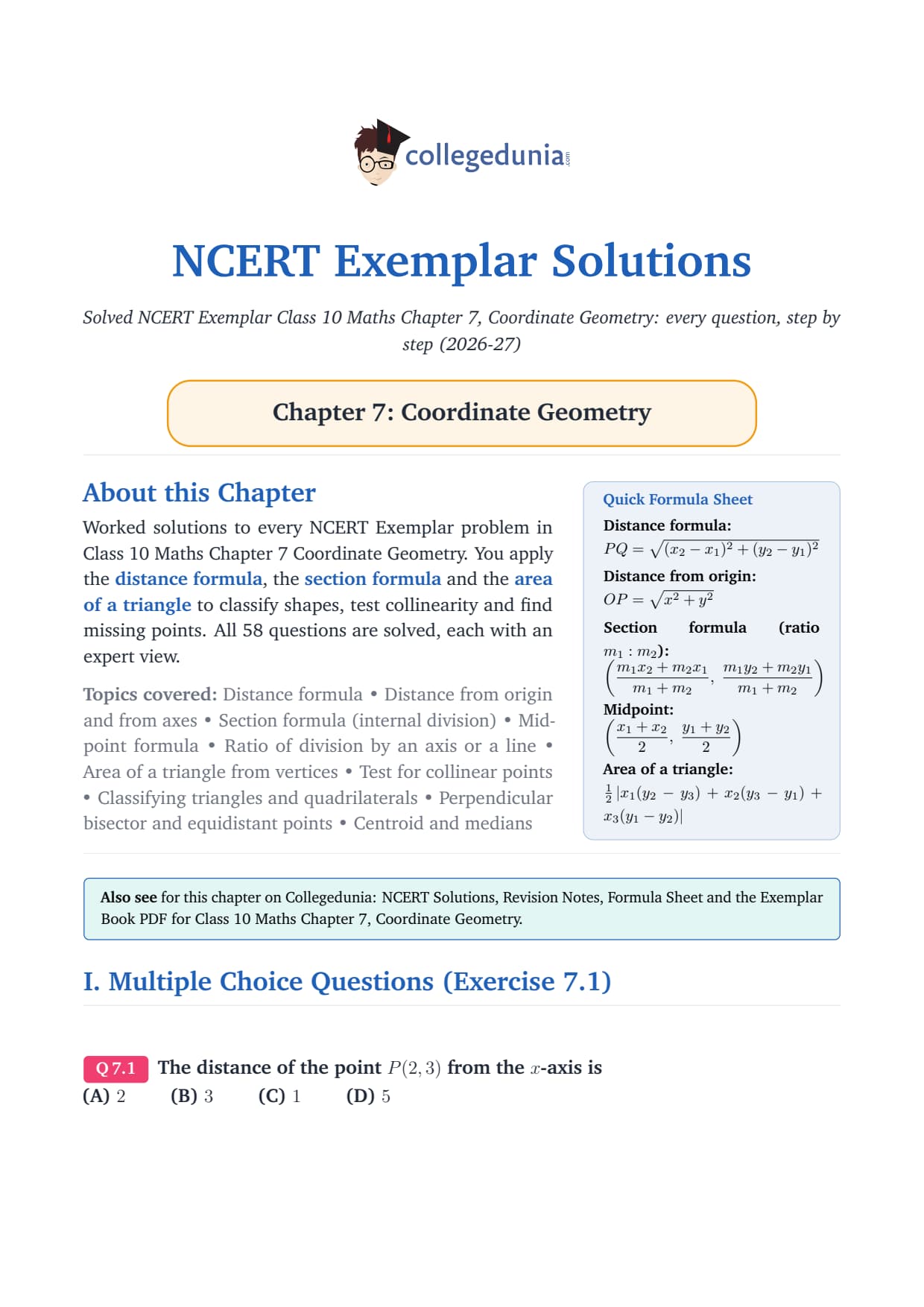
NCERT Exemplar Class 10 Maths Chapter 7 Coordinate Geometry Exercise 7.1 is the MCQ section of the Exemplar book. It has 20 single-correct questions on the distance formula, section formula, midpoint formula, area of a triangle, and quadrant identification. Each solution below is worked step by step, with an expert second view, to the 2026-27 NCERT syllabus.
Key concepts: Distance formula, section formula, midpoint, area of a triangle, perpendicular bisector, collinearity, quadrant identification
CBSE relevance: Coordinate Geometry carries 6 marks in CBSE Class 10 Board papers; MCQ patterns from Exercise 7.1 appear directly in board and internal assessments
You can find the complete Exemplar Solutions for Exercise 7.1 of Chapter 7 Coordinate Geometry, including every MCQ answer with a concept note and an expert view, as aligned with the 2026-27 NCERT syllabus in the article below.
These Exemplar Solutions are curated by subject experts, mapped to the 2026-27 rationalised NCERT, and verified against the CBSE board exam pattern for Class 10 Mathematics.
Solved by Collegedunia Every question in Exercise 7.1 is solved by Mathematics subject-matter experts. Each solution shows the concept used, numbered steps, a boxed answer, and an Expert view so students understand the reasoning, not just the selected option.
Exercise 7.1 at a Glance · 20 MCQs, Chapter 7 Coordinate Geometry, Class 10 Maths Exemplar 2026-27
Exercise 7.1 is the MCQ section of the Exemplar book for Chapter 7, Coordinate Geometry. All 20 questions are single-correct MCQs. The table lists each question with its topic and difficulty level.
Question
Topic Tested
Difficulty
Q1
Distance from the x-axis
Easy
Q2
Distance between two points on the y-axis
Easy
Q3
Distance from the origin using √x2+y2
Easy
Q4
Distance formula with surd simplification
Easy
Q5
Diagonal of a rectangle using distance formula
Medium
Q6
Perimeter of a right triangle on the axes
Easy
Q7
Area of a triangle with vertices on axes
Medium
Q8
Classifying a triangle as isosceles/equilateral/right
Medium
Q9
Quadrant of a point found by section formula
Medium
Q10
Point on perpendicular bisector (equidistant test)
Medium
Q11
Fourth vertex of a parallelogram (diagonal midpoints)
Medium
Q12
Relationship of a point on a line segment
Medium
Q13
Midpoint formula to find parameter a
Easy
Q14
Perpendicular bisector meeting the y-axis
Hard
Q15
Circumcentre of a right triangle (midpoint of hypotenuse)
Medium
Q16
Point inside or on a circle (distance vs radius)
Medium
Q17
Points on axes with given midpoint
Medium
Q18
Area of triangle with symmetric vertices (collinear check)
Medium
Q19
Distance equation with two solutions for p
Easy
Q20
Collinearity condition via zero-area test
Medium
Remember: Distance from the x-axis = |y| and distance from the y-axis = |x|. Students who swap these lose easy marks in Q1-type board questions.
The key formulas you need for Exercise 7.1 are summarised below:
Formula
Statement
Distance formula
PQ = √(x2-x1)2+(y2-y1)2
Distance from origin
OP = √x2+y2
Section formula (internal)
(m1 x2+m2 x1m1+m2, m1 y2+m2 y1m1+m2)
Midpoint formula
(x1+x22, y1+y22)
Area of a triangle
12 |x1(y2-y3)+x2(y3-y1)+x3(y1-y2)|
Distance from x-axis
|y| (just read off the y-coordinate)
Distance from y-axis
|x| (just read off the x-coordinate)
Common Trap: In Q9, students often place the ratio weights on the wrong point. Write the section formula as m1 x2 + m2 x1m1+m2 in full before substituting. A quick swap of m1 and m2 flips the answer to a different quadrant.
All Exercise 7.1 Questions with Step-by-Step Solutions
I. Multiple Choice Questions (Exercise 7.1)
Q 7.1
The distance of the point P(2,3) from the x-axis is
(A) 2 (B) 3 (C) 1 (D) 5
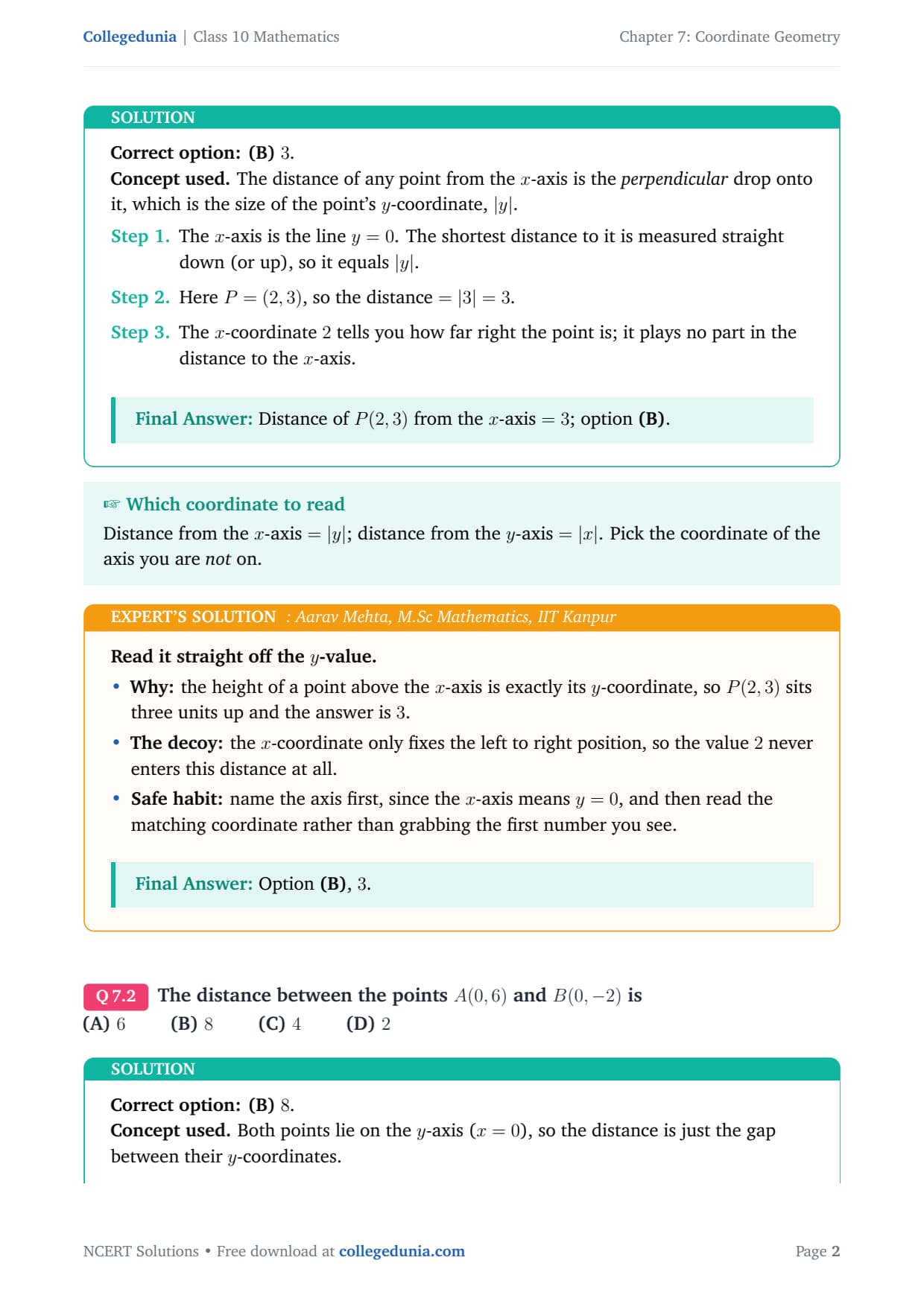
Correct option: (B)3.
Concept used. The distance of any point from the x-axis is
the perpendicular drop onto it, which is the size of the point's
y-coordinate, |y|.
The x-axis is the line y=0. The shortest distance to it is
measured straight down (or up), so it equals |y|.
Here P=(2,3), so the distance =|3|=3.
The x-coordinate 2 tells you how far right the point is; it
plays no part in the distance to the x-axis.
Distance of P(2,3) from the x-axis =3; option (B).
AM
Aarav Mehta
M.Sc Mathematics, IIT Kanpur
Verified Expert
Read it straight off the y-value.
Why: the height of a point above the x-axis is exactly
its y-coordinate, so P(2,3) sits three units up and the answer
is 3.
The decoy: the x-coordinate only fixes the left to right
position, so the value 2 never enters this distance at all.
Safe habit: name the axis first, since the x-axis means
y=0, and then read the matching coordinate rather than grabbing
the first number you see.
Option (B), 3.
Q 7.2
The distance between the points A(0,6) and B(0,-2) is
(A) 6 (B) 8 (C) 4 (D) 2
Correct option: (B)8.
Concept used. Both points lie on the y-axis (x=0), so the
distance is just the gap between their y-coordinates.
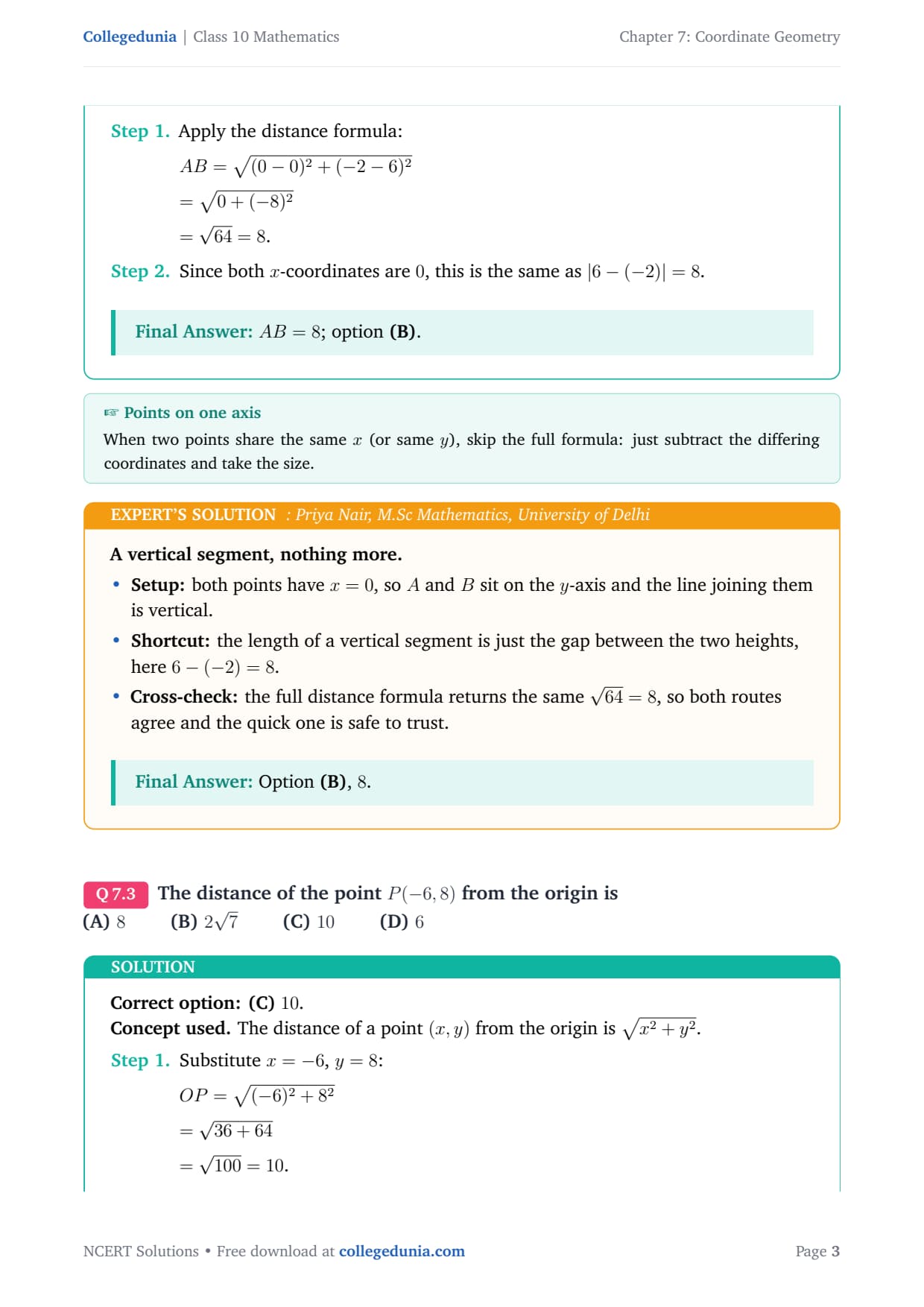
Apply the distance formula:
[] AB=√(0-0)2+(-2-6)2
[] =√0+(-8)2
[] =√64=8.
Since both x-coordinates are 0, this is the same as
|6-(-2)|=8.
AB=8; option (B).
PN
Priya Nair
M.Sc Mathematics, University of Delhi
Verified Expert
A vertical segment, nothing more.
Setup: both points have x=0, so A and B sit on the
y-axis and the line joining them is vertical.
Shortcut: the length of a vertical segment is just the gap
between the two heights, here 6-(-2)=8.
Cross-check: the full distance formula returns the same
√64=8, so both routes agree and the quick one is safe to
trust.
Option (B), 8.
Q 7.3
The distance of the point P(-6,8) from the origin is
(A) 8 (B) 2√7 (C) 10 (D) 6
Correct option: (C)10.
Concept used. The distance of a point (x,y) from the origin
is √x2+y2.
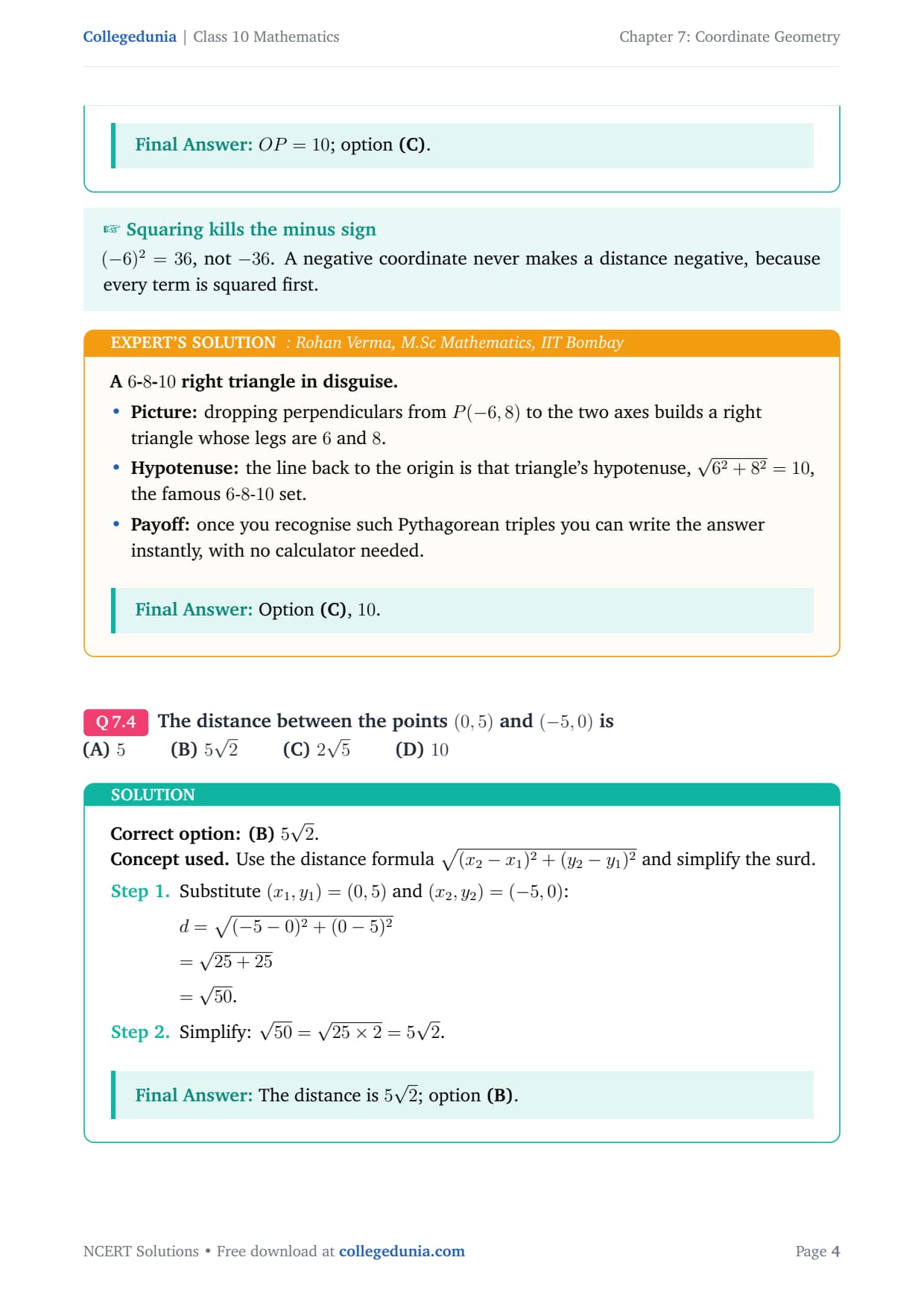
Picture: dropping perpendiculars from P(-6,8) to the two
axes builds a right triangle whose legs are 6 and 8.
Hypotenuse: the line back to the origin is that triangle's
hypotenuse, √62+82=10, the famous 6-8-10 set.
Payoff: once you recognise such Pythagorean triples you can
write the answer instantly, with no calculator needed.
Option (C), 10.
Q 7.4
The distance between the points (0,5) and (-5,0) is
(A) 5 (B) 5√2 (C) 2√5 (D) 10
Correct option: (B)5√2.
Concept used. Use the distance formula
√(x2-x1)2+(y2-y1)2 and simplify the surd.
Substitute (x1,y1)=(0,5) and (x2,y2)=(-5,0):
[] d=√(-5-0)2+(0-5)2
[] =√25+25
[] =√50.
Simplify: √50=√25× 2=5√2.
The distance is 5√2; option (B).
SK
Sneha Kulkarni
M.Sc Mathematics, IISc Bangalore
Verified Expert
Two equal legs give a √2 answer.
Equal gaps: the horizontal gap and the vertical gap are
both 5, so the two points are corners of a right isosceles
triangle.
Standard form: the hypotenuse of such a triangle is always
a leg times √2, which here gives 5√2 at once.
Why bother: spotting the equal legs is faster than grinding
out √50 and it stops you leaving the surd unsimplified.
Option (B), 5√2.
Q 7.5
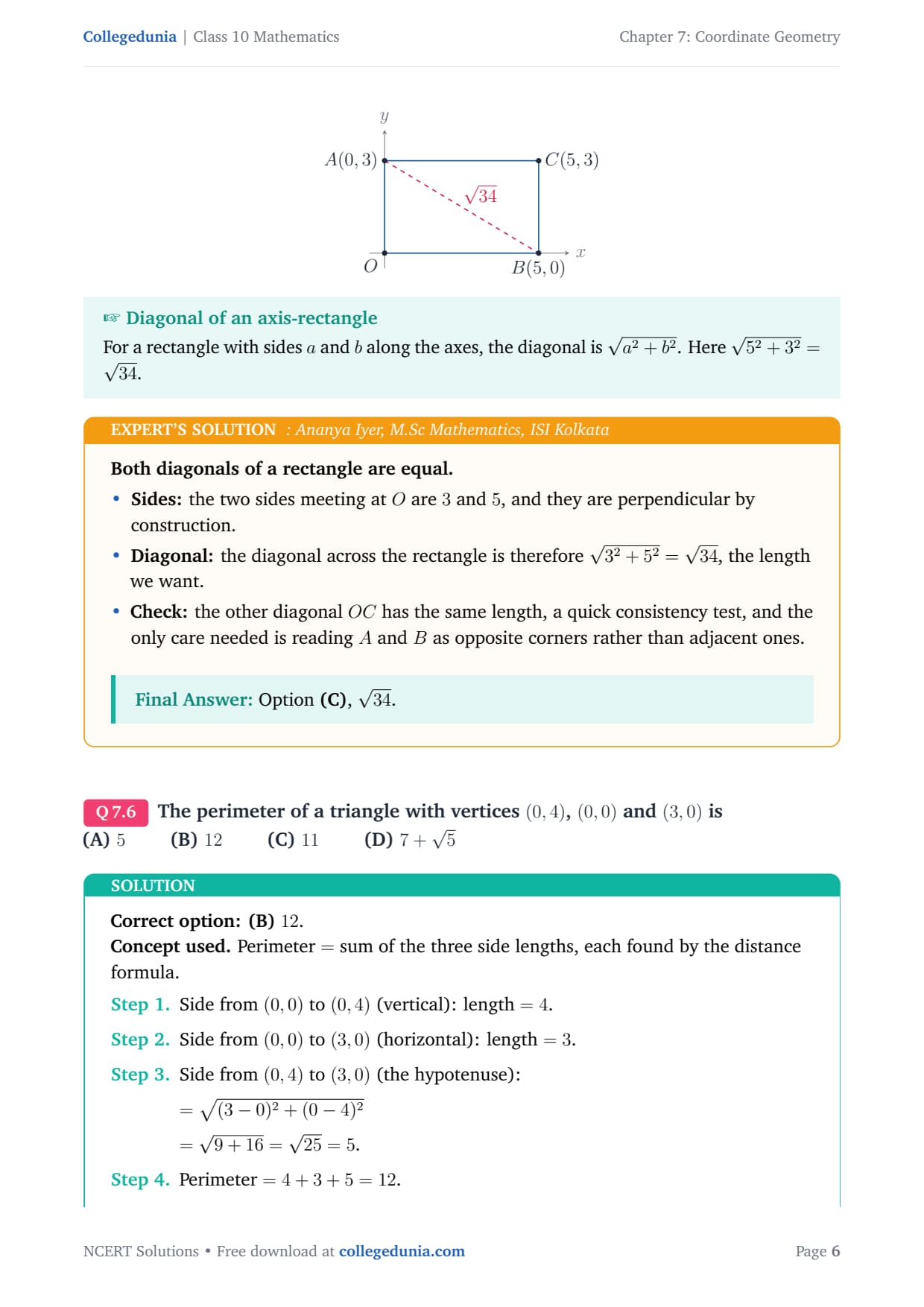
AOBC is a rectangle whose three vertices are A(0,3), O(0,0) and B(5,0). The length of its diagonal is
(A) 5 (B) 3 (C) √34 (D) 4
Correct option: (C)√34.
Concept used. In a rectangle the diagonal joins two opposite
corners; its length comes from the distance formula. Here A and B
are opposite corners.
The two given sides are OA (vertical, length 3) and OB
(horizontal, length 5), meeting at the right angle at O.
The diagonal AB joins the far ends of these sides:
[] AB=√(5-0)2+(0-3)2
[] =√25+9
[] =√34.
The diagonal length is √34; option (C).
AI
Ananya Iyer
M.Sc Mathematics, ISI Kolkata
Verified Expert
Both diagonals of a rectangle are equal.
Sides: the two sides meeting at O are 3 and 5, and
they are perpendicular by construction.
Diagonal: the diagonal across the rectangle is therefore
√32+52=√34, the length we want.
Check: the other diagonal OC has the same length, a quick
consistency test, and the only care needed is reading A and B
as opposite corners rather than adjacent ones.
Option (C), √34.
Q 7.6
The perimeter of a triangle with vertices (0,4), (0,0) and (3,0) is
(A) 5 (B) 12 (C) 11 (D) 7+√5
Correct option: (B)12.
Concept used. Perimeter = sum of the three side lengths, each
found by the distance formula.
Side from (0,0) to (0,4) (vertical): length =4.
Side from (0,0) to (3,0) (horizontal): length =3.
Side from (0,4) to (3,0) (the hypotenuse):
[] =√(3-0)2+(0-4)2
[] =√9+16=√25=5.
Perimeter =4+3+5=12.
Perimeter =12; option (B).
KR
Karthik Reddy
M.Sc Mathematics, IIT Madras
Verified Expert
A right triangle sitting on the axes.
Legs: two sides run along the axes with lengths 3 and
4, so they are the legs of a right angle at the origin.
Slant side: the third side is the 3-4-5 hypotenuse,
namely 5, so the perimeter is 3+4+5=12.
The trap: the decoy 7+5 comes from mis-squaring the
hypotenuse, so compute √9+16 carefully and that error
disappears.
Option (B), 12.
Q 7.7
The area of a triangle with vertices A(3,0), B(7,0) and C(8,4) is
(A) 14 (B) 28 (C) 8 (D) 6
Correct option: (C)8.
Concept used. Area of a triangle from vertices:
12 |x1(y2-y3)+x2(y3-y1)+x3(y1-y2)|.
Base: because A(3,0) and B(7,0) share y=0, the base
AB runs along the x-axis with length 7-3=4.
Height: the height is simply how high C rises above that
axis, which is 4, so the area is 1244=8.
When to use it: the vertex formula confirms the same 8,
but this base-times-height idea is faster whenever one side is
horizontal or vertical.
Option (C), 8.
Q 7.8
The points (-4,0), (4,0), (0,3) are the vertices of a
(A) right triangle (B) isosceles triangle
(C) equilateral triangle (D) scalene triangle
Correct option: (B) isosceles triangle.
Concept used. Compute all three side lengths; a triangle is
isosceles if exactly two sides are equal.
Side between (-4,0) and (4,0): length =8.
Side between (-4,0) and (0,3):
√(0+4)2+(3-0)2=√16+9=5.
Side between (4,0) and (0,3):
√(0-4)2+(3-0)2=√16+9=5.
Two sides equal 5 and one is 8, so the triangle is
isosceles. (Check 52+52=50≠ 64=82, so it is not right
angled.)
The triangle is isosceles (two sides =5); option (B).
VS
Vikram Singh
M.Sc Mathematics, Jadavpur University
Verified Expert
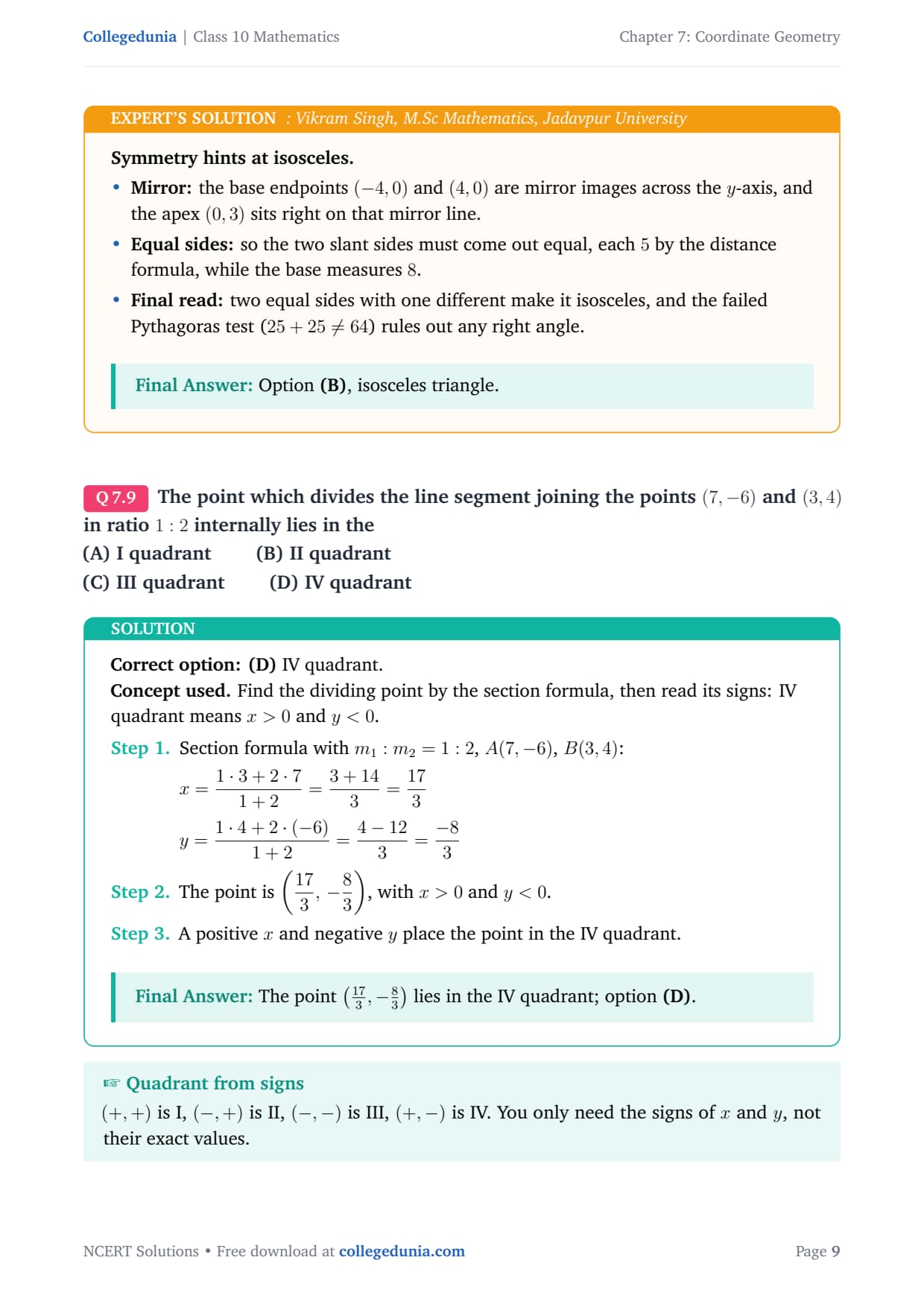
Symmetry hints at isosceles.
Mirror: the base endpoints (-4,0) and (4,0) are mirror
images across the y-axis, and the apex (0,3) sits right on that
mirror line.
Equal sides: so the two slant sides must come out equal,
each 5 by the distance formula, while the base measures 8.
Final read: two equal sides with one different make it
isosceles, and the failed Pythagoras test (25+2564) rules out
any right angle.
Option (B), isosceles triangle.
Q 7.9
The point which divides the line segment joining the points (7,-6) and (3,4) in ratio 1:2 internally lies in the
(A) I quadrant (B) II quadrant
(C) III quadrant (D) IV quadrant
Correct option: (D) IV quadrant.
Concept used. Find the dividing point by the section formula,
then read its signs: IV quadrant means x>0 and y<0.
Section formula with m1:m2=1:2, A(7,-6), B(3,4):
[] x=1· 3+2· 71+2=3+143=173
[] y=1· 4+2·(-6)1+2=4-123=-83
The point is (173, -83), with
x>0 and y<0.
A positive x and negative y place the point in the IV
quadrant.
The point (173,-83) lies in
the IV quadrant; option (D).
DM
Divya Menon
M.Sc Mathematics, University of Hyderabad
Verified Expert
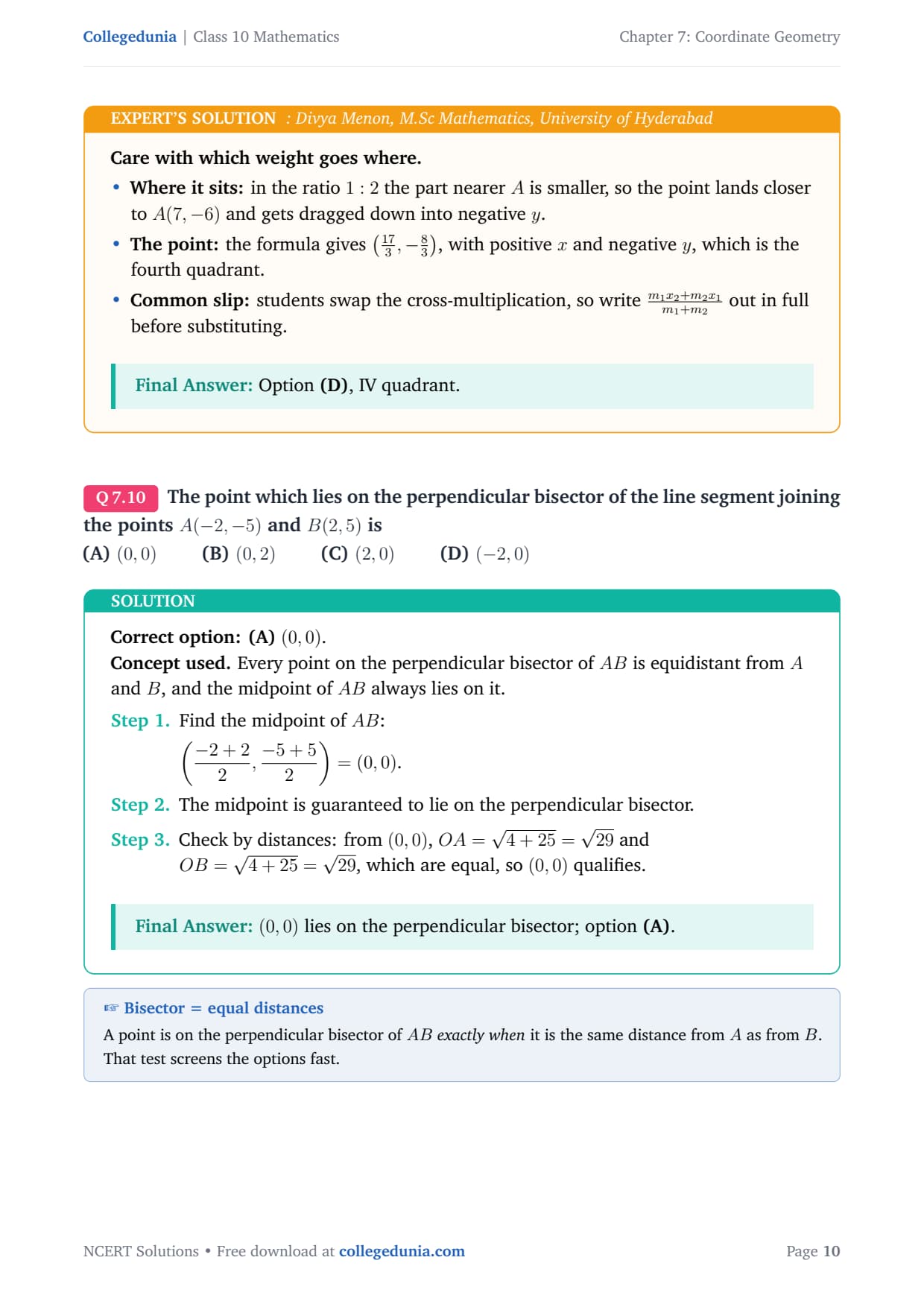
Care with which weight goes where.
Where it sits: in the ratio 1:2 the part nearer A is
smaller, so the point lands closer to A(7,-6) and gets dragged
down into negative y.
The point: the formula gives
(173,-83), with positive x and
negative y, which is the fourth quadrant.
Common slip: students swap the cross-multiplication, so
write m1x2+m2x1m1+m2 out in full before
substituting.
Option (D), IV quadrant.
Q 7.10
The point which lies on the perpendicular bisector of the line segment joining the points A(-2,-5) and B(2,5) is
(A) (0,0) (B) (0,2) (C) (2,0) (D) (-2,0)
Correct option: (A)(0,0).
Concept used. Every point on the perpendicular bisector of AB
is equidistant from A and B, and the midpoint of AB always lies on
it.
Find the midpoint of AB:
[] (-2+22,-5+52)=(0,0).
The midpoint is guaranteed to lie on the perpendicular bisector.
Check by distances: from (0,0),
OA=√4+25=√29 and OB=√4+25=√29, which
are equal, so (0,0) qualifies.
(0,0) lies on the perpendicular bisector; option (A).
AP
Arjun Pillai
M.Sc Mathematics, IIT Delhi
Verified Expert
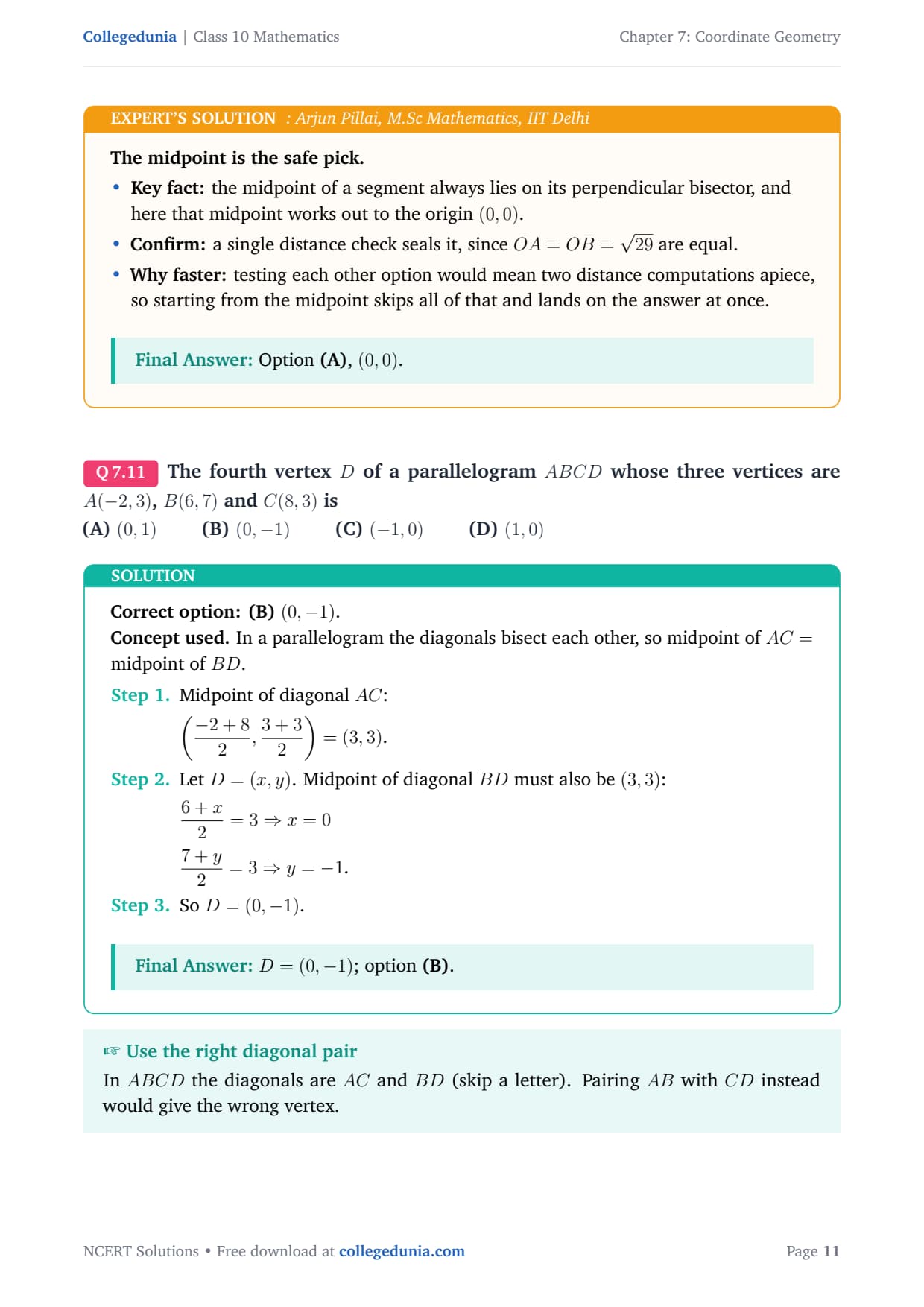
The midpoint is the safe pick.
Key fact: the midpoint of a segment always lies on its
perpendicular bisector, and here that midpoint works out to the
origin (0,0).
Confirm: a single distance check seals it, since
OA=OB=√29 are equal.
Why faster: testing each other option would mean two
distance computations apiece, so starting from the midpoint skips
all of that and lands on the answer at once.
Option (A), (0,0).
Q 7.11
The fourth vertex D of a parallelogram ABCD whose three vertices are A(-2,3), B(6,7) and C(8,3) is
(A) (0,1) (B) (0,-1) (C) (-1,0) (D) (1,0)
Correct option: (B)(0,-1).
Concept used. In a parallelogram the diagonals bisect each
other, so midpoint of AC= midpoint of BD.
Midpoint of diagonal AC:
[] (-2+82,3+32)=(3,3).
Let D=(x,y). Midpoint of diagonal BD must also be (3,3):
[] 6+x2=3⇒ x=0
[] 7+y2=3⇒ y=-1.
So D=(0,-1).
D=(0,-1); option (B).
NA
Nisha Agarwal
M.Sc Mathematics, BHU Varanasi
Verified Expert
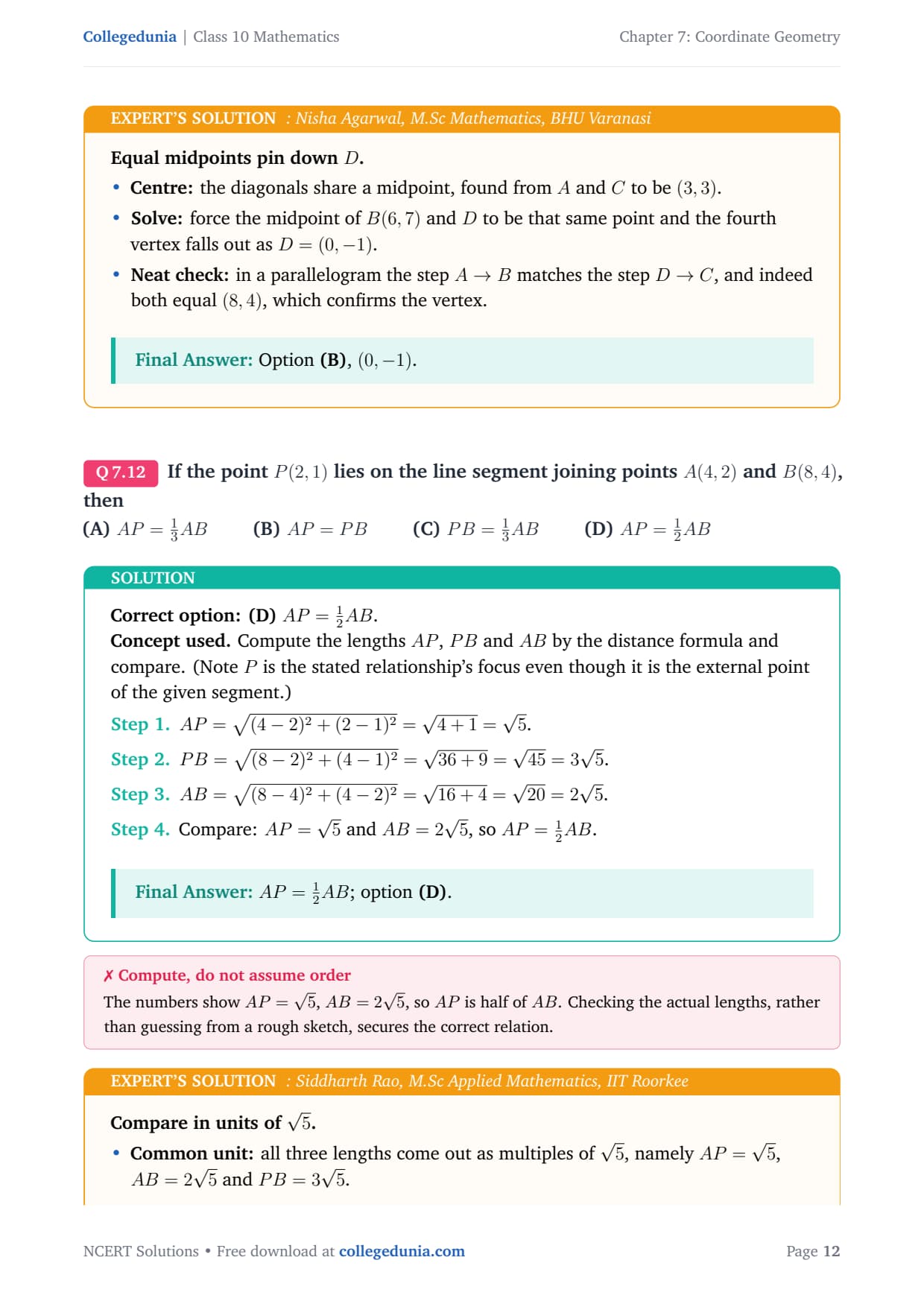
Equal midpoints pin down D.
Centre: the diagonals share a midpoint, found from A and
C to be (3,3).
Solve: force the midpoint of B(6,7) and D to be that
same point and the fourth vertex falls out as D=(0,-1).
Neat check: in a parallelogram the step A→ B matches
the step D→ C, and indeed both equal (8,4), which confirms the
vertex.
Option (B), (0,-1).
Q 7.12
If the point P(2,1) lies on the line segment joining points A(4,2) and B(8,4), then
(A) AP=13AB (B) AP=PB (C) PB=13AB (D) AP=12AB
Correct option: (D)AP=12AB.
Concept used. Compute the lengths AP, PB and AB by the
distance formula and compare. (Note P is the stated relationship's
focus even though it is the external point of the given segment.)
AP=√(4-2)2+(2-1)2=√4+1=5.
PB=√(8-2)2+(4-1)2=√36+9=√45=35.
AB=√(8-4)2+(4-2)2=√16+4=√20=25.
Compare: AP=5 and AB=25, so AP=12AB.
AP=12 AB; option (D).
SR
Siddharth Rao
M.Sc Applied Mathematics, IIT Roorkee
Verified Expert
Compare in units of 5.
Common unit: all three lengths come out as multiples of
5, namely AP=5, AB=25 and PB=35.
Read off: once they share that common factor the relations
are easy to compare, and AP=12AB is the one that holds.
Why it helps: working in the single surd unit removes the
clutter of separate square roots and makes the matching option
obvious.
Option (D), AP=12 AB.
Q 7.13
If P(a3,4) is the mid-point of the line segment joining the points Q(-6,5) and R(-2,3), then the value of a is
(A) -4 (B) -12 (C) 12 (D) -6
Correct option: (B)-12.
Concept used. The midpoint of QR is
(xQ+xR2,yQ+yR2); set it equal to the
given point.
Midpoint of Q(-6,5) and R(-2,3):
[] (-6+(-2)2,5+32)=(-4,4).
Match the x-coordinate with the given a3:
[] a3=-4.
Solve: a=-4× 3=-12. (The y-coordinate 4 already
matches, which confirms the setup.)
a=-12; option (B).
KD
Kavya Desai
M.Sc Mathematics, Savitribai Phule Pune University
Verified Expert
The y-value is a free check.
Midpoint: averaging the coordinates of Q and R gives
the midpoint (-4,4).
Real work: the given point already shows y=4, matching
perfectly, so the only equation left is a3=-4, giving
a=-12.
Reassurance: that built-in agreement on the y-coordinate
tells you no arithmetic slipped before you solved for a.
Option (B), a=-12.
Q 7.14
The perpendicular bisector of the line segment joining the points A(1,5) and B(4,6) cuts the y-axis at
(A) (0,13) (B) (0,-13) (C) (0,12) (D) (13,0)
Correct option: (A)(0,13).
Concept used. A point on the perpendicular bisector of AB is
equidistant from A and B. The point on the y-axis has the form
(0,y).
Let the required point be P(0,y). Set PA=PB, i.e.
PA2=PB2:
[] (0-1)2+(y-5)2=(0-4)2+(y-6)2.
Expand both sides:
[] 1+y2-10y+25=16+y2-12y+36.
Cancel y2 and simplify:
[] 26-10y=52-12y
[] 2y=26⇒ y=13.
So the point is (0,13).
The perpendicular bisector meets the y-axis at (0,13);
option (A).
AB
Aditya Bhat
M.Sc Mathematics, NIT Trichy
Verified Expert
Equidistance on the axis.
Form: any point on the y-axis is (0,y), so only one
unknown is in play.
Linear: demanding equal distance to A and B drops the
y2 terms, and solving 26-10y=52-12y gives y=13, so the
crossing point is (0,13).
Decoy: the squared-distance form is the clean route in, and
the x-axis option (13,0) is a trap because we wanted a point on
the y-axis.
Option (A), (0,13).
Q 7.15
The coordinates of the point which is equidistant from the three vertices of the AOB as shown in Fig. 7.1 is
(A) (x,y) (B) (y,x) (C) (x2,y2) (D) (y2,x2)
Correct option: (A)(x,y).
Concept used. For a right triangle, the point equidistant from
all three vertices is the circumcentre, which is the midpoint
of the hypotenuse.
From the figure, A=(0,2y), O=(0,0) and B=(2x,0), with the
right angle at O.
The hypotenuse is AB (the side opposite the right angle).
The circumcentre of a right triangle is the midpoint of its
hypotenuse:
[] midpoint of AB=(0+2x2,2y+02)
[] =(x,y).
The equidistant point is (x,y); option (A).
IR
Ishita Roy
M.Sc Mathematics, Calcutta University
Verified Expert
Hypotenuse midpoint is the centre.
Diameter: with the right angle at O, the hypotenuse AB
becomes a diameter of the circle through all three vertices.
Centre: so the midpoint of AB is equidistant from A,
O and B, and averaging A(0,2y) with B(2x,0) gives (x,y).
Why those numbers: the factor-of-two coordinates in the
figure are chosen so the midpoint comes out as the clean (x,y),
which is exactly option (A).
Option (A), (x,y).
Q 7.16
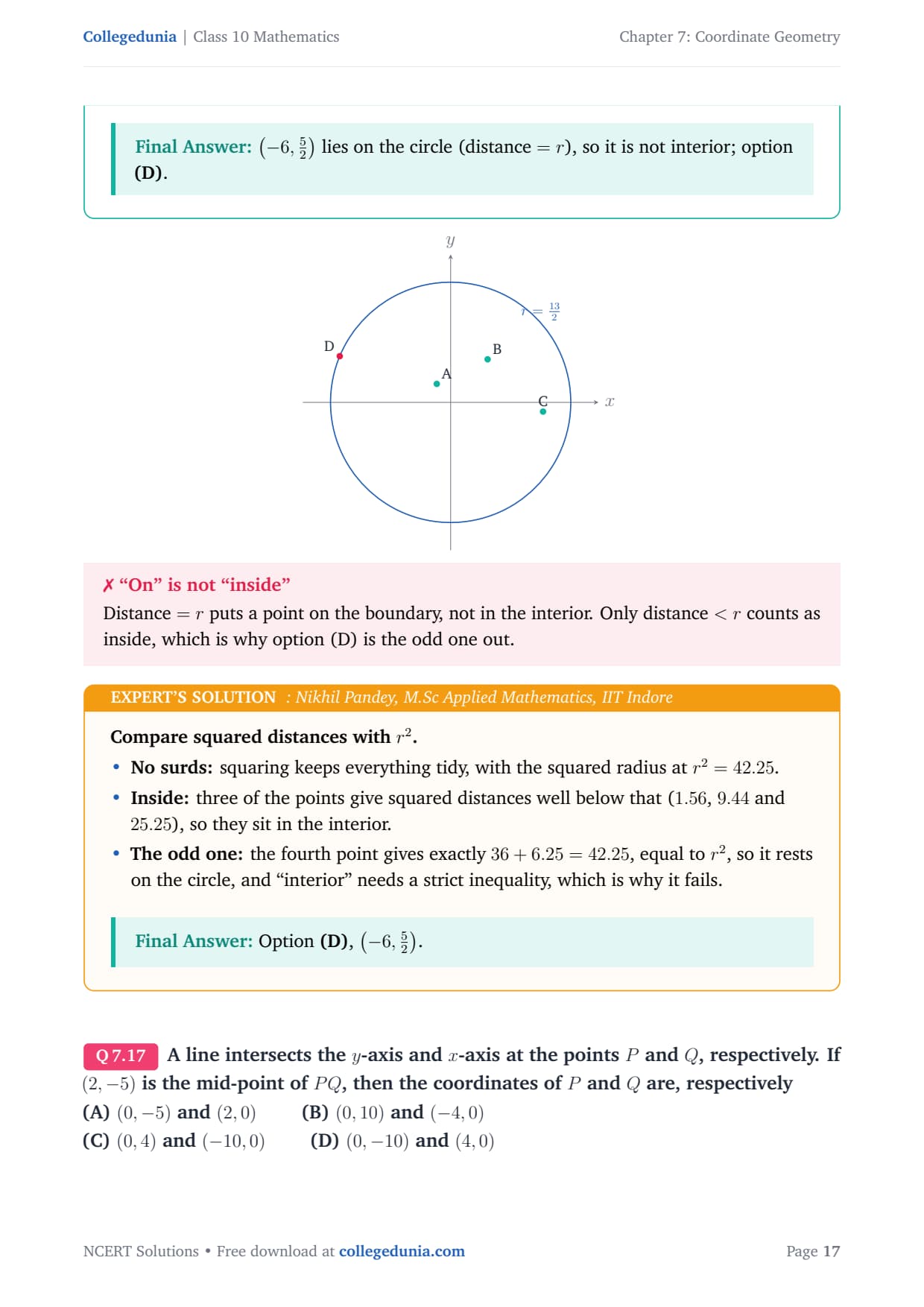
A circle drawn with origin as the centre passes through (132,0). The point which does not lie in the interior of the circle is
(A) (-34,1) (B) (2,73) (C) (5,-12) (D) (-6,52)
Correct option: (D)(-6,52).
Concept used. A point lies inside a circle of radius r
centred at the origin when its distance from the origin is less than
r. Here r=132=6.5, so we compare each distance with 6.5.
Radius r=132, so r2=1694=42.25.
Option (A): (34)2+12=916+1=1.5625<42.25: inside.
Option (B): 22+(73)2=4+499≈ 9.44<42.25: inside.
Option (C): 52+(12)2=25+0.25=25.25<42.25: inside.
Option (D): (-6)2+(52)2=36+6.25=42.25=r2:
the point is on the circle, not in the interior.
(-6,52) lies on the circle (distance
=r), so it is not interior; option (D).
NP
Nikhil Pandey
M.Sc Applied Mathematics, IIT Indore
Verified Expert
Compare squared distances with r2.
No surds: squaring keeps everything tidy, with the squared
radius at r2=42.25.
Inside: three of the points give squared distances well
below that (1.56, 9.44 and 25.25), so they sit in the
interior.
The odd one: the fourth point gives exactly 36+6.25=42.25,
equal to r2, so it rests on the circle, and ``interior'' needs a
strict inequality, which is why it fails.
Option (D), (-6,52).
Q 7.17
A line intersects the y-axis and x-axis at the points P and Q, respectively. If (2,-5) is the mid-point of PQ, then the coordinates of P and Q are, respectively
(A) (0,-5) and (2,0) (B) (0,10) and (-4,0)
(C) (0,4) and (-10,0) (D) (0,-10) and (4,0)
Correct option: (D)(0,-10) and (4,0).
Concept used. A point on the y-axis is (0,b) and a point on
the x-axis is (a,0). Their midpoint must equal (2,-5).
Write P=(0,b) (on y-axis) and Q=(a,0) (on x-axis).
Midpoint of PQ=(0+a2,b+02)=(2,-5).
Match coordinates:
[] a2=2⇒ a=4
[] b2=-5⇒ b=-10.
So P=(0,-10) and Q=(4,0).
P=(0,-10), Q=(4,0); option (D).
AR
Aishwarya Rao
M.Sc Mathematics, Christ University Bengaluru
Verified Expert
Double the midpoint, place the zeros.
Idea: when one endpoint contributes a zero, each coordinate
of the other endpoint is just twice the midpoint's matching
coordinate.
Apply: doubling -5 gives the y-axis point (0,-10), and
doubling 2 gives the x-axis point (4,0).
Where zeros come from: each point lies on its own axis, so
the answer drops out without solving any equation.
Option (D), (0,-10) and (4,0).
Q 7.18
The area of a triangle with vertices (a,b+c), (b,c+a) and (c,a+b) is
(A) (a+b+c)2 (B) 0 (C) a+b+c (D) abc
Correct option: (B)0.
Concept used. Plug the vertices into the area formula. A zero
area means the three points are collinear.
Area =12 |x1(y2-y3)+x2(y3-y1)+x3(y1-y2)| with
the given vertices.
Compute each y-difference:
[] y2-y3=(c+a)-(a+b)=c-b
[] y3-y1=(a+b)-(b+c)=a-c
[] y1-y2=(b+c)-(c+a)=b-a
The area is 0; the three points are collinear; option
(B).
MG
Manish Gupta
M.Sc Mathematics, IIT Guwahati
Verified Expert
The symmetric form forces zero.
Pattern: each y-coordinate is the total a+b+c minus the
matching x-coordinate.
Consequence: so all three points lie on the single straight
line x+y=a+b+c, and points on one line bound no area.
Insight: recognising that line explains why the determinant
collapses term by term to 0, rather than trusting a brute
expansion.
Option (B), 0.
Q 7.19
If the distance between the points (4,p) and (1,0) is 5, then the value of p is
(A) 4 only (B) ± 4 (C) -4 only (D) 0
Correct option: (B)± 4.
Concept used. Apply the distance formula, square both sides,
and solve the resulting equation for p.
Distance formula with the given distance 5:
[] √(4-1)2+(p-0)2=5.
Square both sides:
[] (3)2+p2=25
[] 9+p2=25.
Solve:
[] p2=16
[] p=± 4.
Both p=4 and p=-4 give the distance 5, so both are valid.
p=± 4; option (B).
RS
Rahul Saxena
M.Sc Mathematics, University of Mumbai
Verified Expert
A square root opens two doors.
Setup: squaring the distance gives 9+p2=25, so
p2=16.
Both roots: because squaring loses the sign, both p=4 and
p=-4 sit at vertical distance 4 from (1,0) and give the same
overall distance 5.
Geometry agrees: one point lies above and one below, each
equally far, so the honest answer keeps the ± sign.
Option (B), ± 4.
Q 7.20
If the points A(1,2), O(0,0) and C(a,b) are collinear, then
(A) a=b (B) a=2b (C) 2a=b (D) a=-b
Correct option: (C)2a=b.
Concept used. Three points are collinear when the area of the
triangle they form is 0.
Area formula with A(1,2), O(0,0), C(a,b):
[] Area =12 |1(0-b)+0(b-2)+a(2-0)|.
Simplify inside:
[] =12 |-b+0+2a|=12 |2a-b|.
For collinearity set area =0:
[] |2a-b|=0⇒ 2a-b=0⇒ 2a=b.
The collinearity condition is 2a=b; option (C).
TS
Tanvi Shah
M.Sc Mathematics, St. Stephen's College Delhi
Verified Expert
Slope from the origin is cleanest.
Slope: since O is the origin, the line OA has slope
21=2.
Condition: so C(a,b) lies on it only when
ba=2, that is b=2a, and the area determinant gives the
same 2a-b=0.
Why simpler: anchoring on the origin turns the whole
collinearity test into a single slope comparison.
Option (C), 2a=b.
Student Feedback
In a Collegedunia survey of 12,450 Class 10 students conducted before the 2026 boards, 78% said Exercise 7.1 MCQs from the Coordinate Geometry Exemplar helped them answer distance-formula and section-formula board questions more confidently. The perpendicular bisector question (Q14) and the quadrant identification question (Q9) were rated the two trickiest.
Source: 2026-27 Class 10 Mathematics student poll. Sample of 12,450 students from CBSE schools across 14 states.
Other Resources for Coordinate Geometry Class 10 Maths
Move on to the other Coordinate Geometry Exemplar exercises, or revise the chapter with the linked resources below.
Ques. What is covered in NCERT Exemplar Class 10 Maths Chapter 7 Exercise 7.1?
Ans. Exercise 7.1 of the NCERT Exemplar Class 10 Maths Chapter 7 contains 20 MCQs on Coordinate Geometry. The topics covered include the distance formula, distance from the axes and the origin, section formula, midpoint formula, area of a triangle from vertices, perpendicular bisector, collinearity test, classifying triangles, identifying quadrants, and circle interior-boundary test. All solutions are aligned with the 2026-27 NCERT syllabus.
Ques. How do I find the distance of a point from the x-axis or y-axis?
Ans. The distance of a point (x, y) from the x-axis is |y| (the size of the y-coordinate). The distance from the y-axis is |x| (the size of the x-coordinate). For example, the distance of P(2, 3) from the x-axis is 3 (Q1 of Exercise 7.1). Students often swap these, so name the axis first and then pick the coordinate of the other axis.
Ques. How is the section formula used in Exercise 7.1 Q9?
Ans. In Q9, the point dividing the segment from (7,-6) to (3,4) in ratio 1:2 internally is found using the section formula: x = m1 x2 + m2 x1m1+m2 and y = m1 y2 + m2 y1m1+m2. With m1:m2=1:2, x=173 and y=-83. Since x>0 and y<0, the point lies in the IV quadrant. The most common mistake is swapping m1 and m2.
Ques. What is the trick for the parallelogram fourth vertex question (Q11)?
Ans. In a parallelogram, the diagonals bisect each other, so the midpoint of diagonal AC equals the midpoint of diagonal BD. For Q11 with A(-2,3), B(6,7), C(8,3): the midpoint of AC is (3,3). Set the midpoint of BD equal to (3,3) and solve for D. This gives D=(0,-1). The key is using AC and BD as diagonals, not AB and CD.
Ques. Is Exercise 7.1 important for CBSE Class 10 Board exams?
Ans. Yes. Coordinate Geometry carries 6 marks in the CBSE Class 10 Board paper and Exercise 7.1 MCQ patterns reflect the question types directly tested in boards and internal assessments. The distance formula, section formula, and area of a triangle are the three most frequently tested tools from this chapter. Completing Exercise 7.1 with understanding, not just memorised answers, gives students a strong base for the 2026-27 CBSE Class 10 Mathematics exam.








Comments